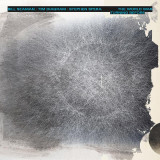
Gatefold single vinyl LP with an 8 page 12" size bookelt in the other side of the gatefold.
We're thrilled to announce the return of Tobor Experiment, the visionary musical project led by the enigmatic Giorgio Sancristoforo, to the Bearfunk fold. After a twelve-year hiatus, Tobor Experiment emerges from the shadows with their second LP, "Available Forms". Picture the ethereal ambiance of a dimly lit jazz club colliding with the futuristic vibrations of a 1970s sci-fi TV show, and you'll begin to grasp the sonic experience that awaits. Giorgio draws on a whole host of musical inspirations, from the name checked Tim Gane & Letitia Sadier to the moog pioneers Claude Denjean & Jean Jaques Perrey. With the moogsploration of contemporary jazz Tobor Experiment invites listeners on an extraordinary musical odyssey where jazz meets electronica meets nu-disco.
Prepare to be captivated from the very first note of the infectious opener, "Lowpass Risotto" as Tobor Experiment masterfully combines familiar elements with their unique artistic vision. Resonating with undertones reminiscent of the timeless classic "Take Five" the track immediately grabs your attention. While the familiar drum shuffle sets a comforting foundation, Tobor Experiment takes an unexpected twist by infusing the composition with squelchy Moog lines and captivating hollow body guitar solos. The result is a harmonious blend of nostalgia and innovation that transports you to an entirely new sonic realm.
Continuing the journey, the mesmerizing 6/8 rhythm of "Up!" pays homage to the iconic sounds of Stereolab while showcasing Tobor Experiment's innovative spirit. As enchanting synth pads weave through the air, you find yourself immersed in a dream-like state, carried away by the hypnotic shifting patterns of the bass and drums.
With "Astounding Stories" Tobor Experiment returns to the energetic vibes of the album opener, inviting you to surrender to a sonic tapestry rich with musical exchanges. In traditional jazz style we receive solo's from all parties. Each instrument adding its unique voice to the narrative, creating a dynamic and engaging musical conversation.
As the album progresses, "Moonscape Dust" emerges, drawing inspiration from the atmospheric brilliance of "Low." This track serves as a portal to an otherworldly sonic landscape where time and space lose their hold. Here, organic drums step aside, making way for a low-fi drum pattern that lays the foundation for ethereal synth pads. The composition invites you to explore the depths of your imagination, transcending earthly boundaries and allowing you to float in an immersive soundscape.
The album's closing track, "Monsters" has an air of "Air" about it... the ethereal synths beckon you to surrender to the weightlessness of space, just allow yourself to be carried away by the infectious rhythms, intricate melodies, and atmospheric textures that shape this extraordinary musical journey.
Each track on "Available Forms" showcases Tobor Experiment's exceptional ability to transcend musical boundaries, creating a genre-bending album that defies all expectations. From start to finish, the soundscape presented is a testament to Tobor's relentless pursuit of musical innovation. Each composition is a fusion of diverse elements, seamlessly blending organic instruments and electronic textures in a way that challenges traditional genre classifications.
The AI-generated artwork serves as a portal to an alternate dimension. Paying homage to the retro-futuristic aesthetic of 1970s science fiction TV shows, it captures the essence of the album's fusion between organic and electronic realms.
Поиск:tape five
Все
Drummer and composer Tony Williams’ adventurous 1965 album Spring—his second as a leader for Blue Note—found him convening a stellar line-up with saxophonists Wayne Shorter and Sam Rivers, pianist Herbie Hancock, and bassist Gary Peacock. The five Williams originals presented here offer the musicians spacious realms in which to go exploring.
This Blue Note Classic Vinyl Edition is stereo, all-analog, mastered by Kevin Gray from the original master tapes, and pressed on 180g vinyl at Optimal.
The tenor sax master attacks five standards and in the process produces some of
his most intense performances on record. Taped at the Van Gelder Studio in one
marathon session on July 8th 1965, this electrifying Impulse! Records debut also
featured Ray Bryant on piano and Mickey Roker on drums.
"One of the more remarkable albums in Freddie Hubbard’s formidable Blue Note oeuvre, Breaking Point! was recorded in May 1964 shortly after the trumpeter left Art Blakey’s Jazz Messengers to form his own band. The quintet—with James Spaulding on alto saxophone and flute, Ronnie Mathews on piano, Eddie Khan on bass, and Joe Chambers on drums—moves assuredly from free-form playing and modal jazz to the blues and balladry on this five-song set of originals by Hubbard and Chambers.
This stereo Tone Poet Vinyl Edition was produced by Joe Harley, mastered by Kevin Gray from the original analog master tapes, pressed on 180g vinyl at RTI, and packaged in a deluxe gatefold tip-on jacket."
Julian Cannonball Adderley's only Blue Note album, Somethin' Else, would likely forever be famous in music lore if just for the presence of Miles Davis. The iconic composer/trumpeter steps into the role of sideman on the 1958 set, one of just a handful of times he'd make such a move after the calendar passed the mid-1950s. Yet evaluating Somethin' Else strictly on Davis' involvement misses the big picture. Plain and simple, Adderley's jubilant work remains a jazz landmark due to the chemistry of its Hall of Fame personnel, enthusiasm of its participants, and sophistication of its arrangements – not to mention the reference-grade production and inclusion of the definitive renditions of two all-time jazz standards.
Limited to 6,000 numbered copies, pressed on dead-quiet MoFi SuperVinyl at RTI, and mastered from the original master tapes, Mobile Fidelity's ultra-hi-fi UltraDisc One-Step 180g 45RPM 2LP collector's edition pays tribute to the record's merit and includes the bonus track "Allison's Uncle." Offering reference-calibre sonics, this spectacular collector's version provides a clear, transparent, ultra-dynamic, and up-close view of a cornerstone effort that witnesses Adderley and Davis sharing horn duty alone for the only time in their fabled careers – an arrangement that occurred as a result of Adderley having joined Davis' majestic sextet a year prior.
The premium packaging and beautiful presentation of the UD1S Somethin' Else pressing befit its extremely select status. Housed in a deluxe slipcase, it features special foil-stamped jackets and faithful-to-the-original graphics that illuminate the splendour of the recording. No expense has been spared. Aurally and visually, this UD1S reissue exists as a curatorial artefact meant to be preserved, touched, and examined. It is made for discerning listeners that prize sound quality and production, and who desire to fully immerse themselves in the art – and everything involved with the album, from the iconic photos to the gorgeous finishes.
The vibrant potency reveals itself openly on an analogue set that provides full-range reproduction of an ensemble that also includes pianist Hank Jones, bassist Sam Jones, and drummer Art Blakey. Each and every snare hit, downbeat, and cymbal splash registered by the latter take on realistic proportions, blooming and decaying as they would right in front of you on a stage. Jones' foundational bass lines register with uncommon depth and palpability, the litheness of the strings and fullness of the instrument epitomizing the definition of rhythm. Stellar, too, are the surefooted 88s. Sublime in scale, tonality, and attack, with the delineation such you can practically separate the white and black keys in your mind. As for that liquid interplay between Adderley and Davis? Breathtakingly lifelike in timbre, naturalism, purity, and presence. This collector's version takes you there – there being Rudy Van Gelder's legendary New Jersey studio in March 1958 to witness it all unfold, again and again.
For reasons that extend far beyond the outstanding playing and flawless repertoire, Somethin' Else is without question a record you'll always want to watch and hear come together. As veteran critic Bob Blumenthal observed writing about the album four decades after its release, "The instant rapport achieved by the quintet is thus the product of much shared and common history, though the tensile strength that they create throughout created a totally unique feeling that can be attributed to the sensitive musicianship of all concerned, including the supposedly hard bopping leader and drummer." Such inimitable feeling, or emotion, courses throughout every passage, and no where more obviously than on "Autumn Leaves" and "Love for Sale."
Without question, the discreet interpretations of the Johnny Mercer and Cole Porter songs, respectively, found on Somethin' Else have long been considered part of jazz's alluring mystique. Adderley and Davis bring contrasting approaches to the table yet sound of a singular mind on "Autumn Leaves," with the latter's muted trumpet and the headliner's lush alto saxophone dovetailing into a performance that endures as a blueprint for expression, counterpoint, sophistication, fluidity, and linearity. Blues, melody, and romance pour from their horns. Their bandmates, picking up on the intimate vibe and calm mood here – as well as on the spry, head-over-heels spirit of "Love for Sale" – join in on the conversation with sharp economy and float-on-air roundedness.
Not to undersell the other three numbers, all deserving five-star status. Twelve measures in length, the title track offers a slow burn in swing. Written by Adderley's brother, Nat, the 12-bar "One for Daddy-O" transmits funk flavors. The closing "Dancing in the Dark" pops with lushness and temptation, its stream of bold colours and understated textures calling for a moonlight twirl, or at least fantasies suggestive of a memorable night. Somethin' else, indeed.

Rare 1986 Funk/Soul From Alabama.
Originally released as a private pressed cassette tape only.
First Time On Vinyl.
Released in collaboration with the Numero Group.
180g BLACK vinyl limited to 500 copies w/obi strip. Non-Returnable.
Armed with little more than his Peavey T-60 guitar and a Jumbo Fuzz pedal, Errol Stubbs and his bar-band cohorts cranked out a self-released tape of funked-up disco soul in 1986. With no label or distribution to speak of, Errol would simply put on his best suit and sell the cassettes by hand. The tape languished into obscurity…until now!
The story of Errol Stubbs begins in Birmingham, Alabama in 1959. The youngest of five, he was surrounded by music as a child–his aunt taught piano at Daniel Payne College while his older brother, Avery Beavers, was an accomplished jazz trumpeter. Under the guidance of Avery, Errol started playing trumpet at the age of nine, though he gravitated toward songwriting and quickly picked up the guitar. Inspired by blues greats the likes of Albert King, Buddy Guy, and Little Milton, 12-year-old Errol began mimicking the sounds that filled southern airwaves. As a teenager, he played at barbecues, fish fries, and dive bars across the Magic City. After a brief stint at Jefferson State studying music, Errol’s passion for songwriting beckoned him away from the classroom.
Stubbs bounced around bar bands before settling on a live lineup and saving enough dough to take his vision to the recording studio. Over the course of two days, his well-rehearsed band recorded Turning it Out mostly live to tape at the Sound Of Birmingham Studio. Located on Birmingham’s east side, the state-of-the-art studio kept the lights on by recording commercial jingles but was more than happy to open their doors to local talent.
Taking notes from guitar god Ernie Isley and funk legend Rick James, the resulting recordings are drenched in cosmic phaser-fuzz guitar work, slapping bass lines, and sexual disco innuendos. Big brother Avery lends a hand on Clavinet for “Sweat,” while studio owner/engineer Don Mosley adds a tasteful dose of Moog synthesizer across a handful of cuts.
Soon after the Sound Of Birmingham sessions, Errol released the private pressed EP “Dancin’ Fancy,” b/w “Spaced Out On Your Love,” the latter of which was featured on Numero Group’s 2019 compilation Visible and Invisible Persons Distributed In Space.
The seven-song cassette Turning It Out was sold in local record stores and from night club stages, but only a few copies made their way out of Birmingham.
*REISSUED ON LIMITED EDITION BLUE VINYL*
London-based electronic songwriter Ryan Lee West aka Rival Consoles to release his most personal work to date in the form of a mini-album titled ‘Night Melody’ through Erased Tapes on 5th August 2016. During the release of his acclaimed full-length album ‘Howl’ and heavy touring in late 2015, Ryan came out of a 13-year long relationship and found himself making music throughout the winter months. The result of his efforts is a 34-minute, 6-track mini album ‘Night Melody’, born out of and shaped by long hours working into the night. It’s nocturnal in sound; mysterious in the way that the early hours so often are.
“I found myself, in a silent home, with the days getting dark very early. I’ve never before in my life been affected by the lack of light so much. I just remember it always being night time. I would either make music into the night, go out drinking with friends, or go to parties and dance into the early hours, every day, week after week, month after month, until eventually the days became brighter again.” The opening statement ‘Pattern of the North’ starts off with a collage of spliced synth melodies, inspired by anxiety that accompanies going home for Christmas. It’s followed by ‘Johannesburg’, an early sketch gradually filled out during his tour in South Africa.
“After playing it around some of the cities, I got a lot of inspiration to bring it to life and push it into something that really moves me. I think this is one of my most colourful pieces of music, with its driving rhythm and almost a homage to Terry Riley’s ‘In C’ towards the end, with a build of very simple, hypnotic parts. I especially love that for over five minutes the piece is tied to just one note. This makes the ending very dramatic, because all of a sudden there is this harmonic change.” ‘Lone’ started life around the time Ryan was working on his ‘Sonne’ EP in 2014. It’s the result of constant adjustments to find the perfect balance of fragility and assurance. As everything on the album, it’s a carefully considered, emotionally mature piece. “I think, as I get older, I need music to represent something and not just sound interesting, though of course the two are connected.” The closing statement ‘What Sorrow’ is a fitting end to the album, building from gentle melancholia to a joyous crescendo. It’s a sensibility that’s central to the record; joy and sorrow both find their counterpoints.
“This record is very personal to me and I hope it offers something for other people, as it helped me to make it and to listen to it. Almost every synth line was recorded intuitively, without perfection but with a lot of intention and expression. I’m not interested in making something sad or making something happy. I want music to be bittersweet, to be more complex, like life – containing moments of vibrant colour and hope, as much as darkness and sadness.” This summer will see Ryan follow on from his recent North American Tour with the appearance at many festivals including Lovebox, Secret Garden Party, La Route Du Rock, Sea Change and Tale of Us-curated Afterlife party at Space, Ibiza.
Robert Pollard has a very strong work ethic. With most of their touring canceled due to the pandemic and then a fractured kneecap, Guided By Voices ran up an extremely prolific streak in the studio, recording and releasing eight albums in the past three years and garnering piles of rave four star and five star reviews in the process. In case one were snoozing, the last album, La La Land was Uncut magazine’s “Best Of The Month.” The pandemic records were particularly notable and unique that the band members recorded most of their instruments individually in separate cities. Welshpool Frillies finds the gang back together, in a Brooklyn basement with producer Travis Harrison. Much of it was recorded live to tape. The catchy ear worms in these new songs are undeniable, as the kinetic energy of the band is captured in its most raw and pure form. The album is brash, no-frills, and punky, inspired by the wiliness of 90s-era GBV, specifically the Scalping The Guru compilation that Pollard put together in 2022. 2023 marks the 40th anniversary of GBV’s start in Dayton, Ohio. Robert Pollard was an elementary school teacher with no formal music training, and his unlikely success has been an odds-defying adventure. It’s never too late to discover this vital rock band and join the GBV cult.
'The Devil, The Heart & The Fight' is Skinny Lister's third studio album and is repressed here on yellow vinyl. The band are currently supporting Flogging Molly across the US, have summer festivals confirmed and will be touring across UK and Europe by the end of the year. 'The Devil, The Heart & The Fight' was recorded over five weeks in Newcastle Under Lyme’s Silk Mill Studio in May 2016 with producer Tristan Ivemy (Frank Turner, The Holloways), it is Skinny Lister’s most far-reaching, exciting and accomplished album yet. It’s a full-on rock record that splashes even more punk vigour and eighties pop elements across their fervent folk canvas, taking in hints of Adam Ant and The Clash. It also brings the folk storytelling tradition bang up to date with its brutally honest and close to the knuckle lyrics of real-life stories (‘Geordie Lad’, ‘Charlie’) and on-the-road mayhem, the Pogue-ish ‘Hamburg Drunk’. A mature, vibrant and varied record, it mingles classic Skinny folk romances (‘Grace’, ‘Reunion’) with epic rock takes on rafter-rattling shanties (‘Beat It From The Chest’) and hearty Dexys-style tributes to the fans they meet on the road (‘Fair Winds & Following Seas’), plus a hitherto unseen darker side. Take the deceptively upbeat ‘Injuries’, Dan’s ode on the bruising nature of life, or ‘Devil In Me’, in which Lorna comes on like a particularly melodic Glenn Close in Fatal Attraction. • The Devil, The Heart & The Fight hit the UK Top 40 in the two independent album charts (#38 ‘Breakers’ chart, and #11 Independent Album Chart). • Has received over 2.5million streams on Spotify and the videos have reached over 400K views on YouTube. • Global radio support from 6Music, Radio X in UK Radio Eins, Flux FM, Star FM in Germany and WBSD, WRFL, WYCE, KSJS, WAWL, KPNT, WRIF, KXRN, Indie.FM, WVMO, and WCSF in USA. PRESS QUOTES: “…considerably upped their game.” 4/5 Q Magazine album review “…a deafening and visceral experience.” 5/5 Independent live review from London Garage. "This album has a wholesome kind of dirtiness woven deep into the tapestry of each of the songs." Subba Cultcha "The Devil, The Heart & The Fight’ sees them break their own mould, in places amplifying the popular influences on their sound yet retaining their fundamental roots." Punktastic “(a) kaleidoscope of high octane folk punk via Dexy’s and The Pogues” Louder Than War
First-ever vinyl repress of her classic 1982 fan-favourite album, third in a series of remastered vinyls of her 1980s albums, and part of Cherry Red’s on-going re-issue campaign of the star’s EMI catalogue in association with RT Industries.
Remastered from the original master tapes and pressed on green coloured vinyl with refreshed artwork including new inner sleeve.
Includes the singles ‘Machinery’, ‘Are You Man Enough’ and ‘I Wouldn’t Beg For Water’ as well as her original recording of ‘Wind Beneath My Wings.’
Sheena Easton rocketed to overnight fame in 1980 with the BBC broadcast of ‘The Big Time’ – arguably the first pop reality show – subsequently breaking records with her first two singles ‘Modern Girl’ and ‘9 To 5’ simultaneously hitting the UK Top Ten. Within a year, she had topped the US Hot 100 with the renamed ‘Morning Train (Nine To Five)’, recorded the Bond theme ‘For Your Eyes Only’, released two platinum-selling albums and become an international sensation.1982 proved another whirlwind year for Sheena – beginning with her ‘Best New Artist’ win at the Grammies, followed by first national US tour, the recording of her first TV special ‘Live At The Palace, Hollywood’ and capped with the release of her third album
– the aptly-titled ‘Madness, Money and Music’. Produced by Christopher Neil, the album ranged from the hyperkinetic new wave-infused ‘Machinery’ via the smooth west coast yacht rock of ‘There When I Needed You’ to classic, Streisand-style balladry on the top 20 AC hit ‘I Wouldn’t Beg For Water.’ It also included one of the earliest recordings of the classic ‘Wind Beneath My Wings’.
- A1: German Trained Unit 1
- A2: Neoliberal Madness Offering I
- A3: Riyl Roma
- A4: Neoliberal Madness Offering Ii
- B1: German Trained Unit 2
- B2: New Bulgaria
- B3: German Trained Unit 3
- C1: Armchair Evader
- C2: Neoliberal Madness Offering Iii
- C3: German Trained Unit 4
- D1: Double Arm
- D2: Neoliberal Madness Offering Iv
- D3: Abhaengen
Repress!
Exceptional debut album of Military Space Music and / or Fluxus Techno rave drills from the inimitable, acronymic duo for Diagonal. RIYL Belgian Techno, SuperCollider, Powell, Lorenzo Senni,
the bleep test At long last N.M.O. execute their crazed debut album for Diagonal, distilling the playful calisthenics of their laptop and drum kit live show in a totally unique manner that somehow deconstructs and alliterates tracky acid techno with avant no-wave rock, computer music and the kind of snare-
driven tattoos coming out of Portugal's Príncipe label. Best just call it Military Space Music - Cleft as two corresponding but individual sides entitled Nordic Mediterranean Organisation
& Numerous Miscommunications Occur, it finds the Romantic Viking duo ratcheting the psychotomimetic intensity of their previous tape and trio of 12"s for Anòmia, The Death of Rave
and Where To Now according to their central mantra of As Strict As Possible, resulting in 5 alarming, powerful dancefloor raids intersected by infuriating locked grooves, or Neoliberal
Madness Offering #1-4, plus a series of barking trained Unit drills.
The razor sharp and raucous results don't sit comfortably in any pre-ordained category, preferring to scythe their own route thru the time-flattened field of contemporary music by employing
the fundamentals of physical pressure and precise psychoacoustic frequencies in a disciplined pursuit of new, syncretic sensations that toy with rave convention and serve to demystify notions of aerobic mysticism.
Nose to tail, they spell out their ideas with playfully pedantic attention to detail, whether physically making you get up to nudge the needle from its pervasive locked groove, putting you thru your
paces in their German Trained Unit challenges, or simply driving you to delirium in the album's full blown dance tracks.
Cut almost a side-a-piece for optimal intensity, those five dance cuts veer from the clashing sharp and wet, tight-but-distended dichotomies of RIYL Roma to the ploughing pneu-beta bass drum
and giddy top end tickle of New Bulgaria on the Nordic Mediterranean Organisation plate, to take
in the scuffling, compartmented swerve and teeth-chattering acid of Armchair Evader and what
Renowned Italian spiritual jazz master, DJ, producer, guitarist, and bandleader Nicola Conte proudly presents his new album Umoja via London based label Far Out Recordings.
A joyous exultation across ten tracks, Umoja taps into the abundant well of knowledge Conte has amassed over his career as connoisseuring compiler and archivist of deep jazz, latin, afrofuturist, bossa-nova and soul music from around the world. Expressing unity, oneness and harmony in Swahili, Umoja coalesces universal feelings through the multifaceted global music Conte has spent his life studying and researching.
Having released music with Blue Note, Impulse! and Schema records, Nicola Conte’s relationship with Far Out began over a shared love of hard-edged bossa-nova and swinging samba-jazz. Between 2009-2013 Nicola Conte compiled five volumes of forgotten 60s Brazilian music for his Viagem series. He then released his critically acclaimed Natural album: a collaboration with vocalist Steffania Dippiero, featuring jazz standards alongside covers of lesser known Brazilian gems.
The music of Umoja draws on the deep-dug 70's independent spiritual and free jazz sounds, private-press soul records, and African and Afro Caribbean rhythms in Conte’s collection. But he equally recognises his debt to many of the decade’s more celebrated musical icons, such as North American cosmic jazz masters Lonnie Liston Smith and Gary Bartz, and Afrobeat originators Fela Kuti and Tony Allen.
Since founding the Bari-based bohemian cultural movement and club night Fez at the dawn of the nineties, Conte has proven to be a pillar of the contemporary, international soul-jazz scene. Composed alongside his long time friend, guitarist Alberto Parmegiani, Conte brings together a dazzling host of guests from around the world, including award winning British vocalist Zara Mcfarlane, acclaimed Finnish saxophonist Timo Lassy, french vibes player Simon Mullier, US vocalist Myles Sanko, rising South African drummer Fernando Damon, former Roy Hargrove bassist Ameen Saleem and Serbian flute sensation Milena Jancuric.
Proudly revivalist, Umoja was recorded direct to analog tape, with just two takes for each track. “Searching for an unadulterated, spontaneous, almost improvised feeling”, Nicola made sure that the few overdubs were also transferred to tape in order to retain the colour and warmth of the analog sound. “Very little post production or editing has been added, so what you hear is largely what happened in those magical live sessions”.
It has been some five years since US ambient maestro zake dropped the first volume of his Orchestral Tape Studies. We're glad to finally have the second instalment in the series available because there has rarely been music as cathartic and soothing as this on our shelves. It's made from drones, field recordings and richly layered movements of fragmented orchestral loops.
It is heavily inspired by the sound of the greatest minimalist symphonic composers and orchestras of the last 100 years and comes in several different colours.
This version is a transparent rose vinyl LP and download code.
Niemand hätte im Jahr 2023 damit gerechnet, dass beim Keep It True Festival die ganze Halle den Refrain von „Somewhere Up In The Mountains“, die heute sehr rare Single aus dem Jahr 1981, mitsingt und dann auch noch ein neues, quasi erstes Album erscheint! Gute Zeiten für NWOBHM Fans!
MARQUIS DE SADE aus London wurden 1979 gegründet neben der heute unbezahlbaren 7“ Single „Somewhere Up In The Mountains/Black Angel“ gab es 1981 auch noch ein Tape mit vier Songs. Bassist Pete Gordelier ging in Folge zu Angel Witch und ist auf diversen Alben zu hören. Keyboarder San Remo startete 1982 mit Sanctus, deren gesammelte Werke (zwei Tapes) 2015 bei High Roller veröffentlicht wurden.
2005 wurden die Aufnahmen von MARQUIS DE SADE (Single und Tape) als Bootleg veröffentlicht. High Roller Records folgten schließlich 2012 mit einer offiziellen Version auf CD und LP. 2015 coverten Roxxcalibur den Song „Somewhere Up In The Mountains“ auf ihrem dritten, erfolgreichen Album „Gems Of The NWOBHM“ und verhalfen dem Titel zu zusätzlicher Popularität. Diese Umstände führten schließlich 2019 zur Reunion von MARQUIS DE SADE, nach einem Todesfall nun zu fünft mit drei Originalmitgliedern. Alte und
neue Ideen wurden ausgearbeitet und man nahm nach all den Jahren endlich das erste Album „Chapter II“ auf. Zeitgleich konnte man nach Corona die ersten erfolgreichen Clubshows spielen und schließlich, im April 2023, der Ritterschlag auf dem renommierten Szenefestival Keep It True bei Tauberbischofsheim.
„Chapter II“ ist nicht nur ein Fest für NWOBHM Fans und Liebhabern von britischem Heavyrock im Allgemeinen, sondern weist auch epische und pompöse Elemente der Marke Magnum auf. Die natürlich gehaltene Produktion, getrennt für CD und Vinyl gemastert, sorgt für ein authentisches und dennoch druckvolles Hörerlebnis.
Nobody would have expected in 2023 that at the „Keep It True Festival“ the whole hall sings along the chorus of „Somewhere Up In The Mountains“, the now very rare single from 1981, and then also a new, practically first album is released! Good times for NWOBHM fans!
MARQUIS DE SADE from London were founded in 1979 and besides the today priceless 7“ single „Somewhere Up In The Mountains/Black Angel“ there was also a tape with four songs in 1981. Bassist Pete Gordelier subsequently joined Angel Witch and can be heard on several albums. Keyboardist San Remo started Sanctus in 1982, whose collected works (two tapes) were released by High Roller in 2015.
In 2005, the recordings of MARQUIS DE SADE (single and tape) were released as a bootleg. High Roller Records finally followed up in 2012 with an official version on CD and LP. In 2015, Roxxcalibur covered the song „Somewhere Up In The Mountains“ on their third successful album „Gems Of The NWOBHM“ and helped the track gain additional popularity.
These circumstances finally led to the reunion of MARQUIS DE SADE in 2019, now with five original members after a death. Old and new ideas were worked out and they finally recorded the first album „Chapter II“ after all these years. At the same time they were able to play the first successful club shows after Corona and finally, in April 2023, the accolade at the renowned scene festival Keep It True near Tauberbischofsheim.
„Chapter II“ is not only a feast for NWOBHM fans and lovers of British heavy rock in general, but also features epic and pompous elements of the Magnum brand. The naturally kept production, mastered separately for CD and vinyl, makes for an authentic yet powerful listening experience.
In the five years since Creep Show’s acclaimed Mr Dynamite album was released it’s fair to say that we’ve all been through a fair bit. Sitting here, in 2023, things don’t seem to be getting any better. There’s the cost of living crisis and political meltdowns; we're in deep water with global warming and to top it all there’s a war on our doorstep.
Back in 2018 everything seemed less complicated. Sure, there was stuff to get riled about, but we knew nothing about what was to come. Mr Dynamite was a fairground ride into the dark corners of a world that was on the brink of being blitzed in a blender. It was a record teetering on the edge. Five years down the line you’d expect the follow-up, Yawning Abyss, would double-down and bring the white-knuckled, teeth-gritted fury of the last five years to the boil. And yet….
A quick recap? No problem. Wrangler + John Grant = Creep Show. And Creep Show? “A band of musical misfits who have found a voice or two”, says Wrangler’s Ben “Benge” Edwards, whose Bond villain studio on the edge of a moorland is Creep Show Grand Central as well as home to an analogue synth arsenal that could sink ships.
Wrangler have known each other for a while. Tunng’s electronics wizard Phil Winter and Cabaret Voltaire’s trailblazing, pioneering frontman Stephen Mallinder go way back, while Phil and Benge crossed paths in the 21st century when they seemed to be increasingly in the same venues at the same times. Meanwhile, Mal had been living in Australia since the mid-90s and when, in 2007, he returned to the UK his old pal Phil suggested he meet Benge and the three of them immediately began working together.
Wrangler collectively bumped into Grant at their soundcheck for Sheffield’s Sensoria Festival in 2014 where they were playing with Carter Tutti. A friendship blossomed and when they were invited to perform together for Rough Trade’s 40th anniversary show at London’s Barbican in 2016, well, they jumped at the chance... and Creep Show was born.
Let’s talk about the new album... What is the ‘Yawning Abyss’? You might well ask. According to Mal, it’s “a cosmic event horizon that I can see from my attic window when stand on a chair”. Yeah. Thanks.
“On this album”, offers Benge, feet firmly on the floor, “Wrangler wrangled some vintage synths, mostly Roland, Moog, and the ‘Crystal Machine’ - then John Grant joined in the fun at Memetune Studios where lots of musical experiments were carried out. Then Mal and John ran off to Iceland with the master tapes and recorded a load of madcap vocals. Back at Memetune, me and Phil were left to try and make sense of it all. Which wasn’t hard because what they did in Iceland was totally magnificent.”
Which kind of brings us back to where we began. You’d imagine ‘Yawning Abyss’ would be blowing steam out of its furious ears. Mr Dynamite but kicking a wasps nest. Repeatedly. And yet…
Opener ‘The Bellows’ comes on like a modular ‘Radio Ga Ga’, the singalong ‘Moneyback’ (“You want your money back? / I didn’t think so”) sounds like Godley & Creme’s ‘Snack Attack’ meets Prince Charles And The City Beat Band (“Pennies, pounds, dollar bills, signed agreements, death wills”). ‘Yahtzee!’ is an unhinged electro breakdance party in four minutes and nine seconds.
Where Mr Dynamite was menace, a mélange of mangled voices, with Grant and Mallinder being heavily treated, pitched up or down, rendering their contributions largely indistinguishable, Yawning Abyss takes a more direct approach. You hesitate to say feelgood, but there’s a skip in the step here for sure.
The title track plays John Grant’s vocal straight. Completely. It’s good, so very good. Like ‘Axel F’ covered by Vangelis. The delicious shimmering synths of ‘Bungalow’ also plays those Grant pipes with a straight bat. ‘Matinee’ delves into darker, very funky territory. With Mal upfront it comes on like ‘The Crackdown’. Choice lyric: “You are starting to breakdown / And it’s so fun for me to see / You should have thought of that / You should have come prepared / You can see what’s happening and you look a little scared”.
So, you know, not all feelgood. But it does feel good. It’s probably best to draw your own conclusions... This is Creep Show after all.
How does one properly introduce an epochal record? Perhaps by unequivocally stating that it is the best-selling jazz album in history. Or by affirming that, every year, it sells tens of thousands of copies more than five decades after its original release. There's also the matter of its status as the most-referenced, and arguably, most important, jazz recording of all-time. And the Dream Team line-up of Miles Davis, Cannonball Adderley, John Coltrane, Bill Evans, Wynton Kelly, Paul Chambers, and Jimmy Cobb. Yes, Kind of Blue is utterly inimitable.
In its three-decade-plus history, Mobile Fidelity has never been prouder to have the honour of handling efforts as important as Davis' key recordings. It's why the our engineers took every available measure to transport listeners to the March and April 1959 sessions that parlayed modal jazz into mainstream language. The blueprint for melodic improvisation and vamping, Kind of Blue simplifies tonal organization and chordal progression into an eminently beautiful, introspective tapestry stitched with swinging poetry, mellifluous soloing, compositional lyricism, transcendental harmonies, and group interplay of the highest calibre.
While no one has ever completely identified the magic behind the record's allure – the otherworldly nature is part of its inherent charm – much of the success lies with the band members. Davis intentionally hand-picked these musicians to comprise this particular cast, with everyone from former foil Evans to blues maestro Kelly to percussive genius Cobb interacting and reacting with peerless skill.
An audiophile favourite from the day it was issued, Kind of Blue takes on nirvanic sonic proportions via Mobile Fidelity's reissue. The expressive warmth, imaging clarity, frequency extension, and window-on-the-world breadth afforded by this new edition places music lovers right in the studio with the sextet. Close your eyes and, no matter how many times you may have heard it before, your experience will parallel that of the players that recorded these gems. Everyone shares in the excitement of not knowing what will happen and, as the music begins to lie out in front of you, you'll feel as if you've been whisked away to a jazz holy land. Quintessential.
Old style, Tip-On Jacket, and 8pp heavy insert featuring a treasure trove of newly discovered photos, and a 6,000 word essay by Kris Needs.
In 1962, Karen summoned Richard Tucker to join her in Colorado, extolling the healthier lifestyle, and plentiful gigs at Boulder folk club The Attic. Upon his arrival, the pair solidified their personal and professional relationship, riding horses in the mountains, and performing as a duo at parties and venues throughout Denver and Boulder. Stories of the spell they conjured - and rumours of tapes! - have circulated among friends and musicians who witnessed them, but until now, no recorded evidence had turned up.
Shuckin' Sugar is the glorious result of three reel to reel tapes that miraculously found their way to us in November, 2018; which featured two complete shows from The Attic in January '63, and a benefit concert for The Congress of Racial Equality (CORE) recorded the following February. Their gigs would often include brief solo sets from Karen and Richard, in addition to the duets, and all seven solo songs of Karen's found on the three reels are included here, as well as five duets, sequenced as close to how it all went down as humanly possible. To describe the record would take a poet, but all I can say is that unveiling a missing chapter in the Karen Dalton story - with six songs we've never heard her sing before - is cause for celebration in Delmore's world.
"From her opening, jaw-dropping lift-off with early blues standard "Trouble In Mind," the unique
otherworld Karen conjured springs into vivid life. Playing to audiences inevitably bound to the era's formalities and traditions, Karen instinctively pushed the envelope, straying into uncharted territory beyond the established borders. She must have bewildered many who came to see her in those winsome Peter, Paul and Mary times." From the liner notes by Kris Needs
One of Yusef Lateef’s best albums from one of the
finest periods of his esteemed career, the 1964 LP
Live at Pep’s showcases the reedman backed by
trumpeter Richard Williams, pianist Mike Nock,
bassist Ernie Farrow, and drummer James Black.
Taped at a live performance at Pep’s Lounge in
Philadelphia, Pennsylvania, the album was so
successful that a full second LP was culled from
the same sets. The program alternates between
hard bop originals and covers of jazz classics such
as Leonard Feather’s “Twelve Tone Blues” and
an unorthodox version of Ma Rainey’s “See See
Rider”. On “Sister Mamie”, “Number 7”, and “The
Magnolia Triangle”, Lateef moves away from strict
jazz, although he retains his improvisational flair. Live
at Pep’s received the maximum five-star rating on
AllMusic, with critic Ron Wynn stating that: “This was
a pivotal date in Lateef’s career, and those unaware
of it will get a treat with this disc”. 180-gram VIRGIN
VINYL LIMITED GATEFOLD EDITION.
Blue Spirits was the last of trumpeter Freddie Hubbard’s 1960s studio albums for Blue Note. This bluesy and spirited offering featured five evocative Hubbard originals including “Soul Surge,” “Outer Forces,” and “Jodo,” each given a richly textured arrangement for an ensemble including four horns.
This stereo Tone Poet Vinyl Edition was produced by Joe Harley, mastered by Kevin Gray from the original analog master tapes, pressed on 180g vinyl at RTI, and packaged in a deluxe gatefold tip-on jacket.t
'Out Front' is the greatest realisation of trumpeter Booker Little's scope as
a musician and composer, this brand new reissue is available on CD and
LP (180g), and has been remastered from the original Candid master
tapes by Bernie Grundman
It is also one of only five sessions led by Little as a band leader before his
premature death at the age of 23 in 1961. Arguably, the seven original
compositions here might be more widely known today had his life not been so
tragically cut short. Little is mostly known for his work with Max Roach, who he
began playing with as early as 1955.
The sextet on these dates include the great Max Roach on drums, Eric Dolphy on
reeds, and Julian Priester on drums.
4 star Jazzwise review
Perhaps slightly better known for his dancefloor-enlivening electro productions, this is actually the third full length ambient album from UK producer Emile Facey under the Plant43 moniker. He's been writing and storing up atmospheric synthesiser experiments alongside his dancefloor oriented output since his last ambient LP The Countless Stones released in 2020, and the eight tracks here are meditative, ethereal affairs, Facey carving out a beautiful set of vivid emotions out of crystal clear pure sounds and arpeggios rolling like gentle waves lapping at a shore. Imagine classic Tangerine Dream combined with the balance and poise of Global Communication and you're getting close.
.
Tape
"And we"re coming out of dreams / And we"re coming back to dreams" is the first thing you hear Bill say as you remake your acquaintance on YTILAER. Right out the gate, he"s standing in two places at once: meeting up with old friends behind the scenes and encountering them on the record, finding himself coming round the bend and then again as someone else on down the line. Like the character actor he played on Gold Record, writing stories about other people, telling jokes about everyone, and in singing them, becoming the songs. "You do what you"ve got to do / To see the picture" Bill"s got a full band sound going on this one, with him and Matt Kinsey on guitars, Emmett Kelly on bass and backing vocals, Sarah Ann Phillips on B3, piano and backing vocals and Jim White on drums. Jim and Matt sing on one song, too, and some other singers come in, too. Bill plays some synth here and there, and Carl Smith drifts in and out of the picture with his contra alto clarinet, as do Mike St. Clair and Derek Phelps on brass. Somehow in between them all, you might think you hear the distant sound of a steel guitar. And you might - but you might not, too. In this company, Bill continues his journey, tunneling underneath the weathered exterior of what seems to be and into the more nuanced life everything takes on in the dark. With Bill"s voice making the extraordinary leaps and bounds that measure the lives of the songs, the band follow him through passages that seem to invent themselves; other times playing with deeply soulful grooves and/or desperate intensity, as these moments come and go. There"s nothing they can"t do. "I wrote this song in five and forever / I"m writing it right now" Bill sings on "Natural Information" - an admission of the everyday alchemy he"s forever trafficking in. Time passes, triangulating the encounters that went into any one record with two out of any three others, all of it made flesh, new constitution, in our stereo speakers. If every album is its own life, it stands to reason that they"re invariably passing in the night. Cascading images flowing from the stream of consciousness. Turning like pages from the journal, unspeakably personal, then suddenly become tall tales, like a book pulled off the shelf, completely unbound. Headlines flow through. Mirror images, mirthful ones. Bill"s lyrics strain at the lines on the page, not content to separate the printing of the fact from the myth or be confined to ink on paper. They want to fly free. And they do. "I realize now that dreams are real" On YTILAER"s inner sleeve, alongside his lyrics, Bill celebrates the "exhilaration and dread" of cover artist Paul Ryan"s paintings. Paul"s another one met up with again down the road, his indelible cover imagery on Apocalypse and Dream River now an axis of meaning in the Callahanian world - and in the bright colors found in these new images, a parallel to Bill"s recognitions here. "A breath of exquisite air as we come up from drowning", sounds like the desired hope for those hearing the songs of YTILAER.
- A1: Naomi Akimoto - Bewitched (Are You Leaving Soon) (Are You Leaving Soon)
- A2: Atsuko Nina - Tonkachi
- A3: Miho Fujiwara - Heartbeat
- A4: Miharu Koshi - Scandal Night
- B1: Chu Kosaka - Shirakechimauze
- B2: Teresa Noda - Tropical Love
- B3: Makoto Matsusa - Business Man (Part 1)
- B4: Susan - Ah! Soka
- C1: Yukako Hayase - Suiyoubi Madeni Shinitaino
- C2: Parachute - Kowloon Daily
- C3: Hiroyuki Namba - Tropical Exposition (Who Done It? Version)
- C4: Pizzicato Five - Boy Meets Girl
- D1: Mari Iijima - Love Sick
- D2: 1986 Omega Tribe - Cosmic Love
- D3: Osamu Shoji - Pub Casablanca
- D4: Chiemi Manabe - Untotooku
Light in the Attic’s Pacific Breeze series has supplied the world’s growing legions of Japanese music fans with an expertly curated selection of the most sought-after City Pop recordings—the mesmerizing and nebulous genre of Japanese bubble-era music of the ‘70s-’80s that encompasses AOR, R&B, jazz fusion, funk, boogie and disco. These familiar sounds are spun through the unique lens of optimistic, cosmopolitan fantasy colored by Japan’s affluence at the time. Much of the music has previously been nearly impossible to acquire outside of Japan and continues to captivate listeners with its unique blend of groove-laden escapism, even birthing wholly new genres such as Vaporwave.
Pacific Breeze 3: Japanese City Pop, AOR & Boogie 1975-1987 marks the latest chapter in the famed series and features holy grails plus under-the-radar rarities. The collection bursts at the seams to reveal some of the greatest Japanese tracks ever laid to tape, pushing towards the edge of City Pop to reveal glimmers of the next waves of styles to spring forth from the country’s creative minds. The appearance of Pizzicato Five hint at the emergence of Shibuya-kei while the influence of hip hop and electro as an emerging global trend are also evident here through the prevalence of heavier programmed drum beats on tracks such as “Heartbeat” by Miho Fujiwara.
This volume of Pacific Breeze, like its predecessors, is a female-forward offering with many tracks being voiced by women who would become household names in Japan as actresses and pop idols. Their songs here subvert the norm and brim with an innovative spirit that shatters gender roles in favor of sonic transcendence. Techno-pop classics from Susan, Miharu Koshi and Chiemi Manabe sit alongside sublime funk from Atsuko Nina and Naomi Akimoto while Teresa Noda slides into the mix with a sultry reggae jam. The genre span is stretched wider with hypnotic jazz fusion by Parachute and Hiroyuki Namba, a synthesizer fantasy from Osamu Shoji, and magnetic pop by Makoto Matsushita and Chu Kosaka.
Although not front and center, the visionary members of Yellow Magic Orchestra are still very present on Pacific Breeze 3, with Haruomi Hosono, Ryuichi Sakamoto, and Yukihiro Takahashi taking up producer and musician roles on many of these tracks. Pacific Breeze 3 serves up a captivating musical journey that adds an essential chapter to the iconic compilation series.
Tracklist:
Naomi Akimoto - Bewitched (Are You Leaving Soon), Atsuko Nina - Tonkachi, Miho Fujiwara - Heartbeat, Miharu Koshi - Scandal Night, Chu Kosaka - Shirakechimauze, Teresa Noda - Tropical Love, Makoto Matsushita - Business Man Pt. 1, Susan - Ah! Soka, Yukako Hayase - Suiyoubi Madeni Shinitaino, Parachute - Kowloon Daily, Hiroyuki Namba - Tropical Exposition (Who Done It? Version), Pizzicato Five - Boy Meets Girl, Mari Iijima - Love Sick, 1986 Omega Tribe - Cosmic Love, Osamu Shoji - Pub Casablanca, Chiemi Manabe - Untotooku
- A1: Teno Afrika & Diego Don - Ambassadors (Feat Stylo Musiq & Flame Darula)
- A2: Teno Afrika & Diego Don - Storytellers
- A3: Teno Afrika & Diego Don - 8 Ubers
- A4: Teno Afrika & Silvadropz - Conka (Feat Stylo Musiq & Flame Darula)
- B1: Teno Afrika & Silvadropz - Smooth Criminal (Main Mix)
- B2: Lerato La Bass
- B3: Trip To Vlakas (Main Mix)
- B4: Chants Of Africa
South Africa's reputation for expanding dance music again with Amapiano.
The past five years have seen amapiano, South Africa’s electronic music movement born in the townships of the country’s Gauteng province, evolve from an underground sound to a nationwide mainstream staple. Even with its commercial success though, amapiano’s DIY ethos has continued to disrupt music creation and distribution in the country. Most amapiano commercial successes today began their careers on cracked versions of production software like FL Studio, distributed their work through file sharing platforms like datafilehost and marketed it using social media pages they controlled and influenced. Amapiano Selections, the debut album by DJ and producer Teno Afrika, gives listeners outside the movement’s online release economy an insight into the high-burn nature of amapiano that has spawned a distinct typology under its larger umbrella. Twenty-one-year-old Lutendo Raduvha has spent the bulk of his life moving between different townships on the outskirts of Johannesburg and Pretoria in the Gauteng province. The palette of amapiano styles on the album reflect these influences.
But at first, South Africa’s youngest electronic music movement lived underground with a small, loyal following. “Amapiano is a genre that I chose because I have a passion for it,” says Teno “I started following amapiano in 2016 because I wanted to explore how it’s produced. It was not taken seriously in our country.” Interestingly, Teno Africa only gives vocals prominence on the closing track “Chants of Africa.” As a way of making their music recognizable and relatable for broadcast, amapiano producers have sometimes overly relied on vocals in the form of singing, catch-phrases and party refrains for the purpose. “It was my decision not to use vocals on this project,” says Teno “The reason is I wanted people to feel my instrumentals and style because this is my first album.” On his closing track the young producer gives a glimpse of the considered approach to music which buoys anticipation for greater things from his future releases.
Official reissue of Civilistjävel!'s first, self-titled archival LP in sky-blue embossed sleeve, 500 copies.
A minor masterpiece of high-lonesome, ultra-spacey existential electronics, recorded in the ‘90s and early 2000s, the music on this album had never been heard outside the Swedish artist’s private tape/CD-R trading networks until 2018 - when London’s Low Company presented it in a hand-assembled vinyl edition of 250 with scant context or biographical info. Some people understandably thought the project might be a ruse - was it really plausible that material this accomplished and affecting had fallen under the radar for 20-odd years? Implausible, perhaps, but true nonetheless. Five years on we know that Civilistjävel is indeed the real deal: the alter ego of a discreet but by no means reclusive solo artist based in Uppsala who has for decades been quietly honing his craft without worrying about who's listening. Since 2019 he has become more visible: performing live several times in and around Europe, and last year releasing a brand new studio album, Järnnätter, on Felt Records. Meanwhile Low Company has put out four subsequent, vinyl-only volumes of archival material. These have increasingly tended towards the more rhythmic/techno-oriented impulse in Civilistjävel, so it’s interesting to return now to Volume 1: comprised of the most introspective and isolationist of his works, tapping into deep wells of northern European melancholy. It’s a music made with no audience in mind, but simply to suit itself: cold-world kosmische, intimate minimal synth etudes, bowled percussion clusters and impossibly yearning, 30-days-of-night ambient dronescapes. Created mostly using a Juno60 and Korg MS20, and home-recorded to DAT (crackles and surface-noise preserved intact), you can hear in these seven expansive instrumentals unconscious echoes of Serge Bulot and Anna SjalveTreje’s crepuscular dream-sequences, Scandinavian black metal's mist-cloaked forest-fantasies, the austere dub-techno of Thomas Köner and Basic Channel, and the gristly, consumptive concrète of Nurse With Wound and Asmus Tietchens.
As the momentum continues to build for old-school blues rock trio GA-20, the band takes their expanding fanbase by storm with the release its first full-length live LP, Live In Loveland!. Featuring 11 rowdy, blistering performances (including five songs from 2022's Crackdown, three from their 2019 debut Lonely Soul and three previously unrecorded tracks), Live In Loveland! captures GA-20 feeding off the energy of the wall-to-wall crowd and delivering each song with raw emotion and body-shaking force. Live In Loveland! mixes band originals and vintage covers, from early electric blues and honky-tonk country to proto rock 'n' roll, all performed live with deep feeling and punk energy. The album was recorded direct-to-tape on a vintage Tascam 388 at Plaid Room Records in Loveland, Ohio, home of the famous Colemine record label. Produced by Stubbs and engineered by Colemine owner Terry Cole, the band blasts out of the gate playing Harold Burrages' I Cry For You, before tearing into Little Walter's obscure gem My Baby's Sweeter. The previously unrecorded original Hold It One More Time proves to be an instant classic, sitting seamlessly next to the vintage covers on the album. According to guitarist Matthew Stubbs (whose resume includes playing with blues legends Charlie Musselwhite and James Cotton, among others), "There is a special type of energy that is exchanged when we play in front of a live audience, and we definitely feed off of that and wanted to capture that. I love the power and energy of the best live blues albums. Historically, some of the most iconic blues and jazz records have been live ones. B.B. King's Live At The Regal changed my life. So did Hound Dog Taylor's Beware Of The Dog!, and Albert King's Live Wire/Blues Power. We really wanted to continue that tradition and do one of our own."
Close to five years on from their last transmission, Ulrika Spacek resurface from self-imposed exile with their third album, Compact Trauma, a collection of songs that function as a chance treatise of sorts for our current collective condition. With a title like that arriving at this point in time, it's tempting to interpret the record solely in the context of the global events of the past few years, but the roots of these ten songs arc back much further in time, charged with their own personalised internal damage. Trauma, in its myriad forms, is often hard to qualify, even harder to rationalise. When something begins to go wrong, how do you gain perspective? What is a temporary roadblock, and what is unmitigated disaster? In its first phase of life, Compact Trauma was a document of a band striving to perfect an idea while the universe around them seemed to want to shut down. And then, at an impasse of sorts and with a record halfway complete, it suddenly did. If Ulrika Spacek were a band in need of the breaks applying, it was the force of a global pandemic that made it happen. As the world stood still, Compact Trauma was filed away, unfinished and unheard by the wider world, possibly to remain that way forever. And yet, there was to be a second act. If mutability is our tragedy, it's also our hope, clearer days slowly began to emerge as the bad slipped away. The wound, as the saying goes, is the place where the light enters you. The prolonged break enforced by myriad lockdowns may have separated the group but it also afforded the five time to reflect on what had already been committed to tape.. As the lights came back on and the shutters up, they found themselves drawn back towards Compact Trauma. What they rediscovered was a record that seemed to preempt the shared grief of a global pandemic. Even if the specifics were different, the themes were uncannily similar. Addressing existential freak out, displacement, substance reliance and encroaching self-doubt, these highly personalised songs suddenly took on a wider significance, speaking in part to a bigger narrative. They could have left it alone, but in coming back to what they knew, Ulrika Spacek found their best work yet. RIYL: Mercury Rev, Sonic Youth, My Bloody Valentine, Radiohead, Deerhunter, Atlas Sound, Stereolab.
By now a regular and esteemed presence among the Discrepant sprawling household via releases with projects such as Alförjs or Jibóia, Mestre André "resurrects" his O Morto alias (bad pun somewhat intended) after 2016 'The Forest, The People And The Spirits'. With a diaristic approach where field recordings function as remnants of his surrounding reality and subsequent memories to be processed and recontextualized into an expressionist whole, O Morto expands that previous Discrepant release sonic palette unto uncharted cartographies.
Based on a number of field recordings taken during a life-changing trip to Morocco that felt like a fever dream, 'Dans La Gorge D'un Monstre' reenacts that hazy and hallucinatory mindframe through five tracks where no vivid recollection persists, tainted by the extrasensory feeling of not being quite there. A sonic fiction that goes from the processed cymbals and pummelling drums of 'The Gorge' with Andrés' mates in Jibóia, through moroccan Gimbri player Ayoub El Ayady and Khalid Boulhaman’s rattling Krakebs on 'Lila' and the slowed down Eccojams vibes of 'Out of the Atlas' to the dreamy aquatic soundscapes and arpeggios of the appropriately titled ‘Princesas Batráquio'. Comprising the whole of the B side, 'A Desert of Rain' is a slow evolving wonder where gong-like tones drift beneath scrambled transmissions of unknown origin, eventually giving way to synapse inducing drone motifs and scraps of realities collapsing among themselves - fire into water, a jetstream into steps, maybe none of this.
Along with the LP, the release comes with a companion piece tape titled 'Iffrits Habitent', a more impressionistic and unadulterated account of the same travel that could well be this side of the mirror. Then again, maybe he never made it from the other side. Who's to know?
Back in print for the first time this century, first time for tip-on jacket, the definitive edition remastered from the original tapes.Meeting at the halfway point between Bleach and Damaged, Unwound's 1995 self-titled album arrived years after the original trio of Vern Rumsey, Justin Trosper, and Brandt Sandeno made their Avast Studios debut. Compiling their EPs for Kill Rock Stars and Gravity Records with five more session outtakes, Unwound was released on Rumsey's Punk In My Vitamins as the band began flirting with the mainstream. Witness a band's prehistory as it plays out in a feral maelstrom of screaming, distortion, feedback, and abrasive promise.
- 1: Bewitched (Are You Leaving Soon)
- 2: Tonkachi
- 3: Heartbeat
- 4: Scandal Night
- 5: Shirakechimauze
- 6: Tropical Love
- 7: Business Man Pt. 1
- 8: Ah! Soka
- 9: Suiyoubi Madeni Shinitaino
- 10: Kowloon Daily
- 11: Tropical Exposition (Who Done It? Version)
- 12: Boy Meets Girl
- 13: Love Sick
- 14: Cosmic Love
- 15: Pub Casablanca
- 16: Untotooku
Pink Vinyl[67,19 €]
- The third chapter in the acclaimed Pacific Breeze series! - Artwork by renowned illustrator Hiroshi Nagai - Compiled by Yosuke Kitazawa and Mark "Frosty" McNeill (dublab) - Newly remastered audio - 2xLP housed in a deluxe wide spine jacket with full color inner sleeves and custom die-cut OBI - Extensive artist bios by Yosuke Kitazawa // Light in the Attic's Pacific Breeze series has supplied the world's growing legions of Japanese music fans with an expertly curated selection of the most sought-after City Pop recordings-the mesmerizing and nebulous genre of Japanese bubble-era music of the '70s-'80s that encompasses AOR, R&B, jazz fusion, funk, boogie and disco. These familiar sounds are spun through the unique lens of optimistic, cosmopolitan fantasy colored by Japan's affluence at the time. Much of the music has previously been nearly impossible to acquire outside of Japan and continues to captivate listeners with its unique blend of groove-laden escapism, even birthing wholly new genres such as Vaporwave. Pacific Breeze 3: Japanese City Pop, AOR & Boogie 1975-1987 marks the latest chapter in the famed series and features holy grails plus under-the-radar rarities. The collection bursts at the seams to reveal some of the greatest Japanese tracks ever laid to tape, pushing towards the edge of City Pop to reveal glimmers of the next waves of styles to spring forth from the country's creative minds. The appearance of Pizzicato Five hint at the emergence of Shibuya-kei while the influence of hip hop and electro as an emerging global trend are also evident here through the prevalence of heavier programmed drum beats on tracks such as "Heartbeat" by Miho Fujiwara. This volume of Pacific Breeze, like its predecessors, is a female-forward offering with many tracks being voiced by women who would become household names in Japan as actresses and pop idols. Their songs here subvert the norm and brim with an innovative spirit that shatters gender roles in favor of sonic transcendence. Techno-pop classics from Susan, Miharu Koshi and Chiemi Manabe sit alongside sublime funk from Atsuko Nina and Naomi Akimoto while Teresa Noda slides into the mix with a sultry reggae jam. The genre span is stretched wider with hypnotic jazz fusion by Parachute and Hiroyuki Namba, a synthesizer fantasy from Osamu Shoji, and magnetic pop by Makoto Matsushita and Chu Kosaka. Although not front and center, the visionary members of Yellow Magic Orchestra are still very present on Pacific Breeze 3, with Haruomi Hosono, Ryuichi Sakamoto, and Yukihiro Takahashi taking up producer and musician roles on many of these tracks. Pacific Breeze 3 serves up a captivating musical journey that adds an essential chapter to the iconic compilation series.
- 1: Bewitched (Are You Leaving Soon)
- 2: Tonkachi
- 3: Heartbeat
- 4: Scandal Night
- 5: Shirakechimauze
- 6: Tropical Love
- 7: Business Man Pt. 1
- 8: Ah! Soka
- 9: Suiyoubi Madeni Shinitaino
- 10: Kowloon Daily
- 11: Tropical Exposition (Who Done It? Version)
- 12: Boy Meets Girl
- 13: Love Sick
- 14: Cosmic Love
- 15: Pub Casablanca
- 16: Untotooku
Black Vinyl[63,82 €]
- The third chapter in the acclaimed Pacific Breeze series! - Artwork by renowned illustrator Hiroshi Nagai - Compiled by Yosuke Kitazawa and Mark "Frosty" McNeill (dublab) - Newly remastered audio - 2xLP housed in a deluxe wide spine jacket with full color inner sleeves and custom die-cut OBI - Extensive artist bios by Yosuke Kitazawa // Light in the Attic's Pacific Breeze series has supplied the world's growing legions of Japanese music fans with an expertly curated selection of the most sought-after City Pop recordings-the mesmerizing and nebulous genre of Japanese bubble-era music of the '70s-'80s that encompasses AOR, R&B, jazz fusion, funk, boogie and disco. These familiar sounds are spun through the unique lens of optimistic, cosmopolitan fantasy colored by Japan's affluence at the time. Much of the music has previously been nearly impossible to acquire outside of Japan and continues to captivate listeners with its unique blend of groove-laden escapism, even birthing wholly new genres such as Vaporwave. Pacific Breeze 3: Japanese City Pop, AOR & Boogie 1975-1987 marks the latest chapter in the famed series and features holy grails plus under-the-radar rarities. The collection bursts at the seams to reveal some of the greatest Japanese tracks ever laid to tape, pushing towards the edge of City Pop to reveal glimmers of the next waves of styles to spring forth from the country's creative minds. The appearance of Pizzicato Five hint at the emergence of Shibuya-kei while the influence of hip hop and electro as an emerging global trend are also evident here through the prevalence of heavier programmed drum beats on tracks such as "Heartbeat" by Miho Fujiwara. This volume of Pacific Breeze, like its predecessors, is a female-forward offering with many tracks being voiced by women who would become household names in Japan as actresses and pop idols. Their songs here subvert the norm and brim with an innovative spirit that shatters gender roles in favor of sonic transcendence. Techno-pop classics from Susan, Miharu Koshi and Chiemi Manabe sit alongside sublime funk from Atsuko Nina and Naomi Akimoto while Teresa Noda slides into the mix with a sultry reggae jam. The genre span is stretched wider with hypnotic jazz fusion by Parachute and Hiroyuki Namba, a synthesizer fantasy from Osamu Shoji, and magnetic pop by Makoto Matsushita and Chu Kosaka. Although not front and center, the visionary members of Yellow Magic Orchestra are still very present on Pacific Breeze 3, with Haruomi Hosono, Ryuichi Sakamoto, and Yukihiro Takahashi taking up producer and musician roles on many of these tracks. Pacific Breeze 3 serves up a captivating musical journey that adds an essential chapter to the iconic compilation series.
Black Vinyl[25,63 €]
Back in print for the first time this century, first time for color and tip-on jacket, the definitive edition remastered from the original tapes.
Meeting at the halfway point between Bleach and Damaged, Unwound’s 1995 self-titled album arrived years after the original trio of Vern Rumsey, Justin Trosper, and Brandt Sandeno made their Avast Studios debut. Compiling their EPs for Kill Rock Stars and Gravity Records with five more session outtakes, Unwound was released on Rumsey’s Punk In My Vitamins as the band began flirting with the mainstream. Witness a band’s prehistory as it plays out in a feral maelstrom of screaming, distortion, feedback, and abrasive promise.
Rising Blood Vinyl[27,31 €]
Back in print for the first time this century, first time for color and tip-on jacket, the definitive edition remastered from the original tapes.
Meeting at the halfway point between Bleach and Damaged, Unwound’s 1995 self-titled album arrived years after the original trio of Vern Rumsey, Justin Trosper, and Brandt Sandeno made their Avast Studios debut. Compiling their EPs for Kill Rock Stars and Gravity Records with five more session outtakes, Unwound was released on Rumsey’s Punk In My Vitamins as the band began flirting with the mainstream. Witness a band’s prehistory as it plays out in a feral maelstrom of screaming, distortion, feedback, and abrasive promise.
- A1: Breezeplate (2022 Remaster) 03 44
- A2: Squarewave Colorwheel (2022 Remaster) 04 33
- A3: Toypieceplate (2022 Remaster) 03 33
- A4: Dodecatheon (2022 Remaster) 04 21
- A5: Sunsculpture One (2022 Remaster) 03 10
- B1: Sienna (2022 Remaster) 02 42
- B2: Kekker (2022 Remaster) 04 45
- B3: Gauss (2022 Remaster) 02 30
- B4: Billionwatt (2022 Remaster) 03 44
- B5: Continentsunderclouds (2022 Remaster) 03 08
- B6: Sunsculpture Two (2022 Remaster) 04 30
»Holo« by the US-American three-piece Kiln, first released in 1998, is one of those rare records that managed to carve out a niche of its own while also building bridges to variety of genres like Chicago-style post-rock, the ambient mysticism of projects like Rapoon or the music made at the intersection of shoegaze, and electronic music in the late 1990s. Lush textures, subtle rhythms, jazzy inflections and electronic experimentation seamlessly blend into each other over the course of the eleven tracks. This reissue through the German label Keplar makes the fully revised version, self-released by the group in 2007 under the name »Holo re/lux,« available on vinyl for the very first time. »Twenty-five years later this newly mastered vinyl edition is evidence that the sound of ›Holo‹ continues to attract like-minded listeners,« says member Clark Rehberg III. »Which on many levels means that our mission was successful.«
Rehberg had embarked on this mission together with Kevin Hayes and Kirk Marrison in 1993. They had first worked together under the name Fibreforms as a live trio that used treated guitars, kit drums, and tapes of found sound to explore the balance between band composition and recording experiments, while Marrison made heavy use of the Akai S612 sampler as a fabricating strategy with the project Waterwheel. »Kiln seemed to encapsulate the evolution and melding of those previous approaches to one that insisted on the continual opening up of the compositional process, allowing more of the mystery that can be discovered through studio experiments—and accidents—to become important elements of creating our music,« says Rehberg of the trio that is still going strong after three decades. »The word Kiln implies heat and transformation, an attitude that we apply to every sound we use—we begin with notes and performance and then mosaic with shape and colour.«
»Holo« followed up on the trio’s debut self-titled EP that had been recorded in the summer of 1996. »That same year, during a lull in our collabs, Kirk began building pieces on a low-memory Mac using an early 8-channel DAW,« explains Rehberg. Enchanted by the unprecedented fidelity and energy of those recordings, the three reconvened to build upon them and make more music in that manner. »I’d say our intention was no different than any other time: create something immersive and compelling: dense melodic blasts of uniquely constructed but ultimately accessible audio moments.« The group worked individually and in pairs for about 18 months while being spread across the United States. »We poured everything into it that we had at the time, working dead-end jobs by day and on audio in every other open moment. I remember the struggle of that process, but also the pure joy as we pulled down countless moments of magic while the pieces took shape.«
Rehberg says that he still hears »a time-stamp of those efforts and the belief that we were creating a special audio experience« when listening back to »Holo,« a record the band itself chose to revise almost a decade after its initial release. »Ultimately we just felt those pieces needed more impact and we had the tools and ability to make that happen,« he explains. 16 years after that and a quarter of a century after it first introduced Kiln as a force to be reckoned with, the remastered version feels indeed timeless. It is both a snapshot of the first extensive album project by a group whose bond is still »diamond strong,« as Rehberg puts it, and a record that continues to sound fresh, if not visionary also today.
All tracks composed and recorded by Kevin Hayes, Kirk Marrison, Clark Rehberg III.
Originally released on Thalassa in 1998.
Remaster by Stephan Mathieu. Vinyl cut by LUPO.
Cover art by Kirk Marrison & Clark Rehberg III.
Text by Kristoffer Cornils.
Light in the Attic’s Pacific Breeze series has supplied the world’s growing legions of Japanese music fans with an expertly curated selection of the most sought-after City Pop recordings—the mesmerizing and nebulous genre of Japanese bubble-era music of the ‘70s-’80s that encompasses AOR, R&B, jazz fusion, funk, boogie and disco. These familiar sounds are spun through the unique lens of optimistic, cosmopolitan fantasy colored by Japan’s affluence at the time. Much of the music has previously been nearly impossible to acquire outside of Japan and continues to captivate listeners with its unique blend of groove-laden escapism, even birthing wholly new genres such as Vaporwave.
Pacific Breeze 3: Japanese City Pop, AOR & Boogie 1975-1987 marks the latest chapter in the famed series and features holy grails plus under-the-radar rarities. The collection bursts at the seams to reveal some of the greatest Japanese tracks ever laid to tape, pushing towards the edge of City Pop to reveal glimmers of the next waves of styles to spring forth from the country’s creative minds. The appearance of Pizzicato Five hint at the emergence of Shibuya-kei while the influence of hip hop and electro as an emerging global trend are also evident here through the prevalence of heavier programmed drum beats on tracks such as “Heartbeat” by Miho Fujiwara.
This volume of Pacific Breeze, like its predecessors, is a female-forward offering with many tracks being voiced by women who would become household names in Japan as actresses and pop idols. Their songs here subvert the norm and brim with an innovative spirit that shatters gender roles in favor of sonic transcendence. Techno-pop classics from Susan, Miharu Koshi and Chiemi Manabe sit alongside sublime funk from Atsuko Nina and Naomi Akimoto while Teresa Noda slides into the mix with a sultry reggae jam. The genre span is stretched wider with hypnotic jazz fusion by Parachute and Hiroyuki Namba, a synthesizer fantasy from Osamu Shoji, and magnetic pop by Makoto Matsushita and Chu Kosaka.
Although not front and center, the visionary members of Yellow Magic Orchestra are still very present on Pacific Breeze 3, with Haruomi Hosono, Ryuichi Sakamoto, and Yukihiro Takahashi taking up producer and musician roles on many of these tracks. Pacific Breeze 3 serves up a captivating musical journey that adds an essential chapter to the iconic compilation series.
Tracklist:
Naomi Akimoto - Bewitched (Are You Leaving Soon), Atsuko Nina - Tonkachi, Miho Fujiwara - Heartbeat, Miharu Koshi - Scandal Night, Chu Kosaka - Shirakechimauze, Teresa Noda - Tropical Love, Makoto Matsushita - Business Man Pt. 1, Susan - Ah! Soka, Yukako Hayase - Suiyoubi Madeni Shinitaino, Parachute - Kowloon Daily, Hiroyuki Namba - Tropical Exposition (Who Done It? Version), Pizzicato Five - Boy Meets Girl, Mari Iijima - Love Sick, 1986 Omega Tribe - Cosmic Love, Osamu Shoji - Pub Casablanca, Chiemi Manabe - Untotooku
Black Vinyl[21,81 €]
Yellow Vinyl + 7" Black Vinyl[28,53 €]
TRANSPARENT PURPLE VINYL Vinyl[22,06 €]
Tape
If Songs of Praise was fuelled by pint-sloshing teenage vitriol, then Drunk Tank Pink delved into a different kind of intensity. Wading into uncharted musical waters, emboldened by their wit and earned cynicism, they created something with the abandon of a band who had nothing to lose. Having forced their way through their second album's identity crisis, they arrive, finally, at a place of hard-won maturity. Enter: Food for Worms, which Steen declares to be "the Lamborghini of shame records." It marks a sonic departure from anything they've done before, abandoning their post-punk beginnings for more eclectic influences, drawing from the tense atmospherics of
Merchandise, the sharp yet uncomplicated lyrics of Lou Reed and the more melodic works of 90s German band, Blumfeld For the first time, the band are not delving inwards, but seeking to capture the world around them. "I don't think you can be in your own head forever," says Steen. A conversation after one of their gigs with a friend prompted a stray thought that he held onto: "It's weird, isn't it? Popular music is always about love, heartbreak, or yourself. There isn't much about your mates." In many ways, the album is an ode to friendship, and a documentation of the dynamic that only five people who have grown up together - and grown so close, against all odds - can share
• Co-writer Charles Spurling sang and wrote at King in the late 60s, providing songs for James Brown, Hank Ballard, Junior McCants and Peggy & Artie among others. ‘Ball Of Fire’ is an exceptional song, first recorded by Connie Austin as a smouldering mid-tempo number on which she pours her heart out. It would be updated a year later by Marva Whitney who took it at a faster funkier pace. Charles Spurling remembers Connie as a good-looking, fast-living girl who was murdered in Los Angeles soon after.
• Spurling was a good singer himself and had five King releases between 1967 and 1969. The excellent ‘You’ve Got Love On Top Of Love’ failed to make it to wax until now. Kent found the tape in the King vaults and issued it on CD in 2001; now it is on a righteous single.
For the last five years, Los Angeles-based musician Noah Weinman has been Runnner, and for much of those five years, Runnner has been working. Working on his 2021 collection album, Always Repeating; working as a producer on the Skullcrusher records; and, of course, working towards his debut full-length, Like Dying Stars, We're Reaching Out. From LA to Ohio and the Northeast and back, he's been deep in the craft of sound. This is music made at home, using anything and everything: cell phones and handheld tape recorders, the hum of an a/c unit, voicemails from friends. Rubbing cardboard together, stretching acoustic sounds out to near liquid, or stacking delay pedals at random to scramble the smoothness of a song can make something known into something unknown –
something ordinary into something cosmic. These are songs where the edges have been left deliberately rough because perfection invites predictability, and imperfection imbalances, and those imbalances ask the listener to listen again, and again.
CRU SERVERS return to the 12th Isle after five long years with a new LP's worth of their technicolour machine mulch:
"Part hexagonal lube-pool, part peatman’s gallbladder; EEL marks an encephalitic (onward) plowter for both of us. Like intractable flagellations hoisted through individual druse romps, staminate bleachfields give way to unillustrated gonging, in chiefly 12V 3A veinlets.
EEL – acronymised in ‘pen scrape’ – decontaminates, in our eye, four key baronial globoids, expunging gladly by 5 pin toddy ladle. In the torrential burn below, head hair, jaw hair and clothes sticky, stinking and greased with black charcoaled remains; arms are held aloft, supplicants to a muse long rent from this earth"
500 copies on black vinyl includes bonus 7" featuring two tracks by the mysterious no-wave punks CCV.
All Cru Servers material written and produced by Rickie & Jamie McNeill
CCV are, were and forevermore shall be Jon McNeill & George Cathro
Tape restoration for CCV by Connor Walker at the National Sound Archives of Scotland