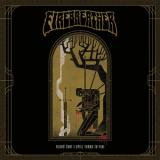
Nicaraguan-American artist Dagmar Zuniga makes music that feels both intimate and expansive: songs drift like disrupted signals, carried by harmony, tape hiss, and a strong sense of touch. Her debut solo album in filth your mystery is kingdom / far smile peasant in yellow music — written and recorded in New York, Norway, and Athens, Georgia over a period of five years on her longtime companion, the Tascam 424 — was uploaded to Bandcamp and YouTube in January 2025, quickly garnering over two hundred thousand views and the attention of artists such as Mount Eerie, who invited her to tour with them that summer. This year, what was once a jewel of tapped-in algorithms and message boards will meet the world at large, with in filth arriving digitally on March 4, and physically on April 10, via AD 93.
in filth is an atmospheric, devotional collage where one voice multiplies into a chorus of selves, sometimes delicate, sometimes severe; an effect created by Zuniga’s masterful layering of texture and complex harmonies. Synths glitter out like spears of sunlight from beneath clouds of moody, time-distorted guitars, and songs spin about themselves like tightly-wound music boxes, making use of a kind of hypnotic repetition, before melting apart into their components or slipping into the following track.
Zuniga began recording to tape as a teenager, drawn to the physicality of the medium — how a tape recording is fragile, mutable, and alive. Though her ethereal sound may draw easy comparisons to other female pioneers of psychedelic folk, she is influenced just as much by the darker sounds of Syd Barrett and The Fall. Like Barrett, Zuniga is a painter, and she is interested not only in recording music but in creating a full, self-contained artistic universe: she creates her own artwork, merchandise, music videos, and bootleg tapes of new and unfinished music that she exclusively sells at live shows (“If something is not material, it does not exist,” she insists). Her world has not gone unvisited, garnering her a monthly show on NTS Radio ‘World of Pain’, as well as a forthcoming appearance at Rewire Festival in April 2026.
Though Zuniga’s work explores themes of solitude and suffering, the suffering in her songs is not borrowed or displayed; it is held, then opened outward through empathy — an exacting practice of attention that insists on shared ground. Solitude, in her work, is not withdrawal but a starting point for connection. Likewise, over time, her recording process has become increasingly communal, with in filth featuring musicians Hayes Hoey, Austyn Wohlers (Tomato Flower), and Zach Phillips (Fievel Is Glauque). Newer recordings widen the circle even more. For Zuniga, collaboration is a way to “find a place between worlds,” echoing Badiou’s idea of love as a vision refracted through the prism of difference. Meaning emerges there — in the space between voices, between artist and listener. “I hope my music helps people work through difficult experiences,” she says. “The same way it helps me.”
Cerca:that s why
Dutch composer and pianist Xavier Boot, also known as XA4, joins Philip Glass for the second release on the New York-based record label Orange Mountain Music, owned by Philip Glass.
“Xavier is really a wonderful pianist, and I am thrilled by how he now tackles my compositions, with that elegant electronica touch.” – Philip Glass
The Sea Above features not only Glass compositions but also several original pieces by Xavier: “I recorded this album inspired by all the musical influences I’ve experienced in my life, including classical, electronic (club) music, ambient, minimal, and even Indonesian music. The title track of the album is inspired by Philip Glass’s composition Mad Rush. He told me that he wrote this piece for an event with the Dalai Lama, where it was unclear when the Dalai Lama would arrive. That’s why Mad Rush was composed to last either five minutes or an hour. I tried to convey this idea of timelessness in my music, embodying this endless portal of time and space, which was also scientifically described by Albert Einstein. Another track on the album, Train I, is a reworking from Philip Glass’s opera Einstein on the Beach. You can experience the music on this album as a kind of journey, a trip where you are energetically drawn in at the beginning and later enter more of a fantasy world where dreams and unconscious elements of your mind can emerge.”
Credits:
Tracks 1 & 3 are original compositions by Philip Glass remixed by XA4
Tracks 2 & 9 remixed by XA4 and Jaro.
Tracks 4, 5, 6, 8,10 are original compositions by XA4
Track 7 is composed by XA4 and Tenzin Choegyal.
Vocals track 1: Julia Rosenhart.
Remix, production and playing: XA4.
Piano arrangement track 3: Michael Riesman and XA4.
Remix, production track 2 & 9: XA4 and Jaro.
Production assistance track 3: Jaro.
Mixing: Studio Karakterbak.
Mastering: Laura de Rover.
Cover foto: Angelina Nikolayeva.
Graphic design: Yesser Khalefa
- On N'est Pas Chez Les Colonels
- Intercommunal Blues
- Mazir
- Kan-Ha-Diskan - We Shall Over Come
- African Rythm-N-Logy
2[23,95 €]
Concert at Prades-le-Lez marks the origins of the Intercommunal Free Dance Music Orchestra. In 1974, François Tusques and his companions (Michel Marre, Jo Maka, Adolf Winkler and Guem), in the spirit of Don Cherry or Chris McGregor, playfully dismantle all borders and all styles of creative music.
On this first volume, the Intercommunal takes its audience from New Orleans to Brittany and on to North Africa. The journey was bold, without a doubt—and its memory remains unforgettable.
“The music that we make is primarily meant to be listened to live,” warned a leaflet from the Intercommunal Free Dance Music Orchestra. This is precisely why the (restored!) reissue of the two volumes of Concert at Prades-le-Lez, recorded on January 25 and 26, 1974 by François Tusques and his comrades, is such an important event.
In 1971, after recording a series of albums that would leave a lasting mark on French jazz (Free Jazz, of course, with Michel Portal, François Jeanneau, Bernard Vitet, Beb Guérin and Charles Saudrais, but also Le Nouveau Jazz with Barney Wilen, or the solo Piano Dazibao), François Tusques founded the Intercommunal—a grouping whose very name called for the fraternization of the various communities making up the country: Our music will help, we hope, to resolve the contradictions that exist between workers be longing to different communities, by breaking down various forms of national chauvinism, and more particularly the chauvinism of certain French people toward the cultures of Third World countries… Long live the friendship between the peoples of the whole world!
Among the great records made by the Intercommunal Free Dance Music Orchestra, the two volumes of Concert at Prades-le-Lez come first, before L’Inter Communal, Vol. 4, Le Musichien, and Après la marée noire (four titles already reissued by Souffle Continu). François Tusques and his companions (Michel Marre and Jo Maka on saxophones, Adolf Winkler on trombone, and Guem on percussion) performed on January 25 and 26, 1974 at the Moulin de Prades-le-Lez, a few kilometers from Montpellier. It was thus in the southern region of Occitanie that the first echoes of this musical vision of a borderless brotherhood were recorded.
“We’re not among the Colonels,” the Intercommunal reassures us right away, performing a stride piano tune carried by African winds that the audience cannot resist for long. The energy is already striking and it never lets up throughout these two recordings, from start to finish: jazz, blues, traditional music, minimalism, even funk… The musicians of the Intercommunal have heard a lot of great music and now delight in reinventing it by mixing it all together.
“We want the song form to take its place as a weapon in the struggle against capitalist exploitation and all those who oppress us morally and materially,” declared an Intercommunal leaflet, quoting Jean-Baptiste Clément, author of the lyrics to “Le Temps des cerises.” The struggle was therefore serious—but it did not prevent François Tusques and his group from waging it in a festive spirit: each piece on Concert at Prades-le- Lez sends out a call for love and fraternity. Fifty years later, the message remains as relevant as ever—and once again, it is François Tusques who makes it heard.
Concert at Prades-le-Lez marks the origins of the Intercommunal Free Dance Music Orchestra. In 1974, François Tusques and his companions (Michel Marre, Jo Maka, Adolf Winkler and Guem), in the spirit of Don Cherry or Chris McGregor, playfully dismantle all borders and all styles of creative music.
On this second volume, the Intercommunal builds unprecedented soundscapes around a song of revolt, a dance tune, or a burst of dissonance. The journey is unforgettable, no question about it. On repeat listening, it even becomes… lunar!
“The music that we make is primarily meant to be listened to live,” warned a leaflet from the Intercommunal Free Dance Music Orchestra. This is precisely why the (restored!) reissue of the two volumes of Concert at Prades-le-Lez, recorded on January 25 and 26, 1974 by François Tusques and his comrades, is such an important event.
In 1971, after recording a series of albums that would leave a lasting mark on French jazz (Free Jazz, of course, with Michel Portal, François Jeanneau, Bernard Vitet, Beb Guérin and Charles Saudrais, but also Le Nouveau Jazz with Barney Wilen, or the solo Piano Dazibao), François Tusques founded the Intercommunal—a grouping whose very name called for the fraternization of the various communities making up the country: Our music will help, we hope, to resolve the contradictions that exist between workers be longing to different communities, by breaking down various forms of national chauvinism, and more particularly the chauvinism of certain French people toward the cultures of Third World countries… Long live the friendship between the peoples of the whole world!
Among the great records made by the Intercommunal Free Dance Music Orchestra, the two volumes of Concert at Prades-le-Lez come first, before L’Inter Communal, Vol. 4, Le Musichien, and Après la marée noire (four titles already reissued by Souffle Continu). François Tusques and his companions (Michel Marre and Jo Maka on saxophones, Adolf Winkler on trombone, and Guem on percussion) performed on January 25 and 26, 1974 at the Moulin de Prades-le-Lez, a few kilometers from Montpellier. It was thus in the southern region of Occitanie that the first echoes of this musical vision of a borderless brotherhood were recorded.
“We’re not among the Colonels,” the Intercommunal reassures us right away, performing a stride piano tune carried by African winds that the audience cannot resist for long. The energy is already striking and it never lets up throughout these two recordings, from start to finish: jazz, blues, traditional music, minimalism, even funk… The musicians of the Intercommunal have heard a lot of great music and now delight in reinventing it by mixing it all together.
“We want the song form to take its place as a weapon in the struggle against capitalist exploitation and all those who oppress us morally and materially,” declared an Intercommunal leaflet, quoting Jean-Baptiste Clément, author of the lyrics to “Le Temps des cerises.” The struggle was therefore serious—but it did not prevent François Tusques and his group from waging it in a festive spirit: each piece on Concert at Prades-le- Lez sends out a call for love and fraternity. Fifty years later, the message remains as relevant as ever—and once again, it is François Tusques who makes it heard.
James Curd and Osunlade. After years of playing back to back DJ sets and collaborating in the studio, they decided it was time to create something that could represent both the music they make together and the shows they play. Their sound is a natural meeting point between deep house grooves and soulful roots, reflecting both artists’ histories and shared love fortimeless dance music.
The first single from Nomadic’s is “Better Man”. The track was originally signed to Defected Records,but after creative differences about how the release should be presented, the contract was voided. That decision gave James and Osunlade the chance to put the music out exactly as they envisioned, and the song now finds its proper home on Pronto Records. The package includes the original alongside a set of remixes from some of the most exciting names in underground house.
Dutch producer Frits Wentink delivers a remix in his unmistakable style – raw drum programming, warm analogue textures, and the kind of off kilter groove that has made him one of the most respected names in Europe’s house scene. Mr Ho, co-founder of the cult label Klasse Wrecks, adds his own twist with a version that nods to classic rave and electro energy, while keeping things firmly locked for the dancefloor. Finally, LA based duo Too Easy bring a mysterious touch, layering live instrumentation with electronic drive, showing why they’re quickly becoming ones to watch.
With its story of creative independence, heavyweight remixers, and the credibility of two deeplyrespected artists at the helm, “Better Man” is both a club record and a statement of intent for what Nomadic’s represents.
For over four decades, Mr. Fingers has been shaping the core of house music. Now he returns with a new album that continues his timeless journey through deep rhythms, soulful melodies, and immersive atmospheres. Crafted with the warmth and musicality that define him, the record blends deep house, jazz-infused harmonies, and subtle R&B textures. Mr. Fingers once again reminds us why his music remains essential: hypnotic grooves and heartfelt compositions. Not just music for the club, but also for the quiet spaces...
Repress 2026
NEOCLASH is DJ Hell's new work.
The Electroclash of the early 2000s is reconstructed here, its characteristic codes extracted and reshaped into a modern, reflective form.
NEOCLASH is a cultural experiment - music as a medium of reflection, a structure for space and time, and a vehicle for exploring the tensions between technology, the body, and perception.
Electroclash now - or a manifesto for the aesthetic relevance of electronic club music, combining strong old-school references with a new understanding.
DJ Hell, a.k.a. Helmut Josef Geier, delivers a contemporary reinterpretation of the Electroclash genre.
International Deejay Gigolo Records was the pulse of the movement 25 years ago - and Hell, its very namesake. Godfather of Electroclash reloaded.
25 years and many milestones later, DJ Hell returns to his roots with NEOCLASH, proving that Electroclash in 2025 can sound not nostalgic, but forward-thinking and visionary.
NEOCLASH builds a bridge between past and present within electronic dance culture and club music.
Italo Disco, New Wave, Indie Dance, Disco, Pop, Chicago House, Acid, Detroit Techno, and Avantgarde Music merge here into a bold new interpretation.
Released in 1973 on Motown’s label, Share My Love is a richly layered and deeply expressive record that captures Gloria Jones at a creative crossroads. After years working behind the scenes as a songwriter and session vocalist, penning material for The Tams, The Marvellettes, and others, Jones finally takes center stage with a collection that radiates confidence, vulnerability, and undeniable soul.
Known to many for her original 1964 version of “Tainted Love,” later immortalized by Soft Cell, Jones brought to Share My Love a seasoned understanding of both the heartbreak and hope that lie at the core of great soul music.
More than just a product of its time, Share My Love feels like a declaration, a turning point where one of soul’s great, often-overlooked voices stepped into her own light. It remains a moving document of artistic self-assurance and one of the most heartfelt releases to emerge from Motown’s early ’70s era.
- A1: Al Green – Let's Stay Together
- A2: Marvin Gaye - What's Going On
- A3: Diana Ross - Ain't No Mountain High Enough (Single Version)
- A4: Stevie Wonder - Signed, Sealed, Delivered (I'm Yours)
- A5: Commodores - Easy (Album Version)
- A6: Bill Withers - Ain't No Sunshine
- A7: The Stylistics - You Make Me Feel Brand New (Let's Put It All Together Version)
- A8: Rose Royce – Wishing On A Star
- B1: Jackson 5 - I Want You Back (Single Version)
- B2: Smokey Robinson & The Miracles - The Tears Of A Clown (Single Version / Mono)
- B3: The Supremes - Nathan Jones
- B4: Frankie Valli And The Four Seasons - The Night (1972 Album Version)
- B5: Chairmen Of The Board – Give Me Just A Little More Time
- B6: The Trammps - Hold Back The Night
- B7: The O'jays - Love Train
- B8: The Blackbyrds – Walking In Rhythm
- B9: Heatwave - Always And Forever (Single Version)
- C1: The Temptations - Papa Was A Rollin' Stone (Edited)
- C2: Isaac Hayes - Theme From "Shaft" (Remastered 1991 Album Version)
- C3: Ike & Tina Turner - Proud Mary
- C4: James Brown - Get Up I Feel Like Being A Sex Machine
- C5: Edwin Starr - War
- C6: Sly & The Family Stone - Family Affair (Single Version)
- C7: The Delfonics - Didn't I (Blow Your Mind This Time)
- C8: Billy Paul - Me And Mrs. Jones (Single Version)
- D1: The Floaters - Float On (Single Version)
- D2: Minnie Riperton - Lovin' You
- D3: The Isley Brothers - Summer Breeze, Pt. 1
- D4: William Devaughn - Be Thankful For What You Got (Part I)
- D5: Detroit Emeralds – Feel The Need In Me
- D6: The Moments - Jack In The Box
- D7: Raydio - Jack And Jill
- D8: The Tymes - Ms. Grace
- E1: Barry White - Can't Get Enough Of Your Love, Babe
- E2: Aretha Franklin – Until You Come Back To Me (That's What I'm Gonna Do)
- E3: Al Green – Tired Of Being Alone
- E4: Gladys Knight & The Pips - Midnight Train To Georgia
- E5: Timmy Thomas – Why Can’t We Live Together (7" Glades Version) (2013 Remaster)
- E6: George Benson – The Greatest Love Of All
- E7: Diana Ross - Theme From Mahogany (Do You Know Where You're Going To) (Single Version)
- E8: Jackson 5 - I'll Be There
- F1: Freda Payne – Band Of Gold
- F2: Ann Peebles - I Can't Stand The Rain
- F3: Marvin Gaye - Let's Get It On (Single Version)
- F4: Harold Melvin & The Blue Notes Featuring Teddy Pendergrass - If You Don't Know Me By Now
- F5: The Stylistics - Can't Give You Anything (But My Love)
- F6: The Three Degrees - When Will I See You Again (Single Version)
- F7: Deniece Williams - Free (Single Version)
- F8: Earth, Wind & Fire - After The Love Has Gone (Single Version)
- F9: Commodores - Three Times A Lady (Single Version)
NOW That’s What I Call 70s Soul brings together 50 era-defining tracks from one of the most powerful decades in soul music, featuring classics from Motown legends, Philly Soul pioneers, smooth balladeers and funk innovators – all pressed across 3LPs on beautiful blue vinyl… Out April 24th!
LP1 opens with one of the decade’s most recognisable love songs: Al Green’s ‘Let’s Stay Together’, a US #1 and UK Top 10 hit that became his signature recording. It’s followed by Marvin Gaye’s ‘What’s Going On’, the socially conscious masterpiece and title track from his landmark 1971 album, and Diana Ross’ Ain’t No Mountain High Enough’, which topped the US chart and became her first solo #1. Stevie Wonder’s ‘Signed, Sealed, Delivered (I’m Yours)’ remains one of Motown’s most joyful recordings and comes before Commodores’ ‘Easy’ introducing Lionel Richie’s smooth ballad vocals. The side also includes Bill Withers’ timeless ‘Ain’t No Sunshine’, a Grammy-winning classic, and The Stylistics’ lush ballad ‘You Make Me Feel Brand New’, a UK Top 3 smash, before closing with Rose Royce’s beautiful ‘Wishing On A Star’, one of the most loved soul ballads of the era.
Flip the LP over and The Jackson 5’s ‘I Want You Back’ – the group’s explosive debut single opens the side. Smokey Robinson & The Miracles’ ‘The Tears Of A Clown’ became a UK #1 and is followed by The Supremes’ Nathan Jones’ showcasing the group’s evolving psychedelic-soul sound. Northern Soul classics from Frankie Valli & The Four Seasons with ‘The Night’, Chairmen Of The Board’s Top 3 smash ‘Give Me Just A Little More Time’ and The Trammps’ ‘Hold Back The Night’. The O’Jays’ joyous ‘Love Train’ leads to The Blackbyrds’ Walking In Rhythm’, before the side closes with the romantic classic ‘Always And Forever’ from Heatwave.
LP2 opens with The Temptations’ epic ‘Papa Was A Rollin’ Stone’, a Grammy-winning US #1 remains one of the most stunning recordings from the Motown catalogue, is followed by Isaac Hayes’ ‘Theme From “Shaft”’, an Academy Award-winner and a US #1 smash. More funk follows from Ike & Tina Turner, James Brown with one of his key tracks ‘Get Up (I Feel Like Being A) Sex Machine’, Edwin Starr’s powerful anti-Vietnam protest song ‘War’, and Sly & The Family Stone’s hugely influential ‘Family Affair’. The Delfonics’ sublime ‘Didn’t I (Blow Your Mind This Time)’ comes ahead of Billy Paul’s timeless ‘Me And Mrs. Jones’ which closes the side…the other side begins with the 1977 #1 from The Floaters with ‘Float On’, before the breathtaking vocals of Minnie Riperton on ‘Lovin’ You’. The Isley Brothers’ Summer Breeze’ and William DeVaughn’s ‘Be Thankful For What You Got’ have become enduring classics and are followed by a run of ‘80s pop-chart crossover hits completing LP2 from Detroit Emeralds, The Moments Raydio and The Tymes’ #1 ‘Ms. Grace’.
LP3 opens with the unmistakable voice of Barry White and his US #1 hit ‘Can’t Get Enough Of Your Love, Babe’, before Aretha Franklin’s ‘Until You Come Back To Me (That’s What I’m Gonna Do)’, delivers one of her smoothest performances. Al Green’s ‘Tired Of Being Alone’ and Gladys Knight & The Pips’ ‘Midnight Train To Georgia’ are followed by minimalist soul classic ‘Why Can’t We Live Together’ from Timmy Thomas, and the side closes with a trio of defining ballads:- George Benson’s ‘The Greatest Love Of All’ Diana Ross’ ‘Theme From Mahogany (Do You Know Where You’re Going To)’ and The Jackson 5’s ‘I’ll Be There’, their biggest hit…while over on the final side…Freda Payne’s #1 ‘Band Of Gold’, opens alongside Ann Peebles’ influential and much covered ‘I Can’t Stand The Rain’.Marvin Gaye’s sensual ‘Let’s Get It On’ became another US #1, while Harold Melvin & The Blue Notes featuring Teddy Pendergrass deliver the contemporary standard ‘If You Don’t Know Me By Now’. Three massive UK #1s are next…The Stylistics with ‘Can’t Give You Anything (But My Love)’, The Three Degrees’ peerless ‘When Will I See You Again’ and Deniece Williams’ ‘Free’. This amazing collection closes with two timeless ballads: Earth, Wind & Fire’s ‘After The Love Has Gone’, a Grammy-winning classic, along with ‘Three Times A Lady’, a huge worldwide #1 for the Commodores.
NOW That’s What I Call 70s Soul, 50 defining tracks from one of music’s greatest decades. Out April 24th.
2026 Repress
35th Anniversary Edition of Peacefrog - 2LP Smokey Vinyl
Born and raised in the birthplace of House Music, Paul Johnson was known for his raw, soulful, and infectious sound, that helped shape Chicago's house scene and inspired generations of DJs worldwide in particular he was a massive inspiration to Daft Punk and the 'French Touch' scene. Releasing a vast amount of music throughout the 1990s for some of the most consistently underground dance labels including legendary Chicago imprints Cajual, Relief and Dance Mania he finally gained global fame with his 1999 hit “Get Get Down,” a dancefloor anthem that topped charts across Europe. Despite facing physical challenges, including losing both legs in accidents, he remained an unstoppable force in music—touring, producing, and uplifting others with his resilient spirit and signature groove.
Originally released in 1996 Feel The Music was Paul's second album for Peacefrog Records. Containing some of the classiest house music to hail from the Windy City. Classics such A Little Suntin Suntin , Summer Heat and I Wonder Why will have you smiling while you’re jackin’ and the irresistible and infectious Hear The Music was fthe opening track for Daft Punks legendary Radio 1 Essential Mix.
Artist and multi-instrumentalist Flaer looks to the landscape to explore pastoral melancholy on debut release, Preludes. It is released in a second edition black vinyl, with an alternate cover artwork.
Ensconced in his family home in rural Leicestershire in the early months of 2020, painter and musician Realf Heygate (b. 1994) picked up his childhood cello for the first time in several years and began to play. Setting himself parameters to only record onto 4-track tape with acoustic instruments – cello, piano and acoustic guitar – he assembled a suite of instrumental compositions that form the basis of Preludes, his debut album as Flaer and the inaugural release on Odda Recordings.
Channelling the tension and unease between the pastoral idyll of the English countryside and the darkness which lurks beneath the surface, the mini-album draws inspiration from the analogue aesthetic of 1970s folk horror films, weaving field recordings of birdsong, church bells and the natural environment into chimerical melodies that reflect on Heygate’s childhood experiences of rural England.
“It was really important not to isolate the sound from its environment,” he explains, describing the compositional and recording process as “site-specific”. Developed over a series of intuitive musical enquiries, the mini-album’s uncanny quality emerges from combining raw demo takes with overdubs of almost orchestral grandeur.
Heygate points to the final track as indicative of the work as a whole: “‘Follow’ really is the mantra for the release and embodies the practical approach I was taking to music making: not to force the music but see where it takes you.”
As a painter, Heygate’s practice takes artefacts through sequences of reproduction that embrace the fluctuating materiality of the copy. Since obtaining a degree in Fine Art from Central Saint Martins in 2017, he has exhibited solo at Peter von Kant and Springseason galleries in London, and has participated in group shows at Saatchi Gallery, Cob Gallery and Senesi Contemporanea.
Describing his artistic practice as one of self-erasure, music instead provides Heygate with a more personal and autobiographical outlet. Where the two worlds combine is on Preludes’ striking artwork, which features paintings of 13th century stone carvings from the font of the church in the town where he grew up.
Speaking to a time where people were connected to the land in a more profound way, each symbol is assigned to a track on the album, which Heygate likens to giving them a title.
“To add that one juxtaposition might open a whole new interpretation or language that might be hard to find otherwise,” he explains.“Over time it might reveal itself to you, which is why I'm excited about it being released. To throw them out there and see what comes of it.”
- A1: Rue Des Villas
- A2: Les Correspondances
- A3: Intempéries
- A4: V
- A5: Quand Tu M'aimais
- A6: Rubans
- B1: Chanson Pour Abel
- B2: Les Roches Noires
- B3: La Douceur
- B4: Le Sens De L'eau
- B5: Panoramas
"Throughout her life, my mother wrote ghost songs. Songs without melodies, without music, written on loose sheets of paper and stored away in folders. Why did my mother, who isn’t a musician, choose this form of expression? And why do I, her son, devote my life to producing music without words?
Le disque de ma mère, an album composed from these texts, the oldest dating back to 1984 and the most recent to 2018, seeks to translate the poetry of this situation."
With the collaboration of Blandine Rinkel, who gives voice to these texts, Superpoze creates a powerful album of songs that speaks to us about transmission, imagination, and secrecy.
- I Call My Baby Pussycat
- Put Love In Your Life
- Little Ole Country Boy
- Moonshine Heather
- Oh Lord, Whylord / Prayer
- My Automobile
- Nothing Before Me But Thang
- Funky Woman
- Livin' The Life
- The Silent Boatman
Demon Records are proud to present Osmium Deluxe - the first recordings credited to the funk-rock ensemble Parliament-Funkadelic.
Since its re-release in 1990, Osmium has been distributed numerous times by various labels in America, Europe and Japan under alternate titles – including Rhenium and First Thangs. A number of these reissues have featured material that was not included on the original album, such as unreleased tracks and singles that were taken from the same time.
This in-demand, black-vinyl version of the Record Store Day 2024 sell-out compiles together everything from that period 2 LPs and includes; the full Osmium album, the single sides that never made the album, unreleased tracks, demos and jams – all of which made their debut vinyl appearance as one package in 2024.
Many of these recordings are still as far-out as they sounded when first released. However, the tracks here represent the genesis of what would become P-Funk and the entity that would give the world ground-breaking albums Maggot Brain (1971), Mothership Connection (1975), and One Nation Under a Groove (1978). An essential addition to anyone’s collection.
- A1: Apt A (1) 06 29
- A2: Apt A (2) 05 52
- B1: And All You Can Do Is Laugh (1) 05 35
- B2: And All You Can Do Is Laugh (2) 05 51
- C1: I Promise Never To Get Paint On My Glasses Again (1) 05 46
- C2: I Promise Never To Get Paint On My Glasses Again (2) 06 02
- D1: Jimmybreeze (1) 07 01
- D2: Jimmybreeze (2) 05 33
- E1: (Cloud Dead Number Five) (1) 05 23
- E2: (Cloud Dead Number Five) (2) 06 00
- F1: Bike (1) 07 13
- F2: Bike (2) 06 54
european exclusive version[39,92 €]
cLOUDDEAD's debut album, compiling six 10" EPs that appeared between 2000-2001, is aurally dense and obscured. A sprawling mass of miniature beat-suites and Dadaist lyrics, this strange and beautiful 3xLP would influence a myriad of sub-genres (cloud rap, hauntology, lo-fi hip-hop, etc.) in the two decades since its initial release.
Only the three members of cLOUDDEAD – Why?, Doseone and Odd Nosdam – can speak to the group's origins, but in the context of underground hip-hop towards the end of the 20th century, their arrival makes perfect sense. Cincinnati had a vital scene; home to Scribble Jam, an annual confluence of MCs, DJs, B-boys and graffiti artists. While the trio soon relocated to the Bay Area where they co-founded the Anticon collective, their Midwestern roots – in ramshackle basements of off-campus hovels, as the "cerberus of Southern Ohio" – would remain the atomic heart of their early recordings.
As Chris Martins writes in the liner notes, "The only reason we know their names today is because of how loudly and curiously they aired their insularity. They rewrote the entire world as they knew it through their own fucked perspective, and when those mysterious 10-inches started popping up in record shops, it wasn't just a puzzle to investigate: there seemed to be a whole cosmology hidden in those grooves."
Each side of the album represents one of those elusive 10-inches, each embodying a universe unto itself. Opening salvo "Apt. A" and "And All You Can Do Is Laugh" are perhaps most emblematic of the cLOUDDEAD experience. Why? and Dose create a new language through boundless non-sequiturs, sing-song non-choruses and call-and-response hooks, while Nosdam's dexterous production shifts from crackling ambience of Flying Saucer Attack to tight Ohio Players drum breaks and oblique film samples.
Taken all together, cLOUDDEAD is an original interpretation of hip-hop in the surreal Y2K glow – a bizarre meeting point between William Basinski's Disintegration Loops and MF DOOM's Operation: Doomsday. All it took was a Dr. Sample SP-202, Tascam cassette eight-track and cheap RadioShack mic. There's truly nothing like it.
This edition has been faithfully restored by Nosdam. European exclusive version comes on clear vinyl, incl. fold-out poster and liner notes insert.
Gap Mangione's monumentally influential Diana In The Autumn Wind. AKA BEWITH200LP. And, without question, Be With's White Whale.
They said it could never be done. And with good reason.
We've spent the past 12 years trying to license this legendary 1968 recording from Gap and, after much work, it's finally here. Remarkably, this is the first ever vinyl reissue of Gap Mangione's Diana In The Autumn Wind, produced with the full and extensive participation of Gap. An exceedingly rare album, it's been coveted by funk, soul, jazz and hip-hop sample fiends for decades.
It's unarguably *the* most sought after album for J Dilla / Madlib sample collectors. It has also been brilliantly sampled by A Tribe Called Quest, Large Professor, Ghostface Killah, Kendrick Lamar and Talib Kweli.
But this record is so much more than a sample-spotters curio. It's solid gold throughout. Bursting with killer funky-jazz grooves and tracks adorned with warm electric piano, the release is notable for featuring some extremely significant players at the very outset of their careers; Tony Levin, at 21, whose superb playing on both acoustic and electric bass was the harmonic mainstay of the trio and Steve Gadd, at 23, one of the greatest drummers of his generation.
With acceptable copies of this holy grail changing hands for $400, to call this reissue "much-needed" underplays just how vital it is. Gap's story is told in his words alongside rare photos across a sumptuously designed 2-page insert and, to augment this deluxe edition further, its all wrapped up in a beautiful, no-expense-spared luxury tip-on sleeve, as per the original hens-teeth release. And, while we're talking packaging, just take a look at that cover - a work of art in and of itself.
The tracks are short but complex, with that extraordinary rhythm section backing the beautiful piano, organ and electric piano work of Gap. It's like the best ever library funk breaks record you never heard - but all your favourite golden age rap producers were all over it, long ago. It's a stunning blend of the vibrant, driving music of the Gap Mangione Trio coupled with the sensitive composition and superb orchestration of Gap's legendary brother, Chuck Mangione, who helmed an amalgam of seemingly disparate elements – rock, big band jazz, solo improvisation and "classical" music - into a spectacularly cohesive whole that has aged wonderfully well. As Gap himself notes in the liners, "with this group I was able to explore and add new and exciting elements from rock, Brazilian and then-current pop music."
Opener "Boy With Toys" triumphantly swaggers out the gate, all big band horns, flutes and dextrous organ work. The synthesis of everything going on is nothing short of stunning. When one wise YouTube commentator called this tune "old school superhero music", Gap agreed. Rap luminaries did, too, amongst them Talib Kweli, who rapped over DJ Scratch's chopped up intro for "Shock Body" on his Quality album back in 2002.
You've barely recovered from that incredibly affecting opener when you get hit over the head with the exquisite title-track. And now you see how two of the greatest beats of all time emerged from one single track produced nearly 50 years earlier. Unforgettably utilised by Dilla for Slum Village's heartbreakingly good "Fall In Love" and then Madlib for his "Official" beat for Dilla to rap over, on the Jaylib record. Regardless of the records it went on to spawn, this is just a staggering tune in its own right. Be beguiled by the flutes and the flutter tonguing, the counter-melody from the trombones, the soprano sax solo. All of it. Simply beautiful.
The questing organ and horn workout "Long Hair Soulful" deserves a lot more attention, overshadowed somewhat by the opening two monsters but no less fantastic. It swings, it grooves and Gadd and Levin truly cook. Up next, Gap's wonderfully percussive, mellifluously piano-heavy cover of "Yesterday" by some fellas called The Beatles. It's a subtly arresting gem. "The XIth Commandment" is damn fine, with thick, gorgeous electric piano and snappy drum work underpinning chaotic soundtracky horns. To close out the side, "St. Thomas" showcases the "fourth" member of the Gap Mangione Trio, conga drummer Dhui Mandingo. Having performed with the Trio since 1965, Dhui‘s African-based and jazz-latin-influenced style amazed listeners and its way to hear why.
Opening the B-Side, standard "You're Nobody Till Somebody Loves You" breezes along in the late-night jazz club fashion before things get super deep with the outstanding and - up to now - un-sampled "Pond With Swans". It's simply heavenly, and how its moody, melancholic intro has yet to be pilfered is anybody's guess. It oscillates between gentle, sombre movements and bombastic grooves, equally hypnotic and joyous. The rendition of "You Are My Sunshine" is yet another showcase for Gap's virtuoso playing and Gadd's mastery of the pocket. Indeed Gadd's drumming on "Free Again" is nothing short of neck-SNAPPING! Ghostface took it for not one but two "Iron's Theme" tracks across his seminal Supreme Clientele. It's got that Galt MacDermot "Coffee Cold" feel. Suuuuuper cool. The frantic "Dream On Little Dreamer" hurtles along and must've surely had the whole room absolutely swinging from the chandeliers back in Rochester in the late 60s. The album closes with the magnificent Graduate Medley, featuring memorable renditions of "Scarborough Fair", "The Sounds of Silence" and "Mrs. Robinson". The warm electric piano lines of the former were sampled by The Ummah (Dilla again!) for Tribe's "Pad & Pen" from their reappraised final album, The Love Movement, as well as by Large Professor on his much-loved "The LP (For My People)".
Under the watchful eye - and extremely attentive ears - of Gap Mangione himself, the audio for Diana In The Autumn Wind has been carefully remastered by Be With regular Simon Francis, with a few much needed tweaks here and there, according to the artist's wishes. At the prestigious Abbey Road Studios, Cicely Balston's expert skills have made sure nothing is lost in the cut whilst the records have been pressed to the highest possible standard at the always stellar Record Industry in Holland. The artwork restoration has taken place here at Be With HQ and has that drop-dead gorgeous cover artwork popping like new. Buy on sight!
This is hypnotic music in the purest sense: elegant, fluid, and deeply immersive, built on patience, precision, and a rare understanding of tension. Rather than forcing impact, the EP unfolds with quiet authority, drawing the listener deeper with every cycle and every subtle shift. Romanian producer Barac has long been regarded as one of the key figures in the country’s minimal and microhouse continuum, known for his hypnotic, deeply detailed sound and for shaping a distinctive artistic identity around rhythm, space, and subtle emotional tension. What makes this release so special is its balance of restraint and depth. The grooves are understated but powerful, the atmospheres weightless yet emotionally charged, and the overall flow simply brilliant. It is exactly the kind of record that shows why Barac remains such an important name in contemporary minimal and deep club music: few artists can create this level of hypnosis with such finesse. Look at the cross is a genius release, sophisticated, timeless, and absolutely captivating from start to finish.
- A1: Can I Live Feat. Precious Okoyomon 02:36
- A2: M32 Riddim 04:06
- A3: One Exists Or Agrees To Exist 05:00
- A4: Don't Panic Feat. Ms. Carrie Stacks 02:58
- B1: Duppy Know Who Fi Frighten 06:31
- B2: Helicopter Hovers Over My Crown Heights Apartment 05:19
- C1: Exorcise The Language Of Domination Feat. Juliana Huxtable 06:12
- C2: B2B Feat. Suutoo 05:32
- D1: Effects Of Resistance Feat. Khanyisile Mbongwa 06:12
- D2: Black Trans Masculine Experience (Instrumental) 08:55
May 2026 marks the arrival of TYGAPAW (aka Dion McKenzie)’s first full-length album on Tresor Records, entitled Together You Gather All Power Applied Worldwide. An acronym of its creator’s name, TYGAPAW’s third studio album is a deeply personal collection of music building worlds where Black queer and trans siblings can thrive, while unifying dancefloors worldwide. A proposition that collective wisdom liberates us from the matrix of domination we live within. The album unfolds as the latest chapter in TYGAPAW’s ongoing techno opera opus, continuing to center the voices of Black women, which surface as layered incantations rather than lyrics - powerful, haunting, sensual, activating.
With the process of creating the album starting in 2023, as TYGAPAW (Dion McKenzie) was in the first year of their transition, the music reflects the intensity of that period, where they were experiencing deplatforming as a response to the shift in their physical appearance: Tracks like ‘M32 Riddim’ and ‘Helicopter hovers over my Crown Heights Apartment’ feature high-paced rhythms intersecting with intense siren-like synths to form demanding compositions echoing a heightened sense of alert. Yet throughout the album, relief comes in the form of TYGAPAW’s vocal features, co-conspirators, and chosen family, whose voices are treated with reverb and echo, a sonic fingerprint that leads back to the pioneers in the legendary studios of TYGAPAW’s native land, Jamaica, an important reminder that the past will always inform the future. It is an album for dancers first and foremost, where joy, defiance, and integration with the natural body coexist, and every drop feels less like a climax than a transformation. Expect a bass that permeates your soul and melodic synthesized sequenced phrases echoing the dancehall eras of TYGAPAW’s youth, reshaped into hypnotic melodies that glow over industrial kicks designed to command attention, reasserting Jamaica's pioneering yet often overlooked contribution to electronic music.
In the opening track, ‘Can I Live’, Precious Okoyomon’s words feel like the beginning of a ritual; setting the intentions for the rest of the proceedings. As McKenzie puts it, their “work is about regeneration, resetting, getting integrated into nature, and about rebirth. That’s the tone I wanted to set at the outset of the album.” Ms Carrie Stacks continues this thread of support in ‘Don’t Panic’ with heavily processed vocals on top of a beat that takes inspiration from another important ingredient in the antidote to the oppression of isolation: Ballroom culture. “ I feel like I found my queerness in Ballroom, that’s why this track is very important to me.”
Echoes of NYC Black queer nightlife scene also permeate in the energetic drums of ‘Exorcise the Language of Domination’, in which Julianna Huxtable’s spoken performance complements the various movements and tones of the music. “My producer brain thought this was the one that Juliana’s vocals would be best suited for. I hinted: ‘what do you think of this one?’ She just went into her notes and picked some passages to go with the first section of the track. From there, it was a year-long process of development. It required time and space for this thing to evolve, but I think it’s one of the most powerful tracks on the album.” London’s SUUTOO contributes the album’s only musical collaboration on ‘B2B’, a track that emerged from sessions in McKenzie’s New York studio where the real objective was to connect and have fun; a time out from the demands of life outside.
The album closes out with a double hit of emotion in the form of ‘Effects of Resistance and Black Trans Masculine Experience’. The former features South African scholar Khanyisile Mbongwa drawing connections that exist between Africa and the Black diaspora, whilst looking to the future and calling for a shared sense of community.
The latter piece, an instrumental version of the piece which featured on the IMMIGRANT E.P. of 2025 is a gentle and deeply affecting end to the record, a place of peace and acceptance. This end-of-cycle tone is mirrored in the sleeve photography, which also ties back to IMMIGRANT by finally revealing what was hidden: a portrait of the artist fully self-actualized; a step towards true inner liberation. TYGAPAW is sonically defiant across this album; bass frequencies feel tactile — less heard than inhabited — infectious lead synth melodies remain with you long after the track ends. An overall sound that leaves asserting an urgent need for connection. From Detroit to New York to Berlin to Jamaica, despite geographic distance, this album reminds us that we remain in solidarity, recognising that meaningful world-building requires collective input and action, both personal and communal, if we are to move toward liberation.
- 1: I Ate The Most
- 2: One Stop
- 3: Train On The Island
- 4: Worms
- 5: Venus In The Zinnia Feat. H Hawlkine
- 6: If Lady Does It
- 7: San Francisco
- 8: What Am I Gonna Do?
- 9: Riding That Symbol
- 10: Coats
BLUE COLOURED EDIT[21,81 €]
Das zehn Songs starke "Train On The Island" entstand erneut in enger Zusammenarbeit mit ihrem langjährigen Weggefährten John Parish (u.a. PJ Harvey, Dry Cleaning) und wurde gemeinsam mit ihm in den legendären Rockfield Studios in Monmouth, Wales, produziert. Dort entstanden bereits Hardings frühere Alben "Party" (2017), "Designer" (2019) und "Warm Chris" (2022). Unterstützt wurden Harding und Parish diesmal von Pedal-Steel-Gitarrist Joe Harvey-Whyte, Harfenistin Mali Llywelyn, Synth-Künstler Thomas Poli sowie Schlagzeuger Sebastian Rochford (Polar Bear). Außerdem mit dabei: H. Hawkline alias Huw Evans an Bass, Gesang, Akustik- und E-Gitarre sowie Orgel.
A great, self-contained, soul music collective that never got their just due because of a spurious tax scam that was prevalent in the record industry in the early to mid 1970”s - the group known as Spice, and their 1976 LP ‘Let Their Be Pice”, remained in obscurity without members of the band even knowing that it was ever released until nearly 30 years after the fact. Now, thanks to the sharp ears of his internet savvy aging motherland subsequent interviews with Spice”s leader Richard Brown Jr. - the full story of who this almost forgotten band was, and what happened to them and why, is finally revealed. Whatever transpired business wise should not obscure the quality of the music that resulted in the recording of this album. The performances are impeccable, the musicianship is top-notch, and the original songs in retrospect, were way ahead of their time. As a special treat for rare soul music lovers, this long-lost LP has been newly remastered for this exclusive release.
2026 Repress
You cannot swim for new horizons until you have the courage to lose sight of the shore. I Hate Models is back on the label with ARTS040. 3 Years after the big storm that took this artist everywhere in the world, he is here in his home with a record that goes back into his unique way to paint contrast of emotions. "Intergalactic Emotional Breakdown" is a well-crafted work based on 3 cuts that reflect his personal vision of music and one more time confirms why we love this artist so much.
Comes with special front sticker.
Cyborg Quest encapsulates MODAZ 2024—its learning, its searching, and its becoming. It moves through cycles of connection and disconnection, yet above all, it is driven by music. This EP is deeply personal. It echoes the phrases that resonate with his daily life: “It’s happening again,” lifted from Twin Peaks; “Where you at?”; and even “Why the world isn’t the way I wanted?” Together they form a blend of symbolism, mystique, and raw reality.
Straight from the backseat of a tinted SUV and into the headphones of every die-hard fan from the West Side to the coast, LUCKI returns with Dr*gs R Bad—a title that’s half-ironic, half-exhausted, and 100% Tune. This isn't a PSA; it’s a high-speed, low-pass filtered look at a life where the designer denim is heavy and the heart is even heavier. Drowning in those signature ethereal, space-trap melodies that sound like a 4:00 AM fever dream, LUCKI trades his usual nonchalance for a raw, "out of luck" transparency that reminds his cult following why he’s the undisputed king of the heartbreak flex. It’s the soundtrack for the late-night drives and the "everything’s a movie" lifestyle where the credits are starting to blur, proving once again that nobody captures the beautiful, nihilistic chaos of the climb quite like Neptune.
Celestial Echo returns with a proper UK soul classic — The Cool-Notes “I Forgot How To Love You”, back on 12” and cut loud for the dancefloor.
Hailing from South London, The Cool-Notes were one of the UK’s most consistent soul outfits through the late ’70s and ’80s. While many know them for their chart successes later in the decade, this early period shows the band in a formative state — warm basslines, tight rhythm section, rich harmonies and that unmistakable Britfunk feel.
“I Forgot How To Love You” is one of those records that’s quietly done the rounds for years. A favourite of Frederika’s back in the day, it’s about time it has it’s first ever reissue.
Presented on 12” in a clean company sleeve, this edition gives the record a new lease of life.
Celestial Echo is here to put proper soul records back into circulation — Buy or Cry
- A1: Ros Serey Sothea - Jam 10 Kai Thiet (Wait 10 More Months)
- A2: Yol Aularong - Yuvajon Kouge Jet (Broken Hearted Man)
- A3: Pan Ron - Why Follow Me Wav
- A4: Tet Somnang & Meas Samon - Khnyom Jah Karake
- A5: Houy Meas & Dara Chom Chan - Nek Na Min Rom (Who Isn't Dancing)
- A6: Choun Malai - Jomreang Oun Chreang
- B1: Sinn Sisamouth - Navy A Go Go
- B2: Liev Tuk - Rom Sue Sue (Dance Soul Soul)
- B3: Thra Kha Band - Do You No Wrong Again
- B4: Yol Aularong & Liev Tuk - Sou Slarp Kroam Kombut Srey (Rather Die Under The Woman's Sword)
- B5: Eng Nary - I Wonder. B6- Baksey Cham Krong + Mol Kamach De Quoi Pleures - Tu
Repress!
Before the Khmer Rouge took power in 1975, unleashing a horrifying genocide, Cambodia had one of the most vibrant and exciting music scenes in Asia. With a mixture of traditional Khmer music and a myriad of western genres (from French and latin music, to rock-and-roll , rhythm-and-blues, surf, psychedelia, soul and many more) the few pre 75 Cambodian recordings that survived -most of them were destroyed- are enough to make anyone with a taste for good music shocked by the amazing quality of the sounds created during those golden years. Gathered in this amazing album are some of the most talented and unique musicians from that amazing era with an explosive collection of tracks sure to blow the mind of the listener. A celebration of some of the best music ever made.
- A1: Frankie Knuckles Ft. Jamie Principle - Your Love
- A2: Sounds Of Blackness - The Pressure (Frankie Knuckles Classic Mix)
- B1: Loose Ends - Hangin’ On A String (Frankie Knuckles Club Mix)
- B2: Frankie Knuckles - It's Hard Sometime (Fk Classic Club)
- C1: Hercules & Love Affair - Blind (Frankie Knuckles Remix)
- C2: Frankie Knuckles With Jamie Principle - Baby Wants To Ride
- D1: Chaka Khan - Ain’t Nobody (Hallucinogenic Version)
- D2: Frankie Knuckles Ft. Adeva - Too Many Fish (Classic Frankie Version)
Volume One[27,94 €]
TO COMMEMORATE THE 10th ANNIVERSARY OF HIS PASSING
DEFECTED HONOURS FRANKIE KNUCKLES WITH SPECIAL EDITION ‘HOUSE MASTERS’ VINYL
Defected celebrates the life and legacy of house music pioneer Frankie Knuckles with a limited-edition vinyl offering of his notable ‘House Masters’ release.
Marking ten years since his passing, join Defected in honouring the enduring legacy of house music pioneer. All proceeds of ‘House Masters: Frankie Knuckles’ will be donated to Frankie Knuckles Foundation as it was when the compilation was originally released back in April 2015.
“Frankie Knuckles, whom many consider to be one of the architects of house music is still highly influential to a new generation. Since his untimely passing ten years ago it has been incredible to see the continued outpouring of love and respect that he has received. His legacy is why the Frankie Knuckles Foundation exists. Through our work we honour him by supporting initiatives that he was passionate about: music education, AIDS and diabetes research, prevention and LGBTQIA+ youth homelessness. This commemorative vinyl release of ‘House Masters’ in association with Defected will allow us to do just that!”
Frederick Dunson, Founder, President & Executive Director, Frankie Knuckles Foundation
The forthcoming vinyl releases will feature a selection of his finest productions and remixes including the seminal ‘Your Love’, ‘The Whistle Song’ and remixes for Chaka Khan and Sounds Of Blackness.
Find out more about Frankie Knuckles Foundation and its commitment to educating and supporting initiatives across LGBTQIA+ communities and AIDs prevention
- A1: Frankie Knuckles - The Whistle Song (Sound Factory 12” Mix)
- A2: Alison Limerick - Where Love Lives (Classic Mix)
- B1: Frankie Knuckles Ft. Roberta Gilliam - Workout (1992 Vocal Mix)
- B2: Inner City - Whatcha Gonna Do With My Lovin (Def Mix)
- C1: Frankie Knuckles Presents Satoshi Tomiie - Tears (Classic Vocal)
- C2: Candi Staton - Hallelujah Anyway (Director's Cut Signature Praise)
- D1: Electribe 101 - Talking With Myself (Frankie Knuckles 12” Mix)
- D2: First Choice - Let No Man Put Asunder (Frankie Knuckles 12” Remix)
Volume One[27,94 €]
TO COMMEMORATE THE 10th ANNIVERSARY OF HIS PASSING
DEFECTED HONOURS FRANKIE KNUCKLES WITH SPECIAL EDITION ‘HOUSE MASTERS’ VINYL
Defected celebrates the life and legacy of house music pioneer Frankie Knuckles with a limited-edition vinyl offering of his notable ‘House Masters’ release.
Marking ten years since his passing, join Defected in honouring the enduring legacy of house music pioneer. All proceeds of ‘House Masters: Frankie Knuckles’ will be donated to Frankie Knuckles Foundation as it was when the compilation was originally released back in April 2015.
“Frankie Knuckles, whom many consider to be one of the architects of house music is still highly influential to a new generation. Since his untimely passing ten years ago it has been incredible to see the continued outpouring of love and respect that he has received. His legacy is why the Frankie Knuckles Foundation exists. Through our work we honour him by supporting initiatives that he was passionate about: music education, AIDS and diabetes research, prevention and LGBTQIA+ youth homelessness. This commemorative vinyl release of ‘House Masters’ in association with Defected will allow us to do just that!”
Frederick Dunson, Founder, President & Executive Director, Frankie Knuckles Foundation
The forthcoming vinyl releases will feature a selection of his finest productions and remixes including the seminal ‘Your Love’, ‘The Whistle Song’ and remixes for Chaka Khan and Sounds Of Blackness.
Find out more about Frankie Knuckles Foundation and its commitment to educating and supporting initiatives across LGBTQIA+ communities and AIDs prevention
Hot Creations Winter 2025 Vinyl Sampler featuring four of the Hottest recent releases on Hot Creations.
First up Jamie Jones marks Hot Creations’ 15th Anniversary with solo return with this year’s anthem: “Murder Mystery. His first solo release on Hot Creations since 2022’s ‘Bionic Boy’ EP, it’s a track designed to move, mesmerize, and captivate with every listen. Rolling basslines, intricate percussion, and a subtle tension pulse beneath the playful surface, making it a record built for late nights, festival main stages, and intimate spaces alike. It’s a statement of intent, and a reminder of why Jamie’s groove-driven productions continue to set the standard for house music worldwide. Next up Darius Syrossian returns to Hot Creations with ‘Bass In Ya Face’, featuring Cortez Walls is a driving, bass-fuelled floor-filler that combines weighty low-end grooves with hooky vocals.
On the flip, Joe Rolét makes his Hot Creations debut with this summer’s underground anthem. Enter: ‘No Hesitating’, the definition of a bassline mover. Stacked with rave-ready pressure and designed for full dancefloor impact, it’s a cut that has already been road-tested to devastating effect by Rolét himself alongside names such as Chris Stussy, Max Dean, and the Hot Creations head honcho himself, quickly becoming one of the most sought-after IDs of the year. Finally Manchester’s AJ Christou is back on Hot Creations with the incredibly infectious: ‘Bang Bang’, which leads with crisp percussion, slinky grooves, and a hook that’s been igniting AJ’s sets worldwide.
- A1: Rage
- A2: More Real
- A3: Like No Other
- A4: Driving & Talking At The Same Time
- A5: Aeiou
- A6: Sahara
- B1: Europe
- B2: State-Of-The-Art
- B3: The Finish Line
- B4: Detroit Tonight
- B5: On The Run
- B6: Paceways
- C1: Law & Order
- C2: I Feel Tension
- C3: I Do
- C4: Dancing Out Of Time
- C5: Runaway Child (Minors Beware)
- C6: Detroit Tonight
- C7: Snake Dancing
- D1: Working
- D2: Back To You
- D3: My Baby's Explosive
- D4: Born Yesterday
- D5: Paceways
- D6: Big Sky
- E1: The Dark Side Of Me
- E2: Tachito In The White Meredes Benz
- E3: New Strangers In Town
- E4: Skylife
- E5: The Dancing Girls Of Windsor
- E6: My First Idea
- F1: 3Rd Generation
- F2: The Exterminator
- F3: A Detective Story
- F4: Jerry Leaves The Small Town
- F5: Mona Lisa On My Arm
- F6: The World Is Loud
“The group has no niche, it doesn’t fit in anywhere,” explains Necessaries drummer Jesse Chamberlain in a 1980 Melody Maker interview. “We just state the facts about life in America, like The Clash did about England, but we’re not so heavy about it.” The Necessaries rose from the ashes of Harry Toledo & The Rockets, a little-known New York art-rock band playing gigs at Max’s Kansas City during glam’s metamorphosis into punk. —From the liner notes by Michael IQ Jones The Necessaries came together in 1978 and in the too-brief lifespan of the band counted among their members, Ed Tomney (Rage To Live, Luka Bloom), Jesse Chamberlain (Red Crayola), Ernie Brooks (Modern Lovers), Arthur Russell (The Flying Hearts), Randy Gun (Love Of Life Orchestra). First championed by John Cale on the strength of Tomney’s songs, Cale produced their first single for Spy Records (under the I.R.S. umbrella) which was released in 1979. With the forward momentum brought about by the single, the band set about tracking demos intended for Warner Bros., but The Necessaries ultimately would sign to Seymour Stein’s Sire Records. These rough demo basic tracks lacked overdubs, mixes and any finishing touches that would have made them viable for commercial release, but due to tour commitments, the band had to put the sessions on hold to hit the road. While on tour, the band was shocked to discover that Sire had issued the unfinished tracks as their debut album Big Sky (issued in 1981). The band had Big Sky withdrawn and replaced with Event Horizon (issued in 1982) which included half the original tracks from Big Sky and continued to record throughout 1982 aiming for a follow-up. It was not to be and their final studio sessions remained unissued until now. Completely Necessary (Anthology 1978–1982) is the first authorized collection of recordings by The Necessaries and includes 37 tracks, 28 of which are previously unissued. Completely Necessary represents the most accurate musical history of the band laid out across three albums. Disc one is the band-approved first album Event Horizon, followed by Pilots Facing North, a disc collecting studio recordings spanning 1978–1981 and disc three finally sees the release of their final sessions, Songs From The Blue Colony. Album notes by Michael IQ Jones trace the history of the band for this compilation produced by The Necessaries’ Ed Tomney and Cheryl Pawelski (Omnivore Recordings). The audio has been restored and mastered by Michael Graves at Osiris Studio, and both the 3-LP and 2-CD sets feature previously unseen photos across the package. Finally, an essential missing piece of the late ’70s/early ’80s New York scene that was just slightly ahead of the college alt-rock soon to come, is finally available to rediscover—this time it’s authorized and absolutely necessary. BUY! HERE’S WHY! • The first authorized and comprehensive anthology by The Necessaries. • Mid-’70s/early ’80s New York rock/punk/art scene band included members: Ed Tomney, Ernier Brooks, Arthur Russell, Jesse Chamberlain, and Randy Gun. • 37 tracks, 28 previously unissued. • Liner notes by Michael IQ Jones, plus unseen photos.
- A1: Design - Premonition
- A2: Vision - Lucifer’s Friend
- A3: Richard Bone - Alien Girl
- A4: John Howard - I Tune Into You
- A5: Ian North - We’re Not Lonely
- A6: Selwin Image - The Unknown
- B1: Harry Kakoulli - I’m On A Rocket
- B2: Rich Wilde - The Lady Wants To Be Alone
- B3: Billy London - Woman
- B4: Alan Burnham - Science Fiction
- B5: The Microbes - Computer
- B6: The Goo-Q - I’m A Computer
- C1: Gerry & The Holograms - Gerry & The Holograms
- C2: The Warlord - The Ultimate Warlord
- C3: Die Marinas - Fred From Jupiter
- C4: Dee Jay Bert & Eagle - I Am Your Master
- C5: Peta Lily & Michael Process - I Am A Time Bomb
- C6: Sole Sister - It’s Not What You Are But How
- D1: Alasdair Riddell - Do You Read Me?
- D2: Karel Fialka - Armband (The Mystery Song)
- D3: John Springate - My Life
- D4: Idncandescent Luminaire - Famous Names
- D5: Disco Volante - No Motion
- D6: Dream Unit - A Drop In The Ocean
2025 REPRESS ON TRANSPARENT GREEN VINYL
Compiled by Philip King “And then came the rise of synth pop : blokes with dodgy haircuts hunched over keyboard-operated machines stuffed with wires and do-it-yourself tone oscillators making sounds like a brood of geese passing gas in a wind tunnel. Whoopee! This is the way the ‘70s ended : not with a blood-curdling bang bang but with a cheap, synthesized, emasculating whimper.” NICK KENT, NME. All The Young Droids: Junkshop Synth Pop 1978-1985 is a new compilation that charts the underbelly of the epoch-defining sound of the synthesiser in 80s popular music. Compiled by Philip King (previously seen compiling All The Young Droogs, Glitterbest and Boobs - The Junkshop Glam Discotheque), the music here connects the dots between DIY synth enthusiasts grappling with new, cheap synthesisers at the tail-end of punk and wannabe, jobbing songwriters enthral to the new music pioneered by Gary Numan, Depeche Mode and Daniel Miller’s Mute Records. Featuring rare tracks of auto-didactic progressive pop music, proto-techno punk, shoot-for-the-stars-land-in-the-gutter chart flops and heralded, underground synth classics, School Daze paints a picture of beautiful failure. Complete with extensive sleeve notes written by King and never before seen imagery, all 24 tracks were remastered by RPM in-house engineer Simon Murphy, many from vinyl copies due to lost master tapes. The story told on All The Young Droids is one of the dawning opportunity presented by both the emergence to the market of cheaper analog synthesisers and the distribution networks plus indie labels that exploded with the advent of punk music in 1976. While the music that sprouted out all over the globe in the wake of these factors was decried as fake, plastic, a refutation of punk’s guitar-led revolution, it’s telling that much of the music on All The Young Droids.. was created in bedrooms, ramshackle studios and home-made set ups with often borrowed equipment. In the era of record labels jumping to capitalise on the success of The Sex Pistols, The Clash (both on major labels, of course) these artists struggled to stand out from a new gold-rush with next to no budget or PR team. With radio and labels desperate for the new Yazoo, what resulted was a testament to necessity being the mother of invention. At the time, the synthesiser was the music of the future, a shiny new machine that could paint like an orchestra with a single finger and a 4-track. In the hands of Manchester avant-pranksters Gerry & The Holograms it’s a pulsing, sardonic weapon.. the only instrument on the Messthetics classic lampooning of New Wave fashion. In Hamburg, a 16 year old Andreas Dorau used it to write and record (with his female classmates on vocals) a global smash in Fred Vom Jupiter (later licensed to Mute Records). The hard-to-find English version (Fred From Jupiter, natch) is included here. Many artists with alreadystoried careers caught the bug and recorded synthesiser-fuelled peons to space, computers, the future and, of course, love-interests. Harry Kakoulli, late of Squeeze, recorded a solo album in 1979 that included the incredible power-synth-pop smash-that-never-smashed I’m On A Rocket. Similarly, Ian North of Neo and American Power Pop stalwarts Milk ’n’ Cookies bought a Korg MS20 and used a tape machine to record We’re Not Lonely, an absolute lost-classic of minimal synth pop. We’re Not Lonely also features on the Junkshop Synth Pop sampler 7” twinned with John Howard unreleased track You Will See, released April 12th 2025. There are plenty of compilation debuts in evidence. Sole Sister were a mysterious trio who were featured on the Scaling Triangles compilation of female-fronted, queer-adjacent post-punk / underground music that also featured The Petticoats. Selwin Image were from San Francisco and featured members of the recently defunct power pop/punk group The Pushups. Their stupidly catchy The Unknown fizzes with New Wave energy - think XTC to Sparks but remains unreleased until now. Dream Unit’s A Drop In The Ocean is an early synth wave cut, positively teaming with Joy Division instrumentation, previously only released on a long-forgotten and super rare, self-released EP. Incandescent Luminaire’s Famous Names belies an archetypal struggle of a small-town trying to make it in a cruel industry but is a thrilling New Romantic-Synth Wave cross over with a OMD gloominess that’s a joy to hear. Feminist Minimal Wave track I Am A Time Bomb by performance artist Peta Lilly and Michael Chance is a revelation destined for new found cult status. It was released on 7” and lost until now. The flipside to the subterranean, never-made-it synth pop mentioned above are the ambitious, even fruity attempts at success that have a perennial elegance to their confidence. New Jersey-ite Billy London (real name Ed Barth) tried to cash in on the synth boom with Woman, released by a major label, a lurching new wave track built on the Louie Louie rhythm and a wonderfully camp Lou Reedstyle sleazy vocal before exploding in the synthesised chorus. The song bombed but with a chorus like this, you have to wonder why? Ex-Glitter Band member John Springate’s My Life is truly epic, with doomed chord progressions and massive sounding drums turning into at least 3 different songs in the course of the track. Before you wonder what’s going on the song resolves with a glorious return to the main refrain. The dry-ice-dressed dance floor is well catered for too. Design’s Premonition and Vision’s Lucifer’s Friend are stone-cold minimal synth bangers, well loved but given a new lease of life here. The Warlord’s The Ultimate Warlord was released in 1978, a homespun proto Hi NRG banger that was later re-recorded by The Immortals in Canada who had a club hit with it. One-man- band Disco Volante’s No Motion was re-issued by Synth wave label Medical in 2012 but makes its first vinyl compilation appearance here. Close your eyes and you can imagine what Lawrence of Felt would have sounded like with some cheap Korgs a little earlier in his career. Gibraltar-based trio The Microbes imagined a computer programming people to dance - how prescient - and ended up with a propulsive, robo-funk track with splendid rubbery bass playing over a tectonic drum machine. Previously picked up by Belgian label Stroom TV, Dee Jay Bert & Eagle’s heavily Euro-accented I Am Your Master demands the listener to “come to paradise!” In a frankly terrifying manner. All The Young Droids is the first compilation to peel away from the narrative that dour, Minimal Synth and Cold Wave were the only musical children of the first rush of synth pop. Philip King and School Daze Records describe a much more complicated world: along with the austere, Brutalist children of Daniel Miller (who produced Alan Burnham’s Bowie-Low-influenced Science Fiction here) was a plethora of desperate cash-ins, accidental mainstream hits, ambitious pop dramas and major label punts that went nowhere. Crucially, the compilation blurs the line between junk and treasure. What if the two things are interchangeable. What if it’s all science fiction?
Celebrating a decade since its live debut, Detroit-based artist Rebecca Goldberg announces the first-ever vinyl release of her original score for A Trip to the Moon, the iconic 1902 silent film by Georges Méliès. Composed in 2016, Goldberg’s reimagining of the groundbreaking film—originally titled Le Voyage dans la Lune—translates early cinema fantasy into a minimalist electronic soundscape shaped by synthesis, texture, and composed foley.
Goldberg’s approach honors the wonder and theatricality of Méliès’ vision while grounding it in Detroit’s lineage of forward-thinking electronic music. The score premiered in Paris in 2016 with live performances at Silencio, the club founded by David Lynch, and at Bar à Bulles, located above the legendary Moulin Rouge. The Paris events were produced by Why So Serious Productions and marked a rare convergence of experimental electronic performance and historic cinematic space. Goldberg also presented the live score in her native Detroit, reinforcing the transatlantic bridge that has long shaped her conceptual record projects.
Now, ten years later, the score will be released for the first time on vinyl in a limited edition of 300 copies. The pressing captures the nuance of the original live compositions while offering listeners a new way to experience the interplay between silence, rhythm, and sonic illusion. As with Goldberg’s previous conceptual 12" releases, the vinyl format serves not only as a medium but as an artifact that preserves and reframes cultural memory.
*Repressed on yellow vinyl
45 Pounds is a record of thrilling cacophony: whirring drums meet the sound of instruments which have been twisted and bent into new shapes, all of which are paired with the arresting growls of Zack Borzone. Across the record the four-piece re-imagine what is possible within the confines of a band set up, creating music that perfectly encapsulates the information overload of our times.
The band have become known for their stellar live performances and now with 45 Pounds they have set that electrifying feeling to record. With 45 Pounds YHWH Nailgun have created a statement that is short to cut through the modern day post-algorithmic sludge. Stay tuned for more news.
Fides Records pushes further into its 10-year anniversary journey with X3, the third chapter of the series. Staying true to the label’s decade-long commitment to forward-minded underground techno, this new instalment sharpens the focus with five cuts that move between peak-time impact, melancholic tension, and dubwise pressure—each one a different angle on the Fides aesthetic.
Side A opens with Dustin Zahn’s “Madness”, a no-nonsense peak-time weapon built on stomping momentum, immersive pressure, and relentless drive—proof of why the US veteran remains a constant reference point. Marco Bruno follows with “Aura”, where melancholic leads and detuned synths shape an introspective yet heavy-hitting groove, capturing the Italian producer’s emotional weight and versatility. Closing the side, JANEIN (co-founder of Seelen Records) delivers “Polaris”, a spatial, bleepy roller that leans into darkness while keeping the propulsion locked forward.
Flipping to Side B, Yant’s “Fractured” shifts the palette: playful yet precise, kinetic in motion, with textures that keep mutating as the rhythm snaps into place. DHÆÜR “Sealand” captures the mood of a young Italian artist carving a new lane in minimal, elegant, unapologetic techno—energized and raw, yet defined by clean design, confident restraint, and a sharp personal signature. The record concludes with Hadone’s “No Longer Observed”, a dub-tinged stomper rich in detail and low-end depth; club-weight with an emotional undercurrent, balancing elegance and power in a way that feels unmistakably Fides.
Repress.
Fast-rising Dutch DJ/producer BELLA becomes the first new artist signing to Sally C’s Big Saldo’s Chunkers imprint, with the inspiring ‘Note to Self’ EP – her debut production.
Relationships are key for Sally C. Since the inception of Big Saldo’s Chunkers in 2020, she’s released three carefully chosen EPs, all from her own studio. When she met BELLA while playing a festival in Amsterdam during summer 2022, the click was instantaneous, with the pair going on to play an impromptu b2b that day. Vibing both musically and energetically, they kept in touch, with BELLA sending Sally her maiden productions ‘Note To Self’ and ‘Orchestra Spring’. Sally connected so deeply with the tracks that they’d form the backbone of her debut artist EP on Big Saldo’s Chunkers.
One listen to the final EP and it’s not hard to see why Sally wanted to emboss them as Chunkers. Three fresh originals taking in influence from ‘90s house, acid, electro and prog, all with a unique hard-to-pin-down energy that makes them hit with a special swing.
The title track – also the first production made for the EP - sees BELLA lay down a sonic blueprint – both for her own sound and the full body of work. “This set the vibe and guided me through the creative process. I was really trying to make something that felt my own, that was also unique and not something I’ve heard before,” she shares. ‘Note to Self’ is heavy on attitude and bounce, driven by banging old skool drums, a rapid-fire grime-style vocal and a duo of synth lines – one uplifting, the other mining a slick ‘80s sheen, and the results are memorable. An absolute tune that Sally’s delighted to add to the Chunker catalogue.
‘Orchestra Spring’ is the perky sequel, a wicked one-two punch of kaleidoscopic groovy house with lashings of attitude that loves to scribble outside the lines with lots of retro samples and trippy energy. ‘Odd Symphony’ completes the trio, a blazing late-night cut driven by a gurgling acid underbelly, gritty drums and warm chords, giving the EP a brilliant afterglow.
- A1: Seki Taneko - Akemi&Apos;S Poems
- A2: Kusunoki Shigeo - Longing For The Shadow
- A3: Yayoi Tanaka - Sad Gull
- A4: Akasaka Koume - Please Forgive Me
- A5: Ichimaru - If You Go Down The Tenryū
- A6: Mitsuko Nemoto - Cosmos Elegy
- A7: Ichirō Fujiyama - Tokyo Daughter
- A8: Chiyako Sato - Skyscraper
- A9: Yayoi Tanaka - The Dream Is Short Lived
- B1: Ichirō Fujiyama &Amp; Masao Koga - Is Sake Tears Or Sighs?
- B2: Otomaru - Yoneyama Sanri
- B3: Hamako Watanabe - I Don&Apos;T Forget
- B4: Akasaka Koume - Asama Smoke
- B5: Yoshio Tabata - Farewell Ship
- B6: Ichirō Fujiyama - Farewell Youth
- B7: Kouta Katsutaro - Stand Up Tomorrow
DEATH043[10,04 €]
Emerging during the early stages of the recording industry in Japan, the ryūkōka style adopted western classical, blues & jazz elements into traditional and classical Japanese music.
This collection of 1920s & 30s ryūkōka recordings follows on from the Kouta Katsutaro tape we put out a couple of years back, and further captures the hauntingly unique sound of a cultural merging that was starting to reflect itself via popular song, ahead of the widespread influence of western pop music during post-war US occupation.
"Death Is Not The End are on a mission to expand the musical archive, with compilations of everything from Jamaican doo wop to pirate radio idents and adverts weaving new threads into the history of music. Longing For The Shadow: Ryūkōka Recordings, 1921-1939 goes back to the beginnings of the recording industry in Japan, and a style merging traditional Japanese forms with western pop and classical. Swooning orchestrations and prominent vocals capture some of the melodrama and bombast found in US and European music of the time, but beds of plucked and strummed instruments give an ordered elegance, tying it firmly to Hogaku tradition. Not much has been written about Ryūkōka, and a 2017 book by Hiromu Nagahara gives some clue as to why, arguing that although popular with the public, it was dismissed by critics both for its adoption of western sounds and its dwelling on Japanese traditional styles. Close to a century later, those are some of the qualities that make this compilation so fascinating." - The Quietus
2026 Repress
A notoriously jaw-dropping folk-funk classic, long treasured by the Balearic fraternity, the self-titled LP from the brothers Batteau nevertheless remains a criminally underheard gem. Appealing to fans stuck on Ned Doheny's scorching blue-eyed soul as well as Gene Clark's rich country-rock, it's an honour to present the first officially licensed vinyl reissue of this undoubted masterpiece of proto-Yacht-Rock.
Like a forgotten piece of baroque folk caught in 1973, Batteaux's eponymous album somehow sounds magically timeless. A full 45 years after the fact, it remains a mystery as to why they weren't better known. The lush production and virtuoso playing conforms with the ruling aesthetic of the time - well-crafted, melodic songs performed with precision and balance - whilst the shimmering AOR atmosphere and sun-dappled vocal washes align neatly with the best Crosby, Stills & Nash records.
Throughout, the beautifully penned tracks hold traces of Jimmie Spheeris, America and Seals & Crofts. The immaculately orchestrated percussion and additional instrumentation (electric piano and fiddle to name a few) are performed by perennially celebrated West-Coast cats including Tom Scott, John Guerin and Andy Newmark.
It's no surprise that the heavenly "High Tide" is such a Balearic touchstone. A free soul aqua-space groover, its sophisticated rhythms predict the swing of CSN's canonical "Dark Star" by a full four years. An alternative measure of its enduring magnificence can be gauged by MF Doom sampling Paul Horn's wonderful version, subsequently used by Ghostface Killah.
The highlights are many and memorable. Gorgeous opener "Tell Her She's Lovely" is the perfect example of the addictive, melody-driven songwriting which really should have earned them stardom. Moody ballad "Living's Worth Loving" is nothing short of heartbreaking whilst the chugging elegance of "Wake Me In The Morning" showcases their bewitching harmonies. The hypnotic yearning of "Lady Of The Lake" is an exquisitely string-drenched, piano-laced favourite that achieves a peculiar strutting-funk. It's that good.
This lovingly curated reissue enables a long overdue reappraisal of the hitherto buried genius of Batteaux. The serene aqua artwork which adorned the original jacket - their father worked on a dolphin-human communication project in Hawaii, hence the infamous design - and sumptuous inner sleeve have been faithfully restored. Whilst, with access to the original tapes, Simon Francis' sensitive mastering elevates the sound throughout and, as ever, it has been pressed at a reassuringly weighty 180g.
- 1: Private Symphony (Feat. Stuart Murdoch)
- 2: The Cold Collar (Feat. Gruff Rhys)
- 3: Love Is A Life That Lasts Forever (Feat. Molly Linen)
- 4: First Moonbeams Of Adulthood
- 5: Road To The Amber Room
- 6: Hachi No Su (Feat. Saya From Tenniscoats)
- 7: In Portmanteau (Feat. Field Music)
- 8: Irreparable Parables
- 9: Spectators In The Absence Of God (Feat. Kathryn Joseph)
- 10: Soul Enters The Ocean Sun Climbs Out The Sea
Pink Vinyl[26,26 €]
Very limited numbers, orders will need to be confirmed.
For his new album, Irreparable Parables, Andrew Wasylyk felt a strong desire to write a set of songs featuring an element hitherto rare in his work: the human voice. Equally strong was the conviction that he did not want to sing them himself.
The Scottish multi-instrumentalist and composer set about assembling a group of guest singers, sending out the songs to wherever they were in the world. The vocals were recorded remotely and then, like migrating birds, winged their way back to Scotland. The result is an album of great beauty which, perhaps preeminently in Wasylyk’s work, expresses the vulnerability and resilience of the human spirit.
Six singers appear on the record, represented by six songbirds illustrated on the sleeve by Clay Pipe Music’s Frances Castle. The cuckoo is a nod to Belle and Sebastian’s 2004 single ‘I’m A Cuckoo’, that band’s Stuart Murdoch being the first voice you hear on the new album. When the vocal for ‘Private Symphony #2’ arrived, says Wasylyk, “it was everything that I was looking for and more. But this is Stuart Murdoch. Of course he’s going to make something incredibly beautiful and thoughtful.”
The song lyrics were, for the most part, written by the singers. The music is Wasylyk’s creation. He navigates a sound world that lies somewhere beyond the borders of classical and jazz, ambient and abstract. It is difficult to describe, but easy to understand, which is to say to feel. That is the way Wasylyk’s work is experienced: as a feeling. It takes you back to childhood, perhaps, to feelings of comfort and safety, or to memories of walks at sunrise and sunset, or to the way a shadow falls on a particular field in a particular place at a particular time in your life. This is consoling music. That is why, though pretty, it is not merely pretty. These are songs to shore up the soul.
Wasylyk writes in a room, in his native Dundee, full of “half broken” instruments. He picks these up, plays a little, seeking an idea, a feeling, a door that lies ajar. The musical palette of Irreparable Parables includes brass and woodwind, a six-piece string section, guitar, bass, drums, vibraphone, Mellotron, Fender Rhodes, tape loops, synthesisers and percussion. The strings were arranged by the cellist Pete Harvey, a long-term collaborator.
Among the other guest vocalists are Gruff Rhys of the Super Furry Animals, Saya Ueno from Japan’s Tenniscoats and Peter Brewis from Field Music. Wasylyk himself takes the lead vocal on the title track, though a throat infection and touch of pitch-shifting have altered his singing in a way that even he, having fallen out of love with his own voice, finds acceptable.
The heart of the record can, arguably, be found in two tracks, ‘Love Is A Life That Lasts Forever’ and ‘Spectators In The Absence of God’, sung respectively by Molly Linen and Kathryn Joseph. The former, bright with trumpets, was inspired by the writing of Derek Jarman. “I was feeling deeply upset about the world and wanted to try and write some- thing that was obviously hopeful,” Wasylyk says.
‘Spectators …’ offers an emotional counterpoint. It is an “apocalyptic hymn” that seems to grapple with watching human suffering from afar, too distant to be at physical risk, but experiencing the psychological wounding, and feelings of helplessness, even complicity, that come with constant awareness of other people’s pain. “Kathryn’s a pal, I love her dearly, and she’s a brilliant artist who really feels what she writes,” Wasylyk says. “The cracked tenderness of her voice is spellbinding.”
The album closes with an instrumental piece, ‘Soul Enters The Ocean Sun Climbs Out Of The Sea’, all piano and strings, that offers a sense of resolution and ascension. A good moment, too, for Wasylyk to reflect upon the artistic companionship that he enjoyed while making this record – the songbirds that answered his call: “These humans are incredible at what they do. I’m deeply grateful and feel so lucky. It blows my mind.”
2026 Repress
Slam rework Nitzer Ebb, Silent Breed, DK8, Terrence Fixmer and more for the final installment of their Archive Edit series.
Soma label heads Slam curate a specially designed package of tracks to finalize their Archive Edit project that sees them delve deep into Techno's past to bring some of the genre's best tracks into the modern age. The Archive Edit project started as a way for Slam to showcase and share the many different edits that had made their way into their DJ sets over the last few years.
The pairing of Stuart McMillan & Orde Meikle have both raided their extensive collections, picking out tracks that have defined countless sets over their career. Tracks from luminaries such as Nitzer Ebb, Thomas P Heckmann (as Silent Breed), Damon Wild & Terrence Fixmer have been re-edited alongside some of Slam's own unreleased material, showcasing the duo's current sound; one that naturally evolves, matures and demonstrates why the duo have been at the forefront of the global scene since its inception.
The Éthiopiques series returns! Essential archive recordings from an extremely fruitful period in Ethiopian music.
Before “Swinging Addis” took over the world, there was Moussié Nerses Nalbandian — the Armenian-born composer who shaped modern Ethiopian music. Mentor, arranger, and pioneer, he laid the foundations of Ethio-jazz.
This Éthiopiques volume revives his forgotten legacy, recorded live by Either/ Orchestra First issue ever with new exclusive photos and in depth liner 8-page insert.
“Ethiopian jazzmen are the best musicians that we have seen so far in Africa.
They really are promising handlers of jazz instruments.”
Wilbur De Paris
(1959, after a concert in Addis Ababa)
አዲስ፡ዘመን። *Addis zèmèn* **A new era.**
The time is the mid-1950s and early 1960s, just before "Swinging Addis" bloomed – or rather boomed – onto the scene. Brass instruments are still dominant, but the advent of the electric guitar, and the very first electronic organs, are just around the corner. Rock’n'Roll, R’n’B, Soul and the Twist have not yet barged their way in. Addis Ababa is steeped in the big band atmosphere of the post-war era, with Glenn Miller's *In the* *Mood* as its world-wide theme song, neck and neck with the Latin craze that was in vogue at the same period. Life has become enjoyable once again, with the return of peace after the terrible Italian Fascist invasion of Ethiopia (1935-1941). The redeployment of modern music is part and parcel of the postwar reconstruction. *Addis zèmèn* – a new era – is the watchword of the postwar period, just as it was all across war-torn Europe.
The generation who were the young parents of baby boomers** were the first to enjoy this musical renaissance, before the baby boomers themselves took over and forever super-charged the soundtrack of the final days of imperial reign. Music is Ethiopia's most popular art form, and very often serves as the best barometer for the upsurge of energy that is critical for reconstruction. Whether it be jazz in Saint-Germain-des-Prés or the *zazous* who revolutionised both jazz and French *chanson* after the *Libération*, be it Madrid's post-Franco Movida, or Dada, the Surrealists and *les années folles* that followed World War I, the periods just after mourning and hardship always give rise to brighter and more tuneful tomorrows. Addis Ababa, as the country's capital, and the epicentre of change, was no exception to this vital rule.
**Two generations of Nalbandian musicians**
Nersès Nalbandian belonged to a family of Armenian exiles, who had moved to Ethiopia in the mid-1920s. The uncle Kevork arrived along with the fabled "*Arba Lidjotch*", the** "*40 Kids*", young Armenian orphans and musicians that the Ras Tafari had recruited when he visited Jerusalem in 1924, intending to turn their brass band into the official imperial band. If Kevork Nalbandian was the one who first opened the way of modernism, pushing innovation so far as to invent musical theatre, it was his nephew Nersès who would go on to become, from the 1940s and until his death in 1977, a pivotal figure of modern Ethiopian music and of the heights it. Going all the way back to the 1950s. Nothing less. And it is Nersès who is largely to thank for the brassy colours that so greatly contributed to the international renown of Ethiopian groove. While the younger generations today venture timidly into the genealogy of their country's modern music, often losing their way amidst a distinctly xenophobic historiographical complacency, many survivors of the imperial period are still around to bear witness and pay tribute to the essential role that "Moussié Nersès" played in the rise of Abyssinia's musical modernity.
Given the year of his birth (15 March 1915), no one knows for sure if Nersès Nalbandian was born in Aintab, today Gaziantep (Turkiye/former Ottoman Empire) or on the other side of the border in Alep, Syria... What is certain is that his family, like the entire Armenian community, was amongst the victims of the genocide perpetrated by the Turks. Alep, the place of safety – today in ruins.
Before Nersès then, there was uncle Kevork (1887-1963). For a quarter of a century, he was a whirlwind of activity in music teaching and theatrical innovation. *Guèbrè Mariam le Gondaré* (የጎንደሬ ገብረ ማርያም አጥቶ ማግኘት, 1926 EC=1934) is his most famous creation. This play included "ten Ethiopian songs" — a totally innovative approach. According to his autobiographical notes, preserved by the Nalbandian family, Kevork indicates that he composed some 50 such pieces over the course of his career. This shows just how much he understood, very early on, the critical importance of song as Ethiopia's crowning artistic form. Indeed, for Ethiopian listeners, the most important thing is the lyrics, with all their multifarious mischief, far more than a strong melody, sophisticated arrangements or even an exceptional voice. (This is also why Ethiopians by and large, and beginning with the artists and producers themselves, believed for a long time — and wrongly — that their music could not possibly be exported, and could never win over audiences abroad, who did not speak the country's languages).
Last but not least, one of Kevork's major contributions remains composing Ethiopia's first national anthem – with lyrics by Yoftahé Negussié.
Nersès Nalbandian moved to Ethiopia at the end of the 1930s, at the behest of his ground-breaking uncle. Proficient in many instruments (pretty much everything but the drums), conductor, choir director, composer, arranger, adapter, creator, piano tuner, purveyor of rented pianos,... he was above all an energetic and influential teacher. From 1946 onwards, thanks to Kevork's connexion, Nersès was appointed musical director of the Addis Ababa Municipality Band. In just a few years, Nersès transformed it into the first truly modern ensemble, thanks to the quality of his teaching, his choice of repertoire, and the sophistication of his arrangements. It was this group that would go on to become the orchestra of the Haile Selassie Theatre shortly after its inauguration in 1955, which was a major celebration of the Emperor's jubilee, marking the 25th anniversary of his on-again-off-again reign.
At some point or other in his long career, Nersès Nalbandian had a hand in the creation of just about every institutional band (Municipality Band, Police Orchestra, Imperial Bodyguard Band, Army Band, Yared Music School…), but it was with the Haile Selassie Theatre – today the National Theatre – that his abilities were most on display, up until his death in 1977. To this must be added the development of choral singing in Ethiopia, hitherto unknown, and a sort of secret garden dedicated to the memory of Armenian sacred music, and brought together in two thick, unpublished volumes. Shortly before his death (November 13, 1977), he was appointed to lead the impressive Ethiopian delegation at Festac in Lagos, Nigeria (January-February 1977).
His status as a stateless foreigner regularly excluded him from the most senior positions, in spite of the respect he commanded (and commands to this day) from the musicians of his era. Naturally gifted and largely self-taught, Nerses was tirelessly curious about new musical developments, drawing inspiration from the very first imported records, and especially from listening intensely to the musical programmes broadcast over short-wave radio – BBC *First*. A prolific composer and arranger, he was constantly mindful of formalising and integrating Ethiopian parameters (specific “musical modes”, pentatonic scale, and the dominance of ternary rhythms) into his “modernisation” of the musical culture, rather than trying to over-westernise it. It even seems very probable that *Moussié* Nerses made a decisive contribution to the development of tighter music-teaching methods, in order to revitalise musical education during this period of prodigious cultural ferment. Flying in the face of all the historiographical and musicological evidence, it is taken as sacrosanct dogma that the four musical modes or chords officially recognised today, the *qǝñǝt* or *qiñit* (ቅኝት), are every bit as millennial as Ethiopia itself. It would appear however that some streamlining of these chords actually took place in around 1960. It was only from this time onward that music teaching was structured around these four fundamental musical modes and chords: *Ambassel*, *Bati*, *Tezeta* and *Antchi Hoyé*. A historical and musical “details” that is, apparently, difficult to swallow, especially if that should honour a *foreigner*. Modern Ethiopian music has Nersès to thank for many of its standards and, to this day, it is not unusual for the National Radio to broadcast thunderous oldies that bear unmistakable traces of his outrageously groovy touch.
- 01: Explanation
- 02: Hits Like Hank
- 03: Renaissance (While We)
- 04: Them That’s Got
- 05: Through These Streets
- 06: A.t.u. Is In The House Tonight
- 07: L.a. Styles Back
- 08: Mass Men Baby
- 09: No Regrets
- 10: Front Row
- 11: Just Like Akira
- 12: They Ryde
- 13: Showgun
- 14: Why Oh Why
- 15: L.a. Styles Back (Project Blowed Remix)”
Red "Eruption" Marble Blend" Doppel-Vinyl, inklusive 16-seitigem Booklet mit Texten und ausführlichen Liner Notes. Ursprünglich 1998 veröffentlicht, fing ,South Central Thynk Taynk" von Abstract Tribe Unique (Abstract Rude, Fat Jack, Zulu Butterfly Priest, Irie Lion King und DJ Drez) einen entscheidenden Moment in der Underground-Szene von Los Angeles ein - als junge schwarze Künstler den Hip-Hop von Grund auf neu erfanden. Mit einer Mischung aus jazzigen Beats, spiritueller Einsicht und einer äußerst unabhängigen Produktion wurde das Album zu einer Hymne auf Selbstständigkeit und kreative Rebellion. Jetzt wird dieser lange nicht mehr erhältliche Klassiker von Rhymesayers Entertainment als Deluxe-2xLP-Set mit einem Text-Booklet und einem Bonustrack neu aufgelegt und kehrt für eine neue Generation zurück. Im kulturellen Zentrum der Platte steht Project Blowed, eine legendäre Crew aus L.A., die von Abstract Rude und Aceyalone gegründet wurde und eine Reihe von Rap-Innovatoren hervorbrachte, deren Einfluss bis heute im globalen Hip-Hop zu spüren ist. Während der Mainstream-Rap den G-Funk-Boom der Westküste aufgriff, schlug die Blowed-Crew einen anderen Weg ein - geprägt von Jazz, radikaler Politik und afrozentrischem Futurismus. ,South Central Thynk Taynk" ist eine vielschichtige Zeitkapsel aus dieser revolutionären Zeit, die Ab Rudes tiefgründige Lyrik mit Fat Jacks genreübergreifendem Produktionsansatz verbindet und eine poetische Reflexion über Familie, Kampf und künstlerische Bestimmung schafft. Diese Neuauflage enthält den Titel ,L.A. Styles Back (Project Blowed Remix)" mit einer generationsübergreifenden Besetzung von Schwergewichten - Aceyalone, Myka 9, Medusa, Pigeon John, Blu, 2Mex, Ellay Khule, Riddlore und NGAFSH -, die unterstreicht, wie die Underground-Szene von L.A. seit Jahrzehnten ein kreatives Epizentrum geblieben ist. ,South Central Thynk Taynk" ist mehr als ein Kultartefakt; es ist ein lebendiges Dokument der Transformation, der Gemeinschaft und der künstlerischen Kraft.
[o] 15 : L.A. Styles Back (Project Blowed Remix)” [feat. Aceyalone, Myka 9, Medusa, Pigeon John, Blu, 2Mex, Ellay Khule, Riddlore, NGAFSH]