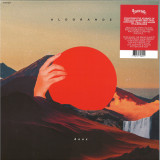
In 1958 the painter Isson Tanaka (22 July 1908 – 11 September 1977) moved to Amami Ōshima, an island in the Ryukyus. There, in self-chosen isolation, he committed himself exclusively to his art until his sudden passing in 1977. In 2018 Seiha Kurosawa, Kanako Azuma and Hideki Umezawa visited Amami Ōshima to create a video installation about Tanaka’s insular life. The work, entitled “Dokkyaku” (tr. The Lone Visitor), shifts between the texture and materiality of Tanaka’s paintings in relation to the natural world of Amami Ōshima and its people. The video invites viewers to understand—poetically—the artist’s sensitivity to nature and the expressivity of his works.
During his stay on Amami Ōshima, Hideki Umezawa recorded a lot of natural sounds to recreate a sort of simulated ecology of Tanaka’s mind – or: of the painter’s mind. On this long playing record these recordings are blended with electronically generated sounds. Next, Andrew Pekler, who has never actually visited Amami Ōshima, upon hearing Umezawa’s field recordings creates - in the spirit of Isson Tanaka - a complementary dreamscape of the island’s phenomena. Of what could be.
This is a work that doubts between site specific and creative imagination. With sounds echoing between the anecdotic and the imaginary. It is a sensitive and highly stylized interpretation of a world that Isson Tanaka had also carefully studied. A painter at work; a way of seeing. So, after Christophe Piette’s ‘Six Tableaux de Quelpaert’, released by Edições CN in 2019, we again moore an island in the nautical footsteps of a painter. While Piette drew a story through – among other things - recording dialogues at his island home, at the restaurant table, et al. Pekler and Umezawa paint their pictures in a more musical fashion. Where natural sounds evaporate into electronic clouds of imagination.
Hideki Umezawa (b.1986, Gunma) is Japanese artist / composer. He won 1st prize at Luc Ferrari’s international competition – Presque Rien Prize 2015 (France), and the Contemporary Computer Music Concert 2015 (Japan). “Dokkyaku” was originally created for "Fukami – Une plongée dans l'esthétique japonaise", an exhibition at Hôtel Salomon de Rothschild in Paris, France as part of ‘Japanismes 2018’.
Andrew Pekler (b. 1973, Samarkand) works with techniques of digital sampling and analog synthesis to re– contextualize found sounds and archival musical materials. In addition to numerous album releases, Pekler has also produced a number of video, installation and web-based works, as well as music for theater, dance, and film.
Buscar:the arc
Having already impressed via a slew of releases for Correspondant, Live At Robert Johnson and his own Biologic Records, DC Salas tees up an impressive release for Futureboogie. ‘The Weight Of Uncertainty’ EP illustrates the suave sounds that the Brussels born producer has become noted for, and comes backed with a remix from the supremely talented and always on-point I:Cube.
In its original mix, ‘The Weight Of Uncertainty’ dips into a smorgasbord of sound, as touches of Belgian New Beat slide on up against balearic disco tropes for a spectacular body & soul workout. The legendary French disco architect and Versatile Records mainstay, I:Cube, floats in on a little fluffy cloud for a terrific ambient dance version, fuelled by the kind of IDM brain scrambling sounds once present in the DNA of producers like Carl Craig, B12, Black Dog and Autechre.
On his two other originals, DC Salas gets raw and grungy on ‘Gliding Sound’, its distorted edge adding to the drama composed by the heavy hitting synth lines and the gnarly percussive pattern, whilst ‘They Don’t See It’ introduces some dark acid elements to the chugging rhythm and steely hi-hats anchoring the tracks off-kilter melodies.
"Emotional Response celebrates its 50th release with a special limited-edition from label stalwart Roy Of The Ravers. Following 2019’s magnum opus White Sunrise II is the accompanying “Soliel”, where our nom dee plume delves further into his archives of recently rediscovered disks to present an 8-track double pack, cut loud for DJ play.
The music too is more expansive, with the ambient and techno signatures matched with touches of jazz keys, Balearic sampledelica and even acoustic outtakes, all with that Ravers humour included.
The opening cinematic symphonies of The Smell Of Orange Peel and Kliszewicz Klopcic Klim highlight again a side not seen on his more acid / club cuts found on various labels. However, it’s the B side that compounds expectations with the deep house meets techno melodics of City Limits, before the ever-expanding feel-good vibrations of center piece Feathers hooks all. Sometimes a simple groove and catchy vocal sample is all you need to create a classic.
The second half then glides with 14 minutes of house dramatics via Versace 101624, a master of arrangement and beats, preempting the interlude of Clock House’s return. To close, EL-9400’s intense scatter percussion melds with anthemic acid undertones before its 2nd half melts to a choral ambience, leading to the closing acoustic jam dub curiosity My Brother And His Mate and the curtain for another stage in the Roy sagas. "
Hot on the heels of their landmark remix of ‘Lost My Love’ by Kenny Cox, DJ Amir and Re.decay return to BBE Music with a rework of Maulawi’s ‘Street Rap’, plus a new version of Fito Foster’s ‘Salsa’ by DJ Dez (aka Andrés) featuring Amp Fiddler. Originally issued as the opening track on Maulawi’s self-titled 1974 album by Detroit’s Strata Records, ‘Street Rap’ is a slept-on jazz/funk classic. As part of his role as curator and archivist of the Strata catalogue, DJ Amir discovered the original stems for the track and was happy to discover they had survived the years well. “I thought we could really do something different with this song” say Amir. “Like making it more of a mid-tempo ‘four to the floor’ groover. Also, I wanted us to play with the original vocals a bit for the updated version. This is by far our favourite remix!” Previously serving as DJ for Slum Village and releasing on Moodymann’s Mahogani Music simply as Andrés, DJ Dez Andrez is part of the fabric of Detroit’s unique and eclectic music scene. But few people know that Dez’s father is Cuban music hero Humberto “Nengue” Hernandez, a highly respected percussionist and vocalist who starred in the 1988 motion picture ‘Salsa’. “So I reached out to Dez because I knew his father sang and played on the Fito Foster song “Salsa’” says Amir. “I have had the stems of the song since the beginning of my license deal with Strata. I thought it would be a great homage to have Dez remix his father’s music. Plus, Dez was definitely excited to do so!” For his remix, Dez called upon Detroit legend Amp Fiddler to play additional keys and piano on the remix, while Dez also added additional percussion to compliment his father’s, like a time-travelling jam session going back almost 50 years. Staying true to his Cuban roots, Dez’s remix brings a contemporary twist to this timeless track.
Repress
Crepuscule presents It's Kinda Funny, a vinyl-only collection of classic singles by iconic Scottish post-punk guitar group Josef K issued between 1979 and 1982.
As well as the three legendary 45s on Postcard Records (Radio Drill Time, It's Kinda Funny and Chance Meeting), the album also includes both Crepuscule singles (Sorry For Laughing, Missionary) as well as the original Absolute version of Chance Meeting from 1979. B-side tracks are also included, plus a digital download coupon.
Cover art by Jean-Francois Octave. Outer sleeve printed on matt reverse board. Inner bag features liner notes and archive images by Simon Clegg.
Josef K were The Sound of Young Scotland, together with Orange Juice, whose guitars were also radiant and brittle, whose rhythms were also scrubbed and blunt, whose vocals were also proud and serious, but who sounded like another group entirely' (Paul Morley), Josef K was about the heroic Outsider suavely surfing across the fraught surface of their albino funk fracas. Haig sounds high on anxiety, finding an odd, giddy euphoria in doubt.' (Simon Reynolds)
finding an odd, giddy euphoria in doubt.' (Simon Reynolds)
Limited edition coke bottle clear LP with download card.
Currently, there is a bleak outlook on global ecology. With glaciers melting at an alarming rate and wildfires decimating over 6 million acres of forest each year, it is clear; we as a species are running out of time to rectify our planet's destructive direction.
Italian ambient duo ILUITEQ has composed their second album, aptly titled The Loss of Wilderness, echoing our current ecological situation's sentiment. By way of meticulously crafted subterranean ambient utilizing guitars, piano, and a myriad of synthesis techniques, the duo of Sergio Calzoni and Andrea Bellucci create arcadian movements in memory of landscapes destroyed by humanity's negligence.
A strong yet bucolic statement from one of the newest additions to the n5MD roster
Interiors, the title of this new release from Ultramarine, may have a topical resonance for many listeners who have found themselves in involuntary confinement during the past year, but the five tracks on this EP were actually recorded in 2011, and they represent a significant opening out of the duo's evolving musical perspective.
Ian Cooper and Paul Hammond, who had become friends while growing up together in the Essex countryside, formed Ultramarine in 1989. Throughout the 90s their distinctive music, an enticing blending of acoustic with electronic instruments, secured a loyal following and won critical acclaim. Then, throughout the whole of the next decade, Ultramarine lay dormant. Interiors documents their reawakening, with Cooper and Hammond exploring approaches to music-making made possible by recently developed software, designed specifically with live performance in mind.
Four of the five tracks to be heard here were issued digitally last year. But as Paul Hammond has pointed out, "with Ultramarine the whole point is to create an artefact, so the form and the look of the finished product is central." That's an outlook shared passionately by Simon Lewin's label Blackford Hill, and the music now available on this vinyl record is appropriately enhanced with cover art by printmaker Katherine Jones. Her imagery matches the music neatly in its nuanced interplay of solidity and shadow, line and colour, geometric form and organic growth.
Ultramarine returned refreshed in October 2011, bursting back into public awareness with "Find A Way," issued as a 7" single on their own label, Real Soon. Clive Bell, writing in The Wire, extolled its engaging mix of electronic beats with cool vocals and tropical percussion. More generally Bell embraced Ultramarine's thoughtful hybrid electronica as "music you could enjoy at home without feeling your intelligence was being scorned, or that if you were not physically in a club, you were wasting your time."
On Interiors, the roots of that slinky single are laid bare on the purely instrumental track "Find A Way Back." Its two distinct parts stretch out the beats and flaunt those tropical flourishes, shuffling and flexing, vibrant and heady, languid and sultry. This is techno filtered through the fabric of magic realism, an exotically spiced concoction, chilled and ready to be savoured at home.
With the diagrammatic clarity of its punchy thrust and spooling loops "Even When" distils the essence of Cooper and Hammond's way of working with their musical material: layering and shaping, nurturing textures, plaiting rhythms and juggling accents. The cumulative impact is almost sculptural in its physical immediacy and looming presence. In contrast, on "By Return" the duo skew the outcome, projecting a selection of limber figures into dub's auditory hall of mirrors. They are clearly revelling in the reverb, relishing the recoil and decay.
Interiors ultimately opens out onto "Decoy Point (Version)." With its ozone saturated ambience, this closing track evokes marshland and mudflat soundscapes, seabird mews, maritime signals and tidal wash. Cooper and Hammond feel deep attachment to the Essex landscape and, in particular, to the local history and physical features of the Blackwater estuary. Blackford Hill provides an accommodating home for Ultramarine's ongoing project Blackwaterside, which has featured to date a 7" vinyl record plus 28-page booklet, and a photo film with soundtrack. Now, delving into the Ultramarine archive, this welcome incarnation of Interiors offers a fascinating glimpse of the duo finding their bearings, at a vital stage along the way.
New solo record from Philip Frobos of Omni (Sub Pop, Trouble in Mind), this record is released in conjunction with a novel by Philip of the same name.
Philip Frobos' ‘Vague Enough to Satisfy’ will be released on 180g black vinyl - Only 500 Pressed Worldwide October 1st 2021. The novel will be published by Hex Enduction Books in Seattle on the same day.
‘Vague Enough to Satisfy’, is Philip Frobos’ debut solo album, it is also the original soundtrack to his debut novel of the same title. This lounge-inspired punk album acts as the musical bedrock for the story of a young man who revels in the day to day details (both romantic and mundane) of his experiences in Leipzig and Atlanta. The tone of the record reflects the tides of the protagonist’s confidence and self-doubt throughout the novel.
‘Vague Enough to Satisfy’ rushes straight to the point with it's bossa nova beat and seductive lo-fi musings. ‘Vague Theme’ opens the album with a groove reminiscent of ‘Whammy’ era B-52s while the vocals tell the story of a young romantic confused of his place within a relationship and the city around him.
‘Vacant Street’ proceeds with a hooky bassline, the revolving, cryptic sort that Frobos is known for as a member of Atlanta post-punks Omni. ‘No Packages Today’ is similarly sprightly and circuitous, sounding like the Au Pairs refining an obsession with Bowie’s ‘Lodger’. “I’m afraid that you need more than I can offer” opines Frobos bedecked by shuffling beats and burgeoning waves of saxophone. ‘Never Noticed’ and ‘Through with Buzz’ introduce notes of tension and intrigue to the frisson of the story, “you’re stuck in the same day” confesses Frobos in the former.
Instrumental tracks help to prolong an uneasy feeling of ambiguity too, with compositions like ‘Pool Disturbance’ and ‘Inflatable Flamingo’ taking their musical cue from Henry Mancini. Curious flourishes, a metronomic headiness and shuddering xylophones bring to life the intensely vivid imagery and cynical humor that suffuse the novel.
‘Pathetic’ collides the casual, magnetism of Serge Gainsbourg with tight Cars-style vocals and choruses. Meanwhile ‘Singer Not The Song’ and ‘Saturn Return’ showcase a more sedate approach, languid and arch. ‘Vague Enough to Satisfy’ is a trip, plunging you into a curious world populated by the unexpected.
Third time’s a charm. Or a chant in this case.“Antologia De Música Atípica Portuguesa” is back.Following two sold out volumes, the unplanned trilogy comes to a close with chants and hymns whilst continuing to merge music genres and presenting them as a world building concept.
If the first two volumes were dedicated to work (“O Trabalho”) and regions (“Regiões”), it only made sense to close the trilogy with ceremonial music, connecting the real – each musicians’ creation – with a fantasied celebration of Portuguese folk, traditions, and ghost methods within these unusual anthems.
If you’ve listened to Niagara before, you probably felt this whole ceremonial thing going on. A perfect opener then, for this volume with Niagara’s deep dive into proto religious-ambient music with “Paulo, Apolo e Pedro”. It sets the tone for the next 35-minutes of ethereal like songs. Either you listen to musicians working within their natural habitat (João Pais Filipe or Filipe Felizardo) or feel them exploring new areas in their realm (Niagara, Joana Guerra or Serpente), this third volume manages to combine eight of the best underrated visionaries working in current day Portugal.
In the past, “Antologia da Música Atípica Portuguesa” created an imaginary folktale where current day creations could live with the idea of archive or fake-folk. This volume forgets the world building and actually lives in it. Because this is the real Portugal. This is our folk. These are our chants. Embrace the otherworldly.
- A1: Promenade (The Cosmos Gave It Prophecies Agog And Clear.)
- A2: Obi Xi
- A3: Ded2Tfref99&Lvbrefop125Dir#35 Vinyl Only
- B1: Voluptuous Antics Enter The Hemisphere
- B2: Ritualist
- B3: Ded2Uurefg00&Aobrefatsw93Dir#26 Vinyl Only
- C1: Modest
- C2: Id (Feat Tom Wax)
- C3: Ded2Uurefc99&Aobrefatsw93Dir#8 Vinyl Only
- D1: Laps
- D2: Thine (The Cosmos Takes It Looking Back In Rapture.)
- D3: Ded2?Ref?98&Pjrefa91Dir#17 Vinyl Only
Red & Yellow Vinyl
With its first track produced in early 2017 (that crowds worldwide were listening to already in 2018), the OBI THINE XI album by RICO PUESTEL took up the time of 4 years to become the wild-at-heart ride at hand.
The fantasy concept of OBI THINE XI (based on an anagram of the label name EXHIBITION) tells stories from a wonderous kind of holistic place in space with two dualistic layers and velocities of perception present:
On the one side of SPACE, the main plot is based on the idea of an exhibition-walkthrough, representing the culmination of the EXHIBITION label itself. Throughout these acts of promenading from exhibit to exhibit, the journey passes different angles of RICO PUESTEL's musical mindset from the uniquely designed depths of OBI XI or RITUALIST to the blunt uplifts like MODEST or ID (a cooperation with scene-bedrock Tom Wax), finally peaking with the retro-game styled melodies of THINE that close this primal arc.
On the other side of TIME, there's a 12“-exclusive mini-album within the album itself that pays tribute to the vinyl record (and all of its fans) with four tracks at the end of each side, telling tales at their own pace and reflecting their perspective on the main course of the album like reflective and feverish dreamscapes from places without any conception of time.
The union of both layers merges the dualism of space and time, demonstrating the wayward ideas and musical excesses of RICO PUESTEL when it comes to his grasp and definition of Techno music and beyond – you gotta say yes to this excess...
Sun Rafs disciple and multiface artist Jamal Moss is back to Modern Obscure Musicafter his debut on the label with the "The Anticipatory Organization" under The SunGod alias back in 2018.
J. Moss more known as Hieroglyphic Being is back to the Barcelona based recordlabel with a new aka, OUR SOULS ARE IN THE HANDS OF THE TRANSALOR. Threeyears after "s..kr.t.z.m", released on Warpfs sublabel Arcola, the chicago electronic-wizar signs "An Era of Spiritual Tenebraeh. The new EP is composed by two 18minutes long freejazz-psycodelic improvisations. A trip to the dark holes of the spaceeternity.
"Continue to see yourself shining your light, brighter and brighter with every breathout as you hear yourself silently say these words. May love heal our world. May we allchoose kindness and compassion" - Our Souls Are In The Hands Of The Translator
- A1: This Evening Was Like Last Year (To Sarah)
- A2: I Wish There Was A Nowhere 1
- B1: Thank You For The Smile (To Wendy And Roger)
- B2: Three Minutes From An Afternoon In July (To Nick)
- B3: View From Battery Point (To John And Pete)
- B4: Violence
- B5: Stately Dance For Miss Primm
- B6: This Evening Was Like Last Year - Short Version
The overall atmosphere and aura of You Are Here... I Am There points at the influences of American jazz musicians such as John Coltrane, Archie Shepp, and Charles Mingus. The record shows a strong tendency, however, towards a distinctive sound that was, at the time, new, embraced by musicians such as Jan Garbarek and Ian Carr. Above all, Tippett's compositional style bears traces of the artist's classical training, unveiled by his harmonic and dynamic awareness and careful balance between improvisation and composition. At the same time, in a reasonable dose, the sextet also captures the kind of spiritual aspect of American jazz, particularly powerfully displayed by Albert Ayler, John and Alice Coltrane, and Sun Ra.
repressed !
Biogen's a different kind of musician, always travelling the road less trodden. All law's broken - no chords, no build-ups and no traditional drum patterns. Instead Biogen offers listener's fragmented shredding's, constant irritations, glitches, imbalance—and enough creative ideas to supply a whole battalion of electronic musicians. His works are full of contrast. Occasionally soft and mellow - like a cloud in trousers - Biogen would call that 'sofa-trance'. Other times the music's harsh and uncompromising with uncomfortable, irrational beats and glitches - 'Weird-core' - a vast uncharted territory. Some might be tempted to connect the contrast and contradictions in his music to his long battle with manic-depressive disorder. But the disparity in his music is its strength, confounding and delighting the listener.
It's five years since Biogen passed away, but his influence is keenly felt among Icelandic electronic musicians. In the early '90s, Sigurbjörn 'Bjössi' .orgrímsson was a pioneer of the modern electronic scene as a member of the old skool hardcore band Ajax, who for a short time counted Goldie as vocalist, and cemented his reputation for pushing the limits under his Biogen pseudonym. His musical creations weren't made to serve the past or the present, but the future.
Each release and concert offered something different. Concerts were supposed to be challenging and engaging. His releases were not easy to come by and often he'd sell his music on Laugavegur - to unsuspecting tourists intrigued by his Viking-like appearance or mesmerised by his big blue eyes. He was a friend and a mentor to many; in 1995 he was a founding member of Thule Records, and in 2007 one of the leading forces in the Weird-core movement, a group of artists focusing on the unconventional. He'd encourage young artists to release their music into the cosmos - to make mistakes and learn from them - and that wouldn't be done while sitting in a basement. Many have memories of their first gig, watching a tall and comforting figure hovering above everyone else in the crowd. That was him, and it happened rarely that he wasn't there.
A fair amount of tracks on 'Halogen Continues' are previously unreleased, or self-released in very small amounts. The music moves from 'Irrelevant Information' where Biogen illuminates on 'Stabastab" a mysterious international institute he dreamt up, originally on the 'Mutilyn' LP that he handmade and sold himself. It was an anti-LP, a non-linear album of drones, crackles and weirdness. 'Bliss' is from the 1996 double CD compilation entitled "Icelandic Dance Sampler' that he helped compile. '303 Ambient' one of the recent works of the "Weird-core" era - also a regular event showcasing abstract electronica. He was the front man of the movement; regularly performing in Reykjavik with shows included lots of break-beats and 303's.
His creativity and freedom from tradition have seen Biogen gathering appreciation as an artist with the passing of time, and are hand in hand with the concept of . The artwork by Tombo is inspired by the idea of eternity and reverence after death. Nina compiled the tracks much like other album journeys on - 'I was in the car driving in the middle of nowhere in Iceland when I heard Biogen's music for the first time. Dramatic weather conditions outside probably influenced that instant emotional connection that I had with his music. Later navigating through a large archive of his recordings it took me some time until the album took form. I picked the most idiosyncratic cuts that show his creative approach most brightly. Some of them are short cuts ending obnoxiously with a lot of temper and others gorgeous atmospheric narratives - so deep and haunting that it feels like they are not familiar with a notion of time and dissolve slowly into the eternity. It's been an honour and felt exciting to have complied his work, a responsibility I feel keenly, and I hope he would like his music together in this album.'
Biogen's friend the Icelandic musician Ruxpin (Jonas Gudmundsson) who has worked to collect together Biogen's musical legacy through his DAT recordings and hard drives, and kindly granted Nina access to the files, provided much of the text for the press release. Following the album release of 'Halogen Continues', a further album of Biogen's ambient and experimental works will be released on GALAXIID later this year.
Renowned Finnish jazz innovator and band leader Iro Haarla takes a detour towards progressive rock Iro Haarla Electric Ensemble to release their debut album in October Known for her large number of works in the field of acoustic free jazz, Iro Haarla is a notable Finnish pianist, composer, arranger and band leader. Now, having inked a deal with Finnish cult label Svart Records, Haarla takes an eye-opening sidestep towards progressive rock. Her new band consisting of renowned Finnish musicians, Iro Haarla Electric Ensemble weaves a vastly colourful world of sound around Haarla’s peculiar melodies, and welcomes us to new sonic territory: a vibrant world where black music influenced rhythms, acoustic instruments, analog synthesizers and spacelike, valiant electric guitars converge. In her long career as one of the most distinctive creative powers in modern scandinavian jazz, Haarla’s history includes both the works with her past life partner Edward Vesala (d. 1999) and an extensive repertoire of her own innovative solo works, recorded for the renowned ECM Records. For What Will We Leave Behind - Images from Planet Earth Haarla has put together a band whose musical expression is strong and profound. The rhythm of the music lies in the dynamic hands of bass player Ulf Krokfors and drummer Aniida Vesala, and together with Sami Sippola’s (Hot Heroes) responsive tenor saxophone and Finnish rock legend Jukka Orma’s (Sielun Veljet) imaginative ability to dive into new dimensions with his electric guitar, What Will We Leave Behind grows into an unforgettable experience for both prog rock and jazz enthusiasts. Out on the 29th of October 2021, the Iro Haarla Electric Ensemble debut is a homage to nature - our common planet and home. Inspired by nature, the album is also a cry for help in the age of natural disasters and depletion of natural resources around us. “I admire nature’s grand beauty, which arises from extreme phenomena and the battle for survival. The thread of life is unbroken”, Haarla says. Each album track portrays a place on Earth: between the humane opening track The Song We Loaned From Our Children and the hopeful closing track What Will We Leave Behind? vibrates a variety of soundscapes from lakesides, oceans, glaciers and rainforests, all the way to the winds and rumbles of mountains and man-made cities. Adding even more depth to the musical themes and landscapes, the album’s cover art was picked up from environmental art pioneer Teuri Haarla’s photo collection.
Limited edition 12" dedicated to the Neve A Maggio song flavoured with four remixes. Three from Mushrooms Project and one with a 90's house style by Deep88.
Wrapped in elegant electronics and an international flavour, Sara's voice recounts the unusual in these days characterized by strong anomalies and cold solitude. Like when it snows in May, like when you want to pick a rose and instead find yourself blinded by a white reflection, completely out of place. Yet there is life, under that white; breath, pulsation, a rhythm that presses and makes you dance: a song that drags you away from a daily life troubled by extraordinary events, which become intimate and confidential, but still unique, like every single snowflake.
Archeo Recordings is a reissue record label that regenerates old, lost, obscure and forgotten rare gems of mostly Italian music but also all over the world of the 70s, 80s and 90s.
All releases are licensed audio tracks re-mastered in their original form with sleeves recreated for today but all based on the original images.
Archeo would like to make the music available to a wider audience of collectors, DJs, music lovers of a forgotten time.
Favorite Recordings proudly presents Deux, second album of French Jazz-Funk quartet Aldorande. In this new chapter, the four explorers pursue their interstellar trip on the Aldorande
planet, deploying their ever deeper love for the 70's Jazz-Funk & Fusion scene. Extending their first
visions of this new world, the bigger-than-life arrangements of this second album reflect again their
high attention to dramatic narrative schemes, breezy Brazilian vibes, tempestuous funky grooves and
strong cosmic melodies from outer space. Classic and contemporary at the same time, Deux is built
for the like-minded souls still looking for the perfect beat.
Twisting time and space but never forcing the groove, the band dives more profoundly into the
Cortex influence of their compositions, with intense female back vocals fitting perfectly into their
cinematographic vision. Like a cry in space, could these esoteric incantations be heard by Aldorande's
divinities? Or will they be more impressed by the super-tight rhythm section with its bangin' basslines
or an irresistible blend of drums and percussion? In the end, they probably would have to surrender
after hearing the infinite echoes of the synthesizers and horns reflecting in the atmosphere. Deep and
thoughtful, the travel has only begun but it seems that so much has already been experienced.
Breaking the code, they opened the gates to a rebirth. One that could be only accomplished by finding
the “Pierre des Mondes”, deeply buried somewhere on Aldorande - the only key to solve the riddle of
the groove. Mission accepted.
You'll find in Aldorande some of the best French jazzmen including bandleader and founder Virgile
Raffaëlli on bass (Setenta & Joe Bataan, Camarão Orkestra), Florian Pellissier on keys (Iggy Pop,
Setenta, Cotonete & Di Melo, …), Mathieu Edouard on drums (Chassol, De La Soul) and Erwan
Loeffel on percussion (Camarão Orkestra, 10LEC6). On this album, they took the initiative to invite
two guests on some tracks: AOR singer Al Sunny and killer guitarist Laurent Guillet (Le Soldat Rose,
Setenta).eir ever deeper love for the 70's Jazz-Funk & Fusion scene. Classic and contemporary at the same time, Deux is built for the like-minded souls still looking for the perfect beat.
Available on November 19th 2021 as Tip-On Vinyl LP & CD.
- 1: Unidentified Members Of The Royal Drums Ensemble (Mujaguzo) - Mujaguzo
- 2: Erusana Lutwana & Budo African Music Club - Ffe Basajja Ba Kabaka
- 3: Albert Bisaso Ssempeke & Band As The Lyres, Fiddles, And Drums Ensemble (Abadongo) - Akasozi Bamunanika Keyagaza
- 4: Kopolyano Kyobe & Band As The Xylophone And Drums Ensemble (Abantamiivu) Ssematimba Ne Kikwabanga
- 5: Unidentified Members Of The Royal Flutes And Drums Ensemble (Abalere) - Akwana Omwami Tagayala
- 6: Evaristo Muyinda - Sewaswa Kazala Balongo
- 7: Maria Nanemba Muyinda - Twaliraana Mayumba Emmeeme Tezaalirana
- 8: Evaristo Muyinda - Twabonabona
- 9: Unidentified Members Of The Royal Trumpets Band (Abakondere) - Bagabye Mukwenda Owange Talina Nnaku
- 10: Kalema Hassan Katipa & Band - Byananyinimu
- 11: Unidentified Members Of The Royal Big Xylophone Ensemble (Abakadinda) - Bandaba Okulya Etoke Bampita Mulamu Dala
- 12: Temutewo Mukasa, Royal Harpist (Omulanga) - Okwagala Omulungi Kwesengereza
- 13: Unidentified Members Of The Royal Drum-Chime Ensemble (Abatenga) - Kifwe Kze Kya
- 14: Semuwemba George William - Kubikira Amadinda
- 15: Semuwemba George William & Sekindi John - Emirembe Ngalo
- 16: Albert Ssempeke - Omusango Gw’abalere
- 17: John Ssempeke & Sebuufu Steven - Osiibye Otyano
From its founding in the late 14th century, the kingdom of Buganda has been celebrated through sound and nurtured a rich musical tradition in its royal court. Coming from across the kingdom, musicians would take turns in the palace to sound drums, xylophones, flutes, lyres, and more to praise and honour the existence of the kingship. In recent years however, the tradition has been more difficult to maintain, especially since 1966 where there was a violent attack on the palace that abruptly abolished the kingdom and during which royal musicians fled or were killed. And while the kingdom was re-established in 1993 as a cultural institution, many of the remaining musicians had since chosen to sideline their skills to deal with the issues of their day to day lives, the practice of the royal tradition waning in popularity, especially with younger listeners and players. But all is not lost. Scattered across the kingdom, a motivated team of older veterans and attentive young players are still keeping the tradition alive. Offering a transversal glimpse into the past and the present, "Buganda Royal Music Revival" collects recordings made in between the late 1940s and 1966 illustrating the older generation's skills, and presents them alongside recent recordings featuring old and young musicians who still carry on this musical tradition, some even performing for the current king, Muwenda Mutebi II. The later were made during the shooting of the 2019 documentary "Buganda Royal Music Revival" that presents through a film what this album conveys through sounds: a packed dive into a century-old tradition. The music displayed here is diverse and vibrant, presenting a variety of styles and highlighting instruments that illustrate the depth and sophistication that stemmed from the royal court experience of Buganda. As a starter, the album opens with 'Mujaguzo'. Often translated as 'The Drums of the Kingship', the mujaguzo is a crucial ensemble for the cultural tradition, made from drums collected by the kingdom throughout its long history and numbering around 100 drums (historical records suggest there were at some point over 300). They are the vitality of the kingship packaged into sound. From here, we're introduced deeper to an array of instruments and textures, like the buzzing Bugandan lyre (endongo) by contemporary royal player Albert Bisaso Ssempeke, the resonant akadinda xylophone with its 21 large wooden keys, Temutewo Mukasa's restless praise sung with his harp (ennanga), the hand-made gourd trumpet (amakondere), the entenga "drum-chime" and its core set of 12 drums tuned like the amadinda xylophone, or the tightly intertwined melodies of the flutes ensemble (abalere). With the music, the hissing and swishing sounds of old tapes reminds at times the listener of the long process, from the original recording to its archival digitization, that allows the talent of past musicians to still vibrate nowadays. This rousing selection of music and moods is a unique and all too rare exploration of sounds that celebrates the common history of generations of musicians, and the question remains open as to how this rich cultural tradition will shape and be shaped by the upcoming Bugandan future, and what engagement it will trigger among audiences within, but also beyond, the kingdom of Buganda.
- 1: Take My Hand
- 2: Something In My Eye
- 3: Medicine
- 4: Badger's Wake
- 5: World In Action
- 6: One By One
- 1: Take A Bow
- 2: October Sun
- 3: So Low
- 4: Summer Sun
- 5: Gather Up
- 1: Theme From Snuff Box
- 2: Middle Of The East
- 3: Like Stone
- 4: Phantom Birds
- 5: Music For Insomniacs Part Iv
- 6: Say It Again
- 1: The Innkeepers Song Live
- 2: Obsessed & So Obscure
- 3: Woman
- 4: Solstice
- 1: Bigger Than A Dog (Original Witchazel Intro)
- 2: Take My Hand (Live On Absolute Radio)
- 3: Autumn (Witchazel Outtake)
- 4: The Dawn (From Myspace Ep 'Summer Sun' 2010)
- 5: Snuff Box Live Loop (Used Live Between 200 - 2012)
- 6: Catch Me In Time
- 7: Dark Beach (From Myspace Ep 'Summer Sun' 2010)
- 8: The Hangman (Acoustic Version 2007)
- 9: Wonder Theme (Became 'Something In My Eye')
- 10: Music For Insomniacs (Alternative Intro)
- 11: Theme From 'Sorry' (Live From Charlie Brooker's Screenwipe 2007)
- 12: Music For Insomnaics Rejected Theme
- 13: Walk With Samuel Devil Inside Me
- 14: Blankety Blank Vocal Intro
- 15: The Blue Elephant Trip Two
- 16: Sweet Velvet Became 'Seasons On Fire
- 17: The Blue Elephant Alternative Intro
- 1: Covered In Clowns
- 2: Get Her Out Of My Mind
- 3: I'm Going
- 4: Make It Go Away
- 5: Peter Cleopatra And The Windmill
- 6: Play On
- 7: Take A Bow
- 8: The Preacher's House
- 9: A Shot Rang Out In The Forest
- 10: The Wrong House
- 11: Where's My Love?
- 12: You Danced All Night
- 1: Medicine / So Low
- 2: Silver Sun
- 3: Theme From Snuffbox
- 4: Solstice
- 5: The Pheasant
2x 12 Inch[30,88 €]
‘Gather Up’ is the culmination of ten years on Acid Jazz for Matt Berry.
‘Gather Up’ comes as a beautifully packaged 4CD hardback book set with 28 pages of
illustrations and notes or a 5LP box set with a 64-page booklet and certificate of
authenticity signed by Matt.
‘Gather Up’ is also available as a standalone 21-track ‘Best Of’ on gatefold CD and red
coloured vinyl double LP.
The 55 tracks on the 4CD / 5LP sets are split between an anthology compilation that
tracks the very best tracks from his eight albums and associated singles for the label over
the last decade, an album of unreleased tracks and rarities, a demo version of his 2020
album ‘Phantom Birds’ (titled ‘Phantom First’) and the previously unreleased ‘Live At A
Festival’ album, which showcases Matt and his band The Maypoles in full flight.
The book included in both formats has an extended essay by Chris Catchpole which
reviews Matt’s musical career and an exclusive set of photo images culled from the
archive of Matt’s long time photographic collaborator Ben Meadows.
Following the huge acclaim earlier this year for Matt Berry’s eighth studio album, ‘The
Blue Elephant’, Acid Jazz release ‘Gather Up’, a compilation album encompassing the
singular musical adventures this extraordinary musician has taken over the past decade,
offering a revelatory and fascinating insight into the working process of a genuine musical
maverick and sonic explorer.
Over 10 years with Acid Jazz, Berry has released nine incredibly diverse albums
(including one live album). From the tangled-folk rock thickets of ‘Witchazel’ and ‘Kill The
Wolf’ (which features the song from which this release gets its name), to the out-there
explorations of ‘Music For Insomniacs’ or ‘TV Themes’’ retro-kitsch delights, through the
soul power in ‘Matt Berry & The Maypoles Live’ or the twilight grooves of ‘The Small
Hours’ to the classic pedal-steel songwriting of ‘Phantom Birds’ and the smorgasbord of
psychedelic sounds on ‘The Blue Elephant’, Berry’s journey has produced a feast for the
ears that twists and turns down more unexpected avenues than most artists could
manage over several careers.
‘Gather Up’ pulls together an excellent career spanning collection expertly compiled by
Berry, including non-album tracks such as ‘Snuff Box Theme’. No easy achievement
considering the sheer breadth, diversity and volume of his exceptional musical output.
p 16 Music for insomniacs [Part 4]
- 1: Take My Hand
- 2: Something In My Eye
- 3: Medicine
- 4: Badger's Wake
- 5: World In Action
- 6: One By One
- 7: Take A Bow
- 8: October Sun
- 9: So Low
- 10: Summer Sun
- 11: Gather Up
- 12: Snuff Box Theme
- 13: Middle Of The East
- 14: Like Stone
- 15: Phantom Birds
- 16: Music For Insomniacs
- 17: Say It Again
- 18: The Innkeeper's Song (Live)
- 19: Obsessed & So Obscure
- 20: Woman
- 21: Solstice
5LP BOXSET VERSION[126,85 €]
‘Gather Up’ is the culmination of ten years on Acid Jazz for Matt Berry.
‘Gather Up’ comes as a beautifully packaged 4CD hardback book set with 28 pages of
illustrations and notes or a 5LP box set with a 64-page booklet and certificate of
authenticity signed by Matt.
‘Gather Up’ is also available as a standalone 21-track ‘Best Of’ on gatefold CD and red
coloured vinyl double LP.
The 55 tracks on the 4CD / 5LP sets are split between an anthology compilation that
tracks the very best tracks from his eight albums and associated singles for the label over
the last decade, an album of unreleased tracks and rarities, a demo version of his 2020
album ‘Phantom Birds’ (titled ‘Phantom First’) and the previously unreleased ‘Live At A
Festival’ album, which showcases Matt and his band The Maypoles in full flight.
The book included in both formats has an extended essay by Chris Catchpole which
reviews Matt’s musical career and an exclusive set of photo images culled from the
archive of Matt’s long time photographic collaborator Ben Meadows.
Following the huge acclaim earlier this year for Matt Berry’s eighth studio album, ‘The
Blue Elephant’, Acid Jazz release ‘Gather Up’, a compilation album encompassing the
singular musical adventures this extraordinary musician has taken over the past decade,
offering a revelatory and fascinating insight into the working process of a genuine musical
maverick and sonic explorer.
Over 10 years with Acid Jazz, Berry has released nine incredibly diverse albums
(including one live album). From the tangled-folk rock thickets of ‘Witchazel’ and ‘Kill The
Wolf’ (which features the song from which this release gets its name), to the out-there
explorations of ‘Music For Insomniacs’ or ‘TV Themes’’ retro-kitsch delights, through the
soul power in ‘Matt Berry & The Maypoles Live’ or the twilight grooves of ‘The Small
Hours’ to the classic pedal-steel songwriting of ‘Phantom Birds’ and the smorgasbord of
psychedelic sounds on ‘The Blue Elephant’, Berry’s journey has produced a feast for the
ears that twists and turns down more unexpected avenues than most artists could
manage over several careers.
‘Gather Up’ pulls together an excellent career spanning collection expertly compiled by
Berry, including non-album tracks such as ‘Snuff Box Theme’. No easy achievement
considering the sheer breadth, diversity and volume of his exceptional musical output.
[p] 16 Music for insomniacs [Part 4]