Known for his indie-folk-inspired singer-songwriter music that envelops emotions and
moods in intimate, breathtakingly beautiful soundscapes, Cunningham has built a
massive following over the years, amassing more than half a billion streams.
With 'In Light', he wanted to push boundaries. Inspired - and unsettled - by the rapid
development of artificial intelligence, he sought to capture the essence of raw human
creativity. The result is a collection of ten tracks, recorded over five weeks in
Tottenham, North London. These songs-- captured as single takes with minimal
editing-- immerse the listener in a profound stream of consciousness. Cunningham
explores personal truths and reflects on the world's complexities, from the unsettling
grip of big data to the hope that genuine human connection still offers. As he sings in
'This I Know', "The best is yet to be / I believe." The album's title, 'In Light', reflects
Cunningham's optimism, shining through even in darker moments. "We're here right
now / Let's be here again tomorrow," he urges in New Symmetry, concluding with the
poignant affirmation, "I am leaving a light on".
quête:the best in minimal
Aufbauend auf der Dynamik seiner "Stolid State" EP, die eine kraftvolle Kollabo mit à;GRUMH…-Sänger J3 sEUQCAJ und Remixe der britischen Industrial-Pioniere Test Dept und der französischen Innovatoren Maman Küsters enthielt, verspricht das neue Album des Stockholmer Underground-Elektro-Pioniers Majestoluxe Grenzen weiter zu verschieben. "Wretched Conditions" bietet 13 unerschrockene Industrial-Pop-Tracks, die die raue Essenz des 80er EBM/Industrial beschwören. Mit dabei sind einige der besten Alternative-Talente Stockholms wie Bodypop-Queen EMMON, Horror-Gothic-Sirene Aux Animaux, Post Kontrôl (von den Minimal Wave-Helden Hidden Lines) und der himmlische LIVMØDR. Das Album wurde von Jimmy Monell aka Mr Monell gemischt und gemastert.
Released in 1997, this Stunning EP from Kerri Chandler is considered by many to be the best of his Raw Grooves series and maybe even his best work of the late 1990's. Ladbroke Grove and What About Us are the classics here while Dub Music and Can't You See tread into darker minimal Chandler territory. Out of print since 2001, this is another slab of Large Music essential wax for every serious collector.
- I Miss You, I Do
- Crooked Teeth
- Greyhound Station
- I Love You
- Day Old Thoughts
- Maybe I Ve Wasted My Time
- Took The Train Til The End
- You Re Mine, I M Yours
- Born In Spring
- Happy New Year
Arny Margret, Iceland’s remarkable and poetic upcoming singer-songwriter, is due to release her second album ‘I Miss You, I Do’ on March 7th via One Little Independent Records. The follow-up to 2022’s celebrated, minimalist folk debut ‘they only talk about the weather’ sees her working with new producers in America to develop and hone a sound that’s more textured, expansive, and mature.
‘I Miss You, I Do’ incorporates sessions from Arny Margret’s trips to New York City, North Carolina, and Colorado, as well as those recorded in Iceland. During extensive international touring, she wrote prolifically and spent time getting to know producers and musicians who each brought their own unique and individual talents to the project. Arny’s atmospheric and introspective material has been layered with country-inflected full band ensembles, keys, banjo, harmonium, slide guitar and more, adding an ambience that only enhances her natural ability to convey crystal-clear imagery within thematically rich writing.
In pursuit of her creative vision, Arny enlisted producers Josh Kaufman, Andrew Berlin, Brad Cook, and Guðm. “Kiddi” Kristinn Jónsson. Josh Kaufman is best known for his work with Grateful Dead founder Bob Weir, The National, This Is The Kit, Hiss Golden Messenger, Josh Ritter, and The War on Drugs. Andrew Berlin, GRAMMY nominated for his work on Gregory Alan Isakov’s record ‘Evening Machines’, also mixes national punk rock staples such as A Wilhelm Scream, Rise Against, and Teenage Bottlerocket. Brad Cook served as a producer for Bon Iver, Big Red Machine, Waxahatchee, Hand Habits, Kevin Morby, and Whitney amongst others. Arny also returned to Iceland to record with her long-time collaborator and friend Kiddi Jónsson in Reykjavík, Iceland.
- 1: Lucifer, Bringer Of Light
- 2: Laird Of Heimly
- 3: Stanley (Tonight's The Night)
- 4: The Comeback
- 5: Kip Satie
- 6: Balthazaar
- 7: Bed Of Roses
- 8: Neotzar (The Second Coming)
- 9: Core Memory Corrupt
- 10: Three Frightened Monkeys
- 11: Dead Of Winter
After two pandemically conditioned ‘reaction’ albums - Yay! (2023) and Neigh!! (2024) - a few non-album singles and a compilation album, a downsized and sleek Motorpsycho is back where we all know and love them, with an epic, sprawling double album, filled to the brim with inventive, organic and ecstatic rock-based music. Rejoyce Psychonaut! This eponymously titled, 11 song work, has exactly as much variety & diversity, accord and discord, as one expects from a band that has released a few albums before, and that these days must be regarded as an institution in European rock. From concise 3min-something pop-rockers, to 20mins plus progressive epics, via acoustic intimacies and psychedelic wig-outs, this is concentrated Motorpsychosis: commenced Rebis, countdown initiated. Ever closer. Ever sharper... Since the traditional 3 or 4 piece rock band seems to be a dying breed these days, and MP always was a band in flux anyway, a new pragmatic era has begun in the Psychoverse. The band has, in what one might call alchemical terms, been ‘dissolved and purified’, and is by now again reduced to the core two founding members HMR & BS. This is nothing new, it has happened a few times before, but these days they are also the owners and creators of the record company NFGS, which is now the hub of all recorded band activity, and Motorpsycho marks the final severance of existing ties to other labels for the first time in 35 years. If ‘freedom is free of the need to be free’, this is it. Yikes! The minimalist title of the album is then not just easy to remember, it’s also a statement: a new era has begun in the Psychoverse, a state of affairs reflected in execution and details as well as title, if not perhaps, in ambition or size: “Senex psittacus negligit ferulam” *. This is a time of new beginnings for a band that has spent two years consolidating and reseting before charging ahead anew on a new path, trumpets blaring (...and trumpets don’t come much more blaring in the Psychoverse than with this grandiloquent hyperbole. Good fun! ). New day rising indeed. The core band was adroitly helped by a gaggle of greats from all over the Scandinavian musical landscape on these recordings: drummers Ingvald Vassbø and Olaf Olsen, string arranger/violinist Mari Persen, vocalist Thea Grant, and - as usual - honorary psycho, brother Reine Fiske, were all fellow travellers on this musical journey. Motorpsycho was co-produced by the band and Deathprod, and mixed by Andrew Scheps. Motorpsycho are not the best at what they do, they’re the only ones that do what they do. NFGS2025 *: “Senex psittacus negligit ferulam,” or “An old parrot doesn’t mind the stick.”
Reissue!
WRWTFWW Records is honored to reissue revered UK electronic duo Ultramarine’s best kept secret from their discography, the superb A User’s Guide album, available as a limited double LP housed in a beautiful heavyweight sleeve with inside out printing.
On the rare occasions that Ultramarine’s story is told, the duo’s fifth album, 1998’s A User’s Guide, tends to get omitted from the narrative. Radically different to anything the duo released before or since, it has remained a slept-on, timeless and inherently futurist classic ever since.
Unavailable on vinyl since the year it was released – in part because the label it originally came out on, New Electronica, folded shortly afterwards – A User’s Guide was the result of a conscious decision by Ultramarine members Paul Hammond and Ian Cooper to change their working methods and the “sound palette” that underpinned their work.
Out went the partially improvised hybrid electronic/acoustic sounds and the collaborations with guest musicians they’d become famous for. They were replaced by painstakingly created electronic sounds and textures, metallic motifs, spaced-out chords, rhythms rooted in contemporary techno and drum & bass culture, and nods aplenty to pioneering music of the period, from the post-rock atmospherics of Tortoise, and the hazy dub techno of Basic Channel, to the tech-jazz of Detroit, the minimalism of Berlin, and the musically expansive warmth of Chicago deep house.
It may have taken a year to create – part of which was spent developing this head-spinning new sound – but the results were undeniably unearthly and effortlessly forward-thinking. Over a quarter of a century may have passed since it first appeared in record stores, but A User’s Guide still sounds fresh and modern – a remarkable achievement given the relatively sparse and basic equipment used in the making of the album.
As this first vinyl reissue conclusively proves, the material showcased on A User’s Guide has lost none of its sparkle in the 26 years that have passed since its release. For proof, check the head-nodding IDM bubbliness of opener ‘All of a Sudden’, the queasy, lopsided tech-jazz of ‘Sucker For You’, the locked-in beats and mind-mangling motifs of ‘Zombie’, the ghostly, out-there electro of ‘Ambush’, the Autechreesque ‘Ghost Routine’ and the triumphant closing cut ‘What Machines Want’, a classic of minimalistic, jazz-flecked techno futurism.
Fully remastered from the original DATs by Jason G at Transition Studios, the 2024 vinyl edition of A User’s Guide thrusts Ultramarine’s most overlooked album back into the spotlight. This WRWTFWW edition also features brand new contextualizing sleeve notes, complete with new quotes on the production process from Ultramarine, by dance music historian Matt Anniss (author of Join The Future: Bleep Techno and the Birth of British Bass Music, and founder of online electronic music platform Jointhefuture).
Points of interests For fans of electronic, leftfield, postrock, tech-jazz, IDM, minimalism, futurist electronica, dub techno, house, experimental, Autechre, Tortoise, Basic Channel, forgotten gems from superb discographies, very good music, and very very very very good music.
Official vinyl reissue of legendary UK electronic’s duo Ultramarine’s timeless and radical album A User’s Guide.
- My Darling, My Angel
- Pavement
- Something For Somebody
- Virtue
- Defibrillator
- The Light Streams In And Hits My Face
- Hocus Pocus
- Hideaway
- Love Songs/ Heart Strings
- Ray Of Light
- The Worst Thing I Would Ever Do
- Horses
In Mallrat’s (aka Grace Shaw’s) vision of the world, light is more than photons and electromagnetic radiation hitting the eye — it’s a moment of divine intervention. A bold swerve into the metaphysical, this is the premise of the prized Brisbane-born, LA-based pop songwriter and producer’s 2025 sophomore album: Light hit my face like a straight right. Set against a newly informed backdrop of expressive breakbeats and dance music, its 12 songs explore the intangible and mysterious allure of human connection, held together by curious investigations into light — “the closest thing to a concept this album has,” Mallrat says. She reunited with Butterfly Blue producers Styalz Fuego (Troye Sivan, Tate McRae) and Alice Ivy, while bringing into the mix indie electronic producers Chrome Sparks and Casey MQ. Mallrat serves up highs like “Hideaway,” a song where heart-racing garage clashes with her trademark candor: “I’ll be your lucky charm just let me hang around your neck,” she sings. Sleek and early standout “Pavement” gets a gritty underlayer with chopped up vocals from DJ Zirk’s “Born 2 Lose” and mid-album standout “Hocus Pocus” finds Mallrat singing about being pulled “under the spell” of someone new, borrowing a different part of the same DJ Zirk sample to build its shimmering, dancefloor-ready facade. It’s an endeavor that perhaps reaches a peak on “Horses,” the record’s gentle and organic closer which Shaw herself calls “objectively the best song.” Written after returning home to Brisbane and “feeling like an alien,” it gained new meaning in the wake of her late sister’s passing. For Shaw, it’s the convergence of the song’s minimalism, lyrics, space, and the way her voice cracks on the recording as she sings, “Hey, I’m right here, I look different now.” After years of solidifying herself as a master of well-crafted, timeless pop — fielding recognition from New York Times, NYLON, Teen Vogue, Billboard, The FADER, NPR, and more — Light hit my face like a straight right is a step into the art of world-building, bolstered by her intuitive songwriting and clever, studied production.
YVGOSLAVIA is undoubtedly one of the best post-punk and minimal wave acts from Spain, and they’re returning to Oráculo with their second mini-album, following the highly sought-after ORDUB01. Their frozen atmospheres and relentless, punishing beats immediately captivate any advanced darkwave enthusiast.
Presented in a ONE-OFF truly limited edition of 300 copies lacquered pressed on 180 gr. high quality solid BLACK vinyl. All tracks have been specially mastered for vinyl by Daniel Hallhuber at Young and Cold Studios (Germany).
Securing his place in the scene as a mainstay after consecutively acclaimed releases on his own record label and beyond as well as lengthy touring around the globe's best venues, Altinbas returns to Token the only way he knows how. The Fuse resident's ethereal mark on driven techno comes this time with an aquatic touch, diving further into his bubbly architecture and melodic intrigue.
'Voyage' can mean many things; the past few years have been an incessant trip across the world's greatest sound systems and most dedicated audiences for the Belgian producer, or then perhaps it's a reference to the climactic and emotional nature of his productions. In any case, it's also the title track for his third EP on Token Records. Balancing warmth and anticipation, Altinbas is able pack in all the elements of a timeless record while still providing the space to breathe. Smooth and introspective, 'Voyage' kicks off the EP on a cloud of a club roller. 'Stygious Night' shares the first side with a more minimal but nonetheless effective approach. The tonal synth work on this record begs for a powerfully round system worthy of only the best dancefloors, and the space that washes around in the background gives it true dimension. Maintaining minimalism with structure through drum arrangement, 'Stygious Night' is reminiscent of a not so distant past in Berlin crafted with a clearly modern approach. As the record flips, 'Venus Ballroom' takes us by surprise with an uncommonly resonant sound at the forefront. This stylistic switch blends perfectly with historic tracks on the label that have come to define its sound since 2007. Hypnotic, psychotic, quirky, and mental - 'Venus Ballroom' proves a deep understanding of the music and appreciation of versatility. 'Psychosphere' closes down the EP with a classic sound of dissonant stabs to resonate through a foggy room. Altinbas highlights his sound with frantic clap sequences and short rides to keep his percussion rolling but dry while his synths create the acoustic he's been known to craft for the past few years. To have everyone agree on level of taste and technical capability is tough, which is why this certainly won't be the last time Altinbas will team up with Token to roll out his cutting-edge work.
Following their groundbreaking collaboration with Art Ensemble of Chicago, Comme à la Radio, Areski and Brigitte Fontaine began recording almost exclusively together as a duo.
Deeply rooted in North African and European folk traditions, the album features evocative vignettes with breezy vocals and minimal accompaniment of classical guitar, strings and woodwinds.
As always, there is a mercurial quality to their lyrics. The title track (translated as "I Do Not Know This Man") suggests at once Apostle Peter's denial and a poetic acknowledgement. On "C'est Normal" Fontaine playfully questions the status quo while Areski offers satirical answers. What makes Je Ne Connais Pas Cet Homme one of their best-loved albums, though, is its remarkable sense of intimacy – as if Areski and Fontaine beckon listeners into their strange and beautiful world.
This first-time domestic release continues Superior Viaduct's reissue campaign of Fontaine's classic '70s catalog.
Sourcing rare records to reissue can involve meticulous research and years of digging, but then occasionally, Lady Luck smiles upon you. We probably would have never heard of the Medium Wave Band if Gary from Mr Bongo hadn't known Wolverhampton-based record dealer, Steve Ward. Whilst offering Gary some records for sale, he remembered he had a spare copy of an old 7" single that he thought Gary might like. Steve didn't know much about the release, and it had never sold on Discogs. Looking at the record itself, it was minimalist in appearance and information, there wasn't much to go on other than that it was from the Birmingham area. The mystery drew us in…
The A-side, 'So Tender’, is a late-night, jazzy slow-jam, with beautifully sultry, soulful female vocals which sounded vaguely familiar. On listening to the B side, 'Games (Instrumental)’, you are rewarded with a superb example of Britfunk / independent UK jazz-funk. The pulsating, bass-led dancefloor groove and sensibility is a sound reminiscent of productions usually found on labels such as Elite, but the 7” was not released on a label, it was a private press by the band themselves. So who are the enigmatic The Medium Wave Band?
After some fruitful internet digging and correspondence, we got the answers. The band lineup featured Elliot Browne on guitar (lead & rhythm), Ron Lyseight on guitar (rhythm), Andrew Proverbs on keyboards, Tony Peart on drums, Paul Snook on bass, Linton Levy on saxophone, and surprisingly, the beautiful vocals we had been enjoying were those of Jackie Graham, aka the hugely successful UK vocalist, Jaki Graham. Maybe best known for her pop hit with David Grant, 'Could It Be I'm Falling In Love', but also featuring on the cult classic track 'Fire In My Heart' by Escape From New York.
Influenced by artists and bands including George Benson, Ronnie Laws, Weather Report, George Duke, Azimuth and Chick Corea to name a few, the guys booked into a studio near the Botanical Gardens in Birmingham and recorded the two tracks that make up this 7”. Only 200 copies of the original 7" were ever pressed and were sold mostly in Birmingham at Summit Records by the band’s friend DJ Frenchi, as well as at live shows. Despite its limited distribution channels, the record received solid support from fans and those in the music industry, including Morgan Khan of the influential record label, Street Sounds. DJ and journalist, Lindsay Wesker, reviewed the release and this led to the band travelling to London for several radio interviews. They played live shows across the country, including at the prestigious Ronnie Scott's in London, and supported both Shakatak and Weapon of Peace in Birmingham.
Thanks to all those involved bringing this release into fruition and for solving the mystery behind a wonderful Britfunk and UK soul record that could have otherwise been lost in the mists of time.
Following his recent EP, The Circle of Life, on Pushmaster Discs, Milan's rising techno star Maike Depas returns with a brand-new release on his renowned The Innovation Studio Records. Titled “Sexy Devil Horse”, it is a powerful 10-track collection, featuring many iconic international artists from the Hard Techno space such as Etruria Beat’s headmaster Luca Agnelli, Dutch-based sensation OGUZ and the “Demon of hard techno” also known as Michael Katana, as well as Southern Italian talents CHRS and Gianni Di Bernardo.
This release marks a pivotal moment in Maike Depas’ journey to become one of the highest rated talents in the Hard Techno scene. It will also be followed by a key paradigm shift his label’s business model in 2025. For this occasion, Maike has lined up an amazing group of artists to celebrate those who have shared his musical vision along the way.
The title is meant to be provocative and captivating, just like its content: catchy and fresh enough to attract ravers and clubbers from around the world. Its artwork was created by the master Luden Works. It features a plastic female figure with an undefined appearance, yet with sensual curves and a powerful surge of energy, like a wave enclosed in a sphere, representing Maike’s and The Innovation Studio Records’ logos.
From the galloping rhythm of “Sexy Devil Horse” and “Hear The Sound” to the groovy and elegant “Ce Soir” there is an immediate feel about the artist’s singular touch and eclecticism. Same goes for the tangible contrasts which make a key element of this release, where the minimalistic mood of “StarKiller” and its maximalist counterpart “Dark Serenade” carry the listener through a full-spectrum emotional rollercoaster.
Hard Techno and Psy Trance vibes go hand in hand with ‘90s Trance and Rave echoes, creating a blend of recognisable and innovative samples that can resonate with many different types of audience and like-minded artists. This aspect is fundamental in the direction Maike and his team have decided to take.
It all comes from afar: starting with a classical musical background – playing the piano at Conservatory level for many years, including Berlin’s own Funkhaus. This theoretical and practical knowledge, mixed with a long-time passion for electronic music, made it easier for Maike to shape and cultivate his authentic sound since a very young age.
As part of its evolution, The Innovation Studio Records will officially open its doors to new talent and renowned artists starting in 2025. The team’s vision is to create an international reference point for quality and innovation, shaping a brand-new artistic movement based on combining the modern vision of our generation with our cultural heritage from the past, thanks to the team that we put together, both in terms of approach and technique.
It'll be a structure built from the ground up, combining the best of analogue technology in a modern workflow with the highest level of music hardware, audio monitoring and studio design. In their view, there are two types of productions: those that stay ‘inside the box’ and those that get into your heart.
The desire to unite instead of dividing, to join forces instead of competing, is the key to Maike’s success and a real drive to turn the studio lights on every single day. Despite playing a lot with dystopic, cyberpunk-like atmospheres throughout his artistic journey, music doesn’t feel like a means to escape reality for Maike. In fact, it’s quite the opposite.
The definition Maike uses the most to describe what The Innovation Studio Records wants to become is “a mysterious display cabinet”: a place where an artists will never know what emotion will arise or what direction will be taken next. Although hard work, professionalism and common inspiration will ultimately still be its main fuel, a true sense of community and empathy will be crucial to shape the future Maike and his team have in mind for it.
In a very romantic way, the idea is to re-create the same atmosphere from the Italian Renaissance masters’ workshops. Places where different artists - with opposite backgrounds and styles - could all mingle and inspire each other, in order to foster the creation of something unique. A collective effort for a greater good.
About MAIKE DEPAS
Young hard techno DJ-producer Maike Depas (born Michelangelo De Pasquale) has seen the future of music and it’s called metaverse: “In the future it will blow up,” he predicts. “And it’s going to revolutionize the way we experience music.” Bowled over by Skrillex and Martin Garrix by the age of eight, and DJing at smaller Milan clubs by the time he was eleven, Depas went on to study composition and piano at the prestigious
Milan Conservatory before learning ‘life- changing” lessons from the best in the business at Catalyst’s 4-week Advanced Sound Design course in Berlin’s Funkhaus . His production gets inspired by huge 90s trance synths as much as pounding hard techno from artists such as Kobosil, In Verruf and Amelie Lens.
2024 marked the launch of MAIKE DEPAS 2.0, a tectonic audio-visual shift that entails a wide array of content from DJ sets livestreamed from Berlin’s Teufelsberg and other dystopic locations around Europe to cyberpunk-inspired outfits designed by Demobaza, a cyberpunk-inspired casual couture brand best known for their sustainable Dune X Demobaza collection. Over the course of a developing metamorphosis from a flesh-and-bone individual to a mysterious CGI character, Depas is another step closer to revolutionize the dance music scene through the metaverse.
Remastered Re-issue!
Marvin Dash, Germany's best kept House Music secret. Real House Music headz have been following his versatile productions between Detroit House and Minimal Techno since the mid 90's. Back then many didn't know Marvin is really Ronald Reuter, hailing from the middle of Germany, Thuringia.
About 30 years ago Ronald and his buddy Jens Kuhn aka Lowtec teamed up for music production on their own terms in the vibrant House, Techno scene of East Germany. This scene was pure DIY: Parties somewhere out in the country, heartfelt, down-to-earth people and raw underground tunes from analogue machines. Their productions were way ahead of their times, but found a cult following by and by...
There's many great Marvin Dash records, but his main piece of work remains „Model Turned programmer“ on C-Rock's Stir15. Deep as hell, iconic soundscapes, 100% pure!
In this next installment of Token, Brussels' own Border One steps in to showcase 'Echoes from the Abyss', another swinging, modular-driven project destined for controlled sound systems. In these four tracks, the seasoned producer does what he knows best: engaging the dancefloor through his signature sound design and use of space.
'Echoes from the Abyss' the track, like the EP, is a collection of sound associations that are synonymous with Border One's sound. Resonant and cerebral yet bouncy and full of groove, the A1 presents a shimmering veil of synthwork that gives off a truly hypnotic effect. The follow up is much more sequence-based, focusing on the elements' interactions. The producer plays along freely with his drum machine, responding to a classically loopy and dissonant main synth that insists its way from beginning to end. Tension is everything, especially when met with a sustained chord in the second half, turning the record into a weapon of suspense. 'Celestial Observer' comes back straight and center with a focused tone and a progressive arrangement. With a thick low end and shrill highs, Border One flicks through percussion patterns and filter sweeps to make an intense, at times close eyed dancefloor experience. Ducking back into obscurity for the last track, 'Escaping the Void' takes on a more minimally produced style that breathes a bit after its previous, denser productions. Concluding with a question mark is always very appropriate, and here we're faced with a record caught between ethereal soundscapes and tense implications. With 'Escaping the Void', Border One closes with his latest contribution to Token with class as always, appealing to genre veterans and newcomers alike.
- A1: Delgado Intro
- A2: Slow Down
- A3: Shouts To The Mobb / Medusa (Ft. Conway The Machine)
- A4: This What Ya Want?
- A5: Breath Of Air (Ft. Ransom)
- A6: Trim The Fat (Ft. Stove God Cooks)
- A7: Skipping Town
- B1: Breezin In A Porsche
- B2: First Kill
- B3: Roc Reunion (Ft. Eto)
- B4: Mobb Bop (Ft. G4Jag)
- B5: Real Vs. Whatever (Ft. Bun B & T.f.)
- B6: Pirate Lords (Ft. Knowledge The Pirate)
- B7: 4 Point Play
- B8: Delgado Outro
Gold Vinyl[46,18 €]
The wait is over! Delgado, the ten-track collaboration album by Flee Lord & Roc Marciano is now available on vinyl with bonus tracks from the delxue digital version! Originally released in August of 2021, Delgado was produced entirely by Roc Marciano, with the veteran artist / producer providing a blend of versatile beats for the Lord Mobb General to spit his patented street raps over. With features from long time collaborators such as Conway the Machine, Ransom, Stove God Cooks and DJ Boogieman, Delgado received both commercial and critical acclaim and now this fan favorite is available on wax! HotNewHipHop had this to say about the album: “On this one, Flee is in absolute beast mode, bodying each instrumental that Marci serves up with fire and fury. At this point, it’s going to be hard to deny Flee a spot at the best current lyricist table, especially after he delivers inspired performances on ‘This What Ya Want?’ and the minimalist ‘First Kill’.”
"""Many Tribe fans consider the band’s next album, 1993’s Midnight Marauders, to be its magnum opus. But you don’t arrive at the perfect nocturnal LP without first releasing a focused work like The Low End Theory, which winnowed the colorful expanse of People’s Instinctive Travels into a seamless listen. The Low End sounds minimal in comparison and is a mostly drum’n’bass record of subtle bells and whistles. Tribe represented freedom, and some 30 years after The Low End Theory, it’s still a sonic marvel and one of the best hip-hop albums of all-time."" "
Robert Sotelo is a bedroom pop songsmith who lives in Glasgow. Sotelo has released six albums since 2017, three of which came out on Upset The Rhythm. He also performs in Order of the Toad, Dancer and Nightshift. Mary Currie is best known as half of touchstone DIY experimentalists Flaming Tunes, alongside Gareth Williams (of This Heat). Currie also performed in Officer! with Mick Hobbs amongst others.
Introduced via a mutual friend, Sotelo approached Currie last year about collaborating on four songs he was constructing with producer/electronic guru Joe Howe. This resulted in the ‘Dream Songs’ 7” EP (out October 4th on Upset The Rhythm).
Not only does the title capture the hazy, reflective nature of the music it also expounds on the origin of tracks. Sotelo experienced several lucid dreams in the first half of 2023 that left him in a state of confusion. He recalled visiting parts of London vividly, including a disused theatre of great familiarity, yet it slowly transpired that these places and circumstances were not real, much to Sotelo's disbelief.
These reveries informed the lyrical narrative of the four songs from the forthcoming EP. Currie took a similar approach with her lyrics, focusing on memory and time for her passages on the record. Currie recorded her parts in London (assisted by her good friend Alison Craig) and then sent them to Howe, alongside additional location recordings to consolidate into the mixes. These four tracks flutter with a minimalist bass, drum machine and keys dynamic, allowing Sotelo and Currie’s vocals to speak deeply into the back of your mind. ‘Expectations’ is a pensive triumph of whirled moments and momentum with Currie’s final words lending much gravity “the outcome of my days is always the same, a void that must be filled, a battle against time that drags us along; mutating, spinning, ebbing, flowing. Begin again, we work to give value to time.” ‘Telegraph Hill’ boasts a glossy fluidity, as it plays with images of motorways, ancient citadels, crows, paralysis and emanations. ‘Lady Fortune’ meanwhile is a tranquil treatise on fate, imbued with finessed electronic embellishments and clarinet flourishes. You can't quite trust where these songs will take you, they feel particularly mercurial. Dreams indeed.
‘Dream Songs’ by Robert Sotelo & Mary Currie will be released on October 4th, followed by some live performances from the band. These will include the aforementioned EP tracks, as well as recreated cuts from the Flaming Tunes era, leaning into happenstance rather aptly.
"Cerulean Blue vinyl limited to 700 units! On her second full-length record as Waxahatchee, former P.S. Eliot singer Katie Crutchfield’s compelling hyper-personal poetry is continuously crushing. Cerulean Salt follows American Weekend -- a collection of minimal acoustic-guitar pop written and recorded in a week at her family’s Birmingham home. On this new record, Crutchfield’s songs continue to be marked by her sharp, hooky songwriting; her striking voice and lyrics that simultaneously seem hyper-personal yet relentlessly relatable, teetering between endearingly nostalgic and depressingly dark. But whereas before the thematic focus of her songcraft was on break ups and passive-aggressive crushing, this record reflects on her family and Alabama upbringing. Whereas American Weekend was mostly just Crutchfield and her guitar, Cerulean Salt is occasionally amped up, with a full band and higher-fi production.
At times, Cerulean Salt creeps closer to the sound of PS Eliot: moody, 90s-inspired rock backed by Keith Spencer and Swearin’ guitarist Kyle Gilbride on drums and bass. The full band means fleshed-out fuzzy lead guitars on “Coast to Coast”, its poppy hook almost masking its dark lyrics. Big distorted guitars and deep steady drums mark songs like “Misery over Dispute” and “Waiting”.
There’s plenty of American Weekend‘s introspection and minimalism to be found, though. “Blue Pt. II” is stripped down, Crutchfield and her sister Alison singing in harmony with deadpan vox. She’s still an open booking, musing on self-doubt versus self-reliance, transience versus permanence. “Peace and Quiet” ebbs and flows from moody, minimal verses to a sing-song chorus. “Swan Dive” tackles nostalgia, transience, indifference, regret — over the a minimal strum of an electric-guitar, the picking at a chirpy riff and the double-time tapping of a muted drum. The album closes with a haunting acoustic-guitar reflection on “You’re Damaged,” possibly the best Waxahatchee song to date."
Geplant war es von Omega damals logischer Weise nicht, die eigene Karriere in Genre-Phasen einzuteilen. So etwas machen später Musikjournalisten und Fans - und unter ihnen besonders die Statistiker. Nach deren Lesart gilt die zweite Hälfte der Siebziger als Space-Rock-Ära der ungarischen Band. Abgebildet wird sie durch die Trilogie "Time Robber" (1976), "Skyrover" (1978) und schließlich "Gammapolis" (1979). Zwar waren sphärische Klänge bereits davor und auch danach noch im Schaffen des Budapester Quintetts zu vernehmen, derart konzeptionell fokussiert zeigten sich Omega jedoch tatsächlich nur auf diesem Triple. Nimmt man die Erfolgs-LP "Time Robber" weiterhin als Qualitätsmaßstab, hielt auch "Gammapolis" mühelos mit. Die Kompositionen der Gruppe um Sänger Jànos Kòbor waren melancholischer geworden, die bittersüßen Melodien schmeichelten. Das galt besonders für den siebenminütigen Opener "Dawn In The City" ("Hajnal a város felett"), dem Titelsong "Gammapolis" und "Silver Rain" ("Ezüst esö"). Zwischen der westeuropäischen, englischsprachigen Version und dem ungarischen "Original" gibt es neben dem Gesang und der Sprache in der Titelreihenfolge und bei der Songlänge einige kleine Unterschiede. Minimal ließen Omega die instrumentalen Passagen einiger Stücke auf der Muttersprachenvariante länger fließen. Für die westeuropäischen Omega-Platten-Käufer jedoch hatten diese feinen Unterschiede keine Relevanz, kannten sie meist die ungarischen Songs gar nicht. Ebenso wenig dürften sie registriert haben, dass GAMMAPOLIS in Omegas Heimat mit fast einer dreiviertel Million Einheiten die am besten verkaufte LP der Band-Karriere wurde. Das deutsche Cover-Artwork wich jedoch von der ungarischen Version erheblich ab: Zeigte die Bacillus/Bellaphon-Variante die Silhouetten der Musiker vor einem von Flak-Scheinwerfern durchschnittenen Nachthimmel, war auf dem Pepita-Album offenbar die zwar futuristische, allerdings auch karge Welt auf einem fremden Planeten zu sehen.
Círculo Cerrado presents its second album “Circular Economy”, 4 tracks that span a wide range of textures with the common denominator of atemporality.
A1. Rindeau, the Argentinian illustrator and music artist from Strain Collective, presents “Machine soul”, intelligently crafted with the best combination of electro-techno and EBM.
A2. Galdar’s breed Aniano materializes another mind-blowing track with “Encadenado a la Realidad”, a house tune with funk overtones and psychedelic undertones.
B1. Javier Carballo and Aniano aka HDZ brings a darker engine “ La Furnia ”, trailblazingfrom breaks, IDM to acid house for full voltage.
B2. Frenchman Tom Joyce, owner of Sounds Benefit label, captures in “ Good Game“ a hypnotic and minimalistic track with hints of tripping on top of 909 drums.
Dame Area's highly anticipated fourth studio album, "Toda la verdad sobre Dame Area" ("The Whole Truth about Dame Area"), a collaboration with the renowned labels Mannequin Records and Humo Records.
Formed in 2017 within the vibrant underground scene of Barcelona's Màgia Roja club, Dame Area comprises the Italian-Catalan duo Silvia Konstance and Viktor Lux Crux. They fuse industrial-tribal polyrhythms with minimalist synth basslines, drawing profound inspiration from avant-garde masters such as Esplendor Geometrico, Throbbing Gristle, Suicide, Einstürzende Neubauten, Can, Coil, Swans, Big Black, and Wolf Eyes.
This record represents a new phase in Dame Area's discography. It's a big step up in terms of sound, composition and ideas. This record it's the perfect representation of what they have been playing live the last three years and what most people know them for. Also it serves as a companion piece to 2022’s Toda la mentira sobre Dame Area ("All The Lies About Dame Area"), which had a stronger focus on melody, while this latest record is more aggressive and industrial-influenced, with a greater emphasis on percussion.
Tracks like the Suicide-influenced "Si no es hoy cuando es" and "Sempre Cambiare" are an onslaught of industrialism and experimentalism—formidable, volatile, and unpredictable avant-garde subversion. Silvia explains, "One of our biggest influences is doing what our influences wouldn't do. We're more into dynamics and structures atypical of electronic music, with changes in time signatures, starts and stops, and dynamics more typical of rock music. We use any musical idea from any genre. Some songs on the album are based on flamenco rhythms, others influenced by '60s experimental pop, heavy metal, or contemporary electronic music."
The confrontational "Vengo dall'aldilà" accelerates with heavy percussion, while "Tu me hiciste creer" builds into a rhythmic, transcendent noise of yelled vocals and hypnotic beats. Viktor adds, "This song took us more time to complete than any other we have recorded. It was a very organic process, evolving slowly from some instrumental percussive stuff we were doing live. Then we started using feedback as a rhythmic element (through a metallic sheet), and this was the first song where we incorporated this element, typical of noise-rock and experimental rock."
Elsewhere, "Esto Es Nuestro Ruido" represents a manic, eclectic form of contemporary industrial music, post-punk, and EBM. Silvia notes, "It's the first album we recorded outside a studio. Although we've been playing live with metallic percussion and floor tom from the very start, in the studio, with some exceptions, it was mostly sample-based until now. On Toda la verdad sobre Dame Area, all drums and almost all metallic percussion have been recorded live."
With a growing reputation as one of the best live bands around since their inception, Dame Area has toured extensively across Europe, performing at renowned festivals like Atonal, CTM, Nuits Sonores, Dour, and Fusion, as well as legendary clubs such as Berghain, Tresor, Apolo, and Spook Factory.
Recorded at Sol de Sants Studios and Estudio Hermetic between August and November 2023
Silvia Konstance: vocals, synths, percussions, electronics, production
Viktor L. Crux: synths, drums, percussions, electronics, production
Mixing and additional production by Guillermo Sánchez Rojo
Mastering by Paul Mac at Hardgroove Mastering
Designed by Leo Sousa
Photography by Fabio Calabretta
Photo concept by Dame Area
Das Duo aus Jerusalem und Lothringen, bestehend aus Ruth Rosenthal und Xavier Klaine, entwickelt seit etwa fünfzehn Jahren ein einzigartiges Universum, in dem sich synthetische Punkklänge und dröhnende Gebete einer Gesellschaft am Rande des Abgrunds zusammenfinden. Genährt von Doom/Drone, Barockmusik, multidisziplinärem Theater und afroamerikanischer Kultur, verfolgen sie weiterhin einen einzigartigen Weg, indem sie einen radikalen Diskurs verteidigen, der sich seiner Widersprüche bewusst ist. Sie spielen auf der ganzen Welt in Clubs, Galerien und Kirchen. Ihre Musik ist minimalistisch, dunkel, politisch und rau, zwischen Magie, Chaos und Melancholie. Winter Family machen auch dokumentarische Theateraufführungen, die von großen europäischen Theatern produziert werden. Manchmal spielt ihre Tochter Saralei mit ihnen. "On Beautiful Days" ist das vierte Album von Winter Family und es erzählt in Wort und Klang viele Geschichten: die der Musiker selbst und ihrer Lieben, die ihres Umfeldes, ihres Lebens in Jerusalem, Paris oder Lothringen; die von Frauen, 'Hexen', Verschwörungsmythen; die des kapitalistischen und kolonialistischen Europas; die der Blindheit und Gewalt der israelischen Gesellschaft und der Indoktrination ihrer Bevölkerung; die der Besetzung Palästinas; die des ewigen Eingesperrt seins, die einer Laborratte; und vielleicht auch Deine Geschichte. Wir hören Pumpenorgeln und Harmoniums, ein altes Klavier, Verzerrungen und himmlisches weißes Rauschen, Sirenen, marschierenden Stiefel, Atmen im Schlaf, Betäubungsgranaten am Checkpoint 56 in Hebron, die Flötenklänge von Saralei, Beats von einem iPhone und Ruths (sprechende, erzählende, kommentierende) Stimme. Wir tauchen ein in all diese zeitgenössischen Geschichten, die von der Geschichte heimgesucht werden, in das Gefühl eines Sprungs ins Leere, in einen Zustand der Dissoziation oder in ein Gefühl der Befreiung. Eine komplexe und doch zugängliche, nachvollziebare Klangwelt erschaffen Winter Family. Vinyl klassisch schwarz, CD mit Bonustrack!
Perhaps best described as a pioneer of the underground experimental scene, the signature of Jørgen Teller on the musical landscape of Denmark traces back to the late 1970’s. Sprung out of a whirlpool of post-punk and art school ideas, Teller has relentlessly been chiseling away on the constrictions of music in various bands, collaborations and solo projects ever since. Searching out its farthest outposts - be it free jazz, noise or acousmatic music - Teller has strived towards an approach to music without rules, often by way of improvisation and usually with the aid of electric guitar.
This album is based on a live performance held at the Inter Arts Center in Malmö in early 2022, where Teller performed a semi-improvised piece in homage to the poet Poul Borum, whom he had worked with in the mid-90’s closely before Borum’s death in 1996.
As a composer, Teller relies on a set of “basic choices” that becomes a “precise point of departure” - where he can then go against his “good knowing” of the science, trends and different schools of music and go straight into his own instincts as a performer. For this performance, he used pre- recorded material of three rhythm boxes (all out of sync), timbales and sessions on Erica synths.
In dialogue with the label, Teller has focused on extracting the recording of the rhythm boxes and timbales alone, emphasizing the tension between the rhythms. With minimalist drum sequences that could easily be placed in a proto-techno context, and the whooshing of what might be an ancient rhombus instrument, there is a feeling of a primitive presence to Teller’s rhythmic excursions. A throwback to the spiritual realms of a wordless society fighting the demons of chance.
Occasionally pierced by stark industrial drum crashes and rattling post-punk percussion, it also conjures echoes from the darker side of the 1980s. In citing Borum as its inspiration, Teller shares that he channels the poet’s energy and their shared love of “noisy stuff and darkness”.
But the pace can also go somewhere close to breakbeat on track B2, where a whirlwind of rhythmic elements clash into a deranged deconstructed club tune.
The album also features a remix by a fellow colleague of the acousmatic community; the composer Jacob Riis. On the closing track B3, Riis quietly manipulates and balances the elements of Teller’s recordings and gently releases them into a contemplative pool of static.
For our second release, circuit|breaker quips back the stacked offering of CBRK001 with another dynamic double LP, exhibiting some of the best local and international talent that’s cropped up on our radar over recent years.
The label is as driven as ever to build a bridge between our community and the wider electronic
music domain, giving artists a platform to preach the sound that speaks to them, and this release is but another stepping stone towards greatness, for us and for them.
CBRK002 opens up with a rolling, gritty number that could only be Fergus Sweetland, as metallic voices beckon forth on ‘Untitled (ARP 1.02)’. Hasvat Informant, whose thunderous reputation precedes him, then storms the barn with the explosive ‘Abispa Ephippium’. The B-side shifts gears to Goa’s Dotdat and his frantically groovy track ‘Holo’, followed by a gorgeous minimal number by Berlin-based Pino Peña – Mia’s Pocket; one that’s sure to get summer dancefloors pumping.
The C-side of the record contains two heaving tracks, the C1 from the prominent force of Cloudy Ku with ‘A Room of One’s Own’, and the C2 from the dark visage that is disgrays with
‘Turmstraße’. The final side of the record has Amsterdam legend Juan Sanchez open the filter with a warm, jacking submission in ‘Indulge’, while the Berliner Marsch takes us home with a
devious timbre that will have bodies glued to the floor on ‘Into You’.
Pianist and composer Bas Bulteel turns his gaze inward after a successful track record as leader of the adventurous energy bomb Wasdaman and as inspirer of his own trio, with which he won the 2014 Klara Music Prize for best CD in the jazz category for the album Coming Home, his debut as a bandleader.
Bas went into residency with visual artist Jan Frederik De Cock which resulted in a unique collaboration where image and sound dialogue with each other, feeding off each other, cursing against each other, loving each other ....
The result has become a profound and layered solo piano record that showcases Bas' versatility as a pianist and composer. Musically hovering between minimalism and avant-garde. Sometimes melancholic and always compelling.
Larry Mullins, langjähriger Mitarbeiter von Nick Cave and the Bad Seeds, Iggy Pop and The Stooges, Swans & The Residents, hat mit "Camissonia" ein einzigartiges und persönliches Soloalbum aus minimalen elektronischen Sci-Fi-Vignetten geschaffen, das lose auf den Schriften und dem Leben des deutschen Schriftstellers und Botanikers Adelbert von Chamisso basiert. Das Album ist nach der von Chamisso benannten Pflanzenart benannt, die von seinem Kollegen, dem Botaniker Johann Friedrich Eschscholtz, erstmals beschrieben wurde. Es ist größtenteils ein instrumentaler Soundtrack, der mehrere bemerkenswerte Ereignisse aus Chamissos Buch "Peter Schlemihls wundersame Geschichte (Der Mann, der seinen Schatten verkaufte, 1814)" sowie seine tatsächliche Überseereise an Bord von Otto von Kotzebues Schiff, der "Rurik", während der Jahre 1815-1818, als Botaniker, musikalisch illustriert. Das Artwork zum Album besteht überwiegend aus drei Holzschnitten, die zwischen 1915 und 1919 von Ernst Ludwig Kirchner geschaffen wurden. Kirchner hegte Anfang des 20. Jahrhunderts, also ca. 100 Jahre nach der Veröffentlichung von Chamissos Buch, eine ähnliche Faszination für das Werk wie Larry Mullins weitere 100 Jahre nach Erstellung von Kirchners expressionistischem Meisterwerkes - dem "Peter Schlemihl-Zyklus". Diesmal erweitert "Camissonia" das Chamisso-Erbe als Interpretation in Musik. Camissonia wurde 2020 während der Lockdown-Periode in Wien, Österreich, aufgenommen, die das belebte Zentrum Wiens in einen Zustand einer evakuierten Sci-Fi-Dystopie versetzte. Während Mullins als Musiker im Burgtheater arbeitete, fand er seine Sammlung von Instrumenten plötzlich für die kommenden Monate im Orchestergraben eingeschlossen. Er hatte jedoch eine kleine Auswahl an Elektronik in seiner Wohnung und hatte auch die Möglichkeit, sie aufzunehmen. Außerdem hatte er einen Stapel Bücher zum Lesen, und ganz oben lag - "Der Mann, der seinen Schatten verkaufte". "Die Bilder dieser Geschichte verließen meinen Geist weder bei Tag noch bei Nacht. Ich begann, Chamissos echtes Leben zu erforschen und fand ein wildes Abenteuer rund um die Welt auf einem Schiff! Eine parallele nächtliche Obsession mit den Sci-Fi-Filmen von Rainer Werner Fassbinder verschmolz schließlich zu einem bizarren Moment der Klarheit. Ich richtete mein karges Equipment ein, um zu sehen, welche Klänge ich erzeugen konnte, um die Bilder in meinem Kopf zu interpretieren. Ich entdeckte, dass die mir auferlegten Einschränkungen eine eigene Atmosphäre schufen, und so entstand jeden Tag ein neues Musikstück. Nach meiner Rückkehr nach Berlin wollte ich das Projekt so schnell wie möglich abschließen und keine weiteren Instrumente hinzufügen, um die seltsame Qualität zu bewahren. Ich lud zwei Sängerinnen ein, die ich in Berlin kannte, um bei zwei Stücken einen Chor zu singen, und ich fügte bei einem weiteren Stück selber einen Chor hinzu. Dann schloss ich die Tür und warf den Schlüssel weg."
Solomun & CASSIM remix two of the track rake from Radio Slave’s Venti album released earlier this year
Diynamic boss and Ibiza titan Solomun remixes Radio Slave ‘The Lunatics’ on Rekids, following the original’s inclusion in Matt Edwards’ acclaimed ‘Venti’ album in May. The original, a rework itself, reimagined the 1981 Fun Boy Three track ‘The Lunatics Have Taken Over The Asylum’, with Edwards’ ode to the band’s late lead vocalist and The Specials frontman Terry Hall winning support from Saoirse, Erol Alkan, Jennifer Cardini, Laurent Garnier, Paul Woolford, and Honey Dijon.
Solomun’s remix of ‘The Lunatics’ is sparkling aural nostalgia executed with total joy. Crisp 80s drums, Stranger Things-esque Jupiter 8 synth swells, the vocoded titular vocal, and a gloriously rich sliding bassline combine to drag the listener back to 1983 in the best possible way. As the track builds, rousing guitars join the ensemble, completing what is a hypnotic, melodic trip to the 80s via what’s set to be a 2024 anthem.
CASSIMM’s remix of Radio Slave vs Audion’s ‘Mouth To Mouth’ continues the story of Matthew Dear’s classic, which Radio Slave revived and reinvented as part of his 2024 LP, ‘Venti’.
Radio Slave’s hi-NRG disco cover of Audion’s minimal/maximal 2006 and era-defining anthem has dominated dancefloors since it emerged as a single in late 2023, with the likes of Erol Alkan, Job Jobse, Sean Johnston, Jennifer Cardini and Eats Everything continuing to play it today and the latter awarding it an Essential New Tune whilst sitting in for Pete Tong on BBC Radio 1.
Now, recent Rekids alum CASSIMM continues his huge run of form with a chunky, main-room house interpretation that shows just why his recent release, ‘House of Moves,’ won DJ support from the likes of Tong, Arielle Free, Paul Woolford, Honey Dijon, and Jennifer Loveless.
CASSIMS’s remix of Radio Slave vs Audion quickly follows Lindstrom and Solomun’s remixes of the ‘Venti’ LP’s tracks, which have seen support from the likes of Ivan Smagghe, Chloé Caillet, Nightmares On Wax, and more.
The impact, influence, and importance of Run-D.M.C.'s self-titled debut – the album that invented hardcore hip-hop and bridged rap, rock, and funk in then-unparalleled ways – cannot be measured. The first full-length record released by Profile Records, the 1984 set permanently changed the sound of music, broadcast streetwise wisdom to every corner of the country, and made the notion of a one-man band a distinct reality. Bolstered by an incendiary blend of staccato deliveries, stark beats, aggressive exchanges, evocative hooks, and socially conscious messages, Run-D.M.C. still hits listeners in the jaw with the same intensity it did nearly 40 years ago when it could be heard booming from ghetto blasters carried around city blocks nationwide.
Sourced from the original master tapes, pressed on MoFi SuperVinyl, and strictly limited to 3,000 numbered copies, Mobile Fidelity's 180g SuperVinyl 33RPM LP is the definitive-sounding version of the groundbreaking work cited by Rolling Stone as the 378th Greatest Album of All Time. This reissue also represents the first time this gold-certified effort has been presented in audiophile quality. Benefitting from the ultra-low noise floor, superb groove definition, and dead-quiet surfaces of SuperVinyl, Run-D.M.C. now plays with a clarity, immediacy, punchiness, and directness worthy of the artistry, urgency, and intellect of the trio's material.
The brilliance of Russell Simmons and Larry Smith's production comes into view as if the music is being broadcast on a giant system in a small club — only more focused, lively, and unlimited. Free of dynamic constraints and fatiguing harshness, this LP invites you to turn up the volume and experience the raw, rough, invigorating songs that changed the look, sound, and feel of hip-hop overnight. Think the trio’s sparse framework of drum machines, tag-team rhymes, keyboard accents, and turntable scratches is stuck in the mid-80s? Spin MoFi’s SuperVinyl LP and gain new appreciation for the music, messages, and production on display on Run-D.M.C.
Recorded in the wake of two successful and pioneering singles, both included on the album, Run-D.M.C. effectively took a sheet of coarse-grit sandpaper to the polish, sheen, and linear presentation of all the hip-hop that preceded it. Stripped to bare-bones foundations, the songs grab your attention and shake you by the collar with a combination of industrial-leaning rhythms, staggered deliveries, dance drama, and hard, minimalist percussion. Then there are the lyrics.
The LP broadcasts a smart mix of boots-on-the-ground reports, uplifting advice, and then-nascent b-boy culture. In one fell swoop, its narratives and music rendered the scene’s proclivity toward glamor and softness passé. Run-D.M.C.’s tough, cool-minded fashion sense showed the trio walked its talk and gave fans — particularly those living in long-ignored urban areas — heroes which with they could identify. Kangol hats, black jeans, leather jackets, Adidas sneaks, and gold chains were the new currency.
In every regard, Run-D.M.C. signifies the birth of modern hip-hop. Never more obviously than on the groundbreaking “Rock Box,” where rap and rock were first fused. As the first hip-hop video to receive regular rotation on MTV, the track eviscerated racial and social boundaries, awakened musicians and listeners to new possibilities, and redefined both popular music and, ultimately, popular culture. As the Roots’ Questlove has stated, it “ knocked down many obstacles, enabling hip-hop to become the new gospel."
Such teaching includes the real-world scripture of “Hard Times,” utopian hopefulness of “Wake Up,” and observational truths of “It’s Like That.” Released as the group’s debut single well before its eponymous album, the latter tune established themes and outlooks Run-D.M.C. would embrace during its career. Namely, the keen awareness of various prejudices, economic ills, and disruptive violence as well as the knowledge that education, self-motivation, and hard work were the ways to escape disadvantages and disillusionment.
Inspired and inspirational, the song reflects the spirit and shrewdness that courses throughout Run-D.M.C. That includes a detailed account of the trio’s not-so secret weapon (“Jam-Master Jay”), purpose statement (“Hollis Crew (Krush-Groove 2)”), and a revolutionary hybrid autobiographical narrative-dis track (“Sucker M.C.’s (Krush-Groove 1)”) widely regarded as one of the best hip-hop songs ever created. The same can be said for every moment on Run-D.M.C.
MoFi SuperVinyl
Developed by NEOTECH and RTI, MoFi SuperVinyl is the most exacting-to-specification vinyl compound ever devised. Analog lovers have never seen (or heard) anything like it. Extraordinarily expensive and extremely painstaking to produce, the special proprietary compound addresses two specific areas of improvement: noise floor reduction and enhanced groove definition. The vinyl composition features a new carbonless dye (hold the disc up to the light and see) and produces the world's quietest surfaces. This high-definition formula also allows for the creation of cleaner grooves that are virtually indistinguishable from the original lacquer. MoFi SuperVinyl provides the closest approximation of what the label's engineers hear in the mastering lab.
For those of you who"ve mislaid your history goggles, this archival release recalls an ancient time in the world of recorded music. Yes, back in the dinosaur days of the 1990s, a creature known as Aerial M walked the earth, before evolving into Papa M and PAJO and beyond and back. Even then, the music of M had a next-wave vibe, walking upright among the knuckle-draggers (and having drinks in the evening with others of its genetic detatchment). It was too much to last very long, of course - but some things end up lasting forever, don"t they? Fuck! So it is today that Drag City, an organization largely set up to bring you the best of all available M recordings, is proud to be there for the release of the only Aerial M session ever recorded for John Peel"s BBC Radio One show, as it was originally recorded on 3rd March 1998 and broadcast on 2nd April of the same year. The studio versions of these songs, which appear on Aerial M"s S/t album (DC114) and Papa M"s Hole of Burning Alms comp (DC231), were played by "M" himself (now revealed to be David Pajo!), which makes this album a rare alternative view of the canonical M, played by an actual Aerial M band who, all too briefly, embodied the sound for a year or so before Papa brought a brand new bag. This Session found them fortuitously roadburned from several weeks in the European Theatre. So much the better for our archival ears, as OG-M"s signature minimalist long-fuse sizzle is thrillingly intact here; in fact, even more so, as the tunes are jammed out past the studio versions" originally delineated borders, reaching rudely across the table in moments of liveness that the studio-bound project might have decided against when conferring only with the walls. For fans of their epic version of "Turn Turn Turn", this is more sweetmeats from that raucous old skull - but if you"ve not been down this road before, be prepared: the taste will set you slowly aflame. And then, before you know it, the band is dined and dashed - just like the band that Aerial M was, all too briefly amok on the earth that was too.
Ten bad boy digi riddims from the myspace era by Copenhagen’s Maffi crew, dubbed out into 3D space by disrupt in 2024. Raw, minimalist CyberDancehall at its best, nostalgic and oddly futuristic at the same time, this album is quickly becoming RoboCop’s favorite playlist when going to work.
…………………………………………………………………
Maffi Promotions a.k.a. Maffi Boys come straight outta 1773 Kbh V, Copenhagen, Denmark. Originally founded in 1990 by the two homeboys, lazy body Moog and Junior the Rat, Maffi Promotions have been a steady producer of simple digital riddims for years. Hanging out in the streets of Hummel City Junior & Moog used to entertain their friends with the primitve riddims of the Maffi sound. Not knowing that they would do the exact same thing fifteen years later, they continued to believe that one day they would move up the ladder, break out of the underground and reach for the stars.
Now, after finally adopting a little sense of realism, the two homeboys have realised that stardom is nothing compared to spamming people on myspace. So the two stoners decided to get a couple of friends together and turn up the bass online. Together with their sound crew FIREHOUSE, Maffi deal nuff weed and gyals!
Maffi Boys are very dedicated to the art of playing Sensible World of Soccer, rolling weed joints with Manitou tobacco and keeping it real in a Vesterbro-style. So watch out! And don’t test! We’ll be putting up new riddims on a weekly basis. We have nuff things brewing – including a delicious chicken!
………………………………………………………………
Growing up in the streets of Hummel City, Vesterbro, MOOG learned the pleasures of sleeping late, playing Sensible World Of Soccer and picking up hot gyals at an early age. He has spent most of his life trying to master these crucial skills. Taking a break from the dog race, Moog is currently focused on reaching a higher understanding of reggae-science and weedology.
JUNIOR experienced the necessity of rolling well-made spliffs at an early age. Incorporating the aestethic heritage of Scandinavian design, he has spent most of his life perfectionizing this old and traditional art form. Junior is currently taking his ph.d. in digital reggae by buying crates of 80’s 7″ and selecting for his sound system Firehouse.
Boxed set of five 7-inch vinyl records, 300 copies limited edition. Artwork poster included.
All tracks remastered from the original master tapes.
Alessandro Alessandroni is no longer remembered simply as 'the whistler' in Morricone's spaghetti western soundtracks – and rightly so, since he was the key figure behind much of Italian 'secret music' from the 60s and 70s, always there in the studio during recording sessions, whether as a multi-instrumentalist or as the leader of session vocal group I Cantori Moderni di Alessandroni. Today his pervasive presence and important role has been finally recognized by music professionals and enthusiasts alike, so much so that he is now considered the true father of Italian library music – a genre whose sound he shaped since 1968.
As a film composer, Alessandroni often worked for small productions that had very limited (and often regional-only) distribution, and whose budgets were worlds apart from those in the 'top league' where friends and colleagues like Morricone, Bacalov, Trovajoli or Piccioni thrived. Rarely released as a soundtrack, this music ended up, at best, forgotten inside dusty ¼-inch reels or, at worst, disappearing into thin air.
After a string of releases that have brought back to life forgotten or lost works by Alessandroni (Sangue di Sbirro, Afro Discoteca, Lost and Found, etc.), it was pretty natural for us at Four Flies to start delving into a little investigated area of his filmography: his scores for erotic films, the last genre to gain popularity in the flourishing Italian film industry of the 60s and 70s, and perhaps the most extreme too, the one that, by pushing things too far, eventually put an end to that industry and its genres.
So, we're now very proud to present Alessandroni Proibito, an exclusive boxed set of five 7-inch records. It contains a total of 14 previously unreleased tracks from the soundtracks of 4 soft-core erotic films that included hard-core sequences and, therefore, fell somewhere in-between normal commercial distribution and the underground scene of adult movie theatres.
Taking an artisanal approach to his musical craft, Alessandroni was not afraid of having to deal with spicy subject matter, wobbly productions, implausible plots, improvised actors, or cinematographers who were clearly no disciples of Storaro. And he was so good at making a virtue out of necessity, at turning budget constraints into creative advantages, that he created soundtracks that far surpass the films' quality, with music that at once captures and elevates the spirit of the erotic genre as if into a condensed symbol.
More specifically, the maestro recorded many of the pieces in a DIY fashion at home, using a 4-track Teac tape machine to arrange his compositions. The Teac allowed him to play different instruments on each track, which meant he could basically put an entire soundtrack together all by himself, or almost all by himself.
These recordings often feature drum machines – which provide that retro, early electronic music vibe – as well as funk guitars and exotic-sounding percussion in the rhythm tracks. In addition, there is an extensive, almost bewildering use of synthesizers to replace solo instruments that would have required a paid session player. On top this minimalist arrangement, Alessandroni layered what he could: some piano chords, a little flute and, most importantly, his signature 12-string guitar phrasing.
The result is just stunning: a unique mixture of electronic music and acoustic instruments, in a style that stops short of kitsch and ranges from cinematic ambient pieces like "Tensione erotica" to disco-funk tracks like "Snake Disco" and "One Sunday Morning", both of which feature vocals by Alessandroni himself.
Alessandroni Proibito comes with artwork by Eric Adrien Lee and a matching 30x70cm folded poster inspired to the insert-size posters which used to be hung outside movie theatres to attract cinema-goers.
The boxed set is being released in a limited edition of just 300 copies and will never be reissued. First come, first served.
Another Interplanetary STAR CREATURE team up for a Chicago Tokyo expedition across a soundscape ranging from bossa nova lounge to pre-vaporwave exotica; new age city pop to minimal library boogie. JUNE CHIKUMA is best known now for her ground breaking Video Game soundtracks throughout the late 1980s and early 90s, most notably the now cult-classic status Bomberman Hero OST for Nintendo. During this same period she produced many recordings for a wide variety of clients including Japanese Public Transit Commercials, Video Game Arcades and VHS Nature Documentaries. STAR CREATURES combed her archives and selected a nice mix of tracks as entry point into her work. These tracks have been rescued from obscurity, remastered and waxed up for contemporary universal enjoyment. 500 Copies. Pressed in Detroit.
Docile Recordings is for itself. We are an expression of the beautiful moments that hold us frozen. Warm confusion that breathes life to the senses. The Docile sound captures a nostalgia for times yet to come. We are a familiar resonance always shifting for the correct approach. Always aiming for the heart and soul. Docile speaks to the basic instincts of the techno rebel; supplying sonic reasons to trudge on.
The “last of a kind e.p.” is the 32nd release from the Docile Recordings record label. The feel of this release ranges from a pragmatic spiritual funk to a loose heabangin’ frivolity. Docile 32 is 4/4 minimal held together by soulful synth and smart percussion advanced by ringing highs and detuned horns. Proper mathematics of programming moves a mix match of harmonies through a gauntlet of invisible edits gaining momentum until it is taken away. This is Docile music.
At the frayed bottom-edge of Indiana - just a moderate bike ride north of Louisville, Kentucky - multi-instrumentalist, artist and songwriter Ryan Davis' Americana-noir soundwaves have been emanating for years in a myriad of forms. As driving force for the lauded State Champion, long-running member of Tropical Trash, administrator of the esoteric and excellent Cropped Out festival, and lone proprietor of the Sophomore Lounge label, Davis lays down his first proper 'solo' release with Dancing On The Edge, a rich, 2LP tapestry of tunes that absolutely glows over seven expansive cuts. It's a pure collage of modernity and heritage. Recorded in early 2023 with help both in-studio and remotely from peers like Joan Shelley, Catherine Irwin (Freakwater), Will Lawrence (Felice Brothers, Gun Outfit, John Early), Jenny Rose (Giving Up), Christopher May (Mail the Horse), Elisabeth Fuchsia (Footings, Bonnie "Prince" Billy), and Aaron Rosenblum (Son of Earth, Sapat), the results herein are melancholic, gentle, minimal yet colorful in mood: a lilting highway accompaniment of crisp instrumentation and a relaxed, amiable approach to vocals with rhapsodic wordsmithery. Fans of the aforementioned artists as well as those of Souled American, David Berman, Kurt Vile and 'Comes A Time'-era Neil should all easily find bounty. While bare-boned and uncluttered in presentation, many of these pieces track over 6 minutes allowing a fair amount of expansiveness. Dancing On The Edge stares down into the navel of the American Experience underbelly with a fair amount of outward reach. Besides the Kosmische-synth and violin stabs reaching into a European element, stately organ swells build a musical bridge between 1969 Southern California and Felt's latter era smooth moves, with layers of intelligent gesture taking this well beyond the realm of its archetypal indie troubadour/acoustic songwriter tag. Music and mint juleps never went down so well together." Originally released via Ryan's own label, Sophomore Lounge, in the US late 2023, it picked up some incredible reviews: best of 2023 in both Pitchfork and Rolling Stone, 9/10 lead review in Uncut, and a raft of other notable publications. "This is the sound of someone bearing a torch." - Bill Callahan (Smog) - RIYL Silver Jews, BPB, Lambchop, Cass McCoombs, Sparklehorse.
- A1: Samba 00 04:58
- A2: Panorama 00 04:39
- A3: Golfo Mistico 00 04:34
- A4: Open Sky With Tears Of Blue 00 04:56
- A5: Contemporary Lullaby 00 03:05
- A6: Requiem 00 02:55
- B1: Whispers 00 04:19
- B2: Modular Clouds In Rome 00 03:21
- B3: Piano Bells 00 03:30
- B4: Space Call From Mars 00 03:01
- B5: Tuning The Orchestra With Tears Of Blue 00 03:22
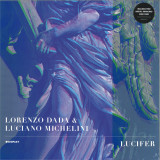
With Lucifer, Kompakt presents an album of rare beauty from two masters of modern music. A family affair, it’s a collaboration between the Italian father-and-son duo of Luciano Michelini and Lorenzo Dada, whose combined histories bring to Lucifer a depth of experience alongside clarity of vision and a finely tuned, neatly developed combined compositional voice. A lovely, beguiling suite of music that combines the electronic and the acoustic, the urban and the pastoral, its gorgeous night-eye vision and tender melancholy sits neatly within the Kompakt universe, while offering the curious listener some rich new perspectives.
There is already plenty to know both artists by. Lorenzo Dada creates across multiple fields – a techno producer and DJ who has already worked with the likes of Jay Haze, Fete, Leo Benassi, and Der, he’s released a small clutch of stylish, smartly designed EPs, and a solo album, Second Life (2018). His complementary background in classical music and composition informs his ensemble project, Tears Of Blue (who appear on Lucifer), where Dada paints with neo-classical tones for a quartet of violin, viola, cello and grand piano, supplemented by electronics for live performance.
Luciano Michelini’s history is yet richer. He may be best known, to many, for his piece “Frolic”, the theme to Larry David’s Curb Your Enthusiasm series; it was also sampled by Snoop Dogg for 2022’s “Crip Ya Enthusiasm”. But there’s much more to Michelini’s story. A successful soundtrack composer, Michelini both studied and taught at the Conservatoro di Santa Cecilia, and worked for RCA from the sixties to the eighties; his soundtracks from this period are gorgeous examples of the form, particularly his work for Il Decamerone Nero (1972), L’Isola Degli Uomini Pesce (1979), and the devastatingly gorgeous Dimensione Donna (1977).
In the eighties, Michelini and his wife Anna Gutling founded the Electronic Music Division studio and academy in Rome, which is where the majority of Lucifer was recorded. Dada reflects on the experience: “We never worked together before, so it was all new for both of us,” with Michelini adding, “I truly love this experience with my son. He’s a talented pianist and composer. I am not very familiar with electronic music nowadays, but we did it fluently.” There’s certainly a familial energy at play through Lucifer, and you can hear how Dada and Michelini, through exploration and experiment, find a shared language, balancing Dada’s tendency toward minimalism, and Michelini’s composerly voice.
Lucifer flows as a suite that interweaves electronic music with acoustic instruments: the lonely sigh of saxophone; Michelini’s lush, verdant piano; the weeping strings of Tears Of Blue (recorded at the studio of Michelini’s friend, the late Maestro, Ennio Morricone). These multiple voices are located within the electronic sighs and swarms from Dada’s kit; there are moments of propulsion, and passages of lambent drift, where the album revels in its tonal sweetness. If it flows so effortlessly, that’s because Lucifer was designed that way, as a suite or a sonata of sorts.
And the title? Dada reflects, “Lucifer was an angel who decided not to be one anymore. The miracle of life is that we can decide what we want to be, even if we are born as angels or vice versa.” This feels somehow apposite: there’s certainly something of the transformative, and the transportive, in Lucifer, a unique family collaboration of rare poetry and sensitivity, where two generations meet in the modern crucible that is the electronic music studio.
Born in Beirut, Lebanon, Rami Gabriel has been a motive force in rock n' roll, jazz, Arabic, and experimental music communities across North America for over twenty years. In that time, he has released numerous projects across genres and under many names. On his debut LP for Sooper Records, Rami trips all the breakers. In his own name and voice for the first time, That's what I been sayin' is not so much a debut as a conflagration in Rami Gabriel's worldly underground. Drawing on Punk, Krautrock, Dub, No Wave, and lo- fi, the territory occupied by That's what I been sayin' is astringent, minimal, and buzzing with the sound of machines dancing in the wind. "I'm used to putting out records based on genre," says Rami of his multiple endeavors. "I was listening to one of the `70s Brian Eno records where he took his experimental work and his songs and put it all together, and I was thinking, `Why don't I try to put all the different ways I've been working for the last couple years onto one record?'" That's what I been sayin' ignites this vision with an album that ranges from the motorik-driven krautrock of "Like a monk" to the unexpected trance-like pairing of "Buzuq synth." That's what I been sayin' is a furnace of Rami's insuppressible impulses, where he undertakes to ask and answer: what is left of punk but making do with what is at hand? At times direct and scorching, at others meditative and wandering, That's what I been sayin' compresses Rami's understanding as a composer, musician, and singer into a restless, 11-track love letter to the underground. For Fans of The Fall, Haruomi Hosono, Brian Eno, and Scientist.
2024 Reissue
Transparent grünes Vinyl! Wieder lieferbar! Zum ersten Mal überhaupt seit der digital-only Veröffentlichung 2011 erscheint nun der erste "Minecraft"-Soundtrack in physischer Form. Die Vinylversion enthält zwölf Tracks! "Minecraft - Volume Alpha" ist das Werk des deutschen Komponisten und Musikers Daniel Rosenfeld. Unter seinem Künstlernamen C418 erschuf Rosenfeld den weitreichenden Soundtrack und das lebendige Sounddesign, das das auf Voxel aufgebaute Universum von "Minecraft" zum Leben erweckte. Fans und Kritiker waren durch die Bank weg begeistert von seinen beatlosen, ausgewogenen Electro-Stücken. Die bekannte Gaming Seite "Kotaku" führte den Soundtrack unter der "Best Game Music" 2011 und nannte die Musik "beeindruckend beruhigend", während The Guardian die zerbrechlichen Stücke Rosenfelds aus Klavier und minimalistischem Ambient mit den legendären Künstlern ERIK SATIE und BRIAN ENO. In einem Interview destillierte Polygon "Volume Alpha" auf seine Essenz hinuntern: "Der Soundtrack ist nicht gebunden an die Retro-Ästhetik der Minecraft Graphik. Der Soundtrack setzt sich über sie hinweg. Das Album ist ein Versuch, die kombinierte Game/Music Erfahrung in etwas Himmlisches zu übersetzen."
Warehouse Find!
Red D is back for a follow up to his brilliant Chez EP which dropped last year and this time he's going for the jugular! The man responsible for
some of the finest house music of the last decade as FCL (with San Soda) and FCL vs VFB (with Motor City Drum Ensemble) knows a thing or two about
what makes the dancefloor lose its s**t, with tracks such as Let's Go Seven, It's You and Can We Try all testament to this.
When he's not DJing at the likes of Panorama Bar or hosting his own stage at Tomorrowland, Red D can be found running his own mighty fine We Play House label from his Ghent HQ.
Moan The Mania opens this release in suitably back to the raw fashion! A minimal drum machine groove and clipped bassline lay the foundations of this tribute to all things jacking with a sprinkling of porno groans to help you on your way. This is sleazy machine funk at it's very best. Next up we have a remix from Eli Escobar, the native New Yorker who has recently been making major waves following the release of his LP Happiness on Classic.
As someone who has remixed the likes of Lana Del Rey, Kim Ann Foxman, Honey Dijon and Holy Ghost we knew he'd be the man to take Red D's baton and run with it.
Keeping the overall vibe of the original intact
Eli cranks the energy further with additional in your face percussion parts and a couple of perfectly placed build ups. Flipping over we have Chase The Cat which takes a similarly stripped-back and minimal approach as Moan The Mania but goes heavier on the 707 beats. Finally we have Dusk Or Dawn closing the release with a deeper mood.
Simple FM synth stabs and glassy chimes provide a tender and naive-sounding counterpoint to the basic beats.
Red D proving once again that limiting your tools and not over-complicating things can often have so much more impact when it comes to house music.
2024 Repress
Mannequin Records is proud to present a full length by the Philly minimal-synth princess Void Vision.
Void Vision is a Philadelphia-based electronic project helmed by Shari Vari. It began around 2009 at a time when a wave of synth-revivalists were materializing, but the quality of the songwriting and intense vocals set the band apart from the pack. In a rare instance, Void Vision has managed to combine vintage dance elements with melodic structures, haunting melancholy, and lyrics that have a palpable soul. The songs themselves are dynamic, referencing a cross-section of the last 30 years of electronic music, while simultaneously retaining a uniqueness all their own.
The infamous Wierd Records weekly club night in New York, which showcased a variety of talented electronic and coldwave artists, served as an incubator for Void Vision in it's early stages. After a standout debut performance at the club, they immediately caught the attention of Blind Prophet Records, who consequently released their first 7" single, 'In 20 Years', which received excellent reviews.
Vari has continued performing and recording steadily over the last few years, releasing songs on compilations for various labels, including Rough Trade, and in 2012 the song 'Everything is Fine' was selected for Artforum magazine's 'Best of 2012' issue. In 2013, Void Vision toured the West Coast and later that year released a split 12" with Portland-based band, Vice Device. The first official full-length album, entitled 'Sub Rosa' is set to debut on Berlin-based Mannequin Records, followed by a European tour in 2015.
Shari Vari formed Void Vision in 2009 originally as a duo, during the explosion of the new minimal synth and cold wave scene in United States. Sharing the same scene of the Wierd Records associates like Led Er Est, Martial Canterel, Xeno & Oaklander, Automelodi, in 2010 VV released 'In Twenty Years' on Blind Prophet (Sean Ragon's Cult Of Youth record label), receiving also the attention of the Rough Trade dudes, who asked to put out a track for one of their synth wave compilations.
After other split vinyls, tapes and compilations, Mannequin approached Shari with the intention to continue what Wierd Records started, giving a proper shape to her beautiful and youthful dark electronic sound. The result is 10 hypnotic cold analog tracks dominated by the warm and fragile Shari's voice, some more 'pop orientated' some others belonging to the original 'cold wave' atmosphere.
"Sub Rosa" is an edition of 400 copies on 160 gram black vinyl and 100 copies on 160 gram white vinyl.
Laura Quirke and Claire Kinsella’s collaboration charms audiences into a world of intimate observations and uncomfortable questions with irresistible chemistry, charisma, and humour. ‘Why are all the good men, too old, taken or dead?’ The rare alchemy of the duo’s voices together cuts through a minimal and dramatic soundscape; coloured by the warmth and grit of Kinsella’s Cello, and distinctly underpinned by Quirke’s cyclical, trance-like guitar playing. While embedded in Irish and Folk roots, Lemoncello’s sound embraces the freedom of carving out its own song structures, entwined with a love of off-kilter Indie Pop, Jazz extemporisation and Romantic and Contemporary Classical music. A vital voice in the thriving alternative folk scene in Ireland, Lemoncello have been nominated for Best Folk Song and Best Emerging Folk Act at the RTE Radio 1 Folk Awards and opened for and collaborated with many esteemed artists such as Lisa O'Neill, Sam Amidon, Glen Hansard, Cormac Begley & Joshua Burnside. Now, they present their self-titled debut album, available on CD & vinyl.
SlapFunk return to the world of phonographic recordings with a mini album split into two ep’s from the highly regarded Tommy Vicari Jnr.
Hailing from the steel city of Sheffield he forged a new bond with the label after a standout DJ set at one of the famous SlapFunk parties and then delivered 8 solid tracks to work the speaker stacks.
Even with a minimal approach to the main ingredients in the productions, the results have been creating maximum impact on the dance floor, fully road tested at some of the best parties and festivals. Deep,moody, glitched out grooves collide with warehouse box jams that will soon get you throwing some serious shapes.
We are thrilled to have such a talent appear on our label and are very excited to present to you this dynamite double disc release. soft pads that will make you close your eyes and dive into intense reflections.
Backwater Collage ist das erste Soloalbum von James Hoare, das er unter dem Namen Penny Arcade veröffentlicht. Dem ein oder anderen wird er als Musiker/Songwriter bei Bands wie Veronica Falls, The Proper Ornaments oder Ultimate Painting bereits über den Weg gelaufen sein. Backwater Collage ist in der Tat ein Album bei dem die Gesamtheit der Songs als Ganzes wirken und nicht einzelne Songs die anderen überstrahlen oder ausblenden. Vom ersten bis zum letzten Ton hält die Stimmung und begleitet den Hörer auf seiner ganz persönlichen Reise. Die elf vertraut klingenden Songs, die das Album ausmachen, sind in bester Homerecording-Tradition entstanden, aber dennoch (behutsam) produziert. James entwickelt und entfaltet reine, unaufgeregte Melodien, in denen sich seine sanfte, melancholische Stimme mit dem weichen, warmen Gesang von Nathalia Bruno vermischt. Angedeutete Gitarrensoli unterbrechen manchmal die klare, ungeschliffene musikalische Linie. Der langjährige Freund Max Claps hat Keyboard-Parts beigesteuert, die die minimale Nostalgie der Tracks aufgreift und dabei jeglichem tränenreichen Pathos entgegenwirken. Um diesen homogenen Sound, diese Sounddichte zu erreichen hat James sich Zeit gelassen. Das er seine Songs aus verschiedenen Aufnahmesessions retten musste, die von einer Reihe von Missgeschicken geprägt waren, an die er, wie er amüsiert zugibt, gewöhnt ist: kaputte Multitracks, versagende Tonbandmaschinen oder selten verfügbare Schlagzeuger, die in der Hauptstadt leben, kam ihm dabei sicherlich zu Hilfe. Ähnlich wie Jack Name oder Syd Barrett - nur weniger psychedelisch - sitzt Hoare auf dem schwarz-weißen Sofa von Velvet Underground und verleiht seinem Album eine unterirdische Note. Zeitweise unruhig, aber leichtfüßig, ohne unnötige Effekte, tritt die Platte in die Fußstapfen einer weniger lauten, aber ebenso rohen und schmucklosen Jesus and Mary Chain. Mit Backwater Collage, allein am Ruder unter einem stürmischen Himmel, lädt James Hoare seine Hörer ein, es sich bei einer Tasse Tee gemütlich zu machen.
- A1: Magic Momentum
- A2: Rockets To Mars
- A3: The News These Days
- A4: Life (Skit)
- A5: Love Vibration
- B1: Original Flow
- B2: Hold On
- B3: Surviver (Skit)
- B4: Tatamaka Pt.1
- B5: Tatamaka Pt.2
- C1: Time (Skit)
- C2: Time
- C3: Jinja (Skit)
- C4: Kochirakoso
- C5: Our Tactus
- C6: Nah Personal
- D1: No Chains
- D2: Push Comes To Shove
- D3: We No Let Y'all In
- D4: Mexico (Skit)
- D5: Future For Our Children
We Release JAZZ is very happy to announce an exciting new body of work by Joseph Deenmamode aka Mo Kolours. The singular musical spirit’s new 21-track album Original Flow is available as a double LP housed in a heavy 350gsm sleeve with original artwork by Mo Kolours himself and the classic WRJ obi strip, as well as in digipack CD and digital formats.
A catalog of critically acclaimed records, including his self-titled debut (2014), ‘Texture Like Like Sun’ (2015), 2018 album ‘Inner Symbols’ and three companion EPs, established Deenmamode as a prodigious musician and vocalist. Pitchfork extolled his “hypnotic, tribal-infused dance grooves”, DJ Mag appreciated the “colourful celebration of soundsystem culture”, and Resident Advisor advocated that “no one sounds quite like Mo Kolours”. Musical analogies were drawn by The Guardian as “The best album Curtis Mayfield never made with A Tribe Called Quest and Lee Perry” and Mojo as “like Marvin Gaye produced by J Dilla”.
Five years ago, Deenmamode moved to the Japanese countryside. Far away from familiarity, he contemplated his place and further questioned his identity. “I had none of my ‘own’ people around. I had time to really find what makes me tick musically. Japan has helped me go back to those subconscious leanings, really go deep, and reflect the aspects that make up my story”.
The tracks on ‘Original Flow’ have been constructed from sessions, improvisations and soundbites captured around the world during this time; collecting contributions from musicians including Deenamode’s brothers Reginald Omas Mamode and Jeen Bassa plus Andrew Ashong, Charles Bullen, Dwaye Kilvington, Eddie Hick, Stefan Asanovic, Myele Manzanza, Ross Hughes, and Tom Dreissler. Deenamode says “I’m proud of this album’s creative process. Coming from a tradition of scouring through hours of records, I wanted to create my own samples, to find that perfect loop that no other producer could put their hands on. I decided to invite a group of friends and acquaintances, who also happen to be incredible musicians, to a studio in Crystal Palace to improvise based on some loose ideas I had. We spent all day, and recorded everything”.
‘Original Flow’ is an album of UK street-soul nouveau, future indigenous jazz fusion, Rasta Segga, Nyahbinghi jazz, Malagasy Hebrew hip hop. While retaining a spirit of exploration and improvisation, it sees Deenmamode grow and flex beyond beat tape brevity, expanding composition and stretching his musical muscle to play live with other musicians. Themes of empowerment, overcoming adversity, and mental liberation coexist with notes from ancient history, futurism, and science, as well as musings on family and togetherness.
‘Magik Momentum’ springs from a discussion that features at the start of the song, an inspiring mentor answering a question from Deenmamode about improvisation and what role it plays in life when planning and manifesting the future. ‘Rockets to Mars’ questions the lack of care for the billions of people with nothing, while governments plan to explore space. “This sparked a comparison in my mind to a Sonny Okuson song that I would reference when performing. Okuson’s song talked of the lack of resources in many communities in the world, while governments go to the moon”.
He says the music behind ‘The News These Days’ is “possibly my favourite on the album”. Looped like he would a late sixty jazz-fusion sample, there was nothing added and the track was complete within a matter of minutes. “It was the first and best moment from the entire Crystal Palace session”, he adds. The album’s contrasting title track with minimal instrumentation played solo by Deenamode. While frustratingly searching for gems in past recordings, he thought in a burst of ego, “I don’t need no-one else to make a dope beat!” picked up his ravanne, (the traditional frame drum of his fathers home-land of Mauritius), pressed record, and started to play. He says, “In my thoughts were the rhythms of the Nubians in Upper-Egypt and Sudan, the swing of the huge drums played by Mauritanian women, of-course the Sega beat of Mauritius, and the ever inspiring beat of James Yancey”.
Driven by UK broken beat, Cuban congas, Nigerian and Mauritian inflections, ‘Love Vibration’ follows the concept that all emotions carry a vibratory frequency and pays homage to the frequency of creation and the power of love. The two part ‘Tatamaka’ tells of the history of Deenmamode’s ancestors, the maroons of Mauritius. “We are people who managed to run from our oppressors and find refuge in a corner of the island called ‘Le Morne’ where they could not reach us. One bloody day they came in numbers to re-capture, to revenge. Many of us chose to jump to our deaths, rather than be taken back into subjugation. The poem by Creole Richard Sedley Assonne says; “there were hundreds of them, but my people, the maroons chose the kiss of death over the chains of slavery”. Tatamaka was the name of a famed maroon leader who was murdered for claiming his, and our people’s freedom. The song is the imagined journey of escape and freedom by an ancestor of the maroons of Le Morne”.
Born in the west midlands and raised on the traditional sega music of his father’s Indian Ocean homeland of Mauritius alongside records by the likes of Jimi Hendrix, Santana and Michael Jackson; his influences expanded with late 90s jungle and drum and bass nights in Bristol, experiments at art college in Camberwell, and the rich culture of Peckham, “at the time we called it the Afro Quarters of London” says Deenmamode, adding hip hop, dub, soul and soundsystem styles to his individual sound.
He explains, “I love drum music, from hand-drums to 808s. I love music from the ancient past, heritage music, indigenous music, traditional music passed down from the beginning of time. Music from the body, hand claps, grunts and foot stomps. Music with audible depth, busy, bustling, highly charged. Music from the soul, the music from beyond. I love music from the islands and the mountains. The music of the streets, hustle music, alleyway beats. Club music”.
He describes the creative process as thinking in images. “The visual world and the world of sound seem to intermingle in my thought process. When I play the drum with my eyes closed, a world of imagery dances and moves with beat. Improvised drumming feels like I am listening to what I want to hear, rather than trying to play what I want to hear. Following the rhythm and finding new pathways to walk within the patterns is what I experience. In this way I often feel I am just a listener, instead of the player”.
Original Flow is pressed on biovinyl, a sustainable alternative to traditional vinyl. Biovinyl replaces petroleum in S-PVC by recycling used cooking oil or industrial waste gases, resulting in 100% CO2 savings in bio-based S-PVC production. Furthermore, it is 100% recyclable and reusable, embracing the circular economy ideology.
- 01: Dante Inferno (Intro)
- 02: All Alone (Feat. Masta Ace & Torae)
- 03: Lyrikal Landslide (Feat. Ruste Juxx & Nutso)
- 04: What`s Done Is Done (Feat. Ide & Jise One)
- 05: Deja Vu (Feat. Rasheed Chappell & Soul The American Dream)
- 06: Im Here (Feat. Dontique `& Cf)
- 07: The Mecca (Interlude)
- 08: Disobedience (Feat. Clever One)
- 09: Call Of The Wild (Feat. Team Thoro (Absouljah & Spicco & Halfa Brick))
- 10: She`s Broke (Feat. Guilty Simpson)
- 11: Believers (Interlude)
- 12: Ambition Of The Shallows (Feat. Napoleon Da Legend & Paloma Pradal)
- 13: Just Listen (Feat. Wildelux)
- 14: Longevity (Feat. G.o.d. Part 3, J-Merk & Jamil Honesty)
- 15: Who Be The Realest (Feat. King Magnetic)
- 16: Making Cuts (Feat. Dj Nix`on, Dj Topic, Ordœuvre & Dj Duke)
- 17: Hell`s Storm (Feat. Q-Unique, Hex One & Milez Grimez)
- 18: Maniac (Feat. Xplicit Content (Unkn?Wn, Fatha Death & Eternel & Apacalypze))
- 19: Damned (Interlude)
- 20: Other Shit (Feat. Dirt Platoon & Wyld Bunch)
- 21: Projects (Feat. Spit Gemz & Eff Yoo)
- 22: The Payback (Feat. Ems (M-Dot & Revalation & Mayhem))
Stuck in the depths of a dark alley, blocked by yet another breeze, hitting a stone wall, road sign ahead: Dead End.
Impasse. "Cul-de-sac".
Hip‐hop. The original, some would say, official music of the late 20th Century Bronx.
Some say it has endured it's fair share of distractions, detractors and defectors. Some say it has murdered itself, having been abandoned by its so‐called best men, those who have gone off in other directions, or who have, simply, just beat‐retired. Yet, there are plenty of Soldier Monks still out there, prepared to sweat it out in the Temple of Machinery and Mics.
Low Cut honored this cause four years ago, with his MPC crafted minimalist version of NY Minute and he's back to ring the bells and unsheathe the samples!
The starting point of Dead End's production remains the 90's boom-bap, but the will to carry it even further brings it to its destination. By decorating it with rich samples flushed out after digging through vinyls pressed several decades ago, it is guided by a compass pointing deposits to the East. With sound quality inherited from a fastidious composition and mix works, using inspiration rather than just being a copycat, Dead End celebrates it without setting it up as a museum piece.
Picturing the beatmaker stuck in the depths of a dark alley, ended with a brick wall, is easy. But far from isolated in his Parisian basement, Low Cut has rung phones in New York, Baltimore and Detroit, rounding up the faithful. He magnetized the hidden but sharp forces, and gained attendance of legends. The casting of Dead End : Ruste Juxx & Nutso, Dirt Platoon, Guilty Simpson, Torae, Rasheed Chappell and the stainless Masta Ace, among other beat crushers. Also starring DJ Duke, Nix'on, Topic and Ordoeuvre with their DMC titles crates, for a deep beatfight on bars scarified of scratches.
Heavy atmosphere, martial beats and street soul, Dead End is also the final episode of the projects initiated by Low Cut, based on the model of a producer inviting various MCs.
He will then replace his turntable needles, refresh his sample banks, and settle the BPMs of his productions on more abstract frequencies.
Jon Langford's been in more bands than you have digits and that's true even if you were born with a few extras! From his early days in Mekons, Delta 5, Three Johns and even Sisters Of Mercy (booted for not wearing black) to a veritable explosion of one-off recordings and performances with more names than we could ever hope to list in full. A Wikipedia description for this group, The Bright Shiners (described therein as 'circa 2022 through at least 2023, in Northern California') provides some sense of the complex taxonomy needed just to keep track of Jon's massive oeuvre. Happily, that's an understated description of a serious new outlet for his endless creativity, and The Bright Shiners' recording activities have produced a full album, Where It Really Starts, the first recording in a collaboration with Tamineh Gueramy, Alice Spencer, and Jon's frequent musical partner, John Szymanski. Jon's never sung or written better, and the sense that the band realised they were onto something great is palpable in an instant. Each song is a minimalistic jewel - there's nothing here that doesn't need to be - yet the album is unsparing of aptly astonishing adornment - wonderful harmonies, horns, mellotron, bowed guitar, piano. looped percussion and more), by our reckoning this is one of Jon's finest works of art and his best outfit outside The Mekons themselves Jon Langford & the Bright Shiners will tour mercilessly throughout 2024.
,somewhere in the nowhere, between cows and sheep, there's a little studio:"klingt als ob man den schrank aufmacht und einem fällt alles entgegen" (fortuna ehrenfeld) "sounds shit" (new york times) "nope" (bbc6) "i fucking love it!" (brian eno) "honestly?!" (meg white) "mind opening" (hans zimmer) "well done" (idles) bonny und clyde sind in ein, ja sie hören richtig, walisisch/oberösterreichisches indie-duo reinkarniert und plötzlich riecht hier alles wie reifenabrieb nach einem vollgas-start auf der straße richtung sonnenuntergang.an den drums wird hier schnell eine new sensation offenbar.tank girl, punkbraut, madonna, blumenmädchen.mit roher gewalt und einem einzigartigen stil ballert veva mit stampfenden beats den weg zum tresor frei, während tom lässig mit dem ellenbogen durchs regal geht und die erbeuteten juwelen in form von schmutzig geschliffenen britesquen songzeilen für die ewigkeit auf den pokertisch wirft.im haldern studio hat martin, sänger und mastermind von fortuna ehrenfeld, den beiden einen derart geschmackvollen noise appeal auf die leiber genagelt wie man in hierzulande nur (viel zu) selten hört." FALSE LEFTY stellt die punkwelt auf den kopf. sie brechen nicht nur optisch, sondern auch musikalisch jedes klischee. drei saiten, drei trommeln- mehr braucht das duo FALSE LEFTY nicht. die band bricht mit perfektionismus, reduziert sich von überflüssigem, lässt das unwichtige weg und setzt auf einen minimalismus, der die hoffnung weckt, dass es doch so wenig braucht, um gute musik zu machen- eine vision, zwei menschen, drei saiten, drei trommeln. FALSE LEFTY sind eine newcomer band, bestehend aus einer schlagzeugerin, die im stehen drei trommeln spielt und einem sänger, der seine gitarre nur mit drei saiten bespannt: die frage ist nicht, was gute musik braucht, sondern was sie nicht braucht. seit der gründung der Band vor einem jahr spielten FALSE LEFTY über 40 konzerte, sowohl als headliner wie auch als support für Public Image Ltd., Fortuna Ehrenfeld, The Lathums, SONS, Kapelle Petra, Cash Savage and the last Drinks und viele andere.
Organ of Corti, the trio of Joachim Nordwall (IDEAL Records, The Gagmen), Mattias Gustafsson (Altar of Flies) and Dan Johansson (Sewer Election, Enhet för Fri Musik) returns with another exercise in the slow-motion decay of analog sound. Usher, a minimal hypnotic track on side A reveals its subtle details after multiple listens while the claustrophobic Trauma on the flipside will grab your immediate attention. Machines that hum, sputter, and crackle while slowly moving forward. Vaguely familiar tape loops, spacious synths and crumbling electronics. A journey into the unknown.
The Swedish underground scene continues to deliver some of the best experimental acts and Organ of Corti firmly establish themselves as part of the foundation with a recent self-released cassette, another cd on New Forces and this new single. While their sound has clearly evolved, these alchemists are staying true to their original intention of forging fragments of surreal nightmares.
One of the most successful and enjoyable debuts in history, The Cars' self-titled album doubles as a greatest-hits collection. That's because not one song here is unrecognized or unknown. A huge reason why the Boston quintet became America's most popular new-wave band, The Cars launched eight tracks still regularly heard on radio stations everywhere. Consider the hit list: "You're All I've Got Tonight." "Good Times Roll." "Just What I Needed." "Moving in Stereo." "My Best Friend's Girl." "Don't Cha Stop." If you're a fan of pop music, this album is mandatory. Just call it the best new-wave rock album ever made.
And now, The Cars sounds better than it has in any previous incarnation. Mastered from the original analogue tapes, Mobile Fidelity's numbered-edition LP allows the music's oscillating rhythms, futuristic keyboard passages, panned stereo images, and rippling textures to be experienced like never before. The songs take on a surreal quality, the Cars manipulating the vibrant music at will to mesmerize the listeners' senses and hold them at bay. Mobile Fidelity's pressing epitomizes the sensation of "moving in stereo."
Led by Ric Ocasek and Benjamin Orr, the Cars managed to unite then-disparate styles: bubblegum pop melodies, angular art rock, progressive arrangements, and terse minimalism. Orr's low, understated singing and Ocasek's cool, detached vocals lend shades of doubt and double meaning to the lyrics, which are further counterbalanced by orchestral keyboard flourishes and electronic beats. The brilliant arrangements also benefit from a laidback cool and understated irony that remain uncommon in the over-the-top world of mainstream music. Obsessed with incorporating the latest technologies and sounds into its palette, the band spiced its tunes with delightfully quirky accents — country-tinged guitar fills, echoing Syndrums, reggae splashes, hard-rock tones, robotic pulses.
The results are the sounds of a creative landmark. At once accessible and eccentric, edgy and catchy, The Cars explodes with emotion, energy, and hooks. It's impossible not to get caught up humming and singing along to every song, an appeal that comes courtesy of Roy Thomas Baker's stellar production. The legendary producer, best known for his work with Queen, ensured that the record seamlessly packed a smooth midrange, spacious imaging, and call-and-answer choruses in one tight package. Baker's trademark touches with harmony vocals abound.
"The MoFi disc is much better than the original in every way. It's more dynamic, much more natural on top, and all three dimensions have a lot bigger space. This disc is great from start to finish, but "Moving in Stereo" will blow you away on a great system in a big room."
—Jeff Dorgay, TONEAudio
Of the countless accolades and analyses that surround Blue, no point is more significant than the fact that the 1971 Joni Mitchell album continues to become more popular, revered, referenced, and relevant with each passing day. Such vitality is not only extremely singular; it is the ultimate measure of great art and, in the context of Blue, indisputable proof of the record's accessibility, integrity, and timelessness. If the most brilliant and everlasting music seeks to find truths shared by all of humanity, Blue can be said to be universal doctrine.
Sourced from the original analogue master tapes, pressed on MoFi SuperVinyl, and strictly limited to 12,000 numbered copies, Mobile Fidelity's UltraDisc One-Step 180g 45RPM 2LP box set presents the landmark album with reference-grade detail, tonality, and directness. Marking the first time the beloved LP has received audiophile-quality treatment, it's one of six iconic 1970s Mitchell records Mobile Fidelity is reissuing on definitive-sounding vinyl and SACD sets.
Everything about Blue sounds more intimate, involving, and inescapable on this transparent pressing, which benefits from a virtually non-existent noise floor and superior groove definition. Mitchell's voice, positioned front and center, and primarily accompanied by minimalist acoustic guitar, piano, and dulcimer playing, comes across clearly and prominently. Suspended notes and radiant chords double as question marks, commas, and phrases. The in-the-room presence and spatial dimensionality make absolute the full-range spectrum of introspective emotions — hurt and distress, self-awareness and joy, difficulty and uncertainty, warmth and desire — Mitchell navigates, queries, and contemplates throughout the record. The defencelessness the singer once spoke about is laid bare here like never before.
The packaging of the Blue UD1S set complements its distinguished status. Housed in a deluxe box, both LPs come in special foil-stamped jackets with faithful-to-the-original graphics that illuminate the splendor of the recording. This UD1S reissue exists as a curatorial artifact for listeners who prize sound quality and production, and who desire to engage themselves in everything involved with the album, including the unforgettable cover photograph of a ruminative Mitchell shot by Tim Considine.
Deemed the third Greatest Album of All Time by Rolling Stone; universally celebrated by critics, fans, artists, and educators; and defined by a spell of disarmingly vulnerable songs that are at once confessional, intense, spare, honest, painful, hopeful, and exquisite, Blue charts love, spiritualism, independence, and loss like no record before or since. Widely considered the album that established the singer-songwriter template, the largely autobiographical LP changed everything shortly after its original release in June 1971. Amazingly, it continues to do so more than five decades later.
An incalculable influence on generations of artists, it stands as the through-line from Carole King, Elton John, James Taylor, Joan Armatrading, and Leonard Cohen to Patti Smith, Carly Simon, Emmylou Harris, and Rosanne Cash to 21st century contemporaries like Brandi Carlile, Taylor Swift, Sharon Van Etten, and Courtney Barnett. Teetering between agony and optimism, it is — to borrow a phrase from Mitchell's eternal "A Case of You" — a bottomless "box of paints."
The beauty of the stripped-down arrangements, intoxicating melodies, and Mitchell's wisdom on Blue didn't go unnoticed. Critical acclaim, coupled with the depth of the material and Mitchell's reputation, propelled the album into the Top 20 in the U.S. and Top 10 in the U.K. Yet while so much pop music diminishes with age, Blue has defied norms and headed in the opposite direction. Its 50th anniversary year witnessed an outpouring of tributes, reflections, and testimonials that helped frame the record's escalating importance and symbolism — apt in an age in which women have become the prominent trailblazers in rock, R&B, and hip-hop.
Perhaps most succinctly, in a 2021 article celebrating the LP, the Los Angeles Times declared: "In 1971, nothing sounded like Joni Mitchell's Blue. 50 years later, it's still a miracle." Nothing, indeed. Yet "miracle" suggests Blue partially owes to a divine agent or inexplicable circumstance. And though Mitchell's bracing conviction and forthright sincerity can appear otherworldly, her musical approach and lyrical storytelling is nothing if not personal and human. What we hear is pure truth — no matter how aching, complicated, or stark.
Much has been written about the circumstances that inspired the songs on Blue: Mitchell's romances; her time overseas; her disdain for celebrity; her lingering sense of loss at having given up her daughter for adoption; her treatment by the very same industry that her music made uncomfortable; her prolonged search for resolution. These situations and experiences pushed Mitchell to question everything — especially big-picture concepts that have always obsessed mankind: fulfilment, autonomy, love, honesty, being.
"I wanna make you feel free," Mitchell sings on the record-opening "All I Want." Mission accomplished. Blue is liberation — and the start of a freedom that continues to impact music, culture, and identity today.
More About Mobile Fidelity UltraDisc One-Step and Why It Is Superior
Mobile Fidelity Sound Lab's UltraDisc One-Step (UD1S) technique bypasses generational losses inherent to the traditional three-step plating process by removing two steps: the production of father and mother plates, which are created to yield numerous stampers from each lacquer that is cut. For UD1S plating, stampers (also called "converts") are made directly from the lacquers. Since each lacquer yields only one stamper, multiple lacquers need to be cut. Mobile Fidelity's UD1S process produces a final LP with the lowest-possible noise floor. The removal of two steps of the plating process also reveals musical details and dynamics that would otherwise be lost due to the standard multi-step process. With UD1S, every aspect of vinyl production is optimized to produce the best-sounding vinyl album available today.
Sully returns to Astrophonica for a celestial collaboration with young Manchester based vocalist Salo.
Always one step ahead of the pack, Sully relinquishes the signature crusty Jungle breaks in exchange for crisp and steely, live sounding drums to provide the groove for a stripped back and crushed 808 bassline - a hi-def take on his iconic sound. This minimalist structure gives the foundations and space for Salo’s bittersweet vocals to take the lead with clarity and float off into the glorious twilight. A celestial collaboration that spotlights both artists’ strong points.
Sully totally flips the script with the ‘Not Just a Dub Mix’ by taking Salo’s vocals and giving them the Tubby treatment. The Jungle breaks return and sirens ring out - one for the club Salo, born in Tbilisi, Georgia before moving to Manchester via Glasgow as a child, is a classically trained pianist with all the swagger and charm of Manchester club music. She studied at Glasgow Music Academy and Royal Northern College of Music before working with club legends such as Zed Bias, Chimpo and Bassboy.
This is Sully’s first return to the label since 2020’s seminal, highly requested and repressed Swandive EP. At this point he honestly needs little introduction - he’s become one of the highest selling and most sought after Jungle artists for the best part of a decade and shows no signs of stopping
Canadian bowed guitarist and multi-instrumentalist C. Diab announces his fifth album Imerro, out February 16th, and presents the trip-infused lead single 'Lunar Barge'.
(Real name) Caton Diab creates soundscapes that evoke the spectacular wilderness of his childhood home in northern Vancouver Island. Incorporating experimental textures, folk overtones and tape manipulations, C. Diab uniquely finds the unseen spaces in-between, and fittingly dubs his creations "post-classical grunge". Imerro explores new sonic realms and is the culmination of a sound world that Diab has built up since the critically acclaimed 'No Perfect Wave' (2016, Injazero) and subsequent releases 'Exit Rumination' (2018), 'White Whale' (2020) and 'In Love & Fracture' (2021). The Wire calls it "ambient music in the best sense - music for living, which can be both non-invasive and immersive...epic"
Imerro was recorded in late July and August of 2021 at Risque Disque Studio in Cedar, BC, during the summer's unprecedented second "heat dome", which saw temperatures soaring to over 40 degrees. Recorded with regular collaborator and engineer Jonathan Paul Stewart, the pair journeyed by boat to the studio to a place with minimal distraction with a plan of "simple ecstatic improvisation." Diab explains: "I wanted to place myself in a space for creation with little thematic pretence, with the belief that music 'shows its face' as you move along. I would pick up an instrument, whether I had experience playing it or not, and make a sound. If it wanted to be played, it would play."
Original Sufferhead beginnt mit einer minimalen Improvisation mit Felas neuer Band Egypt 80 und steigert sich dann zu einer kühnen, komplex strukturierten Afrobeat-Hymne, die die Situation der Massen in Nigeria anprangert. "Lasst uns zusammen ein schönes Lied singen", schlägt Fela vor, während der Refrain parallel zu der lebhaften Melodie seines Saxophons erklingt. Mit Hilfe des Refrains zählt er dann die Probleme auf, die das Volk plagen: keine Wasserversorgung, exorbitante Lebenshaltungskosten, keine Gesundheitsversorgung, zweistellige Inflationsraten. Die "großen, großen Leute" haben das Volk zum Sarg des Staatschefs gemacht: Nach der Plünderung und Verbrennung von Felas Kalakuta Republic 1977 schrieb Fela mehrere musikalische Antworten, in denen er die schuldige nigerianische Regierung direkt angriff, darunter diese traurige Hommage an seine Mutter, Coffin for Head of State. Nachdem seine Mutter an den Komplikationen der Verletzungen gestorben war, die sie erlitten hatte, nachdem sie während des Überfalls auf Kalakuta aus einem Fenster geworfen worden war, trugen Fela, seine Frauen und seine Anhänger den Sarg seiner Mutter zum Eingangstor der Armeekaserne: ein mutiger Akt des Trotzes.
"Coffin For Head of State" ist Felas düstere Anklage gegen diejenigen, die "durch Jesus Christus, unseren Herrn" das afrikanische Volk korrumpieren, bestehlen und berauben. Der wummernde, gleichmäßige Beat und die sich wiederholende Struktur des Liedes ahmen den Marsch zur Kaserne nach, während der Text Felas überwältigende Trauer über den Verlust seiner Mutter und den Zustand seines geliebten Nigerias direkt anspricht: eine Nation von ewig Leidenden. Seid nicht passiv, fordert er: Steht auf für eure Rechte.
Die B-Seite, Power Show, baut auf dem gleichen Thema auf und hebt die Unterdrückung der Massen durch die herrschende Klasse hervor. Der Text handelt von einem reichen Mann in einem schicken Auto, der an den Straßenrand ranfährt, um einen armen, allein reisenden Mann zu beschimpfen. Fela nennt dies die "Power Show" und prangert das Verhalten an. So verhält man sich nicht gegenüber seinen Mitmenschen.
Original Sufferhead war im Box Set #5 enthalten, das von Chris Martin und Femi Kuti kuratiert wurde. Das Album wurde auf opakem, hellgrünem Vinyl neu gepresst und ist untergebracht in einer bedruckten Innen- und single sleeve Außenhülle.
Approaching the 50th-anniversary release of Artreform, the label's boss, Kyiv-based DJ and sound producer JOSS is counting on experienced artists. The fresh record
with an updated modern design from the abstract art master Elemetalsource boasts two tech-house powerhouses at once: Fedo, the lead artist from Odessa, and Okain,
the Berlin-based musician and owner of Talman Records, who was invited as a remixer.
The three original tracks from Fedo deliver detached, robotic minimal house that could be playing on an interplanetary station as its well-coordinated machinery works
in unison. It is club-centric music with a moving, inventive groove, albeit without any live emotions. A respectful tribute to those 90s cult Plastic City records, and at the
same time, trendy sound for modern minimal and microhouse parties.
Okain's injection boosts the release's dynamics with more thumping rhythms and a hypnotic atmosphere. Nevertheless, this special guest star from Berlin flows in
organically, enhancing Fedo's material with his trademark style, perfected through years of releases on Bpitch Control and Tsuba, and thoroughly tested on Europe's best dancefloors.
finally available again on vinyl, note the new price. The most critically revered and commercially successful Eluvium album finally released on stand-alone vinyl for the first time ever. Originally released on CD and Digital formats only, Copia was eventually available on vinyl exclusively as part of the Life Through Bombardment Vol. 1 box set. With thatset long out of print – and Copia celebrating its 10-year anniversary – we are finally giving this landmark album the vinyl reissue that it unquestionably deserves. Remastered for vinyl by Francesco Donadello at Calyx Mastering in Berlin, this deluxe 2xLP set is packaged in a full-color wide-spine jacket with dual heavyweight full-color inner sleeves. // “The grandest, most sweeping Eluvium record to date.” Pitchfork // “A magnificent set, awash in textures, atmospheres, moods, and emotion.” AllMusic // “Copia is the sound of Cooper surpassing himself, combining his patented minimalist drones with beautifully rendered piano.” – Drowned In Sound // Following a string of increasingly remarkable albums, Eluvium's Matthew Cooper set out to broaden his instrumental palette, while maintaining the uncanny emotional resonance that has become his trademark. The result is Copia, an hour-long epic that applies Eluvium's heartache-inducing ether to a symphony of strings, brass, keyboards and piano. Noticeably absent but hardly missed are the washes of guitars that color most of Eluvium's previous material. The deliberate exclusion of traditional rock instrumentation serves as sufficient proof that the instrument is not Eluvium's driving force. At best it is a catalyst, a vehicle to that netherworld in the back of your head, where your life starts to uncontrollably reevaluate itself. Also Available From Eluvium: False Readings On CD, 2LP, Life Through Bombardment Vol. 2 7LP, Nightmare Ending 2CD, The Motion Makes Me Last CDEP, Leaves Eclipse The Light CDEP, Similes CD, Talk Amongst the Trees CD / 2LP, An Accidental Memory In the Case of Death CD, Lambent Material CD
Van Halen did more than announce to the world the earthshaking arrival of a revolutionary guitarist. Performed by an enterprising California quartet that took its name from two of its principal members, the 1978 debut ripped headlines away from punk, injected fresh energy into a then-moribund rock 'n' roll scene, reimagined how heavy music and throwback pop could coexist, and invited everyone to experience the top-down pleasures of a beach-front Saturday night every day of the week no matter where they lived. Painstakingly restored by Mobile Fidelity Sound Lab, and the first of a multi-album series in an exciting partnership between the famous reissue label and Van Halen, Van Halen delivers feel-good thrills and hormonally charged desires like never before.
Limited to 12,000 numbered copies, pressed on dead-quiet MoFi SuperVinyl at RTI, and mastered from the original analogue master tapes, Mobile Fidelity's ultra-hi-fi UltraDisc One-Step 180g 45RPM 2LP collector's edition pays tribute to the record's merit and allows fans to experience Van Halen's original blend of raw power, Hollywood flair, and vaudeville fun for generations to come. Playing with reference-setting sonics that elevate a 10-times-platinum landmark whose importance cannot be quantitatively measured, this definitive version provides a clear, clean, transparent, balanced, and turn-the-volume-up-to-11 view of an album that birthed entirely new styles. Since MoFi's unique SuperVinyl compound allows you to crank the decibels to your wildest desires without risking noise-floor interference, prepare to not only hear but feel Van Halen in your chest, no fifth-row concert seat necessary.
The premium packaging and gorgeous presentation of the UD1S Van Halen pressing befit its extremely select status. Housed in a deluxe box, it features special foil-stamped jackets and faithful-to-the-original graphics that illuminate the splendor of the recording. No expense has been spared. Aurally and visually, this UD1S reissue exists as a curatorial artefact meant to be preserved, touched, and examined. It is made for discerning listeners that prize sound quality and production, and who desire to fully immerse themselves in the art – and everything involved with the album, from the iconic cover art to the meticulous finishes and, yes, of course, Eddie Van Halen's pioneering fretwork and his brother Alex's double-bass percussion.
Indeed, could a piece of music that transformed how countless guitarists approached their instrument be more fittingly named than "Eruption"? Likely not, and in just 102 seconds, Eddie Van Halen rewrote, reimagined, and reconfigured a vocabulary last significantly updated a decade earlier by fellow six-string wizard Jimi Hendrix. Akin to the Washington State legend, Eddie Van Halen developed his own techniques and tones all the while making his seismic accomplishments seem effortless. Devoid of the pretence, ego, and showiness that infected many of his imitators, the Dutch native sticks to a straightforward approach that underlines the authority, prowess, and visionary scope of his playing and then-unheard-of finger-tapping skills. Throughout Van Halen, he establishes himself as an instant idol – a savant whose otherworldly combination of breadth, poise, feel, speed, force, and melody seems beamed in from another galaxy.
As does nearly every song on the record, whose cohesiveness and dynamic put into perspective the advanced chemistry and one-for-all spirit the youthful band had out of the gates. Having paid its dues for years in bars and clubs – going as far as recording a 24-track demo for Kiss bassist Gene Simmons at Village Recorders only to be spurned by management companies that felt its music wouldn't go anywhere – Van Halen finally got a deserved break when Warner Bros. executives signed the group in 1977. The subsequent recording sessions further testify on behalf of the band's synergy and alignment. Completed in just a few weeks with producer Ted Templeman, Van Halen was primarily cut live in the studio with minimal overdubs and edits. The explosiveness, energy, and electricity remain definitive, and as heard on this UD1S set, put the group on a private stage – humming amplifiers, Frankenstrat guitar, bright spotlights, sweaty headbands, and then some.
Van Halen yielded just one hit in the form of a Top 40 single (a breathless cover of the Kinks' "You Really Got Me") but practically every song on the revered LP has become a staple. Named the 202nd Greatest Album of All Time by Rolling Stone and considered by countless experts as one of the best debuts in history, the record displays what can happen with four distinct talents gel and strive for the same purposes. In Van Halen's case, the latter almost always involved partying, freedom, sex, and, in the immortal words of singer David Lee Roth, living "life like there's no tomorrow." The celebration manifests from the opening notes of the strutting "Runnin' with the Devil" – announced with the blare of droning car horns, Michael Anthony's robust bass line, and Alex Van Halen's thumping drumming – and continues through the conclusion of the white-hot "On Fire," goosed by Eddie Van Halen's race-track-ready lines, Roth's flamboyant deliveries, and the rhythm section's cat-like pounce.
Picking out individual highlights on Van Halen is akin to trying to count all the stars in a clear nighttime desert sky: There are far too many to identify, once you see one you notice another dozen you didn't spot before, and the cluster is best enjoyed as a whole. What's evident over repeat listens is the sheer diversity, a fact that's often overlooked: The high harmonies and background funk of "Jamie's Cryin'"; the insistent cane-and-a-tophat shuffle and doo-wop shoo-bop vocal break on "I'm the One"; the throwback acoustic blues that spreads into fast-paced, single-entendre wildfire on the Roth-led standout interpretation of John Brim's "Ice Cream Man." Like the man says, on Van Halen, all the flavours are guaranteed to satisfy.
More About Mobile Fidelity UltraDisc One-Step and Why It Is Superior
Instead of utilizing the industry-standard three-step lacquer process, Mobile Fidelity Sound Lab's new UltraDisc One-Step (UD1S) uses only one step, bypassing two processes of generational loss. While three-step processing is designed for optimum yield and efficiency, UD1S is created for the ultimate in sound quality. Just as Mobile Fidelity pioneered the UHQR (Ultra High-Quality Record) with JVC in the 1980s, UD1S again represents another state-of-the-art advance in the record-manufacturing process. MFSL engineers begin with the original master recordings, painstakingly transfer them to DSD 256, and meticulously cut a set of lacquers. These lacquers are used to create a very fragile, pristine UD1S stamper called a "convert." Delicate "converts" are then formed into the actual record stampers, producing a final product that literally and figuratively brings you closer to the music. By skipping the additional steps of pulling another positive and an additional negative, as done in the three-step process used in standard pressings, UD1S produces a final LP with the lowest noise floor possible today. The removal of the additional two steps of generational loss in the plating process reveals tremendous amounts of extra musical detail and dynamics, which are otherwise lost due to the standard copying process. Every conceivable aspect of vinyl production is optimized to produce the most perfect record album available today.
MoFi SuperVinyl
Developed by NEOTECH and RTI, MoFi SuperVinyl is the most exacting-to-specification vinyl compound ever devised. Analogue lovers have never seen (or heard) anything like it. Extraordinarily expensive and extremely painstaking to produce, the special proprietary compound addresses two specific areas of improvement: noise floor reduction and enhanced groove definition. The vinyl composition features a new carbonless dye (hold the disc up to the light and see) and produces the world's quietest surfaces. This high-definition formula also allows for the creation of cleaner grooves that are indistinguishable from the original lacquer. MoFi SuperVinyl provides the closest approximation of what the label's engineers hear in the mastering lab.
Gaucho — Steely Dan's Grammy-winning seventh studio album now on UHQR!
Definitive reissue Ultra High Quality Record, the pinnacle of high-quality vinyl!
45 RPM LP release limited to 20,000 numbered copies
Mastered by Bernie Grundman from a 1980 analogue tape copy originally EQ'd by Bob Ludwig
Pressed at Quality Record Pressings using 200-gram Clarity Vinyl®
Purest possible pressing and most visually stunning presentation and packaging!
Tip-on old style gatefold double pocket jackets with film lamination by Stoughton Printing
Gaucho — the iconic seventh studio album by Steely Dan, released in November 1980 — and Grammy-winner for Best Engineered Non-Classical Recording, was also Grammy-nominated for Album of the Year and Best Pop Performance by a Duo or Group with Vocals. The album represents the band's musical evolution towards a more polished and sleek sound, featuring a collection of meticulously crafted songs that blend jazz, rock, and pop music, while exploring themes of decadence, longing, and disillusionment.
Gaucho opens with the title track, a jazzy instrumental piece that sets the tone for the rest of the album. The standout tracks on the album include "Hey Nineteen," a catchy and upbeat tune that features a memorable saxophone riff and lyrics about an older man's attraction to a young woman, and "Babylon Sisters," a funky and groovy track that showcases the band's impeccable sense of rhythm and melody.
The sessions for Gaucho represented the band's typical penchant for studio perfectionism and obsessive recording technique. To record the album, the band used at least 42 different musicians, spent more than a year in the studio, and far exceeded the original monetary advance given by the record label. Still, the album features multiple layers of instrumentation, carefully crafted arrangements, and the use of top-notch session musicians to create a lush and sophisticated sound that is uniquely Steely Dan.
Despite its critical and commercial success, Gaucho was a challenging album to make. During the two-year span in which the album was recorded, the band was plagued by a number of creative, personal and professional problems. MCA, Warner Bros. and Steely Dan had a three-way legal battle over the rights to release the album. After it was released, jazz musician Keith Jarrett was given a co-writing credit on the title track after threatening legal action over plagiarism of Jarrett's song "'Long As You Know You're Living Yours."
Gaucho marked a significant stylistic change for the band, introducing a more minimal, groove- and atmosphere-based format. The harmonically complex chord changes that were a distinctive mark of earlier Steely Dan songs are less prominent on Gaucho, with the record's songs tending to revolve around a single rhythm or mood, although complex chord progressions were still present particularly in "Babylon Sisters" and "Glamour Profession." Gaucho proved to be Steely Dan's final studio album that Donald Fagen and Walter Becker would make together until the year 2000.
Gaucho reached No. 9 on the U.S. album chart and was certified platinum-selling. "Hey Nineteen" reached No. 10 on the U.S. Singles Chart and went to No. 1 in Canada. Pitchfork, in its review, describes the almost "pathologically overdetermined production" as elegant, arid and a little forbidding. "Every last tinkling chime sounds like it took 12 days to mix, because chances are, it did." The New York Times deemed Gaucho the best album of 1980, beating out Talking Heads' Remain in Light and Joy Division's Closer.
Founded by core members Walter Becker (bass) and Donald Fagen (vocals, keyboards), Steely Dan's popularity rose throughout the late 1970s on, and their seven albums throughout that period of time blended elements of jazz, rock, funk, R&B, and pop. Steely Dan created a sophisticated, distinctive sound with accessible melodic hooks, complex harmonies and time signatures, and a devotion to the recording studio. Becker and Fagen, with producer Gary Katz, gradually changed Steely Dan from a performing band to a studio project, hiring session musicians to record their compositions. The duo didn't perform live between 1974 and 1993. But their popularity nevertheless grew throughout the '70s as their albums became critical favorites and their singles became staples of Adult Oriented Radio and pop radio stations.
After a brief battle with esophageal cancer, Walter Becker died on September 3, 2017 at the age of 67. Steely Dan has sold more than 40 million albums worldwide and were inducted into the Rock and Roll Hall of Fame in March 2001. VH1 ranked Steely Dan at No. 82 on their list of the 100 Greatest Musical Artists of All Time. Rolling Stone ranked them No. 15 on its list of the 20 Greatest Duos of All Time.
This stereo UHQR reissue will be limited to 20,000 copies, with gold foil individually numbered jackets, housed in a premium slipcase with a wooden dowel spine.
Gaucho remains a testament to Steely Dan's enduring musical legacy and their ability to create timeless music that transcends genre and style.
Lucy Kruger ist eine Singer-/Songwriterin aus Kapstadt, Südafrika, die kürzlich nach Berlin gezogen ist. Ihre Performance konzentriert sich auf das Pure, Nackte eines Songs, langsamer psychedelischer Folk, der sowohl intim als auch ambient ist. Drones gepaart mit Traumlandschaften lassen die Geschichten treiben und abtauchen, einschlafen und aufwachen. Lucy Kruger & The Lost Boys' erste LP »Summer's Not That Simple« wurde in Zusammenarbeit mit dem südafrikanischen Indie-Label Permanent Records veröffentlicht. Das Album enthält ein Meer von Gitarren im Gespräch mit fast geflüsterten Gedanken.
Nun wird sie ihr zweites Album »Sleeping Tapes For Some Girls« bei Unique Records veröffentlichen. Das neue Album ist ein leiser Begleiter für unruhige Abende. Das Album wurde aufgenommen, kurz bevor Lucy im Mai letzten Jahres von Kapstadt nach Berlin gezogen ist. Während dieser Zeit hatte sie leise ein weiches Netz von Liedern gesponnen und wollte deren Gefühl vor dem Umzug einfangen. Die Aufnahmen wurden für einen ganz bestimmten Zuhörer gemacht. In den Jahren davor ist Lucy zu Bett gegangen und hat sich dabei mit Geschichten und Klängen anderer Songwriter umgeben, die zu engen Begleitern geworden sind, die sie herausforderten, förderten und schließlich beschenkten. Sie wollte denen, die es brauchen könnten, dasselbe geben. Die Arrangements sind minimal und lassen Platz für Lucys Stimme und Gitarre, die überall präsent sind - reflektieren, widerstehen und versuchen, mit widersprüchlichen Gedanken zu argumentieren.
Lucy Kruger ist eine Singer-/Songwriterin aus Kapstadt, Südafrika, die kürzlich nach Berlin gezogen ist. Ihre Performance konzentriert sich auf das Pure, Nackte eines Songs, langsamer psychedelischer Folk, der sowohl intim als auch ambient ist. Drones gepaart mit Traumlandschaften lassen die Geschichten treiben und abtauchen, einschlafen und aufwachen. Lucy Kruger & The Lost Boys' erste LP »Summer's Not That Simple« wurde in Zusammenarbeit mit dem südafrikanischen Indie-Label Permanent Records veröffentlicht. Das Album enthält ein Meer von Gitarren im Gespräch mit fast geflüsterten Gedanken.
Nun wird sie ihr zweites Album »Sleeping Tapes For Some Girls« bei Unique Records veröffentlichen. Das neue Album ist ein leiser Begleiter für unruhige Abende. Das Album wurde aufgenommen, kurz bevor Lucy im Mai letzten Jahres von Kapstadt nach Berlin gezogen ist. Während dieser Zeit hatte sie leise ein weiches Netz von Liedern gesponnen und wollte deren Gefühl vor dem Umzug einfangen. Die Aufnahmen wurden für einen ganz bestimmten Zuhörer gemacht. In den Jahren davor ist Lucy zu Bett gegangen und hat sich dabei mit Geschichten und Klängen anderer Songwriter umgeben, die zu engen Begleitern geworden sind, die sie herausforderten, förderten und schließlich beschenkten. Sie wollte denen, die es brauchen könnten, dasselbe geben. Die Arrangements sind minimal und lassen Platz für Lucys Stimme und Gitarre, die überall präsent sind - reflektieren, widerstehen und versuchen, mit widersprüchlichen Gedanken zu argumentieren.
Scandinavian jawbreakers Harmagedon offer up a nightmare future on their debut album Dystopian Dreams, with a refreshingly modern concoction of melodic death metal and crust punk. Three piece riff machine from Stockholm Sweden, Harmagedon is a raw festering carcass of dynamic grind and roll. Featuring members of Martyrdöd and Freedom raising hell once again, Harmagedon’s debut record Dystopian Dreams is a fusion of heaviness that is difficult to pin down but makes all the damn sense in the world! With focus on primal minimalism but maximum animalism, Dystopian Dreams is the ground zero of an explosive power trio summoning raw energy into being. With no frills and no gimmicks, just relentless heaviness, Harmagedon is a matured brew of “crust punk” or “d-beat” (“kängpunk” for the diehards) infused with ravishing death-metal. Dystopian Dreams is made by adepts of distortion and grime to be imbibed by connoisseurs of rage and chord-fury. Recorded live at their own studio, Dystopian Dreams was conjured with the help of Fred Forsberg of Mass Worship at the controls, capturing Harmagedon’s wildfire and blending this dense stew together. With the addition of Magnus Lindberg of Cult of Luna mastering it, Dystopian Dreams has that exceptional flavour of a future classic, where all the cogs and wheels of this merciless weapon fire on all cylinders. Black Sabbath, Entombed, Neurosis & High on Fire spring to mind, as the calibre of Harmadgedon’s riff whirlwind is of the finest quality, the antithesis of royalty but epic and majestic in delivery. Dystopian Dreams’ hulking magnetism leads you expertly to headbang and worship at the altar of timeless metal, without the slightest remnant of doubt. Songs like Reptilian and Controlled Chaos groove and churn, but pack a hell of a concrete punch, with nihilistic, gravelled guitars and spewing vocals of molten brimstone. Guitarist and vocalist Tim Rosenquist says: “Controlled Chaos is about propaganda actions and distractions but Reptilian is about how hard work makes you into this emotionless beast of a being. That song is best served blasting on the factory floor or in the car on your way to the office! Reptilian’s themes are at the core of what Harmagedon is about”. Look to the masters to deliver true heavyweight metal when the current scene lacks enough muscle and teeth. From a band made up of underground titans, Harmagedon is drawn from the well of eternal heaviness, living in death forever, what nightmares are made of. Harmagedon is: Tim Rosenquist - Guitars & Vocals Magnus Berglund - Bass Jens Bäckelin - Drums
Much has been written about Young Marble Giants' small, perfect catalogue, which contained roughly two-dozen songs, nearly each one a perfect gem. Less is known about his long wilderness years after the break-up of his first professional band. His next project, The Gist, chopped YMG's minimalism into a new sound. This Is Love, Public Girls and Fool For A Valentine showed his songs to be razor-sharp, but the album's fragmented pieces were a step too far for some, though even the strangest, Carnival Headache, when cast in sunlight by Alison Statton's combo Weekend, was as fine a song as any he'd written - and Love At First Sight became a million-seller when covered by Etienne Daho. Then Stuart disappeared. A rmid-90s resurgence led to fine albums done on low budgets, before more silence followed. The Gist's 2018's release Holding Pattern - unexpected and then quickly followed by YMG singer Alison Statton's first new album with her accompanist Spike in two decades, adding fuel to public interest. The Devil Laughs, recorded a few years back, is a compelling addition to the canon of the 21st century songwriting. Stuart's generally unadorned musical presentation does not hinder his appreciation for the skills of Louis Philippe, whose iconic arrangements across an array of Él label albums inspire the fierce devotion of aficionados around the world. Nor does the unvarnished solidity of Stuart's arrangements deter Louis from hearing possibilities for their presentation in styles which take inspiration from the perfection of 1960's studio technology that led to the rise of Brian Wilson, Burt Bacharach, along with less-recognised names such as Bones Howe and Roy Halee. Tidy Away is Young Marble Giants redux, though the backing vocals hint at maturity which band didn't live to see. Fighting To Lose, written with producer Ken Brake, would pass as a worthy b-side to Bridge Over Troubled Water, and although the songs are otherwise Stuart's, Louis fans will delight at several, like Love Hangover and Sky Over Water, which display his style and production genius as succinctly as anything on his own albums. The Devil Laughs is as out of its time as Colossal Youth was - its subtle but immediate beauty, devoid of "rock", is a recording best understood in the light of those obscure groundbreakers who inspired it - the faux barbershop vocals of Smile-era Beach Boys, the studio lustre of Tom Wilson's work with Simon & Garfunkel, a dash of The Swingle Sisters and French chanson - along with enough hints of Young Marble Giant's modernist folk abstraction to satisfy longtime fans. The Devil Laughs is a small masterpiece of pure expression.
Skemer is a brand new cooperation between singer Kim Peers, who’s also a model for Vogue, Steven Meisel, Prada and guitarist Mathieu Vandekerckhove of post-metal band Amenra and his personal project Syndrome. Two very different worlds collide and lead to minimalist dark wave deconstructions that are equal parts brutal and erotic. This duality is reflected in the name Skemer, which next to its obvious English meaning of ‘intriguer’ also stands for ‘dusk’ in Mathieu’s native tongue West-Flemish, as well as in their debut album. Recorded just a few months after meeting, a sense of urgency shines through in the tracks that build Benevolence. The winding sensuality of Sunseeker juxtaposed with the pounding harshness of Best, the faint twirl of Call Me versus the solemn gait of Heartbreak. Just like with their effervescent live performances where Peers seductive vocals coalesce with Vandekerckhove’s austere beats to meld into a transcendent fury. Everything has a double nature in the hands of Skemer. Vinyl LP limited to 500. Comes in UV Glossy Varnish picture sleeve.
Australia post-punk duo The Native Cats - bassist Julian Teakle and singer and electronics operator Chloe Alison Escott (who released solo album Stars Under Contract via Chapter in 2020). Spiritual forebears to the current wave of speak-singing post-punk a la Dry Cleaning and Sleaford Mods, The Native Cats have grown a sizable cult following from their home in Tasmania (Australia's remote and chilly island state) since the late 2000s. Their minimal bass and drums rumble is offset by Chloe's lyrics which twist, confound and linger. The band have toured the US and played Memphis' legendary Goner Fest, been written up by the likes of Stereogum, NPR and Brooklyn Vegan, and performed at the Sydney Opera House. In 2020, they were riding a growing wave of recognition and admiration following their best run of records to date, culminating in killer double A-side single Two Creation Myths. But the pandemic and Australia's extended lockdowns brought with them a period of intense loneliness, isolation and despair. Chloe's confidence as a lyricist, singer and performer was at an all-time low. Even in those low times, the apparition of Native Cats LP #5 just kept on calling out. Julian never stopped recording instrumental demos and emailing them to Chloe. Chloe never stopped writing, and even began revisiting lyrics that had previously felt too raw or revealing to include.. Small moments of inspiration grew into more substantial ones. The band committed to weekly songwriting sessions, started to accept invitations to perform again, and had crowds fall instantly in love with their new songs. Recorded with producer Ben von Fürstenberg, The Way On is the Way Off takes a meticulous, painterly approach to the band's heavy, scorching songs. Every element is chosen for its thematic resonance and emotional impact. Chloe's lyrics arise from deep-rooted trauma and identity issues she is finally facing head-on, as well as reflections on post-punk history and lineage - the title of the album is drawn from the rules and principles David Thomas wrote for his band Pere Ubu. With the setbacks and self-doubt now a distant memory, The Way On is the Way Off is everything The Native Cats believed it could be when its completion seemed impossible, and everything they have been working towards since the day they began.
Faitiche releases the album Improvisations And Edits, Tokyo 26.09.2001 on vinyl for the first time. For the original 2002 CD on Soup-Disk and Sub Rosa (Audiosphere), Jan Jelinek and the Japanese trio Computer Soup (Satoru Hori – trumpet, Osamu Okubo - toys & electronics, Kei Ikeda - toys & electronics) presented eight tracks all recorded one afternoon in the trio’s living room in Tokyo. They are excerpts from a joint group improvisation that subsequently underwent rudimentary editing, on which Jelinek and Computer Soup worked separately.
Jelinek met the three musicians at his first concert in Japan in 2001, at Tokyo’s Yellow club, where Computer Soup performed as the support act. Delighted by their free improvisation on pocket-sized electronic toys, trumpet and oscillators, he arranged to meet Hori, Okubo and Ikeda a few days later for a session at their apartment. The resulting three-hour recording, made on their living room floor, formed the basis for Improvisations and Edits. A few days later, Jelinek returned to Berlin. Over the following months, they separately chose passages from the recording that were then edited and assembled into an album.
Formed in Tokyo in 1996 as a quintet (including Shusaku Hariya and Daisuke Oishi), Computer Soup began by performing with acoustic instruments on the streets of Shibuya. Ikeda und Okubo soon switched instruments, and from then on the group’s minimalistic but densely woven sound was defined by electronic toys, oscillators and Satoru Hori’s trumpet. Their first album was released in 1997 on the Japanese label Soup Disk. Eight further releases followed.
From the reviews of Improvisations and Edits, Tokyo 26.09.2001 in 2003:
"The mind-blowing first track Straight Life is perhaps the best example of what the album has to offer. Jelinek's trademark smears and washes occupy the midrange, like ghosted images of Joe Zawinul's electric piano floating quietly in the wind. DSP jazz modes are set against a walking bassline (possibly computer generated) and a gently tooted trumpet complete with Harmon mute, a dead ringer for Miles Davis' Prestige-era ballads. The effect is something like a three-dimensional film, with different realities on each layer; images of what jazz was manage to interact with a real-time demonstration of all it could be."
pitchfork, 2003
"Improvisations and Edits is a warm and mellow Ambient release with beautiful glitch fragments, static noise bursts and real trumpet intersections. However, there are times where it is the exact opposite, mainly effect-laden, overdriven and bouncy with a lack of melodies and focus, so be aware of these specific tracks."
ambientexotica, 2003
"Often deliciously dreamy and hazy, Improvisations and Edits is like listening to an exceptional instrumental jazz performance while half-conscious or under some sort of chemical influence. Computerised blips and bleeps, loops and treatments and murky sonic skips curl up around desolate horn notes and scattered instrumental noises that culminate in elegant music."
exclaim.ca, 2003
You don't know yet but you're about to discover one of Europe's unearthed diamonds: this is the shape of the industrial to come, where punk, noise, ebm and rave meet.
Minimalistic but full of detail and big dynamics with songs that take you on a journey, there's not a single second wasted on his first 12"". From energy blasts like ""De Internet se sale"" or ""Disforia"" to the dystopic and dissonant synth pop gem of ""Parking Tanatorio"", through the EBM punk of ""Foto de un Caballo"" or ""Captcha"" which was debuted at Tresor at peak time and made everyone instantly scream their lungs out!
BTW If he's coming to play in your town don't miss it, it's one of the best live shows we have seen the last few years.
Formed in 1999 by bassist Jim Barr and drummer Clive Deamer, best known as the rhythm section of seminal act Portishead, award-winning Bristolian jazz-rock disruptors Get The Blessing present their seventh studio album 'Pallet' Like most artists around the world, the pandemic forced the ensemble to rethink their creative processes. Born from a series of improvisations between Barr, Pete Judge on trumpet and Jake McMurchie on saxophone, the trio built up a rough portfolio of recordings which they then sent to Deamer, who added his drum parts at home in Oxfordshire. The result is nine minimalist compositions driven by groove, texture, electronics, and spontaneity. Built around the hypnotic loops that have become synonymous with their sound, 'Pallet' is an exploration of the nexus of improvisation and modern production. Grounded by thick, punchy bass lines and playful drum grooves, the record creates deep sonic spaces through the use of dizzying delays, squelching filtered loops and trails. The album's title owes much to the obtuse punning jazz musicians have enjoyed since the '50s; the song titles conjure up an imaginary colour chart with which the listener can fill in the paint-by-numbers image of a wooden pallet on the cover art
Jeder, der genau hinschaut, kann erkennen, dass Cincinnati, OH, derzeit eine wahre Brutstätte musikalischer Kreativität ist, und die drei Mitglieder von The Serfs - Dylan McCartney (Gesang, Perkussion, Gitarre, Bass, Elektronik), Dakota Carlyle (Elektronik, Bass, Gitarre, Gesang) & Andie Luman (Gesang, Synthesizer) - und ihre jeweiligen Nebenprojekte (The Drin, Crime of Passing, Motorbike) sind unbestreitbar im Zentrum der New-Underground-Szene von Cincinnati. Nach der Veröffentlichung von Alben auf dem Berliner Minimal-Synth-Label Detriti und dem in Seattle ansässigen DREAM Records im Jahr 2018 bzw. 2022 macht die Band für ihr drittes und bisher bestes Album den Schritt zu Trouble In Mind. "Half Eaten By Dogs" gibt dem modernistischen Twitch von Future-Forward-Bands wie Total Control oder Cold Beat sowie dem post-industriellen Dancefloor-Grime von Skinny Puppy, Dark Day, This Heat oder Factrix einen entschiedenen Midwestern-Spin. "Half Eaten by Dogs" ist ein Blick durch ein Fernrohr in eine dystopische Vision, in der eisverkrustete Synthie-Harmonien triefende chemische Rhythmen und aufgebohrte elementare Rockformationen beherrschen. Die Musik ist eine Mischung aus düsterem Drum- und Synthesizer-Industrial und stygischen Gitarreninstrumenten, mal mit vorsichtiger Paranoia, mal mit melodischem Trotz und Ausgelassenheit (und in manchen Momenten mit Mundharmonika, Saxophon oder Flöte). "Half Eaten By Dogs" fasst erfolgreich alles zusammen, was The Serfs bisher erreicht haben, aber mit weitaus größerer Absicht und Zielsetzung als ihre vorherigen Alben. Es gibt Songs zum Tanzen und Songs, die man während eines Sturms oder beim Fahren durch die Straßen der Welt in sich aufnehmen kann. Es mag für die Band ein weiterer Schritt hinunter in die Katakomben sein, dabei aber auf dem Weg zu etwas Höherem.
Repress!
Mesh-Key is pleased to announce the release of a lavish, limited edition run of this heretofore unheard collaboration, finally seeing the light of day 15 years after its recording. Acoustic instrumentation and synthesizers meet Mukai's haunting voice for four sparse, minimalistic compositions unlike anything in either artists' previous output.
.
Mesh-Key is pleased to announce the release of a lavish, limited edition run of this heretofore unheard collaboration, finally seeing the light of day 15 years after its recording. Acoustic instrumentation and synthesizers meet Mukai's haunting voice for four sparse, minimalistic compositions unlike anything in either artists' previous output.
Chie Mukai is a composer and musician from Osaka, Japan, best known for her underground improv-folk group Ché-SHIZU (PSF), which she founded in 1981. In addition to her song-based work, Mukai has been an active improviser since 1975, when she joined the East Bionic Symphonia group under the leadership of Fluxus violinist-composer Takehisa Kosugi at the Biggako Art School of Tokyo. She has since collaborated with Keiji Haino, John Duncan, Agata Morio and many others. Her primary instrument is the bowed Chinese er-hu, but she also plays piano and percussion.
German post-punk band Onyon scrambled our brains when we heard them for the first time last year, so much so that we signed them & reissued their eponymous debut cassette EP (originally co-released in limited quantities by the Flennen/U-Bac labels) in June of '22. "Last Days On Earth" is the band's latest & first proper full-length for Trouble In Mind. The oddball, synth-soaked world of Onyon is disorienting at first - the band's herky-jerky rhythms may operate in a familiar fashion to bands like Devo, Kleenex/Liliput or label-mates LITHICS, but Maria Untheim's woozy synth squiggles that populate & punctuate the band's songs keeps everything at arms-length. Flirting with the primitive cool of 80's minimal-synth and the wire-haired cretinism of 60s garage, especially on tunes like the manic `Dogman' or first single `Alien, Alien'. Guitarist Ilka Kellner's six-string salvos rage unpretentiously with edges torn & frayed, rarely (if ever) soloing, but never afraid to unleash a spindly lead-line over Florian Schmidt's rubbery bass lines & Mario Pongratz's stuttering drum patterns that phase in & out of time imperceptibly like drunks doing their best to seem sober. Kellner & Untheim share vocal duties (in both English & German - sometimes in the same song), but the real magic comes when the two sing together, voices merging in loosely harmonic gang vocals; one deadpan, the other slightly unhinged. The group's beguiling lyrics add to the mystique - inscrutable neu-world fables about egg machines, ghosts, worms that talk, and urges to consume newspaper that ooze a rural, old-world understanding of life & the imperceptible spaces in between reality & fiction, transmuted thru a modernist sci-fi lensflare. Recorded, mixed & mastered in late 2022 by Martin Müller, "Last Days On Earth" is released on CD, black vinyl & limited purple vinyl (while supplies last) as well as streaming via most digital platforms.
Hjalte Ross neues Album "Less" erscheint im Oktober 2023 und zeigt sein bisher direktestes, verletzlichstes und ausdrucksstärkstes Songwriting. Selbst-produziert, minimalistisch, schön und tödlich - das ist das neue Album von Hjalte Ross. Bereits mit den beiden Alben, dem Debüt "Embody" (2018) und dem Nachfolger "Waves of Haste" (2020), etablierte der preisgekrönte junge Künstler seinen Namen sowohl in Dänemark als auch in der internationalen Songwriter-Szene. Auf die Platten folgten von der Kritik gefeierte Konzerte und große Aufmerksamkeit. KEXP, MOJO, Uncut, Clash Magazine, sind nur einige derer, die ihre Liebe zu dem dänischen Songwriter gezeigt haben. Wild und sanft ist der neue Hjalte Ross, der beschreibt, dass Less" eine Sammlung von Liedern für deine heilige Stunde ist, die sich mit deinen Gefühlen verbindet. Hjalte Ross stellt sein Album vor: "'Less' umfasst Songs, die in schwierigen und herausfordernden Zeiten entstanden sind, aber trotzdem geschrieben wurden. Less' enthält nicht nur ein bestimmtes Gefühl, sondern vielmehr eine Sammlung von Gefühlen, die alle unter das Thema der Unzulänglichkeit fallen." Ross legt seine innersten Gedanken offen und schafft so eine Atmosphäre gemeinsamer Intimität. Ross' künstlerische Reise wurde nicht allein unternommen. Die Zusammenarbeit mit seinen Musikerkollegen Mads Lang, Astrid Matthesen und Jonas Kardyb sowie das geschickte Händchen des Toningenieurs D. James Goodwin haben "Less" einen Reichtum verliehen, der in jeder Note nachhallt. Der Titel ist keine bloße Beschreibung, sondern ein Tor zum thematischen Kern des Albums. Ross erforscht die Komplexität von Emotionen und stellt die Vorstellung in Frage, dass diese Gefühle nur seine eigenen sind. "Less" ist eine Einladung zu einer gemeinsamen Erfahrung - Trauer, Hoffnung und Wachstum - die über das Individuum hinausgehen und uns als Menschen verbinden. In einer Welt, die oft das Spektakel schätzt, ist "Less" ein unaufdringlicher Triumph - ein Spiegelbild von Ross' Entschlossenheit, sich seiner eigenen Verletzlichkeit zu stellen und die Schönheit darin zu beleuchten. Dies ist "Less". Klappcover, rauer Karton, 140 gr klassisch schwarzes Vinyl mit 28seitigem 12"-Booklet!
2023 Repress
Best Record lights up a surefire classic from the annals of Italian dance music, made courtesy of Italo-Disco heavyweights Klein & MBO, who were not a company looking to get rich, but just 2 individuals: Tony Carrasco (USA), Mario Boncaldo (Italy), in one word... LEGENDARIES! with something burning inside to share. Italy certainly had a huge influence on the nascent Chicago house scene which embraced the best jams of Italo-Disco and created a movement of those simple yet complex sounds like those of "The MBO Theme", beautiful song, smooth and sweet, to give you time to think about some amazing dance moves and bring back very beautiful memories. The song was originally a hit created by the likes of Ron Hardy thanks to his punchy synth bass and captivating European vocals. So this was the first house song ever made and it's from the '80s, loved from the beginning by Derrick L. Carter, one of the pioneers of House Electronica in Chicago and Farley "Jackmaster" Funk, who broadcast on WBMX-FM of Chicago as a member of the DJ team Hot Mix 5. Pure Italo-Disco! Simple analog drum machine (sounds like a TR-606) and analog synthesizer, which in the case of Klein & MBO, is most likely a Sequential Circuits Pro-one. Italo's first purely minimal songs from the early 80s. This sought-after dancefloor gem has been given a faithful remastering touch, as is the Best Record method, which also brought out a previously unreleased edit of the track called "Italian Version", which extends the club qualities of the jam to the maximum impact of the party.
Sublime ethereal minimalism from Hiroyuki Onogawa on this retrospective compilation album for
Mana, the first dedicated release and remaster of his soundtrack compositions.
The album August in the Water: Music for Film 1995-2005 plots a decade of Onogawa’s compositions for films by the renowned filmmaker Gakuryū Ishii (formally known as Sogo Ishii). Ishii’s leftfield and trailblazing cinema has proven highly influential - Crazy Thunder Road (1980) is frequently cited as the starting pistol for the Japanese cyberpunk genre - and unfathomably difficult to source outside of Japan. This, coupled with the mysterious and artistic nature of the films, has seen him build a cult-like following. Most of his oeuvre remains undistributed outside Japan, though Third Window Films has recently taken great strides toward making some titles available internationally.
This retrospective publication, sequenced into an album by Onogawa himself, spans a fertile period of collaboration with Ishii, through soundtracks for three remarkable films: August in the Water (1995), Labyrinth of Dreams (1997), and Mirrored Mind (2005). Each feels texturally and sensually linked with the spiritual, ambient, dreamlike quality that lingers in Onogawa’s music.
The sound Onogawa conjures for these films is elegant and patient, often minimal or essential in form, but saturated in a poetic emotion and atmosphere that feels strange and otherworldly, touched by the metaphysical in subtle ways. Boundaries are crossed between New Age and science fiction, locating a blissfulness, melancholy and paranoia within the same spectrum, and moving toward an enchanting sense of mood and colour.
It’s notable that the compositions on this album straddle the millennium, and the mix of divine and uncertain themes in the music carry that currency. New listeners might hear links to Mark Snow’s compositional work for the X-Files and Millennium, or other celebrated future-facing and future-fearing Japanese anime or cyberpunk.
Onogawa’s music adds great depth and tenor to the sensory experience of the films themselves, but it stands just as strongly as a listening experience on its own terms, a virtuosic example of ambient that changes in hue when turned in the light. Remarkably, and in similar circumstances to Ishii, Onogawa’s work has never been widely available outside of (always highly enthusiastic) underground fan posts, usually sourced from extremely limited and private CDs limited to Japan. This retrospective seeks to remedy that, and hopes to achieve recognition for Onogawa as one of the great composers of the last three decades.
Onogawa continues to work in film, both in the creation of soundtracks, and now as a producer and director. He composed the music for Koji Fukada’s Harmonium (2016), which won the Jury Prize in the Un Certain Regard section at the Cannes Film Festival, as well as for Fukada’s A Girl Missing (2019). As a director, he received the Grand Prize for Best Short Film in the Noves Visions category at the Sitges Festival in 2022 for Flashback Before Death (Guu), co-directed with Rii Ishihara.'
PICTURE DISC[32,98 €]
Ursprünglich von der Sängerin und Multi-Instrumentalistin Cathy Lucas im Jahr 2015 gegründet, ist VANISHING TWIN nach einer Reihe von Besetzungswechseln nun das eingespielte Kollektiv aus Lucas, der Schlagzeugerin Valentina Magaletti und dem Bassisten Susumu Mukai. Mit den unterschiedlichen Hintergründen und Berührungspunkten ihrer Mitglieder - Lucas' linkes Songhandwerk, Magalettis einzigartige Herangehensweise an der Perkussion und Mukais lange Erfahrung in der Produktion elektronischer Musik - hat die Band seit 2016 auf fast einem Dutzend Veröffentlichungen einen hypnotischen Sound an der Schnittstelle von Minimalismus, Kosmischer Musik, Post-Punk und traumbeladenem, psychedelischem Pop entwickelt. "Afternoon X" zeigt VANISHING TWIN inmitten einer ausgeprägten kreativen Veränderung, in der jedes Mitglied weniger definierte Rollen übernahm und einen kollaborativen Ansatz verfolgte, der eher an die Arbeit dreier Co-Produzenten als an die einer Band erinnert. Das Album, das Ende 2022/Anfang 2023 aufgenommen wurde, ist das Ergebnis einer Reihe von Marathon-Aufnahmesitzungen, an denen das Trio in verschiedenen Konfigurationen teilnahmen. Mit einer spielerischen Balance aus Humor und Strenge, bei der jedes Mitglied die Rolle des Multiinstrumentalisten und den Prozess über das Ergebnis stellt, setzt "Afternoon X" den Weg der Erkundung fort, der ihre letzten Veröffentlichungen bestimmt hat. Metronomische, zyklische Patterns und pulsierenden Basslinien bilden nach wie vor das Herzstück ihres Sounds, aber diese verwurzelten Rhythmen ergeben nun die Grundlage für das Streben nach einer größeren klanglichen und strukturellen Bandbreite. Somit begeben sich VANISHING TWIN auf eine neue, facettenreiche Reise, die in ihrer Gesamtheit ihr bisher spannendstes Werk veröffentlichen.
Part 1[29,37 €]
Introducing Part 2 of Megalon's highly anticipated archival collection, showcasing their studio output between 1995 and 1997. This compilation brings together the best tracks from the EPs released by Megalon on esteemed labels like R&S and London's Plink Plonk Records.
Continuing their sonic voyage with finesse, this selection embodies the duo's forward-thinking approach. The music presented here is a testament to their ability to explore diverse styles and capture various moods, maintaining a striking modernity that remains relevant regardless of time. These tracks possess a timeless quality, sounding as fresh today as they did when they were first conceived. For any dedicated techno enthusiast, these records are a must-have addition to their record collection. With its true school UK techno essence and minimal electronic stylings, this compilation stands tall above much of the music produced on this island during that era.
Drawing from Megalon's extensive DAT tape archive, all the music featured in this compilation has been meticulously restored by the renowned Curvepusher. The artwork and design have been crafted under the keen eye of Rogan Jeans, the original designer for Plink Plonk Records and Megalon, ensuring a visually captivating experience to complement the exceptional sound.
Industrial Music Producer Geistform Releases New Album "Resonancia". Renowned industrial music producer Geistform has released a brand new album titled "Resonancia", featuring 11 mesmerizing tracks that explore the boundaries of industrial minimalism. The album is undoubtedly their best work to date and is reminiscent of legendary bands such as Pansonic, as well as other experimental industrial music pioneers, blending together elements of noise, electronica, and minimalism to create a sound that is uniquely Geistform. "Resonancia" is an exploration of sound and texture, and it takes listeners on a journey through haunting soundscapes and intricate rhythms that evoke feelings of both dread and fascination. Geistform's distinct style shines through in every track. From the opening track "Ciclos Por Segundo" to the haunting "Metaobjeto", Resonancia is a captivating listening experience. Geistform has been creating unique and innovative music for over the years, and "Resonancia" is a testimony to his artistic prowess. By exploring the possibilities of industrial music and raw minimalism, Geistform has created an album that challenges fearless listeners and it showcases Geistform's ability to push the boundaries of the genre while still remaining faithful to its roots.
Der aus Seattle stammende Produzent Jeff McIlwain, alias Lusine, kehrt mit seinem 9. Album Long Light zurück und feiert damit sein zwanzigjähriges Bestehen bei Ghostly International. Lusine, der als Einfluss für unzählige elektronische Künstler wie die Londoner Loraine James und andere gilt, ist bekannt für viszerale, kinetisch neugierige Musik, die Techno, Pop und experimentelle Kompositionen miteinander verbindet. In den letzten Jahren hat McIlwain sein Handwerk mit mehr kollaborativer, songorientierter Arbeit in die Höhe getrieben. Long Light" zeigt die durchgehende Linie; seine charakteristischen Looping-Muster und Texturen sind dynamisch und dennoch minimalistisch wie immer. Strukturell geradlinig, straff und hell, strahlt das Material als das direkteste in seinem Katalog, mit Gesangsbeiträgen von Asy Saavedra, Sarah Jaffe und den Sensorimotor-Kollegen Vilja Larjosto und Benoît Pioulard. Lusine hat seinen Sound schon früh gefunden, aber er hat nie aufgehört, an seinem Potenzial zu feilen, geduldig die Ablenkungen zu dekonstruieren und die Rätsel zu lösen. Mit Long Light erreicht ein prozessgeleiteter Künstler ein außergewöhnlich erfreuliches Niveau an Klarheit und Unmittelbarkeit. McIlwain sieht den Titel, der der lyrischen Phrase "long light signaling the fall again" entnommen ist, die Benoît Pioulard für das spätere Titelstück geschrieben hat, als einen Leitfaden, der mehrere Bedeutungen widerspiegelt. "Es gibt diese Art von Paranoia, bei der man nicht weiß, was real ist, es ist ein Zeitalter der großen Angst und es gibt all diese Ablenkungen", erklärt McIlwain. "Es ist wie ein Spiegelkabinett." Dem langen Licht zu folgen ist der einzig wahre Weg, und diese Metapher wendet er auf die Aufnahmen des Albums an, die ebenfalls einen zyklischen Charakter haben, ähnlich wie die Jahreszeiten. Wie der Beginn des Herbstes schließt das Album eine Periode der Kultivierung ab; "Musikmachen ist ein Kampf und man muss eine Menge Geduld haben." Long Light ist der Beweis dafür, dass das, was jenseits des Lärms, am Ende des figurativen Tunnels liegt, all die Arbeit wert ist, die man auf dem Weg dorthin geleistet hat. In der gesamten Sammlung identifiziert McIlwain das zentrale Klangelement, einen Gesangsausschnitt oder eine einfache Beatsequenz, auf dem alles andere aufbaut. Auf dem Opener Come And Go" vervielfältigt er eine Gesangseinlage seiner langjährigen Mitarbeiterin Vilja Larjosto zu einem himmlischen Chor, der an den Sensorimotor-Hit Just A Cloud" erinnert. Es ist die Bass-Hook auf der Single "Zero to Sixty", die sich um die Stimme von Sarah Jaffe windet, deren geschmeidiger Tonumfang und coole Darbietung die Quelle für Lusines unverwechselbares Mapping ist.
- A1: Rock Extra 3 00
- A2: Slowrama 2 10
- A3: Latin Pop Sound 3 30
- A4: Morning Melody 1 12
- A5: Islam Blues 0 55
- A6: Phasing Drums N° 1 1 10
- A7: Phasing Drums N° 2 1 16
- A8: Phasing Drums N° 3 1 25
- B1: Pacific Rock 2 25
- B2: Quasimodo Pop 3 16
- B3: Carmel Beach 3 25
- B4: Auto Moto Rallye 1 32
- B5: V S.o.p Rock 2 10
- B6: Rythmiques N° 1 0 53
- B7: Rythmiques N° 2 0 45
- B8: Rythmiques N° 3 0 53
A Tele Music CLASSIC from 1972, Pierre-Alain Dahan's Continental Pop Sound is of those library albums with something for everyone. Breaks? Check. Fuzz guitar? Check. Slower, jazzy stuff? Double check. It's a stunning collection of psychedelic rock, soulful funk and retro pop stylings that's currently going for over £200 on Discogs. And with good reason. French drummer, percussionist and composer Pierre-Alain Dahan was a key member of the legendary Arpadys, Disco & Co, Voyage, Tumblack (with Wally Badarou and Sauveur Mallia) and Jef Gilson Septet. So, you know this Be With reissue is nailed on essential.
Skip the by-numbers opener "Rock Extra" and head straight to the deeeeeep, minimalist groove of "Slowrama", a humid masterclass in low-slung, creeping crime funk with weighty breaks and beefy bass complimented by hypnotic wah-wah and warm electric piano. Sensational. It was sampled by Prince Po in 2004 for his "Love Thang" track. The galloping "Latin Pop Sound" is a percussive, Santana-esque tour de force featuring fantastic guitar shreds over a bassline to die for. "Morning Melody" is a lightweight amble whereas the brief but deliciously psych-rock heavy "Islam Blues" is a must for your mixes when requiring short segue tracks. The A-Side closes out with "Phasing Drums N° 1, 2 & 3", all completely ace. For us, N° 3 is the pick of the bunch, with particularly slooooow and deliberate drums underpinned by a droning, sinister organ. Hip-hop, before hip-hop, no less.
The genuine monster "Pacific Rock" blasts out the gate to usher in Side B, a thrilling and unrelenting pop-rock instrumental that really drives. "Quasimodo Pop" contains great slow mo funk breaks and scratchy guitars that alternate with pretty heavy riffing to create a compelling base track. "Carmel Beach" is as beautiful as the location it's named after, as insouciant guitars glide over super slo-mo beats and dramatic organ before it breaks down to a laconic, reflective electric piano showcase. Sumptuous. "Auto Moto Rallye" is a brief driving funk gem, as you might expect, complete with revved up guitars tuned and played to emulate the irresistible sound of growling race cars.
The upbeat, piano-led rock stomper "V.S.O.P Rock" is all well and good but, what you might really be here for is the trio of tracks that ensure the LP ends on an almighty high. The three most famous tracks “Rythmiques 1, 2 & 3” all come complete with *ultra*-dope breaks. N° 2 is probably our favourite, with the shuffling bassline and breaks combo augmented by the wonderful cowbell. Though on any other day, it could be N° 3! This album is often considered as the “baby brother” to Tele Music's Rythmiques, and this triptych is all the proof you need. Outstanding.
One of the very best French drummers ever, Pierre-Alain Dahan began his career at the Blue Note in Paris with Sonny Stitt, Dexter Gordon and Daniel Humair. Some start, eh?! He also participated in the recording of Serge Gainsbourg's cult album 'La Ballade de Melody Nelson' before going on to make countless KILLER library funk records and be a key member in the legendary Arpadys, Disco & Co, Voyage, Tumblack (with Wally Badarou, Sauveur Mallia et al), Jef Gilson Septet (alongside Henri Texier) and many more. Some pedigree.
The audio for Continental Pop Sound has been remastered by Be With regular Simon Francis, ensuring this release sounds better than ever. Cicely Balston's expert skills have made sure nothing is lost in the cut whilst the original, iconic Tele Music house sleeve has been restored here at Be With HQ as the finishing touch to this long overdue re-issue.
Survival Paradox is dark machine poetry programmed in the cold dark north of Denmark. Fusing a hypnotic black & white dance of despair and anguish this release is equally enjoyable at home or on fogged out dark dance floors worldwide. His debut EP "Dysfunctionalism" is a 5 track cerebral deep dive into relentless hopelessness and confined aggression that is deceptively simple yet crawls under the listener's skin. This carefully crafted EP unveils its complexities by spreading into every cell of the timbres and sequences within. With influences ranging from minimal techno, old-school Goa Trance and 90's EBM : "Dysfunctionalism" can best be described as a kind of Hypnotic Body Music. The release includes an edit by SARIN. Released by X-IMG & available as a limited run of 300 records + digital. Mastered by Alain Paul.
Cult Argentinian darkwave act Euroshima’s Gala sees a vinyl reissue courtesy of Dark Entries. Euroshima was formed in 1986 by Fabián Iribarne, José Wyszogrod, Ricardo Parrabere, and vocalist Wanda. Originally released in 1987 on Polygram, Gala was a success throughout South America. But to the band’s dismay, they received minimal support from the record label, which meant the album would linger in obscurity outside of the region. A CD issue via Twilight Records surfaced in 2020, but this is the album’s first reissue on vinyl.
Gala’s legendary status among cognoscenti is warranted. The album’s nine tracks display all the hallmarks of the best darkwave: spiky guitars, analog synth basslines, and wailing vocals. But Euroshima make their mark on the genre with impeccable songcraft and a honed sense of the uncanny. While the band themselves rejected the label of “gothic”, it’s hard to resist busting out the black eyeliner when listening to gems like the uptempo “Como Los Otro” or the churning album-closer “Mejor Callarlo”. Highly recommended for fans of Xmal Deutschland, Lebanon Hanover, pummeling TR-707’s, and doom-laden synths.
This reissue is co-presented with Twilight Records, responsible for the 2020 CD reissue of Gala. It has been remastered by George Horn at Fantasy Studios. Also included is a double sided insert with lyrics and photos, as well as a postcard featuring a photo of the band.
In loving memory of Darrell - you will be missed. "On Wednesday the 15th of June we lost our best friend, our Bobby. Words can’t describe how shocked and heartbroken we are. The joy, or what he would call ‘hot sauce’, that he brought to our lives has left a massive hole in our hearts. This is a photo taken at our last show on Saturday night. After we finished our set, he said “that was fucken sick, I think that was the best show we have ever played.” Darrell, we will love you forever." Love always, Greg & Steph x Eora/Sydney 3-piece Display Homes are back with new music! The asymmetric guitars, bass grooves and dynamic drums we’ve come to love on their previous two EPs are all there brighter than ever on forthcoming debut album What If You’re Right & They’re Wrong?. It’s raw but sharp, minimalist and danceable. Their pop sensibilities make it accessible while their post-punk leanings make it exciting. We’re calling it now as one of our favourite albums of the year! When I put this on I listen all the way through. The other day two times in a row. Unbelievably catchy. I will love this even years and years from now, for sure. Can’t pick a favorite song. This sounds like it could have been released in any of the last 5-6 decades. Solid, tight songs that warm the soul. I’m picking up on a wide diversity of sounds, from The Pixies to Blondie. Really glad to have stumbled across these guys! Extremely catchy, every song is a bop.
- A1: Speedboat (2023 Edit)
- A2: Low Res Skyline (2023 Edit)
- B1: Blocks (2023 Edit)
- B2: Burma Heights (2023 Edit)
- B3: Skin Diving (2023 Edit)
- C1: Fukumachi (2023 Edit)
- C2: L O.9.V.e. (2023 Edit)
- C3: Cone (Mix 2)
- D1: Bueno (2023 Edit)
- D2: French Dub (2023 Edit)
- D3: Evil Dub (2023 Edit)
- E1: Blufarm (Abbey Road 2023 Edit)
- E2: Unknown Mind
- E3: Bueno (Ambient Mix)
- F1: Speedboat (96 Demo)
- F2: L O.9.V.e. (Boat Mix, 2023 Edit)
- F3: Redfarm (Abbey Road 2023 Edit)
Dance music has always been grounded in a sense of place. Chicago, Detroit, London, Berlin—a zip code can tell you as much about the music as the year it was made.
But beyond the nuts and bolts of the here and now lies a netherzone where some of the best electronic music floats, impossible to pin down. Swayzak’s Snowboarding in Argentina is one such record.
The title hints at its uncanny placelessness. The music has nothing outwardly to do with Argentina, for one thing. The work of UK producers David Nicholas Brown and James S. Taylor, it was recorded in a number of locations—mostly bedrooms—around London. Yet there is little that is quintessentially British about the music.
Instead, Brown and Taylor drew much of their inspiration from, on the one hand, the luminous chords and silky heft of Detroit techno, and on the other, the staccato drums and clipped textures that were then beginning to bubble out of Berlin and Cologne.
That brings us to the question of time. For if Snowboarding in Argentina belongs to nowhere, it is equally a product of nowhen.
On a practical level, the music took shape in the mid to late 1990s, although it took nearly 10 years for it to come to fruition. Brown and Taylor began jamming on instruments, then machines, in the late 1980s. Then, after Brown suffered a serious car accident, the two musicians began working together more seriously. Trial and error yielded a promising single with a downtempo vibe that a hired-gun studio producer promptly ruined; Swayzak retreated to their bedrooms.
They learned about Chain Reaction from a radio show, found new ways to burrow into the circuitry of their machines, and by 1996 they had hit upon their sound. brought 10 copies of the first to Berlin’s Hard Wax, sold them directly to the shop for a fistful of Deutschmarks, and turned around and spent the money on records; that’s how DIY electronic music worked in those days.) The album itself appeared in 1998 on London’s Pagan label and quickly built a cult following. It was clear that the music was in conversation with its contemporaries: Heard from the right angle, it was possible to imagine it as a halfway point between the proto progressive house of Underworld and the monochromatic minimalism of Kompakt. But it also didn’t quite sound like anything else around; it was a dispatch from an unknown territory that needed no special understanding to decipher.
A quarter century later, Snowboarding in Argentina sounds simply eternal. Certain hallmarks of ’90s production are available—the music’s almost murky warmth is a reminder of what electronic music sounded like before software swallowed everything into its digital maw—but there’s nothing dated about it. The exploratory nature of these tracks, as the result of experimenting with their machines’ limitations, never eclipses their musical or emotional essence.
Long since been deemed a classic, Snowboarding in Argentina remains an underdog in the annals of electronic music. Its semi-obscurity was surely not helped by the decision to publish nine of its original 12 tracks on the CD, and seven on the vinyl, with only four appearing on both formats. Twenty-five years after its original release, Lapsus’ Perennial Series edition unites, for the first time, all the album’s tracks as a single triple-vinyl package, rounding out the 12 original songs with previously unreleased material. Working off the original DAT premasters, Swayzak have created new edits of all the tracks. The result might be considered the definitive edition of the album as it was meant to be, after a 25-year journey. It seems fitting that an album so timeless would continue morphing throughout its lifespan. For fans, it’s the chance to hear a beloved album as never before. And for newcomers, it’s the perfect introduction to a record that, in its own quiet way, reshaped the sound of electronic music, opening up new frontiers unbound by cartography or calendars.
The core of Snowboarding in Argentina appeared on a series of three two-track singles in 1997. (Taylor brought 10 copies of the first to Berlin’s Hard Wax, sold them directly to the shop for a fistful of Deutschmarks, and turned around and spent the money on records; that’s how DIY electronic music worked in those days.) The album itself appeared in 1998 on London’s Pagan label and quickly built a cult following. It was clear that the music was in conversation with its contemporaries: Heard from the right angle, it was possible to imagine it as a halfway point between the proto progressive house of Underworld and the monochromatic minimalism of Kompakt. But it also didn’t quite sound like anything else around; it was a dispatch from an unknown territory that needed no special understanding to decipher.
A quarter century later, Snowboarding in Argentina sounds simply eternal. Certain hallmarks of ’90s production are available—the music’s almost murky warmth is a reminder of what electronic music sounded like before software swallowed everything into its digital maw—but there’s nothing dated about it. The exploratory nature of these tracks, as the result of experimenting with their machines’ limitations, never eclipses their musical or emotional essence.
Long since been deemed a classic, Snowboarding in Argentina remains an underdog in the annals of electronic music. Its semi-obscurity was surely not helped by the decision to publishnine of its original 12 tracks on the CD, and seven on the vinyl, with only four appearing on both formats. Twenty-five years after its original release, Lapsus’ Perennial Series edition unites, for the first time, all the album’s tracks as a single triple-vinyl package, rounding out the 12 original songs with previously unreleased material. Working off the original DAT premasters, Swayzak have created new edits of all the tracks. The result might be considered the definitive edition of the album as it was meant to be, after a 25-year journey. It seems fitting that an album so timeless would continue morphing throughout its lifespan. For fans, it’s the chance to hear a beloved album as never before. And for newcomers, it’s the perfect introduction to a record that, in its own quiet way, reshaped the sound of electronic music, opening up new frontiers unbound by cartography or calendars.
N8noface is globally acclaimed as one of the most fresh and raw acts of the United States. For his debut in Oráculo N8noface presents an album where reviews some of his classic tracks exploring his most dark and minimal side, but not forgetting his unique new-punk sound for the likes of Sleaford Mods.
His proposal is extremely minimalistic but effective at the same time with that classic 90’s west-coast attitude that could remind even to the best era of Cypress Hill.
The whole thing surely deserves a place in the best vinyl collections. Presented in a one-off truly limited edition of 300 copies, lacquered pressed on 180gr. high quality solid black vinyl. All tracks have been specially restored and remastered for long cut vinyl by Daniel Hallhuber at Young and Cold Studios.
It has been some five years since US ambient maestro zake dropped the first volume of his Orchestral Tape Studies. We're glad to finally have the second instalment in the series available because there has rarely been music as cathartic and soothing as this on our shelves. It's made from drones, field recordings and richly layered movements of fragmented orchestral loops.
It is heavily inspired by the sound of the greatest minimalist symphonic composers and orchestras of the last 100 years and comes in several different colours.
This version is a transparent rose vinyl LP and download code.
Blue Vinyl[34,41 €]
2023er LP Nachpressung auf schwarzem Vinyl! Nach eigenen Angaben verbrachten Gitarrist Mike Sullivan und Drummer Daniel Turncrantz eine gewisse Zeit in amerikanischen Nationalparks und fuhren durch Berglandschaften, als sie "Station" aufnahmen. Ihr Album klingt auch entsprechend episch, monumental und besitzt eine unglaubliche Tiefe. Sullivan und Turncrantz bekamen prominente Unterstützung vom THESE ARMS ARE SNAKES/BOTCH Bassisten Brian Cook, während sich Morgan Henderson von den BLOOD BROTHERS (R.I.P.) auf "Xavii" dem Kontrabass annimmt. Aufgenommen in Seattle von Mastermind Matt Bayles (ISIS, MASTODON, MINUS THE BEAR), verpasste er der Band diesen intensiven und beeindruckenden Klang und achtete gleichzeitig darauf, dass "Station" den Namen Album auch wirklich verdiente: ein kohärentes Werk, vom ersten Lied Campaign bis zum letzten Lied mit Double Bass Xavii. Insgesamt sechs Stücke befinden sich auf "Station" und es ist ohne Untertreibung instrumentaler Postrock at its best! Ein echtes Kunstwerk. Gegründet 2004 haben RUSSIAN CIRCLES von Anfang an mit Versatzstücken des Metal, Elementen des Minimal Jazz und kryptischen Riffs, die so klangen, als sei ein Komet in einer Großstadt eingeschlagen, verwirrt, polarisiert und unendlich verzückt. Ihre Musik verwebt einen Teppich aus intensivsten cinematischen Eindrücken, der einem auf der einen Seite mit seiner Härte den Boden unter den Füßen wegzieht, es auf der anderen Seite aber auch versteht, den Aufprall zu bremsen und für Kopfkino ohne Gleichen sorgt. "Enter", ihr Debüt von 2006, bescherte RUSSIAN CIRCLES Shows mit Größen wie TOOL, DALEK, DAUGHTERS und PELICAN. RUSSIAN CIRCLES setzen mit "Station" genau dort an, wo sie mit "Enter" aufhörten, erschließen sich aber gleichzeitig einen neuen Weg in die musikalische Tundra, um Kopf und Körper mitzuziehen und nicht nur dem Jahre 2008, sondern der ganzen Musikgeschichte ihren Stempel aufzudrücken.
Black Vinyl[33,15 €]
2023er LP Nachpressung auf schwarzem Vinyl! Nach eigenen Angaben verbrachten Gitarrist Mike Sullivan und Drummer Daniel Turncrantz eine gewisse Zeit in amerikanischen Nationalparks und fuhren durch Berglandschaften, als sie "Station" aufnahmen. Ihr Album klingt auch entsprechend episch, monumental und besitzt eine unglaubliche Tiefe. Sullivan und Turncrantz bekamen prominente Unterstützung vom THESE ARMS ARE SNAKES/BOTCH Bassisten Brian Cook, während sich Morgan Henderson von den BLOOD BROTHERS (R.I.P.) auf "Xavii" dem Kontrabass annimmt. Aufgenommen in Seattle von Mastermind Matt Bayles (ISIS, MASTODON, MINUS THE BEAR), verpasste er der Band diesen intensiven und beeindruckenden Klang und achtete gleichzeitig darauf, dass "Station" den Namen Album auch wirklich verdiente: ein kohärentes Werk, vom ersten Lied Campaign bis zum letzten Lied mit Double Bass Xavii. Insgesamt sechs Stücke befinden sich auf "Station" und es ist ohne Untertreibung instrumentaler Postrock at its best! Ein echtes Kunstwerk. Gegründet 2004 haben RUSSIAN CIRCLES von Anfang an mit Versatzstücken des Metal, Elementen des Minimal Jazz und kryptischen Riffs, die so klangen, als sei ein Komet in einer Großstadt eingeschlagen, verwirrt, polarisiert und unendlich verzückt. Ihre Musik verwebt einen Teppich aus intensivsten cinematischen Eindrücken, der einem auf der einen Seite mit seiner Härte den Boden unter den Füßen wegzieht, es auf der anderen Seite aber auch versteht, den Aufprall zu bremsen und für Kopfkino ohne Gleichen sorgt. "Enter", ihr Debüt von 2006, bescherte RUSSIAN CIRCLES Shows mit Größen wie TOOL, DALEK, DAUGHTERS und PELICAN. RUSSIAN CIRCLES setzen mit "Station" genau dort an, wo sie mit "Enter" aufhörten, erschließen sich aber gleichzeitig einen neuen Weg in die musikalische Tundra, um Kopf und Körper mitzuziehen und nicht nur dem Jahre 2008, sondern der ganzen Musikgeschichte ihren Stempel aufzudrücken.
Greg Paulus joins forces with fellow Brooklynite Taylor Bense for a new Freerange EP showcasing their left field, raw house sounds across three original tracks plus a bonus Martinez Brothers edit.
With previous releases appearing on labels as diverse as Soul Clap, Let’s Play House, Ghostly International and Kompakt, the producer, DJ and trumpeter is perhaps best known for being one half of No Regular Play who have recorded LP’s and EP’s for Wolf & Lamb, Crew Love, and Let’s Play House. Never one to be confined to one genre, Greg takes influence from Jazz, Funk, Hip Hop and underground house to form a unique sound primed for discerning dance floors. Taylor Bense is an in-house composer and producer at the highly regarded Hyperballad Studios in Brooklyn, where he works and records a wide spectrum of music for everything from high end commercial work to EP’s for Wolf + Lamb and Soul Clap Records. The entire EP was recorded and produced at Hyperballad Studios over the past few years.
Title track Heat Make Sense wears its Prince inspiration on its sleeve with a hooky whistled tune, crunchy live bass fills and punchy, raw beats. Next up we have Switch which features Brooklyn MC’s Stimulus and Malik Work on vocal duties and Greg’s own trumpet adding top lines to the deep pads and rolling groove.
Marino takes us back to golden era jacking Chicago house of the 00’s but with Greg’s trumpet flourishes bringing a live, jazzy energy to the track. Fellow NYC mainstay Big $exy provides his trademark deep baritone vocal to give a little hip house flavour. Closing out the EP we have NYC’s Martinez Brothers providing an uptempo minimal edit of Do You Love Me, a track from Greg’s previous Freerange EP. The MB’s keep things rolling and stripped back for maximum club impact creating a useful DJ tool whilst allowing Greg’s musical and vocal parts to shine.
Superb Gatefold printed sleeve...
Conceptual inside brain travel...
To express the mental acid sounds to check...
First track announces the style with a long Break intro... mental tune... Superb ambiances... very Cinetic and good to mix.
Second track goes 128 BPM acid progressive techno... Excellent Dj tool at a rare speed... flirting with the Trance.
Last track of the A side grow the speed up to 150 BPM with a long break intro tunring after a while more/less 4/4... The sound is very acid and industrial. A big tune !
B side goes up to 160 BPM : Minimal acid sound.
...And finishes in a dark 170 BPM progressive acid track. Mentalcore aera starts here....
Second record opens with a 146 BPM techno mental acid stabilizer. Deep.
Second track is mentalcore big acid overdrive dancefloor pearl from Mr Gasmask !
Last Track of C side from Emetic is a Hardcore splendid exciting tune... maybe the best of this record. Quiet minimal and banging at 170 BPM it reminds the A*Symetric Spivey style:)
... Last side, opens with Minus Polaris and a pure mental acid grower
Last tune of this jewel is from Scandal Orchestra, a Hardcore frontier Hardtek acid track in the classic french good vibe style... Enjoy !
Glasgow's Work For Love have once again descended deep into the cellars of Thee J Johanz early 90’s DAT recordings and pulled a companion selection to 2017's Declassified EP.
This time they've come back up the ladder clutching a sultry yet sturdy triple-tracker, a little snapshot detailing the full spectrum of house and techno hybridisation that was rife in the rave at the time. The EP kicks off lovingly lamenting the second summer of love with the proto house jam of Tender Tales which features Johanz himself giving his best Sleazy D impression on vox whilst masterfully tickling the 303 to several squelchy climaxes.
Flip over for Desire, a curled-lip 4am weird and wonky warehouse destroying techno leviathan that captures the stark minimalism of yer best Axis records and ads a real touch of John Carpenter esque menace to the affair. Bringing things to a close is the refreshing twinkly pulse of Prophet to say goodnight
Limitierte Auflage: honiggold-farbene Vinylschallplatte, alternatives Cover-Artwork, 2 Einleger mit Bildern und Texten, antistatische Innenhülle. SHE KEEPS BEES, Jessica Larrabee und Andy LaPlant (auch privat ein Paar), fanden 2006 zusammen, ein garagig, souliges Blues-Rock Duo aus Brooklyn, NY. Nach einigen selbstveröffentlichten Aufnahmen, sorgte hierzulande erst ,Eight Houses", ihr jüngstes, im September 2014 über BB*ISLAND erschienenes und vielgelobtes Album für größeres Aufsehen, sowie die darauf folgenden Konzerte. "Nests" ist das Debüt des Vollzeit-Duos. Aufgenommen 2008 in ihrem Brooklyn Appartement, mit einem Fünfdollar-Verstärker und einer akustischen Gitarre aus einer Satanisten-WG ist das ein neu zu entdeckendes Juwel in Sachen bassloser Boy-Girl-Duo-Sound und Bedroom-Blues. Howlin Wolf und Millie Jackson könnten hier Taufpaten gewesen sein. Cat Power, frühe PJ Harvey, The Kills sind auch nicht weit. Jessica Larrabee hat mit ihrem rauhen, beseelten Gesang und ihrem intuitiven Gitarrenspiel eine sehr eigene Intensität und Präsenz. Ihre betörend schlafwandlerische Stimme ist durch und durch soulful. Ihr Partner Andy La Plant ergänzt das mit seinem direkten, wie zurückgenommenem Schlagzeugspiel kongenial. LaPlant kümmert sich dabei auch um die Produktion. Die Selbstbeschränkung der Mittel sowie der Ort an dem sie aufnehmen ist sicher ein Vorteil. ,Nests" ist ein New York Album und She Keeps Bees Musik ist wirklich blank bis auf die Knochen, bestimmt von weiblicher Stärke und Emotion, und buchstabiert alten Blues: Minimal, dunkel, roh, heilend.
- 1: Secretly Bad 03:08
- 2: I Like To Pretend 0:53
- 3: Rude Body 02:57
- 4: If I Ask Her 02:18
- 5: Stripey Horsey 03
- 6: Lean 03:2
- 7: I Have A Lot To Say 03:09
- 8: Born To Care 03:00
- 9: Done With The Day 03:30
- 10: Lighter Better 03:12
- 11: Wakey Wakey 01:57
PURPLE VINYL[22,65 €]
In a world of endless, bottomless content, to find something that stands out from the crowd is a rare thing. But it’s something that 7ebra manage without breaking a sweat. Based in Malmö, twin sisters Inez and Ella Johansson deal in sparkling indie-rock that’s pretty without being soft, sweet without losing its edge and catchy without being cheap. With Inez on guitar and vocals and Ella on keys, organ and Mellotron, their minimal set-up makes a virtue of simplicity – with a sliver of guitar fuzz, and organ lines snaking around stark, striking vocals, augmented by shivering harmonies, they don’t need a lot to make music that’s colourful, kaleidoscopic, and effortlessly original.
7ebra debuted in 2022 with the double-single “I Have A Lot To Say”/ “If I Ask Her”, two helpings of psych-tinged, street-smart rock and roll, and the music scene around them wasn’t slow to notice. They opened for the Future Islands and the Dandy Warhols, were picked out by Apple Music’s Matt Wilkinson as a Hidden Gem of 2022 and were booked for prestigious showcases SXSW and Eurosonic. With a packed schedule of shows across Europe and the UK already planned for 2023, their world looks set to get a lot bigger – something that their debut album Bird Hour makes certain. The record is a warm, elegant introduction to the sound 7ebra have crafted. The songs are full of personality and character, but also retain a little bit of enigma, a sense of keeping something secret to themselves. To unwrap that elusiveness is a daunting task, but one the listener can’t resist leaping into.
Ella and Inez’s parents played in bands as they were growing up, so picking up music was a natural thing for them. The origins of 7ebra start with Inez whiling away the hours playing guitar in her bedroom. “I learned by playing covers by myself in my room”, she says. “Ella didn’t do that as much, but we sometimes played and sang together, country songs”. Eventually she would start writing her own. Ella wasn’t involved originally (“we did play together a few times”, she says, “and it just went to shit laughs. We fought a lot”), and Inez was originally reluctant: “I was a bit unsure whether I wanted to be in a band with my sister. Because you get clumped together all the time, when you’re twins”. But Ella was keen to join, and eventually persuaded Inez to let her join for a show. It went – so well that producer Tore Johansson (The Cardigans, Franz Ferdinand), saw it and asked if they’d like to record with him. That changed things, says Ella: “It made us think there might be something in this music”. As a duo, 7ebra were in flight. “In the end, it’s kind of a nice thing too being sisters in a band”, Inez says. “It doesn’t bother me anymore. It just made sense to play together”.
On the album that they eventually came up with, the talent that caught Johansson’s eye is immediately obvious. Opener “Secretly Bad” has a way of walking along your nerves, an eerie echo of a hymn in Inez’s vocal backed by a swirl of woozy blend of guitars and organ. That’s followed up by “I Like To Pretend”, an easily charming song that has a sleepy brightness about it, like morning sunlight breaking through a window. They take a couple of different genres for a whirl on Bird Hour – they’re tense and snappy on “If I Ask Her”, breezy and cocky on “Lighter Better”, and there’s even a couple of droplets of blues and folk in the mix, in the raw intensity of the emotions in the slower songs, the vulnerability and aching of songs like “Lean” and “Stripey Horsey”. The record has a way of sweeping you along in its mood and tones, fuelled in part by the band’s use of repetition, sometimes fast and fevered, sometimes crawling and hypnotic. The duo’s musical input blends perfectly, with Inez’s guitar and vocals forming the core, and Ella drawing in the detail with keys, organ, and harmonies, to really bring out the vivid nature of the songs. Indie rock that’s melodic and sweet, but with enough shadow mixed in to make it really compelling.
On Bird Hour, what strikes you first about 7ebra’s sound is how fully formed it is, how much they’ve carved out their own sonic territory, perfected by trial and error in the studio with Johansson. “Tore wanted us to try everything possible”, says Ella. “We had moments where things weren’t working. But that was necessary in order to find the good stuff”. 7ebra’s signature might be found in the deft way they deal with emotion – unafraid of being open, but a little too clever to make things too clear cut: “You can’t take yourself that seriously. It’s too emotional to take it seriously, to start hating yourself. But at the same time, it is quite serious”, says Ella. Another trademark is the simplicity – a 7ebra song has just enough to make it work, and nothing more. “I think it was important for me that our voices were at the centre of the songs”, says Inez, “that all the little melodies have their place, and don’t get overwhelmed. With lyrics, I sometimes come up with something, and just feel ‘there’s no need to add more to this’. Sometimes a line works by itself. You don’t have to add a bunch of lyrics”. Finally, the album’s themes are ones that will resonate with most people that have set foot on this planet. “I guess it’s about trying to understand yourself, in relation to others. Just life. ‘Why am I not good at this, why is this thing happening to me, why is this thing so hard, why am I so stupid?’”, laughs Ella.
7ebra haven’t been around for very long – but a handful of songs and their fizzing live shows have stirred up the biggest buzz in Scandinavian music in quite a while. Their debut album justifies it all. It showcases the magic they’re capable of conjuring up, and hints at even more to come in the future. But from where they are right now, they’ve made something very special. Bird Hour takes all that promise and turns it into something concrete, in the form of one of the year’s best rock debuts.
In a world of endless, bottomless content, to find something that stands out from the crowd is a rare thing. But it’s something that 7ebra manage without breaking a sweat. Based in Malmö, twin sisters Inez and Ella Johansson deal in sparkling indie-rock that’s pretty without being soft, sweet without losing its edge and catchy without being cheap. With Inez on guitar and vocals and Ella on keys, organ and Mellotron, their minimal set-up makes a virtue of simplicity – with a sliver of guitar fuzz, and organ lines snaking around stark, striking vocals, augmented by shivering harmonies, they don’t need a lot to make music that’s colourful, kaleidoscopic, and effortlessly original.
7ebra debuted in 2022 with the double-single “I Have A Lot To Say”/ “If I Ask Her”, two helpings of psych-tinged, street-smart rock and roll, and the music scene around them wasn’t slow to notice. They opened for the Future Islands and the Dandy Warhols, were picked out by Apple Music’s Matt Wilkinson as a Hidden Gem of 2022 and were booked for prestigious showcases SXSW and Eurosonic. With a packed schedule of shows across Europe and the UK already planned for 2023, their world looks set to get a lot bigger – something that their debut album Bird Hour makes certain. The record is a warm, elegant introduction to the sound 7ebra have crafted. The songs are full of personality and character, but also retain a little bit of enigma, a sense of keeping something secret to themselves. To unwrap that elusiveness is a daunting task, but one the listener can’t resist leaping into.
Ella and Inez’s parents played in bands as they were growing up, so picking up music was a natural thing for them. The origins of 7ebra start with Inez whiling away the hours playing guitar in her bedroom. “I learned by playing covers by myself in my room”, she says. “Ella didn’t do that as much, but we sometimes played and sang together, country songs”. Eventually she would start writing her own. Ella wasn’t involved originally (“we did play together a few times”, she says, “and it just went to shit laughs. We fought a lot”), and Inez was originally reluctant: “I was a bit unsure whether I wanted to be in a band with my sister. Because you get clumped together all the time, when you’re twins”. But Ella was keen to join, and eventually persuaded Inez to let her join for a show. It went – so well that producer Tore Johansson (The Cardigans, Franz Ferdinand), saw it and asked if they’d like to record with him. That changed things, says Ella: “It made us think there might be something in this music”. As a duo, 7ebra were in flight. “In the end, it’s kind of a nice thing too being sisters in a band”, Inez says. “It doesn’t bother me anymore. It just made sense to play together”.
On the album that they eventually came up with, the talent that caught Johansson’s eye is immediately obvious. Opener “Secretly Bad” has a way of walking along your nerves, an eerie echo of a hymn in Inez’s vocal backed by a swirl of woozy blend of guitars and organ. That’s followed up by “I Like To Pretend”, an easily charming song that has a sleepy brightness about it, like morning sunlight breaking through a window. They take a couple of different genres for a whirl on Bird Hour – they’re tense and snappy on “If I Ask Her”, breezy and cocky on “Lighter Better”, and there’s even a couple of droplets of blues and folk in the mix, in the raw intensity of the emotions in the slower songs, the vulnerability and aching of songs like “Lean” and “Stripey Horsey”. The record has a way of sweeping you along in its mood and tones, fuelled in part by the band’s use of repetition, sometimes fast and fevered, sometimes crawling and hypnotic. The duo’s musical input blends perfectly, with Inez’s guitar and vocals forming the core, and Ella drawing in the detail with keys, organ, and harmonies, to really bring out the vivid nature of the songs. Indie rock that’s melodic and sweet, but with enough shadow mixed in to make it really compelling.
On Bird Hour, what strikes you first about 7ebra’s sound is how fully formed it is, how much they’ve carved out their own sonic territory, perfected by trial and error in the studio with Johansson. “Tore wanted us to try everything possible”, says Ella. “We had moments where things weren’t working. But that was necessary in order to find the good stuff”. 7ebra’s signature might be found in the deft way they deal with emotion – unafraid of being open, but a little too clever to make things too clear cut: “You can’t take yourself that seriously. It’s too emotional to take it seriously, to start hating yourself. But at the same time, it is quite serious”, says Ella. Another trademark is the simplicity – a 7ebra song has just enough to make it work, and nothing more. “I think it was important for me that our voices were at the centre of the songs”, says Inez, “that all the little melodies have their place, and don’t get overwhelmed. With lyrics, I sometimes come up with something, and just feel ‘there’s no need to add more to this’. Sometimes a line works by itself. You don’t have to add a bunch of lyrics”. Finally, the album’s themes are ones that will resonate with most people that have set foot on this planet. “I guess it’s about trying to understand yourself, in relation to others. Just life. ‘Why am I not good at this, why is this thing happening to me, why is this thing so hard, why am I so stupid?’”, laughs Ella.
7ebra haven’t been around for very long – but a handful of songs and their fizzing live shows have stirred up the biggest buzz in Scandinavian music in quite a while. Their debut album justifies it all. It showcases the magic they’re capable of conjuring up, and hints at even more to come in the future. But from where they are right now, they’ve made something very special. Bird Hour takes all that promise and turns it into something concrete, in the form of one of the year’s best rock debuts.
"The Fact of Being are happy to inform about the second step in a series of reissues of early works by Peter Davison. The long-awaited re-edition of a highly acclaimed and innovative album "Glide" 1981 to celebrate its 40th anniversary. "Glide" was the second artist's album. Released in 1981 on vinyl and urgently repressed in 1982 due to high demand it was sold-out fast again and has not been reissued since that. To date, this is one of the rarest and wanted ambient recordings that finally available again with original artwork and short liner notes from Peter Davison himself. A fascinating ambient album less new-age more minimal ambient. An absolute classic in the spirit of Iasos, Brian Eno, Jon Hassell, Michael Stearns... Peter Davison has composed music scores for Indie Features, the History Channel, A+E, Biography, PBS, Warner Bros., Disney, Universal, Discovery, Gaiam (Yoga/Relaxation music), and others. Over 25 CDs of his music are available on EMI/Higher Octave, Gaiam, Davisounds, and TSR/Baja. His instrumental "Sip of Wine" (from his CD "Future, Present, Past") received the Best Song of the Year Award, Hollywood Music in Media Awards, (New Age/Ambient), 2010. Both "Fern Valley" and "Mount Tahquitz" from his CD "Forest Home" and "Possibility" (from his CD "Possibility") have also received nominations. Peter's score for the PBS Series "The Endless Voyage" was nominated for the "Best Score of the Year, TV Show." Peter Davison has composed the memorable music for over 45 of GAIAM's award-winning DVDs featuring master instructors yoga and meditations Rodney Yee, Patricia Walden, Suzanne Deason, David-Dorian Ross, and others."
n this Second Edition of eli.sound we bring you High-End Music with the Best exponent of Our Catalog in this moment, This time Our Happy House Side our Leader Son of Elita releases a Party Deep House with many changes of analog Synthesizers and pads chords and so on close Side A with a Incredible Argentinian Collaboration Trentz & Cajal induce to wear out all your Sneakers with a very emotional Fast Groove.
A Roman Side dresses up by hosting one of the best Romanian Exponents the great Direkt already known by all in the Underground environment releases a track with Experimental Minimalistic Trends and Organic Groove, to close our Project SOEm launches Breakbeat cut with Arpeggios and Organic Synthesizers. We assure you that this LP cannot missing from your Selection.
‘Where is Agartha? What is the specific region in which it lies? Along what road, through what civilizations, must one walk in order to reach it?.’ Saint-Yves d’Alveydre in 1886
Agartha, the debut full-length album by Japanese producer Wata Igarashi, is a mysterious, divine thing. Named for the mythical secret kingdom, understood as a complex maze of underground tunnels, perhaps designed by Martians who colonised the Earth tens of thousands of years ago, it’s a similarly mystical, perhaps even cosmic trip – but this time, exploring an inner, deeply personal cosmos. Beautifully detailed and bustling with rich incident, it takes Igarashi’s music to new places, which still retaining his unique sonic imprimatur; in this respect, it’s perfectly at home with Kompakt, a label that’s always encouraged artists to make the visionary music they need to create, to take risks and make sideways steps into uncharted territory.
An eloquent producer and DJ, Igarashi has been releasing techno for eleven years now, appearing on such imprints as The Bunker NY, Delsin, Midgar, and Time To Express; he has also self-released his productions via his WIP net label. Throughout, Igarashi has consistently explored his unique approach to techno and electronic music, one that’s eloquent and poised, even when it shifts into more psychedelic terrain; he’s a master at balancing the sensual and the functional, and he has an unerring ear for the right texture, the right tone, at the right time. He brings all of this into Agartha, his most thorough-going expression of self to date.
For Agartha, Igarashi had a strong concept he wanted to explore. Visualising specific scenes from an imaginary film based on the titular secret kingdom, he created soundtracks for those scenes, spending time during the pandemic in his studio, working away carefully at the ten tracks here. Given his background in creating music for television and advertisements, Igarashi is well-placed to explore the marriage of the sonic and the visual in such intimate ways, but freed from commercial concerns, he let his imagination run riot. He also drew on a rich palette of musical influences – techno is in there, of course, but you can also hear the smoky, improvised jazz of the likes of Miles Davis (to whom the album’s title is an indirect nod), and the minimalism and systems music of Steve Reich.
The latter is particularly pronounced on the gorgeous, beatless drift of “Floating Against Time”, where an arpeggiated sequence lingers, lovingly, around your ears for nine blissful minutes, coasting across swooning drones and waves of ambient noise. “Ceremony Of The Dead”, originally composed as part of a Sony 360 Reality Audio spatial sound concert, is a deep pass into systems composition, with various patterns overlaid and interlocking, before a wordless vocal rises from the depths, a gorgeous counterpoint to the swarming textures that gather across the track. On the other hand, tracks like “Burning” and “Subterranean Life” nudge toward Fourth World territory, painting deluxe dreamscapes of uncertain provenance; the title cut is an abstract drift-world, Igarashi painting an alien tableau dotted by shape-shifting creatures.
Agartha’s conceptual framework means that everything on the album sits perfectly together; listening to it in one sitting is a dizzying, lush experience. Its imaginings of inner landscapes recall, in some respects, the nautical, aqueous mythologies of the Drexciyan universe, though from different perspectives. But the result is Igarashi’s own creation, a deluxe, enchanting trip through the visionary Agartha of this unique producer’s cinematic mind’s-eye.
Wo liegt Agartha? In welcher spezifischen Region liegt es? Auf welchem Weg, durch welche Zivilisationen muss man gehen, um dorthin zu gelangen?'
Saint-Yves d'Alveydre im Jahr 1886
Agartha, das Debütalbum des japanischen Produzenten Wata Igarashi, ist ein geheimnisvolles, göttliches Ding. Benannt nach dem mythischen, geheimen Königreich, das als ein komplexes Labyrinth unterirdischer Tunnel verstanden wird, die vielleicht von Marsmenschen angelegt wurden, die vor Zehntausenden von Jahren die Erde kolonisierten, ist es eine ähnlich mystische, vielleicht sogar kosmische Reise - aber dieses Mal erforscht es einen inneren, zutiefst persönlichen Kosmos. Wunderschön detailliert und voller reichhaltiger Begebenheiten, führt es Igarashis Musik an neue Orte, die dennoch seine einzigartige klangliche Handschrift bewahren. In dieser Hinsicht hat es bei Kompakt ein perfektes Zuhause gefunden - einem Label, das Künstler immer ermutigt hat, jene visionäre Musik zu machen, Risiken einzugehen und seitwärts Schritte in unbekanntes Terrain zu tun.
Der eloquente Produzent und DJ Igarashi veröffentlicht seit elf Jahren Techno auf Labels wie The Bunker NY, Delsin, Figure und Time To Express; außerdem hat er einige Produktionen über sein Label WIP net selbst veröffentlicht. Dabei hat Igarashi stets seinen einzigartigen Ansatz für Techno und elektronische Musik verfolgt, der kontrolliert und ausgeglichen ist, selbst wenn er sich in psychedelisches Terrain begibt; er ist ein Meister der Balance zwischen dem Sinnlichen und dem Funktionalen und hat ein untrügliches Gespür für die richtige Textur, den richtigen Ton zur richtigen Zeit. All das bringt er in Agartha ein, dem bisher umfangreichsten Ausdruck seiner selbst.
Für Agartha hatte Igarashi ein starkes Konzept, das er erforschen wollte. Er stellte sich bestimmte Szenen eines imaginären Films vor, der auf dem titelgebenden geheimen Königreich basiert, und schuf Soundtracks für diese Szenen. Während der Pandemie verbrachte er Zeit in seinem Studio und arbeitete sorgfältig an den zehn Tracks. Mit seinem Hintergrund als Komponist von Fernseh- und Werbemusik ist Igarashi prädestiniert dafür, die Verbindung von Klang und Bild auf solch intime Weise zu erforschen, aber frei von kommerziellem Dünkel ließ er seiner Fantasie freien Lauf. Er schöpfte auch aus einer reichen Palette musikalischer Einflüsse - Techno ist natürlich dabei, aber man hört auch den rauchigen, improvisierten Jazz von Miles Davis (an den der Titel des Albums eine indirekte Anspielung ist) und den Minimalismus und die Systemmusik von Steve Reich.
Letzteres ist besonders ausgeprägt in dem wunderschönen, beatlosen "Floating Against Time", wo eine arpeggierte Sequenz neun Minuten lang liebevoll um die Ohren fliegt und über schwelende Drones und Wellen von Umgebungsgeräuschen gleitet. "Ceremony Of The Dead", ursprünglich als Teil eines Sony 360 Reality Audio-Raumklangkonzerts komponiert, ist ein tiefes Eintauchen in eine Systemkomposition, bei der sich verschiedene Muster überlagern und ineinander greifen, bevor sich ein wortloser Gesang aus der Tiefe erhebt, ein wunderschöner Kontrapunkt zu den wimmelnden Texturen, die sich über den Track legen. Andererseits bewegen sich Tracks wie "Burning" und "Subterranean Life" in Richtung der Vierten Welt und malen luxuriöse Traumlandschaften ungewisser Herkunft; der Titeltrack ist eine abstrakte Scheinwelt, in der Igarashi ein außerirdisches Tableau malt, das von formwandelnden Kreaturen übersät ist.
Der konzeptionelle Rahmen von Agartha ermöglicht, dass alles auf dem Album perfekt zusammenpasst; es in einem Zug durchzuhören ist eine schwindelerregende, opulente Erfahrung. Wata's Vorstellungen von inneren Landschaften erinnern in gewisser Hinsicht an die nautischen, wässrigen Mythologien des drexciyanischen Universums, wenn auch aus einer anderen Perspektiven betrachtet. Aber das Ergebnis ist Igarashis ureigene Schöpfung, ein luxuriöser, bezaubernder Trip durch das visionäre Agartha dieses einzigartigen Produzenten mit seinem cineastischen Blick.
Unrilis drops the latest release in its reinvigorated Rilis release series with a four-track EP by Ritzi Lee who is known for his hypnotic grooves and analogue sounds.
Rino Cerrone launched the Rilis series in the '90s as an outlet for his own experimental tracks and in 2022 the Unrilis team decided to relaunch the project.
Ritzi Lee is a Dutch artist based in Amsterdam who is well-known for his releases on underground imprints ranging from Bas Mooy's Mord to Ben Klock's Klockworks and his dark and dystopian style with raw percussion is a perfect fit for the Rilis style.
Talking about his new Rilis series release, Ritzi Lee said: 'I'm a big fan of the early Rilis releases. That sound was always integrated to my DJ sets and a big inspiration for most of my productions. The early Naples techno sound was always about pushing the limits, but at the same time keeping it groovy and funky. So, I was able to use those rules and apply them into this release while still combining my own signature sound. I think it's best described as ruff edged with a minimalistic approach, but making sure to keep it warm sounding. I'm really happy with the result, as feels like there is a strong Amsterdam/Naples connection in this sound and I would say it is a perfect match.'
- A1: Damian Lazarus X Jem Cooke - Into The Sun (Major League Djz Remix)
- A2: Jamie Jones - Paradise 2011 (Art Department Remix)
- B1: Pier Bucci - Hey Consuelo (Dennis Cruz Remix)
- B2: Audiojack X Jem Cooke - Feels Good (Michael Mayer Remix)
- C1: Made By Pete X Zoe Kypri - Horizons (Black Coffee Remix)
- C2: Adam Ten & Yamagucci - The K Dance
- D1: Maceo Plex - Together (2011 Mix)
- D2: Guti & Dubshape - Every Cow Has A Bird (Tibi Dabo Remix)
Damian Lazarus celebrates 20 Years of his world-renowned Crosstown Rebels imprint with a special album project of unreleased cuts and fresh remixes, featuring material from Black Coffee, Maceo Plex, Art Department, Dennis Cruz and many more.
Undeniably one of the most influential record labels within underground dance music, releasing material from Laurent Garnier, Krust and Mathew Jonson to Rósìn Murphy, Deniz Kurtel, Francesca Lombardo and Jennifer Cardini while playing a pivotal part in the careers of artists like Maceo Plex, Jamie Jones, Art Department and Seth Troxler, Crosstown Rebels stands today as a hub and platform for flourishing projects across the electronic spectrum, including via sub-label Rebellion and across a long list of showcases across the globe. More than just your everyday label, the Crosstown Rebels legacy has grown alongside its founder in equal measure, with head honcho Damian Lazarus continually showcasing, championing and spotlighting artists from across the globe who share his radiant, experimental vision for house music and beyond. Ringing in a major milestone in style, 2023 will see the biggest twelve months to date as Lazarus and Crosstown mark the 20th Anniversary of the label with a series of projects set to be unveiled in the lead-up to summer, with ‘CR20 The Album’ set for release on 12th May 2023.
“20 years ago, I dreamed a dream of creating a family of like-minded, crazy individuals from all corners of the planet - releasing music to the world and making people dance. That dream was Crosstown Rebels, and this year we are 20. Over these years, I have forged beautiful friendships, discovered very talented artists and tried my best to help, advise and support some of the most colourful characters in dance music. Crosstown Rebels is more than a record label, it is family.
So 2023 will mark the label’s 20th Anniversary. This is an opportunity for the Crosstown Rebels family, a global community of artists, DJs and creatives, and the label’s myriad of followers to celebrate this momentous milestone. There will be parties and events around the world. A killer compilation of exclusives and special remixes, a beautiful coffee table book, a short film, and a special launch event are planned to bring together the sights and sounds of the label’s unique and influential history. There’s lots to share, announce and reminisce. 20 years young.” - Damian Lazarus.
Comprised of six stellar, high-profile remixes of releases from the label’s catalogue, alongside two previously unreleased original gems, the eight-track package is a rich and exemplary showcase of the far-reaching corners of the Crosstown Rebels sound and also its globally connected family of artists and close friends.
Opening the package, Lazarus’ own 2020 collaboration ‘Into The Sun’ with regular Crosstown vocalist Jem Cooke is given a cosmic rework by Johannesburg’s Major League DJz, while Jamie Jones’ slick ‘Paradise 2011’ is stripped back and given a new lease of life by the hypnotic and heady sounds of Art Department. Opening the B-Side, Dennis Cruz brings his percussive Latin-infused signature sound palette to Chilean musician and producer Pier Bucci’s ‘Hay Consuelo’, before Audiojack’s ‘Feel Good’, another standout collaboration alongside Cooke, is taken into synth-led territories as Michael Mayer reaches for an evolving bed of captivating tones.
The second half of the project brings more excellently remixed material, both new and old, with GRAMMY-winning DJ/producer Black Coffee turning his hand to the label’s first release of 2023 in Made By Pete and Zoe Kypri’s emotive ‘Horizon Red’, unveiling reworked melodies and sparkling keys as he delivers an interpretation of a track which has featured as a staple in his sets. Next, the project welcomes Adam Ten & Yamagucci’s playful yet off-kilter and wonky ‘The K Dance’ which unveils itself as a production perfect for those late night hours and early afters, before Ellum boss Maceo Plex’s ‘Together (2011 Mix)’ brings another lost production to the mix with a driving and zipping ride through sugary synths and soaring leads. To close, Tibi Dabo turns his attention to Guti & Dubshape’s absorbing ‘Every Cow Has A Bird’, delivering a nimble minimal-led trip through lush pads and crisp percussion to round things out in style.
Alongside the album, the 20 Year celebrations will also welcome a 192-page hardback book, ’20 Years Of Magic, Madness and Music’, with words from renowned journalist and key underground music player Joe Muggs, and a feature-length documentary directed by acclaimed director David Terranova.
Crosstown has become known globally for throwing some of the world’s best parties, from the wondrous cultural journey of Day Zero Tulum to longstanding Music Week marathon Get Lost Miami. This ethos of creating magical dancefloor moments spills into the label’s 20 year celebration with its worldwide Get Lost tour, launched with Get Lost Miami, and followed by Bali, Tokyo, Ibiza, Dubai, Istanbul, Rome, Paris, London, Berlin and more, plus a special to-be-announced London showcase.
RP Boo's essential first album, 2013's ‘Legacy’ caused a storm of acclaim worldwide as people finally started to piece together his true place in Footwork and the powerful legacy of his work as an innovator. In parallel with productions, his always on-point DJ sets have lit up festivals and clubs worldwide and continue to do so to this day, notably leading to him being named one of the ‘100 World’s Best DJs’ in a recent book by DJ Mag. Now on its 10th anniversary ‘Legacy Vol.2’ continues his story. Featuring tracks created between 2002 and 2007, this is a wonderous selection of material, some known, some unknown. The album kicks off with the dark and epic ‘Eraser’ created in September 2007, during a time RP was going to underground Footwork club War Zone on the west side of Chicago. The track was inspired by, and created to fuel, the “taunting words of intimidation” between dancers.” And now it makes for one intense album opener. Some cuts are inspired by everyday life – take for example 2005's ‘Pop Machine’, which was inspired by the time he was working at Speedway Oil Change who had a temperamental soda/pop machine. One day, a customer put money in the machine and nothing came out, so he continued to press the button, and for some reason RP found this funny so he went over to the machine and started pressing the buttons himself and everyone he touched started saying “Work!.” Inspired once he was back home in his studio he made ‘Pop Machine’ in tribute to the defunct machinery. When he came back to work the next day and played the track for all this co-workers it blew their minds and they also laughed with at how creative RP could get using things from his everyday life as inspiration. ‘Pop Machine’ also illustrates how RP’s Footwork uses repetition and minimalism as fuel. Years later RP Boo is still inspired by Foot Work – the art of dancing and working for dancers. He continues to shake up clubs and isn’t afraid to get out from behind the decks and drop some Foot himself. We’ll let the man himself have the final word - “What inspires me to keep going is seeing the people having an awesome time moving on the dance floor, as well as playing music that is a recognizable part of my life. I’m one with it.”
Shannon, and veteran electronic producer and remixer producer Dave Clark, best-known for his Sparky moniker, and as one-half of the production/remix team Optimo (Espacio).
First emerging in 2015 with a couple of compilation appearances, Kübler-Ross released their debut, self-titled album in 2020. Originally released as a limited-edition cassette on the Glasgow label Akashic Records, the album — now resequenced and released on vinyl via Suction Records’ minimal synth sublabel Ice Machine — is a collection of tracks recorded over a three year period in a variety of studios, rehearsal rooms, and gigs, documenting the musical variety and ferocity of their incendiary live performances. The Akashic tape, despite being low-key, under-the-radar, and released in limited quantity, managed to earn them a Long List nomination for SAY (Scottish Album of the Year) for 2020.
Standout cut “Bridges”, first released in 2015, is synthpop perfection — sitting comfortably alongside classics from the first wave of UK electronic classics by Thomas Leer and Robert Rental, John Foxx, and even early Depeche Mode. It’s not the only synthpop track on the record, but the album is dominated by a more tough, raw, and punk spirit, featuring aggressive female vocals, live drums + bass guitar, and judicious use of crude analog synthesizers and tape delay fx. Think Liaisons Dangereuses meets Suicide, and you’re beginning to get close…
Available digitally, and on limited vinyl LP in a reverse-board jacket. We’ve also pressed up a special edition with an additional bonus 7”, featuring covers of songs by US minimal synth oddball John Bender,and Australian industrial mavericks SeveredHeads. The special edition LP and 7” are on pink-vinyl LP + green-vinyl-7”, and strictly limited to 200 copies. Both versions include a Bandcamp download card inside.
First up on side A we have that man again Stefano De Santis with Broken Fusion, a typically wonderful track pushing all the right buttons, a much darker affair than his previous three tracks for us. Following on from there we have Melchior Sultana who rounds off side A in style, where Malta meets Detroit, a peak time track for the dancefloor.
This is Melchiors third appearance on one of our Best Of Various compilations and all three are superb pieces of music. Onto side AA and Jose Rico with two tracks both superb deep journies into Detroit musical territory. Jose is joined on both by Ruben Valero, both Silence Sentences and Minimalism are must have tracks for anyone who is a fan and follows Jose’s music. Finally Caruso serve up some Latin inspired music and beats for a heavy workout.
Following up his score for the japanese Netflix Anime series “Carole & Tuesday”, Mocky returns to album mode with his new orchestral opus “Overtones For The Omniverse”. Just days before the first Covid lockdowns, Mocky brought a 16 person orchestra comprising of his usual who’s who of underground talent into LA’s Barefoot Studios (and into the same room where Stevie Wonder recorded “Songs in the Key of Life”) to record a pile of scores he had come up with during his previous year’s sabbatical in Portugal. The result is a stunning orchestral album recorded in 36 hours in one or two takes straight off the written page. Shunning the “possible perfection” of today's recording techniques, Mocky looked back as a way to find an alternate future.
According to Mocky:
“We had to do it quick with no rehearsal to capture that big open sound of people working together in a room - in all its imperfect glory. In the imperfections you find the humanity. And in today’s tech driven spaces you have to fight to preserve a space for humanity. I felt a deep desire to create a sonic trajectory path for us to follow as we ascend and evolve our understanding of love and what it means to be human. This is the inspiration for „Overtones for the Omniverse“”.
The album runs the gamut from Steve Reich infused minimalism overlaid with Dorothy Ashby style harp runs (“Overtures”) to atonal analogue synth sounds over Martin Denny style percussion (“Bora!”). There's a classic Mocky crooning number that gives a Jim Henson-esque take on the state of “Humans” and the album as a whole captures Mocky's skill of bringing together the joyful energy of a unique cast of LA collaborators.
Featuring:
Randal Fisher / Flute, Vicky Farewell / Piano, Vocals, Harry Foster / Bass, Vibraphone, Tubular Bells, Vocals Joey Dosik / Organ and Glockenspiel, Vocals, Guilermo E. Brown aka Pw / Percussion, Vocals, Jhan Lee Aponte (TossTones) / Percussion, Vocals, Timpani, Paul Cartwright / Violin, Molly Rogers / Viola, Gabe Noel / Cello, Contrabass, Liza Wallace / Harp, Coco O. / Vocals, Mocky / Compositions, Drums, Vocals, Roland Sh-1000
O for the O Choir :
Nia Andrews, Leslie Feist, Moses Sumney, Durand Bernarr, Eddie Chacon
Recorded at Barefoot Studios, Los Angeles March 6 + 7, 2020.
All songs written by Dominic “Mocky” Salole and published by Heavy Sheet Music/Warner Chappell except "Wishful Thinking" written by Dominic “Mocky” Salole and Matt Corby and "Bora!" written by Dominic “Mocky” Salole, Guillermo Brown, Aponte Poro.
Produced by Mocky, Justin Stanley and Renaud Letang. Mixed by Renaud Letang at Ferber Studios Paris
Mastered by Emilie Daelemans. Cover artwork by Rand Sevilla. Photo by Vice Cooler.
ABOUT MOCKY
Performer, producer, songwriter, composer and multi-instrumentalist, Dominic "Mocky" Salole came to prominence in the Berlin electronic scene of the mid 2000s, releasing three acclaimed solo albums, co-writing and producing classics like Jamie Lidell's "Multiply" and Feist's "The Reminder" and making waves on stage with close collaborators (and fellow Canadians) Peaches, Feist and Chilly Gonzales.
In 2009, his music took a jazz-inflected turn to the acoustic with the release of "Saskamodie" and in 2011, after work in Big Sur on Feist's "Metals", Mocky relocated to Los Angeles, where he quickly established himself as a co-writer with uncommon credentials and eccentric working methods collaborating with L.A.’s brightest breakthrough artists like Kelela, Joey Dosik, Vulfpeck or Moses Sumney.
Whilst in L.A. songs he has written have been sung by Mary J. Blige, Jill Scott and many more and he has collaborated with artists as diverse as Mali’s Bassekou Kouyate and the GZA. His monthly rooftops gigs at the ACE Hotel breathed new life into the LA live scene and Mocky channeled those new creative energies into his fifth full length album "Key Change" and four digital mixtapes/EPs "The Moxtapes" Vol. I-IV.
After co-producing and co-writing Feist's "Pleasure", Kelela's "Take Me Apart" and Joey Dosik's "Inside Voice", in 2018 Mocky released two albums: "Music Save Me (One More Time)" - a collection of the best of Japan-only/unreleased gems and favorites from his so far digital only "Moxtapes" series and "A Day At United", an instrumental jazz album, recorded in a single day in the legendary LA recording studio United Recording.
In 2019 Mocky delved into soundtrack work by collaborating with legendary Anime director Shinichiro Watanabe (Cowboy Bebop) on the first two seasons of the breakthrough show “Carole and Tuesday” (Netflix) for which he won Best Score at the Anime Awards 2020.
Deluxe Eco Vinyl LP with 16 page lyric booklet! London slowcore band deathcrash have announced their new album Less, due March 31st via untitled (recs). Recorded at the UK's most remote studio in the Outer Hebrides, Less follows their critically acclaimed 2022 album, Return with a statement in reduction that turns out to be as powerful and potent as it is tender and introspective. "The mission statement was to be super minimal," says deathcrash singer Tiernan Banks. "Just simple and beautiful guitar parts and to be really bare. To be...less." Swiftly following Return, the band initially had no plans to make a full length. "The last thing we felt like doing was making another album," says bassist Patrick Fitzgerald. "It was like, 'let's do this little EP that's aesthetically quite different and pared down'." Less was always planned to be a statement in reduction but it soon became apparent that the songs the band were writing were significant, personal and, despite the intentions to strip things back, bigger. "As time went on, we started putting much more emotional weight into it and it became more important to us," says Banks. The result is a record that is as powerful and potent as it is tender and introspective, with arrangements that manage to feel refined yet detailed and with a deep emotional resonance at the core of the record. Banks' voice shifts from hushed whispers to guttural screams, one minute tapping into the kind of fragile beauty that artists like Elliott Smith managed so well, on tracks such as 'Duffy's' before unleashing a doom metal growl in thundering unison with the band on 'Empty Heavy'. The record has confirmed early press support from a number of UK publications, including a 4-page print feature in Loud & Quiet, a feature in Line of Best Fit, and early indications of support from Stereogum and a number of other U.S. publications too. A radio campaign will also be run for the second single 'Duffy's' and we expect support from BBC 6 Music, Apple Music and other tastemaker stations
Building on the themes of her most recent album, `Medieval Femme', Fatima Al Qadiri's newest release sees her pairing up with fellow Kuwaiti vocalist Gumar. The EP - also titled `Gumar', Arabic for "moon" - is an homage to a style of lamentation singing that both Fatima and Gumar grew up with and were heavily influenced by, and for which the latter received formal training as a teenager. On these four short songs, Fatima provides a minimal counterpoint to Gumar's elegant vocals, a coalescence that powerfully and sympathetically complements and extends with cosmic, almost elemental depth. Serious and mournful in tone, the record ruminates on the subject of unrequited love, arguably the most common theme in Arabic music past and present. The cover is an original artwork by Kuwaiti artist Khalid al Gharaballi, Fatima's bestie and long-time collaborator.
Following on from his remixes of Robert James' LP Battle Of The Planets, Berlin-based Klix goes in for the kill with four examples of club-friendly grooves that are big on dancefloor dynamics but also boast a delicate sensitivity to melody that's often left behind when it comes to the minimal/tech genre. Check, for instance, the distinctly understated acid undertow to 'Just Tell Me', balanced beautifully with lush, New Order-esque pads, or the almost imperceptible trails of flute left across the landscape of 'Satisfaction'. Best of all is probably 'Squanchy Thoughts' featuring Shibafu No Baga, the vocoders and synth lines rendering it like a post-rave Kraftwerk.
Originally released in 1979 on Mistlur Records in Sweden, Nyanser is widely considered Thomas Almvqvist’s masterpiece.
It's almost unspeakably beautiful.
With his adventurous, virtuoso guitar technique to the fore, the album explores a unique path through world music, folk, jazz and acoustic experimentation, whilst retaining a very personal vision.
It’s aged very, very well indeed and is now rare and immensely sought-after, coveted for many years by collectors of all musical genres. This Be With re-issue, remastered from the original analogue tapes, shows off just why this deserves to be back in press.
The majority of the album is a solo exercise with Thomas playing Rhodes, flute, synthesizer and percussion as well as his idiosyncratic guitar on all tracks. Alongside Thomas in the studio were an array of young, experimental Swedish musicians in the nascent stages of their careers including the much lauded Swedish composer Ann-Sofi Söderqvist, vocalist Turid Lundqvist and perhaps the key contributor to the album, Hans Peter Andersson, whose alto, tenor and baritone saxophone contributions shift the album from into the realms of jazz, most notably on “Horisont” and “E.M.”
The whole ensemble comes together on the centrepiece of the album, the joyous aquatic harmony of “Coral Reef”, one we've been playing out for the past 5 years to dropped jaws. The album presents a very visual aesthetic, each track evoking images of landscapes and far-flung corners of the earth. Almvqvist himself considered the visual aspect of his sound very important, describing his approach as “picture music.”
Nyanser is considered one of the earliest examples of a fusion of world music, jazz and folk traditions, certainly from a Scandinavian artist. Despite its impact on release being minimal outside of those aficionados tuned into such sounds, over the years the album has become something of a "lost" cult classic and a fine example of the experimentalism going on in Scandinavian music at the time. The English translation of nyanser - ‘shades’ - is a particularly apt description of the sounds contained within.
Thomas very sadly passed away in 2008 at the age of 55. We hope this reissue will go some way to bringing his unique output to a wider audience and secure the legacy he deserves as one of Sweden’s great guitarists and musical visionaries. It sounds sensational, if we do say so ourselves. Working with audio from the original analogue tapes, the vinyl mastering chops of Simon Francis are on full show here in what he considers to be some of his best ever work for Be With. Pete Norman’s cutting skills have made sure nothing is lost whilst the beautiful artwork has been restored here at Be With HQ as the finishing touch to helping this revered work find a rightful place in every record collection.
Since the late aughts, Helsinki-based multi-instrumentalist, linguist, and skateboarder Olli Aarni has released a steady stream of diverse and remarkably consistent recordings via labels such as Mappa, Longform Editions, Cotton Goods, Laaps and Superpang. “Koko maailma” constitutes a major new work in his discography, finding a fertile middle ground between what might be understood as his two primary compositional modes: organic/chaotic/aleatoric music and rule-based, longform works of minimalism. The source material for these compositions was recorded exclusively using the Serge system at EMS Stockholm, but the timbres that Aarni arrives at do not recall archetypal Serge music as most know it. Meticulous editing and processing of the material with an array of digital tools has resulted in music that preserves the erratic and cybernetic character of the Serge system but sounds totally unique unto itself. The first piece, “Ylhäällä,” has the sonic character of fireflies at dusk or ants in the dirt — mercurial, hypnotic, flittering, and scattering tones presented in the spirit of the best environmental music. “Alhaalla” functions almost like a zoomed out impression of what precedes it, with just intonation tuning applied to sine wave generators to create grid-like, harmonically rich, and surprisingly emotive drone music. Micro and macro — two pieces of music, two perspectives of a world.
Donato Dozzy, Marco Shuttle and Ultrastation are among the names on these great remix package on the trustworthy SoHaSo label. After two well received EP's -Laren and ZL2- Bas Dobbelaer and Vand asked a few like-minded spirits to reset the dials of some of their best work. With their melancholic, melodic and highly detailed techno-infused productions, the two Dutch producers carved a name for themselves over the last four years. Italian producer Donato Dozzy takes Transit (a track from 2019) into a lush, green forrest. Where dew water is still dripping from the trees while string-like melodies slowly swirl around them. Beautiful stuff. Gal Tsadok-Hai takes a similar path, though his take on Gateway to Gaia is a bit gloomier. Dusk is setting in and so is melancholia. Same goes for Marco Shuttles version of Reflect, a track from 2021. The London-based Italian producer left out kickdrums and basslines, settling instead for a feverish percussion-infused meditation. Once on the flipside, the club vibe truly kicks in. With a minimalist, bassline heavy remix by Shoal of Story of Blade and an equally effective techno remake from Ultrastation, who turns Runner into a hypnotic peak time monster.
MORE EPHEMEROL is one of the most fresh and surprising minimal synth project we have heard in months at Oráculo Records. Recorded with a fully analog systems, the simplicity and quality of the arrangements and the overwhelming vocals reminds to the best era of the genre back in the 80’s but with a new approach that makes it sound so fresh and new. The L.A.’s duo, with an amazing album coming up soon after this presentation EP, will be for sure an important player on the international synth scene. Comes presented in one-off truly limited edition of 300 copies lacquered pressed on 180gr. high quality solid black vinyl. All tracks have been specially remastered for long cut vinyl by Daniel Hallhuber at Young and Cold Studios.
Canto Ostinato is the new volume of classical minimalism from musician and producer Erik Hall. Written for four pianos in 1979 by Dutch composer Simeon ten Holt, the piece is freshly framed as an intimate, hour-long solo performance consisting of multitracked grand pianos, electric piano, and organ. Modern yet warm, ethereal yet tangible, Hall's Canto Ostinato expertly bridges a revered piece of meditative concert repertoire with a tactile and highly personal studio setting. Chicago-born and Michigan-based, Erik Hall is known as a multi-instrumental pillar for the groups NOMO, Wild Belle, and his own songwriting moniker In Tall Buildings. He has composed music for feature films, and as a producer/engineer he has shaped records for Natalie Bergman and Western Vinyl labelmates Lean Year. In a 2020 creative pivot, he chose to reinvent composer Steve Reich's monumental contemporary classical masterpiece Music for 18 Musicians as a solo undertaking, applying the piece's score to the familiar keyboards, guitars, and synthesizers in his studio. "At the time I think I was working through my identity as a musician and an artist," Hall explains, "and on a level there was some sort of exorcism of a long held pop spirit." The album was celebrated for being "freshly thrilling" and "legible in history but assertive of the moment" (Pitchfork) and "beguiling, meditational, and magical" (Electronic Sound). It won the 2021 Libera Award for Best Classical Record, and it quickly joined the canon of the piece's quintessential recordings. "There is a pseudo-meditational benefit to working on a longform piece that's built on repetition," Hall says. "Every stage- from internalizing the music, to executing the performance, to editing and mixing the record- requires deep and sustained presence of mind. I've always been drawn to a hallucinatory combination of harmony and repetition, and I found the entire process addictive." An apt second chapter, Canto Ostinato is inherently vast, and its score gives great creative license to the performer. Comprising 106 sections, complete freedom is given to repeat each one as many or as few times as desired. Additional leeway is given with regard to dynamics, articulation, and even instrumentation. On the heels of his previous, rather maximal arrangement, Hall chose to limit this album's palette to three foundational keyboards of his studio: a 1962 Hammond M-101 organ, a 1978 Rhodes Mark I electric piano, and his family-heirloom 1910 Steinway grand piano. "This particular piece brought the added challenge of rekindling my dexterity as a pianist, something I haven't maintained in earnest since I was a teenager," he admits. The ensuing five-note rhythmic motif- the piece's primary building block- is steady and workmanlike, forgoing virtuosic flare for depth, texture, and resonance, and eventually giving way to the stunning gratification of a gorgeously lyrical left turn. As with Music for 18 Musicians, Hall employed no loops nor quantization nor any programmed or sequenced instruments of any kind. Every part was performed live in a room and captured with microphones, one at a time, each informed by, and reacting to the last. In this way the record breathes with interplay and an organic humanity, complete with flaws, noise, and the faint sound of turning pages. The recording quality is nonetheless toneful and saturated, characteristic of Hall's production style and straying from the usual transparency of classical albums by using gear with tubes, transformers, and various stages of compression in the signal path. Always there is unmistakable realism and the feeling of being present in the room, sitting among the keys, hammers, and tines. Ten Holt said: "Time, patience and discipline are the prerequisites for making a genetic code productive." His landmark composition provides Hall once again with a wondrous space in which to reverently embody this sentiment and deftly convey the elegant beauty of this music.
Steve Moore's Lovelock is back with Washington Park, a gorgeous suite of instrumental lounge music that can only be described as synth exotica. A real departure for Steve, this is a more mellow, soothing sound and can be regarded as Lovelock's response to these dystopian times.
New York-based multi-instrumentalist/producer/film composer Steve Moore is probably best known for his synthesizer and bass guitar work as Zombi, together with Anthony Paterra. Yet his Lovelock alias has been quietly blowing minds and warming hearts for a decade plus now. His latest effort, Washington Park, was not initially meant to be a Lovelock album. But Steve was posting little snippets of his work on Instagram and people started asking him: "is this new Lovelock?" It was at this point that Steve had an epiphany, of sorts. "It occurred to me that Lovelock can be whatever I want it to be. So yeah, maybe this new lounge/exotica record is, in fact, Lovelock."
Washington Park creeped out in a very low-key, early lockdown fashion and there wasn't much of a reaction. Says Steve, "I just self-released it and all my usual suspects were down with it, but it didn't really make it outside of my own circle." Yet many of the Balearic heads in Europe were indeed on it and Be With were most certainly listening. So, when we struck a deal to do the vinyl version of Burning Feeling, we couldn't resist asking about Washington Park.
Gentle opener "It Means Love" grooves along in the laconic style, conjuring carousel innocence and complimented by dreamy, spiritual sax and syrupy synth strings over a digi-soul beats. Title-track "Washington Park" glides smoothly in much the same vein, almost like a slightly more acidic, squelchier version of the preceding track with more insistent organ. Swoon. Closing out Side A, steady ambient gem "We'll See" is all gorgeous, soft pads with plaintive guitar and organ giving way to soaring digital strings over that metronomic drum machine soul.
Flip for the eerily brilliant "Seduction", a track which starts like a minimalist slice of Tommy Guerrero-esque guitar and drum machine soul but soon takes on a more menacing bent as Steve leans into his long-held predilection for horror by creating a slow-mo haunted house jam. The tempo (and temperature) rises with "Center Square", a Latin rhythm section and a sensual sax rubbing up against hot and heavy organ and string action. Steamy! To round things off, the ominous creeping groove of "Rhythm 77" feels like exotica-in-excelsis.
Washington Park was recorded over the first few months of the pandemic, during the spring of 2020, against the backdrop of his kids being out of school which meant daily walks and bike rides through Washington Park in Albany. It was during these moments of family activity and gentle movements, trying to make sense of the chaos engulfing his world, that Steve formed the ideas that led to this album. To make it manifest, he used all his old Roland beat boxes (CR-78, Rhythm 77 and Rhythm 330, Rhythm Arranger) plus a Chamberlin Rhythmate for all the percussion. Basslines were usually performed with his Moog Source or Minitaur and for pads and brass he used his Sequential Prophet 600 and Roland Juno 60. Strings came via a variety of old stringers - Korg Polysix, Elka Rhapsody, Crumar Orchestrator and Solina String Ensemble - and he also used his Fender Strat and Yamaha Custom saxophone.
Steve is a huge fan of exotica and that's clearly where this album is coming from. The likes of Martin Denny, Les Baxter and Henry Mancini can all be discerned here. As Steve explained, "I spent a lot of time listening to that stuff in the 90s and I figured it was time to let those influences show." You're going to be glad he did.
Mastering for the Washington Park vinyl edition was overseen by Be With regular Simon Francis before being cut by Cicely Blaston of Alchemy Mastering at AIR Studios and pressed in the Netherlands by Record Industry.
On February 17th 2023 Svart Records will bring out the highly-anticipated vinyl version of Unfyros' acclaimed debut album “Alpha Hunt”. The album delivers a unique mixture of old-school, mid-tempo black and heavy metal with a strong emphasis on dark, hypnotic and menacing atmospheres through captivating, eerie melodies and haunting passages. If genres or other classification is necessary be it “Black Heavy Metal”. The songs are culminating on mind altering dissonant guitar riffs, minimal yet heavy bass lines and powerful, bestial drumming. These all have been tied together by subtle synth tapestries and raspy vocals flowing out like an obscure black swarm of ghost daggers. Listen how the luminous darkness is calling and devouring One and All.
Time and duration are core themes in the work of both William Basinski and Janek Schaefer, and this long-distance collaboration took a suitably long gestation of eight years from start to finish. In that time, our collective perception of time has at times become disorienting. “ . . . on reflection” remodels that instability as an exquisite work of art – one that is unmoored by time or space. Limitation breeds creativity, revealed as an expression of minimalism and close focus. Deploying a delicate piano passage from their collective archive, Basinski and Schaefer weave and reweave in numerous ways, forging an iridescent flurry of flickering melodies. The sounds of various birds heard from late night windows on tour can occasionally be heard throughout, ricocheting off mirrored facades, reflecting on themselves as they continually reshape their own environments with song. “ . . . on reflection” looks backwards, a bustling revelry of positive emotions heard through the aging mirrors of memory. It is a celebratory meditation where sound shimmers through time like the light of the sea’s waves glistening as it folds and unfolds upon itself. Created 2014-2022 between L.A. & London. Mixed at Narnia, Walton-on-Thames. For Harold Budd. Press Quotes: “At its best, William Basinski’s music inspires the sort of rapturous testimony usually reserved for peak experiences, cult leaders and the dead.” Pitchfork // "Schaefer finds peace in discord. His musique concrete pieces tend to evoke an ominous sense of mortal doom, yet enrapture in the process.” Pitchfork
- A1: Hardy's Jet Band – Sorry, Doc! (3 12)
- A2: Hardy's Jet Band – Wind It Up (2 52)
- A3: Hardy's Jet Band – Safari Track (2 58)
- A4: Hardy's Jet Band – Look At Me (2 27)
- A5: Hardy's Jet Band – Blue Butterfly (2 44)
- A6: Hardy's Jet Band – What You Call To Be Free (3 03)
- B1: Orchestra Klaus Wuesthoff – Lady In Space (2 26)
- B2: Orchestra Klaus Wuesthoff – Big Beat (2 45)
- B3: Jan Troysen Band – A Blue Message (3 31)
- B4: Jan Troysen Band – Pop Happening (2 29)
- B5: Orchestra Gary Pacific – Ghetto Gap (2 43)
- B6: Orchestra Gary Pacific – Soft Wind (2 07)
- B7: Orchestra Gary Pacific – So Far (1 38)
Behold! Yes, Blue Butterfly, one of the absolute stunners on the revered Selected Sound, is finally available for all the beat-heads. Heavyweight library funk with a psychedelic touch, the super in-demand Blue Butterfly from *deep breath* Hardy's Jet Band, Orchestra Klaus Wuesthoff, Jan Troysen Band and Orchestra Gary Pacific - was originally released in 1971. Incredibly ahead of its time, it's been rare and sought-after for decades.
For many aficionados, this is the best Selected Sound release. Loaded with fuzzy wah-wah guitar, deep flute-lines atop soulful psych-rock breakbeats and huge organ action, its uncompromising funk will blow you away. Sampled for many hip hop beats and dropped by well known rare groove DJs around the world, one jewel in particular from this glorious German vault needs little introduction. The intro to Orchestra Gary Pacific's mesmeric "Soft Wind" rides the illest, crispest drum break you've perhaps never heard - like, the drum break to end them all - alongside a smooth, deep bass line from the heavens. It featured notoriously on the beloved Dusty Fingers comps of the 90s and was brilliantly sampled by Pacewon for his eternal "Sunroof Top". Just listen and be dazzled.
Beyond this mini-masterpiece, the other killer tracks offer brilliance in abundance. Hardy's Jet Band take control of the full A side, and it's full of dynamic psych-funk bombs. Hard, "big city" industrial groovers. In particular, the initial one-two of "Sorry, Doc!" and "Wind It Up" provide thrilling funky-blues rock instrumentals showcasing relentless guitars, flutes, sax and organ, the latter containing gorgeous, hypnotic breakdowns; these tracks just slay. The title track, "Blue Butterfly" is a real deep strut of a track with fantastic soloing from guitar and flute over crisp drums whilst the highway banger "What You Call To Be Free" certainly sounds a lot like unbridled, rhythmical liberty.
On the flip, the ghost-riding "Lady In Space" is a string-drenched acid-western foxtrot. Yep. “Pop Happening” by Jan Troysen Band is a heavy, druggy psych-fuzz organ groover whilst their slow beat-organ-flute gem "A Blue Message" is a gorgeous psych floater conjuring deeply strange frontier lands. Preceding their monster "Soft Wind", the soulful, uptempo groover “Ghetto Gap” by Orchestra Gary Pacific contains solo piano and flute whilst closing out the set is the free-and-easy samba beat of "So Far".
Founded in the late 60s by German composer and musician Klaus Netzle (who recorded under the alias Claude Larson for Sonoton) Selected Sound began as a production music company specialising in jazz, orchestral and electronic recordings. You can’t miss those early LPs in their iconic glossy metallic copper sleeves with minimal German typography. Serious, classy stuff.
The audio for Blue Butterfly has been remastered for vinyl by Be With regular Simon Francis whilst Richard Robinson has handled reproducing the glossy metallic (iconic) original Selected Sound sleeve. Essential.
The second instalment from London Odense Ensemble digs deeper into the group's vision of what modern psychedelic jazz should sound like. Cut from the same sessions as Jaiyede Sessions vol. 1, released last summer, vol. 2 presents a more nuanced approach to the material. On this set the ensemble focuses on shorter, layered pieces - travelling from deep spiritual jazz grooves to gorgeous free-flowing minimalism to full-on acid jazz. There's echo-drenched flutes being absorbed into layers of analog synth pads and guitars, bossa beats and double bass sequences merging with electronics. It's an intoxicating mélange of sounds and styles, spanning wide temporal and geographical distances. London Odense Ensemble came together when two of the finest exponents of London's flourishing jazz scene, flautist and saxofonist Tamar Osborn and keyboard specialist Al MacSween, came over to Denmark to explore new sounds with Causa Sui's Jakob Skott and Jonas Munk, as well as local bass player Martin Rude. For two days the group laid down grooves and ideas and experimented in the studio, and later the best segments were edited and mixed by Jonas Munk, who took a somewhat liberal approach to the mixing process, often dyeing the material with external effects and synthesizers. Jaiyede Sessions are the kinds of records that defy genre-terms, yet have its own instantly recognizable fingerprint. It carries a unique shared vision between the players of what modern psychedelic jazz sounds like. bios: Tamar Osborn: Saxophonist, composer and multi-wind instrumentalist is the creative force behind modal jazz ensemble Collocutor (On The Corner Records). She is a member of the Dele Sosimi Afrobeat Orchestra, performs and collaborates regularly with Sarathy Korwar, Jessica Lauren, Emanative, Ill Considered and DJ Khalab. Al MacSween: Keyboard player & founding member of Kefaya. Collaborations include American jazz legend Gary Bartz, Syrian qanun master Maya Youseff, London Community Gospel Choir, Palestinian jazz singer Reem Kelani & kora player Kadialy Kouyate. Martin Rude: Multi-string instrumentalist & lead singer in Sun River & Edena Gardens with members of Papir & Causa Sui. Jakob Skott: Drummer in Causa Sui with a slew of side projects on El Paraiso, including Chicago Odense Ensemble, Jonas Munk: Guitarist in Causa Sui & studio wizard on most releases on El Paraiso.
- A1: Kristi Brud - Variations Of La Folia - The Abduction Of Europa
- A2: Joel Ivar - Svalov 9 Juli
- A3: Inre Kretsen Grupp - Interlud
- A4: Fai Ling - Ikaros Svett Short Version
- A5: Borringe Kloster - Hommage A Eva Ramel
- B1: Philipp Otterbach - The Lost Track
- B2: Moonilena - Onio
- B3: Digge Shim - A Friend In Deed
- B4: Spivak - Oauver
- B5: Moisture - Blue Tea
Enter The Decagon assembles friends of the label - near and far - for further excursions into the abyss of industrial, folk, jazz and ambient music.
From Copenhagen hails Kristi Brud (Bride of Christ) extending us with a shimmering violin contemplation initially made for the short art film piece "The Abduction of Europa", absorbing a modal ambiance of harmonics rooted in central European renaissance. Recorded in Svalöv in rural Skåne comes a hillbilly folk jazz piece constructed by Joel and Ivar on equal parts violin, flute, upright bass and percussion, recorded somewhere in the misty era of of 2012-2015. Then, an interlude follows, reconstructed from the very early live sets of the label's own Inre Kretsen Grupp, laden with tuned metallic percussions and synthesized bow sounds. Following up, the idiosyncratic local talent Fai Ling offers a piece of Basinski/Hassel-esque horn repetitions in full deterioration. Concluding the A-side of the compilation is the band that never was - the only released material of Prins Emanuel and Golden Ivy's Börringe Kloster project - encapsulating their minimal maximal approach of low quality sound samples turned in to a wall of sound of rhythm of sorts.
The B-side picks up on different musings in the form of ambient cadence and carefully sculpted soundscapes signed Phillipp Otterbach, who gives us an unraveling journey into kalimba-hampered harmonies carried through a bed of industrial, synthesized sounds. Moonilena follows up with an eerie yet beautiful minimal composition of radio disturbances and repetitive, ear catching melodies.
Breaking the barrier of stillness, local producer and Catholic chant music fiend Digge Shim performs a rhytmical, tongue-in-cheek number that pulls widely from both the hymnal traditions of medieval Europe as well as the zonked out ambient trance sounds you'd meet in a mid nineties Goa chill-out room.
Near the tip of the decagon, we find the Cypriot producer, singer and lyricist Spivak presenting us with a feeling of the-familiar-but-never-heard in the form of an ambient pop breakbeat number with carefully crafted choirs oscillating on top - hauntingly beautiful and equally danceable.
Ending in the best of styles, well-mannered umarel and purveyor of drum-smitten metallic sounds shows us what Moisture is really about - the mental image of finding your true self dancing in purgatory in a never-released Kenneth Anger film set, encumbered with red lights and occult paraphernalia.
- A1: Hadone - What I Was Running From
- A2: Hadone & Askkin - Sonar
- B1: Hadone - Nobodies Oscillation
- B2: Hadone - Katy In Your Eyes
- C1: Hadone Feat Fragrance - Things We Never Did
- C2: Hadone - A Key To The Shadow
- D1: Hadone - Step Away From June
- D2: Hadone - Slow Burn Confessions
- D3: Hadone - Was Max A Charcter From Jojo
green vinyl / printed sleeve / 180 grams
Hadone's nine-track LP shares a first glimpse of his immersive 'Things We Never Did' concept.
November 2022 sees the inception of not only Hadone's first ever feature LP but also his artistically driven and expansive label project 'Things We Never Did'. Marking the first release on the imprint, 'What I Was Running From' spans nine individually unique records, including a special collaboration with friend and fellow French producer Askkin. One of the standout breaks tracks on the LP, it was the first track they made together.
A culmination of all things influential in modern underground techno, blending 4x4 raw techno tracks with more spirited melodic pieces, Hadone's debut LP is a telling celebration of several immersive sub-genres combined with his renowned sonic despondency. The result: a careful balance of richly electronic emotional cuts and racy industrialised techno with a gritty minimalist feel. "Not only the music is destined to evolve, but the whole environment that goes with it will be rethought on a recurring basis" adds Jeremy.
Title track 'What I Was Running From' was made after he finally found inspiration after the pandemic and was written in an hour. "I think my best tracks are made fast, as they don't reply in any intention but feelings only, therefore they are natural and reflect my true style" adds Jeremy.
Its fast paced bassline and jittery stabs, give the track a choppy break beat influenced vibe opening the album with true intent. 'What I Was Running from' offers a transcendental eye through the looking glass at a project that incorporates music, a digital interactive universe, a fashion collaboration with precocious
Parisian footwear brand Phileo. A creative collaboration which has resulted in a limited collection of 2 styles, available on both TWND's digital universe and Phileo direct.
For the 1st year designs, graphism by Raphael Clerget "leverages the power of art to underline the importance of saving our relation to time and improve focus." Raphael brings his vision of complexity and darkness through refined aesthetics carried out for the digital universe, label and merchandise.
Limited Cerulean Blue Vinyl LP. RIYL: Amen Dunes, Adrienne Lenker & North Americans. Numün, the NYC psychedelic instrumental trio Pitchfork dubbed as 'savvy navigators of paths less traveled', is releasing its second album Book of Beyond on the legendary Shimmy Disc label. With this record, the band, which includes Joel Mellin and Christopher Romero of Gamelan Dharma Swara and ambient country pioneer Bob Holmes of SUSS, continues to stretch their exploration of the inner and outer astral worlds of their first release Voyage au Soleil – voted one of the Best Ambient Releases of 2020. Dave Segal of Pitchfork called that album a "blending of the opiated psychedelia of the music territory staked Brightback Morning Light with a loose-limbed minimalism that privileges subtle effects and incremental chord changes" and Chris Ingalis from PopMatters called it "a trippy, ambient ride and ambitious debut that pulls off the neat trick of creating music that evokes space travel while also sounding refreshingly grounded to Earth's atmosphere." The new album, mastered by Kramer (Galaxie 500, Butthole Surfers, Bongwater, Low, Bill Frisell, etc.) features a unique mixture of Eastern and Western musical stylings and instrumentation including Balinese gamelan, gender wayang, and cumbuz (a 12-string fretless banjo) alongside the classic Americana instrumentation of slide guitar, baritone, mandolin and violin. The instrumental music charts new territories as it explores themes that are sometimes deeply personal, spiritual and otherworldly, including new fatherhood, sleep deprivation, loss and rebirth with titles that include Steps, Vespers, Eyes Open & Lullaby. Guests on the album include Trina Basu (Brooklyn Raga Massive), Tori Lo Mellin (Dharma Swara), and Willa Roberts (Black Sea Hotel). With their new album, Book of Beyond, Numün creates music that provides a star map to help us all navigate the inner constellations of our daily lives.
Ltd. Yellow Vinyl
Limited Repress! The album entitled "Lighght" (pronounced "Light") continues and expands the sound of his critically acclaimed debut, "151a" - which earned Kishi Bashi the *title* of "Best New Artist" by NPR. Since the profoundly successful release of "151a" two years ago, Kishi Bashi has toured relentlessly, captivating audiences across the globe with his loop-based live show, and fostering a groundswell of devotees. "151a" was crafted over a four-year period while Kishi Bashi was touring and recording with Regina Spektor, Sondre Lerche, and of Montreal (where he was a full-time member and co-producer). In late 2012, after the success of "151a", Kishi Bashi decided to focus solely on his own music and began composing the new material which has become "Lighght". "Lighght" takes its title from the one-word poem by minimalist poet Aram Saroyan. As Kishi Bashi explains, "The poem's blatant assault on literary convention and classical form was attractive to me." It is apparent that such an approach informed the new album, which has both broadened and redefined his classical foundations. "Though I have studied classical composition, I prefer to take an unconventional path when it comes to creating and thinking about music," says Kishi Bashi. Though violin remains his primary instrument and songwriting muse, Kishi Bashi has expanded his palette to include more diverse and nuanced instrumentation. Bright and soaring avant-pop songs are prevalent, as are Eastern-tinged arrangements, gentle ballads, Philip Glass inspired improvisations, and more than a few moments that flirt with 70s prog (in the tradition of ELO or Yes). If this sounds jarringly kaleidoscopic, that's because it is. But it works. Listen and see.
The Belgian minimal synth band's three releases – a cassette and two vinyl EPs – were all titled »Against The Dark Trees Beyond«. This compilation collects the songs from these records.
"They were interesting times, the early eighties. Against a backdrop of cold war and economic crises, the DIY attitude of the earlier punk movement had spawned near countless new genres where artists and bands broke the three-chord guitar mould and experimented with new content matter, singular song structures and – in many cases – new instruments. Synthesizers became affordable and were no longer the sole privilege of rock millionaires. All around the globe, musical creativity boomed as never before, and Belgium was no exception: Digital Dance, Snowy Red, The Names, Pseudocode, Marine, 1000 Ohm, De Kommeniste, M.Bryo & D.M.T., De Brassers, Struggler, Siglo XX are but a few legendary names of bands and artists who started making a name for themselves.
In Leuven, things were happening as well. Until then, the music scene in this rather provincial town had been dominated by straightforward rock and blues acts. Not for much longer, though: in places like Arno'z and (later) The Gladhouse, where young budding artists met with kindred spirits, bands were often formed on the spot and, more importantly, started to make ripples.
Ludo Camberlin and Karel 'Bam' Saelemaekers already had a certain track record in Leuven's burgeoning music microcosm. But what they shared would become the cornerstone of A Blaze Colour (Against The Dark Trees Beyond): a fascination for new forms and instruments, a penchant for sonic adventure and a profound love for gripping songs. The full band name, by the way, was inspired by a phrase from the Irish-American novelist J.P. Donleavy, a writer who belongs in the definitely-worth-checking-out section.
After appearing on the first No Big Business LP (1981) with the instrumental 'Fisk', A Blaze Colour's first proper release, as was so often the case in those days, was a self-produced cassette. The music – which would later be dubbed 'minimal' – was characterized by the use of basic rhythm machines (Boss Dr. 55, mainly) and analog synthesizers (for the synth geeks: Korg Delta and MS20, Roland SH-2 and Jupiter IV, and the infamous Casio VL-1). Camberlin’s vocals, meanwhile, displayed an aloofness totally in sync with the zeitgeist. Equally important, though: all five tracks on this cassette were bona fide songs with a clear sense of structure, aided by a sonic mastery that demonstrated a high level of experience: 'Means To An End' started out as a proto-industrial track before bursting out into a moroderesque finale. The remix of 'Fisk' was as sprightly as the next river salmon, while 'Or Lie Again' proved the perfect soundtrack to a nightly walk through wet deserted streets. On the other hand, 'Through With Life', rife with disturbing sound effects countered by a slow portamento, could have been a prize track on a post punk 'Lamb Lies Down On Broadway'. And in true dramatic fashion, 'Follow The Signs' was the perfect ending of this five-song cycle: a driving sequencer and gripping chord progression coupled with a simple but powerful vocal line. Considering the limited technical means the duo was working with, this was no less than a triumph.
A few months later, the band released a seven-inch single on its own ABLACO label. 'Dark Trees Beyond', a quirky pop song, was coupled with 'Addict Of Time', a dark and brooding spoken word piece. Not the kind of single to storm hit parades, but it didn't go unnoticed. The Minny Pops' Wally van Middendorp, who had founded the Plurex label in 1978, invited A Blaze Colour to his studio in the Netherlands, to record an EP. It would prove to be a massive step forward: recording in a semi-professional studio offered great possibilities, the recently acquired TR-808 drum machine allowed for a broader rhythm palette, and the three new tracks (next to the re-recording of 'Through With Life') showed a band on the top of their game: 'The New Ones' was a wry and haunting song built around a live drum loop and an ominous bass pattern, while 'Nowhere Else' was a near-pop track with very un-minimal vocal harmonies. And it's a mystery why 'Altitude' – another instrumental – was never used in a stylized, high-profile detective soundtrack.
Another song from these sessions, the revved-up 'Cold As Ever' turned up on the high-profile Plurex "Hours" compilation, where it shone brightly, next to songs of a.o. X-Mal Deutschland, Nasmak, Minny Pops and Section XXV.
Meanwhile, Camberlin had already carved out a bit of a reputation for himself as a producer, while Saelemaekers was a respected graphic designer. It remains uncertain if this played a big part in the end of A Blaze Colour, but the fact remains: as studio recordings go, 'The Ultimate Fight' on the "No Big Business 2" compilation, was to be their swan song. What a way to go, though: maybe their best song ever, this was a synthetic bastard funk groove, complete with shout-out chorus and punch-drunk middle-eight. It shut a door, for sure, but it did so with a resounding bang.
So there it is and there it was. Short, sweet, visionary, pioneering and highly influential. And as anybody listening to this first ever compilation will be able to assess probably one of the most colourful electronic acts of its time.
On a more a personal note, A Blaze Colour proved to be instrumental in my own coming of age as a lyric writer, when Ludo and Bam graciously adopted some of my earlier writings, warts and all. To hear them translated into songs was no less than magic, and it certainly gave me the confidence to start our own band a bit later. And the magic continued when Ludo became our producer and Bam designed our record sleeves. But that’s another story, obviously. Because this is the place and the time to dive back into the wondrous world of A Blaze Colour!"
Bart Azijn (Aimless Device)
Jon K and Elle Andrews’ MAL imprint returns with a new LP from one of the London experimental underground's best kept secrets, Rory Salter aka Malvern Brume. His music is rare, eccentric and mysterious - somewhere between Coil's bleak ritual magick and the BBC Radiophonic Workshop's most experimental, minimal fringes.
Malvern Brume operates just beneath the radar, occasionally turning up at Café OTO lineups and on a smattering of releases for Low Company, Alter, Infant Tree and Kasual Plastik - but he’s never one to shout too loudly about his work. ‘Body Traffic’ is his most interesting set to date, laying bare a process melting found sounds, field recordings and spoken word into throbbing, pulsing rhythms. It’s an evocation of a fraught mindset during the early weeks of lockdown in 2020; sequestered in his flat next to a trainline, the infrasonic - and more audible - rumbles of rolling stock and a nagging sense of dread infecting his ambiguously discomfiting recordings.
Operating in a headspace that values world-building and vivid, visual emotionality, Salter’s careful melodies are familiar - the distant, weeping melancholia of 1970s British TV hangs off the recordings like net curtains, and his atmosphere loops into experiments that weave through bare traces of industrial music, blank-faced electro pop, and hedonistic Brummie techno, all reduced to a cinder.
The mood is set on the bellyaching resonance and crawling walls of the title tune, while 'Through Beaked Fog Horns' is drowned beneath morning mists: lopsided synth drones choke and drift, percussion mutates into inebriated bubbles, and tape-f*cked environmental whirrs create an atmosphere that’s hard to decipher in one take.
‘Moss Spines Clenched’ follows cryptic stains on peeling flocking, and the icy creep of ‘Tense Branches Waver’ quivers beyond a cracked windowpane. The artist’s voice appears from beneath a cardboard box fort in the imaginary world of ‘Cornered Into Sleat’ as a distant drum beats out a marching thud and traffic squeals are sculpted into chirpy whistles, before ‘Bri Dun’ resolves the eerie tension in an OOBE-like ascent above the dado-rail and across the tracks, watching himself fade into a dissociative bliss.
"All chatter falls quiet…” Salter murmurs thru saturation and white noise. It’s a sound that’s gonna stick with us for a while.
On their third album, »Rideau«, Swedish trio Tape made their great leap forward. Released in 2005 on Häpna, following two albums of pastoral folk meets electronica, »Rideau« saw the trio of Andreas and Johan Berthling, and Tomas Hallonsten, working with an outside producer, Marcus Schmickler (best known for his post-rock outfit Pluramon). On »Rideau«, Tape’s music opened out considerably, embracing traditional minimalism, and luscious melodicism. Now, seventeen years later, »Rideau« has a new home with Morr Music, who are reissuing the album on vinyl, marking its first appearance on the format, including an extra track.
It’s only logical that »Rideau« should reappear via Morr Music. Like Tape themselves, Morr Music was a significant part of the worldwide gang busy reconciling electronica, pop, and acoustic, group- oriented sound across the 2000s, and »Rideau« sits neatly alongside other releases of similar heritage. And yet, »Rideau« feels contemporary, suggesting the creative discoveries made by the trio have ongoing resonance; their elliptical poetry echoes through recent music from the likes of Tara Clerkin Trio, and Tape’s sometime collaborators, Tenniscoats.
Asked about the album, Johan Berthling recalls, “»Rideau« was a special album for us to make”. While they had previously recorded their albums in rural Sweden, for »Rideau«, the trio decamped to Schmickler’s Piethopraxis Studio in Cologne. The creative space that Schmickler carved out for the group allowed them to explore this new material to its fullest. For his part, Schmickler found himself drawn to Tape’s music –“Their focus was a combination of seemingly timeless folk influences with noisy electronics and field recordings,” he explains. You can hear Schmickler’s influence at an almost molecular level – Tape had never sounded quite so graceful and assured with their compositions. “Marcus really shaped the music, working architecturally to build the form of the pieces,” Berthling recalls.
»Rideau« represents a collective exhalation for Tape, with the trio exploring more involved, longer pieces, which situates them in yet broader musical contexts. There are clear connections with the history of minimalism, for example, via the repeating organ phrase of »Sunrefrain«, and the insistent piano arpeggio of »A Spire«, which builds into a Reich-ian dream song, with sensuous electronics and glinting vibraphone dappling abstract shapes across the song’s stretched canvas.
Reflecting on Tape’s essence, Schmickler isolates their “uncompromised ethos, caring about small details.” This echoes most radically through the twilight environment of »Long Lost Engine«, which sets the listener adrift on impossibly radiant drones, while a gentle, almost Feldman-esque melody plays out over the song’s surface. It’s followed by the reissue’s extra track, Japanese electronica quartet Minamo’s remix of »Roulette«, a connection that would lead to a Minamo/Tape collaborative album, »Birds Of A Feather« (2007).
For now, though, here is the gorgeous, penumbral abstraction of »Rideau«, an album of whispers and clues, quiet moments and grand gestures, reintroduced to a welcoming world.
- A1: Delgado Intro
- A2: Slow Down
- A3: Shouts To The Mobb / Medusa (Ft. Conway The Machine)
- A4: This What Ya Want?
- A5: Breath Of Air (Ft. Ransom)
- A6: Trim The Fat (Ft. Stove God Cooks)
- A7: Skipping Town
- B1: Breezin In A Porsche
- B2: First Kill
- B3: Roc Reunion (Ft. Eto)
- B4: Mobb Bop (Ft. G4Jag)
- B5: Real Vs. Whatever (Ft. Bun B & T.f.)
- B6: Pirate Lords (Ft. Knowledge The Pirate)
- B7: 4 Point Play
- B8: Delgado Outro
Black Vinyl[31,22 €]
The wait is over! Delgado, the ten-track collaboration album by Flee Lord & Roc Marciano is now available on vinyl with bonus tracks from the delxue digital version! Originally released in August of 2021, Delgado was produced entirely by Roc Marciano, with the veteran artist / producer providing a blend of versatile beats for the Lord Mobb General to spit his patented street raps over. With features from long time collaborators such as Conway the Machine, Ransom, Stove God Cooks and DJ Boogieman, Delgado received both commercial and critical acclaim and now this fan favorite is available on wax! HotNewHipHop had this to say about the album: “On this one, Flee is in absolute beast mode, bodying each instrumental that Marci serves up with fire and fury. At this point, it’s going to be hard to deny Flee a spot at the best current lyricist table, especially after he delivers inspired performances on ‘This What Ya Want?’ and the minimalist ‘First Kill’.”
Pique-nique Recordings is proud to present People’s Dream, the latest solo release from NYC-based vibraphonist and electronic producer Will Shore.
Inspired by Francis Bebey and Don Cherry’s electronic music from the 70s and 80s, People’s Dream draws heavily from modal jazz, minimalism, and dance music. It blends tightly composed percussive phrases with freely moving melodic improvisations that feel as much at home in a DIY loft space as they do on a custom-built sound system at Nowadays.
Shore says: “The vibraphone is the thing that I know best, but I’ve always found the instrument quite limited. Its pure bell-like tone can seem too pretty to evoke a wide range of feelings. I normally find ways to obscure that pure sound: I distort it, pitch it down, or layer rougher textures over it. But for People’s Dream and Lucid, instead of obscuring the sound quality, I decided to embrace it.
I used the vibraphone for not only melodic parts but also as a driving rhythmic element. I let the entrances and exits of melodies appear and disappear in a dream-like way, and added electronics and percussion as texture, to create a more cinematic atmosphere.”
On the B-side, UK producer and label-head Tom Blip (Blip Discs) flips Lucid into a driving, bass-oriented club track, fit for vibrant dancefloors this summer. On the back of successful collaborations with East African artists Swordman Kitala and Mubashira Mataali Group, Blip unleashes a trademark peak-time drum track designed to elude any dream-like state.
People’s Dream is the seventh release on NYC/Sydney label Pique-nique Recordings, which worked with Shore in 2019 on their signature event, Take Two. Shore led a nine-piece band through a reinterpretation of Albert Ayler’s Spiritual Unity for the occasion, utilizing his mentor Butch Morris’ conduction technique to rapturous effect.
Comprehensive box of 6 LPs / EPs and the band's first rare 7inch.
Aroma Di Amore is/was Belgian’s premier cult band. Since the early eighties ADA innovatively combined electronics with rock. With a mix of razor-sharp Flemish lyrics and unconventional song structures the group earned a cult status in Belgium and abroad. 40 years later they conclude their career with a few last concerts and a vinyl box set spanning the years 1983-1987.
At the notorious Rock Rally of 1982 Aroma Di Amore stands out with their wonderful handling of the Flemish language, a deep bass, typical cold new wave drums, biting guitar riffs with the occasional flavor of absolute madness. Frontman Jos Verlooy adopts the stage name Elvis Peeters. The explanation for this remarkable pseudonym choice: in 1977 – the period of the singer's musical awakening – one of the two famous rocking Elvises (not Costello, but Presley) succumbs to his pill addiction. So, dixit Verlooy, there is an Elvis vacant. A banal surname belongs next to that exotic first name. A combination that breathes rock 'n' roll, according to the singer.
His companion Gerry Vergult – who very much determines the sound with his metallic riffs, somewhat indebted to Jean-Marie Aerts – adopts the stage name Fred Angst. Completely in line with the depressing zeitgeist of the 1980s. Gerry eats and breathes music. Besides composing most of ADA’s songs, he records & self-produces a few fantastic dark en loner solo minimal wave tracks as Fred Angst. He is still musically active, more towards the electronic leftfield nowadays under the moniker Zool.
It is clear from an early age that companion Elvis Peeters possesses the gift of the word. As an adolescent he published the punkzine “Dus”. The punk spirit stimulates Peeters. He begins to transform the poetry that he has been entrusting to paper for some time into song lyrics. It is on a whim and without any stage experience that punk friends Peeters and Angst register for the Rock Rally as Aroma di Amore. On a bed of post-punk and cold wave (Joy Division, Wire and Sisters of Mercy are the main influences), they initially let out playful, minimalist and nonsensical slogans such as "Doe De Mafia" (1982) and "Gorilla Dans De Samba" (1983). Later on, the tone becomes more serious, although Peeters' choice of words continues to show a penchant for absurdism and sarcasm. No one in Dutch songwriting imitates this verbal elasticity, certainly at that time.
The numerous songs about war are downright horrifying. In the 1980s, an arms race is underway. When the Belgian government decides to install nuclear missiles in 1981, Aroma di Amore asks for one minute of silence in the hall during performances. In "Lauwe Oorlog" (1983), Peeters exposes the core of his unrest: “paraat voor de parade / de vrede wordt begraven / met militaire eer”. To this day, the frontman of AdA still proudly wears his at least 30 year old 'atomic energy, no thanks!' button.
In 1984 Aroma releases Koude Oorlog on the new and independent Brussels label Play It Again Sam. The traditional press and radio ignore the record, but in the alternative circuits the mini-album does not go unnoticed, and the group starts to build a solid fan base, resulting in more and more offers for gigs. There's also interest in the Netherlands, and due to the international contacts of PIAS, the record also ends up in France, Switzerland, Spain and Canada.
Encouraged by this modest success, the group returns to the studio for a 12" single. With new group member Frits De Cauter on sax, they record "Voor De Dood". To this day, Voor De Dood remains the most popular AdA song, as evidenced by the countless compilations on which the song has appeared.
AdA goes to the Netherlands to record their next album “De Sfeer Van Grote Dagen”. The people from Nasmak have built a new studio in Eindhoven and one of the members, Theo Van Eenbergen (later Henry Rollins), will be the producer. “De Sfeer Van Grote Dagen” is the group's most adventurous album, and the reviews are again unanimously favorable. However, sales are disappointing and PIAS proposes to recruit Chris Reed of Red Lorry Yellow Lorry and record a new single with him. "Zonder Omzien" is recorded at the prestigious Pyramid Studio. However, PIAS is waiting to release the album and in the meantime AdA is recording a number of extra tracks with producer Ludo Camberlin, including "Koekoek In De Stad". Towards the end of the year, Lo and Elvis travel to Africa for a few months and as a result the group comes to a standstill. In this period, Zonder Omzien is released.
At the beginning of 1986, Peeters and Meulen return, and Andrea Smits leaves the group. Luc Pillards is hired as a replacement, and when Ludo Camberlin presents himself as a new label boss and producer (Anything But Records), they start recording their first full album for the label. “Harde Feiten" kicks in immediately, and the group is back up to cruising speed. In the first week of release, the record even appears in the bestseller list of the record stores.
At the beginning of 1987 the recordings for the second album start, this time in a production by Peeters and Angst themselves. Shortly after the shooting, AdA goes to Switzerland for a short but successful tour, with Men 2nd and Cas & Organized Crime as support act. "Koudvuur" is published in the autumn and considered to be their strongest record so far by the group, the reactions are rather low. Both the reviews in the press and the sales are disappointing and put a damper on the joy. Nevertheless, the group is invited to perform in Valencia, Spain, where they have an unexpected success.
MUTANT SOUNDS BLOG
Aroma Di Amore have always been outsiders, even within the confinement of the alternative rock circuit. Their peculiar blend of raw guitars, electronics, Dutch lyrics and unconventional song structures was too hybrid for many. Those howewer who, without prejudice, would lend an ear to the band's music, discovered an energetic, authentic and uncompromising collective that stood above all trends. While so many Belgian "connaisseurs" had their doubts about the possibilities of international recognition for a band singing in Dutch, Aroma Di Amore toured France, Switzerland and Spain; their records figured in alternative charts from Poland to Canada.
From beginning to end the nucleus of Aroma Di Amore consisted of Elvis PEETERS, who in a inimitable, possessed way delivered his highly original lyrics, and Fred ANGST, guitarist mastering the heaviest riffs as well as refined tapestries of sound. Furthermore, the line-up varied throughout the band's carreer with:- H.K. (Guitarist from 1982 until 1983)- Andrea SMITS (Organ from 1982 until 1985)- Luc PILLARDS (Synthsizer in 1986)- Jan WANDELAAR (Guitar and synthesizer in 1986)- Pulcherie (Saxophone in 1983)- Wout DOCKX (Bass from 1987 until 1988)and especially- Lo MEULEN (Bass from 1983 until 1987)and the late Frits DE CAUTER (Saxophone from 1984 until 1986) contributing to the music.
Box Set includes: Gorilla Dans De Samba 7" (1983), Voor De Dood 12" (1984), Koude Oorlog LP (1984), De Sfeer Van Grote Dagen 12" (1985), Zonder Omzien 12" (1986), Harde Feiten LP (1986), Koudvuur LP (1987)
First-time reissue of Aroma Di Amore's 2nd album, originally released in 1986.
Aroma Di Amore is/was Belgian’s premier cult band. Since the early eighties ADA innovatively combined electronics with rock. With a mix of razor-sharp Flemish lyrics and unconventional song structures the group earned a cult status in Belgium and abroad. 40 years later they conclude their career with a few last concerts and a vinyl box set spanning the years 1983-1987.
At the notorious Rock Rally of 1982 Aroma Di Amore stands out with their wonderful handling of the Flemish language, a deep bass, typical cold new wave drums, biting guitar riffs with the occasional flavor of absolute madness. Frontman Jos Verlooy adopts the stage name Elvis Peeters. The explanation for this remarkable pseudonym choice: in 1977 – the period of the singer's musical awakening – one of the two famous rocking Elvises (not Costello, but Presley) succumbs to his pill addiction. So, dixit Verlooy, there is an Elvis vacant. A banal surname belongs next to that exotic first name. A combination that breathes rock 'n' roll, according to the singer.
His companion Gerry Vergult – who very much determines the sound with his metallic riffs, somewhat indebted to Jean-Marie Aerts – adopts the stage name Fred Angst. Completely in line with the depressing zeitgeist of the 1980s. Gerry eats and breathes music. Besides composing most of ADA’s songs, he records & self-produces a few fantastic dark en loner solo minimal wave tracks as Fred Angst. He is still musically active, more towards the electronic leftfield nowadays under the moniker Zool.
It is clear from an early age that companion Elvis Peeters possesses the gift of the word. As an adolescent he published the punkzine “Dus”. The punk spirit stimulates Peeters. He begins to transform the poetry that he has been entrusting to paper for some time into song lyrics. It is on a whim and without any stage experience that punk friends Peeters and Angst register for the Rock Rally as Aroma di Amore. On a bed of post-punk and cold wave (Joy Division, Wire and Sisters of Mercy are the main influences), they initially let out playful, minimalist and nonsensical slogans such as "Doe De Mafia" (1982) and "Gorilla Dans De Samba" (1983). Later on, the tone becomes more serious, although Peeters' choice of words continues to show a penchant for absurdism and sarcasm. No one in Dutch songwriting imitates this verbal elasticity, certainly at that time.
The numerous songs about war are downright horrifying. In the 1980s, an arms race is underway. When the Belgian government decides to install nuclear missiles in 1981, Aroma di Amore asks for one minute of silence in the hall during performances. In "Lauwe Oorlog" (1983), Peeters exposes the core of his unrest: “paraat voor de parade / de vrede wordt begraven / met militaire eer”. To this day, the frontman of AdA still proudly wears his at least 30 year old 'atomic energy, no thanks!' button.
In 1984 Aroma releases Koude Oorlog on the new and independent Brussels label Play It Again Sam. The traditional press and radio ignore the record, but in the alternative circuits the mini-album does not go unnoticed, and the group starts to build a solid fan base, resulting in more and more offers for gigs. There's also interest in the Netherlands, and due to the international contacts of PIAS, the record also ends up in France, Switzerland, Spain and Canada.
Encouraged by this modest success, the group returns to the studio for a 12" single. With new group member Frits De Cauter on sax, they record "Voor De Dood". To this day, Voor De Dood remains the most popular AdA song, as evidenced by the countless compilations on which the song has appeared.
AdA goes to the Netherlands to record their next album “De Sfeer Van Grote Dagen”. The people from Nasmak have built a new studio in Eindhoven and one of the members, Theo Van Eenbergen (later Henry Rollins), will be the producer. “De Sfeer Van Grote Dagen” is the group's most adventurous album, and the reviews are again unanimously favorable. However, sales are disappointing and PIAS proposes to recruit Chris Reed of Red Lorry Yellow Lorry and record a new single with him. "Zonder Omzien" is recorded at the prestigious Pyramid Studio. However, PIAS is waiting to release the album and in the meantime AdA is recording a number of extra tracks with producer Ludo Camberlin, including "Koekoek In De Stad". Towards the end of the year, Lo and Elvis travel to Africa for a few months and as a result the group comes to a standstill. In this period, Zonder Omzien is released.
At the beginning of 1986, Peeters and Meulen return, and Andrea Smits leaves the group. Luc Pillards is hired as a replacement, and when Ludo Camberlin presents himself as a new label boss and producer (Anything But Records), they start recording their first full album for the label. “Harde Feiten" kicks in immediately, and the group is back up to cruising speed. In the first week of release, the record even appears in the bestseller list of the record stores.
At the beginning of 1987 the recordings for the second album start, this time in a production by Peeters and Angst themselves. Shortly after the shooting, AdA goes to Switzerland for a short but successful tour, with Men 2nd and Cas & Organized Crime as support act. "Koudvuur" is published in the autumn and considered to be their strongest record so far by the group, the reactions are rather low. Both the reviews in the press and the sales are disappointing and put a damper on the joy. Nevertheless, the group is invited to perform in Valencia, Spain, where they have an unexpected success.
MUTANT SOUNDS BLOG
Aroma Di Amore have always been outsiders, even within the confinement of the alternative rock circuit. Their peculiar blend of raw guitars, electronics, Dutch lyrics and unconventional song structures was too hybrid for many. Those howewer who, without prejudice, would lend an ear to the band's music, discovered an energetic, authentic and uncompromising collective that stood above all trends. While so many Belgian "connaisseurs" had their doubts about the possibilities of international recognition for a band singing in Dutch, Aroma Di Amore toured France, Switzerland and Spain; their records figured in alternative charts from Poland to Canada.
From beginning to end the nucleus of Aroma Di Amore consisted of Elvis PEETERS, who in a inimitable, possessed way delivered his highly original lyrics, and Fred ANGST, guitarist mastering the heaviest riffs as well as refined tapestries of sound. Furthermore, the line-up varied throughout the band's carreer with:- H.K. (Guitarist from 1982 until 1983)- Andrea SMITS (Organ from 1982 until 1985)- Luc PILLARDS (Synthsizer in 1986)- Jan WANDELAAR (Guitar and synthesizer in 1986)- Pulcherie (Saxophone in 1983)- Wout DOCKX (Bass from 1987 until 1988)and especially- Lo MEULEN (Bass from 1983 until 1987)and the late Frits DE CAUTER (Saxophone from 1984 until 1986)contributing to the music.
First-time reissue of Aroma Di Amore's 4th EP, originally released in 1986.
Aroma Di Amore is/was Belgian’s premier cult band. Since the early eighties ADA innovatively combined electronics with rock. With a mix of razor-sharp Flemish lyrics and unconventional song structures the group earned a cult status in Belgium and abroad. 40 years later they conclude their career with a few last concerts and a vinyl box set spanning the years 1983-1987.
At the notorious Rock Rally of 1982 Aroma Di Amore stands out with their wonderful handling of the Flemish language, a deep bass, typical cold new wave drums, biting guitar riffs with the occasional flavor of absolute madness. Frontman Jos Verlooy adopts the stage name Elvis Peeters. The explanation for this remarkable pseudonym choice: in 1977 – the period of the singer's musical awakening – one of the two famous rocking Elvises (not Costello, but Presley) succumbs to his pill addiction. So, dixit Verlooy, there is an Elvis vacant. A banal surname belongs next to that exotic first name. A combination that breathes rock 'n' roll, according to the singer.
His companion Gerry Vergult – who very much determines the sound with his metallic riffs, somewhat indebted to Jean-Marie Aerts – adopts the stage name Fred Angst. Completely in line with the depressing zeitgeist of the 1980s. Gerry eats and breathes music. Besides composing most of ADA’s songs, he records & self-produces a few fantastic dark en loner solo minimal wave tracks as Fred Angst. He is still musically active, more towards the electronic leftfield nowadays under the moniker Zool.
It is clear from an early age that companion Elvis Peeters possesses the gift of the word. As an adolescent he published the punkzine “Dus”. The punk spirit stimulates Peeters. He begins to transform the poetry that he has been entrusting to paper for some time into song lyrics. It is on a whim and without any stage experience that punk friends Peeters and Angst register for the Rock Rally as Aroma di Amore. On a bed of post-punk and cold wave (Joy Division, Wire and Sisters of Mercy are the main influences), they initially let out playful, minimalist and nonsensical slogans such as "Doe De Mafia" (1982) and "Gorilla Dans De Samba" (1983). Later on, the tone becomes more serious, although Peeters' choice of words continues to show a penchant for absurdism and sarcasm. No one in Dutch songwriting imitates this verbal elasticity, certainly at that time.
The numerous songs about war are downright horrifying. In the 1980s, an arms race is underway. When the Belgian government decides to install nuclear missiles in 1981, Aroma di Amore asks for one minute of silence in the hall during performances. In "Lauwe Oorlog" (1983), Peeters exposes the core of his unrest: “paraat voor de parade / de vrede wordt begraven / met militaire eer”. To this day, the frontman of AdA still proudly wears his at least 30 year old 'atomic energy, no thanks!' button.
In 1984 Aroma releases Koude Oorlog on the new and independent Brussels label Play It Again Sam. The traditional press and radio ignore the record, but in the alternative circuits the mini-album does not go unnoticed, and the group starts to build a solid fan base, resulting in more and more offers for gigs. There's also interest in the Netherlands, and due to the international contacts of PIAS, the record also ends up in France, Switzerland, Spain and Canada.
Encouraged by this modest success, the group returns to the studio for a 12" single. With new group member Frits De Cauter on sax, they record "Voor De Dood". To this day, Voor De Dood remains the most popular AdA song, as evidenced by the countless compilations on which the song has appeared.
AdA goes to the Netherlands to record their next album “De Sfeer Van Grote Dagen”. The people from Nasmak have built a new studio in Eindhoven and one of the members, Theo Van Eenbergen (later Henry Rollins), will be the producer. “De Sfeer Van Grote Dagen” is the group's most adventurous album, and the reviews are again unanimously favorable. However, sales are disappointing and PIAS proposes to recruit Chris Reed of Red Lorry Yellow Lorry and record a new single with him. "Zonder Omzien" is recorded at the prestigious Pyramid Studio. However, PIAS is waiting to release the album and in the meantime AdA is recording a number of extra tracks with producer Ludo Camberlin, including "Koekoek In De Stad". Towards the end of the year, Lo and Elvis travel to Africa for a few months and as a result the group comes to a standstill. In this period, Zonder Omzien is released.
At the beginning of 1986, Peeters and Meulen return, and Andrea Smits leaves the group. Luc Pillards is hired as a replacement, and when Ludo Camberlin presents himself as a new label boss and producer (Anything But Records), they start recording their first full album for the label. “Harde Feiten" kicks in immediately, and the group is back up to cruising speed. In the first week of release, the record even appears in the bestseller list of the record stores.
At the beginning of 1987 the recordings for the second album start, this time in a production by Peeters and Angst themselves. Shortly after the shooting, AdA goes to Switzerland for a short but successful tour, with Men 2nd and Cas & Organized Crime as support act. "Koudvuur" is published in the autumn and considered to be their strongest record so far by the group, the reactions are rather low. Both the reviews in the press and the sales are disappointing and put a damper on the joy. Nevertheless, the group is invited to perform in Valencia, Spain, where they have an unexpected success.
MUTANT SOUNDS BLOG
Aroma Di Amore have always been outsiders, even within the confinement of the alternative rock circuit. Their peculiar blend of raw guitars, electronics, Dutch lyrics and unconventional song structures was too hybrid for many. Those howewer who, without prejudice, would lend an ear to the band's music, discovered an energetic, authentic and uncompromising collective that stood above all trends. While so many Belgian "connaisseurs" had their doubts about the possibilities of international recognition for a band singing in Dutch, Aroma Di Amore toured France, Switzerland and Spain; their records figured in alternative charts from Poland to Canada.
From beginning to end the nucleus of Aroma Di Amore consisted of Elvis PEETERS, who in a inimitable, possessed way delivered his highly original lyrics, and Fred ANGST, guitarist mastering the heaviest riffs as well as refined tapestries of sound. Furthermore, the line-up varied throughout the band's carreer with:- H.K. (Guitarist from 1982 until 1983)- Andrea SMITS (Organ from 1982 until 1985)- Luc PILLARDS (Synthsizer in 1986)- Jan WANDELAAR (Guitar and synthesizer in 1986)- Pulcherie (Saxophone in 1983)- Wout DOCKX (Bass from 1987 until 1988)and especially- Lo MEULEN (Bass from 1983 until 1987)and the late Frits DE CAUTER (Saxophone from 1984 until 1986)contributing to the music.
First-time reissue of Aroma Di Amore's 3rd EP, originally released in 1985.
Aroma Di Amore is/was Belgian’s premier cult band. Since the early eighties ADA innovatively combined electronics with rock. With a mix of razor-sharp Flemish lyrics and unconventional song structures the group earned a cult status in Belgium and abroad. 40 years later they conclude their career with a few last concerts and a vinyl box set spanning the years 1983-1987.
At the notorious Rock Rally of 1982 Aroma Di Amore stands out with their wonderful handling of the Flemish language, a deep bass, typical cold new wave drums, biting guitar riffs with the occasional flavor of absolute madness. Frontman Jos Verlooy adopts the stage name Elvis Peeters. The explanation for this remarkable pseudonym choice: in 1977 – the period of the singer's musical awakening – one of the two famous rocking Elvises (not Costello, but Presley) succumbs to his pill addiction. So, dixit Verlooy, there is an Elvis vacant. A banal surname belongs next to that exotic first name. A combination that breathes rock 'n' roll, according to the singer.
His companion Gerry Vergult – who very much determines the sound with his metallic riffs, somewhat indebted to Jean-Marie Aerts – adopts the stage name Fred Angst. Completely in line with the depressing zeitgeist of the 1980s. Gerry eats and breathes music. Besides composing most of ADA’s songs, he records & self-produces a few fantastic dark en loner solo minimal wave tracks as Fred Angst. He is still musically active, more towards the electronic leftfield nowadays under the moniker Zool.
It is clear from an early age that companion Elvis Peeters possesses the gift of the word. As an adolescent he published the punkzine “Dus”. The punk spirit stimulates Peeters. He begins to transform the poetry that he has been entrusting to paper for some time into song lyrics. It is on a whim and without any stage experience that punk friends Peeters and Angst register for the Rock Rally as Aroma di Amore. On a bed of post-punk and cold wave (Joy Division, Wire and Sisters of Mercy are the main influences), they initially let out playful, minimalist and nonsensical slogans such as "Doe De Mafia" (1982) and "Gorilla Dans De Samba" (1983). Later on, the tone becomes more serious, although Peeters' choice of words continues to show a penchant for absurdism and sarcasm. No one in Dutch songwriting imitates this verbal elasticity, certainly at that time.
The numerous songs about war are downright horrifying. In the 1980s, an arms race is underway. When the Belgian government decides to install nuclear missiles in 1981, Aroma di Amore asks for one minute of silence in the hall during performances. In "Lauwe Oorlog" (1983), Peeters exposes the core of his unrest: “paraat voor de parade / de vrede wordt begraven / met militaire eer”. To this day, the frontman of AdA still proudly wears his at least 30 year old 'atomic energy, no thanks!' button.
In 1984 Aroma releases Koude Oorlog on the new and independent Brussels label Play It Again Sam. The traditional press and radio ignore the record, but in the alternative circuits the mini-album does not go unnoticed, and the group starts to build a solid fan base, resulting in more and more offers for gigs. There's also interest in the Netherlands, and due to the international contacts of PIAS, the record also ends up in France, Switzerland, Spain and Canada.
Encouraged by this modest success, the group returns to the studio for a 12" single. With new group member Frits De Cauter on sax, they record "Voor De Dood". To this day, Voor De Dood remains the most popular AdA song, as evidenced by the countless compilations on which the song has appeared.
AdA goes to the Netherlands to record their next album “De Sfeer Van Grote Dagen”. The people from Nasmak have built a new studio in Eindhoven and one of the members, Theo Van Eenbergen (later Henry Rollins), will be the producer. “De Sfeer Van Grote Dagen” is the group's most adventurous album, and the reviews are again unanimously favorable. However, sales are disappointing and PIAS proposes to recruit Chris Reed of Red Lorry Yellow Lorry and record a new single with him. "Zonder Omzien" is recorded at the prestigious Pyramid Studio. However, PIAS is waiting to release the album and in the meantime AdA is recording a number of extra tracks with producer Ludo Camberlin, including "Koekoek In De Stad". Towards the end of the year, Lo and Elvis travel to Africa for a few months and as a result the group comes to a standstill. In this period, Zonder Omzien is released.
At the beginning of 1986, Peeters and Meulen return, and Andrea Smits leaves the group. Luc Pillards is hired as a replacement, and when Ludo Camberlin presents himself as a new label boss and producer (Anything But Records), they start recording their first full album for the label. “Harde Feiten" kicks in immediately, and the group is back up to cruising speed. In the first week of release, the record even appears in the bestseller list of the record stores.
At the beginning of 1987 the recordings for the second album start, this time in a production by Peeters and Angst themselves. Shortly after the shooting, AdA goes to Switzerland for a short but successful tour, with Men 2nd and Cas & Organized Crime as support act. "Koudvuur" is published in the autumn and considered to be their strongest record so far by the group, the reactions are rather low. Both the reviews in the press and the sales are disappointing and put a damper on the joy. Nevertheless, the group is invited to perform in Valencia, Spain, where they have an unexpected success.
MUTANT SOUNDS BLOG
Aroma Di Amore have always been outsiders, even within the confinement of the alternative rock circuit. Their peculiar blend of raw guitars, electronics, Dutch lyrics and unconventional song structures was too hybrid for many. Those howewer who, without prejudice, would lend an ear to the band's music, discovered an energetic, authentic and uncompromising collective that stood above all trends. While so many Belgian "connaisseurs" had their doubts about the possibilities of international recognition for a band singing in Dutch, Aroma Di Amore toured France, Switzerland and Spain; their records figured in alternative charts from Poland to Canada.
From beginning to end the nucleus of Aroma Di Amore consisted of Elvis PEETERS, who in a inimitable, possessed way delivered his highly original lyrics, and Fred ANGST, guitarist mastering the heaviest riffs as well as refined tapestries of sound. Furthermore, the line-up varied throughout the band's carreer with:- H.K. (Guitarist from 1982 until 1983)- Andrea SMITS (Organ from 1982 until 1985)- Luc PILLARDS (Synthsizer in 1986)- Jan WANDELAAR (Guitar and synthesizer in 1986)- Pulcherie (Saxophone in 1983)- Wout DOCKX (Bass from 1987 until 1988)and especially- Lo MEULEN (Bass from 1983 until 1987)and the late Frits DE CAUTER (Saxophone from 1984 until 1986)contributing to the music
First-time reissue of Aroma Di Amore's debut album, originally released in 1984.
Aroma Di Amore is/was Belgian’s premier cult band. Since the early eighties ADA innovatively combined electronics with rock. With a mix of razor-sharp Flemish lyrics and unconventional song structures the group earned a cult status in Belgium and abroad. 40 years later they conclude their career with a few last concerts and a vinyl box set spanning the years 1983-1987.
At the notorious Rock Rally of 1982 Aroma Di Amore stands out with their wonderful handling of the Flemish language, a deep bass, typical cold new wave drums, biting guitar riffs with the occasional flavor of absolute madness. Frontman Jos Verlooy adopts the stage name Elvis Peeters. The explanation for this remarkable pseudonym choice: in 1977 – the period of the singer's musical awakening – one of the two famous rocking Elvises (not Costello, but Presley) succumbs to his pill addiction. So, dixit Verlooy, there is an Elvis vacant. A banal surname belongs next to that exotic first name. A combination that breathes rock 'n' roll, according to the singer.
His companion Gerry Vergult – who very much determines the sound with his metallic riffs, somewhat indebted to Jean-Marie Aerts – adopts the stage name Fred Angst. Completely in line with the depressing zeitgeist of the 1980s. Gerry eats and breathes music. Besides composing most of ADA’s songs, he records & self-produces a few fantastic dark en loner solo minimal wave tracks as Fred Angst. He is still musically active, more towards the electronic leftfield nowadays under the moniker Zool.
It is clear from an early age that companion Elvis Peeters possesses the gift of the word. As an adolescent he published the punkzine “Dus”. The punk spirit stimulates Peeters. He begins to transform the poetry that he has been entrusting to paper for some time into song lyrics. It is on a whim and without any stage experience that punk friends Peeters and Angst register for the Rock Rally as Aroma di Amore. On a bed of post-punk and cold wave (Joy Division, Wire and Sisters of Mercy are the main influences), they initially let out playful, minimalist and nonsensical slogans such as "Doe De Mafia" (1982) and "Gorilla Dans De Samba" (1983). Later on, the tone becomes more serious, although Peeters' choice of words continues to show a penchant for absurdism and sarcasm. No one in Dutch songwriting imitates this verbal elasticity, certainly at that time.
The numerous songs about war are downright horrifying. In the 1980s, an arms race is underway. When the Belgian government decides to install nuclear missiles in 1981, Aroma di Amore asks for one minute of silence in the hall during performances. In "Lauwe Oorlog" (1983), Peeters exposes the core of his unrest: “paraat voor de parade / de vrede wordt begraven / met militaire eer”. To this day, the frontman of AdA still proudly wears his at least 30 year old 'atomic energy, no thanks!' button.
In 1984 Aroma releases Koude Oorlog on the new and independent Brussels label Play It Again Sam. The traditional press and radio ignore the record, but in the alternative circuits the mini-album does not go unnoticed, and the group starts to build a solid fan base, resulting in more and more offers for gigs. There's also interest in the Netherlands, and due to the international contacts of PIAS, the record also ends up in France, Switzerland, Spain and Canada.
Encouraged by this modest success, the group returns to the studio for a 12" single. With new group member Frits De Cauter on sax, they record "Voor De Dood". To this day, Voor De Dood remains the most popular AdA song, as evidenced by the countless compilations on which the song has appeared.
AdA goes to the Netherlands to record their next album “De Sfeer Van Grote Dagen”. The people from Nasmak have built a new studio in Eindhoven and one of the members, Theo Van Eenbergen (later Henry Rollins), will be the producer. “De Sfeer Van Grote Dagen” is the group's most adventurous album, and the reviews are again unanimously favorable. However, sales are disappointing and PIAS proposes to recruit Chris Reed of Red Lorry Yellow Lorry and record a new single with him. "Zonder Omzien" is recorded at the prestigious Pyramid Studio. However, PIAS is waiting to release the album and in the meantime AdA is recording a number of extra tracks with producer Ludo Camberlin, including "Koekoek In De Stad". Towards the end of the year, Lo and Elvis travel to Africa for a few months and as a result the group comes to a standstill. In this period, Zonder Omzien is released.
At the beginning of 1986, Peeters and Meulen return, and Andrea Smits leaves the group. Luc Pillards is hired as a replacement, and when Ludo Camberlin presents himself as a new label boss and producer (Anything But Records), they start recording their first full album for the label. “Harde Feiten" kicks in immediately, and the group is back up to cruising speed. In the first week of release, the record even appears in the bestseller list of the record stores.
At the beginning of 1987 the recordings for the second album start, this time in a production by Peeters and Angst themselves. Shortly after the shooting, AdA goes to Switzerland for a short but successful tour, with Men 2nd and Cas & Organized Crime as support act. "Koudvuur" is published in the autumn and considered to be their strongest record so far by the group, the reactions are rather low. Both the reviews in the press and the sales are disappointing and put a damper on the joy. Nevertheless, the group is invited to perform in Valencia, Spain, where they have an unexpected success.
MUTANT SOUNDS BLOG
Aroma Di Amore have always been outsiders, even within the confinement of the alternative rock circuit. Their peculiar blend of raw guitars, electronics, Dutch lyrics and unconventional song structures was too hybrid for many. Those howewer who, without prejudice, would lend an ear to the band's music, discovered an energetic, authentic and uncompromising collective that stood above all trends. While so many Belgian "connaisseurs" had their doubts about the possibilities of international recognition for a band singing in Dutch, Aroma Di Amore toured France, Switzerland and Spain; their records figured in alternative charts from Poland to Canada.
From beginning to end the nucleus of Aroma Di Amore consisted of Elvis PEETERS, who in a inimitable, possessed way delivered his highly original lyrics, and Fred ANGST, guitarist mastering the heaviest riffs as well as refined tapestries of sound. Furthermore, the line-up varied throughout the band's carreer with:- H.K. (Guitarist from 1982 until 1983)- Andrea SMITS (Organ from 1982 until 1985)- Luc PILLARDS (Synthsizer in 1986)- Jan WANDELAAR (Guitar and synthesizer in 1986)- Pulcherie (Saxophone in 1983)- Wout DOCKX (Bass from 1987 until 1988)and especially- Lo MEULEN (Bass from 1983 until 1987)and the late Frits DE CAUTER (Saxophone from 1984 until 1986)contributing to the music.
First-time reissue of Aroma Di Amore's 3rd album, originally released in 1987.
Aroma Di Amore is/was Belgian’s premier cult band. Since the early eighties ADA innovatively combined electronics with rock. With a mix of razor-sharp Flemish lyrics and unconventional song structures the group earned a cult status in Belgium and abroad. 40 years later they conclude their career with a few last concerts and a vinyl box set spanning the years 1983-1987.
At the notorious Rock Rally of 1982 Aroma Di Amore stands out with their wonderful handling of the Flemish language, a deep bass, typical cold new wave drums, biting guitar riffs with the occasional flavor of absolute madness. Frontman Jos Verlooy adopts the stage name Elvis Peeters. The explanation for this remarkable pseudonym choice: in 1977 – the period of the singer's musical awakening – one of the two famous rocking Elvises (not Costello, but Presley) succumbs to his pill addiction. So, dixit Verlooy, there is an Elvis vacant. A banal surname belongs next to that exotic first name. A combination that breathes rock 'n' roll, according to the singer.
His companion Gerry Vergult – who very much determines the sound with his metallic riffs, somewhat indebted to Jean-Marie Aerts – adopts the stage name Fred Angst. Completely in line with the depressing zeitgeist of the 1980s. Gerry eats and breathes music. Besides composing most of ADA’s songs, he records & self-produces a few fantastic dark en loner solo minimal wave tracks as Fred Angst. He is still musically active, more towards the electronic leftfield nowadays under the moniker Zool.
It is clear from an early age that companion Elvis Peeters possesses the gift of the word. As an adolescent he published the punkzine “Dus”. The punk spirit stimulates Peeters. He begins to transform the poetry that he has been entrusting to paper for some time into song lyrics. It is on a whim and without any stage experience that punk friends Peeters and Angst register for the Rock Rally as Aroma di Amore. On a bed of post-punk and cold wave (Joy Division, Wire and Sisters of Mercy are the main influences), they initially let out playful, minimalist and nonsensical slogans such as "Doe De Mafia" (1982) and "Gorilla Dans De Samba" (1983). Later on, the tone becomes more serious, although Peeters' choice of words continues to show a penchant for absurdism and sarcasm. No one in Dutch songwriting imitates this verbal elasticity, certainly at that time.
The numerous songs about war are downright horrifying. In the 1980s, an arms race is underway. When the Belgian government decides to install nuclear missiles in 1981, Aroma di Amore asks for one minute of silence in the hall during performances. In "Lauwe Oorlog" (1983), Peeters exposes the core of his unrest: “paraat voor de parade / de vrede wordt begraven / met militaire eer”. To this day, the frontman of AdA still proudly wears his at least 30 year old 'atomic energy, no thanks!' button.
In 1984 Aroma releases Koude Oorlog on the new and independent Brussels label Play It Again Sam. The traditional press and radio ignore the record, but in the alternative circuits the mini-album does not go unnoticed, and the group starts to build a solid fan base, resulting in more and more offers for gigs. There's also interest in the Netherlands, and due to the international contacts of PIAS, the record also ends up in France, Switzerland, Spain and Canada.
Encouraged by this modest success, the group returns to the studio for a 12" single. With new group member Frits De Cauter on sax, they record "Voor De Dood". To this day, Voor De Dood remains the most popular AdA song, as evidenced by the countless compilations on which the song has appeared.
AdA goes to the Netherlands to record their next album “De Sfeer Van Grote Dagen”. The people from Nasmak have built a new studio in Eindhoven and one of the members, Theo Van Eenbergen (later Henry Rollins), will be the producer. “De Sfeer Van Grote Dagen” is the group's most adventurous album, and the reviews are again unanimously favorable. However, sales are disappointing and PIAS proposes to recruit Chris Reed of Red Lorry Yellow Lorry and record a new single with him. "Zonder Omzien" is recorded at the prestigious Pyramid Studio. However, PIAS is waiting to release the album and in the meantime AdA is recording a number of extra tracks with producer Ludo Camberlin, including "Koekoek In De Stad". Towards the end of the year, Lo and Elvis travel to Africa for a few months and as a result the group comes to a standstill. In this period, Zonder Omzien is released.
At the beginning of 1986, Peeters and Meulen return, and Andrea Smits leaves the group. Luc Pillards is hired as a replacement, and when Ludo Camberlin presents himself as a new label boss and producer (Anything But Records), they start recording their first full album for the label. “Harde Feiten" kicks in immediately, and the group is back up to cruising speed. In the first week of release, the record even appears in the bestseller list of the record stores.
At the beginning of 1987 the recordings for the second album start, this time in a production by Peeters and Angst themselves. Shortly after the shooting, AdA goes to Switzerland for a short but successful tour, with Men 2nd and Cas & Organized Crime as support act. "Koudvuur" is published in the autumn and considered to be their strongest record so far by the group, the reactions are rather low. Both the reviews in the press and the sales are disappointing and put a damper on the joy. Nevertheless, the group is invited to perform in Valencia, Spain, where they have an unexpected success.
MUTANT SOUNDS BLOG
Aroma Di Amore have always been outsiders, even within the confinement of the alternative rock circuit. Their peculiar blend of raw guitars, electronics, Dutch lyrics and unconventional song structures was too hybrid for many. Those howewer who, without prejudice, would lend an ear to the band's music, discovered an energetic, authentic and uncompromising collective that stood above all trends. While so many Belgian "connaisseurs" had their doubts about the possibilities of international recognition for a band singing in Dutch, Aroma Di Amore toured France, Switzerland and Spain; their records figured in alternative charts from Poland to Canada.
From beginning to end the nucleus of Aroma Di Amore consisted of Elvis PEETERS, who in a inimitable, possessed way delivered his highly original lyrics, and Fred ANGST, guitarist mastering the heaviest riffs as well as refined tapestries of sound. Furthermore, the line-up varied throughout the band's carreer with:- H.K. (Guitarist from 1982 until 1983)- Andrea SMITS (Organ from 1982 until 1985)- Luc PILLARDS (Synthsizer in 1986)- Jan WANDELAAR (Guitar and synthesizer in 1986)- Pulcherie (Saxophone in 1983)- Wout DOCKX (Bass from 1987 until 1988)and especially- Lo MEULEN (Bass from 1983 until 1987)and the late Frits DE CAUTER (Saxophone from 1984 until 1986)contributing to the music.
WRWTFWW Records is proud to announce the worldwide reissue of Midori Takada’s solo album from 1999, Tree of Life, available on vinyl for the first time ever in a new audiophile mix by the Japanese percussionist herself, and in full half-speed-mastered glory. The 180g LP comes in a heavy sleeve with a beautiful design by Kohei Sugiura. Tree of Life is also available in CD (digipack) and digital formats.
Originally recorded in September 1998 at legendary Ginza (Tokyo) studio Onkio Haus (founded in 1974 and where Ryuichi Sakamoto’s "Merry Christmas Mr. Lawrence" and many more were recorded) and released on CD only for the Japan market in 1999, Tree of Life is Midori Takada’s best kept secret, a lost gem of minimalism and percussive ambient. The album is separated in two parts, the first one finds Takada exploring her trademark environmental soundscapes with precise mastery of marimba, drums, and bells, notably on the magnificent fan-favorite "Love Song Of Urfa". The second half is a collaboration with Chinese virtuoso Erhu player Jiang Jian Hua, allowing Midori Takada to unveil new layers of her artistic mind with a slightly more theatrical approach and a beautiful crystallization of complex simplicity.
The entire album was given a fresh new audiophile mix by Midori Takada herself and was mastered at Emil Berliner Studios, with half speed cutting for the vinyl version, to ensure an audio presentation aligned with the Japanese pioneer’s vision.
This Tree of Life reissue follows two newly recorded Midori Takada albums, Cutting Branches For A Temporary Shelter and You Who Are Leaving To Nirvana, both available on WRWTFWW Records, along with her 1983 masterpiece, Through The Looking Glass.
With his new EP “Insides”, Palham Music owner Pressburg, delivers a true minimalist house masterpiece.
Dubbyrim starts off with taperecorder processed dub chords, guided by a haunting (-lybeautiful) bassline. Memory Gospel is J Dilla having musical intercourse with Lowtec. And With You is slower, sensual four to the floor house music at its best.
With this record, Pressburg expands his musical horizons, not only sticking to previous experimental records he made, but taking those experiments now to the dancefloor.
We are very happy that renowned dj's such as Move D, Roger 23. Sensu and Lerosa have included the tracks already in their setlists.
This is Pressburg’s first throw on Someguy Records.
ABOUT PRESSBURG:
Pressburg lives in a rural idyll on the foothills of the Thuringian Forest. That’s where he produces his meandering tracks which he has been releasing on his house label Palham Music, since 2003. His approach is technically cognitive, fitting for his reservedly modest character.
ABOUT SOMEGUY RECORDS
Someguy Records is the brainchild of G?s Ramboer, aka Someguy, a political journalist with a passion for music. The label aims to be a haven for house music artists that don’t strictly aim for the peak time of the party, but rather provide that surprising opening or closing track. There’s no rules to what or who is involved with the label, but most acts are situated left of the center.
Current and future acts include:
Someguy, Different Fountains, Pressburg, Sensu, Mikkel Metal, Mary Yalex, D man.
Sunda Arc are brothers Nick Smart and Jordan Smart. Best known as key members of folk and jazz influenced minimalists Mammal Hands, their Sunda Arc project takes inspiration from the likes of Jon Hopkins, Rival Consoles, Moderat and Nils Frahm as well as their own music world. Their debut EP 'Flicker' was released in December 2018 and now the duo are set to release their debut LP, 'Tides' on 7th February 2020.
Named for a volcanic arc in the Indian Ocean, created by the process of massive tectonic plates colliding, Sunda Arc strives to mingle electronic and acoustic sounds until they become almost indistinguishable from each other. It's a process where they draw the acoustic properties and quirks out of electronic sounds and find the electronic potential in acoustic sounds. "Finding the ghost in the machine or blending the human elements of playing live is something we are always trying to explore in our work.
Experimentation is a large part of our process and we tend to combine carefully composed material with chaotic ideas to find the balance between the two" — Sunda Arc 'Tides', their debut album, takes its name from the idea of unseen forces that can affect our lives in myriad ways, being pushed and pulled and at the whim of powerful forces outside of our control as well as offering a nod to things such as the tides on our planet, tectonic plate movements and weather systems. There are often chaotic elements in these systems that function in a way that produce a type of controlled randomness on a large scale. This is something they try to reflect in their music by adopting some of the ways these systems work into musical sequences, and using ideas such as chaos theory to control musical parameters. "Tides is a reference to themes we were thinking a lot about during the making of this album. These include the similarities between macro and micro systems, or the circulatory and nervous systems in the body. Things that produce a type of controlled randomness on a large scale". — Sunda Arc 'Hymn', the first single from the album, uses Nick's voice sampled and played back through a keyboard to create a human yet electronic feel.
It mixes soft vocals with heavier electronic elements to create a danceable yet human sound world. 'Dawn', is best described as uplifting-techno, its use of repeated phrases building in intensity and variations to put you into a hypnotic state whilst also being industrial and danceable. 'Daemon' is one of the tracks that really resonates live. Drawing on the sound of UK dubstep it's intense but fun and the bass clarinet blends with synths at the end to create a sound almost like a vocal. 'Secret Window' brings forward another side of the band, focusing around a lo-fi recording of felted piano and bass clarinet.
These are blended with granularised and processed versions of themselves which emerge like ghosts of the instruments throughout the track. 'Cluster' is another key track. It utilises a small group of notes looped in an unusual way to create a sense of cascading patterns over a solid danceable drum groove. It emphasises soprano sax blended into the sound world half-way through to lift into the final section.
Welcome to the world of Edward Blankman, a retired dentist who wrote elegant, minimalist jazz in obscurity circa 1970. At least that's the story. In truth, Edward Blankman's Cape Cod Cottage is the 2021 concept album from Echo Park composer Brendan Eder. A tender, wistful follow up to 2020's To Mix With Time, the Cape Cod Cottage sound evokes the spirit of Erik Satie, Miles Davis with Gil Evans, and Stevie Wonder, balanced with the accessibility of 1960s lounge-exotica. Eder created Blankman's story to channel his own grief, with bittersweet tenderness. Read the liner notes (or watch the mini-doc), and you'll be transported to the quiet shores of Cape Cod in the early 70s, where a lonely retiree mourns his late wife, Natalie, with walks in nature and evenings at his Wurlitzer. The story is brought to life with a meticulously crafted package sporting classic liner notes, faux 1970s photographs documenting Edward with the musicians (taken during the actual session), a make-believe jazz label, and a commissioned oil painting of Edward's cottage. Eder brought together a dream line up with a ton of chemistry for the project; drummer Christian Euman (Jacob Collier), saxophonist Josh Johnson (Jeff Parker, Leon Bridges), and bassist Alex Boneham (Billy Childs), who all studied together at the Hancock Institute of Jazz. Rounding out the group is flutist Sarah Robinson, a recurring player in Eder's ensemble, and Edward Blankman (Brendan) on the Wurlitzer. The cast was booked for a single date with coveted engineer Michael Harris (Kamasi Washington, Angel Olsen) at famed Electro-Vox Recording Studios. To create realism for Edward's story, the charts were purposefully withheld from the musicians until they arrived at the studio. The result is an authentic and natural performance delivered by players at the top of their game, captured on lauded vintage equipment including the legendary Neve-8028 console. This was, hands down, one of the very best records of last year so don't miss out on this extremely limited pressing for UK and Europe. Under license from Jazz Dad Records.
Horse Lords return with Comradely Objects, an alloy of erudite influences and approaches given frenetic gravity in pursuit of a united musical and political vision. The band's fifth album doesn't document a new utopia, so much as limn a thrilling portrait of revolution underway. Comradely Objects adheres to the essential instrumental sound documented on the previous four albums and four mixtapes by the quartet of Andrew Bernstein (saxophone, percussion, electronics), Max Eilbacher (bass, electronics), Owen Gardner (guitar, electronics), and Sam Haberman (drums). But the album refocuses that sound, pulling the disparate strands of the band's restless musical purview tightly around propulsive, rhythmic grids. Comradely Objects ripples, drones, chugs, and soars with a new abandon and steely control. This transformation came, in part, due to circumstance. Sidelined from touring their early 2020 album The Common Task in a world turned upside down, Horse Lords promptly returned to their Baltimore practice space and began piecing together the music that became Comradely Objects (Bernstein, Eilbacher, and Gardner have since relocated to Germany). Removed from their tried and true method of refining new music on the road, the quartet invested less energy ensuring live playability and more rehearsing and recording. The deliberate writing and tracking process, a rarity since the band's earliest days, led to a collection of pieces that signal a new peak of creativity and musical heft without devolving into studio sprawl or frippery. Comradely Objects reflects familiar elements of Horse Lords' established palette_the mantra-like repetition of minimalism and global traditional musics, complex counterpoint, the subtleties of microtonality, a breadth of timbres and textures drawn from all across the avant-garde_with some standout stylistic innovations. At different moments, the album veers closer to free jazz than anything else in the band's catalog, channels spectral electroacoustic tones, and throbs with unexpected yet felicitous synth. While these new elements are evidence of additional studio time and care, Comradely Objects retains the dizzying obsessive rhythmic energy that galvanizes the best moments of the band. Music for people who like Mdou Moctar, This Heat!, Battles, Ndagga Rhythm Force, Can, Captain Beefheart, Art Ensemble of Chicago, LaMonte Young.
Superb EP ! The best from them with a banging full Electro Techno/Freetekno side and 2 Electro Techno groovers on the flip.. Some vocal samples you could recognise from big cheezy classics...
Sound is quite minimal and spacy, the bass is light and groovy, in that Pumpin 2.0 style proper to Ixindamix.
The full EP provides a wicked printed sleeve.
BIG !
DUBFIRE ANNOUNCES HIS DEBUT SOLO ALBUM ON HIS SCI+TEC IMPRINT
With a career spanning over 3 decades, Dubfire has achieved global success as an artist with relentless drive, talent, and intuition. Pioneering commercial notoriety came initially as one half of the Grammy award (2001) winning duo Deep Dish, before embarking on a truly groundbreaking solo career in 2007. A career filled with timeless tracks include his early works ‘Ribcage’ (2007), ‘Emissions (2007), ‘Roadkill’ (2007) and the highly acclaimed ‘Exit’ (2014) a debut collaboration with Kiss Kitten. Collaborative work highlights include Luke Slater, Moscoman, Oliver Huntemann, Chris Liebing, Tiga and co-producing two tracks on the legendary Underworld’s ‘Barking’ album. A true artist, he has always been heavily invested in exploring boundaries or audio and visual technologies, which he displayed more than ever with his HYBRID show. A two-year world tour with a goal to reinvent the concert experience in 2015, also became his muse for his retrospective album ‘A Decade Of Dubfire’. A collection of all his biggest tracks and remixes from the last decade, released in 2017. It may come as a surprise to many, with so many landmark releases, that Ali ‘Dubfire’ Shirazinia hasn't yet released a totally solo album, until now.
EVOLV is an 11-track visionary into the mind of Dubfire to be released on his long-standing label SCI+TEC. It’s concept? The journey of the ‘hybrid’ being and its evolution, which kicks off with ‘Dark Matter’ and ‘Dust & Gas’ set a brooding atmosphere. The rougher percussion, and eerie lead in ‘Dark Matter’ is accompanied by a stripped back sound and glitchy vocals sitting in a spaced-out atmosphere in ‘Dust & Gas’. Its deep and minimal drum work is exceptional. ‘Escape’, a deep, dark and pulsating track that sets the tone for the body of work on the album. Coupled with ‘Elevation’ and it’s understated arpNew Release Information and crisp percussion for the second single. ‘Bottom Dweller’ give you two different versions, the original is straight forward, yet effective for a late-night head down cut, where the ‘Meltdown Mix’ takes a minimal path, and faster pace. ‘Swerve’ sees Dubfire return to that stripped back sound with heavy swinging
percussion, a landmark and much-loved element in his music. Sonically, the journey so far has been like a dystopian landscape, but ‘Decent’ brings a kaleidoscope of colour and sound before dropping into the ‘CHALLNGR’ duo. ‘CHALLNGR 1.1’ is perhaps the most contemporary track on the album. Dubfire picks up the rhythm for a full-on dancefloor focused track. It’s no-nonsense techno at its best, with heaps of pure energy. Two versions appear on the album, ‘CHALLNGR 1.2’ retains the BPM but reigns in the percussion with a snappier approach and a more euphoric warped effect. Closing out, is a special digital only track ‘The Bells Tolls’. This one drives the energy back to ground level, into a more unsettling and mysterious end to a killer 11 track debut album. The music will also be accompanied by a new audio-visual show from the revered DubLab team based in Portugal. Test shows at DGTL (Amsterdam),
Caprices (Crans-Montana) and in Sofia between 2018 and 2019 had created lots of buzz just before the COVID-19 pandemic shut the world down for two years. But now the stage is firmly set for the new album
and live shows. As music evolves, so does Dubfire. EVOLV is a special project from this pioneering producer showing his interpretation of techno in his own unique vision.
Originally released between 1995 and 1999 on his green imprint, 'green trax' is steve o'sullivan's signature take on minimal techno. The album on trip is a compilation of best works with several previously unreleased tracks that steve found on data tapes in his archive.
Arriving on There Is Love On You, following killer releases from Posthuman, Denham Audio and Saturday Night Rush, comes a sci-fi soaked five-tracker spanning headsy techno, proggytrance and chugging ethereal noise from 'Us' founder Desire, who heads the project that aims to 'shine the light on queer people' through releases and mixes.
'Express Self Love' sounds much like the expression of ecstasy. Spacey atmospheric and ear-wriggle acid lines meet in a dimly lit room with dark techno, electro and trance for a proper headsdown affair. 'Dernier Souffle' is a cut of contemporary progressiveness being championed by labels such as Kalahari Oyster Cult and Butter Side Up - minimal, malfunctioning and dubbed-out goodness.
'Keep Moving' maintains a meaty bassline that threatens to overflow at almost every turn - moments of celestial high-ends emotional transfixation sparkle amongst the tough-as-nails techno - before 'Incisiveness' follows up with what might be the fun-loving twin of its predecessor; a cut of peak moment, intellectual techno-trance.
The tempo comes down on 'Voyage Infini'; a chugging cut of transcendental synthwave best played as the sun is just coming up.
Double LP documenting a realtime collaboration between Terrence Dixon (Metroplex/Tresor/Rush Hour) and Jordan GCZ (Off Minor/Minimal Detroit/Rush Hour). Finally the full results of these special sessions see the light of day (a ltd edition 12" of exclusive tracks owas released in 2020).
BIG TIP!
"In September 2019, Motor City techno legend Terrence Dixon made a rare trip to Europe. He was introduced to Jordan Czamanski AKA Jordan GCZ, a serial collaborator and electronic music improviser best known for his work as part of Juju & Jordash and, alongside David Moufang and Gal “Juju” Aner, as Magic Mountain High.
The pair hit it off immediately, so Czamanski powered up his studio and the pair began to jam. Over the following five days, the pair improvised extensively, stopping only periodically to drink coffee and discuss music, life and much more besides. While in the studio, they barely uttered a word to each other, instead responding almost psychically to the rhythms, grooves, riffs and musical motifs the other was spinning into the mix.
The results of these surprisingly magical 2019 studio sessions are showcased on Keep In Mind, I’m Out of My Mind, the pair’s first joint album and Dixon’s most significant musical collaboration since the Detroiter’s 2018 hook-up with German techno and ambient veteran Thomas Fehlmann.
In keeping with the project’s improvised roots, the six-track set is notable for its immediacy, pleasing looseness – it was mostly created using outboard equipment including synthesizers, drum machines and effects units – and sonic fluidity. It offers a neat, symmetrical blend of the two producers’ trademark styles, with Czamanski’s attractive chords, melodies and jazz-flecked motifs rising above hypnotic, cymbal-heavy rhythms that have long been the hallmark of Detroit’s sci-fi-fuelled techno sound.
This unique and appealing, dancefloor-focused sound ripples through album opener ‘Fretless’, an ultra-deep chunk of heady liquid techno, and the breathless bustle of ‘Operation Delete’, where bubbly synthesizer motifs, cascading ambient electronics and urgent bass cluster around a killer broken techno groove.
It’s there, too, throughout the surging, deliciously percussive ‘Space Chime’, an alien-sounding concoction that sounds like it was beamed down from some distant galaxy, the warming-but-intoxicating minor key swirl of ‘Axis Mundi’ – a two-part slab of techno psychedelia full of trippy electronics, dystopian jazz riffs and intergalactic intent – and the pitched-down, mind-altering oddness of closing cut ‘Above Ground’, when the pair goes all-out in pursuit of leftfield techno perfection.
Created from scratch in a few days by two of electronic music’s most accomplished improvisers, Keep In Mind, I’m Out of My Mind is an exemplary meeting of musical minds and sonic sensibilities."
Matt Annis
Comes with insert with photographs by Atelier Fantasma (Jop Verberne).
Dass die Band aus Minneapolis, Minnesota kurz davor ist eine ganz große Nummer zu werden, zeigen nicht nur die fast 200.000 monatlichen Hörer*innen auf Spotify. Der Sound, den Villain of the Story liefern, ist unwiderstehlich und kombiniert das allerbeste aus modernem Metalcore und einem radiotauglichen Rocksound, den sonst nur Bands wie I Prevail so ausgeklügelt kombiniert bekommen.
Energetisch, eingängig und explosiv – so ist der erste Eindruck von „Losing Control“, der ersten Single des vierten Villain of the Story Albums „Divided“. Zwischen poppigen Rock Parts finden sich groovige Metalcore Elemente, die einen Sound auf der Höhe der Zeit abbilden und mit Spannung erwarten lassen, wie dieser Sound auf voller Länge klingen wird.
Die zweite Single „Karma“ zeigt sich hingegen mit harten Metalcore Elementen und einem catchy Pop Chorus, der sich schnell ins Gedächtnis einprägt. Auch Tracks wie „Never Again“ folgen diesem Ansatz. Es gelingt Villain of the Story unfassbar gut, diese harten Breakdowns mit poppigen Refrains zu verknüpfen und dabei enorm frische Metalcorehymnen zu kreieren. Dabei bleiben die US-Amerikaner jedoch nie eindimensional.
Im Sound von „Divided“ finden sich mitunter progressive Elemente, die mit dezentem Deathcore Einschlag an Bands wie Veil Of Maya und Born Of Osiris erinnern, was insbesondere durch die dezent platzierten elektronischen Elemente und Synthesizer unterstützt wird. Neben den leicht djentigen, bouncy Grooves, die Tracks wie „Jester“ und „Under My Skin“ zu wahren Moshpitmagneten werden lassen, sind es die unwiderstehlichen Vocals der beiden Sänger, die den Sound von Villain of the Story so einzigartig werden lassen.
Mit „Wrong“ liefern Villain of the Story jedoch auch einen krassen Kontrast, der noch mehr Farbe mit in das Bild von „Divided“ bringt. „Wrong“ ist eine herzzerreißende Ballade, die mit minimalistischer Klavierbegleitung dem Gesang seine ungeteilte Aufmerksamkeit gibt und die Band von einer vollkommen zarten Seite zeigt. Eine Seite, die spätestens aber vom schmetternden Beginn von „Don’t Go“ schnell wachgerüttelt wird. Es ist eben dieser Kontrast, der die Spannung im acht Track starken Album aufrecht hält und es so überzeugend macht.
Villain of the Story gehen mit “Divided” den nächsten Schritt in der Karriere ihrer Band und beweisen, dass Metalcore im Jahr 2022 noch lange nicht auserzählt ist. Stattdessen ist das vierte Album der Band ein wahres Genrehighlight das sowohl Fans von harter, als auch rockiger Popmusik vor allem in puncto Emotionalität bestens unterhält.
The 40th Anniversary Edition of Fairytales is the final of many incarnations of singer Radka Toneff and pianist Steve Dobrogosz’s jewel of a duo album. In the course of the 40 years that have passed since its release – on LP in 1982, CD in 1986 – Fairytales has sold well over 100 000 units, making it the top-selling Norwegian jazz record ever, and was also voted Norway’s best album of all time in a poll of Norwegian musicians in 2011. For four decades the sometimes delicate and sometimes robust melodic intimacy between the singer and the pianist, and the fragile strength with which they imparted their lyrics and music, has cast a spell on listeners from all music scenes. Constantly new generations are enthralled by the 41 auditorily minimalist but eloquently narrative minutes, and this final version, with improved sound quality, brings us closer to the magic of the Toneff/Dobrogosz duo than ever before. Fairytales had a solemn epilogue when Radka died under tragic circumstances a few weeks after the album was released and had begun to go from strength to strength. In retrospect, though, it is not the memory of the loss of an incomparable singer, but rather the content of what Radka accomplished together with her American duo partner that keeps Fairytales alive. “It’s not just the sound itself, but it’s also about how Radka sings, about the sensitivity in her voice,” Steve Dobrogosz has said. The pianist describes Radka as a superb, forthright and genuine interpreter who was “at her best” with Fairytales, and he rejects any implication that she sounds especially lonely or depressed, or that the album can be construed as part of any autobiographical timetable. The sum of singer Radka Toneff was, naturally, more than the parts she was able to display on Fairytales. But when practically all subsequent singers in Norway, from Sidsel Endresen up to the young talents of today, get a warmth in their voices and eyes when they talk about Radka as an artistic ideal and a source of inspiration, it is not least because they heard Fairytales at some point, and were sold. The fact that the album has also been the impetus for an interest in Radka that has produced posthumous records, books, radio documentaries and countless articles only confirms the strong position the album still occupies in the Norwegian music scene, a position that this 40th Anniversary Edition will further reinforce. Terje Mosnes, January 2022 01 The Moon Is A Harsh Mistres (Jimmy Webb) 02 Come Down In Time (Elton John/Bennie Taupin) 03 Lost In The Stars (Kurt Weill/Maxwell Anderson) 04 Mystery Man (Steve Dobrogosz/Fran Landesman) 05 My Funny Valentine (Richard Rodgers/Lorenz Hart) 06 Nature Boy (Eden Ahbez) 07 Long Daddy Green (Blossom Dearie/Dave Frishberg) 08 Wasted (Radka Toneff/Fran Landesman) 09 Before Love Went Out Of Style (Dudley Moore/Fran Landesman) 10 I Read My Sentence (Steve Dobrogosz/Emily Dickinson)
The Outer Edge (formerly known as The Artless Cuckoo) is proud to present a second vinyl release by Ghia. The first single is sold out for a while and already became a collectible item. Now, we present a piece from Ghia's past - a very limited 7" with two unreleased recordings from 1985: "Down At The Hilton" on side A and the equally fantastic tune "Curacao Blue" on the flip side. This is just the beginning of a series of more unissued songs by the band. Two albums are currently in the works - and there will be more material to follow.
For now, here is what label founder Günter Stöppel a.k.a. John Raincoatman says about the project: "For the past three years I've been asking Ghia about further recordings. Lutz Boberg and Frank Simon, the two original band members who later joined with Lisa Ohm as a singer, always were communicative, friendly and interested in releasing more music. But at the same time nothing really happened. Accept for a bunch of newer demo tracks they offered on their Bandcamp page for a while, I never was able to hear anything more. Anyway, a few month ago, I suprisingly received a picture by email. A photo showing a box of 11 demo tapes by Ghia with basically all tracks they ever recorded. I couldn't believe my eyes! After a few complications the package with the cassettes arrived in Berlin. I didn't really know what to expect. Everything was taped chronologically, the first cassette included early recordings from 1984 and 1985. I put it in my tape deck and I couldn't believe what I heard. It started with a minimal electro funk track, the next song was '80s funk with rap vocals, and then came a track entitled "Down At The Hilton". This was EASILY the best Balearic jazz funk track I had ever heard. The warm sound, the melodies, the drum computer beats, the solos - everything was almost too unreal to believe. I really didn't understand why Boberg and Simon never considered that some of their early works could be of interest to other people. But they simply thought of it as some sort of learning curve remnants or simply forgot that the music existed."
The story goes on - but we are going to end it here for now. The vinyl single "At The Hilton" is now available. Once you hear the songs we are sure that you'll agree that the music by Ghia needs to be heard and shared with the world.
Black Truffle is thrilled to announce Drumming Up Trouble, the first release of previously unissued music by Alvin Curran on the label. Collecting works recorded between 2018-2021 and a side-long epic dating back to the early 80s, as the title suggests, Drumming Up Trouble focuses on a hitherto almost unknown aspect of Curran’s encyclopaedic and omnivorous musical world: his experiments with sampled and synthesised percussion. As Curran’s wonderful, wildly sweeping liner notes make clear, his fascination with drumming belongs to the radical investigation of music’s fundamental elements that has marked his output since the beginnings of MEV, who aimed (as he says in a recent interview) to return ‘in some collective way to a non-existent start time in the history of human music’. Whatever kind of music our proto-human ancestors played, he writes, ‘drums were front and centre in the mix. Drums rule!’
In a paradox typical of Curran’s approach, Drumming Up Trouble interrogates this most ancient dimension of music with contemporary technology. On the first side, we hear recent pieces performed using the sampling software and full-size MIDI keyboard setup Curran has refined since the 1980s. Two of them are wild real-time improvisations, primarily utilising an enormous bank of hip-hop samples. Building from polyrhythmic layers of drum machine fragments to wild cacophonies of clashing vocal samples, scratching, and frantic pitch shifting, these energetic and at times hilarious pieces occupy a space somewhere between John Oswald’s Plunderphonics, Pat Thomas and Matt Wand in the Tony Oxley Quartet, and the propulsive Kudoro/Grime fusion of Lisbon’s Príncipe label. They are improvisations are accompanied by two austere, minimal compositions realised in collaboration with Angelo Maria Fallo: ‘End Zone’ for orchestral bass drum and high oscillator, and ‘Rollings’, where a snare roll is gradually stretched and filtered by digital means into ‘floating electronic gossamer’.
The incredible breadth of Curran’s output makes it pretty unlikely that a listener familiar with his work would be surprised to find it branching out in a new direction. But no degree of familiarity with his work can really prepare for side B’s epic and bizarre ‘Field it More’. It’s perhaps best to let the maestro describe this unhinged and infectious offering in his own words: ‘It features an 8 bar funky minimal riff à la James Brown, played on synth and an-out-of-tune piano, synced to a pre-paid patch on the Roland drum machine. Over this is laid a heavily processed track of the voices of dancer Yoshiko Chuma and movie-maker Jacob Burckhardt discussing an upcoming performance of theirs at the Venice film festival, capped by a track of my playing an increasingly out of control blues over the top of all of the above’. Only Pekka Airaksinen’s Buddhas of the Golden Light comes to mind as a reference point that might even vaguely compare to this wild home-brew of drum-machine funk, mad improvisation and squelching electronics, which eventually dissolved into a massive, layered cluster. Ancient and modern, synthetic and human, hysterical and rigorous, Drumming up Trouble is 100% Curran.
Truly one of the great trumpeters of the bop era, Howard McGhee suffered with drug addiction his whole career which meant his band-leading recorded output was minimal. Although the 1950s had largely been a waste for McGhee, Dusty Blue, recorded in 1960, marked a strong return-to-form and is credited amongst fans as some of his best recordings. Featuring an all-star band of Bennie Green, Pepper Adams, Tommy Flanagan, Roland Alexander as well as the ever-touring Ron Carter, this is a collective of musicians at their very best. Mastered from the original tape transfers by Kevin Gray, this is a sublime recording from start to finish.
Features:
180g Vinyl
Remastered from the Original Analog Tape Transfers by Kevin Gray
Printed & Pressed at Pallas
12" Insert Featuring a Photographic Print
Deluxe Reverse-Board Jacket
Officially Licensed from Bethlehem/BMG
Musicians:
Pepper Adams baritone saxophone
Ronald Carter bass
Walter Bolden drums
Tommy Flanagan piano
Roland Alexander tenor saxophone
Bennie Green trombone
Howard McGhee trumpet
In the musical universe of the Brazilian singer-songwriter Raphael Gimenes, wild landscapes are metaphors for unspoken feelings. The Copenhagen-based artist writes hauntingly visual, and poetically surrealistic stories, in which he can be hunted by sun-kissing jaguars, chased by thirsty horizons, become a kaleidoscope of butterflies, or turn into dream-singing birds. His 2016 debut album, "Raphael Gimenes & As Montanhas de Som", was elected the best Brazilian album of 2016 by the Dutch website Written in Music, received 5 stars on Jazzism, and was hailed as a "conceptual masterpiece" by the Japanese magazine Latina. His sophomore release, "A tongue full of suns", is co-produced by the Faroese singer-songwriter Teitur, who also features on synths. On this new album, Gimenes explores his non-Brazilian influences and his life outside of Brazil. The songs are sung in English, a language that he learned when he lived in the United States as a boy. The lyrics are inspired by the mountainous landscapes of Jotunheimen, Norway, where he goes trekking on a yearly basis. The production and the arrangements draw heavily on sounds he heard on vintage European prog rock bands, particularly Yes and PFM. The music itself does not stray far from the universe of his debut album, but the songs do take more symphonic, progressive forms, while the Brazilian rhythms are substituted by the more meditative, minimalistic tabla played by the German musician Jan Kadereit. "A tongue full of suns" also features two guitar virtuosos from Argentina and the Netherlands: Matias Arriazu and Tim Panman. The fictitious story behind the concept album is presented as a poetic short text written by Gimenes himself: "These are the last songs written by The Painter, a broken-hearted sorcerer who disappeared on a journey of self-discovery in the vast canvas of the great wild. They were found floating above the silence of an ageless rock, in a valley of slumbering glaciers. It is said that on his odyssey, he learned the hypnotic dialects of the trees, and deciphered the translucent poetry of the moon; that he unearthed ancient vestiges of rhymeless metaphors, and mastered the alchemy of cosmic verbs. It is believed that The Painter could enter the memories of rivers, interpret the dreams of birds, and that his sun-gilded tongue carried melodies that filled entire horizons. Legend says that he is now a wanderer of the infinite; a sacred secret, revealed only by the colors of the solstice alpenglow on inaccessible, rugged peaks."
‘Reich’s music expands from minimalist austerity to more full-bodied passages and back again. Reminiscent of his earliest work, it is very beautiful.’ – Financial Times
‘The music has tender energy, and an undercurrent of melancholy. Its droning tones sometimes seem to be pulling apart – like taffy, or like Richter’s stretching spaghetti stripes of color.’ – New York Times
Nonesuch Records releases the first recording of Steve Reich’s Reich/Richter, performed by Ensemble intercontemporain and conducted by George Jackson. The composition was originally written to be performed with German visual artist Gerhard Richter and Corinna Belz’s film Moving Picture (946-3).
Reich describes Richter’s book Patterns, which served as source material for the film: “It starts with one of his abstract paintings from the ’90s. He scanned a photo of the painting into a computer and then cut the scan in half and took each half, cut that in half and two of the four quarters he reversed into mirror images. He then repeated this process of ‘divide, mirror, repeat’ from half to quarter, eighth, sixteenth, thirty-second, all the way up to 4096th. The net effect is to go from an abstract painting to a series of gradually smaller anthropomorphic ‘creatures’ (since the mirroring produces bilateral symmetry) to still smaller very fine stripes.
“Belz described the film in terms of ‘pixels’. It begins with two-‘pixel’ stripes and the music begins with a two-sixteenth note oscillating pattern. When the film moves to four ‘pixels’, the music moves to a four-sixteenth note pattern, then to eight, and sixteen,” the composer continues. “After that, I began introducing longer note values – initially eighth notes, and later to quarter notes. By the middle of the film, when the images move from 512 to 1064 pixels, the music really slows to dotted half notes. Finally, as the ‘pixel’ count begins to diminish, the music moves back into more rapid eighths and then ending with the most intense rapid sixteenth movement.”
After more than one hundred performances of Reich/Richter at The Shed in New York in 2019, it was performed in London at the Barbican by the Britten Sinfonia conducted by Colin Currie and then in Paris at the Philharmonie, where this recording was made. The Austrian ensemble Windkraft Tirol, led by Kasper de Roo, will perform Reich/Richter on September 8 at Szentrum, Silbersaal in Schwaz, and the LA Phil New Music Group, led by Brad Lubman, performs the piece, accompanied by Richter and Belz’s film, at Walt Disney Concert Hall in Los Angeles on April 1, 2023.
Nonesuch has recorded every new piece of music by Steve Reich since 1985, beginning with The Desert Music and continuing through 2018’s Pulse/Quartet, resulting in twenty-two albums and the two box sets Phases in 2006 and Works: 1965-1995 in 1997. The label will put out a collection of his complete works in 2023.
Reich released a book last month, Conversations, that includes dialogues with past collaborators, fellow composers, musicians, and visual artists who have been influenced by his work, including: David Lang, Brian Eno, Richard Serra, Michael Gordon, Michael Tilson Thomas, Russell Hartenberger, Robert Hurwitz, Stephen Sondheim, Jonny Greenwood, David Harrington, Elizabeth Lim-Dutton, David Robertson, Micaela Haslam, Anne Teresa de Keersmaeker, Julia Wolfe, Nico Muhly, Beryl Korot, Colin Currie, and Brad Lubman. Booklist said in its review, ‘Iconoclastic American composer Steve Reich is singular in his own right, and when he is in conversation with other equally iconoclastic composers, conductors, sculptors, musicians, percussionists, and video artists, sparks not only fly, they sparkle. Reich and his colleagues conduct lovely give-and-takes during which they share stories, creative approaches, and viewpoints. Reich's Conversations is the best kind of eavesdropping.’
Steve Reich has been called ‘America’s greatest living composer’ (Village Voice), ‘the most original musical thinker of our time’ (New Yorker), and ‘among the great composers of the century’ (New York Times). His music has influenced composers and mainstream musicians all over the world. Music for 18 Musicians and Different Trains have earned him two Grammy Awards, and in 2009, his Double Sextet won the Pulitzer Prize. Reich’s documentary video opera works – The Cave and Three Tales, done in collaboration with video artist Beryl Korot – have been performed on four continents. His recent work Quartet, for percussionist Colin Currie, sold out two consecutive concerts at Queen Elizabeth Hall in London shortly after tens of thousands at the Glastonbury Festival heard Jonny Greenwood (of Radiohead) perform Electric Counterpoint followed by the London Sinfonietta performing his Music for 18 Musicians.
In 2012, Reich was awarded the Gold Medal in Music by the American Academy of Arts and Letters. He has additionally received the Praemium Imperiale in Tokyo, the Polar Music Prize in Stockholm, the BBVA Award in Madrid, and the Golden Lion at the Venice Biennale. He has been named Commandeur de l’Ordre des Arts et des Lettres and has been awarded honorary doctorates by the Royal College of Music in London, The Juilliard School, and the Liszt Academy in Budapest, among others. ‘There’s just a handful of living composers who can legitimately claim to have altered the direction of musical history and Steve Reich is one of them’, states the Guardian.
Pierre Boulez founded the Ensemble intercontemporain in 1976 with the support of Michel Guy (who was France’s Minister of Culture at the time) and the collaboration of Nicholas Snowman. The Ensemble’s thirty-one soloists share a passion for twentieth and twenty-first century music. Under the artistic direction of Matthias Pintscher, the musicians work in close collaboration with composers, exploring instrumental techniques and developing projects that interweave music, dance, theater, film, video and visual arts. In collaboration with IRCAM (Institut de Recherche et Coordination Acoustique/Musique), the Ensemble intercontemporain is also active in the field of synthetic sound generation. New pieces are commissioned and performed on a regular basis. Resident of the Cité de la musique – Philharmonie de Paris, the Ensemble performs and records in France and abroad, taking part in major festivals worldwide.
George Jackson, winner of the 2015 Aspen Conducting Prize, came to attention after stepping in at short notice with Orchestre de Paris, where he stepped in for Daniel Harding. Recent highlights include leading Ensemble intercontemporain at Festival Romaeuropa, the Rainy Days Festival in Luxembourg, and Festival D’Automne in Paris, as well as conducting the RTÉ National Symphony Orchestra, the orchestra of Opéra de Rouen and the world premiere of Tscho Theissing’s Genia with Theater an der Wien. His varied operatic experience includes performances at Opera North, Hamburg State Opera and Opera Holland Park, as well as conducting a new production of Hänsel und Gretel at Grange Park Opera.
21st Century pop is curiously irrelevant: autotune, twelve 'writers' on a single song, sensationalist yet skin-deep social commentary . . . with none of the joy, excitement and surprises of pop's lengthy heyday, from the Brill Building through the New Wave era. Where did it go? That would be an apt introduction to an album of calculated throwbacks to a three-minute pop ideal . . . but No Place Like Home isn't that record. We doubt even Gemma could tell you where this collection of beguiling jewels came from exactly, each fully-formed, complete and satisfying, no two quite alike, and each devoid of Wet Leg or Dry Cleaning's crafty calculation, but with every bit of those acts' charm. The first single, Stop, is based on an idea so simple that it's nearly unfathomable why no one had come conjured it earlier. Like toilet paper or a pair of scissors, the song feels entirely obvious until one ponders its late arrival. Stop's motorik beat propels verses to a chorus of pure delight, bested by a bridge occurring so late in the tune that it comes across like a surprise second dessert. My Idea Of Fun, a tale of frequent drunken regret, comes with a video of minimalist humour and visual brilliance. On other songs, Gemma channels acts Delta 5, Au Pairs and The Raincoats, along with the humour of Ian Dury and a similar verité of London life found in the best of Madness. The more serious fare is equally compelling. Rabbit Hole projects a daring newness of young freedom, Dance Of A Thousand Faces veers into Sprechstimme and expands into a swooping chorus, the feel of which subtly conveys present-day tensions reminiscent of the Weimar era. Tailspin captures the dark feeling which comes burdened with real-time consciousness of a loss of control, while the album closer, Frida, a tale of the loss of a dear friend manages to end in a guardedly upbeat tone. Gemma's debut album is sure to stir up deep interest and will be supported by a number of videos and live performances, plus free digital singles featuring otherwise unavailable non- album tracks.
REVELATORS SOUND SYSTEM ist das neue gemeinsame Musikprojekt von MC Taylor (HISS GOLDEN MESSENGER) und Cameron Ralston. Das Debüt, "Revelators" besteht aus vier Tracks und wurde größtenteils in Taylors Haus in Durham, North Carolina, und im Spacebomb Studio in Richmond, Virginia, wo Ralston als Hausbassist fungiert, aufgenommen. Das Duo beschreibt "Revelators" als eine Meditation über Gemeinschaft und als "laufenden Soundtrack für eine im Chaos befindliche Welt". Das Album schließt mit "George The Revelator", einem üppigen Andachts-Epos, das am Tag nach der Ermordung von George Floyd durch die Polizei in Minneapolis im Mai 2020 entstand. Der mit echolastigen Drums und hochfliegenden Spacebomb-Streichern versehene Track ist ein mitreißendes, rhythmisch aufgeladenes Instrumental, der sich zwischen Avant-Funk und spirituellem Groove bis hin zu einsamem kosmischem Minimalismus und glitzerndem Dub-Ambiente bewegt.
Belgian instrumentalists Glass Museum have found the perfect balance between piano and drums, where jazz and electronics collide, uniting the surgical precision of the best contemporary jazz, à la Gogo Penguin and Badbadnotgood, with the electronic influences of Jon Hopkins or Floating Points.
In motion since 2016, the duo consisting of keyboardist Antoine Flipo and drummer Martin Grégoire, have a rich history written around a powerful connection to duality. From the initial impact of the 'Deux' EP in 2018, to the synthetic and organic textures of the critically acclaimed 2020 album 'Reykjavik', Glass Museum has found its balance in symmetry.
Released 29th April via the groove-obsessed Sdban Ultra label, 'Reflet' was born out of a desire for freedom, a wish to innovate and travel differently. This new piece stands out as an artistic climax crafted at the crossroads of time and genres, an electronic proposition wrought by two brave hearts, tempered by the organic reflections delivered through computer free melodies. An album which places the human at the core of its compositions and in order to return to a more instinctive and instantaneous means of creation, the duo retreated to a secret location in one of the most remote parts of the Ardennes. It's there, in the shade of spruces, that the album was first born.
Extremely cinematographic, 'Reflet' delivers a panoramic view point: jazz, breakbeat, minimal techno and deep house, collide on neo classical grounds. From the dynamic instrumentation of album opener 'Caillebotis' to the absorbing oscillations of 'Shiitake' and grand gestures of the album title track, 'Reflet' is an odyssey running through troubled times, an ode to night time, to life, dreams and to all rhythms that convey emotions beyond words. Like its immersive creative process, the album offers a counterpoint and, above all, endless perspectives. Elsewhere, the pulsing, melodic 'Auburn' and entrancing electronic textures of 'Opal Sequences' continue the exploration before the strutting 'Kendama' showcases the electronic sensibilities that are buried within their productions.
Shining as a true instrumental tour de force, 'Reflet' also takes inspiration from the progress of the Ohme Collective. At the crossroads of art disciplines, science, new technologies and societal challenges, this creative community draws the future of visual arts and created the album artwork for this resolutely futuristic album.
Having initially won the opportunity to perform at the Dour Festival, Tournai back in 2016, Glass Museum have picked up a series of awards and distinctions back home in their homeland and they now find themselves dining at the top table of Europe's contemporary music scene. The international music scene opened itself to the band once again in 2019, with the duo performing at Elb Jazz in Hamburg, the legendary Ancienne Belgique in Brussels and the Iceland Airwaves Festival, Reykjavik.
In 2020, Glass Museum distinguished themselves by remixing a track for electronic artist, Rone. Having recently received a César Award for his soundtrack to the Jacques Audiard film, Les Olympiades, the French producer called on the Brussels duo's know-how - a mark of confidence which once again underlines the international reach of Glass Museum. Germany, Iceland, Turkey, Romania, Greece, France or Czech Republic have already approved Glass Museum's singular recipe.
Renowned German artist Jonathan Kaspar will make an eagerly-awaited return to Kompakt next month via his Umfang EP, with the four-track offering acting as his first full-length solo release on the label since March 2021. “My third Kompakt EP feels particularly special as it is the first time I’m releasing on my home label with dancefloors being open again. The result is four different tracks producing four different vibes, each of which transport my pandemic desires into today’s world.” - Jonathan Kaspar.
The title track leads the way, taking the form of a retro-leaning cut that features whirring synth stabs throughout. Kupfer comes next, a track packed full of emotive chords and a delicate underlying bassline, before Am Raster leads us to the dancefloor and beyond courtesy of minimal-laced kick patterns. Gemach, Gemach Herr Rabe ends proceedings on an incandescent note, as symphonic keys combine with intermittent crow samples to form a slice of wholesome, nature-inspired musical bliss.
Hailing from Bonn, Germany, Jonathan Kaspar is an integral part of the scene in Cologne. He is a resident at the city’s renowned Gewölbe club and also one of the current main figures at the legendary Kompakt label. His discography boasts releases on some of contemporary dance music’s most esteemed labels, including Innervisions, Cocoon Recordings and Crosstown Rebels to name a few, whilst performances at Watergate (Berlin), NDSM (Amsterdam) and Extrema Festival (Hasselt) have brought his sound to global audiences. The Umfang EP proves exactly why he has become one of Germany’s most exciting prospects in recent times and with a highlight year ahead, the future certainly shines bright for Jonathan.
Jonathan Kaspar ist mit einer neuen EP zurück auf KOMPAKT. Die vier Tracks unter dem Titel “Umfang EP” sind seine erste Solo-Veröffentlichung auf dem Label seit März 2021.
"Meine dritte KOMPAKT EP fühlt sich als etwas ganz Besonderes an, weil es das erste Mal ist, dass ich etwas auf meinem Heimatlabel veröffentliche und die Clubs wieder geöffnet sind. Dabei herausgekommen sind vier verschiedene Tracks mit vier unterschiedlichen Stimmungen, die meine pandemischen Sehnsüchte in die Jetztzeit transportieren", so Jonathan Kaspar.
Den Anfang macht der Titeltrack, retro-orientiert und mit flirrenden Synth-Stabs. Es folgt “Kupfer”, ein Track voller gefühlvoller Akkorde und einer zarten Bassline, bevor “Am Raster” uns mit minimalistischen Patterns auf die Tanzfläche und darüber hinaus führt. Mit “Gemach, Gemach Herr Rabe” schließt sich der Kreis, ein Stück glühender musikalischer Glückseligkeit, in dem sich symphonische Keys mit hier und da eingestreuten Samples von Krähen verbinden.
Der aus Bonn stammende Jonathan Kaspar ist fester Bestandteil der Kölner Elektro-Szene. Er ist Resident im renommierten Gewölbe Club und einer der aktuellen Protagonisten des KOMPAKT Labels. Seine Diskographie umfasst Veröffentlichungen auf einigen der angesehensten Labels der zeitgenössischen elektronischen Tanzmusik, darunter Innervisions, Cocoon Recordings und Crosstown Rebels, um nur einige zu nennen. Als DJ ist Jonathan international in den wichtigsten Clubs und auf den renommiertesten Festivals unterwegs, um seinen Sound einem weltweiten Publikum nahezubringen. Die “Umfang EP” ist ein neuerlicher Beweis, warum Kaspar in letzter Zeit zu einem der aufregendsten Produzenten aus Deutschland geworden ist. Dass ihm als Künstler weiterhin Großes bevorsteht, dem sollte nichts entgegenstehen.
MISADVENTURES OF DOOMSCROLLER wurde von Jonathan Wilson (Billy Strings, Father John Misty, Angel Olsen) produziert und stellt eine neue, abenteuerliche Richtung für Dawes dar, die einen ehrgeizigeren und experimentelleren Ansatz bei den Aufnahmen zeigt als je zuvor.
”Wir waren schon immer stolz darauf, Minimalisten zu sein. Mit dieser Platte haben wir uns vorgenommen, MAXIMALISTEN zu sein”, sagt Goldsmith. ”Immer noch ein Quartett. Die Songs sollen sich nicht
hinter irgendwelchen Tricks oder Effekten verstecken. Aber wir lassen die Songs wirklich atmen und sich ausdehnen und leben, wie sie es wollen. Wir haben beschlossen, keine Rücksicht mehr auf kurze Aufmerksamkeitsspannen zu nehmen. Unsere Ambitionen gehen dabei über das Musikalische hinaus. ”Wir wollten auch die traditionelle Länge einer Schallplatte - 40-45 Minuten - respektieren, aber keine Rücksicht auf die Anzahl der Tracks nehmen. So wie es Miles oder Herbie oft getan haben. Die Songs zu dokumentieren ist nur die eine Hälfte des Bildes. Für diese Platte sind sie auch die Plattform, von der aus wir abspringen und uns darin verlieren können. Ich glaube, ich kann es am besten so ausdrücken: Wir wollten, dass diese Platte weniger eine Sammlung von Songs als vielmehr eine Sammlung von Musik ist.”
Tape
Charlemagne Palestine (born Charles Martin ni 1947 in Brooklyn, New York) wrote intense, ritualistic music in the 1970s, intended by the composer to rub against audiences' expectations of what is beautiful and meaningful in music. A composer-performer, he always performed his own works as soloist. His earliest works were compositions for carillon and electronic drones, and he is best known for his intensely performed piano works. He also performs as a vocalist. Palestine's performance style is ritualistic; he generally surrounds himself (and his piano) with stuffed animals, smokes large numbers of kretek (Indonesian clove cigarettes) and drinks cognac.
Oren Ambarchi (born 1969 in Australia) is a composer and multi-instrumentalist with longstanding interests in transcending conventional instrumental approaches. His work focuses mainly on the exploration of the guitar, "re-routing the instrument into a zone of alien abstraction where it's no longer easily identifiable as itself. Instead, it's a laboratory for extended sonic investigation". (The Wire, UK).
Oren Ambarchi's works are hesitant and tense extended songforms located in the cracks between several schools: modern electronics and processing; laminal improvisation and minimalism; hushed, pensive songwriting; the deceptive simplicity and temporal suspensions of composers such as Morton Feldman and Alvin Lucier; and the physicality of rock music, slowed down and stripped back to its bare bones, abstracted and replaced with pure signal.
From the late 90's his experiments in guitar abstraction and extended technique have led to a more personal and unique sound-world incorporating a broader palette of instruments and sensibilities. On releases such as Grapes From The Estate and In The Pendulum's Embrace Ambarchi has employed glass harmonica, strings, bells, piano, drums and percussion, creating fragile textures as light as air which tenuously coexist with the deep, wall-shaking bass tones derived from his guitar.
Ambarchi works with simple constructs and parameters; exploring one idea over an extended duration and patiently teasing every nuance and implication from each texture; the phenomena of sum and difference tones; carefully tended arrangements that unravel gently; unprepossessing melodies that slowly work their way through various permutations; resulting in an otherworldly, cumulative impact of patiently unfolding compositions.
Ambarchi has performed and recorded with a diverse array of artists such as Fennesz, Otomo Yoshihide, Pimmon, Keiji Haino, John Zorn, Rizili, Voice Crack, Jim O'Rourke, Keith Rowe, Phill Niblock, Dave Grohl, Gunter Muller, Evan Parker, z'ev, Toshimaru Nakamura, Peter Rehberg, Merzbow, Kassel Jaeger, Anthony Pateras, Crys Cole, Giuseppe Ielasi, Judith Hamann, Sunn 0))), James Rushford, Stephen O'Malley and many more.
For 10 years together with Robbie Avenaim, Ambarchi was the co-organiser of the What Is Music? festival, Australia's premier annual showcase of local and international experimental music. Ambarchi now curates the Maximum Arousal series at The Toff In Town in Melbourne and has recently co-produced an Australian television series on experimental music called Subsonics. Ambarchi co-curated the sound program for the 2008 Yokohama Triennale. Ambarchi has released numerous recordings for international labels such as Touch, Southern Lord, Table Of The Elements and Tzadik.
Belgian drummer Eric Thielemans is one of the most idiosyncratic figures in Belgian music, someone who not only demonstrates that special musicians always seek out (and find) their own place, but above all that they always remain students of the art of questioning and listening. No musician better illustrates the difference between playing music and playing with music than percussionist Eric Thielemans. He gets to the heart of the matter with an at times extremely minimalist approach, but on the other hand he frequently relies on a range of objects beyond the regular drum kit: a drum placed on its side, a bicycle wheel with a bow, hands and the body.
Tape
Charlemagne Palestine (born Charles Martin ni 1947 in Brooklyn, New York) wrote intense, ritualistic music in the 1970s, intended by the composer to rub against audiences' expectations of what is beautiful and meaningful in music. A composer-performer, he always performed his own works as soloist. His earliest works were compositions for carillon and electronic drones, and he is best known for his intensely performed piano works. He also performs as a vocalist. Palestine's performance style is ritualistic; he generally surrounds himself (and his piano) with stuffed animals, smokes large numbers of kretek (Indonesian clove cigarettes) and drinks cognac.
Oren Ambarchi (born 1969 in Australia) is a composer and multi-instrumentalist with longstanding interests in transcending conventional instrumental approaches. His work focuses mainly on the exploration of the guitar, "re-routing the instrument into a zone of alien abstraction where it's no longer easily identifiable as itself. Instead, it's a laboratory for extended sonic investigation". (The Wire, UK).
Oren Ambarchi's works are hesitant and tense extended songforms located in the cracks between several schools: modern electronics and processing; laminal improvisation and minimalism; hushed, pensive songwriting; the deceptive simplicity and temporal suspensions of composers such as Morton Feldman and Alvin Lucier; and the physicality of rock music, slowed down and stripped back to its bare bones, abstracted and replaced with pure signal.
From the late 90's his experiments in guitar abstraction and extended technique have led to a more personal and unique sound-world incorporating a broader palette of instruments and sensibilities. On releases such as Grapes From The Estate and In The Pendulum's Embrace Ambarchi has employed glass harmonica, strings, bells, piano, drums and percussion, creating fragile textures as light as air which tenuously coexist with the deep, wall-shaking bass tones derived from his guitar.
Ambarchi works with simple constructs and parameters; exploring one idea over an extended duration and patiently teasing every nuance and implication from each texture; the phenomena of sum and difference tones; carefully tended arrangements that unravel gently; unprepossessing melodies that slowly work their way through various permutations; resulting in an otherworldly, cumulative impact of patiently unfolding compositions.
Ambarchi has performed and recorded with a diverse array of artists such as Fennesz, Otomo Yoshihide, Pimmon, Keiji Haino, John Zorn, Rizili, Voice Crack, Jim O'Rourke, Keith Rowe, Phill Niblock, Dave Grohl, Gunter Muller, Evan Parker, z'ev, Toshimaru Nakamura, Peter Rehberg, Merzbow, Kassel Jaeger, Anthony Pateras, Crys Cole, Giuseppe Ielasi, Judith Hamann, Sunn 0))), James Rushford, Stephen O'Malley and many more.
For 10 years together with Robbie Avenaim, Ambarchi was the co-organiser of the What Is Music? festival, Australia's premier annual showcase of local and international experimental music. Ambarchi now curates the Maximum Arousal series at The Toff In Town in Melbourne and has recently co-produced an Australian television series on experimental music called Subsonics. Ambarchi co-curated the sound program for the 2008 Yokohama Triennale. Ambarchi has released numerous recordings for international labels such as Touch, Southern Lord, Table Of The Elements and Tzadik.
Belgian drummer Eric Thielemans is one of the most idiosyncratic figures in Belgian music, someone who not only demonstrates that special musicians always seek out (and find) their own place, but above all that they always remain students of the art of questioning and listening. No musician better illustrates the difference between playing music and playing with music than percussionist Eric Thielemans. He gets to the heart of the matter with an at times extremely minimalist approach, but on the other hand he frequently relies on a range of objects beyond the regular drum kit: a drum placed on its side, a bicycle wheel with a bow, hands and the body.
Taking direction from both the cinematic song stylings of sardonic yet
unfettered troubadours like Randy Newman, Brian Wilson, and Harry
Nilsson and the "visual scoring" of indie pop song placement in 21stcentury films, Best Move's music suggests the sound of a decade of
winding, disparate avenues finally convening in a perfect center
The Sacramento-based trio is composed of Kris Anaya, Joseph Davancens, and
Fernando Olivia. Anaya, a talented songwriter with a penchant for wry, offbeat
guitar-based folk-pop songs, and Davancens, who holds higher education degrees
in avant- garde composition and jazz double bass, formed the electronic act
Doombird together in 2016, but in 2019 the pair gravitated back to what they
consider more natural inclinations: organic instruments, earnest songwriting, and
a more true-to-themselves direction. Adding Oliva, Best Move was born. Many of
Best Move's songs maintain an intentionally similar sonic feel. Guitars strum and
piano twinkles while a layer of manipulated or synthesized instruments spread a
hazy overtone on top of it all, and steady yet minimal drums keep things moving.
Lyrically, the standards prevail - love, loss, friendship, searching for purpose - but
the themes bubble under the surface of a sea of metaphor, leaving the listener to
decipher the message in their own way. Anaya calls the sound a "thank you to the
past," and while a warm, familiar tone echoes throughout the band's universe,
something unmistakably modern remains.
Clear Vinyl
"Flux" is the 1981 debut solo outing of Robert Turman, an American multi-instrumentalist and avant-garde composer. Until recently, Turman was perhaps best known for his contributions to the ballistic NON project with Boyd Rice, as well as other obscured U.S. industrial acts such as Z.O. Voider.
In the summer of 1981 Turman decided he would take a drastic turn from the noisy/electronic/industrial work of his compatriots, and began work on what is now the classic "Flux" cassette. "Flux" was originally self-released in extremely limited numbers. Weary of the noisescapes of old, he set out to create long-form minimalism utilizing kalimba, piano, "Mini-Pops Jr." drum machine, and tape loops to create a complex bed of interweaving micro-stasis'. The results of these new experiments were as beautiful as they were perplexing.
A curious dusty fidelity carries these classic tracks across four sides of vinyl, including all of the original "Flux" content. These compositions glow with a sprawling, slow motion haze that's light years ahead of its time. "Flux" reveals wide spectrums of sound from melancholic kalimba and percussion patterns to slowed down, syrupy Exotica. Turman had complex ideas in his mind yet only the simple technologies of the day were at hand. Hear the click of the stopping and starting Tascam 3340 open-reel tape machine as one hand presses the "record" and "play" buttons and the other plays piano phrases. While there are similarities in style to Classical Minimalism, Turman's sound and vision is his own and is exclusive to his limited discography.
Released in a limited edition 2xLP set. Lovingly remastered and cut by Rashad Becker at Dubplates & Mastering from the original C-60 cassette master. Original cassette artwork and scans provided by Aaron Dilloway.
Spectrum Spools released in association with Editions Mego
Tibor Kocsis doesn't take a minute to introduce himself on his first EP for 030303 records; he presents himself with a slap in your face from the very first second. Title track Delta Ophiuchi is heavy duty dancefloor material... reminiscing of the very best of K Alexi Shelby's early works, just a little more focused and to the point maybe - an instant rush and an instant classic! Second track Nekorb is a little sweeter and more for the after hours. The remaining 3 tracks keep that same flow; a wonderful blend of Chicago, psychedelic British acid house and electronic minimal wave.