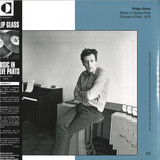
Lost PHILIP GLASS Recordings from 1975 - ORTF
The newly discovered and unreleased concert from 1975 recorded by the Philip Glass
Sextet at La Maison de la Radio, Paris.
The sextet is composed of Philip Glass, Jon Gibson, Dickie Landry, Michael Riesman, Joan
La Barbara and Richard Peck.
Music in Twelve Parts is a set of twelve pieces written between 1971 and 1974. This
performance in France includes part 1, 2, 3, 11 and 12 on a double LP.
Also included a very rare Philip Glass interview from 1974 in his NYC loft during the
rehearsals of this piece, produced for the French radio by Daniel Caux - musicologist and
co-founder of Shandar Records.
A never before released -Philip GLASS (1975) live recordings, released in partnership with
the National Audiovisual Institute - INA.
"A new sound and a new chord suddenly break in, with an effect as if one wall of a room
has suddenly disappeared, to reveal a completely new view." - A. Porter
Search:the double x
Picture your fercest self, taking your more introverted self on a loving peptalk-fueled shopping spree. Imagine the feeling of driving down the highway listening to Springsteen with a car full of friends. Bathe in the comfort of lying in bed next to a bag of M&M peanuts watching Twin Peaks. Welcome to Sorry Girls.
Easier - their new 7' / double single - presents a culmination in Sorry Girls' sound. Equally steeped in lament and celebration.
Eric Maltz Had A Busy 2018 With The Release Of The First Two Records On His Label Flower Myth, The Frenetic Pathway Ep And The Dub-techno Informed Estuaries Ep. The Smashing Vocal Single Naked Broken Followed On Possible Futures As Well As A Remix For Marlon Hoffstadt, A Debut Performance At Berlin's Atonal Festival And To Close The Year, A Live Set At Tresor With Close Friend Levon Vincent Whose Novel Sound Label Released Eric's 2017 Double Ep Ns-17.
2019 Is Gearing Up To Be Just As Busy And Kicks Off With 'dream Journal', Two Long Form Cuts For Deep Dancefloors.
A Side 'dream Journal' Is One For The Rem Cycles. A Development Of Maltz' Signature Psychedelic Deep House Sound, Dub Sound Effects Jump In And Out Of Focus, Swirling Arpeggios Pan Across The Stereo Field And A Playful Piano Solo Take Turns At The Center Of The Stage As A Deep Bass Line And Funk-ready Drum Machine Hold The Fort.
On The Flip, 'subliminal Virgo' Is Exactly That, Hitting With A Loose Breakbeat And Echoes Of "dream Journal" Before Settling Into An Unstoppably Subby 4x4 Throb. A Synth Solo Hides Deep Under The Layers As Maltz Adventures Into The Dark Chasms Of Thought Gaps
Shirley Wahls is known as one of the young pioneers of Gospel music. Singing in the church since the age of three, she began her singing career in the junior choir of the Mt Pleasant Baptist Church under the direction of Ruth Jones. Her professional career began with such legendary groups as "The Argo Singers", "The Ward Gospel Singers" and "The Dorothy Norwood Singers" before trying her hand on secular music around the mid 1960s. Between 1967 and 1976 she had released eight 45RPM singles on different labels such as King, Calla, Smash, Blue Rock, and Giant. The two songs featured on this 45 are probably her funkiest recordings and were long overdue for an official reissue. We'd like to say "Thank You" to Ms. Wahls for giving us the permission to re-release these wonderful songs. This is an essential double-sider which certainly fills any dance floor.
With one of the hippest jazz albums of recent years under their belt, Jukka Eskola Soul Trio is back with a fresh new single. It's truly a double-sider of the highest order, as both of the tracks deliver a completely distinct flavor.
"Tiny B" on the A side is a neat bossa jazz number, and as usual in top of the genre, the lightness serves only as a facade. The composition starts to evolve before the listener gets too comfortable, transitioning into a beautiful cinematic section, which is followed by tight solos by Eskola on trumpet and Mikko Helevä on organ. The trio rises beyond its numbers, as the maestro Teppo Mäkynen overdubs his drumming with added percussion and vibes.
Hiding on the B side is a furious jazz dance burner, which sees the trio rise to energy levels that surpass even Five Corners Quintet in their tightest form. "Stick of a Branch" is highly syncopated business that takes its cues from a sound refined by 1970's independent afrocentric jazz groups. It's a style, which is inherently modernist, without a slightest interest in mass appeal, and firmly rooted in the blues.
If you need some no nonsense organic jazz on your turntable, it's hard to go wrong with this single.
- A1: If God Were Alive (& He Is) You Could Reach Him By Telephone
- A2: R4T
- A3: Et Tu, Klaatu
- B1: Eenie Meenie Chillie Beenie
- B2: Novena
- B3: Mind Power
- B4: Yellow Yankee
- C1: Want You
- C2: Vocal Variety
- C3: Kokole
- C4: Cincinnati 1830-1850
- D1: Edison's Piano
- D2: The Lecture Of Comrade Stalin At The Extraordinary 8Th Plenary Congress
Paul DeMarinis is a key figure in the history of electronic music since the 1970s. Collaborator with the likes of Robert Ashley, David Behrman, and David Tudor, DeMarinis is a pioneer in the development of gallery sound installation and digital music technologies. Black Truffle is thrilled to announce the release of a double-LP collection, selected in collaboration with the artist, focussing on DeMarinis's exploration of synthesized voice and the digital analysis and manipulation of speech sounds. Drawing together tracks dispersed on compilations along with a number of pieces previously unheard in any form, Songs Without Throats offers a revelatory look into DeMarinis's alternately accessible and uncompromising production between 1978 and 1995. Opening with a mesmerizing piece from 1978 pairing the voice and tamboura playing of Anne Klingensmith with strings of letters spat out by a Speak n' Spell to the accompaniment of the randomised melodic patterns of DeMarinis's homebuilt electronic instrument 'The Pygmy Gamelan', the record then dispenses with the live human voice in favour of its recorded and synthetic doubles. We follow DeMarinis's restless probing of the possibilities of new technologies, from the hacked Speak n' Spell (which gives us the austere 'Et Tu, Klaatu' 1979, another duet with Klingensmith, this time on bowed psaltery, in which the toy's synthetic voice is stretched into an alien song) through to the use of digital audio samples manipulated with home computer technology in the early 1990s (including a remarkable dream-like collage piece that weaves a rare recording of Stalin's voice and bird-like electronic twittering derived from its formant-glides into a rich tapestry of samples reflective of the dictator's musical life). In between we get a rich sampling of DeMarinis's signature work with speech melodies - usually unnoticed melodic inflections that lie within speech patterns - which he analyses and translates into synthesized musical accompaniment. These pieces draw on a wide variety of textual and vocal sources, which range from the hilarious to the menacing ('Cincinatti (1830-1850)' sets a detailed description of butchering techniques, for example) and an equally broad range of musical conceptions, combining elements as seemingly unlikely as Beethoven's Opus 31 pianos sonatas and the sounds of 80s synth pop. The results are an extraordinary combination of the alien and the familiar. As DeMarinis himself characterises his work with vocal synthesis, this is 'a kind of signal that simultaneously carried and obscured meaning and ideation, even as it created a sound world totally alien in esthetic'. Presented in a deluxe gatefold sleeve with archival images and liner notes by Paul DeMarinis. Design by Stephen O'Malley. Mastered and cut by Rashad Becker at D&M, Berlin
Payfone bring a double header of NYC styled heat for the inaugural release on their newly launched Otis Recordings. Marrying modern boogie and classic R&B, with cosmic leanings and Balearic touches, Payfone manage to keep all the essence of the early days whilst bringing a contemporary swagger to the floor.
Each element in 'I Was In New York' gets the space it deserves. Palm muted guitars and sashaying synth echoes flutter over the top of a strutting slap bass courtesy of Giulio Granchelli. A simplicity that sings - simultaneously giving your mind the space it needs to drift off into a daydream of sunsets over cityscapes. Introspective, meditative and innocent, Dayna Talley's spoken word vocals lull listeners into memories of tranquil times. Set to be one of 2019's standout songs, its refreshingly original and sure to cut through the noise.
The B side, 'A Prayer For Maya Angelou' takes a Balearic boat out across calming seas. Gravitating around a metallic, pulsating synth, modulated to bounce at points and brood at others, mystic flurries drift in the distance, as pads wash across the horizon. Len Xiang's melancholic tale reverberates throughout, with those sweet sax sounds from Billy Brooks Paul and a spring reverbed guitar riffing off into the ocean - elevating this into pure paradise.
YANGA brings a new dimension to the rapidly growing scene of Afro-Latin independent music taking shape in Los Angeles and concentrated in the fertile enclave known as the Inland Empire. Intertwined with other intrepid musical explorers who call the IE home, YANGA has sprouted their own distinct branch on the tree of Caribbean music and culture.
Much like their cousins and Names You Can Trust label mates of the same Southern California region (QUITAPENAS, EL SANTO GOLPE and BUYEPONGO), YANGA creates new recipes based on a traditionalbouillabaisseof Afro-Carib rhythm, sharing a few ingredients and musicians to develop a deeper chemistry and cohesiveness but cohering into their own piquant flavor.
YANGA's singular focus and strength is their inspiration from and adherence to the beloved rhythms found throughout the Caribbean coast of Colombia — rhythms like cumbia,garabato, tambora and zambapalo. These rhythms form a touchstone and a proud statement of purpose for their debut on Names You Can Trust.
Led by John D'Alessandro's accordion and the fiery female voice of Eddika Organista (El Haru Kuroi), this new recording is an intense ode to the band's fundamental influences, conceptually crystallized in the studio of Chicano Batman bassist Eduardo Arenas with veteran Marcos Garcia (Antibalas, Chico Mann, Here Lies Man) crafting the mix. It's a realized and impeccably executed scene of dark, gritty and saturated drums and bass, the entire sonic landscape dosed with subtle psychedelia and studio wizardry that never overshadows the band's natural performance or their reverence for the classic sounds of the tropical '70s. The finished product is a perfect juxtaposition between vintage and modern. This special edition, double-issue single packed with deep dancefloor grooves are a sure-shot entry into the timeless canon of Afro-Caribbean recordings.
YANGA brings a new dimension to the rapidly growing scene of Afro-Latin independent music taking shape in Los Angeles and concentrated in the fertile enclave known as the Inland Empire. Intertwined with other intrepid musical explorers who call the IE home, YANGA has sprouted their own distinct branch on the tree of Caribbean music and culture.
Much like their cousins and Names You Can Trust label mates of the same Southern California region (QUITAPENAS, EL SANTO GOLPE and BUYEPONGO), YANGA creates new recipes based on a traditionalbouillabaisseof Afro-Carib rhythm, sharing a few ingredients and musicians to develop a deeper chemistry and cohesiveness but cohering into their own piquant flavor.
YANGA's singular focus and strength is their inspiration from and adherence to the beloved rhythms found throughout the Caribbean coast of Colombia — rhythms like cumbia,garabato, tambora and zambapalo. These rhythms form a touchstone and a proud statement of purpose for their debut on Names You Can Trust.
Led by John D'Alessandro's accordion and the fiery female voice of Eddika Organista (El Haru Kuroi), this new recording is an intense ode to the band's fundamental influences, conceptually crystallized in the studio of Chicano Batman bassist Eduardo Arenas with veteran Marcos Garcia (Antibalas, Chico Mann, Here Lies Man) crafting the mix. It's a realized and impeccably executed scene of dark, gritty and saturated drums and bass, the entire sonic landscape dosed with subtle psychedelia and studio wizardry that never overshadows the band's natural performance or their reverence for the classic sounds of the tropical '70s. The finished product is a perfect juxtaposition between vintage and modern. This special edition, double-issue single packed with deep dancefloor grooves are a sure-shot entry into the timeless canon of Afro-Caribbean recordings.
Soundway Records present a special summer tribute double a-side 12" with two tracks from African musicians that both passed away within a couple of months of each other at the end of 2013 / start of 2014. Both tracks are perfect smooth summer tropical DJ fodder for the dancefloor.
On the first side South African singer Shaluza Max's massive Mashkandi / house anthem from 2002 gets a first release on vinyl. This track was a huge hit in South Africa and around the world on its release. With a soaring Zulu vocal and big sound it's a fitting reminder of a very talented musician who worked as a very well respected producer, composer and arranger who died tragically young at the age of 47 in January of 2014.
On the flip we drop a fairly unknown track from the mid 1980s from one of the biggest names in African music, Tabu Ley Rochereau. With a kind of almost balearic proto-house congolese pop cut with drum machines, and trademark sweet congo horn section, Hafi Deo is a beautiful track that fell into obscurity by perhaps being too smooth for the world music crowd in the mid 80s. Tabu Ley passed away in November 2013 in his late 70s with over 250 albums and 3000 songs to his name. A true pioneer of the congolese soukous sound, he was also one of the most influential African musicians of his generation.
Born in 1974, Aymeric de Tapol is a composer living in Brussels. He writes scores for contemporary dance projects, cinema, radio, and aims to tell stories through his audio creations and recordings. His music has been played on The Word Radio, Radio Panik, and NTS in shows including The Hot Selection, featured first on 26 July 2015. Songs played include 'La ronde des beaux yeux', 'J'ai dansé avec elle' and 'Les attractions'. He is a prolific producer of audio across styles and mediums.
The double 7-inch, BOMBINA, is Aymeric de Tapol's third release for Ångstrom Records. Each track evokes a different compositional mood, although the entire release can nicely fit into the traditions of drone & continuous music.
Lyra is DeWaltas fourth large solo-project and third full-length solo-album following Wander in 2012 (on Haunt), llumination in 2014 (on Meander) and Dark Matter in 2017 (on Amphia) besides - Residual' a collaboration-album with Mike Shannon.
The album consists of two individually available parts: a double LP (Lyra) with 6 tracks on Meander as well as a single LP (Lyra Pi) with 5 synth and ambient works. The Ambient-Part launches a new Meander Horizon Pi series-- a departure from Meander's well known dancefloor releases.
Lyra is by far DeWaltas most extensive and refined project to date. With 11 exclusive songs, a total running time of over 100 minutes - plus a collaboration with long time friend and Meander co-owner Fabian Geimer-Lorusso aka. Jupiter - it marks a new beginning of ambient and score-like modern electronic music works as well as the continuation of his inspired intellectual-emotional approach to dance music.
Lyra is a star-constellation in the northern hemisphere which is highest in the midnight sky in the early summer months. It contains one of the brightest stars in the sky - Vega. Many of the songs on this album were produced in these warm and gentle months during an inspirational creative time in Portugal.
In Greek mythology, Lyra represents the Lyre of Orpheus, Apollo's son. Made by Hermes from a tortoise-shell, it was given to Apollo who then passed it along to Orpheus. It is said to be the first music instrument ever made
- A1: Learning To Cope With Cowardice
- A2: Liberty City
- A3: Blessed Are Those Who Struggle
- A4: None Dare Call It Conspiracy
- B1: Don't Ever Lay Down Your Arms
- B2: The Paranoia Of Power
- B3: To Have The Vision
- B4: Jerusalem
- C1: Intro (The Lost Tapes)
- C2: May I
- C3: Conspiracy
- C4: Jerusalem (Prototype)
- C5: Paranoia
- C6: Liberty Dub
- D1: Vision
- D2: Cowardice
- D3: High Ideals & Crazy Dub
- D4: The Weight C
'learning To Cope With Cowardice', The Groundbreaking Debut
Solo Album By Visionary Post Punk Iconoclast Mark Stewart, Is To Be Given A Definitive Reissue Alongside 'the Lost Tapes', A Newly Discovered Cache Of Unreleased Material.
'learning To Cope With Cowardice' Is Released On Double Cd,
Double Vinyl With Digital Download Code And Separately As
Digital Download Albums. 'learning To Cope With Cowardice' Is A Vital Chapter In The Legacy Of Mark Stewart & The Maffia, A Project That Would Prove To Be A Revolutionary Benchmark For Many, From The Innovators Of The 'bristol Sound' (the Wild Bunch, Smith & Mighty, Tricky, Massive Attack) Through To The Likes Of Trent Reznor And Nine Inch Nails. Collected Together This Set Realizes An Expansive Restoration Of One Of Stewart's Most Audacious Statements. As It Was In The Early 1980s So It Is Now, 'learning To Cope With Cowardice' Is A Masterwork Of Mutant Design And A Rude Awakening Of Extraordinary Bite.
Mark Stewart Himself Perceives 'the Lost Tapes' As A Document
That Now Possesses A Storied Significance: it Was A Real
Adventure Discovering This Forbidden History, A Twisted Tale Of
Muswell Hillbillies, French Pirates And A Dutch Schizophrenic
Doctor Doing Psychic Archaeology.' Whilst Adrian Sherwood
Describes These Works As Characteristic Of A Distinct Primitivism: ('the Lost Tapes' Represent) The Early Childhood Of The Songs Before Mark And Me Conducted Frenzied, Scorched Earth, Slash And-burn, Twenty Hour Mental, Manic Editing Sessions At Crass' Studios That Led To Birthing The Finished Album.'
- A1: Vous Et Nous
- A2: Patriarcat
- A3: Mon Enfance
- A4: Vent D'automne
- A5: Le Serveur Du Dôme
- A6: Je Suis Venu Te Voir
- A7: Rien Que Changer
- A8: Le Ciel Est Doux
- B1: Les Épis
- B2: Le Repas Des Dromadaires
- B3: Vous Et Nous
- B4: L'amour Parfait
- B5: Un Soleil
- B6: Dans Ma Rue
- B7: L'orage Est Fini
- B8: Gamme
- C1: Le Brin D'herbe
- C2: La Harpe Jaune
- C3: Je T'aimerai
- C4: Diabolo
- C5: Cher
- C6: Ce N'est Pas Un Ennemi
- C7: Encaustique
- C8: Petit Sapin
- D1: Mon Lit
- D2: Je T'aimerai
- D3: La Déchirure
- D4: Le Petit Cheval Bleu
- D5: Personne
- D6: Les Roses Sont Farouches
- D7: Le Bouc
- D8: Dessin
- D9: Les Muzdus
Art is a matter of different phases and influence. The artists' core reaches out like heat waves. And very rarely do these artists' core merge like Brigitte Fontaine and Arseki Belkacem have. Their Saravah Era lasted ten years (1969 to 1979), ten years of "folle sagesse" (crazy wisdom), above all genres and song limitation.
"Le plaisir secret que donne une chanson, dessin à la craie sur le mur de tes sons" (the personal delight within song, a chalk drawing on your wall of sounds) whispers Areski, right after Brigitte's voice on the penultimate song of the double album "Vous et nous". Released in 1977, this free flowing record contains 33 songs, it's their 6th album after "Comme à la radio", "Brigitte 4", "Je ne connais pas cet homme", "L'incendie" and "Le bonheur", and it continues to spread the wide and generous spectrum of the couple fully blossoming talent. Electronic experiments, North African trance, refined acoustics and medieval drones gracefully blend with the acid and candid tongues of the singers, surprising us each step along the way. The making of this record was also full of twists and turns. It started out as a solo effort by Areski at Jean-Pierre Chambard's studio. Little by little, as Areski was filling tapes with poems and improvised skits, Brigitte would sneak into the studio at nightfall, adding her voice here and there, her whispers then became screams, giving fuel to the fire in a total blaze, a surreal blaze. The solitary work ("je") thrived to become us ("nous") and you ("vous") ...
Benjamin Barouh, June 2018
BELLADONNA GRAVE is a new solo project from L.A, California. Past august 2018 has been released 2 mindblowing albums at the same time, 'Behind Despair' and 'Spiritual Death'. This double EP put together the best of the best of those majestic works. At ORACULO RECORDS we strongly think that we are more than probably in front of the cold synth / electronic record of the year. It arrives on ultra deluxe 2×12 EP format and produced in a ONE-OFF truly ultra extra limited edition of 200 copies lacquered pressed on 180 gr. high quality solid black vinyl, including inner big postcard with tracklist and a POSTER of BELLADONNA GRAVE's scan/copy based art. All tracks have been specially remastered for LONG CUT vinyl by Eric Van Wonterghem.
After over 100 million album sales the Backstreet Boys return newly signed to RCA Records. Formats are double LP (1st Feb) and CD (25th Jan). Includes the singles "Don't Go Breaking My Heart", "No Place" and the Ryan Tedder/Shawn Mendes penned song "Chances". Radio support across R2, ILR network, plus ad campaign. Video plays at Vevo and MTV. Ads, features, interviews and reviews across all press. Online/social media activity. Recent TV performances have included Strictly Come Dancing, Loose Women, This Morning, Lorraine, ITN News, 'Stand Up To Cancer'. Sold out June UK arena dates. Poster campaign and database mailout.
Blues Creation was founded in Tokyo in 1969. They released this, their impossibly rare debut of American blues covers, that same year. Featuring covers of Sonny Boy Williamson, Chester Burnett, Memphis Slim, Willie Dixon, and more, this is the greatest recorded example of the Japanese obsession with American blues music. The band would record several more albums and then come back as, simply, Creation, but nothing reached the sheer blues rock heights of their debut.
The man behind Workshop and Out To Lunch famously takes his time to make electronic productions that are, in turn, out of time. Over the course of his career he's released tracks that could have been made yesterday, years ago, or a decade into the future. with Avenue 66 he's found a leftfield home that celebrates pure creativity, that embraces the liminal, the weird and the sublime. Light Surfing fits all of these descriptors.
The double-LP rewards deep, repeated listening. There's plenty to unpack, but those who cherish the murky bangers that have been Lowtec's stock and trade will find plenty to love. "Boy With The Broken Glasses" weaves a subtle, dancehall-inflected riddim into hazy ambient house, while the closer, "Burnt Toast," is the latest example of Kuhn's uncanny ability to perfectly fit a soulful vocal sample into an alien dance floor soundscape.
Unexpected moments of sideways beauty also unfurl across the four sides. The two-part "Light Surfing" is one of Lowtec's most evocative suites to a date-its mournful string soundtrack is the album's recurring, longing motif. Elsewhere, as on "Mynthenquai," Kuhn applies avant-garde strategies to his synth leads, taking us on head-spinning melodic journeys.
Light Surfing is a masterful balancing act between dream states and machine-like efficiency, the experimental and functional, precision and spontanaeity. Lowtec could have only gotten here by taking his time.
Repress
The rebirth of the ongoing series of concept albums on russia's Trip records. "Happy new year! We wish you happiness!" Is the theme for this double album of carefully curated breakneck techno and IDM. The eight-track package is a fantastical celebration of the new - with three new artists joining Trip and a fresh new visual outlook for the series and the start of a promising new year. Recommended!
Dark Entries is honored to release a 4-track EP by Swiss musician Carlos Perón, founding member of Yello. Carlos was born in 1952 in Zurich and began collecting music at a young age. Inspired after attending a concert of Karlheinz Stockhausen in the 1960s, he began to compose Musique Concrete pieces using a 4-track reel to reel and found sounds. In 1979 Perón founded the trio Yello with musician Boris Blank and vocalist Dieter Meier. Yello released their first album in 1980 and the following year Carlos released his first solo album 'Impersonator'. In 1983 Carlos left Yello in order to pursue a solo career and released the soundtrack to Die Schwarze Spinne" and 1984 his second solo album Nothing Is True, Everything Is Permitted'. In 1988, Belgian label LD Records released a 4-song EP of instrumental tracks from 1984 that predated, influenced and became staples in the New Beat scene.
Dirty Songs' is a collection of songs from Carlos Perón recorded between 1980 and 1986. The recordings were made with the core set up of an ARP 2600, Roland's Drumatix, TB-303 and TR-808. Nothing Is True, Everything Is Permitted (Instrumental)' recorded in 1984 is a slow burner with dark, gloomy atmospherics, presented here in an extended version with a bonus intro. The song was inspired by William S. Borroughs' Naked Lunch' and paints a bleak futuristic landscape. Breaking In (Instrumental)', from 1984, is a crossover of electronic body music and pitched down Chicago acid house featuring overplayed snares by hand though an Ovomaltine Box. Originally featured on the soundtrack for Die Schwarze Spinne', the song is about breaking into a large pharmaceutical company to steal drugs. On the B-side is A Dirty Song (Instrumental)', originally recorded in 1986 and released by Play It Again Sam in 1988. The song uses one of the earliest Roland SH synthesizers, the SH-1 A, as a solo instrument and is strikingly aggressive with percussive rhythms. Et' was recorded in 1980 on a 4-track and later and remixed to 8-tracks in 1984 for the Frigorex' EP, which is where this extended version comes from. Featuring eerie, cut up vocals and Dadaist lyrics by Isa Nogara atop a proto-Techno beat.
All songs have been remastered for vinyl by George Horn at Fantasy Studios in Berkeley. The jacket features a never before seen black and white photo of Carlos taken in 1988. Each album includes an double-sided postcard featuring the cover art from the Frigorex' EP. Prepare to make your own movie to the Swiss John Carpenter soundtrack vibes of Carlos Perón.


