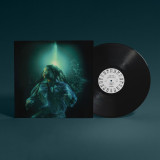
Rivet’s new album for Editions Mego is an uplifting and joyous affair coming in the wake of tragedy and disenchantment. It is yet another rebirth from an artist willing to take a step back and reprise the current situation he is in. Mika Hallbäck has a long credible history in the Swedish underground. First recognised for his industrial techno works under the Grovskopa moniker he worked privately on more experimental works that eventually came out as On Feather and Wire, an album released on Editions Mego in 2020. After much acclaim for this bold new direction that blended electronic abstraction, pop and industrial forms into a heavy synthetic trip two tragedies struck. One was the passing of label boss Peter Rehberg and then the passing of his dog Lilo, who was as close as a companion one could have. These events led to the release of the more unsettling follow up L+P-2 (Lilo and Pita minus two) on Midnight Shift Records in 2023. Peck Glamour sees Rivet return to the reawakened Editions Mego with an album of optimism inspired by reconciliation with loss and further explorations of new mental/sonic realms.
Hallbäck defines his approach as not being married to any particular machine, instrument, process or genre. However he holds a particular affinity to sampling, of which, he says, provides the dirt and grit amongst what would otherwise be pristine, generic machine music. The contemporary crate digging method of scouring obscure download music bogs for unique sounds was his preferred research practice.
Peck Glamour is an album full of tracks brimming with the excitement of exploration. It's the results of a mind informed by punk, industrial, techno, dancefloor, disappointment, trauma and rebirth. Here the synthetic and authentic is viewed simply as the same means of human rationale and expression.
The opening, ‘Catch Up to Light’, sets the scene with ecstatic and odd fluorescent vocals sliding amongst crystalline likembe whilst synths swirl amongst the external festivities. ‘Orbiting Empty Cocoon’ is somewhat a homage to the alien sound worlds of The Orb, one which takes the listener deeper into a mind melting array of teased potential as visual elements are executed in a mask of audio wizardry and euphoric staccato rhythms, the later being a nod to Singeli music. ‘Patitur Butcher’ is more dance frontal utilising the Ghatam drum and a YouTube rip of a Chinese language lesson. ‘Plastic Bag Putain’ was made during the beginning of Russia's invasion of Ukraine and should be clear of its intent. ‘All that Heaven Allows’ is a marimba cover of an imaginary Love Parade anthem. 'Kyrie Geire’ potentially briefly fills the void left by the demise of Coil. The entire trip of Peck Glamour is sewn up with ‘We left before we came’ whereby extraneous recordings of double bass player Gregory Vartian-Foss (tuning/strumming/moving the bass) are superimposed with local field recordings to create a gorgeous bed of sounds acting as an exciting exit music to this sharp collection of cinematic ear excursions.
Buscar:the express
Amoul Bayi Records continues its mission of discovering and showcasing West African artists. After introducing talents such as Daba Makourejah and Saah Karim, the Dakar-based label returns with a new release from one of the most soulful
voices in Gambian reggae: Royal Philosopher.
"Thank You Jah" is a song of gratitude, carried by the emotive and distinctive voice of Royal Philosopher. With humility, he expresses his thankfulness for the talent he has received, the path he has walked, and the strength that has guided him along the way.
Built on a dynamic Digi Roots riddim produced by Yared and mixed by Rootical45, the track provides the perfect space for his voice to shine. The refrain – “Thank you Jah for giving I talent” – echoes like a personal prayer and a universal message, able to resonate beyond belief systems.
Royal Philosopher is a Gambian singer whose powerful and precious voice is shaped by spirituality, African heritage, and musical commitment.
Born in Banjul, he first discovered his vocal gift in a church choir, where he developed a heartfelt and sincere expression. He fell in love with reggae through the voice of Garnett Silk, whose intensity and devotion deeply influenced his path. He began his journey with the group The Royal Family, before pursuing a solo career, releasing music with consistency and authenticity.
Today, he presents "Thank You Jah", a single produced by Amoul Bayi Records, imbued with gratitude and faith, true to his artistic vision: sincere, elevated, and deeply connected.
Designed both for turntables and streaming platforms, the single will be released in digital format and on 7" vinyl. The artwork is by renowned Senegalese graffiti artist King Mow.
Influenced by the likes of Wanexa, Eddy Grant, and YMO, Legowelt teams up with synth-funk artist Shook for a colorful, fun, and melodic new LP on Nightwind Records. A raw mix of saturated Italo disco, city pop, and electro-funk -- drenched in haunting melodies that will linger in your mind for months to come!
"Reflection Code" is an EP that delves into the multifaceted aspects of human reflection through a collection of immersive musical compositions, each inviting the listener on a unique sonic journey.
The Practice of Desire — A deep techno track featuring enveloping pads and modulating metallic cosmic sounds, reminiscent of heavy matter from outer space. Accompanied by a lecture from Gangaji, this track adds an extra layer of depth and meaning to the musical experience.
Port Del Compte — Inspired by memories of Spain's stunning landscapes and a performance at the Parallel festival, this track transports the listener to picturesque settings, filling their heart with joy and harmony.
Bad Trigger — This track offers a profound reflection on life events, utilizing an expressive electronic soundscape with a compelling bass line at 144 bpm. It creates an atmosphere conducive to introspection and self-discovery.
Green Frequency — A shamanic sequence infused with forest vibes and the calls of an electronic bird. This composition immerses the listener in nature, evoking a sense of unity with the surrounding environment and the inner self.
"Reflection Code" invites listeners to explore their inner reflections and connect with each composition on a profound level, creating a unique auditory landscape that lingers long after the music ends.
Toki Fuko music can be described as mechanical signals are structured in a hypnotic substance. Their constant musical experimentation actor perceives as an analysis of the surrounding world.
- A1: Time Was
- B1: Sometime World
- B2: Blowin' Free
- C1: The King Will Come
- C2: Leaf And Stream
- D1: Warrior
- D2: Throw Down The Sword
Wishbone Ash reigned supreme through the 1970s — centered on inspired musicianship, joyful spirit and inventive songs. Their concerts were uplifting and their recorded work sublime. Argus remains a stunning high point in the band's startling repertoire. Argus was a 1972 tour de force, a hard-rocking masterpiece that has gone on to have a huge impact on rock bands moving forward. If you've never heard Argus, you've surely heard music that it inspired.
The British quartet's trademark harmony guitars became a touchstone for many: Thin Lizzy, Iron Maiden, Opeth, and Lynyrd Skynyrd have all acknowledged an Ash influence, and tracks such as Lizzy's "The Boys Are Back in Town," Maiden's "The Trooper," and even Steely Dan's "Reeling in the Years" all have twin-guitar moments that hark back to Argus. But Wishbone Ash were different from the start. They were never strictly a hard rock band; their soaring vocal harmonies and musical grandeur placed them close to progressive rock.
But they weren't strictly prog either: They had no keyboards, no real classical influence and weren't into side-long suites. Their roots were in the blues, and their calling card was twin lead guitars in harmony (played in the original lineup by Ted Turner and Andy Powell). Even the hardest Ash rockers — like "Blowin' Free," the most famous track from Argus — had an ethereal touch. They could rock the big stages, but they did it with subtlety and grace. This is reflected perfectly in the classic album sleeve by prog-associated designers Hipgnosis: The front cover shows a Greek sentry — the "argus" of the title — staring off into the distance. It's a mythic, old-world kind of image until you look closely at the back cover, and see that he's heralding the arrival (or perhaps watching the departure) of a spaceship.
Two worlds colliding. Exactly what the band and album were all about. By the time of Argus, Wishbone Ash were stars in England and cult heroes among Anglophiles in the US. What made Argus a step forward was its flow of moods. The songs don't run together, but there's an emotional connecting thread from the album's somber beginning to its heroic end. The band insisted at the time that lyrics were something of an afterthought: Shortly after its release, main lyricist Martin Turner told NME that he wrote them mainly to fit the mood of the music: "The music that was coming out was very English, very medieval, and the lyrics had to reflect that." Added Powell at the time, "The expression comes out in the guitars. We wouldn't play it if it didn't express something." Now, Analogue Productions has applied all of its vaunted craft and technical expertise to make this epic album shine! Two 45 RPM LPs pressed on virtually silent 180-gram vinyl at Quality Record Pressings make the remastered audio sparkle. Quieter lyrical sentiments and softer musical passages are rendered precisely, while majestic riffs and fist-waving anthems fully reveal the energy of the music! Argus isn't just another rock record — it's a journey through a sonic landscape rich with depth, emotion and technical prowess. It's the album that solidified Wishbone Ash as masters of twin guitar harmony. Discerning audiophiles will find Argus an essential addition to their record collection. It's a masterclass in sound engineering that fully captures the intricate interplay of dual guitars with pristine clarity and a warmth that only analog recordings can provide.
- A1: Concierto De Aranjuez
- A2: Will O’ The Wisp
- B1: The Pan Piper
- B2: Saeta
- B3: Solea
Miles Davis' Final Collaboration with Arranger Gil Evans Yields Watershed Innovations: Flamenco-Themed Sketches of Spain Spins Graceful Webs of Sound and Emotion Mobile Fidelity's UltraDisc One-Step 180g 33RPM LP Set Brings Out the Record's Full Spectrum of Color: 65th Anniversary Edition Pressed at Fidelity Record Pressing and Strictly Limited to 5,000 Numbered Copies 1/4" / 15 IPS analogue master to DSD 64 to analogue console to lathe Miles Davis and Gil Evans bridged styles and collaborated on high-concept projects three different times during their celebrated careers. For their final act, they created Sketches of Spain, a peak moment in each luminary's legacy.
The transformative album weds Spanish themes, lush orchestrations, romantic timbres, and Davis' lyrical methods in a tender ceremony that resonates more than six decades after its original release. Part of Mobile Fidelity's Miles Davis restoration series, this 1960 landmark has been afforded the ultimate white-gloves treatment for its 65th anniversary. Sourced from the original master tapes, strictly limited to 5,000 numbered copies, and pressed at Fidelity Record Pressing, this UltraDisc One-Step 33RPM 180g LP set dramatically expands the soundstages and eradicates a dryness that many critics found inhibitive to the record's enjoyment. You can now hear the full-range responsiveness of the woodwinds, strings, and percussion, all of which come alive with superior definition and detail.
The beautiful presentation of this UD1S set befits the record's historical importance. Housed in a deluxe slipcase, it features a special foil-stamped jacket and faithful-to-the-original graphics that illuminate the splendor of the 1960 LP. This reissue is made for discerning listeners who desire to fully immerse themselves with the album. And who wouldn't want to go deep with Sketches of Spain? Whether it is the somber mood piece "Concierto de Aranjuez," renowned for Davis' flugelhorn performance, or the folktale-based "Solea," Sketches of Spain transfixes with playing, ideas, and innovations exclusive to this incomparable effort. It's one reason why Mobile Fidelity's engineers took all available measures to insert listeners into the space originally occupied by Davis, bassist Paul Chambers, drummer Jimmy Cobb, percussionist Elvin Jones, and an 18-piece orchestra. The results are as breathtaking as the music.
Multi-note motifs, brief improvisational solos, fanfare sweeps, and contrapuntal exchanges inform flamenco-spiced pieces. Davis' famous Harmon-muted trumpet is complemented by an assortment of bassoons and French horns. Heard together, they create pleasing contrasts and sounds (pp, mf, ppp) that get to what resides at the heart of Sketches of Spain: color. Seldom, if ever, did Davis ever so expressively and liberally paint with color. And in Evans, he has a likewise-minded partner to help draw out tones, shades, layers, and textures. What they achieved continues to draw praise from the global music community in the 21st century. Ranked #358 on Rolling Stone's 500 Greatest Albums of All Time, deemed "a work of unparalleled grace and lyricism" by noted scribe J.D. Considine, bestowed a five-star review from DownBeat, and noted by Q to have taken "jazz in a new direction," the Grammy Award-winning effort has never been better.Miles Davis' Final Collaboration with Arranger Gil Evans Yields Watershed Innovations: Flamenco-Themed Sketches of Spain Spins Graceful Webs of Sound and Emotion Mobile Fidelity's UltraDisc One-Step 180g 33RPM LP Set Brings Out the Record's Full Spectrum of Color: 65th Anniversary Edition Pressed at Fidelity Record Pressing and Strictly Limited to 5,000 Numbered Copies 1/4" / 15 IPS analogue master to DSD 64 to analogue console to lathe Miles Davis and Gil Evans bridged styles and collaborated on high-concept projects three different times during their celebrated careers.
For their final act, they created Sketches of Spain, a peak moment in each luminary's legacy. The transformative album weds Spanish themes, lush orchestrations, romantic timbres, and Davis' lyrical methods in a tender ceremony that resonates more than six decades after its original release. Part of Mobile Fidelity's Miles Davis restoration series, this 1960 landmark has been afforded the ultimate white-gloves treatment for its 65th anniversary. Sourced from the original master tapes, strictly limited to 5,000 numbered copies, and pressed at Fidelity Record Pressing, this UltraDisc One-Step 33RPM 180g LP set dramatically expands the soundstages and eradicates a dryness that many critics found inhibitive to the record's enjoyment. You can now hear the full-range responsiveness of the woodwinds, strings, and percussion, all of which come alive with superior definition and detail. The beautiful presentation of this UD1S set befits the record's historical importance. Housed in a deluxe slipcase, it features a special foil-stamped jacket and faithful-to-the-original graphics that illuminate the splendor of the 1960 LP.
This reissue is made for discerning listeners who desire to fully immerse themselves with the album. And who wouldn't want to go deep with Sketches of Spain? Whether it is the somber mood piece "Concierto de Aranjuez," renowned for Davis' flugelhorn performance, or the folktale-based "Solea," Sketches of Spain transfixes with playing, ideas, and innovations exclusive to this incomparable effort. It's one reason why Mobile Fidelity's engineers took all available measures to insert listeners into the space originally occupied by Davis, bassist Paul Chambers, drummer Jimmy Cobb, percussionist Elvin Jones, and an 18-piece orchestra. The results are as breathtaking as the music. Multi-note motifs, brief improvisational solos, fanfare sweeps, and contrapuntal exchanges inform flamenco-spiced pieces. Davis' famous Harmon-muted trumpet is complemented by an assortment of bassoons and French horns. Heard together, they create pleasing contrasts and sounds (pp, mf, ppp) that get to what resides at the heart of Sketches of Spain: color. Seldom, if ever, did Davis ever so expressively and liberally paint with color. And in Evans, he has a likewise-minded partner to help draw out tones, shades, layers, and textures. What they achieved continues to draw praise from the global music community in the 21st century. Ranked #358 on Rolling Stone's 500 Greatest Albums of All Time, deemed "a work of unparalleled grace and lyricism" by noted scribe J.D. Considine, bestowed a five-star review from DownBeat, and noted by Q to have taken "jazz in a new direction," the Grammy Award-winning effort has never been better.
Students of Decay presents The Dip, a new full-length recording by Berlin-based artist and composer Thomas Ankersmit, marking his debut with the label and sixth album to date. Comprised of two expansive, sidelong pieces composed entirely on the Serge Modular synthesizer, it signals a subtle yet significant shift in Ankersmit’s trajectory, imbuing the hyper-physical, psychoacoustic intensities of his live performances with introspective, atmospheric, and even melodic elements.
Primarily known for a site-responsive approach to sound, often realized in the moment of performance, Ankersmit’s turn toward the studio in the last few years has opened up a new dimension within his practice. It is in this quiet rupture that The Dip emerged, a study in internality and suspended states, rich with cinematic undercurrents and ghostly spatial suggestion. Here, electricity itself feels transfigured – becoming supple, even organic – within an environment shaped entirely by analog signals.
Over the past two decades, Ankersmit has established himself as one of the foremost practitioners of the Serge, the notoriously idiosyncratic and expressive instrument that has remained central to his work. On The Dip, he harnesses its potential not for brute force or disorientation, but for spaciousness, resonance, and lyrical abstraction. Without resorting to additional processing or effects, he draws out tones that feel simultaneously raw and refined, articulated and blurred – intricate structures that seem to breathe and evolve of their own volition.
The result is a kind of auditory hallucination, a “cinema for the ears,” wherein impressions, emotional arcs, and imagined topographies unfold. Each side of The Dip plays like a single gesture unfolding in time – a spatial narrative constructed through vibration, density, and the movement of air.
The Dip follows acclaimed works on PAN, Touch, and Shelter Press, and reaffirms Thomas Ankersmit’s position as one of the most focused and probing voices in contemporary experimental music. Quietly radical and meticulously constructed, it is less a departure than a deepening – a descent into a more private sonic world, where the boundaries between perception, memory, and pure signal dissolve.
Improving on their very fine, self-titled debut album, their latest, Sing Sing Death House, is battle-scarred and resolute, but Brody"s tough voice is more expressive than your average punker"s and especially affecting when she flaunts the full range of her throaty snarl. On "Seneca Falls," an appreciation of the women"s suffrage movement set to chugging guitars and a thumpity-thump bass, there"s an exceptional, goosebump-inducing though unintelligible chorus, which soars above the music because of the emotional quality of Brody"s howl. Otherwise, the music is quite stirring, coming from a gang of gutter-punks with lip piercings.
- Intro
- The Kneeling Wretch
- Beyond Dara's Gates
- Sacred Flames Of Anathema
- Baptistery
- Interlude
- Silent Ruin, None Evade
- Day Of Resurrection
- Outro
Hailing from the depths of Istanbul's ancient shadows, ASH MAGICK is a raw and unfiltered black metal project founded in 2022 by Necrosanctus and Graveyard Slut. Born from firsthand occult experience, the band channels themes of spiritual decay, cursed devotion, and forbidden knowledge into ritualistic sonic expressions. Drawing on Eastern mysticism, ancestral lore, and demonic narratives, Ash Magick conjures haunting atmospheres steeped in esotericism and ancient rites. Black metal in its most feral, feminine, and arcane form. Ash Magick are returning with their most spiritually charged and meticulously crafted work to date.
- A1: Asa Branca
- A2: London, London
- A3: Mudei De Idéia
- A4: Zanzibar
- A5: Boi Ta-Tá
- A6: Marinheiro Só
- B1: Summertime
- B2: De Conversa Em Conversa
- B3: One O’clock Last Morning, 20Th April 1970
- B4: O Samba Da Minha Terra
- B5: Concierto De Aranjuez
- B6: Tema Espanhol
Rosinha de Valença’s 1971 album Um Violão Em Primeiro Plano is a masterful showcase of Brazilian guitar, highlighting her exceptional talent and contribution to MPB (Música Popular Brasileira).
This album features a rich blend of bossa nova, samba, and traditional Brazilian rhythms, all centered around Valença’s virtuosic guitar playing. Known for her intricate fingerpicking and emotive style, Valença creates a captivating soundscape that transports listeners into the heart of Brazilian music. Tracks like “Asa Branca” and “Summertime” demonstrate her ability to blend technical skill with deep musical expression. Um Violão Em Primeiro Plano remains a testament to Valença’s influence as one of Brazil’s most talented guitarists, offering a timeless listening experience for fans of Brazilian music and acoustic guitar mastery. Discover Rosinha de Valença’s Um Violão Em Primeiro Plano for an immersive journey into classic Brazilian sounds.
Um Violão Em Primeiro Plano is a limited edition on translucent green coloured vinyl.
Mocambo is proud to welcome Peki Momés, a Turkish artist who has always expressed herself creatively, but accidentally began recording music in 2023. With no pre-education in music, Peki Momés brings a stylish, fresh perspective to groove music, blending her vocals with a unique mix of intuition and uncompromising authenticity.
Her first two songs showcase her versatility, offering distinct sounds that work as both dancefloor hits and listening gems.
Göç Mevisimi transports listeners to a secret place between Japanese City Pop and outernational/tropical boogie sound. Dirty disco grooves, soothing Fender Rhodes, jazzy flute and charming lyrics in Turkish language about our constant search and movement that makes us all passagers of life create a bonafide piece of global underground.
Rüya, on the flip side, is a heavy psych joint that embodies the gritty sound of psychedelic Anatolia. With wobbling grooves, fuzzy guitars and contemporary vocals, it brings a raw, yet hypnotic energy.
Now collaborating with Mocambo Records, Peki Momés is working on an album that promises to offer a fresh approach to Turkish alternative music, ready to captivate music lovers around the world.
Recorded and mixed at Duke Reid's storied Treasure Isle studio by Duke's nephew, young engineer Errol Brown, Dub Expression collects dubbed up treatments of seminal rockers rhythms crafted for Marcia Griffiths, John Holt, Dennis Brown and more.
Propelled by the drums of Lowell "Sly" Dunbar, the appropriately named Revolutionaries (with their tough and radical sound) were the ideal group to reflect a turbulent period in Jamaican politics. While the band's personnel remained fluid – depending on which players were available and frequently overlapping with other seminal sessions bands such as Joe Gibbs' The Professionals and Bunny "Striker" Lee's The Aggrovators – The Revolutionaries were most known as Channel One's house band in the mid to late '70s.
The decision to top-bill The Revolutionaries, rather than feature an individual artist as was customary at the time, was made by Kingston's most celebrated female producer, Sonia Pottinger who shrewdly determined that The Revolutionaries' name alone would be a can't miss selling point. One only needs to spend a minute with Dub Expression to hear why.
Originally released in 1978 on Pottinger's High Note label, Dub Expression represents the essence of dub in its purest form. An absolute classic. Liner notes by JR Gonne.
A“This album is about what it means to be human, and its creation is my offering. I attempt to tell a tale of the human experience in the reflection of my own.”
‘In the Andean mythology, condors are believed to be immortal. It is said that once they feel old, without energy, and useless, they climb to the highest peak and let themselves fall to death.’
The Allegorist is a visionary, enigmatic, transmedia, and boundary-pushing artist known for crafting deep, immersive dark sonic tales. Embracing a wide array of influences, weaving together the mysteries, art and spirituality, the art project defies categorisation, resonating with those who seek the unconventional.
From Birth Until Death is an introspective and immersive concept album that reflects on the essence of the human experience. Crafted over six years by The Allegorist (aka Anna Jordan), the album traces the arc of life—from its fragile beginnings to its inevitable end—using sound art to explore existential and philosophical terrain. Inspired by the Andean mythology of the condor – a symbol of immortality – the album blends electronic soundscapes with raw field recordings, evoking a deep sense of connection between the natural world and human existence.
The album’s progression mirrors the stages of life, starting with the birth of new beginnings and culminating in death, with each track offering a unique reflection on the moments in between. From the dynamic energy of Momentum, to the ethereal, illusionary world of Fata Morgana, the tracks guide the listener through emotions, perceptions, and experiences that shape the human condition.
A distinctive feature of From Birth Until Death is its intricate production. The album incorporates field recordings from Grunewald Forest, a distant roar of a jet, barking dogs, blending the sounds of nature – footsteps in the snow, birdsong, ocean waves – with layered synthesisers and electronic beats. The bass and ambient textures are crafted using an array of analog hardware, while all vocals, both lead and backing, are performed and recorded by Jordan. Some of the vocal takes were intentionally left raw, capturing the spontaneous energy of early recordings, while others were re-recorded to balance the album’s organic yet polished feel. Each element is meticulously crafted, revealing its deeper meaning as the album unfolds like a multidimensional, living sculpture.
At its core, From Birth Until Death is a meditation on the full spectrum of life. The album’s title track, From Birth Until Death, encapsulates this journey, reflecting on the passage of time and the unique experience of being human. The final track, Death, offers a melancholic yet beautiful exploration of endings, not as finalities, but as moments in the grand cycle of life. With its combination of evocative sound design and deeply personal themes, From Birth Until Death invites listeners to contemplate their own lives, offering a moving experience of reflection, growth, and transformation.
About From Birth Until Death
Words By Robin Rimbaud (Scanner)
From Birth Until Death is a deeply personal and reflective album and beautifully crafted. A detailed listen reveals that Jordan was in search of a profoundly human and authentic expression. In an era when so much around us seems defined by speed, Anna Jordan, aka The Allegorist, stands apart – aware that skimming the surface of life is neither sufficient nor rewarding. She reminds us of the value of deep, authentic listening.
The track Andean Condor seductively draws us into a smoky, blurred rhythmic soundscape, capturing the essence of the darkest Berlin nightclub, while Birth pulses with an almost shamanic transformation of sound, moving from the organic to the musical. It features a recording of Jordan’s footsteps in the snow in Grunewald Forest, Germany.
At times, the music feels almost sculptural in shape and tone – lifting, pushing, lilting, opening, and closing – where each piece is given room to fully develop. Many of the works blend synthetic sound with the natural, incorporating the human voice alongside environmental recordings: the wild waves of the ocean, a jet flying overhead, and barking dogs.
With From Birth Until Death, Jordan, like an alchemical architect revealing in the process of getting lost and relinquishing control, leaves us with a taut, immersive soundtrack in which to lose ourselves.
About the album ‘From Birth Until Death’
words by The Allegorist
“The album From Birth Until Death did not come easily to me. I started working on it in 2019, and it underwent many alterations over the years. I produced multiple versions of the tracks each year, but the album name, the track titles, and the album cover art stayed the same for 6 years. Not everything I did fit into the album’s final form, but I hope the heavy selection just made it better. I played this piece live in my techno live set between 2019 and 2020, and in the years after, I performed different art, ambient, and vocal versions of it, most notably the one at the church St. Marienkirche in Berlin in 2022. It just wanted to live and didn’t want to be finished. As I aged, this album aged with me. And now I’m ready to let it go.”
- Watch The Water
- The Way Of The World
- Coombe House
- Wash What You Eat
- Like When
- Basic Everyday Life
- Hold Onto I.d
Recorded from late 1996 through early 1997, Hold Onto I.D., The Shadow Ring's fourth album, marks the apogee of the trio's experimental rock epoch - their last record clinging to their factitious bandness before they let all song and structure go awash in sonic malaise for their final run of releases on Swill Radio. The surrealist dreams of City Lights and Put the Music in Its Coffin give way to pseudo-expressionistic lyrics mired in the banality and bleakness of the everyday, set against the backdrop of the Coombe House (as pictured on the album's cover). While Hold Onto I.D. is the group's most overtly autobiographical release to date, Lambkin's lyrics obfuscate his expressionist tendencies filtering them through the codes and languages of officialdom, linking the "inner self" with documents of the state_identification cards, National Insurance numbers, and British passport numbers. Having moved out of their parents' homes and into the top floor of the famed Coombe House, Graham Lambkin and Darren Harris set out to rework material drafted over the previous year, aided by Tim Goss, still safely in residence at the "Valebrook Inn." While the familiar sounds of Harris's deadpan recitation and Lambkin's electric guitar, amateurishly strummed, dominate the album, the emotive interludes of Goss's keyboards populate the record along with of home-cooked tape experiments and dime-store concrète. Originally released on CD and supported by a US tour with friends Scott Foust and Karla Borecky's Idea Fire Company, Hold Onto I.D. is perhaps the band's best-known and most accessible album. (The Shadow Ring's sole representative on a streaming platform, it was once acknowledged by the Guardian as one of "the 101 strangest records on Spotify.") Offered here for the first time on vinyl, Hold Onto I.D. is an essential album for both completists and the uninitiated alike. Throughout their legendary, decade-long run, the Shadow Ring were an enigmatic force on the international musical sub-underground. Before their disbandment in 2002, this shambolic rock outfit, formed by a group of rowdy teenagers in southeast England, left behind a mighty run of eight LPs, a handful of 7"s, and a spate of raucous live shows and cryptic zine appearances on both sides of the Atlantic, all which have bolstered their enduring word-of-mouth mystique. Beginning in 2023 with the first-ever vinyl pressing of the self-released pre-Shadow Ring tape The Cat & Bells Club (1992), Blank Forms Editions has been conducting a systematic retrospective of the storied group. Wax-Work Echoes and Hold Onto I.D. are the latest releases in a multiyear reissue effort that includes several LPs, a comprehensive CD box set, and a nearly five-hundred-page book.
- A1: Cheb Bakr – Allom
- A2: Group Hewaya – Irja
- A3: Shahd – Erhal Keef Alshams Tgheeb
- A4: Ahmed Ben Ali – Jara
- B1: The White Bird Band– Ya Ummi
- B2: Khaled Al Melody – Jani Bigool
- B3: Fathi Aldiyqz & Sons Of Africa Band – Palestine Is My Homeland
- B4: Libya Music Band – Kol Al Mawaeed
- C1: Stars Of Africa – Baed Al Farha
- C2: Khaled Al Reigh – Zannik
- C3: Khaled Al Zlitni – Jiti Yam Eloyoun Buhoor
- C4: Murad Najah – Hubbi Leeki
- D1: City Lights Band – Kul Ghrub
- D2: Adil Al Ramli – Mawoud
- D3: The Hope Duo – La Tgheeb Anni Wala Youm
2x12"[28,15 €]
Habibi Funk is more than happy to announce our 31st release which happens to be our 3rd various artists compilation. The album is dedicated to the cassette tape scene in Libya from the late 80s to early 2000s, from disco to reggae to pop. All songs previously unreleased outside of Libya and not available on any DSP platforms.
This compilation isn’t a sweeping history of Libyan music — it’s a personal journey into the sounds we fell in love with while digging through tapes, conversations, and stories across Libya and beyond. Rather than spotlighting the country’s most famous musical exports, the compilation brings forward a mix of overlooked gems and local classics of the cassette era: artists whose work thrived despite political limitations, and scarce international exposure. The music featured here blends reggae rhythms, synthy disco grooves, gritty pop, house, and funk, a vibrant collision of genres that reflects Libya’s unique sonic landscape from the 1980s to the early 2000s. Many of these recordings were recovered from the TK7 cassette factory in Sousse, Tunisia, a now-demolished site that once played a quiet but vital role in distributing and manufacturing Libyan music. Other tracks were digitised in a Cairo hotel room in 2021, where we transferred nearly 100 tapes over the course of three days, on-site using a high-grade cassette deck brought into Egypt with us. From that trove emerged artists like Ahmed Ben Ali, Cheb Bakr, and Najib Alhoush & The Free Music, who have already featured on our earlier releases. Their sounds sit alongside contributions from this release from the likes of Khaled Al Melody, Fathi Aldiyqz & Sons of Africa Band, City Lights Band, Libya Music Band, and Group Hewaya. During this era, Independent artists relied on makeshift home studios or travelled abroad to record in Tunisia and Egypt, gradually building their own infrastructures for creativity. By the 90s and early 2000s, as access to digital equipment increased, a few of the artists began setting up their own studios — a shift that gave rise to a more self-sufficient recording culture across the country. The resulting sounds are anything but homogeneous. They reflect Libya’s geographic and cultural crossroads: North African rhythms meet Arab melodies and deep African roots. Reggae, in particular, took on a local Libyan flavour — not just musically, through the slowed-down cadence of traditional shaabi beats, but socially, as a vehicle for expressing identity and pride. What ties all the artists on this comp together is a boundary- pushing approach to genre and style: recorded in small studios, exchanged by hand, and shaped by a cross-pollination of influences, from Benghazi to Tripoli and beyond. All tracks are licensed from their creators and in the case of the artists being deceased from their estates. All profits are being split 50:50 between us in the licensors and ownership remains with the creators, we only licensed the music.
White LP. Born out of the early 1980's Austin noise punk scene, Scratch Acid deliberately eschewed the loud, fast rules of hardcore as everything they didn't want to be and embraced a weirder, artier sound. Prior to the release of their 1984 debut S/T EP, someone gave Touch and Go Records owner Corey Rusk a cassette of the recording, and he was instantly a huge fan. Rusk was immediately interested in releasing the EP and contacted the band to express his admiration. At the time, Scratch Acid had already committed to working with Rabid Cat Records, who released the band's debut release S/T EP (1984) and their only full-length album, Just Keep Eating (1986). The group quickly developed a riveting performance aesthetic, and, as the debut S/T EP made its way around the country via fanzines, college radio, and word-of-mouth, the band mounted short tours to the Midwest and the East Coast. After playing a total of 146 shows, Scratch Acid broke up after the long tour that followed the release of the Berserker EP (Touch and Go Records, 1987). Since that time, the band have had many imitators, and many alternative bands have cited Scratch Acid as one of their influences.
- 1: I’ll Be With You 3:00
- 2: Left :0
- 3: Carmen Electra 2:45
- 4: Idr 1:3
- 5: Fumbled 1:46
- 6: “Affirmatively.” Pt 1 1:59
- 7: Honey I 2:10
- 8: Could You 3:31
- 9: Recognize Me 2:11
- 10: “Affirmatively.” Pt Ii 3:19
- 11: And 4:16
Blaney describes A Room With A Door That Closes as “a love letter to her blue,” an emotional state that she defines as “a kinetic, intense, and dark energy that needs to be expressed as soon as it is felt.” The eleven songs on the album span radioactive kiss offs, sorrowful meditations on yearning, and gossamer reveries about self image.
The music has a fittingly tumultuous, intricate sound: 1960s soul samples melt into warm drum n bass percussion, blips of glitch ping pong against grating synth, and Blaney’s vocals range from searing punk exclamations to gentle, exploratory croons. It’s the sound of a singer peering deeply within herself and presenting the world with everything she finds, unadulterated, in real time. Blaney produced the new project along with a tight team of three producers: Emerson Fossett, Harlan Steed (Show Me The Body), and Alex Farrar (MJ Lenderman, Wednesday, Squirrel Flower, Snail Mail).
Blaney had just started playing guitar and producing around the time she began writing the songs that would become the album. Being new to both producing and guitar playing opened up a sense of exploration and freedom for her. She felt emboldened to employ more adventurous riffs and unconventional song arrangements when she was writing. A Room With A Door That Closes is a collection of songs that rigorously pursue honesty, that present feelings as they arise without rushing to categorise them or explain them away. In the process of understanding her rage or discomfort, Blaney often lands on a sense of pride and assurance, but that’s never the ultimate goal. She eschews the easy comfort of neat resolution for the excitement of ongoing discovery. The album is an exercise in unfiltered self-expression, and a celebration of life at its messiest.
Born out of the early 1980's Austin noise punk scene, Scratch Acid deliberately eschewed the loud, fast rules of hardcore as everything they didn't want to be and embraced a weirder, artier sound. Prior to the release of their 1984 debut S/T EP, someone gave Touch and Go Records owner Corey Rusk a cassette of the recording, and he was instantly a huge fan. Rusk was immediately interested in releasing the EP and contacted the band to express his admiration. At the time, Scratch Acid had already committed to working with Rabid Cat Records. The group quickly developed a riveting performance aesthetic, and, as the debut S/T EP made its way around the country via fanzines, college radio, and word-of-mouth, the band mounted short tours to the Midwest and the East Coast. While he was not able to work with Scratch Acid directly through Touch and Go, Rusk had begun booking shows with Scratch Acid in Detroit, so he could see them live and meet them. A friendship formed, and Touch and Go Records would eventually release the band's second EP, Berserker, in 1987.
Brenda (Hudson Whitlock of Surprise Chef / Karate Boogaloo / The Pro-Teens) presents new album 'Bath Time', a suite of heartbreaking, cinematic indie-soul ballads from the hotbed of Melbourne, Australia.
Brenda encompasses the left-field soul sensibilities for which Whitlock has come to be recognised in cult instrumental groups Surprise Chef, Karate Boogaloo and The Pro-Teens, alongside heartfelt, introspective lyricism delivered in a sincere, delicate falsetto. Stylistically, lines can be drawn to the 1960s sweet soul ballads of The Delfonics, Jean-Claude Vannier's vivid arrangements for Serge Gainsbourg, and, of course, the unmistakable flavour of Melbourne's cinematic soul movement à la other Whitlock exploits Surprise Chef and Karate Boogaloo.
'Bath Time' contains ten entrancingly melancholic ballads that earnestly express Whitlock's dramatic indie-soul sensibilities; encompassing the classically introspective nature of the poetic lyricist and the idiosyncratic use of soulful instrumental arrangements. The songs encompass themes of old romantic habits dying hard, familial rifts and unrequited love.
True to his modest vagabond nature, Whitlock has 'released' six Brenda albums to date, each uploaded exclusively to bandcamp, gladly resigning the music to the underground. Whilst he created theses albums in solitude, playing each instrument himself, 'Bath Time' sees Whitlock relinquishes the isolationism of previous works in favour of including his trusted inner circle of friends and collaborators: Surprise Chef's Lachlan Stuckey and Jethro Curtin on guitar and keyboard respectively, Karate Boogaloo's Darvid Thor on bass, and production from Henry Jenkins (Surprise Chef, Karate Boogaloo, Frollen Music Library).
AVAILABLE IN BLACK ICE WITH ORANGE AND BLUE SPLATTER (COK015WW)