Alan Abrahams aka Portable aka Bodycode is an artist very much defined by his past and his journey from South Africa to Paris via Berlin and Lisbon has seen him develop into a critically acclaimed producer, singer and video artist working with some of the biggest players in house and techno.Part of his constant drive to evolve and challenge himself, this autumn Abrahams launches new project RANGEr, teaming up with London label Waella's Choice for the debut release. The five tracks on Portable Presents RANGEr are a delicate mélange of jazz , soul and electronic and one of Abraham's most explicit nods to his South African roots.
On the A-side, the EP makes a steady start with 'Bazokonwaba' accompanied by a lullaby from South African a capella group Korus, hailing from the small township of Mbekweni in the Western Cape. They also feature heavily on the EP's most exuberant moment in 'Nomaliso' - already a favourite in Esa's recent Boiler Room - and the more languid B-side opener 'Indaba' with a choir of cowbells all harmonizing in unison. 'Reset' and 'Vessel' provide a self-reflective conclusion to the EP, holding their own as instrumentals with Cameroonian bass player Stan on bass and Parisian saxophonist Chisneg lending a hand on the latter. Early support from Tama Sumo, Lakuti, Gilles Peterson, Rinse FM, Esa, Stamp The Wax, Dimensions Recordings
The Crooked Man returns to Bitter End with an 'Emotional Copy Only' limited pre-release of powerful club pieces...
Keen eyed aficionado's may spot the homage to Mel Cheron's classic US label West End Records here
But while their motto may have been 'Where The Sun Sets & The Stars Rise' Bitter End Records embarks on a distinctly more 21st century path to dancefloor salvation...
'Echo Loves Narcissus - Part 1' is the opening salvo in a sonic saga across four movements, marrying, as it does irresistibly uplifting chords and vocal ad-libs to a bass line so thick it'll rattle the windows right out of your ride and knock the tiles straight off the walls of your cerebral restroom.
Once you've adequately composed yourselves, we invite you to the 11 minute MONSTER which is 'Get The Love' on the AA...
This recalls the brief but genre defying 1990 jams from Mundo Muzique's 'Revelation' project: synth assisted house-nosis, buoyed by the mantric voice imploration to accept higher states of carnality atop an immersive blanket of propulsive rhythms.
Once again Bitter End rips up the rule book, and crafts a whole set of new, better ones in which freedom reigns
The return of The Hague's black magician! It has been 13 years since The Parallax Corporation / Conservatives projects together with I-f and now Intergalactic Gary is back. I-G hooked up with a new musical partner, the lovely and talented Pasiphae from Greece and together they deliver four very well-crafted tracks of contemporary machine-driven techno romance, with the ecstatic title track 'Made of glass' being the floor burner that will unite dancefloors worldwide. With the 'Made Of Glass' ep Bio Rhythm proudly presents the absolute creme de la creme of the current Dutch West Coast 'noir' scene.
Standing at the intersection where techno meets classical music, Ólafur Arnalds directs the newest Late Night Tales, set for release on 24th June 2016.
After releasing the breakthrough album 'And They Have Escaped The Weight Of Darkness', in 2014 he was awarded a BAFTA for best original music for the TV series Broadchurch. Arnalds' music has a quietude that seems perfectly apposite and that's evident here as each song drifts like an autumn wind towards the next.
Arnalds has enlisted the help of a few of his countrymen for the journey out west - electronic bands Samaris and Hjaltalín - and just as his records manage to combine the experimentalism and adventure of electronic music with a classical sensibility, here he weaves them perfectly, using tracks like Koreless' brilliant post-dubstep 'Last Remnants' alongside the enigmatic brilliance of Jai Paul. It's a perfect musical landscape that is eerie yet beautiful, as on Odesza's 'How Did I Get Here'.
As if Ólafur wasn't spoiling us enough, he offers up three exclusives: his own 'Kinesthesia I' and 'RGB' and 'Orgoned' by his techno side project Kiasmos. Alongside that we have the obligatory cover version (Destiny's Child's 'Say My Name') and also a Late Night Tales debut for David Tennant, reading a story by Anam Sufi, with whom Ólafur worked on Broadchurch.
When I was asked to do the next installation of the Late Night Tales series I thought "This will be fun and easy, only a couple of days work. No problem!". Six months later, I was still pulling my hair out in some kind of quest to make the perfect mix. As someone who has never really done mixes before, I learned a lot of things along the way and the whole experience was very inspiring. I decided to approach the mix in a similar way as I would one of my scores. This is the soundtrack of my life. I included songs from many of my friends and collaborators and tried to deliver a mix that represents who I am as an artist and where my influences are coming from - both personally and musically.'
Bristol based imprint Timedance launched in February this year, with the 'Cardinal' 12" by label head Batu (Hotline, Dnuos Ytivil).
Following on from this the label travels further into dark, off-kilter UK techno territories with a debut 12" by L.SAE.
L.SAE is a new project by Joe Higgins, also known as Metrist (Resin, Fifth Wall), exploring experimental techno-tempo music. He creates a distinctively raw, atmospheric sound palette, referencing material from early Drum & Bass, noise-techno and 90s IDM.
Both tracks are tough as nails, containing thunderous distorted kick drums and clattering percussion, but also delicate, mournful synth work.
out of Stock
Last delivered 6 years ago available to reorder, subject to availability
For more than a decade, The Bunker New York has been a nexus point for the transnational techno community.
A chance meeting at The Bunker in 2011 brought together Gunnar Haslam and Johannes Auvinen (also known as Tin Man), who became fast friends and collaborators soon after, conceiving a joint project called Romans. The Bunker New York is proud to present Romans' Ambulare Aude, a collection of atmospheric acid techno tracks following the project's debut on Auvinen's own Global A in 2014."The Roman theme opens a world to explore beyond both of our past endeavours," says Auvinen, explaining
the conceptual genesis of the collaboration. "In the same way Ennio Morricone may have conceived the 'Spaghetti Western' genre by fusing together various contemporary motifs and moods to conjure the spirit of a past era, we're imagining stories and scenes from the Roman era, trying to manifest narratives while celebrating the distortions we see looking through the murky lens of time." And while Morricone may be a conceptual reference point for Romans, their sound is anything but—instead offering up a pair of murky, psychedelic acid-etched cuts (Emona, Delmenium) buffered by a gradually unfolding up-tempo floor-burner
(Coptos).
The record is the result of several extended improvisational jam sessions in Vienna and Brooklyn in which both
artists would play off of each other in the studio. Accordingly, each of the three tracks have a slight aleatory
air about them, as though both artists are being led down an unforeseen musical path, not entirely certain of
where it leads. This culminates in Delmenium, the record's B-side, a true techno journey, featuring an emotional, metallic synthesizer coruscating against a melancholy background.
"I like to think what we make sounds simultaneously like both of us and neither of us. We both push each other
in different ways," Haslam says, recounting their production process. Auvinen adds that "(Collaboration) offers a chance to hear from someone else's perspective. Working with others, I'm often reminded of how radically different the way people hear things, and relate to them in a musical context, can be."
The enigmatic Amara Touré from Guinée Conakry finally getting a well deserved compilation showcasing all of the 10 songs ever released between 1973 and 1980. Cuban influenced music of a different kind featuring amazing spaced-out guitar works!! Analog Africa compiles a complete collection of Amara Touré's Afro-Cuban compositions, originally released between 1973 and 1980."Lamento Cubana and Temedy are the two finest Afro-Cuban compositions ever recorded. As if they were played in a smokey, poorly lit ballroom where dark rum was sipped ever so slowly" - Vikram Sohonie - Ostinato Records
Analog Africa to release a compilation by Amara Toure, the enigmatic Afro-Cuban musician from Guinea-Conakry, showcasing all of the 10 songs he ever released between 1973 and 1980.
"Latin music, is it really foreign to us Africans I don't think so. Listen to the drums, to the rhythm. It all seems very close to us - it feels like it's our own culture," declared enigmatic singer Amara Toure. It is the late 50s, and Senegal is going crazy to the groove of Son Montuno and Patchanga. Brought to West Africa by Cuban sailors in the early 40s, these styles were immediately adopted by a flourishing music scene that did not hesitate to embrace the Caribbean sound, mixed it with their own Folklore, and, in the process, created something new. Through the unique cultural fusion of West African and Caribbean influences, Latin music took on a new and unique sound - the format was reinvented. Producer Ibra Kasseì and his Miami nightclub acted as the spearheads of this movement. They brought a breath of fresh air into Dakar's nightlife, further energising one of West Africa's most exciting cities. The demand for ballroom parties and live acts exploded, attracting numerous musicians from surrounding countries. One of the musicians who answered this call was percussionist and singer Amara Toureì, from Guinea-Conakry. Spotted by Kasseì while performing with Dexter Johnson, Toureì was asked if he would like to be part of a new project. Little did he know that this project would become a phenomenon.Immensely important for the development of Senegalese modern music, Le Star Band de Dakar, led by Mady Konate, became a sort of musical incubator and workshop, where many musicians learned and practiced their trade before moving on to become stars in their own right. Toureì's talent on percussion was undeniable, but it was his powerful and raw voice that captivated the producer. The fascinating way Toure interpreted Cuban music was unparalleled, and it was this feature that encouraged Kasse to recruit the unknown artist.
Although already brimming with incredible talent, Amara Toure's joining of Le Star Band de Dakar in 1958 began the band's meteoric rise to the top. The band quickly became Dakar's number one orchestra, and it cemented the reputation of the Miami nightclub as the hottest spot in the country. The place was packed nightly, and Dakar was boiling.
Amara Toure's Senegalese adventure lasted for ten years when he received an irrefutable offer and in 1968, joined by a few talented Senegalese musicians, headed to Cameroon and immediately formed the Black and White ensemble. Many live gigs later and it was time for the first songs to be recorded. A total of three singles were produced between 1973 and 1976. These singles, representing the first six songs on this compilation, fully epitomise and distill the essence of what Toureì had learned during his career. His Mandingue roots fused with the Senegalese sound that he had mastered - the perfect foundation for the Toureì's Cuban interpretations.
If Toure's intention was to create the most sensual music ever recorded in Africa, he might very well have reached this goal. The musicians on the recording sound like they are playing in a smokey, poorly lit juke joint, where dark rum was sipped ever so slowly, and the pulse of the music took up a life of its own. How many couples have danced, swayed, and melted together to the distinct sound of Amara Toure Nobody can say for sure ...
Amara Toureì's success poured across the borders of Cameroon, and in 1980 he went to Libreville, Gabon, to team up with the powerful Orchestre Massako. Toureì recorded an LP at that time which is hailed by many music aficionados as one of the very best African albums. The songs from that LP are the last four on this compilation. It took only ten songs for Amara Toureì to become a legend. These ten treasures, representing Toure ìs complete discography, have been carefully re-mastered from original session tapes and vinyl records, and will be released by Analog Africa on 22 June 2015. After the release of his LP in 1980, Toureì seems to have disappeared. Apparently he was last seen in Cameroon but it is unknown if he is still alive today. His music though is definitely alive.
Bell Gardens combines the musical visions of Kenneth James Gibson (formerly of Furry Things, now recording as
*Bell Gardens' origins began arguably as more of an experiment than the duo's current 'experimental' projects - McBride's drone- and string-laden ambient symphonies, and Gibson's ventures in dub and minimalist techno - as they sought to manifest their mutual reverence for folk, psychedelia and chamber pop in a traditional band structure without cannibalising any particular past genre. Bell Gardens' sound is less reliant on effects and studio trickery than the pairs' independent guises, laying bare as it does vocals and live instruments with emotional sincerity, and presenting songs imbued with an almost pastoral or gospel simplicity and timelessness.
Slow Dawns for Lost Conclusions was again recorded mostly at home studios, but additionally the band made use of a friend's desert cabin in Wonder Valley, California, and it seems this willingness to retreat from the city has lent an expansiveness to the tracks, in particular the spacious, ceremonial 'Silent Prayer' (written in a snowbound mountain cabin in Idyllwild, C.A.) and the crepuscular 'She's Stuck in an Endless Loop of Her Decline' (mapped out under the stars in the desert).
While the addition of strings (contributed by Lauren Chipman of The Rentals and The Section Quartet) and trumpet (Stewart Cole of Edward Sharpe and The Magnetic Zeros) provides a double rainbow of tonal textures throughout, the nine tracks of Slow Dawns for Lost Conclusions are united by an understated elegance belying the newly expanded, communal effort in the studio: each instrument earns its place, nothing is overwrought or conspicuous. Moreover, it is McBride and Gibson's artistry in building stirring soundscapes from the barest of materials in their other guises that lends such assurance and sophistication to these arrangements.
The band is a result of the complimentary cross-pollination of Gibson and McBride's musical tastes - borne from a late-night conversation between the two that grew wings - and it is the universality of the sentiments and their restrained, reflective approach to writing and recording that allows the music to simultaneously straddle the past and the present. The music avoids pastiche, its pedal steel, sleigh bells and harmonies giving a nod to the ghosts of musical genres past, but never overriding or distracting from the emotional content of the sum of its parts.
The album ends with the glorious 'Take Us Away' - one of the first demos Gibson gave McBride when he was on tour with Stars of the Lid - neatly bringing their work to date full circle and exemplifying the band's mindfulness of their own serendipitous beginnings: the dawning of an auspicious, unique musical force.
Bell Gardens - Take Us Away -
Harmonies alert!! Actually, this is rather lovely. Slow-tempo, just the right side of 'twee' and packed full of strings, as if Air and Midlake had been taking balloon trips over the mid-West and sprinkling good-vibes dust across the land. From L.A. and subconsciously plugged into the '60s dream-pop scene, taking in a little bit of Mercury Rev and Brendan Perry en route, stopping off at Pearls Before Swine and Big Star's house for inspiration, before getting stoned with '70s era Brian Eno and Harold Budd.
Visibility Is A Trap is the new EP by Dalhous, comprised of four originals together with a masterfully understated Regis remix of 'He Was Human And Belonged With Humans'. The EP heralds the arrival of the Edinburgh-based project's sophomore album, Will To Be Well, due out on Blackest Ever Black in early Summer 2014. Dalhous first announced its existence in 2012 with the Mitchell Heisman 10', and last year released its debut full-length: An Ambassador For Laing. Both Visibility Is A Trap and the upcoming Will To Be Well LP reflect writer-producer Marc Dall's continued interest in the language and imagery of self-help, R.D. Laing and the anti-psychiatry movement. Though recorded after Will To Be Well, the tracks on Visibility Is A Trap at first appear to have more in common with the blue ethereal drift of Ambassador. While 'Information Is Forever' and 'A Change Of Attitude' are firmly in the ambient mode, 'Active Discovering' fizzes with arpeggiated energy, and a battery of percussion disrupts the calm surface of 'Sight Of Hirta'. Something is up. All is not as it seems. The Regis remix of Ambassador highlight 'He Was A Human And Belonged With Humans' finds Karl O'Connor in unusually pensive mood. In fact this near-beatless, dubwise version is unlike anything he has put his name to before. Discarding the rhythmic skeleton of Dalhous's original, he gives their weeping saxophone more space to roam and resonate, adding off-beat, sleep-deprived keys, murmured vocal fragments and swells of sub-bass pressure. It could be construed as a love letter to his former home in West Berlin; certainly it evokes and effortlessly updates the drugsick grandeur of later Neubauten or Low side 2.
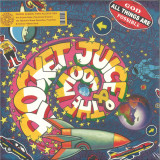
Up and away / To your journey to the sun / Drink your rocket juice / Fly away (Hey, Shooter).
High up in the skies, amongst the clouds, Rocket Juice & The Moon was born. Literally. It happened back in 2008, when Damon Albarn, Flea and Tony Allen convened on the same Lagos flight, to play and exchange musical ideas in that city as part of the Africa Express collective. Relishing a shared enthusiasm for one another's work, and bonding immediately, there and then the triumvirate laid down the blueprint for Rocket Juice.
Still, more than a year passed before conditions were set for three weeks together at Albarn's West London studio, recording and refining two-dozen startlingly out and deeply funky instrumental grooves. The next stage was to invite onboard some extremely talented friends, with further sessions in Dallas, New York, Chicago and Paris... Erykah Badu, no less, queen of contemporary soul. Three companions from Africa Express: Malian singer Fatoumata Diawara, whose debut album has topped World Music charts since its release last Autumn; her multi-talented compatriot Cheick Tidiane Seck, whose prodigious keyboardism has lit up releases by artists ranging from Youssou N'Dour to Hank Jones; the young, Ghanaian rapper M.anifest, quizzically existential, switching seamlessly between Twi and English. And the Hypnotic Brass Ensemble, long-time stalwarts in the Honest Jon's set-up — since one of the team discovered them busking near the shop in Portobello Road, on his lunchbreak — with a second album for the label due in May... Finally, the tracks were dispatched for mixing to Berlin, to be meticulously honed, polished and envenomed by Mark Ernestus, one half of the legendary Basic Channel and Rhythm & Sound partnerships.
The result is Rocket Juice & The Moon — out March 26, 2012, on Honest Jon's Records — a triumphant exploration and proliferation of kinetic Afro-funk rhythms: organic, exuberant, communal music-making, evidenced by the project's live debut on stage as part of the Honest Jon's Chop Up in late 2011, which hit London, Marseille, Dublin, and Cork to such great acclaim (witness the flurry of smart-phone film-clips uploaded in the days thereafter).
From the inaugural bars — that absurdly funky slice of instructional timekeeping, 1-2-3-4-5-6 — the liquid pulse of Fela Kuti's classic recordings drives the action through a suite of 18 shape-shifting compositions. The greatest drummer in the world has never sounded so good as he does here. His intricate cross-patterns jostle and lock with Flea's nimble, rumbling bass riffs. Joined by Seck on There and Extinguished — 'when you dispose of something burning, be sure it's out' — Albarn's keyboards spray synth fusillades up top, over, and under... splicing into the mess of wires running between the freaked Afro-disco of William Onyeabor and the space-jazz-moog of Sun Ra. The HBE brings extra intensity and drama to Leave-Taking — likewise Flea's trumpet to Rotary Connection — teasing out the haunting melody coiled in the mix.
Where the best of vintage Afrobeat sides sustained their concentrated energies over the course of sprawling, marathon jams, RJ & TM manages something altogether different: the group bottles the idiom into capsules of funk... and real songs. Beautifully buoyed by Erykah Badu's unmistakable vocals, Hey, Shooter brilliantly traverses metaphysical spaceways sans any semblance of noodling. Lolo and Follow-Fashion — featuring the open-hearted sensuality of Diawara's singing, M.anifest's quick, brawny science, and more brass blasts — play like its musical cousins or codas. Indeed, the album's shrewd sequencing creates the composite effect of tracks working both individually or within the context of an extended song-cycle.
The lovely ballad, Poison, is bittersweet and ruminative: 'If you're looking for love, beware the signs / They will paralyze you one by one / Poison, it will only break your heart.' Down-tempo and dubby, Check Out and Worries amplify the range of styles and moods. And by the time of Fatherless — a chugging Afro blues that evokes John Lee Hooker lost in Lagos, one gets the sneaking suspicion there's very little outside the reach of this collective's inventive musical grasp.
There is, in fact, a palpable openness pervading Rocket Juice & The Moon — the sense of a limber willingness to follow creative impulse — right down to how the group acquired its name. When Ogunajo Ademola — the Lagotian commissioned to do the album's cover artwork — dubbed his submission 'Rocket Juice & The Moon', it quickly morphed into the formal name of the project, like trying to hold onto mercury.
Surely, the stars above also approved.
Jay Dee needs no introduction. Widely regarded as one of the most important figures in hip–hop alongside Pete Rock, Kanye West, Pharell, and Dr. Dre, his influence has reached far beyond the genre. Known widely as your favourite producer’s favourite producer, and having produced and remixed for legends like Janet Jackson, Daft Punk, A Tribe Called Quest, Brand New Heavies, Busta Rhymes, Common, Erykah Badu, Guru, The Pharcyde, The Roots, De La Soul, and Royce Da 5’9"—the list is endless—there is no questioning Jay Dee’s genius. Many have tried, but none have been able to duplicate his sound. Originally released in 2001, Welcome 2 Detroit marked Jay Dee’s first solo project and the groundbreaking debut of BBE’s Beat Generation series, where producers stepped into the spotlight with complete creative freedom. A paradigm-shifting record, it was short-listed for Artistic Achievement in Music in October 2001 (the U.S. equivalent of the Mercury Prize) and instantly set the bar for everything that followed. Now, 25 years later, Welcome 2 Detroit returns in a long-awaited repress, celebrating a quarter-century of influence and innovation. This anniversary edition brings the instrumental version of the album back into circulation after years out of print, allowing listeners to experience the full depth and complexity of Jay Dee’s production in its purest form. Stripped of vocals, the intricacy, texture, and brilliance of his work shine brighter than ever—revealing details you may have missed the first time around. Make sure you grab a piece of history.