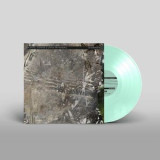
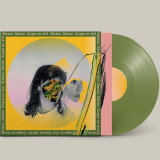
Plasma Color Vinyl. 'The way Bloomsday's Iris James Garrison writes songs feels like somewhere between a mirror and a memory. Spacious, full-bodied folk songs, they are an ode to things that are good no matter how small; they sometimes feel like the ghost of a Mary Oliver poem. Bloomsday's new record, 'Heart of the Artichoke', is a relic of unfettered creativity and community. They recount the miracles of the mundane, the memories that become sacred, an ode to all that is holy: nightswimming, songs plucked from the ether, the ways friendship can endure. Like earlier Bloomsday songs, the work here is threaded with warmth; it's simmering, crisp and deeply human, an encapsulation of the present moment. Recorded across 10 days in June 2023 in upstate New York at duo Babehoven's studio and co-produced by Babehoven's Ryan Albert, with mixing by Henry Stoehr of Slow Pulp. The record was built out with a wideranging group of collaborators, including inventive drumming from Andrew Stevens (Lomelda, Hovvdy), Alex Harwood, Richard Orofino, Babehoven's Maya Bon, Hannah Pruzinsky (h.pruz, Sister.), and Chris Daley. It was an insulated and collaborative experience: all family dinners on the back porch, bonfires, feeling a full sense of joy, of friendship, of purity in the artistic self. Collaboration is an integral part of Bloomsday's musical process. Garrison is malleable in the studio, their songwriting generous and spacious. But in listening to the record, there's a sense that Garrison leaves room for the players, for the listener; for songs to find the shapes they're meant to take. Garrison's role as maestro is crucial, singular - it's a collaborative, exploratory spirit harnessed by Garrison's intuition, and by an honest commitment to carve out creative space for play, to delve into what's known - or pushing past that, into unknown. "The ghosts of the past still come up and haunt me," Garrison says, "but I sit in what I have and see it. All of these songs are about loved ones, about personal struggles with getting out of my head and being present." Heart of the Artichoke was written from a healed, matured place - written in a moment of safety from chaos. It's a prayer for the present, an appreciation of tenderness and what happens once we give ourselves the space to really see, and really feel - becoming free and whole - an ode to the way healing allows us to bloom.
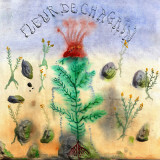
quête:the object
'The way Bloomsday's Iris James Garrison writes songs feels like somewhere between a mirror and a memory. Spacious, full-bodied folk songs, they are an ode to things that are good no matter how small; they sometimes feel like the ghost of a Mary Oliver poem. Bloomsday's new record, 'Heart of the Artichoke', is a relic of unfettered creativity and community. They recount the miracles of the mundane, the memories that become sacred, an ode to all that is holy: nightswimming, songs plucked from the ether, the ways friendship can endure. Like earlier Bloomsday songs, the work here is threaded with warmth; it's simmering, crisp and deeply human, an encapsulation of the present moment. Recorded across 10 days in June 2023 in upstate New York at duo Babehoven's studio and co-produced by Babehoven's Ryan Albert, with mixing by Henry Stoehr of Slow Pulp. The record was built out with a wideranging group of collaborators, including inventive drumming from Andrew Stevens (Lomelda, Hovvdy), Alex Harwood, Richard Orofino, Babehoven's Maya Bon, Hannah Pruzinsky (h.pruz, Sister.), and Chris Daley. It was an insulated and collaborative experience: all family dinners on the back porch, bonfires, feeling a full sense of joy, of friendship, of purity in the artistic self. Collaboration is an integral part of Bloomsday's musical process. Garrison is malleable in the studio, their songwriting generous and spacious. But in listening to the record, there's a sense that Garrison leaves room for the players, for the listener; for songs to find the shapes they're meant to take. Garrison's role as maestro is crucial, singular - it's a collaborative, exploratory spirit harnessed by Garrison's intuition, and by an honest commitment to carve out creative space for play, to delve into what's known - or pushing past that, into unknown. "The ghosts of the past still come up and haunt me," Garrison says, "but I sit in what I have and see it. All of these songs are about loved ones, about personal struggles with getting out of my head and being present." Heart of the Artichoke was written from a healed, matured place - written in a moment of safety from chaos. It's a prayer for the present, an appreciation of tenderness and what happens once we give ourselves the space to really see, and really feel - becoming free and whole - an ode to the way healing allows us to bloom.
Black Truffle is pleased to announce Resonant Trees, the first vinyl release from French composer-performer Léo Dupleix. An active member of the international community of younger musicians working with just intonation, Dupleix has composed works for solo instrumentalists and ensembles in Europe and Japan, as well as performing extensively on harpsichord, piano and electronics. His music is distinguished by a formal clarity and elegance of surface, gently shaping pure intervals into delicate melodic patterns and shimmering harmonic planes.
Resonant Trees presents two side-long pieces for harpsichord and ensemble, both setting slowly repeating patterns played on harpsichord and guitar within an environment of sustained tones. Dupleix performs on a French double manual harpsichord (tuned to a just intonation scheme of his own devising) and Prophet synthesizer, joined by Juliette Adam (bass clarinet), Johanna Bartz (traverso flute), Cyprien Busolini (viola), Fredrik Rasten (6- and 12-string guitars), and Mara Winter (traverso flute). The harpsichord begins Resonant Tree I alone, slowly sounding out a series of arpeggiated chords that emphasise the unique (and for unaccustomed listeners, sometimes unsettling) harmonic and timbral qualities of justly tuned intervals. Long tones from synthesiser, bass clarinet, viola and Baroque traverso flutes slowly creep into the spaces between the arpeggiated chords, joined after several minutes by delicate patterns of harmonics played by Rasten on acoustic guitars.
On Resonant Tree II, a similar structure and ensemble (without the flutes) are used with quite different results. We again hear only the harpsichord at first, but this time playing a series of flowing melodic lines, each of which is repeated several times. Joined again by long tones from the ensemble, here the viola is particularly prominent and its interplay with the harpsichord creates fascinating acoustic effects. In both pieces, repetition gives the music a static, stable quality while, at the same time, the exact shape of the repeating patterns remains difficult to grasp. As Dupleix writes, these pieces dream of music as ‘space and a sound that one could grasp in one’s hand.’ As the near-static quality of the repetitions and long tones with little incident make these two stretches of musical time feel like spaces for the listener to inhabit, the small variations on a narrow range of related material act like a three-dimensional object whose each facet is examined in turn. At once austere and seductive, Resonant Trees takes its place beside the work of contemporaries like Catherine Lamb, while also calling up the languorous melodic world of Mamoru Fujieda, the dignified melancholy of Satoshi Ashikawa’s classic Still Way and the espaliered chamber atmospherics of the Obscure catalogue.
- A1: アヴちゃん (Avu-Chan
- A2: Siiickbrain Feat. Pussy Riot - Power
- A3: Engelbert Humperdinck - I'm Forever Blowing Bubbles
- A4: Alejandro Sanz - La Despedida
- A5: Upsahl - My Time To Shine
- A6: 奥田 民生 (Tamio Okuda) - Kill Me Pretty
- A7: Big Fella - Couple Of Fruits
- B1: カルメン·マキ (Carmen Maki) - Tokiniwa Hahano Naikono Yoni
- B2: Shuggie Otis - Sweet Thang
- B3: Song For Memories - Five Hundred Miles
- B4: 麻倉未稀 (Miki Asakura) - Holding Out For A Hero
- B5: 坂本 九 (Kyu Sakamoto) - Sukiyaki
- B6: Rare Earth - I Just Want To Celebrate
- B7: Dominic Lewis - Momomon
Tangerine[39,45 €]
Bullet Train is the 2022 American action-comedy film by the Deadpool 2-director David Leitch and is based on the 2010 novel Maria Beetle, written by Kōtarō Isaka. In Bullet Train, Brad Pitt stars as Ladybug, an unlucky assassin determined to do his job peacefully after one too many gigs gone off the rails. Fate, however, may have other plans, as Ladybug's latest mission puts him on a collision course with lethal adversaries from around the globe - all with connected, yet conflicting, objectives - on the world's fastest train...and he's got to figure out how to get off.
The film features a number of original tracks. Most notably, the film contains Japanese language covers of "Stayin' Alive" by Bee Gees and "Holding Out for a Hero" by Bonnie Tyler. Composer Dominic Lewis noted that the film's soundtrack represents "all vibe and no technique".
For the first time, the soundtrack for Bullet Train is available on vinyl and comes in different editions, all based on the characters in the movie. All editions include a 4-page booklet, but each edition contains an exclusive Bullet Train boarding pass with corresponding picture of the character. This is the limited edition on Lemon coloured vinyl.
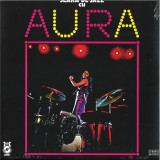
a A1. アヴちゃん (AVU-CHAN QUEEN BEE) - STAYIN' ALIVE
The Slovak band Shallov releases their new track "Refrain" on the experimental label Weltschmerzen just one year after the release of "Coexist". Two tracks that both span more than 10 minutes in length, work together as one coherent audiovisual art piece and are out as an EP on 10" vinyl. Music videos do not only visually supplement both tracks but they are equally autonomous art pieces.
The visual feature of the music pieces is highlighted by the vinyl's cover painted by Slovak artist Michal Fízik. The previous back cover carries a photograph which served as an inspiration for the painting while the current back has been created via AI reinterpretation.
The musical component of Refrain is based on a repetition building into a hypnotic trance, gradually disintegrating so it eventually ends in a monumental climax. It contrasts the band's previous work as well as the track Coexist which uses rather neverending rhythmic variations, and a changeable vibe and atmosphere.
The concept of the visuals in Coexist is a result of a collective fusion between the theatre director Adam Dragun, Viktor Ori and dozens of other participating non-actors. The video depicts individualistic egoist actions shaping a contradicting and incomprehensible totality of the world which ultimately seems to be alienated to everybody.
Refrain is an introspective journey leading to the dissolution of the individualistic experience of human existence. The video's concept, direction and production was conducted by the visual artist and performer Jak Užovič who also tends to inter-media art and object installations.
As Shallov and Jak Užovič explain the track's conceptual background: "The idea of owning one's own body and mind is an unnatural way of looking at ourselves imposed by the dominant paradigm. It's a blind ideology - the view of a body as a machine or a commodity is incomplete and represents a materialistic utopia which is being systematically internalized. We're not a community that acts right or wrong, our intentions are determined by an ideology which pretends not to exist - our relations are relations of masters and slaves, of domination and exploitation. We are a society bound by these features and even though we refuse to admit it, the world presented to us is only a legend we're striving to keep alive at all costs, while believing that there is no alternative. Our quality doesn't stem magically from the inside, on the contrary, it's determined by the conditions within which we interpret it through collectively shared fictions. We don't get to know our consciousness through ourselves, but we recognize it through others as they create and form us."
In 2024, Vredehammer, the mighty force from the deepest North returns. Vredehammer explore the depths of darkness and despair, painting a chilling sonic landscape that captures the essence of true black metal. Vredehammers upcoming album "God Slayer" is poised to deliver nothing short of blackening excellence, Vredehammer continues to push the boundaries of extreme metal, seamlessly blending elements of blackened death metal, thrash, and melodic death metal to create a sound that is both relentless and captivating. With one of Scandinavia's finest BM drummers, Nils 'Dominator' Fjellström, on drums, combined with the unparalleled musical songwriting and guitar skills of Per Valla, this album is not to be missed. Vredehammer about the album: "With the Godslayer album I wanted to take a step back regarding tempo, not focusing so much on fast songs. There is definitely some fast stuff in there, but my main objective was to create memorable songs and guitar riffs with a lot of punch and power to them. This time Vredehammer had the pleasure of having Nils "Dominator" Fjellström doing drums for the album. Having played with Nils on other occasions, I was excited to see how he would perform when the music didn't just consist of fast black metal stuff, which is known to be his specialty. He definitely rose to the occasion and contributed with some great ideas for the drums."
Nathaniel Russell is a multi-disciplinary artist from Indiana who creates drawings, paintings, prints, murals, objects, videos, and music, often with friends and fellow artists. And in 2023, he packed up his car and drove from his home in Indiana all the way to North Carolina to record new music with his long-time friend Amelia Meath (Sylvan Esso, The A's) at Betty's, the wooded studio haven of Sylvan Esso, where recent releases from The Tallest Man on Earth, Caroline Rose, Wednesday, The A's, The Mountain Goats, Flock of Dimes, Indigo de Souza, and many more have been born. This record began with a funny and sad idea Russell had about a funeral. "I imagined a picture of a funeral with a merch table. It was an idea full of darkness and sweetness to me. Immediately I thought about what my merchandise would look like, what it would be. I began to think about what the record for sale at my funeral would sound like. I started to think about the songs I have made up and sung to and with my friends, family, and myself over the years. I noticed how the songs I had sung the longest seemed connected to others from a different time. I had changed some words and how I played them but they were all of me and my time on earth. I heard how these things fit together. Of course I now needed to see this project become a reality." Songs Of was produced by Meath, engineered by Alli Rogers, and features additional performances from Joe Westerlund (Megafaun, Califone) and Nick Sanborn (Sylvan Esso, Made of Oak).
This record invites you on an extraordinary journey, in the form of a spatio-temporal and transgenerational sound collage, into the parallel and singular universe of one of the major counter-culture movements of the 1960s fantastic realism. A cross between thematic compilation and sound creation, it offers a selection of rarities and nuggets with psychedelic and esoteric tonesby groups from the late 60's - early 70's French psychedelic scene, such as Haira, Guy Skornnik and Martin Circus, as well as previously unreleased tracks by major current and emerging bands such as The Limiñanas, Zombie Zombie featuring Pacôme Thiellement, The Penelopes or Terrains vagues, Rubin et le paradoxe featuring Brigitte Fontaine, Tuxedomoon or Exotourisme (Perez and Dominique Gonzalez Foerster). These tracks were created especially for the occasion. All mixed and interspersed with audio archives by Jacques Bergier, Louis Pauwels or Eugène Canseliet and sounds from installations designed by visual artists (Veronique Belland, Alexis Chapelain). At once cutting-edge and accessible to the uninitiated, between fantasy and science fiction, esotericism and occultism, popular culture and contemporary art, avant-garde and pop music, this disc offers a poetic ode to the Strange, to curiosity, to the capacity for wonder and the desire for knowledge, with a view to re-enchanting reality. Conceived by Jean-François Sanz (author, director and curator) and Hermione Volt (visual artist), in collaboration with Laurent Paulré (founder of the Contours label and producer at Radio France), and with the complicity of Céline Du Chéné (author and journalist), this album, an atypical sound object, is the musical extension of the eponymous group exhibition UN AUTRE MONDE ///DANS NOTRE MONDE, which opened at Galerie du Jour in Paris.
- 1: Static On The Radio – 6:3
- 2: Bluebird – 5:9
- 3: Combing My Hair In A Brand New Style – 6:24
- 4: That Girl From Brownsville Texas – 6:22
- 5: Borrowed Wings – 4:34
- 6: If Jesus Drove A Motor Home – 4:3
- 7: Objects In Motion – 5:58
- 8: Buzzards Of Love – 7:00
- 9: Alabama Chrome – 4:25
- 10: Phone Booth In Heaven – 7:09
- 11: Land Called Home – 4
- 12: Suckerz Promisez – 5:58*
- 13: Stranger Candy – 7:25*
- 14: Cinderblock Walls – 5:27*
20th anniversary of Jim White’s haunting outer space alt.country classic that has a title so long nobody can remember the name of it. Featuring Aimee Mann, M. Ward, Bill Frisell and the Barenaked Ladies. Now it’s on vinyl for the first time, pressed on Substrate Black in a gatefold jacket plus three additional bonus tracks
Ngwaka Son Systéme’s debut album Iboto Ngenge means “power struggle” or “seizing the opportunity” but while words can only be roughly translated, the music reaches listeners unambiguously: A potent mixture of techno, rumba, soukous, zagué and dancehall with the unique “Kinoise” brand fresh out of Kinshasa, the Congolese megacity that never stops innovating in the music landscape worldwide. Ngwaka Son Systéme is led by musicians Love Lokombe and Bom’s Bomolo, having previously founded the band KOKOKO!. This new project continues the contemporary Congolese tradition of reinventing electronic music by shaping and crafting music instruments made of household objects. As a means to continue strengthening the links between Africa and Latin America, Eck Echo has tasked Colombian dub engineer Diego Gomez with the analog mixing of the stems, originally recorded by Levy David at Timbela Ba Studio in Kinshasa. With the aim to bring the lexicon of shared Colombian and Congolese music into the next chapter, we proudly present to the world the magnificent music of Ngwaka Son Systéme. The inadvertently techno-oriented Lakala, a trance-inducing experience where listeners can quickly relish to the lyrics even without speaking Lingala, for the shapes of the words are already inviting listeners to dance, sing and smile, all the while virtuoso percussionist Steroy operates the DIY-drum kit at high-tempo. The call-and-response effect, where each musician lends their voice to the choir, is particularly felt in Bo Lobi Pe, where the vocals guide us ever so playfully to the tune of an acoustic guitar that invites us to take off our shoes, kick back and relax. Zanga Mbongo (translated as “there is no money”) is lyrically a proud anthem to celebrating life in spite of economic scarcity, and musically it is a triumphant renewal to the legendary soukous genre of the 1970s, championed by worldwide renowned stars such as Pepe Kallé and Sam Mangwana.
Introducing the next release in Names You Can Trust's long-running collaboration with the prolific and symbiotic musical universe of Bogotá, Colombia. Mau Gatiyo y Los Años Maravillosos formed in 2021, arising from the very same fertile ground of the Teusaquillo neighborhood that has spawned many records and musical mischievousness. At the heart of this experimental movement is what can only be described asTropicanibalismo, where a deep hunger for the roots of Colombian tropical music are only satiated by dissecting it, consuming it and ultimately creating something new again as some kind of untraditional, unholy, and yet referential form of musical sustenance.
Within this concept, there's a clear lineage of inspired and visionary artists that have been featured throughout NYCT's record catalog for the last 15 years that includes luminaries Frente Cumbiero, Meridian Brothers, and Romperayo. Each of these artists' tentacles have touched several parallel projects from their talented neighbors and friends, and whether through production, playing, engineering, or mixing, these collaborations have heavily contributed to a very fruitful and colorful scene that could only exist within Colombia's capital, while also gaining notoriety in the nooks and crannies of northern latitudes like New York, Chicago, and Los Angeles.
Mau Gatiyo, a talented accordian player and vocalist, together with his group (translated as The Wonder Years), is precisely one of these projects, a collective that has found their calling in the echoes of thevallenatosandcumbiasthat once populated the nation's airwaves throughout the 20th century. It's a traditional format that has always lent itself to storytelling, whether it be anecdotes about daily life, or using one's voice to raise uncomfortable questions in protest against the system. This is where Mau Gatiyo's poetic, almostnew wavetimbre finds a lane of its own, straddling a 2020s societal landscape under the guise of ostensibly old-time accordion music.
The debut 7-inch from the group, an excerpt from their recently released album Baño Unisex, was recorded at Mambo Negro studios by Ivan Medellin (La Sonora Mazurén) and mixed by Eblis Alvarez of Meridian Brothers, both familiar names and contributors to the NYCT catalog. Alvarez himself, who has emerged in recent years as an international beacon of this new tropical avant-garde, is no stranger to flipping traditional styles on their head, or at least respectfully off-kilter. Mau Gatiyo y sus Años Maravillosos proves to be another great vessel for this veryBogotano expression, draping the classical playing of its group members in a modern day cosmopolitan expression of righteousness, both outwardly in their dashing, performative fashion sense, and lyrically with their cheeky "420, Reloj"ganja-tune promotion – or even their outward dissenter objections to paramilitary and firearm power in "Poder Militar."
Ultimately, these songs lie at the crossroads where two cultural eras connect and become something unique, a protestation one with performance, dance, and artistic expression. This cathartic ritual of protest has a storied history in music, and these two new entries into the NYCT catalog will hopefully find their place amongst a modern day canon, or at the very least, have your feet moving and your head nodding in just approval.
- 01: Soulstance - Lead The Way
- 02: Jukka Eskola - 1974
- 03: Luis Ferri - My Love Samba
- 04: Dalindèo - Solifer-Lento
- 05: S-Tone Inc. - Some Kind Of Blues (Jazz Mood Instrumental)
- 06: The Invisible Session - Heroes Of The Conquest
- 07: Paolo Fedreghini And Marco Bianchi - Stars
- 08: Quartetto Moderno - Mr. Bond
- 09: Quintetto Lo Greco - Yes And No
Repress!
Extending the heritage left from the first chapter of the homonymous collection, Schema Records presents "Freedom Jazz Dance Book II". The concept comes from an idea of Luciano Cantone aiming at offering "New Standards" that can be understood and responsively absorbed by young generations. The title deriving from a composition from Eddie Harris describes precisely the project's essence: the intuition of something overcoming hurdles laid by rigid market rules. From this, the artistic meaning of "Freedom", solid funded in "Jazz", from which spawns subsequently the natural impulse to movement, manifesting in "Dance" in fact. With "swing" setting the right pathway without hesitations, the objective of the project remains capturing younger people inside the magic of Jazz. The only possible way it's organic: by leaving the music to free up the spirit within themselves.
- A1: Gwaing Reverie
- A2: Lucelle Sista Of The Soil
- A3: Mantis Praise
- A4: Amaseh Amen
- A5: For Peter & Ruth
- A6: Terug Blik
- A7: Threnody For The Khoisan
- A8: Ambient Khoi
- B1: Mcinci Song I
- B2: Morenga
- B3: Evidence Of Things Unseen
- B4: Lockdown Duet Milano-Cape Town
- B5: Roesdorp Requiem
- B6: The Ascension Of Milford Graves
Garth Erasmus is an artist and musician based in Cape Town, South Africa. 'Threnody for the KhoiSan' is his first album under his own name. Since 1985 his artistic interests have broadened to include music-making, designing and making his own instruments based on indigenous KhoiSan knowledge. From 1999 to 2012 he was a member of the South African First Nation activist group Khoi Khonnexion. In the past couple of years Garth Erasmus has also been a pivotal part of various international performance pieces and exhibition projects which brought him regularly to Europe. Most of these activities were developed and performed in collaboration with the Hamburg based band Kante and his band Khoi Khonnexion. In April 2024 Garth Erasmus will be part of the group exhibtion 'Oscillations' at Akademie der Künste, Berlin.
His works in music are predominantly characterized by a restless quest for alternative forms of expression and materials including self build instruments, field recordings or various electronic music devices.
In this context the music on 'Threnody for the KhoiSan' takes on a primal and metaphorical meaning. Rather than a formal, physical initiation, this process is more spiritually inclined, yet it is a spirituality which is consistently put into action.. “Ever since I was an art student I have experimented with alternative materials to release me from the Western education values I received. When I started to make these instruments in the 1980s, my intention was to create art objects but when I discovered the sound they made, it unlocked a door that transported me deeper in my quest in the realization that I was on the right path.
In fact all instruments which appear on 'Threnody for the KhoiSan' are products of a process of discovery starting from square one. All this is based and founded on the beauty of simplicity and minimalism as symbolized by the single string Khoisan musical bow and arrow as trance musical instrument. In this sense it soon became manisfest for Garth Erasmus to combine the bow instruments with various electronic instruments. Besides developing his own unique language in music he also shared an expressed interested in experimental sound aesthecis, Avantgarde composition and Free Jazz. However, his non - academic approach towards sound and music was always fueled by the desire for a reconnection to the land and to the idegenious knowledge of the KhoiSan, whose struggle for First Nation status continues.
Song for Morenga
This song is dedicated to a guerilla leader, named Jacob Morenga, who was the leader of the nama/herero anti-german uprisings that occured between 1904 and 1907.
Amaseh Amen
This is a classic mouthbow piece that conjures the spiritual nature of Khoisan cultural praxis.
Gwaing Reverie
It was composed as a personal gift to the other members of newly formed electro-acoustic trio „Gwaing". „Gwaing" is an ancient Khoisan place name, meaning the mouth of the river.
Mcinci Song
A typical meditation on the traditional Mcinci flute. This flute was originally played by shepherds and was made of reed.
The Ascension of Milford Graves
This piece attends to capture the risen spirit of the legendary African American drummer Milford Graves. It was composed soon after his death in 2021.
Song for The Sisters of the Soil
A live improvisation dedicated to Lucelle and Melissa (The Sisters of the Soil) on the occasion of visiting them at their residence, known as „Oppieyaart" on the Cape Flats. On 10 September 2022 there is an online event with them at Kunsthaus Hamburg.
London-based four-piece Adult Jazz announce their first full-length album in a decade, So Sorry So Slow, out 26 April 2024 via Spare Thought. Alongside the announcement comes lovesick new single ‘Suffer One’ featuring Owen Pallett, a cautious excavation of self and sexuality, clambering across a gorgeously shapeshifting, filmic five-minutes.
Containing some of the band’s most abrasive but gentle, beautiful and melismatic work to date, So Sorry So Slow has many defining characteristics: romance, panic, devotion and remorse, threaded together by an intentionally laser-focused love. It’s deeply personal, bruised and candid in its expressions of tenderness, and deeply pained in its concurrent reflections of ecological regret. Across its hour-long runtime, a delicate, frenetic energy and glacial heaviness coexist, the band pitting those paces against one another. In their richly experimental timbre, dancing strings and fluttering falsettos prang against a bed of brass drones like a wounded bird.
“We started writing in 2017 and began recording in 2018,” says vocalist Harry Burgess. “We genuinely thought it might be finished in 2018! But things kept developing and, having resolutely not struck while the iron was hot, there was no real external push to rush things after that, so we just kept letting things shift and unfold until it felt right. Listening back to my voice notes it’s nice to notice that there are fragments of ideas from the whole period 2017-2023 which have shaped the record.”
Recorded in bursts at studios across London and in the band members’ flats, at Konk, on the Isle of Wight and in Sussex, So Sorry is unambiguous in its evolution. Sonically, there are sparks of the arrhythmic brightness that afforded the band’s critically acclaimed debut album Gist Is its cult adoration, for fans of Arthur Russell and Meredith Monk, but with a blossoming, melancholic darkness often overhead. Piano sprees and luscious string sections appear like low-hanging stars on a night-time drive, whilst plunging vocal distortions and humming brass loops resurrect heavy limbs in a bad dream.
“I usually have objects as kind of totems for ideas,” explains Burgess. “The album initially started out to do with performance… the totem was a head mic, one of the subtle skin-tone ones, discreet on the forehead of a West End star. A number of the first songs in their original forms were almost musical theatre piano ballads. I think that was really a device to write about my life as the ‘main character’ (pre internet-speak reframing): regrets about romance, relationships - unsustainable relationships with the self and others.”
“However, once we started writing, the ideas about unsustainable personal relationships, loving unevenly and heartbreak conflated with a more expressly ecological regret. Like contending with big feelings of loss, endings, beauty, desolation, and with how much joy the earth contains in it. Feeling so much gratitude bound up in waves of sadness. Maybe witnessing a slow-motion goodbye to all that, or its last gasps. I love the earth and the life it supports so much. I love how ecosystems fit together - even the brutal stuff. It may be basic to say, but now is the time to be laser focused on that love. I was thinking about human centrality on earth, us as the ‘main character’, the way that is served by faith and romanticism, and the subsequent disingenuous understandings of our position in the ecosystem, as only stewards somehow, rather than subjects. The totems at this point: a herald’s horn, lorry inner tubes, archaeological tools. I guess from doom, industry, history respectively.”
“Now I would say the record is about gripping. Totems being: crampons, rope, drips, desalination equipment, accruing various survival tech. I think gripping sums up both of the threads. There’s the emotionally correct clinging to the earth that is the substrate of everything we value, or the delusional clinging to our imagined dominant position. But also the practical, technological aspects of creating a sustainable relationship, of remaining here. Then I think of romance again.”
So Sorry So Slow comes out 26th April 2024 on Spare Thought, mixed by Fabian Prynn at 4AD Studios and mastered by Alex Wharton at Abbey Road.
Adult Jazz is Harry Burgess, Tim Slater, Steven Wells and Tom Howe.
Much-anticipated debut album from Leeds post-punk power-trio and 6Music favourites Objections. Optimistic Sizing is comprised of ten kitchen-sink dramas, ten miniature worlds to lose yourself in. The key topics are covered: performative royal mourning, ill-suited sexual relationships, coastal gentrification, motormouth bigots and - of course - snogging. Objections formed in the post-lockdown period after drummer Neil and guitarist Joe's former band (and cult favourites) Bilge Pump slowed to an amicable halt. They wanted to continue the musical dialogue they had built up over decades and turned to Claire Adams (Nape Neck, Beards) to start something new and Objections was born. The 3 members have also played in/with: Polaris, Yann Tiersen, HiM, Enablers, Felix and Damo Suzuki (among others). Objections released their debut 7" - BSA Day/Better Luck Next Time on Wrong Speed in 2023 and have recorded two Marc Riley / Gideon Coe BBC 6Music sessions. At Wrong Speed we are not fond of genres, we are here to release music we love not tell you how to file it. But Optimistic Sizing is genuinely post-punk in the literal sense of the term. Objections take the freedom and anyone-can-do-it promise of punk and run somewhere new and adventurous with it, creating a vibrant and living musical language with which to communicate their own unique world view. As a result, Optimistic Sizing is not only a classic debut album but a timeless one. "We like to think we know what we're talking about....believe us when we say, Objections are a band to watch" - Louder Than War
Read any article or comment thread about the Seattle noise-rock outfit GREAT FALLS and you're likely to see descriptors like cathartic, heavy, crushing, and unhinged. Maybe even psychotic. And sure, those are all apt: For over a decade, vocalist/guitarist Demian Johnston and bassist Shane Mehling (who also played together in the early-2000s noisecore band PLAYING ENEMY and the experimental duo HEMINGWAY) have honed their sludgy, overwhelmingly intense brand of heaviness, punctuated by delectably discordant riffs, terrifyingly low, thwacking bass lines, and mesmerizingly tight percussion. In the live setting, too, they’re notorious for a stage presence that is so aggressively confrontational and menacing that Mehling once broke his own arm mid-set.
But the most striking aspect of GREAT FALLS, setting them apart from the murky sea of sludge metal and AmRep-inspired noise-rock bands, is their ability to paint a deeply, utterly human story through an all-out assault on the senses: an art the band has perfected on their fourth full-length album OBJECTS WITHOUT PAIN, out September 15 via NEUROT RECORDINGS.
The album is not only their NEUROT debut, but also the first LP featuring drummer Nickolis Parks (GAYTHEIST, BASTARD FEAST), who joined the band prior to the release of their exhilarating, cacophonous 2023 EP,FUNNY WHAT SURVIVES.
OBJECTS WITHOUT PAIN takes us on a bleak, purgative journey through a separation–a snapshot of the turmoil and indecision that occurs after the initial realization of someone's misery, and before the ultimate decision to end a decades-long partnership. From the foreboding intro riffs of “DRAGGED HOME ALIVE” to the end of the 13-minute closer “THROWN AGAINST THE WAVES,” its eight tracks explore the thoughts that come up when a person is staring down the barrel of blowing up their life: How did this happen? Is it too late for a new life? Will the kid be OK? What will make me happier: familiar torment or unknown freedom?
Isaiah Collier & The Chosen Few return with a new musical journey, "The Almighty". The first quartet offering since 2021's Cosmic Transition.
Collier's compositions and lyrics focus on using music to communicate deeper principles that are part of everyday. Isaiah showcases these principles through sounds that evolve within the titles: Love, Compassion, & Perspective. These principles once taken fully in are arranged to deliver the message that there is a Divine energy connecting through us all and is seen within all things. The album opens up with LOVE, featuring the legendary Chicago vocalist Dee Alexander channeling her energy to deliver the message of love to the human family. With lyrics written by Collier specific to Alexander's qualities as a maternal figure to him and other musicians, the message remains strong within the music throughout the album. Searching deeper to share more sincerely through our interactions with others, is the albums objective. Collier & The Chosen Few showcase those Principle with Musicianship and an unyielding commitment to put their all into each breath of this episodic journey. The album features the legendary Saxophonist Ari Brown, who has mentored Isaiah for over a decade in their native Chicago. The conversation between student and master evolves on the song "Compassion". Collier's steps into the vocalist roll on the infectious, Perspective (Peace & Love) which serves as Collier's acknowledgement of Pharoah Sanders for his musical contributions, that features percussive sounds that connect the ancestors of the diaspora. Throughout "The Almighty" the group explores elements heard on 2021’s Cosmic Transitions and 2022’s Beyond by I AM (Isaiah Collier and Michael Shekwoaga Ode), and streamline the sound with laser focus in this incarnation.
Smalltown Supersound’s Le Jazz Non Series returns with a collection of pure, emotional club bangers, on a tip somewhere between Aphex Twin’s first Analogue Bubblebath and Drexciya’s most direct The Other People Place romancers.
’Slay Tracks’ is Bratten’s 6th album and perhaps the closest to Smalltown’s heart, personally selected from his swelling hard drive by label bossman Joakim Haugland. You can see the tip he’s on too, opting for a sort of refracted view of ‘90s electronics, propulsive but always emotionally driven.
‘Res’ hits most closely to classic Richard D James with its doe-eyed, single note bassline, while screwed acid vignette ‘Tunnel’, reminds us of Sockethead and Michael J. Blood with its slow, square bass grind. ‘Repair’ gives it all gossebump-inducing melodies in a mode not far from classic Titonton Duvanté or even The Black Dog’s earliest, many-monikered excursions, while ‘A Fog’ craftily dices with a vibe redolent of Phoenicia or the Miami lot, and the closing couplet of ‘The Returner’ and ’Strayed’ smartly extend that analogue on a low- down, offbeat bent like some classic Push Button Objects.
Khôra is the medium Matthew Ramolo uses to delve deeply into initiatory world-building by way of sound, image, and lyrical prose. Figuring wholly realized art-myths which distill and rouse the numinous while provoking the visceral and cathartic, Khôra intricately collages studio documents of ritualized instrumental performances, introducing overdubs by transient, heteronymic personae which dismantle stable points of reference in the music and open uncommon planes of consciousness.
"Gestures of Perception" is Khôra’s first double album with a supporting artbook and features a fascinating array of sources subjected to patterned assembly, poetic layering, and the elevations of the heart. Deft handling of modular synthesis is palpably central, while feedback, erhu, keys, flute, contact electronics, guitar, field sounds, and various percussion objects (rattle and frame drums, seed pod sticks, random metal objects, meditation bowls, kalimbas, bells) all serve to provide breathing structures and energetic contours that guide and scaffold inner and outer journeys into the far-near. Prominent across the record's span is a home-built, solenoid drum machine, responsible for the alive and askew techno-archaic flows and conceived as the album’s "rhythm seed”. The music on Gestures is teeming with organic and alien textures, soaring drones, inter-dimensional noises, and emotionally resonant melodies; balanced on the fringes of exotica and meditative trance, with capacities that untether the listener from the ballast of limited reality.
Operating hermetically in the penumbra of Toronto's cultural scene for well over a decade, Khôra has been invested in self-publishing handcrafted editions of spiritually driven recordings which led to the LP/CD reissue of inaugural album "Silent Your Body Is Endless" by Constellation. Khôra has toured extensively in North America and Europe both solo and in collaboration with Picastro, Nick Kuepfer (Hrsta,1/4 Tonne), and Brandon Valdivia (Mas Aya, Lido Pimienta), generated over a hundred hours of unreleased, bewildering drone through durational performance with experimental outfit Nidus (Marc Couroux, Jason Doell), composed for live dance and independent film, been commissioned by MaerzMusik, and seeded and co-run the now defunct music and art venue Ratio in Toronto.
Advitam Aeternamour, Cléa Vincent's third album, will be released on 29 March 2024 by Midnight Special.
If the 90s gave us “French touch,” then the 2010s ushered in “French pop,” and it was in the midst of this revival that Cléa began her artistic journey. As early as the music video for
“Achète-le-moi” from her debut LP Retiens mon désir (2016), we witness the singer striking selfie-like poses with her French pop comrades (La Femme, Bertrand Burgalat), appearing pell-mell on screen in the form of their vinyl records. Since then, whether singing with Philippe Katerine or co-producing (and composing) Jeanne Balibar's D'ici là tout l'été (2023), Cléa Vincent has effortlessly carved out a niche for herself in the French pop scene. The advantage of being a “jack-of-all-trades” — Cléa is a writer, composer, and producer — is that her music casts a wide net. Both highly acclaimed in the indie circuit and “as seen on TV” (on Quotidien, among others), she has also enjoyed a stint as the host for web-TV show Sooo Pop, for which she regularly interviewed a plethora of French artists. Beyond France, the singer tours extensively. After a run of concerts in Europe, Asia, North and South America, it was her visit to Latin and Central America that inspired Tropi-cléa (2017-2020-2022). The three EPs bathed in a tropicalist glow do more than just dip their toes in the water; they mark a deep desire to escape in a post-lockdown world.
In between these projects emerged Cléa’s LP Nuits sans sommeil (2019). The album quickly became an instant classic and lives up to its name, since Clea never seems to stop — writing, composing, singing, or dancing. Mixed by Stephane ALF Briat, who has lent his magic touch to records by Phoenix, Bonnie Banane, Air, and Flavien Berger, Cléa Vincent's third LP Advitam Aeternamour proves once again that her music is in perpetual renewal. The artist takes risks both in her pursuit for innovative sounds and in the themes she tackles: coming out, incest, grief...and of course, she will always be a true romantic at heart; there’s no need to be ashamed of loving love. Cléa’s songs are full of “explicit lyrics,” but not in the typical sense: rather than ringing harsh and raw, her words are tinged with sweetness and melancholy, at the risk of shocking less sentimental listeners.
Written hand-in-hand with Raphaël Léger, her creative soulmate for the last ten years who also recorded and produced the album, Advitam Aeternamour features lyrics charged with Epinal and equinox imagery. On the poignantly sober title track, sudden flashes of light are padded by tinkling synthesizers swathed in the voices of an angelic choir, as also heard on “Nuit de Yalda.” Cléa offers a modern take on 90s house music (“C'est Ok”) and 2-step garage (“Free Demain”). Particularly influenced by The Beloved, she is not above dipping pop songs into the electronic melting pot to get them through the club door (“État Second,” where we “turn up the BPM”). And whether on “Shut down ma tête,” or “Douce Chavirée,” Cléa pushes the champagne cork down even further so that the party never stops. The bass gets louder, the rhythm intensifies — the melodies of these eternal hits are an invitation onto the dance floor, lit up by her smile.
As depicted in the soothing embrace that appears on the album artwork, the bright psychedelic hues are the perfect complement to her therapeutically inclined synthetic pop. Even if they tackle themes such as breakups, Cléa's songs, which are vitamin-packed and deep on the surface, are intended to heal and repair. “Se laisser partir,” with its light vocoder echoes, emulating the vocal shadow of a loved one, is an optimistic breakup song. Advitam Æternamour gives us life, from birth to grief — and in the middle, wild, beating passion. If her songs resonate with us, it's because Cléa speaks to us in her songs, as heard on the girl power anthem “Free demain,” where she addresses the listener as a friend (“put the pedal to the metal and you’ll take off for the stars”). When she shares the microphone with Jacques on “État Second,” enveloped by the sounds of unidentified musical objects, the complementary nature of the two artists is evident. The album is as much a tribute to the healing virtues of music as it is a self-portrait of Cléa inhabited by her art. Ad vitam æternam and with love.
Delphine Dora is a prolific composer, improviser and musician who has released on a plethora of labels including Recital, Morc, Sloow Tapes, Feeding Tube, Okraïna and more, and ‘Le Grand Passage’ is her Modern Love debut, a stunning set of songs for piano and voice, recorded in one take without overdubs or edits.
In an act of pure expression, Delphine Dora recorded the 8 songs of ‘The Great Passage’ in a single take, succumbing to a whirlwind of inspiration that transported her beyond the material world. Baroque paradigms bleed into fragile, introspective mantras, expressed through a made up language of existential yearning and channeled through piano and voice. It’s music that caresses the sublime, made without any premeditation.
Delphine was nearing the end of a three-day prepared piano residency when an technician stepped in to tune her grand piano for her final performance. He removed the objects from the strings and fixed the pitch, leaving Dora with a freshly tuned instrument. Mesmerised by its new sound, she proceeded to switch on her recorder and pour out her soul, channeling, in her own words, "something greater than myself".
The result is some of the most unusual but elevated material the prolific composer, improviser and multi-instrumentalist has ever recorded, rooted in a deep understanding of European musical history but willing to push at its boundaries, questioning the earthly logic of life and death, asceticism and impiety. Glistening imperfections lash 'The Great Passage' to the physical world, but Dora - seemingly possessed as she quivers in a fictional dialect - lets her fantasies intensify her spirit, lifting the music towards the heavens. It's not sacred music, per se, but it is unashamedly mystical.
On the luxurious, languid opening, Dora dissolves eerily familiar romantic piano motifs into an attentive ceremony, singing with charged emotion. Her words aren't really decipherable, but their resonance vibrates beyond language; it's striking to hear how confident she is in vulnerability. She lets the piano wrap into her voice, connecting us directly to a unique mode of emotional expression by urging us - the listener - to project our own meaning onto her abstracted words.
Dora refers to the act of improvisation itself as a way to indicate "the fragility of being”, and as her words blur in and out of focus, dipping from a hoarse croak to a choking wail, she places herself at the very edge of musical formality, questioning strictures put in place to suffocate self-expression. Her music has often been labeled "outsider", but here she sounds intimate and interconnected, more self-consciously candid than anything traditional might have allowed. She conjures affecting, plainspoken poetry, like a bedside diary written in a hypnagogic, delirious state: a stream-of-unconsciousness, channelling the beyond.
The album title connects to a book dedicated to French philosopher and activist Simone Weil, who famously pored over global religions to ascertain spiritual truths. To Weil, meditation was a passage to access mystical experience, or a bridge between humanity and divinity. In Dora's hands, this idea is a corridor between herself and the listener, a liminal place where she's able to address feelings without making anything explicit. The title, of course, also refers to life, its impermanence, finitude, and fragility, presenting the complex, multi-dimensionality of being through one of the most undiluted, unbridled set of songs imaginable.
In 2023, Irène Drésel, an electro artist between Vitalic and Solomun, became the first woman in history to win the César (French Cinéma Award) for " Best Original Score ". Her colourful techno music is as sensual as it is upfront inspired by a rich, magnetic, sonic and visual universe. After two consecutive EPs, "Rita" (2017) and "Icône" (2018), her debut album "Hyper Cristal" was released in Spring 2019. It was followed by a second album, "Kinky Dogma" in 2021, which Libération (French National Newspaper) describes as "an accomplished work of techno, ambitious but not pretentious, since it never loses sight of its author"s objective: to provoke irresistible joy in the listener". And now is the time for "Rose Fluo", her brand new album!
When we started playing music together in 1997, we could spend a lot of time on each individual track. It would mutate, go through many phases, until we’d get to the point when we’d decide to capture it and mix it on the fly.
Twenty-five years later, we changed gears. This album was produced across a two year period, during several sessions in our studio (the third member of the band), following this process: we plug the machines, we start a musical conversation, we press record when it gets interesting.
In the studio, that moment always comes, when a fragile and magical balance happens. That’s when we record, usually in one take, sometimes all in the same stereo channel, the computer sitting in a corner, its presence not interfering with our ears.
La Folie Studio is the fruit of this process.
Let’s get numerologistic with this new age reactionary-philosophic strategy manifesto:
Playing electronic music, whether alone or not, must be joyous, funky, and make you feelgood.
The studio is not a sanctuary but a place of life. Technology must not be intimidating.
Welcoming friends and new objects in the studio should be an infinite source of inspiration.
If nothing happens in the studio, turn off the light and play a percussion record.
Techno heads of all ages need something more spontaneous and freer than little thumbnails shared on a pocket computer. Château Flight offers a musical experience carved on grooves.
With 25 years of experience, Château Flight can cure all your musical ills, instantly and painlessly.
The key to success: midi sync + din syc + external trigs.
Dago Sondervan uploads his code-driven debut to the Censor mainframe. Known for live-coding using Sonic-Pi and TidalCycles, Dago transports you straight into front-left of the Algorave. The EP includes a dimension changing remix from Annie Hall, and a further set of twisted electro remixes from CYRK and F.R.B. (an alias of Alex Jann). This is one for the replicants, bots and cyborgs.
Having built a loyal local Antwerp following off of the success of their 2019 debut self released album, ‘Forgotten Kingdom’, and growing reputation for electrifying stage performances, Kolonel Djafaar achieved worldwide recognition in 2021 for the ‘Cold Heat’ EP on Batov Records, attracting praise from Music Is My Sanctuary (“triumphant), and support from Gideon Coe on BBC 6 Radio Music, and DJs across Worldwide FM, Soho Radio, Le Mellotron, and KEXP.
The group overcame busy schedules and frequent quarantine periods to hit the studio in February 2022 to lay down four tracks. However, the creative itch persisted, leading to an intense writing session in August, deep in the heart of a tranquil forest. From noon until midnight, the band immersed themselves in the creative process, embracing the freedom to make noise without restraint.
Fueled by hearty breakfasts, unwavering focus, and the ambient clucking of chickens roaming the studio, Kolonel Djafaar crafted the majority of ‘Getaway’. This period marked a pivotal shift as a number of new band members joined just in time for the August sessions.
Membership changes, including Emiel Lauryssen joining on trumpet, alongside guitarist Philip Matthhijnssens, the band's palette has broadened and new sounds are able to break through. From psychedelic rock and soul influence of the Daptone Records’ affiliated Budos Band, surf rock (“Urban Dweller”), Morricone Spaghetti Western guitar, and Afro Cuban (“Kelmendi”), alongside the brassy Afrobeat and Ethio jazz vibes the group have been known for.
The broader dynamics of ‘Getaway’, and the band’s more cinematic and experimental approach, is particularly apparent on "Siren’s Glitch" and "Phil’s First Tear". The latter, first conceived by drummer Anton Van Hove, features the lead guitar doubling up with the bass guitar for added impact. Whilst the origins of "Convoi Exceptionnel", a brass & synths stomper of a march, trace back to a jam session during the band's Hungarian tour, another vital period of prolonged time together, capturing the organic essence of their experiences on the road.
Each track on ‘Getaway’ holds a unique connection to at least one band member, and all benefit from a collaborative approach to songwriting. "Sparking Clover'', an Ethio-inspired psych & soul groover penned by tenor saxophonist Doyin Smith, carries a poignant undertone inspired by personal loss, while psych rock leaning tracks like "Apologies in Advance" showcase the band's evolution and increasing professionalism in crafting a distinct sonic experience.
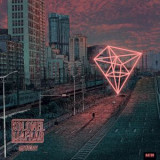
The curious cover art depicts a lone individual heading down an empty city street towards a large mysterious glowing object, evoking the common emptiness and struggle of urban life, and the search for meaning or just something better. The band envision the object to represent this album, offering a beacon to like-minded listeners. Kolonel Djafaar invite music enthusiasts on an immersive journey, to ‘Getaway’ from the daily grind of life, on an album reflecting diverse influences and marking a new chapter in their musical exploration.
Black Truffle is thrilled to announce a major archival release from legendary American composer and live electronics innovator Richard Teitelbaum, centred around his soundtrack for Suzan Pitt’s cult 1978 animation Asparagus. Best known to some listeners for introducing Europe to the Moog synthesizer as a founding member of Musica Elettronica Viva in Rome, Teitelbaum’s extensive and radically experimental body of work includes collaborative recordings with master improvisers like Anthony Braxton, Andrew Cyrille and George Lewis, intercultural experiments combining electronics with non-Western instruments such as the shakuhachi, works for computer controlled piano, and large-scale multi-media operas. Recorded at York University, Toronto in 1975–1976, ‘Asparagus (European Version)’ sprawls across both sides of the first LP. Discovered by composer Matt Sargent in Teitelbaum’s tape archive, this is a previously unheard major work for Moog modular and Polymoog synthesizers, unique in Teitelbaum’s oeuvre for its lushness and gently melodic quality. The music unfolds slowly, submerging lyrical melodies and burbling arpeggios into uneasy, glacially shifting harmonic swells, the luscious texture thickened with subtle changes of modulation and phase, calling up the shifting layers of Costin Miereanu’s classic Derives or the kosmische Musik tradition more than any academic synthesizer exercise. Teitelbaum incorporated much of this material into his soundtrack for Suzan Pitt’s Asparagus, which receives its first official release here. Asparagus, famously paired with David Lynch’s Eraserhead for a two-year run of midnight screenings at New York’s Waverly Theatre, uses hand-drawn and stop animation to unfurl an oneiric succession of images, beginning with a sequence in which the female protagonist defecates two stalks of asparagus, which multiply and float out of the toilet bowl to form the letters of the title. Teitelbaum’s soundtrack interweaves delicate drifting tones from the ‘European Version’ with contributions from Steve Lacy and Steve Potts on saxophones, George Lewis on trombone and Takehisa Kosugi on violin. Edited closely to the film, even without images the soundtrack proposes a surreal journey through floating synth tones, squealing horns, propulsive arpeggios, distant chatter, and an old-timey waltz. The final side of the set presents a new realisation of Teitelbaum’s text score ‘Threshold Music’, performed at a memorial concert at Roulette, New York in 2022 by Leila Bourreuil (cello), Alvin Curran (sampler and objects), Daniel Fishkin (daxophone), Miguel Frasconi (glass objects) and Matt Sargent (lap steel). The piece asks musicians to match their instrumental volume to that of the sounds of the environment in which they play, sometimes with the addition of recorded environmental sounds, reinforcing frequencies they encounter in listening deeply to their surroundings. Here the players use a field recording taken at Teitelbaum’s home in Bearsville, New York, their long tones and shimmering, glassy textures delicately emerging from the white noise of the location recording. Released with the full approval of both Richard Teitelbaum and Suzan Pitt’s estates, Asparagus is illustrated with striking images from Pitt’s film and accompanied by detailed liner notes by Francis Plagne. These previously unheard pieces shed new light on the work of a key composer in the American experimental tradition, offering up some of Teitelbaum’s most beautiful and engaging music.
Les yeux grands fermés is a spontaneous new EP that is an ode to freedom, both in the creative process and in everyday life. This opus depicts the rather raw feelings of a young artist who had a tough time of it when he was starting out, and who is now finally experiencing the success he had been hoping for. More liberated, the protagonist is now enjoying a new life: a more freestyle lifestyle full of surprises and lightness, with days governed by studio sessions, parties and carnal relations... all the while keeping his feet firmly on the ground and his goals firmly in mind! In terms of songwriting and production, Les yeux grands fermés is an improved blend of ABSOLEM's last two projects, Leur dire and Balle d'Argent, featuring both their introspective songwriting, here even more touching, and their arrogant, second-rate side. ABSOLEM continues the journey begun on Balle d'Argent, a project in which the rapper discovered himself to be more than ever in harmony with his music (spontaneity, introspection, fluidity of text) and less concerned by all the external factors (industry, the race for numbers, social networks, pressure, etc.), social networks, pressure, etc.).
Produced in a very short space of time, Les yeux grands fermés is a highly intuitive and spontaneous project with some tracks created from scratch in just a few hours.
Entirely produced, recorded and mixed by Dee Eye in their cellar-home studio, the project retains the 'live' touch. studio, the project retains the 'home-made' touch that characterises the duo and which they are constantly perfecting. The featuring with JeanJass, who is very close to the duo, was just as natural, having worked with with Dee Eye and advises them on the creation of their projects. projects. The result is a track with a very intimate theme (esotericism and introspection), which takes the form of an astral journey.
Project after project, the chemistry between ABSOLEM and Dee Eye grew stronger and stronger and the main objective remains the same: to break new ground in every area production, writing, interpretation, mixing and mastering). Continuing to continue to work on a number of projects on their own, Dee Eye continues to progress experience and a keen eye in the artistic direction of ABSOLEM's projects. projects. With quality, consistency and efficiency always in mind and efficiency, ABSOLEM and Dee Eye are increasingly asserting their desire to create their own musical colour, a sort of hybrid between Slowthai and Asap Rocky with and Asap Rocky, with innovative production and flows, featuring rap lyrics.
My art investigates the rich area of resonance and I engage in dialogue influenced by past works, current concerns and new directions. Works attempt to immerse the senses bringing to the fore natural phenomenon. I believe that sound can heal and that the conscious investigation of harmonic tunings, acoustic resonance as well as social relationships can yield powerful experiences. One of my objectives as an artist is to expose natural phenomena. I am interested in the physical aspects of sound and have developed a sensibility that focuses heavily on Resonance. Vibration is at the core of my experience of Resonance. I am moved by natural resonances that exist around us all. My own work strives to develop and nurture Resonances by negotiating sensitive relationships among a number of what I identify as critical ingredients for psychedelic phenomena: resonant bodies exciting harmonic energy creating diverse waves, beating and phase patterns diffused spatially with full dynamic range and a deep attention to the body and how it engages with the environment.
Danny Clay is a composer who often utilizes classical instruments, open forms, found objects, analog media, and digital errata in his work. He has collaborated with musicians and ensembles throughout the US, including Kronos Quartet, Eighth Blackbird, Third Coast Percussion, Volti, the San Francisco Girls Chorus, Wu Man, Sarah Cahill, Phyllis Chen, the International Contemporary Ensemble (ICE), Ensemble Dal Niente, the St. Louis Symphony Orchestra, and others.
After 4 years since his last solo release ("Ocean Park" LAAPS04). Danny Clay comes back with "No More Darkness No more Night", which could be, maybe, or, finally, a follow-up from his previous work. a complete intimate and out-of-time piece evolving between ambient, chamber music and contemporary music.
The Left Side is the latest body of work from the Iggy Pop-endorsed teens since the release of their acclaimed second EP We Aren’t Getting Out But Tonight We Might in summer 2022. With Saul at the creative helm, The Left Side is a mature and cerebral body of work with Saul once again writing and producing the entire EP (with co-production by Ali Chant (Yard Act, Katy J Pearson, Dry Cleaning) on ‘Conman’ and ‘ITSA’). Written in Saul’s bedroom, the EP is a retrospective insight into the young band’s journey so far as they tie up their teenage years.
A coming of age saga, the EP acts as a vehicle for Saul to dive into the psyche behind emotional evolution, and to unpack the complexities of maturity and the ability to say goodbye to the past. These themes present themselves not only in the songs, but right down to the title of the EP itself - which refers to the fact that the left side of the brain is responsible for comprehension.
Summarising the EP, Saul says: “It’s the closest we have been to knowing what picture we want to paint. It’s another window into the musical space we wish to explore, yet I think we’re closer to having our sound. I think the project signifies the end of a section in our lives, moving out from the haze of the moment and reflecting on our teenage years and all its chaos with more understanding.”
L’objectif have drawn instant acclaim across their two EPs to date with support coming from key tastemakers at 6 Music (where previous single ‘Feeling Down’ was daytime playlisted after being premiered by the station’s Steve Lamacq) such as Amy Lamé, Tom Robinson, and of course Iggy Pop, BBC Radio 1’s Jack Saunders (who made the band his Next Wave featured artist and featured
‘Burn Me Out’ and ‘Do It Again’ as Daily Delivery) and Gemma Bradley, Radio X’s John Kennedy, Apple Music 1’s Matt Wilkinson, and Australian national broadcaster triple j. The effervescent young band have already received ‘ones to watch’ tips from national media outlets NME (First On), The Line Of Best Fit (On The Rise), The Observer (One to watch), The Sunday Times Culture (Breaking Act), and more.
Canadian performer and composer Sarah Belle Reid’s 2021 acclaimed album, first time on vinyl, expanded with two new incredible songs, remastered featuring new artwork. From distant ocean song to the clang and howl of a murky forgotten memory, MASS is a dreamlike collage of shrill shrieks, gasps, corroded brass choirs, and melting modular synth soundscapes, all heard through a mist of hiss and noise. Fused with equal parts spastic improvisation, shrouded ritual, and meticulous arrangement, it presents a sonic topography at once tongue-in-cheek, sensitive, and nightmarish. With discordant chorales and angular trumpet improvisations churning in an ever-evolving wash of whispers and howls, MASS is a collection of three hazy, harsh, and frightful sound worlds. With tracks meandering between aggressive rhythms, eerie ambiances, and abrasive cut-up electronic textures, MASS draws inspiration from early tape music, horror film soundtracks, and grindcore. It was assembled between listening to extended doses of Else Marie Pade, Daphne Oram, Eliane Radigue, the Locust, Edgard Varèse, Maryanne Amacher, Dick Raaijmakers, Naked City, Mr. Bungle, and Thomas Ankersmit, bringing a little bit of all of them along with it. MASS was recorded and mixed over the course of three weeks in January–February 2021 while in the midst of a cross-country move. Recorded entirely in short-term housing away from her studio (and most of her instruments), Reid relied exclusively on her voice, trumpet, flugelhorn, household objects, and Make Noise's Strega semi-modular synthesizer for all sound materials. Original sound materials were recorded loosely and independently with little to no overdubbing, instead relying on meticulous editing and processing in the manner of classic tape music.
- Mar Vista - Visions Part 1 Her Eyes Are Closed
- Kennlisch - Kennlisch
- Crystal Eyes - Crystalzed
- Warlus - Girl Like You
- Gerard Alfonsi - Fana Stickle
- Geoffroy - Viking
- Amphyrite - Symphonie Pour 3 Oeufs Brouilles
- Eole - Friendship
- Capucine - Les Elephants
- Rictus - Flashes
- Inscir Transit Express
- Polaris - Polaris
- Joel Boutolleau - Force
- Spotch Forcey - Frustre
- Demon Wizard - Black Witch
- Temple Sun - Voyage Sans Retour
- Chantal Weber - Ballade Aux Chataignes Tombees
- Jean-Claude Zemour - X Kmh
- Rhodes Co - Baoum
- Guidon Edmond Et Clafoutis - Stormy Sunday
"For a long time, I'd come across these discs without really understanding what connected them, apart from a button and that famous logo designed by René Dessirier. Then, with a little more digging, I discovered the "self-production" link. For choirs, schools, folk singers, young pop groups, popular homes and even great composers who engraved unique copies of certain recording sessions...
The French equivalent of the English "Derby Service", the Kiosque d'Orphée, formerly at 7 Rue Grégoire de Tours in the 6th arrondissement, was taken over by Georges Batard in 1967 and moved to 20 Rue des Tournelles in the 4th arrondissement of Paris. The adventure lasted until 1991. Georges Batard was a sound engineer who used a Neumann tube engraver to engrave acetates from the tapes he received, before printing the precious vinyls in the press factories of the day, where he was able to produce very small runs of between 50 and 500 copies.
Of course, there were other structures for releasing his records, such as Voxigrave or, later, FLVM, but none of them had so many records in their catalog. Le Kiosque d'Orphée was neither a label nor a publisher, but a structure that allowed you to press your own vinyl, at a time when it was quite an adventure to get your first 45 rpm or 33 rpm album released!
Georges Batard was described as passionate and conscientious. His son, bassist Didier Batard, wrote of him:
"Georges was passionate about recording and reproducing the stereo sound of his great passion, music. He paid close attention to distortion rates, signal-to-noise ratios, response curves, rise times and other damping factors in audio equipment. He was looking for the exact reproduction of concert hall sound in his living room (with the same sound level, if possible...). In the late '50s/early '60s, he found other sound enthusiasts in AFDERS (Association Française pour le Développement de l'Enregistrement et de la Reproduction Sonores). He became its honorary president. Every Saturday afternoon, its members met to test au- dio equipment. Their opinions were published in the monthly Revue du Son.
All you had to do was send in your tapes and choose the number of record copies you'd like to take home with you, so you could finally share your creations and, in a way, exist. You could opt for a generic sleeve, available in several colors, directly customizable with your name and credits, or you could design your dream sleeve yourself in your living room or at a printer's.
This "Do It Yourself" temple gave birth to some superb pouches. Stencilled, hand-written, illustrated with paintings, drawings, illustrations by friends or girlfriends of the time, photo prints hastily stuck in the middle of a blank, white sleeve, on which the traces of time would leave their imprints, so that collectors and the curious would come and buy them decades later, with the promise of a musical discovery, unfortunately not always fulfilled...
What most of these records have in common is the youth of their songwriters, whether or not they've had a career. Stories of buddies, of getting by and dreams of glory made up this catalog. Most of them were amateur productions, both in terms of the level of the musicians and the quality of the recordings, made on a two-track or, the ultimate luxury, a 4-track in a teenager's bedroom or parents' living room.
It was the beginning of the home studio, thanks to the advent of the Revox portable tape recorder. A bit of a shaky DIY system, but, in return, the luxury of setting no limits: one-sided tracks, no outside censorship, no artistic director, no manager, no Barclay or EMI/Pathé Marconi logos...
When you finally had your own record, you could give it away or sell it to friends, family or after concerts. You could also drop it off at the nearest record shop, with undisguised pride.
It was also a calling card that could be sent to radio stations or music labels, in the hope of launching a career...
Many of the protagonists in this story tried to sign with labels, but in those days, bridges were not so easy to build between one's hometown, or even one's village, and the major or more specialized label that might have released these records. At the time, the advertisements published in the press by the Kiosque d'Orphée opened up the field of possibilities for provincial composers. It was now possible to make their own record, without having to go through the process of signing with a label.
Some of the composers who have gone on to make a career have used this channel to release their first record or parallel projects (Claude Engel, Dominique A, Andy Emler, Michel Deneuve, Claude Mairet, Mick Piellard, Tristan Mu- rail...) and sometimes even single or very limited pressings of work or promotional copies (Bernard Parmegiani, Jef Gilson...).
This album is the conclusion of a long investigation, begun six years ago. It took a long time to find the records, scattered all over the place, in the homes of collectors and sometimes the musicians themselves, and then to listen to them, sometimes painstakingly, to unearth these moments of grace.
From this work, 23 tracks remain, but there are dozens of others that could have been included, so we had to choose, and the choice had to be as universal as possible. This selection is obviously not objective, but I hope you'll like it.
Today's music is raw, touching and powerful. "
Jean-Baptiste Guillot - Born Bad Records
Redrum Recordz and Fremdtunes present:
Maj Rachel - 'My Shadow Was a Nun'
With her debut "My Shadow Was a Nun", Maj Rachel creates anamalgam of soul, musique concrete, sound design experimentsand classical. She employs objects as percussion, fieldrecordings, piano, guitar, synths, violin and effects incompositions that are rich in color and contrast. Her music isabstract, paradoxical, full of emotion. At times, her voicesubmerges into a tumultuous sea of reverb and distortion, onlyto emerge in soft, bittersweet melodies. She sounds dark andeerie. She sounds romantic and whimsical. In short, it's apowerful debut album that engages the mind, heart, and gut.
This is what Maj herself says about "My Shadow Was a Nun":
"So sensitive yet so immune. Light beams shine through millionsof holes. The sun makes the black thick wall seem light grey.The light pulls apart to colors. Love feels painful yet beautiful.You are around even though you're not. A brain doesn't like tothink it's alone. Arranged sound into personal stories, all self-recorded. Because sound creates deep emotion."
- 1:
- 2:
- 3:
- 4:
- 5:
- 6:
- 7:
- 8:
- 9:
- 10:
First vinyl edition of the album Rhetorical Islands, originally released by Giuseppe Ielasi in 2012 as a limited-edition CD on his Senufo Editions label, with recordings made in 2011 as a commission for l’Audible Festival, Paris.
The album’s ten tracks have neither titles nor accompanying text, standing for themselves as what Ielasi himself has called “isolated sound worlds”. They are nonetheless unparalleled in their plasticity, acoustic events with a rare degree of tangibility. Ielasi evokes physical objects, some of which seem to have been constructed out of paper and cardboard, others based on a mechanics of elastic materials. Of course these objects are hallucinations, and precisely because Ielasi constructs them so masterfully there’s no need for any further information. Here’s to everyone creating their very own sculptures while listening to Rhetorical Islands!
The front and back cover features 0.058, a work on paper by the artists Thomas & Renée Rapedius. They make sculptures whose form and artistic inspiration are defined by their materials. Like Ielasi’s acoustic islands, their impact derives from self-referentiality, resulting in paradoxical objects that embody both a detailed material study and a potential for free association.
Complete with 10" vinyl record and booklet presenting Laurianne Bixhain's photographic work and text by Chloe Chignell.
Presented at the Mudam (Museum of Modern Art of Luxembourg) and initiated by a photographic exploration by Laurianne Bixhain, the work "The day begins with a loud boom" interrogates the manner and extent to which we are defined by our relationship to the physical environment, and the cultural import of the techniques of production. Its imagery follows the trajectories of the materials subjected to the processes of diamond cutting and automotive glassware fabrication, and presents the traces of human intervention of which those materials are both the object and the repository.
The interplay of its imagery, music and text constitutes a theatrical whole: both the staging of the text and the sonorities create an architectural space within which each constituent object is deployed. That spatiality is shared and complemented by the text’s sonorous and performative qualities. Likewise, the elements of texture and abstraction in the imagery invoke our sense of touch, as a means of material and spatial appreciation.
The succeeding reiterations of the ostinato the day begins with are treated graphically by its progressive effacement, evoking the tension in assembly line work between repetition and linearity, accumulation and exhaustion, trace and erasure. Such attrition is equally conveyed by the harsh, impassive, and architectural qualities of both the images and the music which accompany the text. The latter notably deploys a range of insidious effects, from the marriage of dissonance and unsettling rhythm evocative of the competing cycles of multiple industrial machines, to sensual and reassuring sonorities which are contaminated by their contrast with the harsh acoustic aesthetic elsewhere.
PART 1[20,59 €]
DECEPTION ISLAND homes in on their minimal synth approach, with italo disco and darkwave being the main components of the album.
The subject matter of Lee’s lyrics range from upbeat to melancholic. Her work covers a range of personal and social issues, including current affairs and social commentary.
They are telling the stories of darkish shades of love, everlasting longing and solitude. They mirror the brutal part of human nature as well.
The cover art, created by Joan Pope, is a piece of art to praise in its own right. Flowers are above a skull, an easy symbol of life and death. Multiple hands caress the objects while down below is a naked woman lying down. She reaches up towards the skull while the skull if it had eyeballs, stares back at the figure. It’s simple and odd, yet eye-catching, and the static that lines the cover art makes it seem like it’s floating in space.
First vinyl edition of the album »Rhetorical Islands«, originally released in 2012 as a limited-edition CD on Ielasi's Senufo Editions label. The album’s ten tracks have neither titles nor accompanying text, standing for themselves as what Ielasi himself has called ›isolated sound worlds.‹ They are nonetheless unparalleled in their plasticity, acoustic events with a rare degree of tangibility. Ielasi evokes physical objects, some of which seem to have been constructed out of paper and cardboard, others based on a mechanics of elastic materials. Of course these objects are hallucinations, and precisely because Ielasi constructs them so masterfully there’s no need for any further information. read on / listen
Inimitable post-rock outsiders A Burial At Sea return with `Close To Home', a soaring sonic love letter to the places and people that shaped them, the collective's first new music since the eponymous debut full-length in 2020, `Close To Home' is a breathtaking evolution of their unique, brass-led blend of shoegaze, math-metal and blissed out afro-jazz that draws inspiration, influence and insight from the rich Gaelic cultural heritage of their Irish homeland. First making waves in 2018 with unbridled bombastic creativity of `_And The Sum Of Its Parts' EP, A Burial At Sea turned the traditionally austere post-rock frown upside down. Quickly catching the attention of like-minded, international genre-benders And So I Watch You From Afar (ASIWYFA), This Will Destroy You ,Caspian and Some Become Hollow Tubes (Godspeed You! Black Emperor), the band subsequently spent months on tour in support, honing their incendiary craft and gaining a loyal fan base across Europe in the process. Despite being landlocked by forces outside of their control, A Burial At Sea continued their adventure by looking inwards to produce `Close To Home': a staggering refinement of the band's already singular instrumental sound. The confidence, experience and sheer musical assuredness behind this album renders any generic labels of post rock immediately obsolete. `Close To Home' proves without a doubt that A Burial At Sea are indeed more than the sum of their parts; positioning the band on the crest of a truly progressive wave of uplifting, anthemic post-rock. Everything you are NOT edition (single coloured vinyl)!
With this legendary LP, "Jazz Evening with Aura," whose first edition was released in February 1974, Electrecord inaugurates the series of reissues of essential albums in romanian music on vinyl, audio cassette, and CD formats. In the exact 50 years since its release, this album by Aura Urziceanu – accompanied, during the two afternoons of the recordings, by the Bucharest Septet, a group of formidable instrumentalists – has become an object of veneration for many generations of music enthusiasts in both Romania and abroad. "Jazz Evening with Aura" defines the local jazz sound of the mid '70s – intense, playful, tender, versatile, and accomplished – placed within a framework that the late Aurel Gherghel inspired called, in the text on the back cover of the 1974 LP, "a jazz of romanian inspiration and atmosphere."
Disastroid's latest outing, Garden Creatures, is a record about the darkness in the hidden corners of suburban landscapes - sinister overgrown gardens, secret collections kept in basements, the crime just beneath the surface, the pervasive loneliness under a veneer of normalcy. Accordingly, it's a dark and atmospheric record, trading the stripped-down approach of 2020's Mortal Fools for a thicker, heavier, and more layered sound. Legendary producer Billy Anderson (Sleep, Melvins, Neurosis) builds mixes that range from dark and dreamy to a thick, sludgy crunch, slowly puling the listener through a range of sounds and textures, making sure things stay interesting. Singer/guitarist Enver Koneya's vocals are soulful and sometimes haunting, drifting above Disastroid's characteristically off-kilter, grunge-influenced riffs.
The music of Atlanta trio Omni has always swung fast and hit hard. And Souvenir, their fourth album and second for Sub Pop, packs their biggest punch yet. Inactive during the majority of the pandemic-the longest downtime in their history-they approached this recording with lots of pent-up energy. Guitarist Frankie Broyles, singer/bassist Philip Frobos, and drummer Chris Yonker converted their creative fuel into sharp, driving songs that land immediately, sporting chopping riffs, staccato beats, and wiry melodies. Why does Souvenir sound so sharp? Because each track is a compact unit that stands on its own, reflecting the time and place in which it was created. That's why Omni called the album Souvenir: it's a collection of audio objects, a stash of musical miniatures. Think of it as a family photo album, a binder of rare playing cards, a shoebox holding precious gems. Take "Plastic Pyramid," the first song Omni wrote after coming out of lockdown. Filled with twists and turns, it's a journey unto itself, charged by clanging chords, spinning rhythm, and Frobos trading lines with Izzy Glaudini of Automatic, with whom Omni toured with last fall. (Glaudini sings on two other Souvenir tracks, the first guest vocalist the band has collaborated with). Or take opener "Exacto," a slicing web of intertwined guitar and bass. Its razor-fine notes and syncopated beats perfectly match pointillist Frobos lyrics such as "Exacto, de facto, concise, quite right"-a line that could well be an Omni mantra. The precision and clarity of Souvenir comes from some new Omni developments. For one, this is their first album with Yonker as their full-time drummer, and his forceful playing adds exclamation points to every pointed moment on Souvenir. In addition, the trio worked with Atlanta-based engineer Kristofer Sampson for the first time. Sampson pushed the band to a higher degree of power, with Frobos's vocals more upfront in his pulsing mix and the rest of the music leaping out of the speakers. You might notice that Frobos' singing is a bit more emotional and even nostalgic this time around. In crafting his vocals, he was inspired by the early college radio rock of formative favorites like REM, the Cure, and Big Audio Dynamite-the kind of bands whose melodies could have been top 40 hits in an alternative universe. The lyrics on Souvenir are also by turns funny, absurd, and even cryptic. A wry humor has always coursed through Omni's songs, and this time, it comes in shades of both dark and light. In "Granite Kiss," an "astronomical" love story concludes with the hope that "we can decay together," while in "PG," a romantic walk in the park includes a rose-colored mugging. Immediacy rushes throughout every moment of Souvenir, making it the band's most powerful album to date. Omni has truly crafted a musical keepsake-a set of songs that you'll want to keep close, an aural memento you'll cherish for the rest of time.
The first revolutionary fracture in The Fall was the sudden departure of guitarist Martin Bramah. Commonly understood as the only viable challenger to Mark E Smith's dominance of the band, Bramah was The Fall's first singer and primary songwriter at the start. His subsequent group, Blue Orchids, was originally a reconstitution of the first recorded line-up of The Fall, without Mark, but with another slightly later Fall member, Eric McGann. After slight revisions in the lineup, Blue Orchids created a singular sound of maniacally aberrant psych on two thrilling singles - "The Flood" and "Work" - before recording one of the most imperfectly perfect debuts in what could no longer really be called 'rock and roll'. 'The Greatest Hit (Money Mountain)' eschews the frenetic energy of those singles to present itself as the greatest 'morning after the trip' albums ever - Martin and Una's wonderful explanations of the experiential backdrop to "Sun Connection" take up nearly as much space as those of all the other songs combined! Without exception, the songs are brilliant, majestic and memorable . . . plus it's possible that more covers of songs from 'The Greatest Hit' have been recorded by bands of credibility and renown than from any single Fall LP (although we're counting!), with near-contemporaneous versions arising from Fish & Roses, Slovenly, Dustdevils and Aztec Camera and many others since. Never reissued on vinyl since its 1982 release, due to objections from the WB Yeats estate for the album's musical interpretation of the author's "Mad As The Mist And Snow" (now in public domain!), this deluxe edition includes a bonus album with two unreleased pre-album demos, two further demos released only on long out-of-print cassette compilations from more than forty years ago, and scorching live set featuring several of their early songs, extensive liner notes from Martin Bramah and Una Baines, a reproduction of the original lyric fold-over booklet and (with the 2LP version), a download card. The original artwork for the album and booklet have been restored painstakingly, and as Bramah himself says, "It's better than the original." Four decades later, we're ecstatic to make this classic available again. Tiny Global Production's first album, "Awefull", is also available. A companion to this release, it contains the band's first two 7" singles, the album's four-song follow-up 12" 'Agents Of Change', and two unheard demos.
Oliver Bradford presents Pacific Objectives, his first solo EP under his own name. Bradford has been producing electronic experimental and dance music since the early 90s when he held his first DJ residency at Brückenkopf, Mainz (in 1992-93). To create his deep house grooves Oliver utilizes a hands-on approach, working with tape loops and analogue recording tools. The tracks featured on Pacific Objectives were recorded between 1996 and 2021, after nd_baumecker signed them to be released on his FREUNDINNEN label, the tracks were mixed and mastered with Jörn E. Wuttke, at the final stage Loop-O created the vinyl master and cut in 2023.
Oliver Bradford thanks go to: Jörn E. Wuttke, D Man, Ralf Köster, Loop-O and Andreas & Jenus Baumecker for your great support to make this happen!
- A1: Main Title
- A2: The Giant Tail
- A3: Facing Fear
- A4: A Close Call
- A5: Godzilla Appears In Nemuro
- A6: In The Ocean Depths
- A7: A Sleeep Of 60 Million Years
- A8: The Object From Outer Space / Unusual Phenomenon
- A9: The Self Defence Force Mobilizes
- A10: Godzilla’s Theme 2000
- A11: End Title – The Feared God Godzilla
- B1: The Object From Outer Space Flight
- B2: Eerie Silence
- B3: Eerie Silence Ii
- B4: Ominous Premonition
- B5: The Wonder Of G Revealed
- B6: The Flight Of The Giant Ufo
- B7: The Earth Invasion
- B8: Before The Explosion
- B9: Millennium
- B10: Thinking Of Dad
- B11: Millennial Kingdom
- C1: Miraculous Survival
- C2: Organizer – Godzilla’s Theme
- C5: Extraterrestrial Life/The Metamorphosis
- C6: Astonishing Resurrection
- C7: Millennial Kingdom
- C8: G’s Decision
- C9: The Space Monster Ironic Fate
- C10: End Title – The Feared God Godzilla
- C11: End Title – The Feared God Godzilla Ii
- C3: Extraterrestrial Life /The Birth
- C4: Rising Tension
He's back - again! Years after the end of the Heisei era, the big G came back to film in 1999 with the first of a new era: GODZILLA 2000: MILLENNIUM. Directed by Takao Okawara (GODZILLA VS. DESTOROYAH), a new look Godzilla is still harassing Tokyo, with the Godzilla Prediction Network out there trying to figure out where he'll show up next. To make matters worse, the government's Crisis Control Intelligence care more about firing missiles, but everything changes when they discover a mysterious meteor has a UFO inside. All of this results in Orga, a kaiju made from Godzilla's DNA, and of course it's up to the Big G to kick its ass back to space. Scoring GODZILLA 2000 was Takayuki Hattori, who had previously composed 1994's GODZILLA VS. SPACEGODZILLA. Hattori's music is very much about mood; the composer brings a sense of lyricism to proceedings, but of course, he also knows how to get us excited for Godzilla's appearances. Hattori does that with a spectacular new theme for the Big G that perfectly captures the creature's grandeur and immense power. There's also a fantastic piece for the UFO that has a wonderfully primevil beat, and of course, Akira Ifukube's classic theme for Godzilla returns in a big way. A perfect start to the Millennium era! (Charlie Brigden)
Artwork by Matt Ryan Tobin
2X 140gram Eco-Vinyl
The latest release on An’archives, Suikyō, documents a first-time meeting between three Japanese improvisers: Takashi Masubuchi on guitar and harmonica; Ayami Suzuki on voice and electronics; and Tomo on hurdy-gurdy. Recorded at Permian on the 29th of January, 2023, it’s a stunning, forty-minute long improvisation of rare artistic sympathy. Notably, it was the first time the trio had performed together, though Masubuchi and Suzuki have prior form as a duo; on the evening itself, the trio performance was preceded by solo sets from Suzuki and Tomo, which served as a kind of introduction, of sorts, to the broader aesthetic visions of two of the musicians on Suikyō.
Masubuchi, Suzuki and Tomo make for a fascinating trio, not only due to the shared musical sympathy that’s clear from their performance, but also due to their histories, and the way these dovetail on the music you hear on Suikyō. Masubuchi has recorded a number of stunning solo albums for guitar and has also improvised with a number of musicians: you can hear his responsiveness and thoughtful playing on albums alongside Suzuki, Taku Sugimoto, Straytone, Shizuo Uchida, Takahiro Kawaguchi, and more. Suzuki’s work for voice has been documented on several solo cassette releases, and in consort with Tetuzi Akiyama, Rob Noyes, Leo Okagawa, Aidan Baker and Tobias Humble. And Tomo’s music can be heard on a small clutch of solo CDs, as a member of Tetragrammaton and Archeus, and in collaboration with Junzo Suzuki.
The way their instrumental voices meld together on Suikyō, though, is evidence of a capacity both to draw from these histories, and to take these collective knowledges to new places. And sometimes, unexpectedly old places: Masubuchi notes that his guitar on this set took him back to the rock and blues he used to play, perhaps in earlier groups like Pelktopia, which he suggests contributes to “the psychedelic mood” of Suikyō. Tomo’s hurdy gurdy matches this by pulling drones out of the air or allowing melodies to slowly morph and envelop the listener – their development, at times, reminds me of troubadour music from Occitanie.
Suzuki’s presence is equally compelling and curious. Her voice is an eternally flexible instrument, and whether it sits unadorned within the soundworld magic’d into space by Masubuchi and Tomo, or slips between the cracks thanks to subtle use of electronic effects, it has a quality about it that is both otherworldly – at times, the voice soars and pirouettes – and thoroughly, deeply grounded, of this earth, a most human and intimate encounter. There is a lovely consort between Suzuki and Tomo, the voice and hurdy-gurdy shadowing each other: as Tomo notes, “the hurdy gurdy has been an instrument played to accompany singing since the Middle Ages.” For Suzuki, the performance was “psychedelic and hedonistic in a good way,” but it wasn’t simply given in to that experience: “we were at the same time looking at it from an objective point of view.”
That feels like the right way to approach Suikyō: as a performance that both sets the mind and ears spinning, but with a careful, thoughtful, and considerate objectivity to its moment-by-moment development. It’s also incredibly gorgeous. As a first encounter, it’s surprising in both its comfort and its challenge: and as Masubuchi says, the playing together feels just the way it had to be: “instinctive, unintentional, and inevitable.”
Erupt Records has suffered its first Unrest Hazard. After keeping the lid on a beast this explosive, what did you think was going to happen?
This new series of '4 on 1' EPs from the mighty label, will showcase several of the best producers from the UK (sometimes even beyond!) breakbeat hardcore/jungle scene on 1 record, be they old or new.
The first track from Schoco (Omni Music) is "I Need". Let yourself go to wispy, dream-state synthlines over ferocious breakz.
Track 2 is a bouncy piano anthem for anybody who likes hearing the words "1993" and "happy" in the same sentence. This one is brought to you by After The Zenith. Usually resident cover artist for Erupt, this time he grabs the steering wheel and gears up to present you a bit of his own 'ardcore.
Next up is some brutality from Tactical Aspect. Need no more be said than these lads are one of Australia's finest purveyors of hardcore junglism, with a portfolio including works for Reinforced Records. But, with a recent move back to Yorkshire, and following an initiation into the West Yorkshire Jungle Collective, it only made sense for TA to deliver some unrelenting '93 style breakbeat hardcore brutality to celebrate.
The final track "When Did We Forget" is a get together from the lads at Kool FM, Code and Subbreak, with D-Region. Any time you see these names together, it commands serious respect. This is one for anybody who likes those hazy breakbeat hardcore tracks that tread a fine line between hard and euphoric.
What are you waiting for?
Erupt Records was established in 2016 to cover tougher, faster styles of electronic dance music, with a view of openness towards introducing contemporary influences alongside the familiar; Hardcore that reflects today, not yesterday. The objective? Push the boundaries, keep the drums raw, compromise for noone.
Ultravillage is a collective and burgeoning community of new age music devotees, private press fanatics and underground ambient, minimal and progressive electronic aficionados. T
Mark Griffey, the man behind Ultravillage, has recently made the venture into releasing albums, with the intention of reissuing forgotten personal masterpieces of 1980s and 90s private press synth culture on new label Mid-Air Museum. MM’s first vinyl record release is a collaboration with Scottish reissue label chOOn!!.
Together, they present Accidental Music 1987-1991 by Charles Esposito, a career retrospective of the experimental composer from Martha’s Vineyard, Massachusetts. The cinematic and the sacred swirl around on Accidental Music, which gives new life to intriguing self-released tapes that Esposito put out in the 1980s and 90s. Heard by few on its original release, the music featured on this compilation ranges from Palace of Lights percussive sonics to an almost minimal techno palette, a meeting of pop and twisted electronics with the hypnotic immediacy of ancient ritual.
Accidental Music 1987-1991 develops a series of resonant harmonic spaces, by adding layers of instruments and played objects. Rather than work as acoustic maps of specific locations, these pieces eddy and gather into positive physical presences. But Esposito’s real strength lies in creating depth of field. The foreground might be dominated by glassy chimes or resonant prayer bowl-like timbres, but beyond it a series of sonic veils seems to recede towards murky imperceptibility. There’s also a kind of surreal decorum at play, passages that sound like an immaculately laid dinner table being shaken by an earth tremor while the tinkling complaints of the silver, glass and muffling linen are scrupulously recorded.
Available for the first time on vinyl, Accidental Music 1987-1991 by Charles Esposito is an exploration into
many inner worlds and dreamscapes, an analogue mirage of avant-garde gems. Produced in cooperation with the artist for Mid-Air Museum and chOOn!!.
Mastered for vinyl and digital and featuring liner notes from Mark Griffey.
- A1: Grana
- A2: Vorsichtig - Mutiger - Verloren
- A3: The Idea Of A Horizon
- A4: View From My Parents House
- B1: Folie
- B2: X-Pulse
- B3: Ungeheuer Ist Vieles
- B4: Seance
- B5: Nexus Ii On The Beach
- B6: Langsame Bewegung
- B7: Zwischen Luft
- C1: Chez Charles
- C2: P-Analyse
- C3: La Caduta Degli Dei
- C4: Aavikon (No Water)
- C5: Что Такое Человек
- D1: Dark Matter Art Cabinet
- D2: Hatch On A Hunch
- D3: Theban Constitutional
- D4: Kismet
- D5: No Noosphere
ESP Institute artist Bartellow, one third of the project Tambien and otherwise known in the Contemporary Classical sphere as Beni Brachtel, returns to the label with his second full-length release, Noosphere. While currently heading the SVS label and residency series out of Munich, Beni’s resume expands well beyond electronic music to include immersive sound installations such as The Adven- ture Of The Empty House (solo live performance across seven floors of Walter Henn’s Deckelbau building), a slew of compositions for the Bavarian State Opera (for which he doubled as conductor), and a prolific career of over twenty-five theater scores for institutions such as the Münchner Kammerspiele, Schauspiel Basel, Maxim Gorki Theater Berlin, Berliner Ensemble, Schauspiel Köln, Schaus- piel Graz and with directors Ersan Mondtag, Alexander Eisenach, Jessica Glause and Tobias Staab among others.
Noosphere is a compendium excerpting from theatrical scores WUT (Elfriede Jelinek, at Schauspielhaus Köln, directed by Ersan Mondtag, 2020), Ödipus and Antigone (Maxim Gorki Theatre Berlin, directed by Ersan Mondtag, 2017), Der Zauberberg (Thomas Mann, Schauspiel Graz, directed by Alexander Eisenach, 2017), Hass Tryptichon (Sybille Berg, Wiener Festwochen / Maxim Gorki Theatre, directed by Ersan Mondtag, 2019), Wonderland Ave. (Sibylle Berg, Schauspielhaus Köln, directed by Ersan Mondtag, 2018), Die Verdammten (after Visconti ́s film, Schauspielhaus Köln, directed by Ersan Mondtag, 2019) and Roi Ubu (Alfred Jarry, Theater Neumarkt, Zurich, directed by Alexander Eisenach, 2018).
The work traverses homages, infusing everything from Baroque to Impressionism, and while these types of references are certainly built into the canon of Theatre as a discipline, here we gather histor- ic layers in an even wider net. Under the self-referential thumb of Contemporary Classical music, this sort of "hindsight" approach has been largely avoided, however, in today’s all-access arena, the constant stream of historic causal-chained events has opened a delta where anything is possible. This defines Bartellow’s stance among his colleagues as well as his cultural position as a composer.
Beni considers beauty a fleeting objective in the arts, that expression is often expected to follow notions of Destructivism or the unfulfilled. Art will pore over wounds, collective angst, mourn- ing a loss of natural habitat or a fear of technological invasion, yet there is a bitter irreverence for the friction or salvation in beauty itself. Acknowledging this subjectivity — what one audience considers superficial pleasure may be deeply profound to another — he leans into musical instinct as if composing via divine conduit.
Noosphere conjures a array of suspense, ecstasy, melancholy, and dread, but in isolating the work from its theatrical component, Brachtel directs our focus toward formal qualities, clearing unim- peded space to conceive fresh narratives and examine dynamism and interconnectivity. In sympathy with often difficult theatre pieces, the passages can be dark and transgressive, but more importantly they remain relative to Brachtel’s circumstances at their time of creation. The title Noosphere speaks to the evolution of human thought and knowledge, opening a door to subjective points-of-view. For example, Nexus II On The Beach refers to both Roberto Musci’s Water Messages On Desert Sand as well as the film Bladerunner, invoking the image of an android enjoying the sunset, but whether or not this abstraction may be considered beautiful depends the listener’s cumulative life experience and perspective.
This is hybrid chamber music, augmented by electro-acoustic layers, juxtaposing various periods and successively processing their residual themes into a trans-generational rendering of “now.”
ITALIAN LIBRARY GEM RE-IMAGINED BY BEATMAKER KORALLE AND RAPPER ILLA J
Four Flies is proud to present a new installment in the RELOVED series, 'New Levels / Chartreuse', with an original track from late-70s Italian ensemble Modern Sound Quartet and a rework from producer and beatmaker Koralle featuring iconic rapper Illa J.
In keeping with the aim of the series, which is to put a modern and urban spin on tunes from Italian golden age soundtracks and library music, Koralle has used the unique jazz-funk sound of the original sample to create a smooth and stylish hip-hop beat to which Illa J adds irresistible swag and coolness. More than a remix, 'New Levels' is a new composition that takes 'Chartreuse' into the world of contemporary hip-hop and rap.
Lorenzo Nada, aka Koralle, is a musician, beatmaker and producer from Bologna, Italy. Nada is best known for his project Godblesscomputers, which kicked off a couple of years ago while he was living in Berlin. After releasing four albums/EPs and touring Europe with a four-piece band, Nada is heading into a new direction as Koralle. Firmly rooted in hip-hop, Koralle is taking his jazz crates and field recordings to the studio. Equipped with an array of synths, Rhodes and bass, he creates deeply textured tracks that touch mind, body and soul. "Each beat is like an object found at the bottom of the sea," says Koralle to describe his music. And adds: "The samples emerge from the depths of my record collection and find a new meaning, transformed, like corals from the bottom of the ocean."
Rapping on Koralle's beat is Detroit artist Illa J. Raised in a musical family (his father played piano, his mother sang, and his older brother is the late hip-hop producer J Dilla), he grew up surrounded by jazz, gospel and soul, before building a name for himself as a rapper with a distinctive flow and timbre, but also as a singer and songwriter. Illa J has said of his approach to lyric writing that "the melody comes first, then I bring the words in, even when I'm rapping, you know rhythmically. I'm a singer, so melody comes first, but in terms of the subject matter, the music tells you."
The Modern Sound Quartet was an ensemble led by Milanese pianist and composer Oscar Rocchi. It included Rocchi on keys, Andrea Surdi on drums, Ernesto Verardi on guitars, and Luigi Cappellotto on bass. 'Chartreuse' (written by Cappellotto) comes from their 1976 library LP Cocktail Bar – a collection of jazz-funk/jazz-rock/fusion tunes, each named after a famous spirit. While little known to the general public, Cocktail Bar is highly sought after by diggers, DJs and beatmakers.
'New Levels / Chartreuse' is the fifth release in the RELOVED series, following Jolly Mare's retouch of Piero Umiliani's 'Discomania' (12"), Free The Robots' rework Gianni Safred's 'Autumn 2001' (7"), Dengue Dengue Dengue's remix of Giuliano Sorgini's 'Oasi Nella Giungla' (7"), and Fratelli Malibu's reversioning of Alessandro Alessandroni's 'Tema di Susie' (12"). The 7" releases are co-curated by fellow independent label Little Beat More.
- A1: Brian Bennett – Image 4 29
- A2: Neil Richardson – The Little Orphan 2 27
- A3: David Gold / Gordon Rees – Paradise Island 2 19
- A4: David Gold / Gordon Rees – Forbidden Fruit 2 19
- A5: David Gold / Gordon Rees – The Enchantress 2 56
- A6: David Gold – Phenomena 2 41
- B1: John Scott – Infinite Expanse 1 46
- B2: John Scott – Static Objects 2 31
- B3: John Fiddy – Metamorphosis 2 37
- B4: Neil Richardson – Cubist Pictures 2 12
- B5: Neil Richardson – Analysis 2 04
- B6: Neil Richardson – Crystal Ball 2 38
- B7: Steve Gray – Gliding Through Clouds 2 55
Impossible to find in the wild, KPM's Image is exactly that; this record paints extraordinary, hyper-vivid scenes with music, in the way only the library greats can. Originally released in 1974, Image is an absolutely stunning listen from start to finish, and arguably the most wanted KPM grail that's still not been reissued - until now! Just too good…
Worth the price of admission alone, and likely the reason you're all already drooling about this release, the mellow, dramatic beat of "Image", Brian Bennett's opener and title track, is a Jaylib-sampled firecracker. A reflective, scenic underscore which grows to full orchestra and ends as it begins - it's just beautiful. Next up, swoon to "The Little Orphan" by Neil Richardson featuring strings and harp. It's a deeply emotive, sweeping orchestral piece. Just straight gorgeous. It's followed by "Paradise Island", a lush, horizontal Balearic gem courtesy of Gordon Rees and David Gold; it'll send you into a blissful reverie with its elegant strings and gentle drums. From the same pair, "Forbidden Fruit" is, again, string-drenched but the strings are more insistent, stabbing even, and, with drums and Blaxploitation guitars high up in the mix, it's definitely a funkier proposition. "The Enchantress", again a Rees-Gold special, is a slower, groovy, synthy wonder. Closing out the A-Side, "Phenomena" is a mysterious gem, a Gold solo effort set at a breezier tempo with propulsive percussion and head nod, fast-paced breaks with ace keys.
Flip over for "Infinite Expanse", John Scott's dramatic panorama adorned with proud, triumphant horns. Scott's "Static Objects" paints patient, pastoral scenes; there's a serenity and stillness to the proceedings. Next up, Be With favourite John Fiddy delivers shifting shapes and patterns with his wonderful "Metamorphosis", all wah wah, harps, dramatic percussion and strings. It's by turns billowy and blasting. "Cubist Pictures" follows, Neil Richardson's brilliant nebulous, fragmentary piece. Better yet, Richardson's gorgeous, beatless "Analysis" follows, and it's an orchestral beauty featuring cello, harps and woodwind. It's no exaggeration to describe this as transcendental. His "Crystal Ball" presents more static scenes with cello, twinkling percussion and strings, before Steve Gray's fantastically-titled softly-ace "Gliding Through Clouds" closes out this remarkable set.
As with all of our KPM re-issues, the audio for Image comes from the original analogue tapes and has been remastered for vinyl by Be With regular Simon Francis. And as usual, the sleeve reproduction duties were handed over to Richard Robinson, the current custodian of KPM’s brand identity.
On Natura Morta, Sven Wunder is exploring art as a bridge between nature and the human ability to judge and observe in eleven musical compositions with brightly colored textures and an emphasis on vibrant melodies.
Throughout human history, we have depicted the world we live in through art. By reworking what we see in the world, the simplest things have helped us understand the beauty of nature and to evaluate the material world that we have created around us, as a window to a constantly changing reality, through our own perception. It is that absolute reality that appears in the seam of human and nature and that can be revealed through art.
Still life painting, also referred to as Natura Morta (”dead nature”) in Italian, stretches back to ancient times. Some of the earliest works, found in Pompeii, depict commonplace objects such as fresh autumn fruits alongside man-made objects such as a small amphora and a small terracotta heap with dried fruits. These two-thousand-year-old paintings give a snapshot of Roman life, and also creates a link to time and space. A slice of life has been created by binding the earth’s pigments with extracts of oil, made from nuts and seeds, painted with brushes, made from a variety of fibers, such as trees and hair from animals. While life wanes with each brushstroke, by shifting reality into the past, art exists to make us come alive, being a living image of a dead thing, a surface and a symbol with symbolic powers of its own. Still life works celebrate material and ephemeral pleasures by returning to nature as the ultimate source for our standards in art as well as in life itself.
Natura Morta collects pieces from a continuous variety of melodies — supported by a decisive rhythm section — creating a musical kaleidoscope of ever-changing colors. Sven Wunder brings life into this rich assortment of musical implications by fusing and combining melodic instruments with each other in a setting that spans from a classical to a modern idiom. The author evokes this panoramic portrait by articulating an instrumental dialog between a chamber orchestra and a jazz ensemble. The result is a musical celebration of material pleasures that also serves as a reminder of the brevity of human life. This album was produced with financial support from the Swedish Arts Council.
A discreet but essential figure in the field of musical creation, Horacio Vaggione has been crafting an ambitious, precise and highly significant body of work for over the last fifty years, coupled with a demanding research activity. This disc offers four purely electroacoustic pieces which illustrate, each in their own way, this singular and fascinating grammar developed by Horacio Vaggione, a complex but fertile grammar which establishes a very special relationship between structure and texture, between matter and formula, to create a fascinating musical space, made up of polyphonies and metamorphoses. (François Bonnet, Paris, 2022)
--
«Schall» (1994), 07’30
Schall exclusively uses piano sounds sampled and processed with various digital techniques. The sound palette focuses on several shapes of various sizes which reiterate, altered to varying degrees, throughout the process. The granular paradigm is clearly assumed here, as is also that of the interactions between various temporal scales. Basically, there is a concern for the articulation of micro-events. The piece essentially plays with low-intensity frames, composed of various planes and punctuated by stronger objects, in a kind of polyphonic dialogue between proximity and distance. (H. V.)
«Rechant» (1995), 15’51
Initially, a few brief sounds of instrumental origin — percussions, flutes, strings. Processed by means of various digital techniques, projected on various temporal scales, analyzed and re-synthesized, worked in their parts (in their saliences), articulated in their edges as well as in their interactions, these sounds show, as Bachelard would say, «pluralism under identity». I thus tried to compose morphologies by targeting properties contained in the material and by projecting them on temporal perspectives of all sizes. The title, an allusion to the old polyphonic technique, refers to the iterative content of these morphologies as well as to the modalities of their interweaving. (H. V.)
«24 Variations» (2001), 09’50
The word «variations» applies here to the morphological transformations of the material, as well as to the various contexts in which these transformations appear. The result can be heard as a continuous interaction between sound particles of different sizes, composed of several layers, reflecting a preoccupation with detailed articulation spanning different time scales. (H. V.)
«Gymel» (2002), 09’25
In Gymel I tried to compose a space-trajectory using layered sounds, produced by morphological operations (splits, clusterings) that spread out from location to location in variously dense objects. The space was treated through phase-decorrelation, a technique which I use extensively, both to create spaces and to locate sounds and movements within a polyphonic (stratified) context. (H. V.)
- A1: アヴちゃん (Avu-Chan
- A2: Siiickbrain Feat. Pussy Riot - Power
- A3: Engelbert Humperdinck - I'm Forever Blowing Bubbles
- A4: Alejandro Sanz - La Despedida
- A5: Upsahl - My Time To Shine
- A6: 奥田 民生 (Tamio Okuda) - Kill Me Pretty
- A7: Big Fella - Couple Of Fruits
- B1: カルメン·マキ (Carmen Maki) - Tokiniwa Hahano Naikono Yoni
- B2: Shuggie Otis - Sweet Thang
- B3: Song For Memories - Five Hundred Miles
- B4: 麻倉未稀 (Miki Asakura) - Holding Out For A Hero
- B5: 坂本 九 (Kyu Sakamoto) - Sukiyaki
- B6: Rare Earth - I Just Want To Celebrate
- B7: Dominic Lewis - Momomon
WHITE COLOURED VINYL[31,89 €]
Bullet Train is the 2022 American action-comedy film by the Deadpool 2-director David Leitch and is based on the 2010 novel Maria Beetle, written by Kōtarō Isaka. In Bullet Train, Brad Pitt stars as Ladybug, an unlucky assassin determined to do his job peacefully after one too many gigs gone off the rails. Fate, however, may have other plans, as Ladybug's latest mission puts him on a collision course with lethal adversaries from around the globe - all with connected, yet conflicting, objectives - on the world's fastest train...and he's got to figure out how to get off.
The film features a number of original tracks. Most notably, the film contains Japanese language covers of "Stayin' Alive" by Bee Gees and "Holding Out for a Hero" by Bonnie Tyler. Composer Dominic Lewis noted that the film's soundtrack represents "all vibe and no technique".
For the first time, the soundtrack for Bullet Train is available on vinyl and comes in different editions, all based on the characters in the movie. All editions include a 4-page booklet, but each edition contains an exclusive Bullet Train boarding pass with corresponding picture of the character. This is the limited edition on Lemon coloured vinyl.
a A1. アヴちゃん (AVU-CHAN QUEEN BEE) - STAYIN' ALIVE
[a] A1. アヴちゃん (AVU-CHAN [QUEEN BEE]) - STAYIN' ALIVE
Clear Vinyl
On Rock Island, their second LP, Palm produces evidence of a distinct musical language, developed over time, in isolation, and out of necessity. On the island, melodies are struck on what might be shells or spines. Rhythms are scratched out, swept over, scratched again. Individual instruments, and sometimes entire sections, skip and stutter. There is the sense of a music box with wonky tension or a warped transmission in which all the noise is taken for signal.
Like other groups so acclaimed for their compulsive live show, Palm has been burdened by the constant comparison between their recorded material and their touring set. On Rock Island, they render this tired discussion moot, using the album form to present that which could never be completely live, reserving for performance that which could never be completely reproduced.
Despite appearing behind the instruments typical of rock music, Palm trades in sounds of their own making. On these songs, one of the guitars and the drum kit are used as MIDI triggers, producing an index that can be combed through later and replaced with new information. The percussion is sometimes augmented so as to suggest a multiplication of limbs. The strings are manipulated to choke, crack, and hum like other instruments, or other bodies, might.
Working again with engineer Matt Labozza, the band spent the better part of a month in a rented farmhouse in Upstate New York. With the benefits of time and space, Palm recorded the various elements piecemeal, only rarely playing together in groups larger than two or three. While some members tracked, others holed up in the next room, experimenting with quantization, beat replacement, and other methods borrowed from electronic music. Even accounting for the many labors that brought them to be, these materials seem produced by an organic logic. Their complex friction forms a habit of thought, scores a network of grooves on the floor of the mind.
This is music with dimensionality. Sonic objects are deployed, developed, and dissected in various states of mutation. The listener flits about between the field and the lab. The tone is warm in a way only the sun could make, the pace as forceful and as variable as a gale. Whether one locates Rock Island in a sea or in a refinished attic (as in Greg Burak's album cover), whether one escapes to there or is banished, its psychic environs are charted clearly enough. Only at this remove from the mainland can we sense the conditions necessary for such a strange species of sound.
Red Vinyl[35,25 €]
The long-anticipated debut album "Infernal Fractality", set for a late 2023 release, unleashes a relentless onslaught of sonic brutality that has consumed over half a decade of tireless devotion from the band's enigmatic founder, Ødemark (known for his work with 3rd Attempt, Ovate, and Necrocave). Ødemark, an artist driven by both the fiery passion of psychedelics and a relentless pursuit of extreme metal's uncharted territories, has woven these elements into an epic, violent, and boundary-defying soundscape that delves deep into the realms of the Luciferian ideals, non-duality pointers, and the mystic principles found in his own psychedelic experiences.
THE LAST EON was formed to push the boundaries of the established but dormant industrial black metal sound pioneered by bands such Thorns and Mysticum and to its maximum exponential, with the vision of "creating the most intense music in history", objective that took 6 years of obsession, a couple burnouts, and a whole galaxy of multi-colored uppers, downers, screamers and outers, to map the depths of the psychedelic experience that would be distilled into "Infernal Fractality". With the help of drummer Jarle Byberg, Ødemark created this whole beast by himself.
After years of pushing every conceivable boundary, and breaking every possible rule and standard in composition, production and sound design, the masterpiece was ready for the crucible of Zardonic's mastering process, who consolidated the behemoth of a more than 300 track project into a time-space shattering soundscape of cosmic proportions.
Mainman Ødemark states: “I wanted to push the limits of what extreme metal can be, and materialize a vision for the future of electronic black metal that required me to rebel against every single rule in my mind of what black metal is, to create what black metal can be. This included also the theme and lyrics, spreading awareness of the mind expanding psychedelic experiences and self exploration within the black metal culture.”
Black Vinyl[35,25 €]
The long-anticipated debut album "Infernal Fractality", set for a late 2023 release, unleashes a relentless onslaught of sonic brutality that has consumed over half a decade of tireless devotion from the band's enigmatic founder, Ødemark (known for his work with 3rd Attempt, Ovate, and Necrocave). Ødemark, an artist driven by both the fiery passion of psychedelics and a relentless pursuit of extreme metal's uncharted territories, has woven these elements into an epic, violent, and boundary-defying soundscape that delves deep into the realms of the Luciferian ideals, non-duality pointers, and the mystic principles found in his own psychedelic experiences.
THE LAST EON was formed to push the boundaries of the established but dormant industrial black metal sound pioneered by bands such Thorns and Mysticum and to its maximum exponential, with the vision of "creating the most intense music in history", objective that took 6 years of obsession, a couple burnouts, and a whole galaxy of multi-colored uppers, downers, screamers and outers, to map the depths of the psychedelic experience that would be distilled into "Infernal Fractality". With the help of drummer Jarle Byberg, Ødemark created this whole beast by himself.
After years of pushing every conceivable boundary, and breaking every possible rule and standard in composition, production and sound design, the masterpiece was ready for the crucible of Zardonic's mastering process, who consolidated the behemoth of a more than 300 track project into a time-space shattering soundscape of cosmic proportions.
Mainman Ødemark states: “I wanted to push the limits of what extreme metal can be, and materialize a vision for the future of electronic black metal that required me to rebel against every single rule in my mind of what black metal is, to create what black metal can be. This included also the theme and lyrics, spreading awareness of the mind expanding psychedelic experiences and self exploration within the black metal culture.”
Hush Hush is thrilled to present the debut album 'No Such Thing As Free Will' by Los Angeles-based guitarist and composer Deniz Cuylan. "Deniz Cuylan seems to invent new languages for the guitar: nylon-strung takes on Reichian minimalism, fluttering arpeggios that recall Vini Reilly's spidery flamenco and atmospheric pieces pitched between Glenn Branca and Bert Jansch." -The Guardian "It's certainly an album that will soundtrack those moments when you sit and gaze at the world for a stretch, whether it is from behind a screen or in a park. An understated work, yes, but a miniature marvel." -A Closer Listen "A bright, studious, harmonic, pastoral gem. 'No Such Thing As Free Will' is a much prettier and more enveloping record than words can convey; it has a really nice poise between the disciplines of the leftfield, the guitar soli and that of bright folk melody." -Backseat Mafia
Tricatel is proud to present, in a limited edition of 777 hand-numbered copies, the superb double vinyl/book dedicated to 7×7, inspired by Bertrand Burgalat.
Seven notes in the scale, seven days in the week, seven colors in the rainbow, seven wonders of the world, seven virtues and seven sins, seven ages of life, seven samurai, seven dwarfs for Snow White… Under the sign of 7, Belgian artist Jean Pierre Müller, in close collaboration with seven music legends (Robert Wyatt, Archie Shepp, Sean O’Hagan, Mulatu Astatke, Kassin, Nile Rodgers, Terry Riley), has conceived a magical project combining visual and sound compositions, in all senses and meanings.
In the summer of 2012, 7×7 was first presented to the public in its entirety at Edinburgh’s Summerhall, the start of a series of high-profile exhibitions and shows that have taken 7×7 from New York to Cannes. Ten years later, Jean Pierre and Tricatel would like to dream again with you, this time of a physical object celebrating 7×7 and offering the general public the opportunity to own a piece of the 7 colors dream.
This art and music object is a Gatefold double-vinyl, comprising two white vinyl records in printed inner sleeves and a 64-page booklet in the center, like a book.
Altered Circuits' next release comes by way of Bologna-to-Berlin transplant Jacopo Latini. On the Motherboard EP he combines stubby drums and sultry, efficient basslines with richly hued synth work. Once the cuts get going, a tapestry of melody reveals itself: gated leads are accompanied by burbling arpeggios, momentous chord progressions and bright pads that crawl in and out. The patches often incline to the bright and dreamy but are deployed with restraint; in the same vein, concealed and aloof vocal samples get sprinkled in. These techniques - staples for the artist - add an inscrutable quality to his work's mood. It is dance music that feels direct on the surface yet hides more ambiguous emotions underneath. Being a DJ was Latini's first approach to the electronic genres, and it arguably still is his main inspiration - it even occurs he writes tracks with a specific venue in mind. Since starting over a decade ago, and having meanwhile swapped the local Italian stages for the international ones, he has amassed a ton of analogue gear to help him do so. On this occasion, he plugged in his Roland D-50, Moog Sub 37 and microKorg XL, among other favorites, to take on progressive, trance and tech house. "Motherboard", "High Voltage", "It Comes In The Morning", and "Dual Effect" make for a diverse selection but have indeed the same objective: the club floor.
João Almeida (trumpet) and Pedro Melo Alves (drums), two of the most creative and prolific Portuguese jazz musicians of their generation, are MOORIS. Recorded in May 2021, right after the second lockdown in Portugal, “I” shows them freely exploring their instruments of choice but also finding and creating sound with “objects”, as they describe.
Both musicians leave behind familiar ground and use their instruments to create sounds that appear ceremonial or even manifest themselves as rituals. “+” sets the tone, dark, sparse and haunting, and the next four tracks (all on the "positive" side, with “+” added to each title) make use of the freedom proposed by this experiment with the uncanny. The “objects” start appearing, creating movement, confusion and dancing around different genres, from dark metal to industrial.
Flashes of jazz can be heard throughout, particularly on the B side (the "negative" side), with all tracks following the same conceptual logic as the A Side (“-”, “- -”, etc.). The atmosphere is clearer here. João’s trumpet ascends to a new level and creates new concepts in the fourth world realm. In a matter of seconds, it shifts naturally to somewhere else, the dense/dark atmosphere experienced on the A side becomes a distant memory and we are now flowing with the sounds, not trapped in them. A beautiful release after a tense/intense beginning.
After spending the last year constantly listening to “I”, MOORIS' debut still sounds brutal and unforgiving. A rare breed.
In a recent interview, the California artist Jim Haynes was asked to name his top five noise albums. In quick fashion, he listed off Kill The King, Send, Desnos, Persona, and Carcinosi. Since then, he's equivocated on which albums to choose, but the artists behind such works remain as the adjacent signposts and landmarks to his own constructions of industrial noise. How those records connect to the output from Haynes is found in their unique combination of smoldering dynamism and psychological inquest. For over twenty five years, Haynes has been an autodidactic clinician into the processes of corrosion, decay, and rust, turning his attention away from visual practices and more to the metaphoric crucible of noise and sound. By now, it seems like a cliche that the pandemic changed everything; but since that viral encroachment, there is a noticeable shift in Haynes' work post 2020. It's more aggressive and yet more controlled: a rarification and telescoping of the research into decay for more potent noise and more potent metaphor.
The tools for Haynes' work remain limited: motors, electronics, shortwave radio, found objects, all applied with considerable pressure. Compositionally, Inauspicious is a very rough moire pattern from overlapping elliptical structures that can negate and obfuscate just as easily as they can compound and aggregate. The album surges and collapses upon the two twenty minute chunks of controlled noise that follow an internal logic that snakes from brooding power drones, spectral radio transmission, and an aktionist demolition cast upon metal, glass, and unfortunate wooden objects. Rupture and release. Purge and pulse.
CUT THE ENGINES is the third album by All Structures Align, following the critically acclaimed Details And Drawings and Distance And Departure (both released on Wrong Speed Records in 2022). All Structures Align began as a studio project reuniting brothers Tim and Adam Ineson of 90s underground rock heroes Nub. Their debut album Details And Drawings took everyone by surprise.
Rather than sounding like a tentative bedroom project, it arrived fully formed and with its own identity. It was an album of unhurried patience, of mounting tension (and eventual release) and it possessed a depth that rewarded repeated listens as irresistible hooks revealed themselves almost casually to the listener.
It also felt slightly out of time: no rush to the chorus, no gimmicks, no desire to pack out every second of space with sound. Lots of people agreed and the limited vinyl pressing sold out almost instantly. The follow-up came within the same year with the brothers recruiting drummer extraordinaire Neil Turpin (Objections, Bilge Pump, Polaris) to bring swing and pulse to their songs.
Distance And Departure was the result and widened their audience and acclaim further. So much so that the brothers decided to venture out and play live. To do so they brought in Oli Heffernan (Ivan The Tolerable, King Champion Sounds) on bass and Andrew Pollard (Polaris) on guitar and additional vocals.
If you’ve been lucky enough to see All Structures Align live over the last year, you’ll know this expanded band bring the songs to life beyond simple recitation. Those dynamic shifts in the music are now larger than life and fully multi-dimensional. Cut The Engines is the first All Structures Align release to capture the five-piece live band in the studio. Eight songs as spacious and measured as their previous work but with an increased directness and drama that seems to come from the interplay between people in a room.
Whilst never getting down to Ramones levels of brevity, the songs are compact and sharper than before, as though the addition of extra personnel has allowed their musical language to become more concise and effective. The songs still feel like rich novels condensed into short stories, but the band format has brought a confidence and ease to the telling that increases their impact. The resulting record is their most accessible yet, a slow-core indie-rock masterpiece that will intrigue and delight existing fans and newcomers alike for decades to come.
»Tropic of Capricorn« is the second album by Lawrence English and Werner Dafeldecker. Based on field recordings made by the prolific Room40 owner that were subtly but decisively altered with electroacoustic techniques through the German improv legend, these two long-form pieces blur the lines between acoustic ecology and aesthetic interventions, concrete local sound worlds and boundary-defying art. They put a focus on our relationship with nature as listeners as much as they call into question where nature ends and human perception begins. They are deeply confusing, disorienting perhaps, in the most beautiful ways.
English recorded the material that form the basis of the duo’s Hallow Ground debut on two different field trips. One led him from the Western coast to the Pilbara region in the North of the country called Australia, the other to the central desert into the lands of the Arrernte people. »These are vast spaces, and in some respects they shun contemporary ideas of civilisation which seek not to listen to the country,« says English. When recording the soundscapes, the artist put a focus on the residues of failed colonial aspirations. »The buildings and objects that remain from the failed cattle pastures and other endeavours create uneasy sound worlds of their own,« he says of the regions that are also places of extraction, especially the heavily mined Pilbara. »There is a distant drone of industry in even the most remote of places; an unsettled sense of heavy breath on the land.« He brought home a document of natural reclamation in time.
The rich source material was then given to Dafeldecker. Spatialising the recordings with transducers applied to different surfaces such as wood, stretched animal skin, glass, or metal surfaces and also re-recording parts of the recordings, he created discrete events that were inserted into, or rather enmeshed with English’s recordings. You’ll hear plenty of birdsong, insect noises and the sound of rain during these 39 minutes; the sounds of a life you can tap into if you tune into your environment. But there are also other things, things that are impossible to categorise even after repeated listens and that call into question whether or not those were really birds, insects, or the sound of rain in the first place. What »Tropic of Capricorn« invites its listeners to listen beyond the preconceived notions of how nature is supposed to be represented in sound and to instead embrace the immediacy of the sensation.
- A1: The Star Room
- A2: Avian
- A3: I'm Not Real Ft. Earl Sweatshirt & Vinny Radio
- A4: S.d.s
- A5: Bird Call
- B1: Matches Ft. Ab-Soul
- B2: I Am Who Am (Killin' Time) Ft. Niki Randa
- B3: Objects In The Mirror
- B4: Red Dot Music Ft. Action Bronson
- C1: Gees Ft. Schoolboy Q
- C2: Watching Movies
- C3: Suplexes Inside Of Complexes And Duplexes
- C4: Remember
- C5: Someone Like You
- D1: Aquarium
- D2: Youforia
- D3: Goosebumpz (Bonus Track)
- D4: O.k. Ft. Tyler, The Creator (Bonus Track)
- D5: Claymation (Bonus Track)
10th anniversary deluxe edition of Mac Miller's second studio album Watching Movies with the Sound Off on heavyweight galaxy vinyl. Includes a bonus 10" zoetrope picture disc with bonus track "The Star Room (OG Version)" and a never before released vinyl exclusive track "The Quest."
With the release of his sophomore album, Pittsburgh native Mac Miller goes up against some of hip-hop's heavyweights to shatter the public perception and prove that he is a talented lyricist.
Miller made a name for himself several years ago with the release of his popular mixtapes , gaining a following from the party-heavy beats and whimsical rhymes. Miller's first album Blue Slide Park debuted on the charts at the number one spot of Billboard's 100 making it the first indie album to snag the number one spot since Tha Dogg Pound's Dogg Food in 1995. Despite the commercial success of BSP, Miller's debut album received mixed reviews and he was lambasted and accused of being one-dimensional. Determined to prove himself as a serious lyricist, Miller's Watching Movies With The Sound Off goes toe to toe with Cole and West. Picking up where his 2012 mixtape Macadelic left off, Miller continues his psychedelic journey through hip-hop with a more serious undertone to his lyrics.
Miller once again pulls double duty and puts on the producer's hat of his alter ego Larry Fisherman. The 21-year-old handles most of the production on the album but he enlists the help of several others including Pharrelll Williams, Diplo, The Alchemist, Clams Casino, Flying Lotus and more. It's clear Miller has grown just as much as a producer as he has as a rapper. Sonically, WMWTSO is a complex and challenging conglomerate of trippy, acid-laced sounds that mesh well with Miller's laidback flow.
WMWTSO may seem like a far leap from his debut album, but with the several projects released in between the two albums, Miller has been on this path for a while. Accomplishing the goal of proving he's more than a flash in a pan and can make more than party hits, Miller's sophomore album WMWTSO holds its own against his colleagues that share the same release date. A must have on vinyl for any fan!
Released in 1996, Le Onde "The Waves" was the first solo piano album released by Ludovico Einaudi. The incredible work featured the following quote from the man himself. "If it were a story it would be set on the seafront of a long beach. A beach without beginning and without end. The story of a man who walks along this shore and perhaps never meets anyone. His gaze lingers occasionally to look at some object or fragment brought from the sea. The footprints of a crab or a solitary seagull. I always take the sand, the sky, some clouds, the sea. Only the waves change, always the same and different, smaller. larger. Shorter. Longer." Now released on Blue Vinyl for the very first time.
- A1: Spiritual
- A2: Painted Houses (Feat. Conway The Machine)
- A3: Zelle Transfers
- A4: Drug Trade (Feat. Black Thought)
- A5: Harlem World 97 (Feat. Estelle)
- B1: Spiritual (Instrumental)
- B2: Painted Houses (Instrumental)
- B3: Zelle Transfers (Instrumental)
- B4: Drug Trade (Instrumental)
- B5: Harlem World 97 (Instrumental)
Flying Objects is the new collaborative project from indie heavyweights Smoke DZA and Flying Lotus - featuring Black Thought (The Roots/Jimmy Fallon), Estelle, Conway The Machine, and more. Smoke DZA is a popular independent rapper from New York City who has worked with Big K.R.I.T., Wiz Khalifa, Action Bronson and ASAP Rocky among others, and is a founding member of the Smokers Club. His album, Rolling Stoned was awarded the High Times Doobie Award for Hip Hop album of the year for 2011. Other popular album releases include Rugby Thompson (produced by Harry Fraud), Dream.Zone.Achieve (features from Cam'ron, Joey Bada$$, Ab-Soul, Wiz Khalifa, Curren$y), and Don't Smoke Rock (produced by Pete Rock). Flying Lotus is a producer, DJ, filmmaker and rapper from Los Angeles who has worked with Kendrick Lamar, Danny Brown, Mac Miller, Chance The Rapper, Blu and more. He is also the founder of the record label Brainfeeder. He has released seven studio albums. His debut project 1983 dropped in 2006 on Stones Throw Records and his next six projects all came out on Warp Records - to critical acclaim.
Artefacts is the second part of the diptych of 2 albums by Hihats In Trees, pseudonym for Belgian drummer, producer Lander Gyselinck
HHIT’s unprecedented experiments with rhythm and acoustic textures on its debut album ‘Disleksikon’, released in 2019, was well received. On Artefacts HHIT takes it a step further. A truly sensational sonic realm is explored.
Hihats In Trees’ obsession with singular physical objects, materials of wood, stone, metal evokes a dark dystopian sentiment and a recurring melancholy. A poetic expression of the solid object. In Artefacts, through this language with materials, the physical objects come to life sonically. The 10 compositions revolve around this peculiar vocabulary of texture and rhythm, balancing between the dance floor and a solitary ritual, reminiscing on HHIT’s major influences of gqom, detroit techno, hiphop and experimental ambient.
Fashion designer Dries Van Noten was fascinated by HHIT’s musical experiments, This resulted in a collaboration with photographer Viviane Sassen for his Spring Summer collection in 2021 with music by HHIT, partly from Disleksikon, partly tracks later to be released on Artefacts. Artefacts is released on the Brussels based label Maloca Records, run by dj, producer Le Motel.
Five groups, one mythical studio - documenting the emergence of a generation!
The initial postulate was simple: five groups, one emblematic studio and 24 hours for each to imagine and record two unreleased tracks with one objective - the will to document a French jazz scene in the midst of renewal.
In these last few years, several innovative currents have shaken up the world of jazz and attracted new fans. They have bubbled up from Los Angeles, impregnated with hip-hop culture (Kamasi Washington, Terrace Martin, Thundercat), or from London, tinged with African rhythms (Nubya Garcia, Kokoroko, Ezra Collective). Meanwhile, in France, a new scene is emerging, carrying with it more of a dancefloor-oriented sound influenced by electronic music - an obvious kinship with the French Touch explosion of the late 90s.
Historically, every movement has been assimilated to a certain neighbourhood, to specific clubs where late at night, young guns stayed up to imagine the jazz of tomorrow - the Cotton Club for the jazz of the 20s, Minton’s Playhouse in Harlem for Be-Bop, the Black Hawk in San Francisco for West Coast jazz, Birdland in New York for Hard-Bop or a lot more recently, the Total Refreshment Centre which has been the playing field for the new London scene.
In Paris too, this new sound is associated with actual venues, places which have allowed these groups to form, create a repertoire and forge an aesthetic - Le Baiser Salé for Monsieur Mâlâ, La Gare/Le Gore for Photon, La Pêche in Montreuil for Ishkero, La Petite Halle for Underground Canopy and also le Duc des Lombards and le 38 Riv’ for Alex Monfort; it’s in a live context that this music will always continue to evolve.
Keeping this “live” spirit, with all its spontaneity, was actually the guiding line for the elaboration of this Studio Pigalle compilation. Each take was recorded in the most organic way possible, bringing all the musicians together in the same room to limit post-production alterations before the final cut was assembled, in just one day, by studio in-house sound engineer, Felix Rémy.
A feeling of urgency permeates a record guided by an artistic production taking care to crystalise the essence of this artistically free-range generation whose childhoods were rocked just as much by Bill Evans and Roy Hargrove as by J Dilla and Jeff Mills. One of the two tracks recorded is geared towards the dancefloor, and the other, more cosmic/ambient gives freer rein to individual interpretation.
There were therefore many possible ways of interpreting these guidelines for the five formations which number among the most distinctive on the current French musical landscape, and the occasion, for some, to rummage through their archives! With Transe (Mbappé) and Da Verdere (Vella), Monsieur
Mâlâ present us with two unreleased tracks issued from the very first rehearsals of the quintet reworked especially for this compilation. “Seen the aesthetic range of this group, it all worked out very naturally in the studio”, recounts keyboardist Nicholas Vella “Recording like they did in the sixties with all the channels live and working with small imperfections was a very interesting task, even when it came to the mix, we had to make do with the takes we had... “
“Our group is very recent, and with this session, in just two tracks, we had the opportunity to present the entirety of our musical universe,” says Photons pianist Gauthier Toux. “All too often, we assimilate this fusion between jazz and dance music to computers and post-production modifications. For “Dessine”, we kept the first take, and we must have recorded just three or four for the other track with more of a techno bent. In one day, we understood that we could play our entire repertoire live, from A to Z”.
“When the Komos label offered me this project, it immediately spoke to me”, remembers Alex Monfort “Straight away, I thought of “Since I Met You”, a track with a nine/four time signature which really is reminiscent of a new- soul groove, but with this extra cosmic vibe! I wrote the words to the chorus and Nina Tonji placed her voice on the track, adding her own verses. For “Tonight”, the up-tempo track, I wanted to head off in more of a hybrid direction inspired by Kaytranada or the Black Radio series by Robert Glasper. A cross-over between jazz and hip-hop which really does represent my world, and I also tried to place vocals centre stage (Emcee Agora)”.
“We truly resonated with the way Antoine Rajon imagined this compilation and the recording session”, confide Warren Dongué and Jérémy Tallon from Underground Canopy. “When arriving in this studio we felt as if we had gone backtothe70s! Inkeepingwiththespiritofthisera,heknewhowtoletus keep our spontaneity, without recording in too many takes, and that’s how we like to work”.
“We managed to adhere to the themes of the compilation without changing our instrumentation, we wanted to remain faithful to the sound of Ishkero on these new compositions and take them somewhere else” – says drummer TaoEhrlich -“Withoutaddinganyelectronics.Thesessionwassupervisedin a truly subtle and benevolent manner. From a human perspective, it was also a wonderful experience”.
Whether turned towards hip-hop, ethnic or electronic music, the artists featured on this Studio Pigalle compilation represent the eclecticism of a new generation in the process of writing the first chapters of its history. Open to experimentation, these artists continue to hold high an immutable love for improvisation and creation in the moment... another definition of the word Jazz!
The first release in a new catalog series dedicated to the 7" . Here are two reworks produced between Italy and the United States, inspired by Italian cosmic atmospheres of the late 70s: “Cascades” by Stephen Schlacks (1978) and “Pulsazioni” by Filippo Trecca (1979).
“Cascate Emozionali Volume One” is a tribute to these two composers, and to all others that, just like them, have created immortal melodies and atmospheres. This project is also a work of sound archeology, of careful research of the synthesizers and the sounds that have given life to the original versions, here reproduced with a contemporary luster, honoring their original essence.
This music is a container full of emotions, of nostalgia for an era that no longer exists, of faded memories that are suspended in the cosmos, of moments that we miss. All of them connected to our childhood, our family, to our loved ones, and to the objects that were there all along, like the “Selene” chair of Vico Magistretti, redesigned for the cover by French illustrator Alexis Jamet.
Music to remember.
William Eggleston is a famed photographer and musician credited for iconic album covers such as Spoon's Transference and Jimmy Eat World's Bleed American. 512 was inspired and recorded at the Parkview Apartments in Memphis, Tennessee where Eggleston lived for almost ten years. The apartment was full of art and inspiration: cameras, naturally, but also high-end stereo tube amplifiers and objects that you'd rush towards money in hand at your local flea market. But also a gigantic nine foot Bosendorfer grand piano and a massive grand vintage JBL theater speaker console. His home was overwhelmed by music. By recording there the album captures not just his performances, but also the vibe of the place; it often felt as though there were artists lurking in the aether listening along. His visitors over the years were no small change: Lee Friedlander, Carl Sagan, Dennis Hopper , Paul McCartney and many others came to see him and listen to his hypnotic "Musik". You can hear local traffic, a dog barking, weather; reality, in other words. But there was another space layered on top, a kind of surreality echoing his music, as you can imagine a gathering of musicians listening in, eager to join him. Thus came along 512 which features the legendary Brian Eno on bells and production from Leo Abrahams (Regina Spektor, Paul Simon, Jon Hopkins)."
»What is Dance?« contains two pieces originally conceived in 2017 for a performance/sound installation of the same name at Meinblau Projektraum (Berlin), as part of the series singuhr_projekte. Drawing inspiration from the works of American sound artist Joe Jones and his »Music Machines«, Robert Lippok (Ornament und Verbrechen, To Rococo Rot) arranged various sound objects (pieces of wood, cymbals, rotating plastic film), that were played mechanically. The sound piece—designed for a 4-channel system and condensed into a loop, that clocked in at around 20 minute—is his interpretation of three dances from the opera »The Fairy Queen« by Baroque composer Henry Purcell.
From this source material, Robert Lippok has now extracted and rearranged two pieces for »What is Dance?.« The result is music of its own right: Dense, but permeable drones are central, but complemented by harmoniously matching and gently pulsating sounds.
Aho Ssan debuts on Other People with second solo album and book 'Rhizomes' featuring Nicolás Jaar, Moor Mother, Angel Bat Dawid, clipping., Blackhaine and more
Paris based composer Aho Ssan, the artist moniker of Niamké Désiré, presents his new full-length 'Rhizomes' on the Other People label following his debut LP 'Simulacrum' (2020) and collaborative record 'Limen' (2022) with fellow musician KMRU.
'Rhizomes' draws inspiration from a concept coined and developed between Gilles Deleuze and Felix Guatarri. The idea of an ever evolving structural model, constantly in motion and spreading out in all directions at once. It has no beginning and no end, but always remains in a middle, through which it grows and overflows.
"The root thought is the one that kills everything around itself while the rhizome is the root that stretches out to meet other roots," Désiré explains considering the works of French writer Édouard Glissant who addresses questions of identity, crossbreeding of cultures and its evolution.
Much like the name it borrows, Aho Ssan's 'Rhizomes' is a multimedia project that embarks on a myriad of disparate, unique musical and artistic partnerships. This piece adapts this concept to explore the influence of sound materials on creation, the appropriation of a sound object, and the collaborative nature of a composition that responds to modernity.
"Rhizome represents an underground stem system that fosters connections between various organisms and allows them to flourish collectively. It's an album that celebrates collaboration and brings together a diverse group of talented artists," Désiré continues.
Aho Ssan collaborated with a comprehensive cast of artists to create a musical rhizome including Nyokabi Kariuki, Josefa Ntjam, Blackhaine, Nicolás Jaar, Resina, R?n C?p ?uôi, Richie Culver, clipping., Lafawndah, 9T Antiope, James Ginzburg, Exzald S, Valentina Magaletti, Moor Mother, Angel Bat Dawid and Mondkopf. Cooperation and community are at the root of this project and the lens through which all the compositions can be understood through.
Aho Ssan will present 'Rhizomes' AV show together with visual artist Sevi Iko Dømochevsky at Berlin Atonal 2023. 'Rhizomes' received a Honorary Mention at Prix Ars Electronica 2023 Digital Music
Ouverture feat Nyokabi Kariuki
After collaborating together for more than a decade, Jenny Hval and Håvard Volden released their first album under the Lost Girls moniker in 2021: Menneskekollektivet. The record received rave reviews, including a Best New Music mark at Pitchfork. On October 20th, 2023, the duo will release their second album Selvutsletter.
Like its predecessor, the album title is a made up Norwegian word, a word that almost exists. The band’s own translation of Selvutsletter is «self-effacer»: Someone who tries to erase themselves. Someone who is cleaning out themselves. Performing exorcism. Or perhaps just getting older, less interested in their own present self.
In 2022, Lost Girls were booked to perform a concert at Les Subsistances in Lyon, together with a few Norwegian performing arts groups performing their pieces. The band decided to use the opportunity to create all new material, and think of it as a coherent piece. Working in tandem, with Volden creating beats and wild sets of guitar chords and Hval restructuring the parts, creating melodies, words and adding more sounds, they started spiraling into unchartered territory of shorter, more concise and melodic songs than their debut LP Menneskekollektivet.
As the material developed, words already embedded in the chords, guitar sounds and rhythms began to dance around. Lyrics about cities after dark, music rituals and band practices of the 90s, and the early days of the internet began to take shape. These were Hval's own memories of her hometown and her obsession with creating music as a way of leaving it behind or even setting it on fire. Selvutsletter is, in that sense, about retracing Hval and Volden's steps back to how it felt to discover music, the intensely physical and communal experience of creating something. Certain tracks even go back further, to discover possible happenings in Norwegian towns and cities before any of us were born, using elements of faux folk singing.
Where Menneskekollektivet was about exploring club beats, and expanding and trying out structures, Selvutsletter is about disappearing in experiences. It combines the intuitive, late night feel of Lost Girls’ previous work with experimental rock music as its object. The result is more adventurous than nostalgic: A fiery, bilingual whirl of colors, words, vegetation and electricity.
Multi-disciplilnary Swiss artist Zimoun makes large-scale installations of noise and movement from cardboard, DC motors and other industrial objects. He has shown them in prestigious museums and galleries across the globe and now in his new album ModularGuitarFields I-VI he has relied on just one instrument, the Tenor Baritone Guitar, which he has then fused with elements of a modular synth setup and a vintage 1960s Magnatone Amp. It is a deliciously atmospheric work of raw sound, hints of psychedelia and gritty microsounds that are like scone sculptures that evolve as you listen and make for a hypnotic experience. Each new listen reveals a fresh layer to get lost in and as such makes for a fascinating album.
Works for the Ever Present Orchestra Vol. II continues Black Truffle’s documentation of the late work of legendary American experimental composer Alvin Lucier, who sadly passed away in 2021 at the age of 90. Like the first volume of the series, the two works recorded here were written for The Ever Present Orchestra, an ensemble founded in Zürich in 2016 to perform Lucier’s work exclusively. At the core of the music Lucier wrote for the ensemble is the electric guitar, an instrument he began to explore in 2013. Played with e-bows, in these works electric lap steel guitars take on roles akin to the slow sweep pure wave oscillators heard in many of Lucier’s works since the early 1980s. This strikingly elegant pair of compositions would serve as an ideal introduction to Lucier’s late music for a listener as yet unfamiliar with its graceful exploration of beating patterns and other acoustic phenomenon.
The two pieces have quite different characters, exemplifying Lucier’s ability to harvest a remarkable range of musical results from closely related compositional procedures and concerns. In Arrigoni Bridge (2019), Lucier uses a technique familiar from earlier works such as Still Lives (1995), where sine waves traced the shapes of household objects. Here, three lap steel electric guitars (played by Oren Ambarchi, Bernhard Rietbrock, and Jan Thoben) follow the form of the Arrigoni Bridge that connects Middletown and Portland, Connecticut. The bridge’s two enormous steel arcs become slowly sweeping pitches, alongside which alto saxophone (Joan Jordi Oliver Arcos), violin (Rebecca Thies) and cello (Lucy Railton) sustain long tones, creating a variety of audible beating patterns depending on their distance from or proximity to the guitars. With its stately pacing, warm middle register tones, and rich timbral variety in the sustaining instruments, Arrigoni Bridge is a beautiful example of compositional reduction producing immersive results. Flips (2020), on the other hand, is more austere. Scored for two lap steel electric guitars (Rietbock and Thoben), double bass (Ross Wightman) and glockenspiel (Trevor Saint), the two acoustic instruments played with bows, the piece zooms in on the range of a major second (two semitones). The two guitars sweep in opposite directions within the range, crossing every four minutes; the double bass and glockenspiel sustain long tones, producing beats of different speeds determined by their distance from the guitar tones. This limitation of the tonal range means the music is often dissonant and forces the phenomenon of audible beating to the surface, resulting in a paradoxical music composed entirely of long tones yet alive with pulsating rhythm. Exemplifying Lucier’s ability to uncover near-infinite complexity within seemingly simple materials, Works for the Ever Present Orchestra Vol. II is a fitting tribute to one of the major figures of the experimental music tradition and a testament to the continuing power of his work.
Simon Goff ist Komponist, Ingenieur und Produzent und lebt in Berlin, DE. Er hat mit einigen der weltweit bekanntesten Musiker als Kollaborateur und Tontechniker zusammengearbeitet, darunter mit der oscarprämierte Komponistin Hildur Gudnadóttir für die Filme "Joker" und "Chernobyl", die ihm beide einen Grammy Award einbrachten, sowie Jóhann Jóhhansson und Apparat. Außerdem arbeitete er mit Katie Melua als Co-Autor und Produzent an ihrem 2022 erschienenen Album "Aerial Objects" zusammen. "Spark Like Living Mothers", der Nachfolger des von der Kritik gefeierten Albums "Vale" aus dem Jahr 2021, ist ein Projekt, das aus der Frage geboren wurde: Was passiert eigentlich in dem Moment, in dem alles aufhört und wieder neu beginnt? Zu diesem Zweck hat das gesamte Album seine Wurzeln in einem Arrangement, welches Goff für das extravagante Chorstück "If ye love me" von Thomas Talis erstellt hat. Das Album ist eine Sammlung von sechs Titeln mit eindringlicher, strukturierter und intuitiver Electronica und zeugt von Goffs vielseitiger Praxis. Zur Unterstützung der Veröffentlichung wird Simon Goff eine Reihe von Galerieshows in Deutschland spielen, darunter am 5. Oktober in der nüüd.berlin gallery und am 9. September in der Van Der Grinten Galerie in Köln.
Percussionist extraordinaire Valentina Magaletti recorded live at Colourful Storm's showcase at Cafe Oto in 2021. Intricate, textural longform percussion pieces comprised of traditional drums, found objects, voice and electroacoustics conjured to hypnotic effect. A rare solo recording, following collaborations with Laila Sakini, Yves Chaudouët, Marlene Ribeiro and outings for Blume and Takuroku.
Extremely curious listening for fans of African Head Charge, The Necks, and followers of Magaletti's collaborative groups, including Moin, Vanishing Twin and Holy Tongue. First-time vinyl pressing following a short run of cassettes. Full-colour reverse-card sleeve with postcard and new artwork by Dennis Tyfus.
- A1: Ifo (Identified Flying Object) (Identified Flying Object)
- A2: Runaway
- A3: Heart Be Still
- A4: I Won't Give Up
- B1: Vote, Baby, Vote
- B2: Two Clouds Above Nine (Feat Jamal-Ski)
- B3: Electric Shock
- C1: I Had A Dream I Was Falling Through The Ozone Layer
- C2: Fuddy Duddy Judge (Feat Michael Franti)
- C3: Pussycat Meow
- D1: Thank You Everyday
- D2: Rubber Lover
- D3: Come On In, The Dreams Are Fine (Feat Arrested Development)
Never Before Reissued On Vinyl! After the smash success of Deee-lite's debut record World Clique, and their now-iconic dance club hit "Groove Is In The Heart", anticipation was high for a follow-up from the New York-based dance music trio of vocalist Miss Lady Kier, and producers DJ Towa Tei and Super DJ Dmitri.
For their sophomore record Infinity Within, Deee-Lite opted to venture in a different direction of sorts. The club-embracing disco-funk sounds and groovy vibes of World Clique were everpresent, but while that record contained themes of global togetherness, Infinity Within took a more socially aware route, with politically charged themes of environmentalism, (To show their bonafidese, Infinity Within was one of the first titles to be issued in an ecologically friendly Eco-pak.) sexual liberation, voting rights, and critique of the juidicial system.
Taking major inspiration from the ancient Chinese divination text I Ching, Miss Lady Kier would later explain that Infinity Within was a natural progression for the group, not a departure. Elaborating in an interview with Reflex Magazine, she remarked: "The reason why we titled this new album Infinity Within to balance out World Clique’s idea of looking outward and thinking about unity is if you look outward, you should look inward to see what you’re doing as an individual.
Because people seem to be so passive I’d like to see people turn their TV sets off and start protesting." Infinity Within was not the overwhelming commercial success that World Clique was, but it's tracks shined on the Billboard Dance Club charts, with it's lead single "Runaway" reaching #1 on the chart, bolstered by a Gus Van Sant-directed music video.
The record also featured a slew of top-tier collaborators, including Parliament veterans Bernie Worrell, Maceo Parker and Bootsy Collins (Returning from their appearances on World Clique) as well as Bootsy's brother Catfish Collins, legendary house DJ Statoshi Tomiie, and rap verses from Michael Franti, Jamal-Ski, and a pre-"Tennessee" Arrested Development.
Even though critical reaction at the time was cooler than their debut, over the years Infinity Within has been considered an underrated
gem of 90's dance, a classic of early club and house music, and a remarkable follow-up for Deee-Lite.
Lady Tazz’s Mind Medizin imprint drops its third release this April with Linear System’s ‘Simian’ EP.
Hot on the heels of no.name’s recent ‘Unseen’ release, catching the attention of Luke Slater, Ben Sims, Truncate, Shlomi Aber and B.Traits, Mind Medizin continues its upward trajectory with a groovy third instalment. Here, Italian DJ and producer Linear System (Symbolism/Edit Select/Planet Rhythm) takes the reins with his warehouse-ready ‘Simian’ EP.
Sinister pads creep over chugging percussion, alarming bleeps and moody basslines in the loopy ‘Simian’, before rolling low-ends meet eerie analog synths in ‘Unknown Object’ as heavy claps complement crashing cymbals in this other-worldly cut.
Explorations was born from the inquisitive spirit that Hypnotica Colectiva has always had for the world of experimental music. We can classify it as an ambitious project, based on the fact that it is the first official sub-label of HC Records, but also pointing to the musical section both on the publishing side and on the live art side. The main objective is not to adhere to any pigeonhole, seeking to cover a wide range of unconventional sounds and rhythms without straying too far from recognizable and danceable patterns. That is why we want to create space for this project on and off the track, without barriers, and with our eyes mainly set on the future.
To kickstart the project, we look within for answers, paying attention to our mother label. John and Paul Healy hide under the name of Somatic Responses, two Welsh brothers with a long and proven career in intelligent music. We won't say that they are pioneers, but they did manage to forge a characteristic sound and style that has accompanied them since they began their career in the mid-90s.
EXPLORATIONS 01 was not conceived as an LP is usually made. When contacting the artists, they sent us a large number of tracks that they thought would fit the label's preferences. From here, the Explorations team selected the 13 tracks that now come to you, trying to find the balance between the three main styles we bet on for this first release: IDM, Ambient and Drone.
"HC Records is expanding its horizons with a new parallel yet ambitious project. In an effort to broaden its recording legacy from an evolutionary perspective, the Valencian label is venturing into the field of experimental sound. This new direction signifies a rejuvenation and adaptation to a new era, where music fragments and expands towards infinite horizons. Complex compositions, abstract designs, and extreme sound treatments define this innovative approach, pushing music beyond its limits and sacrificing some of its essential properties in the process."
Ximo Noguera @Industrial Complexx
This new double LP version restores the track “Deep Sky Objects” to the original running order of the album as it was left off of the original single LP version due to side length restraints. This is the first time this album has been available on vinyl in almost two decades, and the first time the Drop EP has been available in any format since original release in 1994.
At the same time, Kranky is making the CD version available once again for the first time in many years, with the Drop EP tracks also included.
The debut album from New York City’s Bowery Electric was released by Kranky in late summer 1995 after they came to the label’s attention via their self-released 2x7-inch Drop EP from the year previous. The first in a trio of albums released by the core duo of Lawrence Chandler and Martha Schwendener finds them in their most raw form.
“The perfect realization of their aesthetic, each word and chord tuned and focused for maximum impact.” — Pitchfork
“Genuinely hypnotic.” —The Wire
The innovators of Electro-Hip Hop are back! Franco-Californian duo, AllttA (French producer 20syl + American rapper Mr. J. Medeiros) emerge from their five year hiatus to take on the stage! After their 2017 debut “The Upper Hand” and sophomore following “Facing Giants” (that same year), AllttA returns with “Curio” Part. I, the first installment in their two part experiment on Electro and Hip Hop: a soundscape they’ve co-created while bending and pushing both into their own AllttA image . This “Curio” experiment of sound in motion will be hitting the road for a tour that will begin next fall.
The Electro-Hip Hop duo consisting of American rapper Mr. J. Medeiros and French producer 20Syl took an “at all cost” - “no fear” attitude when creating what might be the future of Electro - Hip Hop or at the very least a defining moment in the sub-genre.
“CURIO” Part II is AllttA’s second release from their two part album, “CURIO” Part I & II and as its name declares its: a rare, unusual, and intriguing object. In all aspects of “CURIO” you can see, feel, and hear the symbiosis of digital and organic life - the artificial intelligence and the human touch, a relationship which has never been so relevant as it is now.
Even material that didn’t make the record, a tune titled “Savages”, a jaw dropping sound experiment where AllttA used A.I. in a manner which shook the Hip Hop world at the highest levels of stardom, allowed the duo to insert a musical perspective into this world wide debate on the human relationship with technology. If this tune did not make it on the record - imagine what did…
“CURIO” Part II is where AllttA defines itself with confidence, class, and a level of creativity seemingly lost in an oversaturated market of express musical branding. Songs like “Honorificabilitudinitatibus’ and “Victim” take the listener into a genre splitting, epoch bending, mind and sound experience. Shakespearean like word play followed by stacked one-man choruses give you the impression Queen snuck in while distorted analog bass rings violently before morphing into sweet - pensive harmonic tones.
Black Vinyl[20,80 €]
The latest EP from Drab Majesty marks the start of a stirring new chapter in the band's majestic legacy. Written during a 2021 retreat to the remote coastal Oregon town of Yachats, Deb Demure leaned into the neo- psychedelic resonance of a uniquely bowl - shaped 12 -string Ovation acoustic/electric guitar. After early morning hikes in the rain, Deb would record ambient guitar experiments the rest of the day, tapping into "flow states," letting the sound lead the way. These sessions were then refined or recreated, and later elevated further with key collaborations by Rachel Goswell (Slowdive), Justin Meldal Johnson (Beck, M83, Air), and Ben Greenberg (Uniform, Circular Ruin Studio). An Object In Motion is true to its title, capturing the chrysalis moment of an artist evolving, reborn and untet hered, silhouetted against an open horizon. "Cape Perpetua" kicks off the collection's divergent palette: sparkling acoustic fingerpicking refracted through delay, equal parts raga and reverie. Melodies and moods congeal and dissipate, at the threshold of rustic American primitivism, brooding neo-folk, and pastoral melancholia. "The Skin And The Glove" deploys jangle to different effect baggy, soaring, grey skied kaleidoscopic pop in the spirit of Stone Roses, Primal Scream, and The Glove. Rachel Goswell lends her iconic freefall voice to The Cure - esque ballad, "Vanity," infusing poetic gravity to the doomed refrain: "If the valve breaks / then the earth quakes / and history finds a way / to put you in your place." "Yield To Force", the closing track of the EP, may be the most anomalous offering of the set. A 15 minute instrumental odyssey of cyclical strings, ominous slide guitar, and simmering synthesizer, the piece sways and spirals like a long zoom into distant storm clouds. Demure finesses the guitar with a restless but regal grandeur, unfolding a panorama of peaks, shadows, and plateaus. It's music both intuitive and prophetic, tracing the slow swing of pendulums across an endless plain. Taken as a whole, An Object In Motion presents a showcase of potential futures from Drab's evolving domain, their sound poised to bloom at the precipice of transformation.
These sonic stories emerged from a gathering of artists concerned with alternative uses of everyday objects, subversive anti-aesthetics, sensual-absent poetry, moving optical discs, and echoes of activities occurring in the Earth's orbit. It was a performative celebration of entangled audio-visual events that enabled us to learn once again how to tune in to a place: with our eyes, with our ears, with our minds. While listening to the record, I remember what it sounded like in the space. I remember monologues of chairs that were given voice, phones eavesdropping and speaking back to us, cassettes falling on the floor (intentionally): some visions unfolding in front of our very eyes and others in our minds. Try to imagine all that these short pieces might still contain. As Peter Fengler exclaims in his chorus: it will all work out. Just choose a bicycle, low on emissions and also better for the tummy and the legs! (Lucija Gregov)
Read any article or comment thread about the Seattle noise-rock outfit GREAT FALLS and you're likely to see descriptors like cathartic, heavy, crushing, and unhinged. Maybe even psychotic. And sure, those are all apt: For over a decade, vocalist/guitarist Demian Johnston and bassist Shane Mehling (who also played together in the early-2000s noisecore band PLAYING ENEMY and the experimental duo HEMINGWAY) have honed their sludgy, overwhelmingly intense brand of heaviness, punctuated by delectably discordant riffs, terrifyingly low, thwacking bass lines, and mesmerizingly tight percussion. In the live setting, too, they’re notorious for a stage presence that is so aggressively confrontational and menacing that Mehling once broke his own arm mid-set.
But the most striking aspect of GREAT FALLS, setting them apart from the murky sea of sludge metal and AmRep-inspired noise-rock bands, is their ability to paint a deeply, utterly human story through an all-out assault on the senses: an art the band has perfected on their fourth full-length album OBJECTS WITHOUT PAIN, out September 15 via NEUROT RECORDINGS.
The album is not only their NEUROT debut, but also the first LP featuring drummer Nickolis Parks (GAYTHEIST, BASTARD FEAST), who joined the band prior to the release of their exhilarating, cacophonous 2023 EP,FUNNY WHAT SURVIVES.
OBJECTS WITHOUT PAIN takes us on a bleak, purgative journey through a separation–a snapshot of the turmoil and indecision that occurs after the initial realization of someone's misery, and before the ultimate decision to end a decades-long partnership. From the foreboding intro riffs of “DRAGGED HOME ALIVE” to the end of the 13-minute closer “THROWN AGAINST THE WAVES,” its eight tracks explore the thoughts that come up when a person is staring down the barrel of blowing up their life: How did this happen? Is it too late for a new life? Will the kid be OK? What will make me happier: familiar torment or unknown freedom?
BOTANICA is the newly established Japanese label created by DJ/ Producer, Iori Wakasa. It was formed for him to utilize it as a foundation for the realization of his own unique, artistic expression.
And now, he has the pleasure to announce his label’s inaugural title with the release of his own BOTANICA EP.
Born in 1988 in a rural Japanese city surrounded by mountains and the sea with a mild climate, Iori grew up playing RPGs with a father who was a devoted game aficionado. And he was introduced to electronic music through game music from an early age and formed his musical sensibilities through playing the classical piano around the same time.
Influenced by the spirituality and idiosyncrasies of punk rock and ethnic and indigenous music in his youth, also gradually influenced by the Tokyo club scene and the music, it didn't take him long before
he made the choice to start DJing at the age of 17 and soon afterwards, started exploring the path of music production as a form of self-expression.
Iori set up Botanica to convey 2 main concepts of 'presenting music that provides each listener with their own viewpoint' and ‘to construct a fusion between 'nature' and 'man-made objects and human
activity’. Through the experience of traveling around Japan, Europe and Asia and connecting with people of different languages and cultures, he became to appreciate that music transcends all languages and grooves, and the framework in which he would like to shape his perspective and embody it as his way of life is what he envisions as the vital expression for BOTANICA, The two tracks and the artwork included in this first EP are the first steps towards hopefully chronicling the story of the vortex that he resides in now and the new forest that he plans to weave in the future with his label.
'The Pure Land' means in Japanese 'Gokuraku-Jodo (= a space where you can live in bliss)', but in English it is closer to 'utopia' or 'paradise'. However, 'The Pure Land' is a musical work that evokes a
hypnotic and pleasant euphoria through the gradual layering of multiple rhythms and soft particles of spatial sound design. It is also shaped with the aim of liberating the listener and guiding them towards their primal self.
In contrast, 'Lunar Down' expresses the changes that occur in the human state of mind during the extended period from moonrise to moonset especially when the moon sets from its zenith and is completed with a focus on maximum dance floor impact via an inner voice that resonates in the brain that echoes throughout a well-textured bass line and rhythm track.
The artwork for the front cover of this EP was created by SHINOZAKI HILOSHI, an illustrator who has been traveling and painting to express his true way of life that he learnt in the 10+ years of commuting between Tokyo (the end) and the Hawaii Islands (the beginning), and the graphic designer hiro, who stands by Iori`s side as his life partner and as the person who understands him the best. Iori`s first steps are complemented by the label design and art direction by graphic designer hiro, who stands by his side as his life partner and most understanding partner, and the proof is the physical cut, which is presented as the foundation for the future.
On Rock Island, their second LP, Palm produces evidence of a distinct musical language, developed over time, in isolation, and out of necessity. On the island, melodies are struck on what might be shells or spines. Rhythms are scratched out, swept over, scratched again. Individual instruments, and sometimes entire sections, skip and stutter. There is the sense of a music box with wonky tension or a warped transmission in which all the noise is taken for signal.
Like other groups so acclaimed for their compulsive live show, Palm has been burdened by the constant comparison between their recorded material and their touring set. On Rock Island, they render this tired discussion moot, using the album form to present that which could never be completely live, reserving for performance that which could never be completely reproduced.
Despite appearing behind the instruments typical of rock music, Palm trades in sounds of their own making. On these songs, one of the guitars and the drum kit are used as MIDI triggers, producing an index that can be combed through later and replaced with new information. The percussion is sometimes augmented so as to suggest a multiplication of limbs. The strings are manipulated to choke, crack, and hum like other instruments, or other bodies, might.
Working again with engineer Matt Labozza, the band spent the better part of a month in a rented farmhouse in Upstate New York. With the benefits of time and space, Palm recorded the various elements piecemeal, only rarely playing together in groups larger than two or three. While some members tracked, others holed up in the next room, experimenting with quantization, beat replacement, and other methods borrowed from electronic music. Even accounting for the many labors that brought them to be, these materials seem produced by an organic logic. Their complex friction forms a habit of thought, scores a network of grooves on the floor of the mind.
This is music with dimensionality. Sonic objects are deployed, developed, and dissected in various states of mutation. The listener flits about between the field and the lab. The tone is warm in a way only the sun could make, the pace as forceful and as variable as a gale. Whether one locates Rock Island in a sea or in a refinished attic (as in Greg Burak's album cover), whether one escapes to there or is banished, its psychic environs are charted clearly enough. Only at this remove from the mainland can we sense the conditions necessary for such a strange species of sound.
Memory is malleable. The day you met the person you love, what color shirt was she wearing? At precisely what angle did the sunlight strike his face? How exactly did they glow? These little details are precious, but the strange thing is, the more you cherish them, the more they change. Each recollection is another potential touch point where stories can shift—each replay degrades the truth. Reality's rough edges smooth, with time. Objectivity is a myth: cameras and recording devices all contort image and sound. There's no way to know exactly how things were. And yet we still tell the stories, to try to capture how things felt, even though the truth is always slipping through our fingers.
Lemon Quartet's second albumArts Festseems to unconsciously circle this thematic territory. Full of loose, yet lush repetition, it seems to function like memory—each dizzy melody recalling and rewriting what came before, subtly shaping each piece as time passes. Not that they seem especially concerned with the passage of time anyway. They space out, they work in the realm of feelings, scribbling melodious abstractions that feel familiar. Rich with compassion, harmony, and gestures toward ecstatic—if not objective—truth, it's full of the sort of pieces that demand you return to them, but sound a bit different each time, new details overtaking familiar comforts. Are you hearing them for the first time? Or just for the first time in a long time? Either way, drift away, and try to remember…
Perth-based artist hub 823, led by the extraordinary producer / creator Ta-ku joins forces with Berlin's Jakarta Records for the release of Godblesscomputers's fourth full-length LP, "Faded Views." The LP melds bright electronic flourishes with laidback synth-driven backdrops, weaving tapestries of mellow folktronica and groovy jazz harmony with continuous sonic intrigue that will keep you grooving into a tropical disposition. Paying homage to his musical moniker, the Bologna-based producer makes timely metallic interjections amidst lush, effortlessly groovy soundscapes. Explore a world of found, recycled, and synthesized sound on "Faded Views" out everywhere September 8.
Bologna-based producer, DJ, and sound collector Godblesscomputers (122k Spotify listeners) has returned with the release of his fourth full-length record, "Faded Views." Godblesscomputers's latest LP "The Island" (2020, La Tempesta Dischi) earned him placement on Spotify playlists like "Brain Flood" and "Coffee Club." Since then, his appearance on Willie Peyote's track "La colpa al vento" landed GBC on "Best of Indie Italia 2022." On "Faded Views," it was Godblesscomputers's creative project to explore the sonic potentials of his direct environment, picking up recordings and threads of inspiration from the most commonplace occurrences. A sonic scavenger, Godblesscomputers explored the expanses of his-both digital and physical-soundscapes. "Faded Views" does the work of crafting a unified, yet complex compilation of the noises that mark the experience of being digital natives in ever-expanding dimensions.
Godblesscomputers's use of musique concrète and found-sound composition melds curiously with his undeniable electronic and techno acumen. Superimposing metallic electronica onto esoteric sound bytes creates the occasion for complex sound collage. "Faded Views" marks a decade since the genesis of the Godblesscomputers project; the entire LP testifies to how time warps perception and sound. Godblesscomputers's music seems to decorate time, both commemorating the moments passed with mind-melting sonic collages and looking forward to the infinitudes of the future with frenetic electronic experimentation.
Themes of impermanence and transience-hence "Faded Views"-pervade the record. Godblesscomputers blurs time as each track seeps into the next in what feels like a seamless transition. He makes these swift passages in genre as well-the record opens on "Colors" with a rich horn section which frictionlessly becomes a lo-fi dance groove. It is this melding of the analog and the electronic that makes sense of his found approach to beat-making: Godblesscomputers marries the found and the synthesized; the creator and the created; the past and the future. The process of sonic dissection and recomposition that drives much of Godblesscomputers's creative process yields not only assertive breakdowns and animated dance tracks, but also complex tapestries of sound that keep the listener ever-intrigued-piano, saxophone, and modular synthesis all find a natural home on tracks like "Hello." In an apt description, the producer's work has been described as "sounding like wood, metal, and microchip."
Godblesscomputers's artistic objective lies in blurring definitive lines, constantly shifting perspectives, genres, and origins of inspiration. On "Faded Views," this design cultivates a folktronica record that truly evades definition.
Feelgood lead single "Mirrors" is out June 30th and features a rich meld of warbling layers, mixing upbeat dance music with complex instrumentation. Stream second single, "Above the Lake," for a mellow summer cut on July 21. Finally, the effortlessly groovy third single "You Feel Me" captures a genre-warping foray into folktronica. Listen to "You Feel Me" on August 11.
All LP artwork and stunning single visualizers were single-handedly put together by multi-disciplinary designer Michael Norman. "Faded Views" will be available everywhere physically and digitally on September 8, 2023. Be sure to listen for focus track "Hello" that captures the vast scope of Godblesscomputers's musical prowess. Find the LP, CD, and digital release on 823's and Jakarta Records's Bandcamp and local record stores.
For their fourth album, »Bear In Town«, indie avant-pop supergroup Spirit Fest made a virtue of distance, with group members split across Europe, and recording sessions taking place after a brief 2021 tour of Europe. It’s an object lesson in perseverance and commitment, as the music here is some of Spirit Fest’s most moving yet. The six songs on this album illuminate different aspects of the transnational quintet’s character – lovely, heart-rending pop songs; melancholy chants; the joys of simple repetition – with the group’s guitar pop tended by gentle flourishes of piano and electronics.
Some of those flourishes were spirited onto »Bear In Town« across the waves, with Mat Fowler (Bons, Jam Money) contributing from Britain, while the body of the music was recorded in a small apartment studio in Munich by the other members of Spirit Fest: Saya and Ueno (Tenniscoats), Markus Acher (The Notwist) and Cico Beck (Joasinho, Aloa Input). »Bear In Town« is concise and powerful, the infectious joy of the spirit communicated, beautifully, by melodies that balance the heartfelt with the melancholy. Reflecting on those sessions, Acher says, »I think the album captures how well we played together at that time.« It’s all the more impressive given this material was put down live in the studio, with a few vocal overdubs. The depth of feeling at the core of Spirit Fest’s music is evident from the opening notes of »Bear In Town«.
»Kou-Kou Land«, the first song on the album, recalls several earlier Tenniscoats songs, like »Baibaba Bimba«, in the way the musicians weave gentle complexity around a simple, repeated chant; the stop-start structure of »Kou-Kou Land« builds anticipation, while Saya’s simple melody is lovely, delivered in an absent-minded hum that’s deeply affecting. »Lost & Found« revolves around a delightful descending chord change that breaks up the swaying, folksy verses, gorgeous electronic whirrs and purring winds floating through the song. The following »In Our House« possesses such sweet sadness, it’s one of Spirit Fest’s most moving songs yet.
»Like A Plane« repurposes a song that Markus Acher originally wrote and recorded for his solo EP of the same title, released on a 2022 10-inch single on Morr Music. The original was a gentle, introverted lament, but the version on »Bear In Town« has a widescreen tenderness, its melancholy framed by raindrop piano. The album concludes with two moments of playful splendour, the bossa-inflected »Hill Blo«, and the driving title track, both led by Saya, who is in stunning voice on this album; on »Bear In Town«, her awestruck wonder perfectly captures the sense of possibility in the song’s capacious chords. Like the rest of the album, it’s full of kindness, rich with psych-pop splendour… a balm for troubled times.
A long-in-the-works project of ours, here comes A Tribe Called Kotori's first foray into full-length territories, as the immensely talented Rampue takes us on a melancholy-riddled ride across his phantasmatic mindscapes. A true sound explorer, deftly steering his ship down the junction of electronica, abstract and balearic-infused prog house, the Berlin-based vibist has us transfixed and elevated throughout the twelve cuts that form the backbone to this lushly textured promenade in sound - at times understatedly euphoric, at others rivetingly exotic.
Of the creative process that lead to 'Bubblebath Trance', Rampue explains "It all started and ended in the same moment: my cherished feline companion, my laptop awash with an unintended bath, and alas, a dearth of backups. The resultant calamity, an echo of chaotic tranquility." Under the generous layer of irony lies some unaltered truth about Rampue's debut long-player for A Tribe Called Kotori: this sense of serenity that goes with stepping into this warm and bubbling primitive chaos of sorts infuses the listening experience far and wide. Distantly emulating the "euphonious strains" of iconic PS1 video games soundtracks from his youth days, the album has us surfing a constant paradox of emotions, wistful but not abandoning itself to sorrow, dynamic yet suspended in some sort of mind-expanding stasis. As if you were looking at the world beneath you in exploded view, conscious of all thing, slowly moving up the many layers of our atmosphere towards uncharted skies.
A paragon of Rampue's most poignant take on classic electronica tropes, 'Harmonie' blazes with a poetic fire that engulfs about everything in its wake. Just figure yourself riding a chocobo across the sand-covered expanse of North Corel (toasting to the FFVII nerds here) as this blasts out in the distance. From this trancey bubblebath emerge lots of musical shades and nuances, from the nicely dubbed-out, brass-heavy coastal jazz of 'Schattenschranz' to the choppy, trip-hop-adjacent future electronics of 'Inside', via the exuberantly joyous mess of faux-organic number 'Tripomatic' and cinematic charisma of 'Ich hasse Sonne' high-flying orchestrations.
Connecting the dots between that trance-indebted ebullience and further downtempo-friendly attraction, 'Verfahren' perhaps encompasses best what 'Bubblebath Trance' is about: gracefully walking the tightrope in-limbo nostalgia-soaked inner movements and a powerful outward thrust, burning to let the feelings ooze out from the shell that holds them.Clad in purely 90s-compatible breaksy motion, 'Salz' is another attempt to reconcile emotional and physical dissonance, like kneading all states - solid, liquid and vaporous - into an impossible mega-vibe of its own; malleable, strong and enveloping in equal measure. Borrowing from two-step and UK garage, 'Take Away' is a definite high in Rampue's master unfolding of musical twists and turns, summoning a Boarder Community-esque atmosphere and clashing it alongside floor-ready footwork motifs to fascinating effect.
An ode to his studio companion, 'Buchla Trip' finds Rampue's exploring his machinic friend's quirky yet soulful array of electronic potentialities - making it sound like a conversation you'd have with R2-D2 in the heart of a Sandcrawler, whereas 'Kajal' beams us up to a fragmented headspace, halfway altered PC-Pop and arps-loaded electronica on amphetamines. Effusive and transporting, the title-track 'Bubblebath Trance' could well figure as the album's no.1 medley in essence: a bountiful lucid dream of dancing forms, colours and sentiments to wrap your head around, confidently drifting from a liminal state of consciousness down the rapids of one's troubled inner workings.
Rounding off the package, the languid ambient finale of 'Die Leiden des hungrigen Fruehstuecks' rubber-stamps the feeling that 'Bubblebath Trance' belongs to that rare category of albums. The ones that mint their own alphabet aside from typical norms and expectations, teaching you the ropes of their new language as it unreels between your ears - real and unreal, elusive to any other meaning than the one your guts and brains will be inclined to give it to, in real time. A crystal-pure object if you will, that shall not reveal its secrets, even after a thousand listens and just as many wowing moments.
Fierce tracks that cross the bridge between electro and Uk Bass genres. This is the Third chapter in the Unseen Series. As the concept dictates... Another 4-track EP from a hidden source. Let the music do the talking. Limited supplies... don't sleep.
“Upopo Sanke“ means “Let's sing a song" in the Ainu language. Umeko Ando (1932-2004) was one of the best-known artists of the Ainu, an indigenous, long-suppressed community in northern Japan. She sings their traditional songs together with Oki Kano on the Tonkori harp, who also recorded the album. The two are supported by members of the female vocal group Marewrew as well as Ainu percussionists, a string player and a male singer who provides rhythmic shouts and also throat singing. The call-and-response structure of many of the songs is performed with a mantric quality in a vocal style that is perhaps best described as elastic and breathing. There seems to be a gentle smile in every note and syllable. This music softly hits the heart.
Upopo Sanke was recorded on a farm in Tokachi in the summer of 2003. We hear dogs barking, a distant thunderstorm and voices imitating animals. The liner notes that accompany the 2LP release gather the anecdotal memories of Umeko Ando and Oki Kano about the stories of the 14 songs. Oki Kano is a musical ambassador of the Ainu culture who tours worldwide with his Oki Dub Ainu Band and also gives solo concerts, always playing the Tonkori, the five-stringed Ainu harp.
The Ainu have suffered from the oppression of their culture and language by Japan, especially since the 18th and 19th centuries. Only recently, in 2008, were the Ainu officially recognized again as an indigenous people culturally independent of Japan. As a result of the marginalization, there are now only a few hundred native speakers of the Ainu language left, making it a particularly worthy object of preservation.
"Upopo Sanke" was mixed again in part by Oki Kano, before being mastered and cut to vinyl by Kassian Troyer. The 2LP plays on 45rpm and it sounds fantastic. This album was the second album by Umeko Ando, the follow-up to „Ihunke" and also re-released in 2018 by Pingipung together with Oki Kano.
- A1: Overture
- A2: Reich & Darwin (Keren Ann, Yuksek & Chassol Rework)
- A3: Happy Feeling
- A4: La Route De La Trace (Pieuvre Remix)
- A5: The Troup (From Nola Chérie)
- B1: Soft Feeling - Samak
- B2: Magical Moutain (From Lamb)
- B3: Les Oiseaux (Aquaserge)
- B4: Funny Or Serious Song ?
- B5: Reich & Darwin (The Dashaa-Able Prep)
- B6: Friday Morning L.a
Pianist, composer, arranger and musical director for the likes of Phoenix and Sebastien Tellier, the charismatic and talented Christophe Chassol gave birth to an unclassifiable artistic piece. His compositions articulate voices, music, sounds, images onto new audiovisual objects. The result has a name : "ultrascore".
The second volume of Ultrascores is a selection of unreleased musics composed by Chassol : ?Lamb, his last original soundtrack, Nola Chérie, and remixes of friends : ?Yuksek, Keren Ann,
Green in Blue Vinyl[20,80 €]
The latest EP from Drab Majesty marks the start of a stirring new chapter in the band's majestic legacy. Written during a 2021 retreat to the remote coastal Oregon town of Yachats, Deb Demure leaned into the neo- psychedelic resonance of a uniquely bowl - shaped 12 -string Ovation acoustic/electric guitar. After early morning hikes in the rain, Deb would record ambient guitar experiments the rest of the day, tapping into "flow states," letting the sound lead the way. These sessions were then refined or recreated, and later elevated further with key collaborations by Rachel Goswell (Slowdive), Justin Meldal Johnson (Beck, M83, Air), and Ben Greenberg (Uniform, Circular Ruin Studio). An Object In Motion is true to its title, capturing the chrysalis moment of an artist evolving, reborn and untet hered, silhouetted against an open horizon. "Cape Perpetua" kicks off the collection's divergent palette: sparkling acoustic fingerpicking refracted through delay, equal parts raga and reverie. Melodies and moods congeal and dissipate, at the threshold of rustic American primitivism, brooding neo-folk, and pastoral melancholia. "The Skin And The Glove" deploys jangle to different effect baggy, soaring, grey skied kaleidoscopic pop in the spirit of Stone Roses, Primal Scream, and The Glove. Rachel Goswell lends her iconic freefall voice to The Cure - esque ballad, "Vanity," infusing poetic gravity to the doomed refrain: "If the valve breaks / then the earth quakes / and history finds a way / to put you in your place." "Yield To Force", the closing track of the EP, may be the most anomalous offering of the set. A 15 minute instrumental odyssey of cyclical strings, ominous slide guitar, and simmering synthesizer, the piece sways and spirals like a long zoom into distant storm clouds. Demure finesses the guitar with a restless but regal grandeur, unfolding a panorama of peaks, shadows, and plateaus. It's music both intuitive and prophetic, tracing the slow swing of pendulums across an endless plain. Taken as a whole, An Object In Motion presents a showcase of potential futures from Drab's evolving domain, their sound poised to bloom at the precipice of transformation.
Sam Barker returns with his first solo EP since 2020's BARKER002, this time on Oslo's Smalltown Supersound. While Barker's previous releases (2018's Debiasing EP, 2019's Utility LP) explored the possibilities of kickless dancefloor tracks, Unfixed sees him inverting the musical equation and exploring both the variability and sonic possibilities of a kick-drum - though the final result is not a concept EP. The four tracks emerged from a session that started out as both a technical study in bass drum design and cognition, specifically problem of "functional fixedness", which describes a mental block that restricts the use of an object to its traditional application. Exploring the so-called "generic parts technique", whereby an object is broken down into its component parts to help reveal novel solutions, the typical bass drum elements of waveform, transient, and noise were re-combined through modular synthesis to become fluid, expressive and dynamic. However, what began as a rule-based experiment was overtaken by a more organic music making process without specific conceptual constraints, which allowed the music to live and breathe. Tracks were started and then left unfinished, only to be approached again and again over lengthy intervals. Stylistically the result a mix of raw, stuttering, psychedelic growl, kosmische techno, and infinite iterations and of a single groove. In this regard, Unfixed sees Barker not only deeply invested in musical experimentation but also exploring his own biases in both composition and sound design. The result is, once again, a sound and musical framework all of his own.
Close your eyes and merge into Benedikt Frey’s 'Fastlane'. Imagine sitting in the driver’s seat of a an automobile, one with exceptional horsepower and torque, as you stare out the windshield at the red light, warping in fata-morgana a mile down the road. It’s a straight-away, a black top with two lanes, and against your better judgment you decide to floor the gas. No hesitation in your muscle, your ankle or the ball of your foot, which you now realize is some kind of universal pivot, the first point of contact fusing your body with the will of machine. In this moment you’re in awe that you, a human, an animal, grew from pond scum into something so advanced as to engineer this thing, a mechanical beast capable of overwhelming power and exhilaration. But you also feel a seductive dread, an outside force diverting you from caution toward a dangling carrot of curiosity, asking yourself, ‘How far can I take this thing?’ The dread, now a constant, is numbed, equalized by an adverse intoxicating gratification. You feel both sensations in real time, however, rather than take responsibility for yourself, friends, family and innocent bystanders, you cement your foot to the floor and lean your head back. Noise around you fades to mute. Smell the benzene-scented air, feel the wind on your face, the menacing vibration of the vessel you control beneath you and every grain of asphalt under its tires. This mile has now lasted an eternity and you’ve left your body for some objective view, as if watching climax of a film. Past the point of no return, you embrace abandon and lean into fate. The film becomes slow motion, a crawling pace so mesmerizing you convince yourself of an option to eject yourself from this madness, but as you finally let go of your last morsel of fear, you run the red light head-on into the nucleus of a fantastic glistening sculpture of torn metal, glass, oil, broken dreams and heartache. 'Fastlane' may be just drum machines and synthesizers if you’re timid, but listen harder and know the catastrophic reality of existence, a wreckage so gruesome we dare not rubberneck, but afterall it is our nature to stare.
- A1: Vortex Count - Growthh
- A2: Translate - Nyquist
- A3: Pulso - Unexpected
- A4: Aural Research - <>
- B1: Droneghost - Cartographer
- B2: David Bowman - Ligo
- B3: Animatek - Black Cat
- C1: Hd Substance - Kormoran
- C2: Groof - Al Caer Sube
- D1: Dorian Gray - Arcadia
- D2: Andrey Detochkin - Brain Impulses
- E1: Pedro Pina - Peakoil
- E2: Victor Santana - The Feeling Of Never Giving Up
- F1: Hironori Takahashi - Velk
- F2: Subtraum - Binare Code Ii
- G1: Plural - Stowaway
- G2: Hanton - Astral Travel
- H1: Eleck & Alex Schultz - Engine Control
- H2: Lakej - Someone Lead The Way
Neurotwin is a Trilogy:
Part I
In the fight against Alzheimer's, epilepsy, schizophrenia and other diseases characterized by an imbalance in neuronal activity, there are chemical weapons, such as those that try to prevent the protein fragments known as beta-amyloid plaques from developing in the cerebral cortex , and physical, such as electrical stimulation that allow to restore the functionality of brain cells. This last resort, which has already been shown to be effective in modifying the activity of the cerebral cortex, is today a weapon of general intervention. Converting it to precision requires the development of individualized and predictive brain models that allow identifying where and how much to stimulate each patient. To achieve this, an international European team is working on the creation of virtual replicas of the most unknown organ in the body: the Neurotwin project.
According to recent research, the decrease in power in the neuronal oscillations of the gamma band of the cerebral cortex (a pattern whose frequency ranges between 20 and 50 Hertz) favors the development of protein fragments related to Alzheimer's.
Transcranial application of weak electrical currents has proven to be an effective and painless way to modulate brain activity without side effects.
The objective is to create complete computational models of the brain with real data of living beings (human patients) and that allow to anticipate and specify the effects of non-invasive stimulation techniques on neurological mechanisms.
"Never turn your back on a friend."
- Alfred Hitchcock
Part II
The Neurotwin project is the successor to an initiative that encompasses many projects called Virtual Physiological Human, which was based on the idea of creating a complete model of a human being on a computer, to perform non-invasive tests at the computational level. Now the concept has been derived to "Digital Twin", which seeks not only to have an equal computational model for everyone, but to create "twin" digital models of each patient in order to be able to make personalized medicine from the genome of each individual. Specifically, in our project, we have focused on digital twin brains, which would be representations of patient brains created from data extracted with current neuroimaging and brain activity monitoring techniques.
"Mirrors are used to see the face, Art to see the soul."
- George Bernard Shaw
Part III
A digital twin is a computer system programmed in such a way that, receiving the same inputs as the physical object or process it is a twin of, it provides the same outputs.
Characteristics of digital twin technology
1 Connectivity
2 Homogenization
3 Reprogrammable and intelligent
4 Digital traces
"There is no light without shadows and no fullness of mind without imperfections. Life requires for its realization, not perfection, but fullness. Without imperfection, there is no progress or growth."
- Carl Gustav Young
Three years after the original release date of Caterina Barbieri’s career defining album Ecstatic Computation, the Italian artist reissues the record on her newly found own label light-years.
Caterina Barbieri is an Italian composer who explores themes related to machine intelligence and object oriented perception in sound through a focus on minimalism. Ecstatic Computation revolves
around the creative use of complex sequencing techniques and pattern-based operations to explore the artefacts of human perception and memory processes by ultimately inducing a sense of ecstasy and contemplation. Computation is turned from being a formal, automatic writing technique into a creative, psychedelic practice to generate temporal hallucinations. A state of trance and wonder where the perception of time is distorted and challenged.
Equally nervous and ecstatic, the fast permutation of patterns can create a state where time stands still whilst simultaneously being in motion. Is this propulsive music moving forward or backward? As
long as the perception of the present is constantly enhanced and refreshed in an endless sense of loss, re-discovery and the search for self-orientation this question lies mute aside the thrilling and perplexing moment of the matter at hand.
Black Truffle is pleased to welcome free jazz legend Joe McPhee back to the fold with Oblique Strategies, a wild trio recorded in Antwerp in 2018 in the company of Mette Rasmussen’s fire-breathing alto saxophone and Dennis Tyfus’s post-Fluxus antics on tape, voice, and percussion. Rasmussen and Tyfus have previously recorded together as Bazuinschal, and some similar strategies are on display here: mysterious metallic scrapes, extended tones in which voice and sax become indistinguishable, comic explosions of varispeed tape. With McPhee on board, however, proceedings are more sumptuous, with the two horns moving fluidly from expeditions into the extremes of their instruments’ registers to pointillistic note-splatter and Ayler-esque folk melodies; we even get to bask in some of the slow-motion free blues that McPhee has now been playing for half a century. McPhee is heard primarily on tenor, Rasmussen mainly on alto, but with Rasmussen doubling on sundry objects, and the whole trio contributing vocals, certainty about who is doing what becomes nigh impossible.
The recording and production add to this hazy unclarity. Where much contemporary improvised music aims at dryly clinical hi-fi, the lively reverberant space of Oblique Strategies calls to mind the less-than-pristine sonics of classic free jazz artefacts like John Tchicai’s Afrodisiaca or McPhee’s own Underground Railroad. A further dimension of oblique unpredictability is added by subtle changes in the sense of space: at times merely a reverb tail glimpsed between phrases, at other points the whole mix seems to be momentarily swallowed up in slap-back, blurring the lines between acoustic instruments and the decayed fidelity of Tyfus’ tape playback. Spread across four pieces ranging from four to nineteen minutes in length, Oblique Strategies moves with anarchic swagger from explosions of clattering cymbals and bellowing horns to near-silent episodes of mysterious rumble and clunk. ‘Death or Dinner?’ opens the record with a lovely duet of climbing melodic patterns shared between the two saxophones, played with a buzzing oboe-like tone. A long, wavering note sung by Tyfus cues the first of countless changes of direction, eventually leading to a crescendo of watery splutters and duelling saxes. At points Tyfus’ keening resemble the signature moves of his friend and collaborator, Ghédelia Tazartès; at others, his tape-sped huffs and puffs possess a rawness reminiscent of Henri Chopin or Gil Wolman. The dialogue between wailing saxophones and vocal cries, punctuated by percussive thuds and crashes, can at times feel less like a musical performance and more like the calls of some mysterious forest creatures, possessing a primordial energy that might remind some listeners of the outdoor antics of Brötzmann and Bennink’s Schwarzwaldfahrt.
Oblique Strategies can also be delicate at times, as on the beautiful third piece, ‘Destilled Edible’, dominated by a slow, microtonal melody played with a breathy tone resembling a shakuhachi. The closing side-long ‘Light My Fire’ ranges across classic improv call and response, skittering trumpet blurts, inept cymbal clatter, mock-operatic vocals, and crude tape manoeuvres. Momentarily pausing at the ten-minute mark for an interlude of ghostly room sound and crackling texture, its closing moments unfurl a glorious dual saxophone finale, the almost epic tone subtly undermined by Tyfus quietly tapping out swing rhythms. Arriving in a striking sleeve adorned with Tyfus’ drawings, Oblique Strategies is an invigoratingly free-spirited blast of improvisation.
Downloads
Mercury Prize-nominated Portico Quartet has always been an impossible band to pin down. Sending out echoes of jazz, electronica, ambient music and minimalism, the group created their own singular, cinematic sound over the course of three studio albums, from their 2007 breakthrough 'Knee-Deep in the North Sea', and 2010 John Leckie produced 'Isla', to the self titled record 'Portico Quartet' in 2012. Now rebooted as Portico Quartet after a brief spell as the three-piece Portico, the group are set to release their fourth studio album Art In The Age Of Automation this August on Manchester's forward thinking indy jazz and electronica label Gondwana Records. It's an eagerly anticipated return, with the band teasing both a return to their mesmeric signature sound and fresh new sonic departures in their new music. Featuring the singles Endless and A Luminous Beam.
BYTES, das dritte Album der Artificial Intelligence-Serie, wurde ursprünglich 1993 veröffentlicht und feiert mit dieser Reissue sein 30-jähriges Jubiläum. Black Dog Productions waren Ed Handley, Andy Turner und Ken Downie, die für dieses Album unter verschiedenen Namen auftraten: Atypic, Balil, I.A.O, Close Up Over, Xeper, Discordian Popes und Plaid. Die Reissue besteht aus exakten Repliken der Originalausgaben, das Album wurde von Beau Thomas @ Ten Eight Seven Mastering für klassisch-schwarzes Vinyl neu geschnitten.
To call Current Affairs a Glasgow band may initially seem misdirection. Though Joan Sweeney (ex-Rose McDowall’s Band, Aggi Doom, The Royal We) is a lifer, Sebastian Ymai (Comidillo Tapes, Pissy, Anxiety) came from Chile via York, recently relocating to Berlin in 2021, and new member Gemma Fleet (The Wharves, Order of the Toad, Dancer) alongside Andrew Milk (Shopping, Pink Pound) were persuaded to leave London for the ‘second city’ after touring through with previous bands. However, Glasgow is the heart and hub of the band’s music, musical life and the place where Off the Tongue was solidified and produced. Their current line up formed in 2020, but the four have been circling each other for years, touring and playing with their previous bands within the close UK network of DIY music. Stalwarts of their respective scenes they finally began working together through the creation of the Spitehouse collective – a project designed to promote Queer and female-fronted music through events mainly held at Transmission Gallery and Glasgow Autonomous Space, putting on many local and international acts (Sneaks, Sacred Paws, Still House Plants and Comfort amongst others). When an opening for a new bassist arrived, Gemma was the obvious compliment, the slogan of Spitehouse being the language of Current Affairs – “Everyone’s welcome, but don’t get it twisted.” Following on from 2019’s singles collection, Object & Subject, the wait for their debut full-length may belie the urgency of its sound. Songs that were written in pieces over a long time and distance, but fully formed in the instant of the recording room across just a few days by producer Ross McGowan at Chime Studio. Current Affairs’ song-writing process has always been collaborative. Songs are developed responsively, with each of the band’s members sending/bringing elements or hooks to each other, but practices being the place where the songs flesh out, structure and are fully realised. These new songs feel a little brighter than their previous offerings, yet still hold true to their propulsive and caterwauling sound. Still embryonic in the most exciting way that that can be. Current Affairs’ music straddles new-wave pop and gothic post-punk in the way that you should expect a Glasgow-Berlin band to do so: with grit and panache. Written from within the world of crumbling services, broken bonds and wounded spirits, Off the Tongue rolls off an ecstatic rage, filled with hope for you, them and everyone else. It’s a rallying cry away from hopelessness, forgiving your fears and laying them to waste. Their album holds a place for you to be angry and to be focussed. In lieu of having anything else, we’ve always got each other, and an uncertain future is open game for us too
Three years after the original release date of Caterina Barbieri’s career defining album Ecstatic Computation, the Italian artist reissues the record on her newly found own label light-years.
Caterina Barbieri is an Italian composer who explores themes related to machine intelligence and object oriented perception in sound through a focus on minimalism. Ecstatic Computation revolves
around the creative use of complex sequencing techniques and pattern-based operations to explore the artefacts of human perception and memory processes by ultimately inducing a sense of ecstasy and contemplation. Computation is turned from being a formal, automatic writing technique into a creative, psychedelic practice to generate temporal hallucinations. A state of trance and wonder where the perception of time is distorted and challenged.
Equally nervous and ecstatic, the fast permutation of patterns can create a state where time stands still whilst simultaneously being in motion. Is this propulsive music moving forward or backward? As
long as the perception of the present is constantly enhanced and refreshed in an endless sense of loss, re-discovery and the search for self-orientation this question lies mute aside the thrilling and perplexing moment of the matter at hand.
Pinchy & friends is delighted to present the latest offering from Kaifeng-born and raised, Vancouver-based musician Yu Su.
In her first major release of original music since 2021’s acclaimed “Yellow River Blue” LP, Yu Su says elements for the EP began to form during time spent in the deserts of Ojai, California and the fertile coastal areas around her home in British Columbia. Of the new release, Yu Su says the ideas are thanks to “the objects around (colors, reflections of light, wood burning in the fireplace, and material rhyme with the sounds in the room) the desert and valley plants, the ground where citrus grows, and the flood a rainstorm created.” She notes that “the golden earth is the changing point of the matter, earth centers, stabilizes, and conserves, nurtures, and seeks to draw all things together with itself.”
Likewise, the four varied pieces of the EP match four very different landscapes: Earth-of-water (Wet/Cold Earth) Earth-of-Fire (Arid/Hot Earth) Earth-of-Metal (Dry/Hard Earth) Earth-of-Wood (Loose-Fertile/Warm Earth).
Additional guitar and bass were provided by Scott Johnson Gailey and Aiden Ayers - who also play in Yu Su’s live band.
The vinyl release comes on 180g vinyl in a full-colour sleeve by Seoul based Lobde Kim, with OBI STRIP.
Miracle Wax steps in with Tommy Vicari Jnr & Audio Werner for their first release.
No repress.
White Vinyl / Dl Code
Finely selected, wide range of 11 tracks form a full journey that embodies the prolific duo's vibrant past decade. The doctrine-like title encourages listeners to introspect and challenge themselves.
Whitelands follow their acclaimed single ‘Setting Sun’ – which saw the London-based band added to the BBC Radio 6 Music playlist – with their first ever vinyl release, an EP of reworkings, which is released as a limited edition orange vinyl 10” on June 23.Simply titled Remixes, the EP features two reworkings of ‘Setting Sun’ by dreampop legends A.R. Kane – the short Initiation Dub and the epic Hero Remix, which comes in three parts, titled Departure, Initiation and Return and takes the song to some unexpected and exciting new places.“Whitelands came up in conversation three times in a week,” explains A.R. Kane’s Rudy Tambala of how he got to know the band and came to remix them. “Two times is coincidence, three times is a conspiracy, so I reached out to them on social media, and we started chatting. They’re cool, like baby Kanes. ‘Setting Sun’ was close to my heart, reminding me of ‘Fools Gold’ meets Slowdive versus Frank Ocean. Anyway, I heard several approaches in my head, so I thought, ‘Fuck it, let’s do ’em all’. “I knew I wanted to take a prog approach: Marvin Gaye’s What’s Going On, Pink Floyd’s The Dark Side Of The Moon, Sasha’s Involver2, Coltrane’s A Love Supreme, Frank Ocean’s Blond, etc. Even my own sixty nine. It’s that seamless drift from one part into the next, stretching the idea until it ruptures, creating space for a new way of perceiving; this has the first inklings of hive mind, telepathy, in a musical form; you dissolve into it as it dissolves into you. A fundamental dreampop construction and aim, whereby subject and object become one. Ahem. “As the extended mix took shape it suggested to me the three components of The Hero’s Journey, hence the titles. The three-minute pop song was determined by the technical limitations of the 7” vinyl single. Digital has obliterated that. The perfect dreampop song has no time limit. ‘Setting Sun’ A.R. Kane Hero Remix is timely.” Alongside Rudy’s reworkings is an equally dazzling drum’n’bass take on last year’s single ‘How It Feels’ by the band’s guitarist Michael in his howdogirlssleep guise.
Marc Richter aka Black To Comm released his debut record 20 years ago. In 2023 he is still busy releasing music under various disguises and is currently signed to the Thrill Jockey label. To celebrate this anniversary his own Cellule 75 label is re-releasing some classic out-of-print vinyl albums that originally came out on the defunct Type and De Stijl labels. The LP will feature a full-colour printed inner sleeve exclusive to this edition.
In 2009 the Type Recordings label run by John Twells had just released seminal records by Grouper, Jóhann Jóhannsson and Yellow Swans when they signed Richter and put out his breakthrough Alphabet 1968 album. The LP sold out within two weeks, receiving a glowing full-page review in The Wire Magazine by the late Mark Fisher (later reprinted in his book Ghosts Of My Life), was selected for Boomkat's Top 10 releases of the year (alongside debut albums by Leyland Kirby, Demdike Stare and Oneohtrix Point Never) and was greeted with universal praise in the underground blog network as well as established magazines such as The New Yorker and Pitchfork.
The music itself played with the notion of nostalgia without being nostalgic itself. It's the sound of half-remembered dreams, a surreal distorted vision of the past, an aural polaroid of long forgotten musics, a ghostly voice from a non-existent era.
From the original Type one-sheet:
"The mission statement for Alphabet 1968 was to write an album of "songs" for want of a better word. Short tracks which represented genre points, the milestones which stuck in Richter's mind when he thought back to his favorite records. What we arrive at is a breathtaking 10-track album which, over the course of 45 minutes, explores world music, techno, noise, avant-garde, ambient music and even exotica. Each track is linked with a loose thread of radio static or environmental sound, dragging you through the album, as if tuning in to a stray broadcast or a particularly adventurous mix. Richter has pieced the album together from hours of recordings made at his studio with home made gamelan, small instruments and loops gathered from a collection of ancient vinyl and 78 records. The scope of the album is admirable, but ignoring this, it is simply a shockingly arresting collection of experimental oddities, with references ranging from Moondog to Basic Channel by way of Bernard Herrmann. It's not hard to fall in love with Alphabet 1968, far harder would be to place exactly where the record should fit into your collection."
Mark Fisher in The Wire:
"But what if we were to take Richter's provocation seriously - what would a song without a singer be like? What would it be like, that is to say, if objects themselves could sing? It’s a question that connects fairy tales with cybernetics, and listening to Alphabet 1968, I’m reminded of a filmic space in which magic and mechanism meet: JF Sebastian’s apartment in Blade Runner. The tracks on the LP are crafted with the same minute attention to detail that the genetic designer and toymaker brought to his miniature automata, with their bizarre mixture of the clockwork and the computerised, the antique and the ultramodern, the playful and the sinister. Richter’s musical pieces have been built from similarly heterogeneous materials - record crackle, shortwave radio, glockenspiels, all manner of samples, mostly of acoustic instruments. ….. JF Sebastian's apartment was itself an update of older spaces in which science and sorcery co-existed: the workshops of ETA Hoffmann's inventor-magicians, or of Pinocchio's creator, Geppetto. I think, too, of Auguste Villiers de l'Isle-Adam's astonishing 1886 tale The Future Eve in which Edison, using the expertise he has recently acquired from inventing the phonograph, sets himself the task of constructing an artificial woman. But if there are songs here, they are sung by the gramophone and other recording and playback machines. Richter so successfully effaces himself as author that it is as if he has snuck into a room and recorded the objects as they played (to) themselves. Rather than simply automating his music, as in the case of Pierre Bastien and his mechanical machines, Richter makes us feel that he has merely recorded the unlife of objects. ….. Indeed, the impression of things winding down is persistent on Alphabet 1968. Entropy has not been excluded from Richter's enchanted soundworld. It feels as if the magic is always about to wear off, that the enchanted objects will slip back into the inanimate again at any moment."
Available for the first time since originally released in 2006 via Stones Throw, Dudley Perkins & Madlib are pleased for the reissue of their sophomore collaborative LP, Expressions (2012 A.U.), their acclaimed follow-up to their 2003 debut effort, A Lil’ Light. And albeit the former can be accused of being excessively avant-garde, it’s Expressions where both Perkins and the Beat Konducta find a more fluid symmetry.
In everything from his collaborations with MF Doom and the late Jay Dee to his more recent pairing with Freddie Gibbs, Madlib is easily one of hip-hop's golden revolutionaries. At times his production has been accused of being sparse, but that's not the case with Expressions. This time around, Madlib's production is hitting all the funky corners with layered grooves that evoke the attitudes and emotions of A Tribe Called Quest's The Low End Theory.
Perkins's objective to keep the grooves flowing on Expressions is laid down with first lines of opener "Funky Dudley": "A little bit of funk and a dash of soul/ A little bit of George borrowed from my Ol' gran' pappy's stack of old school/ One nation under a groove." From there on the funk samples dance famously with Dudley's vocal style, which cross-pollinates the worlds of D'Angelo and Ol' Dirty Bastard. From "Get on Up" to the James Brown vocal sample in "Dolla Bill," Expressions uses Perkins's voice as if it were a sample itself, incorporating it in the production and the rhythms.
Madlib's production works flawlessly, his semi-psychedelic influence on R&B, soul and hip-hop keeping Perkins's style fresh and original. All the parts seem to be in place on Expressions as producer and emcee work side-by-side to create a cohesive sound that not only represents the creativity of the underground but could also awaken the tired ears of the mainstream.
Far Out Recordings proudly presents Hermeto Pascoal’s remarkable self-titled debut album. Recorded in 1970 at A&R studios in New York, the album features certified North American titans including Ron Carter, Hubert Laws, Joe Farrel and Googie Coppola, and Brazilian stars Airto Moreira and Flora Purim (who also produced the album).
While it was Hermeto’s first album released under his own name, he had spent the decade or so prior making a name for himself in Brazil and internationally as a composer, arranger and instrumentalist with groups including Sambrassa Trio, Quarteto Novo and Brazilian Octopus, before going on to work with (amongst countless others) Edu Lobo, Antonio Carlos Jobim, Donald Byrd, Airto Moreira and Miles Davis, who allegedly called Hermeto “one of the most important musicians on the planet”.
With Hermeto’s otherworldly orchestral arrangements, ghostly vocal performances from Flora Purim and Googie Coppola, and the inimitable drumming and percussion stylings of Airto Moreira, Hermeto easily rivals some of the oft-celebrated MPB albums of the early 1970s, sitting somewhere between the string-heavy magic of Arthur Verocai’s 1972 debut and the unplacable early experimentalism of Pedro Santos’ 1968 album Krishnanda.
With his phenomenal natural musical genius and a ceaseless sense of creative freedom, Hermeto is widely known for using unconventional objects to make music. In the album’s sleeve notes, Airto highlights the track “Velório (Mourning)” explaining how Heremto filled 36 apple juice bottles with different amounts of water and tuned them to precise pitches in order to create the beguiling harmonies heard.
The reissue of Hermeto Pascoal’s Hermeto, follow’s Far Out’s recent unveiling of a previously unheard Hermeto Pascoal live concert Planetario da Gavea from 1981, and 2017’s release of Hermeto Pascoal’s lost 1976 studio album: Viajando Com O Som.
Hermeto will be available on vinyl LP and CD from the 20th May 2022 via Far Out Recordings.
A growling echo came from deep within the tunnel. There was movement, he was sure of it, but was it living? The wind brushed the darkness, stroking his ears as it passed through the entrance where he stood. Whispers of air danced along the concrete walls and he felt the presence of another. Something stirred down there, but whether it was friend or foe, he could not be sure...
As the name suggests, this EP guides the listener with voices, vocal samples, and choral pads, glueing dub techno soundscapes together. The work brings a dark and brooding, yet warm sonic structure. Distortion provides textured atmospheres, while analogue rhythms build on sturdy 4/4 foundations in meditative cycles.
Guided By Voices: The title track beats with heartthrob kicks, gently arpeggiated melodies, and flecked, illusive vocal samples. Messier808 builds curiosity in the listener, as we try to catch hold of the voices. Each time they remain out of reach. Understated and subtle, the release marks a new outlet - bringing psychedelic, dub, and meditative techno under one roof.
Road to Frederikshavn: Driving, robust and punchy. This track comes with a clarity and forward motion that energises the meditative feel of the previous song. Falling choral pads juxtapose sturdy drums to combine meditation with movement.
Redshift: Bleepy stutters chime like electronic birdsong, looping in with the cyclical soundscapes of the EP, inducing another trance-like state.
This engaging and thoughtful release from the Dutch producer, Messier808, marks the first imprint on The Messier Objects. The tone has been set with breathtaking artwork and intricate soundscapes for what is to become an absolutely intriguing record label and a talented emerging artist.
- A1: The Language Of Love Ft Adam Evald, Антоха Мс
- A2: Strong Accent Ft Curly Castro, Sindysman, Lovvlovver
- A3: Forget, Forgive Ft Mishinuki
- A4: Ingen Förstår Ft Adam Evald, Ni!
- A5: The Closing Shift At The Jazz Cafe Ft Jimi Tenor, Starving Yet Full, Ÿorik, Mak Glonti
- A6: Breed Ft Ÿorik
- A7: Praise This Ft Sindysman
- B1: In The Mood For Dub (Memories Of Love) Ft Mishinuki
- B2: Light Ft Fotiniya
- B3: Obey (Reprise) Ft Mishinuki
- B4: Kabwato Ft Budūchi, Ni!, Lipelis
- B5: Magic Mystery Tour Ft Adam Evald
- B6: Track 04 (りんロゴ) Ft Jimi Tenor, Fotiniya, Rich Thair
- B7: The Sun Is Still Up Ft Noteless, Adam Evald, Saya Siiang, Alina Royz, Katya Panterrra
Green Monster, the 4th Kito Jempere studio album is a journey through love, interconnectedness and creative freedom, bound together by musical friendship that breaks through walls, borders, languages and shapes; accumulated over a celebrated twenty year career and ten years of Kito Jempere.
Over fourteen tracks Kito teams up with over 26 artists from all over the world: a range of talented artists including Warp records artist Jimi Tenor, Red Snapper drummer Rich Thair, Azari & III ex-vocalist Starving Yet Full, L.I.E.S. records Lipelis (on bass), Curly Castro and SINDYSMAN. The album blends hip-hop, free-flowing jazz and world-building soundscapes into a piece dedicated to Kito’s musical roots; marrying multiple artforms, cultural influences and international artists into a body of work that feels deeply personal, healing and detailed. The accompanying artwork is a world created by Kito made using Midjourney prompt, connecting the albums audio world with visible objects — both vinyl and CD will contain booklets with lyrics and the visual world of Green Monster.
Kito describes the album ‘like getting Ennio Morricone, Weezer, The Beatles, Oneothrix Point Never, Eduard Artemiev, Jaga Jazzist, Massive Attack, Fugazi, Jimi Tenor, Hans Zimmer, Radiohead, John Cage and Aphex Twin all together, then collaborating with movie-directors Wes Anderson, David Lynch, Dziga Vertov and Andrei Tarkovskiy.’ Used as a metaphor to help create his album.
In the digital age, words are no longer just symbols of communication, but a powerful tool that gives rise to meaningful interconnections between different universes.
Words have the power to transcend time and space, connecting two souls destined to meet.
Il Significato delle Parole (the meaning of words) is Adiel's new effort on her DanzaTribale, a crossover of two minds, generated together with musician Flavio Accorinti: techno sounds like the restless soul that pervades our days, deconstructed atmospheres like shattered generational dreams. The fusion of two cosmic currents, two ways of thinking and creating, characterized by an immanent power, pushing us to imagine new urban primitivism. Two creative processes, transcending individual boundaries to connect into a single overarching vision, to explore new forms of art and storytelling.
The EP, mixed by Donato Dozzy and mastered at Rome's Enisslab Studio by Giuseppe Tillieci, starts with Nulla Resta, a defragmented, dreamlike, ascending climax markedly cyberpunk: dense with references to 90s Progressive Dream, Nulla Resta, with its dulcet melodies, transports us to an artificial reality, a spiritual reality albeit dominated by technology. A reality suspended between fantasy and materialism.
Suspended, like the second track (Sospesa): dark trip-hop's echoes adorned by the voice of Jordie Devlin Mcmorrow. "Shadows on the walls orchestrate our downfall." Dystopian futures intertwine with mysteriously dreamy pasts in a fatal spiral of redemption.
But words remain the catalysing element of this EP.
Parole(words) represents a communicative rare faction that embraces tribes near and far. Black drums echo in the distance in an intimate ballad, in an epic ride, in an ethereal metaphysical journey to the dissolution of the boundary between time and space, between memory and perception.
Notturna, on the other hand, is the epilogue we all deserve; a solemn twilight, a lysergic, dragging escape from the objectivity of the real world.
The images of life do not simply exist in a vacuum. They are defined by the energy that surrounds them, and it is the explanation behind each of these words that we must find if weare to truly understand them. Thanks to the meaning of words, sooner or later, we will be all united again.
Kusōzu : Nine Death Stages is the second album by the Tokyo trio Archeus, which consists of Keiko Higuchi (voice, percussion, trombone, shamisen), Shizuo Uchida (bass strings), and TOMO (hurdy gurdy, voice). It follows their debut, self-titled and self-released CD and cassette from 2021 and is further proof – if any were needed – that these musicians, who’ve known each other for some time, but only started playing together relatively recently, share a telepathic communication, improvising together, fully in the moment, and as one. Where their debut album featured four extended improvisations, Kusōzu is an object lesson in economy and clarity – nine tracks, thirty-three minutes, everything that needs be said and nothing more.
All three musicians are incredibly active in the Japanese underground. Higuchi currently plays with Sachiko in Albedo Fantastica, adding Uchida for Albedo Gravitas; Uchida and Higuchi team up with Masami Kawaguchi (guitar) in vDBG. She’s also recorded with improvisers such as Naoto Yamagishi, Yasumune Morishige, and Shin-Ichiro Kanda. Uchida is also a member of MAI MAO, Kito-Mizukumi Rouber, Hasegawa-Shizuo, UH, and TERROR SHIT, and he’s recently recorded with improvising guitarist Takashi Masubuchi; TOMO has previously been a member of Tetragrammaton and Pouring High Water, and has recently performed live with Mick of Kousokuya, Mitsuru Tabata, Keiji Haino, and Daisuke Takaoka.
While Higuchi and Uchida have been making music together for some time now, they appear careful not to impose their previously articulated lexicon to bear on Archeus. There are trace elements of their playerly voices still present – the stretchy, plastic scrabbling on bass strings from Uchida; Higuchi’s murmurations of tone, and sudden plunges back down to earth, vertiginous and woozy – but there are other things going on here, particularly with TOMO joining in the action. His hurdy gurdy is a wild card in a group of wild cards, here cranking out burred, purring drones, there fidgeting through floods of notes, cranked up really high, ducking and weaving between Higuchi and Uchida as the three pursue the eternal now that is core to the best improvised music.
Archeus seem to work alchemically, transmuting their base matter into gold. Named after the Buddhist art practice of kusōzu, the graphic painting of nine stages of a decaying corpse in the open air, “to demonstrate the effects of impermanence,” as scholar Gail Chin once wrote.
Kusōzu : Nine Death Stages is Archeus at their most rigorously attentive to each other’s playing, and by the end, the music is itself thinking and feeling.
- A1: German Army - A Thirsty Garden
- A2: German Army - Klamath River
- A3: German Army - Last Habitat
- A4: German Army - The Distant Unseen Impact
- A5: German Army - Urban Extent
- B1: Group - 000703_1472
- B2: Group - 220412_1401
- B3: Group - 211020_1176
- B4: Group - 210122_1308
- B5: Group - 210323_1397
- B6: Group - 220503_1432
- B7: Group - 220415_1405
- B8: Group - 211020_1181
Faith Discipline presents on the same release two of the proposals that best define its identity as a recording project. Two artists, or two bands, or a band and an artist, who coincide in some of their qualities and who also perfectly represent the sound line that the label has pursued since it was launched in 2015. German Army and Group have a lot in common, but their personalities are also unique, as are the objectives that influence their work.
German Army and Group coincide in several ways, both operate from anonymity and their approach to music production is also very similar. The style and sound of German Army and Group is mainly based on extreme and lo-fi treatments, and their music can be categorised as tribal, industrial, ethnic or experimental. However, German Army adds to their style a series of moral principles, as the project is based on a vindictive nature with continuous messages and appeals to the population and the rulers, the health of our planet is in extreme danger and with it the life and dignity of the underprivileged.
Andrius Arutiunian’s debut album »Seven Common Ways of Disappearing« was first conceived as an installation for the Armenia Pavilion at the Venice Biennale in 2022. The Armenian/Lithuanian artist and composer uses hybrid forms of music, focusing on sonic vernaculars, hypnotic musical forms, and aural cosmologies. Arutiunian is known to work with installations, sound objects, and time-based collaborations with ensembles and performers. The piece on this record was written for two musicians, a retuned piano and analogue electronics, and it borrows an enneagram as its score—the world-ordering model introduced by the controversial Armenian-Greek mystic and composer G.I. Gurdjieff. The result is an album that is both aesthetically and spiritually intoxicating music of the spheres, at once reminiscent of the masterpieces of minimal music and improvised, if not stochastic music. G.I. Gurdjieff was one of the first thinkers and (quite possibly charlatans) to introduce a syncretic idea of Eastern philosophy into the West. His unique way of teaching was based on an esoteric blend of Middle Eastern, Buddhist, and Dervish philosophies, and oscillated between a genuine search for enlightenment and a complex form of trickery. Borrowing from Gurdjieff’s writing on the world ordering and musical tuning, Arutiunian used the enneagram to organise the musical and structural matter of the piece that was originally conceived as a live performance.»Seven Common Ways of Disappearing« is written for a grand piano—the epitome of Western composition and musical production—and follows a simple set of rules: the two musicians have to navigate the topography of the score, rendering the piece in a different configuration each time. In a sense, this gripping recording is thus only one of the potentially infinite versions of how it could be played, but also seems to take on different shapes and forms with each new listen. It documents a truly mystical composition that follows its own logic
"As long as you come to my garden", the sixth release in the cherished Die Schachtel’s series “Decay Music” as well as the debut of the duo Damāvand (Gianluca Ceccarini and Alessandro CIccarelli) on the prestigious Italian label, is a tribute to the Armenian troubadour Sayat Nova, through his lyrics and freely inspired by the cult movie about his life The Color of the Pomegranates (Nřan guynə, 1968, USSR) directed by Sergei Parajanov. The feature film tells the life of the poet, who lived in the 17th Century, from childhood in the royal court, to retirement until his death in the monastery of Haghpat, through a series of episodes, static like paintings that do not tell but show, evoke, they suggest through metaphors, analogies, surrealist flair, dreamlike landscapes, liturgical pauses.
The six tracks are inspired by the dreamlike imagery contained in the movie, weaving sound textures ranging from ambient to noise, to references to the musical tradition of the Middle East.
Gianluca Ceccarini and Alessandro Ciccarelli alternate, without fixed roles, with analog synths, drones, amplified common objects, generative music, audio samples from the film and acoustic instruments such as the tar - a stringed instrument of Persian origin, the trombone and the cornet. In addition, two of the songs on the album contain Sayat Nova’s poems recited in Persian by Nahid Rezashateri.
The sound materials are revealed gradually like episodes, evoking the visual suggestions staged by Parajanov in the movie. As long as you come to my garden is intended as an imaginative journey to distant spaces and indefinite archaic times.
DAMĀVAND is a musical project by Gianluca Ceccarini (electronics, electroacoustic objects, tar) and Alessandro Ciccarelli (electronics, electroacoustic objects, trombone, cornet)
Gianluca Ceccarini, guitarist, electroacoustic experimenter, luthier specialized in the restoration and construction of plucked musical instruments for early music. In 2021 his first album Starving Night was released for the netlabel Laverna and in 2022 the Sarab Label published a CD version. He also works in photographic research, video-art, graphics and independent publishing with the Sarab collective.
Alessandro Ciccarelli is an author who ranges between different languages: photography, video, sound. He is involved in several collective research projects in the musical and theatrical fields. His solo records are released under the nom de plume Elnath Project. The latest work, after six years of silence, from Italian berlin-based composer, performer and publisher (Black Letter Press) Claudio Rocchetti, and a welcomed return on the Die Schachtel imprint after the brilliant Another Piece of teenage wildlife (2008), Labirinto verticale (Vertical Maze) takes its origin from the four years long collaboration of Rocchetti with the Parma-based Fondazione Lenz, a contemporary theatre research collective/organization.
Returning after three years, the husband and wife duo of Alexi Erenkov and Alison Alderdiceaka. The Saxophones have announced the arrival of their third album, To Be A Cloud, for 2nd June 2023. Out today is the first single to be taken from it, Desert Flower, featuring a video directed by Rainbow Tunnel. "Alison wants me to try therapy, "says Alexi. “She’s a therapist herself, but I’ve never been to one. The idea of going makes me very uncomfortable. I don’t like being vulnerable in front of strangers. So, instead of confronting my discomfort, I look for an easier path. It’s never easier and it’s always unsatisfying or destructive. “Desert Flower” is about avoidance and fear impeding personal growth and the deepening of relationships. The album itself was recorded at Phil Elverum’s (The Microphones, Mount Eerie) Unknown Studio in Anacortes, WA last autumn. A former Catholic church where the pair lived during 24/7 recording sessions, time was no object as they experimented and developed the sound of the record. Its magical setting and ample space provided natural acoustics for Alexi’s arresting vocals which were recorded live to 24-track tape, suspending them in an ambiguous historical and chronological context between analogue and digital. Enhanced by Alison’s percussion alongside the bass and keys of Richard Laws, together they made the most of the studio’s many instruments which fill out and bookend their exploration of the billions of years of evolution that have led to this moment in time.
The album features future hit 'They're Playing Kraftwerk In The Coffee Shop' and will be released by Last Night From Glasgow in conjunction with Creeping Bent.
The Creeping Bent Organisation was formed in December 1994 by Douglas MacIntyre and went on to issue a range art and music by artists including Sexual Objects, The Jazzateers, Vic Godard and Gareth Sager. In January 2022, Creeping Bent joined the LNFG family, with all future Creeping Bent releases being released in conjunction with the main label.
A digital twin is a computer system programmed in such a way that, receiving the same inputs as the physical object or process it is a twin of, it provides the same outputs.
Characteristics of digital twin technology
1 Connectivity
2 Homogenization
3 Reprogrammable and intelligent
4 digital traces
«There is no light without shadows and no fullness of mind without imperfections. Life requires for its realization, not perfection, but fullness. Without imperfection, there is no progress or growth.»
- A1: Governor's House Brisbane 25Th November 05
- A2: Mormon Gibbon Brisbane 19Th Feb 06
- B1: Muji Judith Wright Centre Brisbane 19Th December 05
- B2: Governor's House Brisbane 25Th November 05
- C1: Governor's House Brisbane 25Th November 05
- C2: Mormon Gibbon Brisbane 19Th Feb 06
- C3: Muji Judith Wright Centre Brisbane 19Th December 05
- C4: Governor's House Brisbane 25Th November 05
- C5: 20Th Feb 06
- C6: 11Th May 06 (Part 1)
- C7: 11Th May 06 (Part 2)
Australian improvisers Joel Stern and Adam Park dropped their Sunshine Has Blown in 2006 and since then it has acquired a truly cult status. It was a CDR-only drop back then and now makes it onto vinyl as well as CD. It is a droll work in the genre of electroacoustic improvisational music in which the artists excavate lost sound objects, focus on event, space, and moment in history and build real intensity throughout. This remastered special edition repress comes with full colour labels and jacket, an insert and liner notes by Christoph J. Harris.
Murmer is the long-standing project for Estonian field recordist and composer Patrick McGinley, and in Tether, The Helen Scarsdale Agency welcomes Murmer back to our roster, over a decade since he graced us with his last production for the Agency. His field recordings often center upon the amplification and activation of resonance from a particular space, landscape, or object. Such sounds emerge from a condition as begin fleeting, inconsequential, or ephemeral and explode into that which alien, sublime, and profound. Here lies the tremendous prowess of the contact microphone, as wielded by an accomplished musician! The source material cited by McGinley includes cables, fences, wires, and vents.
There is a heft to many of these sounds as heard throughout all of "Taevast" with deep throbbing pulsations from arctic wind generating subharmonic patterns upon thick high-tension wires. Elsewhere the subtle dissonance from a rasping cooling fan blooms into a brooding ambience that is sublimely rich in its metallic timbres and complex reverberations. McGingley has long been an exemplary artist in the field of phonography even as he is less prolific than others. On Tether, he has produced a majestic if occasionally foreboding work on par with the mythic wire recordings of Alan Lamb, Jacob Kirkegaard's haunted resonance from Chernobyl, and much of the Touch catalogue for that matter!
Patrick McGingley on Tether:
In 2006, I made a collection of recordings at a mobile phone mast in Mooste, southeast Estonia. It is a guyed tower, 80 meters tall, affixed to 3 support points with heavy cables. I attached my self-made contact microphones to these cables with poster tack, and spent many hours over several weeks recording the various wind and weather variances (it was summer), and the birds that passed or settled on the tower or cables. This was one of my first visits to estonia, where i now live, and one of the things that marked me about that experience was the access: the tower had no fences or protections around it (I have not been back there recently to answer my own question of whether or not this is still the case); it stands in the middle of a field of tall grass along a dirt road in the countryside, just out of view of the few nearby houses, and during all the hours I spent there I was never disturbed or shooed away.
For more than 16 years, I have been thinking about this location and these recordings, and have made several attempts to work with them. I have used the sounds in installations a handful of times, and uploaded one short edit to the Aporee soundmaps, but have never managed to use them in any composed work. They always seemed too big for any structure I could provide them, whether I left them on their own, or partnered them with other sounds. Finally, in 2019, after putting them down and picking them up again repeatedly over so many years, they seemed to allow me in, although it took me another few years before they were happy with what I could offer. They stand now not quite alone - the majority of the layered sounds in the piece come from various edits of those cable recordings, but I added two other contrasting sounds, related to one another: one is snowflakes landing delicately on a plastic cakebox with microphones inside it, and the other is a frosted field of grass thawing on a lightly warming autumn morning (both these recordings can also be heard on their own on the Aporee maps).
Coming back to those cables brought to mind so many other wind-driven sounds that I had spent time with and recorded, but never returned to, that I began digging through my archives looking for them. I ended up with a pool of sounds from resonant wires, cables, fences, poles, fans, and vents, which became the basis for the 2nd work on this release. One of these sounds is among the first sounds I ever recorded, possibly within a month or so of buying my first microphone and minidisc recorder: the rhythmic fan of a beer cooler in a pub where I worked in North London in 1999. Other sounds in the piece include another phone tower, recorded on the northern coast of France in 2008, a telephone pole recorded in the Beaujolais region in 2010, the drone of ventilator fans at a factory in Tezno, Slovenia in 2012, an electric sheep fence in the Scottish borders in 2013, a hanging wire in a storage space in Rovaniemi, Finland in 2016, and, with no relation to cables or wind at all, calcium deposits being cleaned from the inside of an electric kettle here in Estonia in 2019.
I offer these two new pieces as my first solo publication since 2018, the first release on a physical medium since 2016. No one has ever accused me of working too fast, or being too prolific. I have a need, it seems, to leave a physical space of time around my work, before I can consider it 'finished'. Perhaps it is a simple need to forget how I did something, or that I did something; perhaps I have a need to be able to hear a work as a first-time listener would, before I can consider it ready for such an encounter. In some part of my mind I have to forget it before I can let it go. Well, I've just about forgotten that London beer cooler now, and that walk in the Beaujolais (with my father, who has since passed away), and that sheep fence next to our campsite in the borders, and that kettle that is now leaky. So I guess it's time.
Speicher 125 is a most auspicious collaboration between two great, inimitable voices in techno: Kompakt co-founder Michael Mayer, and Magazine’s own Barnt. They’ve both been productive of late, Mayer with his “Brainwave Technology” EP in 2021, Barnt with his first release on Kompakt, "ProMetal Fan Decor Only Product" in 2022. Of course, they’re also busy with their respective record labels, and international DJing schedules.
You may already have heard their first track, which appeared on Michael’s "&" album from 2014, the psychedelic “Und Da Stehen Fremde Menschen”. For Speicher, though, they set their sights firmly on the peak time dance floor – the result is two stunning cuts of techno euphoria.
On “Teller” Barnt and Mayer unleash a synth storm, tense and thrilling. Percussion piles up against the incessant buzz, but before too long we’re submerged in waves of dense texturology, making the track an object lesson in tension and release. “Duration” is a bittersweet anthem about "life long love". A moving voice tells us about "faith in life" while gleaming, synths, choral swarms and snares shower down from above to form an epic tale about duration and devotion.
Weirding the groove and updating the emotions, Speicher 125 is a monster.
Speicher 125 ist die Zusammenarbeit zwischen zwei unnachahmlichen Stimmen des Techno: Michael Mayer, Mitbegründer von Kompakt, und Barnt von Magazine. Beide waren in letzter Zeit nicht unproduktiv, Mayer mit seiner "Brainwave Technology" EP, Barnt mit seiner ersten Veröffentlichung auf Kompakt, "ProMetal Fan Decor Only Product". Natürlich sind sie auch mit ihren jeweiligen Plattenlabels und internationalem DJing beschäftigt.
Vielleicht hast Du schon ihre erste Kollaboration gehört, die auf Michaels "&"-Album von 2014 erschienen ist, das psychedelische "Und Da Stehen Fremde Menschen". Für "Speicher" haben sie den Peak-Time-Dancefloor ins Visier genommen - das Ergebnis sind zwei atemberaubende Stücke voller Techno-Euphorie.
Auf "Teller" entfesseln Barnt und Mayer ein Synthie-Gewitter, spannend und mitreißend. Die Percussion türmt sich gegen das unaufhörliche Summen auf, aber schon bald tauchen wir in Wellen dichter Texturen ein, was den Track zu einer Lehrstunde in Sachen Spannung und Entspannung macht. "Duration" ist eine bittersüße Hymne über "lebenslange Liebe". Eine bewegte Stimme erzählt uns vom "Glauben an das Leben", während schimmernde Synthies, Chorschwärme und Snares von oben herab eine epische Geschichte über Ausdauer und Hingabe prasseln.
Speicher 125 ist ein Monster, das den Groove neu erkundet und die Emotionen auffrischt.
The trio Amiira of Klaus Gesing, Björn Meyer and Samuel Rohrer has returned after a layoff of six years since their debut LP. It would be unwise to expect for them to pick up exactly where they left off, given all the turbulent change that the world has encountered since this time, and indeed the new Album Curious Objects reflects a clear expansion of the players’ abilities. The fundamentals that guided the
debut album – spatiality, refined coolness, the non-verbal “narrative” quality - are still very much present, but are this time reinforced with an even more pronounced feeling of communicating across wide
physical and conceptual spaces. Altogether, Curious Objects is a potent antidote for spiritual and musical fatigue; especially
recommended for those who have already left behind the limitations posed by genres. It is more than the sum of its parts, and its crossing of numerous different boundaries never feels like the goal in and of
itself: instead, all this activity feels like a tool for unlocking and decoding even more supposedly irreconcilable qualities and ideas.
Unreleased but perfectly formed "hidden" album, recorded in 1989-90 by Nuno Rebelo on the wake of his "Sagração Do Mês De Maio" double LP (composed in 1988 as soundtrack to the third Manobras de Maio fashion event in Lisbon). The tracks convey a sense of investigative curiosity regarding computer composition and they sound wonderfully artificial. Titles as "Moon OK", "Tiny Space Ships" or "Dança Das Creaturas Elásticas" ("Elastic Creatures Dance") embody this idea of otherworldness, a kind of music actually coming from another place, composed and played by elastic creatures. It displays the functional qualities of Library Music, illustrating playful as much as moody and dense moments. In this way the album comes across as a soundtrack for moving images, sure, but with unusual framing and sharp angles. A unique object in the Portuguese avantgarde, keeping its distance from Academia but also from contemporary independent releases ("Plux Quba" by Nuno Canavarro comes to mind). António Duarte's 2019 mastering enhances this collection of music liberated from the archives of one of the most brilliant, active and challenging musicians of his generation.
Nuno Rebelo was born in 1960, graduated in Architecture, founded Street Kids and Mler Ife Dada, played in the "transitional" line up of GNR in 1982. His creativity expanded into improvised music. Performances and recordings with other musicians multiplied. He composed music for theatre, dance, jingles and, on an almost contradictory scale to his underground credentials, soundtracks for the Expo 98 and Porto 2001 mega events.
“Improvisações Cristalizadas” by Nuno Rebelo:
Short electronic pieces composed in 1989-90 using the Atari 1040ST computer with Steinberg Pro24 Software, Two Yamaha Sound Modules (TX81ZX and TG55) and Ensoniq Mirage Sampler with keyboard. The composition method for each piece evolved from a short improvisation on the Mirage keyboard, recorded in MIDI to the computer. Counterpoint permutations (inversion, reversion, inverted reversion, transpositions) were then applied through the software, distributing the variations of the initial improvisation by other timbres. No other musical material was used.
Lost in the depths of space, AAKAARA takes listeners on a journey to the outer limits of the sonic universe with their latest album “Obsidian Promises”. Blending influences from punk and metal, EBM, architectural design and certain celestial objects, AAKAARA offers a fresh take on industrial techno.
This body of work is dark and brooding, full of haunting and thought-provoking soundscapes. Metallic and cold one moment, blisteringly hot the next. Pounding drums create searing rhythms, acid-drenched synths weave abrasive textures, and noise permeates the stereo field. Inspired by the mysterious and alluring world of black holes, the producer explores the beauty of extremes through sound. “If you know my work or me,” AAKAARA says, “it’s no secret that I have a spiritual connection to, and an obsession with, black holes.
It’s not about doom and gloom, but about beautiful extremes: infinite calmness, ultra-high energy, being deeply centered, and inevitable attraction.” “I try to sonify this in a naive sense. It isn’t an attempt at science; it’s a way for me to practice a makeshift spirituality about these entities through craft and functional dance music for people.”
Spirituality and stellar inspiration were essential to AAKAARA’s life during the three years they spent between Los Angeles and London, while writing this album. It provided a sonic home during a period of transition, when they didn’t feel at home and didn’t have access to a studio.
Everything was made “in the box” using only Ableton 10. After collecting guitar pedals and amplifiers for years, AAKAARA has shifted away from a hardware-focused mindset and is now more invested in the conceptual framework, narrative, and cultural implications of their work. Visuals also play an integral role in this maximalist experience.
The outer sleeve (front and back cover) conveys the “big ideas” visually, while the companion poster includes custom typography, detailed drawings, symbol design, and poetry. The poetry provides a textual counterpoint to the lyric-less music, written in parallel but later stages of the production process. The visual identity of this work is inseparable from the music, describing it in an integral way. It’s the other side of the coin, not simply an accompaniment. With its spiritual connection to the infinite and mysterious, “Obsidian Promises” harnesses the beauty and intensity of celestial entities as musical inspiration, transforming the science into mystical, narrative-driven sonic experience. Get ready for a ride through the unknown as AAKAARA’s latest offering takes you on a high-energy trip through the black hole’s playground.
- A1: Blue Flower
- A2: Sat Nam 2024
- A3: Himalaya Drone
- A4: The Fire And The Rose Are One
- A5: In The Orient Café (With Erik)
- A6: Shiva In The Rain
- A7: The Lights Are Different
- A8: Night Country
- A9: Calling Your Name
- B1: The Gardens Of The West
- B2: Traherne
- B3: The Fire And Rose Suite Part 1
- B4: The Fire And Rose Suite Part 2
- B5: The Fire And Rose Suite Part 3
Peter Culshaw was described by Malcolm Mclaren as “the Indiana Jones of World Music” and has tracked down music from the Amazon to Siberia and lived with Pygmies in Central Africa and dervishes in Istanbul. The result of decades of research is this, his first solo album.
The music is a mysterious mix of East and West, ancient and modern, led by minimal tantric piano, objective, meditative music for a chaotic age.
Berlin-based French-Irish sound artist Zoë Mc Pherson levels up on their third full-length "Pitch Blender", mangling years of experience DJing and performing live into a tight set of cybernetic soundsystem experiments that flicker between the rave and the art space. Described as a "vanguard" by DJ Mag and "fearless" by Hyponik, Mc Pherson has performed tirelessly across the world, appearing at Berlin's CTM Festival, Madrid's LEV, Malmö's Intonal and presenting installations at Berlin's Silent Green and Monom. They also curate the ambitious A/V-focused imprint SFX with visual artist Alessandra Leone and maintain creative partnerships with Jessica Ekomane and Ciarra Black (as Carbon 96).
Pulling in influence from British bass music and the outer fringes of experimental sound art, "Pitch Blender" is Mc Pherson's most ambitious album to date, splicing bold vocal performances with psychedelic modular synth flourishes, illusory environmental recordings and relentlessly abstract polyrhythmic beats. It's music that's able to balance a constant exploration for newness with a rhythmic pulse that never ignores the dancefloor, connecting the nodes between artists like aya, Elvin Brandhi, ZULI and Slikback. Cinematic and sub-heavy, "Pitch Blender" is a dizzying work of sonic fiction that's permanently in flux, dissolving breaks, beats and acidic leads into queasy, pressurized tracks that act as an antidote to contemporary malaise.
Russell and Craig have collaborated on several site specific projects over the years (Cotton Goods & Wist), notably sharing a graphic score concept for the production of their Atlantic Cable release. The album Diagenesis represents a change in their working process through which the materiality of field recordings is somewhat privileged over musicality. This work was created through a process of exchange - passing tracks back and forth, each layer of sound buried a little deeper beneath the next.
Diagenesis: The watery interactions, microbial activities, alterations, compactions, and chemical transformations of sediments slowly converting to rock.
Russell Burden (Being) is a sound and visual artist living on the south coast of the UK. His practice develops work that explores qualities of ambient perception, most often through the lens of hydrological, geological or biological processes. He has delivered gallery exhibits in various mediums including live cymatic feed, and dark space installation. Russell was also a member of The Humble Bee & Players and last year as artist in residence for a site specific project produced a set of drone works on his own imprint, riverwork press.
Craig Tattersall (The Humble Bee) works across music and visual art with an interest in their intersection, and often works collaboratively producing art objects and sound works which have been released on numerous labels. His main focus is with environment(s) and his own interactions within. He has curated a number of micro-labels including cotton goods, mobeer:: | moteer::, our small ideas and now co-curates umbrella publishing.
- A1: Seduced By Each And Every Shiny Object I Became An Infant In A Sea Of Glance
- A2: To What Human Product Precisely Are You Devoting So Much Ingenuity?
- A3: This Song Emanates From The Common Man Claiming His Right To Poetry
- A4: Not Sensing The World, I Should Forget It’s Existence And Be Forgotten By Those Who Live In It
- B1: This Life Can Not Be All They Swear, For How Unpleasant Of It Were
- B2: Soon The Tears In My Eyes Will Be Blinding And Blessing At The Same Time
- B3: Bodies Pressed Against Small Platforms In Institutionally Resolved Postures
- B4: I Will Allow Myself This World Whose Wear And Tear Is Without Cure
- B5: The Annoying Got Interesting Because The Interesting Got Annoying
Sergeant's debut lp is a 9 track trial & error effort. A collection of failed protest songs, dreamy and naive. Playfull & self relativating pop music trying to blow up itself.
Full Tracklisting:
A1 Seduced by Each and Every Shiny Object I
Became an Infant in a Sea of Glance
A2 To What Human Product Precisely Are You
Devoting So Much Ingenuity?
A3 This Song Emanates From the Common Man
Claiming His Right to Poetry
A4 Not Sensing the World, I Should Forget it’s
Existence and Be Forgotten by Those Who Live in it
_____________________________________________________________________________
B1 This Life Can Not Be All They Swear, For
How Unpleasant of it Were
B2 Soon The Tears in My Eyes Will Be Blinding
and Blessing at the Same Time
B3 Bodies Pressed Against Small Platforms in
Institutionally Resolved Postures
B4 I Will Allow Myself This World Whose Wear
and Tear Is Without Cure
B5 The Annoying Got Interesting Because the
Interesting Got Annoying
Anaïs Tuerlinckx is a Belgian pianist who has been living in Berlin since 2008.
She began playing the piano as a child and discovered the world of free improvised music as a teenager. Her approach to the instrument is based on an intuitive sonic research of the piano, which is extended by using a variety of found objects.
Since 2021, she has been playing on a string box instrument, made by Henri Seiferth. The string box, a simplified piano, is a wooden resonator with shortened piano strings mounted on it. Miroitements Étranges was recorded in her home, where the first piece on the A-side album was composed using her string box, while the rest of the material was recorded with a broken Wiener Zither. The B-side is played on her grand piano.
For Anyone That Knows You, an album of mostly piano solos by Josiah Steinbrick, was recorded riot for smoothness or posterity but to emphasize the piano as object, the person playing it, and the moment it sounds. On three of the pieces, the saxophone of Sam Gendel hovers ok or the piano like a faint change in the light, adding resonance and gentle reinforcement rather than counterpoint. Three others are delicate renditions: "Green Glass" interprets an untitled recording by Quechuan folk musicians Leandro Apaza Roams and Benjamin Clara Quispe; *Tyne Road" abbreviates one of Malian kora master Toumani Diabatels most tender compositions: and "Lullaby" is an arrangement of a traditional Creole song, originally recorded in 1954 by the Haitian-American guitarist Frantz Casseus.
"Lovoscope" is the second album of the Parisian band Polycool. After the obsession with lemons of their first LP "Lemon Lord", the band changes course to talk about love, quite simply.
Each song on the album tells the story of love from a different angle. Lovoscope is the only way to access all the faces of love: happy, toxic or even virtual. The album is a bubble of 11 tracks in which we go through rhythmic ballads (Spiral, Leaves, <3), tracks with electronic sounds (Computer Love, Start), sharp melodies and refrains (Unlike You, Please Babe), and even unidentified sound objects (Odijk).
We find the Anglo-Saxon influences of LA Priest, Unknown Mortal Orchestra, Connan Mockasin, but also Metronomy or Sam Evian, all in a French musical sauce. This album was recorded in the summer of 2021 in an attic studio, surrounded by fields, in a free DIY tradition.
Rupert Marnie’s debut album “Evocative Rhythm” is a singular object to begin with. Split over two parts, each one working as an individual piece and under seemingly endless configurations when played together on a pair of record players, “Evocative Rhythm” is an elusive piece of musical abstraction you will play a crucial role in shaping, fashioning it as you dabble with it - certainly curious and cautious at first, then manipulating its raw clay more firmly as you envision it with a clearer idea of where to go with it. Or is that just a mirage?
Fruit of geographical meanderings through Hamburg’s tentacular architecture, Rupert Marnie’s maiden full-length effort reflects that of the city’s tonal, rhythmic and harmonic structures in a uniquely vibrant way: dancy and not, ethereal and full-bodied, oneiric and anchored. From field recordings garnered here and there across town, then either truncated, morphed, stretched out beyond recognition via a wide palette of technical means (granular synthesis, time-stretching, use of resonators, delay, reverb, pitch-shifting…), Marnie weaves a narrative that bridges the gap continually betwixt non-formulaic beatless meditation and proper club-focused functionality, plus the countless possible creations that will emerge when combining both sides of the disc to form your own story out the battery of elements at reach.
Evocative Rhythm” is much more than the sum of its parts. A mirage of ambient, techno, electro, whatever style and labels that could be stuck all over it, yet never managing to say a true word of it.
Belgian junk jazz trio schroothoop (which translates as 'junk yard') bring together multi-instrumentalists Rik Staelens (wind & string instruments), Timo Vantyghem (bass & thumb piano) and Margo Maex (percussion). Their new album called 'MACADAM' will be out April 7 via Sdban Records, home of many strongholds in the lively contemporary Belgian jazz and groove scene.
In 2020, schroothoop first emerged with their much-acclaimed and infectious debut album Klein Gevaarlijk Afval (Small Hazardous Waste). "Music on homemade instruments with a surprisingly good result" (De Standaard). "Schroothoop show that material limitation can be liberating and that sometimes the source of new sounds is just old junk."(Written in music). "We assure you that this "scrap heap" is worth gold!" (Le Grigri).
On their second album, to be released on April 7, schroothoop explore the vast sounds of discarded objects found on the macadam streets of Brussels. Wooden crates turn into guitars and lyres. Scrap metal becomes a thumb piano, a cimbalom, or percussion bells. Their compelling collection of semi-improvised songs is born out of several fruitful residencies and live performances during which Margo Maex, Rik Staelens and Timo Vantyghem dive deeper into the possibilities and unique timbres of their DIY instruments.
The junk jazz trio find inspiration in traditional Afro-Cuban and North-African rhythms, New Orleans second line grooves, and Arabic Hijaz scales. On Macadam, the band also explore the realms of electronic music, not shunning hints of drum and bass, dub riddims and ambient soundscapes, using pitch shifting delays or gauzy reverbs. The album delivers a mesmerizing trip through the most diverse capital of Europe, mixed and post-produced by none other than sound wizard Dijf Sanders.
The trio originally met in the Brussels street orchestra scene. One night they found themselves jamming on trash cans, buckets and other illegally dumped materials. Soon after, they started building their own DIY instruments from street trash. Imagine flutes made out of pvc pipes, a scrap metal drum kit, thumb pianos made out of old kitchen knives, a tin can violin, worn-out cutting discs as gongs, and a washtub bass. Delivering their own brand of "junk jazz", Schroothoop literally gives junk a second life by immortalizing a whole range of lost and found objects through music. The Brussels-based group effortlessly incorporates jazz, Northern African music, and Afro-Cuban rhythms, resulting in a danceable and hypnotic trip through the city's melting pot.
Belgian junk jazz trio schroothoop (which translates as 'junk yard') bring together multi-instrumentalists Rik Staelens (wind & string instruments), Timo Vantyghem (bass & thumb piano) and Margo Maex (percussion). Their new album called 'MACADAM' will be out April 7 via Sdban Records, home of many strongholds in the lively contemporary Belgian jazz and groove scene.
In 2020, schroothoop first emerged with their much-acclaimed and infectious debut album Klein Gevaarlijk Afval (Small Hazardous Waste). "Music on homemade instruments with a surprisingly good result" (De Standaard). "Schroothoop show that material limitation can be liberating and that sometimes the source of new sounds is just old junk."(Written in music). "We assure you that this "scrap heap" is worth gold!" (Le Grigri).
On their second album, to be released on April 7, schroothoop explore the vast sounds of discarded objects found on the macadam streets of Brussels. Wooden crates turn into guitars and lyres. Scrap metal becomes a thumb piano, a cimbalom, or percussion bells. Their compelling collection of semi-improvised songs is born out of several fruitful residencies and live performances during which Margo Maex, Rik Staelens and Timo Vantyghem dive deeper into the possibilities and unique timbres of their DIY instruments.
The junk jazz trio find inspiration in traditional Afro-Cuban and North-African rhythms, New Orleans second line grooves, and Arabic Hijaz scales. On Macadam, the band also explore the realms of electronic music, not shunning hints of drum and bass, dub riddims and ambient soundscapes, using pitch shifting delays or gauzy reverbs. The album delivers a mesmerizing trip through the most diverse capital of Europe, mixed and post-produced by none other than sound wizard Dijf Sanders.
The trio originally met in the Brussels street orchestra scene. One night they found themselves jamming on trash cans, buckets and other illegally dumped materials. Soon after, they started building their own DIY instruments from street trash. Imagine flutes made out of pvc pipes, a scrap metal drum kit, thumb pianos made out of old kitchen knives, a tin can violin, worn-out cutting discs as gongs, and a washtub bass. Delivering their own brand of "junk jazz", Schroothoop literally gives junk a second life by immortalizing a whole range of lost and found objects through music. The Brussels-based group effortlessly incorporates jazz, Northern African music, and Afro-Cuban rhythms, resulting in a danceable and hypnotic trip through the city's melting pot.
Calisthenics is the first album by Institute for Certified Nomadic Illicit Sonic Practices (ICNISP), the Berlin-based duo of Brazilian musicians Marina Cyrino (flute) and Matthias Koole (el.guitar).
With a mixture of electronic and acoustic sound sources, objects and preparations, inside amplification and no-input mixing, the duo leads guitar and flute towards a common hybrid terrain. Sound perspectives are shifted, instrumental identities are displaced. The piccolo can function as a noise generator and a percussion instrument, the guitar can sound like a bird, the alto flute can be played by an external balloon that moans. Partly inspired by drawings of the Handbook of Calisthenics and Gymnastics: A Complete Drill- book with Music to Accompany the Exercises by J. Watson, first published in 1864, ICNISP came up with a series of musical exercises to stay healthy and fit during the several lockdowns over the past few years. In a playful way, the title Calisthenics also translates an agitation present in many of the duo's energetic playing modes.
On Side A, Calisthenics comprises 7 tracks - or exercises - of different lengths, with a focus on specific instrumental materials or preparations. Side B consists of one track in which a larger form unfurls, with elements of the exercises concatenated into a Full Arch.
No cuts or overdubs.
Marina Cyrino - Amplified Piccolo and Alto Flute.
Matthias Koole - Electric Guitar.
Recorded and mixed by Rabih Beaini at Morphine Raum in Berlin.
Mastered by Paulo Dantas in Rio de Janeiro.
Cover art by Sara Lambranho.
"Juliette’s new album. This disc displays an ability to mix the anecdotal and the tragic, objects and people. Laughter and tears. Sun and shadows. In this disc everyday life is transformed, there is life in all its paradoxes, dogs, squeakers, bells, a cello, hearts beating and refusing to give up, forgotten cars, the Devil and many other things. Each song is a new act of a play, a new curtain that opens. A universe that takes shape. Faithful, this album was produced with his accomplice Renaud Letang.
Reviews: R2, London Macadam, le Petit Journal Ads: R2, London Macadam"
Inspired by three movies of avantgarde cinematographer Maya Deren (At Land, Ritual in Transfigured Time and A study in Choreography for Camera), Francesca Bono (vocalist, performer, founder of Ofeliadorme and member of the Donnacirco collective) and Vittoria Burattini (percussionist, multi-faceted drummer and member of influential Italian avant-rock band Massimo Volume) created a dense hypnotic transfixing collection of songs based upon the sole use of the Juno 60 synthesizer and the organic linear pulsating sound of a drum kit.
These apparent limitations set the scene for an incredibly rich and rewarding voyage that immediately establishes a strong identity that oscillates between circular dream soundscapes and psychedelic rhythmic architectures. Bono / Burattini excels in threading magical images where objects transform without warning (Your House Is A Ghost) and collapse into kosmische grooves (La Trama Del Desiderio) or when humming electronics mold into temporal dimensions (Sogno Nel Vigneto). Burattini’s astonishing use of the drum kit and her mallet driven timbre produce space and tension (Dinner Illusion) perfectly complementing Bono’s synthesized realm made of nuance and reflection (Dancing Demons). One of the album’s key elements is the sparse use of Bono’s singing, an intricate mix of measured phrasing, breathing, spiral structures and extrasensorial-like choirs that seem to reference the rich Italian tradition of cosmic jazz, library music and the unmatched work of the RAI engineers in the 70s working with Gruppo Di Improvvisazione Nuova Consonanza, Morricone, Daniela Casa. The driving Can-like pulse of Le Ossa shows force and flow while Stella’s haunting piano recreates a futuristic horror-movie OST.
Suono In Un Tempo Trasfigurato is beautifully recorded and mixed by Italian composer Stefano Pilia, a perfect match for Bono / Burattini’s sonic explorations and for a record that intersects experimental wave, alien grooves, contemporary electronics and futuristic sci-fi. Their blend of analog electronics and organic pulses place them in a time out of joint where dancing remains the one constant ritual.
Less of Everything was released on April 3rd 2020 on Upset The Rhythm and sold out quickly. This limited repress on sun-yellow vinyl sees the album finally available on vinyl again, around the release of the group's new EP and upcoming tour plans.
Less of Everything. The title of Es’ first full length LP could be interpreted as a manifesto pledge, an outright demand or a purely literal sonic descriptor of the London quartet’s glacial form of punk rock music. This tension between intent and interpretation has been a fundamental element of the group’s output from their formation.
Es is Maria Cecilia Tedemalm (vocals), Katy Cotterell (bass), Tamsin M. Leach (drums) and Flora Watters (keyboards). Their 2016 debut EP, Object Relations, released on influential London punk label La Vida Es Un Mus, was described as “mutant synth-punk for our dystopian present” (Jess Skolnik, Bandcamp, Pitchfork). The band has since become a vital presence in London’s underground DIY music scene, as well as having toured the UK with the Thurston Moore Group in 2017.
After a period with members split between Glasgow and London, Es recorded Less of Everything with Lindsay Corstorphine (Sauna Youth, Primitive Parts) in Tottenham in 2019. As in Object Relations, the dynamic between Cotterell’s bass and Watters’ keyboard is at the heart of Less of Everything’s sound: intertwining sub-zero melodies, gothic anarcho-punk influences (think KUKL, MALARIA, X-MAL DEUTSCHLAND) and some kind of entirely unlocatable aquatic component. When combined with Murray Leach’s precise drumming, the outcome is original and immediately recognisable. Es are a group who know how to leave space, how to strive for minimalism without sacrificing aggression or dynamism. This dynamic provides the perfect backdrop for Tedemalm’s relentless, pointed vocal style. While comparable ‘cold’ sounding groups might affect an impersonal, safer mode of lyrical or vocal detachment, Tedemalm’s strategy is to “push the lyrics as far as I can thematically until they become absurd … overly dramatic ... while still being sincere in the feeling they’re trying to invoke. I try to apply as much emotion as I can.” The result is something intense but nuanced, confrontational but complex. Owen Williams, 2020
Dismantling the acoustic to feed the electronic, Editions Mego presents Telepath, the new album by Material Object. Born out of a single improvised recording session with a lone Violinist, Telepath is a startling album of future electronic music, resulting in an LP of unique and timeless tracks that reimagine a classic sound for an endless future.
Boldly departing from his previous canon of largely 'ambient' work, Material Object's Telepath renders itself out as something much stranger, something more spacious, more subtle and gradual. Moments of bouncing minimalism meet moirés of delayed pure tones phasing in and out of resolution, giving way to a series of strobing foreground gestures arranged and offset in disorienting landscapes which scatter themselves asymmetrically amongst crystal pools of reverb.
Revelling in the creative dismemberment of the original source material, Material Object slowly and patiently induces the violin to undergo every category of torsion, pressure and rupture. Its vivid acoustic qualities pass over and across the event horizon of the digital domain. Shattering then crystallising into points and coordinates, intersections, disjunctions, planes and reverberant figures. An uncanny geometry perceived only between the ears, at once dissolving and reconstructing itself.
Not to be missed here is the essential, but bonus only, add-on (available with all Bandcamp purchases) "Auxiliary Apparition", a hallucinatory expanse that traverses the same liminal geography as the LP proper but as some refracted, ghostly counterpoint. More nocturnal, overpowering phantasms looming out of a droning noise floor before fading away. A hypnotic and time-dilated recapitulation of what's gone before as if looking back from beyond a mirror. When it finally resolves in the closing moments and returns you home, you realise you haven't really moved at all.
Equally abstract, haunting and daring, Material Object’s Telepath is a singular work that abandons all notions of genre. Erupting with a tension of opposites that unfolds as a truly unique story, told in four dimensions and draped in deafening colour.
Having lived and worked in numerous musical directions for many years, Semay Wu’s begrudgingly
faithful cello still remains at her side: from Merseyside, to Manchester, to The Netherlands, and now to
Central Scotland. Always trying to push age-old boundaries of how the instrument is viewed and heard,
her focus has led her to explore further collaborative and everyday improvisations, blending electronics
with mixed media and a variety of gestural art disciplines.
Raspberry Hotel is Semay’s first foray into recorded solo work. Finding it hard to stick to any one brief,
she filled out a room of a local studio space, with toys, everyday objects, instruments, and her cello.
Sitting on the floor, she recorded whatever came to mind. A week-long session of improvisations were
then taken home, spliced up and pieces were composed and mixed. Raspberry Hotel is made up of
fleeting, off-the-cuff performances, that can be listened to as separate tracks or as one long piece.
Kate NV's WOW offers listeners a prismatic shift in perspective and scale, a parallel dimension in which the mundane becomes funny, unfamiliar, and altogether sensational. Turning the contents of her 2020 album Room for the Moon upside down and spilling them across a floor checkered with intrigue and surprise, Kate places sound, object, and ritual under the microscope to magnify the delight hidden in plain sight of everyday life. WOW is Kate Shilonosova's fourth full-length release as Kate NV in six years, and third for RVNG Intl. Her prolific musical output aligns with a highly attuned aesthetic and a deep commitment to visual world building. WOW is one of many of these worlds in which music is fully saturated with color, deeply tactile and textural. Shiny, sproingy, plastic. Where Room for the Moon embraced structure (abstractly speaking) and veered pop, WOW happily abandons conventional song shapes, parsing the experience of musical time into ecstatic fragments. It's difficult to imagine a more fitting album title: pure exclamation, an organic pitch of delight leaving the mouth, with no clear etymological links. On Room for the Moon, Shilonosova's voice was layered and lyrical, with sweeping and urgent melodies. WOW finds her as a peripheral purveyor of high jinks, peeking out from the corners, commenting on her surroundings in non-verbal, and arguably non-human, utterances. Instead of employing lyricism, Shilonosova steps outside of language, and rewards us with a gum ball machine of textures: soda fizz and wind-up teeth and scraps of bubble wrap become comically huge, as if heard from an insect's perspective. Words are tasty plosives, onomatopoeias, percussive chirps and one-liners, and singing serves as another form of what Shilonosova refers to as "funny tiny sounds." WOW skews and skitters, trips over its own feet and laughs about it, plays out of tune on purpose, tilts and leans like a top-heavy flower. Shilonosova is a longtime user of Found Sound Nation's Broken Orchestra sample pack, a sound catalog of over one thousand dilapidated instruments sourced from Philadelphia public schools. These perfectly imperfect instruments are tightly spliced into WOW's patchwork of synthesizer and reworked snippets of Shilonosova's friends playing clarinet, flute, and marimba. It's central to the record's internal logic: a disregard for what is, and isn't, broken, what is, and isn't, a sentence or a song. A commingling of subject and object, with a firmly new wave sensibility. Shilonosova has long had an unusual relationship with inanimate objects (citing her bicycle as her best friend), as if the joys they evoke for her are personality traits of the objects themselves. On WOW, she evinces a kind of inverted anthropomorphism: she shrinks her voice and becomes an object among multitudes, toylike in size and perspective, cohabitating with sedentary, indifferent roommates. This pursuit of childlike perspectives is a thread that runs through much of her catalog, and places her work on a plane with that of her personal hero Nobukazu Takemura, who for decades has treated his music as a portal to childlike curiosity, both in subject matter and tone. With an invitation to pursue this curiosity, WOW further confirms Kate NV's deeply inventive, fluid and technically dizzying artistry. By refusing constraints and rules, Shilonosova embodies a profound freedom, allowing objects, sounds, and processes to unfold organically; or, as she puts it, a commitment to "accepting randomness." She succeeds terrifically at a breed of auditory defamiliarization that is all her own, and the rewards for listeners are many: through her lens, the small becomes monstrous, the abstract becomes sensorial, and the old becomes new. Kate NV's WOW will be released on February 10, 2023 on vinyl and digital formats. On behalf of Kate NV and RVNG, a portion of the proceeds from this release will benefit War Child, an organization that supports children and their families impacted by conflict, and working to build sustainable peace for generations to come.
Yellow Vinyl
Kate NV's WOW offers listeners a prismatic shift in perspective and scale, a parallel dimension in which the mundane becomes funny, unfamiliar, and altogether sensational. Turning the contents of her 2020 album Room for the Moon upside down and spilling them across a floor checkered with intrigue and surprise, Kate places sound, object, and ritual under the microscope to magnify the delight hidden in plain sight of everyday life. WOW is Kate Shilonosova's fourth full-length release as Kate NV in six years, and third for RVNG Intl. Her prolific musical output aligns with a highly attuned aesthetic and a deep commitment to visual world building. WOW is one of many of these worlds in which music is fully saturated with color, deeply tactile and textural. Shiny, sproingy, plastic. Where Room for the Moon embraced structure (abstractly speaking) and veered pop, WOW happily abandons conventional song shapes, parsing the experience of musical time into ecstatic fragments. It's difficult to imagine a more fitting album title: pure exclamation, an organic pitch of delight leaving the mouth, with no clear etymological links. On Room for the Moon, Shilonosova's voice was layered and lyrical, with sweeping and urgent melodies. WOW finds her as a peripheral purveyor of high jinks, peeking out from the corners, commenting on her surroundings in non-verbal, and arguably non-human, utterances. Instead of employing lyricism, Shilonosova steps outside of language, and rewards us with a gum ball machine of textures: soda fizz and wind-up teeth and scraps of bubble wrap become comically huge, as if heard from an insect's perspective. Words are tasty plosives, onomatopoeias, percussive chirps and one-liners, and singing serves as another form of what Shilonosova refers to as "funny tiny sounds." WOW skews and skitters, trips over its own feet and laughs about it, plays out of tune on purpose, tilts and leans like a top-heavy flower. Shilonosova is a longtime user of Found Sound Nation's Broken Orchestra sample pack, a sound catalog of over one thousand dilapidated instruments sourced from Philadelphia public schools. These perfectly imperfect instruments are tightly spliced into WOW's patchwork of synthesizer and reworked snippets of Shilonosova's friends playing clarinet, flute, and marimba. It's central to the record's internal logic: a disregard for what is, and isn't, broken, what is, and isn't, a sentence or a song. A commingling of subject and object, with a firmly new wave sensibility. Shilonosova has long had an unusual relationship with inanimate objects (citing her bicycle as her best friend), as if the joys they evoke for her are personality traits of the objects themselves. On WOW, she evinces a kind of inverted anthropomorphism: she shrinks her voice and becomes an object among multitudes, toylike in size and perspective, cohabitating with sedentary, indifferent roommates. This pursuit of childlike perspectives is a thread that runs through much of her catalog, and places her work on a plane with that of her personal hero Nobukazu Takemura, who for decades has treated his music as a portal to childlike curiosity, both in subject matter and tone. With an invitation to pursue this curiosity, WOW further confirms Kate NV's deeply inventive, fluid and technically dizzying artistry. By refusing constraints and rules, Shilonosova embodies a profound freedom, allowing objects, sounds, and processes to unfold organically; or, as she puts it, a commitment to "accepting randomness." She succeeds terrifically at a breed of auditory defamiliarization that is all her own, and the rewards for listeners are many: through her lens, the small becomes monstrous, the abstract becomes sensorial, and the old becomes new. Kate NV's WOW will be released on February 10, 2023 on vinyl and digital formats. On behalf of Kate NV and RVNG, a portion of the proceeds from this release will benefit War Child, an organization that supports children and their families impacted by conflict, and working to build sustainable peace for generations to come.
Fazerdaze, aka Auckland-based singer / producer / multi
nstrumentalist Amelia Murray, is back with new music after a
very intentional five year pause.
Fazerdaze returns with ‘Break!’, an air-punch purge in musical
form, marking an important reintroduction to an essential artist
of our times.
In a society where being strong and resilient is often held up like
a badge of honour, it’s much, much harder to acknowledge
when enough is enough - to accept when it’s time to let go. It’s
a truth that Murray has spent years wrangling with, but one
whose story thankfully comes with an empowering punchline of
personal reclamation. Rewind back half a decade and,
objectively, things for Fazerdaze were hitting their stride. Then
residing in Auckland, an early determination to graft hard and
“put herself in the right places” had led to working for and then
signing with legendary New Zealand label Flying Nun. A debut
LP - 2017’s ‘Morningside’ - followed, full of gauzy melodies and
nfluenced by Frankie Cosmos, Japanese Breakfast, and the
dream-pop landscape of the time.
Finishing up touring for the record at the end of 2018, Amelia
speaks of a deep sense of burn out and, more than that, of
feeling the “wheels starting to come off” in her general life. “No
longer being stoic and strong was the best thing I ever did for
myself. Giving up on the people and things that weren’t working
in my life was this big release where I could finally put down this
weight that I was carrying, and ever since then everything has
been better in my life overall,” she continues with an audible
sense of relief. “I can hear my intuition and write songs and be
creative; I signed a record deal, I moved into my own place. It’s
like the floodgates opened for good stuff coming into my life.”
Black vinyl in a single sleeve jacket and printed inner sleeve.
Design by Joey Clough.
Press - Reviews & features in The Guardian, The FADER, Brooklyn Vegan,
Complex, Consequence, DIY, Narc Magazine, Pigeons and Planes.
Radio - BBC 6 Music A-List.
Online - Support from both fans & fellow musicians, including posts shouting
out ‘Break!’ from King Krule & Lorde.
- 1: La Nouille … L'air
- 2: Complainte De La Bete
- 3: Mordue
- 4: Les Vaches Musiciennes
- 5: La Fille Brule
- 6: Un Bezoar Dans Le Ventre
- 7: Failli Tomber
- 8: La Vie Secršte Des Doryphores
- 9: Boue Qui Roule
- 10: Vengeance Tardive
- 11: Ingurgiter Ton Image
- 12: Para Lo Lop
- 13: La Fontaine Noire
- 14: La Violeta
- 15: Je Suis Sur L'autoroute
- 16: Aucel Perdut
- 17: Chant Pour Dissuader L'etre Aim De Sortir La Nuit
Pauline Marx, formerly of the fantastic duo La Fureur de Vouivre, seems like a being from another time and place; namely, an escaped marauder lurking in the forests of a Bruegel painting and integrating the surreal flora and fauna of a Boschian creation into the scenery and lore of deep Brittany. Her invented mythology is loaded with murky rituals and contorted mantras, backed by the surprising sounds and textures of terrains so earthly and so unreal.
The Devil at the Crossroads
Where do you think you come from? Where do you think you're going? Lasciate ogni speranza, voi ch’entrate: you, with the noodle to the four winds, who pass the threshold of this disc, you better leave all hope there, and glide in the poisonous footstep of the devil your guide.
Where do you think you come from? The mountain is no longer just the mountain; after your passage, it will no longer even be a mountain. Like the whole landscape, it will have been eaten, sauced by invisible leeches. Your nostalgia for the ground and your thirst to find the source will have only discovered a forest of vain words and foul water. Where do you think you're going? At the crossroads, the world is consumed in the previous future. Only the devil will know how to make you overcome the disgust of traditions, and only the love for the devil will give you enough vim to reach your goal: a village, perhaps, but which belongs to no one, a haven to your excessiveness .
The dark tradition to which this game of ternary trampling belongs, like the rhythm of a heart in tune with the inverted world, has no country and no assigned time. Rather a topology of Eve awakened after a thousand-year sleep, an idiosyncratic and possessed reading of our common humus, made up of stories composted in the limbo of the past, of songs captured in extremis vitae and rebus in the privatized antechambers of death.
What does she tell us about? Of our automobile and in love roamings, of the porosity of the membranes that separate beings and things, of the constant inversion of signs. The seventeen stages of this short journey, where intertwine the throbbing of objects, blown horns and rubbed horsehair, form the map of a country never to be found, ours, where only the voice of an old child and the disgusting devil's poisonous charm can guide us.
A travelogue that unites physical and inner space, a series of trance states rendered in vivid colour, a delirious portal into the ether.
Marlene Ribeiro’s first albumunder her own name is all of this and much more. Toquei No Sol is a fresh new chapter for this unique artist, by far the most melodic and transcendent outing yet for her hypnotic dreampop.
This is only the latest release in a long history of sonic experimentation for Marlene, which includes her previous work as Negra Branca across a series of releases on labels such as Tesla Tapes and Zamzam and a long period as a member of audial iconoclasts and Rocket mainstays GNOD, not to mention collaborations with the like of Valentina Magaletti and Thurston Moore.
Toquei No Sol is also a record with a very distinctive and potent sense of place, paradoxically despite having been woven together from recordings made in Ireland, Wales, Portugal, Madeira and Salford.
It’s genesis came via a visit to Marlene’s maternal grandmother Emilia, whose influence as well as the sounds of her kitchen in Portugal.
can be heard on the album’s first track ‘Quatro Palavras’.
“Emilia ended up getting excited about me being able to record things there and then and - total news to me - told me she used to sing a lot when she was younger to the point of getting offered studio time but refusing it as she was fearful of what that could imply in those times” relates Marlene “From that point I planned to include her in this record as sort of the chance she never had of getting her voice out there.”
Elsewhere, a disarmingly catchy and irresistible grace is married to
a utilitarian approach to sound and texture. The ritualistic “Sangue De Lua de Lobo” (first released on a Sofia records compilation Songs Of The Lunar Eclipse) contains random objects from Marlene’s then-garden in Ireland, whereas on the drifting, beatific ‘Forever’ the percussion tracks are constructed from the sounds of pots and pans in her own Salford kitchen.
Yet at all times her fleet-footed approach to melody rings through even as the tracks conjure visions of heat-hazes, meditative spaces and late-night epiphanies. Although listeners may hear echoes of the
loop-driven psychedelia of Panda Bear’s Person Pitch or the incantatory ululations of Pocahaunted in these beguiling soundscapes and magick-strewn mantras, the truth is that the aesthetic here is
very much Marlene’s alone.
“It’s all a big misty haze of nostalgia, playfulness, self-reflection and hopefulness” is what Marlene reckons herself. Yet Toquei No Sol
is also a transporting vision from an artist both returning to her roots
and looking out to new celestial horizons.
New family members Loris S. Sarid & Innis Chonnel summon a long-overdue return to the 12th Isle with an album built around percussive sounds taken from various mic-ed up objects found in a wood workshop on the East Coast of Scotland. With the pair occasionally leaving said workshop to enjoy some respite in Innis Chonnel’s horse box / studio, the artists hatched a plan to process and program their field recordings, later combining them with improvised synthesiser rhythms and overdubs. The tracks began to materialise over the course of a few follow-up sessions by which time saws sang and flutes flowed through watering cans. Shortly afterwards they found their way to us via carrier pigeon on a CD-ROM that smelt vaguely of soiled hay and we knew we had to act.
- 01: Music For Hen Meditation Movement 1
- 02: Music For Hen Meditation Movement 2
- 03: Music For Hen Meditation Movement 3
- 04: Music For Hen Meditation Movement 4
- 05: Music For Hen Meditation Movement 5
- 06: Music For Hen Meditation Movement 6
- 07: Music For Hen Meditation Movement 7
- 08: Music For Hen Meditation Movement 8
- 09: Music For Hen Meditation Movement 9
- 10: Music For Excited Sauces Movement 1
- 11: Music For Excited Sauces Movement 2
- 12: Music For Excited Sauces Movement 3
- 13: Music For Excited Sauces Movement 4
Though severely cut, Red Circle doesn't exactly sweep along. It has a deliberate pace as Kallabris sets up the score of thirteen chance acquaintances who plan and carry out the sacking of our acoustic consciousness... Understatement is the method of these compositions for a small modular synthesizer. If there ever was something like heist music, this here surely is. (Vincent Canby, with a few minor changes and adaptions).
Kallabris is a musical project that was begun in the mid 1980ies out of the scene around Coitra's Clan. Since ist inception Kallabris has persistently neglected any usage of advanced recording technology. Ever since not technical or compositonal innovation is at the core of the group’s work but, the active engagement with the limitations and the objects of every day life. This sound positivism can result in stylistically varied outputs ranging from chanson or country blues to musique concrète – while all musics live by their surfaces. Save the surface and you save all.
- A1: Marie-Jeanne Astique Le Pont Croisiere Pour Couples En Chaleur (5.41)
- A2: Post Scriptum Post Coïtum Croisiere Pour Couples En Chaleur (8.29)
- A3: Annie A Le Vent En Croupe Croisiere Pour Couples En Chaleur (3.27)
- B1: Kikumi, Paravent Et Par Derrière Infirmieres A Tout Faire (3.54)
- B2: Partenaires Particulières Pour Parties Fines. Infirmieres A Tout Faire (2.07)
- B3: Go Go Go Reggae Croisiere Pour Couples En Chaleur (4.49)
- B4: Birgit Et Le Mâle Du Pays La Petite Etrangere (3.23)
- B5: Juliette, Décoincée Dans L'ascenseur Le Droit De Cuissage (2.19)S
2022 Repress
A brand new selection of unreleased musics composed by the great Alain Goraguer (working with Serge Gainsbourg & Boris Vian, as well as having released on the great "Cosmic Machine" Compilation and known for his Cult Soundtrack "The Fantastic Planet. ".
Today we present his works
for movies from the golden age of french pornography, brought together on a collector vinyl, object of all desires.
To stress the Cult Status of this, MCX was previously released only through a crowfuding campaign in july 2018 - which reached 700% of ist initial goal
Eight never released before tracks composed by Alain Goraguer, orchestrator and composer of an impressive number of monumental french pop songs, from Boris Vian to Serge Gainsbourg, and well known by hip-hop fans and sampling lovers for his cult soundtrack for The Fantastic Planet.
Tracks saved from oblivion and fully restored, from the soundtracks of these evocative titles : Swinging Couple Cruise, Private Nurses, Right of the First Night and A Foreign Girl in Paris
Comes with a 12 pages color X-Rated Excercise book, with the classics : coloring, points to link and carvings, with a gallery of characters to carve and to layout of the included locations, to elaborate your own orgy, with any outside help ! Designed by famous french illustrateor Erwann Terrier.
While the theme of the four elements has been a constant source of inspiration in the arts, its setting to music using electroacoustic techniques seems highly auspicious, since the notion of matter and its transformation is consubstantial with the concrete approach. In »Sphæra«, Daniel Teruggi precisely addresses this question, transcending matter with the help of novel digital audio techniques so as to draw out forms, trajectories, layers, and musical objects, all of which result from the merging or sublimation of primordial sounds. Indeed, this is where Daniel Teruggi’s music and compositional approach stand out: by engaging sounds, with strength, will and inspiration, in a close encounter with energies, whether tectonic or electrical. Such collisions, such metamorphoses, are then appeased in the whole space of the composition, a fascinating landscape, the final destination of all transmutations. (François Bonnet, Paris, 2021)
"Between 1984 and 1989, my acousmatic work was focused on processing and merging the four fundamental substances. Each 'element' gradually became articulated with the others, thus crystallizing my subjective perception of their materiality. Over the years, helped by the enthusiasm of a Greek friend who propelled me into the Socratic universe, what started out as an exploratory path has become a circular, spherical unity, in which each occurrence simultaneously belongs to one of the four substances as well as the whole.
These four sections, of uneven durations, embody the different resonances of each 'element' upon my imagination. The movements are ordered compositionally and range from the intangibility of the air to the extreme density of the earth.
In Eterea, the dual nature of air, a space for the dissemination of sounds and an environment for mobile masses, shaped the work and the development of its forms. Whether it be the vast expanse of particles as organised movement or the displacement of sources in our three-dimensional perception, ethereal air fills the space and drives the immaterial motions and gestures.
Aquatica locates the materiality of water in relation to its amazing extremes: from the drop to the ocean, an extensive journey unfolds through the various phases of the reinvented liquid. Still waters, deadly waters, raging waters follow one another, leading to the aerial fusion of a primordial equilibrium eventually retrieved.
Then comes Focolaria and the unsteady fires, the elusive and wild will-o’-the- wisps that open and adorn the gates leading to the depths of the earth.
The land of Terra is devoid of atmosphere, a land of matters before the advent of life. The sounds of the original matter merge and evolve into purer forms. The motions trigger progressions towards new equilibriums of forces, the ultimate fusion, the very last attempt, needed for the emergence of life.
The sphere is now complete, the world ready for creation..." (Daniel Teruggi)
(Lauer rmx)
500 copies only !
The boston duo, the mighty Soul Clap, international stars goes balearic with one of their biggest track to date, the fabulous SUENO HEBREO ! It is a great pleasure to welcome them on Skylax Records. This track is like no other, unidentified sound object in sight, imagine the happy and improbable collision of sueno latino & the ibizenco spirit & sound popularized by alfredo and you can imagine the devastating effect this 12 inch will have on the dancefloor. As a bonus, an atomic remix crafted by the master Lauer which adds an early house touch (cece peniston finally atmosphere). Close your eyes you are in 1989. No in fact you are in 2022 & these madmen compile 35 years of music in the space of 6 minutes 40 seconds. The circle is complete.