We are proud to present the Mr Bongo pressing of Guilherme Coutinho E O Grupo Stalo's self-titled mythical album. Blending lo-fi, Brazilian tropicalia, jazz, funk and MPB with a unique aroma, this record is pure perfection.
It was originally released in 1978 on Erla - Estudio Rauland, an obscure record label from Belém in Brazil, that only released 7” singles, with this album being one of two exceptions. During the 1970s, Belém had a thriving nightclub scene, but it is thousands of miles away from the music industry hubs of Rio de Janeiro and São Paulo, making this record insanely difficult to find, even in Brazil. Added to the scarcity factor is the magical nature of the recording, which has naturally resulted in a hefty price tag to match. Original copies have become a prized, collector’s item.
The elusive Brazilian band leader and keyboard player, Guilherme Coutinho is a true cult artist. He passed away in 1983, at the age of just 41, and during his career he only seems to have appeared on a handful of marvellous records, which makes them all the more special. This album feels individualistic and distinctive from other albums of the day. Listening back to vocalist Elinho’s (aka Hélio Rubens de Oliveira) delivery, it sounds not too dissimilar to some of Belle & Sebastian’s songs. ‘Guilherme Coutinho E O Grupo Stalo’ is rich in charm, quirky and playful. It feels cinematic, soothing and benefits from being heard in its entirety. A proper album experience.
Symphony Orchestra is a new group from Maximilian Turnbull and Michael Rault. Both Rault and Turnbull are accomplished songwriters, performers and producers in their own right, with Turnbull leading The Badge Epoque Ensemble, playing with the group Darlene Shrugg, and once releasing records under the name Slim Twig and Rault having released several psychedelic rock & roll classics under his own name in the past decade. The pair have worked together in various capacities for many years, writing and recording together on U.S. Girls' In A Poem Unlimited, and contributing to each other's releases, but the debut LP from Symphony Orchestra (due out May 12th on Telephone Explosion) marks their first release as an official entity.
Needless to say, there is a potent creative chemistry between Rault and Turnbull and Radiant Music showcases the alchemy between their distinct skill sets. The album is an exercise in pure collaboration. After years spent focusing on solo projects and working as hired guns on other projects, the duo came together with no specific intentions other than to work free of boundaries and direction. Freeing themselves from the familiar pressures of deadlines and expectations, they found a sense of discovery through togetherness. Duties on this project were split between Rault acting primarily as a one-man rhythm section and lead vocalist with Turnbull bringing chord sketches and his trademark aphoristic lyrical musings to the table. Trading off roles on guitar and keys from song to song, the duo's deft approach to melody bleeds through their instrumental parts as much as it does through Rault's vocal melodies. The majority of this album was self-engineered over the course of three sessions in 2018, at Michael's Montreal studio. Dormant during the pandemic, Rault's move to Los Angeles and the birth of Turnbull's twin sons, work reignited in 2022. The latterly tracked instrumental 'Concerto' and ballad 'Unthink The Thinkable' provide a dynamic depth to the album perhaps attributable to this tumultuous pause. Mixing came courtesy of Steve Chahley & Tony Price (U.S. Girls, BÉE, Jane Inc, etc).
In all of their work, Rault and Turnbull have made a hallmark of elaborately precise production and arrangement, Radiant Music is no different, though its pared-back simplicity provides a streamlined directness. The pairing of Rault's soulful, elastic vocal with Turnbull's evocatively cerebral lyrics provides a thrilling sensation unlike anything else in their respective catalogs. With an explosive, groove-forward approach, kaleidoscopic walls of vocal harmony and technicolor displays of guitar work, these 31 minutes of music will most certainly stimulate the mind of any fan of classic pop rock and funk. The blown-out breakbeats, winsome woven vocal melodies and propulsive wah-wah guitars of the title track evoke memories of an after-school cartoon special that never really existed outside of a lysergic daydream. "Harp In The Wind" is a perfect moment of overcast melancholy complete with ribbons of weeping synthesizers and velcro-fuzz guitar that could rip a clean line through Kevlar. "Know Thyself" and the harmony-rich "Intersection" are standout tracks that find a kinship in Stereolab's space-age effervescence. "Concerto" is a slab of beaming, mischievous funk that nods to Billy Preston's extraterrestrial keyboard explorations.
Radiant Music, like the best pop music, is life-affirming, confectionary, and enticing. Symphony Orchestra have created an album that hits you right where you need it, anchoring heady, adventurous sonic ideas down to a solid foundation of masterful songcraft, virtuosic instrumental performances and undeniable groove. Not a bar, nor beat is wasted.
Fans of American metal act Iced Earth have long hoped for a new sign of life from their icons. On 28 April 2023, the wait will be over at last: Guitarist and founder member Jon Schaffer has announced the release of two new EPs on ROAR! Rock Of Angels Records. Entitled 'Hellrider' and 'I Walk Among You', these releases will include rare recordings from the transition phase between singer Tim 'Ripper' Owens' and predecessor/successor Matt Barlow in 2007 and 2008, a particularly exciting and eventful period in Iced Earth's band history. The 'Hellrider' EP consists of the songs 'Prophecy', 'Birth Of The Wicked' and 'The Coming Curse', originally from the album 'Something Wicked This Way Comes' (1998), voted one of the best power metal records of all time by Metal Hammer. In late summer 2007, all three tracks were re-recorded, featuring Tim 'Ripper' Owens. Schaffer: "Before now, these releases hadn't been issued on anything other than CD. Now they've been remastered, with new artwork, new mastering, new formats on vinyl, picture disc, and they'll be available for digital download for the first time."
To need, to be needed, in four corners. Sleep and privacy, gases come and gases go, and now you are the only one in the room you sit in, you are one with the room you sit in, as if there are no negatives and no positives--did you know that you are an extension of your apartment? Did you know that you are in a codependent relationship with your apartment? Did you know that your apartment knows and appreciates all of your secrets?--I feel safe, which is not a new need for human beings, but a very ancient one, almost the first one. It is enacted by the possibility of sound, humming or strumming something mostly. But the quiet apartment makes its own sounds: a single longing note of birdsong told to the beat of restful breathing, the angelic insistence of tinnitus, the neighbours. Sometimes I wonder if silence means nobody's home. How still I sit. Sometimes I return to silence and feel hugged by the cool lightness of its touch, like sleeping with just a sheet in summertime. Like turning the key. Like a visit from the cat next door. Like a somnambulant ray reaching across the room, asking if you'd like to step outside. Reste Envie is a desirous message to oneself, made from a place of lived solitude: the parameters of home. Roger 3000 is a painter and a musician from Brussels, Belgium. Rest En Vie follows his 2020 release on his own imprint Tundra Records, Fiftine. His first solo EP, UFO Love Letters, was released by JJ Funhouse in 2014, followed by a contribution to Ekster's 2017 compilation album EXO3. Roger 3000 frequently collaborates with other musicians and artists, most recently with Lawrence le Doux (with whom he released the EP Chou Chou on Lexi Disques in 2021); with Carole Louis as Ondine & Turbotin for the EP Club Solitude, as well as with Bitsy Knox, with whom he released the LP OM COLD BLOOD in 2018 on Tanuki Records. Text by Bitsy Knox
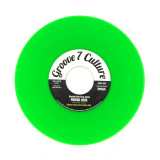
Groove Culture and Irma Records teamed up on this beautiful fluorescent green coloured 7'' and provided two of the best house music classics ever made in Italy. Two crazy timeless hits: ‘Found Love’ by Double Dee and ‘Say It Again’ by Jestofunk.
On the A side we find a peak time pumping version of ‘Found Love’ by the one and only maestro Dimitri From Paris, on the back a funk fuelled version of ‘Say It Again’ by Micky More & Andy Tee, who painstakingly reconstructed all the arrangements of the original and added some delicious sax phrases to elevate the track to new heights. A must have for of any true music lover.
Supported by: DJ Spen, Danny Krivit, Mousse T, Simon Dunmore, David Penn, Dr Packer, Dirty Channels, Angelo Ferreri and many others…
Harold McNair was a Jamaican born saxophonist and flautist who settle in London in 1960. He played regularly at Ronnie Scott's club and with contemporary UK Jazz musicians like John Cameron and was a member of Donovan's band in the mid to late 60s. His most famous recording 'The Hipster' comes from his second UK album and was issued on RCA as a 45 in 1968, which is now very in demand and sells for approx £300.
The track has become one of the most iconic 60s British Jazz dance tracks and was featured on Gilles Peterson Impressed Vol 2 compilation.
It's influence can be heard on recent UK Jazz recordings by Chip Wickham and others .
We are delighted to release this great track on 45 for the first time since its original issue 55 years ago, it still sounds remarkable ‘Hip’. It has been remastered from the original tapes with a look a like 4 prong centre image label. The single is likely to be met with significant demand.
‘At the turn of the 1990s, there were few more successful New York house producers than Victor Simonelli. Under a dizzying array of aliases – Solution, NY’s Finest, Groove Committee, Critical Rhythm and Cloud 9 being amongst the better-known – the Brooklyn-born DJ/producer delivered a string of underground club hits during the city’s early ’90s house boom.’
BTG presents “Victor Simonelli: The Early Years Vol 1” a collectors edition double Vinyl release - 2 X 12’s in each Vol
Launching the first Behind The Groove collectors edition vinyl series is New York’s finest Victor Simonelli with ‘The Early Years Vol 1 & 2’ double Vinyl releases. Featuring seminal house tracks such as Cloud 9’s ‘Do You Want Me’, Solution’s ‘Feel So Right’, Instant Exposure’s ‘Wanna Be With You’ and rare mixes of Raiana Page and EZ-AL, this collection brings together classic and rare Victor Simonelli cuts that reflect the early raw energy and buzz of the New York House scene. With ‘Vol 2” scheduled to follow shortly after, this is the most comprehensive collection of rare Simonelli cuts that firmly establishes his esteemed role in 90s House Music as well as introducing new fans to his inimitable sound.
Victor Simonelli is one of the early kings of NYC sampling In house music. The real deal - Victor danced at the legendary David Mancuso’s Loft sessions and developed a serious appreciation for good music. He interned for Arthur Baker at his renown Shakedown Studios (where Arthur worked with the iconic Afrika Bambatta on the seminal dance floor ’Planet Rock’ track) and went on to release hugely influential releases on seminal NYC labels 4th Floor and Nu Groove. Victor’s music was championed by the hugely celebrated iconic House Music DJ pioneers, Larry Levan and Tony Humphries at Paradise Garage & Zanzibar/WBLS/Kiss FM respectively.
Revered as a New York house heavyweight and prolific producer since the turn of the 1990s, Victor Simonelli grew up in Brooklyn, NYC, nurtured by a music loving family, with an avid record collecting father who also worked as a local party DJ. He took music lessons in piano, drums, guitar and bass, before discovering his first love, tuning into NY’s Radio Mix Shows on WBLS, WKTU and WRKS,98.7 Kiss FM) where he discovered the art of mixing and in his own words, ’I just simply got lost in the music’.
Graduating from NYC’s Centre For Media Arts, Victor got an internship in the legendary producer, Arthur Baker’s Shakedown Studios. Soon graduating to editing, mixing and then producing he worked for artists David Bowie, Quincy Jones, Debbie Harry, Sinead O’Connor and Talking Heads. Teaming up with fellow NYC producer Lenny Dee to become the Brooklyn Funk Essentials, they released records ‘Critical Rhythm’ and ‘Subliminal Aurra’ on 4th Floor before Victor went solo as Groove Committee releasing the classic ‘I Want You To Know’ on the legendary Nu Groove Records. Paradise Garage legend, Larry Levan broke ‘I Want You To Know’ rocking 2 copies on his last tour of Japan whilst King of NY House Music,Tony Humphries broke Victor’s new ‘Feels So Right’ across New York on his WBLS/Kiss FM Mastermix show and at his legendary Zanzibar club sessions. It was only a matter of time before Victor’s name became synonymous with quality House music ensuring a worldwide platform for his productions.
In the early 90s alongside his own productions, Victor Simonelli worked on high profile projects, including James Brown’s album, “Love Overdue” BeBe and CeCe Winans single featuring Mavis Staples “I’ll Take You There” and Quincy Jones’ “I’ll Be Good To You” featuring Chaka Khan and the legendary Ray Charles. Never straying too far from his clubland roots, Victor worked with Danny Tenaglia on his classic “The Harmonica Track”.
DJ gigs across the world started flooding in and Victor found himself recording for a dizzying array of labels including Tribal America, Sub-Urban, Bassline, King Street Sounds and Vibe, under a wide range of aliases. He also produced, wrote and remixed for artists such Nile Rodgers (Chic), Afrika Baambata, Hall & Oates, Frankie Knuckles, Kerri Chandler, Madonna and Michael Jackson. Famed for his own productions “It’s So Good” by Creative Force, “I Know A Place” as Sound Of One - the first release on Roger Sanchez One Records -, “Dirty Games” as well as the “Street Players Vol 1 EP”, Victor went on to set up Suburban Records with Tommy Musto and Bassline Records with two other partners. Notable releases on this label include “Do You Feel Me”, Connie Harvey’s gospel inspired, “Thank You Lord”, Urban Blues Project’s “Deliver Me”, Colonel Abrams “Not Gonna Let”, and Mone’s “Better Way”. Never ceasing to produce, DJ, run his own label and host radio shows like Groove Lift, Victor has worked with virtually every NYC producer and has nurtured a next generation talents including Angel Moraes, Jazz ‘N’ Groove, Urban Blues Project, Harlem Hustlers, Jay Jay and Julius Papp. Victor’s releases have also been used on M&S’s “Salsoul Nuggett” hit and Eddie Amador’s underground smash ‘House Music’.
In the late 90’s Victor launched his new Westside Productions, notable for the “Latin Impressions 1 & 2” releases, opened up a studio in Italy as he found himself increasingly working in Europe and now divides his time between New York and Italy. Suffice to say his unique sound of uplifting and spiritual music has kept him at the forefront of House Music and he is credited as one of its leading exponents with his string of classic releases and remixes.
Behind the Groove, branches out from its digital platform to embark on a programme of releases from the iconic pioneer producers of House Music. Esteemed for their high quality features and mixes that continue to explore, celebrate and venerate the contributions of highly respected, scene-shaping Labels, Artists, DJs and Special Events, BTG seeks to bring these talents and tales to the attention of the wider community. Unlocking the stories surrounding the pivotal roles they played and continue to play today in shaping the underground music scene we have come to know and love.
BTG presents “Victor Simonelli: The Early Years Vol 1” a collectors edition double Vinyl release, released on May 12th 2023. ‘Vol 2” follows on May 26th 2023 . These releases are the most comprehensive collection of rare Victor Simonelli cuts that firmly establish his esteemed role in 90s House Music and introduces new fans to his carefree sound.
yet is a slippery word in English. Amorphous, these three letters in dierent contexts can define contrast or emphasis, set a place in time, show an expectation that something will occur or, paradoxically, that it is likely to stop.
It is this mercurial nature that makes yet the perfect title for Tresor’s latest compilation: the label follows on from the more explorative sections of 2021’s landmark Tresor 30 boxed set with a compilation, featuring 13 artists making music that resists easy definition.
Every track hints at and borrows from the familiar yet none follow the expected path: halfway through Deserto, Nandele & A-Tweed dramatically reveal a very dierent sonic landscape that was initially suggested; DJ Sotofett collaborates with Sri Lankan artist Kavadi with results that are unlike anything in the Norwegian producer’s catalogue as yet.
Further invention can be found as Jean Redondo’s Hypersonic moves across spaces inhabited by digital hardcore and hyperpop before swerving o-road and into a futuristic hip-hop section; on No Longer Human, Ireen Amnes takes a dierent path at the crossroads melding hyperpop, trance, and sci-fi soundtrack atmospherics, Significant Other heads towards UK Bass and Dubstep, and France’s Willis Anne skims by the outskirts of footwork with a piece that is almost completely uncategorisable.
Yet more sonic experimentation comes from E-Saggila, Nadia Struiwigh, NVST, Solid Blake, and Viikatory who oer unique takes on the well-established electro blueprint, while Ryan James Ford, and Nit. both find ways to blend elements normally found in ambient pieces with those heard on a dancefloor.
The feel of the compilation is yet again reflected in the enigmatic artwork by Malik Arbab, where shapes and colours suggest animals and plants but in a world that appears to be transient and constantly evolving.
Lord knows we have put out some rare R&B records here at Real Gone Music, but this one may take the cake! Mary Mundy’s 1980 album for the obscure Image label goes for hundreds of bucks if you can find it at all (which, as of this writing, you can’t). Loaded with bassheavy, disco-soul grooves over which Mundy’s voice floats like
a butterfly and stings like a bee, Mother Nature lives up to the collector hype. That Mundy’s discography consists of this album and a few scattered singles just adds to the mystique of this intriguing one-off, which sees its first reissue in any format here. Remastered for vinyl by Mike Milchner at Sonic Vision. We’re only making 1000 copies and you better not tarry…pink vinyl pressing!
After the successful 7-inch release of Agip, Roman producer and composer Azzurro 80 is back on Four Flies with another triple-single that continues his love affair with dreamy synth-pop and Italian Eighties culture and society.
"Notte Inchiesta", on side A, could be the title music to an imaginary '80s investigative/true-crime program broadcast on late-night television. Clearly reminiscent in mood and texture of the soundtracks of late-70s/early-80s Italian detective-action films, it brings back the jazz-funk, post-prog and fusion overtones that characterized the music of those films. In short: a contemporary-retro sound nestled somewhere between Goblin's funk-oriented recordings, Azymuth's "Jazz Carnival", and electronic disco with a sprinkle of new wave.
Side B opens with "Equilibrio", which could serve as additional, more dynamic music for the same TV program mentioned above. The style is once againelectronic jazz-funk, but here we have abreak built upon a trail of notes chasing each other.
In contrast, "Sambuca", the single's closer, is deliberately nostalgic and melancholy. Perfectly suitable for visual narratives of an Italy that no longer exists, it sounds like one of those great Italian soundtrack themes that are able to convey tension and calm at the same time. The track is titled after the anise-flavoured liqueur that Italians often drink after their espresso, because "making references in my music to things that are part of our national popular culture is really important to me", as the artist has explained.
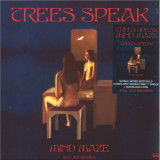
Mind Maze is, amazingly, Trees Speak’s fifth album to be released on Soul Jazz Records in the space of little over two years– an output matched only by the intensity of their music created during this short time.
The first pressing only of the album comes with a bonus seven-inch single containing two tracks that are not available on vinyl anywhere else.
As with all their previous releases, ‘Mind Maze’ is a mind-boggling tightrope walk across an array of musical influences that seamlessly create the unique present-day world of Trees Speak.
The band’s sound is characterized by a combination of German krautrock motoric-beat rhythms, angular New York post-punk attitude, 60s spy soundtracks, psych, rock, jazz, and 70s synthesizers and vocoders. There is also a cosmic spatial awareness to their sound; both personal inner space and galactic outer space, as well as a wilful pushing of sonic boundaries.
Trees Speak are a musical duo based in Tucson, Arizona, composed of Daniel Martin Diaz and Damian Diaz. Their music is heavily influenced by the cosmic magic of the natural desert landscapes of Arizona, creating a unique and captivating sound that is both experimental and innovative.
Here you will find the myriad sounds of 1970s German electronic music (everything from Can to Cluster, Popul Vuh to Tangerine Dream); 1980s New York post-punk and synthcore (from No Wave to Suicide); John Barry’s 1960s movies, John Carpenter’s 1970s horror. You will also hear the influences of French and Italian progressive rock (Magma, Goblin) as well as cosmic, new age and experimental space soundscapes …. an almost endless list of diverse influences that ebb and flow like an ocean of sound, in the process creating a truly unique soundscape that Trees Speak have made wholly their own.
The name Trees Speak reflects their interest in the concept of using future technologies to store information and data in trees and plants, with the idea that trees communicate collectively. This interest in nature and technology, combined with their passion for experimentation, has led Trees Speak to create a truly one-of-a-kind listening experience that is both unique and engaging.
If you ever wanted to hear Can, Neu!, Destroy All Monsters, Pere Ubu, electric eels, John Cage, Liquid Liquid, Tangerine Dream, Suicide, Laurie Spiegel, Art Ensemble of Chicago, John Barry, Mother Mallard’s Portable Masterpiece Company, Sun Ra, Stockhausen, John Carpenter, Electro-Acoustic and Musique Concrete and Mars in one band - then this is it! Trees Speak are a band that defies categorization and offer an eclectic listening experience, both exciting and memorable.
The two bonus tracks (‘Seraphim’ and ‘Orpheus’) included with the album give us a further window into the complex mind maze of the group - two stunning acoustic tracks that explore a distinct early 70s sound of Yes, Argent and other progressive rock accolytes.
Global pointing Brazilian jazz trio releases their new album Agôra, that sparkles with electric funk and Herbie-esque eclecticism. It features a myriad of guest vocalists and musicians including Brazilians Xênia França and Zé Leônidas, Jembaa Groove's Ghanaian singer Eric Owusu and South African artists Bongani Givethanks & Mpho Nkuzo
Re-wiring the concept of 'fusion' for 2023, Agôra is Brazilian trio Caixa Cubo's resurgent new record with the title referring to 'now', based upon the intuitive and fluid nature of the trio's method, and this inspired recording. With shoots to black music culture, from Brazil to Brooklyn, Ghana and South Africa, Agôra is the group's ninth album yet is their first where they've invited guests, mainly singers, onto each track and follows their last, Angela from 2020, released on Heavenly Records, which won a BBC 6 Music Album of the Year (Huey Morgan's selection) granting them much deserved international recognition.
The core musical elements of Caixa Cubo are Henrique Gomide (keys), João Fideles (drums) and Noa Stroeter (bass), all from São Paulo, Brazil and where they met as teenagers and would continue their friendship and musical bond at the Royal Conservatory in The Hague, Netherlands. Now all in their mid thirties, João and Noa live back in the city where it all started but Henrique has settled in Cologne, Germany where the recording of Agôra took place, over the course of 3 days, at the home cum studio of Chris 'Dusty' Doepke, their friend and owner of the label they signed to, Jazz & Milk.
In line with all their creations where flow and energy provide the magic, allowing what the moment provides, the album shines not only for its virtuosity but for its minimalism, the depth of space, and for the first time, the ability to figure in and outside of the jazz fold, as the trio decided, for the first time, to bring in singers and add a new aesthetic to their sound.
"Agôra is a wake-up call to reality, a reminder that the infinite possibilities of technological progress should not disconnect us from the earth, from eye-to-eye relationships, and from moments lived in person" the band are keen to point out. "And that we must not be consumed by greed, for all we truly possess.... is the NOW."
Turning hope and metaphor into music, the debut single Sábado, an electrified future- jazz-fizz reflects perfectly the spontaneity that permeated the entire recording of the album. "When we got to the studio, we had no idea what we were going to record. We started playing a groove, kind of inspired by Gilberto Gil's 80s albums, and our drummer João started singing this funny song 'Sábado Barrigudão' (Big Belly Saturday) alongside the bass groove and that was that". Inspired by their city of birth, São Paulo, it features long time collaborator and vocalist Zé Leônidas, with cuicas, tamborim, agogo and shakers providing the most obvious Brazilian affect from the album.
Dreams is the band's first foray into R'n'B melding the group's simple and sporadic instrumentation of drums, keys and bass into a Jill Scott inspired song that could have been born in Brooklyn yet sung by Brazilian singer and Grammy nominated Xênia França and Zé Leônidas in both English and Portuguese. Xênia recently performed online for hip-to-it website Colors and it's her latest collaboration with Caixa Cubo, having first met in 2009 for a series of live performances.
South African artists Bongani Givethanks & Mpho Nkuzo come to the record with a wholly different approach on Ndiyakhangela, providing spoken word and vocal refrains on top of an Afro-Brazilian percussion jam with a delivery and verse in Xhosa, Zula and Ndebele. Asase is the album opener and features vocals of Eric Owusu who is part of highlife pioneer Pat Thomas's live band and most recently, co-leader of Jembaa Groove, an Afro-soul band from Berlin. It's a synth wig out with djembe grooves and offers a brand new take on Afro-soul-jazz.
Other contributions come from Cologne based jazz singer Rebekka Ziegler (Oblique Sunshine), São Paulo based guitarist Eduardo Camargo (Caio & Eric) and trumpet player Matthias Schriefl on Kismeti, a gorgeous and rolling number that ebbs and flows, exemplifying the group's effortless ability to craft a sound energised by a belief in one-self and the idea of having faith without the need to look at each other for verification.
As drummer and percussionist João Fideles perfectly surmised upon arriving for the recording session, "What drums do you have? Whatever you have, I'll use it". Agôra is testament to nearly 20 years of camaraderie, friendship and most importantly, trust.
To many crowds the world over PBR Streetgang are known and loved for their talents behind the turntables, selecting at most major festivals and clubs of note but to others they are producers and remixers whose eclectic taste and evolving style has seen them enjoy longevity and critical acclaim. This album is a rare selection of originals and remixes that shows the breadth of their work.
Featuring early original hits that propelled them into the limelight, like ‘Downstroke’ and ‘J2Thab’, and more recently their stand out disco tinged nugget from their debut album ‘Late Night Party Line’.
Previously un-pressed remixes like the cult classic rework of Romathony’s – 'Bring You Up' and the slow chuggy sleaze of Bryan Ferry – One Night Stand and the teary eyed euphoria of their remix Hot Chip’s - 'Melody Of Love'.
This compilation represents an honest retrospective of the production and remix talents of PBR - always keeping true to their sound and themselves.
Limited Vinyl Press.
DJ Support from a very broad base.. from Paul Woolford and Bicep to Jennifer Cardini and Daniel Baldelli.
Staran Wake is a collaborative project by Andrew Bunsell and Tom Relleen. After several years creating music in various groups together, followed by countless hazy late night recording sessions at each other’s studios and crisper afternoons producing the results, the British duo’s musical vision materialised with this self-titled instrumental album, taking nearly 4 years to complete.
This collection of pieces is composed with a wide range of instruments and combines multiple dark, experimental genres to form a rather lavish and unique proposition. It is imprinted with intense turgid textures, interweaving the hyper-tactile characteristics of analogue sound with field recording elements and sound effects.
Although the project’s name suggests a rather celestial concept (‘an’ means moon in one of the early protolanguages), the music actually explores the intimate feelings of transient space and otherness. It uses subtle build-ups of tension and repetitive progressions to shape an impression of distended time and space. More than a mere treat for the ears, it’s a multi-layered album that invites reflection.
All tracks composed, performed and recorded by Andrew Bunsell and Tom Relleen at Dalston Studios, Space Studios and The Bunker, London, UK
Arranged, produced and mixed by Andrew Bunsell and Tom Relleen at The Bunker, London, UK
Mixed and mastered by Marta Salogni at Studio Zona, London, UK
Before MF DOOM donned his mask and became one of the most prolific MC-producers of modern Hip-Hop, he was a member of KMD, an early ‘90s rap group whose work still goes criminally under-appreciated to this day.
Following their 1991 debut album, Mr. Hood, the former trio shed one member leaving only two remaining – Subroc and his brother, Zev Love X (better known today as MF DOOM). Originally scheduled for release in 1994, their sophomore album Black Bastards showed clear progression from their debut. It was a truly amazing record, both sonically and lyrically, full of youthful creativity and tinged with the stresses of growing up as Black men in urban America. Songs like the lead single “What A N*gga Know”, the slippery, bass-driven “Get U Now”, and the album’s title track explore Black consciousness viewed through young-but-experienced eyes. Musically alternating between bouncy and raw – many times both, concurrently – the tracks gave the MC’s the springboard they needed to express themselves clearly.
Sadly, Subroc would face a sudden and untimely death in 1993, just as the duo were finishing the album. Grief-stricken, his brother Zev Love X – now the sole remaining member of the group – was determined to carry the legacy of KMD onward, but Elektra Records unceremoniously shelved the project in the eleventh hour, due to controversy surrounding the album’s provocative cover art. Following the fallout with Elektra, Zev tried for years to release the album on other labels, but he was continually met with dead ends. Struggling through the pain of losing his brother, coupled with the inability to release their final project together, a discouraged Zev Love X quietly withdrew from the scene and began quietly plotting his revenge on an industry that had broken him spiritually. Thus, in order to understand the true origin story of the super-villain, MF DOOM, one must recognize and appreciate the evolution of his former group, KMD, and the backstory of their pivotal album, Black Bastards.
In 1975, under the oppressive air of military dictatorship in Brazil, brothers Lelo and Zé Eduardo Nazario invited bassist Zeca Assumpção to join their musical experiments in a basement under Sao Paulo’s Teodoro Sampaio Street. As teenagers, the trio had already been playing together in Hermeto Pascoal’s Grupo, alongside guitarist Toninho Horta and saxophonist Nivaldo Ornelas, and it was while working together under Hermeto’s direction that the Paulista rhythm section (as they were then known) began to realise their own potential.
With many nightclubs and venues closed in the mid-70s and government censors dictating the output of radio, TV and art galleries, many Brazilian artists fled during the years of dictatorship. But underground, Grupo Um were fusing avant garde ideals with contemporary jazz and Afro Brazilian rhythm; making phenomenally free and expressive music - in stark contrast to the sterile, conservative conditions being imposed above ground.
Just like Hermeto Pascoal’s Viajando Com O Som from the following year, Starting Point was recorded over two days at Vice-Versa Studios, by revered engineer Renato Viola. The studio was one of the best in Sao Paulo and musicians communicated with engineers through cameras and a monitor, allowing the group complete immersion in the process. They also made use of the studio’s hemispherical tiled room, which served as an acoustic reverberation chamber.
The album begins with Zé Eduardo Nazario’s thunderous drum solo on “Porão da Teodoro”, before clearing the clouds with the lone Berimbau which opens “Onze Por Oito”. Built around a hypnotic electric bass line, heady Fender Rhodes improvisations, and more rip-roaring drums, it’s a rapturous, electrifying freak-jam in 11/8.
Like some invertebrate deep-sea curiosity, the free-form “Organica” is made up of Lelo Nazario’s playfully eerie prepared piano, with Zé Eduardo’s percussion flurries darting around Assumpçao’s double bass. The equally non-conformist, percussion-only piece “Jardim Candida” features many of Zé Eduardo’s home-made instruments, including a long saw blade played with vibraphone sticks and violin bow. While working with Hermeto, Zé Eduardo famously built his own all-in-one percussion set-up known as the “Barraca de Percussão” (Percussion Tent) - the first of its kind in Brazil, which he would also use on Hermeto Pascoal’s Viajando Com O Som and throughout his career.
“Suite Orquidea Negra'' (Black Orchid Suite) was written by Lelo Nazario as the score for an imaginary movie - the story of a rare, black orchid which produced a substance meant to cure all diseases, but which had mysteriously disappeared from the laboratory… “As a screenplay it’s not very good” reflects Lelo in jest, “but the music ended up being very interesting, the way its parts are chained to one another carries a little of the mystery I imagined for the movie.”
The album closes with the triumphant “Cortejo dos Reis Negros” (Procession of Black Kings) - a groovy variation on the Maracatu rhythm, with a two-note bassline underpinning piano improvisations, exultant wordless vocals, cuicas, slide-whistles and a very special guest appearance from Zé’s dog Bolinha.
Starting Point was to mark the inception of one of Brazil’s most daring instrumental groups. Their debut now sits in the lofty echelon of otherworldly 70s Brazilian music, alongside the likes of Marcos Resende & Index’s self-titled debut, Cesar Mariano & Cia’s Sao Paulo Brasil, Azymuth’s debut and indeed Hermeto Pascoal’s Viajando Com O Som. But just like all of those titles, which were either shelved or largely ignored at the time, Grupo Um - so radically ahead of their time - struggled to find a label to release their debut album. So Lelo kept the tapes safe in his archives, which is where they sat for almost half a century. Finally, almost fifty years later, this mesmerising piece of history is here, and it was only the beginning...
Grupo Um’s Starting Point will be released by Far Out Recordings, on vinyl LP, with an insert featuring unseen photos and liner notes by the Nazario brothers, as well as a CD on 17th February 2023.
You Can Can is an echoed affirmation, an album which traces song forms around silence, field recordings, and degraded analog memories. This is folk music transmogrified and mutated, as if recorded and reconstructed in Pierre Schaffer’s GRM studio.
Not your typical Mariposa folk duo, the group is comprised of Toronto avant-music scene stalwarts, vocalist Felicity Williams (Bernice, Bahamas) and bricolage artist and synthesist Andrew Zukerman (Fleshtone Aura, Badge Epoch). The album feels like a somnambulant conversation, fragmented and half-remembered with Williams’ vocals traveling through a landscape of field recordings and Zukerman’s saturated concrète topographies. It is an electro-acoustic assemblage, both analog and digital, comprised of air, electricity, minerals, wood, and water. Although the album nods towards traditional forms of folk and musique concrète (if at this point it can be called a traditional form), it is outwardly and inwardly contemporary; non-linear, citational, opaque, and sui generis. In a way it feels like a sonic index of the narrative experiments found on the infamous Language school-related publisher The Figures, in the work of Lyn Hejinian, Clark Coolidge, and Lydia Davis. In the musical continuum, the album picks up where Linda Perhacs left off in the early 70’s—explored by Gastr Del Sol in the ‘90s—a convergence of rural acoustic idioms and urban avant-electronics. This is country music for the discerning cosmopolitan citizen of the 21st Century.
RIYL: Luc Ferrari, Brannten Schnüre, William Basinski, Oval, Eric Chenaux, Emmanuelle Parrenin About Everything In Time and Failure Figures, Felicity Williams says:
Everything In Time is indebted to the language of Brazilian author Clarice Lispector (as translated by Alison Entrekin). Drawing on insights from psychoanalysis, we trace the roots of melancholy to render them available to consciousness; words from the ghostly realm of the transpersonal filter through dreams and shine a beam of light onto a lone trillium in a forest at night. Other influences include the experience of not knowing, of being subject to a gestation outside of one’s control. This is an ode to the power of naming to obliterate, to set free.
Failure Figures is a meditation on the radical contingency of reality and the vicissitudes of the will. With Slavoj Zizek as my guide (think: “Hegel for dummies” - I’m the dummy in this scenario), I wander through the valley of the shadow of death, and take heart. The last verse refers to an experience I had recording at a studio in Brussels. I was singing in French, with which I have some fluency, and the producer was complaining to the artist whose song it was that my delivery was not convincing. Thinking I was out of ear shot, he said in French, “c’est comme elle n'est pas là”; I was pronouncing the words correctly, but I failed to express anything. So what or whom is responsible for conveying meaning, if not the form of the word itself? And if the connection between meaning and form is broken, how do we fix it?
Gratitude to Thom Gill (guitar) and Daniel Fortin (bass) who joined us on the recording of Failure Figures. Thanks as well to my old roommate Christopher Willes, who unwittingly left behind his hand bells deep in the hall closet. We unearthed them by accident, and the bells became an important sound element. Thanks to other past roomies Robin Dann and Claire Harvie, whose childhood piano and guitar respectively still reside with us, and were used in the recording. Field recordings were made in Toronto, Canada and Celestún, Mexico in 2020.
The next transmission from planet BRUK comes courtesy of Lårry, an enigmatic artist ploughing an individualist furrow through various fields of electronic expression, one hand tweaking the tiller and the other casually dismissing the rules of rave. You might have caught their sharply-pointed sound on Super Hexagon or Awkwardly Social, or perhaps stumbled across their fabled 2021 live performance from Fitzroy in Berlin, or even unconsciously swayed to something spun in a set any time over the past five years. Lårry's discography is modest but mighty, and How Was That For You builds into that idea with four
precise tools for forward-leaning soundsystem communion. From the fractalised barbs of electronica stepper 'In Water' to patiently dread-eyed wobbler 'Angela's Knife', 'Uniform Uninform's icy incisions to the snaking spiral staircase of 'Yargachin', this is brain fodder first and foremost, with bassweight impact threaded through as an added bonus. Keeping fine company amongst the other oddities inhabiting the Bruk mandate, Lårry continues to keep us on our toes, literally and figuratively.
Time to welcome Session Victim back to Delusions Of Grandeur following some heavyweight releases on Toytonics and Rhythm Section International. The German duo show absolutely no signs of slowing down continuing to impress with their unique sound which combines organic live elements, fat, floor-filling beats and a deep, musical approach. Here on The Intangibles EP we’re treated to three original tracks spanning high energy jazz disco meets techno, soulful uplifting house and downtempo blunted beats.
Opener Motivation features spoken word from Ras Stimulant backed by urgent looping Rhodes stabs and an uptempo disco groove. An instant Session Victim dance-floor shaker if ever there was one, the energy cranked up to the maximum without losing sight of that all important groove.
Next up we have Dromedary Twist which keeps up the pace but goes deeper on the jazzy organ chords and lays down a heavy syncopated bass- line which ensures the funk factor remains present and correct.
Rounding out the EP in fine style, Green Run drops the BPM’s as we head into lazy, hazy, blissed-out jazzed-up beats territory. Lush strings and layers of analogue synths come together on this simple yet enchanting little tune which compliments the other tracks perfectly and will appeal to fans of SV’s more home-listening output from their 2020 LP Needledrop.
Gated kick off 2023 with a corker of a remix package, featuring an epic electro workout from Radioactive Man and lo-fi deep house from Max Wheeler of Anushka fame.
Marcela Dias Sindaco’s breathy Portuguese vocals always lent themselves to remixes and these five cuts use them to great effect.
Keith Tenniswood’s storming version of Missao Controle kicks off the EP, with a near-8-minute bass-heavy acid monster that retains the original’s funky elements but pushes them way into the future.
German upstarts not even noticed take Extincao nice and deep for those loved-up dancefloor moments, again bringing in melodic elements from the original, but twisting them just enough to flow into a dreamy acidic breakdown.
Flip to the B and Anushka’s Max Wheeler goes it alone, with a deep and crackly analogue house version of Dois Lados. Injected with just a smidgeon of jazz, this is definitely one for the heads.
Next up, longtime Gated collaborator Dip Shim, whose debut album only just dropped, brings a straight-up electro jam version of Pro Meu Bem, with haunting pads and insistent arpeggios.
Rounding off the EP is Perseus Traxx’s deeper than deep take on Missao Controle, a tripped out reverby journey laden with his signature hardware sound.
The title track "Ghost In The Shell" has a light and a dark side that fight with each other somewhere in 2077, and it's up to you to decide which one wins. “Ramayana” is an interpretation of the ancient Indian epic in the form of a meditative dub-techno-trance. "Wow!" dedication that occurred on August 15, 1977. A strong narrowband radio signal was detected by Dr. Jerry Eiman while working on the Big Ear radio telescope at Ohio State University. "Wow!" was the only signal in the history of mankind intercepted from the depths of space, which could not be deciphered, but the musicians tried. The EP closes with a slow track with an unearthly atmosphere, shimmering with contrasting electronic sound. "After Glow" - a neutrino of a thermonuclear sun, making its way through thunderclouds and bringing hope to the bright future of the present time. So Komponente & Kurilo made mystical EP with an unpredictable plot, which is a symbiosis of dub-techno and trance melodies.
Holly Lester’s Duality Trax Label has quickly become synonymous for its blend of future facing sonics and mind-warping melodies, served together with a healthy dose of nostalgia. A label just as focused on making dancefloor destroyers as it is exploring left-leaning, personal projects, it’s within this duality where the label has found its success, never afraid to shy away from b side oddities or tracks edging more towards good-old-fashioned-fun.
DUALITY5 steers towards the latter, with Manchester based DJ & producer Aiden Francis providing the serotonin on tap with three lively dancefloor cuts, including a huge remix from Italy’s Matisa. Aiden had a big 2022, releasing music on Magic Carpet, Gestalt and beloved music platform and label Houseum, solidifying himself as one to watch in the euphoric unity of house, trance and techno.
Title track ‘Plastic Fantasy’ is the star of the show, a suitably sassy roller that places everyone's favorite blonde icon front left of the speakers. Subtle old school strings contrast with alien electronics, providing familiarity in an otherwise unfamiliar world. A bubble-gum vocal then rolls in cheekily over a driving bassline and dynamic percussion - used in a way I’m not sure the original creators had in mind. ‘Future Proof’ meanwhile demonstrates Aidens’ knack for contemporary progressive house music. With warm pads, swirling sonic textures and moments of blissful euphoria, it’s energetic enough to move a dancefloor, but gentle enough for home listening too.
The record comes to a close with ‘Aquamarine’, with Aiden opting in favour of free flowing breakbeats and mind expanding synths, together radiating a feeling of warmth and hope for days to come. Italian DJ and producer Matisa is on hand to round the EP off with a bass-heavy rendition of ‘Plastic Fantasy’ a no-holds-barred speed garage licked stomper, with the power to lure smokers back inside the club with their feet firmly planted on the dancefloor.
Dancing as an act of rebellion is the first Abraxas LP in collaboration with the Valencian label Soil Records. A compilation of the first project recordings released between 2020 and 2021 plus some new tracks and, in addition to this, a second vinyl by other darkwave electronic artists remixing the first one: Geistform, We Are Not Brothers, Ober Dada, Melting Dogmas, SMforma, HBK1, José Rodríguez, SOJ and PanDemian.
Abraxas is a halfway project between dark dance electronic music, philosophical reflection, socio-political activism and musical entrepreneurship. Its main goal is to shake bodies and minds by spreading messages of individual and social self-criticism from the point of view of duality, extremes and contradiction, inherent to the human being and capitalist society.
Wax Tailor announces the release of his new album "Fishing For Accidents" on February 10th, 2023, accompanied by a new international tour.
"The starting point of this record is a quote from the film director Orson Welles, which evokes the notion of accident in the creative process. I always thought that accidents were an integral part of creation and the job of a film or music director is also to know how to capture them in order to make the accident an artistic intention. I decided not to follow a well established concept but this more instinctive guideline and to go fishing for accidents".
In this new opus, Wax Tailor explores with his sampler a world of vinyls and cinematographic references, brandishing as a flag a stamped musical culture and multiplying references to the 7th art in a music written in 33 rpm and 24 images seconds. After the dark "The Shadow Of Their Suns" released in 2021, Wax Tailor takes us with "Fishing For Accidents", on a brighter and more colorful side without ever betraying his universe and his convictions.
A multi-recidivist talent scout, he gathers around him a prestigious cast ranging from hip hop (Mick Jenkins, Mr. Lif, Kuf Knotz, Lojii, Napoleon Da Legend, Ill Conscious, Voice Monet, David Bars, Mattic) to the indie rock scene (Jennifer Charles, singer of the legendary band Elysian Fields and Victoria Bigelow).
With one eye on the past and the other on the horizon, Wax Tailor instills the incandescence of an organic sound and distills his art of sound anachronism in a wide gap between nostalgia and modernity that has made him one of the leaders of the international electro hip hop scene for over 20 years.
KINGUNDERGROUND TO RELEASE A SET OF 45s, FROM
CAVENDISH MUSIC CATALOGUE. PAYING HOMAGE TO
LIBRARY MUSIC, FURTHERING ITS EXPOSURE TO A NEW
GENERATION OF LISTENERS.
Library Music experienced its heyday in the 60s and 70s, as
thousands of instrumental tracks were produced by musicians and
composers for the purpose of placements in radio, television, and
film.
The second record in the Cavendish Music series is classified as
‘Frantic’ and features 2 compositions by Sam Fonteyn. Frantic
energy is no doubt present in the horns and percussion on the A
side of the 45 “One Way Trip (Warm)” but the high energy gives off a
dancehall vibe, leaving you in a sweat as if you were in the club.
Fonteyn was a key contributor to the Boosey & Hawkes Music
Library. His output held a strong presence amongst other
composers, there’s an “it” factor or a swagger to his productions.
The compositions are timeless and feel hip in any era, especially on
“One Way Trip (Cool)”. Which is appropriately titled because it
doesn’t get much cooler than the feel on this track!
In all there will be 8 individual 45s, licensed from Cavendish Music
Library & released by KingUnderground. Including compositions by
Tony Kinsey, John Scott, Sam Fonteyn, Ray Davies, and more.
For this uniquely personal retrospective spread over twelve vinyl discs, Sven Väth takes us back to the early days of his DJ career. On What I Used To Play we meet great pioneers of electronic music, gifted percussionists, obscure wave bands, and innovative producers of a bygone 'new electronic' era. Rough beats and irresistible grooves from the identification stage of house, techno, and acid remind us not just how far electronic music has evolved over the past four decades, but how great it was to dance to EBM, techno, and house for the very first time.
If there is one protagonist of the electronic music scene who has remained curious, innovative and at the very cutting edge of music for over four decades, it's Sven Väth. His multi-layered artist albums and Sound of the Season mix compilations have been defining the genre for over two decades, and even today, he is constantly on the lookout for the next top tune to add to the highlights of his next set. At least, that's the case when he's not producing them himself as an artist or remixer. "Actually, it's always been part of my DNA to think ahead," and nothing had been further from his mind than looking back at his past, but when in spring of 2020 the international DJ circuit had to be scaled down to virtually zero, the 'restless traveler' suddenly had time. Time to stop and reflect on "how it actually was back then, at the very beginning of my career..."
"It was a great trip and with every track, beautiful memories came flooding back".
In the London apartment, he had just moved into, Sven has set up a "little music room", where he cocooned himself for several days, "to look way back for the first time and review my musical journey through the eighties, so to speak."
The interim result was six thematically oriented playlists with a grand total of 120 tracks from 'early 80s' to 'Balearic late 80s', together with excursions into afrobeat, European new wave, and EBM sounds and a few epochal techno/house tracks from the USA in between. From these 'Best of Sven Väth's favorites', the project What I Used To Play crystallized. Sven remembers how the Cocoon team reacted to his proposal: "They found the idea of making a compilation out of it MEGA from the beginning and everyone said 'Sven, go for it', but then, of course, the work really started, namely, to clear the rights and to get clean sounding masters of the up to 40-year-old tracks. There was also disappointment, of course. We couldn't clear certain titles because the rights holders in the USA had fallen out with each other or simply disappeared from the scene. In short, it wasn't easy, but now I can safely say we got the most important tracks."
Finally, after two years of research, curation, design, and administrative fine-tuning, the "little retrospective" from 1981 to 1990 is available. The exquisitely packaged, and three-kilo heavy box set is not only physically impressive, WIUTP is also the definitive record of Sven Väth's musical development. On each of the twenty-four sides of vinyl, you can trace track by track, what influenced him during which phase, and how he took off as a DJ from his parents' Queen's Pub straight into the spotlight at Dorian Gray. There and at Vogue (later OMEN), Sven became the style-defining player in the DJ booth that he still is today.
1981 - 1990: Future Sounds of Now
In the early eighties, the crowd in clubs like Vogue and Dorian Gray danced to what nowadays we call 'dance classics' - mainly disco, funk, soul, and chart pop. It was up to a new generation of DJs, including Sven Väth, the youngest protagonist in the Rhine-Main area at the time, to create their own club-ready music mix. Good new tracks and potential floor-fillers were rarities that had to be sought out and found, in order to prove oneself worthy.
Without MP3s, internet streaming, or other digital download possibilities, music didn't just gravitate to the DJ, instead, it had to be tracked down. In well-stocked record stores in Frankfurt and Wiesbaden or even in Amsterdam, London, or New York, Sven and friends sourced the material for countless magical nights. On WIUTP we can follow Sven's very personal journey through this wild, innovative era in which synth-pop, funk, hip-hop, and disco were successively replaced as 'club music' by house, techno, acid, and breakbeat. By the end of the decade, it was clear to see that these once exotic 'fringe' phenomena would soon become 'mass' phenomena.
Early 80s
Dirty Talk by the Italian-American duo Klein & M.B.O. represents the most innovative phase of the Italo-disco genre in the early eighties like no other track. Mario Boncaldo (I) and Tony Carrasco relied entirely on the original synthetic drum and percussion sounds of the Roland TR-808, coupled with the raunchy vocals of Rossana Casale and guitar accents of Davide Piatto. Of course, other tracks from this period were also influential in style, most notably Unit by Logic System, which worked as the perfect soundtrack to the laser lighting system at the legendary Dorian Gray club. With stomping beats and robotic rap interludes, Bostich by Yello also belongs on Sven's eternal playlist - after all, it caught the attention of Afrikaa Bambaataa, who invited the Swiss duo to perform at the Roxy in New York in 1983.
EBM Wave - Mid 80s
From today's point of view, the almost ten-minute-long, downtempo track Giant by Matt Johnson's band project The The, would probably not be considered an obvious club classic. However, a closer (re)listen reveals the rhythmic intricacies of the percussion overdubs by JG Thirlwell (aka Foetus) on Johnson's composition, and it becomes clear why this exceptional piece of music is one of Sven's absolute favorites. Other classics from this phase include Kaw-Liga by the mysterious The Residents, the hypnotic-synthetic Our Darkness by Anne Clark (and David Harrow), and last but not least, the somber, monotonous anthem Where Are You? by 16Bit, one of Sven Väth's projects together with Michael Münzing, Luca Anzilotti from 1986.
US House - Late 80s
You certainly can't talk about Chicago house without mentioning Frankie Knuckles. The resident DJ at the Warehouse not only gave the name to an entire genre, but also produced epochal floor fillers on the Trax label like the timeless Your Love, sung (and moaned) by Jamie Principle. Acid house protagonists Phuture also hail from Chicago, and on We Are Phuture (also released on Trax) we hear the chirping acid sounds of the legendary Roland TB-303 in full effect. Another featured classic is No UFO's by Detroit's Model 500 aka Juan Atkins, who is rightly considered the 'Godfather of Techno' even if the genre-defining track from 1985 still breathes with the spirit of hip-hop and electro from the first breakdance era.
Afrobeat
Le Serpent, by Algerian-born Abdelmadjid Guemguem, is a track that sounds completely different from everything else on WIUTP. Made in 1978, it's a monumental, rousing groove created without bass or synths, just with five congas! Even though Guem sadly passed away in 2021, his immortal, acoustic beats are understood all over the world and will continue to enrich many thousands of DJ sets for years to come. Another classic that not only Sven appreciates beyond measure is Hugh Masekela's Don't Go Lose it, Baby. In addition to being one of the most important jazz pioneers, the trumpeter and freedom fighter from Johannesburg was very experimental, integrating electronic sounds into his music in later years, in a similar vein to Miles Davis and Herbie Hancock. Dutch jazz pianist Jasper van't Hof's afrobeat project Pili Pili has also aged well. The trance-like, almost sixteen-minute-long track of the same name, manages to fill a whole side on the seventh of twelve vinyl discs in the WIUTP box.
UK-US-Euro - Late 80s
Time for a change of scene, in the truest sense of the word, and from a musical perspective, this section is like landing on another planet. First up is Andrew Weatherall's classic remix of Primal Scream's Loaded, featuring the iconic Peter Fonda sample (lifted from the 1966 biker film Wild Angels) that came to personify the mood triggered by the British Second Summer of Love in the late eighties: "We wanna be free to do what we wanna do, and we wanna get loaded...". This period also saw the emergence of M/A/R/R/S whose only single, 1987's Pump Up The Volume, became a club classic with support from DJ legend CJ Mackintosh. In this most eclectic of sections, we also encounter New York house and reggae producer Bobby Konders and his seminal Nervous Acid.
Balearic - Late 80s
Those who know him, know that Sven had already lost his heart to the 'magic island' of Ibiza as a teenager, so with that in mind, the WIUTP project couldn't end without a Balearic chapter. Inspired by Manuel Göttsching's E2-E4, the immortal, eponymously titled Sueño Latino belongs in there without question. Equally popular on the island was, and still is Break 4 Love by Raze, which thinking about it, would also fit perfectly into the house chapter. Last, but not least, there's an overdue reunion with Sven Väth himself, in his role as frontman of the successful Frankfurt trio OFF. Together with Michael Münzing and Luca Anzilotti (later of Snap!) this 'Organization For Fun' created the off-the-wall club hit Electric Salsa in 1986 which incidentally turned into an international chart smash, putting Sven in the enviable position of having to decide between pop stardom and a DJ career. Well, we all know how that decision turned out and the rest, as they say, is history. A not insignificant part of his story is What I Used To Play. Enjoy!
On behalf of re:discovery records, it is with great excitement that we announce the release of Stryke – The Introspection Trilogy (1994-2022). rd011 features a track that is very close to my heart. My senior year in high school. I was heavily into chill-out music at the time. Labels like FAX, Instinct Ambient, Reflective, Astralwerks, em:t, Silent, Moonshine, Rising High, Warp, Exist Dance, Visible, Eye Q and others were giving me such a wide array of beautiful sounds of more subdued techno and rhythmic ambient music. I was buying every compilation I could at the time that looked remotely different based on the artwork, the unusual artist names or the tracks. I was soaking in everything I could under the chill-out style. That year 1994 I picked up the 2nd edition of Moonshine's 'United State of Ambience 2'.
It has so many good tracks on it. One track that always held a special place in my heart was Stryke's 'Introspection pt.1'. The simple but catchy melody layering. The easy atmosphere made me feel like I was floating in the ocean. The deep 808 bass notes (I hope one day you and I will hear this on an amazing sound system). The amazing strings reach a crescendo nearing the end. This track has so many simple but beautiful sounds on it. It's a great example of what I call sequencer-styled electronic music. At a time when producers layered tracks in more of a sequence then building or placing sounds. In 2021 I was able to get a hold of Greg Chin to see if he was interested in putting the track on my label and letting it breathe freely on its own side alone as the highlight of an EP. Greg was enthusiastic about the opportunity and told me that he always wanted to complete the trilogy he had in mind of a part 2 and 3. The ominous and eerie part 2 adds a terrific tension to the finale of part 3. The last being almost an updated part 1 really concluded the trilogy for me. Both parts melded together on side B pushing near 17 minutes. I want to thank Greg for letting us be a home to complete his journey.
In October 1974, the first number of “L'Indépendant du Jazz”, a small self-produced magazine DIY -before punk supposedly invented the concept- was launched by Jef Gilson, Gérard Terronès, Jean-Jacques Pussiau and a few other specialists of a different kind of jazz in France, it looked at the already long career of Jef Gilson and in detail at the album with saxophonist Philippe Maté:
“The ‘Workshop’ is, with Philippe Maté (alto-sax), an undeniable success. Maté is genuinely ‘the’ most inventive French saxophonist since Michel Portal burst onto the jazz scene (who has also worked with Jef Gilson on both “Enfin” and “Gaveau”).”
Even though the author of the article is a mysterious I.H. Dubiniou, and it is difficult to know if it is a real person or a pseudonym used by one of the merry bunch, it is also tempting to hear it as what Jef Gilson really thought about his new discovery. Even more so as the two men would work together over a long period, as Maté became one of the key figures of Gilson’s Europamerica orchestra up until the 1980s.
Philippe Maté had started to make a name for himself with the Acting Trio when they released an album on the BYG label in 1969, and he was also one of the regular sidemen for the Saravah studios (he can notably be heard on albums by Higelin, Fontaine or his cult duo album with Daniel Vallancien).
The album was recorded on 4 February 1972, at the Foyer de Montorgueuil, where Gilson had set up his studio, with more or less the same team found on “La Marche Dans Le Désert” by Sahib Shihab + Gilson Unit (recorded ten days later). This was drummer Jean-Claude Pourtier and pianist Pierre Moret (regular Gilson accomplices since “Le Massacre Du Printemps”), alongside Maurice Bouhana and Bruno Di Gioa on various percussions and/or wind instruments. On bass is Didier Levallet, of the now mythical Perception, (Jean-François Catoire would replace him with Shihab) and Philippe Maté who took top billing, rather than the American saxophonist afterwards. The two albums are however quite different. This “Workshop” is more abrasive, more free. Made up of two long improvisations each of over 22mn, “L'Œil” on side A and “Vision” on side B (Gilson specialists would recognise the nod to one of his albums from the 60s), the album plunges you into the depths, attempting to drown you in electronic waves, dragging you back to the surface by the collar, giving you a good shakedown, before showing you the light, leaving you breathless on the shore after 46mn of the most intense music French has to offer. “An undeniable success”, they said. (by Jérôme "Kalcha" Simonneau)
It was in the year 1981 when Belgian electronic musician Michel Huygen and his Spanish colleague Carlos Guirao, both better known as Neuronium, met with Evngelos Odyss as Papathanassou, better known as Vangelis, to record a joint session in London.
Michel Huygen remembers: "The music we played together starting from my score, was flowing, flowing so fast and smoothly between the 3 of us, that I can now, many years after, say: We recorded all the music's parts in one single "shot", since the result was absolutely what we all wanted and Vangelis told us: "Don't touch what we have recorded, it is lovely " and so we did."Now, after some rather unofficial releases, the opus "In London" is finally released for the first time in its entire length, titled "In London - The Platinum Edition", fondly reworked, remastered and sonic refined to perfection exactly 45 years after Neuronium released their first album on the famous Harvest label.
Michel Huygen had intended to celebrate this anniversary with Vangelis in Paris. But fate had other intentions, on May 17, 2022, Vangelis died as a result of a Covid-19 disease.
Huygen: "I feel honored to have been able to meet him, to play music with him and to have him as a funny friend too. And mainly to have been able to meet a huge musician, a classical composer for the forthcoming generations, without doubt. R.I.P, dear Vangelis."
For its first release, Caprices Music relies on Brizman, an Israeli based in Berlin. In a competitive market of international DJs and producers, Brizman's distinctive sound consistently delights the hearts of listeners. He has produced a massive collection of minimal house tracks that have already been released on renowned labels. Now he's hitting his notes on Caprices Music with two original tracks "Mama Shelly feat. Linn Stern" and "Berlin Moment" in tribute to the recent death of his mother. If one is a melancholic and haunting ballad, the other is distinguished by a deep but heavy sound. As for the remixes, Tripmastaz and Silat Beksi deliver two dancefloor bomb. The remix of Silat Beksi will appear only on the vinyl version.
Bernard Szajner is a French composer, musical theorist, visual artist. He is credited with the invention of the laser harp, which he patented.
Between 1979 and 1983, Szajner released five albums of innovative and Avant-garde electronic music. He became renowned as a light and visual effects technician with artists such as Magma, Gong, Stomu Yamashta and The Who.
During the 1970s, he became a pioneer in the field of using laser technology as an artistic tool. As a measure of his success, he became renowned by his work with companies such as Cartier and Renault. In 1980, inspired by the novel, Nova, by Samuel R. Delany, he first created the laser harp. The laser harp became so successful that Jean-Michel Jarre ordered a version from Bernard Szajner for his tour of China. Despite all this, Szajner would only occasionally use this instrument in his own performances. He has stated that he would rather the public not know him solely for his work on the laser harp, and that it not be allowed to take precedence over his work in musical composition that it enables. This is also why he continues to develop other instruments which use other innovative methods of interaction, such as tactile or holographic.
Towards the end of the 1980s and disgusted with the music industry, he chose to abandon music entirely, and shifted his focus towards digital and visual arts, and theatre.
From Bernard Szajner : “These tracks are my preferred ones .... Ever ! ... For a long time I've been waiting for a record label to release what corresponds to what I like playing these days... Until Sleepers records decided to release this compilation which contains most of the tracks I enjoy playing live on stage ! At last my wish is fulfilled !”
An aura of mystery is hidden on this magnificent album released on EMI Nigeria in 1974 and today a collector’s cult object was the only one named Moonrakers Band.
Steve Black tells: “We were the original members of The Moonrakers and were based in Zaria, then in 1972 we left band management and started The Elcados. The original management of The Moonrakers sold the name to his elder brother who had a club in Kano and they brought Prince Bola Agbana to get other musicians to continue The Moonrakers while we moved in as The Elcados.”
Moonrakers Band and Elcados were the two bands that inflamed northern Nigeria in the early 70s with a more rocking and virtuoso sound, and especially with tons of rare grooves, then everything else around it.
Coming to the album content tracks like Wait For Me, Cut Your Coat According To You Size, Yara Manyan Gobe, but also Enia Sa Pele and Move on, will make floating camels appear on the dancefloor, or in your house.
With ´Future Romance´ a new chapter of storytelling house & techno music is opened. After running the mighty Parquet Recordings label for 15 years, german DJ and producer ´Solee´ is starting an additional vinyl & digital imprint with focus on quality deep & expressive sounds.
Future Romance starts off with „Reboot“ a new single by the labelboss himself showcasing once again his ability to build up a track like no other and combine extensive melodies with big basslines & clever invented synth-work. As remixers for this promising debut release we could win no less than one of the greatest icons of melodic techno worldwide ´Recondite´ (wellknown for his releases on labels like Afterlife or Innervisions) and italian master of organic deep and emotional house sound ´Lehar´, member of the Diynamic family and owner of the ´Multinotes´record label together with Musumeci and Olderic.
Early DJ support by DJ Hell, Innellea, Kevin De Vries, Fur Coat, Pig & Dan, Timo Maas, Quivver, Musumeci, Oliver Huntemann, Dave Seaman, Mira, Rinzen, Markus Kavka, Nick Warren, Eelke Kleijn, Nhar, Martin Roth and more.
Samuel L Session and Van Czar drop a four-track techno EP on Unrilis that showcases a deeper and more hypnotic sound with dystopian atmosphere and driving percussion. Rino Cerrone launched the Unrilis record label over 15 years ago, and part of the label's back catalogue is its iconic Rilis series. 2022 sees the relaunch of the Rilis series that has a focus on underground DJ tools with raw analogue sounds. The Rilis series was originally launched in 1999, and was restricted to a concept on only 10 releases, each pressing a limited run of vinyl. It was hugely popular with each one often selling out in only a week and picking up DJ support by people ranging from Jeff Mills to Richie Hawtin. Those first 10 releases were focused on Rino Cerrone's own music, but since his retirement from the industry, the revitalised Rilis series will welcome other artists whose sound matches the label's underground concept.
This latest release in the Rilis series features collaborative tracks by Samuel L Session and Van Czar who have previously teamed up for releases on other imprints ranging from Marco Bailey's MB Elektronics to Ben Sims' Hardgrooves. Both are also successful solo artists, Sweden's Samuel L Session being well-known for his headline DJ sets at clubs around the world, along with the music he has released via iconic imprints such as Slam's Soma, Shlomi Aber's Be As One, Len Faki's Figure and Emmanuel's ARTS plus his own imprints SLS, Cycle, New Soil, and Klap Klap Belgium's Van Czar is also an accomplished DJ who is well-established across Europe and he has also released music on respected record labels ranging from Kevin Saunderson's KMS Records as well as the classic imprint, Yin Yang.
'Air Raid' opens the release with its eerie pads, spine-tingling melody loop and machine-driven percussion. It's got a raw aesthetic with dramatic claps and snare fills that add to the building suspense.
'18-022' is a dark and stripped back track with modulating synth textures layered with fast-flowing high-end percussion. Its pounding kick drum and clap rhythms add rigid structure to its expansive atmosphere and dance floor focused groove.
'Route 200' has thrashing cymbals punishing claps and rippling pads that create a stripped back groove submerged in deep atmosphere. Rich with analogue textures and gritty sound design, its relentless energy is tailor made for club sound systems.
'Objectivism' closes out the release with it's funky bassline and bleeping melody. Whirling textures and fluttering percussion maintain an unrelenting tension that's driven forward by the pounding kick drum.
18 track compilation of cult '80s French rock band Les Calamités,
includes their biggest hit "Vélomoteur" and tracks with the bands the
Dogs and The Barracudas Available as a digipak CD with 36-page booklet and vinyl with 8 page booklet and download code, with liner notes in French and English. Wouldn't it do them justice to rid Les Calamités (literally "the calamities") of the embarrassing phrase "girl band", durably stuck to their skins and plaited skirts? It's nothing but a pink puffy cloud obscuring their true importance as a "band" full stop, as well as their fleeting though mind-bending trajectory. In just a few months after going on stage with a handful of original songs recorded here and there, they became, from Dijon to Rouen, Paris to Toulouse, Bordeaux to Strasbourg, the darlings of an uncompromising rockers' demanding scene. Tolerated by some, maybe, they were also consecrated, certainly (should they have needed the accolade). The trade-off was a succession of quick and distinctive verse-choruses for which the adjectives "fresh" and "light" seemed to have been invented again.
They delivered just as many covers, which gave an idea of the origins of their songwriting: one foot in the fifties (on the dancefloor), the other in the sixties (in the garage). All of this leading to their final hit, a successful incursion in the top sales with a popular song for everyone to hum at ease, from seaside campsites to the cool kids of the capital.
Everything the Calamités touched, with their classy, rigorous, casual ways - plus just enough amused detachment - turned into gold.
If you decide to look up the strict definition of outsider in any dictionary, you'll find that the term is understood as "a person who is not involved with a particular group of people or organization or who does not live in a particular place".
Perhaps this is the most accurate description of Santiago Merino. For a long decade and from his native Medellín, this DJ and producer has always tried to keep his sonic spectrum open. An interdisciplinary artist capable of freely navigating through a myriad of genres is rarely encountered, and that may be the reason why Santiago enjoys a non-negotiable respect in the different scenes that make up the music circuit of his city. On this occasion, Back Door Records is pleased to serve as host to receive one of the most anticipated facets within the range of music produced by this Colombian artist.
The Outsider marks the debut of a new project signed by Merino, a new hunch in which house takes the helm of an EP entitled 4 Club Use. Composed of five tracks, 4 Club Use seems to show us the true essence behind a genre that has almost been trivialized over the years. In this case, El Outsider decided to take the basic ingredients of tech house to produce a recipe much richer in flavors, textures and melodies. "Fire People", for example, leaves the window open for the airs of Detroit techno to come in and cool off any sunny afternoon. "Outsider" and "The Heat", on the other hand, are seasoned by the purest amen breaks, as if it were a blessing intended solely for the dance floor.
But the real deal across 4 Club Use is definitely El Outsider's own edit of Merino's track "Those Days". Raw and forceful kicks, meticulously sampled vocals and pads that seem to wrap them magically, make this bomb one of the candidate tracks to take the absolute podium of 2023.
This mini album was originally published on Semantica Records in 2010 as a extremely limited 100 copy only reference. 12 years later we recover this for the Drivecom’s catalogue and fans of the label. This is a re-press edition with a new mastering and cutting, focused in the audio quality more than trying to get a maximum volume or gain. So this is one of the reasons that the side A cutting is trying to keep the tracks in the outside area of the vinyl in the most possible way, trying to avoid distortions or other artifacts from the inner vinyl curvature.
This 12” contains the same tracks on vinyl as the original edition but a couple of bonuses as a digital download. Those tracks called "Axonal Destruction (1999 Rework)" and "Automatic Reconstruction" were never released.
Note: For the people who purchase a physical copy in the shops, please take a picture of your purchase and share it on social networks, then we’ll send you a special download code.
In the musical eld, this reference was introduced with minimal and repetitive mental synth lines, mainly triggered from TB303 sequenced lines as the vertebral spinae, slow and progressive cadence rhythms with a touch of experimental electro and vocoders on board, exception is the rst tittle “Ultralink” which gives the name to the reference and it’s also the most club-oriented track in the mini album. About the thematic is all surrounded of such as mental driving musical lines so all the tittles were focused in the neuroscience
Nearly 10 years on since his last solo LP, Berlin techno icon Marcel Dettmann arrives on Dekmantel with an expansive album captured in a flash of inspiration.
In many ways Fear Of Programming is a reflection on the artistic process – the critical hurdles one has to overcome, the constant strive for originality, the ability to capture inspiration in its pure moment of inception. Bar the closing title track (and we all know Marcel loves a surprise closing), these 13 tracks came together during a period in which our hirsute host was able to immerse himself in studio practice and set the intention to record an album’s worth of material every single day. From the resulting mass of work there were many options to choose from, and Fear Of Programming stood out as one of the most complete statements on Dettmann’s approach in the here and now.
Unconcerned with an overarching concept, it was the work in the studio which drove the musical direction. No labouring over knotty arrangements, no painstaking mix downs – just honest expression, a moment caught, a groove locked, a stroke of synth sent pirouetting over a cavernous bed of texture. The results are varied, and while you might well hear plenty of bruising machinations in line with the techno Dettmann has made his name on, there are plenty of other shades expressed across the album.
Ambient sojourns, beatless epics and angular electronica have equal footing with strident, floor-friendly workouts. Standout piece ‘Water’ offers an icy ballet of swinging minimal and drip-drop melodics fronted by Ryan Elliott on lesser-spotted vocal duties, urging, ‘give me a sign, just a little something to let me know that you’re mine’. It’s playful, but still underpinned with the sincerity that comes with Dettmann’s work.
Running on instinct, Dettmann presents an honest version of himself in the here and now, speaking through the sonics and not over-thinking the results. His decades of experience helming a thousand techno parties speak for themselves, while his evolution as a musical entity through collaboration and his own BAD MANNERS label demonstrate his appetite for change. Indeed, the working method which resulted in the album also spurred him on to create a live set beyond his well-established DJ practice. Without resorting to a conceited overhaul, Fear Of Programming opens up the idea of what Dettmann represents in the modern techno landscape.
Another one from the fruitful collaboration with LA's highly regarded Patrick Houchen aka Shakaman. After Shakeena's “I bet you” 12" re-issue flying off the shelves, we deepen the exploration within Shakaman's treasure chest of Reggae/Dub gems with Shakeena's first and last album on Majicaa Records. Originally released in 1987, this album is a proper act of musical generosity, not so easy to point out the “hit” track here – clearly a case of all killer no filler. Unlike too many albums where the format length sadly gets the best of the artists' work, rest assured with this one you can play from the beginning to end and you'll only have to come back to flip it. The professional execution of what is hands down an ensemble of highly seasoned musicians sets the tone for the dreamy lyrics and arrangements to unravel. Besides expected reggae rhythms, Shakaman brings in other influences with subtle electro/freestyle hints that might have been hard to ignore in LA at the time. New remastered version sounding especially big and cozy on the low end. Can't go wrong!
Ivor Cutler is loved by generations of fans - including Paul McCartney, Billy Connolly and Alex Kapranos - for his unique music and poetic humour. A phenomenal stage presence for 50 years, with a prolific output. Championed by legendary DJ John Peel for whom Cutler recorded 21 sessions. 'Privilege' was produced as a vinyl LP for Rough Trade Records in 1983 and has been unavailable for decades. The album is only one of two where Cutler collaborates with other artists. It is unique in that there is a second voice - singer Linda Hirst. Musicians Steve Beresford and David Toop play several instruments and produced the record.