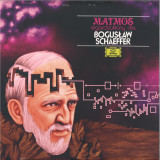
Matmos are one of the most prominent experimental electronic artists working today, crafting work by creating new conceptual frameworks and immediately testing those frameworks’ absolute limits. For ‘Regards/Ukłony dla Bogusław Schaeffer’ they’ve focused on another artist known, in large part, for doing the same.
Bogusław Schaeffer was one of the first Polish artists creating electronic music. In step with American contemporaries like John Cage and Morton Feldman, he worked across the boundaries of classical composition, electronic experimentation and radical theatre, in playfully form-breaking ways.
Matmos are not the first ones to recognize the power of his catalogue, from ‘Solo’ (a 2008 documentary that garnered numerous international awards), to the annual Shaeffer’s Era Festival (most recently celebrated simultaneously in Warsaw and Los Angeles), Bogusław Schaeffer’s work continues to inspire.
‘Regards/Ukłony dla Bogusław Schaeffer’, however, was not just inspired by his work. Matmos were given access to the entirety of Schaeffer’s recorded works to use as they saw fit, commissioned by the prestigious Instytutu Adama Mickiewicza. They re-assembled and re-combined these recorded works with modern instrumentations in a way that only Matmos could, and what emerged is a composite portrait of the utopian 1960s Polish avant-garde and the contemporary dystopian cultural moment regarding each other across a distance.
Vinyl packaged with digital download card.
out of Stock
Last delivered 4 years ago available to reorder, subject to availability
Felicia Atkinson’s music always puts the listener somewhere in particular. There are two categories of place that are important to »Image Langage«: the house and the landscape. Inside and outside, different ways of orienting a body towards the world. They are in dialogue, insofar as in the places Atkinson made this record—Leman Lake, during a residency at La Becque in Switzerland, and at her home on the wild coast of Normandy—the landscape is what is waiting for you when you leave the house, and vice-versa. Each threatens—or is it offers, kindly, even promises? —to dissolve the other. Recognizing the normalization of home studios these days, she revisited twentieth-century women artists who variously chose, and were chosen by, their homes as a place to work: the desert retreats of Agnes Martin and Georgia O’Keefe, the life and death of Sylvia Plath. Building a record is like building a house: a structure in which one can encounter oneself, each room a song with its own function in the project of everyday life.
At times listening to »Image Langage« is immediate, something like visiting a house by the sea, sharing the same ground, being invited to witness Atkinson’s acts of seeing, hearing, and reading in a sonic double of the places they occurred. In an aching moment of clarity in »The Lake is Speaking,« a pair of voices emerge out of the primordial murk of piano and organ, accompanying the listener to the edge of a reflective pool that makes a mirror of the cosmos. "I open my feet to fresh dirt, and the wet grass. I hold your hand. You hold his hand. In the distance without any distance. The comets, the stars." At other times, listening to »Image Langage« is more like being in a theatre, the composition a tangle of flickering forms and media that illuminate as best they can the darkness from which we experience it. On »Pieces of Sylvia,« a noirish orchestra drones and clatters beneath and around a montage of vocal images, stretching the listener across time, space, subjectivities. Atkinson says that "Image Langage" is like the fake title of a fake Godard film. There is indeed something cinematic about Atkinson’s work—not cinematic in the sense that it sounds like the score for someone else’s film, but cinematic in the sense that it produces its own images and langage and narratives, a kind of deliberate, dimensional world-building in sound.
»Image Langage« is built from instruments recorded as if field recordings, sound-images of instruments conjured from a keyboard, instruments Atkinson treats like characters, what she calls “a fantasy of an orchestra that doesn’t exist.” And then, speaking of Godard, there are the monologues, operating as both experimental-cinematic device and a literary style of narration. Voice can be a writerly anchor or a wisp of a textural presence. Atkinson’s capacious and slippery speech plunges into and out of the compositional depths, shifting shapes, channelling the voices of any number of beings, subjectivities, or elements of her surroundings—not unlike her midi keyboard, able to speak as a vast array of instruments.
»Image Langage« is an environmental record, in the vastest sense of the world. It is about getting lost in places imagined and real; it registers, too, the dizzying feeling of moving between such sites. It puts forth a concept of self that is hopelessly entangled with the rest of the world, born of both the ache of distance and the warmth of proximity.
For Félicia Atkinson, human voices inhabit an ecology alongside and within many other things that don’t speak, in the conventional sense: landscapes, images, books, memories, ideas. The French electro-acoustic composer and visual artist makes music that animates these other possible voices in conversation with her own, collaging field recording, MIDI instrumentation, and snippets of essayistic langage in both French and English. Her own voice, always shifting to make space, might whisper from the corner or assume another character’s tone. Atkinson uses composing as a way to process imaginative and creative life, frequently engaging with the work of visual artists, filmmakers, and novelists. Her layered compositions tell stories that alternately stretch and fold time and place, stories in which she is the narrator but not the protagonist.
Matmos are one of the most prominent experimental electronic artists working today, crafting work by creating new conceptual frameworks & immediately testing those frameworks absolute limits. For Regards / Uklony dla Boguslaw Schaeffer they've focused on another artist known, in large part, for doing the same. Boguslaw Schaeffer was one of the first Polish artists creating electronic music. In step with American contemporaries like John Cage and Morton Feldman, he worked across the boundaries of classical composition, electronic experimentation, and radical theater in playfully form-breaking ways. Matmos are not the first ones to recognize the power of his catalog, from Solo (a 2008 documentary that garnered numerous international awards), to the annual Shaeffer's Era Festival (most recently celebrated simultaneously in Warsaw and Los Angeles) his work continues to inspire. Regards.. however, was not just inspired by his work, Matmos were given access to the entirity of Schaeffer's recorded works to use as they saw fit, commissioned by the prestigious Instytutu Adama Mickiewicza. They re-assembled & re-combined these recorded works with modern instrumentations in a way that only Matmos could, and what emerges is a composite portrait of the utopian 1960s Polish avant-garde and the contemporary dystopian cultural moment regarding each other across a distance. To facilitate the transcultural exchange that is the album's essential premise, all song titles and liner-notes are provided in both English and Polish. The album was mastered by Rashad Becker and features illustration and design by acclaimed artist Robert Beatty (Tame Impala, Osees, Mdou Moctar). Like the anagrams of the letters of Boguslaw Schaeffer's name that were re-assembled to create some of the song titles, the album itself is a musical re-assemblage of component parts into possible but unforeseen new shapes. Adding harp from Irish harpist Una Monaghan, erhu, viola and violin from Turkish multi-instrumentalist Ulas Kurugullu, and electronic processes from Baltimore instrument builder Will Schorre, and Horse Lords wunderkind Max Eilbacher, the resulting arrangements constantly toy with scale as they move from the close-mic-ing of ASMR and the intimacy of chamber music to the immensity of processed drones and oceanic field-recordings that close the album. Offering a "life review" of production styles, Regards / Uklony dla Boguslaw Schaeffer builds temporary shelters out of the panoramic wreckage of modernist composition, sixties tape music, seventies dub, eighties industrial music, nineties postrock and dark ambient, 2000s era glitch fetishism, and contemporary post-everything collage sensibilities.
out of Stock
Last delivered 4 years ago available to reorder, subject to availability
FRENCH COMPOSER, PRODUCER AND MULTI INSTRUMENTALIST ADRIEN DURAND’S THIRD ALBUM
"Our last album, “La Course” was released in 2020 during the lockdown. Inspired by the feedback from listeners, who received the music with special attention, the idea and need for “(Loin des) Rivages” was born.” - Adrien Durand
Bon Voyage Organisation is the story of the construction of an ensemble, the quest for harmony, through music, between beings. This story has been the central leitmotif in Adrien Durand's composition and production work for almost ten years. Adrien Durand is a renowned Parisian bass keyboard player, composer, producer and mixing engineer having worked with noteworthy projects such as Amadou & Mariam and Papooz among others. Known for his knowledge of ensemble recording and arrangement techniques, BVO is his attempt at meticulously creating a musical dialogue around his compositions with a distinguished cast of musicians from di?erent backgrounds without the pressure associated with pop music recordings reminding us of the musical ensembles of the 70’s such as that of Carla Bley, Soft Machine or Irakere. (Loin des) Rivages was recorded over five days in June 2020 at Studio Atlas, the studio of Air’s Jean- Benoit Dunckel and mixed the following summer by Adrien Durand in his Parisian studio, Bureau 12. It was an orchestrated performance considering that all ten tracks of the album were played live, gathering up to thirteen musicians in the same room. The album follows what was initiated with BVO’s previous album La Course: an entirely instrumental sound free from any constraints. The close collaboration between Adrien Durand and the members of the ensemble allowed for an exquisite completion. Together, they deliver the incredible energy of "Le Sentier des Orpailleurs", the depth of melancholy of "Apacheta", and the originality of "Et s’éveillent"... Inspired by the great explorers of the soul: Sun Ra, Moondog and Coltrane - a cover of his Naïma actually opens the album - Adrien Durand mixes humanity’s first instruments (percussion and the wind) with its latest ones (mixing desks and synthesizers). Thus, he continues the most interesting yet rewarding artistic journey: The journey inward, far from the standards of civilization, in the heart of what some can take for madness, reaching into a jungle of the soul so marvelously represented in Clément Vuillet’s artwork. This is not an intellectual record but rather a spiritual e?ort, because, as Adrien Durand likes to repeat in his concerts: "Let us step into music as we step into a sanctuary."
Kicking off proceedings on new label, Scene Unseen is Yorkshire’s finest, Jinjé a.k.a. Lee J Malcolm.
Scene Unseen will focus on exploring and showcasing scenes from around the world (some seen or some maybe unseen), as well as releasing music from artists who incorporate sounds from across the globe within a music style that's closer to home. This is where Jinjé steps in, delivering an EP of Afro-funk and Afro-tech. He draws upon his usual duties as a fine Techno, House and Electronica producer and combines them with rhythms inspired by African and Indian music, using instruments (played and recorded live by Jinjé) and field recordings from both regions.
Jinjé (Lee J Malcolm) has released on labels such as Messrs. Kicks & Drums, EPM Music, Mesh and Ostgut Ton. He was also a founding member and mainstay in the Leeds band, Vessels (Different Recordings), until leaving a couple of years ago to concentrate on solo projects.
The track names tell all, as Jinjé gives a clear nod to the Africanism is his music. First track, 'Ngoma' is a name used across Africa to describe certain drums and percussive instruments, which can be heard here, like Djembes from the Conga region, as well as live and acoustic components, blended with modular and other electronic sounds.
'Burkina Faso' takes us west and hits the ground running with a vocal sample of Tribal women from the area, singing praise and joy to engineers who have come to provide fresh water to the village: "Praise God for they have come to build us a well." The progression of the track is based around this joy and develops nicely alongside some intense bass and drums.
'Dusk' is inspired by thoughts of the Serengeti planes at night fall, all built around Jinjé's live M'bira plugged into a modular synth, grouped with live flute and field recordings from India which provide additional percussion.
'Ya Maji' is a collection of high energy rhythms from a Moroccan frame drum, congas, clapping, live bass, distorted marimba and the mighty Korg Ms20 playing the lead synth lines.
Last up is 'Jara', a nod to Steve Reich and his six marimbas, as well as drawing inspiration from Fela Kuti. Vocal samples bring in more of the field recordings Jinjé made in India, as well as the clapping elements. Acoustic and electronic sounds intertwine to great effect and sum up the EP as a whole.
Look out for more from Jinjé in this musical direction as he seeks to bring these tracks and future ones to a live band setup.
out of Stock
Last delivered 4 years ago available to reorder, subject to availability
Having initially met more than a decade ago at a local community radio station, sometimes doing guest slots on each other’s live, improvised noise shows, Cormac Culkeen and Dave Grenon knew they had a mutual interest in working with sonic textures. They listened to each other’s bands for a handful of years, and in 2017, “made good on a threat” that they’d been making for quite a long time: to start a band. At Cormac’s gentle but clear urging—declaring that they’d gone ahead and booked a space in which to record a video—the two wrote their first song, “Sebaldus,” an ambitious 12-minute trip, which also serves as the fireworks finale to their self-titled debut album. With surges of pathos that smooth out into something more soothing in turn, Cormac goes: “The hunter, you’ve seen him / The archer, his arrows are strong / And hunger, you’ve known her / I know the winter is long.” The track is as much about enduring a Canadian winter as it is about the eponymous 8th century hermit, shot through with sublimated desire. As Cormac put it, Joyful Joyful’s songs are “a little bit outside of time.” But while the lyrics beg close, oblique reading unto themselves, there’s also a distinct sense that they’re only one of many more ways that the duo shapes sound. Cormac, whose voice is like a sea with irregular tides, lights up about an idea in traditional sean-nós Irish music that songs already exist and are out there; it’s up to the singer to become the conduit. This belief in music as something to be channelled, and something more than sound, resonates with the singer’s fundamentalist religious past. To paraphrase: lots of group singing, harmonies, no instrumentation, totally unmediated, no priest, congregational—not choral, not a performance, not about talent, the spirit moves through people. “Of course that informs how I think about singing,” Cormac says. So, when they were exiled from the church because of their queerness, they took the music with them, dislocating it from its dogmatic bounds but not from its transcendent potential. This record might be thought of, then, as a kind of queering of sacred, devotional traditions—or at the very least, a space where all of these things can be held at once. Perhaps perceivable by some as contradictions, these intersecting influences create the conditions for an incredibly singular sound. Dave is steady and exploratory in his handling of this multiplicity, arranging sounds as they’re revealed, corralling them, coaxing them into form. “Because Dave is there,” Cormac says, “I get to sing three times higher, and three times lower, and faster, and backwards, and all of these sounds! That are there. They’re all there.” When asked about early musical memories, Cormac recalled an immediate fascination with harmony: from demanding that the first person they ever heard singing it explain what they were doing, to always (still, to this day) singing in harmony with their twin sister around the house, to being part of a children’s choir that sang soprano in Handel’s Messiah—not realizing until they entered the room with all the other ranges that their learned melody was but one part of the whole. Just as tellingly, Dave reflects on his early attraction to “abstraction and becoming abstract,” describing childhood afternoons messing with microphone and speaker feedback loops, producing long, enduring sounds with almost undetectable variations. In a way unique to the coalescing of these two listeners, notions of harmony are central to their output. Dave samples field recordings, old keyboards and synths, and vocal drones, running the live singing through four or five parallel effects chains, sampling and treating everything again in the moment. “Another way to put it is that Cormac’s voice comes into the board and then comes back out shifted, delayed, and shattered; Cormac and I hear it, live with it, and respond,” Dave says. This work is contingent not only on a deep intuition (neither of them read sheet music) of polyphony and due proportion (something St Thomas Aquinas famously listed as an attribute of beauty) but also on their connection to each other and ability to read subtle cues. Dave says they’d hold each other’s hands while performing if it was more convenient to do so, riffing on something else Cormac mentioned about traditional Irish singing: that someone would always hold the singer’s hand, for fear that without a tether to the ground they might find themselves utterly lost, unsure how to return. Joyful Joyful doesn’t shy away from offering such experiences of departure; they’re willing to unsettle their audiences because they themselves are unsettled. Their shared penchant for spooky, heavy music, and self-described “omnivorous” listening practices equip them with an array of sonic concepts that support this effort; Diamanda Galás, The Rankin Family, Pan Sonic, Pauline Oliveros, Keith Fullerton Whitman, Yma Sumac, and Catholic hymnody were just a few that came up. Observing their audience gives them insight about the effect of each song—something they considered while arranging the album. Its arc is marked by soft, sometimes sudden oscillations between cacophony and euphony, day and night (listen for insects), and from sexual, visceral entanglements to more ephemeral, celestial ones. Front to back, it arouses expansion, unraveling. Of lightning, Vicki Kirby writes: “quite curious initiation rites precede these electrical encounters. An intriguing communication, a sort of stuttering chatter between the ground and the sky, appears to anticipate the actual stroke.” By all accounts, something similar seems to happen at Joyful Joyful shows, between those on the stage and those off it, between what’s earthly and what’s beyond. “A lightning bolt is not a straightforward resolution of the buildup of a charge difference between the earth and a cloud … there is, as it were, some kind of nonlocal communication effected between the two,” writes Karen Barad, extrapolating on Kirby’s thought. Cormac acknowledges that while they and Dave play a role in this mysterious charge that comes about, they’re not solely responsible. However ineffable it may be, it’s undoubtedly a form of communion—and a sensuously shocking one at that
Brainwaltzera's debut LP 'Poly-ana' follows quickly on the heels of the producer's Aescoba EP - also released this year via FILM. Across thirteen tracks of both previously released material and fresh excursions into the artist's world, Brainwaltzera explores sounds ranging from luscious, downtempo grooves and expertly reduced braindance cuts with nods to early 90's experimental IDM to harder, more caustic outings - all bound together by a recurring theme of otherworldly ambience. Taking its name from a variety of sources dear to the artist, including polyphonic analogue synthesizers and the Pol-lyanna Principle itself - a theory that suggests individuals recall pleasurable experience more acutely than displeasing ones - the title represents a meeting point in the artistic process between creative method and conceptual choices. Production techniques range from more traditional hardware synthesis to the incorporation of a modified dot matrix printer acting as a modulation source for MIDI parameters. Sample sources include VHS material from the produ-cer's own childhood and ambient Bullet Train samples from an on-the-fly production session traveling from Tokyo to Kyoto. According to the enigmatic producer, memory and its fundamental role in the human experience is one of the central themes of the record. While the artist's own experiences shaped the sound of the record, there is no attempt to impose them on the listener through blatant exposition.
out of Stock
Last delivered 4 years ago available to reorder, subject to availability
Pokey LaFarge's 7th studio solo album, In the Blossom of Their Shade,
showcases the positivity of coming out of the darkness and into the light
When the 2020 global pandemic hit, LaFarge's rigorous work ethic powered him
through the potentially challenging creative period. As days became a couple
months, songs blossomed from embryonic ideas into full- formed ones and he
was ready to move on, which typified his mindset as a working artist. With this
record LaFarge captures the thematic notion of being the perfect summer
afternoon soundtrack...the type of music you want to listen to while having a
cocktail with your significant other. It makes sense musically as well - LaFarge
intentionally crafted songs that created space and have melodies that can glide
throughout a composition that's a far cry from the swing and blues-infused songs
of his earlier work. LaFarge is an artist who refuses to rest on his laurels and
compromise. He's always motivated and ready to create. With In the Blossom of
Their Shade the album is one of LaFarge's strongest and most mature efforts to
date.
Third album of this post-punk/avant-rock french project.
RIEN VIRGULE is before everything else musically, the meeting of four people, islands of desires, tentacles that embrace each other. Or “the meeting of a soldering iron and an iceberg, a pigeon asleep in a packet of chips, a smashed path in a debaptized city” (according to J. Burgun).
For 8 years, two albums and numerous concerts, they have been peddling a generous, graceful and cold, intensely vibrating music.
In a radical and deviant approach to Pop music, the classical structures of verse-chorus serve as a playground and experimentation, where rhythmic, melodic and noisy functions merge.
In June 2019, Jean-Marc Reilla passed away. His homemade instrumentarium and laughter continue to resonate for his loved ones, and his memory lives on in the music of RIEN VIRGULE that has become a trio.
out of Stock
Last delivered 4 years ago available to reorder, subject to availability
If you’re looking for a raw, sugary blast of distorted pop, look no further than
‘Weird Nightmare’. The debut album from METZ guitarist and vocalist Alex
Edkins contains all of his main band’s bite with an unexpected, yet totally
satisfying, sweetness. Imagine The Amps covering Big Star, or the gloriously
hissy miniature epics of classic-era Guided by Voices combined with the
bombast of ‘Copper Blue’- era Sugar - just tons of red-line distortion cut with the
type of tunecraft that thrills the moment it hits your ears.
These ten songs showcase a new side of Edkins’ already-established
songwriting, but even though the bulk of ‘Weird Nightmare’ was recorded during
the COVID-19 pandemic, some of its tunes date back to 2013 in demo form.
“Hooks and melody have always been a big part of my writing, but they really
became the main focus this time” he explains. “It was about doing what felt
natural.”
To be clear: Weird Nightmare is not a ‘pandemic album’, but an album - some of
which had been gestating for quite a while - that just so happened to be recorded
during the pandemic. “I had always planned on finishing these songs, but being
unable to tour with METZ, and forced to lock down, really gave me a push.” After
days spent homeschooling his son, Edkins would drive to the METZ rehearsal
room and tinker deep into the night on these songs’ deceptively simple structures
and rich, static-laden textures. “It was a godsend for me,” he states about the
creative process. “The hours would disappear and I would get lost in the music
and record. It was a beautiful escape.”
‘Weird Nightmare’ is, in its own way, a study in extremes: Edkins’ melodic
instincts and penchant for dissonance are both turned up to the max throughout,
the latter reflecting not only the barn-burning tendencies of METZ, but Alex’s own
sonic predilections. “It doesn’t sound right to my ears until it’s pushed over the
edge.” He also cites other artists who are masterful at mixing the sublime and the
punishing - Kim Deal and Scout Niblett among them - as influences on his own
songwriting. “My favorite songs are the simple ones,” he explains. “I’ve never
been attracted to virtuosity or technicality. Certain songs have the power to lift
your spirits like nothing else can. I wanted to create that type of song.”
A few guests pitch in on Weird Nightmare: Canadian alt-pop genius Chad
VanGaalen adds his unmistakable touch to the ever-escalating ‘Oh No’, while
Alicia Bognanno of Bully lends her distinctive pipes to the thrashing ‘Wrecked’, a
collaboration that effectively saved the song. “I almost didn’t put it on the album
because I thought it was missing something,” Edkins explains. “I sent it to Alicia
and she lifted it way up.”
And taking risks and reaching out of Edkins’ comfort zone was the name of the
game when it came to making ‘Weird Nightmare’. “I found myself doing new
things I didn’t have the guts to do before, recording everything by myself and
trusting all of my musical instincts,” he states. “I think when music manifests
quickly, a certain amount of honesty automatically comes along with it. When it is
a purely instinctual creation, there is no opportunity to obscure the truth.”
Loser Edition LP pressed on Coke Bottle Green transparent vinyl.
If you’re looking for a raw, sugary blast of distorted pop, look no further than
‘Weird Nightmare’. The debut album from METZ guitarist and vocalist Alex
Edkins contains all of his main band’s bite with an unexpected, yet totally
satisfying, sweetness. Imagine The Amps covering Big Star, or the gloriously
hissy miniature epics of classic-era Guided by Voices combined with the
bombast of ‘Copper Blue’- era Sugar - just tons of red-line distortion cut with the
type of tunecraft that thrills the moment it hits your ears.
These ten songs showcase a new side of Edkins’ already-established
songwriting, but even though the bulk of ‘Weird Nightmare’ was recorded during
the COVID-19 pandemic, some of its tunes date back to 2013 in demo form.
“Hooks and melody have always been a big part of my writing, but they really
became the main focus this time” he explains. “It was about doing what felt
natural.”
To be clear: Weird Nightmare is not a ‘pandemic album’, but an album - some of
which had been gestating for quite a while - that just so happened to be recorded
during the pandemic. “I had always planned on finishing these songs, but being
unable to tour with METZ, and forced to lock down, really gave me a push.” After
days spent homeschooling his son, Edkins would drive to the METZ rehearsal
room and tinker deep into the night on these songs’ deceptively simple structures
and rich, static-laden textures. “It was a godsend for me,” he states about the
creative process. “The hours would disappear and I would get lost in the music
and record. It was a beautiful escape.”
‘Weird Nightmare’ is, in its own way, a study in extremes: Edkins’ melodic
instincts and penchant for dissonance are both turned up to the max throughout,
the latter reflecting not only the barn-burning tendencies of METZ, but Alex’s own
sonic predilections. “It doesn’t sound right to my ears until it’s pushed over the
edge.” He also cites other artists who are masterful at mixing the sublime and the
punishing - Kim Deal and Scout Niblett among them - as influences on his own
songwriting. “My favorite songs are the simple ones,” he explains. “I’ve never
been attracted to virtuosity or technicality. Certain songs have the power to lift
your spirits like nothing else can. I wanted to create that type of song.”
A few guests pitch in on Weird Nightmare: Canadian alt-pop genius Chad
VanGaalen adds his unmistakable touch to the ever-escalating ‘Oh No’, while
Alicia Bognanno of Bully lends her distinctive pipes to the thrashing ‘Wrecked’, a
collaboration that effectively saved the song. “I almost didn’t put it on the album
because I thought it was missing something,” Edkins explains. “I sent it to Alicia
and she lifted it way up.”
And taking risks and reaching out of Edkins’ comfort zone was the name of the
game when it came to making ‘Weird Nightmare’. “I found myself doing new
things I didn’t have the guts to do before, recording everything by myself and
trusting all of my musical instincts,” he states. “I think when music manifests
quickly, a certain amount of honesty automatically comes along with it. When it is
a purely instinctual creation, there is no opportunity to obscure the truth.”
Loser Edition LP pressed on Coke Bottle Green transparent vinyl.
First album by this duo, known separately for their work in Mouse on Mars
and Gastr del Sol.
Two long-form pieces, utterly different from one another: one hyper-detailed
electronic music and sound poetry, and the other live-in-the-studio electric
guitar and laptop paint-peeling.
The exciting first chapter in a long-anticipated collaboration
David Grubbs and Jan St. Werner met in the mid-1990s when Grubbs was
playing with Gastr del Sol and The Red Krayola and St. Werner in Mouse on
Mars and Microstoria. After years of exchanging ideas, ‘Translation from
Unspecified’ marks their first time locking horns as a duo, and it’s clear this
deck-clearing collaboration was long overdue.
In January 2020 Grubbs arrived at Mouse on Mars’ Berlin studio Paraverse
with a guitar and ‘Translation from Unspecified’, an open-ended, seemingly
self-generating poem suggesting AI, one of the themes in St. Werner’s recent
work. This became the side-length title track, a winding corridor of electronic
fanfares and spontaneous musical miniatures urging Grubbs’s slow and
steady recitation to grow wings and graduate into song.
Who knows where this idiosyncratic mise-en-scène - day-glo, extrovert
electronics and task-oriented human - came from? Reference points - distant
ones - might include Robert Ashley and Paul De Marinis’s ‘In Sara, Mencken,
Christ and Beethoven...’ and the sound poetry of Anton Bruhin.
Flip the record and you have ‘Soixante Ooze’, a live-in-the-studio duo for
guitar and computer more recognizably St. Wernerian and Grubbs-like that
reconfigures elements of the title track before finally morphing into needlepinning monoliths of sound.
David Grubbs has released fourteen solo albums and appeared on more
than 200 releases. He was a member of the groups Gastr del Sol, Bastro,
and Squirrel Bait and has performed with Tony Conrad, Pauline Oliveros,
Luc Ferrari, Will Oldham, Loren Connors, the Red Krayola, Royal Trux, and
many others. His newest book is ‘Good night the pleasure was ours’ (Duke
University Press, 2022).
Jan St. Werner is an artist and electronic music composer best known as
one half of the group Mouse on Mars. He has collaborated with Oval’s
Markus Popp as Microstoria and written music for installations and films by
visual artist Rosa Barba. In 2013, St. Werner released ‘Blaze Colour Burn’,
the first of a series of experimental recordings called ‘the Fiepblatter
Catalogue’. Recently his work has prioritized installation and interventions
with spatialized sound, including a number of collaborations under the name
Dynamische Akustische Forschung (DAF).
HIGHLIGHTS: 1967 descargas album by Peruvian percussionist Coco Lagos y Sus Orates, featuring Alfredo Linares, Charlie Palomares, Otto de Rojas, Mario Allison_ This album was recorded following the success of the descarga sessions released by New York label Alegre Records. It includes a version of Cal Tjader's 'Mamblues' and 'Brava pachanga', an original by the Father of Boogaloo, Joe Cuba, among many other stand-out tracks. Quality official reissue on 180g vinyl after years unavailable. Includes insert with liner notes. Details: 1966 was a prolific year for the MAG record label. The microphones were constantly on at the label's studios, recording timeless hits by Los Demonios de Corocochay, Betico Salas, Cholo Berrocal, Mario Allison, Alfredo Linares, Carlos Muñoz and Los Pacharacos, just to mention the most successful ones. The percussion playing by 29-year-old Peruvian Coco Lagos stands out on a number of these recordings. Coco continued his early career, and he played the conga drums for artists who passed through Lima, accompanying Pérez Prado, Oréfiche and Chano Scotty, among others. In the late 50s, he started working as a regular musician in the recently founded record company MAG, alongside musicians such as Ñiko Estrada, Mario Allison, Lucho Macedo...
out of Stock
Last delivered 4 years ago available to reorder, subject to availability
Memorial are a duo, Jack and Ollie. Neither are in any great hurry, with their songwriting process originally found spent solo, several hundred miles apart in Brighton and Manchester. Voice memos zipped across the internet, all half thoughts and feelings seeking the other's encouragement.
Headline shows in London and Brighton and supports in 2021: Bess Atwell, Chartreuse, Richard Thompson, Courtney Marie Andrews, Amber Run, Samantha Crain. Nominated for AMA's 'UK song of the year', award ceremony in January at Hackney Empire.RADIO:
Sessions on BBC Radio Wales with Janice Long Interview with Robert Elms on BBC Radio London Chosen as John Kennedy's Hot Ones and X-Posure Big One on Radio X Consistent radio plays on Radio 1's Chillest Show with Sian Eleri, Chris Hawkins on BBC 6Music and on Amazing Radio Further spot plays from Elton John on Beats, Roddy Hart on BBC Radio Scotland, Soho Radio and more.
LDI Records serves up a celebration of The Hague's famous electro sound with native Cliff Dalton aka Sander Evers behind four originals and fellow West Coast legends Legowelt and Rude66 both remixing. Cliff Dalton is a relatively new project from a long-time Dutch music great. Sander Evers is the drummer in psychedelic stoner rock band Monomyth and has played with other notable groups including 35007 and Gomer Pyle. Next to those projects, he has always had his ear tuned into the region's enduring techno and electro scene and now offers up his own fresh take on it. The EP's title refers to the fact that all these artists are bound by geography, but is also a nod to the fact that The Hague is the largest Dutch city by the sea. The opener 'We Are The Little Ones' is about an evil robot factory in a futuristic dystopian city. It is a coruscated electro-funk workout with crisp analogue drums and nimble bass overlaid with withering sci-fi melodies. 'We Don't Need A Real World' is a superbly cinematic eight-minute excursion with widescreen synth work taking you to the stars as you ride an elastic bassline. The majestic 'City Under The Sea' then layers up neck-snapping snares with cosmic arps and plunging bass and 'Cleopatra's Matrix' soundtracks an ancient Egyptian city with its mystic leads and eerie pads luring you into a late-night electro trance. West Coast pin-up and hugely prolific electronic innovator Legowelt remixes 'We Are the Little Ones'. His version has plenty of his textbook intrigue, lo-fi texture and magical synth charm, and finally key Bunker Records associate Rude 66 flips 'City Under The Sea' into a snaking dub rhythm with hypnotic acid lines and seductive vocal whispers woven in deep. The Blue City EP is a timeless package of West Coast electro direct from the source.
out of Stock
Last delivered 3 years ago available to reorder, subject to availability
Dark Green 12" Vinyl Limited to 1000 Vinyl Includes Exclusive bonus track 'Restless'
“The things you hear when you’re alone. Walking through Mount Royal or other wooded areas you might notice a branch break. As much as I value my alone time and the subtle things you can pick up around and within yourself in those moments, a certain loneliness and anxiety permeates the quiet at some point. The past couple years created ample opportunity for that anxiety and loneliness to stretch its legs and make itself comfortable. This record was born out of weeks of willing a form of peace and inspiration into my surroundings. A large part of that came from working with Leanne Macomber on some vocals. Through a desire to form new connections and throw more humanity into the work. We made a variety of song sketches that I mostly reworked into the final recordings here. We spoke a lot about where our heads were at, certain key phrases, triggers and emotions. Joel Ford, whom I worked on Dawn Chorus with, mixed the record and helped me wrangle a few cats to get this across the finish line. Restless at home in Canada, feeling the restlessness of all my friends and loved ones I kept in touch with as much as possible, trying to make something that made the quiet a bit more peaceful."
out of Stock
Last delivered 4 years ago available to reorder, subject to availability
Hip Hop Collected will take you on a musical journey through the history of hip hop. This 2LP covers the first 20 years of the genre, showcasing 25 early pioneers who participated in the rise of hip hop. This compilation features music from the new labels that started to rise from the underground scene, like Sugar Hill Records, Profile and of course Def Jam. Including artists that defined a genre, a lifestyle and most of all, artists that inspired millions of young kids with both socially critical lyrics as well as classic party anthems.
This hip hop compilation album is part of the new Collected compilation series, which is a collaboration between Universal Music and Music On Vinyl. The compilations bring together the biggest and best names of its genre, combined with forgotten hits and less discovered gems, giving the listener an experience of both nostalgia and uncovering new musical grounds at the same time.
The 2LP features Kurtis Blow “The Breaks”, Grand Master Flash & The Furious Five “The Message”, Beastie Boys “She’s On It”, Rob Base & DJ E-Z Rock “Get On The Dancefloor”, and Eric B. & Rakim “Paid In Full” amongst many others.
Hip Hop Collected is available as a limited edition of 5000 individually numbered copies on red (LP1) and white (LP2) coloured vinyl. The album includes an insert with liner notes, photos and credits.
out of Stock
Last delivered 4 years ago available to reorder, subject to availability
* Strictly limited-edition 2x12” vinyl in full colour sleeve. Includes card to download full album in WAV format.
* ‘Strange Days’ the debut album from one of the standout Drum & Bass acts of recent years, due for release on the legendary V Recordings on 3rd December 2021.
* Features collaborations with Serum, Makoto, MC Fats, Lorna King, 2shy MC, Cleveland Watkiss, Blak, Riya, A Little Sound, Elipsa & T.R.A.C.
* With support already secured from the likes of Shy FX, Bryan Gee, Fabio & Grooverider, Rene LaVice, Hybrid Minds, Serum, Randall and with a growing international fanbase at their back, Paul T & Edward Oberon's new album 'Strange Days' is set to be one of 2021's defining drum & bass releases.
* Their recent run of singles, including two Beatport number ones and collaborations with vocal talents like Cleveland Watkiss, MC Fats, A Little Sound & Lorna Kings have given us a flavour of this monumental project. An eclectic array of influences from jazz to jump up have been filtered through the unique musical perspective of this duo to bring us something that we've never quite heard before.
* Drum & bass has the capacity to deliver, on the one hand, soulfully emotive musicality and, on the other, sheer rave-inflaming filth. Paul T & Edward Oberon, however, have consistently performed the alchemical magic of bringing together both the music and the mayhem without compromising either.
* But of course they have. Paul and Edward have years of experience creating music for some of the most prestigious labels in the scene and drawing from a myriad of influences. Individually, they have credits stretching back decades, and, as a combo, they've been dusting dances around the world since 2011.
* Having won an army of new-gen fans with anthems like 'Stomp', 'Look for the Light' and the absolutely huge scene smashing Serum-collab 'Moon in Your Eyes', these veteran artists have wasted no time in stepping things up to even greater heights as they gear up to drop their album.
* Balancing vibes and viciousness, 'Strange Days' lays out the definitive manifesto for Paul T & Edward Oberon's dirty soul sound. Operating as both a self-contained audio journey and a collection of rave-ready deejay weapons, this LP is a piece of work that demands your attention!
out of Stock
Last delivered 3 months ago available to reorder, subject to availability
Reissue of 2018 debut on 2 colour vinyl, black & milky clear. Note includes members of Pains Of Being Pure At Heart. More than anything else, Oh Boy is a celebration of teenage fandom and friendship. Each song is “about” something else, of course: a betrayal, a breakup, new love, parenthood. The usual stuff. And we’re hardly teenagers. Yet somehow Massage feels like the kind of band you were in back in high school. We were friends first. We all had other lives. We started playing music almost by accident. (Michael wanted to learn drums; Alex wanted to relearn guitar after playing bass in the Pains of Being Pure at Heart; Andrew and David invited themselves to their second practice.) We made a playlist of songs we loved hundreds of them long before we recorded anything: the Feelies, the Go-Betweens, East River Pipe, the Lemonheads, the Breeders, Flying Nun, Sarah Records. Alex and Andrew started writing songs the way kids do to sound like their heroes. No matter how we tried, though, the songs half Alex’s, half Andrew’s came out sounding like “Massage”: scrappy, catchy, minimalist, and sincere, with Gabi’s harmonies elevating each track. Every Monday after practice, we went to Jay’s Bar for beers and poutine. There was no point to any of this. We were just having fun. Then one day we realized we were a band. Oh Boy is our attempt to capture this easy alchemy on tape the strange magic of a bunch of amateurs coming together, finding their own wavelength, and making something out of nothing. We couldn’t have asked for a better partner in crime than our pal Jason Quever of Papercuts, who recorded us on random weekends over the course of two years. We hope the result sounds as loose, low-key, idiosyncratic, and ultimately indelible as the bands that inspired us — the ones you already know, and the ones that are still just teenagers goofing off in some suburban garage.
Following the release of Collision and Coalescence, Slovakian label mappa commits to the duo Grykë Pyje, releasing their third LP "Squirlich Stroll". Maintaining the fabled tone of their debut on the label, Jani Hirvonen (Uton) and Johannes Schebler (Baldruin) dig deeper into the sonic vein of myth and fabric of yonder. The music in "Squirlich Stroll" unravels as a yarn brought back from a wild voyage.
On uncharted areas of medieval maps where potential dangers were thought to exist, the inscription "Here be dragons" was used to warn as much as to tempt explorers willing to cross limits. Myth awaited them as a blank page of dormant territory, yet also to be proved unlike and reinvented. In such pliable borders, wonder had the favorable conditions to blend experience and imagination, crafting creatures with an eye instead of a bellybutton, arms instead of ears and ears instead of fingers, hypnotizing spirals where a mouth should have been. These chimeras, though fictitious, allowed explorers to express their delusions along with their fears. "Here be dreams", we hear nightmares. Here be mushrooms the size of pyramids that sing lullabies for mountains. Here be talking roads that lead to volcanoes throats and spit you back to flight. Here be art of bending trees into braided bridges like in Meghalaya, and the time gap between seed and living ruins.
Let that be the compass, the astrolabe. Yet, the music in Squirlich Stroll comes with these journeys already embraced, unraveling as a story told by wanderers visiting town, nourishing fantasy. The sonic language and diction employed here are crystal clear. Sounds are sharp and pure. Growls, howls, shrieks, tingles, rattles, moans, excretions and even hymns sung by landscape and creatures alike do not run over each other. There is no chaos, but ambience, cohabitation. The duo masters dramaturgy, providing every voice with focused turns and character, guarding their parley with caution and care, convoking them mainly through soothing synth melodies that enable an analgesic, sedative mood. Clusters of sounds gathered are articulated through the album with the inherent luminosity and required stability to accomplish what peaks in, as the title of the final track reads, a new dawn.
"In the beginning there was Jack... And Jack had a groove." We know this old tale pretty well. But what do these words really mean? And does this meaning even exist nowadays?
Our fellow musician and sound researcher Stas Sharifullin, known as HMOT, presents his report Jack Studies in the form of a release on the Instrument, Gost Zvuk sublabel. Formally, it is a reissue of his single Prolegomena to Home Music Ontology, released in 2017 on Cyland. But these old tracks have been expanded, remastered by Rupert Clervaux and complemented by the two new ones. HMOT originally prepared the tracks on Jack Studies for release on Gost Zvuk, so these instrumentations are finally coming home after a long journey. Context is everything - and in the new environment, this music speaks even louder.
Originally, house music was associated with HIV/AIDS activism and the fight against racial oppression, among other things - and this was completely lost in translation in Russia. House was stripped of its political and symbolic potential, and Jack Studies tries to show how the context is slowly fading from our memory. But it's not just an observation. It's a tool of light intrusion that the author has already tested in his DJ sets. Once, he says, he played Instrumentation IV (Encore) for eleven minutes at the Kantine am Berghain.
Now that we are finally talking about Western and Eastern ways of making it in music, Jack Studies is more relevant than ever. You can see it not only as a joke said louder this time, but also as a critique of modern house music. You can also see it as a reflection on our strangeness to house music and how we can interpret it in our own way; as Sharifullin astutely suggests, as home music. He sees no line between tragedy and comedy, citing the plays of Samuel Beckett as the root of Jack Studies' irony. "They are funny and somber at the same time. To me, this release is sad, but the music here is joyful." Home music is the paradox. But it is also the beginning of something new. And in the beginning there was... what? Jack Studies has an answer.
out of Stock
Last delivered 4 years ago available to reorder, subject to availability
“Revel in Time”, the third album from ARJEN ANTHONY LUCASSEN'S STAR ONE, is as much of a reaction as it is a contrast to Arjen Lucassen’s previous album, “Transitus” from Ayreon. While “Transitus” is a cinematic experience that you may almost call a musical, “Revel in Time” is a heavy album that is very riff driven and there is more focus on virtuoso musicianship. Similar to its predecessors, “Revel In Time” works as a concept album. All tracks are inspired by different movies that deal with some kind of manipulation of time. There is one thing this time around that is quite different compared to the earlier STAR ONE albums: The first two had the same cast of four singers: Floor Jansen, Russell Allen, Damian Wilson and Dan Swano. However, this time Arjen decided to generally have mainly one singer per track, and a different for almost each track. This shows especially on CD 2, the “Same Songs, Different Singers”-CD as Arjen likes to call it. The guide vocals that were recorded (for the other singers) were way too good to just be guide vocals. Thus, Arjen decided to release a second version of the songs with the guide vocals on them as CD2. At some point he started spontaneously inviting other singers to sing some of these tracks, because he was curious how the songs would sound with their voices. Ultimately CD2 ended up with no less than 9 different singers, all equally as good as the ones on CD1. A total of about 30 different musicians contributed to the new album, not all of them being singers though. The core of STAR ONE remains Ed Warby’s powerful drums as well as Arjen’s guitar and bass work that hold it all together and give it that typical STAR ONE sound. The icing on the cake is the front cover art that was created by Arjen’s trusted favorite artist Jef Bertels.
"In the beginning of the 2000's being a producer or a DJ wasn't cool, it was something for nerds. And no one was so crazy to spend all their money in machines. I was going to the clubs in the weekend and when everyone was going to the afterparty i was going to work for a little money to be able to make music, music that I wanted to be play by all these big DJ's I had the chance to see, and I made it."
- Tells Hector Sandoval AKA Tensal Aka Syndromania to me and some other younger DJS (P.E.A.R.L, Jheal Bashta) while we drink a beer in Gijon north of Spain, city close to the town where Syndromania is based. -
After hundreds of records released and the recognition of every single artist of the scene. Few has changed for Syndromania, he keeps getting immersed in his studio with the same love although now with another point of view plus the experience to twist it to the next level.
DJing since 1993 his musical knowledge may be in the top 5 more knowledgeable people I ever met. As you can hear along the 6 cuts of this Sacrilegio EP it's fully rooted on straight messages and codes that have been filling up years of rave culture with a new take on them in order to optimize them for a contemporary rave experience.
From UK infected electro, mechanical-industrial techno music, leaning Chicago house cut to a tremendous take on techno-trance. This record is one of my favorites ever released on OAKS/KAOS and one of the ones that I'm sure that sets the level to inspire many to reinvent and develop our culture.
To be honest Sacrilegio is one of the records I'm more proud about of all in our catalogs. Thanks to Syndromania for this extraordinary piece of art and DJ apex tool which won't ever leave my record bag, neither probably yours."
Respeto.
Hector.
#oftenplusneverminus8
out of Stock
Last delivered 7 months ago available to reorder, subject to availability
Nestled somewhere between the soul
jazz, spiritual jazz, fusion, and post-bop
subgenres, 1974’s Cosmic Funk headed, as
the title indicates, in a funkier direction,
with Lonnie Liston Smith’s brother Donald
contributing smooth vocal stylings to John
Coltrane’s “Naima” among other tunes. A
transitional work but a fascinating one, with
surehanded production once again from
Bob Thiele. Features the original gatefold album art…another
“post-fusion” masterwork from the Lonnie Liston Smith and the Cosmic Echoes!
I'll Look for You in Others is the bittersweet fruit of a painful time in the Portland, Oregon, electronic musician's life. Patricia wrote and recorded the album in 2020, in the aftermath of losing her mother-in-law to cancer and then, months later, losing a close friend. Created using her habitual materials-synthesizer and voice-in unfamiliar ways, the album served as a means of processing her feelings of heartbreak. Feeling disconnected from everything around her, including her usual approach to music, Patricia found new inspiration in spectral processors-digital FFT algorithms that pull apart and reconfigure audio. As she reshaped her synthesizers and voice into stark, silvery new forms, she realized that the process functioned as a metaphor for grief itself: a representation of the transformation that happens when our loved ones are no longer with us as a physical presence, but are still alive within us in a beautiful new way. I'll Look for You in Others is not just a document of loss; it is a testament to the way the loss of loved ones changes our lives, and the way the presence of those we've lost changes shape after they are gone. I'll Look for You in Others marks Wolf's official debut album, following a long, extensive practice of live performance, sound-design projects, contributions to benefit compilations, and reworks of the music of her friends and peers.
out of Stock
Last delivered 4 years ago available to reorder, subject to availability
Parcels have always been a band of extreme light and shade: they’re from surf hotspot Byron Bay in Australia but they’ve been holed up in grimy nightlife utopia Berlin for years; their sweet-as-honey vocal harmonies rival the Beach Boys but they can also turn their live shows into slamming techno rave-ups. The twentysomethings stand out amid the current musical landscape: a soulful rock band that looks like it’s stepped out of a postcard from 1970s California, all flares, moustaches and shaggy hair. They’re a classic band for atypical times.
Since Crommelin, keyboardist Louie Swain, keyboardist/guitarist Patrick Hetherington, bassist Noah Hill and drummer Anatole ‘Toto’ Serret formed in 2014, fresh out of school, they’ve struck upon a singular sound, weaving together gossamer disco and exotica, soft rock and Sixties pop with a focus on uplifting grooves. Their seductive style has translated into 100,000 album sales worldwide, over 200 million streams, cross-continental tours, shows with French royalty Phoenix and Air, a US TV debut on Conan O’Brien, a Coachella slot and a debut single that was produced by none other than Daft Punk, who saw them live in Paris and ushered them into their studio.
After two EPs, 2015’s Clockscared and 2017’s Hideout (the band’s penchant for smooshing words together is a result of a broken keyboard when they submitted their first demo), Parcels’ acclaimed self-titled debut album came in 2018 and was called “timeless and devilishly fun'' in a five-star NME review. They followed it in 2020 with an impressive live album, Live Vol.1, recorded at Hansa Studios, the legendary studio where Iggy Pop and David Berlin hung out during their Berlin years.
The band returns for summer 2021 with an ambitious third studio album,
Day/Night, a double record that spans impossibly catchy disco-soul, prog, pastoral folk, Laurel Canyon-era classic songwriting and cinematic strings. Made over the course of 2020, when the world was at a standstill, it’s the sound of a band growing up; five guys who’ve known each other since childhood and are finding their way together, in spite of all the major obstacles the last 18 months have thrown at them, when they were unable to return home to Australia and see their loved ones. Day/Night is huge in scope and sound, and its hopeful messages of perseverance through difficult times are a balm for these uncertain times.
2 LP Boxset. 2 vinyls packaged together in a clear PVC wallet (in order to display each vinyl cover). 2 x : 140 G black vinyl ( 33 rpm)+ 3mm spine printed sleeve + printed inner sleeve + cmyk vinyl label.
Cello. Marketing Front sticker 5 cm x 7 cm , back cover sticker (upc + tracklisting) 5 cm x 7 cm
out of Stock
Last delivered 4 years ago available to reorder, subject to availability
Angel Olsen covers “Something On Your Mind,” while Karen Dalton’s version is found on the flip.
The latest release in Light in the Attic’s 7" Covers Series.
Artwork by Los Angeles-based fine artist Robbie Simon.
Pressed at Third Man Pressing. Non-Returnable.
Didn’t you see, you can’t make it without ever even trying? — Dino Valenti, lyrics from “Something On Your Mind”
Light in the Attic is honored to be releasing Angel Olsen’s gorgeous cover of Karen Dalton’s moving interpretation of ‘Something On Your Mind,’ a song that enduringly underscores the unspoken thoughts, painful truths and buried emotions between people and within oneself. Thematically, the song is universal and resonates as much with listeners today emerging from a post-pandemic world as it did for Karen Dalton when she first recorded it in 1971 for her second and final studio album, In My Own Time. “‘Something On Your Mind’ for me is about letting yourself face something that keeps setting you back,” says Angel Olsen, who has come to the forefront of Karen Dalton appreciators around the world, both in her contribution of this new interpretation and as the voice of Dalton’s personal journals in the recent documentary, Karen Dalton: In My Own Time. As part of the latest installment of LITA’s long-running cover series, Angel’s cover is found on the a-side, while the flip includes Karen’s 1971 version.
Previous singles in Light in the Attic’s Covers Series includes musician, poet, and author Leslie Winer collaborating with Manchester-born composer Maxwell Sterling on a truly gorgeous cover of Tim Buckley’s 1967 forlorn love song “Once I Was,” Bill Callahan & Bonnie ‘Prince’ Billy covering Johnnie Frierson’s beautiful and inspiring tune “Miracles,” BADBADNOTGOOD with Jonah Yano covering “Key To Love (Is Understanding)” by Milwaukee’s funk/soul pioneers Majestics, Charles Bradley & the Menahan Street Band covering Sixto Rodriguez, Mac DeMarco covering Haruomi Hosono’s “Honey Moon,” and Iggy Pop with the Zig Zags transforming Betty Davis’ dirty funk into a heavy Sabbath grind, amongst many others.
„Sybilline“, „unique“ and „peerless“. These are some of the adjectives that were used to describe Everyone Is A Door – Panoram’s first full-length on Edinburgh’s Firecracker Recordings. Since then, the elusive producer, founded his own label Wandering Eye, produced automated piano music in Los Angeles (Thom Yorke Sonos playlist approved), composed synth lines underwater for Amen Dunes Freedom and toured two years with the band as well being involved in their collaboration with Sleaford Mods Feel Nothing and their upcoming album on SubPop. But Panoram can also hold its own very well. His debut on Running Back’s Incantations series lets you hear and experience that after the first few bars already. Acrobatic Thoughts is surreal, abstract, puzzling and urgent, yet filled with beautiful, slow-moving melodies and emotional passages. Eccentric humor meets serious soundscapes, acrobatic thoughts evolve around abstract key notes, while an out-of-time and out-place atmosphere surrounds a microcosmos that seems to be otherworldly and very natural at the same time. Panoram manages to build a house that can be as much of a home for ambient record collectors as for futuristic pop fans and all the ones in-between those poles. Or to describe it one sentence while quoting two titles of this enigmatic record: Seabrains controlled by beautiful engines.
out of Stock
Last delivered 4 years ago available to reorder, subject to availability
Having already proven that he is capable of maintaining sonic quality and distinction over the course of a full original program, Chevel (a.k.a. Dario Tronchin) now makes his LP debut for Stroboscopic Artefacts. His other S.A. contributions (including the inaugural entry in the label's singular Monad series, the "One Month Off" EP, his participation to the label's five-year retrospective series) have already hinted that a more complete exposition of his unique inner world would surface, and here it is at last.
Over the course of his young career, Chevel has gained a mastery over several compositional elements: Polaroid-like slow melodic fades, sharp ricocheting beats, and simply making one's headphones feel like a viable means of physical transportation. All of these elements come into play shortly after the needle hits the grooves of (Track A1), a euphoric introductory track marked by a spectral panning sequence and by beats chopped with a culinary expert's sense of elegance. The drum kit sounds that feature throughout are used sparely but - either because of this or in spite of this - provide maximum impact upon the listener's nervous system. The almost 'far Eastern' use of 'block' percussion on (Tracks A2 and B1) perfectly complements the synthetic sheen produced by fuzz distortion, radio static and bandpass-filtered sound bites, taking us to a terrain where a palette of decay effects provides just as much aesthetic inspiration as the presence of technological advancement.
There is more than enough humor and playfulness at work here, too, helping to once again banish the persistent stereotype of the modern techno producer as a sterile technician: the queasy melody line, sliced-and-diced whistling and gelatinous bounce of (Track D2) evoke a child's wonderment at playtime more than they do the rarefied rigour of the laboratory. The less pulsating numbers like (Track C3) and the closing (Track D3) will engage the listener as well, being like short audio films of abiogenesis (i.e. spontaneous generation of life from 'non-living' material) taking place. These tracks are not so much 'interludes' or contemplative retreats from the action as they are enhancers of it, utilizing fluttering cycles of melody to engage in a kind of conversation with the more driving tracks. As to the 'driving' tracks themselves: the places that they drive the listener to are satisfyingly beyond customary experience.
In other words, despite Chevel's keeping the sonic toolkit and overall atmosphere consistent from track to track, there is a rich variety in the emotional affectivity on display here. The net effect is like a dream state that leaves strong impressions even though one can't pinpoint exactly why they are doing so (and which leaves one wanting to dive back into the dream pool and experience something similar again.) This is a talent that unifies the diverse constellation of Stroboscopic Artefacts producers, and one that makes Chevel in particular one to continue watching, listening to, and experiencing.
Wire (USA/Germany/UK) - ''Very intriguing, can/'t wait to dive in.''
Pitchfork (USA) - "Nice use of space, though do find the atmosphere a little one-note. Percussion really pops."
RBMA - "Thanks for reaching out. Having a listen now and the album sounds really good. Happy to give it a shout on RBMA Twitter whenever is best for you."
Paramount Artists (UK) - "20/10 top effort!"
NTS Radio (UK) - ''Nice IDM music with fine textures and bass frequencies..''
Groove (Germany) - ''Very interesting delicate structures. Suggested for review in Groove.''
Exclaim! (Canada) - "I like this. I'll float it to my team and I'll let you know if anyone's interested in covering it."
Big Up Magazine (USA) - "Absolutely epic album."
Vicious Magazine (Spain) - "Great sounds, for our september issue, thx a lot!"
Little White Earbuds (USA) - ''Fantastic album from Chevel. I have unfortunately been at work today without my usual headphones but even listening on very poor quality ones, the rich sonic mastery comes through. Can't wait to get home and listen to this properly.''
Cone Magazine (UK) - "Thanks for sending this through. Looks great, and always interested about a new Stroboscopic release. I'll let you know when something goes up."
After their first album “Vertigo” (2018), the Paris-based musicians making up BLOW are back with the indie-pop album “Shake the Disease”. Produced by Crayon, this surprising new chapter is a collec- tion of purer, more organic sounds with a somewhat 70’s/80’s tilt. A return to basics, one that doesn’t turn its back on reality.
The changes are radical as the need was strong to surprise people including themselves, to think outside the box. They went for radical changes: a new method of song writing, a new musical genre, a new way of working, ... But the group’s fans should be reassured: even if the electronics have given way to a more rock-inspired sound, and the chords are a bit richer, and even if the bass, the driving element of each song, is stronger than ever, “Shake the Disease” is pure BLOW.
In terms of the lyrics, a common thread appears: duality. Without ever giving way to schizophrenia, this duality of “what I’d like to be” versus “what I really am” stands at the center of the chessboard. Legitimate and healthy questions give rise to life changes that almost all of us ask ourselves when en- tering into our thirties, just like the members of BLOW. Coming to terms with all this mentally without losing our instincts or our spontaneity, is the guiding idea behind this second album.
Coming back strong, BLOW started dropping uplifting single and live session «Full Delight» and more recently «One Life», both supported in France and abroad by Greenroom, Tsugi radio, The Inde-pendent, Ones to Watch, Hotmix, Brain, Vanyaland, Kulturnews, Laut.de, DetektorFM...
This third extract is «Shake The Disease», a laid back single coming along with a COLORS session including breathtaking performances from Quentin (singer of BLOW) and the only featuring of the album, praised female songwriter and singer Anna Majidson from French duo HAUTE (also featured on COLORS a few years back).
"You ever wonder what Keith Morris does at the end of the day? Does he maintain that wide-eyed stare, the one that pins audiences to the floor with its very intensity, while he’s putting on his pyjamas? Does he continue spitting venom from that heroically ragged throat of his while he’s making his cocoa? Does he lay his head on his pillow with the same righteous fury that launched thousands upon thousands of moshpits? Hey, I’m just wondering. Y’see, all that intensity and venom and fury… it has to go somewhere while he’s otherwise occupied with mundane tasks like taking off his socks or brushing his teeth, right? And listening to the thrilling racket conjured up by Vancouver’s Chain Whip, you’d be forgiven for thinking that they have somehow become vessels for that energy. I mean, they’re Morris’ spiritual successors - if their 2019 debut ‘14 Lashes’ wasn’t enough of a clue, then this six-song blast of blink-and-you’ll-miss-it brilliance should leave you in no doubt. This is hardcore punk as it was originally conceived, and it slays. ‘But who are Chain Whip?’ I hear you ask. Well, they’re a bunch of dudes from British Columbia who’ve also served time in bands like The Jolts, Fashionism and Corner Boys (among others). They’re the ones who are gonna have you slashing the seats at your local cinema, or taking potshots at lines of empty bottles on street corners, cuz they make you feel so damn tuff. OK, I’m just goofing around here - whereas Chain Whip are serious business. No, really. I dare you to listen to the Germs-go-nuclear b(‘)last of ‘Laguna Bleach’, or the garage-slop-at-200-mph rush of ‘Fresh Paint And Philanthropy’, and not want to launch a stink bomb into your teacher’s car. Or, failing that, to bring about the extinction of global capitalism. If that fails, you’ll just end up wearing out the grooves of this very fine six-song EP while bouncing between walls like the DRI logo guy if he wore jet heels and spring-loaded shoulder pads. Jeez, imagine Keith finishing the night shift and giving these guys a handover. As if they’d even need to be told. Look, Chain Whip are the best straight-up old-skool punk band you’ll hear today. You know what to do. Trust your instincts. Dance that two-step to hell with ‘em. This. Is. The. Shit." Will Fitzpatrick.
When hearing Anna Gréta at the piano, you become witness to an
astonishingly mature artist, with absolutely profound technique, a
complex understanding of style and harmony and an impressively
wide range of musical expression, who has made an extraordinarily
good name for herself in just a few years on the Scandinavian scene.
Over a period of two years, partly influenced by isolation, the twelve
compositions of ‘Nightjar in the Northern Sky’ emerged, for Anna
Gréta not only as a pianist but also as a singer.
The album title ‘Nightjar in the Northern Sky’ sets the tone for the
world of the album: A metaphor for the Scandinavian expanse,
tranquility and the close connection between people and nature, a
theme that runs through the songs in many pictures. “Nature is just an
enormous force in life. It is so much bigger than most of the other
things that otherwise seem so significant to us. And it is, in its infinite
facets, perhaps the greatest inspiration for my music. A place where
the noise falls silent and you can feel and hear yourself again,” before
adding: “Recently I have been developing a passion for bird-watching
- something that I reflect on in the title track. When you observe
nature carefully you can experience or see something unique. Sort of
like searching for love. The nightjar is a bird that is rarely seen flying
across the sky in Sweden and has been observed in Iceland less than
five times. I feel that everyone is looking for something unique in their
lives. And that nature can offer that to the ones open to see it.”
With each of the tracks on the album she creates little, self-contained
worlds that fit into a bigger picture. Light-footed, relaxed, reduced,
concentrated. An art that required a great deal of work and attention
to detail. Together with pop-experienced producer Albert
Finnbogason, Anna Gréta chose the perfect, hand-picked line-up and
sound for each of her extraordinarily refined - harmoniously and
rhythmically - compositions.
Although always in a coherent framework, Anna took elements from a
very diverse range of musical styles, alternating between jazz
elements and influences from pop music to excerpts from classical
and folk. All these elements create a remarkably multi-layered album,
which at the same time tells a coherent, bigger story.
CD in 4-page digipack with 12-page booklet.
180g vinyl with digital download code
Yep people, you’ve got us right. While many of us are still looking for traces of lizard people wandering over a flat earth, your favourite producer’s favourite producer has already boarded his space vehicle in the direction of moon, closely observing our mediocre attempts to enrich our earthly existence.
Magician Jichael Mackson opens his bag, presenting the signature sound he’s so famous and respected for. Deep and bass driven grooves, perfectly layered on top of each other like damask steel. In order to enjoy this masterpiece, we recommend to snort a big line of that “Digital Dust”.
“Family Biz” is taking a more laidback and broken beat direction. Dense percussions, intricate harmonies and a lot of soul and jazz vibes are hidden in this gem. Best to be discovered with your friends and loved ones on a sunny day beneath a shady tree, enjoying a couple of glasses while waiting for the sunset. Geez, this is so damn gorgeous.
“ATH” ends this formidable EP. Again, no club inspired vibes (cos clubs are closed anyway, right?) pulsating out Mackson’s snyths, instead a more abstract broken beat crawling into our ears. Eerie sound modulations and creepy acid - lovers of DJ Krush’s older works might fall in love with this.
out of Stock
Last delivered 4 years ago available to reorder, subject to availability
Ben Bertrand weaves transverse waves into otherworldly compositions. He embodies the singular motion of these melodic and harmonic forms in order to draft new sonic possibilities freed from the laws of the physical plane. Pulsating at the kernel of Ben Bertrand’s musical universe are vivid dreams generating the fabric of these tapestries. Dokkaebi is deeply familiar yet refreshingly unknown, like a comforting whisper from your subconscious. It gently drifts into perception, glistening like the sun sparkling off a glacier gliding along the edge of your vision.
Deep listening to these tonal sculptures is enriching. By opening oneself to their deliberate unfolding, you will discover new principles for sound organization far afield from common modes of operation. The gradual, rhythmic progression of his compositions are ever-shifting grains, which upon thoughtful contemplation, reveal astonishing worlds. Bertrand’s music is constructed from blueprints drafted with honest intentions aspiring to bring humans closer to a sense of wonder.
Ben Bertrand welcomes each listener to discover his music anew from their own perspectives. It is infinitely in time with your time. These are the ripples in the wake of successive revolutions of universal evolution. Dokkaebi is an example of musical expressions adapting to the contours of the human psyche through gentle reflection of multiplicity. They are sounds reshaping themselves to suit the contours of each individual’s subconscious—sonic entities projected simultaneously as molecular and holistic.
Dokkaebi is an oceanic expression softly set in motion by honest aims that echo and grow. Ben Bertrand beckons you to listen up and look in. There is great reward in this generous flow.
Ben Bertrand was accompanied by Christina Vantzou, Geoffrey Burton, Indré Jurgeleviciuté, Echo Collective: Margaret Hermant & Neil Leiter, Otto Lindholm.
out of Stock
Last delivered 5 years ago available to reorder, subject to availability
Andy Compton is undisputedly one of the hardest working producers in dance music. With over 40 albums and 150 EPs released either solo or as part of deep house legends The Rurals, the Bristol-based producer just can't stop creating profoundly funky and vibey music that works on loose-limbed dancefloors, beach bars and shag carpets alike.
He has appeared regularly on quality labels as diverse as Lumberjacks In Hell, Hed Kandi, LARGE and naturally, his own vital imprint Peng.
Andy's latest long player for Tangential Music is a collaboration with LA artists Irantzu Pujadas and Brad Kent under the name Blue Dream.
Aptly titled: 'A Trip To LA' the album is a deliciously louche and laidback twelve tracker of pure LA heat. The project began as many great ones do, without a plan. Visiting Brad's studio to check out his huge vintage analogue synth collection in search of new sounds for The Rurals, they got to thinking...and jamming. With Brad on the dusty old drum machines, Irantzu on the microphone and Andy in synthesiser heaven, Blue Dream was born.
Their first and equally good album 'California Dreaming' was released on Peng in early 2019 and now we are here with a second round of perfectly realised dream-like grooves. Think of the sun-facing vibes of Shuggie Otis, Eddie Chacon, Bobby Caldwell or Roy Ayers at his most relaxed and add a passionate knowledge and experienced grasp of electronic forms. They make this seem easy goddammit.
'I Wanted To See You' sounds like Khruangbin with a 303, 'You Want Me Back' with its mid-tempo shuffling groove, saucy squidge bass line and seductive soul house vocal is pure daytime at Houghton Festival happiness, like Crazy P in the hot tub.
At no point are we required to sweat. Lie down if you must, stand up and sway if you're ready. This could be lovers music or just for you alone. Irantzu's vocals throughout are whispers and purrs, evocations of humid love drenched in reverb and easy living. Sunset music.
The singles 'I Wanna Go Home' and 'Sandwich Dub' don't deviate far from the endless feeling of hazy cinematic sunshine, one a sultry plea for intimacy, the other a heavily dubbed-out slice of musique française amour.
'Trip To LA' with a vocal more than suggestive of the Balearic classic 'Sueno Latino', spare guitar chords and a prodding repetitive bass line creates a feeling of slinky bliss.
Every track is full of sensual melodies and the space required to be truly funky. Press play and invite a bit of California magic in...
out of Stock
Last delivered 5 years ago available to reorder, subject to availability
Spirits Having Fun records are ones made from and for shows and spaces—arrangements rooted in a deeply collaborative process, that come to life through intuitive and locked-in live improvisation. Following their 2019 debut Auto-Portrait, Two finds the New York and Chicago based four-piece continuing to challenge ideas of what a rock band can be, pulling apart their musical experiences and reimagining them as kinetic compositions, equally studied but palpably organic.
Two is constructed around gut feelings and strong grooves, elastic rhythms and playful pacing. Its twelve songs expand, contract, and make sharp turns between melodies under singer-guitarist Katie McShane’s meditative lyrics. “Broken Cloud,” which was also released last year on a compilation in support of Chicago Community Jail Support, offers a glimpse into her reflections on the natural world: "A city grew out of the ground / to a mountain it's only a blur."
True to its name, the internal logic of the band is also just a lot of fun, built on trust and deep-rooted musical relationships. Before there was Spirits Having Fun, McShane, bassist Jesse Heasly, guitarist-vocalist Andrew Clinkman, and drummer Phil Sudderberg had performed together in various arrangements over the years. McShane, Heasly and Clinkman met in a specific corner of the Boston underground in 2013, a time when a scene had coalesced around students from local music conservatories frequently collaborating with punk bands and noise artists, exchanging ideas and warping musical worldviews. Heasly and Clinkman played together in Cowboy Band, making mutant, free jazz-inspired takes on old country tunes. When Clinkman moved to Chicago, Heasly and McShane played in experimental groups like EKP and Listening Woman; in Chicago, Clinkman met Sudderberg playing in projects like jazz scene fixture Ken Vandermark’s high-powered band Marker.
Spirits first came together as an attempt at a long-distance collaboration among friends in 2016, driven by the simple feeling of missing each other; they’d meet up for marathon weekends here and there to practice, playing small loops through dive bars and art spaces around the Midwest—just enough for McShane and Heasly to afford plane tickets back home. Being split between Chicago and New York forced the project into a deliberate pace. “We tried to take it slow and let it be what it was,” said McShane. That sense of patience unexpectedly prepared them for March of 2020, when their planned tours and the release of Two were indefinitely delayed.
Two was mostly recorded in the summer of 2019 with the help of omnipresent Chicago engineer Dave Vettraino and DPCD’s Alec Watson, whose contributions on organ, synths, and piano are laced throughout the record. The album reflects a synthesis of solitary and communal songwriting processes—each song drawing on fragments written by individuals, which McShane threaded together and shaped through her distinct compositional lens, making the songs whole before returning to them to the band to mature collectively. When composing, McShane writes first on the keyboard before adapting parts for guitars played by herself and Clinkman. Their dueling approaches to guitar are complementary: McShane, being a newer guitarist, brings a freshness to the project (“I'm just discovering the whole time,” she says) while Clinkman has been playing since childhood.
“There's a lot more collaboration on this record,” says Clinkman, “in terms of all of us letting stuff bloom a little bit more.” The record’s first single, “Hold The Phone” is a good example of this process—it started with a playful intro riff from Clinkman, a melody and bridge added by McShane, a wobbly outro groove added by Heasly, which Sudderberg brought to life. Another single, the dynamic “See a Sky,” written primarily by Heasly, underscores the rhythm section chemistry at play across the record, the song ebbing and flowing around Heasly and Sudderberg’s eclectic percussive palettes.
“Entropy Transfer Partners” is the only song on the record with lyrics by Clinkman, and the album’s most politically direct—a call for solidarity in the face of systemic failures, an acknowledgment of the shared material devastation caused by our country’s ongoing healthcare and housing crises: “These are not things we're experiencing individually. We struggle through them collectively. And we could actually declare, all of us, that it doesn't have to be this way, and fight and organize to ameliorate some of those conditions.” (“We won't work to create the shit you monetize, to run our lives,” they sing.)
From front to back, Two is an absorbing listen simply for its impressive range. But as the members explain themselves, the complexity of the record is about more than its intricate riffs, or how often they count out an odd time signature, but how they reject the notion of boxing the songs in, letting the melodies take on lives of their own. “Making music that feels alive is important to us,” says Clinkman. “Music feels most powerful to me when it deepens our sensation of feeling alive and connected to other humans. It’s so easy to feel worn down and isolated; that your life’s value is fixed to your productivity at your job, or the things that you have or don’t have. Making music that feels joyful and fun seems like one effective antidote to that feeling.”
Pokey LaFargeʼs 7th studio solo album, ‘In The
Blossom Of Their Shade’, showcases the positivity
of coming out of the darkness and into the light.
When the 2020 global pandemic hit, LaFargeʼs
rigorous work ethic powered him through the
potentially challenging creative period. As days
became a couple of months, songs blossomed
from embryonic ideas into fully-formed ones and
he was ready to move on, which typified his
mindset as a working artist.
With this record, LaFarge captures the thematic
notion of being the perfect summer afternoon
soundtrack... the type of music you want to listen
to while having a cocktail with your significant
other.
It makes sense musically as well - LaFarge
intentionally crafted songs that created space and
have melodies that can glide throughout a
composition thatʼs a far cry from the swing and
blues-infused songs of his earlier work.
LaFarge is an artist who refuses to rest on his
laurels and compromise. He's always motivated
and ready to create. ‘In The Blossom Of Their
Shade’ is one of LaFargeʼs strongest and most
mature efforts to date.
LP in gatefold sleeve.
Joshua is the follow-up album to Olympic. While the second album, typically, often shows what critics call “maturity”, here Simon has released instead an album of adolescence. The musician opened up his own memory box to contemplate his childhood souvenirs, and dust them off of all nostalgia. At that time, he would VHS-record movies from TV and tape record soundtracks directly from the TV speaker, so he could listen to them in his bedroom. This is when he “discovered the power of music, the way it makes you enter another world, far from reality. I wanted to pay tribute to the era I shaped myself in – the ’80s and ’90s”. Tangerine Dream, Kraftwerk and Soft Machine. Logically, these are the sonic signatures that seem to haunt the album. The timeless pioneers of synthetic music constitute the sound references, without any established chronological timeline, that blend with the atmosphere of typically “French Touch” movie soundtracks – long before the term was even coined. “I use a musical palette that acts as a flashback to my favourite teenage movies: the synth sounds of Close Encounters of the Third Kind; the synth pads in Jean-Jacques Cousteau’s fascinating documentaries about the sea world; the melodies in the manner of François De Roubaix; the themes that evoke the soundtracks of late-night TV sessions (those by Verneuil, those with Belmondo, Depardieu, etc.); and the sci-fi ambiences like in Blade Runner.” In short, an aesthetic was decided on by Simon very early on: French analog synths instead of North American symphonic orchestras.
The name Joshua has two meanings for French 79: one is linked to the idea of nostalgia, the other to adventure. On the one hand, the computer in the 1983 movie Wargames, and on the other, the boat of French sailor Bernard Moitessier.
The track titled Joshua synthesizes the spirit of the album – an odyssey, a neverending crossing of the world in search of oneself, a spontaneous escape into the future, under the benevolent eye of the past. This epic invites everyone of us to a specific place in our imagination, which is also the source of an indescribable pleasure for French 79: a gust of wind, a sailboat ride, a skateboarding trick, the smell of freshly fallen snow, or the dull roar of an impatient audience.
The same aesthetic preferences are found in the videos that illustrate Joshua’s first tracks: for Hold On, the skateboarder chose to recall the cult ’90s skate videos that he would watch on repeat as a teenager, while Hometown hints at Close Encounters of the Third Kind. Although he now calls Marseille home, Simon continuously draws with passion from the anachronic contemporaneity of his childhood in the Eastern French region.
“I need escape to be able to create. A two or three-day sailing trip gives me enough inspiration to lock myself in the studio for a week when I’m back on dry land.” His boat takes him far away from everything, far from the Old Port where she moors, the rest of the time Simon would escape by walking the streets of his city or climbing the Alpine mountains.
Not only does the new version French 79 reveal a few biographical pieces of Simon henner's history, but it also inaugurates the first vocal track for the musician. One feels a guilty pleasure when hearing him take the lead on the first track, The Remedy. The electronic fugue that opens the album sets the tone: Simon has found the cure for his inner turmoil and wants us to discover our own treatment too. Hold On is a sonic explosion that celebrates the feeling of freedom - what's more of a teenage dream than this feeling - and it eventually command one to feel the same way too. Echoing Olympic, the electronic argonaut invites his muse again, singer Sarah Rebecca. On By Your Side and Touch The Stars, the native of Ocean Springs, Mississippi, now based in Paris, hoisted the mainsail of dream pop. First, though a dialogue that surfaced their unfailing attachment to the bonds of friendship, then through the light hearted atmosphere that leaves us with no choice but to believe in our own dreams and do anything possible to fulfill them. The quest for peace in the midst of the daily din is heard in both Code Zero and the title track Joshua, two majestic journeys in search of hedonism, combined with introspection.
out of Stock
Last delivered 4 years ago available to reorder, subject to availability
Wackelkontakt are the trio that currently spearheads the Jerusalem scene, playing music that's precise yet eclectic, cruel and abrasive even when vulnerable. An unholy mixture of trap, industrial, experimental and power electronics. Wackelkontakt have already made a global mark with the sensory overload of their live multimedia performances and the scintillating presence of frontwoman Tomer Damsky AKA MC Slice, backed by Eyal Lally Bitton (electronics, visuals, scenography) and Marco Milevski Tomasin (drums and electronics). Wackelkontakt's wildly eclectic approach, bound by an impossibly consistent sound, is a direct result of the band living a minute away from The Old City's Damascus Gate and recording in the ultra-orthodox neighbourhood of Me'a She'arim; Jerusalem is present in the music, not in the shape of touristic exotica but in a sense of conflict, paranoia and isolation. The lyrics are equally contradictory, schizophrenic and chaotic. Emotional manipulation clashes with a desire to shake and be shaken, to allow oneself to become sucked as far as possible from self-loathing. When self-reflection arises it is bitter, ridiculous, pathetic, interweaving with philosophical texts lifted directly from the likes of Deleuze & Guatarri, Foucault, Artaud, WJT Mitchell and others.
Lynda Dawn and XL Middleton collaborate on boogie 7" 'Roses' for Extra Soul Perception.
London soul singer Lynda Dawn returns with her first release since being tipped by The Guardian as one of their 'Ones To Watch' in 2021.
Following her participation in the first ESP writing camp in Nairobi 2019, 'Roses' was originally released on 'New Tangents…Vol. 1' EP alongside four other tracks with artists from the UK, Kenya and Uganda.
As part of the label's commitment to international collaboration, 'Roses' 7" brings two artists together for the first time, united by their love for boogie. To accompany the original, Lynda collaborated remotely with L.A. producer and record shop owner XL Middleton for an up-tempo flip, mixing g-funk and 90s RnB.
The 'Roses' 7" is Extra Soul Perception's second release of 2021, following on from 'Bad Meditation', the debut album from former Electric Wire Hustle frontman Mara TK.
a a1: Roses (7" Version) feat. BesKept
out of Stock
Last delivered 3 years ago available to reorder, subject to availability