The debut recording by The Ancients, the intergenerational coalition of Isaiah Collier, William Hooker, & William Parker formed by parker to play concerts in conjunction with the milford graves mind body deal exhibition at the institute of contemporary art los angeles & now a working group. across x2LPs of side-length long-form improvised sets recorded at 2220 arts & archives in LA & the chapel in San Francisco, The Ancients bring the free jazz trio languages first explored by the Cecil Taylor Unit & Ornette Coleman’s -Golden Circle- band (expanded upon in later eras by Sam Rivers' Trio & Parker’s collective trios with Charles Gayle/Graves & Peter Brötzmann/Hamid Drake) into their own unique & scintillating realms of expression.
As we tumble further into the throes of history’s tides, people of hope & creativity rely on the works of our great artists to lift our spirits & focus our resolve. -ascension- was recorded less than a year after the passage of the civil rights act & four months after the assassination of Malcolm X. -journey in satchidananda- was recorded the month reagan was re-elected governor of California. M’boom made its debut recording weeks after the watergate scandal broke & a couple months after the wounded knee occupation ended. The music of the ancients builds on these great musical legacies. it resounds with the pride of survival & the joys of making & sharing music. It delivers to us hope & balm. something real in you, real in history, & real in the music is shared, right on time.
When Eremite records commenced operations during the 1990s free jazz resurgence, heavyweight freedom-seeking tenor saxophonists such as Fred Anderson, Peter Brötzmann, Charles Gayle, Kidd Jordan, & David S. Ware were at the height of their powers. Isaiah Collier’s tenor playing in the ancients is bracing testimony that the wellspring lives on. to hear the young chicago firebrand blowing freely with veteran improvisers in an entirely open-form group music is a revelatory study of his vast talent, personal voice, & the intensity of his expression —as well as a bold complement to his composition-based albums as a bandleader (including -the almighty-, a new york times' best albums of 2024 selection).
I've admired drummer William hooker since first encountering his music in a hartford ct city park, early ‘90s (on a double bill with Jerry González & Fort Apache Band). From the man himself right off the bandstand i bought his even-then rare 1st recording, the 1976 self-released x2LP opus -is eternal life- (reissued 2019 by superior viaduct). An imposing force on his instrument & an intrepid DIY cat, Hooker’s been exuberantly swinging in&out of free time for 50+ years. informed by the innovations of Sunny Murray & Tony Williams yet entirely himself, there is no other term for it than “pure hooker.” at age 78, with the ancients & everywhere else, THE HOOK is in peak form.
With a discography approaching 600 entries & 50+ years working across the musical maps, including in the history-defining bands of Don Cherry, Cecil Taylor, Bill Dixon, Peter Brötzmann, in his own wondrous ensembles from small group to orchestra to opera, a bastion of compassionate leadership & a poetic champion of his musical community, in tireless service to what he rather egolessly refers to as “the tone world”, multi-instrumentalist, improviser & composer william parker is a living hero of the grassroots & the black mystery musics, not to mention one of the great bassists in the history of jazz. To quote George Clinton, conquering the stumbling blocks comes easier when the conqueror is in tune with the infinite.
Live to 2-track concert recordings by Bryce Gonzales, Highland Dynamics. Mastered by Joe Lizzi, Queens, NY.
Buscar:the other side of the city
The Ottawa composer/performer and head of Black Bough Records plays every instrument on his CST debut: an accessibly avant-garde work of dark/ambient modern chamber music. Mark Molnar has been a linchpin of the Ottawa experimental music scene for over two decades, spanning contemporary classical, electroacoustic, industrial/noise, and improv. As a string player in a wide range of projects, an organizer and curator of innumerable shows, and via his own avantgarde label Black Bough Records, Molnar's unflagging contributions to independent music culture in Canada's capital city have been significant. EXO is his Constellation debut: a remarkable and bracing suite of post-classical composition on which Molnar plays every instrument. Meticulously self-recorded, primarily with strings, harp, and piano, EXO balances thematic melodicism, polytonality, and dissonance across three elegiac pieces of exquisitely expressive dynamism. This is exacting modern chamber music that blends formal and harmonic complexity with a solemn emotive sensibility accessible to a broad audience. Listeners that yearn for some edge and disquietude in a landscape of often all-too-approachable post-classical music should find EXO eminently worth their time and attention. While Molnar is a highly trained string player, and studied music under Aubrey Wolfe, microtonality with James Tenney, and composition with R. Murray Schafer, his trajectory has been entirely and intentionally outside the academy, signalling a socio-artistic commitment to DIY culture, forged from an early passion for the sonic worlds of post-hardcore, post-punk, no-wave, free improv, power electronics, and other independent/underground musics. His classically-informed works have been described as "tense currents of musical modernism invigorated with punk's raw vitality." EXO carries an undercurrent influenced by dark industrial and ambient metal in particular, with microphones purposely placed to pick up the low-end frequencies of the piano body, and of a bass drum positioned as a resonant skin in the acoustic space; an electroacoustic strategy organically meshed to the crisply defined and pristinely recorded pointillisms and polychords of strings, harp, and piano, which feed into this noisefloor of crepuscular sub-bass disquietude and decay. It's a production aesthetic that lends EXO a distinct undertow of tension and feeling, a sort of roiling maximalism where the chamber instrumentation traces arcs and waves of form and flow as if drawn from a dark, impervious ocean below. It also reinforces the profound hermeticism of Molnar's process, as a forbiddingly solitary creative act of immersion and navigation. The album artwork, featuring semiabstract stills of the sea by British photographer Ed Allen, further reifies this metaphor. The album's opening piece 'Sub Luna' (and its shortest at 8 minutes) showcases Molnar's adeptness at naturalistic and flowing complexity: tight cascades of climbing and descending chordal clusters hold their polytonal densities for various durations, yielding to more clarified harmonic suspensions and motifs, as melodic themes led primarily by violins in the higher registers provide a fractured lyricism. Molnar says: "the opening and closing figures of this piece act as opposing shorelines; the shorelines provide a reliable expression of range and key signature, and the tides come in and swallow them up, the motion of a body that addresses the relationship between states of lucidity and melodic figures." On 'Terre Sacer' everything happens in soupier waters, as a slow and doleful theme, anchored by grinding bass notes, circles in a gyre of dark resonances, until glistening strings gradually ascend to enrobe a plaintive and gently harrowing single-voiced ostinato over the composition's final third. Molnar's drone, ambient, minimalist, and goth-industrial influences are on display here. Side Two of EXO features the 18-minute multi-movement 'pallida Mors' (pale death): a waterfall of heterophony introduces dense chordal movements where strings are recorded and mixed to evoke pipe organ, in the album's most overtly dissonant and (anti)liturgical sequence. This gives way to ever more open and fragile spaces, before a resurgence of dark clusters and noise treatments introduces a final repeating piano coda, shrouded in devastated bass resonance, settling into what Molnar calls "a meditative hollow." Constellation is honoured to release this work by Mark Molnar, a longtime fellow-traveler whose selfless and boundlessly generous activities as an independent arts enabler sometimes obscure his own accomplished and uncompromising artistry. We trust EXO can help shed some much deserved light on this fine composer. Thanks for listening.
"U.S. Maple's first album, before they fell all apart on """"Sang Phat Editor"""". This is the album that """"rocks"""". Disjointed machinations, poppy locksteps and jarring sideways excursions all leading down a path to nowhere's-ville. Engineered by Jim O'Rourke with a cold. Pressed on Muleta Maroon Colored Vinyl LP includes a vinyl-only bonus track plus a Two-Sided Footlong OBI and Lyric Sheet.
In high school, the members of U.S. Maple never said a word to anyone. And although this had disastrous results (stolen shoes, constant de-pantsing, gum in the hair, etc...), a fire was burning inside each one of them.
A beginning was struck in Chicago, early in 1995. The four met near the corner of Grand and Western Avenues to devise a working method for reorganizing rock and roll, keeping what was felt to be it’s most important core elements.
The mumblings are slick. The melodies are souped-up and soured. The drums are spastic bursts of laughter, rocket fuel and confetti. It is fronted by a singer who reminds one or the other of Kevin Costner's stoner bro. A 7” single and a version of AC/DC’s Sin City are the first to be recorded.
U.S. Maple’s debut full-length, “Long Hair In Three Stages” was recorded late in 1995 with Jim O'Rourke at Solid Sound Studios in Hoffman Estates, Illinois. This was Jim's first legitimate recording session with a rock and roll band. The album receives critical acclaim. Soon thereafter, U.S. Maple find themselves flying coach to Deutschland for a European tour. The extensive six-week tour spans 12 countries and includes a Peel Session for the BBC's John Peel Show. More history is made.
""""Long Hair In Three Stages"""" goes on to be ranked #85 on the Alternative Press “90 Greatest Albums of the '90s” list. We all know better."
- A1: Aseurai
- A2: Not A Necessity
- A3: Mandarin Tree
- A4: Get Up
- A5: Playground Song Side
- B1: Fading Star
- B2: Static
- B3: Drifting
- B4: Blue Butterfly
- B5: Goodnight
o encapsulate the themes. “Aseurai means around you in the atmosphere, hard to reach, fading away,” Choi says. “It’s a poetic expression. You wouldn’t say it in normal conversation, but I like that.”
Following the four-piece band’s 2024 self-titled EP, Aseurai adds disco and city-pop influences while staying true to dream-pop roots. While Phoebe Rings was originally a solo project of Choi’s, Aseurai marks a shift with contributing songwriting credits from the whole band. The four musicians cut their teeth working on other notable NZ projects such as Princess Chelsea, Fazerdaze, Tiny Ruins, AC Freazy,, Sea Views and Lucky Boy.
With a more ambitious collection of instruments, Choi says this album heralds the start of true collaboration: “I feel more precious about this LP because it includes everyone’s gems.” Guitar/synthesist Simeon Kavanagh-Vincent spearheads unexpected arrangements, with bold fuzzy guitar textures, to spice up the mix. Benjamin Locke adds maturity to the lyrics, paired with perfectionist bass lines. And drummer Alex Freer’s slick production soars Aseurai to diverse and synergetic heights. The broth is richer with more cooks in the kitchen, and the brewing of textures creates a distinct ‘Phoebe Rings’ sound.
If the EP was spacey, then Aseurai settles on earth, rooted in tangible moments. “Without getting too gloomy, it’s a weird world out there. A lot has changed in the world since the EP came out,” says Kavanagh-Vincent on this transformation. The album delves into hope and longing across all possibilities, and this exploration of holding on and letting go is organically threaded throughout. Across ten songs, Phoebe Ring’s storytelling ranges from tongue-in-cheek musings on gentrification to tender autobiographical memories.
아스라이 흩어지는 하늘의 별이 (May the falling light of faraway stars) / 그대의 손 끝에 닿아 숨이 돼주길 (Reach your fingertips and let you breathe),” Choi sings in the title track “Aseurai.” Imagined as a breezy track inspired by a 90’s Korean pop band, Choi discovered, when fleshing out the lyrics, that it was about yearning for people she couldn’t see anymore. In the old-school disco track, “Get Up,” Locke addresses struggles with mental health in a Matrix-inspired driven mantra: ‘Just get up / Just get up.’ The groove persists with ‘Fading Star,” a quirky ballad filled with steely jazz/rock guitar solos dedicated to a suburban aging musician. Kavanagh-Vincent’s lead single ‘Drifting’ is an unrequited celestial love song with bouncing bass and playful synths.
The band wrote, produced, and engineered the album across studios and band members’ homes in 2023/2024 in Tāmaki Makaurau (Auckland). It features mixing/mix production by local legend Jeremy Toy (Bic Runga, Aaradnha, Princess Chelsea) and mastering by Kelly Hibbert. With Aseurai, Phoebe Rings mark out a brilliant new constellation in their sky, bringing their individual compositions to the fore whilst seamlessly threading them into one celestial body - launching skyward on Carpark Records in June 2025.
Charlotte de Witte’s unrelenting single ‘No Division’ featuring XSALT drops digitally on May 29th while she plays six NYC shows in four days (vinyl on 6th June) – with different DJ sets across venues from small and intimate to big and uncompromising. The vinyl version (including the Original Mix and Instrumental Mix as a B-side) gets an early release and will be on sale at the shows.
Why the NYC connection? Says de Witte: ‘Launching this single while I’m in New York feels symbolic. There’s something about the city, its chaos, its diversity, its constant movement, that perfectly mirrors the spirit of ‘No Division’. It’s a place where differences collide and coexist.’
‘No Division’ is the second single from Charlotte’s eponymous long-awaited debut album (out November 7th). ‘This track is another chapter of my upcoming album, and like the others, it reflects a part of who I am. ‘No Division’ is both a call and a celebration. It’s a reminder of what’s possible when we lose ourselves in the music and come together on the same frequency. It reminds us that we are one.’
‘No Division’: Brimming with an overwhelming, penetrating techno power, this track demands our full attention, with spacey hoover sounds, piercingly hooky main theme, a classic organ sound and hissy robotic spoken vocal lyrics like ‘…cut the wire/break the system/fight the fire/no division…’ It’s a manifesto you can dance to. Charlotte de Witte has an agenda as well as making a killer track; ‘‘No Division’ comes from a place of unity and the understanding that when we come together through music, the barriers between us start to dissolve. It’s about erasing the invisible lines that separate us, whether cultural, emotional, or personal.’
XSALT was previously sampled by de Witte on her tracks ‘Overdrive’, ‘High Street’, ‘Roar’ and ‘How You Move’. Here he provides exclusive vocals for her for the first time.
- Follow You Where You’re Talking
- Shortly Forgotten Pleasure
- Loose Enchantment
- Exile In Exile
- Work (Feat. Steven Brown Of Tuxedomoon)
- Soap
- Spy V Spy
- Theme From “Other People’s Lives”
- Window In Your Eye
- Western Folly: Floating Love/ Drying Off In The Rain/How Seconds Work
Over and through the hot cement of North East L.A., an almost-dry riverbed winds like a snake through the city. Coyotes lap at its trickling stream by moonlight, as pedestrians rush past it by day without a second glance, their thoughts tangled up in the distractions of life in a sprawling metropolis. Here, amongst the many avenues and gentle hills, we find Coffin Prick (alias: Ryan Weinstein).
Loose Enchantment, this latest Coffin Prick record, is music conceived of in a different frame of mind for humans living in a world nearly-disenchanted with itself. The album consists of eleven new pieces of music recorded by Coffin Prick himself at his home in Los Angeles, a great city of quicksand-like commitments and those who love them enough to uphold the ends of their collective bargains. A record as much about the confusion of modern life as it is endeavored to expose the lusts in the very loins of creation. Sounds enchanting enough for you? Let’s look a little more closely…
On the heels of 2023’s Laughing (Sophomore Lounge), Coffin Prick got busy. And fast. Playing shows into the year with a newly minted live band, while simultaneously working day and night in his home studio laying the ground for what would become Loose Enchantment. Whereas he was essentially a recording know-nothing at the inception of his last LP, he’d learned a thing or two about better capturing his ideas by this point, taking the sidesteps and victories born of the experience Laughing provided and turning the bright lights on them. As many of Los Angeles’s drivers choose to do, it was time to take some surface roads. Odes to self-delusion, the mysteries of creation, cleanliness, and the secrets in other people’s lives.
A little Loose Enchantment for everyone, basically.
- Rock Candy
- Slab City
- Monster Collecting
- Soft Copy
- Love Zoo
- Bodymod
- Monty Donahue
- Sad Help
- Cruel Entertainment
Neon Pink Vinyl. For their tenth LP in a career spanning more than two decades, Tulsa's Unwed Sailor deliver their heaviest riffs, loudest squalls, and most deeply textured arrangements yet. Cruel Entertainment is a catalogue of contrasts - dissonance and harmony, hardcore crunch and post-rock grandeur, complexity and catchiness - that adds a vibrant new dimension to the second phase of their discography, spanning thus far from 2019's landmark Heavy Age up to the "vivid, starry-eyed psychedelia" (AllMusic) of 2024's Underwater Over There. Opener and lead single, "Rock Candy", roars in with a gale of feedback, pounding drums, and nimble bass, until a latticework of howling guitars ushers us into a more goth-tinged space. It's a characteristically intricate, energetic composition that flows with remarkable ease between its parts, and wastes not a moment of its three minutes. "Monster Collecting" brings a rare combination of melancholic and driving energy, reminiscent of avowed heroes New Order, but ups the ante with a tight, fastpaced rhythm section and litany of guitar lines, until opening up into a cascade of reverberating textures and tenuous sweetness. According to Ford, the title Cruel Entertainment refers to "the hardships of being an artist and musician in the crowded, imbalanced world of social media and streaming," where the completion of a new work demands that the creator also be a promoter, content strategist, and agent, among many other intensifying challenges. Pointedly drawing inspiration from noisier, rowdier bands - including Fugazi, Quicksand, and Cherubs - here they seek a much-needed catharsis in the ongoing fight to keep the creative soul intact. Second side standout, "Monty Donahue", typifies this form of release, as massive, mid-tempo percussion leads a fluid low end theme - inspired by the dual bass assault of Dianogah - and Swatzell's chords burst into shimmering nebulas across a labyrinthine arrangement that's equally loud and beautiful. Title track, "Cruel Entertainment", is a mosaic of sound for which Ford's bass provides the mortar: taut drums list between the channels, washes of guitar stretch to the horizon, and metallic heaviness punctuates the drift. There is a confident immensity here, proving that, although Unwed Sailor have witnessed a wild amount of changes in the music industry, their knack for creating complex, vital, and masterfully produced work remains untouched.
2025 Repress
As a trained dancer, movement has always guided GiGi FM’s work, whether through developing movement based instruments, or questing to make you move via sound-systems across the world. These ephemeral moments of altered sleep patterns and dance are now present in the music of ‘Sea~rène’, sounds for a trip in the mind held with a desire to dance.
A sense of brightness prevails in ‘Movimiento’, the feeling of white light rising from the dark of your mind as you lay with closed eyes.
Opener ‘Gabriella’ takes you by the hand to spin you across the ballroom floor, dancing in a dusky glow. Piano twinkles along with your step; a gradual ascension as a graceful dance can be. Lost in thoughtful yet thoughtless drift to the rumble of sound, we can confront parts of ourselves and our connection to others, the spirit of B side opener ’Awakening The World’s Heart’.
Place is important to movement also, as heard in the kinetic motion of ‘Tempelhof’, reminiscent of the feld in Berlin (GiGi’s home) itself. Blurred lines of people weaving their way through, either high speed on skates or on a leisurely stroll. It's summer in the city, where the nighttime shortens and daylight extends, yet the simulated night of the club never ends. Eventually reaching slumber, ‘Lucid Dreaming’ is the record's swan-song, a final lift of propulsion to remind that the dream of dance is a physical act, belonging to the imagined and the real. Digi bonus ‘Raspberry Pie’ is a sweet treat at the end of the dance, a familiar taste and a reminder of joy, ready for the next ‘Movimiento’.
- Operation
- Golden Dragon
- Dead In Me
- Black Eyed Soul
- Side Steppin' City Streets
- Lsd And Me
- Take Me Down
- Roller Coaster
GOLD NUGGET VINYL[23,11 €]
Even the name is mysterious-Black Honey Cult evokes a sense of intrigue and the otherworldly, a fitting moniker for a band born out of deep roots in Los Angeles' storied underground music scene. The story begins in the early '90s, when Johnny DeVilla and Jake Cavaliere first crossed paths, performing in various bands at the legendary JabberJaw, a hub for raw talent and boundary-pushing sound. Fast forward to 2003, when Spencer Robinson joined forces with Jake and Johnny in The Lords of Altamont, solidifying a creative bond that has endured for decades. Over the years, this trio found themselves collaborating time and again, refining their chemistry and exploring new sonic landscapes. It wasn't until 2010 that Black Honey Cult began to take shape, though the journey to a definitive lineup was a winding road. After several incarnations, the band finally coalesced into its current form with the addition of Garey Snider on drums, and Travis Petersen on guitar, whose contributions completed the puzzle. Jake and Garey, longtime conspirators with a shared desire to work together, brought their vision to fruition, creating a group that feels both destined and uniquely fresh. Drawing inspiration from pioneers like The Velvet Underground and psychedelic icons, The 13th Floor Elevators, Black Honey Cult infuses their sound with shades of early goth, post-punk, and krautrock. The result? A hypnotic, genre-defying blend of dark, atmospheric psychedelia that transports listeners to another plane - like dropping LSD on Mars. The band's sound was brought to life by the legendary Paul Roessler (of Screamers and 45 Grave fame) at Kitten Robot Studios, a perfect match for their haunting and transportive vision. Black Honey Cult stands as a testament to years of collaboration, creativity, and perseverance, offering an immersive experience for those ready to step into their enigmatic world. Prepare to follow the cult and lose yourself in the spellbinding sounds of Black Honey Cult.
Gold nugget vinyl, limited to 350 copies. Even the name is mysterious-Black Honey Cult evokes a sense of intrigue and the otherworldly, a fitting moniker for a band born out of deep roots in Los Angeles' storied underground music scene. The story begins in the early '90s, when Johnny DeVilla and Jake Cavaliere first crossed paths, performing in various bands at the legendary JabberJaw, a hub for raw talent and boundary-pushing sound. Fast forward to 2003, when Spencer Robinson joined forces with Jake and Johnny in The Lords of Altamont, solidifying a creative bond that has endured for decades. Over the years, this trio found themselves collaborating time and again, refining their chemistry and exploring new sonic landscapes. It wasn't until 2010 that Black Honey Cult began to take shape, though the journey to a definitive lineup was a winding road. After several incarnations, the band finally coalesced into its current form with the addition of Garey Snider on drums, and Travis Petersen on guitar, whose contributions completed the puzzle. Jake and Garey, longtime conspirators with a shared desire to work together, brought their vision to fruition, creating a group that feels both destined and uniquely fresh. Drawing inspiration from pioneers like The Velvet Underground and psychedelic icons, The 13th Floor Elevators, Black Honey Cult infuses their sound with shades of early goth, post-punk, and krautrock. The result? A hypnotic, genre-defying blend of dark, atmospheric psychedelia that transports listeners to another plane - like dropping LSD on Mars. The band's sound was brought to life by the legendary Paul Roessler (of Screamers and 45 Grave fame) at Kitten Robot Studios, a perfect match for their haunting and transportive vision. Black Honey Cult stands as a testament to years of collaboration, creativity, and perseverance, offering an immersive experience for those ready to step into their enigmatic world. Prepare to follow the cult and lose yourself in the spellbinding sounds of Black Honey Cult.
1990's Recurring, the fourth and final studio album by Spacemen 3, is often considered the introduction of two brilliant solo projects (Spectrum and Spiritualized) rather than the work of a functioning band. While Spacemen 3's departing statement surely reveals a deep divide within the S3 camp – each side of the LP was written by Sonic Boom and Jason Pierce separately and, unlike previous releases, the two do not play on each other's songs – Recurring maintains a cohesive, dreamy feel with its chief sonic officers backed by fellow travelers Will Carruthers, Mark Refoy and Jon Mattock.
Opening saga "Big City (Everybody I Know Can Be Found Here)" marries ambient haze with narcotized indie rock, while "I Love You" manages to arrange a beautiful flute alongside a defiantly throbbing bass track. "Hypnotized," a reimagined fuzz-pop hymn, would become the group's first entry in the UK Singles Charts. Recurring lays bare the essence of Spacemen 3's persistent sound, rooted in both aural expansion and phenomenal songwriting.
Includes download card and new insert with liner notes by Marc Masters.
- What Was
- Above Us
- What Am I? / Radio Tower
- Lotus Leaf
- Sideline
- Nature's Eternal
- Fiction Interlude
- All My Life
- Cycles
- Up In The Stars
- Grow
Luke Titus is a Chicago-born drummer, songwriter, producer, and multi-instrumentalist known for his remarkable versatility and genre-spanning artistry. With deep roots in jazz and a knack for blending it seamlessly with experimental music, drum & bass, and beyond, Titus has earned a reputation as a world-class drummer and a dynamic force across the national musical landscape. Growing up in Chicago's vibrant music scene, Titus flourished alongside fellow young artists in the early 2010s. His work quickly positioned him as a key figure in the city's jazz, hip-hop, and R&B communities, leading to collaborations that propelled him to national recognition. Continue to follow the thread of Luke Titus' many contributions to jazz and alternative scenes across America, and what emerges is a singular weave between his roots in Chicago, LA and New York communities. From What Was Will Grow A Flower is the second LP from the prolific young songwriter and producer, codifying his many musical leanings into an emergent, nearly clairvoyant statement of musical intent. Blooming and innovative songwriting, effervescent vocal hooks, virtuosic instrumental passages, and meticulously studied production techniques abound. About the album, Titus says "This album is about spirituality and connectivity, both with the universe and the self, as told through my personal journey. It questions reality as a way to deepen one's connection to it. I dedicate this album not only to anyone who has been through hard times, but to anyone who relates to the cyclical nature of the human experience. And more than that, I dedicate this album to my mom." As a producer and songwriter, Titus' fingerprints can be found on numerous acclaimed projects, including Noname's Room 25, Luke Titus & Cisco Swank's Some Things Take Time, Orion Sun's Orion, and Ravyn Lenae's Hypnos. His co-production credits span across a roster of innovative talents like Steve Lacy, Monte Booker, Brian Sanborn, Teo Halm, Phoelix, Cisco Swank, Saba, Kiefer, Elijah Fox, and Itai Shapira. Titus has taken his talents to the global stage, performing at high-profile festivals and venues such as Lollapalooza, Coachella, Pitchfork, Blue Note NYC, North Sea Jazz Fest, Smoking Grooves, Fuji Rock Festival, Blue Note Tokyo, and NYC Winter Jazz Fest, amongst many others.
- A1: Montego Bay - Everything (Paradise Mix) 04 59
- A2: Atelier - Got To Live Together (Club Mix) 06 06
- A3: Golem - Music Sensations 04 56
- B1: The True Underground Sound Of Rome Feat. Stefano Di Carlo - Gladiators 05 26
- B2: Eagle Parade - I Believe 04 26
- C1: Dj Le Roi - Bocachica (Detroit Version) 05 28
- C2: Green Baize - Synthetic Rhythm 01 41
- C3: M.c.j. Feat. Sima - Sexitivity (Deep Mix) 05 30
- D1: Kwanzaa Posse Feat. Funk Master Sweat - Wicked Funk (Afro Ambient Mix) 06 31
- D2: Progetto Tribale - The Bird Of Paradise 06 29
- D3: Mbg - The Quite 06 59
Vol 1[28,99 €]
Googling “paradise house”, the first results to pop up are an endless list of European b&b’s with whitewashed lime façades, all of them promising “…an unmatched travel experience a few steps from the sea”. Next, a little further down, are the institutional websites of a few select semi-luxury retirement homes (no photos shown, but lots of stock images of smiling nurses with reassuring looks). To find the “paradise house” we’re after, we have to scroll even further down. Much further down.
It feels like yesterday, and at the same time it seems like a million years ago. The Eighties had just ended, and it was still unclear what to expect from the Nineties. Mobile phones that were not the size of a briefcase and did not cost as much as a car? A frightening economic crisis? The guitar-rock revival?! Certainly, the best place to observe that moment of transition was the dancefloor. Truly epochal transformations were happening there. From America, within a short distance one from the other, two revolutionary new musical styles had arrived: the first one sounded a bit like an “on a budget” version of the best Seventies disco-music – Philly sound made with a set of piano-bar keyboards! – the other was even more sparse, futuristic and extraterrestrial. It was a music with a quite distinct “physical” component, which at the same time, to be fully grasped, seemed to call for the knotty theories of certain French post-modern philosophers: Gilles Deleuze, Félix Guattari, Paul Virilio... Both those genres – we would learn shortly after – were born in the black communities of Chicago and Detroit, although listening to those vinyl 12” (often wrapped in generic white covers, and with little indication in the label) you could not easily guess whether behind them there was a black boy from somewhere in the Usa, or a girl from Berlin, or a pale kid from a Cornish coastal town.
Quickly, similar sounds began to show up from all corners of Europe. A thousand variations of the same intuition: leaner, less lean, happier, slightly less intoxicated, more broken, slower, faster, much faster... Boom! From the dancefloors – the London ones at least, whose chronicles we eagerly read every month in the pages of The Face and i-D – came tales of a new generation of clubbers who had completely stopped “dressing up” to go dancing; of hot tempered hooligans bursting into tears and hugging everyone under the strobe lights as the notes of Strings of Life rose up through the fumes of dry ice (certain “smiling” pills were also involved, sure). At this point, however, we must move on to Switzerland.
In Switzerland, in the quiet and diligent town of Lugano, between the 1980s and 1990s there was a club called “Morandi”. Its hot night was on Wednesdays, when the audience also came from Milan, Como, Varese and Zurich. Legend goes that, one night, none less than Prince and Sheila E were spotted hiding among the sofas, on a day-off of the Italian dates of the Nude Tour… The Wednesday resident and superstar was an Italian dj with an exotic name: Don Carlos. The soundtrack he devised was a mixture of Chicago, Detroit, the most progressive R&B and certain forgotten classics of old disco music: practically, what the Paradise Garage in New York might have sounded like had it not closed in 1987. In between, Don Carlos also managed to squeeze in some tracks he had worked on in his studio on Lago Maggiore. One in particular: a track that was rather slow compared to the BPM in fashion at the time, but which was a perfect bridge between house and R&B. The title was Alone: Don Carlos would explain years later that it had to be intended both in the English meaning of “by itself” and like the Italian word meaning “halo”. That wasn’t the only double entendre about the song, anyway. Its own very deep nature was, indeed, double. On the one hand, Alone was built around an angelic keyboard pattern and a romantic piano riff that took you straight to heaven; on the other, it showcased enough electronic squelches (plus a sax part that sounded like it had been dissolved by acid rain) to pigeonhole the tune into the “junk modernity” section, aka the hallmark of all the most innovative sounds of the time: music that sounded like it was hand-crafted from the scraps of glittering overground pop.
No one knows who was the first to call it “paradise house”, nor when it happened. Alternative definitions on the same topic one happened to hear included “ambient house”, “dream house”, “Mediterranean progressive”… but of course none were as good (and alluring) as “paradise house”. What is certain is that such inclination for sounds that were in equal measure angelic and neurotic, romantic and unaffective, quickly became the trademark of the second generation of Italian house. Music that seemed shyly equidistant from all the rhythmic and electronic revolutions that had happened up to that moment (“Music perfectly adept at going nowhere slowly” as noted by English journalist Craig McLean in a legendary field report for Blah Blah Blah magazine). Music that to a inattentive ear might have sounded as anonymous as a snapshot of a random group of passers-by at 10AM in the centre of any major city, but perfectly described the (slow) awakening in the real world after the universal love binge of the so-called Second Summer of Love.
For a brief but unforgettable season, in Italy “paradise house” was the official soundtrack of interminable weekends spent inside the car, darting from one club to another, cutting the peninsula from North to centre, from East to West coast in pursuit of the latest after-hours disco, trading kilometres per hour with beats per minute: practically, a new New Year’s Eve every Friday and Saturday night. This too was no small transformation, as well as a shock for an adult Italy that was encountering for the first time – thanks to its sons and daughters – the wild side of industrial modernity. The clubbers of the so-called “fuoriorario” scene were the balls gone mad in the pinball machine most feared by newspapers, magazines and TV pundits. What they did each and every weekend, apart from going crazy to the sound of the current white labels, was linking distant geographical points and non-places (thank you Marc Augé!) – old dance halls, farmhouses and business centres – transformed for one night into house music heaven. As Marco D’Eramo wrote in his 1995 essay on Chicago, Il maiale e il grattacielo: “Four-wheeled capitalism distorts our age-old image of the city, it allows the suburbs to be connected to each other, whereas before they were connected only by the centre (…) It makes possible a metropolitan area without a metropolis, without a city centre, without downtown. The periphery is no longer a periphery of any centre, but is self-centred”.
“Paradise house” perfectly understood all of this and turned it into a sort of cyber-blues that didn’t even need words, and unexpectedly brought back a drop of melancholic (post?)-humanity within a world that by then – as we would wholly realise in the decades to come – was fully inhuman and heartless. A world where we were all alone, and surrounded by a sinister yellowish halo, like a neon at the end of its life cycle. But, for one night at least, happy."
- A1: When Your Number Isn't Upa
- A2: Hit The City (W/Pj Harvey)A
- A3: Wedding Dressa
- A4: Methamphetamine Blues
- B1: One Hundred Days
- B2: Bombed
- B3: Strange Religion
- B4: Sideways In Reverse
- C1: Come To Me (W/Pj Harvey)
- C2: Like Little Willie John
- C3: Can't Come Down
- D1: Morning Glory Wine
- D2: Head
- D3: Driving Death Valley Blues
- D4: Out Of Nowhere
RED VINYL[30,46 €]
Bubblegum XX features features members of Queens of the Stone Age, PJ Harvey, Greg Dulli, Izzy and Duff from Guns & Roses/Velvet Revolver, among other assorted rock luminaries. When Bubblegum was released, Mark chose to let it speak for itself and didn"t have much to say aside from within the small handful of interviews he did at the time. In 2017, he released a book of lyrics and writings called I Am The Wolf and wrote about the album then. Shared here are some of his words about the record. Song favorites include "When Your Number Isn"t Up," and "Strange Religion," a love song I wrote in a Tokyo hotel room. While many of the songs came from a place of dejection and ennui at the end of a tempestuous relationship, "Bombed" in particular came about when, after I had written and recorded it in just a few minutes, I put a microphone in front of Wendy Rae Fowler, my soon-to-be-ex-wife, and had her sing along while simultaneously hearing it for the first time. I loved the result as it reminded me of Royal Trux, a band I liked. When I insisted on using the first and only take of the song, it made her slightly unhappy, but to be fair, that was just one of many things I did that had that effect.
Fresh from beasting the end-of-year charts with her 'I Miss Your Love' remix project, Ghost Assembly, aka Manchester DJ and writer Abigail Ward, is back with a double A-side: RESIST! / I Keep on Making the Same Mistake.
RESIST! (Extended 12" Mix)
Laid down quickly and angrily after attending a demo in Manchester city centre, RESIST! aims to capture the galvanising spirit of protest and put it on wax.
A 111bpm acid chugger that will leave dancefloors of an ALFOS or Optimo persuasion begging for more, this is uncompromising machine funk at its crudest.
Duelling 303s twist around each other whilst a taut, snaking 707 groove underpins unexpected blasts of Arabic rhythm, almost as if DJ Pierre had remixed 'Get UR Freak On', relocating it to the Middle East.
As a stuttering Harper Hay vocal sample urges us to RESIST!, the track climaxes with an ice-cold acid house string coda banged out on a disobedient synth. Please note: the sub on this record may trouble your duodenum.
RESIST! (Utter Kunt Mix)
The Utter Kunt mix is a sparse and daring Sleng Teng-inspired avant-dub affair strictly for discerning dancefloors only. Improbably combining hints of the Mission Impossible theme, Les Negresses Vertes' 'Zobi La Mouche' and the rough-hewn sampling of 'Duck Rock', this is a radiant obstacle in the path of the obvious. Warning: collectors of On-U, EBM and New Beat could experience a spate of nocturnal emissions upon purchasing this record.
The A-side closes with a BONUS BEATS version of the Utter Kunt Mix: a must-have DJ tool.
I KEEP ON MAKING THE SAME MISTAKE
Picking up the pace to 120, 'I Keep on Making the Same Mistake' sees Ghost Assembly returning to her string-drenched sad banger comfort zone, pairing a chilly breakbeat with a bass riff reminiscent of Joey Beltram having a gut-wrenching cry wank. Keening vocals supplied by Hazel Grove are chopped up, tormented and eventually hurled down a K-hole as the strings build and the drama escalates.
When the credits roll on this cinematic masterpiece we hear a wistful French lesbian talking about 'borrowed bliss'.
A future comedown classic; also sounds good slowed down to 33rpm.
The E.P. signs off with a stunning string-a-pella that will linger long after the needle hits the run-out groove.
- A1: Progetto Tribale - The Sweep
- A2: Onirico - Echo Giomini
- A3: Open Spaces - Artist In Wonderland
- B1: Alex Neri – The Wizard (Hot Funky Version)
- B2: M C.j. Feat. Sima - To Yourself Be Free - Instrumental Mix Energy Prod
- B3: Mato Grosso - Titanic Expande
- C1: Dreamatic - I Can Feel It (Part 1)
- C2: Carol Bailey - Understand Me Free Your Mind (Dream Piano Remix)
- C3: The True Underground Sound Of Rome - Secret Doctrine
- D1: Don Carlos - Boy
- D2: Lazy Bird – Jazzy Doll (Odyssey Dub)
Vol 2[28,99 €]
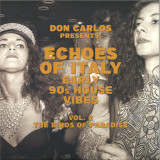
Volume 1 of this expertly curated project of 90s Italian House - put together by Don Carlos.
If Paradise was half as nice… by Fabio De Luca.
Googling “paradise house”, the first results to pop up are an endless list of European b&b’s with whitewashed lime façades, all of them promising “…an unmatched travel experience a few steps from the sea”. Next, a little further down, are the institutional websites of a few select semi-luxury retirement homes (no photos shown, but lots of stock images of smiling nurses with reassuring looks). To find the “paradise house” we’re after, we have to scroll even further down. Much further down.
It feels like yesterday, and at the same time it seems like a million years ago. The Eighties had just ended, and it was still unclear what to expect from the Nineties. Mobile phones that were not the size of a briefcase and did not cost as much as a car? A frightening economic crisis? The guitar-rock revival?! Certainly, the best place to observe that moment of transition was the dancefloor. Truly epochal transformations were happening there. From America, within a short distance one from the other, two revolutionary new musical styles had arrived: the first one sounded a bit like an “on a budget” version of the best Seventies disco-music – Philly sound made with a set of piano-bar keyboards! – the other was even more sparse, futuristic and extraterrestrial. It was a music with a quite distinct “physical” component, which at the same time, to be fully grasped, seemed to call for the knotty theories of certain French post-modern philosophers: Gilles Deleuze, Félix Guattari, Paul Virilio... Both those genres – we would learn shortly after – were born in the black communities of Chicago and Detroit, although listening to those vinyl 12” (often wrapped in generic white covers, and with little indication in the label) you could not easily guess whether behind them there was a black boy from somewhere in the Usa, or a girl from Berlin, or a pale kid from a Cornish coastal town.
Quickly, similar sounds began to show up from all corners of Europe. A thousand variations of the same intuition: leaner, less lean, happier, slightly less intoxicated, more broken, slower, faster, much faster... Boom! From the dancefloors – the London ones at least, whose chronicles we eagerly read every month in the pages of The Face and i-D – came tales of a new generation of clubbers who had completely stopped “dressing up” to go dancing; of hot tempered hooligans bursting into tears and hugging everyone under the strobe lights as the notes of Strings of Life rose up through the fumes of dry ice (certain “smiling” pills were also involved, sure). At this point, however, we must move on to Switzerland.
In Switzerland, in the quiet and diligent town of Lugano, between the 1980s and 1990s there was a club called “Morandi”. Its hot night was on Wednesdays, when the audience also came from Milan, Como, Varese and Zurich. Legend goes that, one night, none less than Prince and Sheila E were spotted hiding among the sofas, on a day-off of the Italian dates of the Nude Tour… The Wednesday resident and superstar was an Italian dj with an exotic name: Don Carlos. The soundtrack he devised was a mixture of Chicago, Detroit, the most progressive R&B and certain forgotten classics of old disco music: practically, what the Paradise Garage in New York might have sounded like had it not closed in 1987. In between, Don Carlos also managed to squeeze in some tracks he had worked on in his studio on Lago Maggiore. One in particular: a track that was rather slow compared to the BPM in fashion at the time, but which was a perfect bridge between house and R&B. The title was Alone: Don Carlos would explain years later that it had to be intended both in the English meaning of “by itself” and like the Italian word meaning “halo”. That wasn’t the only double entendre about the song, anyway. Its own very deep nature was, indeed, double. On the one hand, Alone was built around an angelic keyboard pattern and a romantic piano riff that took you straight to heaven; on the other, it showcased enough electronic squelches (plus a sax part that sounded like it had been dissolved by acid rain) to pigeonhole the tune into the “junk modernity” section, aka the hallmark of all the most innovative sounds of the time: music that sounded like it was hand-crafted from the scraps of glittering overground pop.
No one knows who was the first to call it “paradise house”, nor when it happened. Alternative definitions on the same topic one happened to hear included “ambient house”, “dream house”, “Mediterranean progressive”… but of course none were as good (and alluring) as “paradise house”. What is certain is that such inclination for sounds that were in equal measure angelic and neurotic, romantic and unaffective, quickly became the trademark of the second generation of Italian house. Music that seemed shyly equidistant from all the rhythmic and electronic revolutions that had happened up to that moment (“Music perfectly adept at going nowhere slowly” as noted by English journalist Craig McLean in a legendary field report for Blah Blah Blah magazine). Music that to a inattentive ear might have sounded as anonymous as a snapshot of a random group of passers-by at 10AM in the centre of any major city, but perfectly described the (slow) awakening in the real world after the universal love binge of the so-called Second Summer of Love.
For a brief but unforgettable season, in Italy “paradise house” was the official soundtrack of interminable weekends spent inside the car, darting from one club to another, cutting the peninsula from North to centre, from East to West coast in pursuit of the latest after-hours disco, trading kilometres per hour with beats per minute: practically, a new New Year’s Eve every Friday and Saturday night. This too was no small transformation, as well as a shock for an adult Italy that was encountering for the first time – thanks to its sons and daughters – the wild side of industrial modernity. The clubbers of the so-called “fuoriorario” scene were the balls gone mad in the pinball machine most feared by newspapers, magazines and TV pundits. What they did each and every weekend, apart from going crazy to the sound of the current white labels, was linking distant geographical points and non-places (thank you Marc Augé!) – old dance halls, farmhouses and business centres – transformed for one night into house music heaven. As Marco D’Eramo wrote in his 1995 essay on Chicago, Il maiale e il grattacielo: “Four-wheeled capitalism distorts our age-old image of the city, it allows the suburbs to be connected to each other, whereas before they were connected only by the centre (…) It makes possible a metropolitan area without a metropolis, without a city centre, without downtown. The periphery is no longer a periphery of any centre, but is self-centred”.
“Paradise house” perfectly understood all of this and turned it into a sort of cyber-blues that didn’t even need words, and unexpectedly brought back a drop of melancholic (post?)-humanity within a world that by then – as we would wholly realise in the decades to come – was fully inhuman and heartless. A world where we were all alone, and surrounded by a sinister yellowish halo, like a neon at the end of its life cycle. But, for one night at least, happy.
Gus Englehorn ist Bürger des Planeten Gus, eines unheimlichen Universums, entstanden durch die Urknall-Kollision zwischen heiterer Schönheit und apokalyptischem Chaos. Sein Hornbook verwandelt die Rock’n’Roll-Geschichte des 20. Jahrhunderts – die Golden Oldies der 50er, den Garage-Spunk der 60er, die glamouröse Extravaganz der 70er, die Indie-Transgression der 80er, die Lofi-Weirdness der 90er – in eine Alien-Übertragung aus der Zukunft. "The Hornbook" wurde in Montreal von Grammy-Gewinner Mark Lawson (Arcade Fire, Sophie Hunger, Basia Bulat) produziert, dessen Lebenslauf auch einen persönlichen Meilenstein Englehorns enthält: "Who Will Cut Our Hair When We’re Gone?" (2003), die herrlich verlotterte Debüt-LP der Montrealer Kulthelden The Unicorns, die ihn sehr beeinflusst haben.