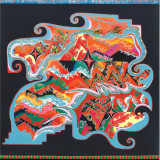
In his “Pulse Music” compositions of the mid-1970s, composer John McGuire forged a unique interpretation of European serialism. A student of Karlheinz Stockhausen, Krzysztof Penderecki and Gottfried Michael Koenig, McGuire moved to Cologne, Germany in 1970, where he become associated with the world-leading Studio for Electronic Music at Westdeutscher Rundfunk (WDR) in Cologne. Like Stockhausen, McGuire found his musical imagination both constrained and inspired by the technology that was available to him.
A conversation with sculptor Hans Karl Burgeff led McGuire to think beyond the horizon and into limitless space. For “Vanishing Points” (1985–1988), McGuire used an entirely digital set-up for the first time: a digital sequencer, eight Yamaha DX-7 synthesizers and a Studer 24-track digital tape recorder. The piece was conceived as a “sequel” to the Pulse Music series, but also a step forward from it. Whereas the Pulse Music pieces had employed steady streams of pulses, with Vanishing Points McGuire employed pulse layers that accelerate or decelerate against one another, vastly increasing the resulting rhythmic complexity.
McGuire's exploration of music technology continued in “A Cappella” (1990–1997), written for his wife, the soprano Beth Griffith, known for her recording of Morton Feldman’s “Three Voices” made in 1983. Using samples, he created a four-voice choir of voice samples and arranged them into interacting parts. The composition faced challenges due to the organic nature of the human voice compared to the precision of synthesized sounds. This process involved extensive editing and a negotiation between the "material" and the "original conception". This sort of negotiation applies as much to the composition of a single piece as it does to the work of two decades.
Search:the sample choir
Aurora Records proudly presents Temporal Gardening, featuring
composer and performer Stephan Meidell and the baroque ensemble
Bergen Barokk
The new album will be available on vinyl and digital platforms on15th of
September 2023.
Temporal Gardening was originally a commission written in 2020 for Bergen
Barokk. The idea was to explore using early music instrumentation in dialogue
with new electro-acoustic technology. The unique and remarkable ecology grew
from pseudo- baroque music playfully reimagined, reinterpreted, disassembled,
remixed, and resampled.
The trio has been expanded with drums, functioning as speakers for the
electronic manipulations of the ensemble. A double-bass recorder vibrates a subwoofer speaker mounted inside a bass drum, and a live sampled harpsichord
sounds through cymbals, gongs, and a snare drum. Meidell himself part takes as
a musician in the performance, doing live sampling and electronic contributions.
Musician-composer Stephan Meidell is a musical adventurer who, in a nomadic
fashion, improvises his way through a plentitude of styles. Meidell's music exists
where genres dissolve into fragments that canbe picked apartand combined in
new ways. He frequently combines sounds from electronic, acoustic, and
electromechanical instruments and machines and then recontextualises them
with his finely tuned intuition and sense of detail. Meidell has a plentitude of
releases and commissions, including with Erlend Apneseth Trio, Strings &
Timpani, Cakewalk, and TRIGGER on labels such as Hubro, Clean Feed, Playdate,
and Ideophone.
Bergen Barokk was established in 1994 and is today one of Norway's leading
early- music ensembles. The group has concertized and appeared in radio
broadcasts in Europe, Russia and USA. Their recordings on Simax Classics, BIS,
Bergen Digital Studio and Toccata Classics include German, English, Italian and
French repertoire. Bergen Barokk has collaborated with several ensembles
through the recent years, some of them are Pratum Integrum (Moscow),
Norwegian Soloists' Choir and Barokksolistene (Norway). Bergen Barokk has
performed in festivals like Festspillene i Bergen, Bach Festival of Philadelphia,
Moscow Early Music Festival and Janacek International Music Festival (Czech
Republic).
The next chapter of the Natural Information Society is here. Since Time Is Gravity, credited to Natural Information Society Community Ensemble with Ari Brown, presents a newly expanded manifestation of acclaimed composer & multi-instrumentalist Joshua Abrams nearly 15 year, 7 albums &-counting flagship ensemble. Joining the core NIS of Abrams (guimbri & bass), Lisa Alvarado (harmonium) Mikel Patrick Avery (drums) & Jason Stein (bass clarinet) are Hamid Drake (percussion), Josh Berman & Ben Lamar Gay (cornets), Nick Mazzarella & Mai Sugimoto (alto saxophones & flute), Kara Bershad (harp) & Chicago living legend of the tenor saxophone Ari Brown. Recorded live to tape at Electrical Audio & The Graham Foundation, cover painting Vibratory Cartography: Nepantla, by Lisa Alvarado. 2xLP on Eremite USA, 2xLP & CD on Aguirre/Eremite Europe. Out 14-04.
Since first developing Natural Information Society in 2010, Joshua Abrams has been gradually expanding the group’s conceptual underpinnings, its musical references & the sheer number of the group’s members. Its music is, in a sense, an expansive form of minimalism, based in repeated & overlaid rhythmic patterns, ostinatos & modality. Its roots, its scale & its meaning become clearer in time. If time is gravity, it also allows us to carry more. Having begun as fundamentally a rhythm section with Abrams’ guimbri at its core, the version here can stretch to a tentet, including six horns.
Abrams has been expanding his minimalism gradually, but he has long understood a key to minimalism’s potential: the breadth of its roots in the late 1950s & early 1960s, ranging from the dissatisfaction of young European-stream composers with the limitations of serialism to the simultaneous dissatisfaction of jazz musicians with the dense harmonic vocabulary of bop & hard bop. The former began exploring rhythmic complexity & narrow tonal palates in place of harmonic abstraction (Steve Reich’s Drumming, Philip Glass’ Music with Changing Parts; perhaps above all Terry Riley’s In C & his late ‘60s all-night organ & loop concerts); the later reduced dense chord changes to scales (signally with Miles Davis' Kind of Blue, but rapidly expanding with John Coltrane’s vast project). In the 1950s the LP record opened the world with documentation of Asian & African musics, key influences on both minimalists & jazz musicians. If John Coltrane’s soprano saxophone suggested the keening shehnai of Bismillah Khan, the instrument was rapidly taken up by two key minimalists, LaMonte Young & Riley, similarly appreciative of its flexible intonation, the same thing that kept it out of big bands.
If the guimbri, the North African hide-covered lute that Abrams plays with NIS, involves a rich tradition of hypnotic healing music associated with the Gnawa people, Abrams’ music also touches on other musics as well — other depths, memories & healings, different drones, rhythms & modes. As the group expands on Since Time Is Gravity, he has made certain jazz traditions in the same stream more explicit as well. If there is a mystical & elastic quality involved in the experience of time, both in direction & duration, you will catch it here. The parts for the choir of winds expand on the roles of Abrams’ guimbri, Mikel Patrick Avery & Hamid Drake’s percussion & Lisa Alvarado’s harmonium: at times, the winds are almost looping in the tentet version, each hitting a repeating note in turn, at once drone & distinct inflection on temporal sequence. The brilliance of the work resides in Abrams’ compositions, the NIS’ intuitive execution & in Ari Brown’s singular embodiment of the great tenor saxophone tradition, including the oracular genius of Eddie “Lockjaw” Davis, & Yusef Lateef. The three pieces by the expanded NIS featuring Brown —the opening “Moontide Chorus” & “Is” & the ultimate “Gravity”— have an immediate impact, & togther might be considered a kind of concerto for tenor saxophone. Here Brown presses almost indistinguishably from composed melody to improvised speech, getting so close to language that he might have a text. Everything here is a sign. Note the tap of the Rhythm Ace that links “Moontide Chorus” to “Is”, the attentive heart always present, even when signed by a machine. There’s a link here to the methodologies & meanings of dub music & the linear & vertical collage of beats, textures & tongues: treated with reverence, a sample of a beat-box can be as soulful, as hypnotic, as a mbira or a tamboura. If those pieces with Brown are heard as a suspended concerto, the three embrace & enfold the other works, like the sepals of a flower. That placement will also touch on the mysteries of our perception of time.
Particularly in “Is”, but elsewhere as well, a phenomenon of transcendence arises in which time appears to be tripartite, at once moving backwards & forwards & standing still. This is an act of technical brilliance certainly, but also an illumination of music’s ability to represent temporal consciousness through polymetrics. This particular listener has only heard it before in a few places, including the horn shouts & bowed basses of Coltrane’s Africa, in moments of Charles Mingus’ The Black Saint & the Sinner Lady, in certain pieces where tapes were literally running backwards, & earlier still in Dizzy Gillespie’s Cubana Be, Cubana Bop, in which the composer George Russell & conguero Chano Pozo found a music that spoke at once in the voices of Stravinsky’s Rite of Spring & the vestigial rites, rhythms & songs of the Yoruba language & Santeria religion of inland Cuba.
In Joshua Abrams’ compositions & the realization of them by the NIS, in the time of one’s close listening & memory thereof, distinctions between the “natural” & the “social”, the “quotidian” & the “transcendent” are erased, suspended or perhaps irrelevant. Consider two of the ensemble pieces, one named for nature, the other social science. In “Murmuration” the repeated wind figures of flute & alto saxophone combine with the interlocking patterns of harp, guimbri & frame drum (tar) to create a perfect moving stillness, not an imitation but a witness to the miracle of the starlings’ astonishing collective art, a surfeit of beauty that might be the ultimate defense tactic.
“Stigmergy” takes its name & concept from the Occupy movement’s Heather Marsh, who proposes a social system based on a cooperative rather than competitive models, one in which ideas are freely contributed & developed as ideas rather than an individual’s property. In its form, Abrams’ “Stigmergy” is the closes thing to traditional jazz, a series of accompanied solos by each of the wind players. However, the composed accompaniment is a radically collectivist notion: a repeated rhythmic figure, call it ostinato or riff, in which the different winds each play only a note or two of the figure, a concept both more collectivist & individualistic in its conception than any typical unison figure. It suggests another of the underlying recognitions that propel the Natural Information Society, the group as social organism, the teleology of hypnotic anarchy, all parts in place, functioning systematically, evolving & expressing itself, its nature & society, as a transformative organism.
George Lewis has described music as “a space for reflection on the human condition”. This suggests that, rather than a “distraction”, at least some music might serve as a distraction from distraction. It’s a focus, a clarity, a awareness, an external invitation to interiority, as if music itself is a model for form & contemplation, an organism contemplating for us or as us. If that is a possibility, & I am sure I have heard such musics, than this music is among them. How many of our rhythms, melodies & harmonies (cultural, historical, biological, psychic) might such music carry, translate & transform in the particulate ecstasy of our own murmuration? (Stuart Broomer, April 2022)
"Morphing Chinese traditional music with bass, Chicago footwork and AI-manipulated birdsong. It's quite a feat to sound this ancient and futuristic simultaneously." The Guardian
"The album presents a world where flute and guanzi find common ground with choral vocals, ambient and AI- manipulated birdsongs." Vinyl Factory
"There has never been a record that sounds like this. And, very possibly, never will be again" Bandcamp
'At once fine-grained and expansive, Lee's work combines traditional Chinese music and historical references with wild electronic experimentation" Pitchfork, 7.6
'Island Birdy' samples Bollywood vocals, 'Foreign Flowers' has hints of warped drum & bass and 'Feather Signifier' is steeped in jazz fusion....Lee's most organic work has plenty of diverse influences" Resident Advisor, Album Of The Day
Swirling layers of OST-style sound design, dreamy choir vocals and traditional Chinese folk combine across eight dynamic and transportive tracks on Birdy Island, the latest album by Beijing-based producer/artist, Howie Lee.
On Birdy Island Lee's intricate brand of traditional pan-asian exploration meets experimental bass weight sound via stripped-back UK Grime sonics and ceremonial taoist music.
Let's get it straight: "This is" is THE album by Ghia. It catches the band at its peak and features 10 songs, including not only their impeccable hit, "What's Your Voodoo?" but a full arsenal of yet unheard, timeless, and soulful music without equal. The songs on the album, which were recorded between 1988 and 1991, could be considered forerunners of the downtempo genre, with one foot in the late 1980s street soul direction but sparkling with touches of synth pop and contemporary jazz-funk. Genre limitations aside, all that Ghia ever wanted to do was create music-good music-and you will hear this in the depth of the compositions.
The album starts with "Keep Your House In Disorder," which has yet again become another classic song from the band's catalog since it was featured as the B-side of the "What's Your Voodoo?" reissue. The song is about a relationship in which the woman has trouble adapting to her boyfriend's turn in life. He tells her to "keep your house in disorder," meaning don't take things too seriously, don't stand still, and you will do better to take the sideroads in life.
"This Is" continues with the downtempo numbers "Crystal Silence" and "Close to You." Both are deep, one-of-a-kind, and previously unissued street soul ballads. On these two tracks, you can still hear the band's roots in jazz-funk. Hence, as a follower of the band's output may have yet recognized, instrumentals of these two tracks can be found on their first LP, "Curaçao Blue." In fact, "Close to You" was one of the band's first compositions. Earlier recordings of the song exist with different singers and different vocals, but it wasn't perfect until Lisa laid down the final version and a choir was added. It's difficult for us to recall any late-80s soul tune as beautiful and intriguing as this one. The final section, which begins with "so much baby we can say," sounds ahead of its time, reminiscent of mid-90s contemporary R&B.
Next up is "Eskimo," an equally brilliant and soulful downtempo composition, but with more focus on synth sounds than the previous tracks. Once more, it showcases the creative lyricism of the song writers, Boberg and Simon, imagining a train ride during a rainy and cold night: "feeling like an Eskimo in an igloo in New York."
Eskimo leads to the aforementioned classic, "What's Your Voodoo?" Originally released in 1991 on the small Mikado label, it was reissued on our label in 2019. We already called this "one of the most wonderful and mystic slow motion synth pop tunes ever recorded"-and we still mean it! Let's face it: this was done before British bands like Massive Attack, Tricky, and Portishead laid the foundation of trip-hop. Dare we call Ghia's music "proto trip-hop"? As a special bonus, the digital version of the LP features a previously unreleased mix of the song, which includes added samples; this should clarify how close Ghia actually was to the sound of the mid-'90s.
"Angel On Your Shoulder" and "L O M E" are two more completely unissued and great tracks from the band's shelved works. Being a bit more uptempo than the rest of the album, they fall between contemporary soul/R&B and synthesized pop music. And of course, another downtempo hit needed to be featured on the album: "You Won't Sleep on My Pillow." It was the original A-side of their single release in 1991, and since then it has been featured on various compilations.
The album concludes with a really strong ballad entitled "I Haven't Got The Power." Here we hear only pianist and keyboardist Lutz Boberg with Lisa Ohm, without further instrumentation. Basically recorded in a live session, this showcases once more the talent and ingenuity within the Ghia project.
Whether you agree or not, "This is" may easily be considered one of the best German late 80s/early 90s soul pop and downtempo albums ever recorded. Cautiously, it may even be submitted as the missing link between mid/late 80s soul by bands such as Sade, and later trip-hop groups like Massive Attack. Let us celebrate Ghia and their music, which had been shelved for more than 30 years but has now finally been released on The Outer Edge.
Following the release of their 2021's critically acclaimed album The Black Stone Affair, instrumental cinematic-soul outfit Whatitdo Archive Group unleashes two startling new singles: "Forbidden Cove" and "The Cashmere Chamber", out on limited edition 7'' on March 24th via Record Kicks. The 45 is limited to 500 copies worldwide and it is just an appetizer of the upcoming new album Palace Of A Thousand Sounds, scheduled for release on May 5th, 2023. Whatitdo Archive Group previous 45s went sold out in weeks and are currently very in-demand from collectors and djs.
On side A, we find the first single "Forbidden Cove". We are immediately greeted with top-notch production that feels like we stumbled upon yet another lost rarity, but this time from the heyday of American "exotica" music from the mid-century movement of the early '60s (think Martin Denny and Les Baxter). The twist here is that the underlying tone is dark, heavy and cinematic. WAG flexes their compositional chops and maturity with clever arrangements, a tight rhythm section and dreamy vibraphone that lead us to dense Arthur Verocai-esque orchestral arrangements and hypnotizing eastern flavors.
From the first notes of the Javanese metallophone, Whatitdo Archive Group welcomes you into "The Cashmere Chamber", on side B of the 7''. Less a room and more an auditory experience, "Chamber" skillfully guides you deeper into its world complete with menacing drums and bass, sinister vibraphone melodies and a haunting choir. But this driving force of the rhythm section isn't enough for WAG; we see the song quickly blossom into an adrenaline pumping guitar feature layered expertly with a Turkish baglama saz and percussion. This track is a sample-worthy heater for any DJ.
The new album Palace Of A Thousand Sounds will be available May 5th, 2023 on limited edition LP, CD and digital platforms. Palace Of A Thousand Sounds finds Whatitdo Archive Group entrenched deeper in the worlds of mid-century exotica and library music—from the Tropicalia-steeped Amazon to the minor key tonalities of the far-out Near East.
Steeped in obscurity, a cult following of crate-diggers and musical oddity collectors has been brewing over the mysterious releases of the Whatitdo Archive Group. Surfacing in 2009 from the high deserts of Reno, NV USA, this three-piece recording collective (Alexander Korostinsky, Mark Sexton and Aaron Chiazza) focuses solely on curating, performing and preserving esoteric soundtrack, library and deep-groove collections. As an onlooker, it's hard to tell whether the music they are procuring is actually archival, music of their own creation, or both. Their debut LP The Black Stone Affair, the formerly lost soundtrack music of a once-shelved Italian cinematic masterpiece, was released in 2021 and received praise from the likes of Wall Street Journal, Mojo Magazine, Uncut, Shindig and Blues & Soul Magazine, BBC 6 (UK), FIP (FR), KCRW (US), JazzFM (UK) and more. Two years later, the Whatitdo Archive Group is back. Get ready for an exotic adventure with their sophomore full-length effort: Palace of a Thousand Sounds.
In the late 1980s, the renowned American jazz pianist, composer, and arranger John Hicks formed one of the most influential ensembles consisting of musicians that had played music at the highest level all their lives and gained their status as both stand-alone artists and important sidemen. Each of them had participated in many of jazz’s great moments and all shared the ability, documented on many albums, to inspire their fellow musicians to even greater heights. The ‘John Hicks Trio’ had several line-up changes over the years that included greats such as Clifford Barbaro (Strata East, Blue Note, Sun Ra Arkestra, Charles Tolliver), Clint Houston (Prestige, Nina Simone, Roy Ayers, Azar Lawrence), Ray Drummond (Freddie Hubbard, Art Blakey, Lalo Schifrin), Marcus McLaurine (Muse, Verve, Weldon Irvine, Kool & The Gang) and Victor Lewis (Steve Grossman, Stan Getz, Charles Mingus, Cedar Walton, Chet Baker).
On the album we are presenting you today (I’ll Give You Something To Remember Me By from 1988) the trio consists out of some of the biggest and best players in the jazz, funk and soul scenes:
On piano we have the Atlanta based trio’s bandleader JOHN HICKS (1941-2006). He served as a leader on more than 30 albums and played as a sideman on more than 300 other recordings. After being taught piano by his mother, Hicks went on to study at Lincoln University of Missouri, Berklee College of Music, and the Juilliard School. After playing with a number of different artists during the early ’60s (including Oliver Nelson and being part of Pharoah Sanders’s first band) he joined Art Blakey & The Jazz Messengers in 1964. In the early ’70s he taught jazz history and improvisation at Southern Illinois University before resuming his career as a recording artist. Next to his many solo recordings for labels such as Strata East and Concord, Hicks would collaborate with all the big names in the scene, including Archie Shepp, Mingus and Alvin Queen. In 2014 & 2015, J Dilla paid homage to John Hicks by sampling two of his songs.
On drums we have the legendary IDRIS MUHAMMAD (1939-2014) who to this day is still considered as one of the most influential drummers covering a multitude of genre-transcending styles. Born in New Orleans, he showed early talent as a percussionist and began his professional career while still a teenager, playing on Fats Domino’s ‘Blueberry Hill’. He then toured with Sam Cooke and would later go on to work with Curtis Mayfield. Next to his landmark solo recordings for Prestige Records, Idris would collaborate with iconic musicians and acts from the likes of Manu Dibango, Ahmad Jamal, Melvin Sparks, Charles Earland, Walter Bishop, Ceasar Frazier, Roberta Flack, Gato Barbieri, Nathan Davis, Sonny Rollins, Lou Donaldson, Galt MacDermot, Lonnie Smith…and countless others. Idris Muhammad’s work was sampled by renowned performers such as Drake, Beastie Boys and Fatboy Slim.
On bass we have CURTIS LUNDY (born 1955) who originates from Florida. Lundy is a well-respected bass player (and a master of his instrument), choir director, arranger, composer and producer who was part of performances and recordings of renowned acts and artists such as Pharoah Sanders, Frank Morgan, Cole Porter, Chico Freeman, Khan Jamal… and many others!
On I’ll Give You Something To Remember Me By (recorded at the legendary Dutch Studio 44 in March 1987 and released on Limetree Records in 1988) the listener is treated to eight majestic tracks of the highest caliber (including an excellent Thelonious Monk cover-tune) and features a remarkable outing of advanced musicianship by three jazz-giants in their prime, delivering an inspirational gem of an album.
These recordings sound as successful, young and vibrant as ever! Expect supercharged ragtime Post Bop with striking notes, no-holds-barred musicianship, high swinging solos, screaming choruses and plenty of solid virtuosity to spare. The up tempo none stop Latin beat is complimented by the terrific drum solos of Idris Muhammad and the rhythmic bass strokes of Curtis Lundy. This electrifying set of tracks makes this release a bonafide hit and a must have for any self-respecting jazz fan or collector.
Infinite Machine is proving again it's a label that refuses to sonically sit still. Having released everything from code-based compositions to bass-heavy techno in 2022, the imprint is readying the release of the black metal-tinged Ehkta by BOLT RUIN later this month. A musician whose work has been described as 'apocalyptic' more than once, on this new mini-album, the Belgian producer blends field recordings, twisted samples and rave signifiers with an eerie tonality born out of his nocturnal production sessions and time spent absorbing the silence of his studio garden.
Bridging the gap from his previous record to this one, 'Sktone' is a cinematic opener that unfolds like a bad dream in slow motion. Warped samples of Bulgarian choirs glide over synths wired in closed-circuit loops which feed back on themselves, degrading for infinity. Texture and space is added via field recordings of waves crashing over the ruins of Brighton West Pier. This track exemplifies the unexpected influence BOLT RUIN took from the wildlife he witnessed in the garden of his urban studio when working on Ehkta. Adapting to the material at their disposal, weasels and blackbirds create nests from organic waste and human trash - an astute metaphor for the Belgian producer's compositional approach.
Next up, BOLT RUIN drives up the tempo with the rave-ready 'Nehng', where a frenzy of trance arpeggios and frantic drum programming builds and intensifies over its 5-minute duration. Inspired by Yves Klein's 'Leap Into a Void', 'Nehng' definitely evokes that bodily rush of freefalling into the unknown. 'Nehng''s driving rhythm is switched out for the brooding 'Tzarhk' - an ode to the soundtracks of B-movies composed on a vintage Roland SH-2 (a prominent character of the Stranger Things soundtrack). BOLT RUIN runs thick, syrupy synth slabs and punishing drum patterns through a rain-soaked limiter the producer found lying on the street by chance.
Another master-class in self-destructive arrangements comes in the form of 'Rfohmdrá' as delicate pianos and synth tones atrophy through daisy chained pedals which erode the signal. Valgeir Sigurðsson's mastering skills shines through here, taking BOLT RUIN's sci-fi-meets-metal sonics and amping them up to a scale on par with the Björk or Ben Frost records he's previously worked on.
Conceived of as the mirror reflection of the LP's opener, 'Maevr' pushes the approach of 'Sktone' to an even more nightmarish extreme. Embracing chance, the clattering layers of beats are sampled of a knocked mic on a window as BOLT RUIN attempted to capture a recording of rain from his studio. A happy and very effective accident for the foreboding mood of the track!
BOLT RUIN rounds off Ehkta with 'Ekztamnh'; an ode to that specific sensation of entering through a corridor to a rave and hearing the rumble of a soundsystem from afar. Snarling melodies are run through a reverse granular delay effect which fragments the signal, reverses it and plays them back in irregular order; much like the shattered memories of a late night in a warehouse.
A musical magpie who finds inspiration in the most unlikely of sources, Ehkta is a restless exploration of salvage-punk aesthetics where doom-laden black metal melodies, amen breaks and an experimental approach to sound design sit in an irregular and uneven musical apocalypse. For fans of Blanck Mass or Caterina Barbieri - this is a must-listen material from a fresh producer establishing himself with a singular musical voice.
Killer shit from Flore - Tip for fans of Simo Cell, Ploy, Metrist and Batu
After the widely acclaimed "Rituals" album released in April 2020, Flore is now back to the cherished area of banger engineering with a four packer of original compositions to be unleashed this spring 2022 on her own POLAAR imprint.
The project’s title itself shows clearly what her program is all about : "Legacy & Broken Pieces" has to be seen as a cruise into the anterior future rather than a trip down memory lane. Following this mantra, it’s more than clear that her music does not constitute a tribute to any previous club music history, but has to be seen as a true proposition of sonic innovation and moving paradigms.
"I'm tired of the nostalgia that can be found in electronic music nowadays. With everything that is going on right now, the world will never be the same. Then why should music has to be so ?" says Flore.
Thus, she offers to rework this legacy with her very own vision of sound wizardry, providing a wide range of sonic textures to fulfill this forward goal of breaking patterns within the electronic continuum. Yet another proof of Flore’s skills for always trying to innovate and never repeat herself.
“Disruption” echoes an aerial jungle of the former century while “Fiery Principle” rides Jamaican waves of bass soon dynamited by minced voice samples evoking a soul goddess from the 90’s. The upbeat intro of “The Switcher” leads us towards a choir of drums navigating various black rooted rhythm traditions, but tripping into a very refined and spatial production effort. The records ends with “Primary Mineral”. Its rough and matte sound seems to drill into a wall of fragmented beats racing towards an elusive end, suggesting another musical adventures to be revisited soon…
- A1: Kristi Brud - Variations Of La Folia - The Abduction Of Europa
- A2: Joel Ivar - Svalov 9 Juli
- A3: Inre Kretsen Grupp - Interlud
- A4: Fai Ling - Ikaros Svett Short Version
- A5: Borringe Kloster - Hommage A Eva Ramel
- B1: Philipp Otterbach - The Lost Track
- B2: Moonilena - Onio
- B3: Digge Shim - A Friend In Deed
- B4: Spivak - Oauver
- B5: Moisture - Blue Tea
Enter The Decagon assembles friends of the label - near and far - for further excursions into the abyss of industrial, folk, jazz and ambient music.
From Copenhagen hails Kristi Brud (Bride of Christ) extending us with a shimmering violin contemplation initially made for the short art film piece "The Abduction of Europa", absorbing a modal ambiance of harmonics rooted in central European renaissance. Recorded in Svalöv in rural Skåne comes a hillbilly folk jazz piece constructed by Joel and Ivar on equal parts violin, flute, upright bass and percussion, recorded somewhere in the misty era of of 2012-2015. Then, an interlude follows, reconstructed from the very early live sets of the label's own Inre Kretsen Grupp, laden with tuned metallic percussions and synthesized bow sounds. Following up, the idiosyncratic local talent Fai Ling offers a piece of Basinski/Hassel-esque horn repetitions in full deterioration. Concluding the A-side of the compilation is the band that never was - the only released material of Prins Emanuel and Golden Ivy's Börringe Kloster project - encapsulating their minimal maximal approach of low quality sound samples turned in to a wall of sound of rhythm of sorts.
The B-side picks up on different musings in the form of ambient cadence and carefully sculpted soundscapes signed Phillipp Otterbach, who gives us an unraveling journey into kalimba-hampered harmonies carried through a bed of industrial, synthesized sounds. Moonilena follows up with an eerie yet beautiful minimal composition of radio disturbances and repetitive, ear catching melodies.
Breaking the barrier of stillness, local producer and Catholic chant music fiend Digge Shim performs a rhytmical, tongue-in-cheek number that pulls widely from both the hymnal traditions of medieval Europe as well as the zonked out ambient trance sounds you'd meet in a mid nineties Goa chill-out room.
Near the tip of the decagon, we find the Cypriot producer, singer and lyricist Spivak presenting us with a feeling of the-familiar-but-never-heard in the form of an ambient pop breakbeat number with carefully crafted choirs oscillating on top - hauntingly beautiful and equally danceable.
Ending in the best of styles, well-mannered umarel and purveyor of drum-smitten metallic sounds shows us what Moisture is really about - the mental image of finding your true self dancing in purgatory in a never-released Kenneth Anger film set, encumbered with red lights and occult paraphernalia.
First trained in his church choir, Print played in R&B bands in high school and later developed a reputation as a standout rapper. On Adventures in Counter-Culture, he experiments with the synths, keyboards, and drum machines that connected the musical dots of those early days.
Print began pursuing his career as a musician in 2001, working on several hip hop projects including his collaborative project Soul Position with DJ/Producer RJD2. Releasing The Unlimited EP & 8,000,000 Stories on Rhymesayers Entertainment with RJ, Blueprint began work in 2004 on what would become his first solo album, 1988. The success of that album allowed him to tour extensively throughout North America and Europe, before returning home to focus on writing and recording his next album. When he sat down to work on this sophomore effort, Print began with the dark, soulful and sample heavy hip hop of the early 90's, but soon found himself hitting a creative wall. What shook him loose was a new mission: to create an album that encompassed every facet of music he knew, blurring genre lines and bringing it back home as one cohesive listening experience. The more he worked to pair new found interest in rock & electronic music with his love of hip hop, the more he was able to break down that creative barrier.
Thus began his Adventures in Counter-Culture, a monumental undertaking that would involve reinventing himself as a musician and person. His growing cynicism with the world, his disdain for pop culture, the state of politics, and an apathetic, uninspired society, all worked as fuel to inspire this sophomore album. Moved by the impact that sampling lawsuits were having on the music community, Blueprint also decided to return to his roots and began writing and producing his own original content.
First trained in his church choir, Print played in R&B bands in high school and later developed a reputation as a standout rapper. On Adventures in Counter-Culture, he experiments with the synths, keyboards, and drum machines that connected the musical dots of those early days.
Print began pursuing his career as a musician in 2001, working on several hip hop projects including his collaborative project Soul Position with DJ/Producer RJD2. Releasing The Unlimited EP & 8,000,000 Stories on Rhymesayers Entertainment with RJ, Blueprint began work in 2004 on what would become his first solo album, 1988. The success of that album allowed him to tour extensively
throughout North America and Europe, before returning home to focus on writing and recording his next album. When he sat down to work on this sophomore effort, Print began with the dark, soulful and sample heavy hip hop of the early 90's, but soon found himself
hitting a creative wall. What shook him loose was a new mission: to create an album that encompassed every facet of music he knew, blurring genre lines and bringing it back home as one cohesive listening experience. The more he worked to pair new found interest in rock & electronic music with his love of hip hop, the more he was able to break down that creative barrier.
Thus began his Adventures in Counter-Culture, a monumental undertaking that would involve reinventing himself as a musician and person. His growing cynicism with the world, his disdain for pop culture, the state of politics, and an apathetic, uninspired society, all worked as fuel to inspire this sophomore album. Moved by the impact that sampling lawsuits were having on the music community, Blueprint also decided to return to his roots and began writing and producing his own original content.
Recorded in 1971 by a 27-year-old pastor and an after school program choir, Like A Ship is a stirring and powerful meditation on the wayward aftermath of the Civil Rights Movement. Tracked with the help of Chess/Cadet maestros Gene Barge, Phil Upchurch, and Richard Evans, the album is a mix of euphoric gospel and Mayfield-esque political soul, with sleigh bells, hand claps, and jazzy piano stabs. Sampled by T.I., Kanye, and Khaled, Barrett created a rapturous, crossover gospel classic that's still wildly relevant.
Having initially met more than a decade ago at a local community radio station, sometimes doing guest slots on each other’s live, improvised noise shows, Cormac Culkeen and Dave Grenon knew they had a mutual interest in working with sonic textures. They listened to each other’s bands for a handful of years, and in 2017, “made good on a threat” that they’d been making for quite a long time: to start a band. At Cormac’s gentle but clear urging—declaring that they’d gone ahead and booked a space in which to record a video—the two wrote their first song, “Sebaldus,” an ambitious 12-minute trip, which also serves as the fireworks finale to their self-titled debut album. With surges of pathos that smooth out into something more soothing in turn, Cormac goes: “The hunter, you’ve seen him / The archer, his arrows are strong / And hunger, you’ve known her / I know the winter is long.” The track is as much about enduring a Canadian winter as it is about the eponymous 8th century hermit, shot through with sublimated desire. As Cormac put it, Joyful Joyful’s songs are “a little bit outside of time.” But while the lyrics beg close, oblique reading unto themselves, there’s also a distinct sense that they’re only one of many more ways that the duo shapes sound. Cormac, whose voice is like a sea with irregular tides, lights up about an idea in traditional sean-nós Irish music that songs already exist and are out there; it’s up to the singer to become the conduit. This belief in music as something to be channelled, and something more than sound, resonates with the singer’s fundamentalist religious past. To paraphrase: lots of group singing, harmonies, no instrumentation, totally unmediated, no priest, congregational—not choral, not a performance, not about talent, the spirit moves through people. “Of course that informs how I think about singing,” Cormac says. So, when they were exiled from the church because of their queerness, they took the music with them, dislocating it from its dogmatic bounds but not from its transcendent potential. This record might be thought of, then, as a kind of queering of sacred, devotional traditions—or at the very least, a space where all of these things can be held at once. Perhaps perceivable by some as contradictions, these intersecting influences create the conditions for an incredibly singular sound. Dave is steady and exploratory in his handling of this multiplicity, arranging sounds as they’re revealed, corralling them, coaxing them into form. “Because Dave is there,” Cormac says, “I get to sing three times higher, and three times lower, and faster, and backwards, and all of these sounds! That are there. They’re all there.” When asked about early musical memories, Cormac recalled an immediate fascination with harmony: from demanding that the first person they ever heard singing it explain what they were doing, to always (still, to this day) singing in harmony with their twin sister around the house, to being part of a children’s choir that sang soprano in Handel’s Messiah—not realizing until they entered the room with all the other ranges that their learned melody was but one part of the whole. Just as tellingly, Dave reflects on his early attraction to “abstraction and becoming abstract,” describing childhood afternoons messing with microphone and speaker feedback loops, producing long, enduring sounds with almost undetectable variations. In a way unique to the coalescing of these two listeners, notions of harmony are central to their output. Dave samples field recordings, old keyboards and synths, and vocal drones, running the live singing through four or five parallel effects chains, sampling and treating everything again in the moment. “Another way to put it is that Cormac’s voice comes into the board and then comes back out shifted, delayed, and shattered; Cormac and I hear it, live with it, and respond,” Dave says. This work is contingent not only on a deep intuition (neither of them read sheet music) of polyphony and due proportion (something St Thomas Aquinas famously listed as an attribute of beauty) but also on their connection to each other and ability to read subtle cues. Dave says they’d hold each other’s hands while performing if it was more convenient to do so, riffing on something else Cormac mentioned about traditional Irish singing: that someone would always hold the singer’s hand, for fear that without a tether to the ground they might find themselves utterly lost, unsure how to return. Joyful Joyful doesn’t shy away from offering such experiences of departure; they’re willing to unsettle their audiences because they themselves are unsettled. Their shared penchant for spooky, heavy music, and self-described “omnivorous” listening practices equip them with an array of sonic concepts that support this effort; Diamanda Galás, The Rankin Family, Pan Sonic, Pauline Oliveros, Keith Fullerton Whitman, Yma Sumac, and Catholic hymnody were just a few that came up. Observing their audience gives them insight about the effect of each song—something they considered while arranging the album. Its arc is marked by soft, sometimes sudden oscillations between cacophony and euphony, day and night (listen for insects), and from sexual, visceral entanglements to more ephemeral, celestial ones. Front to back, it arouses expansion, unraveling. Of lightning, Vicki Kirby writes: “quite curious initiation rites precede these electrical encounters. An intriguing communication, a sort of stuttering chatter between the ground and the sky, appears to anticipate the actual stroke.” By all accounts, something similar seems to happen at Joyful Joyful shows, between those on the stage and those off it, between what’s earthly and what’s beyond. “A lightning bolt is not a straightforward resolution of the buildup of a charge difference between the earth and a cloud … there is, as it were, some kind of nonlocal communication effected between the two,” writes Karen Barad, extrapolating on Kirby’s thought. Cormac acknowledges that while they and Dave play a role in this mysterious charge that comes about, they’re not solely responsible. However ineffable it may be, it’s undoubtedly a form of communion—and a sensuously shocking one at that
The Diva Faïrouz.
Her real name Nouhad Haddad, she was born in the Zokak el Blat district of Beirut. The eldest of a modest Maronite family, she developed a passion for singing very early on. Her parents are too poor to afford the luxury of a radio, so she spends most of her time listening, her ear glued to the wall, to the neighbors. Nouhad quickly memorizes the songs she hears and gives a few samples at parties organized by her school. It was there that she seduced her comrades with her vocal abilities and that she was noticed in 1947 by the composer Mohammed Fleyfel.
The echo of his velvety voice reaches Halim el Roumi, talent scout, renowned singer-songwriter and director of Lebanese Radio, who asks to audition him immediately. Literally fascinated, el Roumi introduced him to the choir of Radio Beirut, baptized it with the name of Faïrouz and became its appointed composer. Then, he introduces her to Assi el Rahbani, a young avant-garde composer who, in the company of his brother Mansour, wishes to renew a Lebanese song under profound Egyptian influence.
The teenager Faïrouz succumbed to the personal charm of Assi, whom she married in 1954, and to that of his compositions (the model couple of Arab song would be separated by the death of their husband in 1986). The heavenly trio causes, from the publication of its first titles, a real musical revolution. Traditionalists howl at sacrilege and distortion while sympathizers of the rejuvenation and modernization of Lebanese folklore, weary of insipid refrains and pale copies, show their enthusiasm.
In 1957, Faïrouz opened the International Festival of Baalbek (a locality mentioned in one of his flagship titles) and sang in the middle of the six columns of the Roman temple. This initial encounter with his audience, who warmly welcomed him, earned him the nickname "seventh column". Faced with this fabulous galloping success, the Rahbanis are stepping up their offensive and courageously playing the card of constant innovation. They wrote for Faïrouz musical sketches, operettas and, from 1962 to 1976, about fifteen sung plays in which she plays the role of a woman in love with Love, the true, the pure, the innocent. , and that of hope. She also appears in a few films but she quickly interrupts her cinematic odyssey.
It is still and always one of the major references of Arabic song and many of its titles, such as "Bint el Chalabia", are hummed as much by the new generation as by the old.
Arre! Arre! is the Swedish punk band that during the last decade have
won multiple awards, been booked to festivals such as Roskilde & SXSW and have gotten hand-picked to open for hardcore legends Refused'
On their new LP, the band have maintained their core inspiration from the 90s Riot Grrrl scene, while at the same time broadening their sound to include a wider range of influences - from post- punk and 60's ballads, to James Brown, to the Spice Girls. As usual, the album has a strong underlying theme throughout - this time of motorbikes and female biker gangs, with the band even going to the extreme of recording local bikers driving around the car park of the Studio Sickan
to sample within the tracks. Combined with the other new production quirks such as ABBA- inspired choirs and galloping percussion, 'We Ride The Universe' has turned into a markedly cohesive and unique album for the band, sure to impress fans both new and old. The album is out on PNKSLM Recordings (ShitKid, Les Big Byrd etc.).
St. Paul and the Broken Bones announce their new album ‘The Alien
Coast’, released on ATO Records. Produced by Matt Ross-Spang and
featuring eleven new, original songs, ‘The Alien Coast’ is the first St.
Paul and the Broken Bones album tracked in the band’s hometown of
Birmingham, AL. The arrangement allowed the octet to spend more time
and tap a broader creative community than ever before, resulting in their
most ambitious work to date.
Led by singer and lyricist Paul Janeway - a former bank teller and
preacher-in-training who learned to sing in his church choir - the octet
explore thrilling new territory on ‘The Alien Coast’, a fever dream
convergence of soul and psychedelia, stoner metal and funk, animated
by the very “fire and brimstone” which Janeway invokes in the album’s
opening line. Unlimited studio-time allowed individual members of the
band to experiment with synths and samples on ‘The Alien Coast’, and
even collaborate with Birmingham beatmaker and hip-hop artist Randall
Turner.
Janeway cites a similarly disparate range of influences that wove their
way into the writing for ‘The Alien Coast’, from Greek mythology and
dystopian sci-fi, to works of art like Bartolomé Bermejo’s Saint Michael
Triumphs over the Devil and 17th Century Italian sculpture, to colonialperiod history books. “The title actually came from reading about the
history of the Gulf of Mexico, which is home for us,” he recalls. “When
the settlers - or invaders, really - first came to the Gulf Coast they
couldn’t figure out what it was, and started referring to it as the Alien
Coast. That term really stuck with me, partly because it feels almost
apocalyptic.”
St. Paul and the Broken Bones have reached incredible heights since
breaking out with their first album in 2014. Their previous three albums
each debuted in the Billboard 200, their legendary NPR Tiny Desk has
over 7 million views, they’ve opened for the Rolling Stones, shared the
stage with Elton John, and appeared on several television shows
including Jimmy Kimmel Live, Austin City Limits and more. They were
also the first-ever musical performance on Stephen Colbert’s Late Show.
St. Paul and the Broken Bones announce their new album ‘The Alien
Coast’, released on ATO Records. Produced by Matt Ross-Spang and
featuring eleven new, original songs, ‘The Alien Coast’ is the first St.
Paul and the Broken Bones album tracked in the band’s hometown of
Birmingham, AL. The arrangement allowed the octet to spend more time
and tap a broader creative community than ever before, resulting in their
most ambitious work to date.
Led by singer and lyricist Paul Janeway - a former bank teller and
preacher-in-training who learned to sing in his church choir - the octet
explore thrilling new territory on ‘The Alien Coast’, a fever dream
convergence of soul and psychedelia, stoner metal and funk, animated
by the very “fire and brimstone” which Janeway invokes in the album’s
opening line. Unlimited studio-time allowed individual members of the
band to experiment with synths and samples on ‘The Alien Coast’, and
even collaborate with Birmingham beatmaker and hip-hop artist Randall
Turner.
Janeway cites a similarly disparate range of influences that wove their
way into the writing for ‘The Alien Coast’, from Greek mythology and
dystopian sci-fi, to works of art like Bartolomé Bermejo’s Saint Michael
Triumphs over the Devil and 17th Century Italian sculpture, to colonialperiod history books. “The title actually came from reading about the
history of the Gulf of Mexico, which is home for us,” he recalls. “When
the settlers - or invaders, really - first came to the Gulf Coast they
couldn’t figure out what it was, and started referring to it as the Alien
Coast. That term really stuck with me, partly because it feels almost
apocalyptic.”
St. Paul and the Broken Bones have reached incredible heights since
breaking out with their first album in 2014. Their previous three albums
each debuted in the Billboard 200, their legendary NPR Tiny Desk has
over 7 million views, they’ve opened for the Rolling Stones, shared the
stage with Elton John, and appeared on several television shows
including Jimmy Kimmel Live, Austin City Limits and more. They were
also the first-ever musical performance on Stephen Colbert’s Late Show.
1976 Space jazz-folk masterpiece infused with prog scents from one of the true legends of Argentinian music, latin rock pioneer Litto Nebbia. Floating electric piano, acoustic guitar, female choirs and moog sounds combine with Litto's own voice and create a unique blend of delicate beauty. The use of analogue synthesizers in this conceptual album was a turn in Nebbia's work at the time. A long 7-minute suite opens the album, mixing acoustic textures with synth sounds, setting the grounds for the entire LP. Songs of introspective darkness alternate with other tracks influenced by sunny bossanova, musical passages fueled with epic energy where the voice of Mirtha Defilpo accompanies Nebbia along with the intricate and enveloping instrumental work driven by Daniel Homer's guitars and Litto Nebbia's keyboards. The album draws a complex soundscape made up of an almost infinite number of musical pieces, rich in layers and textures, that - decades after its original release - still stands out for their modernity. "Bazar de los milagros" is undoubtedly one of the most advanced recordings of those
that appeared in Latin America at the end of the 70s. Includes the song 'La Caída', as recently sampled on Jay Electronica/Jay Z's hip-hop hit 'The Neverending Story'. "Bazar de los milagros" has also been listed on Japanese DJ and music expert Chee Shimizu's Obscure Sound guidebook, a must for record collectors.
First vinyl reissue, including a facsimile version of the 32-page booklet that accompanied the original 1976 release, and remastered sound.
A1 is that classic Nebraska “This Is The Way” vibe; warm, atmospheric, sample-heavy 21st century disco with a truly euphoric build and release. A2 revises that first tune in a more tripped-out excursion. Both B-side tracks feature a French spoken-word vocal from BeBelle. “Fuis” is a blissed-out slow jam, whilst “Espace Fuis” picks the tempo back up again, adding a celestial choir and a fritzed-out arpeggiator solo.
- 1: Like A Ship
- 2: Wonderful
- 3: It’s Me O Lord
- 4: Ever Since
- 5: Nobody Knows
- 6: Joyful Noise
- 7: Medley
- 8: Blessed Quietness
- 1: Jesus Is All The World To Me
- 2: I Want To Be In Love With You
- 3: Jesus, Lover Of My Soul
- 4: O Sinner
- 5: I Shall Wear A Crown
- 6: Do Not Pass Me By
- 7: Here I Am
- 8: There Is Only One
- 9: O What A Day
- 10: No Not One
- 1: Long (He’ll Wait For You)
- 2: I Came To Jesus
- 3: What Would You Give
- 4: I Am So Glad
- 5: Pray, Pray, Pray
- 6: I Found The Answer
- 7: Trouble And Strife
- 8: He Rose (From The Grave)
- 9: Shine On Me
- 10: Turn On With Jesus
- 1: Do Not Pass Me By
- 2: After The Rain
- 3: These Are The Words
- 4: Father Stretch My Hands
- 5: So Many Years
- 6: You May Not Need Him
- 7: Oh What A Day
- 8: I Want To Be In Love
- 1: Lord's Prayer
- 2: Said It Long Time Ago
- 3: My Country Tis Of Thee
- 4: In The Old Time Way
- 5: Jingle Bells Pt. I
- 6: Nobody Knows
- 7: Dry Bones In The Valley, Excerpt 1
- 8: Dry Bones In The Valley, Excerpt 2
- 9: Dry Bones In The Valley, Excerpt 3
- 10: Dry Bones In The Valley, Excerpt 4
- 11: How Would You Like To Have A Nice Hawaiian Punch?, Excerpt 1
- 12: How Would You Like To Have A Nice Hawaiian Punch?, Excerpt 2
- 13: How Would You Like To Have A Nice Hawaiian Punch?, Excerpt 3
A Civil Rights activist who marched alongside Jesse Jackson, preacher for Earth Wind & Fire, Stax recording artist, “Family Feud” contestant, Stephen Curry soundtracker, high school drop out, and Kanye samplee, Pastor T. L. Barrett stuffed a dozen lives into one. His signature 1971 spiritual soul jam “Like A Ship” has transcended its humble South Side Chicago beginnings, rediscovered by Leon Bridges and Beck and described by Radioheadʼs Colin Greenwood as “The most euphoric celebratory music that makes you want to jump around the house and explode with joy.” This box is the definitive statement on Barrettʼs two decades of recordings, 49 tracks spread across five LPs, including Like A Ship, Do Not Pass Me By Volume 1 & 2, I Found The Answer, plus a bonus album of singles and sermons, a 10,000 word blow-by-blow, and illustrated discography.
The final album in Pastor T.L. Barrett’s 1970s four-part suite of gospel funk LPs, Do Not Pass Me By finds the fiery preacher getting spaced out on God’s love. Accompanied by his Youth For Christ Choir, the eight-song record is buoyed by the seven- minute opus “Father Stretch My Hands,” later sampled by Kanye West on 2016’s The Life of Pablo.
- A1: Future Children - The Lutine Bell
- A2: Regal Worm Vs The Amorphous & Dodginess - Gunter & His Evil Soul Sacrifice Orchestra Play Black Mass A Gogo
- A3: Cobalt Chapel - Hymortality (Part 1)
- A4: The Amorphous Androgynous - Physically I'm Here, Mentally Far, Far Away (Excerpt)
- A5: Higher Peaks - In Madness Reigns
- A6: Cobalt Chapel - Hymortality (Part 2)
- A7: Las Trompas De Falopium - Somos Inmortales Nos Persuadimosi
- B1: Stoned Freshwaters - Everything Is Easy With A Little Persuasion
- B2: Atomic Simao - Gravity Bong
- B3: Richard E Further Out - Our Dominion
- B4: Steve Cobby's Sweet Jesus - The Persuader
- B5: The Amorphous Androgynous - Synthony On A Theme Of Mortality (Part 2)
- B6: The Flying White Dots - Counting Down The Time (Part 2)
- B7: The Cuckoo Clocks - Tomorrow, Time & Immortality
Black vinyl pressing of the now sold out RSD 2020 reissue.
The Amorphous Androgynous unite their award winning psychedelic compilation series ‘ A MONSTROUS PSYCHEDELIC BUBBLE ( Exploding In Your Mind ) ‘ with their symphonic new single ‘ We Persuade Ourselves We Are Immortal’ ( taken from the forthcoming album ‘ LISTENING BEYOND THE HEAD CHAKRA ‘ ) to create this latest installment of the Monstrous Psychedelic Bubble series . Featuring a host of luminaries such as Peter Hammill -vocals ( Van Der Graaf Generator ) Paul Weller -piano and guitar and erstwhile members of the SPENCER DAVIS GROUP/ Ian Gillan Band AND SOFT MACHINE on lead guitar and sax among a plethora of other musicians ( including the Chesterfield Philharmonic choir and a full string section ! ) alongside collaboration & remixes with a host of bands ( ATOMIC SIMAO / HIGHER PEAKS / REGAL WORM / COBALT CHAPEL plus others ) to create one helluva progtronic psychedelic trip through the Amorphous Androgynous samplerdelic multiverse.
Over the course of two decades The Body - Lee Buford and Chip
King - have consistently challenged assumptions and defied
categorization, redefining what it means to be a heavy band.
On ‘I’ve Seen All I Need To See’, they test the boundaries of the
studio to explore the extremes and microtonality of distortion to
find its maximal impact.
Their most incisively bleak album to date, a towering monolith of
noise, Buford’s booming, resolute drums paired with King’s
obliterated guitar and howl.
Course, bristling distortion contorts every instrument, with
samples of spoken word, cymbals, toms and King’s already
noxious tone emerging from layers of feedback.
Features guests Ben Eberle (Sandworm) and Chrissy Wolpert
(Assembly of Light Choir).
Recorded with long time engineer Seth Manchester at Machines
with Magnets (Lightning Bolt, Battles, Daughters) and mastered by
Matt Colton (Sumac, Brian Eno, Uniform, Sunn O)))).
Available on CD, metallic silver vinyl and black vinyl. LP formats
include digital download code.
The Body have collaborated with many, including Full Of Hell,
Thou, Uniform and Bummer.
“The distortion has this ability to envelope you, and not push you
away. It has this strange kind of beautiful timbre... once you give
into the sheer power of it, and let it take you on a ride then it
becomes this whole other kind of sonic experience.” - Matt Colton
The Body have continued to mould their sound into something
even more devastating, gorgeous and terrifying... As a whole, The
Body’s discography is, and will continue to be, without peer.” -
Metal Injection “Some of the most captivating heavy music around right now.” - Rolling Stone
Over the course of two decades The Body - Lee Buford and Chip
King - have consistently challenged assumptions and defied
categorization, redefining what it means to be a heavy band.
On ‘I’ve Seen All I Need To See’, they test the boundaries of the
studio to explore the extremes and microtonality of distortion to
find its maximal impact.
Their most incisively bleak album to date, a towering monolith of
noise, Buford’s booming, resolute drums paired with King’s
obliterated guitar and howl.
Course, bristling distortion contorts every instrument, with
samples of spoken word, cymbals, toms and King’s already
noxious tone emerging from layers of feedback.
Features guests Ben Eberle (Sandworm) and Chrissy Wolpert
(Assembly of Light Choir).
Recorded with long time engineer Seth Manchester at Machines
with Magnets (Lightning Bolt, Battles, Daughters) and mastered by
Matt Colton (Sumac, Brian Eno, Uniform, Sunn O)))).
Available on CD, metallic silver vinyl and black vinyl. LP formats
include digital download code.
The Body have collaborated with many, including Full Of Hell,
Thou, Uniform and Bummer.
“The distortion has this ability to envelope you, and not push you
away. It has this strange kind of beautiful timbre... once you give
into the sheer power of it, and let it take you on a ride then it
becomes this whole other kind of sonic experience.” - Matt Colton
The Body have continued to mould their sound into something
even more devastating, gorgeous and terrifying... As a whole, The
Body’s discography is, and will continue to be, without peer.” -
Metal Injection “Some of the most captivating heavy music around right now.” - Rolling Stone
The music of CARM features horns in roles typically reserved for drums, guitars, and voices, while also escaping the genre categorizations reserved for music featuring an instrumentalist as bandleader. It is not jazz or classical music, nor is it a soundtrack. This is contemporary popular music that features a sound normally used as a background color and texture as the unabashed lead voice. According to CARM, aka CJ Camerieri, "It started with the question: `What kind of record would my trumpet-playing heroes from the past make today?' I believe they would want to work with the best producers, beat makers, song-writers, and singers to create new, truly culturally relevant music, and that's what I sought to do with this project." Produced in Minneapolis by Ryan Olson ( Polica , Lizzo ) and featuring collaborations with Sufjan Stevens , Justin Vernon ( Bon Iver ), Yo La Tengo , Shara Nova , Mouse on Mars , Francis and the Lights and many others. It is a completely unique sound that additionally serves as a survey of the collaborations that have come to define the artist's career thus far. Says Vernon, "I truly believe there isn't a more accomplished brass player in the entire world of music. And this is way more than a 'horn' record. It's a discovery of new heights with what is possible in creating music." The album begins with an orchestral brass choir of french horns, which quickly gives way to a piano sample from Francis, as Stevens and Lupin combine voices over a lush bed of horns to sing "Song of Trouble." The album bookends with the same piano sample used as a springboard to an iconic lyric by Vernon in the album closer "Land." Between these two generation-defining artists we have upward sweeping melodies and fanfares reminiscent of Ennio Morricone . The acutely original sound of Georgia Hubley and Ira Kaplan of Yo La Tengo in "Already Gone" give way to the virtuoso sound of Nova's voice. A more experimental path emerges before the strings from yMusic bring us back to the piano sample that started the record. Instead of recycling well-trodden sounds, CARM offers a respite for those seeking an original voice.
Worldwide Award winners First Word Records are pleased to welcome back Souleance; a duo that have been releasing music with us for a decade now, and triumphantly returning to the fold with some brand new music for 2020.
This vinyl / digital EP, 'Les Mouches', is their first release for First Word since the acclaimed beat-tape 'French Cassette' from early last year.
Expanding on the original Normand-Parisian super-duo of Fulgeance and Soulist, the Souleance crew now includes Vincent Choquet on synths and Guillaume Rossel on drums as part of their live outfit. Whilst sonically their style remains unchanged, the formation into a full band sees the Souleance sound become bigger, more realised and more formidable than ever.
The title track 'Les Mouches' sets off the EP in a playful disco manner - a chugging bassline, assorted synthesisers, disco claps and a four-to-the-floor drum track, inspired by the likes of Larry Levan and Candido. Meaning "flies", Les Mouches was a legendary Manhattan club that existed around the era of Studio 54, and was infamously a hangout spot for Imelda Marcos. The club itself was named after a play by Jean-Paul Sartre.
Next up is the single 'Aquarelle' (meaning watercolours), which contains more layers than a Bob Ross painting. With its various elements splayed across its aural canvas, sprinkled with some subtle scratches, it's four minutes of funk presented in Souleance's inimitable way.
'The Bounce' follows and enters a more soulful side of the dance, dropping the tempo a touch and inviting in a huge bassline, squelchy keys and intermittent vocal hooks.
'Mont Maudit' takes more of a latin jazz direction with big drums and cymbals rocking throughout, whilst an infectious piano hook cruises throughout, and an ethereal gospel choir switches up the proceedings mid-way.
Things get deeper still with the epic broken beat-esque 'Maneuevers'. Crunchy rhodes dominate this slightly tweaked-out rhythm, a delectable piece of heads-down nujazz fused with Souleance's unmistakable funk once again.
'L'Opuleance' closes out this EP with some more traditional Souleance fare - the tempo a little more head-nod, this one is comprised of some deliciously wobbly bass, chopped samples and hefty breaks.
This EP is essentially a set of grooves marinated in nostalgia whilst managing to sound entirely current. Analogue synths, live bass, sleek cuts and intoxicating drums. This is another round of sure-shot dancefloor fire from our favourite French family.
Previous support has come from OkayPlayer, Bill Brewster, BBC 6 Music's Gilles Peterson, Tom Ravenscroft & Huey Morgan, and various DJs on Worldwide FM, NTS & Le Mellotron,
Please find enclosed one 'Deluxe' stereophonic gramophone record from Concept City, containing thirteen recordings of musics entirely produced upon 4-track portastudio for your pleasure and discourse - the sole work of Mr Robert Grant of this parish.
So states the photocopy insert from the 1985 November LP on Cordelia Records. Home to R. Stevie Moore, Rimarimba recently reissued by Freedom To Spend - and label owner Alan Jenkin's The Deep Freeze Mice, Cordelia was home to a menagerie of sound collage plucked from the ether.
Included is the only vinyl release from Concept City, spreading across 13 instrumental tracks of samples and noise. The Welsh choir and robovox meets hypnotic bass of Open The Network glides to the acoustics of Jayne Andrews and Filament, before Steam amasses TV ad cassette archives. As Etruria and Lapse Wine's Durutti meets reel-to-reel to the cold wave of War, Children and wasp synth of Helsinki, Grant slowly unfolds a masterpiece.
Looped drum samples, multiple layered to tape, sped up and slowed down for phasing, the title track is a pinnacle of 80s DiY genius. 'Crossroads' multi-sampling Meg leads to the exotica 'muzak' closings of Penetration and Friends. With just 5 albums over 40 years the music of Mr Concept can be a discovery and cherished.
The highly anticipated album by Jay-Z's 4:44 soul hurricane Hannah Williams & the Affirmations produced by award-winning composer and multi-instrumentalist Shawn Lee.
Hannah Williams, the British soul hurricane who sensationally became part of Jay-Z's chart-topping 4:44 album, is primed and ready for her own national and international breakthrough.
Williams turned heads worldwide when the hip-hop superstar sampled her heart-stopping vocals on 'Late Nights & Heartbreak' for the title track, '4.44' on his 2017 album. Now Hannah and her exemplary, Bristol-based band the Affirmations deliver a definitive career statement with the drop-dead soulful new album 50 Foot Woman which will be released October 18th on the Milan based imprint Record Kicks.
The album captures all of the visceral power of the band's increasingly legendary live performances. Shades of classic Soul and Psychedelic Funk blend uniquely with modern-day flavours on a record destined to set the soul agenda for 2019 and far beyond. "I've never been as proud of anything in my entire career" says Hannah.
Born in High Wycombe in Buckinghamshire, Williams'father was a musically gifted minister, and her mother let her join the church choir at the age of six. Hannah could read music before she could properly read words, and when she discovered soul by listening with her mum to Motown and Bill Withers, there was no turning back.
After a 2012 debut with her previous band the Tastemakers, it was 2016's Late Nights & Heartbreak that announced the arrival of Hannah Williams and the Affirmations. But little did she know that Jay-Z was listening. One day, at her then-day job running the music department at the University of Winchester, he sent her a text.
Once she'd established that it wasn't a wind-up, and summoned the courage to call him back, she learned that JayZ's producer, No I.D., had played him Hannah's track to inspire his response to Beyoncé's Lemonade, on which she sang of his infidelities.
Williams was as in the dark about how 'Late Nights & Heartbreak' would be used until 4:44 dropped. But the substantial sample of her voice opened doors she never dreamed of. "It was an incredible catalyst," she says, "as a change in our collective career, and getting a global audience. Suddenly, there were millions of predominantly American hip-hop fans listening to my voice, going 'Is this from the '60s? Is she dead?'"
What followed was a year of the band's widest-ever touring including an invitation to perform at Central Park Summer Stage NY, Toronto Jazz Festival and Brooklyn Bowl NY and expanded audiences in continental Europe where she and the Affirmations had already made a mark. Then came the burning determination to make the record of their lives. The captivating 50 Foot Woman is that album, produced by Shawn Lee, a respected presence on the funk/soul scene whose credits include Amy Winehouse, Lana Del Rey and Alicia Keys. Lee has released five solo albums as Shawn Lee's Ping Pong Orchestra on San Francisco label Ubiquity Records and is also one half of the cool melodic pop duo Young Gun Silver Fox.
Now the world will hear what the cognoscenti have known for a while: that Hannah Williams is the real deal, and sings from her very soul. "I feel like my performance comes from my solar plexus," she says. "The emotional side of it is so intrinsic; I can't take it away from what I do."
Where Future Unfolds is a new work spirited by Chicago-based sound & visual artist Damon Locks. Starting as a solo sound collage piece (where Locks pulled samples from Civil Rights era speeches and recordings to create an improvisational pallet for performance on his drum machine), over 4 years the project has blossomed into his 15-piece Black Monument Ensemble - featuring musicians (including Angel Bat Dawid on clarinets and Dana Hall on drums), singers (alumni of the Chicago Children"s Choir), and dancers (members of Chicago youth dance company Move Me Soul). Where Future Unfolds is a live capture of the ensemble"s epic debut at the Garfield Park Botanical Conservatory on the West Side of Chicago. Recalling the spirits of Phil Cohran"s Artistic Heritage Ensemble, Eddie Gale"s Black Rhythm Happening, Archie Shepp"s Attica Blues, and Public Enemy"s It Takes a Nation of Millions to Hold Us Back, the album presents an inspired, innovative & immediate intersection of gospel, jazz, activism & 808 breaks.
Influenced by the social and political climate of the modern
world, MOTSA’s debut album, ‘Perspectives’, is inspired by his
acute awareness of modern society’s dependence on
technology and the social media bubble also responsible for
the civic polarisation seen globally. The 11 track album takes
the listener on an emotional journey with dark, yet hopeful,
detailed compositions, each representing their own personal
story. The title “Perspectives” refers to a problem we all face:
differing perspectives of the same situation, which in turn
leads to conflict, be it in personal relationships, families and
even political discussions globally. With individuals and
groups often losing perspective in disagreements, MOTSA’s
debut LP calls for more empathy, highlighting our current
trajectory of an ego-driven society. Encouraging listeners to
spend less time behind computer screens and more time
outside in nature to broaden our horizons and reflect on
human decisions, many of the album’s samples were recorded
from MOTSA’s own environment. Using the sounds of children playing in the sand on a Balearic beach, crickets in the grass,
or the ambient soundscapes of bells recorded from his
father’s apartment in Moscow, the producer also recorded and
sampled his own voice to create distant, choir-like melodies in
many of the tracks. The artist’s signature sound – a soulful yet
driven harmonic blend – continues to propel the multi-talented
artist to the highest acclaim into 2019 and beyond.
RIYL HIDDEN CAMERAS/ARTHUR RUSSELL
Since his recording debut as Choir Boy in 2016, Adam Klopp mined a sound swirls 1980s synth noir with captivating, cinematic songs sweeping with pensive sorrow and glowing hope. As a former member of the Mormon faith, Klopp spent his youth both in the pews of his place of worship, but also churning through DIY punk venues, before leaving the sect in the thick of a mission in Tahiti.
The duality of faith and fiction are central to the lush explorations on his debut album Passive With Desire. Recorded at Studio Studio Dada, the album's tracks permuted as bedroom sketches, awash with camp, the sting of loss, and allusions to halcyon days of nocturnal, electronic driven pop. Retaining elements of Klopp's original demos, Passive With Desire was recorded with a full band and polished with trumpet, strings, as well as archival samples calling back to Klopp's hazy youth.
Engineered by Klopp, Bret Meisenbach, and Stephen Cope, Passive With Desire is the entry point to Choir Boy's world of emotive wit, novella kissed lyricism, and bouncy, synth-forward takes on traditional song writing bound by the universal themes of loss, desire, evolution, and exploration.
Now available for the first time in wide release, Passive With Desire is a proper introduction to Klopp's unique storytelling, orated by his full, rangeful vocals. The expanded CD version comes with a 12-page lyric booklet, and combines the album with seven bonus tracks, including the Sunday Light EP and tracks from the limited Part Time Punks cassette. The repackaged LP edition comes in a sturdy matte jacket with matte Eurosleeve insert with lyrics. The first pressing comes in limited editions of 100 on Clear/Black/Red Splatter, 400 on Metallic Red, and standard black vinyl.
Key Selling Points:
- Expanded CD version comes with a 12-page lyric booklet, and combines the album with seven bonus tracks, including the Sunday Light EP and tracks from the limited Part Time Punks cassette.- LP edition comes in a sturdy matte jacket with matte Eurosleeve insert with lyrics. - LP comes with download- Reissue of debut album
Nirosta Steel is a sometime alias of Steven Hall. Musician and survivor of the `80s NYC`s art melting pot. Everybody Sing dances like Steven`s long-term collaborator and lost-way-too-early friend, Arthur Russell. As he forced irresistible, idiosyncratic, Disco-Not-Disco, out of the Ingram Brothers. Riding low rumbling bass. Phased guitar, country picking, flickering in and out of the mix. Strings, choir boy falsetto, and blue yodel, cutting through its delay-drenched, dance floor delirium.
L.A.`s Cole Medina delivers two reworks. His Heavy Disco take is intro`d by cowbell and synth swirls. Cymbals crashing like sampled surf. With Stratocaster microtones, and echoes of the original, washing over an electronically, re-imagined B-line and trip-py sequences.
Cole`s Knuckles Tribute sets poignant piano and gated orchestral euphoria against a classic Def Mix groove. Revealing the song in epiphany. Clarifying the lyric`s call for unity. Where singing your troubles away is a analogy for strength in adversity. Everybody hurts sometimes. In that, we are united. Eventually heading towards its own disorientating climax. Comin` at ya from all sides.
Mind Fair`s version goes in for some tribal thumping. Stripping the track down, before building it back up. Its big kick blowing bins like a hyped heart pumping within a giant's chest. Chicken scratches dropping in between its colossal 'lub dub', and Coati Mundi-meets-Jah Wobble-like Punk Funk..
Arguably One Of The Most Acclaimed And Loved Bands Of The Past 20 Years, By Both Fans And Their Musical Peers Alike, The Beta Band Formed In St. Andrews, Scotland, In 1996. Innovative And Singular, Their Unique Musical And Aesthetic Approach To Everything They Did Set Them Far Apart From Their Musical Contemporaries. Together For A Relatively Short Period Of Time, The Three Albums And Three Eps They Released Between 1996 And 2004 Would Nonetheless Help Define Them As One Of The Most Exciting And Cherished Bands Of Their Generation. After A Short Hiatus The Band Gradually Gravitated Back Into The Studio And Recruited Noted Uk Producer Colin Emmanuel, Aka C-swing, To Oversee The Process Of hot Shots Ii' Which Was Released In Mid 2001. Notoriously The Band Had Intended To Release squares", Which Featured A Sample From The Günter Kallmann Choir's 1970 Version Of Wallace Collection's daydream", As The Lead Single. However After Filming The Music Video And Taking The Single To Radio It Suddenly Transpired That Another Single daydream In Blue' By I Monster Featuring The Sample From Günter Kallmann Choir Recording Was Also To Be Released At The Same Time Causing The Band To Release broke' Instead. Touring Extensively And Supporting Radiohead In August 2002, They Made No. 3 On Q Magazine's List Of 50 Bands To See Before You Die".
Planet Mu Are Very Happy To Be Releasing 'vicious Circles', The Debut Ep By Sinjin Hawke And Zora Jones, Who Aside From Producing Music Also Run The Audio-visual Production Unit 'fractal Fantasy'. Zora Released Several Collaborations On Last Year's 'visceral Minds 2' Including 'dark Matter' With Planet Mu's Jlin, While Sinjin Has Collaborated With Dj Rashad, Just Blaze And Mikeq, And Also Produced Music For Monoliths Like Kanye West And Frank Ocean. Remarkably, Given The Breadth Of Their Work, 'vicious Circles' Is Their First Collaborative Ep, And The First Time Either Have Released A Vinyl Record Too. The Ep Is A Great Showcase For The Duo's Emotional, Maximalist Chimeras Of Abstract Pounding Beats. From The Punchy, Circular, Grandiose Build-ups Of Opener 'vicious Circles', To The Unyielding Melancholy Of 'god' With Its Sinister Bulgarian Choir Sample Against A Peak Timbaland-era Rhythm, The Record's Potent Synths And Manipulated Vocals Are Both Simultaneously Fierce And Friendly. 'source Of Conflict' Is A Poised Dance Between Pulsing Ambient Textures And Drilling Beats, While 'lurk 101' Pits A Volley Of Abstracted Juke Toms Up Against A Hammering Drumline. 'babyboysosa' Feels Like Drum-less Drill, Manipulating Vocals Into Strange Alien Shapes Over A Bassline Before Spiraling Toms And Hi-hats Start To Form A Forceful March. The Ep Concludes On The Love Anthem 'and You Were One' With A Chipmunked Vocal Running Through Its Wonky Chorus Of Bent Notes And Chords.
The early 2000s were a time of upheaval for hip-hop. The underground and mainstream divide that had dened so much of the previous decade was showing the rst signs of irrelevance. Timbaland and The Neptunes made radio rappers sound futuristic while independent artists struggled in a quagmire of backpacks and misguided claims to keep it real. Away from this, in a misunderstood middle ground between hip-hop and electronic music, a new generation of artists were busy imagining a new sound for hip-hop.
One such artist was Scott Prefuse 73' Herren, whose perpendicular MPC chops on his 2001 debut for Warp Records set curious minds racing with possibilities. That same year Tadd Mullinix released his debut as Dabrye on Ghostly International, a sonic wildstyle that appealed to both hip-hop heads and IDM nerds. Sometime that same year Herren and Mullinix met after sharing a bill in Detroit. CD-Rs were exchanged and a year later Eastern Development, Herren's newly launched label, released Dabrye's Instrmntl, a short album with a big impact. On its fteenth anniversary Ghostly International is reissuing Instrmtl on vinyl and making it available digitally for the rst time.
Instrmntl is a continuation of the beat experiments Dabrye began with One/Three and a bridge to the diverse textures that would dene Two/Three four years later. About half of its nine tracks (ten if you lived in Japan) were created at the same time as One/Three while the rest were newer or made specically for the album. Once again Mullinix looked outside of hip-hop to techno, house, and drum & bass for stylistic and technical ideas while embracing the blissful minimalism of a good hip-hop instrumental and the rhythmic nuance of Detroit.
Despite the similarities between Dabrye's debut and this follow up, Mullinix didn't simply replicate what had made One/Three so arresting. He pushed and pulled further between the two cornerstones of his approach to reveal more potentials. Instrmntl takes you deeper into electronic depths — the rugged synth stutter of 'Won', the tumbling, wobbling bass in 'No Child Of God', the electro get down of 'Prospects (Marshall Law)' — while also treading more organic grounds by letting samples breathe and moods unfurl at a gentler pace ('Take Me Home', 'Evelyn', and 'You Know The Formula Right'). And then there are the moments where this push and pull nds balance and the result becomes more, as it does on the mournful march of 'D-Town Tabernacle Choir' and the twinkling daydream of 'This Is Where I Came In'.
At just over 30 minutes, Instrmntl offers a snapshot of a time when potentials seemed innite, when lines could be drawn between jazz, ragga jungle, techno, and hip-hop and the resulting shape divined an exciting future.
- Reissue of the out of print 2002 album, available for the rst time on Ghostly.
- Includes previously Japanese-only bonus track, Gimme Lowlands'
- Standard weight blue vinyl is housed in a matte jacket.
- Dabrye's beats are like Jay Dee getting crunked up with Autechre.' — Prefuse 73
Fallow presents his debut EP on the freshly established Chow Down label - 6 typically epic and emotive tracks from the semi-infamous Manchester-based DJ & producer. On side A Fallow serves up 3 gigantic grime instrumentals with all the bravado, theatrics and outrageous samples the genre has to offer. The tracks are as cinematic as they are energetic, weaving pulse sounds, choirs and dreamy sino samples into breakneck dance-floor gear to great effect. On the flip Fallow adopts his DJ Chalice moniker to explore his softer side. Still bursting with colour and melody, the tracks are as indebted to sunny dancehall records as they are a raw UK sound. Peppering carefree mallets and flutes with angelic chipmunk vocals, Chalice still captures the producers' unique ear for bold melodies and vivid sounds.
Recorded in 1971 by a 27-year-old pastor and an after school program choir,
Like A Ship is a stirring and powerful meditation on the wayward aftermath of the Civil Rights Movement. Tracked with the help of Chess/Cadet maestros Gene Barge, Phil Upchurch, and Richard Evans, the album is a mix of euphoric gospel and Mayfield esque political soul, with sleigh bells, hand claps, and jazzy piano stabs. Sampled by T.I., Kanye, and Khaled, Barrett created a rapturous, crossover gospel classic that's still wildly relevant.
Electro kicks, raw textures, ominous choirs: L' immaginario, Previsto's opening track, ties a bound between Martelli's two releases on Antinote, giving us one last glimpse at the uninhabited post-apocalyptic landscapes drawn in Menti Singole.
However, this time Leonardo Martelli explores a more urban universe, as the use of rap samples on Negli abissi and Lo Schema suggests. Martelli exploits their aggressiveness in a way that somehow reminds us of minimalist rap tapes from Memphis. The third track's title makes it even clearer: called Leggende Metropolitane, the song is
a trip into the darkest blind alleys of the city, an invitation to wander among human wastes, driven by its light kick.
La Luna, is the most contemplative moment of the album, offering us a meditative break before the nightmarish Il
registro, Martelli's brutal come-back to raw electro with a tune which depicts us a hellish engine room for expiating souls. Finally, the record concludes with Previsto, a haunted title track, filled with wailings that give us to contemplate a cruel vision of the urban misery we're stuck in.