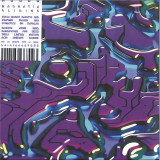
8 tracks of genuine mid-90s acid, techno, and ambient for fans of AGE, Spacetime Continuum, Caustic Window & Air Liquide.
Reissue of A3000 "Magnetic Gliding" album, produced by Swiss musicians Marco Repetto and Stefan Riesen, also known as Synectics on Rephlex and founders of Axodya Records. Originally released in 1995 on the Italian Disturbance label, it has now been remastered and proudly reissued for 2023 in a limited edition of 500 copies by Musique Pour La Danse. Enjoy this trip.
Marco Repetto was a member of the world-famous wave/punk band Grauzone. In the late '80s, he delved into techno, ambient, and psychedelic music, drawing inspiration from nature and shamanic knowledge. His performances are described as colorful, playful, and mind-opening experiences. His main project now is "Bigeneric," which he releases on his label, Inzec Records.
Stefan Riesen has been a prominent figure in the Swiss techno scene since 1995. He is the founder-manager of Phont Music, SuperBra, Morris/Audio, Floppy Funk, and Speaker Attack. He has (co-)produced numerous tracks under various aliases on different labels, including Box Blaze, Flaptrack, Hooper, Nylon, Sonic Tourism, Spin, A3000, Box Blaze & Deetron, Dialogue, Lausen, R.B.R., Sidestepper, Silver Zone, Skank Burner, Synectics, and more.
After Jamuse Records favourable outcome, the Swiss label is delighted and honored to unveil its latest vinyl release featuring the talented Romanian artist Lumieux.
Titled "Gemini Road," this EP consists of three tracks. The title track presents a captivatingly glitchy and rhythmic style, adorned with warm sub-bass and distinctive vocal elements. The offbeat rhythm adds a unique touch that sets the track apart.The offbeat rhythm adds a unique touch that sets the track apart. "Fuzzy Formats" skilfully blends human and robotic voices with beats, accompanied by inviting warm bass and crisp treble notes.Bringing the EP to a captivating conclusion, "Lemesleep" takes listeners on a hypnotic adventure enriched by evocative pads and skillfull glitches.
In its entirety, "Gemini Road" guides your auditory senses on a mesmerizing journey through the realms of magical minimal house music. This sonic voyage is not solely characterized by its warm sub-bass and glitchy elements but also by its diverse and eclectic textures. Lumieux's inspirational touch is the driving force behind this EP, elevating it to a gem within its genre.
Two And Half Records said goodbye to the A-B side and welcomes the DANCE and LISTEN side. the first of a series of Various, 6 Artists or in this case 7 with the swiss duo Quismi, Groenogen, ILyes and Venetia from France, Curios from USA and Riccardo Buccirossi with a new alias EAE. 6 Energetic tracks, some fresh Housy sound to enjoy on the dance floor, likewise to sit back, listen and get carried away by the electronic wave.
In a booming Swiss rocksteady and ska scene, COSMIC SHUFFLING is once again affirming itself as a rising star of the genre on a intergalactic scale. The band's first album, MAGIC ROCKET
SHIP, released in the midst of the pandemic, was a huge hit with fans of the Jamaican sound of the 1960s. Three years later, the Geneva-based septet is back in force with a new album, COSMIC QUEST, featuring eleven vocal tracks ranging from fiery ska worthy of the best years of the Skatalites and Soul Brothers ('Eclipse', 'Walk On By'), to exquisitely melancholy rocksteady ballads ('Birds of Spring', 'Dusk Till Dawn'), to bright early reggae with a touch of 1950s mento ('By The
Rivers').
Fans of vintage sound will be delighted by the sound of this new album elaborated in the raw and warm aesthetics of analog saturation that made the beauty of the golden age of Jamaican music.
Under the guidance of Swiss producer Mathias Liengme, the renowned Spanish sound engineer Roberto Sánchez has mixed this superb opus with class and character. The sound is just like the
cover of the album: against a lunar backdrop, in the glowing light of the setting sun, Cosmic Shuffling’s magnificent seven delight the hearts of the convinced as well as the undecided with the
exhilarating sound of their irresistibly danceable Cosmic Quest. Let yourself be carried away!
For the second release, the Swiss Label present a classic Dub techno track produced by AudioChain (A duo composed by the Label owner Brenno Della Vecchia and his friend Luca Gaggetti). A timeless track with a deeper groove born directly from the Alps!
The remix otherwise, is a faster interpretation remixed by the Dub techno producer from S. Francisco, Federsen. A wonderful relaxed track full of details able to bring you inside Kelly's rhythm.
Two years after their previous effort, regular as clockwork, Swiss throbbing synth pop duo Veil Of Light is back with a new album and what can we say? These guys keep on getting better and better.
If you have followed the Zurich-based outfit over the past few years, you must have noticed the constant moving towards 80’s FM new wave and synthpop tones – without losing their electro/body music outline – that have marked the band’s parable, especially since their latest Landslide LP.
Sundancing is their sixth full-length and it stays the course, bringing what we’ve just said to the next step. Nine new dancy and bright tunes with emotional depth that blend lush instrumentation and robust rhythms, guided by funky and rubbery basslines. Syncopated rhythm sections match suburban cool synths in the lead single Apricot Kiss and Hypersleep, while Raindancing and Tonight summon a sinuosity long gone since the mid Eighties. The musical backdrop here serves as the fundament for emotional vocals delivering lyrics dealing with the fragility of love, joy and loneliness.
There’s some subtle addictiveness to these songs, one that will gently grab you by the collar of your coat and stick the refrains from Sundancing inside your head for good.
Veil Of Light might make it look easy to keep it neat without being minimalist, intimate without being depressing, romantic in the most true sense of the word, but we know that’s possibly the hardest thing to do.
For this uniquely personal retrospective spread over twelve vinyl discs, Sven Väth takes us back to the early days of his DJ career. On What I Used To Play we meet great pioneers of electronic music, gifted percussionists, obscure wave bands, and innovative producers of a bygone 'new electronic' era. Rough beats and irresistible grooves from the identification stage of house, techno, and acid remind us not just how far electronic music has evolved over the past four decades, but how great it was to dance to EBM, techno, and house for the very first time.
If there is one protagonist of the electronic music scene who has remained curious, innovative and at the very cutting edge of music for over four decades, it's Sven Väth. His multi-layered artist albums and Sound of the Season mix compilations have been defining the genre for over two decades, and even today, he is constantly on the lookout for the next top tune to add to the highlights of his next set. At least, that's the case when he's not producing them himself as an artist or remixer. "Actually, it's always been part of my DNA to think ahead," and nothing had been further from his mind than looking back at his past, but when in spring of 2020 the international DJ circuit had to be scaled down to virtually zero, the 'restless traveler' suddenly had time. Time to stop and reflect on "how it actually was back then, at the very beginning of my career..."
"It was a great trip and with every track, beautiful memories came flooding back".
In the London apartment, he had just moved into, Sven has set up a "little music room", where he cocooned himself for several days, "to look way back for the first time and review my musical journey through the eighties, so to speak."
The interim result was six thematically oriented playlists with a grand total of 120 tracks from 'early 80s' to 'Balearic late 80s', together with excursions into afrobeat, European new wave, and EBM sounds and a few epochal techno/house tracks from the USA in between. From these 'Best of Sven Väth's favorites', the project What I Used To Play crystallized. Sven remembers how the Cocoon team reacted to his proposal: "They found the idea of making a compilation out of it MEGA from the beginning and everyone said 'Sven, go for it', but then, of course, the work really started, namely, to clear the rights and to get clean sounding masters of the up to 40-year-old tracks. There was also disappointment, of course. We couldn't clear certain titles because the rights holders in the USA had fallen out with each other or simply disappeared from the scene. In short, it wasn't easy, but now I can safely say we got the most important tracks."
Finally, after two years of research, curation, design, and administrative fine-tuning, the "little retrospective" from 1981 to 1990 is available. The exquisitely packaged, and three-kilo heavy box set is not only physically impressive, WIUTP is also the definitive record of Sven Väth's musical development. On each of the twenty-four sides of vinyl, you can trace track by track, what influenced him during which phase, and how he took off as a DJ from his parents' Queen's Pub straight into the spotlight at Dorian Gray. There and at Vogue (later OMEN), Sven became the style-defining player in the DJ booth that he still is today.
1981 - 1990: Future Sounds of Now
In the early eighties, the crowd in clubs like Vogue and Dorian Gray danced to what nowadays we call 'dance classics' - mainly disco, funk, soul, and chart pop. It was up to a new generation of DJs, including Sven Väth, the youngest protagonist in the Rhine-Main area at the time, to create their own club-ready music mix. Good new tracks and potential floor-fillers were rarities that had to be sought out and found, in order to prove oneself worthy.
Without MP3s, internet streaming, or other digital download possibilities, music didn't just gravitate to the DJ, instead, it had to be tracked down. In well-stocked record stores in Frankfurt and Wiesbaden or even in Amsterdam, London, or New York, Sven and friends sourced the material for countless magical nights. On WIUTP we can follow Sven's very personal journey through this wild, innovative era in which synth-pop, funk, hip-hop, and disco were successively replaced as 'club music' by house, techno, acid, and breakbeat. By the end of the decade, it was clear to see that these once exotic 'fringe' phenomena would soon become 'mass' phenomena.
Early 80s
Dirty Talk by the Italian-American duo Klein & M.B.O. represents the most innovative phase of the Italo-disco genre in the early eighties like no other track. Mario Boncaldo (I) and Tony Carrasco relied entirely on the original synthetic drum and percussion sounds of the Roland TR-808, coupled with the raunchy vocals of Rossana Casale and guitar accents of Davide Piatto. Of course, other tracks from this period were also influential in style, most notably Unit by Logic System, which worked as the perfect soundtrack to the laser lighting system at the legendary Dorian Gray club. With stomping beats and robotic rap interludes, Bostich by Yello also belongs on Sven's eternal playlist - after all, it caught the attention of Afrikaa Bambaataa, who invited the Swiss duo to perform at the Roxy in New York in 1983.
EBM Wave - Mid 80s
From today's point of view, the almost ten-minute-long, downtempo track Giant by Matt Johnson's band project The The, would probably not be considered an obvious club classic. However, a closer (re)listen reveals the rhythmic intricacies of the percussion overdubs by JG Thirlwell (aka Foetus) on Johnson's composition, and it becomes clear why this exceptional piece of music is one of Sven's absolute favorites. Other classics from this phase include Kaw-Liga by the mysterious The Residents, the hypnotic-synthetic Our Darkness by Anne Clark (and David Harrow), and last but not least, the somber, monotonous anthem Where Are You? by 16Bit, one of Sven Väth's projects together with Michael Münzing, Luca Anzilotti from 1986.
US House - Late 80s
You certainly can't talk about Chicago house without mentioning Frankie Knuckles. The resident DJ at the Warehouse not only gave the name to an entire genre, but also produced epochal floor fillers on the Trax label like the timeless Your Love, sung (and moaned) by Jamie Principle. Acid house protagonists Phuture also hail from Chicago, and on We Are Phuture (also released on Trax) we hear the chirping acid sounds of the legendary Roland TB-303 in full effect. Another featured classic is No UFO's by Detroit's Model 500 aka Juan Atkins, who is rightly considered the 'Godfather of Techno' even if the genre-defining track from 1985 still breathes with the spirit of hip-hop and electro from the first breakdance era.
Afrobeat
Le Serpent, by Algerian-born Abdelmadjid Guemguem, is a track that sounds completely different from everything else on WIUTP. Made in 1978, it's a monumental, rousing groove created without bass or synths, just with five congas! Even though Guem sadly passed away in 2021, his immortal, acoustic beats are understood all over the world and will continue to enrich many thousands of DJ sets for years to come. Another classic that not only Sven appreciates beyond measure is Hugh Masekela's Don't Go Lose it, Baby. In addition to being one of the most important jazz pioneers, the trumpeter and freedom fighter from Johannesburg was very experimental, integrating electronic sounds into his music in later years, in a similar vein to Miles Davis and Herbie Hancock. Dutch jazz pianist Jasper van't Hof's afrobeat project Pili Pili has also aged well. The trance-like, almost sixteen-minute-long track of the same name, manages to fill a whole side on the seventh of twelve vinyl discs in the WIUTP box.
UK-US-Euro - Late 80s
Time for a change of scene, in the truest sense of the word, and from a musical perspective, this section is like landing on another planet. First up is Andrew Weatherall's classic remix of Primal Scream's Loaded, featuring the iconic Peter Fonda sample (lifted from the 1966 biker film Wild Angels) that came to personify the mood triggered by the British Second Summer of Love in the late eighties: "We wanna be free to do what we wanna do, and we wanna get loaded...". This period also saw the emergence of M/A/R/R/S whose only single, 1987's Pump Up The Volume, became a club classic with support from DJ legend CJ Mackintosh. In this most eclectic of sections, we also encounter New York house and reggae producer Bobby Konders and his seminal Nervous Acid.
Balearic - Late 80s
Those who know him, know that Sven had already lost his heart to the 'magic island' of Ibiza as a teenager, so with that in mind, the WIUTP project couldn't end without a Balearic chapter. Inspired by Manuel Göttsching's E2-E4, the immortal, eponymously titled Sueño Latino belongs in there without question. Equally popular on the island was, and still is Break 4 Love by Raze, which thinking about it, would also fit perfectly into the house chapter. Last, but not least, there's an overdue reunion with Sven Väth himself, in his role as frontman of the successful Frankfurt trio OFF. Together with Michael Münzing and Luca Anzilotti (later of Snap!) this 'Organization For Fun' created the off-the-wall club hit Electric Salsa in 1986 which incidentally turned into an international chart smash, putting Sven in the enviable position of having to decide between pop stardom and a DJ career. Well, we all know how that decision turned out and the rest, as they say, is history. A not insignificant part of his story is What I Used To Play. Enjoy!
Mesmerizing new abartik from one of the most talented swiss based artists. Abartik welcomes homeboy Aron for a stunning 4 track EP from outer space. This is definitely one for the books.
AMPHIA is honored to welcome UK legend 100Hz to its ever-expanding catalogue.
AMP024, a four-track EP titled "Improviser", is a statement of Lee's long lasting career as a visionary producer.
Combining intricate polyrhythms with an assorted sound aesthetic, each piece has character, as much as it does a mood of its own, seamlessly blending together throughout the moments of a set.
We hope you'll enjoy it as much as we do!
Swiss label Proxima is very pleased to present the reissue of italo disco classic "Love Me Too / The Dream" by Italian circus performer, singer and tv presenter Ambra Orfei. Originally released in 1986 on a 7inch, those two tracks are brought back to life for the first time on a 12inch record.
Double LP: Heavy 350gsm Sleeve, Liner Notes, Sticker
WRWTFWW Records is very happy to reissue Swiss cult band Grauzone's self-titled album in an expanded 40 Years Anniversary Edition packed with the original 1981 album plus 9 extra songs, as well as extensive liner notes by Swiss music historian Lurker Grand. The 19-track album is available as a double LP vinyl in heavy 350gsm sleeve and a digipack CD, both sourced from the original reels and put together under the supervision of band member and all around legend Stephan Eicher.
The pioneering band from Bern (Switzerland) had a short-lived but highly-regarded career which birthed a cult discography that still fascinates and resonates today. Consisting of core members Martin Eicher, Stephan Eicher, and Marco Repetto, and on-and-off participants Christian GT Trüssel, Claudine Chirac, and Ingrid Berney, the elusive group broke new grounds in the early 80s, experimenting with punk and industrial music, early techno sounds, minimalism, new wave, pop, and various electronics. With an innovative and polished approach to design, visuals, performance, and all around style and philosophy on top of their superb music, the constantly transforming unit developed a whole experience - the Grauzone experience: wild and unpredictable, yet sophisticated and cohesive, or as Swiss music historian Lurker Grand would call it, "an Art band with a Punk attitude".
Completely rejecting the music industry rules and refusing to play the game of promotion, touring, release schedules, and TV appearances even though they had a multi-platinum international hit with the song "Eisbär", the band quickly disintegrated in full convention-defying glory, leaving behind an inspiring music legacy for the world to discover and discover again, one generation after the other.
This extended version of their debut (and only) album beautifully crystallizes the Grauzone miracle/accident - where pop and youthful experimentation meet at (new/cold/no) wave and industrial crossroads, and where classic hits ("Eisbär", "FILM 2", "Raum", "Träume Mit Mir", "Der Weg Zu Zweit"…) flawlessly mesh with unconventional deep cuts ("In Der Nacht", "Film 1", "Maikäfer Flieg"…). Very simply put: GOOD timeless music with an edge.
Stephan Eicher went on to be, arguably, the most successful Swiss musician ever, with an international career extending from pop chanson to experimental escapades and collaborations with Moondog, artists Sophie Calle and Sylvie Fleury, and author Martin Suter among many other luminaries. Marco Repetto flourished as a techno and ambient producer, releasing multiple projects including releases on Aphex Twin's Rephlex label.
Following the release of a number of EPs on Swiss, German, British and Australian labels, Trinidad will release their debut album ‘Palm Trees & Thirty Degrees’ on October 16th 2020.
The album draws on the Swiss-based trio’s experience of sustaining the energy of festival and club shows, while also providing the perfect background to a relaxed summer evening with friends.
The project provides an opportunity for the trio to indulge in a range of musical influences, blending together a mix of synthesizers with the haunting tones of a church organ, the warmth of a string quartet and regality of an opera singer. The album grew organically, with inspiration taking hold beyond the confines of the studio: the bonus track recorded with a Jamaican reggae singer in the back of a VW bus in Greece. Soundscapes from Colombia to India were captured and embedded.
With "Palm Trees & Thirty Degrees" Trinidad guide listeners on a journey to a tropical paradise; to a wonderful, perhaps peculiar place of confidence, created and shaped by the mental theatre of the moment.
The soft kiss of a warm breeze hits you as you adjust to your new surroundings ("Desembarco"); leaving the static chatter of your thoughts behind in the "Lobby" (feat. MonoAbe) of your mind; you allow yourself to imagine what the evening holds in store (“Kopfkino”); But first, there’s a drink in the “Sunset Bar”, a refreshing cocktail "Luciola" that serves as a gateway for you to plunge into the night. A night of unlimited possibilities, the first instances a blur ("Sagrada"), as time starts to lose its meaning ("Tempus Fugit"); everything spins, everything is possible, everything is ("Elevate"). Suddenly, hours (or is it days?) have passed – it doesn’t matter; what matters is the first sign of dawn, the unmistakable warmth dissolving the darkness (“Alma”); the beat slows, and you feel the "Libération" of the new day; looking around you see the moments you’ve shared etched on the faces of your friends ("Fleeting" feat. Julia Portmann); It is not goodbye, it is only "Au Revoir".
The album was produced by Trinidad in their own studios in Bern and Zurich. It features collaborations with a number of artists: Cornelia Aeschbacher Firmin (Hang), MonoAbe (Mallets & Percussion), Jack Williams (text of "Fleeting"), Julia Portmann (vocals), Zenyth (vocals) and Michael Meier (electric bass). The songs were mixed by Marcel Schneider, mastered by Benjamin Fay. Raïssa Lara Lütolf was responsible for the graphic design.
Dark Entries is honored to release a 4-track EP by Swiss musician Carlos Perón, founding member of Yello. Carlos was born in 1952 in Zurich and began collecting music at a young age. Inspired after attending a concert of Karlheinz Stockhausen in the 1960s, he began to compose Musique Concrete pieces using a 4-track reel to reel and found sounds. In 1979 Perón founded the trio Yello with musician Boris Blank and vocalist Dieter Meier. Yello released their first album in 1980 and the following year Carlos released his first solo album 'Impersonator'. In 1983 Carlos left Yello in order to pursue a solo career and released the soundtrack to Die Schwarze Spinne" and 1984 his second solo album Nothing Is True, Everything Is Permitted'. In 1988, Belgian label LD Records released a 4-song EP of instrumental tracks from 1984 that predated, influenced and became staples in the New Beat scene.
Dirty Songs' is a collection of songs from Carlos Perón recorded between 1980 and 1986. The recordings were made with the core set up of an ARP 2600, Roland's Drumatix, TB-303 and TR-808. Nothing Is True, Everything Is Permitted (Instrumental)' recorded in 1984 is a slow burner with dark, gloomy atmospherics, presented here in an extended version with a bonus intro. The song was inspired by William S. Borroughs' Naked Lunch' and paints a bleak futuristic landscape. Breaking In (Instrumental)', from 1984, is a crossover of electronic body music and pitched down Chicago acid house featuring overplayed snares by hand though an Ovomaltine Box. Originally featured on the soundtrack for Die Schwarze Spinne', the song is about breaking into a large pharmaceutical company to steal drugs. On the B-side is A Dirty Song (Instrumental)', originally recorded in 1986 and released by Play It Again Sam in 1988. The song uses one of the earliest Roland SH synthesizers, the SH-1 A, as a solo instrument and is strikingly aggressive with percussive rhythms. Et' was recorded in 1980 on a 4-track and later and remixed to 8-tracks in 1984 for the Frigorex' EP, which is where this extended version comes from. Featuring eerie, cut up vocals and Dadaist lyrics by Isa Nogara atop a proto-Techno beat.
All songs have been remastered for vinyl by George Horn at Fantasy Studios in Berkeley. The jacket features a never before seen black and white photo of Carlos taken in 1988. Each album includes an double-sided postcard featuring the cover art from the Frigorex' EP. Prepare to make your own movie to the Swiss John Carpenter soundtrack vibes of Carlos Perón.
Pierre Mariétan (1935–2025) was a prolific Swiss composer, sound artist, and pioneer in acoustic ecology who spent most of his life working in France. Over his long career, he composed more than 300 instrumental, orchestral, vocal, and electronic pieces. Mariétan studied under avant-garde legends like Pierre Boulez, Karlheinz Stockhausen, and Bernd Alois Zimmermann. In 1966, he founded GERM (Groupe d’Étude et de Réalisation Musicales), a music collective that blurred the lines between strict composition and free improvisation. In 1969 the French BYG label released a GERM album and the same year GERM played at the legendary 5-day Festival in Amougies, Belgium, sharing stage with Pink Floyd, The Soft Machine, Frank Zappa, Don Cherry,…
In 1979 Mariétan founded the Laboratoire d'Acoustique Urbaine (Urban Acoustics Laboratory) to bridge environmental sounds, urban architecture, and musical composition. Mariétan was also a professor at the University of Paris where he taught the relationship between sound and space. Later in life, he remained active as a director for the Movement of Environmental Sound and continued developing permanent, immersive sound installations across the globe. His album Musique d’été was originally released on cassette back in 1983 by Éditions Salabert and Costin Miereanu’s Poly-Art International, and it has been slightly tweaked for this LP reissue. The record splits his vision of "Summer Music" into two different vibes. Side A is a deep dive into an electronic, synthesizer-driven landscape, while Side B features raw acoustic field recordings of forests and traditional Swiss alphorns.
Adjust the intensity of the sound at the same level, if not just above the background noise specific to the place of diffusion.
Probably the most respected and sought-after producer of the European reggae scene of the last ten years, Spanish genius Roberto Sánchez (Willi Williams, Earl Zero, Alpheus, Keith & Tex, Milton Henry,...) takes place behind the microphone to deliver a new album as a singer under his pseudonym LONE ARK. Soberly titled Showcase Vol. 1, this album is a collaboration between Sánchez and the Swiss band THE 18TH PARALLEL, whose playing is well known to reggae fans, since its musicians have recently played and produced some remarkable records, including I've Seen by Oku Onuora, Roots I Vision by Micah Shemaiah or Wonderland of Green by The Silvertones and Burro Banton.
Faithful to the Jamaican roots reggae tradition, Showcase Vol. 1 offers six vocal tracks followed by their dub counterparts where all the creativity of the sound engineer and the musicians is freely expressed. On instrumentals at the same time heavy and irresistibly dancing, with a modern production but deeply rooted in the roots reggae sound, Lone Ark and The 18th Parallel push their listeners to critical reflection. A strong message + powerful music = a must-have album!
out of Stock
Last delivered 5 years ago available to reorder, subject to availability
Montréal-based sound artist Steve Bates expands his strategies and stylistic influences on An Infinite Antenna, his second solo album for Constellation, giving freer reign to melodic components and textural dynamics: leftfield synth work, deconstructed drum machine, pointillist electric guitar, and radiostatic blur are all part of the new brew swirling around his bruitist signal-bending and field-recording sensibility. Arguably a more ambient album than his acclaimed 2022 Constellation debut, An Infinite Antenna is at the same time more densely packed with ideas, dynamics, evocations and earworms. Coming out of the anarcho-punk scene of the Canadian Prairies in the 1990s, Bates founded Winnipeg’s experimental sound festival Send + Receive in 1998 before moving to Montréal to become Sound Coordinator at Hexagram (Concordia University), delving further into sonic research and theory, tape-based composition, and installation work. Alongside the curatorial arc of his own sound art label The Dim Coast, Bates released several solo and collaborative albums on ORAL_records leading up to All The Things That Happen, the 2022 Constellation debut praised by Boomkat for its “grittily iridescent ambient billow rendering maximalist panoramas” and by Backseat Mafia as “extraordinary soundscapes of unstable, destructive cacophony and tender calm, echoes of the threat of power.” Where that album was noisier and single-minded, made with the self-imposed limit of a Casio SK-1, Bates plays more widely with instrumentation and atmospheres on An Infinite Antenna, also drawing on his post-hardcore roots in seeking a sort of track-by-track concision nonetheless driven by the album’s coherence as a seamless work. “I was trying to set durations I associate with punk rather than the longer, sprawling music coming from more ambient styles (that I very much love), and while I wasn’t able to quite pare it down to Minutemen durations, I had that reduction to essential elements as a sort of whisper over my shoulder.” Incorporating source recordings made throughout 2023-2025, including at artist residencies and site-specific sound installation visits in Bosnia and Herzegovina (the album’s cover photo was taken in Sarajevo), Austria, Greece, and Saskatchewan, An Infinite Antenna combines Bates’ “idea of slowly scanning a radio dial” with a soundworld of recurring timbral and textural touchstones that forge an integrated whole.
The album’s 12 tracks work effectively as stand-alone pieces, replete with shifting undercurrents, buried melody, and stuttering kinetics, and as a sequential flow where the brief interstitial silences between them are like short pauses to flip the next page in a sketchbook of perspectival studies of a wide but singular tableau. The glistening atonal synth expressionism of opener “Pink pink pink pink…pink pink” drifts gently toward submerged ambience, darkened by the noised rumble and static interference of “Green as a ghost”, which introduces broken beats and piano chords in its denouement. Tracks like “Battles and sieges and street trees” and “Easier sad than done” work the foundations of low-end field-recording resonance, but dappled with lovely melodic droplets of treated guitar and synth. “Waste, songs of the world” and “Disaster loans” are among the album’s most explicit stylistic references to posthardcore, with distorted ambient bass and gently abrasive drum sampling. Closing track “Swamps and factories”, the album’s longest piece, is perhaps most reminiscent of Bates’ previous record with its sustained dissonant glimmer-drone, but the journey An Infinite Antenna traces to get there is Bates at his most dynamic, diverse, distinctive, and engaging. Thanks for listening.
Founded in Germany in 2019, CONSVMER. have spent the last few years carving out a space that’s entirely their own: progressive metal, beatdown, and metalcore delivered entirely in German, with an unflinching focus on subjects most people would rather look past. Their 2024 record Seelenfrieden turned heads inside and outside the German metal scene, with coverage from outlets including Nik Nocturnal and a collaboration with Paleface Swiss that confirmed the band were operating at a level far beyond their years. Live, they have earned their place on stages at Summer Breeze, Core Fest and Bembel X Core Festival. Now, with new vocalist Jacques Gronert and a vision sharpened to a point, CONSVMER. return with Abgrund.
Where Seelenfrieden refined the template, Abgrund dismantles it. Across eleven tracks the band push further into territory that feels genuinely unique and uncompromising: the title track opens the record on collective collapse and a society steering towards the edge with no intention of stopping, while songs like "Gier" tear into systemic greed and exploitation with brutal clarity, "Willenlos" descends into dissociation and the erasure of identity, and "Sucht" confronts addiction and self-destruction with a rawness that is hard to shake. Closer "Gottverlassen" leaves the listener exactly where the title suggests. The collaboration with brutal deathcore veterans Acranius on "Sucht" hits like a freight train, their English-language verses locking into CONSVMER.'s German delivery to devastating effect. Fellow German hardcore outfit DOGBITE also appear, adding another dimension to a record that never loses focus.
Radically exploratory, Raphael Loher’s Figuren is an album shaped by process and experimentation. Guided by intuition, listening, and a deliberate distancing from his primary instrument—the piano—, the LP marks a decisive step in the Swiss pianist and composer’s artistic development, expanding his sonic vocabulary while maintaining a distinct and personal language.
Figuren draws on ten intimate concert recordings from Keemuun—Loher’s debut for Three:four Records—created during the pandemic and performed in his studio for just one or two listeners. This source material was subsequently developed during a residency in the Blenio Valley, where Loher deconstructed melodic elements, isolated individual tones, and extracted resonances, reassembling them into new configurations. The process generated around 30 initial pieces and also informed his sophomore album, Hug of Gravity, released by Hallow Ground in 2025.
In a further stage of transformation, Loher processed these fragments through a Revox B77 tape machine, subtly altering their pitch before digitizing and reshaping them once again. This iterative cycle of manipulation and recombination forms the core of Figuren’s sonic language.
Departing from the more structured frameworks of his earlier work, Figuren foregrounds experimentation as both method and aesthetic. The compositions range from finely layered rhythmic microstructures to sparse, evolving melodic fragments, each unfolding with a precise sense of restraint.
»Cosmogonical Ears« is Amosphère's first album for Hallow Ground. Following her contribution to the Swiss label’s »Epiphanies« compilation and her 2021 full-length debut »More Die of Heartbreak« on 33-33, it features three expansive pieces. The Paris-based composer and multidisciplinary artist delves deeper into themes of time, space, cosmology, human perception, and psycho-physical effects, crafting profound sonic meditations. Drawing on a minimalist approach while blending electronic and acoustic elements, Amosphère’s long-form compositions are living, breathing entities whose sonic richness and evocative power unfold gradually over time, putting »Cosmogonical Ears« in direct kinship with previous Hallow Ground releases by artists such as Kali Malone and FUJI|||||||||||TA.
The album opens with its longest piece, »Land of eternal delight,« composed for the Buddha10 exhibition at the Museo d'Arte Orientale in Turin. Written during three years of isolation—a period in which Amosphère explored meditation practices and diverse belief systems—it merges mythology with personal transcendental experiences, reflecting on a challenging time for humanity. »By blending Buddhist philosophy and sculpture with my own meditation practices, I sought to explore a way for people to transcend the boundaries of space and time—not as a believer, but as an observer,« she explains. Featuring handmade ceramic instruments and recorded by Thomas Lefevre, the piece combines Amosphère’s electronic organ with Marc Lochner’s flute contributions, creating a sound that is simultaneously minimalist and expansive.
The concept of teleportation and how it challenges traditional notions of time and space serves as the foundation for the second piece. »Recent advances in quantum physics suggest that teleportation might be possible through quantum entanglement,« Amosphère notes. »What if science fiction is becoming reality—or has already existed in ancient times?« Drawing inspiration from theories proposed by physicists such as Roger Penrose, Amosphère again worked together with flutist Lochner, this time using her VCS 3 synthesizer. »Teleportation« weaves single notes into intricate, non-linear patterns that defy conventional logic, creating a complex auditory tapestry. The last piece »Black hole in, white hole out« was recorded on Corsica and features Miao Zhao’s bass clarinet drones alongside Amosphère’s church organ. It imagines the possible sound of crossing a black hole while also suggesting the study of its theoretical exit and its potential applications for large-scale time and space travel.
The questions posed by »Cosmogonical Ears« do not yield straightforward answers. Instead, Amosphère’s restrained yet intricately layered compositions require full immersion and concentration from the listener. As expressed by the album’s title—which envisions the birth of a new universe through listening—»Cosmogonical Ears« offers an experimental approach to auditory perception as a tool for seeking truth, freedom, and harmony between the outer world and the inner self.
With the release of "Wildnis" in autumn 2026, Klangwart celebrate 30 years of the group"s existence. During numerous sessions in their own Inkiek studio in Unna/Germany and a residency in Montoriol/France in 2025, Klangwart have created their new work "Wildnis" ("wilderness"), inviting Sébastien Del Grande to add tenor and alto saxophone, drums, marimba and other various percussion instruments to their electronic textures. Catalan composer and performer Ivan Chin aka Ivan Telefunken also participated in the recording sessions by contributing to a Catalan version of Swiss group Grauzone"s famous new wave hit "Eisbär" under the title "Os Polar". Timo Reuber"s arrangements, production and mastering gave the album its final touch. Klangwart started their musical expedition into for them unknown territories already in 2014 when they went to Bogotá/Colombia in order to record with protagonists of the local music scene: Damián Ponce (drums), César Quevedo (bass) and Eblis Alvarez (violoncello), members of The Meridian Brothers, and singers Juanita and Valentina Añez Rothmann a.k.a. Las Añez. The result, released on Markus Detmer"s Staubgold label in 2019, was Klangwart"s trademark sound permeated by a Latin American pulse and pitch. With "Wildnis" the story continues: field recordings from Latin America are interwoven with delicate electronic structures, Del Grande"s iconoclastic approach to the saxophone meets Klangwart"s familiar organ drones, Catalan folk meets German Krautrock.