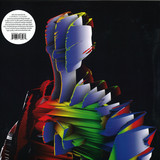
Nothing is static. Music moves you places. And sometimes your machines follow you wherever you go. That's exactly what happened some moons ago during a nature retreat in Icelandic landscapes. The man. The machines. Water. Lots of water. Trees. Endless trees. And the horizon. Out of early mornings & contemplation come 3 tracks of sheer beauty ready to reunite with urban dancefloors.
An Invitation To Disappear is the debut LP by British electronic musician Inland aka Ed Davenport - and his first release for A-TON. Based on his soundtrack for a video installation by conceptual artist Julian Charrière, Davenport has recast the material and field recordings into eight tracks of rhythmically intricate electronics and spectral, ambient techno, inspired by Charrière's visually striking, 76-minute tracking shot through a palm plantation toward a totemic soundsystem on full blast.
Both the album and original soundtrack were created in response to the 200th anniversary of the eruption of Indonesia's Tambora volcano in 1815, which plunged the world into darkness and caused a series of extreme weather conditions. At the time, the natural climate change crisis resulted in numerous global famines and is known throughout the northern hemisphere as 'The Year Without Summer', with global communities forced to adapt to sudden radical changes in temperature and weather.
An Invitation To Disappear offers a contemporary parallel, leading viewers - and listeners - down a seemingly endless direct path of gridded palms from dawn to dusk; a bio-commercial monoculture where ancient jungle once flourished. Light flickers between rows of fruit-laden trees and a distant fire burns in the undergrowth where the border between natural image and computer simulation breaks down. At the same time, formerly incoherent rumblings of sub-frequencies begin to transform into the contours of rhythm. This is reflected sonically in eight perspectives on the lush, synthetic jungle, made of myriad buzzing fauna, morphing melody and colossal bassweight. All paths lead toward an apocalyptic dancefloor, though speeds vary widely; rhythms dissolve from straight to broken, synth tempos operate by their own internal clocks (and logic). Juxtaposing industrial agriculture with rave culture, the album explores the industrialization and refinement of nature, and the new strange forms emerging from the synthetic grids of both.
As Inland, Davenport has previously contributed soundtracks to other installations by the Swiss-born Charrière, whose artistic practice focuses on bridging environmental science and cultural history, often taking place in remote geophysical locations, including ice fields, volcanos and radioactive sites.
Julian Charrière is a French-Swiss artist based in Berlin. A former student of Olafur Eliasson at the Institut für Raumexperimente, Charrière's art explores post-romantic constructions of nature, staging tensions between deep or geological timescales and those relating to mankind. His work has previously been shown across the globe, including at the main exhibition of the Venice Biennale in 2017, a solo show at Kunsthalle Mainz this past Spring and an upcoming solo show at the Berlinische Galerie opening September 26.
Inland (real name Ed Davenport) is a British producer, DJ and founder of Counterchange Records based in Berlin. Known for his detailed and explorative house and techno releases on his own label, Infrastructure, Naïf and more, Davenport has recently gravitated toward the contemporary art world, finding inspiration in the cross-pollination between Berlin's art and music scenes. Previous sound design collaborations with Charrière have been exhibited in institutions such as the Musée des Beaux-Arts de Lausanne in 2014 and Thyssen- Bornemisza Contemporary in Vienna in 2017.
The gallery version of An Invitation To Disappear premiered this past April at the Kunsthalle Mainz and will be on display at the Berlinische Galerie as part of Charrière's solo exhibition As We Used to Float, opening September 26, 2018. The LP will premier live together with the video installation during a special presentation in Berghain the same day for Berlin Art Week.
Honey Soundsystem met October (aka Jules) while on a one-night affair in Bristol in which he immediately dragged us from an artist dinner to the saddest Bear bar in the UK. After a few pints, vetting his taste for drag, boys, and girls that make love to boys who make love to boys, Jules confessed he has always wanted to release on HNYTRX. And so the hazing began, a year of torturing yet another sexy-stranger into refreshing, reminding, and refining a flurry of demos into the army of skeleton soldiers you now have in possession. Money drops, midnight withdrawals, 4 crisp singles: this is the Pay Day EP — gonna make that dance-floor 'cha-ching' bitch!
A lot of people hate October so... that is why we are releasing this record in September. But seriously though, upon cracking open this 4 track EP you might wish you had saved the vacuum seal just a couple days longer, keeping these ghosts contained until the month where screaming winds strip trees nude
On A side, electronic music wizards Kompozyt team up with a Dub Legend Lee 'Scratch' Perry to bring you a heavy-hitting and instant bounce-inducing Dub Techno track 'Hidden Force'. Lee Scratch Perry's amazing and charismatic Dub poetry blends superbly with the neat fusion of spacey and subterranean sounds of Kompozyt productions. The single is not to be missed this summer.
On B side, Kompozyt brings you a 7' version of 'Homesick' - Dub and Trip-hop inspired Experimental Electronica with Olgierd Dokalski on the trumpet. Olgierd's incredible performances of real haunting beauty further reinforce the analog, live and improvisational aspect of Kompozyt's music.
Both tracks come from Kompozyt's debut album: 'Synchronicity' - out everywhere now on CD and DL.
Selected Reviews of Kompozyt's Debut Album and the Single
5/5 Decoded Magazine: 'Incredible album 10/10'
4/5 Lars Berhenrot (Deepershades): 'LOVE THIS .. never-ending deepness ..'
5/5 Pierre Ravan: 'Amazing work from the heart'
5/5 Queensradio.org: 'I'll definitely be playing these guys on air'
4/5 Garth Trinidad (KSRW Radio) 'Exquisite score without a film'
5/5 Hoxton FM (London): 'Incredible release!'
4/5 Stereo MCs: 'Nice vibes refreshing'
4/5 Robert Babicz: 'I love dub. in all forms'
5/5 Adam Hannibal (Balanced) : 'Neat fusion of spacey and subterranean sounds. Reminiscent of the Beyond Recs Ambient Dub compilations with some freshness... Well done'
5/5 Al Bradley (3amrecordings): 'This needs full love because it's excellent :) I can really picture myself just letting this play from the first sound to the last & becoming utterly immersed as it flows through! Gorgeous.'
5/5 Bartlomiej Blesznowski- 'One of the best electronic music albums this year'
4/5 Neil Brown (RMFM; Pro Mobile Magazine): 'Some nice tunes to get your head in gear to.'
5/5 Jorn Kirk (DJ Jay Kay) (Faith Sundays): 'very nice album !!! a joy to listen to'
Seeking the overwhelming vibration of the genuine sound wave and its profound echo on the soul, Kenneth James Gibson has spent his career experimenting under a variety of aliases like as many brushstrokes to an ever polymorphic palette - successively releasing as (a)pendics.shuffle, Bell Gardens, Reverse Commuter, dubLoner, Kenneth James G., KJ Gibbs, Bal Cath, Eight Frozen Modules, and Premature Wig... the list is long. Near to two years after his first incursion on Kompakt with his third studio LP 'The Evening Falls', Gibson returns with 'In The Fields Of Nothing', his second full-length delivery for the Cologne-based imprint.
A piece of intricate scales and moods, by turn streaming with the quiet flow of a small meandering rill, then suddenly veering off into an oceanic kind of tumult, 'In The Fields Of Nothing' was conceived as a proper film soundtrack with its rhythmic ebb-and-flow and deep sense of immersion, pulling the strings to an imaginary scenario where the uncanny rubs shoulders with a minute care for the immersion and deep emotional involvement of its whole.
Like entangling multiple levels of consciousness through a millefeuille of textures, piano and strings as well as a flurry of subtly FX-soaked instrumentals, Gibson reflects on his new album - created and recorded right after 'The Evening Falls' came out - as hugely inspired by the lushly forested mountain landscapes of his home region, the bewitching Idyllwild, California. With each track being an essential petal in the narrative corolla figured by Gibson, it's a breathing forest of sounds that deploys, bearing the memories of Kenneth's early morning and late night wanderings in the wild, alone and not, with the ancient trees' vital force for main companion.
An attempt at capturing a slice of these ephemeral sensations felt when striding along across the steep ridges and stony paths of the San Jacinto mountains, staring at the star-studded dome or gazing into the quiet horizon at dawn, 'In The Fields Of Nothing' eludes the single genre encapsulation, opting for the all-embracing openness of scope as it hops from droney melodic interplays ("Her Flood") and roomy string-laden folk drifts ("Further From Home") through Ligetian webs of sound ("Thirsty Lullaby", "Fields Of Everything") and poignant threnodies ("Unblinded"), onto sorrowful pop ballads ("Far From Home") and lulling ambient scapes ("To Love A Rotting Piano", "Plastic Consequence")
Southend quartet Ghost Music release their evocative debut album I Was Hoping You'd Pass By Here via Arlen on 19 January. They create careful, considered songs, weaving lo-fi lullabies with gliding guitars and understated arrangements. Influenced by Silver Jews, Flying Nun and K Records, they explore themes of nature, love, loss and a melancholic English romanticism embellished with beautifully spectral melodies and executed with startling subtlety.
Despite this record being their debut, the band has produced a veritable wealth of music over the past 20 years in various guises. Ghost Music revolves around the songwriting partnership of Matt Randall and Lee Hall, who had played together in the 90s with John Peel favourites Beatglider. More recently Randall has received critical acclaim as Plantman, with his three albums Closer to the Snow, Whispering Trees and To The Lighthouse receiving praise from The Guardian, Uncut and Mojo. When Randall and Hall reunited to collaborate on another album together, they brought in the talents of Roy Thirlwall on bass (Melodie Group) and Leighton Jennings on drums (Dark Globes) to complete the band.
The original idea would be that the songs would be 'ghosts' and create 'ghost music' to resurrect and dust off old songs that they had already started. Lee had found the beginnings of 'Home Dog' on a dusty old 4-track and he had recorded 'Strange Love' on his iPhone in 2014, whilst Matt had written 'My Cloud' as far back as 1997 (the night he moved out of his parents' house). As the album began to take shape, the ghostly premise took a back seat, as they began to breathe new life into the songs they found the impetus to write new ones.
Randall explains the songwriting process; 'When we were in Beatglider together and in the past we'd made a 'thing' out of writing long songs with a lot of changes. This time we pared it back a bit and stuck to the melodies more. We really wanted to make a proper guitar record. Lee's my favourite guitarist and it was lovely to see him stretch out on these songs with his diamond fingers.'
Not afraid to wear their influences on their sleeves, Ghost Music's sound is instantly familiar, echoing beloved bands from the 90s such as Pavement ('Home Dog' has a definite 'Range Life' feel), Galaxie 500 ('Blindspot'), Yo La Tengo ('Heart Shaped Holiday' is influenced by the languid YLT songs that peak after a short intro) and even old-school rock'n'roll ('Strange Love' was born out of an appreciation for the instantly engaging opening riff in 50s songs). Yet Ghost Music's work never feels derivative, being instead effortlessly emotive, melancholic and affecting, creating a world of sound that is hugely reassuring and a tonic for the modern age.
After numerous concerts and performances throughout the last years, Summe 1 is Andreas O. Hirsch's first release on makiphon. The album concentrates on peculiar soundscapes and drony pieces, carefully inter- woven by means of pitched harmonicas, electric guitars, mini fans, de- lays and the electric palm leaf, an electroacoustic invention of the artist. The eight titles evoke a space somewhere between interstellar geography (Maxwell Mountains - a plateau on planet Venus), abstract physics (Teilchenbeschleuniger), botanical scenery and animality: Kemeri 5 am features nocturnal crane calls that Hirsch recorded on a bike trip in a swamp near Riga while he was busy with decoding bird messages via morse code. Opossum Pravda is dedicated to the tenacious marsupial that likes to wander around at night and which is able to hang from trees by its tail. Kautschukwaage seems to suggest an exotic setting and provides a link to the rubber bands which one hears resonating in the miniature.
Sleeve designed by the artist. 300 copies. Mastered by Joseph Suchy.
Visible Cloaks' Lex proposes a utopian dream language and its accompanying sound, a limitless, delicate space developed by fluid musical techniques and subconscious voices. The six pieces comprising Lex simulate a more peaceful future, their mysteries telling a new tale in an unknown but imaginable melodic language. Visible Cloaks are the Portland-based musicians Spencer Doran and Ryan Carlile. Utilizing software-based composition rooted in randomization, MIDI-translation and chance operations, the duo has established an improbable humanist mode of music from esoteric processes. Following their self-titled debut album, Visible Cloaks offered Reassemblage, an album simultaneously honoring the post-Yellow Magic Orchestra school of avant musical adventure and diverging from it. Veering from the paths cleared by Japanese and Italian electronic pop and ambient artists of the mid-80s / early-90s, Reassemblage established Visible Cloaks' own camp in a forest of deep sound canopied by trees grown from synthetic seeds.The sound represented on Lex is webbed with sculptural arrangements and interpolated by the sounds of alien speech. These strange and serene utterances were created by Doran feeding a chain of multiple dialects and accents through a language translation software to create an auditory poetry of an evolved place and time.
Lex features both the final version of this process and earlier, simplified experiments with it ( Keys'). The idea - building on 'fourth world' or 'global village' type concepts - was to create a projected language that was a fusion of many,' Doran explains. The result was a very disorienting form of non-language that amplifies the lapses in meaning that occur with the inaccuracy of auto-translation software.'
Permutate Lex, a companion short film to Lex made by Visible Cloaks in collaboration with artist Brenna Murphy (who also created the artwork for Reassemblage and several virtualist videos for the album), is an integral counterpart, both visualizing an aesthetic alive with human form and guiding the sonic experience of the first five pieces: Wheel,' Frame,' Transient,' Keys,' and title track Lex.' World,' the longest piece presented on Lex, is redrawn from a generative composition originally produced for an installation Doran made with Murphy.
The original work incorporates LFOs and randomized MIDI-information, and was intended to variate indefinitely. In this 'fixed' version, World' provides a more conclusive view into the impossible musical environments Visible Cloaks make real. Longer than any track on
Reassemblage, World' expresses the deepening, patient intimations suggested by Lex.
Doran says the Lex attempts to communicate the essence of a world distant enough that it can't be captured or comprehended from the present, appearing only surreal and inscrutable.' The statement reveals a broader musical philosophy fueling this new moment, an awakened voice woven through complex melodic shapes and phrases establishes communication between listeners and the unknown, here presented by Visible Cloaks as sounds coloring the very edge of the envisionable.
Lock Eyes embarks on the ninth expedition into the exotic lands of palm trees and blue skies with the Vanished' EP.Expedition nine features four jams packed of ambient soundscapes, dusty drum sequences and moody synth lines.
For the label's 50th release, Emotional Rescue returns to the music of Woo to close a trilogy of reissue collaboration albums, in A La Luna. Following Whichever Way You Are Going (1982) and Into The Heart Of Love (1990), their opus A La Luna (1991) was the last of the bands song based albums and represents a wonderful way to close this association.
Reworked, re-ordered and remastered especially for this first time vinyl release, brothers Mark and Clive Ives again present their unique, ground-breaking and at the time, heart-wrenchingly overlooked music, that seems to fit the folk-new age-electronics of today as well, if not better, than when first released.
Across 20 plus songs Mark's guitar, clarinet and vocals are as ever drenched in Clive's mixing desk mastery. Echo and reverb shimmer as the short pieces rise and fall like the wind blowing across nighttime trees. With no song going much beyond three minutes, A La Luna flows as one piece. The unmistaken sound of Woo wraps itself around you in an essence, warmth and glow that is addictive, meditative and uplifting.
Featuring the original vocal performance of Mark's love ode, Magic In The Dark stands as a centerpiece where, as with all their albums, vocals appear at a minimum, as part of the musical journey.
The underlying somber nature of the album comes as the band ended more than a decade of recording with little critical or commercial success. The fact they did not release a full album again and moved towards a more meditation outlook was a loss, however, their recent rediscovery and the excellent releases by Drag City and Palto Flats included, has finally given the Ive's brothers not just a place in appreciation, but has shown that there really is no one like Woo. Enjoy the magic.
Mamie's Records is the new project of troublemakers La Mamie's. The crew of Djs, well known for throwing wild parties in Paris and its suburbs, top-quality sets, and their dedication to the Macki Music Festival, have decided to launch their own record label. Kodäma is a music duo formed in 2014 by Kiala Ogawa (singer and composer originally from Japan and Congo) and by T-time (bassist and composer). The word «kodama», meaning «echo» in Japanese, also refers to spirits conveyed by trees and forests. According to the legends, these spirits are responsible for the the phenomenon in which the mountains echo. Kodäma's universe is very linked to Kiala's cultural sphere with, as a major source of inspiration, her childhood's memories from the Japanese countryside. Kodäma is a subtle combination of electronic and acoustic sounds with Kiala's captivating voice, blending English and Japanese. From this mixture of sounds emerges a spiritual, experimental music marked by their own neo soul groove or future jazz
Musically and emotionally, Superpitcher's third full-length studio album, The Golden Ravedays is a one sound autobiography that exhibits the skill, feeling and style that the artist has honed over a period of twenty years, musically, and forty-plus-years, emotionally.
And full-length it is:
The Golden Ravedays is an epic album of 24 tracks that was released in January 2017 and is stretching over 12 respective chapter albums during a one-year period.
The fourth chapter of The Golden Ravedays saga will be released on Hippie Dance in April 2017.
Number 4 of the series introduces two further tracks of the sound adventure that Superpitcher is taking us on this year.
Side A features Blood and Berry.
It is a captivating track that reminds one of the very first years when Superpitcher made music under the alias Sir Positive.
The beat is broken and the going is slow and rolling and the listening is a warm bath. There are flutes there that one never wants to stop and they almost don't. However essentially sweet this track is, like a berry on the tongue, it might lead to some blood on the dance floor!
Listening to Side B of this Golden Ravedays edition is entering a ghost town, alone, under a full moon.
Howl is a confluence of melodies and rhythms from Africa to Arabia where the snakes are being charmed out of their baskets and it is downright creepy.
A spooky voice is saying something but we don't know what exactly and it is bothersome because deep down we know that tonight when we are alone in the dark, we should be ready with the answer - or else.
All we can do is wonder:
Did Superpitcher sell his soul to the vampires for the vocals he let lose in this track
He answers by howling at the full moon behind thorn trees, in the shadows.
germany-via- artist osker offermann, the owner of leading label white presents us a quality dou-bled package on the mule, strongly effecting his meditated mindsets.
as well as his dj sets, his crafted productions have a superb balance between being not too exces-sive, but not being too minimalistic -
creating the dynamism which make people move, based on his own aesthetic featured with well-polished, functional electro phrases and raw machine beats.
because of its floating grooves, will be nice for club use, but also surely will be a good accompany for the home-listening. oskar continually points forward us the fact, that listening to deep house is no longer meandering journey, but something meaningful and fruitful in your life.
Musically and emotionally, Superpitcher's third full-length studio album, The Golden Ravedays is a one sound autobiography that exhibits the skill, feeling and depth of style that the artist has honed over a period of twenty years, musically, and forty-plus-years, emotionally.
And full-length it is:
The Golden Ravedays is an epic album of 24 tracks that was released in January 2017 and is stretching over 12 respective chapter albums during a one-year period by record label, HippieDance.
We are thrilled to bring you the third chapter of The Golden Ravedays saga, released in March 2017.
Number 3 of the series introduces two further tracks of the haunting sound adventure that Superpitcher is taking his fans on during 2017.
Side A features 1984.
It has nothing to do with George Orwell's magnificent book but it could remind some of how the apocalypse might sound one day.
1984 is as sweet as the very first track, Little Raver, of The Golden Ravedays album but it stresses the fact that even though Superpitcher produces music mainly intended for the dance floor, he creates sound that is bordering on the shamanic.
1984 might as well be the meeting of a group of supersonic bottlenose whales that are overly excited to see each other after being separated by many an ocean and moon.
Side B of this edition brings us Pocket Love.
Or shall we rather say, Side B gifts us Pocket Love
Because we believe this is nothing other than a gift to us all.
Imagine looking into a kaleidoscope and turning the dial and experiencing all those colors as pockets of love rushing your way and exploding in satin wonderment the moment they past your eyes and ears. Imagine how it must sound like if all the e mails, tweets, facebook posts, instagrams, pinterests, grandma's postcards, text messages, letters on rice paper, hearts scratched into trees, declarations of eternal loyalty written in sand, phone calls and videos of the whole universe were all messages of love stuffed into pockets and sent to you.
Imagine the treasure you will receive!
Imagine being one big ear drum and listening to the very energy that this love exists of - imagine it and you will find yourself inside Pocket Love.
In autumn 2015, Swedish dream-pop duo Korallreven bid us all farewell by releasing the "round-the-world-in-a-day" sounding final single Here In Iowa, alongside memorable shows in New York City and Scandinavia. Now, they return for one last time with a disco dub dream remix of said song by the mighty Peaking Lights. This forms part of a 12" EP released by Be With Records. The record - limited to just 500 copies - will see its worldwide release for Record Store Day on 16th April 2016.
The 12" will also, for the first time on vinyl, include Korallreven's breathtaking cover of Guns & Roses' November Rain from 2014 as well as Shine On, the duo's rework of their own 2010 single Honey Mine, featuring Taken By Trees' Victoria Bergsman.
From the guys:
"Hard to say if Here In Iowa was an end or a start of something new. You'll see! Whether or not, we hold it as one of our highest heights and, after this beautiful season, we truly deeply madly felt that it was worth some extra limelight. And hey! Thanks for the remix, Peaking Lights! It's so wonderful! Life surely is."
Up next to bat for the Astral Black label is Glasgow's Bushido and he looks set to hit his debut 4-track EP straight out the park. Over the past 18 months Bushido's playful, dance-hall infused take on UK club-music has built a steady reputation, with his soundcloud page showcasing a blaze of radio rips lifted from 1xtra, Rinse & NTS. His Beach Stage set at last years Outlook Festival was picked by The Daily Street as their personal highlight and his collaborations with label-mate DJ Milktray & contributions to releases from Liminal Sounds & LuckyMe's 14/15 advent calendar have picked up DJ support from the likes of Hudson Mohawke, Mssngno & Nina Las Vegas as well as press from the likes of The Fader & FACT.
On 'Grandmaster Cash', Bushido turns in 4 sweltering, hyper-tropical, club tracks - the arpeggiated cowbells & vocal chops of opener 'Palm Trees' sounding like you've hit the jackpot on a fruit machine. 'Palm Trees' has become a firm favourite in sets from the likes of Mr Mitch & Murlo and its clear to see why. The sino-centric 'Cherry Blossom' is up next, it's half-step breakdowns offering some mild respite before culminating in an arsenal of pan-flute chops & triplet hi hats. The mavado-sampling 'Just Us' rings out at the top of side B, a stripped back offering of anthemic vocal-chops, 808 kicks, sub bass and rim shots. Finally, leaving the B'more bounce of Boxed-favourite 'Jersey' to seal the deal.
out of Stock
Last delivered 7 years ago available to reorder, subject to availability
This is France in the Mitterrand years: fashions fleet as fast as governments. In the early eighties, the happy-go-lucky gather the nectar of each and every new release.
Believing in a bright future for videotex, and loosened up by the sexy talks broadcasted on the budding pirate radios, the new generation dreams of dance floors and holiday clubs. French Boogie, which preserves the spirit of these years of boodle and bunkum, is the ideal soundtrack to their dreams.
What the web now refers to as French Boogie is some synthetic funk reflecting the spirit of those days when nothing was impossible, or so it seemed. Its syncopated flow heralded the dawning of French rap. Often considered as some kind of post-disco, inspired as much by black music as by new wave, this carefree pop music with bawdy lyrics indulged in simple pleasures: holidays, swank and sun were recurrent themes. Totally in tune with its time, it incidentally glorified luxury, success, and a certain consumerism embodied, for instance, in Bernard Tapie.
In popular clubs such as La Main Bleue in Montreuil, or L'Echappatoire in Clichy-sous-Bois - where Micky Milan could be seen behind the decks - an enthusiastic audience discovered this new sonic wave, influenced as much by French pop as by Sugar Hill Gang or Kurtis Blow. The artists who first launched the movement engaged in it wholeheartedly, but as often the case with new music trends in France, humour and casualness quickly became a decoy to impose a new style. This explosive mixture, in which startling and typically Frenchy French lyrics go along New-York-style tunes, is sometimes reminiscent of the kinky comedies directed by Max Pécas or Claude Zidi. On this prolific scene, partly originating from the Jewish community, everybody was looking for success, trying to hit the jackpot with what was to hand. Famous media personalities, one-hit wonders or John Does in quest of fame, all had a go at French Boogie - more or less successfully. Apart from « Vacances j'oublie tout » by Elégance, « Un fait divers et rien de plus » by Le Club, or « Chacun fait ce qui lui plaît » by Chagrin d'amour (produced by Patrick Bruel), very few songs became hits: the story of funk in France is that of a half-baked robbery.
In this myriad of new musicians, the very young François Feldman and Phil Barney pioneered a fresh and hybrid style. Other well-known artists like Gérard Blanc from Martin Circus (Attaché Case), Richard de Bordeaux (Ich), or Jean-Pierre Massiera (Anisette, Pirate Scratch Band, Mandrake, Scratch Man...) added an eccentric touch to this sound-wave, making it often entertaining, and sometimes showy.
Capture d'écran 2015-10-26 à 12.55.43Singers like Agathe (the author of 'La Fourmi' and of the hit song 'Je ne veux pas rentrer chez moi seule') were far more than just window dressing. They even tried to give an ironic and subversive twist to this rather harmless genre. The very vindictive rebel Gérard Vincent shared in this spirit, but as a whole, French Boogie became associated with nonchalance and sauciness. Thus, Stéphane Collaro, Gérard Jugnot, Alain Gillot Pétré and other TV clowns would clumsily contribute to this French variation on funky sounds. In a few but intense years, French Boogie gave all the tips to party with style.
If some hits made it possible for the happy few to get a real house under truly exotic palm trees, the wave actually ebbed away very quickly, leaving quite a few musicians stranded on the shore. Whether they were sincerely motivated, or simply opportunistic, they had failed. In 1984, French Boogie was already breathless, and got merged with other genres: on the one hand, rap and breakdance adapted its flow to a more urban world, especially with Sydney's show, H.I.P.H.O.P, and Dee Nasty's broadcasts on Radio Nova; on the other, italo, new beat and house began to rule over dance floors, even more strongly asserting the will to develop music for clubs.
Squeezed in between the age of disco and that of modern electronic music, French Boogie was a transitional phase, but it remains an amazingly refreshing testimony to the intermingling of pop and underground cultures. The genre was hastily categorized as anecdotal in spite of its pioneering synthetic groove and matchless bass lines. An attentive ear will discover the poetry of the ephemeral beyond the eccentricities of the genre, as well as a certain unexpected avant-gardism. At the origin of major music trends, always cheerful and catchy, French Boogie is what you need to party.
From the deep roots of giant trees with longing vines come the drums that flow through ear, heart, nerves and limbs. In soothing yet roaring bewilderment, like the Pororoca of Rio Negro and Rio São Francisco that carve their ways through the unchartered Brazilian land, "Ricardo Vincenzo" creates a soundscape of different beats, sounds and voices from the indigenous world. A rhythmic brew with varying monotony that scratches at the doors of perception and seduces our Little Luise to tiptoe through her sleep walking journey. Que noite maravilhosa. Limited release with hand-silkscreened sleeve.
out of Stock
Last delivered 7 years ago available to reorder, subject to availability
“Trash Can Lamb” is a new solo album from Akron, OH-based multi instrumentalist Keith Freund. For the better part of twenty years, Freund has been producing intimate, shape-shifting music on his own and as part of collaborative projects such as Trouble Books, Lemon Quartet, and Aqueduct Ensemble. Here, he concocts a heady, homespun broth of analog synthesis, bit-reduced sampling, piano, standup bass, saxophone, and location recordings, arriving at a loose and evocative set of songs. Throughout the album, we hear 8-bit experimental delays mangling airy acoustic materials, denaturalizing them into primitive loop structures while retaining their golden-hued, melodic cores. The sputters, hisses, and croaks of handmade electronics nuzzle up to wistful piano and saxophone ruminations; the pure pandemonium of chaotic triangle wave patching and filtered noise settles into the serenity of a backyard dusk full of spring peepers (or maybe they’re crickets…). It’s in the space between the ragtag and rough-hewn and the romantic and yearning that Freund situates these compositions; it’s a peek inside a workshop that sits atop the trees, branches scraping on the windows, bluejays who just won’t knock it off, a table fan spinning slower and slower, its cheap blades covered in dust.
All music by Keith Freund, with contributions by Linda Lejsovka, G.S. Schray, Steve Clements, and Corey Farrow.
Mastered by Kassian Troyer at D&M.
Art/design by Alex McCullough and Felix Luke.