Cut by Rashad Becker at Dubplates & Mastering, Berlin, November 2018
Digital transfer: Jonathan Fitoussi & Diego Losa
Translations: Valérie Vivancos
Layout: Stephen O'Malley
Photos: Jacques Brissot, ARR
Coordination GRM: François Bonnet
Executive Production: Peter Rehberg
Remerciements: Brunhild Ferrari
SIDE A
Music Promenade (1964-1969), 20'29
Electroacoustic Music
World premiere for the Théâtre de la musique, March 16, 1970
" Hétéro-Concert ""
Permanent version for four stand-alone tape recorders. A series of colliding realistic sounds and sonic images. Whilst walking, a man is struck by the violence of his surroundings. Nature has disappeared in a whirlwind of warfare and industry in the midst of which he encounters a dying folklore and a lost young girl.
The "Installation" version is used to sonify a place in which walkers are free to choose their musical itinerary.
SIDE B
Unheimlich Schön (1971), 15'40
Musique concrète made in 1971 in the studios of the Südwestfunk in Baden-Baden.
Voice: Ilse Mengel.
"How does a young woman breathe when thinking about something else "
To be listened to at a low volume.
Search:thin men
Mysterious talent Clouds Of Kouros returns to their self-titled imprint to deliver the second EP on the
label this March, with three fresh cuts making up their 'Houghton Time' EP.
The enigmatic Clouds Of Kouros guise first surfaced in November of 2018, with the debut 'Reason's Why' EP picking up a slew of support from Secretsundaze through to Laurent Garnier and more.
Heavily influenced by the early UK rave scene, the project looks set to highlight key early inspirations from within the electronic sphere whilst keeping the focus solely on the music and not the artist behind the project across with each release on the imprint. The latest installment, the 'Houghton Time' EP, was written out of frustration after missing last year's edition of the festival through a last-minute transportation cancellation and in-turn returning to the studio to channel this frustration into a handful new productions. The result is an impressive fresh three tracker that takes cues from breaks through to deep house and beyond set for release on vinyl only this March.
Title cut 'Houghton Time' opens the package with authority as slick breakbeat arrangements combine with menacing basslines and infectious vocal hooks, before 'Diego's Groove' takes things deeper as dubby chords and bright melodies work in tandem. Last up, 'Hide2' completes the EP in style as the focus shifted towards punchy drum licks, resonant stabs and eerie melodies throughout.
Serenace, a mysterious duo based in Chicago and Berlin joins the Shaw Cuts squad with 'The Flying Guillotine' - a weapon shaped like a hat with a blade rim and chain attached.
The weapon serves to brutally quash any defiance against the ironfisted Emperor Yung and his regime. The enforcers are twelve specially trained fighters, The Flying Guillotine squadron. 'Sheltered In Absence', its pushing drums and energetic synth elements, chimes to the cruel deeds of the squadron.
The guard Ma Teng flees when he witnesses the brutality unleashed by the men and the lethal weapon. The raging emperor commands his fighters to capture him, but Ma has disappeared into thin air. - Vitrine', a diverse groove combining swinging percussions and warm melodies circles over head, helping Ma to stay undercover.
The slaughter continues as the squadron relentlessly search for Ma. Ma turns back and confronts the army. Equipped with his own deadly weapon, he joins forces with Kreggo and his - 2in1' remix version, wiping out the squadron one by one.
- Spun Coral' sweeps in, drowning out the sound of guillotines gliding through the air until the last member falls. Silence reigns over the battlefield. But the myth of the fatal weapon remains.
I wanted it to be the biggest sounding Foo Fighters record ever. To make a gigantic rock record but with Greg Kurstin's sense of melody and arrangement... Motorhead's version of Sgt. Pepper... or something like that.'
So speaks Dave Grohl of the mission statement made manifest in Foo Fighters' ninth epic, the aptly-titled Concrete and Gold, due out September 15 worldwide on Columbia Records and available for pre-order now.
Concrete and Gold marries some of the most insanely heavy Foo Fighters riffs ever with lush harmonic complexities courtesy of a first time team-up with producer Greg Kurstin (Adele, Sia, Pink). The first taste of which came in the form of anthem of the summer Run' which was described by The Times as 'epic', Music Week as 'Classic' and Shortlist as 'the best thing they've done in years'.
Concrete and Gold was written and performed by Foo Fighters, produced by Greg Kurstin and Foo Fighters, and mixed by Darrell Thorp.
Foo Fighters are Dave Grohl, Taylor Hawkins, Nate Mendel, Chris Shiflett, Pat Smear and Rami Jaffee.
The B-52's The B-52's on Numbered Limited Edition LP from Mobile Fidelity Silver Label
Ranked at #152 on Rolling Stone's List of the 500 Greatest Albums of All Time Delightfully Campy, Intentionally Goofy, Lyrically Kitschy: 1979 Set Is Nothing But a Good Time
Mastered on Mobile Fidelity's World-Renowned Mastering System and Pressed at RTI (America's Best Record Plant): LP Bursts Forth With the Color and Vibrancy of the Brilliant Pop Within
The B-52's' Wild Planet and Cosmic Thing Also Available on Silver Label LP Boffo! Beehive hairdos, goofy sci-fi humor, lava-lamp kitsch, thrift-store fashions, party-starting tunes, unconventional perspectives, and the unique blending of the underground aesthetic with mainstream accessibility: The B-52's mix all this and more into a dizzying cocktail on their self-titled debut, which remains one of the most ahead-of-its-time, endlessly enjoyable, and vividly colorful albums ever released.
Ranked at #152 on Rolling Stone's list of the 500 Greatest Albums of All Time, The B-52's has its roots in the band's improbable genesis, itself reflective of the record's gleeful moods and quirky charms. The five members first played after sharing a tropical alcoholic beverage at a Chinese restaurant, the ironic silliness and spontaneous irreverence indicative of the music on its breakthrough record. Not to mention how it mirrors the unusual hodgepodge of instrumentation: organs, walkie talkies, bongos, glockenspiels, tambourines, toy pianos, smoke alarms, and more!
Musically, the band proves just as adventurous and whimsical. Using pleasant harmonies as a backdrop and Kate Pierson's squealing organ as a starting point, the B-52's draw upon surf-rock grooves, beach-bound soul-pop, herky-jerky funk riffs, minimalist rhythms, and Ricky Wilson's unusual guitar lines to craft songs that tower above the sarcastic suggestiveness and campy declarations. Of course, the latter are plenty entertaining on their own, but there's no denying the dance-bound persuasiveness and melodic shimmy associated with the classic cult single 'Rock Lobster' and splendid cover of the ubiquitous Petula Clark standard 'Downtown.' You've never heard anything like this.
Indeed, the B-52s were about a decade ahead of the alt-rock revolution when they recorded this delightfully campy, intentionally goofy, lyrically tawdry, and undeniably harmonic 1979 new-wave set that comes off as the best dance party you might ever hear. This is 40 minutes of nothing but a good time.
Mastered on Mobile Fidelity's world-renowned mastering system and pressed at RTI (America's best record plant), Silver Label numbered limited edition LP presents the B-52's brilliant debut in a fidelity it's never previously enjoyed. So detailed and realistic are the timbres, accents, and harmonies, you'll think the band's bright outfits are appearing right in front of you. Plus, the LP is worth the cost alone for the iconic album cover, which spotlights those bouffant 'dos.
Apollo welcome Metalheadz veterans Om Unit AKA Jim Coles and Kid Drama / Jon Convex AKA Damon Kirkham for a 4 track EP of blissed out autonomic dnb.
The duo originally met on the DJ circuit, Coles had been a longtime fan of instra:mental, Kirkham's pioneering project with Alex Green AKA Boddika
"I had their fabriclive CD with dBridge in my car on repeat," Coles enthuses. "What those guys were up to felt like a new start for my appreciation of modern drum n bass music. It was like a new form of architecture."
Kirkham picks up the narrative; "Yeah it would have been during my Convex period, I was bouncing back and forward between London and Sydney and playing with people like Machinedrum and Mark Pritchard. I'd heard some of Jims stuff and we had a long chat and in 2013 we did a collab on Exit with my Kid drama alias.
Immediately hitting it off over a shared affinity for cold architectural aesthetics, a friendship blossomed; "Getting to hang out with Damon here and there over the years has always been insightful, we both think about stuff deeply, we come from a fairly broad appreciation of music in general, rooted in rave stuff but loving loads of types of music."
The pair continued to send tracks and ideas back and forth for subsequent years but nothing was finished, until recently when something shifted and progress began to come quickly and the four tracks of 'The Untitled Works EP' began to form. The release sees the duo explore their affinity for widescreen synth pads and hypnotic rhythms with a rich seam of jungle influences shooting through the gossamer ambiance. While well suited for headphones, in the right hands a couple of the tracks will cause dancefloor damage.
vtgnike is danil avramov, born in Vladimir,russia. started actively
making music in 2010 after moving to moscow. after releasing couple of
eps under different monikers, got a few vtgnike d.i.y. cds(one of
those probably got into nico's ears in NY) i've got beautifull DUBNA
LP on other people(yes really still think its a great record) and few
month after its release got in jail because of drug charges dated
2009. long story here. im 100% on weed legalization and
decriminalization of other drugs in a logically gentle and mentally
stable sociaty(and the world is not equal, its diversed and i respect
all non violent cultures :-). got free in 2016(THANKS TO EVERYONE
INVOLVED AND NICO) and got another album with a gostzvuk fam.
i am a proud resident of NII club.
in producing i've been switching music genres all my life ) electronic
music that has a flow in it, dosnt need to be glued to any specific
range of bpm, etc.
White Shadows In The South Seas is the title of a book written in 1919 by Frederick O'Brien as part of a trilogy he wrote based on his experiences living in the Pacific islands in the early part of the 20th century. His book was taken as the starting point for a film to be directed, initially, by Robert Flaherty (famous at the time for his groundbreaking documentary / fiction film Nanook Of The North) with W.S.Van Dyke as his support. The film, ultimately, apart from the title, had little to do with O'Brien's book and Flaherty left the film after a few months leaving Van Dyke to finish it.
I purchased O'Brien's book, along with many others, from Basement Books, a secondhand bookstore in Melbourne/Australia. Part of my 'Islomania' and on going fascination with all things Pacific. When I discovered there was a 1929 silent film based on the book I sought it out and started to present it as part of my 'Live Music/Silent films' repertoire. Tabu by Frederick Murnau, which coincidently also had Flaherty as co-director originally, was the first film I ever wrote / improvised a score for and presented as a live film/music performance. My repertoire extends to over 23 films now.
My eclectic and diverse musical and artistic interests extend into 'Hawaiian', 'Exotica', 'Ambient' and 'Electronic' Music. I have produced several volumes of so called 'Electronic, Ambient, Exotica' on CD and Vinyl, including Kiribati, Globe Notes, Rayon Hula ( on Vinyl, CD and digital format ) and most recently, New Globe Note on Vinyl and White Shadows In The South Seas on CD.
White Shadows In The South Seas features some of the music presented in my live screenings of the 1929 silent film.
The film is the story of Dr. Matthew Lloyd, an alcoholic doctor who is disgusted by the exploitation by white people of the natives on a Polynesian island. The natives dive for pearls, however, numerous accidents occur and one diver dies. In anger, Dr. Lloyd punches Sebastian, the employer. As revenge and to prevent further interruption of his activities, he tricks Dr. Lloyd onto a ship with a diseased crew (thinking they are ill) and his men rough him up and send the ship off into a storm. Dr. Lloyd survives and is washed ashore on an island where none of the natives have ever seen a white man before. Lloyd is rescued and ultimately falls in love with the chief's daughter, who is Taboo, hence Lloyd is prevented from pursuing his love for her. An incident occurs and a young boy is thought to have drowned but Lloyd is able to revive him, earning him points and permission with the chief's daughter. Lloyd begins to realise that the local islanders have no sense of the value of the black pearls which grow in abundance around their island and he starts to dive for them and collect them. One morning the white man Sebastian unexpectedly turns up on a scooner and starts to offer the islanders trade for their pearls. Llloyd tries to interrupt the encounter and is shot and dies. His wife and the islanders morn for his dead body and, symbolically, the passing of a way of life.
Mike Cooper plays - Electric and acoustic lap steel guitars / electronics / Zoom Sampletrack / Kaos Pad / Casio SK1 / Korg Drum Machine / Self Made Instruments.
It also features field recordings made on Pulau Ubin by Mike Cooper during a month as Artist In Residence for The Artist Village / Singapore.
I would like to acknowledge and thank Lawrence English (Room40 Records) for his assistance and encouragement with the original recordings and the CD version of White Shadows In The South Seas.
All music written and played by Mike Cooper PRS/MCPS - except Po Mahina (trad. Arr. Cooper) and Hilo Hanakahi (trad. Arr. Cooper)
Recorded and Mixed at the Steelworks in Rome 2012/2013.
A White Shadow In The South Seas
In February 2014 'A White Shadow In The South Seas' was the title of an audio-visual installation I made at the Teatro In Scatola in Rome, Italy, presented as part of a series of sound installations titled 'Visitazioni' produced by Proposte Sonore.
The essay below, as well as our collection of Hawaiian shirts, Exotica and Hawaiian vinyl records, was an inspiration for this installation.
'..the transformation and reconstitution of the souvenir commodity as an indigenous ethnic art form and a scarce relic of Hawai'i's romanticized past...' from - Clothing and Textile Reasearch Journal - From Kitsch to Chic by Marcia A. Morgado.
And....
Michael Thompson's Rubbish Theory (1979)
' ...a critical aspect of Western culture is the pre-disposition to see objects in terms of two overt categories: the transient and the durable. Objects identified as transient have finite life spans and lose value over time, whereas those identified as durable have infinite lives and over time increae in value....category assignments are arbitrary, but once assigned a category membership determines relative value. Fashion apparel-by defenition-is assigned to the transient category; paintings commonly are designated durables....how is it that transient objects.. ( e.g. Hawaiian shirts and vinyl records ) ..sometimes become durables.
Objects assigned to the rubbish category are largely invisible, have no value and, ideally, no life span. Fashion for example, no longer worn and relegated to the back of the wardrobe has fallen into the covert rubbish category. But rubbish can be rescued and transformed. Thompson says ' What I believe happens is a transient object gradually declining in value and in expected life span may slide across into rubbish. Here it exists in a timeless and valueless limbo where it has a chance to be re-discovered and be successfully transformed to a durable. Such transferes are radical: objects gradually slide from transcience to rubbish, but the transformation from rubbish to durable involves an all-or-nothing leap across two boundaries, that separating the worthless from the valuable and that between the covert and the overt. Things drift into obscurity but they leap into prominence.
The delightful consequence of this hypothesis is that in order to study the social control of value we must study rubbish.
The rubbish-to-durable transformation is accompanied by the development of highly specialized knowledge derived from the discovery of subtle variations and complex details that went unnoticed in the objects transient stage. The discoveries initiate renewed interest in the object and its market value begins to climb. As prices soar beyond the reach of ordinary people, the object becomes available only in high priced collectors' markets. Furthermore, as market values rise, the aesthetic value of the object undergoes a reassessment as well, and it becomes increasingly apparent that the objects intrinsic beauty has been overlooked. Ultimately the object is re -assigned as a durable and becomes recognized as a timeless classic.
Exotica, Ambience and Pacificism - A dialogue with Mike Cooper & Professor Philip Hayward Deputy Pro Vice Chancellor of Research Southern Cross University, Lismore, Australia.
Lance Ferguson's Raregroove Spectrum is a collection of newly recorded versions of classic funk, soul, jazz and latin vinyl rarities, which features some of Melbourne's finest musicians across the album, including past and present members of The Bamboos, The Putbacks and Hiatus Kaiyote.
As the man at the helm of many musical projects over the years including Cookin' On 3 Burners, Menagerie & his solo project Lanu, Lance is no stranger to the art of imaginative musical re-interpretation, be the material soul, funk and jazz based or the works of James Blake, Roxy Music and Prefab Sprout.
For Raregroove Spectrum, Lance explains that much of the inspiration for the re-works comes from his experience as a DJ, "Some of these versions can almost be looked at as DJ re-edits, sometimes we're extending what may be a really short track into something longer, or teasing out the elements in a song that really make it work on a dance-floor. It's essentially what someone does with a club re-edit, except we went the extra step and re-recorded the whole thing with a live band".
In other cases, top-shelf classics have been re-imagined in different guises: James Mason's 'Sweet Power, Your Embrace' as a sun-drenched Samba, or Anderson Paak's sure shot tune 'Am I Wrong' given an 1980's style Boogie/Jazz Funk makeover. Stir into this musical gumbo stew the raw Deep Funk of 'Egg Roll', the swinging Mod R&B of Googie Rene's 'Smoky Joe's La La' to the epic, widescreen Jazz-Funk of Pleasure's 'Joyous' - Rare Groove Spectrum provides new perspectives on the obscure to the well-loved, from old-school to new sounds - this is rare grooves re-grooved... beautifully.
Format Returns With Another 4-track Slice Of Techno From The Label's Founder, Juan Sanchez, Including A Remix By Lauded Us Producer Mike Parker.
The Ep Opens With Qx02, A Jacking Techno Track Built On Gritty Synth Swirls And An Acidy Pulse. Following Up, Mike Delivers A Much Darker Rework With A Menacing Kick Drum As Its Engine. The Ep's Title Track Dans Ta Tete Pumps Up The Tempo, Delivering A Fast-paced Synth-driven Stomper. Things Close Off With Plural, On Which Juan Explores The More Dubbier Sides Of Techno Across Lush And Warm Ambient Chords.
Fr015 Is Another Prime Example Of Format's Signature Techno Sound That's Successfully Finding Its Way To The Floors.
All things come from and return to the same source - such is the theory of Monism; an ancient philosophy, but also accounting for the music of Jeroen Search. Dictated by an ethos of exclusively recording live takes and the only ever editing happening while a tune is being created, each finished track is imbued with that unique magic of the moment. Such too is the nature of Monism, Search's first LP in over two decades of electronic explorations and personal as well as artistic growth. As with any of his music that has been released so far, the tracks on here hold a timeless quality, existing within their own frame of reference than - that is their immediate experience. Across a carefully arranged course, the album naturally unravels its many ideas, ranging from moments of pensive ambient pieces to thick washes of dub echo and layers of modulated synths, all while providing an endless array of hypnotizing bare-bone grooves in the process. A true Figure mainstay, Jeroen Search upholds his artistic relevancy without any reinventing or switching up the formula - rather by simply keeping true to his accomplished craft.
Santo Sangre is a project by San Francisco-based artist, producer and DJ Gonzo Manuel. On its first release, Quetzal, perhaps a reference to the central-American bird with bright, ornate plumage Gonzo taps into a Latin-accented, tribal feel that is ably carried on rolling, syncopated percussion with an organic essence, a birdsong-like chant, sporadic and light bursts of actual song and haunting string chords that cut across the sound spectrum, adding dark energy and urgency to the track. This one will sit nicely out on its own, bringing a hybrid organic/robotic essence to the dance or would work equally well rinsed around in the mix, with all its elements appearing and disappearing at just the right time as a transition ascends and peaks.
Oakland producer Indy Nyles remix builds on the tribal theme by enhancing the syncopated aspect of the percussion. He augments this further with a pretty and drifting melody line composed of glassy keyboard sounds. The sense of drama this creates is boosted further by a breathy and repetitive voice sample. This concoction drives along nicely until around the 5 minute mark when Nyles drops a menacing, snaking thread of 303 bass, stabs of icey strings and echo and delay effects that amplify the shadowy, seductive allure of his remix. Its a new sounding track but the acid line and syncopation bring to mind some of the psychedelic, breakbeat classics of San Franciscos halcyon, rave era.
Rounding things up is the Slope 114 Remix. Here Dmitri Ponce and partner
Elise Gargalikis take the track on a house journey that is, like Indys mix, brand new sounding but possessed by the spirits of the classics. Elises vocal flourishes bring to the mind the Latin house, tribalist dynamism of Louie Vega and Indias River Ocean numbers while Dmitri nudges the bassline from chunk and funk to acid and massive without sacrifcing the subtlety of the maneuver. The subtle aspect being that a techno, a tech-house and a straight up house heads will be able to bounce this one to the box without leaving her generic comfort zone: the true mark of a classic.
This release is a strong start for this new artist, look out for more fire from this Bay Area talent
Lost Futures is a new label that explores experimental and often radical approaches to dance music from the past. In a musical landscape that increasingly claims to seek and reward new forms and ideas, Lost Futures delves into the recent past to revisit forward-thinking, optimistic projects that, owing to the social, musical or outright political climate, perhaps struggled to find an audience. Allowing only time to re-contextualise these leftfield, sometimes misunderstood and ultimately human bodies of work, Lost Futures taps into the inherent idealism of rave.
LF001 trips back until the early nineties to revisit the alternative scene emerging from the Dutch city of Utrecht. Here, three young men - DJ Zero One (Sander Friedeman), TJ Tape TV (Arno Peeters) and DJ White Delight (Richard van der Giessen) - joined forces to form 'The Awax Foundation'. Inspired by the transcendent and revolutionary electronic music arriving on their shores imported from Chicago and Detroit, combining their knowledge, gear and ever-expanding vinyl collection allowed additional freedom in paying sincere tribute to these intoxicating sounds, while also developing their tastes in a more personal, eclectic direction.
The musical flavours of Awax initially leaned toward acid house and the roots of techno. However, with three different mindsets in the mix, their tastes were rarely fixed. One thing each shared in common was a devotion to collecting rare sounds, specifically more adventurous and international samples than those emanating from the increasingly-hard, masculine dance music emerging from the Netherlands during the period. Inspired by the cross-over global sound of bands like Suns of Arqa, or 'World Music', as it was perhaps patronisingly termed at the time, the trio became interested in the idea of making techno with 'ethnic instruments'.
Of course, this being 1992, none of The Awax Foundation had access to such instruments, instead, they had a vast, collective library of samples from all over the world. There were no collaborations and no clear plan. Instead, they set to work using a Yamaha TX16W sampler, the legendary Atari 1040ST computer, a cheap mixing desk and a couple of low-end synths and FX machines. When Richard mentioned the project to his friend, Akin Fernandez, the London DJ and owner of cult label Irdial Discs, Fernandez was intrigued enough to invite the trio to record a one-hour show for his 'Monster Music Radio' series on London's then-burgeoning Kiss FM.
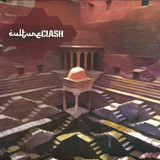
Forced to come up with a name, 'CultureClash' seemed like the obvious choice, even if the members of Awax were only creatively sparring among themselves. Along with the term 'ethno-techno', slightly dubious to a hopefully more conscious Western audience in 2017, these were the only guiding principles to the quietly ambitious project that soon combined cutting-edge machine rhythms with samples sourced from everywhere from Bolivia to Togo, and inspired by everything from Ravi Shankar's epic soundtrack to the Oscar-winning movie Ghandi, to the technical limits of their own setup requiring a dazzling degree of cut-and-paste work. Some tracks even emerged out of academic studies within the ethnomusicology department at The University of Amsterdam.
The show aired on October 2nd, 1992, recorded in one blistering take and without any rehearsals, traversing a huge variety of tempos and styles. If the performance wasn't seamless, it was undeniably thrilling, fresh and ambitious. As such, several labels, including Fernandez's aforementioned Irdial Discs expressed an interesting in commercially releasing CultureClash, while another imprint proposed a series of twelve-inches and an album. But the sheer complexity of the project meant that it never saw the light of day, while the trio embarked on different journeys ahead, both creative and personal.
Twenty five years later, and the original CultureClash lineup and founding members of The Awax Foundation provide the sound of the first release from Lost Futures. An otherworldly, ambitious and optimistic compilation, accompanied by extensive sleeve notes from the trio, CultureClash is a timeless ode to experimentation in dance music's ever-overlapping culture.
- A1: Theme From The Conversation (3:33)
- A2: The End Of The Day (1:37)
- A3: No More Questions / Phoning The Director (2:18)
- A4: Blues For Harry (Combo) (2:39)
- A5: To The Office / The Elevator (2:40)
- A6: Whatever Was Arranged (2:09)
- A7: The Confessional (2:21)
- B1: Amy's Theme (2:51)
- B2: Dream Sequence (2:35)
- B3: Plumbing Problem (2:54)
- B4: Harry Carried (2:47)
- B5: The Girl In The Limo (2:25)
- B6: Finale And End Credits (3:54)
- B7: Theme From 'The Conversation' (Ensemble) (2:31)
THIS IS NOT A REISSUE. THIS IS THE FIRST TIME THIS AMAZING MINIMAL SCORE HAS BEEN ISSUED ON VINYL
This is the first time the complete score to The Conversation has been released on vinyl. The film itself was originally released in 1974 and a 7' demo of the theme was sent out as promotional material by Paramount (PAA-0305), but a USA stock edition was never issued. In Japan the same music was also issued on a 7' at about the same time (JET-2273), with a picture sleeve, but until now nothing else has ever been pressed on vinyl.
Jonny Trunk's little obsession with this music began after I'd caught the film, late night, sometime in the mid 1990s. Musically it's an exceptional example of the 'new minimalism' in film music of the period, marking a departure (for some) from big scores to smaller, more economic ensemble sounds.
The film was written, produced and directed by Francis Ford Coppola and is still a thrilling journey into sound, mind and murder. Heavily influenced by Antonioni's Blow-Up (and not, as some thought, by Watergate), Coppola wanted to fuse the concept of Blow-Up with 'the world of audio surveillance'. The story centres around Harry Caul (Gene Hackman), a mac-wearing professional wire-tapper and clandestine bugger who gets unusually consumed by a conversation he's been paid to record. Caul is a loner, an obsessive-compulsive character with numerous neuroses that play out brilliantly throughout the film. And as he slowly pieces together the conversation fragments and forms his own story around it, his world falls apart.
Sonically this movie - all about sound - is groundbreaking in many ways, with actual 'sound Design' Provided By The Legendary Walter Murch - The Man Who Actually Invented The Term In The First Place.
For The Music, Coppola Wisely Chose A Young David Shire, His Brother In Law. Shire's Deceptively Simple Piano Theme (composed Because Of No Budget For Big Orchestra) Is One Of Tragic Beauty, Brilliantly Capturing Caul's Loneliness, His Slightly Disturbed Nature And This Trip Into Darkness. The Melody Has Both Sweet And Sour Tones, Feeling A Little Like A Slow Ragtime, Which Both Develops And Retreats Throughout The Film; There Are Even Trips Into Avant-garde Territory With Electro-acoustic Flourishes And Concrète. The Solo, Agitated Figure Of Caul, Wearing His Distinctive Transparent Mac, Is Made All The More Raw And Poignant By The Score - The Sparse And Curiously Emotional Compositions Are Unlike Any Others I Can Think Of From The Period.
The Soundtrack For The Conversation Proved To Be A Major Break For Shire, His Career Really Taking Off From This Musical Point. His Next Score Was To Be The Underground Classic Taking Of Pelham 123, Followed Up Later Ironically By All The Presidents Men - A Thriller About The Watergate Scandal.
The Conversation Went On To Win Several Awards And Nominations, And Has Become A Classic Of The 'new Hollywood' Movement. Hopefully Now This Music May Become Part Of The Renewed Interest In Old Film Soundtracks.
- A1: Otto Lindholm - Cain
- A2: Pan Daijing - The Island Within
- B1: Lanark Artefax - Styx
- B2: Petit Singe - Komm Wieder Mit
- B3: Peder Mannerfelt - Post Sense Perspective
- B4: Tomoko Sauvage - In Some Brighter Sphere
- C1: Pye Corner Audio - Box In A Box
- C2: Sophia Loizou - Shadows Of Futurity
- C3: Abul Mogard - Trembling With Tenderness
- C4: Par Grindvik - Speaking Their Minds
- D1: Koenraad Ecker - Rat's Coat
- D2: Roly Porter - Without Form
- D3: Hodge Sunlight - On A Broken Column
- E1: Gazelle Twin - The Dream Ends
- E2: Shapednoise - Ghostly Metafiction
- E3: Asc - Tessellate
- E4: Batu - Zoo Hypothesis
- F1: We Will Fail - Carbon Trail
- F2: Peter Van Hoesen - 98 Lines
- F3: Spatial Haunted - Dance Hall
- G1: Yves De Mey - Solemn But Fading
- G2: Mindspan - Accept Things As They Are
- G3: Kangding Ray - Glacier
- H1: Zov Zov - Post Six
- H2: Ian William Craig - An End Of Rooms
- H3: Christophe De Babalon - Broken Land (Vinyl Only Bonus)
Top-compilation Des Londoner Labels Houndstooth, Das 26 Künstler Um Einen Musikalischen Beitrag, Angelehnt An Das Apokalyptisch-klaustrophobische Gedicht "the Hollow Men" Von T.s. Eliot Von 1925, Bat. Die Tracks Erschienen Bereits Anfang 2018 In Digitaler Form, Seitdem Wird Nach Einem Physischen Tonträger Gefragt, Der Jetzt Einen Zusätzlichen, Exklusiven Bonustrack Enthält. Stilistisch Erinnern Die Werke An Electronic Listening-acts Der 1990er (artificial Intelligence, Future Sound Of London, Global Communication). Dark Music For Dark Times. "a Work Of Pure Desolation, An Echo From A Point Of No Return." - Pitchfork
One thing The Vryll Society aren't short of is admirers, Lauded at just about every turn by press and public alike, the release of their debut LP for Deltasonic Records is hotly anticipated thanks to the promise this band have shown through their live sets and recent single releases.
Discovered and nurtured by the late and much missed Deltasonic founder Alan Wills, they fitted the type for him perfectly. He instantly saw in them similar attributes he'd previously found in the early days of The Coral and The Zutons. The confident swagger, the solid union formed by their band-of-brothers gang mentality, their willingness to stand outside the conventional and often stifling jangly Liverpool scene, and the work ethic. Always the work ethic.
Wills instilled in The Vryll Society something which has become over the ensuing years a key element of what they are, what they've become, and of the music they produce. He gave them belief. A belief that hard work and determination will bring them to the place they wanted to reach.
'Alan taught us that all you need to conquer the world is a rehearsal room, your instruments, a good work ethic and a positive attitude and you'll get there. He kind of taught us the rules and the attributes that you need to have to be successful so we've just continued on that path' says frontman Mike Ellis.
Ellis has stated that it was that attitude and that work ethic which got them through the subsequent tragic loss of their friend and manager in 2014, driving them forward through those times, propelling them to harder work, and bonding them even closer together as a unit.
That unit have spent the intervening time creating and honing their own brand new-psych sound, and building up a fanbase with their superlative live shows. Drawing from an eclectic palette of influence from deep funk to Krautrock, electronica and prog, they've created a heady, intoxicating, pin sharp, and tightly wound mellifluous groove, washed over with cyclical motifs, acres of effects laden guitar hooks, and shimmering, textural technicolour soundscapes. It is at once blissful, dizzying and madly infectious. It's that eclecticism, that kaleidoscopic swirl of influences which brings together hip hop flavours, with the prog stylings of names such as Aphrodite's Child and The Verve - pre Urban Hymns - when the drugs were still working. The dynamic leaps and folds through all these influences is where you find The Vryll Society's own brand perfect pop. Its all there in the loops, in the hooks, the drive and the vibe of this unique band. But this isn't frippery, these aren't throwaway cheap thrills for our disposable times. No, this is heavier. This is music too feed your head.
Live too, The Vryll Society are a formidable force. That gang mentality binds them together over the ideas formed by spending long hours together in the rehearsal every day. Hotwiring these ideas into the heads of the crowd through extended psych jams and deep solid grooves gives a different show every time, and with each and every set, the offer gets better. Recent travels have seen them take SXSW 2017 by storm as guests of BBC Introducing as well as major festivals such as Glastonbury and Leeds/Reading.
The songs that fill the delicious grooves of Course Of The Satellite weren't so much written as devised or developed, brought together organically over months in the band's underground lair, or over weeks in Liverpool's Parr Street Studios. Working closely with producers, Wills' right hand man and Deltasonic brother-in-arms Joe Fearon and Tom Longworth, the album took shape organically, biding its time and finding its way. The result is a work of impressive confidence and stature. It's a record that believes in itself, and for all the right reasons. This is an effortlessly cool album, the sort of record that makes friends easily. The world is ready, willing and more than able to take The Vryll Society even deeper to their heart. The path Alan Wills showed them awaits. It's a path that leads to greatness.
a1 | Course Of The Satellite
a2 | A Perfect Rhythm
a3 | Andrei Rublev
a4 | Glows And Spheres
a5 | Tears We Cry
a6 | When The Air Is Hot
b1 | The Light At The Edge Of The World
b2 | Shadow Of A Wave
b3 | Soft Glue
b4 | Inner Life
b5 | Give In To Me
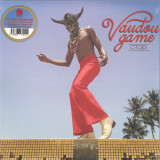
No one had been through those doors in years. Unchanged, seemingly untouched, just a Guard watching over it, one wondered whether the place would ever see the light of day again. Built in the 70s by Scotch, there were only twenty such places in the entire world. Twenty studios, all identical. Most had undergone a digital makeover in the 80s, but not this one; situated in Lomé, this studio had stayed true to its original form. Silent and uninhabited but waiting for one thing, and one thing only: for the sacred fire to be lit once again. That of the Togolese Recording Office, is studio OTODI for those in the know. Through thick layers of dust, the console was vibrating still, impatient to be turned on and spurt out the sound so unique to analog. That sound is what Peter Solo and his band Vaudou Game came to seek out.
The original vibrations of Lomé's sound, resonating within the studio space, an undercurrent pulsing within the walls, the floor, and the entire atmosphere. A presence at once electrical and mystical sourced through the amps that had never really gone cold, despite the deep sleep that they had been forced into. In taking over the studio's 3000 square feet, enough to house a full orchestra, Vaudou Game had the space necessary to conjure the spirits of voodoo, those very spirits who watch over men and nature, and with whom Peter converses every day.
For the most authentic of frequencies to fully imbibe this third album, Peter Solo entrusted the rhythmic section to a Togolese bass and drum duo, putting the groove in the expert hands of those versed in feeling and a type of musicianship that you can't learn in any school. This was also a way to put OTODI on the path of a more heavily hued funk sound, the backbone of which maintains flexibility and agility when moving over to highlife, straightens out when enhanced with frequent guest Roger Damawuzan's James Brown type screams, and softens when making the way for strings. Snaking and undulating when a chorus of Togolese women takes over, guiding it towards a slow, hypnotic trance. Up until now, Vaudou Game had maintained their connection to Togo from their base in France. This time, recording the entire album in Lomé at OTODI with local musicians, Peter Solo drew the voodoo fluid directly from the source, once again using only Togolese scales to make his guitar sing, his strings acting as channels between listeners and deities...
"It's Maths classes. A red-haired boy sits in the back, rhythmically tapping his fingers on a table like a madman. Although other students' eyesight is focused on the formula being written on the black-board, the boy could not care less. Out of a corner of his eye he notices as the sequence of numbers slowly begins to melt off the blackboard, glittering with colours, and finally spills all over the floor like a fractal leakage from some other dimension. Students from the first rows, scared, put their legs up - and then you start to hear the rhythm. The sounds, once set free, feedback from the walls and find their way to all chinks and cracks, circle all around to finally reach the teacher's ear. The lady cannot stop the upcoming fury, grabs Krzysztof Ostrowski (number 28) by his ear and circumventing the leakage she leads him out of the classroom. It's not the first nor the second time such thing happens. Years later, the boy finally sits by the machine; subtle light comes through the window slightly ajar, the curtain dances with the wind. Krzysztof, bent, is programming the rhythm."
It's warm and bright Autumn of 2018 and Krzysztof emerges again, this time on vinyl released by Jacek Sienkiewicz's label Recognition. The experimental style of "Primary Fluctuation" might come as a surprise to many of Jacek's followers, but there are surely some common features for the two art-ists - from attention to detail to a kind of serious melancholy present in their music. Ostrowski's rec-ord is a journey through futuristic polyrhythm, with enough space for menacing basses or unorthodox samples, reminding the aesthetics of fusion of broken techno and bass music championed recently by the labels like Timedance or Livity Sound. Four tracks (five in digital version) make up a cohesive, intriguing and surprising record, announcing series of special releases prepared by Recognition for the forthcoming months. ,
Warehouse Find!
Helsinki-based producer Saine makes his Delusions debut following amazing output on such revered labels as Voyage Recordings, Odd Socks, Omena and Fina. A producer who can flit from hazy instrumental hip hop through to raw, dusty house at the flick of a switch, Saine has built a solid following amongst lovers of left field leanings we've come to expect from the likes of Max Graef, Glenn Astro, Henry Wu and Leon Vynhall.
On lead track Act Natural we find Saine in perhaps his heaviest mood to date, delivering a crunchy uptempo house jam which retains his unique sound despite being aimed firmly at the dancefloor. A speaker wobbling eighth note bassline locks down the groove whilst familiar, much-loved frag- ments from the rave days punctuate the crackling beats. Add to this some simple syncopated chords and you have a winning formula for a timeless track which looks to the future whilst respectfully doffing it's cap to the past.
Jus Right continues in a deeper, more musical fashion with Saine getting busy on his synths, building up layers of warm pads and soloing Moog lines. A prominent vocal brings a soulful touch whilst the minimal, almost hihat-less groove adds an original and fresh feel to this blissful track.
Flipping over we have Low Key, a shuffling deep house number loaded with sliced Rhodes samples, echoing vocal hits, clipped percussion and sublime bass. As the atmosphere thickens, everything falls away to silence before rebuilding, creating some nice tension in the arrangement.
Finally we have Pontchartrain offering up an excellent remix of Jus Right. The Detroit native responsible for some mighty fine releases for the likes of Rocksteady Disco, Lovedancing, Soul Clap, Kolour LTD and Whiskey Disco takes things in a more straight-up house direction with heavier beats, 909 hats pushed to the fore and a distinctively old school feel to the mix.