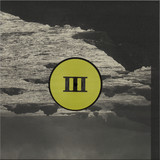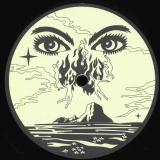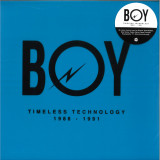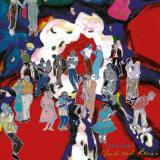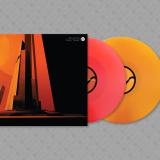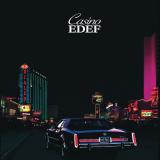
Falter is the 5th full-length album from New Zealand-based composer/-multi-instrumentalist Micah Templeton-Wolfe, working under the moniker Stray Theories.
Templeton-Wolfe has consistently woven together the cinematic sweep of ambient music, the refined structures of neoclassical composition, and the emotional cresting arcs of post-rock. With Falter, those intersections are more deeply blurred, yet more boldly explored.
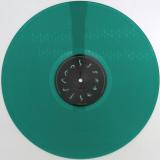
Transparent Red Vinyl.
The title Falter evokes wavering, hesitation, uncertainty of intent and yet the album stands in sharp contrast to that concept: Templeton-Wolfe’s performance here is marked by a quiet but unmistakable confidence.
From the first notes, the listener is immersed in an atmosphere in which the music feels like a cinematic means of passage, a journey toward redemption. Optimism is present, but ever cloaked in doubt; moments of
contemplative solace sit side-by-side with streaks of melancholia. One senses something looming within the sound-world of Falter. As though the heart itself can tell something is coming.
In this respect, Falter may well rank as the most affecting release in Templeton-Wolfe’s canon to date. While his earlier work had always balanced delicate textures and evocative atmosphere, here he pushes into a more expansive emotional terrain. Only the hopeful refrain “Lifelines” brings the album fully into brighter territory , hinting that redemption is possible, that the journey through doubt is not endless.
Cerca:thou
Holy grail of Memphis Boogie Funk! Subway Featuring Wave is an absolute gem of a mini Lp and is reissued for the first time ever on Past Due Records. Original copies are known to fetch in the thousands...
Produced by Lee Moore with Stax musicians, including guitarist Michael Toles, keyboard player Lester Snell, and drummer Willie Hall, all members of the Isaac Hayes Movement. He also hired bassist Ray Griffin who recorded numerous sessions for both Stax and Malaco Records.
This is the debut release from Laguna Seca, a new project from Porto based Mike Jefford. It foreshadows a new body of work, steeped in 70s nostalgia, refracted though sounds that could belong to krautrock, disco, electronica, noisy alt rock and everything in between. Mike has previously recorded as Positive Centre releasing textural, experimental techno on such labels as Stroboscopic Artefacts, SNTS and Leyla. (seek out if you you’re a fan of Vatican Shadow or the ghostlier wing of Black Dog)
After mastering his forthcoming 2026 debut album ‘O Tempo’, Mike Jefford caught a second wind of inspiration. In just seven frantic days he recorded the heap of tracks that formed the basis of 'Live from Müsli Mountain’. It soon became clear that these tracks foreshadowed the album perfectly and the EP was born.
Named after the California raceway, this project fuses 1970s recording techniques, modern electronics and psychedelic retrofuturism, it’s a pyramid of sonic adventure that will be explored deeper on the album next year.
Phonica AM welcomes long-time friend of the shop Voigtmann, appearing under his A Thousand Futures alias with a release that feels perfectly at home on the imprint. Known for precision engineering and playful groove work, he delivers a 12″ that’s subtle, characterful and built for repeat play.
Across four tracks, Voigtmann moves between sleek, futuristic club moods with ease: from the ghostly, cosmic drive of “Leftfoot Lover” and the acid-flecked momentum of “Outer Edge,” through to the jacking electro-funk tension of “No Room For Squares.” The record closes on “Sunshine Capital,” a warm, chord-led cut that still carries his trademark grit - a deeper moment without losing focus.
Curated by Phonica’s Luther Vine, the AM series champions the stranger, more late-night corners of the dancefloor, and this release fits the ethos with style. Touching lightly on progressive house, tech house and electro-leaning minimal, the record avoids strict genre lines and instead prioritises feeling: trippy, functional and made for DJs.
In early 2025 Oakland-based Jerod S. Rivera released his second full length Dot-Dash, featuring a collaboration with CST co-founder Cat Lauigan and Jonathan James Carr. From the beginning we were mesmerized with the result, a perfect melding of Cat's processed spoken-word and Jerod's Buchla experimentations.
The thought of remixes presented immediately, the material extra ripe for interpolation. Enlisting friends from geographically and sonically disparate locations to present an ideal remix 12". Something for everyone, something for every setting, a tool with multiple functions...
The mysterious dub/techno/leftfield mastermind behind False Aralia dives further into territory explored on iri.gram, uptempo and dancefloor-ready in a more maximal Perlon-ish way while still embracing a half-time dub feel. Philipp Otterbach (Music from Memory, Offen, RIO) goes deeper into the guitar zone he’s been exploring, channeling Earth 2, Boris, and the like for some heavy drone. Oakland duo DJ ML and Wonja adopt their Motoko & Myers moniker (Future Times, Soda Gong), zeroing in on some choice vocal snippets that mesh perfectly with a live drum break and bassline for a Seefeel-esque version that could have come from a 90’s UK studio. Finally, Slowfoam embraces the more experimental elements of the original with a remix that starts sparse and minimal but builds into a glitchy rhythmic climax.
The 12” includes a 2-sided riso insert and a download code with access to an additional remix by close collaborator Jon Carr that twists the vocals into a throbbing industrial caucaphony.
UK funk veterans McKenzie & Gardiner are best known for their 1983 boogie classic 'From Time' and the album Songs From Time - The Lost Demos. They returned in 2021 with a fresh recording of fan favourite 'Hold On Tight' featuring original vocalist Shelley Hicks and it now lands on vinyl for the first time. First, though, the A-side delivers the sultry boogie swagger of 'Completely' with its aching male vocal and humid, throbbing bass. Flip it over for the smooth, soulful 'OG Redux' version of 'Hold On Tight' produced by Clive Gardiner who says, "we used lockdown to get the gang back together, and we've never sounded better." Hard to argue with that.
DJ Homicide is a celebrated American DJ, musician, rapper, singer, record producer and radio personality. With a career that spans more than three decades, he has left a lasting mark, mostly as a key member of the multi-platinum band Sugar Ray, though he has also made some fine solo moves. And he backs that up here with a couple of full-fat jams on CA to get the new label underway in style. 'Pause Lion' starts things off with some raw, guttural vocals and low slung boom-bap drums that are direct and edgy and on the flip, 'Ghetto Scenario' rides a more smooth groove with some ragga vocals that call to mind the best of Sean Paul.
- A1: Veillands
- A2: Eolasfalas
- A3: Sonnenallee
- A4: Somnisvela
- B1: Nothing Under Heaven
- B2: Turadh
- B3: Caoimal
- B4: Saorla
Nothing Under Heaven is the third full-length album from Scottish ambient and drone multi-instrumentalist Yulyseus.
It follows 2022’s In the Dark Palaces of Both Our Hearts, an introspective and immersive work shaped by travel, displacement, and unfamiliar surroundings. Where that release explored darker and more inward-looking terrain, Nothing Under Heaven opens outward into broader, more expansive soundscapes. Drawing on years spent moving between Glasgow, Berlin, Mexico City and Valencia, Niall Gahagan’s compositions here feel patient and quietly luminous, built from layered electronics, bowed strings and subtle field recordings.
Rather than seeking dramatic gestures, the album unfolds slowly, allowing atmosphere and emotion to emerge over time. Working within a crowded and ever-evolving ambient landscape, Yulyseus continues to focus on texture, weight and gradual movement.
Across eight carefully shaped pieces, Nothing Under Heaven explores how sound can hold both stillness and momentum, inviting attentive listening rather than functioning as simple background music. The opening track, Veillands, sets the tone with a quiet intensity that gently draws the listener inward. From there, the album develops as a continuous, immersive experience, rich in detail and emotional nuance. Nothing Under Heaven reflects an artist still in motion, responding to change, uncertainty and new surroundings with humility and care. It stands as a thoughtful and deeply considered addition to Yulyseus’s growing body of work which is rooted in patience, deep listening, and a continuing search for meaning through sound.
Visionary producer Ibrahim Alfa Jr, who's been traversing the rave's farthest fringes since the late '90s, returns with his most focused and concise set to date, an anthology of undulating, bass-heavy experiments that surveys techno and its distorted history, printing fractured pulses and cybernetic synths over vanishing snapshots of jazz, funk, trip-hop, broken beat, dub and ambient music. It's a body of work that coalesced during a difficult time for Alfa.
After returning to Brighton and sobriety in 2022, he was diagnosed with a pulmonary embolism, subsequently suffering two debilitating heart attacks. With his immune system compromised, isolation was the only option, so for months on end Alfa devoted each waking hour to his art, recording samples, building digital synths and effects and meticulously sequencing some of his waviest, most experimental material to date. Over this period he finished over 500 tracks, writing impulsively and constantly challenging himself. "There was nothing to hold me back," he explains. "I just had music, I didn't know if I would see the next day."
Now recovered from his ordeal, Alfa looks back at this prolific period with optimism and fondness. It was a chance for him to reconnect with his art holistically, writing purely for himself without any outside influence. Because, at this stage in his life, Alfa has already been through a series of artistic evolutions. When he was still just a teenager, he penned a slew of grinding, jacking techno 12"s (under a variety of mysterious monikers) in the late '90s before re-emerging a decade ago with the acclaimed 'Hidden By The Leaves', an album made up of deeply personal archival tracks that were thought to have been lost. A few years later, Alfa returned wholeheartedly with a series of records for Mille Plateaux that redrew the boundaries of his "Black political music without words." And on 'Infinite Black Inside', those different strands are muddled with Alfa's profound life experiences and he expresses himself free of any self-imposed boundaries, writing quickly on a hybrid analog-digital setup to document as many ideas as possible.
There's a palpable sense of liberation that drives the album's opening track, 'Subutrax', lubricating polyrhythms that isolate the connective tissue between footwork and Detroit techno as they slip between looped electric piano vamps and vaporous synths. On 'Naked Lunchbreak' meanwhile, the beat generation's excesses are illustrated by mesmeric fast-paced acoustic drums that Alfa balances out with brassy drones and euphoric keys. He captures rubbery hits from a Ghanaian djembe on 'Drum Slinger', re-sequencing them into seismic waves that rumble underneath live woodwind blasts. And on 'Capture', decelerated breaks and garbled voices tumble into humid pads, suspending the album somewhere between the chill-out room and the night sky. It's a record of new beginnings and fresh narratives that collapses the hardcore continuum, revealing a sonic signature that's Alfa's alone.
Laseech, a Croatian producer and Cosada label owner with releases on BBE, Lumberjacks In Hell, Red Ember Records, and Forbidden Dance, is continuing a string of excellent releases with Rising Soul. Known for his dedication to house music, Laseech has built an international reputation through collaborations and remixes with some of the genre's most respected architects, including Ron Trent, Patrice Scott, Javonntte, and Dego. "Rising Soul is actually one of the first tracks I did back in 2017 while I was heavily into sampling. I was jamming with my MPC1000, and Rising Soul came up. I never thought that it would become such an effective song that works on the dancefloor every time." Laseech explains. Kez YM, a highly respected Japanese producer and DJ, has been a key figure in the global house music scene for almost two decades. Originally from Chiba and now based in Berlin, his unique approach to house music has led to releases on esteemed labels such as City Fly, Faces Records, Yore, and 4Lux. When describing his version of the track, Kez simply stated: "VIBES." Well, no one will argue with that. The last version comes from Cycle Records' founder Jan Kincl, a prominent Croatian music producer and DJ with releases on labels like BBE, Far Out, Sonar Kollektiv, and Get Physical. "I've been playing Andrej's original for years. He undoubtedly made some good stuff recently, but this one remains among my firm favourites from him. Kez delivered a beautiful version that took it further towards jazz territory, so I decided to make a version that would bridge those two." Jan explains. "I knew we could build a very good record around Rising Soul, with versions that would give DJs different options for different moments during the party. I guess we did a good job because some of the early supporters include DJs from all over the place - Laurent Garnier, Alex Barck from Jazzanova, Marcel Dettmann, Alex Nut (Eglo), Sasse, Chicago's K' Alexi Shelby, Lakuti, Ian Friday and Truncate, among others.
2026 Repress
One of the leading names in contemporary underground music, Guy J, embarks on a new journey. As a dedicated futurist and sound enthusiast who pushes boundaries akin to science fiction, Guy delivers the first track on his new label with an abstract vision of the layered future of sound. This 15-minute preview of Guy J's forward-thinking, innovative work indicates a promising future for his label. Experience the birth and transformation of a new era in sound from day one!
Every beginning carries excitement and unpredictability, requiring something extraordinary. Whether rooted in creationism, biblical narratives, or the Big Bang Theory, both theological and scientific origin stories resonate with events echoing millions of years into the future. One of the leading names in contemporary underground music, Guy J, embarks on a new journey. As a dedicated futurist and sound enthusiast who pushes boundaries akin to science fiction, Guy delivers the first track on his new label with an abstract vision of the layered future of sound.
From the opening patterns till the end, A Million Years From Now offers an adventure, blending moments of free-flowing thought with a perfectly engineered audio collage that evokes a spectrum of abstract emotions-from melancholia and psychedelia to breathless excitement and, ultimately, pure euphoria.
The layered creativity transcends realism, leading listeners into a state of trance. The second piece, Just Rain, kicks off with a bass-heavy, pumping kick drum that vibrates speakers on any sound system.
However, Guy J transforms this from a rhythm-based track into a melodic epic. Its power lies in the seamless transitions and manipulation of effects and in the compositional structure that evolves over the eight-minute arrangement. Despite its subtle atmosphere, the melody culminates in an explosion of emotions that stimulate every frequency of the audible sound spectrum.
This 15-minute preview of Guy J's forward-thinking, innovative work indicates a promising future for his label. Experience the birth and transformation of a new era in sound from day one!
- A1: Init
- A2: Terminal Feeling
- A3: Higher Resolution
- A4: Daydream
- A5: Remission
- A6: Side Effects
- B1: Clarity
- B2: Breathe
- B3: Dawn
- B4: Kosmos
- B5: Inner_Mission Lp
- C1: Better Today Better Tomorrow
- C2: The Legend Of
- C3: Audio Machina
- C4:
- C5: Time
- C6: Missed Connections
- D1: <<
- D2: Television
- D3: String Theory
- D4: Touch
- D5: Hold For Applause
- D6: Trinitron
Kasablanca deliver their long awaited debut album ‘Higher Resolution’. Hitting milestone after milestone over the past five years, Kasablanca has quickly risen through the ranks of dance music must-see acts. Launching into the scene with their first singles in 2020 they struck gold early on with their hit collaboration ‘Run’ alongside Lane 8. With over 40M streams on the track since, the duo hasn’t looked back since. Hailing from Toronto, Canada the band has been explosive over the years since their first ‘Human Learning EP’ in 2020. Most widely known for their enthralling live performances, Kasablanca has played some of the world’s most well-known venues and festivals, like Printworks, Coachella, Red Rocks, Carnival in Brazil and The Gorge to name just a few. Their songs have also been heard worldwide across radio airwaves including features on BBC Radio 1 and Sirius XM (which brought in their #1 hit with ‘Run’) as well as thousands of spins from stations across North and South America, Europe and Asia.
Versions Visions, the third EP from Umanuto, is an artistic union between rising producer Sirius Topic and label founder Javas. Blending psychedelic-tinged house with minimal and retrospective vibes, the EP showcases a unified sonic vision despite differing creative approaches. Parsec opens with Detroit-inspired melancholy and minimalist depth.
Sellerhausen ramps up with acid energy and rhythmic drive, evoking a mysterious Leipzig night. Navigation offers a reflective, sway-inducing stroll through sound. Mindset wraps up the EP with a house groove, weaving joy into layers of introspection. A thoughtful, genre-blurring exploration of mood and movement
Introduced by a discrete message online, at the beginning of 2024, SNR007’s opening track Gliadin snuck its way through the web and first tickled my eardrums. It immediately lightened the mood and caused a little living room dance after a boring and grey day.
K’s musical ingredients may be called sparse, or certainly peculiar. All elements have their purpose though, even if they won’t tell you exactly what that is. The resulting experience is rich, enveloping and darkly funny.
The second chapter after “neverlost”, “closer” blends samplebased production with classic songwriting – like a sonic mosaic of warmth and groove. Lyrically “hippiesque,” Sepalot explores natural beauty, unity, equality, and self-determination. Guest features shine: Blu delivers sharp lyricism, and Illa J surprises
with soulful vocals on “My Own Way.” For fans of The Avalanches, Caribou, and Madlib – Closer is lush, human, and unforgettable.
Sepalot is one of those rare artists whose sonic palette refuses to be boxed in. His music exists in the fertile space between multi-layered sophistication and playful unpredictability – a quality rooted in his eclectic upbringing. From skate-punk beginnings to soul all-nighters, from obsessive vinyl digging to
deep immersion in hip-hop’s golden era, Sepalot has carried the art of sampling like a badge of honor. His beats are mosaics – meticulously pieced together fragments of sound forming an intricate whole. Beyond the studio, he’s explored these influences as DJ, producer, and live performer, leading the
Sepalot Quartet across Europe’s jazz festivals, and more recently with his experimental band Tikhet alongside Angela Aux
With “closer”, the upcoming second chapter following his 2023 album “neverlost”, Sepalot distills his broad musical world into a sample-based yet song-driven statement. The production feels warm and tactile – think needle-on-vinyl crackle meeting modern songwriting clarity. Lyrically, it’s “hippiesque” in the best
way: themes of natural beauty, unity, democratic awareness, equality, and spiritual introspection weave through the tracklist.
The guest list is just as inspired: legendary wordsmith Blu delivers razor-sharp verses, while Illa J – brother of the late J Dilla – steps away from his signature rap to surprise with soulful vocals on “My Own Way.” Together, they amplify the album’s humanist core, balancing groove-heavy production with
lyrical depth.
Fans of artists like The Avalanches, Caribou, DJ Shadow, or Madlib will find plenty to love here, but Closer carries its own unique fingerprint – a testament to Sepalot’s ability to merge hip-hop grit with songwriting grace. If “Neverlost” was a map, “Closer” is the destination: lush, thoughtful, and deeply human.
Highly recommended for anyone ready to hold hands, open their mind, and let the beat guide them.
CAY unveils his personal side on Another Life, a debut album rich in melancholic euphoria
The expressive, multi-faceted 10 tracker comes on Mind Against's HABITAT label in January 2026
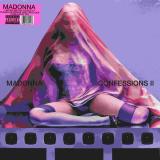
Cologne-born producer CAY explores beyond the dancefloor with Another Life, a debut album that trades peak-time pressure for an ambitious and artful exploration of self. Far from being rooted in one genre, the record weaves his own honest vocals with a wide range of powerful rhythms that pull from progressive, broken beat, techno and trance.
For CAY, making music has always offered refuge and a place to calm his mind, process life’s chaos and channel personal experiences into sound. His journey started in the clubs of Cologne, in illegal forest raves and with trips to Berlin to soak up big room techno. His search for more purpose, away from mental demons and the darker side of the party lifestyle, led him to production. DJing followed after a push from his brother turned Manager, and while those experiences around Europe shaped his understanding of dance floor dynamics, he was never in a rush to release his early experiments.
Instead, CAY took private time to evolve into an accomplished artist with his own musical voice. Label heads Mind Against were so impressed when they heard what he sent to their demo inbox, they both reached out to collaborate, and he has since released on their label HABITAT.
With Another Life, he is making music that is multilayered and rich in narrative, rather than defined purely by big moments. It is drawn from years of writing, with more than 60 tracks whittled down to one concise, impactful statement. "There wasn't one big concept,” says CAY “but there was direction. It's a big risk for me, but I wanted to introduce people who like club music to something deeper. I want the music to say something real.”
Because of that, Another Life introduces CAY the vocalist. For the first time, he sings on several tracks. The subjects are real, whether that's an important friend, a moment with his girlfriend or, on 'Runaway', the thought of giving up and escaping everything. The lyrics are honest but often slightly oblique, so they invite your own readings rather than spelling everything out.
Sonically, the album moves between optimistic grandeur and introspective reality. It's cinematic but personal and bridges the gap between dancefloor drive and vulnerable storytelling. There is a grand scale to many of the tracks, with arching synths reaching and heavyhearted drums anchoring a groove: you'll dance, you'll cry, maybe both at the same time.
Another Life is the sound of a producer granting himself permission to sing, turn inwards and risk audience expectations. It’s intimate without being insular, club-capable without being confined, and a compelling first chapter for an artist who has spent years building toward this moment of truth.
- A1: Hurts And Noises
- A2: Wake Up
- A3: I Don't Wanna Be A Rich
- A4: Terrorist Bad Heart
- A5: Provocate
- A6: Lucifer Sam (Pink Floyd)
- B1: Happy!?
- B2: So Lazy
- B3: I Feel Down
- B4: Stupido
- B5: Guilty
- B6: Caroline Says (Loo Reed)
UILTY RAZORS, BONA FIDE PUNKS.
Writings on the topic that go off in all directions, mind-numbing lectures given by academics, and testimonies, most of them heavily doctored, from those who “lived through that era”: so many people today fantasize about the early days of punk in our country… This blessed moment when no one had yet thought of flaunting a ridiculous green mohawk, taking Sid Vicious as a hero, or – even worse – making the so-called alternative scene both festive and boorish. There was no such thing in 1976 or 1977, when it wasn’t easy to get hold of the first 45s by the Pistols or the Clash. Few people were aware of what was happening on the fringes of the fringes at the time. Malcolm McLaren was virtually unknown, and having short hair made you seem strange. Who knew then that rock music, which had taken a very bad turn since the early 1970s, would once again become an essential element of liberation? That, thanks to short and fast songs, it would once again rediscover that primitive, social side that was so hated by older generations? Who knew that, besides a few loners who read the music press (it was even better if they read it in English) and frequented the right record stores? Many of these formed bands, because it was impossible to do otherwise. We quickly went from listening to the Velvet Underground to trying to play the Stooges’ intros. It’s a somewhat collective story, even though there weren’t many people to start it.
The Guilty Razors were among those who took part in this initial upheaval in Paris. They were far from being the worst. They had something special and even released a single that was well above the national average. They also had enough songs to fill an album, the one you’re holding. In everyone’s opinion, they were definitely not among the punk impostors that followed in their wake. They were, at least, genuine and credible.
Guilty Razors, Parisian punk band (1975-1978). To understand something about their somewhat linear but very energetic sound, we might need to talk about the context in which it was born and, more broadly, recall the boredom (a theme that would become capital in punk songs) coupled with the desire to blow everything off, which were the basis for the formation of bands playing a rejuvenated rock music ; about the passion for a few records by the Kinks or the early Who, by the Stooges, by the Velvet mostly, which set you apart from the crowd.
And of course, we should remember this new wave, which was promoted by a few articles in the specialized press and some cutting-edge record stores, coming from New York or London, whose small but powerful influence could be felt in Paris and in a handful of isolated places in the provinces, lulled to sleep by so many appalling things, from Tangerine Dream to President Giscard d’Estaing...
In 1975-76, French music was, as almost always, in a sorry state ; it was still dominated by Johnny Hallyday and Sylvie Vartan. Local rock music was also rather bleak, apart from Bijou and Little Bob who tried to revive this small scene with poorly sound-engineered gigs played to almost no one.
In the working class suburbs at the time, it was mainly hard rock music played to 11 that helped people forget about their gruelling shifts at the factory. Here and there, on the outskirts of major cities, you still could find a few rockers with sideburns wearing black armbands since the death of Gene Vincent, but it wasn’t a proper mass movement, just a source of real danger to anyone they came across who wasn't like them. In August 1976, a festival unlike any other took place in Mont-de-Marsan – the First European Punk Festival as the poster said – with almost as many people on stage as in the audience. Yet, on that day, a quasi historical event happened, when, under the blazing afternoon sun, a band of unknowns called The Damned made an unprecedented noise in the arena, reminiscent of the chaotic Stooges in their early adolescence. They were the first genuine punk band to perform in our country: from then on, anything was possible, almost anything seemed permissible.
It makes sense that the four+1 members of Guilty Razors, who initially amplified acoustic guitars with crappy tape recorder microphones, would adopt punk music (pronounced paink in French) naturally and instinctively, since it combines liberating noise with speed of execution and – crucially – a very healthy sense of rebellion (the protesters of May 1968 proclaimed, and it was even a slogan, that they weren’t against old people, but against what had made them grow old. In the mid-1970s, it seemed normal and obvious that old people should now ALSO be targeted!!!).
At the time, the desire to fight back, and break down authority and apathy, was either red or black, often taking the form of leafleting, tumultuous general assemblies in the schoolyard, and massive or shabby demonstrations, most of the time overflowing with an exciting vitality that sometimes turned into fights with the riot police. Indeed, soon after the end of the Vietnam War and following Pinochet’s coup in Chile, all over France, Trotskyist and anarcho-libertarian fervour was firmly entrenched among parts of the educated youth population, who were equally rebellious and troublemakers whenever they had the chance. It should also be noted that when the single "Anarchy in the UK" was first heard, even though not many of us had access to it, both the title and its explosive sound immediately resonated with some of those troublemakers crying out for ANARCHY!!! Meanwhile, the left-wing majority still equated punks with reckless young neo-Nazis. Of course, the widely circulated photos in the mainstream press of Siouxsie Sioux with her swastikas didn’t necessarily help to win over the theorists of the Great Revolution. It took Joe Strummer to introduce The Clash as an anti-racist, anti-fascist and anti-ignorance band for the rejection of old-school revolutionaries to fade a little.
The Lycée Jean-Baptiste Say at Porte d’Auteuil, despite being located in the very posh and very exclusive 16th arrondissement of Paris, didn’t escape these "committed" upheavals, which doubled as the perfect outlet for the less timid members of this generation.
“Back then, politics were fun,” says Tristam Nada, who studied there and went on to become Guilty Razors’ frontman. “Jean-Baptiste was the leftist high-school in the neighbourhood. When the far right guys from the GUD came down there, the Communist League guys from elsewhere helped us fight them off.”
Anything that could challenge authority was fair game and of course, strikes for just about any reason would lead to increasingly frequent truancy (with a definitive farewell to education that would soon follow). Tristam Nada spent his 10th and 11th unfinished grades with José Perez, who had come from Spain, where his father, a janitor, had been sentenced to death by Franco. “José steered my tastes towards solid acts such as The Who. Like most teenagers, I had previously absorbed just about everything that came my way, from Yes to Led Zeppelin to Genesis. I was exploring… And then one day, he told me that he and his brother Carlos wanted to start a rock band.” The Perez brothers already played guitar. “Of course, they were Spanish!”, jokes their singer. “Then, somewhat reluctantly, José took up the bass and we were soon joined by Jano – who called himself Jano Homicid – who took up the rhythm guitar.” Several drummers would later join this core of not easily intimidated young guys who didn’t let adversity get the better of them.
The first rehearsals of the newly named Guilty Razors took place in the bedroom of a Perez aunt. There, the three rookies tried to cover a few standards, songs that often were an integral part of their lives. During a first, short gig, in front of a bewildered audience of tough old-school rockers, they launched into a clunky version of the Velvet Underground's “Heroin”. Challenge or recklessness? A bit of both, probably… And then, step by step, their limited repertoire expanded as they decided to write their own songs, sung in a not always very accurate or academic English, but who cared about proper grammar or the right vocabulary, since what truly mattered was to make the words sound as good as possible while playing very, very fast music? And spitting out those words in a language that left no doubt as to what it conveyed mattered as well.
Trying their hand a the kind of rock music disliked by most of the neighbourhood, making noise, being fiercely provocative: they still belonged to a tiny clique who, at this very moment, had chosen to impose this difference. And there were very few places in France or elsewhere, where one could witness the first stirrings of something that wasn’t a trend yet, let alone a movement.
In the provinces, in late 1976 or early 1977, there couldn’t be more than thirty record stores that were a bit more discerning than average, where you could hear this new kind of short-haired rock music called “punk”. The old clientele, who previously had no problem coming in to buy the latest McCartney or Aerosmith LP, now felt a little less comfortable there…
In Paris, these enlightened places were quite rare and often located nex to what would become the Forum des Halles, a big shopping mall. Between three aging sex workers, a couple of second-hand clothes shops, sellers of hippie paraphernalia and small fashion designers, the good word was loudly spread in two pioneering places – propagators of what was still only a new underground movement. Historically, the first one was the Open Market, a kind of poorly, but tastefully stocked cave. Speakers blasted out the sound of sixties garage bands from the Nuggets compilation (a crucial reference for José Perez) or the badly dressed English kids of Eddie and the Hot Rods. This black-painted den was opened a few years earlier by Marc Zermati, a character who wasn’t always in a sunny disposition, but always quite radical in his (good) choices and his opinions. He founded the independent label Skydog and was one of the promoters of the Mont-de-Marsan punk festivals. Not far from there was Harry Cover, another store more in tune with the new New York scene, which was amply covered in the house fanzine, Rock News (even though it was in it that the photos of the Sex Pistols were first published in France).
It was a favorite hang-out of the Perez brothers and Tristam Nada, as the latter explained. “It’s at Harry Cover’s that we first heard the Pistols and Clash’s 45s, and after that, we decided to start writing our first songs. If they could do it, so could we!”
The sonic shocks that were “Anarchy in the UK”, “White Riot” or the Buzzcocks’s EP, “Spiral Scratch” – which Guilty Razors' sound is reminiscent of – were soon to be amplified by an unparalleled visual shock. In April 1977, right after the release of their first LP, The Clash performed at the Palais des Glaces in Paris, during a punk night organised by Marc Zermati. For many who were there, it was the gig of a lifetime…
Of course, Guilty Razors and Tristam were in the audience: “That concert was fabulous… We Parisian punks were almost all dressed in black and white, with white shirts, skinny leather ties, bikers jackets or light jackets, etc. The Clash, on the other hand, wore colourful clothes. Well, the next day, at the Gibus, you’d spot everyone who had been at this concert, but they weren’t wearing anything black, they were all wearing colours.”
It makes sense to mention the Gibus club, as Guilty Razors often played there (sometimes in front of a hostile audience). It was also the only place in Paris that regularly scheduled new Parisian or Anglo-Saxon acts, such as Generation X, Siouxsie and the Banshees, the Slits, and Johnny Thunders who would become a kind of messed-up mascot for the venue. A little later, in 1978, the Rose Bonbon – formerly the Nashville – also attracted nightly owls in search of electric thrills… In 1977, the iconic but not necessarily excellent Asphalt Jungle often played at the Gibus, sometimes sharing the bill with Metal Urbain, the only band whose aura would later transcend the French borders (“I saw them as the French Sex Pistols,” said Geoff Travis, head of their British label Rough Trade). Already established in this small scene, Metal Urbain helped the young and restless Guilty Razors who had just arrived. Guitarist for Metal Urbain Hermann Schwartz remembers it: “They were younger than us, we were a bit like their mentors even if it’s too strong a word… At least they were credible. We thought they were good, and they had good songs which reminded of the Buzzcocks that I liked a lot. But at some point, they started hanging out with the Hells Angels. That’s when we stopped following them.”
The break-up was mutual, since, Guilty Razors, for their part, were shocked when they saw a fringe element of the audience at Metal Urbain concerts who repeatedly shouted “Sieg Heil” and gave Nazi salutes. These provocations, even still minor (the bulk of the skinhead crowd would later make their presence felt during concerts), weren’t really to the liking of the Perez brothers, whose anti-fascist convictions were firmly rooted. Some things are non-negotiable.
A few months earlier (in July 1978), Guilty Razors had nevertheless opened very successfully for Metal Urbain at the Bus Palladium, a more traditonally old-school rock night-club. But, as was sometimes the case back then, the night turned into a mass brawl when suburban rockers came to “beat up punks”.
Back then, Parisian nights weren’t always sweet and serene.
So, after opening as best as they could for The Jam (their sound having been ruined by the PA system), our local heroes were – once again – met outside by a horde of greasers out to get them. “Thankfully,” says Tristam, “we were with our roadies, motorless bikers who acted as a protective barrier. We were chased in the neighbouring streets and the whole thing ended in front of a bar, with the owner coming out with a rifle…”
Although Tristam and the Perez brothers narrowly escaped various, potentially bloody, incidents, they weren’t completely innocent of wrongdoing either. They still find amusing their mugging of two strangers in the street for example (“We were broke and we simply wanted to buy tickets for the Heartbreakers concert that night,” says Tristam). It so happened that their victims were two key figures in the rock business at the time: radio presenter Alain Manneval and music publisher Philippe Constantin. They filed a complaint and sought monetary compensation, but somehow the band’s manager, the skilful but very controversial Alexis, managed to get the complaint withdrawn and Guilty Razors ended up signing with Constantin with a substantial advance.
They also signed with Polydor and the label released in 1978 their only three-track 45, featuring “I Don't Wanna be A Rich”, “Hurts and Noises” and “Provocate” (songs that exuded perpetual rebellion and an unquenchable desire for “class” confrontation). It was a very good record, but due to a lack of promotion (radio stations didn’t play French artists singing in English), it didn’t sell very well. Only 800 copies were allegedly sold and the rest of the stock was pulped… Initially, the three tracks were to be included on a LP that never came to be, since they were dropped by Polydor (“Let’s say we sometimes caused a ruckus in their offices!” laughs Tristam.) In order to perfect the long-awaited LP, the band recorded demos of other tracks. There was a cover of Pink Floyd's “Lucifer Sam” from the Syd Barrett era – proof of an enduring love for the sixties’ greats –, “Wake Up” a hangover tale and “Bad Heart” about the Baader-Meinhof gang, whose actions had a profound impact on the era and on a generation seeking extreme dissent... On the album you’re now discovering, you can also hear five previously unreleased tracks recorded a bit later during an extended and freezing stay in Madrid, in a makeshift studio with the invaluable help of a drummer also acting as sound engineer. He was both an enthusiastic old hippie and a proper whizz at sound engineering. Here too, certain influences from the fifties and sixties (Link Wray, the Troggs) are more than obvious in the band’s music.
Shortly after a final stormy and rather barbaric (on the audience’s side) “Punk night” at the Olympia in June 1978, Tristam left the band ; his bandmates continued without him for a short while.
But like most pioneering punk bands of the era, Guilty Razors eventually split up for good after three years (besides once in Spain, they’d only played in Paris). The reason for ceasing business activities were more or less the same for everyone: there were no venues outside one’s small circuit to play this kind of rock music, which was still frightening, unknown, or of little interest to most people. The chances of recording an LP were virtually null, since major labels were only signing unoriginal but reassuring sub-Téléphone clones, and the smaller ones were only interested in progressive rock or French chanson for youth clubs. And what about self-production? No one in our small safety-pinned world had thought about it yet. There wasn’t enough money to embark on that sort of venture anyway.
So yes, the early days of punk in France were truly No Future!
Red and Black Galaxy Vinyl. Kmoe is a young Canadian artist who emerged from the 2021 SoundCloud/Discord scene. Kmoe blends hyperpop and glitchy production with catchy indie-pop melodies and pitched up vocals. His sound is characterized as a "modern-day romantic" take on electronic music, heavily influenced by shoegaze, hip hop and experimental pop.
- A1: Wasting Your Facelift
- A2: Die Infektion
- A3: Knebelfreunde (Feat. Das Kinn)
- B1: Free Cigarettes
- B2: Going In Circles (Ft. Rosaceae)
- B3: Totengräber (Ft. Felix Kubin)
- C1: Beiss Mich! (Ft. Rosaceae)
- C2: Leaves Casting Shadows
- C3: Hell Was Boring
- D1: Ironsight
- D2: Deutschland Verreist (Ft. Konstantin Unwohl)
- D3: Second Thoughts (Ft. Children Of Leir)
Between 2023 and 2025, L.F.T. split his time between Hamburg and Berlin, slowly piecing together what would become his most ambitious work to date. The result is Hell Was Boring - a double album that plays like a fever dream, unfolding as a dark, mythical tale about life, death, and the strange spaces in between.
L.F.T. - the alias of German producer and multi-instrumentalist Johannes Haas - has always thrived on tension: between punk urgency and electronic precision, between raw emotion and mechanical repetition. On Hell Was Boring, those tensions are amplified. Drawing on the spectral drama of Bauhaus, the melancholic minimalism of Linear Movement, the futuristic romanticism of Gary Numan, and even the sly swagger of Falco, the album feels at once deeply personal and part of a much older musical lineage.
The sound is stripped down to its bones: drums snap and rattle from a Roland TR-808, TR-707 and Korg KR-55; basslines growl from a Roland SH-101 and Korg MS-20; shards of guitar cut through clouds of tape hiss. Everything was tracked to a Teac Tascam 80-8 reel-to-reel, giving each track a lived-in, imperfect warmth. Nothing is overpolished - L.F.T. wanted the listener to hear the edges, the grit, the moments when the music almost comes apart.
Along the way, he invited friends and long-time collaborators into the fold - Das Kinn, Rosaceae, Felix Kubin, Children Of Leir, and Konstantin Unwohl - each leaving their own fingerprints on the record’s world of shadows and static.
Hell Was Boring isn’t a mere collection of songs; it’s a narrative that drags you into its orbit and doesn’t quite let go. It’s music for the late hours when reality feels porous, and for those moments when you’re not sure if you’re waking up or still dreaming.
American jazz keyboardist Hilton Felton, who also recorded a superb album as The Three of Us which is also being reissued right now, dropped his most classic full length A Man For All Reasons in 1980. It came on his own label and the reason it is so well thought of is that it has become a real staple of the rare groove scene thanks to how much of it get splayed by DJs and how many key collectors have it on their racks. This reissue, with an all new remastering, arrives via P-Vine with gems like the standout jazz funk gem 'Bee Bop Boogie' one of many of its tunes that are still rare groove classics.
Green Marbled[11,72 €]
Following his remix of Youthman by Echo Inspectors & Subset, Biodub returns to Primary Colours with his first original release for the label, the Dialogue EP.
The title track, Dialogue, shows Biodub’s familiar warmth and attention to detail, built around deep basslines, subtle textures, with a calm and reflective flow. It’s understated yet full of presence, a fine example of Biodub’s ability to communicate emotion through minimal elements.
Pablo Bolivar steps in for the Dream Dub Remake, offering a refined reinterpretation that expands the original into wider, dreamlike space. His version brings a smooth, rolling energy with gentle synth layers, flowing delays, and a steady, hypnotic rhythm that carries both warmth and clarity. It’s a standout moment on the release, highlighting the shared sensibility between both artists.
Grassland continues with a natural, organic movement, a balance of deep groove and open atmosphere, while Ubiport closes the record in a more introspective tone, marked by subtle echoes and restrained rhythm.Dialogue is a cohesive and thoughtful release that reflects the core sound of Primary Colours: immersive, detailed, and rooted in the deep dub tradition.
Inspired by Sam Kidel’s ›mimetic hacking‹ concept, Berlin-based composer Jasminev Guffond pipes opiated brass and woodwind motifs into a reverb chamber modelled on an Amazon fulfilment centre.
»Muzak for the Encouragement of Unproductivity« is a poetic inversion of Muzak’s traditional role in stimulating seamless productivity in the workplace. Beginning as a pre-radio music distribution network (1934, U.S.), Muzak was transmitted along electrical wires with the intention of being at once ubiquitous and indiscernible, always present yet easily ignorable. As a pseudo-science the aim was to capitalize on the potential of music to have a psychological effect on listeners, and with the goal of maximum productivity, was employed as a sonic disciplinary force in the work place.
Previously installed for Dystopia Sound Art Biennial (2024), at the Amazon Packing Station located before HAUNT-Frontviews in Berlin, Muzak for the Encouragement of Unproductivity sonically addresses utopic notions of seamless, efficient productivity, inherent to capitalist cultures, and their very real dystopic effects from labour exploitation to the impacts of over-production on the environment. This poetic inversion, further developed as an album, is not meant as a kind of melodic control but rather a reflective space in which to consider the benefits personally, globally and environmentally, of slowing down.
Reverb, essential to the Muzak aesthetic, is programmed (using convolution reverb) with the dimensions of the Berlin Amazon fulfillment centre, DBE2. Amazon fulfillment centers are global contemporary factories, promising a consumer utopia of next day delivery of almost any product imaginable. Inspired by Sam Kidel’s concept of »mimetic hacking«(1), the reverberation characteristics of the DBE2 facility perform a symbolic sonic break-in to the guarded Amazon fulfillment center, a trespass to the flow of production.
Guffond’s ambient Muzak with its drifting horn, clarinet and synth-like modulations is just too down-tempo for upbeat spending. If this is Muzak it is possibly Muzak for the end of the world, thoughtfully seeking transcendence through implied questioning after all avenues for shopping have been exhausted.
Delta Funktionen returns from a 5-year hiatus with a fiery new EP on his own Radio Matrix label. Four powerful, yet deep and somewhat dubby cuts that perfectly balance techno and stronger house. With this new EP, Delta proves he's a unique voice in the world of electronic music, one who maintains consistent quality in his output while being very diverse in his sound palette. The music is often straightforward, though there's still plenty of depth to be found. It's serious, yet very playful. It's grounded, but also very spacey. And all is presented in very solid mixdowns. All these ingredients combined make this an EP that will fit perfectly into the DJ bags of the true DJ soldiers.
Summer of 2025, the UK techno community was shocked to hear of the sudden and untimely passing of one of its leading lights, James Baker, better known as ReKaB. As his light had been glowing ever brighter in recent years, with forays across the deep end of the techno spectrum, his passing was even more tragic. He had certainly found his voice, a particularly emotive, soul-tinged strain of techno building on the foundations of the 90s bastions of the form. Though bittersweet, Distant Worlds is immensely proud to present this release showcasing his personal evolution and mastery of the sound both he and the label love so much.
‘Art 4 Me’ opens with a transcendent chord progression, gradually incorporating brain piercing synth-work and chunky percussion before opening out into a perfect intersection of melancholy and euphoria. ‘Trapped In Boxes’ opts for a more introspective take on the classic techno template incorporating a Detroit palette of sound atop punchy bassline and beats.
Flip over for UK techno royalty Nuron’s take on ‘Art 4 Me’, a characteristically apposite reimagining. Teasing layers of inverted synth and percussive elements until a beautiful breakdown finally delivers that majestic chord progression. ‘Our World’ closes out this fantastic release with pure elegance; beats skitter, Detroit strings soar and cosmic pads align in timeless fashion. These are 4 tracks of deep, electro-soul music helping cement the legacy of one of the truest practitioners of the form over the last decade.
- A1: Poetic Sands (Interlude) - Brian Jackson Feat. Wes Felton
- A2: It's Your World - Brian Jackson Feat. Raheem Devaughn, J. Ivy
- A3: We Almost Lost Detroit - Brian Jackson Feat. Moodymann
- B1: The Bottle - Brian Jackson Feat. Omar
- B2: Peace Go With You Brother - Brian Jackson Feat. Raheem Devaughn
- B3: Beautiful Dame - Brian Jackson Feat. Raquel Ra Brown
- C1: Lady Day & John Coltrane - Brian Jackson Feat. Rahsaan Patterson
- C2: The Revolution Will Not Be Televised - Brian Jackson Feat. Black Thought
- C3: Addiction (Interlude) - Brian Jackson Feat. Raquel Ra Brown
- D1: Home Is Where The Hatred Is - Brian Jackson Feat. Lisa Fischer
- D2: Madison Avenue - Brian Jackson Feat. Raheem Devaughn
- E1: Is That Jazz? - Brian Jackson Feat. Rahsaan Patterson
- E2: More Than Ever (Interlude) - Brian Jackson Feat. Raquel Ra Brown
- E3: Now More Than Ever
- E4: Home Is Where The Hatred Is
- F1: Moonshine (Live) - Brian Jackson Feat. Carl Cornwell
- F2: Racetrack In France - Brian Jackson Feat. Josh Milan, J. Ivy, Moodymann
- F3: Winter In America - Brian Jackson Feat. Rich Medina
- F4: New York City
Produced by Masters At Work (Kenny Dope and Louie Vega).
'Collaboration is stimulating, it's in my blood.' Thus speaks Brian Jackson and his philosophy for making music and it's indeed collaboration that runs through this amazing album of reimagined and revisited songs from his artistic past. Featuring artists such as Black Thought, Rahsaan Patterson, Josh Milan, Moodymann, Omar, J. Ivy and others and being produced by Masters At Work, Now More Than Ever takes the enduring classic tracks that Brian made with Gil Scott-Heron and places them in the now over nineteen tracks and across a triple vinyl LP or double CD.
Songs such as Lady Day & John Coltrane, The Revolution Will Not Be Televised, Home Is Where The Hatred Is, Winter In America, The Bottle and more soundtracked a generational movement of Black Consciousness in the 70s and 80s. As Brian says, 'This album is one way to connect to what we were about in the 70s; we were about change and this is part of the lineage of resistance. These tracks mark a period of time when resistance was essential and now a younger generation has picked them up.'
'As young men in their twenties we (Brian and Gil) just wrote about what we saw and were feeling and people interpreted these songs in ways we never thought about but as Sly stone said the song comes from me but it's for you.' This statement from Brian perfectly sums up the collaborative nature of Now More Than Ever and the relevance of these songs in a contemporary perspective can be perfectly summed up by the songs themselves. The formidable stable of artists contributing to each track and the excellent production from Louie Vega and Kenny 'Dope' Gonzalez make this album an event in itself. However, these songs are there to be enjoyed as a canon or as individual masterpieces, whether on the dancefloor or on a home system. ‘Now More Than Ever’ just has to be in everybody’s music collection.
- 01: Maria Do Carmo - Beijos São Como As Rosas
- 02: Jose Paradela D&Apos;Oliveira - Fado De Se Velha
- 03: Edmundo De Bettencourt - Crucificado
- 04: Madalena De Melo - Cantares
- 05: Luiza Baharem - Fado Mondego
- 06: Alberto Xavier Pinto - Fado Do Paraizo
- 07: Maria Victória - Fado Maria Victória Nº 1
- 08: Maria Silva - Fado Alice
- 09: Adelina Fernandes - Misérias
- 10: Estêvão Amarante - Fado Do Cauteleiro
- 11: Alfredo Marceneiro - Olhos Fatais
- 12: Ermelinda Vitória - Fado Da Minha Aldeia
- 13: Dr Lucas Junot - Triste (Fado)
- 14: Maria Alice - Quando O Meu Filho Adormece
- 15: Laura Santos - A Magia Do Fado
- 16: Joao Rocha Jor - Fado Rocha
Vinyl[21,64 €]
The definition of the word 'fado' is technically 'fate', though the Portuguese meaning bound up with this term is more complex. The music itself can be fairly closely compared with that of Greek rebetika - also the American blues or the original working-class tango music of Argentina and Uruguay - and similarly takes it's common subject matter from the various cruel realities of the world. Though perhaps what distinguishes fado in character is it's often poised acceptance of the pains of life rather than protestation or resistance - as writer Paul Vernon says "It speaks with a quiet dignity born of the realisation that any mortal desire or plan is at risk of destruction by powers beyond individual control"
Death Is Not The End compile here a spine-tingling collection of fado recordings, taken from records issued in the mid 1910s through to the 1930s. The fado's Lisbon and Coimbra variants are presented here by some of the music's earliest recorded stars - spanning a time period leading up to the emergence of the fado's all-conquering star, Amália Rodrigues.
- 1: Cabin Talk (Album Intro) Feat. Giancarlo Esposito
- 2: Yuhdontstop
- 3: Sunny Storms
- 4: Good Health
- 5: Will Be Feat. Yummy Bingham
- 6: The Package
- 7: A Quick 16 For Mama Feat. Killer Mike
- 8: Just How It Is (Sometimes) Feat. Jay Pharoah And Gareth Donkin
- 9: Cruel Summers Bring Fire Life!! Feat. Yukimi From Little Dragon
- 10: Day In The Sun (Gettin’ Wit U) Feat. Q-Tip & Yummy Bingham
- 11: Run It Back!! Feat. Nas
- 12: Different World Feat. Gina Loring
- 13: Patty Cake
- 14: The Silent Life Of A Truth
- 15: En Eff Feat. Black Thought
- 16: Believe (In Him) Feat. Lady Stout And K. Butler & The Collective
- 17: Yours Feat. Common And Slick Rick
- 18: Palm Of His Hands Feat. Bilal
- 19: Cabin In The Sky
- 20: Don’t Push Me
- A1: Drawdown
- A2: Hold (Feat Ale Hop & Sara Persico)
- A3: 20230704_102400 Jpg Feat. Valerio Tricoli, Anthony Pateras & Ale Hop)
- A4: Strial
- A5: Calco (Feat Ale Hop, Antonina Nowacka & Anthony Pateras)
- B1: The Lower Primate In Us 2 (Feat Ale Hop & Renato Grieco)
- B2: Prima (Feat Ale Hop)
- B3: Xhakers (Feat Aleksandra Słyż)
- B4: Kwesch(Ə)Nˌmärk
- B5: Angelica Chirurgia (Feat Ale Hop & Antonina Nowacka)
- B6: Eyecontact (Nereo`s)
After spending much of the last years focusing on the evolution of his own instrument, the drummophone, the release of ZERO,999… reveals a new paradigm in La Foresta's work and career.
In this album he collects fragments of live performances and site-specific installations conducted over the last decade, with and without the drummophone — reimagining and repurposing them as compositional elements that he has interwoven with recent studio recordings and collaborations to form eleven viscerally powerful pieces of overwhelming rhythmic and textural density.
La Foresta weaves together these captured moments in time, while employing combinatory strategies inspired by Italo Calvino's tarot stories in "Il castello dei destini incrociati," forging relationships and connections between recordings from the collaborators and his own. In approaching accompanying and augmenting these recordings, Riccardo, in the role of percussionist and composer explores the tension between his personal and academic focus on rhythmic structures and his fascination with repurposing the drum as a durational instrument.
Contributions from collaborators include the synthetic textures of Valerio Tricoli, Anthony Pateras, Aleksandra Słiż, and Renato Grieco, the vocalizations of Antonina Nowacka and Sara Persico, and the guitar experimentations of Ale Hop and Stefano Pilia, bringing together a distributed ensemble of musicians pulling apart the orthodoxies of their own instruments and techniques. Through the interaction of these elements, La Foresta imagines a causal network that binds, integrates and informs fragmented contexts, performers and performances, exploiting new possibilities of the drummophone.
ZERO,999… is conceived as a suite where sound and time are communicated simultaneously at different orders of scale, a single strike of a drum is a drone if slowed down one thousand times, an hour-long drone is a brief tick in the clock of geological time. A seemingly static object, such as the number 1, can both be defined by its fixedness, and as a process in which eternally approaching (0,999...) is the same as arriving.
k 11: EyeContact (Nereo`s) feat. Stefano Pilia
- #1 - In/Flux
- (Side A, Track 1) Dj Shadow - In/Flux - (Side B, Track 1) Dj Shadow - Hindsight
- #2 - Lost And Found (S.f.l.)
- (Side A, Track 1) Dj Shadow - Lost And Found (S.f.l.) - (Side B, Track 1) Dj Shadow - Hardcore (Instrumental) Hip-Hop - (Side B, Track 2) Dj Shadow - Last Stop
- #3 - What Does Your Soul Look Like
- (Side A, Track 1) Dj Shadow - What Does Your Soul Look Like - (Part 2 - Original Standalone Version) - (Side A, Track 2) Dj Shadow - What Does Your Soul Look Like - (Part 3 - Original Standalone Version) - (Side B, Track 1) Dj Shadow - What Does Your Soul Look Like (Part 4 - Original Standalone Version) - (Side B, Track 2) Dj Shadow - What Does Your Soul Look Like - (Part 1 - Original Standalone Version)
- #4 - Midnight In A Perfect World (U.k. Version)
- (Side A, Track 1) Dj Shadow - Midnight In A Perfect World (Radio Vision) - (Side A, Track 2) Dj Shadow - Midnight In A Perfect World (Gab Mix) - (Side B, Track 1) Dj Shadow - Midnight In A Perfect World (Extended Vision) - (Side B, Track 2) Dj Shadow - Mutual Slump (Album Version)
- #5 - Stem
- (Side A, Track 1) Dj Shadow - Stem (Cops 'N' Robbers) - (Side A, Track 2) Dj Shadow - Red Bus Needs To Leave! - (Side B, Track 1) Dj Shadow - Stem/Long Stem (Earlier Version) - (Side B, Track 2) Dj Shadow - Soup
- #6 - High Noon
- (Side A, Track 1) Dj Shadow - Hypnotist Intro - (Side A, Track 2) Dj Shadow - High Noon (Alternative Mix) - (Side B, Track 1) Dj Shadow - Devil's Advocate (Alternative Version) - (Side B, Track 2) Dj Shadow - Organ Donor
- (Extended Overhaul - Original Version)
- #7 - Camel Bobsled Race
- (Side A) Dj Shadow - Camel Bobsled Race (Original Unedited Version) (Part 1) - (Side B) Dj Shadow - Camel Bobsled Race (Original Unedited Version) (Part 2)
- #8 - Bonus Disc For This Box Set
- (Side A, Track 1) Dj Shadow - In/Flux (First Ever Mpc Version) - (Side A, Track 2) Dj Shadow - Lost And Found (S.f.l.) (First Ever Mpc Version) - (Side B, Track 1) Dj Shadow - What Does Your Soul Look Like (Part 2 - First Ever Mpc Version) - (Side B, Track 2) Dj Shadow - What Does Your Soul Look Like (Part 4 - First Ever Mpc Version)
Zum ersten Mal seit Jahrzehnten erscheinen DJ Shadows legendäre Mo’Wax-Singles wieder offiziell – in einem umfassenden 8-teiligen Vinyl-Set, das mehrere Stunden bahnbrechender Musik enthält.
Die Aufnahmen wurden in den Abbey Road Studios von Miles Showell halbspeed-remastered und klingen so klar und kraftvoll wie nie zuvor. Die Box enthält zahlreiche bisher unveröffentlichte Mixe und Edits sowie eine exklusive Bonus-LP mit den ursprünglichen Demos von vier Tracks – ein einzigartiger Einblick in die Entstehungsgeschichte des Shadow-Sounds.
Abgerundet wird das Set durch neue Fotografien von Brian Cross (B+), DJ Shadows langjährigem visuellen Wegbegleiter.
Ein essenzielles Sammlerstück für Fans, Vinyl-Liebhaber und alle, die die Wurzeln moderner Beat-Kultur feiern wollen.
"This box wasn’t made for the casual listener,it was made with the hardcore fan in mind. I’ve always felt, if something is worth doing, it’s worth doing right, and every step of the process was
made with this philosophy firmly in mind. I had fun locating and resurrecting these songs, some of which still feel close to my consciousness as though they were made yesterday.”
-DJ Shadow
Music springs eternal. Recognising the enduring power of timeless albums to guide us through life, Forever Records is a reissue series dedicated to rediscovering lost musical treasures from across the spectrum of head-feeding, heart-rending electronic music.
Established by Rush Hour co-founder Christiaan Macdonald and Delsin founder Marsel van der Wielen, Forever Records places heartfelt faith in a carefully curated sequence of seminal, largely forgotten records from disparate eras, scenes and spaces within electronic music history. Tipped towards the mellow and introspective, these are albums that stop time when the needle hits the groove, stirring only when it's time to flip over before you sink back into the experience. That's what albums were always meant to be about, back then, right now, always and forever.
The Release:
Striking the sweet spot between sampledelic downtempo and earth-rooted deep house, Fila Brazillia's Old Codes New Chaos is a maverick patchwork of grooves and soundscapes. Crafted in North East England in the vibrant period before chill-out was co-opted by advertising, Steve Cobby and Dave McSherry's sharp-eared funk formula remains a cult classic suite of exquisite productions spanning deep house, broken beat and ambient shot through with wry humour.
Last physically released in limited quantities in 2002, Forever Records are revisiting this 1994 gem with an extensive reissue led by a triple vinyl pressing. As well as a new LP edition of the album, there will also be a uniquely numbered, limited edition housed in a gatefold sleeve that comes with a bonus 10" featuring two previously unreleased tracks.
'Chemistry' and 'Rankine', plus an exclusive print of Catherine Brennand's watercolour painting that graces the front of the album. All editions also features liner notes by veteran music journalist John McCready.
Press response to Old Codes New Chaos:
"The album that made the world finally sit up and take notice of the avant funk grooves coming from Hull's immaculately stoned tech funk magicians." Frank Tope, Mixmag, UK 1994.
"This album… stands out a mile from most of its peers as a work of untouchable genius." Bill Brewster, DJ Mag UK 1994.
"Fila works because they fit into that no man’s land, the space in your record collection where ambient seems too much like wallpaper and house seems just too braindead for your bedroom " Frank Tope, Mixmag, UK 1994.
"Having already created the perfect desert island disc, "Mermaids" and explored the darker side of sub bass on the 17-minute extravaganza "Fila Funk", Fila Brazillia have just unleashed their moving debut LP, "Old Codes New Chaos", and to be quite honest, you'd be fool to miss out this time around." Mandi James, Melody Maker, UK 1994.
“Where Cobby and Man rip up the rulebook on the four to the floor and probably make the greatest afterhours house album in the word”. Tony Marcus, Mixmag, 1996.
Music springs eternal. Recognising the enduring power of timeless albums to guide us through life, Forever Records is a reissue series dedicated to rediscovering lost musical treasures from across the spectrum of head-feeding, heart-rending electronic music.
Established by Rush Hour co-founder Christiaan Macdonald and Delsin founder Marsel van der Wielen, Forever Records places heartfelt faith in a carefully curated sequence of seminal, largely forgotten records from disparate eras, scenes and spaces within electronic music history. Tipped towards the mellow and introspective, these are albums that stop time when the needle hits the groove, stirring only when it's time to flip over before you sink back into the experience. That's what albums were always meant to be about, back then, right now, always and forever.
The Release:
Striking the sweet spot between sampledelic downtempo and earth-rooted deep house, Fila Brazillia's Old Codes New Chaos is a maverick patchwork of grooves and soundscapes. Crafted in North East England in the vibrant period before chill-out was co-opted by advertising, Steve Cobby and Dave McSherry's sharp-eared funk formula remains a cult classic suite of exquisite productions spanning deep house, broken beat and ambient shot through with wry humour.
Last physically released in limited quantities in 2002, Forever Records are revisiting this 1994 gem with an extensive reissue led by a triple vinyl pressing. As well as a new LP edition of the album, there will also be a uniquely numbered, limited edition housed in a gatefold sleeve that comes with a bonus 10" featuring two previously unreleased tracks.
'Chemistry' and 'Rankine', plus an exclusive print of Catherine Brennand's watercolour painting that graces the front of the album. All editions also features liner notes by veteran music journalist John McCready.
Press response to Old Codes New Chaos:
"The album that made the world finally sit up and take notice of the avant funk grooves coming from Hull's immaculately stoned tech funk magicians." Frank Tope, Mixmag, UK 1994.
"This album… stands out a mile from most of its peers as a work of untouchable genius." Bill Brewster, DJ Mag UK 1994.
"Fila works because they fit into that no man’s land, the space in your record collection where ambient seems too much like wallpaper and house seems just too braindead for your bedroom " Frank Tope, Mixmag, UK 1994.
"Having already created the perfect desert island disc, "Mermaids" and explored the darker side of sub bass on the 17-minute extravaganza "Fila Funk", Fila Brazillia have just unleashed their moving debut LP, "Old Codes New Chaos", and to be quite honest, you'd be fool to miss out this time around." Mandi James, Melody Maker, UK 1994.
“Where Cobby and Man rip up the rulebook on the four to the floor and probably make the greatest afterhours house album in the word”. Tony Marcus, Mixmag, 1996.
- 1: When You Coming Home
- 2: Bettadaze
- 3: Miss Black America
- 4: The Man
- 5: Thick N Country
- 6: Na$Ty
- 7: Under Pressure
- 8: Mama Don't Worry
- 9: Reparations
- 10: Jump The Broom
- 11: My People
- 12: Afromations
AAls "Inbegriff des Southern Soul" (VIBE) und "bluesiger Geniestreich" (Okayplayer) gefeiert, mit "einer Stimme, die von der Gospelkirche geprägt ist, und einem fast übernatürlichen Umgang mit der tiefen Intensität des Blues" (KCRW), baut "Miss Black America" KIRBYs Mission weiter aus, ihre Wurzeln zurückzugewinnen und die Musik und Kultur von Mississippi den Massen näherzubringen. Wie Elton John kürzlich verkündete, ist KIRBY "zu Großem bestimmt", und mit diesem Album schlägt sie ein neues, tiefgründiges und persönliches Kapitel auf, in dem sie die Zuhörer dazu herausfordert, das Stampfen, Summen und Sehnen zu hören und diese Klänge in Sinn und Kraft zu verwandeln. Während KIRBY bereits mit Rihanna, Kanye West, Paul McCartney, Beyoncé, Black Thought, Ariana Grande, Demi Lovato, Donald Glover und vielen anderen zusammengearbeitet und Songs mitgeschrieben hat und Millionen von Fans, darunter Hayley Williams und unzählige andere, für sich gewinnen konnte, ist "Miss Black America" ganz und gar ihr eigenes Werk. Dieses Projekt, bei dem Hymnen statt Hits, Geschichten statt Samples und Wahrheit statt Trends im Vordergrund stehen, ist das inspirierendste Werk ihrer Karriere und begleitet dich vom Grillfest am Samstag über den Gottesdienst am Sonntag bis hin zur Arbeit für "den Mann" am Montag. Es ist Blues- und Soulmusik für die Zukunft, gemacht für diejenigen, die vor ihr da waren: die Vorfahren, die auf dem Land der Dockery-Plantage, von der sie abstammt und die viele als Geburtsort des Delta-Blues bezeichnen, tanzten, weinten und sangen.
Sometimes the title of an album tells you everything you need to know. Laurence Pike’s Possible Utopias for Jazz Quintet is like that: The music within represents a search for freedom, potentiality—liberatory strategies that transcend the ego and the solitary, atomized figure.
But in this case, the album title is also a red herring, because there is no jazz quintet here—just Pike, his drums, and his machines, not so much an ersatz ensemble as a purely notional one, a thought experiment equipped with drumsticks, circuitry, and the desire to go beyond hardwired limits.
And the results, strictly speaking, aren’t really jazz, though they incorporate the vocabulary of jazz, along with that of ambient, electronica, and post-rock. They are some other thing, cognizant of genre but never beholden to it. Again, we’re talking about a search for freedom here.
The Sydney-based musician has a long history of coloring outside the lines, not just in his solo recordings—including four albums for the Leaf label between 2018 and 2024—but also in the trio Pivot (later PVT); Szun Waves (alongside saxophonist Jack Wyllie and Border Community’s Luke Abbott); Triosk, which recorded an album with Jan Jelinek in 2003; and even post-punk titans Liars, whom he joined in late 2018.
Of his first album for Balmat, Pike says, “My loose concept was: What does music sound like when the expectations of late capitalism are removed from it? How might a jazz musician from an idealised culture of the future, or even another world, utilise musical language when the conventions of style and marketing are no longer a factor in music making?”
That inquiry, he says, connects to his “guiding principle: that the purpose of music is to access something bigger than the individual, and reveal a sense of possibility and freedom in the world to the listener. To create an understanding that the future can be something other than what we imagined or expect, even unconsciously.”
Heady ideas, but plug into his stream-of-metaconsciousness flow and you may start to intuit what motivates him. There is a deeply lyrical expression in these pieces—in the ruminative piano of opener “Guardians of Memory,” for example—but also a sense of exploded perspective, of ideas approached from more angles than any one mind could dream up. Of a collectivized consciousness, of mycelial networks branching across tone and rhythm and timbre, of ideas articulated in distributed fashion, nodal points dancing across drum heads.
Pike’s imaginary quintet is hardly without precedent; it’s a continuation of concepts floated across Jan Jelinek’s Loop-Finding-Jazz-Records, Burnt Friedman’s many guises, and much of the recombinant improv of the International Anthem roster, not to mention the far corners of ECM’s catalog in the late 1970s and 1980s, which Pike says have been integral to his development since he was a teenager. Possible Utopias for Jazz Quintet is a point in a continuum, a voice in a conversation, a question with no obvious answer: How can the search for otherness in music manifest something true about ourselves?
- 1: Private Symphony (Feat. Stuart Murdoch)
- 2: The Cold Collar (Feat. Gruff Rhys)
- 3: Love Is A Life That Lasts Forever (Feat. Molly Linen)
- 4: First Moonbeams Of Adulthood
- 5: Road To The Amber Room
- 6: Hachi No Su (Feat. Saya From Tenniscoats)
- 7: In Portmanteau (Feat. Field Music)
- 8: Irreparable Parables
- 9: Spectators In The Absence Of God (Feat. Kathryn Joseph)
- 10: Soul Enters The Ocean Sun Climbs Out The Sea
Pink Vinyl[26,26 €]
Very limited numbers, orders will need to be confirmed.
For his new album, Irreparable Parables, Andrew Wasylyk felt a strong desire to write a set of songs featuring an element hitherto rare in his work: the human voice. Equally strong was the conviction that he did not want to sing them himself.
The Scottish multi-instrumentalist and composer set about assembling a group of guest singers, sending out the songs to wherever they were in the world. The vocals were recorded remotely and then, like migrating birds, winged their way back to Scotland. The result is an album of great beauty which, perhaps preeminently in Wasylyk’s work, expresses the vulnerability and resilience of the human spirit.
Six singers appear on the record, represented by six songbirds illustrated on the sleeve by Clay Pipe Music’s Frances Castle. The cuckoo is a nod to Belle and Sebastian’s 2004 single ‘I’m A Cuckoo’, that band’s Stuart Murdoch being the first voice you hear on the new album. When the vocal for ‘Private Symphony #2’ arrived, says Wasylyk, “it was everything that I was looking for and more. But this is Stuart Murdoch. Of course he’s going to make something incredibly beautiful and thoughtful.”
The song lyrics were, for the most part, written by the singers. The music is Wasylyk’s creation. He navigates a sound world that lies somewhere beyond the borders of classical and jazz, ambient and abstract. It is difficult to describe, but easy to understand, which is to say to feel. That is the way Wasylyk’s work is experienced: as a feeling. It takes you back to childhood, perhaps, to feelings of comfort and safety, or to memories of walks at sunrise and sunset, or to the way a shadow falls on a particular field in a particular place at a particular time in your life. This is consoling music. That is why, though pretty, it is not merely pretty. These are songs to shore up the soul.
Wasylyk writes in a room, in his native Dundee, full of “half broken” instruments. He picks these up, plays a little, seeking an idea, a feeling, a door that lies ajar. The musical palette of Irreparable Parables includes brass and woodwind, a six-piece string section, guitar, bass, drums, vibraphone, Mellotron, Fender Rhodes, tape loops, synthesisers and percussion. The strings were arranged by the cellist Pete Harvey, a long-term collaborator.
Among the other guest vocalists are Gruff Rhys of the Super Furry Animals, Saya Ueno from Japan’s Tenniscoats and Peter Brewis from Field Music. Wasylyk himself takes the lead vocal on the title track, though a throat infection and touch of pitch-shifting have altered his singing in a way that even he, having fallen out of love with his own voice, finds acceptable.
The heart of the record can, arguably, be found in two tracks, ‘Love Is A Life That Lasts Forever’ and ‘Spectators In The Absence of God’, sung respectively by Molly Linen and Kathryn Joseph. The former, bright with trumpets, was inspired by the writing of Derek Jarman. “I was feeling deeply upset about the world and wanted to try and write some- thing that was obviously hopeful,” Wasylyk says.
‘Spectators …’ offers an emotional counterpoint. It is an “apocalyptic hymn” that seems to grapple with watching human suffering from afar, too distant to be at physical risk, but experiencing the psychological wounding, and feelings of helplessness, even complicity, that come with constant awareness of other people’s pain. “Kathryn’s a pal, I love her dearly, and she’s a brilliant artist who really feels what she writes,” Wasylyk says. “The cracked tenderness of her voice is spellbinding.”
The album closes with an instrumental piece, ‘Soul Enters The Ocean Sun Climbs Out Of The Sea’, all piano and strings, that offers a sense of resolution and ascension. A good moment, too, for Wasylyk to reflect upon the artistic companionship that he enjoyed while making this record – the songbirds that answered his call: “These humans are incredible at what they do. I’m deeply grateful and feel so lucky. It blows my mind.”
- A1: The Mackenzie Feat Jessy - Arpegia (Without You) (Odyssey To Kevin Jee Mix)
- A2: Cari Lekebusch - Shaded (Compuphonic & Kolombo Remix)
- B1: Oxia - Domino
- B2: Mr Happy - Come Back To Love (Joyful Mix)
- C1: Thugfucker - Disco Gnome (Tale Of Us Remix)
- C2: The Chemical Brothers - Nude Night
- D1: Gregor Tresher - A Thousand Nights
- D2: Klangkarussell - Sonnentanz
(incl. The Mackenzie, The Chemical Brothers, Oxia , Mr. Happy, Gregor Tresher, Cari Lekebusch, Thugfucker & Klangkarussell) After the successful release of 12 Inch Lovers vinyl 1 & 2, a sequel was inevitable. Again 2 compilations with a fresh and contemporary mix of true classics combined with more recent, hard to find club hits.
2023 Repress
Voices From the Lake (consisting of Donato Dozzy and Neel) mark the 10th anniversary of their influential self-titled album with a fully remastered reissue on Spazio Disponibile. It arrives in full on vinyl for the first time, as well as on digital formats, first quarter of 2023 as the pair continues to play select live shows around the world. The release will see the light of day as a 4-set vinyl LP release, including download. Italians Dozzy and Neel have been friends united by a shared vision of music since their teenage years. They are immaculate sculptors of sound who fuse evocative ambient and leftfield techno into multi-layered soundscapes. For many years they worked as established solo artists but came together in 2011 to craft what is now regarded as one of techno's most pure and absorbing listening experiences. It's often said that the best music comes about as a happy accident, and that is certainly true of Voices From the Lake. The career-defining album first arose in the thoughts of Dozzy and Neel when the latter was preparing a mix for the former's wedding and named it Voices From The Lake. It was a pertinent title that stuck in the mind: both grew up by waters around the coast of Italy, and in their early days the pair even held private parties on the shores of a lake. Fittingly, Japan's celebrated Labyrinth festival at that time was also held by a river and a lake in the middle of a forest on a serene mountainside. It was that exact setting the pair envisaged when making music to play live on stage. During preparations, they "accidentally" wrote an entire album. It has only ever been performed live a few times - once at Japan's Labyrinth festival in 2011, at London's Barbican, Barcelona's Mira Festival, Paris' Marathon Festival and once during 2022's Amsterdam Dance Event. Those shows saw the pair using banks of analogue and digital equipment to improvise in the moment and essentially remix the album live on stage. That spontaneity is captured in the original Voices From the Lake recordings and on later LPs such as Live at Maxxi in 2015, and the most recent EP Quarto Freddo from 2020. But the debut album remains a standout achievement. A decade on, it's quiet intensity, musical storytelling and slowly unfolding tension remain in a class of one. Each sound is meticulously designed and placed, and the spaces left behind are just as important in conveying such a captivating mood and emotion. Rather than traditional kick drums, hi-hats or snares, this is music crafted from layers of real-world sound - dripping water, chirping birds, rustling leaves or a distant breeze - and it's that which defines the album's organic allure. From deeply contemplative to cautiously optimistic, pastoral organic scenes to more underwater worlds, Voices From the Lake is a cohesive collection of tracks that add up to one inseparable whole.
Black Version[13,32 €]
For the first time on Little Beat More, Sweden’s Cumbiasound deliver a vibrant 7” that expands their ever-evolving exploration of tropical soundscapes. Led by Daniel Fridell, the band has long been pushing the boundaries of cumbia while keeping its analogue heart beating strong, blending classic Colombian and Peruvian sounds with Afrobeat, reggae, jazz, funk, and beyond.
The A-side Mas Paz (Rework) breathes new life into one of Cumbiasound’s most beloved tracks, originally featured on their album Cosas del Universo. Vocalist Lis Flores Varela brings her unmistakable smoothness, while Chilean rapper Boogie Castillo lays down thoughtful verses with his signature flow in a track that captures the essence of the band: rooted, soulful, and globally connected. And to top it off, this new version has a fresh new vocal feature by Congolese singer José Pereelanga.
On the flip side, Jinsei, is a collaboration with Japanese cumbia band Mumbia y Sus Candelosos, led by composer and percussionist Mutsumi Kobayashi. With its breezy guitars, soft tropical groove, and the warm vocals of José Pereelanga, the track drifts like a slow river, effortlessly bridging continents and traditions.
With this 7”, Cumbiasound once again affirms its place among the most interesting projects in today’s nu-cumbia landscape with a vision that crosses borders with ease.
Made with Love by Little Beat More 2025 “We Dance We Think”