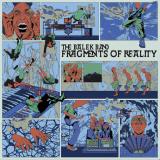
We Release JAZZ is very happy to announce the limited vinyl edition of Obad’s powerful new album Suspended, a vivid document of the Tehran ensemble’s endlessly evolving sonic universe — now available as a limited LP housed in a heavyweight sleeve with an Obi strip and featuring original artwork by Iranian painter Sadra Baniasadi.
Suspended is a superbly spontaneous, improvisational blend of exploratory jazz fusion, progressive funk-rock, and transcendental groove. Built from lived experience and shaped by Tehran’s pulse, Obad’s music is kinetic and intuitive — an ever-morphing dialogue between rhythm and texture, emotion and message.
With Farid Farzian Pour on drums, Siavash Karimi on electric guitar, Kiarash Radmehr on bass guitar, and Hamidreza Keshavrpajuh (aka Pajuh) on tenor saxophone, Obad creates a soundworld where hypnotic basslines meet thunderous, free-flowing percussion; where searing guitar motifs coil around saxophone phrases that move from whispered invocation to explosive catharsis. Suspended captures the quartet at full creative stretch: alive, unguarded, and deeply attuned to one another.
Sadra Baniasadi’s striking cover painting mirrors the album’s energy — bold, dreamlike, charged with movement, and extending Obad’s world into the visual realm.
Suspended stands as a major statement from one of Iran’s most compelling contemporary ensembles, marking Obad’s first release on We Release JAZZ and continuing the label’s commitment to boundary-pushing music born from profound listening, place, and collective intuition.
Suche:trans a m
In a sharp-angled, fiercely inventive reflection on the nature of club culture and digital fatigue, Simo Cell and Abdullah Miniawy reunite to deliver their new album, Dying is the internet, to Dekmantel's UFO series.
French producer Simo Cell has blazed a singular path from his dubstep-influenced origins to become a leading light in contemporary leftfield club music, twisting up adventurous rhythms and flamboyant production in pursuit of a perpetual freshness for the floor. Egyptian singer, poet, producer and composer Abdullah Miniawy has become equally omnipresent in the past 10 years, straddling the arts world and leading with his piercing Arabic lyricism while maintaining an eternally curious spirit that leads into open-ended, experimental music from the abstract to the propulsive.
Following up on their 2020 EP for BFDM, Kill Me Or Negotiate, Miniawy describes their sharply focused new album as "a playful prophecy about the triggers of a new global revolution." Cell considers the title, Dying is the internet, to be a mantra about "how the internet lost its soul," becoming "less about sharing ideas and more about surviving in a digital business ecosystem." Deliberately at odds with the reel-ready two-minute attention span of the average social media surfer (i.e. everyone), the pair set out to make an album that takes its time to reveal nuanced ideas and expressions. Rather than one-note despair for the modern malaise, Cell and Miniawy offer a philosophical reminder that this present moment in the human experience is a temporary phase, no matter how overwhelming it feels.
Dying is the internet finds Miniawy experimenting with auto-tune across the record, while Cell has developed his voice design chops and compositional instincts, moving closer to fully realised song structures without losing the fundamental 'clubbiness' of each track. The result is a cohesive, wildly original kind of heavyweight dance music that slings out hooks left right and centre, from Miniawy's laconic trumpet looming through low-slung 'Reels in 360' and 'Travelling In BCC' to the persistent handclaps that bring 'Living Emojis' to life. Miniawy's poetry explores the power of insistent, repeated phrases in a break from his more typically structured form.
Kenyan powerhouse Lord Spikeheart adds extra snarl to stripped-back, slow-burn opener 'I See The Stadium', but otherwise Dying is the internet is purely the work of Miniawy and Cell casting their considerable chops out into unexplored territory. The results are electric, bound together by a consistent economy of sound that burrows into a shroud of bass-heavy minimalism barely masking Cell's incredibly detailed studio flex. Even the beatless flourish of the Miniawy-produced 'Tear Chime' comes loaded with physicality — a sensory rush at the mid-section of the album bookended by some of the most idiosyncratic club music in recent memory.
Both Simo Cell and Abdullah Miniawy have already proved themselves as fearless innovators across different fields. The strength of their partnership lies in their ability to make space for each other while letting their distinctive sonic identities ring loud and true. Dying is the internet has immediacy and physicality to translate over a soundsystem, but its intricacies are purpose-built for repeat visits and contemplation, unveiling hidden dimensions the deeper you dive into it.
Gatefold Sleeve
M’Bamina – African Roll (1975)
The story of an album born between Africa, Italy, and the nightclub culture of the 1970s
In the heart of 1970s Italy — a country undergoing profound social change and a music scene just beginning to open itself to distant sounds and cultures — an extraordinary, almost improbable story took shape. It is the story of a group of young African musicians who found their way to Europe, of a Turin nightclub that became a crossroads for communities and experimenters, and of an album which, released in small numbers and largely unnoticed at the time, is now considered a rare jewel of Afro-fusion.
The band called themselves M’Bamina — an ensemble of musicians from Congo, Cameroon, and Benin, who arrived in Italy in the early Seventies. Settling between northern Italy and the Pavia area, they began performing in small clubs and community events, bringing with them a vibrant rhythmic heritage: African polyrhythms, call-and-response vocals, funk-infused bass lines, and Caribbean or Afro-Latin colours absorbed along their musical journeys. Their raw, contagious energy on stage quickly drew attention.
Meanwhile, in Turin, another story was unfolding. There was a venue becoming almost legendary: Voom Voom, one of the city’s liveliest nightclubs, run by Ivo Lunardi. The club attracted an eclectic crowd — students, artists, foreigners, night owls — and Lunardi quickly understood that the dancefloor wasn’t just a place for music, but a melting pot for a new kind of cultural energy. Out of this vibrant atmosphere came his idea: to turn the club’s name into a small independent record label, Voom Voom Music, capable of capturing the spirit of those years and giving voice to unconventional projects.
When Lunardi heard M’Bamina, he immediately sensed that this was the sound he had been searching for: fresh, different from anything circulating in Italy at the time, and capable of blending African tradition with funk and European sensibility. He brought them into the studio.
Production was handled by Lunardi along with Christian Carbaza Michel, while the engineering was entrusted to Danilo Pennone, a young sound technician with a sharp, intuitive ear.
The recording sessions — held in Turin in 1975 — produced a remarkably warm and direct sound. The music feels almost live: grooves rooted in African tradition, but open to funk-rock structures and modern arrangements. It is a natural fusion, never forced. Tracks move between tribal rhythms, funk basslines, light electric guitars, congas and Afro-Latin percussion, with call-and-response vocals and melodies that echo both Congolese tradition and the lineage of Latin jazz. Not by chance, one of the album’s most striking tracks, Watchiwara, reinterprets a Latin standard through M’Bamina’s own rhythmic language.
The album was titled African Roll — a name that was already a statement of intention. It is African music that “rolls,” that moves, adapts, transforms within a new geographic and cultural setting. It is not strictly Afrobeat, nor Congolese rumba, nor Western funk: it is a spontaneous, hybrid blend, shaped more by lived experience than by any calculated aesthetic program.
When African Roll was released, the world around it barely noticed. Distribution was limited, and 1970s Italy had yet to develop a cultural framework for receiving such music. The national music press rarely paid attention to African or “world” productions. The album slipped into silence — though the band’s own story did not.
M’Bamina continued performing across Europe and Africa, even sharing a stage in Cameroon with none other than Manu Dibango. By the late Seventies, they moved to Paris, signed with Fiesta/Decca, and recorded a second LP, Experimental (1978). Meanwhile, the peculiar record they had made in Turin began to resurface quietly among vinyl collectors, Afro-funk enthusiasts, and DJs hunting for forgotten grooves.
That is when the album’s fate began to shift.
Over the decades, African Roll emerged as an almost unique document: a snapshot of an intercultural Italy before the word “intercultural” even existed, a fragment of migrant history, a spontaneous experiment in musical fusion born far from major industry circuits but rich in authenticity. Original copies began commanding high prices on the collector’s market, and the album became recognized as one of the hidden classics of European Afro-fusion from the 1970s.
Today, more than fifty years later, this reissue finally restores visibility and dignity to a project that deserves to be heard, studied, and celebrated. It is not simply an album: it is the testimony of a rare cultural encounter, born in an Italy unaware of how fertile such exchanges would one day become.
It is the story of a visionary producer, an extraordinary band, and a fleeting moment in which music, migration, and nightlife came together to create something genuinely new.
African Roll is — now more than ever — the sound of a bridge: between continents, between eras, between cultures. A record that, after rolling far and wide, has finally come home.
Wolfgang Haffner is one of Europe's most respected jazz drummers, known for his impeccable sense of timing, groove, and atmosphere. Though rooted in jazz, his musical language transcends genre boundaries, guided by pulse and subtle nuance rather than tradition alone. For Cocoon Recordings, he now enters an entirely new dialogue, offering warm, organic reinterpretations that honor the spirit of the source material while opening a fresh sonic horizon. The result is a meeting of two artistic worlds where Sven Väth's timeless energy and Haffner's refined touch flow naturally into a new musical form, an encounter between two artistic universes, merging into something both unexpected and deeply musical.
Fusion is a groove driven piece built around a clear, flowing melody, allowing Haffner to reinterpret it acoustically through a jazz lens. Its straight, driving pulse lets him explore the track's rhythmic and melodic interplay with clarity and nuance.
L'Esperanza, originally a dreamy, trance like track, envelops listeners in strings, filtered downbeats, and a playful synth melody, a perfect canvas for Haffner's warm, organic touch. Its ethereal layers and subtle tension allow him to explore the track's emotional depth while preserving its entrancing charm.
Barbarella, emblematic of Sven Väth's early 90s vision, carries the energy and innovation of a club classic. Haffner's reinterpretation transforms it into a rich, acoustic exploration that honors its hypnotic essence. By emphasizing the track's iconic motifs and underlying drive, and by drawing out the track's essential elements, he bridges its electronic origins with a new, organic perspective.
Together, these three reinterpretations form a cohesive journey that celebrates the timeless essence of Sven Väth's music while revealing a new dimension through Haffner's masterful touch, a release that invites listeners to experience familiar classics in a completely new light.
ALTERNATE ART EDITION[29,83 €]
On a Sunday in the early 70s in South LA one could asily find themselves experiencing the Pan Afrikan Peoples Arkestra doing what they do for the community, performing incredible music. "Live at Widney High December 26th, 1971" is a previously unreleased PAPA recording. It finds director Horace Tapscott conducting the band at Widney Career Preparatory & Transition Center, a special-education magnet high school in Los Angeles. The band played shows here between 1970 and "72, often sharing the bill with contemporaries John Carter and Bobby Bradford"s group, and at one point the Sun-Ra Arkestra. These weekend shows were free and meant for the surrounding Black community. On this date the PAPA performed a range of compositions from the Ark"s expansive songbook, including arrangements of tunes by Pharoah Sanders and John Coltrane.
Electro as its best! SS001 marks the first transmission from Serpiente Sounds, a debut 12" split that keeps it lean, direct, and floor-focused. Viewtiful Joe handles the A-side with two cuts that balance Electro snap and Detroit discipline: clean drum architecture, crisp low-end, and synth lines that feel both futuristic and functional. On the flip, Subversive brings two late-night weapons with a colder edge and a deeper swing. SS001 is a debut statement with zero filler, a compact toolkit of Electro/Detroit tools for the booth.
uper Deception dives into the uncanny beauty within the everyday, drawing inspiration from M.C. Escher’s idea of “super deception”: the art of creating the impossible without illusion. Nelson of the East translates that concept into sound: deep, tactile basslines and intricate percussion twist familiar rhythms into hypnotic new forms. Textures and samples are lifted from their origins and reimagined, creating tracks that feel both ancient and futuristic, physical and dreamlike. The result is an electronic landscape where sound folds in on itself: a timeless, shape-shifting exploration of rhythm, resonance and perception.
Nelson of the East is a Berlin-based sound artist, producer and educator. He operates at the intersection of experimental composition and club culture, shaping his craft both as a music teacher and behind the scenes as an experienced ghost producer.
Artwork & Layout by Alicia Carrera
"Over the past three decades, Philipp Lauer has produced an incredible body of work, deploying a myriad of aliases, both as a solo artist and as a part of collaborative projects. From his hardware-steeped Frankfurt studio Pyramide 2, he has built this catalogue through original material and remix commissions, taking on the full spectrum of electronic music while retaining an unmistakable signature. He combines a hands-on approach to rhythm and composition with a DIY MO and a love of big hooks. The level of expertise at hand seems to facilitate a playfulness that subtly permeates all layers of his work. He's a pop melody natural who just so happens to love fiddling with synthesizers, drum machines, and effects an equal amount. All of these qualities are exemplified on "Embalmed In Martino": Lauer's four-track ode to the Belgian Martino sauce, a spicy tomato-based condiment, and arguably the essential ingredient to top off the namesake raw meat sandwich. On "Embalmed", which makes use of instrumentation that would fit right in on an early eighties Manchester cut, and "Martino", where a sturdy, electroclash flavored arp bass provides the stamina, a slew of big and small riffs easily work their way in, thirsting for our ears. On the other side, "Transactional" combines Miami basslines and similarly electro-fundamental twinkling synth work with a flanger-laced 4/4 beat, while "Don't You Know" features soaring synthwave patterns and the only vocal samples on the EP. Both sport rich arrangements as well, right down to the cowbell overdubs. Lauer's often lauded for his "summery sound". In this light ALT026 lands right on time - yet we might disagree here, as it's suited for all seasons, and all terrains, both the shiny festival grounds and the dim-lit club floors."
Massive vocal driven Garage House pressure here, from way way back in 1992! Yes, 'Follow Me' is one of THOSE records, one that transcended genre boundaries on it's release and continues to do so today. A true classic piece of NYC goodness from back in the day. The super production team of DJ Pierre and george Morel could only deliver the heat and that's exactly what they did - created a timeless House record with the bassline that just doesn't let up! This is the sort of track that got hammered on the US House scene, found a home in the UK Garage world and got spin at almost any and all clubs where the DJ's had half a clue and an iota of taste! Containing the original 3 mixes released in '92 now's your chance to bag a bonafide, hands down classic record! 'Follow Me' has been skilfully remastered from all original master sources and fully licensed and reissued officially for 2017.
For the next installment in the Voyager Recordings series, we have rising Belgian star Carmelo Ponente taking control. Carmelo delivers a solid album of 7 tracks of layered sci fi sounds, with punch, in order for the dancefloor.
Carmelo has most recently released on Loopania Records with Oliver Rosemann, released on Illegal Alien, Solitar, Newrythmic, TMM and Subsist to name but a few labels that has showcased his layered sounds. Carmelo is very modular focused, and you can hear this in his signature sound.
Italian multi-instrumentalist, composer, producer and vocalist Alex Puddu is returning with at brand new album "Francia Meccanica" A strong set of songs with catchy hook lines and up tempo groove. Taking us back to the late ’80s and early ’90s disco-house production with refined, sexy vibes that introduces eroticism in both Italian and French. It’s a perfect cocktail mix that pairs seamlessly with Alex’s voice and performance, beats, funky bass, acid sax, and sultry French spoken words. Alex Puddu brings pop disco and retro vibes back in trend — always essential to his style and musical world — and sweeps us into wild French nights blending transgression and romance.
- A1: Let's Rock (Title)
- A2: Ev-01 (Opening)
- A3: St-01 (Ancient Castle Stage)
- A4: Pubic Enemy (Battle Theme 1)
- A5: Gm-03 (Divinity Statue)
- A6: Psycho Siren (Mid-Boss Battle Theme)
- A7: Flock Off! (Griffon Appears - Battle Theme)
- A8: Gm-04 (Mission Clear)
- B1: Red-Hot Juice (Phantom Appears - Battle Theme)
- B2: Gm-02 (Continue)
- B3: Mental Machine (Nightmare Battle)
- B4: St-03 (Ocean Floor Stage)
- B5: Ultra Violet (Nelo Angelo Battle Theme)
- B6: Devil Sunday (Sparda's Theme)
- B7: St-02 (Cathedral)
- B8: Ev-03 (Sin Scissors Appear)
- C1: Lock & Load (Original)
- C2: Bloody Bladder (Escape From The Underworld)
- C3: Eva's Theme
- C4: Evil Vacuum (Underworld)
- C5: Super Ultra Violet (Nelo Angelo Appears - Battle Theme 3)
- C6: Ev-19 (Nobody Appears)
- C7: Ev-20 (Nightmare Barrier - Battle Theme)
- C8: Final Penetration (Underworld Stage)
- D3: Legendary Battle V2 (Demon Emperor Mundus Battle 2 - Land)
- D4: St-10 (Demon Emperor Mundus Battle 3 - Underground)
- D5: Ev-30 (Reunion - Too Late)
- D6: Pillow Talk (Ranking Music 1)
- D7: I'm Coming! (Escape)
- D8: Blue Orgasm (Blue Sky)
- D9: Dante & Trish - Seeds Of Love (Ending Credits)
- D10: Gm-06 (Game Over)
- D1: Trish's Theme
- D2: Ev-29 (Mother's Voice - Trish Appears)
- E1: Super Ultra Violet (Nelo Angelo Appears - Battle Theme 3)
- E2: Ev-17 (The Truth)
- E3: Ev-18 (Devil Sword Sparda Acquired)
- E4: Evil Vacuum (Underworld)
- E5: Ev-19 (Nobody Appears)
- E6: Ev-20 (Nightmare Barrier - Battle Theme)
- E7: Ev-21 (Betrayal)
- E8: Ev-22 (Tactics)
- E9: St-09 (God Of The Demon World)
- E10: Final Penetration (Underworld Stage)
- F1: Eva's Theme
- F2: Legendary Battle (Demon Emperor Mundus Battle 1 - Aerial)
- F3: Ev-23 (Demon Emperor Mundus)
- F4: Ev-24 (Avenging Mother)
- F5: Ev-25 (Awakening)
- F6: Ev-26 (Dante Knocked Out Of The Sky)
- F7: Ev-27 (The Collapse Of Mundus)
- F8: Bloody Bladder (Escape From The Underworld)
- F9: Karnival (Ancient Castle At Night Stage - Plasma Appears)
- G1: Lock & Load (Original)
- G2: Ev-28 (Demon Emperor Mundus, Round 2)
- G3: Super Pubic Enemy (Sparda Battle Theme 1)
- G4: S (Sparda Battle Theme 2)
- G5: Pillow Talk Again (Ranking Music 2)
- G6: Anarchy In The U.w. (Underworld Battle Theme)
- G7: Trish's Theme
- G8: Ev-29 (Mother's Voice - Trish Appears)
- H1: Legendary Battle V2 (Demon Emperor Mundus Battle 2 - Land)
- H2: St-10 (Demon Emperor Mundus Battle 3 - Underground)
- H3: Ev-30 (Reunion - Too Late)
- H4: Pillow Talk (Ranking Music 1)
- H5: I'm Coming! (Escape)
- H6: Blue Orgasm (Blue Sky)
- H7: Dante & Trish - Seeds Of Love (Ending Credits)
- H8: Gm-06 (Game Over)
Red+Ochre Vinyl[47,44 €]
Zum 40. Jubiläum des ersten Teils des stylischen Actionspiel-Klassikers DEVIL MAY CRY erscheint der Killer-Soundtrack des Capcom Sound Teams - bekannt für seine Musik zur Resident Evil-Serie - spezielle für 180g Vinyl gemastert. Der OST ist eine genreübergreifende Meisterklasse, die von Rock über Techno zu Ambient und weiteren Paletten wechselt. Erhältlich als 2LP-Format mit 34 Tracks auf transparent-rotem und ockerfarbenem Doppelvinyl, sowie als luxuriöses 4LP-Boxset mit den kompletten 73 Tracks auf schwarzem 4fach-Vinyl.
Daskal debuts on DJ Tennis’s Life and Death label today with the release of “Changes,” the first single from his forthcoming album OD, out March 6. The release marks a defining moment for the producer and composer, whose work moves fluidly between contemporary dance, film, and electronic music, and represents his first full-length statement reconnecting his compositional practice with the dancefloor.
“Changes” arrives alongside a striking accompanying video directed by award-winning filmmaker Tamir Faingold, featuring dancers from the world-renowned Batsheva Dance Company. Rather than functioning as a traditional music video, the piece uses contemporary dance as its primary language, translating the emotional charge and magnetism of nightlife into movement. Together, the single and visual introduction frame OD as a bridge between club culture and the expressive traditions of modern dance and composition.
A classically trained composer with deep ties to the world of choreography, Daskal has spent recent years creating original scores for institutions including Los Angeles Dance Project and the Royal Danish Ballet, while simultaneously developing a parallel body of work across ambient and experimental electronic music. OD emerges as a convergence of those paths: a ten-track album shaped as much by physical movement and spatial awareness as by club tradition, positioning Daskal between concert hall, black box theater, and late-night club environments.
Recorded and mixed primarily using vintage hardware — including a rare 1980s German mixer in a high-end Tel Aviv jazz studio — OD reflects a deliberate shift away from purely atmospheric writing toward rhythm, repetition, and physicality, while retaining the precision and restraint of his compositional background.
Farron is back on Shaw Cuts with his next EP called ãHuman LanternsÒ - a tale of social jealousy and long-standing rivalry transformed into 4 bass-heavy broken techno tracks.
The two wealthy kung-fu masters Lung and Tan are embroiled in a long lasting game of perpetual one-upmanship. Vowing to show Tan up, Lung enlists the aid of a man he defeated in a duel years ago in fashioning a masterful lantern for the upcoming festival in which both masters will compete. ãWe Are The WaveÒ and its noisy fragments and broken rhythmics led by a hefty stormy bassline, underline the tension and aversion between the two competing masters.
But the eccentric artisan is more interested in seeking revenge for his old defeat, in taking away everything Lung holds dear. The bass-driven ãSwitch OddÒ and its sharp percussions and phat kick underline the ulterior motives of the shady character.
The evil villainÕs plan of revenge contains kidnapping several beloved women of Lung, skinning them alive and using their flaps of skin to create the ordered lantern. ãGX100Ò and its fast-paced drum pattern carried by virulent synth fragments and raucous pads, epitomises the merciless act of violence.
Tan and Lung falsely accuse each other but feel constrained to eventually team up and hunt the criminal together. ãTalking To ThemÒ rings in furiously and chases the enemy with its rolling bass, chopped vocals and stomping drums, but the villain is sneaky and recalcitrant. Silence before the attackÉ
This EP marks the first release from a collaborative project between Tokyo based DJ/producer Iori Wakasa and Okayama's Keita Sano, born from a quiet resonance between their musical sensibilities.
In Japan, the academic year begins in April. Though born in 1988 and 1989, the two artists belong to the same school-year cohort under this system, yet within Japan's gengo era structure they stand at the symbolic end of one era and the beginning of another. The title 'A Shift of Eras' points to the moment when one era gives way to the next, suggesting not only the passage of time, but the subtle renewal of culture, perception, and values.
'Filtered Jewels' draws from the image of light shimmering like gemstones, or a space scattered with countless jewels, perceived through an imagined filter that gently alters the way the scene reveals itself.
'Heaven's Door' envisions the ascent of a transparent staircase floating above a sea of clouds, leading toward a quietly resting emerald-green door.
'Shocking Yellow', originally created in response to a specific request, incorporates carefully placed vocal samples while grounding the track in warm, rounded low frequencies and organic textures, shaped with DJ use in mind.
And finally, 'Time To Change' was reconstructed repeatedly with the hope of offering both solace and a quiet sense of encouragement, ultimately becoming a piece that reflects the underlying theme of the EP.
- A1: Tempue Or Dos De Aqua
- A2: Andreaen Sand Dunes
- A3: Running Out Or Space
- A4: Universal Element
- B1: Habitat
- B2: Funk Release Valve
- B3: Organinc Hydropoly Spores
- B4: Draining Or The Tanks
- C1: Surrace Terrestrial Colonisation
- C2: Oxyplasmic Cyration Beam
- D1: Tranqular Hydrogen Strain
- D2: Bottom Feeders
- D3: C To The Power Or 8+C To The Power Or 8 = Mm = Unknown
2026 Repress!
Tresor Records is proud to announce forthcoming special editions of its entire catalogue of Drexciya and related projects. 2022 marks the 20th anniversary of the passing of James Stinson and the releases of the Transllusion and Shifted Phases albums. In recognition, the rightsholders, their families, and the label have commissioned Detroit-based contemporary artist Matthew Angelo Harrison to re-conceptualize the covers of Tresor's Drexciya-related catalogue. These editions will be released sequentially, bimonthly, starting early-September 2022.
The series starts with Neptune's Lair, first released in 1999, with the Hydro Doorways single arriving shortly after. In November, Harnessed The Storm and Digital Tsunami are coming. In 2023 comes the release of Transllusion in February. The series is completed by the long-awaited re-release of Shifted Phases - The Cosmic Memoirs Of The Late Great Rupert J. Rosinthrope - at the end of March.
These records, individually and as a catalogue, represent some of the most crucial moments in the Tresor label history, with the sound and mythic world of Drexciya undoubtedly inspiring generations.
Los Angeles artist Blone Noble arrives on the label Mystic Transfers with his new EP ''Dominator,” rich with his primordial and perverse essence, hard-hitting modern dance floor production from James Mathew Seven, and surrounded by breathless midnight remixes from Kontravoid and Tony Price
Alva Noto - Wave Weave – Sono Obi is the original soundtrack by Alva Noto, composed for a film by Carsten Nicolai.
- The project emerged from a collaboration with an 12th-generation kimono textile manufacturer in Kyoto, Japan.
At its core, the work explores the translation of sound into textile form: sonograms of musical compositions serve as the basis for woven structures, connecting acoustic frequency patterns with traditional weaving techniques.
Alongside the original soundtrack, the release includes an alternative soundtrack version and a photographic documentation featuring sonograms, soundtrack visualizations, and film stills.
Tracklisting
---------------------------------------------------------
Medium: 1 // Side: A // Track: 1
Artist: Alva Noto
Title: Sono Obi Wave Weave
Playtime: 00:22:00
Explicit Lyrics: No
ISRC: DE1N62600001
(P): 2026 NOTON
Composer: Carsten Nicolai
---------------------------------------------------------
Medium: 2 // Side: B // Track: 1
Artist: Alva Noto
Title: Sono Obi Landscape
Playtime: 00:06:10
Explicit Lyrics: No
ISRC: DE1N62600002
(P): 2026 NOTON
Composer: Carsten Nicolai
---------------------------------------------------------
- 1: Sex & Bonfire
- 2: Parking Warden
- 3: Colin's First Ride
- 4: Waking Up In Ray's House
- 5: Gymopedie1
- 6: Ride Bubbles
- 7: Subdued Something
- 8: After Funeral (Nick Roder & Oliver Coates)
- 9: Bikesteal
- 10: Fleeing Cinema
- 11: Breakup
- 12: Driveaway
- 13: Colin's Computer Strings
- 14: Driveaway (Original Piano)
Transparentes blaugrünes Vinyl mit O-Card. Oliver Coates' Original-Soundtrack zu Pillion (dt.: Sozius"), einem britisch-irischen Spielfilm von Harry Lighton aus dem Jahr 2025. Der Liebesfilm handelt von einem schüchternen jungen Mann, der sich auf eine unterwürfige SM-Beziehung mit einem älteren Motorradfahrer einlässt.