Bringing together the elder statesman of the Zulu guitar Madala Kunene and internationally acclaimed Sibusile Xaba, kwaNTU pulls two generations of South African guitar mastery into a single point of focus. Under-represented on recordings outside of South Africa, Madala Kunene (b. 1951), the ‘King of the Zulu Guitar’, is revered as the greatest living master of the Zulu guitar tradition. Sibusile Xaba, whose collaboration with Mushroom Hour Half Hour reaches back to his first recording in 2017 (Open Letter To Adoniah/Unlearning), has garnered international acclaim for his unique voice and virtuoso guitar stylings, which bring together multiple South African guitar lineages in an original, spiritualised fusion. Collaborating with Mushroom Hour and New Soil for kwaNTU, the two players come together to weave a filigree sonic fabric which reaches down to the heartwood of Zulu guitar music but moves resolutely outward, building on the past to create a deeply rooted statement about present conditions and future travels. kwaNTU – which can be roughly translated ‘the place of the life-spirit’ – is also conclave of teacher and student, as Xaba has been taught by Kunene for the last decade. Meditative, rich and sonically sui generis, kwaNTU finds these two musicians linking up within the inimitable space of sound and spirit that they share through Kunene’s teaching.
The great masters of South African music have not all had equal exposure. For many years the generation of musicians who were exiled during apartheid took centre stage, as the regime made it very difficult for those at home to be heard. More recently, a new cohort of important voices, especially in jazz, has broken through to international consciousness. But for the generation of musicians in between – those who shone like beacons in the most difficult final years of apartheid and immediately afterward – international recognition has been slow in coming.
Madala Kunene, ‘the King of the Zulu Guitar’, is among this number. A revered figure for current generations of South African musicians, Kunene began his recording career in 1990, at the bitter end of apartheid, with a now classic self-titled LP for David Marks’ storied Third Ear imprint. Born in 1951 in Cato Manor, near Durban, he had determined to be a musician from early childhood, and by the time he first entered a recording studio he had already had a long career as a popular performer. His virtuoso absorption and transformation of the venerable Zulu maskanda guitar tradition and his richly spiritualised approach to music immediately marked him out as someone special, and in the years that followed, Kunene cemented his position as one of South Africa’s musical elders. He is without doubt the grand master of the Zulu guitar tradition, but his sound and sensibility ranges far beyond it into varied sonic terrain, and he has collaborated with a wide range of musicians both at home and abroad. Now in his mid-seventies, he remains a shining light for those that are making music in contemporary South Africa.
‘He is really an amazing person,’ says the guitarist Sibusile Xaba, who has been mentored by Kunene for over a decade, and now invites a collaboration with him on kwaNTU. ‘As a mentor, he's really powerful in showing us the way. For us to have this opportunity to make music together and have a project together is really a blessing to me.’
Xaba himself grew up in Newcastle, KwaZulu-Natal, where his mother had been in a band and his father sang in a church choir, and from early childhood Xaba played homemade tin guitars. He only later realised that music was his calling. ‘I just loved music. I was fortunate. My parents loved music. And when it was time for me to leave home and go to study outside Newcastle, I knew that music was what I wanted to do. There was no second option. It was just music.’ Moving to Pretoria to study music formally, Xaba committed himself to his craft, developing a unique style that draws on both US jazz masters such as Wes Montgomery and Jim Hall, and the rich and varied heritage of the South African guitar, from inspirational jazz players such as Allen Kwela and Enoch Mthalane, to the music of the Malombo groups and Dr. Philip Tabane (Xaba has previously collaborated with Dr. Tabane’s late son, Thabang), and the Zulu guitar tradition embodied by Kunene.
‘I was really in love with the jazz guitar, I really admired it, and I was digging a lot in that direction,’ says Xaba, recalling his first encounter with Kunene’s music, over a decade ago. ‘And then one day on my timeline, Kunene popped up, and I was like – “What's this sound?” I was so connected to it. It really touched me deep. I started checking out his records, and then I found out he's from the same region as I am, which is Zululand.’ After Kunene played a show at the Afrikan Freedom Station in Johannesburg, Xaba make contact with him, and visited him at home in Durban. They struck up a friendship, and Xaba became the elder’s student, as Kunene began to pass on his knowledge and his inimitable way of playing.
kwaNTU is a tribute to this relationship and the deep learning that has defined it. The album was recorded in Zululand in the town of Utrecht, at a cultural centre called Kwantu Village, which gives its name to the album. ‘It's such a broad word,’ Xaba says, ‘but the elders teach us that Ntu is basically an energy, almost chi, an energy, a force that all living beings have within them. It's a living energy, so kwaNTU is like, almost the place of this energy.’ The two men sequestered themselves for five days of jamming, improvising and planning, and then the session was recorded in one take over a single night, with Gontse Makhene joining on percussion and backing vocals and Fakazile on vocals. Other voices and overdubs were later added in the studio in Johannesburg.
The result is a rich and meditative recording that finds two generations in a deeply engaged dialogue. Teaching and passing on his knowledge, the elder Kunene has brought Xaba into a space of sound and knowledge that they now share; Xaba’s own practice of deep communion with nature and his dedication to his musical craft make him the perfect interlocutor for Kunene. The result is an album that foregrounds the two musicians engaged at the highest levels of responsive listening, sympathetic unity, and collaborative concentration. Bringing an elder statesman of South African music to an international listening audience for the first time in decades by pairing him with one of South Africa’s most important new voices, kwaNTU is a meeting of generations and a powerful demonstration of musical lineage and continuity.
‘Before music, there is sound,’ Xaba observes, speaking of Kunene’s unique approach to music. ‘And sound is like a common compartment…it's not restricted to particular people or particular geographic places, you know what I mean? It's sound. Everybody can hear it. So when he constructs that sound into music, I think everybody resonates with the energy behind his construction of sound into song. Here at home, we really love him for preserving our history through the guitar, through his stories as well the music, the songs that he writes. We really, really admire him.’
Suche:transformation
Arriving two years after the first chapter, Absurd Matter 2 isn’t just a sequel, it’s an evolution, redrawing the boundaries established by its acclaimed predecessor. The Berlin-based Italian producer tempers his confrontational sonics with rare moments of introspection, shifting seamlessly between blown-out noise, warped hip-hop, mutant club experimentation, and weightless ambience. Textures disintegrate and reassemble, rhythms flex and crumble, and every detail balances on the edge of fantasy. It’s a poetic, layered response to Nino Pedone’s changing physical reality: the gradual hearing loss and perceptual renegotiation triggered by Ménière’s disease, which struck him in 2022. At first, the experience felt like betrayal, a brutal disconnection from the very sense that had shaped his life. But over time, the disorientation turned into a strange kind of focus. The silence between sounds became as expressive as the sounds themselves.
The first Absurd Matter was a visceral reaction to trauma; the second is more reflective – an ambiguous chronicle of sensory recalibration. Pedone doesn’t represent his altered inner reality through extremes, but through depth, zooming in on illusory distortions, tense rhythmic fluctuations, and fragmented sonics. Dense, immersive, and mystical, the album mirrors Pedone’s evolving relationship with perception itself.
Tinnitus-like feedback wails and noir-ish strings introduce “Repeater”, making it immediately clear that Pedone is painting a more delicately finessed image this time around. Fleshed out by raps from cult MCs billy woods and E L U C I D, the track is marked by subtle, sophisticated contrasts: the blurred, inverted rhythms that couch Armand Hammer’s haunted back-and-forth, and the glitchy interference that offsets the lavish orchestral phrases. Backwoodz associate Fatboi Sharif lends his Lynchian drawl to “Bandage Chipped Wings”, grounding Pedone’s lysergic rhythmic distortions with syrupy, horror-inspired couplets. Pedone also invites discomfort into “Crash Landing”, with droning, metallic tones that contradict South Central rapper ICECOLDBISHOP’s elastic flow. “Bitch, I don't give a fuck about anybody,” he squawks over Pedone’s incongruous rasping textures and time-warped beats, “cash out at any party.” Working alongside London’s Loraine James on production, Pedone reunites with Moor Mother on “I Saw The Light”, blending James’ soft-focus atmospherics with soundsystem-damaging, overdriven bass hits and rusted percussive snips. Moor Mother’s assertive words hover over the wreckage, tightening Pedone’s themes of overstimulation and altered awareness as they stutter and veer off course, vanishing into the backdrop.
Contrasting his more pensive experiments, Pedone’s dancefloor deviations are more concentrated on Absurd Matter 2 than ever before. He torches a stuttering dembow structure on “X”, obfuscating the rhythm’s familiar energy with disturbing audio hallucinations. On “Splintered”, he reunites with Kenyan prodigy Slikback, mangling neon-lit trance arpeggios with dissociated trap rhythms. He sharpens his skills to a fine point on “Oblivion Step”, observing 2- step through a lens of distortion and personal abstraction, shaking blipping synth leads over neck-snapping drums and counteracting the momentum with airless sci-fi soundscapes.
Perhaps the album’s most surprising moment arrives with “Viel”, which features vocals from Los Angeles-based composer Kaitlyn Aurelia Smith. Together, Pedone and Smith chance upon their notion of dub techno, fogging synth stabs and ghostly vocal traces into eerie harmonic distortions. On some level, it’s almost pop music, a far cry from the bleak dissonance of Absurd Matter and a hopeful way to reframe turbulence as transformation. Absurd Matter 2 doesn’t simply document a process; it enacts one. It doesn’t offer clarity; it invites disorientation. It’s not a map of the labyrinth, but a foghorn piercing the darkness.
Belgian pop superstar Max Colombie, aka Oscar and the Wolf, announces new
album ‘The Shimmr’, on PIAS Recordings.
Enter Colombie’s world and you’ll discover a uniquely dazzling and shimmering
fusion of contemporary R&B and a more European electro-pop sensibility, uniting
shivery melody, shifting beats and vocals steeped in drama, sensuality and yearning.
Colombie hears, “a twilight zone where it doesn’t sound dark nor happy. It’s like the
name Oscar and the Wolf; it’s a balance between light and dark, this perfect
combination between the sun and the moon. It’s beautiful and scary at the same
time.”
Oscar and the Wolf’s official debut, the 2012 EP ‘Summer Skin’, showed his gifts
arrived virtually fully formed, but he truly came of age in 2014 with his debut album
‘Entity’. Balanced between dancefloor anthems and slow jams, ‘Entity’ went 4 times
Platinum in his native Belgium and quickly jettisoned Colombie to superstar status.
He sold out arenas in Belgium and the Netherlands, taking the penultimate
headlining slot (behind Muse) at 2016’s Lowlands festival before headlining
Belgium’s Pukkelpop festival, sharing the bill with Rihanna and LCD Soundsystem.
Released in 2017, the second Oscar and the Wolf album, ‘Infinity’, went Platinum at
home, whilst amassing a huge Middle Eastern fanbase across Turkey (where his
2018 tour sold out in minutes), Egypt, Israel and Iran. On stage, Colombie cut a
commanding and lithe performer, often garbed in shimmering outfits that interacted
with the dynamic lighting.
The new Oscar and the Wolf album, ‘The Shimmer’, distils the essence of Colombie’s
sound and vision in its title and the image of Colombie on the album cover, bathed in
starry light. The album is a benchmark of his transformation on record; whereas
‘Entity’ was recorded in a barn, “very lo-fi with no access to gear,” he recalls.
‘The Shimmer’’s bold, rich and layered dynamics were captured at ICP Studios in
Brussels, home to, “one of the best live rooms in Europe, with all this vintage gear.”
More intimate moments were added at Colombie’s house outside the city, “those
magic takes we made just after we’d written something, which are so hard to capture
again.”
By ‘we’, Colombie includes producer Jeroen De Pessemier and multi-instrumentalist
Ozan Bozdag, who had both worked on ‘Infinity’ (and Bozdag on ‘Entity’ too). “It’s a
magical trio,” Colombie says. “Everyone is allowed to be themselves, and to explore
themselves. I’m really happy with ‘The Shimmer’ because I hear a more mature
version of myself. I always want things to grow, and I’m proud that I allowed myself to
not follow people’s expectations and reproduce what had been successful before.
There are no four-to-the-floor clubby pop songs this time.”
Instead, ‘The Shimmer’ more accurately reflects Colombie’s personality. “My
emotions run from super-happy to super-melancholic in a split second,” he says. “To
me, ‘The Shimmer’ feels like the soundtrack to a blockbuster, with many types of
tracks and themes. It’s always changing."
Fetter’s Body of Noise erupts at the threshold between ravey hypnosis and avant-pop experiment, slithering through the hinterlands of unconscious desire. Nine shape-shifting tracks conjure haunted landscapes where beauty refuses clarity and dancefloor logic warps underfoot. Vocals swoon, drift, and demand—stacking into fragments that multiply and weave through saturated pulses and shimmering, snarling synths.
Opening track "Like a Rose" traces a dreamer’s transition into the unstable physics of a perplexing but familiar dream world, where they gradually become lucid. “Beast” follows up humming with shadowed urgency, threading a path through self-sabotage and metamorphosis. “Spathiphyllums” drifts a while in a lush lostness, aching for something new before fracturing into wild, cathartic collapse. Side B’s “Do I Exist? (D.I.E)” and “The Longing” spiral into existential wonder, searching for a human origin story—both personal and collective—against a backdrop of uncertainty, while “Headache” thrusts forward as an absurd and insistent manifesto to stay the course and harness one’s own power within the madness.
Body of Noise is crafted not only for sweating bodies in motion, but for distorting time and opening psychic portals, where surrender becomes strategy and uncertainty transforms into ecstatic navigation. Rooted in all-hardware improvised production and shaped by Fetter’s years of boundary-blurring visual and performance art, their debut LP feels alive and in flux. Reminiscent of a spectral pop chorus trapped in a loop of broken machinery, or a lost broadcast from a dancefloor in a parallel realm, Body of Noise is a journey into chaos, transformation, and a bold refusal to be contained.
About Fetter:
Fetter makes clubby self-destructing noise pop to dance and weep to. Oscillating between ethereal and pounding, their all-hardware, largely improvised live sets take listeners through a foggy wilderness of saturated rhythms and menacing synth lines, a golden voice guiding the way through. Fetter is the stage moniker of multimedia artist Jess Tucker. Their performances take place in clubs as well as galleries, often incorporating video, installation, and interactive performance art elements to create other-worldly surrounds of mesmerizingly unhinged bodies and faces.
Simon Popp is back on Squama with his fourth album Trio.
At its heart, Trio is a work about collaboration, playfulness and unification. It is music as a means of coming together, a sonic equivalent to the Japanese philosophy of Kintsugi, in which broken ceramics are repaired with a visible golden lacquer. Rather than hiding the breaks, Kintsugi embraces them, making them part of the story, a form of delicate transformation. Popp and his collaborators Flurin Mück and Sebastian Wolfgruber take a similar approach: three distinct drummers, three different temperaments, three personal styles. Fused together into a single expressive instrument.
The album is a celebration of timbre, texture, and touch, its sound palette drawn from across continents and traditions. Human beings at all points of time, across all cultures and continents have used music to celebrate, mourn, worship and bond. Along with our voices, creating rhythm with our bodies. Clapping, stomping, hitting with sticks. A celebration of rhythm as both a shared human memory and an audible expression of close bonds.
Trio is a reflection of the beauty of imperfection and the timeless pull of rhythm as a shared human force. The cracks are not hidden. They are filled with gold.
"Later Than You Think" erscheint bei seinem neuen Label YOUNG und beschäftigt sich mit Themen wie Trauer, Gerechtigkeit, Wiedergeburt, Transformation und spirituellem Kampf. Es ist ein Werk von Bekenntnis und Konfrontation, für das sich Affekt, Intellekt und Geist auf der Suche nach dem Schönen, der Wahrheit und dem Realen zusammenschließen. Entstanden ist das Album in den Ozarks von Missouri. Die 16 Tracks vereinen Elemente und Gegensätze wie Üppigkeit und rohe Reduziertheit, das Heilige und das Profane, minimalistische Disziplin und maximale Schwelgerei, Kontrapunkt und simple Popharmonien. Im Kern unterstreicht das Album aber vor allem Maus" Hingabe an radikale Aufrichtigkeit und emotionale Wahrhaftigkeit in einem Zeitalter der Entfremdung - angetrieben von Konfrontation, Glauben und der tiefen Überzeugung, dass Sinn und Bedeutung noch immer etwas meinen. Maus, der einen Abschluss in Experimental Music und einen Doktortitel in Politikwissenschaft hat, wurde für die Art und Weise, auf die er akademische Sorgfalt und Lo-Fi Synthpop-Ästhetik verbindet, mal als "philosopher pop star" mal als "analog futurist" bezeichnet. Sein Wirken zieht sich dabei quer durch die Popkultur - von der Grime-Ikone Skepta, der seinen Track "I"m Only Human" sampelte bis zum Gen-Z-Rapper nettspend, von Filmemacher Josh Safdie ("Uncut Gems") bis zum Fotografen Wolfgang Tillmans. Sein Track "Cop Killer" ist im 2025er Film "Friendship" mit Tim Robinson und Paul Rudd enthalten. Mit exzessiven Liveshows und seinen bislang erschienenen Alben, auf denen Ironie, Trauer, Freude und Absurdität stets dicht beieinander liegen, hat Maus einen einzigartigen Weg beschritten und sich eine ergebene Fanbase erspielt.
On September 26th, 2025, two decades and seven albums into his career, American musician, composer, and academic John Maus will release his most transcendent work yet: Later Than You Think. Arriving via his new label YOUNG, the album explores themes of grief, justice, rebirth, transformation, and spiritual warfare - coalescing into a work of confession and confrontation: an aural metaphysics where affect, intellect, and spirit converge in search of the beautiful, the truth and the real. Written, produced, and recorded in the Ozarks of Southwest Missouri, Later Than You Think spans 16 tracks and contains multitudes - the lush and the bare, the sacred and the profane, minimalist discipline and maximalist indulgence, counterpoint and simple pop harmony. At its core, the album reaffirms John Maus’ commitment to radical sincerity and emotional truth in an age of alienation. Powered by confrontation, faith and transformation - driven by the urgent belief that meaning still matters, and time is of the essence. Holding a degree in experimental music from CalArts and a PhD in political science from the University of Hawaii, Maus has been dubbed a “philosopher pop star” and “analog futurist” for the way he merges academic rigor with lo-fi synth-pop aesthetics. His influence spans genres and generations—from UK grime icon Skepta, who sampled his track “I’m Only Human,” and Gen-Z rapper nettspend, to filmmaker Josh Safdie, actor Natasha Lyonne, and photographer Wolfgang Tillmans. His track “Cop Killer” features in the 2025 film Friendship, underscoring his continued relevance across high and low culture. With five previous albums under his belt - Songs (2006), Love Is Real (2007), We Must Become The Pitiless Censors of Ourselves (2011), Screen Memories (2017) and Addendum (2018) - Maus has carved out a singular path where irony, grief, joy, and absurdity can coexist and gained a cult following along the way. On Late r Than You Think Maus doesn’t just return—he confronts, confesses, and transforms. The result is not only a career-defining work, but a rare artistic offering: one that dares to believe in meaning, beauty, and the possibility of transcendence
- A1: Intro
- A2: Les Bourgeons
- A3: Ecoule Les Larmes
- A4: La Mer Pleure Ft. Oliver Foster
- A5: La Nuit Dorages
- A6: Nausee
- A7: Por Que Te Vas
- A8: Le Bruit Des Vagues
- B1: Dans Le Noir
- B2: Le Saut De Lange
- B3: El Corazon De Poeta
- B4: La Fin Du Tunnel
- B5: Interlude
- B6: Hear You Say
- B7: Dans Le Vent
- B8: Une Berceuse Pour Avril
‘LE DON DES LARMES’, and was conceived and recorded during the artist's pregnancy — a time of deep transformation. It is a poetic offering to her newborn child, where the cycle of the seasons becomes a metaphor for birth, vulnerability, and renewal.
Her sound draws from the lullabies of her Kabyle childhood and the gentle melancholy of Algerian chaabi, carrying their echoes into a world entirely her own. LÉO LA NUIT is a Franco-Algerian writer and composer who weaves music as one might weave dreams — with tenderness, intuition, and a reverence for nature.
Through field recordings, intimate textures, and delicate pop melodies, LÉO LA NUIT invites us into her inner landscape. Her music breathes closely to the skin — fragile yet luminous — a collage of fleeting moments, stitched together with care. It is a world both grounded and dreamlike, where emotion flows freely, like tears given as a gift
Backspin's new release comes from Obscure Shape, delivering a deep and versatile techno EP that lives up to its title: 'Zwei Gesichter' (German for 'Two Faces'). Across five tracks, the EP explores the tension between raw force and emotional depth, marrying the label's Hardgroove roots with a more introspective edge.
The A-side presents Obscure Shape's first face: It opens with 'Zwei Seiten', a no-frills banger that hits with immediacy and drive. 'Im Angesicht Der Zeit', the single, leans into groove and movement, offering a more fluid, time-aware flow. 'Die Haut In Der Ich Wohne' pares things back into a minimalistic, loopinghypnosis, evoking the idea of inhabiting one's own skin. On the B-side, presenting the producer's second face, 'Spuren Des Werdens' features producer AMIYE and introduces more melody and saw synths, a reflection on growth and transformation. The closer, 'Von Hoffnung Getragen' - also a collaboration with AMIYE - lifts off with ethereal vocals and a bouncing rhythm, embodying the hope that carries us forward.
With the 'Zwei Gesichter' EP, Obscure Shape crafts a powerful narrative through groove, form and feeling, perfectly aligned with Backspin's evolving reinterpretation of early 2000s techno.
Acclaimed Swedish multimedia artist and electronic music visionary TOBIAS BERNSTRUP returns with his highly anticipated new 7th studio album, “Shadow Dancer”, on German indie label Nadanna Records.
Known for his fusion of visual art, retro-futuristic aesthetics, and Italo-inspired synthpop, BERNSTRUP’s latest offering dives deep into the shadows of the dancefloor—where desire, danger, and digital nostalgia collide. “Shadow Dancer” marks a bold evolution in BERNSTRUP’s sound, channeling pulsating analog synths, icy vocal hooks, and cinematic atmosphere into a darkly euphoric collection of tracks. The album explores themes of identity, transformation, and nocturnal seduction, blending BERNSTRUP’s signature 1980s stylings with a sharply contemporary edge.
“This album explores the tension between appearance and reality—how we perform identity, desire, and memory in a world flooded with simulation,” says BERNSTRUP. “It’s both a personal and cultural reflection, rooted in the shadowy edges of nightlife, surveillance, and performance.”
Standout single tracks like “Chiaroscuro”, “Legend”, “And The Smile” and “Jackie 60” showcase BERNSTRUP’s unique ability to fuse melancholic nostalgia with dancefloor-ready energy. The album’s visual aesthetic is just as striking, featuring dystopian glam imagery, gothic noir, and sleek, gender-fluid costuming.
Iter, Calgolla's latest concept album, is an intense and layered sonic journey into the contradictions of the contemporary human condition.
With a musical language that combines alt-rock, post-rock, post-punk, spoken word and forays into performance art, the group constructs a complex work that defies any simple definition.
The record deals with themes such as migration, inner transformation, social alienation, ecological collapse and a sense of loss, layering lyrics and sounds into a coherent but fragmented narrative, like the time it tells.
The lyrics are taken and adapted from Viaticus, a graphic poem written by the singer together with visual artist Giacomo Della Maria, reshaped to adhere to tense, dense and visionary soundscapes.
The nine tracks of Iter thus form a journey that crosses different languages, styles and moods, like stages of an initiatory path that reflects the precariousness of modern life.
An album that refuses to offer answers, but invites immersion, surrender and transformation through listening. It is a meditative, multi-layered exploration of transformation, perception and resilience in the fragmented reality of modern life. With nine tracks and several languages, Iter (‘journey’ in Latin) traverses internal and geopolitical, sacred and profane landscapes, layering spoken words and sound collages into a deeply expressive experience. The guitars weave textures that are now ethereal and now abrasive, while the rhythm section builds a pulsating framework that supports and amplifies the evocative atmosphere of each piece. Iter does not merely recount the decay of our time, but attempts to bring it to life, immersing the listener in an emotional flow that blurs the boundaries between dream and nightmare, between meditation and chaos. An album that refuses to offer answers, but invites immersion, abandon and transformation through listening.
- B3:
- A1: El Algo-Ritmo (De La Musa-Raña)
- A2: Body To Body / Forbidden Pleasures
- A3: Delito Y Castigo
- B1: Erlösung
- B2: Reptilian Bakalas Mutant Komando
- B4: Memoria Colectiva
- C1: Megafan De Haus Arafna
- C2: No Pleasures In My Life
- C3: Disko Filinky
- C4: Modern Jazz For The Greys Of The Future
- D1: La Patera Interestelar
- D2: La Asquerosa Naturaleza Humana
- D3: Epitafio ¿Dónde Estás Bela Lugosynth?
- D4: Bonus La Body Música
Estado de Bienestar is the bold new solo project from Nico Cabañas, co-founder of the record label Oráculo Records and Ombra Festival. Emerging from a period of personal transformation, the project marks a departure from Cabañas’s earlier ventures — including Synths Versus Me (“So Far”, 22 Recordings) and Almax und Forte (“Nois d’Avui”, Oráculo Records). The latter had already begun shaping the sonic direction Cabañas now fully embraces: a raw, visceral, and fully analog “proto” sound. Chapters 1 and 2 of Estado de Bienestar offer a genre-defying journey through twisted, reimagined darkwave. As if curated by a seasoned digger, subgenres collide and dissolve — EBM blends seamlessly with breakbeat, industrial goth meets trip-hop, and dub-industrial collides with jazz, creating a rich and unpredictable listening experience. Presented in ONE-OFF truly limited edition of 300 copies lacquered pressed on 180 gr. high quality solid ORANGE and YELLOW vinyls. All tracks have been specially remastered and mastered for vinyl by Daniel Hallhuber at Young and Cold Studios (Germany).
f b3 HiddenTrackDeMierd@
[f] b3 [HiddenTrackDeMierd@]
[f] b3 [HiddenTrackDeMierd@]
Steve Bicknell returns to KR3, once again unleashing his mastery of power electronics!
Following his two reinterpretations of last year's "JK Flesh Remixes" and four years after his solo EP "A Day In The Life" in 2021, Bicknell takes us deep into the realms of his sonic mysticism, marking a significant milestone in the fifth anniversary of the label.
Several Streams of Thought LP - is an unrelenting and immersive odyssey, presented through nine tracks, seven of which will be available on a double 12-inch vinyl, with two exclusive cuts in a limited 7-inch format.
The album hits hard, straight to the brain, with no warning, across sides A, B, and C. Each side is a raw, untamed techno experience, with Bicknell's unmistakable signature dominating throughout, delivering unwavering intensity and relentless impact.
However, on side D, a transformation takes place: a 15-minute soundscape that turns the embedded waves into breath - a blinding light emerging from the darkness. It's a moment of tribalism and evocative magic, offering a refreshing pause, a return to balance after the intensity of the shadows.
The 7-inch, available in a limited edition under the title "the eye of the invisible world", contains two tracks - one on side E and the other on side F.
The mystical sounds complete this dual experience: one part filled with dark, untamed energy, while the other brings a sense of mental lightness, emphasizing breathwork and emotional self-
healing.
S | B is back, stronger than ever!
Since 2019, Amsterdam-based curator Pieter Jansen has used his yeyeh label as a vehicle for carefully considered (and sometimes unlikely) ‘first time’ collaborations between different experimental and avant-garde artists including Eversines, Carolina Eyck, Greetje Bijma and Oceanic. After pairing saxophonist/composer/producer Jerzy Maczyński with fellow Polish experimentalist Waclaw Zimpel on 2021 collaborative release Sariani (which was credited to Jerry&ThePelicanSystem in a nod to the former’s earlier album for Warner Music’s Polish Free Jazz series), yeyeh founder Pieter Jansen had an idea. That simple idea – getting Maczyński in the studio with Chicagoan DJ/producer Hieroglyphic Being – was the genesis of this record, the debut album by Universal Harmonies & Frequencies. In June 2022, Hieroglyphic Being flew to Amsterdam to spend five days improvising with Maczyński in a rented studio beneath Volkshotel, under the watchful eye of recording and mix engineer Rein De Sauvage Nolting, better known in electronic music circles for his work as RDS. During those sessions, 26 long, improvised compositions were recorded, with Maczyński contributing saxophones and electronic tools, and Hieroglyphic Being laying down synthesizer parts and vocals. These sessions were captured on film by VLF (Katarzyna Debska), who later created the artwork and visual language for this record release. Some days after the recording sessions, Sauvage Nolting – who had delivered artistic input during the improvisations – sat down with Jansen to select 13 pieces to put forward for the album and a loose conceptual framework. It was then that the hard work began. While a decision was taken to present some improvisations in full, most of what you will hear on Tune IN, as the album is titled, is based on fragments of improvisation. The resultant pieces were reconfigured, re-worked and re-produced by Maczyński and Sauvage Nolting over many months, and in discussion with Hieroglyphic Being. Maczyński added more layers of instrumentation, creating a “whole digital band of reed instruments” – a method he previously utilized on Sariani. What you hear when you play the record defies categorization. It is rooted in a specific moment in time and the spontaneity of musical improvisation – both Maczyński and Hieroglyphic Being are experienced improvisers, albeit with different musical instruments and tools – but also the product of extensive post-production and reflective re-shaping. It is not free-jazz, ambient, electronica, rhythmic cubism (as Hieroglyphic Being’s distinctive sound has previously been called), or avant-garde experimentalism, but something that combines all these musical approaches and more, with a sprinkling of far-sighted futurism mixed in. It is a magical and mystical meeting of musical minds that will pass the test of time in decades to come.
Amsterdam natives Maarten Smeets and Lars Dales, aka Dam Swindle, unveil their third long-player with the release of a new track, the first to be shared from the upcoming album, ‘Open’ - out on 30 May 2025 via Heist Recordings.
The new album sees the acclaimed duo dive far beyond the deep sonic waters they’re most known for, exploring lower tempos, synthwave, hip-house, and ambient across fourteen tracks. With a gestation period that traces back several years, ‘Open’ is their most intimate and personal body of work thus far, birthed during a time of self-reflection away from touring and personal transformation as individuals.
“We felt the need to tell a very personal story through our music as a translation of our personal development in the past years. We also wanted to make music without a specific goal in mind; We simply wanted to create. By taking away the grid of dance music and any expectations of what a Dam Swindle song should sound like, the creativity started to flow naturally with songs in many different styles and tempos. The result is an album that feels refreshing and uplifting and still very much true to the heart and soul of our sound.” - Dam Swindle, January 2025.
While the trademark Dam Swindle four-to-the-floor beats are still ever-present on tracks like ‘The Present Is Always Perfect’, ‘I Need You’, and ‘Is This Love?’, it’s the gentle waves of synths on opener ‘Home’, the contemplative piano chords of ‘Bloom’ featuring Joep Beving, and the lo-fi ambience of ‘It’s Okay, I Can Wait’ that showcase a melancholic, ethereal sensibility previously uncharted by the duo. Collaborations with vocalists such as NYC’s Haile Supreme on ‘Not Enough’ and Neo-soul singer Faye Meana on ‘Girl’ expertly find room in between the dancefloor and home listening sessions, and a clear standout on the LP is the title cut where message-heavy rapped vocals from UK artist Samson ebb and flow amongst iridescent grooves.
Under the helm of Maarten and Lars’ adept A&R, their Heist imprint has become a beloved home for house heads of both schools old and new, platforming some of dance music’s biggest names from Cinthie to DJ Sneak as well as the musical dawnings of artists such as Kassian and Makèz. The Dam Swindle alias has achieved house music royalty-like status across a storied 15-year career that includes two critically lauded full-lengths, collaborations with the likes of Tom Misch and Kerri Chandler, and a globetrotting touring schedule. This album stands as their most profoundly personal work of art to date, and they can’t wait to share it with you.
Following the first two releases on Sea~rène, GiGi FM returns with “Virgo Space Acid”, a deeply personal and sonically assertive exploration of transformation and healing.
Rooted in the energies of 2025, the Year of the Snake, this four-track EP channels the mystery and intuition of the serpent, weaving together Virgo’s archetypal forces of the healer and the alchemist.
Across driven beats, hypnotic acid sequences, and vocal-infused textures, “Virgo Space Acid” reflects a journey of renewal, self-ownership, and inner power.
From Berghain to The Bunker New York, GiGi FM has long been known for her ability to channel movement into sound. With “Virgo Space Acid”, she refines her craft even further, working with fewer elements yet pushing them to their fullest expressive potential. She explores the full range of her voice, shaping it into textures, atmospheric layers, and even percussion, while separately reworking classic 909 drum machine sounds into something entirely her own. This EP is a statement of both discipline and liberation, where minimalism meets deep transformation.
Opener “Calibration” sets the tone with its mantra-like intention: an invitation to realign and tune into one’s own energy. Built around a driving bassline, nostalgic yet forward-moving synths, and GiGi’s own spoken word, “A breath holds time, calibrates space”, the track creates a moment of clarity before the journey begins.
“Mercury” follows, embodying the trickster, the messenger, the shapeshifter. Playful and urgent, its bouncing synth sequences move like conversations in motion, with rising tones driving the track forward, pushing toward a restless ascension that mirrors Mercury’s role as a bridge between realms, both celestial and internal.
The title track, “Virgo Space Acid”, is the wormhole: the brain battle, the transformation. With a heavyweight 303 bassline, spiraling bleeps reminiscent of birds, and powerful classic 909, it is pure tension and release, an acid-drenched trip through motion and evolution.
Closing the record, “Floresta” is a sensual and grounding moment of reflection. Named after the stage at Waking Life Festival where GiGi felt a pivotal shift in her healing journey, the track mirrors the scene with dub chord sequences, emotional rising pads, and percussive vocal elements. Like the purple and pink drapes floating above the dance floor at sunset, Floresta is both a farewell and a prelude, a misty horizon where one chapter closes and another awaits.
With “Virgo Space Acid”, GiGi FM continues to expand her sonic language, deepening her connection between body, rhythm, and transformation. More assertive, more urgent, yet deeply intuitive, this is a record of movement, clarity, and self-empowerment.
"We are Sea~rène, swimming in-between supernatural tides, forever following the emotional waves of the universe." GiGi FM
De:tuned welcomes the Purveyor of Fine Funk, Midwest house and techno originator Dan Curtin, to the label with his first new album in 15 years entitled 'The 4 Lights'. The now Berlin-based DJ and producer channels his inner DC and opens up his soul on this exceptional eight-track LP. Dan showcases his unique take on techno and early 90s influences rise to the surface. The result is an in-depth masterclass of cosmic funk, spaced-out vibes and warm pads that stimulate the mind, while the distinctive groove moves your body. Stay tuned!
- A1: Sepehr - Twilight Calls
- A2: Sissy Fuss - No Restraint Instrumental Def
- A3: God Is God - Na Gore More Dub Edit
- A4: Alex Loveless - Voicenote
- A5: Suemori - Kisou
- A6: Mari Herzer - Limbal Ring
- A7: Elena Colombi Feat Juno Roche - Lost In A City
- A8: Loma Doom - Sisterresister
- A9: Decha - Mujeres
- B1: Pose Dia - Lovers Rock
- B2: Low End Activist - Need To Know Blue Room Version
- B3: Decha Wir Sind Da
- B4: Mayurashka - Libra Man
- B5: Nar John Silvestre - Ensel Ham
- B6: E-Bony - Slow Machines
- B7: Riva Ft Tommy Khosla - Resurfacing
- B8: Anenon - Length-Of-Night Improvisation
Following on from the celebrated first instalment, the second part of The Male Body Will Be Next compiles an entourage of daring sonic experiments, composed in response to bell hooks’ landmark book The Will to Change. Prompting artists and musicians to envision cross-gender solidarity, Osàre! Editions founder Elena Colombi presents an enrapturing, narrative album, conceptualised around collective transformation.
Resonating with hooks’ challenge to men to reclaim the sensitivity that patriarchy denies them, the name of the record arises from a photograph by Peter de Potter and Rebecca Salvadori’s film of the same title. In these depictions, naked flesh is exposed, made vulnerable and trembles with emotion as the fragility of masculine bodies are examined through the queer and female oppositional gaze. Transforming this visual language into musical expression, The Male Body Will Be Next swirls with punk vitriol, electrified noise, acid, electro and free-wheeling encounters charged by love, lust and limerence.
Gently plunking chords signal Pose Diva’s reimagining of lover’s rock before Sissy Fuss smashes in with a heavy-weight instrumental version of their erotic anthem ‘No Restraint’.
Made up of Turkish musician Etkin Çekin and Belarussian songstress Galina Ozeran, God is God delivers a gentle lullaby, while Low End Activist flirts with dark and brooding bass, shattering penetrating frequencies into luminous fragments. Riffing off the 2020 documentary about female early electronica pioneers, Loma Doom crafts a slowly oscillating drone zenith, the ultimate climax. In line with the conceptual underpinning, there are plenty of collaborations – Daytripper’s Riva and Sitar player Tommy Khosla, Lebanonese experimentalist N R and Swiss-French producer John Silvestre (AKA Typhon), as well as Colombi herself and trans author/activist Juno Roche. Within these partnerships, new modalities come alive as mediums, practices and perspectives are ignited and pushed in otherworldly, metamorphic directions.
The year 2024 rolled out in a restless haze, leaving everything a bit cloudy. In search of vision, we sought the guidance of our shaman—through the steady beat of a drum, a deep transformation began. And bam, just like that, the balance was restored and everything fell into alignment. Tokyo, Paris, Zürich, and Helsinki—each location now linked in a cosmic force field.
Fast forward to May 2025, and we are presented with a lush underground journey. The eleventh Common Labour 12” features the works of Omar Santis, Flabaire, Thomas Wood and pothOles. So buckle up and enjoy the ride into the depths. Odd Jobs Vol.4 is a labour of love – hand-stamped and numbered, limited to 199 copies worldwide.
Hits! Hits! Hits! Number 8 in the value-for-money series on Running Back is here, serving up a dessert spoon for almost every taste. Skatman discovers his inner crooner and shares his feelings with the world—electronic disco poetry of the highest order.
Australia’s high-velocity aristocrat, Baron von Trax, delivers a mirror ball tearjerker of the finest kind: If I Only Knew strikes the golden balance between tried-and-tested Italo tropes, classic disco elements, and their razor-sharp transformation into a zenith of happiness.
In Your Eyes by Janis Zielinski & Sowhy3 continues the journey of heartfelt thingsto-think-about with a pop dance hit from a parallel universe. To round it all off, recurring Running Back artist Morphena delivers a new wavey masterpiece, while Zoé Zoé offers an ode to tangerine-like Berlin School music— complete with a dance beat underneath.
Fancy!
- A1: Montego Bay - Everything (Paradise Mix) 04 59
- A2: Atelier - Got To Live Together (Club Mix) 06 06
- A3: Golem - Music Sensations 04 56
- B1: The True Underground Sound Of Rome Feat. Stefano Di Carlo - Gladiators 05 26
- B2: Eagle Parade - I Believe 04 26
- C1: Dj Le Roi - Bocachica (Detroit Version) 05 28
- C2: Green Baize - Synthetic Rhythm 01 41
- C3: M.c.j. Feat. Sima - Sexitivity (Deep Mix) 05 30
- D1: Kwanzaa Posse Feat. Funk Master Sweat - Wicked Funk (Afro Ambient Mix) 06 31
- D2: Progetto Tribale - The Bird Of Paradise 06 29
- D3: Mbg - The Quite 06 59
Vol 1[28,99 €]
Googling “paradise house”, the first results to pop up are an endless list of European b&b’s with whitewashed lime façades, all of them promising “…an unmatched travel experience a few steps from the sea”. Next, a little further down, are the institutional websites of a few select semi-luxury retirement homes (no photos shown, but lots of stock images of smiling nurses with reassuring looks). To find the “paradise house” we’re after, we have to scroll even further down. Much further down.
It feels like yesterday, and at the same time it seems like a million years ago. The Eighties had just ended, and it was still unclear what to expect from the Nineties. Mobile phones that were not the size of a briefcase and did not cost as much as a car? A frightening economic crisis? The guitar-rock revival?! Certainly, the best place to observe that moment of transition was the dancefloor. Truly epochal transformations were happening there. From America, within a short distance one from the other, two revolutionary new musical styles had arrived: the first one sounded a bit like an “on a budget” version of the best Seventies disco-music – Philly sound made with a set of piano-bar keyboards! – the other was even more sparse, futuristic and extraterrestrial. It was a music with a quite distinct “physical” component, which at the same time, to be fully grasped, seemed to call for the knotty theories of certain French post-modern philosophers: Gilles Deleuze, Félix Guattari, Paul Virilio... Both those genres – we would learn shortly after – were born in the black communities of Chicago and Detroit, although listening to those vinyl 12” (often wrapped in generic white covers, and with little indication in the label) you could not easily guess whether behind them there was a black boy from somewhere in the Usa, or a girl from Berlin, or a pale kid from a Cornish coastal town.
Quickly, similar sounds began to show up from all corners of Europe. A thousand variations of the same intuition: leaner, less lean, happier, slightly less intoxicated, more broken, slower, faster, much faster... Boom! From the dancefloors – the London ones at least, whose chronicles we eagerly read every month in the pages of The Face and i-D – came tales of a new generation of clubbers who had completely stopped “dressing up” to go dancing; of hot tempered hooligans bursting into tears and hugging everyone under the strobe lights as the notes of Strings of Life rose up through the fumes of dry ice (certain “smiling” pills were also involved, sure). At this point, however, we must move on to Switzerland.
In Switzerland, in the quiet and diligent town of Lugano, between the 1980s and 1990s there was a club called “Morandi”. Its hot night was on Wednesdays, when the audience also came from Milan, Como, Varese and Zurich. Legend goes that, one night, none less than Prince and Sheila E were spotted hiding among the sofas, on a day-off of the Italian dates of the Nude Tour… The Wednesday resident and superstar was an Italian dj with an exotic name: Don Carlos. The soundtrack he devised was a mixture of Chicago, Detroit, the most progressive R&B and certain forgotten classics of old disco music: practically, what the Paradise Garage in New York might have sounded like had it not closed in 1987. In between, Don Carlos also managed to squeeze in some tracks he had worked on in his studio on Lago Maggiore. One in particular: a track that was rather slow compared to the BPM in fashion at the time, but which was a perfect bridge between house and R&B. The title was Alone: Don Carlos would explain years later that it had to be intended both in the English meaning of “by itself” and like the Italian word meaning “halo”. That wasn’t the only double entendre about the song, anyway. Its own very deep nature was, indeed, double. On the one hand, Alone was built around an angelic keyboard pattern and a romantic piano riff that took you straight to heaven; on the other, it showcased enough electronic squelches (plus a sax part that sounded like it had been dissolved by acid rain) to pigeonhole the tune into the “junk modernity” section, aka the hallmark of all the most innovative sounds of the time: music that sounded like it was hand-crafted from the scraps of glittering overground pop.
No one knows who was the first to call it “paradise house”, nor when it happened. Alternative definitions on the same topic one happened to hear included “ambient house”, “dream house”, “Mediterranean progressive”… but of course none were as good (and alluring) as “paradise house”. What is certain is that such inclination for sounds that were in equal measure angelic and neurotic, romantic and unaffective, quickly became the trademark of the second generation of Italian house. Music that seemed shyly equidistant from all the rhythmic and electronic revolutions that had happened up to that moment (“Music perfectly adept at going nowhere slowly” as noted by English journalist Craig McLean in a legendary field report for Blah Blah Blah magazine). Music that to a inattentive ear might have sounded as anonymous as a snapshot of a random group of passers-by at 10AM in the centre of any major city, but perfectly described the (slow) awakening in the real world after the universal love binge of the so-called Second Summer of Love.
For a brief but unforgettable season, in Italy “paradise house” was the official soundtrack of interminable weekends spent inside the car, darting from one club to another, cutting the peninsula from North to centre, from East to West coast in pursuit of the latest after-hours disco, trading kilometres per hour with beats per minute: practically, a new New Year’s Eve every Friday and Saturday night. This too was no small transformation, as well as a shock for an adult Italy that was encountering for the first time – thanks to its sons and daughters – the wild side of industrial modernity. The clubbers of the so-called “fuoriorario” scene were the balls gone mad in the pinball machine most feared by newspapers, magazines and TV pundits. What they did each and every weekend, apart from going crazy to the sound of the current white labels, was linking distant geographical points and non-places (thank you Marc Augé!) – old dance halls, farmhouses and business centres – transformed for one night into house music heaven. As Marco D’Eramo wrote in his 1995 essay on Chicago, Il maiale e il grattacielo: “Four-wheeled capitalism distorts our age-old image of the city, it allows the suburbs to be connected to each other, whereas before they were connected only by the centre (…) It makes possible a metropolitan area without a metropolis, without a city centre, without downtown. The periphery is no longer a periphery of any centre, but is self-centred”.
“Paradise house” perfectly understood all of this and turned it into a sort of cyber-blues that didn’t even need words, and unexpectedly brought back a drop of melancholic (post?)-humanity within a world that by then – as we would wholly realise in the decades to come – was fully inhuman and heartless. A world where we were all alone, and surrounded by a sinister yellowish halo, like a neon at the end of its life cycle. But, for one night at least, happy."
Jorja Chalmers enjoys a quiet life. The Australian born mother of two lives in Margate, the Kent coastal town that is turning into something of a cultural hub. Yet there’s another, shadow version of Jorja Chalmers, one that resides in a liminal realm; a saxophonist & composer, a brooding, vampiric, twilight soul who yearns for some sense of aesthetic transformation.
New album ‘Midnight Train’ comes close to severing the two. Constructed during the long winter lockdown, Jorja would put her kids to bed before closing the door in the spare room, building lengthy, undulating passages of cinematic terror, patching together European art-pop glamour with outsider electronics. It’s composed, intense, & challenging – but it’s also utterly exhilarating.
“I feel incredibly proud of this album,” she says. “It feels like a life’s work squeezed into one space. It feels like I’m saying something.”
If there’s one thing we know at International Feel, it’s that good things take time. But sometimes, just sometimes, they take a little longer than expected. Enter IFEEL088, a split remix 12” that stitches together two albums, two projects, and a collection of kindred spirits who understand the delicate art of sonic transformation.
Charlie Charlie (the Swedish duo of Chords and Bella Boo) have been long-time admirers of Mondag, ever since their ears first met the melancholic splendor of Sad Soup. When it came time to create Save Us, they had one request: a sax solo from Kristian (of Mondag fame). A beautiful idea, but as the fates (and studio schedules) would have it, the horns never made it onto the album.
Fast forward, and what began as a missed opportunity has now come full circle. Mondag, still taken with Save Us, took matters into their own hands and offered up a remix – a shimmering, unexpected rework of a track that already carried so much weight. Charlie Charlie obliged. And, because there’s no such thing as too much of a good thing, Bella Boo herself offers a tight and nimble edit, while Gerd Janson drapes the track in an ambient mist for those more horizontally inclined.
Hypernatural exists in some liminal space between waking life and dreamstate, it makes sense that its remixes should play with perspective. The trio—Dan Whitford (Cut Copy), Mirko Vogel, and Mike Gamwell (a.k.a. Knightlife)—crafted their album between the Swedish coast and the Scottish highlands, capturing the sublime and the surreal in equal measure. Now, it’s time to hand things over to new guides.
Mike Gamwell himself steps up, delivering a fresh take that bends and stretches time, while Gerd Janson follows, offering another piece for the puzzle—one that slots seamlessly into the hazy, transportive nature of the Hypernatural sound.
One record, two projects, three perspectives, and infinite interpretations. IFEEL088 is a reminder that sometimes the best things in life are worth the wait.
We are very excited to present our first release "Prelude" RU001. This exceptional record marks the beginning of a new era in minimal electronic music, fusing the creativity of Lucas Moss with the unique interpretations of Vlad Arapasu and Nu Zau. "Prelude” is more than an album; it is a testament to our commitment to change and evolution in musical culture. This journey of original sounds reveals our vision of embracing art in all its forms, contributing to a cultural change on a global level. On the two original tracks by Lucas Moss, we explore the depths of change and transformation. Vlad Arapasu brings his unique perspective with a remix that captivates, while Nu Zau features a vibrant and joyful remix that redraws the boundaries of the dancefloor. “Prelude" symbolises a trip where change and purification can be achieved by bringing just a little bit of light into the darkness. The vocals symbolize the intuition we all have but which is sometimes dormant. Cumacanga express our shadows; we recognize that without them, the light would not shine as brightly. This release is our call for change, innovation and the continued support of art in all its forms. Join us on this journey, where minimal electronic music becomes the way to transcend barriers and create a permanent impact on the world of art. Together, we start the journey with "Prelude" RU001, and this is just the beginning...
- A1: Cangilón
- A2: Piedras
- A3: Aquí
- A4: Agua Pa Fantasmas
- B1: Rio De Las Tumbas
- B2: Viento
- B3: Mi Viejita
- B4: No Hope
- C1: Radio Chomio (Con Eli Wewentxu)
- C2: Rio Radio Correspondencia Anfibia
- C3: 3Eee
- C4: F Collect
- C5: Even Heaven Is Uneven
- C6: El Azar
- D1: I, You
- D2: Heterodina
- D3: Sin Conexión
- D4: Sss1
- D5: Sss2
- D6: Sss3
he initial seed for this project was planted in 2020 when Nicolás Jaar wrote the song “Piedras” for a concert at the Museum of Memory & Human Rights in Santiago, Chile, which commemorates the victims of human rights violations during the military dictatorship led by Augusto Pinochet between 1973 and 1990. Between 2022-2023 it took on a new form as a radio play entitled 'Archivos de Radio Piedras', which was shared on a dedicated Telegram channel. In 2024, the play was converted into a 24 channel installation at the University Museum of Mexico City (MUAC), where it was exhibited for 5 months.
Piedras 1 and 2 is a collection of the tracks featured within the play, all new music by Jaar, but partly presented within the play as the music of Salinas Hasbún (the name a composite homage to Jaar's grandmothers, Graciela Salinas and Miriam Hasbún).
The play follows two friends mourning the disappearance of Salinas Hasbún, a musician and writer who vanished in the early 2020s. Although they live in a future where technology is advanced, they
resort to DIY radio methods because the anonymous group “Las 0cho” has launched a worldwide attack on undersea internet cables, causing a global internet blackout.
The play's central theme revolves around the idea that truths, memories and identities speak from the cracks (“rasgaduras”), or the "in-between" spaces ("en el entre"). This concept is supported by the
way much of the narration unfolds - in the liminal spaces between radio frequencies. The instability and transitory nature of a constantly shifting radio dial becomes not just a metaphor but the structure of the play itself. It’s in these moments of noise, static and interference that the deeper revelations of the story emerge. This disjointed, ever-changing medium mirrors the way memory and trauma operate within the play - non-linear, slipping through the gaps, found in fragments or ordinary moments, rather than direct transmissions of “official” historical accounts.
This notion reaches its climax at the end of the narrative, when a text is discovered in which Salinas speaks of finding a new number in a small pond in a cave mentioned in the first episodes of the radio play. This pond, inside the “cochlea of the world”, is seen as a way to introduce real-life randomness to computation. Embodied in the salt lakes of northern Chile, home to the world’s oldest bacteria, this randomness disrupts the rigid order of binary code, paving the way for a transformation of digital life.
First solo release by Nicolás Jaar since 2020’s Telas and Cenizas.
Prepare to embark on an immersive sonic journey with Rites of Passage, the self titled debut album from the enigmatic duo Atiq and dreadmaul.
Released on vinyl and digital, this album delivers an overwhelming and hypnotic interpretation of the age-old concept of transformation and initiation.
With each track, the listener is invited to delve deep into an otherworldly soundscape where mysticism and archaic rituals blend seamlessly with the pulse of modern electronic music.
Crafted with meticulous attention to detail, Rites of Passage transports you to a pre civilization era, incorporating organic elements like bone flutes, haunting throat singing, and shamanic invocations.
These sounds are woven into the fabric of intricate electronic arrangements, creating a unique atmosphere that feels timeless yet contemporary a delicate balance between the ancient and the modern.
This concept album is not just a collection of tracks its an experience, a ceremonial rite that transcends the listener from one state of mind to another.
The vinyl format, with its warmth and physicality, only heightens the immersion, making it an essential addition for collectors and audiophiles alike.
Whether youre a fan of experimental music or simply seeking something transformative, Rites of Passage delivers an unforgettable journey through sound.
A ritual in itself, this album truly earns its name.
Dont miss your chance to own a piece of this alchemy Rites of Passage on vinyl is a musthave for those ready to enter a new sonic dimension.
Outcast Planet Compilation vol.1 is the first in a series of volumes by Outcast Torino and features two records and 9 tracks, one for each resident DJ: Alex Dima, Bakked, Cristian Sarde, Denaila, Emanuele Montalto, Lorenzo Aribone, Munir Nadir, Paolo Macri and Paul Lution.
The collective from Turin comes together for the first time in a V.A whose sounds range from house to techno, with deep and electro influences.
Coming soon from Outcast Planet straight to your turntables, get your copy now.
After more than ten years, four albums and countless shows, Swiss artist Joell Nicolas takes a turn and releases her last album as VRVN. Despite being an ending, Storia is also a place for beginnings. For the first time, VRVN brings together her semi-modular synth with an acoustic instrument, but not just any: a church organ. Filled with air like a dragon, it becomes both emancipating and dangerous, weaving its sounds with synthetic ones, together with voices and lyrics: in English and –also for the first time– in French.
Three years of musical research condensed in ten tracks, sometimes structured as songs, sometimes as sensitive soundscapes. Stemming from an exploration of textures over structure, Storia meanders through intimate topics, such as childhood, silence, risk, healing and transformation.
With the support of Ville de Lausanne and Canton de Vaud.
“A New Chapter” by Clawz SG marks a profound evolution in the artist’s sonic journey, offering a blend of melodic techno that straddles the boundaries between deep house and ethereal techno. Known for his ability to craft immersive soundscapes, Clawz SG delves deep into the human experience with this album, exploring themes of hope, transformation, and introspection. Released on Steyoyoke, the album invites listeners to embark on an emotional voyage through richly textured melodies and poignant rhythms that resonate with the soul.
The album comprises eight meticulously crafted tracks, each weaving a tapestry of deep, melodic undertones that evoke both serenity and introspection. The opening track, “Updraft”, sets the tone with its uplifting yet contemplative energy, while “Echoes Of Hope”, the album’s lead single, stands out with its delicate balance of melancholy and optimism. Collaborating with violinist Félix Vanghem, Clawz SG delivers “Whispers Of The Past”, a track that seamlessly blends electronic and classical elements, creating a hauntingly beautiful soundscape. Throughout the album, Clawz SG showcases his signature ability to intertwine dreamlike melodies with driving techno beats, most notably in tracks like “A Glimpse Of Forever” and “Serendipity”.
“A New Chapter” is a carefully curated sonic journey that reflects Clawz SG’s growth as an artist and his deep connection to the emotive power of music. With each track, the listener is drawn deeper into a world of introspection and emotion, making this album a must-listen for fans of melodic techno and those seeking a deeply immersive musical experience.
Balmat began our journey in 2021 with the release of Luke Sanger’s Languid Gongue. Now, three years later, we turn an important corner as the Norfolk musician rejoins us with Dew Point Harmonics, the first repeat appearance on the label. Sanger’s new album feels like a natural extension of his inaugural record for Balmat: It’s a bewitching collection of esoteric synth sketches that slips unpredictably between consonant repetition, poignant melodies, and gnarled bursts of noise that catch in the ear like burrs in hiking socks.
That natural metaphor is perhaps not accidental. Despite having been composed on Sanger’s diverse array of hardware and self-written software, many of the tracks were first conceived while Sanger was hiking in a particularly wild and isolated section of the Norfolk coast. The field recording that opens the album, on “6am Beach Walk,” was taken on one of his many early-morning walks there, in which he and his dog might go for miles without seeing another soul. The album’s title was inspired by the overnight condensation covering the long marram grass in the dunes, glistening in the early light (and drenching everything coming in contact with it) before evaporating in the morning sun. Indeed, the concept of dew point—the temperature at which water vapor condenses into a liquid—feels like the perfect metaphor for Sanger’s music, in which foggy ambience is distilled into glistening quicksilver orbs, transient spheres of perfection eventually absorbed back into the atmosphere.
A shapeshifting collection of richly detailed and deeply expressive electronic miniatures, Dew Point Harmonics is both a testament to the mysteries of transformation and an invitation to get lost in the wilderness of your own imagination.
The Błoto quartet had made a comeback six months ago with their first singles in over two years dropping “Szlam” and “Ścieki”. These tracks were pressed on a 7-inch vinyl by Astigmatic Records, but this only whetted the appetites of the band’s mud-loving fans, as the singles sold out instantly. And so, the band's musical onslaught continues. Ahead of their upcoming LP “Grzybnia” set to release in autumn 2024, Błoto is putting out another bacteria-laden 7-inch to conclude this brief series of singles. This time, the release features a remix by none other than the modern funk maestro DāM-FunK, hailing from sunny Pasadena, California.
Wading through the sludge of sewage, one can encounter colonies of bacteria. They are well-known for their dark side – causing serious diseases. Nevertheless, they are with us all the time. They exist in humans and all other living organisms – fungi, plants, and animals. They can be found in soil and water. They are even present in radioactive areas, proving that they are truly hard to eliminate. Such is the music of Błoto. Like a post-apocalyptic bacterium, it’s capable of surviving in the harshest conditions.
Sinister, biting, and primitive – just like colonies of microorganisms. This is Błoto's latest single. Drawing heavily from classic acid house, it can truly infect the mind, inviting you to join a rave in Błoto on the eastern flank of Europe. Quartet’s “Bakteria” is a direct continuation of their first 7-inch release. However, this time, during their collective improvisation at Studio Pasterka, the band has entirely forsaken acoustic instruments in favor of a full array of synthesizers accompanied by drums.
Certainly, the dichotomous nature of these organisms presents a paradox. While capable of causing harm, without bacteria, life as we know it would cease to exist, and human civilization would not have reached its current state. Bacteria fulfill numerous essential roles. They serve as decomposers, crucial in maintaining biogeochemical cycles, and contribute to processes such as fermentation and decay. As symbiotic organisms living within other organisms, they are vital for functions like digestion. Their versatility extends to diverse applications, from biological wastewater treatment to the production of various food products.
Such are the properties of the beneficial probiotic titled “Bakteria Re-Freak” by DāM-FunK (renowned for his classic albums released on Stones Throw, like “Toeachizown” and “7 Days of Funk” with Snoop Dogg). It offers a 180-degree transformation of the dark atmosphere of the original version. The track evolves towards G-Funk, brimming with sunny synths and a drum machine. It portrays a vision of a biopharmaceutical bacterium lazily roaming the streets of warm yet perilous Los Angeles.
The 7-inch will be released on July 19, 2024, by Astigmatic Records. The vinyl single is limited to 700 copies.
- A1: Jake Muir - Mirage
- A2: Pent & Dylan Kerr - Incoherences
- A3: Flora Yin Wong - Oath
- A4: Qwqwqwqwa - Shadow (Ft. Sop.io)
- A5: Ex Wiish & Dorothy Carlos - Assimilation
- A6: Nexcyia & Mu Tate - Sans Titre
- A7: Tati Au Miel - House Of Gold
- B1: Kamran Sadeghi - Formula Fiction
- B2: A... ...Cha.... A... I Feel Like A Ghost Uh
- B3: Eric Frye - Plague Chain
- B4: Maxwell Sterling - Xiahe Tears
- B5: Muein - Creep
- B6: James K - Sketch 4
29 Speedway is a record label and performance series based in Brooklyn, NY featuring forward-thinking improvisational music and live multimedia. Founded in 2020 by Ben Shirken a.k.a. Ex Wiish (‘Shards Of Axel’, Incienso 2023), 29S serves as a platform for artists exploring the fringes of interdisciplinary art and music. Hosting D.I.Y-guerrilla style sound and performance art concerts at Pioneer Works (NYC), Public Records, and in Europe in partnership with Index Records, they have worked with artists such as James Hoff, J. Albert, Yolabmi, Robert Aiki Aubrey Lowe, AceMo, Flora Yin Wong, Nexcyia, Young Boy Dancing Group, UMFANG, Color Plus, Poncili Creación, Special Guest DJ, Arushi Jain, Drumloop, Isabella Koen, Ben Bondy, Kamran Sadeghi, Yawning Portal, James K., Syndey Spann, Debit, Pent and many others.
Resident Advisor called their most recent compilation record ‘Channel Plus’ “one of the most stunning documents of the ‘modern ambient-techno movement pioneered by labels such as Motion Ward and West Mineral’, with a focus on New York as well as a global outreach that encompasses chilled-out trap, electro, downtempo and even early '00s electroacoustic music”. Their debut solo artist release from J. Albert and Will August Park, entitled “Flat Earth” (2023), was based on free improvisation and ambient jazz, receiving praise from Philip Sherburne, Shawn Reynaldo, and was included in RYMs top EPs of the year. 29S has been written about on ID, Bandcamp Daily: Best Ambient, Boomkat, Paper Mag, Artnet, Dazed, Clot Mag, Nina Protocol, and Document Journal.
The newest release from 29 Speedway, UltraBody, is a compilation record featuring the music of Jake Muir, Pent & Dylan Kerr, Nexcyia & Mu Tate, James K, Flora Yin-Wong, Ex Wiish & Dorothy Carlos, Kamran Sadeghi, Tati au Miel, James Hoff, Eric Frye, Muein and Maxwell Sterling. The record is emblematic of the artists who have performed at 29 Speedway shows in New York and Europe during the past two years, and is the third in a series released by the label.
The record was born out of a desire to investiage how the self, spirituality, and language are intertwined with the intervention of subjectivity by new technologies. With increasingly sophisticated tech, and the supposed ability to remake the world and ourselves, what differentiates our individual discretion from the will imposed upon us by software? Quoting Walter Chaw from his piece on David Cronenberg’s Videodrome, “Decades of rampant, unregulated and ill-considered technological leaps have begun to evolve, to mutate, humans at a biological level”. This haphazard acceleration towards a techno-utopic transformation of humanity has faulted, and as William Gibson put it, is leading us to live in a “half assed singularity”. In this reality, artistic processes are influenced by excessive access to computational tools and assistance, but not utterly controlled.
This in-between state of dominion is explored in 29 Speedway: UltraBody. “Incoherences” samples the utterances of Dylan Kerr’s voice processed between Pent’s percolated glazes, muddying the gulf between vaporous ambient and reflexive sound design. The voice on James Hoff’s “A... ...Cha.... A... I feel l” was created by trying to get voice cloning technology to sing a gps data stream, the music an extrapolation from an earworm he got stuck in his head while shopping in Kyoto. On “Plogue Chain”, Eric Frye’s most speculative sci-fi observations spiral into a glazed pool of digital cacophony, while Kamran Sadeghi’s “Formula Fiction” is an experiment in (un)controlled generativity. Incorporating minimal pings from a 3D simulation scene based on gravitational interaction, cello bits evolve on “Assimilation”, a collaboration between Ex Wiish & Dorothy Carlos.
On UltraBody, sound has no separate existence from space.
2024 Repress
Mastered from the original analog tapes for the very first time, SHARP-FLAT brings you the WITCH DISCO SINGLES as you’ve never heard them before. WIT 5 hosts a single edit of “Erotic Delight” from the band's 1984 album Kuomboka backed with “Change of a Feeling,” an unheard WITCH track released for the very first time.
By the end of the 1970s, WITCH was a Zambian music institution. Active since 1972, they had survived the Zamrock years and left an impressive garage, psych and prog discography in their wake. But at the outset of the 1980s, the band was ready to embrace the modern sounds of a newera. Undertaking personnel changes and relocating to Zimbabwe, they were primed by the independence celebrations of their neighbouring country to undertake their mythical transformation into an African disco powerhouse.
With access to a state of the art recording studio in Harare, WITCH produced two exquisite albums in the early 1980s. Appearing in 1980,Movin’ On was preceded by the single “My Desire,” which featured new member Christine Jackson on lead vocals. With an upfront funky bass-line, falsetto backing vocals, swirling synths and tight horns, it was a searing hot disco offering that made no bones about the fact that the WITCH was ready to get down. Composer/vocalist Stanford Tembo’s mid-tempo burner “You Are My Sunshine" was the perfect fit for the flip.
Documenting the band’s drift from disco into boogie, WITCH’s final album Kuomboka was released in 1984 without an accompanying single. New lead vocalist Patrick Chisembele injected youthful energy and a modern soul edge, most notably on “Erotic Delight” with its crisp drums, slinky keys and intoxicating bass groove. Pop reggae was also within the album’s stylistic purview by way of the closer “Jah Let the Sunshine” as well as “Change of a Feeling,” the flip side of a recently discovered single that wasn’t originally released.
2024 Repress
Mastered from the original analog tapes for the very first time, SHARP-FLAT brings you the WITCH DISCO SINGLES as you’ve never heard them before. WIT 4 carries a single edit of 'My Desire' backed with 'You Are My Sunshine' from the group's classic 'Movin’ On' LP from 1980.
By the end of the 1970s, WITCH was a Zambian music institution. Active since 1972, they had survived the Zamrock years and left an impressivegarage, psych and prog discography in their wake. But at the outset of the 1980s, the band was ready to embrace the modern sounds of a new era. Undertaking personnel changes and relocating to Zimbabwe, they were primed by the independence celebrations of their neighboring country to undertake their mythical transformation into an African disco powerhouse.
With access to a state of the art recording studio in Harare, WITCH produced two exquisite albums in the early 1980s. Appearing in 1980,Movin’ On was preceded by the single “My Desire,” which featured new member Christine Jackson on lead vocals. With an upfront funky bass-line, falsetto backing vocals, swirling synths and tight horns, it was a searing hot disco offering that made no bones about the fact that the WITCH was ready to get down. Composer/vocalist Stanford Tembo’s mid-tempo burner “You Are My Sunshine" was the perfect fit for
the flip.
Documenting the band’s drift from disco into boogie, WITCH’s final album Kuomboka was released in 1984 without an accompanying single. New lead vocalist Patrick Chisembele injected youthful energy and a modern soul edge, most notably on “Erotic Delight” with its crisp drums, slinky keys and intoxicating bass groove. Pop reggae was alson within the album’s stylistic purview by way of the closer “Jah Let the Sunshine” as well as “Change of a Feeling,” the flip side of a recently discovered single that wasn’t originally released.
Sourced from the analog master tapes for the first time, Sharp-Flat presents the WITCH disco albums as you've never heard them before in sleeves that replicate the original album artwork.
Over the course of the 1970s, WITCH delivered an impressive run of garage, rock and prog releases. By 1980, the band was ready to embrace the exciting dance sounds of a new era. Shuffling their lineup and relocating to Zimbabwe, they undertook their mythical transformation into an African R&B, soul and funk powerhouse. With access to a state of the art recording studio in Harare, WITCH produced two exquisite recordings during their disco years.
A full-throttle boogie outing, Kuomboka was issued in 1984 and features rising star Patrick Chisembele stepping in on lead vocals. Despite the album's modern vision for African pop, its title refers to a traditional migration ceremony practiced by the Lozi people of the Zambezi floodplains. The album documents a seasoned ensemble with an ambitious vision and is considered the group's sonic masterpiece.
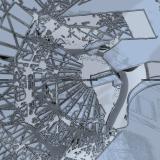
Unrecognisable” is a story about a city where buildings are used as weapons in a war between the government and the people. The initial chapter, “Eiffel Shard”, was published as an online graphic novel with an interactive soundtrack. It depicts a phone call between Paris Hell and Geneva Heat, two members of the resistance group Unrecognisable. During the call, Paris informs Geneva that a deadly building, The Shard, is now under the authorities’ control. What’s worse — the government also got hold of a secret building transformation plan developed by the resistance. Paris tells Geneva that the Unrecognisables decided to abandon the plan due to the number of civilian casualties it would inevitably cause. A series of intricate explosions would force the building’s glass surface to rip through the surrounding areas, destroying everything in its path and leaving only a pointed metal structure standing: an Eiffel Shard.
The second chapter, “Paris’ Dream”, was performed by Lolina as an improvised gig. Samples from the soundtrack to chapter one accompanied a video showing the protagonist sneaking into The Shard at night. The narrative continues with Paris’ anxiety dream of her time working on the Eiffel Shard project alongside another Unrecognisables member who she fears has betrayed them by handing over their dangerous plan to the government.
The third chapter is now being released as an album of new music. In a declining city, Paris and Geneva are tour guides to be followed at your own risk. Lies and petty crimes, mistrust, betrayal and, inevitably, war are the setting in which they seek to devise a plan for resistance. As members of a secret group, they hide their identities and meet after dark. Under dim lights of city streets and closed-down clubs, it’s hard to tell a dodgy detective from an eager philosophy student, friends are enemies in disguise, and it’s advised to park your car sideways for a fast getaway.
On this concept album, Lolina performs the role of both characters, her own voice often made unrecognisable by pitch-shifts and distortion. It was recorded almost exclusively on a Casio SK-200 sampling keyboard boasting 1.62 seconds total sampling time. No beat preset (total of 20) is left untouched, unchopped or unlooped. Not one of the 49 mini keys is idle. Retains samples when turned off.
In 1969, Albina in the US underwent a pivotal transformation which saw the arrival of Black residents displaced by the Vanport floods. While a local Black economy thrived to start with, the neighbourhood eventually got neglected due to disinvestment by the city's elites but citizens didn't take it lying down and some of them formed Shades Of Brown, a group that emerged at the Albina Arts Center which was a haven for artists during civil unrest. With members from various musical acts, they found unity under leader Thara Memory who instilled discipline and required them to read and write music before performing. This EP, which is the group's sole record, embodies their camaraderie and the community's struggle against neglect across six raw-as-you-like funk cuts laden with emotion and narrative.
- A1: Burning Out With Juan Hansen
- A2: Silence With Maurice Kaar
- A3: Forward Forever W Flowdan
- A4: Deformation
- B1: Shelter With Monolink & Camelphat
- B2: So Far So Near
- B3: Insanity
- B4: Tarar With Karin Park, Yubik
- C1: Downfall With Braev, Colyn
- C2: Under Earth
- C3: Hatred Human
- C4: Transformation To God With Jay Starr
- D1: No Gravitation
- D2: The Belonging
- D3: There`s Another Me With Aparde
- D4: Airplane Mode
Live artist Innellea dropped his limited vinyl deluxe album . ‘The Belonging’ including two bonus tracks, poster and colored vinyls. The LP forms part of a conceptual storytelling project. The album features focus track ‘Shelter’ w. CamelPhat & Monolink, along with diverse and significant collabs with Grammy winner Flowdan, Swedish indie singer/songwriter Karin Park, live musician Juan Hansen. Additionally the deluxe vinyl album includes Innellea´s feature with Paris Paloma 'under Earth'
‘The Belonging’ project is a cohesive multi-media concept, comprising the album heralded by a series of singles, multiple music videos. All of this will evoke a ‘collective catharsis’ after charting a personal and universal journey. This says Innellea: ‘As personal crises are part of life, we want to go through this journey collectively, from a silent, burned out state of ‘Where do we belong?’ Together, we will go forward forever through all the insanity until the certainty that ‘We belong here!’ as each track charts a step away from crisis, towards this feeling of belonging.