Following their acclaimed debut ‘The Summoned’ on Acid Jazz in 2023, Mama Terra return with a new album - ‘Chameleons: Live Interpretations of Herbie Hancock’. The album recasts Hancock’s iconic works in a new, live setting, as a basis for both homage and exploration, with ‘Headhunters’ being a prime influence for leader Marco Cafolla. The album grew out of Jazz FM’s ‘Classic Albums’ series, and was recorded live at the Glasgow International Jazz Festival in June 2024. The performance demonstrates the prowess of Mama Terra as a live outfit. Led by Marco Cafolla (Keyboards), musicians include Konrad Wiszniewski (Tenor Sax), Rachel Lightbody (Vocals), Ross David Saunders (Upright Bass + Mix Engineer) & Doug Hough (Drums). Known for their fresh and invigorated take on spiritual jazz, with soul and R&B influences, Mama Terra showcased at the 2024 SXSW Festival in Austin, Texas, alongside a host of festival and jazz club appearances. ‘Chameleons…’ shows a band in ascendency.
Cerca:u key
Dies ist die LP-Version der sehr erfolgreichen CD-Einspielung des Arrangements für vier Klaviere von Mike Oldfi elds Kultstück "Tubular Bells".
"Tubular Bells", veröffentlicht 1973, ist das bahnbrechende Debütalbum des britischen Multiinstrumentalisten Mike Oldfi eld. Die Mischung aus progressivem Rock, Klassik und Volksmusik machte das Album für seine experimentelle Struktur berühmt, die zwei Teile erstrecken sich über insgesamt fast eine Stunde. Die Musik ist vollständig instrumental. Was "Tubular Bells" so einzigartig macht, ist die vielschichtige Komposition, bei der Oldfi eld alle Instrumente – insgesamt über 20 – selbst spielt, darunter Gitarren, Keyboards, Schlagzeug und natürlich die Röhrenglocken, die
"Tubular Bells". Das eröffnende Klaviermotiv, das im Film "Der Exorzist" von 1973 eine wichtige Rolle spielte, wurde zur Ikone und trug zum kommerziellen Erfolg des Albums bei
Pattern-Seeking Animals comes out of the gate in 2025 with the release of their fifth album
Friend of All Creatures due out on February 14th, on GEP Records. The Los Angeles-based
quartet have been one of the prog scene’s most prolific and well-received artists, beginning
with the release of their self-titled debut album in 2019, followed by Prehensile Tales in
2020, Only Passing Through in 2022 and Spooky Action at a Distance in 2023.
Originally formed with past members of Spock’s Beard, Pattern-Seeking Animals (P-SA) has
long since staked claim to its own identity, forging a strong path in the prog world. The
band, named after a quote about human behavior from science historian Michael Shermer,
PS-A is Ted Leonard (lead vocals and guitar), John Boegehold (keyboards, guitars,
programming), Dave Meros (basses) and the energetic Jimmy Keegan (drums and vocals).
Friend of All Creatures (named from a verse in the Bhagavad Gita) contains 7 songs, all
written by Boegehold, who also produced the album. It was engineered and mixed at
Woodcliff Studio in Los Angeles by Frank Rosato in 2024.
- Jellyroll
- High-Test Fish Line
- Local Days
- Check Me Out
- Highway Blues
- I M A Lonely Man
- Sweet Lynda
- Springfield Station Theme
- Racetrack Daddy
Released in 1971, Get Off in Chicago captures the essence of an energetic concert featuring Harvey Mandel and key figures from the Chicago blues scene. Alongside Mandel, known for his innovative guitar playing, are renowned musicians such as John Bishop and Gregory E. Stinson, who contribute their talents on guitar. The rhythm section, with Peter Milo on drums and Nick Tountas on bass, anchors the tracks in a powerful groove. The album shows blazing solos, bold improvisations, and a collaborative spirit that transcends genres. This unique blend of blues, rock, and jazz highlights the collective genius of these talented artists.
- Prologue Amateur
- Sax Addict
- Otre Soleil Est Mort
- Tinder Surprise
- Igor Stravestit
- Amoureuse
- 5: Th
- Ok Boomer
- Ouais
- Je Cours
- Conversation
- Laura Palmer
- Yaourt A L'italienne
- T'es Ou?
Back in the day, when he was the drummer for Poni Hoax, Vincent Taeger would sing in French whatever came to his mind backstage after concerts, just for fun, to amuse his friend the late Nicolas Ker. Since then, time has flown by, undoubtedly bringing its share of ups and downs. Nonetheless, today, this artist with a long career is finally releasing his debut album as a singer, OK Crooner. It's indeed an album for a singer, but also one for a musician. For this part, Taeger doesn't come alone; he brings along the Jazz Kamasutra, a sexy sextet that knows how to play everything and will later accompany him on stage. To get to this point, Vincent Taeger had to stop playing around with big names like Air, Damon Albarn, Justice, Lenny Kravitz, Skepta, Tony Allen, Oumou Sangaré, Jeff Mills, Archie Shepp, Sampa the Great, Andrea Laszlo de Simone... More than half of the major artists with whom he once collaborated, contributing to their albums or simply laying down a drum, bass, or any other heavy instrument line. Before OK Crooner, he also transformed into Tiger Tigre. This roaring alias was used for a first solo album, instrumental and so deep that one might have thought the ghost of François de Roubaix had taken shape. But that was before, before this exceptional musician decided to dive into the vast ocean of French variety to give a sequel, a culmination to this project. During COVID, Vincent Taeger started frantically listening to Souchon, Chamfort, Gotainer, and Christophe. Inspired by his elders, while not renouncing his attachment to the meticulous arrangements reminiscent of Alain Goraguer's soundtracks, he picked up a pen to jot down snippets of songs to accompany his increasingly sophisticated compositions. And the worst part is that he enjoyed it! Coming from rap, he has a knack for punchlines. Throughout the album, he delivers just as many harsh or soft words as good ones, alternating between risqué humor, Gaulish wit, and poetry. Partially recorded at Studio Ferber, but mainly at home with his partner, known by the alias La Plongée, who co-produced the album for the occasion, OK Crooner is a key album in Vincent Taeger's discography. Besides being the one where he finally unveils his voice to the public, without pretense as it is prominently featured and minimally, if at all, retouched, Taeger also offers music that suits him perfectly. Sharp yet accessible, jazz, pop, baroque, classical, modern, and resolutely marked by Tony Allen's legacy, which he daringly mixes with Beethoven in the Fifth Symphony. His alter ego, Vincent Taurelle, with whom he has produced many albums, took care of mixing this one.
Artikal Sound System is a reggae band based out of South Florida. Founded by Chris Montague (guitar) and Fabian Acuna (bass) in 2012, the band honed their chops backing a series of Caribbean singers. Along the way the boys picked up the insane and absurd keys player Christopher Cope and the heavy footed drummer Adam Kampf before finally trying something a little sonically different with their neighbor, female vocalist Logan Rex. After nearly a decade of playing together the boys sound tight and powerful, creating the perfect foundation for their jazz-influenced singer to dance around on lyrically and literally. What you hear is the sound of friendship, hard work, imagination and the hope to spread their message of love and the importance of having a good time
Alternate versions of tracks from Marc Mac's Def Radio Album. The album marks the return of Marc Mac's long-running Visioneers project. As ever with Visioneers, this record reimagines the default stock of hip-hop's best-stocked jukebox, often beginning from scratch focusing on a central sample used in the original Hip Hop song, to either recontextualise a classic or come up with a new song; whatever the case, the key hallmark of a Visioneers is its live instrumentation, with flaunts a *gauche et droite* mastery over hip-hop's laggard swing.
a A1: What It Mean (Battle Cut) 45
- A1: Alone (Live Troxy London Mmxxiv)
- A2: And Nothing Is Forever (Live Troxy London Mmxxiv)
- A3: A Fragile Thing (Live Troxy London Mmxxiv)
- A4: Warsong (Live Troxy London Mmxxiv)
- B1: Drone Nodrone (Live Troxy London Mmxxiv)
- B2: I Can Never Say Goodbye (Live Troxy London Mmxxiv)
- B3: All I Ever Am (Live Troxy London Mmxxiv)
- B4: Endsong (Live Troxy London Mmxxiv)
1st November saw the release of THE CURE's critically acclaimed album, 'SONGS OF A LOST WORLD,' the band’s first new studio record in 16 years and their first #1 album in the UK since 1992.
The night of the album's unveiling, The Cure performed it in full to 3000 fans at Troxy London and to more than a million on a free global stream.
The stunning live performance entitled 'SONGS OF A LIVE WORLD : TROXY LONDON MMXXlV’ will be released on the 14th Feb on vinyl on Fiction/Polydor, with all The Cure's royalties benefitting War Child and this will be opened up to Indie stores.
Initially formed in 1978, The Cure has sold over 30 million albums worldwide, headlined the Glastonbury festival four times and been inducted into the Rock And Roll Hall of Fame in 2019. They are considered to be one of the most influential bands to ever come out of the UK.
'SONGS OF A LOST WORLD' was written and arranged by Robert Smith, produced and mixed by Robert Smith & Paul Corkett and performed by The Cure - Robert Smith: Voice / guitar / 6string bass / keyboard, Simon Gallup: Bass, Jason Cooper: Drums / percussion, Roger O'Donnell: Keyboard, Reeves Gabrels: Guitar.
'SONGS OF A LIVE WORLD : TROXY LONDON MMXXlV’ includes Perry Bamonte: Guitar / 6string bass / keyboard.
Originally released on a Partial 10” in 2019, `Mediation’ became a hit on the underground roots and dub sound system scene with regular plays from the late Jah Shaka, amongst others.
This 12” reissue features the original vocal and dub cut, but also contains two previously unreleased dubplate cuts.
Hailing from Limerick, Ireland, Eva Keyes has a very bright and distinctive voice with an undeniable hint of Sinead O’ Connor and Dolores O’Riordan.
Produced by Dublin-based Dan Taliras.
Hidden Harmony presents the first full-length LP from Estonian composer and keyboardist Volodja Brodsky. The six compositions on 'Whispering Ln.' were entirely recorded during Brodsky's trip to the USA in 2018-2019 and showcased his passion for the transformative power of minimalism as an art form. The follow-up to his keyboard duties on psych funk/rare groove Estonian outfits Estrada Orchestra, Centre El Muusa, Misha Panfilov Septet, on ‘Whispering Ln’ Brodsky reinventing himself as a minimalism evangelist in his own right. From space age pop shimmering sonatas to the monolithic drone/overtone hypnotics, Brodsky created an ascetic yet complex sonic landscape where less is more.
"During this period, I was deeply engaged in the study of this art form. The compositions are meticulously distilled to their most primitive form, crafting an immersive experience that beckons to embark on a journey into the very core of emotions and thoughts. Every pause and each meticulously chosen sound within the album serves a purpose, orchestrating a delicate interplay between simplicity and depth. I hope this music carries you to a place of introspection and serenity, where you may discover the profound beauty within the plainness of life" – Volodja Brodsky
- A1: B-Rock & Mono Junk - My Mind Is Going
- A2: Orchestra Guacamole & Mika Vainio - Theme For The Lost Diamonds
- A3: Mr Velcro Fastener& Mesak - Robotic Appliances (Original Demo)
- B1: Jori Hulkkonen - Whispers (Extended Dance Version)
- B2: Markus & Kristian - Hän Malli On
- B3: Spektor - Rubic`s Cube
- C1: Imatran Voima - It`s Time To Testify
- C2: Decepticons - We Are The Decepticons
- C3: Dr Robotnik - Own Commands
- D1: Feng Shui - Hao Hao (I`m Back)
- D2: Brothomstates - Naeae Eletrok
- D3: Tero - Music
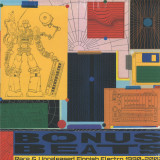
Cold Blow proudly presents Bonus Beats: Rare & Unreleased Finnish Electro 1990–2002, a landmark compilation capturing Finland's underground electro scene from the late 1990s and early 2000s. This double-LP features 9 rare and 3 previously unreleased tracks from pioneering Finnish artists, showcasing a distinctly Nordic approach to the genre. With contributions from notable names such as Jori Hulkkonen, Mr. Velcro Fastener, Mono Junk, and the late Mika Vainio, this release highlights the experimental and DIY ethos that defined Finland's electronic music scene during this period.
Carefully curated by Erkko Lehtinen, a key figure in Finland's electro scene as a DJ and promoter, the compilation explores a broad sonic palette, spanning early techno influences, robotic allure, and dark, bass-heavy tracks. Standout contributions include Decepticons and Dr. Robotnik's unreleased dark electro cuts, with the latter veering into minimal wave territory. Feng Shui feat. Monsieur delivers a striking collaboration that fuses a trance-like lead with raw, industrial beats, uniting members of Huoratron, Nu Science, Polytron, and Op:l Bastards. Keeping alive the legacy of Perttu Häkkinen (aka Randy Barracuda), this release wouldn't be complete without Imatran Voima's bass-driven anthem from their debut EP. Also featured are Spektor's retro synth experiments, Tero's Commodore 64-based creations, Brothomstates' (later a Warp signee) futuristic soundscapes, and a rare cover of Kraftwerk's The Model by the anonymous duo Markus & Kristian. Erkko's extensive liner notes provide additional insight into this culturally and musically significant era. Available in double-LP, this collection is a must-have for electronic music aficionados and vinyl collectors.
j 10: Feng Shui - Hao Hao (I`m Back) feat. Monsieur
The influence of the UK’s Steel City on electronic music is well documented and undisputed and continues to push the envelope with key figures such as Winston Hazel (Forgemasters, The Step), DJ Parrot/Crooked Man, Richard Benson (RAC, SWAG, Altern 8), Chris Duckenfield (RAC, Popular Peoples Front, SWAG, All Ears Distribution), a thriving underground club scene and the likes of Synaptic Voyager reinforcing the city’s rich musical legacy.
Matt White and Paul Baines have been making off-kilter, emotive, late night electronic jams since meeting in the early 90’s and while life took them on different paths for a while, they have recently blown the thick layer of dust from their synths and drum machines and got busy in the studio to create some amazing new music which draws influence from that classic UK techno sound which played such an important part in the development of dance music culture around the world. With recent releases on Frame Of Mind, Acquit and Telomere Plastic the duo are clearly on a roll, wearing the heritage of their city on their sleeve and delivering what can only be described as heartfelt, authentic machine music made with love and soul.
From the opening beats of lead track Dawn Till Dusk we are drawn in to another place which feels comfortably familiar yet organic, fluid and loose in a way that tugs on the heartstrings. A million miles from cookie-cutter tech house, this is two guys in a bedroom studio, digging deep on hardware machines to create a sound to get completely lost in. Lonely Promontory takes things deeper still with immersive pads, taught electro beats and blissed-out melodic lines which give just hint of optimism and recall those beloved sounds of B12, Redcell and Likemind.
Flipping over we have Stellar Engine which goes a littler heavier on the beats and bass whilst still retaining a floating quality, once again highlighting the hardware jam workflow that Synaptic Voyager utilise in their studio. Once Exposed takes us back to those heady days of the early 90’s when techno, house and ambient electronics combined to create a heady blend of deep atmospherics and driving beats which could work on both dance floors and car stereos alike. Rounding off the EP we have Cognitive Network which goes for a straighter four on the floor techno groove and a killer bassline to lose yourself in. These recordings were delivered to the label in unedited long form (some tracks totalling 15 minutes or more in length!) which Jimpster lovingly edited into the versions which you hear on this release.
- A1: Progetto Tribale - The Sweep
- A2: Onirico - Echo Giomini
- A3: Open Spaces - Artist In Wonderland
- B1: Alex Neri – The Wizard (Hot Funky Version)
- B2: M C.j. Feat. Sima - To Yourself Be Free - Instrumental Mix Energy Prod
- B3: Mato Grosso - Titanic Expande
- C1: Dreamatic - I Can Feel It (Part 1)
- C2: Carol Bailey - Understand Me Free Your Mind (Dream Piano Remix)
- C3: The True Underground Sound Of Rome - Secret Doctrine
- D1: Don Carlos - Boy
- D2: Lazy Bird – Jazzy Doll (Odyssey Dub)
Vol 2[28,99 €]
Volume 1 of this expertly curated project of 90s Italian House - put together by Don Carlos.
If Paradise was half as nice… by Fabio De Luca.
Googling “paradise house”, the first results to pop up are an endless list of European b&b’s with whitewashed lime façades, all of them promising “…an unmatched travel experience a few steps from the sea”. Next, a little further down, are the institutional websites of a few select semi-luxury retirement homes (no photos shown, but lots of stock images of smiling nurses with reassuring looks). To find the “paradise house” we’re after, we have to scroll even further down. Much further down.
It feels like yesterday, and at the same time it seems like a million years ago. The Eighties had just ended, and it was still unclear what to expect from the Nineties. Mobile phones that were not the size of a briefcase and did not cost as much as a car? A frightening economic crisis? The guitar-rock revival?! Certainly, the best place to observe that moment of transition was the dancefloor. Truly epochal transformations were happening there. From America, within a short distance one from the other, two revolutionary new musical styles had arrived: the first one sounded a bit like an “on a budget” version of the best Seventies disco-music – Philly sound made with a set of piano-bar keyboards! – the other was even more sparse, futuristic and extraterrestrial. It was a music with a quite distinct “physical” component, which at the same time, to be fully grasped, seemed to call for the knotty theories of certain French post-modern philosophers: Gilles Deleuze, Félix Guattari, Paul Virilio... Both those genres – we would learn shortly after – were born in the black communities of Chicago and Detroit, although listening to those vinyl 12” (often wrapped in generic white covers, and with little indication in the label) you could not easily guess whether behind them there was a black boy from somewhere in the Usa, or a girl from Berlin, or a pale kid from a Cornish coastal town.
Quickly, similar sounds began to show up from all corners of Europe. A thousand variations of the same intuition: leaner, less lean, happier, slightly less intoxicated, more broken, slower, faster, much faster... Boom! From the dancefloors – the London ones at least, whose chronicles we eagerly read every month in the pages of The Face and i-D – came tales of a new generation of clubbers who had completely stopped “dressing up” to go dancing; of hot tempered hooligans bursting into tears and hugging everyone under the strobe lights as the notes of Strings of Life rose up through the fumes of dry ice (certain “smiling” pills were also involved, sure). At this point, however, we must move on to Switzerland.
In Switzerland, in the quiet and diligent town of Lugano, between the 1980s and 1990s there was a club called “Morandi”. Its hot night was on Wednesdays, when the audience also came from Milan, Como, Varese and Zurich. Legend goes that, one night, none less than Prince and Sheila E were spotted hiding among the sofas, on a day-off of the Italian dates of the Nude Tour… The Wednesday resident and superstar was an Italian dj with an exotic name: Don Carlos. The soundtrack he devised was a mixture of Chicago, Detroit, the most progressive R&B and certain forgotten classics of old disco music: practically, what the Paradise Garage in New York might have sounded like had it not closed in 1987. In between, Don Carlos also managed to squeeze in some tracks he had worked on in his studio on Lago Maggiore. One in particular: a track that was rather slow compared to the BPM in fashion at the time, but which was a perfect bridge between house and R&B. The title was Alone: Don Carlos would explain years later that it had to be intended both in the English meaning of “by itself” and like the Italian word meaning “halo”. That wasn’t the only double entendre about the song, anyway. Its own very deep nature was, indeed, double. On the one hand, Alone was built around an angelic keyboard pattern and a romantic piano riff that took you straight to heaven; on the other, it showcased enough electronic squelches (plus a sax part that sounded like it had been dissolved by acid rain) to pigeonhole the tune into the “junk modernity” section, aka the hallmark of all the most innovative sounds of the time: music that sounded like it was hand-crafted from the scraps of glittering overground pop.
No one knows who was the first to call it “paradise house”, nor when it happened. Alternative definitions on the same topic one happened to hear included “ambient house”, “dream house”, “Mediterranean progressive”… but of course none were as good (and alluring) as “paradise house”. What is certain is that such inclination for sounds that were in equal measure angelic and neurotic, romantic and unaffective, quickly became the trademark of the second generation of Italian house. Music that seemed shyly equidistant from all the rhythmic and electronic revolutions that had happened up to that moment (“Music perfectly adept at going nowhere slowly” as noted by English journalist Craig McLean in a legendary field report for Blah Blah Blah magazine). Music that to a inattentive ear might have sounded as anonymous as a snapshot of a random group of passers-by at 10AM in the centre of any major city, but perfectly described the (slow) awakening in the real world after the universal love binge of the so-called Second Summer of Love.
For a brief but unforgettable season, in Italy “paradise house” was the official soundtrack of interminable weekends spent inside the car, darting from one club to another, cutting the peninsula from North to centre, from East to West coast in pursuit of the latest after-hours disco, trading kilometres per hour with beats per minute: practically, a new New Year’s Eve every Friday and Saturday night. This too was no small transformation, as well as a shock for an adult Italy that was encountering for the first time – thanks to its sons and daughters – the wild side of industrial modernity. The clubbers of the so-called “fuoriorario” scene were the balls gone mad in the pinball machine most feared by newspapers, magazines and TV pundits. What they did each and every weekend, apart from going crazy to the sound of the current white labels, was linking distant geographical points and non-places (thank you Marc Augé!) – old dance halls, farmhouses and business centres – transformed for one night into house music heaven. As Marco D’Eramo wrote in his 1995 essay on Chicago, Il maiale e il grattacielo: “Four-wheeled capitalism distorts our age-old image of the city, it allows the suburbs to be connected to each other, whereas before they were connected only by the centre (…) It makes possible a metropolitan area without a metropolis, without a city centre, without downtown. The periphery is no longer a periphery of any centre, but is self-centred”.
“Paradise house” perfectly understood all of this and turned it into a sort of cyber-blues that didn’t even need words, and unexpectedly brought back a drop of melancholic (post?)-humanity within a world that by then – as we would wholly realise in the decades to come – was fully inhuman and heartless. A world where we were all alone, and surrounded by a sinister yellowish halo, like a neon at the end of its life cycle. But, for one night at least, happy.
Back in stock due to popular demand, the 23rd release in our signature Brazil 45’s series served up a double header of classics from Sonia Santos and João Donato.
First up, 'Poema Ritmico Do Malandro (Balanço Do Crioulo)' is a beautiful track from the instantly recognisable Sonia Santos. A song that drifts from classic to psychedelic samba, laden with strings, horns and crowd noise. First released on 7” by Copacabana in 1971, but never on an album, originals fetch up to £100 per copy. A different version of this song also appears on the truly excellent Zito Righi Alucinolandia LP.
On the B side, 'Cala Boca Menino' is taken from João Donato’s much sought after and requested Quem É Quem LP. Quirky percussion, bubbling keys, horns and a hypnotic vocal. Donato is a hugely prolific force in Brazilian music and worked with the likes of including Tom Jobim, Astrud Gilberto, Cal Tjader, Dom Um Romao and Gilberto Gil amongst others. ‘Cala Boca Menino’ was released on a 7” in 1973 in Brazil, but is very difficult to find at a reasonable price and in good condition these days.
Mit "Nobody Loves You More" veröffentlicht Kim Deal am 22.11.24 auf 4AD ihr erstes Soloalbum. Die elf Songs umfassende Sammlung ist das erste Album der in Dayton, Ohio lebenden Künstlerin unter ihrem eigenen Namen. "Nobody Loves You More" ist Kim Deals Debütalbum, obwohl es nicht das erste Mal ist, dass sie einen Alleingang unternimmt - 2013 veröffentlichte sie im Eigenverlag eine fünfteilige Reihe von zehn Songs, die limitiert als 7" erschienen. Im Einklang mit Deals akribischer Herangehensweise an ihre Kunst, wurde das Album über mehrere Jahre hinweg verfeinert. Die ältesten Songs, "Are You Mine?" und "Wish I Was", wurden 2011 geschrieben und aufgenommen, kurz nachdem Deal von der "Lost Cities Tour" der Pixies zurückkam und nach Los Angeles umzog (frühe Versionen dieser Songs waren in der besagten Vinyl-Serie enthalten). Die letzten Aufnahmen für "Nobody Loves You More" fanden im November 2022 mit dem legendären Tontechniker und engen Freund Steve Albini statt, der den letzten Track "A Good Time Pushed" in seinem Electrical Audio Studio in Chicago einspielte. Auf dem Weg dorthin hat sie eine Vielzahl von Mitstreitern aus der Vergangenheit und Gegenwart hinzugezogen, von den Breeders (Mando Lopez, Zwillingsschwester Kelley Deal, Jim Macpherson, Britt Walford) oder auch Raymond McGinley (Teenage Fanclub), Jack Lawrence (Raconteurs) sowie Fay Milton und Ayse Hassan von den Savages. "Nobody Loves You More" wurde von Marta Salogni gemischt und von Heba Kadry gemastert. Zu jedem Song gibt es eine persönliche Geschichte. Sie handeln von den Winterferien mit ihren Eltern auf den Florida Keys ("Summerland"), einem Hochzeitsband-Cover von "Margaritaville" ("Coast") oder auch der Demenz ihrer Mutter ("Are You Mine?"). Die Platte zelebriert Deals unvergleichliche Kunstfertigkeit, die nicht nur auf die Höhepunkte ihrer Karriere mit gefeierten Bands der Alternative-Landschaft (Pixies, The Amps, The Breeders) verweist, sondern auch auf ihr unverrückbares kulturelles Gewicht, das über Generationen hinweg Musiker und Musikerinnen wie Kurt Cobain und Olivia Rodrigo beeinflusst hat.
Miki Yui is a musician, artist, and composer, originally from Tokyo, who has been based in Düsseldorf since 1994. Her whose work has long explored multiple forms of media, while documenting liminal zones of perception. On her latest album, As If, Yui creates a subtly connected suite of electronic music, drawn from improvisations and randomised processes that she has engaged with modular synthesis. Deeply poetic in its expression, even at its most minimal, the six pieces on As If have a curious tenor – they are, each of them, intensely sensuous, almost haptic listening experiences, as though the laser focus that Yui displays towards her compositions allows her to engage them as almost physical presences in the world.
One of the keys that unlocks the intimate complexity-in-simplicity of As If was Yui’s encounters with the Amazonian rainforest in Manaus, Brazil in 2018. Finding that the sounds in the rainforest both shadowed and echoed the music she had been making for two decades, she embraced the possibilities of modular synthesis, the sounds of which she discovered “have astonishing similarities to the sounds I experienced in the rainforest.” There is, indeed, something natural about the way these sounds bloom in real time; in their dedicated focus to the subtle development and mutation of several discrete parameters of sound, they grow slowly, gradually, their rhizomic structures suggesting that we are always situated within the middle of sound.
Sometimes, the material here has a kind of febrile energy, as on the ticking, clacking electronics of “Generativ”, a track that seems to rotate in the air in front of the listener, the light reflecting off its multiple surfaces as we catch the intricacies of its micro-patterns. Elsewhere, we slide into a cooled but welcoming environment, like the late-night fire-fly horizon of “Song 4”; there’s also the humid, dripping tropical sunset that’s documented on “Summernight”. It’s a music that’s hard to locate external coordinates for, though there are, perhaps, some parallels with the work of Laurie Spiegel, Eliane Radigue’s Vice Versa, and Pauline Oliveros’s “Roots of the Moment”. But As If is an extraordinary collection of naturally developing, rich studies for slowly mutating, enveloping, elemental electronics.
2 x black LP + LP Booklet
Die GRAMMY®-gekrönten Progressive-Music-Titanen Dream Theater melden sich mit ihrem 16. Studioalbum "Parasomnia" zurück - eine Ankündigung, die satte 15 Jahre auf sich warten ließ. Es ist das erste Album mit der legendären Besetzung Sänger James LaBrie, Gitarrist John Petrucci, Bassist John Myung, Keyboarder Jordan Rudess und Schlagzeuger Mike Portnoy seit "Black Clouds & Silver Linings" von 2009. "Parasomnia" wurde von Petrucci produziert, von James 'Jimmy T' Meslin aufgenom-men und von Andy Sneap abgemischt. Hugh Syme hat erneut seine kreative Vision für das Cover-Artwork beigesteuert. Vom Opener "In The Arms Of Morpheus" bis zum abschließenden "The Shadow Man Incident" kehren Dream Theater mit einer Samm-lung von Songs zurück, die zeigen, weshalb die Band seit vier Jahrzehnten eine treue Fangemeinde hat. Mit einer Spielzeit von 71 Minuten nimmt "Parasomnia" den Hörer mit auf eine musikalische Reise, die seit Beginn der Karriere zum Synonym für die Band geworden ist
ltd 2 x ultra-clear 2 LP + LP Booklet
Die GRAMMY®-gekrönten Progressive-Music-Titanen Dream Theater melden sich mit ihrem 16. Studioalbum "Parasomnia" zurück - eine Ankündigung, die satte 15 Jahre auf sich warten ließ. Es ist das erste Album mit der legendären Besetzung Sänger James LaBrie, Gitarrist John Petrucci, Bassist John Myung, Keyboarder Jordan Rudess und Schlagzeuger Mike Portnoy seit "Black Clouds & Silver Linings" von 2009. "Parasomnia" wurde von Petrucci produziert, von James 'Jimmy T' Meslin aufgenom-men und von Andy Sneap abgemischt. Hugh Syme hat erneut seine kreative Vision für das Cover-Artwork beigesteuert. Vom Opener "In The Arms Of Morpheus" bis zum abschließenden "The Shadow Man Incident" kehren Dream Theater mit einer Samm-lung von Songs zurück, die zeigen, weshalb die Band seit vier Jahrzehnten eine treue Fangemeinde hat. Mit einer Spielzeit von 71 Minuten nimmt "Parasomnia" den Hörer mit auf eine musikalische Reise, die seit Beginn der Karriere zum Synonym für die Band geworden ist.
Rauelsson's third solo album for Sonic Pieces focuses on simplicity and minimalism. It recalibrates his love for ambient with an austere approach that conjures an atmosphere of silence and solitude. On Niu, the artist has traded his craft for shimmering layers of sound clusters and electronic editing in favor of a predominantly raw and acoustic recording.
Recorded primarily in Sofia and Berlin and mixed at Saal 3 of Funkhaus Berlin, Niu presents a 9-song journey that includes orchestral compositions, delicate synth miniatures, and sparse brass and woodwind drones with room for spoken word and a hint of psychedelic noir fable. The result is an album that, despite the eclectic choice of instrumentation, paints a landscape of spiritual clarity; an album that without being typically classical, still feels like a classical album. Three themes vary across the 9 pieces, starting with the purely orchestral "Prelude No. 7" before moving on to airy synth bass arpeggio and pedal steel. With more changing instruments, Raúl next takes us into a fairytale flute composition with guest flutist Heather Woods Broderick and brass vibrations by the trio Zinc & Copper. Finally, Katrine Grarup Elbo recites a poem by Raúl, ending the piece on a somber but beautiful note. The rest of the album continues in this vein, creating a unique sound that surprises the listener at every turn. Niu is a real departure from the artist's previous works in both scope and musicality. Everything was recorded without overdubs and with only minimal editing, trying to preserve the feeling of music coming from a room where musicians play live. Overall, this is music that finds comfort in movement as much as in pause and silence; music in which tenderness and tension exist in the same gesture.
The album also follows a certain mysticism with its poetic interludes, alternate track lists and titles like "Podium Of Riddles", "A Keyhole-Shaped Island" and "Ceramic Swallows, Set Of 3". Perhaps, given enough time, a hidden meaning or a new perception will be revealed. Niu is also set to be expanded into an art book, containing poems and photographs by Raúl, as well as an exhibition. Perhaps the key lies somewhere in there.