The official new edition from this rare and great Afrobeat & Soukous masterpiece from Nigeria !
"Vibro Success Intercontinental Orchestra was an extraordinary group from the Central African Republic, founded by the sax player Rodolphe 'Beckers' Bekpa, also known as Master Békers, in the late 60's. The band achieved surprising domestic success after Beckers introduced the first drums to the Congolese Rumba rhythm. His innovation proved to be wildly popular so they were hired as the resident band of “ciel d’Afrique au Km5”, a night club in Bangui. The club was renowned as the temple of the Olympic Réal football team's fans and that visibility propelled them into becoming the official national orchestra.
1970 marked beginning of the band's international fame . Their fame spread beyond national borders until they became so popular that invitations began to arrive from nearby countries like Cameroon and Chad, the former of which the band would then tour that same year. The success of their performances prompted a further tour in 1972. According to Rodolphe Bépka, the audience enthusiasm Vibro encountered was bewildering. "We filled the old military stadium in Yaoundé in 1970, in 1972 the new Amadou Haïdjo stadium ... We are running with great success in the cities.” Their popularity was also growing in Chad, where they would tour several times through the early and mid 70's.
Towards the end of 1976, Vibro Success decided to take their music global and introduce Central African music to listeners worldwide. It worked. The turning point came in Nigeria. There the group achieved extraordinary success, with live performances followed by contracts with local labels like Scottie and Ben/Clover resulting in hit releases. Most of their LP's were originally released on this later label, Ben Limited, owned by Ben Okonkwo.
Ben, also known as Clover Sounds, brought a great number of the biggest bands from the country to market, bands like The Apostles, Akwassa,The Doves, Aktion, The Visitors, Mansion, Folk 77 and many others. Nearly all those groups started their recording careers in the label's studios based in the commercial heart of Aba, Abia State, one of Southeastern Nigeria’s largest cities. Aba at that time was a flourishing city, an important crossroads of people and culture with an intensive and active and cutting edge live music and nightlife.
But after that golden era the group began to lose its popularity. In the 1980's they returned to Bangui and resumed their old-time gigs in dance halls there - only to realize that their music didn't have the appeal it used to. Making matters worse, the domestic economic downturn accelerated, forcing the orchestra to slowly end its activities . Vibro Succès Intercontinental Orchestra disappeared at the end of the 80s and most of its members died in the 90s.
We discovered this LP during our first trip to Nigeria in 2016. While traveling in the east to meet up with a musician, we stopped for a night in a village. As often happens in Nigeria, information has a way of traveling fast. The news that a couple of white guys looking for records had arrived in the village the day before spread like light. When we awoke, we found a couple of elderly music lovers in the hall of our hotel with a little pile of records for sale. The nice cover of the “Drunkard” album was right on top!
At first we thought it was just another really good soukous album made by Vibro Success but after we heard “Drunkard” - we knew we had stumbled onto something very special. That was the “easy” part. Soon after, we had the idea of reissuing this LP and that was a bit harder. There were no credits on the cover and not much information about Vibro Succès. We started to ask to our friends to ask around, see if somebody knew them or the producer. That's when sadly we discovered that Ben Okonkwo had passed. So with no leads to follow and seemingly without any possibility of making progress on the matter, we "gave up" and returned to Italy.
A couple years later, in the summer of 2019, we found ourselves again in Aba. This time we had the chance to meet Nnamdi Okonkwo, the eldest son of the late Ben Okonkwo. After Nnamdi's mother and family agreed, he was glad to cooperate with us for the re-release of this special album."
Cerca:villa abo
Van Halen did more than announce to the world the earthshaking arrival of a revolutionary guitarist. Performed by an enterprising California quartet that took its name from two of its principal members, the 1978 debut ripped headlines away from punk, injected fresh energy into a then-moribund rock 'n' roll scene, reimagined how heavy music and throwback pop could coexist, and invited everyone to experience the top-down pleasures of a beach-front Saturday night every day of the week no matter where they lived. Painstakingly restored by Mobile Fidelity Sound Lab, and the first of a multi-album series in an exciting partnership between the famous reissue label and Van Halen, Van Halen delivers feel-good thrills and hormonally charged desires like never before.
Limited to 12,000 numbered copies, pressed on dead-quiet MoFi SuperVinyl at RTI, and mastered from the original analogue master tapes, Mobile Fidelity's ultra-hi-fi UltraDisc One-Step 180g 45RPM 2LP collector's edition pays tribute to the record's merit and allows fans to experience Van Halen's original blend of raw power, Hollywood flair, and vaudeville fun for generations to come. Playing with reference-setting sonics that elevate a 10-times-platinum landmark whose importance cannot be quantitatively measured, this definitive version provides a clear, clean, transparent, balanced, and turn-the-volume-up-to-11 view of an album that birthed entirely new styles. Since MoFi's unique SuperVinyl compound allows you to crank the decibels to your wildest desires without risking noise-floor interference, prepare to not only hear but feel Van Halen in your chest, no fifth-row concert seat necessary.
The premium packaging and gorgeous presentation of the UD1S Van Halen pressing befit its extremely select status. Housed in a deluxe box, it features special foil-stamped jackets and faithful-to-the-original graphics that illuminate the splendor of the recording. No expense has been spared. Aurally and visually, this UD1S reissue exists as a curatorial artefact meant to be preserved, touched, and examined. It is made for discerning listeners that prize sound quality and production, and who desire to fully immerse themselves in the art – and everything involved with the album, from the iconic cover art to the meticulous finishes and, yes, of course, Eddie Van Halen's pioneering fretwork and his brother Alex's double-bass percussion.
Indeed, could a piece of music that transformed how countless guitarists approached their instrument be more fittingly named than "Eruption"? Likely not, and in just 102 seconds, Eddie Van Halen rewrote, reimagined, and reconfigured a vocabulary last significantly updated a decade earlier by fellow six-string wizard Jimi Hendrix. Akin to the Washington State legend, Eddie Van Halen developed his own techniques and tones all the while making his seismic accomplishments seem effortless. Devoid of the pretence, ego, and showiness that infected many of his imitators, the Dutch native sticks to a straightforward approach that underlines the authority, prowess, and visionary scope of his playing and then-unheard-of finger-tapping skills. Throughout Van Halen, he establishes himself as an instant idol – a savant whose otherworldly combination of breadth, poise, feel, speed, force, and melody seems beamed in from another galaxy.
As does nearly every song on the record, whose cohesiveness and dynamic put into perspective the advanced chemistry and one-for-all spirit the youthful band had out of the gates. Having paid its dues for years in bars and clubs – going as far as recording a 24-track demo for Kiss bassist Gene Simmons at Village Recorders only to be spurned by management companies that felt its music wouldn't go anywhere – Van Halen finally got a deserved break when Warner Bros. executives signed the group in 1977. The subsequent recording sessions further testify on behalf of the band's synergy and alignment. Completed in just a few weeks with producer Ted Templeman, Van Halen was primarily cut live in the studio with minimal overdubs and edits. The explosiveness, energy, and electricity remain definitive, and as heard on this UD1S set, put the group on a private stage – humming amplifiers, Frankenstrat guitar, bright spotlights, sweaty headbands, and then some.
Van Halen yielded just one hit in the form of a Top 40 single (a breathless cover of the Kinks' "You Really Got Me") but practically every song on the revered LP has become a staple. Named the 202nd Greatest Album of All Time by Rolling Stone and considered by countless experts as one of the best debuts in history, the record displays what can happen with four distinct talents gel and strive for the same purposes. In Van Halen's case, the latter almost always involved partying, freedom, sex, and, in the immortal words of singer David Lee Roth, living "life like there's no tomorrow." The celebration manifests from the opening notes of the strutting "Runnin' with the Devil" – announced with the blare of droning car horns, Michael Anthony's robust bass line, and Alex Van Halen's thumping drumming – and continues through the conclusion of the white-hot "On Fire," goosed by Eddie Van Halen's race-track-ready lines, Roth's flamboyant deliveries, and the rhythm section's cat-like pounce.
Picking out individual highlights on Van Halen is akin to trying to count all the stars in a clear nighttime desert sky: There are far too many to identify, once you see one you notice another dozen you didn't spot before, and the cluster is best enjoyed as a whole. What's evident over repeat listens is the sheer diversity, a fact that's often overlooked: The high harmonies and background funk of "Jamie's Cryin'"; the insistent cane-and-a-tophat shuffle and doo-wop shoo-bop vocal break on "I'm the One"; the throwback acoustic blues that spreads into fast-paced, single-entendre wildfire on the Roth-led standout interpretation of John Brim's "Ice Cream Man." Like the man says, on Van Halen, all the flavours are guaranteed to satisfy.
More About Mobile Fidelity UltraDisc One-Step and Why It Is Superior
Instead of utilizing the industry-standard three-step lacquer process, Mobile Fidelity Sound Lab's new UltraDisc One-Step (UD1S) uses only one step, bypassing two processes of generational loss. While three-step processing is designed for optimum yield and efficiency, UD1S is created for the ultimate in sound quality. Just as Mobile Fidelity pioneered the UHQR (Ultra High-Quality Record) with JVC in the 1980s, UD1S again represents another state-of-the-art advance in the record-manufacturing process. MFSL engineers begin with the original master recordings, painstakingly transfer them to DSD 256, and meticulously cut a set of lacquers. These lacquers are used to create a very fragile, pristine UD1S stamper called a "convert." Delicate "converts" are then formed into the actual record stampers, producing a final product that literally and figuratively brings you closer to the music. By skipping the additional steps of pulling another positive and an additional negative, as done in the three-step process used in standard pressings, UD1S produces a final LP with the lowest noise floor possible today. The removal of the additional two steps of generational loss in the plating process reveals tremendous amounts of extra musical detail and dynamics, which are otherwise lost due to the standard copying process. Every conceivable aspect of vinyl production is optimized to produce the most perfect record album available today.
MoFi SuperVinyl
Developed by NEOTECH and RTI, MoFi SuperVinyl is the most exacting-to-specification vinyl compound ever devised. Analogue lovers have never seen (or heard) anything like it. Extraordinarily expensive and extremely painstaking to produce, the special proprietary compound addresses two specific areas of improvement: noise floor reduction and enhanced groove definition. The vinyl composition features a new carbonless dye (hold the disc up to the light and see) and produces the world's quietest surfaces. This high-definition formula also allows for the creation of cleaner grooves that are indistinguishable from the original lacquer. MoFi SuperVinyl provides the closest approximation of what the label's engineers hear in the mastering lab.
A blistering advancement of the knife-sharp hooks and urgently efficient post-punk structures that they’ve spent over a decade refining since their formation in 2011, the band’s fourth album – and second on Specialist Subject - emerges from a period of flux for the band’s chief songwriting partnership of Emma Wigham (drums/vocals) and Mark Jasper (guitar/vocals). First came a move north to Yorkshire from their native London. “We had decorated a tiny, rented house in Mytholmroyd” Jasper explains. “We setup a practice room in the top of a mill nearby and tried to write music, which we did amid stress about money, and a fear of having made the wrong decision. We had left our jobs, friends and a nice but absolutely tiny flat in London behind, and moved to a small village in West Yorkshire.” Although they found the location to be beautiful, the transition from city life to rural turned out to be an odd fit – too much so, it turned out. From this relatively short stay in West Yorkshire, however, came a more permanent change as the couple welcomed their first child Ivy into the family. Although, they’re hesitant to put too much of Streams and Waterways influence on the shoulders of their young daughter – she arrived a year and a half into the album’s conception – there’s no denying that its themes of loss, birth, and being part of this eternal, momentary life were brought into sharp focus following their new arrival. “Streams and Waterways is about the struggle of looking at the clock, realising it’s actually going pretty damn fast and knowing that really you have no control over anything” Jasper confirms. Perhaps that explains the way that opener The Valley doesn’t even introduce itself before careering into a full-throttled, three-minute scuzzy rager that would approach the descriptor anthemic had it not been kicked and scuffed along the way; it’s maybe why the wiry, ferocious Choice You Make feels like a charge into a storm despite the uncertainty of what you might find. It’s perhaps why even when Witching Waves allow themselves respite on the pared down Open A Hole, there’s a churning anxiety that lies below the acoustic guitar and harmonising vocals: in many ways musically and thematically Witching Waves are relinquishing the control that’s always been a fixture of their music – with all the thrilling and nervous fallout that comes from that. Although the pair have since returned south (having relocated to Exeter), Streams and Waterways also serves as a document of their foray northwards. The surviving artefact from Jasper’s never-to-be-finished studio that he’d began to build in Yorkshire – following the ending of his London-based Sound Savers studio – the record is also the first to feature current bassist Will Fitzpatrick, who joined initially live on their support tour with Australian punks Camp Cope. Fitzpatrick – a key component of Liverpool’s DIY scene for two decades – quickly became a key part of the writing process. Recording sessions were done during periods of lockdown that allowed congregation, Jasper recalling a still unborn Ivy kicking hard during an early mix playback of It’s A Shame’s layered noise rock assault. “The song was about my past, a much harder time. But my future was egging me on” he says. It’s a neat summation of Streams and Waterways and its representation of the discomfort of life amidst the compulsion to ride on its journey regardless. It’s a record that finds Witching Waves looking into the future more than ever before, but still bristles with the rush of being in the moment – because ultimately, despite what may have happened or may yet come, the band’s strongest trait remains being able to keep you feeling in the present.
Edition Hawara’s fifth release is a raw funk gem by a little-known Austrian pop band called Magic Sound
Edition Hawara’s second 7“release features one of the more obscure Austrian bands from the 1980s. Little is known about Magic Sound. The cover suggests that their label wanted them to be Austria’s Village People, though their sound is much rawer and funkier. One thing we know for sure is that the group included Andy Töfferl, who was also a member of the famous Austrian pop ensemble EAV (Erste Allgemeine Verunsicherung). And we know that they went to the studio to record a whole album after touring Sweden in 1980. Only these two songs survived, and they are worth listening to over and over again. Enjoy in fancy dress, or dressed down. With or without a moustache.
'Elephantasia' is a glorious folk opus from 1972, long lost and attaining a legendary reputation for its candour and creativity, from the late Bangor-born singer/songwriter Dave Evans. Finally, the LP sees the light of day again via Earth Recordings, it is a true gem from the vaults of British folk history. For fans of Nick Drake, Bill Fay and Davy Graham - with a touch of Michael Chapman, Bert Jansch and Fahey for good measure. Dave Evans' story is like a Pinter play; he sailed the seas in the merchant navy, was taught guitar in a brief interlude by the "mythical" Morocco John, wound up sharing a room with Steve Tilston in 1963 when they attended Loughborough Art College and ran the local folk club, while learning to make stringed instruments, the art of wine making and ceramics. Over the next year, Dave got a domestic 2-track reel-to-reel tape recorder and experimented with its two speeds to produce the tracks 'Elephantasia' and 'Lady Portia'. He pulled in members of local prog band Squidd, including latter day Hawkwind member Steve Swindells on keyboards, John Merritt on bass and Rodney Matthews on drums, who also designed the 'Elephantasia' album cover, and went on to become a renowned fantasy artist. 'Elephantasia' the album was originally released in 1972, fully exposing Dave's finger picking style, lilting vocal and his dalliance with the tape manipulation. It sold around 2000 copies and over the years became a talked about rarity, deemed too progressive for folk, too folk for the new prog heads. In best plot-thickening style, Dave tried two more releases and then disappeared. The scant sleeve notes recounted the songs' creation, featuring tales of experimentation in sound inspired by elephants, old memories recounted with all of the unpleasant bits edited out, storylines for escapists, the residents of St Agnes Park, broken beauty queens and a fat feline. It's an eclectic but beautifully fluent narrative from a finger picking maestro with a warm and engaging vocal style that wowed Peel and Whispering Bob back in the day. Dave Evans sadly died in April 2021. Earth Recordings is proud to reissue 'Elephantasia' for the first time in over 50 years, in collaboration with his estate and original Village Thing producer Ian A. Anderson. "Cult status guaranteed." Uncut. Classic Black Vinyl, DL card. CD Digisleeve.
Columbarium are a Belgian (the village of Zwevegem) heavy doom metal band, formed in 2021 but comprised of seasoned members from the regional doom scene over the last ten years.
Having played about a hundred gigs in a former incarnation (as Loose License) in Belgium, The Netherlands and France with bands like The Gates Of Slumber, Nekromant, Marche Funebre, Serpent Venom, FAAL, Famyne and King Hiss, they have built a serious reputation as a live act in the last decade.
The addition of an extra guitar / keyboard player some years ago (Koen Biesbrouck, formerly also from the avantgarde / instrumental rock band Locus Control) has taken the music to another horizon and that newfound sound was the cradle for the band’s rebirth, which led to renaming the band Columbarium.
The four guys found that sound with Belgian producer Lander Cluyse from Hearse Studio (Amenra and Aborted) and with Brad Boatright from AudioSiege Mastering Studio (Portland - Monolord and Pig
Destroyer).
Featuring guest vocals from Michelle Nocon (Bathseba / Serpentcult / Of Blood And Mercury).
The LP is pressed on green vinyl.
For fans of Paradise Lost, Winter, Tiamat, Swallow The Sun, My Dying Bride, Opeth, Celtic Frost, Anathema, Cemetary, Katatonia, Autopsy, Candlemass.
- A1: Star (Ricardo Villalobos Master)
- A2: Custard Last Stand / Amo1 Ambient Version (Ricardo Villalobos Master)
- B1: Make My Love Grow (Ricardo Villalobos Mix Down)
- B2: Black Apple Pink Apple (Ricardo Villalobos Remix)
- C1: Make My Love Grow (Ricardo Villalobos Make My Love Groove Remix)
- C2: Softlanding (Ricardo Villalobos Remix)
- D1: Dealer (Ricardo Villalobos Remix)
tom Ravenscroft at 6music amongst others. And now, in true AMO1 creative fashion they are presenting an off-shoot release of that album, one completely reimagined by the man, the myth: Ricardo Villalobos.
Much has been written and talked about when it comes to producer/DJ Ricardo Villalobos over the years.
The mercurial Chilean-German artist has consistently redefined the boundaries of techno and electronica over the past 30-years as a producer, whilst also traversing the world and expanding minds as a DJ who can equally delight as he does challenge.Like a great jazz drummer (he was a percussionist before discovering mixing records), Villalobos has not so much as broken “the rules” of structure as just created his own unique approach. One that is often surprising, ever open-minded, and clearly lead by whatever happens to be inspiring him at any given moment. Watching him work or hearing him play music always feels live and free. He’s an artist. And that is exactly how this (perhaps unlikely) collaborative album has come to light – but then this is Ricardo, so maybe we should all know by now that anything is possible.
Villalobos explains, “In my scientific search for some electroacoustic musical landscapes, the offer of remixing ‘Black Apple Pink Apple’ was just perfect for me… In general, the song writing is so very good and particular, with all the instruments played into a sequencer, so it was very inspiring to strip down these pop songs into my dubby extensions, taking only the drums, bass, and vocals of the song.” Expanding further, “After delivering the first remix, Mo and myself came up with the idea of reimagining the whole album in a new way, mixed simple with other ears and my inspirations, with a new and different point of view of what instruments are important to hold the song to bare itself.”
It says a lot, and somehow captures the essence of Ricardo’s approach to music (and life), that one remix soon evolved into a whole plethora of reimagined works, driven by a creative slipstream and a clear connection to the songs created by A Mountain of One.
Mo Morris provides more insight into his own connection with Villalobos, “I lived in Berlin back in 2002-04 and used to religiously go to dance to Rici at the after (after) hours parties: little, tiny events. And he just used to blow my mind, I hadn’t heard anything like it before (or since). Ultra-modern and forward thinking.”
Mo continues, “A good friend connected to Ibiza happenings introduced me to Ricardo as it transpired that he was a fan of our early material, so I sent him some demo’s when we were in the studio creating ‘Stars Planets Dust Me’ and he loved ‘Black Apple Pink Apple’. The relationship and collaboration grew from there really, and I hope that this release is still at the start of what we can all create together.”
Focussing in on the album at hand – ‘Ricardo Villalobos reimagines: Stars Planets Dust Me’ – we are treated to a concept listen that guides us from dreamy daytime Balearic pop – staying very true to the original songs – all the way through to completely original deep dubby techno excursions. And to Villalobos fans, it will perhaps surprise (and hopefully delight) how light a touch he has provided to the opening tracks, focussing more on enhancing the sonics, and allowing the originals to shine brighter through remastering and mixing down. It’s in these moments that we see Ricardo as a pure music fan, needing not overly change or alter what’s already been created, but simply doing what he can to maximise what’s already there.
What will certainly delight Ricardo fans are the four full ‘klub’ remixes provided of ‘Black Apple Pink Apple’, ‘Make My Love Grow’, ‘Softlanding’ and ‘Dealer’ that each boldly explore the outer regions of the dancefloor in a way that only Villalobos can.
Mo rounds off, “From an electronic and sonics standpoint he’s kind of out there on his own. It’s such a unique sound. Weatherall also had this, and Harvey has that unique flavour, and also people like Nils Frahm and Max Richter have this gift. It’s not an easy thing to produce. Ricardo has his own personal cosmic trademark.”
Indeed he does. Take a trip with him around the stars and planets and see for yourself.
Black Vinyl[21,13 €]
Bathed in a green haze, the crowd oozed to the mutant rock and roll roaring from the basement's dusty depths — everything and everyone was sweaty and sticky. But as Speedy Ortiz crammed into the back corner, their grins just inches away from ours, D.C.’s Dougout became a moshed-and-sloshed sauna of 20-somethings delirious on rock euphoria.
After spending much of the new millennium bored out of my skull by network soap indie, Speedy Ortiz — not to mention its pals in Pile, Ovlov, Grass is Green and the rest of New England’s burgeoning basement scene — was rock's wild howl. The songs were unpredictable, yet weirdly memorable, swaggering with a winky and wry sense of self. Riffs would twist with a topsy tenderness, then slam a ruptured discord. Sadie Dupuis' sphinxian-yet-sensitive lyrics were not only matched but accentuated by her coil-sprung vibrato. How could Speedy Ortiz not immediately become my new favorite band?
What began as a short-lived solo project recorded in Dupuis' off-hours as a rock camp counselor became a four-piece band in Northampton, Mass., by the end of 2011: Dupuis on guitar and vocals with drummer Mike Falcone, bassist Darl Ferm and guitarist Matt Robidoux. They made cool mixtapes, cracked inside jokes and gushed about teenagers that opened for them on tour. They freaked out (via LiveJournal) when they met the bassist from Polvo or Helium's Mary Timony, but also rolled their eyes at '90s indie-rock comparisons. The band's first single — the gender-bending got-laid grunge yowler "Taylor Swift'' — elicited that rare response of the simultaneous giggle and headbang. The Sports EP amped up the taut yet rubbery riffery.
Released July 9, 2013, Major Arcana is filled with wedding chapel exorcisms, oiled-down attractants and criminally twisted puny little villains — this is Dupuis' haunted lexicon as she scales the toxic Aggro Crag of a breakup. And while Dupuis wrote these songs, the band's convulsing arrangements and diverse influences sprawled the squigglier edges of feedbacked fuzz to mete out matters of the heart. Falcone — who, it's worth noting, has a knack for vocal harmony — swung as much as he smashed the drums. In easily tipoverable songs, Ferm's burly bass and percussive overdubs gave the unruly glee its momentum. Robidoux ripped skronky guitar solos and countered Dupuis' riffs with decorative splatter. Over a four-day marathon session at Sonelab in Easthampton, recording engineer Justin Pizzoferrato sparked the studio imagination of Speedy Ortiz — not only leaning into gritty tones but layer-caking dense dynamics that made these songs pop and pulverize.
For all her sweet-toothed seething, Dupuis was not easy on herself. Everyone's allowed the idiot growing pains of your 20s and the misery that follows, but I can only imagine the emotional exhaustion that playing these songs on the road, night after night, must have wrought. "But you left something on my lips: a mark so sick," she repeats over the doomy destruction that ends the album. Thinking back to the many Speedy Ortiz shows I caught in those early years, including an unofficial after-after party for my own wedding, "MKVI" often served as the noisy down-and-out closer — heads would bang in solidarity as the crowd became co-authors in the chaos, the biting phrase now a hex, Speedy Ortiz forever our coven. —Lars Gotrich
To celebrate the 10th Anniversary of Major Arcana, Speedy Ortiz release a remastered edition on Carpark Records.
and Sebastian Kokus and the prolific Ulf Schütte, the Hamburg-based trio has tirelessly expanded upon its sound and extended its musical style. After 2022’s »S/T« documented the results of their first jam sessions as a newly-founded group, »V.A.« started even more modestly and became an even bigger undertaking. Originally conceived as a small one-off release, it grew into a full record which sees the group embracing dub music, collaborating with Peaking Lights’ Aaron Coyes and inviting other artists—No UFO’s, Seekers International, Coco Em—who reworked select tracks in true dub style. »V.A.« is marked by inconsistency, openness, and heterogeneity in the best sense of those words: ever-changing, constantly surprising and consistently in motion.
The starting point for »V.A.« was a Hamburg concert in December 2022 together with Coyes, who played a solo set as Peaking Lights. On the request of the event organiser, Cloud Management teamed up with him for a jam session after the gig, laying the foundation for a track that the group took to the studio before sending it to Coyes to record vocals for it. Another song quickly followed and even though the band initially intended to release »PST« and »0rten Pitch« as standalone 7” single, they soon decided to have others create versions of the two tunes to round them off in the form of a 12” EP. Once more though, one thing led to another and now »V.A.« collects five original pieces by Cloud Management as well as three—four on the digital version—remixes by other artists.
Collaborating with Leipzig-based Canadian producer No UFO’s, the Canadian Seekers International collective, and Kenyan multi-disciplinary artist Coco Em came about organically. As fans of their friend Konrad Jandavs’ work for labels such as Spectrum Spools, Root Strata and his own Nice Up International, Korf, Kokus and Schütte asked him for a remix and granted him full creative freedom for his take on »PST«. Jandavs also connected them with the prolific Richmond-based soundsystem worshippers, who present their take on the same track on this record as well as a version of »Electric CD.« Also this track appears three times on the record, having been re-rubbed by Emma Mbeki Nzioka, who was introduced to the the trio by its label Altin Village & Mine.
There isn’t really a common thread running through the rough digi-dub of No UFO’s take on »PST«, Seekers International’s traditionally-minded yet infinitely playful dub-psychedelia and Coco Em’s bass-heavy, percussive, pulsating take on »Electric CD.« However, as a group dedicated to staying in flux at all times, Cloud Management ended up embracing the creative differences between their own work and those of their respective collaborators. In calling it »V.A.,« they paid tribute to their somewhat loose, but conceptually consistent concept of giving various artists full creative licence over their own work. Neither a true album in the strict sense of the world nor just a compilation, »V.A.« is actually the essential Cloud Management record: ever-changing, constantly surprising, consistently in motion.
- A1: You May Be Right (Glass Houses (1980))
- A2: Sometimes A Fantasy (Glass Houses (1980))
- A3: Don’t Ask Me Why (Glass Houses (1980))
- A4: It’s Still Rock And Roll To Me (Glass Houses (1980))
- A5: All For Leyna (Glass Houses (1980))
- B1: I Don’t Want To Be Alone (Glass Houses (1980))
- B2: Sleeping With The Television On (Glass Houses (1980))
- B3: C’etait Toi (You Were The One) (Glass Houses (1980))
- B4: Close To The Borderline (Glass Houses (1980))
- B5: Through The Long Night (Glass Houses (1980))
- A1: Allentown (The Nylon Curtain (1982))
- A2: Laura (The Nylon Curtain (1982))
- A3: Pressure (The Nylon Curtain (1982))
- A4: Goodnight Saigon (The Nylon Curtain (1982))
- B1: She’s Right On Time (The Nylon Curtain (1982))
- B2: A Room Of Our Own (The Nylon Curtain (1982))
- B3: Surprises (The Nylon Curtain (1982))
- B4: Scandinavian Skies (The Nylon Curtain (1982))
- B5: Where’s The Orchestra (The Nylon Curtain (1982))
- A1: Easy Money (An Innocent Man (1983))
- A2: An Innocent Man (An Innocent Man (1983))
- A3: The Longest Time (An Innocent Man (1983))
- A4: This Night (An Innocent Man (1983))
- A5: Tell Her About It (An Innocent Man (1983))
- B1: Uptown Girl (An Innocent Man (1983))
- B2: Careless Talk (An Innocent Man (1983))
- B3: Christie Lee (An Innocent Man (1983))
- B4: Leave A Tender Moment Alone (An Innocent Man (1983))
- B5: Keeping The Faith (An Innocent Man (1983))
- A1: Running On Ice (The Bridge (1986))
- A2: This Is The Time (The Bridge (1986))
- A3: Modern Woman (The Bridge (1986))
- A4: Baby Grand (Duet With Ray Charles) (The Bridge (1986))
- B1: Big Man On Mulberry Street (The Bridge (1986))
- B2: Temptation (The Bridge (1986))
- B3: Code Of Silence (The Bridge (1986))
- B4: Getting Closer (The Bridge (1986))
- A1: That’s Not Her Style (Storm Front (1989))
- A2: We Didn’t Start The Fire (Storm Front (1989))
- A3: The Downeaster ‘Alexa’ (Storm Front (1989))
- A4: I Go To Extremes (Storm Front (1989))
- A5: Shameless (Storm Front (1989))
- B1: Storm Front (Storm Front (1989))
- B2: Leningrad (Storm Front (1989))
- B3: State Of Grace (Storm Front (1989))
- B4: When In Rome (Storm Front (1989))
- B5: And So It Goes (Storm Front (1989))
- A1: No Man’s Land (River Of Dreams (1993))
- A2: The Great Wall Of China (River Of Dreams (1993))
- A3: Blonde Over Blue (River Of Dreams (1993))
- A4: A Minor Variation (River Of Dreams (1993))
- A5: Shades Of Grey (River Of Dreams (1993))
- B1: All About Soul (River Of Dreams (1993))
- B2: Lullabye (Goodnight, My Angel) (River Of Dreams (1993))
- B3: The River Of Dreams (River Of Dreams (1993))
- B4: Two Thousand Years (River Of Dreams (1993))
- B5: Famous Last Words (River Of Dreams (1993))
- A1: Reverie ("Villa D'este") (Fantasies & Delusions (2001))
- A2: Waltz #1 ("Nunley's Carousel") (Fantasies & Delusions (2001))
- B1: Aria ("Grand Canal") (Fantasies & Delusions (2001))
- B2: Invention In C Minor (Fantasies & Delusions (2001))
- B3: Soliloquy ("On A Separation") (Fantasies & Delusions (2001))
- C1: Suite For Piano ("Star-Crossed"): I. Innamorato (Fantasies & Delusions (2001))
- C2: Suite For Piano ("Star-Crossed"): Ii. Sorbetto (Fantasies & Delusions (2001))
- C3: Suite For Piano ("Star-Crossed"): Iii. Delusion (Fantasies & Delusions (2001))
- D1: Opus 5. Waltz #2 ("Steinway Hall") (Fantasies & Delusions (2001))
- D2: Opus 9. Waltz #3 ("For Lola") (Fantasies & Delusions (2001))
- D3: Opus 4. Fantasy ("Film Noir") (Fantasies & Delusions (2001))
- D4: Opus 10. Air ("Dublinesque") (Fantasies & Delusions (2001))
- A1: Allentown (Live From Long Island (1982))
- A2: My Life (Live From Long Island (1982))
- A3: Prelude/Angry Young Man (Live From Long Island (1982))
- B1: Piano Man (Live From Long Island (1982))
- B2: Don’t Ask Me Why (Live From Long Island (1982))
- B3: The Stranger (Live From Long Island (1982))
- C1: Scandinavian Skies (Live From Long Island (1982))
- C2: Movin’ Out (Anthony’s Song) (Live From Long Island (1982))
- C3: She’s Always A Woman (Live From Long Island (1982))
- C4: Pressure (Live From Long Island (1982))
- D1: Scenes From An Italian Restaurant (Live From Long Island (1982))
- D2: Just The Way You Are (Live From Long Island (1982))
- D3: Goodnight Saigon (Live From Long Island (1982))
- E1: Stilleto (Live From Long Island (1982))
- E2: Band Intro (Live From Long Island (1982))
- E3: Until The Night (Live From Long Island (1982))
- E4: It’s Still Rock N Roll To Me (Live From Long Island (1982))
- F1: Sometimes A Fantasy (Live From Long Island (1982))
- F2: Big Shot (Live From Long Island (1982))
- F3: You May Be Right (Live From Long Island (1982))
- F4: Only The Good Die Young (Live From Long Island (1982))
- F5: Souvenir (Live From Long Island (1982))
Today we announce The Vinyl Collection, Vol. 2, an 11-LP boxset to follow 2021’s Vol. 1, which includes the remainder of Billy’s catalogue: Glass Houses, The Nylon Curtain, An Innocent Man, The Bridge, Storm Front, River of Dreams. It exclusively features Fantasies & Delusions & Live from Long Island on vinyl for the first time. The boxset includes a 60+ page booklet that highlights the era through photos, quotes, and an essay by Rob Tannenbaum. All albums remastered from original sources at Sterling Sound.
- A1: You May Be Right (Glass Houses (1980))
- A2: Sometimes A Fantasy (Glass Houses (1980))
- A3: Don’t Ask Me Why (Glass Houses (1980))
- A4: It’s Still Rock And Roll To Me (Glass Houses (1980))
- A5: All For Leyna (Glass Houses (1980))
- B1: I Don’t Want To Be Alone (Glass Houses (1980))
- B2: Sleeping With The Television On (Glass Houses (1980))
- B3: C’etait Toi (You Were The One) (Glass Houses (1980))
- B4: Close To The Borderline (Glass Houses (1980))
- B5: Through The Long Night (Glass Houses (1980))
- A1: Allentown (The Nylon Curtain (1982))
- A2: Laura (The Nylon Curtain (1982))
- A3: Pressure (The Nylon Curtain (1982))
- A4: Goodnight Saigon (The Nylon Curtain (1982))
- B1: She’s Right On Time (The Nylon Curtain (1982))
- B2: A Room Of Our Own (The Nylon Curtain (1982))
- B3: Surprises (The Nylon Curtain (1982))
- B4: Scandinavian Skies (The Nylon Curtain (1982))
- B5: Where’s The Orchestra (The Nylon Curtain (1982))
- A1: Easy Money (An Innocent Man (1983))
- A2: An Innocent Man (An Innocent Man (1983))
- A3: The Longest Time (An Innocent Man (1983))
- A4: This Night (An Innocent Man (1983))
- A5: Tell Her About It (An Innocent Man (1983))
- B3: Christie Lee (An Innocent Man (1983))
- B4: Leave A Tender Moment Alone (An Innocent Man (1983))
- B5: Keeping The Faith (An Innocent Man (1983))
- A1: Running On Ice (The Bridge (1986))
- A2: This Is The Time (The Bridge (1986))
- A3: Modern Woman (The Bridge (1986))
- A4: Baby Grand (Duet With Ray Charles) (The Bridge (1986))
- B1: Big Man On Mulberry Street (The Bridge (1986))
- B2: Temptation (The Bridge (1986))
- B3: Code Of Silence (The Bridge (1986))
- B4: Getting Closer (The Bridge (1986))
- A1: That’s Not Her Style (Storm Front (1989))
- A2: We Didn’t Start The Fire (Storm Front (1989))
- A3: The Downeaster ‘Alexa’ (Storm Front (1989))
- A4: I Go To Extremes (Storm Front (1989))
- A5: Shameless (Storm Front (1989))
- B1: Storm Front (Storm Front (1989))
- B2: Leningrad (Storm Front (1989))
- B3: State Of Grace (Storm Front (1989))
- B4: When In Rome (Storm Front (1989))
- B5: And So It Goes (Storm Front (1989))
- A1: No Man’s Land (River Of Dreams (1993))
- A2: The Great Wall Of China (River Of Dreams (1993))
- A3: Blonde Over Blue (River Of Dreams (1993))
- A4: A Minor Variation (River Of Dreams (1993))
- A5: Shades Of Grey (River Of Dreams (1993))
- B1: Uptown Girl (An Innocent Man (1983))
- B1: All About Soul (River Of Dreams (1993))
- B2: Lullabye (Goodnight, My Angel) (River Of Dreams (1993))
- B3: The River Of Dreams (River Of Dreams (1993))
- B4: Two Thousand Years (River Of Dreams (1993))
- B5: Famous Last Words (River Of Dreams (1993))
- A1: Reverie ("Villa D'este") (Fantasies & Delusions (2001))
- A2: Waltz #1 ("Nunley's Carousel") (Fantasies & Delusions (2001))
- B1: Aria ("Grand Canal") (Fantasies & Delusions (2001))
- B2: Invention In C Minor (Fantasies & Delusions (2001))
- B3: Soliloquy ("On A Separation") (Fantasies & Delusions (2001))
- C1: Suite For Piano ("Star-Crossed"): I. Innamorato (Fantasies & Delusions (2001))
- C2: Suite For Piano ("Star-Crossed"): Ii. Sorbetto (Fantasies & Delusions (2001))
- C3: Suite For Piano ("Star-Crossed"): Iii. Delusion (Fantasies & Delusions (2001))
- D1: Opus 5. Waltz #2 ("Steinway Hall") (Fantasies & Delusions (2001))
- D2: Opus 9. Waltz #3 ("For Lola") (Fantasies & Delusions (2001))
- D3: Opus 4. Fantasy ("Film Noir") (Fantasies & Delusions (2001))
- D4: Opus 10. Air ("Dublinesque") (Fantasies & Delusions (2001))
- A1: Allentown (Live From Long Island (1982))
- A2: My Life (Live From Long Island (1982))
- A3: Prelude/Angry Young Man (Live From Long Island (1982))
- B1: Piano Man (Live From Long Island (1982))
- B2: Don’t Ask Me Why (Live From Long Island (1982))
- B3: The Stranger (Live From Long Island (1982))
- C1: Scandinavian Skies (Live From Long Island (1982))
- C2: Movin’ Out (Anthony’s Song) (Live From Long Island (1982))
- C3: She’s Always A Woman (Live From Long Island (1982))
- B2: Careless Talk (An Innocent Man (1983))
- C4: Pressure (Live From Long Island (1982))
- D1: Scenes From An Italian Restaurant (Live From Long Island (1982))
- D2: Just The Way You Are (Live From Long Island (1982))
- D3: Goodnight Saigon (Live From Long Island (1982))
- E1: Stilleto (Live From Long Island (1982))
- E2: Band Intro (Live From Long Island (1982))
- E3: Until The Night (Live From Long Island (1982))
- E4: It’s Still Rock N Roll To Me (Live From Long Island (1982))
- F1: Sometimes A Fantasy (Live From Long Island (1982))
- F2: Big Shot (Live From Long Island (1982))
- F3: You May Be Right (Live From Long Island (1982))
- F4: Only The Good Die Young (Live From Long Island (1982))
- F5: Souvenir (Live From Long Island (1982))
"The Vinyl Collection, Volume 2" vereint Billy Joels monumental erfolgreiche Alben aus dem späteren Teil seiner Karriere: "Glass Houses" (1980), "The Nylon Curtain" (1982), "An Innocent Man" (1983), "The Bridge" (1986) und "Storm Front" (1989), "River of Dreams" (1993). Außerdem gibt es 2 Titel zum ersten Mal auf Vinyl: die Doppel-LP "Fantasies & Delusions" und die 3er-LP "Live from Long Island" aus dem Jahr 1982. Alle Songs stammen von den Original-Album-Mastern, Zudem ist ein über 60-seitiges Booklet mit Billys persönlichen Anmerkungen und einem Essay von Rob Tannenbaum enthalten
If there’s anything that defines SUDS, it’s friendship. Meeting through their love of the DIY scene currently emerging in Norwich, the band quickly found themselves gravitating towards writing songs together, and by Autumn 2021, Jack Ames (drums/vocals) joined Maisie Cater (vocals/guitar) and Dan Godfrey (guitar/vocals) to form a line-up that felt inherently natural. Stepping in on bass duties came Harry Mitchell, and things seemed to click instantaneously. Driven to keep the spark going they all upped sticks from their far flung edges of the county, pooled together to get a touring van and set to work. Just like their 2022 debut EP, In The Undergrowth, SUDS ventured down to Kent to record with producer Ian Sadler (Roam, Anavae), ready to explore the next chapter of their story. Step forth debut album The Great Overgrowth, a record brimming with addictive melodies and gorgeous moments of optimism. Their evocative and sometimes literary approach to lyrics takes inspiration from midwest emo and the 1960s Greenwich Village folk scene - Cater and Ames would regularly distract themselves while writing, gazing between the pages of books by Woody Guthrie, Allen Ginsberg, Bob Dylan and Brontez Purnell - which appears across their songwriting and would quickly become the foundation for their sound. Finding a delicate balance of sensitive lyricism dripping in warmth and killer guitar hooks, The Great Overgrowth follows on from the EP, telling the next part of the tale, as a tight knit group of twenty-something year old friends struggling and floating through life, to becoming more confident in their everyday lives and friendships while embracing change. The band are already off to a flying start, conquering sets at 2000 Trees Festival, The Great Escape and Truck Festival, as well as sold out shows with Spanish Love Songs, Pool Kids and Martha. Their talent for achingly intelligent, relatable lyricism and a heft for devil-may-care creative output already puts them heads above the rest. SUDS might be fresh faced but have the maturity and drive to become one of the most exciting emerging artists of 2023.
Cleveland-based producer Tim Thornton makes music under the moniker Tiger Village. Thornton has carved out a niche in the American experimental underground through the wide-spanning releases of his own label Suite 309, as well as through his day job as a quality control supervisor at the Gotta Groove Records manufacturing plant — meaning that his ears serve as the finish line for a vast slate
of vinyl projects that hit the market every year. The Celebration, the fourth Tiger Village release on Hausu Mountain since 2014, joins a catalog that includes releases on Orange Milk, Patient Sounds,
and HausMo sublabel Blorpus Editions, along with a battery of music self-released through Suite 309.
Within the jittering IDM-adjacent networks of The Celebration, Thornton expands his craft on multiple concurrent trajectories, digging deeper into complex drum programming and labyrinthine synth arrangement while further exploring passages of vocal synthesis and non-recursive song structures that thrive on unpredictability and constant fluctuation. Thornton can’t help but bring a wide-eyed curiosity to anything he produces, as he rejects the dead-serious gun-metal intensity of many strains of contemporary electronic production in favor of bright tones and wonky rhythms.
Like fellow Hausu Mountain artists Wobbly and Moth Cock, Tiger Village revels in cheeky compositional about-faces and
carnivalesque synth lines. In all their staccato voices and peals of abstract texture, Thornton’s tracks blur the lines between harmonic electronic elements and drum patterns. The album morphs before our
ears every few seconds or so, allowing arrhythmic loops and alternating rhythmic grids to contrast against whatever might seem to be the bedrock of any given piece. By paying attention to the
trajectory of every dollop of sound, Tiger Village pulls off magic tricks in his pointillist arrangements in which nothing remains static — everything pushes towards a state of progressive complication.
Fulco Ottervanger and Lander Gyselinck, you remember them from their debut album Duizeldorp which included cult classic Isabellade.
On October 27 they add the second album Altijd Bewust Bewegen to their discography.
On this album the duo goes in search of reasons for movement. Head and body harmoniously translated into Beraad-language. The two 2 improvisational athletes once again gracefully stretch themselves between the limits of gravity.
Admiration for movement culture takes them from gym to racetrack, from apps to abs. A breaststroke here, a backhand there. An aimless goalkeeper musing on a distant acquaintance. From village to town and back, the tandem rustles at to tennis lessons.
Talk about it with your coach.
Owners Club call themselves a "pub rock four piece" - but they are so much more than that. There's a through line in their taut, visceral guitar sound going from British greats like Roxy Music and Marc Bolan, through The Buzzcocks and The Jam before taking a detour off to NYC and nodding towards The Strokes and The Walkmen. The Dorking-based four piece are a blistering live act, with songs that range from singing about the long discontinued Double Diamond beer to vampires, the occult and an England that feels like a distant memory.
This EP will be the band's debut release on vinyl. Recorded at Small Pond Studios in Brighton in April this year, and produced and mixed by Matt Gleeson of WELLY fame, it presents three songs that brilliantly demonstrate what a ferocious, tightly-wound sound this Dorking four-piece can produce.
The lead single will be Double Diamond - a song that came about after a chance purchase of a Double Diamond-branded ashtray from a car boot sale by Dorking train station. The song is a romantic and messy vision of the life the ashtray’s lived, the pub it came from, the punters who left their fag ends in it and the messy nights and bar fights it’s witnessed. With sprawling synths, punchy guitar lines and tongue-in-cheek lyrics, the song is an anti-advertisement for a drink which no longer exists, as well as a look through rose-tinted beer googles at what Britain's night life - for better or (almost certainly) for worse - was once like. As the advert used to state: you know where you are with Double Diamond. It works wonders.
Acclaimed NY-based singer songwriter Jordan Lee aka Mutual
Benefit announces ‘Growing At The Edges’, on Transgressive
Records, his first record since 2019.
‘Growing at the Edges’ is sonically expansive, artfully blending
genres from country to classical with the help of multifaceted
co-producer Gabriel Birnbaum (Wilder Maker) and critically
acclaimed string arranger Concetta Abbate. The band,
alongside Lee and Birnbaum, was made up of Wilder Maker
members Sean Mullins (Andy Shauf) and Nick Jost (Baroness)
and features help from Jonnie Baker of Florist and Eva
Goodman of Nighttime among others.
“I approached ‘Growing at the Edges’ as an act of worldbuilding. It was a place we visited often over the past 5 years
collaging and sonically redecorating until it reflected the joy and
the pain of being human in a universe that will always be
changing. I wanted to make music that could simultaneously
mourn versions of the past but still find hope in the seedlings
which could, perhaps, bloom into better futures” - Jordan Lee
The album cover is a purposefully ‘unfinished’ weaving by fibre
artist Natalie Phillips.
“I had this theme for ‘Growing at the Edges’ where I was
thinking about the first little life forms that pop up after
something natural like winter or less natural like a disaster and
kind of channeling their spirit for the art and music. That got me
imagining one of Natalie’s beautiful weavings but in-process
with stray yarn and loom still visible. Incomplete yet still
beautiful. I couldn’t be happier with how it turned out.”
Mutual Benefit’s live shows are known for their rotating cast of
wide-ranging musicians leading to inspired interpretations of the
extensive catalogue on notable stages like MoMA’s sculpture
garden or UK’s Green Man Festival as well as the occasional
surprise park or basement show at home in Brooklyn.
Throughout the years Mutual Benefit has been in Album Of The
Year lists among Pitchfork and Stereogum, as well as Folk
Musician Of The Year by New York’s Village Voice.
Sara Dobbs and Jenny Shore used to work summer stock theater in St. Louis, Missouri. They'd do the hand jive with TV stars past and future; they'd get coldly corrected by the ancient, legendary choreographer Gemze de Lappe. Sara went on to Broadway, including a run as Anybodys in West Side Story. Jenny went on to choreograph in the independent dance scene of early 2000s Chicago. Julie Shore is Jenny's sister. She's always made music_playing Chopin, writing songs, making bands with her friends. She's had the archetypal Millennial journey of entering adulthood in the '08 financial crisis and figuring out what stupid series of jobs you have to take to pay rent while keeping an artistic life alive. Miles Francis grew up in New York City with Backstreet Boys posters covering their walls. An extraordinary drummer since youth, Miles thrives in collaboration_ whether producing artists in their West Village studio, performing with artists like Angelique Kidjo, or powering protests with a big marching drum. These four_Miles, Julie, Jenny, and Sara_are Sister Squares. What made them a musical unit was working with Grammy winner and Oscar nominee Will Butler. They've all just finished a new record together: Will Butler + Sister Squares. "After Generations, I considered making a weird solo record. Me alone in the basement, etc., etc. Mostly I realized that what I wanted was the opposite," says Will. He increasingly turned to the band for feedback on lyrics and song structures. He asked Miles if they'd produce the record. The band played a run of shows in August 2022, airing out studio ideas in live rooms. After coming home, the band regrouped at Figure 8 Studios in Brooklyn. "I had quit my band Arcade Fire very recently, after 20 years_maybe the most complex decision of my life. I had spent the preceding two years at home with my three children. I was 39 years old. I was waking up every morning and reading Emily Dickinson, until I had read every Emily Dickinson poem. I was listening to Morrissey, to Shostakovich, to the Spotify top 50. I had unformed questions with inchoate answers," says Will. "But, honestly, I was feeling great about the record." The album projects widescreen emotional landscapes. Lead-off single "Long Grass" is like a Harry Styles song with 20 more years of life behind it. Standout track "Saturday Night" has a beat, according to Miles, "with that robot-alien-dancing-at-a-haunted- dive-bar feeling that we were going for." The back half of the album is a danceable, weird choral record with harmonies both beautiful and dissonant. Closing song "The Window" is the comedown after the party_Julie playing a Chopin Nocturne on a three-years-out-of-tune piano, slowed to half-speed on tape with Will singing over it in a voice exactly as tired as he was. It's a record with a warm, humane soul.
- A1: Can I Talk My Shit?
- A2: Carpenter
- A3: You Know How
- A4: Lexicon
- A5: Passing Me By
- A6: Autobahn
- B1: Nothing To Lose
- B2: It’s A Crisis
- B3: Do Your Worst
- B4: Interlude
- B5: Made Out With Your Best Friend
- B6: Anti-Fuck
Nonesuch releases Sorry I Haven’t Called, the new album by Vagabon, the moniker of Lætitia Tamko. Co-produced by Tamko and Rostam (Vampire Weekend, Haim, Clairo), it finds Tamko reinventing herself once again and features the most playful and adventurous music of her career, as evidenced by its lead track and opening song ‘Can I Talk My Shit?’. Vagabon has also announced an autumn tour that includes a headline run in the US, as well as European dates with Weyes Blood.
“I didn’t feel like being introspective,” says Tamko of her new album. “I just wanted to have fun.” Following her intimate 2017 debut Infinite Worlds, the New York artist favoured expansive and evocative electronic textures in her breakthrough 2019 self-titled follow-up. But her latest album feels like a wholly new era for Tamko, one that’s transformational and uncompromising. Across 12 vibrant tracks she wrote and produced primarily in Germany, she channels dance music and effervescent pop through her own confident sensibilities. These conversational songs are alive and unselfconscious, a document of an artist fully embracing her vision and reclaiming her joy.
The first words she sings on the album are, “Can I talk my shit? / I got way too high for this.” It’s a statement of purpose for the rest of the album that this is an unapologetic artist. “This whole record is how I talk to my friends and how to talk to my lovers,” says Tamko. “I think honesty and conversational songwriting can become poetry. There’s beauty in plainly speaking without metaphors and without flowery imagery.”
The story of Sorry I Haven’t Called started in grief after Tamko’s best friend died in 2021. This devastating and unexpected loss unmoored Tamko but also gave her a newfound clarity. “The things that I thought I cared about, I no longer cared about,” she says. “I had a realization that I need to make sure to feel everything that comes my way.” She decided to sell her things and move to a small lakeside village a few hours north of Hamburg in northern Germany to process everything. “There's no linear path to grief, and everyone handles it differently, but uprooting my life just felt like exactly what I had to do,” says Tamko. “I needed a place to think and go through my discomfort privately but to also explore the newness and urgency I was feeling in my life.” In the village, her phone didn’t work and there were no close grocery stores or restaurants, so she spent her time alone working on music.
Despite the palpable absence in her life, her new songs were her most disarming and ebullient yet. The first one she wrote was ‘Carpenter’, a mesmerizing track anchored by a tangible bass groove, where she sings, “I wasn’t ready to move on out / but I'm more ready now.” It’s a fully-realised track and feels like the culmination of her catalogue so far. “A lot of the music that I was making there had nothing to do with my grief at all,” says Tamko. “Once I gave myself permission to make a record that's full of life and energy, I realized that’s the point of this album. In the midst of going through all of these tough things, it became a record because of the vitality that these songs had.” For Tamko, there’s power in pursuing happiness.
While writing in Germany, Tamko nurtured her love for dance music and let it seep into her new songs. “The only things that were giving me access to a feeling were dance music and going to a rave in an extremely dark club where if I wanted to cry, I could do it and be around other people,” she says.
After a few months in Germany that included marathon writing sessions and a whirlwind romance, Tamko decided to stay with friends in Los Angeles and finish her record. She enlisted co-producer Rostam to help her unify her vision.
Sorry I Haven’t Called is a warm and resilient album about embracing the ecstatic moments wherever you can by knowing how you love and how you mourn. It’s an album born of both communal dancefloor revelations and the clarifying peace from solitude, an emotional rebirth as well as an artistic one. “This record feels like what I've been working towards,” says Tamko. “When I think of this album, I think of playfulness. It's completely euphoric. It's because things were dark that this record is so full of life and energy. It’s a reaction to what I was experiencing at the time, not a document of it.”
- A1: Intro
- A2: Conant Garden
- A3: I Don't Know Feat Jazzy Jeff
- A4: Jealousy
- A5: Climax (Girl Shit)
- A6: Hold Tight Feat Q-Tip
- B1: Tell Me Feat D'angelo
- B2: What's All About Feat Busta Rhymes
- B3: Fourth And Back Feat Kurupt
- B4: Untitled (Fantastic)
- B5: Fall In Love
- C1: Get Dis Money
- C2: Raise It Up
- C3: Once Upon A Time Feat Pete Rock
- C4: Players
- C5: Eyes Up
- D1: 2U 4U
- D2: Cb4
- D3: Go Ladies
- D4: Thelonious (Bonus Cut)
- D5: Fall In Love (Remix-Bonus Cut)
The contributions of the late Detroit producer James DeWitt Yancey -better known to the world as J Dilla- to the world of hip-hop can't be overstated, and nowhere is his legacy more apparent than his work as a member of Slum Village. A founding member of the trio, (Alongside rappers T3 and Baatin) Dilla provided the group's distinctly esoteric, free-wheeling sound, built around winding basslines, quirky drumbeats, subtle low-end frequencies, and classic jazz & soul samples. Against the backdrop of Dilla's rich production, T3 and Baatin's free-flowing style of rhyming would also earn wide critical praise, leading to comparisons as the successors to A Tribe Called Quest. (A label they themselves have rejected.) After the success of Slum's 1997 studio debut, Fan-Tas-Tic Vol. 1, the group went to work on their follow up. Though the project was completed in '98, label turmoil kept the project on ice until 2000. By the time Fantastic Volume II hit Dilla was well on his way to his status as a hip hop legend having produced cuts for Common, Busta Rhymes, Erykah Badu, A Tribe Called Quest and many more. Later works from Slum Village may have had more of an impact sales-wise (in the immediate) but Fantastic Vol. 2 had fans and many critics saying that Slum Village, and Dilla in particular, may single-handedly save rap music.' Perhaps that statement is hyperbole but many consider Fantastic Volume II to be Slum Village's finest work ever to this day. Ne'Astra Media Group now presents the album reissued on vinyl, for the first time in several years. Every wobbling bass note of J Dilla's production has been preserved to maintain the legacy of this hip hop rap classic and maintain the legend of one of hip-hop's greatest beatsmiths.
Under the alias 4E, producer Can Oral created his own unique sound of raw, futuristic acid-electro. The A-Side tracks "Ask Isadora" and "Conga Banana" first appeared on the album, Blue Note, released on Home Entertainment in 1996. On the flip are two unreleased tracks picked from his extensive archive and edited by FIT Siegel. These were also recorded during this era, which Can describes below:
"In the 90s I moved to NYC to start a band with Jimi Tenor. I had a small flat in the East Village with the apartment number 4E and that became my artist name for the downtempo and electro material I was working on. The style I called Futuristic Electro because I didn't want to relate to the old school with this. I had my studio on the kitchen floor and pretty much only used EMU SP-1200, TB-303, TR-808 and SH-101 by good ol’ Roland. In a way NYC was still developing because it was all about house music. In 1995, I opened Temple Records in Manhattan with Dr Walker from Air Liquide and DJ DB from Smile Communications. The record shop was inside the Liquid Sky clothing store. After a fire in the shop, along with a falling out with the owner I decided to talk to a fortune teller to find out what the future held. Her name was Isadora, and she had a TV show called "Ask Isadora." She told me on live television to move out, have my own shop and be independent, so I did. Thanks Isadora!"
- A1: California Girls
- A2: I Get Around
- A3: Surfin' Safari
- A4: Surfin' Usa
- A5: Fun, Fun, Fun
- A6: Surfer Girl
- A7: Don't Worry Baby
- A8: Little Deuce Coupe
- B1: Shut Down
- B2: Help Me, Rhonda
- B3: E True To Your School (Single Version)
- B4: When I Grow Up (To Be A Man) (To Be A Man)
- B5: In My Room
- B6: God Only Knows
- B7: Loop John B
- B8: Couldn't It Be Nice
- C1: Getcha Back
- C2: Come Go With Me
- C3: Rock & Roll Music
- C4: Dance, Dance, Dance
- C5: Barbara Ann
- C6: Do You Wanna Dance?
- C7: Heroes & Villains
- C8: Good Timin
- D1: Kokomo
- D2: Do It Again
- D3: Wild Honey
- D4: Darlin
- D5: I Can Hear Music
- D6: Good Vibrations
- E1: All Summer Long
- E2: Good To My Baby
- E3: This Whole World
- E4: All I Wanna Do
- E5: Disney Girls
- E6: Kiss Me, Baby
- E7: Let The Wind Blow
- E8: Forever
- F1: Sail On Sailor
- F2: Long Promised Road
- F3: Cotton Fields (The Cotton Song) (The Cotton Song)
- F4: Pom Pom Play Girl
- F5: Wind Chimes (Smile Version)
- F6: I Went To Sleep
- F7: Farmer's Daughter
- G1: Let Us Go On This Way
- G2: You Need A Mess Of Help To Stand Alone
- G3: The Night Was So Young
- G4: Marcella
- G5: You're So Good To Me
- G6: Aren't You Glad
- G7: Baby Blue
- H1: It's About Time
- H2: Do You Like Worms (Roll Plymouth Rock) (Roll Plymouth Rock)
- H3: Surf's Up
- H4: Add Some Music To Your Day
- H5: It's Ok
- H6: Goin' On
- H7: San Miguel
- I1: The Warmth Of The Sun
- I2: Everyone's In Love With You
- I3: All This Is That
- I4: California Saga (On My Way To Sunny California-I-A) (On My Way To Sunny California-I-A)
- I5: Feel Flows
- I6: Wendy
- I7: Girl Don't Tell Me
- J1: Let Him Run Wild
- J2: All I Want To Do (Alternate Take)
- J3: Susie Cincinnati
- J4: Vegetables
- J5: Time To Get Alone
- J6: Where I Belong
- J7: I Just Wasn't Made For These Times
- K1: Little Bird
- K2: Til I Die
- K3: (Wouldn't It Be Nice To) Live Again (Wouldn't It Be Nice To)
- K4: Friends
- K5: Devoted To You (Unplugged Version)
- K6: Can't Wait Too Long
- K7: California Feelin
Double LP[41,13 €]
Black Vinyl[9,12 €]
Blue Vinyl[10,29 €]
Black Vinyl[34,24 €]
Translucent Blue vinyl[35,92 €]
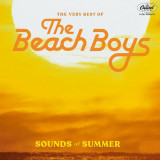
"To kick off the yearlong celebration and provide the perfect summer soundtrack, Capitol Records and UMe will release a newly remastered and expanded edition of The Beach Boys career-spanning greatest hits collection, Sounds Of Summer: The Very Best Of The Beach Boys, on June 17. Originally released in 2003, the album soared to no. 16 in the US and stayed on the chart for 104 weeks. Now certified 4x platinum for sales of nearly four and a half million albums, the collection has been updated in both number of songs and audio quality, expanding the original 30-track best of with 50 more of the band’s most beloved songs for a total of 80 tracks that span their earliest hits to deeper fan-favorite cuts and from their 1962 debut album, Surfin’ Safari through to 1989’s Still Cruisin’.
Assembled by Mark Linett and Alan Boyd, the team behind 2013's GRAMMY® Award-winning SMiLE Sessions and last year’s acclaimed boxed set, Feel Flows – The Sunflower and Surf's Up Sessions 1969-1971, Sounds Of Summer features nearly every US Top 40 hit of The Beach Boys’ incredible career, including “California Girls,” “I Get Around,” “Surfer Girl,” “Surfin’ U.S.A.,” “Fun, Fun, Fun,” “God Only Knows,” “Good Vibrations,” “Be True To Your School,” “Wouldn’t It Be Nice,” “Kokomo,” “Barbara Ann,” “Help Me, Rhonda,” “In My Room,” and many others. Fifty additional tracks showcase a broad mix of songs from across their wide-ranging catalog with some of the many highlights including “All Summer Long,” “Disney Girls,” “Forever,” “Feel Flows,” “Friends,” “Roll Plymouth Rock,” “Sail on Sailor,” “Surf’s Up,” and “Wind Chimes.”
The collection boasts 24 new mixes including two first-time stereo mixes, plus 22 new-and-improved stereo mixes, which in some cases feature the latest in digital stereo extraction technology, allowing for the team to separate the original mono backing tracks for the first time.
The expanded edition of Sounds Of Summer will be available in a variety of formats, including a 3CD softpack, and as a Super Deluxe Edition 6LP vinyl boxed set on 180-gram black vinyl in two options – a standard set or a numbered, limited edition version featuring a rainbow foil slipcase and four collectible lithographs. Both versions will feature color printed sleeves that replicate the original “Capitol Catalog” sleeves that highlight the entire Beach Boys discography, and all formats will include a booklet with new liner notes and updated photos. The original 30-track version will also be available in its newly remastered and upgraded form on single CD or double gatefold LP on standard weight vinyl or as a higher-end limited edition numbered version pressed on 180-gram vinyl with a tip-on jacket and a lithograph. "
These days, singer-songwriter and actor David Blue tends to be remembered only in relation to Bob Dylan. A member of the supporting cast in mid-60s Greenwich Village and The Rolling Thunder Revue. Yet to categorise Blue in this way is reductionist, and does him an injustice. He was something of an archetype of the 60s generation of Greenwich Village singer-songwriters. Yet, esteemed by his peers, he was overlooked. He released seven albums in a decade, and his acting career was shaping up when he died suddenly at the age of just 41. His passing was barely noted in the rock press, and in the subsequent years Blue was all but forgotten. Of late, though, that’s changed. His albums started to reappear on CD on small labels and, in 2020, both Rolling Stone and Mojo magazines published major reappraisals. Blue – at last – was getting the attention denied him in life.
It wasn’t until 1965 that Blue, as Dave Cohen, released his first recordings – three songs on Elektra’s Singer Songwriter Project. All betrayed a debt to pre-electric Dylan. But then again, so did much else coming out of Greenwich Village at the time. Elektra contracted Blue to do his own album, and in 1966 David Blue was released – his first recording to appear under that name. Electric folk rock with a garage band attitude, somewhat in debt to Highway 61, it didn’t sell well. Shortly after the album’s release Blue formed and toured with The American Patrol, a four-piece rock band, recording an album for Elektra that was never released.
Now, for the first time, Hanky Panky and Mapache release those historical abandoned American Patrol recordings, along with the three tracks included on Elektra’s 1965 LP Singer Songwriter Project, as David Blue And The American Patrol The Lost 1967 Elektra Recordings & More and David Blue, his self-titled 1966 debut album, on two exclusive vinyl editions limited to 500 copies
- A1: Leonard Nimoy – Music To Watch Space Girls By
- A2: Martin Denny – The Enchanted Isle
- A3: Yma Sumac – Gopher
- A4: The Bongolian – B-Boy Toga Party
- A5: Los Bitchos – The Link Is About To Die
- A6: Herb Alpert & The Tijuana Brass – The Lonely Bull (El Solo Toro)
- A7: Michael Giacchino & Nouvelle Modernica Orchestra – Sidereal Day: 3 (Instrumental)
- B1: Mel Tormé – Sunshine Superman
- B2: Sergio Mendes & Brasil ’66 – Mais Que Nada
- B3: Lalo Schifrin – Lalo's Bossa Nova
- B4: Quincy Jones – Black Orpheus (Manha De Carnaval)
- B5: Les Baxter & 101 Strings Orchestra – Tropicando
- B6: Pizzicato Five - They All Laughed
- B7: Alain Goraguer – Les Hommes
- B8: Hugo Montenegro & His Orchestra – The Good, The Bad And The Ugly
- C1: Mort Garson & The Lords Of Percussion – Geisha Girl
- C2: Arthur Lyman – Quiet Village
- C3: Les Baxter – Voodoo Dreams / Voodoo
- C4: Cal Tjader – The Lady Is A Tramp **
- C5: Martin Denny – The Enchanted Sea
- C6: Ixtahuele – Mareld 2021
- C7: Keith Mansfield – Morning Broadway
- D1: Mel Tormé – Comin' Home Baby
- D2: Dave Pike – Sweet Tater Pie
- D3: Jack Trombey – Underlay No.3
- D4: Don Sebesky – Guru-Vin **
- D5: Keith Mansfield – Beat Me Till I'm Blue
- D6: Brian Bennett & Keith Mansfield – Mermaid **
- D7: Sheila – Bang Bang
coloured 2x12"[35,08 €]
Shapes of Rhythm is proud to present the self-titled debut LP of Turkish psychedelic pop from MLDVA & Çınar Timur. This record is a celebration of the classic music and culture typically of the 70s and 80s, but which also leans into western jazz funk and soul jazz moments. If you're into the Turkish music legends of the 70s and 80s such as Barış Manço and more recently Altın Gün or Derya Yıldırım & Grup Şimşek, you've come to the right place.
MLDVA were formed in Krakow, Poland in 2013 as a DJ and production outfit. Under the influence of Greek and Turkish folk and psych-rock music they began to transform into a band, taking up instruments including the Saz which is one of the most recognisable trademarks of the Turkish sound. Two years later in 2015 they invited Turkish instrumentalist Çınar Timur to join them and this completes the line up on their debut. This electric album is packed with excellently-recorded expansive tracks which are full of energy, psychedelic deep grooves, hard-hitting breakbeats and everything else you'd expect with classic Turkish sounds.
The instrumental double-header of Neşat Erkaş' Zülüf Dökülmüş Yüze, moving into the time-honoured traditional Kozan Dağıis the perfect opening track. The introduction is an overture of sorts with two minutes of Çınar Timur's pondering guitar. This tees up the record perfectly before heading into a break-beat driven workout with the band matching Çınar's evocative and energetic riffing. The result is a tight sound and a heavy groove that sets the tone for what's to come.
With the band unveiled, Sarı Çizmeli Mehmet Ağa, written by Barış Manço (a legend in Turkish popular music), hits a relaxed, deeper and more psychedelic groove, dominated by Wojciech Długosz's dreamy Rhodes piano, set against choppy wah-wah guitar licks that characterize that classic electric Turkish pop sound. We're introduced to Ulaş Çıbuk's vocals for the first time, telling the historic tale of a charitable village lord Mehmet Ağa from 19c Anatolia known for his generosity. He shared his fortune with people inneed and as a result, died penniless. This track also features the unique sound of Çınar's Mictrotonal electric guitar.
Bir Adım Öte is MLDVA & Çınar Timur's magnificent mellow moment, marking the halfway point in their debut. The group shows that it's not all about the frenetic in a nod to western Soul-Jazz constructs. They showcase restraint, emotion and that joy in repetition of a wonderful guitar refrain. Not content with holding this down, Wojciech Długosz's Rhodes solo steps into a world that's US-influenced Soul jazzand is a lesson in reduction and feeling. Çınar Timur then takes a solo turn, keeping it western-influenced with an on the spot improvisation. When the three minutes of solos are over, we're brought back out of thedream and towards the East again.
Adımız Miskindir Bizim kicks off like a hip hop/funk crossover tune, until the chord changes muscle in, to remind you where you are in the world. As with other tracks on the debut, the tune is marked by recurring motifs, this time from Çınar's microtonal electric guitar. We've more solo Rhodes action, thist ime busier and more urgent. The lyrics–originally written by Yunus Emre – criticizevalues such as holding grudges that destroy ideas of love, friendship and peace among people which causes hostility. Adımız Miskindir Bizim concludes with an uplifting vocal vamp which switches it up unlike any of thetracks on the LP.
In Fesupanallah– made most popular by Erkin Koray – Ulaş Çıbuk sings about the simple subject ofbeing patient with never ending problems in life, and trying to find a solution for them. This cut takes a rhythmical side-step to the rest of the album. The kick drum maps out a solid four-four, but the vocals and guitar lines move around it to impose Fesupanallah as being the record's most traditionally Turkish-sounding cut.
The album's closing track Ölüm Allah'ın Emri (another Manço classic) was recorded live in the band's more familiar surroundings of Krakow's Cheder Cafe during 2020's Jewish Culture Festival. The lyrics tell the tale of someone who has accepted death but cannot accept the separation that comes with it. We open with a dreamy, psychedelic mood before progressing into a heavy-riffing rock feeling with probing synths. Ulaş delivers his vocals over the top of a stripped back, shuffling groove. As the track progresses towards a frenetic conclusion, drummer Szymon Piotrowski cuts loose, combining with Grzegorz Dąbek's synth lines.
MLDVA & Çınar Timur's debut LP is not the sound of a band starting out. Taking time to hone their craft and let influences across the global spectrum of music mature, this is the result of years of jamming, gigging and collaborating. Now, after prestigious festival appearances and their place on Saz Power – an essential modern Turkish music compilation – they're making a lasting contribution to a rich, time-honored culture. MLDVA & Çınar Timur releases Friday 30 June 2023 on limited edition vinyl LP and digital download/streaming services on Shapes of Rhythm. Global distribution by Kudos Records.
In the mid-'60s, Albert Ayler found himself at the center of major transformations within jazz. On his albums for ESP-Disk', his delivery was radically aggressive and his tone blistering – aiming for something beyond the New Thing. His music would be further energized when (at the behest of John Coltrane) Bob Thiele signed him to Impulse! As Ayler told The Plain Dealer at the time, "It's not about notes anymore. It's a sound – a feeling. The approach we're taking will discontinue the use of the word 'jazz.'"
In Greenwich Village, Ayler's first LP on Impulse!, perfectly captures the Cleveland-born saxophonist's radiant intensity. Sourced from a pair of live engagements – February '67 at the Village Theatre on New York's Lower East Side and December '66 at the Village Vanguard – these recordings show an improved clarity in production and performance.
Both sets feature two basses (including Alan Silva and Henry Grimes) which allowed the ensemble to go in different harmonic directions while maintaining an organic unity. Of particular interest are "For John Coltrane," a tribute to Ayler's mentor who would pass later that year, and "Truth Is Marching In" where trumpeter Donald Ayler joins his brother to celebrate and ultimately deconstruct several jazz traditions to stunning effect.
Vibrant in sound and vision, Albert Ayler's In Greenwich Village is a landmark statement in free jazz and a career high-point for this truly original artist. Superior Viaduct is honored to present this classic album on vinyl for the first time domestically in 30 years.
Egyptian-Australian DJ/producer moktar announces his second boundary-pushing five track EP, ‘Immigrant’. An expressive and considered journey that combines his Middle Eastern heritage and influential club sounds in one.
‘Immigrant’ sees moktar continue to bring traditional Arabic instrumentation into the club by weaving samples like polyrhythmic drumming and the Arabic Oud into experimental club music which has captured the attention of many tastemakers. Giant Swan, Anz, Tash LC, Raji Rags, Jamie XX, Bonobo, Groove Armada, Hudson Mohawke, Mary Anne Hobbs and Jamz Supernova all championed his highly favoured self-titled EP in 2021, which topped the Australian community radio charts as a number #1 most played alongside the global support it received. The release represented re-learning the value of his Egyptian heritage following racism and stereotyping growing up. ‘Immigrant’ expands on the story.
Debut single ‘Immigrant’ was released in September and served as a backdrop for moktar to air the stories of many as well as his own, told through a chopped vocal sample of Arsenal Football Club’s host and hype man, Frimpon. ‘North Africa’ and ‘Al-Duqqi’ are a homage to moktar’s roots. ‘Crossroads’ represents his need to push himself and grow in life and music, and ‘Send it’ (a term in Australia that means you're about to do something wild) also aims to represent Middle Eastern communities in Bankstown, Sydney.
moktar explains - “Through Immigrant I wanted to highlight the struggle many people all over the world go through to be accepted, while representing the community in Egypt, North Africa and Australia. Fusing Middle Eastern sounds into sounds into my music has been a big part of helping me become proud of who I am. I feel passionate about bringing these sounds to a wider audience in the hope it helps others in the identity struggle feel a sense of pride too”
The EP falls just as moktar’s highly anticipated debut EU tour comes to a close, playing b2b with DJ Plead at Phonox for Yung Singh, Adaptations Festival, Repercussions Festival, Werkhaus Festival, b2b with Mr Scruff at Field Day, Lost Village, Amsterdam for ADE with Kode 9, Rex Club in Paris, and Takseer festival Berlin.
In the five years since Creep Show’s acclaimed Mr Dynamite album was released it’s fair to say that we’ve all been through a fair bit. Sitting here, in 2023, things don’t seem to be getting any better. There’s the cost of living crisis and political meltdowns; we're in deep water with global warming and to top it all there’s a war on our doorstep.
Back in 2018 everything seemed less complicated. Sure, there was stuff to get riled about, but we knew nothing about what was to come. Mr Dynamite was a fairground ride into the dark corners of a world that was on the brink of being blitzed in a blender. It was a record teetering on the edge. Five years down the line you’d expect the follow-up, Yawning Abyss, would double-down and bring the white-knuckled, teeth-gritted fury of the last five years to the boil. And yet….
A quick recap? No problem. Wrangler + John Grant = Creep Show. And Creep Show? “A band of musical misfits who have found a voice or two”, says Wrangler’s Ben “Benge” Edwards, whose Bond villain studio on the edge of a moorland is Creep Show Grand Central as well as home to an analogue synth arsenal that could sink ships.
Wrangler have known each other for a while. Tunng’s electronics wizard Phil Winter and Cabaret Voltaire’s trailblazing, pioneering frontman Stephen Mallinder go way back, while Phil and Benge crossed paths in the 21st century when they seemed to be increasingly in the same venues at the same times. Meanwhile, Mal had been living in Australia since the mid-90s and when, in 2007, he returned to the UK his old pal Phil suggested he meet Benge and the three of them immediately began working together.
Wrangler collectively bumped into Grant at their soundcheck for Sheffield’s Sensoria Festival in 2014 where they were playing with Carter Tutti. A friendship blossomed and when they were invited to perform together for Rough Trade’s 40th anniversary show at London’s Barbican in 2016, well, they jumped at the chance... and Creep Show was born.
Let’s talk about the new album... What is the ‘Yawning Abyss’? You might well ask. According to Mal, it’s “a cosmic event horizon that I can see from my attic window when stand on a chair”. Yeah. Thanks.
“On this album”, offers Benge, feet firmly on the floor, “Wrangler wrangled some vintage synths, mostly Roland, Moog, and the ‘Crystal Machine’ - then John Grant joined in the fun at Memetune Studios where lots of musical experiments were carried out. Then Mal and John ran off to Iceland with the master tapes and recorded a load of madcap vocals. Back at Memetune, me and Phil were left to try and make sense of it all. Which wasn’t hard because what they did in Iceland was totally magnificent.”
Which kind of brings us back to where we began. You’d imagine ‘Yawning Abyss’ would be blowing steam out of its furious ears. Mr Dynamite but kicking a wasps nest. Repeatedly. And yet…
Opener ‘The Bellows’ comes on like a modular ‘Radio Ga Ga’, the singalong ‘Moneyback’ (“You want your money back? / I didn’t think so”) sounds like Godley & Creme’s ‘Snack Attack’ meets Prince Charles And The City Beat Band (“Pennies, pounds, dollar bills, signed agreements, death wills”). ‘Yahtzee!’ is an unhinged electro breakdance party in four minutes and nine seconds.
Where Mr Dynamite was menace, a mélange of mangled voices, with Grant and Mallinder being heavily treated, pitched up or down, rendering their contributions largely indistinguishable, Yawning Abyss takes a more direct approach. You hesitate to say feelgood, but there’s a skip in the step here for sure.
The title track plays John Grant’s vocal straight. Completely. It’s good, so very good. Like ‘Axel F’ covered by Vangelis. The delicious shimmering synths of ‘Bungalow’ also plays those Grant pipes with a straight bat. ‘Matinee’ delves into darker, very funky territory. With Mal upfront it comes on like ‘The Crackdown’. Choice lyric: “You are starting to breakdown / And it’s so fun for me to see / You should have thought of that / You should have come prepared / You can see what’s happening and you look a little scared”.
So, you know, not all feelgood. But it does feel good. It’s probably best to draw your own conclusions... This is Creep Show after all.
Long out-of-print release available digitally for the first time. Extensive notes by a local writer in English and French. Previously unpublished family photos. Urbanized traditional music at a dance-floor-friendly tempo. The very definition of an "Awesome Tape From Africa". Roger Bekono made a deep mark in the contemporary history of Cameroonian music through the four-on-the-floor, ribald intensity of bikutsi. The Ewondo-language dance-pop style that forms an undulating tapestry of interlocking triplet rhythmic interplay came to international prominence in the European "world music" scene as the 90s began. But the relentless sound of bikutsi developed in Yaoundé at the hands of Bekono and many others, as it developed from a village-based singing style performed mostly by women into a cosmopolitan music force that rivaled the popularity of established musics like Congolese rhumba, merengue and makossa. With his unique—some say suave—voice, Bekono contributed much over a period of more than 10 years as part of the evolution of this traditional rhythm-turned-urban dance movement. Bekono worked with legendary producer Mystic Jim, who had built a prolific home studio along with a crack team of musicians. They joined as part of the production of his self-titled album, which became known locally as "Jolie Poupée," the name of the album's lead single and most popular song. For "Jolie Poupée" Mystic Jim programmed the kick or bass drum, adding effects to have a heavier bass. Overall the album represented a new level of finesse and professionalism for his second release. In the middle of 1989, Jolie Poupée was released by the label Inter Diffusion System and aggressively hit the radio, discos and national television. The music video for the title track was on loop on TV. It felt like everyone was talking about it, even artists in adjacent music scenes like makossa. The album came out on vinyl and cassette and remains Bekono's best-selling recording to this day. With Jolie Poupée Bekono finally made an impact outside Cameroon as the record captured listeners in some Central African countries like Equatorial Guinea, Gabon, Republic of Congo and Sao Tome & Principe. In these countries, we find the Fang or Mfan people (also known as Ekang), Bantu-speaking ethnic groups that are also found in Cameroon. This umbrella language group includes the language in which bikutsi is mainly sung. Most of Bekono's songs are in French, Ewondo (of which Beti is a dialect) and Pidgin. The four songs on Jolie Poupée are all considered bikutsi classics. On September 15, 2016, Bekono died of a long illness at the age of 62. In the wake of his passing the media published a wave of tributes, thanking him for what he did for Cameroonian music. He was an admired musician, songwriter and guitarist, and some of his old colleagues and some of the new generation of performers showered Bekono with vibrant tributes via social media, many of which noting something to the effect of: "The artist dies but his works remain."
Svart Records are ecstatic to present the first ever vinyl edition of the Mad Juana debut album Skin Of My Teeth. Limited to 500 copies and including a bonus CD with 5 home demos. Mad Juana were Sam Yaffa (Hanoi Rocks) and Karmen Guy, and Skin Of My Teeth will see the light of day for the first time since 1997. After the years spent as the bassist for Hanoi Rocks and Demolition 23, Yaffa began to search for new musical enthusiasm by exploring a wide range of different genres of music, while learning to play numerous new instruments. Mad Juana allowed him to step outside his comfort zone and redefine himself as a musician. “Re-mastered, the record will get a new life in the spring of 2023. The album that was created 27 years ago is still one of my favorite records. Written and created with my ex-wife Karmen Guy, the album is an inspired celebration of limitless musical joy, which combines rock'n'roll, punk, experimental music, a little bit of ethno and whatever came to our minds in the creative process" says Yaffa. Mad Juana's Skin of My Teeth was born in two countries and broke musical boundaries. “The album was first recorded at our home studio in the small Mallorcan village of Montuiri in Spain and finished at the late Hombre Laitinen's studio in Tikkurila, Finland. The album that also featured the percussion maestro, Affe Forsman was a turning point for me personally in creating music and my approach to it. All the rules and habits of making music learned previously were tossed aside, and a door to a new musical world was kicked wide open with a big boot", Yaffa describes the making of the album and continues excitedly, ”Re-mastered and with Svart's great album packaging, the album will hopefully reach the ears and eyes of those who might not have even known about its existence. I'm going to blast the vinyl to 11 as soon as I get my hands on it!".
BerettaMusic, known for discovering and developing Detroit talent and serving as a launching ground for several well known artists such as Seth Troxler, Ryan Crosson, Luke Hess and many others, the label further solidifies their legacy in Detroit dance music with a release from legendary Dez Andrés.
“It's hard to believe it is now a full decade since Detroit's Dez Andres blew up off the back of his classic house jam 'New For U.' He had of course been toiling away for years before that, recording with Moodyman and DJing for Slum Village amongst other things. Since then the music has kept coming - some of it hip-hop as DJ Dez, some of it house under this alias, and much of it a perfect fusion of the two. And that's what we get here on this new EP for Beretta Music - four lush deep house joints with his smooth signature drum loops and gloriously incidental melodies. The slower, funkier bounce of 'Back To Nature' is the EP highlight for us, but all four of these are a cut above, as per usual with Dez.”
Airport Society are the Detroit duo of Brian Kage and Ryan Sadorus who founded the label BerettaMusic together nearly 20 years ago. They have been on a tear this past year since getting back together on both the label and musical collaborations. Here they deliver a heavy remix of “Back in My Space”, taking it into the depths while accentuating the soulful elements. Inspired by late night Detroit underground parties, the duo continues to deliver classic releases and remixes. The label continues to build momentum through 2022/2023 with some great releases. Written and Produced by Dez Andrés. Remix by Ryan Sadorus and Brian Kage. Mixed and mastered at the Bear Cave in Detroit, cut by Dietrich Schoenemann. Pressed at the world famous Archer Records in Detroit.
First-ever reissue of the 1988 album. Gatefold LP includes new and restored artwork and a chapbook, featuring forty-eight pages of lyrics, essays, photographs, and Gordon's extraordinary drawings for each song. The Choctaw, Assiniboine, and Texan poet, journalist, visual artist, American Indian Movement activist, and musician Roxy Gordon (First Coyote Boy) (1945-2000) was above all a storyteller, known primarily as a writer of inimitable style and unvarnished candor, whose wide-ranging work encompassed poetry, short fiction, essays, memoirs, journalism, and criticism. Over the course of his career he recorded six albums, wrote six books, and published hundreds of shorter texts in outlets ranging from Rolling Stone and The Village Voice to the Coleman Chronicle and Democrat-Voice, in addition to founding and operating, with his wife Judy Gordon, Wowapi Press and the underground country music journal Picking Up the Tempo. Along the way he cultivated close friendships with fellow Texan songwriters such as Lubbockites Terry Allen, Butch Hancock, and Tommy X. Hancock, as well as Ray Wylie Hubbard, Billy Joe Shaver, and, most famously, Townes Van Zandt, whom he called his brother. Although his work covered a vast array of topics exploring strata personal, local, global, and cosmic alike, Gordon's primary subject as a writer, musician, and visual artist was always American Indian culture, specifically the ways it collided and coexisted with European American culture in the South and West-and within the context of his own life and braided identity. The ten songs on Crazy Horse Never Died, his first officially released and distributed album, were recorded in Dallas in 1988. "Songs" is perhaps an imprecise taxonomy for what Roxy captured on this and his other albums, all of which remain out of print or were released in instantly obscure limited editions of homebrew cassettes and CD-R's. (Paradise of Bachelors plans to reissue remastered, expanded editions of his catalog; Crazy Horse is the first.) He only occasionally attempted to sing, and his musical recordings are primarily corollaries of, and vehicles for, his poems. His sharp West Texan drawl, tinged by formative years of reservation living in Montana and unmistakable once you hear it-high, lonesome, flat, and cold-blooded as a bare rusty blade-instead patiently unfurls in skewed sheets of anecdotal verse and discursive narrative rants. Although Gordon's music at times incorporated powwow style drumming, fiddling, or unaccompanied ballad singing, the majority of it hews to an idiosyncratic spoken word style, accompanied by atmospheric, sometimes synth-damaged country-rock that skirts ambient textures and postpunk deconstructions. His songs are essentially recitations over backing tracks of finger picked guitars, rubbery washtub bass, and buzzing, oscillating keyboards. On the stark yellow and red jacket of Crazy Horse, which he designed himself, Gordon describes these recordings as innately ambivalent in terms of form, content, and identity: These are poems and/or songs about the American West, white and Indian. My life has been Indian and/or white. Maybe there's not a lot of difference-maybe. I guess that's mostly according to which white person or which Indian you're talking about. That's probably what this album's about. Crazy Horse Never Died comprises songs that span the personal and political arcs of his writing practice and the poles of his native and white ancestries.
Taavi Suisalu is an Estonian media artist particularly interested into complex and adventurous sounds, field recordings and harsh audio emergencies, organized under the form of symphony or as a result of performative interactions.
In 2014 Suisalu received the Young Estonian Artist Prize as curator of Project of In-existent Villages, an articulate exhibition full of installations and site-specific sound performances. The use of peripheral spaces and the crossovers, sometimes extremely creative, of human interactions, data, sounds and technologies, are recurring in the works of Suisalu, whose subjective perspective unconventionally investigates different social and cultural phenomena. He is always attracted by the different forms of technologies. It can be an old seismograph he reconstructs to record the underground vibrations of a volcano, or, it can be some 3D models he uses to analyze a grain of soil coming from the ancient Pompei. The results of the researches would lead to the installations. The whole set of data is often the premise of a narration, a datafiction, as in the case of the signals recorded from some abandoned satellites, who are later presented with a speed set by the position of other satellites gravitating above the gallery hosting the event.
“Noisephony of Lawn Mowers" was originally composed in 2013, but it was unreleased until now, when Staalplaat, a fundamental label for its unusual experimental connections and for the sound events performed in unconventional spaces, decided to publish it. It's a score for lawnmowers, whose making is given to a conductor and executed by a group of artists. Suisalu reminds us that historically, lawn has been a symbol of power and wealth as it required substantial upkeep and unused land. Today, it still indicates wealth, but is mainly maintained by the owners themselves. This puts us in a schizophrenic situation where we strive to be privileged by taking the role of the servants.
“Silver Meets Ted” is the other track included in the selection. It's a recording of over ten minutes, whose trend cryptically moves on and with some unsettling minimal tolls, always more metallic. Some deaf beats follow, and then we have a splash of water and some slightly hinted neighs, chirps, different spills of liquid, more intense and measured, clackings and vibrations, some hardly identifiable frequencies and again a series of punctuated metal bells. The work by Taavi Suisalu stands out as a calibrated combination of mathematical coherence and elements of surprise, automatized and causal processes, some small oblique utopias, that work well together by improving highly subjective resources and create some slightly unsettling final results.
Toronto-based retro-soul artist Claire Davis shares her journey of self-worth and love on her debut album "Get it Right", out April 21st 2023, via LRK Records. This lively 10-track analog soul LP was recorded to an 8-track tape machine by engineer Braden Sauder in a converted garage- studio in Toronto, owned by the renowned instrumental jazz/hip-hop group, BADBADNOTGOOD. Featuring some of the city's top-flight musicians in the R&B/Soul scene, the album was laid down live-off-the-floor in one week during the winter of 2022. Davis shares, "My heart really lies in live performance so I wanted to recreate that experience as much as possible for this record by having the musicians all record together to tape. I feel like I personally thrive under the limitations that tape gives you; it offers the opportunity to
capture a vibe of a performance more so than chasing perfection. Knowing that my favourite soul records were recorded this way gives me an even deeper appreciation for the skill and talent involved in this process." "Get it Right" is a record born out of the faith that there's better things on the other side of fear.
Whether that's breaking toxic cycles or being truly honest about what is and isn't working in life. The first song written for the record was the title-track of the album which began as a jam between Davis on guitar, producer Scott McCannell on bass, and drummer Chino deVilla. "The lyrics were inspired by my relationship with my partner and the intention that we both have to work on healing ourselves in order to make our partnership work. I'd like to think that it's a love
song with a strong sense of maturity and understanding to it. And the whole record was really shaped around that idea of my relationships and experiences stemming from my own sense ofself-love add my desire to live and create from an authentic place."
The songs on the album feature co-writes from Scott McCannell, Kyla Charter, and Toronto production house Safe Spaceship Music, in addition to horn and background vocal arrangements by composer La-Nai Gabriel. Musicians include Heather Crawford on guitar,
Scott McCannell on bass, Adrian Hogan on keys, Chino de Villa on drums, Juan Carlos Medrano on percussion, Aphrose, Tegan Michelle Gordon and Chynna Lewis on background vocals, and horn section The Northern Soul Horns.
"Get it Right" follows up Davis' most recent 7" vinyl release of "Long Gone"/ "Times Have Changed" and most recent single release "Intuition" on LRK Records Huey Morgan played "Times Have Changed" on " The Huey Show " on BBC Radio Six
Tune of the week on David Bishops Street Sounds radio.
Karen Gabay played "Intuition" taken from the album on "The People" BBC Manchester
On the heels of his already critically acclaimed (yes, already!) retrospective, World Spirituality Classics 3: The Muslim Highlife of Alhaji Waziri Oshomah, Alhaji Waziri Oshomah — the Oyoyo King, the Godfather of Afemai Music, the Etsako Super Star, Mr. Please Please Please, Mr. Dynamite — returns with Vol. 2.
Along with the other four volumes of the series, Vol. 2 is now available—for the very first time!—as part of a complete set (in a box): Vol 1 - 5 (1978 - 1985) (November 4, 2022).
Waziri hails from a small part of Edo State in southern Nigeria called Afemailand, known for being a harmonious region where Muslims and Christians live—and dance—together. And there, as a devout Muslim and an exemplar of religious piety in his community, Waziri’s music fuses Etsako/Afemai folk styles with pan-Nigerian highlife and pop to create a sublime vehicle for his Islamic philosophy that gets everyone—Muslims, Christians, whoever—on the dancefloor.
Vol. 2 focuses on Waziri’s illustrious mid-career output—the music he created during the years leading up to and after he performed his first hajj. Every song here (one of which you might recognize from The Muslim Highlife) strikes his signature balance of traditional music, highlife, and funk, as he entreats you to stay on the straight and narrow, though there’s nothing straight about his beat.
On and off the record…
This is the second of the five-part Volume Series, which was recently compiled for the first time in the limited-edition box set, Vol. 1 - 5 (1978 - 1984) (November 4, 2022).
This release follows World Spirituality Classics 3: The Muslim Highlife of Alhaji Waziri Oshomah (September 23, 2022).
The Muslim Highlife of Alhaji Waziri Oshomah, received an 8/10 from Uncut, ★★★★ from MOJO, and has been called “therapy, worship, ecstasy” by Pitchfork (7.2).
Release supported by archival and new video content.
Alhaji Waziri Oshomah will play select shows—along with his wife and musical collaborator Madam Hassanah Waziri—in the U.S. and Europe throughout 2023. l He can perform sets as long as 3-4 hours! (Depending on the financial strength of the village).
Sings in English and local languages and is regarded as #1 Singer in all of Edo State.
- 1: Sea Breeze
- 2: Hercules
- 3: Heat Haze
- 4: Bicycle Ballet
- 5: The Downs
- 6: Ramblers' Dance
- 7: Greyfriars
- 8: Blackfriars
- 9: St Nicholas
- 10: St Katherine
- 11: St Leonard
Oliver Cherer is back with a new Gilroy Mere record which follows on from his other much lauded Clay Pipe releases (The Green Line, Adlestrop and last year’s D Rothon collaboration, Estuary English).
Over the last two decades Ollie has released numerous collections of music in an ever shifting array of modes, from folktronic, singer-songwriter styles through psychogeographic electronica to jazz-tinged, confessional ghost-pop and most recently, the “guitar tainted machine rock disco” of Aircooled.
Gilden Gate is an album of two halves. Side 1 ‘Rising’ celebrates the sun-drenched beaches, pastures and heaths of rural Suffolk, whereas Side 2 ‘Falling’ explores the underwater world of the lost city of Dunwich and its five church spires.
Oliver says:-
“A few years ago I discovered the lost city of Dunwich. I’d made a trip to Suffolk to shoot a short film about Sizewell Nuclear Power Stations and stayed in the old Coastguard’s Cottage on Dunwich Beach within sight of Minsmere Nature Reserve and the power plants. It’s a wild, sleepy place of pines and heath and North Sea winds and a strangely mysterious air – Sutton Hoo is nearby and Eno’s reference to the very beach that I was staying on made perfect sense. In the small museum at Dunwich I learned that this tiny hamlet had once been a major medieval city of international trade. It seemed unlikely and even now, knowing Dunwich as a small village, I find putting what I know about the place into perspective as a city a certain kind of impossible.
It seems that over a period under the influence of the weather, natural erosion and market rivalry the thriving harbour port was inundated by the North Sea and eventually slipped into and under it. The city of churches was lost and all the spires engulfed and toppled. What remains are the few houses, and the ruin of Greyfriars crumbling inexorably down the cliff and exposing the bones of buried monks as the graveyard follows the building’s stones into the sea.
There are local legends surrounding the site including stories of fishermen hearing the bells of lost churches and seeing the ghostly, lighted city beneath their boats as they return to the shore.
Gilden Gate is named for one of the entrances to the old city and is a musical meditation on Dunwich past and present. Frances Castle’s beautiful sleeve art depicts the surface and the sub-marine, the warm and the cold, the past and the present. The glass rises and the glass falls and in the background there are sirens, fog horns, church bells and Eno, and on the sea bed there are the scattered remains of a once great city.”
A Late Lunch’ is the soundtrack to Akiko Iimura’s eponymous movie realized in 1978. It is based on acoustic instruments and field recordings, brilliantly reconfigured and mixed by Bekaert to create a surreal, immersive soundscape. The technique used includes superposition and speed change of recordings, radical sound effects and juxtapositions of sounds. The players were prominent musicians of the 1970’s, including Maggi Payne, George Lewis, David Rosenboom and Blue Gene Tyranny.
‘A Summer Day at Stony Point’ was composed in 1969, with participation of David Behrman, Shigeko Kubota and Charlotte Warren. The piece was commissioned by English composer Hugh Davies who presented it at the Harrogate festival the same year. Stony Point is a small village in New York State where John Cage co-owned a small pseudo-commune art resort where like-minded artists gathered. ‘A Summer Day at Stony Point’ is nothing more than a page of a journal, a fragment of a notebook that utilizes a series of sound sources recorded at Stony Point on one beautiful day in the summer of 1968. Other electronic sound sources were recorded at the Brandeis University where Alvin Lucier was professor. The final realization of the piece was done at Henri Pousseur’s APELAC Studio in Brussels, 1969.
The soundtrack for Akiko Iimura’s ‘Mon Petit Album’ was composed on the basis of a simple description of the technique of the film and its time span. It includes David Behrman on alto, from an outdoor recording at Stony Point, plus excerpts from a Transition concert in London, the band Bekaert formed in 1971 with Michel Herr, Takehisa Kosugi and Ryo Koike, both members of the Taj Mahal Travelers. The atmosphere is quiet and pastoral throughout with a very dreamlike flavour.
Jacques Bekaert (1940-2020) was a man of many gifts: author, journalist, composer, photographer, visual artist, wine connoisseur, radio talk show host, diplomat and expert in Southeast Asian affairs. His whole life Bekaert has been actively involved in music but not much of his work got recorded or published. In the early 60’s Bekaert studied with Pousseur and through his frequent visits to the US he became friends with artists like John Cage, David Tudor, Charlotte Moorman and most of all David Behrman with whom he had a close friendship ever since. Bekaert helped organize the first European tour of The Sonic Arts Union (David Behrman, Robert Ashley, Gordon Mumma, Alvin Lucier) and in the early 70’s he formed the group Transition (with Belgian jazz pianist Michel Herr, Takehisa Kosugi and Ryo Koike, both members of the Taj Mahal Travelers). His meeting with Japanese experimental film-maker Akiko Iimura resulted in two film soundtracks featured on this one of a kind discreet avant garde album.
When asked in a 1979 interview about his double life as a musician and a journalist, Bekaert replied, “I suppose they’re both unsafe, unstable, questioning jobs—composing and reporting. Journalism takes me to places, shows me the world as it is. My music is my wish for the kind of world I’d want to live in. The little peaceful state I dream for everyone, where you can be yourself, and happy, and as collective as possible without giving up total privacy.”
Originally released in 1981 on the Belgian Igloo label this reissue comes with the same sleeve as originally designed by Alain Géronnez.
- A1: Shake It, Shake It, Shake It
- A2: Surrounded
- A3: Good, Good Man
- A4: If You Go
- A5: Miranda Blue
- A6: Money Ain't Everything
- A7: Enemies
- A8: Star Angel
- B1: Mister President
- B2: I Don't Roll With Snakes
- B3: I'm A Grown Man
- B4: It Ain't Easy
- B5: If I Could Walk On Water
- B6: Lover Oh Lover
- B7: Hard Work
- B8: Bridges You Burn
Three years after the release of his critically acclaimed album "Salone",
Bai Kamara Jr returns with "Traveling Medicine Man", a 13-track
collection of blues songs portrayed in Bai's unique style
In a descriptive, provocative and sometimes suggestive way, the tales of love, life,
relationships, politics and innuendo are meticulously explored by the
raconteur.''Traveling Medicine Man is the continuation of my introspective journey
through my roots and my perpetual quest to make my two homes, Africa and
Europe, coexist within me. The title was inspired by my maternal grandfather
Tinka Tanner Kargbo, born in 1901 in the Northern Province of Sierra Leone. He
was educated by the Wesleyan Missionaries and later traveled with them across
the country to help provide medical care to villagers and townspeople. I was
fortunate enough to have spent some time with my grandfather when I was still a
child, and one of the things that fascinated me the most about him was his ability
to reconcile his Christian beliefs with his traditional African beliefs and
customs.'' (Bai Kamara Jr)For the making of this album Bai brought his touring
band, The Voodoo Sniffers, into the studio; these exceptional musicians
contributed to Bai's unique and evolving sound. With a percussive nature at the
heart of the arrangements this rootsy blues is spiced up with an afro vibe, making
you want to get up and dance more often than not. May your listening experience
be soothing and pleasurable with a healing effect
Chocolat is the 2000 British-American romantic comedy-drama film directed by Lasse Hallström (The Cider House Rules) starring Juliette Binoche, Judi Dench and Johnny Depp. The movie was adapted from the novel written by Joan Harris and is about a woman and her daughter opening a chocolate shop - with Sunday hours - across the street from the local church in a small French village.
The music is composed by Rachel Portman and the soundtrack also includes “Minor Swing” from Django Reinhardt/Stéphane Grappelli and the 1936 jazz standard “Caravan” from Duke Ellington and Juan Tizol.
Rachel Portman has written over 100 music scores for film, television, and theatre. She was also the first female composer to win an Academy Award in the category of Best Musical or Comedy Score for Emma in 1996 and in 2015 she received the Primetime Emmy Award for Outstanding Music Composition for the HBO TV series Bessie.
Chocolat is available as a limited edition of 500 individually numbered copies on white coloured vinyl and includes an insert.
160-gram heavyweight Vinyl LP with gatefold jacket displaying the painting series that inspired the music, and the story of Newtok. Newtok is a remote Alaska Native village situated on the Ningliq River, near the west coast of Alaska. Although a very remote and quiet place, Newtok has come face-to-face with climate change. Due to a combination of thawing permafrost, low levels of sea ice, and strong storms, the coastal land of Newtok is eroding dramatically. In 2016, Chicago visual artist Jennifer Cronin embarked on a trip to Newtok to document this changing environment. Upon returning, she spent the next several years developing a series of paintings and screen prints titled Seen and Unseen that captured this eroding landscape. In 2019, Cronin and musical Artist Patrick Mitchell (a/k/a Dusty Patches) began discussing the project after Cronin asked him to perform at the Gallery opening for the series. As a result, Mitchell created this album, Newtok - inspired by Cronin's Seen and Unseen series and the story of Newtok, Alaska. Mitchell is a multi-instrumentalist songwriter and producer from Chicago who has led numerous past projects in the Chicago DIY community including De Triomphe, New Color, and Whiskey Wise. He dove headfirst into synths in 2017 and adopted the electronic alias Dusty Patches. Dusty Patches released his debut project Filthy Four Track Machine: Volumes I & II (2018, Sooper Records), largely made with the Teenage Engineering Pocket Operators and OP-1. In 2020, he released Nocturnal Emissions from the Dablatory, his first project fully realized with modular synthesis. In approaching Newtok, Mitchell composed all of the constituent musical elements of the work and then recorded and live mixed the album during a single live performance on modular synthesizer. The album draws heavily on sprawling ambient synths, electric and acoustic post-punk guitar motifs, cryptic vocal sampling, vintage drum machines, and modular patches that often sound like birds or the sea. The subject matter of the album, the complexity of its arrangement, and its execution as a single live recorded performance makes Newtok a unique musical experience. About Newtok, Mitchell says: This record was an exploration of themes. When faced with the immense canvases Jen Cronin produced upon her return from the village of Newtok, one can't help but feel awe. With the sheer size of the works towering above you, you are compelled. There is overwhelming beauty, desolation, a sense of urgency, and a sense that it is, in fact, far too late. These visual themes, and the emotions they evoke, were connected to the sounds and compositions of this record. There is a coldness to the digital soundscape, but organic sounds of nature and humans tether and steer the album through a journey of musical storytelling. Newtok is a journey of musical storytelling about the tragedy of the Anthropocene in the age of climate change. FOR FANS OF: Mother Earth's Plantasia, Black Moth Super Rainbow, Boards of Canada, Bibio