Mecca And The Soul Brother by Pete Rock & C.L. Smooth is considered by fans and critics as one of the finest hip hop albums of the early Nineties. Songs like "Lots of Lovin", "They Reminisce Over You (T.R.O.Y.)","Anger In The Nation" and "If It Ain't Rough, It Ain't Right" have everything; funky basslines, solid production, convincing lyrics and lots of soul. Producer Pete Rock built his beats from obscure R&B, funk and jazz records and CL Smooth added his sometimes-philosophical raps. Guest rappers on the album include Grand Puba (of Brand Nubian), Heavy D, Rob-O, Grap & Dida, and it reached #7 in the US R&B/Hip-hop charts and #43 in the US album charts.
Did you know that for decades, record collectors across the Dutch-speaking region have overlooked a significant portion of their own musical heritage while avidly searching for rare grooves and breaks in bins filled with more exotic music? It's a fact! And that's where Harde Smart comes in. After delving deep into dusty crates of Belgian and Dutch music, Harde Smart's inaugural compilation in 2019, dedicated to music from the 1970s, brought to light a selection of smooth, jazzy, funky, and soulful gems from Flanders (the Dutch-speaking part of Belgium) and Holland. In addition to exquisite grooves and hard-pounding drums, these songs shared Dutch lyrics, offering a unique compilation of lyric-driven Flemish and Dutch music from back in the days.
Yet, nothing is as certain as the unexpected. This compilation marked the first time a Dutch album uncovered the authentic Afro-American funk and soul vibe, which, albeit sporadically, influenced the work of both popular and lesser-known singers and musicians in this corner of the world during the 1970s. Undoubtedly, influences also stemmed from French chanson and rock music of the era. This 21-trackalbum shattered all musical predictability, taking listeners on a strange and nostalgic journey, offering a revised collection of "essential homegrown classics" for local listeners while also captivating non-Dutch-speaking audiences.
With the second compilation, Harde Smart shifts its focus from the 1970s sound to explore the next decade, the 1980s. Vinyl aficionados No Sleep Richy and Micha Marva joined forces with Sjefke De Kok, one of Holland's premier crate diggers, to continue their musical odyssey. Digging even deeper into dusty bins filled with Dutch and Flemish records once again unearthed an exquisite selection of tracks-too weird to play, too rare to ignore. From butt-shaking boogie to weird disco adventures on wax, this album encapsulates all the good stuff of the 1980s: smooth and seductive alongside dark and wavy. Get ready for an atypical introduction into the Dutch lyric-driven music from the 1980's.
out of Stock
Last delivered 2 years ago available to reorder, subject to availability
Daga Voladora's last album came out in 2016. To alleviate such a long wait, only a couple of celebrated singles. Now, finally, Cristina Plaza (identity gracefully hidden under the Daga Voladora name that was before Gran Aparato Eléctrico and also a quarter of Los Eterno and half of Clovis) releases an album and does it, for the first time, in vinyl format. "Los manantiales" is the title of the happy and long-awaited return of an artist that never completely left.
"Los manantiales" ("The Springs") refers to all those sources from which I drink to make my songs: Stereolab, Broadcast, Galaxie 500, Cate Le Bon... And also some of the flamenco language. Flamenco in my own way, of course," explains Plaza. "Los manantiales" will also bring echoes of acts that the artist has not practiced as much such as Esclarecidos, Vainica Doble, Ana D or Kikí d'Akí. Deep voices for songs with substance.
But there is also that other idea of the spring that gushes forth when it can no longer be contained. "It has taken me so many years to make this album because I had a prejudice related to the previous one "Primer segundo" in which there was a coherence. Not finding that concept or thinking that this or that wasn't Daga Voladora, I couldn't get into it. Until I decided that maybe I didn't have to impose such a rigid direction on myself..."
Sketched in a town bordering Ávila where Plaza decided to get lost in the summer of 2022 and then finished off in a basement in Madrid for several months, the nine songs of "Los manantiales" make up a short album, premeditatedly short ("I don't like the songs to be longer than 2:50") but, above all, varied. Because, as can be sensed in the song Quise ser ( "I wanted to be a fictional hero, an expressionist painter, a promising actress"), here are all the imagined Cristinas and their different lives ("The song Lejos de la multitud is that longing of mine to be a vagabond"), an unmistakable sign that, as the artist confesses, "I am my own spring". And all this joyful dispersion comes from the premise with which Plaza approached the album: "I said to myself: 'Let's play'. I set out to have a good time. Suddenly, I wanted to do a dub track and I came up with Fosforito or a rock song like Lou Reed in the 80s and there was 'Me vi penando'. I wanted a rock record, an experimental record, something like Broadcast, and a musical! I wanted to do a thousand things!"
The result is a playful album, very enjoyable; but above all elegant and extremely precise. In both form and substance. Thus, the melodies are so rounded at first listen; the music would work perfectly on its own, stripped of lyrics that respond to the maxim, so often ignored, that there is really only one way to say things. "I have tried to refine the texts a lot. There are some phrases taken from Steinbeck, other things that emerge in a somewhat magical way. There's also Gary Snyder, Kerouac and his Dharma Bums, echoes of California..."
It's an album made, as usual with her, in the most absolute solitude (except for the collaboration of Andrés Arregui on sax and the final mix by Fino Oyonarte). Bareback. "I recorded everything with my computer, with my instruments, my analog keyboards, my rhythm boxes, little noises I make around... I don't make demos. I just do it. In a rough way. What I do do is repeat. The good thing about this method is that many things happen spontaneously and that's where they stay".
An album that, for all of the above, responds to the best notion of caprice. A whimsical whim, signed and finished off by the splendid cover designed by Beatriz Lobo, which feartures a painting ('La chica del King Creole') by the legendary artist Javier de Juan.
In "Los manantiales" there are many possible worlds, as many dreamed ones. Of course, those of Daga Voladora (not in vain, the album opens with a song titled Cristinópolis), but also those of any curious and sensitive listener who, by the way, will find more than one musical wink along the way. You just have to be attentive.
Yes! Tommy Guerrero’s revered Return Of The Bastard gets its first ever vinyl reissue. Endearingly simple but beautifully beguiling, it's lo-fi dusty break business with the most elegant guitars this side of Vini Reilly and Gabor Szabo. Tommy's breezy drum-machine guitar-soul should be prescribed to soothe an aching world. By rights, he should also be a Balearic god. Here's 14 tracks of drop-dead laconic beauty, all of them combining to create this unheralded masterpiece. Working with Tommy directly, the LP has been fully remastered and sounds as dazzlingly, heartbreakingly beautiful as it did back in 2007.
Coolly opening the album, "And The Folklore Continues" can be said to be both a titular and actual nod to his past work. As ever, there's heavenly Latin guitar stylings that make you swoon and the melancholic vibe is accentuated by the addition of some melodic wordless vocals from Tommy. Just divine. The sparkling "La Califas Perdido" follows, all dreamy melodic guitars and twinkling vibes over dusty drums and a fine bassline. The shuffling, conga-assisted "I Would Go With You" is a gentle, romantic gem whilst the brief but beautiful "No Time For Time" feels in a hurry to let us know that Tommy can work with more propulsive rhythms. In this case, they underpin Tommy's gorgeous, shimmering guitars wonderfully well.
The head-nod funk of "Calling For Ya!" (get it?) features Curumin delivering the clever title as a hypnotic vocal refrain peppered throughout, all hung around some buried spoken word vocals and gorgeous cello work from Lenny Gonzalez. "Bloodinthemud" is a low-down gritty funk workout whilst "Zapata's Boots" is a total low-key groover, all Latin percussion and Morricone muscle aided by a whistled Spaghetti Western melody. The startling instrumental "Mosaic Man" closes out the side with a lean slice of mellifluous, virtuoso guitar bliss.
The reflective "What Have I Been Doing Since I Was Gone?" opens the B-side in glorious fashion, the type of melancholic melodic head music that should soundtrack a bright walk on a cold winter's day. The hypnotic groover "Paper Switchblade" is a razor-sharp fuzz-funk whilst the beautifully downbeat "Never Forget To Remember" is a kaleidoscopic kalimba-koolout. Galloping cop-funk breaks workout "Run With The Hunted" is a rollicking ride and it's followed by the fresh chiming guitar funk of "New Terrain".
The upbeat and bright "40 Summers", featuring congas from Alfredo Ortiz, is as clean and poppy as Tommy gets and it really is a look he wears incredibly well. Just straight up guitar pop. "The Simple Man" a gorgeous, melancholic ballad, closes out the record with deeply yearning vocals from Tommy, a rarity and a treasured one at that.
Meticulously remastered and cut by both Simon Francis and Cicely Balston respectively, it has been pressed to the highest possibly quality at Record Industry in Holland. The original and iconic sleeve, designed by Natas Kaupas, has been restored here at Be With HQ as the finishing touch to this long overdue re-issue.
"Direct from Sandy’s tape archive, these DIY bedroom demos feature his layered harmonies, harpsichord and guitar - all recorded during his time with the Millennium. Though unreleased and hidden away at the time they were recorded, these demos finally get their due on coloured vinyl! Includes new liner notes & photos! The CD has 7 bonus tracks!
Sandy seemed to be in the eye of the kaleidoscopic tornado that was swirling and twirling around L.A. … so why didn’t these songs surface all those years ago? It certainly wasn’t for lack of talent, nor was it disinterest. In fact, it was quite the opposite. While in the Millennium, Sandy continued to write and record his own songs. After signing a publishing deal with Four Star Music, his new publisher did place a few of his songs - “Rag Doll Boy,” recorded by Thee Prophets and The Naked Truth; Terry Black recorded a version of “Wishing Star,” and “These Are The Children” and “Goodbye Yesterday” made an appearance on Tommy Roe’s sixth album, Phantasy.
But for all of the songs he composed and recorded on his reel-to-reel tape machine in his small, Sunset Strip apartment, it seemed as if Four Star Music wasn’t truly interested in promoting his songs. But in truth, it was an under-the-table handshake between Curt Boettcher and Four Star Music that squashed all hope of other artists hearing and recording Sandy’s songs.
The songs on this album are a few of many compositions Sandy wrote and recorded between 1966 and 1968. With only one or two exceptions, every instrument, lead vocal and layered harmony is his, and as you will hear, it’s really no wonder that Curt had them hidden away. Taken from the original reel-to-reel tapes, dive into Sandy Salisbury’s sparkling world of sunshine pop."
Second Compilation Of New Music By Ex-Sarah Records Bands! Under The Bridge 2 is the sequel to the celebrated 2022 compilation album that reunited groups and songwriters who had once recorded for cult label Sarah Records. The new album showcases the continuing creativity of a special group of musicians who have never rested on their laurels. Bigger and more expansive than the first album, Under the Bridge 2 is a double LP, containing twenty brand new tracks. There is a huge range of material here, from intense, dark chamber pop to dense shoegaze to out-and-out indiepop. Exciting new groups are unveiled: The Gentle Spring (a new project by Michael Hiscock of The Field Mice); Vetchinsky Settings (a collaboration between Mark Tranmer and James Hackett of The Orchids); and Mystic Village (which features new songs by Robert Cooksey of The Sea Urchins). You will also see familiar starry names like Even As We Speak, The Orchids and Secret Shine - bands whose line-ups have remained mostly unchanged since the 1990s. And there are established bands who didn't appear on the first album but are now represented - bands like Action Painting! and The Hit Parade. Most of the tracks are exclusive and unreleased: there's the first new song from The Catenary Wires since 2021, a brand new fizzbomb from Jetstream Pony, a haunting instrumental from GNAC. The emphasis of Under The Bridge is on the new. The bands' shared history means they have a shared aesthetic, even a shared ethos - they all believe that the future is more important than the past. They are as independent and as uncompromising as ever, but they are still uncynical - and still excited about what Pop Music can be. Under The Bridge 2 is available as ltd vinyl double LP, CD and digital download. It will not be on streaming sites. CDs and LPs include a 12 respectively 24-page illustrated colour booklet.
The birth of rock steady portrayed in a consummate collection from the vaults of Federal Records
Most of them drawn directly from Ken Khouri's master tapes this miscellany of cool rock steady includes marvellous music from the originator of the genre, the one and only Lynn Taitt, alongside an array of Jamaica's greatest singers and vocal harmony group
American rhythm & blues fervour, boosted by a multitude of sound systems playing 78rpm records on increasingly larger sets, gripped Jamaica from the late forties onwards but, towards the end of the decade, the American audience began to move towards a somewhat softer sound. The driving rhythm & blues discs became increasingly hard to find and the more progressive Jamaican sound system operators, realising that they now needed to make their own music, turned to Kingston's jazz and big band musicians to record one off custom cut discs. These were not initially intended for commercial release but designed solely for sound system play on acetate or 'dub plates' as they would later be termed. These 'specials' soon began to eclipse the popularity of American rhythm & blues and the demand for their locally produced music proved so great that the sound system operators began to release their music commercially on vinyl and became record producers. Clement Coxsone' Dodd, Duke Reid 'The Trojan' and Prince Buster, who operated his Voice Of The People Sound System, were among the first to establish themselves in this new role and the nascent Jamaican recording industry now went into overdrive.
In 1954 Ken Khouri had numbered among the first far sighted entrepreneurs to produce mento records with local musicians (mento is Jamaica's original indigenous music) before progressing to opening Jamaica's first record manufacturing plant. Three years later he moved his operation to Foreshore Road (later renamed Marcus Garvey Drive) where, with the assistance of the inestimable Graeme Goodall, he updated and upgraded his recording studio. The importance of this enterprising move was critical to the development of Jamaican music and its influence both profound and far reaching.
"It was Ken Khouri's Federal Recording Studio, the womb that gave birth to the talented writers, artists and musicians that gave Jamaica its musical identity." Prince Buster
Federal Records was not only the place for the sound system men to record their music but it was also where they had their records manufactured and, consequently, the company enjoyed a near total monopoly on recording and record pressing in Kingston. In 1963 Ken Khouri sold his one track board to Clement 'Coxsone' Dodd, who established Studio One, and Ken imported the first stereo equipment to Jamaica and Federal began making stereo records. The following year WIRL (West Indies Records Limited) opened but the competition served to drive the company on to higher heights. Ken Khouri continued to work on his own productions and, in 1966, the seven inch release of Hopeton Lewis' 'Take It Easy', recorded under the guidance of Trinidadian guitarist Lynn Taitt, ushered in the rock steady era.
These two essential albums showcase a stunning selection of well known hits, and not so well known rarities, from the vast Federal catalogue. All tracks have been transferred direct from the master tapes and assembled with the invaluable assistance of Ken Khouri's son, Paul Khouri, who generously gave Dub Store unlimited access to the Federal tape vaults. The extensive liner notes feature extracts from extensive interviews with Paul Khouri whose knowledgeable recollections of working on Marcus Garvey Drive, not only as a producer but as an engineer and musician, are illuminating and educational. Both sets present an insight into the birth and growth of Federal Records and the Jamaican recording industry and are essential to an understanding of the real roots of reggae music.
Originally rumoured to be a double album the plan was shot down - Dave Thompson in conversation with Melanie managed to work out what it would look like and here we present all newly mastered the deluxe version. Woodstock and Glastonbury Fayre icon Melanie had been working with Easy Action on the deluxe vinyl and CD rerelease of one of the most legendary albums in her long catalogue prior to her very sad passing. In 1972, Melanie and her producer and husband Peter Schekeryk began work on what she intended to be her most ambitious album yet. Stoneground Words was to be a double album - the first such statement from any female rock artist. It would also be the first worldwide release on Neighborhood Records, the label she and Schekeryk established in 1971 - another first, as she entered territory into which only The Beatles, The Stones and The Moody Blues had previously stepped. Even more crucially, however, it was her personal response to the enormous success, earlier in the year, of the hit "Brand New Key" - "the bicycle song," as so many people recall it. Stoneground Words returned to the drawing board. Ten songs were selected; the remainder were placed to one side; and the album was released to generally positive reviews which included Melody Maker's assertion that it was "the most sophisticated she's made. The naiveté of the past has been replaced by deeper, more comprehensive methods of expression." She is the first to admit that the new edition of Stoneground Words is not a true facsimile of the original. The paperwork for all three projects, after all, disappeared long ago, as did the tapes ("who knows where?"). Stoneground Words will be released in March 2024 by Easy Action/Neighbourhood Records o Issued for the very first time as a double LP o Completely remastered. o Limited pressing on Pink Vinyl, CD Presented in large deluxe gatefold sleeve with full colour booklet o Brand new artwork o Originally recorded in New York in 1972 and released on Melanie's own Neighbourhood Records label.
Stu Chapman one of the hardest working producers in the breakbeat rave revival scene has had recent releases on Remix Records, Amen Brother, Monky Records & Ars Musica Imprendere Vitah out of Spain to name a few and has a repress series on his noughties label Enormous Mouse planned for 2024. Stu makes his debut on the Hardcore Vinylists label with 3 tracks of rave breakbeat proving what you can do when 90s rave meets modern samples we didn't ask for a free ride, we only asked Stu to show me a real good time...
out of Stock
Last delivered 2 years ago available to reorder, subject to availability
Stop. Breathe. Reload. And dive into "El Paso, Elsewhere: The Album". Black Screen Records, Lost In Cult Records and Strange Scaffold are teaming up to bring the original songs of RJ Lake and LAKE SAVAGE to life on glorious vinyl. "El Paso, Elsewhere: The Album" takes aim at the key songs that punctuate the game's dark and introspective journey through haunted hallways - with heavy doses of hip-hop, electronica and Trace-Wave coalescing into a pellucid vision of influences and a deeply entrenched sense of identity, akin to the works of seminal hip-hop artists such as Kendrick Lamar and Open Mike Eagle. All tied together within the beautiful gold foil cover artwork by Bri Neumann. RJ Lake shared some of their thoughts going into the creation of this album: "Months before the first thing I ever started working on with Nelson Dog Airport Game (that's not the actual title, but it might as well be) even came out, he asked me if I knew anyone who could make a horror game. I knew a guy. A few months in, we did a touch-base about the music and mutually agreed that none of it at that point was totally working. It was good (look, I'm not going to put myself down here; even back in 2020, it kicked ass) but it wasn't RIGHT. He gave me a bunch of reference materials and kept pointing to them and saying: 'Okay, but these? These are RIGHT. These have the juice we want.' The thing every single song he showed me had in common, was that every one of them had vocals. After some back and forth, we both agreed: 'El Paso, Elsewhere' had to be a rap record as much as it had to be a game. So, three and a half years later, here we are. This is probably the most lavishly mixed thing I've ever made, full of weird, intricate beats, layered vocals from both myself and Nelson, lyrics that go everywhere from bleak to so-party-that-you'll-die to totally ridiculous, loads and loads of genre switch-ups, and absolutely zero subtlety. For 'El Paso, Elsewhere', I made a full score, but that's not what this is. This vinyl is a fucking album and it's sequenced like one. Play it loud!" Alongside the LP, explore what happens after the events of "El Paso, Elsewhere" within the diaries of James Savage - an exclusive in-world archive of the thoughts and feelings directly from the heart and soul of our protagonist within the liner notes. As well as a 5-page excerpt from the "El Paso, Elsewhere" original script and never before seen concept art by Demente Animation Studio.
Introducing "The Sevens” - A Sonic Revelation from A Place To Bury Strangers Prepare to embark on a transcendent auditory journey with "The Sevens” a series of four 7-inch vinyl records that unveil a treasure trove of previously unreleased tracks from A Place To Bury Strangers' critically acclaimed 6th album, "See Through You." Renowned for their visceral sonic assault and immersive live performances, A Place To Bury Strangers has cemented the end-all-be-all space for over-the-top post-punk / shoegaze destruction. With this special vinyl collection, the band invites listeners to delve deeper into their sonic universe, exploring uncharted territories and hidden gems. 'Chasing Colors/I Can Never Be As Great As You Are' is the second release coming March 22. "When looking back at the recordings that were done around the time of See Through You there were a bunch of great tracks that just captured life back then and really had something incredible going on. Even though they are a bit raw and a bit personal, I thought it would be a mistake if they didn't come out. I thought it would be best to go back to my roots and put out a series of 7"s the way A Place To Bury Strangers started. That strange weird format where the tracks each speak for themselves, no album context to muddy the water. These tracks are such a contrast to the way I am feeling now and the current songs we've been working on so slip back into this moment in time.” says APTBS’ Oliver Ackermann. The vinyl is pressed as a white disc.
tapetopia 015 The name L’Ambassadeur des Ombres goes back to the
French science fiction comic “Valérian et Laureline”. The Ambassadors of the Shadows combined pop appeal and experimentation as the soundtrack to the zero hour of their generation in the GDR’s waning days. The music was made in a children’s room, but the edifice of ideas was a demolition site. L’Ambassadeur des Ombres existed as a hybrid of the wave bands Die Vision and Neuntage. The open ensemble’s family tree can however be traced back to buried DIY projects such as the Mahlsdorfer Wohnstuben Orchester, Zerstörte Umwelt and dark-wave protagonists Fellini Prostitutes or Nontoxic. In the short time of their existence in 1988/89, L’Ambassadeur des Ombres did not give a single concert. The tape “Strike Me If I Shriek” was circulated among friends and musicians only as an on-request work report – it’s a long overdue discovery. The tapetopia series, using the original layouts and track lists, publishes cassette editions from the GDR underground of the 1980s, especially from the “walled-in” scene in East Berlin. More than three decades after their initial “release”, most of these tapes have yet to be heard on either vinyl or CD, even though they made an audible mark in the canon of GDR subculture. Despite the tiny original editions of the time, many of the bands were considered cult in countercultural circles, which made them highly suspect in informed circles.
out of Stock
Last delivered 2 years ago available to reorder, subject to availability
"Widowmaker's second and final album Stand by for Pain was written, rehearsed, recorded, mixed, and mastered in only 30 days. Speaking of the fast turnaround for the album, frontman Dee Snider (of Twisted Sister fame) said: ""I'm crazy about this record. We did this thing in 30 days and we did it how we wanted to do it. No worrying about how fast the 'hook' comes in a song."" Prior to release of Stand by for Pain, two tracks, ""Long Gone"" and ""Ready to Fall"", were released to radio as a promo. For the first time ever, Stand by for Pain is available on vinyl as a limited edition of 750 individually numbered copies on gold coloured vinyl. The vinyl package includes an insert. "
Stand By For Pain by Widowmaker, released 15 March 2024, includes the following tracks: "Protect and Serve", "Circles", "Just Business", "Bad Rain" and more.
This version of Stand By For Pain comes as a 1xLP. This release comes with (a) Insert(s).
Of the countless accolades and analyses that surround Blue, no point is more significant than the fact that the 1971 Joni Mitchell album continues to become more popular, revered, referenced, and relevant with each passing day. Such vitality is not only extremely singular; it is the ultimate measure of great art and, in the context of Blue, indisputable proof of the record's accessibility, integrity, and timelessness. If the most brilliant and everlasting music seeks to find truths shared by all of humanity, Blue can be said to be universal doctrine.
Sourced from the original analogue master tapes, pressed on MoFi SuperVinyl, and strictly limited to 12,000 numbered copies, Mobile Fidelity's UltraDisc One-Step 180g 45RPM 2LP box set presents the landmark album with reference-grade detail, tonality, and directness. Marking the first time the beloved LP has received audiophile-quality treatment, it's one of six iconic 1970s Mitchell records Mobile Fidelity is reissuing on definitive-sounding vinyl and SACD sets.
Everything about Blue sounds more intimate, involving, and inescapable on this transparent pressing, which benefits from a virtually non-existent noise floor and superior groove definition. Mitchell's voice, positioned front and center, and primarily accompanied by minimalist acoustic guitar, piano, and dulcimer playing, comes across clearly and prominently. Suspended notes and radiant chords double as question marks, commas, and phrases. The in-the-room presence and spatial dimensionality make absolute the full-range spectrum of introspective emotions — hurt and distress, self-awareness and joy, difficulty and uncertainty, warmth and desire — Mitchell navigates, queries, and contemplates throughout the record. The defencelessness the singer once spoke about is laid bare here like never before.
The packaging of the Blue UD1S set complements its distinguished status. Housed in a deluxe box, both LPs come in special foil-stamped jackets with faithful-to-the-original graphics that illuminate the splendor of the recording. This UD1S reissue exists as a curatorial artifact for listeners who prize sound quality and production, and who desire to engage themselves in everything involved with the album, including the unforgettable cover photograph of a ruminative Mitchell shot by Tim Considine.
Deemed the third Greatest Album of All Time by Rolling Stone; universally celebrated by critics, fans, artists, and educators; and defined by a spell of disarmingly vulnerable songs that are at once confessional, intense, spare, honest, painful, hopeful, and exquisite, Blue charts love, spiritualism, independence, and loss like no record before or since. Widely considered the album that established the singer-songwriter template, the largely autobiographical LP changed everything shortly after its original release in June 1971. Amazingly, it continues to do so more than five decades later.
An incalculable influence on generations of artists, it stands as the through-line from Carole King, Elton John, James Taylor, Joan Armatrading, and Leonard Cohen to Patti Smith, Carly Simon, Emmylou Harris, and Rosanne Cash to 21st century contemporaries like Brandi Carlile, Taylor Swift, Sharon Van Etten, and Courtney Barnett. Teetering between agony and optimism, it is — to borrow a phrase from Mitchell's eternal "A Case of You" — a bottomless "box of paints."
The beauty of the stripped-down arrangements, intoxicating melodies, and Mitchell's wisdom on Blue didn't go unnoticed. Critical acclaim, coupled with the depth of the material and Mitchell's reputation, propelled the album into the Top 20 in the U.S. and Top 10 in the U.K. Yet while so much pop music diminishes with age, Blue has defied norms and headed in the opposite direction. Its 50th anniversary year witnessed an outpouring of tributes, reflections, and testimonials that helped frame the record's escalating importance and symbolism — apt in an age in which women have become the prominent trailblazers in rock, R&B, and hip-hop.
Perhaps most succinctly, in a 2021 article celebrating the LP, the Los Angeles Times declared: "In 1971, nothing sounded like Joni Mitchell's Blue. 50 years later, it's still a miracle." Nothing, indeed. Yet "miracle" suggests Blue partially owes to a divine agent or inexplicable circumstance. And though Mitchell's bracing conviction and forthright sincerity can appear otherworldly, her musical approach and lyrical storytelling is nothing if not personal and human. What we hear is pure truth — no matter how aching, complicated, or stark.
Much has been written about the circumstances that inspired the songs on Blue: Mitchell's romances; her time overseas; her disdain for celebrity; her lingering sense of loss at having given up her daughter for adoption; her treatment by the very same industry that her music made uncomfortable; her prolonged search for resolution. These situations and experiences pushed Mitchell to question everything — especially big-picture concepts that have always obsessed mankind: fulfilment, autonomy, love, honesty, being.
"I wanna make you feel free," Mitchell sings on the record-opening "All I Want." Mission accomplished. Blue is liberation — and the start of a freedom that continues to impact music, culture, and identity today.
More About Mobile Fidelity UltraDisc One-Step and Why It Is Superior
Mobile Fidelity Sound Lab's UltraDisc One-Step (UD1S) technique bypasses generational losses inherent to the traditional three-step plating process by removing two steps: the production of father and mother plates, which are created to yield numerous stampers from each lacquer that is cut. For UD1S plating, stampers (also called "converts") are made directly from the lacquers. Since each lacquer yields only one stamper, multiple lacquers need to be cut. Mobile Fidelity's UD1S process produces a final LP with the lowest-possible noise floor. The removal of two steps of the plating process also reveals musical details and dynamics that would otherwise be lost due to the standard multi-step process. With UD1S, every aspect of vinyl production is optimized to produce the best-sounding vinyl album available today.
"For a long time, I'd come across these discs without really understanding what connected them, apart from a button and that famous logo designed by René Dessirier. Then, with a little more digging, I discovered the "self-production" link. For choirs, schools, folk singers, young pop groups, popular homes and even great composers who engraved unique copies of certain recording sessions...
The French equivalent of the English "Derby Service", the Kiosque d'Orphée, formerly at 7 Rue Grégoire de Tours in the 6th arrondissement, was taken over by Georges Batard in 1967 and moved to 20 Rue des Tournelles in the 4th arrondissement of Paris. The adventure lasted until 1991. Georges Batard was a sound engineer who used a Neumann tube engraver to engrave acetates from the tapes he received, before printing the precious vinyls in the press factories of the day, where he was able to produce very small runs of between 50 and 500 copies.
Of course, there were other structures for releasing his records, such as Voxigrave or, later, FLVM, but none of them had so many records in their catalog. Le Kiosque d'Orphée was neither a label nor a publisher, but a structure that allowed you to press your own vinyl, at a time when it was quite an adventure to get your first 45 rpm or 33 rpm album released!
Georges Batard was described as passionate and conscientious. His son, bassist Didier Batard, wrote of him:
"Georges was passionate about recording and reproducing the stereo sound of his great passion, music. He paid close attention to distortion rates, signal-to-noise ratios, response curves, rise times and other damping factors in audio equipment. He was looking for the exact reproduction of concert hall sound in his living room (with the same sound level, if possible...). In the late '50s/early '60s, he found other sound enthusiasts in AFDERS (Association Française pour le Développement de l'Enregistrement et de la Reproduction Sonores). He became its honorary president. Every Saturday afternoon, its members met to test au- dio equipment. Their opinions were published in the monthly Revue du Son.
All you had to do was send in your tapes and choose the number of record copies you'd like to take home with you, so you could finally share your creations and, in a way, exist. You could opt for a generic sleeve, available in several colors, directly customizable with your name and credits, or you could design your dream sleeve yourself in your living room or at a printer's.
This "Do It Yourself" temple gave birth to some superb pouches. Stencilled, hand-written, illustrated with paintings, drawings, illustrations by friends or girlfriends of the time, photo prints hastily stuck in the middle of a blank, white sleeve, on which the traces of time would leave their imprints, so that collectors and the curious would come and buy them decades later, with the promise of a musical discovery, unfortunately not always fulfilled...
What most of these records have in common is the youth of their songwriters, whether or not they've had a career. Stories of buddies, of getting by and dreams of glory made up this catalog. Most of them were amateur productions, both in terms of the level of the musicians and the quality of the recordings, made on a two-track or, the ultimate luxury, a 4-track in a teenager's bedroom or parents' living room.
It was the beginning of the home studio, thanks to the advent of the Revox portable tape recorder. A bit of a shaky DIY system, but, in return, the luxury of setting no limits: one-sided tracks, no outside censorship, no artistic director, no manager, no Barclay or EMI/Pathé Marconi logos...
When you finally had your own record, you could give it away or sell it to friends, family or after concerts. You could also drop it off at the nearest record shop, with undisguised pride.
It was also a calling card that could be sent to radio stations or music labels, in the hope of launching a career...
Many of the protagonists in this story tried to sign with labels, but in those days, bridges were not so easy to build between one's hometown, or even one's village, and the major or more specialized label that might have released these records. At the time, the advertisements published in the press by the Kiosque d'Orphée opened up the field of possibilities for provincial composers. It was now possible to make their own record, without having to go through the process of signing with a label.
Some of the composers who have gone on to make a career have used this channel to release their first record or parallel projects (Claude Engel, Dominique A, Andy Emler, Michel Deneuve, Claude Mairet, Mick Piellard, Tristan Mu- rail...) and sometimes even single or very limited pressings of work or promotional copies (Bernard Parmegiani, Jef Gilson...).
This album is the conclusion of a long investigation, begun six years ago. It took a long time to find the records, scattered all over the place, in the homes of collectors and sometimes the musicians themselves, and then to listen to them, sometimes painstakingly, to unearth these moments of grace.
From this work, 23 tracks remain, but there are dozens of others that could have been included, so we had to choose, and the choice had to be as universal as possible. This selection is obviously not objective, but I hope you'll like it.
Punk pioneers Crass continue their vinyl reissue series, re-pressing their limited releases by adjacent artists through Crass Records, in association with One Little Independent. The series, including over twenty bands and solo artists recorded at the legendary Southern Studios and produced by Penny Rimbaud, continues with two more historic pieces from the Crass Records catalogue; ‘Barbed Wire Halo’ by Annie Anxiety and ‘Neu Smell’ by Flux of Pink Indians.
They follow records from the likes of Captain Sensible, Omega Tribe, Honey Bane, Jane Gregory, Lack of Knowledge, Sleeping Dogs, Rudimentary Peni and Zounds. First released on 7” vinyl, limiting the sound, the new series has been remastered for 12” by Alex Gordon at Abbey Road Studios, allowing them to be heard as never before. This, plus enlarged replicas of the original covers, brings new gusto to their already radical sound.
New York City musical maverick and performance artist Annie Anxiety, aka Little Annie aka Annie Bandez, began her illustrious career (including work with Adrian Sherwood, Coil, Current 93, and Lee ‘Scratch’ Perry) with Crass. They released her first solo single, 1981’s ‘Barbed Wire Halo’ alongside ‘Cyanide Tears’, an extraordinarily prescient piece of jagged electronics, samples, and skeletal rhythms, led by Annie’s nightmarish vocals.
She tells us; “When creating this single with Penny I hadn’t heard the word ‘avant-guard’ nor could I spell it – I only got explained ‘concretism’ via an interview I did in Berlin regarding some of my work three years ago – My father was a printer so I grew up with sound of printing press and subway train beats and always heard melodies and cross rhythms within those beats – I was just making dance music / disco tunes to my mind and Pen heard those same tunes I was hearing – my first recording, in retrospect I guess, was pretty ‘out there’ at its release, but to us it was dance floor for a club yet to be invented- one day”.
Penny Rimbaud expands; “Annie Anxiety is a total enigma, a passionate voice in the wilderness of consensual reason. Dada in instinct, Monroe in affection, Rambo in inflection, Annie rams it home with divine thunder. An instigator and innovator, she’s the bonkers angel of Yonkers, NYC. With no time to spare, Annie takes to the road with complete conviction, overtaking Kerouac halfway down 5th Avenue. Catch her if you can”.
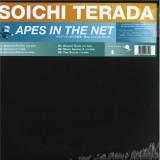
6-track EP compilation with Terada's work for the Ape Escape games, tip!
Outside of the international house underground, where his early ‘90s works for the Far East Recording label he co-founded with Shinichiro Yokota are rightly celebrated as bona-fide classics, Soichi Terada is best-known for his work composing music for video games. Yet until now, few of his productions for video games have been released outside of Japan, especially on vinyl.
Apes In The Net, a six-track EP featuring music composed for the popular PlayStation 1 series Ape Escape, sets the record straight. It not only showcases Terada’s quality as a composer and producer, but also his versatility. Like much of Terada’s work on the Ape Escape series, the tracks featured don’t explore deep, New York and New Jersey influenced house sounds, but rather his lesser-celebrated love of jungle and drum & bass – a sound he fully explored on 1996 album Sumo Jungle.
“The producer of the Ape Escape games heard that and got in touch,” Soichi remembers. “They asked me to make the soundtrack, and then work on the music for the sequels after that. I used to love making music with AKAI hardware samplers, synthesisers, and computers, so I played and recorded the tracks using almost the same methods as I did when I made house music. Using breakbeats and audio samples with a sampler was the most useful way to make the soundtracks.”
The six tracks on show, which were originally recorded in the ‘90s but reconstructed and remastered for Japan-only CD and digital releases over a decade ago, mix elements of Terada’s familiar deep house style – think warming chords and pads, memorable melodies, and emotive musical motifs – with blistering D&B breakbeats, 16-bit synth sounds, electronic bleeps and undeniably weighty basslines. They’ve stood the test of time and arguably sound just as fresh now as they did at the turn of the millennium.
For proof, check the soaring, spellbinding ‘Spectors Castle’, where uplifting lead lines and sumptuous chords dance atop punchy beats and growling bass, the jazzy and saucer-eyed rush of ‘Mount Amazing’ (all twinkling piano motifs, alien synth sounds, squelchy bass and skittish drums) and the intergalactic, liquid D&B excellence of ‘Time Station’, whose whistling melodies and stargazing chords are undeniably alluring.
There are plenty of other delights to be found across the EP, too, from the bustling, race-to-the-finish breathlessness of D&B/bleep techno fusion workout ‘Spectors Factory In’, and the rumbling sub-bass, creepy pads and suspenseful melodies of ‘Haunted House’, to the bombastic, all-out-assault on the senses that is ‘Coaster’, the set’s most “purist” jungle workout – albeit one that also doffs a cap to the pulsating world of big room techno.
Apes In The Net, then, celebrates Soichi Terada’s mastery as a video games composer and early Japanese junglist. Props are well and truly overdue.
out of Stock
Last delivered 22 months ago available to reorder, subject to availability
Lightnin’ Hopkins was one of the greatest and most popular authentic blues artists. This collection covers singles released by Lightnin’ Hopkins between 1947 and 1952. They weren’t his first recordings but they were the first released under his own name.
Although he did record with other musicians and even with full bands it’s these acoustic classics that best illustrate his art and they are some of the most endearing blues tracks ever recorded.
Includes the popular songs “Katie Mae Blues” and his biggest chart hit “Shotgun Blues”.
A true genius of the genre this Lightnin’ Hopkins release by Jasmine is a must have for blues and R&B fans.
Fully detailed liner notes.
Limited edition press on 140 gram colour red/black marbled vinyl.
Limited orange vinyl. We've all heard the axiom, "if you ignore it, maybe it'll go away." That goes double for a lot of people who wish to apply that saying to rap music. But when it comes to the West Coast "gangsta rapper" genre made popular by the likes of NWA, Eazy E, Ice-T and his Rhyme Syndicate cohort, King Tee, the truth is hard to ignore. King Tee aligns producer DJ Pooh on this Bass EP consisting of tracks recorded in 1987. They're joined by The Compton Posse that includes the late Mixmaster Spade and J-Ro from Tha Alkaholiks. This EP sharpens the skillful word play King Tee made famous on his debut album Act A Fool. From song to song, this EP has a superior sheen, a tightness and cohesiveness between rhyme and music. Born in Los Angeles and now a resident of the infamous West Coast rap capital, Compton, California, King Tee truly is a product of the streets. He openly admits to running with gangs in his youth, causing his mother endless embarrassment and frustration. So much so that, in a desperate attempt to turn his life around, she turned King Tee into the authorities when she discovered him stealing from her. Once out of jail, King Tee ran of to Houston, Texas. Trouble is that he was underage atthe time, so his mother again had King Tee locked up in a juvenile camp. When King Tee finally realized why his mother did what she did, he decided to turn his life around by dedicating himself to music. He listened obsessively to the radio and chose to become a DJ. When King Tee was released from juvenile camp he secured a mixing gig at KSU and then KYOK in Houston. Between station gigs he handled the mix at various venues and clubs. After gaining the necessary experience behind the tables, King Tee moved back to Los Angeles and hooked up with Ice-T. In rapid succession, King Tee met Du Pooh who enlisted him into his rap group (after King Tee bugged Pooh for months), then Pooh introduced Tee to DJ Unknown with whom he made several 12" records for the Techno Hop labelwhich is now released on this EP for the first time since then. Ice-T's influence brought Rhyme Syndicate Management's Jorge Hinojosa into the picture. King Tee eventually signed with Hinojosa who then secured a contract with Capitol Records for King Tee. The result was 1988's Act A Fool.
Several unique features set the debut studio album by folk rock supergroup Crosby, Stills & Nash, released in 1969 by Atlantic Records, apart. It's the only album by the band before adding Neil Young to their lineup. The album spawned two Top 40 singles, "Marrakesh Express" and "Suite: Judy Blue Eyes," which peaked respectively at No. 28 during the week of August 23, 1969, and at No. 21 during the week of December 6, 1969, on the U.S. Billboard Hot 100. The album itself peaked at No. 6 on the U.S. Billboard Top Pop Albums chart. It has been certified four times platinum by the RIAA for sales in excess of 4 million copies.
Instantly lifting the group to stardom, along with the Byrds' Sweetheart of the Rodeo and the Band's Music from Big Pink, the previous year, the album is cited by music reviewers for initiating sweeping changes in popular music. In 2021 the album held the rank of No. 161 on Rolling Stone's 500 Greatest Albums of All Time list.
Crosby, Stills & Nash was "the perfect blend of David Crosby's social conscience, Stephen Stills's virtuoso musicianship and Graham Nash's ability to craft the perfect pop melody for radio," writes Rolling Stone, in its review.
The band was brought together after Crosby was fired from The Byrds, Stills's band, Buffalo Springfield had broken up (a band which also featured later member, Neil Young) and Nash's departure from The Hollies. The three decided to form a band after an informal jam led them to discover how well their voices harmonized. Released in May 1969, the band would perform nine of the album's 10 songs at Woodstock, which was the second time they ever did, in August of the same year.
The album features some of CSN's most well known and iconic songs; "Suite: Judy Blue Eyes," "Marrakesh Express," "Guinnevere," "Wooden Ships," "Helplessly Hoping" and "Long Time Gone." This album saw a shift in sound to what was popular at the time — blues based rock, opting for a more folk rock, and sometimes jazz-based sound. It would lay the foundations for the California Sound that would be popularised out of Laurel Canyon in the ‘70s. Artists such as The Eagles, Jackson Browne and Fleetwood Mac would take inspiration from the sound of this record.
All the hallmarks of a top-notch Analogue Productions reissue are here for you to savor: Mastered directly from the original master tape by Bernie Grundman and cut at 45 RPM. Pressed on 180-gram vinyl at Quality Record Pressings, and housed in tip-on old style gatefold double pocket jackets with film lamination by Stoughton Printing.
This vinyl re-pressing of Martin Carthy's Debut album is released to commemorate Topic's 85th anniversary in 2024 - Limited edition of 1000 copies - Black vinyl, standard weight with black, polylined inner sleeves. In the early 1960s, the approach Martin Carthy took to folk music was nothing short of revolutionary, albeit a relatively quiet revolution befitting of his humble nature. You wouldn't find Carthy's music clambering up the singles charts; his was not a face adorning the teen magazines. Instead, his influence was felt at a grass-roots level. He plied his trade in the folk clubs, which is where the likes of Bob Dylan and Paul Simon sought him out, enamoured of his traditional repertoire and keen to learn songs like 'Scarborough Fair' and 'Lord Franklin' directly from him before adapting them for their own purposes.
His debut eponymous album, re-released here, on vinyl by Topic Records as part of their ongoing Topic Treasures series, is a snapshot of the work he was doing at the time.
Originally finding its way into the world in 1965, courtesy of Fontana Records, Martin Carthy pulled together 14 songs from his burgeoning repertoire. Produced by Terry at the Philips Recording Studios in Marble Arch, the album was a must-learn checklist for budding guitarists and folk club orgas, and, to this day, remains an essential listen for anyone attempting to find their way into traditional English folk music. Most people turn up for 'Scarborough Fair', very few leave without getting hooked on 'High Germany', 'Sovay' and 'Ye Mariners All'.
The album also introduces Carthy's earliest collaborations with Dave Swarbrick, an enduring and much-copied partnership that lasted, off and on, until Swarbs death in 2016, and became a blueprint for how guitar and fiddle duos ought to sound. While Carthy had been building up his solo repertoire over the previous five or six years, several of the duo arrangements on this album ('Lovely Joan', 'A Begging I Will Go', 'Broomfield Hill') were thrown together in the studio, adding a fizz and freshness to the recordings. This became the pair's standard way of working. "We used to rehearse on stage, in front of the audience," he explains today.
In the years since, Martin Carthy has become the veteran of over 40 studio albums and a veritable beacon for musicians and music lovers seeking "the real stuff." Pressed to name his favourite, he needs no time to think it over. "I always stand by the first album," he says of his 1965 debut. "I love it. There are some things on it I think I couldn't have done better. There was a clarity of purpose."
And, with this re-release, we can be sure that newcomers get to hear that sense of purpose in the best possible quality, as clearly as Bob Dylan, Paul Simon and a generation of folk lovers did six decades ago.
RAWAX proudly welcomes The Legend Adonis the the Family!
We're very honoured to present you on the 30th edition of our Chiwax Classic series the man who produced 1986 his fist of many House Anthems, "No Way Back"! Now in the rebound: The 1989 originally on Jack Trax released "Do You Wanna Jack/ Lost In The Sound". As bonus track Adonis gave us "My Space". Another outstanding track, he did with Virgo aka Marshall Jefferson! This release is quite unique in this combination - so don't sleep on it! We'll have it on black solid vinyl and also on purple vinyl - it's up to you!
Colouring, das Pseudonym des Sängers und Musikers Jack Kenworthy, kündigt das neue Album 'Love To You, Mate' an, das am 23. Februar über Bella Union veröffentlicht wird.
Das Leben des Songwriters und Produzenten aus Nottingham wurde 2021, wenige Monate vor der Veröffentlichung seines Debütalbums 'Wake', auf den Kopf gestellt, als bei seinem Schwager Krebs diagnostiziert wurde. Was folgte, war ein intimes Jahr des Zusammenseins mit der Familie, in dessen Folge Kenworthy das Projekt eigentlich schon komplett beenden wollte, von Freund und Produzent Gianluca Buccellati (Arlo Parks, Lana Del Rey) dann aber doch zum Weitermachen überredet wurde.
Colouring ist jetzt schon seit einiger Zeit ein Soloprojekt, das neben den Post-Britpop-Größen der 00er-Jahre von The Blue Nile beeinflusst ist, aber auch elektronische und rhythmische Einflüsse von Radiohead und James Blake aufnimmt. So auch die neuen elf Songs, die auch schlurfende Breakbeats, Arpeggio-Gitarrenmelodien und düstere Pianoparts enthalten. “I've always been on the side of making up scenarios rather than being really honest about my life within my music”, fügt Jack hinzu. “This is the first time I've been able to do that. I've been less scared of it because it's not my story. It’s a shared one.”
Klanglich überfrachtet Kenworthy das Album jedoch nicht mit Traurigkeit. Gerade die letzten beiden Songs, 'For Life' und 'Big Boots', sind fröhlichere Stücke, die das Leben und den Zusammenhalt der Freundschaft feiern. “Love To You, Mate is a love letter to my wife, family and Greg for what they all did; a photograph of that time”, erzählt der Songwriter. “I really feel we've made this music together.”
Blessings of the Highest Order compiles all of Thou's Nirvana covers, originally recorded and released piecemeal on various EPs, splits, and tributes from 2009 - 2018. The songs feature guest appearances from Emily McWilliams (Silver Godling), Melissa Guion (MJ Guider), Rebecca Levy (Turboslut), Isidore Grisoli (High), and Jennifer Murphy (that one Thou tote). The record features artwork by New Orleans' underground, BDSM, xerox freakaleek "Trashboy.
Maston’s Darkland is a breezy collection of the material from the Tulips sessions that didn’t make it on to the original LP. Originally a digital-only release for those in the know in the autumn of 2018, after re-issuing Tulips in 2020 it made too much sense for Be With to give Darkland a vinyl release.
Like Tulips, Darkland was recorded mostly in Hoorn, in the Netherlands, between 2015-2017 during downtime from Frank’s touring duties with Jacco Gardner’s band. Bits were also done in Los Angeles on some extended trips back home.
The collection plays like an alternate view of Maston’s instant modern classic Tulips; a companion piece to the LP proper with similar mixture of shorter themes and more full length tracks. As Frank Maston explains: “I think Darkland is the shadow of Tulips in a way… what it might’ve been in a different universe. But the heart of Tulips beats in these songs as well and they evoke the same memories and feelings for me. I see my process playing out across these songs - lots of experimentation and trying out new techniques and sounds and just sort of going for it.”
Frank goes on: “It was all from the same pool of material, like 30+ ideas. I was making a lot of little demos… some would be more fleshed out and become songs and others would just be a cool riff and not go anywhere. When I started trying to form it all into an LP I went through all the sessions and ideas and collected the ones I thought were the most fleshed out and cohesive together as a whole. There were a fair amount of songs that were finished and in hindsight really should have been on Tulips (like what would’ve been the title track). And the rest of these songs are either very early versions of tunes that ended up on Tulips or some cool ideas that just ended up being dead ends. It definitely shows how wide my net was in the beginning before I narrowed the record down stylistically.”
Darkland opens with its ornate 39 second title-track before striding into “Tulips”, that full-length title-track that never was. It’s a real head-nod, percussive-rich electric piano stunner that would’ve been a comfortable standout on the album proper. But now this “downlifting” gem is given ample room to shine on this record.
The funky organ-led bass and drums workout “Immaculate Conception” will keep your neck gently snapping while MPC fiends go reaching for their sampler. And that’s gospel. “Love Theme No 3” cuts a breathtakingly stylish vibra-slapped swathe through the middle of the opening side before we’re startled by the pronounced bass and twinkling percussion of “The Owl In Daylight”. Charming digi-drums underpin the wonky synth (quiet-)banger “Innovative Patterns” which has a lovely melodic switch-up in the final third before the tempo (and hairs on your neck) rise on the faintly creepy yet imminently groovy “Osiris”. The gorgeously soft-focus “Groove Experiment No 3” closes out the first half in slow-mo wonderment.
The lushly melancholic “Raincloud” ushers in side B before the emotionally-stirring “Phonic” taps at the door, coming on like the long lost sister to Pet Sounds’ “Let’s Go Away For A While”. Next up, the swooning beauty “Love Theme No 2” keenly sways in front of you, growing ever more insistent and hypnotic. The too-short “Italian Summer” conjures the same flirtatious imagery as the title hints at whilst “Endless” is a fascinating “piano-pella” alternative version to “Rain Dance” from Tulips. “Wonder Theme” has a nostalgic, exotic 60s swing and album closer “Willow” is a hushed, campfire folk gem. The gently circular strumming is just magical.
Speaking to Aquarium Drunkard back in 2019 about the sessions that became Tulips, Frank noted: “I was really surprised by the lack of sunlight during my first winter in Holland, so I would call it Darkland which then became the name of the first demo I wrote during that time. It was also the working title of the record when I first started writing. Some are full songs that didn’t make the cut (including what would have been the title track), some are just ideas that I never finished.”
Whilst we were working on Darkland’s vinyl release Frank explained more specifically about the music that didn’t make it on to Tulips: “When I was putting together the tracklisting for Tulips I was already thinking that whatever didn’t make it onto the LP would be cool to release eventually somehow. The response to Tulips has been so passionate over the years that it’s nice to be able to offer another piece of that world. And for me personally it’s amazing to have more of my work out there in the world. Most common bit of feedback was that many of these songs should have been on Tulips. The odd friend says it’s much better than Tulips.”
Just like Tulips before it, Simon Francis’s vinyl mastering for Darkland has been cut at 45rpm so you can trip out to this as well at a woozy 33 1/3. The artwork too has been designed by Frank himself as a literal visual continuation of the Tulips cover.
We couldn’t possibly say whether Darkland is better than Tulips, and luckily we don’t have to decide.
out of Stock
Last delivered 5 years ago available to reorder, subject to availability
Frank Maston’s Tulips is a sample-ready film score to the best 70s movie never made. Originally a super-limited self-release on his Phonoscope label in late 2017, Tulips has already become incredibly sought-after. Be With were introduced to Maston by mutual friends Aquarium Drunkard and it didn’t take long before we decided this modern classic deserved a reissue.
Inspired by the deep-grooving soundtracks of Italian cinema - think Morricone, Umiliani and Alessandroni - Maston conceived the entire Tulips project as a continuation of these revered works. Frank designed the artwork and made two 16mm films to accompany the music: “It wasn’t just the LP… it was kind of a whole vibe I was trying to create. Not really trying to emulate the things that influenced me but more trying to make something that could sit alongside those records on a shelf. I’m still very proud of the project.”
There’s a distinct library music feel too, with wiry organ, spacey keyboards and loping 60s guitar hinting at KPM and DeWolfe. Like the best library music, Tulips creates a cinematic universe through sound alone, evoking moving images in the listener’s technicolour imagination. It turns out that was accidentally on purpose: “I was discovering a lot of library music for the first time… listening to a composer’s entire catalog or finding all this obscure stuff. I wasn’t entirely conscious of the influence until I started making this music and realized I was channeling the vibe. That’s when I began focusing more on weaving melodic themes throughout the record to make it function more like a soundtrack”.
Tulips was recorded between 2015 and 2017 in a small studio in a village called Zwaag in Holland, during downtime from Frank’s touring duties with Jacco Gardner’s band. “Tulips” comes from the title of the very first demo he made in Holland, it was the first thing that came to mind. Makes sense.
Recording in Europe with some very European influences in mind, Frank wanted to eschew any American influences. But we can still feel the studio wizardry of the likes of Brian Wilson and Harry Nilsson in there somewhere. A psychedelic bedroom-pop song-cycle, full of hypnotic hooks and dusty drums, Tulips manages to sound charmingly homemade yet wholly widescreen.
Dreamy opener “Swans” is an exquisite soul instrumental and recalls the soft-psych of Koushik, which Be With loves of course. Tropicalia influences abound in the cool and breezy “New Danger” and the KPM-references are loud and proud on the lush organ pop of “Old Habits”. Fast-paced “Chase Theme No. 1” manages to be both tense and laid back, decorated by acid-drenched spaghetti Western guitars. The glorious Gainsbourg-esque melancholia of “Infinite Bliss” is all gauzy flutes and happy-sad vocalizing and the title is almost perfect: it’s bliss, no question; *if only* it went on forever. Side A closes with “Evening”, a subtle bossa nova beat thing. Gorgeous.
Side B opens with the heat-shimmer guitars of “Rain Dance”, evoking an unreleased Byrds or Buffalo Springfield backing track. Yes, it’s that good. “Sure Thing” is music to accompany an elevator ride you never want to end, but in a good way! The ornate “Garçon Manqué” is as beautiful as the instrumentals on Pet Sounds (think “Let’s Go Away For A While”) and the wistful “Turning In” starts like a stroll in the park before Maston introduces a scorched-Earth guitar solo that would startle if it wasn’t so pitch-perfect. “Chase Theme No. 2” is a briefer, more keening counterpart to what we hear on side A. The head-nod bass-drums-keys funk of “Hues” rounds out this staggeringly assured set; still opening each phrase with a plaintive strum, but using vibrato and heavy reverb to accent the electric organ melody. Sublime.
All these top drawer musical references might sound like just more of the usual release notes hyperbole, but there’s a reason that this still-young LP already changes hands for big money. It really is that good. Of course that first pressing didn’t hang around for long and Frank’s regularly been asked about a re-press pretty much ever since.
Re-issuing Tulips on Be With made sense to Frank “because the record would fit in so well with the catalogue”. Having already delved into the archives of KPM and Themes, and beginning to do the same with Coloursound and Selected Sounds, the collaboration “just makes sense and seems inevitable”. We agree.
Frank wasn’t sure a record of instrumentals with obscure soundtrack references would be an easy sell when it was originally released, and was surprised when Tulips turned out to be exactly what some people wanted to hear. We reckon its timeless beauty ensures that it’ll *always* have an audience.
The record was originally cut to be played at 45rpm, a technical quirk that grants the home listener the opportunity to go deeper, for longer. Played at 33rpm, the more languid unfurling of the tracks proves just as wonderful a trip. As a psilocybin-soaked case study from Aquarium Drunkard back in January of 2019 describes, some of the songs sound as if they were intended to be heard that way. The slower speed allowing the listener to step inside and perhaps even “crack the code” of the music’s meaning.
Mastered for this vinyl reissue by Simon Francis and featuring alternative burnt orange artwork from Maston himself, this Be With pressing is limited to just 500 copies. Hypnagogic it may be, but please don’t sleep.
out of Stock
Last delivered 2 years ago available to reorder, subject to availability
Best remembered for his partnership with the rapper Will Smith in the duo DJ Jazzy Jeff & the Fresh Prince, the duo won the first rap Grammy as well as scoring some big pop hits back in the day, including their 1987 smash, "A Touch Of Jazz," which famously sampled Bob James' classic track "Westchester Lady."
In a full circle moment, James and Jeff have joined forces on the tune "That Bop," a thumping dance track overlain with elegant piano hooks. "It was fun to work with him so many years after he had sampled me in the past," says James, who reveals they collaborated by sharing music files across the internet during the pandemic.
"We also did a couple of other tunes that may see the light of day soon," discloses James, who is keen to work with the hip- hop legend again. "I hope the next time we'll actually be in the studio at the same time so that we can interact," he says. The B-side features Bob James' original jazz-funk classic and DJ favorite, "Shamboozie", available for the first time on 7" vinyl.
Released by evosound on a 7" Vinyl Single on the 6th of October, 2023. Limited Edition of 1,200 copies worldwide.
out of Stock
Last delivered 2 years ago available to reorder, subject to availability
British singer-songwriter Katherine Priddy releases her much-anticipated sophomore album "The Pendulum Swing" via Cooking Vinyl. This follows her highly acclaimed 2021 debut The Eternal Rocks Beneath, which announced Priddy as a singular new talent on the contemporary roots music scene. Once again recorded in Birmingham by producer Simon J Weaver, guest musicians comprise John Smith (lead guitar), Harry Fausing Smith (strings), Marcus Hamblett (brass/double bass), George Boomsma (guitar, backing vocals, co-writer on track "Ready To Go"), Polly Virr (cello) and even a brief appearance from Priddy"s family members right at the end of the album, in keeping with its themes. With The Pendulum Swing, Priddy has managed to keep moving forward whilst acknowledging and honouring all that has gone before. For fans of Nick Drake and John Martyn.
Die unbestrittene britische Musikikone Dizzee Rascal meldet sich mit dem elektrisierenden neuen Album 'Don't Take It Personal' auf seinem neuen Label Big Dirte3 Records Ltd. zurück. Die LP stellt seine besten Arbeiten in den Schatten und ist eine eindrucksvolle Erinnerung daran, wie Dizzee zu seinem legendären Status kam. Es fängt ihn in aufrührerischer Form ein, während er mühelos und mit unvergleichlicher Leichtigkeit durch eine ganze Sammlung an eindeutig britischen Genres fliesst. Dizzees neuestes Werk, das sich auf prahlerische Flows und beeindruckendes Wortspiel konzentriert, ist eine weitere Siegesrunde eine der prägendsten Legenden der Rap-Musik, und während es weiterhin Reime regnet, denkt daran: Es ist nichts Persönliches.
out of Stock
Last delivered 2 years ago available to reorder, subject to availability
Formed in Fullerton, CA in 1978, Social Distortion were one of the original LA punk groups and their first single was released on legendary LA punk label Posh Boy. But far more rare than that first single ("Mainliner" b/w "Playpen") is the unreleased EP Posh Boy's Little Monsters. This EP only made it to the test pressing stage back in 1981, and featured those two tracks from the first single along with "All The Answers" and "Justice For All." This is the absolute holy grail for Social Distortion fans and it's finally available in commercial form on two limited edition pressings for RSD 2019, black vinyl available worldwide and a Europe only red vinyl limited edition. Includes 2 bonus tracks.
“Of the 3 teenagers who recorded for me, one has died, another was believed to be dead and one became immensely wealthy from playing music. The one who did hard time in prison was not Mike Ness. It was the drummer Carrot, better known as John Stevenson, now living a very ordinary life in rural Florida.
I now count John as a dear friend. Apparently, he was only l6 years old when he rolled into the studio that day in April l98l, armed with a taped up pair of drumsticks. He played great as did both Mike and Dennis (RIP). This time there was no fighting in the studio over production values. I had promised Ness that we would not fight so once there was a minor disagreement over the artwork for the proposed l2", I dropped the project in favor of the Playpen/Mainliner 7" which sported iconic artwork from the band.”
After releasing numerous and now collectable standalone singles, plus some now famous collaborations with Dimitri from Paris, 2019 saw Parisian based 8 piece, Cotonete release their first long player in 15 years! Under the guidance of Melik Bencheikh from Paris’ rare record emporium, Heart Beat Vinyl. The dark moody mover "Super-Vilains" came out to great success on Heavenly Sweetness.
After playing some packed live shows around France and the UK, including the acclaimed Sunday at Dingwalls in Camden, hosted by Gilles Peterson and Patrick Forge. Somewhere along this part of the journey, they came across the Brazilian music legend and vocal powerhouse, Di Melo. He softened their souls, and from this love affair came the album "Atemporal". Released on Favourite Recordings, this 8 track album would end up being sampled by Canadian superstar Drake, for his 2023 album ‘For All the Dogs Scary Hours
Edition’.
So now into 2024, and we have Cotonete full length number two. They’ve enlisted the producer Guts to guide them towards sunshine, groove, warmth and all the colours in his rainbow. With their tongues firmly in their cheeks, the album is titled ‘Victoire de la Musique’ - a dig at the annual French music award ceremony. Taking the band deep, producer Guts showed them new and exciting rhythms from all corners of the world. The record’s first example of this is ‘Venezuela’, a track directly inspired by the jazz funk from the great Caribbean nation.
Other key musical exploration on the record can be attributed to the late composer Francis Lai. On ‘Cinq Pour L'aventure’ - an almost 15 minute epic monster showcasing the band’s love for 70's French movies soundtracks. “L’aventure c’est l’aventure”, was a movie by one of the most famous French directors Claude Lelouch The single from the soundtrack was sung by French music superstar Johnny Halliday.
Guests are scattered very tastefully across the album, on the only cover version of the record, the Brazilian master Jorge Ben’s ‘Bebete Vãobora’, Sabrina Malheiros was invited to lend her lungs. The daughter of Azymuth’s Alex Malheiros helps join perfectly the dots from a band that are without a doubt Cotonete’s biggest influence. Brazilian jazz funk, now with an added French touch.
On ‘Day in Day Out’ a powerful performance is given from Leron Thomas on vocals and trumpet. Perhaps also known for his role as the musical director for Iggy Pop and touring member of his band. This track is an already tried and tested dance floor filler, emphasizing just how tight the band really can play - the track even found its way into BBC Music’s Craig Charles’ ‘Track Of The Year’ selection.
No record so soulful would be complete without a trip to the UK. Omar, London’s Godfather of New Soul pops in. Having recorded with artists like; Courtney Pine, Level 42 & Erykah Badu, in his distinctive smooth style, he blesses the track ‘What Did Run You For?’ The final vocal visitor is Gystere Peskine, a Parisian based musical hero, who shows off his retro future funk feels on ‘O Ceu es Preto’ - which literally translates as ‘the sky is black’ - although given the hugely uplifting and almost Gospel Soul of this Russian/Brazilian singer, he
has us seeing things far brighter.
Cotonete have endeavored to build a worldwide rainbow warrior team of merry boys and girls. Fighting the brave fight to shine light towards the fact that music will always win…. "Victoire de la Musique" - a symphony of spring, songs of the new world, a "Victory Of Music”
out of Stock
Last delivered 13 months ago available to reorder, subject to availability
Desmond Dekker recorded some of his best known songs together with his backing group the Aces. Their single “007 (Shanty Town)” made him Jamaican music’s first outernational superstar, reaching the 14th place in the UK charts. The Leslie Kong produced Double Dekker was first issued in 1973 and consists of the best material Desmond recorded during his early years. In 1969 he scored a number one hit with the legendary song “Israelites”. You’ll hear how the Ska music from the mid-60s developed to the Rocksteady sound. This was “Ska” or “Blue Beat”—(or its new name for the slower tempo “Rock Steady”), and the lyrics come from the Calypso-Mento method of telling about current events in music. He was really at his prime from 1969 to 1971, and recorded classics such as “It Mek” (1969) and “You Can Get It If You Really Want” (1970), which you’ll both find on this record. Even before Bob Marley and Jimmy Cliff Jamaica already had their own international superstar, Desmond Dekker was his name.
Double Dekker is available as a limited edition of 750 individually numbered copies on orange coloured vinyl.
The trio of John Medeski, Billy Martin, and Chris Wood did as much to reinvigorate and reimagine jazz as anybody over the last three decades. Now, Real Gone Music is proud to provide the band’s classic second album It’s a Jungle in Here its first widespread vinyl release. That this record includes covers of tunes by John Coltrane, King Sunny Ade, and a mash-up of Bob Marley with Thelonious Monk speaks volumes as to Medeski Martin & Wood’s fresh approach to the jazz tradition; but their ability to compose and perform startlingly original material is what really sets them apart. Black vinyl pressing for optimum sound!
"Along with Black Flag and the Circle Jerks, Fear helped define the sound and style of L.A. hardcore. Even though they formed during the first wave of punk in 1977, they didn’t put out an album until five years later, titled The Record. They used their music to piss off everyone around them, and they achieved that goal with flying colors on this debut album. It remains a punk classic to this day and Record Collector’s Mark Rigby called it “probably the most exciting and impressive, one-dimensional, ill-mannered, distasteful, odious ‘hate’ record ever made.” The album only spawned one single, “I Love Livin in the City”, but includes many more gems, including “We Destroy the Family”, “Let’s Have a War”, and “Beef Boloney”. The Record is available as a limited edition of 1500 individually numbered copies on translucent magenta coloured vinyl."
"The Dive is a 2023 scuba-diving movie, starring Sophie Lowe (Medieval) and Louisa Krause (Billions), with much of the footage – underwater and topside – shot in the popular diving destination of Malta. Directed by Maximilian Erlenwein and written by Erlenwein with Joachim Heden, The Dive focuses on two sisters, Drew and May, whose dive together off the rocky shoreline is abruptly cut short when a landslide above water sends a cascade of boulders down on top of them, leaving May trapped down at 28m by the debris. With dangerously low levels of oxygen and cold temperatures, it is up to her sister to fight for her life. The score to The Dive is composed by Volker Bertelmann & Raffael Seyfried. Bertelmann is a German composer who is also known under the name Hauschka. In 2022, he won an Academy Award and BAFTA for his work on All Quiet on the Western Front. For the soundtrack for The Dive, he teamed up with Raffael Seyfried, who previously scored the acclaimed 2018 drama series Patrick Melrose. The Dive is available as a limited edition on turquoise coloured vinyl."
Dive by Various Artists, released 25 January 2024, includes the following tracks: "Do You Hear That", "Go To The Surface", "Ship", "Are You OK" and more.
Listed as one of Record Collector's "100 Greatest Psychedelic Records" 1968's Five Day Week Straw People, which relates the imagined "typical weekend of the average nine-to-five worker" is now released on 180g Straw coloured vinyl.
The album is often considered a cult classic and a collector's item among psychedelic rock enthusiasts, featuring a blend of psychedelic and folk- rock influences and includes songs like "Sunday Morning," and "Carwash." While the band didn't achieve widespread commercial success, they are remembered for their unique sound and contribution to the psychedelic music scene of the late '60s. The Straw coloured 180- gram vinyl is re- issued on Morgan Blue Town including sleeve notes
tapetopia 010 FO 32 extra hart arbeitendes rastermaterial für kontakt did not emerge from the usual underground milieu – their setting was the base of the 4th Flotilla of the GDR People’s Navy! The propaganda unit PrK 18 had among its recruits some who turned the logistics for agitation against the intentions of the system. Inside a barracks, but under the state radar, the paramilitary music corps FO 32 boarded an NVA studio and recorded industrial tracks and dark ambient. The experimental military band gave an illegal concert; they had previously been heard on the radio programme “Parocktikum”, a pirate gig from the ranks of the People’s Navy on GDR radio. In 1989, a first FO-32 tape was shared among just a few friends. Shortly after, an abridged mix of material was released on the illegal Trash Tape label in an edition of no more than one hundred copies. The vinyl version on tapetopia is based on the original tape. The tapetopia series, using the original layouts and track lists, publishes cassette editions from the GDR underground of the 1980s, especially from the “walled-in” scene in East Berlin. More than three decades after their initial “release”, these tapes have yet to be heard on either vinyl or CD, even though they made an audible mark in the canon of GDR subculture. Despite the tiny original editions of the time, many of the bands were considered cult in countercultural circles, which made them highly suspect in informed circles.
Sasu Ripatti's complete "Dancefloor Classics" series. Music for imaginary dancefloors, released on Ripatti's own label Rajaton.
”Look up, into the light” she said, while the camera shutter clicked. ”Like this? Does it look holy?” His neck felt stiff. Her reply: ”Yes, just like that. What do you mean holy? Like religious? ”No, more like trying to look very far, somewhere beyond what we can see.” ”Okay, stand still, I’m going to come close to you now. The light hits your face great.” click, click, click.
He noticed her fingernails. They were not polished. Natural. Even somewhat rugged, as if something wore out the fingers slightly. What had these hands held besides the camera? What made the edges of her fingernails drift off?
He thought it’s weird to look straight into the camera. The photographer had closed her left eye, the one not looking into the lens. Then it opened, she looked up, perusing the surroundings, then she closed her eye again, then looked up, closed, looking up, very quickly. It all seemed very professional. Maybe she calculated the light, making sure it’s close to perfect. ”What will these photos look like?” – the thought popped into his head briefly. It was liberating to think it wouldn’t matter.
”What’s that song playing?” he asked. ”Wait a sec, Ol’ Dirty Bastard?” she replied. ”Oh yeah, right. But the sample?” ”Hey, could you look up again, like that. No, lower.”
New directions: ”Look out from the window, turn left.” ”My left or yours?” ”Yours, I always try to think from the direction of my model.” How professional! This is a good shoot, so natural. Should I worry about how the photos look like? No, I don’t want to. His thoughts bounced around. What would the story be like? It’s a big newspaper, everyone will read it. Maybe someone drinks coffee and eats a stroopwafel while they do it. Will they place the waffle on top of the mug for a brief while, so that it gets hot and the syrup melts a little? Then it feels wet, and you can bend the cookie.
She broke his train of thought off midway through: ”Now turn right, but look left, and slightly up, but don’t turn your face right.” ”Umm, like this? Sounds like a set of pilates instructions.” she laughed ”You do pilates?” ”Yeah, it’s hard sometimes. Have you tried?” ”No”, she said. ”I’m not good for sports that are done in groups.” ”Yeah, but in pilates you can just be inside your mind, drowning in your private thoughts.”
”What are you thinking in pilates?” she asked, taking more photos. ”Well, mostly just which way is right. And which left.” click, click.
Q&A with Sasu Ripatti:
1) Tell us something about the EP series ”Dancefloor Classics”, what’s the idea and what can we expect?
I’ve been slowly writing these sort of dance music pieces and finally curated them together for a conceptual release. I like to create music for a dancefloor that exists only in my imagination and doesn’t try to suck up to the standardized reality.
2) Your vinyl format is 10” which is quite special (as opposed to LP / 12”). Why did you choose it?
It’s my favourite format, absolutely. The size is perfect, and you can make it sound really good @ 45 rpm. And you still can make great artwork.
3) You seem interested in sampling/repurposing, what does it mean to you as an artist to approach something already existing from a new angle? How does the source material inform you about the approach to take?
I guess i could flip it around and just say I’ve outgrown synths or electronic sounds to a great extend, and having gotten rid off all my synths already good while ago I’ve used samples as my main source material a lot. It’s obvious on this series that i’ve sampled existing music, but I also sample instruments and things in the studio and resample my own library that I have built over the years, it’s quite large. To me the end result matters, not so much how I get there. Once I have something on my keyboard and play around, it’s all an instrument, though with sampling other music it becomes a really interesting and complex one as you’re possibly playing rhythm, but also harmonic content and maybe hooks or whatever, all at once.
I never sample premeditadedly, like listening to records and looking for that mindblowing 3 sec part. I just throw the cards in the air and see what lands where, just full intuition and hopefully zero mind involved, playing tons of stuff, trying things, just recording hours of stuff. Then comes the interesting part to listen to hours of mostly crazy stuff and finding that mindblowing 3 sec part.
4) What is your relationship with the dancefloor (conceptually and/or in experiences / as a performer)?
Very complicated. I have never really felt comfortable on a dancefloor but have always wanted to. There’s something in club music, in theory, that really speaks to me. It has never really materialized for me – speaking mainly from a performer’s point of view who goes to check on a dancefloor for a moment after a concert. I never have DJ’d or felt much interest towards it. But again, I love the idea and concept of DJing. As well as producing music for imaginary DJs. Lately, as in the past 10+ years, I haven’t even performed in any sort of club spaces. So my relationship to the dancefloor is quite removed and reduced, but there’s quite a bit of passion and interest left.
All tracks composed and produced by Sasu Ripatti.
Artwork & photography by Marc Hohmann.
Mastering by Stephan Mathieu for Schwebung Mastering.
Vinyl cut by SST Brueggemann.
Publishing by WARP Music Ltd.
out of Stock
Last delivered 2 years ago available to reorder, subject to availability
Andy Sharrocks started writing songs in 1976. He found a vehicle for these songs with punk band Accident On The East Lancs. This started out as a covers band, but Andy soon became frustrated when the other members wanted to stay that way. The band disintegrated but Andy retained the name, forming a new cutting edge four piece playing his songs. He financed their first single in 1979 on his own label Roach Records. This was a double A side as one of the sides was a ditty called We Want It Legalised. The other side was a Bo Diddley kind of groove called Tell Me What Ya Mean, which Record Collector magazine recently said sounded like a song The Strokes should cover. This line up fell apart when immediate success failed to arrive, but Andy formed another band out of the ashes of local band Wilful Damage, and the guitarist out of the original covers band. They recorded and released on Roach Records another double A sided single in 1981 as well as an album released on cassette tape on Cargo Records. The singles now exchange hands on the collectors market for over seventy pounds, the album has been rereleased on vinyl twice, once on a German label, and once on UK’s OZIT/MORPHEUS Records which came with a bonus live album The singles have been released on many punk compilations and We Want It Legalised is about to be released on a new Manchester punk compilation on Cherry Red Records. They played many free festivals including Deeply Vale three times, and did many great supports including The Fall, Tractor, Here And Now and Crass. Andy left the band in 1982 for personal reasons, and had a one single deal with I Believe In Love on the Vibes and Vibes record label in 1985. Refusing to compromise and do covers, Andy found it impossible to make a living doing his own material which was now primarily Americana, after discovering alt.country through Steve Earle and Lyle Lovett in 1985. He went on the road as a tour manager, which is where he met Hilly Briggs, who went on to produce Andy’s first solo album in 2004 called Walking In Familiar Footsteps, which featured ex Rolling Stones Guitarist Mick Taylor, Bluesband and Manfreds frontman Paul Jones and Bobby Vee’s sons Jeff and Tommy on drums and bass respectively. Andy was now living in London and was gigging regularly on his own or with a revolving circle of musicians going under the collective title of Andy Sharrocks & The Smokin’ Jackets. He played over five hundred gigs all over London and the UK. He also did many supports for Mick Taylor, Buddy Whittington, Steve Gibbons, The Strawbs, Curved Air, and supported John Mayall on a UK nationwide tour, and played the Jazz Café in Camden twice with John. He also played The Hells Angels Bulldog Bash three times, The Skegness Rock n Blues Festival, The Herelbeke Blues festival in Belgium and The Colne Blues Festival. In 2009 he released another album called Dirt with The Smokin’ Jackets, which came out to great critical acclaim. Andy is now releasing a triple album of truly magnificent UK Americana, called Country Rock n Roll n Durty Blues. Press Quotes : "Country Rock ‘n’ Roll ‘n’ Durty Blues is a sprawling album of original rock and blues which takes you from Muddy Waters to modern Americana" – Nigel Carr, Louder Than War // "Good honest earthy rock ‘n’ roll done the old fashioned way with passion and aplomb" – Mark Radcliffe, BBC // "Country Rock ‘n’ Roll effortlessly lives up to its title … and more" – Pete Feenstra, Get Ready To Rock // "As a listener it really is bloody good fun - Briticana, Americana with a very English voice
The Vampisoul chicas are back. And for the third time. And, although collectors and connoisseurs have never stopped playing the songs by these Spanish female singers, here they are again, sounding as vibrant as they did half a century ago. Because these children of their times, the musical decades of the 60s and 70s covered by this compilation, boldly ventured into the limited spaces of freedom open to female artists back then. And they did so with attitude, in search of the right repertoire, proudly presenting new, daring personal projects often breaking away from the demure tone adopted by mainstream local female singers. And they were canny about it too. Realizing that the censors working back would just listen to the song that the record company flagged up as the listening target on the A side and not bother to flip the single over, they recorded many of their racier songs on the B side. That exciting dark side of singles, which have long tempted collectors. Lacking the freedom and visibility enjoyed today, these daring records by these female singers went as far as they could and a few managed to go beyond. The songs on this compilation tell everyday stories, narrating small socio-musical conquests revolving round the enduring theme of young love. Sass, sex, boy-girl rivalry, the defense of liberating women's fashion and, saying what women think loud and clear, all characterize these grooves. Performed in a variety of musical styles ranging from ye-yé, twist, disco, beat, popcorn, flamenco pop to Northern Soul, and, even more surprisingly, sung in an everyday, natural and self-assured tone that must have ruffled some feathers. As in previous volumes of "¡Chicas!", this third compilation includes female singers from outside Spain but whose career, their decision to sing in Spanish or their long tours and local stays, and occasionally permanent residence, meant their albums were created, recorded or produced here in Spain. It's a winning proposition for everyone. Take the band Los Bravos, four of the singers that passed through the ranks of this quintessentially Spanish group were foreigners. It's part of our open-door policy. Spain is different. In every sense. But let's get down to the serious stuff and the ritual: vinyl on the turntable and needle poised ready to play. Third volume of Vampis' ¡Chicas! series, an irresistible collection of ye-yé, twist, disco, beat, popcorn, flamenco pop and even Northern Soul! From the early 60s and in the middle of a difficult political and social context, Spanish female singers - and those who moved to Spain - disregarded conventions and overcame all barriers to be part of a music movement that shook the Spanish society of the period. Many of the 24 tracks are reissued for the first time, including very hard-to-find records. It includes extensive notes by Vicente Fabuel featuring all the original record sleeves and artist photos.