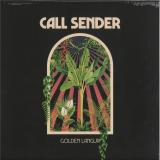
Call Sender is the collaborative brainchild that unites the talents of Paul Elliott, a versatile multi-instrumentalist, composer, producer, and recording engineer from Suffolk/UK and Michael Reed, a multi-talented instrumentalist, recording engineer, and drummer residing in the Bay Area/USA. Despite working together for the past four years, the pair are yet to meet in person!
After connecting on social media over their love of drum breaks and vintage reverbs Elliott and Reed fostered their creative partnership by bouncing recordings back and forth via email and this virtual collaboration resulted in their first album, the jazz-funk inspired “Lost To The Storm” (Tru Thoughts, 2023). With four singles from the album gaining radio play and becoming a favourite for tastemakers and DJs, the pair began work on the follow up “Golden Langur”. With this new record, the aim was to retain their signature Call Sender sound, a heady mix of B-movie soundtracks, classic library music and psychedelic funk and soul, but also introduce elements of lo-fi soul as well as collaborating with some of their talented friends as featured artists.
These features include fantastic instrumental contributions from the incomparable funkmaster Shawn Lee (Ping Pong Orchestra/Young Gun Silver Fox) on “Brainforests” and the legendary JJ Whitefield (Poets Of Rhythm/Whitefield Brothers) who kicks ass in two tempos on “Two Tails”. Not to mention the silky-smooth vocals from the Bay Area’s Andre Cruz, vocal duet from Lucid Paradise that is reminiscent of Gil Scott Heron and Paul Elliott’s seven year old son Buddy drops a vocal on the future B-boy classic “Rainbow”. Together Call Sender has an old-school vintage foundation with a modern perspective. Influenced by iconic acts such as Klaus Weiss, Miles Davis and Nino Nardini and with a hip and funky sonic aesthetic, Call Sender’s music is nostalgic without being pastiche, has a sense of travelling at its core, having been recorded in different parts of the globe, while never hesitating on the direction of the music.
Daje Funk Records makes a triumphant return with the latest instalment to the spectacular ‘Slam Dunk’ series bringing you the Slam Dunk EP3.
First up on the A-Side of this stellar four tracker is Strange, with the acid laced disco burner, ‘Keep On’. From the intro of delicious 120bpm beats with added ‘Bongonaise’, the cleanest of guitar riffs leads to a hot disco bass with stabs of Rhodes keys lovingly applied. Just when you think you have it all worked out, the acid rug pull is a masterstroke. ‘Keep On’ has a classic (but often elusive) disco vibe with a wickedly acidic twist. ‘Strange’ will rule the summer, guaranteed. Any questions?
For A2, the considerable production chops of Ezirk are on full display with ‘Erotik’ - an 80s funk inspired taxi ride through rush hour traffic to the best cocktail bar on the planet. It’s infectious, demanding fist bumps and virtual high fives. It’s a melody that sets all the possibilities of a great night out through wielding the ultimate synth power. And that breezy sax? Heaven. Put the needle down and let it take you!
On the B Side, we start with label co-owner and master of the groove, De Gama and his carefully crafted ‘Higher’. The tempo is dropped right down here, with De Gama showing his darker and funkier side. Like a joint Gil Scott Heron and Robert Plant fever dream, ‘Higher’ is an intricate lecture in immaculate beats, unimaginable concepts and chord progressions. Serious grooves. Very serious.
Rounding things off on the B Side and closing the EP is ‘R.O.C.K.’ by Hungary’s The Magic Track. These boys know how to deliver a chugger from the MT workshop. You expect them to lure you in, and ‘R.O.C.K.’ does just that. One minute you’re in church, the next in a heaving club with retro beats, thumping bass and driving piano filling the air. The Magic Track are selling magic dreams and you’re buying. The whole bag.
The Slam Dunk EP 3 slam dunks with such force it shatters the backboard. Get it in your record boxes for the summer, and let it stay there!
Ghetto Pop Life was Danger Mouse’s first full length album on Lex and a hip hop classic, harking back to the sound of the early 90s East Coast and resurrecting Brooklyn’s most soulful thug MC, Jemini The Gifted One. Incorporating a full church choir on the title track, Danger Mouse also brings in heavy hitting guest rappers J-Zone, Tha Alkaholiks, The Pharcyde and Prince Po. In the words of the NME "Ghetto Pop Life is a funk-fuelled hip hop record that virtually orders you to get down’. LEX010LPRT was originally an exclusive variant but now available to all.
nicht am Lager
Zuletzt vor 2 Jahren geliefert unverbindlich nachbestellbar
Ghetto Pop Life was Danger Mouse’s first full length album on Lex and a hip hop classic, harking back to the sound of the early 90s East Coast and resurrecting Brooklyn’s most soulful thug MC, Jemini The Gifted One. Incorporating a full church choir on the title track, Danger Mouse also brings in heavy hitting guest rappers J-Zone, Tha Alkaholiks, The Pharcyde and Prince Po. In the words of the NME "Ghetto Pop Life is a funk-fuelled hip hop record that virtually orders you to get down’. LEX010LPRT was originally an exclusive variant but now available to all.
Sex Tapes From Mars presents Outdom Records' boss, LATENT, who shares a brand-new four-track EP that spars with breakbeat, electro, house, and left-field electronics, neatly centring them all into a steady, sexy collision. The record as a whole captures genuinely original-sounding, rough-edged b-boy breaking badness - nostalgic, but never polite. It's a few BPMs slower than Sex Tapes' last few outings, but no less effective. Arguably, it's more late '80s sounding than ever, although, in fact, it's a brand-new, stonking release that showcases the label's versatility and unpredictability.
The opening track, "Break Machine", sets the pace with a clear nod to the '80s US group of the same name, bringing tidy drum workouts and clipped vocal samples that recall early Chicago, as well as choppy rave and street party energy at its most unfiltered.
"Disco Hijack" pushes the clutch into a more functional gear, merging delay-heavy, druggy, chuggy, sludgy bass with more robotic vocoder tropes, sharing something playful but IDM and European skewed. It's a dancefloor tool with a wink - just the style this now accomplished label has made its identity. Oh, don't forget the amens and clattering jungle breaks. 1990 or 2040? Fuck knows.
On "Distress Robot", pneumatic percussion and malfunctioning android chatter bring a darker, more mechanical edge, while "Virtual Body" closes with a spacious, garage-leaning shuffle that pulls the EP into recognisable contemporary yet still very much peak-time territory.
LATENT gives lean grit, pushes the edges, and lets the tracks feel alive in their imperfections. It’s music that thrives on tension between old-school reference points and modern floor pressure.
Bristol's label head Elon Dust HAS done it again.
Vinyl-only as per, don't sleep."
nicht am Lager
Zuletzt vor 89 Tagen geliefert unverbindlich nachbestellbar
We’re excited to present this special edition vinyl celebrating Lofi Girl’s collaboration! For the second year running, we’re proud to sponsor the Champions Chess Tour 2024—the largest online chess tournament in history with a $1.7 million prize fund and the world’s top players competing for glory.
This vinyl features our curated compilation, synthwave beats to play chess to, blending the focus and creativity of synthwave music with the strategy and brilliance of chess.
Thank you for joining us on this journey—let the games (and the beats) begin!
nicht am Lager
Zuletzt vor 13 Monaten geliefert unverbindlich nachbestellbar
After the success of the first volume, “Nihon No Wave 2” continues to unearth the hidden history of Japan’s underground electronic scene from the ’80s. This second installment digs even deeper into the archives, showcasing more rare tracks from obscure artists who operated on the fringes of Japan’s independent music world.
Like its predecessor, “Nihon No Wave 2” captures the raw energy and experimental spirit of the "Nippon-wave" era—where lo-fi synths, minimal rhythms, and post-punk aesthetics converged into a uniquely Japanese take on global sounds. Many of these recordings, originally released on cassette compilations or small-run vinyl with no international reach, have remained virtually unknown outside Japan.
Wishbone Ash reigned supreme through the 1970s — centered on inspired musicianship, joyful spirit and inventive songs. Their concerts were uplifting and their recorded work sublime. Argus remains a stunning high point in the band's startling repertoire. Argus was a 1972 tour de force, a hard-rocking masterpiece that has gone on to have a huge impact on rock bands moving forward. If you've never heard Argus, you've surely heard music that it inspired.
The British quartet's trademark harmony guitars became a touchstone for many: Thin Lizzy, Iron Maiden, Opeth, and Lynyrd Skynyrd have all acknowledged an Ash influence, and tracks such as Lizzy's "The Boys Are Back in Town," Maiden's "The Trooper," and even Steely Dan's "Reeling in the Years" all have twin-guitar moments that hark back to Argus. But Wishbone Ash were different from the start. They were never strictly a hard rock band; their soaring vocal harmonies and musical grandeur placed them close to progressive rock.
But they weren't strictly prog either: They had no keyboards, no real classical influence and weren't into side-long suites. Their roots were in the blues, and their calling card was twin lead guitars in harmony (played in the original lineup by Ted Turner and Andy Powell). Even the hardest Ash rockers — like "Blowin' Free," the most famous track from Argus — had an ethereal touch. They could rock the big stages, but they did it with subtlety and grace. This is reflected perfectly in the classic album sleeve by prog-associated designers Hipgnosis: The front cover shows a Greek sentry — the "argus" of the title — staring off into the distance. It's a mythic, old-world kind of image until you look closely at the back cover, and see that he's heralding the arrival (or perhaps watching the departure) of a spaceship.
Two worlds colliding. Exactly what the band and album were all about. By the time of Argus, Wishbone Ash were stars in England and cult heroes among Anglophiles in the US. What made Argus a step forward was its flow of moods. The songs don't run together, but there's an emotional connecting thread from the album's somber beginning to its heroic end. The band insisted at the time that lyrics were something of an afterthought: Shortly after its release, main lyricist Martin Turner told NME that he wrote them mainly to fit the mood of the music: "The music that was coming out was very English, very medieval, and the lyrics had to reflect that." Added Powell at the time, "The expression comes out in the guitars. We wouldn't play it if it didn't express something." Now, Analogue Productions has applied all of its vaunted craft and technical expertise to make this epic album shine! Two 45 RPM LPs pressed on virtually silent 180-gram vinyl at Quality Record Pressings make the remastered audio sparkle. Quieter lyrical sentiments and softer musical passages are rendered precisely, while majestic riffs and fist-waving anthems fully reveal the energy of the music! Argus isn't just another rock record — it's a journey through a sonic landscape rich with depth, emotion and technical prowess. It's the album that solidified Wishbone Ash as masters of twin guitar harmony. Discerning audiophiles will find Argus an essential addition to their record collection. It's a masterclass in sound engineering that fully captures the intricate interplay of dual guitars with pristine clarity and a warmth that only analog recordings can provide.
Mobile Fidelity's UltraDisc One-Step 180g 45RPM 2LP Set Plays with Authoritative Tonality, Airiness, and Clarity:
Pressed on MoFi SuperVinyl and Strictly Limited to
3,000 Numbered Copies
1/4” / 15 IPS Dolby A analogue master to DSD 256 to analogue console to lathe
Joni Mitchell is the only artist who could’ve made Hejira. The legendary singer-songwriter said as much when discussing the album decades after its release. Yet that fact seemed obvious from the moment the gold-certified effort streeted in fall 1976. An adventurous travelogue, probing narrative, and offbeat homage to freedom, Hejira remains an inimitable entry in the catalog of recorded music — a spare, gorgeous, meditative series of sonic vignettes comprised of floating harmonic pop, cool jazz, soft rock, and sensitive vocal elements that beckon feelings of motion, discovery, and self-examination.
Sourced from the original analog master tapes, pressed at Fidelity Record Pressing on MoFi SuperVinyl, and strictly limited to 3,000 numbered copies, Mobile Fidelity's UltraDisc One-Step 180g 45RPM 2LP set presents the record ranked the 133rd Greatest of All Time by Rolling Stone with definitive detail, richness, accuracy, and directness. Marking the first time the revered LP has received audiophile treatment, it's one of six iconic 1970s Mitchell records Mobile Fidelity is reissuing on vinyl and SACD.
Playing with a virtually nonexistent noise floor, dead-quiet surfaces, and superior groove definition, this collectible reissue reproduces in enveloping fashion the tones, textures, and craftsmanship that help Hejira function as the equivalent of a liberating trip down an open road with nothing but blue sky, natural landscape, and fresh air in the immediate vicinity. Passages bloom, carry, decay as they do amid an acoustically optimized environment. Soundstages extend far, wide, and deep, with black backgrounds and pinpoint images adding to the realism.
The reference-grade immediacy, airiness, and presence put in transparent perspective Mitchell’s dense strings of words, stream-of-conscious-like phrasing, and unhurried albeit forward momentum. Likewise, the instrumental contributions of her A-list support musicians — a cast that includes L.A. Express members John Guerin, Max Bennett and Tom Scott, plus Neil Young, Victor Feldman, and Abe Most — emerges with breathtaking clarity and dimensionality.
While Mitchell, whose intimate vocals and abstract guitar parts center everything, Mobile Fidelity's restoration of Hejira further reveals the visionary breadth of guitarist Larry Carlton and bassist Jaco Pastorius. Though heard on only four tracks, Pastorius' fretless bass epitomizes the fluid, subtle, flexible, roomy, and shape-shifting characteristics of songs that often appear to transpire out of nowhere akin to the formation of a puffy cumulus cloud overhead. In sync with Mitchell’s voice, Pastorius’ fusion hovers and floats, suspended in a fog you want to deeply inhale. The "grace notes" Mitchell desired on Hejira can now be heard in full. Ditto the luxurious tapestries of alinear lines, fills, and supplements unreeled on Carlton’s six-string.
Visually, the packaging of this UD1S set complements its identity as the copy to own. Housed in a deluxe slipcase, the LPs come in foil-stamped jackets with faithful-to-the-original graphics. This version is for listeners who desire to become immersed in everything about Hejira, including the unforgettable album cover — a pastiche of 14 different photos Mitchell used a Camera Lucida to assemble into one image that’s anchored by a portrait of her in a stoic pose — and the interior shots of Mitchell skating on a frozen Wisconsin lake wearing a pair of black skates, black shirt, and fur cape.
The notion of skating, feeling an awakening wind whipping against your face, and losing yourself to the surroundings are extremely apt for Hejira, which Mitchell wrote after a sequence of trips and relationships prompted her to reflect on the complicated conflicts between independence and marriage, success and satisfaction, duty and desire — and, more specifically, “the cost of being a woman.” The Canadian native delved into such themes before. But never as she does on Hejira, whose liberating, running-away aura doubles as another of Mitchell’s rejections of tradition as well as a suggestion of a better alternative.
At once observational and personal, expansive and insular, cheerful and poignant, Hejira spans a sea of human conditions, emotions, and circumstances. It addresses drifting, isolation, pleasure, place, time, and surroundings with strikingly poetic discourse matched with music that, save for the crooned ballad “Blue Motel Room,” forgoes conventional structures and choruses.
The jazz-based arrangements, marked by scaled-down percussion and all manner of bent, rounded, and unsettled notes, hint that Mitchell has no exact destination in mind. Excursions such as the moody “Furry Sings the Blues,” funky “Coyote” and edgy “Black Crow” throw open previously locked doors to possibility and journey. They signal it’s time for a welcome departure from norms and the past, one that leads to a heightened sense of clarity and perspective. Or, as Mitchell said upon choosing the album title, it’s time for “leaving the dream, no blame.”
From the moment she began writing her new album, Japanese Breakfast’s Michelle Zauner knew that she wanted to call it Jubilee. After all, a jubilee is a celebration of the passage of time—a festival to usher in the hope of a new era in brilliant technicolor. Zauner’s first two albums garnered acclaim for the way they grappled with anguish; Psychopomp was written as her mother underwent cancer treatment, while Soft Sounds From Another Planet took the grief she held from her mother‘s death and used it as a conduit to explore the cosmos. Now, at the start of a new decade, Japanese Breakfast is ready to fight for happiness, an all-too-scarce resource in our seemingly crumbling world.
Jubilee finds Michelle Zauner embracing ambition and, with it, her boldest ideas and songs yet. Inspired by records like Bjork’s Homogenic, Zauner delivers bigness throughout - big ideas, big textures, colours, sounds and feelings. At a time when virtually everything feels extreme, Jubilee sets its sights on maximal joy, imagination, and exhilaration. It is, in Michelle Zauner’s words, “a record about fighting to feel. I wanted to re-experience the pure, unadulterated joy of creation...The songs are about recalling the optimism of youth and applying it to adulthood. They’re about making difficult choices, fighting ignominious impulses and honouring commitments, confronting the constant struggle we have with ourselves to be better people.”
Throughout Jubilee, Zauner pours her own life into the universe of each song to tell real stories, and allowing those universes, in turn, to fill in the details. Joy, change, evolution - these things take real time, and real effort. And Japanese Breakfast is here for it.
Tobias Bernstrup is a contemporary musician and video artist born 1970 in Gothenburg, Sweden. He received an MFA from Royal College University of Fine Arts Stockholm in 1998. Using the visual language of pop culture, video games, sci-fi, classicism and gothic noir, he has created a stage persona with notorious live performances. Dressed in elaborate costumes of skin-tight rubber suits and fetish gear, Tobias' external appearance is androgynous. He raises questions about representation of identity, the body and physical space in both virtual and non-virtual realities. Between 1997 and 1998 he self-released two limited CD-R EPs. In 2002 his debut album 'Re-Animate Me' was released by Tonight Records followed by two limited 12' singles for the song 27' and the Italian version Ventisette'.
.
27' is a 5-song EP collecting 4 different mixes of the title track plus one unreleased song from the 'Re-Animate Me' recording sessions. The material on this EP is closely connected with the world of computer games which Bernstrup also inhabits. Bernstrup's music is influenced by 1980s Italo disco and synth pop, reminiscent of Kraftwerk, Depeche Mode and Ken Lazlo. On the A-side is the original mix at 115 bpm followed by the Lazer Mix set to an faster beat and additional arpeggiations and heavier bass drum beats. Lyrically the song tells the story of a good looking 27-year old boy from a small town searching for love with any man who can spoil him. On the B-side are both the vocal and instrumental of Ventisette', the Italian translation of the song 27.' Both versions of Ventisette' are stripped back compared to the A-side but keep the melodies in tact. Also released for the first time ever is the demo Dirty Money' a Pet Shop Boys influenced song about male prostitutes ready for a night out working the streets.
All songs have been remastered for vinyl by George Horn at Fantasy Studios. For the jacket Eloise Leigh transformed the original portrait of Tobias into a Warhol-like painted polaroid with a striking likeness to Liza Minelli with blue eye shadow and red lipstick. Each copy includes a photo postcard with lyrics and notes. I would rather create alternative routes to experiencing and understanding the world, understanding what it means to be human today,' says Bernstrup. We are more artificial than we want to admit.'
nicht am Lager
Zuletzt vor 19 Tagen geliefert unverbindlich nachbestellbar
From the moment she began writing her new album, Japanese
Breakfast’s Michelle Zauner knew that she wanted to call it
‘Jubilee’. After all, a jubilee is a celebration of the passage of time
- a festival to usher in the hope of a new era in brilliant technicolor.
Zauner’s first two albums garnered acclaim for the way they
grappled with anguish; ‘Psychopomp’ was written as her mother
underwent cancer treatment, while ‘Soft Sounds From Another
Planet’ took the grief she held from her mother’s death and used it
as a conduit to explore the cosmos.
Now, at the start of a new decade, Japanese Breakfast is ready to
fight for happiness, an all-too-scarce resource in our seemingly
crumbling world.
‘Jubilee’ finds Michelle Zauner embracing ambition and, with it, her
boldest ideas and songs yet. Inspired by records like Bjork’s
‘Homogenic’, Zauner delivers bigness throughout - big ideas, big
textures, colours, sounds and feelings. At a time when virtually
everything feels extreme, ‘Jubilee’ sets its sights on maximal joy,
imagination and exhilaration. It is, in Michelle Zauner’s words, “a
record about fighting to feel. I wanted to re-experience the pure,
unadulterated joy of creation… The songs are about recalling the
optimism of youth and applying it to adulthood. They’re about
making difficult choices, fighting ignominious impulses and
honoring commitments, confronting the constant struggle we have
with ourselves to be better people.”
Throughout ‘Jubilee’, Zauner pours her own life into the universe
of each song to tell real stories and allowing those universes, in
turn, to fill in the details. Joy, change, evolution - these things take
real time and real effort. And Japanese Breakfast is here for it.
Available on clear with yellow swirl coloured vinyl.
nicht am Lager
Zuletzt vor 5 Jahren geliefert unverbindlich nachbestellbar
Neue erweiterte Deluxe-Version des Debütalbums "fishmonger" (2021) der gefeierten Hyperpop-Produzentin underscores (aka April Harper Grey) aus San Francisco, das sie bislang nur im Eigenvertrieb auf den Markt brachte. Eine aussergewöhnlich frische, experimentelle Produktion zwischen Electronic, Pop, Dubstep und Pop-Punk, mit den Fanlieblingen "Spoiled Little Brat" und "Second Hand Embarrassment". Die neue "deadAir Legacy Edition" enthält eine zusätzliche LP mit 6 Single/EP-Tracks, 5 Remixen (Lunice, six impala, Virtual Riot, carolesdaughter) und 2 Bonustracks, dazu ein 24-seitiges Songtext-Booklet. Transparent-hellblaues und transparent-kobaltblaues Doppelvinyl.
nicht am Lager
Zuletzt vor 17 Monaten geliefert unverbindlich nachbestellbar
Prairiewolf make easy listening music for an age of fracture. They almost do it in spite of themselves. No one can seriously question the head music bona fides of the members of this Colorado-based trio.
Guitarist Stefan Beck has already assembled a formidable discography of jewel-toned guitar zone-outs under his Golden Brown moniker. And keyboardist and guitarist Jeremy Erwin and bassist Tyler Wilcox have both made their reputations as chroniclers of the vast world of out-music. Erwin helms the indispensable Heat Warps blog, a performance-by-performance archive of Miles Davis’s labyrinthine electric period. And Wilcox has been covering the ragged edges of psychedelia and experimental rock at Aquarium Drunkard and other publications, not to mention his own virtual basement for heads, the great bootleg blog Doom and Gloom from the Tomb.
These guys come by it honestly. And yet, given their backgrounds, Prairiewolf’s self-titled debut last spring was remarkably free of face-melters, brown acid blowouts, and ascendant spiritual jazz odysseys. Instead, they dropped a record of beautiful, elegant, low-key cosmic groovers that sounded like the piped-in background music to a resort hotel on Jupiter. It was an unlikely psychedelia, brocaded with mid-twentieth century sonic threading from the hi-fi era: vintage synthesizers, smears of spaghetti western, luxe tropical details, the faint schmaltz of space age pop. Imagine something like a Harmonia residency in the airport lounge. And yet somehow it all worked brilliantly. Prairiewolf became last summer’s cool-down standard. After a year woodshedding around Colorado’s Front Range region, the Prairiewolf boys have fired up their trusty Korg SR-120 drum machine for another outstanding collection of suborbital exotica. The appropriately titled Deep Time operates in its own chronology, unspooling at its unhurried pace. All its incongruous period and stylistic references—the new age pulses, Hawaiian steel, shaggy hippie rambles, lysergic guitar spirals, and orchestral synthesizer flourishes—float atop the album’s own singular temporality. Deep Time makes its own time.
From the moment Beck folds his slide guitar, origami-like, into a sound resembling the call of gulls on the tranquil album opener, “Peach Blossom Paradise,” there is a sense of departure from everyday life. The shimmering “Lighthouse” has a similar sunbaked nonchalance, like an afternoon passed day-drinking in a seaside bar. That they named their lush, kaleidoscopic downtempo track “The Meander” pretty much says it all. The ranging, propulsive “Saying Yes to Everything” seems like a nod in the direction of Rose City Band’s brand of wookie krautrock. And the motorik noir of “Demon Cicadas in the Night” also goes hard. Beck and Erwin’s intertwined guitar jam on the eerie album standout “The Cold Curve” evolves into something that sounds like primitive computer music. A genteel bassline from Wilcox on another album highlight, “Revisionist Mystery,” sets the stage for a loopy space jazz turn from guest clarinettist Matt Loewen of Rayonism. The title of post-rock cowboy tune “Another Tomorrow” might refer to the alternative future that so many critics heard in the music of Prairiewolf’s first album. Or it might simply refer to the persistence of time, however deep. Either way,
I’m thankful for the way Prairiewolf make each of their tunes a little oasis or sanctuary, each subsisting according to its own crystalline little logic for a few minutes. It is no simple task to filter out the omnipresent anger and anxiety of everyday life these days. But Prairiewolf are out here making it seem easy.
The next installment of MFM's popular multi-artist compilation Virtual Dreams: 'Virtual Dreams - Ambient Explorations In The House And Techno Age, Japan 1993-1999'. As with Part One, released in 2020, 'Virtual Dreams II' shines a light on house and techno-adjacent music that helped redefine the definition of ambient music during the 1990s.
The focus of Part One heavily fell on music from techno and house producers in Europe, eagerly exploring new soundtracks for chill-out rooms and re-imagining the potential future of club culture from new perspectives. For Part Two, we narrow the lens to focus on a unique time and place, namely Japan between 1993-1999. Despite missing out on the 'Acid House Fever', club culture was beginning to take shape in Japan during the early '90s. In contrast to the rest of the world, where ambient techno / IDM emerged as a by-product or response to the scene, 'listening techno', as it is known in Japan, was a central pillar of the culture right from the start.
'Virtual Dreams II' aims to shine a light on this unique moment in time where the thread of ambient music weaved its way through the music of an emerging club culture. This period saw the birth of many great Japanese techno labels such as Sublime Records, Transonic Records, Syzygy Records, Frogman Records, and Form@ Records, following in the late '90s. 'Virtual Dreams II' features ambient, chill-out, and intelligent techno from these leading labels alongside other lesser-known but equally influential imprints, as well as ambient deviations from Japanese house producers. Much of the music featured has only ever been released on CD.
'Virtual Dreams II' is compiled by Eiji Taniguchi and Jamie Tiller, who have worked closely together on previous Music From Memory releases such as 'Heisei No Oto' and 'Dream Dolphin - Gaia'. It is also the final project Jamie Tiller worked on before his tragic passing in 2023. Jamie had been researching, planning, and compiling this version of Virtual Dreams even before the first chapter was released, believing that there were many great tracks in Japan that fit the concept of the series. Knowing how much love and energy he put into compiling it gives it an extra special place in our hearts.
Compiled by Jamie Tiller and Eiji Taniguchi with artwork by Kenta Senekt, design by Steele Bonus and liner notes by Itaru W. Mita,
nicht am Lager
Zuletzt vor 25 Tagen geliefert unverbindlich nachbestellbar
The impact, influence, and importance of Run-D.M.C.'s self-titled debut – the album that invented hardcore hip-hop and bridged rap, rock, and funk in then-unparalleled ways – cannot be measured. The first full-length record released by Profile Records, the 1984 set permanently changed the sound of music, broadcast streetwise wisdom to every corner of the country, and made the notion of a one-man band a distinct reality. Bolstered by an incendiary blend of staccato deliveries, stark beats, aggressive exchanges, evocative hooks, and socially conscious messages, Run-D.M.C. still hits listeners in the jaw with the same intensity it did nearly 40 years ago when it could be heard booming from ghetto blasters carried around city blocks nationwide.
Sourced from the original master tapes, pressed on MoFi SuperVinyl, and strictly limited to 3,000 numbered copies, Mobile Fidelity's 180g SuperVinyl 33RPM LP is the definitive-sounding version of the groundbreaking work cited by Rolling Stone as the 378th Greatest Album of All Time. This reissue also represents the first time this gold-certified effort has been presented in audiophile quality. Benefitting from the ultra-low noise floor, superb groove definition, and dead-quiet surfaces of SuperVinyl, Run-D.M.C. now plays with a clarity, immediacy, punchiness, and directness worthy of the artistry, urgency, and intellect of the trio's material.
The brilliance of Russell Simmons and Larry Smith's production comes into view as if the music is being broadcast on a giant system in a small club — only more focused, lively, and unlimited. Free of dynamic constraints and fatiguing harshness, this LP invites you to turn up the volume and experience the raw, rough, invigorating songs that changed the look, sound, and feel of hip-hop overnight. Think the trio’s sparse framework of drum machines, tag-team rhymes, keyboard accents, and turntable scratches is stuck in the mid-80s? Spin MoFi’s SuperVinyl LP and gain new appreciation for the music, messages, and production on display on Run-D.M.C.
Recorded in the wake of two successful and pioneering singles, both included on the album, Run-D.M.C. effectively took a sheet of coarse-grit sandpaper to the polish, sheen, and linear presentation of all the hip-hop that preceded it. Stripped to bare-bones foundations, the songs grab your attention and shake you by the collar with a combination of industrial-leaning rhythms, staggered deliveries, dance drama, and hard, minimalist percussion. Then there are the lyrics.
The LP broadcasts a smart mix of boots-on-the-ground reports, uplifting advice, and then-nascent b-boy culture. In one fell swoop, its narratives and music rendered the scene’s proclivity toward glamor and softness passé. Run-D.M.C.’s tough, cool-minded fashion sense showed the trio walked its talk and gave fans — particularly those living in long-ignored urban areas — heroes which with they could identify. Kangol hats, black jeans, leather jackets, Adidas sneaks, and gold chains were the new currency.
In every regard, Run-D.M.C. signifies the birth of modern hip-hop. Never more obviously than on the groundbreaking “Rock Box,” where rap and rock were first fused. As the first hip-hop video to receive regular rotation on MTV, the track eviscerated racial and social boundaries, awakened musicians and listeners to new possibilities, and redefined both popular music and, ultimately, popular culture. As the Roots’ Questlove has stated, it “ knocked down many obstacles, enabling hip-hop to become the new gospel."
Such teaching includes the real-world scripture of “Hard Times,” utopian hopefulness of “Wake Up,” and observational truths of “It’s Like That.” Released as the group’s debut single well before its eponymous album, the latter tune established themes and outlooks Run-D.M.C. would embrace during its career. Namely, the keen awareness of various prejudices, economic ills, and disruptive violence as well as the knowledge that education, self-motivation, and hard work were the ways to escape disadvantages and disillusionment.
Inspired and inspirational, the song reflects the spirit and shrewdness that courses throughout Run-D.M.C. That includes a detailed account of the trio’s not-so secret weapon (“Jam-Master Jay”), purpose statement (“Hollis Crew (Krush-Groove 2)”), and a revolutionary hybrid autobiographical narrative-dis track (“Sucker M.C.’s (Krush-Groove 1)”) widely regarded as one of the best hip-hop songs ever created. The same can be said for every moment on Run-D.M.C.
MoFi SuperVinyl
Developed by NEOTECH and RTI, MoFi SuperVinyl is the most exacting-to-specification vinyl compound ever devised. Analog lovers have never seen (or heard) anything like it. Extraordinarily expensive and extremely painstaking to produce, the special proprietary compound addresses two specific areas of improvement: noise floor reduction and enhanced groove definition. The vinyl composition features a new carbonless dye (hold the disc up to the light and see) and produces the world's quietest surfaces. This high-definition formula also allows for the creation of cleaner grooves that are virtually indistinguishable from the original lacquer. MoFi SuperVinyl provides the closest approximation of what the label's engineers hear in the mastering lab.
nicht am Lager
Zuletzt vor 2 Jahren geliefert unverbindlich nachbestellbar
Originalmusik von den Chiptune-Rockern Anamanaguchi (Künstlerveröffentlichungen, Scott Pilgrim Videospiel, Capsule Silence XXIV) und Joseph Trapanese (Oblivion, Straight Outta Compton, No One Will Save You, The Greatest Showman, Skull Island, The Witcher, The Machine, Star Wars: Tales from the Galaxy's Edge, Stuber), mit Originalsongs von Anamanaguchi.
Scott Pilgrim Takes Off ist eine Anime-Streaming-Fernsehserie, die von Bryan Lee O'Malley und BenDavid Grabinski für Netflix entwickelt wurde. Die Serie basiert auf den Scott Pilgrim-Grafikromanen, die von O'Malley geschrieben und gezeichnet wurden, wobei die gesamte Hauptbesetzung aus der Verfilmung von 2010, Scott Pilgrim vs. the World, ihre Rollen für die englische Sprachbesetzung wieder aufnimmt, und dient sowohl als Fortsetzung als auch als Neuinterpretation des Grafikromans und des Films. Die Serie wurde am 17. November 2023 veröffentlicht und von der Öffentlichkeit
begeistert aufgenommen. Im Gegensatz zur Verfilmung, die weitgehend die gleiche Geschichte wie die Comics erzählte, weist "Takes Off" eine völlig eigenständige Handlung auf: Der titelgebende Scott Pilgrim verschwindet in der ersten Folge, und Ramona Flowers, sein Liebesinteresse, steht im Mittelpunkt, während sie versucht, herauszufinden, wer von den Darstellern für sein Verschwinden verantwortlich ist, während andere Figuren in der Geschichte an einer fiktiven Adaption von Scotts Leben arbeiten.
A Human Home“ wurde während des Einschlusses in Lucys Zimmer in Berlin geschrieben.
Es ist eine intime und ausdrucksstarke Sammlung von musikalischen Skizzen, die erforschen, was es bedeutet, ein Zuhause zu finden und sich zu Hause zu fühlen.
Mit einer Reihe von zufälligen und absichtlichen Kollaborationen aus der Ferne dokumentiert es einen spezifischen, persönlichen und universell geteilten Moment in der Zeit.
Die Entstehung des Albums war ein bewusster Versuch, den Einfluss von anderen auf ihren kreativen und persönlichen Prozess zu fördern.
Sie erkennt an, wie viel Heimat nicht nur an einem Ort liegt, sondern auch an den Menschen, die wir lieben.
Das Artwork des Albums wurde von Julia Schimautz von Don't Try Anything New gestaltet, die Fotografie stammt von Francis Broek und das Styling von Lenny-Dee Doucha.
REISSUE OF THEE HEADCOATS' FINAL ALBUM IN THEIR ORIGINAL INCARNATION! Originally released by Friends Of The Buff Medway Fanciers Association Records in 2000! The final studio release by Thee Headcoats (until last year's Irregularis: The Great Hiatus) gets a long-awaited vinyl reissue! Includes eleven Billy Childish originals plus a cover of Bo Diddley's 'Great Grandfather'! Recorded at May Road & Red Studios. Engineered by Graham Semark. "Thee Headcoats, who put out their first album in 1989, have recorded raw, primordial romps that seem inspired by American Delta blues musicians like Sonny Boy Williamson or the Southern swamp rock of Hasil Adkins, while maintaining a decidedly English sound. They've recorded under a slew of monikers, and issued an amazing discography of full-lengths, EPs, 7"s, and what-have-you for virtually every cool indie label since they formed (including US-based labels like Sub Pop, Get Hip, Sympathy for the Record Industry, and K, among others). Whether he's covering songs with a Bo Diddley beat, garage rock chug, or playing one of his angry young man/dysfunctional family rantings ('The Day I Beat My Father Up', for example), Billy Childish has built up a solid and somewhat rabid fanbase by releasing songs that you wouldn't normally think would attract a huge audience to begin with. However, I Am the Object of Your Desire has the distinction of being the last album by this band, as their prolific leader Billy Childish moved on to a new band; they're called the Buff Medways, which is apparently an ancient and now extinct breed of chicken which had feathered legs. It's also the name of the UK imprint this record was released on. This collection kicks right off with the album-titled track reveling in pure Headcoats fashion: that warm, fuzzy vibrato guitar with Childish's fuzzy, electronically distorted voice (an effect repeated throughout the album); Johnny Johnson's soft, flowing bassline; and Bruce Brand's primeval drums. The group keeps this sort of mid-tempo riffage going for the next couple of tracks. Johnson plays a mean harp on 'Hurt Me (Slight Return)', but things don't really take off until 'In a Dead Man's Suit' and the swaggering, Texas blues 'Chatham Town Welcomes Desperate Men'. The band's punk roots show up in songs like 'An Image of You' and 'Your Crying Means Nothing to Me' while 'Come into My Mind' has a definite Kinks influence. All in all, an excellent album from this soon to be sadly missed band." - Review from 2000 by Bryan Thomas (All Music Guide)
When we established Balmat in 2021, neither of us could have imagined that within two years, we’d be putting out an album by one of our musical heroes: Mike Paradinas, aka µ-Ziq. The British producer has been an inspiration to label co-founders Albert Salinas and Philip Sherburne since the 1990s. In fact, his album-length remix project The Auteurs Vs µ-Ziq was one of the very first pieces of electronic music that Philip bought, way back in 1994. To have the opportunity to release his music now feels like a real full-circle moment.
Paradinas, of course, needs no introduction. Under a slew of aliases, chief among them µ-Ziq, the British artist revolutionized leftfield electronic music in the 1990s—coincidentally, this year marks the 30th anniversary of his debut album, Tango N’ Vectif, for his friend and sometime collaborator Aphex Twin’s Rephlex label—and his label Planet Mu has built up a formidable catalog of visionary, forwardlooking records, mapping virtually every corner of the electronic spectrum. With 1977, he turns the clock backward in a sense, and not just with the album’s title: Rooted in classic ambient and electronic sounds, these 15 tracks evoke the anything-goes spirit of the early ’90s, before the tools and tropes had calcified into cut-and-dried styles.
There’s no shortage of familiar sounds on 1977. There are echoes of raves and chillout rooms and transmissions from the fringes of techno; there are detuned synths and glistening reverb tails and, above all, gauzy vox pads, the eerie glue that holds it all together. The title, he says, is meant to invoke a general sense of nostalgia, bookmarking a year in his boyhood when he became more selfaware. More than anything, 1977 sounds like µ-Ziq distilled: Stripped of his signature breakbeats and customary chaos, Paradinas’ first-ever strictly (well, mostly) ambient album presents the essence of his music in a whole new light.
Along the way Paradinas touches on dark-ambient drones (“Marmite”), horror-film themes (“Belt & Carpet”), jungle breaks (“Mesolithic Jungle”), and even house music (“Houzz 13”), which marks the first bona fide dance-floor moment on Balmat to date). Yet the album never—to our ears, anyway— feels expressly retro. Rather, Paradinas plucks timeless sounds out of the ether and gives them a gentle tap, spinning them into unexpected new orbits. At times, 1977 feels like an experience of extended déjà vu: When we first listened to it, we had the sense that we already knew this music. It was as though we had heard it years ago, perhaps on a battered cassette tape lent to us by a friend, and been searching for it ever since. We hope you feel the same.
nicht am Lager
Zuletzt vor 2 Jahren geliefert unverbindlich nachbestellbar
Vocal Shades And Tones is a miraculous leftfield library classic from the genius mind of celebrated UK composer/singer/vocal arranger Barbara Moore. It's a heavenly groove-based blend of jazz, Latin, soft-psych, folk-funk and gospel soul. Recorded for the legendary Music De Wolfe in 1972, it's an audacious start-to-finish listen, as dizzying as it is dazzling. It's a perfect snapshot of a musical era, supported by Moore's glorious vocal arrangements. Widely regarded among collectors, DJs, and lounge/easy-listening acolytes as an absolute essential it is viewed as the holy grail by many production music heads, rarely appearing for sale and disappearing in a flash when it does. Indeed, originals now go for over £300 and it's easy to see why. Just one of the reasons why this fresh Be With reissue, part of a wider De Wolfe reissue campaign, is so utterly crucial.
Racing out the gate, the driving "Hot Heels" is a bright, sophisticated scat groove which sounds Brazilian, richly produced as if coming by the hand of Arthur Verocai. Yes, *that* good. It's followed by "It's Gospel" which is, er, a wonderfully slow and deeply soulful gospel treasure. The appropriately monikered "Steam Heat" is a darker, breathy gem, one for salacious crates and one of the record's most infamous tracks. "Fly Away" is pastoral West Coast soft rock, very much in conversation with John Cameron and Keith Mansfield's epochal KPM recording, Voices In Harmony. "His Name Was" is a stop-you-dead-in-your-tracks Beach Boys accapella church-organ stunner, whilst "Swing Over" is another carefree, richly produced sun-dappled smasher. The gentle Bossa and sunshine soul of the aptly-titled "Touch Of Warmth" closes out a virtually perfect A-Side.
The B-Side opens with the easy grace and dramatic build of "Voice Force Nine". The jaunty "Very Fine Fellow" may be the only track to slightly grate so we advise heading to the slower, moody "Shades-Tones", eminently more compelling with sparkling, hypnotic piano throughout, underpinning the gorgeous wordless vocals. Just beautiful. It was sampled by Redman for his Method Man-featuring "Do What Ya Feel" on the great Muddy Waters. We're back in Brazilian territory with the cool, uptempo "I'm Feather" before swooning to the warm, relaxed "Drifting", another total highlight which was famously sampled by Koushik on his legendary remix of Madvillain's "America's Most Blunted (Doom's Verse)". The penultimate track, "Take Off" is a bright, organ lounge groove before this remarkable set is rounded out by the beaty "Fly Paradise". It's so so good, it sounds like Rotary Connection fronted by The Mamas & the Papas. As noted in a recent Guardian article on Moore's life, "there is a plushness and electricity in the tight vocal harmonies that spring out, sung with the precision of cathedral choristers decades before Auto-Tune." Amen.
In the 1960s, Barbara Moore was a member of Top of the Pops’ resident vocal-harmony group, The Ladybirds and sang backing vocals for Dusty Springfield’s TV show. Her own outfit, the Barbara Moore Singers, were regulars on TOTP, singing with Jimi Hendrix when he performed "Hey Joe" live in Lime Grove Studios. An important detail for Moore was the shepherd’s pie she bought Hendrix when she found him alone, looking emaciated, near the BBC canteen. By 1970, she was working as a session singer for De Wolfe and, by 1972, was composing her own tracks for De Wolfe and working within their tight creative strictures. Each short track had to evoke an obvious mood and theme, with no significant key or tempo changes. Her response, this very album, managed to stay between the lines while cohering as an overarching artistic masterpiece.
The audio for Vocal Shades And Tones has been carefully remastered by Be With regular Simon Francis, ensuring this release sounds better than ever. Cicely Balston's expert skills have made sure nothing is lost in the cut whilst the records have been pressed to the highest possible standard at Record Industry in Holland. The original, iconic sleeve has been restored here at Be With HQ as the finishing touch to this long overdue re-issue.
nicht am Lager
Zuletzt vor 2 Jahren geliefert unverbindlich nachbestellbar
Ska, rocksteady, funky reggae, roots, dub mixes, disco mixes, they're all here from the queens of the Jamaican music scene - Studio One Women features a wide mix of classics and obscurities from the finest female voices in reggae.
Until now most of these tracks have only ever been available as extremely hard to find Jamaican 7" and 12" singles and even if you were lucky enough to find them they'd cost you a small fortune
Marcia Griffiths and Rita Marley (here with her first group The Soulettes) are two of Jamaica's most famous female singers hugely popular today. Both these artists became internationally famous as The I – Threes (along with Judy Mowatt), Bob Marley's backing singers alongside The Wailers. Also featured are Hortense Ellis, sister of Alton who cut many smash hits on the island, and Jennifer Lara, a lady who had a long career with Studio One, singing on countless sides.
Studio One is the greatest label in the history of reggae and is the foundation of all reggae music. It's where virtually every world renowned Jamaican superstar started out, Bob Marley and The Wailers included. Under the guidance of the legendary Clement Coxsone Dodd the musicians at Studio One recorded hundreds of instrumental rhythms which still provide the backbone for many of the records made in Jamaica today.
nicht am Lager
Zuletzt vor 8 Monaten geliefert unverbindlich nachbestellbar
When we established Balmat in 2021, neither of us could have imagined that within two years, we’d be putting out an album by one of our musical heroes: Mike Paradinas, aka µ-Ziq. The British producer has been an inspiration to label co-founders Albert Salinas and Philip Sherburne since the 1990s. In fact, his album-length remix project The Auteurs Vs µ-Ziq was one of the very first pieces of electronic music that Philip bought, way back in 1994. To have the opportunity to release his music now feels like a real full-circle moment.
Paradinas, of course, needs no introduction. Under a slew of aliases, chief among them µ-Ziq, the British artist revolutionized leftfield electronic music in the 1990s—coincidentally, this year marks the 30th anniversary of his debut album, Tango N’ Vectif, for his friend and sometime collaborator Aphex Twin’s Rephlex label—and his label Planet Mu has built up a formidable catalog of visionary, forwardlooking records, mapping virtually every corner of the electronic spectrum. With 1977, he turns the clock backward in a sense, and not just with the album’s title: Rooted in classic ambient and electronic sounds, these 15 tracks evoke the anything-goes spirit of the early ’90s, before the tools and tropes had calcified into cut-and-dried styles.
There’s no shortage of familiar sounds on 1977. There are echoes of raves and chillout rooms and transmissions from the fringes of techno; there are detuned synths and glistening reverb tails and, above all, gauzy vox pads, the eerie glue that holds it all together. The title, he says, is meant to invoke a general sense of nostalgia, bookmarking a year in his boyhood when he became more selfaware. More than anything, 1977 sounds like µ-Ziq distilled: Stripped of his signature breakbeats and customary chaos, Paradinas’ first-ever strictly (well, mostly) ambient album presents the essence of his music in a whole new light.
Along the way Paradinas touches on dark-ambient drones (“Marmite”), horror-film themes (“Belt & Carpet”), jungle breaks (“Mesolithic Jungle”), and even house music (“Houzz 13”), which marks the first bona fide dance-floor moment on Balmat to date). Yet the album never—to our ears, anyway— feels expressly retro. Rather, Paradinas plucks timeless sounds out of the ether and gives them a gentle tap, spinning them into unexpected new orbits. At times, 1977 feels like an experience of extended déjà vu: When we first listened to it, we had the sense that we already knew this music. It was as though we had heard it years ago, perhaps on a battered cassette tape lent to us by a friend, and been searching for it ever since. We hope you feel the same.
nicht am Lager
Zuletzt vor 3 Jahren geliefert unverbindlich nachbestellbar
Celebrate the technical expertise of the world's finest LP pressing plant — Quality Record Pressings — with the finest LP sampler ever assembled!
The Wonderful Sounds Of Quality Record Pressings includes music hand-picked by Acoustic Sounds CEO Chad Kassem and classical music tracks chosen by the team at Reference Recordings.
Every song meets the criteria of excellent performance, perfect recording and flawless mastering. What better way to celebrate such a monumental anniversary for one of the absolute leading brands in analog high fidelity than with this to-die-for LP sampler? Contains most genres of music — blues, jazz, classical, R&B and female vocal. From now on, you'll only need to carry one demo record around with you.
Vinyl expert Michael Fremer, of Analogue Planet and Stereophile, gives you a track-by-track tour of the history and production of the songs on this special album.
What separates our world-renowned Quality Record Pressings LPs from other manufacturers? Since Acoustic Sounds CEO Chad Kassem launched QRP in 2011, the focus has been on producing consistently virtually silent vinyl playing surfaces, as well as reproducing details that were hallmarks of vintage labels — the "deep groove" label of Blue Note LPs, for example.
The craft of pressing fine vinyl is perfected in such details. Such as plating lacquers within 24 hours of their arrival at the plant. Cut grooves are prone to change with temperature fluxuations, high humidity and time. The sooner that lacquers are plated, the better the fidelity of the final pressing. Other keys include using a proprietary silver spray formulation, made fresh daily. And incorporating computer microprocessors on our presses to precisely control press functions with absolute precision. And an imbedded temperature sensor in the dye cycles the press with just as much control. The result — more consistency in each LP, high fidelity and reduced distortion. The ultimate sonic advantage.
Recently discovered in the vaults - 10 previously unreleased and virtually unheard studio recordings.
Including covers of Bob Dylan, Sly & The Family Stone, The Smiths, Led Zeppelin, Bukka White and Jevetta Steele, in addition to the first ever studio recording of his signature song 'Grace' and 'Dream Of You And I', an unheard original recording which informs the deeply intimate and profoundly personal mood of the album. These recordings represent the breadth of Buckley's influences and talent for interpretation.
Recorded prior to the sessions which would become his seminal debut album 'Grace', these tracks offer a unique insight in to the creative process of a developing genius and inimitable immerging talent.
The Columbia/Legacy release of Jeff Buckley's You and I has been overseen by the artist's mother, Mary Guibert.
nicht am Lager
Zuletzt vor 3 Jahren geliefert unverbindlich nachbestellbar
"Matasuna Records" returns to Mexico for a third time to dig for rare treasures. They got their hands on a special gem - two obscure Latin/Jazzfunk tunes by a band called "Colorado" from "Mexico City". The songs were released in 1976 on the Mexican label Peerless and the super rare original 7inch is virtually unavailable. Fortunately, the release is finally available for the first time as an official reissue in a remastered edition. An unjustly under-the-radar Latin jazzfunk highlight!
The song "Colorado", named after the band, opens the "A-side" of the single. The hypnotic fender rhodes puts the listener in the right mood right from the start, before the drums and percussion set the rhythm. The horns also add depth and melodiousness before the song takes a turn and reveals its funky side with guitars, synths and bass. A nice guitar solo also reveals the affinity for rock music without losing sight of the vibe of the song or tipping it a different direction. Definitely a fabulous song that comes up with a lot of ideas and inspirations, offering an unexpected richness in the under 3-minute running time.
The "B-side" also continues musically energetic in the same way with "Para Ti". Here, too, you can feel and hear the playfulness and experimentation of these extraordinary musicians. Atmospherically dense passages alternate with quieter phases and solo parts, before the tension rises again and literally explodes. As in the song "Colorado", rhodes, brass, guitars & bass offer a great and varied interplay. The secret highlight, however, might be the drum and percussion parts in the middle of the track, which will surely enchant not only the B-Boys and B-Girls.
Artist info:
The internet, a source of almost endless knowledge, offers no information about the band Colorado. All the more fortunate that one of the band's founding members, "Emilio Espinosa Becerra", provides detailed info for the reissue.
In 1968 the three brothers "Luis", "Francisco" and "Emilio Espinosa Becerra" from Mexico City started to rehearse together to play wellknown rock & pop songs at friends or family parties. At first, they played on Japanese guitars and a Teisco bass borrowed from a school friend. They saved up money to then buy guitar & bass amps and a microphone, which they always had to rent until then. However, the budget was only enough for Mexican replicas of the legendary Fender Bassman and the Fender Super Reverb. Original equipment was simply unaffordable.
Shortly thereafter, more members joined the band. Three musicians from the school band "Tepeyac": "Marco Nieto Bermudez" (trumpet), "Raymundo Mier Garza" (tenor saxophone) and "Alfonso Romero" (trombone). Another classmate named "Carlos Mauricio Fernández Ordóñez", who studied piano, also joined the group. His father had a chemical factory in the United States and helped bring equipment (amplifiers and a Farfisa Fast 5 organ) - hidden in the back of a truck - to Mexico. In the time that followed, more instruments were acquired, including bass and guitars (from Gibson, Rickenbacher and Fender) and microphones (from Shure) for vocals and horns.
With a larger band and new equipment, they played many parties in their district of "Lindavista" in "Mexico City" and neighboring areas from 1970 to 1973, as well as gigs at various festivals and school events. The group's band name at the time was "Sound Core Brass". However, more and more often people with turntables and speakers showed up at parties, which were also able to heat up. The so-called "Sonideros", a sound system culture that was emerging in the 1960s, charged less than a multi-piece live band, so the band's performances declined.
During those years, three other "Espinosa Becerra" family members joined the band: "Jorge Rafael" (trombone), "Sergio Alejandro" (tenor saxophone) and "Felipe de Jesus" (drums and percussion).
A brother of the musicians, "Carlos Espinosa Becerra", studied electrical engineering at the University. Together with another fellow student, he designed and built a 10-channel console with a variety of functions and features that far surpassed the devices available at the time. They also went to the US again to buy JBL speakers & tweeters to build their own sound system. On another trip to Los Angeles, they bought Phase Linear amplifiers, which offered enormous power by the standards of the time and had an extremely low distortion factor. With this equipment they could turn up the volume really loud and noise-free.
This was also the time when they stopped playing music from English bands & youth groups and changed their repertoire completely. They played mambos, chachachas, pasodobles and tangos on special occasions in big ballrooms and halls. Also, every now and then they hired a string quartet of well-known Mexican violinists to provide the musical entertainment at dinner events.
During those years, classmate "Pablo Rached Diaz" joined the band, playing tenor saxophone. Pablo was very active and organized many parties. He was also the one who helped the band to record on the Mexican label "Peerless". So in 1975 they were asked by Peerles Records to record their own songs. They had recorded a total of 12 songs - six of these songs were released on three vinyl singles (45rpm). Most of the songs were composed by "Gustavo Ruiz de Chavez Sr.". The band was asked to adopt a more commercial name, and so they had chosen the band name "Colorado". In the course of the releases, the band made some promotional tours and appeared in shows on "Televisa", the most important television station in Mexico in those years.
Later, several members of "Colorado" graduated and began to pursue regular professions. They didn't stop playing at events, but priority was given to more formal duties and the band was no longer as active as it had been in its heyday.
About 8 years ago, the band got back together to play again. The next generation of musicians also joined the band: two sons, a nephew and a brother-in-law of the original band members. Currently, they are back playing at friends' parties and family gatherings in Mexico City.
nicht am Lager
Zuletzt vor 3 Jahren geliefert unverbindlich nachbestellbar
Limited edition of 7500 picture disc copies. Spirituals is Santigold's first full-length album since 2016's 99¢, and was mostly recorded during the 2020 lockdown. "All of a sudden there I was with three small children out of school_just-turned-two-year-old twins and a six-year-old_I was cooking, cleaning, doing laundry and changing diapers from morning to night, with three little kids coming in and out of my bed throughout each night like musical chairs. I was losing touch with the artist me, stuck in a part of myself that was too small. I felt the other parts of me were shrinking, disappearing." Santigold struggled but succeeded in defining a space in which she could center herself and collaborate virtually with producers and contributors: Rostam, Boys Noize, Dre Skull, P2J, Nick Zinner, SBTRKT, JakeOne, Illangelo, Doc McKinney, Psymun, Ricky Blaze, Lido, Ray Brady, and Ryan Olson. "Recording this album was a way back to myself after being stuck in survival mode. It wasn't until I made the space to create that I realized I wasn't only creating music but a lifeline," she says. California was on fire, we were hiding from a plague, the social justice protests were unfolding. "I'd never written lyrics faster in my life. After having total writer's block, they started pouring out. I decided to create the future, to look towards where we are going, to create beauty and pull towards that beauty. I need that for myself, but it's also there for whoever else needs it."
nicht am Lager
Zuletzt vor 4 Jahren geliefert unverbindlich nachbestellbar
Legendary American musician Brian Jackson announces his first solo album in over 20 years,
‘This Is Brian Jackson’, produced by Phenomenal Handclap Band founder Daniel Collás and
released on BBE Music.
Brian Jackson earned mythic status among music fans thanks to his pioneering work with Gil
Scott-Heron in the 70’s, where his flute and electric piano performances on ‘Pieces of a Man’
and ‘Winter In America’ virtually defined the sound of an era. From the 80s onwards he went
on to record with Kool & The Gang, Will Downing (whose debut album he produced), Roy
Ayers and Gwen Guthrie among many others, and while many veteran musicians tend to
stick with the sounds they know best at some point in their careers, Jackson remains an
unusually adventurous, vital and broad-minded artist to this day.
When the Phenomenal Handclap Band’s Daniel Collás first met Brian Jackson at a
performance in New York, right off the bat he said “I think I could produce you”. “I wasn’t
sure why he thought that,” says Jackson “but I considered it a challenge to find out. Turns
out that he was right.”
Early on in their friendship, Brian mentioned that he’d embarked on a solo project right
around the time he recorded ‘Bridges’ with Gil Scott-Heron in 1976. There were even some
unfinished demos, but the album had never materialised. Daniel leapt on the idea, asking
“what would a Brian Jackson album sound like if the 21st century Brian were to complete
that 1976 album today?” Completed in a series of twice weekly sessions over 11 months in
Daniel’s Williamsburg studio, ‘This Is Brian Jackson’ provides the answer.
“We sketched out musical ideas, drank way too much coffee, consumed way too many
tacos and sampled perhaps a few too many exotic whiskeys while talking about things that
were important to both of us personally. The lyrics for the songs are a result of those
conversations” says Jackson.
Contributors to the album range from Jackson’s guitarist, bassist and longtime friend Binky
Brice (Billy Ocean, Evelyn Champagne King, Roy Ayers), Collás’s occasional writing partner
Morgan Phalen, Latin Grammy-winning flautist Domenica Fossati, drummers Moussa Fadera
and Caito Sanchez, and Phenomenal Handclap Bandmates Juliet Swango and Monika
Heidemann.
And the music? Vintage, soul-stirring Brian Jackson, with the great man’s warm vocals,
distinctive flute and lyrical keys taking centre stage. The songwriting feels timeless, the
arrangement effortless, the production human and analogue. From golden-era soul-funk
opener ‘All Talk’, through soaring Afrobeat-inspired dreamscape ‘Mami Wata’ to compact
groover ‘Little Orphan Boy’ which closes the album, ‘This Is Brian Jackson’ is simply some of
the veteran artist’s best work yet, subtly and lovingly framed by Daniel Collás.
nicht am Lager
Zuletzt vor 3 Jahren geliefert unverbindlich nachbestellbar
A product of generations of underground music in L.A. and beyond, The Linda Lindas' debut, Growing Up, channels classic punk, post punk, power pop, new wave, and other surprises into timelessly catchy and cool songs sung by all four members-each with her own style and energy. A handful of cuts have already been previewed at shows and enthusiastically approved by diehard followers in the pit at L.A.'s DIY punk institution The Smell and Head in the Cloud festival goers at The Rose Bowl alike. The Linda Lindas are stoked to unleash Growing Up. The Linda Lindas first played together as members of a pickup new wave cover band of kids assembled by Kristin Kontrol (Dum Dum Girls) for Girlschool LA in 2018 and then formed their own garage punk group just for fun. Sisters Mila de la Garza (drummer, now 11) and Lucia de la Garza (guitar, 14), cousin Eloise Wong (bass, 13), and family friend Bela Salazar (guitar, 17) developed their chops as regulars at all-ages matinees in Chinatown, where they played with original L.A. punks like The Dils, Phranc, and Alley Cats; went on to open for riot grrrl legends Bikini Kill and architect Alice Bag as well as DIY heavyweights Best Coast and Bleached; and were eventually featured in Amy Poehler's movie Moxie. When the pandemic put a pause on shows, The Linda Lindas went on to self-release a four-song EP, make their own videos and grow a following beyond Los Angeles. But they never expected or could have even dreamed that their performance of "Racist, Sexist Boy" for the Los Angeles Public Library in May 2021 would take them from punk shows to TV shows. A month later, when the school year ended and summer began, The Linda Lindas got to work on their first full-length LP. Having written a mountain of new material individually while sheltering in place and attending class virtually, the band was more than ready to enter the studio where Mila and Lucia's dad (and Eloise's uncle and Bela's "uncle") Carlos de la Garza oversaw recording and production. The Grammy-winning producer's work includes Paramore, Bad Religion, Best Coast, and Bleached.
In March 2020, Tahiti 80 had a plan to start recording their new album in the studio. That plan, of course, along with everything else in the world, got derailed. But the five-piece group was resilient and resourceful. They quickly shifted to a socially distanced plan B that included file swapping and virtual sessions, all refereed by producer Julien Vignon. The result, due for release in March 2022, is the buoyant Here With You, a collection of eleven upbeat songs that unfold like a prescription for a post-pandemic panacea.
“When lockdown in France happened, we said, 'We're not going to stay at home not doing anything,'” says singer-guitarist Xavier Boyer. “And our new plan became a hopeful thing, waking up every morning and seeing what the other guys had worked on. It wasn't always easy, but this new method allowed a freer approach where we could really go all the way with an idea without being influenced by each other’s suggestions. It must've been overwhelming for Julien, who ended up selecting all our arrangements. But he stayed positive all the way through.”
To help stay inspired and focused during their time in isolation, the band created a mood board, with the centerpiece a photo of an early '90s rave in the UK.
Boyer says, “Whenever you see pictures from this era, people seem very innocent. There are no cell phones and everybody is in to what they are experiencing. We kept that picture in mind as a kind of mantra that would help everyone feel connected to this idea of people celebrating, gathering and just having fun. We were missing the connection with people, and thought it would be great if we could create music that would inspire that kind of emotion.”
Indeed, the songs on Here With You are brimming the feeling of communion that we've all been missing over the past two years. It's there in the catchy opener Lost in the Sound, which walks the walk with Chic guitar flicks, urban nightfall sparkles and an inviting chorus (“Your heart grooves like a thousand 808s on the right time”). It's there in the Jackson 5-style syncopated bounce of “Vintage Creem,” the lush, dreamy “Breakfast in L.A.” and the panoramic sweep of “UFO.” And it's there in the first single “Hot,” which matches an irresistible groove with a neon-lit, percolating arrangement that evokes the disco clubs of 1979.
What's remarkable is that though Tahiti 80 displays a clear affection for sounds of the past, from bubble gum to '70s soul, they never trade in mere pastiche. Their take is more a slightly warped and playful carnival mirror mash-up of classic pop styles, given depth through Boyer's hang-gliding, coolly emotive vocals and lyrics that often rub against the euphoric grain of the music.
“I like to think of songs as a three-minute drama,” says Boyer. “This concept of drama definitely adds different levels to our music. There's the melody, the lyrics, then the production that can maybe emphasize or counterbalance the interaction between the yin and yang in a song.
“There's a difference between the very upbeat, sunshine-y soft rock and the lyrics, even on our past albums,” he continues. “Not dark, but a little more melancholy, and also looking for some kind of motivation, talking to yourself. Like with a lot of Motown songs, you get that feeling where you body’s dancing while your mind’s reflecting, reminiscing.”
That alluring blend of happy-sad has been a signature part of the Tahiti 80 sound from the time Boyer and bassist Pedro Resende formed the group in 1993, as students at the University of Rouen. Taking their name from a souvenir t-shirt given to Boyer's father in 1980, the duo recruited guitarist Mederic Gontier in 1994, and with the addition of drummer Sylvain Marchand a year later, the lineup was complete. The foursome released a self-produced and self-financed EP, 20 Minutes, in 1996, which resulted a record deal with French label Atmospheriques in 1998. Their full-length debut Puzzle, produced with Ivy's Andy Chase and mixed by Tore Johansson, went gold and featured the international hit “Heartbeat” that established the band throughout Europe and Asia.
In the years since, Tahiti 80 – with the additions of Raphaël Léger on drums and Hadrien Grange on keys - has released eight acclaimed albums. The band has fused what MOJO called a “glorious entente of old and new technology” (including singles like “Yellow Butterfly,” “1000 Times,” “Sound Museum,” “Crush!” and “Big Day,” which was featured on a FIFA video game soundtrack), while collaborating with such producers and arrangers as Richard Swift, Tony Lash and Richard Anthony Hewson, who famously arranged The Beatles' “Long and Winding Road.” Boyer has also put out two solo albums, the first under the anagram Axe Riverboy and the second under his name. In 2019, the band released Fear of an Acoustic Planet, a stripped-down reimagining of some of their best-loved tracks from the previous twenty years. It served not only as a look back but a reminder of their formidable songwriting skills.
Boyer is definitely a student of the timeless three-minute pop song format pioneered by '60s artists like The Beatles and The Beach Boys. He says, “I see it as kind of a frame for a painting. Most of the songs on this album, I wrote a verse, pre-chorus and chorus. There aren't many middle eights. I wanted it to be very concise. I feel like people have less attention. There's so much music. It's too easy to switch off or skip to another track, so I want to hook the listener. The three-minute song is kind of an easy code to crack, but at the same time you have to figure out a new way to tell the stories that we've heard before.”
And the stories on Here With You are very much about the longing for connection. Of the album title, Boyer says, “In the world right now, that can mean a lot of different things. Like missing our fans, missing going to concerts. In a way, it can be a statement of what happened last year, and a wish of 'I want to be here with you again.' It's our ninth album. We've had some had some very open, conceptual titles like Puzzle, Activity Center. Sometimes they were more specific like Fosbury orWallpaper for the Soul. Here with You, seems more personal, more engaging in terms of relationships. When I suggested that title, everyone in the band said, 'Yeah, that's it.'”
Until Tahiti 80 can resume a full tour schedule, Boyer says he hopes the new record will make that personal connection. “If I see from the point of view as a music fan, sometimes I see albums I like as companions throughout my life. So if we can be a part of people's existence, even if it's a song that reminds them of the time they were driving with the windows open and it was sunny. Or a sad song that resonates with them after a breakup. That's what we're all looking for when we're making music. You do this very personal thing and you want it to touch as many people as possible.”
Kapingbdi came together in Liberia, West Africa, during the late 1970’s and had their own unique style. This six to seven-piece band played original compositions in a vibrant mix of African Rhythms, Soul, Spiritual Jazz, Funk and Rock. Led by Kojo Samuels on sax, flute and vocals “Born in The Night” presents the essential tracks from their rare studio LPs produced between 1978-1981. The work has been carefully edited and remastered in 2019 for vinyl LP and a 6-Page Digipack CD, which includes two additional recordings. Kapingbdi toured through Europe and the U.S. and were the only Afro funk band to ever come out of Liberia.
Kapingbdi hail from Liberia, West Africa and have their own imitable style. They effortlessly combine traditional African music in a modern mix of Jazz, Funk, Soul and Rock. The band is a fusion of the old and the new.
The word "Kapingbdi" is taken from the Sierra Leone language Mende and means "born in the night". Kojo Samuels was given the name by his Latin teacher whilst attending high school in Freetown, They often meet and debate at night in the city and soon after Kojo is called Kapingbdi. The name serves as a description of his origin. Born In Lagos, Nigeria in 1943. The son of slave children. His mother from Nigeria and father from Sierra Leone who moved the family to Liberia, during the 1950’s.
Kojo has played music for as long as he can remember. He starts with the harmonica and later becomes a drummer and percussionist in his first band at school. During his art studies 1965-1972, he tours Germany and works as an art teacher in the USA. His band Kapingbdi is reorganized five times and consists of up to seven musicians. In a VW-Bulli he drives the group from concert to concert and if the drummer fails, he jumps in himself. Between 1978 and 1981 three Kapingbdi LPs are produced for the independent label Trikont, recorded in Hamburg and Munich. During this creative period, the band plays at festivals in Africa and Europe. In 1984, the band tours the United States and shortly after, they came to an end.
At their best, Kapingbdi would rouse the audience with original compositions like "Human Rights", justice for all, especially for South Africans, and "You Go Go You Go Come". The officials and employees in the government departments have no time for the common man, for any questions such as job search, scholarship or similar, he receives the answer "go, come back tomorrow" and the same thing the following day. Or "Now Is The Time For Cry For Love." Now it is time to scream for love and finally, time for humanity and justice. Despite immense difficulties, the musicians consciously live and work in Africa and are at home in Liberia.
On April 12, 1980, ordinary soldiers and non-commissioned officers organize a coup against the government. This is an attempt to put an end to a policy of exploitation of the Liberian people. Whilst efforts to eradicate poverty, lawlessness and illiteracy are obvious throughout the country, Liberia is still Americanized to a high degree. This is evident, as the radio programs of that time almost exclusively played American disco music. Under these conditions, the people seek a reconnection to their folk music, and Kapingbdi were aware of this. Kojo tried many times to come together with traditional Liberian musicians. This passion takes him north of the country. Meeting and playing with the old hornblowers and playing music on traditional instruments, such as the elephant tusk.
Kapingbdi make high quality tape copies of their own vinyl LPs and patiently try to displace all unauthorized tapes from the domestic "market". Nevertheless, it is hard to make a living through music in Liberia. Kapingbdi, is now celebrated. The radio plays are in abundance, but royalties are not forthcoming. Their musical link is the feeling of Afrobeat and Highlife, which is found in each of the many Kapingbdi pieces. They embody Jazz, which is understood to be the most refined example of black music outside of Africa. In Liberia, Jazz is virtually impossible to hear. Bright shining names such as John Coltrane, Charlie Parker or Miles Davis were widely unknown. Thus, the Black Jazz, including its Back-To-Africa movement of the 60’s and 70‘s, passes by without leaving a trace in Africa itself.
Kojo's claim at the time, was to make African music with the depth, sensitivity and the freedom of the technical level of Jazz. This makes Kapingbdi the torchbeares. The underpaid prophets in small Liberia. It is the passion with which the founder of the band continues to work on their music for years. Tirelessly, stimulating and encouraging his fellow musicians. This is ultimately responsible for the success of Kapingbdi in Liberia itself. The local audience seems to listen to the band in fascinated astonishment. One wonders about the ability to develop as demonstrated by Kapingbdi on the basis of their music. It is African and unusually jazzy, danceable and better than the American disco music heard on the radio.
Rather than chase the money and the job opportunities in Europe, Kapingbdi are firmly rooted in Africa. The musicians live in Monrovia, the capital of Liberia, at the Kabingbdi workshop, located in the Congotown area on the eastern edge of the sprawling city. Kojo works here as a sculptor, painter, batik artist and musician. The sales revenue that his activities generate, gives him the opportunity to support the development of African Jazz music. The highest percentage of funds are from Germany and Kojo’s work ethic is “to work on your own thing“. The stance taken aims to support the welfare of Liberians and Africans. The other musicians of the group live in a second house that is nearby.
For the sake of consistency, Kapingbdi is a full-time band. However, the revenue, from all of the sources, could not keep them afloat. Equally, as important to the group are Kojos's knowledge of traditional African music and his sculpting skills. His knowledge is shared with others at the afternoon workshops. It is here that they discuss new lyrics, engage in political debate and the self-imposed task of improving conditions in Africa. At times the debate became heated, especially during rehearsals. This was regarded as good and integrative, sowing the seeds of innitiative to keep the band together.
From 1980 to 1985 Kojo also opened and ran the club "Panjebota", located on the grounds of the U.S. Consulate in Monrovia. Almost every evening Kapingbdi perform the song "Wrong Curfew Walk", whose lyrics lament the killing of citizens during the curfew imposed by the Liberian government. When the head of state Samuel Doe hears the song, he behaves agressively and forces Kojo to close the "Panjebota". Kojo had already moved on. Soonafter he meets Fela Kuti at the Africa-Festival and plays concerts in Germany with Cecil Taylor's workshop band.
Kapingbdi is for thinking, dreaming, dancing. What they sing about is what they have experienced. Kojo Samuels is 76 years old today and still follows his vocation as a critical musician, artist and activist.
Ekkehart Fleischhammer / Sonorama 2019 (with the help of original press sheets and the memories of Kojo Samuels)
nicht am Lager
Zuletzt vor 4 Jahren geliefert unverbindlich nachbestellbar
Mark Lower is back, and Nervous Records once again hand over the reins to the Nu-Disco prince for his second full length album.
Through a series of high-streaming single releases and high-profile remixes, Mark has firmly established himself as one of the freshest sounds in the ever popular Disco-inspired House Genre.
His relationship with Nervous Records goes back to 2013, when he released his break-out hit “Bad Boys Cry”. Since then Lower has gone on to see his discography on Nervous alone reach over 150M total streams, and he has developed an especially productive relationship with the A&R Director Andrew Salsano where he has full confidence to constantly push the envelope of genre and format to continue to be a creative leader in the industry, knowing the label will stand behind and work in tandem to bring his sounds to the widest audience possible.
It took Mark 7 years (and a break-up) to release a new LP.
On « Blurry Dreams Of You », Mark explores new horizons while also keeping his famous signature sound on a few cuts.
While his first album « Mark Lover » (2014) was 100% made with virtual intruments and synths, « Blurry Dreams Of You » features talented musicians like LEFTI (bass / guitars), Pete Whitfield (live strings) and Edouard Musiala (Sax) among others.
On the vocal side, the album features good friends like Scarlett Quinn, Yota or Alexandra Price, but also the amazing Scavenger Hunt, Adeline, Alena and Leeloo.
nicht am Lager
Zuletzt vor 10 Monaten geliefert unverbindlich nachbestellbar
Formed in Dublin in 1968 few would dispute that Thin Lizzy helped define the genre Hard Rock.
The band scored 8 top 20 hits over 8 years and place no less than 8 albums in the UK top 20, 3 of which would make the top 10 and 4 the top 5.
From the mid-70s onwards, they championed the use of two lead guitars, it gave them a unique sound which evolved down the years and influenced the likes of Def Leppard, Metallica and Iron Maiden
After numerous line-up changes, Thin Lizzy called time in 1983
With 1986 just 4 days young lead singer and main songwriter Phil Lynott died aged 36. All music’s John Dougan wrote, “As the band’s creative force, Lynott was a more insightful and intelligent writer than many of his ilk, preferring slice-of-life working-class dramas of love and hate influenced by Bob Dylan, Bruce Springsteen and virtually all of the Irish literary tradition.”
This 2-LP set contains all that is great about the band – the tracklisting overseen by Lizzy Expert Nick Sharp covers what is the best of the band’s output throughout the years.
nicht am Lager
Zuletzt vor 5 Jahren geliefert unverbindlich nachbestellbar
From the moment she began writing her new album, Japanese
Breakfast’s Michelle Zauner knew that she wanted to call it
‘Jubilee’. After all, a jubilee is a celebration of the passage of time
- a festival to usher in the hope of a new era in brilliant technicolor.
Zauner’s first two albums garnered acclaim for the way they
grappled with anguish; ‘Psychopomp’ was written as her mother
underwent cancer treatment, while ‘Soft Sounds From Another
Planet’ took the grief she held from her mother’s death and used it
as a conduit to explore the cosmos.
Now, at the start of a new decade, Japanese Breakfast is ready to
fight for happiness, an all-too-scarce resource in our seemingly
crumbling world.
‘Jubilee’ finds Michelle Zauner embracing ambition and, with it, her
boldest ideas and songs yet. Inspired by records like Bjork’s
‘Homogenic’, Zauner delivers bigness throughout - big ideas, big
textures, colours, sounds and feelings. At a time when virtually
everything feels extreme, ‘Jubilee’ sets its sights on maximal joy,
imagination and exhilaration. It is, in Michelle Zauner’s words, “a
record about fighting to feel. I wanted to re-experience the pure,
unadulterated joy of creation… The songs are about recalling the
optimism of youth and applying it to adulthood. They’re about
making difficult choices, fighting ignominious impulses and
honoring commitments, confronting the constant struggle we have
with ourselves to be better people.”
Throughout ‘Jubilee’, Zauner pours her own life into the universe
of each song to tell real stories and allowing those universes, in
turn, to fill in the details. Joy, change, evolution - these things take
real time and real effort. And Japanese Breakfast is here for it.
Available on clear with yellow swirl coloured vinyl.
nicht am Lager
Zuletzt vor 5 Jahren geliefert unverbindlich nachbestellbar
Incredible Bongo Band was formed by MGM A&R Michael Viner in 1972 to record the soundtrack to a now virtually anonymous B-Movie entitled 'The Thing With Two Heads'. "The IBB" transformed from a loose studio collective to an instrumental pop covers consortium, interpreting classics of the day in their inimitable percussive fashion. Viner recorded them at MGM studios during downtime, assembling line-ups from whichever musicians were available at the time, leading to a unique blend of multi-talented musicians that included Jim Gordon, King Errisson, Jerry Scheff, and Perry Botkin Jr. The full bands' line-up is shrouded in mystery, but their legacy is undeniable. They spawned cult-classic records that would become a goldmine for hip hop breaks and attain sampling immortality.
'Apache', which was written and made famous by the British band The Shadows, is legendary in the worlds of dance music and hip hop. It was a staple for DJs such as Kool Herc and Grandmaster Flash as they invented their world-shaking take on the art of DJing at the Bronx block parties of the ‘70s. Over the years it has become a hip hop and breakers anthem and is revered as 'the break' of all time (at least in the top three) with the rhythms of this LP even helping to coin the term 'breakbeat'.
“Bongo Rock” is significant, for being one of the musical cornerstones of rap ... it is certainly one of the most sampled LP’s in history, if not the most sampled. Almost every history-minded hip-hop DJ has a copy, and the first few bars of “Apache,” can send crowds into overdrive.” According to Kool Herc, the stylistic pioneer many people consider to be the father of hip-hop music, the Bongo’s “Apache” is “the national anthem of hip-hop.” NY Times.
Sampled over 600 times, including... Nas, Beastie Boys, Moby, Mick Jagger, Kanye West, Sugarhill Gang, Jay-Z, Aphex Twin, DJ Shadow, Massive Attack, Ultramagnetic MC’s, Unkle, LL Cool J, 2 Live Crew, 4 Hero, Fatboy Slim, to name a few…
The real story of “The IBB” is far greater than the recordings themselves and ultimately shows how a distinctly powerful musical performance can get the recognition it deserves, no matter how anonymous its origins.
nicht am Lager
Zuletzt vor 5 Jahren geliefert unverbindlich nachbestellbar
Conjunto Papa Upa returns with “Todo Parao” (“Total Shutdown”), another boundary pushing tropical smasher. Bringing you the ultimate (humourous) hymn to the pandemic over an exquisite blend of highly danceable Caribbean rhythms (zouk, cadence, kompás, guaracha) and classic synths. Backed by a deep sea dub on the flip, complete with resplendent cowbell(!), timbales and Wurlitzer solos. Another stepping stone that showcases yet another angle of the unique and radical production style of Alex Figueira. Drop this 45 at your next virtual party and watch everybody leave their computers in a desperate search of a dancing partner.
Conjunto Papa Upa is the Afro Caribbean centered solo project of Figueira, backed live bysome of the best musicians from Amsterdam’s Latin and free jazz scenes. Their debut LP was recently released on legendary American indie label Names You Can Trust. Figueira is also known for his percussive work on tropical psych power trio Fumaça Preta or his regular live incursions with Amsterdam’s turkish psych folk powerhouse, Altin Gun.
Having spent the whole night working on the melodic structure of the song, Figueira took a break to take advantage of the different time zones and check on his dad in Venezuela, and ask how the pandemic was unfolding there. His answer: “Todo Parao” (“Total Shutdown”). The same two words he had used multiple times before, this time pronounced in a hilarious Rum-infused way, giving Alex an unexpected flush of inspiration in the form of an instant infectious chorus. He excused himself and immediately got locked back in the studio. The result is this incredibly catchy tune, displaying the optimistic approach of a boyfriend to the chaos, uncertainty and worrying of his girlfriend about the pandemic, presenting her with his own lascivious lockdown plan for the two, declaring at a certain moment: “while everyone is lamenting, you and I are going to enjoy”.
In the musical side, rhythms from Haiti, Guadaloupe, Martinique, Puerto Rico and Cuba are unscrupulously mixed with the most diverse and strikking elements: strident cowbells that evoke the toughest salsa of 70's New York, harmonized guitars evidencing the inconfesable influence of 80’s heavy metal, a delicate Wurlitzer piano reminiscent of Black America’s greatest Soul ballads, Casio keyboards rescued from a child’s toy cabinet and a whole plethora of half-broken classic Synths, to create an equally irresistible and unclassifiable hybrid.
On the flip side, Part 2 opens with a prominent dose of the lead guitar that appeared briefly on the A side, working as a preamble to an instrumentalist frenzy that is not concerned about displaying technique. Its mere intention is to tell you the rest of the story without using words. A few bars into the song, the first gear shifts with a monumental solo given by the least probable of all “soloist” instruments: the cowbell (!). After it, a crispy Timbal crashes the party, making a statement out of its only appearance in the entire recording. Finally, the longed-for turn of the melodious Wurlitzer, who left everybody craving for more on the other side of the record, giving the modest keyboard skills of Figueira an imposing pentatonic virtue.
nicht am Lager
Zuletzt vor 5 Jahren geliefert unverbindlich nachbestellbar
Meda Fury is so gassed to welcome Silvestre back for a virtual hug and a 5 track EP of new jams and remix fire! The Lisbon boy done good has been enjoying some well earned praise for his last few releases - his '...is boss EP' on Secretsundaze, 'Girar' on Diskotopia, and 'Yeah' via yours truly. Gigs in Amsterdam, Bristol, Porto, London and Lisbon followed - including his debut on Boiler Room. For this new EP we are served 3 brand new Silvestre tracks and 2 huge remixes from one of the most respected labels in Lisbon - Príncipe! 'Todos Bem' starts as an organ led scratch-fest, with a tight auto-tune vocal from Silvestre himself, before mutating into an anthemic/hedonistic 303 acid and whistle banger! This euphoric string-laden track equally at home in Ibiza or Notting Hill Carnival! 'Paga O Que Deves' is up next; Joao's love of grime and UK bass culture is evident from the drop, twisted synths and breaks recall everyone from Eastman to Wiley. On the flip we find serious remix pressure from Silvestre's friends and contemporaries - the Lisbon crew of Príncipe! DJ Firmeza is up first, pushing the tempo way up on 'Yeah', turning it into a banging kuduro rave monster, propulsive batida drums upping the temperature. DJ Lilocox follows with an intense remix of 'Demónios Na Cabeça', converting it into a percussive trancey big-room bomb. Layers of mixed afro/gqom drums follow a strict samba-like rhythm forcing hands and possibly the ceiling higher.
nicht am Lager
Zuletzt vor 5 Jahren geliefert unverbindlich nachbestellbar
At the end of last year we quite enjoyed the little spat when Simon Cowell's chosen one, Joe... Something or other had his Christmas number one spot whipped away from under his nose by Rage Against The Machine. Still whilst we enjoyed the sight of the X Factor being given a bloody nose as much as anyone else, there was also an undercurrent of the ridiculous prejudice that ROCK = GOOD & MEANINGFULL whilst POP = CRAP & DISPOSABLE to the whole thing that we found less agreeable.
Here at Hot Pockets we have no truck with such orthodoxy, no, what we need is suite simply better pop music, made with all the passion and spirit of your finest indie troubadour but filtered through the prism of a 3 minute teenage symphony. Listen back to the likes of Roxy Music or Pet Shop Boys and you have music that is as equally up to the task of inspiring as it is of soundtracking a quick fumble on the dancefloor, that is the beauty of great pop music.
Thankfully for those of us that do like smart, clever pop that doesn't come hurtling off a production line but instead is crafted with much love and precision :Kinema: have arrived with their debut release a classic double A-side of pop perfection, Recreation/My Girls.
First up we have Recreation, a slow burning slice of South coast electro-soul inspired by an insatiable thirst for fun and those who would pass judgement on our basic human need for intoxication and ecstatic night time rituals. All in all a bonafide late night disco classic. Flip the virtual release over and you'll find the band's stunning cover version of Animal Collective's My Girls, a live favourite the track has already been the subject of a blogging frenzy when a demo leaked back in December. Finally available the whole world can now enjoy this smooth, autotuned refix of the indie classic.
The ep comes in 300 copies packed in hand burnt sleeves on the front and a silkscreen print on the back
Eocity is the result of a study on technological failure and the imagination of a non-existent urban landscape.
This project features the use of a Yamaha ex5r, one of the rst synths to ever implement VL synthesis.
The "Yamaha Virtual Acoustic" Synthesis tone generation was born to try to accurately emulate the complex vibrations and other acoustic phenomena of real instruments and their sounds within space, but the dubious results of this technology gave birth to something more.
Its nal output sound happens to be cold and synthetic while being also organic and warm at the same time, welcoming the listeners into a feeling of an arti cial world that is neither digital nor analog.
In this world man is not around anymore and the binary language survived him, communicating with the rest of the natural environment, in respect of its laws and dynamics, becoming one indistinct entity.
Eocity is a place that exists in between the imaginary and the real one, gently oating as a digital tactile experience.
To those familiar with the output of Cologne-based imprint Firm from back in the early '00s, the name of Geiger, alias Nass, shall undoubtedly ring a bell. Herald of an hedonistic melange of funk- soaked electro pop and guitar-riddled synth music, sitting somewhere close to acts like Ween and Junior Boys, Alexander Geiger is about to break a eight-year hiatus with the drop of his debut album under the newly-founded moniker of Fahrland. A release that both encompasses a healthy dose of the discoid tropes from the Firm era but also aspires to split with a segment of it, geared towards exploring further undisclosed fringes of his shape-shifting sound universe, 'Mixtape Vol.1' is the fruit of a decisive move from the sleepless Berlin to the peaceful countryside landscapes of Fahrland - a lushly forested area near Potsdam which you'll have understood played an essential role in Geiger's longed-for return. Versatile and inclusive, the album sweeps a polyamorous gamut of styles and tempos like an answer to the virtual prisons that inhibit us on a daily basis, straying away from normative standards and classic full-length calibration as a result. Instead weaving a singular narrative course, clear from all type of shackles and chains, Geiger navigates on sight, reflecting on notions as wide and universal as freedom, friendship and love across a multiversal patchwork of sounds and feels. From the languid sexy vibe of 'Beggin', 'Plastic People' and 'Yesterday' - all three featuring the sensual whispers of multi-talented vocalist and artist MZ Sunday Luv, through the heavily vocodized, chip- implemented groove of I AM ROBOT - reminiscent of Telex and Space Art, balearic jazz & rap shine of 'Sky So High', smokey lounge ambience of 'L AND H' onto broader ambient-friendly spans such as 'Suspension', 'Windshield Gently Wipers' and the smooth, sun-basking closer 'Get Down', each track holds a fragile cocooned world at its heart.
Bei denjenigen, die mit dem Output vom Kölner Label Firm aus den frühen Nullerjahren vertraut sind, sollte der Name Geiger alias Nass zweifellos die Glocken klingeln lassen. Als der Herold einer hedonistischen Melange aus Funk durchdrungenem Elektro-Pop und Gitarren durchzogener Synthie-Musik irgendwo zwischen Ween und den Junior Boys, bricht Alexander Geiger seine achtjährige Schaffenspause mit der Veröffentlichung seines Debüt-Albums unter neuen Pseudonym: Fahrland.
Ein Release, das sowohl die diskoiden Tropen der Firm-Ära affirmiert, als auch danach strebt ein bestimmtes Segment davon zu spalten. Aufgenommen um ungeahnte Interferenzen seines gestaltverändernden Sounduniversums zu entdecken, ist 'Mixtape Vol.1' das Resultat eines bewussten Umzugs aus dem schlaflosen Berlin in die friedliche Landschaft von Fahrland - einem üppigen Waldgebiet in der Nähe von Potsdam, das eine entscheidende Rolle in Geigers ersehnter Rückkehr zur Musik gespielt hat.
Vielfältig und offen erforscht das Album polyamorös eine Skala von Stilen und Tempi als Antwort auf die virtuellen Ketten, die uns tagtäglich hemmen. Bewusst vergessen werden dabei normative Standards und klassische Langspieler-Kategorien. Geiger webt stattdessen ein einzigartiges Narrativ, frei von jeglichen Fesseln und Ketten und führt uns auf seinem multiversalen Flickenteppich aus Sounds und Gefühle mit Sichtkontakt an so allgemeingültige und universelle Begriffe wie Freiheit, Freundschaft und Liebe.
Vom nochalanten Vibe von 'Beggin', 'Plastic People' und'Yesterday' (alle drei mit der sinnlich wispernden und vielseitigen Sängerin MZ Sunday Luv), bis zu dem durch den Vocoder gejagten und computergenerierten Groove von I AM ROBOT; Reminiszenzen an Telex und Space Art, balearischen Jazz und Rap erklingen in 'Sky So High', rauchiges Loungeambiente auf 'L AND H' bis zu völliger Ambient-Anschlussfähigkeit in 'Suspension', 'Windshield Gently Wipers' und dem sanften, Sonne anbetenden Schlusslied 'Get Down' - jeder Track hält eine Welt für sich in seinem Herzen.