Mit "Rise of Akhenaton" feiern die Melodic Power Metal Stars SERIOUS BLACK nicht nur ihr 10-jähriges Jubiläum. Es markiert auch eine triumphale Rückkehr zu den Wurzeln der Band. Gleichzeitig wird mit moderner Produktion und Abwechslungsreichtum eine neue Ära eingeläutet. Von der adrenalingetriebenen Hymne "Metalized" bis zu den ansteckenden Mitsing-Parts von "Take Your Life".
Mit einem Jahrzehnt unerbittlicher Leidenschaft zur Musik und gleich mehreren Metal-Hymnen im Gepäck sind SERIOUS BLACK zurück, um die Flagge des klassischen Power Metal hochzuhalten. Mit elf elektrisierenden Tracks markiert "Rise of Akhenaton" eine triumphale Rückkehr zu den Wurzeln der Band, während gleichzeitig mit moderner Produktion und Abwechslungsreichtum eine neue Ära eingeläutet wird. Von der adrenalingetriebenen Hymne "Metalized" über die ansteckenden Mitsing-Refrains von "Take Your Life" bis hin zur ergreifenden Ballade "When I'm Gone" ist jeder Moment von "Rise of Akhenaton" ein Zeugnis für die beeindruckende Entwicklung von Serious Black.
For Fans Of: Sabaton, Hammerfall, Helloween, Gamma Ray, Powerwolf , Beast in Black, Battle Beast , Avantasia , Edguy
Vast imbecile mentality of those
Who cannane tell a thistle from a rose This is for the others...
Jesse Rae: anachronist Celtic funk warrior, renegade pioneer of funk, soul & dub (collaborating with Parliament, Funkadelic, Adrian Sherwood, Roger Troutman & the Sugarhill Gang); mad pedestrian-punk-poet, steeped so much in his own mythology he exists not only outside of time but in a universe of his own making; three time runner as an independent electoral candidate for Scottish Parliament, kitted-out as ever in ever in his Scots regal (kilt, helmet and claymore); the original trailblazer of the MTV Age (see 1985 music video ‘Over the Sea’, shot on top of the Brooklyn Bridge - aye, you read that correctly). And that’s just the tip of the iceberg folks. The Real McCoy. Prince of Scotland, king of hearts.
Appearing on wax for the first time, three cuts from the world's first ISDN virtual album, Jesse Rae’s seminal ‘Compression’ (CD) - which first dropped on Echo Beach in 1995. ‘Almost Ma Sel Again’ - a Scottish Burns-Funk classic intercut with a reading of Nigel Tranter’s The Wallace, a breathtaking (de)construction of emotional-electronic-free-funk; as deep as the heart that reaps it. ‘Virtual U’ - a mad cut of downtempo Scot/US G-Funk cum hip-hop interposed with answering machine messages from New Jersey’s own Bernie Worrell. ‘Switch Tae U’ - an orchestral and sublime bit of downtown house music. And of course, joining these three is a re-mastered cut of Jesse Rae’s 1982 cult classic ‘Rusha’ - a tripped out slab of linguistic psychedelia.
There we have it then: real shit indeed! Jesse Rae on Pace Yourself folks. For the already initiated and first timers, welcome to the Caledonian wormhole.
Sure to be an outsider anthem for Scotland @ the Euros this summer. Pace & Luv xo
The Pro S entry-level cartridge is perfect for newcomers on the DJ scene who want to start off with decent, but not too expensive equipment.
The Pro S has a spherical diamond stylus which minimizes scratching and a solid cantilever which can survive hectic activity at the turntable.
No matter what the application, the Pro S provides remarkable versatility for virtually any setting.
The sound quality is absolutely not to worry about.
The Pro S is a consistent performer and a fine all-arounder!
Pro S Stylus Technical data
Output voltage at 1000Hz, 5cm/sec. - 5 mV
Channel balance at 1kHz - 2 dB
Channel separation at 1kHz - 20 dB
Channel separation at 15 kHz - 15 dB
Frequency response - 20-18.000 Hz +/-2 dB
Tracking ability at 315 Hz at recommended tracking force - 70 μm
Compliance, dynamic lateral - 7 μm/m N
Stylus type - Spherical
Stylus tip radius - R 18 μm
Tracking force range - 3.0-5.0 g (30-50 mN)
Tracking force recommended - 4.0 g (40 mN)
Tracking angle - 20°
Internal impedance, DC resistance - 750 Ohm
Internal inductance - 450 mH
Recommended load resistance - 47 kOhm
Recommended load capacitance - 200-600 pF
Concorde / OM cartridge weight - 18.5 g / 5.0 g
Regular Offcial Authorised Vinyl Version, Original Soundtrack, 350g Sleeve, Black Inner, Sticker, 12 140g Vinyl - The first ever OFFICIAL vinyl release of the soundtrack for Mamoru Oshii's legendary science fiction anime film GHOST IN THE SHELL (1995). - LP cut from the original master reels at Emil Berliner Studios, official Ghost in the Shell artwork
We Release Whatever The Fuck We Want Records is thrilled and honored to announce the first ever official vinyl pressing of the soundtrack for Mamoru Oshii's critically acclaimed and all around legendary science fiction anime film GHOST IN THE SHELL (1995), adapted from Masamune Shirow's groundbreaking manga series of the same name. Cut from the original master reels at Emil Berliner Studios (formerly the in-house recording department of renowned classical record label Deutsche Grammophon), the album comes as a LP accompanied by a bonus one-sided 7 housed in official Ghost in the Shell artwork sleeve with silver gilt printing and a Japanese obi, and contains extensive 24-page liner notes. The haunting score is composed by Kenji Kawai, one of Japan's most celebrated soundtrack composers, alongside Joe Hisaishi and Ryichi Sakamoto, whose work includes Hideo Nakata's Ring (1998) and Ring 2 (1999), Death Note (2006), Hong Kong films Seven Swords by Tsui Hark (2005) and Ip Man by Wilson Yip (2008), and countless others. Kawai's compositions see ancient harmonies and percussions uncannily mesh with synthesized sounds of the modern world to convey a sumptuous balance between folklore tradition and futuristic outlook. For its iconic main theme 'Making of Cyborg", Kawai had a choir chant a wedding song in ancient Japanese following Bulgarian folk harmonies, setting the standard for a time
Broken Techno/Electronica label Theoretical Rhythms is back with another vinyl release. This time it is a 4-track compilation EP called "Confessions". Featuring a carefully curated selection of tracks from diverse artists, "Confessions" takes you on a journey through emotions, melodies, and introspective narratives. Each track serves as a musical confession, laying bare the artists' innermost thoughts and experiences. The compilation opens with Varna's own Virtually J who masterfully sets the tone for the entire collection with his composition. From there, listeners are guided through a sonic landscape that seamlessly blends genres, showcasing the rich tapestry of musical expression. London duo Getae are showcasing their talent with the dance floor filler "Stumble" and Getsu opens the door to another dimension with his story "Otklonenie". With its minimal composition, broken beats and various effects Getsu invites us to divert from our path and experience another world. The EP concludes with Nickel Eye's "Lodi", a story that starts on a darker side with repetitive rhythm to transform to a jazz epos.
"Confessions" is more than just a compilation; it's an exploration of vulnerability and authenticity. Each artist bares their soul through their music, creating a connection with the audience that goes beyond the surface. "We wanted to create a compilation that goes beyond the ordinary, something that resonates on a deep, emotional level," says Nickel Eye, Theoretical Rhythms' head honcho. "This project is about sharing our musical confessions and inviting others to do the same". With its innovative approach to storytelling through sound, "Confessions" promises to be a standout in the music landscape, inviting listeners to immerse themselves in a musical experience that is both intimate and expansive. "Confessions" is a testament to the power of music to connect, inspire, and evoke raw, authentic emotions. Press play and embark on a journey of musical confessions.
– Meow, Doc! Are you serious?!
– Hopefully, now we'll be able to program the cognitive processes of different creatures.
– The intranasal mutagen?
– With consciousness, too!
Spacelunch devoted all of his spare time to developing the virus. Once in the body, its molecules activate: they replace the configuration of neurotransmitters and start evolving independently. A small dosage of vapours reactivates brain navigation, whereas readings are taken from a nano-oscilloscope and sent to a tablet for further analysis. Augmented reality has long gone beyond virtuality, ladies and gentlemen!
The simulation of the collective mind has undergone a series of public tests initiated by enthusiasts from the Venus Biomolecular Institute. After a data leak from the lab's journal, the dangerous technology could have fallen into the hands of Aerospace Corporation, but luckily was intercepted by the Meta-Warp operational unit. Putting the development on pause, they shut down access to any information about the project. It remained unexplored, but the Professor's inquisitive mind wanted to understand the discovery that could change the future.
Before New Angels is the debut album by Swills & Phil Mills, a Dutch mixed electronic duo in which vibrant talent and solid experience swirl together in a hazy cloud. Ten cinematic ambient tracks that combine the imaginative power of Biosphere and the hallucinatory club DNA of Huerco S and GAS.? Take for instance a track like Common Parlance. It's a centerpiece and forms the beating heart of Before New Angels. With its elongated, shuffling chords and deadpan kicks it seems to come from an early Wolfgang Voigt recording.?? Utrecht-based Sabine Willems is the newcomer of the two. Her work is experimental and does not conform to any genre. She likes to challenge herself by keeping her instrumentation to a bare minimum. Phone recorded samples of the world around her sometimes serve as a building block. But where her earlier tracks still contain rhythm, Before New Angels is virtually beatless.? Phil Mills is the experienced side of the duo. He's from the North of The Netherlands. Anyone who dives into his musical past will come across dance productions that date as far? back as the early nineties. Mills' experience pays out on Before New Angels, where its layered melodies and slow evolving arrangements never smother the minimalist compositions.?Is this one of the better ambient albums of 2023? We tend to think so.?You better lie down and feel for yourself.?
IZIPHO SOUL are delighted to announce our second 7” release with Nashville smooth soul man Dwayne Scivally.
Prior to his highly respected LPs with French music maestro Thomas G, Dwayne recorded an album in 2016 entitled ‘Stay Until The Morning’. The CD has virtual invisible status, with no sales documented on Discogs. Our top pick is ‘Point of no Return’, this track was played upon it’s original release by a handful of elite DJs - Props therefore go out to Mick O’Donnell, Mark Merry, Colin Curtis, Steve Scotney and Brian Goucher (who ranked this as one of his top tunes of 2016 in U.K. Vibe magazine)
The flip ‘So Good’ - a sensuous mid tempo composition, beautifully complimenting the top side.
A true masterpiece, full of dashing solos and containing some of Freddie King's finest vocals since his heyday in the late '50s and early '60s. Released by Shelter Records in 1972, Texas Cannonball is similar to his first Shelter outing (Getting Ready), but with
more of a rock feel. It covers tunes by Jimmy Rogers, Howlin' Wolf, and Elmore James, tackles compositions by Leon Russell and, more unexpectedly, Bill Withers, Isaac Hayes-David Porter, and John Fogerty (whose "Lodi" is reworked into "Lowdown in Lodi"). King's own pen remained virtually in retirement, as he wrote only one of the album's tracks. In 2007, the Houston Chronicle listed
Texas Cannonball among the 75 essential Texas blues albums.
IZIPHO SOUL are thrilled to announce the 7” release of the Modern Gospel Soul Banger JESUS MAKES ME HAPPY by RICHARD HARTLEY & SOUL RESURRECTION - Presented on vinyl is ‘The Joyful Exaltation
Edit’, this excludes the rap from the original version.
On the flip side, HEART AND SOUL, a ballad of epic proportions that builds and builds with the finale possessing some of the most gut wrenching vocals you are ever likely to hear. Richard states towards the end that ‘I should be fading
right now’, but finds the strength to come back one more time!
These tracks are taken from the album Face II Face from 2007, the CD is virtually invisible - Discogs history reveals no sales.
Richard Hartley has had a prolific career as a singer and musical director, travelling across the world to work with choirs and musical icons such as Aretha Franklin and Diana Ross. He is pastor
at Haven International Ministries, New York and star of his own reality television show ‘The Rev’.
"Why "Bouncer"?
In Club Culture, the bouncer represents the image of determination, a
fundamental element that characterizes every produced track.
I imagined this album as a virtual club in the metaverse, where my
avatar is a BOUNCER.
Here, the music plays loud, the bar is open, and each track on the
tracklist carries a part of my soul and my influences.
For me, this project represents a meeting point between the roots of my eclecticism and the strength of the artists involved, creating a mix of sounds and styles that reflects my artistic and personal journey.
With this album, I want to celebrate Club Culture and all its influences
on my life and music, offering an authentic and deep sonic experience
for all fans of the genre.
Sunny Crypt is happy to announce the reissue of "Sur L'Eau", the sought after debut EP by French IDM pioneers Les Dupont, an electronic duo composed by Didier Blasco and Louis-Frédéric Apostoly at Nice’s Fine Arts school. Originally released in 1994 on the seminal Virtual... label, this record is a unique-sounding blend of trippy acquatic-themed house meets electronica meets ambient. Now up in demand and with OG copies hard to get ahold of, this new fully licensed and remastered edition comes with a bonus techno / trance jam called "Outremer", previously released only on CD on Les Dupont's 1995 debut album titled "Miracle". In the words of the artists, a kind of equivalent of surrealism, a work of collage, chance, freedom and experimentation of all kinds.
‘At the turn of the 1990s, there were few more successful New York house producers than Victor Simonelli. Under a dizzying array of aliases – Solution, NY’s Finest, Groove Committee, Critical Rhythm and Cloud 9 being amongst the better-known – the Brooklyn-born DJ/producer delivered a string of underground club hits during the city’s early ’90s house boom.’
BTG presents “Victor Simonelli: The Early Years Vol 1” a collectors edition double Vinyl release - 2 X 12’s in each Vol
Launching the first Behind The Groove collectors edition vinyl series is New York’s finest Victor Simonelli with ‘The Early Years Vol 1 & 2’ double Vinyl releases. Featuring seminal house tracks such as Cloud 9’s ‘Do You Want Me’, Solution’s ‘Feel So Right’, Instant Exposure’s ‘Wanna Be With You’ and rare mixes of Raiana Page and EZ-AL, this collection brings together classic and rare Victor Simonelli cuts that reflect the early raw energy and buzz of the New York House scene. With ‘Vol 2” scheduled to follow shortly after, this is the most comprehensive collection of rare Simonelli cuts that firmly establishes his esteemed role in 90s House Music as well as introducing new fans to his inimitable sound.
Victor Simonelli is one of the early kings of NYC sampling In house music. The real deal - Victor danced at the legendary David Mancuso’s Loft sessions and developed a serious appreciation for good music. He interned for Arthur Baker at his renown Shakedown Studios (where Arthur worked with the iconic Afrika Bambatta on the seminal dance floor ’Planet Rock’ track) and went on to release hugely influential releases on seminal NYC labels 4th Floor and Nu Groove. Victor’s music was championed by the hugely celebrated iconic House Music DJ pioneers, Larry Levan and Tony Humphries at Paradise Garage & Zanzibar/WBLS/Kiss FM respectively.
Revered as a New York house heavyweight and prolific producer since the turn of the 1990s, Victor Simonelli grew up in Brooklyn, NYC, nurtured by a music loving family, with an avid record collecting father who also worked as a local party DJ. He took music lessons in piano, drums, guitar and bass, before discovering his first love, tuning into NY’s Radio Mix Shows on WBLS, WKTU and WRKS,98.7 Kiss FM) where he discovered the art of mixing and in his own words, ’I just simply got lost in the music’.
Graduating from NYC’s Centre For Media Arts, Victor got an internship in the legendary producer, Arthur Baker’s Shakedown Studios. Soon graduating to editing, mixing and then producing he worked for artists David Bowie, Quincy Jones, Debbie Harry, Sinead O’Connor and Talking Heads. Teaming up with fellow NYC producer Lenny Dee to become the Brooklyn Funk Essentials, they released records ‘Critical Rhythm’ and ‘Subliminal Aurra’ on 4th Floor before Victor went solo as Groove Committee releasing the classic ‘I Want You To Know’ on the legendary Nu Groove Records. Paradise Garage legend, Larry Levan broke ‘I Want You To Know’ rocking 2 copies on his last tour of Japan whilst King of NY House Music,Tony Humphries broke Victor’s new ‘Feels So Right’ across New York on his WBLS/Kiss FM Mastermix show and at his legendary Zanzibar club sessions. It was only a matter of time before Victor’s name became synonymous with quality House music ensuring a worldwide platform for his productions.
In the early 90s alongside his own productions, Victor Simonelli worked on high profile projects, including James Brown’s album, “Love Overdue” BeBe and CeCe Winans single featuring Mavis Staples “I’ll Take You There” and Quincy Jones’ “I’ll Be Good To You” featuring Chaka Khan and the legendary Ray Charles. Never straying too far from his clubland roots, Victor worked with Danny Tenaglia on his classic “The Harmonica Track”.
DJ gigs across the world started flooding in and Victor found himself recording for a dizzying array of labels including Tribal America, Sub-Urban, Bassline, King Street Sounds and Vibe, under a wide range of aliases. He also produced, wrote and remixed for artists such Nile Rodgers (Chic), Afrika Baambata, Hall & Oates, Frankie Knuckles, Kerri Chandler, Madonna and Michael Jackson. Famed for his own productions “It’s So Good” by Creative Force, “I Know A Place” as Sound Of One - the first release on Roger Sanchez One Records -, “Dirty Games” as well as the “Street Players Vol 1 EP”, Victor went on to set up Suburban Records with Tommy Musto and Bassline Records with two other partners. Notable releases on this label include “Do You Feel Me”, Connie Harvey’s gospel inspired, “Thank You Lord”, Urban Blues Project’s “Deliver Me”, Colonel Abrams “Not Gonna Let”, and Mone’s “Better Way”. Never ceasing to produce, DJ, run his own label and host radio shows like Groove Lift, Victor has worked with virtually every NYC producer and has nurtured a next generation talents including Angel Moraes, Jazz ‘N’ Groove, Urban Blues Project, Harlem Hustlers, Jay Jay and Julius Papp. Victor’s releases have also been used on M&S’s “Salsoul Nuggett” hit and Eddie Amador’s underground smash ‘House Music’.
In the late 90’s Victor launched his new Westside Productions, notable for the “Latin Impressions 1 & 2” releases, opened up a studio in Italy as he found himself increasingly working in Europe and now divides his time between New York and Italy. Suffice to say his unique sound of uplifting and spiritual music has kept him at the forefront of House Music and he is credited as one of its leading exponents with his string of classic releases and remixes.
Behind the Groove, branches out from its digital platform to embark on a programme of releases from the iconic pioneer producers of House Music. Esteemed for their high quality features and mixes that continue to explore, celebrate and venerate the contributions of highly respected, scene-shaping Labels, Artists, DJs and Special Events, BTG seeks to bring these talents and tales to the attention of the wider community. Unlocking the stories surrounding the pivotal roles they played and continue to play today in shaping the underground music scene we have come to know and love.
BTG presents “Victor Simonelli: The Early Years Vol 1” a collectors edition double Vinyl release, released on May 12th 2023. ‘Vol 2” follows on May 26th 2023 . These releases are the most comprehensive collection of rare Victor Simonelli cuts that firmly establish his esteemed role in 90s House Music and introduces new fans to his carefree sound.
Official Reissue of the 1992's “A Tone Colour Of Onirico” classic! Back to Life is proud to presents another gem produced by Emanuele Luzzi, under the Oneiric name.
This is one of the release that made the history of House and Techno scene worldwide.
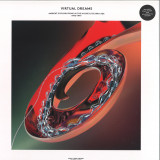
Music From Memory is delighted to be turning 50 with a special release: MFM050 - V/A - Virtual Dreams: Ambient Explorations In The House & Techno Age, 1993-1997 (3xLP/2xCD). The first in a series of compilations, alongside more in depth artist-focused releases, Virtual Dreams will delve into music produced during the 1990’s that redefined the boundaries of ‘Ambient’. This was music that explored the possibilities of Ambient music within a new setting, created often by House & Techno music producers for a world beyond dance floors but made very much with the pre and post-clubbing listener in mind.
When House and Techno exploded out of America in the mid 1980s a whole generation was redefined not only musically but also culturally and chemically speaking. Peaking, quite literally, with a second ‘Summer of Love’ in 1988, millions of young people across the world would experience the life-changing ups of a brave new world but with it of course came the downs; enter the concept of a ‘Chill-out’ room. Whilst early Chill-out rooms lacked a specific sound and were often soundtracked by music such as reggae and soul, slowly young Techno and House producers themselves would become increasingly interested in developing a futuristic ‘Ambient’ soundtrack to a world beyond the thud of the main room.
‘Ambient’ in this new age now though had sharper teeth than in Brian Eno's key text for ‘Music for Airports’, instead here the sounds were the mode of transport rather than the backdrop. While the melodies were pretty, the soundscape steered away from the pastoral, dreaming of outer-space and technology as opening up exciting new dimensions. Much like in the first Summer Of Love; the musicians were again exploring psychedelic, mind-altering and transcendental possibilities of music. And also much as in the first Summer Of Love, a psychedelic visual language would accompany the music. Though now the tracks could be accompanied by music videos, utilising early CGI techniques, they would look almost entirely to the future: envisioning technology, nature and humanity intertwined in a new Utopian future. Virtual Dreams of a better world.
From Ambient and early Chill-out classics, to lesser known one-off projects, as well as Ambient deviations by some of House and Techno’s leading producers, Volume One of Virtual Dreams features tracks by Bedouin Ascent, LA Synthesis, LFO, Marc Hollander, Mark Pritchard & Kirsty Hawkshaw, Richard H. Kirk and more.
To celebrate our 50th release the first 1000 copies include a holographic 'Virtual Dreams' sticker plus a special insert poster with artwork by Victoria Pacheco and design by Steele Bonus.
For this uniquely personal retrospective spread over twelve vinyl discs, Sven Väth takes us back to the early days of his DJ career. On What I Used To Play we meet great pioneers of electronic music, gifted percussionists, obscure wave bands, and innovative producers of a bygone 'new electronic' era. Rough beats and irresistible grooves from the identification stage of house, techno, and acid remind us not just how far electronic music has evolved over the past four decades, but how great it was to dance to EBM, techno, and house for the very first time.
If there is one protagonist of the electronic music scene who has remained curious, innovative and at the very cutting edge of music for over four decades, it's Sven Väth. His multi-layered artist albums and Sound of the Season mix compilations have been defining the genre for over two decades, and even today, he is constantly on the lookout for the next top tune to add to the highlights of his next set. At least, that's the case when he's not producing them himself as an artist or remixer. "Actually, it's always been part of my DNA to think ahead," and nothing had been further from his mind than looking back at his past, but when in spring of 2020 the international DJ circuit had to be scaled down to virtually zero, the 'restless traveler' suddenly had time. Time to stop and reflect on "how it actually was back then, at the very beginning of my career..."
"It was a great trip and with every track, beautiful memories came flooding back".
In the London apartment, he had just moved into, Sven has set up a "little music room", where he cocooned himself for several days, "to look way back for the first time and review my musical journey through the eighties, so to speak."
The interim result was six thematically oriented playlists with a grand total of 120 tracks from 'early 80s' to 'Balearic late 80s', together with excursions into afrobeat, European new wave, and EBM sounds and a few epochal techno/house tracks from the USA in between. From these 'Best of Sven Väth's favorites', the project What I Used To Play crystallized. Sven remembers how the Cocoon team reacted to his proposal: "They found the idea of making a compilation out of it MEGA from the beginning and everyone said 'Sven, go for it', but then, of course, the work really started, namely, to clear the rights and to get clean sounding masters of the up to 40-year-old tracks. There was also disappointment, of course. We couldn't clear certain titles because the rights holders in the USA had fallen out with each other or simply disappeared from the scene. In short, it wasn't easy, but now I can safely say we got the most important tracks."
Finally, after two years of research, curation, design, and administrative fine-tuning, the "little retrospective" from 1981 to 1990 is available. The exquisitely packaged, and three-kilo heavy box set is not only physically impressive, WIUTP is also the definitive record of Sven Väth's musical development. On each of the twenty-four sides of vinyl, you can trace track by track, what influenced him during which phase, and how he took off as a DJ from his parents' Queen's Pub straight into the spotlight at Dorian Gray. There and at Vogue (later OMEN), Sven became the style-defining player in the DJ booth that he still is today.
1981 - 1990: Future Sounds of Now
In the early eighties, the crowd in clubs like Vogue and Dorian Gray danced to what nowadays we call 'dance classics' - mainly disco, funk, soul, and chart pop. It was up to a new generation of DJs, including Sven Väth, the youngest protagonist in the Rhine-Main area at the time, to create their own club-ready music mix. Good new tracks and potential floor-fillers were rarities that had to be sought out and found, in order to prove oneself worthy.
Without MP3s, internet streaming, or other digital download possibilities, music didn't just gravitate to the DJ, instead, it had to be tracked down. In well-stocked record stores in Frankfurt and Wiesbaden or even in Amsterdam, London, or New York, Sven and friends sourced the material for countless magical nights. On WIUTP we can follow Sven's very personal journey through this wild, innovative era in which synth-pop, funk, hip-hop, and disco were successively replaced as 'club music' by house, techno, acid, and breakbeat. By the end of the decade, it was clear to see that these once exotic 'fringe' phenomena would soon become 'mass' phenomena.
Early 80s
Dirty Talk by the Italian-American duo Klein & M.B.O. represents the most innovative phase of the Italo-disco genre in the early eighties like no other track. Mario Boncaldo (I) and Tony Carrasco relied entirely on the original synthetic drum and percussion sounds of the Roland TR-808, coupled with the raunchy vocals of Rossana Casale and guitar accents of Davide Piatto. Of course, other tracks from this period were also influential in style, most notably Unit by Logic System, which worked as the perfect soundtrack to the laser lighting system at the legendary Dorian Gray club. With stomping beats and robotic rap interludes, Bostich by Yello also belongs on Sven's eternal playlist - after all, it caught the attention of Afrikaa Bambaataa, who invited the Swiss duo to perform at the Roxy in New York in 1983.
EBM Wave - Mid 80s
From today's point of view, the almost ten-minute-long, downtempo track Giant by Matt Johnson's band project The The, would probably not be considered an obvious club classic. However, a closer (re)listen reveals the rhythmic intricacies of the percussion overdubs by JG Thirlwell (aka Foetus) on Johnson's composition, and it becomes clear why this exceptional piece of music is one of Sven's absolute favorites. Other classics from this phase include Kaw-Liga by the mysterious The Residents, the hypnotic-synthetic Our Darkness by Anne Clark (and David Harrow), and last but not least, the somber, monotonous anthem Where Are You? by 16Bit, one of Sven Väth's projects together with Michael Münzing, Luca Anzilotti from 1986.
US House - Late 80s
You certainly can't talk about Chicago house without mentioning Frankie Knuckles. The resident DJ at the Warehouse not only gave the name to an entire genre, but also produced epochal floor fillers on the Trax label like the timeless Your Love, sung (and moaned) by Jamie Principle. Acid house protagonists Phuture also hail from Chicago, and on We Are Phuture (also released on Trax) we hear the chirping acid sounds of the legendary Roland TB-303 in full effect. Another featured classic is No UFO's by Detroit's Model 500 aka Juan Atkins, who is rightly considered the 'Godfather of Techno' even if the genre-defining track from 1985 still breathes with the spirit of hip-hop and electro from the first breakdance era.
Afrobeat
Le Serpent, by Algerian-born Abdelmadjid Guemguem, is a track that sounds completely different from everything else on WIUTP. Made in 1978, it's a monumental, rousing groove created without bass or synths, just with five congas! Even though Guem sadly passed away in 2021, his immortal, acoustic beats are understood all over the world and will continue to enrich many thousands of DJ sets for years to come. Another classic that not only Sven appreciates beyond measure is Hugh Masekela's Don't Go Lose it, Baby. In addition to being one of the most important jazz pioneers, the trumpeter and freedom fighter from Johannesburg was very experimental, integrating electronic sounds into his music in later years, in a similar vein to Miles Davis and Herbie Hancock. Dutch jazz pianist Jasper van't Hof's afrobeat project Pili Pili has also aged well. The trance-like, almost sixteen-minute-long track of the same name, manages to fill a whole side on the seventh of twelve vinyl discs in the WIUTP box.
UK-US-Euro - Late 80s
Time for a change of scene, in the truest sense of the word, and from a musical perspective, this section is like landing on another planet. First up is Andrew Weatherall's classic remix of Primal Scream's Loaded, featuring the iconic Peter Fonda sample (lifted from the 1966 biker film Wild Angels) that came to personify the mood triggered by the British Second Summer of Love in the late eighties: "We wanna be free to do what we wanna do, and we wanna get loaded...". This period also saw the emergence of M/A/R/R/S whose only single, 1987's Pump Up The Volume, became a club classic with support from DJ legend CJ Mackintosh. In this most eclectic of sections, we also encounter New York house and reggae producer Bobby Konders and his seminal Nervous Acid.
Balearic - Late 80s
Those who know him, know that Sven had already lost his heart to the 'magic island' of Ibiza as a teenager, so with that in mind, the WIUTP project couldn't end without a Balearic chapter. Inspired by Manuel Göttsching's E2-E4, the immortal, eponymously titled Sueño Latino belongs in there without question. Equally popular on the island was, and still is Break 4 Love by Raze, which thinking about it, would also fit perfectly into the house chapter. Last, but not least, there's an overdue reunion with Sven Väth himself, in his role as frontman of the successful Frankfurt trio OFF. Together with Michael Münzing and Luca Anzilotti (later of Snap!) this 'Organization For Fun' created the off-the-wall club hit Electric Salsa in 1986 which incidentally turned into an international chart smash, putting Sven in the enviable position of having to decide between pop stardom and a DJ career. Well, we all know how that decision turned out and the rest, as they say, is history. A not insignificant part of his story is What I Used To Play. Enjoy!
One thing that is written in stone even in these days of near endless uncertainty is that when Topical Disco unleashes one of their vinyl releases they are a no questions asked, must have. For a label which regularly dominates the top spot of the download charts they still consistently manage to up the ante for their vinyl drops. It’s no wonder at all that the previous editions have gone on to become collector’s editions, disappearing from the shelves as quickly as you can say here today, gone tomorrow.
Volume 24 easily keeps this incredible run of club vinyl masterpieces going strong. Packed across two side of black gold are tracks from newcomers and scene heavy hitters alike Toscana, Toby O’Conner, Charly Angelz and Frank Virgilio.
The mysterious Toscana leads the way with the wonderfully enigmatic ‘The Girl With The Red Hair’, a six and a half minute slice of pleasure packed Balearic disco. Incessant, warm and inviting it combines a divine groove heavy bassline, funky guitar licks and a subtle percussive backbone with a rather brilliant stand-out guitar solo. This is a track which is guaranteed to fill those summer dancefloors.
Next up is Toby O’Conner who is returning to Tropical Disco after his lauded ‘The Heist / 1920 EP’ with another high energy slice of disco goodness in the shape of ‘Cave Of Gold’. Again this is classic Tropical Disco, combing both live chops with jazz overtones as throbbing club ready drums provide the framework for a bubbling bassline, subtle keys and sax solo’s aplenty to weave their magic. Expect jazz inspired shapes to be thrown on dancefloors across the globe when this one drops.
Over on the flip is Charly Angelz, another artist who has been making a considerable swirl on the disco scene of late. ‘Mother Phunk’ is very aptly named with an absolute gem of a bassline front and centre as classic funk vocal chops, vibey pads and guitar stabs all combine perfectly with earworm strings for anther sure fire floor filler.
Closing the EP out is scene stalwart Frank Virgilio. Hailing from Napoli Frank has been behind a virtual disco smorgasbord over the five years including regular chart bothering appearances on Tropical disco. ‘What We Love’ tips its hat to the golden era of house music, think 90’s Soulfuric meets MAW. Vibes abound here from the classic drum sounds right through to the divine ethereal percussion which adds that touch of class. This is another track which will sound just perfect on the golden Isle this coming summer, did some-one say Ibizan boat party? We’re onboard!
Daje Funk Records makes a triumphant return with the latest instalment to the spectacular ‘Slam Dunk’ series bringing you the Slam Dunk EP3.
First up on the A-Side of this stellar four tracker is Strange, with the acid laced disco burner, ‘Keep On’. From the intro of delicious 120bpm beats with added ‘Bongonaise’, the cleanest of guitar riffs leads to a hot disco bass with stabs of Rhodes keys lovingly applied. Just when you think you have it all worked out, the acid rug pull is a masterstroke. ‘Keep On’ has a classic (but often elusive) disco vibe with a wickedly acidic twist. ‘Strange’ will rule the summer, guaranteed. Any questions?
For A2, the considerable production chops of Ezirk are on full display with ‘Erotik’ - an 80s funk inspired taxi ride through rush hour traffic to the best cocktail bar on the planet. It’s infectious, demanding fist bumps and virtual high fives. It’s a melody that sets all the possibilities of a great night out through wielding the ultimate synth power. And that breezy sax? Heaven. Put the needle down and let it take you!
On the B Side, we start with label co-owner and master of the groove, De Gama and his carefully crafted ‘Higher’. The tempo is dropped right down here, with De Gama showing his darker and funkier side. Like a joint Gil Scott Heron and Robert Plant fever dream, ‘Higher’ is an intricate lecture in immaculate beats, unimaginable concepts and chord progressions. Serious grooves. Very serious.
Rounding things off on the B Side and closing the EP is ‘R.O.C.K.’ by Hungary’s The Magic Track. These boys know how to deliver a chugger from the MT workshop. You expect them to lure you in, and ‘R.O.C.K.’ does just that. One minute you’re in church, the next in a heaving club with retro beats, thumping bass and driving piano filling the air. The Magic Track are selling magic dreams and you’re buying. The whole bag.
The Slam Dunk EP 3 slam dunks with such force it shatters the backboard. Get it in your record boxes for the summer, and let it stay there!
First striking us with his exhilarating ‘Yakka’ EP, Bambi OFS has continued to surprise us with his musical output ever since. (…) The Belgium-based producer is carving out an almost unique take on dance music with a heavy debt of gratitude to the endless rhythms and percussion-centric styles of Gamelan, and other styles of music native to Indonesia and further afield (…) the revised ‘Kwon-9’ EP goes for the jugular and ties together the percussion-heavy originals on vinyl alongside phenomenal remixes from Don’t DJ, Georgia, Icon Template and Broken English Club.” Inverted Audio Super excited to bring this killer release on vinyl with a brand new remaster and remixes by Broken English Club, Georgia, Don’t DJ and Icon Template! Meshing together industrial mirages and ethnofictional mindscapes, Bambi OFS provides Antibody with a new suite of polyrythmic spins. Extending on his first ep YAKKA, KWON-9 blurs the line between the synthetic and the organic while pushing the Brussels-based producer’s interest in uneven grooves and mixed meters into sharper detail. Mirrored by the puzzling archaic-futuristic alphabet featured on the cover, this new set of trax softly draws the listener in an elusive and multi-faceted experience. Bambi OFS is Cédric Dambrain, composer, electronic musician and virtual instruments designer based in Brussels, Belgium. Dambrain’s approach to music is motivated by an exploration of perception thresholds, psychoacoustics, and the physiological impact of sound. This diversity of themes is matched by a wide range of productions which include electroacoustic computer music, compositions for ensembles, noise, sound installations and, more recently, club- oriented polyrythmic explorations. Dambrain has also been composing extensively for performance artists and music theatre.
Having crested the west coast modular-ambient wave in just a few releases - including 2018's Sharing Waves on the influential LA experimental imprint Leaving Records - Sean Hellfritsch has swapped the mossy analog synth improvisations of his prior output for refined melodic arrangements dressed in sprightly dawn-of-digital textures. Big Earth Energy plumbs the depths of Hellfritsch's multimedia mind and naturalist heart, spinning an impressionistic narrative world off of cultural touchstones like the PC game MYST, and the work of Studio Ghibli composer Joe Hisaishi. Inspired by the aforementioned, and guided by Hellfritsch's experience as an animator and filmmaker, Big Earth Energy is the soundtrack to a hypothetical video game with a pointedly ecological premise, and a twist of psychedelic charm. In Hellfritsch's imagined virtual journey, the player assumes the perspective of a treefrog sixty-five-million years ago, hopping epochs with each new level, forming a comprehensive picture of the massive changes the planet has gone through over the eons. The ultimate goal of the game is not to amass resources, defeat enemies, or gain power, but to fully witness the unfolding of one of the biggest systems of energy imaginable - or as the album's creator puts it - "to explore the incomprehensibly vast energetic expression and mystery that is Earth." Big Earth Energy is steeped in exploratory RPG intrigue, possibility, and contemplation, lovingly overlaid with Miyazaki-an sentiments and aesthetics. The through-composed, organic, meandering synthesis heard on previous Cool Maritime albums has been fully replaced by meticulous polygonal arrangements that recall the computerized sheen of late 80s work by composers like Hiroshi Yoshimura, and Yoichiro Yoshikawa - using true-to-period gear no less. Even given its referentiality, Big Earth Energy comes off as forward-facing where so much reminiscent music remains fixed to a bygone moment in pop culture. Hellfritsch has created a musical world where the endless verdancy of the biosphere finds its parallel in the golden age of early 1990s video games, and late 80s Japanese environmental music, all while pointing to a hopeful planetary and artistic future that vindicates the motives of all of these muses.
It might seem tongue-in-cheek on the surface, but the fact that the title of Eldritch Priest's sprawling debut vinyl release, Omphaloskepsis, is the Greek translation for “navel-gazing” unlocks something essential to the Vancouver-based composer and writer's singular outlook.
Perhaps even more telling is the title of Priest's 2013 book Boring Formless Nonsense: Experimental Music and the Aesthetics of Failure (Bloomsbury), whose 300-odd pages read as though you've been dosed with potent hallucinogens. Throughout the text Priest addresses—celebrates, even—the titular elements via various musical examples, including that of his peers. What's so bewildering it is that his descriptions of how boredom, formlessness, and nonsense manifest are laced with the very tactics he's depicting. Passages tie themselves in knots, footnotes engulf the “primary text,” he even deliberately misleads the reader.
The restless stasis of Omphaloskepsis could be regarded as an extension of this book's wayward spirit. Things unfold fairly slowly and consistently but it'd be a stretch to describe it as properly contemplative. Like attempting to meditate with a high fever, any sense of tranquility is constantly derailed as one succumbs to queasy agitation. The piece's foundation is a seemingly endless guitar melody; an organic meander that neither seems to repeat or offer any concessions to narrative directionality. Priest unfurls this rambling cantus firmus in a rich, clean, jazz-like tone, but as it's played, it's repeatedly tangled with snarls of dense digital processing and shadowed by stumbling virtual “band.” These strident interjections blatantly contrast with the guitar, yet they aren't so violent as to offer more than a faint itch of distraction. As such, the distinctive amorphousness that this piece asks us to inhabit for its 54-minute duration leaves a strong impression, but also feels utterly intangible.
In addition to his recorded forays, Priest's disorienting music has also been performed by top-tier interpreters such as the Arditti Quartet, Quatuor Bozzini, Philip Thomas, Anton Lukoszevieze, and Continuum. While living in Toronto he co-founded the collective neither/nor with John Mark Sherlock, which featured a cross section of musician-composers playing each other's work including Eric Chenaux, Doug Tielli, Eric KM Clark, Heather Roche, and Rob Clutton. “Though the name refers specifically to a loosely knit group of composers and performers,” remark's the collective's website “neither/nor is also a sensibility that refuses art’s messianic pretensions and the gaping maw of commercialized society, opting instead for art’s right to be esoteric.” In 2021, when Eric Chenaux and Martin Arnold relaunched their neither/nor-adjacent Rat-drifting imprint, an album by Priest, Many Traceries, was among the first to be released. Perhaps unsurprisingly, Priest was a student at the University of Victoria, a school that's come to be known for fostering such staunch individualists as Arnold, Linda Catlin Smith, Allison Cameron, and Anna Höstman.
As a scholar, Priest writes from a 'pataphysical perspective and deals with topics such as sonic culture, experimental aesthetics and the philosophy of experience. Priest brings these interests to his job as an Associate Professor in the School for the Contemporary Arts at Simon Fraser University, interests that also inform his work as a member the experimental theory group The Occulture. In addition to Omphaloskepsis, his new book, Earworm and Event: Music, Daydreams and Other Imaginary Refrains,
The Tel-Aviv centered Yotam Avni officially joined forces with Stroboscopic Artefacts last year, turning in a sensual an invigorating entry for the Monad series. Thanks to his personalized fusion of esoteric and worldly sound elements, Avni immediately made a case to deliver more work to the label, and now he has done so with 'Perlude to Dybbuk,' the second in a new series of S.A. releases to feature the Oblique Artefacts visual team's distinct, elegant portrayals of scanned foliage. As with Avni's previous Monad contribution, the new Perlude to Dybbuk makes references - both in title and in sonic content - to the ancient Hebrew folklore of his homeland (a 'dybbuk' being a kind of limbonic spirit attaching itself to the body of a living human until it has successfully reached its final destination). However, the atmospheric, rather than overt, use of these references gives this record a level of dignity and quality as well as a premonitory feeling that hovers over the proceedings.The opening 'Avka (New Life)' opens with the twin stimuli of chthonic, rolling percussion and ambience that has become a modern Stroboscopic tradition, but ever so gradually deviates from the realm of the easily anticipated. Some of the surprises to be found here are sharp, organic drum fills and sighing strings that have an uncanny vocal quality to them. By the time a surgically clipped acid synth sample comes into the mix, the track has reached a simmering level of excitement and the listener's imagination will have license to reside in a virtual world seamlessly combining elements both ancient and futuristic.Dybbuk' temporarily situates listeners back in brutal modernity, with the first sounds heard being something like insistently slicing helicopter blades. Avni merely uses this as the foundation, though, for a genuinely unique construction whose shamanic beats, throttled horn and undertow of frenzied electronics combine to give the feeling of being menaced and eventually overtaken by a spirit entity. This piece shows just what Avni is capable when operating in a more aggressive, 'post-industrial' mode, and the result stands up with some of the best exponents of that genre.The finale 'Modern Matters' is the most readily club-friendly selection from the disc. This potent, floor-shaking and perspiration-inducing number superimposes resonant vocals from traditional Middle Eastern folk song onto this alchemical mixture of machine oil and sweat, and provides a romantic flair without resorting to naïve, touristic 'ethno-techno.' Avni's skillful dedication to counterpoint, and determination to make a finished form is more than the sum of its parts, shines through here and throughout the duration of this record.
“I wanted to try and showcase as many people as I knew on this mix. My idea of Late Night Tales was to distil a series of relaxing moments; the whole conceptual sonic of relax- ation. So, I was trying to think of all the collaborators and friends that I knew, who’d recorded stuff with this horizontal vibe. Plus, I was also trying to help my friends' stuff get into the world. I know the story of Khruangbin blowing up after appearing on the series (in fact, I think that's how I discovered them). So, the main idea was to create a certain atmosphere, but also to help some of my favourite collaborators and bud- dies to give their songs a little push out into the world. Hope you like it” Jordan Rakei
Due for release on 9th April, Late Night Tales celebrate their 20th anniversary with the release of multi-instru- mentalist, vocalist and producer Jordan Rakei’s majestic compilation. The 28-year-old modern soul icon effortlessly stamps his own jazz and hip-hop driven sound all over this gorgeous array of handpicked tracks. A beautifully layered blend that is mirrored in the music he’s made, itcomes as no surprise that such a supremely gifted songwriter should deliver a mix that is all about the song.
Rakei, born in New Zealand, but raised in Australia, moved to the UK in 2015; he released his debut album, Cloak, with Oz label Soul Has No Tempo, but his two subsequentLPs, Wallflower and Origin, came out on Ninja Tune, the former#2 in Album Of The Year for Gilles Peterson’s Worldwide poll, while Origin was nominated for Best Album at the AIM Awards. Jordan had this to say on his upcoming mix:
As Jordan says,there’s so much more to the song selection on Late Night Tales’latest outing than a random collection of artists. Many have some sort of personal connection, so just as Bonobo provided a platform for the breakout of Khruangbin on a previous LNT, this may have the same ef- fect for Rakei’s friends. After a soothing opener from Fink, good friend and big influence Alfa Mist (part of the Are We Live collective) delivers ‘Mulago.’ “I want to champion their sound and show the world how good he is, and I thought it’d be fitting to start the mix with family,” says Jordan.
Next up is Charlotte Day Wilson with ‘Mountains,’ followed by ‘Count A Heart’ from Moreton, an exclusive collab- oration with Jordan, who grew up on the same street in Brisbane, Australia. “She was the first artist I ever collabo- rated with, and one of the first artists to be involved in mycareer,” he explains. Elsewhere we hear Scottish producer and multi-instrumentalist C Duncan’s haunting ‘He Came from the Sun,’ Barcelona collective Oso Leone deliver a dreamy ‘Virtual U’ and Bill Lauren’s ‘Singularity,’ which evokes a striking sense of time and place.
Snowpoet’s ethereal ‘Evitenity’ is a “long mediative nar- rative over a beautiful soundscape,” which at times seems chaotic, nicely juxtaposed with undeniable beauty, and Maro’s kooky songwriting shines on ‘Always And Forever.’ Long-time buddy Armon-Jones contributes ‘Idiom,’ and Jordan’s exclusive cover version is a two-for-one, Radio- head’s ‘Codex’ merging with ‘Lover, You Should’ve Come Home’ by Jeff Buckley and another exclusive,original com- position by Jordan, ‘Imagination.’ The latter works as a piece with the spoken (Spanish) word voiced by movie director Alejandro González Iñárritu (Babel, Birdman, and The Reve- nant,) who is a big fan of Jordan’s. “He messaged me when I went to L.A and asked to come to my show. I was in such shock and we hung out after. I thought it would be nice to get him to do this in his native tongue, because I don’t think that’s been done yet on the series.” It certainly is a familyaffair. Not theblood is thicker than water kind, but certainly musical kindred spirits.
Cute Heels is the project of Victor Lenis, a contemporary electronic artist living in Berlin, Germany. He grew up in Bogotá, Columbia during the 1990s, surrounded by the radial punk scene. Over the years, Victor's passion and fascination for synthesizers and drum machines to produce and compose resulted in his debut album 'Spiritual" for Dark Entries in 2014 as well as the Third Skin' EP in 2016. Inspired by equal parts Liaisons Dangereuses, Drexciya and Black Devil Disco Club, Cute Heels connects the dots between Detroit techno, early Chicago house and Belgium electronic body music.State of Mind' is a 4-track EP featuring the vocal talents of Berlin artist Aga Wilk, of electro-punk projects Walkman Music and 77TM, on the the title track. On the A-side are two fresh compositions recorded in New York and Bogota between 2016 and 2017. Victor says, 'State of Mind refers to the subconscious as dominated by real facts, natural, unnatural ,metaphysical or virtual and dynamism of the body as physical shield.' The track is a slow building foray into techno, elegantly suited for intangible moments. 'Golden Tears' kicks off with Cute Heels' signature metallic EBM funk played with punchy, percussive analog synths. On the flip we present two banging club remixes. The first is from LA-4A, techno DJ and producer Kevin McHugh aka Ambivalent, who adds a strong kick drum and lacerating hi-hats that build up to a mind melting breakdown with a full on acid squelch attack. The second remix comes from Noncompliant, Midwest US-based producer Lisa Smith aka DJ Shiva, who creates a raw, thumping exercise though off-kilter mechanics and punishing percussion. All songs have been mastered for vinyl by George Horn at Fantasy Studios in Berkeley. The record comes in a custom-made die-cut jacket designed by Eloise Leigh featuring suggestive rope bondage graphic printed spot black matte on black hi-gloss finish. Each copy includes a postcard.
Founded by friends and fellow producers Braunbeck and Hazel, Sol Eterno will serve as an outlet for their own productions, but also for companioned artists sharing similar tastes and aesthetics.
Madame E. is a musical setting of Georges Bataille's 'Madame Edwarda', a short novel that interlaces themes of eroticism, religiosity and death, and was written under the pseudonym Pierre Angelique in 1941, during the occupation of Paris.
Composer Mirco Magnani wrote eleven electronic pieces and presented them to actor/singer Ernesto Tomasini. They turned them into songs by adding vocal melodies and together they produced a libretto based on Bataille's French text. The result of their dynamic interpretation is a hypnotically spellbinding performance where the audience is transported through worlds - ancient and new - and where Tomasini's haunting falsetto conveys the tormented emotions in Bataille's work and becomes the instrument that articulates the writer's famously obscure themes.
The experimental operatic performance captures the atmosphere of heightened human passion, reminiscent of opera seria and revisited through hazy and minimalistic lens. The resulting dark and twitchy mood amalgamates old vintage electronic devices, string piano and Stella Veloce´s touching violoncello. The stage becomes a space where Eros and Thanatos, real and virtual, analogue and digital, cluster and melody, spirituality and technology are intermixed and turned unidentifiable, hence collapsing the binary logic of dualism.
Written by Magnani/Tomasini and produced by Mirco Magnani, with lyrics taken from "Madame Edwarda" by Georges Bataille, Madame E. was developed between Berlin and London where Magnani and Tomasini are respectively based. Recorded in Berlin, mastered by Murcof and released by Magnani's label Undogmatisch, a collective that also includes Nicolas Defawe (Urban Spree) and Valentina Bardazzi, the painter responsible for the album artwork.
the iconic project returns late September with its milestone 10th studio album, ‘I Wrote You A Letter’.
Twenty-five years after his debut, M83 (Anthony Gonzalez) stands as a genuinely era-defining electronic act, renowned for pushing indie-electronic into the mainstream while maintaining absolute critical credibility. With a massive catalog compounding billions of streams—anchored by the timeless “MIDNIGHT CITY” (1.5B streams)—the iconic project returns late September with its milestone 10th studio album, I WROTE YOU A LETTER’.
Recorded between Los Angeles and Paris alongside BENOIT DE VILLENEUVE, this new record follows the highly acclaimed ‘FANTASY’ (2023) and features striking artwork by celebrated Australian photographer BILL HENSON. This release marks a historic chapter, encapsulating a quarter-century of sonic evolution.
Commercially, M83’s power lies in an unmatched ability to transcend generations. Synonymous with cinematic emotion, nostalgia, and immense scale, M83’s sound is virtually a genre of its own, heavily sought after for film, TV, and sync. Live, the act holds top-tier global status, proven by headlining slots at major festivals like Coachella, Glastonbury, and Primavera.
‘I WROTE YOU A LETTER’ delivers exactly what M83 does best: big emotional scale, breathtaking cinematic atmospheres, and sharp hooks, all pushed into a fresh, modern palette.
Fünfundzwanzig Jahre nach seinem Debüt gilt M83 (Anthony Gonzalez) als ein wahrhaft epochaler Elektro-Künstler, der dafür bekannt ist, Indie-Elektro in den Mainstream zu bringen. Mit einem riesigen Repertoire, das Milliarden von Streams umfasst – angeführt von dem zeitlosen „MIDNIGHT CITY“ (1,5 Milliarden Streams) – kehrt das ikonische Projekt Ende September mit seinem wegweisenden zehnten Studioalbum „I WROTE YOU A LETTER“ zurück.
Das neue Album, das gemeinsam mit BENOIT DE VILLENEUVE in Los Angeles und Paris aufgenommen wurde, knüpft an das hochgelobte „FANTASY“ (2023) an und besticht durch ein eindrucksvolles Cover des gefeierten australischen Fotografen BILL HENSON.
Diese Veröffentlichung markiert ein historisches Kapitel und fasst ein Vierteljahrhundert klanglicher Entwicklung zusammen.
Kommerziell liegt die Stärke von M83 in der unübertroffenen Fähigkeit, Generationen zu verbinden.
Als Synonym für filmische Emotionen, Nostalgie und immense Größe ist der Sound von M83 praktisch ein eigenes Genre, das für Film, Fernsehen und Synchronisation sehr gefragt ist.
Live genießt die Band weltweit Spitzenstatus, was durch Headliner-Auftritte bei großen Festivals wie Coachella, Glastonbury und Primavera unter Beweis gestellt wird.
„I WROTE YOU A LETTER“ liefert genau das, was M83 am besten kann: große emotionale Bandbreite, atemberaubende filmische Atmosphären und eingängige Hooks, alles verpackt in einer
frischen, modernen Klangpalette.
out of Stock
Last delivered 3 days ago available to reorder, subject to availability
03: A Post-Modern Object-Oriented Chaotic Cellular Microtonal Teledildonic Virtual Simulacra! (Buzzwords (that might have gotten you tenure) for sampled orchestra)
01: Martigny (1991) for computer-controlled synthesizer
02: 24 Chorales for Chris Mann (1991) for computer-controlled synthesizer
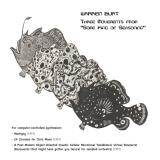
EM Records is proud to release Three Movements from “Some Kind of Seasoning” by the eminent Warren Burt: composer (and performer, writer, instrument builder, educator) of genius. Burt was born in 1949 in the USA, and moved to Australia in 1975. Throughout his long and inspired career, his expansive aesthetic has eagerly embraced microtonality, improvisation and technology, fusing these elements in often humorous and/or irreverent compositions based on live interaction with intelligent or semi-intelligent machine processes. He sets up machine-generated musical environments and then “wanders through” their rules and behaviors, exploring the resulting possibilities in a manner which never results in tech-driven alienation or alienating randomness; Burt’s keen and personable musical intelligence is always evident. This release features music from the final sections of a near-six-hour epic cycle of interactive computer and synthesizer pieces from 1990-91, investigating the magical intermediate space between the human and the mechanical. Dedicated to Kenneth Gaburo, the music draws on wide-ranging inspirations including Sun Ra and Elliott Carter, Quincy Jones’ “Setembro” and Charles Ives, Portsmouth Sinfonia and ancient Greek modes. With good-natured humor, an openness to the excellence of “mistakes” and a wide range of timbres, the music includes progressions of "traditionally musical" pitches, delicate textures of sustained electronic tones, raucous and noisy combinations of sound. Available on 12” LP, CD and DL, with liner notes by the composer.
c 03: A Post-Modern Object-Oriented Chaotic Cellular Microtonal Teledildonic Virtual Simulacra! (Buzzwords (that might have gotten you tenure) for sampled orchestra) 1991 for computer-controlled synthesizer
[c] 03: A Post-Modern Object-Oriented Chaotic Cellular Microtonal Teledildonic Virtual Simulacra! (Buzzwords (that might have gotten you tenure) for sampled orchestra) [1991] for computer-controlled synthesizer
[c] 03: A Post-Modern Object-Oriented Chaotic Cellular Microtonal Teledildonic Virtual Simulacra! (Buzzwords (that might have gotten you tenure) for sampled orchestra) [1991] for computer-controlled synthesizer
Lost Soul Super Rarity “Here I Am Baby” by Lady Jane reissued by Athens of the North
Rare 1980 Detroit funk-soul LP finally surfaces after 45 years, revealing a powerful story of survival and artistic resilience
Edinburgh based label Athens of the North is pleased to announce the reissue of Here I Am Baby, the only studio album by soul and funk vocalist Lady Jane (Jane Brice), originally recorded at Studio A, in Dearborn Heights and privately released in 1980.
Lady Jane recorded these sessions during a turbulent period in Detroit in the late 1970s, working with respected engineer Eric Morgeson and a studio band on material largely written by her then-husband. The album remained virtually unknown for decades, with copies destroyed in a flood and masters held by her ex-husband. A chance discovery by Friends of Sound Records founder David Haffner in 2022 set the reissue in motion. Remarkably, before his death, Jane’s ex-husband returned the original master tapes to her—yielding not only the complete multitracks for Here I Am Baby, but an entire album’s worth of unreleased material, also coming soon on AOTN.
Here I Am Baby showcases Jane’s extraordinary voice across a compelling blend of soul, funk, and disco, from the opening ballad through heavy funk excursions like “Never Lived In The Ghetto” and “Space Flight.” The album’s final track, “She’s A Star” - the only song Janewrote herself - carries profound personal significance. Recorded without her husband’s knowledge, the song directly addresses her survival of childhood sexual abuse and stands as a moving testament to resilience and self-belief.
Now an ordained minister, Jane Brice has spent decades away from the spotlight. But her voice—at once forceful, delicate, and vulnerable—deserves to be heard. Newly mastered from the recovered tapes, Here I Am Baby and the forthcoming Miss Disco present not merely a rare funk-soul artifact, but a powerful document of a woman’s courage in reclaiming her own story.
out of Stock
Last delivered 9 days ago available to reorder, subject to availability
the iconic project returns late September with its milestone 10th studio album, ‘I Wrote You A Letter’.
Twenty-five years after his debut, M83 (Anthony Gonzalez) stands as a genuinely era-defining electronic act, renowned for pushing indie-electronic into the mainstream while maintaining absolute critical credibility. With a massive catalog compounding billions of streams—anchored by the timeless “MIDNIGHT CITY” (1.5B streams)—the iconic project returns late September with its milestone 10th studio album, I WROTE YOU A LETTER’.
Recorded between Los Angeles and Paris alongside BENOIT DE VILLENEUVE, this new record follows the highly acclaimed ‘FANTASY’ (2023) and features striking artwork by celebrated Australian photographer BILL HENSON. This release marks a historic chapter, encapsulating a quarter-century of sonic evolution.
Commercially, M83’s power lies in an unmatched ability to transcend generations. Synonymous with cinematic emotion, nostalgia, and immense scale, M83’s sound is virtually a genre of its own, heavily sought after for film, TV, and sync. Live, the act holds top-tier global status, proven by headlining slots at major festivals like Coachella, Glastonbury, and Primavera.
‘I WROTE YOU A LETTER’ delivers exactly what M83 does best: big emotional scale, breathtaking cinematic atmospheres, and sharp hooks, all pushed into a fresh, modern palette.
Fünfundzwanzig Jahre nach seinem Debüt gilt M83 (Anthony Gonzalez) als ein wahrhaft epochaler Elektro-Künstler, der dafür bekannt ist, Indie-Elektro in den Mainstream zu bringen. Mit einem riesigen Repertoire, das Milliarden von Streams umfasst – angeführt von dem zeitlosen „MIDNIGHT CITY“ (1,5 Milliarden Streams) – kehrt das ikonische Projekt Ende September mit seinem wegweisenden zehnten Studioalbum „I WROTE YOU A LETTER“ zurück.
Das neue Album, das gemeinsam mit BENOIT DE VILLENEUVE in Los Angeles und Paris aufgenommen wurde, knüpft an das hochgelobte „FANTASY“ (2023) an und besticht durch ein eindrucksvolles Cover des gefeierten australischen Fotografen BILL HENSON.
Diese Veröffentlichung markiert ein historisches Kapitel und fasst ein Vierteljahrhundert klanglicher Entwicklung zusammen.
Kommerziell liegt die Stärke von M83 in der unübertroffenen Fähigkeit, Generationen zu verbinden.
Als Synonym für filmische Emotionen, Nostalgie und immense Größe ist der Sound von M83 praktisch ein eigenes Genre, das für Film, Fernsehen und Synchronisation sehr gefragt ist.
Live genießt die Band weltweit Spitzenstatus, was durch Headliner-Auftritte bei großen Festivals wie Coachella, Glastonbury und Primavera unter Beweis gestellt wird.
„I WROTE YOU A LETTER“ liefert genau das, was M83 am besten kann: große emotionale Bandbreite, atemberaubende filmische Atmosphären und eingängige Hooks, alles verpackt in einer
frischen, modernen Klangpalette.
Tucked in the heart of Koreatown, Los Angeles, lies The Libra Hotel—the titular architecture of Nick Malkin's new album and site of his musical and psychogeographic exploration. Unlike most musical "site-specific" studies, Malkin remains wholly ambivalent to the documentarian approach, instead sharpening an auteur-like focus on the site as a conceptual and highly expressive backdrop. The Libra is musically explored as a space that houses a noir fragmentation of identity—the exhausted trope of a complicated protagonist walking through rain-soaked street corners and fumy neon lights—where an inner monologue is rendered in both miniature and at a cosmic scale. Casting aside stifling tropes around field recording, ambient, and improvised music, Malkin's work finds its own unique fidelity and emotional core through the assembly and reassembly of memory. Nearly every sound on the album—from frayed saxophones, lambent pianos, and dissected jazz drum kits—are multiplied, shattered, and reconstituted into shapes that adorn The Libra in a motion-blurred fog. The narrative of the Hotel suddenly appears as if out of the mist, with intersecting characters interacting within its walls by happenstance. Adminst the languid set pieces, wraith-like sonic grains gravitate around wide subbass beams that give structural form to The Libra, a narrative tension like when a scene is shot from hundreds of different perspectives: an image both luminous and veiled.
Much like Frank Sinatra's own spatial residency immortalized on "Live at The Sands," "At The Libra Hotel" showcases an exuberant view of entertainment, hospitality, and a form of masculinity, one that can quickly detourn into darkness. Knowing this, Malkin extracts a melancholic core out of The Libra locale. The flickering shadows of American decadence are shown in their ephemeral honesty, lines that trace how even in everyday life virtue is tested, sanity is tested, even reality is tested within the confines of desire, within the night. The album is draped in fleeting textures, carefully arranged with a trance-like microtonality, the faint inflections and articulations of a jazz band cascading into dissipated stillness. Voicemails about changed locations and covert eavesdropping on guests' whispered conversations provide an atmosphere of missed connection and voyeurism—a purloined letter of desire receding into a vanishing point. Like the music itself, The Hotel, a chapel perilous at the intersection of desolation row, the center of it all, yet simultaneously at the edge of town, becomes a structure between libidinous virtuality and actuality—our inevitable half-light.
Ultimately, the pensive atmosphere of "At The Libra Hotel," powerfully asserts a plea for the kinds of intimacy only possible in transient spaces. Here, memory cascades into a force that feels like something supernatural, perhaps even religious, yet always subject to the infidelity of our imagination. Here, the album opens into its primary psychodrama, the transient nature of subjectivity itself and how this becomes fractured in the tumult between our commitments and desires. Within this nocturnal space, to quote Louise Bourgeois, "you pile up associations the way you pile up bricks. Memory itself is a form of architecture."
Released in 1983, "En la guía, en el listín" remains a permanent anomaly in the history of Spanish pop music, with few clear predecessors and even fewer descendants. It is an imperfect yet fascinating catalog of the many faces Derribos Arias could reveal. Its sound combines odd electric rock, leftfield proto-hip-hop, and dark, immersive songs that simply defy categorization. An essential album. Includes liner notes and the artwork of the original insert. By late 1981, the San Sebastián-based group La Banda sin Futuro had already transformed into Derribos Arias. Their first two singles dazzled critics eager for new ideas capable of placing Spanish pop alongside the contemporary music increasingly arriving from abroad in real time. 'Branquias bajo el agua', the standout track from the band's debut single, topped the list of Best Songs of 1982 as voted by listeners of Diario Pop on Radio 3 (Spanish National Radio). With an expanded four-piece lineup and a larger budget than they had enjoyed for their earlier singles, the band entered the prestigious Kirios Studios to record their album, with Paco Trinidad serving as producer. The electric intensity of 'Intima decoración' and 'Crematorio' -angular, off-kilter reinterpretations of a strain of rock descended from The Velvet Underground and The Stooges, a style with virtually no precedent in Spain-are excellent examples of the band's sound. To aberrate was the key term Poch used to describe his ineffable working method: a fearless creative freedom without which songs such as 'Lo que hay' could never have existed. The track stands as a leftfield proto-hip-hop number, later reworked as 'Disco pocho,' demonstrating both his admirable lack of prejudice and his complete disregard for any commercial ambitions the album might have had.Unfortunately, this album would never have a follow-up.
Remastered limited edition double vinyl with double-sided screenprinted poster-cover (sleeve folds out to be one huge poster). A real collectors item!
When Off Off came out around June 1984, one couldn’t speak of an independent music scene in Portugal. Warm Records’ vague existence didn’t have any impact and Dansa do Som’s inaugural release appeared only in December. 10 years after the revolution, after two IMF interventions, a lot of political instability (not to say turmoil, in the first couple of years) and the natural excesses of a sudden burst of freedom, the Portuguese consumer had more choices but a generally poor standard of living. There was no entrepreneurial culture and serious second thoughts about investing private money in risky ventures.
After many complaints about the whole music scene (institutions, critics and record label executives, popular and classical music alike), something that would continue well beyond the end of the decade, Telectu decided to finance, record, produce, release and sell an album with complete independence from outside structures. Their karmic reward was profit. According to Vítor Rua, Off Off was the only album fully payed by the duo and the only one that really payed off. Not an easy accomplishment for a double LP housed in a large (also double-sided) screenprint with complicated cuts and folds. The artwork was conceived by António Palolo, a friend and multidisciplinary artist. It was based on a collage of heavily saturated and xeroxed polaroids framed in shocking pink and green. Palolo was considered the third member of Telectu, regularly producing slides, video and other visual support for their shows. The inspiration for the type of cover came from GRM’s Gramme series.
Off Off is divided in four distinct sides, each one corresponding to a “theme” or “function” related to Telectu’s manifold artistic interests and interactions. The titles are also gateways to influences and a small portion of Portuguese cultural life:
- Side 1 / “Diagonale” is dedicated to Egídio Álvaro, art critic and gallery director (he opened Diagonale in Paris). Performance art was arguably his main artistic concern over the years, so the music on this side is suggested for use by one or more performers in live or playback situations. The three tracks segue into each other, linked by a synth arpeggio much in the same way as Telectu’s previous “Belzebu” álbum (1983);
- Side 2 / “Anarké” is dedicated to the composer Filipe Pires, one of Jorge Lima Barreto’s recurring invocations when asked about worthwhile contemporary music in Portugal. It is subtitled “concert music”, proposing «a new form of listening». Three tracks also, and these are separated by “clap interludes”, which basically consisted in the following: JLB and VR each had a pair of headphones on, and they clapped their hands according to the rhythm of the music each one was listening. Both musicians were interacting with a different Steve Reich piece: Vítor with “Music for Mallet Instruments”, Jorge with “Six Pianos”. The result is disjointed clapping, an awkwardly deliberate celebration of their own music. Telectu applauded themselves.
- Side 3 / “Cornucópia” is subtitled “music for theatre” and dedicated to Luís Miguel Cintra and Luís Lima Barreto (JLB’s brother), both connected to the Cornucópia theatre company. The side consists of several short pieces previously used as interludes in the Cornucópia staging of “Mariana Espera Casamento” (1983). Field recordings, mood pieces, ambience and a numeric poem (“Soneto Soma 14x”, by E.M. de Melo e Castro) read by João Perry, a quite well-known stage actor. His voice is treated with a flanger effect;
- Side 4 / “Palolo” is “video music”. It’s a one-take mix recorded from cassette sources (Telectu studio experiences) and done live while watching António Palolo’s Om film (1978) projected on the living room wall. It’s a deep, immersive, quasi-mystical 20-minute piece perfectly suiting the meditative, abstract, fluid images created by Palolo by mixing paint and water inside a bathtub. One imagines the Cosmos, hardly suspecting the technique. The film is 90 minutes long, so the music on the LP is of course edited.
The six titles on sides 1 and 2 evoke demons, all of them with conflicting symbolism, since it varies from culture to culture, religion to religion. No explanation is given and Vítor Rua has no idea where this imagery comes from. During virtually the whole stretch of the 1980s, Jorge was the one in charge of titles and concepts, and Vítor didn’t bother too much even reading the liner notes :) In any case, when you synchronize the listening experience with the imagery, a powerful impression emerges, a feeling of being in the presence of these entities while placing yourself inside the sonic narrative.
Off Off is undoubtedly a seminal album in the history of electronic music, as much Heldon as Fripp & Eno, jazz and American minimalism, cosmic out-thereness, mantric miniatures. Telectu at the height of their powers, still very early on, delivering an album-manifesto advocating intermedia art and the fierce independence of Portuguese musicians «from the scum of capitalist music industry monopolies. It’s a path to follow, albeit one that requires enduring hardships and retaliation from music industry gangsters.» Despite a few journalists deemed «capable of being free», the media are «enslaved by the dominant and fascist imbecility of the speculators of light music.» Off Off is addressed to those journalists «and to an audience angry at the cultural misery imposed upon us ..., certain that this music will open new horizons of musical pleasure in the conception of Portuguese avant-garde music, and in the open consciousness of us all. OFF OFF repeats Freedom.»
Those two words are a direct lift from Alberto Arbasino’s 1968 book Off Off, the basis of which is a critical analysis of Theodor Adorno’s and Dwight MacDonald’s ideas concerning the stratification of culture in different levels (high, mid and low) and the pervasiveness of mass culture in the form of a culture industry. In very simplistic terms, and that is precisely the point that inspired Jorge, Arbasino argued that it was possible and desirable to effect a revolution from below, cultivating alternative circuits completely cut-off from what he termed the in-in reality. Telectu’s record was a deliberate demonstration that it could be done, displaying Freedom in the face of all the gatekeepers and other human obstacles.
"Psicofásicos" by The Silver Pumpkins is a unique document: an EP that is virtually impossible to find in its original edition, offering an essential glimpse into Bolivia's thrilling 1960s rock scene-raw, wild, and unlike almost anything else. Beyond the ubiquitous covers of Cream and Jimi Hendrix recorded by countless South American bands, this EP features the far less common 'Pushing Too Hard' by The Seeds and, most notably, the dark, powerful 'You're Gonna Miss Me' by the 13th Floor Elevators. Bolivia boasts an extraordinary musical legacy of raw, garage-driven '60s sounds. Alongside Peru, it was one of the South American countries where the greatest number of recordings in this style were released-captured with limited resources but overflowing with spontaneity, energy, and attitude. The difficulty of obtaining the records that were shaping the latest Anglo-American rock trends of the 1960s in many Spanish-speaking Latin American countries led to a proliferation of local bands covering their musical heroes. Well-known artists such as Cream, Jimi Hendrix, and Iron Butterfly were reinterpreted by countless groups, making these songs available to local audiences without having to rely on imported records reaching their countries. By doing so, these bands helped spread the cutting-edge rock music already making waves elsewhere in the world. What makes this release particularly unusual is that the band chose to cover second-tier cult acts rather than the obvious classics-groups that only briefly cracked the U.S. Top 50 in the late '60s, such as The Seeds and 13th Floor Elevators. Originally released on the Bolivian Psicofásico label, this exceptionally rare EP pairs The Seeds' garage anthem 'Pushing Too Hard' with the ferocious, immortal 'You're Gonna Miss Me' by Roky Erickson and the 13th Floor Elevators. The raw power of the original songs is pushed even further here by the rudimentary recording techniques and the limited instrumental skills of the very young members of The Silver Pumpkins. The result is a one-of-a-kind document-virtually impossible to find in its original pressing-that helps complete the picture of Bolivia's fascinating '60s rock scene. First-ever reissue.
out of Stock
Last delivered 28 days ago available to reorder, subject to availability
“I like to work with a variety of instruments and set ups,” says Mark Van Hoen, sometimes known as Locust or Autocreation but here working under his own name on the excellent Plan For A Miracle, his first physical release of solo music since 2018’s Invisible Threads. ”Sometimes it’s literally in my studio, with all the hardware electronics available. Sometimes the laptop, using software instruments. Some of the tracks on this record were recorded in the desert (Joshua Tree) using a 4-track tape machine and small modular synthesiser set up. Each track was recorded in different location using different instruments, which accounts for the distinction between each piece. It’s also about my own reaction to my environment, and what’s going on in my life at the time.”
The Croydon-born Van Hoen started musical life in the early 1990s, signing for R&S records in 1993 but developing his own, myriad and distinctive style across a range of releases on Touch, Editions Mego and other labels, using a battery of instruments, including analogue synthesizers and taking a number of different approaches to recording, rather than ploughing a single sonic furrow. He has worked on a number of collaborations, including with Nick Holton and Neil Halstead of Slowdive, under the moniker of Black Hearted Brother - their Stars Are Our Home was released in 2013. “I have known Neil Halstead since 1992,” says Van Hoen. “He shared a house with me for a couple of years, and the music I was making and listening to along with clubs I was attending had an influence particularly on Pygmalion, the final Slowdive album on Creation.”
Each track on Plan For A Miracle does indeed sound like a world unto itself, a mini-environment, a weather condition, an ecosystem created for the moment. It’s a collection of tracks recorded over the past few years, released on Bandcamp - despite his apparent absence, Van Hoen works constantly. Opener “Climates”, in its exquisite limpidity, feels like a homage to Brian Eno, one of his most formative influences in his teen years, commencing with Music For Films, which he bought in 1979. “This Is For Them”, feels like a ghostlike throwback to early drum & bass or electronica, reminiscent of his own, earliest outings. “There have been a number of requests from labels to make some more music like my very early releases on R&S,” says Van Hoen. “This is part of ‘letting go’ and realising that there’s nothing less creative about going back to those styles again.”
“Pencil Of Spheres” is something else again, a magnificent, imaginary glass structure, shimmering, refracting, without visible means of suspension, a thing of impossible beauty. “Electric Lights” evokes an abandoned fairground, its lights still pulsating, its music lingering. “The Underpass”, meanwhile, insofar as it reminds of anything at all, is faintly reminiscent of Cluster or Neu’s! West German ambience, the urban mundane rendered magical, the sodium lights, the whitewashed walls. The reverberant, faintly oriental chimes of “Insight” transport us yet again, burgeoning and intensifying.
The landscapes, the skyscapes rendered on Plan For A Miracle feel unpopulated as a rule - but when he does introduce vocal elements, Van Hoen has a history of doing so to spectacular effect - think of “Real Love” from 1998’s Playing With Time, the seductive intonation of its title recurring throughout like a series of massive holograms, echoing, stuttering, breaking up, surging. Here, there are just the faintest of vocals, barely distinct, disquieting. “There’s been a bit of a game changer in recent times,” explains Van Hoen. “AI software that enables you to extract vocals and instrument parts from virtually any recording. That means sampling individual parts from existing sources is no longer limited to the original mix exposing certain parts soloed. The vocal parts I use are from multiple sources and often pitch shifted altered rhythmically and melodically.“ There’s further vocal chatter on “I Really Do”, proceeding at a faster pace as if giving chase, or being pursued - distant, enigmatic. “The Music”, meanwhile, its beat tolling, lost in its own fog of static, features a curious intonation, like the ghost of a lost Walker Brother.
Sadly, the album’s title is in reference to a personal tragedy on Van Hoen’s part - the loss of his wife. Titles such as “I Won’t Give Up”, which faintly reminds of another Eno masterpiece, Another Green World, in its nautical hurly-bury, or the pastoral strains of “Mrs Who”, heavily clouded with sadness, seem to allude to this. “In fact the record was recorded entirely before she passed away,” says Van Hoen, “most of it before she even became very ill. The title was given to the album when it started to look like she wasn’t going to make it beyond a few months. It was something Osho said - “plan for a miracle” - so it was a statement of hope. Unfortunately it was not to be.” Although the album is non-thematic, non-specific in its atmospheres, sound paintings, elegant structures it most certainly stands as a magnificent monument to Osho’s memory.
-David Stubbs.
out of Stock
Last delivered 31 days ago available to reorder, subject to availability
It is virtually impossible to describe with mere words how emotionally powerful this work of art is. Just listen. Listen, listen, listen...
A blissed-out 80-minute epic, Hatchback's Phaser For The Ocean, Chorus For The Moon is his magnum opus, a sprawling masterwork that encompasses ambient, new age and environmental music to wondrous effect. Moving, hypnotic and deeply meditative, it's FFO Mike Brooks, Deuter, Klaus Weiss, Innovative Communication, Harmonia, Cluster, Ashra's New Age of Earth, Stomu Yamashta, Haruka Nakamura, Yoshimura, Hosono, the works.
A record truly deserving of the deluxe Be With treatment, the vinyl was specially cut at Abbey Road Studios whilst the original stunning artwork has been pleasingly expanded. Now, an eye-catching holographic-foil layer moon is set against the original tones, wrapped up in a sumptuous double-gatefold jacket.
Soaked in Californian consciousness and limited to a run of just 500 copies for the world, this release is a treasured balm like no other for these troubled times.
Hatchback is the atmospheric, melodious ambient alias of California-based artist Samuel Milton Grawe. Sam creates music that sings of the Cosmos, full of deep resonant tones, glistening arpeggios, lush pads and harmonic motifs.
"When I first was getting into the creative side of music making in my teens, I was heavily influenced by concept albums like Quadrophenia and The Lamb Lies Down on Broadway, as well as epic pieces that took up an entire side of a record: Pink Floyd’s Echoes, Yes’ Close To The Edge, Klaus Schulze’s Nowhere Now Here, Miles Davis' Shhh/Peaceful and He Loved Him Madly. In the extreme, these ideas coalesced in double albums where each side of each record is occupied by a single title - Yes’ Tales From Topographic Oceans and Tangerine Dream’s Zeit being primary examples. When I returned to making music after moving back to Northern California in 2020, the first piece I recorded landed around the 20-minute mark, and the idea of creating three other long pieces to realize a full album felt like a natural - if indulgent - goal. From there, each new piece followed sequentially. Four songs. My fourth album." - Sam Grawe
Phaser For The Ocean Chorus For The Moon is a pure expression, informed by a lifetime of deep listening unbound by algorithms or AI. These are songs for the sunrise and the sunset - and every colour in between.
out of Stock
Last delivered 13 days ago available to reorder, subject to availability
To celebrate the launch of the 4th and last DLC of Atomic Heart, Kid Katana Records teamed up with Mundfish to bring you this high quality album for the first time on an exclusive double vinyl.
With over 10 million players since its release, and a nomination at the 14th Hollywood Music in Media Awards, Atomic Heart has kept on bringing new content in the game, enriching the players’ experience with new Stories, Threats and Music to pursue the fight for freedom and progress.
The physical edition is a premium 2LP designed in close relationship with the game's creative team: Track selection handpicked by Atomic Heart team, including tracks from Mick Gordon, GeoffPlaysGuitar and Boogrov, and 1 new track (DLC #4 trailer exclusive) 2-colored vinyls with unique red and black “corona” effect: handmade vinyl effect melting red and black colors to shape a unique vinyl color on each product, mirroring the cover art.
Exclusive cover art with mat finishing and glossy effect on the Twin and motorcycle
out of Stock
Last delivered 6 days ago available to reorder, subject to availability