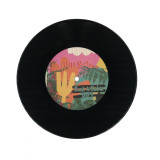
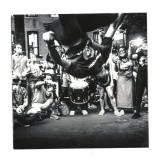
A seismic, cinematic double dose from two sonic veterans with previous in Wire, Electrelane, and Better Corners. MEMORIALS’ kaleidoscopic debut covers broad musical territory, encompassing protest songs, fuzz-flooded pop, searing drone, and psychedelic freakouts whilst carving out a sound that is uniquely their own.
Both halves of this dynamic double album were originally conceived as individual film soundtracks but once the multi-instrumental duo of Verity Susan & Matthew Simms brought ‘Music For Film’ into a live space, the desire to shape it into a cohesive whole was more than they could resist. The resulting, intoxicating, musical odyssey can be viewed independently from the associated films and stands proudly as an ambitious artistic statement.
“The music we like and admire ranges from challenging to really tuneful, and we try to bring all that together in a way that sounds natural.” - MEMORIALS
‘Music For Film: Tramps! & Women Against The Bomb’ – is scheduled for release on May 12th 2023 via The state51 Conspiracy. The limited double LP (500 only) comes in an embossed reverse board sleeve and indie shop editions will also include an exclusive poster.
out of Stock
Last delivered 3 years ago available to reorder, subject to availability
Somewhere in the Lower-Franconian vineyards lies a hidden and mostly unknown canyon, a place that often returns to the thoughts and dreams of Läuten der Seele’s Christian Schoppik. Though a much rarer occurrence now as a consequence of environmental change, chance encounters upon the area in the past would sometimes reveal small ponds amongst the reeds, teeming with life and populated by colonies of newts and the now endangered yellow bellied toad. The transience of the water and the wildlife it hosts, dependent on season or climate, lends the area an almost fantastical, dream-like quality. Was it ever even there at all? A secret place that may or may not be present holds vast appeal to some enquiring minds… Ertrunken Im Seichtesten Gewässer, the third Läuten der Seele album in two years, is inspired directly by these experiences. Translating as ‘drowned in the shallowest stretch of water’, a title as pregnant with dread as it is wonder, the themes present speak both to personal memories and a wider understanding of place and time, and how we might interpret our own position within an ever-changing, sometimes disappearing world.
The record is presented as two long-form pieces divided into four separate movements, each titled so as to reflect this natural environment and its intersection with imagination, relying on processes of collage that draw from myriad indeterminable samples, field recordings and various recorded instruments. Those familiar with Schoppik’s work, both as Läuten der Seele and with Brannten Schnüre, will find present many of his signature tropes - the way deeply layered collages render abstracted visions of the past alive in the present - though what is always significant about his approach is not so much aesthetic as the wider concepts it attempts to express and emote. Indeed, emotional response is key to the Läuten der Seele sound, how overlapping notions of nostalgia, memory and identity calibrate experience and understanding of who we are and the world around us, whether it’s a world that’s gone or another imagined into being. If you observe the artwork closely enough, you may find a clue as to the canyon’s location, though such specifics are besides the point. The music itself infers a wider sense of the impermanence that characterises hidden worlds, wherever they might be or whoever they might belong to.
out of Stock
Last delivered 3 years ago available to reorder, subject to availability
"Bastian Epple makes an eagerly anticipated return to marionette under his elusive MinaeMinae guise that imagines rich sonic architectures for the journeying spirit to voyage to. Räumlichkeit is Epple’s debut album and third release to date following Gestrüpp from 2020, venturing further into melodic electronic nostalgia and percussive beat oriented soundscapes.
Growing up in a small village in southern Germany, Bastian Epple was never interested in kitschy folk sounds, rather he took solace in the time he would spend meditating to repetitive and hypnotic patterns. His guitar strumming and what sounded to his mother like a young Philip Glass on a cheap Casio keyboard encouraged little Epple to tread on this self-taught path of developing his own musical language. This led him to start experimenting with a tape recorder and layering sounds with non-musical samples to eventually working with a DAW.
Bastian went on to study Media Art at the Center for Art and Media (ZKM) in Karlsruhe and graduated with a diploma in film and documentary media - where he now works as a freelance filmmaker and lecturer at Stuttgart Media University. However, this never stopped him from creating and playing with wide-eyed sounds, eventually amassing a vast collection of tunes and finally emerging from this anonymity.
Utilizing modular synth, self made tape echos, synthetic sounds, recordings of ethnic percussion and guitar, MinaeMinae understands musical material similar to documentary footage which he would splice, repitch, and rearrange intuitively into captivating worlds."
out of Stock
Last delivered 3 years ago available to reorder, subject to availability
On their sophomore effort Tusky, surrealist duet Robbie & Mona ascend beyond the lo-fi scrawlings of their debut album to something altogether more grandiose. Between the lights down drama of sprawling opener ‘Sensation’, to the ‘roll credits’ coda of closer ‘Always Gonna Be A Dead Man’, Tusky exists as a glitzy, lucid journey playing out before the listener.
While debut album EW captured William Carkeet and Ellie Gray as they were finding their feet with one another, creating Tusky was a wholly symbiotic process from day one. “We got better at knowing what each other wanted,” William offers. “This was the album that we were trying to make from the beginning.”
Simultaneously evoking multiple eras of music, the album drifts through worlds of synth pop, jazz, trap, drill, ballroom waltz and leftfield electronica, with the scatterbrain sound palette melded by a peppering of instrumental motifs and William’s addiction to sampling sounds across multiple tracks. “I wanted there to be this weird dimensional thing going on,” William explains, “where songs from the album are playing in multiple places.”
The record sees an expansive cast of musicians assembled, with a much heavier focus on live instrumentation than previous outings. Alongside the expected fare of crackly synths, samplers and drum machines, Tusky gets its glossy sheen from a rich tapestry of jazz drums, double bass, grand piano and saxophone.
Most of the tracks are laden with improvised saxophone from Campbell Baum (Sorry, Broadside Hacks) and Ben Vince (Housewives, Joy Orbison), much of which was scrambled by William in post-production, lifting scraps from one song and layering them atop an entirely different track. Elsewhere, session musicians were cherry picked, including Bingo Fury, his drummer Henry Terrett, and a string ensemble led by Caelia Lunniss and Jo Silverston (Spindle Ensemble).
Most surprising is a rap feature from Monika (of South-East London collective Nukuluk), who brings album centrepiece ‘Mildred’ to new heights with a fiery verse on pain. Aside from being the most unlikely addendum to a sombre piano ballad, it demonstrates Robbie & Mona’s natural state of playfulness, forever following emotions and sensuality over any notion of traditional compositional boundaries.
Many of Tusky's tracks owe their inception to cinema, be it the soundtrack to Betty Blue, the glowing films of Wim Wenders, or the surprising parallels between La Belle Et La Bete and Bad Boys. Equally, much of Robbie & Mona's new-found sense of tension and spectacle comes from William’s recent work soundtracking independent filmmakers, while Ellie gave greater priority to threading a narrative through her stream of consciousness writing style.
In all its majesty, Tusky celebrates creativity with creation. “If you begin to see fiction as real, you can reincarnate and become different things. You can grow,” Ellie implores. “Nothing stays the same. You can shed old characters in yourself. There’s great joy in that.”
out of Stock
Last delivered 3 years ago available to reorder, subject to availability
A quick five-year jump from 2018 takes us to the long-awaited comeback of the Will & Ink imprint. The Amsterdam collective was inaugurated exactly 10 years ago and has since gained fame for its exciting catalogue of forward-thinking, wonky techno experiments.
One of their mainstays for years, Yaleesa Hall, now presents (drops) a fresh batch of absolute dance floor madness with the Cullen EP. The EP features four experiments in highly energetic stepping electro, broken techno, and rumbling subs. It marks an exciting return and serves as a promising taste of what's to come.
out of Stock
Last delivered 14 months ago available to reorder, subject to availability
Official re-release, retrieved from original cassette tape (1988). First time on vinyl! Includes Turkish musicians like jazz & percussion star Okay Temiz.
Brought to you by the compiler of the Saz Beat series as well as the Bosporus Bridges series.
A Danish-Lebanese Afro-American who has learned Turkish and knows how to play the saz? Who entered the Anatolian Pop scene in Istanbul right in the heyday, the early 1970s? And who got so much musical credit that the renowned Turkish producer Nazmi Senel released a solo album with him in 1988, recorded in Istanbul and including musicians like Turkish percussion star Okay Temiz? Sounds pretty unlikely. Sometimes miracles happen and highly improbable music gets released. A person with a diverse heritage as Nyofu Tyson can be seen as a 'melting pot', as a 'synthesis'. Yet, he can be also seen as someone who is able to step out for new paths.
This is the case for TÜRK LOKUMU - TURKISH DELITE. Like nobody before, Tyson connects and opens up Anadolu Pop towards a whole range of styles: Synth-Pop, New Wave, Reggae, Hip Hop/Break, Latin, Disco Boogie… He shows us how vital, compatible and versatile one could think Anadolu Pop at the end of the 1980s. The compositions are basically all Türkü-s, traditional Anatolian folk songs, yet updated with a poly-cultural music practice, which involved a lot of the then current musical trends. So, this is Turkish folk music and it has at the same time all what you like about the late 1980s pop music: cold electronic drum sounds, crisp-flashy synths, crunchy bass - all in contrast with warm distorted saz tones, wooden Turkish wind instruments, and a disco-soul proven female choir. This is crazy music. This is a miracle. This is Anatolian-Synth.
out of Stock
Last delivered 3 years ago available to reorder, subject to availability
Hailing from the seaside communities surrounding Enoshima, a small island located 50 km southwest of Tokyo, Maya Ongaku is a ragtag collective of local musicians whose brand of earthy psychedelia transcends widely beyond the roots of their inner souls. The name derives not from any kind of ancient civilization, but rather a neologism defined as the imagined view outside one’s field of vision. The band—currently a trio of Tsutomu Sonoda, Ryota Takano, and Shoei Ikeda—finds sanctuary at the Ace General Store, a beachy vintage shop and salon-like space just hidden from sight from the bustling, touristy riverside Subana Street. Between discussions on music and art, curating the vinyl section and manning the register, and chatting up with locals young and old, the members find time to jam and record their spontaneous ideas in the studio tucked away in the back. It’s in this unlikely setting where Maya Ongaku finds its origins, the culmination of what Sonoda describes as 自然発生 (shizen hassei), meaning spontaneous generation, or the supposed production of living organisms from nonliving matter.
Approach to Anima, the group’s debut album released on Guruguru Brain, finds Maya Ongaku building a foundational groove while tapping into their innermost psyche. Sonoda’s malleable guitar and vocals, Takano’s sinuous bass lines, Ikeda’s floating woodwinds, and a sprinkling of delicate percussion—all coalesce into an aural experience that’s assertive yet abstract, calm but unsettling. The slow building, sax-laden “Approach” serves as an introduction to Maya Ongaku’s world, while the appropriately-named “Water Dream” floats its way toward the gentle finale of “Pillow Song.” It’s a concise distillation of their many interests and influences, from Neo-Dada and Fluxus, to where contemporary art intersects with the development of modern recording technology in the ‘60s and ‘70s.
As the title suggests, Approach to Anima is not intended to be a terminus; it’s merely the beginning of an exploration. The three childhood friends that comprise Maya Ongaku are always looking beyond the confines of the idyllic but rapidly gentrifying enclave of their beloved Enoshima. Feeding off of the energy that still radiates from the triumphant, decade-long journey of their label bosses’ band Kikagaku Moyo, who rose to global prominence from scrappy beginnings busking on the streets of Takadanobaba, they hope to go wherever inspiration takes them, to anywhere around the globe where their music can find a home.
Ultimately, Maya Ongaku’s uninhibited world-building will make it possible for us to see the unseen, expand the possibilities of the naked eye—all through the unbridled vibrancy of their music.
out of Stock
Last delivered 81 days ago available to reorder, subject to availability
Detroit's John Beltran can do no wrong if you ask us, and what he does do is always famously varied, from sound design for TV to melodic techno excellence via ambient beauty. Here for MotorCity Wine he revisits his Back To Bahia series with a third volume that finds him flexing his Afro-Brazilian deep house chops. The 7" opens up with the jazzy boogie of Lsaura' which is steeped in Minneapolis funk and will get cultured dancefloors in a spin. 'As The Sunsets' that appears on the flip and is a superbly emotive sound with wispy late night melodies and glowing harmonies and shuffling Latin grooves. Essential.
out of Stock
Last delivered 23 months ago available to reorder, subject to availability
What’s happening in the streets? This right here, a celebrated engineer Yas Inoue and Dj Takaya Nagase come together in the studio and rework the Voltage Brothers rare groove jam “Happening In the Streets” with a cleverly put together edit with filters, effects and sonically tweaking it to perfection. They've created a perfect dance floor masterpiece already championed by Louie Vega, Joe Claussell, Spinna, Mike Dunn, and Rich Medina. This choon has everyone in anticipation for it’s release.
Japanese sound engineer Yas Inoue, based in New York began his career in the world renowned Maw Studios in the late 90s and has engineered for producers such as Masters At Work, Patrick Adams, Leroy Burgess, and Randy Muller contributing to the creation of various New York house and disco hits.
Takaya Nagase, a New York based Japanese Dj started as an A&R for Japanese record label Soundmen On Wax. He learned and studied under the great David Mancuso of the Loft Party NYC and later held his own Joy parties along with other Loft members. Having had regular gigs at Club Shelter from 2006 to 2007 and at Club Output from 2017 until the closing in 2019, he built his dj chops and now currently djs at New York City's top venues such as Le Bain, Good Room and Nowadays along with monthly shows on the famed Lot Radio in Brooklyn.
Together they are Domo Domo and with their first project on Vega Records they are on their way to becoming New York household names in the dance music industry. Look out for “Happening In The Streets” coming soon at all digital and streaming outlets with vinyl releases on 12” and 7”. Lookout everyone, this one’s a sure HIT!!!
The legendary Ultramagnetic MC touches down in London for a one-away collab with We Are The Horsemen, featuring the one and only Kaidi Tatham.
What you sayin’, Kool Keith...? Enter your spaceship for a transatlantic meeting of minds as the legendary Kool Keith links up with We Are The Horsemen (Outernational Sounds head honcho Harvinder Singh Nagi and producer Sub One) and the great Kaidi Tatham for a future-jazz flavoured trip through the great MC’s London adventures.
Kool Keith needs no introduction to hip-hop heads worldwide. As one of the greatest MCs ever to touch the mic, Keith has never stopped innovating and progressing. From his days in the seminal 1980s Bronx unit Ultramagnetic MCs, through his pioneering development of new conceptual characters and styles in the 1990s (Big Willie Smith, Dr. Octagon, Dr. Dooom, Black Elvis), to his continuous run of radically independent recordings in the 2000s and beyond, Kool Keith defines rap longevity and artistic originality. No one else in hip hop has a comparable record of continuous reinvention, conceptual boldness, and stylistic panache.
And after four decades in rap, Keith is still one of the hardest working rappers in the game, perpetually seeking new sounds to spit on and new collaborators from across the musical spectrum. Fresh off the acclaim for his new Black Elvis 2 release, the protean MC has touched down on Outernational Sounds for a unique collab with We Are The Horsemen and Kaidi Tatham. ‘London Is The Place’ finds Keith riding the Horsemen’s atmospheric, break-toughened riddim and reaching back in time to drop kaleidoscopic, stream-of-consciousness impressions of the Ultramagnetic MCs infamous 1989 tour, before flashing forward to the present in order to namecheck Honest Jons Records, saxophone star Nubiya Garcia and master keyboardist and broken beat pioneer Kaidi Tatham, who contributes trademark jazz keys and bruk steez to the AA side remix. The 12” is closed out by a third version, the Horsemen’s own Kool Jazz Mix, bringing see- sawing organ stabs and a neck-snapping Ultra-sampling hook.
Kool Keith, Kaidi Tatham and We Are The Horsemen, taking it higher and overcoming the pressure with ‘music so progressive’, to quote Keith himself! Limited press – don’t sleep on this one!!
out of Stock
Last delivered 2 years ago available to reorder, subject to availability
Born of a thousand nights lost in a surrender to stillness and contemplation, In The Air is Anna St. Louis’ second full length album and her most considered work yet. St. Louis’ debut If Only There Was a River seemed to emerge fully formed out of the recesses of her mind; a gritty, mesmerizing affair, filled with jagged edges and ghostly apparitions. The type of record that announces a new voice; one haunted by what has come before.
But this time, St. Louis is no longer concerned with what could have been and sets her sights to exploring what could be. It’s an outlook on the world that was formed when her immediate one was small. The intervening years since her last album found St. Louis in a small one-bedroom cabin in the middle of the woods of upstate New York with a new love and time to think of what she wanted to express with her music. For weeks on end, the only trips she took were to and from her job as the front desk clerk at a nearby hotel. The previous years she had spent on tour and performing constantly in the venues of Los Angeles felt like they had occurred in another lifetime.
“It really compelled me to surrender to the unknown,” she says. And in this surrender, she found liberation. St. Louis is more self-assured, open-hearted and ready to say what she wants. St. Louis describes the writing period as one of a slow harvest; a fertile time but one that required a newfound patience. Instead of documenting her first thoughts, she spent more time with each song, going deeper with the themes and ideas she wanted to express.
This slower approach also guided the sonic textures of the album. Working with producer Jarvis Taveniere (Purple Mountains, Woods) in two extended recording sessions in Los Angeles in 2021, St. Louis used the studio in a previously unexplored way, opening up her songs to more experimentation featuring brighter tones and a more orchestral sound to accompany her new perspective. To that end, she was aided by a cast of friends and collaborators including Jess Williamson, Kacey Johansing, Oliver Hill (Kevin Morby, Vagabon) on strings, Alex Fischel (Spoon) on piano, Josh Adams on drums (Bedouine, Tim Heidecker) and Keven Lareau (Cut Worms, Hand Habits).
In the Air has the sound of a joyous consideration of the present moment; a quiet morning revealing a new snowfall outside, steam coming from the kettle, just before it whistles, St. Louis with her guitar, staring out the window, with a few free hours before work. She’s reflecting on the scene in front of her, imagining the times yet to come. You can hear it; she’s a long way from the noisy bars of Los Angeles, the rigors of the road. As she intones in “Rest”: “You spend your whole life believing in the chase. And then you realize that being somewhere doesn’t matter like it used to.” She doesn’t need a river to carry her anymore ... She’s in the air.
Third in a trilogy of LPs of Library Music miniatures from composer and multi-instrumentalist Daniel O’Sullivan (Æthenor, Ulver, This is Not This Heat, etc) following 2020’s Electric Māyā and 2021’s Fourth Density. For heads, the term “Library Music” in 2021 might evoke dodgy Italian gray market LPs and crate diggers hunting for “funky breaks” - but London’s venerable KPM Music is working with groundbreakers like Daniel to open up new avenues for composers to experiment. The 15 tracks on “The Physic Garden” are fully-formed and orchestrated compositions, which would be highlights on anyone’s LP, never mind as incidental music. Of the music, Dan says: “The Physic Garden is an album of diverse instrumentals inspired by a swathe of verdant vistas from manicured gardens and follies to urban common land, overgrown and forgotten. Convalescent memories in the shape of psychedelic auditory botanics.”
Key tracks include the droning acoustic folk of the title song; the Canterbury-esque rolling horn and woodwind melody of “Return the Heart” (with expert drum kit from Frank Byng); The prog-ish odd meter interlude “Buttercup Tea”; The quiet ambience and delicate melody of “Dusty Feather:”; and the Eno-like drift of “Vapourer Larvae.”
“Library music. Akasha. Here you accept that music behaves like a thing to accentuate another thing, seemingly unrelated. A beautiful, shining blankness. Not passive. An opportunity to wade. A brief encounter with an open-ended destiny. As in, you never know who or what it will be partnered with. With library music the emphasis tends to be on functionality and less on sonic self-portraiture. So it compels you to be concise, like what is the function of this work? The distance is liberating. It’s less “What Am I? and more “What Is This?”. It compels you to be brief, each little cell is a world of its own in an assemblage of miniatures all vibrating in their collective identity. Then there is the occult nature of library music which is fetishized by many for its ability to induce time travel, often to send us back to some televisual memory. However, despite its broad-brush strokes, the library can be so profoundly alien, especially when experienced independently of the televisual realm; an unruly chimera of genre mutations, compositional curiosities and the deepest wallpaper you ever laid ears on. Perhaps the observances of library music can help unshackle us from our artistic insecurities and delusions, where one is drawn to the shape of music as a whole instrument unto itself; as a vehicle carrying our intention and consisting of everything we have to give at that moment; so things that are seemingly unrelated are ultimately connected.” – Daniel O’Sullivan
The album was recorded completely live in Studio Two at the legendary Abbey Road Studios and features live versions of songs from Yearbook and Lifeline, as well as brand new track Headspace and an irresistible cover of the Rolling Stones' classic You Can't Always Get What You Want.
Whitelands follow their acclaimed single ‘Setting Sun’ – which saw the London-based band added to the BBC Radio 6 Music playlist – with their first ever vinyl release, an EP of reworkings, which is released as a limited edition orange vinyl 10” on June 23.Simply titled Remixes, the EP features two reworkings of ‘Setting Sun’ by dreampop legends A.R. Kane – the short Initiation Dub and the epic Hero Remix, which comes in three parts, titled Departure, Initiation and Return and takes the song to some unexpected and exciting new places.“Whitelands came up in conversation three times in a week,” explains A.R. Kane’s Rudy Tambala of how he got to know the band and came to remix them. “Two times is coincidence, three times is a conspiracy, so I reached out to them on social media, and we started chatting. They’re cool, like baby Kanes. ‘Setting Sun’ was close to my heart, reminding me of ‘Fools Gold’ meets Slowdive versus Frank Ocean. Anyway, I heard several approaches in my head, so I thought, ‘Fuck it, let’s do ’em all’. “I knew I wanted to take a prog approach: Marvin Gaye’s What’s Going On, Pink Floyd’s The Dark Side Of The Moon, Sasha’s Involver2, Coltrane’s A Love Supreme, Frank Ocean’s Blond, etc. Even my own sixty nine. It’s that seamless drift from one part into the next, stretching the idea until it ruptures, creating space for a new way of perceiving; this has the first inklings of hive mind, telepathy, in a musical form; you dissolve into it as it dissolves into you. A fundamental dreampop construction and aim, whereby subject and object become one. Ahem. “As the extended mix took shape it suggested to me the three components of The Hero’s Journey, hence the titles. The three-minute pop song was determined by the technical limitations of the 7” vinyl single. Digital has obliterated that. The perfect dreampop song has no time limit. ‘Setting Sun’ A.R. Kane Hero Remix is timely.” Alongside Rudy’s reworkings is an equally dazzling drum’n’bass take on last year’s single ‘How It Feels’ by the band’s guitarist Michael in his howdogirlssleep guise.
Salt Peter, by Ruby (AKA Lesley Rankine), was originally released in 1995 to critical acclaim under the trip-hop and electronica tags,
quickly becoming the soundtrack to many a student, clubber and vinyl junkie’s life.
Roll on 25 years to find Rankine & her brother, Scott Firth (bassist with PIL) in Covid lockdown together following the death of their mother. What else would they do but make some music?
So, while noodling around with some ideas one night, Rankine remade one of her old Salt Peter songs and was so pleased with the result she decided to do the whole album.
Rather than simply remixing or remastering the original album she decided to rebuild it from the ground up with completely new production, arrangements and vocals.
With Scott’s additional production, engineering and mixing, Salt Peter 25 is a completely different album from the original, but still with Rankine’s distinctive vocals
and her ear for the quirky and the dark. With densely textured sounds and uncompromising arrangements, Salt Peter has matured into an exciting new and unique animal.
Salt Peter 25 is a deeply personal album, created during a very difficult time and so the cover, fittingly, features a striking photo of Lesley and Scotts’ mother,
as well as other family photos, again echoing the aesthetics of the original album.
Now released on delicious orange double vinyl with a beautiful gatefold sleeve, featuring additional art by Toronto based designer, Henry Faber.
Those two prior releases were voted #4 and #5 best albums of the year, respectively, in the annual Francis Davis Jazz Poll of over 150 jazz critics. In two 4 1/2 Star reviews, Downbeat called Mesmerism "wonderfully simple, yet breathtakingly deep" and Off- Off Broadway (featuring saxophonist Greg Osby) "music robust enough to have you believe the energy generated by the group is its own discrete force."While the new release features the same musicians as on Mesmerism - Sorey on drums, pianist Aaron Diehl and bassist Matt Brewer - the result could not be more different.
Drunk Hymns on the A Side. All the previous hits on the B Side. Lovely job A band formed over pints in a small English pub in late 2021, CARSICK have exploded onto the scene with love from the likes of Gemma Bradley, John Kennedy, Nels Hylton, Dork Magazine, Gigwise and Tom Robinson - and take influence from a range of different artists and genres, from indie rock to post-punk to hip-hop with electronic elements, but their tongue-in-cheek lyrical approach directly tackles the trials and tribulations of life as a young adult, and especially the drinking culture which dominates the band's demographic.
A fresh chapter takes soft, sure shape for Cape Town-based singer songwriter Wren Hinds on his new album. Released through Bella Union, ‘Don’t Die In The Bundu’ follows Bella Union’s vinyl releases of Wren’s first three Bandcamp LPs. A gleaming set of gently dappled and poetic songs about fatherhood and fortitude, the album roots its restrained strength in an innate understanding of what matters most to us.
Wren’s own life began on the southeast coast of Kwazulu-Natal, South Africa. His father was a musician, his mother a landscape painter. While his dad inspired Wren to record whenever and wherever he could, his mother’s artform coloured his approach to songwriting: “painting with sound” is Wren’s description, a methodology illustrated by his use of light, shade and space to communicate powerful impressions and feelings.
Nothing compares to Lewis Taylor and nobody crafts a "B-Side" quite like him. Indeed, his long deleted B-Sides are the stuff of legend. So, gathered together for the first time on one slice of wax, we present The Damn Rest: an album's worth of B-Sides from the era of the 1996 Lewis Taylor ("Damn") album. More off-the-wall and abstract than the album proper, these rare, underheard tracks burst with Lewis's uncompromising genius. A lot more experimental, the music is still drop dead beautiful. The Damn Rest is the essential bridge between Lewis Taylor and Lewis II.
Lewis Taylor's self-titled masterpiece from 1996 was to be originally called Damn. You can see the word right there on the from cover. However, concerns over distribution in the US scuppered this desired title. When thinking about what to call this collection of essential B-Sides from the era of that first album, we thought The Damn Rest would be appropriate. But these tracks aren't simply throwaways or outtakes, as Lewis himself states: "each little group were recorded specifically for the release of each 'single'." These B-Sides were simply the next thing to happen after self-titled, and before Lewis II. In other words, you need this!
The collection opens with "Asleep When You Come", the A2 on the original "Lucky" 12". It's a slow-mo string-drenched soul offering, cast in cinematic soft-focus with a vocal performance from the heavens set against wonky, shuffling drums and delicate instrumental flourishes. Beautiful. Also from the "Lucky" single, "You Got Me Thinking" may actually be Lewis' funkiest moment and is definitely one of our favourites, a great, gently psychedelic funky club track, that's for sure. Next, the gorgeous, meandering "I Dream The Better Dream" is just sheer, metronomic bliss, with shades of Stevie Wonder. Just ask D’Angelo, who included the track on his Feverish Phantasmagoria show for Sonos. Not only a celebrity-fan-favourite, it's Lewis's, too: "My favourite has always been this track. In my fantasy it’s what early Soft Machine would’ve sounded like if Marvin Gaye was their lead singer."
As we move to the B-sides from the "Whoever" single, the first to feature is "Pie In The Electric Sky / If I Lay Down". It's a brilliantly sprawling classic. A head-nod funk workout in two parts; part psychedelic heavy soul jam, part breezy Marvin-esque near-instrumental of the deeply lush variety. It needs to be heard to be believed. Astonishing! Flip over for "Waves", a shimmering, dramatic, sweeping string-led fan favourite. The climax of the song is just too stunning for words. It's followed by the deep wyrd-soul of "Trip So Heavy" the final, dizzying track from the "Whoever" single and another celestial funk delight featuring strings, organ, twisted bass and heavy drums. From the "Bittersweet" 12", "A Little Bit Tasty" is a building, schizophrenic soul-jazz epic that starts out with Lewis performing a call and (distant) response with himself over a gentle mid-90s drum loop before snatches of heavy, crunching metal guitars blast apart the otherwise neat song structure. Ultimately, it's unarguable that The Damn Rest is worth it for the inclusion of the jaw-dropping "Lewis III" alone. A dazzlingly lush and stunningly sophisticated prog/soul hybrid that owes as much to "Pet Sounds" as "What's Going On" with arrangements that grow and unfold in layers. Just sparkling.
A compilation like this feels like one of those promo-only rarities they used to give out to a select few back in the good old days, so when it came to the artwork it only made sense to follow what Cally Callomon (head of Island’s art department) had done for the singles and promos back in the 90s. He even did us some fresh scribbles of “The Damn Rest” to match his handwriting that’s all over the first album and its singles. We hope you like it as much as the music contained within. Simon Francis’s vinyl mastering ensures these classic recordings sound as great as they deserve to. The record has been cut by Cicely Balston at Air Studios and pressed at Record Industry. We've lost Prince. We still have Lewis.
out of Stock
Last delivered 3 years ago available to reorder, subject to availability
Lewis Taylor's legendary magnum opus: The Lost Album. "Now you're talking. That's my favourite LT album. Unlike all of the others, there isn't anything about it that embarrasses me." Straight from the genius's mouth. What can we say about this? Well, it's the most requested record ever at Be With Towers. The Lost Album was the intended follow-up to his first album but Island rejected it for fear of "confusing" the marketplace and its conception of Lewis as a soul artist. Their loss. It's a breezy sunset masterpiece.
The genesis of this incredible record needs unpicking a bit. Lewis stopped promoting the first album after a year and went home to record a completely different record that was the most un-R&B album you could probably ever hear: "I pushed in such an extreme direction the other way with what eventually became The Lost Album. It was a knee-jerk reaction to a perceived ‘trapped in R&B’ feeling I was going through at the time. Some people around me were in favour of it and others weren’t. In the end I think I lost confidence in it and did Lewis II instead." We did at least get Lewis II, which is a remarkable album, and he kept Island happy...for a bit. Not long after, Lewis was dropped. And what was to become The Lost Album could've been...er...lost. Forever.
Thankfully, however, Lewis and longtime partner Sabina Smyth revisited those scrapped demo tracks in 2003. They decided to re-arrange, re-record and then self-release them. So it was that the brand new version of The Lost Album finally dropped in late 2004. It's sheer perfection, and we don't say that lightly. The Lost Album was a fully 50/50 collaboration between Lewis and Smyth. As well as production, Sabina did a lot more writing on it, from the melody to "Listen Here" to the chord sequence for "Let's Hope Nobody Finds Us." Thankfully, Sabina is credited this time around.
No, it's not straight up "soul music" in the vein of his previous work. Yet, in its perfectly formed suite of one dozen songs, The Lost Album is dripping in soul. It's so warm, so effervescent and so alive with possibilities. It features deep, fresh imprints on well-loved, accessible sounds. It's a proper 70s style double album. Just one listen and the musical influences on The Lost Album are fairly self-explanatory, as Lewis recently told us, but it's always nice to hear that, in case we were in any doubt, he was definitely channeling Love, Yes, Brian Wilson, CSN, Laura Nyro and, of course, Todd Rundgren. The influences don't end there: "I’m particularly fond of my bass playing on that album, there’s a lot of Chris Squire going on which is cool."
Deep orchestral opener "Lost" is a sublime, harp-laced, string drenched gem, a cinematic, melancholic Axelrod-esque mini-epic that simply beguiles. Written by Smyth, it evokes Donny Hathaway's celestial "I Love The Lord, He Heard My Cry" from Extensions Of A Man. The only problem is the brief 90 seconds running time. It segues into the classic Brian Wilson-meets-power-pop-rock splendour of "Listen Here" which, with its outstanding extended harp-licked beatless intro, sounds like the younger cousin to Boston's "More Than A Feeling". We then drift into the ringing guitars of classic 70s rock anthem "Hide Your Heart Away". It's Lewis's personal favourite, "especially the multi-tracked guitar solo – I was listening to Boston at the time, which was fun." A-ha!
A new version of the heart-stopping, shoulda-been-a-massive-pop-hit "Send Me An Angel" opens Side B before the arrival of, in Lewis's completely correct words, "the clear standout, "Leader of the Band"; the perfect distillation of everything that album was trying to achieve." Soaring, piano-led Rundgren-esque power pop that makes the hairs on the back of your next stand on end. Truly, otherworldly. This is pure pop for now (and then) people. The simple jangly brilliance meets experimental prog-rock of "Yeah" sounds like simultaneously like prime CSNY and late 90s Radiohead (if they'd had a slightly more accessible bent and could write better tunes).
Oh, you wish The Beach Boys had continued writing amazing songs beyond Holland? Well, allow us to point you in the direction of the downlifting stunner "Please Help Me If You Can" and the warm textures and brilliant atmospherics of goosebump-inducer "Let’s Hope Nobody Finds Us". Words can't really describe the sheer beauty of these songs. So we'll stop trying. Just listen. Listen, listen, listen. Closing out this remarkable side of music, the accidentally Balearic "New Morning" should be blasting out at every sunrise set in Ibiza, this summer and forevermore.
The final side opens with the vaguely Beatlesey "Say I Love You". It's just classic, soaring pop-rock songwriting and should strictly be canonical. It's that good. The sassy, Stonesy swagger of "See My Way" injects enough rock'n'roll attitude to compensate for the rest of record's peace-loving, AOR sun-dappled vibe whilst album closer, "One More Mystery", emerging out of the rubble of the previous track, comes on initially like a Baroque-Pop George Harrison before piling crunching drums and screeching guitar solos atop the dreamy harmonies til close.
When asked what it means to have these records available on vinyl for the first time, Lewis is in no doubt: "It’s great and it’s really nice to be able to offer fans a different listening experience. There’s a whole other dimension with vinyl that taps into that whole nostalgia thing, well for me anyway. Something about the physical aspect of pulling it out of the sleeve and putting it on, it does tend to make you feel like you’re more engaged."
Lewis was adamant that he wanted all new artwork for The Lost Album vinyl sleeve and his brief was just the sort of classic tropical-beach-at-sunset you’d want to see on the front of a record that sounds like this. On the finished sleeve, the beach at sunset is just where we start out, before heading up through the painterly clouds and heading out into the stars. And yes, the lettering is a definite subtle nod to all those in-between-period Beach Boys bootlegs we all love. Simon Francis's sensitive mastering combines with Cicely Balston's precise cut for Alchemy at AIR Studios so the album sounds appropriately outstanding. The immaculate Record Industry double LP pressing will ensure this previously lost masterpiece stays forever found.
out of Stock
Last delivered 3 years ago available to reorder, subject to availability
Marc Richter aka Black To Comm released his debut record 20 years ago. In 2023 he is still busy releasing music under various disguises and is currently signed to the Thrill Jockey label. To celebrate this anniversary his own Cellule 75 label is re-releasing some classic out-of-print vinyl albums that originally came out on the defunct Type and De Stijl labels. The LP will feature a full-colour printed inner sleeve exclusive to this edition.
In 2009 the Type Recordings label run by John Twells had just released seminal records by Grouper, Jóhann Jóhannsson and Yellow Swans when they signed Richter and put out his breakthrough Alphabet 1968 album. The LP sold out within two weeks, receiving a glowing full-page review in The Wire Magazine by the late Mark Fisher (later reprinted in his book Ghosts Of My Life), was selected for Boomkat's Top 10 releases of the year (alongside debut albums by Leyland Kirby, Demdike Stare and Oneohtrix Point Never) and was greeted with universal praise in the underground blog network as well as established magazines such as The New Yorker and Pitchfork.
The music itself played with the notion of nostalgia without being nostalgic itself. It's the sound of half-remembered dreams, a surreal distorted vision of the past, an aural polaroid of long forgotten musics, a ghostly voice from a non-existent era.
From the original Type one-sheet:
"The mission statement for Alphabet 1968 was to write an album of "songs" for want of a better word. Short tracks which represented genre points, the milestones which stuck in Richter's mind when he thought back to his favorite records. What we arrive at is a breathtaking 10-track album which, over the course of 45 minutes, explores world music, techno, noise, avant-garde, ambient music and even exotica. Each track is linked with a loose thread of radio static or environmental sound, dragging you through the album, as if tuning in to a stray broadcast or a particularly adventurous mix. Richter has pieced the album together from hours of recordings made at his studio with home made gamelan, small instruments and loops gathered from a collection of ancient vinyl and 78 records. The scope of the album is admirable, but ignoring this, it is simply a shockingly arresting collection of experimental oddities, with references ranging from Moondog to Basic Channel by way of Bernard Herrmann. It's not hard to fall in love with Alphabet 1968, far harder would be to place exactly where the record should fit into your collection."
Mark Fisher in The Wire:
"But what if we were to take Richter's provocation seriously - what would a song without a singer be like? What would it be like, that is to say, if objects themselves could sing? It’s a question that connects fairy tales with cybernetics, and listening to Alphabet 1968, I’m reminded of a filmic space in which magic and mechanism meet: JF Sebastian’s apartment in Blade Runner. The tracks on the LP are crafted with the same minute attention to detail that the genetic designer and toymaker brought to his miniature automata, with their bizarre mixture of the clockwork and the computerised, the antique and the ultramodern, the playful and the sinister. Richter’s musical pieces have been built from similarly heterogeneous materials - record crackle, shortwave radio, glockenspiels, all manner of samples, mostly of acoustic instruments. ….. JF Sebastian's apartment was itself an update of older spaces in which science and sorcery co-existed: the workshops of ETA Hoffmann's inventor-magicians, or of Pinocchio's creator, Geppetto. I think, too, of Auguste Villiers de l'Isle-Adam's astonishing 1886 tale The Future Eve in which Edison, using the expertise he has recently acquired from inventing the phonograph, sets himself the task of constructing an artificial woman. But if there are songs here, they are sung by the gramophone and other recording and playback machines. Richter so successfully effaces himself as author that it is as if he has snuck into a room and recorded the objects as they played (to) themselves. Rather than simply automating his music, as in the case of Pierre Bastien and his mechanical machines, Richter makes us feel that he has merely recorded the unlife of objects. ….. Indeed, the impression of things winding down is persistent on Alphabet 1968. Entropy has not been excluded from Richter's enchanted soundworld. It feels as if the magic is always about to wear off, that the enchanted objects will slip back into the inanimate again at any moment."
Bobby's 2019 tour ended in New York City and he had two days off before flying home to Finland. Leon invited him to the Diamond Mine to record some music. Bobby had been talking about wanting to stretch out lyrically and write about more esoteric subject matter, Leon was game. They recorded "Reasons" in one session which put the chemistry between the two on the world stage and sparked the idea of doing a full length album together. More than halfway through the recording process, they have decided to treat us to another two-sider of the new material. On the A side, "Whatcha Know" Bobby explores death and the human experience, putting his philosophical ponderings into his music. Michels' production and overall ethos is the perfect complement to Bobby's desire to stretch out his sound. EMA provides a gorgeous backing track that compliments Bobby's style and simultaneously broadens its scope. The B side "Losing It" is a dramatic and moving number that Bobby sings in Spanish and English. A gorgeous guitar riff is countered with eerie sound effects that crescendo when the drums come in. Bobby professes he's "Losing It" over a love too strong and El Michels Affair's production turns the whole affair into a saga that thunders through speakers.
When Belgian Adolphe Sax invented the saxophone in the mid-19th century, he could not have imagined what he had set in motion with his invention. Neither in classical music nor in military music did his new woodwind instrument find much appreciation. It was only long after his death that it became the most important instrument in jazz music via swinging big bands. It would probably have amazed Mr. Sax if he had been able to witness a young trio from Germany playing loudly against climate change and the lack of political consequences with two noisy saxophones and a drum set on a stage in front of the Reichstag in Berlin in front of more than 50,000 people jumping up and down during the climate strike in September 2021: BRASS RIOT.
The trio around Constantin von Estorff (Sax), Simon Sasse (Drums) and Carl Weiß (Sax) have been a band since their school days in Lüneburg. What started there as street music became a permanent and sought-after formation through the proximity to political initiatives, above all the Fridays-For-Future movement, and appearances at countless demonstrations. The band's name is slightly misleading, as "brass" in music refers to brass instruments such as the trumpet or tuba, even though most brass bands always include a saxophone. Moreover, the word "brass" means something in the German language, which in turn fits perfectly with this young, energetic trio: Fury.
On the heels of their debut album "Matschsafari" (2018), their second studio album "The Never Acting Story" is now released on Fun In The Church. The album title, in critical allusion to the world-famous fantasy book by Michael Ende, sums up well what the music of BRASS RIOT is about at its core: the possibility to get a noisy outlet for all the fury about the failed politics of the last decades and the frustrations and fears that go with it, and to free oneself from it for a moment. That this path has produced the wildest live music on this crisis-ridden planet is an irony of history - and certainly not the first time it has happened. It's no different in the jazz of Charlie Parker than in the songs of Patti Smith, the raps of Little Simz or the Afro-beat of Fela Kuti.
Musically, BRASS RIOT move more in the area of the melodic ska-pop of Madness, the fake jazz of the Lounge Lizards and contemporary rave brass ensembles like MEUTE between house music and electro beats. The fact that they have managed to politicize their sound so strongly over the years, despite all the party that goes with it, and without any song lyrics at all, is truly phenomenal.
Lewis II was the follow up to Lewis Taylor's epochal, self-titled debut album. It was initially released in 2000 and this double LP release, its first ever vinyl edition, has been heavily anticipated for nearly a quarter of a century. It's often years before most listeners catch up with an album's breathtaking vision and devastating execution, and so it has proved with Lewis II; it stands up exceptionally well today.
After Island rejected Lewis Taylor's second release (later released as The Lost Album), he returned to the studio to record Lewis II. Less esoteric than Lewis Taylor, Lewis II is a more polished, sophisticated funk and mature uptempo soul than the dark psych-soul of his debut. The production, whilst slicker, is a bit tougher, with more crisp, R&B-flavoured grooves and head-nod beats and more bass pumping up his voice. The vocal intensity present on album number one doesn't abate. Indeed, as Lewis himself noted, "my voice is better on Lewis II and the vocals are high in the mix."
The moody funk of "Party" sounds like a mad blend of Riot-era Sly Stone and Brian Wilson. It rides a stuttering drum machine groove with acapella harmony vocals arriving halfway through to stay for the duration. "My Aching Heart", with its clean, slick, late 90s R&B drums, could surely have been a single. Perhaps Lewis's idiosyncratic melodies would've been too challenging for the charts. Lewis *had hoped* "You Make Me Wanna" would be a single but the dank, organ-drenched groove, coupled with the growling eroticism of Lewis's vocals would've, again, made this beyond the pale for most mainstream music fans. Somewhat incongruous acidic synths and bleeps give way to a laconic summertime groove on breezy highlight "The Way You Done Me", all funky acoustic guitars and stunning, good-time vocals. Sumptuous ballad "Satisfied", a real fan favourite, marries unusual instrumentation with classic soul-ballad structure and closes with a monster guitar solo which almost out-Princes Prince in its gritty melodicism, set against sweeping strings of real majesty. Prog-Funk-Rock!
The dubbed-out, spaced-out "Never Gonna Be My Woman" is the closest the album comes to classic D’Angeloesque neo-soul, with echoes of the esoteric funk featured across Maxwell's contemporaneous Embrya. But what follows is on some next level business. As Lewis's biggest fan, Geoffrey Scull, noted, "the "I'm On The Floor" / "Lewis II" / "Into You" song cycle stacks up against any other consecutive 15 minutes of recorded music, ever!" And who are we to argue with that? These could've been hits for Justin Timberlake during his fascinating Timbaland-collaborating days, such is the sonic and textural pop experimentation at play here. The extraordinary title track sounds like an outtake from Marvin Gaye’s Trouble Man and spends its last third as a searingly dark piano-led psychedelic-guitar-crunching soul instrumental. Just astounding. And then. AND THEN! The way it segues into, er, "Into You" is just straight up genius. Goosebumps galore on this one, no words can describe its celestial brilliance. Just kick back and be beguiled by the "Let me come on over again" refrain that ornately adorns its sensational coda. Phew.
The swoonsome, lovelorn ballad "Blue Eyes", apparently written in the spirit of Marvin’s "Vulnerable", is a lush, slow swinger with some gorgeous noir touches. To close, Lewis completely retools Jeff Buckley’s beloved, beautiful "Everybody Here Wants You" and, while talking some liberties, even manages to surpass the original. Yes, really! With soaring, fiery vocals set against icy piano and psychedelic guitars, Lewis recasts Buckley's effort as dramatic, ethereal soul.
When it came to translating the original CD booklet into a 12 inch LP sleeve, thanks to some suggestions from Cally Callomon (head of Island’s art department, who designed all the sleeves for Lewis’s two Island albums and their singles) and his trusting us with his “Lewis Taylor” folder full of various negatives, test prints and whatever else he was able to salvage from the old Island art department, we’ve gotten pretty close to what the original LP sleeve would’ve looked like if it existed. Simon Francis’s vinyl mastering, presents the eleven tracks over a double LP so, as ever, the record sounds outstandingly good. The records have been cut by Cicely Balston at Air Studios and pressed at Record Industry.
out of Stock
Last delivered 3 years ago available to reorder, subject to availability
Write a blurb about the new four-track EP by Ghost in the Machine. It is the ninth release on their label Genosha Basic.
The title of the EP is "Brown for Whatever".
The first track is called Just a Dream. Mention something about it being very dreamy and heavy.
The second track is called Somebody's Cream, which the artists must think is a very clever title.
The first track on the flip-side is called Uncut Scorpion. Say that it's a bit disappointing that it seems to have no relation to real scorpions and that given today's climate it should have been called Uncut Lobster.
The final track on the EP is called Liquid Surrender. Write something witty about it being a total acid face-melter. Say once again how amazing Ghost in the Machine is.
out of Stock
Last delivered 13 months ago available to reorder, subject to availability
I Shall Die Here / Earth Triumphant is an expanded edition of the fourth full-length album by The Body, first released to widespread acclaim, and terror, in 2014. Sharing their moribund vision with Bobby Krlic, aka The Haxan Cloak, the tried and true sound of The Body is shred to pieces on I Shall Die Here, mutilated by process and re-animated in a spectral state by the collaboration.
This double album set is expanded with the previously unreleased Earth Triumphant, a full-length companion album that would become I Shall Die Here, showcasing The Body's brutality in its most primal form. With both albums revisited by The Body and Seth Manchester at Machines With Magnets and remastered by Matt Colton at Metropolis Studios, this is the definitive edition of a shocking classic of unbridled bleakness and innovation. Formed by drummer Lee Buford and guitarist Chip King in Little Rock, Arkansas in 1999, The Body soon relocated to Providence, Rhode Island. The duo remained in Providence for a decade before moving west to their current home of Portland, Oregon. Their debut self-titled album (Moganano, 2003) and on the widely-acclaimed, classification curtailing of All the Waters of the Earth Turn to Blood (At A Loss, 2011) readied the band for even more experimentations. The employment of the Assembly of Light Choir's classical chorales on All the Waters, alongside more industrial music techniques such as vocal sampling and drum programming, prompted RVNG to inquire with King and Buford which darker corners of the electronic universe they were presumably interested in exploring.
The undertaking of I Shall Die Here was aided by Seth Manchester and Keith Souza, The Body's long standing engineer and creative collaborator, and noted producer Bobby Krlic. Krlic's own work as The Haxan Cloak struck a similarly despairing chord to The Body with the celebrated Excavation (Tri Angle, 2013), itself a minimalist evocation of the afterlife. I Shall Die Here shares similar nether space with the morbidly deviating darkness of Excavation, but remains sculpturally frozen in a sort of earthen purgatory.
The Body's musical approach, engraved by Buford's colossal beats and King's mad howl and bass-bladed guitar dirge, became something even more terrifying with Krlic's post-mortem ambiences serving as both baseline and outer limit. I Shall Die Here sonically serrates the remains of metal's already unidentifiable corpse and splays it amid tormented voices in shadow. This expanded edition gives us a window into the creation of a classic with the inclusion of its in utero twin, Earth Triumphant. Recorded as a nearly finished album by Buford and King before The Haxan Cloak's transformation, it stands as a raw statement of intent, the original DNA for what would soon mutate into something wholly new.
Fans of I Shall Die Here will find familiar sonic fragments in a more primitive state - like seeing an out-of-context photograph of a family member taken well before you knew them - but the album stands on its own in its minimalist brutality, a natural bridge to what The Body was soon to become. The Body's I Shall Die Here / Earth Triumphant will be released in digital and vinyl formats on June 30, 2023. On behalf of The Body, The Haxan Cloak, and RVNG Intl., a portion of the proceeds from this release will benefit Intransitive, an organization that works to advance the cause of Trans liberation in Arkansas through art, education, advocacy, organizing and culture in order to create effective systemic change and on-the-ground impact.
I Shall Die Here / Earth Triumphant is an expanded edition of the fourth full-length album by The Body, first released to widespread acclaim, and terror, in 2014. Sharing their moribund vision with Bobby Krlic, aka The Haxan Cloak, the tried and true sound of The Body is shred to pieces on I Shall Die Here, mutilated by process and re-animated in a spectral state by the collaboration.
This double album set is expanded with the previously unreleased Earth Triumphant, a full-length companion album that would become I Shall Die Here, showcasing The Body's brutality in its most primal form. With both albums revisited by The Body and Seth Manchester at Machines With Magnets and remastered by Matt Colton at Metropolis Studios, this is the definitive edition of a shocking classic of unbridled bleakness and innovation. Formed by drummer Lee Buford and guitarist Chip King in Little Rock, Arkansas in 1999, The Body soon relocated to Providence, Rhode Island. The duo remained in Providence for a decade before moving west to their current home of Portland, Oregon. Their debut self-titled album (Moganano, 2003) and on the widely-acclaimed, classification curtailing of All the Waters of the Earth Turn to Blood (At A Loss, 2011) readied the band for even more experimentations. The employment of the Assembly of Light Choir's classical chorales on All the Waters, alongside more industrial music techniques such as vocal sampling and drum programming, prompted RVNG to inquire with King and Buford which darker corners of the electronic universe they were presumably interested in exploring.
The undertaking of I Shall Die Here was aided by Seth Manchester and Keith Souza, The Body's long standing engineer and creative collaborator, and noted producer Bobby Krlic. Krlic's own work as The Haxan Cloak struck a similarly despairing chord to The Body with the celebrated Excavation (Tri Angle, 2013), itself a minimalist evocation of the afterlife. I Shall Die Here shares similar nether space with the morbidly deviating darkness of Excavation, but remains sculpturally frozen in a sort of earthen purgatory.
The Body's musical approach, engraved by Buford's colossal beats and King's mad howl and bass-bladed guitar dirge, became something even more terrifying with Krlic's post-mortem ambiences serving as both baseline and outer limit. I Shall Die Here sonically serrates the remains of metal's already unidentifiable corpse and splays it amid tormented voices in shadow. This expanded edition gives us a window into the creation of a classic with the inclusion of its in utero twin, Earth Triumphant. Recorded as a nearly finished album by Buford and King before The Haxan Cloak's transformation, it stands as a raw statement of intent, the original DNA for what would soon mutate into something wholly new.
Fans of I Shall Die Here will find familiar sonic fragments in a more primitive state - like seeing an out-of-context photograph of a family member taken well before you knew them - but the album stands on its own in its minimalist brutality, a natural bridge to what The Body was soon to become. The Body's I Shall Die Here / Earth Triumphant will be released in digital and vinyl formats on June 30, 2023. On behalf of The Body, The Haxan Cloak, and RVNG Intl., a portion of the proceeds from this release will benefit Intransitive, an organization that works to advance the cause of Trans liberation in Arkansas through art, education, advocacy, organizing and culture in order to create effective systemic change and on-the-ground impact.
Before there was Saturday Night Fever there was underground disco. DJs across America went out and found the music to play; dancers went out and found the clubs. At this point, in the early seventies, the disco was the venue and not a genre of music.
By the time Nik Cohn’s short story Tribal Rites of the New Saturday Night was published by New York magazine in June 1976, disco was the biggest genre of music on the charts and was about to get bigger still, becoming an all-enveloping cultural phenomenon. Cohn sold the film rights to Robert Stigwood, and his classic club yarn became Saturday Night Fever.
“Tribal Rites Of The New Saturday Night” is the soundtrack to Cohn’s story, where disco began; a 1975 score for the underground clubs of Brooklyn and Queens that played R&B, soul and Latin beats to people who lived for the weekend.
Bob Stanley has put this collection together, sourcing what was actually played in Brooklyn discos in 1974 and 1975. Only a few specific records were mentioned in Cohn’s feature, but two of them – Ben E King’s ‘Supernatural Thing Part 1’ and Harold Melvin’s ‘Wake Up Everybody’ - were cosmically great and both are included here, alongside underground favourites like Moment Of Truth’s Four Tops-like ‘Helplessly’ and Gloria Scott’s Barry White-produced modern soul classic ‘Just As Long As We’re Together’. Ivano Fossati’s incredible ‘Night Of The Wolf’ has fans in northern soul, disco and prog circles.
Without Cohn’s original story, it’s quite possible that disco would have remained an underground phenomenon – “Tribal Rites Of The New Saturday Night” paints a scene in full flower. Saturday Night Fever would eventually, if unintentionally, wreck the underground nature of this scene, and clubs like Studio 54 would destroy the democracy of the party, but for two or three years the scene was largely undocumented and magical. This album is the sound of disco before it was captured.
From Alehouse to Playhouse Bjarte Eike and his barnstorming Barokksolistene capture the vital spark of Restoration London’s entertainment scene with a captivating new recording for Rubicon Classics! The Playhouse Sessions will be released on 23 September 2022 to coincide with Barokksolistene’s concert double-bill at London’s Southbank Centre.
‘A smattering of Purcell, dances from Playford’s Dancing Master, shanties, reels and ballads succumb to a nine-piece ensemble drawing on Baroque, jazz and folk styles for a no holds barred hooley of riotous improvisatory give and take,’ (BBC Music Magazine review of The Alehouse Sessions, August 2019)
London’s musicians, pushed in the 1650s, to the margins of society by order of Oliver Cromwell, found room for new forms of entertainment in city-centre taverns and alehouses. They remained there long after the restoration of the monarchy, performing sets of dances, theatre songs and bawdy ballads to audiences glad to be free from Puritan constraints on pleasure.
Norwegian violinist Bjarte Eike and his Barokksolistene have restored the spirit and substance of those long-forgotten performances with their Alehouse Sessions, hailed by The Times as ‘irresistible’ and ‘fabulously unrestrained’ by The Guardian. Five years ago the Norwegian violinist and his band scored a best-selling album with The Alehouse Sessions on Rubicon Classics. They return to the label with another compelling collection of music and words of the kind on offer more than three centuries ago at Henry Purcell’s favourite Westminster watering holes. The Playhouse Sessions, set for release on Rubicon Classics on 23 September 2022, reflects the uplifting energy and engaging emotional contrasts of Barokksolistene’s Alehouse performances.
“The album contains a sort of inner narrative that runs through the recording,” says Bjarte Eike. “It has become like a play in its own right, with each track being a small tale within a larger story.” The recording’s tracklist includes Eike’s beguiling arrangements of music from Purcell’s semi-opera The Fairy Queen and his own original compositions on words from the play on which it is based, Shakespeare’s A Midsummer Night’s Dream; popular songs and ballads such as ‘The Irish Washerwoman’, ‘I often for my Jenny strove’ and ‘The Three Ravens’; tunes from Purcell’s welcome odes and stage shows, Come ye sons of art and Dido and Aeneas among them; the ‘Willow Song’ from Shakespeare’s Othello; Eike’s own voice in Puck’s monologue from Act 5 of A Midsummer Night’s Dream; and John Dowland’s sublime air ‘Can she excuse my wrongs’.
London’s theatres were closed at the start of the English Civil War in 1642 and remained shut until the Restoration. Alehouses offered redundant musicians, actors and dancers a place to scrape a precarious living and soon became their creative refuge. “Although a few surviving theatres reopened in 1660 with the return of Charles II, there was little money around to rebuild those that had been demolished,” observes Bjarte Eike. “And a generation of musicians had already found an audience in places like the Black Horse in Aldersgate Street. So popular were their alehouse sessions that Cromwell tried to abolish them! But they outlived him and became part of Restoration musical life.” The form of a Barokksolistene Alehouse, he adds, is like a creative room. “Within its framework I can frequently refurbish the show with new contents. The Playhouse project is likewise an extension of the ever-evolving Alehouse Sessions. Together they tell the story of music and theatre in London during Cromwell’s time and after the Restoration. Of course there’s an historical context to what we do. But there’s also the practical context – which is even more important to me – of connecting with a contemporary twenty-first century audience. An Alehouse / Playhouse performance is not something for the museum; it's about music made in the present moment, just as it was in the London alehouses of Purcell’s day -- with their playhouses annexed to the rear of the beer-drinking saloons. The encounter of musicians onstage and the audience in the hall is the real magic of it. We have to fuse the audience into the action of our performance!”
The Playhouse Sessions will be launched on Friday 23 September with a late-night concert at the Purcell Room and a post-concert Alehouse Session in the foyer of the Queen Elizabeth Hall. Soprano Mary Bevan is set to join Eike and his Alehouse Boys for the first half of their Southbank Centre double-bill, offering unique interpretations of songs from Purcell shows and other hits from the late seventeenth-century London stage. “The Southbank Centre is a direct descendant of concerts given in the 1650s in the alehouses of London,” notes Eike. “These alehouses after all staged some of the world’s first public concerts. Later, after the Restoration, it became common for promoters to advertise alehouse concerts in the press and offer subscription tickets. Purcell and his fellow musicians were thus just as at home performing there as they were in the chambers of the royal court or in London’s new theatres.”
Bjarte Eike launched his Alehouse Sessions in company with like-minded musicians 15 years ago. The ensemble comprises a core of regular performers, all of whom have committed to memory a huge setlist of up to four hours of music. Typically they meet a day or so before a concert tour to share a meal and make music together; then next day, re-grouping thirty minutes before the show, they discover Eike’s select-menu for the evening. “That ensures that every show is fresh,” he notes. “I make sure we never repeat the same programme twice. It’s therefore essential to work with people who share my outlook and dare to adventure. We’re into a high-risk sport, with lots of traps and places where the unexpected appears - for good or for ill. And so the audience knows we’re vulnerable. But our skill is seen in how we re-act on the hoof to the unpredictable. That’s authenticity and honesty - and above all it’s a performance that’s genuine.”
Armed with a classical training and a background in folk music and improvisation, Bjarte Eike was drawn naturally to Early Music in all its stylistic variety. “I never really felt at home with only one genre,” he recalls. “Early Music allowed me to study profound, complicated compositions, but performing it has also opened up the chance of rebellion and uproar! Early music offers wide, multi-faceted areas of musical exploration for me. You find, for instance, links to different types of music wherever you look in seventeenth-century English repertoire. And I am fascinated by all these connections. They offer a foundation for the Alehouse Sessions and for all Barokksolistene performance more generally. Every member of the group plays, sings, dances and improvises without limitation. We’re all interested in the many different fields of being a stage performer and pushing hard at the ‘normal’ boundaries of what it means to be a classical musician.”
Greet Death is a three piece post-rock band from Flint, Michigan. They initially made waves with their infectious debut album "Dixieland" (Flesh and Bone, 2017). The album was well received, with Pitchfork giving it a "7.7" rating and stating "...This is a remarkably tuneful, forthright pop-rock band that just so happens to play six-minute songs at bradycardic tempos". "New Hell" is the latest album from Greet Death. It was recorded by Nick Diener (The Swellers) at Oneder Studios. Additional recording was done by Jake Morse. It was all mastered by Jay Maas at Getaway Recording, and artwork for the release was created by illustrator Liam Rush. The album as a whole is a creative intermingling of lush melodic atmosphere with melancholic lyrical content. Within that haze their personal subject matter is cleverly cloaked amid beautiful vocal deliveries and dreamy guitar work. This is the case in songs "Circles of Hell", "Do You Feel Nothing", "Let It Die", and "You're Gonna Hate What You've Done". This not-so-subtle vitriol continues to spread through self reflection in unforgettable songs like "Entertainment", "Strange Days", as well as the tone-soaked "Strain". While "Crush" plays as a complex outpouring disguised as a hook-laden pop number. All of this leads to "New Hell", a nearly ten minute epic of towering proportions. Lovingly constructed before ominously swaying in the wind and collapsing under its own emotional weight.
Brian Jonestown Massacre, Velvet Underground, TOY. “Upon the highways of Freedom, where Evil is like a Ferrari… “ Unbeknownst to its members, Index For Working Musik was born on an evening in late 2019 amidst the discovery of a collection of faded b&w photocopies that had been marinating on the floor of a urine-alley in the Gothic Quarter of Barcelona. An assortment of sacred and profane imagery were crumpled amongst an essay on early Christian hermits, entitled Men Possessed by God, the meaning of which was enticingly vague. Received together, they planted the seeds for a new endeavour. Though Max Oscarnold and Nathalia Bruno were already engaged in a creative ping-pong of sorts, the results to this point had only totaled a 30 min long ½ inch tape containing one track and four interludes. They needed a page and they needed ink, and they needed a place and it needed energy. Suddenly by chance or divine intervention, their experimental venture had been given form and direction. Back home in London’s cursed smog, they moved themselves and their 8-track studio into a basement in E8, where the project’s gravitational pull gained strength, quickly developing into an unexpected collective with the incorporation of drummer Bobby Voltaire, double bass player E. Smith and guitarist J. Loftus. As the world shifted around them and the Plague Years followed, it became increasingly clear that they were not going to leave that small basement room. The scarcity of light or outer world presence was less a limitation, instead the main tool at hand, allowing the recording to stretch for boundaryless days in architectural isolation, and forcing them to make straight forward free guitar music, adopting a ‘first thought, best thought’ approach. 35 minutes of repeat phrased guitars, slow-clipped drums and dulcet vocals where the recurring landscape is the desert. Reel-to reel-loops of Afghan music compete with the found sound overlays of voices recorded at the queue of the pharmacy and drum machines borrowed from Spanish heroes, channelling both far-off climes and snippets from a closer reality. It’s a strange psychic brew, built of imagined mysticism and domestic realities, of fever dreams and days that stretched into weeks of months. What was sparked by that discovery in the Gothic Quarter was actually a realisation that what they were looking for was with them all the while, buried as it was in piles of voice memos and recorded guitar feedback. Men Possessed By God they may be not: it was self-possession that was to guide their way in the end. “Life, despite all its destructive changes, remains indestructibly powerful and joyful
Following hot in the footsteps of his debut HF release ‘Cocoa Butter’, ‘Off The Grid’ sees Renelle 893 team up with producer Bay29 on a body of work that offers an escape route from the monotonous every day; the duo taking us further and further off the beaten track, marrying moments of purest hedonism with stark reminders that the real world lies in wait, just after sunrise, with no pause button in sight.
Laying the foundations with summer anthem (and lead single) ’Spaghetti’, Renelle wrestles with the fleeting nature of youth, and his topsy turvy relationship with the finer things in life. The dynamic is both gritty and nostalgic as Renelle walks the fine line between Hollywood hedonism and slurry excess, his mood swinging between moments of invincibility and vulnerability, expertly scored by Bay29’s ethereal, bass dripping instrumentals.
Another SE London / Brighton hook up, one of many on the label in recent years, Renelle utilised his late night train rides to-and-from Bay29’s Brighton studio as an opportunity to refine the verses that make up the bones of the project.
Twelve-tracks; six vocal, six instrumental, ‘Off The Grid’ is the first in a series of new works from Renelle 893 & Bay29. A perfect scene-setter for what’s to come.
As Renelle 893 explains… “Off The Grid is about soul searching and figuring out what kind of adult I am looking to be, navigating a world filled with distractions that will do everything to numb the pain as life inevitably passes you by…”
High Focus Records is proud to present 'Put That Soul On Me' a brand new 3 track offering from arguably one of the best voices to emerge from these shores in recent years : Rag N Bone Man.
Since having been introduced to the world via High Focus Records in early 2013, Rag N Bone Man's career has flourished in an incredible way and it has become a widely known fact that, as cliche as it may sound, he is the next big thing. From gathering attention from the likes of tastemakers Zane Lowe, Rob Da Bank, Mistajam & getting daytime radio play on BBC Radio 1 among others to working with Hip Hop legend DJ Premier and touring all over the country with chart toppers Bastille, it is a proven fact that Rag N Bone Man's voice has the power to touch the hearts of millions no matter what genre of music you are into. With such a universally recognised talent, its going to be hard for nay sayers to deny the infectious flute grooves of 'Put That Soul On Me' or the slow pounding bass of 'Across The Sky'.
Dirty Dike, normally known for his outlandish lyrics and larger than life provocative character takes the back seat on this release, allowing his signature crunchy production to do the talking. Dirty Dike's instrumentals provide the perfect back drop for the smooth rumblings of Rag N Bone Man, the pair complement each other perfectly as the beat and the voice are just as heavy as one another, both putting on a fantastic display of skill and raw talent which has been synonymous with all High Focus Releases.
The title track, 'Put That Soul On Me' is a catchy celebration song, a festive underground tune praising 'that neat sweet soul' whilst denigrating those 'wack ass drums and played out synths' over swirling flutes. Following the festivities we have 'Across The Sky', a bass heavy downtempo number which explores the side effects of different drugs, upon which our protagonist asks for a helping hand before the heart wrenching saxophone kicks in. High Focus Records fans will be pleased to see that the infamous Rag N Bone Man 'exclusive Bars' from the HFTV channel is finally seeing an official release. 'My Business', which set the internet on fire upon its release on the channel, getting retweeted by the likes of super producers DJ Premier and 9th Wonder, is the third track on this project and features a guest verse from Contact Play legend Ronnie Bosh. With these three unmissable tracks on one piece of wax, The 'Put That Soul On Me' 12'' is going to be the soundtrack to your summer.
Svitlana Nianio has been active in the Ukrainian and Polish underground music scenes since the early '90's both as a solo artist and a prominent member of the now disbanded avant-rock outfit Cukor Bila Smert (Sugar White Death). Her music draws on aspects of modern composition and traditional Slavic music, with songs and experiments from that early period culiminating in the 1999 album Kytytsi (Koka Records, Poland). Prior to that in 1995, Nianio recorded Lisova Kolekciya (Forest Collection) live in a simple home studio setting with Olexander Yurchenko and Konstantin Nazarenko.
Less indebted to folk tradition than Kytytsi, Lisova Kolekciya was performed using Casio keyboards, electronics, and voice, positioning itself more inline with Terry Riley's Shri Camel in its otherworldly reinterpretation of the ancient through modern means. Retaining aspects of traditionl music in its use of spare instrumentation and haunting vocal melodies, this largely unknown album pushes at the edges of what folk music might be, resulting in music previously described as being "deeply rooted in primeval myths, creating a world of magic realism, in which the temporal dimension and the other world constantly move and permeate."
Issued here officially for the first time after an extremely limited private cassette edition handed out to friends in 1996 - where the recording was twinned with the album Znayesh Yak Rozkazhi (Know How Tell Me) - Lisova Kolekciya comes packaged in a full colour offset printed sleeve featuring artwork by Svitlana Nianio and is limited to 300 copies. 100 copies are housed in a special edition sleeve handmade by Faraway Press and are only available to order direct from the label.
out of Stock
Last delivered 13 months ago available to reorder, subject to availability
UK soul stalwarts Stone Foundation celebrate 25 years and 10 studio albums together with a career retrospective. The tracklist includes their biggest collaborations (Paul Weller, Durand Jones, Graham Parker, Melba Moore, William Bell, Bettye LaVette, Nolan Porter, Mick Talbot and many more) alongside their best known tracks plus 2 brand new songs.
UK soul stalwarts Stone Foundation celebrate 25 years and 10 studio albums together with a career retrospective. The tracklist includes their biggest collaborations (Paul Weller, Durand Jones, Graham Parker, Melba Moore, William Bell, Bettye LaVette, Nolan Porter, Mick Talbot and many more) alongside their best known tracks plus 2 brand new songs.
David Horridge's unreleased bedroom studio tape material (1982).
Shortly after releasing the inimitable Light Patterns, David Horridge recorded a handful of demos. These sole artifacts from Dave capture the same Mancunian melancholy presented on
Light Patterns, and offer an insight into David’s contributing piece of the puzzle. It comes as no surprise that every track laid to tape from that era is an absolute gem.
David’s playing comes in the form of well-timed melodies and carefully placed basslines.
Nothing forced or rushed, and each movement really sits with a mood. Journey Within is an even more sedated, mellow effort than Light Patterns. The songs were perhaps even sketches for a
follow up that never manifested. The album’s greatest strength is in setting a peaceful, pastoral mood that allows for a relaxed listen all the way through. Hypnotic stuff.
The only deviation is the final song, One Note Bossa, which came as a surprise with its use of a drum machine. A feature that demonstrates what might have been were David have continued to
experiment and release albums...
RIYL: Durutti Column, Woo, Pat Metheny, and Steve Hiett.
Charlie Watts “Anthology” is an affectionate retrospective and a reflection of just how frequently Watts was able to exercise his jazz muscles between Rolling Stones commitments to create a bespoke discography of his own. Including 3 unreleased tracks.
The names of Charlie's jazz heroes fell from his lips like a superfan turning the pages of a personal scrapbook. Charlie Parker, Gerry Mulligan, Chico Hamilton, Dave Green, Stan Tracey, Peter King, Courtney Pine, Gail Thompson, Brian Lemon, Gerard Presencer, the Red Rodney group and collaborator Jim Keltner. He knew every player, every session, every album, every outfit they wore on the cover, and he spoke about them with a deep and genuine reverence. He may have been a globally loved hero in the biggest band in the word, but he swatted away any compliment or comparison with his musical favourites. He counted himself their admirer, never their equal.
The Anthology includes an extended essay by Paul Sexton which documents Charlie Watt’s jazz career and the essential albums covered in the collection.
A kind of hush pervades throughout Standards Vol VI, the latest release by The National Jazz Trio of Scotland, the ironically named project helmed by Falkirk’s musical polymath, Bill Wells, that is neither a trio, nor a jazz band. If this collection of ten covers probably comes closest to the latter in its late night renditions of actual standards, the presence of long-term NJToS member and collaborator Aby Vulliamy as the record’s lone vocalist adds to its solitary air. This follows Standards Vol IV (2018), which featured fellow NJToS co-founder Kate Sugden as primary vocalist, while Gerard Black, a member of the group since 2016, took centre stage in similar fashion on Standards Vol V (2019). Wells has long been a fan of Vulliamy, both of her work as a viola player with numerous collaborators, and as a singer.
Vulliamy played viola on Everything’s Getting Older, Wells’ 2011 collaboration with Arab Strap vocalist Aidan Moffat. Wells went on to play melodica on Vulliamy’s solo record, Spin Cycle, released on Karaoke Kalk in 2018. With the intent of producing the saddest heartbreak record ever made, Wells sourced a back catalogue of miniature epics, reinterpreting each tale of everyday yearning to make a canon of melancholy loungecore designed for nights in alone, if not always lonely. Beyond the concept of isolation behind Standards Vol VI, practical concerns added to the affair, with Wells recording backing tracks at home in Glasgow, while Vulliamy added her voice from her home in Yorkshire. The result on Standards Vol VI is a thing of quiet beauty that sees Wells and Vulliamy reimagine a panoply of pop classics in their own aloof sounding image.
Shades of Margo Guryan and Claudine Longet abound in Vulliamy’s delivery over Wells’ woozy, low-slung guitar and piano, with samples culled from a session with Teenage Fanclub’s Norman Blake. Little electronic percussive clicks and hisses lend things an even more otherworldly air on a record bookended by opener, Donovan’s proto hippy classic, Catch the Wind, and Dixieland miniature, Careless Love. The eight points in between take in a first half led by The Beatles’ normally jaunty We Can Work it Out, flipping the loveable mop-tops’ perky optimism for something more soul searching. This is followed by I Wish You Love, Albert Beach’s English language version of French songwriter Charles Trenet’s evergreen, Que reste-t-il de nos amours. The Bee Gees lost classic, To Love Somebody, is up next, with more impossible to answer questions coming in Why Can’t I?
The latter is a Rodgers and Hart composition that first appeared in the duo’s 1930 Broadway musical, Spring is Here, in which the show’s two heroines commiserate each other over their shared loneliness. Wells stumbled on the song in a tatty Rodgers and Hart songbook, which, like its subjects, had been left on the shelf before he and Vulliamy brought it in from the cold. The second half of Standards Vol VI leads with Matchmaker, Matchmaker, Jerry Bock and Sheldon Harnick’s much covered evocation of a pre dating app era from their 1964 hit musical, Fiddler on the Roof. This is followed by Billy Rose and Dave Dreyer’s showbiz staple (with Al Jolson also taking a credit), Me and My Shadow. While made famous by showbiz double acts ranging from Frank and Sammy to Robbie and Jonathan, here it flies decidedly solo. Johnny Mercer and Hoagy Carmichael’s Skylark comes next, a song inspired by Mercer’s yearning for Judy Garland. We hear ya, bub. The most downbeat take on Bacharach and David’s The Look of Love you’re ever likely to hear comes next, ushering in the short farewell of Careless Love, before the lights are turned out forever. Yeah, well. Whatever gets you through the night…