The NOW Yearbook series continues with the ultimate soundtrack to one of pop’s most dynamic years: 1998 - out February 14th! This collection brings together the biggest and most iconic tracks from the year, presented across three stunning coloured vinyl discs, pressed in neon violet with 43 tracks from the era and two CD editions available as a standard 4-CD set, and as a special edition 4-CD set in ‘hardback book’ packaging, which includes a 28-page booklet packed with notes about all of the 80 featured tracks that capture the unforgettable sounds from the year. Whether you’re reliving the hits or discovering them for the first time, this collection brings you the best from the singles charts of 1998.. Whether you're revisiting these unforgettable hits or discovering them anew, NOW - Yearbook 1998 brings you the best from the singles charts of 1998!
Heavyweight Black Vinyl / Original glued prints on Thick Cardboard 700 gram / 2 Separated parts hand-glued / Glossy lamination / PVC outer sleeve / Insert with 10 pages Booklet 30 x 30 cm printed on Gmund Colro Felt Red Purplea d 90 Gram Favini papers with detailed interview between Tony Higgins and Mustafa's family (his sisters and children are all musicians), as well as an insight into the recording of the album with Gregory Bufford, the drummer for the session, lyrics and exclusive pictures.
Colored Vinyl Details:
Heavyweight "A side - B side solid purple + transparent blue" vinyl / Original glued prints on Thick Cardboard 700 gram / 2 Separated parts hand-glued / Glossy lamination / PVC outer sleeve / Insert with 10 pages Booklet 30 x 30 cm printed on Gmund Colro Felt Red Purplea d 90 Gram Favini papers with detailed interview between Tony Higgins and Mustafa's family (his sisters and children are all musicians), as well as an insight into the recording of the album with Gregory Bufford, the drummer for the session, lyrics and exclusive pictures.
Peronnel:
Mustafa Abdul Rahman - Tenor Saxophone, Percussion, Producer
Ahmed Abdullah - Trumpet
Malachi Thompson - Drums
Gregory Bufford - Bass
Richard Radu Williams - Piano
Rafik Abdur Rahim
Tony Smith - Guitar
Larry Banks - Synthesizer
Khalil Abdullah - Congas
Babafumi Akunyon - Percussions
Odell Grier Backing Vocals – Fred Harley, Hilda "Asia" Richbow , Linda Hall
Notes:
In the course of our deep research, we sometimes discover a hidden thread that unites musicians, songwriters, artists, and poets linked by music. Mustafa's 'Polygamy' is no exception. Apart from the music - the main reason we decided to work on this first ever re-press, a jewel at the crossroads between jazz funk, spiritual jazz and proto rap - are the many other things that make Mustafa an intriguing and fascinating character. For starters, he was a childhood friend of the Ayler brothers with whom he played in different formations. He also played with other beloved figures such as Noah Howard and Charles Tyler, on a still unreleased album recorded for Amiri Baraka's Jihad label, and worked with The Legendary Master Brotherhood and Steve Reid. This and much more will be revealed in a detailed interview between Tony Higgins and Mustafa's family (his sisters and children are all musicians), as well as an insight into the recording of the album with Gregory Bufford, the drummer for the session.
Here is our Hot Sauce Volume 5 showcasing some seriously groovy and rare Rocksteady,
Boss and Reggay tracks mixed expertly for yet another thrilling early Reggae experience on vinyl.
Here is the much anticipated volume 5 of the HOT SAUCE compilation LPs dedicated to the Trojan related labels between 1965 and 1975.
HOT SAUCE volume 5 features outstanding original Rocksteady, Boss Reggae and early Reggae (“Reggay”) tracks including rare songs, overlooked gems, hidden treasures and a couple of hits. The record labels showcased on this fourth volume are Amalgamated, Bread, Downtown, Duke, Explosion, Grape, Harry J Records , JJ Records, Rio, Splash, Upsetter and Techniques.
The tracks here have been selected according to their musical interest firstly, their rarity, and their complementarity.
These tracks are all outstanding tracks, “killer tracks”, there is no “filler” whatsoever.
Particular attention has been paid to the way the songs are sequenced (or “mixed”) so that the album builds up nicely and gradually, generally starting
with the Rocksteady songs on the A side and the 70s songs on the B side.
The HOT SAUCE series is a musical journey across Trojan and its labels showcasing early Jamaican Reggae’s diverse musical genres and outstanding artists.
Since the early 70s’ “Tighten Up” and “Club Reggae” series, no compilations have really explored these labels in depth on vinyl.
It might be the last volume of the series as we know it so we wanted to make a splash for volume 5.
It is a nod to self-censored lewd Reggae covers from Trojan and Pama in early 70s. So don't fret,
a collectible yellow sticker has been strategically applied on the shrink-wrap to cover Miss Rocksteady's bottom!!
With its striking cover and its thrilling Reggay selection, volume 5 is bound to become another successful album in the Hot Sauce series...
"Goodbye 20th Century", a double album originally released in 1999, features versions of pieces by avant-garde composers such as John Cage, Yoko Ono, Steve Reich and Christian Wolff played by Sonic Youth and various collaborators such as Christian Marclay, William Winant, Wharton Tiers and Takehisa Kosugi.
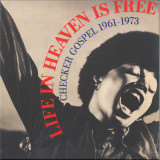
Gospel melts into Soul in this dazzling collection of sides originally released by the Chess subsidiary.
Devised by the same team supporting the likes of Muddy Waters and Etta James at Chess, the vintage of Checker Gospel celebrated here is distinguished by its expertly raw, rugged, live feel — thumping bass and pounding drums, bluesy guitar and horns — and its keen engagement with contemporary realities and politics, with an underlying, unwavering commitment to the Civil Rights movement. Not forgetting its sheer, startling, richly diverse soulfulness.
Key architects of the Chicago Sound and Motown are amongst the scores of contributors: Charles Stepney, Gene Barge, Eddie Kendricks, and Leonard Caston Jr. are in the house… Morris Jennings, drummer on Curtis’ Superfly and Terry Callier’s What Color Is Love… Louis Satterfield from The Pharaohs and Earth Wind & Fire… Ramsey Lewis’ guitarist Byron Gregory… Phil Upchurch… Laura Lee…
Producer Monk Higgins joined Checker in 1967, bringing his experience of R&B and Gospel hit-making for the labels One-derful and Satellite, together with a loyal cohort of musicians. A protege of Willie Dixon, engineer Malcolm Chisholm set up the Ter Mar studio as if preparing for a live gig, carefully teasing measures of bleed into the microphones. With Ralph Bass from King Records running A&R, they knew exactly what they were after. ‘I’m using horns and an R&B sound in gospel recordings,’ said Bass. ‘We have no charts. All the musicians are given the chord changes. I want the cats to think when we’re cutting. I want spontaneity, and that’s what we’re getting.’ And: ‘There is more to gospel than just finding solace in the church. This follows the same message of Martin King, who was fighting for a new way of life. Kids are tired of hearing Jesus Give Us Help. They want a positive message.’
Focussed on the late sixties and early seventies, the twenty-five recordings here are all killer no filler, but try these four, random entry points: the heavy funk ostinato of the Violinaires’ Groovin’ With Jesus, working itself up into a post-James-Brown brass frenzy, sure to knock your socks off; Cleo Jackson Randle’s title track, for those who like their Gospel straight-up and hard-core; Eddie Kendricks’ achingly timely choral call-to-arms, Stand Up America, Don’t Be Afraid; the East St Louis Gospelettes’ heart-stopping, fathoms-deep rendition of Bobby Bland’s I’ll Take Care Of You.
A beautiful gatefold sleeve; a full-colour booklet with excellent notes by Robert Marovich; top-notch sound. Another knockout selection by Greg Belson and David Hill.
We’re teaming up with ELUCID and Fat Possum for a limited edition of 300 copies of a Rush Hour black ice coloured edition.
E L U C I D, one half of the illustrious duo Armand Hammer, is here with the full-length follow-up to 'I Told Bessie'. Further experiments in the sonic, expanding on the 'live' side of music paired with the embracing of chaos. Something you haven't heard, or not so for a very long time. E L U C I D is here to reveal the bleakness of reality.
''There is never time in the future in which we will work out our salvation. The challenge is in the moment; the time is always now.''
James Baldwin
A raw, crackling urgency runs through rapper-producer ELUCID’s new album REVELATOR like an underground power line. There is no space here for sepia-toned reminiscences or indulgent self-mythologizing. Intellectual rabbit holes have been filled in with concrete and rebar ; there is nowhere to hide and no off ramp from the audio Autobahn that ELUCID has fashioned—a renegade Robert Moses with gold fronts, bulldozing the homes of the powerful and the complicit. REVELATOR brims with the energy of now, with a refusal to look away. Carpe diem in a murder one mask.
Born in Jamaica, Queens, ELUCID has been on the cutting edge of New York’s underground scene since the mid-2000s. From the beginning, he has defied both convention and expectation. He ran with Okayplayer darlings Tanya Morgan, but his own music eschewed their throwback charm for glitchy noise experiments and bass-swamped culture jamming. His 2016 debut studio project Save Yourself (re-released in a deluxe edition last year) announced him in earnest. But in recent years, his Armand Hammer releases with partner-in-crime billy woods have received significant attention and acclaim. Serving as a followup to his last solo album—2022’s comparatively balmy I Told Bessie—ELUCID hoped to “re-distinguish” himself with REVELATOR, setting himself apart amidst the increasing attention around the music he and his friends are making together.
For ELUCID, this meant setting bold new challenges for himself. One of these was diving further into live instrumentation than ever before—”getting my Quincy Jones on,” as he puts it. The testing ground for this approach was Armand Hammer’s most recent project, 2023’s We Buy Diabetic Test Strips’ Möbius strip soundscapes, warmed with instrumental flourishes and skin-shedding beat progressions. With REVELATOR, though, ELUCID strove to create an atmosphere of chaos, embracing experimental electronics and atonal sample bursts. He worked on much of the album with co-producer Jon Nellen, who comes from a background in avant-garde and Indian classical music. “I wanted to get as freaky as I could at this moment. I wanted people to hear things, maybe for the first time, or in a way they haven’t for a long while,” the rapper explains.
ELUCID arrived at the studio with a collection of noise sources: non-referential samples, glitches and noises. Together he, Nellen, and others created forms out of them and, as ELUCID recalls, “just started playing drums with it.” Their fried, distorted sound was directly inspired by Miles Davis at his most uncompromising—specifically, the tone-clustering funk track “Rated X” from his 1974 double LP Get Up With It. At times, the pairing of rap with avant-fusion sounds also brings Emergency! from The Tony Williams Lifetime to mind, perhaps in an alternate timeline where the late drummer was listening to Ice Cube’s AmeriKKKa’s Most Wanted.
“The World is Dog,” REVELATOR’s lead single, functions as the album’s aesthetic thesis statement. Like the Davis track, the textures are punishing, the tonality is in free-fall, and the driving breakbeat of a groove cuts in and out unceremoniously. Avant-jazz bassist Luke Stewart, who appears throughout the record, holds the whole thing together just long enough for ELUCID to tightwalk over the beat. This tension is exactly where REVELATOR sets itself apart; in a time of drumless loops, and safe soul samples, this is a high-wire act with no safety net. Similarly, the song announces the themes of the album within just a few phrases, evoking the way societies accept and adjust to new levels of debasement and brutality while suffocating under the weight of history: “Can’t clock the kill, all a mystery/Forced past will eating everyone eventually/The world is dog.”
Many of the songs on REVELATOR grapple obliquely with dissolution and disenfranchisement in America and across the world—the grim realities of our domestic sociopolitical climate and our involvement in foreign conflicts. “Much of my artistic and political sensibility comes from the Black arts movement here in New York,” ELUCID explains. “Recognizing the interconnected global struggles against oppression, artists and thinkers created works and actions in solidarity with freedom movements in South Africa and Palestine.” ELUCID cites intellectuals like Amiri Baraka, Kwame Nkrumah, Audre Lorde, Sonia Sanchez, and Nikki Giovanni among his heroes. (One track on the album is specifically inspired by Lorde’s work, “SKP,” citing the scholar’s paper “Uses of the Erotic: The Erotic As Power.”) Songs like REVELATOR’s insistent closer “ZIGZAGZIG,” find ELUCID applying up-to-the-minute messaging, making explicit reference to the conflict in Gaza: “Feed a war machine…from river to sea, in lieu of peace.”
Despite ELUCID’s preference for cacophonous system overload here, the rapper also provides moments of respite. Recorded at The Alchemist’s Los Angeles studio, the laid-back, wheezing “INSTANT TRANSFER” is a collaboration with billy woods, which crystallizes their shared sense of creative determination. “With much momentum behind us and even more on the horizon, I knew a purpose, and that every step was ordered to that purpose,” ELUCID said of the experience. Meanwhile, the jittery “HUSHPUPPIES” is a playful anomaly on the track list, providing a snapshot of ELUCID watching his grandparents in the kitchen while preparing for Friday night fish fry dinners.
“Love still rules over on this side,” ELUCID says. ”I’m raising a family. We are making meaning and finding joy in the midst of all the fucked up-ness of everything around us because the alternative is cowardice and slow death. We remain rooted. We celebrate our people and our wins. Struggle is necessary.”
“IKEBANA” is one of ELUCID’s strongest statements of purpose on the record, blending the record’s heaviest themes with its most hopeful sentiments. supported by a shoutalong refrain and an urgent prog-funk groove. Breaking away from images of dissolution and crumbling societal systems that populate REVELATOR, ELUCID notes that the only way to navigate life’s bleakest landscapes is to cling to love and believe in those around you—to look forward toward something better that may or may not be possible. For the rapper, one of the album’s most trenchant lines comes during a centerpiece of a beat drop: “Being alive/I must look up.”
“The lyric ‘being alive I must look up’ is important especially in the context of this album. Much of the album imagery is harsh and reflects the actual doom some of us experience. But still I/we exist,” ELUCID explains.
Every artist is, in one way or another, the product of their time, bound by life’s leaden gravity to operate within the space of that which is already known. But there are some who are able to shake free of these ties, to shape the culture as it unfolds, to make the present their own.
Revelation, as a concept, points to the scales falling from people’s eyes—something that has been hiding in plain sight becoming clear. “The revelator relates to things that have been talked about, things that have been forecasted,” ELUCID adds. “And now they’re really here, and everyone sees it. And there’s no escaping.” REVELATOR plays out with the unmitigated power of those storms, laying waste to any genre conventions in pursuit of a certain physicality. Here, ELUCID develops a wholly distinctive musical language to explore our fractured modernity.
REVELATOR's packaging was designed by longtime Armand Hammer / Backwoodz art director, Alexander Richter.
Musician, composer, bandleader and musical rubik’s cube, Laurent Bardainne is a saxophonist who trained at The Paris Conservatory.
He’s collaborated with Pharrell Williams, Cassius and Philippe Katerine to name just a few and presents here his latest project, ‘Tigre d’eau Douce’ Also co-founder of electro rock band Poni Hoax (Tigersushi Records), Limousine, a duet with Camelia Jordana and more recently Sabrina & Samantha for Ed Banger. This album, sees a return to his first love of jazz, The Tigre d’eau Douce, represents a species doomed to disappear. So using melodies, chants and solos as an escape guide, his tenor saxophone takes us to a higher place,
one where John Coltrane and the great figures of jazz reside. These LP tracks bounce between the grooves and soul of the 1970’s, where
percussion and saxophone pave the way. ‘Marvin’ allows the fluffy keys of the Hammond organ to open out into a pensive melody that feels familiar. Carrying on the journey, the tough asphalt of hip hop is visited on tracks like ‘Bachibouzouk’ and ‘Felin M chant’, whereas more tropical themes are explored on tracks like ‘Kinshasa’.
We are so excited to present to the world the 3rd and final instalment in Danny Tenaglia’s GU Trilogy, Danny’s mixes have been a huge part of our DNA for many years, with his seminal Athens and London mixes forming the part of many people’s favourite DJ mixes of all time, Brooklyn is a stunning addition to that heritage and we can’t wait to release this album to the world.
This is the Vinyl Edition #2 of the album, curating a stellar selection of techno and melodic house. "As a native of Williamsburg, Brooklyn, this compilation is not only a celebration of my roots but also a tribute to the dynamic and ever-evolving nightlife that ignited and guided my musical career back in 1975.” Danny Tenaglia
'The John Carter and Bobby Bradford Quartet/Quintet were critical to the progressive jazz movement around Los Angeles in the late 60s alongside the likes of Horace Tapscott. Both hailed from the Watts area and trumpeter, Bradford played with a woodshedding Ornette Coleman for two years in the early 60s when the legendary free movement leader decided not to record for a while but wanted to hone his trademark sound on the saxophone. Multi-reed player, Carter also worked with Coleman who brought them together to lead their own band.
Their first outing on Flying Dutchman was “Flight For Four” as the Carter Bradford Quartet that was released in 1969. This is the second album they recorded where Carter and Bradford were supported by Tom Williamson (bass), Buzz Freeman (drums) and another uncredited bass player on four extended improvisations – ‘The Sunday Afternoon Jazz Blues Society’, ‘The Eye Of The Storm’, ‘Loneliness’ and ‘Encounter’.'
Remastered reissue of another stone cold New York club classic from the legendary
SAM Records label - home to so many fabulous disco/boogie recordings from the
1980s.
• Pure early 80s electronic disco joy for the packed, sweaty dance-floors. A true boogie
classic, a huge club hit that got spun from The Garage to the streets of London.
• Not much is known about Komiko, an undercover studio outfit that featured guest
vocals Carol Williams, Tracey Weber and Vicky D. This single is their sole release.
• Remastered by Phil Kinrade and presented in a 7” Discobag sleeve.
Almost halfway through 2023, Voitax returns with a bass heavyweight of the highest order.
Marc alias Tymotica has been showcasing his musical ambitions not only as a founding member of the Munich-based label »Ruffhouse«, but also through his sonic ventures as a DJ and producer. Luca, on the other hand, an equally ambitious DJ and producer going by the name of DJ Ion, has his roots in hip-hop, jazz, and 90s techno. His debut on Don Williams’ a.r.t.less imprint proves that adequately. Their fusion turned out to be quite fruitful, as shown by their diverse yet well-centred record »Anthea« on Club Qu.
With »Bionic Gradient«, their promising collaboration enters another chapter, a representation of their precise curation of musical components, as well as an impressive design of their sounds. This progressive bass EP features dubstep-, grime-, trap-, and hip- hop influences, nuanced with dub and IDM. Through each track, the duo links crispy polyrhythms with well-chosen samples that perfectly complement the contemporary, high defined sound. Catchy leads, long reverb tails, metallic soundscapes, and detailed drum programming are carefully fused with the underlying warm bass body. All this comes down to an astonishingly eclectic bass EP that is built to be dropped on the dance floor, yet invites you to dive into an abstract and dreamy world on its own.
As both are continuously working on new material, we are more than excited about what is to come!
NOW Music is proud to present the next instalment in our ongoing ‘Yearbook’ series – and our first to celebrate the ‘90s, NOW – Yearbook 1992; 79 tracks from a brilliant year in Pop! Available as a Special Edition CD housed in ‘hard-back-book’ packaging, including a 28-page booklet featuring a summary of the year, a track-by-track guide, a quiz, and original singles artwork, a standard 4CD package, and a Limited edition 3-LP set pressed on green vinyl.
Legendary Memphis soul brothers William, Bertram and Randy Brown released an album under the group name TEN-63 entitled FACING THE MUSIC, it was published in 2009, but recorded sometime earlier. YOU AND ME was played out and initially covered up by Mike Ward circa 1989/90 receiving cult status.
YOU AND ME and our pick for the flip SAY WE’LL STAY are beautifully constructed songs with each of the Brown brothers serving up a solo part, it cannot be denied their contrasting vocal styles and harmonies are supreme in the extreme!
The Browns’ contribution to the Memphis music scene is etched in history. William, who sadly passed away in 2015 was a member of The Mad Lads. Randy and Bertram were members of The Newcomers, Bertram went on to be a part of soul funk group Kwick and of course Randy had a glittering solo career with LPs on Parachute, Chocolate City and Stax as well as numerous singles; he is regarded by many as being one of the finest vocalists of his genre.
Omar Apollo veröffentlicht offiziell sein mit Spannung erwartetes Debütalbum IVORY.
IVORY bringt Omar Apollos Songwriting auf die nächste Stufe - es überwindet Genregrenzen und Sprachbarrieren, während es eine noch größere musikalische Vielfalt des aufstrebenden Superstars zeigt.
Das neue Album enthält die zuvor veröffentlichten Singles "Tamagotchi", produziert von Pharrell Williams und Chad Hugo, "Killing Me", das mit einem Fernsehauftritt in der Tonight Show mit Jimmy Fallon debütierte, und "Invincible" mit Daniel Caesar.
Darüber hinaus enthält das Album die von Teo Halm produzierte gemeinsame Single "Bad Life" mit Kali Uchis und "Go Away", das von Omar selbst zusammen mit Carter Lang und Chromeo produziert wurde.
In nur wenigen Jahren entwickelte sich der in Indiana aufgewachsene, mexikanisch-amerikanische Singer-Songwriter vom Teenager-Strummer zu einem der heißesten R&B-Künstler seiner Generation.
(Produced, Arranged and Conducted by Claus Ogerman)
Not long after the dawn of her career, as a teenager in Rio de Janeiro, Joyce was declared “one of the greatest singers” by Antonio Carlos Jobim. Yet despite reputable accolades and the fact that she has since recorded over thirty acclaimed albums, Joyce never quite achieved the international recognition of the likes of Jobim, João Gilberto and Sergio Mendes, all of whom became global stars after releasing with major labels in the US.
There was a moment when it seemed she might be on the cusp of an international breakthrough. While living in New York, Joyce was approached by the great German producer Claus Ogerman. Ogerman had already played a pivotal role in the development and popularisation of Brazilian music in the 1960s, recording with some of the all-time greats like Jobim and João Gilberto, as well as North American idols like Frank Sinatra, Billie Holiday and Bill Evans.
"I met him in New York City, in 1977”, recalls Joyce. “I was living and playing there, and João Palma, Brazilian drummer who used to play with Jobim, introduced me to Claus. We had an audition, he liked what we were doing and decided to produce an album with us.”
Featuring fellow Brazilian musicians Mauricio Maestro (who wrote/co-wrote four of the songs), Nana Vasconcelos and Tutty Moreno, and some of the most in-demand stateside players including Michael Brecker, Joe Farrell and Buster Williams, the recordings for Natureza took place at Columbia Studios and Ogerman produced the album, provided the arrangements and conducted the orchestra.
But mysteriously, Natureza was never released, and what should have been Joyce’s big moment never happened. As Joyce remembers, “I returned home, but Claus and I remained in contact, by letters and phone calls. He was very enthusiastic about the album and tried to hook me up with Michael Franks. He wanted me to go back to NYC in order to re-record the vocals in English with new lyrics, which I actually wasn’t too happy about. But then I got pregnant with my third child and could not leave Brazil. And little by little our contact became rare, until I lost track of him completely. And that was it. I never heard from him again."
While Claus was known to be something of an elusive character, the album’s disappearance might also have been a result of timing. The Brazilian craze was coming to an end, making way for disco and new wave at the end of the seventies, and Ogerman struggled to find a major label interested in a new Brazilian sensation. Additionally, as Joyce mentions, it wasn’t quite finished. Ogerman wanted to add finishing touches to the mix and to record alternative English lyrics for the US and international markets - a critical artistic difference between Joyce and Ogerman.
As the military dictatorship’s grip on Brazil began to subside in the 1980s, Joyce had a handful of hits in her home county, including a tribute to her daughters ‘Clareana’, and the iconic ‘Feminina’ - an intergenerational conversation between mother and daughter about what it means to be a woman. But already a feminist pioneer, these successes were hard fought. Joyce had caused controversy as a nineteen-year-old when she became the first in Brazil to sing from the first-person feminine perspective, and the institutional sexism she faced was worsened by the dictatorship who would often censor her music. Even once the Junta was out of the way, Joyce found herself up against the male-dominated major record companies in Brazil, who sought to dictate her career and sexualise her image, before dropping her for refusing to play along.
A few years after the success of her albums Feminina and Agua E Luz in Brazil, Joyce’s music began to find its way to the UK, Europe and Japan, and “Feminina” and “Aldeia de Ogum” became classics on the underground jazz-dance scenes of the mid to late-eighties and early-nineties.
The full-length version of “Feminina” from the Natureza sessions was first heard on a Brazilian Jazz compilation in 1999 and “Descompassadamente” was licensed for a CD compiling the work of Claus Ogerman in 2002. Following these, word began to get out about an unreleased Joyce album with Claus Ogerman and the legend of Natureza grew.
Forty-five years since it was recorded, Natureza finally sees the light of day, as Joyce intended: with her own Portuguese lyrics and vocals. Featuring the fabled 11-minute version of ‘Feminina’, as well as the never before heard ‘Coração Sonhador’ composed and performed by Mauricio Maestro, Natureza’s release is a landmark in Brazilian music history and represents a triumphant, if overdue victory for Joyce as an outspoken female artist who has consistently refused to bow to patriarchal pressure.
***Disclaimer! While “Feminina” and “Descompassadamente'' were mixed by legendary engineer Al Schmitt and mastered from the original master tapes, the remaining five tracks are unmixed. Due to significant deterioration of the master-tapes, the best audio source for these tracks was an unmixed tape copy Joyce had kept of the recordings. The best care has been taken in the restoration and mastering of this release, but the sound quality may differ from other releases on Far Out Recordings. We advise listening to sound clips before buying where possible.
We’re excited to be launching a new release series: “Melodies Record Club”, a string of DJ and artist curated mini compilations in loud 12” format.
The first instalment was put together by Four Tet, selecting two big peak-time Jazz tracks he used to spin regularly at Plastic People.
On one side, we’ve got all time jazz greats Jackie McLean and Michael Carvin’s De I Comahlee Ah, taken from their seminal album Antiquity recorded in Denmark back in 1975. A year and a half ago, we visited Steeplechase, the original label in the outskirts of Copenhagen. They informed us that at the time, the track was cut short as it didn’t fit on the full LP. They were kind enough to provide us with the tape of the full original recording, allowing us to release for the first time the full extended version capturing twelve and a half minutes of studio magic. Speaking with Michael back in November, he told us that every song on that album was recorded without any overdubs. They had taken their shoes off and organised the studio in such a way that they could move from instrument to instrument during the take (!!)
On the flip, we have Chris McGregor’s Brotherhood of Breath – MRA. Back in 70s London, the Brotherhood had brought together musicians who had sought refuge from South Africa’s apartheid regime and the best of a new generation of British jazz musicians. Music journalist Richard Williams, who had originally reviewed the band in the 1970s tell us: “They made music that appealed in equal measure to the head, the heart and the feet, taking the jazz legacy of Duke Ellington and Charles Mingus and adding to it the fantastic dance rhythms and gorgeous harmonies of the townships and untethered collective improvisations of the new free music”.
Four Tet’s instalment is out early May in 12” format and digitally (stream & download), first press comes with a folded A2 insert with words from and about the artists. Graphic design by Studio ChoqueLeGoff, illustration and animation by Nevil Bernard and for the audiophiles out there, remastered and cut at half speed by Matt Colton at Metropolis Studios!
The second instalment curated by Ben UFO is scheduled shortly, which will be followed over time by a string of releases including selections from Hunee, Mafalda, Floating Points, Anya & Julia from Javybz, Daphni, Josey Rebelle, Charlie Bones, Gilles Peterson… and more, stay tuned!
Two stone cold Roy Ayers classics get the South Street Disco official reissue treatment, one side the feel-good disco-tinged, jazz funk fire ‘Running Away’ and the other the smooth groove, love letter funk bomb ‘Love Will Bring Us Back Together’. Melting hearts, melting minds, is there a better Valentines gift out there then two slices of joy from Roy?
From hip hop to house, ‘Running Away’ has been a favoured sampling treasure since it came out in 1977. Co-produced alongside Edwin Birdsong and William Allen, joyous vocal harmonies dance around grooving basslines, strutting guitar riffs and Roy’s warm soothing tones. Top it off with some trademark vibes and it’s a one-way ticket to happiness, pure sunshine smiles all round.
Flip it to find ‘Love Will Bring Us Back Together’. Straight up seductive business co-produced by Carla Vaughn. It’s silky, it’s smooth, it’s everything you want it to be and more. Clavinet wizardry, buttery Rhodes layers and fiery vocals. Loved up funk at it’s best.
Melbourne based producer, DJ and co-founder of Sumac Records, Jon Watts delivers his Butter Sessions debut, Music for 3 CDJs. With over 10 years experimenting as an artist, Jon has an established history with the Australian underground scene. Music for 3 CDJs, showcases two contrasting sides, revealing his ability to seamlessly navigate manifold sounds.
The A-side presents three distinct tracks, thread together with restless percussion and a propulsive force. The introduction to the EP, Prohaasation, is a medley of techno and electro fabrics which progressively build before abruptly halting -- generating suspense for the track to follow. The feverish William gasps and screeches in tones that peak and fall, accompanied by audio maintained throughout; reminiscent of a malfunctioning fax machine. Now It's Done is a choppy and disjointed piece yet coherent in its structure that makes for a rewarding conclusion to the release's first chapter.
Subtlety and minimalism prevail for side B, as Jon gifts us with loops that swirl and churn. AMB 4 marks the first deviation from the narrative of Side A; sounding like hypnotic swelling from the bottom of a deep well. AMB 5 follows suit, divulging more of the picture. Carved out of a sound bed of field recordings, the nine and a half minute piece enchants with its repetitive arc, a spaciousness mirrored in the EP's farewell. The last track Piano 1, is an intricate study of a singular piano chord, examining the layers of the chord's sustain that are disclosed. A testament to Jon's unadorned restraint and confirmation of the old adage that less is really more.
After the creation of his own label and four EPs (Intuitive, Blend, Exil, Singles), here is Thylacine with a first album called Transsiberian, named after a recent trip to the other side of the world.
In the spring of 2015, William left for Russia with a video crew. The goal: to get carried away by the famous Trans-Siberian, which connects Moscow to Vladivostok, and stop at the option of fixed and impromptu meetings with local personalities. Time is divided between intense encounters and long train journeys where William locks himself in his cabin to compose. At the option of these stops which, over the days, nourish William's inspiration, he has the right to a concert offered as a welcome by the old ladies of the native village of the graffiti artist Artemiy, polyphonies in Irkutsk, a bell ringer of bells, a traditional musical trio in Kazan, surfers in Vladivostok. A shaman welcomes him in his yurt on the shores of Lake Baikal, with his two little daughters, Aikhai and Mandukhaï. All can be found on Transsiberian, a concept album that places the taste for travel and his curiosity about others at the heart of his contemplative songs. Evolving in the world of contemporary art, for which he composes regularly, William sees an album as a work where performance counts but also emotion and, above all, manner of doing things. "The process of creation matters as much as the end," he says.