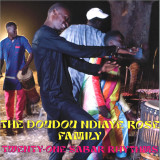
Magnificent Wolof drum music, performed by an extended griot family over seven consecutive days, in the mystical setting of Lac Rose, outside Dakar.
Doudou Ndiaye Rose — who died in 2015 — is a key drummer in the musical history of the world. He developed a system of five hundred original drumming patterns, ancient and new. Amongst the modern rhythms here is Bench Mi — ‘under the Baobab tree,’ a spot where problems get solved. Also Hibar Yi — ‘passing on information’ — the theme-tune of Senegalese TV national news for decades — and Les Rosettes, the signature rhythm of Senegal’s first ever all-female percussion group, convened by Doudou, and named after his grandmother.
These original compositions sit alongside important traditional rhythms, familiar to every Sabar player, such as Farwu Jar (a courtship game sometimes resulting in a wedding), Ceebu Jin (also the name of the national dish of fish and rice), and Gumbé, often played after a successful harvest.
Recorded in joyful single takes, with no overdubs, mastered by Rashad Becker, the music is deep and thrilling, polyrhythmic to the bone, with a complex, pointillistic intensity at times evoking Jeff Mills in full flight.
Search:x nation
- A1: Xibir (Orchestra Only, Live In Wacken) 03 17
- A2: Born Treacherous (Live In Wacken) 05 22
- A3: Gateways (Live In Wacken) 05 42
- A4: Dimmu Borgir (Orchestra Only, Live In 03 53
- A5: Dimmu Borgir (Live In Wacken) 05 42
- B1: Chess With The Abyss (Live In 04 09
- B2: Ritualist (Live In Wacken) 05 13
- B3: A Jewel Traced Through Coal (Live In 05 12
- B4: Eradication Instincts Defined 05 07
- C1: Vredesbyrd (Live In Wacken) 04 57
- C2: Progenies Of The Great Apocalypse 05 21
- C3: The Serpentine Offering (Live In 05 11
- C4: Fear And Wonder (Orchestral Only, 03 19
- D1: Kings Of The Carnival Creation (Live In 08 11
- D2: Puritania (Live In Wacken) 03 03
- D3: Mourning Palace (Live In Wacken) 05 56
- D4: Perfection Or Vanity (Orchestral Only) 04 09
Dieses Produkt wurde ursprünglich als Teil von „Forces Of The Northern Night“ veröffentlicht Die Band beschloss, ein Konzert mit dem Orchester von Offical Norwegian (NRK) zu spielen und aufzunehmen Es war ein großer Erfolg. Rund ein Jahr später spielte die Band mit der gleichen Running Order und dem Wacken Festival das Tschechische Nationalorchester. Dieses Vinyl ist die Aufnahme dieser Show.
- A1: Don Carlos - Purple Day (Don Carlos Edit)
- A2: Deep Aural Penetration - Let Your Body Be Free (Club Xero Mix) Don Carlos Edit
- B1: Be Noir - It’s Gonna Be Alright (Don Carlos Rimini 4 00 A.m. Mix) Don Carlos Edit
- B2: Deep Aural Penetration - All I Want To Do ( Josh Wink H E.r.e. Mx) Don Carlos Edit
- C1: Love Nation - Everything 4 U (Remix) Don Carlos Edit
- C2: More Heavy Soul - Magic Tonight (Irregular Dub) Don Carlos Edit
- D1: Outdance - Pump The Jumping (Sexy No Dirty Mix) Don Carlos Edit
- D2: F I.t.z. - The Reigh Forest (Fitzcarraldo) Don Carlos Edit
Among those who have written the history of the Italian House is certainly Carlo Troja, aka Don Carlos. In 1991 Irma Records released her first single Alone which immediately became a cult record for DJs across the Channel and especially American DJs. Its particular soft and ambient sounds defined a genre that was then called Paradise House.
And it is precisely from this genre and from this Dj that Irma Records began the celebrations of its thirtieth anniversary a few years ago by
proposing a selection of its catalog chosen by Don Carlos, trying to dig among some of the pearls of the genre but above all among some
songs that featured in his evenings but were less popular at the time of their release.
This compilation had a great response and it was decided to make a volume 2, always selected by Don Carlos. Also this compilation, like the first one, consists of two compact discs and a vinyl version this time with a selection of only 8 of the 20 tracks contained in the CD and Digital version.
All the tracks on the double vinyl have been re-edited by Don Carlos for the occasion. The double cd is in a limited numbered edition.
Among the artists and producers included are: Don Carlos, Lust Unlimited, Subsonic Posse, T.M.V. (Marco Trani, Moz-Art and Maurizio
Verbeni), The Sweatbox Orchestra, Aritmya, Deep Aural Penetration, Be Noir, Love Nation, More Heavy Soul, Outdance, F.I.T.Z. and many
others
Clear Vinyl
Tacit Group is an audio-visual group founded in 2008 with a vision of creating new art for the 21st century. Based in Seoul but working globally, the group comprises composer Jaeho Chang and electronic musician Gazaebal(Lee Jinwon).
With audio-visual art as its core content, Tacit Group has expanded in a contemporary and experimental way in multimedia performances, interactive installations, and music installations. Representative works such as ‘Hun-Min-Jeong-Ak,’ ‘Game Over,’ ‘Morse ㅋung ㅋung,’ combine a systematic worldview weaved through intuitive materials and technology inspired by normal everyday activities such as games and text chatting. In particular, works that utilize the beauty and communica- tion power of characters are among their most striking.
“It’s like wind chimes,” says Tacit Group’s Jeaho Chang. “The creator makes the pipes, but the wind makes the music.” He’s talking about the algorithmic music that Tacit Group creates. Jaeho and Gazaebal create audio/visual systems using code that the pair work within to unleash their utterly compelling AV performances, each show, each track, as unique as a snowflake. The pair met at Korea National University of Arts in 2006. Jaeho Chang was a media installation artist and composer who’d studied classical composition in Korea and electronic music at Den Haag’s Conservatoire. Gazaebal, who’d moved to the US as a teen, had worked at the renowned Quad group studios as a sound engineer, recording acts including Rage Against The Machine, Wu Tang and Janet Jackson. Returning to Korea, he had found success as a K-Pop producer, (founding the act Banana Girl, and writing their No.1 Korean hit ‘Shake Your Ass’) and DJing under the moniker Gazaebal, before deciding to go ‘back to school’ to learn to create more challenging music.
The quiet and reserved Jae and the more outgoing Gazaebal bonded over a shared vision, forming Tacit Group in 2008. And until recently, everything they have done has been through the medium of their globally acclaimed live shows, playing all over the world from Lincoln Center in NY, the Museum of Contemporary Art in Chicago, MMCA (National Museum of Modern and Contemporary Art) and Nam June Paik Art Center in Korea, Aarhus Festival in Denmark, Stereolux in France and NYU Abu Dhabi.
Each show an utterly unique and compelling event, a synthesis of music and visual art that has echoes of the concept of synesthesia: “we love the idea that the audience can ‘see’ the music.” says Gazaebal, “the way that you can hear a painting like Edvard Munch’s ‘The Scream’.” The frameworks and systems are created in advance using code such as C++ and max/M- SP(sometimes combined with analog and modular synthesizers), often growing out a of a simple idea (one of their first composi- tions, ‘Game Over’ explored the idea of a Tetris gameplay as a musical score) while on stage the pair react to the audience, creating new inputs and variables that can lead the performance in ways that are unexpected and even self sustaining - some of their installations could in theory continue to evolve and run on into infinity.
For Tacit Group, the process is as important as the outcome, and every bit as fascinating for the audience, who’ve been known to react like the crowd at a rock band gig to tracks / installations like ‘Hun-Min-Jeong-Ak’ which sees abstract geometric shapes based on the Korean alphabet evolve (through the process of live text interchanges between the pair) to become almost an immersive call and response.With that in mind, the duo have long been reluctant to commit to the idea of releasing via a ‘fixed medium’ it was actually the release of an acclaimed (and beautifully designed) book Tacit.print0_Anthology that convinced them to share their work more widely through an album.
DJ, producer, label boss and soundtrack composer, Hannah Holland has never been one to tie herself to mediums. Now, on her debut studio album Tectonic, released on PRAH Recordings on September 17th, Holland pours her career to date into one outstanding and diverse body of work.
Hannah Holland has long been a mainstay of London’s queer and alternative club scene. Her eclectic DJ sets have taken her from Berlin’s infamous Berghain, NYC with friends The Carry Nation, Glastonbury’s NYC Downlow and legendary parties Adonis and Trailer Trash. She’s remixed the likes of Goldfrapp, The Knife and Metronomy and run her label Batty Bass for over ten years.
White Vinyl
Greyscale's most personal release and perhaps the most important for label owner grad_u aka Aleksandr Martinkevič. Earlier this year, Alex was diagnosed with cancer. Certainly a horrible thing to hear and there has definitely been some low moments in certain stages of the journey. At just 36 years old, many of us are shocked that such a young person can develop cancer. After some research he found out that younger and younger people are randomly getting cancer studies show. An alarming trend to learn about. However, there has also been a lot of other learning and different new levels of appreciation for the simple things in life as a new higher level of inspiration in making music has manifested. And this new release encapsulates that. Alex has also felt a duty to make things better for others. Focusing on what can be improved as he wants to highlight research, treatment and the overall communication of this disease to more people in the electronic music scene. Part of the proceeds from this new album will be donated to the National Cancer Institute in his homeland of Lithuania.
Alex wants everyone to know that catching these signs early and getting regular checkups are your best chance at beating cancer. Thankfully Alex did this also and his treatments have gone well. Alex plans still stay steadfast with his label and his life. Simplifying things with the love from his family and friends, focusing on his hobbies
along with making sure he makes his health his #1 personal priority.
The name for this full length release is titled 'T2NO'. grad_u's most introspective work yet features 8 emotional tracks overall. The honesty expressed in this album is blunt and to the point. These tracks take you on an audio journey thru grad_u as he expresses his feelings thru the entire process in each stage.
Beginning with two wonderful ambient tracks named 'Genetic Mutation' & 'Carcinogen'. In the opener, Chords rain over you as a beautiful ambient melody peeks out underneath it followed by a more stark and hazy field of interference. From the gentle opener to the more tension filled follower, the personal journey of grad_u is
developing before your ears. The b-side of 'Neoplasm' is a bit more somber but also has a ray of light in it.
Introspective as it can get, this is a true journey through an uncertain future. 'MRI scan' needs no explanation....
The second half of the album begins the understanding of what grad_u was going thru. 'Malignant Transformation' gives off that feeling of the human body working thru the science. Fight or flight becomes the theme for this track. 'Adenocarcinoma' almost gives off the sound of cells rebuilding themselves. Sci-fi meets real life in this epic battle. 'Resection' continues this scientific sounding reflection on the body healing with sounds of movement and time. As if the body is working itself out. Lastly and triumphantly comes the closing
track 'Waking up to a New Life'....
The emotional journey of this album isn't for the faint of heart. It leaves nothing to the imagination. It works thru all the emotions that can come with such and life changing event like having cancer. We want to thank grad_u for sharing his story with us. This story can happen to anyone...
"I would like to take this opportunity to express my great gratitude to doctors A. Dulskas, G. Jurevičienė, V. Sidorov and all staff in Abdominal Surgery and Oncology Department at NCI. Thank you for your expert care and for saving my life.
Also, big big thank you my family and closest friends for all their love and support during this difficult period of time and always being there for me."
Special thanks to Lithuanian Council for Culture, associations AGATA and LATGA for support of this special project.
Part of proceeds from the album will be donated to National Cancer Institute, Lithuania
30 years as a full-time touring nightclub DJ sounds like one hell of a career, and for Kenny Summit it's as much of a milestone as it is a turning point. Having shared the stage with greats such as David Byrne, Stevie Wonder, Chaka Khan, George Michael, Kylie Minogue and Prince over the years, Kenny took that influence and inspiration and decided it was time for him to get behind the mic too.
‘Burnin’ is a song written, produced and performed by Kenny Summit that speaks on a desire that's been burning inside of him for three decades. Across those 30 years he’s made many an influential friend too, three of which come on board to remix ‘Burnin’ - the late great Paul Johnson, D&B icon DJ Aphrodite and Brooklyn legend DJ Spinna.
"I caught the fever for house in 1990 and by 1992 I was booked for my first DJ gig at New Jersey's famed Zanzibar nightclub where house legend Tony Humphries held court on a weekly basis. Something changed that night, a fire started and its been building, growing inside of me and now it's time to put paper to pen and write my own songs."
Clearly influenced by the artists Kenny's worked with over the years, ‘Burnin’ is a culmination of one man's journey through dance music; from the Nile Rogers-ish 70s guitar riff to the whining Steely Dan-like keys, to the lush strings and synth pop stabs that would make Moroder blush, the track itself is masterfully produced and punctuated with Kenny's unique uplifting vocals, sang in a manner as if David Byrne and Boz Scaggs were put together and yet still very uniquely Kenny Summit.
Up on remix duties the late great Paul Johnson, Chicago's shining star, serves up a dark, very much after house vibe, that still keeps that trademark Paul Johnson sound. Drum & Bass icon DJ Aphrodite applies his unique sound to ‘Burnin’ with a stellar remix the D&B community has been patiently waiting over three years for. And finally, long-time friend, Brooklyn's DJ Spinna steps up, who after hearing the track commented 'this needs a dope DUB! Leave it to me, imma hook you up bruh!'. The Discoelectric Dub does not disappoint.
Reissue of Elizio De Buzios's "Tamanquiro". Remastered and pressed on 45 RPM!
Sitting a good 90-minute drive away from Rio de Janeiro’s crowded beaches and packed tourist hot-spots, Campo Grande is not a neighbourhood that attracts travellers from around the World. Traditionally it is home to the city’s lower middle-class, whose aspirations of moving up the social ladder were played out in a suburb that has always been solidly working-class.
Campo Grande is home to Elizio De Buzios, a Brazilian musician who started playing music in the late 1970s and early 1980s. De Buzios began as a drummer, before learning to play guitar and starting to compose and sing his own music. When he turned 18, De Buzios joined a local band formed by some of his friends and other like-minded local musicians: Sol da Terra. The band mostly played samba in neighbourhood bars and small venues around Camp Grande, but De Buzios was interested in more than just samba. While he naturally admired great samba composers such as Cartola and Beth Carvalho, his musical pass went far beyond Brazil’s national music. He also loved MPB and bossa-nova and at home he listed to Joäo Bosco, Milton Nascimento, Luis Melodia, Tom Jobim, and many bossa-nova singers.
In 1980 De Buzios was noticed by a local representative of international major label Polygram, who gave him the opportunity to record two songs. He was excited, so started searching for inspiration for the songs he would eventually lay down. He found that inspiration close to home while passing a neighbourhood shop which made and sold clogs. After noticing a display of then fashionable Portuguese clogs outside the store, De Buzios popped inside to talk to the owner. It turned out that he was a tamanqueiro – as clog-makers are traditionally called in his native Portugal – and was as passionate about music as he was about the footwear he made. Thus inspired, De Buzios returned home to work more on the lyrics and music.
The next day, he headed into the studio to record the song, with Vale Ribeiro, who later went on to produce tracks for Marcos Valle, behind the desk. With Ribeiro’s assistance, De Buzios managed to record two songs in one day: ‘Tamanqueiro’ and ‘Sou Um Louco’, a ballad with English lyrics blended into the mostly Portuguese text. From the start, it was clear that ‘Tamanqueiro’ would be the single’s A-side. Incredibly catchy and funky, with some subtle disco elements, the song remained distinctively Brazilian thanks to the use of the cuíca. Listening back all these years on, De Buzios’ lyrics seem almost spontaneous, carry the track forward, and make it almost impossible not to sing along. Its infectiousness and funkiness made it an instant hit with the first few people to hear it.
When it was released, responses to the song were enthusiastic, even if it never became the Brazil-wide smash it should have been. It resonated well in the local clubs and on the radio, but unfortunately the marketing was handled by an inexperienced Polygram employee who failed to adequately promote the track. As a result, the record sank without trace and De Buzios’ dreams of stardom evaporated. Having just started a family, he realized he could not live off the uncertainty of being a musician. Instead, he got a job at city hall as a civil servant, a role he continued until his retirement a few years ago. ‘Tamanqueiro’ and ‘Sou Um Louco’ remain the only two songs he ever recorded.
In the early 2000s, with the rise of diggers’ culture, ‘Tamanqueiro’ slowly surfaced again. It became a sought after, hard to find seven-inch single, finding its way onto the airwaves once more and into the ears of a new generation of listeners. Some started appreciating the song so much that it was referred to as the “best-Jorge-Ben-song-Jorge-Ben-never-recorded”. And they are right: ‘Tamanqueiro’ does have that Jorge Ben-straight-forwardness. It’s a completely honest song that’s almost impossible not to fall in love with. Thanks to this remastered reissue on Rush Hour, De Buzios may now get the props his sole record so richly deserves.
Now for the good news: De Buzios is still singing in local bars and clubs in and around Campo Grande. He is surprised, but also incredibly proud, that the record he had almost forgotten about is appreciated so much by a group of music lovers he didn’t even know existed. But above all, he is happy that more than 40 years after the recording session, the record lives on – not only on this re-release, but also in his weekend sets in the bars of Campo Grande.
VILIFY is a Berlin-based DJ and producer known for her multi-genre approach to bass-fueled club music. With over a decade of performance under her belt, she broadcasts numerous times monthly – known for her “Genre is a Social Construct” mix series, and DJs regularly at top venues in her home city and around the world. Her serene, melodic productions are anchored by titanic sub woofer emanations, and her sound can best be described as ethereal, eclectic, and exquisite. The Wire magazine selected “Road to Eleusis” for inclusion in its Tapper CD compilation series. A video for Interchangable Auras, was shot in Vancouver, BC, by Jeremy Shantz – a collaborator from VILIFY’s home nation of Canada – and is linked below. This 8 track LP, reaches across bass music, jungle, experimental electronic, world, melodic and more. It was a created in a time of uncertainty, aiming to release fear & past Karmic cycles in an effort to open the door to brighter, more authentic being. Connecting to source, rather than self, fostered this culmination of powerful, emotive sound and deep expression.
Transversales Disques proudly presents Pharoah Sanders - Live in Paris (1975). A never-before released ORTF recording performed live at studio 104, Maison de la Radio, Paris. First official release with the full permission and cooperation of the National Audiovisual Institute. Deluxe edition, Classic Tip-On Gatefold jacket, including exclusive liner notes and pictures. Mastered from the original master tapes.
For the first time ever repressed on FullTime Production the iconic disco record "Easy Going" by Easy Going!
That's a brand-new great landmark for the label as "Easy Going" set a milestone in the italian Disco culture.
If at the end of the Seventies you were at Piazza Barberini in Rome at night, you would have come across a small but crowded club half-hidden in the ascent of Via della Purificazione, a trendy gay club with elegant Fassbinderian furniture, but also a night crossroads for many prominent characters of the cultural and artistic life of the eternal city and a regular stop for the most popular national DJs at the time. Easy Going creature was founded by Claudio Simonetti (Goblin), as a homage to the place mentioned above.
The homonymous 33 rpm debut of 1978 is remastered and repressed on a glossy white vinyl and due next December 13th on FullTime Production!
It features the original LP cover highlighting the mosaic of masculine struggle between a sailor and a strictly naked policeman , photographed in the Roman club.
The music explodes with the piece that will define the group par excellence: "Baby I Love You" also released as the first single, sung by a very filtered voice on a hypnotic rug of keyboards and a captivating melody that define a real masterpiece of italian disco and beyond. The same goes for the remaining three tracks of the album, which are also set to set the dance floor on fire: "Do It Again" is pure dance from Studio 54 and on the flip side, Creedence Clearwater Revival's cover "Suzie Q" and the ballad "Little Fairy".
Deep in the Romanian wilderness, beyond the foggy wastelands and the drab greyness of the metropolitan district you can find the base of two musical wizards who invoke the spirit of the past to transmit a very modern interpretation of their nation's musical traditions.
They are known as Livio & Roby and they have been putting their own supernatural twist on house and techno for the past 10 years. Their connection with the global electronic music movement has been channeled via highly influential outlets such as Desolat, VIVa, Saved and Fumakilla. While their physical presence has been felt in a myriad of venues from Buenos Aires to Detroit, and across much of Europe. From dynamic DJ sets and innovative live performances to album projects and a constant flow of cutting edge, dancefloor-based productions the duo remain one of their nation's leading lights in the field.
The tribal rhythms, inspired by Romania's colourful history, penetrate your psyche: the organic instrumentation lifts your spirit; flutes and vocals combine with delicate chimes, while groovy basslines and solemn melodies create a magical concoction. It's a formula that caught the ears of their early supporters, Steve Lawler signed them up to VIVa Music and Berlin stalwart Woody introduced them to the city's music scene via his highly-respected Fumakilla label.
Modularz presents a special edition release
Taking a bit of a different approach to whole getting deeper and focusing on the details that make it happen on the floor !
This is a solid 4 track techno banger written and produced by Juxta Position who was previously featured on DVS1's
Mistress Recordings, Rhythm Nation and his own Failsafe imprint, the release displays great Razor sharp percussion with
melancholic synth lines, whilst serious sub bass shifts much air and shimmering moods filter across the mid range.
This is another one of those never leaves the bag EPs Play it loud!!
- A1: The Bird
- A2: Heart Don't Stand A Chance
- A3: The Waters (Feat. Bj The Chicago Kid)
- A4: The Season / Carry Me
- B1: Put Me Thru
- B2: Am I Wrong (Feat. Schoolboy Q)
- B3: Without You (Feat. Rapsody)
- B4: Parking Lot
- C1: Lite Weight (Feat. The Free Nationals United Fellowship Choir)
- C2: Room In Here (Feat. The Game & Sonyae Elise)
- C3: Water Fall (Interlude)
- C4: Your Prime
- D1: Come Down
- D2: Silicon Valley
- D3: Celebrate
- D4: The Dreamer (Feat. Talib Kweli & Timan Family Choir)
Ten years ago, Anderson .Paak didn't just release an album; he staged a full-scale takeover of the soul and hip-hop landscape. Released on January 15, 2016, Malibu served as the definitive arrival of an artist who had spent years grinding in the underground before a star-making turn on Dr. Dre’s Compton. While his previous work hinted at his potential, Malibu was the moment the world met the "Cheeky Andy" persona in full—a virtuosic drummer, a raspy-voiced crooner, and a sharp-witted rapper all rolled into one. The album is a sprawling, sun-drenched journey through the Southern California coast, blending 1970s funk, church-reared gospel, and gritty boom-bap into something that feels both nostalgic and entirely futuristic. With a heavyweight production lineup including 9th Wonder, Madlib, Kaytranada, and Hi-Tek, the record maintains a warm, analog texture that was a breath of fresh air in an increasingly digital era. It’s an album that breathes, full of intentional imperfections and the kind of "in-the-pocket" groove that can only come from a seasoned live performer. Beyond the infectious, dance-floor-ready energy of tracks like "Am I Wrong" and "Come Down," the album is a deeply autobiographical masterwork. .Paak uses the 65-minute runtime to unpack his life story with startling clarity, touching on his mother’s gambling addiction, his father’s incarceration, and his own brushes with homelessness with a sense of resilience that never feels heavy-handed. He weaves these heavy themes through a lens of triumph, grounded by vintage surfing documentary samples that give the project its cinematic, coastal atmosphere. It’s a celebratory record born out of struggle, anchored by his impeccable technicality on the drums and a guest list—featuring ScHoolboy Q, Rapsody, and The Game—that feels hand-picked to complement his specific brand of West Coast swagger. A decade later, Malibu stands as a modern classic and the blueprint for the soulful revivalism that would eventually lead .Paak to global superstardom and Grammy-winning heights. It remains a testament to the idea that the most profound music often comes from the most personal places, proving ten years on that the best way to move forward is to stay rooted in the groove.
- A1: The Bird
- A2: Heart Don't Stand A Chance
- A3: The Waters (Feat. Bj The Chicago Kid)
- A4: The Season / Carry Me
- B1: Put Me Thru
- B2: Am I Wrong (Feat. Schoolboy Q)
- B3: Without You (Feat. Rapsody)
- B4: Parking Lot
- C1: Lite Weight (Feat. The Free Nationals United Fellowship Choir)
- C2: Room In Here (Feat. The Game & Sonyae Elise)
- C3: Water Fall (Interlude)
- C4: Your Prime
- D1: Come Down
- D2: Silicon Valley
- D3: Celebrate
- D4: The Dreamer (Feat. Talib Kweli & Timan Family Choir)
Ten years ago, Anderson .Paak didn't just release an album; he staged a full-scale takeover of the soul and hip-hop landscape. Released on January 15, 2016, Malibu served as the definitive arrival of an artist who had spent years grinding in the underground before a star-making turn on Dr. Dre’s Compton. While his previous work hinted at his potential, Malibu was the moment the world met the "Cheeky Andy" persona in full—a virtuosic drummer, a raspy-voiced crooner, and a sharp-witted rapper all rolled into one. The album is a sprawling, sun-drenched journey through the Southern California coast, blending 1970s funk, church-reared gospel, and gritty boom-bap into something that feels both nostalgic and entirely futuristic. With a heavyweight production lineup including 9th Wonder, Madlib, Kaytranada, and Hi-Tek, the record maintains a warm, analog texture that was a breath of fresh air in an increasingly digital era. It’s an album that breathes, full of intentional imperfections and the kind of "in-the-pocket" groove that can only come from a seasoned live performer. Beyond the infectious, dance-floor-ready energy of tracks like "Am I Wrong" and "Come Down," the album is a deeply autobiographical masterwork. .Paak uses the 65-minute runtime to unpack his life story with startling clarity, touching on his mother’s gambling addiction, his father’s incarceration, and his own brushes with homelessness with a sense of resilience that never feels heavy-handed. He weaves these heavy themes through a lens of triumph, grounded by vintage surfing documentary samples that give the project its cinematic, coastal atmosphere. It’s a celebratory record born out of struggle, anchored by his impeccable technicality on the drums and a guest list—featuring ScHoolboy Q, Rapsody, and The Game—that feels hand-picked to complement his specific brand of West Coast swagger. A decade later, Malibu stands as a modern classic and the blueprint for the soulful revivalism that would eventually lead .Paak to global superstardom and Grammy-winning heights. It remains a testament to the idea that the most profound music often comes from the most personal places, proving ten years on that the best way to move forward is to stay rooted in the groove.
- A1: The Bird
- A2: Heart Don't Stand A Chance
- A3: The Waters (Feat. Bj The Chicago Kid)
- A4: The Season / Carry Me
- B1: Put Me Thru
- B2: Am I Wrong (Feat. Schoolboy Q)
- B3: Without You (Feat. Rapsody)
- B4: Parking Lot
- C1: Lite Weight (Feat. The Free Nationals United Fellowship Choir)
- C2: Room In Here (Feat. The Game & Sonyae Elise)
- C3: Water Fall (Interlude)
- C4: Your Prime
- D1: Come Down
- D2: Silicon Valley
- D3: Celebrate
- D4: The Dreamer (Feat. Talib Kweli & Timan Family Choir)
Ten years ago, Anderson .Paak didn't just release an album; he staged a full-scale takeover of the soul and hip-hop landscape. Released on January 15, 2016, Malibu served as the definitive arrival of an artist who had spent years grinding in the underground before a star-making turn on Dr. Dre’s Compton. While his previous work hinted at his potential, Malibu was the moment the world met the "Cheeky Andy" persona in full—a virtuosic drummer, a raspy-voiced crooner, and a sharp-witted rapper all rolled into one. The album is a sprawling, sun-drenched journey through the Southern California coast, blending 1970s funk, church-reared gospel, and gritty boom-bap into something that feels both nostalgic and entirely futuristic. With a heavyweight production lineup including 9th Wonder, Madlib, Kaytranada, and Hi-Tek, the record maintains a warm, analog texture that was a breath of fresh air in an increasingly digital era. It’s an album that breathes, full of intentional imperfections and the kind of "in-the-pocket" groove that can only come from a seasoned live performer. Beyond the infectious, dance-floor-ready energy of tracks like "Am I Wrong" and "Come Down," the album is a deeply autobiographical masterwork. .Paak uses the 65-minute runtime to unpack his life story with startling clarity, touching on his mother’s gambling addiction, his father’s incarceration, and his own brushes with homelessness with a sense of resilience that never feels heavy-handed. He weaves these heavy themes through a lens of triumph, grounded by vintage surfing documentary samples that give the project its cinematic, coastal atmosphere. It’s a celebratory record born out of struggle, anchored by his impeccable technicality on the drums and a guest list—featuring ScHoolboy Q, Rapsody, and The Game—that feels hand-picked to complement his specific brand of West Coast swagger. A decade later, Malibu stands as a modern classic and the blueprint for the soulful revivalism that would eventually lead .Paak to global superstardom and Grammy-winning heights. It remains a testament to the idea that the most profound music often comes from the most personal places, proving ten years on that the best way to move forward is to stay rooted in the groove.
- A1: The Bird
- A2: Heart Don't Stand A Chance
- A3: The Waters (Feat. Bj The Chicago Kid)
- A4: The Season / Carry Me
- B1: Put Me Thru
- B2: Am I Wrong (Feat. Schoolboy Q)
- B3: Without You (Feat. Rapsody)
- B4: Parking Lot
- C1: Lite Weight (Feat. The Free Nationals United Fellowship Choir)
- C2: Room In Here (Feat. The Game & Sonyae Elise)
- C3: Water Fall (Interlude)
- C4: Your Prime
- D1: Come Down
- D2: Silicon Valley
- D3: Celebrate
- D4: The Dreamer (Feat. Talib Kweli & Timan Family Choir)
Ten years ago, Anderson .Paak didn't just release an album; he staged a full-scale takeover of the soul and hip-hop landscape. Released on January 15, 2016, Malibu served as the definitive arrival of an artist who had spent years grinding in the underground before a star-making turn on Dr. Dre’s Compton. While his previous work hinted at his potential, Malibu was the moment the world met the "Cheeky Andy" persona in full—a virtuosic drummer, a raspy-voiced crooner, and a sharp-witted rapper all rolled into one. The album is a sprawling, sun-drenched journey through the Southern California coast, blending 1970s funk, church-reared gospel, and gritty boom-bap into something that feels both nostalgic and entirely futuristic. With a heavyweight production lineup including 9th Wonder, Madlib, Kaytranada, and Hi-Tek, the record maintains a warm, analog texture that was a breath of fresh air in an increasingly digital era. It’s an album that breathes, full of intentional imperfections and the kind of "in-the-pocket" groove that can only come from a seasoned live performer. Beyond the infectious, dance-floor-ready energy of tracks like "Am I Wrong" and "Come Down," the album is a deeply autobiographical masterwork. .Paak uses the 65-minute runtime to unpack his life story with startling clarity, touching on his mother’s gambling addiction, his father’s incarceration, and his own brushes with homelessness with a sense of resilience that never feels heavy-handed. He weaves these heavy themes through a lens of triumph, grounded by vintage surfing documentary samples that give the project its cinematic, coastal atmosphere. It’s a celebratory record born out of struggle, anchored by his impeccable technicality on the drums and a guest list—featuring ScHoolboy Q, Rapsody, and The Game—that feels hand-picked to complement his specific brand of West Coast swagger. A decade later, Malibu stands as a modern classic and the blueprint for the soulful revivalism that would eventually lead .Paak to global superstardom and Grammy-winning heights. It remains a testament to the idea that the most profound music often comes from the most personal places, proving ten years on that the best way to move forward is to stay rooted in the groove.
BLUE & WHITE COLOUR IN COLOUR VINYL
In the culinary arts, it’s easy to overcomplicate the final product. Theme, presentation, texture…they’re important but should work to complement the raison d'etre of any food. At the end of cooking a dish, it should taste good and feed people. Some dishes, like barbeque or provoleta, resist the tendency towards hollow showmanship. One of their expressions can be more or less aesthetic, but the first purpose is to be simple and tasteful. Argentinian provoleta goes so far as to blur the line between ingredient and dish. It relies on the inherent flavor of provolone being heated at the right speed for the perfect amount of time. You can add garlic or chives or red pepper to the slice, but ultimately they serve to bring out an essence that’s already there.
Los Angeles’ Cousin Feo has developed his rapping acumen in the five years since releasing Provoleta, but returning to the project today shows that he always had the penmanship, grit and delivery that christens an emcee worthy of remembrance. Like the bubbles rising up in the appetizer that is the album’s namesake, Feo showed that true profundity is found in the simple gestures.
Since dropping the project in 2019, Cousin Feo has expanded his vision of a world where hip-hop and football, two proletarian art forms, mingle in creative and compelling ways. He has collaborated across multiple continents, chronicled football histories, aided in canonizing legends, kept the flames high in age-old rivalries and constantly forced his audience to search for the last time they heard bars this hard. In anyone else’s hands it would be too great a task.
The maturity he showed on Provoleta wasn’t nascent, it was an inherent quality forcing itself to the surface. The songs refract his experience as a working class Angeleno through the archetypes of Argentinian football legends. The kernel that unites the two worlds is hustle. When Feo was coming up, missteps had greater consequences than crashing out in the group stage and street deals had the weight of a Boca-River Plate match.
Each track uses slightly different ingredients to let Feo’s underlying talent shine. “Maradona” feels salvific, fitting for a football legend canonized from the Andes to the Alps and a Los Angeles rapper looking to inspire similar hope in the neighborhoods that raised him. On “Di Stefano” Feo massages the instrumental with the same composure of the late forward, until he pierces through the headphones like one of Di Stefano’s arrows. It’s also refreshing to hear a song celebrating Messi before his meme-ification, focusing on the universal truths contained in his footballing talent instead of using number 10 as a stand-in to make a point in a fruitless argument. And he still finds space to show deference to Batistuta, Kempes and other members of the Argentinian pantheon who’ve been erased from the popular imagination by the national team's contemporary success.
Real ones know that true players, true rappers, and true artists will always stand the attacks of time and consensus. In Provoleta’s first verse, Cousin Feo says he moves with the hand of God. Maybe one day he’ll tell the whole truth and let us know how he was able to wrestle the pen away too. Limited edition of 300 hand-numbered copies.
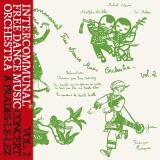
Concert at Prades-le-Lez marks the origins of the Intercommunal Free Dance Music Orchestra. In 1974, François Tusques and his companions (Michel Marre, Jo Maka, Adolf Winkler and Guem), in the spirit of Don Cherry or Chris McGregor, playfully dismantle all borders and all styles of creative music.
On this second volume, the Intercommunal builds unprecedented soundscapes around a song of revolt, a dance tune, or a burst of dissonance. The journey is unforgettable, no question about it. On repeat listening, it even becomes… lunar!
“The music that we make is primarily meant to be listened to live,” warned a leaflet from the Intercommunal Free Dance Music Orchestra. This is precisely why the (restored!) reissue of the two volumes of Concert at Prades-le-Lez, recorded on January 25 and 26, 1974 by François Tusques and his comrades, is such an important event.
In 1971, after recording a series of albums that would leave a lasting mark on French jazz (Free Jazz, of course, with Michel Portal, François Jeanneau, Bernard Vitet, Beb Guérin and Charles Saudrais, but also Le Nouveau Jazz with Barney Wilen, or the solo Piano Dazibao), François Tusques founded the Intercommunal—a grouping whose very name called for the fraternization of the various communities making up the country: Our music will help, we hope, to resolve the contradictions that exist between workers be longing to different communities, by breaking down various forms of national chauvinism, and more particularly the chauvinism of certain French people toward the cultures of Third World countries… Long live the friendship between the peoples of the whole world!
Among the great records made by the Intercommunal Free Dance Music Orchestra, the two volumes of Concert at Prades-le-Lez come first, before L’Inter Communal, Vol. 4, Le Musichien, and Après la marée noire (four titles already reissued by Souffle Continu). François Tusques and his companions (Michel Marre and Jo Maka on saxophones, Adolf Winkler on trombone, and Guem on percussion) performed on January 25 and 26, 1974 at the Moulin de Prades-le-Lez, a few kilometers from Montpellier. It was thus in the southern region of Occitanie that the first echoes of this musical vision of a borderless brotherhood were recorded.
“We’re not among the Colonels,” the Intercommunal reassures us right away, performing a stride piano tune carried by African winds that the audience cannot resist for long. The energy is already striking and it never lets up throughout these two recordings, from start to finish: jazz, blues, traditional music, minimalism, even funk… The musicians of the Intercommunal have heard a lot of great music and now delight in reinventing it by mixing it all together.
“We want the song form to take its place as a weapon in the struggle against capitalist exploitation and all those who oppress us morally and materially,” declared an Intercommunal leaflet, quoting Jean-Baptiste Clément, author of the lyrics to “Le Temps des cerises.” The struggle was therefore serious—but it did not prevent François Tusques and his group from waging it in a festive spirit: each piece on Concert at Prades-le- Lez sends out a call for love and fraternity. Fifty years later, the message remains as relevant as ever—and once again, it is François Tusques who makes it heard.