Escola Records is proud to present its third offering, this time from Pau Roca, one of the local representatives of the house sound in Barcelona with the greatest projection in the scene. He releases 'Your Energy' featuring the incomparable vocal talents of Laura Elle to bring the warmest vibrations as only she can. A phenomenal soulful house track cut filled with warm chords and dusty percussions that fuses Latin rhythms with classic house music. The release comes with the unmistakable sonic signature of the legend from Detroit, Alton Miller, and the collaboration between two of Barcelona's most intriguing and brilliant producers, Less J and Karmasound.
quête:4 to the bar
First release of 2025 is The Coin EP Vol.3. Marcello Cassanelli is back on Ten Lovers Music with two stunning tracks and a beautiful outro solo on his Rhodes. Starlight kicks off side A with some superb Italian Disco for 2025, following that a trip to Cuba for Tropical Breeze on which Marcello employs long time collaborators and super talented Giulia Barozzi on vocals and Antonio Rapa on drums.
Across both tracks Marcello plays the keys, bass, flute, guitar and drum programming. Rounding off side A is Dream Horizon an improvised one minute beatless outro jam on the Rhodes. On the AA side we have a new project from Caruso and Helen McCormack. First up is Have and Hold which harks back to the Manchester Street Soul scene of the late 80’s. Very simply constructed with electronic drums, bass, piano and a lead synth on top of which Helen’s vocal sits perfectly. Second on side AA is Love You More, a very atmostpheric track written by Helen with the strings arranged by Cormac Fulton. The percussion is from fellow TLM artist Takashi Nakazato (Kyoto Jazz Massive/Jazztronik).
Both tracks were produced by Steve Conry who also assisted Jose Rico on the mixes. Finally to finish on side AA is Central, a beautiful Deep House instrumental using only real analogue synths like the Solina String Ensemble, ARP Odyssey and Oberheim Xpander, mixed by Steve Conry and Matt Cox
Two records came out in 1988 that forever changed the perception of "experimental" or "serious" music produced in Portugal. These were "Plux Quba" by Nuno Canavarro and "Música de Baixa Fidelidade" by Tózé (António) Ferreira. Both were released by the same label - Ama Romanta -, an influential independent imprint closely linked to avantgarde pop band Pop Dell'Arte. Because those records appeared in what could be perceived as an "alternative pop" framework, they rescued this difficult music from Academia. It helps that Canavarro played in a successful new wave pop band (Street Kids) during the period 1980-83. By association, being a friend since 1976, António was in close contact with many of the musicians and bands that were part of the equally celebrated and detested Portuguese Rock Boom (roughly 79-82).
He was not a musician then but through his friendship with Canavarro, who had the means to acquire electronic equipment, António became involved with that equipment and shared Canavarro's passion for experimentation and curiosity for knowledge. They tried to get hold of as many technical magazines as possible and learn while testing ideas. In 1983, Street Kids were about to break up, young lives drafted into the Army and maybe, in Canavarro's case, a whole new passion for challenging music similar to his bandmate Nuno Rebelo, by then in the process of discovering a wide range of "other" music mainly through Jorge Lima Barreto. Barreto, who had started Telectu with Vítor Rua, possessed a huge book and record collection and, like Rua before them, Canavarro, Rebelo and Ferreira became fascinated by the pool of knowledge they now had access to by frequenting Barreto's house in Lisbon. He was roughly a decade older, had published several books and other writings throughout the 1970s, cultivated an anarchic stance and a penchant for cultural indoctrination. Rebelo was the first to be introduced via his contact with Rua (who had invited him to play in his other band GNR).
Overwhelmed, he felt the need to share his enthusiasm with friends and eventually took a few to the house in true pilgrimage fashion. To see the Light. Among the few he led there was even João Peste, founder of Ama Romanta. Canavarro and Ferreira preceded him.
Ferreira recalls an exciting learning process added to his experiments with Canavarro's array of synths such as the Korg Ms 20, Korg polysix, ARP Axxe, Roland SH-01, the Ensoniq Mirage sampler... He read in a magazine article about someone who had studied at the Institute of Sonology (then in Utrecht, Netherlands) and went there during a vacation trip in the Summer of 1983. He became excited by the prospect of studying at the Institute but money was a problem. Canavarro, on the other hand, was admitted there in the following year. Back in Portugal, Ferreira eventually abandoned his Chemical Engineering studies in Lisbon's Technical Institute in favour of a more focused music practice. He collaborated with Telectu during 1984 and 85 as a sort of technical engineer, implementing some recording solutions and background tapes and went to work at a thermoelectric power plant in Sines, hoping to make enough money to fund his musical studies. He did and proceeded with the paperwork for admission at the Institute of Sonology, now based in The Hague. António studied there in 1986-87 and the present album includes two compositions developed at the Institute: "More Adult Music" and "This Is Music, As It Was Expected", both featuring the voice of Rodney Waschka II. Among other activities and talents, Rodney is an expert in computer music and to António his voice sounded similar to Robert Ashley's, whose work he admired.
What happened at the Institute was a systematization of António's self-taught practice. Computer software, Musique Concrète, noise and silence, organisation of abstract ideas and sounds. The original notes on the back sleeve of the LP give some indication of process and thinking, but a more detailed account was given by António in the liner notes of the CD reissue in 2002, which are also included in this 2025 LP reissue.
The music sounds deep and detailed, despite the fact of António calling it low-fi ("Baixa Fidelidade"). It flows like an improvised performance where several musicians might be responding to each other, respectful of their mutual space. Drama occurs, as a natural emotional connection is sought by the listener. Piano, bells, drone, processed voices, even the clear narrative of Rodney Waschka II, contribute to create a sort of alternative perceptual reality. The sounds are almost tangible, more a part of the physical world than ethereal manifestations and thus it would not be correct to invoke "ambient music" as a selling point. But although "physical" and distinct, this music is still alien, more so in Portugal's 1988 environment. In March, helped by Canavarro, António set up a home studio and there he recorded the remaining material for this album: "Algumas Pessoas Olharam O Sul E Viram Deserto", "Um Som, Seguido De Uma Cena Negra E Malva" and "O Verão Nasceu Da Paixão De 1921".
"Música de Baixa Fidelidade" stands not only as a proof of great resilience but as one of those magnificent works of art coming from someone who balanced technical inclination and emotional sensibility. Because of that, Tózé Ferreira is able to decode the phantom world of sound for anyone who cares to experience the sensation of inhabiting a version of the Future. First ever vinyl reissue, reproduction of the original artwork with an additional insert. Made in collaboration with the artist and the support of Paulo Menezes (Plancton Music), who provided valuable assistance. Remastered by Taylor Deupree.
The heyday of American baroque pop – or chamber pop - ran from 1966 to the turn of the seventies. It used string quartets, harpsichords and woodwinds to create a summer-into-autumn melancholy that was quite new, and quite far removed from rock’n’roll as Eddie Cochran would have known it. Baroque pop’s musicians often came from a folk background, with an affinity for acoustic instrumentation. Linda Ronstadt's first band the Stone Poneys had introduced the autoharp to their line-ups in 1965, while the likes of Bonnie Dobson and Nico experimented with a string quartet’s, searching for different, post-electric Dylan directions.
There are records that come from the soul. No matter how primitive may be the recording techniques the musician has access to, the soul gets its way to the heart and mind of the listener. Samtvogel' is one of those records. Günter Schickert recorded that amazing piece of human greatness in 1974, using the media he had at the time, putting his brain at work to find the best way of taping everything he had to say. When I was recording Samtvogel' in 1974 I had only 2 Taperecorders. I played one track and while listening I added the second one. And so on. Four times. When I mixed all together I borrowed a 3rd taperecorder. And still added the last track to the master. I had a small mixer with 2 stereo and 1 mono but it was possible to pan tracks. No equalization. It all came out of my still living G2000 Dynacord guitar amplifier, of course valve, with no master, even the voice recorded through it. If I made a mistake in 1 track I had to repeat it from the beginning. And if while mixing I was not fast enough in changing the tape I had to start again. So it took me more than 3 months to get ready.'
Thanks to these three months of work, between June and September of 1974, 'Samtvogel' was privately issued that same year. It would later be issued on the Brain label, with a small change in the artwork -titles added to the front cover, which weren't on the original private pressing. Brain also reissued it on the label's Rock On Brain' LP series, this time with a completely different sleeve. The album contained two tracks on side one and just one on side two, and its sound has often been compared to the most explorative works of Syd Barret - however it must be pointed that Schickert did not need any mind spreading substances to allow his sounds float out of his mind & soul, they just came out in the most natural way. It will also appeal to fans of the echoed athmosferic guitar work of other kraut innovators such as Ash Ra Tempel, Manuel Götsching or A.R. & The Machines, and some may find on the vocal passages certain resemblances to Damo Suzuki on Can's 'Tago-Mago' era.
The Wah Wah reissue is housed in a quality sleeve that reproduces that of the original 1974 private pressing and features a 4 page insert with liners and photos - sound remastered at Eastside mastering Berlin. Get this bird now, before it flies away again!
There are records that come from the soul. No matter how primitive may be the recording techniques the musician has access to, the soul gets its way to the heart and mind of the listener. Samtvogel' is one of those records. Günter Schickert recorded that amazing piece of human greatness in 1974, using the media he had at the time, putting his brain at work to find the best way of taping everything he had to say. When I was recording Samtvogel' in 1974 I had only 2 Taperecorders. I played one track and while listening I added the second one. And so on. Four times. When I mixed all together I borrowed a 3rd taperecorder. And still added the last track to the master. I had a small mixer with 2 stereo and 1 mono but it was possible to pan tracks. No equalization. It all came out of my still living G2000 Dynacord guitar amplifier, of course valve, with no master, even the voice recorded through it. If I made a mistake in 1 track I had to repeat it from the beginning. And if while mixing I was not fast enough in changing the tape I had to start again. So it took me more than 3 months to get ready.'
Thanks to these three months of work, between June and September of 1974, 'Samtvogel' was privately issued that same year. It would later be issued on the Brain label, with a small change in the artwork -titles added to the front cover, which weren't on the original private pressing. Brain also reissued it on the label's Rock On Brain' LP series, this time with a completely different sleeve. The album contained two tracks on side one and just one on side two, and its sound has often been compared to the most explorative works of Syd Barret - however it must be pointed that Schickert did not need any mind spreading substances to allow his sounds float out of his mind & soul, they just came out in the most natural way. It will also appeal to fans of the echoed athmosferic guitar work of other kraut innovators such as Ash Ra Tempel, Manuel Götsching or A.R. & The Machines, and some may find on the vocal passages certain resemblances to Damo Suzuki on Can's 'Tago-Mago' era.
The Wah Wah reissue is housed in a quality sleeve that reproduces that of the original 1974 private pressing and features a 4 page insert with liners and photos - sound remastered at Eastside mastering Berlin. Get this bird now, before it flies away again!
There are records that come from the soul. No matter how primitive may be the recording techniques the musician has access to, the soul gets its way to the heart and mind of the listener. Samtvogel' is one of those records. Günter Schickert recorded that amazing piece of human greatness in 1974, using the media he had at the time, putting his brain at work to find the best way of taping everything he had to say. When I was recording Samtvogel' in 1974 I had only 2 Taperecorders. I played one track and while listening I added the second one. And so on. Four times. When I mixed all together I borrowed a 3rd taperecorder. And still added the last track to the master. I had a small mixer with 2 stereo and 1 mono but it was possible to pan tracks. No equalization. It all came out of my still living G2000 Dynacord guitar amplifier, of course valve, with no master, even the voice recorded through it. If I made a mistake in 1 track I had to repeat it from the beginning. And if while mixing I was not fast enough in changing the tape I had to start again. So it took me more than 3 months to get ready.'
Thanks to these three months of work, between June and September of 1974, 'Samtvogel' was privately issued that same year. It would later be issued on the Brain label, with a small change in the artwork -titles added to the front cover, which weren't on the original private pressing. Brain also reissued it on the label's Rock On Brain' LP series, this time with a completely different sleeve. The album contained two tracks on side one and just one on side two, and its sound has often been compared to the most explorative works of Syd Barret - however it must be pointed that Schickert did not need any mind spreading substances to allow his sounds float out of his mind & soul, they just came out in the most natural way. It will also appeal to fans of the echoed athmosferic guitar work of other kraut innovators such as Ash Ra Tempel, Manuel Götsching or A.R. & The Machines, and some may find on the vocal passages certain resemblances to Damo Suzuki on Can's 'Tago-Mago' era.
The Wah Wah reissue is housed in a quality sleeve that reproduces that of the original 1974 private pressing and features a 4 page insert with liners and photos - sound remastered at Eastside mastering Berlin. Get this bird now, before it flies away again!
- A1: (If You Think You're) Groovy
- A2: The First Cut Is The Deepest
- A3: Angel Of The Morning
- A4: To Love Somebody
- A5: A Likely Piece Of Work
- A6: Medicated Goo
- A7: Bury Me Down By The River
- B1: Will You Love Me Tomorrow - Andy Gibb With P.p. Arnold
- B2: Belle The Sleeping Car - Andrew Lloyd Webber, “Starlight Express” Original Cast, P.p. Arnold
- B3: A Little Pain
- B4: Supergrass
- B5: Electric Dreams
- B6: Burn It Up (7-Inch Edit) - The Beatmasters With P.p. Arnold
- C1: Perfect Sense Part 1 - Roger Waters Feat. P.p. Arnold
- C2: I Believe
- C3: Well Well Well - Steve Howe With P.p. Arnold
- C4: Salobreña - P.p. Arnold With Chaz Jankel
- C5: It's A Beautiful Thing (Radio Edit) - Ocean Colour Scene With P.p. Arnold
- C6: I'm Only Dreaming (Demo) - P.p Arnold With Steve Cradock
- D1: Satellite - Dr. Robert & P.p. Arnold
- D2: Like An Old Fashioned Waltz (Live, May 2012)
- D3: The Love Is Gone - The Mixture With P.p. Arnold
- D4: Different Drum
- D5: When I Was Part Of Your Picture
- D6: Soul Survivor
The very first (and long overdue) career-spanning retrospective from Soul music legend P.P. Arnold • A 57 song 3CD set, or 25 song 2LP set featuring singles, album tracks, demos, and previously unreleased songs • A stylishly packaged collection with new sleeve notes by author Jude Rogers • A companion piece to P.P. Arnold's critically acclaimed autobiography Soul Survivor The term "well-established" might be appropriate for some artists but it barely begins to cover the career of the phenomenal P.P. Arnold, whose records and performances are now in their seventh decade.
Her consistently excellent music covers multiple genres, her high-profile admirers and collaborators are plentiful, and yet 'Soul Survivor - A Life In Song' is the first collection dedicated to this extraordinary body of work. Compiled by the artist, 'Soul Survivor - A Life In Song' is being released on a 57 song 3CD set, and 25 song 2LP set, both formats housed in an eye-catching sleeve created by photographer (and close friend) Gered Mankowitz, with extensive new sleeve notes by author Jude Rogers.
Alongside key singles and album tracks it includes previously unreleased recordings, demo versions, live performances, and some rare mixes that are being reissued for the very first time. From her early days at Andrew Loog Oldham's Immediate label (where she "became one of us", according to Andrew) her allies, associates, and working partners have included the Small Faces, Cat Stevens, Mick Jagger, Barry Gibb, Eric Clapton, Andrew Lloyd Webber, The Blockheads' Chaz Jankel, Roger Waters, Ocean Colour Scene, The Blow Monkeys' Dr. Robert, and Paul Weller. In 2022 P.P. Arnold told her extraordinary life story in her critically acclaimed autobiography Soul Survivor (Mojo magazine called it "a jaw-dropping memoir"); now that book has the soundtrack that it deserves.
Italian composer and saxophonist Laura Agnusdei returns with “Flowers Are Blooming In Antarctica” a career defining record that sees the artist diving into uncharted waters, a profound timeless meditation on our relationship with planet Earth, the eco-conflicts arising and the fascination with non human forms of life, backdropped to a vivid soundtrack of coral exotica, spiritual Jazz, fourth-world minimalism, tropical electronics, tribal futurism and contemporary elegance.
Every step of Laura Agnusdei’s path, from electroacoustic experimentation to her constant research based upon the acoustic dimension of wind instruments and their interaction with polymorphic electronic sounds, seems to have pivoted into a new sense of awareness, as if the mind and intellectual practice has finally caught up with the body, the heart and the soul, resulting in her most organic and transcendent work yet. “Flowers Are Blooming In Antarctica” is loosely inspired around a trifecta of pioneering ideas that explore unconventional reality: James Bridle’s ‘Ways Of Being’ with his radical story that mixes ecology, tech and intelligence; Luigi Serafini’s late-70s fantastical ‘Codex Seraphinianus’, an unparalleled collection of flora, fauna, anatomies metamorphosed into new fragile beings; J.G. Ballard’s climate-fiction foreshadowing sci-fi ruminations. These influences shift Agnusdei’s musical trajectory injecting doses of terrestrial malaise, the earthy sub-saharan ‘Ittiolalia’ with its wah-wah filtered sax and trance inducing groove; the rubbery playfulness of ‘Oasi Bar’; the gentle eco-system of ‘P.P.R.N’ reminiscent of Herbie Hancock’s innovative synthesis of funk, space and synthesizers; the kaleidoscopic northern lights of ‘Emperor Penguin Lullaby’, where south-east Asian echoes reach icy shores; the Jon Hassell hyper-ambience of ‘Cuttlefish REM Phase’; the post-apocalyptic march of ‘The Drowned World, a jazz standard for an artificial civilization on the brink of self-destruction. Nothing feels out of place and it’s no coincidence that one of the most powerful messages on the record is delivered on centerpiece ‘Are We Dinos?’ via an interview conducted with two preschoolers. Radical optimism or sonic liberation?
Laura Agnusdei’s tenor sax cuts deep all across “Flowers Are Blooming In Antarctica”, a laser baton raised up to the clouds, a conductor orchestrating devotional soundscapes for a three-eyed dolphin, guiding us through prismatic pastures and acidic oceans. Her tropicalized realm is pin-pointed with Miles-like sheer clarity, a bristling nakedness on the verge of exploding at any time, creating an album where ascension becomes the unifying code.
- A1: Pride
- A2: Bloom
- A3: My Love
- A4: Nearness Of You
- A5: Upstate
- B1: Wither
- B2: Passerby
- B3: Exit Wounds
- B4: It Could Be Simple
Rising indie soul artist Sevens announces the release of his highly anticipated debut album, Sincerely, Sevens, on February 21, 2025. At just 24 years old, Sevens emerges as a compelling voice in the contemporary soul scene, blending indie soul, neo-soul, and jazz into a collection of sincere, heartfelt songs.
With a distinct baritone voice and a gift for storytelling, Sevens explores themes of love, growth, and introspection throughout the 9-track record. His philosophy is simple: less is more. Crafted over a span of three years, much of the album was created in Sevens' bedroom, showcasing his skills not only as a songwriter and vocalist but also as a multi-instrumentalist and producer.
Sincerely, Sevens captures the artist in his purest form—a deeply personal work that touches the soul. From sparse, intimate arrangements to warm, groove-infused instrumentation, the record embraces vulnerability while exuding timeless charm.
The album features contributions from trusted collaborators: Boris Van Overschee (co-producer / Delv!s, Portland) Willem Ardui (additional production / Blackwave.) and David Poltrock (additional keys)
Tobie Speleman expertly handled the final mix, ensuring every note resonated with clarity and purpose.
Reflecting on the album, Sevens shares: “I wanted to feel more with less. I wanted to evoke, I wanted to touch. Parts of me I’ve never gone. It is honest, it is true. It is me.”
With Sincerely, Sevens, the young artist solidifies his position as one to watch—an emerging voice with both depth and authenticity.
Bursting forth from the darkness of this pre-apocalyptic winter comes 'The Cabanists', the first release of an improvisational project of the same name, comprising three members of the UK's seminal avant-rock band, Nøught. Garnering a cult following since their initial self-titled debut, Nøught became known in the London experimental underground for their tightly orchestrated yet highly complex compositions, ranging from heavy atonal riffage to mesmerizing and hypnotic meditations. 'The Cabanists' builds on Nøught's musical language and are a boundary-pushing trio fusing intricate guitar riffs, dynamic keyboard textures and explosive percussion into a sound that defies convention. Featuring James Sedwards on guitar (most recently known for his involvement with the Thurston Moore Group and This Is Not This Heat), Luke Barlow on keyboards (who co-runs Copepod Records with musician Alex Ward) and Bo Mapper on drums, the band recorded their groundbreaking material during an extended session at London's Lonely Man Studio, marking a defining moment in their musical journey.
With influences spanning progressive rock, experimental jazz and post-punk energy, The Cabanists weave a sonic tapestry that is as cerebral as it is visceral. They challenge standard rock and jazz norms while crafting deeply resonant soundscapes, inviting listeners into a thrilling journey of sound and intense emotion.
Prepare to lose yourself in the intricate chaos and undeniable groove of 'The Cabanists' - where every note is a revelation.
Berlin based producer CONCEPTUAL is back home after his Not an easy one Ep, again providing his own vision on techno, full of sonic landscapes, detail and intelligence.
Release starts with Approach slowly a brief atmospheric intro that sets the pace for what comes next in Il silenzio degli innocenti introducing the rhythmic pulse from the first bar with almost all elements into he equation, this is a minimalistic tool where percussive elements evolve in a subtle manner all over the arrangement.
No more excuses continues in the mood, adding more spice to the formula with reverberated details, growing mental sequences and the usual complex groove. Intense and mental all in one.
Sand fury follows, with atmospheres colliding with rugged components, evolving all together in a progressive arrangement, a superb tool to enhance your mixes properly.
Miles per hour introduces you into another sonic realm, using elastic synth lines, a wise reverb work and a sensation of infinite space combined with floor intensity. Again a proper intelligent missile for the adequate dancefloors out there.
Simone Scardino is one of those few creators that always pushes his sound one step further and we are super proud to have him onboard again.
The Young Mothers return with their third album, Better If You Let It, blending a genre-defying mix of jazz, hip-hop, punk, experimental rock, and electronic music. Formed by Norwegian bassist Ingebrigt Håker Flaten in Austin, Texas, the band’s sound is shaped by the diverse musical backgrounds of its members, hailing from both the U.S. and Norway. With influences spanning from Texas’ vibrant hip-hop and punk scenes to Norway’s experimental jazz traditions, the band creates a powerful fusion that feels cinematic and unpredictable.
The lineup includes Jawwaad Taylor (trumpet, rhymes, electronics) and Jason Jackson (tenor and baritone sax) from Houston, Stefan Gonzalez (vibraphone, drums, percussion, voice) from Dallas, Frank Rosaly (drums, electronics) from Chicago and Amsterdam, and Håker Flaten (bass) from Norway.
This global roster brings together a dynamic, cross-cultural sound, with Better If You Let It showcasing their most cohesive and wide-ranging material yet. Recorded in Oslo and set for release on Sonic Transmission Records, the album is a bold statement, proving The Young Mothers’ ability to push musical boundaries across genres and geographies.
After four EPs of skeletal kraut-punk and slimmed down post-motorik alienage Milan’s Tv Dust are back with an entirely different beast, their proper debut ‘Transition’, an incredible collection of no-jazz, breakneck rhythms, mutant-wave, trance-funk, shredded sax jags and furious, yet mysterious assaults.
Tv Dust run a tight ship, they jam econo, with the album strongly based around the incredible interplay of drums (Sergio Tringali), bass (Filippo Aloisi) and sax/synth (newest member Gaetano Pappalardo). Shedding the use of vocals has completely freed the band up into a mutating beast, wild horses racing beside a volcano eruption, improv bursts that perfectly soundtrack the ruins of a city facing the inhuman consequences of wild expansion and dumb economics.
Transition is a no-jazz, no-panic, no-border album, born between a small bar and a basement, reworking some ideas from the first Tv Dust sessions with a new mindset, with improvisation becoming an important tool in the trio's new path that already sees releases on Occult Punk Gang, My Own Private Records, Sentiero Futuro and Maple Death.
Transition like the transformation of the group, you still get the original package of furious hypnotic grooves, shortwave radio alien funk, devo-id convulsions, jittery no-wave and Italo post-punk tradition alongside dada-jazz and freeform freakouts.
Prolific Norwegian trumpeter and ECM veteran Arve Henriksen returns with Estonian guitarist/composer Robert Jürjendal in tow, matching his idiosyncratic shakuhachi-style melodic condensations with Jürjendal's glassy electro-acoustic soundscapes and sonorous percussion.
Henriksen releases a lot but is remarkably reliable; his playing is so versatile that hearing it dematerialise into different ensembles and individual methodologies is always a treat. Jürjendal is a veteran guitarist, but doesn't approach his instrument from a purely classical standpoint, taking a Fripp-inspired path towards texture, processing and looping his sounds until they're barely recognisable. The duo share a similar love for Hassell's Fourth World ambience, and here inject new life into that mood.
Jürjendal's percussion is impressive: he offsets cascades of oddly-tuned electronics on 'Tuonela' with booming, ritualistic tom hits that punctuate Henriksen's melancholy phrases; and on the brilliant 'Ancient Bells', plays a set of gongs and gamelan-style instruments, creating swirling hammered tonal clusters that quiver beneath Henriksen's echoed-out, spirited improvisations. It's not always that corporeal, either; on 'A Remarkable Flow', he loops guitar phrases, creating gentle vibrations that rumble in the background while he mirrors Henriksen's pitchy zig-zags with high-pitched oscillator vamps.
Even on the peaceable 'Miraculous Lake', discreet kalimba loops set a celestial tempo that anchors the duo's gaseous soundscapes. And although they veer towards end-credits loveliness on the Göttsching-influenced 'Reunion Hymn', it’s balanced by the album's darker passages, like 'Rebirth' and 'Another Me'. On the latter, Henriksen's trumpet is transformed into a voice-like warble, while Jürjendal replies with glacial E-bowed drones that resonate creepily alongside his lysergic FM pads.
It's been a long (and fun) time but finally Ari Bald & CJ Scott are getting the international recognition they deserve, after years of meticulously crafting their own brand of pure, guilt-free, locally sourced house music, through regular releases on a
string of illustrious underground labels and, more recently, two striking EPs on their hometown label Studio Barnhus outta Stockholm, Sweden.
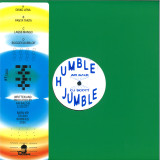
On the dynamic duo's new Studio Barnhus release Humble Jumble, cheekiness levels and BPM counts are pushed to their limits, with ingenious sample choices and floor-friendly arrangements spread across two slabs of DJ-optimised vinyl, arriving on February 7 2025. Comes in yellow, red and green sleeves. Stamped and numbered by the artists themselves. Limited edition of 300 copies.
Apple Cores is the latest full-length album from New York tenor saxophonist James Brandon Lewis, "one of the fiercest sounds in jazz today" (The Guardian) with a "penchant for unbound exploration" (Pitchfork). Informed by the rhythms and textures of hip-hop and funk while remaining rooted in jazz, Apple Cores was recorded with Chad Taylor (drums/mbira) and Josh Werner (bass/guitar) over the course of two intense, entirely improvised sessions. The album takes its name and intention from the column that poet and jazz theorist Amiri Baraka wrote for DownBeat in the 1960s. In addition to Baraka, the influence of another jazz giant looms mightily over Apple Cores: trumpeter and multi-instrumentalist, Don Cherry. In a testament to Cherry"s influence over the music that the trio is playing, Lewis designed each song title as a cryptogram of sorts, making subtle references to Cherry"s life and music. Apple Cores further cements Lewis as one of the provocative and prolific musical voices of his generation. It follows his breakthrough with JazzTimes" Album of the Year Jesup Wagon (2021), a dreamlike mosaic of gospel, folk-blues, and catcalling brass bands inspired by inventor George Washington Carver, and Eye Of I (2023), his joyous and exploratory debut for ANTI-.
DOVS are the duo of Vienna’s Johannes Auvinen, aka Tin Man, and Mexico City’s Gabo Barranco, aka AAAA. Psychic Geography is their second album together, but it differs considerably from both their respective solo work and their 2019 debut LP together, Silent Cities: Where that album’s hardware-based acid kept its gaze focused squarely on the dancefloor, Psychic Geography is a strictly ambient affair.
The album has its roots in a trio of beatless tracks that peppered Silent Cities; this time, the duo decided to try making an entire album with no drums. “It opened up the chance to make a different, more narrative style of music with more complex structures,” Auvinen says. Ambiguity and uncertainty are key watchwords for their music, which moves with eerie, liquid grace. Untethered from 4/4 kicks, their music drifts and morphs; familiar acid sequences give way to surprising shifts in tone and mood. And with no drums to distract the ear, the seeming simplicity of their silvery synth lines opens up to reveal remarkable depth and dynamism.
Barranco and Auvinen recorded the album together in the studio utilizing machines like the Roland TB-303, Juno G, Prophet 5, Elektron Octatrack MKII, Make Noise DPO and René, Mutable Clouds, Roland SH-101, Behringer TD3, and Sherman Filterbank. Listen on good speakers or headphones, and you can tell: Their gear yields a tonal richness that recalls the ambient and cosmic music of decades earlier. You can practically feel the heat from their circuits warming the air.
The meaning behind the name DOVS is as ambiguous as the duo’s music. (Dig, if you will, the picture of Picasso’s dove of peace—or, perhaps, the outline of a bird pressed into a small white pill.) But Psychic Geography needs little explanation. DOVS’ album is a collection of mental maps of imaginary places. Set your coordinates for the mirage on the horizon and prepare to dissolve.
Celebrating 50 years of Kahil El'Zabar's Ethnic Heritage Ensemble's legacy and unwavering contribution to Great Black Music. 'Open Me, A Higher Consciousness of Sound and Spirit' is a new Ethnic Heritage Ensemble sound, constantly shifting gears and tempos in a jazz-blues continuum, in perpetual spontaneity, combining their meaningful music history with an innovative approach to arrangements, performance and improvisation. This is Ancient / Future Music for the Now and Beyond.
Open Me is a joyous honoring of portent new directions of the Ethnic Heritage Ensemble; it's a visionary journey into deep roots and future routes, channeling traditions old and new. It mixes El'Zabar's original compositions with timeless classics by Miles Davis, McCoy Tyner, and Eugene McDaniels. Thus, the Ethnic Heritage Ensemble continues affirming their indelible, half-century presence within the continuum of Great Black Music.
For Open Me, El'Zabar has chosen to push the sound of the EHE in a new direction by adding string instruments --the addition of strings opens new textural resonances and timbral dimensions in the Ensemble's sound, linking the work to the tradition of improvising violin and cello from Ray Nance to Billy Bang, Leroy Jenkins, and Abdul Wadud.
Open Me contains a mixture of originals, including some El'Zabar evergreens such as "Barundi," "Hang Tuff," "Ornette," and "Great Black Music" (often attributed to the Art Ensemble of Chicago but is, in fact, an El'Zabar composition).
As a milestone anniversary celebration and a statement of future intent, Open Me effortlessly carries El'Zabar's healing vision of Higher Consciousness of Sound and Spirit.
We are very excited to present our first release "Prelude" RU001. This exceptional record marks the beginning of a new era in minimal electronic music, fusing the creativity of Lucas Moss with the unique interpretations of Vlad Arapasu and Nu Zau. "Prelude” is more than an album; it is a testament to our commitment to change and evolution in musical culture. This journey of original sounds reveals our vision of embracing art in all its forms, contributing to a cultural change on a global level. On the two original tracks by Lucas Moss, we explore the depths of change and transformation. Vlad Arapasu brings his unique perspective with a remix that captivates, while Nu Zau features a vibrant and joyful remix that redraws the boundaries of the dancefloor. “Prelude" symbolises a trip where change and purification can be achieved by bringing just a little bit of light into the darkness. The vocals symbolize the intuition we all have but which is sometimes dormant. Cumacanga express our shadows; we recognize that without them, the light would not shine as brightly. This release is our call for change, innovation and the continued support of art in all its forms. Join us on this journey, where minimal electronic music becomes the way to transcend barriers and create a permanent impact on the world of art. Together, we start the journey with "Prelude" RU001, and this is just the beginning...