Search:anne hard fi

Styles
All
Various - AMNESIA 50 YEARS (10x12")

Various

AMNESIA 50 YEARS (10x12")

8x12"-Vinyl5411207
541 Label
23.10.2026
 
49

2026 Restock

Celebrating 50 years of dancing, Amnesia represents the heart and soul of electronic music in Ibiza. Telling a story that spans five decades, the 50th anniversary vinyl/CD compilation is a window into a legendary venue that has helped establish some of the world's biggest tracks.

From the iconic piano riff of Eric Prydz' 'Pjanoo' to the laid-back groove of 'Benediction' by Hot Natured. A club that spans eras and genres - the disco of Chic's 'Good Times', the synth-pop of New Order's 'Blue Monday', or the gritty electro of Alter Ego's 'Rocker'.

The soundtracks of 50 summers are represented across 50 tracks spanning 10 vinyl/5 CDs. A hand-picked selection that reflects the incredible breadth of Amnesia's cultural influence, featuring music from Calvin Harris, Donna Summer, Paul van Dyk, Candi Staton, Fred Again.., Robert Miles, Laurent Garnier, Binary Finary, and many more.

pre-order now23.10.2026

expected to be published on 23.10.2026

Last In: 46 days ago
168,03 €
Tieum - Archives EP 2

Tieum

Archives EP 2

12inchGOBBLESP05MRBLD
Mazykka Vinyles
30.10.2026

Après le Gobble SP 04, nous sommes fiers de vous présenter le Gobble SP 05 !

Pour ce nouvel opus, nous avons une nouvelle fois sélectionné des morceaux inédits de Tieum, produits à l’origine dans les années 90/2000. Des tracks choisies avec soin pour composer un EP à son image, rempli de cette énergie et de cette identité qui ont marqué toute une génération.

Un grand merci à Tieum pour sa confiance et pour nous permettre de ressortir de ses archives ces morceaux qui nous ont bercés tout au long de notre jeunesse !

Un véritable voyage dans le temps pour tous les amoureux du hardcore gabber oldschool.

pre-order now30.10.2026

expected to be published on 30.10.2026

22,90 €
Tieum - Archives EP 2

Tieum

Archives EP 2

12inchGOBBLESP05
Mazykka Vinyles
30.10.2026

Après le Gobble SP 04, nous sommes fiers de vous présenter le Gobble SP 05 !

Pour ce nouvel opus, nous avons une nouvelle fois sélectionné des morceaux inédits de Tieum, produits à l’origine dans les années 90/2000. Des tracks choisies avec soin pour composer un EP à son image, rempli de cette énergie et de cette identité qui ont marqué toute une génération.

Un grand merci à Tieum pour sa confiance et pour nous permettre de ressortir de ses archives ces morceaux qui nous ont bercés tout au long de notre jeunesse !

Un véritable voyage dans le temps pour tous les amoureux du hardcore gabber oldschool.

pre-order now30.10.2026

expected to be published on 30.10.2026

20,13 €
Ben Sims - Snapshot 99 (Anne Remixes)

DJ Support - Alan Fitzpatrick, Ben Sims, Colin Dale, Dave Clarke, DJ Bone, Doc Scott, Dustin Zahn, Ellen Allien, Fear-E, Fixon, Gary Beck, James Ruskin, Laurent Garnier, Luke Slater, Misstress Barbara, Radio Slave, Rebecca Delle Piane, Remy Unger, Rodhad, Scuba, The Advent & Truncate

Hardgroove returns with three powerful new remixes from rising Greek talent ANNE, who twists label boss Sim’s Snapshot ‘99 into a trio of peak-time weapons. Marking her third release on the legendary label, ANNE builds on acclaimed work for Out Of Place, Soma, and Hardgroove sister label Symbolism, seeing her in heavy demand with a packed 2025 touring schedule across the EU and beyond.

In Stock

On Stock and ready to ship

Last In: 11 days ago
13,66 €
NALBANDIAN THE ETHIOPIAN & EITHER/ORCHESTRA - NALBANDIAN THE ETHIOPIAN (ETHIOPIQUES)

The Éthiopiques series returns! Essential archive recordings from an extremely fruitful period in Ethiopian music.

Before “Swinging Addis” took over the world, there was Moussié Nerses Nalbandian — the Armenian-born composer who shaped modern Ethiopian music. Mentor, arranger, and pioneer, he laid the foundations of Ethio-jazz.

This Éthiopiques volume revives his forgotten legacy, recorded live by Either/ Orchestra First issue ever with new exclusive photos and in depth liner 8-page insert.

“Ethiopian jazzmen are the best musicians that we have seen so far in Africa.
They really are promising handlers of jazz instruments.”

Wilbur De Paris
(1959, after a concert in Addis Ababa)

አዲስ፡ዘመን። *Addis zèmèn* **A new era.**
The time is the mid-1950s and early 1960s, just before "Swinging Addis" bloomed – or rather boomed – onto the scene. Brass instruments are still dominant, but the advent of the electric guitar, and the very first electronic organs, are just around the corner. Rock’n'Roll, R’n’B, Soul and the Twist have not yet barged their way in. Addis Ababa is steeped in the big band atmosphere of the post-war era, with Glenn Miller's *In the* *Mood* as its world-wide theme song, neck and neck with the Latin craze that was in vogue at the same period. Life has become enjoyable once again, with the return of peace after the terrible Italian Fascist invasion of Ethiopia (1935-1941). The redeployment of modern music is part and parcel of the postwar reconstruction. *Addis zèmèn* – a new era – is the watchword of the postwar period, just as it was all across war-torn Europe.
The generation who were the young parents of baby boomers** were the first to enjoy this musical renaissance, before the baby boomers themselves took over and forever super-charged the soundtrack of the final days of imperial reign. Music is Ethiopia's most popular art form, and very often serves as the best barometer for the upsurge of energy that is critical for reconstruction. Whether it be jazz in Saint-Germain-des-Prés or the *zazous* who revolutionised both jazz and French *chanson* after the *Libération*, be it Madrid's post-Franco Movida, or Dada, the Surrealists and *les années folles* that followed World War I, the periods just after mourning and hardship always give rise to brighter and more tuneful tomorrows. Addis Ababa, as the country's capital, and the epicentre of change, was no exception to this vital rule.

**Two generations of Nalbandian musicians**
Nersès Nalbandian belonged to a family of Armenian exiles, who had moved to Ethiopia in the mid-1920s. The uncle Kevork arrived along with the fabled "*Arba Lidjotch*", the** "*40 Kids*", young Armenian orphans and musicians that the Ras Tafari had recruited when he visited Jerusalem in 1924, intending to turn their brass band into the official imperial band. If Kevork Nalbandian was the one who first opened the way of modernism, pushing innovation so far as to invent musical theatre, it was his nephew Nersès who would go on to become, from the 1940s and until his death in 1977, a pivotal figure of modern Ethiopian music and of the heights it. Going all the way back to the 1950s. Nothing less. And it is Nersès who is largely to thank for the brassy colours that so greatly contributed to the international renown of Ethiopian groove. While the younger generations today venture timidly into the genealogy of their country's modern music, often losing their way amidst a distinctly xenophobic historiographical complacency, many survivors of the imperial period are still around to bear witness and pay tribute to the essential role that "Moussié Nersès" played in the rise of Abyssinia's musical modernity.
Given the year of his birth (15 March 1915), no one knows for sure if Nersès Nalbandian was born in Aintab, today Gaziantep (Turkiye/former Ottoman Empire) or on the other side of the border in Alep, Syria... What is certain is that his family, like the entire Armenian community, was amongst the victims of the genocide perpetrated by the Turks. Alep, the place of safety – today in ruins.
Before Nersès then, there was uncle Kevork (1887-1963). For a quarter of a century, he was a whirlwind of activity in music teaching and theatrical innovation. *Guèbrè Mariam le Gondaré* (የጎንደሬ ገብረ ማርያም አጥቶ ማግኘት, 1926 EC=1934) is his most famous creation. This play included "ten Ethiopian songs" — a totally innovative approach. According to his autobiographical notes, preserved by the Nalbandian family, Kevork indicates that he composed some 50 such pieces over the course of his career. This shows just how much he understood, very early on, the critical importance of song as Ethiopia's crowning artistic form. Indeed, for Ethiopian listeners, the most important thing is the lyrics, with all their multifarious mischief, far more than a strong melody, sophisticated arrangements or even an exceptional voice. (This is also why Ethiopians by and large, and beginning with the artists and producers themselves, believed for a long time — and wrongly — that their music could not possibly be exported, and could never win over audiences abroad, who did not speak the country's languages).

Last but not least, one of Kevork's major contributions remains composing Ethiopia's first national anthem – with lyrics by Yoftahé Negussié.
Nersès Nalbandian moved to Ethiopia at the end of the 1930s, at the behest of his ground-breaking uncle. Proficient in many instruments (pretty much everything but the drums), conductor, choir director, composer, arranger, adapter, creator, piano tuner, purveyor of rented pianos,... he was above all an energetic and influential teacher. From 1946 onwards, thanks to Kevork's connexion, Nersès was appointed musical director of the Addis Ababa Municipality Band. In just a few years, Nersès transformed it into the first truly modern ensemble, thanks to the quality of his teaching, his choice of repertoire, and the sophistication of his arrangements. It was this group that would go on to become the orchestra of the Haile Selassie Theatre shortly after its inauguration in 1955, which was a major celebration of the Emperor's jubilee, marking the 25th anniversary of his on-again-off-again reign.

At some point or other in his long career, Nersès Nalbandian had a hand in the creation of just about every institutional band (Municipality Band, Police Orchestra, Imperial Bodyguard Band, Army Band, Yared Music School…), but it was with the Haile Selassie Theatre – today the National Theatre – that his abilities were most on display, up until his death in 1977. To this must be added the development of choral singing in Ethiopia, hitherto unknown, and a sort of secret garden dedicated to the memory of Armenian sacred music, and brought together in two thick, unpublished volumes. Shortly before his death (November 13, 1977), he was appointed to lead the impressive Ethiopian delegation at Festac in Lagos, Nigeria (January-February 1977).

His status as a stateless foreigner regularly excluded him from the most senior positions, in spite of the respect he commanded (and commands to this day) from the musicians of his era. Naturally gifted and largely self-taught, Nerses was tirelessly curious about new musical developments, drawing inspiration from the very first imported records, and especially from listening intensely to the musical programmes broadcast over short-wave radio – BBC *First*. A prolific composer and arranger, he was constantly mindful of formalising and integrating Ethiopian parameters (specific “musical modes”, pentatonic scale, and the dominance of ternary rhythms) into his “modernisation” of the musical culture, rather than trying to over-westernise it. It even seems very probable that *Moussié* Nerses made a decisive contribution to the development of tighter music-teaching methods, in order to revitalise musical education during this period of prodigious cultural ferment. Flying in the face of all the historiographical and musicological evidence, it is taken as sacrosanct dogma that the four musical modes or chords officially recognised today, the *qǝñǝt* or *qiñit* (ቅኝት), are every bit as millennial as Ethiopia itself. It would appear however that some streamlining of these chords actually took place in around 1960. It was only from this time onward that music teaching was structured around these four fundamental musical modes and chords: *Ambassel*, *Bati*, *Tezeta* and *Antchi Hoyé*. A historical and musical “details” that is, apparently, difficult to swallow, especially if that should honour a *foreigner*. Modern Ethiopian music has Nersès to thank for many of its standards and, to this day, it is not unusual for the National Radio to broadcast thunderous oldies that bear unmistakable traces of his outrageously groovy touch.

In Stock

On Stock and ready to ship

Last In: 7 months ago
22,06 €
Various - yet 3x12"

Various

yet 3x12"

3x12inchTRESOR350LP
Tresor
28.04.2023

yet is a slippery word in English. Amorphous, these three letters in dierent contexts can define contrast or emphasis, set a place in time, show an expectation that something will occur or, paradoxically, that it is likely to stop.
It is this mercurial nature that makes yet the perfect title for Tresor’s latest compilation: the label follows on from the more explorative sections of 2021’s landmark Tresor 30 boxed set with a compilation, featuring 13 artists making music that resists easy definition.
Every track hints at and borrows from the familiar yet none follow the expected path: halfway through Deserto, Nandele & A-Tweed dramatically reveal a very dierent sonic landscape that was initially suggested; DJ Sotofett collaborates with Sri Lankan artist Kavadi with results that are unlike anything in the Norwegian producer’s catalogue as yet.
Further invention can be found as Jean Redondo’s Hypersonic moves across spaces inhabited by digital hardcore and hyperpop before swerving o-road and into a futuristic hip-hop section; on No Longer Human, Ireen Amnes takes a dierent path at the crossroads melding hyperpop, trance, and sci-fi soundtrack atmospherics, Significant Other heads towards UK Bass and Dubstep, and France’s Willis Anne skims by the outskirts of footwork with a piece that is almost completely uncategorisable.
Yet more sonic experimentation comes from E-Saggila, Nadia Struiwigh, NVST, Solid Blake, and Viikatory who oer unique takes on the well-established electro blueprint, while Ryan James Ford, and Nit. both find ways to blend elements normally found in ambient pieces with those heard on a dancefloor.
The feel of the compilation is yet again reflected in the enigmatic artwork by Malik Arbab, where shapes and colours suggest animals and plants but in a world that appears to be transient and constantly evolving.

In Stock

On Stock and ready to ship

Last In: 7 months ago
26,85 €
SERA J & ANNĒ - Symbiosis III

SERA J & ANNĒ

Symbiosis III

12inchMR-042RP
Mutual Rytm
24.08.2026

2026 Repress

ANNE and Sera J close their Symbiosis series on Mutual Rytm with third and most refined EP yet.

This final chapter reflects everything the collaboration has stood for across a trio of inventive techno releases on SHDW's imprint. Creative and life partners ANNE and Sera J have been two voices growing in parallel, evolving separately but moving with the same pulse. ANNE is well established thanks to standout EPs on the likes of Soma and Hardgroove, while Sera J has released on the likes of Life in Patterns and Renegade Methodz, and both have featured on Mutual Rytm's 'Federation Of Rytm' series before now. 'Symbiosis III' is the moment where everything comes full circle: the culmination of a journey built on respect, creativity, and the freedom to explore their own paths while lifting each other forward.

Sera J kicks off with 'Ransomware', a commanding and driving techno cut lit up with flashy synths but always moving with urgency. 'Phosphate' keeps the energy levels high with stripped-back drums and bass designed to perfection, while 'Anthrax' has an anxious edge. The synths are wispy but evocative as bass kills and swiping filters bring the drama.

ANNE then ups the ante with the acid-tinged 'Dementia', which is loopy and unrelenting before 'A Taste of a Real Woman' gets more seductive with a sultry spoken word and sustained chords that bring the paranoia. 'Heart Rate' is propulsive with Detroit-style synth soul and an aching vocal, before Sera J returns with 'On the Run' - a percussive, trippy and eerie roller. His final Cut 'Similar Minds' has a searching synth surveying a desolate landscape, before ANNE then closes the EP with the punchy drum patterns and icy hi hats of 'Primal Howl Of Ego' and a blend of deep drums and evocative synth work on the 'Analog Heartbeat' - which proves potent techno can be beautiful.

stock from14.10.2026

Last In: 2 days ago
12,56 €
ANNĒ & Sera J - Symbiosis

ANNĒ & Sera J

Symbiosis

12inchMR-019RP
Mutual Rytm
24.07.2026

2026 Repress

SHDW's label Mutual Rytm rounds out another year with 'Symbiosis' - an excellent split EP from Greek artists ANNE & Sera J, featuring six fresh cuts and four digital bonuses.

The release title comes from the Greek word 'Symbiosis', which means living closely together for a significant period and can be used to speak of a mutually beneficial interaction between individuals. And that is precisely what can be said of ANNE and Sera J, who have grown through life as partners and, more recently, as musical peers. This split EP is their first release alongside one another, and one that presents the story of their innermost feelings, with their full label debut following fine contributions to the label's 'Federation Of Rytm II' compilation back in March.

ANNE has had a busy few years making her mark with potent techno on labels such as Soma, Hardgroove, and Life In Patterns, while Sera J is just as revered for his tunes on the likes of Out Of Place, DifferentSound and more.

ANNE takes the A-side, firstly with the fiery diva vocals and thumping techno drums of 'Heal My Soul' and then the more physical and banging drum programming of 'Turn Back Time'. It's a big, metallic cut with rumbling bass and sleek synths peeling off the groove, while her final track 'Zephyrus' has plenty of infectious bounce and eerie pads to keep dancers on their toes.

On the flip, Sera J kicks off with the electrifying synth stabs and cantering techno power of 'Blue Dancers' and then offers up 'Common People' as twisted leads and slamming drums all run through with alien sound effects and bright stabs. To close, 'Delusion' is a psychedelic cut with roaming leads that bring plenty of cosmic energy to the unrelenting kicks.

In addition, each artist serves up a pair of digital bonuses: ANNE with the hurried funk of 'Serene' and loopy intensity of 'Victor', and Sera J with the liquid, dubby dynamics of the hard-hitting 'Intensity' and monstrous energy of 'Bodies Don't Lie.'

out of Stock

Order now and we will order the item for you at our supplier.

Last In: 18 days ago
12,56 €
ANNĒ & SERA J - Symbiosis II

ANNĒ & SERA J

Symbiosis II

12inchMR-030RP
Mutual Rytm
21.07.2026

2026 Repress

ANNE & SERA J return for the second edition of their Symbiosis series on Mutual Rytm.

ANNE, known for potent techno on the likes of Soma and Hardgroove, and Nechto and Life In Patterns associate Sera J, have had standout years that have seen them put out a stream of essential club tracks. They are partners in both life and music, and the first volume of 'Symbiosis' on SHDW's Mutual Rytm imprint was their first release together. Delivering an honest representation of their innermost feelings, having also contributed to the label's 'Federation Of Rytm III' VA in February, this new six-track EP (plus bonus cuts) presents a 'mature and refined connection between their souls'.

The second instalment of 'Symbiosis' reflects not only their deep personal connection, but also their collaborative synergy as musical peers with the same goals. The EP captures the essence of their mutual artistic journey and showcases the strength of their bond both in life and through their shared creative vision - to create a storyline through sounds coming from their souls and convey a narrative that many listeners may find relatable.

SERA J kicks off with the lithe and melodically elegant techno of 'Your Soul Is Art' which will have both heart and heels dancing. 'Illusions' is a more heavy and dubby cut with paired back grooves and pulsing synths, while 'Glacial Pace' is an urgent deep techno roller with turbocharged stabs and huge icy hi hats locking you into a trance.

ANNE steps up on the B-side with 'Floating Waves' exploring physical, chunky drum funk and raw synth textures. 'Planetary Dust' is a dark and moody astral techno journey to the stars, before 'Sweet Seventeen' brings a more melodic cut with a sense of hope and joy in the bright pads that shimmer above the glitchy grooves.

Both artists also offer two digital bonus cuts with SERA J's 'Syncrosonix' and 'Space Velocity' delivering perfectly reduced minimal techno monsters, while ANNE's 'Gentle Loop' and 'Starburst' are interplanetary trips with widescreen cosmic synths.

stock from14.10.2026

Last In: 4 days ago
12,56 €
Stella Kola - Stella Kola

Originally self-released in 2023, Stella Kola, the debut album from Beverly Ketch (Jow Jow, Weeping Bong Band) and Robert Thomas (Sunburned Hand of the Man, Dalthom), now returns in a renewed edition—bringing wider attention to a record that already felt like a quietly essential artifact from the moment it first appeared.

Given the pair’s respective roots—and the presence of collaborators drawn from across the Northeast experimental underground—one might expect “a brutal blast of acid swirl.” Instead, what emerges is something far more unexpected. The album is “steeped, not in noise and dissonance, but in the fragrant, captivating folk of Linda Perhacs, Judee Sill, Karen Dalton, and Bridget St John.”

From the opening moments, especially on “Rosa,” the record reveals its core sensibility: “a ballad that digs deep into the psychedelic-folk tradition until it takes root in a freshly sporous permaculture.” What follows is a set of songs that feel both carefully assembled and organically grown—delicate structures held together by a wide circle of contributing musicians, including Wednesday Knudsen (flute), P.G. Six (harp, guitars, keys), Gary War (synth), Jen Gellineau (viola, violin), Willie Lane, L. Gray, and others.

Rather than functioning as studio additions, these collaborators form a genuine collective presence. “The family affair feeds into the album’s charms,” and the feeling is unmistakably communal. Like many of the ‘60s folk records it echoes, Stella Kola carries “the feeling of community and camaraderie” at its core, shaping a warmth that runs through the entire release.

The album’s emotional palette leans toward a quiet, persistent melancholy: “the best records from that era also carried with them an inherent sadness and Stella Kola’s songs wash over the listener with a beautiful woe.” Its sound edges into the terrain of Fairport Convention and Pentangle, with references to “Beggar’s, Kings, Dark Damsels, and Tarot,” yet never settles into revivalism. Instead, Ketch and Thomas extend the tradition outward, refracting it through their own distinctly American, underground language.

As one early description of the album notes, “the masterful restraint of ‘Rosa’ and the rest of Stella Kola’s shimmering debut evokes Anne Briggs, C.O.B., Pentangle and similar ancestors that knew the best way to honor traditions was to widen the heritage even further.”

Even among a prolific and unpredictable network of underground musicians, Stella Kola stands apart. “It’s early in the year, but it’s hard to see an album, especially a debut, capturing the heart as hard as this one.” With its return in reissue form, the album reasserts itself not just as a hidden gem, but as an essential document of contemporary folk experimentation—an intimate, collective work that continues to unfold with time.

pre-order now30.06.2026

expected to be published on 30.06.2026

23,95 €
DREAM_MEGA - CONTROL / YOU ARE NOT THE CENTER
  • CASUAL BUNKER
  • ALRIGHT JAVIER
  • AFTER YOU'VE GONE
  • ORDINARY TIMES
  • DEN DEN
  • FIELD RECORDING
  • BONE TRADE
  • THE RIVER IS A SCAR MADE OF GLASS
  • MAGGOTS
  • FINANCIAL PLACEHOLDER
  • BETTER THAN
  • WEED KING

Bei einem aktuellen Auftritt von DREAM_MEGA stand Joel Kyack allein auf der Bühne und schickte einen Soundstrom auf das Publikum los. Überwältigt von den gruseligen Frequenzen, den eindringlichen Rhythmen und den wilden, verstimmten Vocals, flüsterte ein Besucher seinem Nachbarn zu: ,Ich glaube, der Typ hat Kontakt zu Dämonen." Ob aus Angst oder Bewunderung gesagt, diese Anschuldigung ist angesichts des zweiten Albums von DREAM_MEGA, ,Control / You Are Not the Center", durchaus zutreffend. Die Platte ist voller Bedrohung. Man hört es in den mutierten Kriegsmarschen, im Dancehall-Reflux, im dröhnenden Bass. Man hört es in den kristallklaren Melodien und den sehnsüchtigen Aufstiegen. Man hört es sogar in dem Cover von Guided by Voices. Joels Beziehung zu verstörenden Klängen - dem Channeling von Dämonen - besteht nun schon seit Jahrzehnten. Seine langjährige Tätigkeit bei Landed, der Band, die er 1997 mitbegründet hat, verläuft parallel zu Joels Beiträgen zu Six Finger Satellite, Men's Recovery Project, Megafuckers, Dos Mega und Street Buddy. Diese unermüdliche Hingabe führt direkt zu dem fieberhaften Verfall seiner heutigen Arbeit, aber Dream Mega ist etwas ganz Besonderes. Entstanden aus Joels Nahtoderfahrung im Jahr 2020 - einer Woche der Schwäche, die er isoliert in Thailand verbrachte, Blut hustete und seine Bettlaken durchnässte - erobert DREAM_MEGA einen einzigartigen Raum an der Schnittstelle zwischen Konfrontation und Hingabe. Aufbauend auf seinen eigenen Erfahrungen bei Hardcore-Shows und Straßenauftritten treibt Joel DREAM_MEGA in einen antipodalen Zustand, in dem Hyperbewusstsein und befreiende Transzendenz koexistieren. Die Songs auf ,Control / You Are Not the Center" starren unerschrocken auf unsere dumme, gefährliche Welt, ähnlich wie es ein Song von Dropdead tun würde, aber gleichzeitig heben sie die Last dieser Katastrophe und drängen auf eine luftige Atempause. Ein Teil davon ist Joels kompositorischer Ansatz, bei dem er alte Holzblasinstrumente gegen digitale Synthesizer setzt und unnatürliche Schaltkreise mit menschlichem Atem kreuzt. Aber im Kern geht es um Joels dringendes Bedürfnis, mitten in der Nacht seine Angst und Traurigkeit und die Funken der Hoffnung anzusprechen und sie in etwas zu verwandeln, das sein Herz trotz allem weiter schlagen lässt. Es ist ein Akt der Klarheit und Selbsterhaltung, der so geschickt inszeniert ist, dass jeder Zuhörer die Dämonen spüren kann, die in seinem eigenen Herzen wirken. ,Control / You are Not The Center" enthält Klangbeiträge von Ryan Weinstein (Coffi n Prick), Cordey Lopez und Lisa Anne Auerbach. Es ist empfehlenswert für Fans von Hassell & Enos ,Fourth World, Vol.1: Possible Musics", Houstons Chopped-and-Screwed-Szene und Captain Beefheart.

pre-order now20.03.2026

expected to be published on 20.03.2026

22,27 €
Various - Wizzz! French Psychorama Volume 5 (67-75)

The journey through French-speaking pop archives continues with this fifth volume, packed with fuzz, gimmicks, and dissent. Far from the charts, the selected tracks display a great creative freedom, often backed by corrosive humor. Welcome to the surprising, kaleidoscopic, and colorful world of the late sixties and early seventies, Wizzz!
Born in Montauban, Robert Pico stumbled into music by chance when he met René Vaneste, then artistic director at Pathé-Marconi. René brought him to Paris to record his first 45 RPM EP in 1964. A year later, Pierre Perret introduced him to Vogue, where he recorded his second album with Claude Nougaro’s orchestra. Sylvie Vartan then introduced him to RCA, where he recorded four singles, including the astonishing "Chien Fidèle," a track backed by a hair-rising fuzz guitar. Alongside his solo career, he also composed for other artists like Alain Delon (the song was recorded but remains unreleased), Magali Noël, Bourvil, and Georges Guétary. In the Paris of the sixties, he mingled with Mireille Darc, Elsa Martinelli, Marie Laforêt, France Gall, Françoise Hardy, Petula Clark, Régine, Dani, Serge Gainsbourg, Joe Dassin, Franck Fernandel, Charles Level, and Roland Vincent. Despite his efforts and winning a Grand Prix Sacem for his final record, Robert Pico didn’t achieve the expected success in show business and decided to leave Paris and return to the Southwest, where he devoted himself to writing. He is the author of 23 books (including Delon et Compagnie, Jean-Marc Savary Editions 2025, a memoir about his youth and his many encounters). Today, he is relieved to never have become a celebrity and devotes himself to his work with passion.
In 1969, the Franco-Italian movie Erotissimo was released, directed by Gérard Pirès (who later directed Taxi in 1998, written and produced by Luc Besson). This pop comedy features Annie Girardot, Jean Yanne, Francis Blanche, Serge Gainsbourg, Nicole Croisille, Jacques Martin, and Patrick Topaloff. The soundtrack was written by Michel Polnareff and William Sheller, with lyrics by Jean-Lou Dabadie. "La Femme Faux-cils," performed by Annie Girardot. It recounts the feelings of a rich CEO's wife who seeks to develop her sex appeal under the influence of advertisement and magazines. Groovy, sparkling and light, this track, with ITS lush arrangements humorously critiques consumer society and feminine beauty standards.
“Je suis l’Etat” (1967) is the flagship track of the first EP by singer-songwriter Spauv Georges, aka Georges Larriaga, better known as Jim Larriaga (1941-2022). Born into a family of bakers, the young man was initially planning to become a hairdresser when he discovered English-speaking music through Elvis Presley and the Beatles. After this revelation, he decided he would become a songwriter and gave himself five years to succeed. He recorded his first two EP’s independently for RCA under the pseudonym Spauv Georges; meaning “that poor George”, a nickname given to him by the mother of her friend Jean-Pierre Prévotat (future drummer of the Players, Triangle, or Johnny Hallyday). Portraying a depressed and eccentric young man, Spauv Georges created corrosive and amusing songs that didn’t reach a wide audience, despite a TV appearance with Jean-Christophe Averty.
Supported by his loyal friend and fellow songwriter Jean-Max Rivière, Georges Larriaga met the future singer Carlos in the early '70s, then Sylvie Vartan’s assistant. He wrote songs for Carlos, including the popular "La vie est belle," "Y’a des indiens partout," and "La cantine", which went onto become a huge hit in 1972. He also composed for Claude François (“Anne-Marie”, 1971), Charlotte Julian (“Fleur de province”, 1972), helped launch child singer Roméo (who sold 4 million records), and later wrote the hit "Pas besoin d’éducation sexuelle" (1975) for the young Julie Bataille. In 1971, Jim recorded an album for Disc'Az: “L’univers étrange et fou de Jim Larriaga”, which featured pop gems like “La maison de mon père”.
The story of the song "Zoé" began when Pierre Dorsay, artistic director at Vogue Records, asked Swiss singer and musician Pierre Alain to write a song for a new female singer. The inspiration came when he realized that Zoé (the artist's name) was also the name of France's first atomic battery, created in 1948, which consisted of uranium oxide immersed in heavy water! The lyrics reflect a bubbling energy that must be handled with caution, while the instrumentation echoes this atomic theme, notably with the use of a theremin.
Zoé’s career lasted only as long as a single 45 RPM, but it seems Christine Fontane was the vocalist behind this pseudonym, who is known for several EPs, a good "popcorn" album in 1964, and a handful of children’s singles in the '70s. Regardless, the photograph on the cover is of a different girl entirely.
Later, Pierre Alain continued his career, writing songs for himself, Marie Laforêt, Danièle Licari, Alice Dona, Arlette Zola (3rd place in Eurovision 1982), and achieving multiple gold and platinum records in Canada. Also an inventor with several patents, president of the Romande Academy, and head of the French Alliance in Geneva, he now composes atonal music, books, and poetry. Moreover, he is also the host of "Les Mardis de Pierre Alain" at "Le P'tit Music'Hohl" in Geneva.
Filled with oriental choruses and fuzz guitar, "Fou" is from Jacques Da Sylva's only EP released by Vogue in 1967. Despite the quality of this recording, all traces of this singer disappear after this first effort.
Valentin is a baroque pop singer born in Belgium. He is the songwriter and composer of most of the tracks on his three singles released in the late 60s in Canada. A legend says that he reincarnated himself as Jacky Valentin during the 1970s for a rock'n'roll revival career in Belgium, but his older brother sadly debunked this story. Valentin's first two singles were arranged by Claude Rogen, a Parisian session pianist who had come to Canada to promote the song “Mister A Gogo”, a cover of David Bowie’s “Laughing Gnome”, adapted by singer Delphine, his wife at the time. Far from his usual network, Claude Rogen arranged music for Polydor, including the arrangements for “Je suis un vagabond” in 1969, a jerk tune with string arrangements and a furious optimism.
Jacques Malia wrote, composed, and recorded his only 45 EP for Festival in 1966. “Histoire de gitan” is an incredible beat track with bohemian scat that tells the story of a gypsy musician who came to Paris to make it in the Music-Hall, to no avail. The hero of the song and its author probably shared a similar fate, as Jacques Malia faded into anonymity after this remarkable attempt.
Bernard Jamet recorded two EPs for Barclay in the late sixties and co-wrote several songs with Christine Pilzer, Pascal Danel, and prolific songwriters Michel Delancray and Mya Simile. The track “Raison Légale” (1968), his masterpiece, immerses the listener in a courtroom right when a murderer is being judged, with jerk rhythm and free arrangements. A unique, paranoid, judicial, and psychedelic oddity.
Jean-Pierre Lebrot-Millers started his career in show business in 1967 as a singer and songwriter for the Philips label. After three singles, he wrote several songs of a new kind with his friend Pierre Halioche, in the midst of the sexual liberation movement and the democratization of drugs. With provocative lyrics, “Les filles du hasard” and “Barbara au Chapeau Rose” were released on a Philips singles in 1968. The character of Barbara was inspired by a queen of Parisian nightlife during the psychedelic years: model Charlotte Martin, who dated Eric Clapton from 1965 to 1968, then Jimmy Page from 1970 to 1983. Jean-Claude Petit’s arrangements, with a table-filled intro, soul brass, and Hendrixian guitar, emphasize the flamboyance of a hedonistic and sexy character, whose dog is named Junkie because “Junkie est un nom exquis”! The track was recorded live in three takes with a full orchestra.
Upon its release, the record was censored by Europe 1 and RTL due to its references to drug use. Jean-Pierre Lebrot was then banned from the airwaves and later dismissed by his record label. He changed his artist name to Jean-Pierre Millers, while his companion Pierre Halioche became D. Dolby for a new dreamy composition, “Chilla”, which Jean-Pierre produced himself with arrangements by Jean Musy. Once again, the song was immediately censored everywhere. After this setback, he decided to stop singing and started taking on odd jobs to support his Swedish wife and their son until the day he met Jean-Pierre Martin, then production manager at Decca, who had worked with Manu Dibango. Martin offered Jean-Pierre Lebrot-Millers, then employed at Rank Xerox, the position of artistic director at Decca. He accepted and became, a year later, promotion director (radio, press, TV). He worked on Julio Iglesias’s first album for Decca, which became a massive hit and allowed him to meet Claude Carrère. The latter asked him to write new songs and find their performers, much like a “talent scout.” It’s through him that Jean-Pierre discovered Julie Pietri and Corinne Hermès. He composed “Ma Pompadour” for Ringo, Sheila’s husband, and took the microphone again for the syncope hit “Rendez-Vous” in 1982.
That same year, Jean-Pierre Lebrot-Millers tried to release a track for which he had heavily gone into debt: “Si la vie est un cadeau”. Having recorded it in London, he presented it to numerous professionals, all of whom refused to get involved. The same thing happened with Antenne 2 and the Sacem when he proposed the song as France’s entry for Eurovision. He then met Haïm Saban, who was producing cartoon soundtracks and had just launched the Goldorak theme song. Saban, having listened to the song, declared it had the potential to become a hit. He sent Jean-Pierre and Corinne Hermès to meet the CEO of the Luxembourg radio and television network. The latter received them, asked to hear a verse and chorus a cappella in his office, and immediately hired them to represent Luxembourg at Eurovision 1983. They reworked the arrangements and recorded a new version with Haïm Saban as co-producer. The song ended up winning Eurovision 1983, a great comeback for our hero. He continued producing and hung out with the band Nacash in Belgium when a couple came to introduce their daughter for an impromptu audition in a hotel room. The girl sang “Les démons de minuit” while dancing to a radio cassette. Impressed, he had her take singing lessons for a year and composed a song for her (for which he had the melody and title, but no lyrics). This required him to go on the hunt for a lyricist, who ended up being Guy Carlier. They recorded the song, which was initially a ballad, at Bernard Estardy’s CBE studio, and gave the singer a new name: Melody. They showed the song around their industry network without success. Later, Estardy called Jean-Pierre to suggest changing the rhythm and making it pop-rock. Orlando, Dalida’s brother, liked the result and decided to co-produce the track. “Y’a pas que les grands qui rêvent » became a classic hit. The song has since been covered by Juliette Armanet (as a ballad, like the original) and Valentina.

Born into an aristocratic Breton family, Hervé Mettais-Cartier worked as a DJ at Queen Kiss, a nightclub in Poitiers, where he formed the band Les Concentrés with Michel (an actor) and Christian (a radio technician). Together, they created a repertoire of whimsical songs (“Ma bique est morte”, “J’suis un salaud”, “Fils de dégénéré”...) that they performed on stage dressed in white (in homage to “concentrated milk”). They performed at Bliboquet and Olympia in 1968 for the 10th edition of the “Relais de la chanson Française” organized by L’Humanité-Dimanche and Nous les Garçons et les Filles, sponsored by Pepsi Cola. Winners in the author-composer category, alongside Danish singer Dorte, their visibility allowed them to record a 45, and appear on television in Jean-Christophe Averty’s show. The A-side of the disc features Bruno le ravageur, a casatchok dedicated to Bruno Caquatrix, the director of Olympia, nicknamed in the song “Coq Atroce” or “croque-actrices”. The B-side is dedicated to “Fils de dégénéré”, a quirky tribute to Hervé's aristocratic roots, mixing absurdity with sophisticated vocal harmonies.
After Les Concentrés, Hervé Mettais-Cartier formed the duo La Paire et sa Bêtise with his friend Olivier Robert. They performed in Parisian cabarets and toured with Pierre Vassiliu. In the late 1970s, Hervé began a solo career. He recorded two albums for the Motors label in 1978 and 1979, which did not achieve their anticipated success due to lack of promotion. In 1980, he met Bernadette, with whom he started a family and created a “Chansons à voir” (songs to see) show that he performed until his death at the end of 2024.

Publicité comes from the final EP by the Missiles (Ducretet Thomson, 1966), a disc that also includes “La (nouvelle) guerre de cent ans”, featured on Volume 4 of our Wizzz! series. Please refer to the booklet for the story of the band.

“He’s 1.82 meters tall, 28 years old, weighs 135 kg, is black and Belgian”: this is the description of singer Hegesippe on the back of his sole single (Decca, 1967). He appears on the album cover wearing a Greek toga, like a hippie gag – we are at the end of the year 1967. In “Le crédo d’Hegesippe”, this former bodyguard of Antoine and the Charlots plays the delightful card of the thick brute converted to Flower-Power and non-violence, with arrangements by Jean-Daniel Mercier, aka Paul Mille.
“Ethéro-disco” was released on a promotional record for clients of the Maréchal company (Liège, Belgium) for the New Year 1979. Over a funky rhythm, celebrity impersonations (Brigitte Bardot, Jacques Dutronc, Fernandel…) deliver an enigmatic text about pharmaceutical products like ether, bismuth, and aspartate. The track was composed by Dan Sarravah (responsible for Joanna's “Hold-up inusité” featured on Wizzz! Volume 3) and Tony Talado, who was also a singer (one 45 in 1967), songwriter (with over a dozen credits between 1964 and 1985 in various styles from surf music to disco), author (Devenez Végétarien, Dricot Editions, 1985), ad designer, and psychologist.

Décollez-les is on the A-side of Mamlouk's only single, a pseudonym for Marsel Hurten, who is known for his work on several EPs in the late sixties, as well as composing music for Hervé Vilard’s “Capri, c’est fini”, Claude Channes' “La Haine”, Annie Philippe’s “On m’a toujours dit”, and Nancy Holloway’s “Panne de Cœur”.
This strange song, with Afrobeat horns and absurd dialogues between a chef and his kitchen staff, is the result of a collaboration between Marsel Hurten and one of his neighbors, a photographer from Pavillon-sous-Bois (93), where the musician settled after returning from the Algerian War. A music video was shot to promote the record.
Marsel Hurten was born in Tourcoing (59) into a musical family. At a young age, he joined the brass band founded by his grandfather, playing the piston before studying trumpet at the conservatory, as well as teaching himself how to play the guitar. As an orchestra musician, he toured in France, Belgium, Germany, and England. He released a series of solo 45’s between 1965 and 1968 for the DMF and Az labels before stopping recording to focus on working for other artists (Gilles Olivier, Noëlle Cordier…).
“L’amour nu” (Vogue, 1971) is the work of the short-lived Belgian band Mozaïque. The track, written by singer Jacques Albin, closely resembles another of his compositions, “Carré Blanc”, which he recorded in 1969 for Disc’AZ.
Represented by the Lumi Son micro-label based in Marignane (Côte d'Azur), Jean-Marc Garrigues released two 45 RPMs in the late sixties, defending the French jerk sound. The song “Je dis Non” is a short, joyful ode to youth, pop music, and rebellion.
Songwriter and performer Jacques Penuel released three singles. The first one, “Astronef 328” (Fontana, 1969), features a dizzying series of chords punctuated by sound effects, a sci-fi story, and arrangements by Jean-Claude Vannier.

We would like to sincerely thank Pierre Alain, Moon Blaha, Marsel Hurten, Bastien Larriaga, Jean-Pierre Lebrot-Millers, Bernadette Mettais-Cartier, Robert Pico, Olivier Robert, Claude Rogen, Micky Segura.


out of Stock

Order now and we will order the item for you at our supplier.

Last In: 8 months ago
23,11 €
Allen Ginsberg - First Blues LP 2x12"
 
24

"Rags, Ballads & Harmonium Songs. Chanteys, Come-All-Ye's, Aborigine Song Sticks. Gospel, Improvisations, Renaissance Lyrics, Blake Hymns, Bluegrass, Hillbilly Riffs, Country & Western, 50's R&B, Dirty Dozens & New Wave"

Allen Ginsberg's recorded opus gets its first ever full vinyl reissue on a gatefold double vinyl LP replete with photography by Robert Frank. Containing studio-recorded performances that he wrote, performed and taped in sessions taking place between 1971 and 1981 - featuring Bob Dylan, Arthur Russell, Anne Waldman, David Mansfield, Perry Robinson, David Amram and many other friends and contemporaries.

A selection of what were arguably "demos" for this record were originally recorded by the legendary Harry Smith at his apartment in the Chelsea Hotel in the early 70s, and this would later appear on Folkways as First Blues: Rags, Ballads & Harmonium Songs.

Sit, you sit down
Breathe when you breathe
Lie down, you lie down
Walk where you walk

Talk when you talk
Cry when you cry
Lie down, you lie down
Die when you die credits

Issued under license from the Allen Ginsberg estate. With thanks for Peter Hale, Peter Wright & John Allen.


c 03: Jimmy Berman (Gay Lib Rag) feat. Bob Dylan, David Amram, Perry Robinson, Happy Traum, Jon Sholle, Surya, Moruga, Peter Orlovsky & Anne Waldman

out of Stock

Order now and we will order the item for you at our supplier.

Last In: 11 months ago
30,88 €
Star Feminine Band - Jusqu'au Bout Du Monde

Star Feminine Band

Jusqu'au Bout Du Monde

12inchBBLP185
Born Bad Records
12.09.2025

Star Feminine Band, hardest working women in Beninese show business, are releasing their third album on Born Bad, who went all out for their first. Some get malaria at the sight of that sticky world label : rest assured, the world is all they deserve after nine years of hard work. These eight young women, from a village that even Beninese can't quite place, started out in hard mode.

They had to convince themselves that it was worth a shot, but also their family, their village and an entire continent.

André Balaguemon, composer, manager and lyricist, does a lot, while remaining in the background. He put the group together, included his three daughters, houses everyone with his wife Edwige who also manages dances and costumes. He gave them a musical training, and created the framework for them to continue school while rehearsing hard. From local heroes to UNICEF ambassadors, the group has made it. The very existence of this new album is a testament to the perseverance of Grâce, Anne, Urrice, Bénie, Angélique, Sandrine, Julienne and Ashley. The personnel of this family affair has changed a bit : two new women have joined the group, which conquered bigger stages (Glastonbury in the summer, the X-mas BBC special).


This new album brings simple joys : watching them grow from Benin's first girl band to a band in its own right. And never forgetting why they took to the stage in the first place. Star Feminine Band makes straightforward music, taking no detours to express what's missing in the country. When Grâce advocates for kids getting a chance to get to school it's because there's nothing else more important to say that day. Teachers, don’t leave the kids alone, after all.


As they said on their first album, « music is our job », let them be that : musicians having a lot of fun on this album. It wanders through the vast territory of the countless West African styles. They even make a quick foray into reggae to talk about marriage (with a little rap thrown in), and interweave their voices in multiple languages (Waama, Ditamari, Bariba, Fon, Yoruba). And boy do they have hits. To each is own, but “L'enfant c'est un don de Dieu » (Child is god’s gift) is a mighty steamroller, methodically smoothing out the ground for dancing together to its final chorus, singing « debout-les-en-fants / get up, kids ! » along.


Smoother than the first two albums, supported by fine arrangements, ambitious keyboard parts and more complex vocal harmonies without losing any of their spontaneity, this third opus quietly adds to Benin's musical heritage. As they make clear in « Jusqu'au bout du monde », clever little number that we can already hear swelling up on stage: « oui, c’est Star Feminine Band qui a gagné - o / Star Feminine Band won».

pre-order now12.09.2025

expected to be published on 12.09.2025

21,43 €
Doris Dennison - Earth Interval

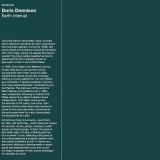
The discovery of Doris Dennison's score represents a genuine musicological breakthrough—what once would have been "a tree falling in the woods" thirty years ago now holds the potential to render "a thunderous clap in our minds." While researching Anna Halprin's lesser-known collaborators, scholar Tom Welsh uncovered the archives of AA Leath, one of Halprin's principal dancers. Buried within these materials was Dennison's handwritten score for Earth Interval, dated May 1956. Born in Saskatchewan, Canada, in 1908, and raised near Seattle, Dennison (1908-2009) encountered John Cage while teaching Dalcroze eurythmics at the Cornish College of the Arts. She joined Cage's earliest percussion quartet—alongside Margaret Jansen, the composer and his wife Xenia—in the group widely regarded as having performed the first complete concert of percussion music in the United States. This historic December 1938 concert was followed by tours and the landmark May 1941 performance at the California Club, comprising Cage and Lou Harrison's Double Music, the premiere of Cage's Third Construction, and Harrison's 13th Simfony.

As Bradford Bailey observes in his extensive liner notes, Earth Interval demonstrates "an extraordinary balance of elements that imbues the piece with a sense of clarity, directness, and constraint that is both distinct and ahead of its time." The work's most remarkable innovation lies in its approach to extended techniques, particularly Dennison's notation for the central movement: "In 2nd movement, 1st player lowers + raises a gong into a tub of water while beating." This technique, absorbed from Cage's experimental vocabulary, generates what Bailey describes as "fields of acoustic abstraction that bend and warp time through sustained resonances, beat, and space." The temporal sophistication of these manipulations anticipated Karlheinz Stockhausen's Mikrophonie I (1964) and Annea Lockwood's water-based sound investigations by over a decade. After joining Mills College as dance accompanist, Dennison maintained crucial connections to the Bay Area's experimental scene, collaborating with figures like Merce Cunningham and programming Cage's music throughout the 1950s.

Comprising three movements—Land Form, Air Tide, and Earth Play—Earth Interval is scored for recorder, drums, gongs, maracas, muted gongs, and bowl gongs. In total, the piece is just under eight minutes: "a fleeting glimmer of moment in time, a life spent at the cutting edge, and a singular creative vision that packs a powerful punch." When viewed in historical context, placed in contrast to roughly contemporaneous avant-garde percussion works by Cage, Harrison, Louis Thomas Hardin (Moondog), and Harry Partch, or important precursors like Edgard Varèse's Ionisation (1931) and Henry Cowell's Ostinato Pianissimo (1934), it's clear that Dennison was following her own path. Earth Interval is not derivative. It is a precursor to what was yet to come, alluding to developments of avant-garde and experimental music that wouldn't begin to appear on the cultural landscape until the 1970s and '80s, with the emergence of Post-Minimalism and more idiosyncratic artists and ensembles like Midori Takada, Ros Bandt, Peter Giger, Frank Perry, Christopher Tree, Michael Ranta, Gamelan Son of Lion, and Niagara.

This recording by Chicago's Third Coast Percussion, captured in March 2022, represents the first complete documentation of this pioneering work. The ensemble's interpretation reveals the piece's remarkable contemporaneity while maintaining its historical specificity. Where Cage, Harrison, and Partch employed "self-consciously off-kilter polyrhythms," Dennison's rhythmic sensibility anticipates minimalist developments by nearly a decade, yet integrates "forceful rests, as well as sharp shifts in sonic character, tempo, and meter, that break the momentum and breathe a sense of life into the piece's structure." This positions her work closer to Post-Minimalism decades before its emergence. The architectural approach demonstrates Dennison's understanding that "the composer almost entirely disappears" in favor of phenomenological listening experience, creating what might be called an egoless music that places its realities and meaning entirely in the ear of the beholder. The present recording, realized by Chicago's distinguished Third Coast Percussion ensemble, represents a significant achievement in experimental music scholarship and performance practice. As specialists in the Cage tradition and contemporary percussion repertoire, Third Coast Percussion approached Earth Interval with the historical sensitivity and technical precision required to illuminate Dennison's subtle compositional innovations. The March 2022 recording sessions, engineered by Colin Campbell, capture both the work's intimate chamber music qualities and its bold exploration of extended techniques. The ensemble's interpretation reveals the piece's remarkable contemporaneity—its ability to speak directly to current musical concerns while maintaining its historical specificity.

This recording serves multiple scholarly functions: it provides the first complete documentation of Dennison's compositional voice, offers insight into the broader network of experimental music practitioners surrounding Cage and Harrison, and demonstrates the sophisticated level of compositional thinking that was occurring within the Bay Area's dance-music collaborations of the 1950s. The work's emphasis on phenomenological listening—what might be called an "egoless" approach to musical experience—places it within a lineage of American experimental music that prioritizes perceptual process over compositional personality. The work's original obscurity—limited to AA Leath's performances at venues like the 1957 Pacific Coast Arts Festival at Reed College—paradoxically allowed it to remain "entirely on its own terms," free from the constraints of historical categorization. Drawing on Jacques Derrida's Archive Fever, the argument emerges that "the archive can acknowledge, celebrate, and resurrect" overlooked voices, transforming our understanding of experimental music history. The present Blume edition, featuring Third Coast Percussion's authoritative interpretation, includes a lavishly illustrated 16-page booklet designed by Bruno Stucchi / dinamomilano, containing complete scholarly apparatus, historical photographs, and detailed production notes. This recording enables "cross-temporal intersectionality," allowing Dennison to "belong to a newly formed and more dynamic understanding of the present and past," demonstrating how forgotten voices can reshape entire historical narratives when given proper scholarly attention and performance advocacy.

pre-order now01.08.2025

expected to be published on 01.08.2025

25,42 €
Annea Lockwood - On Fractured Ground / Skin Resonance LP

Legendary New Zealand-born experimental composer and sound art pioneer Annea Lockwood returns to Black Truffle with On Fractured Ground / Skin Resonance, her third release for the label. Having recently celebrated her 85th birthday, Lockwood shows no sign of slowing down in her exploration of new sound sources and collaborations with an ever-growing intergenerational pool of performers – here with Vanessa Tomlinson. Her creative vibrancy is alive as ever on the two recent works presented here, which demonstrate both her engagement with the social dimensions of sound and the deeply reflective, meditative aspect of her art.

On Fractured Ground derives from material recorded with Pedro Rebelo and Georgios Varoutsos for the soundtrack of Maria Fusco and Margaret Salmon’s opera-film, History of the Present (2023). Working together in Belfast, Lockwood, Rebelo and Varoutsos made extensive recordings of the city’s ‘peace lines’, the dozens of walls erected since the beginning of the Troubles in the late 1960s to separate Catholic and Protestant areas of the city. Struck by the immensity of these barriers, ‘the brutal way they sever neighbourhoods’, Lockwood and her collaborators focused not on the sound environment of the city, but on the walls themselves, playing them as gigantic resonant instruments, using their hands and objects such as stones and leaves. Continuing to work in her studio with the material collected for the soundtrack after its completion, Lockwood composed the work presented here, occupying a space somewhere between her own extended-technique percussion music and the Cagean tradition of hyper-amplified small sounds. From deep, gong-like metallic tolling to dry scrapes and uneasy groans, the piece’s sustained attention to single sounds derived from unorthodox sources draws a line all the way back to Lockwood’s classic Glass World (1967-1970). Its spaciousness and delicacy are at odds with the dark historical background of the Troubles, creating a moving listening experience somehow haunted by the shadow of violence and conflict.

Skin Resonance is a collaboration with Australian composer and percussionist Vanessa Tomlinson. Developed through conversations in which the two discussed the idea of ‘sonic attraction’, the piece focuses on Tomlinson’s relationship to the bass drum, reflecting on the complex web of connections embodied in this seemingly simply instrument, which is at once ‘animal, wood, and metal’. Approaching the instrument in a suitably elemental fashion, Tomlinson’s performance strips away conventional technique to explore the resonance and timbral properties of skin, drum, and metal hardware, producing overlapping waves of texture that at times seem closer to wind swishing through leaves or the ocean than anything usually associated with a drum. Emphasising the symbiotic relationship between performer and instrument, Tomlinson’s voice is heard at times, exploring the field of associations and connections the bass drum suggests to her: ‘Maybe the bass drum skin is an ear as well?’

Accompanied by insightful liner notes on both pieces and photographs documenting the recording of On Fractured Ground and a performance of Skin Resonance, this LP is a moving testament to the engagement, generosity, and openness that sustain Annea Lockwood’s work, still finding new directions after more than fifty years of activity.

out of Stock

Order now and we will order the item for you at our supplier.

Last In: 17 months ago
23,49 €
Geins’t Naït - Archives 3/3

The industrial treasure chest of Laurent Petitgand & Thierry Mérigout Geins’t Naït unit gets a third and final archival jag, playing to a spectrum of styles from misfit tape cut-ups to sludgy grooves and trampling sidewinds of the filthiest, sickest calibre.

The three volumes mining the Geins’t Naït Archive have parsed some 40 years of work for the most potent industrial blatz, culminating in some of the gnarliest and richest tackle on this final volume. As also highlighted on releases via Vladimir Ivkovic’s Offen Music label, it’s hard to fully surmise Geins’t Naït’s oeuvre, but you kinda know it when it hits. It’s industrial, or more specifically post-industrial, in the classic sense of everything after Throbbing Gristle and their famous label; buzzing with atonality and often heavily rhythm-driven, but not necessarily built for the club. In some senses, it's adjacent to freakier ‘floors in a way shared by the likes of Bourbonese Qualk or Din A Testbild, likeminded miscreants who emerged in TG’s shadow during the ‘80s.

‘Archives 3/3’ opens with a particularly Gallic slant on the paradigm in ‘Michel’, and shells a slew of thee crankiest gear that shares a certain tone and thrust toward trippy abstraction with Anne Gillis. ‘Abstrac 2’ finds them speaking in ogreish tongues on an uncanny waltz, before dialling up the pomp with near-EBM levels of muscularity and fanfare on ‘Poiro’, and unleashing reverse-looped heck like a La Peste joint in ‘GN is Good For You’. The keening pulse and nose attack of ‘Rappel’ reminds us of CHBB, and the evil slug of ‘Hate’ feels summoned from Parisian catacombs, whilst ‘Wladimir’ stands out for its phosphorous synth burn and prototypical Él-G poetry, leaving ‘Base Cour’ to souse the senses in distortion and barnyard squabble.

pre-order now07.03.2025

expected to be published on 07.03.2025

31,72 €
Fernand Vandenbogaerde - Les Années 1967-1984 LP 4x12"

Metaphon is thrilled to present this collection of 14 phenomenal electronic and electro-acoustic works by French composer Fernand Vandenbogaerde, realized between 1967 and 1984.

After his science studies Fernand Vandenbogaerde (1946) studied at the Conservatoire de Roubaix and did various classes and courses with a.o. Jean-Etienne Marie, Olivier Messiaen, Pierre Schaeffer, György Ligeti, Karlheinz Stockhausen and Bruno Maderna. He wrote analytical essays on mathematic music, in particular the work of Iannis Xenakis. Vandenbogaerde taught electro-acoustic music at various institutions and was director at the National School of Music and Dance in Blanc-Mesnil, near Paris. As a composer he wrote works for orchestra, instrumental and chamber ensembles, sometimes in hybrid form including tape and electro-acoustic configurations. He also recorded numerous tape compositions in Bourges, Paris, Ghent and at his home studio. His works have been presented worldwide on various leading festivals and events.

The compositions included in this edition are primarily tape works, meticulously recorded and produced, radical and most of all timbre oriented which makes his compositions focus mainly on sound while other parameters hardly change. In Vandenbogaerde’s own words: “What determines my pieces, at least all the ones in this collection, is that it’s the material that dictates me, that will predetermine the form”. This particular approach distinguishes him quite a bit from many of his contemporaries within the field of electro-acoustic music.

Another interesting aspect in Vandenbogaerde’s work is the integration of micro tonal scales (conceived by Mexican composer Julian Carrillo), on the compositions 'Modifications III' and the intriguing trilogy 'Drei Nachdenken über Hymnen an die Nacht'. All tracks are previously unreleased except the proto power electronics piece 'Anschlag' which was self-released in 1971 on his own Point Radiant label, as a compilation LP which also included a track by Tristan Murail.

pre-order now07.03.2025

expected to be published on 07.03.2025

60,92 €
Mariska Baars / Niki Jansen / Rutger Zuydervelt - Hardanger

Hardanger is a collaboration by Mariska Baars (aka Soccer Committee), Niki Jansen, and Rutger Zuydervelt (aka Machinefabriek). The title refers to the instrument played by Jansen, the Hardanger fiddle. It’s a fresh addition to the established musical chemistry from regular collaborators Baars and Zuydervelt.

The music on Hardanger started with improvisations by Niki Jansen, guided by Mariska Baars, who responded with vocal and guitar recordings. Rutger Zuydervelt used this material as the building blocks for the two long-form pieces found on the album. These tracks are like two sides of the same coin, one a collage-like electro-acoustic piece, the other more drawn-out and contemplative.

--

Mariska Baars is probably better known as soccer Committee, creating an experimental blend of ambient rooted in folk music, with minimal arrangements. She has been releasing albums since 2005. In addition to her solo output she is part of improvisation ensemble Piiptsjilling and Fean (Laaps, 2020) and has worked on several duo albums with Rutger Zuydervelt. On other occasions she collaborated with a.o. Annelies Monseré, Wouter van Veldhoven, Peter Broderick and Greg Haines.

Niki Jansen is a violinist who plays both the regular and a hardanger fiddle.She specializes in folk music, especially old Dutch folk music. She plays in various ensembles like Twee violen en een bas (with Jos Koning and Willem Raadsveld), and country quartet Daisy Chain. In addition to music, she also works as a sustainability advisor for governments and institutions and manages a food forest in a cooperative.

Rutger Zuydervelt is perhaps better known as Machinefabriek, the alias under which he releases music since 2004. The stream of releases since is vast, many of them collaborations (with Peter Broderick, Gareth Davis, Chantal Acda, Dirk Serries, and many many more). He regularly works with Mariska Baars, with whom he also plays in Piiptsjilling and Fean (Laaps, 2020). Zuydervelt is an avid composer of scores for film and dance performances, and also works as a graphic designer.

out of Stock

Order now and we will order the item for you at our supplier.

Last In: 19 months ago
22,06 €
BEN LUKAS BOYSEN - Alta Ripa

Ben Lukas Boysen

Alta Ripa

12inchERATPLP169
Erased Tapes
11.12.2024

Ben Lukas Boysen’s new album, Alta Ripa, signifies a seismic shift in his artistic journey. It revisits the foundational impulses of his youth, shaped amidst the serene beauty of rural Germany—a bucolic backdrop where his creative palette flourished. However, it was his move to Berlin in the early 2000s that electrified his sound, infusing it with the city’s pulsating energy and diverse cultural influences. Alta Ripa captures this transformative experience, blending the introspective melodies of his rural beginnings with the bold, experimental tones born from Berlin’s vibrant electronic music scene. This album is a testament to Boysen’s evolution, showcasing how geographical shifts can profoundly shape artistic expression.

Boysen’s fourth studio album under his own name, Alta Ripa is a nod to his beginnings as much as a hint to his future, and as a work, it’s almost contradictory in its boldness and humility. He invites the listener on a journey of self-discovery; both for himself and for them, describing the music as “something the 15-year-old in me would have liked to hear but only the grown-up version of myself can write.”

His last two albums involved working closely with other musicians, including cellist Anne Müller, flugelhorn player Steffen Zimmer, and drummer Achim Färber. However, inspired in part by a recent return to live performance, Alta Ripa sees Boysen circling back to his passion for pure computer music.

For Boysen, the return to his youthful musical language marks a major turning point in his career. It represents a departure from his roots in classical music – his mother was an opera singer and his father an actor with an appreciation for Wagner, Arvo Pärt, Keith Jarrett, and Stockhausen. Although these are still important influences, Alta Ripa encapsulates a new, exploratory interplay between Boysen’s careful craft and his ability to let go of some of the process.

The album’s title comes from the original Roman name of the town that Boysen grew up in, Altrip, where he lived until his early twenties. This formative period is central to the ideas behind this album, from Boysen’s parental ‘schooling’ in classical music through to his sonic journeys through drum and bass, Aphex Twin, and Autechre — all of which changed his idea of what music could be. The extreme energy of tracks like ‘Acperience 1’ by Hardfloor, ‘Tracks & Fragment’ by Cari Lekebusch, ‘Focus2 Implan’ by Jiri.Ceiver, and ‘Low On Ice’ by Alec Empire are also pivotal influences.

For Boysen, this time of his musical development also involved knocking down the pillars that he previously thought had carried his world. A key moment for Boysen was being given a precious (pre-internet) club cassette at school that featured artists like Source Direct, Photek and Goldie. Excited by this new discovery, he introduced his father to the song ‘Dred Bass’ by Dead Dred. After the song finished, Boysen Sr. turned off the tape and proclaimed it was “the end of all music”. This heated exchange sparked a new, and more mature dialogue between the two that involved them sharing and discussing music on a regular basis.

Boysen’s classical and jazz music upbringing might not be easily noticeable from the electronic palette that he uses. But it can be found in its bones; the structure of the tracks and their dynamic shifts. On Alta Ripa, he intentionally embraces a spirit of controlled chaos, churning out sonic ideas to see what sticks.

One of Brian Eno’s Oblique Strategy cards contains the phrase “gardening, not architecture”, and the trajectory of Boysen’s creative path reflects this metaphor. In much of his previous work he followed a sort of Brutalist architect’s approach; here, he was fully responsible for the tracks’ austere structures and planned them with deliberate care. But by sacrificing some of that control on Alta Ripa, he sets the right conditions for a dark and unpredictable, organic growth. It’s a push forward into a new world.

out of Stock

Order now and we will order the item for you at our supplier.

Last In: 21 months ago
23,49 €
BEN LUKAS BOYSEN - Alta Ripa

Ben Lukas Boysen

Alta Ripa

12inchERATPLE169
Erased Tapes
04.12.2024

Ben Lukas Boysen’s new album, Alta Ripa, signifies a seismic shift in his artistic journey. It revisits the foundational impulses of his youth, shaped amidst the serene beauty of rural Germany—a bucolic backdrop where his creative palette flourished. However, it was his move to Berlin in the early 2000s that electrified his sound, infusing it with the city’s pulsating energy and diverse cultural influences. Alta Ripa captures this transformative experience, blending the introspective melodies of his rural beginnings with the bold, experimental tones born from Berlin’s vibrant electronic music scene. This album is a testament to Boysen’s evolution, showcasing how geographical shifts can profoundly shape artistic expression.

Boysen’s fourth studio album under his own name, Alta Ripa is a nod to his beginnings as much as a hint to his future, and as a work, it’s almost contradictory in its boldness and humility. He invites the listener on a journey of self-discovery; both for himself and for them, describing the music as “something the 15-year-old in me would have liked to hear but only the grown-up version of myself can write.”

His last two albums involved working closely with other musicians, including cellist Anne Müller, flugelhorn player Steffen Zimmer, and drummer Achim Färber. However, inspired in part by a recent return to live performance, Alta Ripa sees Boysen circling back to his passion for pure computer music.

For Boysen, the return to his youthful musical language marks a major turning point in his career. It represents a departure from his roots in classical music – his mother was an opera singer and his father an actor with an appreciation for Wagner, Arvo Pärt, Keith Jarrett, and Stockhausen. Although these are still important influences, Alta Ripa encapsulates a new, exploratory interplay between Boysen’s careful craft and his ability to let go of some of the process.

The album’s title comes from the original Roman name of the town that Boysen grew up in, Altrip, where he lived until his early twenties. This formative period is central to the ideas behind this album, from Boysen’s parental ‘schooling’ in classical music through to his sonic journeys through drum and bass, Aphex Twin, and Autechre — all of which changed his idea of what music could be. The extreme energy of tracks like ‘Acperience 1’ by Hardfloor, ‘Tracks & Fragment’ by Cari Lekebusch, ‘Focus2 Implan’ by Jiri.Ceiver, and ‘Low On Ice’ by Alec Empire are also pivotal influences.

For Boysen, this time of his musical development also involved knocking down the pillars that he previously thought had carried his world. A key moment for Boysen was being given a precious (pre-internet) club cassette at school that featured artists like Source Direct, Photek and Goldie. Excited by this new discovery, he introduced his father to the song ‘Dred Bass’ by Dead Dred. After the song finished, Boysen Sr. turned off the tape and proclaimed it was “the end of all music”. This heated exchange sparked a new, and more mature dialogue between the two that involved them sharing and discussing music on a regular basis.

Boysen’s classical and jazz music upbringing might not be easily noticeable from the electronic palette that he uses. But it can be found in its bones; the structure of the tracks and their dynamic shifts. On Alta Ripa, he intentionally embraces a spirit of controlled chaos, churning out sonic ideas to see what sticks.

One of Brian Eno’s Oblique Strategy cards contains the phrase “gardening, not architecture”, and the trajectory of Boysen’s creative path reflects this metaphor. In much of his previous work he followed a sort of Brutalist architect’s approach; here, he was fully responsible for the tracks’ austere structures and planned them with deliberate care. But by sacrificing some of that control on Alta Ripa, he sets the right conditions for a dark and unpredictable, organic growth. It’s a push forward into a new world.

out of Stock

Order now and we will order the item for you at our supplier.

Last In: 22 months ago
25,17 €
FAMOUS - PARTY ALBUM

Famous

PARTY ALBUM

12inchURGRE14
UNTITLED
11.10.2024

Die Londoner Band Famous hat im Laufe von zwei sehr unterschiedlichen und hochgelobten EPs (2019 ,England" und 2021 ,The Valley") ihren eigenen, unnachahmlichen Sound geschmiedet. Himmlische Melodien, verzweifelte Elektronik, die auf wärmende Akustik trifft, und schillernde Songstrukturen - all das ist die einzigartige kreative Vision von Jack Merrett - Famous' Sänger, Texter, Haupt-Songwriter und einziges konstantes Mitglied -, die nun in ihrem bevorstehenden Debüt "Party Album" einen spektakulären Ausdruck findet. Als Teil der gefeierten South-Londoner Brixton Windmill-Szene neben Black Country, New Road und Black Midi wurde die Gruppe schnell für ihren grenzüberschreitenden Post-Punk-Sound bekannt. Jack Saunders von BBC Radio One bezeichnete Famous als ,die originellste Band im Vereinigten Königreich", Während Famous die Muster ihrer Musik herausarbeiteten, die mit jedem Song und jeder neuen Besetzung breiter und tiefer wurden, wuchs ihre Mystik - etwas, das Merrett mit den musikalischen Helden seiner Jugend identifiziert, wie er lachend, aber mit ungeheuchelter Aufrichtigkeit erklärt: ,Mein ganzes Leben lang hatte ich eine bestimmte Vorstellung von Rockmusik.". Mary-Anne Hobbs, BBC 6 Music: ,Wenn du auf Slint stehst, wenn du das magere Ende des Hardcore magst und vielleicht nur eine Prise Jim Morrison, dann wirst du das hier lieben. Recht alleinstehend, recht einzigartig.

pre-order now11.10.2024

expected to be published on 11.10.2024

25,84 €
FAMOUS - PARTY ALBUM

Famous

PARTY ALBUM

12inchUR14
UNTITLED
11.10.2024
  • BOXING DAY
  • WHAT ARE YOU DOING THE REST OF YOUR LIFE
  • WARM SPRINGS
  • GOD HOLD YOU
  • IT GOES ON FOREVER
  • THE DESTROYER
  • 2004:
  • LEAVING TOTTENHAM
  • LOVE WILL FIND A WAY
also available

GREEN VINYL[25,84 €]


Die Londoner Band Famous hat im Laufe von zwei sehr unterschiedlichen und hochgelobten EPs (2019 ,England" und 2021 ,The Valley") ihren eigenen, unnachahmlichen Sound geschmiedet. Himmlische Melodien, verzweifelte Elektronik, die auf wärmende Akustik trifft, und schillernde Songstrukturen - all das ist die einzigartige kreative Vision von Jack Merrett - Famous' Sänger, Texter, Haupt-Songwriter und einziges konstantes Mitglied -, die nun in ihrem bevorstehenden Debüt "Party Album" einen spektakulären Ausdruck findet. Als Teil der gefeierten South-Londoner Brixton Windmill-Szene neben Black Country, New Road und Black Midi wurde die Gruppe schnell für ihren grenzüberschreitenden Post-Punk-Sound bekannt. Jack Saunders von BBC Radio One bezeichnete Famous als ,die originellste Band im Vereinigten Königreich", Während Famous die Muster ihrer Musik herausarbeiteten, die mit jedem Song und jeder neuen Besetzung breiter und tiefer wurden, wuchs ihre Mystik - etwas, das Merrett mit den musikalischen Helden seiner Jugend identifiziert, wie er lachend, aber mit ungeheuchelter Aufrichtigkeit erklärt: ,Mein ganzes Leben lang hatte ich eine bestimmte Vorstellung von Rockmusik.". Mary-Anne Hobbs, BBC 6 Music: ,Wenn du auf Slint stehst, wenn du das magere Ende des Hardcore magst und vielleicht nur eine Prise Jim Morrison, dann wirst du das hier lieben. Recht alleinstehend, recht einzigartig.

pre-order now11.10.2024

expected to be published on 11.10.2024

22,27 €
ZAMILSKA - UNITED KINGDOM OF ANXIETY LP

Her tracks have been played and recommended by Iggy Pop, Mary Anne Hobbs and Nine Inch Nails. ZAMILSKA, one of the most original artists on the European electronic scene, announces a new album, "United Kingdom Of Anxiety" – out October 4.
Combining the rawness of techno and the trance-like nature of world music, industrial sound and a fine blend of trip-hop, the Polish producer created a dystopian, post-apocalyptic,
fascinating vision of a collapsing world. "United Kingdom Of Anxiety" begins with a sonic assault. The breaks and powerful bass in "Phantom" awaken from hypnotic slumber, numbness caused by the daily hustle, serve as a reminder that to survive in an unfriendly world, concentration, willpower and perseverance are essential. This is the beginning of a journey through "United Kingdom Of Anxiety" - the new album by Zamilska, a sensitive outsider.

"I’m here to ruin you again," announces a voice in "Mummy," while the crescendo of beats and noise in "Better Off" further amplifies the tension. It's hard to find peace when hell lurks just around the corner. Is it the horror of civilization or perhaps cosmic dread? The answer depends on the listener's sensitivity.
The much-needed balance and coolness are brought by huskie vocals - that is Ola Myszor - an incredibly talented young artist who appears in several tracks on the album. Besides huskie, there are other guests on "UKOA": Natalia Przybysz, who, with a robotic voice, delivers a manifesto of indomitable, proud solitude in "Persist" and Lukasz Pach, the charismatic frontman of the grindcore band Hostia. His growling is heard in the intense, uncompromising "No Gods," which was presented by Iggy Pop on his BBC6 Music radioshow.

The sonic spectrum is also filled with anonymous voices: echoes of quarrels, media messages, sounds of war clamor, monologues - looped, accelerated, manic, psychotic, but also a wistful singing coming from the depths, from afar. The metaphysical horror of Lovecraft on one hand, and the sober, no less gloomy diagnosis of George Orwell on the other, constantly correspond here.
This entire album is a story about society as a whole and the contemporary, dystopian world, which is inevitably heading towards war. The track "1984" clearly defines the inspiration for the artist's post-apocalyptic vision. A distorted radio signal, alarm siren and gabba/techno beats driving into the head like nails serve as an expression of the fear and anger born in a world of impending totalitarianism.

pre-order now04.10.2024

expected to be published on 04.10.2024

34,42 €
Various - New Music for Electronic and Recorded Media

Marking its first decade of activity, Blume returns with the first ever vinyl reissue of the seminal “New Music for Electronic and Recorded Media”, from 1977, the third and final instalment in a suite of releases that includes James Tenney’s “Postal Pieces” and Ben Vida’s “Vocal Trio”. Unquestionably among the most important collections of experimental music to emerge during the 20th Century, “New Music for Electronic and Recorded Media” is the original feminist presentation in its context, releasing the work of Johanna M. Beyer, Annea Lockwood, Pauline Oliveros, Laurie Spiegel, Megan Roberts, Ruth Anderson, and Laurie Anderson under its collective banner. Includes newly commissioned liner notes by Jennifer Lucy Allen and Bradford Bailey.

Since its founding back in 2014, Blume has carved a unique place in cultural landscape, issuing free standing works, spanning the historical and contemporary, that represent singular gestures of creativity within the field of experimental sound. Joining their broad efforts in building networks of context and understanding that already includes the efforts of efforts of Werner Durand, Sarah Hennies, Bruce Nauman, John Butcher, Jocy de Oliveira, Mary Jane Leach, Valentina Magaletti, Alvin Curran, Julius Eastman, Alvin Lucier, and others, Blume delivers their third release in their first suite of releases for 2024, the fist ever vinyl reissue of the seminal “New Music for Electronic and Recorded Media” compilation, originally issued by Thomas Buckner's 1750 Arch Records in 1977. Out of print for decades on vinyl and arguably the most important feminist statement in the history of experimental music, illuminating the work of Johanna M. Beyer, Annea Lockwood, Pauline Oliveros, Laurie Spiegel, Megan Robert, Ruth Anderson, and Laurie Anderson - in a number of cases representing their recording debuts - during a crucial moment in the history of experimental music. Blume’s brand new edition - complete with newly commissioned liner notes by Jennifer Lucy Allen and Bradford Bailey, as well as reproducing Charles Amirkhanian’s original accompanying text - radically shifts perceptions of the past and present day with its truly revolutionary sounds.

Issued by Thomas Buckner's 1750 Arch Records in 1977, and out of print nearly the entire time since, “New Music for Electronic and Recorded Media” can be understood within two simple frameworks. On one hand, it is an astounding document of the landscape of experimental music toward the end of the 1970s. On the other, it is a historically significant feminist statement, being the first collection of experimental music entirely dedicated to female composers, a number of whom were grossly under-celebrated at the time, but have since gone on to be regarded as among the most important composers of their generation.

The eight pieces gathered by “New Music for Electronic and Recorded Media” - Johanna M. Beyer’s “Music of the Spheres”, Annea Lockwood’s “World Rhythms”, Pauline Oliveros’ “Bye Bye Butterfly”, Laurie Spiegel’s “Appalachian Grove I”, Megan Roberts’ “I Could Sit Here All Day”, Ruth Anderson’s “Points”, and Laurie Anderson’s “New York Social Life” and “Time To Go (For Diego)” - might be regarded as the first cohesive vision of alternate proximity or expression of experimental music to what has always been a frustratingly male dominated environment, and to the tropes, temperaments, and sensibilities that have been historically perceived to define it. It is an expanded vision of truth. While the presence of feminine sensibilities and temperaments in experimental music, however they may present themselves, were anything but new in 1977, “New Music for Electronic and Recorded Media” was the first opportunity, beyond the temporal limitations of live performance, to view them collectively, rather than as individualised expressions within a larger body of similar gestures (as was the case of Oliveros’ inclusion in Odyssey’s 1967 “New Sounds In Electronic Music” and “Extended Voices” compilations) where they might be confused for something else; to regard and celebrate a radical notion of feminine sonority for its unique characteristics and through its interrelations.

While its historical significance and groundbreaking nature can not be debated in its totality, nearly half a century on “New Music for Electronic and Recorded Media” remains compelling in both its musicality and the palpable sense of its lasting influence. Every composition across the album’s two sides is not only engrossing and deeply compelling - feeling as fresh and relevant as the day it was laid to tape - but clearly tangible in their lasting influence. Viewed in context, the album’s eight works feel like breath of fresh air when compared to much of what came before, and laid the groundwork for much of what was to come, introducing a new, often more holistic temperament and more sensitive and inclusive sensibility into the landscape of experimental music.

Particularly in the case of Annea Lockwood, Pauline Oliveros, Laurie Spiegel, Ruth Anderson, and Laurie Anderson, it's hard to throw ourselves back in time and imagine a moment when these composers rested in a fairly marginalised corner of the creative landscape. Blume’s brand new edition of “New Music for Electronic and Recorded Media” - complete with newly commissioned liner notes by Jennifer Lucy Allen and Bradford Bailey, as well as reproducing Charles Amirkhanian’s original accompanying text - brings us back to this confounding moment and points us toward a crucial moment of change set forth by these incredible composers and their sounds. Absolutely seminal and not to be missed.

pre-order now02.08.2024

expected to be published on 02.08.2024

25,42 €
DJ HS - THE ANTHEMS

EN

DJ HS is undoubtedly one of the most emblematic figures on the nightlife scene in Belgium and Northern France. With a career spanning over 35 years, he made his mark as Lagoa's legendary resident for 8 years (1994 to 2002). His unique musical style, a skilful blend of Tek, Hardtek, Electro, Tekclub and Jumpstyle, has made him an essential reference. Always passionate about his work, he sets the dancefloors of the biggest clubs and festivals alight every weekend.

We're delighted to present the very first Best Of from DJ HS (The Anthems) on Serious Beats Classics, featuring no less than four of his best tracks on a single vinyl! These are no less than must-have classics in their respective genres. A must-have for all DJ HS fans. All tracks were composed and produced in collaboration with Frédéric de Backer (Ba-Back / Fred Baker), one of the most prolific producers of the last 30 years.

This previously unreleased Best Of is available as a limited edition. We strongly recommend that you order it as soon as possible, before it's too late...


FR

DJ HS est incontestablement l'une des figures les plus emblématiques de la scène nocturne en Belgique et dans le nord de la France. Fort de plus de 35 ans de carrière, il a marqué les esprits en tant que résident légendaire de Lagoa pendant 8 ans (1994 à 2002). Son style musical unique, un savant mélange de Tek, Hardtek, Electro, Tekclub et Jumpstyle, a fait de lui une référence incontournable. Toujours passionné par son métier, il enflamme chaque week-end les pistes de danse des plus grands clubs et festivals.


Nous sommes ravisde vous présenter le tout premier Best Of de DJ HS (The Anthems) sur Serious Beats Classics, comprenant pas moins de quatre de ses meilleurs morceaux sur un seul et même vinyle ! Il s'agit là non moins que de classiques incontournables dans leurs genres respectifs. Un "must have" pour tous les fans de DJ HS. Il est à noter que l'ensemble des morceaux ont été composés et produits en collaboration avec Frédéric de Backer (Ba-Back / Fred Baker), l'un des producteurs les plus prolifiques des 30 dernières années.


Ce Best Of inédit est disponible en édition limitée. Il vous est donc fortement recommandé de le commander dès que possible avant qu'il ne soit trop tard...

out of Stock

Order now and we will order the item for you at our supplier.

Last In: 13 months ago
16,18 €
Guests - I wish I was special LP

Guests are Jessica Higgins and Matthew Walkerdine of Glasgow, UK, both formerly of the bands Vital Idles and Mordwaffe. They have been closely tied with DIY music, art and publishing for over a decade. Using (amateur) electronics, singing, speaking and field recording they make songs which blend the rhythms of popular music and contemporary approaches to collage, sampling, improvisation and repetition. As inspired by film and art as they are the legacies of twee underground and avant garde experimentalism, their loose, domestically twinged compositions explore feelings, atmospheres and moments which are hard to articulate and the quite literal notion of being a “guest”.

“I wish I was special” is their debut record, and with it a chance taken to explore terrain not previously covered by their other groups. The ideology of DIY practice appears integral to these eleven compositions, side-stepping virtuosity in favour of instinct and impression, unafraid to press unknown buttons and walk head first into mistake, finding inspiration where convention might not otherwise allow one to tread. The results are confoundingly fresh, sharp-of-mind, and unusually intimate. There’s an obvious intelligence at play here, and no little humour of course, but crucially there’s also a sense of the personal, a first-thought/best-thought (auto)didacticism that celebrates shared understanding and implicit trust. What, ultimately, we might view as the fearlessness in radically being yourself around another. It’s an approach that draws some comparison with the private musings of Flaming Tunes, Idea Fire Company’s domestic electronics, or perhaps even Annea Lockwood’s framing of emotional connection within avant garde structures. More so, Guests represent a compelling continuation of DIY post-punk experimentation that values intuition over prowess, and with it guides the listener into unexpected spaces that somehow comfort as much as they challenge.


d Arrangements, as in Making Them [VIDEO]

pre-order now05.04.2024

expected to be published on 05.04.2024

25,63 €
Aldous Harding - Aldous Harding LP
  • toweringly talented song writer.”

Pressed on LP again for the first time in years. Aldous Harding's songs are not for the faint of heart. Disarming in their desolate imagery and vulnerable instrumentation, they deal with the raw materials of life: birth, death, love and grief. Sometimes reminiscent of 60s-era folk singers Vashti Bunyan and Linda Perhacs, Harding's work lies in more harsh terrain than her forebears - piercing the long history of the genre with a grit and sincerity rarely encountered. Based in New Zealand's Southern port town of Lyttelton, Auckland-born Harding began playing to the public in small-town venues and busking on the streets. It wasn't long before her name became synonymous with both the vivid devastation of her wordplay and the stark intensity of her performance; a unique blend of fragility and sinewy, world-won strength that belies her youth. Influential BB6 DJs Marc Riley and Mary Anne Hobbs picked up on tracks and a rigorous festival circuit followed in 2015. The Line Of Best Fit lauded her Great Escape performance: “Aldous Harding mixes traditional folk songs with dirge-y notes and ends her incredible performance with an A cappella cover of Edith Piaf she was told she was too young to be singing. It was spellbinding.” Of her debut record, The 405 said, “the voice is from another time and the imagery is dramatic, the themes are universal....

pre-order now18.12.2023

expected to be published on 18.12.2023

7,40 €
Nude Party - Rides On 2x12"

Nude Party

Rides On 2x12"

2x12inchLPNW5765C
New West Records
17.11.2023

For The Nude Party, nearly a decade has flown by in the blink of an eye. In that time, the New
York-based band has released a pair of well-received albums, an EP and played numerous shows.
The band has historically worked with a producer to help them create a distinct sound in their records
but with their latest effort, Rides On, the band decided to handle production duties by themselves. The
hands-on approach allowed the band to have as much fun creating as they ever had at any other point
in their career. They recorded over 20 songs, including some that dabbled in electro-pop and
stripped-down country before settling on the final 14 songs containing the best elements of ‘70s-driven
blues rock. The relaxed vibe of the session also unleashed a diverse sonic texture compared to their
previous releases. Sonically, the album is reminiscent of Sticky Fingers-era Stones, but the lyrics are
mini-vignettes that embody the spirit of what The Nude Party are going for — and their growth as a
band. Rides On, the band confidently says, is their best record. It’s also the most homegrown and
organic record The Nude Party has created to date.

pre-order now17.11.2023

expected to be published on 17.11.2023

31,89 €
Dot Allison - Consciousology  LP

Dot Allison returns with a new solo album, Consciousology. After over a decade away, the former One Dove singer and songwriter broke cover in 2021 with Heart-Shaped Scars and this new album follows just two years later, as she hits a purple patch of songwriting. It’s also her first full release for Sonic Cathedral after contributing to Mark Peters’ acclaimed Red Sunset Dreams last year. Consciousology finds multi-instrumentalist Dot joined by the London Contemporary Orchestra, her new labelmate Andy Bell from Ride, who plays guitar on two tracks, and Hannah Peel, who is responsible for some of the string arrangements with both the LCO and a stellar group of Scottish string players. It expands on the styles and themes of the previous album, all while pushing everything just that little bit further – the songs sound bigger, more avant-garde and experimental and, occasionally, properly out-there and psychedelic. “I wanted to make some albums that felt like a set, exploring love, what lies beyond the visible and how all these aspects dovetail together,” explains Dot. “I see Consciousology a more psych Heart-Shaped Scars with a far fuller, more immersive sound and so, in that sense, it’s a more wayward, bolder, rule-breaking partner.” Right from the eye-catching artwork by PJ Harvey collaborator Maria Mochnacz it definitely does not play it safe. It veers from the techno-played-as-folk of opener ‘Shyness Of Crowns’ and ‘220Hz’ and the Linda Perhacs-meets-The Velvet Underground chug of the first single ‘Unchanged’ to the Mercury Rev-style fantasia of ‘Bleached By The Sun’, the Brian Wilson-esque harmonies of ‘Moon Flowers’ and the kaleidoscopic colour trip of ‘Double Rainbow’. Elsewhere there are echoes of Desertshore-era Nico, Jack Nitzsche’s work with Neil Young, Karen Dalton and Anne Briggs before the relative simplicity of the Tim Hardin-inspired closer ‘Weeping Roses’. It’s a brilliant, breathtaking record.

pre-order now04.08.2023

expected to be published on 04.08.2023

28,36 €
Daniel Schell & Dick Annegarn - Egmont & The ff Boom
  • La ballade du Zwin
  • Ein kleiner Mann
  • UD
  • Piume al vento
  • Nelle
  • Granvelle
  • Sabina And First Variation
  • Un instant sous la hache
  • Geuzenlied
  • Sabina And Second
  • Variation
  • The ff BOOM

Part fantastical historic sonic biopic, part anthropologic
journey into the deep roots of Belgium’s monstrous
cosmic rock sound, this wholly individualistic concept
album combines the lead members of the mighty COS
(Daniel Schell and Pascale Son) with studio genius
Alain Pierre (Ô Sidarta / Des morts) and celebrated
Dutch progressive rock singer Dick Annegarn, for what
many consider to be both the overlooked hiding place
of Belgium’s deepest psychedelic moment and
European prog’s lost map to the ‘Franco-Flemish
Boom’.
 Emerging from the wider musical family that counted
Marc Moulin, Placebo and Marc Hollander amongst its
creative kin, Daniel Schell’s most profound conceptual
project ambitiously combines the tale of the heroic
historical figure of Count Egmont (1522–1568), while
simultaneously tracing the evolution of the ud, or oud,
(‘the grandfather of the guitar’) in this multifarious
hallucinogenic epic.
 Featuring key members of other collectable groups
such as drummer Felix Simtaine from Solis Lacus and
bass player Jean-Louis Baudoin from the mythical
Classroom (COS predecessor), this best-kept secret
vinyl release also harbours the voices of Dirk Bogaert
(of Belgian hard rockers Waterloo), as well as Catalan
singer Ilona Chale (Marc Hollander / Aksak Maboul)
before her later tenure as the COS front woman.
 Initially released in 1978 via Zeuhl school distributors
Free Bird alongside French pressings of Don Cherry,
Jacques Thollot and CAN, it is plain to understand the
niche nature of this maligned ‘lost COS’ LP as it finally
blooms from between the cracked branches of
European jazz-rock-synth-psych-prog-pop history…
and beyond

pre-order now07.07.2023

expected to be published on 07.07.2023

13,07 €
Bjarte Eike & Barokksolistene - The Playhouse Sessions LP 2x12"

From Alehouse to Playhouse Bjarte Eike and his barnstorming Barokksolistene capture the vital spark of Restoration London’s entertainment scene with a captivating new recording for Rubicon Classics! The Playhouse Sessions will be released on 23 September 2022 to coincide with Barokksolistene’s concert double-bill at London’s Southbank Centre.

‘A smattering of Purcell, dances from Playford’s Dancing Master, shanties, reels and ballads succumb to a nine-piece ensemble drawing on Baroque, jazz and folk styles for a no holds barred hooley of riotous improvisatory give and take,’ (BBC Music Magazine review of The Alehouse Sessions, August 2019)

London’s musicians, pushed in the 1650s, to the margins of society by order of Oliver Cromwell, found room for new forms of entertainment in city-centre taverns and alehouses. They remained there long after the restoration of the monarchy, performing sets of dances, theatre songs and bawdy ballads to audiences glad to be free from Puritan constraints on pleasure.

Norwegian violinist Bjarte Eike and his Barokksolistene have restored the spirit and substance of those long-forgotten performances with their Alehouse Sessions, hailed by The Times as ‘irresistible’ and ‘fabulously unrestrained’ by The Guardian. Five years ago the Norwegian violinist and his band scored a best-selling album with The Alehouse Sessions on Rubicon Classics. They return to the label with another compelling collection of music and words of the kind on offer more than three centuries ago at Henry Purcell’s favourite Westminster watering holes. The Playhouse Sessions, set for release on Rubicon Classics on 23 September 2022, reflects the uplifting energy and engaging emotional contrasts of Barokksolistene’s Alehouse performances.

“The album contains a sort of inner narrative that runs through the recording,” says Bjarte Eike. “It has become like a play in its own right, with each track being a small tale within a larger story.” The recording’s tracklist includes Eike’s beguiling arrangements of music from Purcell’s semi-opera The Fairy Queen and his own original compositions on words from the play on which it is based, Shakespeare’s A Midsummer Night’s Dream; popular songs and ballads such as ‘The Irish Washerwoman’, ‘I often for my Jenny strove’ and ‘The Three Ravens’; tunes from Purcell’s welcome odes and stage shows, Come ye sons of art and Dido and Aeneas among them; the ‘Willow Song’ from Shakespeare’s Othello; Eike’s own voice in Puck’s monologue from Act 5 of A Midsummer Night’s Dream; and John Dowland’s sublime air ‘Can she excuse my wrongs’.

London’s theatres were closed at the start of the English Civil War in 1642 and remained shut until the Restoration. Alehouses offered redundant musicians, actors and dancers a place to scrape a precarious living and soon became their creative refuge. “Although a few surviving theatres reopened in 1660 with the return of Charles II, there was little money around to rebuild those that had been demolished,” observes Bjarte Eike. “And a generation of musicians had already found an audience in places like the Black Horse in Aldersgate Street. So popular were their alehouse sessions that Cromwell tried to abolish them! But they outlived him and became part of Restoration musical life.” The form of a Barokksolistene Alehouse, he adds, is like a creative room. “Within its framework I can frequently refurbish the show with new contents. The Playhouse project is likewise an extension of the ever-evolving Alehouse Sessions. Together they tell the story of music and theatre in London during Cromwell’s time and after the Restoration. Of course there’s an historical context to what we do. But there’s also the practical context – which is even more important to me – of connecting with a contemporary twenty-first century audience. An Alehouse / Playhouse performance is not something for the museum; it's about music made in the present moment, just as it was in the London alehouses of Purcell’s day -- with their playhouses annexed to the rear of the beer-drinking saloons. The encounter of musicians onstage and the audience in the hall is the real magic of it. We have to fuse the audience into the action of our performance!”

The Playhouse Sessions will be launched on Friday 23 September with a late-night concert at the Purcell Room and a post-concert Alehouse Session in the foyer of the Queen Elizabeth Hall. Soprano Mary Bevan is set to join Eike and his Alehouse Boys for the first half of their Southbank Centre double-bill, offering unique interpretations of songs from Purcell shows and other hits from the late seventeenth-century London stage. “The Southbank Centre is a direct descendant of concerts given in the 1650s in the alehouses of London,” notes Eike. “These alehouses after all staged some of the world’s first public concerts. Later, after the Restoration, it became common for promoters to advertise alehouse concerts in the press and offer subscription tickets. Purcell and his fellow musicians were thus just as at home performing there as they were in the chambers of the royal court or in London’s new theatres.”

Bjarte Eike launched his Alehouse Sessions in company with like-minded musicians 15 years ago. The ensemble comprises a core of regular performers, all of whom have committed to memory a huge setlist of up to four hours of music. Typically they meet a day or so before a concert tour to share a meal and make music together; then next day, re-grouping thirty minutes before the show, they discover Eike’s select-menu for the evening. “That ensures that every show is fresh,” he notes. “I make sure we never repeat the same programme twice. It’s therefore essential to work with people who share my outlook and dare to adventure. We’re into a high-risk sport, with lots of traps and places where the unexpected appears - for good or for ill. And so the audience knows we’re vulnerable. But our skill is seen in how we re-act on the hoof to the unpredictable. That’s authenticity and honesty - and above all it’s a performance that’s genuine.”

Armed with a classical training and a background in folk music and improvisation, Bjarte Eike was drawn naturally to Early Music in all its stylistic variety. “I never really felt at home with only one genre,” he recalls. “Early Music allowed me to study profound, complicated compositions, but performing it has also opened up the chance of rebellion and uproar! Early music offers wide, multi-faceted areas of musical exploration for me. You find, for instance, links to different types of music wherever you look in seventeenth-century English repertoire. And I am fascinated by all these connections. They offer a foundation for the Alehouse Sessions and for all Barokksolistene performance more generally. Every member of the group plays, sings, dances and improvises without limitation. We’re all interested in the many different fields of being a stage performer and pushing hard at the ‘normal’ boundaries of what it means to be a classical musician.”

pre-order now30.06.2023

expected to be published on 30.06.2023

32,98 €
JIMETTA ROSE & THE VOICES OF CREATION - HOW GOOD IT IS LP

Beautiful, soulful jazz record by Jimetta Rose and The Voices of Creation, a Los Angeles-based community choir, a mainstay of the local scene. Highly recommended!!

The Voices of Creation are a community-based choir led by vocalist, songwriter, arranger, producer and mainstay of the Los Angeles scene Jimetta Rose. Made up of a multigenerational group of mainly non-professional singers backed by some of the city’s finest musicians,their music marries hip strains of gospel with layers of jazz, soul and funk. While aspects of their music might recall Kamasi Washington, The Staple Singers or Sly Stone, Jimetta’s unique vision has resulted in new spiritually-charged forms of music whose whole-hearted embrace of love, joy and peace act as sonic healing balms for the soul.

For Jimetta - whose resume includes collaborations with Miguel Atwood Ferguson, Georgia Anne Muldrow, Sa-Ra Creative Partners, Angel Bat Dawid, Shafiq Husayn, MED and Blu - the very act of creation was part of a healing process: “I was very low at the time and I wrote most of the songs going through hardship. But I found comfort in the songs and a way to adjust my mindset to where things got better. So I thought ‘if this music works for me, maybe it will work for other people’ I believe that every person has their own voice and their own note and that we can use our voices to heal ourselves. That’s the intention behind creating the project.”

After putting out a call on social media for people interested in joining her choir she was met with a sea of replies. Members were chosen in less-than conventional fashion: “I recruited people based on their interest in healing themselves and others, not necessarily on their musical experience or being seasoned performers” she says. Among those accepted into the ever-evolving collective, which was begun initially as a community choir, were the likes of Sly Stone’s daughter Novena Carmel, better known as a radio DJ for KCRW’s flagship breakfast show. Jimetta’s upbringing in the Pentecostal church, where she was a youth choir director, fed into her otherwise intuitive teachings of her songs and arrangements to the inexperienced members with help from the group’s seasoned organ player/co-musical director Jack Maeby.

Produced by Mario Caldato Jr. (Beastie Boys, Seu Jorge) and his wife Samantha Caldato the results show the incredible sense of togetherness and communal spirit that the group had built up over time in the rehearsal sessions. The six tracks of their debut album, a mixture of originals and rearranged covers, are performed in a wide-eyed mix of styles that reflect Jimetta’s vision for borderless music: “It’s new black classical music,” she explains. “It’s all the hodgepodge of being an African American but also with creativity and vision for the future. It has a taste of what is to come and what we can do. What we have gone through and who we are now.”

The group’s propensity for warm and buoyant sonics finds representation on album opener Let The Sunshine In, a sparkling rework of the Sons and Daughters of Lite’s deep jazz classic. Their version finds the group’s dynamic group harmonies offset with Allakoi Peete’s nimble afro-percussive touches and plenty of soul- drenched keys courtesy of pianist Quran Shaheed and organ player Jack Maeby. A similarly uplifting take on Rahsaan Roland Kirk’s choral jazz classic Spirits Up Above follows, with Maeby’s groove-laden organ lines inspiring some gorgeous group harmonies as well as prime solo turns from the likes of Kellye Hawkins, Zavier Wise, Tamara Blue, and Khalila Gardner.

Another Sons and Daughters of Lite cover follows as Jimetta leads the choir in the groove-drenched ode to self-affirmation Operation Feed Yourself. Written as a series of mantras for everyday living, the Jimetta-penned composition How Good It Is harnesses the full transformative power of music to generate a stirring and joyful ode to positivity - it’s chanted declarations bringing out some of the group’s most deeply-felt and affecting vocal performances over some superlative piano and organ accompaniment with a surprise feature vocal from Novena Carmel.

Jimetta’s talent for re-imagining songs in her own light is highlighted in Answer The Call, her vivid re-telling of Funkadelic’s Cosmic Slop: “When I listened to the original song, the Mom in the story was really going through it. I thought of how I could turn this into a song that can encompass the glorification of all mothers and I thought of the Egyptian cosmic goddess Nut. To that mother we’re all the seeds planted in the garden. Answering the call in your life is literally that. Finding out exactly what you’re here for through your heart.”

The album finishes with the standout original gospel number Ain’t Life Grand. Over swaying organs and clapped percussion Jimetta’s lyrical mantras serve to emphasise the good feelings that come to those with a grateful heart. Good feeling is an apt descriptor for the mood of the album as a whole. Its shining positivity provides a welcome ray of light in an increasingly dark world. “It’s a shortcut if you will to the better feelings” Jimetta says. “The hope that we need to keep pressing forward. We are saturated and inundated with images of chaos and destruction, death and hatred. There’s so much we can witness. So, I want to make sure that there is a representation sonically of the other parts that are still there to witness so that we can continue to build those things. So that the systems we support actually reflect what we want to experience. So it’s like: “Don’t give up and Let The Sunshine Into You” and then find out what your purpose is and answer the call.”

out of Stock

Order now and we will order the item for you at our supplier.

Last In: 3 years ago
25,17 €
Various - Space Part 2 LP 2x12"

A tribute to the late Kenny Hawkes, London's dark lord of house music. Lovingly selected and curated by Luke Solomon, Jonny Rock and Leon Oakey.

Running from 1995 to 2002, 'Space' was a Wednesday night founded by Kenny Hawkes and Luke Solomon. It inhabited the underground world of Bar Rumba right in the heart of London's West End and took place each and every week. Kenny and Luke had both been regular fixtures on infamous London Pirate Radio station 'Girls FM', and were seeking a suitable place to play the kind of music they supported on their respective radio shows. They were presented with a weekly opportunity at Bar Rumba and snapped it up.

'Space' was THE place for 7 solid years, hosting local and international guests from the house music community week in week out, to 200+ hardcore and dedicated followers. Regular guest bookings read like a 'who's who' of the music scene with sets from Derrick Carter, Andrew Weatherall, DJ Harvey, Tom Middleton, A Man Called Adam, Ralph Lawson and Huggy, Harri and Domenic, Francois Kevorkian, Salt City Orchestra, Carl Cox, Chez Damier and Ron Trent.... the list goes on and on and on! Music from seminal record labels such as Classic, Prescription, Cajual, Paper, Relief was played on rotation amongst a killer mix of Disco classics, alternative 80s music, left-field B-sides and techno. The night undeniably became a cauldron of amazing music and midweek hedonistic chaos.

As Soho changed beyond recognition and clubbing moved Eastwards, Kenny and Luke decided to call it a day. Sadly, Kenny Hawkes died in 2011, leaving a huge hole in the dance music community. Kenny was a legendary figure with an unmistakable sound and DJ style, he had a warped sense of humour and a huge personality and he continues to be dearly missed by all to this day.

As a tribute to Kenny, his musical partner in crime Luke Solomon alongside 'Space' regular and DJ / Editor supreme Jonny Rock, and former Classic Records label boss Leon Oakey have joined forces to celebrate his life through music. 3 years of tweaking, pooling music and clearing tracks have culminated in 2 very special double albums and a digital compilation. A collection of 'Space' classics, underground jams and the tracks that shook the Shaftesbury Avenue dance floor, shaping one of London's most revered midweek sessions.

All profits from the compilation will be donated to the British Liver Trust.

out of Stock

Order now and we will order the item for you at our supplier.

Last In: 7 months ago
29,20 €
Anne Bisson - Be My Lover

Anne Bisson

Be My Lover

2x12inchCAMLP5287-45
IMPEX Records
27.02.2023

Anne's 7th Opus in 13 Years, Containing 6 Fantastic Covers and 6 of Her Own Songs, Recorded in One of the Most Prestigious Studios in Montreal with Her Original Blue Mind Team

Fresh from the success of her single "Killing Me Softly" from her previous album Keys to My Heart, Anne Bisson, singer-songwriter and jazz pianist, decided to perform and record more standards from the American jazz songbook, as well as new arrangements of classic songs that were so much a part of her teenage years.

Be My Lover, Anne's seventh album is, therefore, a savoury feast of original compositions and classic songs in her own bold new arrangements for acoustic trio. While still in the 'Smooth Jazz' genre, the presence of a Fender Rhodes, the legendary '70s keyboard, along with an electric bass, impart the album with quite a unique tone.

After over 18 months of musical experimentation and other creative endeavours, Anne once again brought together master drummer Paul Brochu (Gino Vanelli, Michel Legrand, UZEB) and proficient bassist Jean-Bertrand Carbou from France, for a series of informal sessions to explore the songs that were being considered for this seventh release.

These two musicians have been valuable collaborators for several years now. Paul has been featured on many of Anne's albums, notably Blue Mind, which made a huge splash when it appeared, with over 35,000 hard copies sold, while Jean-Bertrand's playing has also graced several of her albums.

Since 2009, the three have performed at several important venues, including Le Festival International de Jazz de Montréal, as well as other festivals in the United States and Mexico.

What holds them together is an evident complicity which is present from the very first notes. Their musical contributions are precise and deeply heart-felt. Their virtuoso playing greatly enhances these songs without turning them into mere technical exercises.

With precision playing, subtlety and attention to detail, as well as being recorded in impeccable High Definition, these songs will definitely please Anne's audiophile fans, while also appealing to a wider audience.


All About Ultimate High Quality CD (UHQCD)
Many years have passed since the birth of the Audio Compact Disc (CD) back in 1982. By use of High-Quality materials and a totally different manufacturing method, the definitive version of audiophile audio CD was born. Playable on any CD player, the Ultimate High Quality CD greatly surpasses all previous CDs before it!

The Ultimate High Quality CD (UHQCD):
UHQCD is a radical change to the CD manufacturing process itself. The conventional wisdom about CD manufacturing, which had remained largely unchanged across the world for over 30 years, has been exhaustively questioned. Through this effort, the ultimate in quality was attained - a level of quality that is certainly impossible to achieve with existing CD discs.

The Ultimate High Quality CD was developed through an effort to improve audio quality by simply upgrading the materials used in ordinary CDs to higher quality materials. For the substrate a high-transparency and high-fluidity polycarbonate (a type of plastic) of the type used for LCD panels was used, while for the reflective layer, low-cost, common aluminium was replaced with a unique and expensive alloy of high-reflectivity.

Differences in manufacturing methods:
Conventional CDs are produced using the technique of injection moulding to form "pits" of data on polycarbonate material. Metal plate on which "pits" representing audio source data are formed is used as a die. This is called the "stamper." Polycarbonate is melted at high temperature and poured into the die to duplicate the pit patterns on the stamper.

This method is efficient because it enables high-speed production, but it does not enable totally accurate or complete duplication of the pits on the stamper. As a melted plastic, polycarbonate is inevitably viscous, so it cannot penetrate completely into every land and groove of the tiny pits of the stamper.

The Ultimate High Quality CD photopolymer is used instead of polycarbonate to replicate the pits of the stamper. In their normal state, photopolymers are liquids, but one of their characteristic properties is that they harden when exposed to light of certain wavelengths. The advantage of this property, perfect replication of very finely detailed pits was achieved. Photopolymers in the liquid state are able to penetrate into the tiniest corners of pits on the stamper so that the pattern of the pits is reproduced to an extremely high level of accuracy. The Ultimate High Quality CD reproduces audio with greater precision and at a level that is impossible to achieve using conventional CD production technology!

pre-order now27.02.2023

expected to be published on 27.02.2023

111,30 €
Brahja - Watermelancholia LP

Brahja

Watermelancholia LP

12inchCORTIZONA018
CORTIZONA
16.12.2022

LP including booklet with extended liner notes. Channeling wild seventies Impulse vibes, even resonating the guts of early Art Ensemble of Chicago and the tempering spirit of Max Roach's 'We Insist' era: BRAHJA is soul searching their spirit on 'Watermelancholia'.

Devin Brahja Waldman is a New York saxophonist, drummer, synthesizer player and composer who leads the group BRAHJA. Waldman has accompanied his aunt, poet Anne Waldman, since the age of ten. Waldman is a co-founding member of Radical Reversal, Diva of Deva Loka, and Notable Deaths. He has performed with Patti Smith, William Parker, Nadah El Shazly, Malcolm Mooney, Thurston Moore, Godspeed! You Black Emperor, Charles Hayward, Luke Stewart and Yoshiko Chuma. Waldman is also a member of NYC's Heroes Are Gang Leaders (led by poet Thomas Sayers Ellis and saxophonist James Brandon Lewis), of Sam Shalabi's Land of Kush, and of the Norwegian hardcore group MoE.

As a youngster, Waldman was taken under the wing of avant-garde giant Paul Bley. Along with Anne Waldman and cousin Ambrose Bye, Waldman is a co-producer for Fast Speaking Music -a NYC poetry and music label which has released recordings with Amiri Baraka, Meredith Monk, William Parker, Laurie Anderson, Eileen Myles, CAConrad, Fred Moten, Daniel Carter, Clark Coolidge, Thurston Moore, Joanne Kyger and many others.

Ancient to the future 2.0

Watermelancholia is about the law of Karma:
a law so obvious that it often goes unspecified and ignored.
Neglecting this law invites a world of chaos.
It's been articulated in endless ways.
Some have called it Cosmic Law or Natural Law.
Others translate it as Do No Harm.

(liner notes excerpt)

The moment the first bass note of Luke Stewart kicks in on 'Watermelancholia', followed by the swelling drum roll of Malick Koly and the lush leading voice of Janice Lowe you feel Devin Brahja will take you on a deep mind-blowing spiritual journey.


Channeling wild seventies Impulse vibes on 'O.P.K' or, could we say, even resonating the guts of early Art Ensemble of Chicago and the tempering spirit of Max Roach's 'We Insist' era: BRAHJA is soul searching their spirit on 'Watermelancholia'.


A poetic stream of consciousness, backboned by top-notch musicians, transcending the cosmic universe, trying to find answers and musically connecting.


Watermelancholia is a meditation on healing the inner schism between the sense of self - the ego - and the inner being. It is about bringing the ego to justice; putting it on trial, as it were.

out of Stock

Order now and we will order the item for you at our supplier.

Last In: 2 years ago
22,65 €
Sofie Vanden Eynde - Vanishing Point

In 2016 lutenist Sofie Vanden Eynde put her instrument aside for nine
months in order to recover from a severe burnout
Five years later, she felt the need to look back. Would it be possible, she
wondered, to use the intense, shared concentration between musician and
listener to convey sensations of over- stimulation, contrast, excess, stagnation,
emptiness, beauty and movement? Would it be possible to articulate the inner
reality of a burnout musically: to make a burnout audible, tangible,
understandable and, who knows, avoidable? The result is Vanishing Point /
Verdwijntijd, an autobiographical recital, a musical narrative, a journey:
somewhere between fragile comfort and cautious happiness. Writer Annemarie
Peeters drew on her interviews with Sofie to write a text that reflects the three
phases of a burnout. The run- up, the phase of total stagnation during, and the
cautious way out. Three colours, three seasons, three ways of being. Lurking
beneath Sofie's personal story are experiences that many will recognize: the
craving for efficiency, the sudden faltering, the unfamiliar and at the same time
disconcerting sense of emptiness, and the tentative search for a new balance.
But also the questions Sofie asked herself – about the connection between her
own little story and the big world that surrounds her – evoke wide recognition. Is
burnout a personal failure or a social symptom?
Sofie went in search of pieces from the solo lute repertoire that she intuitively
associated with the various phases of the text. This resulted in a recital with a
surprising palette of colours, styles and atmospheres. At times she chose the
rich, powerful sound of the theorbo. At others she chose the fragile, hushed
sound of the Renaissance lute. The Prelude by the French baroque composer
Robert de Visee combines phrases full of grandeur with breathing pauses filled
with intimate doubt. The music of John Dowland draws on the typically English
penchant for melancholy. In the fantasias and ricercars of Francesco da Milano, it
is not only the bright colours of the Italian Renaissance that resound, but also the
constant search for a new beginning. Luis de Narvaez's Cancion del emperador is
an arrangement for lute of the famous chanson Mille Regretz by Josquin Desprez,
a song that emanates serene regret for everything that is not. And in Robert de
Visee's Chaconne the same chord sequence revolves around its own axis. Hope,
tenderness, revolt and acceptance each step to the fore in turn.
At Sofie's request, Vladimir Gorlinsky created a new composition, one which
reflects the state of mind in the middle of a burnout. Vanishing Point balances on
the edge of total emptiness, a stagnation that at times is hard to bear. Vanishing
Point starts out from this stagnation to explore the different facets of burnout:
resistance and acceptance, fear and hope, stagnation and movement, absolute
solitude and the desire to interact again with the surrounding world. Vanishing
Point / Verdwijntijd can be listened to in different ways: not only as a lute recital,
but also as a radio play with voice, lute and soundscapes. Annemarie Peeters'
text was recorded by actress Katelijne Damen (NL) and voice artist Caroline
Daish (EN). Vladimir Gorlinsky created soundscapes based on the sounds of the
lute, which were magnified as if under a microscope. The soundscapes weave
themselves between the text and the lute music. Jo Thielemans created the
sound design and provided the live electronics.

pre-order now11.11.2022

expected to be published on 11.11.2022

16,77 €
Drugdealer - Hiding In Plain Sight LP

The third and most seasoned Drugdealer album, Hiding In Plain Sight, almost didn't happen at all. Frustrated and insecure with his own singing voice prior to the pandemic, Drugdealer founder and primary songwriter Michael Collins was nearly ready to throw in the towel. Due to a frequent impulse to hand over the microphone to friends and collaborators like Weyes Blood, Jackson MacIntosh, and his trusty musical companion Sasha Winn, Collins became increasingly unsure of himself as a singer. While attending Mexican Summer's annual Marfa Myths festival, a chance encounter with artist and composer Annette Peacock changed his outlook. Collins says, "I was so inspired by Annette. But similarly to all these other vocalists I'd worked with, I didn't feel like I had it in me." he recalls. "I told her my plight, then I played her a song, and she told me I wasn't singing high enough for my speaking voice. When I returned to LA, I started coming up with new progressions, which I'd modulate up three half steps. It forced me to find a new way to sing." "Madison," is the first song Collins wrote singing in this suggested range. His newfound confidence as a yarn-spinning vocalist in the gruff tenor tradition of Nick Lowe, or even Van Morrison, is readily apparent, with Conor "Catfish" Gallaher's pedal steel adding a dusting of cosmic country to Collins' down-hard love song. When Collins wrote the would-be AM Gold hit, he was summoning an imaginary vision of a love that had eluded him in reality. Tim Presley sings on the second song, "Baby," and Collins had a clear role in mind for the California avant-rock mainstay. "I love White Fence so much, but I also wanted to hear Presley sing a song that sounded like an early '60s sock hop band who had never tried drugs in their life." Meanwhile, Kate Bollinger floats an effervescent lead vocal over the Rhodes-driven groove in “Pictures of You.”. Taking inspiration from a canon of gruff but soulful rock vocalists like Phil Lynott, Collins looks back on his nocturnal meanderings through LA's warrens of bars and clubs ("New Fascination"). He’s right up front in the mix, detailing a search for love in all the wrong places.

pre-order now28.10.2022

expected to be published on 28.10.2022

23,49 €
Ensemble intercontemporain - Steve Reich: Reich/Richter

‘Reich’s music expands from minimalist austerity to more full-bodied passages and back again. Reminiscent of his earliest work, it is very beautiful.’ – Financial Times

‘The music has tender energy, and an undercurrent of melancholy. Its droning tones sometimes seem to be pulling apart – like taffy, or like Richter’s stretching spaghetti stripes of color.’ – New York Times

Nonesuch Records releases the first recording of Steve Reich’s Reich/Richter, performed by Ensemble intercontemporain and conducted by George Jackson. The composition was originally written to be performed with German visual artist Gerhard Richter and Corinna Belz’s film Moving Picture (946-3).

Reich describes Richter’s book Patterns, which served as source material for the film: “It starts with one of his abstract paintings from the ’90s. He scanned a photo of the painting into a computer and then cut the scan in half and took each half, cut that in half and two of the four quarters he reversed into mirror images. He then repeated this process of ‘divide, mirror, repeat’ from half to quarter, eighth, sixteenth, thirty-second, all the way up to 4096th. The net effect is to go from an abstract painting to a series of gradually smaller anthropomorphic ‘creatures’ (since the mirroring produces bilateral symmetry) to still smaller very fine stripes.

“Belz described the film in terms of ‘pixels’. It begins with two-‘pixel’ stripes and the music begins with a two-sixteenth note oscillating pattern. When the film moves to four ‘pixels’, the music moves to a four-sixteenth note pattern, then to eight, and sixteen,” the composer continues. “After that, I began introducing longer note values – initially eighth notes, and later to quarter notes. By the middle of the film, when the images move from 512 to 1064 pixels, the music really slows to dotted half notes. Finally, as the ‘pixel’ count begins to diminish, the music moves back into more rapid eighths and then ending with the most intense rapid sixteenth movement.”

After more than one hundred performances of Reich/Richter at The Shed in New York in 2019, it was performed in London at the Barbican by the Britten Sinfonia conducted by Colin Currie and then in Paris at the Philharmonie, where this recording was made. The Austrian ensemble Windkraft Tirol, led by Kasper de Roo, will perform Reich/Richter on September 8 at Szentrum, Silbersaal in Schwaz, and the LA Phil New Music Group, led by Brad Lubman, performs the piece, accompanied by Richter and Belz’s film, at Walt Disney Concert Hall in Los Angeles on April 1, 2023.

Nonesuch has recorded every new piece of music by Steve Reich since 1985, beginning with The Desert Music and continuing through 2018’s Pulse/Quartet, resulting in twenty-two albums and the two box sets Phases in 2006 and Works: 1965-1995 in 1997. The label will put out a collection of his complete works in 2023.

Reich released a book last month, Conversations, that includes dialogues with past collaborators, fellow composers, musicians, and visual artists who have been influenced by his work, including: David Lang, Brian Eno, Richard Serra, Michael Gordon, Michael Tilson Thomas, Russell Hartenberger, Robert Hurwitz, Stephen Sondheim, Jonny Greenwood, David Harrington, Elizabeth Lim-Dutton, David Robertson, Micaela Haslam, Anne Teresa de Keersmaeker, Julia Wolfe, Nico Muhly, Beryl Korot, Colin Currie, and Brad Lubman. Booklist said in its review, ‘Iconoclastic American composer Steve Reich is singular in his own right, and when he is in conversation with other equally iconoclastic composers, conductors, sculptors, musicians, percussionists, and video artists, sparks not only fly, they sparkle. Reich and his colleagues conduct lovely give-and-takes during which they share stories, creative approaches, and viewpoints. Reich's Conversations is the best kind of eavesdropping.’

Steve Reich has been called ‘America’s greatest living composer’ (Village Voice), ‘the most original musical thinker of our time’ (New Yorker), and ‘among the great composers of the century’ (New York Times). His music has influenced composers and mainstream musicians all over the world. Music for 18 Musicians and Different Trains have earned him two Grammy Awards, and in 2009, his Double Sextet won the Pulitzer Prize. Reich’s documentary video opera works – The Cave and Three Tales, done in collaboration with video artist Beryl Korot – have been performed on four continents. His recent work Quartet, for percussionist Colin Currie, sold out two consecutive concerts at Queen Elizabeth Hall in London shortly after tens of thousands at the Glastonbury Festival heard Jonny Greenwood (of Radiohead) perform Electric Counterpoint followed by the London Sinfonietta performing his Music for 18 Musicians.

In 2012, Reich was awarded the Gold Medal in Music by the American Academy of Arts and Letters. He has additionally received the Praemium Imperiale in Tokyo, the Polar Music Prize in Stockholm, the BBVA Award in Madrid, and the Golden Lion at the Venice Biennale. He has been named Commandeur de l’Ordre des Arts et des Lettres and has been awarded honorary doctorates by the Royal College of Music in London, The Juilliard School, and the Liszt Academy in Budapest, among others. ‘There’s just a handful of living composers who can legitimately claim to have altered the direction of musical history and Steve Reich is one of them’, states the Guardian.

Pierre Boulez founded the Ensemble intercontemporain in 1976 with the support of Michel Guy (who was France’s Minister of Culture at the time) and the collaboration of Nicholas Snowman. The Ensemble’s thirty-one soloists share a passion for twentieth and twenty-first century music. Under the artistic direction of Matthias Pintscher, the musicians work in close collaboration with composers, exploring instrumental techniques and developing projects that interweave music, dance, theater, film, video and visual arts. In collaboration with IRCAM (Institut de Recherche et Coordination Acoustique/Musique), the Ensemble intercontemporain is also active in the field of synthetic sound generation. New pieces are commissioned and performed on a regular basis. Resident of the Cité de la musique – Philharmonie de Paris, the Ensemble performs and records in France and abroad, taking part in major festivals worldwide.

George Jackson, winner of the 2015 Aspen Conducting Prize, came to attention after stepping in at short notice with Orchestre de Paris, where he stepped in for Daniel Harding. Recent highlights include leading Ensemble intercontemporain at Festival Romaeuropa, the Rainy Days Festival in Luxembourg, and Festival D’Automne in Paris, as well as conducting the RTÉ National Symphony Orchestra, the orchestra of Opéra de Rouen and the world premiere of Tscho Theissing’s Genia with Theater an der Wien. His varied operatic experience includes performances at Opera North, Hamburg State Opera and Opera Holland Park, as well as conducting a new production of Hänsel und Gretel at Grange Park Opera.

out of Stock

Order now and we will order the item for you at our supplier.

Last In: 4 years ago
27,69 €
Erin Anne - Do Your Worst

Erin Anne

Do Your Worst

12inchCAK160LP
Carpark Records
08.07.2022

When the whole world collapses around you, sometimes the only thing you can do is stomp it all loose. Erin Anne's second album, the gleaming, electrified Do Your Worst, charts that uninhibited romp through disaster. Written amid the rubble of personal grief and professional disappointment, later exacerbated by the devastation of a global pandemic, the record deepens Erin's venture into the blur between human and machine, adding a new roster of digital instruments to the mix. Drawing on dark, glossy '80s synthpop as well as the unabashed bombast of bands like The Killers, the L.A.-based songwriter deploys a cyborg persona to articulate a feeling of displacement from the world as a queer artist struggling to survive the machinations of late capitalism. With bright, interweaving synthesizers and ripples of Auto-Tuned vocals, Do Your Worst poses a dare to the world: Whatever you have in store, I'll take it standing.

Erin began writing her second album not long after adding a MIDI keyboard and vocal processing hardware to her home studio setup. While exploring her new gear, she found that she could work in the same vein as the artists and producers she loved the most. Do Your Worst takes inspiration from the music of Patrick Cowley, the disco and hi-NRG producer best known for working alongside Sylvester. Erin was taken by Cowley's use of vocoder on the 1982 album Mind Warp, where his distorted vocals create a queer, mutant subjectivity. That album rang out against the cataclysm of the AIDS epidemic; Erin found resonance in Cowley's music during the present-day pandemic. "I have found the most catharsis and the most safety in listening to the music of people in really, really horrific circumstances making something lasting and profoundly beautiful," she says.

Throughout Do Your Worst, which was mixed by Sarah Tudzin of Illuminati Hotties, songs like "Typhoid Mary" and "Florida" reckon with loss, despair, and abjection. "This Hungry Body" sears through pandemic-era touch starvation, while "Mirror Mirror" attends to the noxious but necessary funhouse of social media. On the playful, guitar-driven “Eve Polastri’s Last Two Brain Cells Have a Debate,” Erin uses the spy thriller TV show Killing Eve to explore queer codependency and masochism. Among these fraught subjects, Erin Anne finds opportunities for release. She stages internal conflict on a scale so massive that its details start to become clear; if they don't resolve, they at least become palpable.

"I’m very much a maximalist when it comes to production. I like vast landscapes. I like a stratosphere and a core -- I want the bass to be beneath the floor," Erin says. "This record is, in a lot of ways, a collection of some of the first moments that I was technologically able to achieve accurate renderings of how I hear my own emotional world."

pre-order now08.07.2022

expected to be published on 08.07.2022

20,13 €
Items per Page:

Language