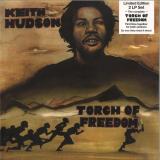
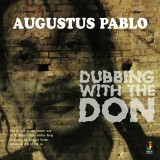
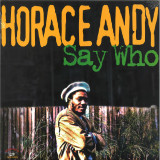
Keith Hudson’s Nuh Skin Up Dub is a deep, heavyweight dub album that stands as one of the most potent statements in the genre’s history. Released in 1979, this sonic masterpiece showcases Hudson’s signature dark, almost mystical production style, where heavy basslines, echo-drenched drums, and ghostly fragments of vocals swirl together in a hypnotic haze. Unlike the more polished, accessible dub records of the time, Nuh Skin Up Dub is raw, unfiltered, and experimental, pushing the boundaries of rhythm and space. Tracks like "Nuh Skin Up" and "Felt We Felt the Strain" pulse with an eerie, almost menacing energy, while Hudson’s masterful use of reverb and delay creates a soundscape that feels simultaneously expansive and claustrophobic. Often referred to as the “Dark Prince of Reggae,” Hudson had an uncanny ability to craft music that was both deeply meditative and unsettling, and Nuh Skin Up Dub is a prime example of his genius. It's a record that rewards deep listening—every spin reveals new layers of sonic detail, hidden textures, and dub wizardry. For fans of heavy, atmospheric dub, Nuh Skin Up Dub is an essential listen, a landmark recording that solidifies Keith Hudson’s status as one of the most visionary figures in reggae history.
Cerca:keith hudson
- 1
Pick A Dub" zeigte die anhaltende Stärke und die zentrale Bedeutung des Rhythmus für die Entwicklung der Reggae-Musik, und Keith Hudsons vollständige Beherrschung des Genres und das uneingeschränkte Lob, das seiner Veröffentlichung folgte, waren völlig gerechtfertigt. Die "strengen klanglichen Qualitäten" des Albums sind ehrfurchtgebietend, die großartigen Rhythmen kommen ohne zusätzliche Effekte und Studiotricks voll zur Geltung, und die Gesamtwirkung ist heute noch genauso fesselnd wie vor über vierzig Jahren.
- A1: Playing It Cool 00 01:59
- A2: Playing It Right Dub 00 01:53
- A3: Trust & Believe 00 03:37
- A4: In I Dub 00 02:53
- A5: California 00 02:59
- A6: By Night Dub 00 02:53
- B1: Not Good For Us 00 02:52
- B2: Formula Dub 00 02:56
- B3: Be What You Want To Be 00 02:39
- B4: Be Good Dub 00 02:25
- B5: I Can't Do Without You 00 01:59
- B6: Still Need You Dub 00 02:01
Keith Hudson was a one-of-a-kind musical innovator with an impeccable track record from the start: his first studio recording involved former Skatalites, and his earliest releases provided solid-gold hits for Ken Boothe (“Old Fashioned Way”, 1967), John Holt, Delroy Wilson, U-Roy and the others.
With Pick A Dub Hudson produced one of the best dub albums ever, and with The Black Breast Has Produced Her Best, Flesh Of My Skin, Blood Of My Blood he released the first concept album in reggae history, bringing his all-around talents to full fruition as early as 1974. Thematically dedicated entirely to Black history, the latter of these two albums is a masterpiece that captivates with an atmosphere that is as dark as it is deeply spiritual, charged by Hudson's eccentric vocals. Like Lloyd Bullwackie Barnes, his splitting from tradition was dynamic and all his own.
As his career moved on, Hudson found himself working outside of Jamaica, more frequently in London and New York studios and for transatlantic audiences, his dark experimentalism becoming increasingly better suited to the LP than the cardinal 7” reggae format.
Playing It Cool & Playing It Right was released in 1981 on the Joint International label, in NYC, with Lloyd Bullwackie Barnes as the executive producer. The Love Joys and Wayne Jarrett, stalwarts of Barnes' record label, Wackies, would also inimitably feature Hudson at the microphone. Like Bullwackie, Hudson was a devotee of Coxsone Dodd’s Studio One and Playing It Cool & Playing It Right follows Dodd’s then strategy of overdubbing his signature rhythms. The Studio One sides were aimed at the dancefloor and Hudson’s reworkings of tracks like “Melody Maker” are more psychological. Here, deep Barrett Brothers rhythms are made deeper with reverb, filters and distortion; everything pitched down and overlaid with new recordings of guitar, percussion, keyboard, and voice, often heavily treated.
Playing It Cool & Playing It Right continues Hudson’s psycho-acoustic journey into the abysses of existence, and overwhelms with the beauty of artistic self-empowerment. "Too much formula," sings Hudson, whose voice is occasionally reminiscent of Sly Stone or even Tom Waits. "Darkest night," answers an echoing background choir elsewhere. Even more fascinating is Hudson's production, which reflects Black history in even the smallest sound detail, the flashing whip of the slave driver still echoes in the sound of the snare drum. Rarely has a roots sound been made so electrifying, so expansive in all directions, so crystal clear, so bass-warm and echophonic as on these 30 minutes of music.
Playing It Cool & Playing It Right is legendary, strange, utterly compelling music that has possibly never been more topical than it is today.
Endlich als LP-Vinyl wiederveröffentlicht! Im Original 1978 auf dem Label Joint International als US-Pressung veröffentlicht, wurden die Bänder nach London zum legendären Mastering Experten Kevin Metcalfe geschickt, der eine komplett neue Überspielung für Greensleeves anfertigte. Das Album wurde in Randy's, Channel One und den Chalk Farm Studios aufgenommen und bei King Tubby's mit dem finalen Mix ausgestattet, am Mischpult dabei Clive Chin, Lancelot 'Maxie' McKenzie, Sid Bucknor und Prince Jammy.
Erstmalig als Repress auf Vinyl erscheint die offizielle Dubversion zum Kultalbum "Rasta Communication". Die 10 Tracks des 1978er Originalalbums wurden in Jamaika in Randy's sowie im Channel One Studio und in London (Chalk Fram Studio) mit Sly & Robbie und Musikern des Soul Syndicate aufgenommen. Am Mischpult saßen dabei Clive Chin, Lloyd McKenzie und Sid Bucknor, der finale Mix wurde von Prince Jammy im King Tubby's Studio ausgeführt. Die Arbeiten des Sängers und Produzenten Keith Hudson, auch bekannt als 'The Dark Prince of Reggae' (geboren 1946 in Kingston, Jamaika - r.i.p. 14.11. 1984 in New York), hatten einen großen Einfluss auf die Entwicklung des Dub.
First time Repress "Greensleeves Records", 12” Classic from
1979- 2 Roots anthems back to back!
• Deep- and heavy extended workouts from "The Dark Prince of Reggae" • Both Sides made big impressions on the sound system scene on raw dub-plate, continued heavy Jah Shaka rotation means they remain in-demand to this day!
Streng limitierte Veröffentlichung der legendären 12Inch Maxi-Single (GRED8) von 1978 als EP mit zwei weiteren Versionen des Rasta Anthem 'Bloody Eyes'! - Weltweit limitiert auf 750 Kopien. Diese EP erscheint in Koordination mit der Veröffentlichung der 2CD Deluxe Edition 'Rasta Communication'
Siren Selector launches its mixtape series with a companion release to Remy Solar’s - ‘Heavy Terrain’ cassette.
“Jamaican music grows in rings like an old tree. From a core of early riddims, the genius of Studio One, versions of original basslines and melodies evolve over time New releases of the same tune follow each other through the 70s, 80s, 90s, into this millennium. Generations of the same family. And then there’s the unreleased versions, the frontier dubs built strictly for sound systems, held close by those who got them and only gradually circulated into the wider audience of selectors and collectors. These are the ones where the bass is heavier, the echoes more mind- bending, the effects wilder and the drums harder. Older sound followers tell stories of how these dubs defined dances, flattened opponents in clashes, inspired a dozen rewinds. Younger followers remember these tales and pass them down. These dubs are folklore.
Who knows how many such versions there are in the vast worldwide archives of Jamaican music? Not me. But as a little taster of a lifetime’s musical journey you can open your ears right now to a few moments: Lacksley’s Castell’s “Unkind”, transported from the sprightly riddim which underpinned it on his Princess Lady album and reengineered into a thunderous version of Ras Michael’s None A Jah Jah Children; “Deceivers” by the Heptones, stripped back into something simultaneously ethereal and bathyspheric; Keith Hudson’s “I’m No Fool” emerging from a pressure cooker of bass and drum; Jah Lloyd’s “Black Moses”, busting down walls with its epic echo and siren opening.
I started collecting these dubs in the late 90s. We were going to Shaka at the Rocket, Aba Shanti in the Arches, then Imperial Gardens. Entebbe somewhere off Mare Street. Iration Steppas in Kingsland Road, Jah Tubby’s in the Rec. We were doing our own parties at the time in east London, Bohemia Place, then Trenz, Dungeons, the old social services office by London Fields. Building up a sound, taking it on the road, crew sitting on the speaker boxes in the back of a Mercedes 508. Under the stars or in warehouses with sweat dripping from the ceiling, lugging crates and amps across fields or up flights of stairs, stringing up boxes under bridges, in car parks or on roundabouts. Waiting for the moment to drop the dubs.
This tape is dedicated to my crew and all the music providers and anyone who also knew or wants to know these moments.“
Fifty Physical Copies - 60 mins - No digital
- A1: Skank On Dub
- A2: Way Out Rockers
- A3: Pablo's Express
- A4: Pablo's Happy Feeling
- A5: Soldier Man Dub
- A6: Well Frozen Dub
- A7: Sweet Cassava Dub
- B1: Talking Dub
- B2: Pablo's Connection
- B3: Skanking With Pablo
- B4: Pablo's Delight
- B5: Death Trap Dub
- B6: Rockers Downtown
- B7: New Train Dub
2024 Repress
If anyone in the reggae circles could be described as having their own sound it would have to be Mr Augustus Pablo, born Horace Swaby 1954 St Andrew Jamaica. He took the humble melodica a wind blown mouth keyboard and made it shine.
His musical journey started one sunny day in 1969. Walking into Herman Chin- loy's Aquarius Records shop and on playing his melodica so impressed its owner that he was taken off to Randy's Studio 17, the very next day to cut his first record 'Iggy Iggy'. But it was his second tune under the guidance of Clive Chin again cut at Randy's, the seminal 'Java ' that put the young Augustus Pablo on the map. Clive Chin continued his work producing Pablo's debut album 'THIS IS AUGUSTUS PABLO' . An instrumental affair on which the neo-mystical ''Far East'' sound synonymous with Pablo's work emerged.
Having worked with most of the top producers of the time,Lee Perry,Keith Hudson, Bunny Lee, Augustus decided to set up his own label "Rockers", named after his brothers sound system. Where many of his tunes would first be heard.The label came to define a new and exciting chapter in reggae history.Even when versioning acknowledged classic Studio One rhythms there was a precious maturity and depth to Pablo's productions that kept him at the top throughout the late 1970s and into the 1980s. His 'King Tubby meets the Rockers Uptown' set which featured some of these rhythms reworked; Swing EasySkanking Easy, Frozen SoulFrozen Dub, stands as one of the true dub classic albums of any reggae education.
This set of dubs are taken from his classic 70's period.All rare dubs straight from the masters. You may have heard the tune, but not these versions. So sit back and enjoy the Original Rocker..... STILL SOUNDS SWEET.
RESPECT....JAH FLOYD.
Monde UFO follow the celebrated ‘7171’ album with a trip to the mysterious ‘Flamingo Tower’. In the shadows of the Los Angeles bustling music scene, the enigmatic collective led by visionary Ray Monde create a trance-like fusion of psychedelia and avant jazz, mantra-like evocations, brash moody ambience and passages reminiscent of long-lost library music.
Magnifying Monde UFO’s idea of musical chaos, their early sonic escapades into off-kilter exotica is now elevated with sweeping atmospheric waves of sound inspired by an eclectic brew of Arto Lindsey, Khan Jamal’s ‘Drum Dance To The Motherland’, Keith Hudson, Milford Graves, Marion Brown, Don Cherry and Lennie Tristano.
Cast deep into number theory with occasional quasi-religious touchstones, ‘Flamingo Tower’ bustles with background sounds overlaid with intimate melodies conjuring plenty of suitably strange illusions; a synthetic orchestra plays baroque pop, a guitar is set to auto destruct and Ray Monde’s hushed vocals carry a bracing narrative. It’s an evocative album, one for the heavy music nerds, sprinkled with ear candy and proliferated by mysterious numbers which litter the song titles.
“Monde UFO wander through a humid mist of exotic samba shuffles, shamanic whispers, and reverberating laser beam synthesizers.” New Commute
Horace Andy has always commanded a place high on the list of Reggae singers from Jamaica. His distinctive haunting vocal style stands strong on any rhythm,song or style he chooses to cover. Of the singers on that long list, he has managed more so than any other, to crossover to a new generation of listeners due to his individual style, helped also by his collaborations with the likes of Massive Attack. Horace Andy (b. Horace Hinds,1951,Kingston Jamaica) like many otherJamaican singers began his musical career at Coxsonne Dodd's Studio One. So impressed with the youth, Coxsonne decided on a name change for theyoung artist and called him after his top songwriter of the time Bob Andy. So Horace Hinds became Horace Andy. His first tune for Coxsonne 'Something On My Mind' was a slow burner in Jamaica, but his belief in his young protégé paid off when followed later by 'Skylarking' a tune that burst the singer all overthe radio and sound systems of Jamaica. After numerous singles and two albums worth of material, Horace moved on to work with many of the topflight Jamaican producers, among them Keith Hudson, Augustus Pablo and Niney the Observer, but it was his work with producer Bunny Lee in the 70's that he cut most of his hits for and from this stable of work, that we have compiled this set. Some of his late 60's classics were recut in the popular1970's style, working with the rhythm kings themselves, Sly Dunbar andRobbie Shakespeare. They have added some shine to the tracks, 'SomethingOn My Mind' and 'Skylarking' and made them hits all over again. Such wasHorace's delivery to the covers he sang like Delroy Wilson's version of theTams 'Riding For A Fall', the Heptones 'My Guiding Star', John Holts'Man Next Door' and Bill Wither's 'Ain't No Sunshine', that these finetunes were made his own. The roots end of his musical style was covered by
Andy originals such as 'You Are My Angel', 'Zion Gate','Money Money'and the cut which we have taken our edited title, the timeless 'Just SayWho'.A bass heavy cut to Bob Marley's 'Natural Mystic' works so well inthis style also. Another nickname Horace acquired was the affectionate title of Sleepy, as he was always hanging around the yards and studios of Jamaica waiting his turn, sometimes so long he would fall asleep. His enthusiasm to get back in the studio to work some more of his magic, to a catalogue of material that has developed into one of the finest in Jamaica. I hope you will agree, this fine set of 1970's classics will sit alongside.
O B8 | AIN'T NO SUNSHINE
A new vinyl album from Nat Birchall, this is the Dub version of his Dimension of the Drums LP, a roots reggae instrumental set that was very enthusiastically received last year, ending up on many best Of The Year lists.
For this album Nat has remixed the tracks in classic early to mid - 1970s style. Inspired by the classic Dub LPs like Keith Hudson’s ‘Pick A Dub’ and Winston Edwards’ ‘King Tubby Meets The Upsetter at the Grass Roots of Dub’ the tracks have been reimagined in Roots Dub fashion, some with new horn lines and all with hand drums, giving the album a very authentic Rootsy sound. Additionally there are two different mixes of a new rhythm track that wasn’t on the previous album.
Once again Nat plays all the instruments and did all the recording, mixing and mastering.
Drums in Dub features eight tracks of instrumental Dub delight, specially designed for the 1970s Dub connoisseur.
The mighty U Roy is the originator, the man who put the DJ phenomenon on the map and made it an artform. From Kingston Jamaica to the corners of all the Dancefloors, Clubs and Sound Systems across the world. U Roy (B. Ewart Beckford, 1942, Kingston, Jamaica) began his musical career spinning records for Doctor Dickies Sound System way back in 1961. The mid sixties saw him working for Sir George The Atomic before moving in 1967 to the man who best shaped his sound King Tubby on his Home Town HI - FI. Tubbys work in the dub field, dropping out vocals on his versions for the Sound Systems allowed U Roy to voice over these spaces adding to the excitment of the Dance!!!
U Roy moved into the recording arena firstly cutting two disc's for Producer Lee Perry 'Earths Rightful Ruler' and 'OK Corral' and then following this with 'Dynamic Fashion Way' and 'Riot' for Producer Keith Hudson. Producer Duke Reid seeing the protential in this new found form brought U Roy to his Treasure Isle Studios to voice over his back catalogue of Rocksteady Hits. His first three releases for Duke Reid 'Wake The Town', 'Rule The Nation' and 'Wear You To The Ball' held the Top 3 positions for 12 weeks in early 1970's.
We have compiled some of U Roy's best loved cuts from his mid 70's period when all were still looking at him for guidence. The opening cut Call On Me sees him working over Delroy Wilson's 'Got To Be There'. You Never Get Away gets U Roy answering Delroy Wison's 'Keep On Rocking'. Johnny Clarke's 'Time Gonna Tell' with rootsy bassline turns into Every Knee Shall Bow. Cornell Campbell the Gorgon himself gets his 'Check Mr Morgon' turned into Gorgon Wise. Johnny Clarke's Hold On gets reworked. Jeff Barnes 'Blowing In The Wind' tuned into Number 1 and alongside King of The Road which sees Lennox Brown blow his saxophone over the instrumental 'In The Swing of Things', was one of U Roys first releases. Linval Thompson's 'Let Jah Arise' is versioned to Joyful Locks. I Originate which lends us to the title of this compilation, says it as it is, a classic built over Dave Barker's 'Shocks of Mighty'. Linval Thompson again provides the backbone with his Cool Down Your Temper cut for U Roys version. The mighty Burning Spear's Creation Rebel although providing our next track, it is Johnny Clarke's version that gets worked over. Leo Graham's 'Birds of A Feather' turns into Stick Together. Soul Syndicates instrumental 'Goliath' grows into Riot. A big hit for Max Romeo Wet Dream sounds great under U Roy's new rendition.
Two extra tracks for the CD release of this album sees the great voice of Slim Smith on his 'Let's Stick Together' becomes ‘Ain’t To Proud To Beg’ and Cornell Campbell's 'Stand Firm' works with
U Roy to sign us off with ‘I Shall Not Remove’. A fine collection i hope you agree to the Daddy of all DJ's who in his own words ''I Originate, so you must appreciate, while the others got to imitate'' says it all really……
ercury Rev take you on a swan dive into the mystic: a rapture of ballad-dreams and emotional memoir at the crossroads of The Dharma Bums, Pet Sounds and Side Three of Electric Ladyland. A profound, transcendant trip from the psychedelic explorers who brought you Deserter's Songs.
David Fricke In upstate New York, deep in the seam between the Catskills mountains and the Hudson Valley, a richly swelling, spellbound sound emerges, eddying and flowing like the local Esopus Creek, or in the slipstream of the grander Hudson river, carrying the flotsam and jetsam of our hopes, dreams, fears. A sound composed of organic and electronic; guitars, keys, brass, strings, woodwind, drums - and a voice of incantations, tapping streams of consciousness that similarly eddy and flow.
Spiritually, literally, psycho-geographically: where else does Mercury Rev’s ninth album Born Horses spring from? This cascade of gleaming, glistening psych-jazz-folk-baroque-ambient quest that searches its soul but can never truly know the answer? A sound and vision linked to their exalted past whilst quite unlike anything they have created before?
The answer is somewhere between the homes of founder members Jonathan Donahue (the hamlet of Mt Tremper) and Grasshopper (the town of Kingston), in their veins and brains of their now-legendary tapping of musical cosmology, and the vital presence of new permanent member Marion Genser (keys), plus long-term ally Jesse Chandler (keys) and guests Jeff Lipstein (drums), Martin Keith (double bass) and Jim Burgess (trumpet). A place that feeds off the levitating mood of their last album, 2019’s expansive tribute Bobbie Gentry's The Delta Sweete Revisited, and the instrumental psych explorations under the names of Harmony Rockets and Mercury Rev’s Clear Light Ensemble, and the spiritual guidance of avant-garde artist Tony Conrad and Beat poet Robert Creeley, to whom Born Horses is
dedicated.
- A1: Brainticket - Places Of Light
- A2: T.j. Lawrence - Fireplay
- A3: Robert Rental - Double Heart
- B1: African Head Charge - No, Don't Follow Fashion
- B2: Keith Hudson - Nuh Skin Up Dub
- C1: Smokin' Cheeba - When I Was A Youth
- C2: The Wad - 15 Inches
- D1: Idjut Boys & Laj - Foolin' (Beatin On Dave)
- D2: Jbb Et Soprann - Tibi Lap
Part 2.[29,83 €]
Optimo (Espacio) started life as a weekly club night. It was born at The Sub Club in Glasgow on a wet, windy, wintry November Sunday night in 1997. Run by JD Twitch and partner in crime Jonnie Wilkes. Optimo was a reaction against what felt like an increasingly conservative musical soundtrack in clubs here at that time. Clubland felt as if it had become very bland and a bit too serious; it was the era of the dawn of the Superstar DJ. Clubs often felt like bastions of male energy. It seemed dance music and culture was going somewhere far, far away from where it was meant to be. The notion of fun had got lost.
It was no longer the world they had devoted ten years of their lives to already, and lots of their friends felt the same. When the opportunity came up to do a Sunday night at The Sub Club it felt like the perfect opportunity to rip it all up and start again. So they did. There was nothing in the city (or possibly anywhere) like it. As the club believed wholeheartedly in what they were doing, there was no pressure from The Sub Club to fill the club. So, they embraced the freedom. Groups of people who had never been in the same room at the same time before came together. A community of kindred spirits started to emerge.
Word spread, slowly. Lots of people checked it out. Many loved it, some hated it. The core of the Optimo idea was to embrace music they loved that might work on the dancefloor from whatever era or genre they thought felt right. It might not seem very radical now but at that time it was revolutionary.
After about a year and a half, the club went from having 100 people attending most nights to suddenly one week having 500 people turn up. It was very weird. It was as if a collective light bulb went off in people’s heads in Glasgow. From that week on, until the very last weekly Sunday night at the Sub Club, in 2010, over a decade later, it was packed.
There were 550 Sunday Optimo nights. A LOT of music was played. So, what was the music? People often find it hard to pin down exactly what Optimo is. This has been a positive but also a negative as we live in a world where people want easily defined “brand identities”. The simplest definition of the music played is “music for dancing”, which of course is a very broad definition. Even better than trying to define it in words, we have these 2 volumes of music that give a hint of what that might be.
This is not a “Best of Optimo” or a “Greatest Hits of Optimo” compilation. For people who come to, or used to come to the nights there are of course “Greatest Hits”. But, over such a long timespan they are “hits” belonging to a certain moment in time and space. Someone who came to Optimo in 1997 would have a completely different notion of the big tracks at the club to someone coming in 2003, or 2010, or today. This compilation is just a snap shot missing several genres that might make up the DNA of Optimo. There is though a broad sweep through lots of music Optimo loves, that they believe is amazing. Music that they know will rock a dancefloor, that they have played between 1997 and 2023. Of course Optimo nights were not all about rocking the dancefloor. The first hour was always a time for them to play music they loved that often was far removed from the dance. Side 1, Volume 1 of this compilation is the kind of music one might hear at the very start of an Optimo night.
Optimo have always loved a good slogan. The most long lived, and fitting Optimo slogan is "We Love Your Ears", which is in essence what it is all about to them.
Delroy George Wilson (5 October 1948 – 6 March 1995) was a Jamaican ska, rocksteady and reggae singer. Wilson is often regarded as Jamaica's first child star, having first found success as a teenager. His youngest son, Karl "Konan" Wilson, has found success as part of British duo Krept and Konan. His voice matured as he left his teens, around the time of ska's transition to rocksteady and this period in the late 1960s produced many hits including one of the first rocksteady records, "Dancing Mood", "Jerk in Time" (with the Wailers), "Feel Good All Over", "I'm Not a King", "True Believer in Love", "Rain From the Skies", "Conquer Me" and "Riding for a Fall". "Won't You Come Home", a duet with Ken Boothe on a rhythm originally cut by The Conquerors for Sonia Pottinger has become one of the most-versioned Jamaican tracks ever. After leaving Studio One he recorded for other labels, with varying degrees of success, and set up his own short-lived W&C label. He enjoyed success with Bunny Lee in the late 1960s and early 1970s with tracks such as "This Old Heart of Mine", "Footsteps of Another Man", and "Better Must Come". His double A-side "It Hurts"/"Put Yourself in My Place" was a skinhead favourite and narrowly missed UK chart success. He recorded a version of "Run Run", a song he had originally recorded for Dodd, for maverick producer Keith Hudson. Wilson toured the UK and recorded for Trojan Records in 1970.
Freestyle puts out another reissue 12" in their drive to unearth rare and classic UK funk, soul & boogie records - this time a much needed pressing of the late Candy McKenzie's heavy boogie-funk cover of Patrice Rushen's classic Remind Me. Produced by Candy's late cousin, and seasoned session bass player, John McKenzie (and licensed from the family estate) this was originally released in 1983 - and comes with an excellent dubbed-out 'Different Style' instrumental version on the flip.
-----------------------
Candy McKenzie (1953-2003) was a North West London-based vocalist from a Guyanese family heavily steeped in musicianship . She began learning the piano at a young age, picking up vocal harmony from her father, a jazz bass player. Her brothers Bunny & Binky, were also celebrated bassists. Candy would marry young in 1970 at the age of 17, though just one year later her brother Binky (who played with the likes of Cream, Alexis Korner & John Mclaughlin in the late 60s) tragically killed her mother and father, along with Candy's husband in an attack at the family home to which Candy was present. Candy was also injured but escaped with her life.
In the years that followed the tragedy Candy, regularly accompanied by her brother Bunny, would find reggae vocal session work - often at the Chalk Farm Studios frequented by many key producers & acts. She found her way onto Aswad's first album and Keith Hudson's legendary Flesh Of My Skin Blood Of My Blood LP - and a little while later on a couple of sessions with Bob Marley for Island, under the supervision of Lee Perry.
The latter two parties took a keen interest in Candy, with Island wisking her away to Jamaica in 1977 to record an album at the legendary Black Ark. Her vocals found their way onto The Congos seminal Heart of the Congos LP, but the album she recorded with Perry was shelved - with just the Black Art holy grail 12" Disco Fits / Breakfast in Bed finding it's way to release at the time.
Back in London, Candy spent the early to mid 80s recording various lovers and funk/soul 12"s, including this fantastic cover of Patrice Rushen's Remind Me, produced by her cousin John. She went on to record singles for labels like Elite & Cooltempo throughout the '80s and early '90s, and appeared as backing vocalist with the likes of Leonard Cohen, Whitney Houston, Elton John and Diana Ross. She passed away in 2003, with her one and only album recorded at the Black Ark finally seeing release on Trojan in 2011.
Candy's cousin John McKenzie got his starts in the music industry in the mid 70s as part of prog group Man and communal festival rockers Global Village Trucking Co., as well as playing with the likes of Annette Peacock and Steve Hillage. His father Mike McKenzie was also a key Carribbean jazz figure in the UK throughout the early 1950s, through to the '60s and '70s. John would become a heavily in-demand session musician - playing with everyone from the Eurhythmics to Bob Dylan - while also finding time to produce this record, alongside a couple of excellent 12"s with Mel Gaynor as Finesse, between 1982 and '83. He would regularly tour the world as a live musician for a huge array of headline acts, appearing on multiple chart hits, and in his later years was a member of the excellent group Ibibio Sound Machine. He lost his battle with cancer in 2020.
This reissue is dedicated to the memory of both John & Candy McKenzie.
Cementing his reputation as the star toaster with the small but popular El Paso sound system, based in the Waltham Park area, Dennis Alcapone was one of the first deejays to rise to prominence following U Roy’s breakthrough in the late 1960s. Born Dennis Smith in the rural district of Culloden, he became immersed in sound system culture after settling in western Kingston. Once El Paso became big on the sound system circuit, dental technician- turned-producer Keith Hudson brought him into the studio for his debut recordings, which led to a debut album for Studio One and hit material for Duke Reid, some cut in concert with his deejay sparring partner, Lizzy. Alcapone’s longstanding links with Bunny Lee yielded the excellent Guns Don’t Argue album, first issued in 1972, on which the toaster raps with style over some of Lee’s all-time greatest rhythms, including Delroy Wilson’s Better Must Come, John Holt’s Left With A Broken Heart and Slim Smith’s rendition of the Temptations’ soul classic Ain’t Too Proud To Beg.
Within Melbourne’s burgeoning cinematic-soul scene, which includes
breakout acts Surprise Chef and Karate Boogaloo, mysteriously sit
The Pro-Teens.
Helmed by prolific drummer and percussionist Hudson Whitlock, who also
plays in both aforementioned bands, this breakaway studio project involves an
interchangeable collective of incognito, Melbourne-based, esteemed instrumentalists playing under outlandish pseudonyms such as “’Dead Honest’ Dean
Amazing” and “Libby Clique-Baite”.
Symbolically led by keyboardist “Snooch Dodd”, new album ‘I Flip My Life Every
Time I Fly’ is the latest musical concoction from Whitlock’s eccentric brain,
marrying the soul/funk roots of sample culture with the principles of boombap hip hop.
Incorporating the colourful comic book stylings of MF DOOM and Kool Keith,
or the dark and exotic flavours of Gravediggaz and The Wu-Tang Clan, The ProTeens also take cues from their composing heroes Galt MacDermot, Richard
Evans and Marc Moulin.
The Pro-Teens bop, zip, whip and fling on this phantasmagorical journey - an
unorthodox patchwork of cinematic soul, hip hop-guided funk breaks, vivid instrumental textures and film score-esque moods.
The Pro-Teens work on the same analogue recording model adopted by the
tight-knit College Of Knowledge label, self-recorded and produced with the ragtag crew of musicians putting tracks down live to tape in crammed attic studios
and sharehouse recording spaces.
The first limited pressing of ‘I Flip My Life Every Time I Fly’ was released on the
‘College Of Knowledge’ imprint in late 2020. It was one of the highlights of the
year at Mr Bongo HQ who loved the concept and felt this tripped out masterpiece from Melbourne needed to be heard well beyond those lucky enough to
have bagged those limited first copies.
- 1