Tiny Habits were formed in Boston, MA by artists Maya Rae, Cinya Khan and Judah Mayowa. The three singer-songwriters met at Berklee College of Music and the band was born at the beginning of 2022.
They started out by sharing covers recorded in the stairwell of their dorm and posting them on social media. Focusing on beautifully intimate three-part harmonies the trio's enticing signature sound, offered exquisite, reimagined versions of songs from across a spectrum of styles and quickly drove them to viral success.
They received recognition and early support from artists as diverse as David Crosby, Marcus Mumford, Phoebe Bridgers, and Noah Kahan. Collaborations include work with Mark Ronson, JP Saxe and Lizzy McAlpine, who they supported on NPR’s Tiny Desk
Their debut EP “Tiny Things” was released in April 2023 and established them as one of “the” bands to watch in the year ahead.
In early 2023, the band opened for Gracie Abrams “Good Riddance Tour” across North America, followed by their own sold-out US “Tiny Tour” At the end of 2023, the trio opened for Noah Kahan on his “Stick Season Tour” across Europe, followed by a sold-out headline show in London. In January 2024, the band rejoined Gracie Abrams, opening for the Australian leg of her “Good Riddance Tour”. This was followed by a sold-out headline show in Melbourne and a performance at the Minetta Lane Theatre in New York with Kacey Musgraves. The New Yorker recently wrote a feature piece on the band, coining them “The Prodigies of Harmonies”.
Cerca:abrams
Released in 1999 on Taylor Deupree’s 12k label, »optimal.lp« was the debut album by Dan Abrams under his Shuttle358 moniker. For its 25th anniversary, Keplar presents it on vinyl for the first time with three previously unreleased tracks—the digital version also includes a alternative version of »Tank«—as well as a new artwork recreated by Daniel Castrejón and a remaster by Andreas LUPO Lubich based on the original pre-masters that were been restored and cleaned up for the reissue project by Abrams. »optimal.lp« was inspired by the rich tradition of ambient music and the rhythmic complexity of 1990s electronica while also sharing many traits with the then-emerging clicks’n’cuts movement, making it a true sui generis piece of work—both informed by tradition and visionary, idiosyncratic and seminal for many artists after him.
Abrams developed an interest in ambient music when he was still a child, scouring through cassette tapes of environmental sounds, new age music, and world percussion. Discovering Brian Eno’s »Thursday Afternoon« as a young teenager marked a turning point for him. »It gave me the idea that ambient music could be an intentional creative act, that tone itself is a legitimate form of expression,« he says today. During the 1990s, he increasingly immersed himself in the electronica scene and the output of labels such as Instinct, where Deupree worked as an Art Director and released his first records as Human Mesh Dance. Abrams found a home on 12k after sending Deupree a demo tape that would later evolve into »optimal.lp,« released as the label’s fifth catalogue number.
Abrams was still in college when he started experimenting with a sound module, his laptop and a mixer as well as a MIDI card and a small controller. »Each note was composed in MIDI and played back when I was ready to record,« he explains his working process at the time. »The tracks could be replayed, but the sound interactions with glitches and noise would be a little different each time. I decided to base the concept of the album on these interactions.« Each piece started with a single sound or tone that, as Abrams puts it, already contained the entire composition: »I let these interactions guide me, and tried to complement them as I added sounds. It’s a conversation of sorts with the medium.«
While refining this technique that he would go on to use on every album until 2004’s »Chessa,« reissued by Keplar in 2021, he also used the first-ever Native Instrument product, the Generator soft synth, to write the record’s title track—possibly making it the first album on which it was being used. »optimal.lp« is marked by this curious interplay of cutting-edge technology, the limitations with which every college student with a small budget is faced, and boundless creativity. »I’ve talked with other artists about how we feel about our early work,« Abrams says today. »We all agreed that there were elements that remain a part of us in a timeless way, despite our techniques—or lack thereof—at the time. ›optimal.lp‹ has a lot of things that will always be with me, that are me. I think I left some clues in there for my future self.«
This sense of timelessness remains tangible after a quarter of a century after the album’s original CD release and is even being expanded upon by the vinyl reissue, which is complemented by three pieces that were made while Abrams was working on the album. The digital release even features an entirely new take on the original album’s final piece, »Tank.« While Abrams let one of the masters go through his customised reverb unit when preparing the reissue, he started recording the results of this accidental dialogue between past and present. It’s a fitting tribute to an album whose delicate circular rhythms, rich textures, and ethereal melodies are precisely so exhilarating because their interplay seems to suspend the passing of time altogether.
Die aus Miami stammenden und seit langem in Nashville ansässigen Americana-Ikonen The Mavericks melden sich mit ihrem mit Spannung erwarteten 13. Studioalbum "Moon & Stars" zurück. Es ist die erste Veröffentlichung seit dem erfolgreichen Projekt "En Español" aus dem Jahr 2020 und die erste englischsprachige Veröffentlichung seit dem gefeierten Album "Brand New Day" aus dem Jahr 2017.
The Mavericks, die bereits für ihre unverwechselbare Americana/Roots-Fusion aus Alternative & Outlaw Country, Rock, Blues, R&B und Tejano/Tex-Mex-Einflüssen bekannt sind, nahmen die Tracks von "Moon & Stars" passenderweise kreuz und quer durch die USA auf: In den Blackbird Studios (Nashville, Tennessee), den Frogville Studios (Santa Fe, New Mexico) und dem Dockside Studio (Maurice, Louisiana). Das Ergebnis ist ein lang erwartetes Album, das sowohl das zeitlose Gefühl einer klassischen Mavericks- eröffentlichung hervorruft, die sich nahtlos in die Reihe der Werke
ihrer Karriere einreiht, als auch einmal mehr Genre-Konventionen herausfordert und die Grenzen ihres Schmelztiegel-Sounds immer weiter verschiebt.
Zu den Gästen auf dem Album gehören Sierra Ferrell, Maggie Rose, Nicole Atkins und das "Fantastic Five"-Mitglied der Band, Max Abrams. Zu den Songschreibern gehören Bernie Taupin, Sam Hollander, Wally Wilson und andere.
b Live Close By (Visit Often) [with Nicole Atkins]
[b] Live Close By (Visit Often) [with Nicole Atkins]
Die aus Miami stammenden und seit langem in Nashville ansässigen Americana-Ikonen The Mavericks melden sich mit ihrem mit Spannung erwarteten 13. Studioalbum "Moon & Stars" zurück. Es ist die erste Veröffentlichung seit dem erfolgreichen Projekt "En Español" aus dem Jahr 2020 und die erste englischsprachige Veröffentlichung seit dem gefeierten Album "Brand New Day" aus dem Jahr 2017.
The Mavericks, die bereits für ihre unverwechselbare Americana/Roots-Fusion aus Alternative & Outlaw Country, Rock, Blues, R&B und Tejano/Tex-Mex-Einflüssen bekannt sind, nahmen die Tracks von "Moon & Stars" passenderweise kreuz und quer durch die USA auf: In den Blackbird Studios (Nashville, Tennessee), den Frogville Studios (Santa Fe, New Mexico) und dem Dockside Studio (Maurice, Louisiana). Das Ergebnis ist ein lang erwartetes Album, das sowohl das zeitlose Gefühl einer klassischen Mavericks- eröffentlichung hervorruft, die sich nahtlos in die Reihe der Werke
ihrer Karriere einreiht, als auch einmal mehr Genre-Konventionen herausfordert und die Grenzen ihres Schmelztiegel-Sounds immer weiter verschiebt.
Zu den Gästen auf dem Album gehören Sierra Ferrell, Maggie Rose, Nicole Atkins und das "Fantastic Five"-Mitglied der Band, Max Abrams. Zu den Songschreibern gehören Bernie Taupin, Sam Hollander, Wally Wilson und andere.
b Live Close By (Visit Often) with Nicole Atkins
[b] Live Close By (Visit Often) [with Nicole Atkins]
[b] Live Close By (Visit Often) [with Nicole Atkins]
Louien is back with her third album, which sees her taking a big leap into a more indie pop sounding universe. She started out writing melancholic folk songs on her debut album, but has slowly found her own voice and a real knack for melodies. We heard hints of this on her last album, «No Tomorrow/Figure Me Out», and on this album - «Every Dream I Ever Had» - she really embraces her new sound. On songs like «Please» and «Hours», you can clearly hear influences from artists like Boygenious, Gracie Abrams and Lizzy McAlpine, while on «Losing My Mind» she turns it up one more notch, with responding vocals from her band, and a tight drum groove. «Quite Like This» is a another highlight from the album, which highlights her skill for writing unbelievably big and beautiful pop ballads. You could say that this is a slightly new turn for Louien, but still with strong songwriting and amazing melodies as the core of all her songs.
Chet Baker's Live In Rosenheim is the live recording at the 5th Rosenheimer Jazz Liv(f)e Tage on April 17th, 1988. It is his last recording as a quartet featuring Nicola Stilo on flute, Marc Abrams on bass, and Luca Flores on piano. Chet can be heard on trumpet, vocal and piano with a choice of tunes including Hank Mobley's "Funk In Deep Freeze”, Duke Ellington's "In A Sentimental Mood", Arthur Jobim's "Portrait In Black And White" and more tracks.
Live In Rosenheim is available as a 35th anniversary edition of 1500 individually numbered copies on white coloured vinyl and includes liner notes on the back sleeve.
- A1: End Titles (From "Star Trek The Motion Picture")
- A2: Main Titles (From "Star Trek Ii The Wrath Of Khan")
- A3: Bird Of Prey Decloaks (From "Star Trek Iii The Search Of Spock")
- A4: End Titles (From "Star Trek First Contact")
- B1: Hella Bar Talk / Enterprising Young Men (From "Star Trek")
- B2: Star Trek - Original Tv Version - Original Series Version
- B3: Theme (From "Star Trek The Next Generation")
- B4: Theme (From "Star Trek Deep Space Nine")
- B5: Theme (From "Star Trek Voyager")
- B6: Where My Heart Will Take Me (From Star Trek Enterprise")
Diese 10-Track-LP ist eine umfassende Geschichte von 43 Jahren Star Trek-Musik von der Original-TV-Serie von 1966 bis hin zu J.J. Abrams' kinoreifem Blockbuster-Neustart. Die Musik von Star Trek steht im Mittelpunkt der Legende – mysteriös und majestätisch, geschrieben von einigen der angesehensten Komponisten der Welt, darunter Größen wie Jerry Goldsmith, James Horner und Alexander Courage. Blaues Vinyl.
The next chapter of the Natural Information Society is here. Since Time Is Gravity, credited to Natural Information Society Community Ensemble with Ari Brown, presents a newly expanded manifestation of acclaimed composer & multi-instrumentalist Joshua Abrams nearly 15 year, 7 albums &-counting flagship ensemble. Joining the core NIS of Abrams (guimbri & bass), Lisa Alvarado (harmonium) Mikel Patrick Avery (drums) & Jason Stein (bass clarinet) are Hamid Drake (percussion), Josh Berman & Ben Lamar Gay (cornets), Nick Mazzarella & Mai Sugimoto (alto saxophones & flute), Kara Bershad (harp) & Chicago living legend of the tenor saxophone Ari Brown. Recorded live to tape at Electrical Audio & The Graham Foundation, cover painting Vibratory Cartography: Nepantla, by Lisa Alvarado. 2xLP on Eremite USA, 2xLP & CD on Aguirre/Eremite Europe. Out 14-04.
Since first developing Natural Information Society in 2010, Joshua Abrams has been gradually expanding the group’s conceptual underpinnings, its musical references & the sheer number of the group’s members. Its music is, in a sense, an expansive form of minimalism, based in repeated & overlaid rhythmic patterns, ostinatos & modality. Its roots, its scale & its meaning become clearer in time. If time is gravity, it also allows us to carry more. Having begun as fundamentally a rhythm section with Abrams’ guimbri at its core, the version here can stretch to a tentet, including six horns.
Abrams has been expanding his minimalism gradually, but he has long understood a key to minimalism’s potential: the breadth of its roots in the late 1950s & early 1960s, ranging from the dissatisfaction of young European-stream composers with the limitations of serialism to the simultaneous dissatisfaction of jazz musicians with the dense harmonic vocabulary of bop & hard bop. The former began exploring rhythmic complexity & narrow tonal palates in place of harmonic abstraction (Steve Reich’s Drumming, Philip Glass’ Music with Changing Parts; perhaps above all Terry Riley’s In C & his late ‘60s all-night organ & loop concerts); the later reduced dense chord changes to scales (signally with Miles Davis' Kind of Blue, but rapidly expanding with John Coltrane’s vast project). In the 1950s the LP record opened the world with documentation of Asian & African musics, key influences on both minimalists & jazz musicians. If John Coltrane’s soprano saxophone suggested the keening shehnai of Bismillah Khan, the instrument was rapidly taken up by two key minimalists, LaMonte Young & Riley, similarly appreciative of its flexible intonation, the same thing that kept it out of big bands.
If the guimbri, the North African hide-covered lute that Abrams plays with NIS, involves a rich tradition of hypnotic healing music associated with the Gnawa people, Abrams’ music also touches on other musics as well — other depths, memories & healings, different drones, rhythms & modes. As the group expands on Since Time Is Gravity, he has made certain jazz traditions in the same stream more explicit as well. If there is a mystical & elastic quality involved in the experience of time, both in direction & duration, you will catch it here. The parts for the choir of winds expand on the roles of Abrams’ guimbri, Mikel Patrick Avery & Hamid Drake’s percussion & Lisa Alvarado’s harmonium: at times, the winds are almost looping in the tentet version, each hitting a repeating note in turn, at once drone & distinct inflection on temporal sequence. The brilliance of the work resides in Abrams’ compositions, the NIS’ intuitive execution & in Ari Brown’s singular embodiment of the great tenor saxophone tradition, including the oracular genius of Eddie “Lockjaw” Davis, & Yusef Lateef. The three pieces by the expanded NIS featuring Brown —the opening “Moontide Chorus” & “Is” & the ultimate “Gravity”— have an immediate impact, & togther might be considered a kind of concerto for tenor saxophone. Here Brown presses almost indistinguishably from composed melody to improvised speech, getting so close to language that he might have a text. Everything here is a sign. Note the tap of the Rhythm Ace that links “Moontide Chorus” to “Is”, the attentive heart always present, even when signed by a machine. There’s a link here to the methodologies & meanings of dub music & the linear & vertical collage of beats, textures & tongues: treated with reverence, a sample of a beat-box can be as soulful, as hypnotic, as a mbira or a tamboura. If those pieces with Brown are heard as a suspended concerto, the three embrace & enfold the other works, like the sepals of a flower. That placement will also touch on the mysteries of our perception of time.
Particularly in “Is”, but elsewhere as well, a phenomenon of transcendence arises in which time appears to be tripartite, at once moving backwards & forwards & standing still. This is an act of technical brilliance certainly, but also an illumination of music’s ability to represent temporal consciousness through polymetrics. This particular listener has only heard it before in a few places, including the horn shouts & bowed basses of Coltrane’s Africa, in moments of Charles Mingus’ The Black Saint & the Sinner Lady, in certain pieces where tapes were literally running backwards, & earlier still in Dizzy Gillespie’s Cubana Be, Cubana Bop, in which the composer George Russell & conguero Chano Pozo found a music that spoke at once in the voices of Stravinsky’s Rite of Spring & the vestigial rites, rhythms & songs of the Yoruba language & Santeria religion of inland Cuba.
In Joshua Abrams’ compositions & the realization of them by the NIS, in the time of one’s close listening & memory thereof, distinctions between the “natural” & the “social”, the “quotidian” & the “transcendent” are erased, suspended or perhaps irrelevant. Consider two of the ensemble pieces, one named for nature, the other social science. In “Murmuration” the repeated wind figures of flute & alto saxophone combine with the interlocking patterns of harp, guimbri & frame drum (tar) to create a perfect moving stillness, not an imitation but a witness to the miracle of the starlings’ astonishing collective art, a surfeit of beauty that might be the ultimate defense tactic.
“Stigmergy” takes its name & concept from the Occupy movement’s Heather Marsh, who proposes a social system based on a cooperative rather than competitive models, one in which ideas are freely contributed & developed as ideas rather than an individual’s property. In its form, Abrams’ “Stigmergy” is the closes thing to traditional jazz, a series of accompanied solos by each of the wind players. However, the composed accompaniment is a radically collectivist notion: a repeated rhythmic figure, call it ostinato or riff, in which the different winds each play only a note or two of the figure, a concept both more collectivist & individualistic in its conception than any typical unison figure. It suggests another of the underlying recognitions that propel the Natural Information Society, the group as social organism, the teleology of hypnotic anarchy, all parts in place, functioning systematically, evolving & expressing itself, its nature & society, as a transformative organism.
George Lewis has described music as “a space for reflection on the human condition”. This suggests that, rather than a “distraction”, at least some music might serve as a distraction from distraction. It’s a focus, a clarity, a awareness, an external invitation to interiority, as if music itself is a model for form & contemplation, an organism contemplating for us or as us. If that is a possibility, & I am sure I have heard such musics, than this music is among them. How many of our rhythms, melodies & harmonies (cultural, historical, biological, psychic) might such music carry, translate & transform in the particulate ecstasy of our own murmuration? (Stuart Broomer, April 2022)
- A1: N.y's Finest - Do You Feel Me (Club Mix)
- B1: Groove Committee - Dirty Games (Victor Simonelli Club Mix)
- B2: Street Players Vol. 1 - Make It Thru The Night
- C1: Sound Of One - I Know A Place (118 Bpm Mix)
- D1: Inner Faith - I've Been Changed (Club Mix)
- D2: International Connection - I Can't Help Myself (Previously Unreleased Instrumental Mix)
Vol.1[31,05 €]
In the words of Bill Brewster - DJ History
‘At the turn of the 1990s, there were few more successful New York house producers than Victor Simonelli. Under a dizzying array of aliases – Solution, NY’s Finest, Groove Committee, Critical Rhythm and Cloud 9 being amongst the better-known – the Brooklyn-born DJ/producer delivered a string of underground club hits during the city’s early ’90s house boom.’
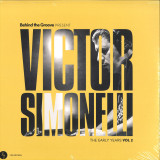
BTG presents “Victor Simonelli: The Early Years Vol 1” a collectors edition double Vinyl release - 2 X 12’s in each Vol
Launching the first Behind The Groove collectors edition vinyl series is New York’s finest Victor Simonelli with ‘The Early Years Vol 1 & 2’ double Vinyl releases. Featuring seminal house tracks such as Cloud 9’s ‘Do You Want Me’, Solution’s ‘Feel So Right’, Instant Exposure’s ‘Wanna Be With You’ and rare mixes of Raiana Page and EZ-AL, this collection brings together classic and rare Victor Simonelli cuts that reflect the early raw energy and buzz of the New York House scene. With ‘Vol 2” scheduled to follow shortly after, this is the most comprehensive collection of rare Simonelli cuts that firmly establishes his esteemed role in 90s House Music as well as introducing new fans to his inimitable sound.
Victor Simonelli is one of the early kings of NYC sampling In house music. The real deal - Victor danced at the legendary David Mancuso’s Loft sessions and developed a serious appreciation for good music. He interned for Arthur Baker at his renown Shakedown Studios (where Arthur worked with the iconic Afrika Bambatta on the seminal dance floor ’Planet Rock’ track) and went on to release hugely influential releases on seminal NYC labels 4th Floor and Nu Groove. Victor’s music was championed by the hugely celebrated iconic House Music DJ pioneers, Larry Levan and Tony Humphries at Paradise Garage & Zanzibar/WBLS/Kiss FM respectively.
Revered as a New York house heavyweight and prolific producer since the turn of the 1990s, Victor Simonelli grew up in Brooklyn, NYC, nurtured by a music loving family, with an avid record collecting father who also worked as a local party DJ. He took music lessons in piano, drums, guitar and bass, before discovering his first love, tuning into NY’s Radio Mix Shows on WBLS, WKTU and WRKS,98.7 Kiss FM) where he discovered the art of mixing and in his own words, ’I just simply got lost in the music’.
Graduating from NYC’s Centre For Media Arts, Victor got an internship in the legendary producer, Arthur Baker’s Shakedown Studios. Soon graduating to editing, mixing and then producing he worked for artists David Bowie, Quincy Jones, Debbie Harry, Sinead O’Connor and Talking Heads. Teaming up with fellow NYC producer Lenny Dee to become the Brooklyn Funk Essentials, they released records ‘Critical Rhythm’ and ‘Subliminal Aurra’ on 4th Floor before Victor went solo as Groove Committee releasing the classic ‘I Want You To Know’ on the legendary Nu Groove Records. Paradise Garage legend, Larry Levan broke ‘I Want You To Know’ rocking 2 copies on his last tour of Japan whilst King of NY House Music,Tony Humphries broke Victor’s new ‘Feels So Right’ across New York on his WBLS/Kiss FM Mastermix show and at his legendary Zanzibar club sessions. It was only a matter of time before Victor’s name became synonymous with quality House music ensuring a worldwide platform for his productions.
In the early 90s alongside his own productions, Victor Simonelli worked on high profile projects, including James Brown’s album, “Love Overdue” BeBe and CeCe Winans single featuring Mavis Staples “I’ll Take You There” and Quincy Jones’ “I’ll Be Good To You” featuring Chaka Khan and the legendary Ray Charles. Never straying too far from his clubland roots, Victor worked with Danny Tenaglia on his classic “The Harmonica Track”.
DJ gigs across the world started flooding in and Victor found himself recording for a dizzying array of labels including Tribal America, Sub-Urban, Bassline, King Street Sounds and Vibe, under a wide range of aliases. He also produced, wrote and remixed for artists such Nile Rodgers (Chic), Afrika Baambata, Hall & Oates, Frankie Knuckles, Kerri Chandler, Madonna and Michael Jackson. Famed for his own productions “It’s So Good” by Creative Force, “I Know A Place” as Sound Of One - the first release on Roger Sanchez One Records -, “Dirty Games” as well as the “Street Players Vol 1 EP”, Victor went on to set up Suburban Records with Tommy Musto and Bassline Records with two other partners. Notable releases on this label include “Do You Feel Me”, Connie Harvey’s gospel inspired, “Thank You Lord”, Urban Blues Project’s “Deliver Me”, Colonel Abrams “Not Gonna Let”, and Mone’s “Better Way”. Never ceasing to produce, DJ, run his own label and host radio shows like Groove Lift, Victor has worked with virtually every NYC producer and has nurtured a next generation talents including Angel Moraes, Jazz ‘N’ Groove, Urban Blues Project, Harlem Hustlers, Jay Jay and Julius Papp. Victor’s releases have also been used on M&S’s “Salsoul Nuggett” hit and Eddie Amador’s underground smash ‘House Music’.
In the late 90’s Victor launched his new Westside Productions, notable for the “Latin Impressions 1 & 2” releases, opened up a studio in Italy as he found himself increasingly working in Europe and now divides his time between New York and Italy. Suffice to say his unique sound of uplifting and spiritual music has kept him at the forefront of House Music and he is credited as one of its leading exponents with his string of classic releases and remixes.
Behind the Groove, branches out from its digital platform to embark on a programme of releases from the iconic pioneer producers of House Music. Esteemed for their high quality features and mixes that continue to explore, celebrate and venerate the contributions of highly respected, scene-shaping Labels, Artists, DJs and Special Events, BTG seeks to bring these talents and tales to the attention of the wider community. Unlocking the stories surrounding the pivotal roles they played and continue to play today in shaping the underground music scene we have come to know and love.
BTG presents “Victor Simonelli: The Early Years Vol 1” a collectors edition double Vinyl release, released on May 12th 2023. ‘Vol 2” follows on May 26th 2023 . These releases are the most comprehensive collection of rare Victor Simonelli cuts that firmly establish his esteemed role in 90s House Music and introduces new fans to his carefree sound.
- A1: The Leaders - Wait A Minute
- A2: Archie Shepp - Song For Mozambique
- A3: Oliver Lake Quartet - Tap Dancer
- A4: Karl Berger And Friends - Guitar Vibes
- B1: Sun Ra Arkestra - Mayan Temples
- B2: Muhal Richard Abrams Octet – Laja
- B3: Andrew Cyrille & Maono - Metamusicians’ Stomp
- C1: The John Carter Octet - Ode To The Flower Maiden
- C2: Diedre Murray, Fred Hopkins - Zebra Walk
- C3: Joseph Jarman, Don Moye Feat Johnny Dyani - Mama Marimba
- D1: Sun Ra Arkestra - Love On A Far Away Planet
- D2: The Don Pullen Quartet - The Sixth Sense
- D3: World Saxophone Quartet
Woke rhythms and high-spirited grooves from the vaults of two seminal Italian jazz labels, between the 70s and 80s. Intensely curated by Khalab.
Hyperituals is a philological investigation that deeply delves into the possibilities of sound, rhythm, remix, and endless sampling. Inspiring listening, interpretation, and reinterpretation.
This volume is dedicated to the catalogue of the Italian Black Saint. Thanks to a constant, cutting-edge, and meticulous commitment, Black Saint & Soul Note established themself as two of the most important imprints for international jazz. They always placed the artists, their visions, and their music at the centre, giving them total freedom of creative expression. By combining jazz tradition with the political vanguard sentiment of the time, the two labels were able to press and produce more than five hundred records, many of which are by some of the brightest names in creative jazz or the ‘avant-garde’ of the era.
Curated by Khalab, the selection - focused on rhythms, grooves, and Afrocentric traditions - blends moments in which the rhythmic aspect is powerfully explicit, with others in which the kinetic aspect dialogues on different levels with African American cultural contexts.
Steve Gunn has always had one foot in indie rock and the other in an expansive improvisational scene. His songwriter albums alternate with freewheeling jams, most notably in his Gunn-Truscinski Duo, but are not confined to that. So when Gunn decided to revisit Other You, it made sense that he brought in some guests from the far side of the commercial/experimental spectrum to reimagine his songs. Nakama presents five tracks from that last album, reshaped by artists that Gunn admires. The process loosens the songs up considerably.
To start, he calls in Mdou Moctar’s backing band (the American bassist Mikey Coltun and the other guitarist Ahmoudou Madassane) for “Protection.” The song already had a bit of blues-y swagger to it, with sharper-edged guitar rhythms also heard on the ultra-smooth Other You, but here the heat has an otherworldly desert sheen. Its caravan-traveling rhythm sways from side to side, digging in to to the upbeats in a way that is both kinetic and also hypnotically still. There’s some crowd noise in the background, the knot of people that regularly forms when Mdou and his compatriots plug in from Agadez, and a few mournful afro-blues licks arcing off the vamp. But mostly it’s a cut that reminds you how much African guitar music Gunn has absorbed (listen to “Tommy’s Congo” from Way Out Weather for proof), and how well it fits with what he does.
Gunn also brings in Circuit Des Yeux’s Haley Fohr to reconfigure “Ever Feel That Way,” and she sets the song’s drifting melancholy amid pensive minor-key piano chords. She strips back the ambient whoosh that surrounds the original, slows down the pace and presents the song in startling, unadorned clarity. Her version removes some of the sticky, over-prettiness that I found so distracting in Other You. The melody is better, purer and more focused without the frills. There is also an electronic remake of “Reflection” from David Moore’s ambient ensemble Bing and Ruth, which traps Gunn’s fragile vocals in a shivering palace of synthetic tones. It’s enjoyable in its way, but the two sensibilities never quite meld together.
The best part comes when Gunn joins forces with Joshua Abrams’ Natural Information Society in remakes of “Good Wind” and “On the Way.” The former is a matter of subtle differences: the gentle pitch and roll under Gunn’s voice, the intermittent liquid runs of bass between widely spaced phrases. Abrams and his crew open up the jazz-leaning, reiterative possibilities under Gunn’s song, but they don’t change it fundamentally. “On the Way” is even stronger, a glowing drone and a pattern of hand drums enveloping the melody. It makes the music seem more spiritual, more resonant, more deep and full of mysteries. It was striking enough that I had to go back to Other You to hear again an album that had left me cold. This new version of “On the Way” didn’t change that chill, but it gave me an idea of how strong the songs might have sounded in another setting. (by Jennifer Kelly)
Mondo, in partnership with WaterTower Music, is proud to present Michael Giacchino's absolutely brilliant score to Matt Reeves’ highly anticipated THE BATMAN. Featuring the music of Academy, Emmy and Grammy Award-winning composer Michael Giacchino, whose credits feature some of the most popular and acclaimed film projects in recent history, including THE INCREDIBLES, COCO, JOJO RABBIT, RATATOUILLE, STAR TREK, JURASSIC WORLD, ROGUE ONE: A STAR WARS STORY, SPIDER-MAN: HOMECOMING, and WAR FOR THE PLANET OF THE APES. This is the fifth film Reeves and Giacchino have collaborated on.
Giacchino proves himself, once more, as one of the greatest living composers, by introducing a powerful and instantly canonized new theme to one of the most musically iconic superheroes. When director Matt Reeves heard the theme for the first time, he was with film producer Dylan Clark. “I was blown away!” He exclaimed. “It was so emotional. The two of us literally cried…it was amazing.”
Though it's not only the world's greatest detective who emerges with a new theme - Selina Kyle / Catwoman's new string heavy theme is slinky and haunted like that of a classic noir's femme fatale. And Giacchino's take on The Riddler is far more haunted, accompanied by the Tiffin Boys choir, a truly terrifying and dread-inducing motif for one of the scariest takes on a Gotham villain, to date.
With nearly two hours of score, housed on three discs, featuring all new artwork by Henry Abrams.
Composed by Michael Giacchino
Artwork by Henry Abrams
Manufactured in Czech Republic
Etceteral are a Slovenian experimental trio (saxophone & electronics, drums, visuals) who create a propulsive, polyrhythmic futurist jazz. It is a sound marked by abstract modular explorations, hypnotic drumming, ricocheted horn textures and crystalline production. Interzones between Dub, Krautrock, Afro-rhythms, free improvisation and quantized electronic music are brightly lit on this thrilling second album. The idea of musical elasticity is central to Rhizome, the sophomore album of the Slovenian audio-visual electronic jazz trio Etceteral, the newest member of the Glitterbeat family, who debuted in 2020 with the album Ama Gi for Kapa Records. Following a series of domestic and international gigs, the band consisting of Bostjan Simon (saxophone, synth, electronics), Marek Fakuc (drums) and Lina Rica (visuals) returned to the studio, taking their ambition to meld audio and visuals to a whole new level on their debut for the tak:til imprint. On Rhizome, the band explores the interzone between groove-driven contemporary jazz, quantized electronic music, abstract modular explorations and free improvisation. Like rubber that is able to stretch and be returned to its original shape, Etceteral expands its arrangements to the point of no return, pushing its sonic architecture to the maximum without ever letting it collapse onto itself. "I like to think in terms of sonic rubber bands. We can stretch our music both rhythmically and harmonically, change tonality and return to the main theme through a different key. This process opens up new space for discovery. We recently listened a lot to Joshua Abrams and Evan Parker, musicians who know how to make their music airy and spacious," says saxophonist Simon
One of the first previously-unreleased funk and soul albums issued by Now-Again, way back in 2003, and it still sounds amazing today. Well, it would have to: it's the brainchild of bandleader/drummer/singer/ songwriter Lester Abrams who crafted hit singles like Minute by Minute' by the Doobie Brothers. Yeah, really. Back in early 70s Omaha, however, he brought a multiracial band into the Pacific Avenue studio to cut an album's worth of material. Only one single - Color' b/w Blink Man' - was ever issued, and this album sat on master tapes in Abrams' closet until Egon dug them out in 2001.
Repressed , please note price increase! Would Like To Pose A Question is one of the first previously-unreleased funk and soul albums issued by Now-Again, and it still sounds amazing today. Well, it would have to: it's the brainchild of bandleader/drummer/singer/songwriter Lester Abrams (the L.A. in L.A. Carnival). Abrams helped create hit singles like "Minute by Minute" and “What A Fool Believes” for the Doobie Brothers and played with artists such as B.B. King, Stevie Wonder, Peabo Bryson, Manfred Mann, Quincy Jones and many more. Before all that - in early 70s while still in Omaha - he brought a multi-racial band into the Pacific Avenue studio to cut an album's worth of material. Only one single - "Color" b/w "Blink Man" - was ever issued, and this album sat on master tapes in Abrams' closet. That is until Now-Again’s Eothen Alapatt intervened in the early 2000s and Would You Like To Pose A Question was at last given a proper full length release.
Black vinyl[22,65 €]
2LP[36,56 €]
Turquoise and Black splatter vinyl[27,69 €]
Gold LP[25,63 €]
Black Vinyl[26,85 €]
Red / Blue Splatter Vinyl[29,37 €]
Black Vinyl[29,37 €]
Vinyl[35,92 €]
Clear Vinyl[28,53 €]
Clear Vinyl[30,21 €]
LP[30,21 €]
LP2[38,87 €]
Black Vinyl[29,37 €]
Creme White Vinyl[31,89 €]
Clear Green Vinyl[31,89 €]
Lavender Marble[30,63 €]
Yellow w/ red & black splatter[30,63 €]
Black VInyl[30,21 €]
Cassette[15,08 €]
Black Vinyl[33,19 €]
Tidewater Tri Color Vinyl[34,87 €]
Available on vinyl for the first time since it's original CD-only release in 2007. Tenor saxophonist Fred Anderson and drummer Hamid Drake had the closest of relationships, as close as a father and son might have. Their communication was at a higher level musically and emotionally. The music on this album reflects not only their masterful musical skills, but a conversation in music that is exceptionally powerful and unique. For From the River to the Ocean, they assembled a band consisting of fellow Chicagoans to record the most relaxed, perfectly balanced album they made together. It may seem hyperbolic to call From the River to the Ocean Fred Anderson's greatest album, but the empathy and cohesiveness of the ensemble, coupled with the saxophonist's brilliant, searching improvisations, makes it a powerful contender. From the River to the Ocean is an especially varied outing, ranging from Anderson's classic set-closing blues "Strut Time" to the meditative, spiritual, modal track "For Brother Thompson," dedicated to the late trumpeter Malachi Thompson and featuring bassist Harrison Bankhead on brooding piano and Drake chanting in Arabic. The record's title track and the closer, "Sakti/Shiva," find bassist Josh Abrams laying down an astounding bed on guimbri, the threestringed Moroccan acoustic bass familiar to fans of Gnawa music. Another of the album's delights is guitarist Jeff Parker, well known Jazz guitarist as well as member of Tortoise. Here, Parker displays an immense sensitivity and melodic genius, sharing solo spotlight with Bankhead's cello on "From the River to the Ocean" and sculpting a stunning array of shapes on the group's swinging take on Anderson's "Planet E." Underneath it all is Hamid Drake, an intensely creative soul continuing to challenge himself. Drake's growth is not measured in how many different instruments he plays - indeed, he's scaled back his arsenal over the years - but in the depth and musicality of his feeling. On this record he is remarkably light and airy, playing with tremendous delicacy and clarity. Propulsion can be introduced without a pneumatic drill, and Drake instigates an avalanche of rolling forward momentum on the opening moments, inspiring the two basses and guitarist to move, to make something moving, and in turn to further inspire Fred Anderson to some of his most forceful and imaginative playing ever documented. If the individual is a small receptacle of expressivity, a mountain spring if you will, then it is in ideal settings like this one that the springs join forces, turning into streams, then bigger and bigger tributaries, finally swelling into rivers that open into the oceanic creative waterways. Thank goodness Anderson and Drake tapped into that wellspring, drawing directly from the source
Black vinyl[22,65 €]
2LP[36,56 €]
Turquoise and Black splatter vinyl[27,69 €]
Gold LP[25,63 €]
Forest Green Vinyl[39,08 €]
Red / Blue Splatter Vinyl[29,37 €]
Black Vinyl[29,37 €]
Vinyl[35,92 €]
Clear Vinyl[28,53 €]
Clear Vinyl[30,21 €]
LP[30,21 €]
LP2[38,87 €]
Black Vinyl[29,37 €]
Creme White Vinyl[31,89 €]
Clear Green Vinyl[31,89 €]
Lavender Marble[30,63 €]
Yellow w/ red & black splatter[30,63 €]
Black VInyl[30,21 €]
Cassette[15,08 €]
Black Vinyl[33,19 €]
Tidewater Tri Color Vinyl[34,87 €]
Available on vinyl for the first time since it's original CD-only release in 2007. Tenor saxophonist Fred Anderson and drummer Hamid Drake had the closest of relationships, as close as a father and son might have. Their communication was at a higher level musically and emotionally. The music on this album reflects not only their masterful musical skills, but a conversation in music that is exceptionally powerful and unique. For From the River to the Ocean, they assembled a band consisting of fellow Chicagoans to record the most relaxed, perfectly balanced album they made together. It may seem hyperbolic to call From the River to the Ocean Fred Anderson's greatest album, but the empathy and cohesiveness of the ensemble, coupled with the saxophonist's brilliant, searching improvisations, makes it a powerful contender. From the River to the Ocean is an especially varied outing, ranging from Anderson's classic set-closing blues "Strut Time" to the meditative, spiritual, modal track "For Brother Thompson," dedicated to the late trumpeter Malachi Thompson and featuring bassist Harrison Bankhead on brooding piano and Drake chanting in Arabic. The record's title track and the closer, "Sakti/Shiva," find bassist Josh Abrams laying down an astounding bed on guimbri, the threestringed Moroccan acoustic bass familiar to fans of Gnawa music. Another of the album's delights is guitarist Jeff Parker, well known Jazz guitarist as well as member of Tortoise. Here, Parker displays an immense sensitivity and melodic genius, sharing solo spotlight with Bankhead's cello on "From the River to the Ocean" and sculpting a stunning array of shapes on the group's swinging take on Anderson's "Planet E." Underneath it all is Hamid Drake, an intensely creative soul continuing to challenge himself. Drake's growth is not measured in how many different instruments he plays - indeed, he's scaled back his arsenal over the years - but in the depth and musicality of his feeling. On this record he is remarkably light and airy, playing with tremendous delicacy and clarity. Propulsion can be introduced without a pneumatic drill, and Drake instigates an avalanche of rolling forward momentum on the opening moments, inspiring the two basses and guitarist to move, to make something moving, and in turn to further inspire Fred Anderson to some of his most forceful and imaginative playing ever documented. If the individual is a small receptacle of expressivity, a mountain spring if you will, then it is in ideal settings like this one that the springs join forces, turning into streams, then bigger and bigger tributaries, finally swelling into rivers that open into the oceanic creative waterways. Thank goodness Anderson and Drake tapped into that wellspring, drawing directly from the source
Screen Time is a series of instrumental guitar pieces recorded during the summer of 2020 as the world confronted the pandemic shutdown and as the people of good conscious stood up against the oppression of racist police oppression and murder. How much screen time does a parent allow a child? How much screen time does a child need to realise a world which has the means to coexist as a community in shared exchange?
The cover image of Screen Time is of a youngster curled into a book, the pages vibratory with text radiating through the skin, blood and bone – an aspect entirely missing from digital media, though the actuality of transparency in our daily lives through streaming etc we can only hope leads to the awareness of fairness.
Screen Time is in reflection to dream time, a state of meditation, hypnagogia and pillow talk.
Thurston Moore born 1958, moved to NYC 1976, started Sonic Youth 1980, edited the fanzines KILLER, Sonic Death, and Ecstatic Peace Poetry Journal, started Ecstatic Peace records + tapes label, senior editor of Ecstatic Peace Library, and Flowers & Cream, edited books at Rizzoli and Abrams, on faculty at the Naropa University summer writing program since 2011, published through various imprints, worked collaboratively with Yoko Ono, Merce Cunningham, Cecil Taylor, Rhys Chatham, Lydia Lunch, John Zorn, Takehisa Kosugi and Glenn Branca, composed music for films by Olivier Assayas, Gus Van Sant, and Allison Anders, records and tours both solo, with various ensembles and with his own band, resides everywhere.
Mastered by Lasse Marhaug for Southern Lord.
- A1: Ash (2021 Remaster) 07 06
- A2: Chessa (2021 Remaster) 06 58
- A3: Blast (2021 Remaster) 03 04
- B1: Duh (2021 Remaster) 03 40
- B2: Marche (2021 Remaster) 05 21
- B3: Nerf (2021 Remaster) 03 40
- B4: West Nile (2021 Remaster) 02 16
- B5: Melt (2021 Remaster) 05 30
- C1: Logical (2021 Remaster) 03 01
- C2: Dead Leaves (2021 Remaster) 05 22
- C3: Scrapbook (2021 Remaster) 07 53
- D1: Habitat (2021 Remaster) 07 04
- D2: Bloom (2021 Remaster) 03 31
- D3: Angelic (2021 Remaster) 03 39
Keplar re-issues the fourth album 'Chessa' by Dan Abrams' project Shuttle358 on vinyl for the first time. The double LP edition includes 3 previously unreleased tracks from the same recording sessions back in 2004, as well as an extended artwork with unseen photographs by Dan Abrams.
While undoubtedly associated with the microsound and 'clicks & cuts' movement around the turn of the millennium, on 'Chessa' Shuttle358 left behind the classical rhythmic patterns of the genre and shifted further towards warmer territories, meandering between modern digital minimalism and the soft tones of ambient music. Counter to his microsound synthesis approach on Frame (2000), Abrams created Chessa by writing software that manipulated samples from his unreleased songs, guitar pieces, and vintage japanese films sampled from video tape. In particular, a special granulating technique was written and performed at intentionally low sample rates that gave the uniquely fragile, yet dense sound to the album. Over fourteen tracks Abrams arranges slowly evolving sonic entities of unfading elegance. Strayed and hazy melodies pulse and cascade, elongated but brittle harmonies shimmer and disappear, echoing far-off in the rounded corners of the mind. The patient and detailed way Abrams combines the broken with the beautiful in creating organic collages of sound that retain the euphonic essence of a song, makes this piece of work so powerful and timeless, sounding just as relevant today, as it did 17 years ago.
Under modern scrutiny in Abrams latest studio, he refocused the original recordings to emphasize the elements most important to the original vision. The final mastering and vinyl preparation was done in collaboration with Stephan Mathieu, vinyl was cut by LUPO.
From the original press release in 2004 by Taylor Deupree:
Without a doubt Shuttle358 has become one of the most admired artists to emerge from modern electronic music’s sea of musicians. From the humble beginnings of a demo CD in 12k’s mailbox to 4 critically acclaimed CDs, Dan Abrams is, to some, the one credited for bringing a warmth and human touch back into what has often been considered a very cold, sterile genre. It began with 1999’s Optimal.lp (12k1005), a groundbreaking debut release that immediately defined the Shuttle358 sound; a hybridization of the then-emerging “microsound” genre with Eno’s true ambient explorations. In 2000 Abrams outdid himself with Frame (12k1011) by honing his sound design and exploring production techniques at rates that made his “now” quite brief and creating what was to become one of the most sought-after CDs in the 12k catalog.
Chessa is the third release from Abrams’ Shuttle358 moniker on 12k and he continues to do what he does best: attempt to move microsound away from the world of theory and towards absolute real life. Like his photographs, Chessa is music about, and to be listened to in, unexpected places. It is a narrative, a simple slice of life that plays out through the incidental photography of the cover artwork. To achieve this Abrams fuses irregular granular sound particles, like the movements of everyday life, with a deliberate melodic base that captures emotion and simplicity.
Volume 2[22,65 €]
Volume 3[22,65 €]
Orange Vinyl Volume 2[22,65 €]
Yellow Vinyl Volume 1[22,65 €]
Detroit Deep House from New label Upstairs Asylum Recordings.
Sam Prekop's eponymously titled LP is a study in pop nuances. Simultaneously transporting the listener from mild climes and swinging palms to darkened skies and wind blown steppes, the record will be easily recognized by fans of The Sea and Cake. Known to many as the singer and main songwriter for said group, Mr. Prekop is assisted on this release by Chad Taylor (Chicago Underground Duo), Josh Abrams (ex-Roots, Town and Country), Jim O'Rourke (Gastr del Sol) and Archer Prewitt (The Sea and Cake). Those expecting to find more of the computer beats and trickery found on The Fawn and Two Gentlemen are in for a surprise. Whilst prevalent on "Faces and People" - (a lucious groove overlayed by cornet and guitar), the computer takes a back seat to real strings, drums, piano, electric piano and organ as well as electric and acoustic bass. The subtle grooves, a trademark of The Sea and Cake records, are still present here as Sam and his band blend West African rhythms with a bit of soul, jazz and pop. The resulting record is something wholly original, elegant and earthy. A cauldren, if you will, of sweet smelling and enlightening stew. So line up, grab a spoon, and dig in. All the ingredients and intoxicating aromas necessary for an auditory feast are contained within.
Mind Maintenance is the new duo consisting of Joshua Abrams (Natural Information Society) and Chad Taylor (Chicago Underground Duo, Chad Taylor Trio). This is where the music begins, but Mind Maintenance can't be described simply as a summation of its parts and players. When you put on the sound, you'll know what we're saying - you'll notice how immediate and meditative it is; how simple, how "in the room," and how the natural buzz of each instrument sits remarkably well against the other. The percussive qualities of the guimbri and the mbira, so raw and unadorned individually, form with their shared resonance a soothing, sonorous whole. It's not about world music, it's not about jazz. It's about mind maintenance. The songs of Mind Maintenance exist in a zone somewhere between composition and improv. Based in melodies that unspool over time, they benefit from Chad and Joshua's intimately enmeshed sensibility and the intensity with which they listen to each other. Chad and Joshua have been playing together forever - or, if you need to think of it more tangibly, since around 1994. Based on our research, the pairing of guimbri and mbira is more than unusual - it appears to be without precedent! This is incredible if it's true, but more important to the music of Mind Maintenance is the shared ground of inspiration that both instruments occupy. Mind Maintenance pursue their inspirations on these instruments down similarly transformative paths. If some part of the 21st century isn't focused on destruction, but instead, locating a place where our traditions can work together in new ways to entertain and even ensure well-being, then that's just one more incentive for all of us to consider Mind Maintenance.
Rich in musical associations yet utterly singular in its voice, joyous with an inner tranquility, the music of Natural Information Society is unlike any other being made today. Their sixth album in eleven years for eremite records, descension (Out of Our Constrictions) is the first to be recorded live, featuring a set from London’s Cafe OTO with veteran English free-improv great Evan Parker, & the first to feature just one extended composition. The 75-minute performance, inspired by the galvanizing presence of Parker, is a sustained bacchanalia of collective ecstasy. You could call it their party album.
This was the second time Parker played with NIS. Joshua Abrams: “Both times we played compositions with Evan in mind. I don’t tell Evan anything. He’s a free agent.”
The music is focused & malleable, energized & even-keeled, drawing on concepts of ensemble playing common to musics from many locations & eras without any one specific aesthetic realization completely defining it.
“The rhythms that Mikel plays are not an exact reference to Chicago house, but that’s in there,” Abrams says. “I like to take a cyclic view of music history, can we take that four-on-the-floor, & consider how it connects to swing-era music? Can we articulate a through line? I dee-jayed for years in Chicago & lessons I learned from playing records for dancing inform how I think about the group’s music. The listener can make connections to aspects of soul music, electronic music, minimalism, traditional folk musics, & other musics of the diaspora as well. It’s about these aspects coming together. I don’t need to mimic something, I need to embody it to get to the spirit, to get to the living thing.”
For jazz fans, the sound of Parker’s soprano & Jason Stein’s bass clarinet might evoke Coltrane & Dolphy, even though they didn’t necessarily set out to do that & they play with complete individuality. Abrams sees a bridge to the historical precedent, too. “Since we first met in the 1990s, one of the things that Evan and I connected on was Coltrane’s music,” he says. “I hoped that we would tap into that sound world intuitively. In this case, I think that level of evocation adds another layer of depth, versus a layer of reference.”
Indeed, this is a performance in which the connections among the ensemble & the creative tension between improvisation and composition build into a complex mesh of associations & interactions. While the band confines itself to the territory mapped out by Abrams’ composition, they are remarkably attentive & responsive, making adjustments to Parker’s improvisations. When Parker’s intricate patterns of notes interweave with the band, the parts reinforce one another & the music rockets upward. Sometimes, Parker’s lines are cradled by the group’s gentle pulse & an unearthly lyrical balance is struck.
Drummer Mikel Patrick Avery is locked-in, playing with hellacious long-form discipline, feel & responsiveness. Jason Stein’s animated, vocalized bass clarinet weaves in & out with Lisa Alvarado’s harmonium to state the piece’s thematic material; the pulsing tremolo on the harmonium brings a Spacemen 3 vibe to the party. Abrams ties together melody & rhythm on guimbri, a presence that leads without seeming to. Like his bandmates, he shifts modes of playing frequently, improvising & then returning to the composed structure.
“As specific as the composition is, the goal is to internalize it & mix it up,” Abrams says. “The idea is to get so comfortable that we can make spontaneous changes, find new routes of activity, stasis & byways every gig. It’s like a web we’re spinning. If someone makes a move, we all aim to be aware of it, make room for it. Experiencing & listening is what it’s about, & Evan supercharges that.”
& “supercharged” is the word for this album. With Parker further opening up their music, descension (Out of Our Constrictions) is the sound of Natural Information Society growing both more disciplined and freer, one of the great bands of its time on a deep run.
Aguirre edition: Mastered by Helge Sten, Audio Virus, Oslo. Lacquers by Dubplates & Mastering. Liner Notes by Theaster Gates. LPs pressed on premium audiophile-quality vinyl at Pallas Records. US 2xLP edition available thru Eremite records.
Hive Mind Records are delighted to present Congo, the debut album from Brazilian guitarist and composer Rodrigo Tavares.
Maintaining a meditative mood across it's nine instrumental pieces, Congo blends composition and improvisation with subtly experimental yet sophisticated arrangements that evoke the mood and rhythms of classic Brazilian artists such as João Gilberto, Dorival Caymmi, Tom Jobim, Milton Nascimento and Caetano Veloso.
Rodrigo's work draws on elements of jazz, post rock, minimalist composition and disparate global sounds to create a deep listening experience that falls between genres and wilfully defies categorisation. Congo is a lush soundworld that rewards exploration and will appeal to fans of music as diverse as Joshua Abrams and Natural Information Society, Collocutor, BadBadNotGood, Slint or late Talk Talk, as much as it does to lovers of classic Brazilian music.
Hive Mind Records are proud to be releasing Congo on vinyl in gatefold sleeve designed by Brazilian graphic artist, Andrea Gomes, and featuring the original painting of celebrated Brazilian artist, Cristiano Lenhardt.
Electronic duo Spring Heel Jack return with a collaboration with the legendary American trumpeter and Pulitzer Prize nominee Wadada Leo Smith.Wadada was born in the Mississippi Delta and became immersed in the music of the great blues masters as a young musician. He then moved to Chicago and became an early member of the AACM alongside the likes of Muhal Richard Abrams, Anthony Braxton, Malachi Favors and Roscoe Mitchell. Recorded last year in London, this LP sees Smith's authoritative trumpet joined by Steve Noble's drums and Pat Thomas' piano, to make a stunning piece of aural theatre in six acts.