Recumbent Speech, Ezra Feinberg’s second album, opens with a lament. Named for the Robert Frost poem, “Acquainted with the Night” was written during one of the many devastating spectacles of injustice under our current regime. Repeating flutes and synths beam out of a low-end darkness, reflecting a collective sense of loss and alienation. Rising slowly, thickening with guitars and strings, “Acquainted with the Night” lifts off, and so too does the album from there. The second track, “Letter to my Mind,'' features the dynamic interplay of Feinberg's guitar with the loose and playful drumming of Tortoise's John McEntire, both pushing and pulling atop a looping bass figure. "Palms Up" begins with a lockstep pulse recalling early Terry Riley before jumping into an Ashra-like jam with Afrobeat accents. Side B opens with "Ovation," a tryptic with McEntire on drums which sets a wide lens onto a sweeping landscape, with soaring flutes, wordless vocals, and a hypnotic bassline played on a humming fretless that recalls classic ECM jazz-fusion. The piece plunges into an ambient, interior space before reemerging with a guitar solo fried through an old Space Echo effects processor, conjuring lidded Pompeii-era Pink Floyd. The album's title-track finale, "Recumbent Speech," features the magical pedal steel of Chuck Johnson. Unwinding atop a Balearic analog synth pattern, Feinberg stretches textures of Fender Rhodes and acoustic guitar around Johnson’s lyrical steel, with nods to Japanese ambient legend Hiroshi Yoshimura, as well as Cluster & Eno. Recumbent Speech refers to the possibilities, pleasures, fears, and fantasies that occur the moment the noise dies down, when we are recumbent, in repose but still awake, still speaking, and still aware of ourselves as part of the maddening world. Ezra Feinberg is a guitarist, composer, and psychoanalyst living in Jackson Heights, NY. Feinberg was the founding member of the San Francisco psychedelic rock collective Citay, releasing albums on Important Records and Dead Oceans throughout the 2000s. After relocating to NYC, he issued his first solo record, Pentimento and Others, on his imprint Related States and on cassette on Stimulus Progression in 2018. The release, his first since Citay folded in 2012, earned praise from numerous music outlets including Paste Magazine, The Wire, Stereogum, Vice, and Aquarium Drunkard. In recent years, Feinberg has performed and toured near and far with Jefre Cantu-Ledesma, Steve Gunn, Alexander Turnquist, Cruel Diagonals, Daniel Carter, Jonas Reinhardt, Christopher Tignor, Kath Bloom, Robbie Lee, High Aura’d, Glasser, Ava Mendoza, Buck Curran, Real Estate, and many others, and has ongoing studio collaborations with Jefre Cantu-Ledesma and Arp, contributing both guitar and songwriting to the last Arp album Zebra.
Поиск:acoustic space jazz
Все
Re-Release
Black Truffle is honoured to present the premier recordings of two recent works by legendary American experimental composer Alvin Lucier. A friend and contemporary of pioneers like Robert Ashley, David Behrman, Gordon Mumma, and Christian Wolff, Lucier has been crafting elegant explorations of the behavior of sound in physical space since the 1960s. Lucier is perhaps best known for I Am Sitting in a Room (1970), in which he repeatedly re-recorded his own speaking voice being played back into a room until the room's resonant frequencies entirely obscure the spoken text. Beginning in the early 1970s, he has written a remarkable catalogue of instrumental works that focus on phenomena produced by the interference between closely tuned pitches, such as audible beating, often using pure electronic tones produced by oscillators in combination with single instruments.
Demonstrating the restless creative drive of an artist now in his 80s, the two recent works presented here both feature the electric guitar, an instrument Lucier has just recently begun to explore. In Criss-Cross, Lucier's first composition for electric guitars, two guitarists using e-bows sweep slowly up and down a single semitone, beginning at opposite ends of the pitch range. The piece is a model of simplicity, exemplifying Lucier's desire not to 'compose' in the conventional sense, but rather to eliminate everything that 'distracts from the acoustical unfolding of the idea'. In this immaculately controlled performance of Criss-Cross by Oren Ambarchi and Stephen O'Malley, (for whom the piece was written in 2013), a seemingly simple idea creates a rich array of sonic effects - not simply beating patterns, which gradually slow down as the two tones reach unison and accelerate as they move further apart, but also the remarkable phenomenon of sound waves spinning in elliptical patterns through space between the two guitar amps.
In the comparatively lush Hanover, Lucier draws inspiration from the beautiful photograph that provides the LP with its cover, an image of the Dartmouth Jazz Band taken in 1918 featuring Lucier's father on violin. Using the instrumentation present in the photograph, Lucier creates an unearthly sound world of sliding tones from violin, alto and tenor saxophones, piano, vibraphone (bowed) and three electric guitars (which take the place of the banjos present in the photograph). Waves of slow glissandi create thick, complex beating patterns, gently punctuated by repeated single notes from the piano. The result is a piece that, like much of Lucier's instrumental music, is simultaneously both unperturbably calm and constantly in motion.
Stunning LP design by Stephen O'Malley including an inner sleeve with a portrait of Alvin Lucier by Kris Serafin.
Criss-Cross' recorded at Studios Ina GRM, Paris by Francois Bonnet and mixed by Alvin Lucier. Hanover' recorded in Zurich and mixed by Alvin Lucier.
Mastered and cut by Rashad Becker at D&M Belin.
Criss-Cross' recorded at Studios Ina GRM, Paris by Francois Bonnet and mixed by Alvin Lucier. Hanover' recorded in Zurich and mixed by Alvin Lucier.
Mastered and cut by Rashad Becker at D&M Berlin.
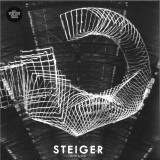
Ghent's Steiger are a piano trio, but not in the classical sense. With their versatile style, influenced by different musical genres such as jazz, rock, pop, classical and electronic music, they try to find a balance between composition and improvisation through the use of experimentation and electronics.
Considered pioneers of the Belgian jazz crossover scene, Steiger have been active for 6 years and have recently found themselves performing at major jazz venues in Flanders, picking up numerous accolades along the way.
The trio's highly anticipated sophomore album 'Give Space', released 14th September on Sdban Ultra, was recorded at 7 different locations, with the music composed to fit and fight these locations within a dialogue of acoustics, atmospheres and appetition. Field recordings, reverbs, ambient sounds, all collected within the search for the unpredictable, were given space within this dialogue as the essential part of the encounter. As a result, the locations emerge somewhat as a fourth member of the trio. The music - sometimes fixed, sometimes completely free - takes on an ever-changing journey into their multi-faceted world.
Wildflower (Leon Brichard, Tom Skinner, Idris Rahman) continue to explore areas of groove-based improvised jazz on their 2nd album. Taking a slightly freer approach to the writing process, simple but effective melodies and bass motifs are explored to to create fully realised pieces with dynamic extremes that bring a full range of emotion. Recorded over a two day session at Fishmarket Studios in London, the band sounds relaxed and at ease, giving space to explore intricate improvised interplay and dialogue fully whilst at the same time building to fiery powerful climaxes and emotional peaks. Skinner is on fire here whilst Rahman and Brichard trade riffs and push the harmonic and rhythmic boundaries. Rahman’s use of clarinet and bamboo flute plus additional layers of woodwinds, Skinner’s unique approach to stripped-down use of his very personalised kit, and Brichard’s use of both acoustic and electric basses make for a sonic landscape that is both unique and highly approachable. Touching on heavy spiritual vibes whilst taking in dark alternative grooves and delicate folk-like tunes, the overall sound remains instantly accessible
Sax, Flutes and Clarinet: Idris Rahman
Electric and Double Bass: Leon Brichard
Drums: Tom Skinner
It’s been a busy eight months since Dampé’s debut on Dirt Crew Recordings. That time has seen the producer hold down monthly slots on Rinse FM, contribute a downtempo electronica/jazz edit to the S3A ‘Pages Remixes” EP as well as open big rooms for the likes of Surgeon and Blawan.
The intervening months have also seen the producer set up camp in the Rhythm Section studio in South East London, and the result of new access to studio gear can be heard all across ‘Garden’. Compared to the debut ‘Peach Shuffle’ this is a far more machine-led and darker listening experience. Snatches of acoustic instruments and space remain, but it’s never long before the disembodied vocals and oversaturated classic drum kits return reminding you this is music best enjoyed in the club.
‘A Basement, 10 Years Ago’ started just there. A bass line dimly recalled from a long-lost 6am jam is sequenced on a weighty analogue keyboard, while syrupy R&B vocals dance around mbira and gangsa, all slowly building and building together. ‘727 and Arp Breaks’ is a love letter to two of the producer’s favourite instruments from the studio. A TR-727 and an Arp Odyssey collide across dubbed out stabs to form some very rolling breaks.
Sunday Night Machines’ sees Dampé tame the box-of-physics that is the Arp Odyssey again with a sprawling meditation on two repeating arpeggios.
‘Garden’ is the one for the dancers. Four variations play with the same melodic theme in distinct sections, with the second variation being the deepest and most floor-ready the whole record gets. ‘France’ is a warped dub-come-hip hop beat that manages to conjure both Lil Jon and Yusef Lateef. We approached Liverpool’s finest ASOK (Lobster Theremin, M>O>S Delsin) for remix duties and to close out the record with a twisted bang. He turned in a propelling weapon that brings a whole new texture to the track listing. It’s very 90’s, very ravey and very raw, in a true IDM style.
With this eclectic mix of sounds we are entering another chapter of the Dirt Crew story and we hope you dig it as much as we do!
For the latest release in their ongoing ‘International’ series, Into The Light Records takes us to Sydney and the dreamy, softly spun musical world of talented multi-instrumentalist Max Santilli.
“Surface” is Santilli’s debut album following years spent working alongside Jacob Fugar in Ken Oath Records-signed downtempo duo Angophora. It draws on a personal archive of home recordings made between 2016 and 2018 using a range of guitars, synthesizers and acoustic percussion instruments.
As you’d perhaps expect, it’s an intimate and hugely personal set that wraps drowsy, slowly shifting musical flourishes around gentle, sun-kissed rhythms and suitably spacey chords. Santilli offers subtle nods towards his various inspirations – think the mesmerizing ambient-jazz fusion of Michael Bierylo, Steve Hillage’s timeless early ambient works and the intricate acoustic guitar playing of Steve Tibbetts and Miguel Herrero – while forging his own distinctly lo-fi and otherworldly path. As a result, “Surface” is an album of impressive depth and diversity, held together by Santilli’s reflective, emotion-rich vision.
Over the years, Claremont 56 has played host to some memorable collaborative
projects, most notably Bison, an unlikely super-group whose members included
Holgar Czukay, Ursula Kloss, Liquid Liquid’s Sal Principato, Ben Smith and label
boss Paul ‘Mudd’ Murphy. Now Murphy is at the helm of another collaborative
outft, Hillside, whose seductive debut single contains two deliciously pie eyed
instrumental workouts.
Hillside is very much a family affair, with Murphy joining forces with two old
friends: bassist/guitarist Alex Searle and percussionist Patrick Dawes. The trio
has a collaborative history that stretches right back to Murphy’s time in Akwaaba
in the mid nineties. For their debut outing, Hillside has also welcomed a very
special guest musician: award-winning jazz violinist and long-time Bert Jasch
collaborator Mike Piggott.
As opening gambits go, “Hidden Port” is an emphatic statement of intent. The
audio equivalent of sailing slowly around a cluster of sun-baked islands in
search of shelter from an approaching storm, the track sees Searle wrap bluesy,
Peter Green style guitar passages around a shuffing, Latin-tinged groove rich
in Dawes’ distinctive percussion patterns and Murphy’s languid electric piano
and synthesizer lines. As the track progresses, Piggott steps up to make his
mark, with his undulating electric violin lines complimenting Hillside’s impeccable
instrumentation while adding extra emotional weight to proceedings. It’s a
stunning beginning to the Hillside story.
Piggott also makes a big impression on accompanying cut “The King’s Tun”,
delivering fuid and energy-packed solos that weave in and out of a bright
and breezy instrumental track rich in jangling acoustic guitars, subtly spacey
electronics, freside-warm bass and more sparse-but-intricate percussion
courtesy of the effervescent Dawes. Searle’s eyes-closed, rock style guitar solos
cap another memorable excursion from Claremont 56’s latest in-house band.
Two years ago, Ferdi Schuster was a young multi-instrumentalist and producer
daydreaming of releasing his music on Claremont 56, one of his favourite labels.
Now he’s set to release his stunning debut album, “All One”, on Paul Murphy’s
long-running imprint.
It’s been a long time between drinks for the German producer, who last graced
C56 with his superb double A-side single, “Little River/Befreit”, in the autumn of
2017. Fittingly, it’s “Little River” – a babbling brook of audio bliss rich in samba
influenced drums, soothing acoustic guitars and spacey synthesizer licks – that
kicks off “All One”, a seductive set in which every drumbeat, piano note, guitar
riff, synthesizer flourish and freside-warm bassline was played by the man
himself.
Throughout, it’s easy to see why Murphy decided to snap up Schuster and
push the producer to record a debut album. Check, for example, the dubbed
out shuffle of “Thinking of You”, where ghostly chords, soft-focus guitar solos
and ethereal vocals drift across the soundscape, and the slowly unfurling bliss
of “The Good Fight”, an effortlessly Balearic workout rich in sun-kissed guitars,
bubbly synth lines and chords so snugly they could probably be used as a
comfort blanket.
Schuster’s greatest strength is undoubtedly the evocative and enveloping nature
of his instrumental music, which draws on a variety of complimentary influences
but never sounds anything less than original and fresh. Some listeners may be
enchanted by the loose and languid pulse of “Fading Away” or the lo-f reggae
jazz of dusty closing cut “Night Talk”, though others may prefer the stoned funk
shuffle of “Interaction” or the spacey vibrations of “Pulsa”, where intergalactic
synthesizer lines wind their way around heady bass guitar and sparse, off-kilter
deep electro drums.
“All One” is that kind of set; an atmospheric and musically accomplished
collection of cuts capable of muting the mundane and distracting from the stress
of 21st century life. As debut albums go, it’s something of a stunner
On March 15th Erased Tapes presents the invigorating and powerful debut solo album Lines of Sight by Australian-born, Liverpool-based composer, saxophonist and founder of Immix Ensemble, Daniel Thorne. Deeply moving, full of otherworldly beauty and rapture, the album is alive, throbbing like a circulatory system, colourful and glowing. It literally dazzles - effectively capturing what the birth (or death) of a planet might sound like.
In Daniel's own words, 'Thematically, this music was inspired by birds-eye aerial images and the idea of perspective - how something incredibly complex like a river or the surface of the ocean is reduced to a simple line or shape when viewed from the heavens. The line between natural and man-made becomes increasingly blurred.'
Every strand is fresh, vital and purposeful. The description 'seamless' might suggest a smooth, bland fusion, but here elements overlap in intermittent, undulating layers of mesh. Avant-garde, noise, electronics, ecclesiastical, classical, a touch of jazz and traces of Wyatt-style contemporary folk come together, each occupying their own space while acquiescing with the whole.
'Several compositions are derived from ratios and processes, and are highly calculated, while others evolved in a much more organic way. I wanted to create music that blurred lines between acoustic and electronic, organic and synthetic, composition and improvisation.
I've long been a fan of studio-based composition, but have always found the infinite possibilities on offer daunting and, often, a stumbling block. To get around this I set myself a challenge of limiting myself to the physical instruments in my possession - a few different saxophones and a bass synth, with no more than four tracks to record them,' he adds.
Lines of Sight follows Thorne's work as artistic director of the acclaimed, collaboration-focussed group Immix Ensemble. Together with experimental electronic artist Vessel, he co-wrote Transition released on Erased Tapes in 2016, described by BBC Radio 6's Mary Anne Hobbs as 'a remarkable new piece of music'. More recently, he worked with acclaimed modular synth wizard Luke Abbott, to create a four-part suite, which was premiered live in June 2017. Immix Ensemble have also performed special live commissions with Kelly Lee Owens, Dialect, Jane Weaver and Bill Ryder-Jones, among others.
Prior to leaving Australia, Daniel was fortunate to work with some of the country's leading new music ensembles as both a composer and performer, receiving commissions from the TURA New Music Festival and the Australia Council, as well as being appointed as Composer in Residence at the Western Australian Academy of Performing Arts. In the UK he was the recipient of the prestigious Dankworth Prize for Jazz Composition, and also undertook a residency at Metal Liverpool, which provided him with the time and space to create Immix.
As the first track under Thorne's own name, 'Iroise' was recorded for the Erased Tapes 10th anniversary release 1+1=X, alongside works by Nils Frahm, Penguin Cafe, A Winged Victory For The Sullen and Rival Consoles. He also recently remixed Manu Delago, known as the live percussionist for Björk and Ólafur Arnalds. After a first solo performance at Sea Change Festival 2018, the new year will see Daniel tour across Europe, promoting the forthcoming release of Lines of Sight.
Leifur James will release his debut album in October through Late Night Tales' artist label Night Time Stories.
A Louder Silence is the London-based producer and multi-instrumentalist's first proper release; his two earlier singles feature on the record, after gaining support from Gilles Peterson's Worldwide FM with a live airing and interview in 2017, plus continued backing from XLR8R, Stamp the Wax, and BBC Radio 6 Music DJ's.
The album is both spacious and thought-provoking, energetic yet restrained, brimming with nuanced electronic instrumentals, dubby synths, and jazz breaks — creating an array of rich textures, complemented occasionally by James' own soulful vocals.
While James' early unreleased work was singularly electronic, A Louder Silence focuses on analog synths and warm acoustic instruments, all played by his own hand. It's the product of a two-year spell in James' home studio, with additional live drums recorded with Jim Macrae at London's Old Paradise Audio.
James' rich musical influences are laced through the release. Encouraged by his mother, a classically trained pianist, he learned to play the cello and developed adeep understanding of rhythm and melody that informs his approach to writing electronic music. James playsthe piano he grew up listening to in 'Mumma Don't Tell' and samples an indefinable percussive element to drive forward 'Suns Of Gold.' 'Night and Day' sees cello plucks and long melodic strokes interlink with a grooving synth line. He also field records the atmospheric Moroccan sea in 'Red Sea.' Inspiration stems from the experimentation of modern day electronic producers, fused with the Jazz, Classical, Blues, and Soul music that soundtracked his youth.
Central to the album is the idea of space. James recalls the early advice of his uncle, a jazz guitarist, who features on 'Uncle Blue': 'I remember him saying to me: "What goes in comes out' James says. 'Every detail should be a worthy detail; sometimes nothing is better than something.' Moments of blissful, structured intensity are juxtaposed with stillness and near silence — dark and light; loud and quiet. This also forms the foundation for the album title: A Louder Silence reflects the dichotomy of finding pockets of stillness in a noisy world.
The result is 10 distinct tracks delivered as one coherent and well-structured long-player debut, set for release on LP, CD, and digital, on 5th October 2018.
Live dates follow a debut live show earlier this year at the Jazz Café with Yazz Ahmed, including an album launch at London's Ghost Notes in October.
A long time ago, in a Norway far far away in time, keyboardist Bugge Wesseltoft introduced his New Conception of Jazz to the world. We're talking about the late 90s, when Bugge's cosmopolitan blend of jazz, hiphop and techno beats was pretty much the coolest music coming out of Norway at that moment. That was a golden time for Norwegian music, in fact, when the rest of the world began to sit up and take notice that something was stirring up north, and realised the music was more than just glacial tones hurtled from icy mountaintops and frozen lakes. This was the sound of urban Scandinavia.
A few years later came the electronic dance genre 'space disco'. Along with Todd Terje, Bjørn Torske and Lindstrøm, Prins Thomas was at the epicentre of this next big wave to surge out of Norway. Now, the two generations have come together in this exclusive collaboration between Bugge and Prins Thomas on the Smalltown Supersound label. Jazz and electronics combine for that energising vitamin D shot of Nordic sunshine.
The Rainbow Studio in Oslo is a familiar name to anyone who follows the ECM label - many of its classic 1970s jazz albums were recorded there under the eye of resident producer Jan Erik Kongshaug. Bugge and Thomas booked a couple of sessions at the legendary space with Kongshaug at the controls, and improvised some tunes in the style and spirit of some of their favourite ECM moments, like the fresh, open sounds of Codona, Egberto Gismonti, Oregon and Kenny Wheeler. Bugge had previously done a remix of Thomas's 'Bobletekno' in 2015 but this is the first time they have worked together as active musicians. The results - also partly taped at Thomas's home studio - fuse programmed rhythms, live synths and percussion, all captured in a sumptuously spacious acoustic.
For an even more authentic touch they called up one of their all time local heroes and one of Norway's most famous jazz drummers, Jon Christensen, who's been the go-to guy for Jan Garbarek, Terje Rypdal, Keith Jarrett and many more. At 75 years he's still pretty spry behind the kit, as you'll hear on several tracks here.
Make no mistake, though, this is not retro pastiche but contemporary music, coasting on gently insistent programmed grooves and bubbling basslines. The whole thing feels not so much like a consciously hip fusion of DJ and jazz musician, more like two great musicians totally enjoying themselves. Which is exactly what it is.
Key facts:
Bugge Wesseltoft is one of Norway's leading jazz figures. He set up Jazzland Recordings in 1996. His solo Christmas LP It's Snowing On My Piano remains Norway's best selling jazz album!
Prins Thomas's real name is Thomas Hermansen. His label, Full Pupp, means 'full breast'. He's released several albums under his own name, as well as collaborations with Bjørn Torske and Lindström. Check out his amazing Paradise Goulash mixtapes.
As The Title Suggests, Joakim Recorded This New Album Last Year At Studio Venezia, The Installation/sculptural Ensemble/recording Studio Created By Xavier Veilhan For The Prestigious 2017 Venice Art Biennale. Built Inside The French Pavilion & Inspired By The Grotto-like Merzbau By Kurt Schwitters, Studio Venezia Had Dozens Of Artists Create And Record There Over The 6 Months Of The Biennale (from Chassol To Brian Eno, From Joakim To Sebastien Tellier), Invited By Xavier Veilhan Himself With The Help Of Co-curator Christian Marclay.
With An Impressive Collection Of Rare Instruments From Medieval Horns To Rare Modular Synths (baschet Crystals And Percussions, A Buchla, A Clavinet...), Studio Venezia Was An Amazing Creative Playground For The Adventurous Musician. Those Instruments Were Captured By A Team Of Sound Engineers In The Best Possible Way Thanks To Nigel Godrich's (beck, Radiohead...) Mobile Studio Loaded With State Of The Art Vintage Recording Gear.
Before Going There In May 2017, Joakim Examined The Instrument List And The Specific Context Of A Studio Open To The Public Within An International Contemporary Art Exhibition To Anticipate His Creative Process. Instead Of Drafting Compositions And Demos Ahead Of The Recording Session, He Decided To Have An in-situ' Approach By Creating A System Involving The Visitors Of The Studio In The Composition Phase. Joakim Asked Random Visitors Of The Pavilion To Pick A Word, A Letter (between A And G), Tap A Tempo And Sometimes Choose The Instruments That He Would Play For Each Piece. The Word Was Translated Into A Chord Using A Transcription Table Joakim Invented. Hence The Song Titles Made Of The Given Word Plus The Name And Origin Of The Contributor. The Music Was Then Mostly Improvised, Based On Those Chords, Scales And Tempi. The Recordings Were Then Taken Back To New York Where Joakim Made Some Light Editing And Mixed The Pieces.
In Terms Of Influences, Joakim Tried To Channel The Spirit Of Proto-ambient German Heroes Cluster, 60s And 70s Modal Jazz, Japanese Evocative Minimalism And Drone Composers' Hypnotic Transcendence.
One Can Hear The Studio Through These Recordings, Which Was The Point, To Use The Studio As An Instrument, Like The Kraut Rock Pioneers Did. You May Hear The Floor Cracking, People Talking Or Coughing, And The Peculiar Quality Of Music Recorded In A Large Space With Its Acoustic Properties, A Rare Occurrence When Everyone Is Now Working From Small Home Studios And Major Large Studios Are Closing Down. This Album Also Marks A Return For Joakim To His Musical Education As A Classically Trained Pianist As You Can Hear Him Improvise On The Piano ( arms', air', dream'), Fender Rhodes ( trust') Or Harpsichord ( absense').
Following The Release Of The Studio Venezia Sessions, Joakim Will Create A Live Performance Based On His Experience In Venice. The Premiere Of This New Solo Performance Is Commissioned By The Villa Medicis In Rome For Their Villa Aperta Festival Early June. More Shows Will Follow.
Max Loderbauer, who has so far made consistently engaging contributions to the Arjunamusic family, is back to lend his unique interpretive skills to the master recordings for the Brightbird album by João Paulo Esteves da Silva, Mário Franco and Samuel Rohrer. Loderbauer has set himself up for a chal- lenge, since the original album's completely improvised flow of small-ensemble, conversational jazz feels complete enough without outside intervention. However, Loderbauer's role as electronics operator in the similarly attuned Ambiq trio has already shown that, through his mastery of tone color, he has a talent for teasing out the additional hidden details within an apparently 'complete' sonic environment. It's a task he mana- ges to accomplish without ever overriding or contradicting the cohesive message provided by his collaborators.
Adding to the challenge here, Loderbauer chooses to re- mix using only sounds from the original recordings. By doing so, it might seem he is willfully denying himself the chance to use his own signature tools and turn Brightbird's source materi- al into stunningly new electro-acoustic hybrid blooms. Yet Loderbauer succeeds here by becoming something more like a translator than an augmenter - he finds a way to make mea- ningful syntactical changes to the trio's rich and versatile vo- cabulary, and once again unveils a verdant world of hidden details in the process.
The A-side 'Trusting Heart/Cosmos' has an anxious tone introduced by a set of Doppler-effected piano notes that seem to melt in the sun, and is soon complemented by a va- riegated, chattering rhythm line. Here Loderbauer builds up a tactile tension between rhythmic certainty and sharp-angled, de-tuned, and occasionally scrambled instrumentation, framing a disorienting (yet engaging) virtual space where ob- jects' bright hues rapidly change as they contract and expand along multiple dimensions. For the b-side 'Noontide', Lo- derbauer switches to a more focused and streamlined idiom with an uncanny ease, riding along steady waves of sequencer patterning and silvery, resonant shiverings. Reverberating, ho- lographic piano again provides the tonal center here, and the notes ring with a forward-thinking optimism not far removed from classics of the 'Krautrock' era.
Current supporters of all the artists involved will find this to be an invigorating synopsis of their work to date, while newcomers will be treated to a soundworld where skillful fu- sion (the act itself, rather than the music genre with the same name) is constantly on display.
It's rare to come across a debut album that delights and surprises in equal measure, but that's exactly what you can expect from Human Call, the first full-length excursion from daydreaming dancefloor fusionists Earthboogie.The East London-based duo of Izak Gray and Nicola Robinson has previous form when it comes to creating beautiful, funk-fuelled fusions of soundsystem-ready rhythms, humid instrumentation and intergalactic audio explorations. To date, they've released a pair of fine EPs on Leng, both of which did a splendid job in showcasing their unique musical vision.Even so, this vision has never been clearer than it is on Human Call, a vibrant eight-track missive that fixes the sticky tropical cheeriness of African and South American dance music - be it Afro-disco, Afro-funk or samba - with a wide range of complimentary sounds, styles and influences, from spacey analogue electronics, sun-kissed Balearica and hazy West Coast jazz-rock, to chunky dub disco, snappy retro-futurist house and bouncy, dub-fuelled club workouts.Throughout, Gray and Robinson showcase an impressive level of musicianship, variously combining crunchy drum machine hits and dusty old synthesizers with razor-sharp electric and acoustic guitars, rich bass, cascading saxophone solos and hazy, life-affirming vocal harmonies.The result is a string of memorable highlights, from the sticky tropical-house-meets-dub disco futurism of 'Human Call' and fuzzy disco-funk righteousness of opener 'Overground', to the post-punk disco jauntiness of 'Stargazing' and samba-infused dancefloor bliss of Nina Miranda collaboration 'Silken Moon'. Cheery, absorbing, imaginative and hugely entertaining, Human Call offers a perfect snapshot of Earthboogie's distinctive musical world.
We started with the principle - the cosmic idea that we were taught by our father from a very young age - that the stars and planets make a sound, that deep in outer space there is audible harmony.'With its cathedral-like, richly resonant acoustics, the new HBE album is a brilliant expression of this interplanetary principle. The album is by turns urgent and contemplative, funky and reflective, varied in its textures, but entirely of one piece. Underpinned by concepts of our earth's place in the cosmos, held in place by meditation, swirling with notions of history, science, theology, ancestry, there is a rich conceptual brew here. But always, what talks loudest is the music. The album rings with what back in the 1950s the jazz critic Whitney Balliet called the sound of surprise'. At a time when the phrase Spiritual Jazz threatens in some quarters to become a tired cliche, this is a record that makes you believe again in the genre's validity.
Talking to Cid, one of the Ensemble's two trombonists, one phrase recurs: back to the beginning'. We wanted to go back to the beginning, when we were kids, real young, and our father would wake us up at 5 AM to practice for two hours before breakfast.' One outcome - initially unplanned but subsequently embraced - is that unlike their two previous albums on Honest Jon's, this is an album without a drummer. When we started, as Wolf Pack, just brothers on the street with our horns, there wasn't a kit in sight.' Book Of Sound retains plenty of rhythmic heft, but the absence of a drummer opens up space for a notably varied instrumental palette. Acoustic guitar, piccolo, synthesiser, alto sax - none of them typical HBE Instruments - all have their place on the album. Most striking perhaps are the vocal lines that thread through the album and give it a palpable warmth. In Wolf Pack, we rapped and played, this time we took it a step further.'
Sessions were recorded in Brooklyn and Chicago, and brilliantly mixed at Abel Garibaldi's studio in the Loop ( Abel was like a musician on this record'), and it's the Hypnotic's hometown that permeates. For Cid this is a deeply Chicago record: it's got the vibe of the lake, the vibe of the prairies opening up to the west'. It also has the vibe of those Sun Ra Arkestra albums recorded in Chicago in the 1950s, and - of course - the Phil Cohran albums from the 1960s.
It's Phil Cohran (the father of all seven members of the Ensemble and their first teacher, and not just in music) who is the album's guiding spirit. For Cid it's a major regret that, in the months before their father's death early in 2017, Phil was not well enough to play on the album. He loved the whole idea, and we had the perfect place for his zither'. But Book Of Sound is a magnificent testament to their Cohran legacy. You know, it's tough trying to satisfy everybody with our music. It's hard enough satisfying ourselves, let alone the jazz scene, the hip hop guys, what have you. With this album we just dropped all that as a consideration, and tuned into deeper principles.'
A new piece by Australian artist Tarquin Manek, devised in collaboration with poet Martina Quake of Canvey Island, UK and recorded at M.E.S.S. (Melbourne Electronic Sound Studio), utilising EMS VCS3, Oberheim OB-Xa and ARP 2600 in combination with cheap, contemporary consumer electronics. It is, to all intents and purposes, a short, cautionary story about love. It is also a folk-tale, a science fiction, a suicide note. Unusually for a long-form spoken word piece, it is immediate in its impact, and lasting in its effect. Our narrator is damaged and unreliable: Quake's voice, digitally processed into a flat, AI affectlessness, conveys this all too well. Is this the vernacular poetry of the Uncanny Valley, or is it just that loss makes robots - numb and listless not-quite-humans - of us all Locks revels in the space between the spontaneous and the programmed (what is a poem if not a programme). It's part Tales Of The Unexpected, part Susan Howe, part Ruth Rendell, part HAL (or Holly). Manek's music is widescreen but understated...a becalmed landscape populated by distant drones, just-out-of-focus field recordings, and phased, minimalistic, Rhodes-style keys. A sort of sombre, lunar jazz. Space-age bachelor pad music, maybe, for a bachelor at the edge of space and the end of his tether. Just as Quake's words are cumulative in their tragedy, so the music grows more agitated and turbulent, at certain points harking back to the smoked-out psycho-acoustics of Manek's 2015 Blackest Ever Black LP, Tarquin Magnet, and his work in F ingers with Samuel Karmel and Carla dal Forno.
- A1: Mandari
- A2: Causa
- B1: Zurna
- B2: Avaz
Despite a discography that stretches right back to the late noughties, little is known about Turkish producer Ali Kuru. Perhaps he's publicity shy, or simply wants to let his music do the talking; either way, the music he makes is magical, and undoubtedly worthy of wider acclaim. Kuru came to the attention of Leng late last year, releasing the Luna 12' his frst vinyl release for six years - in January 2016. That EP boasted two typically exotic and fragrant tracks, both of which effortlessly joined the dots between dub disco, hazy house, gentle downtempo movements and snaking, Middle Eastern instrumentation.
Here, the Istanbul native further explores his unique musical perspective, serving up a quartet of tracks that eschew easy categorization. Twittering birds, throbbing dub basslines, crisp hip-hop beats, trippy vocal samples, and distant chimes combine on the moody 'Mandari', while 'Causa' peppers a jangling, acoustic guitar-laden loop-groove with futtering futes, deep space electronics and rolling hand percussion.On the fip, his more exotic musical inspirations return to the fore. There's 'Zurna' - the musical equivalent of a panicked dash through a bustling late
night market full of drunken jazz drummers, metronomic groove merchants and snake-charming pungi players - and the low-slung stomp of 'Avaz'. Here, sampled vocal chants and Bollywood-inspired instrumentation wind their way around a rubbery bassline and handclap-heavy rhythm track. If
there was such a thing as Turkish-Hindi jazzdance - and maybe there should be - then this would be a guaranteed foorfller.
All four tracks offer further glimpses into Ali Kuru's fertile imagination. It's the perfect teaser for the Turkish producer's debut album, which will be released by Leng in early 2017.