What would it sound like if Ginger Root was asked to make the soundtrack to an American adaptation of a fictitious Japanese film from 1981 entitled, “街のやつ” (Machi No Yatsu) You’d get their new EP, “City Slicker” While the previous Ginger Root albums have had themes of introspectiveness and observations on past personal experiences, this upcoming release is the first collection of songs written from an outside perspective. The first collection of songs that live in a fabricated world. A short 19-minute escape to a metropolis that never was. Following a protagonist whose neighbors call him the “City Slicker”. On this EP, Ginger Root continues to pioneer their self-proclaimed genre: “Aggressive Elevator Soul”. By blending the bones and blueprints from the works of Yacht Rock and City Pop, with textures from the ever-evolving Bedroom Pop scene, glueing them all together fruitions something uniquely Ginger Root. One may argue that the best way to listen to “City Slicker” is not by vinyl, nor by cassette, but by VHS (if such a merch item were to be created). major label,
Suche:ask
“I’m closing a chapter in my life,” Barbie Bertisch says to me from a park bench in Greenpoint, “I spent the last four years working towards gaining confidence around my ideas and my creative perspective. This feels like a culmination of that process” The “this,” in question is Bertisch’s debut record Prelude, a collection of eleven songs that chronicle 5 years of Bertisch’s life. The legendary musician Anna Domino describes the record best: “Prelude is a record of layers and depths. The melting phases and soaring distances.”
Raised in Buenos Aires and Miami, Bertisch has called New York home for most of her adult life. When she started piecing together Prelude, she was in her Brooklyn kitchen. It was early quarantine. Stuck at home instead of DJing at clubs, she found the space to parse through the archives. What she previously considered unworthy of attention in the era of distractions, finally made sense as a whole once all the noise was turned down. Compiling a list of songs in various states of completion, Bertisch dreamed up an album, a chronicle in growth and healing frustrations of the past, an honest account of someone trying to find her own voice. That in and of itself was a journey. It took years for Bertisch to accept that she was an artist. “I felt like I was surrounded by men who ruled every space. I constantly felt like I had to ask permission to enter, always around bands but never the girl in the band” she says.
Prelude is an introspective record. It explores all of the valences of being and feeling. Some songs are chaotic and choppy. Others are soft and searching. There is rage and innocence, and moments of forced stillness, like capturing the aftermath of panic attacks, as in “After The Storm”. Bertisch also focuses on rhythm, bass guitar being her main instrument, and no stranger to the power of the beat. The record also draws on influences as varied as Kaitlyn Aurelia Smith, Cocteau Twins, Berlin School, and pioneering producer François Kevorkian. Both sonically and conceptually, Prelude is a portrait of who Bertisch is as a person.“Is This What You Wanted?” is fiery, a pointed provocation to domineering figures from her past. It’s full of strobing, strident synths, and heady lines of bass. It gives off the same vibe as a fire alarm, as a big room dance track that subverts your expectations of what it means to dance in a sea of bodies. “28,” the record’s opening track is more peaceful. It’s all languid keyboard arpeggios with the occasional flourish of a cascading synth effect.
Since most of the songs already existed in some form or another, Bertisch’s job on Prelude was to refine and reimagine music that had previously been private. She spent time rearranging, rewriting, adding elements newly available to her, such as the saxophone, and pushing the limits of the rough mixes to mold the universe she envisioned. Along the way, Bertisch grew more excited about her abilities as a musician. The resulting record is one that is inherently confident.
Prelude is also a homespun release. It’s coming out on Bertisch’s own label, Love Injection Records, which she runs with her partner Paul Raffaele. The two also DJ and make zines under the name, which started in 2015. Love Injection is a love letter to New York. Prelude is a word of encouragement to those struggling with self-actualization. The record was mixed by Justin Van Der Volgen and mastered by Walter Coelho. Love Injection Records holds the remix tradition in high regard, and they’ve enlisted reworks by some of Barbie’s favorite producers. It’s all a labor of love for Bertisch. Prelude is her: Barbie the musician.
©℗ Love Injection Records 2022
Sean Thompson's Weird Ears self-titled full-length debut centers the
seasoned singer-songwriter/guitarist in the immediacy of he present
moment - Born and raised in Nashville, Thompson cut his teeth playing in
a slew of projects around the city's rock, folk, and experimental scenes
both as creative collaborator and session player, spanning from the
experimental math-rock of Gnarwhal to the psychedelic country rock of
Teddy & the Rough Riders, Promised Land Sound, or Skyway Man, to
more Recently joining singer-songwriter Erin Rae as a one-man-righthand band
When asked about the connective throughline in his projects, Thompson doesn't
hesitate: "From Gnarwhal to now, I've always wanted to make something that
feels alive." Taking equal inspiration from the improvisational grooves of the
Grateful Dead as well as the craft of songwriters like JJ Cale & Joni Mitchell,
Thompson's songwriting debut marks the arrival of a unique voice grounded by
wide-reaching, generous ears.
"The past 5 years we have taken our music all over the world: Europe, Asia, Africa besides our homeland Denmark, and even though we cannot speak with many of the people we meet, our music is a universal language that transcends borders. The meetings we have had (and continue to have) all over inspire us to create new music. But of course we are the composers of the music, so this is our representation of those meetings.
Our 3rd album is called AFROTROPISM. Tropism is a biological phenomenon that indicates growth of a plant in response to the environment; so when you see a plant turning for the sunlight, this is tropism. In other words, this is not so much about the plant's roots but more about how it reacts when it touches the air, feels sunlight or rain - in other words the outside world. So AFROTROPISM refers to the fact that we are drawn towards the African traditions, but we are "growing" our own music.
On our first two albums we have recorded extensively with African musicians, and AFROTROPISM is centered around The KutiMangoes (TKM) as a band. We are developing our artistic direction by going more in depth with how we can mix our inspirations with our own musical heritage. Our musical mission is (and has always been) to mix cultures and create our own sound.
With our background in jazz music, TKM counts virtuoso instrumentalists with a heartfelt intent and sound innovators with our horns, effect pedals, synthesizers, drums and percussion from all over the world. AFROTROPISM is a further and deeper development of our trademark bold sound that experiments with synthesizers, soundscapes and a bit of electronic effects without losing it's focus on groove, melody, atmosphere and musicianship."
The KutiMangoes, July 2019
About each track:
STRETCH TOWARDS THE SUN
This track opens up with a synthesizer groove that is inspired by the polyrhythmic grooves played by the balafon (a predecessor of the piano) from West Africa. Our rolling sequence could not be played on the balafon because of the key changes, but the basic idea comes from that instrument. Quick and light, we wanted to write a song where you can feel the sun coming out and feel the energy it's rays give. The combination of the programmed groove, the horn-arrangement, the huge percussion section and the live instruments makes for a sound that we have not heard before, and it illustrates what this album is all about (and what the track's title refers to): that we stretch towards the things that give us energy – and that although our roots are in Denmark, when we encounter a musical tradition as rich as in West Africa, it changes us and our music.
A SNAKE IS JUST A STRING
The first time we saw Mali-bluesman extraordinaire Vieux Farka Touré on stage was just after we had played at a huge festival in Burkina Faso, and we almost literally caught on fire. Their groove was so strong and insistent that we were mesmerized, and it inspired us to come up with the opening guitar part of this song. Basically a bluesy tune with some unusual chord changes and a crazy synthesizer solo by Johannes Buhl Andresen reminiscent of that fuzzy guitar-sound we love so much in the Mali blues. The title is an homage to the Nigerian writer Chinua Acheba, who in his masterpiece novel "Things Fall Apart" tells that in the village during the night, to ward off the fear of darkness, people would call dangerous animals by a different name: don't be afraid, a snake is just a string.
KEEP YOU SAFE
It is a basic human necessity to have a place where you can feel safe. But there are far too many people in our world that fear for their safety, their livelihood, their children, their relatives – and this is surely not a feeling that helps us to flourish as humans. With this song we are saying that we all need to make it a priority to help our fellow humans to feel safe. And of course, if our song can offer a feeling of safety and comfort for a short time to those who listen, we are truly thankful.
MONEY IS THE CURSE
This track is directly inspired by Fela Kuti's ability to create music that is both physical and political. Dance music with a serious message about our times. For the solo part we wanted a more melancholy, pensive feel (than the full-on baritone-trombone melody) and also wanted to experiment with some choppy, stuttering effects to make the horns sound desperate. Money is the curse because it can become the objective of our life; money is the curse because it changes the relationships we have with our fellow humans. Money is the curse.
THORNS TO FRUIT
This melody is inspired by the scales and developments of a traditional Bambara folk-song. We love the way these melodies constantly evolve with small developments and changes. We felt like an accompaniment that is really dry, sparse and earthy would fit well and then made a contrasting solo part. As a group we are interested in how to develop our improvisations together and create sonic landscapes that evoke a distinctive atmosphere – so here, we have no soloist, but a collection of synthesizer parts, saxophone lines and guitar-sounds that together create a dreamy and lush ambience.
SAND TO SOIL
We started out with a short ngoni riff played by our good friend and master musician Aboubacar Konaté. We then sampled it, built soundscapes and our own both meditative and pumping groove around it. We created a melody with both melancholy and joy, with afterthought and impulse and then the brilliant Aske Drasbæk added an emotive and blistering saxophone solo. The title refers to the contrasts in our humanism. As part of our human nature, we have a dark side that drives us (and each other) towards destruction – making the fertile soil into barren sand. The title is an encouragement to emphasize the opposite movement in our nature: to create life and help it flourish. We keep ourselves human by insisting that we must never forget this side of our nature no matter how tough, tiresome or trying it might be. Let's keep our focus on the light, the warmth, the positive energy – that can turn the cold stone into fertile ground.
”Sometimes, Forever” - das dritte Album von Soccer Mommy erscheint am 24.06. und beweist Sophie
Allison endgültig als einer der talentiertesten Songwriterinnen der Rockmusik unserer Zeit. Mit cleveren
Anspielungen auf Synthie-Subgenres wie New Wave und Gothic erweitert die heute 24-Jährige die Grenzen
ihrer Ästhetik. ”Sometimes, Forever” ist eine faszinierende Sammlung, die sowohl von der Vergangenheit
als auch von der Gegenwart geprägt ist und damit das gewagteste und ästhetisch abenteuerlichste Werk
von Soccer Mommy. Das Album lebt von widersprüchlichen Kräften: Verlangen und Apathie, Ekstase
und Elend, Gut und Böse, Selbstbeherrschung und Wildheit. Unverblümte Liebeslieder reiben sich an viel
düstererer Kost mit makabre Bildern, die selbst die fröhlichsten Passagen heimsuchen. Aber da es ihr heute
besser geht als zu der Zeit, als sie die Lieder schrieb, hat sie keine Probleme damit, in den Momenten des
unkomplizierten Glücks zu schwelgen, die neben der Dunkelheit existieren. Sie sagt: ”Ich wollte nicht etwas
super Deprimierendes ohne jeden Sinn für Magie machen”. Der Album-Titel bezieht sich auf die Idee, dass
sowohl gute als auch schlechte Gefühle zyklisch sind. ”Kummer und Leere gehen vorbei, aber sie kommen
immer wieder - genauso wie die Freude”, sagt Allison. ”Irgendwann ist man gezwungen zu sagen: Ich muss
einfach beides nehmen.”
Produziert wurde der neue Longplayer von Daniel Lopatin aka Oneohtrix Point Never.
A.B. Crentsil is a heavyweight of Highlife music and the main vocalist of Sweet Talks, one of the most popular Ghanaian bands of the 1970’s. In 1992, musician Charles Amoah and producer Richie Osei Kuffour offered him the opportunity to explore a new popular sound: Bürger Highlife. Little did he know these studio sessions would give birth to the biggest song of his career.
Charles Amoah, who had released his Sweet Vibrations LP in 1984 to great acclaim, extensively toured in Europe with bands such as Black Earth and Saraba, was eager to bring a new sound to Crentsil, an artist he had admired for years. Throughout the 1980’s, Highlife had been changing pretty radically, following the same evolution as Congolese Soukous, Caribbean Zouk and most popular black music
genres of that era: Heavy use of drum machines, synths and digital technology was conveniently replacing big bands and expensive
analog studios and equipments. Mostly recorded, produced or mixed in Germany, this new breed of electric Highlife dubbed ‘Bürger Highlife’ could be defined as a fusion of Disco, Jazz, Funk and Pop with the popular Highlife beats, rhythms and lyrics.
According to A.B. Crentsil, the name was a reference to the ever present American cultural influence on Ghanaian musicians. Charles
Amoah has his own take: “I initially called this particular kind of Highlife ‘Ethno Pop’. Bürger is the German word for citizen, and that’s how Ghanaian musicians living and working in Germany were calling each other”.
The music for both “Obi Baa Wiase'' and “Sika Be Ba” was entirely composed and played by Charles Amoah, using minimal equipment: a
DX7 synth, a Korg M1, a Yamaha RX5 drum machine, and an Akai 1000 sampler. A.B. Crentsil provided the lyrics for both tunes on the spot. Obi Ba Wiase’s message is one of gratitude and faith: it says we should appreciate our life way more and follow the example of people who have a lot less but still praise God all day.
Charles remembers fondly Crentsil’s larger than life personality: "A.B. slept a lot, he really loved sleeping. His lack of punctuality was easily dismissed by his wonderful sense of humour and it wasn't uncommon to find musicians rolling with laughter on the studio floor."
Charles also remembers vividly the "Obi Baa Wiase" session: he could feel the magic in the air while working on the soon to be hit, and
knew something special was happening. A.B. asked for a break in the middle of the session, which Charles adamantly refused until the song was finished and the magic fully captured.
Success was not immediate, and Charles was first a little concerned by the lack of buzz following the immediate release of the Gyae Me
Life Ma Me album. But a few months down the line, the situation took a new turn. "Obi Baa Wiase" was making its way into radio playlists,
weddings and festive celebrations. It was covered by local bands, and soon most of Ghana and its European and American diasporas were hooked. It became A.B. Crentsil’s most requested song at live events for the following decades.
As producer Richie Moore wrote on the album back cover : "A perfect integration of two musical geniuses, the result of which are the
scintillating tracks of music on this record… so all you party fans go onto the floor and dance the body music"
Post-Soviet punkrock/hardcore hailing from Riga, Latvia, with melodies and socio-political subtext leaving no one uninspired. HAVE NO HEROES started in 2016 and are now about to release their 2nd full-length album, titled "Letters to Nowhere" on Swedish record label Black Star Foundation, home of bands like: Atlas Losing Grip, Enemy Alliance, the Idoru, This Calling, Idle Class, Fights & Fires, Meleeh, etc.
Have No Heroes first album "Plastic World" was released by the band themselves. With no promotion and mostly by word of mouth the band's music got spread like wildfire and gained listeners all over the world (statistics says that most listeners are situated in Canada, but then… that's no lie to state that the Canadians know about the best political skatepunk available, huh).
By coincidence Swedish record label Black Star Foundation got to hear the band's music. With a fierce rhythm section, aggressive and melodic guitars, and "in your face" lyrics with actual meaning, it was impossible for BSF to not ask the band for future collaborations.
Have No Heroes is a four-piece band in the category of bands like Propaghandi, Rise Against, and already mentioned Atlas Losing Grip.
Sound Like: Pennywise, Rise Against, Propagandhi, Atlas Losing Grip
- A1: Bustin'stronghodes
- A2: Trickmonks
- A3: Swallowing The Water You Walk On
- A4: Can Shadows Praise You?
- A5: The Netherworld Squints At The Sight Of You
- A6: Trick Leash
- A7: Anamnesis
- A8: Asking For Fish
- A9: I'm The Weakest Link
- A10: Under Your Breath
- B1: Handles
- B2: What's Illumined Becomes Visible
- B3: Someone You Can Use
- B4: About Face
- B5: Periodically Yours
- B6: We Won't Survive This
- B7: Project Yourself Alive Onto My Corpse
- B8: We Belong To You, But How Now Is Soon?
The (seventh) new Half-handed Cloud album, ‘Flutterama’, is
a record of 18 jubilant indie-pop songs by John Ringhofer
that investigate spiritual incompetence with lively
arrangements and radiant melodies that skilfully dissolve into
deterioration using herky-jerky tape manipulation, analogue
wow-and-flutter, and an animated orchestra of homerecorded sound effects.
Ringhofer’s work on ‘Flutterama’ was inspired by Frances
Mary Hunter Gordon’s adolescent liturgies (recorded at
Abbey Road during The Beatles era), turbid sights and
sounds in Guy Maddin films, audaciously bold forms in Sister
Corita Kent’s devotional printmaking, the exquisite brittleness
of Elizabeth Cotten’s voice, Alberto Burri’s stitched wound
burlap assemblages, Alvar Aalto church design, Andrea
Büttner’s poverty-informed artwork, Lou Barlow/Dinosaur Jr’s
lo-fi ‘Poledo’ sound collage (which namechecks Jesus), Julie
Canlis book ‘A Theology of the Ordinary’, Wallace Berman’s
visual collage, and The Raincoats’ magnificently shaky DIY
aesthetic.
The album’s tape-fiddled tunes - recorded on the very same
16-track recorder last serviced by a sound technician who
also worked with The Beach Boys in their home studio -
employ surprisingly little synthesizer (“it felt like cheating,”
says Ringhofer) - he preferred to craft most of the album’s
effects the long way, frequently going behind the back of rock
instrumentation by hand-feeding ½” magnetic reel recordings
of chord organs, deflating balloons, some guitars, piano
(occasionally tracked with a baby on his lap), brass,
tablecloth swipes, and a quickly-cranked half-speed music
box. He was assisted by long-time Half-handed Cloud
contributor Brandon Buckner on drums, and single song
backing vocals from Anacortes, WA songsmith John Van
Deusen.
LP pressed on Opaque Brown vinyl
Propulsive tabla percussion and meditative drones collide in deep instrumental conversation on Shruti Dances, the debut collaborative album between UK heavyweights Auntie Flo and Sarathy Korwar, forthcoming on the newly relaunched, Make Music imprint.
Across six exchanges of dynamic electronic production and richly layered Indian classical percussion, Shruti Dances discovers two architects of rhythm and movement on an explorative journey through South Asian tonality and diasporic identity.
One an elemental force on drums, the other on the decks, London-based, Indian-raised drummer/composer, Sarathy Korwar and Scottish-Goan producer/DJ, Auntie Flo first connected back in 2019, unaware both were navigating opposite ends of the beat equilibrium. Where Auntie Flo (aka Brian D’Souza) was new to Korwar’s reimagining of jazz, Indian classical music, electronics and spoken word, Korwar was already a big admirer of Auntie Flo’s intl-facing club output, having first discovered D’Souza’s Rainfall On Red Earth off his Soniferous Garden 12” and 2019 SAY award-winning (Scottish Album of The Year), Radio Highlife. Once properly acquainted, Korwar invited Auntie Flo to remix a track off his landmark 2019 album, More Arriving, described by The Guardian as “a stylistic leap from jazz to hip-hop to spoken word…a protest record encompassing the breadth of immigrant experiences”.
The seeds of an unlikely yet powerful musical bond had been sown and when mutual friend, co-founder of Mixcloud, and Make Music label organiser, Nikhil Shah, asked the duo to inaugurate the label’s new live/electronic direction (previously home to Leon Vynehall, U and George Fitzgerald), Korwar and D’Souza hit the studio. Expanding on early conversations around traditional Indian instrumentation, practicing meditation and improvisation, Shruti Dances (a riff on free dance movement, Ecstatic Dance) was born. Meaning 'that which is heard' in Sanskrit, shruti refers to a note in musical terms, but in this case also references the album’s most prominent influence and instrument, the shruti box.
“The shruti box formed the basis of the sound of the project. It’s a drone instrument, similar to a harmonium, and it makes an amazing sound. I’ve spent the last two years studying sound therapy, and immersing myself in ambient and drone through the Ambient Flo project, and am particularly interested in how they can induce meditative states of consciousness. I was really excited to hear what the Shruti box could do with this EP.” Auntie Flo
Across six tracks, (each named after 6 of the 7 main musical notes in the Indian solfege system), Shruti Dances draws on a celestial mix of traditional percussion and processed digital effects. On opening track Dha, Korwar’s sparse tabla rhythms hop across D’Souza’s scattered, arpeggiated synths, where as on Pa, a Balearic shuffle channels Moroccan Gnawa music and Senegalese sabar meets Mark Ernestus’s Ndagga Rhythm Force. Harmonic speed tabla and roaming drones provide a sense of the ethereal and fourth-worldly on Ma, a track that’s resplendent, curious atmosphere would fit snug into the deep listening-focused programming of Auntie Flo’s Ambient Flo online radio station, a curatorial platform and avenue exploring his interest/promotion of mental health, launched over the UK’s first lockdown. Ni sees Korwar pick up the sticks, thrashing toms in a spirited frenzy, whilst downtempo album closer Sa offers some room for reflection, its slow, swirling chords cloud our focus, leaving us with all but the distant sound of birdsong.
Alex the Fairy is an artist based in Berlin producing music with an emphasis on electronic and concrete methods. Alex the Fairy is also part of the 3Ddancer trio, a live act focusing on improvisation and expression using electronics.
Alex The Fairy writes: "I had sent The Tapeworm tracks before, but I was being difficult so was asked to send a new bunch, with a deadline. I sent the new bunch, a fairly odd collection expecting perhaps some of them to be combined with the older stuff but not seeing any coherence in them. I figured The Tapeworm would find at least something. To my surprise the suggestion that came back was exclusively the tracks I had sent the second time, and, re-listening through the tracks in this new order after returning from a Christmas dinner lying on the floor of my nephews bedroom gave them a completely new context. Despite them being quite varied in terms of age (one had been flung together a few days earlier on the train while another was approaching Schulreife) they seemed to meld together in such a way that I hardly recognised them…
Last year my grandmother died. My last grandparent. I had put off seeing her during corona, as I thought it best not to put her at risk and had almost left to visit her days before her death but had delayed my departure because of a medical appointment. My failure to her weighs heavy on my mind - fates grimacing grin: too little, too late. The approaching march of death, one generation closer was a confrontation I wasn't prepared for.
While clearing out her flat in the following weeks I had kept some of my grandfathers cassettes, live recordings of jazz greats, Pink Floyd, Sade and some classical among them, none originals, several presumably from the radio e.g. a church organ rendition of Bach. At the time I wasn't sure why I was hanging on to them, other than the urge to hoard, and that it felt wrong not at least to keep some. Half a year later, half way through mixing this cassette, suffering from my first bout of COVID, I had the insatiable urge to hook up the cassette player I had received from my grandfather after his death around nineteen years earlier and had been dragging along with me since. I stuck a cassette in only to immediately return to the safety of my covers. I began to work my way into what I had saved, hearing the fruits of my grandfathers labour decades before. It felt like quite an intimate interaction with someone I had long lost contact to/was long gone. Quite a wonderful thing, these time traveling cassettes.
I returned to the tracks to mix them shortly before my corona/cassette experience, with a new mixing console at hand. I had been looking for one for several years, but nothing had ever clicked, until I found this old broadcast desk 30 minutes from my place (it also coincided with a payment from a job the sum of which matched the price identically… fates return). Installing became a massive hassle and I doubted my decision continuously, but the further it was implemented the more it made sense. The first track I recorded with the mixer is on this cassette. Shortly before the mixing I was introduced to an Effektgerät by a friend, Rapha. Another good friend Art lent me their one, and I ended up using copious amounts of it throughout mixing, alongside my usual space creators. All the tracks on this release were mixed again on this mixer and are in a sense all a bit of a dub of the originals. I wouldn't have worked this way without the mixer, and the effect gave me a dimension I hadn't had before, so, from a technical perspective, the mixer and this effect define this release, giving it a coherence, at least for me. Emotionally of course the chaos and turbulence of the preceding year and my newfound appreciation for the medium give it a meaning I will struggle to formulate." – Alex The Fairy, Berlin, 9 May 2022
- A1: Sleepwalkers
- A2: Money For All
- A3: Do You Know Me Now?
- A4: Angels
- B1: World Citizen - I Won't Be Disappointed
- B2: Five Lines
- B3: The Day The Earth Stole Heaven
- B4: Modern Interiors
- C1: Exit - Delete
- C2: Pure Genius
- C3: Wonderful World
- C4: Transit
- D1: World Citizen
- D2: The World Is Everything
- D3: Thermal
- D4: Sugarfuel
- D5: Trauma
REMASTERED
Grönland Records announce a revised, remastered reissue of “Sleepwalkers” by DAVID SYLVIAN. Available as a gatefold 2LP with exclusive art print and as a gatefold digipack CD, this new edition also features the previously unreleased track “Modern Interiors”.
in the 00s, DAVID SYLVIAN produced two of his strongest and most solitary statements, BLEMISH and MANAFON. but those records don’t tell the whole story. during that the same period, SYLVIAN created an alternate body of work: a series of collaborations and side projects with leading talents of pop and improv, electronic and contemporary classical music. the best of these recordings are gathered here on SLEEPWALKERS, meticulously sequenced and remixed: the fruits of one-off meetings and lifelong partnerships, they jump from bliss to intrigue, romance to sensuality, as arch experiments lead into the lushest pop.
the single ‘world citizen – i won’t be disappointed,’ written with RYUICHI SAKAMOTO, is a sublime example, with an impeccable melody and lyric warmed by SYLVIAN’S gorgeous tenor. SYLVIAN has worked with SAKAMOTO for close to three decades. by contrast, on ‘pure genius,’ a collaboration with CHRIS VRENNA aka tweaker, he sounds like he’s walked into a heist flick, singing the part of a delusional, dangerous bedroom genius. as sylvian explains, tracks like this ‘give me a chance to write in a way that’s completely non-personal, playful. it’s an exercise of some kind, working within the parameters of a given assignment.’
intrigue of a different kind drives ‘sugarfuel,’ with music by JEAN-PHILIPPE VERDIN, aka READYMADE FC. the lyrics offered ‘an opportunity to grapple with a more overt sexual theme than anything i’d previously attempted, as suggested by a vocal sample in the original track provided, a threateningly insistent ‘i’m on your side.’ so i took that as my point of entry and ran with it. i would love to write more on this subject should i find the right context. you’re always aware of walking a thin line exploring sexuality with language alone. the failings of the great and the good are strewn all around.’
NINE HORSES’ ‘wonderful world’ strolls in on a black tie bassline and the echoing coos of swedish chanteuse STINA NORDENSTAM, whose high chirps brush hands with SYLVIAN’S lead; there’s the blistering ‘money for all’ by FRIEDMAN and SYLVIAN, an oblique response to the fallout of 9/11 and the war on iraq. this is followed by the last known recording of SYLVIAN’S singing voice in over a decade, ‘do you know me now?’, a live studio recording later augmented by JAN BANG, EIVIND AARSET and ERIK HONORÉ. it’s certainly a title that’s become more relevant over time as SYLVIAN, in the latter stages of his career, repeatedly comes face to face with a new generation of admirers fixated on the life and times of the band formed by his younger self. SYLVIAN is one of only a handful of musicians to have successfully moved on from overt pop beginnings into a domain all his own but is consistently plagued by the misguided desires or expectations of some unfamiliar with his evolution to do a u-turn, pick up where he left off in the late 90s. although this compilation, as well as his writing for NINE HORSES, adequately shows SYLVIAN’S traditional love of melody is
intact, that it’s consistently remained part of his output, there’s no denying his focus has shifted, evolved.
the refusal to embrace complacency, the need to cover new ground ‘as older generations of popular musicians have a moral duty to explore despite, or because of, the greater possibility of failure’ will, i believe, lead to a reassessment of his later work that embraces a sightly more complex relationship with what we’re referring to as ‘melodic’, accompanied by an exploration of improvisation without dogma or beholden to any ‘givens’ for which he’s not infrequently been castigated. for SYLVIAN, there are no such boundaries. it’s obvious that different facets of his work co-exist without conflict but not necessarily for the majority of his audience. again, this places SYLVIAN in the odd, rare, unenviable(?) position of moving forwards leaving many in his devoted audience behind as, should he decide to return to music, it’s unlikely he’ll be aiming to placate an audience in love with work that preceded the 00s. in fact we’ve no idea where new work, should it surface, may lead.
SLEEPWALKERS also spotlights the innovators who contributed to MANAFON and BLEMISH. CHRISTIAN FENNESZ hangs a crackling, shimmering curtain behind the vocal on ‘transit,’ matching his signature mass of sui generis sounds to sylvian’s stately performance. and the title track began with an instrumental handed to SYLVIAN by MARTIN BRANDLMAYR of POLWECHSEL, soon after the first recording session for MANAFON. spite crackles in the gaps between the percussion, and onkyo artists TOSHIMARU NAKAMURA and SACHIKO M set the stage for the scathing lyrics in the chorus.
it cuts close to the bone and so do the two spoken word cuts, ‘angel’ and ‘thermal,’ produced by SAMADHISOUND recording artists JAN BANG and ERIK HONORÉ (and featuring ARVE HENRIKSEN on trumpet). SYLVIAN describes the latter work as a ‘love poem’ to his daughter. ‘‘thermal’ reflects on a period when our time in sonoma, ca was coming to an end. we’d stayed in temporary accommodation which had lulled us into a false sense of security. we had pear, apple, lemon, and figs trees growing in the yard. a small but exotic paradise. a cocoon. but the cracks were beginning to show in the relationship between ex-wife INGRID CHAVEZ and i which is where i think this underlying sense of anxiety, which runs throughout the poem, is derived from, coupled with the need to provide physical and spiritual stability to the children, the youngest of whom was just under two at the time. the poem is addressed to her. our world was dissipating, coming apart at the seams, but we were an island unto ourselves.’
‘five lines’ marked the start of a new partnership with acclaimed young composer DAI FUJIKURA, who at the time of recording was also working on remixes of MANAFON for what became DIED IN THE WOOL. the string quartet was performed by the celebrated ICE ENSEMBLE and written for SYLVIAN, who FUJIKURA cites as an early influence. says SYLVIAN, ‘the composition moves through numerous changes in time signature but as i had no knowledge of what these were i just relied on my gut instinct, and responded, as i always do, with what felt right to me, composing an entirely new melody in the process. some months later i was working in a studio in london and dai dropped by. i rather tentatively asked if he’d like to hear a rough mix of the song as it stood, painfully aware that my contribution might make no sense to him at all but, to my relief he loved the result.’
there’s one further new addition to this collection, the first official release of a track composed in response to the tsunami in fukushma, ‘modern interiors’, featuring SYLVIAN once again in collaboration with BANG and AARSET.
like 2000s EVERYTHING AND NOTHING, SLEEPWALKERS is a retrospective of a particular decade when SYLVIAN was free of major label interference and could follow his own instincts without having to explaining himself – but it’s also an eye-opening complement to his solo releases. as SYLVIAN explains, ‘some collaborations seem to be a one-off exchange but you can never be too certain of that fact. others have been long term. in this respect, RYUICHI comes to mind. there’s others with whom you hope to continue working as you feel you’ve barely scratched the surface. other times offers come out of the blue, welcome, inspired. regardless, it’s wonderfully explorative to have so many possibilities to juggle with. each collaboration seems timely. it’s as if there’s a rightness to the exchange at a given moment in time.’
in the meantime, we hope you enjoy the work presented here, personally selected, remixed and sequenced and entirely remastered. these are the orphans, abused, estranged, exotic, migrating from diverse corners of the globe, brought together under one roof which they're learning to share despite their differences.
‘as many of you will already be aware, despite relatively continuous work on solo albums, i’ve maintained strong ties with a number of musicians throughout my life in one context or another. on this new collection, let’s call it SLEEPWALKERS 2.0, a selection of collaborative work produced over the period encompassing blemish through to manafon, i’ve included compositions by nine horses as well as more fleeting flirtations and one-offs. neglected offspring. represented also is long term friend and writing partner, RYUICHI SAKAMOTO, as well as more recent but potentially equally productive partnerships such as CHRISTIAN FENNESZ, ARVE HENRIKSEN and contemporary classical composer DAI FUJIKURA.
i hope you enjoy the work presented here, personally selected, remixed and sequenced and entirely remastered. these are the orphans, abused, estranged, exotic, migrating from diverse corners of the globe, brought together under one roof which they're learning to share despite their differences.
we contain multitudes. we’re nothing if not contradictory.’
DAVID SYLVIAN, 2010
(consistency is contrary to nature, contrary to life: aldous huxley)
Fuchs is a band that never was. It vanished as quickly as it appeared in the picture, much like the animal that can be seen on this album and after whom it was named. In 2005, Kante singer and guitarist Peter Thiessen travelled to Weilheim to visit Markus and Micha Acher in their studio, where they were joined, among others, by Notwist-affiliated musicians like Cico Beck, Robert Klinger, Carl Oesterhelt and Stefan Schreiber. Spirits were high, but schedules were full: after a week of improvised sessions, everyone went their own way. The recordings gathered dust until Markus Acher found them again in 2021 while cleaning out his studio. After carefully re-evaluating the rough mixes, the musicians decided to finally release them. The resulting album comprises six tracks that musically draw on jazz, aesthetically lean on dub techniques and ideologically pick up on krautrock: there’s no solos to be heard on this record, just a few equally skilled and open-minded musicians listening to each other carefully, providing each other with space in which to unfold. »Fuchs« is a document of egos dissolving in a collective spirit.
Thiessen and the Acher brothers met in the 1990s and bonded not only over their shared background in hardcore music and the DIY ethos in which it was rooted, but also over their love for jazz. »If you look at those two things combined, you will eventually become convinced that you don’t have to be formally trained to make music that at least resembles jazz«, says Thiessen today. He invited Micha Acher to join his band Kante on flügelhorn in 2004 for a tour that saw the expanded group play unusual encores after the official concert was over. »Micha had taught us some dixie pieces, so night after night we would play a freestyle dixieland ska set in front of the remaining audience!« Naturally, the Acher brothers didn’t have to ask twice when they invited him for a visit in Weilheim to further explore their mutual interests in a studio setting. »I got on my way immediately and took two or three loose ideas, a tape echo and a guitar on whose headplate you could create fantastic sounds with me«, says Thiessen.
Between immersing themselves in books by the photographer Leonore Mau, cooking together and drinking the occasional fruit schnapps, the trio went into the studio. Says Thiessen, »Micha brought his flügelhorn and some wonderful ideas with him, Markus an Indian harmonium and a plan, Carl Oesterhelt came with a glockenspiel and a Chinese zither and a bunch of amazing jazz musicians joined in, too.« He considers the resulting recording sessions to be a kind of attempt at musically translating their conversations during those days. They discussed different approaches to jazz, whether sampling and musical miscitations can unlock ecstatic potentials and the possible parallels between syncretistic religions and pop music. »There’s traces of glossolalia, it's like a blurry séance«, adds Thiessen in regard to the sessions.
It is especially this spirit that managed to live on even though the recordings themselves were abandoned. »What we all liked most when listening back to the recordings is probably their marginal and fragmentary character, the empty spaces—the moments in which the virtuoso solo never comes, in which the centre remains empty.« The six pieces on »Fuchs« are chock-full of exactly these moments. When at one instant, the players seem to disperse and improvise freely, they always meet again on common ground a short time later, continuing on their way together. There are no conventions or even previous agreements that guide them, just a shared will to explore a vast range of curious sounds and unusual rhythms together as a truly unified constellation of very different musicians. Fuchs is a band that never was. Its ideas still reverberate vividly even 17 years later.
**180g heavyweight vinyl** Les Racines is the latest solo album from the eminent guitarist and songwriter Vieux Farka Touré, and his first for World Circuit Records. Known as the ‘Hendrix of the Sahara’, Vieux has released 4 critically acclaimed solo albums to date, extending the boundaries of traditional West African music into new and uncharted territory. He has also released audacious collaborations with the likes of Dave Matthews and jazz guitarist John Scofield, and albums with American singer-songwriter Julia Easterlin and Israeli singer-songwriter Idan Raichel. With Les Racines, which translates as ‘the roots’, Vieux documents a deep reconnection with the traditional Songhai music of northern Mali which is one of the traditions that has come to be known in the West as ‘Desert Blues’. Vieux’s roots run deeper than deep – he is the son of Ali Farka Touré, widely acclaimed as the finest guitarist Africa has ever produced. Recorded in Bamako in Vieux’s home studio, the timeless grooves of the album are steeped in the traditional music of West Africa. But the fire of Vieux’s guitar playing and the urgency of the messages in his songs add an entirely contemporary relevance. “We are nothing if we abandon respect for the past,” Vieux says. The resulting album, the most profound statement of his career to date, marks out Vieux as the great Ali Farka Touré’s rightful heir and a major artist in his own right. “Early in my career people asked why I wasn’t just following my father. But it was important for me to establish my own identity,” Vieux says. “Now people know what I can do, I can return to those roots with pride and I hope a certain authority.”
24 Songs. A new project from The Wedding Present. A new 7” single every month throughout 2022. 24 Songs sees David Gedge writing with legendary Sleeper guitarist Jon Stewart for the first time, and a more perfect union could not have been predicted. The notion of a monthly 7” single is not new to The Wedding Present, but 24 Songs shows us that even classic concepts can be reinvented. The series also continues the band’s association with photographer Jessica McMillan, who has created stunning images and films as a visual accompaniment to the recordings. Explaining 24 Songs, David Gedge said: “In 1991, The Wedding Present were rehearsing in a studio in Yorkshire when we hit upon an idea that immediately thrilled us all. Our bass player Keith Gregory had been a member of the ‘Sub Pop Singles Club’ - a service that allowed subscribers to receive 7”s released by that Seattle label on a monthly basis. Keith wondered if we, as a band, could attempt a similar thing. In that instant, The Wedding Present’s Hit Parade series was born and, during 1992, we managed to release a brand new 7” single each and every month. “The Hit Parade went on to become something of a significant milestone in the history of the band and it’s a project about which I’m often asked. As its thirtieth anniversary approached, I began to wonder if we should celebrate it in some way. A ‘Hit Parade Part 2’ didn’t feel quite right, though. Then, someone said to me: “Other bands have released music in similar ways but there has been nothing like the Hit Parade.” And they were right! A 7” single a month seems, somehow, very ‘Wedding Present’. So, inspired by that little idea from three decades ago, we’ve embarked on this new project, 24 Songs. “Even though The Wedding Present have never been known for taking the easy route, the idea of recording 24 tracks and releasing them in this way could seem daunting to any band. However, I’ve been inspired by the music that has been written since Jon and Melanie joined the group. The thought of celebrating this exciting new line-up with an exciting new series has motivated us all… and I suppose we also didn’t want any of these songs to be hidden away in the middle of an album!”
Having initially met more than a decade ago at a local community radio station, sometimes doing guest slots on each other’s live, improvised noise shows, Cormac Culkeen and Dave Grenon knew they had a mutual interest in working with sonic textures. They listened to each other’s bands for a handful of years, and in 2017, “made good on a threat” that they’d been making for quite a long time: to start a band. At Cormac’s gentle but clear urging—declaring that they’d gone ahead and booked a space in which to record a video—the two wrote their first song, “Sebaldus,” an ambitious 12-minute trip, which also serves as the fireworks finale to their self-titled debut album. With surges of pathos that smooth out into something more soothing in turn, Cormac goes: “The hunter, you’ve seen him / The archer, his arrows are strong / And hunger, you’ve known her / I know the winter is long.” The track is as much about enduring a Canadian winter as it is about the eponymous 8th century hermit, shot through with sublimated desire. As Cormac put it, Joyful Joyful’s songs are “a little bit outside of time.” But while the lyrics beg close, oblique reading unto themselves, there’s also a distinct sense that they’re only one of many more ways that the duo shapes sound. Cormac, whose voice is like a sea with irregular tides, lights up about an idea in traditional sean-nós Irish music that songs already exist and are out there; it’s up to the singer to become the conduit. This belief in music as something to be channelled, and something more than sound, resonates with the singer’s fundamentalist religious past. To paraphrase: lots of group singing, harmonies, no instrumentation, totally unmediated, no priest, congregational—not choral, not a performance, not about talent, the spirit moves through people. “Of course that informs how I think about singing,” Cormac says. So, when they were exiled from the church because of their queerness, they took the music with them, dislocating it from its dogmatic bounds but not from its transcendent potential. This record might be thought of, then, as a kind of queering of sacred, devotional traditions—or at the very least, a space where all of these things can be held at once. Perhaps perceivable by some as contradictions, these intersecting influences create the conditions for an incredibly singular sound. Dave is steady and exploratory in his handling of this multiplicity, arranging sounds as they’re revealed, corralling them, coaxing them into form. “Because Dave is there,” Cormac says, “I get to sing three times higher, and three times lower, and faster, and backwards, and all of these sounds! That are there. They’re all there.” When asked about early musical memories, Cormac recalled an immediate fascination with harmony: from demanding that the first person they ever heard singing it explain what they were doing, to always (still, to this day) singing in harmony with their twin sister around the house, to being part of a children’s choir that sang soprano in Handel’s Messiah—not realizing until they entered the room with all the other ranges that their learned melody was but one part of the whole. Just as tellingly, Dave reflects on his early attraction to “abstraction and becoming abstract,” describing childhood afternoons messing with microphone and speaker feedback loops, producing long, enduring sounds with almost undetectable variations. In a way unique to the coalescing of these two listeners, notions of harmony are central to their output. Dave samples field recordings, old keyboards and synths, and vocal drones, running the live singing through four or five parallel effects chains, sampling and treating everything again in the moment. “Another way to put it is that Cormac’s voice comes into the board and then comes back out shifted, delayed, and shattered; Cormac and I hear it, live with it, and respond,” Dave says. This work is contingent not only on a deep intuition (neither of them read sheet music) of polyphony and due proportion (something St Thomas Aquinas famously listed as an attribute of beauty) but also on their connection to each other and ability to read subtle cues. Dave says they’d hold each other’s hands while performing if it was more convenient to do so, riffing on something else Cormac mentioned about traditional Irish singing: that someone would always hold the singer’s hand, for fear that without a tether to the ground they might find themselves utterly lost, unsure how to return. Joyful Joyful doesn’t shy away from offering such experiences of departure; they’re willing to unsettle their audiences because they themselves are unsettled. Their shared penchant for spooky, heavy music, and self-described “omnivorous” listening practices equip them with an array of sonic concepts that support this effort; Diamanda Galás, The Rankin Family, Pan Sonic, Pauline Oliveros, Keith Fullerton Whitman, Yma Sumac, and Catholic hymnody were just a few that came up. Observing their audience gives them insight about the effect of each song—something they considered while arranging the album. Its arc is marked by soft, sometimes sudden oscillations between cacophony and euphony, day and night (listen for insects), and from sexual, visceral entanglements to more ephemeral, celestial ones. Front to back, it arouses expansion, unraveling. Of lightning, Vicki Kirby writes: “quite curious initiation rites precede these electrical encounters. An intriguing communication, a sort of stuttering chatter between the ground and the sky, appears to anticipate the actual stroke.” By all accounts, something similar seems to happen at Joyful Joyful shows, between those on the stage and those off it, between what’s earthly and what’s beyond. “A lightning bolt is not a straightforward resolution of the buildup of a charge difference between the earth and a cloud … there is, as it were, some kind of nonlocal communication effected between the two,” writes Karen Barad, extrapolating on Kirby’s thought. Cormac acknowledges that while they and Dave play a role in this mysterious charge that comes about, they’re not solely responsible. However ineffable it may be, it’s undoubtedly a form of communion—and a sensuously shocking one at that
Mieko Shimizu is a London based Japanese singer, songwriter, composer and producer. Mieko first erupted onto the UK electronic scene as Apache 61; her searing alter ego, fusing layers of cross-woven breaks and battling shards of sub-bass within stateless melodies drawn from the fringes of the avant-garde. Garnering plays by John Peel she quickly build herself a name across the underground scene. Originally trained in Jazz, she cites the multidisciplinary performance artist Meredith Monk and composer Terry Riley as early influences, but also draws inspiration from many genres.
Phenomena of the mind is a re-mastered EP of selected tracks from the album of the same title released in 2006, the year after the London Terror attacks. Something dispirited and unexplainable lay heavy in the air of this immense city that we lived and breathed. In the title song “ Phenomena of the mind” Mieko’s intense Japanese rap echoed the din of the chaotic streets we walk.‘Visualise’, she says, try to imagine a way to fight our way our way out of this ominous struggle.
In the track “Signal Found”, the theme continues to shattered Dance Hall beats that reverberate to the “Twisted Sound” of “Broken down” “London Town”. “Have you lost a plot? Are you ok?” she asks?
In the track ‘Black Salt” a dark melancholic theme floats over fragmented, glitchy beats compounded by the repetition of the word “black” which hammers the constant bombardment of racism prescient of the call for freedom that “Black Lives Matter.”
Wonderland Magazine has described Mieko’s music as “beautiful poetic verses and stunning musical arrangements and Mark Taylor describes Mieko in Record Collector as “An avant-garden artist pushing boundaries”
• Re-mastered EP of selected tracks from the album of the same title released in 2006
• Premiering the re-release at Twenty One in Southend on 21st April
• Mark Taylor describes Mieko in Record Collector as “An avant-garden artist pushing boundaries”
"“Music is a borderless language”
This is our gargantuan motto at Fauve Records.
With this mission statement arose a new project called ? WEST & ? EAST.
Born from the desire to link the world of the West & the East. The idea was to ask two artist/band from opposite ends of the world to collaborate on a split EP, with one original track each and finally to remix each others’ work.
For Volume 2, it is with a honour that we present you to the Russian duo Radial Gaze en tête-à-tête with the Japanese Sensei crew called Que Sakamoto+NT. The second edition is filled with sleek baselines and gloomy atmospheres to make dance-floors sweat."
- A1: Monuments Feat. Neema Askari No One Will Teach You
- A2: Lavos
- A3: Monuments Feat. Mick Gordon Cardinal Red
- A4: Opiate
- A5: Collapse
- B1: Monuments Feat. Spencer Sotelo Arch Essence
- B2: Somnus
- B3: Monuments Feat. Mick Gordon False Providence
- B4: Makeshift Harmony
- B5: The Cimmerian
- C1: Monuments Feat. Neema Askari No One Will Teach You
- C2: Lavos
- C3: Monuments Feat. Mick Gordon Cardinal Red
- C4: Opiate
- C5: Collapse
- D1: Monuments Feat. Spencer Sotelo Arch Essence
- D2: Somnus
- D3: Monuments Feat. Mick Gordon False Providence
- D4: Makeshift Harmony
- D5: The Cimmerian
Fat Laced Funk funded this release on a white label with full colour sleeve from a Gofundme page that Stu set up so they could release the record in Joanne’s name. They initially asked for £500 and it went well over £2000. The thought was to keep his Mrs dancing in the clubs all over and especially their beloved Wobble nights and Hare and Hounds in Birmingham.
Jackie Mittoo, organ and piano maestro, was not only a founding member of the legendary Jamaican Ska group The Skatalites, but through the course of Jamaican music’s long history has produced a body of work under his own name and of that with his various group incarnations, The Soul Brothers, Soul Vendors and the Sound Dimension. His distinctive organ and piano sound and musical arrangements have all played a major part in Jamaica's musical history.
Jackie Mittoo (born 1948, Kingston, Jamaica) began playing musical instruments at a very early age. Taught piano by his grandmother he was performing live by the age of 10 and recording by the age of 15. Two Kingston bands that he played with the Rivals and the Sheiks brought him to the attention of Studio 1's founder Coxsone Dodd. Who at the time was putting a group of musicians together to be his studio band. Impressed by his skills on both the organ and the piano, Jackie was asked to join in what would become Jamaica's foremost band The Skatalites. The fellow band members were Lloyd Brevett (bass), Lloyd Knibbs (drums), Don Drummond (trombone), Tommy McCook, Roland Alphonso and Lester Sterling (Sax), Johnny Moore (trumpet), Jah Jerry(guitar) and Mr Mittoo (piano). This line up ruled the Jamaican scene between 1964 - 1965 as well as inventing the Ska sound, they also performed the backing duties for the other top labels of the time including Duke Reid's Treasure Isle and Justin Yap's Top Deck label.
1965 saw The Skatalites disband, and Jackie Mittoo move on to his next musical project The Soul Brothers. Formed with fellow Skatalite Roland Alphonso,this band would back all the hits coming out of Studio 1 for the next three years with Jackie Mittoo working as band leader and musical arranger. Around this time Jackie also had his own single released, a Ska underground classic called 'Got My Bugaloo'. Rare, as it also features Jackie in the unusual role for him, as lead singer!!!!. 1966 saw the Ska sound evolve into Rocksteady, again with Jackie's band at the helm, and his first hit single the Rocksteady cut 'Ram Jam'. The success of which would lead to a solo career and album releases under his own name such as 'Now', 'Macka Fat', 'Evening Time', 'In London' and 'Keep on Dancing', to name but a few. In 1967 the hits at Studio 1 were still flowing when The Soul Brothers morphed into The Soul Venders and began backing such luminaries as Ken Boothe, Alton Ellis, Delroy Wilson, The Heptones, The Cables, The Wailers and many other of the label’s solo artists.
By 1968 Jamaican music was ready for another change and Rocksteady rolled into a slower groove soon to be called Reggae. Jackie Mittoo would be at the forefront with his latest band The Sound Dimension. A line-up that included Leroy Sibbles (bass),Roland Alphonso and Cedric Brooks (saxophone),Eric Frater and Ernest Ranglin (guitar) and Bunny Williams (drums). Being the house band at Studio 1 they backed all the leading names of the time, John Holt, Horace Andy and Alton Ellis, all of Studio 1's output carried his sound. Jackie Mittoo emigrated in the late 60's to Canada but travelled to Jamaica and London to record with many of the big new names, who were trying to redress Studio 1's supremacy and needed his magic touch. Such producers as Bunny Lee used Jackie Mittoo on many of his sessions,Sugar Minott among others were always glad of his services.
For this release we have put together a selection of some of his finest recordings done with legendary reggae producer Bunny Lee. 1970’s cuts that feature Jackie’s numerous talents, showing his ability to embellish tracks with a feel few could better. Musical arranger, band leader and all around studio ace.
We hope you enjoy this great set with Jackie Mittoo in fine style and his organ super powered indeed…
Cabin Boy Jumped Ship läuten mit ihrem Album "Sentiments" eine neue Ära ein! Sie zeigen auf ihrem Labeldebüt bei AFM womit die Metalszene zu rechnen hat: Diese Band mischt Elektro und Metal und nennt dies Electronicore, der die Tanzflächen der Clubs weltweit in pulsierende Moshpits verwandelt.
Cabin Boy Jumped Ship aus Leicestershire, UK explodierte Ende 2013 in die Szene und tourte seitdem durch die ganze Welt und teilte die Bühnen mit einigen der größten Acts der Metalszene. Die Band hat zwei EPs und ein Album veröffentlicht, die auf verschiedenen Plattformen millionenfach angehört wurden, mit Beiträgen von Künstlern wie Fronz (Atilla) und James Harrsion (Oceans Ate Alaska), um nur einige zu nennen. Das neue Album "Sentiments" gehört zu den bisher besten Arbeiten der Band. Aufgenommen und gemastert wurde es von den renommierten Produzenten des Innersounds Studios, die für Werke wie Asking Alexandria und Glamour Of The Kill verantwortlich sind. Während sich die Welt nach langer Zeit wieder zu öffnen beginnt, ist die Band bereit die Szene des modernen elektronisch getriebenen Metals im Sturm zu erobern.
Before Dan Klein's unfortunate passing, The Frightnrs agreed to keep a promise he asked of them - continue making music together. Part of that promise has been made manifest here... Daptone Records is proud to present ALWAYS - the raw, soulful new long player from The Frightnrs.
The road to Always began with a period of intense songwriting back when The Frightnrs and producer Victor Axelrod (Ticklah) were working on the group's debut, rocksteady masterpiece, Nothing More to Say. In addition to the scorchers heard therein, Axelrod and The Frightnrs agreed many of the recordings were too sweet to tamper with in order to fit the rocksteady mold. Some were created at their headquarters in Queens with Dan on the mic, some were elaborations on older ideas, others were brand new creations made at the finish line.
Thanks to the vocal stems they had captured in this golden period, Dan Klein's other-worldly voice lived on, giving The Frightnrs all the raw material they needed for an entire album's worth of new, original music. So with that, The Frightnrs and Axelrod returned to the studio and painstakingly conceptualized, tracked, re-tracked and mixed them into a complete album with their beloved friend singing lead. The fruits of this arduous process lay bare the undying love and respect between musical brothers.
The last song written for this album, "Why Does it Feel Like a Curse", married two song concepts with one of Dan's original vocal performances - creating a beautiful, flawless composition that not only serves as a highlight reel of their editing skills and songwriting prowess, but also as a kind of metaphor for The Frightnrs jour ney. The per fect ending f or ALWAYS.
Camille Bertault and David Helbock are two of the most jawdroppingly talented members of the cohort of European jazz
musicians currently in their mid-Thirties. Their journeys in improvised
music are always adventurous, playful and exciting.
She is the rising star of French vocal jazz. He, Austrian-born, is one
of the most fascinating pianists on the scene. Their personalities
appear to be polar opposites, yet Bertault’s livewire humour and
Helbock’s calm self-assuredness only appear different on the surface.
When it comes to the musical choices they make, they are
emphatically on the same page. Each is astonishingly versatile, with
an innate sense of dramaturgy. This voice / piano duo reaches
unbelievable levels of inventiveness here on ‘Playground’.
“We both love Egberto Gismonti and Hermeto Pascoal, Björk and
Monk,” Helbock explains. “We also wanted a classical piece.” The
duo found the initial repertoire to explore and to spread their musical
wings with relative ease. Bertault’s vocal artistry is hers and hers
alone. Her voice is a magnificent instrument to carry a melody,
whether at breakneck speed and with devastating precision or at
pindrop volume. Helbock’s creativity, as he exploits all the sound
possibilities of the grand piano, is completely ‘sui generis’ as well. He
dampens the piano strings, he plays directly on them, he uses the
piano case as a percussion instrument, he makes use of electronics.
And ‘Playground’ is the first time he has worked with loops.
His accompaniment therefore has an almost orchestral scale and
depth, a jewel case for this scintillating and very special voice. The
pair have written seven new numbers for the album: we hear the
whimsical blues of ‘Lonely Supamen’, the mysterious ‘Fabelwesen’,
the chanson-esque ‘Aide-moi’ and the ethereal-melancholic ‘Bizarre’.
‘Playground’ is a kaleidoscope of sounds and emotions which
invigorates, excites - and will always surprise. The craft and
technique may be breath taking, but neither musician ever forgets the
essential: “It’s not about showing strength or virtuosity, but about
expressing the truth of the moment,” says Camille Bertault. And that
is what she and David Helbock have delivered with each and every
track.
Lucille Mathis was a two-release mystery on the Abet label back in 1968.
‘I’m Not Your Regular Woman’ is a girl power anthem that was way ahead of its time.
The flipside of ‘Am I Asking Too Much’, the track is a stormer powered by roll-heavy drums and some great brass stings and goes for around £300 these days.
Cut with one of three singles by Holly St James (real name Lorraine Di Bonaventura) that also arrived in 1968.
‘That’s Not love’ is an enormous echoey Spectoresque wall-of sound that broods with incisive string chops and Holly’s groovy mid ‘60s vocal, a soul eruption that simmers with emotion.
A £40 price tag for the original.
Both sides remastered for dancefloor penetration.
Als REGENER PAPPIK BUSCH überraschten Sven Regener (Trompete), Richard Pappik (Schlagzeug) und Ekki Busch (Klavier), alle drei bekannt als Musiker der Gruppe ELEMENT OF CRIME im letzten Jahr mit „Ask Me Now“, einer Jazzplatte der ganz besonderen Art. Und gelangten damit auch gleich an die Spitze der Deutschen Jazz Charts im Monat März.
Nun legen sie nach mit „Things To Come“. Und auch auf dem zweiten Album bleiben sie ihrem Konzept treu: Klassikern des Modernen Jazz eine neue, eigenwillige, vor allem aber auch wilde und exzentrische
Interpretation zu geben.
REGENER PAPPIK BUSCH sind ein durchaus ungewöhnliches Trio.
Der Sound ist zuweilen hart und direkt, zuweilen aber auch ausgesprochen zärtlich und cool. Sie schlängeln sich - zwischen Minimalismus, musikalischem Brutalismus und Jazzklassizismus changierend - durch ein Repertoire ausgesprochen berühmter Stücke von Thelonius Monk, John Coltrane, Charlie Parker, Miles
Davis, Ornette Coleman et alteri und drücken ihnen ihren eigenen, unverwechselbaren Stempel auf. Der Blues als Brücke, als wichtiges Element, gepaart mit der Liebe zum Modernen, zum etwas Schrägen, zum Avantgardistischen, was sowohl ELEMENT OF CRIME im Rock, als auch REGENER PAPPIK BUSCH im Jazz auszeichnet.
- A1: Zoe Brezsny - Timelapse Passionflower
- A2: Isik Kural - Forlorn
- A3: Lucia Hinojosa Gaxiola - Window Poem
- A4: Satomimagae - Dots
- A5: Ivanna Baranova - Cantadito
- A6: Vhvl - Shell One
- A7: Jessica Rae Elsaesser - There Is A Dream Of You
- A8: Visible Cloaks - Arcoiris
- A9: Tessa Bolsover - Untitled (Morning) (Morning)
- A10: Sign Libra - Pi
- A11: Ivanna Baranova - Nice To See You Joyous
- A12: Dialect - Beeoh
- A13: Jessica Rae Elsaesser - It Regenerates Each Night
- A14: Batu - Face Of The Lake
- B1: Lucia Hinojosa Gaxiola - High Ways (Desert Poem) (Desert Poem)
- B2: Anna Homler, Michael Vincent & Waller Darryl Tewes - Bounding/Missive From The Teacup Galaxy
- B3: Tessa Bolsover - Untitled (Salt) (Salt)
- B4: Diatom Deli - Tranquilo
- B5: Zoe Brezsny - Twin Flame
- B6: Emily A Sprague - Silken (Part 2 1)
- B7: Tessa Bolsover - Untitled (Night Buzzes) (Night Buzzes)
- B8: Rachika Nayar & Nina Keith - In The Memory Room
- B9: Ivanna Baranova - Whiplash Portal
- B10: Wayne Phoenix - Living Is The Answer To The Question That Is Asked By Being Alive
- B11: Zoe Brezsny - Sunken Meadow Park Ii
Standard Edition[26,68 €]
‘Heart Under’, Just Mustard’s second album and first for Partisan Records
(IDLES, Fontaines D.C., Laura Marling), is an album that asks you to forget
what you know. At every turn, this remarkable record reconfigures and
stretches the ideas and ambition of a rock band and turns a year of lockdown
and personal struggles into a breath-taking artistic statement.
Across its 10 tracks, the album presents a coherent style and ethos - those
scything guitars, Katie’s magical vocals - but still incorporates a wide and
untethered vision. There are brooding, atmospheric rock songs (‘Still’, ‘In
Shade’) and others that apply a lighter, dreamier touch (‘Sore’, ‘Mirrors’), all
tied together with impeccable instrumentation and a united vision.
On debut ‘Wednesday’, the band played with dreamier soundscapes and
production techniques, and ‘Heart Under’ serves as the next stage of this
development, with every instrument brilliantly pushed to its limit and every
boundary of the band stretched.
After the band had finished recording and producing the album, ‘Heart Under’
was pushed even further into singular territory when the band worked with
mixer David Wrench, whose previous collaborators include Frank Ocean,
Let’s Eat Grandma, Jamie xx, FKA twigs and beyond. “We wanted someone
who had done pop and electronic records and didn’t just work within rock
music,” Katie says.
“Ireland’s buzziest new band” - The FADER
“Their rapturous reception here at SXSW is a testament to their startling
evolution as well as the excitement that can only come from watching a band
just beginning to realise the full extent of their powers.” - NME
“They have well and truly mastered the art of atmospheric rock” - Loud And
Quiet (9/10)
Supporting Fontaines D.C. on their European and US tours this year. They
were handpicked by Robert Smith to support The Cure in Dublin in 2019.
Eire headline tour in June, UK headline tour in September, including Village
Underground, and EU headline tour in October.
Choice Music Prize nomination for Irish Album Of The Year for their debut
album, ‘Wednesday’.
CD housed in a cardboard wallet with lyric and photo insert.
LP pressed on black vinyl and housed in a single sleeve jacket with lyric and
photo insert.
- A1: Sudden Reverb - Sound Tlakotli (Deadbeat Remix)
- A2: Pitch Black - Transient Transmission (Adrian Sherwood's Delta B(0)=B Remix)
- A3: The Orb - Say Cheese (Gaudi's Dubble Mozzarella Mix)
- A4: David Harrow - In My Head (Inside My Head Mix)
- B1: Subset - The Astrogator (Sub Signals Mix)
- B2: 3Head - Afnaz (Dennis Bovell Dub Mix)
- B3: Groove Armada - Oh Tweak To Me (Gaudi Remix)
- B4: Shpongle - How The Jellyfish Jumped Up The Mountain (Cosmic Trigger Remix)
- C1: Aux25 - Passing Through
- C2: Simm Feat Phelimuncasi - Cracks
- C3: Alpha Steppa - Colour
- C4: Radikal Guru - Badman Skank
- C5: Paolo Baldini Dubfiles - Ethiolò Dub
- D1: African Head Charge - Disciplined And Dignified
- D2: Gaudi Feat Steel Pulse - Cry Dubber
- D3: 100Th Monkey - Fly Higher Dub
- D4: Dub Fx - Dub Everyday (Gaudi's Sub Signals Remix)
- D5: Phonolab Feat Bill Laswell - Where Do Comets Come From
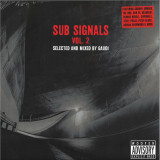
Sub Signals Vol.2 is a deep dive into underground bass, guided by artist and producer Gaudi. Featuring predominantly unreleased originals and versions by some of the biggest names in the worldwide dub collective, it intricately combines analogue elements with digital grooves to stunning effect.
Much more than just a compilation, the Sub Signals series is a celebration of the evolution of the sound of dub, from its original roots in reggae to its fusion with a much wider spectrum of sounds and influences. Gaudi curated the first volume back in 2006 for the cult Canadian label Interchill, sourcing tracks and dubs from High Tone, Zion Train, Manasseh, Almamegretta, Noiseshaper, Creation Rebel, Greg Hunter, Dubadelic and more.
15 years on, Gaudi has created the second volume, blending contributions by established reggae names Steel Pulse, Dennis Bovell and African Head Charge with next generation dub producers Alpha Steppa, Radikal Guru and Paolo Baldini Dubfiles, headline acts Groove Armada, Dub FX and The Orb with underground artists Deadbeat, Pitch Black and SUBSET, to create a seamless 75 minute mix.
“With Volume 2, I wanted to create a deep vibrational experience by shaping an aural trajectory that encompassed the many aspects of dub and its related sub-frequencies. To achieve my goal, I reached out to the artists I regularly work with to ask for contributions, in some cases digging in their archives to find what I was looking for.”
As a solo artist, Gaudi has recorded over 20 albums, while as a producer he has hundreds of productions under his belt. He has worked with legends of the reggae and electronic music worlds including Lee "Scratch" Perry, Horace Andy, Dub Pistols, Hollie Cook, Youth, Mad Professor, Prince Fatty, Lamb, Trentemøller and Nusrat Fateh Ali Khan.
Dedicated to the sound of dub in its many forms, Gaudi’s latest excursion of his Sub Signals series is pure bass therapy, designed to excite your eardrums and worry your woofers.
David Gedge says: “During the summer of 2006 we were invited to record a session for 'One Music With Huw Stephens' - a show on BBC Radio 1. However, this was the year after the 'return' of The Wedding Present and we'd basically been pretty much continually on tour ever since the release of the 'Take Fountain' album the previous year. Accordingly, we didn't really have any new songs of our own and so I decided that we could pursue that other favourite pastime of The Wedding Present... the recording of cover versions! Arranging covers is fascinating, actually, because you get to explore how other people write songs and I think that can often feed back into your own writing. I thought it would be interesting to pick a song from each of four different decades... the 1960s, 70s, 80s and 90s. No particular reason... if we'd've been asked to record five tracks I would have thrown in the 50s, too. So I chose four classic pop songs for us to look at. They weren't particularly 'favourites' - although I have always loved 'Step Inside Love' and 'Lovin’ You' - they were just songs that I thought the band could successfully 're-imagine'. I have never seen the point of recording faithful copies; I have always felt that any Wedding Present version has to bear the stamp of The Wedding Present. And I think we accomplished that particularly well on this session. I'm pretty proud of this E.P., in fact. I remember Graeme Ramsay, our drummer at the time, initially hating the idea of us doing a 'Take That' song but I think he eventually came round to it, especially after The Guardian said it was an interesting 'post-rock' take on the original, or words to that effect..." Track-listing - Step Inside Love/Lovin’ You/Our Lips Are Sealed/Back For Good/
2022 Repress On Elephantine, Cairo-based Maurice Louca guides a 12-piece ensemble through a 38-minute masterwork that might best be described as panoramic. Elements of free improvisation, Sun Ra's cosmic jazz, gorgeous Arabic melody, trancelike African and Yemeni music and minimalism meet in his wholly unique compositional vision. Louca also makes vital contributions on guitar and piano, and inspires stirring performances from a global lineup.
One of the most gifted, prolific and adventurous figures on Egypt's thriving experimental arts scene, Louca has in recent years garnered a global reputation through two previous solo albums and an expanding, evolving lineup of genre-defying collaborations. The Wire called his 2014 sophomore solo effort, Salute the Parrot, "remarkable music-dense, driven and splashed with colour." In 2017, the self-titled debut by Lekhfa, the trio of Louca and vocalists Maryam Saleh and Tamer Abu Ghazaleh, was praised as an "edgy triumph" in The Guardian and picked by BBC Radio 3's Late Junction as one of the very best 12 albums of 2017.
For Louca, 36, Elephantine serves as both the pinnacle of his wide-ranging experience and a bold next step in his development as a composer, arranger and bandleader. The celebrated Egyptian visual artist Maha Maamoun has created the album cover art, following her contribution to Salute the Parrot. "There was a blessed thing about the process of making this record," Louca says of the sessions, held last year in Stockholm and featuring the leader on guitar and piano. "The dynamic between us musically but also as people ...What these musicians delivered was really more than I could ask for, Everyone played their hearts out on this record."
The music-from its pensive lulls through its stretches of hard-grooving hypnosis and moments of avant-jazz catharsis-testifies to that rapport. Best absorbed as a continuous performance, Elephantine's six individually named tracks nonetheless present striking self-contained landscapes. "The Leper" entrances through a deft use of repetition that Louca gleaned from cosmic jazz, African and Yemeni music and other transcendental modal traditions. (Those who've followed Louca's work might be reminded of the Dwarfs of East Agouza, his mesmeric unit with Shalabi and Sun City Girls' Alan Bishop.)
"Laika" manages to evoke the minimalists, though on the combustible terms of '60s and '70s free jazz; "One More for the Gutter," on which Louca ingeniously pits one half of his ensemble against the other, albeit in a synergistic way, mines similarly fiery terrain. "The Palm of a Ghost" distills the band to a Cairo-rooted core, featuring stirring spontaneous melodies from oud player Natik Awayez, violinist Ayman Asfour and vocalist Nadah El Shazly. The album's title track follows, and it too blurs the border between composition and improvisation with gorgeously atmospheric results. "Al Khawaga," with its colossal ensemble riffs, beautifully dirty swing and impassioned blowing, is an ideal finale.
Featuring Squirrel Flower and Liam O’Neill (SUUNS). Recommended If You Like: Mount Eerie, Low, Richard Swift, the Weather Station, Lomelda, Fleet Foxes, Squirrel Flower, L’Rain. Cedric Noel is a songwriter, bassist, collaborator and producer currently based in Montréal, Québec. The newest longplayer from Tio'tiá:ke/Montreal staple Cedric Noel lands with a stunning sense of surety and self. Hang Time stands as a high water mark for a songwriter who's spent the past decade quietly expanding the borders of his music. Longtime fans will recognize the fluid elements of the album’s open-ended rock formations: reflective strumming, soaring choruses, searing guitar lines, subtle bass grooves; all occasionally dissolving into pools of pure ambience. New listeners will find surprises throughout: threads of folk pop, ambient and sound collage fasten the foundations of this expressive whole. However, what’s most striking on Hang Time is Noel’s newfound sense of voice, both literal and metaphorical. Written primarily in 2017-18 during an intense period of self-reflection, this collection of songs finds Noel wrestling profoundly with his sense of identity, self and place. The album’s material was captured faithfully at The Pines, a beloved downtown Montreal studio whose doors shuttered shortly after amidst the strain of the pandemic. Noel worked closely and patiently with friend and engineer Steve Newton, ensuring the songs had the time and space needed to come fully to fruition. Hang Time features subtle rhythm work from drummer Liam O’Neill (SUUNS) and guest spots from Brigitte Naggar (Common Holly) and Tim Crabtree (Paper Beat Scissors) among others. The album opens in mid-air with ‘Comuu’, a song that implores a becoming-more while hovering triumphantly. Then follows a suite of songs (‘Headspace’, ‘Keep’, ‘Stilling’) that recall the heart-rending power of y2k-era Low, albeit with a more vigorous beat. On ‘Bass Song’, an intimate duet with musician Ella Williams (Squirrel Flower) that explores the depths of interpersonal constriction. At the crux of the album sits ‘Born’, a deceptively pleasant-sounding song that explores the confounding emotionality of adoption before fading into a distended soundfield. Throughout the back half of the album, Noel double’s down on this commitment to his genuine, proud, Black self. The most confrontational track, ‘Allies’ finds him refraining “Are you on my side?” as a trailing guitar solo interweaves a Malcolm X soundbite, eventually engulfing the composition. Glorious lead single ‘Nighttime (Skin)’ traces the artist’s sense of ancestral dissociation through to a triumphant moment of pride in self-acceptance. Throughout Hang Time, Noel finds a way to ask hard questions (both of the listener and himself) in ways that are compassionate, open and honest. The ebb and flow of tension and tenderness that moves within these tracks helps to grow the heart and redefine what Black music can be in 2021.
- A1: The Llllloco-Motion
- A2: Some Kind A-Wonderful
- A3: I Have A Love
- A4: Down Home
- A5: Breaking Up Is Hard To Do
- A6: Run To Her
- B1: Uptown
- B2: Where Do I Go
- B3: Up On The Roof
- B4: Sharing You
- B5: He Is The Boy
- B6: Will You Love Me Tomorrow?
Pink Vinyl[14,50 €]
It would have seemed like a dream come true, when a young teenage country girl was drawn to New York landing work as a maid, nanny and sometime session singer, to suddenly find herself with a worldwide hit record. It should have changed her life from then on, but such is the fickle nature of the music business that she never managed to maintain the fruits of her record sales. Despite many fine single releases and this very fine and well respected album, she was soon to fall down the snakes as quickly as she had climbed the ladders. King and Goffin worked for Aldon Music, owned by Don Kirshner, where they were enjoying hits for the likes of Bobby Vee, The Drifters and Tony Orlando. Kirshner asked them to write a possible follow-up to Dee Dee Sharp’s #2 hit Mashed Potato Time, and they quickly came up with The Loco-Motion and had their live-in nanny Eva sing the demo with Carole herself playing piano and singing back-ups with her. Kirshner absolutely loved it and decided to keep the song for his own newly formed Dimension Records. Here for all to enjoy is her musical legacy in the form of this fine début album.
- A1: King Creole
- A2: As Long As I Have You
- A3: Hard Headed Woman
- A4: Trouble
- A5: Dixieland Rock
- A6: Fame & Fortune
- A7: One Night
- A8: I Got Stung
- A9: I Need Your Love Tonight
- A10: Big Hunk O'love
- B1: Don't Ask Me Why
- B2: Lover Doll
- B3: Crawfish
- B4: Young Dreams
- B5: Steadfast, Loyal & True
- B6: New Orleans
- B7: Wear My Ring Around Your Neck
- B8: Doncha' Think It's Time
- B9: (Now & Then There's) A Fool Such As I (Now & Then There's)
- B10: My Wish Came True
Classic Elvis Presley LP 'King Creol' (original soundtrack recording)
pressed on orange coloured 180g vinyl - limited edition and includes a
sticker
24 Songs. A new project from The Wedding Present. A new 7” single every month throughout 2022. 24 Songs sees David Gedge writing with legendary Sleeper guitarist Jon Stewart for the first time, and a more perfect union could not have been predicted. The notion of a monthly 7” single is not new to The Wedding Present, but 24 Songs shows us that even classic concepts can be reinvented. The series also continues the band’s association with photographer Jessica McMillan, who has created stunning images and films as a visual accompaniment to the recordings. Explaining 24 Songs, David Gedge said: “In 1991, The Wedding Present were rehearsing in a studio in Yorkshire when we hit upon an idea that immediately thrilled us all. Our bass player Keith Gregory had been a member of the ‘Sub Pop Singles Club’ - a service that allowed subscribers to receive 7”s released by that Seattle label on a monthly basis. Keith wondered if we, as a band, could attempt a similar thing. In that instant, The Wedding Present’s Hit Parade series was born and, during 1992, we managed to release a brand new 7” single each and every month. “The Hit Parade went on to become something of a significant milestone in the history of the band and it’s a project about which I’m often asked. As its thirtieth anniversary approached, I began to wonder if we should celebrate it in some way. A ‘Hit Parade Part 2’ didn’t feel quite right, though. Then, someone said to me: “Other bands have released music in similar ways but there has been nothing like the Hit Parade.” And they were right! A 7” single a month seems, somehow, very ‘Wedding Present’. So, inspired by that little idea from three decades ago, we’ve embarked on this new project, 24 Songs. “Even though The Wedding Present have never been known for taking the easy route, the idea of recording 24 tracks and releasing them in this way could seem daunting to any band. However, I’ve been inspired by the music that has been written since Jon and Melanie joined the group. The thought of celebrating this exciting new line-up with an exciting new series has motivated us all… and I suppose we also didn’t want any of these songs to be hidden away in the middle of an album!”
FOR FANS OF: Big Thief, Parquet Courts, Cate Le Bon, Elliott Smith, LVL UP. On their debut for Western Vinyl, recording engineer and multi-instrumentalist Nate Mendelsohn and his band use lyrical maximalism for the powers of good. Where Market’s previous home recorded releases shifted genre restlessly, on The Consistent Brutal Bullshit Gong Mendelsohn took a core band of longtime collaborators to a house in rural Massachusetts where they carved out space for his words to speak through with humor and intensity. Though he comes from a background in experimental music, Mendelsohn’s ear for pop has prevailed. Certain moments on Bullshit Gong reveal his stranger side, as on the thundering bridge of “Scar,” which sounds like a more unhinged Parquet Courts, or the angular “I Would Do That,” which takes cues from Cate Le Bon. On the whole, though, this band of close friends insists on directness, their arrangements clear despite the intricacies. Guitars and synthesizers tangle fluidly atop the rhythm section’s tight bedrock, evoking the tenderness and backbeat-centric qualities of Elliott Smith or Big Thief. After college, where he met most of the members of Market, Mendelsohn became an engineer and producer at the Brooklyn studio Figure 8 Recording. Through that community he’s recorded artists like Frankie Cosmos and Wendy Eisenberg, and played with Yaeji, Vagabon, Katie Von Schleicher (who co-produced Bullshit Gong with him), and Sam Evian, who mixed the album. Creating intimacy out of manic self-reflection requires a delicate balancing act, one Mendelsohn tackles with abandon. His words never skew too poetic or grandiose, and when he invokes the ugly it’s met with a sonic tonality that sets him right again. In tender moments, his voice is often flanked by bandmates Natasha Thweatt or Von Schleicher, who help skew his words toward the universal. Still, Bullshit Gong is an obsessive look inward, one in which Mendelsohn simply asks himself if he is good to those he loves. It’s an act of trust between the artist and the imagined listener he takes with him. UK press campaign by Silver PR. Mendelsohn has worked in the studio as an engineer and musician with Frankie Cosmos, Yaeji, Sam Evian, Wendy Eisenberg, Thor Harris, Rebecca Black, in addition to touring as a member of Katie Von Schleicher’s band. Market developed a cult following emerge after being championed by British comedian James Acaster, who featured the band’s first album in his book Perfect Sound Forever and his follow-up podcast for BBC Sounds.
At the tender age of twenty-five, while he was working part-time at an Italian restaurant in Tokyo's Kamata district, Kazuki Tomokawa released his debut record, fittingly titled Finally, His First Album. While he had already penned hundreds of songs, including his first single "Try Saying You're Alive!," written on a long train ride past fields and rice paddies, it was this recording that introduced Japan to one of its most unique musicians of the postwar era. Each track, as record label exec Kiichi Takahara writes in the LP's liner notes (here translated for the first time), is not a song but a "flesh-and-blood human being," birthed by the singer-songwriter and the raw, guttural cries that would become a hallmark of his incomparable sound. 1970s Japan was a time and place marked by a profound desire for authenticity amidst the onset of television and media saturation. Tomokawa arrived on the scene as a musician with "the personality of a hydrogen bomb," to borrow a phrase from his frequent collaborator Toshi Ishizuka. In an unwieldy interview included here, members of the notorious leftist band Zun? Keisatsu (Brain Police) put it bluntly: here was a man surrounded by the "disingenuous," the "wishy-washy," and the "superficial," who was delivering "real life, unvarnished." These songs are lullabies for the lost, staring not into the void but-as the fourth track declares-from inside it. Finally, His First Album is the first of three Tomokawa records to be reissued by Blank Forms Editions in conjunction with the US release of Tomokawa's memoir, Try Saying You're Alive!, the first-ever English translation of his writing. This debut captures the self-assured trademarks that Tomokawa would hone over the course of decades. Multiple tracks are performed in his native Akita dialect, a distinct and highly regional vernacular of northern Japan seldom heard outside the prefecture-and even more rarely heard in music. Tomokawa's lyrics locate profound interiority in the rituals of everyday life, and are sung against sparse folk arrangements of tender, lilting chords-a prelude to the rock and electronic stylings to come in later years. A self-proclaimed "living corpse," Tomokawa wallows, whispers, shouts, and cries, yet still, through his existential doubt, asks to be heard.
Ex RSD LP on transparent red vinyl, gatefold sleeve with lyric inner sleeve and DL card. Final copies now reduced to £7.99. The tracks on this album have never been officially released before now. The eight songs on this album were recorded in 1978 on a 2-track stereo Revox A77 tape recorder. The recordings are unashamedly analogue, using one microphone and guitars plugged directly into the tape recorder. Bouncing down tracks irreversibly as they went on, forced to make creative decisions that could not be undone. Some hard choices had to be made with the mix, but with no record company meant no record company agenda. TV Smith & Richard Strange could write and record whatever they wanted – and did! It has been an enormous pleasure to rediscover these recordings, the result of a friendship of two artists emerging from broken bands and each about to embark on a lifelong adventure in words and music. TV SMITH - I wasn’t having a lot of fun in 1978 when Richard asked me to collaborate on a song he was writing called “Summer Fun.” I was in the final stages of songwriting for the second Adverts album “Cast Of Thousands,” a project that already seemed doomed to failure given an unenthusiastic record company, a band in the throes of falling apart, and a dwindling audience - but my creative juices were in full flow and I was ready for something different. I already knew Richard, of course, from the Doctors Of Madness, who I’d followed in the years before punk when I was still living in Devon and they were one of the few bands to come and play in the area. I considered them a warped poetic glam band with gothic leanings, and was slightly surprised when the song I’d been invited to work on turned out to be a kind of California surf pastiche. But I was game to get involved, and after we’d finished it and ventured forward with regular writing and recording sessions over the following weeks it soon became clear that “Summer Fun” was just a gateway drug, and the songs that were emerging from our combined forces were going to quickly become much deeper and much darker // RICHARD STRANGE - Watching the remnants of a musical dream being swept away by the juggernaut of corporate punk rock in 1976, I felt a combination of jealousy and resentment towards many of the key players who had been responsible for our demise. The Sex Pistols had supported my band Doctors of Madness early in their career and nicked not only our future but £12.00 from a pair of trousers in our dressing room in Middlesbrough Town Hall! The Jam, who supported us over four shows at London’s fabled Marquee Club, were how I imagined The Who would be if they’d joined the Young Conservatives. Warsaw, our go-to support band in Manchester, had just changed their name to Joy Division, and Johnny and the Self-Abusers, our Scottish flag wavers, had become Simple Minds. All were being feted by the all-powerful music press, while we were being buried. But there was one punk band for whom I never had anything but the greatest affection…The Adverts.
Like a book club - only with albums.A simple, but beautiful concept
MJ McArthy (Zoey Van Goey) asked a small group of his pals to gather at The Laurieston – that mystical voodoo Glasgow boozer…that adored bar that defies all reason and logic – and they would talk about a record, track by track, and see what happens.They didn't know each other. There were theatre people:, Playwrite Douglas Maxwell, Isobel McArthur (actress and writer, the genius behind smash hit Pride and Prejudice Sort Of) and Cathy Forde (acclaimed YA novelist and playwright) and Rhona NicDhughaill who works for Gaelic arts company Theatre Gu Leor, as well as being an old band buddy of MJ's from their student days. Peter Geoghegan, award- winning firebrand political journalist and writer of the wonderful Democracy For Sale was there. And lastly - and slightly freaking them out on that very first night - were two actual Delgados: Emma Pollock and Paul
Savage.
And then…MJ had songs. MJ always has songs. And he started to wonder if this particular group of humans could, as well as talk about an album, make an album? For the musicians I don't suppose that was a particularly weird notion, but for the rest of the band it was quite a leap. However, MJ was adamant…let Album
Club become ALBUM CLUB. The Band!
Provogue / Mascot Label Group have three special vinyl reissues of
blues-titan Joe Bonamassa's back catalogue
'You & Me', 'The Ballad of John Henry' and 'Live from the Royal Albert Hall'.
His fifth studio album, originally released in 2006, 'You & Me' has been
remastered from single to 180g heavyweight 2-LP transparent orange vinyl - on
coloured vinyl for the first time. When released it hit the #1 spot on the Billboard
Blues chart and featured a crack band of Carmine Rojas (Bass), Jason Bonham
(Drums), Rick Melick (Piano/Organ) and Jeff Bova (Orchestration). At the time it
was declared his best work to date by Allmusic and features his takes on
Led Zeppelin's "Tea for One," Sonny Boy Williamson's "Your Funeral and My Trial"
and Charley Patton's "High Water Everywhere" as well as Bonamassa originals
including "Bridge to Better Days" and "Asking Around for You."
With 25 #1 albums, yearly sold-out tours worldwide and custom annual cruises,
he's a hard act to beat. These albums are a testament to his credentials and a
toast to his longtime fans who remember them originally and new fans who can
experience them for the first time. It's Joe Bonamassa at his finest, ready to rock.
‘Wax Limousine’ is the third solo album from London’s Wesley Gonzalez. Set for release on 18th March via Moshi Moshi Records, the record is the follow up to last year’s critically acclaimed ‘Appalling Human’ and finds the indie stalwart delivering his most personal album to date, via a collection of 12 irresistible pop songs. The announcement arrives alongside the title track, which received its first play from Marc Riley on 6Music and its accompanying video, the second to be revealed from the record following ‘Greater Expectations’, released earlier this year. In support of the release, Gonzalez heads out on tour this November, headlining Electrowerkz on 25th and supporting Young Knives across the country (full dates below).
With its truly eclectic range of musical influences drawing on Gonzalez’s ever developing sonic palette, the album’s uplifting sound juxtaposes its themes, documenting the end of a long-term relationship and the overwhelming experience of dealing with a family member’s cancer diagnosis and subsequent treatment. ‘Wax Limousine’ navigates these hurdles with a razor-sharp wit and often brutally perceptive self-awareness, nowhere more so than on the new single. Inspired by both 'Faithless' by Scritti Politti and Aretha Franklin, it is Gonzalez’s version of an 80’s gospel song and, as he explains, written at a crucial point over the last 12 months
“This was written right after the breakup and cancer diagnosis. It was that early stage of a breakup where you can't really understand what went wrong for you or for your ex. There was resentment for the extreme change I had suddenly found myself in, and I was asking what it really was I did wrong. The title Wax Limousine came from old phrases like "as useless as an ashtray on a motorbike". I was trying to express how useless I felt within every situation that had just arrived at my doorstep.”
Wesley Gonzalez first made a name for himself as the leader of Let's Wrestle, whose tuneful and eccentric punk earned critical accolades and a devoted audience with three albums, including 2011’s Steve Albini produced ‘Nursing Home’. Gonzalez wasted little time forging his own path and quickly assembled a live band for his solo work, expanding upon the guitar-driven music of his former band, with an interesting concoction of classic 70’s pop, soul, and indie rock. Gonzalez released his debut solo record ‘Excellent Musician’ in 2017, then the follow up ‘Appalling Human’ in June 2020 through Moshi Moshi Records.
The Diva Faïrouz.
Her real name Nouhad Haddad, she was born in the Zokak el Blat district of Beirut. The eldest of a modest Maronite family, she developed a passion for singing very early on. Her parents are too poor to afford the luxury of a radio, so she spends most of her time listening, her ear glued to the wall, to the neighbors. Nouhad quickly memorizes the songs she hears and gives a few samples at parties organized by her school. It was there that she seduced her comrades with her vocal abilities and that she was noticed in 1947 by the composer Mohammed Fleyfel.
The echo of his velvety voice reaches Halim el Roumi, talent scout, renowned singer-songwriter and director of Lebanese Radio, who asks to audition him immediately. Literally fascinated, el Roumi introduced him to the choir of Radio Beirut, baptized it with the name of Faïrouz and became its appointed composer. Then, he introduces her to Assi el Rahbani, a young avant-garde composer who, in the company of his brother Mansour, wishes to renew a Lebanese song under profound Egyptian influence.
The teenager Faïrouz succumbed to the personal charm of Assi, whom she married in 1954, and to that of his compositions (the model couple of Arab song would be separated by the death of their husband in 1986). The heavenly trio causes, from the publication of its first titles, a real musical revolution. Traditionalists howl at sacrilege and distortion while sympathizers of the rejuvenation and modernization of Lebanese folklore, weary of insipid refrains and pale copies, show their enthusiasm.
In 1957, Faïrouz opened the International Festival of Baalbek (a locality mentioned in one of his flagship titles) and sang in the middle of the six columns of the Roman temple. This initial encounter with his audience, who warmly welcomed him, earned him the nickname "seventh column". Faced with this fabulous galloping success, the Rahbanis are stepping up their offensive and courageously playing the card of constant innovation. They wrote for Faïrouz musical sketches, operettas and, from 1962 to 1976, about fifteen sung plays in which she plays the role of a woman in love with Love, the true, the pure, the innocent. , and that of hope. She also appears in a few films but she quickly interrupts her cinematic odyssey.
It is still and always one of the major references of Arabic song and many of its titles, such as "Bint el Chalabia", are hummed as much by the new generation as by the old.
Boogie Butt Records presents its new reissue. Originally Released in 1983 on Becket Records, Time To Throw Down, is a party banger, between P.Funk & Boogie, created by the one & only Paul Thomas, founder of the "Magic Crew", The Circle City Band. Bandleader Paul Thomas had produced three 12" single's released under the title Circle City Band in 1983-84, one of those records titled Magic became extremely popular in the mid1980's, but this record was supposed to be the 4th 12inch single on Becket Records.
At the same time in 1983, when Reggie Griffin and Paul Thomas was mixing this instrumental track in L.A, the reverend "Rickie Clark" originally from "Circle City" in Indianapolis, came to see them hearing what there was doing, and fall in love with this track, asking if he could used it for himself .
The "Circle City Band" (CCB) is made up of eight remarkably talented souls. The band is lead and managed by founder, producer/musician/singer/songwriter Paul Thomas otherwise known as "P" aka the "Funky Skunk" and also features long time friends and mentors, including the legendary award-winning, multi-musician/songwriter/producer Reggie “Mr. Everything” Griffin of Tech-No-Funk fame
The rerelease of Je Dis Oui on vinyl from Pink Martini. The album features 15 new tracks and includes guest appearances from ARI SHAPIRO, IKRAM GOLDMAN, KATHLEEN SAADAT AND RUFUS WAINWRIGHT “Pink Martini is a rollicking around the world music adventure…if the United Nations had a house band in 1962, hopefully we’d be that band.”—Thomas M. Lauderdale, The album features bandleader Thomas Lauderdale and his “little orchestra,” as well as lead singers China Forbes and Storm Large. “Je dis oui!” is Pink Martini’s ninth studio album; the album features three original songs co--‐written by Thomas Lauderdale. The album also features a stunning version of the classic “Blue Moon” by Rufus Wainwright, “Finnisma Di”, a new Arabic version of the band’s early hit “La soledad” sung by NPR’s Ari Shapiro, and songs in English, French, Arabic, Farsi, Portuguese, Turkish, and the band’s first forays into Armenian and Xhosa. Pink Martini have now sold over 3 million albums worldwide.
- A1: Django
- A2: The Ballad Of John Henry
- A3: So It's Like That
- A4: Last Kiss
- B1: So Many Roads
- B2: Stop!
- B3: Woke Up Dreaming
- C1: Further On Up The Road
- C2: High Water Everywhere
- C3: Sloe Gin
- C4: Lonesome Road Blues
- D1: Happier Times
- D2: Your Funeral & My Trial
- D3: Blues Deluxe
- E1: Story Of A Quarryman
- E2: The Great Flood
- E3: Just Got Paid
- F1: Mountain Time
- F2: Asking Around For You
'You & Me', 'The Ballad of John Henry' and 'Live from the Royal Albert Hall'.
It is in a live setting where Joe Bonamassa the performer really thrives and in May
2009, he played the historic Royal Albert Hall in London. It was an incredible
memory for everyone present and one of his greatest live performances has been
remastered on high- quality 180g heavyweight triple vinyl for the first time. The
majestic evening saw him glide through his back catalogue of original hits as well
as inspired covers and featured guest performances from Eric Clapton and Paul
Jones – truly a special night to savour.
With 25 #1 albums, yearly sold-out tours worldwide and custom annual cruises,
he's a hard act to beat. These albums are a testament to his credentials and a
toast to his longtime fans who remember them originally and new fans who can
experience them for the first time. It's Joe Bonamassa at his finest, ready to rock.
Joshua Hedley is 'a singing professor of country & western,' he declares
on his raucous and witty new album, Neon Blue - It might sound like a
punchline, but it's not
An ace fiddle player, a sharp guitarist, and a singer with a granite twang, he's
devoted his entire life to the study of this genre. His previous records have
showcased his deep knowledge of country musics history, in particular the beery
ballads of the 1950s and '60s. Neon Blue, on the other hand, examines a very
different, often forsaken era: the early 1990s. Neon Blue asks, What if that fork
had never happened? What if country kept on sounding like country?' Hedley finds
something exciting in that old hat- act sound, and Neon Blue plays up the
excitement of bigger-than-life choruses, the relatable emotions of those sad-eyed
ballads, and the inventiveness of the lively production.
For King & Country's fourth studio project, 'What Are We Waiting For?',
asks a pivotal question in a post-pandemic world
Brothers Joel and Luke Smallbone provide the answer across 13 original tracks
that confront relevant issues and confirm the duo's commitment to community,
diversity and family. Set against a sonic backdrop painted by the Platinum-selling
group's lush, vivid pop, the collection features cameos from tourmate Dante
Bowe, Kirk Franklin and Tori Kelly and includes barrier- breaking single "Relate,"
awe-inspiring "Love Me Like I Am" and unifying No. 1 hit "Together."
This acoustic body experiment will intoxicate your ears and veins. “Ectomorphin” by Chris Baumann is a straight confession for athletic acid underground – as the artist himself describes his style: “The border between timeless old school quality and new school upfront innovation in today’s techno music – just call it raw, hypnotic techno.” And this new release on Snork Enterprises presents a full load of proof for this bold hypothesis.
Ironically referring to some curious scientific concepts such as “Ectomorphin”, “Brainwave limiter”, “Neurotraxin”, and “Bioport” one may ask himself how the artist may well hypnotize our body and brain. Listening to the four forward moving techno tracks, you will soon know the answer. Just turn up the volume and get your body cells moving.
Rare 1966 Brazilian album with a jazz/bossa nova take on songs by the Beatles, all served up with plenty of great keyboard work from the legendary Manfredo Fest who would later become member of the Sergio Mendes band. The songs are all played with imaginative scents that really take them from their roots as pop songs and open them up as groovers filled with keyboard improvisations. First time vinyl reissue. DESCRIPTION Rare 1966 Brazilian LP with a jazz/bossa nova take on songs by the Beatles performed by the very talented Manfredo Fest and his trio. It was originally released right after their classic 1965 RGE album and has a very similar jazz-based sound. Manfredo Fest was part of the gathering of Brazilian musicians of the late-'50s who were developing the bossa nova movement, and he made a number of trio recordings in that vein from 1961 to 1966. After emigrating to Minneapolis in 1967, Fest moved to Los Angeles where he served as keyboardist and arranger for Bossa Rio and toured with Sergio Mendes. This recording is all instrumental, strongly jazz-based, with piano as the main solo instrument, soaring over the top of some tight, crackling rhythms! The songs are all played with imaginative scents that really take them from their roots as pop songs and open them up as groovers filled with keyboard improvisations. A nice slice of how the bossa nova sound was evolving in its homeland as well as the international impact the Beatles were having on countries outside of the U.S., England, Japan, and Germany. First time vinyl reissue.
The Line Is A Curve is about letting go. The core of the record is that the pressures we face do not always have to be heavy burdens, but can be reframed; the more pressure a person is under, the greater the possibility for release.
The album plays like a chronicle of pressures - the mind-numbing pursuit of a comfortable life, the eternal striving for more, the pressures of the city, the country, the times. The pressures of maintaining relationships, of battling illness, addiction, poor mental health, the vacuous life of our online selves. As we move through these chronicles though, the mood brightens. The musicality becomes more expansive as the lyrical horizon broadens and we glimpse coastlines, high streets, scrap yards, train stations in the rain; the entire album begins to let go. We encounter the contributions of artists who I love and admire, guest vocalists and instrumentalists, and so we defeat the sense of isolation felt in the opening track with a sense of deeply connected community. More Pressure, the penultimate song, is the essence of the whole album and the epiphany that leads to Grace, which is a prayer, a surrendering; ‘Please move me, please move through me, please unscrew me, please loosen me up.’ But once we get to the end of Grace, and the album, we loop back to the start – to ‘Kiss off the day with a mute mouth. Pass the commute like I can die faster than you.’ Because no matter how much a person grapples with, realises, deeply understands, about life and their place in it, we still wake up in the morning back to square one. Life isn’t solved the minute you figure something out about it. It’s a daily operation to increase your resilience, cultivate a deeper acceptance, let go of what’s chasing you and lean in to the pressures. It’s cyclical, as I believe all things are. And instead of trying to fight the cycles, this album asks us to surrender to them. To let go.
These general themes, of acceptance, resilience, surrender are also about where I’m at in my personal life, in my journey towards a greater acceptance of myself as an artist and as a human being. Being more honest with the world and my community about who I am and letting go of some heavy heavy shame, which is a glorious thing.
This album has a beautiful heart, there is so much love running through it and I can’t wait for people to experience it.
Clear Vinyl
Written and conceived by Stephan Crasneanscki, ‘LOVOTIC’ is a concept album by Soundwalk Collective, composed in collaboration with lauded actress and singer/songwriter Charlotte Gainsbourg. Featuring veteran techno stalwart AtomTM, rising singer/composer/performance artist Lyra Pramuk, celebrated actor Willem Dafoe, and writer/philosopher Paul B. Preciado, the album is released by the new Berlin-based Analogue Foundation.
Inspired by a relatively new field of research that seeks to explore and develop the possibilities of sexual and emotional relationships – and even love – between humans and robots, ‘LOVOTIC’ interrogates the impulses, ideas, and needs underlying this phenomenon. The project ventures into a future where sex, intimacy and desire are reformulated through the connection of humans, robotics, and artificial intelligence.
In an age of such hybrid entanglement with the machine, human identity requires the construction of new forms of intimacy, gender, and sexuality. At present, however, such technologies are primarily used to produce programs of limited sexual iterations that do not question the preformatted categories of gender and sexual orientation. In contrast, on ‘LOVOTIC’, Soundwalk Collective ask whether the future of sex and sexuality could instead be an exponentially expanding kaleidoscope. Where does the impulse of preference come from? What sets of words from our vocabulary can be communicated to the AI mind to generate a new identity for desire? Could the machine be another technology that brings us closer together?
Sonically ‘LOVOTIC’ is unidentifiable, artificial, and genuinely futuristic, occupying an amorphous androgynous netherworld at the borderlands between biotic and android. Traditional musical signposts are virtually non-existent, instead offering a mercurial, formless sound which mirrors the flourishing of gender fluidity it suggests could be on the horizon.
The production tangibly evokes the odd, rubbery textures of faux flesh, the slick virtual glide or glitchy mishaps of software, and the sleek shine of hardware. Gleaming sound design creates shard-like surfaces redolent of Alva Noto and Ryuichi Sakamoto’s ‘Glass’, the slippery stretched sonics Gabor Lazar, and the unsettling dark ambience of TOWERS and Hallmark ‘87.
At turns intimate and inviting, with whispering-in-your-ears ASMR vocals evoking blissful, heightened sexual states, within ‘LOVOTIC’ there’s optimism, but also unease; As well as the positive, it implies the negative ramifications of technology. At points a synthetic siren’s call appears to lure the listener to a darker place, with audio malfunctions suggesting dystopian science. Voices morph from gentle to distorted – a glitch in the system causing the mask to slip, like virtual lizards – ‘They Live’ or ‘V’ (?), for the metaverse age.
Here, Charlotte Gainsbourg invokes a being of unknown identity – an artificial eve, the oracle and the portal – speaking from an unspecified time in the future. The voices of AtomTM, Lyra Pramuk and Willem Dafoe weave in and out of Charlotte’s, often overlapping, merging into one another, expressing the entity of a being that’s ephemeral and in constant flux, oscillating between the natural and artificial. The record’s other bonafide singer, Lyra Pramuk’s delivery alternates between spoken word, operatics and partially- unintelligible language.
A multi-media project, ‘LOVOTIC’ also features the work of writer, philosopher and curator Paul B. Preciado – a leading thinker in the study of gender and body politics. Paul contributes a post-apocalyptic, quasi scientific and fictional text, which adds further fantasy, artistic and intellectual depth, augmenting the listener’s experience. Like all the best Sci Fi, his words seem prescient, describing what could become a likely reality in the future. Paul performs his written texts on the opening and closing tracks of the album; ‘The Age Of Mutation’ (in Spanish) and ‘Primate Love’ (in English).
Soundwalk Collective is an experimental sound collective helmed by Stephan Crasneanscki in collaboration with Simone Merli, which operates in a continuously rotating constellation of sound artists and musicians. The Collective’s approach to composition combines anthropology, ethnography, non-linear narrative, psycho- geography, the observation of nature, and explorations in recording and synthesis.
Legendary privately pressed 1979 LP from Scotland. This illusive, super rare and sublimely wonderful percussion album is like no other. Hypnotic, celestial, even cosmic and ambient in parts and totally unique in all ways, it was played by a group of 11 girls with an average age of 14. The group included Evelyn Glennie, who was destined to become one of the world’s greatest percussionists. This is her first ever record.
The Cults Percussion Ensemble was a group formed by percussion teaching legend Ron Forbes in the mid 1970s. The ensemble must have one of the best group names of all time. To many it will immediately come across as something sinister, a touch spooky and possibly a bit dramatic too. They are certainly two of those but the use of the word “Cults” here is easily misinterpreted. Cults, in this case, is the suburb of Aberdeen.
The average age of the students was just 14. They came from a few of the schools in the area, including the Cults Academy, Ellon Academy, Aboyne Academy, Inverurie Academy and Powis.
My original copy of the album came from Spitalfields market in London. I loved the music the second it started, because it reminded me of Carl Orff and peculiar library. So I started to investigate it further, and eventually, thanks to the highly tuned world of percussion, was given the address of Ron Forbes. I got in touch with him and now we have this, a formal release of something quite lovely that was only previously available very briefly in 1979 at concerts when the young girls performed.
The music here is really quite unique, with a celestial swirling hypnotic quality. The blend of glockenspiels, xylophones, vibraphones, marimba and timpani drums is quite intoxicating and can recall the shimmering warmth of the desert sun one minute (“Baia”) or freezing glacial ice caps the next (“Circles”). The Ensemble perform with an effortless tightness and deftness of touch, building textured layers with recurring percussive motives which appear simultaneously dense and yet sparse, almost sounding like modern sampling. In fact, while struggling to find a musical comparison, during the pulsating introduction to "Percussion Suite" I found myself recalling "Gamma Player", a piece of soulful Detroit techno minimalism from Jeff Mills (Millsart - “Humana” EP 1995) with its rhythmic percussion layered with complex emotion. Weirdly enough, other tracks on that EP also prominently feature xylophone and tuned percussion, although obviously synthesised and programmed, a good 20 years after the CPE first recorded.
Sleevenotes also include a letter from Ron Forbes:
“I decided to form a percussion group to provide an outlet for my percussion pupils to play music specially written for them. The group soon became well known in the region and as a result of winning the outstanding award at the National Festival of Music for youth on three occasions, they were invited to play at other festivals within Europe, one being in Erlangen in Germany - hence the Erlangen Polka - and Autun in France - hence the Autun Carillon. During these visits we were often asked if we had any recordings and so it was decided to make an LP”.
Thanks to Ron Forbes and Trunk Records, more people can now enjoy the simple hypnotic musical charms of the Cults Percussion Ensemble
You might know Bert Dockx from the inimitable alternative jazz-rock-trio Dans Dans; or from his moody, psychedelic rock formation Flying Horseman; or from his more intimate but equally special solo records. In 2019, the ever productive guitarist released an album with Ottla, a jazzy sextet blending different genres, textures and moods in wholly original ways, resulting in long, evocative pieces, brooding with tension and atmosphere. Recently, the band has transformed into a quartet, a tighter unit with a sparser and slightly more electric sound. This new Ottla is playing a mixture of reimagined tracks from the aforementioned album, and several brand new pieces. Ottla's music - like all music for which Dockx is responsible - is imaginative, intense and deeply felt.
In the spring of 2021, actor and writer Josse De Pauw contacted Bert with a question. He wanted to perform work of the Uruguayan writer Eduardo Galeano on stage, texts about the madness of colonialism and slavery, and about the beauty and mystery of the jungle, and asked Dockx to come up with a live soundtrack. Dockx invited two friends from his jazz band Ottla (Thomas Jillings and Louis Evrard) and a fourth musician (bass player Axel Gilain). He composed new material, adapted some existing Ottla pieces and could count on the improvisational talent of his fellow musicians for the rest of the soundtrack. In a handful of rehearsals, an impressive concert was put together that captivated the audience during a short run in August. This live EP contains two pieces recorded on one of these blistering evenings. Side A opens with the authoritarian voice of De Pauw, who recites the Song of the Fire, before making way for a scorching, almost apocalyptic version of 'Stofwolk'. On side B we hear Thomas Jillings perform an impressionist clarinet improvisation while De Pauw conjures up images of the unlimited sea and the winds, ships and slaves, heaven and hell.
I came across the music of IYv shortly after I encountered the dark ambient project Skeldos. Both are projects by the same musician. The IYv debut release (and only so far) “Upės” I had missed when it was released on tape. But I had been listening to it a lot when I was away during the winter of 2020 at a small house at a lake. There was a bluetooth speaker in the house so I could listen to the music there. The beauty of this music really resonated with me. Some time later after the musician contacted me (there are no coincidences) to order the Ô Paradis & Nový Svět LP I released on Vrystaete I dared to ask him if he would be into doing a vinyl version of this long sold out tape release. I was very happy he and his partner in crime involved in this project liked the idea. About IYv… it is a project by Vytenis (Skeldos) and Inga (Rūkana) from Lithuania and “Upės” (meaning “Rivers”) was released by themselves in 2017 in a small edition of 72 copies. While Skeldos is more towards the dark ambient sort of thing with hints of (post-)industrial music, IYv is much more on the melancholy side of things… accordion, electronica and Lithuanian vocals make up for a beautiful post-folklore album… The musicians themselves described the album in a perfect way… so I will not try myself to capture the mood and spirit of the music: “Upės” is an album about travelling. About the hearing of birds, close to the rock chains, which twists on the surface of mountains, through marks of our memory just like the rivers. The album was recorded in seclusion: in a log barn and wooden summerhouse. It’s decorated with deliberately left spontaneous inaccuracies and coherent crookedness. Nostalgic loops of ambient music tells a natural story about the composers: approaching gritty earth, enjoying crackling fire in the night, enduring live rain and swimming through the river streams. LP, 150 copies with screen printed artwork,
- A1: Sampuesana - Los Dinners
- A2: La Borrachita - Junior Y Su Equipo
- A3: Paga La Cuenta Sinverguenza - Manzanita
- A4: Infinito - Hugo Blanco Y Su Arpa Viajera
- B1: El Jardinero - Manzanita Y Su Conjunto
- B2: Feito Parrandero - Los Feos
- B3: Bien Bailadido - Junior Y Su Equipo
- B4: Saturno 2000 - Los Santos
- C1: La Danza Del Mono - Lucho Gavilanes
- C2: Capricho Egipcio - Conjunto Tiupico Contreras
- C3: El Chacarero - Los Gatos Blancos
- C4: Pa Oriente Me Voy - Los Atomos De Paramonga
- D1: Alegrate - Junior Y Su Equipo
- D2: Todo Lo Tengo De Ti Menos Tu Amor - Grupo Celeste
- D3: La Fuga Del Bandido - Los Ecos
Analog Africa delves deep into the scene of the Mexican's sonideros (sound-system operators) to present the "Rebajada" movement they've created using locally made pitch controls, speakers and sound effects.
"In 2010, I had asked Eamon Ore-Giron - aka DJ Lengua - if he would be interested in compiling a Latin project for Analog Africa, and if so, if he had a theme in mind. He replied, “Have you ever heard of rebajada?“ The question mark above my head, together with the wall of China, must have been the only other object visible from out of space because Eamon, probably noticing I got paralysed, continued, “Rebajada in Spanish means “to reduce, to lower”. It’s basically Mexican sonideros (soundsystem operators) slowing down the beat of a Cumbia to create a much more tangible music to dance to. I’ll send you a mix I made last year and let me know what you think.“ And so he did.
That mix was called Rebajada Mota Mix and I began listening to it on a loop. Although I was not immediately hooked it was intriguing from the get-go, and so I kept listening until magic began unfolding. Slowed down music allows you enough time to hear right through it, revealing itself in ways I had rarely experienced before. Everything became more transparent and I was noticing sounds normally only perceptible by bats. A near psychedelic experience. That mysterious mix included a few Ecuadorian songs by Junior y su Equipo - aka Polibio Mayorga (a cult figure in the sonidero scene), a couple of Mexican tunes, one Colombian, and various Peruvian songs, undoubtedly the driving force behind this project.
The sonidero who brought Peruvian and Ecuadorian music to Mexico was the legendary Pablo Perea from Sonido Arco-Iris, and although his fingerprints are all over the compilation Saturno 2000, this selection of songs in rebajada is exclusive to DJ Lengua. With the exception of a few classics from Polibio Mayorga and La Sampuesana – the queen of all rebajadas – most of these songs were probably never performed as such before, let alone released.
So how did rebajada come to be? In a nutshell; Rebajada started with two families of brothers – the Pereas and the Ortegas – who travelled all over Latin America and returned to Mexico with heavy loads of records which they would sell to the various sonideros always on the lookout for new tunes. Colombian beats especially seemed to fit almost perfectly with the Mexican dance steps – but they were just a bit too fast. As a result some sonideros began experimenting with equipment, and Marco Antonio Cedillo of Sonido Imperial created a revolutionary pitching system that could slow records down to an extent other players could only dream about. And so rebajada was born . . . or so we thought.
At the same time in north of the country, in Monterrey, sonidero Gabriel Dueñez almost got electrocuted by a short circuit that nearly set his record player on fire. As a result the platter started spinning in slow motion for the rest of the party, turning Cumbia into a different affair altogether. The youngsters went crazy for it and started harassing the sonidero with requests to record cassettes for them. Reluctant at first, Dueñez finally began recording a series of pirated cassettes called “Rebajada” which included mainly Colombian cumbia and porro in slow-mo exclusively. Those tapes took the city by storm and turned rebajada into a celebrated and defiant movement of the youth.
Of course it would not be a Mexican urban legend if it didn’t include dramaturgical elements, and so for nearly 30 years, until this day and probably for ever, both cities have been arguing and claiming ownership the creation of rebajada for themselves. But sonidera Joyce Musicolor, who never has time for such trivial arguments, got straight to the point: “Rebajada, and the equipment to perform it, is from here Mexico City but it was Monterrey that popularised it.“
- A1: She
- A2: When Love Comes Knockin' (At Your Door) (At Your Door)
- A3: Mary, Mary
- A4: Hold On Girl
- A5: Your Auntie Grizelda
- A6: (I'm Not Your) Steppin' Stone (I'm Not Your)
- B1: Look Out (Here Comes Tomorrow) (Here Comes Tomorrow)
- B2: The Kind Of Girl I Could Love
- B3: The Day We Fall In Love
- B4: Sometime In The Morning
- B5: Laugh
- B6: I'm A Believer
- C1: Apples, Peaches, Bananas & Pear
- C2: Don't Listen To Linda
- C3: I'll Be Back Up On My Feet
- C4: Of You
- C5: I Don't Think You Know Me
- C6: Words
- C7: Valleri
- D1: Through The Looking Glass (Remix)
- D2: I Never Thought It Peculiar
- D3: Tear Drop City
- D4: Hold On Girl (Remix)
- D5: I'll Spend My Life With You (Remix)
- D6: Mr Webster (Remix)
- D7: (I Prithee) Do Not Ask For Love (I Prithee)
Twice JUNO-nominated and two-time Polaris Prize listed, Toronto's soul songstress Tanika Charles unveils her album "Papillon de Nuit: The Night Butterfly".
"Papillon de Nuit: The Night Butterfly" is the third studio album from Canadian Soul/R&B powerhouse Tanika Charles and is slated to be released worldwide on Milan-based Record Kicks label on April 08th. Composed and recorded while in and out of lockdowns, "Papillon de Nuit" is an album anchored in growth and maturity. The thematic inspiration came from an unlikely source, a creature that soars after the sun sets, but often goes unnoticed until the light shines on it. It is the "papillon de nuit" to some, but drably referred to as a moth by others, revealing a bias in language alone.
"I always thought it was a strange insect. Once while in Paris, a friend swatted at one and I asked: 'Was that a moth?'. I was told: 'No, that's a papillon de nuit.' I thought that was the most beautiful description for this otherwise overlooked creature. When I later learned of the symbolism associated with it, I felt that really spoke to both my own situation and also what we've all been going through." Production on "Papillon de Nuit" was helmed by a mixture of old and new collaborators. The Safe Spaceship Records production team, consisting of Scott McCannell (Lydia Persaud, Claire Davis), Ben MacDonald and Chino de Villa (re.verse, Jessie Reyez), produced four songs on the album. The group also assisted as session musicians for songs produced by newcomer Todd "HiFiLo" Pentney (Allison Au Quartet, JUNO Award winner). "The Gumption" contributor Kevin Henkel ("Tell Me Something", "Look At Us Now") returned with three compositions, and old friend Jesse Bear (Sean Kingston, Stan Walker) contributed to one song.
Following the success of "Soul Run" (2016/17) and "The Gumption" (2019), Tanika had found a comfortable pace of releasing albums then hitting the road the following year to bring her show to new markets far and wide. So when things changed for all of us, and plans of touring "The Gumption" properly fell through, there was a realization that getting to work on the next project was the healthiest choice to make.
"I was in some dark places. My energy was stagnant and the only reliable constant was this perpetual uncertainty. I had gone from feeling like I was everywhere to only being in one place. From seeing so many new faces, to only my own, in the mirror, everyday and having to face that. Getting back to work on music allowed me to explore these feelings through the format I know best. And I wanted to make sure that when things were ready to resume, I'd be ready with something new for my audience too."
Tanika, who took part in the writing of most of the album, was also assisted by regular co-writer Robert Bolton ("Soul Run", "Remember to Remember") and accomplished solo performer Tafari Anthony (Priyanka, of RuPaul's Drag Race). Featured guests include the multi-disciplinary artist Khari McClelland and rising Toronto rapper, DijahSB. Both Dakarai Morris-James (Joanna Majoko, BeBe Zahara Benet) and Sean "D/SHON" Henderson ("Love Overdue", Serena Ryder) assisted with vocal arrangements across multiple songs.
"I think this album represents my best work to date. And yet, it also represents me coming to terms with who I am as an artist. For the first time I think I've actually accepted my own voice. I can hear beyond the imperfections, and I realized that when paired with the right music, it can sound pretty good. I still have my doubts and my dark places, but a little less of them."
Following widespread acclaim for his recent LP ‘Always Inside your Head’, on March 4th / April 8th Matt Cutler AKA Lone releases four re-works of tracks from the album, entitled ‘Natural Aerials’.
On ‘Natural Aerials (Mouth of God Part Two)’, Lone utilises a similar sound palette as album track ‘Mouth Of God’, but rebuilds it into a brand new banger. Energetic, deep, trancey and driven by jungle-schooled breakbeats, with bassbin shuddering low-end, he delves deeper into the vortex. Whereas the album was made predominantly using software, Cutler has since been buying hardware – and this marks the first track made on these newly acquired synths.
Based around a version from Lone’s recent sold-out live show at London’s Village Underground, on ‘Inlove2 (One Thirty Mix)’ he ups the original’s BPM count, with sights set firmly on the dancefloor. Taking cues from the ‘Ambivert Tools’ series, this is a high-grade, proggy, main room acid rush.
On ‘Visited By Astronauts (SHERELLE Had A Groove Remix)’, the fast-rising star takes an ambient interlude from the album, and gives it what she calls “a space age, footwork jungle twist”. Her first released remix, Sherelle continues an impeccable purple patch, with a re-rub that’s both airy and light, but also heavily percussive, full of propulsive forward motion. She states, "it’s a pleasure and honour to remix for Lone, as being a long time fan, it's a beautiful thing to be able to collaborate. I really wanted my first remix to be special and also for someone who I hugely admire, so Matt asking me to be involved in this process wastruly magical!”
‘Echo Paths Ebb And Flow’ takes a downtempo album highlight, strips it back to just the synths, then unfurls them into a blissful ambient work that’s melodic, warm and fuzzy, swaddling the listener in candy floss clouds.
2023 Repress
"banging piece of sound art" - The Observer
"...a fascinating piece of Brutalist techno that pivots between crisp machine-like minimalism and granulated noise." - Clash
"A piece of immediately engaging techno it reveals more of itself with each listen." - CMU Daily
Nik Colk Void is well established with her work as one half of Factory Floor, one third of Carter Tutti Void (alongside Chris Carter and Cosey Fanni Tutti) and with the late Peter Rehberg as NPVR, but perhaps surprisingly, "Bucked up Space" is her first solo album release.
Void explains, "When Peter Rehberg initially asked me to produce a record for Editions Mego, I didn't feel quite ready and asked if we could make a record together instead. Collaboration is so ingrained into what I do, I only felt ready to make this album after working through ideas live, using the audience in place of the collaborator."
Bucked Up Space combines Void's love of improvisation with the driving force of beat-driven music absorbed from performing in galleries, residencies and clubs across the UK and Europe. She goes on to say, "You find out more about yourself when you explain your ideas to others, and that's how I felt the live performance worked for me."
The process steadily teased out a language and Void employed a variety of tactics in the recording process including a methodical approach of collecting data at her home studio in a manner not dissimilar to keeping a diary. Her microscopic focus on raw instrumental noise, layered and reformulated, resulted in a sound catalogue that Void divided into groups for their tone, density and texture.
These initial pieces were taken to a studio in Margate to put them into a more cohesive compositional context. Something that pragmatically started as cold and detached was given warmth, unity and emotion in the studio. Via improvised repetition co-existing alongside organised production, Void conjures new sonic muscle with tracks such as 'Interruption Is Good' and 'FlatTime'. Initial recordings are rendered into sequences initiating the organic rhythms, triggering awkward jerks of high hats and percussion, or used to activate the margins of post effects detectable in the tracks like 'Demna', 'Big Breather' and 'Oversized'.
Void explains: "It was important to me that the simplicity in the work disguised a lot of complexity, I want this work to be absorbed instinctively."
The sleeve image, a still from We Are City by Brazilian artist Maria de Lima, was chosen to illustrate Bucked Up Space, which Void describes as "a distorted reality, the space that lives at start of an idea, then floats in public view, before returning to inform my understanding of the idea. Once the idea is out in the world, it moves and morphs into something else entirely."
Written, performed and produced by Nik Colk Void, the album was engineered by James Greenwood, mastered by Rashad Becker and tracks 1, 4, 5, 7 and 9 were mixed by Marta Salogni.
Bucked up Space is the result of the ideas and resulting sounds of free exploration morphing into a personal structured album that fearlessly moulds patience, listening and restraint. It's a sharp focussed work embracing collective action through the lens of the self. All this, and also one of the best abstract dance records you will hear in some time!
Loraine James' new ambient-minded alias, Whatever The Weather, follows her 2021 solo LP Reflection (Hyperdub). In contrast to her club music sensibilities, this mode embraces keyboard improvisations and vocal experimentation, foregoing percussive structure in favor of shaping atmosphere and tone. From this divergent headspace emerged new coordinates and climates, a new outlet: Whatever The Weather. A longtime fan of ambient-adjacent Ghostly International artists such as Telefon Tel Aviv (who she'd ask to master the album), HTRK (whose singer Jonnine Standish features on Nothing), and Lusine (whom she remixed at the start of 2021), James saw the label as the ideal home for this eponymous album of airy, transportive tracks as they began to formulate. The titling on Whatever The Weather works in degrees; simple parameters allowing James to focus on the nuances as a mood-builder. Her suspended universe fluctuates; freezing, thawing, swaying and blooming from track to track. James describes her jam-based approach for the sessions as "free-flowing, stopping when I felt like I was done," allowing her subconscious to lead. The improvisations have an intrinsic fluidity to them, akin to sudden weather events passing over a single environment - the location feels fixed while the conditions vary. The album opens at "25°C," a sunshower of soft hums and keys. As the longest piece, it serves to establish stability, the inflection point where any move above or below this temperate breeze breaks the bliss. Given James' proclivity for organized chaos in her production, this scene is fleeting, naturally. From that utopia, we plummet to the most melancholic read on the meter, "0°C," its isolated synth line traversing a hailstorm of steely beats and static. Next, the dial jumps for the propulsive standout "17°C." Like a timelapse of springtime in the city, the single accelerates across a frenzy of frames; car horns, screeching brakes, and crosswalk chatter fill the pauses between rapid jolts of multi-shaped percussion. For portions of the work, James leans neo-classical, rendering pensive vignettes of cascading piano keys and warm delay. "2°C (Intermittent Rain)" ends the A-Side on a short and stormy loop; a resulting sense of reset permeates the B-Side's opener, "10°C." The producer mingles intuitively on echoed organ, locking into and abandoning atypical rhythms that suggest her jazz-oriented interests. "4°C" and "30°C" display the range of James' vocal experiments. The former chops and pitches her voice to a rhythmic, otherworldly effect, the latter reveals James at her most straightforward (she cites Deftones' Chino Moreno and American Football's Mike Kinsella as inspirations), singing tenderly and unobstructed for nearly the duration before beats collide in the climax. Whatever The Weather closes at "36°C," while a sweltering heat by any standards the track eases along comfortably on a chorus of synth waves, acting as an apt bookend for this evocative, sky-tracing collection that started in a similar state. Cyclical, seasonal, and unpredictable, true to its namesake.
"We’ve reached book IV in Rupert Clervaux’s series of “Zibaldone” audio diaries, at which point we find him telling a different kind of story.
“The first three all had very specific themes, while this one feels a little bit looser and doesn’t have just one thematic thrust,” he tells me, which maybe explains why listening feels a bit like annotating. I’m underlining, emphasizing, drawing arrows from here to there, highlighting symbols and noting motifs, realising, questioning, eureka-ing. An impressionistic meaning’s been encoded in and we’re lucky to be given the space to play that most poetic and boundless of all mental games: narrativization.
There are no wrong answers, but Rupert offers some clues either way. If there’s any cipher here it’s “something like a meditation on the concept of ‘depth’––in all its connotative forms.” Think below the surface, (the) underground, yawning oceans, being ‘down in the dirt’, soil, roots, rootlessness, pulling at the dregs, collapse, profundity, stable and unstable horizons, distance, perspective, intuition, not to mention relative opposites: to be shallow, to be above, to be beyond.
It’s got me thinking of Bresson’s “Bring things together that have as yet never been brought together and did not seem predisposed to be so.” His: “Dig deep where you are. Don't slip off elsewhere.” Rupert has realized these—two favourite goals of mine!—here.
This is music that catches you at your own periphery, gives pause, has you offering a little “huh” to, asking “I wonder why” to. Again, it’s got me musing on another mindworm, this time from New York publisher and multi-sensory reading room Dispersed Holdings: “Feeling-making-knowing feedback loop; cartography of feeling; water as text, read to know the land beneath and around it, and body as reader.”
Is it ok to offer up these other contexts out of context? I think so, because Zibaldone IV articulates a similarly swirly tone. Like, we’ve got Rebecca Solnit talking through Kropotkin’s “Mutual Aid” and later calling out to Michael Ruppert a ways away, and “Easy Rider” is playing in the wings. We’ve got Susan Sontag magically contextualizing Mariah Carey with poet Thylias Moss triangulating in order to sketch out (Rupert again) “something a little more interesting than wilful eclecticism or that laboured and patronising kind of pop-savvy.”
Are we following? Whether yes or no Vanessa Bedoret follows on with a performance of a performance of Moss’s 'Water Road’: to be once or twice removed, via strange transitions, purposeful confusions, and, suddenly, seagulls. We’re on a boat with Ingeborg Bachmann—and how I wish I could actually be! But maybe thanks to this music I can as literature, films, friends, lethargy, coincidences, little mental links, eternal wormholes, lingering notions come together to imagine something better."
Text by Natalia Panzer
Back in stock !
There is geological time and deep-space time. The natural world's time, and quantum time. Humans started measuring time with the stars and seasons. Then came hourglasses and sundials. The first mechanical clocks weren't in Europe until the late 13th century. Then came industrial time, a wristwatch for all and then everything had a time. A time for everything. All feeding into our recently digitised time and its marching nanoseconds. Let us not forget however another way to measure time: That would be K&D time.
Yes, you can rush, but isn't it so much nicer to amble? This onception of time may well have its roots in those smoke mists, softly blowing through the pre-history of 1995, and if that was time - then we need space. In particular, one Viennese front room that has turned its bass bins out to the cosmos. That sweet smoke, shrouding the desk and sampler. A few old keyboards (as a friend skins up at the back) unnoticed on the couch - just passing through...
Those days of K&D time had been thought to have gone. But one of times tricks is to hide itself in music. Not long ago (after a box of DATs had been found, and a DAT player prised back into service) back through the music wormhole our heroes fell into that smoke laden room of 1995. The remix time hadn't arrived nor the intense touring schedule. It was before the K&D sessions release and all that came with it, before the solo projects of the Peace Orchestra and Tosca. This was a time before all of that. A time for literally living in the studio and experiencing the joy of creating tune after tune. Just the sound and the smoke and no boundaries.
It was before people started asking about when the album was coming out. Which developed its own time specific answers. The 90s answer was soon, 00s answer was not sure and then: never! from 2010 onwards. The truth was, an album had been finished by the spring of '95 and all recorded onto DAT and placed in a box. K&D pressed up 10 copies and gave 4 away to some suitably eccentric individuals. Then the room's doors opened and in a tremendously big cloud of smoke time rushed in, K&D rushed out, and the years went rolling by. The days got filled with remixes, touring and life.
Then in early 2020 that chance moving of a box at the back of a room exposed the DATs and their time transporting properties. As K&D went through them they ended up comfortable and back in the room and that wonderful haze of 1995. The music was transferred from the DATs and K&D painstakingly rebuilt every molecule that made up the original 10 copies. From the very first takes of the mixes printed onto tape, to the solid slab of black virgin vinyl, to the abused by many plays, white cover. Even down to the labels that says "'Unverkäufliche Musterplatte" (Testpressing - Not For Sale) in rather rude German.
It now looks, feels and sounds pretty much exactly the same as those original 10 copies did in 1995. The only thing that couldn't be don is the original clouds of smoke those 10 copies were bathed in. That will be left to the listener to wrap it in the fresh harvest of 2020. In one way it's a musical time warp space travel. In another, if the music becomes classic and timeless, then it's of its time, whatever the time. So as the rooms bass bins are once again turned out towards the cosmos, K&D are happy and proud to release what they thought were lost moments. Drop through the worm hole, take your place on the couch. The friend who is skinning up, always just passing through, listening to an album for the future called 1995. It all makes sense if you measure in K&D time.
- A1: Intro
- A2: I Know That You've Been Wounded (Church Hurt) (Church Hurt)
- A3: He'll Make A Way (Trust In The Lord) (Trust In The Lord)
- A4: Talk To God
- A5: In The Name Of Jesus (Everytime) (Everytime)
- B1: To Be Used By You (I Want To Be A Good Man) (I Want To Be A Good Man)
- B2: Who Do Men Say I Am?
- B3: Storm Of Life (Stand By Me) (Stand By Me)
- B4: In The Service Of The Lord
- B5: I Just Want To Be A Good Man (To Be Used By You) (To Be Used By You)
This album is a tribute to Pastor Wylie Champion, who died while we were in the process of releasing this, his first record, and his wife, Mother Champion, who died a few months earlier. We met Pastor Champion a few years ago while we were putting together another release, The Time for Peace Is Now: Gospel Music About Us. We found him in a collection of YouTube videos from the 37th Street Baptist Church in Oakland, California, put together by the pastor there, Bishop Dr. W.C. McClinton. There was quite a lot of talent in those videos, and among them was Pastor Champion whom we liked so much that we decided to make a record with him. Pastor Champion wasn’t like any other pastor you’ve ever met. As an itinerant preacher, a carpenter, and a father of five, he made a name for himself traveling up and down the California coast with his electric guitar. He traveled alone and he played alone, well into his seventies. The easiest way to describe him would be as an outsider gospel artist. Other than these bare facts, we never learned much about him—except that he was also the brother of the well-known soul singer Bettye Swann. In fact, most of what we knew about him we got from his sister’s Wikipedia page. We decided that because we met Champion through the 37th Street Baptist Church, we would record him there too. We recorded him live on a two-track Nagra reel to reel, as we wanted the album to be analog in the style of traditional gospel recordings. Over the course of two evenings (when the workday was done), Champion taught his band—musicians who had never played together before—a handful of songs, a small selection of the nearly 2,000 fragments of songs and sermons that he regularly performed. We listened in as they all got more familiar with the material and each other over time. At some point, we mentioned to Champion that he would have to be interviewed by someone to write notes for the album. He wasn’t too pleased with this idea, saying he’d had a hard life and he didn’t want to talk about it. Over the next few months, we kept asking Champion to talk to someone about his life. He told us that he didn’t want to talk about growing up in Louisiana, his mother being accosted by the Klan, or that his father was a gambler. He didn’t want to talk about being jailed for 90 days for using a whites only bathroom, being in gangs or having a street name. We told him that was fine—he could talk about what he wanted to talk about. And he told us that he didn’t want to talk about anything. You know, there are times when you make a record where it’s already made in your mind before you start. But then in the end, the record you thought you were making is not the record you made. We spent years puzzling over this one, trying to figure out what it was saying, who it was for, and how to get people to pay attention to it. But Champion knew that this record wasn’t going to be for everyone. He didn’t really care. The important part for him was just getting the message out there in the same way that he always had, travelling alone with his electric guitar. “I want to say what I mean,” he said, “be practical, precise, to the point, and, at the same time, diplomatic.” In other words, he just wanted to be a good man. God bless Pastor Champion and Mother Champion, peace be with them and their family. Love to all.
With Plum, the songwriting partnership rooted in the creative rapport between bandleader Molly Hamilton and guitarist Robert Earl Thomas continues to expand on shared visions, delving deeper into what was always there: dusty guitars, ear-worm melodies, warm expansive arrangements. Each entry to their catalog has marked a subtle reimagining of Widowspeak's sound, though perennial points of reference remain the same: 90's dream pop, 60's psych rock, a certain unshakeable Pacific-Northwestness. Speaking to the timeless feeling of each, the albums continue to be discovered well beyond their respective PR cycles, made beloved by new listeners through word of mouth. The band's fifth album feels comfortable and lived-in: humble in structure, heavy on mood. Perhaps that came taking time off from the touring grind, instead working full-time jobs and settling into the rhythm of daily life in a small upstate New York town. Plum was recorded over a handful of weekends last winter by Sam Evian (Cass McCombs, Kazu Makino, Hannah Cohen) at his Flying Cloud studio in the Catskills, and was mixed by Ali Chant (PJ Harvey, Aldous Harding, Perfume Genius). In addition to Hamilton (vocals, guitar) and Thomas (guitars, bass, synth), it features instrumental contributions by Andy Weaver (drums), Michael Hess (piano), and Sam himself (bass, synth). Plum nestles into the band's canon like it was always there, but with new textures coming to the fore, like the polyrhythmic pulse of "Amy" and "The Good Ones", or the watery, Terry Riley-influenced track "Jeanie" Plum navigates the spaces between the lesser emotions of modern life. Hamilton's lyrics speak to the unique turmoil of anyone who creates as their work, who must somehow survive off such "fruits of their labor." Yet, Widowspeak have always made a bitter pill much easier to swallow. The majestic "Breadwinner", the luminous "Even True Love" - these songs here were made to be listened to, enjoyed. "Money" is particularly hypnotic, built around a repeating, cyclical motif that serves as both skeleton and body. "Will you get back what you put in?" Hamilton asks over an insistent guitar riff. The line is delivered with a knowingness that transcends its surface critiques of late-stage capitalism, asking both herself and the listener whether this is, in fact, the world we want to live in. Through Plum, Widowspeak have brought something into the world that seems to know its own worth, even as it wonders aloud about what is to come. What value and meaning do we assign ourselves, our time, and how do we spend it?
- A1: Hands High (Feat. Jamelle Bundy)
- A2: Fans (Feat. Large Professor)
- A3: A's & E's (This What We Do) (Feat. Marsha Ambrosius)
- B1: Lil Young
- B2: Reminds Me
- B3: Black Ice Interlude
- B4: Good Music (Feat. Posdnuos, Light & Jamelle Bundy)
- C1: Pass The Mic (Feat. Krs-One)
- C2: Over There
- C3: Round & Round (Feat. Doitall)
- D1: Ei8Ht Is Enuff
- D2: Here I Go Again (Feat. Jamelle Bundy)
- D3: Dancin' Like A W.g. (Feat. Chester French)
Repressed! When asked at the time about what to expect from this collaboration with Edo G, the legend Masta Ace fired back without hesitation: “People are gonna be surprised when they hear the mixture of styles. We both have a different approach. It’s like the old Reeses commercial... Ya got peanut butter walking down the street. Coming from the other direction is chocolate. Someone trips and blam, a peanut butter cup was born. Something new and amazing was created that no one had ever thought of!” When one thinks of Boston and New York, the first thing that comes to mind is the infamous Red Sox/Yankees rivalry. But this time when Boston met New York, it was a collaborative effort to bring the world one of the tightest Hip Hop efforts of 2009. Two of the game’s most exceptionally creative and well-rounded artists, Edo. G and Masta Ace brought the two cities together with Arts & Entertainment. Like their home cities, these artists have a long history and have influenced the world. Hailing from Brownsville, Brooklyn, Masta Ace got his proper introduction setting off the quintessential Juice Crew posse cut, “The Symphony.” Not long after, Edo G’s debut Life Of A Kid In The Ghetto and it’s lead single “I Got To Have It” went to the top of the Billboard Rap Singles chart with heavy rotation on Yo! MTV Raps. Both Ace and Edo have continued to stay relevant, drop albums, tour the globe, and influence up and coming artists everywhere. Joining the duo on Arts & Entertainment was a notable list of prominent artists from NYC and the Bean including Posdnuos of De La Soul, Large Professor, DJ Spinna, KRS-One, Marsha Ambrosius, Mr. Lif, Akrobatik, Chester French, Double O of Kidz in the Hall, M Phases, and more. The album continues to be a fan favorite to this day, especially the never-gets-old cuts “Little Young” and “Dancin’ Like A White Girl,” and this re-issue is sure to be well received once again.
24 Songs. A new project from The Wedding Present. A new 7” single every month throughout 2022. 24 Songs sees David Gedge writing with legendary Sleeper guitarist Jon Stewart for the first time, and a more perfect union could not have been predicted. The notion of a monthly 7” single is not new to The Wedding Present, but 24 Songs shows us that even classic concepts can be reinvented. The series also continues the band’s association with photographer Jessica McMillan, who has created stunning images and films as a visual accompaniment to the recordings.Explaining 24 Songs, David Gedge said: “In 1991, The Wedding Present were rehearsing in a studio in Yorkshire when we hit upon an idea that immediately thrilled us all. Our bass player Keith Gregory had been a member of the ‘Sub Pop Singles Club’ - a service that allowed subscribers to receive 7”s released by that Seattle label on a monthly basis. Keith wondered if we, as a band, could attempt a similar thing. In that instant, The Wedding Present’s Hit Parade series was born and, during 1992, we managed to release a brand new 7” single each and every month. “The Hit Parade went on to become something of a significant milestone in the history of the band and it’s a project about which I’m often asked. As its thirtieth anniversary approached, I began to wonder if we should celebrate it in some way. A ‘Hit Parade Part 2’ didn’t feel quite right, though. Then, someone said to me: “Other bands have released music in similar ways but there has been nothing like the Hit Parade.” And they were right! A 7” single a month seems, somehow, very ‘Wedding Present’. So, inspired by that little idea from three decades ago, we’ve embarked on this new project, 24 Songs. “Even though The Wedding Present have never been known for taking the easy route, the idea of recording 24 tracks and releasing them in this way could seem daunting to any band. However, I’ve been inspired by the music that has been written since Jon and Melanie joined the group. The thought of celebrating this exciting new line-up with an exciting new series has motivated us all… and I suppose we also didn’t want any of these songs to be hidden away in the middle of an album!”
Rudolf Abramov hit all Optimo Music's buttons at once. Drums, energy, songs, instrumentals, super production, Post Punk echoing, dance floor destroying, home listening friendly, and completely unique.
Who are they and what are they about? Read on...
Rudolf Abramov is a duo based in Berlin. They seem to open a door to unexpected musical encounters. It's an almost impossible task to sum up their sound in a comprehensible way, but in their own words their music is 'a response to a seemingly endless conflict about disgust, acceptance and love.' Since the duo likes to invite other musicians and fellow humans to add to their pieces, this often creates another layer to their unexpected musical encounters.
"Losing Perspective" is the result of a journey that began with a week-long recording session outside the city. Back in Berlin the skeletons of the track gradually grew in flesh, experience and emotion, describing this time in a vibrant and ever-changing city; a city where the faded colours sometimes seem more appealing than the unifying glow of the new.
In order to preserve for ourselves the conflicting colours in their fantastic disharmony, we have therefore watched the pieces change rather than moving them in a particular direction. The result is a number of tracks with different facets that derive from different moods and voices, indulging in diversity.
At the end of this process, we look back at this colourful collage and connect our own very personal history with it and both resolve in harmony. When asking the cat from our studio’s courtyard for example, she said that "Losing Perspective" was about stray tomcats who have lost their old home port to a newfangled establishment wandering randomly through the days in search of songbirds, distraction and rest. And we feel like she kinda has a point there.
Phantasy are proud to present the vinyl re-issue of Mystery Jets’ seminal 2008 album ’Twenty One’. Produced by Erol Alkan, the beloved LP includes hit singles ‘Young Love’ and ’Two Doors Down'.
The LP is available to pre-order now on deluxe coloured vinyl. The deluxe edition features a bonus disc of previously unreleased demos and rare B-sides.
“Of all the messages we’ve received from our fans over the intervening years, the single question that has come up more than any other, is ‘When will Twenty One will be released on vinyl again?’. Much to our frustration, our response has never been anything more than a helpless, resounding shrug. That is, until now.
The year being 2021, and all the band being firm believers in the powers of numerology, we felt there would be no better time of telling you that for the first time since its release, Twenty One will finally be available to own on vinyl again. As well as reissuing the original album, we have also dug through the archives and compiled a special selection of never-heard-before outtakes, demos and rarities from that era to accompany the deluxe version of the album.
We are delighted to be reissuing the record via Phantasy, the label founded by Erol Alkan, who produced Twenty One and mentored us to make an album we’re still immensely proud of. This is the record you have been asking for, and the one we always wanted you to hear.
Phantasy are proud to present the vinyl re-issue of Mystery Jets’ seminal 2008 album ’Twenty One’. Produced by Erol Alkan, the beloved LP includes hit singles ‘Young Love’ and ’Two Doors Down'.
The LP reissue is available to pre-order now!
“Of all the messages we’ve received from our fans over the intervening years, the single question that has come up more than any other, is ‘When will Twenty One will be released on vinyl again?’. Much to our frustration, our response has never been anything more than a helpless, resounding shrug. That is, until now.
The year being 2021, and all the band being firm believers in the powers of numerology, we felt there would be no better time of telling you that for the first time since its release, Twenty One will finally be available to own on vinyl again. As well as reissuing the original album, we have also dug through the archives and compiled a special selection of never-heard-before outtakes, demos and rarities from that era to accompany the deluxe version of the album.
We are delighted to be reissuing the record via Phantasy, the label founded by Erol Alkan, who produced Twenty One and mentored us to make an album we’re still immensely proud of. This is the record you have been asking for, and the one we always wanted you to hear.
Green Vinyl
"CCR - Club Culture Rarities" the new record label exclusively dedicated to re-prints of cult and rare 12” taken form Expanded Music’s labels.
The 5th release on "CCR - Club Culture Rarities" FUNKY IS ON of Funky Family originally released on THIRD LABEL in 1984
Another hot mix for most sofisticate Italo Disco Lovers.
Funky is On by Funky Family, was never a popular commercial hit, but more an high valued rarity. Produced by Nicola Nicolosi from Nicolosi Family this tune represents a real example of proto-house. Since it first release in 1984, it became a Chicago classic and always an hot mix for most sophisticated Italo Disco Lovers.
Ask for it and stay tuned.
1971 and Black America was luxuriating in the soft soul
of the O’Jays, the Temptations had just left behind their
flirtation with psychedelia, James Brown was
explaining Soul Power, Sly & the Family Stone were
having a Family Affair, and Marvin Gaye was asking
‘What’s Going On’.
• In their own inimitable way, Funkadelic were laying
down their own statement about the ecology of the
planet in the opening of lead and title track ‘Maggot
Brain’, turning it into an elegy for the Earth in the
ensuing heart-wrenching extended Eddie Hazel guitar
solo – one of the most radical records of the period.
• The album also spawned two Top 50 singles with the
usual Funkadelic wry observational humour of ‘You
And Your Folks, Me And My Folks’ and ‘Can You Get To
That’. And just in case you think things have
normalised, the set closes with nine minutes of the
chaotic sound collage ‘Wars Of Armageddon’.
• This 50th anniversary edition includes a second 12”
with two versions of the title track. Side A features the
live version from Meadowbrook from the same year that
the studio album came out. Jump forward 46 years to
the “Reworked by Detroiters” release and side B has
the BMG Dub, showing the enduring quality of one of
the great guitar records of all time.
• This issue is mastered from fresh transfers of the tape.
• Facsimile gatefold sleeve
Reissue of 2018 debut on 2 colour vinyl, black & milky clear. Note includes members of Pains Of Being Pure At Heart. More than anything else, Oh Boy is a celebration of teenage fandom and friendship. Each song is “about” something else, of course: a betrayal, a breakup, new love, parenthood. The usual stuff. And we’re hardly teenagers. Yet somehow Massage feels like the kind of band you were in back in high school. We were friends first. We all had other lives. We started playing music almost by accident. (Michael wanted to learn drums; Alex wanted to relearn guitar after playing bass in the Pains of Being Pure at Heart; Andrew and David invited themselves to their second practice.) We made a playlist of songs we loved hundreds of them long before we recorded anything: the Feelies, the Go-Betweens, East River Pipe, the Lemonheads, the Breeders, Flying Nun, Sarah Records. Alex and Andrew started writing songs the way kids do to sound like their heroes. No matter how we tried, though, the songs half Alex’s, half Andrew’s came out sounding like “Massage”: scrappy, catchy, minimalist, and sincere, with Gabi’s harmonies elevating each track. Every Monday after practice, we went to Jay’s Bar for beers and poutine. There was no point to any of this. We were just having fun. Then one day we realized we were a band. Oh Boy is our attempt to capture this easy alchemy on tape the strange magic of a bunch of amateurs coming together, finding their own wavelength, and making something out of nothing. We couldn’t have asked for a better partner in crime than our pal Jason Quever of Papercuts, who recorded us on random weekends over the course of two years. We hope the result sounds as loose, low-key, idiosyncratic, and ultimately indelible as the bands that inspired us — the ones you already know, and the ones that are still just teenagers goofing off in some suburban garage.
Pressed on recycled vinyl.
Oonops's first encounter with Japanese producer Shin-Ski dates back six years when he asked him for an exclusive guest mix for his show on Brooklyn Radio. He became aware of him years ago through his group ShinSight Trio with Insight and DJ Ryow a.k.a. Smooth Current. After one more mix and two collaborations on his Resense-series plus "Oonops Drops - Vol.1" compilation via Agogo Records they started working together on a whole album of instrumentals.
For this 45 Oonops had the chance to dig through an amount of unreleased tracks and selected some of the essential essences with different influences from Jazz, Soul, Funk and much more.
- A1: Deux Ans Plus Tôt (02:24)
- A2: Trilogie I (Tâm) (04:04)
- A3: Trilogie Ii (Belles Larmes) (01:33)
- A4: Trilogie Iii (Phoenix Rouge) (02:24)
- A5: Les Rivières Vont À La Mère (04:32)
- A6: Pour Marthe (04:08)
- B1: Mon Âme Vers La Tienne (02:19)
- B2: Sur L’embarcadère / Ðêm Tàn Be^´n Ngu?? (04:14)
- B3: Maman (02:31)
- B4: Le Rêve Noir (02:11)
- B5: Je Revive (01:57)
- B6: Regarde Maintenant (03:43)
- B7: La Floraison Du Bambou (02:52)
We finally made it: BEWITH100LP! And what better way for a re-issue label to celebrate such a landmark catalogue number than to give it to a record of new music. We couldn’t resist when the artist is Official Be With Family Member Kenny Dickenson and when the music is his lovely, lovely score to French-Vietnamese artist Mai Hua's 2020 documentary film “Les Rivières”. If you enjoy the more minimal, intimate piano of the likes of Nils Frahm or John Carroll Kirby’s solo work, you’re certain to fall for this beautiful album.
Taking six years to make, Mai’s film explores what happened when she brought her dying grandmother to France, pulling together four generations of women from the same family. Kenny’s score accompanies all the pretty things, sad things, dirty, beautiful, happy, broken and reborn moments of these women’s experiences.
The whole score is built around delicate, sparkling piano motifs. At times they’re joined by cello and complemented with ambient chords and other flourishes. It’s a very particular palette that Kenny and Mai established early on, as Kenny explains: “We had agreed on a particular sonic aesthetic early on in the process - to use specific and relatively minimal instrumentation, reflecting the intimacy of the picture. So piano and cello were quite prominent in instructing a sense of space and immediacy. Until I had to get the junkyard percussion out… ”
When it comes to describing the end results, Kenny’s happy to wear his influences on his sleeve:
“When the director and I sat down for the creative meetings early in the process, we watched ‘Wolf Children’, a Japanese animation film by Mamoru Hosoda. The amazing soundtrack by Masakatsu Takagi was a launching point for me and thereafter I leaned into more modern classical composers - Reich, Sakamoto, Glass as well as Jon Hassell’s Fourth World output. Richard Reed Parry’s ‘Music for Heart and Breath’ was a good early touchstone for me and Mark Hollis’ sparse, considered and deliberate approach was a constant presence. Also labels like Ghostly, ASIP and the ubiquitous Erased Tapes should probably get a nod here too…”
We’d even suggest there’s the occasional Yann Tiersen moment in there too.
Out of sheer necessity the collaboration between Kenny and Mai continued beyond this initial creative direction. With Kenny speaking neither French nor Vietnamese, Mai acted as translator, a process that naturally lead to discussing the film beyond just what was being said in the footage. Mai herself explains just how successful this relationship felt to her: “Music plays a very important role in all my work, particularly in Les Rivières. I cried every time Kenny sent me a new composition. I felt understood in a way that words cannot describe. It was absolutely magical and I am so happy if this music can make your soul vibrate too.”
Kenny composed much of the music in London, at the same time that Mai was shooting and editing. As the film took shape and the music also evolved, another challenge presented itself when Kenny relocated to Los Angeles part way through, resulting in Arnulf Lindners beautiful cello taking on new shapes- multi sampled, played and manipulated by Kenny into new compositions.
What Kenny has put together for the film score release is definitely a “soundtrack LP”, with the music arranged to work as a proper album in its own right that should be listened to from start to finish. Indeed the album also includes a new piece “Pour Marthe” that Kenny composed in memory of Mai’s grandmother who died after the film was finished.
Kenny’s personal highlight is also ours: “When I listen back to the album as a whole now, I never want part II of the Trilogy (Belles Larmes) to end. I have fond memories of recording it and I love how the dynamic of the piece gradually evolves from falling on the ‘1 and the 3’ to the ‘1 and the 2’. It’s so short and sweet, I keep wanting it to last for longer. But it’s kind of perfect as it is.”
Pretty much our sentiment for the album as a whole.
Running a record label means we often get asked advice about pressing a record. In this case the music was too good not to offer to release it ourselves. To Kenny, having the Les Rivières score on vinyl also feels like the final part of the project.
“It’s a beautiful thing to have it on vinyl. It’s quite an intimate soundtrack so there’s something really perfect about being able to listen to it on that format. When I was a kid, my Uncle Pat who used to work at Woolworths would visit and bring random records from their record department over to us. I can remember listening to “Theme From Exodus” by Ernest Gold. I had no idea what it was about but the imagery it conjured up when listening to that record was just mind blowing to me at that age. Soundtracks can have their own life on vinyl I think, and removed from their original context is this unique format for reinvention. So I’m excited that people who haven’t (and have for that matter) seen the film can have that experience.”
This might not be a re-issue, but the Les Rivières film score album has still been given the full Be With treatment. The vinyl has been mastered by Simon Francis (under Kenny’s ever-watchful eye/ear, of course), cut by Pete Norman and pressed at Record Industry. The sleeve follows the film’s poster and other promotional material, including Lucile Gomez’s almost magical illustration.
We’re under no illusions that many people reading this will have seen “Les Rivières”, but that doesn’t really matter when it comes to listening to the score. Just on its own, Kenny’s music still captures the robustness and the delicacy of lives lived.
On the tribute album Songs for Tres, Psychic Ills band members come together to commemorate the late Tres Warren who passed away just as the world turned upside down in March of 2020. Isolated, feeling helpless and lost by the death of her musical soul mate and collaborator of 18 years, bassist Elizabeth Hart found making music to be her only outlet in a time where people were unable to be physically together to mourn. So, she reached out to Adam Amram, Jon Catfish DeLorme and Brent Cordero, the main players in the Ills line up since the release of their last full length album Inner Journey Out (2016), to ask if they would embark on this cathartic journey with her. This was a different kind of production endeavor for Hart driven solely by “the aching need and urgency” to do something to honor her friend.
Hart, Amram, DeLorme and Cordero reunited for the first time five months after losing Warren at Amram’s loft – the same spot where they’d rehearsed countless times before – although this time with a different objective. In an effort to share, support and create, the old friends joined in the painful and healing experience of making this tribute album to cope with their loss. The band members wrote, arranged, and rehearsed for months and the result of their work culminated in a weekend of recording in the southern Catskill mountains at the end of 2020. This isolated and intimate environment was a perfectly serene and fitting location to finalize their story.
Throughout the album, Hart, Amram and DeLorme take turns as the vocal lead on each of the songs while Cordero showcases his finger-picking guitar skills in addition to his piano and organ playing, which he is known for. Along with the core band members, a number of other musicians played on the album, many of whom had collaborated on prior Psychic Ills releases and wanted to be a part of this last collaboration in memory of Warren. Keeping the project in the Ills family, Hart produced the album alongside Iván Diaz Mathé, the long-time Psychic Ills sound engineer.
The album consists of five original tracks and four cover songs. Initially, learning the covers was just a method for the musicians to “break the ice” and play together again for the first time without their band leader. However, those tracks became just as important to include as the originals because of their essential role in the process of coming together to make the album. The cover songs were chosen because of their unique connections to the band’s memories of Warren. Dennis Wilson’s "Rainbows" and Fleetwood Mac’s "Station Man" come from two of Warren’s favorite albums, Pacific Ocean Blue and Kiln House. The band also recorded Blaze Foley’s "Clay Pigeons" and Powell St. John’s "Right Track Now." The idea for the latter was suggested by Amram. Warren once sent him a clip of Roky Erikson singing a moving rendition of that song in the film Demon Angel and it had stuck with him ever since.
Hart wrote "I’ll Walk With You" on the day of Warrens’ passing, at the time not knowing what it meant. When she got the call with the heartbreaking news, it became clear to her what the song was about. Relying on a gently lilting string arrangement to set the tone, this duet features Mazzy Star vocalist Hope Sandoval alongside Hart. Sandoval previously collaborated with Psychic Ills accompanying Warren on "I Don’t Mind" (2016). The ideas for "Home" and "Walk Around," two other songs on the album by Hart, started simply with an acoustic guitar and lyrics, a hopeful exercise to connect with her lost friend. Brent Cordero’s instrumental "Whole Lotta Piece of Mind" is nothing short of a transcendental experience. By running his pedal steel through a Leslie speaker, Jon Catfish DeLorme crafts the unique tone showcased on Wonderful Feeling, a moving example of studio experimentation combined with old school techniques. DeLorme describes it as “an attempt to highlight the musical experience I shared with Tres both sonically and thematically. What resulted is the unguarded exaltation I feel lucky to have shared with my fellow bandmates.” Adam Amram’s “Into the Sea” was composed spontaneously the week Warren passed. The melodic tune has a hopeful lightness and Amram describes it simply as “a song to my brother”. Their connection shines through.
In fact, the entire album is one that radiates the layers of friendship, love and music that will forever exist between this family of musicians. As the band themselves state: “This album was made out of love and a commitment to honor our dear friend and bandmate.” A portion of the proceeds from the album will be donated to RAICES, a charity who aids children who have been displaced at the Texas/Mexico border.
A collection of Elvis Presley covers recorded by the duet David Fenech & Pierre Bastien. The idea of "Suspicious Moon" started at a party around the topic of blue color. David Fenech had chosen to play "Blue Moon" and Pierre Bastien asked to join in. It was a very enjoyable party and then they recorded the song and decided to plan an album exclusively based on covers of the King. Not that we were absolute fans of Elvis... but as a starting point to go somewhere else. And this is what we reached: in many aspects a premiere for the two musicians. Pierre focuses on (prepared) trumpet for the very first time, while David is heard extensively as a vocalist and is more than ever responsible for all arrangements and textures. Playing other people's material is also a premiere for both of them. 11 tracks around very well known standards. Like familiar places that are changed when seen in a different light. Please enjoy. "Our choice of the Elvis Presley song book for this record may seem strange to many. It seems strange to me as well. Not that I dislike the original music, but before our sessions it had never been a direct source of inspiration. Paradoxically, this distance gave me freedom and flowing ideas. I hear similar qualities in David's parts too. We hope that our relaxed attitude and its positive outcome will be reflected in this album" - Pierre Bastien "The strange thing about these recordings is that the creative process was so fluid and natural_ that it seems that through playing other people's music, we almost reveal something of ourselves. As if these tracks were our creation, as if they were our own children!" - David Fenech
Halloween has been and gone for another year, but darkwave-inflected hardcore punk never goes out of fashion, right? And frankly, who gives a solitary fuck if it does? Nag’s sinister second album is too busy being an ear-bleeding good time to care about shit like that. It’s too wrapped up asking questions like ‘is this real reality?’ - too caught up in pushing Bernard Sumner minimalism into furiously energetic bruisers and ever-darker corners. It’s the record you’ve been waiting for throughout 2021, whether you knew it or not. This RIPS. Formed in Atlanta, GA, Nag have already dropped an LP (last year’s ‘Dead Deer’, on Die Slaughterhaus) and a handful of 7”s - all must-haves - but they’ve never quite cut loose like this. Vocalist Brannon Greene pitches his delivery somewhere between a caustic holler and a dead-eyed sneer, taking the blank generation for a midnight drive and hurtling straight into a brick wall. Meanwhile, the band nab ideas from no-wave, the wilder ends of Goner Records’ almighty roster, and the best (and sometimes synthiest) aspects of gothed-out post-punk - the resulting concoction may be composed of familiar elements, but it feels like no one else other than Nag. A more hyperbolic and verbose hack than me might say this is the moment that signals the band have ‘arrived’, but not me. I’d just say this is a damn fine record - one of the very best things to have emerged from the wider punk rock mess in the last 12 months. Oh, and I’d add that if you don’t buy it, you may as well sever those things called ears, toss ‘em into the woods and let any of their redeeming qualities seep out into the soil, ‘cause that’s the only way you could continue to argue that they’re serving any useful purpose. But you know, that’s just me. You do you, friend. Actually, scratch that. Buy this record, you idiot.
With the world in chaos, exhilarating new music has become more
important than ever before.
As a re-sult, the emergence of French tech-metal mavericks Stengah could hardly be better timed. One of the most exciting new bands on the planet, the French quintet have spent the last few years in a state of per-petual evolution, armed with some of the most visceral and forward- thinking riffs and refrains in recent memory. Now, the band are ready to introduce themselves to the world. Founded by drummer Eliott Williame in 2013, Stengah have the sound, the smarts and the
ambition to push heavy music ever further into the future. After years of steady evolution and meticulous attention to detail, the band – completed by bassist Benoit Creteur, lead guitarist Maxime Delassus, rhythm guitarist Alex Orta and powerhouse frontman Nicolas Queste - have honed their sound to a state of cutting- edge perfection, as showcased on their formidable, forthcoming debut album SOMA SEMA."The music is about (re)connecting with yourself," says Eliott.
"It's about people, their fears, their faiths and their philosophies. How sometimes those things can guide them, and how sometimes they can blind them. It asks, with no judgement, about how odd and how strange the social and emotional behaviors of human beings are. It's all about the power to believe, in creativity, and in consciousness. Our music is technical but fun to play," adds Eliott. "People often become surprisingly transfixed by our energy, espe-cially when they haven't
seen us before. We love being on stage, we are truly passionate and that is what you see and feel during our live performances, from the first to the last song."
The history of metal is littered with the burnt-out shells of bands that lacked the vision and the vivacity to make things happen. For Stengah, the sheer power and fury of their music drives them forward. Mean- while, the sheer quality and ingenuity of Soma/ Sema looks certain to propel the band swiftly up the heavy music ladder and into the spotlight. Newly signed to Mascot Label Group, they're just getting start-ed and the sky's the limit!
“Out of Our Hands” brings together Alvin Lucier and Jordan Dykstra who, through the hands of Ordinary Affects, have created debut recordings of two new compositions.
These companion pieces have similar orbits as they were not only both composed in Middletown, CT (where Alvin and Jordan lived for a number of years), but are about Middletown, at least from a starting point. Alvin’s piece — a homage to the location of the house in which he recorded “I am sitting in a room” back in 1969 — continues his study into slow-moving glissandi and carefully crafted beating patters by interweaving three string players within a minor third (voiced by two vibraphonists). The result is entrancing, almost psychedelic, and opens space where one didn’t expect. Like much of his previous work, it is conceptual and process-based; once the wheels get turning they go on and on, giving the listener time to approach the piece, sit with it, and then move back inward.
On the other hand, Dykstra’s piece “32 Middle Tones” (a pun on his Middletown street address and the harmonic microtonality utilized in the composition) is a very textural work. His piece asks the cellist to sustain pitches for extended durations — at times quietly singing in close proximity to the stopped pitch coming from the cello — while the rest of the ensemble (violin, viola, and 2 percussion) voice a sequence of chords separated by notated silences. The cello voice is sometimes alone, but never for too long as it finds itself supported from both the top and bottom in a harmonic embrace. This supportive structure involves a percussion section which colors the seemingly simple chords (major 6th, inverted minor 7th, inverted minor 2nd, etc.) with a non-traditional toolkit of bowed singing bowls, stone sheets, harmonicas, and even leaves.
This is music that gently gives the listener a sense of predictability but always in an unexpected (and subtly indeterminate) shade. Speaking of shade, the album’s cover photo was taken in 2019 in Alvin’s backyard in Middletown. Alvin and Jordan sit with similar demeanors in front of his favorite tree — a crooked aspen which early on looked to be doomed — but which he would often saunter over to spend time with, giving it whispers of blessings and encouraging words.The world was blessed with Alvin’s presence and hopefully this album will whisper to you and yours.
Artist statement:
“With Alvin’s recent passing I was overwhelmed with messages and calls from friends, collaborators, and his former students. Everyone had a heavy heart, no doubt, but were grateful for the memories and their gift to be around Alvin during his lifetime of prolific dedication to the arts, his fascination with poetic storytelling through scientifically-inspired minimalism, and his calm and warmhearted spirit. In his last few years on earth, Alvin was busier than ever — brainstorming new ideas, creating new pieces, and planning big things. While he was here, he was alive, and may his music — and spirit — live on forever, spreading from his corner of Church and High (where he recorded his seminal piece I am sitting in a room) to every corner, concert hall, and loudspeaker in the world.”
A core part of the Control Freak Recordings family, London based artist Keplrr has built a reputation as a deft & talented producer with unparalleled attention to detail. In the wake of the widespread support for his 2020 EP ‘Reconstructed Club’, we asked four producers we have long-admired to flip a track from the original release. The result is ‘Club Reconstructed’ - a collection of remixes which distill the spirit of Keplrr’s original record into new forms.
First up, Holding Hands boss Desert Sound Colony serves up one of his signature slammers, locking Convection into a thumping four to the floor groover. Berlin-based Konduku, who has carved some of the most kinetic, angular club tracks of recent years with releases on Nous’klaer Audio, Spazio Donsible and others, provides a second interpretation of Convection, time-stretching the original material into a slow-motion panic attack.
On the flip, Syz makes his return to the label after 2019’s highly acclaimed Bunzunkunzun EP, applying his organic touch to Esoteric Functions with a ‘refunction’, which blurs the line between techno and 140 - packing some serious low-end and a cheeky mid-way switch-up to send the dance wild. Rounding things off, Milan’s Piezo proves his reputation as one of the most inventive producers on the scene, repurposing Bod’s Realm into an aggy, warped & technoid ‘Doom Ragga Mix’.
Pressed by Deepgrooves - Europe’s leading ecologically-friendly plant for sustainable vinyl production, made using 100% green biomass energy
A holy grail of French classic new wave! Thierry Müller, who initiated the French RUTH project, is not at his first try when the album POLAROID/ROMAN/PHOTO including the eponymous title track is released in 1985, but already a known name in underground experimental/electronic music with ARCANE, ILITCH (albums "Periodmindtrouble", "10 Suicides") as well as the more punky RUTH M.ELLIYERI (cult track "Mescalito"). Together with Philippe Doray, quite a big name of French experimental music at the times, Müller started RUTH. As early as 1982, a first instrumental version of the track Polaroïd/Roman/Photo is out under the name of the project RUTH. "I wanted to write a piece to make the girls dance and make fun of the boys. I plugged a small handmade clock on my Farfisa organ as a sequencer. I had a small Roland synth-guitar, I put the organ in it and that's how it started." Next came Frédérique Lapierre, who contributed original vocals on the track in 1984 as well as wrote lyrics and sung two more album tracks. Thierry asks some friends to write texts for the album and then recording tracks with Phillipe as well as Frédérique. But when the sessions are over, both musicians are not too happy with the results of the Polaroïd/Roman/Photo version: according to them, it lacks "flamboyance". They decide then to record a new female voice with a professional singer (Frédérique Cambon), sound engineer Patrick Chevalot offers to mix the track "so that it blows out". The whole album was finally released in 1985 with Paris Album, a small independant label, barely selling 50 copies in 1985, despite its eponymous title as a potential success. A first limited CD version was issued in 2001 via Fractal, but In 2004, DJs Marc Colin and Ivan Smagghe discover the track Polaroïd/Roman/Photo and decide to exhume it from oblvion. They released it on a compilation called So Young but so cold (Tigersushi) and then with Born Bad records on the BIPPP compilation in 2008. Thanks to them, the track (remixed and released via Aufnahme & Wiedergabe) and the album (reissued in 2008 (CD) via Infrastition and 2010 (LP) via Angular) started a new life, now back in print via BORN BAD RECORDS! + 12 pages booklet (Iiner notes UK + french) + Download code RIYL: Cold, Minimal & New Wave, Dark Dance, Elektro
Special Edition Double Vinyl LP - Pressed at Optimal
Manchester based trumpeter, composer, arranger and band-leader Matthew Halsall is one of the rising stars of the UK jazz scene. His unique sound was brilliantly described as "Rain-streaked spiritual jazz from Manchester" by the Independent On Sunday and as a label-boss he has nurtured the careers of Mammal Hands and GoGo Penguin via his Gondwana Records imprint, while his own recordings have explored modal and spiritual jazz, string-laden minimalism and hard-bop. ON THE GO was Halsall's 2011 breakthrough disc, drawing inspiration from the late 60s hard-bop sounds of Max Roach and Art Blakey as well as the Strata-East and Black Jazz labels. it's Halsall's punchiest recording and won Jazz Album Of The Year at Gilles Peterson's Worldwide Awards while the tracks Music For A Dancing Mind and Song For Charlie have proved amongst Halsall's most requested compositions.
Re-mixed and re-mastered at Gondwana's home from home, 80 Hertz studios in Manchester and reissued here due to popular demand, ON THE GO appears here in an extended format that adds three new tracks alongside the original album and appears on vinyl for the first time. Halsall explains the decision to reissue On The Go,
"I have always loved this album, and when fans kept asking me for a vinyl version I decided to make a special edition release, so I remixed and remastered the whole album with George Atkins at 80 Hertz Studios and in the process decided to include three bonus tracks that were recorded around the same time and took inspiration from one of my favourite jazz records, Miles Davis's Lift To The Scaffold "
In February of 1976 Eddie Carmichael left the group “The Voshays” after catching the bandleader/manager stealing from the band. Derry Shepherd and Duncan Bethel left at that time also. About a week later I asked Derry if he would be interested in starting another band and he said sure. At that point Duncan Bethel agreed to participate and he recruited his friend Flynn Emanuel to play trombone. Derry was the manager of the cafeteria at Sears Department Stores in The Pompano Fashion Square Mall and he met Sandy Ficca who was the manager at Chess King Men’s Clothing Store in the same mall. Sandy also agreed to join the group and we auditioned bass players and chose Dave Segal and only one keyboard player auditioned and that was Bob Groszer. We now had all of the personnel for the group and we commenced rehearsing in the recreation center in Pompano Beach, FL at Westside Park. We did a few “Chitlin’ Circuit“ gigs to fine tune the band and music and then moved over to the beach circuit. While there we would perform spring and summer months at “The Ocean Mist” on the Strip in Fort Lauderdale, FL and for the fall and winter months the Big Daddy’s 8600 Club on Miami Beach. After 18 months of constant gigging I suggested that the band go into the studio and record some original music. Now all we needed was some serious financial support and songs. I met a man by the name of Jerry Bullard and convinced him to back the project. We formed our own independent label “Get Off Records” and publishing company “Situated Music”. At that point Dave Segal and Sandy Ficca left the group and Bruce Saddler who was the drummer for The Voshays joined us on the drums for the first two recordings. Sandy Ficca returned as drummer and brought in his old friend and bandmate Daryl Walker to play Bass on five of the six remaining songs. We recorded the entire album in five days at SRS Studios and Triad Studios both in Fort Lauderdale, FL in August of 1977. The first single “Give It Up (Let Yo Funk Fly Free) was a winner released only in the New York tri state area where in two weeks it reached number 16 in the top 100 and was poised to go number one nationwide on the R&B charts in the next two weeks. Henry Stone, owner of TK Records in Hialeah, FL wanted to sign the group as did many other major record labels including Maurice White of Earth, Wind & Fire. But the usual problems of the music business reared its ugly head and the record was pulled from all radio airplay and the group who became disenfranchised with the business of the industry decided to call it quits. Derry Shephard went into Gospel Music production, Sandy Ficca went on to become the drummer for the Pop/Rock recording artists “Firefall”. Daryl Walker is a session player and music teacher, I did studio sessions and played in several cover bands and toured internationally. Bob Groszer toured with Sly Stone and other legendary recording artists. Dave Segal went on to start New York Bass Works in New York. Flynn Manuel became a music teacher in The Broward County School District and Bruce Saddler and Duncan Bethel left the Music industry completely. We were young and not good business people at that time and did not understand the rules of do’s and don’ts of the music industry. But we had three talented songwriters, a great arranger, a killer band and all the financial support that we needed. Looking back if we only had an experienced manager I truly believe Mirror would have gone on to create some great music over the years that followed.
Peace and love all the time,
As a confluence of ideas and methods, WILD ROCKET endeavour to interpret the subtle signals of the universe - the interplanetary vibrations - and present them as brash manifestations of sound. Scientists and Shaman alike have endeavoured to interpret the universal whispers, to elucidate meaning from the measurable and the sensible. It is known that to measure and interpret is to alter and colour those signals and this is what drives the development of WILD ROCKET's sound and interpretation.
FORMLESS ABYSS showcases the band's unflinching pummelling style, drifting from repetitive blows to unhinged swirls of din yet always remaining innately infectious and perhaps surprisingly danceable. The record is presented as a continuous piece in three parts.
The title track A FORMLESS ABYSS appears here for the first time in recorded form – a behemoth of a tune which builds around a drone, joined by dual drums and minimal bass locked into a repetitive groove. A groove that is slowly expanded via multiple guitars and synthesis. Vocals eventually join at just the right moment imploring the listener to “leave your criticisms down” and realise “we're all equal now” in the formless abyss or the place between worlds where our earthly preoccupation with human differences are meaningless. We're all in it together, whether we realise it or not.
The second track INTERPLANETARY VIBRATIONS may seem familiar to some in a simpler form. The expanded line up and extended development of the core theme brings a new interpretation and experience that is more than worthwhile. The track's vocals juxtapose the hybrid Germanic language of English with the ancient native Irish language of Gaeilge. Both used to promote meaning and interpretation of the interplanetary vibrations felt by all. The track features large dynamic shifts and changes of pace as the message that “it's time to leave” propagated by the Earth itself becomes more frantic and more desperate. The track culminates in a wash of smashed gongs and distorted guitars, leaving the listener to interpret the message for themselves. Should we leave, to protect ourselves or the Earth itself?
The final track FUTURE ECHOES is a doom/kraut juggernaut coming in at just under twenty minutes. Only one question is asked and none answered, are we doomed to repeat the mistakes of previous civilisations over and over, or can we find the cracks of light that echo through and show us a new way forward? We're left in a swirling formless abyss to consider who we are and where we're headed. Will we ever reach the cosmic truth? Or will we be continuously mocked by the cosmic trout?
WILD ROCKET have proven themselves on the live circuit, playing with such visionaries as Ufomammut, Slomatics, Earth, Boris, The Cosmic Dead and old school rock legends Girlschool. One of the heaviest bands to emerge from the melting pot of talent in the Irish music scene, WILD ROCKET's reputation precedes them wherever they travel and audiences and venues alike are left to piece themselves together in the discombobulation.
- 1: Aaron Lee Tasjan - Traveling After Dark
- 2: Jaime Wyatt - Need Shelter
- 3: Beachwood Sparks & Gospelbeach - You Don't See Me Crying
- 4: Marcus King With Eric Krasno - No One Above You
- 5: Fruit Bats - Feathers For Bakersfield
- 6: Billy Strings With Circles Around The Sun - All The Luck In The World
- 7: Dori Freeman W/ Teddy Thompson - Sweeten The Distance
- 8: Hiss Golden Messenger - Time Down The Wind
- 9: Johnathan Rice - Me & Queen Sylvia
- 10: Mapache - The Wisest Of The Wise
- 11: Phil Lesh & The Terrapin Family Band - Freeway To The Canyon
- 12: Leslie Mendelson - Feel No Pain
- 13: Jonathan Wilson With Hannah Cohen - Detroit Or Buffalo
- 14: Susan Tedeschi & Derek Trucks - Day In The Sun
- 15: Jimmy Herring With Circles Around The Sun - Bird With No Name
- 16: Shooter Jennings - Maybe California
- 17: Vetiver - White Fence Round House
- 18: Todd Scheaffer - December
- 19: Courtney Jaye - Grand Island
- 20: Oteil Burbridge, Nick Johnson, Steve Kimock, John Morgan Kimock, Duane Trucks - Superhighway
- 21: Britton Buchanan - Willow Jane
- 22: Kenny Roby W/ Amy Helm - Too Much To Ask
- 23: Bob Weir - Time & Trouble
- 24: J Mascis - Death Of A Dream
- 25: Tim Heidecker - The Cold & The Darkness
- 26: Warren Haynes - Free To Go
- 27: Rachel Dean - So Far Astray
- 28: Steve Earle & The Dukes - Highway Butterfly
- 29: Victoria Reed - Angel & You're Mine
- 30: Jason Crosby - Pray Me Home
- 31: Lauren Barth - Lost Satellite
- 32: Jesse Aycock - The Losing End Again
- 33: Puss N Boots - These Days With You
- 34: Tim Bluhm With Kyle Field - Cold Waves
- 35: Zephaniah Ohora With Hazeldine - Best To Bonnie
- 36: The Mattson 2 - Let It All Begin
- 37: Cass Mccombs, Ross James, Joe Russo, Farmer Dave Scher, Dave Schools - You'll Miss It When It's Gone
- 38: Angie Mckenna - Fell On Hard Time
- 39: Allman Betts - Raining Straight Down
- 40: Hazy Malaze Featuring Jena Kraus - Soul Gets Lost
- 41: Robbi Robb - I Will Weep No More
Highway Butterfly: The Songs of Neal Casal is a 5LP vinyl boxset
celebrating the prolific body of work Casal left behind over the course of
14 studio albums
Recording sessions for the project began in February 2020 led by co-producers
Dave Schools of Widespread Panic and seven time Grammy- Award winning
recording engineer/ producer Jim Scott at PLYRZ Studios in Valencia, CA.Over
forty artists appear on the tribute including Susan Tedeschi and Derek Trucks,
Jonathan Wilson, Phil Lesh and The Terrapin Family Band, Steve Earle, Warren
Haynes, Jaime Wyatt, and Shooter Jennings among numerous others. The first
single and video from the recording was captured during the initial sessions in
February 2020. It features Billy Strings with Circles Around the Sun performing
"All The Luck In The World.
- A 1: Dead Molly (Peel Session, 1992)
- A2: Bell (Peel Session, 1992)
- A3: William (Peel Session, 1992)
- A4: Off To One Side (Peel Session, 1992)
- B1: Wrong Side (Peel Session, 1993)
- B2: Sharen Vs. Karen (Peel Session, 1993)
- B3: Mercury Falls (Peel Session, 1993)
- B4: City Of Fun (Peel Session, 1993)
- B5: Clockface (Live In Boston, 1991)
LP Black Vinyl, DL card. ‘Devasting, with slow, burning songs that shudder and wince’ NY TIMES. Peel Sessions is an essential nine-track set catching Boston’s mighty Come at the peak of their powers. The collection includes two sessions recorded for John Peel in both 1992 and 1993, plus a previously unreleased live track ‘Clockface’ from 1991, unwrapping the blueprint of their sonic idealism. Raw, loud and live, exactly where the band’s dissonant blues noise rock originates. 1992’s four track session is direct from their debut; but more mangled, strangled and abrasive. The follow-up set from a year later includes live favourite ‘Mercury Falls’ and ‘City Of Fun’ neither of which surfaced as studio recordings. The sessions feature the masterful guitar interplay of two central pivots of the post-post-punk and alternative noisnik underground, Chris Brokaw (Codeine, Pullman, Thurston Moore, Ryley Walker, Lemonheads) and Thalia Zedek (Uzi, Live Skull, solo). The session’s line-up is completed by the addition of Sean O'Brian and Arthur Johnson’s visceral bass and percussion, documenting an essential era for the band. Peel Sessions follows their recently released ‘Don’t Ask Don’t Tell’ reissue, part of Fire Records forthcoming reissue series for the seminal group
First and foremost, deathcrash approached the task of putting together their debut album as music lovers. To all four members, a good album seemed to stamp out periods of their life, capturing a time, a feeling, a mood. This was their approach when trying to make whole two-years-worth of fragmented songwriting. Their songs may differ from each other in certain ways, but they manage to conjure similar feelings. ‘Return’ captures many of the difficult moments of the last couple years in the band members’ personal lives and yet, as a whole its complexity emerges as a beautiful and hopeful message. Amongst other things, writing the album was a cathartic process for the band, and so it can be for the listener too. The first parts of ‘Return’ came from quite a dark and jaded place. To get better can be a path marred by self-sabotage and a desire to hide. It can be easier to have no faith in something new, and rely on the comfort of an old feeling, even if it hurts. There is a reassurance in pain, a familiarity in its narrative. Return asks when things heal, where does the wound go? deathcrash recorded Return with their close friend and producer Ric James, who they’ve worked with since their early recordings. The album was recorded live, with an emphasis on dynamics, bringing together tense intimacy with atmospheric vastness. The members brought things to light they previously hadn’t, and shared words, riffs, ideas and thoughts for the first time. Each band member is able to see something that the others can’t, and write something unique. For deathcrash that is where the magic of making the album happens, when it clicks for everyone. As the album took form, a lot went on, and in many ways deathcrash got back in touch with a newer, more open feeling, sometimes happy, sometimes fearful. Something good returned that had previously been lost, and this is captured on the album. The album aims not to romanticise a dark place however, being equally about hope and renewal.
To celebrate the 35th Anniversary of the debut album "Hipsway" PNFG
will remaster and repackage this frankly outstanding debut album in
gatefold glory
Originally released in 1986, the album spent 23 weeks in the UK charts, spawned
the hit single "The Honeythief" and should have been hit singles "Ask The Lord"
and "Long White Car" whilst also contributing "Tinder" to a long- running lager
commercial.The album will be remastered for vinyl by Paul McGeechan (Love &
Money) and will feature extensive new liner notes.
Now on album number seven , Metronomy has continued where many of their 2000s ‘cool’ band peers have dropped off along the way. Small World is a return to simple pleasures, nature, an embracing in part of more pared down, songwriterly sonics (some moments wouldn’t sound amiss on a Wilco release), all while asking broader existential questions: which feels at least somewhat rooted in the period of time during which it was made – 2020. For all that Mount seems to think he has made a comparatively sombre record, much of Small World still pulses with the zesty, tongue-in-cheek joie de vivre you’d expect of a Metronomy record.
So sure, things are different now Joe Mount is getting older and what’s on his mind is changing, but that doesn’t mark a change in quality for Metronomy. An immaculate set of tracks, Joe Mount’s ability as a songwriter and arranger shines through on Small World, evergreen. Metronomy might be growing up, but they’re not afraid to still have fun with it all. Through the tumultuous ebb and flow of the years, Metronomy continues to endure and make great pop music – and, really, that’s all that we could ask for.
- A1: Projekt Gestalten - The Beast Within
- A2: The Princess Of Death - Trance
- B1: Projekt Gestalten - Trial And Execution Of The Black Wolf
- B2: The Princess Of Death - When The Saints Go Marching
- C1: Projekt Gestalten - Prey To Be Undone
- C2: The Princess Of Death - The Shrine Revelation
- D1: Projekt Gestalten - The Curse Of Engelhart
- D2: The Princess Of Death - Curse, Shattered
- D3: Projekt Gestalten & The Princess Of Death - Requiem For The Swan King
"The Beast Within" is the new album by Brazilian artist, Diego Garcia; exploring gender identities within contemporary electronic music. The artist uses two of their distinguished artistic identities: The Princess of Death, her feminine identity - where there is an exploration of a more introspective and corrosive textures commonly associated with patriarchal values; and Projekt Gestalten, his masculine identity - where melodic and hypnotic sounds, often associated with matriarchy, are emphasized.
In this project, Diego's aim is to dichotomize their gender identities inspired by a point-and-click adventure game from the 90's called "Gabriel Knight 2 - The Beast Within". The story was written by American game designer, Jane Jensen with original music composed by her husband, Robert Holmes. The protagonist is on the trail of a strange wolf, murderer of a little girl. Gabriel was asked to take care of this evil and suspects that this case is paranormal in nature. Together with his assistant, Grace Nakimura, he discovers the dark truth behind the history of Bavaria. The gameplay alternates between Gabriel and Grace and its storyline is only explored indirectly by Diego - as it is deeply connected with their childhood and formative years and still remains as one of their all-time favorite games.
Just like in the gameplay, Diego alternates between both of their feminine and masculine identities in order to create original pieces of music. As Projekt Gestalten, an array of dance tracks are functionally presented; ranging from melodic and trippy to club-ready driving techno; dissecting a more rational aspect of the game's storyline. In contrast, The Princess of Death goes into an ambient and experimental approach; exploring liturgical themes that includes a dark and dystopian cover of the traditional gospel song "When The Saints Go Marching In", a song that is featured throughout the whole franchise of the game in many different versions. In the end, the gender polarizing concept is extrapolated and both aliases are finally merged into one another; leading to the Gestalt principle, alluded to in Diego's main alias, being fully applied as a whole.
The project's ultimate goal is to challenge preconceived notions of how a specific gender should sound/behave and to explore light/dark, sacred/secular, good/evil, male/female using, as the blueprint, a gender-neutral game where the player is forced to assume a feminine and a masculine role in order to navigate through the story. All of these ideas are perfectly aligned with Diego's own trajectory as an artist and their distinct artistic identities featuring distorted gender values - which comes full circle in this project.
Ghédalia Tazartès left us in February 2021 when we had just finalized the editing and the cover art of his new album with him. Unfortunately he will never see the finished object. This record is therefore particularly important for us. He opened his archives to us so that we could select unpublished pieces with him and organize them in two long suites (indexes have been made on the CD for a more convenient listening) . This work took almost two years (finding the pieces among dozens of sometimes very old CD-Rs, checking that these pieces had not already been published, processing the sound to obtain an aesthetic unity and a coherent order, etc). This record is therefore a melting pot of unreleased tracks which cover a large part of his career. You can hear a few guests perform on some of the tracks (mostly vocals parts). As for the lyrics, apart from Ghédalia's own personal poetry, he wrote music for two texts by different poets, that he performs himself in a more or less comical way or on the contrary very intense (the final on a text by Antonin Artaud)!
During an art exhibition in 2018, Ghédalia really loved a series of photographs by Isabelle Magnon and immediately asked to use them for the cover of a future album. It is therefore these three photos (two for the LP version) which illustrate Ghédalia Tazartès' final album.
The first and truly stunning release on the new Deeptrax sub-label Chasing Sunsets is one that is hard to describe...
As an (electronic) multi-instrumentalist, ES has been making music on a daily base for more than 25 years but has not released anything meaningful to this day. When we asked for some demos, we were literally bombarded with hundreds of well-produced songs in a wide variety of styles.
ES is a very creative artist who, in addition to making (video) art, creates his own world with his music. He is a musician with a completely unique sound that sometimes evokes a strong association with other music or artists. It sounds familiar and is pleasant to listen to because all the sounds seem to fall into place perfectly. But at the same time, it's totally fresh and sounds like nothing else.
“I just want to make music and not worry about the hassle; you just have to do it for me...” was the answer to the question if we could talk about releasing some music on one of our labels. "Just pick the songs you like, releasing my music on vinyl would be great ..."
So that's what we did...
This first EP gives a nice overview of some of the many musical sides of ES. It's jazzy, funky, dubby and trippy electronica with bits of ambient, house, breakbeat, acid and many other weird ES sound mix-ups. The tracks are as they are, all recorded in one take/version. Unique songs with sharply programmed rhythm and bass complemented by brilliantly played guitar, piano and synth parts. It's a surprising debut from an artist who only shows a small part of his personality with this release.
Welcome to the world of ES....
Superb acid mental sounds... Another dimension... Swinging and progressive, with new ideas (like this echo on the flip side reminding me the echo in that subversive wicked movie "Don't Look Up")...
Also to notice... Played at 33 RPM the A & B side tunes are absolutly great too (check our 2 last previews)... Someone at the shop were asking me for some 120 BPM mental acid techno... I think maybe the answer is here : play the 45 at 33... Like the Hardtek french movement was playing records 45 in the early 90's... But now playing 33 instead of 45... Turntablism is all about that I suppose :)
Sammy Burdson/Klaus Weiss/Larry Robbins Backgr Ound Rhythms
Dramatic Tempi / Larry Robbins Background Rhythms
- A1: Pop Waves (1:49)
- A2: Cyclodrom (1:10)
- A3: Devils Drive (1:28)
- A4: Crime Ways (2:06)
- A5: Is It Hip (2:00)
- A6: The Camp (3:29)
- A7: Tomorrow (1:53)
- A8: Rhythm Trip (4:28)
- B1: Vox Pop (1:22)
- B2: Rock Pop (2:47)
- B3: Pop Phase (2:46)
- B4: Pop Twang (0:55)
- B5: Canned Pop (1:40)
- B6: Percussion Take 1 (1:24)
- B7: Percussion Take 2 (1:08)
- B8: Percussion Take 3 (1:16)
- B9: Percussion Take 4 (1:10)
- B10: Percussion Take 5 (0:52)
- B11: Percussion Take 6 (1:54)
- B12: Percussion Take 7 (1:24)
C-L-A-S-S-I-C library breaks and beats set of heavy drums and louche funk.
One of two Be With forays into the archives of revered British library institution Conroy, we present one of our favourites on the label - the super in-demand Dramatic Tempi / Larry Robbins Background Rhythms, originally released in 1975. Rare and sought-after for many years now, this is one of those cult library LPs that rarely turns up on even the deepest dig.
As a single LP, Dramatic Tempi / Larry Robbins Background Rhythms is two distinctly different collections of music. The first side, Dramatic Tempi, is made up of four tracks each from Sammy Burdson and Klaus Weiss.
Sammy Burdson was one of the many, many aliases of the mighty Austrian composer, arranger and conductor, Gerhard Narholz. Founder of adored library label Sonoton in 1965, and a classically trained composer, his work runs from easy listening through pop, jazz and electronic, to avant-garde.
About as cult as it gets when it comes to library music legends (German or otherwise) Klaus Weiss produced essential records on German library labels Coloursound, Selected Sound and Sonoton, as well as making two essential entries in the Conroy catalogue. Having started his career at the age of 16 as a jazz drummer, the Klaus Weiss trademark electronic sound is unsurprisingly built on top of sometimes funky, sometimes frenetic, but always hard-hitting drums.
The second side is both titled and also credited to Larry Robbins Background Rhythms. We have to admit to being stumped as to who Larry was, but we don’t think it’s too much of a stretch to assume it might well be yet another incarnation of Gerhard Narholz’s.
First up from Dramatic Tempi are the phased, gargantuan hip-hop beats of Sammy Burdson’s impeccable “Pop Waves”. This is otherworldly funk on a whole new level. Hearing is believing. The magnificently titled “Cyclodrom” is up next, a beast of booming bass and wah wah guitars over frenetic funk drums. “Devils Drive” is dramatic, blaxploitation street funk with rolling, pounding drums. “Crime Ways” is an acid-squelch, slow-pace neck-snapper.
Klaus Weiss starts by askings us “Is It Hip” and we can only answer “yes it is!” to the clean, skipping drums, booming bass and proto-hip-hop bells, layered beneath laconic and melodic guitar shredding. This is just horizontal soul perfection. “The Camp”, propelled by jazzy guitar à la Joe Pass over fast drum and conga breaks, gives way to the dark guitars and cymbal crashes of “Tomorrow”. It sounds like an early New Order jam session. Closing out a pretty startling side of library greatness, “Rhythm Trip” presents early stuttering funk before easin' on in to a jazzy, soulful groove; all breezy guitar and warm keys. Lush.
Larry Robbins Background Rhythms is a lighter, poppier affair, but it’s not without its drum-heavy bangers. “Vox Pop” and “Pop Phase” each have clean, open-ish drum breaks, ripe for sampling or more daring DJ sets. “Pop Twang” is a short and sweet beat-heavy number that gives way to the fantastically out-there “Canned Pop”. We‘d love to know if this was ever actually licensed for something! The final seven tracks are a set of 1-to-2 minute “Percussion Takes”. All compelling, and all equally useful for any number of production needs. Get sampling.
The British library label with those instantly recognisable “orangey-red” sleeves, Conroy began releasing production music in 1965. A sub-label of Berry Music Co, its catalogue typified the library industry’s strange mixture of tradition and experimentation from the start. Conroy’s early releases included work by big band stalwarts like Eddie Warner as well as early electronic recordings by the likes of Belgian experimental pioneer Arséne Souffriau. With Berry Music Co working as a distribution partner to the German library label Sonoton, it was through the Conroy that a great deal of German library music found its way into the UK market.
Conroy stopped putting out new music in the 1980s, but its history and its catalogue offer an excellent window into the trends and eccentricities of a highly unique industry at the height of its international appeal.
This re-issue of Dramatic Tempi / Larry Robbins Background Rhythms has been mastered for vinyl by Be With regular Simon Francis from audio from the original tapes. Richard Robinson has handled reproducing the iconic, hypnotic original Conroy sleeve. Essential.
His last LP has barely touched record store shelves and Ivan ave is back with a EP for Mutual Intentions. Mid Season finds Ivan Ave in bloom as he evokes the sounds of
spring on his latest offering. The EP title also refers to a mid-album-recording process, which Ave currently finds himself in. Mid Season gives the listener insight into a
forthcoming full length album, entitled All Season Gear.
The prolific Norwegian rapper continues to charm with a seductive baritone that blows like a cool breeze through the production’s warm accompaniment. Dusty drum
machines under glacial keys and guitars offer a platform from which Ivan waxes lyrical about everything that touches him. He has crafted a unique voice in Hip Hop echelons, finding quirky analogies in the mundane. While in the past, he could find a parable for love in a bicycle lock or existential questions in an worn out sock, he turns his
attention increasingly to social realities.
He regularly takes aim at the ridiculous aspects of our contemporary society throughout Mid Season, with lyrics that poke fun as much they ask what the fuck?
“Spotify owner 'bout to buy a whole ball team… That mean I own a corner flag or some seats at least?,” he sings on «What a Day!!!». The record is peppered with these
types of anecdotal metaphors that come together like a social media story through a bionic AI. Ivan Ave is the product of this generation and it’s only right he should reflect
that. He does it in a unique way that requires the listener to untangle these preternatural allegories.
Playing with a dichotomy of words, he doesn’t labour on a thought before he’s lazily propelled onto the next at the turn of each bar. His laissez faire approach is only
emboldened by the slow moving percussion and keys that have come to define his sound. Picking up on early nineties influences from the likes of Native Tongues or Dilla,
the music on Mid Season continues to reassess and revolutionise these archetypes. It’s in the keyboard sounds of this latest EP, that Ivan Ave and producers have found
yet another new evolution in his sound.
Synthesisers that sound like they belong to a Maynard Ferguson record rather than a Hip Hop EP make the record come alive over a chugging and forceful rhythm section. It provides an airy and playful contrast to the more serious elements on the track, and much like Ivan Ave’s lyrical prowess offers an extra layer of depth that often
eludes Hip Hop’s most successful stars. The more you listen to Ivan Ave the more you get entrenched in his work and Mid Season continues to send the artist on an
exciting trajectory.
Composer, producer, multi-instrumentalist and co-founder of Black
Rebel Motorcycle Club, Robert Levon Been, announces his forthcoming
album, ‘Original Songs From The Card Counter’.
Levon Been composed several original songs as well as a majority of the
score for writer and director Paul Schrader’s new film, ‘The Card
Counter’, starring Oscar Isaac, Tiffany Haddish, Tye Sheridan, Willem
Dafoe and executive produced by Martin Scorsese.
“Ironically this entire project began by working the last scene of the film
first,” says Levon Been. “Paul had reached out asking if I would write an
original song for a very intimate final scene he had been struggling with.
As tempting as the concept was, I must admit that kind of composing is
also my biggest fear - to write directly to picture with such precision that
it takes over the narrative in a substantial way, which I knew Paul never
shies away from. It also turned me into a nervous wreck because I know
just how easy it is to quickly ruin a movie with merely a single lyric at the
wrong time. Thankfully for ‘Mercy Of Man’, I had S.G. Goodman there in
NY singing with me to help experiment with how to create a fairly
unconventional duet of sorts that is intended to evoke the emotions of
the two characters in that final scene.”
‘The Card Counter’ marks the fifth collaboration between Schrader and
Scorsese, who previously worked together on ‘Taxi Driver’, ‘Raging Bull’,
‘The Last Temptation of Christ’ and ‘Bringing Out the Dead’.
Robert Levon Been is a producer, composer, singer songwriter and
founding member of the band, Black Rebel Motorcycle Club, with whom
he has released eight albums and toured the world with since 2001. With
a dedicated following across Europe, the US, Australia and Asia, their
record ‘Howl’ has ranked many top album lists.
In 2013, Black Rebel Motorcycle Club were featured in Dave Grohl’s
Grammy-winning documentary, ‘Sound City’. 2021 marks the 20th
anniversary of the release of Black Rebel Motorcycle Club’s self-titled
first album.
Robert is currently producing and writing for multiple projects, dividing
his time between Los Angeles and Vienna.
Gatefold LP, with initial copies featuring spot gloss on sleeve. (Once this
format has sold out, a standard gatefold sleeve edition - EPZTC001LPR
- will be made available.)
The Zephyr Bones’ psychedelic rock expands in a precise and determined sophomore album. A warm and accessible record that speaks about love, self-affirmation, loss and hope.
A quicksilver track that glides on a buoyant bassline and glistening melodic interplay, “No One” is the sound of joy. While it’s easy to pigeonhole it as a dreampop track, there’s undoubtedly hints of psych, funk and Kraut all nestled in there, The Zephyr Bones blurring the lines with ease in this intoxicating track that shows growth in their sonic heft without losing their feathery lightness.
Beats per Minute
"No One" opens up like a traditional indie dance track, with sparkling guitars and a vibrant synth lead reminiscent of a cut from The Strokes or Tame Impala. But it progresses in a fascinating way, bringing in a crunchy psychedelic guitar solo and a funky instrumental breakdown at the end. This track has a variety of sounds, but it's prog rock more than anything, as the dynamic instrumentation sticks out the most. Every layer here is not only an excellent piece to the larger puzzle while also being technically impressive on its own. Despite these nods to the more experienced rock nerd, what's the most fascinating is how accessible the tune really is. The wild drum beats, dense synth layers, and lightning-quick guitars demonstrate the true cerebral chemistry of the group. The sheer musical talent doesn't hurt either.
Earmilk
When The Zephyr Bones first burst into the scene they crushed everything that got in their way. Their music slapped us like a wave when it reaches shore. It took us by surprise and left us asking yearning for more. They coined their style “beach wave”. All this became a first album titled Secret Place, something like the sonic coordinates of a sunny place with a soundtrack of guitars with reverb and intoxicating melodies. You can’t tell whether you’ve been there or not, but you definitely want to go back.
In Neon Body they are the same people, but it hits differently. Their melodies and suggestive guitar riffs are on point. They are able to take you back to places. You will never finish these 10 tracks in the same place where you were when you first hit play. Speaking of The Zephyr Bones is speaking of pure freedom. And yet, in this second album we get to know them in a different way, more determined and with a renewed intensity. The landscape has also changed and now the tone reminds us of the twilight, and in some songs you can even feel the reflection of neon light on your skin.
But let’s not lose the point. What matters here are the songs, and in this album you can find pretty damn good ones. “No One”, the first single, is an excellent entry into the universe created in Neon Body. Addictive and irresistible, it will instantly get you dancing and singing along. “So High” is a dizzying and fast-paced first track. By the time “Verneda Lights” arrives, you have fully surrendered to Brian Silva (vocals, guitar and synthesizers), Jossip Tkalcic (guitar and vocals), Marc López (drums) and Carlos Ramos (bass). “Sparks” shines with its own light: it is a controlled fire until the final part of the song makes everything burn again. “Plastic Freedom” goes all-in with an infallible riff. “Velvet” is as elegant as its title suggests, and “Rocksteady” hits the bullseye again with a chorus that hits like a poisonous dart. “Neon Eyes’’ lifts you up with heavenly back up vocals and “Afterglow” keeps you with your feet on the ground – Why? Because begs you to dance. And then comes “Celeste V”, a song that speaks about loss that puts an end to the recording.
Neon Yellow
The Zephyr Bones’ psychedelic rock expands in a precise and determined sophomore album. A warm and accessible record that speaks about love, self-affirmation, loss and hope.
A quicksilver track that glides on a buoyant bassline and glistening melodic interplay, “No One” is the sound of joy. While it’s easy to pigeonhole it as a dreampop track, there’s undoubtedly hints of psych, funk and Kraut all nestled in there, The Zephyr Bones blurring the lines with ease in this intoxicating track that shows growth in their sonic heft without losing their feathery lightness.
Beats per Minute
"No One" opens up like a traditional indie dance track, with sparkling guitars and a vibrant synth lead reminiscent of a cut from The Strokes or Tame Impala. But it progresses in a fascinating way, bringing in a crunchy psychedelic guitar solo and a funky instrumental breakdown at the end. This track has a variety of sounds, but it's prog rock more than anything, as the dynamic instrumentation sticks out the most. Every layer here is not only an excellent piece to the larger puzzle while also being technically impressive on its own. Despite these nods to the more experienced rock nerd, what's the most fascinating is how accessible the tune really is. The wild drum beats, dense synth layers, and lightning-quick guitars demonstrate the true cerebral chemistry of the group. The sheer musical talent doesn't hurt either.
Earmilk
When The Zephyr Bones first burst into the scene they crushed everything that got in their way. Their music slapped us like a wave when it reaches shore. It took us by surprise and left us asking yearning for more. They coined their style “beach wave”. All this became a first album titled Secret Place, something like the sonic coordinates of a sunny place with a soundtrack of guitars with reverb and intoxicating melodies. You can’t tell whether you’ve been there or not, but you definitely want to go back.
In Neon Body they are the same people, but it hits differently. Their melodies and suggestive guitar riffs are on point. They are able to take you back to places. You will never finish these 10 tracks in the same place where you were when you first hit play. Speaking of The Zephyr Bones is speaking of pure freedom. And yet, in this second album we get to know them in a different way, more determined and with a renewed intensity. The landscape has also changed and now the tone reminds us of the twilight, and in some songs you can even feel the reflection of neon light on your skin.
But let’s not lose the point. What matters here are the songs, and in this album you can find pretty damn good ones. “No One”, the first single, is an excellent entry into the universe created in Neon Body. Addictive and irresistible, it will instantly get you dancing and singing along. “So High” is a dizzying and fast-paced first track. By the time “Verneda Lights” arrives, you have fully surrendered to Brian Silva (vocals, guitar and synthesizers), Jossip Tkalcic (guitar and vocals), Marc López (drums) and Carlos Ramos (bass). “Sparks” shines with its own light: it is a controlled fire until the final part of the song makes everything burn again. “Plastic Freedom” goes all-in with an infallible riff. “Velvet” is as elegant as its title suggests, and “Rocksteady” hits the bullseye again with a chorus that hits like a poisonous dart. “Neon Eyes’’ lifts you up with heavenly back up vocals and “Afterglow” keeps you with your feet on the ground – Why? Because begs you to dance. And then comes “Celeste V”, a song that speaks about loss that puts an end to the recording.
Tape
The Zephyr Bones’ psychedelic rock expands in a precise and determined sophomore album. A warm and accessible record that speaks about love, self-affirmation, loss and hope.
A quicksilver track that glides on a buoyant bassline and glistening melodic interplay, “No One” is the sound of joy. While it’s easy to pigeonhole it as a dreampop track, there’s undoubtedly hints of psych, funk and Kraut all nestled in there, The Zephyr Bones blurring the lines with ease in this intoxicating track that shows growth in their sonic heft without losing their feathery lightness.
Beats per Minute
"No One" opens up like a traditional indie dance track, with sparkling guitars and a vibrant synth lead reminiscent of a cut from The Strokes or Tame Impala. But it progresses in a fascinating way, bringing in a crunchy psychedelic guitar solo and a funky instrumental breakdown at the end. This track has a variety of sounds, but it's prog rock more than anything, as the dynamic instrumentation sticks out the most. Every layer here is not only an excellent piece to the larger puzzle while also being technically impressive on its own. Despite these nods to the more experienced rock nerd, what's the most fascinating is how accessible the tune really is. The wild drum beats, dense synth layers, and lightning-quick guitars demonstrate the true cerebral chemistry of the group. The sheer musical talent doesn't hurt either.
Earmilk
When The Zephyr Bones first burst into the scene they crushed everything that got in their way. Their music slapped us like a wave when it reaches shore. It took us by surprise and left us asking yearning for more. They coined their style “beach wave”. All this became a first album titled Secret Place, something like the sonic coordinates of a sunny place with a soundtrack of guitars with reverb and intoxicating melodies. You can’t tell whether you’ve been there or not, but you definitely want to go back.
In Neon Body they are the same people, but it hits differently. Their melodies and suggestive guitar riffs are on point. They are able to take you back to places. You will never finish these 10 tracks in the same place where you were when you first hit play. Speaking of The Zephyr Bones is speaking of pure freedom. And yet, in this second album we get to know them in a different way, more determined and with a renewed intensity. The landscape has also changed and now the tone reminds us of the twilight, and in some songs you can even feel the reflection of neon light on your skin.
But let’s not lose the point. What matters here are the songs, and in this album you can find pretty damn good ones. “No One”, the first single, is an excellent entry into the universe created in Neon Body. Addictive and irresistible, it will instantly get you dancing and singing along. “So High” is a dizzying and fast-paced first track. By the time “Verneda Lights” arrives, you have fully surrendered to Brian Silva (vocals, guitar and synthesizers), Jossip Tkalcic (guitar and vocals), Marc López (drums) and Carlos Ramos (bass). “Sparks” shines with its own light: it is a controlled fire until the final part of the song makes everything burn again. “Plastic Freedom” goes all-in with an infallible riff. “Velvet” is as elegant as its title suggests, and “Rocksteady” hits the bullseye again with a chorus that hits like a poisonous dart. “Neon Eyes’’ lifts you up with heavenly back up vocals and “Afterglow” keeps you with your feet on the ground – Why? Because begs you to dance. And then comes “Celeste V”, a song that speaks about loss that puts an end to the recording.
Johnossi’s seventh album ’Mad Gone Wild’ is a pulse-pounding psychodrama and intimate portrait of a man slipping into insanity. For guitarist/vocalist John Engelbert and drummer Ossi Bonde, the making of the album involved tapping into their own interior lives while pushing into the furthest reaches of their imagination; “We wanted to explore the dangers of living in your head too much, and ask questions like: ‘Is there an exact point where you go from sane to insane? What is that point? And aren’t we all insane in one way or another?’”
JOHNOSSI HISTORY
Singer/guitarist John Engelbert and drummer Ossi Bonde formed Johnossi in their native Stockholm, Sweden, in 2004. After only three shows they landed their first record deal and with the release of their self titled debut album they instantly became one of the most influential contemporary acts in Sweden, winning a Swedish Grammy Award and a huge fanbase with their explosive live shows.
Johnossi have toured extensively through out their career mainly in Scandinavia / Europe but also in the US and Japan, both headlining and as support to other acts like The Hives, Green Day, Lykke Li and The Soundtrack of Our Lives.
- A1: Steamy Windows
- A2: The Best
- A3: You Know Who (Is Doing You Know What) (Is Doing You Know What)
- B1: Undercover Agent For The Blues
- B2: Look Me In The Heart
- B3: Be Tender With Me Baby
- C1: You Can't Stop Me Loving You
- C2: Ask Me How I Feel
- C3: Falling Like Rain
- D1: I Don't Wanna Lose You
- D2: Not Enough Romance
- D3: Foreign Affair
- Followup to 2015's Insides. - RIYL: Jacques Greene, Leon Vynehall, DJ Seinfeld, Project Pablo - Features cover art by Salvador Dalí protégé Steven Arnold. - Silver halide (gray + black marble) vinyl limited to 1,500 copies worldwide - Vinyl is housed in a black dust sleeve inserted in to a matte varnish jacket with metallic silver spot color // After a run of critically-acclaimed singles and EPs, British producer Michael Greene, aka Fort Romeau, returns to the full-length format with Beings of Light, the long-awaited follow-up to 2015's Insides and his second LP on Ghostly International. While a prolific DJ who orients many of his productions for the dancefloor, Greene still sees the album as the ultimate statement of intent, "a space to stretch out, to speak in full paragraphs rather than stunted sentences." He has explored several stylistic fragments in recent years (including the summer 2018 anthem "Pablo," hailed a Best New Track by Pitchfork), but when faced with the extended pause to the dance community in 2020, Greene felt compelled to focus on a larger body of work. Embracing a back-to-basics mentality, he amassed over a dozen hours of sounds, asking himself throughout the sessions: "Does the music move you? Is it honest?" He came out the other end with Beings of Light, an expressive collection traversing rainy day ambient, moonlit disco, and dream-like techno in pursuit of the power found within our subconscious. Album opener "Untitled IV" ushers in a sprinting tempo in its exploration of the human voice, a recurring device in the Fort Romeau project. Greene uses it as a compositional layer, disembodied with its context often opaque or reduced to a single phrase. Here the voice is scattered in percussive twitches, colliding with a kick drum to induce a near state of hypnosis as horns sound off in the distance. Propulsive standout "Spotlights'' is Greene's ode to the romanticised New York City that lives in our hearts, nocturnal and carefree. A vocal snippet repeats the title with a breezy poise, reminiscent of classic house cuts. "Ramona'' honors the beloved Robert Johnson club in Offenbach, Germany. Hazy, spacious, and sustained, Greene designed the beat with their system in mind, "also with a strong nod to the more modern lineage of exceptional minimal house music from Frankfurt," he says. Two ambient pieces surround the track, "(In The) Rain" sets the scene and "Porta Coeli" (a Latin phrase which loosely translates to "heaven's gate") soundtracks the comedown. The album's closer, the title track, is an arc constructed with atmospheric textures, euphoric swings of percussion, and a well-placed piano refrain, "Beings of Light" is adaptive; one could imagine it reverberating from a club, scoring the emotional apex of a film, or radiating through the realm of dreams.
Multi-instrumentalist UMUT ÇAĞLAR (KONSTRUKT, KARKHANA), former BABA ZULA-drummer FAHRETTIN AYKUT and the Finnish saxophone player / shakuhachi specialist JONE TAKAMAKI join forces in a stunning improvised live set that blends Free Jazz with East-Asian ZEN-sounds.
The idea for "Myth Of The Drum. Urban Transformation" dates from an art exhibition in Istanbul 2017 where FAHRETTIN AYKUT exhibited an installation called "Urvban Transformation" that combined painting and music, dealing with the relation of humankind and earth which is symbolized through a tree put upside-down.. AYKUT, former drummer in the Turkish group BABA ZULA and these days a well-known architect in Turkey, asked his longtime friend UMUT CAGLAR, multi-instrumentalist in KONSTRUKT and KARKHANA, to join for an actual performance … CAGLAR on his side was in touch with JONE TAKAMAKI who has been a central figure of the Finnish Free Jazz / Avantgarde scene since the 1970s. His album "Universal Mind" (1982) is a sought-after collector's item of European Spiritual Jazz, he was a member of the group ROOMMUSHKLAHN (with RAOUL BJÖRKENHEIM a.o.) and in 1991 he joined the ECM signed Finnish jazz/rock/improv collective KRAKATAU, founded and run by RAOUL BJÖRKENHEIM, and last but not least TAKAMAKI received the first ever Pekka Pöyry Award. Besides being deeply rooted in jazz, he is also a specialist in Japanese shakuhachi and hocchiku flute playing which makes this adhoc-trio so extraordinary: repetitive drumming, shamanistic throat sounds and plenty of string and reed instruments, a constant ebb and flow of sounds and energy … neither pure jazz nor world music but a blend of both, forming a fascinating third! Meditative in its continuously pulsating rhythm, cathartic in the moments of sonic outbursts …
A few months after the Istanbul art fair performance, the trio (augmented to a quartet by ALAN WILKINSON) played 2 showsatLondon's Cafe OTO and gossip has it saying that THURSTON MOORE who attended the show confessed afterwards that he was very touched emotionally.
Credits:
All Music by Fahrettin Aykut/Umut Çağlar/Jone Takamäki.
A Konstrukt Joint.
Jone Takamäki: tenor saxophone, ney, shakuhachi, clarinet.
Umut Çağlar: guimbri, kalimba, gralla, zurna, mey, flutes.
Fahrettin Aykut: electronic percussion; drums, cymbals.
Recorded live at BantMag. Havuz/Bina in Istanbul (October 3rd, 2017) through a Tascam portable recorder.
Produced by Umut Çağlar.
Mastered & cut by Anne Traegert at D&M, Berlin
Mimsy describes himself as someone with many interests and few skills, and sure, you can put it that way. But more precisely, he is a seeker and finder who has always felt more at home in the intermediary spaces. Since his first releases on Karaoke Kalk under the names Saucer, Motel and Wunder in 1997, he has mostly been active as Wechsel Garland, working with samples beyond recognition and thus blurring the lines between his own songwriting and the musical material he uses.
In 2011, he ended the project with the album »Dreams Become Things« and is now opening a new chapter as Mimsy with »Ormeology.« The album was ten years in the making and saw the producer work with sounds, voices and text fragments that were gathered over time. The twelve pieces—based on guitar pickings, looped textural sounds, rhythm boxes and shimmering organ sounds—install themselves in the unconscious through sound, melody and subtle rhythmic shifts to send the listener’s perception on a journey into the unknown.
The name Mimsy is a nonce word coined by Lewis Carroll in his famous nonsense poem »Jabberwocky,« a combination of »miserable« and »flimsy,« while the term »Ormeology« refers to the Italian film »Le Orme« (»Footprints on the Moon«), in which the main character is haunted by memories of a fictional film of the same name. While this alone creates a rich thematic frame of references for the album, it does not at all define its themes. Instead, the references are reflected in the methods with which the pieces on »Ormeology« were designed—sound and language orbit freely around one another, images within images are being layered, following their path unconsciously. In »Sans mobile apparent,« the lyrics get to the heart of this: »die Widersprüche aushalten / die Folien übereinanderlegen« (»enduring the contradictions / laying the foils on top of each other.«) Creative frictions emerge not out of binary decision-making patterns, but from additive layering.
Mimsy followed traces forth and back through time and space, collaborating for a few tracks with set designer and musician Lydia Schmidt and letting Wolfram Wire record various lyrics based on automatic writing that were gathered by Mimsy. Furthermore, he asked the photo blogger Lilia Katherine from Brazil and the Canada-based Andrea Hernandez to translate and record his lyrics in their own respective languages. Human global coincidences resulted in collaborations which are presented as discrete and thus make the album as a whole and even more complex meditation on the interplay of the concrete and the abstract. This is best exemplified by the song »Ginster,« throughout which Schmidt and Mimsy’s voices overlap more and more until they enter a sort of call and response pattern, although they never seem to address each other directly.
»Ormeology« is an album that whirrs and flickers, seeking to mediate between the tangible world and the intangible by blurring the boundaries between words and sounds and space. It is an archipelago that is in many ways connected to what surrounds it, while at the same time opening up a space of its own.
Pressed on 140g Black Vinyl Including a signed print from Eddie Piller, limited to 750.
Demon are proud to release “Eddie Piller Presents British Mod Sounds Of the 1960s”, the follow up the “The
Mod Revival”. Featuring 100 original tracks across 6LPs, its a deep dive into the Mod scene in '60s Britain.
Including a selection of classic and rare tracks, tracing the scene from its R&B rootsto a soulful finale
Curated by Acid Jazz Records and Modcast founder Eddie Piller, and featuring new sleeve notes from
respected author and broadcaster Paul 'Smiler' Anderson.
As Eddie Piller points out in the forward to the extensive sleeve notes that accompany this collection, he
chose the word 'Sounds' carefully, reflecting the variety of talent contained here, from uncool session
musicians without an ounce of style in them, acts who saw an opportunity to jump on the Mod bandwagon
and bands who whole heartedly embraced Mod way of life.
And so this new collection mixes the Mod mainstays (Small Faces, The High Numbers The Action, The Fleur
De Lys), with a generous selection of future superstars (David Bowie, Rod Stewart, Elton John, Marc Bolan,
Jeff Beck and Graham Gouldman of 10cc are all represented here), and a few artists so obscure, so rare, that
they never got to release a record in the '60s, but Eddie has tracked down the tapes nonetheless.
"Be in with the In Crowd once more."
Every great youth cult deserves a great soundtrack, and when the '60s Mods adopted classic American R&B,
with a side order of hip Jazz, they undoubtedly found the right music for their exuberant and stylish way of
life. And yet, buying expensive imports, hoping for a local release or praying for a rare visit from overseas
talent was never going to be enough to satisfy British youth with a thirst for the latest sounds. Certainly not
those on the dancefloor and definitely not those with their own musical ambitions.
It was a music scene that began with imitation, before skill and imagination lead curious minds to innovation,
a scene that evolved from average (at best) copies of releases on the Chess, Motown and Stax labels, to
become something more sophisticated,something quite unique, something very British.
All formats are stylishly packaged (of course) and include new sleeve notes by Paul 'Smiler' Anderson, author
of the best-selling and highly regarded books'Mods: The New Religion' and 'Mod Art'.
- Dirt On The Bed
- Moderation
- French Boys
- Pompeii
- Harbour
- Running Away
- Cry Me Old Trouble
- Remembering Me
- Wheel
Pompeii, Cate Le Bon’s sixth full-length studio album and the follow up to 2019’s Mercury-nominated Reward, bears a storied title summoning apocalypse, but the metaphor eclipses any “dissection of immediacy,” says Le Bon. Not to downplay her nod to disorientation induced by double catastrophe — global pandemic plus climate emergency’s colliding eco-traumas resonate all too eerily. “What would be your last gesture?” she asks. But just as Vesuvius remains active, Pompeii reaches past the current crises to tap into what Le Bon calls “an economy of time warp” where life roils, bubbles, wrinkles, melts, hardens, and reconfigures unpredictably, like lava—or sound, rather. Like she says in the opener, “Dirt on the Bed,” Sound doesn’t go away / In habitual silence / It reinvents the surface / Of everything you touch. Pompeii is sonically minimal in parts, and its lyrics jog between self-reflection and direct address. Vulnerability, although “obscured,” challenges Le Bon’s tendencies towards irony. Written primarily on bass and composed entirely alone in an “uninterrupted vacuum,” Le Bon plays every instrument (except drums and saxophones) and recorded the album largely by herself with long-term collaborator and co-producer Samur Khouja in Cardiff, Wales. Enforced time and space pushed boundaries, leading to an even more extreme version of Le Bon's studio process – as exits were sealed, she granted herself “permission to annihilate identity.” “Assumptions were destroyed, and nothing was rejected” as her punk assessments of existence emerged. Enter Le Bon’s signature aesthetic paradox: songs built for Now miraculously germinate from her interests in antiquity, philosophy, architecture, and divinity’s modalities. Unhinged opulence rests in sonic deconstruction that finds coherence in pop structures, and her narrativity favors slippage away from meaning.
The new album by the Peruvian-born / Berlin-based experimental artist Ale Hop was conceived in a context of immobility and provides six sonic vignettes that wonder about location, circularity, rootedness and experience. In collaboration with Ana Quiroga,
Concepcion Huerta, Daniela Huerta, Elsa M'balla, Felicity Magan, Fil Uno, Ignacio Briceño, KMRU, Manongo Mujica, Moises Horta, Nicole L'huillier, Raul Jardín, Sukitoa Onamau, Tomas Tello.
Following her explorations on music's inherent fixation to geographic space and time, be it through the longing of home ("Apophenia" 2019) or scientific magnification of invisible worlds ("The Life of Insects" 2020), Berlin-based Peruvian-born experimental composer Ale Hop's fourth album, "Why Is It They Say a City Like Any City?", was conceived in a context of immobility. During the lockdown
months, she started a process of remote collaboration, by sending messages, posted from various cities along a South American trip, to thirteen musicians from around the world. She journaled her impressions upon these places to an intimate fictional character while reflecting on matters of time,
sound, space, cosmology and colonial memory. The thirteen musicians dialogued with this voice by taking upon the challenge of responding to the messages with sound collaborations.
Field recordings, mouth drumming, drone cellos, electronic loops, arrhythmic rhythms and voices came back from this experiment. Ale assembled them, by layering, twisting and turning, into sonic vignettes that wonder about location, circularity, rootedness and experience, making it the first time she's set her guitar aside. Expect no answers to the album's title question, but an innermost psychedelic rumination.
"Despite the technological resources that appear to dilute distances, the simulation of closeness mirrored on the digital space is an emptied body, a state of precarity, a flat surface; unable to withhold an experience of exchange," Ale states. "So, I began this project by asking myself, how can we escape from the reduced experience of the virtual? The idea behind this experiment was that my messages and the places they describe could drive the composition, be a catalyzer, a
score. Thus, to use geography as a tool to remember and imagine, to allow new soundscapes to emerge."
"Memory, diffuse and divergent, sometimes reaches out to the future in its search for form, taking shape from the reflections and echoes that come back … like throwing a rock in a pond and having a rock thrown back at you."
Everyone is searching for it and we’ve got it for you.
"Let's Dance The Bugalu/Aprende Mi Tumbao" by The Guantanamo Boys, could be one of the most sought after records in recent times, a jewel produced in the late 1960s by Gabriel Oller, Latin music pioneer in the United States, now reissued by the Gladys Palmera label as its debut title.
The passage of time has in no way lessened the power of this record’s rhythm. On the contrary, today the Afro-Cuban + groove + funk + Latin soul sound that has taken it to cult status among collectors and DJs is connecting more than ever. Just ask the MCs and selectors who say that The Guantanamo Boys is the holy grail of Latin sessions. And its re-release has been a long time coming.
Produced by Gabriel Oller as an EP on his SMC (Spanish Music Center) label, with no cover and scant mention of the participating artists, The Guantanamo Boys’ 7” single was an amazing discovery for the team at the Gladys Palmera Collection, the most extensive collection of Afro-Latin music in the world.
That’s why we´ve reissued this record on vinyl, preserving the original sound and with attention to every detail of the recording, which features multi-instrumentalist Ray Fernández (known in the 1970s for his alternative salsa-funk band Ray and His Court; pianist and arranger Papi Peña (Conjunto Impacto) and singer Rubén Ríos, better known as Mr. Pachanga, Cuban music pioneer in the U.S.
Gladys Palmera Records is the Gladys Palmera label, bringing you this exceptional recording in an exceptional format: 10”. Don’t let it out of your sight, because you won’t tire of listening to its sound, rhythm and sabor.
- A1: Barry White - Change
- A2: George Mccrae - I Get Lifted
- A3: Andre Maurice - You're The Cream Of The Crop
- A4: Sir Joe Quarterman & Free Soul - I’ve Got So Much Trouble In My Mind (Part 1 & 2)
- A5: Isaac Hayes - Theme From Shaft
- B1: James Brown - Funky Men
- B2: The Whispers - And The Beat Goes On
- B3: Syl Johnson - Ms Fine Brown Frame
- B4: Sweet Thunder - Everybody’s Singin’ Love Songs
- B5: Incredible Bongo Band - Apache
- C1: Manu Dibango - Soul Makossa
- C2: Curtis Mayfield - Toot An' Toot An' Toot
- C3: Al Jarreau - The Same Love That Made Me Laugh
- C4: Stretch - Why Did You Do It?
- C5: Black Ivory - I Keep Asking You Questions
- C6: Bobby Byrd - Back From The Dead
- D1: Cymande - Brothers On The Slide
- D2: Clarence Reid - If It Was Good Enough For Daddy
- D3: The Jimmy Castor Bunch - The Mystery Of Me
- D4: Uncle Louie - I Like Funky Music (Feat Walter Murphy)
- D5: Joe Bataan - Rap-O Clap-O
- D6: Imagination - Music & Lights
Today New York based singer, songwriter and producer Amber Mark announces details of her long-awaited debut album ‘Three Dimensions Deep’, out January 28th via EMI/PMR Records. The announcement of the album is accompanied by a sultry R&B instant-grat track ‘What It Is’ as well as a huge UK, EU and US spring tour announcement including London’s O2 Shepherd’s Bush Empire in March
Amber’s debut album arrives almost 4 years after the release of her second EP ‘Conexão’, an extended process that has proved central to its thematic development. The 17 track album can be divided into three main acts that follow the arc of Amber’s personal and musical development; WITHOUT, WITHHELD and WITHIN. Beginning by acknowledging her insecurities and anxieties before reflecting on her time in denial and spent processing them in all the wrong ways, Amber eventually widens her focus by seeking answers to the world’s negativity and trauma on a cosmic scale. Finding peace and a form of inherent spirituality in the world of astrophysics while writing the album led to a fresh perspective on life and a renewed sense of self. Amber’s debut album is simultaneously a profound concept album and a love letter to herself, richly intertwining messages of self-worth and reflections on the universe beneath a veneer of shimmering pop. In true Amber Mark style, ‘Three Dimensions Deep’ is a kaleidoscopic melting pot of influences and genres, drawing from funk and R&B, soul and hip-hop with international accents influenced by a nomadic childhood spent travelling the world with her late mother.
“Three Dimensions Deep is a musical journey of what questions you begin to ask yourself when you start looking to the universe for answers.” says Amber; “I can only go as deep as the third dimension as that’s how we see the world, but what about when you start looking to the universe within for answers.”
“‘What It Is’ low key is the title track of the album without it actually being the title track” explains Amber; “It comes from going through negative experiences which end up being the gateway to a question I think I’ll be asking for the rest of my life. What is the meaning of life,the universe and everything?”
The three official singles already released from the album ‘Worth It’, ‘Competition’ and ‘Foreign Things’ marked Amber’s first official singles since 2020’s ‘Generous’, though 2020 was still a hugely productive year for Amber. With her hometown of NYC hit hard in the first wave of the pandemic and placed under strict lockdown, Amber turned to her simple home studio to create an acclaimed series of home-produced covers and originals titled ‘Covered-19’, each accompanied by a homemade video and artworks. The series was followed by a collaboration with longtime friend Empress Of on the protest song ‘You’ve Got To Feel’, earning Annie Mac’s Hottest Record, ‘Tune Of The Week’ and a spot on the Radio 1 playlist. Earlier this year Amber was featured on legendary DJ Paul Woolford’s new piano-house track ‘HEAT’, again snagging Annie Mac’s Hottest Record and a long run across the Radio 1 and 2 playlists. Having already amassed over 300 million streams since the release of her breakout debut EP 3:33AM in 2017, Amber has built a global fanbase eager to hear her debut full length -
- A1: Opening - 03 24
- A2: Call Center - 02 22
- A3: End Love - 00 58
- A4: Sister - 01 39
- A5: Mdma - 01 33
- A6: Paris 13Th - 01 52
- A7: Mother - 01 27
- A8: Arrival - 01 43
- B1: Nora - 02 05
- B2: Humiliation - 1 34
- B3: One Month Later - 02 37
- B4: Camille & Emilie - 01 39
- B5: Emilie Dance - 01 54
- B6: Looks - 01 10
- B7: Porno - 2 40
- B8: Nora & Amber - 2 56
Sixteen musical vignettes of electrifying emotion at the crossroads of ambient, modern synthesizer productions and organic orchestral music experimentation, which tint French director Jacques Audiard's new feature film with the illuminated glow of a whole new generation.
Textextext - (add your write up)
When Jacques Audiard contacted him, Rone was just a few weeks away from receiving the Cesar award for best film score for his very first soundtrack "Night Ride", the highest honor in French film for a composer.
Throughout his career, the French director has been able to surprise his audience by playing on the codes of "genre films", while remaining faithful to the aesthetics of "art film". His cinema is both profound and entertaining, sophisticated and accessible, dark and dreamlike.
"Jacques' cinema is physical, sensual, modern", Rone says about the director, "when he asked me to do the music for Paris, 13th District , I immediately accepted, without seeing any images or reading the script. He is simply one of the greatest contemporary filmmakers."
His new feature film deals with youth in general and their sexuality in particular in a way no one may have done before. The story is based on four young characters and their existential questionings, whose destinies intertwined against the backdrop of the Parisian "Olympiades" high rises in the 13th arrondissement.
But time was already running out, as the film was set to be nominated for *Cannes' Palm D'or* at the rescheduled edition of the festival in July 2021. Between the releases of "Rone & Friends" and his remixes for Agnes Obel, Go Go Penguin and Jehnny Beth (who also plays a role in the film), the producer decided to lock himself away in in his brand-new Isola Studio in Cancale, French Brittany. He also invested in a large screen on which he projected loops of the film and started manipulating his gear. "I had Miles Davis in mind and the way he composed "Ascenseur pour l'échafaud" by improvising with his band while watching excerpts from the film."
After a first conclusive test on three scenes of the film which allowed Rone to showcase the skills he had developed in composition in various musical fields, a relationship of trust developed between the musician and the director, which resulted in over 45 minutes of Rone's music used for the final cut.
"There was a lot of music to be made in a short time, but the talks with Jacques were very stimulating. He had a fairly precise idea of what he wanted, while at the same time, I think, having the desire to be surprised, or even a little shaken up."
If the black and white aesthetic recalls the great hours of the "Nouvelle Vague", Rone´s music gives a new layer to the film which fits resolutely with 2020's zeitgeist.
This second soundtrack by Rone is a sonic urban adventure in itself. As it is used in the film, colouring in the lives of Audiard's protagonists, it will have the same impact on us, the listeners, in our own everyday lives.
Pinegrove’s new album, ‘11:11’, is an unqualified triumph, an
album that seizes listeners with hook-filled songs imbuing
feelings of warmth, urgency and poetic beauty, even as it
asks some of life’s big and difficult questions.
On previous Pinegrove recordings, band member Sam
Skinner usually oversees mixing duties, but this time out,
noted producer and former Death Cab for Cutie member
Chris Walla has assumed the role. Calling previous album
‘Marigold’’s production “crisp and contained,” Hall, who coproduced ‘11:11’ with Sam, sought more of a “messier” feel
for these new songs. Most of the recording took place at two
Hudson Valley facilities (Levon Helm Studios in Woodstock
and The Building in Marlboro) with the final touches done
side by side with Walla in Seattle.
‘11:11’ features lush soundscapes, organs, Megan
Benavente’s melodic and adventurous bass playing, Josh
Marre’s signature guitar work and a special guest - Doug
Hall, Evan’s father- playing piano on many tracks. The record
sounds intimate, yet expansive.
“It spends equal time on optimism, community, reaffirming
what we are and how it’s our duty to look out for one
another,” says singer Evan Stephens Hall. “There’s anger,
love, hope and grief. The record has all of that.”
The opening mini epic track, ‘Habitat’, is a two-part
masterpiece of texturalism, brimming with robust, percussive
guitars and driven by unsettling shifts. Another key track is
‘Alaska’, a happy-go-lucky romp of dense, bracing guitar
rock, lurching out of the gate with tectonic force and boasting
hooks at every turn. Later, the breezy, pastoral folk-tinged
‘Iodine’ glistens with exquisite vocal harmonies, and ‘Flora’ is
a beautifully appointed apology to nature, its luxurious
country rock feels connected to past masters like the Flying
Burrito Brothers or early Wilco.
- 1: Shadow (Forte)
- 2: Dagger (Forte)
- 3: Eternal Golden Monk (Forte)
- 4: Benblåst (Forte)
- 5: Östpeppar (Forte)
- 6: Traces (Forte)
- 7: Phobon Nika (Forte)
- 8: Måsstadens Nationalsång (Forte)
- 9: When No One Walks With You (Forte)
- 10: All These Feelings (Forte)
- 11: Nojja (Forte)
- 12: Deceit (Forte)
- 13: The Lone Deranger (Forte)
With a decade between releases, VILDHJARTA remain as inscrutable and as close to anonymity as a band can be. Their down-tuned, staccato riffs and pulverizing grooves are the sound of music stripped to its essence. Formed in 2005 in Hudiksvall, Sweden, VILDHJARTA has become an institution of omission. From their origins, they were unafraid to embrace the untraditional. Since dropping a minute of new live music in 2016, the band's focus has almost entirely been on the new album, “måsstaden under vatten” that was finally released October 15th, 2021, with drummer and now noted producer, Buster Odeholm (also known for his work with Born of Osiris, Shadow of Intent and guitar for Humanity’s Last Breath amongst others) heavily involved in the production, mixing and mastering of the music. While working on “måsstaden under vatten” the band also revamped their two first releases. Buster Odeholm comments: "Before I joined VILDHJARTA they were my favourite band. However, I always felt the production could be a lot better and serve the songs a lot more. After joining I asked for the files from those albums to be able to try my own approach. I’ve re-programmed/produced bass and drums from scratch. For producing the drums on ‘Thousands of Evils (forte)’ I got some help from Chris George from Sworn In. I've also remixed and remastered both albums. This has been going on a long time and a lot of remixing has been done as the years have gone by, but now it’s finally time to release it.". Don’t miss the chance to check out classic VILDHJARTA tunes in all their up to date glory, now entitled ”måsstaden (forte)” and “Thousands of Evils (forte)”. Both are available as Ltd. Gatefold marbled LP, Ltd. CD Edition and Digital Album.
Tara Nome Doyle is a 24-year old singer-songwriter with Norwegian-Irish roots. In April 2018 her first release, the song Down with You came out. Since then it has been streamed more than four million times. More singles and an EP called Dandelion followed. In January 2020 her debut album Alchemy was celebrated by the German press (“… like Kate Bush singing songs by Nick Cave at Berghain”, SPIEGEL). TND’s second album, Værmin, will be released in January 2022 on Modern Recordings. The album was produced by Simon Goff, a Grammy-award winning producer (for his work for Hildur Guðnadóttir’s Chernobyl score), violinist and engineer.
TND likes to collaborate: In spring 2021 she co-wrote an original song with Isobel Waller-Bridge (Fleabag) for the upcoming Netflix feature film Munich - The Edge Of War. In July 2021 the EP The Moments We Keep, which she co-wrote and co-produced with the Italian pianist Federico Albanese, came out on Mercury KX. In late 2020 TND released recordings with Malakoff Kowalski (Bad Dreams) and 1k Flowers (Clemency). TND has also collaborated twice with Max Rieger (Die Nerven; producer of e.g. Caspar and Drangsal).
On Væermin TND tells a tragic love story, rich in symbolism and nuances, orchestrated with piano, violin and synthesizer and sometimes pulsating beats – and with singing that is both intense and varied, sometimes angelic, sometimes rough and threatening. Væermin is touchingly beautiful – and yet it also celebrates the supposed ugliness that lives in all of us and that we like to suppress and ignore. All songs are named after animals that are considered undesirable pests: leeches, caterpillars, snails and worms. Væermin celebrates their beauty and thus also asks a political question: What would happen if we welcomed these vermin instead of rejecting them? Wouldn't we then arrive at a much richer, balanced relationship with ourselves, to a more differentiated relationship to the world around us and to other people?
Værmin is a grand, wise, deeply moving album. And the songs get stuck in your head immediately, pulling you into their depths: existential music by an extraordinary artist.
24 Songs. A new project from The Wedding Present. A new 7” single every month throughout 2022. 24 Songs sees David Gedge writing with legendary Sleeper guitarist Jon Stewart for the first time, and a more perfect union could not have been predicted. The first release includes a gorgeous duet featuring David and Louise Wener also from Sleeper on ‘We Should Be Together’, and it’s coupled with a rousing new track called ‘Don’t Give Up Without A Fight’ which combines classic Wedding Present feistiness with a Krautrock finale. The notion of a monthly 7” single is not new to The Wedding Present, but 24 Songs shows us that even classic concepts can be reinvented. The series also continues the band’s association with photographer Jessica McMillan, who has created stunning images and films as a visual accompaniment to the recordings.‘We Should Be Together’ will be available to listen to at The Wedding Present’s official YouTube channel from Tuesday 19 October at 12 noon. Subscription details with an early bird incentive can be found at 24songs.scopitones Individual singles and a collector’s box can be ordered from the same site or via all participating record shops. Explaining 24 Songs, David Gedge said: “In 1991, The Wedding Present were rehearsing in a studio in Yorkshire when we hit upon an idea that immediately thrilled us all. Our bass player Keith Gregory had been a member of the ‘Sub Pop Singles Club’ - a service that allowed subscribers to receive 7”s released by that Seattle label on a monthly basis. Keith wondered if we, as a band, could attempt a similar thing. In that instant, The Wedding Present’s Hit Parade series was born and, during 1992, we managed to release a brand new 7” single each and every month. “The Hit Parade went on to become something of a significant milestone in the history of the band and it’s a project about which I’m often asked. As its thirtieth anniversary approached, I began to wonder if we should celebrate it in some way. A ‘Hit Parade Part 2’ didn’t feel quite right, though. Then, someone said to me: “Other bands have released music in similar ways but there has been nothing like the Hit Parade.” And they were right! A 7” single a month seems, somehow, very ‘Wedding Present’. So, inspired by that little idea from three decades ago, we’ve embarked on this new project, 24 Songs. “Even though The Wedding Present have never been known for taking the easy route, the idea of recording 24 tracks and releasing them in this way could seem daunting to any band. However, I’ve been inspired by the music that has been written since Jon and Melanie joined the group. The thought of celebrating this exciting new line-up with an exciting new series has motivated us all… and I suppose we also didn’t want any of these songs to be hidden away in the middle of an album!”
Many of you will be aware of the band Homegrown Syndrome (we released the single a few years ago). They were also known locally as Homegrown Funk & the band Memphis that put out one extremely rare two sider. A party Side 'Shake and Rock' flipped with a top of the rung ballad 'Inside My Love', it has everything collectors want, Rarity & Quality so sells for 500+ all day long, below Robert Garcia gives us the history....
"Memphis" were members of the Memphis based group "Home Grown Funk." Home Grown Funk was also known as "Homegrown Syndrome," a controversial name bestowed to them. Before heading to LA they gigged all over Memphis. Some of the members were from an earlier 70s group called "Brothers Unlimited" and had earlier ties during the 60s with the "Memphis Invaders" (a peaceful civil rights activist group).
With aspirations of pushing Homegrown further, a few members including Jerry Jones made the move out west. It was LA 1977 when they were introduced to Ike Tuner through a mutual friend "Ricky G". It was a casual meetup. Then one night Ike had his son Ike Jr. go check them out while performing at the Soul Train hangout spot "Maverick Flats". Ike Jr. praised their performance to Ike and he had them come out to his Inglewood studio. The group walked into the studio with a funky track already playing and that's when Jerry Jones improvised this opportunity and started singing. Ike then turned and said… "Who is that singing?" Jerry said, "Thats me." Then Ike replied " YOU BIG MUTHAF***A! You could be my new Tina." From that point the group cut bunch of tracks with Ike over the years up until they're feature on his 1980 album "The Edge."
In 1981 Perry Kibble (Keyboardist for Taste Of Honey) was at "Concerts In The Park" and heard Home Grown Funk performing. He linked up with the group and got them a deal with Arista. During this time they recorded their hit track " Confrontation." Perry suggested that the group change their name because he didn't want another group with the work "Funk" in it and hence "Homegrown Syndrome." They also use the Arista studio to cut an unreleased acetate with tracks "Got the love" and "Party Vibes" soon to be reissued on ATON.
Around the same time they were introduced to a fella named Roger Green. Green asked the group to come over to his home studio to cut the track "Inside My Love." Upon naming the record Roger Green suggested to go by "Memphis" since they were all from there. This record was eventually pressed in 1982 as small run becoming extremely hard to find.
Words by: Robert Garcia
MOMENTS LIKE THESE, THE NEW ALBUM FROM SUBWAY SECT, PRODUCED BY MICK JONES AND FEATURING THE 1981 SUBWAY SECT LINE-UP, VIC GODARD WITH SEAN MCLUSKY, CHRIS BOSTOCK, JOHNNY BRITTON, & DC COLLARD and guest appearances by MICK JONES, PETE WILLIAMS, TERRY EDWARDS and SIMON RIVERS. Sukhdev Sandhu runs a publishing imprint Texte und Töne in New York.
The LP, the imprint's first, is also the first-ever Subway Sect record to come out in the States. (Perhaps unsurprisingly: they did have a song called U.S. Cunts!) It's been produced by Mick Jones of The Clash. (A White Riot '77 reunion of sorts.) ‘There’s a certain element of unspoiltness about the whole thing and that’s what really appealed to me about it.’
Mick Jones MOJO ‘This is Vic reflecting on a lifetime in the music business. It sounds like a record that he had to make and is perfect for now. When I was a kid, I used to make up my fantasy punk band with members from different bands and they almost always
contained Vic Godard and Mick Jones. The songs are as good as it
gets and with Mick Jones producing and playing piano, what more do
you need?’ Jim Reid, Jesus and Mary Chain ‘The Subway Sect story is one of the strangest, and therefore one of the best. Vic Godard indicated ways that pop should go. He dropped hints, left clues. It is all there.’ Kevin Pearce ‘Vic's always walked his own path. He's a model of independence.
No wonder that he's recorded for some of the best UK independents
(Rough Trade, el, Postcard). Years ago, when I was writing a book
about nocturnal London, he took me on a postal round with him, all
the while telling me funny stories about some of the prog rock
aristos whose mail he delivered, and enthusing about the latest hip
hop and bhangra he was listening to.
Asked by Time Out to write an essay about my favourite Londoner, I wrote it about Vic. Now, in summer 2021, I'm very happy to help release Moments Like These. It's about thinking back and thinking forward, about walking your own path. It's got soul, swagger and swing. Vic Godard: always onward!’ Sukhdev Sandhu ‘It was an accident really as Sukhdev wanted to put What's the Matter Boy out until I told him I'd just recorded a new LP. I'd been in discussions with loads of record labels but they all wanted to get my back catalogue digital rights and weren't into the idea of putting out a new LP. I thought it was on course to be my 2nd lost album until the phone calls with Sukhdev.’ Vic
Many of you will be aware of the band Homegrown Syndrome (we released the single a few years ago). They were also known locally as Homegrown Funk & the band Memphis that put out one extremely rare two sider. A party Side 'Shake and Rock' flipped with a top of the rung ballad 'Inside My Love', it has everything collectors want, Rarity & Quality so sells for 500+ all day long, below Robert Garcia gives us the history....
"Memphis" were members of the Memphis based group "Home Grown Funk." Home Grown Funk was also known as "Homegrown Syndrome," a controversial name bestowed to them. Before heading to LA they gigged all over Memphis. Some of the members were from an earlier 70s group called "Brothers Unlimited" and had earlier ties during the 60s with the "Memphis Invaders" (a peaceful civil rights activist group).
With aspirations of pushing Homegrown further, a few members including Jerry Jones made the move out west. It was LA 1977 when they were introduced to Ike Tuner through a mutual friend "Ricky G". It was a casual meetup. Then one night Ike had his son Ike Jr. go check them out while performing at the Soul Train hangout spot "Maverick Flats". Ike Jr. praised their performance to Ike and he had them come out to his Inglewood studio. The group walked into the studio with a funky track already playing and that's when Jerry Jones improvised this opportunity and started singing. Ike then turned and said… "Who is that singing?" Jerry said, "Thats me." Then Ike replied " YOU BIG MUTHAF***A! You could be my new Tina." From that point the group cut bunch of tracks with Ike over the years up until they're feature on his 1980 album "The Edge."
In 1981 Perry Kibble (Keyboardist for Taste Of Honey) was at "Concerts In The Park" and heard Home Grown Funk performing. He linked up with the group and got them a deal with Arista. During this time they recorded their hit track " Confrontation." Perry suggested that the group change their name because he didn't want another group with the work "Funk" in it and hence "Homegrown Syndrome." They also use the Arista studio to cut an unreleased acetate with tracks "Got the love" and "Party Vibes" soon to be reissued on ATON.
Around the same time they were introduced to a fella named Roger Green. Green asked the group to come over to his home studio to cut the track "Inside My Love." Upon naming the record Roger Green suggested to go by "Memphis" since they were all from there. This record was eventually pressed in 1982 as small run becoming extremely hard to find.
Words by: Robert Garcia
- A1: Stay Gold (Performed By Stevie Wonder)
- A2: Fate Theme
- A3: Country Suite
- A4: Cherry Says Goodbye
- A5: Incidental Music 1
- B1: Fight In The Park
- B2: Bob Is Dead
- B3: Deserted Church Suite
- B4: Sunrise
- C1: Fire At The Church
- C2: Incidental Music 2
- C3: Rumble Variation / Dallas’ Death
- C4: Brothers Together
- D1: Rumble
- D2: Stay Gold (Alternate - Performed By Stevie Wonder)
- D3: The Outside In
- D4: Stay Gold (Performed By Bill Hughes)
Francis Ford Coppola’s coming-of-age drama The Outsiders (1983) adapted S.E. Hinton’s successful 1967 novel of the same name, using a young cast of rising stars (C. Thomas Howell, Tom Cruise, Matt Dillon, Rob Lowe, Emilio Estevez, Patrick Swayze, Ralph Macchio and Diane Lane) many of whom came to be known as the Brat Pack, defining a genre of 80’s films. The plot focuses on the rivalry between two gangs of teenagers in Tulsa, Oklahoma, one poor (Greasers), the other wealthier (Socs).
Coppola’s ambition was to achieve the widescreen scope ‘of a teen Gone with the Wind’, and he asked his father, Carmine Coppola, to score the soundtrack. The result is epic and romantic, a return to a golden age of Hollywood film composing which suits the stylised and epic cinematography, becoming darker as the characters fulfil their tragic destinies. Stevie Wonder co-wrote and performed the song that plays over the credits, ‘Stay Gold’, which is included on this release.
The inner sleeves feature extensive notes by Daniel Schweiger on the history of the film, the soundtrack and an insight into the Coppola father and son partnership.
The Senior Service returns with a brand new 10” for 2022. A year or so ago, The Senior Service decided that it wanted to add a little more to its well-honed instrumental sound. On one slightly drunken night out, they approached local songwriter and chanteuse Rachel Lowrie and asked if she’d like to perform guest vocals on some specially written new material. By this time, Rachel had supplied impressive ‘pipework’ on quite a few Medway records so the band was confident that she’d be able to deliver – the band was right.
Following a lengthy hiatus in activity due to lockdown restrictions, The Senior Service was finally able to get together to record the new songs, so they piled into Ranscombe Studios to crack on. It soon became apparent that they’d lost none of the chemistry that had made them such a powerful musical collective and the instrumental backing tracks were laid down with relative ease. It was when Rachel arrived and sprinkled vocal sugar over the tracks that they really began to shine! Intuitively, she understood the approach needed and delivered a made-to-measure performance for each song. this collection includes four original tracks penned by the band plus two rollicking covers of lesser-known instrumentals; John Schroeder’s take on ‘Lovin’ You Girl’ – a slinky slice of lounge grooviness, given a slightly chunkier sound, informed by the band’s musical aesthetic, and ‘Mysterious Land’ – The Chris Lamb Orchestra’s little heard filmic masterpiece; a track seemingly tailor-made for the band to get its musical chops around. So, we invite you to spend ‘A Little More Time with The Senior Service’.
Black Truffle is pleased to announce For McCoy, a new work by Eiko Ishibashi dedicated to the widely loved character of Jack McCoy, portrayed by Sam Waterston in Law & Order. Following on from Hyakki Yagyō (BT064), For McCoy finds Ishibashi further exploring the unique space she has carved out in recent years, bringing together musique concrète techniques, ECM-inspired jazz, lush layers of synths and hints of pop into immersive and affecting structures crafted in her home studio, aided by a group of close collaborators.
Beginning with overlapping layers of descending flute lines, the expansive ‘I Can Feel Guilty About Anything’ (whose two parts stretch out over more than thirty minutes) unfolds with a free-associative logic, embracing dreamlike transitions and unexpected cinematic cuts. As a hovering cloud of synthetic tones and multi-tracked voices fans out from the spare opening moments, Joe Talia’s skittering cymbals settle into a gently propulsive groove, soon joined by melodic fragments performed by Daisuke Fujiwara on multi-tracked saxophone. As the drums cede to field recordings and ominous synth figures, the uncommon meeting of saxophone and electroacoustic techniques call to mind the more spacious moments of Michel Redolfi and André Jaume’s Synclavier-propelled oddity Hardscore or the early work of Gilbert Artman’s Urban Sax. As the piece continues on the LP’s second side, distant dialogue rumbles beneath a surface of processed flutes, blurring into a cavernously reverberant backdrop for stark ascending lines performed by MIO.O on violin. Eventually, the piece settles into a gorgeous passage of abstracted dream pop, where Ishibashi’s multitracked vocal harmonies glide atop synth chords, errant pings and snatches of outdoor sound.
Fragments of melodic material reappear throughout the spacious opening piece, finally stepping to the forefront on the closing track, ‘Ask Me How I Sleep at Night’. Here, over a shuffling groove supplied by Jim O’Rourke on double bass and Tatsuhisa Yamamoto on drums, layers of flutes, saxophones and guitars sound out melodies whose combination of twisting irregularity and soulful immediacy calls up prime Keith Jarrett, while their closely voiced harmonies suggest Kenny Wheeler or even Wayne Shorter’s Atlantis. In a classical gesture of closure, the web of melodic lines eventually leads back to the descending flute figures with which the record began. Presented in an immersive, impeccably detailed mix by Jim O’Rourke and arriving in a sleeve featuring Ishibashi’s beautiful drawings of Jack McCoy, For McCoy is an essential release for anyone following the enchanted and unique path being forged by Eiko Ishibashi.
Promised Land is the twenty-first studio album by world famous American singer and musician Elvis Presley, originally released on January 8, 1975, Elvis’ 40th birthday. It reached number 47 on the Billboard Top 200 and number one on the Billboard Top Country Chart. The album spawned two hit singles: “If You Talk in Your Sleep” and title track “Promised Land”, the latter of which was also used for the 1997 sci-fi comedy film Men in Black. Promised Land remains a timeless classic by the King of Rock and Roll.
- A1: Willie Ninja - I’m Hot (Louie Vega & Josh Milan Remix)
- A2: Willie Ninja - I’m Hot (Expansions Nyc Dub)
- B1: Willie Ninja - Hot (Louie Vega’s Why Because I’m Hot Original Mix)
- C1: Ralph Falcon - Break You (Radio Slave Remix)
- D1: Ralph Falcon - Break You (Original Mix)
- E1: The Messenger - End This Hate (Tensnake Remix)
- E2: The Messenger - End This Hate (Todd Edwards Original Mix)
- F1: Beltram Presents Phuture Trax - Future Groove (Agent Orange Dj Rework)
- F2: Beltram Presents Phuture Trax - Future Groove (Maxed Out Original Mix)
- G1: Kim English - Unspeakable Joy (Dr Packer Remix)
- G2: Kim English - Unspeakable Joy (Maurice Joshua Original Mix)
- H1: Byron Stingily - You Make Me Feel Mighty Real (Kevin Mckay Remix)
- H2: Look Out - Let Your Body Go (Franky Rizardo Remix)
part 2[37,77 €]
Nervous Records, the iconic label synonymous with the rise of house from the streets of New York City, will mark 30 years in the music industry by releasing the celebratory compilation LP ‘Nervous Records: 30 Years’ on October 1st (Part 1) and October 15th (Part 2).
Featuring original mixes of the label’s biggest tracks, plus remixes by some of its most celebrated acts, ‘Nervous Records: 30 Years’ is both a celebration of the past and of the future. Featuring a who’s who of electronic dance music, the long player sees names including Louie Vega, David Morales Darius Syrossian, Tensnake, Monki, Franky Rizardo, Danny Howard and more take on iconic Nervous cuts: ‘You Make Me Feel Mighty Real’, ‘Treat Me Right’, ‘Future Groove’, ‘Feel Like Singing’, ‘Get Up Everybody’, ‘Break You’, ‘Hot’, ‘End This Hate’, ‘Unspeakable Joy’, ‘Can Ya Tell Me’, ‘Jerk It’, ‘The Anthem’, ‘It Makes A Difference’, ‘Learn 2 Luv’ and ‘Don’t You Ever Give Up’.
The album marks one of the most enduring, extraordinary legacies to grace America’s illustrious music history, not just in electronica but far beyond. Founded in 1991 by Michael and his father Sam Weiss, and recognizable immediately by its distinctive character logo, the label grew rapidly, in no small part due to Michael Weiss’ practically unmatched passion for discovering new music.
“Louie Vega and Kenny Dope woke me at 4am on Tuesday night, Wednesday morning from their studio telling me they had something really different that I needed to hear,” Michael recollects. “I asked if they could play it over the phone. They said if I wanted to hear it I had to come to the studio. So of course I got myself up, got dressed and went there. That “really different track” ended up being ‘The Nervous Track’, a tune that became our signature release and was also highly instrumental in the emergency of London’s ‘Broken Beat’ movement.”
The label’s willingness to take chances on fresh sounds and innovative concepts rising up from the melting pot sidewalks of NYC ensured a body of work that has become a living musical history of the city. House cuts ‘Unspeakable Joy’ and ‘Nitelife’ (Kim English), ‘Get Up (Everybody)’ (Byron Stingily) and ‘Feel Like Singing’ (Sandy B) bump up against hip-hop anthems like ‘Who Got Da Props’ (Black Moon) and “Bucktown” (Smif-n-Wessun) and reggae cut ‘Take It Easy’ (Mad Lion); soulful flows from Mood II Swing (Kim English ‘Learn 2 Luv’, Loni Clark “Rushing”), Armand Van Helden (‘The Anthem’) and Nuyorican Soul (‘Mind Fluid’) sit alongside seminal techno singles like Winx’ ‘Don’t Laugh’. The young artists and producers who joined the Nervous Records’ family have gone on to become some of the most hallowed and celebrated dance acts of all time: Louie Vega, Kenny Dope, David Morales, Tony Humphries, Roger Sanchez, Armand Van Helden, Kerri Chandler, Kim English, Byron Stingily, Josh Wink, to name just a handful.
“We did a release with Josh Wink under his Winx alias entitled ‘Nervous Build-Up’,” Michael said. “It did well and it was obvious how talented Josh was. Subsequent to that release I was pretty persistent in asking him to continue to play me his new demos. During one phone conversation he said, “Mike I’m gonna play you something over the phone but don’t laugh when you hear it.” That demo ended up being ‘Don’t Laugh’, which became one of our biggest international hits and still to this day is one of America’s earliest and most impactful techno hits.”
As much a celebration of the label’s future as it is of their past, Nervous Records: 30 Years is but a marker in the imprints’ history, a clear sign of where they’ve been and also where they’re going. With 30 years behind them, the label’s determination to unearth new raw diamonds in the rough is as unwavering as ever.
“I’ve always been one to look at what others are doing (the industry at large) and think, “ok, are they doing this specific thing for a reason, or doing it because everyone else is doing the same thing” and make my decision based on that,” says Nervous Records’ General Manager Andrew Salsano. “In an age where data metrics and analytics reign supreme, I remain steadfast that they should be complementary to your decision and not the sole indicator to make one. So many songs today are written with 15 second hooks in mind for social media, and while there’s nothing wrong with that business model you will always be chasing the wave instead of carving out your own path and identity.
“My primary focus for the sound of the label has and will continue to revolve around signing good songs and music that has the ability to react at the street level first. The best results come from artists that are firstly given a bit of local love that grows into a global impact. Fresh ideas that express child-like curiosity and artists showing vulnerability in their music are also something I look for, artists and producers that are not making music with certain markets in mind, but rather their own style and signature that is unique but able to straddle the fine line of underground and overground.”
Still as raw, as underground and as finely tuned to the dance floor as they ever have been, perhaps the secret to the success - and the longevity - of Nervous Records has something to do with that hard, dogged, no-holds-barred NYC edge that runs through the veins of the label. With the next generation of producers rising from the clubs of New York, one thing is certain; Nervous Records will be there to find them, nurture them and bring them to the world at large, over the next decade and beyond.
Boy Harsher’s latest release, ‘The Runner (Original Soundtrack)’, is an exorcism.
Augustus Muller and Jae Matthews’ fifth release entitled ‘The Runner (Original Soundtrack)’ is not a traditional album. Rather, it is the soundtrack to a short film, also entitled ‘The Runner’. The film, written, produced, and directed by the duo, is a searching horror film, attached to a meta-style “documentary” about Boy Harsher’s recording process. The album includes several distinct components: cinematic arrangements, vocal features, and of course classic Boy Harsher dark pop.
Both the album and short film will be released in January 2022.
Last year, in the midst of the obvious chaos (the global pandemic), but additionally with Jae’s MS diagnosis, Augustus started working on moody, cinematic sketches. It was uncertain what these pieces would become, other than catharsis. In Jae’s period of convalescence, she kept thinking about this sinister character: a woman running through the woods. Together, they developed this idea further into a film. They were unable to tour, a drastic (and isolating) shift in their career, and making ‘club music’ did not feel right. But there was so much they needed to get out. The next Boy Harsher release would be a reconciliation of this time. The album processes feelings of universal anxiety and the confrontation of at home illness. A necessary expulsion during a time of unrest.
The album opens with “Tower”. The only track on ‘The Runner (Original Soundtrack)’ that Boy Harsher has previously played live, but never recorded. The song is an incantation, with its pulsing synth and Jae’s begging vocals. A spell about desire and impending destruction. Jae asks 'But are you honest? Do you trust? You trust in me?' Questions answered by her desperate yells. It starts both the film and the soundtrack with a heavy presence.
Two songs on ‘The Runner (Original Soundtrack)’ feature vocalists other than Jae Matthews. He allows a distinct sound for both vocalists and really leans into the possibility of divergent genres. “Machina”, is a HI-NRG homage, performed by Mariana Saldaña of Boan, and “Autonomy” a new wave tribute, performed by Cooper B. Handy of Lucy. Augustus Muller fully embraces the soundtrack ethos, by creating fictional ‘bands’ to generate additional content.
‘The Runner (Original Soundtrack)’ is exactly what’s in the name: a soundtrack. At first the shape of the release was nebulous - yet once realized the album is dynamic. It serves as the story of the running figure and her musical accompaniment. Those expecting a traditional release will be surprised, but not disappointed.
To start the year 2014, Stroboscopic Artefacts bring you SA021 - a remixes selection of tracks from Lucy's forthcoming LP Churches Schools and Guns. In presenting four of the album cuts in altered impressions, SA021 helps the label keep on re-examining the timbres, tones and textures of techno.
First up is the unsettled edit of 'Catch Twenty Two' by the young Italian producer Shapednoise. The infamous Heller novel of the same name (though in numerals rather than letters) was a satirical rampage through the futility and tragedy of conflict; this is also a rampage, littered with opaque utterances of sonic thrust, stood stoutly on an unpredictable and emotional structure of aural dissonance. Following this is the Italian maestro Donato Dozzy and his presentation of 'The Illusion of Choice'. The track bounds along like a train through the jungle, powered by a distant rumble and purring synths. Skittering and melodic percussion sounds a little like birds; the drums are made of rawhide, strong, insistent, controlled. Third in line is the remix of 'Laws and Habits' by Milton Bradley. This cut is hypnosis with little regard - not an accident, but effortless. Metallic distortion buzzes like bees across your head, zipping across the top of delicate hi-hats and an elastic groove. This is a walk through the 4am night, appreciative of the glimmering streetlamps, and fearful of nothing. Last is Eomac's rework of 'The Self As Another', bringing the record to a resonant conclusion. One half of label favourite Lakker, the Irish producer begins with a melody line cut from razor-sharp cloth. The pulsating beat is dressed in metallic shimmer, confidently pursuing a dangerous course. And yet there is a pause amid this brief insistence, a moment of perspective, perspicacity. The record considers its place, and asks for contemplation.
With a selection this strong, and of such ideas and identities, this contemplation is surely a worthy vice. This may be a prelude to the full record, but it is a cut made of vehement conviction.
After their first album “Vertigo” (2018), the Paris-based musicians making up BLOW are back with the indie-pop album “Shake the Disease”. Produced by Crayon, this surprising new chapter is a collec- tion of purer, more organic sounds with a somewhat 70’s/80’s tilt. A return to basics, one that doesn’t turn its back on reality.
The changes are radical as the need was strong to surprise people including themselves, to think outside the box. They went for radical changes: a new method of song writing, a new musical genre, a new way of working, ... But the group’s fans should be reassured: even if the electronics have given way to a more rock-inspired sound, and the chords are a bit richer, and even if the bass, the driving element of each song, is stronger than ever, “Shake the Disease” is pure BLOW.
In terms of the lyrics, a common thread appears: duality. Without ever giving way to schizophrenia, this duality of “what I’d like to be” versus “what I really am” stands at the center of the chessboard. Legitimate and healthy questions give rise to life changes that almost all of us ask ourselves when en- tering into our thirties, just like the members of BLOW. Coming to terms with all this mentally without losing our instincts or our spontaneity, is the guiding idea behind this second album.
Coming back strong, BLOW started dropping uplifting single and live session «Full Delight» and more recently «One Life», both supported in France and abroad by Greenroom, Tsugi radio, The Inde-pendent, Ones to Watch, Hotmix, Brain, Vanyaland, Kulturnews, Laut.de, DetektorFM...
This third extract is «Shake The Disease», a laid back single coming along with a COLORS session including breathtaking performances from Quentin (singer of BLOW) and the only featuring of the album, praised female songwriter and singer Anna Majidson from French duo HAUTE (also featured on COLORS a few years back).
Soundtrack from Academy Award-nominated actor Ethan Hawke’s 2001 film Songs written by Wilco’s Jeff Tweedy with the score performed by Tweedy and Glenn Kotche Featuring two previously unissued bonus tracks and available on CD and (for the first time) Vinyl. Includes performances by Wilco, Billy Bragg, Robert Sean Leonard, “Little” Jimmy Scott, and more Packaging features new liner notes from Ethan Hawke, Glenn Kotche, and a conversation between Jeff Tweedy and Grammy®-winning set producer Cheryl Pawelski “It was pivotal for me. There was a burst of creativity that continues to this day because I took the last remaining guardrails off of what I’d been willing to allow myself to do.” –Jeff Tweedy The same year of his Oscar®-nominated performance in Training Day, Ethan Hawke made his full-length film directorial debut with Chelsea Walls (starring Kris Kristofferson, Uma Thurman, Vincent D’Onofrio, Robert Sean Leonard, and more). A fan of Wilco, Hawke approached Jeff Tweedy about scoring the film, and Tweedy agreed. Around this time, Tweedy had collaborated with musician and producer Jim O’Rourke (Sonic Youth, Stereolab) for a special live performance. As fate would have it, O’Rourke had been working with Glenn Kotche, and O’Rourke introducing Tweedy to Kotche would lay the groundwork for the trio’s work together on the debut album by their band, Loose Fur. Tweedy also asked Kotche to work with him on an improvised soundtrack to the movie he had agreed to score.
[m] 13. Finale (Extended) [Bonus Track]
[n] 14. Promising [Bonus Track]
Released on Ruf Records in 2021, Pizza Man Blues is a snapshot of the
moment those certainties were snatched away
The Blues Boy of Matthews’ 2006 debut album has been around the block, and
the genre-crossing songs he now recounts on Pizza Man Blues are written from a
place of hard- won maturity. “This last year, we’ve all had to adapt to
circumstances,” refects Matthews. “I’ve been forced off the road, but I’ve tried to
keep the engine alive, keep earning, not lose my passion. I’ve done so many jobs,
like pizza and fower delivery driver, tree surgeon assistant, volunteering for the
NHS. These songs are all about the experiences I’ve had.”The opening charge of
Mayday would make Motörhead’s Lemmy nod approval, serving a feral fuzz lick
and a speaker-ratting chorus that asks the big questions. From the bruised organ
lines of Can’t Keep Us Apart to the thrilling torn-up guitar tone and Stax-worthy
brass on Anti-Social Media, these are songs that defy genre at every turn. “I just
wanted a ‘Krissy Matthews’ vibe,” he shrugs. “This album was the result.” But as
the indelible chorus of Grateful fades – ‘You’ve got to be grateful for what you’ve
got/ even if it ain’t a whole lot’ – it’s that sentiment that resonates. “Being a
professional world touring musician, in a pandemic, with a girlfriend in another
country, during Brexit, is not ideal,” Matthews considers. “But I’ve still found lots
of things to be grateful for and I’m a very lucky man. The only way to get through
hard times is to focus on the good times…”
- 1: Anders P. Jensen – Gamut (Uddrag)
- 2: Ib101 – Real (Demo)
- 3: The Bleeder Group – Here Come The Dead
- 4: Small White Man – The World To You
- 5: Eric Copeland – Fool
- 6: Homies– Live Tomorrow Edit
- 7: Bona Fide – Slouching Towards Bethlehem
- 8: Smerz – Før Og Etter
- 9: Yangze – Keep Me Cold
- 10: August Rosenbaum – Selfish (Selma Harp)
- 11: Bishbusch – Svl Lvn
- 12: Liss – My Lovin
- 13: Søren Kjærgaard – Hiatus 7
- 14: Baby In Vain – Unlikely
- 15: Puyain Sanati – The Rest Is Silence
- 16: Astrid Sonne – Tiden Der Gik
- 17: Joanne Robertson – Doubt
- 18: Ydegirl – Yde In Me
- 19: Søren Kjærgaard – Hiatus 3
- 20: Varnrable – There Are So Many Things Without Any Meaning
- 21: Gullo Gullo – Love Boat
- 22: First Hate – Vampire Boy ¯\_(ツ)_/¯
- 23: Søren Kjærgaard – Hiatus 8
- 24: Iceage – Lord Knows Best
- 25: Collider – When Will It End
- 26: Dane Ts Hawk – Tribute To Cockpit Music
- 27: Søren Kjærgaard – Hiatus 6
- 28: Kh Marie – Hvor Mange
- 29: Thulebasen – Detroit
- 30: Excepter – Abelene
Copenhagen based label Escho release “Escho 15 år: Burgers for my new life” - an extensive compilation of exclusive material for their 15th anniversary (2005-2020). The compilation gathers music by all the currently active artists of Escho - both Danish and international - 27 artists in total. Contributing artists for the compilation are (in alphabetical order): Anders P Jensen, August Rosenbaum, Astrid Sonne, Baby In Vain, BishBusch, The Bleeder Group, Bona Fide, Collider, Dane TS Hawk, Eric Copeland, Excepter, First Hate, Gullo Gullo, Homies, iB101, Iceage, Joanne Robertson, Kh Marie, Liss, Puyain Sanati, Small White Man, Smerz, Søren Kjærgaard, Thulebasen, Varnrable, Yangze and Ydegirl. About Escho and the compilation: The Escho sound was born 15 years ago in small apartments around Enghave Plads, a slightly run-down square at the west end of Vesterbro, Copenhagen, past the kebab shops and the porno shops and the drunks. A few years earlier, as teenagers, several members of the Escho crew had made extremely strange, crisp metal in a very popular band. Escho was a promoter and booking agent as much as it was a label in the early days. They put on small shows to foster and hype the local scene and they brought important performers from all over the world to Copenhagen for the first time. Black Dice, Gang Gang Dance, White Magic, Excepter, Hype Williams, Boredoms, Charles Hayward, they rippled through Copenhagen after they came. Eric Copeland stayed for months. Lorenzo Senni, now well known as a vanguard dance producer, brought his high-school hardcore band to Copenhagen. Escho found and asked these artists to play. And Escho played their humble part in giving sound back to the world. Iceage, Posh Isolation and the Mayhem scene went global. Escho is a lot about being in Denmark, what that sounds like, and projecting it for anyone to hear. Across its releases, Escho’s aesthetic has allowed for the amateurish and the obsessive, the soft and the hard. Escho is about the power of shared experimental experience. Escho has been going for such a long time that the kids who started it are now twice as old as they were when they came up with the name, the idea, the desire to start something. Much younger people, generations younger, work at the label. The world has transformed since then. Escho was born in a period of time where alternative and underground music existed on a private, separate plane to mass culture, and it now finds itself in a time where mass culture and the underground are porous. Tribalism and niche knowledge has been blended by the internet, erasing the border between mainstream and underground modes. Alternative thinking takes many forms now, and new artists continue to expand and interpret the sound of Escho, carrying with them the same curiosity that lit the first Escho sparks 15 years ago. As a whole, this compilation — it is important to note — is jagged in form and tone. It is not even close to a conventional scene compilation, where the sound of a clan flows together. This record doesn’t flow like that. And this, fittingly, makes this anniversary album a ‘classic’ Escho release, because conventions about form and presentation are thrown out the window and new conventions proposed. It is a reminder that Escho quietly remains an ongoing art project as much as anything else. More than its form and tone, however, this compilation is jagged because it is a document of today. It is not final, or conclusive in any way, because the contours of contemporary music are boundless. It’s jagged because Escho has been to a million shows, and put on a million shows, and still loves going to shows. It is a picture of pluralism, discovery and openness. It makes a case for having ears, and making art, and propagating this so that successive generations of young people do it too. This is exactly as it was in the beginning
[v] 22 First Hate – Vampire Boy ¯\_(ツ)_/¯ [2020 Demo]
For a number of years now, A Guy Called Gerald has largely made music only for himself. But this special EP is borne from Gerald’s unique and long-lasting friendship with Analog Room founders Mehdi Ansari, Siamak Amidi and Salar Ansari. They first met in 2013 when Siamak booked Gerald to play his Analog Room party in Dubai – a leading underground light in the UAE’s then emergent scene. Away from the glossy VIP hotels and expensive bottle service parties
typically associated with Dubai, Analog Room only deals with quality bookings of the caliber of Move D, Roman Flügel, Moritz Von Oswald and the likes. Gerald immediately fell in love with the party. Its strict music-first, no-nonsense policy appealed to him and he’s returned many times over the years.
By then, of course, A Guy Called Gerald’s musical legacy was already assured. The Manchester icon is best known for his 1988 hit single Voodoo Ray – the touchstone of his hometown’s dawning acid house scene. As well as being an early member of 808 State, Gerald embraced breakbeat and jungle, ran his own Juice Box Records label and worked with the likes of Columbia, Perlon, K7! and many other vital labels. His skills on everything from synths to keys, samplers to
drum machines stood him apart then – and still do today.
“This release is based on a real friendship,” Gerald explains. “I feel part of the Analog Room family. Back in the early days, that’s how it was. These days, it’s like, ‘Oh, you’re famous, let’s do something.’ I’m not interested in that. I’m not interested in being a celebrity or living that life. I’m the same as I was 30 years ago, all I care about is the music. With Mehdi, we have spent hours jamming in private in Dubai, we have partied together. We’ve vibed together for so long and he’s shown me new parts of the world I should be making and playing music in, away from the trendy scenes in other places. So this is an exclusive just for him.
I’m not looking at doing anything else with anyone, and the music is just about celebrating individuality rather than trying to fit in anywhere.”
When Iranian-born Mehdi decided to start Moozikeh Analog Room – which translates from Farsi as “the music of the Analog Room” – Gerald was one of the first artists he asked to release on the label. It might have taken some time for Britain’s Dirty Little Secret to materialize, but boy it’s been worth the wait.
Says Mehdi, “The magic comes through proper relationships and friendships.
That’s why Analog Room worked. It was a great room, an amazing sound system, with amazing artists doing their thing. Bookings were so on-point because we had agents around the world, on the dancefloors, spying up artists who were killing it,
and Gerald was one of them. He was a perfect fit from the first gig and our friendship grew from there. He’s always been very kind to me. We have this common language of music without any bullshit, and that is where this EP comes from.”
The EP is a mixture of different things. Some of it is unreleased material from the vaults revisited, some of it is brand new. It opens up with the devastating Old Skool – a writhing, physical track with naughty bass. The drums hark back to Gerald’s early days of making jungle but reimagined through a modern perspective. As the synths spray about the mix and the percussion bounces atop the jostling drums, muttered vocals draw you in deeper. Sugoi is an experimental
track that fuses ambient synth design with the spacious and eerie atmospheres of jungle. Nimble drums get you on your toes as the spangled synths twist and turn in all directions. It is a thrillingly original, impossible to define track.
Flash Fight is built on a captivating rhythm that sits in the area where house, techno and jungle intersect. It is warm and cavernous, physical yet elegant as it bounces on rubbery kicks and lithe synths roam in and out of earshot. Perfect for those sweaty, cozy back rooms, it’s another masterclass from Gerald. Closing out the EP is False Religion, a deep-rooted house track with elastic drums and
haunting, wispy pads. As a subtle acid bassline rises and falls way down below,
Gerald’s own mystic whispers leave listeners hypnotized.
Following on from Analog Room co-founder Salar Ansari’s debut release on the label, this EP is a statement of intent. More releases will follow from some of Analog Room’s most frequent international guests, but only when the time is right. Moozikeh Analog Room is a label of love, one that is focused on putting out the best possible music at all times rather than chasing hype.
A timely reminder of why A Guy Called Gerald is one of the world’s most enduring electronic artists.
The brand new single from The Delines - whom will be releasing their new LP next Feb 2022 - much of which is inspired by Amy Boone and Willy Vlautin's shared love of Tony Joe White. Little Earl will be the lead track for the new album and Myrna and McCaughey will be exclusive to this single on physical formats. Recorded with longtime producer John Askew in Portland over 2019/2020 just before Covid hit. It features the classic line up of the band whom gave the world 'The Imperial' lp which was number 1 for two weeks on the official Americana charts with Amy Boone (vocals), Willy Vlautin (guitar/songwriting), Sean Oldham (drums), Freddy Trujillo (bass) plus the amazing arrangements by Cory Gray (keys and horns).
Twang, Hmmm, click, thunk.
When XTC finally downed guitars after the recording and release of “Wasp Star”, their last album to date, one of Andy’s ideas about what to do next, was to become a songwriter in the traditional sense, writing songs for others…
It was something he had been asked to do throughout the XTC years, but never had the time.
Songs were written. Songs were sent. Sometimes speculatively, often specifically requested, many tailor-made for an artist's requirements, but then choppy waters could still lay ahead. Even where everyone seemed to think that newly written song A would be wonderful if recorded by singer B, whose manager C had initiated the request via music publisher D for album E on record label F…
Well, you begin to see the potential problems of such an approach – almost a quarter of the way through the alphabet and not a note recorded beyond Andy's original demo. That’s without detailing the sort of horrendous politics that makes a fresh batch of alphabet spaghetti of any of the above as they interact.
Still, songs are like children. A songwriter gives birth to them, feeds them, watches them grow before sending them out into the world. So it’s unfair to abandon them as orphans just because their first experience outdoors might be a traumatic one of being cold shouldered.
As a loving parent, Andy brought them all back together, re-Andy-fied them and buffed them up in his home studio, et voila! Here is the first selection of song siblings that resulted from all of this work, four brothers and sisters, happily reunited and presented as a family group aural snapshot for your entertainment and delight.
The story has a happy ending after all. It is almost as if The Sound of Music, had been set in Swindon.
If only we all failed so well…
- A1: Yvré-L'evêque Feat. C.a.r, Tolouse Low Trax Broken Pleasure Remix
- A2: Les Mystères De Lorient Feat. Narumi Herisson, Khidja Remix
- A3: Marilyn Drum, Golden Bug & In Fields Remix
- B1: Yvré-L'evêque Feat. C.a.r, Krikor Remix
- B2: Bar A Gwin Feat. Macdara, Rubin Steiner Remix
- B3: Les Mystères De Lorient Feat. Narumi Herisson, Marvin & Guy Remix
- B4: Phare Ouest Feat. Yula Kasp, Narumi Rework
After the release of their first album, Il Est Vilaine ask to artists and friends to deliver a series of high-flying remixes: Tolouse Low Trax, Krikor, Khidja, Marvin & Guy, Golden Bug, Rubin Steiner, C.A.R…
Tolouse Low Trax opens the ball with a destructured version of Yvré- L'évêque while keeping the darkness of the track. We can hear a nod to the track "Holland Tunnel Dive" anthem of the Salon des Amateurs.
For the eponymous track Khidja were inspired by the sounds of the land of the rising sun which is a good thing to accompany the song of Narumi Hedgehog! A bright version and influenced by YMO's era Sakamato.
Golden Bug & In Field proposes an alternative just as trippy as the original version of Marilyn Drum, a trip between neighborhood hospitals and crazy guru.
Another version of Yvré-l'Evêque this time Krikor takes care of it and takes out his sampler for a digi-dancehall version that only he has the secret, Faya !
Rubin Steiner delivers a version back to the roots of Bar à Gwin mixing deep house texture and 80's-NY-hip-hop/electro.
The two Italians of Marvin & Guy bring out the hits, the guitars and the arpeggios for an epic version of Mystères de Lorient.
To close the album, we find Narumi Hérisson at the controls of her piano for a dreamy and sensitive version of Phare Ouest where her voice and that of Yula Kasp are mixed in the greatest harmony!
- A1: Sagittarius A (Right Ascension) 05 15
- A2: Pleasure Discipline 05 57
- A3: Ertrinken 05 38
- B1: Growth Cycle (Featuring Robert Owens) 05 52
- B2: Zahlensender 08 04
- B3: The Approach 03 27
- C1: Nylon Mood 06 26
- C2: Alphabet City 05 43
- C3: Don't Ask, Don't Tell 06 10
- D1: No Entiendes 06 56
- D2: Kurzstrecke 06 43
- D3: Golden Dawn (Featuring Stefanie Parnow) 07 14
- E1: Interdimensional Interferenc 05 58
- E2: Distant Paradise 08 05
- F1: Be (Featuring Robert Owens) 04 50
- F2: Vampir 06 29
- G1: Downtown | 161 11 38
H- side is etched
The American cable-television industry exploded in the 1980s, pushing broadcasts of diverse programming and emissions of low-laying cultures into homes. Community stations piggybacked on the digital developments of the time, extending their existence through telephony and broadcast a iliates. For those growing up in this time, in locations such as New York City, the localized communications beamed into their homes exposed them to an impressionable array of disparate sounds and visions.
Move into the 1990s and New York was filled to the brim of emergent cultures drawing from this ebullition of communication. From Rammellzee’s shapeshifting to the late Judy Russell and Frank and Karen Mendez’s Nu Groove imprint fusing reggae, poetry and house, nascent ideas emanated from the city walls, from within stores such as Sonic Groove store and on VHS releases such as Stakker’s The Evil Acid Baron Show, a legendary technicolor psychedelic trip along the wildest frontiers of acid house. As scenes expanded and identities developed, such individuals weather the events of the visceral now, expressing themselves right into an unpredictable future.
Function’s long career has seen him uncover a vast range of sonic identities, a mainstay through house, techno and industrial with collaborations with the likes of Regis, Damon Wild alongside his highly influential Infrastructure imprint. With influences deeply tied to pop art, rave and gay scenes, and early memories of block-parties emitting Kraftwerk and Strafe, he found himself seeking out the undercover illegal nights of the 90s on a quest of sexual unearthing, mixing the ever-yearning escapology mission of disco with the influential DJ sets of Jeff Mills.
For his new album Existenz, he marks a clear step away from the corporeal techno of his recent releases. Pivoting around themes of religion, sexuality, trauma and healing, it is a work expansive and celebratory, a clear liberation from a deeply internalized past. Formed from a collection of recordings made in a period from late 2016 to mid 2019, Existenz takes the form of a creative outburst in reaction to a number of traumas - recent, childhood and throughout Function’s life. Life partner Stefanie Parnow assisted the production process in its entirety, providing inspiration, spiritual healing and featuring vocal contributions.
Cosmic synths soar and swoop in ‘Pleasure Discipline’ through towering stacks of rhythm that stutter and creak to a halt before rebooting, a firm robotic response to human intervention. ‘Zahlensender’ reflects a spatial tetris of urban life, as digitalization set within an XYZ matrix confronts the sprawling city. Constant arpeggiated meditations echo synaptic transmissions, e ecting a dissolution of boundaries. ’The Approach’ recalls the unification of the self, a state of delirium non-subjective and smooth, as all connections and functions give way to simple intensities of feeling, crossing the threshold into spirituality. ’Golden Dawn’, featuring Stefanie Parnow, marks a further elevation of dubbed-out euphoria, as once more positive rays emerge. His ode to the effortless short-trip urban navigation 'Kurzstrecke' finds Function in motion, upfront and bold, snapshots of conversation and flickers of light. 'Ertrinken' finds metallic bass jabs swamping snipped synthetic voices, with hidden stores of emotion set as a nod to the history of vocoders as a tool for encrypted military communication. House icon Robert Owens features on 'Growth Cycle' and 'Be', entrenching a celebratory atmosphere over Function's clubwise leanings. Closing track 'Downtown 161' reflects the unmistakeable filtered and squashed interjections of television, and sampled dance vocals - a sound for the curious, dreamers and dancers.
With Existenz, Function reveals an essential body of work, spread over 4LP - thought experiments on the role of identity and spirituality after a lifetime of upheaval and trauma. Leading up until the release date, Function will undertake an album promo tour with select dates - A/V shows at Berlin Atonal and Rural festival in Japan, and three dates as part of his Bassiani residency.
After being out of print for several years, Duval Timothy’s phenomenal ‘Brown Loop’ has finally been reissued. Recorded in New York in the winter months of 2016, this brand-new edition features a slightly adjusted track listing. The release date is 2nd of October 2020, which happens to be the multidisciplinary artist’s birthday. Duval has asked me to write a few words about his record.
I often find myself listening to Duval’s music when travelling. On an aeroplane for example, where the comforting piano pieces are set starkly against the sound of the world passing by, the constant engine humming, air conditioning running. Or when I’m walking through a city I’ve not been to before, the music blending into the continuous noise of cars and motorbikes, anchoring me when I find myself in unknown surroundings. Grounding me, one note at a time, in contrast to a city that does the exact opposite. Duval’s compositions bring a sense of comfort where there is detachment. It’s the soundtrack for an immigrant (such as myself), alienated from wherever he came, but someone who also doesn’t fully belong to the place he set off to.
I heard Duval describe the music of Brown Loop as ascending a mountain, and after you reached the top you come down to the other end. Through rhythmic repetitive patterns, the music builds. Within the pieces, melodies stray away from the theme, into unknown territories, but always find their way back to a comfortable home. Most elaborately this happens on my favourite piece, Hairs. The patterns and melodies on pieces such as Through The Night and (recently added to the vinyl version) G are stripped down to their very essence.
It is not just jazz, it’s pure hip hop, as the hooks are reminiscent of the shards of melancholy legends like Dilla, Pete Rock and Havoc used in their best work. In terms of repetition, the music is also very techno. And like in all good techno, the patterns (perhaps contrary to popular belief) ooze humanity and emotion. But most of all Duval’s Brown Loop is a very personal record. it takes courage to expose your inner self like that in the most minimal of compositions. But once you find the right notes, the right pattern, music is the most beautiful thing in the world.
'My first deep exposure to LEONARD COHEN was the "Bird on a Wire" documentary by Tony Palmer, which was, against the odds, broadcast on public television in New Zealand around 1974 or 1975. At age 15 or 16 I thought it was too dark. A few years later, in the late '70s, I wanted things darker. The first Cohen LP was very clever but a little too "up." The second was too public and political for me. Songs of Love and Hate seemed more honest, more about personal failure. I liked it, although Cohen tended to disown it, especially 'Dress Rehearsal Rag' and 'Last Year's Man', neither of which he performed live later on. I like 'Last Year's Man' for the same reason I like Nick Drake's 'Poor Boy'. It wallows and parodies at the same time. I came across the Suzuki OMNICHORD OM-27 because it was mentioned in relation to another Canadian, Joni Mitchell. It looked like a mystery box of potentially very good or very bad sounds, like a Bontempi chord organ customized for space travel in a Stanley Kubrick film. Irresistible... I was fortunate to meet JESSICA MOSS because of the 12 hour Drone event at Le Guess Who Festival in Utrecht in November 2017. I thought it would be cool to jam with some of the other people scheduled to play their own pieces so I asked the organisers, Bob Helleur and Jacob Hagelaars, to sound out the other droners a few weeks before the festival. Jessica replied, I sent a sample piece, and we talked, more than rehearsed, a day before the performance. We did our piece live and then some months later I sent her a recorded piece to which she added her magical playing.'
Roy Montgomery
- A1: Kevin Hays - Yotam Silberstein - Safta
- A2: Kevin Hays - Yotam Silberstein - Limehouse Blues
- A3: Kevin Hays - Yotam Silberstein - Your Song
- B1: Nicole Glover - Alexander Claffy - One For Amos
- B2: Nicole Glover - Alexander Claffy - Spring Can Really Hand You Up
- B3: Nicole Glover - Alexander Claffy - Good Bait
- C1: Johnny O'neal - Paul Sikivie - You Showed Me The Way
- C2: Johnny O'neal - Paul Sikivie - I'll Take Romance
- C3: Johnny O'neal - Paul Sikivie - Just In Time
- D1: David Kikoski - Peter Bernstein - Old Devil Moon
- D2: David Kikoski - Peter Bernstein - Peace
- D3: David Kikoski - Peter Bernstein - Theme For Ernie
Beyond the reference to the « Blue Hours » and to the New York recording studio, these albums are a hymn to life.
The orange colour reminds us of the Sun’s light at dusk, the hopes of dawn, a promise of a new day .
In that regard, we asked each artist to express three wishes for the future.
Kevin Hays-Yotam Silberstein
Nicole Glover-Alexander Claffy
Johnny O'Neal-Paul Sikivie
David Kikoski-Peter Bernstein
Recorded in Brooklyn NYC at Big Orange Sheep Studios -October 2020-
- A1: Earthquake
- A2: King Of Nothing
- A3: Armadillos
- A4: Pterodactyl
- A5: Wine & Milk
- A6: Cooking
- A7: Cantharellus Cibarius
- A8: Sparassis Radica
- A9: Five Golden Keys
- A10: Qiyamat
- A11: Coprinus Comatus
- A12: Last Winter
- B1: Theogeny
- B10: Venerate Decay
- B2: Happyland
- B3: Black Cat
- B4: Muff Eating Dinosaur Crocodile
- B5: The Assasins
- B6: Little Red Riding Hood
- B7: The Deep Lake
- B8: Pirate Radio
- B9: Amanita Muscaria
Originally released on cassette in 1994 and now for the first time on vinyl, this is an incredible document from a teenage Arrington de Dionyso. All the seeds of his 30+ career are engrained on these fully formed Tascam recordings. From Arrington: "Orga Ar is how Old Time Relijun came into being. It was the first time I ever had a "real" drummer (Bryce Panic) come in to give me some tracks to build songs with, and then I had Aaron come in and play upright bass on one tune (Qiyamat). When they heard the tape they both asked me if I had ever thought about starting a band and getting some shows organized. It's so weird to imagine now, because I really didn't have my shit together to do the kind of live performance I wanted to do all by myself. So the idea was that we would start with the songs on the tape but allow them to "breathe" in the live setting. I think at first I really wanted the band to be mostly improvisational, and just using the lyrics as a way to have continuity. But after a lot of trial and error in setting up our own shows we decided that having a more structured setlist had better results in getting people to dance. The Olympia scene at that time was kind of "anti-dance party"- most of the punk shows downtown were heavily politicized and were more about the connected activism than about the music per se. For me at the time, I felt like the REAL "political statement" that needed to be made was for the music to be an affirmation of one's physicality, that movement and enthusiasm were both OK and sometimes necessary for self-and-social liberation. We weren't popular at all in the "scene" until years later, in fact all of our US tours were disastrous until we were invited to tour in Europe by an Italian fan who organized everything in 12 different countries. In pre-internet era Olympia, our only aims were playing fun shows for our friends, with little regard for reaching the outside world."
Clear Vinyl
For our second anniversary, KR3 is excited to present the second installment of our Various Artists series with contributions from 8 artists.
Vortex Chronologies Evo.2 – will be available both 2×12” Double Transparent Vinyl and Digital.
The concept embodied in the label’s logo once again comes to life in this compilation;
Each artist involved was asked to represent their Sonic Idea of a Vortex, resulting in a selection of tracks different in sound but connected by the same concept.
Like different paths of the same labyrinth, all converging in a common end.
The Mighty Soulmates is a towering early 90s project from the legitimate super group of André Cymone (bass player with Prince), St. Paul Peterson (guitarist with The Family and Prince), Mic Murphy (of Sass and The System fame) and Gardner Cole (writer, producer and musician probably best known for his work with Madonna). The sound is a majestic blend of sophisticated funk, emotional R&B, New Jack Swing flava and slick deep soul.
These should-be legendary sessions have been almost a secret since they were recorded back in 1993. The first Be With knew about the project was whilst working with Mic on some Sass re-issues and he told us he had something else we might be interested in hearing.
Mic explained, “In the summer of 1993, Gardner Cole asked if I’d be interested in coming out to work with him, André, and St. Paul. So we all headed out to what can best be described as a fantasy music summer camp at Gardner’s house in Woodland Hills, California. We had all worked together in the past in some form or another so everyone was energized and enthused and excited to see what we could create together. St Paul and Andre had already begun some songwriting at Gardner’s well equipped home garage studio. The songs and ideas progressed quickly and some additional recording was completed at André Cymone’s studio in downtown LA. We ended up working on the project for about 6 months, off and on, until Gardner's house fell victim to the Northridge Earthquake in January 1994.”
There were some vague ideas at the time about turning the sessions into a finished record, but everyone went back to their day jobs and as St. Paul puts it: “for nearly 30 years it just sat there, marinating like a fine funk masterpiece. Everything has its right time and now just be the time”.
From all the tracks Mic sent over, we’ve cherry picked the absolute cream for a tight four track EP. In an alternate history all four for these would’ve been radio smashes. No doubt. But these songs never even reached a plugger. A mixture of beat ballads and uptempo non-hits, coming on like Al B Sure! or Babyface take on Shalamar or, dare we say it, The Purple One - maybe not so surprising given who’s playing!
The feel-good dancefloor dynamite of “I Wanna Be The One” is the explosive opening track. A piano-driven, groove-laden blast of yearning deep-pop, with perfectly delivered soulful vocals and an unmistakable “early 90s” sound. Indeed, fans of Eddie Chacon’s old group will dig this for days. “Back In The Day” has a timeless swing and swagger, the lyrics reminiscing about the halcyon streetlife of the Soulmates’ youth, about Curtis, Superfly and innocent days gone by, about hustling with friends. Yet more spine-tingling vocals over yet another perfectly produced musical backdrop. Stunning.
Opening side B, “Blue Tuesday” is the thrilling pinnacle of the EP, at least for us. It’s absolute soulful-pop perfection, and the one we’ve been asked about most after teasing this collection on our NTS show. A soaring beat ballad full of chiming guitars, gorgeous harmonising, falsetto “doo-doo-doo-doo do-do-do-do” backing vocals and a real steppers’ groove. Glide to this with your loved one at the next roller rink party.
Dramatic, purple-hued closer “Private Time” seems to predict the Timbaland-dominated sound of the mid-to-late 90s, all synthetic strings and squelchy, acidic-drum-machine soul. There’s even room for funky piano breaks, vocoder bridges and more cowbell than you can shake a cowbell at. You could just as easily hear Aaliyah vibing over this as much as Mic.
This EP represents the sound of four incredibly soulful, talented, and influential (soul)mates jamming together over one long hot summer and weaving pure sonic magic. André Cymone loved the “kinda pop, experimental exploration of sound and music. I think these songs make a statement. Not just because of the collection of talented musicians involved but the idea of musically branching out and experimenting; which is what I loved about the project and for people to hear and hopefully appreciate the artistic adventure this music takes, I think it’s a much needed breath of fresh air.” As Mic recalls, “it had the feeling of recovery in a circle with my dudes making music sitting around catching up on life - it felt like living a second childhood. We just wrote what we felt. I don’t remember ‘aiming’ at anything but a great song, melding all our different influences from throughout our lives. We had no restraints. For me personally, it was a time to make music and regroup. I call it the ‘Soulmate Experience’ because in many ways we are kindred souls as a band. We did have an amazing time making the record and so much fun together. Probably my best summer ever”.
The Mighty Soulmates EP has been mastered for vinyl by Simon Francis, cut by Pete Norman at Finyl Tweek and pressed at Record Industry. That early 90s gloss sounds spectacular, if we do say so ourselves.
And such a special record needed some truly almighty artwork, so thanks go to DJ Ruby Savage for directing us to London-based illustrator and designer River Cousin. This music needed something elegant and indulgent yet soulful and striking and something as simultaneously tongue-in-check and deadly-serious as the group’s name. The end result is as modern yet timeless as the music itself.
And these are just our four picks. There’s plenty more where this came from and Mic tells us he’s even picked the album title: “Earthquake Summer”.
VALHALLA was a Long Island, NY based band comprised of Don KRANTZ (guitar,some bass), Rick AMBROSE (bass,vocals), Eddie LIVINGSTON (drums), Bob HULING (percussion,vocals) and leader Mark MANGOLD (keyboards,vocals) that played a combination of heavy psychedelic blues with powerful symphonic arrangements. The band released their eponymous and only album in 1969, a wildly eclectic affair that at times recalls DEEP PURPLE, PROCOL HARUM, CREAM, ELP, and fellow symph-psych outfits as ROOM. Although the band swings from sixties folk-pop to jazz and the addition of an orchestra lends a pompous, almost cinematic feel to the album, Valhalla was always a psych-blues band, and this influence can be felt across the record. Sadly, Valhalla would not have time to mature their sound and they shortly broke up. However, Mark MANGOLD's love of the organ (among other symphonic keyboards) would continue in his later AOR, heavy keyboard experiments, including the mid-70s group AMERICAN TEARS. VALHALLA is recommended for fans of Deep Purple, as well as fans of the 60s-meets-70s prog-edelic sound.
- A1: Wallpaper For The Soul
- A2: 1,000 Times
- A3: The Other Side
- A4: Separate Ways
- B1: Get Yourself Together
- B2: Happy End
- B3: Fun Fair
- B4: Sould Deep
- B5: Open Book
- C1: The Train
- C2: Don't Look Below
- C3: Memories Of The Past
- C4: Don't Misunderstand
- C5: Silently Walking
- D1: Listen
- D2: Antonelli
- D3: Aftermath
- D4: Strange Thing
- D5: Better Day Will Come
- D6: In My Arms
After the worldwide success of their first album Puzzle (1999), which sold over 200,000 copies and went gold in Japan, Xavier Boyer (vocals, guitars), Pedro Resende (bass), Médéric Gontier (guitars) & Sylvain Marchand (drums) reunited with producer Andy Chase to record the follow-up, Wallpaper for the Soul, in New York City. Starting in November 2001 at Stratosphere Sound, the prolific sessions gave birth to twenty tracks, twelve of which appeared on the original tracklist. The eight outtakes were compiled on the mini albums A Piece of Sunshine (2003) & Extra Pieces of Sunshine (2004). This new vinyl edition will be the first time all these songs appear together.
Almost 20 years on, WFTS is a tour de force of contemporary songwriting with obvious nods to the past somehow revisited in a timeless fashion. Tahiti 80’s second effort can also be seen as an alternative and more sophisticated snapshot of an era often associated with the rebirth of rock (The White Stripes, The Strokes…). This set of songs also established them as stalwarts of the Post French Touch cannon, showcasing both their ability to write catchy songs and their knack for mélanges & experimentation. 1,000 Times or The Train are unique examples of blue-eyed soul augmented with French flair (« Prefab Sprout as produced by Thomas Bangalter » suggested Uncut which listed WFTS in their Top Ten’s albums of 2003). Listen to Don’t Look Below today, and ask yourself who was mixing Destiny’s Child with My Bloody Valentine in 2001? Delicate numbers like Open Book or live favorite Better Days Will Come both demonstrate T80’s songwriting skills and their innate sense of melancholia.
Listening back to WFTS today, one cannot help but think of it as an album recorded in a state-of-the-art fashion. All four members would typically perform together in the same room. Basic takes were printed on a 24-track analog tape machine and then bounced onto a computer for editing. A fine example of this method is the title track itself. Originally written on acoustic guitar, Wallpaper … is the result of three eight minutes synthesizer jams pieced together. The Frenchmen were keen to try out multitude of ideas and had developed a taste for experimentation. The sessions also coincide with a rich outburst of creativity from a band on top of their game after several months of touring around the world.
Another typical WFTS characteristic is Richard Hewson’s orchestration. Veteran string arranger, famous for arranging The Beatles’ The Long And Winding Road or writing RAH Band’s ‘80s classic Clouds Across The Moon Hewson gave the songs a sweeping orchestral touch. Strings, Horns & woodwinds were all performed at the now defunct Olympic Studios in London. Urban Soul Orchestra, a 24-piece ensemble who played on Oasis’ or Spice Girls’ hits can be heard on five songs: the opening trilogy Wallpaper…, 1,000 Times and The Other Side, then on the Northern Soul revival Soul Deep and lastly on the album’s closer Memories Of The Past.
Rouen’s most famous four-piece, now relocated in a house on France’s North West Coast, in the quiet seaside town of Étretat, added more bells & whistles and resumed production on the songs. With one last transatlantic leap during the summer of 2002, the boys flew to Portland, Oregon to attend the mixing sessions held by sound wizard Tony Lash (Elliott Smith, The Dandy Warhols…). Suggested by Sub Pop’s craftsman Eric Matthews, also a guest on trumpet and keyboards, Lash would later become a major collaborator on Tahiti 80’s subsequent albums.
In the meantime, Laurent Fétis, the designer behind Puzzle’s iconic artwork, had started working with artist Elisabeth Arkhipoff on a set of nostalgic photographs transfigured with a soft air-bush technique. Those visuals, like their predecessors, have since become an inseparable companion to Tahiti 80’s music.
Many musical fashions and flavors of the month have come and gone, but twenty years after its release, WFTS still sounds fresh and relevant. And always forward-looking, Tahiti 80 is currently wrapping up the recording of their eighth album, to be released in early 2022.
Northern Soul legend Lorraine Silver recorded Lost Summer Love when she was just 13 years old in August 1965. Whilst not a chart hit on its release, the track did become a massive anthem at the iconic Wigan Casino and was reissued on the Casino Classics label in the late 70s selling in excess of 30,000 copies. However, Lorraine knew nothing of her heroic Northern Soul status until the late 80s.
23 years after the original recording, Lorraine’s husband, agent Barry Collings, was reading Blues & Soul magazine which featured a top ten selection of favourite Northern Soul tracks that included Lost Summer Love. Lorraine called the editor and was flabbergasted to discover it really was her song. Following this, her story was told in a whole
selection of Northern Soul publications. She contacted the original record company PYE and was told that the track had sold some 34,000 copies worldwide and she could claim her royalties!
At around the same time Barry was involved in promoting Northern Soul weekends across the country and Lorraine was able to meet all the DJs who had been playing her record for years.
She was persuaded to get up and do a couple of PA’s of Lost Summer Love much to the delight of the audience who were queueing for autographs.
Since then, Lorraine’s resurrected career has gone from strength to strength, with airplay on BBC Radio 2, performances at Northern Soul events, and an appearance at the Edwin Starr Memorial Concert alongside the likes of Clem Curtis, Geno Washington, and Jaki Graham. In 2011 she was asked to join the line-up of a new touring show ‘The Mod All Star Band’ with artists she herself had idolised in the 60s including Steve Ellis and Chris Farlowe.
Now, at the age of 70, Lorraine continues to perform, record, and release new material in a career that now spans an incredible 57 years. Her brand-new single Fever Raging Out Of Control was produced by legendary Northern Soul DJ Ian Levine who has also produced pop hits for Take That including ‘A Million Love Songs’ and ‘Could It Be Magic’. The final mix of the track was done by Nigel Lowis who has also worked with Burt
Bacharach, Andrew Lloyd Webber, Stevie Wonder, Luther Vandross, Mariah Carey and Celine Dion to name just a few.
And…that original recording of Lost Summer Love, has now become quite the collector’s item, with a recent copy selling on eBay for some £700.00!
The Lord of the Rings film trilogy is among the most successful in cinematic history. Based on the popular J.R.R. Tolkien novel of the same name, these award-winning movies were directed by Peter Jackson and scored by composer Howard Shore. The epic story of Middle-earth arrived in theaters 20 years ago, in December 2001, when The Fellowship Of The Ring made its highly anticipated debut.
To celebrate that milestone, Rhino is releasing a 12” picture disc that includes “May It Be,” the critically acclaimed single Enya recorded for the film’s soundtrack. In 2002, that song was released on a CD single with two more Enya songs: “Isobella” and “The First of Autumn.” Those tracks will make their vinyl debut on MAY IT BE to be released on December 3rd.
Peter Jackson asked Enya to write a song for The Lord of the Rings. She agreed and began writing what would become ‘May it be’ with her longtime producer/arranger Nicky Ryan and her lyricist, Roma Ryan.
Embraced by fans and critics alike, “May It Be” would go on to be nominated for an Academy Award® for Best Original Song; a Golden Globe® Award for Best Original Song; and a Grammy Award for Best Song Written for Visual Media.
Enya recorded the other two songs featured on MAY IT BE while making her fifth studio album, A Day Without Rain. #6 on the UK Album Chart, the album has sold more than 16 million copies and is ranked as the best-selling new-age album of all time. “The First Of Autumn” is an instrumental that appears on the original studio album. The other track, “Isobella,” is a rarity that can be found on the Japanese edition of A Day Without Rain.
MAY IT BE arrives just in time to celebrate the 20th anniversary of The Fellowship Of The Ring and its popular soundtrack. That collection is certified platinum in the U.S., where it won the Academy Award® for Best Original Score and the Grammy® for Best Score Soundtrack Album.
In November, the new ABBA album, ‘Voyage’, will
be released, after 40 years. Just in time for the
music comeback of the year, and as a tribute to the
Swedish supergroup, a classic is now being
released on vinyl for the first time: ‘Funky ABBA’ by
the Nils Landgren Funk Unit from 2004.
Fans and music magazines count the cover
numbers by Mr. Redhorn and his cult band among
the best in the world, and even today they are
played on the radio and in clubs by DJs. Landgren,
who once played trombone himself on the ABBA
hit ‘Voulez-Vous’, personally asked ABBA
mastermind Benny Andersson for his blessing for
the album: “ABBA was never funky. But if you can
do it, then do it!” replied Andersson. Andersson
was so enthusiastic about the project that he was
also present at the legendary Polar Studio during
the recording sessions and did not miss the
opportunity to record a bonus track for the album
himself as a duo with Viktoria Tolstoy.
The result was celebrated, and ‘Funky ABBA’
became the best-selling Funk Unit album of all
time. “It's hard to believe: ABBA grooves, and
how!” claimed STEREO in their review after the
CD’s release.
For this vinyl edition, the album has been
remastered.
180g vinyl with digital download code.
- A1: There's Nothing Like This
- A2: Last Request
- A3: Who Chooses The Seasons (Feat Carleen Anderson)
- A4: Best By Far
- A5: Winner
- A6: Be Thankful (Feat Erykah Badu)
- B1: Tell Me
- B2: Syleste (Lounge Lizzard Mix)
- B3: Feeling You (Feat Stevie Wonder)
- B4: It's So
- B5: Come On (Feat Kele Leroc)
- B6: Treat You (Feat Caron Wheeler)
- C1: The Man
- C2: Fuck War, Make Love
- C3: Bully (Feat The Scratch Professer)
- C4: I Love Being With You
- C5: Simplify
- C6: Gave My Heart (Feat Leon Ware)
- C7: Doobie Doobie Doo
- D1: Insatiable (Feat Natasha Watts)
- D2: De Ja Vu (Feat Mayra Andrade)
- D3: I Want It To Be
- D4: This Is Not A Love Song
- D5: Outside
Long Awaited Double Gatefold Release!
Omar Lyefook MBE is without doubt, one of the greatest soul music talents the United Kingdom has produced in the last 40 years. If anyone has doubts about that, then they might want to consider the list of legendary artists who happily line up to collaborate with him musically, or simply sing his praises - from Stevie Wonder, the late Leon Ware, Erykah Badu, Common, through to Carleen Anderson, D'Angelo, and Soul II Soul's Caron Wheeler, Angie Stone and U.K. artists Courtney Pine, Rodney P, Kele LeRoc, Natasha Watts and Estelle, all appreciate his truly original and unique voice, musicianship and songwriting talent.
When asked to reflect on his long, successful, critically acclaimed and deeply influential career that shows no signs of slowing up, Omar said "I feel blessed. I try to keep things moving and evolving, and when I finish an album, I always put my heart and soul into it. I'm looking at it from an outsider's point of view, because I never really see myself making the music. It's like I'm the vessel and somebody's controlling what I do, I just happen to be the one that gets the praise for it".
That modest statement just re-enforces the fact that Omar is simply a one off, a genuinely unique artist. That is a bold claim, but his sound is so immediately identifiable, that you will know you are hearing an Omar track within seconds - and that is the stamp of true originality.
This collection features many of his classic collaborations, from his evergreen worldwide anthem There's Nothing Like This, It's So, the dancefloor destroying banger inspired by the amalgam of sounds Omar heard at The Notting Hill Carnival.
For their 9th release Slam City Jams welcomes the fabulous Manuel Darquart to the family!
After brilliant releases on imprints like Wolf Music or Coastal Haze and recently getting remixed by the Italo-House legend Don Carlos, we are happy to have the duo on the label with their „Down 2 Dance“ EP. Originally from New Zealand but now living in London, Manuel Darquart bless us with a record full of balearic bliss, backed with a dope remix by Tech Support.
We are kicking things off with the title track, a deep, yet uplifting Italo-House tune: „Down 2 Dance“ is full of sweet chords, perfectly cheesy sax stabs and this catchy vocal cuts we just can’t get out of our head. On „Cultivating Yucca“ Manuel Darquart maintains the Italian vibe but
gets even more balearic with warm pads, some muted trumpets and of course: The slight sound of the ocean.
On the flip things get interesting with „Prince Of The Rinse“: Distorted 808s paired with a funky lead that builds up steadily and finally dissolves into a wonderful synth solo. A tune that reminds of the early Funkineven on Apron Records. To round this record off, we invited
Londons finest Tech Support to give the title track his remix treatment: He added his signature 80s sound to the original and perfecftly stripped back the tune to its essentials, with gated snare drums and little synth blips. What more can you ask for?!
Truly adventurous and life enhancing music that invigorates your soul. TIP!
Press Release:
Gordan join traditional Serbian singing with abstraction, energy and minimalism. Their music is marked by radical reduction, seemingly endless ascension and a passion for experiments.
The Serbian singer Svetlana Spajić is an internationally recognized and acclaimed artist. She, like almost no other contemporary singer, is a master of all the complex local stylistic variations of singing from Balkan music. Guido Möbius plays bass and various electronic sound generators. Additionally he uses guitar amps, microphones and effects to provoke feedback which either harmonize or are juxtaposed with the song. It is a dialogue between sound and noise which is accentuated or fragmented by means of Andi Stecher’s expressive drumming. With a rich pool of ideas the percussionist drives the sound forward breathlessly and grounds it. Together the trio form a dynamic body of sound.
Gordan recorded their debut during the first wave of the Covid19 pandemic in Europe in March 2020. Due to the lockdown in Berlin at that time the city didn’t have many distractions to offer, so the trio just concentrated on work. The atmosphere of being isolated in a recording studio had a big impact on the musical results. All three band members came up with ideas for new pieces, which were immediately tested, worked out and recorded. On abstract instrumentals provided by Stecher and Möbius, Svetlana Spajic sometimes reacted with personal interpretations of serbian traditionals, and the other way around. Most of the time it was as if the music just happend to the band; playing together felt natural from the first moment on.
Some of the old serbian traditional songs that Spajic sang are extinct forms with a specific local melodic mode. The skillful improvisation of their lyrics and ornaments was of great importance and very estimated among village singers. The title song Down In The Meadow for instance originally is a love song from the village of Odevce in eastern Kosovo, Serbia. The singing manner is of a great intensity and sonority, with lots of specific local ornaments. It disappeared along with the village communities from the area. Oh, my Rose flowers is from the region of Kopaonik mountain (southwest Serbia) and the mode, scale is known as ”kopaonički glas” (Kopaonik mountain air). Svetlana adopted the style from the late singer Veličko Veličković from the village of Ostraće. It is an old mountain solo chant, rich in fast ornamentation movements and microtonal intervals. Don’t ask how I live is Svetlana’s homage to the new popular folk music movement from the 80ies known as Južni Vetar (Southern Wind) led by a musician and composer Mile Ilić, known as Mile Bas (“Mile the Bass”) which revolutionized popular music introducing tabooed oriental music and original arrangements.
All music by Spajic Stecher Möbius except ‘Don’t Ask How I Live’ by Miodrag M. Ilić, original title Što me pitaš
All lyrics are traditional, except ‘Don’t Ask How I Live’
Svetlana Spajic — vocals
Andi Stecher — drums & percussion
Guido Möbius — bass, feedback, electronics
Recorded by Alberto Lucendo at UFO sound studios Berlin in March 2020 mixed by Morphosis
Mastering by Neel at Enisslab, Rome
Artwork by Lorenzo Mason Studio
It is highly likely that you will have hummed a song by
Charles Trénet at some point in your life. Thus ‘La Mer’
(aka ‘Beyond the Sea’), a song written on a train
between Narbonne and Montpellier in July 1943, is sung
in Tokyo as well as in Los Angeles and its popularity is
universal. And this is not the only one, among the 700 or
so songs that Charles Trénet submitted to Sacem during
a career of exceptional longevity: nearly seventy years.
10 CD box set features 277 tracks, including 11 rarities.
This edition presents the complete studio recordings
1937-1962 plus several bonus titles from 1933-1936.
2LP vinyl format offers a selection of 29 of his most
famous songs.
What they said about Charles Trénet:
“This new pulse, this extraordinary joie de vivre brought
by the songs that this dishevelled boy was throwing by
dozen, were born from the conjuncture of a remarkable
poetic gift and the vitality of jazz fully assimilated by a
fine sensitivity.” - Boris Vian
“The Sun-King of songs” - Henri Salvador
“He’s a giant … someone who brought everything to
French song. The ‘Singing Fool’ was not only a singerpoet, he was someone extraordinary who is part of the
heritage. He will be teached in schools, he will be talked
about in universities around the world” - Charles
Aznavour
“Charles never asked for anything, but he knew exactly
which place was his, which is the first.” - Alain Delon
The long awaited follow up to Osaka's Hibushibire 'Freak Out Orgasm!' debut album from 2017 is almost upon us ...
Who are Hibushibire ?
821 (Hani) on bass
Ryu Matsumoto on drums
Changchang on guitar and vocals
It would be fair to say Hibushibire’s 2017 debut album ‘Freak Out Orgasm!’ went down well with fans of psych-rock (call it what you will). So far it’s had three vinyl pressings, two cassette pressings and a CD run back in Japan. It garnered quite a few influential underground (if not mainstream) reviews and seemed to sell through on word of mouth alone - which in these times seems to be the way things are going: thriving social media groups sharing their love of recent purchases and fellow vinyl lovers going out and scooping them up without the need to buy a magazine or read an online review to make their mind up. My favourite review of ‘Freak Out Orgasm!’ came from UK based music blog Dayz Of Purple And Orange as I think he nailed it perfectly...
“Fuck me! I think I've died and gone to psychedelic heaven! If anyone had asked me what I would really want from a freak out, heavy-as-fuck psych band I would have to say I would want the sheer guitar pyrotechnics of Acid Mothers Temple, the hard-as-nails scuzziness of The Heads, the lead heaviness of a fucked-up Blue Cheer and the instrumental dexterity of Hendrix on speed. Guess what, that band exists and they are called HIBUSHIBIRE!"
That, to me, said it all. Nail hit hard.
But let's get onto 'Turn On, Tune In, Freak Out!'
Once again the album is produced by Makoto Kawabata (Acid Mothers Temple, Mainliner) and for me it's the next logical step in the bands sonic development. As with its predecessor, side one consists of three tracks, "Ecstasy Highwaystar / Blow! Blow! Blow! / Overdose, Pussycat! More! More!", (they do like an exclamation mark). Some of these titles will be familiar if you've followed the band's live shows in recent times, and it's pretty much a guitar to the front, full gonzo-style hard-rocking psychedelic freak out from the first blast of Changchang's guitar panning from left to right before the main riff kicks it all off.
Again, as with their debut, side two comprises of just one epic length track. 'Rollercoaster Of The Universe' clocks in at seventeen minutes and is, in my humble opinion, the sound of the band moving onto the next level during its journey. It's a shudderingly beautiful piece, with many hypnotic twists and turns. I can't wait to hear how they play this live.
The band did initially attempt to produce this album by themselves, but got 'brain fever' in the studio and called their old friend Makoto to come down and help them finish it off. As he had no preparation in advance, he knew nothing about how the recording was going in the studio, and moreover there was little time left for adjustments to be made. But his technique of mixing was, as always, both mighty and almost destructive.
Maurice Louca is one of the most gifted musicians and composers on Egypt's thriving underground music scene. This forthcoming full-length album draws voraciously on Arabic music, psychedelic folk. The title Saet el Hazz is a coded saying in Egypt to refer to a good time and usually implies a great deal of debauchery. “When you mention to someone that you’ve had a saet hazz, there are no questions asked. It is what it is.”
The initial spark for Saet El-Hazz (The Luck Hour) was Louca’s desire to collaborate with 'A' Trio, the Lebanese improvisational group featuring Mazen Kerbaj on prepared trumpet, Sharif Sehnaoui on prepared guitar, and Raed Yassin on prepared double bass. 'When the three of them come together they create a sonic cosmos entirely their own. I started by composing music that I wanted to have exist within this sonic world— at times in harmony, or clashing with it, and all the emotional ranges in between.' Just as 'A' Trio served as the spark, a commission from Mophradat, an arts organization based out of Brussels, was the tinder. The commission was for a new composition to be performed using instruments that Louca would modify to play microtonally. This led him to Turkey and Indonesia. In Istanbul, he worked with a Lutheran to custom-make a guitar. In Surakarta, he ended up with an instrument maker tuning a Serang—referred to as the Indonesian xylophone, part of the family of Gamelan tuned percussion instruments. These new modified instruments opened up the composition to new tonal possibilities which drove Louca to expand his line up to include Khaled Yassine, a longtime collaborator and versatile percussionist and drummer, Christine Kazaryan, a dynamic harpist whom he met via Praed Orchestra, and Anthea Caddy, a cellist who came highly recommended from the Berlin free improv scene.
'There is something about linking luck to decadence that resonates with me, and even if I can't fully articulate it in words, the drive behind the music of this album and how it came to be, and the energy between us at the studio rehearsing and recording it, was in a lot of ways for me a saet hazz.'
Saet El Hazz (The Luck Hour) is a long form composition of six movements, recorded over the course of a week in August 2019 at A/B studios in Brussels.
Green Marbled Vinyl
THE KINGS OF JUNGLE aka Jungle pioneer and all-round legend DJ Dextrous, served up some genre defining releases on Suburban Base and just a couple of much demanded pieces of brilliance slipped through the net. Many VIP versions were made of tracks and specials for one time use at particular events, in the tradition of reggae clash events from which jungle took much inspiration.
Two such VIP dubplates feature here brought together for one heavy hitting 12inch release, ‘KING OF JUNGLE VIP’ was made especially as a dubplate for Jungle Fever events, rinsed and rewound repeatedly at these shows and elsewhere, it only appeared just once as an exclusive on the seminal D&B Selection album in ‘94, and we have been asked for DJ friendly copies of this track ever since!
The Junglist anthem ‘JUNGLE THEME VIP’ another rare version only held on dubplate by a select few but became a mainstay of the very best Jungle events through 1994, it graced The Joint LP as an exclusive and never had a single release until now.
Saved from the original master tapes directly from DJ Dextrous studio these have both been carefully and stunningly remastered and are being made available as a 12 inch single DJ friendly format for the first time ever!
Looking absolutely amazing in camo style colouring to the vinyl and in the classic Suburban Base house sleeve to evoke those memories of the gold age of Jungle! Grab yourself a piece of history in the making now!
"“Music is a borderless language”
This is our gargantuan motto at Fauve Records.
With this mission statement arose a new project called ? WEST & ? EAST.
Born from the desire to link the world of the West & the East. The idea was to ask two artist/band to collaborate on a split EP, with one original track each and finally to remix each others’ work.
For Volume 1, it is with a humble esteem that we present you to Mameen 3, the duo soFa & Cheb Runner, from Belgium & Morocco face to face with the Indonesian future legend called Dea from Indonesia. We are extremely happy to launch the new series with this extraordinary collection of retro-futuristic club music filled with treasury oddities."