Donovan Woods’ album is a study in contrasts, as one would expect from its name: Both Ways. That push-and-pull, especially in relationships, has long been Woods’ stock in trade. As the lead track of Both Ways, “Good Lover” unfolds with acoustic instruments and Woods’ quietly compelling delivery -- not what a listener might expect from the title alone. That masterful perspective has led to nominations for the Polaris Prize and the Juno Awards. In addition, his single “What Kind of Love Is That?” climbed to No. 1 on the CBC Top 20 Chart, while his catalog has accrued over 45 million streams. Woods is also a notable songwriter in Nashville with credits by Billy Currington, Charles Kelley, Tim McGraw and Charlie Worsham. NPR Music stated, "There are very few writers who can make you laugh and break your heart in the same song.” No Depression noted that Woods’ style is “as fresh and captivating as any out there.” Asked if he writes differently for himself than he does for other artists, Woods replies, “I used to think that there was a difference. I know now there's no difference. You just try to write the best thing. Everything I wrote where I said, ‘This is mine and I’m going to put it out’ – every song like that gets recorded by somebody else. I know now that I just try and write a song that I would want to do.”
Suche:bobby few
Ebalunga!!! is thrilled to announce the first official reissue of the self-released, self-produced, and self-titled 1985 LP Scott Seskind. The album is a lo-fi singer-songwriter jewel. Don’t miss it.
“Authentic and personal, at times it reminds this writer of luminaries such as Jackson C. Frank, PF Sloan, Skip Spence, and Phil Orchs while never feeling derivative.
The songs are melodic and haunting, fueled by existential woes, political angst, and good ol’ fashioned love. Scott’s rich voice has an unpretentious gravitas, his simple-yet-effective guitar playing ranging from delicate fingerpicking to angry bashing.
Created at home on a Tascam 4-Track Portastudio, the recording features few frills and is all the better for it. Unlike most mid-80s records it sounds like it could have come from any time since the late ’60s onwards. As a testament to its greatness, and despite the late recording date, it even gets a nod on Patrick Lundborg’s “Acid Archives” compilation website, Lysergiawhere it’s described thus: “Late phase downer-loner folk and singer-songwriter trip, mostly acoustic, some tracks with a small band.” – Andrew Ure for Ugly
Things.Read a long story about the album in the upcoming Shindig! issue: Story about Scott Seskind in Shiding Mag.
The reissue is available on vinyl with a lyric insert.
Mastering (as always) by Jessica Thompson.
Feedbacks and reviews:
“Almost totally inheralded singer-songwriter Scott Seskind gets the reissue treatment, and I couldn’t be happier. About a year ago I pulled Seskind’s sole vinyl release out of the used bin of a Boulder record store, and with its almost Wallace Berman-esque cover art, could immediately suspect it was something special. The first listen didn’t dispel that notion one bit; here was an impressively captivating and moving collection of four-tracked bedroom folk of the highest order, with an out-of-time vibe that didn’t really snyc with its 1984 recording date. Definitely on the loner-ish end of the folk spectrum, with some aspects of the album harkening back to Skip Spence’s iconic Oar, while other moments revealed the urgency of the ’80s lo-fi revolution. But most importantly, the songs were just really, really great and managed to remain haunting long past their leaving.
Here, I thought, is an album that needs to be heard by more people, NOW. I asked around amongst some record collecting friends and discovered it was pretty highly rated by a small circle of people in the know, and that it had even managed to garner a mention in the Acid Archives despite its late recording date, and most excitingly that there was talk that the digital reissue label Yoga had managed to track Seskind down and secure the rights to his LP. (…) So here we have it, the best songs from Seskind’s eponymous LP. (…) I really hope this release continues to garner the listeners that it deserves.” – Michael Klausman
“The one that struck us the most this year was the almost totally unheralded work of singer-songwriter Scott Seskind, who recorded an impressively captivating and moving collection of four-tracked bedroom folk of the highest order, with an out-of-time vibe that doesn’t really sync with its original 1984 release date. Definitely on the loner-ish end of the folk spectrum, with songs that are really, really great and which manage to remain haunting long past their leaving. Truly an album that deserves to be heard by more people immediately. ” – Other Music
- A1: Ronnie Miller - I Got The Hots For You
- A2: Leaves Of Autumn - Slip Back Into The Magic
- A3: Mirage - Bend A Little
- A4: People - Misty Mood
- A5: Stroke - Without Your Love
- A6: Tom Miles - Old Home Movies
- A7: Jan Lewis Group - Oh Senor
- A8: Synod - Future Shock
- B1: Mikael Neumann - Hey Flicka
- B2: 5-3-74 - Love Is Not For Real
- B3: Babe - It&Apos;S A Long Road
- B4: Jeff Elliott - Magic Sands
- B4: Charles Vickers - Mister Jones
- B5: Aoh - The Answer Lies In Love
- B6: Dianne Elliott - The Ring
- B7: Phil Palumbo &Amp; Pals - It Was A Very Good Year
After 6 years and 7 volumes, the Tramp Records crew invites you to join them on yet another enlightening journey into soulful Jazz, Folk and Funk from the 1970s.
This 8th volume contains nineteen Jazz, Soul and Folk nuggets from between the late 1960s and the late 1970s. One of the many highlights is the opening track by Bobby Cole which is most likely one of the finest independently produced vocal jazz recordings ever put on wax. So true. Oscar Brown Jr. and Mark Murphy sends its regards. But that's just the beginning. Praise Poems Vol.8 covers a wide selection of genres, from big band jazz (Helmut Pistor's Big Rock Jazz Band and Germany's own Ladykiller) to psych-pop (Portraits in Sound, Harve and Charee and Allison & Shaffer), from folk-rock (Flash, Garndarf and the incredible Fang Buzbee) to AOR (The Menagerie and Penn Central), completing the set with a handful of melancholic folk beauties, most notably Hans Hass Jr.'s mind-blowing "Welche Farbe hat der Wind".
Very few compilation series' release as many as eight volumes and those that get that far often start to run out of quality music or meander too far from their original artistic direction. That certainly is not the case with the "Praise Poems" series which leaps from strength-to-strength as our team of compilers and researchers continue to unearth lost and often overlooked music from an era long gone. Many of these records were released in small quantities as private pressings or by small regional labels. Obviously, those labels neither had the budget, expertise, nor options to promote their releases in a sweeping way. Therefore the majority of these artists failed to find the wider audience their music so richly deserved.
- A1: Logic System - Unit
- A2: Kraftwerk - Computerwelt (2009 Remastered
- B1: Whodini - Magic's Wand
- B2: Rocker's Revenger - Walking On Sunshine (Feat Donnie Calvin
- C1: Klein & Mbo - Dirty Talk (European Connection
- D1: Liaisons Dangereuses - Los Niños Del Parque
- D2: Yello - Bostich
- E1: The The - Giant
- F1: The Residents - Kaw-Liga
- G1: Clan Of Xymox - Stranger
- G2: A Split - Second - Flesh
- H1: Severed Heads - Dead Eyes Opened
- H2: The Weathermen - Poison!
- I1: New Order - Blue Monday
- J1: Anne Clark - Our Darkness
- J2: 16 Bit - Where Are You?
- K1: Phuture - We Are Phuture
- K2: Model 500 - No Ufo's (Vocal
- L1: Frankie Knuckles Feat Jamie Principle - Your Love
- L2: Quest - Mind Games (Street Mix
- M1: Jasper Van't Hof - Pili Pili
- N1: Guem Et Zaka Percussion - Le Serpent
- N2: Hugh Masekela - Don't Go Lose It Baby
- O1: Sly & Robbie - Make 'Em Move
- Q1: The Ecstasy Club - Jesus Loves The Acid
- R1: Foremost Poets - Reason To Be Dismal?
- S1: Lhasa - The Attic
- S2: A Guy Called Gerald - Voodoo Ray
- T1: M/A/R/R/S - Pump Up The Volume - Usa 12" Mix
- T2: Bobby Konders - Nervous Acid
- U1: Meat Beat Manifesto - Helter Skelter
- V1: Raze - Break 4 Love
- W1: Sueño Latino With Manuel Goettsching Performing E2-E4 - Sueño Latino (Paradise Version
- X1: Off - Electrica Salsa
- O2: Brian Eno - David Byrne - Help Me Somebody
- P1: Primal Scream - Loaded (Andy Weatherall Mix
For this uniquely personal retrospective spread over twelve vinyl discs, Sven Väth takes us back to the early days of his DJ career. On What I Used To Play we meet great pioneers of electronic music, gifted percussionists, obscure wave bands, and innovative producers of a bygone 'new electronic' era. Rough beats and irresistible grooves from the identification stage of house, techno, and acid remind us not just how far electronic music has evolved over the past four decades, but how great it was to dance to EBM, techno, and house for the very first time.
If there is one protagonist of the electronic music scene who has remained curious, innovative and at the very cutting edge of music for over four decades, it's Sven Väth. His multi-layered artist albums and Sound of the Season mix compilations have been defining the genre for over two decades, and even today, he is constantly on the lookout for the next top tune to add to the highlights of his next set. At least, that's the case when he's not producing them himself as an artist or remixer. "Actually, it's always been part of my DNA to think ahead," and nothing had been further from his mind than looking back at his past, but when in spring of 2020 the international DJ circuit had to be scaled down to virtually zero, the 'restless traveler' suddenly had time. Time to stop and reflect on "how it actually was back then, at the very beginning of my career..."
"It was a great trip and with every track, beautiful memories came flooding back".
In the London apartment, he had just moved into, Sven has set up a "little music room", where he cocooned himself for several days, "to look way back for the first time and review my musical journey through the eighties, so to speak."
The interim result was six thematically oriented playlists with a grand total of 120 tracks from 'early 80s' to 'Balearic late 80s', together with excursions into afrobeat, European new wave, and EBM sounds and a few epochal techno/house tracks from the USA in between. From these 'Best of Sven Väth's favorites', the project What I Used To Play crystallized. Sven remembers how the Cocoon team reacted to his proposal: "They found the idea of making a compilation out of it MEGA from the beginning and everyone said 'Sven, go for it', but then, of course, the work really started, namely, to clear the rights and to get clean sounding masters of the up to 40-year-old tracks. There was also disappointment, of course. We couldn't clear certain titles because the rights holders in the USA had fallen out with each other or simply disappeared from the scene. In short, it wasn't easy, but now I can safely say we got the most important tracks."
Finally, after two years of research, curation, design, and administrative fine-tuning, the "little retrospective" from 1981 to 1990 is available. The exquisitely packaged, and three-kilo heavy box set is not only physically impressive, WIUTP is also the definitive record of Sven Väth's musical development. On each of the twenty-four sides of vinyl, you can trace track by track, what influenced him during which phase, and how he took off as a DJ from his parents' Queen's Pub straight into the spotlight at Dorian Gray. There and at Vogue (later OMEN), Sven became the style-defining player in the DJ booth that he still is today.
1981 - 1990: Future Sounds of Now
In the early eighties, the crowd in clubs like Vogue and Dorian Gray danced to what nowadays we call 'dance classics' - mainly disco, funk, soul, and chart pop. It was up to a new generation of DJs, including Sven Väth, the youngest protagonist in the Rhine-Main area at the time, to create their own club-ready music mix. Good new tracks and potential floor-fillers were rarities that had to be sought out and found, in order to prove oneself worthy.
Without MP3s, internet streaming, or other digital download possibilities, music didn't just gravitate to the DJ, instead, it had to be tracked down. In well-stocked record stores in Frankfurt and Wiesbaden or even in Amsterdam, London, or New York, Sven and friends sourced the material for countless magical nights. On WIUTP we can follow Sven's very personal journey through this wild, innovative era in which synth-pop, funk, hip-hop, and disco were successively replaced as 'club music' by house, techno, acid, and breakbeat. By the end of the decade, it was clear to see that these once exotic 'fringe' phenomena would soon become 'mass' phenomena.
Early 80s
Dirty Talk by the Italian-American duo Klein & M.B.O. represents the most innovative phase of the Italo-disco genre in the early eighties like no other track. Mario Boncaldo (I) and Tony Carrasco relied entirely on the original synthetic drum and percussion sounds of the Roland TR-808, coupled with the raunchy vocals of Rossana Casale and guitar accents of Davide Piatto. Of course, other tracks from this period were also influential in style, most notably Unit by Logic System, which worked as the perfect soundtrack to the laser lighting system at the legendary Dorian Gray club. With stomping beats and robotic rap interludes, Bostich by Yello also belongs on Sven's eternal playlist - after all, it caught the attention of Afrikaa Bambaataa, who invited the Swiss duo to perform at the Roxy in New York in 1983.
EBM Wave - Mid 80s
From today's point of view, the almost ten-minute-long, downtempo track Giant by Matt Johnson's band project The The, would probably not be considered an obvious club classic. However, a closer (re)listen reveals the rhythmic intricacies of the percussion overdubs by JG Thirlwell (aka Foetus) on Johnson's composition, and it becomes clear why this exceptional piece of music is one of Sven's absolute favorites. Other classics from this phase include Kaw-Liga by the mysterious The Residents, the hypnotic-synthetic Our Darkness by Anne Clark (and David Harrow), and last but not least, the somber, monotonous anthem Where Are You? by 16Bit, one of Sven Väth's projects together with Michael Münzing, Luca Anzilotti from 1986.
US House - Late 80s
You certainly can't talk about Chicago house without mentioning Frankie Knuckles. The resident DJ at the Warehouse not only gave the name to an entire genre, but also produced epochal floor fillers on the Trax label like the timeless Your Love, sung (and moaned) by Jamie Principle. Acid house protagonists Phuture also hail from Chicago, and on We Are Phuture (also released on Trax) we hear the chirping acid sounds of the legendary Roland TB-303 in full effect. Another featured classic is No UFO's by Detroit's Model 500 aka Juan Atkins, who is rightly considered the 'Godfather of Techno' even if the genre-defining track from 1985 still breathes with the spirit of hip-hop and electro from the first breakdance era.
Afrobeat
Le Serpent, by Algerian-born Abdelmadjid Guemguem, is a track that sounds completely different from everything else on WIUTP. Made in 1978, it's a monumental, rousing groove created without bass or synths, just with five congas! Even though Guem sadly passed away in 2021, his immortal, acoustic beats are understood all over the world and will continue to enrich many thousands of DJ sets for years to come. Another classic that not only Sven appreciates beyond measure is Hugh Masekela's Don't Go Lose it, Baby. In addition to being one of the most important jazz pioneers, the trumpeter and freedom fighter from Johannesburg was very experimental, integrating electronic sounds into his music in later years, in a similar vein to Miles Davis and Herbie Hancock. Dutch jazz pianist Jasper van't Hof's afrobeat project Pili Pili has also aged well. The trance-like, almost sixteen-minute-long track of the same name, manages to fill a whole side on the seventh of twelve vinyl discs in the WIUTP box.
UK-US-Euro - Late 80s
Time for a change of scene, in the truest sense of the word, and from a musical perspective, this section is like landing on another planet. First up is Andrew Weatherall's classic remix of Primal Scream's Loaded, featuring the iconic Peter Fonda sample (lifted from the 1966 biker film Wild Angels) that came to personify the mood triggered by the British Second Summer of Love in the late eighties: "We wanna be free to do what we wanna do, and we wanna get loaded...". This period also saw the emergence of M/A/R/R/S whose only single, 1987's Pump Up The Volume, became a club classic with support from DJ legend CJ Mackintosh. In this most eclectic of sections, we also encounter New York house and reggae producer Bobby Konders and his seminal Nervous Acid.
Balearic - Late 80s
Those who know him, know that Sven had already lost his heart to the 'magic island' of Ibiza as a teenager, so with that in mind, the WIUTP project couldn't end without a Balearic chapter. Inspired by Manuel Göttsching's E2-E4, the immortal, eponymously titled Sueño Latino belongs in there without question. Equally popular on the island was, and still is Break 4 Love by Raze, which thinking about it, would also fit perfectly into the house chapter. Last, but not least, there's an overdue reunion with Sven Väth himself, in his role as frontman of the successful Frankfurt trio OFF. Together with Michael Münzing and Luca Anzilotti (later of Snap!) this 'Organization For Fun' created the off-the-wall club hit Electric Salsa in 1986 which incidentally turned into an international chart smash, putting Sven in the enviable position of having to decide between pop stardom and a DJ career. Well, we all know how that decision turned out and the rest, as they say, is history. A not insignificant part of his story is What I Used To Play. Enjoy!
A native of Los Angeles, Henry Franklin came of age while the city was producing a crop of exciting jazz talent. Frankin’s lasting impact on jazz can be evidenced by the long list of legends who sought him out for tours and recording sessions, Stevie Wonder, Bobby Humphrey, Freddy Hubbard, & Pharaoh Sanders to name a few. Franklin’s solo output is best remembered for his two solo outings with the Black Jazz label- “The Skipper” & “The Skipper At Home”. Together, they form one of the most compelling diptychs in the entire post-bop canon. Recognised by his peers and contemporaries, Franklin’s entry for Jazz Is Dead gives the living legend his flowers and recognises the contributions The Skipper has made as one of jazz’s most influential heartbeats.
Recorded in St. James Norlands church in London in November 1968 and first released in the following year, this work stands as the first solo bass album in the history of Jazz and improvised music. Born in 1934 in San Francisco, Barre Phillips is one the most influential bassists of his generation. In his long career Phillips has played and recorded with almost everyone in the world of Jazz and beyond, a long list of forward thinking music icons including Don Ellis, Bobby Hutcherson, Dave Holland, Archie Shepp, Marion Brown, John Surman, Paul Bley, Evan Parker just to name a few! Originally recorded as part of a 3 hours session this solo tour-de force expresses the true essence of a genius. A multifaceted, kaleidoscopic journey through a myriad of melodic, rhythmic, fretted and bowed lines. In other words: a true master class and a seminal statement from one of the greatest figures in creative music!
"...Not just an improviser of the highest order; but a true sound sculptor capable of drawing from his instrument such a vast array of shapes and colours that his creation is almost a form of visual art for the ears." Jazzwise
- 01: Natural Monopoly (Feat. Beanieskimask)
- 02: Good Intentions
- 03: Bad Habits
- 04: Anxiiety
- 05: Inheri(Past)Tence
- 06: Had A Few Religious Experiences, Forgot Them All (Feat
- 07: Uncle Kane
- 08: Salt Body (Feat. Robthesoundbank)
- 09: Isles In The Sky (Feat. Cyanide Haiku)
- 10: You Left Early
- 11: Glitch/Spy
- 12: 009 (Reno)
- 13: The Gun That Kills The Past (Feat. Robthesoundbank)
- 14: Wormhole To Andromeda
- 15: Hakim Warrick
- 16: Esp
- 17: My Mind Is An Oven
- 18: Black Friday (Feat. Greg Kramer)
- 19: Send More Chuck Berry
Sunking is the experimental sights and sounds of Seattle natives Bobby Granfelt & Antoine Martel, an outlet for the duo whose music is "steeped in funk, fusion, and the dreamier end of the rock spectrum," said Seattle"s The Stranger. The Stranger also went on to say that "this city needs more groups like sunking, who flit among genres such as hip-hop, jazz, and shoegaze rock while messing with the DNAs of each style they address." Both Granfelt and Martel are also members of High Pulp, a jazz collective that draws influences from punk rock, shoegaze, hip-hop, and electronic music. Also signed to ANTI-, their album "Pursuit of Ends" came out in April of this year. "High Pulp blend old-school bebop with contemporary soul and electronica vibes, as though someone convinced the ghost of Duke Ellington to reinterpret a Chemical Brothers album," said the A.V. Club.
- A1: Sharon Jones & The Dap-Kings - Ain't No Chimneys In The Project
- A2: Wayne Champion - It's Xmas Time
- A3: Bey Ireland - All I Want For Christmas Is A Go-Go Girl
- A4: Hot & Sassy - Christmas Strutt
- A5: Bill Deal With Pure Pleasure - It Feels Like Christmas
- A6: Major Handy - I Won't Be Home For Christmas
- B1: Sam Applebaum - The Year Around Christmas
- B2: Ray Williams & The Space Men - Santa Claus
- B3: Bobby Peterson - Christmas Presents
- B4: Tiny Powell - Christmas Time Again
- B5: Eddie &The De-Havelons - Xmas Party
- B6: Fred Sabastian - Everybody Is A Santa Claus
- C1: Ruth Harley - Christmas Is
- D1: Ruth Harley - Santa Baby
** INITIAL 400 LPs CONTAIN A BONUS 7" OF A RARE XMAS SOUL 45! **
** THE 4th VOLUME OF RARE & HIP-SHAKING SEASONAL GROOVES!! **
Dear Santa, we just loved "Santa's Funk & Soul Christmas Party," Volumes 1-3 TRLP-9013, TRLP-9027, TRLP-9050, and we have really tried to be good this year! Please bring us a whole 'nother album's worth of rare and obscure Christmas-themed funk and soul!
When the third volume of "Santa's Funk & Soul Christmas Party" was released in 2015, everybody involved was certain that it would be the final one. For years, the curators had been looking for "Christmas Rare Grooves" until they finally realized there was nothing left to discover that would justify a fourth volume. Sure, it would have been an easy task to dig through the catalogues of major labels to come up with 40 minutes of more-or-less trivial Christmas soul music. But who on earth would want that kind of album? Since the foundation of Tramp Records in 2003, the label has gained a high reputation as one of the very few German reissue labels of obscure funk, soul, and jazz music. 99% of the songs originate from 7" singles, the small and handy standard-format of the 1960s, which, like Santa's sleigh magically circling the planet on Christmas Eve, spins at forty-five revolutions per minute on the turntable.
So, what can you expect from this, the fourth volume of a series which had ostensibly been completed with only three volumes? After some seven years of digging across the world wide web with open ears and eyes, never tiring of the hundreds of (mainly) shitty songs, hoping to find that kind of monster soul or funk track that constituted the hallmark of the previous volumes, the compilers slowly and surprisingly began to see a fourth volume taking shape. Finally, after more than two thousand days, a complete album's worth of quality tunes had been discovered and secured for release.
"Santa's Funk & Soul Christmas Party Vol. 4" contains a highly diverse selection of obscure Christmas songs. For example, take Bey Ireland's garage-mod-rocker "All I Want For Christmas Is A Go-Go Girl," is something to get you go-going around the tree! Do you prefer mirror-balls to tinsel? Check out Bill Deal with Pure Pleasure. Too fast? How about the dazzling-melancholic "I Won't Be Home For Christmas"? Do you prefer rap music while you wrap presents? Then your choice is going to be Hot & Sassy. Old-School-Hip Hop at its best. Every single song has a compelling reason to be included in this extraordinary selection. Not least is the opening track by Sharon Jones & the Dap-Kings. Their contribution represents the soul sound of the 21st century. Charming soul music with sociocritical lyrics, something you rarely find in the current musical landscape.
Even though the selected tracks that the two compilers and their worker elves proudly present on "Santa's Funk & Soul Christmas Party Vol. 4" are unbelievable, they are very real and will be the surprise gift from Santa this season that can be enjoyed year-round! It took seven years to complete, but believe us when we say it was well worth the wait. Merry Christmas, everybody!
Key selling points:
- initial 400 LPs contain a BONUS 7" of a ULTRA-RARE Christmas soul 45
- ALL but one song appear on CD, Vinyl LP and digital for the very first-time
- the vinyl LP comes with a full album download code
- fold-out CD-booklet and gatefold LP come with liner notes and label scans
THE BOBBY LEES, fresh off an extensive European tour that
included the Woodstock, NY-based band’s first stint in the UK,
wowing audiences and critics alike (“screaming feedback,
howling vocals, and a thumping beat suggest that rock’n’roll is
still very much alive” - The Arts Desk), the Sam Quartin-led
quartet announce the release of their Ipecac Recordings’ debut
album, ‘Bellevue’.
The 13-song album, which was recorded live in-studio, was
produced by Vance Powell (Jack White, Chris Stapleton, The
Raconteurs).
Iggy Pop, Debbie Harry, Henry Rollins… these are just a few of
the punk icons who have shown support for the band. Sam
Quartin (vocals, guitar), Macky Bowman (drums), Nick Casa
(guitar) and Kendall Wind (bass) make music that is punk in
spirit and soul; unfettered and resolutely honest. To say their
sound is wild and untethered is an understatement. It’s the kind
of aural exorcism any listener can tap into, something that
struck a chord with Henry Rollins who brought them to Ipecac
Recordings where Mike Patton and Greg Werckman signed
them.
Two European tours in the past year plus their first ever UK tour
in Summer 2022.
“THE BOBBY LEES’ music, with its Sonic Youth-ian freakouts
and barebones grit, is kind of like the best bad trip ever.” -
Consequence
“... deliciously sleazy garage rock ‘n’ roll. It’s an old-school
adrenaline rush, overrun with jagged guitar work and vocals that
recall the spit and vigor of CBGB’s in the ’70s.” - Guitar World
In the music business, there are certain sidemen — players who back the stars — who play with such prowess that they gain fame of their own. By all rights, Herman Hitson should be one of those people. Over the years, he played with Jimi Hendrix, James Brown, Joe Tex, Bobby Womack, Wilson Pickett, Garnet Mimms, Major Lance, Jackie Wilson, the Drifters, the Shirelles, Hank Ballard & the Midnighters and many others. “I played behind Jackie Wilson and Sam Cooke on the same doggone show,” he said, recalling one night at the Royal Peacock. Along the way, he picked up every style of music that was popular in the early years of his career. Arguably, the original seeds of psychedelic rock were planted after Hitson and Hendrix became running buddies in the early 1960s. Both were playing the Chitlin’ Circuit, tours that would load somewhere between ten and two dozen African American musicians on a bus and tour the South, playing Black nightclubs. The two spent weeks together, Herman says. As the 1970s rolled in, Herman wound up playing funk guitar, recording some tracks with the Ohio Players and releasing some of his own funk singles, including the powerful “Ain’t No Other Way,” a number firmly in the James Brown vein which he reprised on ‘Let The Gods Sing.’ In the mid-1960s, he moved to New York City, where he once again hooked up with Hendrix. Early in 1966, Herman began work on his own psychedelic rock album under the title “Free Spirit.” Hermon sang and played lead guitar, and Hendrix played bass on a few tracks that went unreleased by ATCO at the time. Those recordings wound up being the source of a controversy in the 1980s that brought Hermon’s name into the limelight in a different way. The title song of the album, “Free Spirit,” was released on two albums of music allegedly recorded by Hendrix and then “lost” to history. “That’s my song,” Herman says today. "He Hendrix didn’t never play no lead on nothing of mine. And he didn’t sing on nothing of mine. In fact, back then he thought he couldn’t sing. We had to keep pushing him". Jimi would say, ‘I can’t sing.’ I’d say, ‘Man, you don’t have to be Wilson Pickett. All you got to do is sing like you sing.” Recorded and co-produced by Bruce Watson at his Delta Sounds Studio in Memphis, Hitson’s backed on the new album by guitarist and co-producer Will Sexton and some of Memphis’ best musicians.
Perpetual Doom is proud to present a special double-LP from Mountain Brews. Spearheaded by Jake Longstreth, Los Angeles-based painter and co-host of Apple Music’s Time Crisis with Ezra Koenig, Mountain Brews was founded around a vital American tradition: sippin’ cold ones to the “tasteful palette of seventies rock.” Full of warm melodies and guitars that evoke a Mojave glow, Mountain Brews occupy the sunny spot right between the studio-slick hits of early Eagles and the laidback jams of the Grateful Dead. And now that their four previous EPS are available in a single package, there’s nothing left to do but grab a seat, turn up the music, and crack one open.
Mountain Brews are pros at keeping things loose and light. Recorded by the same group of old pals that make up a LA based Grateful Dead cover band, Richard Pictures—including Longstreth, Aaron Olson, Ryan Adlaf, and John Nixon—these seventeen tracks celebrate the early seventies’ spirit of easy-going collaboration. You can hear it when a guitar slide greets the opening strum on the title track, an assuming ode to the pleasures of drinking and hiking: “As we get to the top of the mountain, there’s a view,” Longstreth sings. “Take a load off and crack a few mountain brews.” And while the song boasts virtuoso playing worthy of Desperado, the vibe is less barstool machismo than six-pack camaraderie.
It’s a self-aware R&R mindset that pulses through tracks like “You Eagled,” which ponders both a great golf score and the trials of becoming “classic,” and “It’s My Masterpiece,” with its tightly coiled licks and breezy nonchalance with regards to inevitable civilizational demise. Sure, the Brews know there’s a down for every up. “Raised in a Place” and “Big Bummer Hotel” acknowledge that even the chillest California cowboys get the middle-aged blues, resurrecting the heartland synthesizers of late eighties Don Henley and Bruce Hornsby to find a little meaning in the madness. And Ezra Koenig and Danielle Haim contribute vocals to help “The Worst Margarita of My Life” go down just a little easier.
These four EPs were recorded between 2019 and 2021 in various bedrooms and studios across California. “Uphill From Here” brings it all back around as guitarist Aaron “Bobby” Olson sings about meeting Jake on the trail once again: “And it’s all uphill from here,” he sings. “We may have to stop and down these beers.” But whether it’s uphill or down, Mountain Brews makes it clear—the journey is better with company.
The Hesitations&Bobby "Blue" Bland&Michael Omartian
Soul Superman / Ain't No Love In The Heart Of The City
A chiming guitar, vibes on full and that heady
Motown / Ric Tic drumbeat with a falsetto vocal…
what’s not to love?
Originally released on Kapp in 1966 and often
bootlegged, copies go for in excess of £100 for this
excellent, driving floorfiller.
The Hesitations have a few Northern nuggets to
their credit - ‘Soul Superman’ is right up there with
the best.
Backed with the super bluesy vocal of the
legendary Bobby Bland on an aching tale of loss
and regret.
A slow smoochy groove with lyrics of genuine
heartache… and all this with a resilient slow
motion dance beat and some exquisite brass
breaks.
Featuring a gorgeous vocal-only drop out, it’s a
triumphant return from the man who also released
the beautiful ‘Shoes’.
Both sides remastered for sprung dancefloorshaking longevity.
- 1: Roar The Lions (Feat. Dj Grazzhoppa)
- 2: Pageants (Feat. Ras Kass)
- 3: Leave It Alone
- 4: Aladdin (Feat. H3Ro)
- 5: Rubber Match
- 6: Eagle Talents (Feat. Phase One & Bobbyj From Rockaway)
- 7: Chromed Out (Feat. Ras Kass & Planet Asia)
- 8: Nothing To Lose (Feat. Killah Priest & Lana Shea)
- 9: Avirex (Feat. Innocent? & King Magnetic)
- 10: Beautiful Distaster (Feat. Georgette)
Following several tragedies in his personal life, New York rapper El Gant had a decision to make—face those losses head on or bury them deep within. Luckily for us, he chose the former. The result is O.S.L.O., the emcee’s most gripping and personal project yet. It’s also his most relatable, because it shows what we’re all capable of when we’re equipped with the right tools to cope and, in El Gant’s case, transform that tragedy into something powerful.
The album arrives nearly a decade after his previous solo effort, 2014’s great Beast Academy, and after several years spent touring and recording with his group, Jamo Gang, with Ras Kass and J57. Despite the highs associated with that time, El Gant also experienced major personal losses. In particular, he lost three close friends—The Last Original, Bones, and Jim Misa—all of whom had a major impact on his life and career. In fact, the album’s title, O.S.L.O., references the Last Original, because it’s an acronym for “Our Sun the Last Original.”
But it wouldn’t be an El Gant project without some straight-up dope hip-hop, too. Tracks like “Avirex (feat. Innocent? & King Magnetic)” and “Chromed Out (feat. Ras Kass & Planet Asia)” are absolute bangers filled with shape-shifting flows and crazy wordplay.
There’s a reason for these tonal shifts, too; El Gant didn’t want to simply create a linear album. “I want to take the listener on a few ups and downs, just like life does for most of us,” the emcee says. It’s those qualities that make O.S.L.O. so immediately satisfying, and why it’s his most accomplished work to date.
Bobby Oroza puts his desire for the profound on wax with his sophomore album Get On The Otherside. Musically, he has updated the formula we were introduced to on the first record. But lyrically, songs are bravely rooted in the more complicated, ubiquitous inner tangles of life like self-examination and coming to terms with the vastness of the human experience. With Coronavirus bringing the world to a halt, Bobby-a father and husband-had to do something. No tours to play or studio time to fill, Bobby found himself back in the construction yard, doing blue-collar work to provide for his family. "I was super grateful for the work-a lot of my colleagues didn't have an option like that," Bobby admits. More than a few personal hardships forced him to acknowledge and work through some brutal truths. And what came of it? Well, for one, this new record Get On The Otherside which pretty well describes what Bobby's been through: He had to demolish his ego, his old ways of thinking, and his tried approaches to anchor into a refreshed perspective with new understandings. As Bobby tells it, "I had to do some real self-searching, come to terms with what was wrong, and how much of it I was responsible for." So how does this translate to the new album? Moments of clarity as to where the real value in life lies on "I Got Love," encouraging numbers like the title track "The Otherside", and declarations of self actualization on "My Place, My Time." Even the more straightforward love songs are outside the box lyrically like "Sweet Agony" and "Loving Body." If you have never had the pleasure of catching one of Bobby's live shows you may have no idea that he is a maverick on the guitar. He lets us in on a little of that on "Passing Things" with a solo that possesses the same restrained and space that his lyrics do. As we'd expect, the songwriting still has that raw, direct edge to it. But an evolution has taken place. There are new points of view on familiar territory which in Bobby's words "For me to love, I needed to take a bigger view of love. One with less ego and more empathy" really hold true. The result is a record with Bobby's new found humility on full display and a message of encouragement to anyone who is struggling and can't see a way out. It still may be hard to nail down and define Bobby and his sound. He's no one thing more than the other. But what he's showing us now, on Get On The Otherside, is that we can also label him a soulful, philosophical optimist. Someone who can say a lot with a little, and who wants us all to know that it's us that has to do the hard lifting to truly live a life in love-both with the world and with yourself.
White Vinyl
Part of The Optic Sevens 4.0 Reissue Series.
Limited to 800 copies worldwide. Please check your allocation with your sales rep.
Pressed on White Vinyl.
Includes postcard and poster. Non-Returnable.
The Wake formed in Glasgow (Scotland) in April 1981, after singer/ guitarist Caesar teamed up with drummer Steven Allen and a bassist, Joe Donnelly. Previously Caesar had played guitar in Altered Images, writing first single Dead Pop Stars and appearing on the first two John Peel sessions, but left the group shortly before they crashed into the mainstream pop charts with Happy Birthday.
With few opportunities to play large live shows the new group financed a single on their own Scan 45 label, coupling upbeat indiepop number On Our Honeymoon with Give Up, a darker song featuring a keyboard line picked out by band friend Robert ‘Bobby’ Gillespie.
Bobby Oroza puts his desire for the profound on wax with his sophomore album Get On The Otherside. Musically, he has updated the formula we were introduced to on the first record. But lyrically, songs are bravely rooted in the more complicated, ubiquitous inner tangles of life like self-examination and coming to terms with the vastness of the human experience. With Coronavirus bringing the world to a halt, Bobby-a father and husband-had to do something. No tours to play or studio time to fill, Bobby found himself back in the construction yard, doing blue-collar work to provide for his family. "I was super grateful for the work-a lot of my colleagues didn't have an option like that," Bobby admits. More than a few personal hardships forced him to acknowledge and work through some brutal truths. And what came of it? Well, for one, this new record Get On The Otherside which pretty well describes what Bobby's been through: He had to demolish his ego, his old ways of thinking, and his tried approaches to anchor into a refreshed perspective with new understandings. As Bobby tells it, "I had to do some real self-searching, come to terms with what was wrong, and how much of it I was responsible for." So how does this translate to the new album? Moments of clarity as to where the real value in life lies on "I Got Love," encouraging numbers like the title track "The Otherside", and declarations of self actualization on "My Place, My Time." Even the more straightforward love songs are outside the box lyrically like "Sweet Agony" and "Loving Body." If you have never had the pleasure of catching one of Bobby's live shows you may have no idea that he is a maverick on the guitar. He lets us in on a little of that on "Passing Things" with a solo that possesses the same restrained and space that his lyrics do. As we'd expect, the songwriting still has that raw, direct edge to it. But an evolution has taken place. There are new points of view on familiar territory which in Bobby's words "For me to love, I needed to take a bigger view of love. One with less ego and more empathy" really hold true. The result is a record with Bobby's new found humility on full display and a message of encouragement to anyone who is struggling and can't see a way out. It still may be hard to nail down and define Bobby and his sound. He's no one thing more than the other. But what he's showing us now, on Get On The Otherside, is that we can also label him a soulful, philosophical optimist. Someone who can say a lot with a little, and who wants us all to know that it's us that has to do the hard lifting to truly live a life in love-both with the world and with yourself.
LIMITED TO 500 COPIES // HIGH-QUALITY TIP-ON COVER // INCL. DOWNLOAD CODE
OFFICIAL RE-ISSUE, DONE IN COOPERATION WITH THE FAMILY OF BOBBY COLE !!!
If you lived in New York during the 1950s through the 1990s and liked jazz, you knew about Bobby Cole. He played piano, sang, composed, arranged and, in 1967, released an album of original compositions titled "A Point of View" (Concentric Records). He had fans but avoided becoming mainstream. He stayed contemporary without becoming current. Jazz, folk, rock, modern dance scores…he wrote and performed them all. He smoked too much, drugged too much, drank too much. He was also cerebral, curious, a prodigious reader of poetry, philosophy, theology, and an uncommonly intelligent and literate lyricist.
On a December night in 1996, he had a heart attack while walking to work. An ambulance brought him to New York Hospital where, a few hours later, he died. Bobby Cole performed throughout Manhattan for forty years, but he spent most of the 1960s headlining at Jilly's, the midtown bistro owned by Frank Sinatra and his friend Jilly Rizzo. Sinatra called Bobby "my favorite saloon singer."
Bobby Cole caught the attention of Judy Garland, who visited Jilly's one night in 1964. She was hosting a weekly television show, and in the midst of a feud with her special materials arranger, Mel Torme. Three weeks later, Mel was out, and Bobby was in. He performed on Judy's show with his Trio. Bobby was scarcely 30 years old and it was his first time on television, but he was unruffled, sophisticated, and so damn cool. After Judy's show ended, Bobby occasionally arranged and conducted for her until she died.
Today, Jilly's is called the Russian Samovar and the piano is in the same spot. My husband and I ate there a few years ago. As we enjoyed our meal, I talked about Jilly's in the Sinatra era. Jilly had an apartment on the upper floor. I pointed up to the apartment and the balcony, where Jilly and Frank would sometimes drop water-balloons on unsuspecting pedestrians below. Another story described Jilly's as "tough, and you had to be tough to work there. Bobby Cole was tough. Frank and Jilly used to throw firecrackers at him to see if they could rattle him, but nothing rattled Bobby Cole. He ignored them and kept on playing." In the 1980s, Bobby headlined at a club called the Café Versailles. His daughter sometimes visited with her friends. She recalled that when she and her father would exit the club after work, a panhandler would be waiting for him. Bobby, who fought his own losing battle with the bottle, would slip the guy twenty dollars and wryly admonish him, "Be sure not to spend it on food." The night my husband and I visited the Russian Samovar there was a guy playing piano there, very young, and trying hard. I talked to him a little bit between his numbers about Bobby and the history of Jilly's and he was sweet, but I could tell he didn't care. I felt like one of those old people who bore young people to death with stories about things that happened before they were born – which, let's face it, is what I was. Nonetheless, when we were ready to leave, I put twenty dollars in his tip jar and said, "This is with compliments from Bobby Cole." After we left my husband said I should have added, "Be sure not to spend it on food."
Marie Hegeman (December 2021)
Part of IF Music founder Jean-Claude’s ever expanding ‘YOU NEED THIS!’ series of compilation albums, the London record shop impresario and DJ takes us on another scintillating musical journey, this time exploring the catalogue of German jazz imprint, Enja Records. Like Jean-Claude’s ‘Journey Into Deep Jazz’ series on BBE Music and his 2017 exploration of Black Saint & Soul Note Records before it, ‘IF MUSIC PRESENTS YOU NEED THIS!: AN INTRODUCTION TO ENJA RECORDS’ provides another impeccably curated and programmed selection of music, assembled by simply one of the most knowledgeable and passionate vinyl specialists in the business. Featuring performances by John Stubblefield, Bobby Hutcherson, Harold Land, Don Cherry, Cecil McBee and Pharoah Sanders collaborator Marvin Hannibal Peterson to name but a few, this collection provides a great jumping-off point for Enja’s rich and diverse back catalogue. Founded in 1971 by Munich natives and jazz obsessives Matthias Winckelmann and Horst Weber, in its heyday Enja released albums by Eric Dolphy, Charles Mingus, Tommy Flanagan and John Scofield, as well as Kenny Barron, Chet Baker, Abbey Lincoln, Bea Benjamin, Freddie Hubbard, to name but a few. Having firmly established itself as “a bastion of all things deep in jazz” as Jean-Claude neatly sums up, Enja also went on to issue early World Music projects from Abdullah Ibrahim, Rabih Abou-Khalil, Mahmoud Turkmani and many others, and it remains active to this day. “There is no doubt that to the uninitiated, a compilation introducing such an esteemed archive is well overdue” says Jean-Claude. “As with previous albums curated by us, this is just a soupçon of this label’s vast back catalogue, which we hope will lead the listener to discover new music and to search out more from this criminally underrated, class act.”
Tracklisting
Bobby Weir & Wolf Bros—consisting of Bobby Weir, Don Was, Jay Lane and Jeff Chimenti—are set to release their first ever vinyl collection of recorded material. Bobby Weir & Wolf Bros: Live In Colorado is out February 18 on Third Man Records—their debut with the label. Bobby Weir & Wolf Bros: Live In Colorado features a collection of songs recorded at the band’s live performances at the historic Red Rocks Park &Amphitheatre in Morrison, Colorado and the Gerald R. Ford Amphitheater in Vail, Colorado on June 8, 9, 11, 12, 2020. These shows were the group’s first live audience concerts in over a year and featured Greg Leisz on pedal steel, along with The Wolfpack: Alex Kelly, Brian Switzer, Adam Theis, Mads Tolling and Sheldon Brown. “Been too long,” Weir said of the performances, “but I can’t think of a better place to pick it back up…” Weir explains “I’ve been workin’ in my spare time on expanding the sonic coloration of the songs I do. The Wolfpack is basically a step toward full orchestration - and further, I gotta say, these guys are game. We worked on the arrangements a bit but eventually we needed to trot it all out and play it for folks - and right at that moment, the folks in Colorado reached out and told us they were gonna open up. Holy Shit, WTF? Let’s Go.” Third Man Records says “When Don approached us about this project of course we all jumped at the opportunity. The whole live music experience is so important to everyone here at Third Man Records and the chance to work with a few of the all time greats, well it seems like a miracle.”
- A1: Bobby Cole A Perfect Day
- A2: Helmut Pistor's Big Rock Jazz Band There's A Promise For The Future
- A3: Ladykiller Mercy Mercy Mercy
- A4: Portraits In Sound It's Time For Music
- B1: Sebastian Good Time City Nights
- B2: Harve And Charee Got To Turn Away
- B3: Allison & Shaffer Moon Madness
- B4: Klaas Craats Six Water Gardens Of The Moon
- B5: Gemini If You're So Smart
- C1: Flash Around This Time
- C2: Garndarf Song For A Girl
- C3: Fang Buzbee & Sutton Frozen Love
- C4: Penn Central Make It Happen
- C5: The Menagerie They All Seem To Know
- D1: Hans Hass Welche Farbe Hat Der Wind
- D2: Ron & Sally Price California Feeling
- D3: Kris 'N Dale Memory Shelf
- D4: David White I Want To Have You A Long Time
- D5: Vision Girl We Really Done It This Time
After 6 years and 7 volumes, the Tramp Records crew invites you to join them on yet another enlightening journey into soulful Jazz, Folk and Funk from the 1970s.
This 8th volume contains nineteen Jazz, Soul and Folk nuggets from between the late 1960s and the late 1970s. One of the many highlights is the opening track by Bobby Cole which is most likely one of the finest independently produced vocal jazz recordings ever put on wax. So true. Oscar Brown Jr. and Mark Murphy sends its regards. But that's just the beginning. Praise Poems Vol.8 covers a wide selection of genres, from big band jazz (Helmut Pistor's Big Rock Jazz Band and Germany's own Ladykiller) to psych-pop (Portraits in Sound, Harve and Charee and Allison & Shaffer), from folk-rock (Flash, Garndarf and the incredible Fang Buzbee) to AOR (The Menagerie and Penn Central), completing the set with a handful of melancholic folk beauties, most notably Hans Hass Jr.'s mind-blowing "Welche Farbe hat der Wind".
Very few compilation series' release as many as eight volumes and those that get that far often start to run out of quality music or meander too far from their original artistic direction. That certainly is not the case with the "Praise Poems" series which leaps from strength-to-strength as our team of compilers and researchers continue to unearth lost and often overlooked music from an era long gone. Many of these records were released in small quantities as private pressings or by small regional labels. Obviously, those labels neither had the budget, expertise, nor options to promote their releases in a sweeping way. Therefore the majority of these artists failed to find the wider audience their music so richly deserved.
Vivian Jones' debut album, released in 1983 and backed by Undivided Roots. Heavy slow sparse rhythms (in a Roots Radics style) and floating keyboards. Superb roots by this inspired UK singer, including the well-known tunes Flash It And Gwan and Third World Man.
Born in Jamaica but raised in the UK, Vivian Jones is an important voice in the UK Roots scene. Started in the 70’s as deejay on local sound systems but also as a member of several UK Roots bands. Disillusioned with the music industry he returned to Jamaica in 1982 and recorded some material there. He returned to London, began recording again in his spare time and released his debut album Bank Robbery on Ruff Cut. He went on to work with Jah Shaka, Bobby Digital, Junior Reid and many others. In the 90’s he started his own ‘Imperial House’ label. Nowadays a welcome guest on every reggae festival in Europe, Vivian still plays live shows and even with more than 130 single releases under his belt, he keeps on recording new and uplifting tunes.
Vivian on the creation of the album: At that time I never had a band to work with or anything so I spoke to Crucial Tony Phillips and he said I must come in. I went down to Ruff Cutt and they had some rhythms down there that they didn't know what to do with and I think they were even going to wipe some of them off the tape. They played me a few of them and I said, "What? You gwaan wipe off this?? A me tek this!" so they say "Alright, come voice it..." and the tune was Flash It And Gwaan. When I heard that rhythm I said, "Bwoy you mad???" and they said, "we cyaan get nobody to sing 'pon this riddim" so I said, "gimme the riddim". And, in fact, before I sang it, when I heard the rhythm I went to a sound party. I went there and they gave me the mic and I started singing Flash It And Gwaan right there and then. Then I went to the studio and sang it for Ruff Cutt.
After Flash It And Gwaan I sang about three more tunes that night and then they decided to make an album so they started giving me different rhythms and I kept voicing them until we had an album. That was the album Bank Robbery, because at the time the bank robbery was a real thing that happened on my birthday, 1st April, when they robbed some gold bullion or something like that. Whole heap of millions. And because it was on my birthday, I remembered that and then one day they gave me a rhythm and so I sang Bank Robbery on it for the album title track.
- 1: Michael Stipe - Sunday Morning
- 2: Matt Berninger - I’m Waiting For The Man
- 3: Sharon Van Etten - Femme Fatale
- 4: Andrew Bird & Lucius - Venus In Furs
- 5: Kurt Vile - Run Run Run
- 6: St. Vincent & Thomas Bartlett - All Tomorrow’s Parties
- 7: Thurston Moore Feat. Bobby Gillespie - Heroin
- 8: King Princess - There She Goes Again
- 9: Courtney Barnett - I’ll Be Your Mirror
- 10: Fontaines D.c. - The Black Angel’s Death Song
- 11: Iggy Pop & Matt Sweeney - European Sun
The Velvet Underground is regarded as one of the most influential bands in rock history.
Their first 4 albums were included in Rolling Stone's list of The 500 Greatest Albums of All Time.
Ranked 19th greatest artist by the same magazine and the 24th greatest artist in a poll by VH1.
Inducted into the Rock and Roll Hall of Fame in 1996.
Critic Robert Christgau considers them "the number three band of the '60s, after the Beatles and James Brown and His Famous Flames".
AllMusic wrote that "Few rock groups can claim to have broken so much new territory, and maintain such consistent brilliance on record, as the Velvet Underground during their brief lifespan ... the Velvets' innovations – which blended the energy of rock with the sonic adventurism of the avant-garde, and introduced a new degree of social realism and sexual kinkiness into rock lyrics – were too abrasive for the mainstream to handle."
- Intro Feat. Bobby Rox
- Relax Playa
- You Sure Love It Feat Kenny Keys
- It's Gonna Be Trouble Find Myself Interlude
- There's No Wasting Time
- Feel Involved In Love Feat. Mr. Tanqueray
- Comfortable Place
- The Next Level Feat Keya Maeesha
- Live At The Beeiscuit Lounge
- Feeling Good Off That Life
- Let Love Be Your Magic Carpet Feat Kyotey Grey
- Speak Low
Generally speaking, albums are created over the course of a few weeks, months, or years. However when it comes to Airplane Mode, not only has it spanned the latter, but its DNA was formed across two continents, a multitude of significant life changes, and an overall renaming of the projects title.
What started as a collaboration effort morphed in to a sonic space that Tall Black Guy used to highlight questions many of us frequently ask, but struggle to answer; Why am I here? Am I enough? What makes me happy? How do I move forward? What does real love feel like? Although the answers may be different for us all, Airplane Mode sets the path that the listeners use to reach their own conclusion.
In closing, rarely does 40 minutes capture the essence of so many different facades of an artist’s process, and personal transition. As intimate as the album may be, Tall Black Guy leaves room for people to shape their own interpretation by what they bring to the listening experience. Airplane Mode demands your complete consideration, and is intended to be consumed without skips, or interruptions. In other words, sit back, relax, and put your mind in….Airplane Mode!
Barang Bang Records Archive Series vol. 1
Previously unreleased recordings
Compiled by Gianmarco Liguori
Bernie McGann - alto sax
Kim Paterson - trumpet
Bobby Gebert - piano (side A)
Andy Brown – bass
George Neidorf – drums
Recorded by Trevor Graham in Sydney, Australia (copyright 1966)
There is no more engaging nor distinctive alto saxophone sound on the planet than McGann’s.
Sydney Morning Herald
McGann takes the language of Bebop then bends and stretches it to fit the contours of his own remarkable im-agination.
The Wire
Bernie McGann’s sound is exciting and physical, as heated as any post-coltrane modernist.
Downbeat
A lost treasure of Antipodean jazz
This compilation documents part of an exciting period in Australasian jazz. Recorded in Sydney, 1966, we can hear Bernie McGann was already one of the great Australian jazz stylists. At the time, the only publicly available recording he made was two tracks on the Jazz Australia compilation (1967) (CBS BP 233450).
Two years earlier, McGann was living in Auckland, New Zealand (1963-64). It was here that he worked regular-ly with Kim Paterson, Andy Brown and pianist Dave MacRae, and the basis of this band came into being.
‘Lazy Days’, ‘Chuggin’, and ‘Sky’ were salvaged from a cassette in Kim Paterson’s collection, one of the few remaining copies. Originally intended for a radio broadcast, the master tapes were reportedly destroyed after the session.
‘Rhythm-a-Ning’ and ‘When Will The Blues Leave?’ were taped by Trevor Graham at the Wayside Chapel in King’s Cross. Graham was a Sydney music journalist and ally of the avant garde, with the foresight to capture some of what was happening at the time.
This album is also notable for a rare appearance by the mysterious American drummer George Neidorf (mis-spelt as ‘Neidori’ in the liner notes on the first Soft Machine album), an early influence on drummer Robert Wyatt.
Field recordings of a major artist in strong company – a lost treasure of Antipodean modern jazz.
While it’s undeniable that Eric B & Rakim crafted and concocted classic after classic back in the Golden Era of the late 80’s and early 90’s, very few of their records could ever be classified as ‘dancefloor fillers’. But that’s exactly what ‘I Know You Got Soul’ was.
The duo’s third single was released at a time when their debut LP, 1987’s ‘Paid in Full’ was already being hailed as a gamechanger. Rakim’s smooth but sombre flow had introduced new phrases to the hip-hop lexicon, while the barrage of James Brown samples had declared open season on the Godfather of Soul’s back catalogue.
There were already stirrings of a backlash from the more frequently sampled artists at the time this came out, and the fact that it took not just its main hook but also its title from Bobby Byrd’s James Brown-produced 1971 single was almost like rubbing salt in the wound. The hip-hop fans and the dancefloor didn’t care – this played all summer long in 1987, elevating the group to a Soul Train performance.
Only months after this dropped, the UK collective M|A|R|R|S turned Rakim’s “Pump up the volume” line into the basis of their own hit. Pop will eat itself.
The original 7” was released in a no-frills generic sleeve – this re-release comes with a brand new cover utilising some of Dan Lish’s trademark artwork.
- A1: Sarah Davachi - Untitled (Live In Portland - Excerpt)
- A2: Carlos Walker - Via Lactea
- A3: The Rationals - Glowin
- A4: William S Fischer - Chains
- B1: Max Roach - Equipoise
- B2: Abu Talib - Blood Of An American
- B3: Sweet & Innocent - Express Your Love
- B4: Robert Vanderbilt & The Foundation Of Souls - A Message Especially From God
- C1: A Message Especially From God - A Message Especially From God
- C2: Alain Bellaiche - Sun Blues
- C3: Alain Bellaiche - Sea Fluorescent
- C4: Kara-Lis Coverdale - Moments In Love (Excerpt)
- D1: Azimuth - The Tunnel
- D2: Kaitlyn Aurelia Smith - Milk (Excerpt)
- D3: Toshimaru Nakamura - Nimb#59
- D4: Floating Points - The Sweet Time Suite (Part 1 - Opening - Exclusive Kenny Wheeler Cover Version)
- D5: Lauren Laverne - Ah! Why, Because The Dazzling Sun (Exclusive Spoken Word Piece)
Floating Points' personal collection of global soul, ambient, jazz and folk treasures form the latest in the warmly revered Late Night Tales series.
Sam Shepherd aka Floating Points' music taste is notoriously tricky to define, ranging from ethereal classical at one end to coruscating techno at the other, united only in a firm belief in the transcendental power of music to move hearts, minds and - yes - feet. Similarly, his production career has ranged from early experiments in dance music with breakout records such as the 'Shadows EP' and collaborating with legendary Gnawa master Mahmoud Guinia to his expansive album 'Elaenia', which met with critical acclaim upon its release in 2015.
This Late Night Tales excursion into the depths of the evening reflects his broad tastes. The globally-travelled producer has collected untold treasures on his travels from dusty stores in Brazil to market stalls near his hometown. There's the gorgeous 'Via Làctea', culled from Carlos Walker's debut album, Abu Talib's (Bobby Wright) plaintive 'Blood Of An American' and Robert Vanderbilt's gospel reworking of Manchild's 'Especially For You'. Raw soul and feeling oozing from each song's pores.
At the other end of the music scale are the modernists, such as Québécoise Kara-Lis Coverdale who weighs in with the indelible 'Moments In Love', Kaitlyn Aurelia Smith whose 'Milk' is an exercise in tranquility, while Sarah Davachi's meditative mix-opener offers respite from a weary world.
We have some exclusive tracks for Late Night Tales; alongside Davachi's offerings there is also Toshimaru Nakamura's 'Nimb #59', as well as the now traditional cover version. hepherd delved into his childhood
memory for this one, a track taken from the first album his parents bought him, Kenny Wheeler's 'Music For Large & Small Ensembles': Sam offers up his interpretation of 'Opening Part 1'. Wheeler also contributes horns to Azimuth
track The Tunnel, written and performed by Norma Winstone and John Taylor who, coincidentally, are the parents of Floating Points' drummer Leo Taylor. Closing the album, Lauren Laverne reads the suitably nocturnal poem 'Ah! Why, Because The Dazzling Sun' by Emily Brontë.
'I tried to find music that reflects the stillness of night. And because my musical interests lie all over the place, it's quite difficult to distil that notion down to just a few songs. I was quite keen to have some electronic music in there but I also really wanted to have some soul music mixed in, so I had to try and find a pathway between all of this different music.' - Sam Shepherd (Floating Points) March 2019
- A1: Catherine Brénot – Et Tout Est Yin Et Tout Est Yang (Club Mix)
- A2: 1 Plus 1 – Coming Up For Air (Instrumental)
- A3: Fragile - We've Got Tonight, Boy
- B1: Jarmaz – Night City Life (Disco Remix)
- B2: Friend Of Mine – Just Your Pride
- B3: Mac & Monica – You’re So Good To Me
- B4: Sala & H – Feel The Love
- C1: Alexandra – Fantasia (Fantasy)
- C2: Gioia – No Secrets (Instrumental)
- C3: Janelle – Don’t Be Shy (Dub)
- D1: Alessandro Scellino – Dinner In The Jungle (Erotic Mix)
- D2: Brian Tatcher – Hot Love (Instrumental Dub Version)
- D3: Preludio – Mysterious Nights
Should you find yourself taking a Thames-side stroll in the shadow of the City of London, keep an eye out for the headphone-clad figure of Ilan Pdahtzur. While be-suited bankers and frustrated office workers scurry home to their families, Ilan can frequently be found casting admiring glances towards the blinking lights of towering skyscrapers while filling his ears with the synthesizer-driven sounds of lesser-known 1980s dance music.
Ilan, an avid but little-known record collector best known for sharing the artwork of obscure and under-appreciated early-to-mid ’80s club cuts on his popular Instagram feed, has been digging for vibrant, kaleidoscopic records since his teens. Now, thanks to Spacetalk, he’s been given a chance to offer a glimpse into his neon-lit nocturnal musical world.
The result is Night City Life, a killer collection of 1980s synthesizer songs inspired by Ilan’s admiration for the glow of London’s late night skyline. Over the course of 13 essential tunes, Ilan escorts us on a vibrant sprint through rare Italo-disco, steamy South African synth-boogie, fizzing American freestyle, oddball Austrian electrofunk and so much more.
There are naturally a fair few sought-after cuts present, but also a fine selection of under-appreciated gems that for one reason or other have been all but ignored since they were released three and a half decades ago. In fact, some selections are so obscure that barely any information exists about them online.
Check for example Preludio’s “Mysterious Nights”, an evocative fusion of slow electronic grooves, dreamy chords and twinkling piano motifs previously buried on a lesser-known album of unremarkable German synth-pop, or the dollar-bin brilliance of Fragile’s sweet synth-pop gem “We’ve Got Tonight, Boy”, a cut that Ilan says is capable of “wrapping itself like tendrils around your soul”. He’s not wrong.
At the other end of the scale you’ll find the ultra-rare Italo-disco breeziness of Friend of Mine’s incredible “Just Your Pride” and Mac & Monica’s soulful 1986 South African synth-boogie cut “You’re So Good To Me”, copies of which regularly change hands for hundreds of pounds online. Ilan originally reached out to the men behind the record last year to tell them how one of their other forgotten gems had been played on a Boiler Room session; naturally, they were thrilled.
There’s plenty to admire elsewhere on the compilation, too, from the waves of analogue synths, bubbly melodies and bobbing beats of the instrumental dub version of Brian Tatcher’s “Hot Love” – a cold-war era cut inspired by the idea of love blossoming in the midst of a nuclear meltdown – to the Bobby Orlando-esque freestyle bustle of Janelle’s “Don’t Be Shy (Dub)” and the sparkling post-boogie brilliance of Jarmaz’s “Night City Life (Disco Remix)”, a track Ilan has listened to countless times while admiring the midnight skyline of his home city.
- A1: Phoner To Arizona
- A2: Revolving Doors
- A3: Hillbilly Man
- A4: Detroit
- A5: Shy-Town
- A6: Little Plastic Bags
- A7: The Joplin Spider
- B1: The Parish Of Space Dust
- B2: The Snake In Dallas
- B3: Amarillo
- B4: The Speak It Mountains
- B5: Aspen Forest
- B6: Bobby In Phoenix
- B7: California & The Slipping Of The Sun
- B8: Seattle Yodel
The Fall is the fourth studio album by British virtual band Gorillaz. The album was officially announced on 20 December 2010 as a holiday gift to fans. The Fall was first released on 25 December 2010 to stream for free on the Gorillaz website, only available as a download for paying members of the band's Sub-Division club, a premium access campaign the band ran throughout 2010. The album features fewer guest artists than previous Gorillaz albums; collaborators include Mick Jones and Paul Simonon of The Clash and Bobby Womack.
"The Shanklin Sessions came out of the Shanklin Road studio that Andy Sims shared with one of his partners from Soft Rocks, Bobby Coulman.
Acid Jan started it's life as a Jan Hammer edit that Andy was doing for one of Soft Rock's Disco Powerplay releases. There were a few parts that never made the final cut, but were too good to leave, so Andy got friend Jaime Read in to jam with the left over bits, and from that Acid Jan was born (none of the Jan's original parts made it to this finished re-incarnation).
Acid Jan found it's way onto Cynic label boss Felix's USB and subsequently was played at every festival/club that Felix played for about a year. When Andy heard Felix playing it at Alfresco Festival in 2016, they decided to release it on Cynic.
In search of a B side for the release, Andy dug out the other DAT's from the session Acid Jan was recorded at, and found Sitars over Shanklin, a suitably oddball track to grace the other side.
A little piece of Chicago via India recorded in Brighton."
After expanding its roster and musical scope into jazzier terrains with Jukka Eskola Soul Trio, Timmion now introduces Sami Linna Quartet. Led by guitarist Linna, this international group of elite players paves way for their full length album with the single release "Mode For Tomorrow" b/w "Umoya".
The single hints to what's to come with a deep modal tune referencing 1970's spiritual jazz on the A-side, and groovy soul jazz on the flip. You can immediately hear that these compositions have been crafted with thorough understanding of the tradition, but with passion and capability to breath them to life in this modern age.
The lineup is truly something to write home to. Linna himself has over 20 years of experience working in the Finnish jazz scene, same as saxophonist Jussi Kannaste. Organist Mikko Helevä plays in Jukka Eskola Soul Trio as well as a host of other top jazz groups. But it is drummer Dana Hall who's is the most seasoned member of this experienced troupe. Namedropping might seen lame, but in this case we'll take it there as Hall has worked side to side with Joe Henderson, Kenny Barron, Bobby Hutcherson, Ray Charles, Horace Silver, and Benny Golson to name a few.
Both tracks get a single edit treatment here and the full length versions will be available on the coming album. This is not jazz for the faint hearted, but the real deal meant for real people.
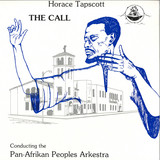
Available on vinyl for the first time in 40 years, Outernational Sounds is proud to present a masterpiece from the Los Angeles jazz underground - Horace Tapscott's burning, spiritualised 1978 set, The Call.
One of the unsung giants of jazz music, the composer, bandleader, arranger, pianist and community activist Horace Tapscott was the undisputed keystone in the grassroots Los Angeles jazz scene. Throughout the 1960s and 1970s, his radical community arts and music formations the UGMA (Underground Musicians Association, later changed to UGMAA - Union of God's Musicians and Artists Ascension), and his protean big band, the Pan Afrikan Peoples Arkestra, were at the epicentre of music, culture and politics in the Los Angeles area.
From their 1960s base at the Watt's Happening Coffee House on 103rd St, to their decade-plus- long 1970s residency at the Immanuel United Church of Christ on 85thE St and Holmes Ave, Tapscott's groups were the beating heart of underground music in LA. Hundreds of musicians passed through and played their part. Major figures in LA jazz such as Arthur Blythe, Azar Lawrence, Jimmy Woods, John Carter, Bobby Bradford, Sonny Criss, Ndugu Chancler and dozens of others all paid dues or just got down with Tapscott, not to mention the core Arkestra regulars who have since become celebrated names - Nate Morgan, Jesse Sharps, Adele Sebastian, Dadisi Komolafe, Gary Bias, to mention only a few.
Tapscott and the Arkestra were down on the ground - playing fundraisers in park and street, organising teach-ins and workshops for young and old, mixing it with radical theatre groups, firebrand poets, political radicals, Black separatists, community groups and churches. They lived communally, and built an ark for the Black arts in the heart of the city. But as a result of this grassroots community focus and Tapscott's antipathy to the music industry, the Arkestra didn't record for nearly two decades. That only changed when long-time jazz fan Tom Albach started Nimbus Records. The label was initiated specifically in order to document Tapscott and his circle, and the first three records showcased Horace and the Arkestra.
The Call was put together from two studio sessions in April 1978, one at Hollywood Sage and Sound, one at United Western - the latter session had the addition of a string section, who can be heard on the moody Cal Massey composition 'Nakatini Suite' and Jesse Sharps' swinging modal trip, 'Peyote Song No. III', with its swirling soprano solo. In keeping with the communal nature of the Arkestra, the other two compositions, 'The Call' and 'Quagmire Manor at Five A.M.' are also by Arkestra members. But at the centre of the music is the builder of the Ark, the visionary whose original call to action started a movement whose legacy continues to this day - Horace Tapscott.
Heed The Call!
Armagnac started in 2010 a label in metz all naked records & throwing up parties with his Fensch Groove Consortium (FGC) crew. After few years, he decided to move to paris france where between his writing for some famous french magazines & sites, he produced some marvellous tracks that keep the bobby konders spirit alive. This is spiritual deep house full of mystery and fuzzy textures that puts most 'deep' house to shame. ESSENTIAL ! SKYLAX RECORDS 4 EVER
With MEL011, it is Melodies International's immense pleasure to direct their focus towards both Soul and House royalty, selecting and reissuing two of Frankie Knuckles' scarcer remixes of an all-time classic: Womack & Womack - MPB (Missin' Persons Bureau). Now known as Zekkariyas and Zeriiya, partners Cecil and Linda Womack, two eminent members in an extensive lineage of music artistry (i.e. Bobby Womack was Zekkariyas' brother, Zeriiya is Sam Cooke's daughter) engaged in one of music history's most successful and exciting singing and song writing partnerships in the early 1980s. Zeriiya says her process with Zekkariyas flowed like water, their shared complicity and talent led them to write and produce strings of chart topping hits and classic albums as Womack & Womack but also for other renowned artists of the time such as Patti Labelle, Teddy Pendergrass and the O'Jays to only name a few. The original version of Missin' Persons Bureau was first released in 1988 on 'Conscience' (Island Records), a classic album with impeccable instrumentation and thoughtful and relatable narratives that reflect on the nature of life, true friendship, love or in the case of MPB, it's subsequent loss. Following the release of the LP, Island records founder Chris Blackwell introduced the idea of getting Missin' Persons Bureau reworked by House legend Frankie Knuckles and whilst the Womacks weren't originally set on the idea of having their songs remixed by other artists, Blackwell, who Zeriiya describes as a 'record label manager seriously involved in making sure the project is what the creators really want it to be", had earned their trust. With these remixes, Frankie managed to turn a radio hit into underground club classics. The Paradise Ballroom mix conserves the essence of the original, reinterpreting the rhythm section whilst drawing it out over 8 minutes, with expert tension building and release clearly aimed at the dance floor.
A seminal album of the 1980s DC Punk sound, the album was the first to feature drummer Dave Grohl, who replaced Stax for the album, and stayed with the band until they disbanded in 1990. This was the first ever album the now world famous musician ever played on.
Since disbanding, several incarnations of Scream have reunited/resurfaced for tours and recordings since. Members of the band went on to form countless other influential acts, including Nirvana, The Foo Fighters, Wool, Queens of the Stone Age, Goatsnake, The Suspects, and others.
Southern Lord is proud to be chosen to reissue Scream's everlasting 'No More Censorship' album. The band found the original multi-track tapes and Southern Lord had them baked/prepped for a remix at Grohl's 606 Studio. The new mix sounds vital and intense; the entire packaging, layout, and design are completely different from the original, including unreleased photos of the band during that era.
Scream was formed in 1981 by vocalist Peter Stahl, and brother Franz Stahl on guitar, Skeeter Thompson on bass, and Kent Stax on drums. The next few years would see the addition of second guitarist Robert Lee Davidson and keyboard player Bobby Madden, following three LPs through Discord Records — "Still Screaming" (1983), "This Side Up" (1985) and "Banging the Drum" (1986) — Scream's 'No More Censorship' was released via reggae label RAS Records in August 1988.
Legendary James Brown's protégée Martha High teams up with mighty Japanese Osaka Monaural to pay homage to "JB's Funky Divas" in her new album "Tribute to My Soul Sisters".
Original Funky Diva Martha High has been an integral part of James Brown's life and career for more than 30 years. She was his backing vocalist, hair stylist, payroll master and his always loyal and reliable confidant.
The idea for this project was hatched back in 2014, when Martha was visiting producer DJ Pari, head honcho of the Soulpower organization and manager of soul legends like The Impressions, Lyn Collins and Marva Whitney. While reminiscing about tours with her fellow James Brown veterans, Martha felt that a tribute to the great soul sisters of the JB Revue, better known as "James Brown's Original Funky Divas," was very much needed.
"I looked up to these ladies of soul," says Martha, "Given the opportunity and the pleasure to perform their songs, is my way of saying: thank you, you're not forgotten. To record the music of the Funky Divas, would mean a lot to Mr. Brown. He always wanted the world to know he had powerful women on stage that could hold his crowd while he was off the stage. They were just as powerful and funky as he was."
Without further ado, following DJ Pari's advice, Martha partnered up in Tokyo with one of the hottest names of the new funk renaissance: Japan's Osaka Monaurail. Deeply influenced by the work of James Brown, Bobby Byrd, Curtis Mayfield and with nine albums under their belt, Osaka Monaurail have been leading the international funk scene for more than two decades, appearing at festivals such as Montreal Jazz Festival, North Sea Jazz Festival and Womad's, as well as recording and touring with funk legends like Marva Whitney and Fred Wesley.
This unique collaboration gives new life to 13 soulful pearls, masterfully interpreted as only an Original Funky Diva can do. To name a few: "Think (About It)", made famous by the female preacher Lyn Collins, "Mama's Got a Bag of Her Own", Anna King's answer to Brown's "Papa's Got a Brand New Bag," "This Is My Story", of which Martha recorded the original version with The Jewels, and the soul classic "Answer to Mother Popcorn" by Vicki Anderson.
Born in Victoria, Virginia, and discovered by rock 'n roll pioneer Bo Diddley, Martha started her career with the soulful, legendary doo-wop group The Four Jewels, with whom she scored the national hit "Opportunity" in 1964. Soon, The Jewels caught the attention of James Brown and joined the James Brown Revue in 1966. The Godfather of Soul recorded and released several songs featuring The Jewels until the group disbanded. Nevertheless, Martha stayed with James Brown and continued to work with him as his personal vocalist for 32 years. She was with him at the Boston Garden during the iconic 1968 gig after Martin Luther King's assassination. She was by his side when he performed at renowned "Rumble in The Jungle" event in Zaire. Mr. Brown produced several of Martha's singles on his own People label such as "Georgy Girl", "Try Me" and "Summertime." Meanwhile Martha launched her solo career in 1979 with the self-titled debut LP for Salsoul Records. Since, she has released five albums under her name and, being one of the "hardest working women in show business", she became one of the leading singers of saxophonist Maceo Parker's legendary funky music machine, working with him for 16 years.
Throughout her career Martha has shared stages worldwide with iconic artists like Little Richard, Jerry Lee Lewis, The Temptations, Aretha Franklin, B.B. King, Stevie Wonder, Prince, Michael Jackson and George Clinton. Martha has been carrying the torch of soul music for her whole life, like a true soul sister. Now, with this new effort, she is keeping the music of the Funky Divas going, and we are sure that the Godfather of Soul and her faithful audience would appreciate it.
- A1: Dorothy Ramsey - He's A Real Gone Guy
- A2: Johnny B & The Music Makers - Unchain My Heart
- A3: Bobby Wade - They Call It Stormy Monday
- A4: Rene Bailey - Woke Up This Morning
- A5: Howard A. Smith - Sugar
- B1: Nu Art Quartet - California Dreaming
- B2: Johnny Walker Trio - The Purple Jellybean
- B3: Bob Brown Quartet - Dell's Bell's
- B4: Bob Hines Trio - Dasheka
- B5: Steve Mason Trio - The Nitty Gritty Humbug
- C1: Al Jarreau & Trio - Take Five
- C2: Matilda Haywood - Can You Handle It 1
- C3: George Smith - Out Of This World
- D1: Ray Johnson - The Deep End
- D2: Lee Mitchell - How Can You Be So Cold
- D3: Shelley Fisher - St. James Infirmary
- D4: The Eminent Stars - Hearts Are Jumping
One year has passed since the last release in this series and, as always, the Tramp Records crew have been working hard during the last 12 months to come up with an equally fine selection of tunes for this brand new volume. Our aim is to keep up with the quality of each release, a task which certainly does not get any easier as we step forward into the twenty first century.
There is no need to praise this selection of tracks. It is larger-than-life. And those who do not recognize the distinctiveness of it should better seek medical advice. The most astounding fact is certainly that 99% of the record buying public have never heard any of these tunes, most likely not even the artists. And we are not talking of people who solely listen to mainstream music. No. Even music lovers who believe that they have a good portion of knowledge when it comes to jazz and soul music will be left speechless.
You can skip to any song on this album and you won't be disappointed. The only premise is that you are a fan of raw, earthy soul and jazz music. If this is the case then you can't go wrong. Rene Bailey, Matilda Haywood, Lee Mitchell, Nu Art Quartet, to name a few. It is high time to introduce all these names to a broad audience and to prevent that they vanish into thin air. The Movements series was coined to introduce music lovers to so far unheard musical treasures. Tunes which only hardcore record collectors have had the privilege to enjoy it...until now.