For Fans Of.. Durand Jones & The Indications, Frightnrs, Thee Sinseers, Jr. Thomas & The Volcanos, Bobby Orozo. Producer, songwriter, and member of Thee Sinseers. Upcoming LP on Colemine Records. Joey embodies the East LA sweet soul scene, and it now dipping into reggae! As the leader of the modern Chicano soul outfit, Thee Sinseers, and releasing a string of singles as a solo artist, Joey Quinones and his crew have recently been ushering in a new era of modern soul. It is the type of music that shares a genesis with the birth of soul and R&B sounds emitted from the classic lowrider cruising down Whittier Boulevard to the sunshine-y vibes of traditional ska and dancehall reggae. And with his debut 45 on Colemine, Quinones shows that he's adept at not just the slow and low, but also the mellow sounds of early reggae. We are proud to present "For You" by the ever-sweet and oh-so-talented Mr. Joey Quinones.
Suche:boul
‘Reich’s music expands from minimalist austerity to more full-bodied passages and back again. Reminiscent of his earliest work, it is very beautiful.’ – Financial Times
‘The music has tender energy, and an undercurrent of melancholy. Its droning tones sometimes seem to be pulling apart – like taffy, or like Richter’s stretching spaghetti stripes of color.’ – New York Times
Nonesuch Records releases the first recording of Steve Reich’s Reich/Richter, performed by Ensemble intercontemporain and conducted by George Jackson. The composition was originally written to be performed with German visual artist Gerhard Richter and Corinna Belz’s film Moving Picture (946-3).
Reich describes Richter’s book Patterns, which served as source material for the film: “It starts with one of his abstract paintings from the ’90s. He scanned a photo of the painting into a computer and then cut the scan in half and took each half, cut that in half and two of the four quarters he reversed into mirror images. He then repeated this process of ‘divide, mirror, repeat’ from half to quarter, eighth, sixteenth, thirty-second, all the way up to 4096th. The net effect is to go from an abstract painting to a series of gradually smaller anthropomorphic ‘creatures’ (since the mirroring produces bilateral symmetry) to still smaller very fine stripes.
“Belz described the film in terms of ‘pixels’. It begins with two-‘pixel’ stripes and the music begins with a two-sixteenth note oscillating pattern. When the film moves to four ‘pixels’, the music moves to a four-sixteenth note pattern, then to eight, and sixteen,” the composer continues. “After that, I began introducing longer note values – initially eighth notes, and later to quarter notes. By the middle of the film, when the images move from 512 to 1064 pixels, the music really slows to dotted half notes. Finally, as the ‘pixel’ count begins to diminish, the music moves back into more rapid eighths and then ending with the most intense rapid sixteenth movement.”
After more than one hundred performances of Reich/Richter at The Shed in New York in 2019, it was performed in London at the Barbican by the Britten Sinfonia conducted by Colin Currie and then in Paris at the Philharmonie, where this recording was made. The Austrian ensemble Windkraft Tirol, led by Kasper de Roo, will perform Reich/Richter on September 8 at Szentrum, Silbersaal in Schwaz, and the LA Phil New Music Group, led by Brad Lubman, performs the piece, accompanied by Richter and Belz’s film, at Walt Disney Concert Hall in Los Angeles on April 1, 2023.
Nonesuch has recorded every new piece of music by Steve Reich since 1985, beginning with The Desert Music and continuing through 2018’s Pulse/Quartet, resulting in twenty-two albums and the two box sets Phases in 2006 and Works: 1965-1995 in 1997. The label will put out a collection of his complete works in 2023.
Reich released a book last month, Conversations, that includes dialogues with past collaborators, fellow composers, musicians, and visual artists who have been influenced by his work, including: David Lang, Brian Eno, Richard Serra, Michael Gordon, Michael Tilson Thomas, Russell Hartenberger, Robert Hurwitz, Stephen Sondheim, Jonny Greenwood, David Harrington, Elizabeth Lim-Dutton, David Robertson, Micaela Haslam, Anne Teresa de Keersmaeker, Julia Wolfe, Nico Muhly, Beryl Korot, Colin Currie, and Brad Lubman. Booklist said in its review, ‘Iconoclastic American composer Steve Reich is singular in his own right, and when he is in conversation with other equally iconoclastic composers, conductors, sculptors, musicians, percussionists, and video artists, sparks not only fly, they sparkle. Reich and his colleagues conduct lovely give-and-takes during which they share stories, creative approaches, and viewpoints. Reich's Conversations is the best kind of eavesdropping.’
Steve Reich has been called ‘America’s greatest living composer’ (Village Voice), ‘the most original musical thinker of our time’ (New Yorker), and ‘among the great composers of the century’ (New York Times). His music has influenced composers and mainstream musicians all over the world. Music for 18 Musicians and Different Trains have earned him two Grammy Awards, and in 2009, his Double Sextet won the Pulitzer Prize. Reich’s documentary video opera works – The Cave and Three Tales, done in collaboration with video artist Beryl Korot – have been performed on four continents. His recent work Quartet, for percussionist Colin Currie, sold out two consecutive concerts at Queen Elizabeth Hall in London shortly after tens of thousands at the Glastonbury Festival heard Jonny Greenwood (of Radiohead) perform Electric Counterpoint followed by the London Sinfonietta performing his Music for 18 Musicians.
In 2012, Reich was awarded the Gold Medal in Music by the American Academy of Arts and Letters. He has additionally received the Praemium Imperiale in Tokyo, the Polar Music Prize in Stockholm, the BBVA Award in Madrid, and the Golden Lion at the Venice Biennale. He has been named Commandeur de l’Ordre des Arts et des Lettres and has been awarded honorary doctorates by the Royal College of Music in London, The Juilliard School, and the Liszt Academy in Budapest, among others. ‘There’s just a handful of living composers who can legitimately claim to have altered the direction of musical history and Steve Reich is one of them’, states the Guardian.
Pierre Boulez founded the Ensemble intercontemporain in 1976 with the support of Michel Guy (who was France’s Minister of Culture at the time) and the collaboration of Nicholas Snowman. The Ensemble’s thirty-one soloists share a passion for twentieth and twenty-first century music. Under the artistic direction of Matthias Pintscher, the musicians work in close collaboration with composers, exploring instrumental techniques and developing projects that interweave music, dance, theater, film, video and visual arts. In collaboration with IRCAM (Institut de Recherche et Coordination Acoustique/Musique), the Ensemble intercontemporain is also active in the field of synthetic sound generation. New pieces are commissioned and performed on a regular basis. Resident of the Cité de la musique – Philharmonie de Paris, the Ensemble performs and records in France and abroad, taking part in major festivals worldwide.
George Jackson, winner of the 2015 Aspen Conducting Prize, came to attention after stepping in at short notice with Orchestre de Paris, where he stepped in for Daniel Harding. Recent highlights include leading Ensemble intercontemporain at Festival Romaeuropa, the Rainy Days Festival in Luxembourg, and Festival D’Automne in Paris, as well as conducting the RTÉ National Symphony Orchestra, the orchestra of Opéra de Rouen and the world premiere of Tscho Theissing’s Genia with Theater an der Wien. His varied operatic experience includes performances at Opera North, Hamburg State Opera and Opera Holland Park, as well as conducting a new production of Hänsel und Gretel at Grange Park Opera.
- 1: Connais Tu L'animal Qui Inventa Le Calcul Integral?
- 2: Evariste Aux Fans
- 3: Les Pommes De Lune
- 4: La Chasse Au Boson Intermédiaire
- 5: Dans La Lune
- 6: La Faute À Nanterre
- 7: Ma Mie
- 8: Wo I Nee
- 9: Si J'ai Les Cheveux Longs C'est Pour Pas M'enrhumer, Atchoum!
- 10: La Révolution
- 11: Je Ne Pense Qu'a Ça
- 12: Je Chante Pour Vous Faire Marcher
- 13: Je Ne Suis Pas Simple
- 14: Si Les Étoiles Pouvaient Parler
Évariste is one of the rare specimens of artist-cum-scientists. Among his kind stand others like Pierre Schaeffer, a Polytechnique graduate (an engineer but also the father of musique concrète) and the eccentric Boby Lapointe (graduate of the École centrale and inventor of the Bibi-binaire system, patented in 1968). Évariste's songwriting, joyful and full of energy (albeit extremely critical), shrouds an original tragedy: born in 1943 among résistants, Joël Sternheimer (aka Évariste) grew up without a father, lost to Auschwitz. Although he makes little reference to Jewish culture in his music, his origins leave their mark: in 1974, he sings a Hebrew song on television. In 1966, the young Joël sports Princeton's colourful paraphernalia - that's because he's freshly returning from the US, where he was sent to pursue his research on "particle mass and the interpretation of observed regularities, such as the effects of a wave" (will understand who may). When he gets there the country's in the midst of the Vietnam War. With McNamara keen to find an alternative to the nuclear weapon and calling upon the country's biggest brains to undertake the task, there's a "fund shift" within the university - a diplomatic way to give notice to whoever may not be disposed to follow the government's scheme. Joël, who's under the supervision of a rebellious physician, is dismissed. He regardless keeps following the prestigious seminaries of the Institute for Advanced Study, chaired by Oppenheimer, inventor of the atomic bomb. Likely inspired by the hippie movement and music, Joël buys a guitar and starts playing in Washington Square - after all, Bob Dylan himself started there. He blithely skips Oppenheimer and receives a warm (though surprised) welcome from a crowd thoroughly unfamiliar with French. When the ageing physicist questions him about his decreasing attendance, Joël explains how drawn he is to music, and how he thinks it could help him in self-financing his research. Évariste recalls seeing the sickened man, his face torn by remorse, lighten up to his words and say: "What's keeping you - go for it! If I was still young that's exactly what I'd do." The student takes these words as a testimony from his professor - and it's enough to convince him . And so he takes the leap during the Christmas vacations he spends in Paris. A journalist friend he often sees around the Sorbonne introduces him to the artistic director of Disques AZ. The latter passes the tapes on to the label's boss, Lucien Morisse, also program manager on Europe N°1. Morisse is blown away - and signs him onto the label right away. Michel Colombier, arranger for Serge Gainsbourg and co-author of "Psyché Rock", with Pierre Henry, contributes some of his original ideas to the 7 inch "E=mc2": Évariste's preoccupation with the percussion sound on the track "Le calcul intégral" is that it goes "poom poom" and not "tock tock" - Colombier is aware of the issue and records Évariste's guitar like a percussion in an isolated booth. The organist Eddy Louis, who is to participate, in 1969, to the success of Claude Nougaro's "Paris mai", also appears on the record. It's 1966 and the Antoine phenomenon (signed on Vogue) storms through France. The two singers share similarities: Antoine is an engineer of the École centrale, gifted with a great originality in his song-writing. A godsend for the two labels who turn this resemblance into a commercial strategy, setting them out as rivals. To this day though, Évariste still denies what was little more than slushy tabloïd gossip. Success comes around swiftly and in 1967 Évariste launches into a second 7 inch, "Wo I nee", again arranged by Michel Colombier. Quantum mechanics fans finally get their anthem with "La Chasse Au Boson Intermédiaire" (or the "Intermediary Boson Pursuit"). To sum up what's a boson, say he's a close pal of the meson, photon and other gluons. A few months later, it's May 68 and everything's turned upside down. Évariste writes a series of songs inspired by the events, which he immediately submits to Lucien Morisse. When the man behind "Salut les copains", once married to Dalida, hears the song "La révolution" - a father and son dialogue - he can't take any more: AZ simply cannot release this. But there and then Lucien Morisse makes a gesture which will remain engraved in French music's history: sorry to be unable to officially stand by the singer, he encourages him to self-produce the record, but with his tacit support. He calls the pressing factory and asks they apply the same rate for Évariste as they would for AZ. The singer and his musicians use the same studio as for the previous record, all of them playing for free awaiting a return on investment. Évariste keeps singing at the Sorbonne with "Jussieu's gang" and "the young Renaud" he nicknames "le p'tit gavroche" (or "street urchin"). Renaud volunteers to type the lyrics of the song "La révolution" so that the chorus can be sung and recorded. A boy in the group is related to Wolinski and introduces them. The two get along so well that Wolinski ends up drawing the cover for the record "La révolution", for free. The self-released 7 inch "La révolution / La faute à Nanterre" is sold under the table and door-to-door for half the price of a standard record, on and around the boulevard Saint-Michel; and it runs out fast. In the end, there will be 6 releases of the record, and 25000 copies sold. When the theatre director Claude Confortès decides to adapt Wolinski's drawing series titled "Je ne veux pas mourir idiot" ("I don't want to die a fool"), he asks Évariste to write the original soundtrack. His friend, now cartoonist for Hara-Kiri Hebdo, often promotes him in accordance with a principle dear to him by virtue of which he gives a special place to his friends. Dominique Grange (writer of the song "Nous sommes les nouveaux partisans") soon joins the team. After 150 performances, Évariste leaves his place to Dominique Maurin (brother of Patrick Dewaere). Évariste composes the songs for Claude Confortès' next play, "Je ne pense qu'à ça" ("That's all I think about"), co-wrote with Wolinski in 1969. The comedians of the play record the songs on a 7 inch, with a cover signed, again, by Wolinski. In 1971, French television produces the documentary "Évariste et les 7 dimensions", but doesn't air it. Indeed, the scientific sub-comity of the programming comity (sic) censors the show. The given justification is that "Évariste dangerously mixed science with science-fiction, numerology and other non-scientific disciplines". The underlying motive might have been a will to censor the singer-mathematician's political discourse. In the documentary and among other things, Évariste discusses hierarchy, alienation and revolution. Half a century later the documentary remains invisible, though some excerpts resurfaced in 1992 in the cult show "L'oeil du cyclone", on Canal +. Though flourishing, Évariste's career is nearing its end. 1970 is the beginning of a decade in the course of which he is to make a decisive discovery in the musical and scientific domains. Following this breakthrough, he moves away from self-produced music and gaucho magazines to focus on science. He keeps Oppenheimer's encouraging words in mind, now freely pursuing his research thanks to the sales of his records. Joël realises that when decoding protein sequences, one finds musical sequences recognisable to humans. He names them "proteodies". If, when listening to a proteody, one responds by being so sensitive as to finding it beautiful, then it reveals a deficiency of the related protein - and this peculiar music may be the cure. We could trace back the music history in light of proteins lacking in a given artist, or within a public's majority. You always thought these hysterical groupies who'd throw their underwear with passion and faint in the pit had miraculously appeared because they had never heard anything as wonderful as the Beatles? Make no mistake! For Évariste, it all boils down to an intro's protein content. Indeed, the beginning of their first hit "Love Me Do" corresponds to dopamine, the neurotransmitter linked to compulsive buying. An intro like this could only unleash the fervour of groupies, victims of fashion and biology. Évariste's success is such that the income from his sales gives him the autonomy to which he had aspired when confiding to Oppenheimer. It made it possible for him to pursue his research without any institutional constraints. He now devotes himself to his proteodies, sat in the offices of the European University for Research, just around the corner from the Sorbonne he knew so well. Évariste is no more. Joël regained control of this strange and comical beast.
Decomposed recalls classic American hardcore like Bad Brains, Poison Idea and Jerry’s Kids or Japanese ragers like Paintbox, The Comes, Eiefits and Skizophrenia. But there’s also a healthy slug of classic UK and US punk and even a bit of Krautrock, psychedelia and Black Sabbath in there too. Nottingham has always been a melting pot for heavy music. For a small city, it has boasted more than its fair share of genre defining bands and artists, not to mention record labels. Bands cross-pollinate, form projects and offshoots and play one-off gigs that would result in lengthy careers and world tours if they had happened across the Atlantic. It has always been like that there. No big deal (but yet, a really big deal if you know). One such band/project/offshoot were Endless Grinning Skulls. Formed by guitarist Andy Morgan (also from Bloody Head, Army Of Flying Robots, Nadir and countless more), drummer Steve Charlesworth (Heresy, Wolves Of Greece, Meatfly, Geriatric Unit) and bassist Gords (Hard To Swallow, John Holmes, Geriatric Unit) in the early twenty-teens, they re-set the bar for the 3-piece hardcore band before (perhaps inevitably) burning out in 2018. Morgan and Charlesworth weren’t done though. They’d forged a bond in EGS and wanted to carry on playing together so - in a familiar Nottingham storyline - they recruited former Pitchshifter guitarist Stu Toolin on bass and Anmarie Spaziano (who you might know from running a famous burger joint) on vocals and formed Blind Eye. They knew Toolin was about to relocate to Portland, Oregon so they wrote and recorded an EP (released on Morgan’s own Viral Age Records). Quick-sharp. No messing about. And that – by rights – should have been that: over and out. New band please. However, the demo captured a rare intensity and vitality that more considered projects often fail to achieve. This was a band let loose, free from previous shackles and loving the noise they made. It seemed a shame to stop there. Recruiting Matt Grundy (a former bandmate of Morgan’s in both Nadir and Dead In The Woods) to the bass vacancy they went back to Stuck On A Name Studios in 2021 with Ian “Boulty” Boult at the helm again and delivered the album Decomposed.
Decomposed genuinely rocks out without losing one iota of the effervescent anger that made the demo such an essential listen. From the insistent, minimal opener Ready To Go Now via the unhinged thrash of Straw Man and the menace of the stomping Pero No Quieres, to the measured chugging and epic crescendo of closer Broken Star, this record is a fucking blast. Needle off, flip it back over, play it again. Your neighbours are loving it so much they’re banging on the walls to tell you. “I suppose the intention was to write high energy, catchy hardcore, with a nod to what has come before, but also to do our own thing,” explains Andy. “Lyrically, the album was written during the pandemic, and although it’s not ‘a pandemic album’, I think it deals with a lot of the feelings of loss, separation and isolation
The brand new album by rising Australian out-rock duo, Party Dozen. Features guest vocals by Nick Cave. Party Dozen are a duo from Sydney made up of Kirsty Tickle (saxophone) and Jonathan Boulet (percussion and sampler). Since forming in 2017, they have become renowned in Australia for their incendiary live shows, touring and playing with acts such as LIARS, Tropical Fuck Storm and Viagra Boys. Exactly what Party Dozen are is completely up to the listener. Doom. Jazz. Hardcore. Psychedelic. No-wave. Industrial. Although largely instrumental, their sets are punctuated by Kirsty’s unique “singing” style, screaming into the bell of her saxophone which itself goes through a bevy of effects pedals. Intensely independent in everything they do, the duo write, perform and record everything themselves. 2022 will see the return of Party Dozen, first in April with the 7” release, Fat Hans Gone Mad, for the Sub Pop Singles Club, and then in July with their third album, The Real Work, with a new label partner in New York’s Temporary Residence Ltd. The Real Work succeeds in exploring new directions but also features some familiar Party Dozen touches. Perhaps most notable is the first-ever appearance of a guest other than Kirsty or Jonathan on a Party Dozen track, with Nick Cave ad-libbing a very memorable contribution to the album’s second track, “Macca The Mutt.”
Renata Zeiguer's new album 'Picnic in the Dark' - her second full length
with Northern Spy - is a sonic dreamworld infused with magical realism
that tells an extremely personal narrative
It is a culmination of a lifetime of reckoning with her past and her unwavering
resolution to transcend inherited patterns and cycles that have held her back. Coproduced with Sam Griffin Owens (Sam Evian), the twelve songs lead a mystical
conversation between characters within her psyche that all center around this
process, which she whimsically likens to the ritual of having a picnic in the dark.
Integrating her child self into her adult life with immense compassion and
enlightenment, 'Picnic in the Dark' is not only an album of exploration but one of
transformation, healing and self- actualization, all through a courageous journey
towards that extremely uncomfortable yet fertile liminal space between
familiarity and uncertainty.
- A1: Jules Wells - Breathe
- A2: Modelson - Cyprination
- B1: Loloman - Liberation
- B2: G-Prod - Something About You
- C1: Alex Noto - Gravitational Forces
- C2: Laurent Chanal - Another Day
- D1: Xaric - Domingo
- D2: Bene Luxe & Christophe Bailleau - Ereignis Zweihundert
- E1: Arocas - Supernova
- E2: Franck Bouly - Highlighter (Second Coming)
- F1: Traffic Beats - Bom Dia
- F2: Fred H - Chi-Town Flavours
- G1: Mazi & Duriez - This Is Not A Follow-Up (Laurent Maldo Remix)
- G2: Jihell - Chance
- H1: Arno Gonzalez Feat. Desprès - The Nice View (David Duriez's Wonder Emporium Remix)
- A1: If Tommy Duncan's Voice Was Booze
- A2: In Texas With The Band (Feat Ray Benson)
- A3: If I Treated You Like You Treat Me (Feat Emily Gimble)
- A4: Same Dream
- A5: Tell Him I'm Dead (Feat Katie Shore)
- A6: Obsessed With The West
- B1: Comin' In Hot
- B2: I Was Just Thinking Of You
- B3: I Don't Want Someone Who Don't Want Me
- B4: Riding Off Onto Sunset Boulevard
- B5: You're Doing It Wrong
- B6: Cottonwood Fuzz
'I've been obsessed with western swing since I was a kid, and it's always
been an influence, but my records in the past have ranged from bluegrass
to hard country to folk, So I've never fully explored it' - So says genrebusting Fargo-born, Austin- incubated, Nashville resident Brennen Leigh,
whose new collaboration with the kings of modern-day western swing,
Asleep at the Wheel, Obsessed With The West, is a showcase not just for
the Bob Wills fans, but for anyone who's ever curled up with Loretta Lynn,
Hank Sr, Cindy Walker, Billie Holiday, or Willie Nelson
On twelve all original songs, Leigh's supple winking voice and multi- instrument
fluency, her interplay with Ray Benson, and the undeniable chops of the Wheel
serve up a treat on Leigh's seventh album. With cameos from Emily Gimble and
Katie Shore, and all the players getting their moments in the sun, Leigh - a twotime winner of the Texas Music Awards Best Female Vocalist award -
demonstrates on the terrific jump 40's rhythm and blues, 'Comin' in Hot' and the
lonesome cowboy musing of 'Riding Off Onto Sunset Boulevard' why Rodney
Crowell and Lee Ann Womack have recorded her songs. Obsessed With The West
is a celebration of music for music's sake in 2022, not just an exercise in looking
back on times gone by.
Deutsche Grammophon honour the supreme artistry of Daniel Barenboim throughout the coming year as he approaches his 80th birthday next November. The anniversary celebrations of the great pianist and conductor’s remarkable legacy began on 31 December 2021 with the release of Debussy’s Clair de lune, one of the highlights of Maestro Barenboim’s first DG album of 2022. For this new record, specially recorded in Barenboim’s Pierre Boulez Saal in Berlin, the great multi-faceted musician lavishes his artistry on such gems as Debussy’s “Clair de lune”, Schumann’s “Träumerei” and an array of other masterpieces by Chopin, Schubert, Liszt and Albéniz and many more.
- A1: Elvin Bishop - She Puts Me In The Mood (As Heard In "Jackie Brown" )
- A2: Dee Clark - Hey Little Girl (As Heard In "Once Upon A Time In Hollywood")
- A3: Dick Dale & The Del-Tones - Misirlou (As Heard In "Pulp Fiction")
- A4: Nick Perito & His Orchestra - The Green Leaves Of Summer (As Heard In "Inglorious Basterds")
- A5: Johnny Cash - I Walk The Line (As Heard In "Kill Bill : Volume 2")
- A6: Zarah Leander - Davon Geht Die Welt Nicht Unter (As Heard In "Inglorious Basterds")
- A7: The Coasters - Down In Mexico (As Heard In "Boulevard De La Mort")
- B1: The Lively Ones - Surf Rider (As Heard In "Pulp Fiction")
- B2: Johnny Cash - So Doggone Lonesome (As Heard In "Kill Bill : Volume 2")
- B3: Lilian Harvey & Willy Fritsch - Ich Wollt' Ich Wär' Ein Huhn (As Heard In "Inglorious Basterds")
- B4: Eddie Beram - Riot In Thunder Alley (As Heard In "Boulevard De La Mort")
- B5: David Alexander Hess - Now You're All Alone (As Heard In "Les Huits Salopards")
- B6: Jim Croce - I Got A Name (As Heard In "Django Unchained")
- C1: The 5.6.7.8'S - Woo Hoo (As Heard In "Kill Bill : Volume 1")
- C2: The Hurricanes - Out Of Limits (As Heard In "Pulp Fiction")
- C3: The Centurions - Bullwinkle (Part Ii) (As Heard In "Pulp Fiction")
- C4: Charlie Feathers - Can't Hardly Stand It (As Heard In "Kill Bill : Volume 2")
- C5: Ricky Nelson - Lonesome Town (As Heard In "Pulp Fiction")
- D1: Dimitri Tiomkin - The Green Leaves Of Summer (As Heard In "Inglorious Basterds")
- D2: Neu! - Super 16 (As Heard In "Kill Bill : Volume 1")
- D3: The Tornadoes - Bustin' Surfboards (As Heard In "Pulp Fiction")
- D4: Johnny Cash - Born To Lose (As Heard In "Kill Bill : Volume 2")
- D5: The 5.6.7.8'S - I'm Blue (As Heard In "Kill Bill : Volume 1")
Double LP of classic tracks from all your favourite Tarantino flicks.
Historically informed violin player, prize-winning street musician, new age experimentalist, chamber ensemble performer and conservatoire deviant. The career of Valentina Goncharova (b. Kyiv 1953) shares parallels with those associated with the broader new music movement of the 20th century and the dissemination of home recording technologies.
Valentina’s was a youth spent immersed in the world of classical music study under soviet rule, first in Kyiv- later in Leningrad & now St. Petersburg, from the age of 16. With the supervision of professors M. Vayman and B. Gutnikov she learned concert violin and developed alternate playing styles alongside skilled pianists. A student of the Leningrad conservatoire during the years 1969 - 1983, her repertoire included music for violin and later expanded to contemporary music composition.
The improvisatory nature of free jazz and then-budding experimental rock circles also intrigued Valentina during this period in Leningrad. Departing from the rules of the conservatoire, she briefly performed in underground rock clubs alongside future members of the industrial group Pop- Mechanika (Popular Mechanics). This perpetual state of flux is central to the variety found within ‘Recordings Vol. 1’, though as opposed to any degree of uncertainty Valentina’s practice is one
in flux by way of earnest curiosity.
Pushing further into an exploration of solo electro-acoustic sounds, she took to home taping on a modified Olimp reel to reel recorder. Intrigued by the manipulability of dubbing and the fresh sounds of DIY effects chains, Goncharova developed pickups alongside her husband Igor Zubkov. Her infatuation with the music of Stockhausen, Xenakis, Ganelin Trio and Pierre Boulez channels through considerations of space and erratic sound design, the 3 movements of ‘Metamorphoses’ embodying this textural approach to musique concrete.
The compositional skills developed in Leningrad unfold in the romantic gestures of ‘Higher Frequencies’, whilst manipulated cello combines with synthesise keys across ‘Passageway To Eternity’.
The slow, pulsating drone soundscapes recall the likes of Robert Rutman’s US Steel Cello Ensemble or even deep listening pioneer Pauline Oliveros.
The juxtaposition of written notation and improvisatory flare is central to Goncharova’s sound world. This period of home recording documents a confluence of minimalism, free form and flirtations
with new age tropes (inc. bell chimes and cavernous vocal mantras).
Experimenting with unusual performance techniques, such as shouting into amplified cello strings, Valentina’s home studio functioned as a place to foster full artistic and creative freedom
away from any academic strictures.
Relocating to Estonia in 1984, and in parallel to the deeply personal music of ‘Recordings Vol. 1’, Valentina performed at jazz festivals and gave classical concerts across Eastern Europe. In a sense, the recordings on these discs offer only a glimpse into her lifelong body of work. Over the past few decades she has taught at Tallinn Music College, expanded and updated post- Soviet popular music repertoire, collaborated with the Russian Philharmonic Society of Estonia and given concerts and charity events alongside the Catholic Church.
Hers is a life dedicated to the exploration of sound, a career forged through careful study and ceaseless intrigue. In a time where technological interconnectedness has allowed for music of the pas
to be continually mined and evaluated through new lenses, Shukai present an artist whose tendency for private home-taping had allowed recordings to go unheard for thirty years.
Allison was best known as one of the members of the great Funk band "TSU Toronadoes", who was the creator of the million seller, "Tighten Up" while backing Archie Bell & The Drells on Ovide & Atlantic an many more.
Allison has also written some amazing songs such as, I Still Love You, The Goose, Only Inside, Work on it, to name a few.
However, when the band "TSU Tornados" split in 1971, "Allison Lewis" went on to form "South Funk Blvd" with two other members Jerry Jenkins, Nelson Mills.
They recorded a well known rare single with his band "South Funk Blvd" called "Skying High Getting Off On Your Loving" & "Be Together" on Captain Funk Records. The rest of the band attempted to continue playing under the name "TSU Tornadoes".
- A1: Are You My Woman (Tell Me So)
- A2: Stoned Out Of My Mind
- A3: (For God's Sake) Give More Power To The People
- A4: We Are Neighbours
- A5: I Found Sunshine
- A6: Inner City Blues (Make Me Wanna Holler)
- B1: Oh Girl
- B2: Have You Seen Her
- B3: It's Time For Love
- B4: Homely Girl
- B5: Too Good To Be Forgotten
- B6: You Don’t Have To Go
On June 17, 2020, the Hollywood Chamber of Commerce and the City of Los Angeles, announced that the iconic multi-million selling
soul/R&B band, THE CHI-LITES, would be honoured in their Class of 2021, by receiving a star on Hollywood Boulevard on the
Hollywood Walk of Fame.
• On 30th September 2021, with family friends and other soul legends in attendance, including their legendary label mate, Gene
Chandler, Marshall Thompson, co-Founder and last surviving member of THE CHI-LITES, accepted the honour on behalf of the Band.
• Although they had formed nine years earlier, it was when the Band met record producer Carl Davis in 1968 that they signed a
contract with Brunswick Records. They began to achieve commercial recognition and success, with songs predominantly written and
composed by band member Eugene Record, who was also their lead singer, although their first charting song, ‘Give It Away’ (US
R&B Chart #10) was co-written by Record, with producer Carl Davis.
• THE CHI-LITES released more than 15 studio albums and registered on the UK chart on nine occasions, with five Top 10 entries, one
of them being the Double-A sided reissue ‘Have You Seen Her’/’Oh Girl’.
• In 1976, THE CHI-LITES switched labels from Brunswick to Mercury and recorded two albums ‘Happy Being Lonely’ (1976) and ‘The
Fantastic Chi-Lites’ (1977), before teaming-up again with Carl Davis on his own Chi-Sound records label, to record 1980’s ‘Heavenly
Body’ and 1981’s ‘Me And You’.
• This 12-track vinyl LP set focuses on their Brunswick Records period and includes all of their UK hits, opening with their barnstorming ‘Are You My Woman (Tell Me So)’, the intro from which, being famously and expertly sampled by Beyoncé (and featuring
Jay-Z), for her worldwide 2003 hit and Transatlantic #1,‘Crazy In Love’.
- A1: The Exceptions - So Much In Love
- A2: Lee Williams & The Cymbals - Please Say It Isn't So
- A3: The Vanguards - Somebody Please
- A4: The Manhattans - Follow Your Heart
- A5: The Lovers - Someone
- A6: The Superbs - It Hurts So Much
- A7: Little Ben & The Cheers - (I'm Not Ready To) Settle Down (I'm Not Ready To)
- B1: The Radiations - That's The Way Our Love Is
- B2: Reuben Bell - It's Not That Easy (With The Casanovas)
- B3: The Esquires - No Doubt About It
- B4: Bobby Burn - I'm A Lonely Man
- B5: The Persians - Here It Comes
- B6: Melvin Hicks & The Versatiles - I'm Just Passing Time
- B7: Houston Outlaws - What Am I Gonna Do
Our Lowriders album is an amalgam of the two “This Is Lowrider Soul” CDs. We have chosen 14 tracks that represent the sounds loved by Los Angelenos, often of Mexican descent, that emanate from their fabulously designed motors while cruising Whittier Boulevard in East LA or, say, Van Nuys Boulevard in the northwest of the city.
The classic Los Angeles vocal group the Superbs are featured here on their glorious ‘It Hurts So Much’, but it is mainly the records discovered by sweet soul collectors that dominate. The Carnival label has a great reputation on this scene; Lee Williams & the Cymbals’ ‘Please Say It Isn’t So’ and ‘Follow Your Heart’ by the Manhattans are a pair of killer ballads perfect in tempo and harmony for the cruisers. Other East Coast offerings include the Persians’ captivating ‘Here It Comes’ and two gems which were only on master tape prior to their Kent releases – Melvin Hicks & The Versatiles’ ‘I’m Just Passing Time’ and the similarly unknown outfit the Exceptions, with the wailing ‘So Much In Love’.
Chicago has always been a breeding ground for black harmony groups. The Esquires saw much success at Bunky; ‘No Doubt About It’ was their equally great first release at Wand. Little Ben & The Cheers hailed from the same city; their ‘I’m Not Ready To Settle Down’ fetches big bucks due to Lowrider demand, as does ‘What Am I Gonna Do’ by the mysterious Houston Outlaws – their origins are uncertain, but must be Midwestern. The Vanguards hailed from Indianapolis and deservedly charted with ‘Somebody Please’, licensed to LA’s Whiz label. All of their seven singles on Lamp are also fine, harmonic soul tracks. The Lovers were a Bay Area group who recorded in Los Angeles with the maestro Arthur Wright; their ‘Someone’ was tipped for the charts when licensed to Philips, but flopped, leaving it ripe for revival by the soul connoisseurs. Like the Lovers, the reputation of Reuben Bell’s ‘It’s Not That Easy’ has grown over the decades and a record once considered common can now fetch hundreds of dollars – class will out.
Limited edition 2000 copies.
•Cut by Kevin Gray at Cohearent Mastering.
•Plated at Quality Record Pressing (QRP).
•180 gr vinyl pressed by Optimal in Germany.
•Deluxe high-gloss flipback album jacket.
•Double insert using an original photo by JP Leloir from the concert.
•Each record has been visually checked to prevent defects.
Donald Byrd’s residency in Paris in 1958 to study with composer Nadia Boulanger gave rise to one of the greatest bands of his career with Bobby Jaspar on tenor sax and flute, Walter Davis, Jr. on piano, Doug Watkins on bass and Art Taylor on drums.
Sam Records is proud to present this previously unreleased concert by the Donald Byrd/Bobby Jaspar Quintet recorded during the evening dedicated to ‘Modern Jazz’ during the 1st and only Cannes Jazz Festival on July 11th 1958. The initiative for this festival was taken by Yvonne Blanc, a lady of good society who played the piano and lived between Paris and Cannes.
This festival was organised in partnership with the festival of Knokke-le-Zoute, in Belgium.
Recorded in Cannes, France, July 11, 1958.
Donald Byrd (Trumpet)
Bobby Jaspar (Flute/Tenor saxophone)
Walter Davis Jr. (Piano)
Doug Watkins (Bass)
Art Taylor (Drums)
'I was born in the North Carolina mud,' says Jamil Rashad, better known as Boulevards, one of the most idiosyncratic artists making music in the Tarheel State - His fourth album, Electric Cowboy: Born in Carolina Mud, is caked in the soil where he grew up, mired in the muck of this place'not stuck but freed.
Grounded in personal experience and haunted by personal demons, Electric Cowboy is an album that reaches out, that embraces the world, that mixes the confessional and the communal. But the dominant sound'the dominant mindset'is funk: gritty, warm, weird, charismatic. Rashad once again composed and recorded with Blake Rhein, guitarist for Durand Jones & the Indications, after they had worked so well together on 2020"s Brother! EP. They corralled an all-star team that included Adrian Quesada from the Grammy- nominated neo- soul act Black Pumas and Colin Croom from the Chicago indie-rock outft Twin Peaks.
Michael Hurley's first new studio record in 12 years features eleven songs recorded in Astoria, Oregon during the brief time of year when the foxgloves bloom. Hurley had been workshopping the set at home for the past few years. Friends and collaborators came into town and contributed from afar. The songs are lifted by violin, organ, upright bass, banjo, percussion - but at the center, of course, is the enigmatic Snock, whose songs have grown only more unique and more 57 years after his debut album (First Songs - Folkways, 1964). It could only be Snock. Heartbreaking, heartfelt, easy and carefree. The glorious opener “Are You Here For The Festival” – punctuated by a pair of violins – came to him while working in the garden. “Little Blue River” floats by on a cloud. The haunting “Jacob’s Ladder” sounds beamed in from another era. Or dimension. Foxgloves is as comforting and wonderful as any Hurley record that has come before it.
- A1: The Changeling (Lp La Woman Original Stereo Mix Remastered)
- A2: Love Her Madly
- A3: Been Down So Long
- A4: Cars Hiss By My Window
- A5: La Woman
- B1: L'america
- B2: Hyacinth House
- B3: Crawling King Snake
- B4: The Wasp (Texas Radio & The Big Beat) (Texas Radio & The Big Beat)
- B5: Riders On The Storm
- CD1-1: The Changeling (Cd1: La Woman: Original Stereo Mix Remastered)
- CD1-2: Love Her Madly
- CD1-3: Been Down So Long
- CD1-4: Cars Hiss By My Window
- CD1-5: L A. Woman
- CD1-6: L’america
- CD1-7: Hyacinth House
- CD1-8: Crawling King Snake
- CD1-9: The Wasp (Texas Radio And The Big Beat)
- CD1-10: Riders On The Storm
- CD1-11: Hyacinth House (Demo)
- CD1-12: Riders On The Storm (Sunset Sound Version)
- CD2-1: The Changeling (Cd2: La Woman Sessions Part 1)
- CD2-2: Love Her Madly
- CD2-3: Riders On The Storm
- CD2-4: L A. Woman (Part 1)
- CD3-1: L A. Woman (Part 2)
- CD3-2: She Smells So Nice
- CD3-3: Rock Me Baby
- CD3-4: Mr Mojo Risin
- CD3-5: Baby Please Don’t Go
- CD3-6: L A. Woman (Part 3)
- CD3-7: Been Down So Long
- CD3-8: Get Out Of My Life Woman
- CD3-9: Crawling King Snake
- CD3-10: The Bastard Son Of Jimmy & Mama Reed (Cars Hiss By My Window)
- CD3-11: Been Down So Long
- CD3-12: Mystery Train
- CD3-13: The Wasp (Texas Radio And The Big Beat)
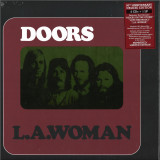
LP + 3xCD + booklet !
The Doors found their mojo (and Mr. Mojo Risin’) in November 1970 as they recorded L.A. Woman over six days at the Workshop, the band’s rehearsal space on Santa Monica Boulevard. A success both critically and commercially, the album was certified double-platinum and contains some of the band’s most enduring music, including the Top 20 hit “Love Her Madly,” “Riders On The Storm,” and the title track.
To commemorate the album’s 50-year anniversary, Rhino keeps on risin’ with a 3-CD/1-LP set that will be available on December 3rd. L.A. WOMAN: 50TH ANNIVERSARY DELUXE EDITION includes the original album newly remastered by The Doors’ longtime engineer and mixer Bruce Botnick, two bonus discs of unreleased studio outtakes, and the stereo mix of the original album on 180-gram virgin vinyl.
For this new collection, the original album has been expanded with more than two hours of unreleased recordings taken from the sessions for L.A. Woman, allowing the listener to experience the progression of each song as it developed in the studio. An early demo for “Hyacinth House” recorded at Robby Krieger’s home studio in 1969 is also included.
The outtakes feature Jim Morrison, John Densmore, Robby Krieger, and Ray Manzarek working in the studio with two additional musicians. The first was rhythm guitarist Marc Benno, who worked with Leon Russell in The Asylum Choir. The other was bassist Jerry Scheff, who was a member of Elvis Presley’s TCB band.
- A1: Abyad Barraq (With Greg Fox)
- A2: Sa'at (With Alexei Perry Cox)
- A3: Istashraqtaq (With Beirut)
- A4: Tanto (With Lucrecia Dalt)
- A5: Ana Lisan Wahad (With Farida Amadou & Pierre-Guy Blanchard)
- B1: Qalaq 1 (With Alanis Obomsawin & Diana Combo)
- B2: Qalaq 2 (With Roger Tellier-Craig)
- B3: Qalaq 3 (With Moor Mother)
- B4: Qalaq 4 (With Rabih Beaini)
- B5: Qalaq 5 (With Oiseaux-Tempete)
- B6: Qalaq 6 (With Viz Reka Csiszer)
- B7: Qalaq 7 (With Tim Hecker)
- B8: Qalaq 9 (With Mayss, Mazen Kerbaj, Sharif Sehnaoui & Raed Yassin)
The Acclaimed Arab-Levantine Contemporary Music & Art Project Returns With Its First New Album Since 2018. Led By Lebanese-Canadian Producer Radwan Ghazi Moumneh, Whose Many Credits Include Matana Roberts, Big | Brave, Sarah Davachi, Suuns. Featuring A Different Guest Collaboration On Each Track, Including Tim Hecker, Moor Mother, Beirut, Lucrecia Dalt, Greg Fox. Europe & Canada Tour In November 2021 With Experimental 16mm Analog Films By New Duo Member Erin Weisgerber.
One of the most renowned and uncompromising entities working in 21st century avant-garde Arab-Levantine art and music, Jerusalem In My Heart presents a new album of vital and haunting electronics and electroacoustics, framed by founder and producer Radwan Ghazi Moumneh’s spoken and sungArabic, buzuk-playing and sound design. Qalaq is the most distilled, variegated and finely wrought Jerusalem In My Heart album to date – featuring a different guest/collaborator on every track, yet as cohesive, emotionally resonant, sonically adventurous and narratively powerful as any release in JIMH’s celebrated discography. Guests across the album's 13 tracks include Moor Mother, Tim Hecker, Lucrecia Dalt, Greg Fox, Beirut, Alanis Obomsawin, Rabih Beaini and many more. “Qalaq” is an Arabic word with many shades of meaning but Moumneh particularly intends it as “deep worry” – on various obvious global levels, but also specifically with respect to Lebanon: its collapsing domestic politics, economy and infrastructure; the tragedy and aftermath of the 2020 Beirut port explosion; the intractable geography and geopolitics that continue to condemn the country to corruption, disruption, destabilization and violence. Moumneh writes: “The Side Two tracks are all named ‘Qalaq’ and then numbered, representing the degrees of layered and complex violence that Lebanon and the Levant have reached in the last couple of years, from the complete and utter failure of the Lebanese sectarian state that has driven the economy to a grinding halt, to its disastrous handling of the migrant influx from neighbouring failed states, to the endemic corruption that led to the August 2020 port explosion, to the latest chapter of Palestinian erasure and yet another brutally asymmetrical and disproportionate bombing campaign on Gaza.” Qalaq is shaped by a "dismantled orchestra" ofmusical collaborations, forged through long-distance file exchange during lockdown winter 2020-21 (and the inverted companion to JIMH's previous 2018full-length Daqa'iqTudaiq, which featured a 15-piece orchestra recorded live in Beirut). Moumneh initially through composed Qalaq in purposely stark and skeletal form, then gave each guest artist a section to decompose, edit, re-interpret and recompose as they desired, working their stems back into his own mixes for each piece/section and moulding newfound coherences in the overall work. The result is The album artwork with a front cover colour photograph by Myriam Boulous capturing a scene during the Beirut October Revolution of 2019.
k 11 Qalaq 6 (w/ VÍZ Réka Csiszér)


![Daniel[i] - Diluvium EP](https://www.deejay.de/images/l/3/8/995938.jpg)