Gondwana Records sign LA bassist and composer Seth Ford-Young's Phi-Psonics project and announce a remastered deluxe-edition of The Cradle featuring bonus material
Phi-Psonics is a meditative, immersive instrumental group from Los Angeles, led by bassist Seth Ford-Young and featuring Sylvain Carton on woodwinds, Mitchell Yoshida on electric piano, and Josh Collazo on drums. Their deeply soulfulmusic draws on jazz and classical influences together with Ford-Young's own musical experiences, relationships, and his introduction to spirituality, yoga and philosophy at a young age, to create something uniquely its own. Phi-Psonics' name and ultimate aim is to find 'Phi' – the golden mean – in art, nature and self. Ford-Young explains:
"It's a bit of a cliché, but music saved my life many times and instilled in me a belief in the great power of healing through art. It is my hope and intention that this music provides healing to someone somewhere."
Originally from Washington DC area, Ford-Young moved to California in the early 90s and fell in love with the deep sounds of the upright bass and the music of Charles Mingus, John and Alice Coltrane, and Duke Ellington along with Bach, Chopin, Pärt, and Satie. He immersed himself deeply in music and keen to learn combinedintense personal study with collaborations, tours, and recordings with artists such as Tom Waits, Beats Antique, and John Vanderslice. In 2010 he moved from the San-Francisco Bay area to the Los Angeles hills and continued his explorations. But great music is rarely just about music and Ford-Young's meditative, soulful music draws on more than just the twin wellsprings of jazz and classical music:
"My mother was a yoga teacher from the early 70's until recently and taught me yoga and meditation at an early age, my stepfather is an Aikido instructor and student of the teachings of Gurdjieff. Those were all early areas of study that I came back to many times throughout my life. Phi-Psonics has been a project that unapologetically synthesizes some of these ideas into our music".
It's this mixture of influences, musical and extramusical, that gives the music of Phi-Psonics it's immersive quality and quiet power. Revealingly the music that would becomeThe Cradle, wasn't written specifically for an album, originally Ford-Young was just writing down what was coming through. As time went by and the album began to take shape, the world situation seemed to be getting darker and his compositions aim to offer hope as a response to the negative influences that abound today. Remarkably for such a beautiful sounding record, it was recorded at the composer's home, rather than in a studio, but the relaxed nature of this process gives the music an airy lightness that propels the music to some magical spaces.
Originally self-released on vinyl in a limited run just as the world went into lockdown, The Cradle reached Matthew Halsall (founder of Gondwana Records) when he aws looking for music for his Worldwide FM show and he was blown away, hearing a kindred spirit at work. Halsall explains:
"Phi-Psonics make beautiful, humble and honest music, it's not showy, but it has a deep vibe that will elevate your mind and soul if you let it. When we heard The Cradle we reached out and are really super delighted to welcome Seth and his band to our label". Whereas for Ford Young: "Connecting with Matthew and the Gondwana records family has been a light in the darkness of the last years - to have my music make connections even as we are more isolated."
Ford-Young is currently putting the finishing touches to the second Phi-Psonics record, but aware that only a select few had heard The Cradle, let alone had the chance to buy a copy, and entranced by its deceptive simplicity and elevating energy, Halsall suggested that Gondwana present the album as a remastered 'deluxe edition' with an extended running time featuring extra tracks and new artwork from Daniel Halsall.
The Cradle starts with First Step, perfectly setting the tone for the whole album, it is a beautiful, soulful slice of musical calm gently propelled by Ford-Young's resonant bass and elevated by sublime flute and Wurlitzer electric piano solos. The seductive title track The Cradle was written way back in 2011 during a time of great personal change that led the composer to a feeling of newness and nurture. The magical, winsome Desert Ride is inspired by many rides through the grandly cinematic Mojave Desert. You can experience how incredibly full of life it's harsh landscape is if you slow down to its tempo. The gentle, sublime Mama is a tribute to mothers of all kinds, beautiful and heroic. Drum Talk was largely improvised, Ford-Young and the band agreed on a topic and recorded their conversation. Choosing their notes based on how Josh's drums were tuned. Like Glass is named for the special properties of Glass. Like some music, glass is delicate, yet has structure. The first of the two bonus tracks Still Dancing was written during the early days of 2020 in response to the challenges we all were facing then. It's a reminder that the figurative dance continues and that real dancing is essential. And the second, The Searcher, also written as a response to 2020, is a gently hypnotic song about the introspection and growth that can spring from a difficult situation.
This then is The Cradle, a quiet self-contained masterpiece, life-affirming and elevating in equal measure and the first offering from a wonderful new voice in spiritual jazz and the latest members of the global Gondwana Records family.
Поиск:cliche
Все
Berlin and London based avant-pop duo Private Agenda will release their second full-length album – A Mannequin – on Lo Recordings on 22 October via digital, limited-edition LP and music box formats.
Berlin and Reunion based duo, Amine Mesnaoui and Labelle are set to release their debut album on revered London independent imprint Lo Recordings on the 1st of April 2022.
‘African Prayers’ is a collection of seven new compositions, which includes lead single ‘Bleu Noir’, that aims to bring a contemporary and fresh interpretation to the Lila Ritual of the Moroccan Gnawa masters - also known as the Ritual of the Seven Colors.
With a firm belief they can deliver a sound that finds its anchor in heritage and yet escape folkloric clichés and stereotypes, the two musicians have strived to make something that is rich in meanings, minimal but complex, simple but deep. This is a record that is universal and invites the listener to the depth of meditation, to the dance, even to the spiritual state of trance.
Mesnaoui plays a prepared piano that is modified by different objects, which are inserted into its strings while Labelle simultaneously plays electronic instruments and further processes the piano sound. These instruments are not native to the traditional context
Gondwana Records sign LA bassist and composer Seth Ford-Young's Phi-Psonics project and announce a remastered deluxe-edition of The Cradle featuring bonus material
Phi-Psonics is a meditative, immersive instrumental group from Los Angeles, led by bassist Seth Ford-Young and featuring Sylvain Carton on woodwinds, Mitchell Yoshida on electric piano, and Josh Collazo on drums. Their deeply soulfulmusic draws on jazz and classical influences together with Ford-Young's own musical experiences, relationships, and his introduction to spirituality, yoga and philosophy at a young age, to create something uniquely its own. Phi-Psonics' name and ultimate aim is to find 'Phi' – the golden mean – in art, nature and self. Ford-Young explains:
"It's a bit of a cliché, but music saved my life many times and instilled in me a belief in the great power of healing through art. It is my hope and intention that this music provides healing to someone somewhere."
Originally from Washington DC area, Ford-Young moved to California in the early 90s and fell in love with the deep sounds of the upright bass and the music of Charles Mingus, John and Alice Coltrane, and Duke Ellington along with Bach, Chopin, Pärt, and Satie. He immersed himself deeply in music and keen to learn combinedintense personal study with collaborations, tours, and recordings with artists such as Tom Waits, Beats Antique, and John Vanderslice. In 2010 he moved from the San-Francisco Bay area to the Los Angeles hills and continued his explorations. But great music is rarely just about music and Ford-Young's meditative, soulful music draws on more than just the twin wellsprings of jazz and classical music:
"My mother was a yoga teacher from the early 70's until recently and taught me yoga and meditation at an early age, my stepfather is an Aikido instructor and student of the teachings of Gurdjieff. Those were all early areas of study that I came back to many times throughout my life. Phi-Psonics has been a project that unapologetically synthesizes some of these ideas into our music".
It's this mixture of influences, musical and extramusical, that gives the music of Phi-Psonics it's immersive quality and quiet power. Revealingly the music that would becomeThe Cradle, wasn't written specifically for an album, originally Ford-Young was just writing down what was coming through. As time went by and the album began to take shape, the world situation seemed to be getting darker and his compositions aim to offer hope as a response to the negative influences that abound today. Remarkably for such a beautiful sounding record, it was recorded at the composer's home, rather than in a studio, but the relaxed nature of this process gives the music an airy lightness that propels the music to some magical spaces.
Originally self-released on vinyl in a limited run just as the world went into lockdown, The Cradle reached Matthew Halsall (founder of Gondwana Records) when he aws looking for music for his Worldwide FM show and he was blown away, hearing a kindred spirit at work. Halsall explains:
"Phi-Psonics make beautiful, humble and honest music, it's not showy, but it has a deep vibe that will elevate your mind and soul if you let it. When we heard The Cradle we reached out and are really super delighted to welcome Seth and his band to our label". Whereas for Ford Young: "Connecting with Matthew and the Gondwana records family has been a light in the darkness of the last years - to have my music make connections even as we are more isolated."
Ford-Young is currently putting the finishing touches to the second Phi-Psonics record, but aware that only a select few had heard The Cradle, let alone had the chance to buy a copy, and entranced by its deceptive simplicity and elevating energy, Halsall suggested that Gondwana present the album as a remastered 'deluxe edition' with an extended running time featuring extra tracks and new artwork from Daniel Halsall.
The Cradle starts with First Step, perfectly setting the tone for the whole album, it is a beautiful, soulful slice of musical calm gently propelled by Ford-Young's resonant bass and elevated by sublime flute and Wurlitzer electric piano solos. The seductive title track The Cradle was written way back in 2011 during a time of great personal change that led the composer to a feeling of newness and nurture. The magical, winsome Desert Ride is inspired by many rides through the grandly cinematic Mojave Desert. You can experience how incredibly full of life it's harsh landscape is if you slow down to its tempo. The gentle, sublime Mama is a tribute to mothers of all kinds, beautiful and heroic. Drum Talk was largely improvised, Ford-Young and the band agreed on a topic and recorded their conversation. Choosing their notes based on how Josh's drums were tuned. Like Glass is named for the special properties of Glass. Like some music, glass is delicate, yet has structure. The first of the two bonus tracks Still Dancing was written during the early days of 2020 in response to the challenges we all were facing then. It's a reminder that the figurative dance continues and that real dancing is essential. And the second, The Searcher, also written as a response to 2020, is a gently hypnotic song about the introspection and growth that can spring from a difficult situation.
This then is The Cradle, a quiet self-contained masterpiece, life-affirming and elevating in equal measure and the first offering from a wonderful new voice in spiritual jazz and the latest members of the global Gondwana Records family.
Take cover: there’s a storm coming !
With its lyrical thunderbolts, lightning-flash fretwork and ground-shaking grooves, Black Wind Howlin’ is a record to blow your roof off – and Samantha Fish is stood at the eye of the hurricane. Released on September 20th through Ruf Records, Black Wind Howlin’ flips a finger at the cliché of the ‘difficult second album’, firing off 12 classic tracks that chart Samantha’s evolution as songwriter, gunslinger
and lyricist. While lesser artists work to a template or settle into a pigeonhole, Samantha shifts her shape across the Black Wind Howlin’ tracklisting. She can be brutally rocking on cuts like the tourbus snapshot of Miles To Go (“Twelve hours to Reno/ten hours til the next show”), the swaggering Sucker Born (“Vegas left me weary, LA bled me dry/skating on fumes as I crossed the Nevada line…”) and the
venomous Go To Hell (“Oh, this ain’t my first rodeo/You hit yourself a dead end/ Your voodoo eyes, ain’t gonna cast a spell/ So you can go to hell!”). And yet, elsewhere, backed by the versatile production of Royal Southern Brotherhood guitarist and longtime collaborator Mike Zito, you’ll find Samantha shifting gears to the aching slide- guitar balladry of Over You (“Echoing words, said I’d never make it on my own…”) and the redemptive country strum Last September (“Don’t
remember the curves of my face/Can’t feel the warmth in my embrace/Well I’m here to remind you…”). She might stop off for a gritty cover of Howlin’ Wolf’s.
Who’s Been Talkin’, and co- wrote Go To Hell with Zito, but all other tracks are Samantha’s self-penned originals, and it’s a mix to keep listeners on their toes. “I wanted this record to have a modern rocking sound,” she explains of the lightfooted vibe. “I also wanted it to have elements of Americana, country and roots.”
Therefore she had support from a first- call band that included Royal Southern Brotherhood rhythm section Yonrico Scott (drums) and Charlie Wooton (bass), back- up guitar and vocals from Zito, plus guest appearances from Johnny Sansone (harmonica), Bo Thomas (fiddle on Last September) and Paul Thorn (vocals on Go To Hell). So here it is. Harder, darker, bolder and better than even its revered predecessor (Runaway), this is the sound of an artist on the brink of the huge-time with both hands on the wheel.
Jlin's new EP "Embryo" marks a key point in the multi-platform artistic growth of the Indiana-based producer. It features a bold and fiery sound palette recalling the futurism of nineties Detroit techno and British IDM without succumbing to their clichés. With faint echoes of classic Model 500, it sounds like music for automated cars, robot cop junctions and virtual freeways in the air. A fifth wave techno? "Connect The Dots" is one of the standouts from her recent lives sets, with the kind of rhythmic complexity only Jlin can bring, underpinned by a glitch reborn and transmuted into something utterly of the here and now. Jlin comments "I wrote all these pieces in between commissions and trying to stay afloat mentally." She singles out final track "Rabbit Hole" as a highlight "It made me feel nostalgia yet connected me to my own evolution." Jlin is currently working on a new full length album for Planet Mu.
We all know that people in Switzerland are different, but these guys take it over the top! The brainchild of mastermind Andy Dormann, an established musician of the Swiss Rock Scene (KISSIN’ BLACK, CHARING CROSS) proves that fun and filthy loud music is alive and kicking on the streets of Switzerland. Get ready for a wild ride Sunset Strip-Style with a Happy Ending. D’OR Rock ’n’ Rolls like a relentless big screen cargo train. Amphetamine-primed guitar artistes with a growl like a peppery G’n’T. A galvanizing groove machine. Filterless cigarettes and a chronic scratchy throat is served up with a double espresso and a thundering sidecar. Melodic? Of course! Pretentious? Absolutely! Clichéd? Hey, D’OR glitters AND is gold! Tongue in cheek? Could be! VENI VIDI IGNIS is fresh and packed with energy. Think Terminator going back in time in a DeLorean to fetch the sexy 80s attitude to life and throw it in your 2020 face. D’OR possesses your neck muscles with an alchemy of hard rock and heavy rusty metal. If you like SKID ROW, W.A.S.P or ALICE COOPER with a bit more dirt, you better be prepared. The Goldfingers are ready. Now fasten your seatbelts!
After a string of diverse EPs on Swiss labels Light of Other Days & Subject To Restrictions Ethimm returns in winter 21/22 with his debut album. The record delivers snapshots of a hopeless romantic’s life packed into an eccentric mix of genres, all in the spirit of balearic. Fever dreams of Disco, New Wave, Dub and Leftfield Pop echo throughout the 32 minutes. Tales from the jet set, delusions of grandeur and the hangover that comes after, long gone love affairs and one’s raison d’être are among the many subjects Ethimm touches. Distinctly nodding towards the 80ies without falling into cliché references, the album feels familiar yet uniquely contemporary.
The cover art features a bust of producer Elisabeth Thimm’s head, as interpreted by artist Paa Joe. The 12 inch comes complete with a 180g, heavyweight white vinyl with a beautifully printed inner sleeve revealing the albums lyrics.
Limited Black and White Vinyl[29,37 €]
Limited Black and White Vinyl[26,85 €]
Today sees Belgian-Caribbean provocateur Charlotte Adigéry and her long-term musical partner, Bolis Pupul announce their debut album Topical Dancer, due for release on March 4 2022 via Soulwax’s iconic label DEEWEE.
Cultural appropriation. Misogyny and racism. Social media vanity. Post-colonialism and political correctness. These are not talking points that you’d ordinarily hear on the dancefloor but Charlotte Adigéry and Bolis Pupul are ripping up the rulebook with their debut album Topical Dancer. The Ghent-based duo, who broke out with their 2019 Zandoli EP, are rare storytellers in electronic music: they take the temperature of the time and funnel them into their playful synth concoctions – never didactic and always with a knowing wink.
Their debut studio record – which cements them as a duo under both their names for the first time and is co-written and co-produced by Soulwax – is both a triumph of kaleidoscopic electro-pop and “a snapshot of how we think about pop culture in the 2020s.” It captures Charlotte and Bolis’s essence as musical collaborators and the conversations they’ve had over the past two years on tour, as well as their perspectives as Belgians with an immigrant background, Charlotte with Guadeloupean and French-Martinique ancestry and Bolis being of Chinese descent.
Beyond the album’s thematic heft, Topical Dancer reflects Charlotte and Bolis’s idiosyncratic sound: it’s thoughtful but it bangs. Their take on familiar genres is always off-kilter; songs sound undone or a little wonky; but these are nocturnal heaters to make the club throb. “We like to fuck things up a bit,” laughs Bolis. “We cringe when we feel like we're making something that already exists, so we're always looking for things to combine to make it sound not like a pop song, not like an R&B song, not a techno song. We’re always putting different worlds together. Charlotte and I get bored when things get too predictable.”
Topical Dancer is fizzing with ideas – there’s certainly no filler among its 13 tracks. But above all, perhaps, it has a restlessness, a desire not to be boxed in and to escape others’ narrow perceptions of who they are. It’s summarised by the refrain of their new single, ‘Blenda’: “Don’t sound like what I look like / Don’t look like what I sound like.” “One thing that always comes up,” says Bolis, “is that people perceive me as the producer, and Charlotte as just a singer. Or that being a Black artist means you should be making ‘urban’ music. Those kinds of boxes don’t feel good to us.”
‘Blenda’ in particular references how “I am a product of colonialism,” says Charlotte, “and I feel guilty for taking up space in a white country.” The song was inspired in part by Reni Eddo-Lodge’s book Why I’m Not Longer Talking To White People About Race. “It talks about the colonial past and post-colonial present in the UK,” Charlotte continues, “but that isn’t merely a British or American problem, Belgium is part of that as well.” She says that her home country is likewise “oblivious to a big part of its history” which “results in general ignorance and a lack of understanding and empathy towards Belgian inhabitants of immigrant descent.”
On Topical Dancer, it’s less about finger pointing or being dogmatic about all the things they speak about. It’s about emancipation through humour. “I don’t want to feel this heaviness on me,” says Charlotte. “These aren’t my crosses to bear. Topical Dancer is my way of freeing myself of these issues. And of having fun.”
Ltd Black & White LP
Today sees Belgian-Caribbean provocateur Charlotte Adigéry and her long-term musical partner, Bolis Pupul announce their debut album Topical Dancer, due for release on March 4 2022 via Soulwax’s iconic label DEEWEE.
Cultural appropriation. Misogyny and racism. Social media vanity. Post-colonialism and political correctness. These are not talking points that you’d ordinarily hear on the dancefloor but Charlotte Adigéry and Bolis Pupul are ripping up the rulebook with their debut album Topical Dancer. The Ghent-based duo, who broke out with their 2019 Zandoli EP, are rare storytellers in electronic music: they take the temperature of the time and funnel them into their playful synth concoctions – never didactic and always with a knowing wink.
Their debut studio record – which cements them as a duo under both their names for the first time and is co-written and co-produced by Soulwax – is both a triumph of kaleidoscopic electro-pop and “a snapshot of how we think about pop culture in the 2020s.” It captures Charlotte and Bolis’s essence as musical collaborators and the conversations they’ve had over the past two years on tour, as well as their perspectives as Belgians with an immigrant background, Charlotte with Guadeloupean and French-Martinique ancestry and Bolis being of Chinese descent.
Beyond the album’s thematic heft, Topical Dancer reflects Charlotte and Bolis’s idiosyncratic sound: it’s thoughtful but it bangs. Their take on familiar genres is always off-kilter; songs sound undone or a little wonky; but these are nocturnal heaters to make the club throb. “We like to fuck things up a bit,” laughs Bolis. “We cringe when we feel like we're making something that already exists, so we're always looking for things to combine to make it sound not like a pop song, not like an R&B song, not a techno song. We’re always putting different worlds together. Charlotte and I get bored when things get too predictable.”
Topical Dancer is fizzing with ideas – there’s certainly no filler among its 13 tracks. But above all, perhaps, it has a restlessness, a desire not to be boxed in and to escape others’ narrow perceptions of who they are. It’s summarised by the refrain of their new single, ‘Blenda’: “Don’t sound like what I look like / Don’t look like what I sound like.” “One thing that always comes up,” says Bolis, “is that people perceive me as the producer, and Charlotte as just a singer. Or that being a Black artist means you should be making ‘urban’ music. Those kinds of boxes don’t feel good to us.”
‘Blenda’ in particular references how “I am a product of colonialism,” says Charlotte, “and I feel guilty for taking up space in a white country.” The song was inspired in part by Reni Eddo-Lodge’s book Why I’m Not Longer Talking To White People About Race. “It talks about the colonial past and post-colonial present in the UK,” Charlotte continues, “but that isn’t merely a British or American problem, Belgium is part of that as well.” She says that her home country is likewise “oblivious to a big part of its history” which “results in general ignorance and a lack of understanding and empathy towards Belgian inhabitants of immigrant descent.”
On Topical Dancer, it’s less about finger pointing or being dogmatic about all the things they speak about. It’s about emancipation through humour. “I don’t want to feel this heaviness on me,” says Charlotte. “These aren’t my crosses to bear. Topical Dancer is my way of freeing myself of these issues. And of having fun.”
Not to add to the deluge of artistic clichés brought on by the Global Event Which Shall Not Be Named, but spending more or less a year in the house offers plenty of time for reflection, reevaluation, and revision. Though there was a lot to process already in those months, it was an opportune time to try and get your shit together, whatever that may mean for you. For Jakob Armstrong—in addition to many other things like the rest of us—part of it meant fine- tuning a collection of songs first recorded in late 2019. A prolonged process leading to five of the seven songs on Get Yourself a Friend retooled into their better-than-even final form. Jakob Armstrong—youngest son of Green Day frontman Billie Joe—began playing guitar at seven years old and honed his craft privately until about sixteen, playing in bands in and around Oakland after meeting friends with like-minded tastes in music. Soon enough, with the memories of Ultraman action figures fighting in his mind, he and a group of friends he cultivated from those years playing around and pouring over records, formed Ultra Q (its name inspired by an Ultraman prequel series). Opening double-shot “Pupkin” and “It’s Permanent” soar to the heights of Ultra Q’s powers in much different ways; the former a black-clad romp through a rainy graveyard, the former pushing straight to the clouds with its soaring chorus. “Straight Jacket” veers pleasantly close to the jangle-pop of the Go-Betweens. “Bowman” features guitars like cats getting into a scratch-fight while an astoundingly metronomic drumbeat is played live rather than punched out on a beat pad. Closing the EP is its title track, an affecting end credits anthem full of nostalgia and a twinge of regret. As a whole, Get Yourself a Friend marks the synthesis of a songwriter’s vision and his band’s ability, forged through an invisible existential threat and an ever-changing world, eager to show what they’ve found while we were all inside
2023 Repress
Life At Robert Johnson is a natural home for Superpitcher, and this two tracker shows his sense of belonging.
Lush Life featuring vocals by Fantastic Twins was inspired by Corsican polyphony, an epiphany after a church concert though as ever with Superpitcher, simplicity is multi-layered: the track itself could be a trip back to the golden (rave) days of deep electronic US house à la François K, dubby yet peacefully driving the ecstasy home. No religious gospel euphoria though, the lyrics are a pagan hymn to Eventide presets. You can’t take the geek out of the schatzi.
Diario stretches its 10 minutes in a misleading laidback groove: Sueno Latino languid clichés are blown away by a smoothly unforgiving acid line. This is a trip, not a journey, a trip dedicated to the young raver in all of us and to a friend too soon departed. As Pasolini said in the poem of the same name: “That’s why I've never abandoned happiness, that’s why in the anxiety of my sins I’ve never been touched by real remorse. Equal, always equal, to the inexpressible at the very source of what I am”
In other words, kids, keep faith out there.
- 1: Mallory's Legacy
- 2: Fading In The Snow (Amine Bouhafa & Etsuko Chida)
- 3: Habu's Farewell
- 4: Looking For Habu
- 5: The Rope (Amine Bouhafa & Etsuko Chida)
- 6: Ghost Of A Child
- 7: The Mountain Call
- 8: Rambling In The Mountain
- 9: Alone On The Wall
- 10: Through The Khumbu Valley
- 11: An Icefall Journey
- 12: Feeling The Heights
- 13: The Storm
- 14: Finding Mallory
- 15: The Summit
- 16: Epilogue
The Summit of the Gods is a French animated film directed by Patrick Imbert, released in 2021. It is an adaptation of the manga The Summit of the Gods by Jirō Taniguchi, based on the novel by Baku Yumemakura. This journey is set against the backdrop of the fate of a Japanese mountaineer and George Mallory's adventure to the summit of Everest.
International release: November, 30th on Netflix
Festivals:
- Annecy International Animation Film Festival (2020)
- Cannes Film Festival (2021) - Official Selection
- Application for the César and Oscar Awards 2022
Balancing on a double culture that he claims, Amine Bouhafa develops a very personal style by playing with the clichés of orientalism. The quality of his writing and the originality of his style led to his being chosen by the producer Sylvie Pialat and the Mauritanian director Abderrahmane Sissako to compose the music for Timbuktu. The film won seven Césars, including the one for best original music.
More recently, he composed the inspired scores for Tu Mourras À Vingt Ans by Amjad Abu Alala (Golden Lion for the first film - Mostra 2019 / Best Music Award at the Odessa International Film Festival 2020), Un Fils by Mehdi Barsaoui awarded for the best actor (Orizzonti selection - Mostra 2019), Gagarin by Fanny Liatard & Jérémy Trouilh (Official Selection of the Cannes Film Festival 2020 - Best Original Score Award at the Rome Film Festival 2020 and at the Bordeaux International Independent Film Festival (FIFIB), L'Homme Qui Vendu Sa Peau by Kaouther Ben Hania awarded Best Actor (Orizzonti selection - Mostra 2020) and the Star of the Best Arab Film at the El Gouna Festival 2020 and The Summit of the Gods by Patrick Imbert (Official Selection of the Cannes Festival 2021).
- A1: Paradise 3:40
- A2: Gone 3:23
- A3: Planes In The Sky 3:59
- A4: Tru Love 3:17
- A5: Waiting 3:34
- A6: Poison To You 3:53
- A7: We Don't Kiss Under Umbrellas Like We Used To 3:58
- B1: A House And A River 3:38
- B2: Hollywood & Vine 5:20
- B3: Cliché 3:28
- B4: Headlights 5:09
- B5: I Should Go 2:24
- B6: Grapefruit 3:46
- B7: Part Of Me 3:47
On 180 grm audiophile black vinyl and is stickered to say this. This six-song, half-hour CD the band’s affecting a more rural, lonesome-sounding tone and a moodier, more deliberate pace; the more traditional feel meshes well with Anton Newcombe's twisting of country-gospel lyrical clichés into rock & roll attitude. The Brian Jonestown Massacre is a psychedelic rock band originally from San Francisco, California, led by guitarist/singer Anton Newcombe. Since 1995 The Brian Jonestown Massacre has released numerous albums, first for Bomp! Records, the label which gave them their start, and later for TVT and Tee Pee. BJM has been essential in the development of the modern U.S. garage scene, and many LA and SF musicians got their start playing with Newcombe, including Peter Hayes of The Black Rebel Motorcycle Club
Nostalgia is a hell of a drug. No one in particular is renowned for that cliched statement, but when something is so universal, who cares who said it? And is there anything more nostalgia inciting than a blurry film, bursting with colours but aged just perfectly so that you know, it's from a past which will never return. Het Jaarronde, a 1977 short film by Dutch amateur filmmaker Jan van Keulen is a picture perfect study of Dutch rural life. Filmed at an observer's distance it, as the title states, follows the Netherland's throughout the year. It's not bombastic and grand like 1967's John Fernhout film, Sky Over Holland. Instead it's modest, even shy, as if afraid to document too much because to document means to acknowledge change and loss.
For the second time, Nous'klaer and The Netherlands Institute for Sound and Vision's RE:VIVE initiative have teamed up for a split 12" featuring two new film scores of Nous'klaer staple, Mattheis and newcomer Ranie Ribeiro. Each artist was given half the film to compose for, resulting in two sonically disparate pieces that are emotionally twinned. Mattheis offers a lush, heart melting wave of pianos and synths and field recordings to appease his own inner-nostalgia, as the images struck an immediate chord with his childhood and youth in Goeree Overflakkee, South-Holland.
Ranie Ribeiro, known under his solo moniker for his slamming chopped beats and earlier club oriented releases as D-Ribeiro unveils his talents as a harpist for the first time. His work, is an encapsulation of a calm autumn day. A work in the present rather than a reflection on the past. But as the day fades into night, one can't wish for it to stay, just a little bit longer, because who knows what tomorrow is going to bring?
The Esbjörn Svensson Trio, e.s.t. for short, are still
celebrated today as one of the most important and
influential European jazz bands of the last 20
years.
In 1999, the three Swedes achieved their
international breakthrough with ‘From Gagarin’s
Point Of View’. A star rose in the musical sky and a
unique world career followed. But sometimes stars
shine for much longer than one thinks. On ‘e.s.t.
Live 95’ there are recordings that prove that this
was also true for the Esbjörn Svensson Trio.
The band, founded in 1993, found their very
specific sound early on but it was not initially
noticed outside its home country. In 1995, when
the trio’s namesake still wore long hair and a
headband, these recordings were made at various
locations in Sweden. And whoever hears how the
trio played back then is left breathless.
Much of what distinguishes e.s.t. was already
strongly pronounced here: the coherence and
powerful grip of the playing; the catchy themes that
immediately jump out at the listener and yet do not
become clichéd; the fusion of the music of role
models like Thelonious Monk and Keith Jarrett into
a style of their own, always infected by the forward
thrust of rock. Magical moments were saved for
eternity by these recordings.
Now this e.s.t. early work is available on double
vinyl.
Does returning to a place have a sound? Can the ear have a memory? And what if places which we return to are just empty shells? Choreographed rooms which we need to play, fill from scratch each time with fragments from the past and present, layer upon layer, familiar and still somehow always new and differently assembled. Paula Schopf’s Espacios en Soledad are acoustic walks around present day Santiago de Chile, the city where she was born - which she always left, had to leave and to which she always returns - but more than anything also through her own memories which resonate throughout the public places, squares, streets though still in their own way remain strange.
„Every immigrant in the world has a piece like this - a kind of missing link, something which is incomplete. And every time one returns to the home country you are looking for it. For me it was a matter of sound.“ (Paula 2019).
In the mid 70s leaving Santiago was a flight of exile as a child with her family. Leaving in 1990 was an autonomous decision to head for Europe, Berlin, where the wall fell, where the heavens opened up all at once and electronic music became a kind of new home to so many. Paula Schopf belonged there. For her the Ocean Club at Tresor club was a central place where friends and mentors like Gudrun Gut and Thomas Fehlmann made it possible for her to get really into it. Dancing, being and feeling your body, forgetting oneself in the bass and beats, who one is and where one’s from, to becoming the DJ Chica Paula. Chile was very far away during this time, Latin America was more just a code, a musical and habitual cliche to be cautious of. This was especially true for the culture of the Chilean exile, the pathos of the “Canto Nuevo”, the sound and ideologically charged instruments of the „música andina“, for example the Zampoña, Quena or Charango. Techno was the greatest thinkable alternative to this even if or perhaps because so many kids exiled from Chile became key figures in the German and European scene: Ricardo Villalobos, Dandy Jack, Cristian Vogel, Matias Aguayo and many more.
How does returning to a place sound? Does the ear have its own memory? The field recordings which were recorded in Santiago de Chile in 2016 and form the central sonic material for Espacios en Soledad represent the paradox for Schopf’s return to her home country after emigrating: the inevitable drifting apart of her own lived time from that of her former home. Already the Venezuelan and Colombian hawkers are unmistakable signs of the deep change in Chilean society which has happened in recent years due to immigration. Which is in contrast to the old lady who sits on the floor in a pedestrian zone and without break sings the same three songs by Violeta Parra and then keeps falling asleep while doing so. The fragile presence of her voice is joined with a repertoire which is almost mythologically timeless in Chile in a particularly moving way.
By layering, ordering and conjoining such found sounds from modern day Santiago this piece become about the urban sound of Chile’s present. But more than anything by doing this Paula Schopf becomes an arranger of her own sonic memory or sound-triggered memories of returning to this city. Just as techno and Berlin helped her for such a long time to get away from too strong of an identification as a Chilean in exil, now with Espacios en Soledad she has found a way to bring these two seemingly disparate lives and remembered worlds together.
Matthias Pasdzierny
- A1: Que Bolá (Feat. Oldjay, Buddy Sativa)
- A2: Luchando (Feat. Dela, Medline, Oldjay
- A3: La Sombra De La Palma (Feat. Niko Coyez, Florian Pellissier)
- A4: Luna Habanera (Feat. Obsession)
- B1: El Café De María Y El Baile De Celso (Feat. Buddy Sativa)
- B2: Oda (Feat. Jorge Bolaño, Florian Pellissier, Dan Amazig)
- B3: La Lanchita De Regla (Feat. Oldjay, Dan Amazig)
- C1: Babalawo Y Caracoles (Feat. Niko Coyez, Dan Amazig)
- C2: Caminando Tu Lumbre (Feat. Florian Pellissier, Dan Amazig)
- C3: Planchao Y Criollos (Feat. Oldjay, Medline)
- C4: Batido De Trigo (Feat. Niko Coyez)
- D1: Taínos (Feat. Fulgeance)
- D2: La Danza De Mis Muertos
- D3: Ella Y El Resto De Mis Dias (Feat. Vinczdef)
You have to know how to move away from the rich, strong and noisy streets, if you want to discover another Havana. A Havana far from the tourist circuits and preconceived images. A Havana where one discovers bucolic, but hard and stripped too after slow journeys in the crowded buses, a Havana with which Al Quetz maintains a passionate history since more than fourteen years.
Installed in one of those neighborhoods that can only be reached by going deeper into the alleys, from the open window of the studio comes the sound of banging drums and thumping bass. The sound reaches the streets on which the day rises.
The place wakes up in a growing tumult, with some rare engines coughing, conversations under the windows, songs of the street vendors , an urban ballet sets up as the sun darts its rays.
Far from the musical clichés with percussions and horns, Cuba is an island bombarded with influences that one discovers.
An island which vibrated for the jazz, the soul, the psychedelic rock , from the waves coming from the Caribbean to those of the bulky neighboring ogre.
A musical flowering as varied as abundant that the glorious post-revolutionary label Areito has on thousands of recordings,
and that Al Quetz has designated as the sole source of his samples to compose Habanologia.
From the ambiences that punctuate the local daily life caught by his samplers, he let the melancholy infiltrate his hip hop beats, the nostalgia melting in the depths of his grooves. Nostalgia in the Cuban air, even during moments of intense laughter, which never totally disappears.
Habanologia restores these moments when the song of the birds has extinguished those of the cars. Where, sitting on a doorstep, we comment on the life of the neighborhood, we watch the women's swaying at eye level. The whole day if necessary, the coffee at one peso, after a certain hour, which leaves its place to the Planchao rum. Wandering through its streets where a chance encounter can itself bring others and lead to the essence of the habanera life. From Regla, after a short trip on the bus-boat that crosses the bay, savor the end of the day, observe the capital from afar, let the nocturnal insects ensure some arrangements and drift towards mysterious horizons, bringing to the contemplation of the place and the moment.
A flute, a keyboard, percussions or a voice. Al Quetz also invited his friends from the island or elsewhere to decorate his productions with their live touch. To share with him this Havana for which he covered his tracks, mixed times and distorted space-time to make it timeless.
To write with Habanalogia, a declaration of love to the Cuban capital, to make Havana, His Havana.
When you’re trying to make it through tough times, you need a little light to find your way. That light blazes brightly on the alchemical second album from Penelope Isles, an album forged amid emotional upheaval and band changes. Setting the uncertainties of twentysomething life to alt-rock and psychedelic songs brimming with life, colour and feeling, ‘Which Way to Happy’ emerges as a luminous victory for Jack and Lily Wolter, the siblings whose bond holds the
band tight at its core.
Produced by Jack and mixed by US alt-rock legend Dave Fridmann, the result is an intoxicating leap forward for the Brighton-based band, following the calling-card DIY smarts of their 2019 debut, ‘Until the Tide Creeps In’. Sometimes it swoons, sometimes it soars. Sometimes it says it’s OK to not be OK. And sometimes it says it’s OK to look for the way to happy, too. Pitched between fertile coastal metaphors and winged melodies, intimate confessionals and expansive cosmic pop, deep sorrows and serene soul-pop pick-you-ups, it transforms ‘difficult second album’ clichés into a thing of glorious contrasts: a second-album surge of up-close, heartfelt intimacies and expansive, experimental vision.
Field recordings were made during a stay at a small cottage in Cornwall, where Penelope Isles began work on the album. With romantic heartache already in the air, things swiftly got worse:
lockdown began, claustrophobia kicked in and emotions ran high. As Jack puts it, “We were there for about two or three months. It was a tiny cottage with four of us in and we all went a bit bonkers, and we drank far too much, and it spiralled a bit out of control. There were a lot of emotional evenings and realisations, which I think reflects in the songs.”
At different points along the way, Jack Sowton and Becky Redford left the Isles. An old friend, multi-instrumentalist Henry Nicholson, stepped in swiftly - “A godsend after a low time,” says Lily. Another friend, Hannah Feenstra, contributed drum parts; now, Joe Taylor is the band’s drummer. After Cornwall, the band redid many of the rhythm tracks, recorded a little in Brighton, then recorded more in Cornwall at their parents’ house. “It was,” says Jack, “a proper
rollercoaster ride.”
The ride continued with Fridmann, whose recent credits include Isles’ favourites Mogwai’s No 1 album, ‘As the Love Continues’. As Lily puts it, the process of sending Fridmann a mix, receiving it back in the morning and then having five hours to make decisions on it resulted first in stress, then in something sublime. “I love everything he’s touched - MGMT, Mogwai, Mercury Rev. He would turn our mix into this electric, fiery thing. There were some moments that were
initially hard, like on ‘Miss Moon’, where he took out the bass when it gets to the chorus. But now it’s my favourite bit on the record. He made everything so colourful. It’s an intensesounding record - a hot record. It was so refreshing to have that blast of energy from Dave - it’s like he framed our pictures.”
Away from the confines of the cottage, the Wolters also opened the door to a collaboration with storied composer Fiona Brice, whose credits include John Grant, Lost Horizons and Placebo. A
“big bucket-list tick” for Jack and Lily, the team-up results in glorious arrangements across the album: for Lily, ‘11 11’ stood out. “I was in absolute tears when she sent back the strings for ‘11 11’. It was like, oh my goodness, she’s nailed it.”
On its release, ‘Until the Tide Creeps In’ received rave reviews from Q, DIY, The Line of Best Fit and many others, while finding champions in Steve Lamacq and Shaun Keaveny. It also become part of a lifeline for music fans during the 2020 lockdown when the band participated in Tim Burgess’s Twitter Listening Party. Meanwhile, extensive touring saw the Isles develop into a formidable live force, with ‘Gnarbone’ emerging as a sure-fire showstopper.
Now, the Isles have 11 more showstoppers to add to the mix. At the album’s heart, the band’s core traits have never been stronger: the bond between the Wolters, a sensitivity towards complex feelings, a desire to celebrate life in all its facets and an ambitious reach combine to create an album that feels utterly, emphatically present on every front, rich in depth and uplift.
LP pressed on 180g clear vinyl with A4 print.
- 1: Happy Holidays / The Holiday Season
- 2: I Want A Hippopotamus For Christmas
- 3: (Everybody’s Waitin’ For) The Man With The Bag Feat. Adam Lambert
- 4: St. Patrick’s Day
- 5: River
- 6: Welcome Home
- 7: All Those Christmas Clichés
- 8: The Christmas Song (Chestnuts Roasting On An Open Fire)
- 9: Somewhere In My Memory Feat. Evan Rachel Wood
- 10: Drunk On Christmas Feat. Lainey Wilson
- 11: Have Yourself A Merry Little Christmas
- 12: New Yea
Ein Weihnachtsalbum zwischen sentimentalen Pop-Balladen, Witz, Swing und Charme präsentiert Darren Criss, multitalentierter Sänger, Songwriter, Emmy- und Golden-Globe-prämierter Schauspieler und
Broadway-Star. Seine Fans lieben den gutaussehenden jungen Mann für seine Rollen in ”GLEE”, ”VERSACE: AMERICAN CRIME STORY” oder ”HOLLYWOOD”.
Jetzt erfüllt sich Criss einen Wunsch mit einem Weihnachtsalbum, das zwischen Pop und Swing a’la
Dean Martin allerbestes Entertainment unter dem Weihnachtsbaum verspricht. Sein erstes Album in voller
Länge besteht aus Originalsongs und kreativen Neuinterpretationen klassischer Weihnachtshits. Als Gäste
hat er Adam Lambert, Lainey Wilson und Evan Rachel Wood zur Weihnachtsparty geladen.
Black Truffle is pleased to announce the latest offering from underground legend Richard Youngs. Hyperactive since the late 1980s, Youngs is widely celebrated for his remarkably extensive and varied body of recordings. His works range freely over a vast terrain, wandering from tender acoustic balladry to raging psychedelic noise and orchestral D-beat, always imbued with his distinctive, often mournful, melodic sensibility and irrepressible sense of joyous experimentation.
Comprised of two side-long pieces, CXXI carried on the experiments with chance operations used to generate material on many of Youngs’ recent releases. On ‘Tokyo Photograph’, a slowly changing, randomly generated sequence of 121 minor chords played by sine waves and accented with a brushed snare hit on every change provides the harmonic foundation for Youngs’ fragile yet impassioned vocal performance, shards of field recordings and electronics and Sophie Cooper’s long, tape-echoed trombone notes. While the melancholic drift of the chords calls up prime Robert Wyatt sides like Old Rottenhat or Dondestan, only the most vestigial sense of song remains here, as Youngs arranges his minimal ingredients over a spacious fifteen-minute expanse that often drops to nothing more than the rich hum of sine waves.
‘The Unlearning’ carries on directly from the first side, presenting another, more harmonically varied, sequence of randomly generated chords played by sine waves, distressed with tape echo flourishes and sparsely sprinkled with electronic touches. Like some of Youngs’ most single-minded instrumental works in recent years, such as his recordings of foot-played guitar or his shakuhachi pieces, ‘The Unlearning’ is deeply meditative but entirely remote from ambient or minimalist cliches.
Named after the number of chord changes on the opening piece and (Chicago-style) the number of records Youngs has released, CXXI arrives in a striking monochrome sleeve featuring play-along chord charts for both pieces. Both rigorously conceptual and endearingly off-the-cuff, CXXI is classic Richard Youngs.
The debut “Moover” EP from the young Bulgarian producer and DJ - Raredub (Petar Vasev) on Sofia Records features energetic and emotional music that finds its place equally in those hands-in-the-air moments in the middle of the dancefloor, as well as laying on a carpet in the afterhours.
Far from formulaic fast-food dance clichés, SOF005 offers fine and delicate layers but as always with its base in spicy street rawness.
Playing the records from start to finish one finds immersed in care-free optimistic melodies, passing through deeper and dreamy sequences, towards stripped down and honest groove. All garnished with the youthful energy that Raredub generates.
Flambéing it all, we have Sofia’s own KiNK collaborating on the track “How The Fire Started” urging all DJs and dancers to grab a fire extinguisher.
With this EP Raredub displays his unique musical personality combined with a strong execution - forming something very special that promises to age well.
Shadow Kingdom Records is proud to present Hour of 13’s long-awaited
fourth album, ‘Black Magick Rites’, on CD and vinyl LP.
‘Black Magick Rites’ is the sweet sound of salvation...through damnation.
Hour of 13’s first full-length offering in over eight years, ‘Black Magick Rites’
was available digitally on the first of November 2020 for only 24 hours. Just as
uniquely, ‘Black Magick Rites’ also marks the first Hour of 13 album where he
handles not only all instruments, but also all vocals.
Indeed, Davis’ vocals evoke an ancient nostalgia, of doom metal before it was
“”doom metal”” - of the days when bands like Black Sabbath, Pagan Altar, and
Witchfinder General simply followed their respective muses wherever it took
them. And for Davis, ‘Black Magick Rites’ sees him taking his Hour of 13 muse
toward a rougher, more rock ‘n’ roll expression and yet tinged with an emotive
melancholy that resonates deeply within the soul.
No, no flavor-of-the-week “”occult rock”” cliches here, for Davis still prizes
blue-collared authenticity in his doom, but he likewise never lets it hamper his
immediately recognizable songwriting, which here ever so subtly inches closer
to classic deathrock territory (think the likes of early Christan Death and Voodoo Church).
Naturally, with a title like ‘Black Magick Rites’, an indulgence in occultism is expected, and you can literally feel the fingers of the black beyond reaching out
to you across every electric minute of this 44-minute monolith.
Tape
Tekanan is the full-length debut of Melbourne-based Indonesian-Australian drummer and sound artist, Rama Parwata. A thorough exploration of rhythmic capabilities and percussive improvisation under ever-shifting timbral and stylistic environments, Tekanan is Parwata’s examination and documentation of his vast musical influences in electro-acoustic improvisation, Indonesian gamelan music, free jazz, electronic music, R&B, and noise music, whilst still maintaining an entirely unique non-idiomatic musical voice. Tekanan sees Parwata experimenting with not only the drum kit, but additionally implementing no-input mixing boards, musique-concréte sampling techniques, junk percussion, electric guitar, and computer music production to create a relentlessly metamorphosing soundscape that abruptly, yet seamlessly oscillates between ethereal ambiances to turbulent barrages of rhythm and noise through five unique movements.
Aptly named after the Indonesian word for pressure and stress, Tekanan was composed by Parwata with the intent of it being a listening experience which would pressure the listener to have no clear indication of the direction of the music and where it will ultimately settle, leading the listener on a sinuous, yet intriguing aural journey. This title additionally applies to the pressure of the challenging nature of the music, in a performative sense, which pushed Parwata to his physical and mental limits to perform and compose.
“As cliche or banal this might sound, I tried to make a record that was purposely made to be hard to put into a box. I didn’t want to make a “drumming” record or a noise record or anything of the type, but a record that just contained "good” music (or what I constitute as being good). Many aspects of my musical life were injected into this release: gamelan music (the first music I was exposed to), noise, hip-hop, free-improvisation, Xenakis, jazz, electronic music. Ultimately this record is a homage to those musical influences.” - Rama Parwata
-
An active figure in Australia’s experimental music and art scenes, Parwata has worked with the likes of Marco Fusinato, Robin Fox, and Robbie Avenaim, and choreographers Stephanie Lake, Juliet Burnett, and Melanie Lane. He is also a member of seminal long-running Melbourne Doom Metal band, Whitehorse.
As of 2019, Parwata has been a co-curator and committee member of Melbourne’s legendary concert series, Make It Up Club, which has been presenting weekly avant-garde improvised performances since 1998.
Womack updates his material for the 80s, creating grown-up sensual soul.
The passion for earthy R&B seemed to have dimmed as the 80s began.
Synthesised confections abounded and veteran Bobby Womack, the Midnight Mover, was at a crossroads. His peers were either in the wilderness (Marvin Gaye, James Brown and Isaac Hayes) or otherwise indisposed (Sam Cooke, Jackie Wilson, Sly Stone), so it was left to Womack to fly the flag for down-to-earth, quality soul.
Womack had been a recording artist for best part of two decades when he made The Poet. After making his name with The Valentinos in the 60s, he cut a string of heartfelt, emotional albums for Minit, United Artists and Columbia throughout the 70s. The Poet was written with great optimism; Womack was out of contract and was approached by agent Otis Smith to set up on his new label, Beverly Glen.
Working with Patrick Moten, Womack crafted eight songs that sounded breathlessly contemporary. If this material had been put in the hands of a soul crooner, it could have sounded perfunctory. The Poet works because of the juxtaposition of Womack’s feral growl with the album’s sweet, smooth, urbane soundtrack. This is grown-up, sensual music; from So Many Sides of You to its epic closer Where Do We Go From Here, this is a luscious collision of Womack’s soul mastery and slick musicianship. It rises and falls, with Womack sidestepping cliché thanks to his preaching, heartfelt delivery. For example, when he cries “I wanna dedicate this song to all the lovers tonight / And I expect that might be the whole world,” on If You Think You’re Lonely, it sounds honest, simple and sincere.
The Poet put Womack back on the map, and gave him his first US R&B chart-topper and first mainstream top 30 album. It was adored in the UK, and sent many back to investigate his grittier 70s heyday as an albums artist. The album became the best-selling record of Womack’s career
Womack cut the equally sublime follow-up The Poet II, released in 1984.
Daryl Easlea – BBC
- 1: Love Has Finally Come At Last
- 2: It Takes A Lot Of Strength To Say Goodbye
- 3: Through The Eyes Of A Child
- 4: Surprise, Surprise
- 5: Tryin’ To Get Over You
- 6: Tell Me Why
- 7: Who’s Foolin’ Who
- 8: I Wish I Had Someone To Go Home To
- 9: American Dream
Womack updates his material for the 80s, creating grown-up sensual soul.
The passion for earthy R&B seemed to have dimmed as the 80s began.
Synthesised confections abounded and veteran Bobby Womack, the Midnight Mover, was at a crossroads. His peers were either in the wilderness (Marvin Gaye, James Brown and Isaac Hayes) or otherwise indisposed (Sam Cooke, Jackie Wilson, Sly Stone), so it was left to Womack to fly the flag for down-to-earth, quality soul.
Womack had been a recording artist for best part of two decades when he made The Poet. After making his name with The Valentinos in the 60s, he cut a string of heartfelt, emotional albums for Minit, United Artists and Columbia throughout the 70s. The Poet was written with great optimism; Womack was out of contract and was approached by agent Otis Smith to set up on his new label, Beverly Glen.
Working with Patrick Moten, Womack crafted eight songs that sounded breathlessly contemporary. If this material had been put in the hands of a soul crooner, it could have sounded perfunctory. The Poet works because of the juxtaposition of Womack’s feral growl with the album’s sweet, smooth, urbane soundtrack. This is grown-up, sensual music; from So Many Sides of You to its epic closer Where Do We Go From Here, this is a luscious collision of Womack’s soul mastery and slick musicianship. It rises and falls, with Womack sidestepping cliché thanks to his preaching, heartfelt delivery. For example, when he cries “I wanna dedicate this song to all the lovers tonight / And I expect that might be the whole world,” on If You Think You’re Lonely, it sounds honest, simple and sincere.
The Poet put Womack back on the map, and gave him his first US R&B chart-topper and first mainstream top 30 album. It was adored in the UK, and sent many back to investigate his grittier 70s heyday as an albums artist. The album became the best-selling record of Womack’s career
Womack cut the equally sublime follow-up The Poet II, released in 1984.
Daryl Easlea – BBC
TRANSVITAEXPRESS is a psycho-phonic tale of the afterlife. Maybe one of the weirdest italian albums ever released.
'TRANSVITAEXPRESS is the sonorous realization of an idea that had been developing in me for some time and to which the encounter with the poet Barbarino gave the decisive push. I used the "tape-sound" technique, that is the organization and integration of sounds, noises, speech, song and rhythm, of which the resulting sound, being the result of electronic manipulation of the sound events themselves, is audible, therefore repeatable, only by means of magnetic tape. The sound material is, in part, reportage, so the work often takes on the character of a “disc-truth”, in part it is a faithful reconstruction of parapsychological events. We have defined this work "Psycho-phonic tale" in fact it is a sound experience, that is, a journey into the world of sounds of an "afterlife", rooted in us due to childhood, ancestral reminiscences, superstitions, legends, anxieties, utopias and above all fear. Fear of the mystery, fear of the unknown.
TRANSVITAEXPRESS is therefore the sound representation of these cultural and existential limits, and is therefore a critical, liberating, provocative work. I certainly do not expect, and perhaps I do not want someone after having listened to tell me that it is "beautiful".
TRANSVITAEXPRESS is the name of a train full of ... that travels in an afterlife so "beyond" that it coincides with the most central point of my ego. Perhaps the most logical "end-continuation" of life, the least imaginative, the least corrupt. The distortions, things that are too, or too little, defined, realistic situations, clichés, monotheisms and captions are embedded in the most traditional dream fabric, the most suitable in my opinion to promote approaches with the mysterious, with the esoteric, with the magical.'
M. GIOMBINI
Zwerm is a Belgian-Dutch electric guitar quartet (with a backyard rehearsal shed located in Antwerp) that operates along the borders between styles and traverses traditions that are typically not convergent. Zwerm rhymes Larry Polansky with Nadah El Shazly and are galvanized by the likes of guitars pioneers like The Velvet Underground and Sonic Youth, the microtonal DYI-er Harry Partch, Middle Eastern sonorities and the prog-madness of Kind Gizzard & the Lizard Wizard. ‘Musical adventure’ is not just a hollow cliché for this quartet, but a genuine commitment. Zwerm calls itself a ‘guitar quartet’, but that can be interpreted broadly as well as with a pinch of salt: “If we want to do something on instruments we don’t really master, we’ll just figure out a way to make it work.”
Toon Callier, Johannes Westendorp, Kobe van Cauwenberghe and Bruno Nelissen all met in 2007 while working on a project with Glenn Branca. A new guitar quartet was born and it became clear rather quickly that staying in the strictly contemporary compositions lane was not for this quartet-with-five-to-six-members (an organizational chart is available upon request).
An appetite for new and lasting collaborations has been a constant theme throughout their artistic parcours. The group has shared stages with theatrical producers like Walpurgis and Post uit Hessdalen, dancers such as Ecce and with the musicians Fred Frith, Stephen O’Malley, Shiva Feshareki, Rudy Trouvé, Mauro Pawlowski, Larry Polansky, Eric Thielemans, Yannis Kyriakides, François Sarhan, Serge Verstockt and Stefan Prins. These projects have not always translated into records, but they have been decisive in creating a unique musical approach. In 2015, when Zwerm was asked by De Handelsbeurs to collaborate with Fred Frith, they proceeded to pen a few new musical sketches over which Firth sublimely improvised. In 2018 ‘Badminton in Tehran’ was released, their first record that was made up completely of only the group’s compositions.
“a basket full of buttons here
and if you push the wrong one: fear
and if you push the right one: love
or maybe none of the above”
The route that Zwerm has taken is often defined by the question “What if... ?” - like a dart thrown at a musical map, not quite blindly, but naive enough to lead to unexpected endings.
“What if we play Renaissance pieces written by John Dowland, but instead of playing lutes we play these tunes with a Telecaster – and then jam it through effect pedals and an amplifier?”
“What if we connect one hundred guitar pedals and just leave our guitars at home?”
“What if we record a record with ten different one-page-pieces that we found on the Internet?”
In 2020 our metaphorical dart landed on “What if we tried microtonality?”.
‘Microtonality’ sounds a bit creepy, but actually there is nothing to be afraid of: there are no out-of- tune notes, just alternate notes. On the continents where Western musical theory is less stringently applied, microtonality is the rule, and has become the subject of many deep and thoughtfully written theories. However for Zwerm, this phenomenon occurs in many, often surprisingly lighthearted forms. A dilapidated piano that has settled into a beautiful microtonal tuning of its own accord, enthusiastic choral singing, a guitar whose three strings are tuned a quarter-tone higher, a saz (Turkishquarter-tone lute), a maddening guitar pedal, ...
"the dreams they were convicted for telling only lies reality came after for claiming to be wise what you don’t see is what you get just never light a spark I’m a crow in the dark”
“And… what if we work with a drummer?” Enter Karen Willems - dummer, extraordinaire, and ardent player in groups, projects and collaborations galore. One chance meeting and the deal was done. It was obvious before the start that Willems was the versatile and creative percussionist-in-a-toy-store necessary for this project. And in the studio, to our delight, she demonstrated an easy dexterity when switching quickly from one idea to the next.
At the reins behind the scenes was producer Rudy Trouvé, who – during previous sessions for ‘Badminton in Terhran’, when the classically trained guitarists went completely off the rails, staring deeply and forlornly into their scores, looking for answers – was able to pinpoint the problem and get the wagons rolling in the right direction again. Completing the team were Mark Dedecker (recording)and Joris Calluwaerts (mixing).
The results are in and it’s called ‘ Great Expectations’ – a title that, in several ways, fits perfectly with these strange times.‘Great Expectations’ goes wide! Zwerm is at its best when it can run along the borders between style and across traditions that otherwise would not necessarily intersect. The most straightforward rockers have a proggy tinge while the dreamy psychedelic songs lean more toward Richard Youngs. And if a nice melody dared come to close to becoming a ‘Kit-Katjingle’, then barbs-a-la-Pere-Ubu were trailed, tracked, found and promptly embedded. ‘Heavy Machinery’ sits neatly somewhere between Captain Beefheart and Richard Wagner, and ‘On My Way To Aguno’, set to an Iranian folk song chord progression, grew into a hyper-personal lullaby. Zwerm used the saz (Turkish lute) and the sinter (Moroccan gnawa bass instrument) without falling into pastiche psychedelia, but you can still sense the orient.
It has occasionally been assumed that Henry Grimes got this December 28, 1965 recording date as a reward for his long service in the avant-garde of jazz. Having already honed his musical conception with a varied range of players, from Benny Goodman and Arnett Cobb to Lee Morgan, Gerry Mulligan, and Sonny Rollins to McCoy Tyner, Steve Lacy, Albert Ayler (including ESP 1020, Spirits Rejoice), Don Cherry, and Cecil Taylor (to name just a few), the service was certainly there, but he got this gig fully on his merits. For The Call Grimes teamed with highly original clarinetist Perry Robinson (as label owner Bernard Stollman has noted, "a virtuoso who merits far wider recognition...and this recording reflects both of their contributions, in equal measure") and stalwart drummer/ESP-Disk' regular Tom Price. As a bassist, Grimes's melodic style is well up to the task of being co-equal voice with a horn, resulting in a thoughtful and texturally rewarding LP with a level of quality far above the rote sideman session cliche, and far away from equally clichéd ideas of unrelentingly full-bore free jazz. It offers the sound of three excellent musicians listening to each other and responding superbly. The Juilliard-trained Grimes appeared on six other ESP LPs besides those already mentioned. He retired at some point after the last of them, 1967's Marzette Watts LP, and went so far off the scene that it was rumored that he had died. Happily, that was not the case, and he reemerged in 2003, moved back to New York, and returned to his prolific ways until illness slowed him down and then took him from us earlier this year (2020).
In 2007 bassist Anneleen Boehme was one of the founders of LABtrio, which is considered as one of the most acclaimed Belgian jazz bands of the past decade. Just like her companions Lander Gyselinck and Bram De Looze, she quickly asserted herself in the most diverse contexts. Now Boehme is launching her "dream project": Grand Picture Palace. A jazz quintet and a string quartet that blend different worlds together. Boehme leads and plays bass and has been writing eight compositions that break through genre walls, music both powerful and elegant, showing how jazz and classical music can balance each other without cliches.
All recordings were made in the early summer of 2020 in the studio of mentor and fellow musician Nicolas Rombouts. The self-titled album 'Grand Picture Palace' will be released on February 19th 2021.
As has often been noted, psychedelic music can involve causal links between getting out of it and getting into it. Conversely, expansion of consciousness can be found by heading deep into the roots that a band explores, and journeying to the centre of their inspiration. Thus, a curious paradox is attained, whereby the traditional elements of an outfit’s sound are superseded by them blasting their core vibrations into unchartered territory. Such is the case with the new opus from third-eye visionaries Hills, a dizzying journey that traverses through the band’s origins and beyond to new dimensions.The Gothenburg-based Hills are entering their ninth year of existence, in which they’ve released two full-length albums, the second of which, ‘Master Sleeps’ saw a vinyl outing on Rocket last year. Part of a rich scene in their homestead also including friends and Rocket Recordings label mates Goat, they form the new chapter in a tradition of Swedish psychedelia that found its origins in late-’60s and early ‘70s freakouts and mind-melts by the likes of Baby Grandmothers and Älgarnas Trädgård - not to mention the unholy trinity of Pärson Sound, International Harvester and Träd Gräs och Stenar - before being developed by the likes of The Spacious Mind and Dungen in the last two decades. These inspirations make their mark on ‘Frid’ by journeying inward, via mantric repetition and hip-shaking pulsations as on the ten-minute monolith, ‘ Och Solen Sänkte Sig Röd’, yet they can also lurch into the unknown via the fuzz/wah odysseys of the aptly monikered ‘National Drone’ and the ceremonial exhortations of the closing ‘Death Will Find A Way.’As they also showed recently at a rare and spellbinding appearance at Liverpool International Festival Of Psychedelia, Hills have landed on a rich and intoxicating sound that sidesteps the cliches and humdrum stylistic foibles that often plague modern-day psych, in the process breathing new life into an approach that can sometimes seem in danger of appearing redundant through lack of imagination. ‘Frid’, their most out-of-mind and out-of-sight effort to date, crystallises everything that makes these Scandinavian satyrs stand out from the global herd; adventurous experimentation and fearless hallucinatory intensity, rendered with brass-knuckle fortitude. The end result is 38 minutes that translate into a feast for seasoned crate-diggers and fresh-faced converts alike. There is, indeed, gold in these here Hills.
An exploratory record that dances across time and genre, guided by fidgety miniatures and jazz inflected collage. Throughout, the band pool together their instrumental chops, moving from fluid and serpentine R&B to meditative, minimalistic piano, evoking a contrast of virtuosity and self-surrender.
While constructed from the inspiration of soul, funk and film music, BÉE mediate those influences having first digested them through the productions of Madlib & the RZA.
A sticker on the sleeve tells us Self Help “combines jazz-funk and mysticism,” a signpost to where its musical and spiritual concerns align. The jazz-funk component translates to arresting hooks in sideways song forms: echoes of Gainsbourg spooled through Azymuth-style Brazilian jazz and punctuated by the whip and snap of Steely Dan. “The Sound Where My Head Was,” the instrumental centrepiece, exemplifies present-wave jazz but also ancient sounds, giving off the mothballed air of a Hiroshi Yoshimura record in a library-music archive.
Self Help’s mysticism emerges in broad and specific ways, denoting not only a search beyond cliché and intellect but also an inquiry into the beat, the spirit, the one will. This isn’t new territory for them: Turnbull—the artist formerly known as Slim Twig, who writes and performs with U.S. Girls and various other Toronto concerns—named the group’s Nature, Man & Woman EP after the Alan Watts book. Building these songs from his drafts over three weekends at Toronto’s Palace Sound studio, the ensemble was free to tap out of the city and into some other place, taking up residence in a collective mind maze. The album produces, in equal measure, familiar surprises and the surprisingly familiar. Intoxicated jazz riffs swerve left at phantom intersections. Rhythms cut loose and tie you in knots. But wired in to each song is a sense of gentle accumulation, making every featherlight flourish weigh a ton. U.S. Girls’ Meg Remy brings serenity to “Sing a Silent Gospel,” and wears its antic melodies lightly. The soul shimmer of “Unity (It’s Up to You)” lets the players pool their R&B chops into something fluid and serpentine while, on guest vocals, the musical performance artist James Baley issues urgent declaratives: “Water must pool, as a rule, before tasted/Or else the water is wasted.” The words throughout the record complement the ensemble music while riffing on the precarious nature of unity itself. Then, closer “Extinct Commune” finds Turnbull deserted at the piano, playing phrases of meditative minimalism taking after the composer Joanna Brouk.
For all the record’s reach, it is these contrasting quiet moments that bring Self Help’s communal spirit into focus. A note on personnel: Badge Époque Ensemble now has a seventh member in Karen Ng, the saxophonist and sometime collaborator of Do Make Say Think, Feist, and others. In BÉE, Ng joins Chris Bezant and Giosuè Rosati, her bandmates in the Andy Shauf live band, as well as U.S. Girls co-conspirators Turnbull and Ed Squires, and other Torontonian cross-pollinators listed below. Guest vocalists across Self Help include Meg Remy, who sings with Dorothea Paas on the opener, James Baley, and Toronto singer-songwriter Jennifer Castle on the remarkable “Just Space for Light.” Words by: Jazz Monroe
Compilation of slow industrial punk EBM edits by Russian duo Olta Karawane. This is their second appearance on Maturre after their previous release on I'm a Cliché last year.
Soft Cell have today revealed more details about the limited-edition 7″ vinyl EP which will accompany their previously announced photo-book ‘To Show You I’ve Been There’ which was published in May.
Entitled ‘Magick Mutants’, the exclusive EP features four previously unreleased tracks: three brand new re-workings of the early Soft Cell classics ‘Bleak Is My Favourite Cliche’, ‘Science Fiction Stories’ and ‘The Girl With The Patent Leather Face’, alongside a cover of the late Fad Gadget’s seminal 1979 single ‘Back To Nature’, and the EP release is also dedicated to Fad Gadget who studied alongside Marc Almond and Dave Ball at Leeds Polytechnic.
Intended as a sequel to 1980’s ‘Mutant Moments’ release, the new EP features artwork by the band’s Dave Ball, also who created the ‘Mutant Moments’ sleeve.
Black Truffle is very proud to present Peaks by Australian cellist Judith Hamann, her debut release of electro-acoustic music. Known mostly for her live performance work with composers including Sarah Hennies, Yvette Janine Jackson, Alvin Lucier, Tashi Wada, and La Monte Young, here she steps away from the cello, moving into an intimate dreamscape woven from recordings gathered over years of itinerant touring.
Peaks is a work in two distinct parts, crossfading between different landscapes and apertures; from rooftop to church, from stasis to flares of momentary romanticism. Peaks considers summits as being both above and below, reframing the idea of apex from a more intimate perspective. Hamann considers how our domestic and personal geographies might form their own apogees, meridians, or nadirs.
Assembled in 2019 while an artist in residence in Krems, Austria, Peaks begins with Hamann’s more familiar cello but soon unravels into resonant electronic interiors; Southern California nightscapes heard through windows, San Francisco bathroom fans, snatches of recordings of friends, hand organs, and engines. signal/centinela draws primarily on recordings from Hamann’s time living in San Diego, and carries with it a certain sense of nostalgia in the sense of homesickness, longing, and displacement of distance and time. Side B is composed from recordings gathered on a different continent, Europe, weaving piano with recordings of sleep, breath, church organ, and the act of climbing. under/over emerges as it recedes, overlapping moments of arrival to create another kind of ‘spire’ in the sense of spir (breath). Peaks, with its omission of any recordings from Hamann’s home of Australia, hints at how the very construction of home itself, might be restless, untethered, changeable, and malleable.
On Peaks, Hamann interrogates tropes of ambient concrète musics, intentionally pivoting formally around material which teeters on the edge of cliche. This exploration asks whether familiar frames of harmony, field recordings and narrative trajectories can excavate new territories, or be ruptured. Peaks untangles a very personal sense of tension between beauty and shame in experimental music: treating lushness and harmony as possessing potentially muscular musical properties that might wrestle with or construct senses of belonging and home.
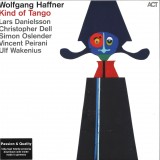
‘Kind of Tango’ is a kaleidoscope of shifting emotions. Wolfgang Haffner’s conception of tango has drama and propulsion in it but also melancholy and longing, with room for frenetic outbursts too. All this is unified by his inimitable groove and feel that commentators have called “an absolute dream,” “magical” and “profoundly relaxed.” Alongside trusted co-protagonists Christopher Dell and Lars Danielsson, he has two guests with him who defy all the clichés associated with tango: guitarist Ulf Wakenius cut his teeth musically in Oscar Peterson’s band and his Swedish heritage always shines through in his playing; Vincent Peirani is one of the leading innovators on the accordion and he finds new ways to define the instrument’s role in the tango. Also, young pianist Simon Oslender makes a first appearance with the band. Jazz and tango find a natural yet constantly shifting equilibrium - to be heard particularly effectively on ‘Close Your Eyes And Listen’ by Astor Piazzolla. In addition to compositions by Haffner himself and by his band members, pieces by the celebrated Argentinian bandoneon player and composer are the focal point of the album. Piazzolla’s innovations with the tango, such as bringing jazz into it, date from around 1955. Haffner and the tango
seem perfectly matched to each other. Tango is no longer a fixed style nowadays, it is above all an attitude to playing and an attitude to life. Wolfgang Haffner’s approach to tango is both authentic and new. It is his and his alone and it is irresistible.
According to the feudal system which was introduced into England by William of Normandy, the king was an absolute monarch, so he could do whatever he liked.
(from Origins of the Magna Charta).
In a cardboard media background, where cliche is law, where the digital essence of the personal data is more meaningful than the person itself, the Bait e Borghi project arises. The natural environment beyond anthropization, the technic and technologic strained clutch inside the places that inspired the album. The traveller meant as the one that makes the trip his own life, and that inevitably moves so far away from common archetypes that defeats every possible storytelling but the sound evocation. A sound that becomes the last unreal notebook like the matter which dreams and memories are made of. An unlikely but possible distopia where our last Thule remains the passage between body and machine, cyberpunk myth yet beautifully imagined and illustrated during the eighties. Not by chance Bait e Borghi share the same starting point, the same region that assumes twisted features if observed from the mid Adriatic offshore oil platforms point of view. Squalo, Giovanna, Ombrina are the point at issue, monumental media short-circuits, disclosed and hidden truths at the same time
Absolute Unity' is the new Dance Music project from Ryan Grieve, a cofounder of Hole In The Sky Records. Ryan has produced as one half of bands Canyons, Fred Cherry and Heart People, among others, with releases on labels DFA Records, Modular Recordings, Universal Music, Warner Music, Hole in the Sky & I'm A Cliche.
Returning from the haze of major record label obscurity and confusion, Absolute Unity is a return to roots with a focus on simple, raw sounds aimed for DJs to play to dance floors.
Repressed in 2023, limited!
Hull/Leeds based five-piece bdrmm release their much anticipated debut Bedroom on July 3, via Sonic Cathedral. The 10-track album was recorded late last year at The Nave studio in Leeds by Alex Greaves (Working Mens Club, Bo Ningen) and mastered in Brooklyn by Heba Kadry (Slowdive, Beach House). It's a hugely accomplished debut and a real step up both sonically and lyrically from their early singles, which were rounded up on last year's If Not, When? EP. Musically, there are nods to The Cure's Disintegration, Deerhunter and DIIV, while the band reference RIDE and Radiohead. There are also echoes of krautrock and post-punk, from The Chameleons to Protomartyr, plus the proto shoegaze of the Pale Saints' The Comforts Of Madness, not least in the cross fading of some tracks, meaning the album is an almost seamless listen. As a result, Bedroom becomes an unexpected and unintentional concept album, running through the different stages of a break-up set against the backdrop of the ups and downs of your early twenties. "The subject matter spans mental health, alcohol abuse, unplanned pregnancy, drugs_ basically every cliché topic that you could think of," reveals frontman Ryan Smith. "But that doesn't mean they ever stop being relevant. It's a fucker growing up, but I'm lucky enough to have been able to project my feelings in the form of this band, surrounded by four of the best people I've ever met." And that band name, in case it needs explaining, is pronounced the same way as the album title. "I never thought I'd get to the stage where I would have to explain it so much," says Ryan. "We have been pronounced as Boredom, Bdum and my old boss thought we were a ska band called Bad Riddim. We're all sarcastic cunts, so Bedroom spelt correctly seemed like the perfect title." He's right. The perfect title for the perfect debut album.
- A1: Choir Of The Damned
- A2: Enemy Of God
- A3: Hail To The Hordes
- A4: Awakening Of The Gods
- A5: People Of The Lie
- B1: Gods Of Violence
- B2: Satan Is Real
- B3: Mars Mantra
- B4: Phantom Antichrist
- C1: Fallen Brother
- C2: Flag Of Hate
- C3: Phobia
- C4: Hordes Of Chaos
- D1: The Patriarch
- D2: Violent Revolution
- D3: Pleasure To Kill
- D4: Apocalypticon
One thing‘s for sure: There aren‘t many bands with a history as long and eventful as Kreator‘s, who fascinatingly succeed in exploring new horizons while challenging and reinventing themselves time and again.That was perfectly illustrated by their latest record ‘Gods Of Violence’ in 2017. With this 14th studio album of their impressive career, the thrashers from Essen, Germany crafted a work of art of utmost vigor, drawing its unfailing power from the pounding heart of one of the greatest, most versatile metal bands of all time.
Mainman Mille Petrozza’s influences range from Hannah Arendt, Pink Floyd and Tocotronic to Slayer, even though he was born and bred in the metal scene. Nevertheless, he is and always has been open to inspiration from various sources, which is why his lyrics are by no means merely based on corny genre templates but offer trenchant observations of our time combined with a witty aside to long-standing cliches: One of the best songs on ‘Gods Of Violence’ is really called ‘Satan Is Real’.
Formed in 1982, Petrozza and ‘Ventor’ – the only two remaining founding members – have come a long way from playing in a small-scale student band. “In my history book, Kreator didn‘t really exist until 1985“, says Petrozza, laughing. “Although we had already started jamming together in `82, we only entered the stage two or three times up until `85. Back then, our set list consisted of five original tracks and five heavy metal cover songs, we went through several line-up changes and didn‘t really find ourselves until ‘Endless Pain’.Over the years, Kreator, the leaders of the German ‘Big Four’ of thrash, have sold more than two million albums worldwide and have played countless shows all around the globe. It is one of these shows that is captured on ‘London Apocalypticon’. Recorded in December 2018 at London’s legendary Roundhouse venue, headlining a bill with US hardcore pacesetters Hatebreed and Norwegian Black Metal legends Dimmu Borgir. Kreator’s explosive set was quite rightly heralded as “a demonstration of consummate musicianship and stagecraft” by Metal Hammer magazine.
When the world slipped into madness last month, the ESP Institute put most releases on the back-burner to await brighter days, but then we thought again; why not approach these odd circumstances the way we do most realities, positively and head-on? We’re committed to a community that builds new worlds — this is fundamental to our creative and spiritual relationship with Osaka-born, cosmos-straggling artist, Ground — and while temporarily we can’t physically congregate to uplift each other, its our responsibility as an institution to maintain a platform for prolific creative pioneers, our cherished cartographers of cognitive escape. 'Wakusei' is wonderfully confusing and disorienting music, a follow-up EP to 2018’s critically acclaimed album 'Sunizm', not created specifically for life under lockdown, but nonetheless aptly suited to help release angst, guide meditation, and assist in making this moment in history more interesting if not transcendental. Whereas 'Sunizm' relied on field recordings gathered from rainforests, percussions learned from imaginary ancient civilizations, and the somehow organic freneticism of a mission control meltdown, the aesthetic of 'Wakusei' reduces this abstract instrumentation one step further to a more base-level array of gurgling synth scraps, accelerating engine friction and static-bound phonetic mistakes, all scrubbed into dust by a Brillo pad of white noise. The cliché of “great art is born out of hard times” is not lost upon us — of course the world will look back to this turmoil and its residual contributions to culture — but we see today's art as an immediate coping mechanism, and artists like Ground helping to unlock and navigate internal utopias. We’re already indoors, let’s delve inside.
"Small Worlds" (2004) a is 42-minute composition for improvising sextet by Austrian double bassist, composer and improviser Werner Dafeldecker. The score is written for any instrument and divides the players into two virtual trios whose constellations change every 3 minutes. No restrictions are made regarding material or playing techniques, the only specification is that in each 3-minute trio, one player has the role of the "dynamic leader" which means that no other player within the trio should play louder than the one on that leading position. Apart from that, the only other restriction concerns how pauses are to be made when two players interchange their positions within the trios.
According to Dafeldecker, the object of the piece is to provide a structure that doesn't curtail the qualities of the musicians, yet forces them to listen very closely to each other and make focused decisions about parameters that are often overlooked in completely free improvisation. Especially, the given structure avoids the emergence of certain clichés that are often present in Free Improvisation, while retaining a very high level of openness with regard to how the piece is performed.
The first published recording of "Small Worlds", by Australian ensemble Quiver, was released in 2017 on CDr by Tone List. This LP contains a recording made in 2004 at Taktlos Festival in Basel, Switzerland, that features the line-up that Dafeldecker originally had in mind when he wrote the piece: Burkhard Beins (percussion), Martin Brandlmayr (percussion), Werner Dafeldecker (double bass), Klaus Lang (organ), Michael Moser (cello), and John Tilbury (piano). Partly, this constellation later also played together in the long-running avant-garde group Polwechsel.
Edition of 300 in regular sleeve with three inserts: two featuring an extensive conversation between Werner Dafeldecker and Matthias Haenisch discussing "Small Worlds", Polwechsel and Free Improvisation in general (German and English), the third reproducing the score of the piece.
It is a cliché to describe music as a trip or an ocean or whatever, so this album, Tecwaa’s album “Beyond the Altai” released on Höga Nord Rekords, will in part be described as a snowman: the snowman has its characteristic familiar shape. He is cold yet there is something warm and cuddly about him, something that makes you feel happy and safe.
The A side on the album goes from that warm/cold cosy feeling but elements of destruction like melodies in minor keys slowly transforms the album to become only cold and not so cosy - the snow turns grey and the snowman’s smiling mouth becomes a twisted grin. Its contours disappears and the shape dissolves as the snow melts and floats out on the ground beneath its body. As the album develops, the sound gets harder and darker and the York based DJ moves closer to his roots in electro and Roland-machine knob-turning.
In some ways, “Beyond the Altai” is a call from the eighties and nineties dancefloors like in the tracks “Back To The Atomic Ether” and “10 Swords” on the B-side but all melts together in Tecwaa’s music to create his own obstinate and loose sound!
The “Under Frustration” project takes stock of the contemporary Arab electronic scene, and highlights its astonishing diversity, by deconstructing Western clichés that are still fantasizing about a culturally homogenous Arab world.
In a context of post-revolutionary disillusion, this ambitious trilogy sets itself as a manifesto of a new, futuristic, underground wave that aims to uplift the Arab voice, once again. With this new release, Arabstazy allows the listener to walk among Shiite, Shaabi or Stambali lands - revealing new mystical sounds, reserved for trance ceremonies and ancestral rituals; all vivid in the eyes of the collective members, musicians, producers, videographers and photographers, nowadays, scattered between the United States, Tunisia, Germany, France, Sweden, Irak, Lebanon and Poland.
Vol2 includes unreleased tracks of Dj Haram, Praed, Hello Psychaleppo, Okydoki and many more.
Curated by Arabstazy, produced by Shouka, published by InFiné.
- A1: Look What You Are Doing To Me (Feat Phonte)
- A2: Let Me Show Ya (Feat Paul Randolph)
- A3: I Can See (Feat Ben Westbeech)
- B1: Lie (Feat Thief)
- B2: Little Bird (Feat Jose James)
- B3: Rockin' You Eternally (Feat Leon Ware & Dwele)
- C1: So Far From Home (Feat Phonte)
- C2: What Do You Want? (Feat Joe Dukie)
- C3: Lucky Girl (Feat Paul Randolph)
- D1: Gafiera (Feat Pedro Martins & Azymuth)
- D2: Morning Scapes (Feat Bembe Segue)
- D3: Dial A Cliche (Feat Paul Randolph)
- E1: Little Bird (Instrumental)
- E2: Lucky Girl (Instrumental)
- E3: Gafiera (Instrumental)
- E4: Look What You're Doing To Me (Instrumental)
- F1: Lie (Instrumental Edit 2019)
- F2: Morning Scapes (Instrumental)
- F3: So Far From Home (Instrumental)
- F4: Rockin' You Eternally (Instrumental)
Very few albums manage to unveil their roots so honestly and at the same time succeed in creating something utterly distinct. "Of All The Things" from Jazzanova is one of these albums.
Originally released in 2008 on Universal, it now gets a luxurious reissue on Sonar Kollektiv as a 3LP with pop-up gatefold cover including previously unreleased instrumentals.
This format corresponds perfectly with the elegant opulence of the music that shines even brighter eleven years after its initial release. At no time is it unclear that this album is a deep bow to soul from the 1960s and 70s as well as genres like jazz, brazil and pop music in the vein of the early Beatles.
Along these lines, "Of All The Things" is meant to be perceived as a tribute to the music that Jazzanova has been honoring affectionately in their DJ sets and which has always had a decisive influence on their own productions.
At the same time, the Jazzanova guys have been successful in casually creating elaborate musical pieces which convey a deeply contemporary vibe - not least because of the multifarious references to electronic productions.
The path to this sophomore long player, which features the contribution of over 50 studio musicians, had been laid out beginning with Jazzanova's first album "In Between" from 2002.
Will Saul is a key figure in UK dance music. Approaching his twentieth anniversary as a DJ, producer and label founder, Saul has helped break the career of key artists such as Leon Vynehall, Midland and Dusky via his Aus Music label, has himself played some of the world’s finest nightclubs and contributed to !K7’s storied ‘DJ Kicks’ mix series, which he also curates.
Finally returning to the production fold himself with his first full-length album in thirteen years, ‘Open Too Close’ is a condensed trip through the influences, discovery and sense of history that have helped shape his career and drive a forward-facing, unblinking passion for new music. The record’s concept reflects Will’s enormous skill and knowledge as a DJ, and as it’s title suggests, “"represents what I play in a club if an 8 hour set was condensed into 10 tracks.”
Having held residencies and made regular appearances at some of the world’s finest clubs including The End and Fabric in London, Panorama Bar in Berlin, Trouw in Amsterdam and Robert Johnson in Offenbach, Saul is uniquely qualified but this refreshingly straightforward approach. Eschewing the lingering, almost cliched expectations for a dance artist to create an album “that sounds good at home, as well as in the club”, ‘Open Too Close’ instead draws on the timeless futurism at the heart of the music that drew Saul into electronic music culture. Simply put, futuristic, melancholic sci-fi soundscapes meets stripped back raw sample driven house music, all executed with the precision and panache of an artist who truly understands how to move a dancefloor.
It has been a long time coming, LDDLM is more than happy to welcome a house friend, Cosmo Vitelli.
This EP is a complement to the recent (and forthcoming) Malka Tuti releases, coherent fragments of a creative year. If Cosmo is known for his wavey-krautey (I have no other words) productions going back to the Bot’ox days, he also has a meaner side.The aptly titled “Un Episode Psychotique” is disco gone wrong, italo with neurosis, straying from polished clichés, musical yet strangely anxiogen.It is turned into an Eighties monster by GOTT aka Sneaker and Scannoir. Their Creatio Instrumentalis is a cold funk monster and their Creatio Continualis amps up the EBM factor.
How does one translate Giallo in Croat? “Tisja” may answer the question, the spoken words of Tanja Vežić burning through the celluloid.
Finally, “The Shy Dictator” is like an early Chemical Brothers breakbeat monster, powerful yet psychedelic, canalised fury of bells and drums.
Will Saul is a key figure in UK dance music. Approaching his twentieth anniversary as a DJ, producer and label founder, Saul has helped break the career of key artists such as Leon Vynehall, Midland and Dusky via his Aus Music label, has himself played some of the world’s finest nightclubs and contributed to !K7’s storied ‘DJ Kicks’ mix series, which he also curates. Finally returning to the production fold himself with his first full-length album in thirteen years, ‘Open Too Close’ is a condensed trip through the influences, discovery and sense of history that have helped shape his career and drive a forward-facing, unblinking passion for new music. The record’s concept reflects Will’s enormous skill and knowledge as a DJ, and as it’s title suggests, “"represents what I play in a club if an 8 hour set was condensed into 10 tracks.” Having held residencies and made regular appearances at some of the world’s finest clubs including The End and Fabric in London, Panorama Bar in Berlin, Trouw in Amsterdam and Robert Johnson in Offenbach, Saul is uniquely qualified but this refreshingly straightforward approach. Eschewing the lingering, almost cliched expectations for a dance artist to create an album “that sounds good at home, as well as in the club”, ‘Open Too Close’ instead draws on the timeless futurism at the heart of the music that drew Saul into electronic music culture. Simply put, futuristic, melancholic sci-fi soundscapes meets stripped back raw sample driven house music, all executed with the precision and panache of an artist who truly understands how to move a dancefloor.
Kicking 2019 off in fine style, we present Boogizm co-founder Fym. Having previously presented tunes on Daniel Bell's 7th City, Circus Company, Telegraph, LMML, and Veniceberg. We have here 4 trax of hi-tech-lo-fi-funk. The works on this wax are devoid of cliche and full of quirky flavors; all whilst maintaining their dancefloor appeal.
DJ Tennis's Life And Death welcomes electronic innovator Moscoman for a label debut that superbly showcases his broad array of club-ready but widescreen sounds. Moscoman is based in Berlin but brings plenty of worldly influences to his music, not least from his homeland of Israel. Next to musical explorations on his own Disco Halal label, he has served up everything from raw and rugged machine disco to melodic techno via wonky house on ESP Institute, Diynamic and I'm A Cliché. He is someone who embraces whatever takes his fancy and has a wilfully random approach to making music that results in never less than thrilling and original tracks. That is the case again here: right from the off 'Wave Rave' is an unusual but effective offering that pairs hands-in-the-air, trance-inducing chords with more reflective melodies and rugged drums. After that one packs a truly emotional punch, 'Dinner For One' is downright dirty. Wild, detuned synths spray about over 'Spastilk'-era snares and rolling drums and the whole thing works you into a lather. On the flip the mood changes again. This time, '550' is a dreamy and zoned out house track with a gorgeous and acoustic lead melody that encourages your mind to wander as you drift along in the warming groove. Last of all, 'Space Comfort' is playful number with sci-fi keys bleeping up and down the scale while harmonic keys and withering retro synth chords bring a sense of spookiness to the fore.
We Are Mattimatti. Two Mattis Living In Different Countries - Sweden (malmö) And Germany (berlin). We Travel Around The World Playing Music While Asking Ourselves, 'who Are We'. The Answer Seems To Change Just As Our Surroundings Do. But The Music Stays With Us And So Does The Friendship. It Is Cliché That It's Hard To Put A Label On Music. And To Say It Has Almost Become A Cliche Itself. But Whole Meaning Of Music Is To Listen To It And Create Your Own World By It. To Create One's Own World One Needs Space. Space That Is Not Interrupted By Either Style Or Defining Categories. Mattimatti Is An Attempt To Step Into That Space Creating Music That Is Solely Built On Improvisation. Our Music Is An Invitation To Places Not Yet Known, Where Rhythmic, Suggestive And Meditative Soundscapes Meet The Present Moment. Music Represents Many Things For Us. First Of All, It Is In-sync With Our Friendship, When The Relationship Is Stuck So Is Our Music. Our Music Is Therapy. We Need To Be Authentic With The Music In Order To Have A Real Friendship And The Other Way Around. As Friends And Musicians We Welcome The Unexpected. This Has Lead Us To Places Where We Never Would Have Ended Up In If It Weren't For The Music. In That Way, Music And Life Walk Hand In Hand. If We Dare To Be Real About It. We Are Living In A World Full Of Confusion When It Comes To Identity. It's Easy To Loose Yourself. All Of A Sudden You Are Standing There Playing Music But Missing The Music At The Same Time, Or Hanging Out With Your Best Friend While Missing The Friendship. We Are Trying To Stay Connected. It Is A Constant Task. We Lose It But Then We Find It Again, Just Like Everybody Else. Sometimes It Ends Up In Music For The Moment. Sometimes It Ends Up In The Shape Of A Record. We Met On The Streets Of Berlin In Spring 2013 While One Of Us Was Playing On The Streets. After We Played The First Time Together, There Was No Question That We Would Travel A Musical Journey Together From That Day. Mattimatti Was Initiated. On Our Quest We Began Playing Improvised Tunes On Sitar And Hang On The Street While Travelling Through Sweden And Germany. This Lead Us To Be Invited To Numerous Festivals All Over Europe While Constantly Developing Our Music And Sound. Since Then Our Set Has Added New Instruments Such As A Drum Kit With Hang, African Harps, Sitar, Guitar, Harmonica, Clarinet, Hank Drum And Vocals On Top Of It Extending The Sound With A Space Echo. The Long, Intimate Tunes That We Are Creating Have An Original Structure And Sound. There Is A Certain Present Resting In The Music Which Is Hard To Describe But Easy To Experience If You Listen To It. Our Live Concerts Have Been Dubbed Mythical, Hypnotic, Magic And Epic. Traveling Is Our Biggest Influence On Music. Mattimatti Are Now Both Based In Berlin & Malmoe And Work Together With The Contemporary Circus, Dance And Music Group - kollektiv Knaster .
Emotional Rescue is delighted to present the first of two EPs from British '80s band Furniture, starting with their much sought-after, six-song "mini-album" - as they were known then - which has recently been rediscovered by a new generation of DJs and collectors. "Transatlantic Cable" compares the cliches of a certain type of American romance - Bogart, Sinatra, Dean - to the reality of life in West London. "They're On Me" is probably one of very few pop songs to feature double bass and the word "newsagent", while "Robert Nightman's Story" is powered by a riff on marimba and abrasive rhythm guitar.
"I Miss You", a torch song so good you'd think Julie London might have cut it. A highlight for many is "Why Are We In Love". This track is a key reason for the revival of interest in the band, with pattering rhythm part and the sweet clarinet melody, creating an atmosphere that has attracted a following among discerning DJs. "A Letter To Myself" introduced the band's new, expanded line-up adding Sally Still (bass, vocals) and Maya Gilder (keyboards), which would endure until the band stopped in 1990.
- 1: Folly
- 2: Better In My Day
- 3: Little Lambs
- 4: Old Thorn
- 5: Dieu Et Mon Droit
- 6: Throne
- 7: Mongrel
- 8: Glory
- 9: Tea Rooms
- 10: Jerusalem
- 11: Dance Of The Peddlers
- 12: Hobby Horse
- 13: Sunny Stories
- 14: Over The Hills
Coloured[16,77 €]
'Bound to shake your walls and rattle your windows' Max Reinhardt, BBC RADIO 3 "The first bit of evidence that Elizabeth Bernholz's next album Pastoral - due out in September - could be her best to date". THE QUIETUS "Will likely be one of the year's very best records.' CLASH 'What species is this What century' Forged in a rural idyll in Middle-England, the new album Pastoral, by Gazelle Twin, exhumes England's rotten past, and shines a torch over its ever-darkening present. Told through a troupe of multi-gender voices, in vernaculars old and new; from the shrill echo of folksong to tabloid-tinged jaunts, the artist aka Elizabeth Bernholz, presents the notion that 'there is horror in every idyll, and danger lurking beyond the 'quaint' '. The village square - once host to centuries of public torture - becomes a floral framed postcard, dolled-up for the Summer Fête. A sunny, afternoon walk over the hills unsettles a cloud of angry flies feeding from unidentifiable remains. Bigoted vitriol gently murmurs amidst tearoom chatter, as the neatly framed pastoral picture dissolves into a solemn ennui. Four years in the making, amidst life-changing events, including a move far out of the city, Pastoral will be the first major release by the artist since her widely acclaimed LP UNFLESH (2014, Anti-Ghost Moon Ray) and is seamlessly on-theme, together with Bernholz's J.G. Ballard-inspired A/V show 'Kingdom Come' (soundtrack released November 2017, Anti-Ghost Moon Ray) - a fascism-infused hellscape, this time set in deepest Old England. As its sole creator, Gazelle Twin 'The Composer, Musician and Producer' has crafted an album overflowing with a frenzy of traditional and contemporary musical tropes; from early music instrumentation - the harpsichord and the humble recorder, fed through myriad electronics - to the compelling, ritualistic application of found sample-looping. Beyond Bernholz's signature choral-infusions, here reverberating like a warped Sunday Service, there are even shades of '90s house and the once-thriving rural rave scene, albeit recalled as a watery, second-hand memory. In its consummation it is an album that feels pan-century, even pan-species. Set against a verdant backdrop of hedgerows and steeples, Gazelle Twin 'The Artist and Performer', constructs an eccentric and commanding visual embodiment of all-of-the-above - a costume fit for a court Jester of the 21st Century. The colours of Neo-Nationalism. Coke cans, and DANGER. 'It' (not 'she') hints at folkloric traditions with a footy mascot twist. The 'Ye Olde' and 'The Everyman' of the English cliché. Brandishing a sneer and a hobby horse. A riddle and a recorder. A jeer and a square dance in red, Adidas Gazelle's, and a mad, fixed GRIN - first glimpsed in the single, 'Hobby Horse' (22 June, Anti-Ghost Moon Ray). A deranged, absurd reflection of deranged and absurd times.
Do you like Love songs After spending a lifetime spent avoiding this subject in song, Joel Sarakula finally admits that he does. On his new album "Love Club" Sarakula relives the golden age of Soulful and Romantic Pop music and connects it with a modern aesthetic. While a deeper message of love and peace flows through the record, Joel Sarakula is no old fashioned hippie: ",Love Club' is about connecting to reality and re-framing the idea of romantic love and loss in the present, loveless age ". Featuring eleven songs touching all genres from disco to blues, from soul to soft-rock, Joel Sarakula's "Love Club" is a profound pop statement.
Joel Sarakula has travelled the world in search of his muse, experiencing everything from being a victim of Caribbean carjackings to performing in the remote fishing villages of Norway, via the dive bars of Europe and the US. It was the hodge-podge musical tapestry of England's capital that finally drew him to a settling point, in the wake of seemingly never ending run of shows. With personal tastes that span from the more avant-garde to soul and pop greats like Sly Stone, Todd Rundgren and Hall & Oates, there are clear nods to contemporaries like Unkown Mortal Orchestra, Erlend Oye and Toro Y Moi in terms of ambition and style.
With his last two albums "The Golden Age" and "The Imposter" collecting strong radio plays at BBC Radio 2, BBC 6, BBC London, XFM Joel Sarakula has been play-listed nationally in Europe including Flux FM, WDR 5, Radioeins, Bayern 2, Deutschlandfunk and Deutschland Kultur Radio in Germany as well as in Benelux and Italy and Spain. He is a regular fixture on the live festival and club circuit in the UK, Europe and internationally including appearances at SXSW, Primavera Sound, Glastonbury, The Great Escape, Liverpool Sound City, Scala London, Tallinn Music Week, V-ROX (Vladivostok) and Reeperbahnfestival Hamburg.
"Love Club" is Sarakula's bold and unashamedly emotional next step. In essence the album is a homage to the soulful singer & songwriter artistry of the Seventies filtered through a darker contemporary lens - fitting for these uncertain times. "I always shied away from generic love songs," the Sydney, Australia born songwriter admits, "but on this record I embraced the subject wholeheartedly... and intellectually, looking at themes of love, lust, loneliness and everything in-between." Take the first single "In Trouble", co-written with Michele Stodart of The Magic Numbers, as the best example for Joel Sarakula's unique, and honest approach to making music. "We Used To Connect" questions the changing nature of relationships in our social-media addicted world: 'We used to connect in the real world too, now the touch of your hand is a digital cue'.
"Coldharbour Man", on the other hand, examines the identity of the song's narrator and the artist vs. fan dynamic all wrapped up in a disco love song: "There's a lot going on in this particular track. I feel my writing has grown emotionally...", explains Joel Sarakula. "Just best to listen yourself and make up your own interpretation!: 'We met in a song come to life like some fantasy cliché, though I'm known for my moves in the dark you flooded sunshine on my day'. Then there's "Baltic Jam", capturing romantic love and loss in authentic 70s confessional singer & songwriter style and of course "Dead Heat", a song about how there is struggle in the most perfect relationship pairings as the match is so even: "I recall an ex-girlfriend of mine... when we first met, we thought we hated each other but we eventually flipped that emotion and realised we had a deep passion and love for each other, there just was a lot of underlying sexual tension!" : 'It's a battle we could only win, if we lose. We'd be stronger if these lonely ones became two'.
More than a year in the making, Joel Sarakula recorded "Love Club" in various studios around London and Berlin capturing soulful performances from his many musical comrades on vintage analogue equipment. "This record has truly been a labour of love. Recording and privately sharing these performances amongst my collaborators started to feel like a bit like a club - I guess that lead to the album title! I was surprised how much I actually enjoyed the 'love-making process' and I look so much forward to playing these new songs on stage with my band." We can't wait, Joel Sarakula.
Darren Cunningham's eagerly~awaited new album is an adventurous, ultramodern, thoroughly British affair, rummaging about in the inner lives of house and techno, and brilliantly elaborating the accomplishments of his debut, Hazyville.
Determinedly off~the~map and resistant to pigeonholing, Cunningham is an enigmatic and playful figure, citing Francis Bacon and Monet as inspirations longside Theo Parrish, Anthony 'Shake' Shakir, Daft Punk, 'binary codes and numeral systems', and The Avengers. He's a hard man to pin down - somehow a key player in the post~dubstep diaspora and yet not there at all - but everything comes across in his shape~shifting, richly textured music.
The South Londoner's acclaimed debut lived up to its name: a series of dreamlike sketches and ideas. For Splazsh the fog has lifted, the sounds are less submerged than before, but still sticky and close - a signature combination of exuberance and introversion, luminescence and puzzlement. Unconstrained by the formal cliches of the dance music he loves, Actress' melodies and arrangements are enthralled by their own genies. Worlds of disturbance and melancholy revolve giddyingly inside the insidious funk of tracks like Get Ohn and Lost. A range of musical influences is redrawn, from speed garage (Always Human) to grime (Wrong Potion), with none crowned king. There is a reflectiveness - the ambient drift of Futureproofing, the radiophonic judder of
Supreme Cunnilingus - in amongst the industrial, synth~wave flavours of Casanova, and the stirring, stately Maze.
Actress has quickly and justly become one of the most respected names in the UK's new dance music underground. His own label, Werk Discs, has proven itself one of the most formidable and taste~making UK independents of recent times, bringing the world extraordinary albums from Zomby, Lukid, Lone and Actress himself. In love with the mysteries of groove and repetition, Splazsh is both a culmination and a new beginning for Actress, a substantial and eccentric work from a brave and coolly individual artist.
With international press interest gathering - photo features in Dazed And Confused, and Fader in the US, and a session with Wolfgang Tillmans for the cover of the German magazine Groove - the stage is set for Actress.
- A1: Tactics Is Hench
- A2: Activator, The Actualizer
- A3: We Lack The Clout The Decision Isn't Ours To Make, There Was No Crusade After All
- A4: The Story Of Our Salvation
- B1: Magnitude Of Oblivion, Refrain Of Pacific Calm
- B2: Aerosol Tropics
- B3: Perfect Lung Polymer Earth
- B4: We Were Big They Were Small, We Used To Be Crucial
The third and final release from Halocline Trance for the calendar year is Perfect Lung, a collaborative album from Istanbul-based composer Ipek Gorgun and Ceramic TL aka David Psutka (Egyptrixx, Anamai, Limit). A decadent yet durable offering of material sound, recorded remotely during 2016 + 2017 in Toronto, Ankara and Istanbul. Seven songs of original, accidental music that span colour and feeling; the petroleum psychedelia of Ceramic TL framed by Gorgun's precise and emotional landscapes. Inhaling/exhaling full register slabs hint at the multi-dimensionality of optimism and voicelessness...multiple things in multiple ways. Chill melodies plod then dissolve entirely like a casual toil. Whatever you like. All creative output is eco-political in nature but this record avoids directive and cliche. Moments of clarity glint through piles of junk; total quantity mimics eruptions of precious material - an unrealistic examination of the concept of material value as defined by its relative scarcity...this album is a lot. A fixation with excess contrasts the corporeal impermanence of humans with the material half-life of their consumer existence. Our legacy is trash - stray objects inside the perfect lung.
Having been an electronic activist in Marseille for more two decades and more, DJ OIL is now a firm staple of LDDLM. Following the RAIN ep released in the summer 2016, here is the first 2018 outing from us: the already bubbling HERITAGE ep.
'Heritage' has been an Ivan Smagghe (and a few others) secret weapon for more than a year now, a strange sampladelic track featuring a full Marcus Garvey speech. A subtle yet powerful appropriation of early house clichés, the hit has one feet in tradition, one feet in political modernity.The EP comes with two more warped cuts: the slow guitar swamp of 'Brouillage' and the System 01/McKenna influenced 'May Be'. Psychedelics and sun.
A second 12' by DJ OIL will follow shortly, doubled with a full digital release of the two EP's with digital extras.
Expect new releases from our camp by Rheinzand, Init, Johnson and more...
We started with the principle - the cosmic idea that we were taught by our father from a very young age - that the stars and planets make a sound, that deep in outer space there is audible harmony.'With its cathedral-like, richly resonant acoustics, the new HBE album is a brilliant expression of this interplanetary principle. The album is by turns urgent and contemplative, funky and reflective, varied in its textures, but entirely of one piece. Underpinned by concepts of our earth's place in the cosmos, held in place by meditation, swirling with notions of history, science, theology, ancestry, there is a rich conceptual brew here. But always, what talks loudest is the music. The album rings with what back in the 1950s the jazz critic Whitney Balliet called the sound of surprise'. At a time when the phrase Spiritual Jazz threatens in some quarters to become a tired cliche, this is a record that makes you believe again in the genre's validity.
Talking to Cid, one of the Ensemble's two trombonists, one phrase recurs: back to the beginning'. We wanted to go back to the beginning, when we were kids, real young, and our father would wake us up at 5 AM to practice for two hours before breakfast.' One outcome - initially unplanned but subsequently embraced - is that unlike their two previous albums on Honest Jon's, this is an album without a drummer. When we started, as Wolf Pack, just brothers on the street with our horns, there wasn't a kit in sight.' Book Of Sound retains plenty of rhythmic heft, but the absence of a drummer opens up space for a notably varied instrumental palette. Acoustic guitar, piccolo, synthesiser, alto sax - none of them typical HBE Instruments - all have their place on the album. Most striking perhaps are the vocal lines that thread through the album and give it a palpable warmth. In Wolf Pack, we rapped and played, this time we took it a step further.'
Sessions were recorded in Brooklyn and Chicago, and brilliantly mixed at Abel Garibaldi's studio in the Loop ( Abel was like a musician on this record'), and it's the Hypnotic's hometown that permeates. For Cid this is a deeply Chicago record: it's got the vibe of the lake, the vibe of the prairies opening up to the west'. It also has the vibe of those Sun Ra Arkestra albums recorded in Chicago in the 1950s, and - of course - the Phil Cohran albums from the 1960s.
It's Phil Cohran (the father of all seven members of the Ensemble and their first teacher, and not just in music) who is the album's guiding spirit. For Cid it's a major regret that, in the months before their father's death early in 2017, Phil was not well enough to play on the album. He loved the whole idea, and we had the perfect place for his zither'. But Book Of Sound is a magnificent testament to their Cohran legacy. You know, it's tough trying to satisfy everybody with our music. It's hard enough satisfying ourselves, let alone the jazz scene, the hip hop guys, what have you. With this album we just dropped all that as a consideration, and tuned into deeper principles.'
My Favorite Robot welcome the collaborative outfit of Rodion & Local Suicide for their next EP, which comes boosted by
remixes from Los Mekanikos, Moscoman and Fairmont, as well as artwork that is made up 3D prints of the act.
Rodion is an Italian classical piano player and acclaimed producer whose albums and EPs for the likes of Gomma, Nein
& Nang have helped to reshape modern disco. Also one half of Alien Alien and boss of the Roccodisco label, he is a real
studio visionary who for ten years has mixed up classical, trance and psychedelic sounds. He makes everything from
chamber music to computer game soundtracks, has remixed Giorgio Moroder and counts the likes of Tim Sweeney, Erol
Alkan and DJ Hell as fans. Berlin-based duo/couple Brax Moody and Vamparela aka Local Suicide have been
collaborating together since 2007, either as a DJ duo, in bands, or as remixers and producers. They have played all over
the world and are in favour with the likes of XLR8R, Thump and Mixmag for their fusions of slow techno, post disco and
acid.
These original analog tracks were recorded between 2014 and 2016 in Rodion s vintage studio in Berlin. They came about
when they all met following one of his gigs just after he moved there, and after being in touch online for a while. During
one of the nights, Rodion brought friend, producer and singer Ali Bey (part of the Belgrade DJ collective Beyond House
and a famous record digger) to contribute.
Impressive opener Abu Dhabi includes samples from field recordings from all over the world. The most prominent is the
recording from an airport in Bangkok where Brax Moody and Vamparela were waiting to catch their plane to Saigon
and it ended up being the main vocal hook. The alluring track is a wonky feeling number with gurgling synth lines and
gentle releases of white noise lulling you into the groove. A searching synth line and distant siren add urgency and the
whole thing feels urban and futuristic.
Comprised of Mexico City producers Max Jones and Eddie Mercury, Los Mekanikos combine raw hypno-rhythm tracks
with pumping grooves that pay homage to Chicago, Detroit and Berlin. Their special remix is another late night and
unhinged number that encourages you to freak out amongst the panning and paranoid synth patterns and robotic grooves.
Then comes the brilliant True Love Floats with Ali Beys singing and Vamparela s vocoded vocals. The interplay between
the two is tense and alien and makes for a perfectly inhuman groove with popping bell sounds, undulating pads and spooky
deep space ambiance.
Remixing this one is Berlin via Tel Aviv artist of the moment and Disco Halal label head Moscoman, whose raw machine
grooves have impressed on labels like ESP Institute, Correspondant and I'm a Cliche. His slow and purposeful version is
deep and psychedelic with disorientating vocals and blistered synths wallowing in a menacing urban landscape. Buy it
digitally and you will also get a fine remix from label regular and Canadian Fairmont. He runs the Beachcoma label, has
worked with cult outlet Border Community over the years and mixes up dark disco and goth into his own fresh sounds. His
remix here is more direct and driven, with powerful drums and well sculpted synths making it another great rework.
This is a unique sounding package featuring plenty of heavyweight names and marks another cultured outing from the
always considered My Favourite Robot label.
Fuckthegovernment.Ltd, a.k.a. F.T.G (Alfredo Trastulli) and Music Box head honcho, Marco Riff, return to the Skylax fold in 2016 with a cache of house nuggets for our listening pleasure. Their last venture on Skylax saw F.T.G collaborate with a bunch of his friends, resulting in some of the best tracks we'd heard all year, including the unforgettable Fuckthegovernment theme. Their tracks have been celebrated and hailed by some of the best DJs in the game, names such as Derrick May, Ricardo Villalobos, Raresh, and DJ Harvey. The bar set by the first record remains sky high, and somehow, these two manage to raise the bar even higher. It may be the biggest cliche going when talking about an album, but the duo certainly do take us on a journey, through the past and present of house music. It's a record not too dissimilar in tone to Paranoid London's from a few years back, but F.T.G and Marco strip things back even further than those guys did, in our opinion; The sound is more raw with less frills, and no track names to predispose feelings in the listener either. This eight track project is cohesive and elaborate, with movements through sounds both acid and jazzy, minimal and maximal. It explores sounds that came to prominence in famous house locales such as Detroit and Chicago over in the U.S., but the underground European influence is definitely present, from Paris to Berlin, and of course F.T.G and Marco's home of Italy. With this album, these guys add to the underground sound that has cultivated in the city of Perugia for years now, a place that has seen the likes of Simoncino and Nicholas hone their craft.Don't miss out on a piece of Skylax history!
Written and produced by Dave Clark
Celebrating our 20th release, Glasgow's Dave Clark returns to Optimo Trax as Sparky. He was responsible for the third release on the label as LUMA which featured the club smash "John Broadwood" and recently had another big club hit with "Signals" on Numbers. We are delighted to welcome him back in what is a contunuation of a relationship that stretches back further than we care to remember.
All four tracks here are certified dancefloor winners; from the reach for the lasers, kickless "Things Fall Apart" through the synth rhapsodies of "Black Swan" and "My Prophet", climaxing in the jacking "Seven Daggers". All killer, no filler is often a trite cliche in these blurbs but is entirely true in the case of this EP.
Four track 12" EP (and digital release) released on April 22nd 2016. Distributed by Kompakt and Rub A Dub.
Vactrol Park is an honest outpouring of thematic obsession, a celebration of championed studio components and the mastery of their nuance, an avant garde collaboration between Kyle Martin (Land of Light, Spectral Empire) and Guido Zen (Gamers in Exile, Brain Machine). Simply entitled "I" (the first of a 2 part series), this debut EP opens the door to a world of ebb and flow, layers of oscillation falling in and out of sync, keeping us on the brink of vertigo and, as cliché as it may sound, we find solace in its chaos. This homogeneous release plays with the notions of systems as beautifully symbolized Mario Hugo's capsule of cardiology—yet another visually arresting module in the ESP Institute catalogue. Some music is made for drugs, some is made on drugs, these tracks simply are drugs.
It takes time for a series of seperate ideas to evolve into a fully concepteptualized album if it wants to have a place in history for Ali and Basti Schwarz, better known as Tiefschwarz. Since 1998 the duo, as both DJ's and producers, have perfected the art of dominating the moments only experienced on a dance floor, deeply immersed in sound. Their music is unique as it is creative. Among the countless extended players and remixes, the three landmark Tiefschwarz albums: 'RAL 9005, 'Eat Books' and 'Chocolate' all have a common thread weaving them together; a historic vision uniting the musical crossroads of past and future. As with the previous albums, Tiefschwarz pause briefly on the subjective localization of artists in the (music) world to create an album which unfolds like a story told by master story tellers. Igniting the dance floor while at the same time giving the listener the opportunity to look beyond themselves and into the journey that is 'Left". With 'Left", Tiefschwarz were able to radicalize the album-specific approach and focus more intently on combining grooves with an introspective perspective. They refrained to bring in an outside co-producer for the album and made sure to forego the cliche variety of guest musicians, concentrating instead on one congenial companion: Khan, who both Ali and Basti have been close friends with since the 90's. Khan, a Frankfurt native of Turkish and Finnish decent, is one of the most prominent and exhilarating German Techno pioneers.
Building on her first LP April Song Sara Mitra draws folk blues and psychadelic influences into her second LP. Recorded and produced by Ben lamdin / Nostalgia 77. The LP was previewed by Gilles Peterson on BBC 6 Music & Sara conducted an interview feature with Jamie Cullum on BBC Radio 2
Press quotes include the following:
Her skill as a songwriter and honesty as a performer shine through" Mercury Prize Recommends
Especially talented" The Daily Telegraph
Fresh sounding and free from cliche..., Sara is left to her own special devices and nails a good melody everytime." Blues and Soul Magazine
Mitra has a really fresh-sounding voice: a great night" The Sunday Times
I love her voice, I love her Englishness." Gilles Peterson
Crooked Man is Richard Barratt from Sheffield, better known as Parrot. He was first off the blocks playing house music in Sheffield back in the 80s, had a top 10 hit in '88 as part of Funky Worm, collaborated with Richard H Kirk on the seminal Sweet Exorcist releases on Warp and had another top 10 hit in the 90s as part of The All Seeing I.
Retiring from DJing, a few years ago he started putting out 12" singles as Crooked Man. Song-based and devoid of house music vocal clichés, often epically long, always full of character, endlessly hypnotic and with razor sharp production they would always cut through in every DJ set they were played in. Twitch was an instant evangelist of the Crooked Man sound and is delighted to now present his debut Optimo Trax 12" EP.
Vocals on A1 and A2 by Rachel. Vocals on AA1 by Pete Simpson.
After a superlative EP from Chicago's DJ Rahaan, Dublin's Fatty Fatty Phonographics is back with another installment of Pablo and Shoey's 'Rejigs', which have had support from the likes of Hot Toddy, Bicep, Get Down Edits, Leftside Wobble, House of Disco and Rub'N'Tug.
'No Good (Start The Jack) sees them take on Kelly Charles' 'You're No Good', a late 80's New Jersey house bomb and source of the infamous vocal hook from The Prodigy's 'No Good (Start The Dance). After one of the great 80's dance music clichés - an intro where some sassy mama gives her boyfriend shit down an old school telephone line - they go straight for the jugular with that big big hook, spinning the whole thing out for 10 minutes with lots of hypnotic piano loops and large chunks of the great song at the heart of it all. This is one that the crowd will be immediately singing right back at ya at 2am!
'Gonna Get Ya', meanwhile, goes for some Greg Wilson 'Edit The Edit' style shenanigans, taking on Barna Soundmachine's sly, slinky funk loops. The Barna man's original had a whole heap of Diana Ross' vocals from 'I'm Gonna Make You Love Me' at the centre but never let rip with the big hands in the air chorus. The lads have rearranged it here so it's alot less teasin' and alot more ease-in!
The 3rd track is as important to Pablo and Shoey as it is to Moodymann, so 'Funky Rump (Tribute To MCA)' pays tribute to the sadly deceased Beastie Boy by looping up some busy jazz drums from 'Paul's Boutique' and splicing it with a very fitting in concert tribute from the one and only Flava Flav of Public Enemy. The full track, when it eventually arrives, is a relentless clav funk monster that just keeps going and going....
We're very happy to welcome aboard new imprint Back To The Balearics
It's a label on a mission to uncover music with significance, special sounds that can make a moment out of nothing.
In an increasingly fast and disposable world the need for such moments is more important than ever.
The first release, by Belfast's MARICOPA, perfectly defines that sound. His electronic tracks blend naïve beauty with emotional depth in a sonic landscape devoid of all the usual musical clichés of dance music.
Back To The Balearics is a journey to nowhere in particular with plenty of musical stop overs on the way.
We hope you will take the trip...
If geography has an impact on music, then Vienna has coloured Tosca's music at every turn. Over the course of a career spanning two decades, the Austrian capital has inspired Richard Dorfmeister (of Kruder & Dorfmeister fame) and Rupert Huber to make electronic mood pieces coloured with Mitteleuropean melancholy.It's a bittersweet juxtaposition that is much in evidence on the pair's new album, 'Odeon'. It opens with the hazy strings of 'Zur Guten', which ebbs into the oozing keys and pizzicato steel string guitars of 'What If', which features a smokey vocal from Sarah Carlier. Lead single 'Jayjay' is a haunted combination of sombre piano chords, rolling drums and weird, otherworldly vocals from JJ Jones. It's the pivotal track on a record that sees Tosca tapping into gothic atmospheres. It's darker than their previous five albums, more downbeat, at times ambient. It's unlike anything else out there at the moment.Is there a reason for this sombre tone Nothing specific. "Obviously our music is influenced by our experiences of life - it couldn't be any other way - so in some senses it's a kind of diary, but there weren't any single incidents that caused the record to be that little bit darker," says Dorfmeister. If anything, the exact opposite is true: life has been good. "Over the last year I think we've both learnt to be more generous and to understand our own limitations and other people's" says Huber. A case of musical yin and personal yang, then.The album's name, meanwhile, comes from the venue in Vienna where Tosca debuted the new material in October. The performance went so well they decided it would make a fortuitous name - the music/place interface in action once again. The performance features as a bonus disc on the deluxe version of the album, which will be available exclusively via !K7's webstore. More than anything, 'Odeon' is the sound of a band at the top of their game. A good time for them to release a career retrospective then. Dorfmeister reflects on the band's history. "It sounds like a cliche, but we've never really thought about other people's music when we're writing our own," he says. "We try and create our own sound. We really have always been like that. And I think we've developed a trademark sound because of that." They certainly have. It's been called the "Vienna sound". And, in updated form, it still sounds like nothing else.
Double Gatefold LP with bonus CD of the entire album


