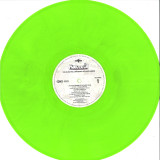
Combination summer anthem by Japanese reggae DJ BunBun The MC and singer Sister Sheez. Remixes by Akio Nagase (EmotionalEspecial,DarkerThanWax,Chillmountain Rec) and Big Ken-G, previously only released digitally, are now available on vinyl for the first time.
Cerca:combination records
On their second album, Winter Pageant, The Softies move forward with focused delight. It's the combination of Jen Sbragia (All Girl Summer Fun Band) and Rose Melberg (Tiger Trap, Gaze, Go Sailor) that molds The Softies' panoply: feathers and thorns, fawn and fearless, fable and friction. Originally released in 1997, Winter Pageant is the drama of utter melancholia documenting the broken promises, missed phone calls, conversations stalled, love lost. Colossal tasks recorded two guitars deep, forming a new Iliad, chapters on brave deeds and the power of love on the move. You can live for love, or you could live for the splendid cascade of guitar on guitar, voice over voice: The Softies. Winter Pageant was recorded by Stuart Hallerman (Soundgarden, KARP) at his Avast! recording studio in Seattle, Washington.
Ben Reed has worked with Frank Ocean, David Byrne, Sampha and many others, but his own music is unpredictable, passionate and tinged with melancholy and has drawn comparisons to the so-called Canterbury sound of Progressive rock.
‘Bandaged’ is much more in the singer/songwriter vein than Ben's previous releases, albeit tinged with an undeniable British proggy-ness. The richness of melody and harmonic vocabulary remains, and the influence of jazz is still detectable, this time via more concise song forms.
Past review comparisons to the Canterbury sound aren't too far wide of the mark here, especially as Jimmy Hastings (Caravan, Hatfield & the North) is present on two of the songs.
Throughout the album there is a detectable combination of sentimentality and melancholy combined with playfulness and a dark sense of humour making ‘Bandaged’ one of the most interesting and innovative new albums of its genre in 2023.
Magic Combo is a vinyl-only label that specializes in limited edition edits of iconic original tracks, symbolizing the rich diversity of musical genres such as Afro, Funk, Jazz, Blues, R&B, and Classic House. This label is a melting pot of emotions, love, and musical improvisations, brought to you by a dynamic combination of emerging Italian and international musicians, DJs, and producers. Each release is a carefully curated selection that represents the soul of its genre, offering a unique listening experience that transcends the ordinary.
The Magic Combo label is not just about music; it’s about creating a connection between the listener and the sounds that have shaped generations. Our limited edition vinyl are a testament to the enduring power of music and the magic that happens when different cultures and sounds collide. It’s a celebration of the past, present, and future of music, encapsulating the essence of each genre while pushing the boundaries of what’s possible. Join us on a journey through sound with Magic Combo, where every record is a story, every beat a heartbeat, and every spin a new discovery. This is where the magic of vinyl comes alive, and where the love for music is immortalized in every groove.
- A1: So Close
- A2: Life Of A Dj (Feat Demolition Man)
- A3: Outta Orda
- B1: Save Me From Myself
- B2: Endless Dreaming (Feat Bulgarian Goddess)
- C1: Automatic
- C2: Consciousness
- D1: Moonshine
- D2: Odyssey (Feat Evil B)
- D3: Keep On Dancing
- E1: Make Me Feel
- E2: Natty Love (Feat Sweetie Irie)
- F1: Pyramidz
- F2: Journey To Outer Space
Warehouse Find!
Undoubtedly one of the most exciting acts to have emerged in drum & bass over the past decade, Voltage has joined forces with Hospital Records for the release of his long-awaited studio album 'Balance Over Symmetry' which marks the tenth year of his journey as a solo artist.
No stranger to the Hospital family with an album, 2 EPs and a handful of singles under his belt as part of drum & bass powerhouse group Kings Of The Rollers, it's now time to explore the solo sounds of Voltage which have slowly but surely carved him to be one of the most respected DJ & producers in the scene.
In his true rambunctious style, Voltage sets the swing with a wild card. 'So Close' is a sub-120BPM synthwave weapon which matches his retro-inspired fashion to his musical vibrations. The combination of catchy vocals, an 80s-esque bassline and an unforgettable topline melody sees the creation of something extremely different yet irresistible from Voltage.
Not straying too far from the roots of his influences, 'Natty Love' features the groove inducing vocals of sound system legend Sweetie Irie. Saturated sub wobbles juxtaposed with potent string plucks are intertwined with ease, peppered with that signature Voltage flair.
Teaming up with reggae and dancehall superstar Demolition Man known for his skill as a vocalist, producer, MC and sound engineer, 'Life Of A DJ' combines the sounds of Demo's with Voltage's unmissable sonic technique. 'Save Me From Myself' exposes
the lighter side to Voltage as he illustrates his versatility as an artist through a soul-heavy amen roller with a classic liquid bassline.
Reminiscent of the days of euphoric hardcore, 'Keep On Dancing' sets the vibe with uplifting piano chops and adrenalised vocals as crunchy snaps and rhythmic cymbals keep things moving beneath. An iconic duo to everyone who knows their drum & bass, Voltage and Evil B come together for 'Odyssey' which sees ambient soundscapes
and earnest lyrics on a truly heartfelt piece of music.
With releases on foundational imprints such as Metalheadz, 31 Recordings, RAM, Souped Up and Spearhead to name a few, Voltage's discography speaks for itself in laying down his years’ worth of experience within drum & bass. With support for his productions coming from a wide range of influential selectors including the likes of Andy C, Hype, Friction, Goldie, Bailey, Hazard and Bryan Gee, it's safe to say that 10 years of Voltage has been a remarkable decade to say the least. Here's to 10 more…
Belgian progressive post-hardcore quintet Hippotraktor have announced their second full-length album, `Stasis'. The combination of impressionistic songwriting ambitions and powerful, narrative-charged lyrics proved to be a perfest match for the band so far. Operating at the intersection of Meshuggah's relentless, polyrhythmic pounding and Gojira's colossal atmospheric weight, Hippotraktor have expanded upon their already distinctive sound by introducing De Graef's vocals that bring with them an intriguing new dedication to musical storytelling. "Stasis tells a story of human nature," explains lead vocalist Stefan De Graef about the album's narrative. "As the protagonist enters a new world in which he is confronted with other humans for the first time, he acquaints himself with their customs and ethics, discovering generosity and empathy, but also greed, jealousy and hatred." Taken from the Greek for `stoppage', `Stasis' sees Hippotraktor doing anything but stagnating. Hippotraktor chart intricate melodies and sprawling riffs as a map showing how humanity has come of age in a chaotic world of its own making. Deftly unveiling tender truths whilst tenderly shrouding the violent majesty at its core, `Stasis' is a fitting soundtrack to life in a world that's hurtling towards a stand still.
- A1: Dennis Coffey And The Detroit Guitar Band - Scorpio
- A2: The Jimmy Castor Bunch - It's Just Begun
- A3: B T. Express - Energy Level
- A4: James Brown - Get On The Good Foot
- A5: Afrika Bambaataa & The Soul Sonic Force - Planet Rock
- B1: Manu Dibango - Soul Makossa
- B2: Esther Williams - Last Night Changed It All
- B3: The Mohawks - The Champ
- B4: Herman Kelly & Life - Dance To The Drummer’s Beat
- B5: Spanky Wilson - Sunshine Of Your Love
- C1: James Brown - Give It Up Or Turnit A Loose
- C2: Candido - Soulwanco
- C3: Arthur Baker - Breaker's Revenge
- C4: Manu Dibango - The Panther
- D1: Abaco Dream - Life And Death In G & A
- D2: The Jackson 5 - Dancing Machine
- D3: Mongo Santamaria - Cloud Nine
- D4: Edwin Starr - I Just Wanna Do My Thing
- D5: Badder Than Evil - Hot Wheels
Compiled by legendary producer Arthur Baker, ‘Breakers Revenge’ is a near-definitive collection of original Funk, Soul, Latin, Disco and Electro classic tracks from 1970-1984. These tracks, a combination of classics and obscurities, have all since become legendary to Breakdancers everywhere.
First played at South Bronx block parties, community halls and park jams in the 1970s and 80s, spun endlessly by the first three major hip-hop DJs – Kool Herc, Grandmaster Flash and Afrika Bambaataa – and found in the record crates of any DJ of note ever since. Seminal funk and soul tracks such as Dennis Coffey’s ‘Scorpio’, The Jimmy Castor Bunch’s ‘It’s Just Begun’, James Brown’s ‘Get on the Good Foot’, The Mohawks’ ‘Champ’ sit side-by-side here with the ground-breaking, classic electro of Afrika Bambaataa’s ‘Planet Rock’, and Arthur Baker’s own definitive ‘Breaker’s Revenge.’ Breakdancing has come a long way from its New York roots to its respected position as an art form today where, for the first time ever, it is to be featured in the Olympics held in Paris this August 2024.
The ‘breakbeat’ remains at the very heart of hip-hop, the mercurial funk, soul and disco tracks, always 100% guaranteed to get B-Boys, B-Girls and Breakdancers moving at any block party, with the percussive breakdown of each track the pinnacle soundtrack to any dance/battle between Breakdancers of any note. Similarly these tracks have been sampled many 1000s of times over by every hip-hop artist and producer of note. KRS-ONE, Marley Marl, Kanye West, Jay-Z, Public Enemy, Eric B, The Fugees, Outkast, Mos Def, Main Source, Jungle Brothers, LL Cool J, De La Soul and, well, everyone!
Compiler Arthur Baker played a pivotal role in hip-hop history when in 1982 he produced Afrika Bambaataa’s seminal ‘Planet Rock’ (as featured here), introducing electronic instruments into hip-hop for the first time ever and in the process created electro. After ‘Planet Rock’, Arthur Baker went on to remix or produce every major artist of note – from New Order to the Rolling Stones, Al Green to the Pet Shop Boys
Kairos Creature Club (KCC) is a new psychedelic rock project from Lena Simon (La Luz) and Glenn Van Dyke (BOYTOY). After years of playing in bands confined by genre, Van Dyke and Simon founded KCC definitively as an exploration of music. As an ever-evolving project, KCC is fueled by collaboration, the duo seeking out individuals who are moved by the moment, and subsequently capturing the minutiae when different combinations of artistry and creativity collide
Leeds' finest reggae rhythm constructors are back with an industrial strength combination enlisting two of Jamaica's top lyricists.
Following the success of their last 12 inch release,
Up Deh with Mark Iration, the duo have laid down two heavy duty slabs of pure sound system mayhem.
Mercy features the unmistakable voice and flammable lyrics of ferocious rockstone deejay Capleton. Thunderclap gives a similarly hard stepping backdrop to the younger brother of Supercat, Junior Cat, who carries the hypnotic family style. The Capleton vocal comes with a pair of spiky, heavily filtered dubs, making mass movement a must.
This release was originally due to come out in 2020, but got locked down in the lockdown and is now back due to popular demand.
Black vinyl back in for the first time in a while, note new price. Produced by Leon Michels. Toured with Chicano Batman. Planned touring with Lee Fields & The Expressions. What is Buck? Buck is a state of mind, a way of life, a demeanor that gets you through the good times and the bad. If you ask Brainstory, It is also the energy that permeates their debut album. Kevin, Tony, and Eric are a trio of brothers bounded by blood, fate, and a small town with nothing to do. Their story begins in the long lost lands of the San Bernardino Valley, in the twilight zone known as Rialto, California: An arid wasteland of boredom and empty lots. Through punk rock and skateboarding they found temporary liberation from the local monotony. However, it wouldn’t be long before a hunger for more led them to explore musical realms beyond that of the hardcore punk they admired. After stints at music school and steady disappointment trying to navigate their local jazz scene they moved to Los Angeles and Brainstory was born. Through a introduction from Chicano Batman’s bassist, Brainstory caught the ears of Big Crown head honchos Danny Akalepse and Leon Michels. Shortly thereafter they were on their way to Queens, to record at The Legendary Diamond Mine with Michels at the helm. An instant chemistry yielded 10 songs in 10 days and now Brainstory has gifted the world with one hell of an introduction to all things Buck. Highlights include the sublime slow burner, “Dead End” which was the A-side to their first 45 on Big Crown that sold out in a matter of days. With Kevin’s sublime falsetto floating atop Tony and Eric’s unflappable and unmistakable backbeat, this tune has become a favorite with the ballad heads, the low-riders, and the slowie collectors. “Breathe” showcases another side of their sound taking a page out of the Shuggie Otis playbook and flipping the script with some stoned out west coast swag. Kev and Tony’s father, Big Tone, an accomplished performer himself, steps in on “Peter Pan” to sing lead vocals over a chorus of friends and family. Bassist extraordinaire, Tony, takes over lead vocal duties on “Sorry”, a smoked out, G Funk groove that is just waiting to be sampled. These guys have come a long way from their self released EPs and opening tours with Chicano Batman. Their musical growth is undeniable, and taking their California sunshine vibes and mixing them with Michels’ NYC aesthetic has proven to be an amazing combination. It’s a debut record that pulls influences from so many genres seamlessly it’s hard to nail down. Call it Funk, call it Rock, call it Soul, but over here at Big Crown HQ, we’ve decided to call it BUCK.
Jacken Elswyth is a London-based folk musician, banjo player, and instrument builder. At Fargrounds is her third solo album, her first for the Wrong Speed label and the latest in a rich catalogue that repositions the spectral, vulnerable sound of the banjo away from its familiar role as signifier of the past and onto lands brave, new and unexplored. “The living wood is imbued with qualities that require engagement and understanding. Working with cherry, oak or walnut involves naming it an equal partner. The parallel, synchronous transformations of wood into instrument, of growing tree into resonating sound, musical tradition into musical flourishing, lie at the heart of Jacken Elswyth’s practices both as an instrument builder and as a creative musician. One might consider her primarily as a worker in wood, but whose craft and fields of expression are absorbed by those transitional and interim processes that manifest change. The traditional tunes included here have been cultivated and maintained by generations of players and collectors, pruned, grafted, and shaped over time. However, in this setting, their long-established forms seem to morph and shift. They audibly accrue unique qualities, blossoming and swelling into new modes of being, bright-stepping arrangements unfolding with a liveliness hinting at practices of ritual and community. Meanwhile, other pieces, creative cornerstones of this collection, appear fluid, partially formed. They suggest not the cultivation of new growth from established stock, but instead the actions of something on the verge of taking form. Working with raw elements of melodic and tonal abstraction, they illuminate the process of emergence and evolution. In this context, the title At Fargrounds is telling. It suggests a point set at some distance from any centre of human concerns, a liminal space in which the cultivated world encounters the world of other living things in their living state. Here, the innate strangeness of the maintained environment–vast lawns, sculpted hedges, vacant playing fields–encounters sprawling vistas of driftwood, dense thickets of brambles, stony hillsides. Across a full century-and-a-quarter, long-standing rural and pastoral musical traditions, at some distance from their origins, have been preserved, nurtured and re-shaped under the folk revival. Placed here, these artefacts now sit in alignment with unvarnished documents featuring the raw elements of sound-making. Their working-together is achieved through a universally-applied interest in musical growth and development. The juxtaposition and combination of these elements gives evidence of new, emerging approaches to community and social music: familiar, known, yet charged with an alien vitality”–CWK Joynes. “...she knows how to knit atmospheres, and does so to especially powerful effect during Scene 4b’s three minutes of stunning bowed banjo, yearning with longing and dread, while showing off her talent, curiosity and range”–Jude Rogers review of Six Static Scenes (Guardian Folk Album Of The Month July 2022) "Jacken is an emotive player with high technical ability. Further, she builds banjos and other instruments, and that intimate knowledge of the bones and fibres holding everything together means that her playing has very few cracks" - Foxy Digitalis
- Tracing Hallmark
- Pulling Quotes
- Pallor Tricks
- Albatross
- Down To Size
- Keys Down If You Stay
- Reprise
- Nice Try
- Bell Wheel
- Bitter Melon
The Gloss is the second album from Cola. From their inception Cola have expanded on the d.i.y. ethic of the Dischord and SST eras, creating potent sounds from a minimal palette of drums/bass/guitar and lacing their songs with winsome one-liners and societal commentary. What’s another word for commentary? Gloss, apparently. Never basic, the lyrics reward repeated listening for deeper meanings. David Berman’s poetry-via-garage light pennings are an inspiration, as equally so are the lighter side of UK first-wave New Wave and the Dunedin sound. The results are in the pudding: at times sparse and poetic, at others a thrilling, hook-laden good time, as with the cheeky romantic sketch of a one-night stand that is so overflowing with innuendo-cum-journalism talk that it almost teeters over into self-parody. But the results are the right combination of lightheartedness and sincerity. Romanticism is never far from laughter, and equally never far from righteous anger in the music of Cola: “Pulling quotes now in the dark/Our outlook is restrained/Your tongue might weaken to be-fit your smile/Til nothing ill remains.” ‘nuff said. It's an album bursting with energy and wit and ideas–filled to the margins.
Plain and solid storage system for 12'' records. These record boxes are made of quality MDF wood, available with black or white shrink-wrap finish.
Technical Data
Material: MDF wood
Dimensions: 355 x 355 x 340 mm
Weight: 6.3 kg
Features
Holds up tp 110 12'' records
Combination system: perfectly stackable with other Glorious Record Boxes
Optically matches the Glorious Mix Station and Mix Extension
Available with black or white shrink-wrap finish
Clear Vinyl[23,95 €]
Belgian progressive post-hardcore quintet Hippotraktor have announced their second full-length album, `Stasis'. The combination of impressionistic songwriting ambitions and powerful, narrative-charged lyrics proved to be a perfest match for the band so far. Operating at the intersection of Meshuggah's relentless, polyrhythmic pounding and Gojira's colossal atmospheric weight, Hippotraktor have expanded upon their already distinctive sound by introducing De Graef's vocals that bring with them an intriguing new dedication to musical storytelling. "Stasis tells a story of human nature," explains lead vocalist Stefan De Graef about the album's narrative. "As the protagonist enters a new world in which he is confronted with other humans for the first time, he acquaints himself with their customs and ethics, discovering generosity and empathy, but also greed, jealousy and hatred." Taken from the Greek for `stoppage', `Stasis' sees Hippotraktor doing anything but stagnating. Hippotraktor chart intricate melodies and sprawling riffs as a map showing how humanity has come of age in a chaotic world of its own making. Deftly unveiling tender truths whilst tenderly shrouding the violent majesty at its core, `Stasis' is a fitting soundtrack to life in a world that's hurtling towards a stand still.
The Glorious Record Stand 75 is a classy display as well as a storage solution for vinyl records and offers space for up to 75 records.
The timeless design captivates with a combination of wood elements and sturdy acrylic glass. The construction of the Record Stand 75 is suitable for all vinyl formats (7’’, 10’’, 12’’) and allows, thanks to the grooved wood, comfortable flipping through the collection without records getting out of place. The useful angle of inclination on both sides keeps records from falling over.
Features
Classy display and storage solution for vinyl records
Offers space for up to 75 records
Stylish presentation in a timeless design, consisting of wood elements and sturdy acrylic glass
Suitable for all vinyl formats (7’’, 10’’, 12’’)
Comfortable flipping through ones record collection without records getting out of place thanks to grooved wood
Useful angle of inclination on both sides keeps records from falling over
Delivery without decoration
Technical Data
Consisting of 2x acrylic panels & 2x wooden brackets
Dimensions: 36 x 20 x 14.5 cm (w x h x d)
Weight: 0.64 kg
THE 1968 ALBUM ON WHICH JOHNNY CASH BECAME A LEGEND: AT FOLSOM PRISON AMONG THE MOST IMPORTANT AND POTENT STATEMENTS OF THE 20TH CENTURY
Johnny Cash already knew his way around Folsom Prison when he and his band stepped inside the institution’s forbidding walls on the morning of January 13, 1968 to record At Folsom Prison. He’d played there two years prior. But this time was different.
Cash took the stage that day for two shows amid a darkening sociopolitical atmosphere and a raging war in Vietnam, as well as the knowledge his career and health hung on by a thread. The Arkansas native shared many of the long odds and abject failures of the inmates for which he performed. The songs he chose, and the conviction with which he delivered them, say as much. The point at which Cash transformed from a country star into a legendary artist, and a bold statement about the American prison state and its commitment to rehabilitation, the triple-platinum At Folsom Prison remains one the most important, potent, and fabled records of the 20th century.
You can hear it echo off the walls of the room; pulse through the itchiness of the Tennessee Three’s acoustic-based boom-chick rhythms; crackle in the announcements conveyed over the intercom; ring in the comedy of the off-cuff remarks and pair of novelty tunes; sense it in palpable energy that wells up within Cash and his audience. And you can experience it like never before via Cash’s knockout singing. The bedrock foundation of all his music, the singer’s baritone resonates with profound degrees of depth, pliability, and passion that underscore how much this appearance meant to him — and the extent he was living the narratives.
Indeed, every song on At Folsom Prison serves a purpose and speaks to the conditions — mental, emotional, physical, geographical, legal, social — the inmates confronted on a daily basis. Beginning with the explicit messages of the opening “Folsom Prison Blues,” Cash makes it clear he understands and shares many of their plights. Not for nothing did the myth of Cash having done hard time persist for decades once this record hit the streets. That’s how real it is, and how dedicated Cash remains to conveying every note with the same truth he invests in the impromptu comments he makes between and amid songs.
Listen to the sorrow, regret, pity, and loneliness of Merle Travis’ “Dark as the Dungeon,” Cash pulling syllables til they threaten to break and inhabiting the mood of bleak phrases such as “pleasures are few” and “the sun never shines.” Witness the isolation, dejection, and sadness punctuating the walking-blues “I Still Miss Someone,” matched in gravity by a solemn reading of “The Long Black Veil” — a traditional dirge that involves murder, cheating, and deception. Cash cuts even deeper on a heartbreaking solo rendition of “Send a Picture of Mother” and plainspoken version of Harlan Howard’s “The Wall,” detailing a suicide disguised as jailbreak through cliched-jaw deliveries that softly curse the impossible situation.
In chronicling temptations, mistakes, mortality, punishment, and life “inside” — for better or worse, the stories of the disenfranchised, forgotten, written-off, and unrepentant — At Folsom Prison also has a blast playing the outlaw role. Cash captures wild-eyed craziness and out-of-control mayhem on a revved-up take of “Cocaine Blues,” taking extra satisfaction in its dastardly tales by way of voice that shifts into character for the sheriff and judge. The gallows humor and racing drama of “25 Minutes to Go”; quicksilver accents and resigned acceptance of “I Got Stripes”; train-whistle blare and twangy locomotion of “Folsom Prison Blues” — all fight the law only to see the law win.
Cash remains deeply committed at every moment, and inseparably connected with the tortured souls removed from the goings-on of the outside world. No wonder all but two songs here stem from the day’s first performance that saw Cash, Luther Perkins, Marshall Grant, and company give everything. As does the Man in Black’s soon-to-be-wife, June Carter. The couple’s fiery duet on “Jackson” scorches; their combination of surrender and fortitude “Give My Love to Rose” puts us in the dying protagonist’s shoes.
And with the closing “Greystone Chapel,” famously penned by convict Glen Sherley, who watched it all happen under the watchful eye of guards, Cash separates the corporeal from the spiritual, relaying lessons about salvation and survival. Heady themes to which he’d return for the remainder of his illustrious career.
Long unavailable warehouse find. Double LP for £7.50 Munster Records proudly presents a collection of Patrik Fitzgerald's Small Wonder and Polydor releases. A combination of punk's outrage with a streak of optimism, rare for its time and place, collected for the very first time on a double LP package. Patrik Fitzgerald was one of the oddities that punk rock threw up in 1977. A lone singer with an acoustic guitar regaling punk audiences with lyrical songs and interspersing them with chats, stories and poems. He is the great forgotten songwriter from the Class of '77. Patrik Fitzgerald never became a household name or punk icon like Rotten, Strummer or Weller, but to his loyal followers he is just as important and as inspirational. Same goes for Mark Perry, Vic Godard and Robert Lloyd.
ltd white LP[31,89 €]
Nadsvest is a black metal entity based in Serbia, comprised of Serbian native S and New Zealander A. S (Gorgoroth) and A (Barshesketh) crossed paths in 2015, and after a clear musical symbiosis had become evident, formed Nadsvest.
After an EP and a split with Portugal's Necrobode, Nadsvest crafted their definitive debut album. Musically, Nadsvest is a hellish combination of the first, second-wave and bestial black metal scenes, with unhealthy doses of heavy metal and nods to Serbian folk music, yet unmistakenly capturing that old school sound as only forged in Eastern Europe. Lyrical themes deal with the black arts through the lens of the darker aspects of Serbian folklore.
Conceptually, Slovo meseca i krvi is an epic poem exploring the stages in the process of awakening the primal werewolf force in the warrior, the triumph of the spirit and the ultimate sacrifice of the flesh.
black LP[31,89 €]
Nadsvest is a black metal entity based in Serbia, comprised of Serbian native S and New Zealander A. S (Gorgoroth) and A (Barshesketh) crossed paths in 2015, and after a clear musical symbiosis had become evident, formed Nadsvest.
After an EP and a split with Portugal's Necrobode, Nadsvest crafted their definitive debut album. Musically, Nadsvest is a hellish combination of the first, second-wave and bestial black metal scenes, with unhealthy doses of heavy metal and nods to Serbian folk music, yet unmistakenly capturing that old school sound as only forged in Eastern Europe. Lyrical themes deal with the black arts through the lens of the darker aspects of Serbian folklore.
Conceptually, Slovo meseca i krvi is an epic poem exploring the stages in the process of awakening the primal werewolf force in the warrior, the triumph of the spirit and the ultimate sacrifice of the flesh.
Clear/Black Smoke Vinyl[38,87 €]
Svart Records are proud to release the long-awaited full length album "SÁLA" by Kati Rán in May 2024
If the most profound treasures are often the most deeply buried, the journey to uncover them is vital process of discovery. Five years after the 15-minute single “Blodbylgje” signaled the birth of a new, more primordial, and immersive vision after the dissolution of her band L.E.A.F., Nordic dark folk artist Kati Rán has expanded on its oceanic theme for her long-awaited full-length album, “SÁLA”. Embarking on a far-reaching musical and personal travelogue, it’s a reawakening of both the feminine narratives submerged and fragmented within Norse mythology, and the enduring, healing powers held within.
Named after the Old Norse word for ‘soul’ and ‘sea’, “SÁLA” is an act of ‘soul retrieval’, the shamanic art of trauma recovery, be it illness, death, heartbreak or loss, and the reintegration of a splintered self. Across its 13, wide-ranging, elegantly unfolding tracks, the album is an embodiment of different feminine voices and perspectives – from the Norse nine daughters of the sea, or ‘billow maidens’, through various historical and fictional figures to the late-night voices we hear in our most liminal states – all with tales to tell, riddles to solve, challenges to be accepted and guidance to offer. It’s a multiplicity that, like the ocean itself, belongs to a vast, restless dynamic: a matrix of mysteries, unfathomable depths and ever-shifting currents, accumulating into an elemental, regenerative source of power.
Recorded in a barn in Húsafell, Iceland – home to glacier ice caves and a rare lava stone marimba rediscovered for the track “Stone Pillars” – as well as Finland, Norway and at home in Kati’s native Netherlands, “SÁLA” is as much chronicle of Kati’s own perspective-shifting recording process as it as a pilgrimage through different viewpoints and internal states. That itinerate urge is also reflected in the use of different languages, ranging across Norwegian, Old Norse, Icelandic, and, for the first time, English, her combination of ancient texts, historical reimagining’s and unguarded personal reflection backed up by deep research into the most resonant recesses of Nordic lore.
Spun throughout every thread of “SÁLA” is a sense of communion - with the power of stories to offer moral guidance and the thrill of the unknown; with the element of water, recreated across the album both in field recordings and the agelessly organic nature of the music itself; with the archetypes whose qualities we are called upon to embody at our most critical moments; and with the internal hidden realms forever whispering at us from the far edges of our consciousness.
Appropriately, it’s a collaborative venture too. As well as working closely together with Finnish producer Jaani Peuhu, there are contributions from across the musical spectrum, including extreme metal vocalist extraordinaire Gaahl, the Icelandic female choir Umbra Ensemble, renowned Norwegian jazz musician Karl Seglem, Björk and Brian Eno contrabassist Borgar Magnason, members of pagan folk acts Völuspá, Gealdýr, Heilung and Theodor Bastard and even Napalm Death’s Mitch Harris on vocals.
For all the many sources “SÁLA” draws from, the result is a singular, intimately transformative rite of passage, and a retuning of the heart to the reverent continuity of the sacred. It will take you from the opening title track’s chest-pounding rhythmic pulse emerging from a traditional Norwegian bukkehorn (recorded by Karl Seglem), a galloping horse-rider and Kati’s glacial, velveteen chant, through “Kólga’s” recounting of female persecution through the ages borne on the most gossamer-light yet unbreakable of timbres and “Stone Pillar’s” gently percolating, deep wells of abandonment and incantations to recovery. “SÁLA” closes with the track “Sátta” - Old Norse for ‘peace’ and ‘reconciliation’ – ending the album as it began with the bukkehorn, as it weaves rich drones and experience-stamped poems and prayers, Kati’s vocals the most sensitively tuned of emotional barometers. An album made in dedication, and in thrall to, its own sense of destiny, “SÁLA” is, as all quests must ultimately be, a homecoming.
Album introduction written by Jonathan Selzer.
Black Vinyl[34,87 €]
Svart Records are proud to release the long-awaited full length album "SÁLA" by Kati Rán in May 2024
If the most profound treasures are often the most deeply buried, the journey to uncover them is vital process of discovery. Five years after the 15-minute single “Blodbylgje” signaled the birth of a new, more primordial, and immersive vision after the dissolution of her band L.E.A.F., Nordic dark folk artist Kati Rán has expanded on its oceanic theme for her long-awaited full-length album, “SÁLA”. Embarking on a far-reaching musical and personal travelogue, it’s a reawakening of both the feminine narratives submerged and fragmented within Norse mythology, and the enduring, healing powers held within.
Named after the Old Norse word for ‘soul’ and ‘sea’, “SÁLA” is an act of ‘soul retrieval’, the shamanic art of trauma recovery, be it illness, death, heartbreak or loss, and the reintegration of a splintered self. Across its 13, wide-ranging, elegantly unfolding tracks, the album is an embodiment of different feminine voices and perspectives – from the Norse nine daughters of the sea, or ‘billow maidens’, through various historical and fictional figures to the late-night voices we hear in our most liminal states – all with tales to tell, riddles to solve, challenges to be accepted and guidance to offer. It’s a multiplicity that, like the ocean itself, belongs to a vast, restless dynamic: a matrix of mysteries, unfathomable depths and ever-shifting currents, accumulating into an elemental, regenerative source of power.
Recorded in a barn in Húsafell, Iceland – home to glacier ice caves and a rare lava stone marimba rediscovered for the track “Stone Pillars” – as well as Finland, Norway and at home in Kati’s native Netherlands, “SÁLA” is as much chronicle of Kati’s own perspective-shifting recording process as it as a pilgrimage through different viewpoints and internal states. That itinerate urge is also reflected in the use of different languages, ranging across Norwegian, Old Norse, Icelandic, and, for the first time, English, her combination of ancient texts, historical reimagining’s and unguarded personal reflection backed up by deep research into the most resonant recesses of Nordic lore.
Spun throughout every thread of “SÁLA” is a sense of communion - with the power of stories to offer moral guidance and the thrill of the unknown; with the element of water, recreated across the album both in field recordings and the agelessly organic nature of the music itself; with the archetypes whose qualities we are called upon to embody at our most critical moments; and with the internal hidden realms forever whispering at us from the far edges of our consciousness.
Appropriately, it’s a collaborative venture too. As well as working closely together with Finnish producer Jaani Peuhu, there are contributions from across the musical spectrum, including extreme metal vocalist extraordinaire Gaahl, the Icelandic female choir Umbra Ensemble, renowned Norwegian jazz musician Karl Seglem, Björk and Brian Eno contrabassist Borgar Magnason, members of pagan folk acts Völuspá, Gealdýr, Heilung and Theodor Bastard and even Napalm Death’s Mitch Harris on vocals.
For all the many sources “SÁLA” draws from, the result is a singular, intimately transformative rite of passage, and a retuning of the heart to the reverent continuity of the sacred. It will take you from the opening title track’s chest-pounding rhythmic pulse emerging from a traditional Norwegian bukkehorn (recorded by Karl Seglem), a galloping horse-rider and Kati’s glacial, velveteen chant, through “Kólga’s” recounting of female persecution through the ages borne on the most gossamer-light yet unbreakable of timbres and “Stone Pillar’s” gently percolating, deep wells of abandonment and incantations to recovery. “SÁLA” closes with the track “Sátta” - Old Norse for ‘peace’ and ‘reconciliation’ – ending the album as it began with the bukkehorn, as it weaves rich drones and experience-stamped poems and prayers, Kati’s vocals the most sensitively tuned of emotional barometers. An album made in dedication, and in thrall to, its own sense of destiny, “SÁLA” is, as all quests must ultimately be, a homecoming.
Album introduction written by Jonathan Selzer.
"Miranda Winters, as the voice of Chicago’s much-loved noisemakers Melkbelly, has spent the past few years happily in her own shadow. While she has quietly written and occasionally released her own music for 15 years, Winters finally steps out into the bright light with the release of Lawn Girl, the debut album under her Mandy moniker.
The album, a combination of older songs and newer creations, feels positively and endearingly alive–like a freeing of pent-up energy, an intimate rebuilding of the self. While Winters recorded and produced a number of the songs herself, she worked with Taylor Hales at Electrical Audio to feed those songs back into the studio, where they were re-recorded with room mics and worked back into the original versions. “I see it like photocopying,” she says of the process. “I’ve always loved working with photocopying and related printing techniques in my visual art because of the way everything decays and falls apart. It was nice to honor that on the record.”
Performed by an all-women band–Linda Sherman (guitar), Lizz Smith (bass) and Wendy Zeldin (drums)–the songs on Lawn Girl suitably find Winters ruminating on the idea of femininity; about her mom (who graces the album cover) and being a mother herself; her female friends; and what it means and what is required to make art and music in a female space intentionally."
Jonah Matranga has been making music for over 30 years. A prolific artist, he has become an enduring institution in the scene with a devoted fan base, rich lineage, and varied music career. Jonah has often straddled the line between the underground and mainstream. He’s worked with indie labels like Jade Tree and majors such as Atlantic, having fronted the bands FAR, NEW END ORIGINAL, and GRATITUDE. His music has influenced bands from Deftones to Blink-182, and he was there for emo and post-hardcore giants in their earliest beginnings–taking bands such as Thursday and Dashboard Confessional on tour. Simply put, the scene cannot be separated from Jonah’s art. Jonah has always written from the heart and performed in an intimate way that few others have accomplished. From basements to massive festivals, he brings the same energy to them all: raw honesty and an ability to make every show unique and personal. This is most apparent in Jonah’s solo and collaborative project ONELINEDRAWING. Jonah’s solo performance has always been about connecting with fans in an intimate setting, where they often perform with only a guitar and R2D2 sidekick. Sketchbook is the latest release from ONELINEDRAWING, featuring a collection of songs from Jonah’s early solo years, 1999 - 2001, completely remastered for vinyl. The album features originals and renditions of the likes of 7 Seconds and Jawbox, as well as the Sensefield split honoring the late Jon Bunch (Sense Field / Further Seems Forever). The LP also includes liner notes and zine by Norman Brannon (Texas is the Reason / New End Original). Sketchbook exists as both a time capsule and thank you letter to fans and music itself–a combination of the period in which Jonah first embarked on his solo journey and a celebration of the vitality that music and community not only affords him but all of us. Available in the EU/UK from Thirty Something Records and in the US from Iodine Recordings. Genre: Alternative / Emo
UK jazz ensemble The Jazz Defenders release their third album "Memory In Motion" in April on Haggis Records (home of The Haggis Horns and Malcolm Strachan). The Bristol jazz boppers deliver another quality release of original material that takes in their usual diverse mix of influences and genres, from timeless acoustic jazz referencing the classic sounds of Blue Note Records, to a more contemporary fusion where jazz meets soul, funk and hip-hop.
Although they love to mix things up, their roots are in the classic acoustic jazz quintet sound of the late 1950s/early 1960s, back when hard bop and modal jazz ruled. They have already explored this musical path well on their previous albums but they still deliver a couple of classic inspired jazz cuts here. "Chasing Fantasies" and "Fuffle Kerfuffle" both give the band some space to cut loose on solos over swing jazz beats that will keep their original jazz audience happy. The latter bubbles away with a jazz shuffle beat that would make drum legend Art Blakey smile.
"Meanderthal" and "Snakebite Playfight" bring soul to this jazz party. Exactly like jazz legends Lee Morgan/Herbie Hancock/Freddie Hubbard etc did back in the early-mid 1960s. The first is a feel-good, toe-tapping gem that's heavy on the backbeat and short and snappy on the solos, the exact reasons that made it the perfect opening single from the album. "Snakebite Playfight" comes with a jaunty New Orleans shuffle before transforming into a heavy psychedelic soul jazz burner, flipping back with ease to the NOLA shuffle for the Mardi Gras meets bebop piano solo by band leader George Cooper.
"Rolling On A High" is a hip-hop/jazz banger that sees the band continue their collaborations with UK rapper Doc Brown, a perfect combination that began on their second album "King Phoenix''. This time, the Doc spits some old-school block party-style bars over a bouncy uptempo funky beat with the band cooking up some soul stew behind him. Definitely dancefloor material.
Another uptempo jam is the heavy jazz fusion jam "Net Zero". It kicks off with some live broken beat kit playing and piano/bass staccato vamping before taking off into Headhunters territory on the solos, sounding both contemporary and classic at the same time. This is The Jazz Defenders at their fiercest and toughest and delivering a track that will have jazz dancers worldwide in an utter frenzy.
It's not all uptempo numbers or dancefloor-oriented compositions on this album. Two tracks take the musical dynamics right down to give a temporary break from the high-energy numbers. "Take A Minute" has a rolling double bass line locked into the groove while the horns play a lazy and laid-back theme with vibes embellishment, sounding like some trippy independent film soundtrack. Another recurring musical reference point for this band over the years.
The album finishes on a poignant and introspective note with a beautiful piano and double bass feature for George Cooper and bassist Will Harris. It's called "Enigma", it was recorded live in Paris and it closes the album on a peaceful note evoking the music and playing of Bill Evans. The perfect way to close this brilliant third album from The Jazz Defenders.
With Memory In Motion, pianist George Cooper and his band undoubtedly pay great homage to a golden era of jazz music that they love, but also elaborate on this influence with a wealth of modern musical experience, to create their own raw and vibrant compositions. The result is an enthrallingly unique sound that is as danceable as it is listenable.
- 1: Risk Of Rain (2023 Remaster)
- 1: 2Dew Point (2023 Remaster)
- 1: 3Tropic Of Capricorn (2023 Remaster)
- 1: 4Monsoon (2023 Remaster)
- 1: 5Cyclogenesis (2023 Remaster)
- 1: 625.3°N 9.7°E (2023 Remaster)
- 1: 7Hailstorm (2023 Remaster)
- 1: 8Moisture Deficit (2023 Remaster)
- 1: 9Intermission (2023 Remaster)
- 2: 1Tropic Of Cancer (03 Remaster)
- 2: Aurora Borealis (03 Remaster)
- 2: 3Surface Tension (03 Remaster)
- 2: 4Arctic Oscillation (03 Remaster)
- 2: 5Precipitation (03 Remaster)
- 2: 6Double Fucking Rainbow (03 Remaster)
- 2: 7Coalescence (03 Remaster)
- 2: 8Chanson D'automne.. (03 Remaster)
- 3: 1Intermission Returns
- 3: 2Risk Of Rain Returns
- 3: Surface Tension Returns
- 4: 1Double Fucking Rainbow Returns
- 4: 2Coalescence Returns
Double 180g coloured marbled vinyl (Disc 1: translucent sun yellow with red; Disc 2: purple with violet & white) housed in a gatefold cover. Double EP 7" on randomly coloured eco vinyl with four new tracks written for "Risk Of Rain Returns". Carefully designed, beautifully remastered and loaded with new ways to play - "Risk of Rain" is back and better than ever! Dive into the iconic roguelike full of unique loot combinations, enhanced with new Survivors, overhauled multiplayer, fan favourite content from Risk of Rain 2 and more! Ten years to the day, after "Risk of Rain" was released into the world to become a true classic, the game is revived on November 8, 2023 as "Risk of Rain Returns" to reconnect with its fans and be discovered by those who didn't realise what they were missing. Time to give the iconic game soundtrack an update as well, isn't it? Creator Chris Christodoulou gives an insight on his work as well as the extensive and luxurious new vinyl release that come with some remarkable extras: "Can you believe it's been ten years already? It seems like yesterday that I was sitting in my small bedroom/studio in front of an aching computer writing the music for 'Risk of Rain'. And here we are, ten years later, returning to it to, adding to its musical compendium. What an unexcepted, magnificent journey! With this very special release we're celebrating both, the 10-year anniversary of 'Risk of Rain' and the release of 'Risk of Rain Returns'! This modular album contains the entire Risk of Rain soundtrack remastered and the four new tracks written for 'Risk of Rain Returns' (with contributions from special guest musicians Damjan Mravunac & Maria Papageorgiou).
Repress!
‘Hardcore Jollies’ was Funkadelic’s ninth studio album and their debut on Warner Bros Records. Released in October 1976 and dedicated to “the guitar players of the world”, it showed Funkadelic was the heaviest black rock band since Jimi Hendrix’s Band Of Gypsies (even featuring Buddy Miles on one track). With lead guitarists Michael Hampton and Eddie Hazel dazzling, the personification of funk Bootsy Collins on bass, Bernie Worrell’s keyboard wizardry and many more, the album was helmed by the genius of George Clinton. Reaching no.12 on the US R&B chart, the album spawned singles ‘Comin’ Round The Mountain’ (US R&B No.54) and ‘Smokey’ (US R&B No.96) and a live remake of 1973’s ‘Cosmic Slop’ from the album of the same name. Recorded during rehearsals for 1976’s P-Funk Earth Tour, this version features a vocal introduction dropped from the 1973 studio cut. Over 45 years since its original release, ‘Hardcore Jollies’ is among Funkadelic and George Clinton’s best-ever albums and remains a masterful example of their creative genius. FUNKADELIC Masterminded by the larger-than-life figure of George Clinton, Funkadelic was a key component of his influential P-Funk empire. Funkadelic’s unique combination of Rock, Psychedelia, R&B & Soul led to the band crossing over to the pop mainstream & gaining a vast international following, becoming one of the most important & influential groups in music. On 6 May 1997, Parliament / Funkadelic were inducted into the Rock & Roll Hall Of Fame by Prince. To commemorate six decades of thrilling & delighting fans, George Clinton returned to the stage in 2022 for a series of concerts. To celebrate, Charly have reissued Funkadelic’s classic four albums ‘Hardcore Jollies’; ‘One Nation Under A Groove’; ‘Uncle Jam Wants You’; & ‘The Electric Spanking Of War Babies’ (originally released by Warner Bros during a golden period for the band between 1976-1981). Each album will be available as deluxe gatefold Digi-Sleeve CDs in PVC wallets + obi-strip & facsimile-edition gatefold LPs on 180-gram black vinyl & limited edition 180-gram coloured vinyl + 1970s-style obi-strip in a protective PVC sleeve. “They played a HUGE role in creating the future of music.” PRINCE
Reissue of early Japanese house outing by Junichi Soma, Shuji Wada and Katsuya Sayo. Comes with insert with liner notes.
All musical movements require a spark to set them alight; in the case of Japanese house music, that spark was provided by the forward-thinking resident DJs of The Bank in Roppongi, Tokyo. In 1989, to celebrate the ground-breaking club’s first birthday, the venue released a 12” EP featuring first-time productions from three of its DJs, Junichi Soma, Shuji Wada and Strong Katsuya AKS Katsuya Sayo.
Widely considered to be one of the first ever EP of house music produced in Japan, 1st Unit was never officially released. Instead, 500 of the 1000 copies pressed were given away at The Bank’s first birthday party, with the rest initially being sold not in local record stores, but rather the venue’s own in-house shop. Three decades on, the 12” is finally set to get its first worldwide release via Rush Hour’s Store JPN Series.
The record has its roots in The Bank’s willingness to give its ever-changing roster of DJs a free hand to play what they liked – at the time a rarity in Tokyo nightclubs, whose musical offerings usually revolved around strictly defined playlists. At The Bank in 1989, it was not only common to hear European body music and the kind of post-disco New York productions associated with Larry Levan’s sets at the Paradise Garage, but also acid house – something not offered at the time by other clubs in the city.
This cutting-edge blend of sounds, combined with the venue’s unique decor (it was modeled on the inside of a London bank, complete with a cashier’s window to take entrance fees), made The Bank a go-to spot for young party-goers, celebrities and forward-thinking Japanese musicians (Ryuichi Sakamoto was reportedly a weekly visitor).
When it came to celebrating the club’s birthday by cutting a unique record, it made sense for The Bank’s owners to turn to three of their most exciting resident DJs, who were assisted by Heigo Tani and Jun Ebi. The collective name, 1st Unit, was chosen to reflect the fact that all three resident DJs were debutants with no previous studio experience.
As this reissue proves, the music remains timeless, magical, and authentic to the sound of American house productions of the period – albeit with occasional twists,. Katsuya Sano’s EP opener, ‘I Need Love’, sounds like a twist on Larry Heard productions of the period – all jacking TR-909 drums, undulating analogue bass, dreamy JUNO synthesizer chords and evocative vocal samples.
The influence of Chicago acid house is also evident on Junichi Souma’s ‘Ubnormal Life’, whose unusual title contains what he says was an intentional misspelling. Driven forwards by restless drum machine handclaps, sweet chords and rising and falling melodic motifs, the track is an energetic and uplifting treat.
Perhaps the most influential of the three tracks at the time – within Japan at least – was Shuji Wada’s similarly misspelled ‘Endless Load’. Deeper and more melodic with a more expansive arrangement, the track’s combination of marimba-style lead lines, tribal drum patterns, dreamy chords and jazz-funk influenced bass offered a loose blueprint for the more successful and better-known Japanese deep house tracks that followed.
Factor City kicks off its third decade in full swing, led by Undo solo and accompanied by its usual partners Casiowaves and Vicknoise.
It all began in 2003 when Undo & Vicknoise laid the foundation for the label with "Noctámbula," and over the years, they continued to collaborate closely, managing the label and producing "hits" such as "Orca" or "Happy Monday." From 2011 onward, following an amicable parting, Undo began to run the label solo while maintaining the same spirit and distinctive sound of the Barcelona-based label, always at the forefront of dance music produced in Spain.
Now, in 2024, in a "digital” world where fewer and fewer things can be touched with our fingers and where 100,000 songs are uploaded to Spotify every day, Factor City is charting a different course and starts a new decade on the dance floors by returning to vinyl releases and persisting in their low key and relaxed approach, releasing few and carefully curated records from their artists each year.
“Ciudad Futura” opens with "Good Times," a track by Undo that radiates joy and positivity. An euphoric ride through landscapes of analog synthesizers and drum machines. The second track on side A is signed by Undo & Vicknoise, who hadn't produced together in 15 years. And we hope they won't take as long to get back in the studio together after hearing the fantastic track "Electric Rainbow." A delightful slice of electro-disco. The B side is signed by the recent combo of Undo and Casiowaves. The first track, "Secret Worlds," follows in the wake of their recent releases on Factor City and Melodize with that winning combination of retro 80s and 90s synths with vocoders and a more contemporary production. Closing out the record is "Astralia," a vibrant "power synth pop" anthem adorned with FM synths and acid-tinged melodies. Thanks for listening!
Scottish Techno wizard Astro joins PIFF Records on their landmark tenth release, with 5 cosmic and groovy belters.
Having recently found success with his own Neptune Discs imprint and regularly performing up and down the country, Astro has firmly established himself as one to watch in the techno sphere.
Opening with the title track, Astro combines a relentless bassline with dubbed-out chords and spacey leads. Echoing space-age soundscapes and futuristic sounds of 70s kosmische musik and 90s techno, Astro makes good on the aesthetic promised by his artist name.
Astro brings down the tempo for the hypnotic Cloned Substance. A mesmerising hat pattern combines with delay-drenched leads and a bouncy bassline to create a track intent on capturing the listener in a state of trance.
Thunderstorm adheres to the tried-and-tested Astro combination of a thick bassline, spacey stabs, and continuously evolving drums. As to be expected, the results are spectacular. Irresistible grooves and rich soundscapes are the order of the day as Astro delivers once again.
A haunting and proggy FM-lead acts as the foundation for Pluto, underpinned by a sub-heavy kick and tranquil chords. The meditative ebb and flow of various elements masterfully expresses the solitude of the track’s namesake.
Planetary Blitz closes the EP as a digital bonus track. Expanding on the spaced-out motifs of the previous track (as reflected in the track title), Astro substitutes chord stabs and warm basslines for a driving blend of punchy kicks and a subtle glittery guitar.
We are thrilled to announce the release of Quater which marksthe 25th release on Twidl Records. This limited edition picturedisk is a rare gem for any collector and comes in a sleeve that was handcrafted and numbered by the Twidl team. At A1, 2Junxion delivers a banging yet atmospheric acid-techno trackcalled Never Acid Again. B1's Devastate is a rough and devastating electro track by Junkie Digital and Ushguli Football League. B2 holds Gixxer's track Placebo Effect, which is a hypnotic and slamming techno track for guaranteed peak time! With a combination of hard techno, acid, and electro, this release is guaranteed to deliver !!
Since their debut album in 2005, Finnish post-rock cinematic epics, Oddarrang, have been captivating audiences with their unique blend of atmospheric, melodically infused, and harmonically rich music, woven around an uncommon combination of guitars, cello, and trombone. The term "odd arrangement," from which Oddarrang takes its name, perfectly describes their effortless merging of atmospheric charm with post-rock influences, tasteful synth production, and resonant brass. In 2024, Oddarrang is set to release their fifth and self-confessed final album, an album that many consider their magnum opus.
This highly anticipated release blends all the elements from their previous works, resulting in a highly compelling musical masterpiece. The anticipation for this album is at its peak, representing the culmination of their artistic growth over the years. As a collective group, Oddarrang is a melting pot of diverse musicians, each contributing their distinct style to the musical canvas. Their evocative compositions possess a cinematic quality, conjuring a plethora of emotions and vivid imagery in the minds of their listeners. This forthcoming album stands as a true testament to Oddarrang's unwavering dedication and artistic evolution. It is a reflection of their authentic connection to the music they create, inviting audiences to embark on a transformative and emotionally charged musical journey.
"Oddarrang" includes the following tracks: "Lull", "Mishkan", "White Wall pt. 2" and more and comes on orange vinyl.
The Sun-kissed songwriting, deft guitar work, and lush vocal harmonies that have been at the core of The HawtThorns' sound are exponentially magnified through the lens of their new record, 'Zero Gravity'
KP and Johnny Hawthorn, have had celebrated careers that started in LA's singer- songwriter and Alt- Country scenes. Between the two, they have hundreds of recordings heard on network and cable TV, and film. KP co-founded LA's CALICO the band while Johnny fronted his own band and played in legacy acts, Toad the Wet Sprocket and Everclear. Their common ground has been the starting point for a sum greater than it's parts, an inspired combination of top- notchsongwriting, vocals and guitar work.
"Dynamite duo who aim to pull up their roots, stick by their guns and bring back the sounds of the Laurel Canyon in the 1960's, the British invaders of the '70's and the cosmic cowboys still twirling through time and space" - Pop Matters
"A perfect blend of melody and magic, one that incorporates the sunny sounds of classic California Rock blended with the rich resonant sounds of today's Americana musical environs" -The Alternate Root
"Already a leading light in L.A.'s independent country scene, the HawtThorns swing for the heartland country-rock fences with "Shaking," whose brightly- strummed guitars and sunny harmonies channel the warmth of the band's west coast home." -Rolling Stone
Zero Gravity by Hawtthorns, released 5 April 2024, includes the following tracks: "Hands On A Clock", "Faking It", "Don't Plan To Lose", "Don't Wait By The Phone" and more.
One of the rarest, and greatest, horn instrumental dub albums of the seventies featuring the soaring saxophone of Tommy McCook in combination with Glen Brown, 'The Rhythm Master', is finally given a legitimate release.
The original title for this long playing release was initially advertised on the label of the seven inch release of 'Determination Skank' as 'The Sannic Sounds Tommy McCook', however the album was released in Kingston in 1974 in very limited quantities on a white label in a plain recycled cover rubber-stamped 'Tommy McCook Dub'. Three years later the set was released through Grounation in London, once again on a white label and without a cover, where it was known as 'Horny Dub'. It gave music lovers a fascinating opportunity to compare and contrast the work of Tommy McCook, one of the architects and builders of the Jamaican sound, with Glen Brown's role in taking and breaking it into pieces...,
Dub Store Records is the Ska, Rocksteady, Reggae, Roots and Dancehall reissue label run by the eponymous Tokyo based record store. The label aims at accurately covering the 50-plus years of Jamaican music, and pass on many rare and magnificent recordings, which are non-commercial and highly artistic. Carefully handing down the tradition of reggae music, Dub Store Records has so far issued recordings from labels and artists such as Studio One, Federal Records (Federal, Kentone, Merritone), Bunny Wailer's Solomonic, Familyman's Fam's, Jammys, King Tubby's Firehouse, Derrick Harriott, Kiddus I, Redman International, BMN and much more to come.
Rock & Roll, indeed. Ruth Brown’s sizzling full-length debut — also known by its eponymous title — symbolizes what was exciting, fresh, invigorating, and raw about the burgeoning style in its halcyon days. Originally released in 1957, and reissued here in audiophile quality for the first time in partnership with Atlantic Records’ 75th anniversary, the set remains a testament to one of the most pioneering and talented vocalists to ever command a stage.
Mastered on Mobile Fidelity Sound Lab's renowned mastering system in California, pressed at RTI, housed in a Stoughton jacket, and strictly limited to 2,000 numbered copies, Mobile Fidelity’s 180g mono LP of Rock & Roll plays with an immediacy, vibrancy, and fullness that showcase the reach, power, and emotionalism of Brown’s voice. The sound of her support musicians — brassy horns, swinging rhythm combos, echoing backing vocalists, rollicking pianists, jaunty guitarists — is made clear and vivid, helping the upbeat fare to jump, juke, and jive with newfound energy and exuberance. In a related manner, Brown’s slower, more understated material crackles with an intimacy and passion that let you know you're in the presence of a woman who has lived what she sings. The longtime Rock and Roll Hall of Fame member deserves nothing less.
In an era dominated by big-throated vocalists, few — if any — came grander than Brown. The singer, whose repeat million-selling ‘50s success with Atlantic Records led many to call the then-indie label “The House That Ruth Built,” charted two dozen R&B hits in the span of a decade for the fledgling imprint. Rightly coined “Miss Rhythm,” the extroverted Brown put Atlantic on the national map, became the best-selling female musician of the ‘50s, and established a precedent that would ultimately lead to Grammy and Tony Awards. Her early works have lost none of their fire or flair.
Akin to many full-length LPs of its era, Rock & Roll doubles as a collection. Its 14 tracks comprise some of the more famous sides Brown recorded for Atlantic, beginning in 1949 with the all-time-great rendition of the ballad “So Long,” and continuing through 1956. After the song caught the public’s ear, the Virginia native briefly became known for her smoldering style with lovelorn material and torch songs, approaching them (see “Oh What a Dream,” “Old Man River”) with a combination of pained sadness and hardened resilience that had no contemporary equal. Encouraged to pursue the style by Atlantic Records co-founder Ahmt Ertegun, her R&B-driven material soon made her a constant chart presence.
Demonstrating what fellow legend Bonnie Raitt deemed “sex with class and dignity,” Brown merges blues and jazz, swing and gospel in electrifying fashion. She dares you not to move, dance, and get on your feet. A majority of Rock & Roll explodes with uptempo runs and jaunty readings of hot-blooded R&B numbers. Sweaty and sultry, bawdy and bold, Brown eclipses the anthemic blare of the saxophones and joyful clatter of the 88s, singing with a slight catch in her voice and hurricane-gale force that threatens to blow the roof off whatever room her voice occupies.
Evidence abounds. Listen to her prod the band and encourage the band members to blow a fuse on a sizzling “Hello Little Boy,” complete with cries and wails; stretch her phrasing to the heavens on the swaying “Wild Wild Young Men,” laden with romp-and-stomp beats; plead and persuade on the snaking “5-10-15 Hours,” which flips the script on the age’s notions of dominance; use her raspy tones, high notes, and breath control to mesmerizing effect on the smash “Mama He Treats Your Daughter Mean,” recorded with a group led by Ray Charles; survey the scene and take charge on the steaming “As Long as I’m Moving”; and tap a classy albeit flirtatious vein on “Lucky Lips,” which dented the pop charts as her first crossover hit.
Throughout Rock & Roll, Brown knows the lyrical connotations and spirited architecture of the songs inside-out. Her assertive voice — never harsh, strident, or false — is the epitome of the passionate desires and sonic strains that turned into nascent rock ’n’ roll. Brown played a pivotal role in helping the style develop, the record a timeless reminder of a lasting legacy that will never be forgotten.
Some artists embrace their success by repeating the steps that originally granted them fame. Billy Joel did the opposite, refusing to be contained by prescribed approaches or constrained by a given label. The follow-up to the breakthrough The Stranger, 52nd Street further expands on its predecessor's bold production techniques and inventive arrangements, incorporating more sophisticated textures as well as reflecting a jazz edge gleaned from New York City's thriving club scene.
A key piece of Mobile Fidelity's Billy Joel catalogue restoration series, 52nd Street is here sourced from the original master tapes and pressed on 45RPM 180g LP at RTI. The wider and deeper grooves – as well as the meticulous mastering – yield resplendent dynamics, broad soundstages, three-dimensional perspectives, and tonal balances absent from prior editions. This is how you want to experience the 1978 LP that captured the Grammy Award for Album of the Year.
Teaming again with producer Phil Ramone, Joel capitalizes on his momentum, churning out another direct-sounding affair replete with captivating melodic devices, showmanship accents, and penetrating lyrics. The singer's concision and focus is evident via the tune's lengths, with only "Until the Night" breaking the six-minute mark. Hit singles "Big Shot" and "My Life" rattle forth with an urgency and intensity that Joel had not previously demonstrated, the combination of passionate deliveries, snide overtones, and insistent grooves setting the table for what follows.
Broadening his palette, and drawing from New York's thriving jazz club scene and the city's late-70s grit, Joel splashes Latin and jazz colours on several pieces, employing veterans such as Dave Grusin and Freddie Hubbard to contribute along with a cast that includes a team of background vocalists and horn players. Everything is tastefully appointed, and yet the vocalist's trademark Broadway gaze and knack for the grand gesture coincide with the straight-ahead swagger.
52nd Street is one of the main reasons why Joel has always been championed for consistency. Everything here, from the production to the stand-up songs, helped redefine mainstream pop-rock. Decades later, it's finally available in fidelity that nears that of the Columbia Records' master tapes produced right on 52nd Street.
Before coming to Europe, in 1970, pianist Manuel Villarroel was a vet in his native Chilli. A few years later, as leader of the Machi Oul Big Band, he returned to the animal kingdom. A very specific kind of animal, for sure, the Quetzalcoatl, also known as the Feathered Serpent. What is behind this title (also the name of one of the three original compositions on this album released on the Palm label in 1976), is first and foremost a sort of homecoming...
After discovering the jazz of Herbie Hancock, McCoy Tyner, Miles Davis and John Coltrane, Villarroel was taken by the free jazz which was all the rage at the time in America and Europe, and this would inspire the first version of his Machi-Oul, project. This was a septet, with which the pianist would record, in 1971, the tremendous Terremoto (re-released by Souffle Continu FFL085). After this masterstroke Villarroel was invited to record with Perception (Perception & Friends) and with Baikida Carroll (Orange Fish Tears). While these were notable contributions, Villarroel was already looking into other combinations.
“I had to deal personally with my situation as an expatriate, without disavowing it. I tried not to betray my roots, I tried to translate into my music what was essential to me, to reflect my origins – Latin America, its musical and above all human feelings – while remaining faithful to jazz, which is the mode of expression of the musicians in the group”. This then is the ‘homecoming’ we mentioned, which would incite Manuel Villarroel to compose what he would call “structured free music”. In January 1972 the pianist enlarged his formation to reach the size of a real big band: the Septet became the Machi-Oul Big Band. Three years later in January 1975, with producer Jef Gilson at the helm, fifteen musicians including those from the old Septet (Jef Sicard, François and Jean-Louis Méchali, Gérard Coppéré) worked on a rare form of jazz. From togetherness to dissonance, we danse to it “Bolerito” then shake it up on “Leyendas De Nahuelbuta”. As for the concluding serpent, it is a piece which is impossible to pin down: “Quetzalcoat” is as impressive as it is difficult to grasp. To remind ourselves of this, lets listen to it again.
Band Of Nowhere is a new constellation project by Juanjo Sánchez, together with other collaborators with whom he had previously worked. It is worth mentioning Bob Drake on drums, former member of the legendary formation Thinking Plague (also on Hail, 5UU's, The Science Group) who has also mastered the project from their studio in the Midi-Pyrénées and also to mention the guitarist Jordi Cabayol (Camino al Desván) both Juanjo and Jordi began their career in a significant band of Barcelona of the early eighties, such as Entr'acte.
The becoming of Juanjo Sánchez would take him to other latitudes as a member of Alondra Satori and without losing the lighthouse of his city, he would collaborate with other outstanding musicians such as Quicu Samsó (Koniec, Macromassa).
The fluidity and chromaticism of his previous album Gonza Magilla is still perceived in here, but in a much more electrified way with guitars that are sometimes expansive, other times exuberant wrapped up with contagious synthesizer modulations and very marked rhythms. The production and especially the arrangements are fantastic with those special presences of synthesizers that are not common around here.
Its original improvisation and experimentation is skilfully adjusted by Juanjo Sánchez, giving a much more playful result with unexpected combinations, very much in continuity with a certain European Art Rock such as Aksak Maboul, Etron Fou, Zamla,The Work or the mischievous resonances of The League of Gentlemen; all this mapping the sound transit, to an unpredictable and vibrant non-place.
Housed in it's original hand made artwork with the little upgrade twist of silk-screen printing textured grey cardboard and including a insert colour with photos and text provided by Juanjo Sánchez.
Housed in it's original hand made artwork with the little upgrade twist of silk-screen printing in Plastic clear cover and including a insert colour with photos and text provided by Juanjo Sánchez.
Javier Hernando
a1 Calling All Beginners
a2 Fleeing To the Poles
a3 Ashes
a4 Rouler ma Bosse
a5 Sunday Machinery
b1 lucid Dreams
b2 Twisted Maze
b3 Rolla Bolla
b4 Chinese Forecast
“But into my miserable brain, always concerned with looking for noon at two o’clock" - Charles Baudelaire (1869)
The Foreign Department is the second album by Astrel K, the solo project helmed by Stockholm-based British ex-pat, Rhys Edwards. Those already familiar with Edwards’ work will likely know him for fronting the cultishly great Ulrika Spacek, and given he operates as the principal songwriter in both projects, much of the same hallmarks of his cathartic, elliptical songwriting are present in Astrel K. Nonetheless, The Foreign Department feels like a rubicon moment of sorts, and the album that Edwards has unconsciously been working towards his entire creative life.
As a title, The Foreign Department offers an instructive guide for the listener, framing a life-in-transition/artist-in-exile document that maps two impromptu moves in twelve months for its songwriter: the first from London in pursuit of a relationship, the second between homes in Stockholm as that decade long relationship then suddenly dissolved. Indeed, diffusion, dissolution and reconstitution feel like appropriate touchstones for its recurring themes. Written amidst the flux of two states, at once isolated from home and then any established emotional anchor, the resulting eleven tracks came to represent a precognitive search for shifting identity and with it forming an unwittingly biographical record. It's commendable and somewhat telling that during this shake up, Edwards somehow landed upon his most realised and original work.
With a former life stripped away, there emerged an opportunity to reinvent a sense of self through art, now not just as a writer, but a composer also. Developing the confidence to arrange songs in ways he'd previously considered off-limits, while also taking cues from the opulent string and brass arrangements of records like Mercury Rev's Deserters' Songs and Death of A Ladies Man by Leonard Cohen, Edwards enlisted a range of performers to bring to life the mini-symphonies forming in his head. Perhaps it's inevitable that an album written while facing the consequences of being alone would eventually ossify around the process of bringing people together.
For all its troubled origins, The Foreign Department is a remarkably warm sounding collection. Edwards' lyrics are typically knotty and neurotic, dancing around the poetry of quarter-life anxiety, but the music itself is often joyous and even uplifting, the combination expressing that neat duality of melancholic euphoria. Edwards sings variously of crises, "torrid pieces of art", of "houses on fire" and not "having the guts for it", yet these troubling sentiments are framed by seemingly incongruous swelling strings, chirping horns or motorik percussion, creating that sense of pushing forward or floating above, of wrapping your troubles in dreams, a salve for the moments when you get a bit too much for yourself.
Lead single, 'Darkness At Noon', likely captures this all best. Named for the French idiom "midi a quatorze heures", the maddening idea of attempting the impossible for the sake of some greater possibly pointless cause, it directly grapples with the opposing notions of wanting and not wanting, of being here and being there at the same time. The conflicting and impossible self. It’s something Edwards addresses in the song at perhaps his most open, opining, “I know I want to be seen, but I hate most of what comes out of me”. And yet here is, putting it all out in the open and on the line, the dialectics of his enlightenment up on show.
Each vinyl copy includes a download code for the release plus 2 digital bonus tracks.
RedBox is the second record in the colored BOX series by Elad Magdasi.
This release is red by all means, with a combination of dark synths and playful notes, Elad mixes his favorite styles while keeping the mood tooly and dancefloor oriented.
All the tracks are named by their position on the record, similar to the oldskool way, focusing on the music alone.
All RedBox tracks were produced at the same time, on the same wave of inspiration, they compliment each other though being completely different.
Front Left Love.
* This release resurrects the original mixes alongside the iconic remixes from the '90s, encapsulating a significant chapter in the Jungle movement. This landmark release not only signifies a pivotal era in Jungle music but also marks the inaugural release on Philly Blunt Records, setting a high bar for the label right from the outset.
* In the early '90s, the jungle scene was set ablaze with 'Burial', a track crafted in Dillinja's home studio under the collaborative genius of Jumpin Jack Frost, operating under the moniker Leviticus. The original mixes, Madamoselle and Lovers Rock, resonated with rare groove and reggae influences that propelled the track to become an anthem at the Notting Hill Carnival, eventually catching the ear of Pete Tong who facilitated a mainstream release on FFRR the following year.
* The remixes encapsulate the collaborative spirit of the era, with Dillinja, Roni Size, and DJ Krust teaming up for the 'Combination Mix', and Ray Keith lending his touch to the 'Tearing Terrorist Mix'. Released in the '90s post the FFRR signing, these remixes added a fresh narrative to the 'Burial' story.
* Reflecting on the creation of 'Burial', Jumpin Jack Frost recalls, "I went to Dillinja's house with the two records, and that was it. We got a beat running and sampled the Mademoiselle "oooh" part first... it just made itself. I was the producer and Dillinja was the engineer... After hearing it a hundred times while we were making it, I thought it was good but I didn't quite know if it was good enough to start playing to the boys. First of all, I made a dubplate with my name in it so I could test it playing it out; I think I played it at Roast and everyone went nuts."
* Bryan Gee, reflecting on the track's impact, mentions, "If you're talking top ten jungle tracks then 'Burial' has got to be in there. You can play it to anyone outside of the jungle scene and they know it."
* This gold vinyl repress is a journey back to the roots of Jungle, offering a tangible piece of Drum & Bass history for enthusiasts and new listeners alike. The profound impact of 'Burial' transcended the Jungle scene, finding resonance across various music genres and remains a testament to the genre's versatility and broad appeal.
* A nostalgic journey and a tangible piece of Drum & Bass history, pre-order now to secure your copy of this genre defining release
DOG BEACH is Merryn Jeann’s first full length album, produced by Rob Ellis, comparing her directely with his previous collaborators.
Rob Ellis is a record producer, composer, arranger and musician who has been acting for about 40 years and during which he's had the honor to work with such notable artists as PJ Harvey, Marianne Faithfull, Scott Walker, Nick Cave, Warren Ellis, Brian Eno, Thom Yorke, Anna Calvi, ...
About working with Merryn : "In every instrumental phrase that she arrived at and each line of her vocal delivery Merryn's enthusiasm and very individual creativity comes across brilliantly I think... whilst still managing to retain an expression of deeply felt heart and soul... a rare combination in my experience, and a match for any of my aforementionel, much admired collaborators."
"The days in the studio were endlessly creative and playful... and subsequently very exhilarating... by the end it felt like we had really gone through something extremely special, and I believe the resulting LP strongly reflects that." Rob Ellis
Album was recorded over 5 weeks in England, including musicians such as Jim Barr (Portishead), Ben Christophers (Bat For Lashes) or Patrick J. Pearson (Daughter, LYR) but also Christelle Canot aka Confuse, half of IN CASE OF FIRE recently signed to Steve Budd’s prestigious record producer agency.
Merryn Jeann is a Naarm/Melbourne and Bundjalung Country/Byron Bay Shire based singer-songwriter and multi-instrumentalist. She has crafted a genre-bending, dreamy world of soundscapes that bear an enticing musical wisdom.
Sitting somewhere between Caroline Polachek, Cat Power, Weyes Blood, Feist, and Kelsey Lu, Merryn Jeann’s sound is fueled by authenticity. Her raw and honest self packaged into intricate and reflective morsels, many of which are yet to be revealed.
She played Glastonburry at the beginning of her career with the band TORA.
UK and international promo by Whiteboard PR.
A second LP will be recorded in 2025 again with Rob Ellis at the production.
Side projects : OSOO with Kyson & Chris Hill, IN CASE OF FIRE
Warehouse find!
With '100% Dope' we find Central Processing Unit bringing up their hundredth catalogue number, and you'd struggle to find a more fitting artist to ring in a century of releases for the label than Cygnus. The one born Phillip Washington has been with CPU since the very beginning, his 2012 LP 'Newmark Phase' representing the first record ever released on the imprint. That album's combination of textured techno and grizzly Drexciyan electro set the tone for CPU perfectly, and it's no surprise that Cygnus has returned to the Sheffield imprint several times down the years.
While '100% Dope' is an expert demonstration of what Cygnus and CPU do, this EP also shows just how much both artist and label have grown over the past nine years. At its heart '100% Dope' is a set of prime machine-funk from a master of the form, but these are also some of the most daring and innovative tracks that Cygnus has ever produced.
Take opening cut 'Bad RGB Controller'. In the undulating synth lines we have a ghost of grime as well as Drexciyan drive, and as such the track reminds one as much of Mr. Mitch or Last Japan as it does, say, Dopplereffekt. Furthermore, 'Bad RGB Controller' shifts gear around the halfway mark into a highwire electronica mode which has the wit and spark of prime Bogdan Raczynski. Entries like 'Float Back To The Surface' are similarly unpredictable. There's some lovely industrial techno bite to this one - the snare drum will echo in your head long after the party's died down - but Cygnus periodically pulls out the rug from underneath us with passages of impressionistic texture that almost border on sound art.
'Float Back To The Surface' is one of a trio of vocoder-led jams here. On 'Throwing Shade' we hear I-F and Egyptian Lover, with Cygnus' vocals clattering around like pronouncements from some funked-out robot overlord atop hissing-piston drums. Then there's the enticingly-titled 'CPU Records'. 'CPU Records' delivers all the crisp electro snap we've come to expect from a record emblazoned with that signature black-and-white artwork, yet this thing is also widescreen and cinematic in ways that demonstrate the maturation of the Cygnus sound. With a wicked vocoder vocal that celebrates the label's many achievements, 'CPU Records' is a victory lap tune if ever we've heard one.
Central Processing Unit keep it 100 on for this new EP. '100% Dope' by Cygnus is CPU's 100th catalogue number, and the Texan producer delivers on the promise of the record's title with a collection of brilliantly unique electro joints.
Los Angeles wordsmith Pawz One teams up with German producer DJ Dister on the collaborative album "Watch & Learn" via Below System Records.
"Watch & Learn" captures scenarios of street life, hustling and paranoia all painted over well-crafted production. Pawz One has come off a string of recent releases that have sharpened his song writing ability while Dister has produced various projects expanding his diverse sound.
For Pawz One "Watch & Learn" has given him a chance to speak on topics that were close to heart having lost friends and family to the streets and prison as well as serving time himself. DJ Dister showcases a wide range of production that combines a classic sound with progressive elements.
The first single "World Champion" moves listeners with the energetic track fused with a dash of reggae and Pawz's combination of punchlines and wordplay. On the follow up single "Out Here", Pawz One and Guilty Simpson lay out the often ignored rules of the streets over a sinister soundtrack. "No Contest" is the last single pitting Akrobatik and Pawz One against all challengers. Next to Guilty Simpson and Akrobatik, other guest appearances by Napoleon Da Legend and Space Honey.
"Watch & Learn" provides a blend of vivid storytelling and melodic beats giving audiences of Hip-Hop something to add to of their collections.
and the novelty goes on: mule musiq welcomes another fresh producer to its vast catalogue of music from all around. this time andro gogibedashvili aka saphileaum. he is coming from tbilisi, georgia and already released an impressive body of work, considering he just publishes music since 2016. countless eps and albums, digital, on tape, documenting his feverish creative urge on labels like not not fun records, good morning tapes, diffuse reality, or vodkast. they cover a comprehensive stylistic range from ambient and downtempo to tribal, house, and techno nuances. a deeper shade of soul, precisely fashioned, growing from different playgrounds of inspiration. he was born into a musical family. as a kid he studied georgian folk. in his school rock band, he sang, and the guitar was his love. then electronic music called the tune, and techno hit his heart. in the midst of it all the 26-year-old never lost contact with his spiritual home. “i find deep inspiration in georgian myths and legends, occultism and esoteric teachings, lost civilizations, earth, unity, truth, information, and the secrets of the universe. these things, to name a few, inspire me daily and help me create the music I make.” saphileaum reveals. “exploring together”, his debut album for mule, navigates all these elements through a merry-go-round of gentle driven rhythm zones. fourth-world spheres, balearic tropes, field recording zones, tropical downbeat, tribal percussions, trancing sounds, balafon hums, mallet airs, hooky house – it’s all there, circling the eavesdropper into a dreamland of melodic undercurrents. “my loops come from tribal and cosmic inspirations. tribal, as below, and cosmic as above. the combination of these two, is very interesting to me”, he clarifies, while joking “but, to put it super simply, loops are super handy for djing”. which brings us to the final promotion of “exploring together” - it’s playability. its vast. multifunctional. spiritual. made for gatherings, were all dance time away. lost in music actions, only touched by the hand of rhythm and sound. his ten tracks are created for such flashes, wide spreading a musical narration of illuminating durability. “cosmic, relaxing, fun, tribal, and mystic.”, as saphileaum declares.
The Sex featuring members of Mercenary God and No Suicide. A mixture of different elements with a rock substrate for an uncategorized result. Another Post-Punk gem from the 80's Italian North-Eastern scene.
My adventure buddies? The silent, enigmatic Patti, former singer of the mysterious No Suicide, and the young, faithful Chris, a passionate Police fan, we met on the battlefield and he immediately became my brother. For him, learning to play the bass was a way to get close to Sting, in other words, just one step below Paradise. Patti instead played keyboards as an extension of her mysterious and glacial presence, so still and distant that the audience sometimes wondered if she was real. And then there was my fixation for the drum machine, a futuristic device which could transform the drumming sweat into an invisible, yet physical, dreamlike pulsation. A particular combination of characters and a special astral conjunction, that’s what you need to get a nucleus source of sonic emotions, and in some ways this is what we were. You could clearly feel it during the concerts. When at the end of ‘81 My Mercenary God lost their drummer and had to disband, I felt clearly that the music had already changed.
Our old 70’s rock ‘n’ roll sound was no longer representative of the day. We were like some sort of yesterday’s newspaper. Thus I Sex was born (later The Sex). According to Freudian thought that sees sexual instinct as the driving force behind every (creative or destructive) human act. And in fact we immediately started creating, destroying, assembling and deconstructing our sound. Suddenly “tomorrow became now”. It was an outburst of creative independence in the form of homemade cassettes put together with makeshift tools, at least until the arrival of the legendary 4 track recorder. I was 19 years old, Chris was only 17. Nothing more than kids after all. Yet we were already veterans, veterans of a lost war. Wise, naive, disillusioned dreamers, everything and the opposite of everything. But, above all, we were totally devoted to our creative delirium up to the point of losing touch with reality, crossing limits, breaking down barriers and almost bordering on madness. Perhaps we were just too involved, especially if in relationship with what we could receive in return. We always spread our energies as if there was no future. We unconsciously felt that we had to live in the moment, now or never, and in retrospect it really was like that, and this is why these songs exist now. Songs created with the intent to tell an inner universe that is, now as then, far from any convention.
The weird world of Wombo is a kaleidoscopic journey of sharp turns and surprising visions, a melting pot of influences with a cheeky cheshire-cat grin that coalesce into a trippy but infinite universe of the band's own, and a portal into their unique vantage point without limitation. Already committed to living outside the traditionally-heralded country sound of the music scene in their hometown of Louisville, Sydney Chadwick (vocals) and Cameron Lowe (guitar) had previously played in punk pop band the Debauchees, and with the addition of Joel Taylor (drums) in 2016 they found a winning combination of more straightforward indie rock combined with Chadwick's pitched up, oscillating vocals and unpredictable shifts in melody that see the band moving forward at an impressive pace. Their 2020 Blossomslookdownuponus LP is a snapshot of Wombo's wide-ranging aspirations that careen across avant pop, post punk and warbly indie interludes with a sky's-the-limit approach to translating the mundanity of regular life into their own high-frequency language.
Blossomlooksdownuponus by Wombo, released 2 February 2024, includes the following tracks: "Ginkobiloba", "Blossom Bear", "Chugging", "Black Hole Sun II" and more.
This version of Blossomlooksdownuponus comes as a 1xLP.
The vinyl is pressed as a baby blue disc.
Two Berlin techno icons merge their art for a first collaborative EP on Amsterdam's Delsin Records. The two prolific producers have been playing a series of back to back DJ sets in the past months before they joined forces in the studio. The result is a flawless combination of their own unique styles, atmospheric break-beats from Answer Code Request matching the impeccable grooves and deep subs of Amotik.
First reissue of these cult 1974 recordings of a Mayan brass band playing funeral dirges and popular songs in its distinctive extended harmonic and rhythmic style. The members of the San Lucas Band lived in the mountain village of San Lucas Tolimán, Guatemala, playing local events of both religious and social nature. The pride of their town since 1922, the band represented a fast-disappearing musical tradition when these recordings were originally released in 1975. Their unique sound derived from an unusual combination of instruments, a repertoire including pieces dating from more than fifty years before the recordings were made to more recent ones, and above all from the highland Maya style of their playing, which is characterized by a preference for freer rhythmic structures and a wider variety of pitches than Western scales allow. One of Jon Hassell and Charlie Haden's favorite records, it was nominated for a Grammy Award upon first release and has remained much beloved by a small community of enthusiasts for decades. A profound and rewarding musical experience for all adventurous listeners, notably fans of Albert Ayler, microtonal and raw cosmic music.
Over 20 years into their career, Toxic Positivity is everything fans have come to know and love from The Used – straightforward, in-your-face, destructive, and vulnerable all at once.
Established in 2000, The Used was brought to life and have since released a collection of albums that pioneered the scene of emo rock. High-energy live shows, gut-wrenching relatable lyrics, and melodies that blended pop sensibility and hard rock was the perfect combination to make an everlasting impression on fans globally.
A real soul gem from 1970 on the James Brown affiliated Deluxe label, the first and only album by this mysterious singer: Marie Queenie Lyons.
It is perhaps apropos that Queenie Marie Lyons’s best known song is titled ‘See And Don’t See.’ For all the acclaim that song has accrued, and all the times it has been compiled, reissued and, yes, bootlegged — for all the times it has been seen — Queenie herself has somehow remained unseen. How did a singer from Ashtabula, Ohio record one of the great female-led soul albums and then simply fall off the map, never to record or perform again? Queenie was a natural performer and a gifted singer. At the age of fifteen, she was doing three shows a week at a local venue. In early 1962, Queenie moved to Queens and was soon playing gigs across the city — an early engagement was with Gene Krupa at the famous Metropole Café in Times Square — as well as touring with established acts like Fats Domino and Ray Charles. The following year, Queenie made her debut recording, for a subsidiary of RCA called Groove, credited to an entirely fictitious “Shelley Shoop and the Shakers.” It remained Queenie’s only presence on wax until early 1968, when a Nashville-based label called Sims gave her her first accurately attributed single, “A Minute Of His Goodtime / Good Soul Lovin’.” Although the 45 is now a highly collectible part of the Northern Soul and Lowrider Oldies pantheons, it made no impact at the time, as Sims was focused on more typical Nashville sounds. A few months later Queenie was back in New York City, performing R&B and pop covers with her band when a man passed her his business card at a performance. The card read James Brown Enterprises. James Brown “was my idol,” she says, and someone whose business acumen and stage presence she strove to emulate. Although Queenie ended up on tour with James Brown for only a month or so, when the group reached Cincinnati in mid-’68 she entered the King Records studio there to record what would become the
album you hold in your hands. The songs were a combination of covers, some of which she’d been doing in her live shows, like ‘Fever’ and ‘Try Me,’ and originals written by producer Henry Glover and pianist Don Pullen, who was the bandleader on the session. The album opener, ‘See And Don’t See,’ was also recorded by the veteran R&B singer Maxine Brown, but Queenie’s version blows hers away. “Soul Fever” is a supremely funky and soulful affair, with Queenie’s powerful and captivating voice magnetically attractive, with an urgency that is impossible to ignore. ‘Your Thing Ain’t No Good Without My Thing,’ ‘Your Key Don’t Fit It Anymore,’ and ‘I Don’t Want Nobody To Have It But You’ are as funky and soulful as the best of Tina Turner and Aretha — a statement not to be made lightly!
The album was critically acclaimed — the October 10, 1970, issue of Billboard listed it as their sole “four star” pick in the Soul category — but perhaps due to the tumult at Starday-King, whose stewardship had turned over several times in only a few years, it never seemed to be able to break through to a larger audience.
Berlin-based artist Avilynn fuses electro, breaks, rave and IDM on modular driven '6' EP for her own Taisha Records this October.
Avilynn has been slowly unveiling releases via her fledgling Taisha imprint, showcasing her unique sound which encapsulates a variety of influences, always laced with a dynamic feel, sonic hypnotism and gritty drive. Following on from 2021's acclaimed 'Five Million Sunsets', Avilynn returns to Taisha Records with her new '6' EP. Blending sonic experiences from the Berlin cityscape and coupling them with provocative and sophisticated instrumentation.
'Air and Bubbles' leads the release and lays down cinematic strings, tension building atmospherics, a vacillating rhythmic groove and murky bass grooves. '66 33'48.8' follows next, coordinates possibly, a hidden destination, a journey complete. This one sees Avilynn shift focus towards textural soundscapes layered with ethereal, billowing voices atop intricate off-kilter drums and swirling synth flutters.
Title-cut '6' then opens the flip-side, embracing a brighter aesthetic with cosseting pads and resonant bubbling synths delicately intertwined with a winding low-end groove and a combination of electronic and acoustic drums to create the composition's bumpy
breaks. 'Fobias' then rounds out the EP, edging back into darker realms bringing crunchy saturated bass stabs and shuffled percussion into the forefront while sweeping strings, intricate melodies and voice-like textures unfurl as the composition progresses.
Orphax & PONI (person of no importance) is a collaboration between the two Dutch brothers, Sietse (Orphax) and Tjeerd (PONI) van Erve. Since their early years they share a broad interest in music, fed mostly from their fathers’ record collection, ranging from early blues to Pink Floyd or Beethoven. But also listening to Belgian radio channel Studio Brussels (which during the late 80s and early 90s was a common listening close to the borders between The Netherlands and Belgium), and the late night Dutch radio inspired them in exploring the rough edges of underground music.
An exploration that gave them a common interest in indie and noise rock, but soon enough both followed their own path in music. Tjeerd moving more into underground guitar music, whilst Sietse developed a wider interest in (experimental) electronic and contemporary music. Both as listeners, but also exploring their own interests as musicians.
Now many years later these musical paths cross again in this album Inheritance (with a slight imagination, a translation of their last name van Erve). An album where Tjeerd brings in his dark and noisy lo-fi guitar songs and Sietse brings in his drones and electro-acoustic composition styles.
The album opens with its longest track, “As Received”. This combination results in a slow developing drone, with the intensity and tension of a well build-up post-rock track, that slowly unfolds Tjeerd his guitar layers and vocals. The title of the song refers to one of the PONI projects, where Tjeerd would send rough recordings to befriended musicians who than would rework those recordings without any restrictions which then would be released side by side with the original rough recordings. A project which actually sparked the idea of this collaboration (and that can still be listened to on PONI’s bandcamp-page).
On the flip side of the record, three shorter works give more room for regular song structures. In “Sunburns” this results in slowcore with subdued vocals, melancholic guitars and nasty synth and organ drones. When Tjeerd wrote the basis for the song, he actually had been listening to a lot of Codeine and Bedhead. One does not need much fantasy to recognize the influences of these bands.
“The Tears Are Necessary” is build up around various broken up piano tracks accompanied by moody drones to develop a fragile song.
The album closes with “Lockdown”, opening with silence as a moment of contemplation after the previous work but then quickly develops in a playful song where improvised play on piano, guitar and modular synthesizer create a lo-fi gem that clearly shows that both brothers still haven’t lost their love for Sentridoh or Guided By Voices.
All together resulting in an album that is an ode to the love of music, experiment, and creativity and a celebration of brotherhood.
Amsterdam based indie rock band POM made their debut in 2019 with their immediately successful single Down The Rabbit Hole, which has now streamed over 2 million times.
After releasing a number of singles and an EP, their debut album We Were Girls Together will be released on November 10 via Mattan Records.
POM brings together a balanced sound of raw guitar rock on the one hand and a sense of catchy melodies on the other. With their fresh and idiosyncratic style, a combination of Britpop, punk and garage rock, their sound can best be described as fuzzpop.
They were previously named by 3voor12 as one of the 12van3voor12 talents and tipped as a must-see act at Eurosonic Noorderslag.
Amsterdam based indie rock band POM made their debut in 2019 with their immediately successful single Down The Rabbit Hole, which has now streamed over 2 million times.
After releasing a number of singles and an EP, their debut album We Were Girls Together will be released on November 10 via Mattan Records.
POM brings together a balanced sound of raw guitar rock on the one hand and a sense of catchy melodies on the other. With their fresh and idiosyncratic style, a combination of Britpop, punk and garage rock, their sound can best be described as fuzzpop.
They were previously named by 3voor12 as one of the 12van3voor12 talents and tipped as a must-see act at Eurosonic Noorderslag.
- Benzedrine
- Pink Lightning
- Beautiful Boy
- Knees
- Rollin', Rollin', Rollin
- Jane Greer With A Gun
- Monkey
- Git Paid
- In Some Dreams
- Drinkin' 'Bout You
- None Of Us Became Anything
- Bacall
- January
- Sit N Squirm
- Howlin' Heart
- Ketamine
- With Half Your Heart
- True Love Waits
- Lil Dead Eye-D
- Gene
- Love
- Inchyra Blue
- The Beach
- Pineapple
- Sandra's Stuff
- Postcard
- Further 2 Fall
- Disappeared Planets
- Estonia
- Sister Wives
- Everytime
"Richard Edwards is in the pocket. He’s been there for several albums now: 2017’s Lemon Cotton Candy Sunset, 2020’s The Soft Ache & the Moon, and 2022’s Ghost Electricity/Vampire Draw. Just as the Margot records defined his twenties, this “Beach Bum” era, as he calls it, may well define his thirties. That era is expanded in Two Sad Little Islands Drift Together, Two Lonely Little Monkeys Find A Tree: Rare and Unreleased 2015-2023.
Beginning with Lemon Cotton Candy Sunset, Richard has been steering his ongoing body of work toward capturing a feeling of being at sea. Life can find us at sea in any number of ways–in a marriage or partnership, or in longing for one; in parenting, and its ceaseless wonders and worries; in bodies and minds that confound understanding (whether just our own, or also that of professionals); in our rotting world, which we’ve fucked up beyond all repair.
“What does that sound like, though?” you may ask. Like Mike Bloom’s cascading fingerpicking in “Lil Dead Eye-d (b.),” or the tranquilizing combination of Dave Palmer’s piano and Perla Batalla’s multi-tracked vocals on “Love (b.)” Like the L.A. based Section Quartet on “True Love Waits,” or the triumphantly stoned Velvet Ocean jam-session that is “Jane Greer With A Gun.” Like Richard’s use of melody and imagery on “Pink Lightning (b.)” and lead single “Benzedrine,” where he is masterfully accompanied by Erin Rae (on the former) and Maria Taylor (on the latter).
Unlike Richard’s past archival releases which have often featured home demo recordings, everything on Two Sad Little Islands has been produced in-studio. With this 3-LP vinyl set, Richard presents just over two hours of material that once again makes his case as one of the “most underrated songwriters of our time” (LA Review of Books)."
The Royal hangmen are exited to announce the release of our third full-lenght album "Paranoid Nightmares" on Foggy Notion Records. Swiss garage heroes The Royal Hangmen are back with their third album. Imagine fuzz-driven guitars, a grinding Vox organ, a stompin' backbeat and some high energy screaming vocals, mix that with some real dedicated sixties attitude and you dig what the The Royal Hangmen were all about. These swiss wildmen play vintage instruments with a sound reminiscent of The Sonics, 13th Floor Elevators and Small Faces but with a style and energy all of their own."Paranoid Nightmares" is an adventurous and eclectic trip through the glorious sixties. 12 tracks that lead you fromfuzz-driven Beat to Surf, from Folk-Jangle to R'n'B and Soul. Always authentic and raw, the band's sound is a lovely combination of shredding vocals, nasty guitars and organ sounds with strong melodies and hooks on top. For fans of The Sonics, The Pretty Things, The Fuzztones, The Chesterfield Kings. The very limited coloured vinyl comes as violet/black marbled LP (DLC included)!
In a recent interview, the California artist Jim Haynes was asked to name his top five noise albums. In quick fashion, he listed off Kill The King, Send, Desnos, Persona, and Carcinosi. Since then, he's equivocated on which albums to choose, but the artists behind such works remain as the adjacent signposts and landmarks to his own constructions of industrial noise. How those records connect to the output from Haynes is found in their unique combination of smoldering dynamism and psychological inquest. For over twenty five years, Haynes has been an autodidactic clinician into the processes of corrosion, decay, and rust, turning his attention away from visual practices and more to the metaphoric crucible of noise and sound. By now, it seems like a cliche that the pandemic changed everything; but since that viral encroachment, there is a noticeable shift in Haynes' work post 2020. It's more aggressive and yet more controlled: a rarification and telescoping of the research into decay for more potent noise and more potent metaphor.
The tools for Haynes' work remain limited: motors, electronics, shortwave radio, found objects, all applied with considerable pressure. Compositionally, Inauspicious is a very rough moire pattern from overlapping elliptical structures that can negate and obfuscate just as easily as they can compound and aggregate. The album surges and collapses upon the two twenty minute chunks of controlled noise that follow an internal logic that snakes from brooding power drones, spectral radio transmission, and an aktionist demolition cast upon metal, glass, and unfortunate wooden objects. Rupture and release. Purge and pulse.
Following on from recent works for 12k, The Trilogy Tapes, and Important, Far More Decentralized is a new collection of subtle, enchanting pieces from Tokyo-based sound and visual artist Akhira Sano. Working with electronic, instrumental, and concrete sounds, he crafts immersive assemblages of long overlapping tones and blurred resonance, cut through with textural crunch and hiss. The resonant bell-like tones of opener ‘Kouai’ invite the listener in, calling up the warm sound palette of ambient classics like Hiroshi Yoshimura’s Music for Nine Postcards, but leaving any sense of compositional anchor behind for a free-floating harmonic drift. Woven through this seductive tonal cloud is a wavering stream of white noise and tactile pops, its textural grit threatening to derail the calmly reflective pool of pitched sounds, but never quite doing so. Each of these seven pieces occupies a similarly ruminative harmonic space while possessing its own identity. On ‘Neow’, lush tonal swells form around fragmented samples, touching on the techniques of early 2000s glitch artists like Ekkehard Ehlers. ‘Orbv’ is particularly subtle in its combination of rippling back-masked tonal wash, almost subliminal suggestions of field recordings, and distant traces of raw electronic interference, as if a Toshimaru Nakamura recording is playing through an open window across the road. ‘Margin’ weaves together a skein of wistful slow-motion melodies while untraceable, resonant clinks and ambiguous static washes rise gradually to the surface. In comparison to his recent Phase Contrast for Recollection on 12k, recognisable instrumental sounds are a rarity here, yet a hand-played feeling is present throughout. On ‘Teens’, filtered electric guitar tones reminiscent of the melancholic miniatures of Andrew Chalk float over aqueous burbles, bringing the album to a magisterial close. In the crowded field of contemporary electronic music tending toward ambience, Sano is a distinctive voice. Like his elegant abstract paintings, here seemingly static surfaces of unhurried calm reveal rich interior worlds of subtle activity and gentle chaos. Where much contemporary ambient music aims for an almost stifling cleanliness of tone, Sano breathes life into Far More Decentralized through the acceptance of imperfection, accident, and rough edges. As the artist himself says, ‘In a world where everything can be made perfectly, I think it’s a beautiful and primal act to touch the fragile and imperfect’
In this climate of social change, one of the greatest Canadian purveyors of offence, the Dayglo Abortions, release their new album, "Hate Speech" Even after more than 40 years, Murray "The Cretin" Acton and company don't seem to have lost a step; they're still angry AND funny, a rare and wonderful combination. While Dayglo Abortions are definitely punk in attitude and delivery, Hate Speech has enough killer riffs to appease the most militant metalhead. Here you will find some of DGA's best work, well after most of their peers have called it a day. This is what punk is supposed to sound like! It's been said that the best punk bands comfort the afflicted, and afflict the comfortable. Dayglo Abortions Hate Speech certainly fits that bill.
Wildly acclaimed, Grammy-winning artist Flume is releasing his surprise album; a surprise package of unheard music from the last decade ‘Things Don’t Always Go the Way You Plan’ on vinyl on November 17th via Transgressive Records.
‘Things Don’t Always Go The Way You Plan’, released via Transgressive Records, features tracks with Injury Reserve, Panda Bear and Isabella Manfredi - with whom Flume previously collaborated on “The Greatest View” and “TRUST.” The collection is an immersive dive into the various eras of Flume with a combination of experimental and vocal material. There’s uplifting cinematic moments, “Close 1.2 2016 Export Wav,” wonky mixtape era beats, “Nice 2 Know U 1.5.3 2020 Export Wav,” a return to hip hop, “Counting Sheep (V2) [2018 Export Wav],” and classic song driven material, “Rhinestone 1.7.2 [2018 Export Wav].” It’s all very Flume and consistent with the eclecticism that has earned him his unique lane in electronic music and popular culture.
[a] 1."Counting Sheep (V2) [2018 Export Wav]" (feat Injury Reserve)
[b] 2."Nice 2 Know U 1.5.3 [2020 Export Wav]"
[c] 3."Why 1.3 [2012 Export Wav]"
[d] 4."Rhinestone 1.7.2 [2018 Export Wav]" (feat Isabella Manfredi)
[e] 1."Dream 1.2.2 [2016 Export Wav]"
[f] 2."Beat 58.1.1 [2020 Export Wav]"
[g] 3."Close 1.2 [2016 Export Wav]"
[h] 4."One Step Closer 1.4 [2021 Export Wav]" (feat Panda Bear)
[i] 5."SPOKE 2 ALIENS FINALLY 1.3 [2020 Export Wav]"
[j] 6."Things Don't Always Go The Way You Plan 1.2 [2020 Export Wav]"
Here's the thing about ill peach: this band exists because they are too weird to not exist. The seed of ill peach was first planted in the recording studios of New York City where Pat Morrissey and Jess Corazza were working together as professional songwriters, collaborating with artists like Icona Pop, SZA, Weezer, Pharrell, Big Freedia, and others. Then came the day they were offered their own publishing deal. Cool, right? Well, about that: "Everyone kept saying, 'The stuff that you're writing is slightly too left-of-center-weirdo stuff," remembers Morrissey. "Why don't you start your own project?" Thus ill peach, a pop band with a punk streak and a taste for both the rotten and the sweet, with an approach to making music that goes something like: "Do you want to pick up a guitar and do you want to be on this water jug and we'll record it on the iPhone and create some weird drum pattern?" Following a series of well-received EPs on their own Pop Can Records (a record label and artist collective Morrissey and close collaborator Jesse Schuster run with friends), a digital single for Hardly Art's 15th anniversary series, and some colorful music videos that crystallized the band's visual aesthetic along with their sound, ill peach's "weirdo stuff" comes to fruition on first full-length THIS IS NOT AN EXIT: a collection of anthemic songs built out of bright pop and gritty experimental elements (Morrissey names the sculptural use of distortion on the final albums by Low as an inspiration), punctuated with hooky choruses ready to be screamed along to in the safety of your own bedroom or with a bunch of friends at one of ill peach's intense live shows. If ill peach first blossomed in New York, it took quarantine in Los Angeles for the project to ripen. The end of the world turned out to be what ill peach needed to get real with themselves. "It helped us creatively to zone in and removed us from the industry side of things to where we could just be like: this is our new identity, let's jump with both feet." THIS IS NOT AN EXIT's title is a reflection of something Corazza realized during a period of personal and familial crises "I kept walking into buildings and I'd try to exit somewhere and the sign would be like, 'This is not an exit,'" she says. "It just felt like a metaphor for a hopeful thing-don't give up yet." This combination of hope and anxiety is all over THIS IS NOT AN EXIT, reflected in a sonic palette (Alternative! Electronica! Indie! Radio pop! Coldplay!) as eclectic as it is unpretentious. Ultimately, THIS IS NOT AN EXIT is a record about healing, a process often spoken about in New Age-y terms but one that in reality can be really confusing and, yes, weird. But it is the beautiful strangeness of being alive that ill peach capture so well on THIS IS NOT AN EXIT.
Breezy headwinds, orange-tinged skies, hazy, serene bliss – just some of the profound feelings to be had on the latest release from Oath, a masterclass in melody and mood from one of the finest ever to do…..
Italian producer and DJ Jacy remains one of the stand-out musical characters from a dazzling ensemble of atmosphere builders who were so prevalent during the late 80s and early 90s. His craftsmanship is simply legendary, his music quite simply some of the finest to exude from this period of time, and of which is still making waves in the collective sands now. His dedication to the creation of emotive sweeps, gorgeous rippling tones and easy going, freeing atmospheres has remained a cornerstone of his sound, from the early days through to his excellent work on his imprint Home of House, along with sublime releases on Kalahari Oyster Cult and Hot Haus Recs. Jacy’s sound was broadcast to the world once again via Safe Trip’s ‘Welcome To Paradise’ compilations, where his inclusions were something that lingered long in the memory – an essential component of what is known as the ‘Dream House’ sound. It’s difficult to convey into words exactly how a Jacy record can take the listener, but perhaps it’s different for everyone – one thing can be agreed on though, it’s an experience like no other.
‘Night Fantasy’ is Jacy’s first EP in 4 years, and much like his other records, this one blesses us with warmth, delight and joy, in the softest and most subtle of manners. The title track, which opens up the record, greets the listener with a familiar drum pattern, one which then gives way to the rock-hard bass line, and then the pads arrive. Heavenly angelic in form, their presence is complimented by the arrival of the breathy vocal sample, which evolves to provide a wondrous narrative with the cascading synth line that comes soon after. As a combination its intoxicating, with the breakdown giving us time to get to know this mixture very well, indeed, before powering home with excellence. ‘Just Change’ comes on next, and this one opens up with that classic and explicitly dreamy chord sequence we all know and cherish, with Jacy allowing us to soak up this goodness before shifting the perspective to the rhythm. The interplay that occurs here between keys and drums is something different, before everything transitions into a sequence to close your eyes too. ‘Dat Tape’ shifts perspective to more of a swing in terms of the groove, with sweeping background pads doing much to tug at the heartstrings. The vocal sample is so very effective at crafting an audial narrative, inviting the listener to swim deeper into the goodness, with the subtle transitions doing much to keep things ticking over. Finally, we have ‘Come On’, and this one keeps a spacious feel between the keys and the drums, and it works ever so well. The bass line occupies the bottom ends superbly, with interchanges in chords and some ever-so-familiar vocal samples thrown into the mix – and its simply wonderful.
To convey deep set feelings is to have faith in musical dexterity, to understand the grooves in the record, to follow instinct and trust in the process and precedent. Jacy has always found the sweet spot in his music by following this approach, it seems, and this new record of his is an accumulation of a lifetime of dedication and passion to music and all of its many flavors. Soaring, effective melodic undulations and rapturous, fluctuating rhythms, coupled with atmospheres to drift into – what more could you wish for? Lets get lost within it once again….
Now on vinyl - limited to 200 copies. Brazilian composer, guitarist and singer Pedro Rosa release his debut album ´Midnight Alvorada". Pedro, who was born in São Paulo in Brazil but has lived in Spain for over 15 years, has a long musical road behind him and soon share his debut album that reveals his most intimate and respectful relationship with music and composition since he was 10 years old. Midnight Alvorada is an invitation to see with someone else's eyes. Above all, to feel with the heart of the other.
The album features a combination of rhythms, such as samba, baião, ijexá, bossa nova and waltz and features the participation of prominent names in Brazilian music, such as Jurandir Santana, Mônica Salmaso, Vanessa Moreno, Zé Luis Nascimento and Ivan acerdote.. "This album was conceived with my songwriting partner Rafael Mourão, who wrote 8 of the 10 songs on the album in partnership with me.
Rafael is an extension of me and vice versa. A bizarre similarity in the way of seeing and feeling the universe " says Pedro. In Midnight Alvorada, Pedro had great support from Jurandir Santana, an instrumentalist, composer and music director residing in Barcelona. "Jurandir, who has been one of those favorite musicians for a long time, and I started to have an increasingly strong friendship. He is an artist who is motivated by the sound. If he likes
Polish jazz rebels sneaky jesus are back with their second studio album For Chaching Taphed.The highly imaginative quartet out of Wroclaw comprising Maciej Forreiter (Guitar), Matylda Gerber (Saxophones), Ben Łasiewick i(Bass) and Filip Baczyński (Drums) have won fans around the world for their restless, quirky brand of jazz which takes in breakbeats, twisting chord progressions and improvisation as well as a wealth of musical influences.
The band have been touring their asses off ever since they surprised the world with their debut album For Joseph Riddle in 2021. From out of nowhere their debut LP of 500 copies sold out in a month and they quickly went on to sell close to 1,000 CDs of the album. Fast-forward to 2023 and the band are sharing stages with artists such as Ill Considered and Theon Cross.
For Chaching Taphed was created in complete isolation. The group locked itself in a barn at the Museum of Agricultural Technology in Piotrowice Świdnickie. It worked on its sophomore output surrounded by machinery, trucks and carriages. These new compositions mirror the abstract conversations which the group frequently has just for fun. Contrary to For Joseph Riddle, this album is simple and does not rely on ongoing grooves. This enabled the group to be much more experimental. The band was joined by friends Flautist Mariya Mavko on Piękno Niemożliwe (Impossible Beauty) and her playing is sampled in Hipotetyczny Taras (Hypothetical Terrace). Pięciu Pszczelarzy (Five Beekeepers) closes the album featuring EABS' Jakub Kurek on trumpet. His fiery solo is one of the most intense moments of the album.
Spacer Po Nadodrzu (A walk around Nadodrze) opens the album and is inspired by one of the districts of Wrocław. It is a sonic story depicting a walk through Nadodrze late at night. A steady bass rhythm imitates a careful pace and the responding sax line is a spooky theme that might pop to oneʼs head in a moment of uncertainty.
The album's first single Krztusiec (Whooping Cough) finds the group diving head first into their most recent influences. The trackstarts with drum improvisation, rolling into a solid hip-hop backbeat provided by Ben Łasiewicki on Bass and Drummer Filip Baczyński. Sax and Guitar weave steady but dissonant lines, written by Maciej Forreiter after many hours spent listening to the Ethiopian jazz greats. The track takes off right after that. Matylda Gerber delivers a fiery Sax solo, while the group picks up the tempo and quickens the groove. The essence is the middle section, a dubby collective improvisation. Forreiter, Gerber and Baczyński take turns playing both classic dub phrases and fierce avant grade lines. Łasiewicki keeps everybody in check with a steady bassline. The energy slows down until Baczyński's drum solo, which explores phrasing detached from the rest of the tune.
Second single Chiński Sprzedawca Smażonych Kasztanów (Chinese roasted chestnut seller) is a fusion of breakbeats, energized songo rhythms and motifs inspired by South African melodies. Presenting the group with spacious and rhythmic horn lines, guitarist Maciej Forreiter wrote a chord progression while Beniamin Łasiewicki and Filip Baczyński took care of the rhythm section. This first part of the track suddenly drops out and explodes into the dramatic main motif which includes double sax and fierce guitar playing in harmony, plus the rhythm section playing more and more jungle-esque. Powerful guitar and sax solos feature before we return to the main theme with a completely different rhythmic backdrop.
W Klatce z Bykiem (In a cage with a Bull), starts like a race. The music plays with an incredible nerve and when the theme is right on edge it suddenly stops. It is followed by an animalistic growl on the saxophone and a doom metal-esque bash of downtuned, distorted guitars and heavy drums. In this heavy fashion it slowly approaches the finishing line hitting one final metallic clang.
Piękno Niemożliwe (Impossible Beauty) features wonderful flute playing of Mariya Mavko (Kadabra Dyskety Kusaje). Her work in the opening motif evokes sounds of Polish and Ukrainian folklore. This brief mellow moment serves as a contrast to the usual frantic sounds of sneaky jesus. It is an appreciation of thepolish jazz music of the past, intrinsically-linked to folklore. The band took this idea and reworked it into their own unique style.
Hipotetyczny Taras (Hypothetical Terrace) is built on top of a lengthy vamp in an unusual 7/8 time-signature. The bass anchors the quartet in a simple line, while the rest of the quartet share an emotional conversation. This track is the most open of the whole project and it ends accordingly. The final burst is a call back to the basics ofspiritual jazzand the whole band shows every emotion simultaneously and gracefully fades out.
Pięciu Pszczelarzy (Five Beekeepers) is For Chaching Taphed's conclusion and is a non stop assault of heavy horn lines, punk rhythms and noise. The band is joined by the extraordinary trumpeter Jakub Kurek from EABS, who blends in perfectly with sax and guitar. His exchange of solos with Maciej Forreiter is a combination of classic jazz phrasing and discordant clatter. In the same fierce manner the whole group works within the motif, switching up accents and breaks.
In the short space of two years, sneaky jesus has gone from ambitious upstart looking to break out from its home city playing spit and sawdust venues, to touring Europe as well as prestigious Jazz clubs such as Jassmine in Warsaw. In the process, it has delivered two full-length albums that don't stay in lane or pander to established jazz sub-genres as so many groups do. Some artists make the same record twice or even more than that, but not sneaky jesus. For Chaching Taphed shows the band as restless, experimental, fun, irreverent but purposeful as never before.
“A lot of over-hyped improv / jazz projects out there at the moment and Sneaky Jesus are genuinely excellent and out on their own. Drawing on the expansive atmospherics of a barn as the recording's setting, the album immediately pulls you in with the unsettling 'Spacer Po Nadodrzu' and lifts off on 'Krztusiec', effortlessly moving from angular, abrasive jazz to trippy dub and cinematic intrigue. Tempos shift and intensities shift naturally. The whole set warrants a deep listen from start to finish and watch out for two great guest features from flautist Mariya Mavko and Jakub Kurek bringing some mad fuzz licks to the boisterous closer. Brilliant album.”
Quinton Scott — Strut Records
'I heard about Seif Abu Bakr and The Scorpions maybe 3-4 years ago. Their album 'Jazz, Jazz Jazz' ended up on my radar because of an eBay auction with the bids eventually rising daily up to a staggering 1000$. The music is a unique combination of incredible horn arrangements powerfully performed, a vigorous drummer contributing a funky backbone and Seif's vocals uniting those elements. The results range from instrumental tracks awaking memories of 1970s crime thriller soundtracks to more Sudanese-rooted tracks, a lot of them modernized versions traditional rhythms of the diverse regions of Sudan and even an excursion into Colgolese Soukouss.
I went for my second trip to Sudan in December 2018 and after doing some research on the first trip my local colleagues Larissa and Yassir had managed to reach Amir, The Scorpions band leader and he was happy to meet. We got together with him in a Cafe right at the Nile in Omdurman. It was a happy occasion for everyone. He told us stories about him meeting Jimmy Cliff and Lewis Armstrong when they visited Sudan and how he and his band mates from The Scorpions played extensively in Kuwait, both in club residencies as well as for television. Amir brought tons of incredible photos illustrating not only the bands history but the vivid cultural live in the many music clubs in Khartoum of the 1970s. During this decade up until 1983 the capital was home to a huge number of clubs, bards and concert halls. This scene started to perish after president Nimeiry's turn away from his socialist policies, that he was widely associated with in the first decade of his rule, towards the implementation of Sharia law in 1983. During the first decade of his rule he had actively supported various artists of the Jazz scene, taking some of them on trips throughout Africa. The 1989 coup of Bashir and his generals then caused the final blow to a once thriving scene. Both of these political events within 6 years lead to significant drawbacks for the Sudanese jazz scene resulting into hardly no gig opportunities left and parties and concerts being critically observed. A number of musicians faced prosecution, most of the time for their political views; some left Sudan for good. Music never completely vanished from public life and even the regime kept selected artists close, but for a majority of those bands affiliated to the jazz scene life and making ends became a lot harder. The Scorpions dissolved as a group around the same time.
The re-release was produced with a clean copy of the vinyl version as a source. The original reel tape of the album stayed with Saif Abu Bakr along with another reel with other recordings that were never released. Unfortunately it was lost when Saif Abu Bakr had to flee to Kuwait temporarily during the second gulf war when Iraq raided Kuwait. Vinyl version comes with extensive booklets with photos, interviews, liner notes. The vinyl version also has a DLL code.
If you were to ask for a defining Habibi Funk track, there are a few that come to mind: from Fadoul’s “Sid Redad,” Dalton’s “Soul Brother” to Ahmed Malek’s “Omar Gatlato.” However, none are as widely connected with us at this point as Hamid Al Shaeri’s “Ayonha.” We heard the track for the first time when we were working on selecting tracks for your first compilation and we instantly loved it. We obviously had heard of Hamid El Shaeri’s music before, but only material from his Al Jeel phase when he was already the full-blown
superstar he is now.
Listening to his releases from the early 1980’s opened a whole new door for us. At the time, Hamid had just left Libya to pursue his career in Egypt via a detour in London, where he recorded his first album. Hamid’s distinct sound of the sound is quintessentially reliant on heavy synths and so it was particularly important to purchase these synths in a timely manner. “Whenever a new one synthesizer would come out, we would have to buy it immediately, otherwise someone else would get their hands on that sound.” London also played an important role for Hamid as a musical epicenter.
He fondly reminisces about the many live shows he attended there, including some of the biggest international musicians like Freddie Mercury and Michael Jackson. After returning to Cairo where he also recorded his following albums, he connected with SLAM! for the
release of his debut, laying the foundation of a collaboration that lasted for 5 albums. Luckily, we were able to connect with Hamid through our friend Youssra El Hawary, whose extensive network has opened many doors for us within the Egyptian music scene. We met Hamid for the first time probably in 2016 at his office / rehearsal studio in the outskirts Cairo. We were expecting a larger-than-life
character in-line with his status as a certified superstar, yet the actual person turned out to be very approachable and super easy to connect with. He liked the idea of an effort to amplify his early works again,
which, when originally released, were far from an economic success.
While he was down to assist with an interview and his blessing for the project he also told us that for any license we needed to speak with the original label SLAM! who released these songs, still held the rights and also remained in business over the decades though they didn’t actively release any new music. Hany Sabet had started SLAM! records in the early 1980s and focused on cassette tape releases, the
format that expedited the success of a new generation of record labels in Egypt. By the mid 1980’s, SLAM! had become one of the most successful and economically dominant record labels in Egypt, with Hamid El Shaeri being just one of their key artists, alongside Mohamed Mounir, Hanan, Hakim, Mustafa Amar and many more. Luckily, Hany Sabet turned out to be a friend of our colleague Malak Makar’s father, which probably helped to warm him to the idea of licen- sing “Ayonha” to this - in the scale of his world - tiny label
from Germany. Eventually “Ayonha” ended up becoming a widely successful release and either Hany or we brought up the idea of a full album dedicated to Hamid El Shaeri’s work on SLAM!.
"Maktoub Aleina” is the first single and will be released January 14th. Following the massive success of "Ayonha,” “Maktoub Aleina” is another mid-tempo groover with a beautiful, synth-forward melody, that brings together a lovely combination of soul, disco and Arabic pop music of the highest order, giving a taste of full album. The second single, “Yekfini Nesma Sotak” will be released January 28th and combines Hamid’s unique formula of soul and pop, held together by a catchy synth melody. “Yekfini Nesma Sotak” picks up the
pace a bit, making the uplifting mood of the track even more powerful. Third single, arriving February 11th, is “Dari Demou’ek,” one of the stand out tracks of Hamid’s early recordings done for SLAM! in the early 1980s. Dominated by a disco infused bassline, the track offers a lot of space of the funky production to shine while Hamid inserts his vocals at all the right moments. A masterpiece of disco touched by Arabic pop music.
Full album arrives February 25th. This release is dedicated to Hany Sabet, the founder of SLAM! and his wife Rosemary Jane Sabet (who
took the photos we used for the cover and the booklet), who sadly passed away during the time it took us to prepare the release.
Vinyl comes with an extensive booklet with an interview with Hamid as well as unseen photos
If you were to ask for a defining Habibi Funk track, there are a few that come to mind: from Fadoul’s “Sid Redad,” Dalton’s “Soul Brother” to Ahmed Malek’s “Omar Gatlato.” However, none are as widely connected with us at this point as Hamid Al Shaeri’s “Ayonha.” We heard the track for the first time when we were working on selecting tracks for your first compilation and we instantly loved it. We obviously had heard of Hamid El Shaeri’s music before, but only material from his Al Jeel phase when he was already the full-blown
superstar he is now.
Listening to his releases from the early 1980’s opened a whole new door for us. At the time, Hamid had just left Libya to pursue his career in Egypt via a detour in London, where he recorded his
first album. Hamid’s distinct sound of the sound is quintessentially reliant on heavy synths and so it was particularly important to purchase these synths in a timely manner. “Whenever a new one synthesizer would come out, we would have to buy it immediately, otherwise someone else would get their hands on that sound.” London also played an important role for Hamid as a musical epicenter.
He fondly reminisces about the many live shows he attended there, including some of the biggest international musicians like Freddie Mercury and Michael Jackson. After returning to Cairo where he also recorded his following albums, he connected with SLAM! for the
release of his debut, laying the foundation of a collaboration that lasted for 5 albums. Luckily, we were able to connect with Hamid through our friend Youssra El Hawary, whose extensive network has opened many doors for us within the Egyptian music scene. We met Hamid for the first time probably in 2016 at his office / rehearsal studio in the outskirts Cairo. We were expecting a larger-than-life
character in-line with his status as a certified superstar, yet the actual person turned out to be very approachable and super easy to connect with. He liked the idea of an effort to amplify his early works again,
which, when originally released, were far from an economic success.
While he was down to assist with an interview and his blessing for the project he also told us that for any license we needed to speak with the original label SLAM! who released these songs, still held the rights and also remained in business over the decades though they didn’t actively release any new music. Hany Sabet had started SLAM! records in the early 1980s and focused on cassette tape releases, the
format that expedited the success of a new generation of record labels in Egypt. By the mid 1980’s, SLAM! had become one of the most successful and economically dominant record labels in Egypt, with Hamid El Shaeri being just one of their key artists, alongside Mohamed Mounir, Hanan, Hakim, Mustafa Amar and many more. Luckily, Hany Sabet turned out to be a friend of our colleague Malak Makar’s father, which probably helped to warm him to the idea of licen- sing “Ayonha” to this - in the scale of his world - tiny label
from Germany. Eventually “Ayonha” ended up becoming a widely successful release and either Hany or we brought up the idea of a full album dedicated to Hamid El Shaeri’s work on SLAM!.
"Maktoub Aleina” is the first single and will be released January 14th. Following the massive success of "Ayonha,” “Maktoub Aleina” is another mid-tempo groover with a beautiful, synth-forward melody, that brings together a lovely combination of soul, disco and Arabic pop music of the highest order, giving a taste of full album. The second single, “Yekfini Nesma Sotak” will be released January 28th and combines Hamid’s unique formula of soul and pop, held together by a catchy synth melody. “Yekfini Nesma Sotak” picks up the
pace a bit, making the uplifting mood of the track even more powerful. Third single, arriving February 11th, is “Dari Demou’ek,” one of the stand out tracks of Hamid’s early recordings done for SLAM! in the early 1980s. Dominated by a disco infused bassline, the track offers a lot of space of the funky production to shine while Hamid inserts his vocals at all the right moments. A masterpiece of disco touched by Arabic pop music.
Full album arrives February 25th. This release is dedicated to Hany Sabet, the founder of SLAM! and his wife Rosemary Jane Sabet (who
took the photos we used for the cover and the booklet), who sadly passed away during the time it took us to prepare the release.
Vinyl comes with an extensive booklet with an interview with Hamid as well as unseen photos
FKOFv004 is the third physical release from FKOF Records in 2020, following WZ’s FKOFv003 in January and the 2x 12” FKOF10 album celebrating 10 Years of FatKidOnFire earlier this summer. We open with the heavyweight Chad Dubz and Biome collab – ‘455’ – that’s been inspiring gunfingers and screwfaces around the world since being teased online a few months ago. It’s everything you’d hope the combination of two of 140bpm’s finest talents would create: incredible synths, crushing percussive power and atmospherics for days. Pure weight.
Bristol's soul jazz kings The Jazz Defenders release a new vinyl 45 single this autumn as a taster for their third album, which is destined for release in spring 2024. Once again, they are bringing together their love of 1960's soul jazz and golden era 90's hip-hop, just as they did on a couple of tracks on their last album "King Phoenix" (Haggis Records 2022). This new single sees them reunited with London MC/rapper Doc Brown, who guested on the track "Perfectly Imperfect", and his flow sits so naturally over the Jazz Defenders' music and beats, you'd think he's a permanent band member.
The A-side "Rolling On A High" is a real old school boom bap style party hip-hop jam. Big beats, rolling bassline (acoustic double bass), Ramsey Lewis soul jazz piano vamps, funky Hammond organ and some punchy horn section business, all topped off with Doc Brown bouncing bars back and forth with that laid back vibe he always brings to the mic. A guaranteed dance-floor bomb, whether you're a breaker, a jazz dancer or simply a Saturday night disco shuffler. The B-side "Looking Back" takes the tempo right down. An 'end of the night' number when the lights in the club are low, the last drinks are being drained and you're thinking and reminiscing about times gone by. The good times and bad, successes and mistakes. And made even more poignant and reflective halfway through when the mellow strings come into the song (once again excellently arranged by pianist/bandleader George Cooper). If "Rolling On A High" is the fire then "Looking Back" is definitely the ice. Proof that the Jazz Defenders can rock the party and grab the dancers but also dig deep with emotive tunes that draw in the discerning listener.
The Jazz Defenders, led by keyboard maestro George Cooper from The Haggis Horns, have been building a reputation as a great musical unit since their debut Blue Note/hard bop-inspired album "Scheming" appeared on Haggis Records back in 2019, which received a huge amount of praise from critics, and subsequently went on to spend 5 weeks in the top ten of the American jazz charts In 2021, their double A-side vinyl single "The Big Man/Love's Vestige" got them the breakthrough they deserved. It garnered heavy support on radio from top folks like Craig Charles (BBC6 Music), Helen Mayhew (Jazz FM), Jamie Cullum (BBC Radio 2), and Worldwide FM resident DJ's Ashley Beedle and Colin Curtis. They further enhanced their reputation as a rocking band with album number two "King Phoenix" and by electrifying audiences at sold out live shows across the UK, including the legendary Ronnie Scott's Jazz Club in London.
Album number three is well on its way but for now, check out this tasty limited edition 45 single on Haggis Records. The JDs and Doc Brown...the perfect combination, still keeping that sweet jazz/hip-hop love affair alive today.
What comprises a dream?
An astral plane of our own making where thoughts, love, and desires of the inner mind abound with irreverence - ripe with connection & perspective beyond constraints of time, set, and setting.
Azu Tiwaline exists within the wonders of these interstitial worlds, diving deeper towards inner sanctums of mystic imagination, sublime intrigue, & profound understanding on her second full length LP “The Fifth Dream”.
Released again through her beloved partnership with I.O.T Records, “The Fifth Dream” finds Azu painting an expansive vision towards unified multitudes, mercurial realities, & abundant inner sanctums.
Where her first album “Draw Me a Silence” was a loving ode to her family & upbringing in the form of an elegant diptych, “The Fifth Dream" is the enactment of actualizing her roots into new routes, taking her multifaceted identity into new means of communication towards herself, the world, & the cosmic unknowns that surround her.
Throughout The Fifth Dream’s 54-minute runtime, we hear all elements of the uniquely transcendental sound that Azu is beloved for worldwide. “Antennae Opening”, “Blowing Flow”, & “Amen Dub” embody her talents for tectonic, dubwise soundscapes that channel the innately maternal elements of bassweight into bold & abstracted pulsations, indebted to the most psychedelic & body activating ends of dubstep.
Still attuned to the spatial awareness of dub sonics but giving way to the hypnotic syncopation & synaptic frequencies of techno, “Reptilian Waves”, “Long Hypnosis”, & “Mei Long” bring forth her spectacular expertise for entheogenic rave rhythms - guiding us warmly towards trance-inducing hyper states of dance & delight. Fluctuating between an adventurous velocity and enveloping stasis, the expansive abyssal planes of “Golden Dawn”, “Night in Palm Tree”, & “Canope Imaginaire” conjures a wondrously invigorating rhythmic enlightenment & celestial comprehension - simultaneously moving us forward, inwards, & outwards through Azu’s uniquely omnidirectional & kaleidoscopic musical visions.
Adorned with sampled field recordings of her deeply inspiring home in the desert of El Djerid in South Tunisia, Azu opens a portal into the synergistic inner sanctums of being, self, and the world around us that’s essential to her work as an artist - from the macro levels of humanity’s naturally intimate connection to the Earth we share, down to each of our own micro levels of culture, ancestry, and belonging. All of this is alchemized through a combination of timeless Saharan knowledge & modern cybernetic tools, creating new dimensions of bewitching, euphonious sonic energy. This is music that gives back as much as the listener wants to give themselves unto it - detailed and layered, orbiting a steady core as ethereal swirls and intonations of the natural world embrace us warmly within a spellbinding journey.
8 of the album’s 9 tracks feature a deep level of collaboration from innovative Franco-Iranian percussionist Cinna Peyghamy. Cinna’s use of Tombak, the principle drum of Iranian music throughout time, is beautifully sonorous - channeling the passion of centuries of Southwest Asian rhythm & expression into his own personalized flourishes, with Azu adding her own electrifying frequencies & undiluted artistic freedom to their shared interplay. This profoundly communicative diasporic essence is transmuted between Azu & Cinna, their expression, & the listener. Both are music lovers, intimately connected to their respected Iranian and Tunisian cultures - concurrently acknowledging the wisdom of their resonant pasts, while proudly bringing the sounds of their heritage into the present & future.
“The Fifth Dream” embodies a cosmic anodyne for those feeling caught in between life’s abyssal inbetweens, whilst aiming for a consonant awareness of where our home truly lies in the swells of life’s spiritual maelstrom. This dream belongs at once to none & to many, that of a common language unified in concentric depth - finding beauty in all aspects of our world, and ultimately, within oneself.
Classic Jazz Album from 1978.
Featuring an all-star line-up.
First ever vinyl reissue since 1986.
Released for the first time in the UK & North America.
180g BLACK vinyl limited to 500 copies (w/obi strip).
Curtis Fuller (December 15, 1932 – May 8, 2021) was an American jazz trombonist best known for being a member of several legendary jazz outfits, his impressive catalog of solo albums and a contributor to many classic jazz recordings.
Fuller was born in Detroit and lost both his parents at a very young age. He spent several years in an orphanage run by Jesuits where he developed a passion for jazz after one of the nuns there took him to see his first live performance. Curtis attended public school in his hometown (together with Donald Byrd and Milt Jackson) where he took up the trombone at the age of sixteen.
Curtis Fuller was a well-respected member of iconic outfits such as Art Blakey & The Jazz Messengers, Art Farmer’s Tentet, The Benny Golson Quintet and Eastern Rebellion. The list of his collaborations is impressive to say the least, Mr. Fuller recorded and performed with greats such as Quincy Jones, John Coltrane, Count Basie, Dizzy Gillespie, Freddie Hubbard, Roland Kirk Rashaan, Miles Davis…and many others.
Fuller was granted an honorary doctorate of music from Berklee College of Music in 1999 and eight years later he was honored as a NEA Jazz Master. Curtis Fuller’s performances were included on classic recordings released by prominent labels from the likes of Blue Note, Savoy, Prestige, Strata-East, Muse, Verve and Impulse!
On the album we are presenting you today: Four On The Outside (Recorded in 1978 at the famous New York CI Recording Studio and released on Timeless Records the same year) the listener is treated to six majestic tracks of the highest caliber and features a remarkable outing of advanced musicianship by jazz-giants in their prime, delivering an inspirational gem of an album.
The all-star line-up includes Pepper Adams (Oliver Nelson, Lalo Schifrin, Herbie Hancock) on saxophone, Dennis Irwin (The Jazz Messengers, Chet Baker) on bass and James Williams (Calvin Keys, Thelonious Monk) on piano.
Four On The Outside shows off Fuller’s mastery of the Trombone and this delightful set features him in a front line with Pepper Adams delivering a unique trombone-baritone saxophone combination (few others have followed this intriguing coupling). Curtis Fuller plays from the heart and is on top of his game. Expect sharp and elegant original compositions, machine gun-like spurts, angular boppish lines and top rhythm section work that never gets in the way of the horns spreading their wings. All of the above makes this record a must have for any self-respecting jazz fan or collector!
- 1: One Step Ahead Sugar Minott
- 2: If You Ask Me To Leon Dinero
- 3: Whatcha Doing (To Me) Charles Bradley
- 4: Icanbecool • Bob & Gene
- 5: Lover Like Me Binky Griptite
- 6: I’d Rather Go Blind The Frightnrs
- 7: I Can’t Stand These Lonely Nights Bob & Gene
- 8: It’s Not What You Know (It’s Who You Know) Bob & Gene
- 9: How Long Do I Have To Wait For You Sharon Jones
- 10: Conscience Is Heavy The Inversions
If youʼre a fan of Daptone Records, chances are youʼve read or heard the name Victor Axelrod, and even if you havenʼt, youʼve heard music from his hand. As a producer, arranger, recording and mixing engineer, and keyboardist, his creativity has extended across more than two decades of the labelʼs releases, even dating to its prehistory with Desco Records.
If You Ask Me To..., the first LP under his name for the label, is a collection of singles released between 2007-2023 as well as unreleased tracks from Sugar Minott and Binky Griptite. The genesis of which came via an 11th hour request from Daptone for a Sharon Jones remix (2007) that resulted in the reggae version of “How Long Do I Have To Wait For You?” found here.
This opened the door to additional explorations of reggae/soul synergies within the catalog, affirming the musical and cultural link between Daptoneʼs core soul sound and Axelrodʼs passion for Jamaican music. While previous projects like Ticklah Vs. Axelrod and Roots Combination (produced under the alias Ticklah) were inspired by the Jamaica of the 1970s and 80s, this set specifically channels an earlier period in the 1960s when Jamaica was both strikingly original in its continuum of genres but also closely and empathetically attuned to Black American music.
Through Axelrodʼs exceptional taste and the notable contributions of guitarist To
Massive power trio HIGH ON FIRE are a supersonic exercise in conquest by volume. Equal parts molten metal and earthquake panic, HIGH ON FIRE's Motorhead-meets-Slayer roar is outrageously loud and absolutely punishing. Guitarist/vocalist Matt Pike (ex-Sleep) unleashes a devastating combination of bombastic guitar and howling war cries, weaving fantastical tales of supernatural beasts, forgotten battles and rivers of blood over an unstoppable bass and drum assault.
With drummer Kenny Wollesen (Tom Waits, John Zorn, Norah Jones) and Dave Harrington (of electronic duo Darkside) guitar/bass/electronics, New York-based Swedish/Turkish saxophonist, composer, club-label owner Ilhan Ersahin captures the vibe of impromptu, cross- pollinating, and heavily grooving late- night jam sessions at Nublu, his "East Village Club where everything goes" (New York Times).
The telepathy and intuition that flows between these three musicians is one that has developed over many years of playing together in different combinations, and on a permanent regular basis at NYC's Nublu, searching and creating together in the moment. What they have come up with has evolved steadily over that time and its current form can be heard to brilliant effect on their debut album "Invite Your Eye"
The exploratory instrumental space- jazz these gentlemen purvey has many antecedents and influences but perhaps it's best not to cite names and instead et the music speak for itself. This sound and approach comes as naturally to them as breathing, hence the album title which is also the title of the first single.
We’ve waited over 20 years and finally Vince Watson is releasing the follow up to his seminal ‘Moments In Time’ album released on Ibadan and Alola, entitled ‘Another Moment In Time’. Over the twenty years since the release of ‘Moments In Time’, Vince has put out more than ten LPs of various flavours. Here he returns to the vibe and feel of those early works. ‘Another Moment in Time’ wastes no time in exploring those rich, melancholic tones with his stunning piano chords and an essence of nostalgia that is both thought provoking and deeply satisfying. This album takes Vince Watson ever further into his original sound but with a pristine quality and finesse that his early work was yet to benefit from.
There are many highlights, from the opener with its rich acid deepness and subtle keys, to the energetic and deeply fulfilling ‘Flashback’ that gives a nod to Funk d’Void’s Diablo or KiNK. ‘Peace Of Mind’ features the incredible talents of the hallowed Underground Resistance ‘Timeline’ keyboard master Jon Dixon as co-writer, this combination of both musicians is an ear to behold; the piano and Rhodes playing is straight up high-tech jazz. ‘Lost In the Deep’ takes its cues from Detroit but hits different with twisting chords and grooves. ‘Whispers’ delivers the most melancholic deepness on the LP, whereas ‘Sunshine’ is pure out and out happiness with its twisting chords and a firm foundation in Detroit. Written on the first sunny day after the winter, you can hear the breath of relief within the track.
‘Rendezvous Finale’ is the 3rd and final version of a cut that’s had a long and satisfying journey. Originally released on Carl Craig’s Planet E in 2006, it was then formatted into Afro House for Osunlade’s Yoruba Records in 2018, and in ‘22 this new version was debuted for Carl Cox’s Birthday at DC10 in Ibiza for Vince’s live set. The reaction sealed the deal! ‘Forever’ and ‘Make A Wish’ are straight up club cuts that featured on a single also in ‘22. The album closes out with the peacefully beautiful ‘Sleep’ that rounds things off to sonic perfection.
20 years is a long time to wait, and it would do ‘Another Moment in Time’ no justice to simply say it was worth the wait. This feels like the next evolution in Vince Watson. The finesse, the musicality, musicianship, and the production levels are of the highest level. ‘Peace of Mind’ and ‘Flashback’ may well be two of the biggest tracks that Watson has released to date.
g D1 Rendezvous Finale
ATA Records are proud to announce this new double A-side from The Sorcerers featuring, on the flip, the first release by The Outer Worlds Jazz Ensemble.
Exit Athens marks the start of a new era for The Sorcerers. Continuing their investigations of Ethio-Jazz and 60s and 70s European library music, the group is now formed around Joost Hendrickx (Kefaya, Shatner's Bassoon, Abstract Orchestra), Richard Ormrod (saxes, flute & keys) and ATA label head, bassist Neil Innes. Exit Athens features a driving funk engine room with exotic percussion, vintage keyboards, and the classic Addis Ababa combination of vibes, flute and horns. The aim is to double-down on previous album successes The Sorcerers and In Search of The Lost City of The Monkey God, expanding their tonal palette whilst tightening their focus, with the intention of producing multiple albums of solid analog cuts, every one of which will appeal equally to DJs and audiophiles alike.
On the AA side, Beg, Borrow, Play marks the debut of The Outer Worlds Jazz Ensemble. The first in an ongoing series of 45s and LP issues, each Outer Worlds release will feature the immaculate grooves of the hard-working, unsung sidemen of the Leeds Funk, Latin and Ethio/Afrobeat scenes. The Outer Worlds series was conceived to feature visiting soloists who have made a beeline to ATA in search of a specific setting for their material, and represents ATA's ambition to encompass the very best in contemporary jazz/club/rare groove/exotica sounds.
Beg, Borrow, Play kicks this off with ATA veteran Chip Wickham on baritone sax, and a slice of jazz exotica that owes as much to New Orleans Street Beat as to the Eastern moods of artists like Yusef Lateef and Ahmed Abdul-Malik. The result is loose and limber, with horns reminiscent of classic Art Ensemble of Chicago, and will appeal to fans of contemporary Afro-Futurist fusions
- A1: Love Cry
- A2: Ghosts
- A3: Omega
- A4: Dancing Flowers
- A5: Bells
- A6: Love Flower
- B1: Zion Hill
- B2: Universal Indians
1968’s Love Cry mixes Albert Ayler’s free jazz with a catchy combination of nursery rhythms and brass band marches, resulting in a peak example of experimental jazz of the period. This was Ayler’s last recording with his brother, Donald, who keeps the pace fiery along with the rhythm section of bassist Alan Silva and drummer Milford Graves, and harpsichordist Call Cobbs.
This Verve By Request title is pressed on 180-gram vinyl at Third Man in Detroit.
Whitney K and band are back with an electric live album that captures the best from their classics ‘Two Years’ and ‘Hard To Be A God’, including a few nuggets from the back catalog and the unreleased tune aptly titled ‘Dire Straits’.
If ‘Two Years’ was the thunder, the rawness and the spirit, a combination of outsider folk, modern psych, grit, humor and everything in between, ‘Hard To Be A God’ was the sophistication, the dedication, the mind traveling far and beyond… ‘Vivi!’ is the hot sauce missing, the perfect setting, the inevitable gift, really putting the word ‘motion’ behind the poetry, the electricity carrying the rollicking combo, the road opening up literally wide and infinite and the wide-eyed dreams becoming a coliseum standing in front of the chaos.
Recorded live in Montreal upon returning from Whitney K’s first European month long tour, ‘Vivi!’ is a vivid, exuberant and jarring photograph of a band that’s lived to see the force of ‘togetherness’, a ritual, a communion of sorts where emotions run free and into the unknown.
Repress
Tresor Records is fortunate enough to be sitting on a catalogue of past releases that no other label in electronic music would turn down.
Three of the finest in this collection were contributed by Surgeon; "Basictonalvocabulary", "Balance" and "Force + Form" all originally came out on the Berlin institution between 1997 and 1999.
Surgeon's inimitable combination of Detroit techno and post-industrial sounds emanating from his British homeland found its fullest expression in these masterful trio of releases on Tresor.
Mysteries Of The World is the stunning final studio album from legendary Philly supergroup MFSB. Expertly co-written and produced with the mighty Dexter Wansel, it features the untouchable, sparkling masterpiece "Mysteries Of The World". The whole album is truly exquisite; a stylish, classy collection of pure Philly soul and orchestral jazz-funk.
MFSB, an acronym for Mother, Father, Sister, Brother, was formed by producers Gamble & Huff of Philadelphia International Records. The band's roots can be traced back to the house band at the legendary Sigma Sound Studios, where they played on numerous hit records by artists like The O'Jays, Harold Melvin & The Blue Notes and The Stylistics. Mysteries Of The World comprises slick jazz-funk grooves, mostly penned by Wansel, who produced a fair chunk of the album in a similar style to his space-funk records. MFSB's smooth sound is retained but it receives a fresh, elegant and jazzy upgrade. While this album is as mellow as the rest of the latter-period MFSB recordings, it never forgets the group's soul music underpinnings.
Swaggering, well-timed horn blasts, sweeping strings and a percolating, hard thumping slap-bassline combine to devastating effect on amazing opener "Manhattan Skyline". It's a sexy mid-tempo instrumental which sets us up nicely for what follows. Essays could be written analysing the perfection of title track. Arguably the finest jazz-funk instrumental ever made, it's absolutely magnificent. Featuring musicianship of the highest calibre, the band play with their trademark tight discipline, cooking up a syncopating rhythm with an array of exploratory keyboard riffs wrapped around a punchy bassline sent from heaven. It sounds like house music, it's that ahead of its time. The string intro is sumptuous, hypnotic and divine and that's all before the beat hits. The track fuses classical, jazz and funk into a musical journey that you never want to end. Absolutely flawless, it's a dramatic disco dancefloor killer.
Says Dexter Wansel himself: "You know, of all the songs I wrote/produced/arranged for MFSB, this is for me the most different. I think it's an experiment in rhythmic, soft sonic synth and live string and harp combinations. I composed it in an effort to blend a funky groove, along with synthesis, and orchestral sounds. There are 3 synthesizers: Oberheim 4 voice, Polymoog, and of course Arp 2600v. And, as I remember, I recorded the track with the rhythm section, string, harp and flute players first. Then I added synthesis."
The profound elegance remains in abundance on the slinky, harp-laced "Tell Me Why"; Carla Benson's beautiful voice truly shines on this sophisticated cut. The side closes out in dramatic style with the string-drenched "Metamorphosis". It's a staccato, Blaxploitation groove workout featuring wah-wah guitar, creeping basslines, rich horn solos and soulful vocals drifting in and out of the mix. The bouncy, irrepressible "Fortune Teller" opens the B side in the bass-heavy orchestral funk style before the beautiful "Old San Juan" glides in, a Balearic-adjacent track with intricate arrangements, building its mellow soul groove around an atypical flamenco guitar hook. Melancholy, guitar-led instrumental "Thank You Miss Scott" is a real highlight, with gorgeous flute, string and percussive elements whilst closer "In the Shadow" works an otherworldly synth line into its bossa nova groove.
An essential record for fans of Philly soul and groovy jazz-funk, Mysteries Of The World was mastered for vinyl by Simon Francis and cut by Cicely Ralston for Alchemy at AIR Studios. The stunning artwork, the work of renowned illustrator Robert Giusti, was restored at Be With HQ to round out this beautiful reissue.
Sucesiones is a compilation of studies written for 53 equal divisions of the octave (53 EDO). This tuning temperament was selected after analyzing the work of Mexican researcher and visionary Augusto Novaro, one of the microtonal and just intonation pioneer theorists. Novaro claims that 53 EDO is one of rich musical qualities, which has good approximations to the harmonic series.
The use of simple textures such as sine waves was a conscious decision, this in order to maintain the focus on the relationship between the frequencies and the possibilities this tuning allows, that fluctuate from aggressive beat frequencies to pure intervals. These four compositions serve as an introduction and familiarization to the tuning’.
Recorded, mixed and mastered by José Orozco Mora in his studio (Mexico City)
José Orozco Mora (Chapala, México) has worked with different aspects of sound creation, such as composition, sound design, recording and production. His work mainly explores the fundamental aspects of the sonic spectrum, implementing alternate tunings and temperaments, exploring their harmonic content through the combination of frequencies, using both acoustic and electronic sources. These explorations had led Orozco to utilize different artistic mediums such as quadraphonic compositions, sound installations, and others.
Orozco has released his work in labels such as Debacle Records (USA), Constellation Tatsu (USA), Hole Records (MEX). He has performed and presented his work in Austria, Germany, Greece, Italy, México, Netherlands, New Zealand, Switzerland, etc.
Pianist and composer Harold López-Nussa has been steadily building a global following in jazz and beyond over the past two decades since winning the prestigious Montreux Jazz Piano Competition in 2005. López-Nussa has released nine acclaimed albums and captivated audiences across the world with his thrilling performances at esteemed venues and jazz festivals. Born into a musical family in Havana, Cuba, his music reflects the full range and richness of the Cuban musical tradition with its distinctive combination of classical, folkloric, and popular elements, as well as its embrace of improvisation. With the forthcoming release of his Blue Note Records debut Timba a la Americana, López-Nussa reaches a career milestone with a vibrant album teeming with joy and pathos that was inspired by the pianist’s recent decision to leave his Cuban homeland and begin a new life in France. Produced by Michael League (Snarky Puppy), Timba a la Americana presents 10 dynamic new compositions and features the harmonica virtuoso Grégoire Maret, Luques Curtis on bass, Bárbaro “Machito” Crespo on congas, and Harold’s brother Ruy Adrián López-Nussa on drums.
The concept of strict musical genre has arguably been dead for decades, and the latest offering from Danish powerhouses Gustaf Ljunggren and Emil de Waal once again reinforces this notion. Their third collaborative album "Stockholm Kobenhavn", a spacious, cinematic and boundaryless exploration of their shared musical connection is set to release on July 7th on April Records. Emil de Waal has been one of Denmark"s leading drummers for three decades. Gustaf Ljunggren initially studied the saxophone at the Rhythmic Conservatory of Copenhagen, where whispers spread throughout the school that he was the best saxophone player in town and yet never practiced. His career has seen him prove that he can bring grace, musicality and heart to any instrument he touches, from the pedal steel guitar, to the bass, piano, and more. In the words of Danish multi-instrumentalist Kresten Osgood, "Although an instrument may be new to him he is able to play it like he has had a lifetime of experience working with it. Over the years I think the only instrument I haven"t seen him play is the drums." "Stockholm Kobenhavn" has a vast array of influences including Jazz, Americana, Film Music and Electronica. It is full of space, coaxing the listener into a meditative state and inviting them to drift away with their own imagination. The record plays as a series of open-ended sketches or moods, absent of big defining melodies or familiar song-like structures. Each piece evolves over time, providing musical interest in the form of rhythmic ideas, rich harmony, texture, and repetitive melodic patterns from a guitar or rhodes. Imaginative electronic production techniques combine the warm sounds of acoustic instruments with a constantly developing palette of otherworldly textures and effects. Grounded by an unwavering pulse, the combination of programmed beats and acoustic drums provide the hypnotic foundation over which the pair explore and challenge their common musical ground. The album closes with an intimate recording from a performance at STUK in Belgium, with a comforting guitar-led Americana tune bringing the listener back into the room and sharing in the joy the duo have felt in playing together over the past twenty years.
Los Angeles born Nita Strauss has become a force in music. After reaching mass acclaim with her first album, Controlled Chaos, she returns with her second full-length on Sumerian Records, The Call Of The Void. Featuring the highly popular "Dead Inside," and "The Wolf You Feed," the album is a combination of melodic sounds and hard-hitting riffs that Strauss has become known for, proving time and time again that she has solidified her presence as one of Rock's greatest
After taking time out from working together to focus on separate musical projects, maverick composer Alan Roberts (Jim Noir) and crowd-rousing vocalist Leonore Wheatley (International Teachers of Pop / The Soundcarriers) have re-joined forces to introduce Co-Pilot. Each the other’s wing person, they’re plotting an escape through Manchester’s claustrophobic grey skies with the pencil case colour of a hand-sewn multi-coloured primary school patchwork quilt. “We are both the creators in charge of navigating Co-Pilot’s overall sound which changes from track to track,” Leonore hints at what to expect. “There are about 6 different genres on one album, it's a pick n mix record!”
Happy in the haze of many boozy hours the album was recorded over just a few months whilst holed up and hanging out in Al’s city centre Dookstereo studio. The former Mill allowed the pair to relax, laugh and create without constraint. Armed with their original demos and vocal recordings from Al’s flat, they’d nip by the offie to pick up some Dutch courage before setting to work: building arrangements from a drum beat and basic chord pattern, the pair were so in tune they rarely spoke, allowing only the music to lead the way. “We’d communicate through nods of agreement or grimaces of dismay,” Leonore recalls. “Using the instruments with Al in production mode, we let the sound dictate the process whilst being drunk enough to follow it.”
The sound of life coming full circle after honing their separate crafts, Leonore had previously played keys and vocals in Jim Noir’s live band before moving on to front International Teachers of Pop for two critically lauded albums of joyous dancefloor filling bangers - their self-titled debut (2019) and Pop Gossip (2020). During that time Al would further expand Jim Noir’s universe with AM Jazz, which was celebrated as the no.1 album in Piccadilly Records’ ‘End of Year Review’ (2020), followed by the Deep View Blue E.P. (2021) cementing his status as one of Manchester’s finest songwriters.
As Leonore added her vocal magic to Al’s early demos of what would eventually become Co-Pilot’s ‘Spring Beach’ and a crooked original version of closing track ‘Corner House’, the vibe was prophetic “like the ending of Grease as Danny and Sandy take flight through the clouds”, letting their imaginations fly. The songs were the catalyst to spark a new phase of the pair working together, picking up where they left off. “From messing about with sounds during rehearsals in the very beginning it was always clear we liked the combination of sounds we made,” Leonore recalls.
Powered by a ‘try anything’ approach, Co-Pilot blends the musical DNA of what you’ve come to expect from each of the pair’s previous flight paths. “Whatever is switched on or nearby gets used. There's no 'correct' for us. If it sounds good, record it,” Al tells. United through typically turbulent wonky pop and lurking samples, whether culled from 70s TV themes or recreations of past and found sounds (see Al’s 60s tropicalia guitar on ‘Brick’, or the innocent ‘Swim to Sweden’ which opens with an ice cream van jingle Al recorded from his bedroom window) their process offers up a bucket load of Easter eggs. The album even features snippets from dearly departed pal Batfinks whilst ‘Motosaka’ is perhaps the most expensive 2-minutes on the album, featuring a Columbia Records Japan-cleared sample of Ryuichi Sakamoto’s ‘Thousand Knives’. Its synth squelches and Tom Tom Club funk also received the blessing of Haroumi Hosono, Godfather of Japanese Electronica, who agreed to being sampled in an original version of the song. “We just kept listening back and hitting gold,” Al recalls. “I was thinking ‘yeah, not sure what this is but I like it! We were buzzing with what we had made.”
But the sound wouldn’t come without self-imposed instrumental challenges. Thanks to an old mellotron sample on ‘Move To It,’ the moog riff and nautical accordion breaks on ‘Swim To Sweden’ and the 6/8 and 7/8 jaunt of ‘Brick’, time signatures were lovingly skewed to create Co-Pilot’s unique mood. “It was a bastard getting the drums right,” Leonore reveals, “but I like the wonkiness”. Levelling up through the lyrics, the words of smoky and evocative ‘She Walks In Beauty’ are based on a Lord Byron poem, with the sentiment of remembering Leonore’s late grandparents. “I wanted to see how much I could get away with just singing on one note, and how I could harmonically change everything else around it vocally,” she says. Elsewhere ‘Can You See’ was written from the perspective of a concerned sister to a brother which tells of keeping someone safe. “The lyrics are quite metaphorical about day-to-day happenings, people loved and lost. Others are rhythmic nonsense! It’s up to the listener to figure out what’s true.”
It’s clear from Al’s productive production techniques and Leonore’s knack for vocals and lyricism, Co-Pilot’s course is engineered by two aeronautically adept sonic storytellers. “We share a pretty similar sense of humour,” Al tells, “It is funny listening to this quite serious album but knowing we were giggling as we recorded it all. It’s been great to have another brain to bounce off.” Their destination might be unknown, but the clouds are about to part for a sound that is light years ahead. “You'll like at least one song,” Leonore suggests, “and hopefully them all.”
- 1: Golgotha
- 2: Christening The Afterbirth
- 3: Immortal Cessation
- 4: Devoured Death
- 5: Profanation
- 6: Blasphemous Cremation
- 7: Rotting Spiritual Embodiment
- 8: Deliverance Of Horrific Prophecies
- 9: Unholy Massacre
- 10: Eternal Torture
- 11: Entrantment Of Evil
Long heralded as one of the heaviest, sickest, and most uncompromising death metal bands in the world, New Jersey's Incantation has forged a legacy of brutality unmatched by any other American group. In 1992, the bands most celebrated lineup entered a then unknown Trax East Studios with a then unproven engineer Steve Evetts and emerged with Onward to Golgotha, the most dark and blasphemous death metal record to date. The combination of the inhuman growl of vocalist Craig Pillard, the ruthlessly savage aural malevolence, and pitiless anti-Christian attack was the ultimate musical sacrilege. Onward... redefined the bounds of brutality and blasphemy for the entire genre of death metal. This is absolute brutality!!!
- A1: Introduçào
- A2: From The Foundation - Ft Dub Judah
- A3: City Walls - Ft Ras Addis
- A4: More Jah Songs - Ft Tena Stelin
- B1: Moses - Ft Ras B
- B2: Strictly Ital - Ft Ras Addis
- B3: Babylon Ambush
- B4: There's A Love - Ft Christine Miller
- C1: Respek I-Spek - Ft Levi Roots
- C2: Touch I Heart - Ft Afrikan Simba
- C3: Rua Joào Vieira 106
- C4: Sangue Brasileiro (Brazilian Blood)
- C5: Nyah Keith
- D1: Transformai - Ft Ras Bernardo & Jeru Banto
- D2: Zulu Dawn
- D3: Hail Jah - Ft Ras Addis
- D4: Foundational Dub
When Transform-I was released in 2009, Bristol’s Dubkasm were unmistakably prominent on the reggae scene but it is this LP - their tenth release - that put them on the map and cemented their status as outernational roots innovators and one of the most creative outfits in reggae. By 2006, Jah Shaka had been rinsing their percussive vocoder smash ‘Zulu Dawn’ (track 15) at the end of every dance for close to three years. Dubplates from the LP became firm favourites on some of the greatest soundsystems in the world, including Aba Shanti-I, Iration Steppas, and Channel One.
DJ Stryda and producer Digistep’s reputation grew still further when the pair managed to get an extremely rare vocal from the legendary Dub Judah, who at the time had not voiced a tune for many years. The resulting 7”, ‘From the Foundation’ (track 2) was the first tune to be released from Transform-I, an album which took the music world by storm with its singular blend of a deep, conscious roots reggae sound with instrumentation that drew on Digistep’s Brazilian heritage.
As the great DJ and journalist Steve Barker said in his rave Wire magazine review of the initial release, ‘Like many innovations heard for the first time, you wonder why this has not been done before’. Indeed, the LP’s blend of percussion instruments like zabumba, cavaquinho, and cuica with an absolutely stellar cast of vocalists including Tenastelin, Christine Miller, and Ras B, with a pre-Reggae Reggae Sauce fame Levi Roots recording from his living room, became timeless the moment it was released. Barker praised the album for being ‘more orthodox than expected’, by which I think he meant that the album is a completely authentic roots record, rather than an attempt to mix musical flavours to conceal a lack of ideas. Instead, ideas flew back and forth across the Atlantic, as basic tracks were laid in the Dubkasm Studio (then in Brazil, now in England) and overdubs and vocals were recorded in London, Nottingham, Bristol and Norway, with the final mixes being done at the Daddy Roots studio in Bristol. The combination is seamless both because Digistep grew up with Brazilian music, courtesy of his father, and because Dubkasm have lived and breathed reggae since their formation in 1994 – just go and listen to early releases like ‘Chemical Reaction Dub’ (1996) or ‘Hornsman Trod’ (2003) and you’ll hear heavyweight productions with a Rasta ethos immersed in U.K. soundsystem culture.
Since the album’s release, Dubkasm have gone from strength to strength and collaborated with a dazzling array of artists. Transform-I was remixed by some of Bristol’s best electronica producers in 2010, and 2013’s 12” ‘Victory’ became a huge soundsystem hit around the world, before being voiced by two of the greatest singers of all time, Luciano and Turbulence, and being remixed the following year by one of the world’s finest dubstep producers, Mala (who in 2016 released his own project fusing Latin music with electronic bass – the excellent Mala in Cuba).
The first project of its kind, beautifully reissued in its original format by Dubquake (the outfit behind France’s incredible OBF Soundsystem), Transform-I is the LP that launched Dubkasm on their current trajectory and has truly lived up to its name.
Death metal powerhouse Dying Fetus return with their long-awaited new record War of Attrition. Masterminded by guitarist/vocalist John Gallagher and his hand picked kill-team, War of Attrition advances the band’s devastating assault and destroys everything in its path. From the first song to the last, the patented 'Fetus combination of punishing slam riffs, frenzied guitar work, and utterly savage dual-vocal assault and overpowers the listener. War of Attrition reaches an altogether new and focused level of brutality for Dying Fetus, and expands and cements the legendary status of this renowned US metal institution.
In the realm of computer-generated music, all compositions are essentially binary, consisting of zeros and ones, representing data and information. Within this binary structure, every musical event exists amidst a backdrop of unchosen possibilities, creating a sense of absence and mourning for what could have been. The bittersweet emotional quality often found in certain electronic music may stem from a combination of its underlying aesthetic principles, a yearning for a lost vision of the future, and the subtle interplay between presence and absence inherent in the creative process itself.
Released for the first time on vinyl and including 2 unreleased tracks, Tales From The Silent City is a deep electronic journey with the unmistakable Niko Tzoukmanis's sound and sensitivity. The album features sequences that shimmer and persist, while gentle pads offer soothing relief to weary listeners.
Tales From The Silent City not only draws inspiration from a nostalgic era of sequencer-driven music but also anticipates the trend of seeking solace in '90s-influenced ambient techno during uncertain times.
In the centre of deep space we tune in to the radio broadcasts from an old Class T interstellar spaceship. The emissions endlessly resonate the frequencies of the seventeenth release on the label HC Records by one of the titans of the Valencian scene, The Lost Boys, new pseudonym of the DJ and producer Raszia.
With releases on labels such as Bass Agenda, Subsist or Hxagrm Records, the artist mesmerises our senses with the Exiles of Mars Ep, available in both double vinyl and digital.
Syncopated rhythms are the protagonists across four original tracks together
with remixes by four electro legends: Boris Divider, Estrato Aurora, Dark Vektor, and Filmmaker.
The EP’s first cut is a remix of "Wall Of Bricks" by the legendary Boris Divider, which gives the track an air of crystalline, synthetic and cosmic sound, very much in line with his latest works on the Generative Operations series. Next, we find the original version, where the kick drums are heavier, the synths and basses more colourful and the acid sequences take centre stage in an odyssey of sidereal intensity.
On the record’s flip side, a feeling of overwhelming melancholy takes root in our soul. Valencian Estrato Aurora mentally transports us to the mysterious red sand of Mars in a precise exercise in symphonic minimalism with his remix of "Exiles of Mars", which mutates the original idea with velvety pads, synths and a slow and rapturous hypnotism that sinks us to unfathomable depths.
The Lost Boys' original concept on B2 is a combination of Miami Bass-style breaks and a demonic mantra-like main synth line, backed by what seems like an infinity of pearly effects and secondary melodies, pushing the track towards a crescendo punctuated by a dry and sharp snare.
The second disc’s opener "Bust My Moves" is a masterclass in deconstruction and reconstruction by Dark Vektor with his "Electro Escuadrón Remix”. The genius from Terrassa provides powerful lyrics loaded with a message about the modern rise of the 808 movement. We return to the original Lost Boys version on C2, a futuristic martial discourse takes shape with combating breaks combined with rave chords and brief episodes of respite, almost dreamlike, in the middle and end of the track’s exciting development.
On the D side, rough frequencies verging on distortion materialise through our ship's speakers as we pick up the Colombian Filmmaker’s remix of "Data Recovery For Brains". A psychotronic final appetiser that combines harshness and elegance in the use of the rolling kick drums and saturation of the sound, it is without a doubt the ideal soundtrack to narrate the collision of two galaxies. The closing of the EP features the original track, in which The Lost Boys show us his most mental and lysergic side as the track progresses along a slow and comforting broken rhythm, made dynamic by clever use of diverse acid sequences and clairvoyant stellar melodies.
The complete artistic experience is enhanced in all dimensions with accompanying artwork by
Daniel Requeni and videos elaborated by Frank-F.
Mastering as usual by Steve Voidloss at Black Monolith Studios in London (UK).
The first ever release of electronic Jaglara, an obscure dance music being innovated in an area near the Sudan, Ethiopia, and Eritrea border called Fashaga.
Among the most raucous, hypnotic, addictive, and celestial dance styles being made anywhere in Africa, this heavy, mysterious sound is being led by one man: Jantra, which translates as "craziness," a moniker bestowed to celebrate both his personality and sound. Jantra is a rather unknown quantity even in Sudan, outside of the circles which have granted him cult status to perform at their humble gatherings or at street parties far from the gaze of the cities.
Jaglara, which roughly translates as improvisation, has no songs. Jantra simply freestyles a combination of his melodies incessantly for hours on end, acting as a live producer and DJ for emphatic crowds, where the energy of his 155 - 168 BPM music is known to inspire the odd gunslinger to raise and fire his pistol in the middle of the dance floor. His music is hopeful in a hopeless world, uplifting in spirit, ancient and new, childish and mature, familiar yet refreshingly obscure, fueled by the hypnotic Sera rhythm. His Yamaha keyboard is specially tweaked to achieve what you're hearing — the perfect, sweet key tone, literally universal in its appeal.
A hybrid reissue-contemporary album, Ostinato combined extracted individual melodic patterns, rhythms, and MIDI data from Jantra's Yamaha keyboard with his older cassette and digital recordings to recreate his lengthy sessions into individual dance tracks for a worldwide audience to reach the enviable frenzy of Sudanese crowds. This promising new dance music emerging from the deepest reaches of Sudan has never made its way outside of Jantra's parties, let alone outside of the country.
This record is confirmation that the many electronic styles being exported from Africa have a worthy sibling and rival—Jantra's signature electronic Jaglara from the Fashaga underground. It is a privilege of the highest order to be exposed to this unheralded, incredibly well kept rural Sudanese secret.
Over the course of eight thrilling tracks, ‘Royal’ leads listeners on a topsy-turvy journey from Middle Eastern exotica to Spaghetti Western style scores, via scorching Mediterranean beaches.
Highlights of the album include the surf-meets-Western delights of “Silver Lining”, where irresistible guitar lines are piled high and topped with euphoric synths and rock drums, resulting in a timeless soundtrack for both headless nights in dive bars and heedless days at the funfair.
“Juda” follows, a deadly combination of Zepellin and Middle Eastern rock with subtle hints of synth funk. The track is named after living legend and Middle Eastern guitar hero, Yehuda Keisar, who also joins the band for this song, contributing a scorching solo. The thunderous guitar riffs are matched pound-for-pound by the irresistible percussive groove.
Boom Pam, widely renowned for their spellbinding Middle Eastern guitar music, have unveiled their highly anticipated fifth album, 'Royal'. Celebrating their twentieth anniversary, the Tel Aviv based band combine cinematic atmospherics and high-powered surf rock on
their first album for international ambassadors of Middle Eastern grooves, Batov Records.
Boom Pam “Rock the Casbah” on title track “Royal”, revealing another card up their sleeve, as they transform a famous 80's Israeli radio theme into a discoinspired super jam with a punk edge.
The band maintain their reputation for first-rate and distinctive surf rock on the fast paced “Daber Yafé” and “Monsour”.
The sonic imprint is both warmed and widened by the rare addition of a tuba supplying the lower frequencies.
Meanwhile, opener “Lava Tongue”, and “Golden” emphasize the melodic side to the band, conjuring dreamy sunset mirages to hypnotize the listener.
Boom Pam have established themselves as pioneers of modern Middle Eastern surf rock, combining sophisticated yet catchy guitar riffs, with roaring tuba basslines and fiery drums. In the past decade the band have frequently collaborated with and backed legendary Turkish folk singer-songwriter, Selda Bagcan, on stage and record, and performed at some of the world's most renowned festivals, including Primavera Sound, Lollapalooza, Fuji Rock, the Montreal Jazz Festival and many more.
An engaging listen from beginning to end, ‘Royal’ is the perfect representation of Boom Pam’s incredible 20-year journey, showcasing their superior skills in pushing the boundaries of their genre.
Balearia series stunning with a more groove-driven tracks made for the dancefloor. Starting with four new dancefloor tracks, a combination of 90s underground energy with modern grooves, a summer feelings the sea spoils you just like good wine and lots of sun... Includes Ricky Montanari remix
Two of the most prominent activists on the current European reggae scene join forces on this brand new song. ‘END OF THE DAY’ is a combination between Bristol singer JOE YORKE and Swiss reggae band THE 18TH PARALLEL.
Written by master storyteller Eeyun Delroy Purkins from The Co-Operators who recently released a highly acclaimed album with Joe Yorke titled ‘A Distant Beat’, ‘End of The Day’ showcases the remarkable talent of both crews: on the one hand enchanting melodies and thought-provoking lyrics provided by Joe’s soulful voice and Eeyun’s brilliant pen, on the other infectious grooves and impeccable musicianship by The 18th Parallel.
This mesmerizing collaboration is highlighted by Westfinga’s perfect early 80’s rub a dub mixing. When these extraordinary forces collide, magic happens. Step into the rhythm and embrace a state of pure musical bliss!
Abstrakce recover this lost gem recorded in 1999 and published by Keliehor himself in a very short-run CD named "Create Music", which had almost no diffusion.
An outstanding collection of exotic tracks with a wide range of influences from primitive cultures all over the world. An unexplored region where the Minimalism concepts developed by Steve Reich, La Monte Young, or Terry Riley and renewed by Midori Takada meet Jon Hassell's 4th world ideas.
You will find here repetitive patterns that evolve and transform the sound space, unlikely instruments gathered together in a perfectly harmonic way, making flow an unusual melodic sense when the uncommon combinations of these instruments interact with one another. Simple instruments, yet exotic, primitive sound makers with complex personalities, timeless sound treasures unchanging a hundred years. Crude or sophisticated, most of the instruments, compel us to listen to them. A more flexible and wider range of tonality is discovered by limiting the number of instruments that play together and choosing those whose tones and harmonics resonate together.
The record results from a didactic project for nursery and primary school environments while searching for ideas to guide children in following the details of music. The music architectures are often transparent, even repetitive, but the culminative effect soon becomes more than that. These pieces are aural landscapes for dreams and adventures, doorways to imaginative worlds.
The Artists:
Jon Keliehor and Signy Jakobsdottir performed together in Seattle, Venezuela, and Scotland. During their stay in Seattle, both had studied gamelan music with Gamelan Pacifica under the direction of Jarrad Powell. After returning to Scotland, they continued to study and perform with Gamelan Naga Mas, in Glasgow, in projects directed by dhalang Joko Susilo, dancer/director Nyoman Wenten, and Professor Matthew Issac Cohen.
In Scotland, they created adult and children's workshops under the banner of Luminous Music. Preceding the formation of Luminous Music, Keliehor had worked as percussionist and composer with contemporary dance companies, both in London and Seattle. Following on studies in percussion music at Dartington College of the Arts, Signy moved to Seattle to begin work with Jon. The partnership that ensued brought them to Caracas, Costa Rica, Brazil and Spain to create music for the dance company DanzaHoy. In 1996, they returned to Glasgow, and continued to work together at the newly created Luminous Music Studios. Signy's involvement with musicians/groups has continued beyond this to include genres in Scottish/Celtic traditions, in Jazz, as well as music innovations of her own design.
Ebo Taylor “Twer Nyame” is being reissued on vinyl by Comet Records, pressed on high quality vinyl, with label designs and artwork as per the original release.
Originally released in 1978 on Philips-West African-Records. Classic highlife sounds; uptempo grooves, vocals, tons of percussion, guitar, horns and organ lines. Featuring
the stand-out ‘Atwer Abroba’.
Ebo Taylor is one of Ghana's finest producer/arrangers.
Taylor was heavily influential in the unique sound that emerged from the country in the 70's; a combination of traditional Ghanaian with Afro-beat, jazz, and funk rhythms.
He worked with bands including Stargazers Band, Broadway Dance Band, Black Star Highlife Band (with Teddy Osei and Sol Amarfio who later joined Osibisa), Apagya Show Band and fellow musicians C.K.Mann, Gyedu-Blay Ambolley and the legendary Pat Thomas.
'Insight Into Mind And Space' is the latest full length project from techno producer and label owner 30drop. It's a 10 track collection compiled out tracks previously released on Jeff Mills' Axis imprint in digital formats. The original albums 'Soroban' and 'Photosynthetic Zone Manifesto' have been released in the years 2020 and 2021 and will now be available on vinyl in a limited edition for the first time. The compiled album includes pieces that, like the mind, evolve as a consequence of each other in an orderly way. Starting with the early origins represented by the track 'Dunkelblau' with which the album begins, going through 'Accepting The Future', which represent the complexity reached by the human brain. 'Insight Into Mind And Space' portrays those hypothetical and alternative molecular combinations in the form of songs. Exposed to different chemical elements, gravitational and environmental conditions, dormant genes and signaling pathways are activated and uncannily combined. And just like the molecular events, sounds are combined in different ways, whether simple or complex, to create songs that provide an artistic vision to that scientific concept that opens a hypothesis to other types of intelligence that are far from human and that could exist in the vast out there. About 30drop. In his formative years, the artist responsible for 30drop discovered new synthetic and electronic sounds that would later influence his work. From the year 1996, his activity as a DJ powered his link with music, focused on Detroit Techno and Techno sounds that held the transgressive references of Birmingham, UK. These impressions saw 30drop magnetize toward an industrial, experimental, noise-based sound, particularly in the mid-2000s. After a creative pause, 2014 brought his new project, '30drop', at this time his label 30D Records of which he is the Manager and joint A&R with Angel Molina, was also born. The conceptual part of this project has been done in collaboration and with the supervision of Meritxell Rosell, PhD in biochemistry and molecular biology.
Elements of breakcore, shoegaze, and obtuse slacker rock find home on An Insult, at times with no bridge at all between the disparate styles. In TAGABOWs.
The Brazil, a stop-on-a-dime is the only thing that separates hazy slowcore and adventurous drum n bass, unambiguous evidence of the bands penchant for iconoclast composition. A Country Westerns side of the split entertains similar stylistic mashups, opening with the atmospheric jungle of Lung before lurching into the alt- rock Keeping up with the Joneses, whose fuzzed- out lead riff calls back to bygone eras. On paper, the combination of styles may read as cacophonous or incompatible, but the end result is instead a measured contrast
of sounds, a reflection of the inescapable influence of our chaotic time and the groups environments.
Fresh vinyl slice of UK Dub Roots Reggae sees veteran producer Vibronics hook up once again with rising star Ashanti Selah for a 4 track outing featuring 3 vocals and one deep dub mix.
Vocals are provided by Nia Songbird, Echo Ranks & Ashanti Selah. Nia is the the young singer from Leicester creating waves right now in the sound system scene, Echo provides the listener with a rare opportunity to hear his legendary tones after a long break from releases and finally Ashanti Selah shows his versatility by dropping a vibrant 70’s style DJ cut - crucial combinations on this 10” vinyl that signed of with a furious Vibronics all-analogue dub mix from the Dub Cupboard Studio.
This release is beautifully presented in a specially printed SCOOPS Records purple label sleeve
Vibronics is one of the most established names in UK Dub/Reggae music. From their base, in the Dub Cupboard Studio in Leicester, their music has achieved millions of views on YouTube, millions of Spotify streams and many tens of thousands of vinyl record sales. Vibronics have collaborated with reggae legends Michael prophet, Macka B, Iration Steppas, Soom T, Aba-Shanti and so many more.
Ashanti Selah is a musician / Dub Producer hailing from the UK, is the eldest son of the world-renowned soundman, Aba Shanti-I. As well as working on his own productions Ashanti makes use of his musical abilities as a performer in various bands as keyboardist and has had the pleasure of working and collaborating with a number of great singers, musicians & producers in the scene- such as; Vivian Jones, Mad Professor & Alpha Steppa, to name but a few.
Short Bio: It only takes a few seconds exposure to the rolling riffs of opening track “Tom Cruise Control” to be reminded that this is Gozu’s world, we’re just living in it. Given that it has been five years since the Boston quartet dropped the monstrous Equilibrium, returning with Remedy is one hell of a way to make sure that everyone - whether previously familiar with them or otherwise - realizes that they are perhaps the most badass of American rock bands, for they have taken everything to the next level. “There is a certain maturity mixed with a childlike enthusiasm to play music, and we all are better players now than on Equilibrium,” says vocalist/guitarist Marc Gaffney. “We have all really tried to look at what we enjoy but more what we do not enjoy. Playing music is a gift and when it becomes A Nightmare On Elm St Part 37.3, you are done.” The result is nine tracks of their signature combination of fuzzy 70s inspired riffs, rich, catchy, grunge-esque vocal melodies and a touch of old school trippy psychedelia written and played with the utmost passion and enthusiasm, eclipsing everything else in their catalog. “The band wanted a very heavy groove-oriented album with singalong choruses. We also wanted sonically to hit you in the chest, like a three-combination, left-right-left, like Micky Ward. Harmonies and melodies were something we really looked at and wanted to shine, and thick guitar tones, driving bass and drums were under the microscope.”
After the mind blowing success of Witchcraft's Legend (2012), mastermind Magnus Pelander outdid himself once again with the band's 2016 offering Nucleus. Combining what made it's predecessor the modern classic it quickly became as well as elements of the band's earlier days makes Nucleus a melancholic, raging, fragile, melodic and at times noisy masterpiece filed somewhere between classic rock, doom and ambient music. With a renewed line-up (Rage Widerberg on drums and Tobias Anger on bass) the band sounds more hungry and powerful than ever. In combination with the thrilling, yet very down-to-earth production by Pelander, Philip Gabriel Saxin and Anton Sundell, Nucleus throws you in dreamy sonic landscapes that will mesmerize and haunt you alike. Svart Records are proud to release an official reissue of this album on black and limited green vinyl on May 19th
Tresor Records is fortunate enough to be sitting on a catalogue of past releases that no other label in electronic music would turn down. Three of the finest in this collection were contributed by Surgeon; 'Basictonalvocabulary', 'Balance' and 'Force + Form' all originally came out on the Berlin institution between 1997 and 1999.
Surgeon's inimitable combination of Detroit techno and post-industrial sounds emanating from his Britishhomeland found its fullest expression in these masterful trio of releases on Tresor.
Tresor Records have decided that its high time to give these seminal albums another airing, and will present each in a staggered series of 2LP represses throughout the year.
'Force + Form' is the last chapter of this re-issue series, centered around Surgeon and represents a turn- ing point both in the artist's career as well as for the history of techno music.
Tresor.117 was remastered in 2015 by Matt Colton at Alchemy Mastering, London.
I was dancing when I was out, I was dancing when I was in. Is it strange to dance so late? Is it strange to dance so soon? Cosmic dancers always ball. Dancing with themselves, dancing space away. Right into the smallest hole a human brain can create: the inner cosmos, a psychedelic region, where time gets space and space turns to haze.
Berlin based producer TM Solver is such a kind of cosmic dancer. He has danced late. And so soon. Since 2008 he released yearly one, sometimes two albums via the German Berlin School dedicated label Syngate and its experimental subdivision Luna. Intensely meandering synthesizer journey music, that is pirouetting on inner universes, genuinely crafted in the tradition of Berlin School and Krautrock. You can catch the unearthly nuances of Can and the spaciously swinging psychedelic corners of Amon Dül, Embryo, Tangerine Dream, or Klaus Schulze. As TM Solver has been a lover of analog synthesizers for almost 30 years, all pulsates on analogue sound orbs under the zigzagging guidance of machines like Moog Prodegy, Korg MS20 and GRP A4, as well as state-of-the-art systems as ASM Hydrasynth and Korg Wavestate. When he got in touch with the Berlin club scene and all its propelling grooves in 2006, a new rhythmic universe joined his vast musical space of sound latitudes. “Tinkering around with sound structures is my thing. Leading the listener into a combination of music and sound spaces.“ he reveals on his emotive musical art. How affecting it works, is now displayed with four epic compositions for R.i.O., Berlin Wedding’s label of novel ways for caved rhythmic patterns. Grooving between 90 to 240 BPM, they offer a vast variety of emotional landscapes, slowing down, rolling up, drifting into genuinely layered tonality magic. Headspace music for vigilant wanderers. Utterly psychedelic and yet so clear. His R.i.O. debut “Subtraktiv Additiv“ comes with five additional remixes, fashioned by R.i.O. conspirator Benedikt Frey, Amsterdam based DJ and producer Mayo, “Die Orakel” magician O-Wells from Frankfurt, Siamese Twin Records co-runner Sunju Hargun, and the versatile club and beyond production duo Red Axes. They all respect TM Solver’s analogue zones and pitch them into the 115 to 130 BPM districts, while transcending his absorbing synth compositions into the world of nervous acid-laden ambient, slow-mo techno, industrial bass, post-trance, and all that hallucinogenic echo house. Nine subtle energy vibrations, epic and full of countless facets, shaped to turn on, tune in, and drop out.
A Ghanaian funk LP from the afrofunk master. one of Ebo Taylor's rarest and most sought-after!
Ebo Taylor and The Pelikans is being reissued on vinyl by Comet Records, pressed on high quality vinyl, with label designs and artwork as per the original release.
Originally released by Ghanian Abookyi label in 1976, Ebo Taylor and The Pelikans is one of Taylor’s most elusive releases, and marked the first time he sang on the seminal Ghana Funk anthem “Come Along”.
The album saw the legendary musician, producer, composer and arranger joining forces with 12-piece Cape Coast Ghanian band ‘The Pelikans’ led by Bessa Simmona with rhythm guitarist Fifi Orleans Lindsay.
Put simply, there has never been a musician and artist quite like Ebo Taylor. As an artist, arranger, musician and producer he’s a combination of James Brown, Nile Rodgers and Quincy Jones: He not only created some of the greatest funk songs ever recorded but as much if not more than that, his genius as an arranger gave the signature sound to high life and afrobeat that was made famous by his one-time London roommate (from when they were both music students, in The early 1960s) Fela. And his funky guitar brought a percussive sound to the rhythm section that didn't exist before.
Repress!
Outstanding free jazz session recorded in 1973 in Paris by Chicago outfit BAG.
It was Lester Bowie, trumpeter with the Art Ensemble of Chicago, who suggested that the Black Artists' Group (BAG) should head for Paris. In 1972 several members of BAG took his advice and flew to France for an extended stay. The following year a concert featuring saxophonist Oliver Lake, trumpeters Baikida Carroll and Floyd LeFlore, drummer Charles Bobo Shaw and trombonist Joseph Bowie (Lester's younger brother) was recorded and subsequently issued as In Paris, Aries 1973, a strictly limited edition LP on the group's own label.
Since the formation of Black Artists' Group in 1968, the home of this multidisciplinary arts collective had been St Louis, Missouri, the city where the Bowie brothers had grown up. It was there that Lester Bowie had started to investigate the expanding horizons of jazz before moving, in 1966, to Chicago where he joined the recently established Association for the Advancement of Creative Musicians (AACM). His close friend Oliver Lake visited Bowie, attended AACM concerts and meetings and was inspired not only by their artistic vision and integrity but also by their efficient organisation. In Chicago musicians were making things happen for themselves, taking control of their own destinies and giving shape to their lives as creative artists.
In June 1969, the Art Ensemble of Chicago had taken their music to France. During the preceding decade Paris had established a reputation for audiences that were unusually well-informed and open-minded, receptive to the uncompromising music of black American innovators such as Cecil Taylor, Ornette Coleman, Albert Ayler and Sun Ra. The city that had nurtured not only Cubism and Surrealism, but also Jean-Luc Godard and contemporary cinema's Nouvelle Vague was well prepared for the sonic collage forms and stylistic dislocations of the Art Ensemble. During that same month violinist Leroy Jenkins, trumpeter Leo Smith and saxophonist Anthony Braxton also arrived in Paris, three further emissaries from the AACM.
The adventure of collective improvisation resonated with the Parisian zeitgeist. Enthusiastic audiences attended their concerts and coverage in the media. In Paris, Aries 1973 offers an isolated and fascinating glimpse into that phase of the group's existence. The album is dedicated to the memory of Kada Kayan, a bassist who had hoped to make the trip from St Louis to France but, tragically, had grown ill and died. His absence adds special poignancy to the sound of the bass when it appears on this recording, played by Baikida Carroll. Listeners keen to hear Kayan himself in the company of Lake, Bowie, Shaw, LeFlore and Carroll should seek out Red, Black and Green by the 10-piece Solidarity Unit, Inc. That album, recorded on 18th September 1970 and dedicated to Jimi Hendrix, who died on that day, features an earlier version of Shaw's composition 'Something to Play On.'
In Paris, Aries 1973 reveals BAG's musical affinities with the Art Ensemble of Chicago. Both groups preserved an independently minded approach to the notion of free jazz and a carefully filtered awareness of pan-African musical practices, while their creative interest in space, mobile structure, chance occurrences and simultaneity also suggests parallels with the concerns of leading experimental composers working at that time. These performances in Paris of Shaw's 'Something to Play On' and Lake's 'Re-Cre-A-Tion,' plus two collective compositions/improvisations, display the dedication to structural fluency and sensitivity to coloration that accompanied BAG's unorthodox group dynamics and their unconventional instrumental combinations. In this case the musicians embrace congas, log drums, marimbas, woodblocks, cowbells and gongs. This is not a showcase for solos, but a shape-shifting and multi-centred statement of togetherness, quest and discovery. Removed from BAG's original multidisciplinary context the music still exudes an exhilarating spirit of collaborative exploration and shared excitement.
Bogota born and raised DJ and producer Nicolas Duque has been lighting up the scene following a string of VA contributions and his perfect pop-tinged UKG debut EP on Breaks 'N' Pieces. Since then Duque has gone on to release music that flirts with nostalgia and contemporary electronics on Dansu Discs, Magic Carpet and Limousine Dream sublabel Nug-Net, merging house with various UK flavours.
Now he makes his debut on Situ-888 with a futuristic four track EP demonstrating his fluidity between genres, this time opting for 4/4 kick drums and pleasure-seeking bleeps.
The sound of swinging hi-hats and classic bass notes churn as the record starts to spin, before distant electronics and crowd roaring grooves take hold in opening track 'Ritmos Contundentes'. 'The Unforbidden Track' is the perfect follow up, this time introducing acidic leads and festival ready chords brimming with warmth and light.
The Aptly titled 'Ting-a-ling' opens the B-side in a playful mood, with optimistic melodies racing at full steam ahead. The record comes to a close with 'Midnight Library' encompassing everything that makes this record great; the combination of mischievous, yet light-hearted grooves built perfectly around an interchanging melody.
A beautiful combination of piano, strings, electronics and Ondes Martenot" Hannah Peel, BBC Radio3 "Fusing modern classical and ambient electronic, Missing Island is the highlight of the year in its class. Never predictable, never mundane - a special album."
Louder than War "What is the Missing Island? Snowdrops dances around the title, touching on multiple themes: the elements, the unconscious, the search for meaning and revelation. In the end, the missing island is open to interpretation: the piece that could complete us, if only we could find it." A Closer Listen. France chamber collective Snowdrops return to Injazero Records for their third album Missing Island, a musical fresco in seven pieces, a naturalist painting that exists between contemporary classical, post-folk and electro-acoustic music. Missing Island is the sequel to the highly acclaimed Volutes (2020), and again sees multi-instrumentalists Christine Ott and Mathieu Gabry joined by violist Anne-Irène Kempf on most tracks. This new chapter in the natural history of Snowdrops is lent an earthier texture by the hand-pumped organ, performed by Christine Ott.
Following on from the compilation of Contact-U's foundational UK dance music, 'Dancing Inner Space, 1982-84', Freestyle return to the Challenge Records vaults to reissue another killer Rick de Jongh & Andy Sojka production in the form of Distance's Just One More Kiss.
"We usually recorded at Vineyard studio which was situated in a Victorian warehouse site behind Borough underground station (later owned by the Stock, Aitken Waterman production team)", recalls Rick de Jongh, "but for a reason I can't remember we recorded this record at Phil Fearon's home studio in Kensal Rise - he probably gave us a good deal!". Fearon had been a member of the band Kandidate and was at the time the lead singer and songwriter in Galaxy and would later go on to helm the legendary Production House label in the late 80s and into the early 90s. Rick recalls the studio, a converted back bedroom, being as well equipped as any pro studio though not without it's quirks - "the odd electrical glitch would occur, especially when somebody put the kettle on, which would play havoc with sync codes etc. and we would often have to start again!"
Most of the track had been laid down by Sojka & de Jongh before approaching vocalist Janey Hallett. "At the time Janey was a vocalist with Mari Wilson & The Wilsations, who had a big hit a year or so earlier with 'Just What I Always Wanted' and was introduced to us by our regular keyboard player Garry Hughes, who also brought along Julia Fordham - then a fellow singer in the Wilsations - who provided backing vocals on the track."
Challenge Records would again later utilize the backing vocals of both Janey and Julia on some of their forays into the world of Hi-NRG records. In places there is a certain Hi-NRG tinge to this track, and at times Janey's vocal (in combination with the stripped back and heavy electro backing track) bring to mind the US-based latin freestyle sound of the late 1980s. All in all, it is another piece of foundational & criminally undersung UK dance music, which surely has a place in a wide-range of DJ's record bags!
MATE records are back with a cool rebranding and the same quality house and deep house to which we are accustomed. This time French artist Evenn and the prolific producer DFRA from Buenos Aires server up six smoking hot tracks in this solid split.
A Side Evenn present a nice house vibe, creamy rhodes and cool samples vocals makes a perfect combination straight to the dancefloor.
B side three new offering of quality deep house music by the multi-
After last year's musical excursions to Central & South America and South Africa, Berlin-based reissue label "Matasuna Records" is once again making a detour to the USA for its first release in 2023. Two funk milestones by "United 8" and "Tony Alvon & The Belairs" have been selected from the archives of "Atlantic Records". Apart from a release as part of a Funk45's box set by Warner in 2004, the songs have only appeared on various bootlegs in the past.
Matasuna Records is thrilled tofinally release them as an officially licensed reissue with new mastering as a 7-inch vinyl single. This release is an absolute must-have for all funk enthusiasts, DJs and collectors.
"Getting Uptown (To Get Down)" by "United 8" is a funk classic released on Atlantic Records in 1972. The musicians of United 8 created an infectious sound with a combination of horns, guitars, drums and bass. The drums drive the beat and give the track its distinctive rhythm, while the bass provides a powerful, pulsating foundation. The horns add a jazzy note, while the guitar adds a funky touch.
The result is an energetic, danceable sound that still sounds fresh and exciting today. The song is timeless and has lost none of its appeal.It's no wonder that it has been featured on many funk compilations since the 2000s.
"Sexy Coffee Pot" by "Tony Alvon & The Belairs" is an explosive and energetic funk jointfrom 1969that immediately captivates the listener. The rhythm section lays down a steady, infectious groove, while the guitar and horns provide a funky, dynamic sound that complements each other perfectly.
It's no surprise that "Sexy CoffeePot" has been sampled and covered by so many hip-hop artists over the years, such as "Eric B. & Rakim", "Cypress Hill" or "DJ Shadow", to name a few. B-boys and B-girls also appreciate the upbeat vibe of this song, which has become a staple on battles.
- A1: Omni Trio - Soul Promenade (Nookie Remix)
- A2: Prisoners Of Technology - Trick Of Technology
- B1: Dope Skillz - 6 Million Ways
- B2: Amazon Ii - King Of The Beats
- C1: Wax Doctor - Heat
- C2: Roni Size / Reprazent - Watching Windows (Dj Die Gnarly Instrumental Mix)
- D1: Jonny L - Wish U Had Something
- D2: Optical - Bounce
In 2021 Velocity Press published Who Say Reload: The Stories Behind the Classic Drum & Bass Records of the 90s, an oral history of the records that defined jungle/drum & bass straight from the original sources. The deluxe coffee table book has since sold thousands of copies and prompted many to comment that it should have an accompanying soundtrack.
Now author Paul Terzulli has compiled a Who Say Reload album. However, where the book focused solely on classics and anthems, the compilation takes a different route and offers up a selection of top-quality tunes from some of the scene’s most respected artists and labels.
Like the book, the album covers the genre’s nineties golden era, and the many styles of D&B are represented. Pioneering producers and crowd-pleasing favourites sit alongside a few sought-after obscurities by the unsung heroes of the scene. Most importantly, there are some absolute bangers!
The 16 tracks are spread over two volumes of 2 x 12"s, and there is also a 13-track digital version, taking you on a journey through music forged from raw breakbeats and basslines that soundtracked a culture of all-night raves, specialist record shops and pirate radio stations.
Jungle/drum & bass is approaching its 30th anniversary. Its sonic and cultural legacy is still being felt today. There’s still plenty of old music that might be “new” to some, and these tunes still pack as much of a punch as they did back in the day. That unique energy generated by a combination of breakbeats, bass and creativity never gets old.
Produced in conjunction with Above Board distribution. All tracks mastered from original sources and fully licensed. Mastering by Beau Thomas @ Ten Eight Seven Mastering. Liner notes from Who Say Reload author Paul Terzulli. Photography by Eddie Otchere. Artwork and design by Protean Productions.
Marroon coloured vinyl.
1st pressing on Maroon coloured vinyl. Manzanita is the common name for a kind of small evergreen tree endemic to California which has strong medicinal properties. It's also the name of the brand new full length by visual artist, writer, songwriter, and musician Shana Cleveland. Subtle, powerful, and unafraid. We can't actually tell you how much we love this record because you'd never believe us, so we'll just say that it is her strongest and most personal album to date. These songs are as strong as the bricks in the Brill building, and seem destined to be covered by others in years to come. Where her previous record, 2019's Night of the Worm Moon (Hardly Art) functions as a collection of speculative fictions equally inspired by Afro-futurist pioneers Herman "Sun Ra" Blount and Octavia Butler, Manzanita concerns the love that loves to love. "This is a supernatural love album set in the California wilderness," Cleveland explains. The combinations of words and song structure are so strong throughout that one hardly notices Cleveland's nimble fingerpicking on first listen, or how much is packed into the arrangements. The lyrics are satisfyingly direct, with the buoyantly whimsical descriptions typical of the 1960s New York School of poetry. It's peppered with the kind of unexpected turns that make the words more modern, and in their spookiness they are more West Coast, as in "Mystic Mine," with its "Mystic Mine Lane, cars rotting away/ I feel so relieved to be/ Back in the country." So much of the pop music we love is propelled by those first blushes of infatuation and lust, but Manzanita concerns the kind of love that one can only experience with time, work, and devotion. Cleveland says: "The songs were all written while I was pregnant (side A) or shortly after my son's birth in that weird everything-has-quietly-but-monumentally-shifted state (side B)," she says. Moving to the country, starting a family, laughing for real at the same joke the thirteenth time you've heard it, surviving heavy shit (this is the first release since Cleveland's successful treatment for a diagnosis of breast cancer at the start of 2022). This is a love album that's somehow populated with the insect world, ghosts, and evil spirits. Sonically, Manzanita sits in a meadow similar to her previous solo records, set back and away from the genre-recombinant garage pop of her band La Luz. This is part due to the fact that there's a different sonic palette in use here. While Cleveland continues to play guitar and vocals; Johnny Goss, who has recorded all of Shana's solo material and early La Luz recordings, and Abbey Blackwell (Alvvays, La Luz) play the bass; Olie Eshleman is on pedal steel; and Will Sprott plays the keyboards, dulcimer, glockenspiel, and harpsichord-little of which would have been out of place on her previous two solo records-Sprott also adds layers of synthesizer infused with the sounds of the natural world.
Tape
1st pressing on Maroon coloured vinyl. Manzanita is the common name for a kind of small evergreen tree endemic to California which has strong medicinal properties. It's also the name of the brand new full length by visual artist, writer, songwriter, and musician Shana Cleveland. Subtle, powerful, and unafraid. We can't actually tell you how much we love this record because you'd never believe us, so we'll just say that it is her strongest and most personal album to date. These songs are as strong as the bricks in the Brill building, and seem destined to be covered by others in years to come. Where her previous record, 2019's Night of the Worm Moon (Hardly Art) functions as a collection of speculative fictions equally inspired by Afro-futurist pioneers Herman "Sun Ra" Blount and Octavia Butler, Manzanita concerns the love that loves to love. "This is a supernatural love album set in the California wilderness," Cleveland explains. The combinations of words and song structure are so strong throughout that one hardly notices Cleveland's nimble fingerpicking on first listen, or how much is packed into the arrangements. The lyrics are satisfyingly direct, with the buoyantly whimsical descriptions typical of the 1960s New York School of poetry. It's peppered with the kind of unexpected turns that make the words more modern, and in their spookiness they are more West Coast, as in "Mystic Mine," with its "Mystic Mine Lane, cars rotting away/ I feel so relieved to be/ Back in the country." So much of the pop music we love is propelled by those first blushes of infatuation and lust, but Manzanita concerns the kind of love that one can only experience with time, work, and devotion. Cleveland says: "The songs were all written while I was pregnant (side A) or shortly after my son's birth in that weird everything-has-quietly-but-monumentally-shifted state (side B)," she says. Moving to the country, starting a family, laughing for real at the same joke the thirteenth time you've heard it, surviving heavy shit (this is the first release since Cleveland's successful treatment for a diagnosis of breast cancer at the start of 2022). This is a love album that's somehow populated with the insect world, ghosts, and evil spirits. Sonically, Manzanita sits in a meadow similar to her previous solo records, set back and away from the genre-recombinant garage pop of her band La Luz. This is part due to the fact that there's a different sonic palette in use here. While Cleveland continues to play guitar and vocals; Johnny Goss, who has recorded all of Shana's solo material and early La Luz recordings, and Abbey Blackwell (Alvvays, La Luz) play the bass; Olie Eshleman is on pedal steel; and Will Sprott plays the keyboards, dulcimer, glockenspiel, and harpsichord-little of which would have been out of place on her previous two solo records-Sprott also adds layers of synthesizer infused with the sounds of the natural world.
Gui La Testa[41,13 €]
For a few dollars more[41,13 €]
Il Mio Nome à Nessuno[41,13 €]
L'assoluto naturale[41,13 €]
Cosi' come sei[41,13 €]
Green Vinyl[33,57 €]
"Gamma" is a dramatic Italian TV show from 1975, a mini-series that
combines mystery and science fiction, in a story that raises interesting ethical questions of science and medicine
The "Gamma" soundtrack, composed and directed by Enrico Simonetti, is a perfect combination of classical, jazz and pop music, with forays into prog and funk-rock.
The main theme was a 7-inch single released at the time which was No
1 in the charts. The success prompted Cinevox Records to release an LP which includes the two tracks "Gamma" and "Drug's Theme", especially written for the TV show, together with other songs composed by Simonetti. Like many productions of the time, the recording of the "Gamma" soundtrack was a mystery, but it is certain that Goblin took part in the recordings right after the release of
"Profondo Rosso": "Drug's Theme" in particular seems to come straight out of a jam session of Goblin playing from Rome.
- 1: I Will Die With My Head In Flames
- 2: Stained Glass Windows In The Sky
- 3: I Didn't Mean To Hurt You
- 4: Space Blues
- 5: Autumn
- 6: Be Still
- 7: There's No Such Thing As Victory
- 8: Magellan
- 9: The Final Resting Of The Ark
- 10: Sandman's On The Rise Again
- 11: Don't Die On My Doorstep
- 12: Tuesday's Secret
- 13: Book Of Swords
- 14: Female Star
- 15: Fire Circle
- 16: The Darkest Ending
- 17: Bitter End
- 18: Rain Of Crystal Spires
- 19: Voyage To Illumination
- 20: Ballad Of The Band
Black Vinyl[26,85 €]
Following a run with Cherry Red Records that featured a potential major label jump, guitarist Maurice Deebank quitting and rejoining multiple times, several pop stardom carrots just out of reach, mixing battles with Robin Guthrie, and a shocking entry into the record charts, Lawrence (just “Lawrence”, like “Cher” or “Madonna” thank you very much) knew he would be making a change with his band Felt. He would be seeing out his plan of ten albums and ten singles in ten years alongside a new partner in Creation Records. This compilation beautifully captures those years.
Creation was beginning a rapid ascent at the time, with Alan McGee serving as its hyperactive mouthpiece and focal point. McGee was all in on the band. “Lawrence achieved pop perfection, a breathless rush of sensitivity and intelligence. It was too understated to be commercial, too art to go pop, too pop to go art—in other words it was a perfect combination of all the music I loved at the time.” McGee was thrilled to have what he considered a real star on the label, and Lawrence was equally thrilled to have such an enthusiastic cheerleader. He funneled that enthusiasm into some of the most focused songwriting of his career, as well as some of his wildest experiments, all of which are on display here.
Mastered by Kevin Gray and pressed at RTI, this 45rpm LP will live up to and surpass your most demanding judgments. Blow Up is one of the most sough-after titles from the acclaimed Three Blind Mice catalogue.
Isao Suzuki’s Blow-Up is virtuosity and class all rolled up into one. A great combination of upbeat blues and mellow grooves! The album was awarded “Jazz of Japan” Award and the Jazz Disc Award of “Swing Journal” in 1973.
Mastered by Tohru Kotetsu and pressed at RTI, this 45rpm LP will live up to and surpass your most demanding judgments. Midnight Sugar is one of the most sough-after titles from the acclaimed Three Blind Mice catalogue.
On “Midnight Sugar” the Tsuyoshi Yamamoto Trio plays two of Tsuyoshi’s own blues improvisations followed by jazz ballads that became standards for the Trio. The combination of these titles is nothing but exceptional.
The Yamamoto Trio’s Midnight Sugar was recorded March 1, 1974 at Aoi Studio, Tokyo. It earned the Best Engineering Award and Jazz Disc Award of Swing Journal in 1974. It is Yamamoto’s unmistakable skill and his jazz feeling which adds that certain touch of liveliness and spontaneity and makes Midnight Sugar a unique experience. This Piano Trio will mesmerize you with this great collection of standards, superb musicianship and awesome sonics. You are sure to listen to this one over and over.
Finnish bassist Antti Lötjönen returns in February 2023 with his second Quintet East album on We Jazz Records. With Verneri Pohjola on trumpet, Mikko Innanen and Jussi Kannaste on saxes, and Joonas Riippa on drums, Quintet East is a hard-hitting ensemble of Helsinki scene A-listers. The new release sees the quintet work with Lötjönen's inspired new music with remarkable spirit, spreading out on a quest for new sounds and ideas, and returning to base with a fresh batch of acoustic creative music, wild to the bone even when sounding completely in control.
Circus/Citadel is essentially a coherent album, rather than a series of loosely connected compositions. There's plenty of diversity within Lötjönen's compositions and the band's dynamics, yet it all flows into one effortlessly, creating a suite of sorts, even outside of the title composition which consists of three parts. During the course of the album, the quintet often gets together in smaller formations: in trios and duos of different combinations of the players. The music breathes and maintains its energy at all times, leaving plenty of headroom for the all-out quintet "attacks" when needed. It all comes together in a shape that feels unified and cyclical, leaving the listener hungry for repeated listens in order to get deeper into the many layers found within.
Antti Lötjönen says:
"These compositions vary in terms of form and density, with each player having enough room to re-invent and expand on the music within the pieces. I wrote this music over a relatively brief time span. This, I think, is something you can also hear on the album, as the temporal closeness of the ideas brings with it a certain kind of unity. The world we live in sometimes feels like and absurd circus, from which you need to get away from to get new ideas and energy. Everyone needs their citadel, whatever it may be. This pairing of the two words Circus/Citadel is inspired by a poem by the Romanian-born German-language poet Paul Celan (1920–1970)."
Circus/Citadel is released by We Jazz Records on 24 February, 2023, as white and black vinyl editions, on CD and digitally. The artwork displays a freeform graphic score of the music by We Jazz artistic director and designer Matti Nives. The vinyl versions are housed in heavy duty tip-on sleeve with silver-embossed lettering, and the CD comes in a matte digisleeve with silver-embossed lettering. Antti Lötjönen Quintet East performs live in Finland in January and February.
Finnish bassist Antti Lötjönen returns in February 2023 with his second Quintet East album on We Jazz Records. With Verneri Pohjola on trumpet, Mikko Innanen and Jussi Kannaste on saxes, and Joonas Riippa on drums, Quintet East is a hard-hitting ensemble of Helsinki scene A-listers. The new release sees the quintet work with Lötjönen's inspired new music with remarkable spirit, spreading out on a quest for new sounds and ideas, and returning to base with a fresh batch of acoustic creative music, wild to the bone even when sounding completely in control.
Circus/Citadel is essentially a coherent album, rather than a series of loosely connected compositions. There's plenty of diversity within Lötjönen's compositions and the band's dynamics, yet it all flows into one effortlessly, creating a suite of sorts, even outside of the title composition which consists of three parts. During the course of the album, the quintet often gets together in smaller formations: in trios and duos of different combinations of the players. The music breathes and maintains its energy at all times, leaving plenty of headroom for the all-out quintet "attacks" when needed. It all comes together in a shape that feels unified and cyclical, leaving the listener hungry for repeated listens in order to get deeper into the many layers found within.
Antti Lötjönen says:
"These compositions vary in terms of form and density, with each player having enough room to re-invent and expand on the music within the pieces. I wrote this music over a relatively brief time span. This, I think, is something you can also hear on the album, as the temporal closeness of the ideas brings with it a certain kind of unity. The world we live in sometimes feels like and absurd circus, from which you need to get away from to get new ideas and energy. Everyone needs their citadel, whatever it may be. This pairing of the two words Circus/Citadel is inspired by a poem by the Romanian-born German-language poet Paul Celan (1920–1970)."
Circus/Citadel is released by We Jazz Records on 24 February, 2023, as white and black vinyl editions, on CD and digitally. The artwork displays a freeform graphic score of the music by We Jazz artistic director and designer Matti Nives. The vinyl versions are housed in heavy duty tip-on sleeve with silver-embossed lettering, and the CD comes in a matte digisleeve with silver-embossed lettering. Antti Lötjönen Quintet East performs live in Finland in January and February.
Canto Ostinato is the new volume of classical minimalism from musician and producer Erik Hall. Written for four pianos in 1979 by Dutch composer Simeon ten Holt, the piece is freshly framed as an intimate, hour-long solo performance consisting of multitracked grand pianos, electric piano, and organ. Modern yet warm, ethereal yet tangible, Hall's Canto Ostinato expertly bridges a revered piece of meditative concert repertoire with a tactile and highly personal studio setting. Chicago-born and Michigan-based, Erik Hall is known as a multi-instrumental pillar for the groups NOMO, Wild Belle, and his own songwriting moniker In Tall Buildings. He has composed music for feature films, and as a producer/engineer he has shaped records for Natalie Bergman and Western Vinyl labelmates Lean Year. In a 2020 creative pivot, he chose to reinvent composer Steve Reich's monumental contemporary classical masterpiece Music for 18 Musicians as a solo undertaking, applying the piece's score to the familiar keyboards, guitars, and synthesizers in his studio. "At the time I think I was working through my identity as a musician and an artist," Hall explains, "and on a level there was some sort of exorcism of a long held pop spirit." The album was celebrated for being "freshly thrilling" and "legible in history but assertive of the moment" (Pitchfork) and "beguiling, meditational, and magical" (Electronic Sound). It won the 2021 Libera Award for Best Classical Record, and it quickly joined the canon of the piece's quintessential recordings. "There is a pseudo-meditational benefit to working on a longform piece that's built on repetition," Hall says. "Every stage- from internalizing the music, to executing the performance, to editing and mixing the record- requires deep and sustained presence of mind. I've always been drawn to a hallucinatory combination of harmony and repetition, and I found the entire process addictive." An apt second chapter, Canto Ostinato is inherently vast, and its score gives great creative license to the performer. Comprising 106 sections, complete freedom is given to repeat each one as many or as few times as desired. Additional leeway is given with regard to dynamics, articulation, and even instrumentation. On the heels of his previous, rather maximal arrangement, Hall chose to limit this album's palette to three foundational keyboards of his studio: a 1962 Hammond M-101 organ, a 1978 Rhodes Mark I electric piano, and his family-heirloom 1910 Steinway grand piano. "This particular piece brought the added challenge of rekindling my dexterity as a pianist, something I haven't maintained in earnest since I was a teenager," he admits. The ensuing five-note rhythmic motif- the piece's primary building block- is steady and workmanlike, forgoing virtuosic flare for depth, texture, and resonance, and eventually giving way to the stunning gratification of a gorgeously lyrical left turn. As with Music for 18 Musicians, Hall employed no loops nor quantization nor any programmed or sequenced instruments of any kind. Every part was performed live in a room and captured with microphones, one at a time, each informed by, and reacting to the last. In this way the record breathes with interplay and an organic humanity, complete with flaws, noise, and the faint sound of turning pages. The recording quality is nonetheless toneful and saturated, characteristic of Hall's production style and straying from the usual transparency of classical albums by using gear with tubes, transformers, and various stages of compression in the signal path. Always there is unmistakable realism and the feeling of being present in the room, sitting among the keys, hammers, and tines. Ten Holt said: "Time, patience and discipline are the prerequisites for making a genetic code productive." His landmark composition provides Hall once again with a wondrous space in which to reverently embody this sentiment and deftly convey the elegant beauty of this music.
160-gram heavyweight Vinyl LP with gatefold jacket displaying the painting series that inspired the music, and the story of Newtok. Newtok is a remote Alaska Native village situated on the Ningliq River, near the west coast of Alaska. Although a very remote and quiet place, Newtok has come face-to-face with climate change. Due to a combination of thawing permafrost, low levels of sea ice, and strong storms, the coastal land of Newtok is eroding dramatically. In 2016, Chicago visual artist Jennifer Cronin embarked on a trip to Newtok to document this changing environment. Upon returning, she spent the next several years developing a series of paintings and screen prints titled Seen and Unseen that captured this eroding landscape. In 2019, Cronin and musical Artist Patrick Mitchell (a/k/a Dusty Patches) began discussing the project after Cronin asked him to perform at the Gallery opening for the series. As a result, Mitchell created this album, Newtok - inspired by Cronin's Seen and Unseen series and the story of Newtok, Alaska. Mitchell is a multi-instrumentalist songwriter and producer from Chicago who has led numerous past projects in the Chicago DIY community including De Triomphe, New Color, and Whiskey Wise. He dove headfirst into synths in 2017 and adopted the electronic alias Dusty Patches. Dusty Patches released his debut project Filthy Four Track Machine: Volumes I & II (2018, Sooper Records), largely made with the Teenage Engineering Pocket Operators and OP-1. In 2020, he released Nocturnal Emissions from the Dablatory, his first project fully realized with modular synthesis. In approaching Newtok, Mitchell composed all of the constituent musical elements of the work and then recorded and live mixed the album during a single live performance on modular synthesizer. The album draws heavily on sprawling ambient synths, electric and acoustic post-punk guitar motifs, cryptic vocal sampling, vintage drum machines, and modular patches that often sound like birds or the sea. The subject matter of the album, the complexity of its arrangement, and its execution as a single live recorded performance makes Newtok a unique musical experience. About Newtok, Mitchell says: This record was an exploration of themes. When faced with the immense canvases Jen Cronin produced upon her return from the village of Newtok, one can't help but feel awe. With the sheer size of the works towering above you, you are compelled. There is overwhelming beauty, desolation, a sense of urgency, and a sense that it is, in fact, far too late. These visual themes, and the emotions they evoke, were connected to the sounds and compositions of this record. There is a coldness to the digital soundscape, but organic sounds of nature and humans tether and steer the album through a journey of musical storytelling. Newtok is a journey of musical storytelling about the tragedy of the Anthropocene in the age of climate change. FOR FANS OF: Mother Earth's Plantasia, Black Moth Super Rainbow, Boards of Canada, Bibio
This 40 year anniversary collection traces Brother Culture's career and includes some of his biggest hits, with remastered versions of these classics. The album includes his hits Jump Up Pon It (25 million streams), Supanova (15 million streams), My Selecta (2 million streams), and some of his most listened-to tracks ever released on vinyl.
A composition simply means things being put together. In music, we usually think of composition as a classical idea. But in recent years, the possibilities of what ‘composing’ can be, have dramatically increased. Based in Oslo, Norway, Deathprod (aka Helge Sten) has been making his own forms of music with no compromise since the early 90s. His specialty is a deeply atmospheric, grainy minimalism that slows time down and explores the very particles of sound itself. This music can sound forbidding and alien at first, but compared to his more brutal output, it’s an extraordinarily close and intimate experience. The first new Deathprod studio project since 2019’s OCCULTING DISK, Compositions is the result of an intense period at his legendary Audio Virus Lab studio in central Oslo. All tracks are released in chronological order – in other words, the order in which they were recorded. Helge used a personal, unique combination of obsolete digital audio processors and sound generators, combined with his own secret-sauce tuning system. Like gazing at the wonders revealed by an electron microscope with Helge compositional control directs your attention to a succession of ever more spellbinding details and textures. Helge adopted the Deathprod alias in 1991. A complex array of homemade electronics, samplers, sound processing and analogue effects – cumulatively known as the ‘Audio Virus’ – combined with obsolete samplers and playback devices, to distort and transform sounds into unrecognizable relatives of their former selves. On the new album Compositions, the virus has evolved into even more fascinating and kaleidoscopic new strains. Electronically generated sounds vibrate and tremble like undiscovered metals ringing and resonating together. Sonic forms attract or repel each other as if under the influence of a strange magnetism. None of the tracks are over four minutes, but no way are these ‘miniatures’. Each one contains its own fully-formed galaxy of tones and clusters, while all tracks audibly belong in the same universe. These are 17 compositions in search of a sonic ideal. His off-grid audio control centre created a parallel acoustic universe which he filled with mutated samples and electronic textures. Even the gaps between the tracks are part of that universe. Helge left the almost silent, twitching crackles of his snoozing analogue gear intact, ensuring a smoother transition between them. Helge is continually striving to find new parameters and possibilities for what music can be – what you can affect with the medium of sound. From the intricate homemade miniatures of Treetop Drive to the bonecrushing electronic barrage of Morals and Dogma and OCCULTING DISK, the different sides of Deathprod are all products of the same obsessive focus and self-discipline in pursuit of sonic exploration. His Compositions are private rather than public music: like introspective chamber or solo compositions instead of the more strident, outward-looking tones of a symphony. Helge is a founder of Norwegian improvising group Supersilent and has produced records by Motorpsycho, Susanna, Jenny Hval, Arve Henriksen and others. He recently composed music for Harry Partch’s legendary instruments, which can be heard on Sow Your Gold in the White Foliated Earth, released in 2022 on Smalltown Supersound.
Swedish outsider anti-folk: Embedded in the ever exciting Swedish underground scene Enhet För Fri Musik continues the quest for innovation numerous legendary Swedish bands started during the 70s, Pärson Sound, Trad Gras Och Stenar, Arbete Och Fritid. Taking the ideas of communal music craft and experimentation, on this album the group comes to a unique combination of Jandek-like atonal guitar, organ, tape effects, field recordings, saxophone and Sofie Herner's amazing loner voice running over it.
Released in 1981& the last in a decade-long run of Top 50 R&B albums, ‘The Electric Spanking Of War Babies’ was the band’s twelfth studio LP & featured several players new to the Funkadelic line-up, notably Sly Stone. With its allusions to the Vietnam War & US imperialism, George Clinton’s project was destined to court controversy from the start, not least for its uncompromising sleeve art which original label Warner Bros. censored. Described by Robert Christgau as “the solidest, weirdest chunk of P-Funk since one nation gathered under a groove” & originally conceived as a double LP, many tracks saw release on Clinton’s later P-Funk projects. Arguably, it is better for having been précised down to a single album while still spawning two hit singles, the title track (US R&B No. 60) & ‘Shockwaves’ (US R&B No.53). FUNKADELIC Masterminded by the larger-than-life figure of George Clinton, Funkadelic was a key component of his influential P-Funk empire. Funkadelic’s unique combination of Rock, Psychedelia, R&B & Soul led to the band crossing over to the pop mainstream & gaining a vast international following, becoming one of the most important & influential groups in music. On 6 May 1997, Parliament / Funkadelic were inducted into the Rock & Roll Hall Of Fame by Prince. To commemorate six decades of thrilling & delighting fans, George Clinton returned to the stage in 2022 for a series of concerts. To celebrate, Charly have reissued Funkadelic’s classic four albums ‘Hardcore Jollies’; ‘One Nation Under A Groove’; ‘Uncle Jam Wants You’; & ‘The Electric Spanking Of War Babies’ (originally released by Warner Bros during a golden period for the band between 1976-1981). Each album will be available as deluxe gatefold Digi-Sleeve CDs in PVC wallets + obi-strip & facsimile-edition gatefold LPs on 180-gram black vinyl & limited edition 180-gram colored vinyl + 1970s-style obi-strip in a protective PVC sleeve. “They played a HUGE role in creating the future of music.” PRINCE
The American rock band Eisley originally consisted of siblings Sherry DuPree, Chauntelle DuPree, Stacy DuPree and Weston DuPree. In 2003, they signed with Warner Records and released their debut studio album with positive response. Their second studio album Combinations was originally released in 2007, which contained “Invasion” as the lead single and debuted in the Billboard 100.
Combinations is available on vinyl for the first time as a limited edition of 1000 individually numbered copies on gold coloured vinyl and includes an insert.
Carolina’ is the Brazilian virtuoso Seu Jorge's debut full-length album from 2002. Originally released under the title ‘Samba Esporte Fino’, its release and subsequent international acclaim dovetailed with Seu Jorge’s ascent into movie stardom. He is probably best known outside of Brazil for his work on Wes Anderson’s 2004 film 'The Life Aquatic with Steve Zissou’, in which he played a starring role and his Portuguese covers of David Bowie records were a highlight of the soundtrack. Having initially found fame thanks to his standout performance as Knockout Ned in the revered movie ‘City of God’. ‘Carolina’ would cement his global fame and launch an illustrious musical career that has earnt him a Grammy nomination.
Co-produced by Mario Caldatto of Beastie Boys and Planet Hemp fame, the album presented a vibrant, contemporary combination of samba and funk, backed by guitar, bass, drums, percussion, and horns. It kicks off with one of Seu's most loved tracks 'Carolina', an anthemic feel-good classic with timeless energy, ending in a sing-along crescendo. Other highlights included the Brazilian-Funk of 'Mangueira' reminiscent in places of Tim Maia with its 80s inspired vibe, and the catchy jazzy-samba of 'Tu Queria' which always ignites the dance floor.
On the 25th release of their label Restoration (after 15 years of its foundation), the original trippy “Someone Else” comes with a mesmerising chicagoic heavy shuffled remix by dj Fett Burger.
On the B side, the sophisticated beats and the classy arpeggios layered over the gloomy “Amazon Crime” comes together with the first track produced by Francesco del Garda and The Analogue Cops’;
“Good Breath” (edited by Del Garda) is the state of the art of years spent behind the decks looking for the perfect combination of garage bass lines, eccentric beats and esoteric pads.
- A1: The Reese Project - Direct Me (Joey Negro Remix)
- A2: Andrew Pearce - Day By Day (Urban Sound Gallery Mix)
- B1: Surreal - Happiness (Fathers Of Sound Renaissance Mix)
- B2: Slo Moshun - Bells Of N.y. (Xen Mantra Beefy Bells Mix)
- C1: Inner City - Ahnonghay (Dave Clarke Remix)
- C2: Rhythmatic - Demons (Sequel Mix)
- D1: Neal Howard - To Be Or Not To Be (Mayday Mix)
- D2: The 10Th Planet - Strings Of Life (Ashley Beedle Remix)
The Art and Soul of Network is well and truly captured on this beautiful collection.
Fittingly for a remix selection, Network’s iconic artwork is reconstructed by Trevor Jackson, the designer of those original graphics. He has lovingly reworked the maverick indie house label’s distinctive branding for this 2 x 12 double album selection which rewinds to some of Network’s finest moments.
Network was based in Birmingham but as this release demonstrates had an international outlook and an alchemist touch for joining together disparate talents which lent itself well to the world of remixology.
Dave Lee’s remix,when he was working under his Joey Negro pseudonym, of The Reese Project’s awesome Direct Me is arguably his finest ever work. The original track fused Detroit electronica with the Motor City’s ever present Soul Music stirrings. Dave simply made the superlative perfect . The result was not only an iconic Network release but one of House Music’s greatest recordings.
There was possibly no better example of Network’s deft touch when it came to selecting unlikely combinations of people to work together than Day By Day. . Andrew Pearce, a raw but incredibly gifted 18 years gospel singer, was plucked of the streets of Wolverhampton and promptly despatched to Detroit where producer Kevin Saunderson and songwriter Ann Saunderson gave him the complete Reese Project template on the mesmerising Day By Day. Then Chez Damier & Ron Trent were drafted in to create their Urban Sound Gallery masterpiece of a remix. It truly is a gem.
Ann Saunderson is also central to Surreal’s hypnotic Happiness, not only as songwriter but as the vocalist too. Network then did their “let’s try this” thing by letting loose Italian house godfathers The Fathers Of Sound on the track parts. They threw down and created a progressive (but dreamy) house anthem that is to this day massively in demand.
Slo Moshun’s game changer (House slows down into Hip Hop then ramps up back into House) Bells Of New York was produced by Mark Archer & Danny Taurus.It became huge literally overnight. Various attempts to remix it were tried but in the end it was back to Mark who demonstrated that sometimes the original creator of a track is best able to re-imagine it by coming up with his much loved Beefy Bells remix.
Inner City’s stark and brutal Ahnonghay saw Kevin Saunderson going back to his Detroit Techno roots. Fittingly it was one of the UK’s disciples of that innovative Belleville Three era,Dave Clarke, who supplied the awesome remix contained here.
Rhythmatic’s Mark Gamble created a British Bleep House anthem with the sledgehammer Demonz. The original won the support of John Peel with repeated BBC Radio plays underlining incessant club plays. Again it’s the original artist who does that remix thing best with Mark’s Sequel mix managing to improv his classic original.
Neal Howard’s Indulge was the debut Network release. His music sounded like it was from another planet and he was hailed as Chicago’s answer to Detroit genius Derrick May..Here we present Derrick’s Mayday remix of To Be Or Not To Be which was the flip to Indulge. This was Network’s debut release, and it is hard to imagine a label having a more euphoric greeting card.
The album concludes with a remix of a track recorded at a live concert in 1989.. To be clear THE TRACK that defined that year’s Acid House cultural revolution. Derrick May brought along Carl Craig to perform with him as Rhythim Is Rhyhim when invited to support Inner City at London’s Town And Country Club . Luckily Kool Kat - the predecessor to Network - recorded for posterity an historic rendition of Strings Of Life. Roll on a few years and Network went into the vaults and asked Ashley Beedle to work on the tape. He completely remoulded it and conjured up a new incarnation of Strings Of Life.
Network - we coninue…
An EP whose purpose denounces our society’s thirst for technological progress, essentially fed with analogical instruments and sounds evoking the beginnings of techno in the late 80s and early 90s. However, if the timeless sounds of the EP evoke the past, the music of Cuften alchemizes a contemporary, inventive sound and an anti-commercial approach. A nostalgic music that deconstructs the rave heritage towards futuristic sounds, with the help of his old analogical synthesizers. A rather raw and rave first approach where the groove is however omnipresent, making Cuften's music a resolutely accessible and federative whole with its combination of D.I.Y aesthetics and vocals, mixed with an ingenious and inventive technique on the machines.
The EP opens with Animal Suicide, a melancholic and analogical melody, dark and luminous, progressively settling towards a rave rhythmic with a powerful kick. A vaporous and vintage electro with a futuristic look with its vocoded voice and its cinematographic touches.
No More Sunday Regrets is more experimental and brutal at first before giving way to a synthetic and psychedelic melody with singular rhythms and organic synths.
Unibios captivates with its luminous melody before a bewitching acid line which snakes gradually settles, accompanied by a heavy bassline.
Heart Particles calls out with a sharp contrast, with its soft voice and melody, as if the shuffle mode had landed us on an ambient record. The tempo increases progressively with an acid line and a slow and powerful rhythms, between the psychedelia of The Orb and Warp’s reveries of the 90's.
Final track is a remix by Dutch pioneer Legowelt, master of synthesizers and underground electro who has always been a great source of inspiration for Cuften.
Sparkle Blue vinyl (limited to 200 copies)
VNR label boss Chippie coming with this double A sided release. Ocean love has been shaking dance floors all across the world with its combination of dirty Reece Bass and a serious amen workout, catchy gospel like vocal making this an upto date sound from the high times of when atmospheric drum and bass was peaking in the scene.
This flip is staying on the same vibes but infused with a reggae themed vibe.
Records Available
Iowa’s blackened punk 4-piece outfit, DRYAD, are the latest band to join Prosthetic Records roster. Featuring crusty dual vocals and relentless buzzsaw riffs, DRYAD is an anomalous combination that eludes easy classification, using elements of d-beat punk, old school death and atmospheric black metal, along with their own touch of bizarre, blackened forest filth. Since the debut of The Black Pullet EP in early 2017, DRYAD has emerged from the basements of Iowa’s DIY scene to perform regularly with a wide variety of acts like Dawn Ray’d, Street Sects, and Drugcharge. Their second offering, The Silurian Age, was released to cassette in June of 2018, and has since been quietly gaining momentum in the underground metal scene across the globe. Inspired by the earth’s ancient glacial lakes that once covered Iowa and fossil-covered cliffs that now remain, the album deals mostly with themes of ecological and political disaster and is a timely reminder of the earth’s inevitable revolt against its most destructive creatures. Since being named one of Astral Noize’s Artists To Watch in 2019, DRYAD has released a crushing split with Acid Leather on cassette, and recently completes a three-week stint across the country with THEORIES and Neckbeard Deathcamp, as part of the Free Speech In America tour.
“We Da People” follows Emanuel's recent EP “Funk La Soul” and will be released via London tastemaker label and analogue specialists Gearbox Records (Binker Golding, Roland Kirk, The Cookers, Abdullah Ibrahim). Alongside the announcement, Harrold has shared a new single titled “I Think”, which features two-time GRAMMY-winner, Gregory Porter. Having made a name for himself both live and record collaborating with the likes of Damon Albarn, Keyon Harrold, Hypnotic Brass Ensemble, De La Soul, and Gregory Porter, “We Da People” marks a new chapter in Harrold’s solo career. The LP is a positive combination of uplifting messages and improvisational sounds that transcend R&B, jazz, soul, gospel, and funk. The release also sees Harrold bring in a number of estimable guest musicians including Gregory Porter, Charles Ransom II & Crystal ‘Crissy’ Ransom, Jahmal Nichols, Carlos “Scooter” Brown, Tivon Pennicott, Joel Holmes, Brian Owens, and more. Featuring lead vocals from his long-time friend and collaborator Gregory Porter, the new single and album opener “I Think” perfectly encapsulates the sound of the album by combining gospel-tinged soul vocals, with jazz-funk inflected guitars, uplifting orchestral strings, groove heavy bass that is interweaved with Harrold’s precise, high energy drumming.
Beirut's Nur Jaber has joined forces with rising producer Luca Eck to rework KUMMER's pop sensation "Bei Dir" into an explosive techno one tracker on her own label, OSF.
Both Berlin based, the techno talents have forged a relationship both in and out of the studio. Luca delivered an accomplished contribution to Nur's 'Planet OSF' compilation back in 2021. The pair have a background in classical music, with Nur studying at Berklee college of music and Luca composing from as young as 11 years old. Combined, they create a smooth combination of robust and textured techno with subtle signature techniques from their unique individual influences, resulting in each production brimming with emotion.
We're glad to be back with the third instalment of our new series of DJ and Artist curated 12" mini compilations: Melodies Record Club.
Following Ben UFO and Four Tet's selections last year, Hunee helms volume three which includes three tracks this time including music from Digital Justice, Dorothy Ashby and Frantz Tuernal. Available early November in loud 12" format.
In his own words: " These three distinct pieces of music tap into different layers of my memory. One being part of the imagination, the other two rooted in the memories of a special morning in the woods of Houghton (and other times and places). On one side we have a beatless ecstatic piece of electronic music by Digital Justice called Theme From 'It's All Gone Pearshaped'. Originally released in 1994 on Rob Gretton's (ex-manager of Joy Division and New Order) label Robs Records, Pearshaped is a 13 minute live jam from two friends messing around in a loft studio full of synths, inadvertently creating magic that can "take many shapes and forms in the hands of a DJ and the movement of a dance floor, whilst its harmonic counterpoint shines through the wildest mixes and combinations"
On the flip, we have Dorothy Ashby's spiritual piece featuring Koto and spoken word "For Some We Loved" from her classic album "The Rubáiyát Of Dorothy Ashby" originally released in 1970 on Cadet and Frantz Tuernal's "Koultans" originally released in 1986 by l'AMEP (Association Martiniquaise d'Enseignement Populaire) which was also a school in Martinique. "After dancing to a set from Cedric Woo at an intimate, after-closing dance party at Brilliant Corners called "Freedom Suite" which completely re-calibrated my sense of experiencing and dancing to music, I went home and immediately searched through my collection for music to listen to and potentially play with these new found sensitivities - the very physical experience of music, the pulling force pushing one into the transcendence of time and space. Dorothy Ashby's "For Some We Loved"immediately took me back to that feeling and opened up in front of me an otherworldly-world through it's free flowing polyrhythms and sparkling Koto playing. I have yet to play my own "Freedom Suite"night, but I hope when that moment comes, I can give back what I have received back then, and "For Some We Loved"is a first step in trying just that.""I have been shown Frantz Tuernal's privately pressed 12"containing "Koultans" by my trusted music friend Nicolas Skliris from Paris a few years ago. An unlikely piece of music (a Zouk song with flamenco-inspired guitar playing) from Martinique that was both a highlight back at Giant Steps when I played the song 3 times in a row in the early morning, and a few weeks later in the woods of Houghton where a few thousand dancers were deeply moved to its melody, when the sun came up in the morning and started descending upon the lake behind the DJ booth, bathing the smiles upon the dancers faces with its reflection."
Hunee's instalment is out early November in loud 12" format, and the first press comes with a folded A2 insert with words from and about the Artists. Graphic design by Atelier ChoqueLeGoff, illustration and animation by Nevil Bernard and for the audiophiles out there, remastered and cut at half speed by Matt Colton at Metropolis Studios!
Comprehensive box of 6 LPs / EPs and the band's first rare 7inch.
Aroma Di Amore is/was Belgian’s premier cult band. Since the early eighties ADA innovatively combined electronics with rock. With a mix of razor-sharp Flemish lyrics and unconventional song structures the group earned a cult status in Belgium and abroad. 40 years later they conclude their career with a few last concerts and a vinyl box set spanning the years 1983-1987.
At the notorious Rock Rally of 1982 Aroma Di Amore stands out with their wonderful handling of the Flemish language, a deep bass, typical cold new wave drums, biting guitar riffs with the occasional flavor of absolute madness. Frontman Jos Verlooy adopts the stage name Elvis Peeters. The explanation for this remarkable pseudonym choice: in 1977 – the period of the singer's musical awakening – one of the two famous rocking Elvises (not Costello, but Presley) succumbs to his pill addiction. So, dixit Verlooy, there is an Elvis vacant. A banal surname belongs next to that exotic first name. A combination that breathes rock 'n' roll, according to the singer.
His companion Gerry Vergult – who very much determines the sound with his metallic riffs, somewhat indebted to Jean-Marie Aerts – adopts the stage name Fred Angst. Completely in line with the depressing zeitgeist of the 1980s. Gerry eats and breathes music. Besides composing most of ADA’s songs, he records & self-produces a few fantastic dark en loner solo minimal wave tracks as Fred Angst. He is still musically active, more towards the electronic leftfield nowadays under the moniker Zool.
It is clear from an early age that companion Elvis Peeters possesses the gift of the word. As an adolescent he published the punkzine “Dus”. The punk spirit stimulates Peeters. He begins to transform the poetry that he has been entrusting to paper for some time into song lyrics. It is on a whim and without any stage experience that punk friends Peeters and Angst register for the Rock Rally as Aroma di Amore. On a bed of post-punk and cold wave (Joy Division, Wire and Sisters of Mercy are the main influences), they initially let out playful, minimalist and nonsensical slogans such as "Doe De Mafia" (1982) and "Gorilla Dans De Samba" (1983). Later on, the tone becomes more serious, although Peeters' choice of words continues to show a penchant for absurdism and sarcasm. No one in Dutch songwriting imitates this verbal elasticity, certainly at that time.
The numerous songs about war are downright horrifying. In the 1980s, an arms race is underway. When the Belgian government decides to install nuclear missiles in 1981, Aroma di Amore asks for one minute of silence in the hall during performances. In "Lauwe Oorlog" (1983), Peeters exposes the core of his unrest: “paraat voor de parade / de vrede wordt begraven / met militaire eer”. To this day, the frontman of AdA still proudly wears his at least 30 year old 'atomic energy, no thanks!' button.
In 1984 Aroma releases Koude Oorlog on the new and independent Brussels label Play It Again Sam. The traditional press and radio ignore the record, but in the alternative circuits the mini-album does not go unnoticed, and the group starts to build a solid fan base, resulting in more and more offers for gigs. There's also interest in the Netherlands, and due to the international contacts of PIAS, the record also ends up in France, Switzerland, Spain and Canada.
Encouraged by this modest success, the group returns to the studio for a 12" single. With new group member Frits De Cauter on sax, they record "Voor De Dood". To this day, Voor De Dood remains the most popular AdA song, as evidenced by the countless compilations on which the song has appeared.
AdA goes to the Netherlands to record their next album “De Sfeer Van Grote Dagen”. The people from Nasmak have built a new studio in Eindhoven and one of the members, Theo Van Eenbergen (later Henry Rollins), will be the producer. “De Sfeer Van Grote Dagen” is the group's most adventurous album, and the reviews are again unanimously favorable. However, sales are disappointing and PIAS proposes to recruit Chris Reed of Red Lorry Yellow Lorry and record a new single with him. "Zonder Omzien" is recorded at the prestigious Pyramid Studio. However, PIAS is waiting to release the album and in the meantime AdA is recording a number of extra tracks with producer Ludo Camberlin, including "Koekoek In De Stad". Towards the end of the year, Lo and Elvis travel to Africa for a few months and as a result the group comes to a standstill. In this period, Zonder Omzien is released.
At the beginning of 1986, Peeters and Meulen return, and Andrea Smits leaves the group. Luc Pillards is hired as a replacement, and when Ludo Camberlin presents himself as a new label boss and producer (Anything But Records), they start recording their first full album for the label. “Harde Feiten" kicks in immediately, and the group is back up to cruising speed. In the first week of release, the record even appears in the bestseller list of the record stores.
At the beginning of 1987 the recordings for the second album start, this time in a production by Peeters and Angst themselves. Shortly after the shooting, AdA goes to Switzerland for a short but successful tour, with Men 2nd and Cas & Organized Crime as support act. "Koudvuur" is published in the autumn and considered to be their strongest record so far by the group, the reactions are rather low. Both the reviews in the press and the sales are disappointing and put a damper on the joy. Nevertheless, the group is invited to perform in Valencia, Spain, where they have an unexpected success.
MUTANT SOUNDS BLOG
Aroma Di Amore have always been outsiders, even within the confinement of the alternative rock circuit. Their peculiar blend of raw guitars, electronics, Dutch lyrics and unconventional song structures was too hybrid for many. Those howewer who, without prejudice, would lend an ear to the band's music, discovered an energetic, authentic and uncompromising collective that stood above all trends. While so many Belgian "connaisseurs" had their doubts about the possibilities of international recognition for a band singing in Dutch, Aroma Di Amore toured France, Switzerland and Spain; their records figured in alternative charts from Poland to Canada.
From beginning to end the nucleus of Aroma Di Amore consisted of Elvis PEETERS, who in a inimitable, possessed way delivered his highly original lyrics, and Fred ANGST, guitarist mastering the heaviest riffs as well as refined tapestries of sound. Furthermore, the line-up varied throughout the band's carreer with:- H.K. (Guitarist from 1982 until 1983)- Andrea SMITS (Organ from 1982 until 1985)- Luc PILLARDS (Synthsizer in 1986)- Jan WANDELAAR (Guitar and synthesizer in 1986)- Pulcherie (Saxophone in 1983)- Wout DOCKX (Bass from 1987 until 1988)and especially- Lo MEULEN (Bass from 1983 until 1987)and the late Frits DE CAUTER (Saxophone from 1984 until 1986) contributing to the music.
Box Set includes: Gorilla Dans De Samba 7" (1983), Voor De Dood 12" (1984), Koude Oorlog LP (1984), De Sfeer Van Grote Dagen 12" (1985), Zonder Omzien 12" (1986), Harde Feiten LP (1986), Koudvuur LP (1987)
First-time reissue of Aroma Di Amore's debut album, originally released in 1984.
Aroma Di Amore is/was Belgian’s premier cult band. Since the early eighties ADA innovatively combined electronics with rock. With a mix of razor-sharp Flemish lyrics and unconventional song structures the group earned a cult status in Belgium and abroad. 40 years later they conclude their career with a few last concerts and a vinyl box set spanning the years 1983-1987.
At the notorious Rock Rally of 1982 Aroma Di Amore stands out with their wonderful handling of the Flemish language, a deep bass, typical cold new wave drums, biting guitar riffs with the occasional flavor of absolute madness. Frontman Jos Verlooy adopts the stage name Elvis Peeters. The explanation for this remarkable pseudonym choice: in 1977 – the period of the singer's musical awakening – one of the two famous rocking Elvises (not Costello, but Presley) succumbs to his pill addiction. So, dixit Verlooy, there is an Elvis vacant. A banal surname belongs next to that exotic first name. A combination that breathes rock 'n' roll, according to the singer.
His companion Gerry Vergult – who very much determines the sound with his metallic riffs, somewhat indebted to Jean-Marie Aerts – adopts the stage name Fred Angst. Completely in line with the depressing zeitgeist of the 1980s. Gerry eats and breathes music. Besides composing most of ADA’s songs, he records & self-produces a few fantastic dark en loner solo minimal wave tracks as Fred Angst. He is still musically active, more towards the electronic leftfield nowadays under the moniker Zool.
It is clear from an early age that companion Elvis Peeters possesses the gift of the word. As an adolescent he published the punkzine “Dus”. The punk spirit stimulates Peeters. He begins to transform the poetry that he has been entrusting to paper for some time into song lyrics. It is on a whim and without any stage experience that punk friends Peeters and Angst register for the Rock Rally as Aroma di Amore. On a bed of post-punk and cold wave (Joy Division, Wire and Sisters of Mercy are the main influences), they initially let out playful, minimalist and nonsensical slogans such as "Doe De Mafia" (1982) and "Gorilla Dans De Samba" (1983). Later on, the tone becomes more serious, although Peeters' choice of words continues to show a penchant for absurdism and sarcasm. No one in Dutch songwriting imitates this verbal elasticity, certainly at that time.
The numerous songs about war are downright horrifying. In the 1980s, an arms race is underway. When the Belgian government decides to install nuclear missiles in 1981, Aroma di Amore asks for one minute of silence in the hall during performances. In "Lauwe Oorlog" (1983), Peeters exposes the core of his unrest: “paraat voor de parade / de vrede wordt begraven / met militaire eer”. To this day, the frontman of AdA still proudly wears his at least 30 year old 'atomic energy, no thanks!' button.
In 1984 Aroma releases Koude Oorlog on the new and independent Brussels label Play It Again Sam. The traditional press and radio ignore the record, but in the alternative circuits the mini-album does not go unnoticed, and the group starts to build a solid fan base, resulting in more and more offers for gigs. There's also interest in the Netherlands, and due to the international contacts of PIAS, the record also ends up in France, Switzerland, Spain and Canada.
Encouraged by this modest success, the group returns to the studio for a 12" single. With new group member Frits De Cauter on sax, they record "Voor De Dood". To this day, Voor De Dood remains the most popular AdA song, as evidenced by the countless compilations on which the song has appeared.
AdA goes to the Netherlands to record their next album “De Sfeer Van Grote Dagen”. The people from Nasmak have built a new studio in Eindhoven and one of the members, Theo Van Eenbergen (later Henry Rollins), will be the producer. “De Sfeer Van Grote Dagen” is the group's most adventurous album, and the reviews are again unanimously favorable. However, sales are disappointing and PIAS proposes to recruit Chris Reed of Red Lorry Yellow Lorry and record a new single with him. "Zonder Omzien" is recorded at the prestigious Pyramid Studio. However, PIAS is waiting to release the album and in the meantime AdA is recording a number of extra tracks with producer Ludo Camberlin, including "Koekoek In De Stad". Towards the end of the year, Lo and Elvis travel to Africa for a few months and as a result the group comes to a standstill. In this period, Zonder Omzien is released.
At the beginning of 1986, Peeters and Meulen return, and Andrea Smits leaves the group. Luc Pillards is hired as a replacement, and when Ludo Camberlin presents himself as a new label boss and producer (Anything But Records), they start recording their first full album for the label. “Harde Feiten" kicks in immediately, and the group is back up to cruising speed. In the first week of release, the record even appears in the bestseller list of the record stores.
At the beginning of 1987 the recordings for the second album start, this time in a production by Peeters and Angst themselves. Shortly after the shooting, AdA goes to Switzerland for a short but successful tour, with Men 2nd and Cas & Organized Crime as support act. "Koudvuur" is published in the autumn and considered to be their strongest record so far by the group, the reactions are rather low. Both the reviews in the press and the sales are disappointing and put a damper on the joy. Nevertheless, the group is invited to perform in Valencia, Spain, where they have an unexpected success.
MUTANT SOUNDS BLOG
Aroma Di Amore have always been outsiders, even within the confinement of the alternative rock circuit. Their peculiar blend of raw guitars, electronics, Dutch lyrics and unconventional song structures was too hybrid for many. Those howewer who, without prejudice, would lend an ear to the band's music, discovered an energetic, authentic and uncompromising collective that stood above all trends. While so many Belgian "connaisseurs" had their doubts about the possibilities of international recognition for a band singing in Dutch, Aroma Di Amore toured France, Switzerland and Spain; their records figured in alternative charts from Poland to Canada.
From beginning to end the nucleus of Aroma Di Amore consisted of Elvis PEETERS, who in a inimitable, possessed way delivered his highly original lyrics, and Fred ANGST, guitarist mastering the heaviest riffs as well as refined tapestries of sound. Furthermore, the line-up varied throughout the band's carreer with:- H.K. (Guitarist from 1982 until 1983)- Andrea SMITS (Organ from 1982 until 1985)- Luc PILLARDS (Synthsizer in 1986)- Jan WANDELAAR (Guitar and synthesizer in 1986)- Pulcherie (Saxophone in 1983)- Wout DOCKX (Bass from 1987 until 1988)and especially- Lo MEULEN (Bass from 1983 until 1987)and the late Frits DE CAUTER (Saxophone from 1984 until 1986)contributing to the music.
First-time reissue of Aroma Di Amore's 2nd album, originally released in 1986.
Aroma Di Amore is/was Belgian’s premier cult band. Since the early eighties ADA innovatively combined electronics with rock. With a mix of razor-sharp Flemish lyrics and unconventional song structures the group earned a cult status in Belgium and abroad. 40 years later they conclude their career with a few last concerts and a vinyl box set spanning the years 1983-1987.
At the notorious Rock Rally of 1982 Aroma Di Amore stands out with their wonderful handling of the Flemish language, a deep bass, typical cold new wave drums, biting guitar riffs with the occasional flavor of absolute madness. Frontman Jos Verlooy adopts the stage name Elvis Peeters. The explanation for this remarkable pseudonym choice: in 1977 – the period of the singer's musical awakening – one of the two famous rocking Elvises (not Costello, but Presley) succumbs to his pill addiction. So, dixit Verlooy, there is an Elvis vacant. A banal surname belongs next to that exotic first name. A combination that breathes rock 'n' roll, according to the singer.
His companion Gerry Vergult – who very much determines the sound with his metallic riffs, somewhat indebted to Jean-Marie Aerts – adopts the stage name Fred Angst. Completely in line with the depressing zeitgeist of the 1980s. Gerry eats and breathes music. Besides composing most of ADA’s songs, he records & self-produces a few fantastic dark en loner solo minimal wave tracks as Fred Angst. He is still musically active, more towards the electronic leftfield nowadays under the moniker Zool.
It is clear from an early age that companion Elvis Peeters possesses the gift of the word. As an adolescent he published the punkzine “Dus”. The punk spirit stimulates Peeters. He begins to transform the poetry that he has been entrusting to paper for some time into song lyrics. It is on a whim and without any stage experience that punk friends Peeters and Angst register for the Rock Rally as Aroma di Amore. On a bed of post-punk and cold wave (Joy Division, Wire and Sisters of Mercy are the main influences), they initially let out playful, minimalist and nonsensical slogans such as "Doe De Mafia" (1982) and "Gorilla Dans De Samba" (1983). Later on, the tone becomes more serious, although Peeters' choice of words continues to show a penchant for absurdism and sarcasm. No one in Dutch songwriting imitates this verbal elasticity, certainly at that time.
The numerous songs about war are downright horrifying. In the 1980s, an arms race is underway. When the Belgian government decides to install nuclear missiles in 1981, Aroma di Amore asks for one minute of silence in the hall during performances. In "Lauwe Oorlog" (1983), Peeters exposes the core of his unrest: “paraat voor de parade / de vrede wordt begraven / met militaire eer”. To this day, the frontman of AdA still proudly wears his at least 30 year old 'atomic energy, no thanks!' button.
In 1984 Aroma releases Koude Oorlog on the new and independent Brussels label Play It Again Sam. The traditional press and radio ignore the record, but in the alternative circuits the mini-album does not go unnoticed, and the group starts to build a solid fan base, resulting in more and more offers for gigs. There's also interest in the Netherlands, and due to the international contacts of PIAS, the record also ends up in France, Switzerland, Spain and Canada.
Encouraged by this modest success, the group returns to the studio for a 12" single. With new group member Frits De Cauter on sax, they record "Voor De Dood". To this day, Voor De Dood remains the most popular AdA song, as evidenced by the countless compilations on which the song has appeared.
AdA goes to the Netherlands to record their next album “De Sfeer Van Grote Dagen”. The people from Nasmak have built a new studio in Eindhoven and one of the members, Theo Van Eenbergen (later Henry Rollins), will be the producer. “De Sfeer Van Grote Dagen” is the group's most adventurous album, and the reviews are again unanimously favorable. However, sales are disappointing and PIAS proposes to recruit Chris Reed of Red Lorry Yellow Lorry and record a new single with him. "Zonder Omzien" is recorded at the prestigious Pyramid Studio. However, PIAS is waiting to release the album and in the meantime AdA is recording a number of extra tracks with producer Ludo Camberlin, including "Koekoek In De Stad". Towards the end of the year, Lo and Elvis travel to Africa for a few months and as a result the group comes to a standstill. In this period, Zonder Omzien is released.
At the beginning of 1986, Peeters and Meulen return, and Andrea Smits leaves the group. Luc Pillards is hired as a replacement, and when Ludo Camberlin presents himself as a new label boss and producer (Anything But Records), they start recording their first full album for the label. “Harde Feiten" kicks in immediately, and the group is back up to cruising speed. In the first week of release, the record even appears in the bestseller list of the record stores.
At the beginning of 1987 the recordings for the second album start, this time in a production by Peeters and Angst themselves. Shortly after the shooting, AdA goes to Switzerland for a short but successful tour, with Men 2nd and Cas & Organized Crime as support act. "Koudvuur" is published in the autumn and considered to be their strongest record so far by the group, the reactions are rather low. Both the reviews in the press and the sales are disappointing and put a damper on the joy. Nevertheless, the group is invited to perform in Valencia, Spain, where they have an unexpected success.
MUTANT SOUNDS BLOG
Aroma Di Amore have always been outsiders, even within the confinement of the alternative rock circuit. Their peculiar blend of raw guitars, electronics, Dutch lyrics and unconventional song structures was too hybrid for many. Those howewer who, without prejudice, would lend an ear to the band's music, discovered an energetic, authentic and uncompromising collective that stood above all trends. While so many Belgian "connaisseurs" had their doubts about the possibilities of international recognition for a band singing in Dutch, Aroma Di Amore toured France, Switzerland and Spain; their records figured in alternative charts from Poland to Canada.
From beginning to end the nucleus of Aroma Di Amore consisted of Elvis PEETERS, who in a inimitable, possessed way delivered his highly original lyrics, and Fred ANGST, guitarist mastering the heaviest riffs as well as refined tapestries of sound. Furthermore, the line-up varied throughout the band's carreer with:- H.K. (Guitarist from 1982 until 1983)- Andrea SMITS (Organ from 1982 until 1985)- Luc PILLARDS (Synthsizer in 1986)- Jan WANDELAAR (Guitar and synthesizer in 1986)- Pulcherie (Saxophone in 1983)- Wout DOCKX (Bass from 1987 until 1988)and especially- Lo MEULEN (Bass from 1983 until 1987)and the late Frits DE CAUTER (Saxophone from 1984 until 1986)contributing to the music.
First-time reissue of Aroma Di Amore's 3rd album, originally released in 1987.
Aroma Di Amore is/was Belgian’s premier cult band. Since the early eighties ADA innovatively combined electronics with rock. With a mix of razor-sharp Flemish lyrics and unconventional song structures the group earned a cult status in Belgium and abroad. 40 years later they conclude their career with a few last concerts and a vinyl box set spanning the years 1983-1987.
At the notorious Rock Rally of 1982 Aroma Di Amore stands out with their wonderful handling of the Flemish language, a deep bass, typical cold new wave drums, biting guitar riffs with the occasional flavor of absolute madness. Frontman Jos Verlooy adopts the stage name Elvis Peeters. The explanation for this remarkable pseudonym choice: in 1977 – the period of the singer's musical awakening – one of the two famous rocking Elvises (not Costello, but Presley) succumbs to his pill addiction. So, dixit Verlooy, there is an Elvis vacant. A banal surname belongs next to that exotic first name. A combination that breathes rock 'n' roll, according to the singer.
His companion Gerry Vergult – who very much determines the sound with his metallic riffs, somewhat indebted to Jean-Marie Aerts – adopts the stage name Fred Angst. Completely in line with the depressing zeitgeist of the 1980s. Gerry eats and breathes music. Besides composing most of ADA’s songs, he records & self-produces a few fantastic dark en loner solo minimal wave tracks as Fred Angst. He is still musically active, more towards the electronic leftfield nowadays under the moniker Zool.
It is clear from an early age that companion Elvis Peeters possesses the gift of the word. As an adolescent he published the punkzine “Dus”. The punk spirit stimulates Peeters. He begins to transform the poetry that he has been entrusting to paper for some time into song lyrics. It is on a whim and without any stage experience that punk friends Peeters and Angst register for the Rock Rally as Aroma di Amore. On a bed of post-punk and cold wave (Joy Division, Wire and Sisters of Mercy are the main influences), they initially let out playful, minimalist and nonsensical slogans such as "Doe De Mafia" (1982) and "Gorilla Dans De Samba" (1983). Later on, the tone becomes more serious, although Peeters' choice of words continues to show a penchant for absurdism and sarcasm. No one in Dutch songwriting imitates this verbal elasticity, certainly at that time.
The numerous songs about war are downright horrifying. In the 1980s, an arms race is underway. When the Belgian government decides to install nuclear missiles in 1981, Aroma di Amore asks for one minute of silence in the hall during performances. In "Lauwe Oorlog" (1983), Peeters exposes the core of his unrest: “paraat voor de parade / de vrede wordt begraven / met militaire eer”. To this day, the frontman of AdA still proudly wears his at least 30 year old 'atomic energy, no thanks!' button.
In 1984 Aroma releases Koude Oorlog on the new and independent Brussels label Play It Again Sam. The traditional press and radio ignore the record, but in the alternative circuits the mini-album does not go unnoticed, and the group starts to build a solid fan base, resulting in more and more offers for gigs. There's also interest in the Netherlands, and due to the international contacts of PIAS, the record also ends up in France, Switzerland, Spain and Canada.
Encouraged by this modest success, the group returns to the studio for a 12" single. With new group member Frits De Cauter on sax, they record "Voor De Dood". To this day, Voor De Dood remains the most popular AdA song, as evidenced by the countless compilations on which the song has appeared.
AdA goes to the Netherlands to record their next album “De Sfeer Van Grote Dagen”. The people from Nasmak have built a new studio in Eindhoven and one of the members, Theo Van Eenbergen (later Henry Rollins), will be the producer. “De Sfeer Van Grote Dagen” is the group's most adventurous album, and the reviews are again unanimously favorable. However, sales are disappointing and PIAS proposes to recruit Chris Reed of Red Lorry Yellow Lorry and record a new single with him. "Zonder Omzien" is recorded at the prestigious Pyramid Studio. However, PIAS is waiting to release the album and in the meantime AdA is recording a number of extra tracks with producer Ludo Camberlin, including "Koekoek In De Stad". Towards the end of the year, Lo and Elvis travel to Africa for a few months and as a result the group comes to a standstill. In this period, Zonder Omzien is released.
At the beginning of 1986, Peeters and Meulen return, and Andrea Smits leaves the group. Luc Pillards is hired as a replacement, and when Ludo Camberlin presents himself as a new label boss and producer (Anything But Records), they start recording their first full album for the label. “Harde Feiten" kicks in immediately, and the group is back up to cruising speed. In the first week of release, the record even appears in the bestseller list of the record stores.
At the beginning of 1987 the recordings for the second album start, this time in a production by Peeters and Angst themselves. Shortly after the shooting, AdA goes to Switzerland for a short but successful tour, with Men 2nd and Cas & Organized Crime as support act. "Koudvuur" is published in the autumn and considered to be their strongest record so far by the group, the reactions are rather low. Both the reviews in the press and the sales are disappointing and put a damper on the joy. Nevertheless, the group is invited to perform in Valencia, Spain, where they have an unexpected success.
MUTANT SOUNDS BLOG
Aroma Di Amore have always been outsiders, even within the confinement of the alternative rock circuit. Their peculiar blend of raw guitars, electronics, Dutch lyrics and unconventional song structures was too hybrid for many. Those howewer who, without prejudice, would lend an ear to the band's music, discovered an energetic, authentic and uncompromising collective that stood above all trends. While so many Belgian "connaisseurs" had their doubts about the possibilities of international recognition for a band singing in Dutch, Aroma Di Amore toured France, Switzerland and Spain; their records figured in alternative charts from Poland to Canada.
From beginning to end the nucleus of Aroma Di Amore consisted of Elvis PEETERS, who in a inimitable, possessed way delivered his highly original lyrics, and Fred ANGST, guitarist mastering the heaviest riffs as well as refined tapestries of sound. Furthermore, the line-up varied throughout the band's carreer with:- H.K. (Guitarist from 1982 until 1983)- Andrea SMITS (Organ from 1982 until 1985)- Luc PILLARDS (Synthsizer in 1986)- Jan WANDELAAR (Guitar and synthesizer in 1986)- Pulcherie (Saxophone in 1983)- Wout DOCKX (Bass from 1987 until 1988)and especially- Lo MEULEN (Bass from 1983 until 1987)and the late Frits DE CAUTER (Saxophone from 1984 until 1986)contributing to the music.
First-time reissue of Aroma Di Amore's 3rd EP, originally released in 1985.
Aroma Di Amore is/was Belgian’s premier cult band. Since the early eighties ADA innovatively combined electronics with rock. With a mix of razor-sharp Flemish lyrics and unconventional song structures the group earned a cult status in Belgium and abroad. 40 years later they conclude their career with a few last concerts and a vinyl box set spanning the years 1983-1987.
At the notorious Rock Rally of 1982 Aroma Di Amore stands out with their wonderful handling of the Flemish language, a deep bass, typical cold new wave drums, biting guitar riffs with the occasional flavor of absolute madness. Frontman Jos Verlooy adopts the stage name Elvis Peeters. The explanation for this remarkable pseudonym choice: in 1977 – the period of the singer's musical awakening – one of the two famous rocking Elvises (not Costello, but Presley) succumbs to his pill addiction. So, dixit Verlooy, there is an Elvis vacant. A banal surname belongs next to that exotic first name. A combination that breathes rock 'n' roll, according to the singer.
His companion Gerry Vergult – who very much determines the sound with his metallic riffs, somewhat indebted to Jean-Marie Aerts – adopts the stage name Fred Angst. Completely in line with the depressing zeitgeist of the 1980s. Gerry eats and breathes music. Besides composing most of ADA’s songs, he records & self-produces a few fantastic dark en loner solo minimal wave tracks as Fred Angst. He is still musically active, more towards the electronic leftfield nowadays under the moniker Zool.
It is clear from an early age that companion Elvis Peeters possesses the gift of the word. As an adolescent he published the punkzine “Dus”. The punk spirit stimulates Peeters. He begins to transform the poetry that he has been entrusting to paper for some time into song lyrics. It is on a whim and without any stage experience that punk friends Peeters and Angst register for the Rock Rally as Aroma di Amore. On a bed of post-punk and cold wave (Joy Division, Wire and Sisters of Mercy are the main influences), they initially let out playful, minimalist and nonsensical slogans such as "Doe De Mafia" (1982) and "Gorilla Dans De Samba" (1983). Later on, the tone becomes more serious, although Peeters' choice of words continues to show a penchant for absurdism and sarcasm. No one in Dutch songwriting imitates this verbal elasticity, certainly at that time.
The numerous songs about war are downright horrifying. In the 1980s, an arms race is underway. When the Belgian government decides to install nuclear missiles in 1981, Aroma di Amore asks for one minute of silence in the hall during performances. In "Lauwe Oorlog" (1983), Peeters exposes the core of his unrest: “paraat voor de parade / de vrede wordt begraven / met militaire eer”. To this day, the frontman of AdA still proudly wears his at least 30 year old 'atomic energy, no thanks!' button.
In 1984 Aroma releases Koude Oorlog on the new and independent Brussels label Play It Again Sam. The traditional press and radio ignore the record, but in the alternative circuits the mini-album does not go unnoticed, and the group starts to build a solid fan base, resulting in more and more offers for gigs. There's also interest in the Netherlands, and due to the international contacts of PIAS, the record also ends up in France, Switzerland, Spain and Canada.
Encouraged by this modest success, the group returns to the studio for a 12" single. With new group member Frits De Cauter on sax, they record "Voor De Dood". To this day, Voor De Dood remains the most popular AdA song, as evidenced by the countless compilations on which the song has appeared.
AdA goes to the Netherlands to record their next album “De Sfeer Van Grote Dagen”. The people from Nasmak have built a new studio in Eindhoven and one of the members, Theo Van Eenbergen (later Henry Rollins), will be the producer. “De Sfeer Van Grote Dagen” is the group's most adventurous album, and the reviews are again unanimously favorable. However, sales are disappointing and PIAS proposes to recruit Chris Reed of Red Lorry Yellow Lorry and record a new single with him. "Zonder Omzien" is recorded at the prestigious Pyramid Studio. However, PIAS is waiting to release the album and in the meantime AdA is recording a number of extra tracks with producer Ludo Camberlin, including "Koekoek In De Stad". Towards the end of the year, Lo and Elvis travel to Africa for a few months and as a result the group comes to a standstill. In this period, Zonder Omzien is released.
At the beginning of 1986, Peeters and Meulen return, and Andrea Smits leaves the group. Luc Pillards is hired as a replacement, and when Ludo Camberlin presents himself as a new label boss and producer (Anything But Records), they start recording their first full album for the label. “Harde Feiten" kicks in immediately, and the group is back up to cruising speed. In the first week of release, the record even appears in the bestseller list of the record stores.
At the beginning of 1987 the recordings for the second album start, this time in a production by Peeters and Angst themselves. Shortly after the shooting, AdA goes to Switzerland for a short but successful tour, with Men 2nd and Cas & Organized Crime as support act. "Koudvuur" is published in the autumn and considered to be their strongest record so far by the group, the reactions are rather low. Both the reviews in the press and the sales are disappointing and put a damper on the joy. Nevertheless, the group is invited to perform in Valencia, Spain, where they have an unexpected success.
MUTANT SOUNDS BLOG
Aroma Di Amore have always been outsiders, even within the confinement of the alternative rock circuit. Their peculiar blend of raw guitars, electronics, Dutch lyrics and unconventional song structures was too hybrid for many. Those howewer who, without prejudice, would lend an ear to the band's music, discovered an energetic, authentic and uncompromising collective that stood above all trends. While so many Belgian "connaisseurs" had their doubts about the possibilities of international recognition for a band singing in Dutch, Aroma Di Amore toured France, Switzerland and Spain; their records figured in alternative charts from Poland to Canada.
From beginning to end the nucleus of Aroma Di Amore consisted of Elvis PEETERS, who in a inimitable, possessed way delivered his highly original lyrics, and Fred ANGST, guitarist mastering the heaviest riffs as well as refined tapestries of sound. Furthermore, the line-up varied throughout the band's carreer with:- H.K. (Guitarist from 1982 until 1983)- Andrea SMITS (Organ from 1982 until 1985)- Luc PILLARDS (Synthsizer in 1986)- Jan WANDELAAR (Guitar and synthesizer in 1986)- Pulcherie (Saxophone in 1983)- Wout DOCKX (Bass from 1987 until 1988)and especially- Lo MEULEN (Bass from 1983 until 1987)and the late Frits DE CAUTER (Saxophone from 1984 until 1986)contributing to the music
First-time reissue of Aroma Di Amore's 4th EP, originally released in 1986.
Aroma Di Amore is/was Belgian’s premier cult band. Since the early eighties ADA innovatively combined electronics with rock. With a mix of razor-sharp Flemish lyrics and unconventional song structures the group earned a cult status in Belgium and abroad. 40 years later they conclude their career with a few last concerts and a vinyl box set spanning the years 1983-1987.
At the notorious Rock Rally of 1982 Aroma Di Amore stands out with their wonderful handling of the Flemish language, a deep bass, typical cold new wave drums, biting guitar riffs with the occasional flavor of absolute madness. Frontman Jos Verlooy adopts the stage name Elvis Peeters. The explanation for this remarkable pseudonym choice: in 1977 – the period of the singer's musical awakening – one of the two famous rocking Elvises (not Costello, but Presley) succumbs to his pill addiction. So, dixit Verlooy, there is an Elvis vacant. A banal surname belongs next to that exotic first name. A combination that breathes rock 'n' roll, according to the singer.
His companion Gerry Vergult – who very much determines the sound with his metallic riffs, somewhat indebted to Jean-Marie Aerts – adopts the stage name Fred Angst. Completely in line with the depressing zeitgeist of the 1980s. Gerry eats and breathes music. Besides composing most of ADA’s songs, he records & self-produces a few fantastic dark en loner solo minimal wave tracks as Fred Angst. He is still musically active, more towards the electronic leftfield nowadays under the moniker Zool.
It is clear from an early age that companion Elvis Peeters possesses the gift of the word. As an adolescent he published the punkzine “Dus”. The punk spirit stimulates Peeters. He begins to transform the poetry that he has been entrusting to paper for some time into song lyrics. It is on a whim and without any stage experience that punk friends Peeters and Angst register for the Rock Rally as Aroma di Amore. On a bed of post-punk and cold wave (Joy Division, Wire and Sisters of Mercy are the main influences), they initially let out playful, minimalist and nonsensical slogans such as "Doe De Mafia" (1982) and "Gorilla Dans De Samba" (1983). Later on, the tone becomes more serious, although Peeters' choice of words continues to show a penchant for absurdism and sarcasm. No one in Dutch songwriting imitates this verbal elasticity, certainly at that time.
The numerous songs about war are downright horrifying. In the 1980s, an arms race is underway. When the Belgian government decides to install nuclear missiles in 1981, Aroma di Amore asks for one minute of silence in the hall during performances. In "Lauwe Oorlog" (1983), Peeters exposes the core of his unrest: “paraat voor de parade / de vrede wordt begraven / met militaire eer”. To this day, the frontman of AdA still proudly wears his at least 30 year old 'atomic energy, no thanks!' button.
In 1984 Aroma releases Koude Oorlog on the new and independent Brussels label Play It Again Sam. The traditional press and radio ignore the record, but in the alternative circuits the mini-album does not go unnoticed, and the group starts to build a solid fan base, resulting in more and more offers for gigs. There's also interest in the Netherlands, and due to the international contacts of PIAS, the record also ends up in France, Switzerland, Spain and Canada.
Encouraged by this modest success, the group returns to the studio for a 12" single. With new group member Frits De Cauter on sax, they record "Voor De Dood". To this day, Voor De Dood remains the most popular AdA song, as evidenced by the countless compilations on which the song has appeared.
AdA goes to the Netherlands to record their next album “De Sfeer Van Grote Dagen”. The people from Nasmak have built a new studio in Eindhoven and one of the members, Theo Van Eenbergen (later Henry Rollins), will be the producer. “De Sfeer Van Grote Dagen” is the group's most adventurous album, and the reviews are again unanimously favorable. However, sales are disappointing and PIAS proposes to recruit Chris Reed of Red Lorry Yellow Lorry and record a new single with him. "Zonder Omzien" is recorded at the prestigious Pyramid Studio. However, PIAS is waiting to release the album and in the meantime AdA is recording a number of extra tracks with producer Ludo Camberlin, including "Koekoek In De Stad". Towards the end of the year, Lo and Elvis travel to Africa for a few months and as a result the group comes to a standstill. In this period, Zonder Omzien is released.
At the beginning of 1986, Peeters and Meulen return, and Andrea Smits leaves the group. Luc Pillards is hired as a replacement, and when Ludo Camberlin presents himself as a new label boss and producer (Anything But Records), they start recording their first full album for the label. “Harde Feiten" kicks in immediately, and the group is back up to cruising speed. In the first week of release, the record even appears in the bestseller list of the record stores.
At the beginning of 1987 the recordings for the second album start, this time in a production by Peeters and Angst themselves. Shortly after the shooting, AdA goes to Switzerland for a short but successful tour, with Men 2nd and Cas & Organized Crime as support act. "Koudvuur" is published in the autumn and considered to be their strongest record so far by the group, the reactions are rather low. Both the reviews in the press and the sales are disappointing and put a damper on the joy. Nevertheless, the group is invited to perform in Valencia, Spain, where they have an unexpected success.
MUTANT SOUNDS BLOG
Aroma Di Amore have always been outsiders, even within the confinement of the alternative rock circuit. Their peculiar blend of raw guitars, electronics, Dutch lyrics and unconventional song structures was too hybrid for many. Those howewer who, without prejudice, would lend an ear to the band's music, discovered an energetic, authentic and uncompromising collective that stood above all trends. While so many Belgian "connaisseurs" had their doubts about the possibilities of international recognition for a band singing in Dutch, Aroma Di Amore toured France, Switzerland and Spain; their records figured in alternative charts from Poland to Canada.
From beginning to end the nucleus of Aroma Di Amore consisted of Elvis PEETERS, who in a inimitable, possessed way delivered his highly original lyrics, and Fred ANGST, guitarist mastering the heaviest riffs as well as refined tapestries of sound. Furthermore, the line-up varied throughout the band's carreer with:- H.K. (Guitarist from 1982 until 1983)- Andrea SMITS (Organ from 1982 until 1985)- Luc PILLARDS (Synthsizer in 1986)- Jan WANDELAAR (Guitar and synthesizer in 1986)- Pulcherie (Saxophone in 1983)- Wout DOCKX (Bass from 1987 until 1988)and especially- Lo MEULEN (Bass from 1983 until 1987)and the late Frits DE CAUTER (Saxophone from 1984 until 1986)contributing to the music.
David Gedge says: "During our `Hit Parade' series in 1992, there were a couple of Science-Fiction-themed singles, namely `Flying Saucer' (July) and The Queen Of Outer Space (November). And, would you believe it, I've only gone and done it again, haven't I? Thus, hot on the heels of last month's `Astronomic' comes the November single, erm... `Science Fiction'. It's not about the whole genre as such; the title will make sense when you hear the song. Although it's quite a sad lyric I, rather glamorously, wrote it whilst enjoying the amenities of a fancy hotel in Hollywood, so maybe the proximity of the film industry inspired me. Talking of inspirations, one band that has influenced The Wedding Present, off and on, over the years is The (mighty) Fall. And I don't know if they even planned it but, on `Plot Twist', Jon's spiky guitar riff and Melanie's crunchy bass line totally remind me of the classic Craig Scanlon / Steve Hanley combination that was memorably to be heard on sessions like the one recorded for John Peel in March 1983. Suitably inspired myself, when writing this lyric, I decided to also reference The Fall (for the second time in Wedding Present lyric history, the first being `Take Me!' some thirty-three or so years ago)." Penultimate release in this monthly series, in 2022 The Wedding Present will be releasing a new 7" single every month, the last but one is available for indie record stores only soon. This fascinating project - which goes under the name of 24 Songs - comes thirty years after the band's similar Hit Parade series of 7"s in 1992 and features two brandnew recordings of the current WP incarnation. Each of the records comes in a beautifully designed sleeve featuring brutalist photography by Jessica McMillan
#PF005 ITRIA VOL.3 is a slow techno-inspired cosmic journey that condenses in a single orbit a great cast of artists coming from different galaxies. It marks an evolution in sound and mood, taking us to a deeper and more visceral dimension.
The first track by Interstellar Funk is a 100% pure electronic mind-trip, a machined groove where thoughts still roam frenetically paves the way for a more intimate experience.
Tamburi Neri’s downtempo track shapes a space-time portal in which to sink; their sound is like a beat echoing from the bottom of the chest and spreading to the tips of the fingers softly.
For the first time, Salamanda co-works with Polifonic framing a Korean unknown soundscape, an ambient loop track through which we break away from this dimension and move towards the exotic.
Hiver restore a connection with reality through their pulsating bass. The heartbeat speeds up, but we still float into a dreamy techno atmosphere.
Claudio PRC & ZIPPO come into play with a powerful combination of techno textures that gets us to resurface and awaken the senses.
Los Angeles Free Music Society (LAFMS) formed in the mid-1970s as a loose-knit experimental music collective and multimedia publishing vehicle. Founded by teenage Le Forte Four members Chip Chapman, Joe Potts and Rick Potts and soon joined by Tom Recchion of Doo-Dooettes, LAFMS incorporated free improvisation, modular synthesizers, tape music, sampling, musique concrète, homemade instruments, noise, mail art and avant-rock in permissive and anarchic sessions at the Raymond Building and Poo-Bah Record Shop in old Pasadena. Inspired by The Residents, LAFMS self-released records and periodicals, organized performances and connected with fellow outsiders via post in the years before punk. Their uninhibited, egalitarian ideal of music-making and DIY distribution would influence generations of underground musicians.
Poo-Bah Records, with its import bins and backroom jam space, attracted the pseudonymous artists forming the initial incarnation of long-running collective Smegma. Early members Ju Suk Reet Meate, Dennis Duck, Cheez-it Ritz, Big Dirty, Amazon Bambiand Dr. Id contributed to various LAFMS compilations and combinations before several core members relocated to Portland, Oregon in 1975, where they recorded their debut album Glamour Girl 1941. Originally released on the LAFMS label in 1979, the LP combines rock instrumentation with tape, synthesizer, horns and voice in a tempestuous cauldron of anti-academy improv and alien noise. Beyond its roots in LAFMS, Smegma would help shape the early Portland punk scene in the late '70s alongside Wipers and Neo Boys. In more recent years, they have collaborated with Merzbow and Wolf Eyes.
This first-time vinyl reissue is limited to 500 numbered copies. Comes with insert.
“Toisten Todellisuus” compiles two 7”s by Helsinki, Finland’s YLEISET SYYT: their self-titled EP, originally released in 2019, and 2021’s “Umpikujamekanismi”. Despite members playing in well-known underground Finnish bands like KOHTI TUHOA and FORESEEN, YLEISET SYYT has flown under the radar in the Anglophone world, with only a small fraction of their records’ tiny pressings making it outside Finland. Fortunately for you, the hardcore fanatics at Sorry State and La Vida Es Un Mus have our ears to the ground, and we agreed that a band this killer deserves a much wider audience. YLEISET SYYT’s sound is both blistering and anthemic, moving nimbly from full-throttle rippers like “Hygieeninen Ruumis” to tracks like “Hyväntekijä” and “Luovan Keskiluokan Takapihalla,” whose big chorus hooks could have anchored a Riot City or No Future A-side. The combination of ferocious performances and songwriting chops might remind you of older Finnish bands like LAMA, MELLAKKA, and APPENDIX, but MINOR THREAT, THE FIX, and NECROS are equally apt comparisons. If you like your early 80s-style hardcore tightly-wound, razor-sharp, and bristling with hooks, you’re gonna love “Toisten Todellisuus” as much as we do (Daniel Lupton) Side A recorded in Helsinki, February 2019. Side B recorded in Helsinki, March 2021. Recorded, mixed and mastered by Ville Valavuo. Artwork by Fetal Brain. Genre: Alternative / Punk
URBAN WARFARE
Music has always been a common means to deal with global events – so does this new release on Snork Enterprises by Lee Holman. Having actually performed in Ukraine shortly before the war, Lee Holman clearly has chosen the title of his new release by purpose. “Urban Warfare” dedicates for titles, all of them bearing names with military connotation, to the recent events in Ukraine and beyond.
The musical means of his choice to process the happenings are raw, straight forward electronic sounds echoing from the underground. His combination of beeping, roaring and crooked tunes creates a dystopian atmosphere in each track – yet, each in its unique way. This makes the release a diverse collection of four tracks of unadorned urban club sounds dashing through present day history.
LEE HOLMAN
An uncompromising underground ethos, Lee Holman has garnered support from a host of Techno's brightest names.
Performing in clubs since the late nineties, he has travelled throughout Europe, North America, South America, Asia and everywhere inbetween, compounding a reputation for his unique vision on Techno. Playing a fusion of deep, raw and energetic electronics, his sound creates a myriad of tension, constructing the perfect combination of musicality for club appearances.
Performances both as a live act and as a DJ have unlocked opportunities to share hallowed ground with Techno’s elite, appearing in prestigious underground venues such as TRESOR Berlin, Corsica Studios London, 8Bahn Arnhem, Sub-Scape Antwerp, Move Medellin, Tag Chengdu, Arkham Shanghai, Nechto events Kyiv + many more.
Production has earned him international recognition, leaving his mark at the forefront, building a reputation for consistency, originality and delivering his dynamic sound on both cutting edge and classic Techno Labels. Generating consistent support, he has remixed for high profile artists such as Aubrey and Gary Beck and has himself been remixed by leading Techno mainstays ranging from Orlando Voorn to Mike Dehnert.
Founding the Kawl Imprint, the label’s aim was to provide diversity in Techno and this formula was immediately picked up on and amounted to rave reviews and impressive charts and plays by leading connoisseurs of the underground.
This year, his releases have been frequent and in demand, with his production skills confirmed for Knotweed Records, Science Cult, Shaded Music, Nechto and more, adding to an already excellent discography.
With an ever expanding release schedule, combining remixes and a new label project called Demarcation, Lee Holman promises to be unrelenting in his definition of essential timeless Techno.
Limited Clear Vinyl edition, 500 copies! Besides playing with the likes of T. Monk, J.Coltrane, A. Blakey and R. Weston, bassist and oud player
Abdul Malik is mostly remembered as one of the first to explore how elements of Middle Eastern and North African music can integrate with Jazz
idioms. Originally released in 1963 on Prestige Records, this is his fifth studio effort featuring Bilal Abdurrahman - alto saxophone, clarinet, Korean
reed flute, percussion, and William Henry Allen - bass, percussion, A peculiar combination of different instruments and sounds for a step into the
Eastern side of Jazz.
- A1: Raymond Guiot - Quintett Flash
- A2: Herve Roy - Repetition Echo
- A3: Raymond Guiot - Primitive Spirit
- A4: Jean-Pierre Martin - Jelly Roll Dance
- A5: Pierre Dutour - Savage Trumpet
- A6: Pierre-Alain Dahan & Slim Pezin - Slim Bertha
- B1: Jean-Pierre Martin - Sesame
- B2: Sauveur Mallia - All The Bass
- B3: Michel Gonet - Cuica-Racas
- B4: Pierre-Alain Dahan & Mat Camison - Baby Rider
- B5: Pierre Bachelet & Mat Camison - Miami Blues
- B6: Guy Pedersen - Bass Session
- C1: Andre Arpino & Maurice Plessac - Pop Drums
- C2: Guy Pedersen - Indian Pop Bass
- C3: Michel Gonet - Nuclear Tension
- C4: Michel Gonet - Red Sunset
- C5: Pierre-Alain Dahan & Mat Camison - Rythmiques No. 10
- C6: Pierre-Alan Dahan & Slim Pezin - Soul Car
- C7: Pierre-Alain Dahan - Slowrama
- D1: Sauveur Mallia - Double Polygone
- D2: Pierre-Alain Dahan & Mat Camison - Long Time Playing
- D3: Michel Gonet - Devil Dance (Version B)
TELE MUSIC is a label of Éditions Musicales Sforzando now owned by BMG Production Music. It is entirely devoted to the music library, that is to say, music for sound illustration used in audiovisual productions. Created in 1966 by Roger Tokarz,
just before advertising was allowed on French television, Editions Sforzando specialized from the outset in sound illustration for radio and television.
This collection, soberly entitled “Volume 2”, is the sequel to “Volume 1”, produced with equal care, passion and fervour by Lord Funk & DJ L.C. In the mid-90s, Tele Music vinyl was sold at ridiculously low prices. Often disparaged by collectors and record shops, considered by some as lift music or vulgarly called “music by the meter”, the music store was only of interest to fans of instrumental music! But in the 2000's, it had a second life and saw its prices soar on Discogs, thanks to sampling and digging in Hip-Hop mainly. This advent of the library is an era that Lord Funk, curator of this compilation, experienced when he brought several music library collections to New York City (NYC) to his A1 Records stronghold in 1997.
In this 2nd volume, Lord Funk & DJ L.C. have chosen a range of music from 1969 to 1983, from psychedelic jazz to electro funk via rnb, soul and jazz-funk. Most of the titles in this collection were recorded in the magic place that was the famous CBE recording studio set up by Georges Chatelain, Janine Bisson and Bernard Estardy. Bernard, nicknamed the giant, was a sound genius and a mixing perfectionist. Georges Chatelain was an electronic engineer. Together, they brought a sound,
a colour, a trademark. Bernard Estardy was also considered as one of the greatest French sound engineers and an energetic organist for Nino Ferrer or Nancy Holloway. We warmly thank Julie Estardy for her total and unreserved involvement in these reissue and compilation projects.
The combination of all these prodigies has given TELE MUSIC a phenomenal and unique sound colour in the service of a sound repertoire that is now part of the French heritage.
2022 limited edition of this Japanese no wave gem from 1982. With extended liner notes and interviews with band members about the recordings of the album, as well as unpublished photographs from 1981 by Jibiki Yuichi.
The Japanese punk rock movement known as Tokyo Rockers began in the summer of 1978. It incubated an independent music culture as well as a host of fascinating, individualistic musicians. One of the more striking units was the male-female duo Maria 023. NON played bass for them, and it was here that she first attracted attention. However, Maria 023 was short-lived, and NON would not reappear until the following year, August 1979, on stage at the legendary concert event "Drive to 80s". Her unbilled performance at the event consisted of several songs for solo bass and vocals, and her combination of intensity and a distinctly female emotionality made a striking impression. In the months that followed, NON continued to play solo and she became a pivotal presence among the female rockers on the scene at the time.
Finally she shifted from solo to group performance, and formed NON BAND. After several member changes, the line-up stabilized into a unique trio with Kinosuke Yamagishi on violin and clarinet, and Mitsuru Tamagaki on drums. It was with this line-up that the group reached a musical peak. At the same time, the Japanese punk and new wave rock scene was moving in a new direction, as a second generation of artists appeared and mushrooming independent labels began to play an increasingly important role. I myself started a label called Telegraph Records in 1981 and worked hard on record releases and building a distribution network.
Since starting the label, I had wanted to release a record by NON BAND. There were many vicissitudes before it could happen, but in February 1982 NON BAND's first album was released as a 10-inch LP on Telegraph Records, the label's fifth release. In the early Japanese indies scene, if a release sold 1000 copies it was counted as a significant success. The NON BAND album went through several repressing and sold 2000 copies. The album was a hit and the band's critical reception and popularity suddenly took off.
The shows that followed the release of the album were given a boost by the addition of two female rockers, the guitarist Kummy and keyboard player Mitsuwa. The group was reaching a real musical peak and everyone expected more great developments, but just six months after the release of the album the group would grind to a halt. Members quit the band one after another, and with no possible replacements to be found, NON herself faded away from the scene.
NON BAND's career in the early Japanese indies scene was thus short-lived. But their sole album was reissued twice on CD, and remained popular with listeners. However, the group's history was to have a second chapter.
NON ended up returning to her hometown, snowy Hirosaki in the far northern prefecture Aomori. There she raised two children and took over the running of the family business, an arts supplies store. Her thoughts turned once again towards music, and in 1999 she took up her bass again and began to sing. She invited two fabulous musicians, Keiji Haino and Tatsuya Yoshida, to Hirosaki, and performed together with them as well as solo. This marked the beginning of a new phase for her, and she played live in Tokyo and released a solo album, "ie". She got back in touch with Yamagishi and Tamagaki and reformed NON BAND. They added Emi Sasaki on accordion and began to play a handful of gigs each year, bringing a mature depth to their undiminished power and dazzling a new generation of fans. In 2012 the group released an album of recent live performances entitled " NON BAND Liven' 2009-2012". I released the album on the newly reanimated Telegraph Records.
NON still lives in the north, in Hirosaki. The city is famous for its summer Neputa festival. The first track on this album, "Duncan Dancin'" is almost a theme song for NON BAND, but its rhythm is taken from the ohayashi music that is performed in this festival, as large floats and troupes of dancers wind their way through the streets. The title refers to the legendary dancer, Isadora Duncan. The image perfectly represents NON herself: Isadora Duncan dancing to the earthy rhythms bubbling up out of the north land.
Nov 9, 2016 Jibiky Yuichi (Telegraph Factory)
In order to achieve a meticulous sound quality the reissue version is cut on 12" vinyl instead of the original 10" format. The original cover artwork has been reproduced and there are liner notes by Jibiky Yuichi with unpublished photos of NON BAND.
(feat. Joe Russo)
The 10-piece ensemble founded by saxophonist Stuart Bogie and drummer Joe Russo is comprised by musicians who hail from a long list of groups, including Antibalas, The Dap Kings, Red Barat, Arcade Fire, Joe Russo’s Almost Dead, David Byrne’s American Utopia, St. Vincent, The Budos Band and Superhuman Happiness. A collaboration between old friends, Bogie's horn arrangements meet Russo's propulsive drumming in an explosive combination of woodwind and brass instruments that reimagine wind music in bold and dynamic new ways.
‘The Struggle (45 Edit)’ is a battle song, musically contemplating the seemingly constant struggle between forces in society. It features solos by Michael Leonhart and Raymond Jay Mason, with the exclusive 45 remix of “Arrival” originally featured on The Prophets in the City LP. Do you remember your first time in the City?
Dear friends, Can you imagine a rolling recording studio? This is exactly where recordings of Himbert´s „Old Banger EP“ took place. For his debut on Brombert Records he put all his gear into an old campervan. Footloose and fancy-free Himbert produced four tracks with dry and almost tangibly sound aesthetics, that take you on a trip into a world remote from commercialized rave and club culture. The EP kicks off with „C35“, a track driven by a gritty bassline that is counteracted by an euphoric chord pattern. This combination pushes into a thrilling atmosphere that keeps you in excitement all the time. „T3“ releases tension with a swirling bass and soft sound pads and sends you on a diving trip. „MB100“ comes in entirely different. This track is a mad rush! An absurd bass-engine and pointed dub echos force up ecstasy with every single loop. Last but not least, „J5“ shows yet another side of Himbert´s sound. With airy-fairy woodblock hits and an eerily beautiful synthline this one has an almost trance-touch and leads you into full contemplation.
- A1: Visioning Shared Tomorrows
- A2: Ant City
- A3: Whisper Fate
- A4: Onset (Escapism) (Escapism)
- B1: Scissors
- B2: Truth Flood
- B3: Reality Drift
- B4: Ascension Phase
- C1: Salt Lake Cuts
- C2: Seeing The Edges
- C3: Flight Path
- C4: Vectoral
- D1: As We Lie Promising
- D2: Work, Live & Sleep Incollapsing Space
- D3: Shutter Light Girl
- D4: Memory Rain
We are excited to reissue Kuedo's classic 2011 album 'Severant' on double vinyl for the first time, and with a bonus track 'Work, Live & Sleep In Collapsing Space'. The cover artwork has been redesigned by Raf Rennie (Who also designed Kuedo's recent album on Brainfeeder, Infinite Window). In terms of feeling, ‘Severant’ explores the space between the detached world of the imagination and the real-time world; that feeling of coming out of a daydream, on the edge of the drift from the day-to-day grind. Jamie says of this moment ”As reality shapes imagination and escapism affects your choices in the real world, there is a strange relational loop between the two and the space in between the two. There’s a bitter sweetness in that gap, it has a certain emotive quality, kind of in between being and non-being”. Again, musically ‘Severant’ is inspired by related themes. It sounds as if it’s in a sweet spot between the emotive, innately futurist synth soundtracks of Tangerine Dream and Vangelis, borne from a time when the very idea of futurism was more prevalent, in combination with musical ideas and inspiration from the emotionally ambivalent, materialist fantasies of ‘coke rap‘ such as The Clipse. Rhythmically the record is influenced by what Jamie calls ”the two ultra modernmusics of modern times”, footwork from Chicago, which Planet Mu has explored in depth on its recent releases, and again the drum machine grids of coke rap. Jamie says ”I wanted to capture a really futurist sentiment, kind of melancholy and grand luminescent, so I used the instrument that most evokes that for me - that sweeping Vangelis brass sound.” And on coke rap he talks about the emotional ‘half being’ of the music, the energetically charged, detached ambivalence of the MCs, and the admission that the MCs could be ”fantasising without admitting to doing so.”
When James Pepper met Riccardo Paffetti (Black Loops) a bromance was quick to bloom. After touring the Berlin-based Italian across Australia, the two soon realised they not only loved each others company but records too.
Following Black Loops maiden trip down under, the dudes stayed in touch and led to Pep crashing on Riccardo’s sofa bed for a week in Berlin. The duo went to work in the studio, brewing up some gems that were released on classy imprints Neovinyl Recordings and Haŵs.
It was on Paffetti’s most recent trip to Oz (well before the world shutdown) that brought about their most anticipated tracks to date. Bunkering down in a Marrickville studio, the cross-continent pairing got up close and personal with some neat hardware. Experimenting with an array of compressors, a TR8 and the Elektron Analog Four MKII ‘Three Drops’ EP was born.
The EP is a lively affair. A rampant message to club folk far and wide. Founded on lo-fi percussion, a crunchy kick and echoed key sections ‘Three Drops’ throws a flurry of punches. Varied combinations of electro, acid and techno rolling together just right. Here we have a welcome jab of adrenaline. You can almost visualise the duo grinning from ear-to-ear, as they bring in each piece of machinery.
'Three Drops’ made its live debut at Pepper’s recent Boiler Room in Sydney and has since taken the interwebs by storm. Hundred’s of ID requests later and the time is right to share this gem as the clubs open back up across the globe.
The B side and new single has arrived in ‘Arp Love’. A frantically beautiful dose of techno. Soaring risers make way for pulsating chords and shimmering TR8 patterns, as we’re led deep into a clubby rabbit hole. In signature Black Loops style, a spoken word sample on the disappointment of love breaks the piece in two.
For a burgeoning Sydney producer like Pep it must be truly amazing to co-write alongside Riccardo - an artist who’s clocked tens of millions of streams worldwide, claimed Deep House Artist of The Year (2017) via Traxsouce plus released weaponry on revered labels such as Shall Not Fade, Toy Tonics, Gruuv and Good Ratio.
We’re grateful James Pepper and Black Loops got together. These two on tracks makes sense.
2022 Repress
LP+MP3 - Carefully ReEdited, 100% Original
Lady of Mine is the 1989 debut LP by self-made Italian-American Joe Tossini. An astoundingly honest, passionate record of cosmopolitan lounge music, he willed this charming suburban oddity into existence without any formal musical training.
Special remarks : LP with digital download card
Lady of Mine is the 1989 debut LP by self-made Italian-American Joe Tossini. An astoundingly honest, passionate record of cosmopolitan lounge music, he willed this charming suburban oddity into existence without any formal musical training.
Sicilian by birth, Tossini drifted around the world between Italy, Germany and Canada, before finally settling in New Jersey. After the passing of his mother and the breakdown of a second marriage, an anxious and depressed Tossini took to songwriting as a form of therapy, crafting disarmingly candid lyrics from his extraordinary life and loves. Whatever industry savvy or musical virtuosity he lacked was made up for by unflinching resourcefulness and infectious charisma. Befriending bandleader Peppino Lattanzi at local club The Rickshaw Inn, he was encouraged to animate his singular songs with an ambitious cast of 9 players and 5 backing vocalists, sincerely credited as his Friends.
The Atlantic City basement sessions are a low budget, high romance testament to Tossini's character and the power of positive thinking. From the defiant, Casiotone samba of If I Should Fall In Love, to Wild Dream's dizzying escapism and the native tongue croons of Sulla Luna and Sincerita, Lady Of Mine hums with the inimitable magic of a true original. Piercing the heart with an effectively sparse combination of humming keys, CompuRhythm drums, horn flourishes and backing divas, ample room was left for Tossini to frankly deliver his much-needed life lessons.
Underperforming commercially at the hands of short lived label IEA Records, Lady Of Mine has since earned a place in the outsider music canon. Recently peaking interest as a cornerstone of the Sky Girl compilation, the private press trades for inordinate sums, typically with no financial benefit to its creator. Lady Of Mine is now finally reissued on the artist's own terms via Joe Tossini Music, in partnership with Efficient Space, restored from original master tapes with unseen photos, extensive liner notes and Tossini's trademark wisdom.
Devoutly independent, Tossini has previously self-released the 2015 instrumental album When You Love Someone as well as two books - a new fiction novel The Devil In White and his autobiography The Account of My Life.
"After embarking on her solo journey with the release of her enchanting first solo album, Tales From Six Feet Under (2021), former Delain frontwoman and songwriter CHARLOTTE WESSELS is now about to unveil her second full length album in two years, Tales From Six Feet Under Vol II, to be released on October 7, 2022 via Napalm Records. As on its predecessor, instruments and vocals were performed or programmed and produced by Wessels herself in her very own Six Feet Under Studio, fueled by her tight-knit Patreon community. On that platform, she releases a new song every month, and Tales Vol. II is a collection of the second year of this endeavor. On the new album, Wessels’ styles range from melancholic alt pop to synth-infused rock and connects atmospheric elements with harder sounds, crossing genre boundaries with ease. The album sets off with the captivating synth-flavored track “Venus Rising”, luring into CHARLOTTE WESSELS’ world of sound, immediately showcasing the multifaceted nature of her music as it’s followed by “Human To Ruin”. The song starts with a sweet melody that breaks into a propelling metal track, where calmer parts alter with powerful break outs. Wessels releases her power on other commanding tracks like “The Phantom Touch” and “Good Dog”, while on “The Final Roadtrip”, she presents the full range of her vocal prowess atop carefully balanced electronic beats and indie soundscapes. Her softer, poetic side is shown on the intimate “Against All Odds” – a gentle ballad featuring calm vocals and an acoustic guitar strummed delicately by Timo Somers. “Toxic” comes with an obscure, captivating whispering sound that turns into a strong sonic wall, as the album then fades out with the honest atmospheric gems “I Forget” with cello performance by Elianne Anemaat and “Utopia”. This eclectic wealth of songs proves Wessels’ exceptional ability to express the most sincere feelings and emotions within her art and her distinct intuition for the combination of seemingly different genres. Tales From Six Feet Under Vol II is an enchanting portent of CHARLOTTE WESSELS’ further multifaceted endeavors."
Herva started to work on 'Seez' right after the release of his last Planet Mu album 'Hyper Flux' back in 2017. He was experimenting with home-made hardware and after the album release wanted to raise the bar, challenging himself to build a point-to-point mixer from scratch. This task took almost a year of intense soldering and forced him to scrap music production. Eventually all this hard work grew into making studio hardware properly and he co-founded a new company making mixers and compressors that work with Eurorack, called Audio Gear Obsession. On 'Seez' Herva moves away completely from the sample-based music he's most known for and into programming and computational production, which he mixes and compresses with his newly-built hardware tools to give them the life and feeling he requires. There's also an element of randomness in 'Seez' as the music is generative, defined with numbers and ratios from his own software, tuned by ear rather than to set scales, with unexpected outcomes.To make the record, he spent more time digging between the different iterations of each track than coding the programs that generated them. He says "How I make music is kind of weird for most producers, but I like it, and I plan to dig further. You can think of 'Seez' as the alpha version of what I and my system are able to do." The new music still retains Herva's laid back airy feel. Each track is like a small ecosystem of chiming tones, wafting drones and skittering rhythms, hinting at formal patterns and melodies but developing on its own abstract terms. It feels as if it's the audio equivalent of watching sped-up recordings of a camera capturing different combinations of plants growing, a pleasant and curious experience to let yourself enjoy.
Jake Mehew's debut album Sage is a modern and contemporary take on spiritual jazz, a truly exceptional record from the eclectic and highly talented Leeds' artist.Whilst staying within the ethos of spontaneous, unedited performance, Mehew constantly pushes and manipulates the genre's boundaries.The recognisable and lush sound of the Fender Rhodes, layered on a bed of punchy, percussive, grooves, provides the bedrock for powerful improvisations, running alongside Meyhew's subtle analogue synth manipulation and production.
Sage was workshopped over one frantic lockdown week in August 2020. It's a truly honest experience of seven days of hard work, a multi tracked record, made without using overdub to capture the true energy of the performance.True to the spirit of albums made in a pre digital era Mehew set out to capture ideas, interaction and performance at their inception rather than post production.
Jake Mehew is an up and coming composer, performer and producer based in Leeds, UK. His work combines principles of free improvisation with the technological considerations of the avant-garde. Using a combination of acoustic instruments, modular synthesisers and samplers Mehew creates rich, meditative soundscapes that envelop the listener in an immersive sound field.