quête:cont ext

Genres
Tout
Fashion Flesh - Atoms Revolt/New Freedom

Fashion Flesh tears the fabric of space and time. This is his first offering for the ESP Institute. With side A’s 'Atoms Revolt', ESP cordially introduces Fashion Flesh, AKA John Talaga, to the deepest corners of your mind. Using largely homemade electronics, circuit-bent gadgets, and tape manipulation, John manages to tap into the innate character of these otherwise introverted machines, eavesdropping and documenting their buried inner dialogue. His command of distortion is multi-tiered. On a micro level, he induces happy accidents and shepherds stray elements. Zooming out a bit, we begin to understand the sonic meat grinder that equalizes his bag of disparate ingredients. And from a macro vantage point, we fully recognize the greater tool that sculpts all of the above into form. Side B’s 'New Freedom' conjures a specific dystopian image—the byproduct of an artist involuntarily conditioned by the commute between up-river Bay County, Michigan and the Detroit metropolitan area. Like cutting away at flesh and muscle, breaking through the bone to suck the marrow, John depicts both the contrast and parallels between two post-industrial urban landscapes, the banal trek across The Thumb between them, and the gradual disintegration of agriculture as one nears the Techno city. Voice fragments begin to stutter in syncopation like radio frequencies interfering with our psyche, Geiger counters wail and moan, untamed oscillations mimic caged primates rioting at the zoo, and a steady-firing piston of drums struggles to break through a dense harmonic soot. The depth of personality John extracts through his manipulation process is remarkable— a point-of-view that foreshadows humanity’s looming technological singularity while hinting that it may have always been here, hiding in plain sight, waiting to be given a voice. These two songs will trip your circuit breakers.

En stock

Disponible en stock et prêt pour l'expédition

13,24
Misingo & DJ Rae ft. Gene Farris - Give You Love

There’s a particular magic that happens when seasoned producers with global roots come together under a shared ethos - not for hype, but for connection. That’s precisely what MISINGO represents. A cross-continental studio experiment born out of Covid-era isolation, the group spans hemispheres and histories: Yorkshire's Doorly, L.A. legend Gary Richards (aka Destructo), and Australian duo Colour Castle. Their debut offering, Give You Love, lands via UK House Music institution Hard Times Records, and it’s as emotionally resonant as it is built for the floor.

Anchored by a slow-burning acid line and moody, immersive synthwork, 'Give You Love' carries the DNA of classic house without feeling like pastiche. DJ Rae’s smokey vocal, recorded in Doorly’s Ibiza studio, sets the tone - raw, intimate, immediate. Gene Farris enters with a gravelly, magnetic counterpoint, flipping the call-and-response into something spiritual. It’s a record that feels both new and deeply lived-in, a jam session from afar that somehow lands with unity and purpose.

For the remix suite, Hard Times dig into family ties and deliver a heavyweight lineup that spans generations of dance music lineage.

First up, DJ Pierre, the Phuture pioneer himself, brings a Wild Pitch revision that is pure summer sleaze and shimmer. Glistening keys, kinetic snares, and a syrup-thick bassline collide in a mix that’s tailor-made for golden-hour sets and open-air systems.

DJ Romain brings that New York swing. All velvet chords, stabbing pianos, and organ swells that spiral skyward. It’s gospel-house energy that doesn’t need to shout to be heard, a reminder that soul still moves the dancefloor.

Closing out the package is Charles Lavine of Soul Clap fame, whose Boston-bred funk sensibility steers things into new territory. He strips back the mix, lets Rae’s vocal ride the groove, and injects a subtle bounce that turns heads and hips in equal measure.

With 'Give You Love', MISINGO and Hard Times haven’t just released a single, they’ve bottled a moment: one born of distance, stitched together with soul, and destined for collective release on dancefloors worldwide.

En stock

Disponible en stock et prêt pour l'expédition

16,51
KI/KI & Storm Mollison - Getting Ready For The Party

Bringing raw club energy into your living room, KI/KI continues to merge worlds as she likes. On her latest release via her self-founded label slash, she fuses hard-hitting trance synths with Storm Mollison's silky vocals, classic hard house elements with her forward-thinking take on club music, and everyday life with the adrenaline of a big night ahead. With its infectious melody, driving bassline, and a touch of pop allure, 'Getting Ready For The Party' channels the rush of pre-party anticipation and has quickly become a fan favourite since its first play.

En stock

Disponible en stock et prêt pour l'expédition

13,87
Ge-ology - Versions Part Two 2x12"
En stock

Disponible en stock et prêt pour l'expédition

34,41
ROY AYERS & THE SOULSOCIETY - EVERYBODY LOVES THE SUNSHINE
 
2
également disponible

Coloured[18,07 €]


EVERYBODY LOVES THE SUNSHINE is more than a classic. It is “THE” summer anthem, one of the most covered and sampled Soul tunes by Roy Ayers and the Ubiquity family. This vinyl re-release has been eagerly awaited by music lovers worldwide. This version was originally recorded as a cover version, produced by Soulciety Records for their label band project named The Soulsociety.

The performance was recorded with the original songwriter and producer of the song, Mr. legendary vibes controller and Soul superstar Roy Ayers. This recording follows the original 70s feel and instrumentation of the 1976 version, but this time also features Roy Ayers prominently on lead vocals. Another big difference compared to all other versions by Roy and Ramp is the fact that this version is arranged and produced as a midtempo track. It will fit perfectly into any DJs set with a focus on Soul, Funk or Hip Hop. For the first time ever, this classic is now available on a SEDSOULCIETY RECORDINGS 7” vinyl with full cover artwork, including the previously unreleased instrumental version on the flip side with added extra vibes by the master himself.

En stock

Disponible en stock et prêt pour l'expédition

15,34
Monika Linges Quartet, Hipsters In The Zone, John Thomas and Lifeforce, Maria Joao Quintet - The Aachen Jazz Files Compiled by Rainer Trüby & Miche

The Aachen Jazz Files

A collection of essential jazz from the NABEL record label (1980-1994), compiled by miche & Rainer Truby.

The Aachen Jazz Files celebrates the pioneering spirit of NABEL Records—one of Germany’s most underrated yet influential independent jazz labels. Founded in 1980 by Rainer Wiedensohler, NABEL became a home for innovative musicians blending classic acoustic jazz with fusion, Brazilian rhythms, and avant-garde flourishes.

This compilation collects some of the label’s finest moments, including the soulful and Latin-tinged brilliance of Monika Linges Quartet (whose album *Floating* was reissued last year by PANORAMA Records for RSD Black Friday), the cosmic jazz explorations of John Thomas & Lifeforce, the deep jazz-funk grooves of Hipsters In The Zone, and the stunning, expressive vocals of Maria João’s quintet.

Nestled in the far west of Germany, near the Dutch and Belgian borders, Aachen has long been a hidden gem for jazz lovers. Its vibrant scene, fueled by music schools and the legendary Malteserkeller jazz club, cultivated a unique sound that resonated far beyond its city limits. In fact, the city didn’t just birth a jazz movement—it also lays claim to opening Germany’s first discotheque in 1959.

From London to Tokyo, NABEL’s releases became secret weapons for jazz DJs seeking deep, danceable cuts. The label’s trademark blend of acoustic jazz, fusion, and Brazilian influences made its way onto turntables in underground clubs and festival stages worldwide.

Expect elegant samba jazz, spiritual grooves, and modal masterpieces that capture the essence of NABEL’s golden years. Monika Linges’ contributions shine with her rich harmonies and heartfelt compositions, while John Thomas & Lifeforce deliver a perfect storm of fiery instrumentation and deep soul. Maria João’s early recordings showcase her extraordinary vocal range, and Hipsters In The Zone bring a forward-thinking, acid jazz-infused perspective to the NABEL sound.

As co-compiler Rainer Truby puts it:

'NABEL Records always had this special ‘Aachen sound’—a jazz flavor that carried its own energy, somewhere between the cool sophistication of fusion and the warmth of Brazilian music. It’s a pleasure to finally bring together some of these classics in one essential collection.'

Compiled by miche & Rainer Truby.

PANORAMA Records is a London-based label dedicated to unearthing and reintroducing rare and essential music to new generations. With a focus on jazz, funk, and global grooves, the label has built a reputation for high-quality reissues that capture the spirit of the originals while providing fresh context for today’s listeners. Their past releases have garnered support from tastemakers like Gilles Peterson, Patrick Forge, and Mr Bongo DJs.

En stock

Disponible en stock et prêt pour l'expédition

20,80
Victoria Keddie - Pshal, P’shaw

»White Noise« is a cooperation project between raster-media and the Max Planck Institute for Empirical Aesthetics. Artistic sound projects generated in the context of the scientific research institute will appear at irregular intervals. The themes and questions of empirical aesthetics research are taken up, questioned or challenged in very different ways. »White Noise« is conceived as an audio archive of the MPIEA artists in residence which records the artistic works on vinyl and documents the respective concepts and working methods in text form.

Victioria Keddie’s »Pshal P’shaw« (white noise #002) is a multimedia exploration delving into phonetic expression’s auditory and rhythmic nuances of phonetic expressions through an amalgamation of text, sound, video, data, and customized learning software. Drawing inspiration from the painter and architectural theorist Hermann Finsterlin who made speculative architectural renderings, the project originated during a residency at the Max Planck Institute of Empirical Aesthetics in Frankfurt in 2023.

The project’s engagement with the sonic landscape of the eight diphthongs in US English, documented through recorded sessions at EEG labs with participants of diverse international backgrounds, is not just a technical analyses. The applied script for the recording session, infused with a contemporary Western US dialect, ventures beyond, exploring the primal essence of phonetic expression and its impact on the oral landscape of mouth, throat, and tongue.

This work focuses on the spoken aspect of language: the art of oration, conversation, and mimicry. It reflects the beauty of our perpetual change, speaking directly to our humanity and the raw, tender moments of existence. It embraces the awkward, beautiful and vulnerable essence of our shared human experience.

Victoria Keddie is a multidisciplinary artist delving into sound, video, installation, and performance. Her work uncovers hidden narratives within ordinary artifacts and spaces, emphasizing their role in shaping our collective story. The examination of acoustic phenomena and language is a recurring theme in her artistic work. Keddie’s current projects navigate the acoustic complexity of language and dialects.

For over a decade, Keddie was co-director of E.S.P. TV, exploring the televisual medium for performance and sound. Keddie has performed and exhibited internationally. Recent fellowships include the NYSCA/NYFA for Music/Sound (2022), the Max Planck Institute for Empirical Aesthetics (2023), and the Bemis Center for Contemporary Art, Sound Art and Experimental Music Fellowship (2024).

»White Noise«, 40 p. magazine English/German, vinyl LP, cardboard box

En stock

Disponible en stock et prêt pour l'expédition

44,83
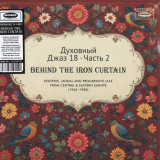
Various - Spiritual Jazz 18: Behind the Iron Curtain PART 2 2x12"

One of the most politically charged terms of the 20th century, the Iron Curtain was a metaphor for political and cultural division. In a post-war telegram Winston Churchill referred to the fault line that ran through Europe between East and West as "an Iron Curtain is drawn down upon their front. We do not know what is going on behind".


In this two-part album, as far as jazz is concerned, we will showcase, describe and celebrate exactly what was 'going on behind'. We see that music is the power supreme, with the ability to transcend all barriers, be they physical, political or metaphorical.


Our liner notes illustrate the complex and contradictory history of Soviet jazz, and the tracks we've chosen cover the key period of the early 1960s to the 1980s. It was during these dark years of the Cold War that the Soviet Union and its satellite states produced a number of outstanding artists playing in a variety of styles. The impact of modernism, from hard bop and Latin to modal and cool jazz, had found its way through cracks in the curtain. The deeply-felt ancestral strains of traditional European folk music were combined with the exciting new and progressive sounds of the West, and a radical, intoxicating brew was created that no amount of guns, tanks or polonium tea could overcome.


We chronicle the triumph of jazz at a time of extreme geopolitical conflict. What went on behind the Iron Curtain in these countries was once mysterious and unknown to the West, but the perseverance of their artists provided sound and light amid the secretive, dark days of the communist-capitalist standoff. There was no end of life-affirming spiritual jazz behind the Iron Curtain.


"Whether it's by improvisation in the African-American jazz tradition, or by a village kobza player standing on top of a damn hill - he feels connected to the stars."

En stock

Disponible en stock et prêt pour l'expédition

28,53
Various - PRIMARY FOREST 03

Various

PRIMARY FOREST 03

12inchCEEXYZ05
CEE
03.06.2025

AN ATLAS OF LOSS

Do minerals dream of becoming semiconductors? Do they yearn to carry charges, amplify, switch, and convert energy into emotions comprehensible to humans? And what if, from the darkness of the underground, they had been listening to us sing in caves before the emergence of the first flute? Could they have guided us, through the course of history, to find them, extract them, and create new sounds through sinusoidal waves, to form valves and bend circuits?

If so, minerals would transition from what philosopher Eugene Thacker defines as the ‘planet’—that virginal and unreachable realm for humans that we study through geology, paleontology, and environmental sciences—to the ‘world,’ the space we inhabit, interpret, and synthesise in our daily lives. Sadly, we only remember the world when it erupts violently, through climate catastrophes or when a new virus emerges. Sometimes a tsunami collides with a nuclear plant, or viruses are cultivated as biological weapons in high-security laboratories, provoking a deep biological anxiety, hard to quell, which we all feel beneath our skin.

There exists a third realm, disconnected from both the world and the planet: the ‘earth’, an immense, dense rock floating in space alongside other planets, situated in the cosmological dimension. Relating to the earth is so complex that we only do so through theoretical speculations of a scientific nature or through science fiction, interweaving until one becomes the prophecy of the other, in an infinite, pendular dance. Beyond the darkness of space and Lovecraft’s cosmic horror, the fantasy of human extinction is the most recurrent: to reach a collapse so devastating that we do not survive it, even though the earth does, without us.

In a world where we quantify everything through body sensors, financial algorithms, nanometre-scale robots, and surveillance drones—a world in which everything that can be domesticated and controlled can also be commodified—a superior artificial intelligence would survive the collapse of the species (some speculate it might even cause it) and learn from our mistakes, thanks to our obsessive gathering of data.

Long after our voices fade, minerals will persist in the darkness of screens, in the silicon of chips, and in their pure form, still unexploited underground. Over the millennia, this intelligence might piece together fragments of our reasoning, as if an alien civilization finally connected with one of our spacecrafts loaded with messages cast into the void. It would sort through endless streams of data, unable to grasp the depths of emotion behind what it quantified, recreating simulations of our past, stripped of the nuance that once defined us and conducting experiments in sandboxes.

Some remnants of our existence—faint echoes of forgotten beauty—would be pieced together in an atlas of loss, buried beneath layers of numbers, decayed bots, and corroded hard drives. What will follow? Perhaps bison will once again roam—trotting to the strange pulse of techno, their ancient forms framed by the ruins of our cities.

Buildings will crumble, slowly dissolving under the soft touch of ambient music, and a thousand flowers will bloom with that ancient music created through electrical signals and computation. 7 songs for a future both improbable and inevitable—a final message from a world lost to itself, from planet Earth to planet Earth.

Alfons Pich, 2025

En stock

Disponible en stock et prêt pour l'expédition

23,95
ORBITAL - Orbital 2 (The Brown Album) (LP 4x12")

Originally released in 1993, the ‘Brown Album‘ defied expectations and had a significant genre and cultural impact - showcasing the duo's scope and ambition. It was also met with widespread critical acclaim upon release, with NME awarding it 9/10 in their review, and it was chosen as one of Mixmag’s “best albums of all time”. The album's blend of diverse influences and its rejection of conventional norms helped to solidify Orbital's reputation as The Godfathers Of Rave, expanding the horizons of electronic music beyond local DJ nights.

Over 30 years on, London Records re-release this genre defying album – loaded with 23 additional tracks - rarities and previously unreleased material, including ‘Live From the Limelight, New York 1992’. Also includes a hardback book containing unseen photos, a track-by-track by Phil and Paul Hartnoll + interviews and essays on the making of the album by esteemed music journalist Andrew Harrison, a slipmat and flyer recreations from the era.

Vinyl masters cut at half speed, to ensure maximum audio fidelity.

En stock

Disponible en stock et prêt pour l'expédition

144,33
JASON KOLAR - A SYNONYM FOR REPETITION (TAPE)

** Cassette release

""A Synonym for Repetition" weaves together a tapestry of parallels, all intricately linked to Japan. The project initiates with a collaboration with a Tokyo-based musician, which ultimately fails to materialise during Jason Kolar’s recent visit to the country.

From an original approach that has to mutate in its starting phase, the record was conceived from the beginning to embody a sincere homage to Ryuichi Sakamoto, also a Tokyo native. Shaping ideas within the context of a city with a vibrant soundscape, through an exploration where tradition and modernity intersect in an ongoing quest for correspondences.

Yet, the barriers of language and cultural disparity emerge, casting a veil over the perceived connections and rendering them more projection than reality. This dynamic delineates the space observed from an external perspective, perpetually distant from true understanding, framing it in the fields of imagination, both Japan and Sakamoto. Nonetheless, Kolar tries to pay an honest ode to the artist and its scenic background, with all the implications and contradictions of this kind of process, even with the risk of falling into clichés, pastiches, and Eurocentric bias.

Connecting it to ‘vertical listening’ rather than to an obvious tribute exercise, he has morphed his sound to a synthetic and midi approach, aiming to set an ironically fictitious stage, one that resembles something, but it’s not really it."

En stock

Disponible en stock et prêt pour l'expédition

13,03
Roby J., O.M.A.R. J. - Nocturnal Elephant Walk

When Omar J Neri sent us the DAT with a white sticker marked with the date “26 January 1996” and some psychedelic drawings, we were quite astonished. Even more so when we listened to the incredible material inside the tape.

In 1996, Roby J was probably at his best, playing constantly in clubs like Insomnia, Imperiale, and Ashram, as well as Alex Piacciafuochi, the mind and owner of one of the studios (Alex Midi Studio) that defined the Tuscan progressive sound.

At that time, Omar J was a young talent building his reputation around the best clubs in the region. It was a fertile period for him, leading to his first release: "Primitive Pulsar".

Roby and Omar’s distinctive leftfield touch can be heard in these two long, slow-evolving, and structure-changing tracks. Truly two steps ahead and forward-thinking!

Unfortunately, Roby left us too soon in 2014. With Omar’s help, we are extremely honored to continue his important legacy and lucky enough to open their archives. More is yet to come… in loving memory of Roby J.

En stock

Disponible en stock et prêt pour l'expédition

17,19
Don Glori - Paper Can't Wrap Fire LP

Mr Bongo proudly presents the third album by Melbourne/Naarm multi-instrumentalist, Don Glori, entitled ‘Paper Can’t Wrap Fire’. A kaleidoscopic genre-surfing odyssey that brings together the worlds of jazz, soul and funk. Feeling both contemporary and classic, familiar yet novel, it’s an assured third release that sees an artist in full flight, showcasing their creative prowess and the uniqueness of their musical voice.

Steering in a new direction, Don Glori (aka Gordon Li) has delved headfirst into his songwriting with ‘Paper Can’t Wrap Fire’. Deftly showcasing his talents as a writer and bandleader, he brings with him a whole host of friends from the creative crossroads that is Naarm. It’s an album enriched with more soul, R&B, and funk-oriented songs than his previous jazz-rooted productions, yet there’s still plenty of jazz material for those familiar fans of Don's earlier works.

The album’s title is an old Chinese proverb, roughly translated as 'you can’t deny the truth'. This underlying thread is woven between the songs. “A lot of them are in some way about truth-seeking, observations and the masks you put on to deal with life (hence the cover art)”, Don mentions. Take, for instance, the sensational soul single 'Brown Eyes' featuring silky lead vocals by ML Hall. A dissection of the minority experience, and the power and comfort in building those communities. Elsewhere, 'Disaster' is a satirical take on the structures serving everyone but the artists, and 'Flicker' tackles notations of truth and clarity after introspection.

To marry that meaning with the level of musicianship on these tracks is what really stands out. Don has set out his stall here as an artist who can write songs that hit home in the heart, as much as they do in the head. It’s a journey infused with a glistening jazz finesse, layered with nourishing vocal harmonies and powered by an instantly relatable human soul.

Recorded over two hot summer days in Rolling Stock Studios in Collingwood, Naarm, the lineup of musicians is built up of Don's friends and family. Featuring the backbone team of Tim Cox, Al Kennedy, Joel Trigg, Robyn Cummins and Lachlan Thompson, who were part of Don's touring band before he relocated to London, and a stunning selection of vocalists in the form of ML Hall, Ruby Dargaville, Isadora Lauritz, and Bianca Kyriacou. Also gracing the album are trumpeter extraordinaire Audrey Powne, saxophonist Joshua Moshe, and Alcides Neto who sprinkles some Brazilian magic into the record.

Taking influence from artists including Azymuth, SAULT, Jordan Rakei and Lynda Dawn, as well as from London musical beacons such as NTS and Total Refreshment Centre, Don has run with this, leaned in and come out with a record truly unique to himself and his distinctive core, with no mask necessary.

En stock

Disponible en stock et prêt pour l'expédition

29,83
Various - Roots Rocking Zimbabwe: The Modern Sound Of Harare' Townships 1975-1980 LP 2x12"
 
25

Analog Africa doesn't do anything other than special releases really, but this one tracing the label's origins back to Zimbabwe over 20 years ago is a real standout. A carefully curated collection of 25 tracks with a fine booklet proving plenty of extra context, it captures the birth of the country's modern music scene and brims with the creative sound explosion of the 70s and 80s. Before genres were fully defined, artists blended rock, rumba, soul and traditional rhythms in bold, experimental ways that still stand up and get diggers and dancers excited in 2025. Included are never-before-released tracks from Thomas Mapfumo, Oliver Mtukudzi and more and they all add up to rich and dynamic snapshot of Zimbabwe's peerless musical evolution during what was a transformative era.

En stock

Disponible en stock et prêt pour l'expédition

29,62
Pallas - A Taste Of Ulysses

"Are You in Heaven?" was famously shouted by Roxy DJ Eddy de Clercq to the crowd at one of the very first legendary house parties in Amsterdam. This phrase not only symbolizes an iconic moment that captured the spirit of the era—it’s also the title of one of the three tracks featured here.

In 1991, inspired by the dance music craze that swept across Europe at the time, Arnoud Winkler and Jochem Peteri (who would later become the one-man supergroup Newworldaquarium) produced music that is equal parts euphoric, emotive, vital, and vibrant—youthful in spirit, naive yet clever. A European translation of a US-American art form, born from pure enthusiasm and concentrated passion for a culture that, to this day, continues to resonate universally.
Originally released on Lower East Side Records, the story told here is full of rave symbolism, after-party joy, and literal can-you-feel-it moments: rattling sub-bass, blissful pads, whispering voices, dub techniques, and subconscious peak-time signals.
Complemented by a new edit of Ulysses Horizon by Gerd Janson (alongside a revised version of the original), alongside Flowerdale Beach, and Are You in Heaven?, the music here hasn’t lost a single inch of its charm or allure. A taste of Dutch house deluxe.

En stock

Disponible en stock et prêt pour l'expédition

13,24
Mathame - Angel

Mathame

Angel

12inchMHA02
MHA
14.05.2025

Mathame Unveil Their Latest Masterpiece: "ANGEL"

Renowned for their groundbreaking contributions to electronic music, Italian duo Mathame is set to captivate audiences once again with their latest single, "ANGEL" Conceived in January 2024 amidst their vibrant tours across Mexico and Asia, the track marks a new pinnacle in Mathame's illustrious career. Critics have lauded "ANGEL" as a real summer anthem, perfectly capturing the essence of summer vibes with its infectious energy and uplifting melodies.

In February 2024, Mathame's journey took them to the heart of Manhattan, NYC, where they collaborated with the equally illustrious Italian duo Parisi. Known for their collaborations with industry giants like Fred Again and Swedish House Mafia, Parisi has been close allies of Mathame since Mathame invited them to perform their first-ever live shows in London and NYC during 2023 and 2024 at Mathame’s events.

This union of brotherhood and musical genius birthed "ANGEL" a track co-written by both duos and perfected through electrifying live performances during the spring. The creative process culminated in the iconic setting of Ibiza, where the final touches were added, ensuring "ANGEL" would emerge as the definitive summer anthem of 2024.

Critics have hailed "ANGEL" as a testament to the innovative spirit and profound synergy. The track showcases their ability to blend mesmerizing melodies with pulsating rhythms, creating an unforgettable experience for listeners worldwide.

En stock

Disponible en stock et prêt pour l'expédition

16,60
CRYME & Ben Reymann - Saveur de Monbi

Cryme&Ben Reymann

Saveur de Monbi

12inchSEVEN7005
Seven
09.05.2025

SEVEN's latest release stands as a proper example of how house and techno complement each other. "Saveur de Monbi" exemplifies SEVEN's commitment to blending classic and modern sounds, delivering an EP that is both timeless and fresh. Available exclusively on Beatport from April 18th, 2025 and on all major platforms and in stores on May 2nd, 2025.

A1 - CRYME x Ben Reymann - WTTD The perfect opening track doesn't exist... "WTTD" stands for "Welcome to the Dancefloor" and sets the tone of this EP. Starting with heavy kicks, syncopated low toms, and hot vocals that ease you into the night, it tells a story about how we can feel and let loose while being on the dancefloor together.

A2 - CRYME x Ben Reymann - Acid Array "Acid Array" is driven by a low-resonant 303 bassline and is supported by ever-evolving atmospheric pads that stretch across the entire track. Simple and sharp hats, along with a powerful clap that cuts through the mix like butter, make up a perfect groove.

B1 - CRYME x Ben Reymann - Midnight Journey "Midnight Journey" is a drum-focused minimalistic track. The reverb-soaked, dreamy pads contrast with the rather rough drums, creating a nostalgic feel that is both sad and happy at the same time.

B2 - CRYME x Ben Reymann - Midnight Journey (Volpe Remix) On the B-side, we are happy to have Argentinian artist Volpe on board with his interpretation of "Midnight Journey." He flipped the track, giving it more drive by adding extra drums and changes in the rhythm structure while keeping the reverb-soaked, dreamy pads from the original. His classic, moody filter sweeps fit perfectly on top.

B3 - CRYME x Ben Reymann - Chordance "Chordance" stands out due to a rather clean mixdown. The playful rhythms of the toms combined with soulful chords as the main element and a big pulsating low end round the EP off with class.

En stock

Disponible en stock et prêt pour l'expédition

12,56
CRYME & Ben Reymann - Saveur de Monbi

Cryme&Ben Reymann

Saveur de Monbi

12inchSEVEN7005LTD
Seven
09.05.2025

SEVEN's latest release stands as a proper example of how house and techno complement each other. "Saveur de Monbi" exemplifies SEVEN's commitment to blending classic and modern sounds, delivering an EP that is both timeless and fresh. Available exclusively on Beatport from April 18th, 2025 and on all major platforms and in stores on May 2nd, 2025.

A1 - CRYME x Ben Reymann - WTTD The perfect opening track doesn't exist... "WTTD" stands for "Welcome to the Dancefloor" and sets the tone of this EP. Starting with heavy kicks, syncopated low toms, and hot vocals that ease you into the night, it tells a story about how we can feel and let loose while being on the dancefloor together.

A2 - CRYME x Ben Reymann - Acid Array "Acid Array" is driven by a low-resonant 303 bassline and is supported by ever-evolving atmospheric pads that stretch across the entire track. Simple and sharp hats, along with a powerful clap that cuts through the mix like butter, make up a perfect groove.

B1 - CRYME x Ben Reymann - Midnight Journey "Midnight Journey" is a drum-focused minimalistic track. The reverb-soaked, dreamy pads contrast with the rather rough drums, creating a nostalgic feel that is both sad and happy at the same time.

B2 - CRYME x Ben Reymann - Midnight Journey (Volpe Remix) On the B-side, we are happy to have Argentinian artist Volpe on board with his interpretation of "Midnight Journey." He flipped the track, giving it more drive by adding extra drums and changes in the rhythm structure while keeping the reverb-soaked, dreamy pads from the original. His classic, moody filter sweeps fit perfectly on top.

B3 - CRYME x Ben Reymann - Chordance "Chordance" stands out due to a rather clean mixdown. The playful rhythms of the toms combined with soulful chords as the main element and a big pulsating low end round the EP off with class.

En stock

Disponible en stock et prêt pour l'expédition

13,03
LUC-HUBERT SEJOR - MIZIK FILAMONIK: SPIRITUAL SOUND

180 G. BLACK VINYL WITH LINER NOTES IN CREOLE, FRENCH, ENGLISH

Originally released in 1979, "Spiritual Sound" lives up to its name, a soaring, triumphant album, six tracks of spirit magic from Guadeloupe.

Telluric, intense, terribly alive, the gwoka drums of Guadeloupe carry the identity of a painful and fervent island. Marked forever by the crime of slavery, Guadeloupe's créolité cherishes the ka drums and their natural environment: the low-pitched boula drum with male goatskin, the high-pitched soloist makè drum with female goatskin, the chacha, ti bwa, triangle, calabash and other percussion instruments that surround them, and the voices - the fiery, proud, timbred, urgent voices of the gwoka.


This album is also a legend for its voices: in his then dazzling youth, singer Lukuber Séjor was one of the first gwoka artists to largely feminize the chorus of répondè, who converse with his text delivered in a straight and powerful voice.

And everything here sets new standards. In 1979, Mizik Filamonik - Spiritual Sound proclaimed a spiritual patriotism of ferocious intensity. The album by Lukuber Séjor - whose spelling alone is a battle - sets out to give Guadeloupe the intangible weapons of self-respect and self-knowledge, through a singular practice of traditional music.

The genesis of gwoka music is less straightforward than one might imagine... The drums performed the servile task of accompanying the work of slaves in the fields and during the “corvées” imposed by the administration, before being freely practiced by the common people after the abolition of 1848. At the heart of the conviviality of the Guadeloupeans furthest from the cities - geographically and socially - the gwoka drums come out for carnival, funeral wakes and neighborhood celebrations, but also during strikes, fits of anger and armed vigils of the riots and revolts that have punctuated the island's history. For generations, governors of the colony and then the prefects of the overseas department of Guadeloupe have been viewing the gwoka as a potential for turbulence and a threat to public order.

But as the Beatlesmania, “chanson engagée” and rock revolutions unfolded in Europe, young people turned to the drums of mizik a vié nèg (“bad negro music”, in Creole), which Guadeloupeans had learned to despise by following the “assimilation” process advocated by the school system and most of the political class. At the end of the sixties, in a Guadeloupe mourning the deadly repression of the May 1967 social movement, they played traditional music, refusing to wrap it up in tourist prettiness and madras folk costumes. Instinctively, they played a rough and contemporary gwoka, led by the incendiary Guy Konkèt. This was the era of decisive 45 rpm records such as Robert Loyson's Kann a la richès, which brought to light the fieriest words of union rallies.

At his home in Sainte-Anne, Lukuber Séjor played with flautist Olivier Vamur and his brother Claude Vamur, who cobbled together a drum kit from tin crockery and became, a few years later, the most influential drummer in Kassav'.

These were the years of the Bumidom program, when young Guadeloupeans were encouraged to emigrate to mainland France. At the age of twenty, Lukuber Séjor embarked on the liner Irpinia, disembarking at Le Havre and taking the train to the Gare Saint-Lazare - the route taken by thousands of young West Indians who went on to study or looked for work, all the while trying to maintain a link with their homeland. In this case, it's at the Antony university residence, where Lukuber played the drum and participated in a thousand gwoka updates and aggiornamentos, while exile reinforced the need for a spiritual link with the native land.

In 1978, Guy Konkèt played at the Salle Wagram, a historic event for West Indian music. After serving as répondè - i.e. backing vocalist - on one of his home-recorded albums, Lukuber joined his live band. Little by little, he became one of the key artists on a circuit parallel to French show business. At a student party in Caen, he met a young woman from Martinique who, at the time, was more motivated by her ambitions as a visual artist than by her vocation as a musician. Her name was Jocelyne Béroard and, a few years before she plunged into the Kassav' adventure and became the greatest West Indian singer of her generation, she designed the cover of Lukuber Séjor's LP.

This ambition was obvious and imposed its will. A more or less regular band was formed, with Roger Raspail, Rudy Mompière and Éric Danquin on ka drums, Claude Vamur on ti bwa, Olivier Vamur and Françoise Lancréot on flutes and Annick Noël on keyboards. Lukuber Séjor is set on wanting to extend the gwoka palette to other instruments, as the jazz-rock revolution opens a thousand new doors. Annick Noël will play a wide range of timbres and textures on electric piano and synthesizer. Another novelty: the répondè are two men and two women, Roger Raspail, Olivier Vamur, Françoise Lancréot and Maryann Mathéus ...

Mizik Filamonik - Spiritual Sound is a self-production in which the singer and leader sank all his savings, allowing him no more than a single day in the studio. The first side is more of a musical manifesto, with the first two tracks, Éritage and Penn é plézi, being instrumentals. The third, Son, forcefully celebrates the need for Guadeloupeans to connect with the gwoka. In fact, Jocelyne Béroard's cover shows a tambouyé in the shadow of a cloudy sky, against which a radiant sun is rising and whose light will soon flood the entire landscape. The silhouette and face of this man strongly evoke the immense Vélo, master of the ka, rejected at the time on the fringes of society.

The second side of the LP is surprising. Formally, three tracks are explicitly linked like the three parts of a triptych. Primyé voyaj evokes the appalling tribulation of Africans deported as slaves to Guadeloupe; dézyèm voyaj speaks of the Bumidom program and the economic, political and social forces driving young Guadeloupeans towards the mirage of prosperity in France; twazyèm voyaj closes the cycle with the emigrants' return from Europe after years away from their island...

This gwoka, obsessed with the need to save Guadeloupe spiritually, appeals far beyond the politicized audience. Mizik Filamonik - Spiritual Sound instantly became a classic, although Lukuber Séjor never really made a career for himself as a musician.

After all, the album was released in 1980, with no promotional resources in France or Guadeloupe - and therefore no concerts. The thirty-two-year-old author, composer and performer made his own third trip back to Guadeloupe. He set up a small woodworking business, which he lost in Hurricane Hugo in 1989. His other activity, teaching in a medical-educational institute, became the core of his professional life. He continued to be an active campaigner - a campaigner for the Creole language, a campaigner for the reawakening of identity, a campaigner for special education, a campaigner for a thousand causes that he ignited with his generous and perceptive enthusiasm, such as the defense of breadfruit fries...

The echoes of his 1979 album have not died down. Of course, the use of Penn é plézi as the theme tune for Radio Guadeloupe's funeral notices from 1980 to 1992 kept him in the collective memory, but he continues to sing and compose sporadically, as with his all-female

vocal group Vwapoulouéka... Still convinced that music is a means of liberating the spirit, he continues the journey of a young man eager to deploy the power of Creole music and language.

Bertrand Dicale

En stock

Disponible en stock et prêt pour l'expédition

19,75
Dj Koze - Pick Up

Dj Koze

Pick Up

12inchPAMPA031
PAMPA
25.04.2025

2025 Repress

DJ Koze might be one of the world's best producers, but above all he's a DJ, and it's his DJ ear that governs. J
ust as in a great set, so with his releases: 'Seeing Aliens' came out of nowhere, a big buzzing beast of a track, to announce that Koze was back on the scene and prime everyone for the coming album, knock knock.
But now that Koze has your attention, it's time to remind everyone what's most important about club music, pull things back, take a turn to the left, and get deep into the groove.

Thus 'Pick Up': the second single from knock knock is 100% pure groove, doubly so in the extended 12' version.

In a sense it's incredibly familiar - it is essentially a filter disco record, very close to something you could imagine coming out of Paris around the turn of the millennium. But of course, this is Koze. Nothing is normal or familiar in his world, and he's taken this most foundational of clubland staples into new territory. Flipping amples of Gladys Knight & the Pips 'Neither One Of Us (Wants to Be the First to Say Goodbye)' and Melba Moore's 'Pick Me Up, I'll Dance', it creates something completely airborne, shot through with emotions such as gods must feel: not quite explicable to the human mind but strong enough to knock you off your feet. In its way it's absolutely as powerful as 'Seeing Aliens', but it comes in like the proverbial iron fist in a glove of velvet.
The flip, a ten-minute new track, 'The Love Truck' is a big contrast again. If 'Pick Up' is giddy flight,
'The Love Truck' is woozy floating. Its sharp, clicking percussion recalls 2000s minimal techno, but this time absolutely nothing is generic. The long, intense, on-and-off bass tones, the flickers of birdsong, the pure voices slipping in backwards as if from the future... it's all like the most blissful dream, and culminates in a coda so subtle yet so beautiful it's like ever time you've ever seen the sun rise and thought 'I never want this to end', all the while understanding deep down that the fleeting nature of the pleasure is also what give it its power. But of course, being created with that consummate DJ's ear, it's also full of the thrill of wondering what Koze has in store next.

En stock

Disponible en stock et prêt pour l'expédition

11,72
Articles par page:
N/ABPM
Vinyl