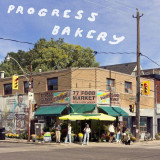
Kneading dough is tricky – you should know how it’s supposed to feel. If you try too hard you could make it worse. It’s a beautiful practice – creation with a gentle touch, to work at something so it can be left alone. “If it’s too drawn out it’s awful. It’s easy to give too much.” Dance in the mirror. Contemplate your veiny hands. Who do they remind you of?
You begin by mixing flour and water. “What happens when your people die? Why’d they move the rock to the other side of Ulster Park?” Eliza Niemi asks two seemingly unrelated questions in a rising melody with guitar accompaniment, like fingers playing spider up to the nape of your neck. Gentle pressure. Strands of gluten form to bind the mix. A new question lingers in the binding. When she admits “but I don’t know how to tell if I’m feeling it or not,” that question surfaces through the text. It is reiterated throughout the album. When I’m working with dough I think the same thing to myself.
On Progress Bakery, her second album as a solo artist, Eliza knows to leave some questions alone – to let juxtaposition and tension be the proof. It doesn’t have to be hard. The feelings and revelations they provoke rise in the heat. The smell is sweet. Crispy on the outside and soft all the way through. She playfully slip-slides through words and sounds and images, delighting in surprise, skimming ideas like stones cast across clear water, touching down briefly with uncommon grace.
The question provoked between those opening lines resurfaces in the strands between songs – “Do U FM” is fully formed and beautifully layered, while “Novelist Sad Face” is a short, acapella rendering of gentle curiosity. What is holding these ideas together? Some songs demand more, seem to carry a whole load – eventually the skipping stone will halt to sink and resume its idle duty – while others drift in and out of focus, the way thoughts and dreams become interwoven before the mind is sunk into true sleep.
Music and words don’t always have to interact. Where she decides to keep them apart gives a new contour to where and how she puts them together. The kind of thing you’re supposed to take for granted with songs and their singers comes alive in Eliza’s hands – the little miracle of mixing, kneading, stretching, and stopping.
So often on Progress Bakery, Eliza teases out truth and meaning by asking questions. “Do I wanna be crying?” “Do you want me good or do you want me bad?” “Do I need an eye test?” “I’m writing songs in my head while you’re going over stuff with me — is that cruel??” In “Pocky” Eliza ends with a question that feels to me like the actual biography, succinct and revealing:
I don’t wanna be made to see
I just wanna ask “what’s that?”
Grace that ought to be rare, but in its care and precision is offered humbly, with great generosity, and without announcing itself. Eliza’s simple, miraculous music is given further form and shape by a group of collaborators – invaluable guest musicians Jeremy Ray, Evan Cartwright, Steven McPhail, Kenny Boothby, Ed Squires, Carolina Chauffe, Dorothea Paas, Louie Short, and Avalon Tassonyi. Together with Louie Short, who recorded, mixed, and produced the album along with Jeremy Ray and Lukas Cheung, Eliza has cultivated a richness in sound and texture that prods and provokes the ticklish ear. Barely audible guitar tinkering, a brief lo-fi field recording of trumpets, the harmonic clicking of a looped synthesizer, a flourish of reeds, a child’s conversation, each uncanny sound perfectly placed, rippling out under a soft breeze.
Lay in bed alone at night and ask aloud to the stillness,
“What were you doing at the Albuquerque Airport?
What were you doing there??”
And hear your question answered by a dream of swelling, undulating cellos. Try to grasp at the melody and structure. It’s not an answer (if there could be one), but it moves deeper, closer to the weird layer of fleeting moments and disconnected images, barely perceptible at its core. Wait for the dream reel to click into place.
Eliza took me for a ride in Nicole (her beloved Dodge Grand Caravan) and told me she’d been thinking of the album as an embodiment of transition – and I think every transition, known or unknown, carries the weight of new meaning, skittering off the surface tension of life as you know it, creating ripples, sometimes bouncing off and sometimes breaking through. There is a trick you can use to tell if a dough is glutinous enough. You’re supposed to stretch it out as thin as you can without breaking it and hold it up to the light. If you can see through, even if it renders the world murky and uncertain, you should leave it alone. I love this trick. It’s one that Eliza seems to know intuitively: work gently and ask questions and don’t always expect answers, and when you can, take a glimpse at something new, and then leave.
Search:deep image
During the pandemic, The Ophelias transformed uncertainty into Spring Grove, their fourth album and most dynamic offering yet. Named after a Cincinnati cemetery, the album blends nostalgia with fresh perspective, reflecting on themes of relationships, identity, and power dynamics. Singer-songwriter Spencer Peppet draws from her OCD diagnosis during the pandemic and the clarity that comes with growing older, resulting in lyrics that explore the cracks and complexities of human connection.
Produced by Julien Baker, who adds lush textures and harmonies, Spring Grove marks a turning point in the band’s evolution. Recorded at Young Avenue Sound in Memphis, the album centers on the core quartet—Peppet, violinist Andrea Gutmann Fuentes, bassist Jo Shaffer, and drummer Mic Adams—with arrangements that balance cinematic intensity and delicacy. Gutmann Fuentes’s violin provides striking countermelodies, while Shaffer’s bass lines, inspired by doom metal, explore melodic depth. Adams’s drumming reflects his first project after transitioning, offering nuanced rhythms that blend power and tenderness.
With one queer and two trans members, the band has moved beyond the reductive label of an “all-girl” group, delving deeply into themes of womanhood and identity. Tracks like “Salome” and “Parade” examine power dynamics and friendship, while nature imagery in songs like “Cumulonimbus” and “Vulture Tree” mirrors lived experience. Across 13 tracks, the album’s cinematic and introspective journey scavenges the past for meaning, ultimately embracing transformation. On the closing track, “Shapes,” Peppet reaches serene acceptance, singing, “I see what’s coming after... a reflection in the water. I am rippling forever.”
Spring Grove captures the band’s evolution, offering a transcendent meditation on self-awareness, identity, and growth, leaving listeners with a sense of profound discovery.
- A1: Montego Bay - Everything (Paradise Mix) 04 59
- A2: Atelier - Got To Live Together (Club Mix) 06 06
- A3: Golem - Music Sensations 04 56
- B1: The True Underground Sound Of Rome Feat. Stefano Di Carlo - Gladiators 05 26
- B2: Eagle Parade - I Believe 04 26
- C1: Dj Le Roi - Bocachica (Detroit Version) 05 28
- C2: Green Baize - Synthetic Rhythm 01 41
- C3: M.c.j. Feat. Sima - Sexitivity (Deep Mix) 05 30
- D1: Kwanzaa Posse Feat. Funk Master Sweat - Wicked Funk (Afro Ambient Mix) 06 31
- D2: Progetto Tribale - The Bird Of Paradise 06 29
- D3: Mbg - The Quite 06 59
Vol 1[28,99 €]
Googling “paradise house”, the first results to pop up are an endless list of European b&b’s with whitewashed lime façades, all of them promising “…an unmatched travel experience a few steps from the sea”. Next, a little further down, are the institutional websites of a few select semi-luxury retirement homes (no photos shown, but lots of stock images of smiling nurses with reassuring looks). To find the “paradise house” we’re after, we have to scroll even further down. Much further down.
It feels like yesterday, and at the same time it seems like a million years ago. The Eighties had just ended, and it was still unclear what to expect from the Nineties. Mobile phones that were not the size of a briefcase and did not cost as much as a car? A frightening economic crisis? The guitar-rock revival?! Certainly, the best place to observe that moment of transition was the dancefloor. Truly epochal transformations were happening there. From America, within a short distance one from the other, two revolutionary new musical styles had arrived: the first one sounded a bit like an “on a budget” version of the best Seventies disco-music – Philly sound made with a set of piano-bar keyboards! – the other was even more sparse, futuristic and extraterrestrial. It was a music with a quite distinct “physical” component, which at the same time, to be fully grasped, seemed to call for the knotty theories of certain French post-modern philosophers: Gilles Deleuze, Félix Guattari, Paul Virilio... Both those genres – we would learn shortly after – were born in the black communities of Chicago and Detroit, although listening to those vinyl 12” (often wrapped in generic white covers, and with little indication in the label) you could not easily guess whether behind them there was a black boy from somewhere in the Usa, or a girl from Berlin, or a pale kid from a Cornish coastal town.
Quickly, similar sounds began to show up from all corners of Europe. A thousand variations of the same intuition: leaner, less lean, happier, slightly less intoxicated, more broken, slower, faster, much faster... Boom! From the dancefloors – the London ones at least, whose chronicles we eagerly read every month in the pages of The Face and i-D – came tales of a new generation of clubbers who had completely stopped “dressing up” to go dancing; of hot tempered hooligans bursting into tears and hugging everyone under the strobe lights as the notes of Strings of Life rose up through the fumes of dry ice (certain “smiling” pills were also involved, sure). At this point, however, we must move on to Switzerland.
In Switzerland, in the quiet and diligent town of Lugano, between the 1980s and 1990s there was a club called “Morandi”. Its hot night was on Wednesdays, when the audience also came from Milan, Como, Varese and Zurich. Legend goes that, one night, none less than Prince and Sheila E were spotted hiding among the sofas, on a day-off of the Italian dates of the Nude Tour… The Wednesday resident and superstar was an Italian dj with an exotic name: Don Carlos. The soundtrack he devised was a mixture of Chicago, Detroit, the most progressive R&B and certain forgotten classics of old disco music: practically, what the Paradise Garage in New York might have sounded like had it not closed in 1987. In between, Don Carlos also managed to squeeze in some tracks he had worked on in his studio on Lago Maggiore. One in particular: a track that was rather slow compared to the BPM in fashion at the time, but which was a perfect bridge between house and R&B. The title was Alone: Don Carlos would explain years later that it had to be intended both in the English meaning of “by itself” and like the Italian word meaning “halo”. That wasn’t the only double entendre about the song, anyway. Its own very deep nature was, indeed, double. On the one hand, Alone was built around an angelic keyboard pattern and a romantic piano riff that took you straight to heaven; on the other, it showcased enough electronic squelches (plus a sax part that sounded like it had been dissolved by acid rain) to pigeonhole the tune into the “junk modernity” section, aka the hallmark of all the most innovative sounds of the time: music that sounded like it was hand-crafted from the scraps of glittering overground pop.
No one knows who was the first to call it “paradise house”, nor when it happened. Alternative definitions on the same topic one happened to hear included “ambient house”, “dream house”, “Mediterranean progressive”… but of course none were as good (and alluring) as “paradise house”. What is certain is that such inclination for sounds that were in equal measure angelic and neurotic, romantic and unaffective, quickly became the trademark of the second generation of Italian house. Music that seemed shyly equidistant from all the rhythmic and electronic revolutions that had happened up to that moment (“Music perfectly adept at going nowhere slowly” as noted by English journalist Craig McLean in a legendary field report for Blah Blah Blah magazine). Music that to a inattentive ear might have sounded as anonymous as a snapshot of a random group of passers-by at 10AM in the centre of any major city, but perfectly described the (slow) awakening in the real world after the universal love binge of the so-called Second Summer of Love.
For a brief but unforgettable season, in Italy “paradise house” was the official soundtrack of interminable weekends spent inside the car, darting from one club to another, cutting the peninsula from North to centre, from East to West coast in pursuit of the latest after-hours disco, trading kilometres per hour with beats per minute: practically, a new New Year’s Eve every Friday and Saturday night. This too was no small transformation, as well as a shock for an adult Italy that was encountering for the first time – thanks to its sons and daughters – the wild side of industrial modernity. The clubbers of the so-called “fuoriorario” scene were the balls gone mad in the pinball machine most feared by newspapers, magazines and TV pundits. What they did each and every weekend, apart from going crazy to the sound of the current white labels, was linking distant geographical points and non-places (thank you Marc Augé!) – old dance halls, farmhouses and business centres – transformed for one night into house music heaven. As Marco D’Eramo wrote in his 1995 essay on Chicago, Il maiale e il grattacielo: “Four-wheeled capitalism distorts our age-old image of the city, it allows the suburbs to be connected to each other, whereas before they were connected only by the centre (…) It makes possible a metropolitan area without a metropolis, without a city centre, without downtown. The periphery is no longer a periphery of any centre, but is self-centred”.
“Paradise house” perfectly understood all of this and turned it into a sort of cyber-blues that didn’t even need words, and unexpectedly brought back a drop of melancholic (post?)-humanity within a world that by then – as we would wholly realise in the decades to come – was fully inhuman and heartless. A world where we were all alone, and surrounded by a sinister yellowish halo, like a neon at the end of its life cycle. But, for one night at least, happy."
Following their acclaimed debut album The Shedding of Skin (2022), the formation has deepened their relationship through numerous live jams, intense touring and story sharing, pushing both their skills and the boundaries of the project. For its successor, État Coupable, this growth has been enriched by various collaborations, including one with Lebanese-Canadian producer Radwan Ghazi Moumneh (Jerusalem in My Heart).
The first single, Freedom, Asshole, features live drums by Spooky-J from Nihiloxica. With lead vocalist Saif singing, 'I envy you because you can close your eyes, you can choose,' the track addresses those who need to be addressed in the Western world, resulting in a gutwrenching piece of raw electronica that delves into the very definition of freedom. Alongside the launch of the record , the single will be released on Bandcamp and other streaming platforms on Wednesday, January 29.
A series of live dates have been announced including gigs at Ment Festival (SL), Rewire (NL), Donau Festival (AT) and dunk!festival (BE) among others.
Belgian multidisciplinary artist and long time collaborator of the project, Youniss Ahamad, has shared a that embodies unease through distorted images, a black-and-white palette, and abstract bird loops.
“For me ‘Freedom, Asshole’ is about fighting for freedom even when everything seems bleak”
– Youniss Ahamad
- A1: Do U Fm
- A2: Novelist Sad Face
- A3: Green Box
- A4: Dusty
- A5: The Linda Song
- A6: Dm Bf
- B1: I Tried
- B2: Melodies Like Mark
- B3: Wildcat
- B4: How U Remind Me
- B5: Pocky
- B6: Bon Tempiii
- B7: Pt Basement
- B8: Alberqurque Ii
- B9: Mary's
Kneading dough is tricky – you should know how it’s supposed to feel. If you try too hard you could make it worse. It’s a beautiful practice – creation with a gentle touch, to work at something so it can be left alone. “If it’s too drawn out it’s awful. It’s easy to give too much.” Dance in the mirror. Contemplate your veiny hands. Who do they remind you of?
You begin by mixing flour and water. “What happens when your people die? Why’d they move the rock to the other side of Ulster Park?” Eliza Niemi asks two seemingly unrelated questions in a rising melody with guitar accompaniment, like fingers playing spider up to the nape of your neck. Gentle pressure. Strands of gluten form to bind the mix. A new question lingers in the binding. When she admits “but I don’t know how to tell if I’m feeling it or not,” that question surfaces through the text. It is reiterated throughout the album. When I’m working with dough I think the same thing to myself.
On Progress Bakery, her second album as a solo artist, Eliza knows to leave some questions alone – to let juxtaposition and tension be the proof. It doesn’t have to be hard. The feelings and revelations they provoke rise in the heat. The smell is sweet. Crispy on the outside and soft all the way through. She playfully slip-slides through words and sounds and images, delighting in surprise, skimming ideas like stones cast across clear water, touching down briefly with uncommon grace.
The question provoked between those opening lines resurfaces in the strands between songs – “Do U FM” is fully formed and beautifully layered, while “Novelist Sad Face” is a short, acapella rendering of gentle curiosity. What is holding these ideas together? Some songs demand more, seem to carry a whole load – eventually the skipping stone will halt to sink and resume its idle duty – while others drift in and out of focus, the way thoughts and dreams become interwoven before the mind is sunk into true sleep.
Music and words don’t always have to interact. Where she decides to keep them apart gives a new contour to where and how she puts them together. The kind of thing you’re supposed to take for granted with songs and their singers comes alive in Eliza’s hands – the little miracle of mixing, kneading, stretching, and stopping.
So often on Progress Bakery, Eliza teases out truth and meaning by asking questions. “Do I wanna be crying?” “Do you want me good or do you want me bad?” “Do I need an eye test?” “I’m writing songs in my head while you’re going over stuff with me — is that cruel??” In “Pocky” Eliza ends with a question that feels to me like the actual biography, succinct and revealing:
I don’t wanna be made to see
I just wanna ask “what’s that?”
Grace that ought to be rare, but in its care and precision is offered humbly, with great generosity, and without announcing itself. Eliza’s simple, miraculous music is given further form and shape by a group of collaborators – invaluable guest musicians Jeremy Ray, Evan Cartwright, Steven McPhail, Kenny Boothby, Ed Squires, Carolina Chauffe, Dorothea Paas, Louie Short, and Avalon Tassonyi. Together with Louie Short, who recorded, mixed, and produced the album along with Jeremy Ray and Lukas Cheung, Eliza has cultivated a richness in sound and texture that prods and provokes the ticklish ear. Barely audible guitar tinkering, a brief lo-fi field recording of trumpets, the harmonic clicking of a looped synthesizer, a flourish of reeds, a child’s conversation, each uncanny sound perfectly placed, rippling out under a soft breeze.
Lay in bed alone at night and ask aloud to the stillness,
“What were you doing at the Albuquerque Airport?
What were you doing there??”
And hear your question answered by a dream of swelling, undulating cellos. Try to grasp at the melody and structure. It’s not an answer (if there could be one), but it moves deeper, closer to the weird layer of fleeting moments and disconnected images, barely perceptible at its core. Wait for the dream reel to click into place.
Eliza took me for a ride in Nicole (her beloved Dodge Grand Caravan) and told me she’d been thinking of the album as an embodiment of transition – and I think every transition, known or unknown, carries the weight of new meaning, skittering off the surface tension of life as you know it, creating ripples, sometimes bouncing off and sometimes breaking through. There is a trick you can use to tell if a dough is glutinous enough. You’re supposed to stretch it out as thin as you can without breaking it and hold it up to the light. If you can see through, even if it renders the world murky and uncertain, you should leave it alone. I love this trick. It’s one that Eliza seems to know intuitively: work gently and ask questions and don’t always expect answers, and when you can, take a glimpse at something new, and then leave.

- A1: Timber Trail
- A2: The Trail To Mexico
- A3: Ridin' Down The Canyon
- A4: Blue Prairie
- A5: The Wild West Is Where I Wanna Be
- A6: Pal O' Mine
- A7: I Ride An Old Paint
- A8: I've Got Spurs (That Jingle)
- B1: Tulsa Time/Deep In The Heart Of Texas
- B2: Philadelphia Lawyer
- B3: Lyndon Has A Bear Hug On Dallas
- B4: I'm An Old Cowhand
- B5: Sioux Indians
- B6: (Take Me Back To My) Boots And Saddles
- B7: Song Of The Bandit
- B8: My Saddle Pal And I
Don McLean's The Western Album is a 1973 release blends folk, rock, and country influences. The album features McLean's storytelling style, exploring themes like love, loss, and Americana, with a focus on Western imagery. It includes tracks like "The Good Old American Dream" and "The Legend of Andrew McCrew. The Western album remains notable for its introspective lyrics and rich sound.
- A1: Idrissa Soumaoro Et L'eclipse De L'ija — Nissodia (Joie De L'optimisme)
- A2: Rail Band — Mouodilo
- A3: Les Ambassadeurs Du Motel De Bamako — M'bouram-Mousso
- B1: Super Tentemba Jazz — Mangan
- B2: Sorry Bamba — Yayoroba
- B3: Super Djata Band — Worodara
- C1: Zani Diabaté Et Le Super Djata Band — Fadingna Kouma
- C2: Salif Keita — Mandjou
- C3: Alou Fané & Daouda Sangaré — Komagni Bèla
- D1: Super Djata Band De Bamako — Mali Ni Woula
- D2: Idrissa Soumaoro Et L'eclipse De L'ija — Fama Allah
Mr Bongo is proud to present 'The Original Sound of Mali', compiled by Vik Sohonie & David Buttle.
Malian music is arguably deeper, more sophisticated and lyrical than any other form of African music. Those of us deeply entranced by Malian culture, and, in particular, the immense hypnotic beauty of Malian music, have put together a
selection of songs from across the country.
Compiled by Vik Sohonie & Dave 'Mr Bongo' Buttle, the story of this release began in 2015 when Dave happened upon the Soul Bonanza blog. A treasure chest of rare finds from around the world! One mix in particular stood out and totally enthralled Dave - le monde à change: a tribute to mali 1970 - 1991. He
already knew of Malian legends such as the Rail Band, Salif Keita, & Les Ambassadeurs du Motel de Bamako, but this mix was something else! Deep & culled from the collections of some of the heaviest African music collectors in the world, legends like Vik Sohonie, Hidehito Morimoto, Philippe Noel, Gregoire
Villanova, and Rickard Masip. Dave immediately contacted Vik and a journey of discovery tracking down the rights-holders began. He also turned to the font of Malian music knowledge, Florent Mazzoleni. Florent has written the definitive book about Malian music - 'Musiques modernes et traditionnelles du Mali'. He
proposed some incredible tracks to include and provided the back bone of the sleeve notes and photos that are used in the album. No Malian album would be complete without a striking front cover photo, and ours is sourced from the late great Malian photographer Malick Sidibé.
On this album you will find well-known artists sitting next to rarer
discoveries. The Rail Band, who are one of the best known of all the big bands in Mali, gave us the stars Mory Kanté and Salif Keita. Les Amabassedeurs du Motel de Bamako were another big act that had Idrissa Soumaoro, Kanté Manfila, and for a while Salif Keita in their ranks. Sometimes Salif would play in both bands in one night, quite a feat considering the bands were fierce rivals. As an albino Salif has had to face considerable prejudice from society, focussing on his musical career to help overcome this.
A major discovery on the album has been Idrissa Soumaoro et L'Eclipse de L'Ija. L'Eclipse de l'Institut des Jeunes Aveugles was a Blind teenagers institute and their record was produced by the German association that took care of blind Malian teenagers in Bamako. It was never properly released commercially and was the first recordings by the legends of Malian music Idrissa Soumaoro, Amadou Bagayoko and Mariam Doumbia. Amadou & Mariam later got married and became household stars, including making an album with Manu Chao.
This album is a concerted global effort to showcase the most vital cornerstone of Malian culture in an attempt to preserve its reputation in the face of its current, grim reality. We hope our highlights of Mali's rich history of musical innovation will serve as a starting point for reclaiming an image tainted by unnecessary conflict. May peace and music return to Mali soon.
Dedicated to Malick Sidibé.
Mannequin Records proudly presents the debut release from Children Of The Night, a dynamic duo whose music is rooted in cinematic soundscapes. The project brings together Mexican techno producer Alejandro Barba, also known as Dellarge, and French documentary/film producer Pierre Labret, forging a distinctive creative partnership. Their collaboration masterfully combines dark, atmospheric elements with driving electronic rhythms, drawing heavily from the worlds of classic horror and psychological thrillers. The result is a collection of soundscapes that are as eerie as they are captivating, creating an immersive and haunting listening experience.
This album stands as an unconventional horror soundtrack for a film that never came to be—a tribute to the legendary Spanish filmmaker Jess Franco, known for his prolific work in the exploitation and horror genres. Born out of the quiet chaos of the pandemic, this project was originally intended to accompany a slasher film that was halted due to financial constraints. Despite the film’s cancellation, the duo pressed forward, turning the unfinished narrative into an imaginative auditory experience. The soundtrack will serve not only as a homage to Franco but also as a nod to Juan Mendez, better known by his alias Silent Servant, whose dark, minimalist electronic productions have left a deep mark on the underground music scene.
Dellarge and Labret’s creative process is shaped by an eclectic array of inspirations, pulling from both literature and cinema. They’ve cited films such as Franco’s "Paroxismus," "Gritos," and "Faceless" as vital to their sonic direction, as well as the eerie black-and-white imagery of F.W. Murnau's "Nosferatu." Additionally, the duo draws on the disturbing psychological tension of Stephen King’s "Carrie" and "Misery," and the surreal dystopian world of Stanislaw Lem's "Congreso de Futurología." The giallo horror aesthetics of Dario Argento's "Deep Red" also serve as a significant influence, merging surreal visuals with nerve-racking, visceral soundtracks—elements mirrored in Dellarge and Labret's own compositions.
The LP is not only rich with atmospheric storytelling but also boasts a range of remarkable remixes by prominent artists in the electronic music scene. Contributions from Alessandro Adriani, David Carretta, Legowelt, and Broken English Club inject new life into the original tracks, offering reinterpretations that span from industrial techno to Italo disco, further enhancing the project’s depth and versatility. Each remix complements the overarching horror theme while adding a modern, avant-garde twist to the duo’s work.
This debut album promises to be more than just a musical release—it's a vivid exploration of the horror genre through sound, creating a sensory experience that brings forgotten films, unrealized visions, and nightmarish stories to life through music. As the lines between fiction and reality blur, Dellarge and Labret invite listeners into a world where the echoes of lost films can finally be heard.
Continuing the year strong, we’re lining up the second release of Dutch newcomer Jancen. Leaving us wanting more after his impressive label debut on FigureX45, the second part of his Inner Labyrinth EP draws from a variety of influences to display his refined image of modern techno.
First off, Dub Dissonance sets the tone right with an immersive and heads-down track, determined synths stabbing away those layers of the mind. F-Track in contrast stands out with its deep swaying chords and beautiful dubby atmosphere, making for one stellar groove.
On the flipside things get more intense as Maze Chase comes swirling all in colourful peak time arps. Straightforward and unrelenting, Sassafras closes the labyrinth with an unrelenting synth motiv and captivating thump, turning the dial up to 10. Buyers of the digital package will also find bonus track Augusto Fiero, a gradually building affair that plays perfectly with the tension of sustain and release.
W/CYA are proud to introduce the first release of Amygdala. A three tracks EP entirely produced by themselves, including a special collab with the brillant Brooklyn's voice of IDA fLO aka Florence Ida Dabokemp.
The A side with the solo track "Forever Joy" is a deep dive into the classic 90's house sounds crafted with a futuristic vision on the modern techno style. The B1 and B2 tracks follow the same line of the A side, offering a more complexed and articulated image of the idea behind the
label identity. A true dancefloor burner that must be in your bag.
"Langt Fra Jorden" ("Lejos De La Tierra", in Spanish, for the book) is the result of the dialogue between the Spanish photographer and artist Irene Zottola and the Danish musician and artist øjeRum initiated by IIKKI, between June 2024 and November 2024.
øjeRum is Copenhagen based musician and collage artist Paw Grabowski. In his øjeRum guise, he plucks and strums his treated acoustic instruments, sounding at times like church bells, at times like angelic harp, at time like drones, and suspends the listener in the magic of his melodies.
With a deep back-catalogue of releases since 2014 - spanning labels such as eilean rec., Room40, Line, Opal Tapes and many more - he continues exploring his minimal, textural and deeply personal style of ambient music.
Irene Zottola is a Spanish photographer and artist who explores the limits of analog photography to generate a world of dreamlike and poetic character, often accompanying her images with text.
She has been self-taught in Madrid in the laboratory of the Slow Photo collective since 2016. In 2017 she is a finalist in the Rfotofolio Grant.
Her work has been exhibited in Spain, Italy and Morocco. She has published with editorials such as La Bella Varsovia and Lumen (Spain) and magazines such as She shoots film (Australia), Fisheyemagazine (France) and Vostmagazine (Korea).
In 2021 she received one of the Grants to Creation granted by VEGAP with which she began a new project in Paris and was part of the artistic residence ART(e)gileak of the BBK with a participatory photography project. She is one of the 33 authors of the Mission Region project organized by the Community of Madrid and is part of the platform of the National Image Centre in Spain. Winner in 2020 of the V Edition of the Photochannel Contest, she has published with Ediciones Anómalas her first photobook, "Icarus", which has been a finalist in PhotoEspaña and in Les Photobook Awards of Les Rencontres d'Arles 2022.
"Lejos De La Tierra’’ is her second book.
Fine Art Book, Ltd. to 500 copies:
Hardcover book printed on Munken Print Cream 115g/m2 // 80 pages, 17cm x 23cm, 42 photos // Logo and slot embossed // Hot gold stamping // Visible seam and cutting cover pages // Hand-numbered, hand-stamped.
- A1: Progetto Tribale - The Sweep
- A2: Onirico - Echo Giomini
- A3: Open Spaces - Artist In Wonderland
- B1: Alex Neri – The Wizard (Hot Funky Version)
- B2: M C.j. Feat. Sima - To Yourself Be Free - Instrumental Mix Energy Prod
- B3: Mato Grosso - Titanic Expande
- C1: Dreamatic - I Can Feel It (Part 1)
- C2: Carol Bailey - Understand Me Free Your Mind (Dream Piano Remix)
- C3: The True Underground Sound Of Rome - Secret Doctrine
- D1: Don Carlos - Boy
- D2: Lazy Bird – Jazzy Doll (Odyssey Dub)
Vol 2[28,99 €]
Volume 1 of this expertly curated project of 90s Italian House - put together by Don Carlos.
If Paradise was half as nice… by Fabio De Luca.
Googling “paradise house”, the first results to pop up are an endless list of European b&b’s with whitewashed lime façades, all of them promising “…an unmatched travel experience a few steps from the sea”. Next, a little further down, are the institutional websites of a few select semi-luxury retirement homes (no photos shown, but lots of stock images of smiling nurses with reassuring looks). To find the “paradise house” we’re after, we have to scroll even further down. Much further down.
It feels like yesterday, and at the same time it seems like a million years ago. The Eighties had just ended, and it was still unclear what to expect from the Nineties. Mobile phones that were not the size of a briefcase and did not cost as much as a car? A frightening economic crisis? The guitar-rock revival?! Certainly, the best place to observe that moment of transition was the dancefloor. Truly epochal transformations were happening there. From America, within a short distance one from the other, two revolutionary new musical styles had arrived: the first one sounded a bit like an “on a budget” version of the best Seventies disco-music – Philly sound made with a set of piano-bar keyboards! – the other was even more sparse, futuristic and extraterrestrial. It was a music with a quite distinct “physical” component, which at the same time, to be fully grasped, seemed to call for the knotty theories of certain French post-modern philosophers: Gilles Deleuze, Félix Guattari, Paul Virilio... Both those genres – we would learn shortly after – were born in the black communities of Chicago and Detroit, although listening to those vinyl 12” (often wrapped in generic white covers, and with little indication in the label) you could not easily guess whether behind them there was a black boy from somewhere in the Usa, or a girl from Berlin, or a pale kid from a Cornish coastal town.
Quickly, similar sounds began to show up from all corners of Europe. A thousand variations of the same intuition: leaner, less lean, happier, slightly less intoxicated, more broken, slower, faster, much faster... Boom! From the dancefloors – the London ones at least, whose chronicles we eagerly read every month in the pages of The Face and i-D – came tales of a new generation of clubbers who had completely stopped “dressing up” to go dancing; of hot tempered hooligans bursting into tears and hugging everyone under the strobe lights as the notes of Strings of Life rose up through the fumes of dry ice (certain “smiling” pills were also involved, sure). At this point, however, we must move on to Switzerland.
In Switzerland, in the quiet and diligent town of Lugano, between the 1980s and 1990s there was a club called “Morandi”. Its hot night was on Wednesdays, when the audience also came from Milan, Como, Varese and Zurich. Legend goes that, one night, none less than Prince and Sheila E were spotted hiding among the sofas, on a day-off of the Italian dates of the Nude Tour… The Wednesday resident and superstar was an Italian dj with an exotic name: Don Carlos. The soundtrack he devised was a mixture of Chicago, Detroit, the most progressive R&B and certain forgotten classics of old disco music: practically, what the Paradise Garage in New York might have sounded like had it not closed in 1987. In between, Don Carlos also managed to squeeze in some tracks he had worked on in his studio on Lago Maggiore. One in particular: a track that was rather slow compared to the BPM in fashion at the time, but which was a perfect bridge between house and R&B. The title was Alone: Don Carlos would explain years later that it had to be intended both in the English meaning of “by itself” and like the Italian word meaning “halo”. That wasn’t the only double entendre about the song, anyway. Its own very deep nature was, indeed, double. On the one hand, Alone was built around an angelic keyboard pattern and a romantic piano riff that took you straight to heaven; on the other, it showcased enough electronic squelches (plus a sax part that sounded like it had been dissolved by acid rain) to pigeonhole the tune into the “junk modernity” section, aka the hallmark of all the most innovative sounds of the time: music that sounded like it was hand-crafted from the scraps of glittering overground pop.
No one knows who was the first to call it “paradise house”, nor when it happened. Alternative definitions on the same topic one happened to hear included “ambient house”, “dream house”, “Mediterranean progressive”… but of course none were as good (and alluring) as “paradise house”. What is certain is that such inclination for sounds that were in equal measure angelic and neurotic, romantic and unaffective, quickly became the trademark of the second generation of Italian house. Music that seemed shyly equidistant from all the rhythmic and electronic revolutions that had happened up to that moment (“Music perfectly adept at going nowhere slowly” as noted by English journalist Craig McLean in a legendary field report for Blah Blah Blah magazine). Music that to a inattentive ear might have sounded as anonymous as a snapshot of a random group of passers-by at 10AM in the centre of any major city, but perfectly described the (slow) awakening in the real world after the universal love binge of the so-called Second Summer of Love.
For a brief but unforgettable season, in Italy “paradise house” was the official soundtrack of interminable weekends spent inside the car, darting from one club to another, cutting the peninsula from North to centre, from East to West coast in pursuit of the latest after-hours disco, trading kilometres per hour with beats per minute: practically, a new New Year’s Eve every Friday and Saturday night. This too was no small transformation, as well as a shock for an adult Italy that was encountering for the first time – thanks to its sons and daughters – the wild side of industrial modernity. The clubbers of the so-called “fuoriorario” scene were the balls gone mad in the pinball machine most feared by newspapers, magazines and TV pundits. What they did each and every weekend, apart from going crazy to the sound of the current white labels, was linking distant geographical points and non-places (thank you Marc Augé!) – old dance halls, farmhouses and business centres – transformed for one night into house music heaven. As Marco D’Eramo wrote in his 1995 essay on Chicago, Il maiale e il grattacielo: “Four-wheeled capitalism distorts our age-old image of the city, it allows the suburbs to be connected to each other, whereas before they were connected only by the centre (…) It makes possible a metropolitan area without a metropolis, without a city centre, without downtown. The periphery is no longer a periphery of any centre, but is self-centred”.
“Paradise house” perfectly understood all of this and turned it into a sort of cyber-blues that didn’t even need words, and unexpectedly brought back a drop of melancholic (post?)-humanity within a world that by then – as we would wholly realise in the decades to come – was fully inhuman and heartless. A world where we were all alone, and surrounded by a sinister yellowish halo, like a neon at the end of its life cycle. But, for one night at least, happy.
Music as the main vibration
the world shapes through its continuous flow,
able to lead the human mind,
who perceives its manifestation
through its physical properties,
into a deep state of trance,
enabling a connection to the soul,
who experiences space-time
alongside this sound flow,
to transmute it
in the image of itself.
Following their collaboration on 2021"s Oscar winning Drive My Car, Eiko Ishibashi & filmmaker Ryusuke Hamaguchi up the ante with a deeply inspired synergistic exchange: music for images, visuals for sounds. Eiko"s score initiated the project that has become his celebrated new film (Best Picture - BFI London Film Fest, Asian Film Awards, Silver Lion - Venice Film Fest, Best Score - Asia Film Awards). Eiko"s compositions are scored for violin, cello, guitar, drums and keyboards. Her longtime partner Jim O"Rourke played the guitar and mixed and mastered the recordings when they were done, eliciting further the necessary nuances of atmosphere and mood that one would expect in one film, much less two!
Following the launch of his new music label, Early Morning, in September 2024, Guy J sets the stage for its sophomore release-an immersive two-track concept by acclaimed producer Roy Rosenfeld.
Roy, an artist whose productions often transcend genre boundaries, offers near-17-minute material with an imaginative work that captures attention and a creative depth.
The opening track, "Forgotten," evolves with a measured intensity, layering elements that cultivate a ritualistic atmosphere. The arrangement unfolds through indigenous-percussive influences, steadily progressing towards a resonant climax. By the third act, rich, deep chords punctuate the experience with a sense of calm, only to transition into a melodic break followed by the tribal-inspired crescendo.
Equally compelling, the closing "Hello" begins with an 80s arcade-inspired, lo-fi aesthetic juxtaposed against high-fidelity beats. Driven by ethnic percussion, it conjures the raw energy of ancient rituals, evoking primal imagery of witch doctors dancing around fires to honor the cycles of life.
Here, Rosenfeld merges traditional, futuristic, and vintage synth elements in a call to fellow producers, challenging them to innovate while empowering dancers to embrace nights of hedonistic freedom.
Dienne creates hazy pieces of music full of the melancholy of remembrance and loss combining analogue instruments with reverb-drenched vocals and shimmers of processed electronic sources. Her new album "Conducturis" emerges as a sensory exploration of the human spirit and the boundless horizons of artificial intelligence.
"Abundant in beauty and rich in disturbances" serves as the guiding principle for Belgian composer, Dienne, as she builds songs and soundscapes that portray the images and stories that play behind her eyes.
Combining analogue instruments like the oboe, the piano, and the flute with reverb-drenched vocals and shimmers of processed electronic sources, she creates hazy pieces of music full of the melancholy of remembrance and loss.
Her debut album Addio (2022) was released on Nicolás Jaar's Other People imprint. Addio is a 32-minute study on loss and mourning. Following the death of her grandmother due to Covid-19, and unable to say a proper goodbye due to travel restrictions, Dienne set out to give her "Addio" through musical form. The result is a deeply intimate work that channels classical instrumentation through foggy electronic experimentation.
Memories, biographies, and family histories merge in this simultaneously somber and optimistic work which plays out like a universal and comforting ode to lost loved ones. Her second album, Conducturis, accompanies an immersive film installation delving into speculative fiction, conceptualized by Mira Sanders and Cédric Noël. Conducturis will be released on Cortizona at the end of January 2025.
Conducturis is an immersive film installation project that delves into the realms of speculative fiction, employing the cinematic language of the road movie to envision the ramifications of constructing an artificial brain within the Swiss landscape.
Following their encounters with key figures in the Human Brain Project during an art research expedition in Geneva from 2019 to 2020, conceptualized by Cédric Noël & Mira Sanders, they stumbled upon a remarkable discovery: a hidden fiber-optic cable linking Geneva to Lugano.
Anchored at both ends by the Human Brain Project in Geneva and the CSCS (Centre Suisse de Calcul Scientifique) in Lugano, this conduit facilitated the transmission of intricate brain simulations from the imposing computational hub in Lugano to Geneva via a 'superconductor' cable.
While the nuances of this fiber network eluded the naked eye, Sanders & Noël meticulously pored over maps, gathered endless data, and traversed the terrain. In crafting "Conducturis", they chose to portray an immersive journey along this IT infrastructure connecting Geneva and Lugano, exploring the curious allure of dreaming about artificial landscapes.
The accompanying originalscore by Dienne invites audiences to delve into the intersection of human creativity and machine intelligence. Guided by the principle of being "abundant in beauty and rich in disturbances", Dienne embarks on a sonic exploration of the Swiss landscape, translating its ethereal beauty and technological wonders into evocative musical compositions.
"How can a human sound like a machine?"
This intriguing question lies at the heart of Dienne's artistic endeavor. For her, the soundtrack of "Conducturis'' transcends mere musical notes; it embodies a profound philosophical exploration into the essence of human creativity amidst the rise of artificial intelligence.
Similarly, "How can a human being compose like a machine?" serves as a pivotal inquiry guiding Dienne's creative journey. As she navigates the delicate boundary between human expression and machine cognition, she skillfully intertwines the pulsating rhythms of data transmission with the haunting melodies inspired by artificial landscapes.
Drawing inspiration from the cinematic aesthetics of the road movie genre, as envisioned by Sanders & Noël in their speculation on the construction of an artificial brain, Dienne weaves a sonic tapestry that transports listeners on a contemplative journey through mountains, lakes, and cities.
Each track for "Conducturis" becomes a testament to the fusion of brain and landscape, inviting audiences to ponder the limitless potential of human imagination.
As audiences immerse themselves in the evocative world of "Conducturis", Dienne's soundtrack serves as a guiding force and perfect companion, leading them through a transcendental experience where reality and imagination merge, and the symphony of human and machine harmonizes seamlessly.
"Conducturis" emerges as a sensory exploration of the human spirit and the boundless horizons of artificial intelligence. With Dienne's soundtrack as its heartbeat, this project invites audiences to embark on a voyage of discovery, where the echoes of human creativity reverberate across the digital frontier.
French producer Jehan is next up on Blur Records with a new EP, TV Screen, that shows that he has a sophisticated approach when it comes to bending free jazz with electronic music and a love of hip-hop. The latter of those is evident in the title of the opener, '92 Till Infinity', which pairs lazy keys with lazier beats and soul drenched vocals. 'Montre Suisse' (feat Donnie Moustaki) has dusty beats that sound like they might fall over themselves topped with warm organ chords and 'You Win' (feat Scruscru & Meowsn) then brings a sweet and swaggering deep house vibe. The flip keeps the slow burning and late night feelings alive with a trio of loved up, well sampled, blissed out beats.
"Langt Fra Jorden" ("Lejos De La Tierra", in Spanish, for the book) is the result of the dialogue between the Spanish photographer and artist Irene Zottola and the Danish musician and artist øjeRum initiated by IIKKI, between June 2024 and November 2024.
øjeRum is Copenhagen based musician and collage artist Paw Grabowski. In his øjeRum guise, he plucks and strums his treated acoustic instruments, sounding at times like church bells, at times like angelic harp, at time like drones, and suspends the listener in the magic of his melodies.
With a deep back-catalogue of releases since 2014 - spanning labels such as eilean rec., Room40, Line, Opal Tapes and many more - he continues exploring his minimal, textural and deeply personal style of ambient music.
Irene Zottola is a Spanish photographer and artist who explores the limits of analog photography to generate a world of dreamlike and poetic character, often accompanying her images with text.
She has been self-taught in Madrid in the laboratory of the Slow Photo collective since 2016. In 2017 she is a finalist in the Rfotofolio Grant.
Her work has been exhibited in Spain, Italy and Morocco. She has published with editorials such as La Bella Varsovia and Lumen (Spain) and magazines such as She shoots film (Australia), Fisheyemagazine (France) and Vostmagazine (Korea).
In 2021 she received one of the Grants to Creation granted by VEGAP with which she began a new project in Paris and was part of the artistic residence ART(e)gileak of the BBK with a participatory photography project. She is one of the 33 authors of the Mission Region project organized by the Community of Madrid and is part of the platform of the National Image Centre in Spain. Winner in 2020 of the V Edition of the Photochannel Contest, she has published with Ediciones Anómalas her first photobook, "Icarus", which has been a finalist in PhotoEspaña and in Les Photobook Awards of Les Rencontres d'Arles 2022.
"Lejos De La Tierra’’ is her second book.
Fine Art Book, Ltd. to 500 copies:
Hardcover book printed on Munken Print Cream 115g/m2 // 80 pages, 17cm x 23cm, 42 photos // Logo and slot embossed // Hot gold stamping // Visible seam and cutting cover pages // Hand-numbered, hand-stamped.
EN:
Automatic ultrasonic record washing machine
Disco-Antistat Ultrasonic - The most thorough way to wash records!
Our record washing machine Disco-Antistat Ultrasonic combines over 40 years of experience in the pflege and cleaning of records with highly developed, state-of-the-art cleaning technology.
The combination of ultrasonic cleaning and our proven goat hair brush system ensures gentle, groove-deep cleaning of your records and an audible improvement in the sound image. During operation, the cleaningfluid is permanently clarified by a filter system and dirt particles are rausgefiltert to minimize impurities in the liquid and thus achieve the best possible cleaning result.
Through our special cleaner, the record is treated antistatically and thus permanently prevented from re-soiling by adhering dust. With only a few handgriffen our washer is ready for operation and the intuitive operability ensures optimal results from the first record!
The simple and intuitive handling as well as the operating elements reduced to the essentials enable best cleaning results from the first record.
The cleaning time can be conveniently adjusted to the degree of soiling of the record, supported by a functional display.
A clearly visible progress indicator provides information on the cleaning status at a glance.
After use, the gefilterte Reinigungsflüssigkeit can be conveniently filled back into the bottle at the touch of a button via a built-in pump.
The permanent filtering of the cleaner prevents the liquid from accumulating dirt. Thus, a consistent cleaning result is achieved.
Thanks to the innovative magnetic coupling, inserting and removing the record is simple and quick.
Driven by an electric motor, the record rotates evenly in the tank, whereby a homogeneous treatment with ultrasound is achieved.
Cleanliness you can hear! A powerful ultrasonic transducer generates so-called cavitation bubbles, which act directly on the dirt and remove it gently and effectively. The ultrasonic waves also reach places that are inaccessible to conventional cleaning methods and ensure cleanliness down to the depth of the groove. The loosened dirt particles are then wiped off on the soft goat hair brushes.
DE:
Automatische Ultraschall Plattenwaschmaschine
Disco-Antistat Ultrasonic – Die gründlichste Art der Schallplattenwäsche!
Unsere Schallplattenwaschmaschine Disco-Antistat Ultrasonic vereint über 40 Jahre Erfahrung in der Pflege und Reinigung von Schallplatten mit hochentwickelter, modernster Reinigungstechnik.
Die Kombination aus Ultraschallreinigung und unserem bewährten Bürstensystem aus Ziegenhaar sorgt für eine schonende, rillentiefe Reinigung Ihrer Schallplatten und einer hörbaren Verbesserung des Klangbildes. Während des Betriebs wird die Reinigungsflüssigkeit permanent durch ein Filtersystem geklärt und Schmutzpartikel herausgefiltert, um Verunreinigungen der Flüssigkeit zu minimieren und somit das bestmögliche Reinigungsergebnis zu erreichen.
Durch unseren speziellen Reiniger wird die Schallplatte antistatisch behandelt und so dauerhaft die erneute Verschmutzung durch anhaftenden Staub verhindert. Mit nur wenigen Handgriffen ist unser Waschgerät betriebsbereit und die intuitive Bedienbarkeit sorgt für optimale Resultate ab der ersten Platte!
Die einfache und intuitive Handhabung sowie die auf das wesentliche reduzierten Bedienelemente ermöglichen beste Reinigungsergebnisse ab der ersten Schallplatte.
Die Reinigungsdauer kann, unterstützt durch ein funktionales Display, bequem dem Verschmutzungsgrad der Schallplatte angepasst werden.
Eine gut sichtbare Fortschrittsanzeige informiert auf einen Blick über den Status der Reinigung.
Nach Gebrauch kann die gefilterte Reinigungsflüssigkeit auf Knopfdruck über eine eingebaute Pumpe bequem in die Flasche zurück gefüllt werden.
Durch die permanente Filterung des Reinigers wird verhindert, dass sich die Flüssigkeit mit Schmutz anreichert. Somit wird ein gleichbleibendes Reinigungsergebnis erzielt.
Das Einsetzen und Entnehmen der Schallplatte ist Dank der innovativen Magnetankopplung simpel und schnell erledigt.
Angetrieben von einem Elektromotor rotiert die Schallplatte gleichmäßig in der Wanne, wodurch eine homogene Behandlung mit Ultraschall erreicht wird
Sauberkeit, die man hören kann! Ein leistungsstarker Ultraschallschwinger erzeugt sogenannte Kavitationsblasen, die direkt an den Verschmutzungen wirken und diese schonend und effektiv ablösen. Die Ultraschallwellen erreichen auch Stellen, die für konventionelle Reinigungsverfahren nicht zugänglich sind und sorgen für Sauberkeit bis in die Tiefe der Rille. Anschließend werden die gelösten Schmutzpartikel an den weichen Ziegenhaarbürsten abgestreift.
The Ghentian skyline has low peaks and hides its horrors in full view ~ walk streamside and you’ll quickly be confronted with façades that leer with their tales and secrets, the angels and demons that built this city holding up its mortar and stone in an inextricable embrace. It is within this incongruous backdrop that Benoît Monsieurs has fostered the Venediktos Tempelboom persona. Using the 12-string guitar as his main instrument, the self-taught musician creates passages that take fingerpicking Americana and Eastern transcendence into the Flanders fields, with winding compositions that distill the essence of giants like John Fahey, Robbie Basho and Jack Rose and folds them into the dark drone melancholia of Funeral Folk/KRAAK stalwarts like Silvester Anfang, Helvete and Ignatz. The results are ringing meditations of awe and terror, flamboyant and grotesque yet utterly mesmerizing in their unrooted sonic imagery.
In his debut LP, Syne Vuyle Hoeck, the Tempelboom amalgamates his influences - East, West and deep Flanders alike - into a flurry of acid-drenched tracks that spread out into a distinctive musical iconography. Each composition carries a facet, highlighting angel and demon in equal measure: the solemn opener “De woelige rit op een roze wolkje” is a threading of melodies that carry pensive heft and hopeful asides, as hints of ragtime buoyancy lead into sullen ruminations in a fully lucid change of course; “Ocharme Ochgod” is a sober penitence, slowly and almost imperceptibly building up into a tangle of lines that inexorably coil back into their brooding backbone; the echoing tape loop of “In Flock” reverberates and torments, steel sharpness and frayed magnetic disintegration finding improbable common ground; “El Contrario” swerves unforgivingly in an Eastern-infused openness reminiscent of Six Organs’ rawer days and unnervingly giving way to a forceful - dare we say upbeat - conclusion. And so one treks into the depths of the Tempelboomian universe, a place of high drama and low morals inhabited by a prankster creator who deploys euphoria and distress in equal measure. Just as the strings of his guitar are left to echo like sparkles in the dark, so his music lingers in the soil of our humanity, redolent of the kind of peace one can only make with the demons of the self.


