The dual forces of shadow and light, despair and hope, frustration and catharsis are at play in the music of Cupid & Psyche, the Los Angeles-based indie rock duo of Michael Vidal and Juan Velasquez. First gaining recognition in the late aughts as members of the punk band Abe Vigoda, whose 2010 album Crush was named one of the "Best 50 Albums of the 2010s" by Pitchfork, the two have reunited as collaborators for the first time in a decade. Cathartic jam sessions would birth the emotionally resonant songs that appear on their debut album, Romantic Music. Though they pull from a wide array of `80s and `90s influences, Cupid & Psyche bring together these disparate moods and genres through their own esoteric lens on Romantic Music_making for a singular sound that at once feels familiar and alluringly hypnotic. Listeners will detect the gloom of post-punk and goth, the haziness of dream-pop and shoegaze, the bittersweet guitar melodies of second-wave emo, and the manic electronic rhythms of trip-hop and big beat. The immersive soundscapes on Romantic Music are sometimes agitated and driving, while other times ethereal and transcendent. This duality matches the album's lyrics of looking for a divine escape from the grim realities of existence, as well as the darkest parts of one's psyche. "The thesis of the album is trying to transcend the limits of life and the struggle therein," Vidal says. "There's a lot of lyrics about feeling trapped or frustrated, and then trying to find a way out. There's a lot of times I sing of hope and grasping towards love. But maybe in trying to escape, you take the wrong door, be it substance abuse or other vices." Now as Cupid & Psyche, Vidal and Velasquez return to a friendship that creatively feels like home_except this time, with more experience, self-knowledge, and less pressure to make anything other than the music that emerges naturally. The LP's title Romantic Music is tongue-in-cheek, since there are no love songs proper on the project, and the phrase itself can imply a kind of light listening. But it befits that deep bond that the members have, as friends who understand and empathize with each other's worst, so they're capable of bringing out each other's best.
quête:deep session
This record captures the amazing live energy of Santrofi, a young 7 piece from Ghana with a mission to bring Highlife back. For this record they are backed by Berlins finest 14 piece brass band: the Omniversal Earkestra. Over 25 great musicians on stage all playing their hearts out, all captured on this live LP.
The album documents the grande finale of the ‚Deep into Highlife‘ project taking place 2021/22 in Ghana and Germany. The project started off in Accra with Highlife shooting stars Santrofi inviting numerous artists on stage for a series of concerts and jamsessions. The guests included Highlife legends A.B. Crentsil (RIP) and A.K. Yeboah, but also newcomers like Camidoh, Black Sherif or drill rapper Yaw Tog from Kumasi.
In May/June 2022 Santrofi brought the ‚Deep into Highlife‘ experience to Germany. The lineup featured two special guests: The guitar band legend A.K. Yeboah, a pioneer of Ghanas Highlifescene and father of famous guitar ace Kwame Yeboah. And Ghana drill pioneer Yaw Tog from Kumasi known as ‚young bull‘ by his fans back home.
The final concert of the tour took place at Kulturbrauerei in Berlin on June 2nd 2022. For this very special event Santrofi was backed by Berlin’s finest brass unit the Omniversal Earkestra. The band is a 14 piece brass collective making waves recently with their ‚Le Mali 70‘ album which took them on a recording trip to Mali.
The album features live versions of some of Santrofis most popular songs backed by the Omniversal Earkestra who wrote horn arrangements for this special session. It also features ‚Suru nipa‘ an original composition by A.K. Yeboah in which the singer gives invaluable advice to his audience: „Don’t be afraid of ghosts, be afraid of humans“. And a version of Yaw Tog’s single ‚Sei mu‘.
We invite you to witness the incredible live energy of Santrofi and their lovely collaborators: Let us share this beautiful night with you.
On October 15th & 16th 2020, drummed Daniel Villarreal was joined by guitarist Jeff Parker and bassist Anna Butterss for two afternoons of recording in the backyard of Chicali Outpost in Los Angeles. For all three musicians, it was the first ensemble recording session they"d done in-person since the pandemic locked the world down just seven months prior. Some choice moments from the sessions made it onto Villarreal"s critically-acclaimed 2022 album Panamá 77, bust most of the music remained unreleased. Lados B is a deep dive into the high-level spontaneous music made by Villarreal, Parker and Butterss across those two days in 2020. Villarreal is heard leading the group through various rhythmic modes and structures for improvisation - flow as informed by the Latin soul of Fania Records as it is by the otherworldly trance of Brain Records - while Parker and Butterss draw on their extensive experience playing free together (as heard on Parker"s recently-released Mondays at the Enfield Tennis Academy, and the LA side of Makaya McCraven"s 2018 LP Universal Beings) to build harmonic buoys for their spontaneous melodicism. The result is a beautifully vivid illustration of context, creativity, and collective composition from a particularly rich moment in history.
The Mapendo album of the Mighty Cavaliers, up to today, has been shrouded in mystery. If you look at the original cover of this very rare Kenyan funk-infused album all you will find are the names of the engineer and the producer, as EMI Kenya omitted the names of the musicians and the songwriters. Digging deeper a rather sinister story of deceit develops whereby Mapendo becomes symbolic for all what was wrong about the Kenyan record industry in the 1970s, and the music industry in Africa as a whole. As this maltreatment of artists proved endemic throughout the continent, although little talked about.
One of the three surviving members of the Mighty Cavaliers, bass player Bonnie Wanda - who started his career in 1971 with Gloria Africana - vividly remembers participating in the recording of the two albums the band made in 1976 and 1977 - Fisherman and Mapendo - and how they, especially on the last album, got short-changed by shrewd record label executives. In the 1960s it was mostly Indian and European record bosses that called the shots and usually gave musicians the chance of a one-off payment for their session time and recorded songs or wait for - hopefully - a generous royalty check. In most cases records didn't sell more than a thousand copies with an occasional hit selling in the tens of thousands, so musicians were reluctant to register themselves with the Music Copyright Society of Kenya. Although without doing so one couldn't receive royalties.
'For two years the Mighty Cavaliers performed five nights a week at the Starlight Club for five hour sets.
The re-release of Mapendo, the first of the German Want Some Records label, is another exciting puzzle piece in the tapestry of groovy Kenyan music. It proves that there are still great gems out there to be re-discovered for audiences worldwide.
Text written by Michiel van Oosterhout
This Album is dedicated to the musicians
Bonnie Wanda, Rashid Salim, Vuli Yeni, Juma Waweru Njuguna and Athmani 'guitar boy'."
'Dreamer Awake' is the fifth album from Rachel Sermanni, her first for
Navigator Records (Katherine Priddy, Kitty Macfarlane, Sam Kelly & The
Lost Boys, Bellowhead)
Hailing from the Scottish highlands, Sermanni is an enchanting singer-songwriter,
whose performance and lyrics draw from a deep well of mysticism, dreams,
nature and the simple-complex experience of being human; a contemporary folk
musician influenced by a wealth of genres including jazz, rock, old- time and
traditional.
'Dreamer Awake,' was recorded at Middle Farm Studios, Devon with co-producer,
Peter Miles. Recording live to tape with people that, "most of the time, are jazz
improvisers," the sessions were conducted with an almost Lynchian approach,
with Sermanni choosing "to flow through the experience like a dream". The result
is an album that captures the intimacy of the room, and the immediacy of these
songs that transform thought, memory and emotion into such wondrous light.
Channelling the metamorphic experience of becoming a mother, and processing
the demise of a long-term relationship, Sermanni dove deep into her psyche and
returned with songs that have a sharpness, an acuity of feeling, and that capture
the fluidity of our mind and the depth of our emotional experience.
Rightly described by critics as a "Folk noir gem" (MOJO), "Stately, poetic" (CLASH)
and "Folk of the Highest Order" (Time Out), Rachel Sermanni has been making
music for over a decade and has developed her artistic voice over her many
releases, each time pushing boundaries and experimenting with different musical
textures while maintaining the raw emotional connection, to herself and others,
that defines her music.
Rachel Sermanni has toured the globe, played alongside artists such as Mumford
& Sons, Fink, Ron Sexsmith, John Grant, The Staves, Karine Polwart, The Maes
and many more at venues and festivals all over, most recently playing with Charlie
Cunningham. She also runs a songwriting workshop called Cultivating A Creative
Life and her podcast, Rachel Sermanni's Finger That Points To The Moon,
similarly explores her relationship to creativity and inspiration, with the hope that
it will help point in the direction of truth for herself and those listening
Jorja Smith is officially back. Further to making a recent return to the musical sphere with her singles ‘Try Me’ and ‘Little Things’, today she has confirmed the details of her highly anticipated second album,
‘falling or flying’, set for release globally on September 29th 2023 via FAMM and available to pre-order now - here.
Alongside the announcement, Jorja has also unveiled the album's poignant artwork; a stunning portrait of her, shot on film by the prestigious British photographer, Liz Johnson Artur. In addition, Jorja has also announced a series of UK live shows in September, commemorating the release of the album. Further details below.
Through her new record, Jorja has delivered an undeniable modern classic, effortlessly condensing any number of disparate styles and genres into music which thrillingly broaches any gap between Jazz, Soul, R&B and Funky House. A bold, brave nd courageous leap forward from her critically acclaimed debut album ‘Lost and Found’ -
‘falling or flying’ is an album that speaks to the musical and emotional era where Jorja is now, and how she got here. It isn’t so much an exploration of how she’s found herself but more a statement that she has arrived, and that her understanding of her life, her relationships, and her feelings, have deepened, matured and crystallised as she
enters her twenty six year. ‘And despite it all,’ she says, ‘it's definitely a journey I've just started. That's what's crazy. It's only just begun.’
Sonically, this album, a no-skips body of work, isn’t like anything you’ve heard before. It sits masterfully in this same space of excitement, self-exploration and self-assertion that Jorja does. Compromised of deep, thumping drums, racing basslines, irresistible hooks and distinctive beats, ‘falling or flying’ runs at the same pace that Jorja’s mind does. ‘I don't slow down enough’ she says. ‘This album is like my brain. There’s always so much going on but each
song is definitely a standstill moment.’
Much of the creative energy that shaped the album emerged from studio sessions with the producer duo DAMEDAME* back in her hometown of Walsall, where, to Jorja, the heart is. The album is both a sonic and an emotional tour of where she’s been, and what she’s been about, in the two years since she dropped her latest offering, ‘Be Right Back’. ‘It touches on breakups, relationships with my friends, relationships with old friends,
relationships with myself.’ She says. ‘It's definitely about a lot of relationships, but every song I write I can sing it to myself.’
Of the many British voices in music today, Jorja is among the most commanding, writing at a pitch of intensity and urgency that few can match. Over the past five and half years, since the release of her debut album ‘Lost & Found’, she has been celebrated unanimously across the world for her evocative song-writing, powerful delivery, pure emotion and unbridled talent as a young woman navigating her way through life and in 2021 was the year Jorja’s hiatus from music was broken. Enter ‘Be Right Back’, the holding space between the sensation that was ‘Lost & Found’, and ‘falling or flying’. ‘Be Right Back’ was born from playing, jamming, freestyling, and sounding out what Jorja had been on the edge of expressing all her life. It was a project entirely for her fans. “Be Right Back did exactly what I wanted it to do. It was a little waiting room so people knew I was coming back.”
And come back she has - entering a chapter of her return to music that’s certain to draw in and intoxicate Jorja’s fans and new listeners alike. And what has changed for her, in the five years since ‘Lost & Found’ dominated the charts and the soundscape? “I like this world that I've just come into. And I’m still figuring things out. Always
figuring things out.” Jorja says. “This is the first time I’m putting stuff out there that I can connect with right now.” Over the last few years, it’s been a reflective and transformative step into her mid twenties for her. She’s been able to step into herself and evolve as a songwriter and a woman despite an ever-changing musical landscape.
While she recognises that the global pandemic has been completely devastating, she acknowledges that it allowed her to stay still, to come more into herself, and to be more in control of the person she is, and of her musical output. Like some of the legendary musicians that came before her, Jorja is looking at the chaos and disorder in the
world right now with resourceful, refined eyes, and she sees the glorious opportunity and enormous responsibility that affords. The net result is that while ‘falling or flying' sounds very much like Jorja Smith, it sounds like no Jorja Smith album you have ever heard before. ‘falling or flying’- released on September 29th
Jorja Smith is officially back. Further to making a recent return to the musical sphere with her singles ‘Try Me’ and ‘Little Things’, today she has confirmed the details of her highly anticipated second album, ‘falling or flying’, set for release globally on September 29th 2023 via FAMM and available to pre-order now - here.
Alongside the announcement, Jorja has also unveiled the album's poignant artwork; a stunning portrait of her, shot on film by the prestigious British photographer, Liz Johnson Artur. In addition, Jorja has also announced a series of UK live shows in September, commemorating the release of the album. Further details below.
Through her new record, Jorja has delivered an undeniable modern classic, effortlessly condensing any number of disparate styles and genres into music which thrillingly broaches any gap between Jazz, Soul, R&B and Funky House. A bold, brave and courageous leap forward from her critically acclaimed debut album ‘Lost and Found’ - ‘falling or flying’ is an album that speaks to the musical and emotional era where Jorja is now, and how she got here. It isn’t so much an exploration of how she’s found herself but more a statement that she has arrived, and that her understanding of her life, her relationships, and her feelings, have deepened, matured and crystallised as she enters her twenty six year. ‘And despite it all,’ she says, ‘it's definitely a journey I've just started. That's what's crazy.
It's only just begun.’ Sonically, this album, a no-skips body of work, isn’t like anything you’ve heard before. It sits masterfully in this same space of excitement, self-exploration and self-assertion that Jorja does. Compromised of deep, thumping drums, racing basslines, irresistible hooks and distinctive beats, ‘falling or flying’ runs at the same pace that Jorja’s mind does. ‘I don't slow down enough’ she says. ‘This album is like my brain. There’s always so much going on but each song is definitely a standstill moment.’
Much of the creative energy that shaped the album emerged from studio sessions with the producer duo DAMEDAME* back in her hometown of Walsall, where, to Jorja, the heart is. The album is both a sonic and an emotional tour of where she’s been, and what she’s been about, in the two years since she dropped her latest offering, ‘Be Right Back’. ‘It touches on breakups, relationships with my friends, relationships with old friends, relationships with myself.’ She says. ‘It's definitely about a lot of relationships, but every song I write I can sing it to myself.’
Of the many British voices in music today, Jorja is among the most commanding, writing at a pitch of intensity and urgency that few can match. Over the past five and half years, since the release of her debut album ‘Lost & Found’, she has been celebrated unanimously across the world for her evocative song-writing, powerful delivery, pure emotion and unbridled talent as a young woman navigating her way through life and in 2021 was the year Jorja’s hiatus from music was broken. Enter ‘Be Right Back’, the holding space between the sensation that was ‘Lost & Found’, and ‘falling or flying’. ‘Be Right Back’ was born from playing, jamming, freestyling, and sounding out what Jorja had been on the edge of expressing all her life. It was a project entirely for her fans. “Be Right Back did exactly what I wanted it to do. It was a little waiting room so people knew I was coming back.”
And come back she has - entering a chapter of her return to music that’s certain to draw in and intoxicate Jorja’s fans and new listeners alike. And what has changed for her, in the five years since ‘Lost & Found’ dominated the charts and the soundscape? “I like this world that I've just come into. And I’m still figuring things out. Always figuring things out.” Jorja says. “This is the first time I’m putting stuff out there that I can connect with right now.” Over the last few years, it’s been a reflective and transformative step into her mid twenties for her.
She’s been able to step into herself and evolve as a songwriter and a woman despite an ever-changing musical landscape.
While she recognises that the global pandemic has been completely devastating, she acknowledges that it allowed her to stay still, to come more into herself, and to be more in control of the person she is, and of her musical output. Like some of the legendary musicians that came before her, Jorja is looking at the chaos and disorder in the world right now with resourceful, refined eyes, and she sees the glorious opportunity and enormous responsibility that affords. The net result is that while ‘falling or flying' sounds very much like Jorja Smith, it sounds like no Jorja Smith album you have ever heard before.
‘falling or flying’- released on September 29th
GAF are back!!! This time under their Estrella de la Muerte configuration and with a gateway musical behemoth double album into the cosmic unknown.
The prolific project, helmed by local Canarian anchorman Mladen Kurajica, dwells deep into esoteric rock genres and this time, they waste no time in plunging the listener into their brave new type of cosmic rock with a deeply influenced krautrock voyage of 70’s jamming and psychonautic exploration.
Recorded over three days in the cultural space of El Tanque, Santa Cruz de Tenerife, at the height of the covid pandemic of 2020 and during one of the hottest summers to date, the band entered the space with no plan in mind deciding instead to approach the recording sessions without any preconceived ideas or pre-composed songs. Clean out of external influences and ready to experiment they loaded in all their available gear, including an array of modular synths, in order to create a new approach to song writing and flesh out some ideas for a future album in situ. The very process of that search, through pure improvisation and jamming, became the album we’re presenting here.
No overdubs or subsequent edits were done, except for cutting some songs so that they could fit on the album. Almost 5 hours of recordings in total, finally reaching a 7 track, 69-minute double LP. All the reverb heard on the record is the natural reverb of El Tanque, a 16 second tail natural reverb recorded with several room mics at different locations in the venue. Eventually this became the first fully instrumental album by the Estrella de la Muerte configuration, with a line up of 7 musicians (Gaf y Estrella de la Muerte are normally a sextet).
Enter then, this inspired selection of psychedelically damaged tunes, 70’s space rock, psychoacoustics and Kosmishe inspired jamming. This is healing music for your mind altering journeys. The titled Pyramids here serving not only as a gateway to the cosmic unknown but also as an exploratory symbol of the bands willingness to freely embrace their subconscious inner flows into a cosmic collective. Ecstatic music for our times!
The story of the invention of the term, 'deepfunk' is probably only known among fans and practitioners of this niche-genre. In short, it all started in the 1990s when DJs like Keb Darge, Mark 'Snowboy' Cotgrove and others began spinning obscure and feral Funk 45 RPM singles from local American bands, ostensibly generating another sub-category branch off of the mighty Northern Soul tree. The dance-club phenomenon inevitably spilled over to contemporary groups on the funk scene which immediately tried to record their music the way their idols did. The 'rare groove' and 'acid jazz' movements had run their course and there was a concerted effort to reinstate primitive idiomatic styles and techniques into the music, most notably by 90s funk collective The Poets of Rhythm. As more years passed by the number of bands steadily increased (although in tiny numbers, compared to the mainstream market). Almost every country had a representative with the majority of them coming from the United Kingdom. The deepfunk sound was still a niche, however a very few bands made it onto the mainstream charts, most notably Sharon Jones & the Dap Kings.
At the height of the retro-soul movement a questionable development took place. As more bands arrived on the scene, the production became more and more polished and pop-ish. Some of that squeaky-clean tidiness began to creep into the recordings, encouraged in part by the signature sounds of the digital recording technology available at that time. Some bands even tried to jump onto the possibility of promoting their music as 'deepfunk' although they were actually playing slick, funky pop music. This way some people who thought they were listening to raw, energetic funk actually felt quite ambushed when hit with real deepfunk. In fact, a certain percentage of funk music produced within the past 20 years does not deserve to be described as 'deepfunk' at all. Fortunately there were (and are) some pleasant exceptions which did not just imitate but actually rendered amazing funk music just like some of the finest funk combos of the 1960s and 70s.
One of those creative minds is without a doubt Joel Ricci aka Lucky Brown. Originally from Seattle, Washington, USA, he has enriched the deepfunk community since the mid-2000s with his stellar abilities. He is not only an amazing musician playing multiple instruments, but also a brilliant composer, arranger, and producer too. But for us here at Tramp he is much more, a close friend and remarkable human being. Whenever we were struggling, whether with the label or in private life, Joel and his musical work helped us to overcome everything and to keep going our path.
So here we are in 2023. The songs you are listening to right now are the complete Space Dream collection, split into two parts, representing the two living-room recording sessions from which his 2011 Tramp Records debut was compiled. Each fully remastered album contains unreleased material and comes with brand new, beautifully reimagined artwork by Ricci himself, housed in an authentic 1960s tip-on cover. A first class product from a first class musician for the discerning funk enthusiast.
The story of the invention of the term, 'deepfunk' is probably only known among fans and practitioners of this niche-genre. In short, it all started in the 1990s when DJs like Keb Darge, Mark 'Snowboy' Cotgrove and others began spinning obscure and feral Funk 45 RPM singles from local American bands, ostensibly generating another sub-category branch off of the mighty Northern Soul tree. The dance-club phenomenon inevitably spilled over to contemporary groups on the funk scene which immediately tried to record their music the way their idols did. The 'rare groove' and 'acid jazz' movements had run their course and there was a concerted effort to reinstate primitive idiomatic styles and techniques into the music, most notably by 90s funk collective The Poets of Rhythm. As more years passed by the number of bands steadily increased (although in tiny numbers, compared to the mainstream market). Almost every country had a representative with the majority of them coming from the United Kingdom. The deepfunk sound was still a niche, however a very few bands made it onto the mainstream charts, most notably Sharon Jones & the Dap Kings.
At the height of the retro-soul movement a questionable development took place. As more bands arrived on the scene, the production became more and more polished and pop-ish. Some of that squeaky-clean tidiness began to creep into the recordings, encouraged in part by the signature sounds of the digital recording technology available at that time. Some bands even tried to jump onto the possibility of promoting their music as 'deepfunk' although they were actually playing slick, funky pop music. This way some people who thought they were listening to raw, energetic funk actually felt quite ambushed when hit with real deepfunk. In fact, a certain percentage of funk music produced within the past 20 years does not deserve to be described as 'deepfunk' at all. Fortunately there were (and are) some pleasant exceptions which did not just imitate but actually rendered amazing funk music just like some of the finest funk combos of the 1960s and 70s.
One of those creative minds is without a doubt Joel Ricci aka Lucky Brown. Originally from Seattle, Washington, USA, he has enriched the deepfunk community since the mid-2000s with his stellar abilities. He is not only an amazing musician playing multiple instruments, but also a brilliant composer, arranger, and producer too. But for us here at Tramp he is much more, a close friend and remarkable human being. Whenever we were struggling, whether with the label or in private life, Joel and his musical work helped us to overcome everything and to keep going our path.
So here we are in 2023. The songs you are listening to right now are the complete Space Dream collection, split into two parts, representing the two living-room recording sessions from which his 2011 Tramp Records debut was compiled. Each fully remastered album contains unreleased material and comes with brand new, beautifully reimagined artwork by Ricci himself, housed in an authentic 1960s tip-on cover. A first class product from a first class musician for the discerning funk enthusiast.
The elusive Hackney basement dweller Alpha Delta colloquially known as Alpha D drops his debutsingle “The Moat” as the very first 12” output on the mysterious new hybrid Berlin++Sydney based label Delphic Iris Records. The headline single inspired by a faithful rave session in Croatia whereAlpha D was simultaneously emotionally touched, scarred and sonically pummelled by kick drums ata wild and stormy Dimensions Festival.
This dark techno beast was the aggressive, distorted acid offspring of that faithful night ravingbetween the mud and tears of the crowd at the formidable Moat stage at Punta Christo. His OG Mixis classic 132bpm heavy pounding acid techno at its moodiest. In the Remix department we have support from the entire Delphic Iris Records crew on this one. Afitting introduction to the labels sound. Sydney based Drox of Analog Cabin fame has a low end electro bass bin rattler for us that delvesinto melancholic and psychedelic 303 territory, deep, minimal and functional a perfect mid setgroover in our opinion. Critical Automator takes us on a deep and elegant techno journey transcending both murky seasand lush hazy skies in his dub mix. Definitely dialled back from the OG mix but there is no shortage ofkick drum energy in this one. 16 Faces cooks up complex drum work and funk driven baselines in a hybrid 146 bpm number that’sa just a touch rave, grime and idm in his 5am mix. The off beat stabs and euphoric strings areplentiful, more than enough to get your through any wobbly kneed sunrise.
- A1: Indian Pop Bass 2 35
- A2: Prélude À Une Angoisse 2 20
- A3: Patio Bass 2 30
- A4: Tension Nerveuse 2 10
- A5: Amour, Délices Et Contrebasse 2 30
- A6: Percussion Bass 2 50
- A7: Obsession Diabolique 2 02
- B1: Les Copains De La Basse 2 32
- B2: Doucement La Basse 2 22
- B3: Bass Session 2 25
- B4: Bass After Love 2 06
- B5: Ballade Pour Une Basse 2 02
- B6: Cosmic Bass 2 55
Guy Pedersen, French jazz-soul-funk double-bass player extraordinaire, recorded Contrebasses in 1970 for Tele Music. It's one of the most outstanding - yet puzzlingly slept-on - releases in the library's catalogue. Forget library, this is basically a sublime, straight-up moody jazz record with monster breaks. It's brimming with sensational psychedelic/jazzy bass-heavy moments throughout; it's absolute gold.
"Indian Pop Bass" contains a deep, abstract breakbeat that intersects with a bassline that loops as if it sinks into the swaying, heavy, slow drums. The mysterious, deliberate "Prélude À Une Angoisse" is an eerie, magical number with ace effects whilst "Patio Bass" is a breezy deep jazz knockout with fantastic drums and a sashaying melody. "Tension Nerveuse" creates an atmosphere that's exactly as the title suggests, full of genuine suspense, rumbling percussion and deep drama jazz. "Amour, Délices Et Contrebasse" is a touch lightweight so you're advised to head to the much darker, peculiar funk of "Percussion Bass", bursting with imaginative sounds and effects. "Obsession Diabolique" closes out the A Side, with a funky walking bassline and sparkling percussion battling against droning strings to create a uniquely unsettling, beatless track.
Enlivening the B-Side immediately is the fantastic, propulsive funky-jazz of "Les Copains De La Basse". "Doucement La Basse" is largely forgettable but "Bass Session" is a blazing psych-jazz-rock burner. Absolutely thrilling. Equally, "Bass After Love" is devastatingly psychy, funky and unique. "Ballade Pour Une Basse" is a classic funky French jazz piece with an infectious bass melody that seems to anticipate "Before The Night Is Over", the Joe Simon track that Outkast sampled for "So Fresh, So Clean".
The audio for Contrebasses has been remastered by Be With regular Simon Francis, ensuring this release sounds better than ever. Cicely Balston's expert skills have made sure nothing is lost in the cut whilst the original, iconic Tele Music house sleeve has been restored here at Be With HQ as the finishing touch to this long overdue re-issue.
Killah Priest’s Mystery Channel EP is his first release on 600 Block Records after his acclaimed features on Pugs Atomz’ Test Drive LP in 2022. The EP, coming on limited edition vinyl, features two original productions from Tusk57, an amazing Tall Black Guy Productions remix, and instrumentals of all three tracks. Tall Black Guy’s remix of Mystery Channel is a soulful jazzy take on the EP’s namesake, bringing his signature style to his first collaboration with 600 Block Records. From humble origins in Detroit, raised on a healthy diet of Motown, Jazz and early Hip Hop...Tall Black Guy has become a standard bearer for the current hip hop beats scene. Through a steady stream of productions filled with incredibly clever sample flips and deft production chops, he has won fans across the world, including Gilles Peterson, Lefto, Jazzy Jeff, Questlove and countless others. Killah Priest made his first appearances on such Wu-Tang side and solo projects as Gravediggaz’ 6 Feet Deep, Ol’ Dirty Bastard’s Return to the 36 Chambers, and Genius/GZA’s seminal Liquid Swords. His contributions to those releases especially Liquid Swords’ “B.1.B.L.E. (Basic Instructions Before Leaving Earth),” essentially a Priest solo track paved the way for the release of the MC's acclaimed debut album, 1998's Heavy Mental, and a lengthy and respected career in the hip-hop underground. In addition to his prolific solo work, he was an integral member of the groups Sunz of Man, the HRSMEN (aka the Four Horsemen), and Black Market Militia. About Tuskb 7 - A musician turned producer, Tusk57 brings a live feel to recording sessions and is most at home leading a band in front of a live audience. He is a multi-instrumentalist songwriter who has released multiple records under many other stage names in various genres, garnering critical acclaim including a Billboard hit. He is how based in LA and is using this moniker to develop a signature textured sound for hip hop and soulful music.
2023 Repress
CELESTE have been breaking the outer boundaries of heavy music for over fifteen years. When they first evolved from the Lyon hardcore punk scene, they were absolutely brutal and entirely unique, delivering extremity on their own terms that they pushed further and further with each successive album. “We just wanted to get darker and more violent,” says drummer Antoine Royer, until 2017’s Infidèle(s) saw the incorporation of a more melodic streak. Their most focussed record yet, it was tremendously received, critically adored, and backed with the band’s biggest shows to date.
Its follow-up was always going to be something radical. Even by their own inordinately high standards, however, new record Assassine(s) is one hell of a step forward. Even if this album still contains cyclonic walls of guitar, of battering rhythm, and passages of blissful, rushing release. it’s unlike anything the band have ever released; embracing a modern and forward-thinking production, they're just as complex but more direct, diverse and accessible than before. “Our leitmotif here was to open our minds,” says guitarist Sébastien Ducotté. “We made a real effort to think outside of our box.”
During lockdown CELESTE’s members were forced to each write individually. “We each went further into our personal, inner views of what the songs were,” says bassist and vocalist Johan Girardeau. When eventually they began sessions under producer Chris Edrich, it was gruelling. “We ended up exhausted, physically and mentally” says Johan. “There was no break in two weeks. We didn’t see the sun at all during that time. Every night we were so tired that we didn’t enjoy being together as much as we’re used to.” Nevertheless, in the same way the hardships of isolation led to richer and more complex songwriting, it’s that relentlessness that led to the record’s razor-sharp edges.
Above all else, CELESTE are innovators. Whether by pioneering French avant-garde metal when they formed at the turn of the millennium, by making their boldest leaps despite being seven albums deep into their career, or using two years away from live shows to tightly finetune their stagecraft, they refuse at all costs to rest on their laurels. There can be consequences to this instinct – fans of the band’s older work might be thrown off by their constant shifts of pace – but they’re throwing caution to the wind. A bit of backlash “would be a good thing, because it would mean that we’ve really changed,” says Guillaume . “It's not disrespectful, it's just that we never made music to please people, but just to enjoy what we're doing.” In the end, CELESTE are a band so forward-thinking that they can only be judged on the strength of their latest work. And when it comes to a record as bold as Assassine(s), they’ve hit a whole new peak entirely.
This is the first ever solo album from the legendary cult singer Attila Csihar, known for his work in Mayhem, SUNN O))), Plasma Pool and Tormentor. For this album Attila traveled to the Monolith of Baalbek archeological site in Lebanon and conducted two sessions. The first was an all night session situated directly across from the massive trillion stones of the Temple of Jupiter. For the second session he recorded directly on one of the 900 tons trillions a few km from the temple site. A work in progress for ten years, I am deeply honoured to have the chance to present Attila's work on Ideologic Organ. He has continued to be an inspiration of what is possible to surprise and develop within the extreme sides of music, in a radical and intelligent way. To say he has been a fundamental inspiration of art music creation is an understatement.
For their fourth album, »Bear In Town«, indie avant-pop supergroup Spirit Fest made a virtue of distance, with group members split across Europe, and recording sessions taking place after a brief 2021 tour of Europe. It’s an object lesson in perseverance and commitment, as the music here is some of Spirit Fest’s most moving yet. The six songs on this album illuminate different aspects of the transnational quintet’s character – lovely, heart-rending pop songs; melancholy chants; the joys of simple repetition – with the group’s guitar pop tended by gentle flourishes of piano and electronics.
Some of those flourishes were spirited onto »Bear In Town« across the waves, with Mat Fowler (Bons, Jam Money) contributing from Britain, while the body of the music was recorded in a small apartment studio in Munich by the other members of Spirit Fest: Saya and Ueno (Tenniscoats), Markus Acher (The Notwist) and Cico Beck (Joasinho, Aloa Input). »Bear In Town« is concise and powerful, the infectious joy of the spirit communicated, beautifully, by melodies that balance the heartfelt with the melancholy. Reflecting on those sessions, Acher says, »I think the album captures how well we played together at that time.« It’s all the more impressive given this material was put down live in the studio, with a few vocal overdubs. The depth of feeling at the core of Spirit Fest’s music is evident from the opening notes of »Bear In Town«.
»Kou-Kou Land«, the first song on the album, recalls several earlier Tenniscoats songs, like »Baibaba Bimba«, in the way the musicians weave gentle complexity around a simple, repeated chant; the stop-start structure of »Kou-Kou Land« builds anticipation, while Saya’s simple melody is lovely, delivered in an absent-minded hum that’s deeply affecting. »Lost & Found« revolves around a delightful descending chord change that breaks up the swaying, folksy verses, gorgeous electronic whirrs and purring winds floating through the song. The following »In Our House« possesses such sweet sadness, it’s one of Spirit Fest’s most moving songs yet.
»Like A Plane« repurposes a song that Markus Acher originally wrote and recorded for his solo EP of the same title, released on a 2022 10-inch single on Morr Music. The original was a gentle, introverted lament, but the version on »Bear In Town« has a widescreen tenderness, its melancholy framed by raindrop piano. The album concludes with two moments of playful splendour, the bossa-inflected »Hill Blo«, and the driving title track, both led by Saya, who is in stunning voice on this album; on »Bear In Town«, her awestruck wonder perfectly captures the sense of possibility in the song’s capacious chords. Like the rest of the album, it’s full of kindness, rich with psych-pop splendour… a balm for troubled times.
"With this solo piano performance, he romps, he stomps, he lays back, he makes the keys cry and he makes them jump for joy" - Randy Lewis (Los Angeles Times).
This double CD treasure takes The Legendary Sessions Vol 1 and adds five unissued cuts to the bounty, including two cuts exclusive to this CD version!
NEW 45 BY DEEP-FUNK PIONEER LUCKY BROWN RECORDED DURING THE NOW LEGENDARY SPACE DREAM SESSIONS!
In around 2001, Joel Ricci, the trumpet player/composer behind his former stage alias, Lucky Brown, went traveling on a worldwide "quest for funk". During that pilgrimage, he went to London England in time to attend Keb Darge's 'Legendary Deep Funk' 6-year anniversary at Madame Jojo's. While in the middle of the dancefloor, he was moved so significantly by this obscure brand of 'deep funk' Mr. Darge was unveiling, he became overcome by a mystical sense of 'coming home'. Additionally, he spent a week at Camden's Jazz Cafe to meet The Poets of Rhythm, The Breakestra, The Sugarman Three, DJ Snowboy, DJ James Trouble, and others. When Joel mentioned the nature of his quest to Neal Sugarman, he warmly invited him to come visit Brooklyn and kick it with members of Antibalas, Binky Griptite & The Mellomatics, and the Dap Kings. But before the trip back to the states, Joel spent some time in Paris playing his trumpet at a club called 'Cithea' where they would host weekly 'rare groove' jam sessions. During the jams, Parisian students of Tony Allen would overtake the stage with their instruments and their full African clothing, chant the word, 'Fela', and begin to play this intense free improvised funk and afrobeat. While traveling by train from Paris to the south of France to visit family, Joel began hearing this inspiring polyrhythm swirling in his inner ear and mixing with the "clack-clacka" of the train moving down the track. As soon as he arrived at his destination, he sat down at a piano and jotted down the polyrhythm, bass line and fundamental horn cluster on a piece of sheet music paper. The simple tune was finally rendered to tape ten years later with Lucky Brown's Crawdad Farmers aka The Funk Revolution on the Magik Carpet at drummer Olli Klomp's Lakeside log cabin in Stanwood, Washington. The tune became the title track to Lucky's first full-length on Tramp Records (Lucky Brown's Space Dream, TRLP-9011).
Space Dream is so titled in part to commemorate a soulfunk masquerade party Joel threw at a temporary all-ages Bellingham Washington music venue called 'The Pickford Dream Space'. This is Joel's stripped-down tape-only remix and re-edit which has never before appeared on 45RPM and commemorates the re-release, remaster and repackaging of upcoming Tramp LPs, "Space Dream" and "Don't Go Away", the fully realised 'director's cut' featuring Ricci's early group funk experiment: "The Funk Revolution."
Coming in blazing-hot off the heels of their very welcome reunion set for the recent Glossolalia LP, Dave Aju & The Invisible Art Trio are apparently out for no mercy here on their potent Elbow Grease debut for the label’s third offering.
“Next 2 You” was a deep jam session-based composition started overseas some 8+ years back in an earlier
incarnation, with the raw-edged flavors and voodoo feels of the OG underground era and has now been unearthed and blessed for pure dancefloor detonation by the everelusive LA-based musical squad.
Wewantsounds is delighted to announce a special edition of the legendary 1979 Masahiko Togashi album "Song of Soil," recorded in Paris with Don Cherry and Charlie Haden and released on Japanese label Paddle Wheel. Supervised by Parisian producer Martin Meissonnier - then Don Cherry"s right hand man - "Song of Soil" reaches heights of spirituality mixing Eastern influences with jazz and deep ambient soundscapes. The album is reissued here with its original artwork and remastered by King Records in Japan. It includes the original Japanese 2-p insert plus a deluxe 8-page booklet featuring new notes (Eng/Fr) by Martin Meissonnier in conversation with Jacques Denis and also an Togashi Biography by Paul Bowler and never-seen photos by cult French photographer philippe gras who witnessed this unique session.
- Rainy Day Women #12 & 35
- Pledging My Time
- Visions Of Johanna
- One Of Must Know (Sooner Or Later)
- I Want You
- Stuck Inside Of Mobile With The Memphis Blues Again
- Leopard-Skin Pill-Box Hat
- Just Like A Woman
- Most Likely You Go Your Way (And I'll Go Mine)
- Temporary Like Achilles
- Absolutely Sweet Marie
- 4: Th Time Around
- Obviously 5 Believers
- Sad Eyed Lady Of The Lowlands
Blonde on Blonde: A double album that transcends time, defies space, suspends reality, and looks through the human soul and tells the listener characteristics about themselves they didn't know. Professor Sean Wilentz, historian-in-residence for Bob Dylan's Web site, comes as close to summing up its brilliance in his superb Bob Dylan In America as any who've tried: "The songs are rich meditations on desire, frailty, promises, boredom, hurt, envy, connections, missed connections, paranoia, and transcendent beauty – in short, the lures and snare of love, stock themes of rock and pop music, but written with a powerful literary imagination and played out in a pop netherworld." No lie.
As part of its Bob Dylan catalogue restoration series, we are thoroughly humbled to have the privilege of mastering the iconic LP from the master tapes and pressing it on 45RPM LPs at RTI. We feel that the end result is the very finest, most transparent edition of Blonde on Blonde ever produced. Forever renowned for what the Bard deemed "that thin, that wild mercury sound," the album's famed aural character lives and breathes on this superb version, with wider and deeper grooves affording playback of previously buried information and lifelike presentation of the studio sessions.
Prized for a unique sound that cultural critic Greil Marcus tagged "the most glamorous record imaginable; listening you can see the chequered jester's suit Dylan had worn on stage for the nine previous, furious months," Blonde on Blonde is to music, production, prose, and performance as what hydrogen is to water. The secret to its inimitable aural character partially stems from Dylan's request in Nashville to producer Bob Johnston to remove the baffles from the studio room, allowing the musicians to interact as well as the music to assume a more organic quality that drifts from one microphone to another.
The story of Blonde on Blonde is almost as compelling as the music within. Dylan, frustrated with how initial attempts fared in New York, relocating to Tennessee and pairing with Nashville's top session players as well as members of what would become the Band, feverishly chasing perfectionism while also arriving at an on-the-fly feel that remains a reference point for recorded music. The Bard sweated over lyrics, demanded his band get the exact sounds he heard in his head, and limited most takes to a handful at most. A majority of songs were recorded long after midnight, the post-A.M. vibe reflected in the nocturnal aura, woozy optimism, inversion of intervals, and spiritual soulfulness of the playing.
Hailed as "gospel titans" by Rolling Stone, the Blind Boys of Alabama defied the considerable odds stacked against them in the segregated South, working their way up from singing for pocket change to performing for three different presidents over the course of an 80-year career that saw them break down racial barriers, soundtrack the Civil Rights movement, and help redefine modern gospel music forever.
The five-time Grammy-winners’ latest album, Echoes Of The South, draws its name from the Birmingham radio program that hosted the group’s very first professional performance back in
1944. Pairing traditional spirituals and long-lost gospel classics with vintage soul and R&B tunes, the collection is as moving as it is timeless, transcending genre and era to touch something deep and fundamental about the human condition.
These are songs of love and friendship, joy and gratitude, faith and perseverance. Uplifting as they are, the recordings can feel bittersweet at times, too: 91-year-old Jimmy Carter retired from performing following the sessions, while two longtime members, Paul Beasley and Benjamin Moore, Jr., have since passed away. Despite the losses, the Blind Boys of Alabama show no signs of slowing down.
“The spirit of the Blind Boys isn’t about what you can’t do it’s about what you can do,” says singer Ricky McKinnie. “As long as we stay true to that, as long as we sing songs that touch the heart, this group will live on forever.”
The most honored and revered group in Gospel music.
Winners of 5 GRAMMY; including Lifetime Achievement.
Echoes of the South brings the group back to Muscle Shoals, Alabama to record, album produced by
Matt Ross-Spang and Ben Tanner, band features Phil Cook, Dennis Crouch and Chad Gamble.
Global touring schedule planned for 2023/2024.
Documentary film to be released in conjunction with the album, book on career to be released in early 2024.
Sam Barker returns with his first solo EP since 2020's BARKER002, this time on Oslo's Smalltown Supersound. While Barker's previous releases (2018's Debiasing EP, 2019's Utility LP) explored the possibilities of kickless dancefloor tracks, Unfixed sees him inverting the musical equation and exploring both the variability and sonic possibilities of a kick-drum - though the final result is not a concept EP. The four tracks emerged from a session that started out as both a technical study in bass drum design and cognition, specifically problem of "functional fixedness", which describes a mental block that restricts the use of an object to its traditional application. Exploring the so-called "generic parts technique", whereby an object is broken down into its component parts to help reveal novel solutions, the typical bass drum elements of waveform, transient, and noise were re-combined through modular synthesis to become fluid, expressive and dynamic. However, what began as a rule-based experiment was overtaken by a more organic music making process without specific conceptual constraints, which allowed the music to live and breathe. Tracks were started and then left unfinished, only to be approached again and again over lengthy intervals. Stylistically the result a mix of raw, stuttering, psychedelic growl, kosmische techno, and infinite iterations and of a single groove. In this regard, Unfixed sees Barker not only deeply invested in musical experimentation but also exploring his own biases in both composition and sound design. The result is, once again, a sound and musical framework all of his own.
For Fans Of... El Michels Affair, Adrian Younge, Roy Ayers, Karriem Riggins, The Roots, Khruangbin. Producer "Grimez" has been making music for 20 years deep. Grimez has ghost produced tracks for 50 cent, Hi-Tek, Kool Keith, Stick man (DEAD PREZ), Killah Priest, Sadat X, MOOD & Talib Kweli, and Mighty Diamonds to name a few. Gritty & raw analog instrumentals Deep, Hard Hitting Soul-Jazz Meets Dub Instrumental Analog Grooves For Your Psyche. In few words, Doctor Bionic can be described as Instrumental b-movie psych-hop. But that doesn't tell the whole story. Doctor Bionic is the brainchild of Cincinnati's Jason Grimes, formerly the producer of the hip-hop group MOOD (with emcees Main Flow & Donte). Having grown up in the Scribble Jam scene here in Cincy, and running in circles that included artists like Hi-Tek & Talib Kweli, Grimes' music has continued to evolve from sample-based loops, to live instrumentation with deep layering; provided by a revolving door of local musicians. The common thread in most Doctor Bionic tracks are the neck snapping drum breaks, but the tempo adjustments and varying instrumentation lends itself to a collection of non-genre specific songs - held together in unity by the flawless drums, often provided by Josiah Wolf (of indie-rock band Why?). The result of these recording sessions are a masterclass in musical juxtaposition. Spacious yet clustered. Futuristic nostalgia. Ideal for long car rides or setting the vibe during a laid back gathering of friends. Also Available From Doctor Bionic: Animal Totem LP, The Invisible Hand LP
Stephen Steinbrink discovered a short YouTube video of a street magician who approaches a highschooler walking home in Barstow, California. “Here, let me show you my idea,” he says, as he places a quarter on the kid’s hand. The magician performs some relaxed flourishes, and the coin vanishes. In silence, the kid stares at his hand at the nothing where there once, indisputably, was something, until his wonder finds a single word: “Cool.” The title of Disappearing Coin, the new album from Oakland songwriter Stephen Steinbrink, comes from this short clip. “When I look at it now,” he says, “I relate to the kid, who’s obviously uneasy in his body, and going through the experience of being a teenager in the early 2000s growing up in a bleak desert town like I did. I also relate to the coin, an inanimate disc of possibility. And I relate to the magician, an absurd facilitator of sending what is tactile and concrete into the wispy conceptual realm.” “I’ve watched it probably a hundred times,” he says. “It cracked me up but also blew my mind open the feeling of wonder I experienced watching this video became a guide as I navigated new ways of staying in the realm of what’s both real and magical.” Following the 2018 release of Utopia Teased, Steinbrink completed an apprenticeship in the nearly-lost art of Stained Glass, becoming a glazier at a studio that over three years, fully restored the enormous 90-year-old windows in San Francisco’s Grace Cathedral. He committed to his Buddhist study, beginning lay monastic training before the process was thwarted by the pandemic. He dove deeper into music production for other artists, engineering two albums by Boy Scouts released on Anti- Records in 2018 and 2021. Steinbrink delighted in the way these pursuits pulled at the thread of ego’s tapestry and decentralized him from his craft, allowing him to embody a new role as a creative caretaker engaging in practices that felt communal and restorative. “As I slowly began writing for myself again, I tried to imbue my new songs with this sense of playfulness and wonder I felt while exploring these other interests.” He says. Feeling unlocked from the pressures of perfection that he often felt in his earlier work, creating Disappearing Coin felt buoyant and healing. “The album feels like an integration of all of my past musical selves zeroing in on the present,” Steinbrink explains, “I felt free to explore new ways of writing, through different perspectives, experimenting with fictional songwriting, visual archetypal language, and total collaboration.” This “total collaboration” was a joyous new venture after years of solo performing and recording. The album can be seen as a 42 minute session of show and tell, the manifestation of Steinbrink repeating the mantra of “Here, let me show you my idea” to himself over and over. Disappearing Coin is at once a welcome return for the veteran Steinbrink and the debut of a totally new artist, one who has found a new path to himself with new goals of openness, curiosity, and self-acceptance. “Recalls the magic pop purity of Arthur Russell...its minimalism manages to feel enlightened and transformative.” PITCHFORK // “Melodic and self-assured. Steinbrink delivers his knotted lyricism with a smooth lilt.
- A1: California Girls
- A2: I Get Around
- A3: Surfin' Safari
- A4: Surfin' Usa
- A5: Fun, Fun, Fun
- A6: Surfer Girl
- A7: Don't Worry Baby
- A8: Little Deuce Coupe
- B1: Shut Down
- B2: Help Me, Rhonda
- B3: E True To Your School (Single Version)
- B4: When I Grow Up (To Be A Man) (To Be A Man)
- B5: In My Room
- B6: God Only Knows
- B7: Loop John B
- B8: Couldn't It Be Nice
- C1: Getcha Back
- C2: Come Go With Me
- C3: Rock & Roll Music
- C4: Dance, Dance, Dance
- C5: Barbara Ann
- C6: Do You Wanna Dance?
- C7: Heroes & Villains
- C8: Good Timin
- D1: Kokomo
- D2: Do It Again
- D3: Wild Honey
- D4: Darlin
- D5: I Can Hear Music
- D6: Good Vibrations
- E1: All Summer Long
- E2: Good To My Baby
- E3: This Whole World
- E4: All I Wanna Do
- E5: Disney Girls
- E6: Kiss Me, Baby
- E7: Let The Wind Blow
- E8: Forever
- F1: Sail On Sailor
- F2: Long Promised Road
- F3: Cotton Fields (The Cotton Song) (The Cotton Song)
- F4: Pom Pom Play Girl
- F5: Wind Chimes (Smile Version)
- F6: I Went To Sleep
- F7: Farmer's Daughter
- G1: Let Us Go On This Way
- G2: You Need A Mess Of Help To Stand Alone
- G3: The Night Was So Young
- G4: Marcella
- G5: You're So Good To Me
- G6: Aren't You Glad
- G7: Baby Blue
- H1: It's About Time
- H2: Do You Like Worms (Roll Plymouth Rock) (Roll Plymouth Rock)
- H3: Surf's Up
- H4: Add Some Music To Your Day
- H5: It's Ok
- H6: Goin' On
- H7: San Miguel
- I1: The Warmth Of The Sun
- I2: Everyone's In Love With You
- I3: All This Is That
- I4: California Saga (On My Way To Sunny California-I-A) (On My Way To Sunny California-I-A)
- I5: Feel Flows
- I6: Wendy
- I7: Girl Don't Tell Me
- J1: Let Him Run Wild
- J2: All I Want To Do (Alternate Take)
- J3: Susie Cincinnati
- J4: Vegetables
- J5: Time To Get Alone
- J6: Where I Belong
- J7: I Just Wasn't Made For These Times
- K1: Little Bird
- K2: Til I Die
- K3: (Wouldn't It Be Nice To) Live Again (Wouldn't It Be Nice To)
- K4: Friends
- K5: Devoted To You (Unplugged Version)
- K6: Can't Wait Too Long
- K7: California Feelin
Double LP[41,13 €]
Black Vinyl[9,12 €]
Blue Vinyl[10,29 €]
Black Vinyl[34,24 €]
Translucent Blue vinyl[35,92 €]
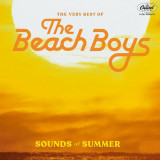
"To kick off the yearlong celebration and provide the perfect summer soundtrack, Capitol Records and UMe will release a newly remastered and expanded edition of The Beach Boys career-spanning greatest hits collection, Sounds Of Summer: The Very Best Of The Beach Boys, on June 17. Originally released in 2003, the album soared to no. 16 in the US and stayed on the chart for 104 weeks. Now certified 4x platinum for sales of nearly four and a half million albums, the collection has been updated in both number of songs and audio quality, expanding the original 30-track best of with 50 more of the band’s most beloved songs for a total of 80 tracks that span their earliest hits to deeper fan-favorite cuts and from their 1962 debut album, Surfin’ Safari through to 1989’s Still Cruisin’.
Assembled by Mark Linett and Alan Boyd, the team behind 2013's GRAMMY® Award-winning SMiLE Sessions and last year’s acclaimed boxed set, Feel Flows – The Sunflower and Surf's Up Sessions 1969-1971, Sounds Of Summer features nearly every US Top 40 hit of The Beach Boys’ incredible career, including “California Girls,” “I Get Around,” “Surfer Girl,” “Surfin’ U.S.A.,” “Fun, Fun, Fun,” “God Only Knows,” “Good Vibrations,” “Be True To Your School,” “Wouldn’t It Be Nice,” “Kokomo,” “Barbara Ann,” “Help Me, Rhonda,” “In My Room,” and many others. Fifty additional tracks showcase a broad mix of songs from across their wide-ranging catalog with some of the many highlights including “All Summer Long,” “Disney Girls,” “Forever,” “Feel Flows,” “Friends,” “Roll Plymouth Rock,” “Sail on Sailor,” “Surf’s Up,” and “Wind Chimes.”
The collection boasts 24 new mixes including two first-time stereo mixes, plus 22 new-and-improved stereo mixes, which in some cases feature the latest in digital stereo extraction technology, allowing for the team to separate the original mono backing tracks for the first time.
The expanded edition of Sounds Of Summer will be available in a variety of formats, including a 3CD softpack, and as a Super Deluxe Edition 6LP vinyl boxed set on 180-gram black vinyl in two options – a standard set or a numbered, limited edition version featuring a rainbow foil slipcase and four collectible lithographs. Both versions will feature color printed sleeves that replicate the original “Capitol Catalog” sleeves that highlight the entire Beach Boys discography, and all formats will include a booklet with new liner notes and updated photos. The original 30-track version will also be available in its newly remastered and upgraded form on single CD or double gatefold LP on standard weight vinyl or as a higher-end limited edition numbered version pressed on 180-gram vinyl with a tip-on jacket and a lithograph. "
Big Crown Records is proud to present the debut full length offering from Les Imprimés, Rêverie. The stirring and ethereal sounds of Les Imprimés have been making fans of anyone who hears them since their first 7" single hit the speakers. Morten Martens is the man behind the band. Born, raised, and working in Kristiansand, Norway, he keeps a low prole while making his heart felt, highly infectious, and unique music. This album is a long time coming for Martens and it is sure to make him a name to be reckoned with. The first thing you notice listening to Les Imprimés is the high level of musician-ship. Martens plays nearly every instrument on the recordings and handles the production and arranging. He has been making records for decades, winning a Spellemann Award (aka, the Norwegian Grammy) in 2006 for producing a HipHop album as well as getting nominations across three other genres. While awards and accolades speak to the level of his talent, this new album really shows who he is an artist on his own terms. Moving away from being a hired gun on the touring scene naturally led him to start doing more studio work. Slowly collecting gear and getting more experi-ence behind the boards he built his own studio on the island of Odderoya and was making a living playing with and recording other people's music. As the story goes, after those sessions would end he would work on his own project into the wee hours of the night. From these late night sessions, Les Imprimés was born and Rêverie began to take shape. However, "it wasn't until COVID, when things locked down, that I was really able to nd the time to focus on Les Imprimés" Morten says about creating and leading his own solo project. "It was a scary time. But I knew I had to do something with it." He took the sum of his inuences, combined them with his own vibe and got busy writing the music, playing the instruments, and singing the songs. "It's soul music, but I don't exactly have the soul voice," Morten explains humbly. "But I do it my own way, in a way that's mine. "It is his sound, his fingerprint, his sensibility, that makes his music hard to put in a box. The album showcases both Martens' range and his ability to make a cohesive album. The lead single "Falling Away" starts with a raw drum break and turns into a lushly arranged tune that paints the picture of love when it slips away. On "Still Here" he professes his resilience through life's twists and turns over a thundering track that puts a new spin on the B side ballad genre. Songs like "You" and "Our Love" mix tones from 60s and 70s Soul with arrangement nods to Doo Wop records while Martens' lyrics and delivery leave you singing the melodies long after they finish. "Love & Flowers" finds Martens in a moment of clarity with a song that ts the niche sub genre of happy break up tunes, the four on the floor track will move the dancefloor or while the message will resonate with anyone who put too much effort into the wrong situation in their lives. However, it is songs like "Muse" and "Chess" that really encapsulate the uniqueness of Les Imprimés as they push the boundaries of genre, one a profession of love for music and the other a cover of an electronic record respectively. Martens' lyrics, emotion, and delivery truly make the whole thing come together and stand out from any of his peers. There's an infectiousness and a pop sensibility in the writing that is done with the utmost class and taste giving Les Imprimés the rare quality of immediate attraction that only deepens the more you listen.
Big Crown Records is proud to present the debut full length offering from Les Imprimés, Rêverie. The stirring and ethereal sounds of Les Imprimés have been making fans of anyone who hears them since their first 7” single hit the speakers. Morten Martens is the man behind the band. Born, raised, and working in Kristiansand, Norway, he keeps a low profile while making his heartfelt, highly infectious, and unique music. This album is a long time coming for Martens and it is sure to make him a name to be reckoned with.
The first thing you notice listening to Les Imprimés is the high level of musicianship. Martens plays nearly every instrument on the recordings and handles the production and arranging. He has been making records for decades, winning a Spellemann Award (aka, the Norwegian Grammy) in 2006 for producing a Hip Hop album as well as getting nominations across three other genres. While awards and accolades speak to the level of his talent, this new album really shows who he is as an artist on his own terms.
Moving away from being a hired gun on the touring scene naturally led him to start doing more studio work. Slowly collecting gear and getting more experience behind the boards he built his own studio on the island of Odderøya and was making a living playing with and recording other people's music. As the story goes, after those sessions would end he would work on his own project into the wee hours of the night. From these late night sessions, Les Imprimés was born and Rêverie began to take shape.
However, "it wasn't until COVID, when things locked down, that I was really able to find the time to focus on Les Imprimés" Morten says about creating and leading his own solo project. "It was a scary time. But I knew I had to do something with it." He took the sum of his influences, combined them with his own vibe and got busy writing the music, playing the instruments, and singing the songs. "It's soul music, but I don't exactly have the soul voice," Morten explains humbly. "But I do it my own way, in a way that's mine."
It is his sound, his fingerprint, his sensibility, that makes his music hard to categorize. He has crafted an album of songs with different energies that all fit together to make one gorgeous record. The lead single “Falling Away” starts with a raw drum break and turns into a lushly arranged tune that paints the picture of love when it slips away. On “Still Here” he professes his resilience through life’s twists and turns over a thundering track that puts a new spin on the B side ballad genre. Songs like “You” and “Our Love” mix tones from 60s and 70s Soul with arrangement nods to Doo Wop records while Martens’ lyrics and delivery leave you singing the melodies long after they finish. “Love & Flowers” finds Martens in a moment of clarity with a song that fits the niche sub genre of happy break up tunes, the four on the floor track will move the dancefloor while the message will resonate with anyone who put too much effort into the wrong situation in their lives. However, it is songs like “Muse” and “Chess” that really encapsulate the uniqueness of Les Imprimés as they push the boundaries of genre, one a profession of love for music and the other a cover of an electronic record respectively. Martens’ lyrics, emotion, and delivery truly make the whole thing come together and stand out from any of his peers. There’s an infectiousness and a pop sensibility in the writing that is done with the utmost class and taste giving Les Imprimés the rare quality of immediate attraction that only deepens the more you listen.
The summer of 2016 marked the fortuitous meeting of two talented musicians, Zaidi Kiggundu (Ziggy Funk) and Jamie Mcshane, at a music festival. Sharing a love for Funk, Jazz, and Soul music, the duo knew they had to collaborate on a project together. Both Zaidi and Jamie had established music careers, bringing their unique backgrounds and experiences to the table. They also had their own music labels, contributing to their respective scenes.
Their collaboration began with a series of demo sessions at Jamie's studio in Scotland. Together, they laid down the foundation for their debut album, which they named 'Fortuitous.' This album fused Funk, Jazz, and Soul with a contemporary touch, paying homage to the classic albums of the past that deeply inspired them. Despite facing challenges such as scheduling conflicts and the disruptive impact of the COVID-19 pandemic, Zaidi and Jamie remained committed to completing the project.
To bring their musical vision to life, they enlisted the help of top-notch musicians on horns, including Ewan Mains, Konrad Wisniewski, and James Steele. With their contributions, the album 'Fortuitous' delivers solid grooves and captivating arrangements, showcasing the duo's dedication to their craft. The quality of the music caught the attention of Splash Music, who eagerly embraced the project. What started as a chance encounter and a few simple ideas many years ago has now transformed into a fully realized album, ready to be released to the world for everyone to enjoy.
This Moment' - Shakti's first new studio album in more than 45 years - is
a work of immense depth and radiant optimism
With John McLaughlin (guitar, guitar synth) and Zakir Hussain (tabla) joined by
vocalist Shankar Mahadevan, violinist Ganesh Rajagopalan, and percussionist
Selvaganesh Vinayakram, the Shakti of now is a powerfully dynamic collective,
defined by deft interplay, dazzling unison passages, extraordinarily dexterous
improvisations, and the ability to draw from a vast well of global traditions and,
miraculously, put them in conversation with one another.
As a cornerstone of what is now called World Music, the vision and virtuosity of
Shakti has inspired generations of musicians from around the world to explore
sonic hybrids once thought impossible. Born of the musical and spiritual
brotherhood shared by the revolutionary British guitarist and bandleader John
McLaughlin and master Indian percussionist Zakir Hussain, Shakti's soulful,
organic intermingling of Eastern and Western musical traditions has proven
transformative for both the band's members and its listeners. Fifty years after the
informal conversations and jam sessions that sparked the band into existence,
their music continues to resonate and evolve.
Despite the large gap in their studio discography, Shakti has persisted
intermittently over the years as a live proposition, releasing several concert
recordings. "Shakti is very much a 'live' band, " explains McLaughlin. "A part of the
problem with making a studio recording has always been the fact that we live on
different continents, and we all follow our individual careers – in addition to
working together in Shakti. 'This Moment' is the result of me calling everyone in
the fall of 2021 and persuading them to use today's recording technology to
realise it."
Recorded and mixed in the U.S., Monaco, India, and Great Britain, This Moment is
nevertheless cohesive, bound by the deeply held bond shared by the players - a
bond that is audibly apparent across the album's eight tracks.
PRSPCTV aka XENTRIX is an emerging Belgian techno talent who steps out here with his first release on Musik is Egall. His moody and atmospheric original 'Perspective & Surface' is found on the B-side. It's a hunched-over, stripped-back deep techno and dub fusion with grotty synths and vast incendiary hi-hats hurrying you along.
Label co-founder Oliver Hess steps up with his own remix on the A-side and flips the track into something as as deep as they come, with dubbed out chords and warm, edgeless but driving kicks and smeared pads all laced up with muffled vocal mutterings and rising synths. It's one for early-evening groove sessions or late-night zone outs.
Japanese born but nowadays NYC resident, DJ Monchan is a long-time purveyor of Disco edits and early House music, something you'll clearly hear on his debut release on GAMM.
The first track 'What is your love worth' is really something special as it starts off with a gritty and raw early house loop but then makes a dramatic turn over to high energy NY Disco...and then back to the grit.
A great jam session!
The B-side offers a deeper Disco-House track that easily could've been released in the early 90's on any of the relevant NYC labels of the time.
Oliver Dollar’s Industry Standard welcome Detroit’s Outr Drive featuring vocalist Steffanie Christi’an for a vinyl release on the label. This package presses up the original ‘You Don’t Know’, first released on the label in 2021, with remixes from John Arnold & KON.
The original sees Outr Drive deliver a low slung, soul drenched, deep house track with a live bass line and lush keys that set the tone of a track for a wonderful vocal from Steffanie. The song is both emotive and seductive and shows off her amazing vocal range.
Detroit’s John Arnold steps up for the first remix taking his version into a deep electronic, synth driven work out, using the vocals to blistering effect over his swirling Detroit styled synth chords.
Over on the B-side we have some disco gold from Boston’s KON. He’s crafted a vintage styled disco record around the vocal that sounds truly authentic, almost feeling like it was recorded in a live session. This mix oozes quality and will be a timeless floor pleaser for the cooler floors.
Wisdom Teeth co-founder K-LONE returns with his second full length project, ‘Swells’: a kaleidoscopic and expansive record that looks to deep house, synthpop, leftfield R&B and beyond for a spellbinding masterwork of melodic electronica.
His debut LP ‘Cape Cira’ became the accidental soundtrack of the long strange summer of 2020 - its lush marimbas, hazy atmos and synthesised bird calls providing the ideal soundtrack for some much needed collective escapism. The record was widely deemed one of 2020’s standout electronic LPs, gaining glowing reviews in Pitchfork, DJ Mag, Mixmag and Resident Advisor, and ranking highly in end of year lists by Crack Magazine.
Approaching its follow up, the Brighton-based producer felt a fresh perspective was needed. Originally landing on the name ‘Swells’ as a secret pen-name to write the record under, the intention was to keep the project as separate as possible from ‘Cape Cira’ to avoid settling into familiar territories - but as the record took shape it became clear that it made perfect sense amongst his already diverse discography.
Like ‘Cape Cira’, there is a distinct and intentionally limited sound palette at play on ‘Swells’. Looping vocal cuts, rich cluster chords and undulating arpeggios sit front and centre here - as does the lo-fi plonk of of the CR78 drum machine. But while the record clearly takes influence from a range of vintage sound sources, its overall aesthetic is unmistakably contemporary. Sounds are not artificially degraded nor obscured under washes of sampled tape hiss. Rather, everything is processed with a gloss, hi-fidelity sheen. The record’s rhythms are bright, dry and snappy, and its melodies are processed with a neon poppy glow.
The producer’s unabashed love of contemporary pop music is most obviously exemplified by the appearance of British singer-songwriter Eliza Rose. The pair met for a session at a North London studio back in 2021, and the now Brit Award-nominated singer’s warm, emotive vocal takes became an immediate source of inspiration early in the record’s conception. As such, Rose’s voice is heard in various states of manipulation throughout its duration - initially as reduced and looped phrases, and then finally in full form on ‘With U’: a low-lit, dubbed-out slice of leftfield R&B that beckons comparisons with Tirzah, Little Dragon and even Erykah Badu.
Elsewhere, there are references to G-Funk (‘Oddball’), Autonomic drum and bass (‘Shimmer’), hip-house (‘Love Is’) and even Metronomy-era electro pop (‘Love Me A Little’).
As always, the true magic of K-LONE’s artistry is to present complex, subtle and original ideas in ways that feel familiar and immediate. Melodies are introduced as effortless earworms, only to be twisted out of shape into strange and unusual formulations. Looping rhythms unspool into washes of hazy, dubbed-out ambience before rebuilding themselves. Refined and endlessly creative, ‘Swells’ marks a captivating next step for a producer and record label that have both reliably positioned themselves at the very forefront of contemporary electronic music.
Renowned Italian spiritual jazz master, DJ, producer, guitarist, and bandleader Nicola Conte proudly presents his new album Umoja via London based label Far Out Recordings.
A joyous exultation across ten tracks, Umoja taps into the abundant well of knowledge Conte has amassed over his career as connoisseuring compiler and archivist of deep jazz, latin, afrofuturist, bossa-nova and soul music from around the world. Expressing unity, oneness and harmony in Swahili, Umoja coalesces universal feelings through the multifaceted global music Conte has spent his life studying and researching.
Having released music with Blue Note, Impulse! and Schema records, Nicola Conte’s relationship with Far Out began over a shared love of hard-edged bossa-nova and swinging samba-jazz. Between 2009-2013 Nicola Conte compiled five volumes of forgotten 60s Brazilian music for his Viagem series. He then released his critically acclaimed Natural album: a collaboration with vocalist Steffania Dippiero, featuring jazz standards alongside covers of lesser known Brazilian gems.
The music of Umoja draws on the deep-dug 70's independent spiritual and free jazz sounds, private-press soul records, and African and Afro Caribbean rhythms in Conte’s collection. But he equally recognises his debt to many of the decade’s more celebrated musical icons, such as North American cosmic jazz masters Lonnie Liston Smith and Gary Bartz, and Afrobeat originators Fela Kuti and Tony Allen.
Since founding the Bari-based bohemian cultural movement and club night Fez at the dawn of the nineties, Conte has proven to be a pillar of the contemporary, international soul-jazz scene. Composed alongside his long time friend, guitarist Alberto Parmegiani, Conte brings together a dazzling host of guests from around the world, including award winning British vocalist Zara Mcfarlane, acclaimed Finnish saxophonist Timo Lassy, french vibes player Simon Mullier, US vocalist Myles Sanko, rising South African drummer Fernando Damon, former Roy Hargrove bassist Ameen Saleem and Serbian flute sensation Milena Jancuric.
Proudly revivalist, Umoja was recorded direct to analog tape, with just two takes for each track. “Searching for an unadulterated, spontaneous, almost improvised feeling”, Nicola made sure that the few overdubs were also transferred to tape in order to retain the colour and warmth of the analog sound. “Very little post production or editing has been added, so what you hear is largely what happened in those magical live sessions”.
Für Sorcery hat sich DeJohnette mit einer Riege virtuoser Bandkollegen zusammengetan, darunter Veteranen der Bitches Brew-Sessions von Miles Davis (Bassist Dave Holland) und der Headhunters-Band von Herbie Hancock (Bennie Maupin).
Diskursiv, meditativ, trippig, aber geerdet in geschmackvollen Grooves (der Deep-Digger-Drum-Break ”Epilog”) und durchzogen von Hendrix-auf-Jazz-Steroiden-Gitarren von den 6-Saiten-Helden John Abercrombie und Mick Goodrick sowie der seiner Zeit vorausgehenden elektronischen Verarbeitung von DeJohnette.
Die erste umfassende Neuauflage seit der Veröffentlichung des Albums im Jahr 1974 ab dem 14.07.2023 als Ltd. 1LP verfügbar.
West Seattle Soul is an oozing collaboration of 13-15 Seattle hot shots crammed into a raw, close quarters performance that is blatant and obscure. It's an accidentally defying, thoroughly enjoyable, relapse of Seattle funk. The group has spent the last two years honing their chops at a residency at West Seattle’s Parliament Tavern.
When writing original music, this outfit goes by the name "The Pulsations" as presented on the B-Side of this Juicy slice of Seattle Side A: "Soul Makossa" West Seattle Soul put an afro-soul twist on Manu Dibango’s pioneering afro-disco hit “Soul Makossa.”
Their arrangement boasts bubbling clavinet, a tenacious horn section, and energetic vocal chants reminiscent of the original with a modern, underground dance music twist.
Side B: "Black River Crisis" Forming an Artist for all original music The Pulsations summon the deep pocket in “Black River Crisis.” Spurred from a group writing session, the drum and bass groove pave the way for interlocking guitar parts and a topsy-turvy horn line. The group found inspiration in the cataclysmic nature of the Black River that fed Lake Washington in the Seattle area.
The river was inadvertently drained when a canal was constructed from the Puget Sound to Lake Washington. The dried-up river caused a catastrophic loss of a resource that affected local farmers, the salmon population, and Native tribes who still lived alongside the river. It beckons the reality of the inevitable briefness in all facets of life and thusly, “you gotta dig it while it’s happening.”
“Session Victim debut on Rhythm Section Intl with an EP of understated but highly effective jazzy house rollers“
Having cemented themselves as firm favourites on the Rhythm Section dance-floor over the years, the German duo step forward to present their debut EP on the South London label: “ Basic Instinct”.
Known for their unparalleled energy when performing live or DJing, Hauke and Matthias fly the flag for sample based, soulful house music and a commitment to the art of vinyl DJing. With the never- ending search for the perfect beat at the core of what they do, it was no surprise they found a deep affinity with Rhythm Section INTL over years of playing for each other, jamming in the studio and crossing paths at festivals and airports around the world. In short, this record was an inevitable culmination of two passionate, like minded groups, a match made in Heaven and a long time coming!
Despite hailing from the techno meccas of Berlin and Hamburg, Session Victim are direct descendants of the German Jazzy House masters, tracing inspiration from the likes of Jazzanova, Soulphiction & Compost Records - the likes of which have gone on to inspire a renaissance of this more soulful sound in German clubs, spearheaded by labels like Tartelet and Toy Tonics - the latter of which the duo recently released an EP with.
This latest effort on Rhythm Section INTL is a masterclass in restraint, demonstrating a deep understanding of dancefloor dynamics, putting the maxim ‘less is more’ to great effect. The
opening track, ‘Trying To Make it Home’ is the most immediately engaging cut: a double bass riff drives along a Kerri Chandler-esque filtered piano pattern which gives way to a soaring Gospel
Vocal , allowing the groove to take control as flutes, strings and occasional guitar licks meander in and out of the mix to create a real ‘heads down, arms up’ moment for the dancefloor.
Born of a thousand nights lost in a surrender to stillness and contemplation, In The Air is Anna St. Louis’ second full length album and her most considered work yet. St. Louis’ debut If Only There Was a River seemed to emerge fully formed out of the recesses of her mind; a gritty, mesmerizing affair, filled with jagged edges and ghostly apparitions. The type of record that announces a new voice; one haunted by what has come before.
But this time, St. Louis is no longer concerned with what could have been and sets her sights to exploring what could be. It’s an outlook on the world that was formed when her immediate one was small. The intervening years since her last album found St. Louis in a small one-bedroom cabin in the middle of the woods of upstate New York with a new love and time to think of what she wanted to express with her music. For weeks on end, the only trips she took were to and from her job as the front desk clerk at a nearby hotel. The previous years she had spent on tour and performing constantly in the venues of Los Angeles felt like they had occurred in another lifetime.
“It really compelled me to surrender to the unknown,” she says. And in this surrender, she found liberation. St. Louis is more self-assured, open-hearted and ready to say what she wants. St. Louis describes the writing period as one of a slow harvest; a fertile time but one that required a newfound patience. Instead of documenting her first thoughts, she spent more time with each song, going deeper with the themes and ideas she wanted to express.
This slower approach also guided the sonic textures of the album. Working with producer Jarvis Taveniere (Purple Mountains, Woods) in two extended recording sessions in Los Angeles in 2021, St. Louis used the studio in a previously unexplored way, opening up her songs to more experimentation featuring brighter tones and a more orchestral sound to accompany her new perspective. To that end, she was aided by a cast of friends and collaborators including Jess Williamson, Kacey Johansing, Oliver Hill (Kevin Morby, Vagabon) on strings, Alex Fischel (Spoon) on piano, Josh Adams on drums (Bedouine, Tim Heidecker) and Keven Lareau (Cut Worms, Hand Habits).
In the Air has the sound of a joyous consideration of the present moment; a quiet morning revealing a new snowfall outside, steam coming from the kettle, just before it whistles, St. Louis with her guitar, staring out the window, with a few free hours before work. She’s reflecting on the scene in front of her, imagining the times yet to come. You can hear it; she’s a long way from the noisy bars of Los Angeles, the rigors of the road. As she intones in “Rest”: “You spend your whole life believing in the chase. And then you realize that being somewhere doesn’t matter like it used to.” She doesn’t need a river to carry her anymore ... She’s in the air.
Opening with euphoric keys and soothing birdsong, Jman & The Argonautz’ debut LP ‘Therapy In Session’ feels like a seminal moment. Not just for the band (it’s not everyday you reveal your debut album to the world) but also in the HF canon.
As a label founded on emcees and breaks, the notion of releasing a fully fledged LIVE studio album, crafted by a 6-piece of likeminded and deeply connected musicians makes for a hugely refreshing kink in the arc, at a time when championing true art has never been more important.
The thing we love most about ’Therapy In Session’ is the sense of togetherness that runs through the album. From the aforementioned opening notes to the very last cymbal, every member bringing out the very best in one another as the track list unfolds. Everything poised and perfectly measured, Jman’s lyrical dexterity and Maddy’s accompanying melodies offering up a rich assortment of emotion and mood for the band to blanket in warm arrangements.
Above all else, ‘Therapy In Session’ represents catharsis for both Jman and The Argonautz; each track a deep dive into the highs and the lows, fears, lessons and regrets that life too often throws at us; 16-tracks, each eloquent and razor sharp at every turn.
- A1: Stompin' At The Savoy
- A2: Flying Home
- A3: Practising, Practising, Just Great
- A4: Relaxing At Camarillo
- B1: Blackbird - White Chicks
- B2: Cool Blues
- B3: You Go To My Head
- B4: If I Should Lose You
- B5: My Ship
- A1: Long Ago (And Far Away)
- A2: Good Morning Heartache
- A3: Never Let Me Go
- A4: Roy Haynes (Reprise)
- A5: Airto
- B1: Roll 'Em Charlie
- B2: What's New
- B3: Take The "A" Train
Charlie Watts “Anthology” is an affectionate retrospective and a reflection of just how frequently Watts was able to exercise his jazz muscles between Rolling Stones commitments to create a bespoke discography of his own. Including 3 unreleased tracks.
The names of Charlie's jazz heroes fell from his lips like a superfan turning the pages of a personal scrapbook. Charlie Parker, Gerry Mulligan, Chico Hamilton, Dave Green, Stan Tracey, Peter King, Courtney Pine, Gail Thompson, Brian Lemon, Gerard Presencer, the Red Rodney group and collaborator Jim Keltner. He knew every player, every session, every album, every outfit they wore on the cover, and he spoke about them with a deep and genuine reverence. He may have been a globally loved hero in the biggest band in the word, but he swatted away any compliment or comparison with his musical favourites. He counted himself their admirer, never their equal.
The Anthology includes an extended essay by Paul Sexton which documents Charlie Watt’s jazz career and the essential albums covered in the collection.
Based in Basel and Berlin, these three award-winning artists of LILAMORS perform genre-defying electro-acoustic music. Their debut album merges contrasting musical influences and gives space to topics that are often forgotten in modern life. Lead singer Ana Čop creates an intimate atmosphere with her poetic chants, accompanied by snowflake-like piano playing and subtle electronica. Perfect music for deep listening, calming down, slow dance sessions, and museums.
Japanese folk-rock legend Morio Agata stunned fans with this way-outta-left-field dispatch - a synthesizer-laden, new-wave/post-punk classic. Originally released by Osaka’s Vanity Records in 1980 and back on vinyl for the first time in nearly 40 years, this fully authorized reissue has been remastered from the original analog tapes. In tip-on sleeve, with double-sided insert.
50 years ago, Hokkaido-born singer-songwriter Morio Agata released his debut single, Sekishoku Ereji (Red Elegy), an emotive, shuffling piano ballad that (shockingly) sold half a million copies in Japan. While he would never have another Top-40 hit, Agata would spend the next half century issuing a series of idiosyncratic, experimental pop albums. Today, he’s a beloved cult figure, still actively touring and recording in his seventies.
In his first decade as a recording artist, Agata released a stream of classics right out of the gate — Otome No Roman (1972) melded American-styled folk rock with traditional Japanese melodies, Zipangu Boy (1976) was a sprawling, Haruomi Hosono-produced psychedelic opus, and Kimi No Koto Suki Nan Da (1977) saw Agata tackle slick, lightly funky AOR. While this sort of stylistic schizophrenia might sink your average artist, Agata’s singular voice and magnetic charisma elevates everything he touches, and subsumes it all into Morio Agata World — a joyous, playful and frequently unhinged world.
Arguably the biggest left-turn of Agata’s early career, however, came in 1979, when legendary experimental label Vanity Records’ Yuzuru Agi paired Agata with major players from his label’s roster and the Osaka punk scene for an impromptu recording session. An impressive list of musicians took part (SAB, Yukio Fujimoto (Normal Brain), Masahiro Kitada (INU), Taiqui (Ultra Bide), Jun Shinoda (SS), Chie Mukai (Che-Shizu), and others) and even though they all came from different wings of the underground music scene, together they built an arresting, minimalistic bedrock of synthesized and acoustic sounds for Agata to work his magic over. The recording sesssions were tense and it took a while for the collective to find their footing. But the hard work paid off — Norimono Zukan is a masterpiece of ramshackle new wave and droning dirges, topped off with Agata’s unmistakeable croon, at times delicate, other times twisted. It’s a relatively short album, but a deep one, and Mesh-Key is honored to introduce it to a new generation of music fans.
The first ever release of electronic Jaglara, an obscure dance music being innovated in an area near the Sudan, Ethiopia, and Eritrea border called Fashaga.
Among the most raucous, hypnotic, addictive, and celestial dance styles being made anywhere in Africa, this heavy, mysterious sound is being led by one man: Jantra, which translates as "craziness," a moniker bestowed to celebrate both his personality and sound. Jantra is a rather unknown quantity even in Sudan, outside of the circles which have granted him cult status to perform at their humble gatherings or at street parties far from the gaze of the cities.
Jaglara, which roughly translates as improvisation, has no songs. Jantra simply freestyles a combination of his melodies incessantly for hours on end, acting as a live producer and DJ for emphatic crowds, where the energy of his 155 - 168 BPM music is known to inspire the odd gunslinger to raise and fire his pistol in the middle of the dance floor. His music is hopeful in a hopeless world, uplifting in spirit, ancient and new, childish and mature, familiar yet refreshingly obscure, fueled by the hypnotic Sera rhythm. His Yamaha keyboard is specially tweaked to achieve what you're hearing — the perfect, sweet key tone, literally universal in its appeal.
A hybrid reissue-contemporary album, Ostinato combined extracted individual melodic patterns, rhythms, and MIDI data from Jantra's Yamaha keyboard with his older cassette and digital recordings to recreate his lengthy sessions into individual dance tracks for a worldwide audience to reach the enviable frenzy of Sudanese crowds. This promising new dance music emerging from the deepest reaches of Sudan has never made its way outside of Jantra's parties, let alone outside of the country.
This record is confirmation that the many electronic styles being exported from Africa have a worthy sibling and rival—Jantra's signature electronic Jaglara from the Fashaga underground. It is a privilege of the highest order to be exposed to this unheralded, incredibly well kept rural Sudanese secret.
- 1: Little Plastic Castle (2023 Remaster)
- 2: Fuel (03 Remaster)
- 3: Gravel (202 Remaster)
- 4: As Is (2023 Remaster)
- 5: Two Little Girls (2023 Remaster)
- 6: Deep Dish (2023 Remaster)
- 7: Loom (2023 Remaster)
- 8: Pixie (2023 Remaster)
- 9: Swan Dive (2023 Remaster)
- 10: Glass House (2023 Remaster)
- 11: Independence Day (2023 Remaster)
- 12: Pulse (2023 Remaster)
- 13: Gravel (Bed Tracks)
- 14: As Is (Bed Tracks)
- 15: Two Little Girls (Bed Tracks)
Orange Vinyl[39,92 €]
Twenty-five years later, Little Plastic Castle feels like a greatest hits collection. Her highest charting release on Billboard (peaking at #22) and containing her third Grammy nomination for Best Rock Performance - Female (“Glass House”), Ani DiFranco’s ninth studio album shows the Little Folksinger grappling with her independent career bubbling up into the mainstream — dissection of her fashion choices, a new expanded listenership encroaching on the die-hards, examination of what it means to sell out — encapsulated in singalongs so indelible that they’re staples of her live set decades later. This 25th Anniversary Edition sees a new remaster by Heba Kadry, the addition of three bonus tracks mixed by Tchad Blake, and a new CD package and first-time release on vinyl (2 LP). To make Little Plastic Castle, Ani returned to one of her favorite places to record in that era—the live-in studio the Congress House in Austin, Texas. In this relaxed setting she commented, "This album seemed to happen more organically than earlier studio releases." Ani is joined by drummer Andy Stochansky and bassist Jason Mercer who played with her on her 1997 tours, as well as bassist Sara Lee who toured with Ani in 1996. LPC also prominently features outside musicians including drummer Jerry Marotta (Peter Gabriel, Indigo Girls), a horn section composed of three Austin session musicians who add flavor to "Little Plastic Castle" and "Deep Dish," and trumpeter Jon Hassell (Brian Eno, Talking Heads) providing the sustained subtle solo on the 14-minute final track "Pulse." The three bonus tracks are recordings of Ani playing with the rhythm section of Sara Lee and Jerry Marotta, a trio that never reassembled after their single day of tracking. Though Ani described it as “the most light-hearted album I’ve made in a long time,” this record covers a wide range of topics — the impermanence of existence ("Fuel"), mutual respect ("Pixie"), forgiveness ("As Is"), drugs (“Two Little Girls”) — and emotions.
- 1: Little Plastic Castle (2023 Remaster)
- 2: Fuel (03 Remaster)
- 3: Gravel (202 Remaster)
- 4: As Is (2023 Remaster)
- 5: Two Little Girls (2023 Remaster)
- 6: Deep Dish (2023 Remaster)
- 7: Loom (2023 Remaster)
- 8: Pixie (2023 Remaster)
- 9: Swan Dive (2023 Remaster)
- 10: Glass House (2023 Remaster)
- 11: Independence Day (2023 Remaster)
- 12: Pulse (2023 Remaster)
- 13: Gravel (Bed Tracks)
- 14: As Is (Bed Tracks)
- 15: Two Little Girls (Bed Tracks)
Black Vinyl[39,92 €]
Twenty-five years later, Little Plastic Castle feels like a greatest hits collection. Her highest charting release on Billboard (peaking at #22) and containing her third Grammy nomination for Best Rock Performance - Female (“Glass House”), Ani DiFranco’s ninth studio album shows the Little Folksinger grappling with her independent career bubbling up into the mainstream — dissection of her fashion choices, a new expanded listenership encroaching on the die-hards, examination of what it means to sell out — encapsulated in singalongs so indelible that they’re staples of her live set decades later. This 25th Anniversary Edition sees a new remaster by Heba Kadry, the addition of three bonus tracks mixed by Tchad Blake, and a new CD package and first-time release on vinyl (2 LP). To make Little Plastic Castle, Ani returned to one of her favorite places to record in that era—the live-in studio the Congress House in Austin, Texas. In this relaxed setting she commented, "This album seemed to happen more organically than earlier studio releases." Ani is joined by drummer Andy Stochansky and bassist Jason Mercer who played with her on her 1997 tours, as well as bassist Sara Lee who toured with Ani in 1996. LPC also prominently features outside musicians including drummer Jerry Marotta (Peter Gabriel, Indigo Girls), a horn section composed of three Austin session musicians who add flavor to "Little Plastic Castle" and "Deep Dish," and trumpeter Jon Hassell (Brian Eno, Talking Heads) providing the sustained subtle solo on the 14-minute final track "Pulse." The three bonus tracks are recordings of Ani playing with the rhythm section of Sara Lee and Jerry Marotta, a trio that never reassembled after their single day of tracking. Though Ani described it as “the most light-hearted album I’ve made in a long time,” this record covers a wide range of topics — the impermanence of existence ("Fuel"), mutual respect ("Pixie"), forgiveness ("As Is"), drugs (“Two Little Girls”) — and emotions.
Label boss Carlo rallies the troops again. This time for his own new collaborative EP, ‘VERSUS’.
Aterral regular, firm family favourite and one of the labels founding artists, Black Loops, steps up on the gorgeously groovy ‘Hungover’. No cloudy heads or slow steps on this collab. Woozy keys yes, but these are kept true by the spritely xylophone melody and warm rolling bass. A perfect opener from this pairing.
Following his popular DOS despatch, ‘Be Pe Em’, much was expected of Emanuele Barilli’s new adventure alongside Carlo. ‘Lelazo’ doesn’t disappoint. Sharp shuffle, filtered keys and popping bassline, all make for a perfect beach-bound soundtrack. Close your eyes, feel the sun on your skin.
From Hungover to another victim of the session, as Carlo teams up with German producer Hauke Freer on ‘Maison.’ Deep, low slung vibes on this ode to the sound we all love. Beautifully constructed, from its patient creamy bassline to its bright rimshots and tender vocal. This is our house. Our home. Come on in.
The most personal of Carlo’s new tracks brings things to a close as he teams up with his young son on ‘Einhorn Poops’. The sun’s warmth is felt again on this beautifully crafted slice of balearic house that matches O's vocals to the equally innocent chimes and bird song to create a fitting and sublime finale.
Returning after three years, the husband and wife duo of Alexi Erenkov and Alison Alderdiceaka. The Saxophones have announced the arrival of their third album, To Be A Cloud, for 2nd June 2023. Out today is the first single to be taken from it, Desert Flower, featuring a video directed by Rainbow Tunnel. "Alison wants me to try therapy, "says Alexi. “She’s a therapist herself, but I’ve never been to one. The idea of going makes me very uncomfortable. I don’t like being vulnerable in front of strangers. So, instead of confronting my discomfort, I look for an easier path. It’s never easier and it’s always unsatisfying or destructive. “Desert Flower” is about avoidance and fear impeding personal growth and the deepening of relationships. The album itself was recorded at Phil Elverum’s (The Microphones, Mount Eerie) Unknown Studio in Anacortes, WA last autumn. A former Catholic church where the pair lived during 24/7 recording sessions, time was no object as they experimented and developed the sound of the record. Its magical setting and ample space provided natural acoustics for Alexi’s arresting vocals which were recorded live to 24-track tape, suspending them in an ambiguous historical and chronological context between analogue and digital. Enhanced by Alison’s percussion alongside the bass and keys of Richard Laws, together they made the most of the studio’s many instruments which fill out and bookend their exploration of the billions of years of evolution that have led to this moment in time.
Ultramarine are an English electronic music duo, formed in 1989 by Ian Cooper and Paul Hammond.
Cooper and Hammond first worked together in the band A Primary Industry during the mid-1980s. Following the split of that band, they formed Ultramarine and released their debut album 'Folk' in April 1990 on seminal Belgian label Les Disques du Crépuscule. The duo found critical acclaim with their second long player, 'Every Man And Woman Is A Star', initially released in 1991. Over the next decade or so, they recorded two John Peel sessions, collaborated with Robert Wyatt, toured the States with Orbital, then Europe with Björk. After a hiatus, they began recording again in Ian's home studio, overlooking the Blackwater Estuary in Essex.
The moods and movements of this English estuary can be heard running through the duo's stunning and deeply intriguing new album 'Send and Return'.
Flowing and mutating as it transitions from an Essex river into the open sea, the Blackwater Estuary, north of London, inspired this beguiling collection of hypnotic jazz, itching electronica and softly dazzling ambient shapes.
For the 6-track album, Paul and Ian hired a Thames sailing barge moored on the estuary for one day and recorded below deck in the ship's downstairs wooden saloon; the idea was originally inspired by seeing Robin Williamson of The Incredible String Band perform on a similar barge.
The duo were joined by jazz musician Greg Heath and accomplished percussionist Ric Elsworth for the day, who added stunning saxophones, alto flute, percussion and vibraphone to the mix. It's a contemplative, ambient record with gentle jazz inflections and softly pulsing electronica.
Eponymous collaboration between Jim Ghedi & Toby Hay - their first
since 2018's 'The Hawksworth Grove Sessions' and their debut for Topic
Records
Postponed for two years due to the small matter of a global pandemic, finally, as
some semblance of normality took shape, in February 2022, the duo headed into
Giant Wafer Studios, mid-Wales, with very little rehearsal time and recorded the
entire album live, with no edits or overdubs over three days.
Jim Ghedi and Toby Hay are both prolific, praised and established artists in their
own right. Hailing from South Yorkshire, Ghedi's previous work has often been
instrumental, exploring the natural world and his relationship to it, as seen on
2018's A Hymn For Ancient Land but also developing into using his voice,
songwriting and traditional material on his more recent album, In The Furrows Of
Common Place. Toby Hay, hailing from the Cambrian mountains, professes
likewise, that the landscape serves as eternal muse and the spiritual groundwork
of his entrancing guitar playing which has dazzled critics and listeners alike
throughout his career. All of this makes their collaboration with the world's oldest
independent label and custodians of UK folk music, Topic Records, a natural
home for this exceptional record.
The album arrtwork includes beautiful liner notes by Andrew Male, senior
associate editor of Mojo magazine; film, radio and TV writer for Sight and Sound
and Sunday Times Culture.
With this release TAL delves deep into the very beginnings of Düsseldorf's post punk scene of the early 1980s. STUMM was the duo of Detlef Funder and Bernd Sevens who both would become pivotal figures in the tape underground movement of West-Germany, when they launched the SDV label in 1986. Individually they went on to produce boundary defying works as Konrad Kraft and Seventh Day respectively.
The material on this album was recorded by Funder and Sevens quite casually in 1980 in a rehearsal studio in the centre of Düsseldorf. Right from the beginning the two young musicians incorporated the atmosphere of the space in order to document the process of their sound experiments on a 4-track tape machine. For those recording sessions, which are now released for the first time ever on vinyl and download, Funder and Sevens managed to get their hands on a very rudimentary set of equipment consisting of merely a Korg MS 20 synth, a Roland CR 78 drum machine, a few electronic effects and a drum kit. The urgent and rough sound of the recordings imbues their production with a characteristic and era-specific edge that's hard to imitate today. Spontaneity and understatement were key elements in the brief creative period of STUMM. The recordings still have a uniquely dizzying quality and are somewhat of a basic blueprint for a lot of industrial/techno and post punk which was about to loom in all corners of the world. These tracks are also a testament to the vivid spark of a period in time that would soon be radically changed through the rise of digital technology.
Bernd Sevens: “Around 1980 there was a great musical awakening. Punk, New Wave, Industrial and of course Dub Reggae -- the electronic music blew us away. Everything we heard influenced us. Back then, cassette tapes were cheap and easily available. We could record our ideas on the spot and then copy and distribute the tapes. That's how it started. Giving it a go, experimenting, trial and error. The music you hear on the record was spontaneous and had no concept. Our collaboration was also not intended to be a permanent project. You could say we were dilettantes setting out on our journey, making it up as we went along. It felt like a beginning.”
Bristol multi-instrumentalist, producer and nature freak Will Yates offers a new record from his Memotone alias, an expansive, hypothetical revue titled How Was Your Life?
Launching from terrains recognizable to fans of Will’s extensive, restless discography, How Was Your Life? packs up his penchant for baroque druid folk, homespun electronics and weightless woodwinds and explodes them into glistening, fractal star dust.
Instigated by the purchase of an antiquated Y2K era guitar synthesizer, the record was produced over the first half of 2022, in a large part a result of in-studio improvisation and carved by equipment that offered both possibilities and parameters that Will relished and explored to the nth degree. The Roland GR33 not only provided sublime guitar sounds but also empowered the guitar to convincingly mimic fretless bass, tabla and a vast percussive array, also summoning an artillery of uniquely outre atmospheres over the course of the record. The resulting concoction sounds familiar yet subtly, unshakeably otherworldly, shaping up as perhaps the most honed, energized and beatific Memotone album to date.
Paradise Drips gently lifts off with wobbly guitar, randomized sequences and unidentifiable percussive elements situating us somewhere in an unearthly realm, before Open World zaps the serotonin receptors and gushes with ecstatic warmth, it’s quietly insistent soft disco shuffle and levitational fretless driving towards a totally blissed and very soft “drop”. Forest Zone sees Memotone deep in the green, with a loose, propulsive groove and dancing flutes stumbling into a medieval ritual in the clearing halfway through, and Glow In The Dark deftly bounces between spacey ambience and an undulating no wave vamp. Carved By The Moon is a delightfully melted classical cut, while Canteen Sandwich offers the record’s most explicitly nod to modernity in the form of a nimble drum workout with samurai synths and melodic percussion that heaves towards a genuine peak. Lonehead immediately backs right off, viscerally melancholic clarinet and bubbling fx making for the records most hefty introspective moment, before Walking Backwards simmers all the way down on an wistful arpeggio, rooting back in earthly reality with charmed rhythms and jazzy tunings. Catharsis complete, Memotone is onto the next incarnation.
Will Yates has been making music as Memotone since 2010, releasing music on labels like Black Acre, Disktopia and Accidental Meetings, also releasing music as O.G. Jigg and Half Nelson. He’s worked as a producer, session musician and live performer on a broad spectrum of projects, and recently provided source sounds that made up Batu’s “Opal” on Timedance.
How Was Your Life? was written, produced and mixed by Will Yates. It was mastered by Chris Wang. Art and design by Hugo Bernier.
Following my recent phone call with Prof. Benson, I left him to continue his 92nd birthday celebrations with his family. We'd talked about his life, his music, his achievements. Throughout our conversation it struck me what a kind, humble and pleasant man he was. I felt that I was in the presence of greatness – not the egotistical greatness that emanates so often from high achievers, but that of someone who had simply won at life.
"I was a music teacher. I wasn't trying to make a record to compete, I was trying to make a record so the students would have something to remember the experience that we had... I was doing it for the kids."
It was 1973 that Prof. James Benson had self-funded his private press LP for the benefit of the teenage musicians he tutored at Cal Poly, California. The album was a momentous achievement for him and his young protegees, something they were all proud of, and rightly so. Taking inspiration from their recent trip to Africa and blended with the radical jazz associated with the young minds of early '70s black America, the Gow-Dow Experience is a unique foray into the enthusiastic mindset of up-and-coming jazz musicians, as encouraged by their mentor Prof. Benson.
We present the album as it was released in 1973 with a heavyweight tip-on jacket and 180g vinyl or on CD. We also include an insert with liner notes and photos provided courtesy of Prof Benson. The LP and CD come with 4 additional tracks taken from the recording session. Until now these tracks have never been heard since the day they were recorded - believe me, they're worth the wait!
Made with love from Jazzman - because we love to dig deeper!
Here comes round 2 of Dimitri From Paris and Chatobaron’s live sessions on Le Heartbeat records. In a clear departure from their Silly Not Silly debut “I like (The Music That You Play)” the 10 piece crew returns with a slightly more trippy mid-tempo groover.
“Chez Madame La Baronne” nonchalantly mixes highly skilled musicianship with vintage lo-fi recording. Here, Chatobaron echo the sound of West Coast Jazz-Funk, as if trapped in a French sexploitation flick - imagine the Mizell Brothers visiting heady Baroness Brigitte Lahaie’s mansion, and you get the picture.
Once again, a lot of pleasure was taken by Dimitri From Paris who directed the proceedings, meticulously arranging the sophisticated material: drum breaks, solos and horny sections, leading to an orgasmic climax. It's lush but raw, and as enjoyable at home as it is effective in the club.
Long time friends The Idjut Boys join the party, deconstructing the original piece from the top down. Ripping it apart to hone in on its darker parts, they deliver a solid and psychedelic Fazz Junk Version in their signature dubbed out style.
With label partner & vinyl digger supremo Melik Ben Cheikh, Le Heartbeat Records continue their quest to bring the higher standards of yesterday’s music to today’s ears.
Early support from François K, Red Greg, Volcov, DJ Deep, Alex From Tokyo, Alex Attias, Hugo LX.
Bedouin aka Tamer Malki and Rami Abousabe are to release their long awaited and adventurous debut album Temple of Dreams on their own label Human By Default this Spring.
Over the course of the pandemic, Malki and Abousabe spent a great amount of time finalizing songs created in the past 7 years, composing, song writing, singing, and working on numerous projects including collaborations and new originals. Temple of Dreams was shaped from these sessions and captures the enigmatic sound of the versatile, forward-thinking group.
Malki explains that the album looks to “experiment and push the boundaries.” It differs from their previous work, as the album is intended to be a deep listening experience for the fans, rather than a slew of club cuts. The multi-talented artists sought to create a timeless sound in Temple of Dreams. Malki outlines that the album lies between “what we play on stages around the world and what we’re capable of writing and producing as musicians and producers. We wanted to exceed expectations and present something that you might think or feel you’ve heard before, yet it's something completely new and not what might be expected from us.”
It starts with the enchanting sounds and candle lit grooves of Rise And Fall then journeys far and wide through the Eastern string sounds of Coldman featuring Nathan Daisy, darkly alluring vocals and mystic rhythms of Voices In My Head and the hypnotic melodic leads of Crazy feat. Iveta Mukuchyan. Elsewhere the richness of Bedouin's sound makes for spellbinding listening on tracks like Hokema Feat. Delaram and Flore Chico feat. Chico Castillo with its alluring Spanish vocals. Love And Hate is a more dynamic and punchier house cut while Fill The Space is an intriguing mix of melodic magic, authentic instrumentation and smooth rolling grooves.
The musicians, singer-songwriters, and producers in Bedouin have spent the better part of a decade fine-tuning their sound, which draws as much from their Middle Eastern heritage as it does their world travels as DJs playing iconic venues across the globe. They have pioneered a distinctive and timeless sound on some of the world’s most notable labels such as Crosstown Rebels, Get Physical, All Day I Dream, and recently their own imprint—Human By Default.
Select major label releases include remixes for Black Coffee and Virgil Abloh on Ultra and Sony/Universal and as well as calling Burning Man home they have their own iconic Ibiza party, Saga, at Pacha each week of summer, and play major events such as Coachella, Tomorrowland, and Art Basel and venues like Ushuaïa, Wynn Las Vegas as well as a ground-breaking Cercle set filmed in Petra, Jordan.
This much anticipated debut album shows yet another side and the artistic development for this influential pair.
- A1: The Great Big No
- A2: Into Your Arms
- A3: It's About Time
- A4: Down About It
- A5: Paid To Smile
- A6: Big Gay Heart
- A7: Style
- A8: Rest Assured
- B1: Dawn Can't Decide
- B2: I'll Do It Anyway
- B3: Rick James Style
- B4: Being Around
- B5: Favorite T
- B6: You Can Take It With You
- B7: The Jello Fund ( + Lenny - Hidden Track)
- C1: Big Gay Heart (Demo)
- C2: Being Around (Alternative)
- C3: Into Your Arms (Acoustic)
- C4: Down About It (Acoustic)
- C5: Deep Bottom Cove
- C6: Acoustic Rick James Style
- C7: It's About Time (Acoustic)
- D1: Miss Otis Regrets
- D2: Learning The Game
- D3: Little Black Egg
- D4: Streets Of Baltimore (Acoustic)
- D5: Frying Pan
- D6: He's On The Beach
- D7: Favorite T (Live In Session)
Zum 30-jährigem Jubiläum erweiterte Neuauflage des nächsten Klassikers der Lemonheads aus dem Jahr 1993, inklusive neuem Cover-Artwork. Die bahnbrechende Platte, die auf It's A Shame About Ray und "Mrs. Robinson" folgte, den amerikanischen Alt-Rock weltweit bekannt machte und Evan Dando in die Herzen einer ganzen Generation katapultierte. Mit einer Fülle von unveröffentlichten Demos, alternativen Versionen und Raritäten - darunter Coverversionen von Victoria Williams, Buddy Holly und den Flying Burrito Brothers sowie The Lemonheads' Interpretation des Cole Porter-Standards "Miss Otis Regrets". In den 90er Jahren produzierten Evan's Lemonheads einen Alternative-Hit nach dem anderen, eine Reihe von wirklich guten Singles: 'Big Gay Heart', 'Into Your Arms', 'It's About Time' und 'The Great Big NO'. Pures Genie, das über's Radio ging und die Indie-Herzen eroberte. Heute ist Evan immer noch ein Meister des Songwritings und 'Come On Feel The Lemonheads' klingt nebenbei noch so frisch wie eh und je. Inmitten der Hits der Originalplatte findet sich aber für noch mehr magische Musik, und diese Deluxe-Edition fügt nun eine zweite Disc mit Demos und Akustikversionen hinzu, sowie eine Vielzahl von Tracks aus Sessions und von Compilations, die dem Mythos und seiner Entstehung weitere Farbe verleihen. So covert die Band liebevoll Victoria Williams' "Frying Pan" von ihrem "Sweet Relief"-Album. Dazu gesellen sich eine Reihe von Flipsides und Out-Takes, wie ihre Version des Garagen-Punk-Knüllers "Little Black Egg" von The Nightcrawlers, Evans Hommage an Gram Parsons "Streets Of Baltimore" und Buddy Hollys melancholisches "Learning The Game". Evan erkennt einen guten Song, wenn er ihn hört, und wie 'Come On Feel The Lemonheads' beweist, kann er auch selbst gar keine schlechten schreiben. Unabhängig davon, dass der Vorgänger ,It's A Shame About Ray" als der Klassiker der LEMONHEADS dargestellt wird, hat der Nachfolger ... seine ganz eigene Geschichte. Erneut gab Juliana Hatfield [mit] den Ton an, [...] auch wenn auf diesem Album Nic Dalton hauptsächlich den Bass einspielte. Es geht insgesamt ruhiger zur Sache, orientiert man sich nur an den Singleauskopplungen ,Into your arms", ,The great big no", ,It's about time" oder ,Big gay heart"." - OX 2015 "Dabei hat Evan Dando seine musikalische Palette wieder erweitert: Neben reinen Country-Songs mit Slide-Gitarre und den poppigen Parts, blitzen plötzlich doch wieder nach vorne treibende punkige Tracks auf. Und diese Mischung passt so gut, dass selbst Pop-Göttin Belinda Carlisle (!) mal singen und auch Punk-Ikone Rick James seinen Part beisteuern darf." - Visions 1993
- A1: The Great Big No
- A2: Into Your Arms
- A3: It's About Time
- A4: Down About It
- A5: Paid To Smile
- A6: Big Gay Heart
- A7: Style
- A8: Rest Assured
- B1: Dawn Can't Decide
- B2: I'll Do It Anyway
- B3: Rick James Style
- B4: Being Around
- B5: Favorite T
- B6: You Can Take It With You
- B7: The Jello Fund ( + Lenny - Hidden Track)
- C1: Big Gay Heart (Demo)
- C2: Being Around (Alternative)
- C3: Into Your Arms (Acoustic)
- C4: Down About It (Acoustic)
- C5: Deep Bottom Cove
- C6: Acoustic Rick James Style
- C7: It's About Time (Acoustic)
- D1: Miss Otis Regrets
- D2: Learning The Game
- D5: Frying Pan
- D6: He's On The Beach
- D7: Favorite T (Live In Session)
- D3: Little Black Egg
- D4: Streets Of Baltimore (Acoustic)
Zum 30-jährigem Jubiläum erweiterte Neuauflage des nächsten Klassikers der Lemonheads aus dem Jahr 1993, inklusive neuem Cover-Artwork. Die bahnbrechende Platte, die auf It's A Shame About Ray und "Mrs. Robinson" folgte, den amerikanischen Alt-Rock weltweit bekannt machte und Evan Dando in die Herzen einer ganzen Generation katapultierte. Mit einer Fülle von unveröffentlichten Demos, alternativen Versionen und Raritäten - darunter Coverversionen von Victoria Williams, Buddy Holly und den Flying Burrito Brothers sowie The Lemonheads' Interpretation des Cole Porter-Standards "Miss Otis Regrets". In den 90er Jahren produzierten Evan's Lemonheads einen Alternative-Hit nach dem anderen, eine Reihe von wirklich guten Singles: 'Big Gay Heart', 'Into Your Arms', 'It's About Time' und 'The Great Big NO'. Pures Genie, das über's Radio ging und die Indie-Herzen eroberte. Heute ist Evan immer noch ein Meister des Songwritings und 'Come On Feel The Lemonheads' klingt nebenbei noch so frisch wie eh und je. Inmitten der Hits der Originalplatte findet sich aber für noch mehr magische Musik, und diese Deluxe-Edition fügt nun eine zweite Disc mit Demos und Akustikversionen hinzu, sowie eine Vielzahl von Tracks aus Sessions und von Compilations, die dem Mythos und seiner Entstehung weitere Farbe verleihen. So covert die Band liebevoll Victoria Williams' "Frying Pan" von ihrem "Sweet Relief"-Album. Dazu gesellen sich eine Reihe von Flipsides und Out-Takes, wie ihre Version des Garagen-Punk-Knüllers "Little Black Egg" von The Nightcrawlers, Evans Hommage an Gram Parsons "Streets Of Baltimore" und Buddy Hollys melancholisches "Learning The Game". Evan erkennt einen guten Song, wenn er ihn hört, und wie 'Come On Feel The Lemonheads' beweist, kann er auch selbst gar keine schlechten schreiben. Unabhängig davon, dass der Vorgänger ,It's A Shame About Ray" als der Klassiker der LEMONHEADS dargestellt wird, hat der Nachfolger ... seine ganz eigene Geschichte. Erneut gab Juliana Hatfield mit den Ton an, ... auch wenn auf diesem Album Nic Dalton hauptsächlich den Bass einspielte. Es geht insgesamt ruhiger zur Sache, orientiert man sich nur an den Singleauskopplungen ,Into your arms", ,The great big no", ,It's about time" oder ,Big gay heart"." - OX 2015 "Dabei hat Evan Dando seine musikalische Palette wieder erweitert: Neben reinen Country-Songs mit Slide-Gitarre und den poppigen Parts, blitzen plötzlich doch wieder nach vorne treibende punkige Tracks auf. Und diese Mischung passt so gut, dass selbst Pop-Göttin Belinda Carlisle (!) mal singen und auch Punk-Ikone Rick James seinen Part beisteuern darf." - Visions 1993
San Francisco is most often associated with the cartoon sounds of DirtyBird when it comes to electronic music but Federsen offers up some deliciously deep dub techno here. He joins the Lempuyang stable and brings with him plenty of fine Maurizio influences from the off: 'Rotation' is all grainy pads and lo-fi drum loops , 'Noir' has a more silky and minimal tech house feel and 'Expiravit' brings a classic dub sound. The closing track 'Aeon' is perfect for late night smoking sessions.
The »Icol Diston« compilation, released in 2002 on DIN, comprised the three first EPs released by Uwe Zahn under his Arovane moniker. Following up on vinyl reissues of his path-breaking debut album »Atol Scrap« as well as 2000’s »Tides,« the German Keplar label finally makes »Icol Diston« available in its entirety on vinyl for the first time in a remastered version with new artwork. This expansive reissue sheds a new light on Zahn’s first two outings as a producer on the »I.O.« and »Icol Diston« EPs on Torsten ›T++‹ Pröfrock’s legendary label as well as highlighting his radical inventiveness as a remixer with the two renditions of Pröfrock-produced material offered on »AMX.« Taken together, these musically complex and emotionally rich electronic compositions form the prologue to an artistic story like none other while also documenting a very specific era in cultural history.
The energy running through Berlin and its boundaryless electronic music scene at the end of the 1990s is reflected by and refined through these eleven tracks. »There was an overwhelming dynamic of liberation reverberating through the city—through the clubs, the arts, the people,« says Zahn today. At this early stage in his career, he had a head full of ideas and slowly started filling up his studio with samplers, synthesizers, and sequencers to put them into practice. »I would compose percussive structures in my mind during long metro rides and record them once I was back at the studio as well as composing melodies spontaneously on my sequencer.« The Yamaha QY700 would become his sketchbook that allowed him to experiment with different patterns, creating polymetric figures out of discrete musical elements.
Zahn’s sessions, recorded live in stereo and straight to DAT, resulted in two very different EPs of original material. His debut »I.O.« showcases a playful and gentle, albeit dubby and at times moody aesthetic. The four tracks are exercises in sonic worldbuilding, creating vast spaces and filling them with a plethora of intertwining melodies and rhythms. Its successor »Icol Diston« drew on similar parameters, but painted a very different picture in terms of atmosphere and mood. »Berlin’s history felt still so tangible and yet somewhat ghostly during the 1990s, and it is a reflection of all that,« explains Zahn. »The weight of its past, starting with World War II up to the end of the GDR, clashed with an atmosphere of departure, a new zest for life among the people in the city.« It is perhaps no surprise then that the five tracks put a firmer focus on beats, at times even approximating techno or electro grooves despite never eschewing the complexity that is so central to Zahn’s work.
The »AMX« EP features two remixes of tracks originally produced by Pröfrock under two different guises. »Außen vor« had been released under his Dynamo moniker and was reworked by Zahn after having been introduced to his label owner’s Studio 440 sampler, sequencer and drum machine. By leaving the groove at the core of the original track mostly intact but infusing it with more dub as well as anthemic synth drones, Zahn gave it more depth both sonically and emotionally. With his remix of »No. 8,« released under Pröfrock’s tongue-in-cheek pseudonym Various Artists, Zahn followed a more radical approach which led him even deeper into dub territory. »I used a relatively short sample as the tonal foundation and then added an incredibly deep bass and percussive elements,« he explains. Widely different from the original version, it perfectly translated the spirit of this singular masterpiece into another stylistic idiom.
The »Icol Diston« compilation is imbued with a forward-thinking spirit that remains exhilarating until today. It captures the sound of one unique artist, but also electronic music during that time more broadly. This is the sound of opening a new chapter, the willingness to venture into the unknown.
All tracks composed and recorded by Uwe Zahn in 1998/99.
D1 is a remix based on the track by Dynamo. D2 is a remix based on the track by Various Artists.
Originally released on three 12inches by DIN in 1998/99 and on CD in 2002.
Remaster and cut by Kassian Troyer @ D&M.
Cover art by Jim Kühnel based on a photograph by Uwe Zahn.
Text by Kristoffer Cornils.
Coherence is overrated. Especially if keeping things hazy, and not smoothing away all the rough edges, and allowing all the seeming contradictions to find their own unique harmony with each other in their own time can result in the heady magic of Lock Eyes & Collide, the second EP from South London-based quintet Moreish Idols. Across these four tracks, Moreish Idols deal in tangles of hyper-melodic guitar, sleepy-eyed murmurs glowing with unassuming poetry, blossoms of wise saxophone, rhythms that pulse and purr to their own inarguable logic. You could spend days trying to define what exactly it is they are doing over these fifteen or so minutes, but you’d be wiser to just lose yourself within Lock Eyes & Collide’s laser-guided twists and turns.
Pulling into focus. They passed tracks from initial collaborative song-writing sessions along to Dan Carey, who signed Moreish Idols to his Speedy Wunderground label and produced their first release on the label, the Float EP, in the summer of 2022 (they’d released a pair of self-released 7”s before lockdown). Restless, jerky, jagged and rhythmically centred, many of Float’s energetic pleasures bore the influence of their earlier flirtation of post-punk, but the ruminative When The River Runs Dry spelled deeper treasures lay within, while the erratic, wonderful Speedboat spoke to Moreish Idols’ essential gift for mystery. Lock Eyes & Collide is something else altogether, though – a looser constellation of ideas, a clearer hint of the group’s future.
The elements that compose the EP – swooning tremolo guitars, prickly melodic riddles, erudite saxophone improvs, loose and flexible rhythms – make perfect sense together, on vinyl if not on paper, sounding like Watery, Domestic-era Pavement one second and some bucolic Canterbury Scene prog the next, but always, always like Moreish Idols most of all.
The future that is undefined is limitless. If Lock Eyes & Collide captures Moreish Idols’ present, what do they see in their future? “If we’d just made Float II for our second EP, people would be, ‘Oh, they’re the band that does that,” says Tom. “I’m so glad we’ve made this weird alter-ego of our first EP; now we feel we can do whatever we want.”
"Akuphone is proud to present the Jerusalem-based improvisational trio Leviot and its hypnotizing debut album. Leviot (Hebrew for “Lionesses”) is a brainchild of multi-faceted musician and composer Yael Lavie, who’s joined by classically trained percussionist and music teacher Cnaan Canetti, and synth enthusiast Yishay Seroussi. The project is a result of Lavie’s ongoing explorations beyond the restraints of classical kanun playing and fascination with electronic sound and modern composition. Initially started following her experience performing and recording with Spiritczualic Enhancement Center, in Leviot, Yael gives up rehearsed pieces in favour of improvised sets, based on virtuous interpretation by Cnaan and Yishay. The three have been active since 2019, playing their immersive shows in a wide variety of settings, venues and festivals. The trio’s debut release is a live session, recorded in late 2020 at Mazkeka Studios (Jerusalem) for the lockdown edition of the annual Zikuk Festival. It’s a meditative improv piece in five parts that combines and melts boundaries between the traditional and the experimental, the primal and the futuristic. With setup as the foundation of the piece and Lavie’s graphic score as the road map, Leviot takes off on a cosmic journey between deep drones, whispering chimes, mesmerizing Arab melodies, pulsating rhythms and iridescent ambient patterns."
repressed !
A lot can happen in 15 years. Few things manage to thrive for a decade and a half, especially in music. But a scrappy, left of center, Bay Area house music label, Dirtybird, has managed to do just that. Claude VonStroke, Dirtybird’s founder, is marking this 15-year milestone the only way he knows how… working. This year, VonStroke will throw two dozen-plus parties, three festivals (including the famous Dirtybird Campout), host his traveling Dirtybird BBQ series in major cities across the US, publish a coffee table book, release a seasonal clothing line, stage art shows, produce a fly on the wall docu series...and kick it all off by releasing a new album, out February 21st.
What began as a free party, turned basement record label, has morphed into a truly thriving community whose familial, fun and welcoming vibe has won over hearts and minds across the world. And while Dirtybird has grown and evolved, VonStroke’s core focus on music remains unwavering. The new album ‘Freaks & Beaks’ is a celebration of quirky innovation and a relentless pursuit of something new and fresh, while hearkening back to the freewheeling spirit that inspired the launch of his label. This is a project that draws upon the inspirations of family, old friends, new fans and proper dancefloors.
Claude will let his flock wet their beaks while they wait in anticipation of the new album with two new singles demonstrating the breadth of the dance music landscape explored on the record. Youngblood touches on the deeper sides of Claude VonStroke, a throwback to the label’s early days, featuring local LA music house talent Wyatt Marshall, while All My People in the House is a dancefloor heater that is sure to unite new and old Dirtybird fans together.
Today, Claude also delivers fans part one of an intimate video series, shot by his sister Emily (an accomplished filmmaker), documenting the creation of ‘Freaks and Beaks’, celebrating this historic milestone and taking a deeper dive into the day to day life of Claude VonStroke on the road.
‘Freaks and Beaks’ is the fourth artist album and sixth full-length project from Claude VonStroke. He approached the album with a new process, including committing to daily creative time, experimenting with a lot of new hardware and having fun creating a huge amount of sketches. He made music on many levels of gear all the way from complex modular synths to simple drum apps on his iPad. Keeping it all DIY, he sampled his own voice and his two children on several tracks as well. He allowed himself to breathe while creating over 130 ideas, which were whittled down to the finished 11 album tracks.
Freaks & Beaks nods at the inspirations that underpin VonStroke’s world, inside jokes between him and Justin Martin (FlubbleBuddy), unused experimental live sessions (Session A), playful noodling on synths (Alpine Arpline), obscure French producers (Frankie Goes To Bollywood), championing new talent (Youngblood), irreverent self-aware humor (Birthday Messages) and genre inspirations that range from ghetto tech and drum n bass to hip-hop and breaks. This is VonStroke’s love letter to the vibrancy and genre diversity that have made Dirtybird such a singular label.
Recorded with a who's who of fusion titans including trumpeter Eddie Henderson, bassist Stanley Clarke, and keyboardist Herbie Hancock, Dance of Magic channels the lessons drummer Norman Connors learned in the employ of Pharoah Sanders, Sam Rivers, and Sun Ra, marshalling Latin rhythms, electronic textures, and cosmic mysticism to create non-denominational yet deeply spiritual funk-jazz. The sprawling 21-minute title cut spans the entirety of the record's first half, capturing a monumental jam session that explores the outer edges of free improvisation but never steps past the point of no return.
Connors' furious drumming is like a trail of bread crumbs that leads his collaborators back home. The remaining three tracks are smaller in scale but no less epic in scope, culminating with the blistering "Give the Drummer Some." by Jason Ankeny
Îlot, an isolated element within a different whole. For his new album, Sheldon, emblematic rapper of the 75e Session collective, continues his work of introspection on organic compositions, filled with the multiple references that build the musical universe of the artist.
Produced by Epektase and mixed by Sheldon himself at Winslow Studio, the project leaves a lot of room for the guitar and the rapper's 60/70s rock influences such as Bowie and the Beatles. There are also influences from Soul, R&B, Lo-Fi and Jazz, pushing the meeting of rap with other musical genres even further.
A nod to Böcklin's painting Isle of the Dead, a work of multiple interpretations that obsessed the painter himself, the island echoes feelings of isolation and solitude, but also the need to escape and introspect. We thus find the themes that haunt Sheldon: his childhood and his relationship with others, his questions about his place as a human being, which he poses head-on or through lighter notes of humour, and his dismay at a world for which he "knows the problems, not the solutions". His texts, unique and personal, reveal his most intimate thoughts. Like a conversation, they resonate within each of us and create a strong bond, a deep sense of understanding, against the backdrop of all the sweetness and melancholy of the images he conjures up: "One more day on my islet, watching the sailboats go by."
The metaphor of the islet continues in the visual universe built around the album, where the central element is a monolith used to represent isolation and emptiness. Made up of four mirrored sides, this imposing artefact represents both the island and the subject of the album: the central element is not the main subject, Sheldon, but rather what he tells us about the world around him.
Mammal Hands announce spell-binding new album 'Gift from the Trees', their fifth studio album, pointing to subtle shifts and exciting new departures for the unique trio
"We're at a point now where playing and writing together can sometimes feel almost telepathic, that as individuals we can tune in to a collective resonance..."
Mammal Hands fifth album 'Gift from the Trees' offers a fresh perspective on the unique trio's singular music. The first to be recorded in a residential studio, the band enjoyed the opportunity to go late into the night searching for a deeper, more organic experience, closer to both their writing process but also their trance-like live performances. While some of the music was pre-composed and had even been performed live, the band also enjoyed the opportunity to improvise ideas in the studio. Drummer Jesse Barrett explains:
We wanted to have a more immersive experience that felt closer to our writing process. One thing that was really important to us was feeling free to jam out ideas as they came to us. We're at a point now where playing and writing together can sometimes feel almost telepathic, that as individuals we can tune in to a collective resonance and just follow that thread where it wants to go. Sometimes it's something as simple as a rhythmic, textural flow, like in Sleeping Bear.
There was also a conscious decision to move away from the sound and ambiance of the recording studio, with the band opting to engineer the record with their go-to live engineer Benjamin Capp before mixing the sessions with Greg Freeman in Berlin. The idea was to try and capture more of the energy of the band's captivating shows, saxophonist Jordan Smart explains:
Considering the group of tracks we had, it made sense to try and capture this process as organically and honestly as possible, and so a change in studio environment felt like the right move to us. Some of the tracks have a raw joy and energy that came with being able to play together again after a long period of time of having been apart, and capture that feeling of just being happy to be in a room with our instruments altogether again.
Whereas for pianist Nick Smart there was also the chance to really go deep into the band's music:
The new studio environment really opened us up to different ways of working and thinking because we could record at any hour of the day or night. I think this allowed us much more freedom to try unusual ideas and push elements of the music to extremes because we had the time to really focus in on the detail and work on things without time pressure. With some tracks, we were trying to find the boundaries of our playing ability and push beyond that point. With others, it was just getting into the right mindset and putting as much energy and emotion into the take as possible.'
The Welsh environment outside the studio doors seeped into the music presented on Gift from the Trees, with two recording sessions (one in winter and one in the spring) bringing different moods: one bleak and wintery, the other more hopeful and bright – an energy that permeates through tracks such as Kernel and Dimu.
Gift from the Trees opens with wonderfully elevating The Spinner which grew from one of Nick's piano parts and was developed and arranged into a complete tune without losing the feeling of constant flow and motion. It is almost like a dance, with the interaction of different melody parts and the doubling of certain parts melding together and fitting into the overall energetic flow, while Jesse's drums are both floating and deeply melodic. Riser aims to capture the band's raw energy and intriguingly is influenced by both breaks and modern drum production but also minimalist classical composition. Nightingale features the band at their most delicate and lyrical – a band favourite it draws heavily on modern folk with a beautifully realised melody that came unforced to pianist Nick Smart before being jammed out together. It was recorded early one morning, bringing an extra light and brightness to this beautiful performance.
Another album highlight is Dimu which utilises one of drummer Jesse Barret's favourite rhythmic devices from the Tabla repertoire and draws inspiration from Indian, Greek and Arabic music as well as modern folk arrangements. Dimu starts with saxophone over a bed of drones and percussion and moves through many different sections that frame and present the melodies in unique ways. The beguiling, intimate Deep within Mountains aims to place you in the room with the band as they play; it was recorded late at night to capture a dreamlike, liminal ambiance. The piano solo really reflects this mood and energy while the tenor is some of the softest and closest on the recording. Elsewhere, the remarkable Labyrinth started with what Nick describes as "some weird recording on my phone from a soundcheck, where Jordan was playing some crazy sounding bass clarinet part and I quickly recorded him", giving birth to a captivating, complex slice of propulsive 'almost' contemporary classical that like so much of the music on Gift from the Trees really couldn't be any other band than Mammal Hands.
Finally, the album draws to a close with the glorious Sleeping Bear, a tune that was wholly improvised in the studio. Nick and Jesse entered a simple but 'weird' locked groove and Jordan improvises melodies over the top. The track came about without any planning or thought; it was one of those special things that came by surprise and the band felt offered the perfect ending to their latest gift to us all: a deeply enthralling album that captures so much of what makes Mammal Hands a special band while mapping out new routes and paths for their beautiful, beguiling music.
A relatively new label based out of Brooklyn, New York, their third release BKS-03 continues to build off of the success of BKS-01 and BKS-02 and again enlists local NYC underground heroes to fill out the Various Artist format, with interludes spread throughout.
The first track on the A-side enlists House Legend Eric Kupper, who frequently collaborated with the late Frankie Knuckles and is responsible for some of Knuckles' biggest hits, drops an absolute stormer of a track that will get any party started. Track two sees Andrew Licata go deep and dreamy with beautiful pads and great percussion perfect for an outdoor jam session or deep in the afterhours.
The B-side enlists BK Sway regulars DeWinter & Emma for a dance floor filler that's bound to shake any massive sound system. Track 2 sees After Touch and Jay Prouty get heady with deep jazzy vibes and a trippy spoken word to complete the package.
Label art from NYC mural legend Cern aka Cernesto.
Swing Family's Music Force is dramatic mid-80s synth-funk. From the maverick mind of Sauveur Mallia, it's a thrilling and uniquely brilliant album from start to finish. It's undoubtedly known and revered for its unbelievable standout track, "Mission Africa". Those that know, know. And if you don't know, get to know. It's the reason this record has been hugely sought-after for the best part of two decades. Originally released on Tele Music in France in 1985 but now tear-inducingly rare, this is the definition of "a welcome reissue."
Swing Family is basically a supergroup of French Funk royalty. Led by French disco lord and Arpadys maestro Sauveur Mallia, they were augmented by trombonist Alex Perdigon from legendary French funk rock collective Godchild, trumpeter Kako Bessot from funky fusion group Synthesis and saxophonist Pierre Holassian, a member of Giant, Janko Nilovic's French jazz orchestra. So, about as heavyweight as it gets for funky French goodness. Mallia handles, of course, bass duties throughout, as well as utilising his arsenal of synths including his E-mu, Yamaha Dx7, Roland MSQ 700, Mini Moog and Oberheimm.
The maximalist disco fusion of "Exorcistor" is perhaps a bit too 80s French cheese for most tastes, so either linger on its singular style or head straight to the soundtracky typo-funk of "Greewich Boulevard". A deep, swaggering powerhouse, it comes on like mid-80s Chic jamming on the set of Beverly Hills Cop with Kashif. Yes, *that* good. It's followed by the vital "Music Force", a synthy, sleazy instrumental full of sax and flute and those 80s drum fills. Just the right side of acceptable.
OR! You can even choose to forget all the rest and just stick "Mission Africa" straight on. A rumbling, strutting, afro-cosmic low-profile banger. The slick drums hit hard, the synth strings warm things up, overlapping horns add swagger whilst electric guitar flourishes and a chanted refrain sit in the mix quite perfectly. A track that's almost impossible to describe and do justice to. You just need to hear it. Preferably as you saunter into your favourite after-hours club, after spotting all your friends at once, as you cut a swathe to the bubbling dance floor. A track quite like no other, it makes you sit up within its first bars and, to us at least, sound like something you'd have heard on a Print Thomas mix from the mid 00s. Basically, it's cosmo-galactic.
The B Side opens with "Musical Stars", an oh-so-80s funk-lite track which, at times, sounds like something Daft Punk may have left on the cutting room floor during their Discovery sessions. Another unimpeachable favourite of ours is the druggy brilliance of "Gentleman & Musician". You can almost hear the white powder through the speakers, as soaring, acidy synths, slick, heavy beats and the irresistible interplay of the primo horn players create a real sleazy wonder. "Film Action" follows, a galloping horn-heavy synth romp with moments of extreme bass breakdown brilliance before the drama-synths of "Episode Double" take things up another notch as it oscillates between gorgeous funky horns and urgent bleepy magic. Super tense, super funky and super stylish. Just ace. The elctro-tinged horn workout "Fatal Lady" closes things out majestically.
The audio for Music Force has been remastered by Be With regular Simon Francis, ensuring the punch of Sauveur's bass and those sick drums come through to the fullest. Pete Norman’s expert skills has made sure nothing is lost in the cut whilst the original and iconic sleeve - complete with perky Liberty Belle - has been restored here at Be With HQ as the finishing touch to this long overdue re-issue.
Veteran artist Sebra Cruz releases his debut album ‘Don't Worry Psy Happy’ on DJ Tennis’ revered Life & Death imprint. The daring eleven track LP is as experimental as it is definitive and encapsulates the Italian spirit in perfect style.
The LP follows two previously teased singles; ‘Margaret’, an ode to Cruz’ girlfriend which is a deeply passionate and expressive melodic house offering and album title ‘Don’t Worry Psy Happy’ a hedonistic, tripped out soundscape.
The lead track ‘Sunfish’ is a melange of powerful synths overlaid with sporadic vocals and a swinging breakbeat which make the record the perfect soundtrack for early morning dancefloor euphoria.
The album continues its genreless motif and is hard to pin down. It broaches a variety of styles including cinematic and ambient leaning sonics such as ‘Optimist’ and ‘Poliziesco’, the latter which includes Gabriele Fabbri’s atmospheric guitar riff throughout.
‘The Siebel Road To Mars’ is a similarly powerful yet emotive record which samples current Italian President Sergio Mattarella between the piano and the extraterrestrial sound palette. Continuing with the more abstract tracks ‘Flying Junior’, which was named after Cruz’ own sailboat, emulates the peacefulness and tranquillity of the sea. It’s yet another reflection of Sebra Cruz’ artistic personality.
Juxtaposing the calm and serene records from the album, ‘AltreCose’, inspired by the energy of the Neapolitan people during Sebra’s DJing residency in the 90s, is a more high energy disco-infused record. Similarly ‘When Life Was Slow’, released on Life & Death back in 2020, is another upbeat dance interpretation and a tribute to Cruz’ passion for Italian composers from the 60s and 70s.
Speaking about the album Sebra says: “What emerges is in my opinion an album with predominantly Italian spirit, disco, house with both edgy and gentle influences. I never decide what to do first, I simply follow my spur of the moment instinct. Releasing an album for Life & Death is cool because I've always had huge respect for Manfredi.”
Sebra Cruz and DJ Tennis have a long lasting and trusting collaborative relationship exhibited by the former's numerous releases on Tennis’ Life and Death label. DJ Tennis’ encyclopaedic musical brain and shared passion for Italian composers perfectly complements Sebra’s stylings.
Striking an impeccable balance between abstract and obscure sonics and more methodical and conventional melodies, 'Don't Worry Psy Happy’ is a body of work that exquisitely expresses Sebra Cruz’ personality via different worlds and mediums.
Beautiful, soulful jazz record by Jimetta Rose and The Voices of Creation, a Los Angeles-based community choir, a mainstay of the local scene. Highly recommended!!
The Voices of Creation are a community-based choir led by vocalist, songwriter, arranger, producer and mainstay of the Los Angeles scene Jimetta Rose. Made up of a multigenerational group of mainly non-professional singers backed by some of the city’s finest musicians,their music marries hip strains of gospel with layers of jazz, soul and funk. While aspects of their music might recall Kamasi Washington, The Staple Singers or Sly Stone, Jimetta’s unique vision has resulted in new spiritually-charged forms of music whose whole-hearted embrace of love, joy and peace act as sonic healing balms for the soul.
For Jimetta - whose resume includes collaborations with Miguel Atwood Ferguson, Georgia Anne Muldrow, Sa-Ra Creative Partners, Angel Bat Dawid, Shafiq Husayn, MED and Blu - the very act of creation was part of a healing process: “I was very low at the time and I wrote most of the songs going through hardship. But I found comfort in the songs and a way to adjust my mindset to where things got better. So I thought ‘if this music works for me, maybe it will work for other people’ I believe that every person has their own voice and their own note and that we can use our voices to heal ourselves. That’s the intention behind creating the project.”
After putting out a call on social media for people interested in joining her choir she was met with a sea of replies. Members were chosen in less-than conventional fashion: “I recruited people based on their interest in healing themselves and others, not necessarily on their musical experience or being seasoned performers” she says. Among those accepted into the ever-evolving collective, which was begun initially as a community choir, were the likes of Sly Stone’s daughter Novena Carmel, better known as a radio DJ for KCRW’s flagship breakfast show. Jimetta’s upbringing in the Pentecostal church, where she was a youth choir director, fed into her otherwise intuitive teachings of her songs and arrangements to the inexperienced members with help from the group’s seasoned organ player/co-musical director Jack Maeby.
Produced by Mario Caldato Jr. (Beastie Boys, Seu Jorge) and his wife Samantha Caldato the results show the incredible sense of togetherness and communal spirit that the group had built up over time in the rehearsal sessions. The six tracks of their debut album, a mixture of originals and rearranged covers, are performed in a wide-eyed mix of styles that reflect Jimetta’s vision for borderless music: “It’s new black classical music,” she explains. “It’s all the hodgepodge of being an African American but also with creativity and vision for the future. It has a taste of what is to come and what we can do. What we have gone through and who we are now.”
The group’s propensity for warm and buoyant sonics finds representation on album opener Let The Sunshine In, a sparkling rework of the Sons and Daughters of Lite’s deep jazz classic. Their version finds the group’s dynamic group harmonies offset with Allakoi Peete’s nimble afro-percussive touches and plenty of soul- drenched keys courtesy of pianist Quran Shaheed and organ player Jack Maeby. A similarly uplifting take on Rahsaan Roland Kirk’s choral jazz classic Spirits Up Above follows, with Maeby’s groove-laden organ lines inspiring some gorgeous group harmonies as well as prime solo turns from the likes of Kellye Hawkins, Zavier Wise, Tamara Blue, and Khalila Gardner.
Another Sons and Daughters of Lite cover follows as Jimetta leads the choir in the groove-drenched ode to self-affirmation Operation Feed Yourself. Written as a series of mantras for everyday living, the Jimetta-penned composition How Good It Is harnesses the full transformative power of music to generate a stirring and joyful ode to positivity - it’s chanted declarations bringing out some of the group’s most deeply-felt and affecting vocal performances over some superlative piano and organ accompaniment with a surprise feature vocal from Novena Carmel.
Jimetta’s talent for re-imagining songs in her own light is highlighted in Answer The Call, her vivid re-telling of Funkadelic’s Cosmic Slop: “When I listened to the original song, the Mom in the story was really going through it. I thought of how I could turn this into a song that can encompass the glorification of all mothers and I thought of the Egyptian cosmic goddess Nut. To that mother we’re all the seeds planted in the garden. Answering the call in your life is literally that. Finding out exactly what you’re here for through your heart.”
The album finishes with the standout original gospel number Ain’t Life Grand. Over swaying organs and clapped percussion Jimetta’s lyrical mantras serve to emphasise the good feelings that come to those with a grateful heart. Good feeling is an apt descriptor for the mood of the album as a whole. Its shining positivity provides a welcome ray of light in an increasingly dark world. “It’s a shortcut if you will to the better feelings” Jimetta says. “The hope that we need to keep pressing forward. We are saturated and inundated with images of chaos and destruction, death and hatred. There’s so much we can witness. So, I want to make sure that there is a representation sonically of the other parts that are still there to witness so that we can continue to build those things. So that the systems we support actually reflect what we want to experience. So it’s like: “Don’t give up and Let The Sunshine Into You” and then find out what your purpose is and answer the call.”
- A1: Livio Fogli - Il Vuoto
- A2: Ital Oscillazioni - Nuove Corde
- A3: Atelier Folie - Planet X
- A4: Italoconnection - Exil (Prequel Sessions Mix)
- A5: Vinavil - The 2Nd
- B1: Love Nation - Make It Right
- B2: S-Tone Inc - No Meio Do Samba(S-Tone Deep Remix Inst )
- B3: Through Twelve Feat Fred Ventura - This Love (Mono Han Remix 2)
- B4: Straight Beat – Argumenting
- B5: Soul Boy - B Side
The sounds across these four tracks were made by SIM and NAP from 2021 to 2023 with lots of love and bass... the sessions started from the first time they met at NAP's studio, point always to kick it, jam and see what happens. After a couple months of that of course a sound develops, a process shines and a friendship grows. After a year or so trust built and a language made present. Transcending the spoken word and feeling unique to both...things start to really go off and the jams turn to songs. Two years pass and it’s time to celebrate with the marker and archive of all those deep sessions, now in edited form to be shared with all. And yeah, you can have all in common with someone when it comes to digging wubs, riddims and drum machines but add vulnerable earnest meetings with meals in between and good conversation about things other than music (or maybe how other things relate to it) and then you get something really special, something like SINNAZ. SIM and NAP journeying into collaboration with a debut EP of rhythmic noise, driving bog beats, swampy dembows, radioactive Dancehall and unhinged experimentalia.
Pink Blue Marbled Vinyl
Angelo is an EP, named after a car, featuring nine songs Brijean have crafted and carried with them through a period of profound change, loss, and relocation. It finds percussionist and singer Brijean Murphy and multi-instrumentalist/producer Doug Stuart processing the impossible the only way they know how: through rhythm and movement. The months surrounding the acclaimed release of Feelings, their full-length Ghostly International debut in 2021 which celebrated tender self-reflection and new possibilities, rang bittersweet with the absence of touring and the sudden passing of Murphy's father and both of Stuart's parents. In a haze of heartache, the duo left the Bay Area to be near family, resetting in four cities in under two years. Their to-go rig became their traveling studio and these tracks, along with Angelo, became their few constants. Whereas Feelings formed over collaborative jams with friends, Angelo's sessions presented Murphy and Stuart a chance to record at their most intimate, "to get us out of our grief and into our bodies," says Murphy. They explored new moods and styles, reaching for effervescent dance tempos and technicolor backdrops, vibrant hues in contrast to their more somber human experiences. Angelo beams with positivity and creative renewal _ a resourceful, collective answer to "what happens now?". Angelo the car is a 1981 Toyota Celica they got off Craigslist during their first stint in Los Angeles, where Murphy and Stuart have since settled. "Such a bro-y, `80s dude car, it's been super fun to drive around in a new town," Murphy says. "He's older than us, he's a classic, he's got a story." It is a spiritual vehicle with a cinematic appeal, first dropping them off in an alleyway for the scene-setting intro, "Which Way To The Club." The question is quickly resolved by "Take A Trip" as a cruising bassline mingles with crowd sounds, hand-claps, cuíca hiccups, whip-cracks, even a horse neigh. Brijean have found some club on this cross-dimensional trip - the kind of imagined space or chamber within one's self capable of "shifting a fraction of who you are," says Murphy. They wrote the track with the simple intention to be "as free as we could be," adds Stuart, likening the flip on the B section to a realm unlocked: "What if the world changed completely? You open the door to a new room." Next is "Shy Guy," a motivational anthem for the wallflowers among us. Murphy sets up the daydream: "We are in junior high, we're on the dance floor, what's going down, who is dancing, who is not, how are we gonna make them dance?" The narrator, the MC, hypes up the room as conga-driven rhythms bounce between languid synth and guitar lines. "Show me how to move...I feel something...I know you feel it too," Murphy sings sweetly, calling back to the opening lines of Feelings, and this time the audience chants it back. It is easy to picture Brijean performing this one - something they only got to do a handful of times until more recently, opening shows for Khruangbin and Washed Out, an experience they found informative. Murphy explains, "It was inspiring to be out there and let loose more. To see how people can expand their expression on stage gave me more liberty with how I viewed my musicianship. My role for so long was to be a backup percussionist, so why would I ever leave the drums, you know? But then after playing all these runs, you see these artists and realize you can, you have permission." "Angelo" and "Ooo La La" deliver the danciest stretch in Brijean's catalog to date. The title track adopts a deep house pulse replete with strings, hi-hats, and kicks. The latter opts for a funkier groove that foregoes verses in favor of warbled hums and extended breakdowns. What follows is perhaps the duo's dreamiest run, a comedown initiated with the honey-hued interlude "Colors" drifting into "Where Do We Go?", a tropicália reverie where Murphy contemplates the passage of time and space. It all culminates in "Caldwell's Way," a fond farewell to their Bay Area community - "a part of my life that I knew couldn't come back," says Murphy. Above shimmering organ sounds, lush strings, and the birdcall of their former neighborhood, she wistfully articulates the uncertainty of moving on by remembering the characters dear to them. There's the wisdom of their neighbor, Santos, who refused payment when helping them move out: "I'd rather have 100 friends than 100 dollars." And the song's namesake, Benjamin Caldwell Brown, a friend and club night cohort for many years. "I'm only miles away, maybe I'm just feeling lonely," the line resigns to warm nostalgia, and "Nostalgia" runs the closing credits to this healing and transportive collection.
Pink Vinyl[20,55 €]
Last year's Big Time brought Angel Olsen to a deeper, truer sense of self than ever before. Borne from the twin stars of grief and love, the album delivered beautiful sense of certainty, the sure-footed sound of an artist fully, finally at home with herself. But within that wisdom comes the realization that there is no finish line, no destination or static end point to life while you're living it, and Forever Means collects songs from the Big Time sessions that hold this common theme. They are, in Olsen's words, "in search of something else." "I was somewhere traveling," says Olsen, "stopped for a few days and wandering the city, and I was thinking `what does `forever' really mean? What are the things I'm seeking in friendship or love, and how can `forever' be attainable if we're always changing?'" Sitting with the reality of that entropy, Olsen realized "maybe the secret to ongoing love is to embrace change as part of love itself, that forever must have something to do with playing, looking, constantly searching things out for yourself, never letting yourself think you're finished learning or exploring." `Forever'", says Olsen, "remains curious while trying also to be kind and honest." All this packs into the four precious songs that comprise Forever Means, songs from Olsen's roads traveled and the ones ahead. "Nothing's free / like breaking free" Olsen sings, comfortable with the costs of her clarity, her heart and voice fixed on the present, the future, the not-yet-known and the beautifully unknowable
Black Vinyl[20,55 €]
Last year's Big Time brought Angel Olsen to a deeper, truer sense of self than ever before. Borne from the twin stars of grief and love, the album delivered beautiful sense of certainty, the sure-footed sound of an artist fully, finally at home with herself. But within that wisdom comes the realization that there is no finish line, no destination or static end point to life while you're living it, and Forever Means collects songs from the Big Time sessions that hold this common theme. They are, in Olsen's words, "in search of something else." "I was somewhere traveling," says Olsen, "stopped for a few days and wandering the city, and I was thinking `what does `forever' really mean? What are the things I'm seeking in friendship or love, and how can `forever' be attainable if we're always changing?'" Sitting with the reality of that entropy, Olsen realized "maybe the secret to ongoing love is to embrace change as part of love itself, that forever must have something to do with playing, looking, constantly searching things out for yourself, never letting yourself think you're finished learning or exploring." `Forever'", says Olsen, "remains curious while trying also to be kind and honest." All this packs into the four precious songs that comprise Forever Means, songs from Olsen's roads traveled and the ones ahead. "Nothing's free / like breaking free" Olsen sings, comfortable with the costs of her clarity, her heart and voice fixed on the present, the future, the not-yet-known and the beautifully unknowable
Mammal Hands announce spell-binding new album 'Gift from the Trees', their fifth studio album, pointing to subtle shifts and exciting new departures for the unique trio
"We're at a point now where playing and writing together can sometimes feel almost telepathic, that as individuals we can tune in to a collective resonance..."
Mammal Hands fifth album 'Gift from the Trees' offers a fresh perspective on the unique trio's singular music. The first to be recorded in a residential studio, the band enjoyed the opportunity to go late into the night searching for a deeper, more organic experience, closer to both their writing process but also their trance-like live performances. While some of the music was pre-composed and had even been performed live, the band also enjoyed the opportunity to improvise ideas in the studio. Drummer Jesse Barrett explains:
We wanted to have a more immersive experience that felt closer to our writing process. One thing that was really important to us was feeling free to jam out ideas as they came to us. We're at a point now where playing and writing together can sometimes feel almost telepathic, that as individuals we can tune in to a collective resonance and just follow that thread where it wants to go. Sometimes it's something as simple as a rhythmic, textural flow, like in Sleeping Bear.
There was also a conscious decision to move away from the sound and ambiance of the recording studio, with the band opting to engineer the record with their go-to live engineer Benjamin Capp before mixing the sessions with Greg Freeman in Berlin. The idea was to try and capture more of the energy of the band's captivating shows, saxophonist Jordan Smart explains:
Considering the group of tracks we had, it made sense to try and capture this process as organically and honestly as possible, and so a change in studio environment felt like the right move to us. Some of the tracks have a raw joy and energy that came with being able to play together again after a long period of time of having been apart, and capture that feeling of just being happy to be in a room with our instruments altogether again.
Whereas for pianist Nick Smart there was also the chance to really go deep into the band's music:
The new studio environment really opened us up to different ways of working and thinking because we could record at any hour of the day or night. I think this allowed us much more freedom to try unusual ideas and push elements of the music to extremes because we had the time to really focus in on the detail and work on things without time pressure. With some tracks, we were trying to find the boundaries of our playing ability and push beyond that point. With others, it was just getting into the right mindset and putting as much energy and emotion into the take as possible.'
The Welsh environment outside the studio doors seeped into the music presented on Gift from the Trees, with two recording sessions (one in winter and one in the spring) bringing different moods: one bleak and wintery, the other more hopeful and bright – an energy that permeates through tracks such as Kernel and Dimu.
Gift from the Trees opens with wonderfully elevating The Spinner which grew from one of Nick's piano parts and was developed and arranged into a complete tune without losing the feeling of constant flow and motion. It is almost like a dance, with the interaction of different melody parts and the doubling of certain parts melding together and fitting into the overall energetic flow, while Jesse's drums are both floating and deeply melodic. Riser aims to capture the band's raw energy and intriguingly is influenced by both breaks and modern drum production but also minimalist classical composition. Nightingale features the band at their most delicate and lyrical – a band favourite it draws heavily on modern folk with a beautifully realised melody that came unforced to pianist Nick Smart before being jammed out together. It was recorded early one morning, bringing an extra light and brightness to this beautiful performance.
Another album highlight is Dimu which utilises one of drummer Jesse Barret's favourite rhythmic devices from the Tabla repertoire and draws inspiration from Indian, Greek and Arabic music as well as modern folk arrangements. Dimu starts with saxophone over a bed of drones and percussion and moves through many different sections that frame and present the melodies in unique ways. The beguiling, intimate Deep within Mountains aims to place you in the room with the band as they play; it was recorded late at night to capture a dreamlike, liminal ambiance. The piano solo really reflects this mood and energy while the tenor is some of the softest and closest on the recording. Elsewhere, the remarkable Labyrinth started with what Nick describes as "some weird recording on my phone from a soundcheck, where Jordan was playing some crazy sounding bass clarinet part and I quickly recorded him", giving birth to a captivating, complex slice of propulsive 'almost' contemporary classical that like so much of the music on Gift from the Trees really couldn't be any other band than Mammal Hands.
Finally, the album draws to a close with the glorious Sleeping Bear, a tune that was wholly improvised in the studio. Nick and Jesse entered a simple but 'weird' locked groove and Jordan improvises melodies over the top. The track came about without any planning or thought; it was one of those special things that came by surprise and the band felt offered the perfect ending to their latest gift to us all: a deeply enthralling album that captures so much of what makes Mammal Hands a special band while mapping out new routes and paths for their beautiful, beguiling music.
Toy Tonics presents a new producer team: Sound Support consists of two enthusiastic synth and house aficionados that everybody knows (in the scene): Lars Dales from Dam Swindle and Lorenz Rhode (keyboard wizard and producer genius).
Together they are doing extremely groovy, jazz infected dance music that connects the good things of 1990ies house with the indie disco of the 2000s.
Lars Dales & Lorenz Rhode connected through their mutual love for all things musically unusual. After years of having worked together on several projects, such as the Dam Swindle live show, they finally got around to making music together. The result has been nothing less than an avalanche of tracks, mostly made in 4 day coffee fueled studio sessions in Lorenz’ studio in Cologne. All reminding the big funk house tracks of the early 2000s. Yes a lot of Daft Punk is here, A lot of NYC disco influences. Larry Levan and Laurent Garnier, DJ Harvey and Masters at Work.. all influences on this record.
After their first two Sound Support EP’s on Prins Thomas’ label, Internasjonal, they’ve ventured out to House of Disco and other labels with a wide array of immensely enjoyable synth heavy tracks. 2023 sees these two venture more into house territory with releases on AUS music and Toy Tonics, two labels that have cemented themselves deeply into the underground scene. In any case, it’s clear that Sound Support have found its signature sound and there is much more of that to look forward to. Toy Tonics is the key label for the wildstyle house scene and Sound Support fit perfectly. Welcome!
Let's get it straight: "This is" is THE album by Ghia. It catches the band at its peak and features 10 songs, including not only their impeccable hit, "What's Your Voodoo?" but a full arsenal of yet unheard, timeless, and soulful music without equal. The songs on the album, which were recorded between 1988 and 1991, could be considered forerunners of the downtempo genre, with one foot in the late 1980s street soul direction but sparkling with touches of synth pop and contemporary jazz-funk. Genre limitations aside, all that Ghia ever wanted to do was create music-good music-and you will hear this in the depth of the compositions.
The album starts with "Keep Your House In Disorder," which has yet again become another classic song from the band's catalog since it was featured as the B-side of the "What's Your Voodoo?" reissue. The song is about a relationship in which the woman has trouble adapting to her boyfriend's turn in life. He tells her to "keep your house in disorder," meaning don't take things too seriously, don't stand still, and you will do better to take the sideroads in life.
"This Is" continues with the downtempo numbers "Crystal Silence" and "Close to You." Both are deep, one-of-a-kind, and previously unissued street soul ballads. On these two tracks, you can still hear the band's roots in jazz-funk. Hence, as a follower of the band's output may have yet recognized, instrumentals of these two tracks can be found on their first LP, "Curaçao Blue." In fact, "Close to You" was one of the band's first compositions. Earlier recordings of the song exist with different singers and different vocals, but it wasn't perfect until Lisa laid down the final version and a choir was added. It's difficult for us to recall any late-80s soul tune as beautiful and intriguing as this one. The final section, which begins with "so much baby we can say," sounds ahead of its time, reminiscent of mid-90s contemporary R&B.
Next up is "Eskimo," an equally brilliant and soulful downtempo composition, but with more focus on synth sounds than the previous tracks. Once more, it showcases the creative lyricism of the song writers, Boberg and Simon, imagining a train ride during a rainy and cold night: "feeling like an Eskimo in an igloo in New York."
Eskimo leads to the aforementioned classic, "What's Your Voodoo?" Originally released in 1991 on the small Mikado label, it was reissued on our label in 2019. We already called this "one of the most wonderful and mystic slow motion synth pop tunes ever recorded"-and we still mean it! Let's face it: this was done before British bands like Massive Attack, Tricky, and Portishead laid the foundation of trip-hop. Dare we call Ghia's music "proto trip-hop"? As a special bonus, the digital version of the LP features a previously unreleased mix of the song, which includes added samples; this should clarify how close Ghia actually was to the sound of the mid-'90s.
"Angel On Your Shoulder" and "L O M E" are two more completely unissued and great tracks from the band's shelved works. Being a bit more uptempo than the rest of the album, they fall between contemporary soul/R&B and synthesized pop music. And of course, another downtempo hit needed to be featured on the album: "You Won't Sleep on My Pillow." It was the original A-side of their single release in 1991, and since then it has been featured on various compilations.
The album concludes with a really strong ballad entitled "I Haven't Got The Power." Here we hear only pianist and keyboardist Lutz Boberg with Lisa Ohm, without further instrumentation. Basically recorded in a live session, this showcases once more the talent and ingenuity within the Ghia project.
Whether you agree or not, "This is" may easily be considered one of the best German late 80s/early 90s soul pop and downtempo albums ever recorded. Cautiously, it may even be submitted as the missing link between mid/late 80s soul by bands such as Sade, and later trip-hop groups like Massive Attack. Let us celebrate Ghia and their music, which had been shelved for more than 30 years but has now finally been released on The Outer Edge.
Hot on the heels of last year’s Mermaids reissue retrospective, Hull’s deep listening house forerunners return: this time revisiting a pair of originals as well as previously unreleased versions.
It’s testament to the depth of feeling that Steve Cobby and David McSherry can conjure, that these tracks sound as potent and impactful as they did when they first came out - and not just for the dance. Throughout their 30+ years, the Yorkshire duo have produced ten albums amid many more collaborations, and transformed the remix into an artform, putting their fingerprints on everyone from Busta Rhymes to The Orb to Radiohead.
This EP collection finds them at the full scope of their powers: from disembodied mood music, to tripped-out dubby beats and raw house sessions for the club. The title track Subtle Body sounds like it drifted in through the window in the middle of a snowy night. Its layered chimes, looped delay feedback and floaty chords (played on a Wurlitzer Electronic Piano that Steve bought from Bill Nelson), mark it out as an enduring piece of ambient music, and a favorite for film-makers, able to soundtrack both haunted memories and afterparty comedowns with finesse. It precedes an unreleased instrumental version of Nightfall from Fila Brazillia’s 2002 album Jump Leads (named Mixmag’s chill album of the year), and as an instrumental, the chunky electro bass and mix of ephemeral tones and bird-like chirrups are brought clearly into focus. The attention to detail is what makes Fila Brazillia’s sound palette so rich, and Nightfall a certified smokers’ anthem.
On the B side, the tempo and temperature rises, and we’re treated to The Light Of Jesus, a favorite from Fila Brazillia’s 1994 debut LP Old Codes: New Chaos. Atop a bumping house groove, the song weaves together smooth organ pads and electrified guitar licks with syrupy bass and gospel-tinged exaltations from Charles Bukowski. The EP rounds out with Room ‘96, a live house jam from Hull’s Room nightclub, and a veritable time capsule back to the halcyon ‘90s rave days, when the lights were still on, everyone was home, and anything seemed possible.
The songs here on Subtle Body might be a window into a time long past, but they remain in the present: and as long as bodies seek pleasure, and dancers want to keep going til sunrise, Fila Brazillia will endure, and soundtrack those moments for us all to get lost in.
London Brew is a reimagining of Miles Davis’ legendary album Bitches Brew. Produced by Martin Terefe and Downtown Music UK Limited, the record reflects an emotional journey of the times, having been recorded during the pandemic after many months of isolation and the inability to collaborate in person. Recorded in December 2020 at Church Studios in London, the recording session brings together UK jazz artists, Nubya Garcia, Shabaka Hutchings, Theon Cross, Dave Okumu, Benji B, Tom Skinner and more. Producer Martin Terefe describes, “Sometimes the music is uncomfortable, other times it's familiar and joyous and other times it's like deep meditation.” This album will be a 2-LP set.
Dave Okumu: Guitar
Martin Terefe: Guitar, Electronics
Nubya Garcia: Tenor Sax, Flute
Benji B: Decks, sonic feed and re-cycling
Dan See: Drums, Percussion
Nick Ramm: Piano, Synthesizers
Nikolaj Torp Larsen: Synthesizers, Melodica
Raven Bush: Violin, Electronics
Shabaka Hutchings: Tenor Sax, Clarinet, Flute, Kalimba
Theon Cross: Tuba
Tom Herbert: Electric bass, Double Bass
Tom Skinner: Drums, Percussion
Nearly five years on from their acclaimed debut, Bennett Wilson Poole reveal the follow up. It's been a long time coming, but...
That eponymous first album was only ever intended as a one-off collaborative project — a serendipitous series of events which began with a late evening session where the trio wrote ‘Hate Won't Win’. A response to the murder of MP Jo Cox, it was something of a fresh take on Crosby Stills Nash and Young’s classic protest song ‘Ohio’. The release saw Bennett Wilson Poole embraced by the Americana community, playing live on the Andrew Marr show and crowned as ‘UK Artist of the Year’ at the 2019 UK Americana Awards, in front of a watching crowd including Graham Nash himself.
The new album came together in similar fashion; Robin (Bennett) and Danny (Wilson) started writing new songs late into the night whilst on tour to promote the first record — a tour which unfolded from a three-night residency in a London pub into a year-long odyssey culminating in a headline show in Hall One at King’s Place — and before they knew it, there were enough songs to begin recording an unplanned second album.
Where the first record drank deep from 70s US west coast folk-rock, the second has been heavily spiked with 1960s British psychedelia, even featuring a cover by legendary counterculture artist John Hurford (whose credits include 60s artwork for Oz Magazine and International Times).*
Tony Poole’s meticulous and inspired production has spun Robin and Danny’s fresh batch of songs into a delicate web of musical delight. Fans of the ‘spot the reference’ game Tony started on the first record won’t be disappointed this time either, as there are plenty more to be found here.
As with the first album, the lyrics don’t shy away from current affairs – by the end of that year of touring, the band were already playing “I Wanna Love You (But I Can’t Right Now)”, reflecting on the state of US politics, yet optimistic that the problems are only temporary.
Many of the tracks on the new album feature live rhythm section Fin Kenny (drums) and Joe Bennett (bass) for the first time on a BWP record.
The title of the album comes from the lyrics of ‘Help Me See My Way’, the first single, a prayer for strength in difficult times, the trippy animated video for which was originally issued during lockdown. The dreamy positivity of the line "I saw a star behind your eyes" is tempered with the plea "don't let it die away", a message which feels as important as ever two years on.
All three collaborators have had critical acclaim in their own right. Danny Wilson’s credentials go back to his days in Grand Drive with brother Julian, and his consistent high calibre output with his Champions of the World led them to sweeping the board at the first UK Americana Awards with Album, Artist and Song of the year awards richly deserved; Tony Poole’s Starry Eyed and Laughing were hailed as “the English Byrds” on the back of their two CBS-released albums in the mid-seventies and he has since built an enviable reputation as producer and engineer; Robin Bennett has been relentlessly turning out timeless songs from his Oxfordshire base in bands from Goldrush to The Dreaming Spires
London Brew is a reimagining of Miles Davis’ legendary album Bitches Brew. Produced by Martin Terefe and Downtown Music UK Limited, the record reflects an emotional journey of the times, having been recorded during the pandemic after many months of isolation and the inability to collaborate in person. Recorded in December 2020 at Church Studios in London, the recording session brings together UK jazz artists, Nubya Garcia, Shabaka Hutchings, Theon Cross, Dave Okumu, Benji B, Tom Skinner and more. Producer Martin Terefe describes, “Sometimes the music is uncomfortable, other times it's familiar and joyous and other times it's like deep meditation.” This album will be a 2-LP set.
Dave Okumu: Guitar
Martin Terefe: Guitar, Electronics
Nubya Garcia: Tenor Sax, Flute
Benji B: Decks, sonic feed and re-cycling
Dan See: Drums, Percussion
Nick Ramm: Piano, Synthesizers
Nikolaj Torp Larsen: Synthesizers, Melodica
Raven Bush: Violin, Electronics
Shabaka Hutchings: Tenor Sax, Clarinet, Flute, Kalimba
Theon Cross: Tuba
Tom Herbert: Electric bass, Double Bass
Tom Skinner: Drums, Percussion
This sensational post-Disco, Boogie classic from 1981 gets pulled from deep within the legendary Sam Records company vault, and sees a vinyl-only re-release on 4-time Grammy Award Nominee Kenny Dope's Kay-Dee Records, with his own special re-rubs. What makes the re-issue of this dance floor gem most authentic is Kenny's process that stays true to old school form, both technically and sonically. That is, the song painstakingly taken from the original 24-track multi-track master and mixed down to 1/2" master tape, and then mastered from tape to vinyl. Kenny proves this process needs to be done the way it was back in the day in order to produce a true analog record; not a record that sounds like a cd on vinyl nor mastered from digital files for vinyl. This is unlike what everyone is doing these days and what separates Kay-Dee Records from the rest. Kenny's O'Gutta Dubba, the other remix on the flipside of the vinyl, brings even more of that boogie sound back with all original new live drums, rubber bass and other classic instrumentation. You may very well have heard this single being played by Larry Levan at the Paradise Garage, David Mancuso at The Loft or Tee Scott Better Days. Today, you might hear these remixes at parties like Body & SOUL, 718 Sessions, Bump & Hustle, or many of the specialty radio shows like Kenny Dope's Anything Goes on Rinse FM UK. Originally produced by Gary R. Turnier of Gary's Gang and produced/written by Andre Booth who has also collaborated with Big Daddy Kane, Lords of the Underground and others, a whole new generation of dancefloor devotees will discover this throwback first hand.
Strawberries ripen in the spring. Or so they used to, in a more reliable world, one that seems to be rapidly receding in our collective rearview mirror. Presently, “spring” is a troubled concept — fraught with anxiety. Our seasons, if they are seasons at all, are paradoxical. Crops fail, or they ripen prematurely, all at once, and into a burst of rot. Impossibly, somehow, the supermarket shelves stay stocked (mostly, for now at least), and there are buckets of strawberries on every corner. But, of course, their nature is suspect. And they don’t taste like they used to. Or maybe that’s just ruinous nostalgia. But somewhere along the way we certainly lost something. Everybody knows.
Strawberry Season (Leaving Records, November 9 2022) responds tenderly to this sorry state of affairs, not with false comfort — nor escapism. Rather, the album conveys, often wordlessly, that there remains an abundance of sweetness amidst our increasing unease. While much of twentieth century American popular and folk music may have dwelt on the beauty and plenitude of the prairie, More Eaze applies a similar Romantic focus to the small bursts of fecundity that now hide in plain sight. Blending found sound, generative music, a knack for elegant, classically-informed melodic arrangement, and a sort of Liz-Fraser-by-way-of-hyperpop approach to vocals, Strawberry Season offers unique solace — providing an occasion for the kind of deep listening that our overstimulated and undernourished spirits require if there is to be any hope at all (and of course there must be hope).
More Eaze (serving as composer, songwriter, multi-instrumentalist, producer, and sound artist) guides us incrementally to this locus of attentiveness. Strawberry Season begins with the softly sweeping gentle pets. Early intimations of Velvet Underground give way, indeed, to a string arrangement that John Cale might have saved for Paris 1919. The second track, Suped, features a kaleidoscopic swirl of grocery checkout scanners that eventually coalesce and release with the subtle strumming of a harp. On known, in the midst of a nearly elegiac outflow of feeling, a shower starts to run. Someone steps inside, pulling the curtain back, sending the plastic rings clattering. Moments later, the unmistakable sound of the showerer blowing their nose — an inclusion that is at once light-hearted and jarringly, movingly intimate.
Strawberry Season’s second to last song, low resolution at santikos, serves as a sustained meditation on all that has come before it. Building slowly throughout its nine minutes, teetering, at times, on the edge of danceability, it dissipates suddenly, and Strawberry Season concludes with the rustling of clothes, snippets of distant conversation, creaking floorboards, an exhale and a sniff. There is a feeling of having arrived, of temporary reprieve in the face of uncertainty. A hint of a season yet to come, or one that is perhaps only now accessible in dreams.
There is a perfect match between Dario Argento's film and Goblins' music
in "Profondo Rosso" (Deep Red), both made in 1974 - and then released
the following year - when both artists were living in a period of maximum
creativity: their fortuitous meeting produced two masterpieces, one
cinematographic and one musical, a source of inspiration in the decades
to follow
The music of "Profondo Rosso" was originally commissioned to jazzman Giorgio
Gaslini, a former Dario Argento's collaborator who wrote the songs on side B of
this LP, but was soon entrusted to four young musicians from Rome: Claudio
Simonetti (keyboards), Massimo Morante (guitars) , Fabio Pignatelli (bass guitar),
Walter Martino (drums). The legendary theme and sinister melodies of the title
track set a new standard at the time for film music, not just in the thriller / horror
genre, and thanks to their dazzling debut Goblin enjoy international fame and
respect until today. An essential masterpiece for any lover of soundtracks and
cinema, Italian music, progressive rock, jazz- rock and much more. A piece of
History, reissued in a faithful reproduction of the original 1975 version. 180gr.
clear purple vinyl edition.
The friendship between Al Cisneros (Sleep/Om) and Kevin Martin (The Bug/King Midas Sound) begun when King Midas Sound supported OM at the Scala in London in 2012. Subsequently the duo quickly realised via passionately animated conversations, that they shared a serous addiction to reggae 7", and in particular, a mutually insatiable appetite for roots and the deepest dub versions being consistently transmitted from Jamaica...This resulted in Cisneros, then inviting Martin to specifically drop hardcore dub sessions as support to Sleep in Berlin, and on tour with OM. It was during the European Om tour in 2019, that Cisneros offered to record an ep for The Bug's fledgling PRESSURE label. And now 'Rosin' is the fulfilment of that promise. Al's side of the single, showcases the low end specialist extending the bassbin pounding methodologies of those incredible b-line masters who first inspired him to relentlessly explore the infinitely resonant worlds of bass and space. So 'Rosin Immersion' and it's subsequent dub 'Dabby You', echo 'Flabba Holt's classic work with the Roots Radics or Robbie Shakespeare 's tremendous output for Channel One with The Revolutionaries...These devastating mixes extend the hallowed roots tradition that Cisneros worships, and gleefully opts for an even lower, slower, grind .... It's another fantastic example of Al's parallel dub world, that he has been tirelessly promoting with his incredible Sinai label releases for the past few years, as he simultaneously continues to reshape Metal with Sleep and zoned 'out' rock with Om too. On the flipside, Martin took up Al's invitation to remix his original song, but Kevin here opts for radical mutation instead of homage. What may have begun as a single remix, ends as two militantly distinct future dubs aimed straight at the body and dome...Echoing Kevin's recent collaborations with Will Bevan aka Burial, for their collaborative Flame series, as previously released on PRESSURE, this pair of thundering tracks reflect The Bug at his most immersive and psychedelic. 'Fathoms' and '50 hz' revel in their otherness, and the sonic sorcery of his Brussels based sound lab. The twin rhythms are undoubtedly inspired by the spirit of The Bug's production heroes Scientist, King Tubby or Adrian Sherwood, but are set adrift in a futuristic sci-fi format for ambient heads and sound system disciples alike to get fully lost in.
- A1: Fado Hilário
- A2: Há Festa Na Mouraria
- A3: Povo Que Lavas No Rio
- A4: Solidão
- A5: (Canção Do Mar)
- A6: Maria Lisboa
- A7: Foi Deus
- B1: Estranha Forma De Vida
- B2: Ai Mouraria
- B3: Lisboa Não Sejas Francesa
- B4: Barco Negro
- B5: Primavera
- B6: Tudo Isto É Fado
- B7: Cansaço
- B8: Nem Ás Paredes Confesso
- B9: Uma Casa Portuguesa
She not only popularized fado throughout South America, she reinvented it; singing material that moved far beyond the traditional tales of failed romance to explore instead the deepest crises of the soul and spirit.
Limited edition audiophile pressing on 180gram premium vinyl.
Thanks to her, an internationally unknown folk music like Portuguese fado became a medium of universal expression known throughout the world. This collection includes some of her greatest hits, including such perennial classics as
"Uma Casa Portuguesa", "Ai Mouraria", and the unforgettable "Coimbra", also known as April in Portugal.
AMÁLIA RODRIGUES, vocals, with:
Jaime Santos - Portuguese guitar, Santos Moreira - Spanish classical guitar, Domingo Camarinha - Portuguese guitar, Castro Mota - Spanish classical guitar,Raul Nery - Portuguese guitar,José Nunes - Portuguese guitar. Orchestra conducted by Frederico Valério.
Sessions recorded between 1951 and 1962 in Lisbon Paris, and London.
Over the last half decade, the music collective Constant Smiles has produced a prolific output of acclaimed music, culminating in their forthcoming record Kenneth Anger, masterfully brought to life by engineer Jonathan Schenke (Parquet Courts, Liars, Dougie Pool). The group is known most recently for their much-praised debut album for Sacred Bones records, Paragons, an emotionally resonant offering of indie folk masterpieces that all confront the internal ways we process our struggles with intimacies, addiction and humanity produced by Ben Greenberg. Constant Smiles' primary singer/songwriter Ben Jones uses the creative process as a tool for working through deeply transformative periods in his life. The band's indie folk music lays bare this internal process, but on Kenneth Anger, the music shifts to synth pop and looks externally, examining creativity, community, ritual, and their place in the healing process. Ritual takes a primary role in the eponymous Kenneth Anger. Not only is auteur Kenneth Anger himself known for his sensorial depictions of ritual, Jones often used the films as a silent visual back drop during his song writing sessions, a ritual that grounded the creation of the album. And while the director's use of saturated color inspired the warm `80s synth style production, the director's trailblazing spirit of authenticity also pushed Jones through his most vulnerable expression to date. While the narrative undertones of the songs deal with fear and isolation and anxiety, the songs themselves were created through the healing process of ritual, and enriched with collaboration, community and trust. The resulting music produces a balm that can genuinely recalibrate the nervous system. The listener journeys through the depths of every track while being lifted and guided by the music's transformative, hypnotic power and this illustrates one of the foundational accomplishments of the album. Just as a Kenneth Anger film explores the underbelly of the unconscious through often soothing visuals, Kenneth Anger the album conjures the underworld into a series of synth pop classics.
Our next foray into the world of 12” vinyl sees three classic cuts from Tyrome - aka Kris Vanderheyden and Pascal Deneef, remastered for today’s standard and pressed onto glorious wax for that nostalgic feel. Tyrome formed in 1996 and quickly gained a following with their brand of electronic dance music. Their first outings appeared on the famous Bonzai Trance Progressive label where they’d deliver these three top-notch joints before appearing on other labels. Kris is a Belgian techno and electronic music producer who is considered one of the leading pioneers of the Belgian techno scene. He is also known by his stage name Insider, as well as The Assistant and he belonged to a host of groups including Quick Reverse, Cherry Moon Trax and Tripomatic Allstars to name just a few and he contributed heavily to the Bonzai sound of the 90’s. Pascal is also a name synonymous with the 90’s techno sound in Belgium. He worked closely with Kris on several projects including Indicator, Technodrive, Total Remedy and Quick Reverse. His repertoire also includes the monikers Big Jim and Emoryt (Tyrome spelt backwards) and has appeared on a raft of labels over the years.
On the A-side we get a taste of Tyrome’s most famous groove, the 1998 joint ‘Electric Voodoo’, with its instantly recognisable vocal sample. A highly charged and energetic slice of trance with a nice techno edge that always gets the crowd moving. On the flip, the B1 slot holds the much deeper grooves of ‘Noxious’ which saw the light of day in 1996. Dark and mysterious, the beat mesmerizes as a melodic siren fades up to the backdrop of erotic voices. A definite contender at any late-night session to keep the party flowing. Concluding the release in the B2 slot, the 1997 cut ‘Monkey Way’ has the honours. A feisty number with a driving groove thanks to a powerful bassline and rhythmic percussions. The track is laden with stabbing synths and pent-up energy just waiting to be unleashed onto the floors.
'In Session' is the debut album from UK dub producer Mali-I released on None More Records. Mali-I is Mali Baden-Powell (Z Lovecraft / Rhythm Section / Monzanto Sound).
Huey Morgan, Don Letts and Jamz Supernova have played singles 'Heaven Sent' and 'This Place' on BBC 6music and 1extra, with regular airplay across NTS, WWFM and KCRW stations.
The album draws on Mali-I's deep love of UK dub and the likes of sound system innovators such as The Bug, Wackies and Channel One, but brings in contemporary London sounds via his long time affiliation with London party and label Rhythm Section. Mali-I is joined by a host of killer guest vocalists across the record, including the inimitable Natty Wylah, the heavenly vocals of Ms. Ray, J Caesar's soulful voice and Lincoln Barrett's deep and moody snarl across two tracks.
Anne's 7th Opus in 13 Years, Containing 6 Fantastic Covers and 6 of Her Own Songs, Recorded in One of the Most Prestigious Studios in Montreal with Her Original Blue Mind Team
Fresh from the success of her single "Killing Me Softly" from her previous album Keys to My Heart, Anne Bisson, singer-songwriter and jazz pianist, decided to perform and record more standards from the American jazz songbook, as well as new arrangements of classic songs that were so much a part of her teenage years.
Be My Lover, Anne's seventh album is, therefore, a savoury feast of original compositions and classic songs in her own bold new arrangements for acoustic trio. While still in the 'Smooth Jazz' genre, the presence of a Fender Rhodes, the legendary '70s keyboard, along with an electric bass, impart the album with quite a unique tone.
After over 18 months of musical experimentation and other creative endeavours, Anne once again brought together master drummer Paul Brochu (Gino Vanelli, Michel Legrand, UZEB) and proficient bassist Jean-Bertrand Carbou from France, for a series of informal sessions to explore the songs that were being considered for this seventh release.
These two musicians have been valuable collaborators for several years now. Paul has been featured on many of Anne's albums, notably Blue Mind, which made a huge splash when it appeared, with over 35,000 hard copies sold, while Jean-Bertrand's playing has also graced several of her albums.
Since 2009, the three have performed at several important venues, including Le Festival International de Jazz de Montréal, as well as other festivals in the United States and Mexico.
What holds them together is an evident complicity which is present from the very first notes. Their musical contributions are precise and deeply heart-felt. Their virtuoso playing greatly enhances these songs without turning them into mere technical exercises.
With precision playing, subtlety and attention to detail, as well as being recorded in impeccable High Definition, these songs will definitely please Anne's audiophile fans, while also appealing to a wider audience.
All About Ultimate High Quality CD (UHQCD)
Many years have passed since the birth of the Audio Compact Disc (CD) back in 1982. By use of High-Quality materials and a totally different manufacturing method, the definitive version of audiophile audio CD was born. Playable on any CD player, the Ultimate High Quality CD greatly surpasses all previous CDs before it!
The Ultimate High Quality CD (UHQCD):
UHQCD is a radical change to the CD manufacturing process itself. The conventional wisdom about CD manufacturing, which had remained largely unchanged across the world for over 30 years, has been exhaustively questioned. Through this effort, the ultimate in quality was attained - a level of quality that is certainly impossible to achieve with existing CD discs.
The Ultimate High Quality CD was developed through an effort to improve audio quality by simply upgrading the materials used in ordinary CDs to higher quality materials. For the substrate a high-transparency and high-fluidity polycarbonate (a type of plastic) of the type used for LCD panels was used, while for the reflective layer, low-cost, common aluminium was replaced with a unique and expensive alloy of high-reflectivity.
Differences in manufacturing methods:
Conventional CDs are produced using the technique of injection moulding to form "pits" of data on polycarbonate material. Metal plate on which "pits" representing audio source data are formed is used as a die. This is called the "stamper." Polycarbonate is melted at high temperature and poured into the die to duplicate the pit patterns on the stamper.
This method is efficient because it enables high-speed production, but it does not enable totally accurate or complete duplication of the pits on the stamper. As a melted plastic, polycarbonate is inevitably viscous, so it cannot penetrate completely into every land and groove of the tiny pits of the stamper.
The Ultimate High Quality CD photopolymer is used instead of polycarbonate to replicate the pits of the stamper. In their normal state, photopolymers are liquids, but one of their characteristic properties is that they harden when exposed to light of certain wavelengths. The advantage of this property, perfect replication of very finely detailed pits was achieved. Photopolymers in the liquid state are able to penetrate into the tiniest corners of pits on the stamper so that the pattern of the pits is reproduced to an extremely high level of accuracy. The Ultimate High Quality CD reproduces audio with greater precision and at a level that is impossible to achieve using conventional CD production technology!
Part 1[10,71 €]
Orlando Voorn is back on Heist after his 2022 ‘Heist mastercuts’ EP and comes in with a heavy dose of soulful machine funk. ‘Heist mastercuts part 2’ has the techno & house veteran showing his eclectic style with the vocal cut ‘Soundsystem’, Midwest inspired sample jam ‘High’ and his Boo Williams collaborative drum workout ‘909’.
On the first Heist mastercuts, Orlando dove deep into his archives and presented a collection of old and new tracks, showing us that his music has aged well and reminding us that he’s a producer still on the top of his game. He kept busy in 2022 with releases on our own label Transient Nature, Kompakt, a handful of Bandcamp only tracks, and a self-released album. Somehow, he found the time to work on his follow up ep on Heist and managed to completely blow us away with the music.
The EP kicks off with Soundsystem: a masterclass in simplicity. A steady and minimalistic groove guides you through the track, where silky vocals and woozy chords take you on a trip through Orlando’s sonic universe. Orlando moves into freak mode with a trippy lead and dubbed-out keys to add some playfulness to an already outstanding track.
‘High’ is Orlando’s take on what could easily be an old Andrés track. Here, he samples a female vocal (I get high, I get high, I get high), and cleverly adds his own vocals to add depth and originality to the track. The percussion on high grooves in an effortless way and underlines the feel of this track: It’s fun, cool and incredibly funky. There’s a bit of Dam Swindle sauce on the mix to make sure this track hits the right spot on any dancefloor.
On the flip, there’s ‘Day by day’: A classic Orlando Voorn cut with a live bassline, plenty of chopped samples and a Rhodes loop that could have come straight from a B-roll of a ‘First Choice’ recording session. The b-side ends with a collab with Orlando’s close friend Emil and legendary Chicago producer Boo Williams. The producers take a monologue from Boo Williams about working the 909 and deliver a drum workout -yes with the 909- that keeps on building energy, showing exactly what Boo is talking about.
The digital package also includes an instrumental mix of Soundsytem and an alternative mix to 909, just for good measure. This is the first artist release in our 10 years of Heist anniversary year and this EP perfectly encapsulates the Heist Sound: varied, deep, soulful, and banging.
Yours sincerely,
Maarten & Lars
Keyboardist and composer Weldon Irvine is among the most celebrated Jazz-Funk artists of all time. He was Nina Simone's bandleader for years, and wrote the lyrics for her iconic civil rights anthem To Be Young, Gifted and Black'. Throughout the 1970s, Irvine released a series of seminal albums full of deep, soulful, funky grooves. The Sisters is a collection of lost tracks and demos from his late-1970s studio sessions with fellow Jazz-Funk luminary Don Blackman. Featuring the hit single Morning Sunrise' (later famously sampled on Jay-Z's Dear Summer'), the album contains a mix of instrumental and vocal tracks that stand up with the best work in Irvine's impressive catalog. Courtesy of Nature Sounds, this rare collection is finally back in stock on limited-edition vinyl. Order this official reissue of The Sisters now while supplies last.
One of the most popular instrumental songs ever, “Green Onions” started out as a band jam at a demo recording session for rock’n’roll singer Billy Lee Riley with the famed Stax Records house band. Stax label head Jim Stewart liked what he heard and recorded what would become the basis for the band’s debut album. Christened Booker T. & The M.G.s, they released “Green Onions” with original members Booker T. Jones (organ, piano), Steve Cropper (guitar), Lewie Steinberg (bass), and Al Jackson Jr. (drums) in October 1962. The title track became a worldwide hit, covered by dozens of artists including the Blues Brothers, the Ventures, the Shadows, Deep Purple, Mongo Santamaria and Count Basie.
The deluxe 60th Anniversary Edition of “Green Onions” releases as a 1LP 180g vinyl in a green translucent colorway similar in hue to the vegetable it celebrates plus a 4-page insert, including band photos, Stax Records ephemera and David Ritz’s new liner notes.
V.I.V.E.K announces his second release on the self-named VIVEK label. Known for his cult label, SYSTEM MUSIC, this label focuses more on eclectic 140 bpm outside the realm of the dance floor.
The 4 track EP explores broken beat, ambience, melody and rhythm at 140, something that has been missing over the last few years within the genre. Colours is not only the EP title, but a reflection of the diversity of the tracks. Musicality sits at the heart of this with a nod to easy listening.
“The main focus of this release was to take me out of my musical comfort zone. I wanted to work with other musicians as well as push myself to inhabit new creative ideas.” - V.I.V.E.K
Whether it’s as an artist, label owner, a deep-drawing world-touring selector or system-building soundman behind some of London’s most important dances, V.I.V.E.K has an inherent drive to push things forward and contribute to the craft of music with serious attention to detail. A life-long frequency student dedicated to soundsystem culture, he has total respect for the heritage, value and rich variety of true music, an ability to totally arrest your full attention and imagination with his music... And has done so since he emerged in the early 2000s.
Musically pressed and blessed on key imprints such as his own System Music, Deep Medi, Tectonic and iconic reggae imprint Greensleeves, V.I.V.E.K’s creations are a crucial brew of bass styles encompassing everything from heavyweight bass hypnosis to flighty, steppy garage hybrids via sweet dub soul and all-out low-end pressure. His self-built custom soundsystem, SYSTEM, meanwhile, is a unique force of nature in UK bass music culture; the most prominent modern system to be established this decade, it’s a whole new chapter in the UK’s longstanding and illustrious history of barrier-breaking soundsystem communities. As such, it attracts committed fans from around the globe and selectors from across the system spectrum.
His label System Music has the same treasured, trusted status; not only as a source of legit never-to-be-repressed artefacts that prize the real value of music, but also as a key platform for encouraging forward-thinking, powerful system music from across the OG – freshmen continuum. Karma to Kromestar, Sleeper to SP:MC, LAS to Egoless: System Music’s celebration of bass music’s sonic scope and nurturing of talent and craft ensures its consistent buy-on-sight ranking.
Most importantly it’s as a selector that V.I.V.E.K’s position is the most vital. The selective tailor of rich, immersive and eclectic sessions, few DJs dig as deep, join the dots or draw for dubs quite like this West London operator. Accentuating his influence as a producer, engineer, dubsmith, label curator and system builder; his creative excursions as a DJ, both on the dancefloor and the airwaves as a broadcaster on the likes of Rinse FM, galvanise his status as one of the most respected, influential and singular artists who is driven by nothing but craftsmanship, unity and the sense of culture that UK bass music needs to thrive and inspire.
Repress !
The long-awaited reissue of the best ever album of rare Eastern and psychedelic Jazz music by this famous Hungarian guitarist
Gabor Szabo, originally released in 1968. For the first time as extended edition with 2 bonus tracks: radio versions of Fire Dance
/ Ferris Wheel from the 1969 7” single 7”. Deluxe 8-sided Digipak CD and Gatefold Vinyl come with long, exclusively written
inner notes by the famous researcher and biographer Douglas Payne. Remastered by Martin Bowes at Cage Studios (UK).
Gabor Szabo was one of the most original guitarists to emerge in the 1960s, mixing his Hungarian folk music heritage with a deep
love of jazz and crafting a distinctive, largely self-taught sound. Born in Budapest, on March 8, 1936, Szabo was inspired by a Roy
Rogers cowboy movie to begin playing guitar when he was 14 and often played in dinner clubs and covert jam sessions while still
living in his hometown. He escaped from his country at age 20 on the eve of the Communist uprising and eventually made his way
to America, settling with his family in California.
He attended Berklee College (1958-1960) and in 1961 joined Chico Hamilton's innovative quintet featuring Charles Lloyd. Urged
by Hamilton, Szabo crafted a most distinctive sound; as agile on intricate, nearly-free runs as he was able to sound inspired during
melodic passages. Szabo left the Hamilton group in 1965 to leave his mark on the pop-jazz of the Gary McFarland quintet and the
energy music of Charles Lloyd's fiery and underrated quartet featuring Ron Carter and Tony Williams.
Szabo initiated a solo career in 1966, recording the exceptional album, Spellbinder, which yielded many inspired moments and
"Gypsy Queen," the song Santana turned into a huge hit in 1970. Szabo formed an innovative quintet (1967-1969) featuring the
brilliant, classically trained guitarist Jimmy Stewart and recorded many notable albums during the late '60s. The emergence of
rock music (especially George Harrison, Eric Clapton, and Jimi Hendrix) found Szabo experimenting with feedback and more
commercially oriented forms of jazz.
During the '70s, Szabo regularly performed along the West Coast, hypnotizing audiences with his enchanting, spellbinding style.
From 1970, he locked into a commercial groove, even though records like Mizrab occasionally revealed his seamless jazz, pop,
Gypsy, Indian, and Asian fusions. Szabo had revisited his homeland several times during the '70s, finding opportunities to perform
brilliantly with native talents. He was hospitalized during his final visit and died in 1982, just short of his 46th birthday.
Repress !
The long-awaited reissue of the best ever album of rare Eastern and psychedelic Jazz music by this famous Hungarian guitarist
Gabor Szabo, originally released in 1968. For the first time as extended edition with 2 bonus tracks: radio versions of Fire Dance
/ Ferris Wheel from the 1969 7” single 7”. Deluxe 8-sided Digipak CD and Gatefold Vinyl come with long, exclusively written
inner notes by the famous researcher and biographer Douglas Payne. Remastered by Martin Bowes at Cage Studios (UK).
Gabor Szabo was one of the most original guitarists to emerge in the 1960s, mixing his Hungarian folk music heritage with a deep
love of jazz and crafting a distinctive, largely self-taught sound. Born in Budapest, on March 8, 1936, Szabo was inspired by a Roy
Rogers cowboy movie to begin playing guitar when he was 14 and often played in dinner clubs and covert jam sessions while still
living in his hometown. He escaped from his country at age 20 on the eve of the Communist uprising and eventually made his way
to America, settling with his family in California.
He attended Berklee College (1958-1960) and in 1961 joined Chico Hamilton's innovative quintet featuring Charles Lloyd. Urged
by Hamilton, Szabo crafted a most distinctive sound; as agile on intricate, nearly-free runs as he was able to sound inspired during
melodic passages. Szabo left the Hamilton group in 1965 to leave his mark on the pop-jazz of the Gary McFarland quintet and the
energy music of Charles Lloyd's fiery and underrated quartet featuring Ron Carter and Tony Williams.
Szabo initiated a solo career in 1966, recording the exceptional album, Spellbinder, which yielded many inspired moments and
"Gypsy Queen," the song Santana turned into a huge hit in 1970. Szabo formed an innovative quintet (1967-1969) featuring the
brilliant, classically trained guitarist Jimmy Stewart and recorded many notable albums during the late '60s. The emergence of
rock music (especially George Harrison, Eric Clapton, and Jimi Hendrix) found Szabo experimenting with feedback and more
commercially oriented forms of jazz.
During the '70s, Szabo regularly performed along the West Coast, hypnotizing audiences with his enchanting, spellbinding style.
From 1970, he locked into a commercial groove, even though records like Mizrab occasionally revealed his seamless jazz, pop,
Gypsy, Indian, and Asian fusions. Szabo had revisited his homeland several times during the '70s, finding opportunities to perform
brilliantly with native talents. He was hospitalized during his final visit and died in 1982, just short of his 46th birthday.
Now coming out on vinyl BBE is pleased to announce the 12” release of The Lyman Woodard Organisation - 'Creative Musicians', featuring remixes by Waajeed and Henrik Schwarz. Originally released as a digital EP from the album 'Strata Records – The Sound of Detroit – Reimagined by Jazzanova', 'Creative Musicians' and its remixes now come to you on deep grooved vinyl. The vocalist for these sessions is Sean Haefeli, who originally hails from Indianapolis, and brings a relaxed urgency to his contributions, sounding like a young Gil Scott-Heron. Leveraging his 20 plus year friendship with legendary Detroit DJ/Producer extraordinaire, Waajeed, Amir enlists him for a special four-to-the-floor mix that not only keeps that organic vibe but also adds a unique contemporary Detroit flavour! Henrik Schwarz needs little introduction to fans of eclectic electronic sounds. For over thirty years, his amazing body of work has packed dancefloors worldwide. Henrik takes ‘Creative Musicians’ in a slightly different direction, retaining many of Jazzanova’s original elements while adding his signature sound to the mix, providing another dance floor scorcher! And just to give you proper context, we have included the cult-classic, much-loved original version of ‘Creative Musicians’ by the Lyman Woodard Organization. ‘Strata Records - The Sound of Detroit - Reimagined by Jazzanova’ is no ‘covers’ album, rather a brand-new celebration of the iconic imprint, as Jazzanova’s take on Lyman Woodard Organization’s musical manifesto ‘Creative Musicians’ makes clear from its Afrobeat-inspired horn arrangements, drum track, and syncopated tempo.
Repress!
Tarenah was one of only two singles pressed under the nom de plume of Psychedelic Research Lab - a collaboration between Scott Richmond and John Selway which began while the pair were attending music conservatory at SUNY Purchase College, in upstate New York. Scott produced the first version of the track for a modern dance performance in 1993. A mix of electronics and room full of live musicians, the session featured an afro-cuban percussionist, a Bangladeshi vocalist / tabla player, a classical flautist, and a reggae guitarist, with Scott on keys and engineering, and John on multiple TB-303s. The duo played the piece to a pal, who said, “Listening to your music is like being in a psychedelic research lab” and the moniker was born. DJ Jonathan Kadish, the chill out resident at pioneering NYC rave, NASA, championed the track and subsequently commissioned four remixes for his label, Gyroscopic Recordings.
The tune has been elevated to legendary status in certain circles - due to it being a firm favourite of “The Godfather Of Chill-out”, the late DJ Jose Padilla. Jose at this time had a penchant for “ambient breaks / breakbeats” - seminal stuff like the work of San Francisco's Hardkiss crew and other Bay Area artists. According to close friend Phil Mison, drawn to the Chill Mix, Jose Padilla played and played Tarenah at Ibiza`s Cafe del Mar. It was a daily constant in Jose`s sets for several seasons, and he eventually included the track on the second volume of his essential compilation series honouring said White Isle shrine - put together in the mid-90s for the label React. Sealing the tune`s fate and making Tarenah forever synonymous with Jose and the golden, halcyon, San Antonio, Cala Des Moro, sunsets he soundtracked.
The 3rd Floor Mix, named after the location of the SUNY Purchase studio, is tribally-tinged uplifting progressive house - taking its cues from the contemporary Dutch imprints, Fresh Fruit and Touche. John Selway’s Remix (titled “Spy’s Sub Mix” on the original pressing) strips the track back to a cool, more minimal, jack - heavily influenced by the “bleep” sound of Sheffield`s Warp Records. The Sleepwalker Mix is beatless. Tailored from twisting, intertwining, 303 drones.
Following Tarenah, Scott and John continued devoting their life to dance music. Scott went behind the scenes, founding - alongside Jonathan Kadish - the famous Satellite Records dance music record store chain. He also ran the house and trance labels, Central Park and Pitch Black. In recent years, Scott has worked in artist management, and within the global music festival scene, primarily with Vh1 Supersonic and Ticket Fairy India, which has taken him to Mumbai, Goa, and Pune. John has had an amazingly prolific electronic music career, building a vast, and varied catalogue of productions - both solo, and through collaboration. From Disintegrator and working on Deep Dish`s debut single, to Smith & Selway and The Rancho Relaxo Allstars. Along the way finding the time to run labels such as Serotonin and CSM. Currently John is teaching and mentoring the next generation of electronic music artists at 343 Labs music school, while still producing forward-thinking techno and electro.
This is the first time Tarenah has been reissued in full on vinyl, and Midnight Drive are very proud to present this sublime underground classic once more. Reissued in full conjunction with John Selway and Scott Richmond, remastered by Curvepusher, London and distributed worldwide by Above Board distribution 2022.
The second instalment from London Odense Ensemble digs deeper into the group's vision of what modern psychedelic jazz should sound like. Cut from the same sessions as Jaiyede Sessions vol. 1, released last summer, vol. 2 presents a more nuanced approach to the material. On this set the ensemble focuses on shorter, layered pieces - travelling from deep spiritual jazz grooves to gorgeous free-flowing minimalism to full-on acid jazz. There's echo-drenched flutes being absorbed into layers of analog synth pads and guitars, bossa beats and double bass sequences merging with electronics. It's an intoxicating mélange of sounds and styles, spanning wide temporal and geographical distances. London Odense Ensemble came together when two of the finest exponents of London's flourishing jazz scene, flautist and saxofonist Tamar Osborn and keyboard specialist Al MacSween, came over to Denmark to explore new sounds with Causa Sui's Jakob Skott and Jonas Munk, as well as local bass player Martin Rude. For two days the group laid down grooves and ideas and experimented in the studio, and later the best segments were edited and mixed by Jonas Munk, who took a somewhat liberal approach to the mixing process, often dyeing the material with external effects and synthesizers. Jaiyede Sessions are the kinds of records that defy genre-terms, yet have its own instantly recognizable fingerprint. It carries a unique shared vision between the players of what modern psychedelic jazz sounds like. bios: Tamar Osborn: Saxophonist, composer and multi-wind instrumentalist is the creative force behind modal jazz ensemble Collocutor (On The Corner Records). She is a member of the Dele Sosimi Afrobeat Orchestra, performs and collaborates regularly with Sarathy Korwar, Jessica Lauren, Emanative, Ill Considered and DJ Khalab. Al MacSween: Keyboard player & founding member of Kefaya. Collaborations include American jazz legend Gary Bartz, Syrian qanun master Maya Youseff, London Community Gospel Choir, Palestinian jazz singer Reem Kelani & kora player Kadialy Kouyate. Martin Rude: Multi-string instrumentalist & lead singer in Sun River & Edena Gardens with members of Papir & Causa Sui. Jakob Skott: Drummer in Causa Sui with a slew of side projects on El Paraiso, including Chicago Odense Ensemble, Jonas Munk: Guitarist in Causa Sui & studio wizard on most releases on El Paraiso.
Drawn from three sessions in 1958–59 that featured The Incredible Jimmy Smith in a quartet with tenor saxophonist Percy France, guitarist Kenny Burrell, and drummer Donald Bailey, Home Cookin’ stands as one of the most deeply soulful albums the Hammond B3 organ virtuoso ever made. The band gives a soul jazz symposium that covers tunes by Ma Rainey, Ray Charles, and Jimmy McGriff along with originals by Smith and Burrell. This Blue Note Classic Vinyl Edition is all-analog, mastered by Kevin Gray from the original master tapes, and pressed on 180g vinyl at Optimal.
4 big ol’ chunks of heavy house music are the order of the day from New York producer Ralph Session’s how new EP for Black Jukebox. Combining his skills as a musician and seasoned DJ along with the technical know-how from his work as an audio engineer, the result is a collection of beautifully crafted, hard-hitting house cutz.
‘That Raw’ features a breathy spoken-word vocal from DJ Amir—one half of the legendary duo Kon & Amir—that laces the soulful, deep production with a hypnotic atmosphere. Thick bass bubbles beneath soaring strings and meandering synth arpeggios to give the track a set-building, big-room feel. ‘Do It’ rocks jaunty snatches of piano and sax over its peppy, skippy beat, with a little New Jersey feel in its incessant, phat-bottomed grove. ‘If You Want’ takes us into a deeper direction with its hazy pad work and dubby touches, with a slinky, rubbery bass groove that throbs hard beneath it all. Turn it up loud and feel it envelop you with its wide-open atmospherics. ‘Raw Sax’ rounds off with a dusty, skipping drum track shuffling around dreamy filtering synths, dubbed-out stab patterns and of course a sultry sax line.
As one of the three co-founders of Washington D.C. production and DJ trio Black Rave Culture, James Bangura is no stranger to situating electronic music within its most purposeful and potent contexts. With this new duo of tracks, however, Bangura taps into a deep, personal internality, metabolising visceral experiences and personal transitions into unexplored phases of his musical life.
The bass-forward “Harrar” is a complex organism which operates on two planes: a sweat-drenched 150pm symphony of synth pulses, fidgety percussion, shimmies and distorted vocals, that falls into lockstep with a
meditative, dubby bass tone that calmly swells and recedes. Emerging out of Bangura’s high intensity hardware jam sessions with friends and collaborators, both the depth and energetic fizz of “Harrar”’ are signified by its name, borrowed from Harrar Coffee & Roastery--a beloved Ethiopian coffee house and community meeting place in Washington D.C. that radiates warmth and familiarity.
“Witness Dub” occupies less of the senses, exploring a state of liminality through a contemplative deep house signature. Having emerged from an extended period of active duty in the military, Bangura had to navigate civilian life for the first time, causing him to process multiple culture shocks that stretched across culture, language, communication and identity. “Witness Dub” finds Bangura at this crossroad, juxtaposing the steady propulsion of kicks and drums with pensive minor key chords, as he begins to explore the other side of the self, letting the energy guide the music.
Scottish jazz trumpeter Malcolm Strachan releases his second solo album "Point Of No Return" on Haggis Records on 27th January 2023. A follow-up to his debut album "About Time" from March 2020 (also on Haggis Records), which received great critical acclaim and strong radio support across the globe. Once again, Malcolm delivers an album of original music written by himself and featuring material covering a broad spectrum of jazz styles. From modal jazz grooves to Brazilian samba beats, Latin rhythms to cinematic soundtrack vibes, and along the way, some beautiful ballads.
If the first album nodded slightly to mid-late 1960s classic Blue Note Records type jazz, this one is more reminiscent of the jazz fusion albums that Malcolms's jazz trumpet hero Freddie Hubbard recorded for the legendary CTI Records label in the early-mid 1970s. The same groove-based jazz where soul and funk beats are at the heart of the arrangement. Rock solid rhythms that allow complex horn parts and improvisation to float over the top with ease. The ensemble playing is strong and the leader's trumpet solos show why he's been one of the most in-demand session musicians in the UK for the last 20 years.
He's recorded and toured with the likes of Mark Ronson, Amy Winehouse, Corinne Bailey Rae, Jamiroquai, Martha Reeves and The Vandellas, Jess Glynne, The Craig Charles Fantasy Funk Band, Black Honey, The New Mastersounds, Abstract Orchestra and Blue Note Records jazz saxophone legend Lou Donaldson. Of course, he's also a founder and existing band member of the UK funk kings The Haggis Horns.
The core band on "Point Of No Return" are musicians that Malcolm has known and worked with for over two decades, often in The Haggis Horns, and most appeared on the debut album. Those musicians making a welcome return are Atholl Ransome (tenor sax/flute), George Cooper (piano), Danny Barley (trombone), Courtny Tomas, (double bass), and Erroll Rollins (drums). Newcomers this time are longtime Haggis Horns guest percussionist Sam Bell plus special guest vocalist UK jazz singer Jo Harrop, who adds non-verbal Flora Purim style vocals on tracks one and three. Three tracks feature strings, arranged by Phil Steel, with all the strings played by Richard Curran. One of the tracks is the beautifully poignant ballad for strings and trumpet "The Last Goodbye" which could easily have come from a film soundtrack and where Malcolm digs deep into his love for jazz ballads in his solo.
"Point Of No Return" by Malcolm Strachan will definitely appeal to lovers of contemporary acoustic jazz with a classic jazz feel. For those who love the music of Blue Note Records and CTI Records and trumpeters Freddie Hubbard, Donald Byrd, Lee Morgan, Art Farmer, and Miles Davis. Without a doubt, it will be one of the standout UK jazz releases of 2023.
Innovative horn player, producer and songwriter CJ Camerieri returns with his deeply collaborative CARM project. CARM II, the second album due out this fall with 37d03d, was produced in Minneapolis by Ryan Olson and features Edie Brickell, Sid Sriram, Kristian Matsson, Justin Vernon, Gabriella Smith, Sean Carey and others. It is a genre-defying, heartfelt exploration of the possibilities in provocative musicmaking and provides a homespace for a profound variety of voices. Where the first record used horns in place of other instruments, CARM II places them even more prominently in the musical texture. The experience of playing live shaped this approach. "Standing at the front of the stage was a new experience for me and I wanted to create a record of songs that justified my being there." On CARM II, there is no mistaking that the lead "singer" of this band is Camerieri's horn. CJ also wanted to feature bandmate Trever Hagen, who takes on both production and performance roles. The featured artists on CARM II have opined on their various roles in this project. Brickell contacted Camerieri asking him to participate in her short-form songwriting project that she introduced on social media during the pandemic. Camerieri and Olson were in the middle of writing songs for the record, and one stood out as perfect for Brickell's request. Sent as a work-inprogress, she quickly responded, writing the first verse and chorus to what would become "More and More." They knew it needed to be fully realized. Says Brickell, "CJ's trumpet melodies and phrases inspired `More and More.' I just listened to him and followed his lead, trusted what came to mind and sang it. It all flowed from his music." "For `I Fall' Ryan and I created the basic track and I really struggled to write on it. It wasn't in song form, and I couldn't find my way into making it a coherent thought." CJ thought of Gabriella Smith, one of the leading composers of our day, and on a whim sent her the track. Smith sent fragments to experiment with and send back to her as she rode out the pandemic in the Norwegian countryside. After 3 months, she then sent him a fully realized score of horns/vocals. The result is a testament to the visionary composer's incredible ingenuity. "That this music was in Smith's imagination and then fully notated is mind boggling to me." "The Ones You Love" was the last song written for the record. CJ had been arranging and playing horns on Sid Sriram's forthcoming debut, falling in love with Sriram's voice and style. The song came from a jam session at with Andrew Broder on keys, Evan Slack on guitar, Chris Bierden on bass, and Hagen on drum machine. CJ and Sid trade epic lines back and forth, celebrating vulnerability and virtuosity in tandem.
1000 black vinyl LPs. London-based ‘indie-supergroup’ SUEP announce their long-awaited debut mini-album Shop, a collection of 6 oddball, car-boot-sale pop songs with a sprinkling of theatrical storytelling. Led by Georgie Stott (of Porridge Radio, Garden Centre) and Josh Harvey, SUEP was born out of a near-decade of playing in sheds and barns with like minded personnel, holding a mutual love for Paul McCartney, Jona Lewie, the B-52s, Devo and other performative freaks enjoying themselves. Following a move to London from Brighton, the pair added George Nicholls (The GN Band, Joanna Gruesome, The Tubs), Will William Deacon (PC World, Garden Centre), and Ollie Chapman (Boil King) to the line-up. The 5 piece take turns writing songs and taking the lead vocal duties in a wonderfully playful but coherent collaboration, with their debut being a kaleidoscopic off kilter pop ride, taking the listener through haunted castles, deprived encounters, days lost to the imagination in bed, and through the integral friendships that give SUEP the energy to keep dancing to their own beat. The album was arranged and recorded in the Red Lion Boys Club, an ex-youth centre in which Georgie and Josh both lived. Using equipment collected by Josh in his travels as a bootsale and market trader, the sports hall was transformed into a makeshift studio for a few days, with sessions conducted by producer Matthew Green (Sniffany & The Nits, The Tubs, etc.) Mark Riley (BBC 6 Music) described SUEP’s debut single and album opener, ‘Domesticated Dream’ (2021) as “perfect pop music.” The joyfully kitsch track brims with a 70s Yamaha disco beat, deep bass, nostalgic drum machines, and hooky melodies. Possibly the most psychedelic and infectious track born out of lockdown, it tackles homelife, drinking too much, and making big plans that never come to fruition, but with a big technicoloured positivity for the future of the human-race, with the chorus’ refrain, “the psychedelic 4000s,” predicting the return of the psychedelic Age of Aquarius in a couple of millennia time. The following single ‘Misery’ (2021) is pure cosmic swing-pop wizardry in part inspired by spy music and The Supremes. Ollie, The track’s baritone vocalist, describes it as “A love song disguised as a song about loss. It's about cherishing the things that matter but it’s also about having the courage to say goodbye,” with each line of the song a small story about a different character. Whilst latest Shop taster ‘In Good Health’ is darkly euphoric like a pleasantly strange meeting of Siouxsie Sioux and Jona Lewie. It’s a playfully discombobulating mix of 80s jangly guitar, chirpy keyboard and moody post-punk tackling mental health, drug addiction, and the power of friendship, written after the song’s vocalist Georgie came out of hospital following a mental health crisis. “I wanted to write a song that encapsulated how important my relationships with my friends and boyfriend were at that time” she explains “…and one that also felt dark like I did at the time. I couldn’t go outside due to anxiety surrounding my health so I stayed inside for weeks. People would visit and watch films with me or let me tattoo them or make music with me. My community helped me recover.” Elsewhere on Shop is ‘Just The Job’ fronted by Harvey and described by him as “About the relief of accepting a menial existence, and allowing life to be boring - but (within that) how the small things are the important ones, how pulling a sicky or extra long lunch break are important things to do for yourself. It’s an anthem for working people who’ve had enough - and a crowd favourite at SUEP gigs. The darker undertones and post-punk angles of the Georgie-fronted ‘Onions’ is inspired by the crapness of cliques, with the band calling the song “A cry of welcome to all;” and finally the hooky ‘Friend of Mine,’ described as “A love letter to all the people that come and go throughout your life no matter how long you know them”. SUEP have received coverage in Independent & Clash, (among many others), with big support from Mark Riley and Steve Lamacq (BBC 6 Music) for early singles.
Back in stock!
Following in the footsteps of the landmark 1966 double-quartet recording by Joe Harriott and John Mayer, Indian born musician Amancio D'Silva produced some of the most adventurous and sophisticated recordings within the canon of 'indo-jazz', a term used to define a pioneering east meets west synthesis that reflected the shifting musical and cultural landscape of post-war Britain. An experiment which reached a pinnacle in 1972 with D'Silva's seminal recording Dream Sequence by Cosmic Eye (The Roundtable TRZY001), an adventurous fusion of modal jazz and Indian classical music viewed through the psychedelic lens of swinging London. Exotic third-stream jazz conceived by a visionary composer whose virtuosic technique and deeply emotive guitar playing defined his two earlier and now legendary 1969 UK jazz albums Integration and Hum Dono with Joe Harriott, both recorded for the much celebrated Lansdowne label.
Also recorded in 1972 although not released at the time was Konkan Dance, an unofficial sequel to Dream Sequence that further explored the unchartered possibilities of an Indian music-jazz fusion. Featuring many of the same personnel, this session also included support from Don Rendell and Alan Branscombe, two giants of the UK jazz scene who add serious credentials to D'Silva's singular and intimate compositions. For reasons unknown the album was cancelled by Lansdowne at the time and never saw the light of day until being resurrected again in the 2000s. The Roundtable are pleased to once again showcase this important artist and present a new addition of this incredible and almost forgotten piece of the Amancio D'Silva story. Pressed on 180g vinyl and packaged in a custom 1960s-style flip-back sleeve.
Unreleased British Jazz from 1972.
Sequel to Cosmic Eye - Dream Sequence
Includes liner notes and rare photos.
Custom Flipback sleeve.
180g Vinyl
Following the April 2022 reissue of the album Shrimp Boats, We Are Busy
Bodies presents companion titles Plum and Cherry and Deeper in Black
to round out a Lionel Pillay and Basil Mannenberg Coetzee trilogy as part
of the label's As-Shams South African jazz archive series
The connection between these three albums is tight as the 1987 release Shrimp
Boats compiled unreleased recordings from both the 1979 session for Plum and
Cherry and the 1980 session for Deeper in Black. These two rare records have
been carefully remastered from their original tapes and are back in print for the
very first time in over 40 years.Shrimp Boats and Plum and Cherry capture the
extraordinary musical chemistry that existed between pianist Lionel Pillay and
tenor saxophonist Basil Coetzee in the late 1970s. The respective album
showpieces Shrimp Boats and Cherry each occupy an entire side of vinyl with
both exquisite musical journeys clocking in at an epic 25 minutes a piece. While
Shrimp Boats was an instrumental reimagining of the popular 1951 song by
American singer Jo Stafford, Cherry drew inspiration from Abdullah Ibrahim at the
behest of producer Rashid Vally, who wanted to emulate the success of the
famous track that had helped launch his independent As-Shams/The Sun record
label in 1974.
Ibrahim's hit Mannenberg had also featured Basil Coetzee and it was this zeitgeist
South African jazz recording that had given rise to his stage name. Capturing the
grace and vitality of working- class township life on the city fringe, Cherry
channels the type of laid-back Cape groove that Abdullah Ibrahim, recording as
Dollar Brand, introduced to South African jazz in the 1970s. On the flip side, Plum
appears to take its own simple chord change in the same direction before
breaking into a chugging 20-minute romp that verges on proto-electronica and on
which Pillay hangs all manner of savage keyboard riffing and experimentation.
The two distinct flavours of Plum and Cherry make for a well-rounded platter with
an iconic cover featuring the work of abstract expressionist painter and AsShams/The Sun collaborator Hargreaves Ntukwana.
Following an outing on celebrated Italian label Cosmic Garden, Dynamic duo XPRESSION ready their Low Battery debut with four expressive cuts of jungle laced magic, with deep roots in the quintessential era of rave.
'Nitebreak' moves effortlessly across five minutes of cosmic acid and contemplative rhythms; flickering street lamps lighting the nocturnal city as day turns to night. 'Quadranite' diverts to a steadier pace, its springy percussion, vocal samples and zero gravity grooves giving off the nostalgic energy of a homecoming
visit.
The B side opens with 'Sacred Sessions', a primal slice of breakbeat heaven. Ethereal pads spill out amongst earthy drums in a spiritual relationship between body and soul. 'Quiet Earth' gently brings us back around as the midnight fire slowly begins to dim.
Soul Jazz Records are releasing Count Ossie and The Mystic Revelation’s seminal 1975 album Tales of Mozambique in an expanded double album/single CD/digital format, fully remastered and with the inclusion of two bonus rare single-only tracks, full sleevenotes, exclusive photographs and interview.
Count Ossie is the central character in the development of Rastafarian roots music, nowadays an almost mythical and iconic figure. His importance in bringing Rastafarian music to a populist audience is matched only by Bob Marley’s promotion of the faith internationally in the 1970s.
Count Ossie’s drummers performed on the first commercially released single to integrate Rastafarian traditional music with popular music: the vocal group The Folkes Brothers’ groundbreaking song ‘Oh Carolina’, recorded for producer Prince Buster in 1959. In 1966 his drummers greeted the momentous arrival of Haile Selassie at Kingston airport.
His legendary jam sessions up in his Rastafarian compound in the hills of Wareika, Kingston, are famous for the many Jamaican musicians who attended including The Skatalites players – Roland Alphonso, Don Drummond, Johnny Moore, Lloyd Knibbs – and many others.
The Mystic Revelation of Rastafari formed in Kingston, Jamaica, in 1970, a union of Count Ossie’s Rastafarian drummers – variously known as his African Drums, Wareikas or his Afro-Combo – and the saxophonist Cedric Im Brooks’ horns group, The Mystics.
The Mystic Revelation of Rastafari are the defining group in bringing authentic Rastafarian rhythms into the collective consciousness of popular music, their unique music is at once rooted in the deep traditions and rituals of traditional drumming and chanting alongside a forward-thinking, even avant-garde, artistry influenced by the likes of John Coltrane, Sun Ra, Pharoah Sanders and other pioneering African-American jazz artists radicalised and charged by the civil rights movement of the 1960s.
Tales of Mozambique is a truly unique and fascinating ground-breaking album.
Count Ossie and The Mystic Revelation of Rastafari are the central group featured on Soul Jazz Records recent "Rastafari - The Dreads Enter Babylon” a collection showing the influence of Rastafari in Reggae and Jamaican popular culture.
Soul Jazz Records will also be releasing Count Ossie and The Rasta Family 'Man From Higher Heights’ in the near future.
* Bonus tracks
REVIEWS
" All roads in Rastafarian roots music lead to Count Ossie.He’s the lead character in this compelling subplot, the musician who was one of the first to put Rasta tenets into the heart of popular music.
He did so from his camp in the hills above Kingston, Count Ossie and his drummers casting a spell on the musicians who gathered to check him out and then went on to spread the word about the powerful nyabinghi rhythms and mesmerising percussion.
This is a reissue of the 1975 album Count Ossie made with his Rastafarian drummers and saxaphonist Cedric ‘Im’ Brooks’s group The Mystics.
It’s a groundbreaking, majestic work, by turns righteous in tone and joyous in execution. It’s the sound of Ossie and his ensemble narrating a history lesson and you’d be daft not to want to find out more." IRISH TIMES
BBE Music continues its highly acclaimed J Jazz Masterclass Series with Kemo Sabe, the
debut album from pianist Masao Nakajima. Recorded in 1979 on Yupiteru Records, it’s an
elusive beast in the field of J Jazz and balances delicate and refined playing with power and
vigour.
The Kemo Sabe album features bassist Osamu Kawakami, who has performed and
recorded with such J Jazz figureheads as Sadao Watanabe, Isao Suzuki, and Kunihiko
Sugano. Sax duty is by Toshiyuki Honda, leader of the popular fusion group Burning Waves.
On drums is Donald Bailey, the noted American drummer most known for playing on classic
Jimmy Smith Blue Note sessions. Bailey lived and worked in Japan for a number of years
from the late 70s and recorded several album dates with local artists such including Keiko
Nemoto, Isao Suzuki and George Kawaguchi.
Recorded at the height of the electric fusion era, Kemo Sabe is an avowedly acoustic album,
which may account for the small sales and low profile of the album at the time. The
propulsive title track, written by New Zealand jazzman Mike Nock, was gifted to Nakajimsan when they briefly met and was featured on J Jazz: Deep Modern Jazz From Japan vol 3.
The reissue’s liner notes features an exclusive interview with Masao Nakajima himself,
discussing his career and background to the album.
The BBE J Jazz Masterclass Series is curated by Tony Higgins and Mike Peden and is
dedicated to presenting the very finest in Japanese jazz. The series features rare, long-lost
and unreleased material presented in the highest quality reproductions of the original
releases, fully licensed and authorised.
Eric Clapton’s studio albums for Reprise Records are among the most beloved of the guitarist’s storied career and the focus of a new series of limited-edition, vinyl-only boxed sets. The first instalment, The Complete Reprise Studio Albums – Volume I, is available now The 180-gram, 12-LP set features Clapton’s first six studio albums for Reprise (Money and Cigarettes, Behind the Sun, August, Journeyman, From the Cradle, and Pilgrim) along with an additional LP of rarities from the era. The second instalment, coming in January, features 10 LPs that cover all five albums Clapton recorded for Reprise between 2001 and 2010, plus an LP exclusive to the collection that includes rarities from the same time.
The Complete Reprise Studio Albums – Volume II will be available on January 13, 2023. The set contains newly remastered versions of five studio albums pressed on 180-gram vinyl: Reptile (2001), Me & Mr. Johnson (2004), Sessions For Robert J (2004), Back Home (2005), and Clapton (2010). All the albums will be released as double-LPs except Sessions For Robert J, which makes its vinyl debut in the collection as a single LP.
Rarities (2001-2010), the collection’s final LP, brings together eight hard-to-find recordings from this prolific era in Clapton’s recording career. Highlights include the B-side “Johnny Guitar” and the Japanese-only bonus track, “Losing Hand.” “Midnight Hour Blues,” another rarity, was released in 2010 as a bonus track for Clapton.
VOLUME II covers a nine-year period that starts in 2001 with Reptile, Clapton’s 14th solo studio album. It reached #5 on the albums chart in the U.S. and sold more than 2.5 million copies worldwide. Two singles from the album – “Superman Inside” and “Reptile” – were nominated for Grammy Awards, with the latter winning for Best Pop Instrumental Performance.
Clapton returned in 2004 with Me and Mr. Johnson, an album of cover songs originally written and recorded by Delta-bluesman Robert Johnson, a trailblazing artist who profoundly influenced Clapton. Packed with passionate performances, the record sold more than two million copies worldwide and was nominated for a Grammy Award. The album is presented as a double-LP in the new collection and features an etching of the album cover on the final side.
Also in 2004, Clapton released Session for Robert J, a companion piece to Me and Mr. Johnson. The album captures acoustic and electric performances by Clapton and his band in Dallas and England as they rehearsed and recorded songs for Me and Mr. Johnson. The album, which makes its vinyl debut in this collection, includes fantastic versions of “Terraplane Blues” and “Sweet Home Chicago.”
Clapton’s hot streak continued in 2005 with Back Home, his 17th studio album. Certified gold in the U.S., the record featured guest performances by Vince Gill, John Mayer, Robert Randolph, Billy Preston, and Steve Winwood. On the album, Clapton paid tribute to his close friend George Harrison with a cover of Harrison’s 1979 song “Love Comes To Everyone.” Back Home won the 2006 Grammy Award for Best Engineered Album, Non-Classical.
Clapton is the final studio album on Volume II. It debuted in 2010 and peaked on the album charts at #6 in the U.S. and #7 in the U.K. Once again, Clapton was joined in the studio by an all-star group of guest musicians that includes Derek Trucks, Wynton Marsalis, Allen Toussaint, and J.J. Cale. On the album, Clapton mixed Tin Pan Alley standards and New Orleans jazz with new songs like “Run Back To Your Side,” which was nominated for a Grammy Award in 2011.
The Complete Reprise Studio Albums Vinyl Box Set - Volume 2 track listing
Reptile
• Reptile
• Got You On My Mind
• Travelin’ Light
• Believe In Life
• Come Back Baby
• Broken Down
• Find Myself 5:15
• I Ain’t Gonna Stand For It
• I Want A Little Girl
• Second Nature
• Don't Let Me Be Lonely Tonight
• Modern Girl
• Superman Inside
• Son & Sylvia
Me & Mr Johnson (3-sided Album)
• When You Got A Good Friend
• Little Queen OF Spades
• They're Red Hot
• Me And The Devil Blues
• Traveling Riverside Blues
• Last Fair Deal Gone Down
• Stop Breakin' Down Blues
• Milkcow's Calf Blues
• Kind Hearted Woman Blues
• Come On In My Kitchen
• If I Had Possession Over Judgement Day
• Love In Vain
• 32-20 Blues
• Hell Hound On My Trail
Sessions For Robert J
• Sweet Home Chicago
• Milkcow's Calf Blues
• Terraplane Blues
• If I Had Possession Over Judgement Day
• Stop Breakin' Down Blues
• Little Queen Of Spades
• Traveling Riverside Blues
• Me And The Devil Blues
• From Four Until Late
• Kind Hearted Woman Blues
• Ramblin' On My Mind
Back Home
• So Tired
• Say What You Will
• I'm Going Left
• Love Don't Love Nobody
• Revolution
• Love Comes To Everyone
• Lost And Found
• Piece Of My Heart
• One Day
• One Track Mind
• Run Home To Me
• Back Home
Clapton
• Travelin' Alone
• Rocking Chair
• River Runs Deep
• Judgement Day
• How Deep Is The Ocean
• My Very Good Friend The Milkman
• Can't Hold Out Much Longer
• That's No Way To Get Along
• Everything Will Be Alright
• Diamonds Made From Rain
• When Somebody Thinks You're Wonderful
• Hard Time Blues
• Run Back To Your Side
• Autumn Leaves
Rarities Vol 2
• Johnny Guitar
• Midnight Hour Blues
• You Better Watch Yourself
• Traveling Riverside Blues
• Little Queen Of Spades
• Take A Little Walk With Me
• Losing Hand
• I Was Fooled
'Confection' is a surprise-album from the talented composer Sebastien Tellier released on October 14, 2013 by Record Makers.
Apart from one song, ‘Confection’ is an entirely instrumental piece that Sebastien conceived like a motion picture score. Several romantic musical themes are showcased in different versions, orchestral or acoustic. Their sequence brings the listener on a succession of subtle climaxes, creating powerful emotions and leaving room for fantazised images.
The recording session of 'Sessions' was definitely old-school, as decided by the maestro. The very team which helped Tellier create his cult classic song 'La Ritournelle' 7 years ago was reunited for the occasion:
Tony Allen, of Fela fame, on drums. Rob, keyboardist for Phoenix. Emmanuel d'Orlando on string arrangements and Philippe Zdar mixed the record. He is also responsible for mixing albums for Phoenix, Cat Power, Beastie Boys, or Kindness and part of Cassius
The album artwork and ‘L’amour naissant’ video are from Jean-Baptiste Mondino.
'Confection' is an album as close as possible to Tellier's soul, a testimony of his deep musical skills. it showcases his outstanding composer talent as rarely before, reminding of his early albums such as 'L'incroyable vérité' or 'Politics'. 'Confection' is a love letter for a film that doesn't exist yet.
To celebrate the release of 'Confection' and for the first time in his career, Tellier will perform a special concert with an orchestra, in Paris on October 12.
Repress! Little Barrie And Malcolm Catto Team Up For Seven Tracks Of Breaks And Sci-Fi Fuzz For Maverick Producer Madlib's Label
Quatermass Seven, the meeting of minds between guitarist Barrie Cadogan, bassist Lewis Wharton and drummer Malcolm Catto represents a re-birth of sorts for Little Barrie, with these their first recordings since 2017’s Death Express and the untimely passing of their gifted drummer and friend Virgil Howe. As Lewis explains, the sessions played a part in the healing process, a way to re-connect through music without any intentions to necessarily come away with a finished record. “It was good to get in the studio again after such a long break especially as we didn’t go in with any agenda or expectations,” he explains. There was no preconceptions that we would make a new Little Barrie record, it was just an opportunity to work on some things Barrie had written for fun with zero pressure.” With most tracks recorded live with minimal overdubs, and produced by Malcolm at his Quatermass studios, The Heliocentrics’ main man brings new flavour to the band’s rhythm section by blending his power behind the drum kit and his expansive skills behind the mixing desk to take Little Barrie’s music forward into new territories. Recorded on Catto’s treasure trove of analogue gear, and mastered onto ¼” tape, the overall effect is guitar, bass and drums finding a sweet spot where genres collide, delivering a record that takes the influences of the past and pushes them towards somewhere more contemporary. “I definitely hear in Barrie’s songs a lot of common musical ground’” explains Malcolm. “It felt like a great thing to do, work with Malcolm while we’re figuring out what we wanna do,” Barrie concludes, “let’s just go in and do some playing and see what happens, and we came out with more than we ever intended.” Quatermass Seven delivers a dark, deep and expansive set of grooves, layered with frazzled and flawless guitar and flowing melodies, as well as pointing toward a future of exciting new musical opportunities. “Still here, so fine, just a little darker state of mind” sings Cadogan on ‘Steel Drum’, words which sum up hope in times of uncertainty, whilst unintentionally offering a perfect description of Quartermass Seven.
CoOp Presents is incredibly proud to present an all-new compilation album put together by Allysha Joy. This 14-track LP gives us a solid glimpse into the current wave of Antipodean bruk / broken beat artists.
Allysha explains "the connection began with a guest mix for CoOp Presents Worldwide FM radio show. I was asked to guest on the show, so pulled together some heavy unreleased and unmastered "Australian" broken sounds. I immediately called Horatio, Close Counters and Setwun, some of my nearest and dearest inspirations and collaborators to get them in the mix! Within 24 hours I had a brand new beat from Setwun called 'H.B.Y', I ran up some vocals on a Close Counters track and landed a wild jazz-bruk collaboration called 'Fly' from Horatio Luna and Nikodimos! We all felt really blessed to be linking in with some of the innovators of the sound we love!
Also in the mix, I played a track by Lanu a.k.a Lance Ferguson, one of "Australia's" funkiest songwriters and producers. Mike Gurrieri and Chris Gill over at Northside Records had already been scheming to set Lance and I up on a music date for weeks, which turned into writing 'Rewind' . Lanu, along with Ennio Styles, have been integral in the broken beat sound down here from the early 2000s and they connected Jonny Faith in to bring 'Southern Stepper'.
After linking in over the music and working on some collaborations, Alex Phountzi and IG Culture asked me to put together this compilation. The first person that came to mind was Sampology. A wild ride of shifting harmony and incredible vocals, Sam delivered 'Sunny', featuring Maia. Also of Middle Name Dance Band acclaim and a beaming light of creative energy, Kuzko created 'Immunity' for the comp — their debut solo release!
Also up in Meanjin, Special Feelings and Squidgenini were making their own style of jazzy house music and we absolutely knew that they would kill it on the broken beat tip. They sent through 'On Heat' and 'Prophecy' respectively, and inspired me to write and produce 'Listen'. A track about the struggle to be heard as female and non-binary artists. A hard-hitter mixed by co-collaborator Yelderbert of our new duo project, Totek.
As my brother and the one that first introduced me to Agent K, I knew we had to get Ziggy Zeitgeist up in the mix! He immediately sent over a bunch of tunes, and from alongside all of the 30/70 Collective demo drum loops and fresh Z.F.E.X sounds, we selected 'Bruk Samba' featuring Cody Curry, the CC Dance Orchestra.
I had managed to pull together a bunch of tunes for the compilation and after a studio session one afternoon I was walking down Sydney Road and bumped into Silent Jay, Alien and A.KID a.k.a. ACID SLOP at their new spot, the Mandarin Dreams HQ. We were just chatting and above Jay's head I spotted the New Sector Movements record, 'Download This'! To see that they'd just been spinning this record felt so serendipitous, so I had to ask them to be on it! Acid Slop sent me through a tune literally the next day, called 'Everything Falls Apart' and within the week we got 'Walk Away', from Lori and Silent Jay. It felt complete.
The way that this music just effortlessly and lyrically fell together, is a testament to the broken beat undercurrent that runs within the jazz and dance music scene down-under. 'They're Energised' connects a scene of deeply talented and inspired musicians, collectively shaping the new wave of uniquely "Australian" bruk and broken beat music!"
'They're Energised' is released mid-November 2022 on double vinyl and digital worldwide via CoOp Presents.
Needwant Records arrive with the latest in their ever-evolving roster showcasing the sounds of underground city life, proudly presenting label newcomer NATE08's kaleidoscopic debut LP, 'Furaha'.
London-based label Needwant Records have been tirelessly advancing dance music's esoteric fringes for well over a decade, with their immaculately curated catalogue routinely moving dancers and garnering respect and plays from the industry's most revered tastemakers. Here, the newest recruit to the label's glittering line-up, Mumbai-based musician, producer, and DJ, NATE08 brings forth his breathtaking inaugural album.
Equally adept as a producer, session bass player, and genre-spanning selector, Nathan Thomas has become an irrepressible force in India’s blossoming underground music scene. The Mumbai-based musician’s solo project, NATE08, treads the groove-oriented territories of funk, r&b, and house – with his elegantly spun productions firmly rooted in dance music's glorious heritage while imbued with a future-facing production gloss.
Title track 'Furaha' blissfully sets the tone for what's to follow, with dextrous Latin guitar gliding over intricate percussive waves as heavenly chords fill the sun-kissed panorama. Upping the energy just a touch, Azamaan Hoyvoy's honeyed vocal enlivens the summer haze of 'Trigger Fool', arriving over evocative chords and laser tight four/four rhythms to create a stunning slice of low-slung future house deepness.
The funk-flecked bump of 'Bunker' sees Nathan's bass mastery arrive in full force, with spirited slaps propelling misty chords and sublime guitar licks across a loose-limbed beat. Continuing the horizontal sensations, the captivating chord progressions of 'Hold Up' soar over thick, rolling bass notes and shimmering synth swells.
Lead single 'Sunrise Sundown' is a stunning example of NATE08's organically spun deep house prowess, with Jitwam's soul-drenched vocals cascading over succulent chords and dancing synth melodies as smokey beats and pulsating bass cement the heads-down groove. Next, hypnotic fusion guitar refrains soar over lively percussion and gentle pads for a life-affirming Balearic voyage, maintaining the carefree spirit while enlivening the senses as the arrangement heads for the horizon.
The 'Let's Go To Ibar' interlude makes way for the mesmerising deep house flex of 'Want You', where Megan Murray's yearning vocal provides the seductive hook as acidic bass notes bounce over glistening chords and propulsive beats. A prime example of NATE08's futurist intentions arrives in the form of r&b-meets-house hybrid 'Feel It', with Lojal's striking performance flitting between searing soul and street-ready swagger powers over an intoxicating, organ-infused bed.
The forward-thinking two-step rhythm of 'Cold Muse' sees broken drums drive emotion-heavy chords and bewitching guitar licks over sensual bass, before closing track 'Primrose' sees the album home with a fitting flourish. Here, Naisha's heartfelt vocals sail across an ocean of glassy chords and staccato synths, with kinetically charged congas enlivening the groove as the magnetic bass adds body to the celestial instrumentation.
Big Zen makes his entrance on Mood Hut records with Prayer Bass, a freely focused collection of euphoric funk-splashed club-cuts from the much-loved Vancouver underground legend. Those who have seen him play at free parties in the park or at the many under-cover basements of Vancouver City will already know what Prayer Bass is all about.
After many sessions and years of friendship both on and off the dance floor we are pleased to finally work with Big Zen. Following up his recently self-released 'Mirror Cut' 12" here Big Zen continues to swim out into the technicolour deep: Prayer bass is purple, Sugar Coated is frosty cream, Cash Splash is lightning blue, Rumble Ball is tangerine.
Dj support from Shanti Celeste, Hunee, Titonton Duvante, Bradley Zero, Ron Like Hell, Giant Swan, Anthony Naples
Clear Vinyl
Portico Quartet Terrain (Extended) – Live in Studio One: An Abbey Road 90th Session. Gondwana Records and Portico Quartet announce a strictly limited edition collectors-item. Featuring an expanded version of their long-form composition Terrain and re-arranged for the Portico Quartet Ensemble and recorded live in Studio One.
Terrain (Extended) features an expanded version of the composition re-arranged for the Portico Quartet Ensemble – a subtle re-configuration of the band that features a string quartet - and which allowed for the composition's deeper textures and resonances to be fully explored, along the way expanding the dialogue between tranquillity and a subtly unsettling melancholy, that makes Terrain such a beautiful, powerful piece.
9th November 2021 was a very special session. The band (who had first recorded at Abbey Road for their second album Isla back in 2009), brought long-term collaborator, recording and mix engineer, Greg Freeman over from Berlin to work with Abbey Road's Chris Bolster and the resulting concert film Terrain (Extended) - Live in Studio One An Abbey Road 90th Session received it's world premiere broadcast on the Gondwana Youtube channel on Thursday 20th October. Now Gondwana Records is super proud to announce the ultimate collector's edition of this special recording. Limited to just 1500 individually numbered and stamped LPs and 1000 CDs.
Recorded live at Abbey Road Studio One. Mixed in Berlin by the band's longterm collaborator Greg Freeman. Audio mastered by John Davis at Metropolis Studios. Vinyl cut by John Davis at Metropolis Studios
Available only on beautiful transparent clear (disc one) and crystal clear (disc two) vinyl pressed at Optimal in Germany
Detroit based producer & DJ 2lanes is happy to announce the evolution of his digital label ‘AUTO SHOP’ into the physical world with its first release; a new alias called OVERTONE SERIES. A collaborative project between 2lanes and fellow Detroiter Jonah Baseball, recorded over many sessions during early lockdown.
The "Shuffle Shack EP" has 4 tracks that span psychedelic deep house, dance floor stomping soul, and rejuvenating sunrise downtempo moments. The record also features performances from Jonah’s father David Gray, Los Angeles based singer Jia Pet and Ji Hoon - who was featured on the B-side “Impish Desires” on 2lanes breakthrough record on Portage Garage Sounds.
Recently discovered in the vaults - 10 previously unreleased and virtually unheard studio recordings.
Including covers of Bob Dylan, Sly & The Family Stone, The Smiths, Led Zeppelin, Bukka White and Jevetta Steele, in addition to the first ever studio recording of his signature song 'Grace' and 'Dream Of You And I', an unheard original recording which informs the deeply intimate and profoundly personal mood of the album. These recordings represent the breadth of Buckley's influences and talent for interpretation.
Recorded prior to the sessions which would become his seminal debut album 'Grace', these tracks offer a unique insight in to the creative process of a developing genius and inimitable immerging talent.
The Columbia/Legacy release of Jeff Buckley's You and I has been overseen by the artist's mother, Mary Guibert.
The Mixtapers land on the newborn Angis Music - founded by Bakerboy - with a warm-sounding and futuristic EP which stems from jam session recordings in which acoustic instruments interact with electronic ones. The path begins with the title track Sun Metaphors, driven by an enveloping bassline which leads us to exotic and surreal landscapes, dominated by a vibrating groove. The glorious vocals of the singer ALO sound like a tribute to the Sun and more generally to warm, bright energies, like a Gospel choir. The same spirituality resonates in Trinity, a cosmic funk trip with flute and keytar interludes. Side A serves also Smokey Reflection which is pure sensuality in its most deep form while Stay (Away From Me) is the epilogue of a fervent journey, where the sounds of drum machine and congas recall the atmosphere of bossa nova, also because of the presence of Sara Lima's voice.
Y Bülbül is back on the controls accompanied by Yumurta, a percussionist from Istanbul. Pingipung introduced the London based artist in 2020 with his psychedelic, synth-laden debut “Fever”.
“Not One, Not Two” is based on a one-way transmission of improvised drum recordings from an industrial estate in Maslak, Istanbul to another one in Tottenham, London, where Y Bülbül laid down fragmented layers of bass, synths, guitars and field recordings over Yumurta’s singular drum takes. The result is a free-form deep listening album for fans of dub, ambient and kosmische music, where the groove and harmonies are mystically interwoven, yet somehow manage to stay on the brink of collapse. Although the sessions were non concurrent and scattered over two continents, the collaboration evokes scenes of a telepathic communion where individual perspectives, circumstances and stories are exchanged between the two.
Resembling Moondog, Holy Tongue or Luis Paniagua in the sense that they favor the raw over the polished, holistic presence over conceptual perfection and questions over answers, the duo’s focus on bare sounds and repetition guides the listener throughout the album. The ride cymbal opening the minimalistic “I’m This”, for instance, briskly disarms the listener who might have been looking for more traditional songwriting or production clues. There are plenty of immediately rewarding moments too in “Not One, Not Two,” like the organic acid bassline in “Maurin Quina”, the euphoric drum fills of “Big K” and the intoxicating groove of the hypnotic vibe-setter “Jah Oto”.
Bülbül is Turkish for a singing bird while Yumurta simply means egg. Which one is first? Who is to follow? It’s this enigmatic entanglement between the two artists which creates the lurking tension, emphasized by the Zen Kōan-like title. The beauty in this album is a peculiar one, and it certainly is a rabbit hole too. Dissonance is fluid as everything moves, and whenever two sounds collide, a third one emerges.
Following the long-awaited Paradise Of Delusion LP from 2021, An’archives announces Lunatic Pearl, a 10” EP by Japanese psych-pop legends Shizuka. As with the material on Paradise, 狂気の真珠 Lunatic Pearl draws from the deep well of music the quartet recorded in 2001, this time from two studio sessions. Here, though, the group’s classic line-up of Shizuka, Maki Miura, Jun Kosugi and Seven is augmented – on the a-side, they’re joined by Yasushi Nagata on guitar; flip the record, and Kazuhide Yamaji chimes in on acoustic guitar and bass.
Both Nagata and Yamaji were members of long-running Tokyo psych-out gang Dip (also known as dip the flag); Yamaji eventually joined Shizuka for a time, appearing with them on the 2010 DVD, Owari No Nai Yume, released by PSF. Part of Lunatic Pearl finds Shizuka in Paisley Underground mode, the spaced-out acoustic mantras of “Shiroi Inochi” and the instrumental “The Street The Fairy Goes” surprisingly reminiscent of the smeared, slow-motion psychedelics of Opal’s early EPs. The latter, a weightless blur, hovers in the air on dreamy drifts of DX-7, drifting melodies landing on the track like an astral traveller, lost and delirious.
“Lunatic Pearl” itself is a monster, one of Shizuka’s most rock-reverent moments, its bold riff soaring over a rhythm section that thuds menacingly, as though they’re the kings of the rumbling spires. “Signs”, another track from the Studio EUN session, features some gloriously unhinged playing from Miura, as though he’s tearing the song’s seams apart, as the group push Shizuka’s simple, perfect song into the stratosphere. Brief yet perfectly formed, Lunatic Pearl is another gorgeous entry in the Shizuka discography.
RELEASE OF THE CLASSIC 1996 SWEDISH BLACKENED DOOM METAL
MASTERPIECE OF MELANCHOLY 'FOR SNOW COVERED THE
NORTHLAND'.The roots of Ancient Wisdom trace back to 1992 when the
project was formed by Marcus E Norman (Throne of Ahaz/Bewitched) in
Ume, Sweden as Pain', then Ancient'
After the release of the first demo 'In The Eye Of The Serpent' in 1993, the name
was updated to Ancient Wisdom' & the recording of the second demo, 'Through
Rivers Of The Eternal Blackness' swiftly followed in December of 1993. On the
back of this, a deal was signed with Italian label Avantgarde Music, leading to the
recording of the full- length debut album,For Snow Covered The Northland'. The
studio sessions took place in December of 1994, though the album did not see
the light of day until 1996.
'For Snow Covered The Northland' was a triumphant journey of atmospheric &
melodic blackened doom metal, with sombre & hypnotic guitar leads permeating
the album to great effect amid the anguished screams. Also utilising acoustic
guitar & piano/keyboard passages, the opus overall exudes an ambience of deep
melancholy & despair. The album was recorded at The Garageland Studio &
produced by Henrik Kjellberg, plus drum programming was made by Fredrik
Thorendal, founding member of Swedish legends, Meshuggah.
' For Snow Covered The Northland' has been remastered for this release &
contains a bonus disc featuring extensive rare material from the early years of the
band, including the 'In The Eyes Of The Serpent' & Through Rivers Of The Eternal
Blackness' demos, plus rare promo & rehearsal tracks.
Surging brass and organ-laden funk wonderment! Formed in 1967, Crow
combines gritty blues with nasty, hard-charging garage rock
Inspired by the likes of The Ventures and The Trashmen, Minnesota natives Harry
Nehls, Dick Wiegand, and Larry Wiegand combined forces with ex- Jokers Wild
members David Wagner and Dave Kink Middlemist. Originally known as South 40,
the band released two singles and one album, Live at Someplace Else, on
Metrobeat Records.
After winning a recording session with Columbia from a battle of the bands
contest in Des Moines, Iowa, the band recorded five demos: Evil Woman, Time to
Make a Turn, Busy Day, and White Eyes. Columbia didn't offer the band a contract,
but Dunwich signed the band.
To give their sound a more commercial appeal, Dunwich added horns to Evil
Woman without the band's knowledge- and it worked! Crow signed with Capitol
subsidiary Amaret Records after turning down Atlantic, hoping to be a big fish in a
small pond. Recording their first electrifying album, Crow Music, in 1969, Crow
delivered their very best. Before it was covered by Black Sabbath and Ike & Tina
Turner, their acclaimed single, Evil Woman (Don't Play Your Games With Me), hit
the Top 20 that Fall. Reminiscent of Blood, Sweat & Tears, Deep Purple, and
James Gang, Crow blends an alluring mix of soul, funk, blues, psychedelia, and
garage rock into one package. I'm sure you'll agree Crow Music is a holy grail of
heart-poundin', grease grindin' rock!
Before he co-founded the legendary Sunday afternoon event Body & Soul with fellow New York DJs Danny Krivit and Francois Kevorkian in 1996, Joaquin "Joe" Claussell was the driving force behind Instant House, an eclectic production outift who released a series of uplifting deep house records, several of which were spun by David Mancuso at the 90s iteration of his influential Loft parties.
In 1993, Instant House released their deepest single, Lost Horizons, through Jungle Sounds Recordings. The A-side, ‘Lost Horizons (The Mind Travel Saturday Night Sunday Morning Mix)’ is a seventeen-minute and twenty-second sojourn into the vibrant club sounds of early 90s NYC. Driven by a Latin-accented man-machine beat that marches into infinity, it comes backed by two shorter mixes, ‘Lost Horizons’ and ‘Lost Horizons (Percussion Bonus)’. Twenty-nine years later, Isle of Jura presents an official vinyl and digital reissue of this slow-burning deep cut.
The Instant House story begins in the late 80s at Dance Tracks, an East Village record store established by the businessman, DJ, and graphic designer Stan Hatzakis. Patronised by New York trendsetters like Frankie Knuckles and Larry Levan, Dance Tracks was considered one of the world's best underground dance music retailers.
During the winter of 1991, Stan got together with one of his best customers, Tony Confusione, to make music. A wall street guy by day and a keyboardist by night, Tony was also a serious DJ. Not long after their first recording sessions, they invited another Dance Tracks fixture, Joaquin "Joe" Claussell, to join them in Tony’s state-of-the-art home studio in Long Island. He brought a vibrant, percussive edge to the sample-based tracks Stan and Tony were cooking up. Emboldened, the three DJs began recording together as Instant House. That year, they released the Dance Trax EP.
In 1992, after Instant House had dropped two certified classics, 'Over' and 'Awade', for Jungle Sounds Records, Stan exited the group and sold Dance Tracks to Joe and his business partner, Stefan Prescott. Following Stan's departure, Joe and Tony headed into the studio for a special recording session. “I just remember how powerful the connection was while we were making that record,” explains Joe, recalling the creation of ‘Lost Horizons (The Mind Travel Saturday Night Sunday Morning Mix)’. “It was a very spiritual encounter in the studio.”
While laying out the drum patterns, sound effects, and arrangement, Joe explained the vibe to Tony, who played the lush cosmic chords and an effortless keyboard saxophone line over the top. “That was Tony completely feeling himself,” Joe reflects. “He performed majestically.”
After the release of the Lost Horizons 12”, Joe received a phone call from Cisco International Corp. A plane flight later, he was sitting in their label offices in Tokyo, talking to a senior record executive who wanted to introduce Lost Horizons to Japan. “What they were primarily doing at the time was pressing classical records - we’re talking thousand dollar plus classical reissues - and they wanted to license and distribute Lost Horizons,” Joe remembers. Three years later, Joe and Tony released 'Asking Forgiveness', their final 12” as Instant House, before parting ways with full hearts.
In the context of his career as a DJ, remixer, and producer, Joe is known for long songs and compositions. As Lost Horizons illustrates, he’s carried that impulse with him since his foundational days. “When I produce, I don’t believe in the beginning or endpoint of anything,” Joe explains. “I really despise the rules. To me, that’s not true to the art of creation. I just believe there is a flow in creation. When we were making music in the 90s, we were restricted by format, but that record could have gone on forever.”
The 12” is housed in a full sleeve jacket by Bradley Pinkerton based on the original release design.
Sacred Bones has curated an LP of original Ya Ho Wa 13 and Father Yod and the Spirit of '76 (the musical projects of the Brotherhood of the Source) music from their rich and prolific recording history. For those not familiar, Ya Ho Wa 13, formed in 1973, are regarded as one of the most extreme, groundbreaking and influential psychedelic rock bands in history. The band released nine super rare LPs (and are rumored to have recorded 60 LPs worth) full of deep spiritual wisdom, tribal drums and distorted guitars, some of which were completely unrehearsed jam sessions, others which contained more conventional rock songs. Most were recorded after hours of meditation at 3:00-6:00 a.m. in a soundproofed garage that served as the musicians' studio at the family's communal residence. All of the records with Father Yod's participation were completely improvised, with no rehearsals or overdubs and feature him on lead vocals and percussion, via a kettle drum. Most of their original music was pressed in small runs and are highly sought after collector's items. Sacred Bones are super excited to have listened through hours and hours of this transformative music to bring you what they think is an absolutely essential compilation of some of their best songs.
20th Anniversary Edition of the Grammy Award Winning album by the King of Rock ‘n’ Soul - the great Solomon Burke. Newly mastered and includes the bonus track “I Need A Holiday”. The newly packaged
booklet includes exclusive photos from the recording session and new liner notes.
Recorded live in the studio in a raw, organic style by Joe Henry, the album features new compositions by writers and artists including Bob Dylan, Van Morrison, Tom Waits, Elvis Costello, Barry Mann & Cynthia Weil, Nick Lowe, Brian Wilson, Joe Henry and Dan Penn, all of whom credit Solomon with deeply influencing their work. None of these songs have ever been released commercially before now, and Solomon makes each of them his own with his dynamic delivery.
Clear Vinyl
th Anniversary Edition of the Grammy Award Winning album by the King of Rock ‘n’ Soul - the great Solomon Burke. Newly mastered and includes the bonus track “I Need A Holiday”. The newly packaged
booklet includes exclusive photos from the recording session and new liner notes.
Recorded live in the studio in a raw, organic style by Joe Henry, the album features new compositions by writers and artists including Bob Dylan, Van Morrison, Tom Waits, Elvis Costello, Barry Mann & Cynthia Weil, Nick Lowe, Brian Wilson, Joe Henry and Dan Penn, all of whom credit Solomon with deeply influencing their work. None of these songs have ever been released commercially before now, and Solomon makes each of them his own with his dynamic delivery.
AN EXCLUSIVE NEW LABEL DEDICATED TO JAZZ, HARD BOP, R&B AND SOUL MASTERPIECE IN STRICTLY LIMITED CLEAR VINYL EDITION.
Limited Clear Vinyl edition, 500 copies! Recorded in 1957 this is one of Charles Mingus’s lesser known sessions. Here the master was at the head of an awesome band including some of his regular sidemen. Jimmy Knepper - trombone, Shafi Hadi - alto saxophone, tenor saxophone and Dannie Richmond - drums, along with nothing but Bill Evans on piano! This is dense, lyrical and very stimulating music deeply rooted in the bop tradition
yet with an open ear to other sound territories.
Super deep n’ rolling ambient junglist mutations from hyped cloakroom attendent Florian T M Zeisig and mysterious XPQ? operator PVAS, uniting under the NUG moniker for a highly atmospheric session beamed directly from that short-lived, elusive sweetspot in the mid 90’s when Omni Trio and DJ Crystl collided with Mo Wax’s Some Scientific Abstract Type Shit! and Gescom’s Disengage, all red lights dappling thru a dense fog of smoke.
Rinsed out under the timeless influence of “bong & sterni” - who sound like a legendary Berlin ambient duo, but are just weed and beer - Zeisig and PVAS collide in midair for a stereo-swirled recollection taking us back to 1995 - that Autechre radio show on Kiss FM, peak Mo Wax, Kodwo Eshun’s ‘club trax’ column, just before everything went fully tasteful. Throwing links to more contemporary refractions found on various J. Albert workouts as much as Skee Mask’s most vapourised breaks, the NUG sound keeps toes and heads off the ‘floor with a rugged but lush suite of rave suspension systems making critical use of negative space and recoiling dub dynamics.
One for the early hours of the club, ‘Not Many People Here yet’ gives acres of room to bounce off the walls, while the ruder ‘Filthy Club’ sounds like the backroom heard from ceramic tiled bogs, and you’re already healthily zonked for the zombie float of ‘Is Under The Blanket.’ The radiant pads and swingeing breaks of ‘Morpheus’ dial up Skee Mask’s most pendulous rave visions, and ‘Napping Under God’ rolls out on 9 minutes of webbed breakbeat for the locked-in steppers, with Florian’s ambient texturing fully coming into effect on the blurry-eyed flex of ‘Lite.’
Spooner Oldham produced six recordings by Barbara Lynn for Atlantic in mid-1968, but session information had previously been scant. Spooner recently confirmed that these tracks were "recorded at American in Memphis" and when the late Red Kelly (Soul Detective) digitised guitarist Reggie Young's session diaries, his endeavours presented further clarity.
Reggie's 1968 diary indicates two American sessions on June 14th and 15th. Four songs were recorded, with "Unloved, Unwanted Me" being shelved. No songwriting credit was documented, but its sorrowful yearning is perfectly executed by Barbara.
A third session the following month yielded two more songs, including the first known recording of "Soul Deep" (its writer Wayne Carson and The Box Tops each recorded the song in 1969). Reggie's diary documents a fortnight's holiday in July, but the distinct lack of guitar and the audible presence of other American Studio musicians further suggests Barbara Lynn's version was possibly recorded in Memphis too.
Both songs make their 7" vinyl debut here. Enjoy!
- A1: Ataxia - Detroit Gospel
- A2: Ataxia & Andres - Pine Island
- A3: Ataxia - Language
- B1: Ataxia & Dj Minx – Maxia
- B2: Ataxia - Spit In Your Percolator
- B3: Ataxia - 98 Degrees
- C1: Ataxia - Number Streets
- C2: Ataxia - The Formulator
- C3: Ataxia - The Pusher
- D1: Ataxia & Mister Joshooa - Feels Like
- D2: Ataxia – Wm
- D3: Ataxia - Dance The Bridge
Having torn up raves for well over a decade, the Detroit duo Rickers and Ted Krisko AKA Ataxia present their debut longplayer ‘Out Of Step’. Featuring guest spots from close peers DJ Minx, Andrés and Mr Joshooa, they twist house, techno, electro, breakbeat and rave into revitalized new shapes; embellished with a touch of soul, funk and hip hop. With backgrounds in hardcore and punk, Ataxia’s debut is suffused with that energy, attitude, and approach; this is raw, lean and unashamedly no-nonsense dance floor tackle that goes straight for the jugular. Heavily analogue, the album experiments with tape saturation, which harks back to the duo’s formative years in bands, recording demos to cassettes. These straight-up, in-the-red tracks give preference to overdriven drum machines, rather than generic polished sheen, but conversely, it’s all deceptively well-crafted too; ‘Out Of Step’ is a standout record that’s big in character, bringing to mind the renegade spirit of Underground Resistance, and the bombastic brilliance of The Prodigy and Chemical Brothers.
Defiantly optimistic despite the state of the world, a “life is good” vocal sample meets minor chords sliding over 808 hats on the exemplary house/techno pumper ‘Detroit Gospel’, before a lighter moment on the album, but no less impactful with its hefty low-end thump, is ‘Pine Island’ featuring Motor City hero Andrés. Together they cook up a Motown-inspired house cut awash with horn swells and backup singers, bouncing to wide swung funk bass, in classic 313 style. ‘Language’ turns the club on its head – busting out one of the most distinct basslines in recent times, and bristling with buzzy, undulating chords, whilst ‘Maxia’ features influential Detroit royalty DJ Minx. Inspired by her classic ‘A Walk In The Park’, with a fat distorted kick and stealthy bass groove, this is low-slung, stripped-back, heads-down coolness. The high-tech funk of ‘Spit In Your Percolator’, is laser-guided in its efficiency, with a strobe-like, increasingly intensifying energy, peppered with clever, tripped up vocal chops. With the next cut, conveyor belt noises and fast churning low-end gives way to a dubbed-out breakdown, on the deep breakbeat roller ‘98 Degrees’. Charged with a blistering, rave intensity, ‘Number Streets’, is a futuristic distorted techno workout that booms through the subs, whilst ‘The Formulator’ mixes filtered snippets, abstract synth noises and melodic bleeps with a bassline echoing Paperclip People’s ‘The Floor’. Closer to the UK definition of hardcore, combining 4/4 and breakbeat, ‘The Pusher’ evokes the spirit of late 80s orbital raves, adding a natty keys solo, and deadly bass used sparingly, for even deadlier effect. ‘Feels Like’ sees Rickers and Ted team up their studiomate and fellow TV Lounge resident and club booker, Mister Joshooa. Inspired by Photek but also almost UKG in style, this breakbeat session is stamped with MJ’s signature chopped vocals and intricate rhythmic interplay. The bubbling, wobbly loose swing of ‘WM’ is constructed around a classic chopped-up MTV cribs sample, with a filtered vocal creating a far out psychedelic effect – all of which is propelled apace by a huge bruising LFO. The LP concludes in fine style with ‘Dance The Bridge’, where bouncy beats and wigged-out keys meet bright, gently uplifting synth chords that bring a clear-skied mood; ending the record as it began, on an optimistic note.
‘Out Of Step’ marks another chapter in the ongoing relationship between Life and Death co-founder DJ Tennis and Ataxia. Their connection goes back to the earliest days of the label, where they played gigs together on some of Tennis’ initial visits to Detroit. It’s a friendship that’s blossomed organically over the last decade through their shared love of punk and hardcore, and led to the fruition of one of Ataxia’s most compelling projects to date. Labels to release Ataxia’s output include legendary Detroit techno imprints Planet E and KMS, plus the seminal American house label Nervous Records. Their catalogue also includes music for Visionquest, Leftroom, 20/20 Vision and Seth Troxler’s Play It Say It.
White Vinyl[33,19 €]
Surging brass and organ-laden funk wonderment! Formed in 1967, Crow
combines gritty blues with nasty, hard-charging garage rock
Inspired by the likes of The Ventures and The Trashmen, Minnesota natives Harry
Nehls, Dick Wiegand, and Larry Wiegand combined forces with ex- Jokers Wild
members David Wagner and Dave Kink Middlemist. Originally known as South 40,
the band released two singles and one album, Live at Someplace Else, on
Metrobeat Records.
After winning a recording session with Columbia from a battle of the bands
contest in Des Moines, Iowa, the band recorded five demos: Evil Woman, Time to
Make a Turn, Busy Day, and White Eyes. Columbia didn't offer the band a contract,
but Dunwich signed the band.
To give their sound a more commercial appeal, Dunwich added horns to Evil
Woman without the band's knowledge- and it worked! Crow signed with Capitol
subsidiary Amaret Records after turning down Atlantic, hoping to be a big fish in a
small pond. Recording their first electrifying album, Crow Music, in 1969, Crow
delivered their very best. Before it was covered by Black Sabbath and Ike & Tina
Turner, their acclaimed single, Evil Woman (Don't Play Your Games With Me), hit
the Top 20 that Fall. Reminiscent of Blood, Sweat & Tears, Deep Purple, and
James Gang, Crow blends an alluring mix of soul, funk, blues, psychedelia, and
garage rock into one package. I'm sure you'll agree Crow Music is a holy grail of
heart-poundin', grease grindin' rock!
Yellow Vinyl[33,19 €]
Surging brass and organ-laden funk wonderment! Formed in 1967, Crow
combines gritty blues with nasty, hard-charging garage rock
Inspired by the likes of The Ventures and The Trashmen, Minnesota natives Harry
Nehls, Dick Wiegand, and Larry Wiegand combined forces with ex- Jokers Wild
members David Wagner and Dave Kink Middlemist. Originally known as South 40,
the band released two singles and one album, Live at Someplace Else, on
Metrobeat Records.
After winning a recording session with Columbia from a battle of the bands
contest in Des Moines, Iowa, the band recorded five demos: Evil Woman, Time to
Make a Turn, Busy Day, and White Eyes. Columbia didn't offer the band a contract,
but Dunwich signed the band.
To give their sound a more commercial appeal, Dunwich added horns to Evil
Woman without the band's knowledge- and it worked! Crow signed with Capitol
subsidiary Amaret Records after turning down Atlantic, hoping to be a big fish in a
small pond. Recording their first electrifying album, Crow Music, in 1969, Crow
delivered their very best. Before it was covered by Black Sabbath and Ike & Tina
Turner, their acclaimed single, Evil Woman (Don't Play Your Games With Me), hit
the Top 20 that Fall. Reminiscent of Blood, Sweat & Tears, Deep Purple, and
James Gang, Crow blends an alluring mix of soul, funk, blues, psychedelia, and
garage rock into one package. I'm sure you'll agree Crow Music is a holy grail of
heart-poundin', grease grindin' rock!
Clear Vinyl
Downwards’ deep bonds with NYC catalyse the debut LP by Jim Siegel’s Vivid Oblivion, a reveberating post-industrial salvo produced by adopted Brooklynite Karl O’Connor (Regis), and co-mixed by Anthony Child (Surgeon) and Simon Shreeve, who also mastered it. It’s a super deep, highly atmospheric beast somewhere between Valentina Magaletti’s most expressive percussion work, Bark Psychosis, and classic, moody 4AD, which is coincidentally referenced via the artwork, made by Chris Bigg - legendary graphic designer and longtime assistant to Vaughan Oliver.
Invoking the density, vertiginous scale, and dark grimy nooks of NYC, ‘The Graphic Cabinet’ was realised by Jim Siegel - hardcore legend and occasional/regular drummer with everyone from Raspberry Bulbs to Damo Suzuki and Boredoms, made in close collaboration with Karl O’Connor aka Regis during 2021.
Stemming from intently deep listening sessions immersed in LPs by Viennese aktionist Hermann Nitsch and the myriad eras of Killing Joke, while also absorbing the atmospheres of classic Tarkovsky flicks, the album began life as gonzo field recordings of Siegel smashing the f*ck out of his drum kit, zither, scrap metal and gongs in an array of abandoned warehouse spaces. The recordings formed the basis of Karl’s compound productions, which add depth charge bass and sonorous metallic atmospheres to the mix, along with birdsong and gibbon hoots, plus guitar textures by Nick Forté (Raspberry Bulbs, Rorschach) for a dread-lusting jag deep in the belly of the Big Apple.
With a palpable tang of rust and blood in the air and grime under the fingernails, the seven tracks evoke a resoundingly brutalist portrait of space and place. Siegel’s nervy percussive discipline is framed in alternating barometric and light settings from cut to cut, variously snaking from the poltergeist clang and haunted resonance of ‘Converging and Dissolving’ to slamming motorik thrum in ‘Oblivion’ via imaginative descent into cyberpunk simulacra of the city as jungle-at-night in ‘Remnant Corridor’, replete with animalistic atmospheres that recall Organum.
While the raw attack and devilish swerve of the rhythms are utterly fundamental to the record, Karl’s atmospheric content and the animist mixing magick of Anthony Child and Simon Shreeve most potently give flesh to its bones. Patently evident on the stepping pulse and searching zither that keens into detuned orchestration on ‘Immediate Possession’, the zoned-out klang of ‘Stand Aside’ or in the flooded warehouse chaos of ‘Test For Traps’. The attention to spatial, textural and proprioceptive detail is tightened throughout, peaking with ‘Bargemaster’, a dense slab of tension that sounds like Jon Mueller’s Silo recordings fed through The Caretaker’s fogged machinery.
It’s one of the most impressive records on Downwards for a long while, bound to gnaw and spark the nerves of experimental rock and post-industrial’s greats, anything from The New Blockaders to Faust, Flying Saucer Attack and into iconic Blackest Ever Black releases in the modern era.
Patricia Barber's 6th studio album is a fascinating collection of classic cover songs shaped by her inimitable downtempo intimacy into startlingly affective journeys through the human condition. Working with her band of the time (bassist Michael Arnopol and drummer Adam Cruz, augmented by star turns from guitarist Charlie Hunter, bassist Marc Johnson, and drummer Adam Nussbaum), Barber creates an atmosphere of austere trepidation that allows her long-time engineer Jim Anderson to hang her haunted vocals directly over top. Like all great jazz albums, Nightclub puts the highlighted artist front and center while carving out plenty of space for the supporting players to give emphatic support.
Impex's 1STEP process provides the perfect showcase for Anderson's peerless audio immersions. Nightclub was originally digitally recorded on a Sony 3348 multi-track and mixed through a Neve analog console to both digital and analogue mix-down masters. Bernie Grundman used the analogue mix-down tapes to assemble a new analogue cutting master exclusively for our 1STEP. Coupled with the incredibly detailed VR-900 vinyl formula, there is instrument detailing to spare, a Mariana Trench noise floor, and incredibly-focused low end. There is simply no better way to enjoy Barber's cool renditions of timeless classics than this one (including the exclusive, never-before-released bonus track "Wild Is the Wind"). Limited to 7,500 pressings!
The 1STEP Process:
The Impex 1STEP process relies on short, tightly-controlled runs that require a new lacquer after each 500 pressings. This unforgiving format has the lacquer skipping the regular father-mother process, going right to a single convert and then pressing. Though this dramatically increases mastering and production costs, it also assures each run is more consistent from disc to disc, with less noise, clearer details and deeper bass.
Reducing production complexity to just a single "convert" disc between the lacquer and the press greatly improves groove integrity, diminishes non-fill anomalies and increases signal integrity from the master tape to your system.
Mastered by Bernie Grundman from the Original Mix-Down Analogue Master Tapes
Pressed on VR-900 Super Vinyl for Incredible Detailing, an Epic Soundstage & Near-Silent Surfaces
Exclusive Ultra-Luxe Impex 1STEP Packaging
Deluxe 12-Page Booklet within a Three-Sleeve Monster Pack Jacket
Colour-Matched Slip Case
Never-Before-Released Studio Session Track "Wild Is the Wind"
Longtime underground star Francesca Lombardo steps up to Ovum with a trio of superb new signature sounds. Italian Lombardo has been crisscrossing the globe and headlining all its most tasteful clubs and festivals for many years. Her powerful, heartfelt grooves have come on the most influential labels of the day and her critically acclaimed debut album 'Life of Leaf' showed that she can do all sounds and styles from downtempo to pop with equal skills. Her mix of innovation and compelling grooves continues on this latest EP. The vocals on the opener 'Magic Moment' are a poem Francesca's friend Victoria sent to her. She kept them for four years before ?nding the special inspiration that encouraged her to use them in these writing sessions. They lend the tune an intimate feel and draw you in deep to the elegant house drums and warming synths. It's an uplifting and classy tune with a standout Moog bassline that will lock in the floor. After the dub version is 'Sea,' a much more twisted and peak time techno tune. The synths are spangled over jacked-up drums, with edgy textures and late-night menace all making it a sure-?re winner This is another tasteful take on techno from Francesca Lombardo.
"Under This Hunger Moon We Fell" is the new album from the uniquely talented, multi-instrumental artificer Lomond Campbell, the third and final instalment of his experiments using tape loops at the heart of his music making process. Campbell notes that "as the album was nearing completion there was a particularly dramatic Supermoon called a Hunger Moon. Apparently it has this name because it occurs right at the end of winter, when predators are at their most lethal and desperate, and those seen as less powerful are preyed upon". These themes can be clearly heard on an album that feels cold and bleak in tandem with moments of vulnerability and tenderness. "Under This Hunger Moon We Fell" stalks from the shadows with a natural, quiet confidence before exploring more carnal heaviness and occasionally brutal displays of dramatic tension. It meditates in cycles and is at both times predator and prey, conveying the balance of these relationships with its cinematic compositions. The album ranges from soft, delicate atmospheric musings such as "Bastard Wing" and "Leave Only Love Behind" to the dark electronics of "And They Are Afraid Of Her" and "Phonon For No One", which Campbell describes as "akin to a massive machine starting up, like a huge sinister power mobilising". During its gloomier moments, "Under This Hunger Moon We Fell" buries tonally ambiguous ambience underneath hazy, distorted textures created via the gradual degradation of the tape. It creates a dream-like backdrop with a moody undertone created by deep basslines and hulking percussive elements, blended with orchestral sounds that add an air of humanity. Although his music is grounded in sound it often incorporates sculpture, engineering, product design and visual art. Using a combination of hardware hacking and industrial manufacturing techniques, Lomond builds his own unique instruments and devices for creating sound which he combines with modular synths, piano and voice. The album also sees Campbell"s vocal debut on "For The Uncarved", having originally written the part for a friend. "I was supposed to be recording her album in my studio The Lengths, but she was struck down with Covid so the session was scrapped. It felt like the album needed some kind of human element so I resorted to singing the part myself". "Under This Hunger Moon We Fell" concludes a trio of albums using tape loops, which was kickstarted with an email from Lomond"s long-time friend and collaborator King Creosote. He was looking for a custom tape looping machine so Lomond set about designing and building a unique music machine, inspired by Reich and Basinski, that plays 10 second tape loops which disintegrate over time as they pass near a rotating magnetic disc. Campbell built and then tested the machine by recording a series of improvisations with it which became LUP, the first album in the trilogy.
“This set was recorded and filmed at the CEMES laboratory, in Toulouse, south of France. The place is called "La Boule", and the structures you see behind us are the top of an old particle microscope. The sound turns infinitely in this sphere of aluminum. We wanted to confront our songs with this environment full of endless echoes and noises. Thank you very much to our crew, LEVITATION, and all the good people at CEMES, it was an intense sonic and physical experience for us, we hope you'll enjoy watching it. Can't wait to play for ya'll in real life, but until this day arrives... We salute you, from the deep space and the night !” - SLIFT
- A1: St Pauli Second Line (Live)
- A2: Something's Missing (Live)
- A3: Arabesque Breakin&Apos; Suite (Live)
- A4: Theme From Beverly Hills Cop (Axel F)
- A5: Four Two Three (Live)
- A6: Silent Heroes (Live)
- B1: Carry On (Live)
- B2: Munich Psycholympics (Live)
- B3: Ghost Walk (Live)
- B4: Let The Music Play (Live)
- B5: Where Do We Go From Here (Live)
A unique longplayer by Germany's Funk champions The Mighty Mocambos: 'Scénarios' is a wild journey through iconic performances captured on 8-track tape, including celebrated versions of breakdance favourites like 'Axel F.' And 'Let The Music Play' as well as brand new original material composed especially for recordings in unusual settings.
Hamburg's deep funk chefs are known for their intuitive recordings that capture the energy of a live performance, and with this record they go all the way.
Just before the pandemic, the group recorded an in-store live session at legendary Hamburg record shop Groove City and taped an impromptu performance at JAM PDM! breakdance battle in Potsdam. Both were released on vinyl 45s, quickly sold out and became secret weapons for DJs. While most bands shifted their stage to the studio in 2020, producing an abundance of isolated lockdown-inspired material, the Mighty Mocambos – never shy of an antidote - took the mobile version of their recording studio on the road.
With no audience allowed at the Pitt Hopkins Music Session charity concert, the group used the occasion to compose meditative folk-soul instrumentals to be performed exclusively on stringed instruments. Sweaty funk does not work via video stream, but the format provided a welcome opportunity to create something entirely different. Even without electricity and drums, the cinematic "Four Two Three" and "Silent Heroes" are unmistakably recognizable as Mocambo themes.
When you follow Nina Simone's credo that an "artist's duty is to reflect the times", it became evident that once the world slowly started opening up again, further concerts would be captured on the group's portable Fostex R-8 tape machine. Luckily, restrictions fell on the very evening that the band hit the open air stage at the Import Export in Munich on September 11th 2021. The extended afrobeat-inspired jam on J.J. Cale's "Carry On" witnesses people celebrating and dancing together again for the first time after a year and the manic "Munich Psycholympics" unleashes all bottled-up energies that had being lying dormant.
The slightly kafka-esque "Ghost Walk" was taped during a soundcheck for a concert that was eventually called off for safety reasons, reflecting once more the uncertainty of the time. The last scénario sees the Mighty Mocambos returning to a packed indoor venue, playing "Let The Music Play" to a audience of b-boys and -girls – a testament to the sheer power of music. Featured as an encore here, an acoustic version of "Where Do We Go From Here?" (originally recorded with Lee Fields) closes the record and its restless voyage through unusual recording situations.
"Scénarios" differs drastically from other live albums as it does not seek to replicate existing material from studio albums. All songs were written or arranged especially for the live recordings in order to combine the group's DJ-friendly trademark sound with added vibes and momentum from the audience. Most of them were recorded while they were performed in public for the first time ever.
Comes in gatefold sleeve & includes download voucher.
d 04: Theme from Beverly Hills Cop (Axel F) Live
- A1: Enslaved - Eon
- A2: Mono - Er Eb Os
- A3: Ihsahn - Dark Awakening
- B1: Jo Quail - Prime
- B2: Bohren & Der Club Of Gore - Plateau
- C1: Hackedepicciotto - Trinity Past
- C2: Ulver - Godeater
- D1: Jonas Renkse - Er Eb Os
- D2: Zola Jesus - Prime
- D3: Spotlights - Of Eons
- E1: The Ocean - Primal (State Of Being) (State Of Being)
- E2: Crown - Element
- E3: Jaye Jayle - Er Eb Es
- F1: Godflesh - Ashen
- F2: Steve Von Till Aka Harvestman - Testament
- F3: Arabrot - The Last Days (See The Light) (See The Light)
The Others (Lustmord Deconstructed) is a celebration of the fearless attitude of being different and the expression of unique ideas which have never existed before. Over 13 years after the release of O T H E R , Pelagic Records has gathered 16 bands and solo artists to record their own unique takes on tracks from the Other-sessions. The result is an album that is more than a compilation, and more than the sum of its parts; covering a wide range of musical niches and directions, but sharing the same underlying mood and vibe defined by Lustmord's timeless soundscapes: from the ambient solo performances provided by IHSAHN, ENSLAVED or JONAS RENKSE to the subdued voice of ZOLA JESUS woven into Lustmord's sombre fabric to the industrial carnage that is GODFLESH's version of `Ashen'. LUSTMORD is the artistic moniker of Brian Williams. Born in North Wales, he started his musical career in 1980 and soon became a pioneer in the early industrial music scene in the UK. He was a former member of SPK during arguably their most crucial era, and went on to work with THROBBING GRISTLE members Chris & Cosey as well as appearing on early albums by CURRENT 93, NURSE WITH WOUND and others. After relocating to Los Angeles in 1993, Williams worked on dozens of motion picture soundtracks including The Crow, Underworld and Paul Schrader's First Reformed. Additionally he created several video game soundtracks, television scores and solo albums, as well as collaborating with artists as varied as THE MELVINS, CLOCK DVA, JARBOE, John Balance of COIL, Paul Haslinger (TANGERINE DREAM), PUSCIFER, Wes Borland and more, including Grammy Award-winners TOOL on their much acclaimed effort Fear Inoculum. To this day, Lustmord is actively recording and releasing music, his latest release being the collaborative album Alter with Karin Park of A°RABROT, and he is considered to be the founding father of the dark ambient music genre. The original O T H E R was released by independent record label Hydra Head Records, founded by ISIS frontman Aaron Turner and former home of bands such as CONVERGE, PELICAN, JESU, SUN O))) or BORIS. As one journalist put it at the time, O T H E R is a "grim example of a consummate artist who is working frmly within the parameters that he has laid out for himself over the years." This album shows Lustmord at his most characteristic, and the icy, ominous guitar playing of Jones, Turner and Ozborne resonates perfectly within the deep soundscapes that make up this frightening yet inspiring journey. What demonstrates the profound influence of Lustmord on this contemporary music underground showcased here is that artists from disparate ends of the sonic spectrum all feel inspired to explore the essence of his idiosyncratic sounds within their own realm: experimental electronica icons ULVER excel on a stunning, hazy rendition of `Godeater', while Japanese post-rock act MONO deliver a crushing version of `Er Eb Os', and THE OCEAN take us on a cathartically heavy mindtrip back to our `Primal State of Being'. In the end, each of these 16 artists delivers an interpretation that pays the deepest respect to this pivotal artist, while also standing out as a new track of its own.
AI-32 signals the arrival of ‘The Fifth World Recordings’, by Son of Chi (Hanyo van Oosterom) and long-term collaborator Arthur Flink. A tribute to the late Jon Hassell, who passed away in 2021, the album connects a deep running thread that goes back to the source of Chi project. Carrying on from where Hassell left off, the album takes inspiration and references from his Fourth World music concept and the ancient Hopi tradition of Native America. Illuminating the subliminal space of the arising Fifth World, Son of Chi pays respects to an inimitable force in contemporary music.
Hassell’s ‘Dream Theory in Malaya’ forms a touchstone to Hanyo van Oosterom’s musical journey, which soundtracked long, deep and reflective periods living in the cave of the Kallikatsou (Patmos, Greece) back in the early 80s. This period resulted in Hanyo’s track as Chi - ‘Hopi’ - in 1984. Hanyo met Hassell shortly after in 1987 at his “The Surgeon in the Nightsky” concert in Rotterdam - it wasn’t until twenty years later that Hanyo invited him for two magic nights of “Instant Composing Sessions” with the Numoonlab Orchestra (with a host of other artists) at the LantarenVenster, the very same stage where Hassell had performed in 1987 and also where Chi did their first live performance.
Dreamful, mysterious, prophetic, the Fifth World Recordings features the quiet yet elaborate sound of Chi awash with rich instrumentation, field recordings, and old stories by the firelight. Sketches were created with drones, loops, and soundscapes, with which Arthur Flink (also a member of the Numoonlab Orchestra) jammed on trumpet. Channelling Hassell’s idiosyncratic style, floating melodies and lyrical improvisations are parsed into the mix, where Hanyo has processed and manipulated the recordings, also referencing Hassell’s exotic scales and unique harmonics.
Additionally, the wah Bamboo flute at the closing piece is an homage to the works of Chi co-founder Jacobus Derwort (1952-2019). For this piece Hanyo used his first bamboo flute he made at the cave of the Kallikatsou in 1984. Arthur Flink answers in counterpoint with the wah trumpet, almost like the intuitive communication of the nightbirds..
Written and recorded in the midst of a dizzying stretch in which nearly everything about the way the band lived and worked was turned on its head, Motel Radio's "The Garden" is indeed a work of relentless hope. The songs are profoundly vulnerable here, and the performances are warm and breezy, calling to mind everything from Andy Shauf and Cass McCombs to Beck and Tame Impala with an easygoing demeanor that belies the deep emotional work underpinning them. Motel Radio generated early buzz in their adopted hometown of New Orleans on the strength of their 2015 debut EP, Days & Nights, which helped land them dates with the likes of Kurt Vile and Drive-By Truckers in addition to festival slots at Firefly, Jazz Fest, and more. The band followed it up with the similarly well-received Desert Surf Films in 2016 and their first full-length, Siesta Del Sol, in 2019, touring the country on a seemingly endless loop as they built up their devoted following one night at a time. Since then, the band had set a goal of becoming more self-sufficient and learning to record on their own, and when it came time to cut The Garden, they dove in headfirst, cutting half the collection in an old fishing camp south of New Orleans with the help of engineer Ross Farbe (Video Age, Esther Rose) and the other half fully remotely while engineering themselves. "There was this real creative freedom that came with working remotely and learning how to run the sessions on our own," explains co-lead singer Ian Wellman. "Synths, samples, beats, plug-ins; suddenly these whole new worlds of sound were at our fingertips and the possibilities were limitless." That creative liberation is easy to hear on The Garden, which opens with the mesmerizing "Wise." Like much of the album, it's a gentle meditation on finding joy and fulfillment, on spreading love and positivity. "I've gotta open my eyes," co-lead singer Winston Triolo sings over dreamy guitars and a hypnotic digital drum loop. "I only get one life, well now how can I live it wise?" The airy "Outta Sight" celebrates the simple pleasures of letting go and being present, while the washed-out "Sweet Daze" revels in the warmth of human connection, and propulsive "Happiness Pie" looks for ways to share the comfort and contentment that comes with self-acceptance. On The Garden, they've realized there's no sweeter garden than the one you grow yourself.
Akae Beka's inimitable style of rich, deep, multi-layered songwriting, uncompromising devotion to RasTafari and soulful healing melodies developed over decades performing with St. Croix based band Midnite and countless recordings. At the point of his untimely passing in 2019, he had released over 70LP's. He is without a doubt one of the most prolific reggae artists ever known.
The stellar production trinity that is Zion I Kings have been involved collectively and individually in creating some of the most highly regarded contributions to the vast Akae Beka catalogue. Beauty For Ashes was named as the best reggae album of 2014 according to iTunes. A monumental achievement for undiluted, uncompromising RasTafari roots reggae music this side of the millennium. Two of the LP's tracks, Weather the Storm and Same I Ah One, have been catapulted into global notoriety in part due to the viral success of the YouTube video of the 'Dub in the Rainforest' session organised in St. Croix by Tippy I in 2014. The video offered an unparalleled audio visual insight of the powerful, captivating, energy of Vaughn Benjamin, Pressure Buss Pipe, Ras Batch, and many of the bredrin and sisterin of St. Croix rallying around the I Grade Dub living dub experience.
Following 8 years of anxious anticipation, for the countless Akae Beka fans that are also vinyl connoisseurs, this LP is now being released on as a 12" vinyl LP courtesy of Before Zero Records. This offers the listener not only the chance to enjoy this LP in an analogue form, but also the chance to hold the artwork as a 12" square masterpiece, created by the hands of Ras Marcus, the artist who gave the powerful visual presence that became synonymous to much of the I Grade / Akae Beka works over the years.
- A1: Rock This Mother
- A2: Talk To Me Girl
- A3: You Can Find Me
- A4: Check This Out
- A5: Jesus Going To Clean House
- A6: Hope You Understood
- A7: Is It What You Want
- A8: Love Is Everlasting
- A9: This Is Hip-Hop Art
- A10: Opposite Of Love
- A11: Do You Know What I Mean
- B1: Saving All My Love For You
- B2: Look Out Here I Come
- B3: Girl You Always Talking
- B4: Have A Great Day
- B5: Take My Hand
- B6: I Need Your Love
- B7: Your Town
- B8: Talk Around Town
- B9: Booty Head/Take A Little Walk
- B10: I Love My Mama
- B11: I Never Found Anyone Like You
Vinyl LP[23,49 €]
As the sun sets on a quaint East Nashville house, a young man bares a piece of his soul. Facing the camera, sporting a silky suit jacket/shirt/slacks/fingerless gloves ensemble that announces "singer" before he's even opened his mouth, Lee Tracy Johnson settles onto his stage, the front yard. He sways to the dirge-like drum machine pulse of a synth-soaked slow jam, extends his arms as if gaining his balance, and croons in affecting, fragile earnest, "I need your love… oh baby…"
Dogs in the yard next door begin barking. A mysterious cardboard robot figure, beamed in from galaxies unknown and affixed to a tree, is less vocal. Lee doesn't acknowledge either's presence. He's busy feeling it, arms and hands gesticulating. His voice rises in falsetto over the now-quiet dogs, over the ambient noise from the street that seeps into the handheld camcorder's microphone, over the recording of his own voice played back from a boombox off-camera. After six minutes the single, continuous shot ends. In this intimate creative universe there are no re-takes. There are many more music videos to shoot, and as Lee later puts it, "The first time you do it is actually the best. Because you can never get that again. You expressing yourself from within."
"I Need Your Love" dates from a lost heyday. From some time in the '80s or early '90s, when Lee Tracy (as he was known in performance) and his music partner/producer/manager Isaac Manning committed hours upon hours of their sonic and visual ideas to tape. Embracing drum machines and synthesizers – electronics that made their personal futurism palpable – they recorded exclusively at home, live in a room into a simple cassette deck. Soul, funk, electro and new wave informed their songs, yet Lee and Isaac eschewed the confinement of conventional categories and genres, preferring to let experimentation guide them.
"Anytime somebody put out a new record they had the same instruments or the same sound," explains Isaac. "So I basically wanted to find something that's really gonna stand out away from all of the rest of 'em." Their ethos meant that every idea they came up with was at least worth trying: echoed out half-rapped exhortations over frantic techno-style beats, gospel synth soul, modal electro-funk, oddball pop reinterpretations, emo AOR balladry, nods to Prince and the Fat Boys, or arrangements that might collapse mid-song into a mess of arcade game-ish blips before rallying to reach the finish line. All of it conjoined by consistent tape hiss, and most vitally, Lee's chameleonic voice, which managed to wildly shape shift and still evoke something sincere – whether toggling between falsetto and tenor exalting Jesus's return, or punctuating a melismatic romantic adlib with a succinct, "We all know how it feels to be alone."
"People think we went to a studio," says Isaac derisively. "We never went to no studio. We didn't have the money to go to no studio! We did this stuff at home. I shot videos in my front yard with whatever we could to get things together." Sometimes Isaac would just put on an instrumental record, be it "Planet Rock" or "Don't Cry For Me Argentina" (from Evita), press "record," and let Lee improvise over it, yielding peculiar love songs, would-be patriotic anthems, or Elvis Presley or Marilyn Monroe tributes. Technical limitations and a lack of professional polish never dissuaded them. They believed they were onto something.
"That struggle," Isaac says, "made that sound sound good to me."
In the parlance of modern music criticism Lee and Isaac's dizzying DIY efforts would inevitably be described as "outsider." But "outsider" carries the burden of untold additional layers of meaning if you're Black and from the South, creating on a budget, and trying to get someone, anyone within the country music capital of the world to take your vision seriously. "What category should we put it in?" Isaac asks rhetorically. "I don't know. All I know is feeling. I ain't gonna name it nothing. It's music. If it grabs your soul and touch your heart that's what it basically is supposed to do."
=
Born in 1963, the baby boy of nine siblings, Lee Tracy spent his earliest years living amidst the shotgun houses on Nashville's south side. "We was poor, man!" he says, recalling the outhouse his family used for a bathroom and the blocks of ice they kept in the kitchen to chill perishables. "But I actually don't think I really realized I was in poverty until I got grown and started thinking about it." Lee's mom worked at the Holiday Inn; his dad did whatever he had to do, from selling fruit from a horse drawn cart to bootlegging. "We didn't have much," Lee continues, "but my mother and my father got us the things we needed, the clothes on our back." By the end of the decade with the city's urban renewal programs razing entire neighborhoods to accommodate construction of the Interstate, the family moved to Edgehill Projects. Lee remembers music and art as a constant source of inspiration for he and his brothers and sisters – especially after seeing the Jackson 5 perform on Ed Sullivan. "As a small child I just knew that was what I wanted to do."
His older brother Don began musically mentoring him, introducing Lee to a variety of instruments and sounds. "He would never play one particular type of music, like R&B," says Lee. "I was surrounded by jazz, hard rock and roll, easy listening, gospel, reggae, country music; I mean I was a sponge absorbing all of that." Lee taught himself to play drums by beating on cardboard boxes, gaining a rep around the way for his timekeeping, and his singing voice. Emulating his favorites, Earth Wind & Fire and Cameo, he formed groups with other kids with era-evocative band names like Concept and TNT Connection, and emerged as the leader of disciplined rehearsals. "I made them practice," says Lee. "We practiced and practiced and practiced. Because I wanted that perfection." By high school the most accomplished of these bands would take top prize in a prominent local talent show. It was a big moment for Lee, and he felt ready to take things to the next level. But his band-mates had other ideas.
"I don't know what happened," he says, still miffed at the memory. "It must have blew they mind after we won and people started showing notice, because it's like everybody quit! I was like, where the hell did everybody go?" Lee had always made a point of interrogating prospective musicians about their intentions before joining his groups: were they really serious or just looking for a way to pick up girls? Now he understood even more the importance of finding a collaborator just as committed to the music as he was.
=
Isaac Manning had spent much of his life immersed in music and the arts – singing in the church choir with his family on Nashville's north side, writing, painting, dancing, and working various gigs within the entertainment industry. After serving in the armed forces, in the early '70s he ran The Teenage Place, a music and performance venue that catered to the local youth. But he was forced out of town when word of one of his recreational routines created a stir beyond the safe haven of his bohemian circles.
"I was growing marijuana," Isaac explains. "It wasn't no business, I was smoking it myself… I would put marijuana in scrambled eggs, cornbread and stuff." His weed use originated as a form of self-medication to combat severe tooth pain. But when he began sharing it with some of the other young people he hung out with, some of who just so happened to be the kids of Nashville politicians, the cops came calling. "When I got busted," he remembers, "they were talking about how they were gonna get rid of me because they didn't want me saying nothing about they children because of the politics and stuff. So I got my family, took two raggedy cars, and left Nashville and went to Vegas."
Out in the desert, Isaac happened to meet Chubby Checker of "The Twist" fame while the singer was gigging at The Flamingo. Impressed by Isaac's zeal, Checker invited him to go on the road with him as his tour manager/roadie/valet. The experience gave Isaac a window into a part of the entertainment world he'd never encountered – a glimpse of what a true pop act's audience looked like. "Chubby Checker, none of his shows were played for Black folks," he remembers. "All his gigs were done at high-class white people areas." Returning home after a few years with Chubby, Isaac was properly motivated to make it in Music City. He began writing songs and scouting around Nashville for local talent anywhere he could find it with an expressed goal: "Find someone who can deliver your songs the way you want 'em delivered and make people feel what you want them to feel."
One day while walking through Edgehill Projects Isaac heard someone playing the drums in a way that made him stop and take notice. "The music was so tight, just the drums made me feel like, oh I'm-a find this person," he recalls. "So I circled through the projects until I found who it was.
"That's how I met him – Lee Tracy. When I found him and he started singing and stuff, I said, ohhh, this is somebody different."
=
Theirs was a true complementary partnership: young Lee possessed the raw talent, the older Isaac the belief. "He's really the only one besides my brother and my family that really seen the potential in me," says Lee. "He made me see that I could do it."
Isaac long being a night owl, his house also made for a fertile collaborative environment – a space where there always seemed to be a new piece of his visual art on display: paintings, illustrations, and dolls and figures (including an enigmatic cardboard robot). Lee and Issac would hang out together and talk, listen to music, conjure ideas, and smoke the herb Isaac had resumed growing in his yard. "It got to where I could trust him, he could trust me," Isaac says of their bond. They also worked together for hours on drawings, spreading larges rolls of paper on the walls and sketching faces with abstract patterns and imagery: alien-like beings, tri-horned horse heads, inverted Janus-like characters where one visage blurred into the other.
Soon it became apparent that they didn't need other collaborators; self-sufficiency was the natural way forward. At Isaac's behest Lee, already fed up with dealing with band musicians, began playing around with a poly-sonic Yamaha keyboard at the local music store. "It had everything on it – trumpet, bass, drums, organ," remembers Lee. "And that's when I started recording my own stuff."
The technology afforded Lee the flexibility and independence he craved, setting him on a path other bedroom musicians and producers around the world were simultaneously following through the '80s into the early '90s. Saving up money from day jobs, he eventually supplemented the Yamaha Isaac had gotten him with Roland and Casio drum machines and a Moog. Lee was living in an apartment in Hillside at that point caring for his dad, who'd been partially paralyzed since early in life. In the evenings up in his second floor room, the music put him in a zone where he could tune out everything and lose himself in his ideas.
"Oh I loved it," he recalls. "I would really experiment with the instruments and use a lot of different sound effects. I was looking for something nobody else had. I wanted something totally different. And once I found the sound I was looking for, I would just smoke me a good joint and just let it go, hit the record button." More potent a creative stimulant than even Isaac's weed was the holistic flow and spontaneity of recording. Between sessions at Isaac's place and Lee's apartment, their volume of output quickly ballooned.
"We was always recording," says Lee. "That's why we have so much music. Even when I went to Isaac's and we start creating, I get home, my mind is racing, I gotta start creating, creating, creating. I remember there were times when I took a 90-minute tape from front to back and just filled it up."
"We never practiced," says Isaac. "See, that was just so odd about the whole thing. I could relate to him, and tell him about the songs I had ideas for and everything and stuff. And then he would bring it back or whatever, and we'd get together and put it down." Once the taskmaster hell bent on rehearsing, Lee had flipped a full 180. Perfection was no longer an aspiration, but the enemy of inspiration.
"I seen where practicing and practicing got me," says Lee. "A lot of musicians you get to playing and they gotta stop, they have to analyze the music. But while you analyzing you losing a lot of the greatness of what you creating. Stop analyzing what you play, just play! And it'll all take shape."
=
"I hope you understood the beginning of the record because this was invented from a dream I had today… (You tell me, I'll tell you, we'll figure it out together)" – Lee Tracy and Isaac Manning, "Hope You Understand"
Lee lets loose a maniacal cackle when he acknowledges that the material that he and Isaac recorded was by anyone's estimation pretty out there. It's the same laugh that commences "Hope You Understand" – a chaotic transmission that encapsulates the duality at the heart of their music: a stated desire to reach people and a compulsion to go as leftfield as they saw fit.
"We just did it," says Lee. "We cut the music on and cut loose. I don't sit around and write. I do it by listening, get a feeling, play the music, and the lyrics and stuff just come out of me."
The approach proved adaptable to interpreting other artists' material. While recording a cover of Whitney Houston's pop ballad "Saving All My Love For You," Lee played Whitney's version in his headphones as he laid down his own vocals – partially following the lyrics, partially using them as a departure point. The end result is barely recognizable compared with the original, Lee and Isaac having switched up the time signature and reinvented the melody along the way towards morphing a slick mainstream radio standard into something that sounds solely their own.
"I really used that song to get me started," says Lee. "Then I said, well I need something else, something is missing. Something just came over me. That's when I came up with 'Is It What You Want.'"
The song would become the centerpiece of Lee and Isaac's repertoire. Pushed along by a percolating metronomic Rhythm King style beat somewhere between a military march and a samba, "Is It What You Want" finds Lee pleading the sincerity of his commitment to a potential love interest embellished by vocal tics and hiccups subtlely reminiscent of his childhood hero MJ. Absent chord changes, only synth riffs gliding in and out like apparitions, the song achieves a lingering lo-fi power that leaves you feeling like it's still playing, somewhere, even after the fade out.
"I don't know, it's like a real spiritual song," Lee reflects. "But it's not just spiritual. To me the more I listen to it it's like about everything that you do in your everyday life, period. Is it what you want? Do you want a car or you don't want a car? Do you want Jesus or do you want the Devil? It's basically asking you the question. Can't nobody answer the question but you yourself."
In 1989 Lee won a lawsuit stemming from injuries sustained from a fight he'd gotten into. He took part of the settlement money and with Isaac pressed up "Saving All My Love For You" b/w "Is It What You Want" as a 45 single. Isaac christened the label One Chance Records. "Because that's all we wanted," he says with a laugh, "one chance."
Isaac sent the record out to radio stations and major labels, hoping for it to make enough noise to get picked up nationally. But the response he and Lee were hoping for never materialized. According to Isaac the closest the single got to getting played on the radio is when a disk jock from a local station made a highly unusual announcement on air: "The dude said on the radio, 107.5 – 'We are not gonna play 'Is It What You Want.' We cracked up! Wow, that's deep.
"It was a whole racist thing that was going on," he reflects. "So we just looked over and kept on going. That was it. That was about the way it goes… If you were Black and you were living in Nashville and stuff, that's the way you got treated." Isaac already knew as much from all the times he'd brought he and Lee's tapes (even their cache of country music tunes) over to Music Row to try to drum up interest to no avail.
"Isaac, he really worked his ass off," says Lee. "He probably been to every record place down on Music Row." Nashville's famed recording and music business corridor wasn't but a few blocks from where Lee grew up. Close enough, he remembers, for him to ride his bike along its back alleys and stumble upon the occasional random treasure, like a discarded box of harmonicas. Getting in through the front door, however, still felt a world away.
"I just don't think at the time our music fell into a category for them," he concedes. "It was before its time."
=
Lee stopped making music some time in the latter part of the '90s, around the time his mom passed away and life became increasingly tough to manage. "When my mother died I had a nervous breakdown," he says, "So I shut down for a long time. I was in such a sadness frame of mind. That's why nobody seen me. I had just disappeared off the map." He fell out of touch with Isaac, and in an indication of just how bad things had gotten for him, lost track of all the recordings they'd made together. Music became a distant memory.
Fortunately, Isaac kept the faith. In a self-published collection of his poetry – paeans to some of his favorite entertainment and public figures entitled Friends and Dick Clark – he'd written that he believed "music has a life of its own." But his prescience and presence of mind were truly manifested in the fact that he kept an archive of he and Lee's work. As perfectly imperfect as "Is It What You Want" now sounds in a post-Personal Space world, Lee and Isaac's lone official release was in fact just a taste. The bulk of the Is It What You Want album is culled from the pair's essentially unheard home recordings – complete songs, half-realized experiments, Isaac's blue monologues and pronouncements et al – compiled, mixed and programmed in the loose and impulsive creative spirit of their regular get-togethers from decades ago. The rest of us, it seems, may have finally caught up to them.
On the prospect of at long last reaching a wider audience, Isaac says simply, "I been trying for a long time, it feels good." Ever the survivor, he adds, "The only way I know how to make it to the top is to keep climbing. If one leg break on the ladder, hey, you gotta fix it and keep on going… That's where I be at. I'll kill death to make it out there."
For Lee it all feels akin to a personal resurrection: "It's like I was in a tomb and the tomb was opened and I'm back… Man, it feels so great. I feel like I'm gonna jump out of my skin." Success at this stage of his life, he realizes, probably means something different than what it did back when he was singing and dancing in Isaac's front yard. "What I really mean by 'making it,'" he explains isn't just the music being heard but, "the story being told."
Occasionally Lee will pull up "Is It What You Want" on YouTube on his phone, put on his headphones, and listen. He remembers the first time he heard his recorded voice. How surreal it was, how he thought to himself, "Is that really me?" What would he say to that younger version of himself now?
"I would probably tell myself, hang in there, don't give up. Keep striving for the goal. And everything will work out."
Despite what's printed on the record label, sometimes you do get more than one chance.
- A1: Science (Intro)
- A2: Flashlight
- A3: Birth Night
- A4: Fire
- A5: Darkness Bout Ya (Flashlight Ii)
- A6: Shit Hot
- A7: All John Travolta
- A8: Nuff Imports
- A9: Chillin In The Morning
- A10: Pure Niceness (Flashlight Iii)
- A11: Shockout Business
- A12: Pure Wicked Tune
- A13: Work To Do
- A14: Sweetback (No Poll Tax)
- A15: Canning Town Posse
- A16: Hello Stranger (Flashlight Iv)
- A17: Special Birthday Request (Find A Partner)
- A18: Set Speed Operator
- A19: For All Those Who Never Hear It Proper (Outro Chop)
Pure Wicked Tune is a mixtape-style collection of extracts & cut-ups, taken from DIY cassette recordings featuring rare groove and "soul blues" soundsystems playing at early morning house parties and blues dances - mostly in South & East London - between the mid 1980s & early 90s.
Sounds like Funkadelic, Touch of Class, Latest Edition, JB Crew, Manhattan, 5th Avenue (and the many more featured on this tape) originally began to form in the mid-1980s. With lovers rock dwindling, and the reggae scene becoming dominated by harder digital-style dancehall, these sounds provided a tight but loyal crowd with a potent alternative - playing a mixture of killer rare soul, funk and boogie records in an inimitably reggae soundsystem style, complete with toasting, sirens and effects aplenty.
They were most well-known for playing at house parties and blues dances, typically in small flats or warehouses, with timing of such events generally running from the early morning hours until late the next afternoon. Though the popularity of the sounds faded following the dance music explosion of the early 1990s, there has been continued demand for revival sessions ever since. Whilst the influence of key British reggae & dancehall soundsystems on subsequent UK sounds like hardcore & jungle is relatively well documented, a similar line can just as easily be drawn from these sounds and the aforementioned styles' tendency toward sampling popular rare groove cuts, particularly well evidenced in the work of Tom & Jerry, 4hero, Reinforced & LTJ Bukem among others.
This represents the first outing in a series of collections exploring the sounds of UK soundsystem culture, via extracts from archival DIY cassette recordings of blues parties, dances & clashes made between the late 70s and early 90s. Often duplicated and shared widely, these ruff and ready "sound tapes" provided keen ears with music that wasn't otherwise readily available on the airwaves or in the record shops, and would go on to leave a deeply-rooted but too often overlooked influence on the UK's musical landscape.
Before 2020, Ocean Alley could have broken. The six-piece had spent two years touring relentlessly off-the-back of their breakthrough record Chiaroscuro, spending months on the road and away from their loved ones, on the brink of burnout. Then the world shut down. And although there was a universal experience of suffering and isolation during ex-tensive lockdowns, Ocean Alley found themselves gifted with a forced break - where time slowed down and they could be with their loved ones, while also finding space to recon-nect with themselves. This luxury of time allowed experimentation in new ways for the band, who since inception had always felt their way through the music with communal jam sessions. It was uncharted territory for the group who for the first time operated as a bedroom band - particularly frontman Baden Donegal who revealed that a number of tracks on their upcoming fourth album Low Altitude Living started as “shitty GarageBand demos” he recorded solo at the beginning of lockdown. When comparing the creative process of their three previous full-lengths - the ARIA-nominated Lonely Diamond (2020), their Gold-certified breakthrough Chiaroscuro (2018) and self-assured debut Lost Tropics (2016) - this in itself was the big-gest difference.y
Surprise Chef’s music is based on evoking mood; their vivid arrangements utilize time and space to build soundscapes that invite the listener into their world. The quintet’s distinct sound pulls from 70s film scores, the funkier side of jazz, and the samples that form the foundation of hip hop. They push the boundaries of instrumental soul and funk with their own approach honed by countless hours in the studio, studying the masters, and perhaps most importantly, the “tyranny of distance” that dictates a unique perspective to their music. Hailing from just outside of Melbourne, Australia their first two albums, All News Is Good News and Daylight Savings amassed a die-hard fanbase and brought their sound from their home studio to every corner of the globe. The band is now signed to Big Crown Records, joining a lineage of contemporary and classic sounds that have influenced Surprise Chef’s music since their formation in 2017. Surprise Chef is Lachlan Stuckey on guitar, Jethro Curtin on keys, Carl Lindeberg on bass, Andrew Congues on drums, and Hudson Whitlock—the latest member who does it all from percussion to composing to producing. Their self proclaimed "moody shades of instrumental jazz-funk" have a bit of everything: punchy drums, infectious keys, rhythm guitar you might hear on a Studio One record, and flute lines that could be from a Blue Note session. But when you step back and take in the entirety of their sound and approach, you'll hear and see a group greater than the sum of its parts. In many ways Surprise Chef embodies the idiom "the benefits of limits." They were limited in that there weren't many people making or talking about instrumental jazz/soul/funk in Southeast Australia, let alone putting out records. This left them to develop their sound and approach in a kind of creative isolation where a small circle of friends and like-minded musicians fed off each other. "Being in Australia, being so far away, we only get glimpses and glances of this music’s origins," Stuckey says. "But hearing a label like Big Crown was one of the first times we realized you could make fresh, new soul music that wasn't super retro or just nostalgic." This approach is on full display throughout their new album Education & Recreation. Tracks like “Velodrome” pair chunky drums with an earworm synth line that has all the making of something you would find on an Ultimate Breaks & Beats compilation while numbers like “Iconoclasts” show their knack for tasteful use of space. From the crushing intro of “Suburban Breeze” to the floaty mellow bop of “Spring’s Theme” Surprise Chef has weaved together an album that takes you through peaks and valleys of emotion and provides a vivid soundtrack that will pull you deeper into your imagination. There is a beauty in the vast space for interpretation of instrumental music and they are adding a modern classic to the canon with this new album. Turn on the record and enjoy the ride, wherever it may take you.
The Southern state’s musical giants have always had their own distinct recipe for
American roots: spiced with jazz, steeped in swamp-blues and cooked up a little
differently by every artist who performs it. As a second- generation child of the
Bayou State, Kenny Neal has taken his own inimitable guitar, gale-force harp and
roadworn voice all over the globe. But in 2022, the Grammy- nominated blues
master’s latest album, Straight From The Heart, finds him drawn by the siren call
of his hometown and musical ground zero, Baton Rouge.“This is the first album
I’ve ever recorded on my own turf, and it truly came straight from the heart,” says
Neal, who both led and produced a crack team of local musicians at his own
Brookstown Recording Studios. “All the tributaries of the blues converge here,
flowing into one rich tradition.”You’ll hear all of Neal’s travels in Straight From The
Heart, but this latest album brings it all back home in every sense. Lining up in the
studio alongside his Baton Rouge compadrés, the respect that Neal commands
on the scene also drew some special guests, including hot- tip blues sensation
Christone ‘Kingfish’ Ingram (who co-writes and plays stinger guitar on Mount Up
On The Wings Of The King), pop royalty Tito Jackson (on Two Timing) and two
songs with Rockin’ Dopsie Junior & The Zydeco Twisters. You’ll even hear Neal’s
supremely talented daughter Syreeta drive the vocal outro of Two Timing.“It was
like a family reunion,” says Neal of the good-natured sessions. “It was excellent
because I had all the musicians that grew up under me here in Baton Rouge. And
just being in my own studio, not worrying about the clock.”Straight From The
Heart is a fitting title for a record that salutes the many loves of Neal’s life.
There’s the brass-driven opener Blues Keep Chasing Me, which tips a hat to his
recently departed friend, Lucky Peterson. There’s the touching piano-led Someone
Somewhere, which salutes his beloved father, harp master Raful Neal, who put
him on this path. Elsewhere, Neal’s deep love for every side of his home state is
underlined by the zydeco chop of Bon Temps Rouler and New Orleans, whose
lyrics reference everything from “sippin’ on Hurricane” to “sittin’ on the Bayou
catching catfish”. Faced with such an open-hearted record, it’s impossible not to
reciprocate. And as the world opens up and Kenny Neal embraces his natural
habitat of the road, this Louisiana icon will bring a little bit of that Baton Rouge
spirit onto every stage he treads. “It don't cost nothing to share a little love and a
little respect,” he says. “And we can all rise above…”
'Cross the Rolling Water' is the debut collaborative album from Hannah
Reed and Michael Starkey
Acclaimed singer-songwriter and fiddler Hannah Read met banjo player Michael
Starkey at an Appalachian old time session in Edinburgh in late 2019.The
moment they first struck up a tune together there was an immediate meeting of
musical minds and they have since become a formidable and dynamic fiddle and
banjo duo, playing repertoire deep from the old time tradition like Apple Blossom
as well as newly composed tunes and songs Shenandoah by Anais Mitchell.
Hannah is an award winning Scottish musician based in Brooklyn, NY. She moved
Stateside to study American fiddle styles and to immerse herself in the thriving
string music scene. She has toured extensively, performing solo and collaborating
with musicians far and wide including Tony Trischka, Sarah Jarosz and Jefferson
Hamer, as well as being one part of the BBC Folk Award winning Songs of
Separation. Her previous album was the well-received 'Way Out I'll Wander' from
2017.
Michael is a multi-instrumentalist, music teacher and old time banjo enthusiast
living in Scotland. His mission as a musician is to keep things simple - clear
melody lines underpinned by solid, infectious rhythm. Recent collaborations
include with Wayward Jane (Edinburgh- based UK/ US folk and roots music 4-
piece) and 'Faultlines', a collection of Lisa Fannen's poetry set to music.
"Hannah and Michael have arrived at a way of playing old- time music that's
refreshingly dynamic, expressive, and toneful. Every track makes me feel like I'm
sitting right next to them, eyeing my fiddle case, just hoping they'll let me join in" -
Stephanie Coleman, old time fiddler
Clear Vinyl
Laila Sakini and Lucy Van’s sought after 2017 EP Figures resurfaces on a newly expanded and remastered edition, deploying taut poetry and creeping electro-pulses for an alchemical suite of slowly encroaching trip hop x dub-pop.
Long before releasing her slow-burn classic ‘Vivienne’ and last year’s compelling Princess Diana of Wales album, Laila Sakini was at work with acclaimed poet Lucy Van for an impromptu session for a local noise and spoken word night in Naarm, Australia. Those initial ideas marinated and eventually resulted in ‘Figures’ - an EP that was originally released on tape via Purely Physical Teeny Tapes, offseting Sakini’s minimal production against Van’s text, spoken in a carefully enunciated dialect lifted and wrapped around Sakini’s nocturnes. It’s the sort of thing that reminds us of Tin Man & Rashad Becker’s ‘Wasteland’ sessions, fused with the spirit of the contemporary Naarm/Melbourne scene.
For all those references, Sakini and Van’s songs are displaced from the contemporary wellspring too. The dusky blue waltz of opener ‘Those Who See’ comes off like a lighter Leslie Winer or melodic, early AFX, as Van dryly intones “...all my enemies in an orgy, of IQ to body ratio,” while ‘Deep End’ sees them nudge into more claustrophobic introspection, before shoring up a dank sort of trip hop sleaze with the title song, slithering with a similar energy to early 90’s Autechre as the narration echoes to a blur.
The three previously unreleased songs flesh out the release into the full album it always should have been, cut of equally rare, hand-spun fabric. With its post-Sleng Teng B-line and noctilucent chords, ‘What You Need’ feels like an Eski rhythmic bump accompanied by sub-aquatic synth bass, and the opalescent, gumtree-shaking shimmer ‘Rough Desires’ secretes its intimations with an absorbingly hypnagogic slow-burn that pools into the perfect curtain closer; ‘Trees Make Me High’.
France is the trio of Jeremie Sauvage on electric bass, Mathieu Tilly on drums and Yann Gourdon on amplified hurdy-gurdy. They play one note / one rhythm producing energetic performances reminiscent of the early collaborations between Faust and Tony Conrad. Creativly recycled influences result in intense shows with pounding overtones and repetitive pulsing rhythms. Loud straight and trance-inducing.
The pertinency of the recordings only slowly appear On Occitanie" in the mass of sound, the rhythmic repetition and the elongated drones. The hurdy-gurdy forces you deeper, highlighting points of microtonal flux, cracking open the single note, the nodding rhythm, to imply the presence of every note, every sound, inside it. The insensible evolution, lurks in a corner of noise and finally imposes itself slowly on careful listening.
The band members of France perform in various other projects: Tanz Mein Herz, Toad and Jérico, all are member of the collective La Novià, an organisation based in Haute-Loire which brings together professional musicians and is a place for reflection and experimentation around traditional and / or experimental music.
In 2009, France was invited to play in Pau, a city far south-west of France, next to spain, by the people running Pagans Musica, a like-minded traditionnal-oriented group of people, also bent on educational issues concerning the local music and dialect: Occitan and on fusioning traditional musics and rock related sounds and instruments. They had set up a show for France and their band Artus and originaly wanted to have Acid Mother's Temple join the bill. The japanese band had done versions of songs coming from their village (eg. "La Nòvia") but weren't touring near France so instead they invited Duo Ancelin Rouzier as the third act, a band both Artus and France were also very fond of.
Pagans had everything set-up for the concert to be recorded and as France had plenty of time for sound-check, they went on to record the Pau" album in the afternoon, taking a thirty seconds pause in the middle of the session so as to mark both sides of the vinyl. The Occitanie Lp is the recording of the live set later that night, with no cut and a longer, more savage performance.
- A1: Mad Town
- A2: Ultima Caccia
- A3: Amboseli
- A4: Space And Freedom
- B1: Zoo Folle
- B2: Chains
- B3: Red Old Skies
- B4: Slaves
- B5: Roma Londra Parigi
- C1: Amboseli (Versione Completa)
- D1: Zoo Folle (Titoli)
- D2: Red Old Skies (Versione Chitarra)
- D3: Roma Londra Parigi (Seconda Versione)
- D4: Chains (Versione Archi)
- D5: Space And Freedom (Versione Piano)
(Extended Reissue)
Double vinyl LP | Extended reissue
All tracks remastered from the original master tapes.
And here it is! For the first time ever, Zoo Folle in its full, extended glory.
This double LP contains both the soundtrack as released in 1974 (sides A and B) and previously unreleased gems (sides C and D).
Back in 2016 we put out the first official reissue of Zoo Folle. It sold out in a matter of months, leaving many vinyl collectors hungry for more. Quite serendipitously, the following year we found ourselves digging through Giuliano Sorgini's personal archives to prepare what would become Africa Oscura and stumbled upon a few mysterious reels that could be traced back to Zoo Folle. Imagine our joy when we realized that they contained the complete recording sessions of the original soundtrack, including unreleased material and never-before heard alternate versions! It was a no-brainer to start planning this extended reissue.
Already a phenomenon among collectors and experts, not only does Zoo Folle it keep winning more and more recognition, but, together with The Living Dead at Manchester Morgue and Under Pompelmo, it has established Sorgini as one of the great Italian composers of his generation.
And this is no coincidence. Zoo Folle is Sorgini's most committed and personal work. It reflects at once his beliefs as an animal rightist and his deep friendship with TV director and long-time collaborator Riccardo Fellini (brother of La Dolce Vita director Federico). It was Fellini himself who asked Sorgini to score his documentary on the living conditions of animals in zoos in Western metropolises (Rome, London and Paris in particular).
Originally broadcast by RAI in three primetime episodes, Fellini's exposé sharply contrasts the lives of caged animals with the freedom they experience in nature and wildlife reserves such as the Amboseli National Park in Kenya, Africa.
For his part, Sorgini offers perhaps his grandest score ever – a magnificent, multifaceted soundtrack that brings together a variety of instruments and the best musicians available at the time, from the lavish string orchestra recorded at the Fono Roma studios (a dream come true for someone who had not penetrated the inner circle of A-list composers like Morricone), to the angelic voice of Edda Dell'Orso, who conveys the sweetness and melancholy of the African sunset in Red, Old Skies.
Also performing on the soundtrack are exquisite soloists – all long-time friends of the composer. Nino Rapicavoli, for instance, whose flute adds a magical touch to the psycho-funk of Mad Town and the groove of Slaves, as well as Enzo Restuccia, whose afro-tribal percussions have made Ultima caccia a legendary track especially among lovers of Balearic grooves, and Enrico Ciacci, whose classical guitar soars beautifully over the nostalgic and poignant Chains. Not to mention the fact that Sorgini himself laid down the foundation tracks for the album in the small studio he had in the Prati neighbourhood in Rome, playing the piano, drums and several synthesizers.
So, what are you waiting for? Get your turntables ready for the full version of Amboseli (14 minutes of sheer bliss versus less than 6 in the original record) and for stunning, previously unreleased alternate versions of many other themes composed by Sorgini to celebrate the beauty of the savannah.
Double LP documenting a realtime collaboration between Terrence Dixon (Metroplex/Tresor/Rush Hour) and Jordan GCZ (Off Minor/Minimal Detroit/Rush Hour). Finally the full results of these special sessions see the light of day (a ltd edition 12" of exclusive tracks owas released in 2020).
BIG TIP!
"In September 2019, Motor City techno legend Terrence Dixon made a rare trip to Europe. He was introduced to Jordan Czamanski AKA Jordan GCZ, a serial collaborator and electronic music improviser best known for his work as part of Juju & Jordash and, alongside David Moufang and Gal “Juju” Aner, as Magic Mountain High.
The pair hit it off immediately, so Czamanski powered up his studio and the pair began to jam. Over the following five days, the pair improvised extensively, stopping only periodically to drink coffee and discuss music, life and much more besides. While in the studio, they barely uttered a word to each other, instead responding almost psychically to the rhythms, grooves, riffs and musical motifs the other was spinning into the mix.
The results of these surprisingly magical 2019 studio sessions are showcased on Keep In Mind, I’m Out of My Mind, the pair’s first joint album and Dixon’s most significant musical collaboration since the Detroiter’s 2018 hook-up with German techno and ambient veteran Thomas Fehlmann.
In keeping with the project’s improvised roots, the six-track set is notable for its immediacy, pleasing looseness – it was mostly created using outboard equipment including synthesizers, drum machines and effects units – and sonic fluidity. It offers a neat, symmetrical blend of the two producers’ trademark styles, with Czamanski’s attractive chords, melodies and jazz-flecked motifs rising above hypnotic, cymbal-heavy rhythms that have long been the hallmark of Detroit’s sci-fi-fuelled techno sound.
This unique and appealing, dancefloor-focused sound ripples through album opener ‘Fretless’, an ultra-deep chunk of heady liquid techno, and the breathless bustle of ‘Operation Delete’, where bubbly synthesizer motifs, cascading ambient electronics and urgent bass cluster around a killer broken techno groove.
It’s there, too, throughout the surging, deliciously percussive ‘Space Chime’, an alien-sounding concoction that sounds like it was beamed down from some distant galaxy, the warming-but-intoxicating minor key swirl of ‘Axis Mundi’ – a two-part slab of techno psychedelia full of trippy electronics, dystopian jazz riffs and intergalactic intent – and the pitched-down, mind-altering oddness of closing cut ‘Above Ground’, when the pair goes all-out in pursuit of leftfield techno perfection.
Created from scratch in a few days by two of electronic music’s most accomplished improvisers, Keep In Mind, I’m Out of My Mind is an exemplary meeting of musical minds and sonic sensibilities."
Matt Annis
Comes with insert with photographs by Atelier Fantasma (Jop Verberne).
Hoshina Anniversary offers a new LP of fluid, alchemical dance music in the shape of Hisyochi, on Impatience. Moving well beyond the initial influence of jazz fusion, electronica and his Japanese heritage, Hoshina Anniversary continues to carve deeper into his own cosm, and Hisyochi arguably represents this prolific producer at his most singular, refined and potent yet.
With nowhere to go and little to do, Hoshina was making music at a seemingly unstoppable torrent throughout the pandemic, sometimes sketching close to 100 tracks in any given month. Opening up a session from a previous track, he would erase all but one element, using it as a starting point for a completely new experiment, lending the body of work a subtle yet tangible coherence. Hisyochi was pieced together from a swathe of productions that came out of a particularly fertile period in the first half of 2021, which also birthed his recent release on Patience, Hyakunin Isshu.
Roughly translating to “somewhere cool to relax during a hot summer” according to Hoshina, Hisyochi transcends seasons but undoubtedly runs hot. Drum patterns are crisp, varied and invariably body-moving, basslines ascend at vertigo-inducing velocity, and dimly-lit jazz-bar piano is often the only element anchoring the sound to terra firma.
Following the plaintive, palette cleansing introduction of Rakka, Irahu plots the course with a light arpeggiator over a chugging rhythm before a warbly piano line to creeps in the back door. Misebayana is a jolt of gyrating mutant dance, part video game suspense and part footwork for drums and koto, while Kokoro no Heisei (Peace Of Mind) sees Hoshina deliver a salvo to stillness over a meandering, dubby spacewalk. Roman is an invigorating cut of warped dancehall tango, while the closing title track perfectly encapsulates the essence of the record and Hoshina Anniversary in 2022 in one elegant, acidic rinse.
Hoshina Anniversary is Yoshinobu Hoshina, from Hachioji, outside of Tokyo. He’s released records as Hoshina Anniversary on ESP Institute, Alien Jams and Youth, under his Suemori moniker for Osare! Editions and as Shifting Gears for Toucan Sounds, amongst others.
Hisyochi was written, produced and mixed by Hoshina Anniversary. It was mastered by Josh Bonati in NYC, and artwork is by Luca Schenardi.
For Fans Of...El Michels Affair, Adrian Younge, Roy Ayers, Karriem Riggins, The Roots, Khruangbin. Deep, Hard Hitting Soul-Jazz Meets Dub Instrumental Analog Grooves For Your Psyche. In few words, Doctor Bionic can be described as Instrumental b-movie psych-hop. But that doesn't tell the whole story. Doctor Bionic is the brainchild of Cincinnati's Jason Grimes, formerly the producer of the hip-hop group MOOD (with emcees Main Flow & Donte). Having grown up in the Scribble Jam scene here in Cincy, and running in circles that included artists like Hi-Tek & Talib Kweli, Grimes' music has continued to evolve from sample-based loops, to live instrumentation with deep layering; provided by a revolving door of local musicians. The common thread in most Doctor Bionic tracks are the neck snapping drum breaks, but the tempo adjustments and varying instrumentation lends itself to a collection of non-genre specific songs - held together in unity by the flawless drums, often provided by Josiah Wolf (of indie-rock band Why?). The result of these recording sessions are a masterclass in musical juxtaposition. Spacious yet clustered. Futuristic nostalgia. Ideal for long car rides or setting the vibe during a laid back gathering of friends. Also Available From Doctor Bionic: The Invisible Hand LP. Tracks: 1.The Messengers 2. No Middle Ground 3. Purple Spark 4. Decades To Come 5. Shadows In The Sun 6. Snow Bird 7. In The Mirror 8. Dose Of Dank 9. The Things That We Love 10. History Lessons
With Panorama, Frank Maston pays homage to the classic era of library records and Italian soundtracks of the 70s. A blissed-out, grooving collection of filmic cues, it continues the unique brilliance of Tulips and Darkland. Elegant and easy, subtle and stylish, breezy and beautiful; this is his Maston-piece. Commissioned by legendary label KPM, Panorama cements Maston as a master of modern classics and the most mesmeric of contemporary composers.
In early 2020, Be With suggested to Frank that he should make a KPM record. He wasn't aware that they were still putting out new library records - but he was super keen: "It was completely surreal and it still hasn't fully sank in that I have a record in that catalog, sitting alongside those incredible albums that were so influential to me."
Frank was visiting family in his hometown of LA in March 2020 when the world ground to a halt so the KPM project arrived at a fortuitous moment. Having fantasised about committing to a record with no distractions, with a proper budget, access to his gear and space to work in - to really dig in and try to write and arrange the best work he could possibly make - it was a real "be careful what you wish for" moment. But, as Frank explained, "it completely saved my year and sanity to have something to focus on and get excited about. It was my lifeline." He spent seven months on it, working almost every day.
Maston had already been making library-influenced music so when KPM outlined the criteria for the tracks it was exactly what he had been doing all along. He thought the best approach would be to make a follow-up to Tulips that had a parallel life as a KPM record. Enjoying complete creative freedom, “gave me the drive to power through and dig in deep. I'm not sure if I could have kept myself on such a rigorous recording schedule under my own steam, and I think the momentum I had writing and recording it is part of the strength of this record."
Maston’s sleek retro-groove instrumentals emulate the classic KPM “Greensleeve” reel-to-reel recordings that provided mood-setting music for mid-century cinema, television, and radio programs. Apparently in close conversation with the John Cameron-Keith Mansfield KPM pastoral masterclass Voices In Harmony, Maston's Panorama could be heard as that record's funky follow-up. Yes, it's *that good*. Another reference point from the hallowed library would be Francis Coppieter's wonderful Piano Viberations.
Opener "First Class" is a blissed-out groove, featuring the soothing vocals of Molly Lewis and a glistening harp over drums, a two-note bass motif (from Eli Ghersinu of L'Eclair) and an assemblage of guitars, synths, French horn and glowing vibraphone. Acid Lounge, anyone? The irresistibly funky "Easy Money" is a gorgeous cut led by more of Molly's vocals, pastoral flute and Rhodes, underpinned by drums and percussion, grooving bass, chilled guitars and synth strings. Kicking the tempo up, the percussive "Storm" is a vibin' filmic-fusion jam where psychedelic guitars (courtesy of Pedrum of Allah Las/Paint) organ, jazzy flute, Rhodes and vibes all compete for a place in the sun, over drums and walking bassline.
The heavenly "You Shouldn't Have" is a delicate, melancholic wonder; a dreamy instrumental where the melody is shared by a whistle, harpsichord and celeste, over a cyclical piano chord sequence and bass, synths, guitars, organ and distant French horn. The tempo rises again with the passionate, sticky "Fling", a summery, nostalgic groove with skipping drums and percussion, warm bass and electric guitar, yearning flute and synth strings. The brilliantly titled "Fool Moon" has that Voices In Harmony sound down pat. A romantic slow-mo dreamscape of Rhodes and harpsichord, piano, light drums and softly strummed acoustic guitar.
Side B opens with "Medusa", a hopeful, mellowed-out track with shuffling drums, feel-good flute, muted horns, glowing Rhodes and synth strings. The soft and gentle "Morning Paper" is an elegant way to start the day; a beatless blend of flute, guitar, percussion, ambient synths and vibes. The upbeat head-nod jam "Scenic" has that widescreen car-chase feel, uptempo drums and percussion, grooving bass, piano, synths and ambient electric guitar. "Adieu" is a smooth summer vibe, relaxing with brushed drums, Rhodes, flutes and horns. Molly Lewis's gorgeous vocals steal the show, alongside vibes, jamming organ and synth strings.
"Hydra" is another laid-back 70s-sounding retro cinema cue with light drums and percussion, walking bass, spacey synths, clavinet, glowing vibraphone, vintage organ and electric guitar. Closer "Jet Lag" is a laconic bow out; bass-driven drum machine soul, featuring hand percussion, Rhodes, vibes, synths and organ.
Multi-instrumentalist Frank played a bit of everything across Panorama. Yet, humble as ever, he believes the time, energy, and enthusiasm of all of the musicians invited to the sessions helped him realise his vision: "There were two Italian flautists who really understood what I was going for. Two french horn players, cor anglais, a vibraphonist and a flügel horn player. I've never involved this many people in my projects before, and yet the result is the most "me" record I've ever made."
Musically, a strong Italian theme runs through the record. Frank is fascinated by ancient Rome and both his parents are Italian (Maston was originally Mastrantonio before anglicisation). So, it felt natural to fully embrace these strands and tie everything together with the striking artwork. The Romans were influenced by Greek culture, emulating their art and architecture, which, in turn, influenced Renaissance era artists. Frank acknowledged this tradition when reflecting on his place in the lineage of library and soundtrack composers. He then asked his friend Mattea Perrotta, a painter and sculptor, for some sketches. What he received was exactly what he had in mind: "Especially the theater mask, which really captures the range of moods on the album". Frank arranged them as per the cover and it soon felt right: "I wanted to make a cover that was reminiscent of the classic KPM albums without making it too pastiche - so it has its own identity and looks at home alongside other library records, while still fitting in nicely in the KPM catalogue." The last step was for us to introduce Frank to Be With-KPM’s Rich Robinson, who helped put together the back and centre labels and align it all within the KPM standard.
Panorama is a perfect title for the album. With no opportunity to travel for tours or recording projects, Frank arranged postcards from his collection on his desk with beautiful views of the mediterranean coast, the Roman Colosseum and Cinque Terre. These also served as visual prompts: "That was part of the sonic concept - imagining myself driving down the mediterranean coast with this music on, with the top down." Additionally, the range of moods and vibes - "I tried to make each song very different from the previous one in terms of tempo and arrangement and feeling" - speaks to the idea of a Panorama of music and sounds and emotions. The last track was originally called Panorama, but KPM already had that title in their catalogue so it was changed to "Jet Lag", which, as Frank notes, "is perhaps even more fitting, since the trip is over".
- A1: Rock This Mother
- A2: Talk To Me Girl
- A3: You Can Find Me
- A4: Check This Out
- A5: Jesus Going To Clean House
- A6: Hope You Understood
- A7: Is It What You Want
- A8: Love Is Everlasting
- A9: This Is Hip-Hop Art
- A10: Opposite Of Love
- A11: Do You Know What I Mean
- B1: Saving All My Love For You
- B2: Look Out Here I Come
- B3: Girl You Always Talking
- B4: Have A Great Day
- B5: Take My Hand
- B6: I Need Your Love
- B7: Your Town
- B8: Talk Around Town
- B9: Booty Head/Take A Little Walk
- B10: I Love My Mama
- B11: I Never Found Anyone Like You
Cassette[11,72 €]
As the sun sets on a quaint East Nashville house, a young man bares a piece of his soul. Facing the camera, sporting a silky suit jacket/shirt/slacks/fingerless gloves ensemble that announces "singer" before he's even opened his mouth, Lee Tracy Johnson settles onto his stage, the front yard. He sways to the dirge-like drum machine pulse of a synth-soaked slow jam, extends his arms as if gaining his balance, and croons in affecting, fragile earnest, "I need your love… oh baby…"
Dogs in the yard next door begin barking. A mysterious cardboard robot figure, beamed in from galaxies unknown and affixed to a tree, is less vocal. Lee doesn't acknowledge either's presence. He's busy feeling it, arms and hands gesticulating. His voice rises in falsetto over the now-quiet dogs, over the ambient noise from the street that seeps into the handheld camcorder's microphone, over the recording of his own voice played back from a boombox off-camera. After six minutes the single, continuous shot ends. In this intimate creative universe there are no re-takes. There are many more music videos to shoot, and as Lee later puts it, "The first time you do it is actually the best. Because you can never get that again. You expressing yourself from within."
"I Need Your Love" dates from a lost heyday. From some time in the '80s or early '90s, when Lee Tracy (as he was known in performance) and his music partner/producer/manager Isaac Manning committed hours upon hours of their sonic and visual ideas to tape. Embracing drum machines and synthesizers – electronics that made their personal futurism palpable – they recorded exclusively at home, live in a room into a simple cassette deck. Soul, funk, electro and new wave informed their songs, yet Lee and Isaac eschewed the confinement of conventional categories and genres, preferring to let experimentation guide them.
"Anytime somebody put out a new record they had the same instruments or the same sound," explains Isaac. "So I basically wanted to find something that's really gonna stand out away from all of the rest of 'em." Their ethos meant that every idea they came up with was at least worth trying: echoed out half-rapped exhortations over frantic techno-style beats, gospel synth soul, modal electro-funk, oddball pop reinterpretations, emo AOR balladry, nods to Prince and the Fat Boys, or arrangements that might collapse mid-song into a mess of arcade game-ish blips before rallying to reach the finish line. All of it conjoined by consistent tape hiss, and most vitally, Lee's chameleonic voice, which managed to wildly shape shift and still evoke something sincere – whether toggling between falsetto and tenor exalting Jesus's return, or punctuating a melismatic romantic adlib with a succinct, "We all know how it feels to be alone."
"People think we went to a studio," says Isaac derisively. "We never went to no studio. We didn't have the money to go to no studio! We did this stuff at home. I shot videos in my front yard with whatever we could to get things together." Sometimes Isaac would just put on an instrumental record, be it "Planet Rock" or "Don't Cry For Me Argentina" (from Evita), press "record," and let Lee improvise over it, yielding peculiar love songs, would-be patriotic anthems, or Elvis Presley or Marilyn Monroe tributes. Technical limitations and a lack of professional polish never dissuaded them. They believed they were onto something.
"That struggle," Isaac says, "made that sound sound good to me."
In the parlance of modern music criticism Lee and Isaac's dizzying DIY efforts would inevitably be described as "outsider." But "outsider" carries the burden of untold additional layers of meaning if you're Black and from the South, creating on a budget, and trying to get someone, anyone within the country music capital of the world to take your vision seriously. "What category should we put it in?" Isaac asks rhetorically. "I don't know. All I know is feeling. I ain't gonna name it nothing. It's music. If it grabs your soul and touch your heart that's what it basically is supposed to do."
=
Born in 1963, the baby boy of nine siblings, Lee Tracy spent his earliest years living amidst the shotgun houses on Nashville's south side. "We was poor, man!" he says, recalling the outhouse his family used for a bathroom and the blocks of ice they kept in the kitchen to chill perishables. "But I actually don't think I really realized I was in poverty until I got grown and started thinking about it." Lee's mom worked at the Holiday Inn; his dad did whatever he had to do, from selling fruit from a horse drawn cart to bootlegging. "We didn't have much," Lee continues, "but my mother and my father got us the things we needed, the clothes on our back." By the end of the decade with the city's urban renewal programs razing entire neighborhoods to accommodate construction of the Interstate, the family moved to Edgehill Projects. Lee remembers music and art as a constant source of inspiration for he and his brothers and sisters – especially after seeing the Jackson 5 perform on Ed Sullivan. "As a small child I just knew that was what I wanted to do."
His older brother Don began musically mentoring him, introducing Lee to a variety of instruments and sounds. "He would never play one particular type of music, like R&B," says Lee. "I was surrounded by jazz, hard rock and roll, easy listening, gospel, reggae, country music; I mean I was a sponge absorbing all of that." Lee taught himself to play drums by beating on cardboard boxes, gaining a rep around the way for his timekeeping, and his singing voice. Emulating his favorites, Earth Wind & Fire and Cameo, he formed groups with other kids with era-evocative band names like Concept and TNT Connection, and emerged as the leader of disciplined rehearsals. "I made them practice," says Lee. "We practiced and practiced and practiced. Because I wanted that perfection." By high school the most accomplished of these bands would take top prize in a prominent local talent show. It was a big moment for Lee, and he felt ready to take things to the next level. But his band-mates had other ideas.
"I don't know what happened," he says, still miffed at the memory. "It must have blew they mind after we won and people started showing notice, because it's like everybody quit! I was like, where the hell did everybody go?" Lee had always made a point of interrogating prospective musicians about their intentions before joining his groups: were they really serious or just looking for a way to pick up girls? Now he understood even more the importance of finding a collaborator just as committed to the music as he was.
=
Isaac Manning had spent much of his life immersed in music and the arts – singing in the church choir with his family on Nashville's north side, writing, painting, dancing, and working various gigs within the entertainment industry. After serving in the armed forces, in the early '70s he ran The Teenage Place, a music and performance venue that catered to the local youth. But he was forced out of town when word of one of his recreational routines created a stir beyond the safe haven of his bohemian circles.
"I was growing marijuana," Isaac explains. "It wasn't no business, I was smoking it myself… I would put marijuana in scrambled eggs, cornbread and stuff." His weed use originated as a form of self-medication to combat severe tooth pain. But when he began sharing it with some of the other young people he hung out with, some of who just so happened to be the kids of Nashville politicians, the cops came calling. "When I got busted," he remembers, "they were talking about how they were gonna get rid of me because they didn't want me saying nothing about they children because of the politics and stuff. So I got my family, took two raggedy cars, and left Nashville and went to Vegas."
Out in the desert, Isaac happened to meet Chubby Checker of "The Twist" fame while the singer was gigging at The Flamingo. Impressed by Isaac's zeal, Checker invited him to go on the road with him as his tour manager/roadie/valet. The experience gave Isaac a window into a part of the entertainment world he'd never encountered – a glimpse of what a true pop act's audience looked like. "Chubby Checker, none of his shows were played for Black folks," he remembers. "All his gigs were done at high-class white people areas." Returning home after a few years with Chubby, Isaac was properly motivated to make it in Music City. He began writing songs and scouting around Nashville for local talent anywhere he could find it with an expressed goal: "Find someone who can deliver your songs the way you want 'em delivered and make people feel what you want them to feel."
One day while walking through Edgehill Projects Isaac heard someone playing the drums in a way that made him stop and take notice. "The music was so tight, just the drums made me feel like, oh I'm-a find this person," he recalls. "So I circled through the projects until I found who it was.
"That's how I met him – Lee Tracy. When I found him and he started singing and stuff, I said, ohhh, this is somebody different."
=
Theirs was a true complementary partnership: young Lee possessed the raw talent, the older Isaac the belief. "He's really the only one besides my brother and my family that really seen the potential in me," says Lee. "He made me see that I could do it."
Isaac long being a night owl, his house also made for a fertile collaborative environment – a space where there always seemed to be a new piece of his visual art on display: paintings, illustrations, and dolls and figures (including an enigmatic cardboard robot). Lee and Issac would hang out together and talk, listen to music, conjure ideas, and smoke the herb Isaac had resumed growing in his yard. "It got to where I could trust him, he could trust me," Isaac says of their bond. They also worked together for hours on drawings, spreading larges rolls of paper on the walls and sketching faces with abstract patterns and imagery: alien-like beings, tri-horned horse heads, inverted Janus-like characters where one visage blurred into the other.
Soon it became apparent that they didn't need other collaborators; self-sufficiency was the natural way forward. At Isaac's behest Lee, already fed up with dealing with band musicians, began playing around with a poly-sonic Yamaha keyboard at the local music store. "It had everything on it – trumpet, bass, drums, organ," remembers Lee. "And that's when I started recording my own stuff."
The technology afforded Lee the flexibility and independence he craved, setting him on a path other bedroom musicians and producers around the world were simultaneously following through the '80s into the early '90s. Saving up money from day jobs, he eventually supplemented the Yamaha Isaac had gotten him with Roland and Casio drum machines and a Moog. Lee was living in an apartment in Hillside at that point caring for his dad, who'd been partially paralyzed since early in life. In the evenings up in his second floor room, the music put him in a zone where he could tune out everything and lose himself in his ideas.
"Oh I loved it," he recalls. "I would really experiment with the instruments and use a lot of different sound effects. I was looking for something nobody else had. I wanted something totally different. And once I found the sound I was looking for, I would just smoke me a good joint and just let it go, hit the record button." More potent a creative stimulant than even Isaac's weed was the holistic flow and spontaneity of recording. Between sessions at Isaac's place and Lee's apartment, their volume of output quickly ballooned.
"We was always recording," says Lee. "That's why we have so much music. Even when I went to Isaac's and we start creating, I get home, my mind is racing, I gotta start creating, creating, creating. I remember there were times when I took a 90-minute tape from front to back and just filled it up."
"We never practiced," says Isaac. "See, that was just so odd about the whole thing. I could relate to him, and tell him about the songs I had ideas for and everything and stuff. And then he would bring it back or whatever, and we'd get together and put it down." Once the taskmaster hell bent on rehearsing, Lee had flipped a full 180. Perfection was no longer an aspiration, but the enemy of inspiration.
"I seen where practicing and practicing got me," says Lee. "A lot of musicians you get to playing and they gotta stop, they have to analyze the music. But while you analyzing you losing a lot of the greatness of what you creating. Stop analyzing what you play, just play! And it'll all take shape."
=
"I hope you understood the beginning of the record because this was invented from a dream I had today… (You tell me, I'll tell you, we'll figure it out together)" – Lee Tracy and Isaac Manning, "Hope You Understand"
Lee lets loose a maniacal cackle when he acknowledges that the material that he and Isaac recorded was by anyone's estimation pretty out there. It's the same laugh that commences "Hope You Understand" – a chaotic transmission that encapsulates the duality at the heart of their music: a stated desire to reach people and a compulsion to go as leftfield as they saw fit.
"We just did it," says Lee. "We cut the music on and cut loose. I don't sit around and write. I do it by listening, get a feeling, play the music, and the lyrics and stuff just come out of me."
The approach proved adaptable to interpreting other artists' material. While recording a cover of Whitney Houston's pop ballad "Saving All My Love For You," Lee played Whitney's version in his headphones as he laid down his own vocals – partially following the lyrics, partially using them as a departure point. The end result is barely recognizable compared with the original, Lee and Isaac having switched up the time signature and reinvented the melody along the way towards morphing a slick mainstream radio standard into something that sounds solely their own.
"I really used that song to get me started," says Lee. "Then I said, well I need something else, something is missing. Something just came over me. That's when I came up with 'Is It What You Want.'"
The song would become the centerpiece of Lee and Isaac's repertoire. Pushed along by a percolating metronomic Rhythm King style beat somewhere between a military march and a samba, "Is It What You Want" finds Lee pleading the sincerity of his commitment to a potential love interest embellished by vocal tics and hiccups subtlely reminiscent of his childhood hero MJ. Absent chord changes, only synth riffs gliding in and out like apparitions, the song achieves a lingering lo-fi power that leaves you feeling like it's still playing, somewhere, even after the fade out.
"I don't know, it's like a real spiritual song," Lee reflects. "But it's not just spiritual. To me the more I listen to it it's like about everything that you do in your everyday life, period. Is it what you want? Do you want a car or you don't want a car? Do you want Jesus or do you want the Devil? It's basically asking you the question. Can't nobody answer the question but you yourself."
In 1989 Lee won a lawsuit stemming from injuries sustained from a fight he'd gotten into. He took part of the settlement money and with Isaac pressed up "Saving All My Love For You" b/w "Is It What You Want" as a 45 single. Isaac christened the label One Chance Records. "Because that's all we wanted," he says with a laugh, "one chance."
Isaac sent the record out to radio stations and major labels, hoping for it to make enough noise to get picked up nationally. But the response he and Lee were hoping for never materialized. According to Isaac the closest the single got to getting played on the radio is when a disk jock from a local station made a highly unusual announcement on air: "The dude said on the radio, 107.5 – 'We are not gonna play 'Is It What You Want.' We cracked up! Wow, that's deep.
"It was a whole racist thing that was going on," he reflects. "So we just looked over and kept on going. That was it. That was about the way it goes… If you were Black and you were living in Nashville and stuff, that's the way you got treated." Isaac already knew as much from all the times he'd brought he and Lee's tapes (even their cache of country music tunes) over to Music Row to try to drum up interest to no avail.
"Isaac, he really worked his ass off," says Lee. "He probably been to every record place down on Music Row." Nashville's famed recording and music business corridor wasn't but a few blocks from where Lee grew up. Close enough, he remembers, for him to ride his bike along its back alleys and stumble upon the occasional random treasure, like a discarded box of harmonicas. Getting in through the front door, however, still felt a world away.
"I just don't think at the time our music fell into a category for them," he concedes. "It was before its time."
=
Lee stopped making music some time in the latter part of the '90s, around the time his mom passed away and life became increasingly tough to manage. "When my mother died I had a nervous breakdown," he says, "So I shut down for a long time. I was in such a sadness frame of mind. That's why nobody seen me. I had just disappeared off the map." He fell out of touch with Isaac, and in an indication of just how bad things had gotten for him, lost track of all the recordings they'd made together. Music became a distant memory.
Fortunately, Isaac kept the faith. In a self-published collection of his poetry – paeans to some of his favorite entertainment and public figures entitled Friends and Dick Clark – he'd written that he believed "music has a life of its own." But his prescience and presence of mind were truly manifested in the fact that he kept an archive of he and Lee's work. As perfectly imperfect as "Is It What You Want" now sounds in a post-Personal Space world, Lee and Isaac's lone official release was in fact just a taste. The bulk of the Is It What You Want album is culled from the pair's essentially unheard home recordings – complete songs, half-realized experiments, Isaac's blue monologues and pronouncements et al – compiled, mixed and programmed in the loose and impulsive creative spirit of their regular get-togethers from decades ago. The rest of us, it seems, may have finally caught up to them.
On the prospect of at long last reaching a wider audience, Isaac says simply, "I been trying for a long time, it feels good." Ever the survivor, he adds, "The only way I know how to make it to the top is to keep climbing. If one leg break on the ladder, hey, you gotta fix it and keep on going… That's where I be at. I'll kill death to make it out there."
For Lee it all feels akin to a personal resurrection: "It's like I was in a tomb and the tomb was opened and I'm back… Man, it feels so great. I feel like I'm gonna jump out of my skin." Success at this stage of his life, he realizes, probably means something different than what it did back when he was singing and dancing in Isaac's front yard. "What I really mean by 'making it,'" he explains isn't just the music being heard but, "the story being told."
Occasionally Lee will pull up "Is It What You Want" on YouTube on his phone, put on his headphones, and listen. He remembers the first time he heard his recorded voice. How surreal it was, how he thought to himself, "Is that really me?" What would he say to that younger version of himself now?
"I would probably tell myself, hang in there, don't give up. Keep striving for the goal. And everything will work out."
Despite what's printed on the record label, sometimes you do get more than one chance.
- 1: Radiant Boys
- 2: Steam
- 3: 1 2 I Love You
- 4: Grooving In Green
- 5: Crow Baby
- 6: The Undertow
- 7: Strange Head
- 8: Slow Drip Lizard
- 9: Walk Into The Sun
- 10: Deep
- 11: Kill The Delight
- 12: Big Soul Kiss
- 13: Lights Go Out
- 14: Love Hit
- 15: Don't Take It Lightly
- 16: Electric Shades
- 17: The Face Of The Dragonfly
- 18: Snake Dance
- 19: Deep
- 20: High Times
- 21: Close To The Heart
- 22: South Country
- 23: Avalanche Of Love
THE MARCH VIOLETS came out of Leeds in the early 80"s, label-mates of Sisters of Mercy. Releasing six singles, they were a constant presence in the UK indie charts, hitting the top two spots with Snakedance, Deep and Walk Into The Sun. They never got around to recording an album - their only "80"s long-players, Natural History in the UK and Electric Shades in the USA, were compilations. Eventually they signed to a major label and were groomed for a USA breakthrough, performing in the 1987 Some Kind of Wonderful movie. However they were asked to make too many compromises and split up. Their early eighties career was thankfully well-documented by the BBC, who broadcast six sessions between 1982-86 - three for John Peel, and one each with Kid Jensen, Janice Long and Richard Skinner. Chronicling their development with lead singers Simon Denbigh, Rosie Garland and Cleo Murray and backed by bassist Lawrence Elliot and guitarist Tom Ashton, these sessions include nine unreleased songs and alternative versions of their indie hits. Here is the unheard history of The March Violets.