Working on opposite sides of the landmass we call Canada, Vancouver/Montreal duo Potatohead People (producers Nick Wisdom & AstroLogical) have been making waves for quite some time with their signature jazzy boom-bap meets boogie inside the bassbin vibes. Called a "formidable tandem" by OkayPlayer, their sounds have been championed early on by the likes of Kaytranada, Soulection, Nightmares on Wax, Pomo, Exmag, Big Boi, and Phife Dawg. After a few early releases on Vancouver based netlabel Jellyfish Recordings, Brooklyn's Bastard Jazz reissued their 2012 landmark Kosmichemusik EP and pressed a 7" released on Valentine's Day 2013. The association landed their song "Back To My Sh*t" (featuring Frank Nitty of Frank'n'Dank) on a Powerade produced LeBron James documentary and Nick and Astro began working on a debut LP for Bastard Jazz, presented here.
Big Luxury draws from influences disparate as classic jazz, prog rock, disco 90's hop, DJ Shadow-Era downtempo beats, alongside modern influences like the Brainfeeder crew and new electronic sounds coming out of Nick Wisdom's adopted hometown of Montreal. What's resulted is a finely honed, extra buttery album that effortly glides between tempos, but never loses the mood. The album also features a whole host of guest vocalists - J Dilla's younger brother Illa J, legendary Canadian MC Moka Only, New Zealand's Sorceress, and Amalia all provide contributions to the sounds within. Big Luxury is a velvety ride through vibes and a magnificent debut for these talented young Canadians.
Rare and highly sought after in its original format, Os Brazoes self-titled album was originally released on RGE Discos in 1969. It is a psychedelic masterpiece that fuses samba, r'n'b and rock 'n' roll influences using fuzz guitars, synths, percussion, lush vocals and effects.
Os Brazoes formed in Rio de Janeiro in the late 1960's. They backed Gal Costa during her Tropicalia period, yet apparently never recorded in the studio with her. Miguel de Deus, the bands front man, recorded the highly sought after 'Black Soul Brothers' LP in 1977, which became an important record in the 'Black Rio' movement. Mr Bongo released the title track from that LP, on the 'Brazilian Beats: Brooklyn' compilation in 2006 and recently as part of their Brazil 45's re-issue series.
'Os Brazoes' features covers of Gilberto Gil's 'Pega a Voga, Cabeludo' and Jorge Ben and Toquinho's 'Carolina, Carol Bela'
The Mr Bongo LP reissue is manufactured in Japan, presented in a super high quality card sleeve with replica original artwork. The CD is presented in a 4-page digi-pack.
Reminiscent of a time where we were releasing 4-tracks sampler every month (remember the Secret Gems From The Vault) It is naturally that we thought about a various artists sampler in order to introduce the new wild bunch.
I said new but some of them are pretty familiar, which is the case with the almighty D'julz or Raw District for an incredible update on 2007 « Fast Forward » which deserves its title, Do I need to introduce D'Julz I don't think so, one of the most sought-after French dj and producer, he never disappoints.
Then we are pleased to welcome Accatone, having several EP's and remixes released since 2008 and a full album in 2012 on labels like Dabit, Apparel, Piston Recordings, Roots & Wings, One to One, to name some, and having his work remixed by legendary Matthew Herbert or Jay Tripwire (Poker Flat, Tonality), Piek, (Cadenza, Paulatine, diynamic), Accatone is becoming a full-grown producer by conquering the likes of Dj Sneak, Laurent Garnier, Stacey Pullen, Slam, Timo Maas, Danny Tennaglia, Olderic, David Labeij, Mirco Violi, Severino Panzeta (Horse Meat Disco), Paco Osuna and many others !
Scan Mode aka Alberto Sánchez began his career in the year 1998 and has since traveled throughout the Spanish territory, performing in major venues and festivals alongside the likes of Jeff Mills, Sven Väth, Dubfire, Marco Carola and Richie Hawtin to name a few. He is regarded as an eclectic artist who has taken different professional profiles during his musical career. His music is on the edge of House and Techno with brilliant melodies and rhytmic, Kike Henriquez began editing in Alex Flatner's labels, Later released on labels like BluFin, Greenhorn and with some of the best artists from the tech-house & deep-house scene, Introduced to David Duriez by Something Different(s head honcho Jesus Pablo, Kike soon joined the task force behind this new BR100 release, Another artist to watch out.
Early Support from:
Raresh / Nathan Coles / Dan Ghenacia / Claudio Coccoluto / Fred Everything / Tiger Stripes / Doc Martin / Shur-i-kan / Luke Solomon & more
Around7 follows up his two laidback funk/jazz albums for Robsoul Jazz with his first ever venture into House music. His Double Crossing EP released through the main Robsoul Recordings imprint on 4th April 2014.The Parisian, who previously delivered the Back To Basics and Soul On Wire LPs to critical acclaim, continues his production style of sampling complemented by live, organic sounds. Producer influences such as J Dilla and DJ Premier continue to be in evidence, alongside the jazz of Miles Davis, Bill Evans and the legendary Blue Note Records, all given a 4/4 twist.The result is four stripped back tracks with a low slung, smoky atmosphere, packed pull of acoustic sounds and live instrumentation. Those who remember Joss Moog's early outings on Robsoul will also find parallels hereAround7's music career began as a bassist and trumpet player in a jazz/funk band. After learning to play keyboard and discovering the Akai MPC sampler and software such as Cubase, he merged all of his skills together to create his own tracks based around live instrumentation and samples.
Visibility Is A Trap is the new EP by Dalhous, comprised of four originals together with a masterfully understated Regis remix of 'He Was Human And Belonged With Humans'. The EP heralds the arrival of the Edinburgh-based project's sophomore album, Will To Be Well, due out on Blackest Ever Black in early Summer 2014. Dalhous first announced its existence in 2012 with the Mitchell Heisman 10', and last year released its debut full-length: An Ambassador For Laing. Both Visibility Is A Trap and the upcoming Will To Be Well LP reflect writer-producer Marc Dall's continued interest in the language and imagery of self-help, R.D. Laing and the anti-psychiatry movement. Though recorded after Will To Be Well, the tracks on Visibility Is A Trap at first appear to have more in common with the blue ethereal drift of Ambassador. While 'Information Is Forever' and 'A Change Of Attitude' are firmly in the ambient mode, 'Active Discovering' fizzes with arpeggiated energy, and a battery of percussion disrupts the calm surface of 'Sight Of Hirta'. Something is up. All is not as it seems. The Regis remix of Ambassador highlight 'He Was A Human And Belonged With Humans' finds Karl O'Connor in unusually pensive mood. In fact this near-beatless, dubwise version is unlike anything he has put his name to before. Discarding the rhythmic skeleton of Dalhous's original, he gives their weeping saxophone more space to roam and resonate, adding off-beat, sleep-deprived keys, murmured vocal fragments and swells of sub-bass pressure. It could be construed as a love letter to his former home in West Berlin; certainly it evokes and effortlessly updates the drugsick grandeur of later Neubauten or Low side 2.
Darshan Jesrani's new project Funn City continues to break open the notion of modern vs. retro and challenges the listener to categorize what is found inside. Extending the experiment in modern disco without re-treading already explored ground, Funn City offers a playful and rebellious approach to the recombination of old and new. Funn City sticks lightly to the fusion of live and electronic instruments, and heavily to its varied influences from rock and r&b to house and techno, yet casts them in a delirious, neon-lit sheen. 'All-Night People,' the project's first offering, is a relentlessly-upbeat, vivid, saturated trip of a maxi-single inspired by that liminal area of late-70s dance music which existed between shitty, bluesy rock, new wave and disco. Otherworldly, gurgling synths surf atop truncated, slashing guitar and thick, pattering congas. Taut synth sequences spar with sinewy lead lines and trashy vocals, bound together by a precise, modern sensibility, enticing you to waste your time inside a glorious, pinball machine dream. The dub on Side B works most of the same features but empties out the arrangement and infuses the mix with a bubbling, techno-inspired sequence and phaser-licked synth to create a new, more streamlined groove for the track-oriented dancefloor and style of play. Startree is proud to present this first release as a mission-statement in musical form and an indicator of things to come.
After his stellar 'Stride EP' release (FACES 1210) and his latest offering 'Late Night Blue Sound EP' (on the UK's City Fly's Records/ featuring Andrés remix), Japanese deep house king- Kez YM is back on FACES Records!
Bringing delicious beatdown flavors to the cooking pot that blends Kazuki Yamaguchi into a serving of signature recipe Kez YM.
With ongoing support from influential peers such as Moodymann, Theo Parrish, Rick Wade & Cassy, this is one delicious treat that will leave the fans salivating for more.
His reputation extends beyond his delicious creations, as one of the standout Japanese House Djs currently holding it down in his hometown and Europe.
Mixing ingredients from Detroit, Chicago House, Funk, Disco & Afro and endlessly rocking dance floors and hearts from Panorama Bar in Berlin to Eleven in Tokyo.
The 'Root Bound' EP journeys beyond his past offerings, fresh ingredients and mouth watering grooves, with a sprinkle of that typical Kez YM signature sound!
In the 1970s the American composer Henry Flynt started a series of pieces under the title - New American Ethnic Music'. In so doing he worked together native styles of music such as blues, Country or Hillbilly with electronic production methods to make something altogether new. So far in Germany it has never been attempted to rework folklore electronically for a compilation. However, this picture changes if one redefines the idea of who the population is. Incomers have brought new - national anthems' to Germany, which means: even the Portuguese Fado, the African Gnawa, the Croatian Klapa or the Vietnamese Quan ho are these days at home in Germany.
With the cultural project - Heimatlieder aus Deutschland' ('Native songs from Germany') founded by former Spex editor Mark Terkessidis and label manager Jochen Kühling all the various styles of traditional folk music now found in Germany has been collected. Thirteen of the songs recorded for the project have now been transformed by contemporary electronic producers to present a - New German Ethnic Music'. But why remixes For one thing electronic music has recently focused a lot on the past (Ghost Music, Hypnagogic Pop etc.) - electronic editing is well suited to follow the effects of the immigrant music which the - imaginary national anthems' has created. Furthermore the project's instigators were curious how - electronic musicians' would handle folk music and folk songs which is a hugely difficult task. To this end artists were sought out who could get along with the idea of each music style and who are known to already have experimented with the human voice. The results are as varied as the music styles and Djs involved. Some melodies remain completely intact while others are abstracted beyond recognition.
Margaret Dygas' associative approach ensured that she presents a polish song about a girls arranged marriage with a claustrophobic feeling. With his remix of the Marrabenta of Mozambique Mark Ernestus has continued the rhythmic experiments he is known for with Jeri Jeri. Thomas Mahmoud translated Gnawa into dub and finally Ulrich Schnauss turned the song of the Italian Chorus of - Donni So' into a hymn for the horizon-expanding power of migration.
Hopefully this compilation will also expand some horizons.
Some friends think that Shihab the man owes the balance of his soul to his beautiful Danish wife. They may be right; for Eros is the very essence of what Shihab plays.Yet Eros is a god with many a face. A tale of tender mournings Shihab's flute is telling in MAUVE - a piece that translates its title into delicately changing colors of sound. In UMA FITA DE TRES CORES he has his instrument wooing with the proud self-reliance of Latin grandezza. Calmly, softly, almost blandishly Shihab blows the solo flute in the Jimmy Woode composition MY KINDA WORLD. Serene and somewhat playful his own title ANOTHER SAMBA comes along - a most uncommon composition by the way: lasting for sixty bars as if growing independent out of itself, with solos that appear to be additional spinnings rather than improvised choruses; and yet; a perfect, self sustaining melody no element of which is superfluous. In the last of the pieces for flute, in Klook Clarke's THE WILD MAN, which is based on a flourish of trumpets, Shihab for the first time reminds of the sombre, the demon-like face of God Eros. He contrasts flawlessly intoned passages with challenging phrases, phrases raucously sung into the flute - really, he is a 'wild man' who is playing like that. This raucous challenging sound prevails throughout the four baritone-titles ('Shihab never withholds long to caress', Campi says). Shihab blows the instrument the same way he speaks: without any delay, directly coming to the point. And he treats it like a voice, not aiming at an artificially homogeneous sound in all the registers, but at their different modes of expression. In the high pitches the horn gains a brilliant tenor-like quality - for instance in PETER'S WALTZ, dedicated to Shihab's son Peter, and in Kenny Clarke's simple drum fills comprising theme JAY-JAY. In the deep register Shihab produces snotty sounds filling lady's ears with horrors like Pan - thus in JAY-JAY and in the boppy blues SET UP . Shihab's sense of a scurrilous humor breaks through in SEEDS (which reminds of the West-African heritage of jazz with its multiple rhythms and its renunciation of harmonious development - only the eight bars of the bridge base on a progression of chords): not only does he omit the notorious bombastic chord by the ensemble after his own final cadenza, he even ends with a minor second above the keynote. Seems as if Shihab now unrestrictedly conveys to his music all the experiences and emotions he formerly did not deal with in a musical way. Shihab the man need not be disturbed so that Shihab the musician may improvise passionate choruses. It would be unjust, however, to forget the choruses of the four other musicians for those by the 'born leader'. Francy Boland, taciturn and always introverted: he plays an extrovert, a masculine piano. Even with spare single note lines he produces a piercing and ringing sound that hitherto nobody except him has discovered, a bluesy sound bespeaking the very element of frustration that lies within the title of the trio number WHO'LL BUY MY DREAM. The unfailing feeling for rhythm the musicians of the CBBB praise with the arranger Boland, becomes manifest in the piano solo on SET UP. Francy's improvisation is rhythmically styled in a Monk-like manner, and yet no accent could be set differently. Maybe this is the secret of the Shihab-Combo. 'Rhythm is our business', this credo of Jimmy Lunceford could be the one of the five musicians as well. Sadi hits his vibes as dryly as if wanting to bring its ancestors to memory, the wooden chimes of West Africa's coastal tribes. To reach the fullest poignancy possible, he intentionally calms down even the resonance in MY KINDA WORLD. In UMA FITA DE TRES CORES Jimmy Woode bears out the crispy jazz beat against Sadi's Bongos and Klook's Latin-American percussion all by himself. Moreover - and that, too, is connected with the school of the Duke who was the first in the history of jazz to discover the instrument's potential as a melody instrument - Woode rips a marvelous counterpoint to the inventions of the other melody instruments, take for example PETER'S WALTZ. And then there is Kenny Clarke. Klook. On the entire record he only uses his brushes. Means by which different drummers only know to bring forward impressionistically blending noises: He drums a vigorous beat with them, fanciful fills, a solo, melodious and at once skillfully playing with cross rhythms in JAY-JAY. The 'born leader', the 'outstanding baritone saxophonist of modern jazz' (Joachim-Ernst Berendt), he could not wish himself different sidemen for this record overdue since some years.
Fresh from the success of the Guilty Pleasures EP by Satin Jackets & Ejeca, next up from the ever growing House of Disco Records is Finnebassen's - 'Baby' EP. Boasting make overs from Monitor 66, Ron Basejam and Debonair along with the original track itself, this is a vinyl with credentials that speak for themselves.
The EP opens with the original track 'Baby' from the Norwegian born producer Finnebassen. With previous releases titled 'Babies' 'Footsteps' and 'Bleedin out' I'm starting to wonder if there's some sort of subliminal message at work. However with the rate at which he's been outputting releases lately there are no signs that he has anything other than more music on the way. 'Baby' is not what we have become accustomed to expecting from Finnebassen, it strays away from his usual deep poignant echoing house tracks. Instead it's a rich funk filled gem of a track that he's shown he is capable of through his 'silly pilly edit' of It's gonna take a long time. With bluesy lead guitar riffs and his trademark bass line it's the perfect soundtrack for a blossoming summer season.
The first remix of the EP comes from Swedish trio Monitor 66 who produce under the ethos of creating ''music for sunsets.' The track certainly embodies that motif as gorgeous saxophone licks and chiming synths over a shifting bassline give it a deep tropical feel. Next up is the remix from James Baron, or as the anagram works and we know him as, Ron Basejam. His remix is more of a straight up boogie house track letting the echoing vocals do a lot of the work whilst being complimented by sprinkles of playful keys. The sliced vocals work a treat and he manages to maintain the tracks strong groove throughout. The final remix of the EP comes from London based artist Debonair who strips down the track into a deep atmospheric affair making it the perfect weapon of choice for an after hour set. Ominous kicks and the spades of tension and atmosphere will make sure that fists are pumping well into the early hours of the morning.
The whole EP is brimming with groove and if you find yourself missing Finnebassens deep echoing trademark sound from the original track then you can find essence of it in the remixes. This release speaks volumes for the trajectory of 'House of Disco Records' as a label that's constantly maturing and sidestepping pigeonholes.
Six artists remix the rich sound material from Sven Kacirek's LP 'Scarlet Pitch Dreams' (Pingipung 32, April 2012). Sven's original percussion recordings and his densely layered melodies invite for a rework which fo-cuses on the single elements.
Welcome reisssue for monster soul-funk LP 'Disconnection', one of the most obscure and sought-after releases from top 70s disco label, Prelude. Ridiculously expensive and hard-to-find in the original, this album is stuffed full with killer tracks spanning warm, soulful disco, high-stepping groove and boogie-heavy funk all written and produced by Robert Holmes. Standouts include the jazzy free-style 'Dead On The Case', later reworked for the mysterious French Skyline project, cool jazz-funk groover 'Bay City', recently edited by none other than Balearic maestro Lexx, and the floor-friendly chunky funk workout 'Cash Money'. However no track is a filler on this superb album which fully deserves its 'holy grail' status with collectors. Essential!
Up and away / To your journey to the sun / Drink your rocket juice / Fly away (Hey, Shooter).
High up in the skies, amongst the clouds, Rocket Juice & The Moon was born. Literally. It happened back in 2008, when Damon Albarn, Flea and Tony Allen convened on the same Lagos flight, to play and exchange musical ideas in that city as part of the Africa Express collective. Relishing a shared enthusiasm for one another's work, and bonding immediately, there and then the triumvirate laid down the blueprint for Rocket Juice.
Still, more than a year passed before conditions were set for three weeks together at Albarn's West London studio, recording and refining two-dozen startlingly out and deeply funky instrumental grooves. The next stage was to invite onboard some extremely talented friends, with further sessions in Dallas, New York, Chicago and Paris... Erykah Badu, no less, queen of contemporary soul. Three companions from Africa Express: Malian singer Fatoumata Diawara, whose debut album has topped World Music charts since its release last Autumn; her multi-talented compatriot Cheick Tidiane Seck, whose prodigious keyboardism has lit up releases by artists ranging from Youssou N'Dour to Hank Jones; the young, Ghanaian rapper M.anifest, quizzically existential, switching seamlessly between Twi and English. And the Hypnotic Brass Ensemble, long-time stalwarts in the Honest Jon's set-up — since one of the team discovered them busking near the shop in Portobello Road, on his lunchbreak — with a second album for the label due in May... Finally, the tracks were dispatched for mixing to Berlin, to be meticulously honed, polished and envenomed by Mark Ernestus, one half of the legendary Basic Channel and Rhythm & Sound partnerships.
The result is Rocket Juice & The Moon — out March 26, 2012, on Honest Jon's Records — a triumphant exploration and proliferation of kinetic Afro-funk rhythms: organic, exuberant, communal music-making, evidenced by the project's live debut on stage as part of the Honest Jon's Chop Up in late 2011, which hit London, Marseille, Dublin, and Cork to such great acclaim (witness the flurry of smart-phone film-clips uploaded in the days thereafter).
From the inaugural bars — that absurdly funky slice of instructional timekeeping, 1-2-3-4-5-6 — the liquid pulse of Fela Kuti's classic recordings drives the action through a suite of 18 shape-shifting compositions. The greatest drummer in the world has never sounded so good as he does here. His intricate cross-patterns jostle and lock with Flea's nimble, rumbling bass riffs. Joined by Seck on There and Extinguished — 'when you dispose of something burning, be sure it's out' — Albarn's keyboards spray synth fusillades up top, over, and under... splicing into the mess of wires running between the freaked Afro-disco of William Onyeabor and the space-jazz-moog of Sun Ra. The HBE brings extra intensity and drama to Leave-Taking — likewise Flea's trumpet to Rotary Connection — teasing out the haunting melody coiled in the mix.
Where the best of vintage Afrobeat sides sustained their concentrated energies over the course of sprawling, marathon jams, RJ & TM manages something altogether different: the group bottles the idiom into capsules of funk... and real songs. Beautifully buoyed by Erykah Badu's unmistakable vocals, Hey, Shooter brilliantly traverses metaphysical spaceways sans any semblance of noodling. Lolo and Follow-Fashion — featuring the open-hearted sensuality of Diawara's singing, M.anifest's quick, brawny science, and more brass blasts — play like its musical cousins or codas. Indeed, the album's shrewd sequencing creates the composite effect of tracks working both individually or within the context of an extended song-cycle.
The lovely ballad, Poison, is bittersweet and ruminative: 'If you're looking for love, beware the signs / They will paralyze you one by one / Poison, it will only break your heart.' Down-tempo and dubby, Check Out and Worries amplify the range of styles and moods. And by the time of Fatherless — a chugging Afro blues that evokes John Lee Hooker lost in Lagos, one gets the sneaking suspicion there's very little outside the reach of this collective's inventive musical grasp.
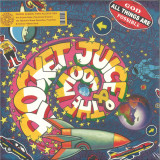
There is, in fact, a palpable openness pervading Rocket Juice & The Moon — the sense of a limber willingness to follow creative impulse — right down to how the group acquired its name. When Ogunajo Ademola — the Lagotian commissioned to do the album's cover artwork — dubbed his submission 'Rocket Juice & The Moon', it quickly morphed into the formal name of the project, like trying to hold onto mercury.
Surely, the stars above also approved.