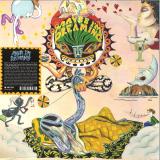
Buh Records presents Primera Secuencia, the debut album by Ballet Mecánico, the project of Fernando Pinzás. After his time in the synth-punk band Varsovia, Pinzás embarks on a new phase as a solo artist and producer, exploring electronic styles from the 1980s like synthpop, Hi-NRG, Italo disco, and techno pop. The album blends synthesizers, programmed sequences, and pulsating basslines to create a nostalgic yet danceable soundscape. Set against the backdrop of the pandemic and social movements in Peru, each track tells a story, featuring guest vocalists from the Peruvian independent scene, including Susana Fátima (Gomas), Noelia Cabrera (Blue Velvet, Silveria), Kat Kathia, Luxsie, Luminiscencia, Anabhell (Las Ratapunks), Laura Rosales (Solenoide), and Elva Cío (Specto Caligo). Singles No Cederé and Testamento define the project's dark and ethereal pop aesthetic. No Cederé, featuring Susana Fátima, critiques societal notions of success over an Italo disco and Hi-NRG beat. The track includes a remix by Italoconnection, the duo of Fred Ventura and Paolo Gozzetti, who take it into a hypnotic, spacey realm. Testamento, with Luminiscencia, reflects on the emotional weight of the pandemic, blending synthpop and ethereal pop. Other standout tracks include La ciudad de los incendios, a dystopian vision of Lima with dark disco rhythms, and Como la última vez, a synthpop-driven, melancholic song featuring Noelia Cabrera.
Flamenco is a Spanish art, which has always been prone to hybridization with a multitude of musical languages. Therefore, the universe of "flamenco fusion" could well reflect the way in which Spaniards have related throughout history with other cultures. And that relationship may have often been one of dialogue, exchange, respect and crossbreeding. Among the circumstances that could have favored the traditional mestizaje of flamenco art is the open character of the south of the Iberian Peninsula, to all the civilizations that have settled in its territories; the encounter with America in 1492, and the brotherhood with the Spanish-speaking countries; that the Casa de contratación de Indias, the entity that regulated the transit between Spain and America for centuries, was founded in none other than... Seville! (and olé); without forgetting the FUNDAMENTAL African contribution, brought to America by millions of black slaves throughout the 400 years of the slave trade. Pícaro vol. 4 is an excellent example of how some Spanish flamenco musicians knew how to take advantage of the fashion of other styles and rhythms coming from outside Spain, creating a new sound universe and incorporating them into their repertoire. Undoubtedly, there is a generational replacement of "flamenco Ye-Ye" in Spain with artists like Rosalía or C. Tangana, although now it will be necessary to modernize "the label". This compilation offers us a snapshot of the multiple styles of flamenco hybridization that triumphed in the world during the decades of the 50's and 60's of the 20th century. Through its microsurcos we will discover immeasurable flamenco ye yé (track 1), flamenco rock & roll (tracks 3 and 4), flamenco cha cha chá (tracks 6, 7 and 15) or flamenco mambo (track 12), together with other unusual, exotic and impossible mixes of Spanish song with tango arrabalero, bluegrass, easy listening, swing, groove or soul. Always a happy mix, which are brought together with exquisite taste in this vinyl for your enjoyment.
‘Maybe I’m Dreaming’ is the latest collection selected by Mikey Young (Total Control, EddyCurrent Suppression Ring) and Keith Abrahamsson (Founder and Head of A&R at AnthologyRecordings), the mangled minds behind the beloved ‘Follow the Sun’, ‘Sad About the Times’,and ‘…Still Sad’ compilations. The twenty tracks of ‘Maybe I’m Dreaming’ make a conscious(and unconscious) detour from its predecessors, sourced entirely from private press releases,spanning new decades and production modes within homespun folk, soft rock and otherwise70s and 80s FM radio adjacent music. The magic of ‘Maybe I’m Dreaming’ is the untold story of the artists behind these songs; thosewho missed the big time, but whose song craft and unrequited care hit the right notes, bothhigh and low.
Where ‘Follow the Sun’ and ‘Sad About the Times’ introduced us to the fame chasing, ambitioncrashing crooners who missed their shot in the mainstream, ‘Maybe I’m Dreaming’ delvesdeeper into the isolated wilds - a private world where production quirks, late-night tape hiss andone-man studio dreams were not necessarily a choice but the hand that was dealt.
With the parameters set to ‘private press only’, Young and Abrahamsson follow a circuitous trailof invention and emotion, documenting a spirit that’s more homespun, sometimes lonelier andoften a little weirder. The guitars still strum, but the keyboards’ hum is more prevalent andprecious; wistful harmonies brush up against lo-fi drum machines; a bittersweet fog lingeringover even the brightest melodies.
As with their previous collaborations, Young and Abrahamsson weren’t interested inconstructing a museum or drafting a historical survey. ‘Maybe I’m Dreaming’ is a sentimentalmixtape, assembled late at night when the mind wanders and old memories blur with imaginedfutures, those within reach and those far too mysterious to ever encounter. Songs wereunearthed in personal collections, deep YouTube burrows, dilapidated web archives and thedim corners of Discogs, with many selections tied not only to intuition but to personalconnection. Some tracks arrived via friends - Kelley Stoltz, a frequent guide for Young, tipped him off toboth Peter Kraemer’s lost gem ‘Let the Light Slip’ and Awakening’s revelatory closer - addingan unseen but deeply felt thread of camaraderie to the compilation.
The journey takes in a wide, strange sweep: The Watson Brothers Band’s ‘Just Whistle’ opensthe collection with a sigh and a shrug, a song that feels like it’s been waiting for decades to beheard again. Jim Huxley’s ‘Tessa on a Magazine’, rediscovered after a long and winding searchby Young, shimmers with a distinctly Australian melancholia. The heartbreak of Rick Penta’s‘My Story Changes’ and Twice As Nice’s delicate ‘Thoughts of You’ float easily alongside themore buoyant, radio-dream sheen of Barracuda’s ‘Baby I Love You’ and MAK’s sunshinedappled ‘That’s Life’.
Widening the aperture to the late 1970s and early 1980s allows for a deeper exploration intoevolving production techniques and musical technologies. The Squad’s ‘D.L.M.H.I.M.A.’ andChristoph Spendel Group’s ‘Forever’ crackle with the kind of bedroom synth warmth that couldonly come from the analogue age, while the soulful, yearning undercurrent of Awakening’s‘Gotta Do Somethin / Might As Well Cultivate’ caps the collection with a call for action - ormaybe just acceptance - in an accidental Brian Eno ‘Here Come the Warm Jets’ parroting.
While ‘Maybe I’m Dreaming’ moves away from the ‘sad man with guitar’ archetype that hoveredover its predecessors, it remains tethered to a familiar emotional gravity - a balance of longingand lightness that defines this corner of the musical universe. Each track shuffles gentlybetween resignation and hope, sadness and serenity, as if the artists themselves were chasinga dream just beyond reach, recording not for fame but for the simple act of getting it, thatprimal, creative itch, out into the world.
Available on CD and 2LP, featuring the third eye-opening artwork of Dang Wayne Olsen. Thedouble LP set arrives in an outrageous double-wide spine jacket with printed inners and adream journal entry by Pacific Northwest artifactual authority Josh Lewellen.
out of Stock
Last delivered 14 months ago available to reorder, subject to availability
The discovery of Doris Dennison's score represents a genuine musicological breakthrough—what once would have been "a tree falling in the woods" thirty years ago now holds the potential to render "a thunderous clap in our minds." While researching Anna Halprin's lesser-known collaborators, scholar Tom Welsh uncovered the archives of AA Leath, one of Halprin's principal dancers. Buried within these materials was Dennison's handwritten score for Earth Interval, dated May 1956. Born in Saskatchewan, Canada, in 1908, and raised near Seattle, Dennison (1908-2009) encountered John Cage while teaching Dalcroze eurythmics at the Cornish College of the Arts. She joined Cage's earliest percussion quartet—alongside Margaret Jansen, the composer and his wife Xenia—in the group widely regarded as having performed the first complete concert of percussion music in the United States. This historic December 1938 concert was followed by tours and the landmark May 1941 performance at the California Club, comprising Cage and Lou Harrison's Double Music, the premiere of Cage's Third Construction, and Harrison's 13th Simfony.
As Bradford Bailey observes in his extensive liner notes, Earth Interval demonstrates "an extraordinary balance of elements that imbues the piece with a sense of clarity, directness, and constraint that is both distinct and ahead of its time." The work's most remarkable innovation lies in its approach to extended techniques, particularly Dennison's notation for the central movement: "In 2nd movement, 1st player lowers + raises a gong into a tub of water while beating." This technique, absorbed from Cage's experimental vocabulary, generates what Bailey describes as "fields of acoustic abstraction that bend and warp time through sustained resonances, beat, and space." The temporal sophistication of these manipulations anticipated Karlheinz Stockhausen's Mikrophonie I (1964) and Annea Lockwood's water-based sound investigations by over a decade. After joining Mills College as dance accompanist, Dennison maintained crucial connections to the Bay Area's experimental scene, collaborating with figures like Merce Cunningham and programming Cage's music throughout the 1950s.
Comprising three movements—Land Form, Air Tide, and Earth Play—Earth Interval is scored for recorder, drums, gongs, maracas, muted gongs, and bowl gongs. In total, the piece is just under eight minutes: "a fleeting glimmer of moment in time, a life spent at the cutting edge, and a singular creative vision that packs a powerful punch." When viewed in historical context, placed in contrast to roughly contemporaneous avant-garde percussion works by Cage, Harrison, Louis Thomas Hardin (Moondog), and Harry Partch, or important precursors like Edgard Varèse's Ionisation (1931) and Henry Cowell's Ostinato Pianissimo (1934), it's clear that Dennison was following her own path. Earth Interval is not derivative. It is a precursor to what was yet to come, alluding to developments of avant-garde and experimental music that wouldn't begin to appear on the cultural landscape until the 1970s and '80s, with the emergence of Post-Minimalism and more idiosyncratic artists and ensembles like Midori Takada, Ros Bandt, Peter Giger, Frank Perry, Christopher Tree, Michael Ranta, Gamelan Son of Lion, and Niagara.
This recording by Chicago's Third Coast Percussion, captured in March 2022, represents the first complete documentation of this pioneering work. The ensemble's interpretation reveals the piece's remarkable contemporaneity while maintaining its historical specificity. Where Cage, Harrison, and Partch employed "self-consciously off-kilter polyrhythms," Dennison's rhythmic sensibility anticipates minimalist developments by nearly a decade, yet integrates "forceful rests, as well as sharp shifts in sonic character, tempo, and meter, that break the momentum and breathe a sense of life into the piece's structure." This positions her work closer to Post-Minimalism decades before its emergence. The architectural approach demonstrates Dennison's understanding that "the composer almost entirely disappears" in favor of phenomenological listening experience, creating what might be called an egoless music that places its realities and meaning entirely in the ear of the beholder. The present recording, realized by Chicago's distinguished Third Coast Percussion ensemble, represents a significant achievement in experimental music scholarship and performance practice. As specialists in the Cage tradition and contemporary percussion repertoire, Third Coast Percussion approached Earth Interval with the historical sensitivity and technical precision required to illuminate Dennison's subtle compositional innovations. The March 2022 recording sessions, engineered by Colin Campbell, capture both the work's intimate chamber music qualities and its bold exploration of extended techniques. The ensemble's interpretation reveals the piece's remarkable contemporaneity—its ability to speak directly to current musical concerns while maintaining its historical specificity.
This recording serves multiple scholarly functions: it provides the first complete documentation of Dennison's compositional voice, offers insight into the broader network of experimental music practitioners surrounding Cage and Harrison, and demonstrates the sophisticated level of compositional thinking that was occurring within the Bay Area's dance-music collaborations of the 1950s. The work's emphasis on phenomenological listening—what might be called an "egoless" approach to musical experience—places it within a lineage of American experimental music that prioritizes perceptual process over compositional personality. The work's original obscurity—limited to AA Leath's performances at venues like the 1957 Pacific Coast Arts Festival at Reed College—paradoxically allowed it to remain "entirely on its own terms," free from the constraints of historical categorization. Drawing on Jacques Derrida's Archive Fever, the argument emerges that "the archive can acknowledge, celebrate, and resurrect" overlooked voices, transforming our understanding of experimental music history. The present Blume edition, featuring Third Coast Percussion's authoritative interpretation, includes a lavishly illustrated 16-page booklet designed by Bruno Stucchi / dinamomilano, containing complete scholarly apparatus, historical photographs, and detailed production notes. This recording enables "cross-temporal intersectionality," allowing Dennison to "belong to a newly formed and more dynamic understanding of the present and past," demonstrating how forgotten voices can reshape entire historical narratives when given proper scholarly attention and performance advocacy.
Mobile Fidelity's UltraDisc One-Step 180g 45RPM 2LP Set Plays with Authoritative Tonality, Airiness, and Clarity:
Pressed on MoFi SuperVinyl and Strictly Limited to
3,000 Numbered Copies
1/4” / 15 IPS Dolby A analogue master to DSD 256 to analogue console to lathe
Joni Mitchell is the only artist who could’ve made Hejira. The legendary singer-songwriter said as much when discussing the album decades after its release. Yet that fact seemed obvious from the moment the gold-certified effort streeted in fall 1976. An adventurous travelogue, probing narrative, and offbeat homage to freedom, Hejira remains an inimitable entry in the catalog of recorded music — a spare, gorgeous, meditative series of sonic vignettes comprised of floating harmonic pop, cool jazz, soft rock, and sensitive vocal elements that beckon feelings of motion, discovery, and self-examination.
Sourced from the original analog master tapes, pressed at Fidelity Record Pressing on MoFi SuperVinyl, and strictly limited to 3,000 numbered copies, Mobile Fidelity's UltraDisc One-Step 180g 45RPM 2LP set presents the record ranked the 133rd Greatest of All Time by Rolling Stone with definitive detail, richness, accuracy, and directness. Marking the first time the revered LP has received audiophile treatment, it's one of six iconic 1970s Mitchell records Mobile Fidelity is reissuing on vinyl and SACD.
Playing with a virtually nonexistent noise floor, dead-quiet surfaces, and superior groove definition, this collectible reissue reproduces in enveloping fashion the tones, textures, and craftsmanship that help Hejira function as the equivalent of a liberating trip down an open road with nothing but blue sky, natural landscape, and fresh air in the immediate vicinity. Passages bloom, carry, decay as they do amid an acoustically optimized environment. Soundstages extend far, wide, and deep, with black backgrounds and pinpoint images adding to the realism.
The reference-grade immediacy, airiness, and presence put in transparent perspective Mitchell’s dense strings of words, stream-of-conscious-like phrasing, and unhurried albeit forward momentum. Likewise, the instrumental contributions of her A-list support musicians — a cast that includes L.A. Express members John Guerin, Max Bennett and Tom Scott, plus Neil Young, Victor Feldman, and Abe Most — emerges with breathtaking clarity and dimensionality.
While Mitchell, whose intimate vocals and abstract guitar parts center everything, Mobile Fidelity's restoration of Hejira further reveals the visionary breadth of guitarist Larry Carlton and bassist Jaco Pastorius. Though heard on only four tracks, Pastorius' fretless bass epitomizes the fluid, subtle, flexible, roomy, and shape-shifting characteristics of songs that often appear to transpire out of nowhere akin to the formation of a puffy cumulus cloud overhead. In sync with Mitchell’s voice, Pastorius’ fusion hovers and floats, suspended in a fog you want to deeply inhale. The "grace notes" Mitchell desired on Hejira can now be heard in full. Ditto the luxurious tapestries of alinear lines, fills, and supplements unreeled on Carlton’s six-string.
Visually, the packaging of this UD1S set complements its identity as the copy to own. Housed in a deluxe slipcase, the LPs come in foil-stamped jackets with faithful-to-the-original graphics. This version is for listeners who desire to become immersed in everything about Hejira, including the unforgettable album cover — a pastiche of 14 different photos Mitchell used a Camera Lucida to assemble into one image that’s anchored by a portrait of her in a stoic pose — and the interior shots of Mitchell skating on a frozen Wisconsin lake wearing a pair of black skates, black shirt, and fur cape.
The notion of skating, feeling an awakening wind whipping against your face, and losing yourself to the surroundings are extremely apt for Hejira, which Mitchell wrote after a sequence of trips and relationships prompted her to reflect on the complicated conflicts between independence and marriage, success and satisfaction, duty and desire — and, more specifically, “the cost of being a woman.” The Canadian native delved into such themes before. But never as she does on Hejira, whose liberating, running-away aura doubles as another of Mitchell’s rejections of tradition as well as a suggestion of a better alternative.
At once observational and personal, expansive and insular, cheerful and poignant, Hejira spans a sea of human conditions, emotions, and circumstances. It addresses drifting, isolation, pleasure, place, time, and surroundings with strikingly poetic discourse matched with music that, save for the crooned ballad “Blue Motel Room,” forgoes conventional structures and choruses.
The jazz-based arrangements, marked by scaled-down percussion and all manner of bent, rounded, and unsettled notes, hint that Mitchell has no exact destination in mind. Excursions such as the moody “Furry Sings the Blues,” funky “Coyote” and edgy “Black Crow” throw open previously locked doors to possibility and journey. They signal it’s time for a welcome departure from norms and the past, one that leads to a heightened sense of clarity and perspective. Or, as Mitchell said upon choosing the album title, it’s time for “leaving the dream, no blame.”
Zum 40. Jubiläum von Modern Talking überrascht Sänger Thomas Anders mit einem ganz speziellen Album-Projekt: Eine Hommage an Modern Talking!
Zum 40. Jubiläum von Modern Talking überrascht der Sänger mit Neuaufnahmen der ersten sechs Modern-Talking-Alben und ist somit der erste deutsche Künstler überhaupt, der sein komplettes Frühwerk neu interpretiert! Seit 2003 geht das erfolgreichste Duo der deutschen Popgeschichte bekanntlich getrennte Wege, doch die Modern Talking Songs, zu denen man bis heute in aller Welt tanzt, bleiben nach wie vor weltweit unsterblich.
Die Neuaufnahmen der ersten Modern-Talking-Alben sind mit seiner unverwechselbaren Stimme eine Hommage an das einzigartige Erfolgsduo und an die glorreiche, vermeintlich bunte und sorgenfreie Zeit Mitte der Achtzigerjahre. Die einst vom pulsierenden Italo-Disco-Sound inspirierten Songs sind alle auf Anhieb zu erkennen, klingen jetzt aber dank modernerer Drums und Synths zeitgemäßer. Zusätzlich erscheint das 6-Album-Paket erstmals im Dolby-Atmos Sound, also 3D-Audio. Auf jedem Album überrascht Thomas Anders außerdem mit zwei bislang unveröffentlichten Songs, etwa “Don’t Fly Too High“ oder “Hold Me Tight In The Night“ auf dem ersten Album. Versierte Studiomusiker haben alle Stücke zusammen mit Thomas Anders unter der Ägide von Christian Geller komplett neu eingespielt, begleitet wird Anders dabei übrigens von denselben Chorsängerinnen und Sängern, die schon damals auf den Originalaufnahmen zu hören waren. Bei der Produktion wurden Spuren aus der Originalproduktion so detailgetreu wie möglich neu produziert und den neuen Versionen hinzugemischt.
Die sechs Alben – “The 1st Album“, “Let's Talk About Love“, “Ready For Romance“, “In The Middle Of Nowhere“, “Romantic Warriors“ und “In The Garden Of Venus“, auf denen alle großen Modern-Talking-Hits der 80er vertreten sind – erscheinen ab März 2025 in regelmäßigen Abständen bis Ende des Jahres beim Label Stars by Edel. Zum 40. Jubiläum von Modern Talking kommt es jetzt also einmal ganz Anders ...
out of Stock
Last delivered 13 months ago available to reorder, subject to availability
Bob Marley & The Wailers' Rastaman Vibration Analogue Productions' UHQR, the pinnacle of high-quality vinyl! 45 RPM 2LP Ultra High Quality Record release limited to 4,500 copies Mastered from the original tapes by Ryan K. Smith at Sterling Sound Pressed on 180-gram at Quality Record Pressings using Clarity Vinyl® Includes "12 x 12" 8-page booklet featuring new liner notes by musician and Marley biographer Leroy Jodie Pierson (APO Records Direct-To-Disc AAPO 005), plus exclusive photos by Kim-Gottlieb Walker Purest possible pressing and most visually stunning presentation and packaging!
When Rastaman Vibration was first released in America in 1976 it did what some in the music industry considered nearly impossible at the time. It took Bob Marley into the Top Ten alongside disco records and corporate rock, points out Rolling Stone, which rates the album 4 stars. Despite the good cheer of the title track and the upbeat "Roots, Rock, Reggae," Rastaman Vibration contains some of Marley's most intense images of oppression, paranoia and despair. Tracks such as "Who the Cap Fit," "Crazy Baldhead" and "War" are offered by the Wailers with dire urgency as Marley's brutal visions are echoed by his own church choir, the I-Threes.
More than four decades later, neither Marley's music nor his message has lost its sting. Now, Analogue Productions presents perfection — Rastaman Vibration cut at 45 RPM in UHQR format on 180-gram 2LP Clarity Vinyl. This Ultra High Quality Record release will be limited to 4,500 copies, with gold foil individually numbered jackets. For Bob Marley, 1975 was a triumphant year. The singer's Natty Dread album featured one of his strongest batches of original material (the first compiled after the departure of Peter Tosh and Bunny Wailer) and delivered Top 40 hit "No Woman No Cry." The follow-up Live set, a document of Marley's appearance at London's Lyceum, found the singer conquering England as well. Upon completing the tour, Marley and his band returned to Jamaica, laying down the tracks for Rastaman Vibration (1976) at legendary studios run by Harry Johnson and Joe Gibbs.
At the mixing board for the sessions were Sylvan Morris and Errol Thompson, Jamaican engineers of the highest caliber. Of the material on Rastaman Vibration, "War," for one, remains one of the most stunning statements of the singer's career. Though it is essentially a straight reading of one of Haile Selassie's speeches, Marley phrases the text exquisitely to fit a musical setting, a quiet intensity lying just below the surface. Equally strong are the likes of "Rat Race,""'Crazy Baldhead," and "Want More."
These songs are tempered by buoyant, lighthearted material like "Cry to Me," "Night Shift," and "Positive Vibration." Not quite as strong as some of the love songs Marley would score hits with on subsequent albums, "Cry to Me" seems like an obvious choice for a single and remains underrated. This UHQR is remastered at 45 RPM by Sterling Sound's Ryan K. Smith from the original analog master tapes. Each UHQR will be pressed at Acoustic Sounds' industry-leading pressing plant Quality Record Pressings (QRP) using hand-selected Clarity Vinyl® with attention paid to every single detail. These records will feature the same flat profile that helped to make the original UHQR so desirable. From the lead-in groove to the run-out groove, there is no pitch to the profile, allowing the customer's stylus to play truly perpendicular to the grooves from edge to center.
Clarity Vinyl allows for the purest possible pressing and the most visually stunning presentation. Every UHQR will be hand inspected upon pressing completion, and only the truly flawless will be allowed to go to market. Each UHQR will be packaged in a custom clamshell box and will include a booklet detailing the entire process of making a UHQR along with a hand-signed certificate of inspection. This will be a truly deluxe, collectible product. In addition to the UHQR booklet the package will contain a 8-page 12" x 12" booklet containing new liner notes by musican and Marley biographer Leroy Jodie Pierson as well as exclusive photos by Kim-Gottlieb Walker. Pierson is a past performer for Blues Masters at the Crossroads, the two-night historic blues festival at Blue Heaven Studios in Salina, Kansas. He's also recorded a Direct-To-Disc blues album for APO Records. (AAPO 005) Rastaman Vibration — now a landmark production on 180-gram 45 RPM Analogue Productions UHQR Clarity Vinyl!
Madlib’s WLIB AM: King of the Wigflip Returns on Double Vinyl via BBE Music BBE Music is thrilled to announce the long-awaited rerelease of WLIB AM: King of the Wigflip, the final installment in the legendary Beat Generation series from none other than Madlib. Originally released in 2008, this masterful collage of dusty loops, raw beats, and left-field soundscapes remains a high-water mark in the Stones Throw producer’s sprawling discography.
Now, for the first time in years, fans can experience the album in all its analog glory with this deluxe double vinyl edition, carefully remastered to preserve Madlib’s signature warmth and grit. A tribute to pirate radio culture and late-night airwaves, WLIB AM weaves together a rich tapestry of hip-hop, jazz, and soul, featuring an all-star cas t of collaborators, including Talib Kweli, Guilty Simpson, MED, and Oh No. Each track showcases Madlib’s uncanny ability to blur the lines between genres, effortlessly flipping obscure samples into hypnotic, off-kilter rhythms. From the hypnotic bounce of “Blow the Horns on ‘Em” to the smoked-out groove of “The Plan Pt. 1,” this is Madlib at his most playful, unpredictable, and inspired.
This special double vinyl edition, released exclusively via BBE Music, brings one of the Beat Generation series’ most celebrated albums back into circulation for crate-diggers and collectors alike. With original artwork and a high-quality pressing, this rerelease is a must-have for Madlib aficionados and vinyl lovers who appreciate raw, unfiltered beat craftsmanship. Don’t miss your chance to own a piece of hip-hop history—WLIB AM: King of the Wigflip is back and sounding better than ever.
odh Teri is back with a brand-new chapter.
The Return of Neela Devi kicks off a vinyl-only series where the iconic characters from Deep In India finally take center stage. With the Sampadan era behind us, a bold new sound is rising.
Leading the way is Neela Devi herself, across three genre-spanning tracks that cover everything from vintage disco to spaced-out synths and slow-burning indie dance. There’s something here for every kind of listener – the groover, the dreamer, and the deep digger.
We open with “Maalgaadi 54” – a relentless disco heater drenched in ’70s glam, trippy layers, and hands-in-the-air energy.
Next comes “Cosmic Dirt” – dusty, mysterious, and dripping with attitude. Think desert synths, dark disco grooves, and a mood straight out of an Indian spaghetti western.
Closing the record is “Beauty Blues” – a dubby slow-burner that gently builds before locking into a bouncing, blissed-out groove. A cheeky take on a classic that’ll leave you smiling from start to finish.Those who dig a little deeper into the wax will uncover a secret locked groove Visually, the record is a stunner. The artwork is helmed by Soju Aduckathil, with creative direction by Manoj Kurian, the visionary behind Masala Movement.
Marking the sixth release on the Masala Movement label, this vinyl-only beauty is just the beginning – with plenty more surprises lined up for 2025.
The new era has arrived. Ready to dive in?
out of Stock
Last delivered 14 months ago available to reorder, subject to availability
Compiled by Philip King
“And then came the rise of synth pop : blokes with dodgy haircuts hunched over keyboard-operated
machines stuffed with wires and do-it-yourself tone oscillators making sounds like a brood of geese
passing gas in a wind tunnel. Whoopee! This is the way the ‘70s ended : not with a blood-curdling bang
bang but with a cheap, synthesized, emasculating whimper.”
NICK KENT, NME.
All The Young Droids: Junkshop Synth Pop 1978-1985 is a new compilation that charts the
underbelly of the epoch-defining sound of the synthesiser in 80s popular music. Compiled by Philip
King (previously seen compiling All The Young Droogs, Glitterbest and Boobs - The Junkshop
Glam Discotheque), the music here connects the dots between DIY synth enthusiasts grappling with
new, cheap synthesisers at the tail-end of punk and wannabe, jobbing songwriters enthral to the new
music pioneered by Gary Numan, Depeche Mode and Daniel Miller’s Mute Records. Featuring rare
tracks of auto-didactic progressive pop music, proto-techno punk, shoot-for-the-stars-land-in-the-gutter
chart flops and heralded, underground synth classics, School Daze paints a picture of beautiful failure.
Complete with extensive sleeve notes written by King and never before seen imagery, all 24 tracks
were remastered by RPM in-house engineer Simon Murphy, many from vinyl copies due to lost master
tapes. The story told on All The Young Droids is one of the dawning opportunity presented by both the
emergence to the market of cheaper analog synthesisers and the distribution networks plus indie labels
that exploded with the advent of punk music in 1976. While the music that sprouted out all over the
globe in the wake of these factors was decried as fake, plastic, a refutation of punk’s guitar-led
revolution, it’s telling that much of the music on All The Young Droids.. was created in bedrooms,
ramshackle studios and home-made set ups with often borrowed equipment. In the era of record labels
jumping to capitalise on the success of The Sex Pistols, The Clash (both on major labels, of course)
these artists struggled to stand out from a new gold-rush with next to no budget or PR team. With radio
and labels desperate for the new Yazoo, what resulted was a testament to necessity being the mother
of invention.
At the time, the synthesiser was the music of the future, a shiny new machine that could paint like an
orchestra with a single finger and a 4-track. In the hands of Manchester avant-pranksters Gerry & The
Holograms it’s a pulsing, sardonic weapon.. the only instrument on the Messthetics classic lampooning
of New Wave fashion. In Hamburg, a 16 year old Andreas Dorau used it to write and record (with his
female classmates on vocals) a global smash in Fred Vom Jupiter (later licensed to Mute Records).
The hard-to-find English version (Fred From Jupiter, natch) is included here. Many artists with alreadystoried careers caught the bug and recorded synthesiser-fuelled peons to space, computers, the future
and, of course, love-interests. Harry Kakoulli, late of Squeeze, recorded a solo album in 1979 that
included the incredible power-synth-pop smash-that-never-smashed I’m On A Rocket. Similarly, Ian
North of Neo and American Power Pop stalwarts Milk ’n’ Cookies bought a Korg MS20 and used a
tape machine to record We’re Not Lonely, an absolute lost-classic of minimal synth pop. We’re Not
Lonely also features on the Junkshop Synth Pop sampler 7” twinned with John Howard unreleased
track You Will See, released April 12th 2025.
There are plenty of compilation debuts in evidence. Sole Sister were a mysterious trio who were
featured on the Scaling Triangles compilation of female-fronted, queer-adjacent post-punk /
underground music that also featured The Petticoats. Selwin Image were from San Francisco and
featured members of the recently defunct power pop/punk group The Pushups. Their stupidly catchy
The Unknown fizzes with New Wave energy - think XTC to Sparks but remains unreleased until now.
Dream Unit’s A Drop In The Ocean is an early synth wave cut, positively teaming with Joy Division
instrumentation, previously only released on a long-forgotten and super rare, self-released EP.
Incandescent Luminaire’s Famous Names belies an archetypal struggle of a small-town trying to
make it in a cruel industry but is a thrilling New Romantic-Synth Wave cross over with a OMD
gloominess that’s a joy to hear. Feminist Minimal Wave track I Am A Time Bomb by performance artist
Peta Lilly and Michael Chance is a revelation destined for new found cult status. It was released on 7”
and lost until now.
The flipside to the subterranean, never-made-it synth pop mentioned above are the ambitious, even
fruity attempts at success that have a perennial elegance to their confidence. New Jersey-ite Billy
London (real name Ed Barth) tried to cash in on the synth boom with Woman, released by a major
label, a lurching new wave track built on the Louie Louie rhythm and a wonderfully camp Lou Reedstyle sleazy vocal before exploding in the synthesised chorus. The song bombed but with a chorus like
this, you have to wonder why? Ex-Glitter Band member John Springate’s My Life is truly epic, with
doomed chord progressions and massive sounding drums turning into at least 3 different songs in the
course of the track. Before you wonder what’s going on the song resolves with a glorious return to the
main refrain.
The dry-ice-dressed dance floor is well catered for too. Design’s Premonition and Vision’s Lucifer’s
Friend are stone-cold minimal synth bangers, well loved but given a new lease of life here. The
Warlord’s The Ultimate Warlord was released in 1978, a homespun proto Hi NRG banger that was
later re-recorded by The Immortals in Canada who had a club hit with it. One-man- band Disco
Volante’s No Motion was re-issued by Synth wave label Medical in 2012 but makes its first vinyl
compilation appearance here. Close your eyes and you can imagine what Lawrence of Felt would have
sounded like with some cheap Korgs a little earlier in his career. Gibraltar-based trio The Microbes
imagined a computer programming people to dance - how prescient - and ended up with a propulsive,
robo-funk track with splendid rubbery bass playing over a tectonic drum machine. Previously picked up
by Belgian label Stroom TV, Dee Jay Bert & Eagle’s heavily Euro-accented I Am Your Master
demands the listener to “come to paradise!” In a frankly terrifying manner.
All The Young Droids is the first compilation to peel away from the narrative that dour, Minimal Synth
and Cold Wave were the only musical children of the first rush of synth pop. Philip King and School
Daze Records describe a much more complicated world: along with the austere, Brutalist children of
Daniel Miller (who produced Alan Burnham’s Bowie-Low-influenced Science Fiction here) was a
plethora of desperate cash-ins, accidental mainstream hits, ambitious pop dramas and major label
punts that went nowhere. Crucially, the compilation blurs the line between junk and treasure. What if the
two things are interchangeable. What if it’s all science fiction?
out of Stock
Last delivered 14 months ago available to reorder, subject to availability
When the hypnotic groove of Berlin band Onom Agemo & The Disco Jumpers meets the pulsating riffs of Malian guitarist and singer Ahmed Ag Kaedy, new horizons open up.
At the centre of 'Common Stars' is Ahmed Ag Kaedy's distinctive vocals - always with poetic urgency. His lyrics, deeply rooted in the political and cultural realities of his homeland, deal with freedom, home and the search for identity. They deal with the ongoing conflict of the Tuareg in Mali, who are caught between the desire for cultural self-determination and political tensions with the central government. They also address the threat posed by Islamist groups, which have controlled parts of northern Mali and banned music since 2012. Ahmed Ag Kaedy had to flee his home country due to this repression. With his band Amanar, he shaped modern Tuareg rock and toured internationally. The collaboration with Onom Agemo began after he came to Berlin for the premiere of the film 'Mali Blues', in which he is one of the protagonists, and led to joint concerts throughout Europe.
'Common Stars' is a musical meeting of cultures that unites sounds from the Sahara to Berlin. Music that creates connections and makes different perspectives audible. The tracks are characterised by trance-like rhythms, hypnotic bass lines and shimmering saxophone and flute sounds. Pulsating synthesizers, dry-as-dust guitar riffs and improvisational outbursts interweave to create a soundscape that is sometimes driving, sometimes floating and creates a very unique, captivating atmosphere. Ahmed Ag Kaedy describes it aptly: 'Space jazz meets the rhythm of the camel.'
For two decades, Trad Vibe Records has been exploring and celebrating the many facets of hip-hop, funk and soul music, always driven by a passion for authentic, organic sounds. Founded in 2005, this independent French label has made its mark on the underground scene with cult releases, transatlantic collaborations and a loyalty to vinyl culture. In 20 years, Trad Vibe has brought together beatmakers, MCs and DJs around a musical vision that is both timeless and audacious. To celebrate this anniversary, the label unveils a limited vinyl edition of 300 copies, a veritable digest of its musical universe.
Side A kicks off with "Boom Bap Introduction", a track mixing jazz and boom bap in a characteristic old-school instrumentation by DJ Vince.
This is followed by the West Coast energy of DJ King Flow & Lex Lakaiser on "Money".
The soulful groove of Moar, Raashan Ahmad and Kohndo explodes on "Stand Up (Soul
Train Mix)".
Juliano concludes the side with his blues-inspired "Nothing or All".
The B-side kicks off with the classic “Rock It Feel The Groove”, a funky bomb orchestrated and scratched by Dee Nasty, a historic figure in French hip-hop.
Moar and Raashan Ahmad return with "Sky High", a track reminiscent of the golden age of 80's Disco Rap.
Followed by LS Brigandes with the sensual "You Make Me Feel", bathed in New York, Hip-Hop, Soul and Jazzy influences.
To round off the album in style, DJ Clyde concludes with a positive message on Boom Bap sounds and Lofi with “More Love”.
This anniversary compilation is available on vinyl only, in an ultra-limited edition of 300 copies. A must-have collector's item for fans of polished beats and authentic vibes.
out of Stock
Last delivered 14 months ago available to reorder, subject to availability
Exploring the great Louis Vega's legacy and re-visiting the raw impact and enduring influence of Mobb Deep, tracing their blueprint on East Coast hip-hop and beyond.
Wax Poetics is back with Volume 3, Issue 1. We've been away for a minute with fresh words but this Summer we return and return hard.
Our spiritual home is New York and in this issue the city is a character and the mag is a movie. With our cover star Louie Vega we explore his legacy - from Bronx discos to the highs of house via Latin, hip-hop, freestyle and New York club culture. This is a trademark Wax Poetics deep-dive, with classic photos provided by the man himself. Then we flip from the dancefloor to the street with our second cover stars of Mobb Deep. We go hard on their career, their role in defining that 90's gritty, loopy, heavy heavy heavy hip-hop sound. With unique photos and ephemera lifting the story, there has never been a piece like this about the duo.
Wider articles include: Ace Records, Arthur Baker, Chris Clark, Dante's HiFi, Daupe!, Jazzy Joyce, Lotti Golden, Re:Discoveries, Record Rundowns and Tony Wilson... You know the score, the best god damn music journalism around.
Mit »Schicksalsmelodien« schenken Eisbrecher 14 Songs aus vergangenen Tagen ein neues Leben. Aus knapp 3 Jahrzehnten werden hier Klassiker von Spider Murphy Gangs »Skandal im Sperrbezirk«, über Die Ärzte (»Bitte, Bitte«) bis Powerwolf (»Stoßgebet«) und ASP (»Schwarzes Blut«) in Eisbrecher-typischem Klangkosmos neu interpretiert. So zollt Eisbrecher Hommage an Bands, deren Songs wirklich »Schicksalsmelodien« für sie und bestimmt auch für viele Fans sind und waren.
out of Stock
Last delivered 14 months ago available to reorder, subject to availability
The undisputed king of Disco House Purple Disco Machine returns to his club roots with retro-inspired release ‘Ghost Town’ ft. Rertosonix. Fresh off reworking the Hurts classic ‘Wonderful Life’ and delivering a huge remix for ‘Born Again’ (Lisa ft. Doja Cat & RAYE), the Dresden-born producer is once again ready to conquer the dancefloor with his signature sound. Tailor-made for that insatiable desire to dance, it’s a release engineered for movement, locking straight into the pulse of late-night energy and crowd euphoria. As such, the track is unsurprisingly becoming a favourite in Purple Disco Machine’s sets already, where dates in Mexico, the USA, and Spain have left the dancefloors anything but a ‘Ghost Town’. Armed with a dancefloor weapon, Purple Disco Machine drops the release early for DJs on Beatport.
A master of channelling the nostalgia of dance music’s beginnings and blending it with a modern-day flair, Purple Disco Machine has expertly crafted a record reminiscent of throwback disco cuts. The soulful vocals come courtesy of Retrosonix, successful songwriters who have come together to specialise in retro disco vocals that ingeniously feel straight from the archives. You’ll be sonically transported back to a time when disco was heard on every corner. Tactfully letting the powerful hooks and provocative lyricism lead the rhythm for the tune, Purple Disco Machine’s iconic groove-driven beats and mesmerising synths lay the foundation for a dancefloor classic. Crafting breakdowns dripping with funk, the disco maestro builds to a crescendo that will undoubtedly be a crowd pleaser for his many shows in 2025.
On the release, Purple Disco Machine said: “While a number of my recent records have referenced the more electronic 80s disco sound, I never lost the love for the classic funky disco of the 70s - which in many ways was the original blueprint - and so it has been equally inspiring and enjoyable to work with this palette again. I'm hoping that the listeners are as haunted (in a good way…) by Ghost Town as I am !”
Over sixty years into a life in music, Amina Claudine Myers revisits old compositions with a quiet force on Solace Of The Mind, her first solo record since receiving an NEA Jazz Master honours. Recorded for Red Hook Records and produced by Sun Chung, it hears Myers at the piano, Hammond B3 organ and mic, reinterpreting personal standards such as 'African Blues', 'Song For Mother E', 'Cairo' and 'Steal Away' with patient, spacious phrasing and the tonal sensitivity she's honed since her days with the AACM. Chung's production renders every harmonic shimmer and pause with startling clarity; a glistening move compared to last year's duo release with Wadada Leo Smith, adding a returnal layer to an otherwise eclectic discography, spanning free jazz and blues-rooted experimentalism. In her words, "I wanted to play (the originals) differently this time."
Ria Moran steps into a bold new chapter with Cubico, her debut solo album set for release in July 2025 via DeepMatter Records. A deeply personal and sonically rich project, Cubico sees Ria stepping forward as a producer and instrumentalist, blending R&B, neo-soul, and jazz with introspective songwriting that explores love, self-discovery, and emotional growth. The 12-track album moves fluidly between smooth R&B grooves and darker alternative tones, embodying the full spectrum of her artistry—sweet, emotional, moody, quirky, and fun. Ria made her long-awaited return in November 2024 with Take It or Leave It, a collaboration with Nubiyan Twist that showcased her evolving artistry and set the stage for Cubico and finding support from BBC Radio 6, Radio 1, Rinse Fm, Jazz FM, Worldwide FM, and more. Prior to this, her 2019 EP Moving into the Light gained widespread recognition from BBC Introducing, BBC Radio 6, and Worldwide FM, placing her among the UK’s most exciting contemporary soul voices. Her music sits at the juncture of forward-thinking UK soul music and nu-jazz, placing her alongside contemporaries including Ego Ella May, Yazmin Lacey and Cleo Sol, whilst also nodding to pioneers like Sade and Erykah Badu. Beyond her solo work, Ria has built an impressive career as a collaborator. Her contributions to Nubiyan Twist’s Freedom Fables earned a MOBO Award nomination, and she later appeared on Blue Note Records’ Blue Note Re:Imagined series, performing a BBC Radio 2 live session at the legendary Maida Vale Studios. She also worked with bassist Daniel Casimir on his acclaimed Boxed In album, joining a roster of UK jazz heavyweights including Nubya Garcia and Moses Boyd. Since 2019, she has been a touring vocalist with Gotts Street Park, sharing stages with Celeste, ENNY, and Pip Millett. With Cubico, Ria Moran is fully stepping into her own as an artist, delivering a debut album that is as raw as it is soulful, as vulnerable as it is empowering—a must-hear for fans of innovative and heartfelt music..
After the nostalgic disco album Lido Sirena and the spiritual housy Aqua Viva, Francesco Fisotti came back with his adriatic sound, this time inspired by the broken-beat scene from the 2000s accompanied by the young talented Italian singer Lauryyn, the musical genius Stefano De Santis and remixes by Steal Tapes and XL Regular. The sound from Apulia never been so bruk, blue and eclectic.
out of Stock
Last delivered 14 months ago available to reorder, subject to availability
Proudly presenting Maravilhosamente Bem the powerful, female-centred third album by Brazilian singer, songwriter, actress, and creative director, Julia Mestre.
Alongside being a member of the Latin Grammy-winning Brazilian supergroup, Bala Desejo, Julia has been steadily building a solo career where her unique vision and alluring soft, sultry voice take centre stage. Drawing inspiration from ‘80s ballads, MPB, pop and disco productions, each song on this third album finds Julia creatively exploring different characters and tones.
A love-song-driven LP at its core, Maravilhosamente Bem holds a playful mirror up to blissful days gone by, artfully reimagined with Julia’s own modern twist. An album filled with love and nostalgia, it pays homage to her love of classic female disco divas such as Donna Summer, Sade, Alcione, Lady Zu, and the Brazilian rock queens Rita Lee and Marina Lima. Of that latter pairing, the late iconic Brazilian vocalist and musician Rita Lee (Os Mutantes) is referenced in the music video for the first single, ‘Sou Fera’, blessing Julia with a magical guitar. Marina Lima then provides guest vocals on the album’s closing track, ‘Marinou, Limou’, with her name transformed into a mantra by Julia.
Channelling a lo-fi ‘80s ballad aesthetic, Julia navigates a multitude of themes across the nine sublime tracks. From the sexy, whispered performances on vintage horror movie-inspired tunes ‘Vampira’ and ‘Pra Lua’ to the delicate, fragile love lullabies of ‘Sentimento Blues’ and ‘Cariñito’, and the seductive disco diva embodiment on dance tracks ‘Veneno de Serente’ and title track ‘Maravilhosamente Bem’. Another hidden highlight is the palette-cleansing mini-suite, ‘Interlúdio dos Amantes’. A luscious strings instrumental piece that lends to the beautiful Sade-esque ‘Seu Romance’.
Produced by Julia and longtime collaborators Gabriel Quirino, Gabriel Quinto, and João Moreira, Maravilhosamente Bem sees Julia embarking on a new era of her musical career. This sensational third album is a captivating showcase of the creative vision and versatility of one of Brazil’s finest stars.
Released on Mr. Bongo (ROW) and Altafonte (Brazil).
out of Stock
Last delivered 15 months ago available to reorder, subject to availability
This album released in 1957 showcases Chet Baker's trumpet skills alongside Bobby Jaspar on tenorsaxophone. The recordings for the album took place between October 25, 1955, and February 10, 1956, at Studio Pathe-Magellan in Paris and features a mix of cool jazz and bop styles with tracks like "How About You," "Once in a While," and "Alone Together." The ensemble of musicians on this album includes notable names such as Jean-Louis Viale on drums, and Benoit Quersin on bass; the album highlighting Baker's distinctive trumpet tone and his collaboration with talented European musicians: "I Get Chet" is a significant work in his discography and reflect his mastery in the cool jazz and bop genres. The tracks are characterized by its relaxed tempos and lighter tone, and bop, known for its complex rhythms and harmonies, it is praised for its lyrical and cool jazz elements. For this and other reasons and considered a gem from Chet Baker's Paris sessions, showcasing his talent during a pivotal time in his career.
Released in 1962, "Etta James Sings for Lovers" came out during a time when Etta James was Establishing herself as one of the premier vocalists in the music industry
The early 1960s were a fertile period for soul and R&B music, and James was at the forefront of this movement. It's about an album collection of romantic ballads and standards that showcase her powerful and emotive vocal abilities: known primarily for her blues and R&B hits, this album allows her to explore jazz standards and love ballads, demonstrating her ability to convey complex emotions and connect with listeners on a deep level. The album features accomplished session musicians who provide a sophisticated and polished sound: Over the years, "Etta James Sings for Lovers" has been appreciated as a classic example of a signifcant part of her discography, beloved by fans for its timeless quality. The arrangements feature lush orchestration, with strings and horns providing a rich backdrop for James' vocals and at the time of its release, the album was well-received by critics who praised James' vocal prowess and the sophisticated arrangements.
The Modern Jazz Quartet, known for its sophisticated and elegant approach to jazz, consisted of pianist John Lewis, vibraphonist Milt Jackson, bassist Percy Heath, and drummer Connie Kay
Here are Some key points about the album: "Fontessa" is regarded as one of the Quartet's essential recordings, praised for its elegant performances and refned compositions. The album refects the commitment to creating jazz that is both accessible and artistically ambitious. Critics and jazz enthusiasts often highlight the interplay between Milt Jackson's vibraphone and John Lewis's piano, supported by the solid rhythm section of Percy Heath and Connie Kay. The title track "Fontessa" is a suite in several movements, showcasing the band's ability to merge different musical themes seamlessly; the album includes notable covers such as "Angel Eyes," "Willow Weep for Me," and "Over the Rainbow" all of which are given the Modern Jazz Quartet unique treatment with a mix of lush harmonies and sophisticated improvisation. The album, released in 1956, signifcantly contributed to the evolution of jazz by demonstrating that it could be a serious, artful genre capable of sophisticated expression. The Modern Jazz Quartet infuence extends beyond jazz to classical and popular music, and "Fontessa" remains a testament to their innovative spirit and enduring appeal, a key album in their discography, exemplifying their unique sound and artistic vision.
New Delhi-based Peter Cat Recording Co. will release their debut album, ‘Bismillah’ on June 14, 2019 via French independent label Panache Records. Debut UK live shows are soon also to be announced by the band.
Peter Cat Recording Co. could almost have a question mark on the end of its name. Not least as founder & frontman Suryakant Sawhney refuses to explain where that name really comes from or what it means (perhaps a reference to the Tokyo jazz club owned by Haruki Murakami), but also since the very existence of the band itself raises a raft of questions. When was the last time we fell for an indie rock band for the right reasons? Not because the band in question nostalgically imitate a perceived ‘golden age’ but because they innately embody the fundamentals of such music: fantasy, sincerity and the freedom to make music without rules or career aspi- rations. And when was the last time this kind of band sounded like Sinatra, Barry White, the sweetest doo-wop, humid fanfares and a psychedelic wedding band, all at once? And all of this coming from India?
In truth, the story of Peter Cat Recording Co. was written within the triangle of San Francisco, Delhi and Paris.
In the first of these cities, Sawhney (a native of Delhi) pitched up to study film-making. More distracted by the city’s peaking live scene of the early noughties, this is where he started to make music and to sketch out an idea for the band.“
The people I lived with supported my idea of writing music, they introduced me to great mu-
sic. There used to be a great garage scene in San Francisco, like The Oh Sees also Ty Seagall, Mikal Conin, all those bands. This is a world I had never seen in my entire life. A big inspiration from San Francisco was that you could record yourself. You don’t need to be in a studio and spend a lot of money to make an album. You can do it”.
At the end of the 2000s, Suryakant returned home to New Delhi, and started his band for real, more or less the same band that plays today. “I wasn’t so concerned about will we be performing, will we be the greatest band, will we be trendy. I just wanted to make something that was consequential and important for us, I think. Something which would last, something people could listen to and be like « this is life changing ». It was for the sake of beauty”.
For the first few years and in India alone, this is exactly what Peter Cat Recording Co. did, in total indifference to the rest of the world. This was until young Parisian label Panache stumbled across the band online via Vice’s THUMP subsidiary, stupefied by the band’s cosmic video for seven-minutes-and-counting track, ‘Love De- mons’. And so in spring of 2018, ‘Portrait Of A Time: 2010-2016’ was released on Panache - making the first international release from Peter Cat Recording Co., bizarrely enough, an anthology of re-mastered, hidden gems from the band’s ramshackle back catalogue, previously recorded in Suryakant’s own living room. With Peter Cat’s off-kilter charm hitherto unheard of beyond the fringes of India, the release provided a gateway op-
Whilst the title track found its way onto Tracks Of The Year lists at the Guardian & NME, it was tricky for new PCRC enthusiasts to get a firm grip on the startling push/pull between the immediate, uncanny music this release gathered, and the cultural backdrop of New Delhi at which it was so startlingly at odds.
Opportunity for a wider fanbase to fall in love with their cloud-like, drunken songs for the first time.
If discovering your favourite new band via a ‘Best Of’ feels a curious premise, then ‘Bismillah’ does more than hint towards the promise of Peter Cat Recording Co’s future. Blending gypsy jazz, psychedelic cabaret, space disco, bossa supernova, Bollywood and uneasy listening with kaleidoscopic ease, in many senses, the band’s knack hasn’t altered. Always different, paradoxical, unpredictable yet somehow familiar. The new album opens to the strains of bird chatter, the whisper of a city’s soundscape and the first few notes from an instrument which seem to be calling us to the departure lounge, a fore-shadow of the flight ‘Bismillah’ launches its listener
on. Suryakant sings with the detached, rueful elegance of Sinatra marooned on a desert island, whilst his band create small space-time capsules which navigate their way through genres and eras – including the future – and between nostalgia and eccentricity.
Peter Cat recently trailed ‘Bismillah’ with the release of ‘Floated By’, an appositely titled musing on failure & missed opportunities, punctuated by the fulsome brass section which weaves through so much of the album.
The languid, blue quality to the track is offset by the attendant music video, created with footage shot, implau- sibly enough, at Suryakant’s own marriage ceremony (needless to say, the wedding band hired for the day was of course, Peter Cat Recording Co.) Sawhney dryly notes; “Hopefully it’s not a many-a-times-in-a-lifetime event. You can’t fake that set, those people actually having a good time, being really emotional and intense.” ‘Bismillah’’s colour-drenched album cover also captures Suryakant’s father-in-law making his wedding toast on that same day - a nod back towards the cover of ‘Portrait Of A Time’, itself a black & white image taken at the wedding ceremony of Suryakant’s own father.
A stumbling but gracious collection of songs rooted in a kind of drunken soul music, the melancholy nature of some of the songs on ‘Bismillah’ renders them almost liquid, before they develop into more dance-like shapes. Suryakant’s rangy voice swoops from the falsetto glide of ‘I’m This’ to the beat-up baritone blown along by the warm breeze of ‘Soulless Friends’. The elliptical structure of album opener ‘Where The Money Flows’ also al-
lows for the use of brief bursts of autotune effect on his vocal without feeling incongruous, whilst the desultory lyrics of ‘Heera’ (a Hindi word for diamond) - sharing something with the Morricone school of grand storytelling - have an emotional weight that would impress even coming from a native English speaker. Perhaps the most gleefully unpredictable moment on ‘Bismillah’ comes with the illusory, vocal loops on the intro to ‘Memory Box’, errupting into 8 exhilarating minutes worth of unbridled, string-backed disco joy. A cat might have nine lives, but on ‘Bismillah’ and beyond, Peter Cat Recording Co. are hinting towards an un- knowable multitude of dimensions. Throw them all together, and it equates less to a listening experience and more to an out-of-body experience.
Random Coloured Vinyl
Nu-Tone presents Combo Tezeta's debut 7" vinyl record! The A-side, "La Danza Del Camaleón" is an instrumental cumbia-salsera that takes you on a tropical trip with a touch of psychedelia. On the flip side, a dark mid-tempo bolero called, "La Reina Nocturna". Remastered from the original verion, released by Discos Más in 2020. Based out of the Bay Area, Combo Tezeta plays a highly danceable blend of instrumental Cumbias, Chichas, and Musica Tropical inspired by the late 60's and early 70's era of psychedelic Peru. Layering the reverb-fueled sounds of surf rock onto the foundations of Cumbia, the band's focus is to highlight the rich melodies and hypnotic rhythms birthed from the Afro-Latin diaspora. Along with its appreciation of world music and its diverse cultures, Combo Tezeta's mission is to deliver the sounds and musical echoes of the past to the present through a combination of traditional and original music. Combo Tezeta was featured in Noise Pop 2023 and has played Pacific Northwest tours with Satan’s Pilgrim and Thomas Lauderdale of Pink Martini 2023. The band has played famed Bay Area Venues the Chapel, Eli’s Mile High Club and the Ivy Room. In Summer of 2024 they toured the Pacific Northwest and Southern California, including an appearance at The Hardly Strictly Bluegrass Festival in San Francisco's Golden Gate Park. The band was chosen by NPR’s Tiny Desk Concerts to be one of 20 finalists (out of 7000), and featured them in the Northern California showcase of finalists at Lagunitas Brewery in 2024. “Oakland seven-piece Combo Tezeta kicked off the baile with a garage-band take on ’60s and ’70s classics and originals, with distorted guitars and jangly synths layering psychedelic ooze onto timbales and güiras. The musician’s solos revealed hard-won skills, but the band members looked remarkably chill as they played together fluidly.” – KQED
Founded in 2020 by Austrian producer Lee Stevens, Rising Seed has evolved into a joint venture with Ken Hayakawa and a collective of guest musicians. Blending Acid Jazz, Trip Hop, and Disco, the project bridges the warmth of live instrumentation with the depth of electronic production.
With a strong focus on recording and re sampling real instruments, Rising Seed crafts a rich, organic sound—where vintage samplers, drum machines, and analog textures meet hypnotic grooves and cinematic atmospheres. Inspired by artists like Moby, Kruder & Dorfmeister, and Massive Attack, their debut album True Lies unfolds like a layered collage, blurring the lines between past and future, truth and illusion.
The opening track, “Follow Me,” perfectly embodies this fusion: sampled instruments and vocal snippets blend seamlessly with live recordings of flute and saxophone, all set against a funky drum break. “Gone West” does the unthinkable—marrying a house groove with esoteric vocals, live sitar by Amrith Jan, and—why not?—a touch of harmonica. “Like A Lion” is a dub-infused downbeat track packed with crusty blues samples.
On “Freedom,” we hear a more minimalist side of Rising Seed, with a tight brush-drum arrangement and densely layered sitar melodies. Another high point is “Soldier of Peace,” featuring even more funky sitar and a subtle acid line, reminiscent of the early days of big beat. It’s followed by “True Lies,” which elegantly distills the downbeat sound of the late '90s while staying true to the Rising Seed formula.
“Psych Jazz” is, as the title suggests, both psychedelic and jazzy, albeit with a somber, low-slung trip-hop feel, while “Don’t Worry” is equally trippy yet more upbeat, carried by a moaning vocal sample that urges us not to worry. Finally, “Stay with Me” closes the album with a jazz-infused vibe that is both moody and uplifting, its shuffling drum groove and elegant piano melodies providing a fitting conclusion.
out of Stock
Last delivered 11 months ago available to reorder, subject to availability
Compiled by Philip King
“And then came the rise of synth pop : blokes with dodgy haircuts hunched over keyboard-operated
machines stuffed with wires and do-it-yourself tone oscillators making sounds like a brood of geese
passing gas in a wind tunnel. Whoopee! This is the way the ‘70s ended : not with a blood-curdling bang
bang but with a cheap, synthesized, emasculating whimper.”
NICK KENT, NME.
All The Young Droids: Junkshop Synth Pop 1978-1985 is a new compilation that charts the
underbelly of the epoch-defining sound of the synthesiser in 80s popular music. Compiled by Philip
King (previously seen compiling All The Young Droogs, Glitterbest and Boobs - The Junkshop
Glam Discotheque), the music here connects the dots between DIY synth enthusiasts grappling with
new, cheap synthesisers at the tail-end of punk and wannabe, jobbing songwriters enthral to the new
music pioneered by Gary Numan, Depeche Mode and Daniel Miller’s Mute Records. Featuring rare
tracks of auto-didactic progressive pop music, proto-techno punk, shoot-for-the-stars-land-in-the-gutter
chart flops and heralded, underground synth classics, School Daze paints a picture of beautiful failure.
Complete with extensive sleeve notes written by King and never before seen imagery, all 24 tracks
were remastered by RPM in-house engineer Simon Murphy, many from vinyl copies due to lost master
tapes. The story told on All The Young Droids is one of the dawning opportunity presented by both the
emergence to the market of cheaper analog synthesisers and the distribution networks plus indie labels
that exploded with the advent of punk music in 1976. While the music that sprouted out all over the
globe in the wake of these factors was decried as fake, plastic, a refutation of punk’s guitar-led
revolution, it’s telling that much of the music on All The Young Droids.. was created in bedrooms,
ramshackle studios and home-made set ups with often borrowed equipment. In the era of record labels
jumping to capitalise on the success of The Sex Pistols, The Clash (both on major labels, of course)
these artists struggled to stand out from a new gold-rush with next to no budget or PR team. With radio
and labels desperate for the new Yazoo, what resulted was a testament to necessity being the mother
of invention.
At the time, the synthesiser was the music of the future, a shiny new machine that could paint like an
orchestra with a single finger and a 4-track. In the hands of Manchester avant-pranksters Gerry & The
Holograms it’s a pulsing, sardonic weapon.. the only instrument on the Messthetics classic lampooning
of New Wave fashion. In Hamburg, a 16 year old Andreas Dorau used it to write and record (with his
female classmates on vocals) a global smash in Fred Vom Jupiter (later licensed to Mute Records).
The hard-to-find English version (Fred From Jupiter, natch) is included here. Many artists with alreadystoried careers caught the bug and recorded synthesiser-fuelled peons to space, computers, the future
and, of course, love-interests. Harry Kakoulli, late of Squeeze, recorded a solo album in 1979 that
included the incredible power-synth-pop smash-that-never-smashed I’m On A Rocket. Similarly, Ian
North of Neo and American Power Pop stalwarts Milk ’n’ Cookies bought a Korg MS20 and used a
tape machine to record We’re Not Lonely, an absolute lost-classic of minimal synth pop. We’re Not
Lonely also features on the Junkshop Synth Pop sampler 7” twinned with John Howard unreleased
track You Will See, released April 12th 2025.
There are plenty of compilation debuts in evidence. Sole Sister were a mysterious trio who were
featured on the Scaling Triangles compilation of female-fronted, queer-adjacent post-punk /
underground music that also featured The Petticoats. Selwin Image were from San Francisco and
featured members of the recently defunct power pop/punk group The Pushups. Their stupidly catchy
The Unknown fizzes with New Wave energy - think XTC to Sparks but remains unreleased until now.
Dream Unit’s A Drop In The Ocean is an early synth wave cut, positively teaming with Joy Division
instrumentation, previously only released on a long-forgotten and super rare, self-released EP.
Incandescent Luminaire’s Famous Names belies an archetypal struggle of a small-town trying to
make it in a cruel industry but is a thrilling New Romantic-Synth Wave cross over with a OMD
gloominess that’s a joy to hear. Feminist Minimal Wave track I Am A Time Bomb by performance artist
Peta Lilly and Michael Chance is a revelation destined for new found cult status. It was released on 7”
and lost until now.
The flipside to the subterranean, never-made-it synth pop mentioned above are the ambitious, even
fruity attempts at success that have a perennial elegance to their confidence. New Jersey-ite Billy
London (real name Ed Barth) tried to cash in on the synth boom with Woman, released by a major
label, a lurching new wave track built on the Louie Louie rhythm and a wonderfully camp Lou Reedstyle sleazy vocal before exploding in the synthesised chorus. The song bombed but with a chorus like
this, you have to wonder why? Ex-Glitter Band member John Springate’s My Life is truly epic, with
doomed chord progressions and massive sounding drums turning into at least 3 different songs in the
course of the track. Before you wonder what’s going on the song resolves with a glorious return to the
main refrain.
The dry-ice-dressed dance floor is well catered for too. Design’s Premonition and Vision’s Lucifer’s
Friend are stone-cold minimal synth bangers, well loved but given a new lease of life here. The
Warlord’s The Ultimate Warlord was released in 1978, a homespun proto Hi NRG banger that was
later re-recorded by The Immortals in Canada who had a club hit with it. One-man- band Disco
Volante’s No Motion was re-issued by Synth wave label Medical in 2012 but makes its first vinyl
compilation appearance here. Close your eyes and you can imagine what Lawrence of Felt would have
sounded like with some cheap Korgs a little earlier in his career. Gibraltar-based trio The Microbes
imagined a computer programming people to dance - how prescient - and ended up with a propulsive,
robo-funk track with splendid rubbery bass playing over a tectonic drum machine. Previously picked up
by Belgian label Stroom TV, Dee Jay Bert & Eagle’s heavily Euro-accented I Am Your Master
demands the listener to “come to paradise!” In a frankly terrifying manner.
All The Young Droids is the first compilation to peel away from the narrative that dour, Minimal Synth
and Cold Wave were the only musical children of the first rush of synth pop. Philip King and School
Daze Records describe a much more complicated world: along with the austere, Brutalist children of
Daniel Miller (who produced Alan Burnham’s Bowie-Low-influenced Science Fiction here) was a
plethora of desperate cash-ins, accidental mainstream hits, ambitious pop dramas and major label
punts that went nowhere. Crucially, the compilation blurs the line between junk and treasure. What if the
two things are interchangeable. What if it’s all science fiction?
out of Stock
Last delivered 10 months ago available to reorder, subject to availability
New R&B discoveries continue to emerge and entertain the many followers of the New Breed musical cult; nobody finds more than the Kent connoisseurs.
Berna Dean’s two previously unheard recordings are by far her best. They were laid down at Cosimo Matassa’s New Orleans’ studios by GNP Crescendo but eschewed in favour of two relatively average sides. The great 50s R&B songwriter Jesse Stone provides a rocker for the much-admired Jimmy Breedlove and a super-catchy ‘This Morning’ for an unknown mixed vocal group that has a joyous gospel feel. Jesse also penned ‘Private Eye’, a classic early 60s story-song, for Buddy Wilkins which was issued on Al Sears’ Tri-Ess imprint.
The title track is used twice, on two very different Fraternity recordings. Kenny Smith’s version was issued in 1964 and has many followers, but the equally meritorious Coasters-inspired composition by the Citations is newly discovered. Win Menifee’s ‘I’m Runnin’ Around’ from the same Cincinnati label comes complete with a fascinating back-story.
There are three cover versions. Vermettya Royster’s ‘All Around The World’ is backed by James Brown’s 1961 band, while Roosevelt Lee's 1970 update of the 1947-originated ‘Hey Little Girl’ funks the tune up a la Godfather of Soul. The cover that will make the biggest noise is undoubtedly west coast band the Afterglows’ version of Barbara Lynn’s evergreen dancer ‘I’m A Good Woman’ – this is a future monster.
Golden Crest provides two fabulous male vocal group sides – the swinging ‘What’s On Your Mind’ by Eddie Daye’s Four Bars and the delightful harmonies of the appropriately-named, but unknown Delights ‘Mary Don’t You Weep’.
Blues still thrived into the 70s as Albert Washington’s mean and moody ‘Case Of The Blues’ proves. Smokey Wilson took the music into the late 70s with the storming ‘Goin’ Away Baby (Round Like An Apple)’, which benefits here from a 45-style edit. His Pioneer Club on 88th Street in South Central L A provides the atmospheric photo for this collection.
More early 60s movers come from Wilbur “Hi-Fi” White with ‘Don’t Look Now’, future hit songwriter Johnny Madara’s raucous ‘You Make Me Mad’ and Big Boy Groves ‘Bucket O’ Blood’ which brilliantly describes the kind of club these tracks would fit right into.
The LP version loses a few tracks, but so many collectors have strong preferences we’ve thrown the vinyl junkies a lifeline.
After more than a decade of music-making, Durand Jones & The Indications have blossomed as a unit and are basking in their successes. On their aptly titled new album, Flowers, The Indications unfurl their true colors _ embracing all their roots and influences, maturation and confidence, and share them with the world. Blue Iceberg Splash Vinyl. Since forming in 2012, the road has taken The Indications from those origins at Indiana University, Bloomington to the global stage, selling out shows across Europe, Japan, Australia, and New Zealand to the West Coast_ where DJI has a strong following among the lowrider and vintage soul enthusiasts. For as far as Durand Jones & The Indications have come, Flowers grew from the desire to return to their roots in a Bloomington basement, a space where they first found camaraderie in gritty funk and Southern soul that would inspire their self-titled debut. Pulling sonically and spiritually from each of the group's previous releases and solo work, Flowers is the next stage of DJI's inspired soulful discography. DJI are not only accepting their flowers, but indulging in their sweet and sexy fragrance.
out of Stock
Last delivered 14 months ago available to reorder, subject to availability
Da Taylor Nordberg und Jeramie Kling den Titel der 1992er Massacre-EP "Inhuman Condition" als Namen für ihre neue Band wählten, nachdem sie das Death-Metal-Flaggschiff 2020 verlassen hatten, erscheint es plausibel, dass in den letzten fünf Jahren an diesem bewährten Old-School-Sound festgehalten haben. Das dritte Inhuman-Condition-Album "Mind Trap" ist jedoch mehr als nur Massacre 2.0 und markiert eine Steigerung auf allen Ebenen. Die Tatsache, dass sich das ursprüngliche Trio, das durch den altgedienten Bassisten Terry Butler (zu verschiedenen Zeiten ebenfalls Mitglied von Massacre) vervollständigt wird, bei der Arbeit an neuem Material nie Ziele setzt, hat sich als Segen erwiesen: "Wir haben das Gefühl, dass wir unsere Identität gefunden haben und endlich über die Verbindung zu Massacre hinweg sind", sagt Nordberg. "Beim Schreiben, Aufnehmen, Mischen und so weiter wurde nichts überstürzt. Dieses Album zeichnet sich durch eine gewisse Behaglichkeit aus, hat aber immer noch diese knallharte Kante." Die Songs auf "Mind Trap" sind dem Gitarristen zufolge ein "Kommentar zu der Welt, in der wir leben". "Einige meiner Texte befassen sich mit dem erdrückenden Einfluss der Technologie auf unsere Spezies. Die Platte hat alles - Blut, Eingeweide, Serienmörder, Sci-Fi-Horror, schlechte Menschen." Die Band produzierte das Album vollständig in ihrem eigenen Studio, und das Ergebnis kann sich mehr als hören lassen. "Mind Trap" kommt mit einem weiteren bestechenden Artwork von Dan Goldsworthy (Accept, Alestorm) und zeugt von der besonderen Chemie des produktiven Duos hinter Inhuman Condition.
Over the past near-decade, Lancashire's medieval metal phenomenon WYTCH HAZEL have been honing an uncommonly wholesome, rustic and devotional brand of timewarped hard rock that's all their own, with 2016's Prelude and 2018's II: Sojourn summoning to mind fevered images of Robin Hood and his Merry Men grooving to Jethro Tull and Thin Lizzy. Yet within moments of pressing play on their third LP, III: Pentecost, the musty mystical minstrelsy takes a back seat in favour of a rich, sumptuous, anthemic late-night drivetime vibe, passionately embracing the most high-end smash-hit classic rock and metal circa its late 1970s heyday. "I thought I put a lot into the second album, but this album has been an absolute obsession," stresses the band leader, Colin Hendra. "Every aspect had to be as good as possible. We've gone back and forth, Ed was tinkering with it for months on end. There's quadruple tracking going on with the rhythm parts, then we've doubled, tripled and quadrupled all our lead parts to get that richness and fullness of sound, all meticulously planned with pages and pages of organisational notes. It wasn't just `get in the studio and see how it goes!'" he laughs. "One day I did 14 hours of vocal recording. All vocals are double-tracked, I can't express how much hard work that is. The last album feels like a breeze compared to what we've done with this - and I don't plan on ramping it down!" Musically there are gorgeous self-professed touches of Black Sabbath, Blue Öyster Cult, AC/DC and early Scorpions_"With the soloing I was trying to go for Michael Schenker" beams Colin_while the scampering headbanger I Will Not initially took a nod from Angel Witch, who Hendra was helping out on second guitar back in 2015 when the track was composed, before studio treatment made it sound "a lot more Wytch Hazelly". But perhaps the most lateral comparison is to a band from the opposite spiritual realm, with Archangel an explicit homage to Swedish faux-Satanic devil cult Ghost. "I find them fascinating, Ghost; musically great, the songwriting is spot-on," enthuses the frontman. "We share an intrinsic connection, with Bad Omen honcho Will Palmer being the person who discovered us both. "Music is created for all, it's a common grace for everyone," he affirms, "which is why the music that shows the glory of God the most, in my opinion, is not music created by Christians. It's Black Sabbath!"
The analog version of the masterpiece EP "I'll", released in 2018 as a work that expresses the continuation of the world view of the debut album "Grace",
has been repressed on turquoise blue vinyl!
Haruka Nakamura herself is in charge of the lyrics, composition, and all the instrumental parts. Janis Crunch, who was in charge of vocals on "Grace",
is featured again. The dreamy number "I'll" evokes the beginning of spring and hope, which synchronizes with the fantastic world depicted by photographer
Shiori Iwakura, who collaborated with Haruka Nakamura on the jacket and music video, "Arne", a reconstructed version of the famous song "arne" from the
debut album "Grace", and "Lilium", a song that was used in the climax scene of the movie "Every Day", for which Haruka Nakamura was in charge of the
music, are newly recorded and included.
The B-side includes "Anne", which can be called a different version of "Arne", which was included in Schole's compilation "Joy" in 2013, and is exclusive to the LP.
It connects the worlds of "Grace" and "I'll". It also contains warm songs that bring to mind childhood scenes, such as the nostalgic "Abandoned School Organ" and
"Your Canon", which combine church organ, muted piano, and field recordings.
The artwork, like the 8cm CD, depicts beautiful natural scenery, and the jacket and insert feature a series of photos by the immensely popular photographer
Shiori Iwakura, creating a package that beautifully blends the sound world of "I'll" with the scenery. As with the analog version of "Grace", the mastering was
done by Gen Tanabe, a close friend of Haruka Nakamura's who works on the sound of his works. It is a deep sound production that will give new discoveries
to listeners who were captivated by the release of the 8cm CD.
Hailed as the “Godfather of electronic music,” Paul Oakenfold is one of the most successful electronic artists of all time, counting more than 110M streams, 5M albums sold worldwide and three GRAMMY nominations.
Oakenfold’s discography includes three full-length studio albums, countless live/compilation albums, singles and remixes, and over 20 DJ mix albums. He has written and produced for major stars like Cher, The Happy Mondays, U2 and Madonna and also counts more than 100 remixes, including ones for The Rolling Stones, Justin Timberlake, Michael Jackson, Britney Spears and Elvis Presley.
He continues to push the envelope via his game-changing projects, including a once-in-a-lifetime DJ set in April 2017 at the top of the base camp of Mt. Everest, commemorating the set with the release ‘Mount Everest: The Base Camp Mix.’ In September 2018, he became the first-ever artist to perform at Stonehenge, a UNESCO World Heritage site, followed by his ‘Sunset at Stonehenge’ mix album (February 2019) capturing the historic DJ set. In March 2019, he performed at the 2019 Special Olympics World Games opening ceremony in Abu Dhabi, in addition to remixing the Games’ official theme song.
This release is a reissue of his classic soundtrack album for the 2001 Joel Silver produced Swordfish starring Hugh Jackman, John Travolta, Halle Berry & Don Chedle. It contains tracks specially commissioned for the film written by Paul & film composer Christopher Young, plus his remix versions of N*E*R*D – Lapdance, Afrika Bambaataa - Planet Rock, Muse - New Born, plus tracks from Lemon Jelly + Dope Smugglerz, Jan Johnston.
The original release has sold over 100k units to date & the vinyl is now selling upwards of £300 on Discogs. This 2025 triple vinyl reissue has been remastered at Metropolis Studios + will be pressed on green coloured vinyl & coincides with the 4k UHD limited edition 25th anniversary Blu Ray release.
out of Stock
Last delivered 77 days ago available to reorder, subject to availability
José James just can’t leave the ’70s alone. Or maybe it’s the other way around. The singer, songwriter, bandleader, and producer was born in 1978, after all, but over his past 17 years of fundamentally forward-looking, blessedly mercurial music, he keeps getting pulled back in. His 2013 Blue Note breakthrough No Beginning No End revisited the hooky, funky, jazz-streaked songcraft of the time through a modern crate-digger’s ears. On 2020’s No Beginning No End 2 — James’ debut on his own Rainbow Blonde Records — he went back through the portal with a small army of fellow celebrated eclecticists. Just last year, there was the album 1978, a richly layered love letter to said year that felt deep, luxe, and cool. It’s as if — vested with the restless fluidity of jazz, the tuned-in sensitivity of soul, and the revisionist grit of hip-hop — he is trying to play his way into the exact moment when, culturally speaking, everything was about to change.
“I'm still so fascinated by the tension in that era of all these seemingly clashing things happening at once,” says James. “The loft scene, the jazz scene, Elton and Billy, Bob Marley, the Isleys, Funkadelic, disco being this behemoth in a way I don't think we even understand today… And then there’s where everybody went from there — into hip-hop, into punk rock, exploding jazz. It's like a summation of the ’70s, and it's about to transform. It's the peak of the rollercoaster.”
Literally breaking into history is impossible, of course, but James’ new LP, 1978: Revenge of the Dragon, does feel like breaking through or bursting out. In loving contrast to its predecessor, the fresh set plays hot, like a Friday night out at the Mudd Club in its prime. Though he’s dreamt up albums with collaborator counts approaching the dozens, James gathered a tight crew for this one. Himself and Taali on vocals. BIGYUKI on keys and analog synth. Jharis Yokley on drums. Bass split between David Ginyard (Blood Orange, Terence Blanchard) and Kyle Miles (Michelle Ndgeocello, Nick Hakim). And an all-star brass lineup: Takuya Kuroda on trumpet, young lion Ebban Dorsey on alto sax, and genre-spanning ronin Ben Wendel on tenor sax. They set up in Dreamland Studios near Woodstock, a restored 19th century church, and recorded live to tape, two tracks, drums pushed to the max — “a small homage to the rise of punk,” says James.
In that place out of time, the band laid down a handful of choice covers and some wild originals, like the single “They Sleep, We Grind (for Badu),” a decades-collapsing cut powered by an ugly groove. Steeped in dub, funk, and sampledelia, James chants an artists’ mantra (“They sleep, we grind / Man, f--- your nine to five”), makes lyrical callouts to Marley and Nas, and channels everything from George Clinton to J Dilla, not to mention the earthy mysticism of Erykah Badu. In 2023, James released and toured his Badu covers LP, On & On. “Living in her musical house for a year was transformative,” he says. “This is my summary of everything I learned through her, tying it to this idea that artists move differently. We are in society but we are outside, too, looking out and in at the same time. Our hours are different, our schedules are different.”
To that point, James and co. actually began each day in the woods, filming the album’s visual companion piece, Revenge of the Dragon, an honest-to-God kung-fu short complete with bad overdubs, training montages, camera tricks, and plot twists. The film pays tribute not only to the genre’s greatest year (1978, of course), but also its cinematic exchange with Blaxploitation, plus James’ own recent Shaolin training and admiration for Bruce Lee as a culture-bridging force (the LP’s cover recreates an iconic shot of Lee). On top of that, says James, “We had this immediacy in the studio. Live, one take, no overdubbing. I feel like that's where the martial arts piece comes in, where it's about being relaxed but also aware, and there's immediacy in your movements.”
Across the project, tribute takes that refracted, multifaceted form. From his personal late-’70s playlist, James chose four covers reflecting the era’s disco-fied churn: the MJ-meets-Quincy dancefloor masterpiece “Rock With You”; Herbie Hancock’s prescient vocoder fever dream, “I Thought It Was You”; and a pair of Black-radio hits from two bands whose fans typically wouldn’t have been caught dead in the same stadium: “Miss You” by the Rolling Stones and the Bee Gees’ “Inside and Out.” All of it gets filtered through a contemporary Black (and beyond) lens, coming out loud, free, funky, and buzzing — dynamic, yes, but also of a joyous piece.
1978: Revenge of the Dragon transports you to a crowded room where all this is playing out in real time. That feeling is helped out by opener “Tokyo Daydream,” a bass-driven swan dive into a neverending night of boutique bar-hopping and neon revelry. Later, “Rise of the Tiger” finds James bringing rare braggadocio to a propulsive track with growling synth lines and a hunger for whatever comes next. And then there’s the closer, “Last Call at the Mudd Club,” which with its upbeat energy and string of Stevie-inspired pickup lines, evokes the sort of unabashedly elated track the DJ throws on at 3:56 a.m. before everyone is kicked out. “I wanted to leave the album on that note,” says James. “If this was a night out in New York, this would be the last thing you hear before you get in that taxi and go back to your apartment.” Or, perhaps, back to 2025.
out of Stock
Last delivered 16 months ago available to reorder, subject to availability
o encapsulate the themes. “Aseurai means around you in the atmosphere, hard to reach, fading away,” Choi says. “It’s a poetic expression. You wouldn’t say it in normal conversation, but I like that.”
Following the four-piece band’s 2024 self-titled EP, Aseurai adds disco and city-pop influences while staying true to dream-pop roots. While Phoebe Rings was originally a solo project of Choi’s, Aseurai marks a shift with contributing songwriting credits from the whole band. The four musicians cut their teeth working on other notable NZ projects such as Princess Chelsea, Fazerdaze, Tiny Ruins, AC Freazy,, Sea Views and Lucky Boy.
With a more ambitious collection of instruments, Choi says this album heralds the start of true collaboration: “I feel more precious about this LP because it includes everyone’s gems.” Guitar/synthesist Simeon Kavanagh-Vincent spearheads unexpected arrangements, with bold fuzzy guitar textures, to spice up the mix. Benjamin Locke adds maturity to the lyrics, paired with perfectionist bass lines. And drummer Alex Freer’s slick production soars Aseurai to diverse and synergetic heights. The broth is richer with more cooks in the kitchen, and the brewing of textures creates a distinct ‘Phoebe Rings’ sound.
If the EP was spacey, then Aseurai settles on earth, rooted in tangible moments. “Without getting too gloomy, it’s a weird world out there. A lot has changed in the world since the EP came out,” says Kavanagh-Vincent on this transformation. The album delves into hope and longing across all possibilities, and this exploration of holding on and letting go is organically threaded throughout. Across ten songs, Phoebe Ring’s storytelling ranges from tongue-in-cheek musings on gentrification to tender autobiographical memories.
아스라이 흩어지는 하늘의 별이 (May the falling light of faraway stars) / 그대의 손 끝에 닿아 숨이 돼주길 (Reach your fingertips and let you breathe),” Choi sings in the title track “Aseurai.” Imagined as a breezy track inspired by a 90’s Korean pop band, Choi discovered, when fleshing out the lyrics, that it was about yearning for people she couldn’t see anymore. In the old-school disco track, “Get Up,” Locke addresses struggles with mental health in a Matrix-inspired driven mantra: ‘Just get up / Just get up.’ The groove persists with ‘Fading Star,” a quirky ballad filled with steely jazz/rock guitar solos dedicated to a suburban aging musician. Kavanagh-Vincent’s lead single ‘Drifting’ is an unrequited celestial love song with bouncing bass and playful synths.
The band wrote, produced, and engineered the album across studios and band members’ homes in 2023/2024 in Tāmaki Makaurau (Auckland). It features mixing/mix production by local legend Jeremy Toy (Bic Runga, Aaradnha, Princess Chelsea) and mastering by Kelly Hibbert. With Aseurai, Phoebe Rings mark out a brilliant new constellation in their sky, bringing their individual compositions to the fore whilst seamlessly threading them into one celestial body - launching skyward on Carpark Records in June 2025.
Welcome to the era of “Artificial Renaissance”. Humanity and technology stand at a crucial and fundamental intersection. Echoing past cultural revolutions in a modern, technologically advanced world, everything is set to be redefined—our lives, our thoughts, and the way we move forward.
Dutch EBM/synth duo Staatseinde returns with “Artificial Renaissance”, an electrifying new mini-album. Fusing the urgency of classic EBM with the boldness of futuristic synth-punk, the band crafts an interstellar sonic journey fueled by pulsating rhythms and dystopian narratives.
The album blends space punk, italo-disco and electro into a dark, cinematic exploration of rebellion, euphoria, and dystopia. “Space Scream” launches with a cosmic punk battle cry, while “Tanzverbot” pulses with defiant energy against restriction. “Suicide Tuesday” captures post-club emptiness with shimmering 80s nostalgia, and “The Trip” unravels themes of environmental doom. “Freight” propels an italo-disco-infused space odyssey tackling exploitation, while “Une Mémoire Sans Fin” dives into AI’s eerie hold on human emotions. The fast-paced “Mutant Whispers” transforms the dancefloor into a space of fluid identity and resistance, closing with “The Mansion”, a hypnotic synth-driven descent into surreal miscommunication.
With “Artificial Renaissance”, Staatseinde ventures into unexplored sonic territory, expanding the boundaries of their lyrics, balancing artificial futuristic aesthetics with raw human emotions. As the lines between past and future blur, their pulsating music reminds us: the new age is already here.
out of Stock
Last delivered 15 months ago available to reorder, subject to availability
Embark on a funky synth-drenched journey as the cosmic count Jimi Tenor reunites with Timmion Records’ soul architects Cold Diamond & Mink for yet another album. When placed side by side with the fellows’ recent effort “Is There Love In Outer Space? “July Blue Skies” glides on a slightly more raw and mystical plane.
Crafted over fiery sessions between Tenor and Cold Diamond & Mink, this vinyl release offers six soul-grasping tracks ranging from mellow groove to soundtrack funk. The album’s opening title song kicks off with an extended analog synth intro which eventually develops into a sweet romantic invocation, painting a sonic canvas reminiscent of a boundless summer sky. The most vocal tune of this quite instrumental set of songs “Sky Train Baby” propels the listener on a locomotive ride through the star systems while “Venus of Barsoon” with its drum breaks and fuzz sounds blast you straight into sci fi movie funk territory.
The album’s B-side opens with “Ikuchi,” where Tenor’s always trusted flute and tenor sax take the spotlight over the slinky library beats. Closing the album we discover two single releases, the sublime “Summer Of Synesthesia” and the demonic “Tsicroxe” both completely worthy to hear sequenced inside this album as well. This album might be just the Spring jam that you needed in your life.
Un auténtico monstruo si hablamos de discos privados USA de hard–rock 70s. Bolder Damn provenían de Florida y editaron esta barbaridad en 1971. Potente y crudo sonido con devastadora guitarra ultra–distorsionada, apabullante sección rítmica y poderosa voz. En la onda de Sabbath, Blue Cheer, MC5, Pentagram, Sainte Anthony’s Fyre...Descubierto por el legendario sello Rockadelic en los 90, "Mourning" se ha convertido en estos últimos años en un disco de culto para amantes del hard–rock oscuro y proto–doom.
Después de años descatalogado, presentamos la reedición definitiva: arte original, sonido remasterizado e insert de 4 páginas con notas y entrevista a uno de los músicos.
This authorised vinyl reissue of the ultimate Finnish death metal cult LP comes with the original cover art and all the lyrics. In the late days of the early life of death metal in the early nineties, the death metal "community" had strayed from an appreciation of the majestic possibilities of sound, and were making a mundane product instead. They wanted the most "brutal" sound so the largest crowd could hear it, consider themselves "extreme," and go back to work with a hangover. This made the music escape its tiny audience, but killed off exploration as well. In addition, it was defensive and under-confident, feeling its chops lagged behind the rock, blues and jazz genres. Stagnation struck even as the genre accelerated. Enter the dark horse, Demilich. These inventive Finns reintroduced amazement at the possibilities of music. Where most people look at a forest and see wood for sale, a death metal fan after Demilich sees an intricate organism in itself, with the smallest details corresponding to the broadest concepts. The labyrinthine riffs of Demilich corresponded to a worldview that saw the connection between details as a design, and a design as conferring a purpose to life, cycling between birth and death as it spelled out the cryptic intricacies of ancient mysteries. Demilich was like finding a submerged city, or discovering a new path through the mountains, or even confronting a glowering enemy on the open plain. It brought risk, uncertainty, ambiguity and a sense of sublime beauty back to death metal, pulling it away from the slump in which it treated itself as a hammer and every listener as a nail.