Efde's first release on Voyage Direct. Here he gets a chance to showcase his trademark sound on an expansive, four-track E.P for the Amsterdam-based label.
Some may be familiar with Efde's work through his occasional 12' singles for Nordik Netrecords and Soweso, where he distilled a variety of influences - think dreamy, ultra-deep house, the Chicago bump of Chez Damier, and the sci-fi pulse of Detroit - into tracks that had a distinctive vibe all of their own.
My Bleep' is arguably his most stunning production yet: a spine-tingling re-imagining of Detroit futurism built around sparkling, intertwined melody lines, dusty drum machine rhythms, hissing hi-hats and throbbing, analogue bass. While a thing of rare beauty, it also comes blessed with moments of sweaty percussive intensity, with stacked snare hits that increase in energy as the track progresses. The original's inherent beauty is emphasized further on the accompanying Ambient Mix', which recalls the glory days of Pete Namlook's FAX Records in the early 1990s.
There's more far-sighted dancefloor futurism to be found on the flip, where the spacey chord progressions, sprightly synth-bass and restless rhythms of Just Did It' capture the spirit of both the Motor City, and the classic UK techno-funk of Dave Angel and Luke Slater. A fine EP is completed by the ultra-deep shuffle of CMP135', which successfully draws on Efde's love of bumpin' U.S deep house whilst retaining the intergalactic sounds that are such a key part of the Dutchman's club-ready productions.
In the late summer of 1994, Upadhmanyia (John Mackaay & Michel Rehatta) invited Leo Verhoef (LFU) to collaborate on a track. They met a few more times afterward at a power station converted into a studio in IJsselstein, The Netherlands. "Hasiya" was quickly born and was already in stores by early November 1994. John & Leo drove to house club iT in Amsterdam, where they gave the track to DJ Marcello, resulting in an iT hit! The track was quickly picked up by DJs worldwide, and Richie Hawtin used it in a live set in Denver on November 19th of that year, which can be heard on SoundCloud (Hasiya is mixed around 43:00). The track was also a huge hit on dance floors in England and Spain.
In late 1994, Hasiya appeared on a CNR Music EP titled "Welcome To The Club," along with four other hits from producers like Pete Lazonby, The Shaker, and Drum Club. A double CD of the same name followed in early 1995, released in Belgium, featuring Hasiya alongside artists like Robert Miles, Digital Express, Aura, Natural Born Grooves, and other hits of the era. In early 1995, Arcade released "House Party '95 the Kinky Klubmixx," mixed by Koen Groeneveld & Addy van der Zwan. The same CD was released in Scandinavia as "House Party '95 (5)." Hasiya flourished among the most popular house tracks of the time. The record spent three weeks in the Dance Music Mega Top 30 and peaked at number 22 around the holidays of late 1994.
For 31 years, Hasiya was only available on record, CD, tape, or YouTube. Starting November 21, 2025, it will be resurrected from the underground into the world of digital downloads and streaming. The 2025 Remaster, along with five new mixes, will be widely available, including a limited vinyl release of 350 copies. The 30 test pressings have already been received with open arms by various DJs and received immediate support from Eris Drew and Octa Octa during ADE.
Because Hasiya was created in 1994, the only available remix material is the original DAT tape, which, thankfully, was still stored in an old box in a dusty attic. Most of the sounds for the new versions have been recreated and re-recorded.
Rehatta's Reanimated Mix:
This remix - created by one of the two founders of Upadhmaniya - combines driving, percussive beats with a thrilling, progressive break featuring ascending, dizzying strings. This trick returns shortly afterward to rev things up again. An accessible remix for dance floors worldwide.
LFU 2025 Version:
This straightforward, raw techno version with a touch of acid is ready to rock dance floors. LFU's updated version of the 1994 original, which he created with Michel & John, will undoubtedly remain a head shaker from here on out.
John Consemulder Metaphysical Mix:
With a pumping groove and a funky bassline as an intro, John Consemulder's remix immediately strikes a chord. A refined and elegant approach to the original, with sounds as mysterious and exciting as the flowing lava in the 'Gruta das Torres' - a cave in the Azores - the setting where this tech-trance remix was created.
Davje Remix:
Davje's version begins with the typical club and hard-trance bassline of the late '90s. You're drawn into a trance journey where beat changes sometimes try to throw you off track. Davje's creative Hammond organ interpretation of the Hasiya theme surprises and transports you back to the hippie era by the end of his remix.
Bojcot Remix:
Junglist Bojcot creates an exciting, nuanced, and mathematical remix with a beat that feels like jungle and half-tempo. He conjures up the sounds of LFU's 2025 Version, creates a bassline that sounds like a disturbed bumblebee, and adds a surprising string section. Massive!
We’re excited to unveil our first vinyl-only release, featuring four dance-floor-focused tracks from Kyiv’s Kiddmisha, alongside Tbilisi-based artists Reshio and Yamoc.
Each track offers a dynamic mix of electronic beats and rhythms, showcasing the energy and creativity of these rising talents in dance music.
Steve Moore reprises his beloved Lovelock guise by presenting his unique riff on the library breaks genre. Business And Pleasure contains grimy groove and sleazy, funk-laden lounge music.
This vinyl release is hyper-limited, with just 500 pressed for the world.
The LP is ushered in by the spacey synth-funk of the sleazy, woozy title track. This is that serious slo-mo cosmic-balearic head-nod shit. Laidback bass, heavy funk with dreamy synth and electric guitars. An outstanding opener. Up next, the dynamic, swaggering "Last Call" is a sophisticated, elegant stroll - sweeping, mellow strings, a smooth bassline and gorgeous percussion with urgent keys and swelling synths.
"Slinky Strut" is another spaced-out, sleazy funk groove with jazz rock by way of a heavy, heavy guitar riff, mellotron and bass breakdowns which build to brass crescendos. Gigantic. "First Class" closes out the side, and, like classic Hawkshaw / Bennett noir, it's got that mysterious and murky stretched out sleuth / detective soul with a great bassline and percussive elements, with swelling strings, ace synths and smooth Rhodes piano melodies entering the mix halfway through. Dramatic guitars and groovy percussion add extra intrigue. It's 7 minutes of funk!
Side B opens with the stretched-out psychedelic funk and jazz groove of "Stank 49". It takes its sweet time to unfurl, creating enormous - almost sensual - anticipation for the ensuing beauty but, as it does, we're left beguiled and straight-up hypnotised. Heaven-sent synth flourishes and a laidback bassline over smooth drums cement its simple, vivacious grace. "Dangerous Man" is that creeping crime funk we all love; heavy bass and fuzzy guitar riffs, mellow strings and sumptuous piano/synths. It's irresistible, it's ominous and it's pretty gargantuan. It's basically like an El-P hip-hop instrumental. We need to get some rappers over this stuff, stat!
"Stinkbug" is a dazzling and funky groove-fuelled jazz-rock workout with fizzing synth riffs joined by full percussion and drum breaks, building with strings to a strong swagger. Vigour! To close out this remarkable set, the breezy "Win Or Lose" is laidback soul-inflected funk, utilising urgent, skipping drums and galloping basslines. Just stunning.
This collection was written and recorded in Spring and Summer of ’24. Everything was tracked at Steve's home studio in Albany, NY except the drums and percussion, which were recorded by Jeff Gretz at his space in NYC. The whole collection is basically a rhythm section feature, so Steve's Rickenbacker 4003 and Fender Jazz Bass play very prominently. The bass guitar serves as lead instrument in a lot of these tracks. Also, lots of Rhodes and stringers (Solina, Logan etc) and guitar (Strat and Les Paul). He even dusted off my sax for this one, which he doesn’t do as often as he’d like!
This type of groove-oriented library music has been a steady part of Steve's diet since the late 90’s. In heavy rotation while writing this collection were the following classics: “Time Signals” by Klaus Weiss, “Tilsley Orchestral No. 10” by Reg Tilsley, and “Heavy Truckin’” by Simon Haseley. “Voyage” by Brian Bennett was also a big one.
Lovelock started as a dedicated Italo-disco project, but over the years Steve expanded it to include anything directly informed by the commercial/pop side of the music of his childhood (70s/80s). Writing and recording this album was, like a lot of Steve's music these days, basically a test to see whether or not he could do it.
The song titles, like the music, are meant to be evocative yet vague. But there is a bit of a travel theme. Steve imagined this record being the soundtrack to a sleazy salesman’s business trip. The kind of guy who, when asked if he’s traveling for business or pleasure, responds “both.” Beyond the traveling salesman comparison, the title directly relates to the creation of this album. This was something he wanted to do just for his own enjoyment. Yet, like our sleazy salesman, he still found a way to get paid.
The album’s cover was designed by Chris Stevenson, with no little direction from Steve. He knew that he wanted to go with something photography-based for this cover so, in true DIY/cheapskate spirit, Steve started by looking through his own photos. He found the cover image on his phone, taken through an almost empty bottle of beer, and it clicked. The whole album has a very boozy vibe (especially with titles like “Last Call”) so this shot seemed appropriate. We, hic, agree.
Mastering for this vinyl edition was overseen by Be With regular Simon Francis, and it was cut by the esteemed Cicely Balston at Abbey Road Studios to be pressed in the Netherlands by Record Industry.
DUSTY DONUTS ISN’T JUST A LABEL — IT’S A TURNTABLE MANIFESTO.
Since its inception, the collective of vinyl scientists behind Dusty Donuts has been applying their signature "Dusty Formula" to every cut – a potent blend of deep crate knowledge, razor-sharp edits and roots firmly planted in the Hip-Hop culture. Each 45 is crafted with the instincts of seasoned DJs and the ears of lifelong diggers, spinning like a secret weapon on the decks: restructured classics and forgotten gems, reimagined with just the right bounce for today’s dance floors.
Now, with their new imprint DUSTY DONUTS CLASSICS, the crew levels up – kicking things off with a standout collaboration featuring the incredibly talented Emma Noble, who they first crossed paths with at the legendary Mojo Club. Emma’s soulful style and versatility made her the perfect fit for the launch of this new venture.
Several years after a 12” for the Unrelatable imprint, Marco Passarani opens a new chapter with F.F.O.M., a work of extra-terrestrial tales that feel grounded, where the hard, dirty work of the people continues on a different planet. The scenery changes, but the story stays the same: broken dreams on arid ground.
Linking back to his early Nature Records releases, Passarani blends experimentation with an unshakable sense of groove, weaving a more abstract narrative without losing the dancefloor pulse. While distinct from his Studiomaster output, the project shares the same DNA, fusing digital and analog textures until the boundaries dissolve.
True to the raw spirit of pure techno and imbued with the unmistakable nuances of the Roman school, F.F.O.M. is both a nod to the past and a step into uncharted territory, where Martian dust meets earthly sweat.
Each track paints a fragment of this imagined frontier: Tales Of Truth reveals shadowy landscapes hiding the real nature of the so-called new promised land; Alone in the Depth drifts through liquid scenery, a classic TR-808 pulsing deep beneath unknown oceans; Clouded Shore distills the numeric essence of groove in a subtle nod to Kraftwerk; Dominion erupts into the fierce struggle for supremacy over the new territories; Passione Orbitale tells of love for the unknown and voyages toward otherworldly sunsets; Exploration Noises echoes the spirit of Ixora from Passarani’s first Nature Records release, with manic, melancholic SH-101 lines riding electro rhythms.
The digital edition includes two exclusive miniatures, fleeting transmissions from the edge of this Martian settlement.
Hard Times and DJ Spen go back decades. The Baltimore house veteran has long been a fixture at the label’s parties, on the remixes, and now under his Muthafunkaz alias he cements the bond with a set that’s as much a time capsule as it is a renewal. The Muthafunking Hard Times EP revisits a clutch of Spen’s early-to-mid-2000s jams that, till now, have never been committed to wax. True to form, Spen hasn’t simply dusted them off: he’s remastered, refreshed, and imbued them with a 2025 gleam, bridging past and present in one irresistible sweep.
The A-side opens with the Funkee Kole Cappin’ Mix of 2008’s “(You Make Me Say) Woah!”, a gospel-fired stormer whose call-and-response vocals climb skyward while a cheeky Fab Four nod keeps things buoyant. “Holy Ghost” follows in its Holy Spirit incarnation, wringing church-floor catharsis from tribal percussion and sanctified chants - a blast of kinetic, almost Faya Combo-like fervor.
Flip the record and you’re hit with the swing and strut of 2010’s “Gotta Hold On Me,” Spen’s Vocal Mix turning horns and jazzy drums into a pure adrenaline surge. The closer, “Doin’ The Best I Can,” is a tonal shift: harmonica and guitar sketches circling loose-limbed beats, equal parts after-hours reverie and Sunday-morning balm.
Too vibrant, too joyous, too Spen not to press - The Muthafunking Hard Times EP isn’t just archival housekeeping. It’s an affirmation of what house music does best: uplift, electrify, and remind you that, even decades on, the spirit still moves.
Hitting release number three, Slush Records remaster and reissue Spacer IV aka James Zeiter’s sought-after 1997 EP on Pleasure Records. The man behind a slew of lauded records under a variety of different aliases, his sound is one that is cherished for orbiting the spheres of progressive trance and atmospheric dub techno. This four-track EP, however, saw James venture into unchartered territory, exploring a more melodic, house-tinted spectrum, before flipping back into the progressive techno-trance underbelly.
Having started life in 1995, Spacer IV had already gone from the leagues of limited white labels, to being the name stamped on one of Pleasure’s biggest-selling records by the time this EP came out. With only 195 white labels of his first record ARC 1/ARC 2 pressed, a copy was passed to Pete Robinson at Robs Records. ‘ARC 2’ was plucked from that release, supplemented with a new cut ‘ARC 3’ and given a proper pressing on Robs Records offshoot label Pleasure to notable success.
Fast forward to 1997 and James chose to depart the trance-infused techno sound of those first releases. Absorbing elements by osmosis, this EP sees James dipping his toes into fresh waters. Using what limited hardware he had available, including an Akai S950 sampler, Ensoniq ESQ-1 and Novation Bass Station 1, James laid down four distinctive and versatile club cuts.
‘Sirocco’ opens the EP, a tingling hit of endorphins that only the most timeless of tracks can elicit. Echoing pads feed acid murmurings, that sit atop dusty breakbeats and rattling sub-bass. An aural exploration, that is equal parts ethereal and empowering, taking cues from breaks, ambient, chill out and house. It’s one of those rare tracks that has the power to float you away or fuel your buzz, giving a healthy tug on the heartstrings in the process.
‘Mono’ follows, merging heads-down dancefloors with the embrace of warmer climates. It’s deep and Detroit-infused yet bolstered by a dream house bassline straight out of the Italian riviera. A dose of eyes-closed euphoria that hits just right.
The flipside sees James in more familiar territory with ‘Jetson’ and ‘Dust’. The former is a hit of space-age progressive house. Trippy, hypnotising, driving goodness, showcasing James’ ability to lock your body into a groove, yet send your mind to another world. The latter rounds out the EP, serving up an acid-swirling club stomper, forever building in intensity before dropping you into the vacuum of deep space.
Much has changed for Ilan Pdahtzur since the release of his Night City Life compilation six years ago. Back then, he was a little-known record collector who shared obscure, synth-heavy music that “captured the night-time glow” of the city he calls home, London, via a dedicated Instagram page. Fast forward to 2025 and Ilan is now a respected member of the international digger-selector community, having delivered must-check mixes for the likes of Bordello A Parigi, Bayete, Hunee’s Lifetones and Sound Metaphors.
It seems a fitting time, then, for Spacetalk to unleash Night City Life II, a second deep dive into Ilan’s distinctive, neon-lit sound world – a place where European synth-pop rarities, Italo-dance treats, dancefloor-focused post-boogie instrumentals soundtrack strolls around shuttered skyscrapers, dockside housing estates and wharf-side warehouse conversions.
In the six years that have passed since the release of Night City Life, Ilan has uncovered many more rarities, private-press gems and slept-on treats, with 14 of these featuring on the dusty-fingered crate-digger’s sublime sequel. As with its predecessor, much effort has been made to track down the artists behind the synth-heavy songs on show, with the vinyl edition featuring extended liner notes where some tell the story of their track in detail. Musically, there’s much to set the pulse racing within Ilan’s superb selections, from the slow-motion shuffle of Playground’s self-released 1984 B-side ‘Rainy Day Woman’ and the brilliance of Shamor’s 1985 South African synth-pop special ‘Close To You (Bwela Pafupi)’, to Sharon & Tracy’s ‘The Sheik’ – a belly-dancing inspired slab of TB-303 bass-driven house – and the kaleidoscopic, piano-rich 1992 Euro-house brilliance of ‘Come Into My Life’ by Jennifer.
Dive deeper into the collection and more under-appreciated musical masterpieces make their presence felt. There’s Sicilian musician Claudio D’Ignoti’s lesser-known boogie-era single ‘Anche Per Noi’, where rubbery bass guitar, Nile Rodgers style disco guitar licks and spacey synths dominate the sound space, Lena’s fashion circuit-inspired, early Pet Shop Boys-esque ‘Embrasse-Moi (Strumentale)’ – one that members of Milan’s Paninaro movement would surely have enjoyed – and a sublime, spaced-out and effects laden dancefloor dub of ‘Rescue Me (Imagination)’ by Jimmy D, a genuinely sought-after jam originally released on a now impossible-to-find seven-inch single. Offering another genuinely distinctive, carefully curated collection of lesser-known musical treats, Night City Life II is another essential, immersive and synthesizer-powered journey through Ilan’s unique sonic world.
Flower Storm returns with Seh, the third chapter in its unfolding mythos. If Yek was the first winds and Do the deepening of the spell, Seh is where the storm fully takes shape--five slabs of sonic metal, smithed in rhythm and ritual. Sepehr and Kasra V continue their excavation of Iranian folklore through contemporary club mutations, where thunderous percussion and hypnotic cycles push deeper into a space where myth becomes motion. The rhythms continue forward, but the past lingers in the echoes--deities flicker between pulsing machine sequences, time loops and fractures, and tension builds like an incantation. Trance-inducing polyrhythms collide with shadowy textures and melodies stretch and distort like time folding in on itself; the storm rages on. When it rains, it pours.
UDG Turntable dust cover made from high quality material with exclusive UDG logo's printed in plastisol ink will be the best choice to protect your gears from dust and liquid drops.
Specification
Specification
Weight 0,12 kg / 0.264 lbs
EAN 8717228276170
Color Black
Outer Dimensions (W x H x D) cm: 49 x 39 x 16 | inch: 19.3 x 15.3 x 6.3
Inner Dimensions (W x H x D) Not Applicable
Material Water Resistant Nylon 210D
Protection Various equipment
Extra's UDG logo printed in plastisol
Fits Turntables
19" mixer
Escola Records is proud to present its third offering, this time from Pau Roca, one of the local representatives of the house sound in Barcelona with the greatest projection in the scene. He releases 'Your Energy' featuring the incomparable vocal talents of Laura Elle to bring the warmest vibrations as only she can. A phenomenal soulful house track cut filled with warm chords and dusty percussions that fuses Latin rhythms with classic house music. The release comes with the unmistakable sonic signature of the legend from Detroit, Alton Miller, and the collaboration between two of Barcelona's most intriguing and brilliant producers, Less J and Karmasound.
Studio, the influential project of Swedish musicians Dan Lissvik and Rasmus Hägg, presents their legendary 2006 debut in remastered form, in partnership with Ghostly International. Available in limited edition "Fog Machine Vinyl", CD, and cassette. "One of the finest pieces of electronic music you'll hear this year.” - The Guardian (2006). Included in year-end best-of write-ups by Pitchfork, FACT Magazine, and Rough Trade. Physical copies have long been out of print for West Coast, and the album has also been notably absent from most streaming services until now.
“Somehow, I knew I wanted to make a conceptual record that, although only imaginary at that point, could represent or define how our city sounded,” says Lissvik of Gothenburg's influence on West Coast. Some called Studio, the project of Swedish musicians Dan Lissvik and Rasmus Hägg, “the missing link between The Cure and Lindstrøm,” Pitchfork heard Durutti Column and Can, as the duo’s story became swept up in a loosely developing scene — adjacent first to the label Service (Jens Lekman, The Whitest Boy Alive) and later Sincerely Yours (The Tough Alliance, jj) — and a precursor to the 2010s boom at the axis of electronic and psychedelic music guided by indie greats like Caribou, Four Tet, and Darkside.
West Coast, their seminal 2006 debut, captured a faraway romanticism of Balearic brushed up against Krautrock, disco, dub, and afrobeat, with pop lyricism lifted from new wave, all made modern by two art school grads in Gothenburg. First pressed in a small vinyl-only run via their own Information label, the album has been notably absent from most streaming services, and the internet’s record of its initial impact is all but fossilized from a bygone blog era, while its sound is simply untraceable to any one moment in music.
Outside of three 7” releases, they’d keep the music to themselves for several more years. In 2005, Hägg remembers, “We got our degrees and were kicked out of our studio spaces so all these recordings were just piled up. A year later we dusted them off and started to deconstruct and assemble them in a more drawn-out fashion.” In the same breadth, they cite DJ Screw, J Dilla, and Joy Division, along with early ‘80s European live DJ sets from the likes of Beppe Loda, Dj Mozart, and Baldelli as reference points.
“The anything-goes mentality was very encouraging and was a big cornerstone to the Studio sound,” says Hägg. “But there’s so much more to the picture, we were not that young then and had lots of musical baggage in our suitcases, the new thing was that we finally let it all come through, not bound by any borders that was often the case with music identity in Sweden during the 90s.” In the afterglow of the record’s 2007 reception, Studio receded from view, clouded behind a mountain of remix requests (including one for Kylie Minogue that saw release) and label bureaucracy. “It’s easy to wish we would have done some proper recordings of our own instead,” Hägg reflects. But both artists, now well into respective careers beyond Studio, have come to peace with West Coast as their most enduring effort together. Lissvik adds, “It serves as a good reminder for me to keep to that decision and promise and to continue exploring and growing
Since Outlaws in 2020, Ludivine Issambourg's flute has not cooled down. How could it have, when with that album of Hubert Laws covers, it had reached incandescence? Still panting, burning despite the lid of its case left wide open, it awaited the opportunity to continue the adventures that Master Laws himself had praised.
A continuation? Above The Laws isn't quite that.
Although his name still appears, Hubert L. is no longer the sole guide in exploring the vast galaxies of jazz-funk. Through covers but especially as an enhancer of her own compositions, Ludivine has invoked the spirit and intangible presence of Jeremy Steig, Ronald Sneijder, and Bobby Humphrey—the legends of the flute.
Guided by an unescapable groove, with a musical dial set to the late 70s and early 80s, Ludivine has enlisted the help of a brass section this time, a true propulsion engine for funk that can also shift to a soulful breath if the moment calls for it. Supporting the keyboards, there's a Moog laying down its rich layers or twisting tones.
The flutes are used like levers to stabilize the flight or, conversely, to make it soar even faster through the measures. The alto version, which Ludivine had previously used sparingly, adds the necessary velvety note when it’s time to embark on smoother destinations. Speeding up the tempo to make passengers rise from their seats as if danger were imminent; calming the atmosphere to put them in a reassuring cocoon where they can let their thoughts and spirits wander, the improvisations find their place in the compositions observed from the porthole. Detached from gravity, yet still very much in tune with the vibe of cities marked as hot spots on the current jazz scene radar, it's the scent of these streets that permeates some tracks of Above The Laws.
Directed from the control tower by Eric Legnini, Chassol, Alex Finkin, and Michaël Lecoq, Above The Laws benefits from a few stops along the way where precious connections are established. Nils Landgren and his trombone in the colors of the Swedish flag, Laurent De Wilde for a chase between flute and Fender Rhodes, Céline Bonacina’s saxophone for an Afrobeat detour.
But it's at the edge of a journey where organic intensity has continued to assert itself without losing power that Ludivine connected with Brian Jackson for a cover of "Angel Dust," a track from the era when he and his partner Gil Scott-Heron were creating soul masterpieces. One of them featured a flutist by the name of Hubert Laws.
The starting point of Ludivine's latest jazz-funk explorations also becomes the endpoint. Elevated by the ten tracks of Above The Laws, Ludivine Issambourg closes a loop where she has placed her flute and its flourishes in an undeniably leading role. Opening the doors to ambitious orchestrations, unexplored horizons, she weaves into her compositions the experiences, places, and encounters that have shaped her.
Occasionally an album comes along that seems to capture the mood of the time. "The K&D Sessions" was one. In the late 1990s no afterparty, smoking session or languid Sunday afternoon was complete without Kruder & Dorfmeister blasting from the Bang & Olufsen. Now approaching it"s 25th anniversary the lore around this iconic release, steeped in a silvery cloud of smoke, retains a star quality which only shines brighter as time hurtles on. With the original having sold well over a million copies by this point in time, it"s hard to imagine a mix or remix compilation being able to inform a movement like "The K&D Sessions" has. To celebrate this monumental milestone, we"ve created a limited boxset in 6LP and 3CD of "The K&D Sessions", mastered and cut by LA luminary Bernie Grundman for a luxurious listening experience, with newly designed inner sleeves using unseen photos from the original photo shoot. Inserted in the box is a forty-page booklet containing multitudes more never before seen photos from the same shoot and notes which recount humorous tales surrounding the duo and the people who spent time with them in this epoch. Included on the 6th LP is their legendary 11 minute shimmering remix of Madonna"s "Nothing Really Matters". The 6th LP also contains Peter Kruder"s Powercut Mix of Roni Size"s "Heroes" and K&D"s remix of U.F.O, "L.O.V.E.". In addition there are two cerebral alternate remixes of Lewis Taylor, one being completely dubbed and the other the using the vocal line for this beautiful gem, "Lucky" and a special remix of "Speechless" by Count Basic. These have been staples in K&D"s sets and now take their rightful place collected in the canon of "The Sessions".
FOR FANS OF... Durand Jones & The Indications, Pale Jay, Kelly Finnigan, Niel Frances, Bobby Oroza, Holly Walker. Colemine Records is proud to present a brand new 45 from Aaron Frazer featuring two tracks from his debut LP. The funky and drum heavy "Bad News" has a timely message at a time when people willfully ignore the warnings about everything from climate change to systematic racism. Frazer recorded the tune in Nashville and he brought together a bevy of talented musicians, including members of The Memphis Boys, who backed Dusty Springfield on "Son of a Preacher Man" and Aretha Franklin on "Natural Woman." On the flip, "Done Lyin'" shows Aaron's vulnerability throughout the song. Heavy and tough production from Dan Auerbach paired with Frazer smoothly singing his heart out is a match made in sweet soul heaven. Introducing, LP that this 45 comes from has been streamed 78.8 million times on Spotify alone. Aaron Frazer has 5.2 million monthly listeners and 70k followers on Spotify
Fledgling label Shadow Pressings already made a mark with their debut release in March entitled the Chicago EP, garnering love from Hunee, Terry Farley and Luke Solomon to name a few.
Striking while the iron is hot, the label are serving up four more heavyweight club tracks which include acidic edits, crunchy deep house, 808 electro grooves and dusty breakbeats.
Lead track Find A Friend jacks up the perennial classic with 808 rims and toms and additional synths but keeps things loopy and rolling.
Holding One Shoe continues with the 808 theme whilst injecting a healthy dose of acid resulting in what sounds like a long lost Yazoo B side filtered through a lysergic lens.
Train Of Fools decontextualises a well known acapella making for a deep and techy basement jam which will keep the floor moving and the speaker pumping.
Closing out the EP we have More Music In The Night, which chops up some familiar samples and layers up an 808 electro groove and breakbeats for a fresh take on early 90’s house.
Belt drive DJ turntable with USB interface and recording software, black
Built-in USB port and phono preamplifier, for a high-quality and convenient digitization of analog vinyl records Plug & play: no driver installation required, unit is identified automatically
Sampling rates of 44.1 kHz and 48 kHz in stereo, resolution: 16 bits
Incl. software for recording and editing
2 speeds, pitch control ±10 %
Large start/stop button
Strobe lamp for exact speed adjustment
Adjustable anti-skating
Shock-absorbing feet
Switchable phono/line output
Delivery includes removable acryl dust cover, pick-up system, RCA and USB cable
USB 1.1 support
Suitable for Windows XP, Vista,7, 8, 10 and Mac OS X
the device can be connected via USB to the PC
Power supply: 115/230 V AC, 50/60 Hz
Power consumption: 8.00 W
Protection class: Protection class II
Power connection: Fixed Power supply cord with Euro plug
Frequency range: 20 - 20000 Hz
Drive type: Belt Drive
Brushless DC motor
Drive: Start time: 1 sec.
Stop time: 1 sec.
Speed change time: <1s 1khz 5cm/sec
Wow and flutter: <0.25 % WRMS
Rumble: 50 dB DIN B
Speed: 33 RPM, 45 RPM
Tonearm: S-shape with Cardan''s suspension
Length: 220
Overhang: 10 mm
stylus pressure: 3-4 g
output level: phono 1.5-3.6 mV/ 1 kHz 5 cm/sec
line 90-216 mV/ 1 kHz 5 cm/sec
Color: Black
Connections: Output: line/phono via Stereo RCA
Output: via USB B (W) mounting version
Pitchrange: ±10%
USB port: USB 1.1, Typ B
Material: Plastic
PC connect: via USB
Width: 45 cm
Height: 14.5 cm
Depth: 36 cm
Weight: 3.95 kg
Turntable platter
Material: Plastic
Diameter: 33 cm
Glasgow based Seated Records return with more 1980s Scottish Post-Punk / New Wave material. In this 8-track mini compilation the label introduces the work of Stirling band 22 Beaches, offering a deep dive into music recorded between 1980-1984 - the majority of which has never seen the light of day!
22 Beaches formed in Stirling in the late 1970s as an evolution of the short lived group ‘Alone at Last’ - drummer Fred Parson’s and guitarist Stephen Hunter being the two who spanned the divide. Out of the six members of 22 Beaches, many were school friends, and the rest naturally fell together. The band toured extensively and played at a truly diverse set of venues across the UK: from a local swimming pool boiler room, to small nightclubs and university parties, to several fundraisers for the miners strike. Maybe most notably of all, drummer Fred Parsons described playing at what he calls “the Grangemouth International”, organised by local promoter Brian Guthrie and which featured an all-star lineup of 22 Beaches, The Exploited and the first incarnation of The Cocteau Twins. A coach was hired to ship the audience to Grangemouth from Stirling, the cost of which was included in the ticket. The gig then paused halfway through for a 'help yourself' buffet. Young promoters take heed. This is how it's done!
Over the course of the 80s the band released music on three different, and now sought after, various artists compilation cassettes. “What Day Is It?” and “Sadie When She Died” were released on a compilation of local Stirling artists 'The A.N.K.L.E File'. The track from which the current record takes its namesake - “Dust” - was initially released on a compilation-tape for the fanzine 'Another Spark'. And ‘‘Zoo” (also featured on this record) was first released on Glasgow label Pleasantly Surprised via compilation, 'An Hour Of Eloquent Sounds', where 22 Beaches rubbed shoulders with early music from Scottish names Primal Scream, Cocteau Twins, The Wake and Sunset Gun. Unfortunately, 22 Beaches never met the same level of commercial success as these others and decided to retire the project in 1984 - leaving their recordings and demos to gather dust (hehe)…until now!
This compilation, “Dust: recordings 1980-1984” follows the band's journey and the changes in their sound over the years. It moves from the raw, punk energy of early DIY recordings through to the A Certain Ratio style Balearica of their later pieces. The record's opener and title track “Dust” is perhaps the most shining example of the latter. Characterised by the plenitude of sonic space in the mix, “Dust” has an almost dub sensibility that is communicated through centrality of Parsons’ drums, McChord’s percussion, and Fildes’ Bass while the harmonising vocals of Sharkey and McGregor chant over the top to give the track its distinctive psychedelic edge. This is an atmosphere only exacerbated by the lofi quality of the recording which sits the vocals in the same aural realm as much 1960s psych-folk. On “Cartoon Boy”, the band strips things down further. A droning bass line persists through the tape fuzz and is accompanied by the sounds of a sole looping guitar chord sequence and McGregor and Sharkey’s vocals - respectively and carefully dancing around one another before harmonising in the most beautiful way. The result is a haunting and abstract Marine Girls style heartbreaker. ‘That Girl’ again delivers a dub adjacent rhythm section similar to that of “Dust”. However, on this instance crisp guitar chords, a distant, phased organ and blue-eyed soul vocal delivery, produce a track that could easily have been a lost Orange Juice recording from their sessions with Dennis Bovel. On “Somebody Got It Wrong” and “One Of Us” the band employ a more macro approach where a jangling guitar with an almost highlife-influenced tone, vocal ad-libs and syncopated percussion give the music a Talking Heads-esque swagger.
Taken together these tracks illustrate a clear trajectory in the band's sound, moving from from the high energy no-wave quality of early recordings towards a more dub influenced, and stripped-back sound - a sonic trajectory followed by so many bands of the time, not least those emerging from the diaspora of Manchester’s Factory Records.
On “Breathing’’ we hear the beginning of this transition, with the strong influence of the oddball NYC disco styles of Was (Not Was) and ZE records. All of this is meshed together with the residual punk rock energy of 1980s UK. This combination is employed to excellent effect with the addition of the distinctly Scottish (and what the band confirmed to me to be spontaneous) vocal delivery of: “Do you love me? Do you want me?” “Aye!” “Do you love me? Do you need me?” “Naw!”.
On the record’s closing tracks, “Zoo” and “Talent Show”, we hear early examples of the band’s work, playing with their rawest all-in-one-take live energy where Hunter’s spiralling guitar riffs and McGregor's distorted vocal exclamations lead the charge. The band recalls that these initial-forays did not always translate so well into multitrack recording and overdubbing: “the deconstruction took away some of the band's natural feel”. On “Talent Show” the record ends with Sharkey delivering an almost unintelligible spoken word section over the top of the track, making for one final, disorientating, almost manic slice of post-punk.
These tracks from 1980-1984 chart the progress of a unique contribution to the world of Scottish Post-Punk and New Wave, encapsulating not only the musical trajectory of 22 Beaches but also echoing the broader sonic landscape of 1980s UK, a testament to the adaptability and creativity of the UK’s underground music of the time.
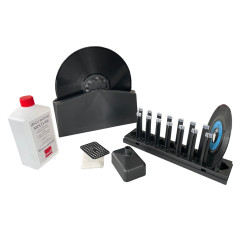
EN:
Makes LPs durably antistatic with the alcohol-free Disco-Antistat mixture, a special liquid that automatically removes dust, dirt particles and dried liquids without leaving any residue and deep into the grooves.
The care set consists of:
Wash case with inserted goat hair brushes
Label cover with hanging axle for LPs, singles and 10 inch discs --> Adapter included
1 litre cleaning fluid DISCO-ANTISTAT Mixture (alcohol-free)
Funnel incl. filter grid and filter fleece (5 pieces), with which the liquid is filtered back into the bottle after use.
Drip stand (drying rack) with drip tray for up to 15 LPs or singles (slides into the casing after use)
Device can be stored in our original Archifix box (Art. 1202431) to save space.
DE: Disco-Antistat, das praktische Pflege-Set für die Grundreinigung.
Macht LPs dauerhaft antistatisch, mit der alkoholfreien Disco-Antistat-Mixture, einer Spezialflüssigkeit, die selbsttätig, rückstandslos und rillentief Staub, Schmutzteile, sowie eingetrocknete Flüssigkeiten entfernt.
Das Pflege-Set besteht aus:
Waschgehäuse mit eingesetzten Bürsten aus Ziegenhaar.
Labelschutz mit Aufhänge Achse für LPs, Singles und 10 Inch. --> Adapter inklusive
1 Liter Reinigungsflüssigkeit DISCO-ANTISTAT Mixture. (alkoholfrei)
Trichter inkl. Filtergitter und Filterflies (5 Stück), mit dem die Flüssigkeit nach Gebrauch wieder in die Flasche zurückgefiltert wird.
Abtropfständer (Trockenständer) mit Auffangschale für bis zu 15 LPs oder Singles (wird nach Gebrauch in das Gehäuse geschoben)
Gerät kann platzsparen in unserer Original Archifix-Box (Art. 1202431) verstaut werden.
Bedroom Talks, hailing from Ukraine, is a gifted solo artist whose music, delves into an eclectic blend of genres including coldwave, darkwave, synthwave, post-punk with touches of EBM. “Call Me Malespero,” produced during Ukraine’s shelling, captures the essence of his art in a unique and moving way.
It’s a powerful testament to human resilience and the ability to find beauty even in the darkest moments, evoking a range of emotions from pain and anger to palpable sweetness, all woven into poetic lyrics and enveloping melodies. Presented in ONE-OFF truly limited edition of 300 copies lacquered pressed on 180 gr. high quality solid BLACK vinyl. All tracks have been specially mastered for vinyl by Daniel Hallhuber at Young and Cold Studios (Germany). inc
The oldest Finnish electronic music organization (est. 1993) is back with another killer vinyl release. Once again they have put out a compilation of 12″ featuring fresh tracks from fresh Finnish talents Funktor, Arre, Doswon and Vapor. Music varies from tight electro tracks to acid house, certain to make every floor burn. Limited and numbered edition of 200pcs on vinyl!
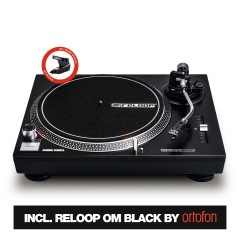
NEW in the MK2 version:
Newly developed top panel and reinforced housing construction
Reworked metallic buttons with improved feel & tactile response
Precision Pitch with selectable ranges of +/-8 %
Superior finish in deep black metallic
Quartz-driven DJ turntable with direct drive
Perfect for beginners
USB audio output for digitizing your records easily
Precise motor control with 2 speeds selectable (33 1/3 & 45 rpm)
Precision-engineered, die-cast aluminium platter with stable rotation
Statically balanced s-shaped tone arm with hydraulic lift and anti-skating - mechanism
Universal connection for pick-up systems (SME)
Extendible needle illumination
Built-in phono pre-amplifier (no grounding necessary)
Switchable phono and line level output
Shock-absorbing feet for vibration isolation
Sturdy, heavy construction with optimized damping features
Prepared for dust cover (available as optional accessory)
Incl. platter, OM Black pick-up system (by Ortofon), headshell, slipmat, counterweight, power cord, operating instruction manual
Technical Data
Turntable:
Type: direct drive turntable
Drive: quartz-driven direct drive
Motor: 8-pol., 2-phase, brushless DC motor
Turntable speeds: 2 speeds, manual (33 1/3, 45 RPM)
Starting torque: > 1kg/cm
Brake time: 50 dB (DIN-B)
Brake system: electronic brake
Platter:
Material: aluminium die-cast
Diameter: 332 mm
Tone arm:
Type: universal, statically balanced, s-shaped
Effective length: 230.5 mm
Overhang: 16 mm
Tracking angle error: < 3°
Applicable pick-up weight: 3.5 – 8.5 g (incl. headshell 13 – 18 g)
Anti-skating range: 0 - 7 g
Connections:
1x PHONO/LINE out (gold-plated)
General:
Power supply: AC 115/230 V, 60/50 Hz (US/EU)
Power consumption: 13 W
Dimensions: 450 (w) x 352 (d) x 144 (h) mm
Weight: appr. 6.76 kg
É Soul Cultura captain, originator of Manchester’s legendary Electric Chair and definitive people’s champion, Luke Una taps into a lifetime’s worth of musical discovery for the second volume in our Mr Bongo Edits series. A cosmic coming together that sees two of Luke’s secret weapons, re-edited and re-contextualised by the man himself to provide optimal dancefloor euphoria.
A stalwart of the underground for nearly 40 years, Luke has become an appointed leader of the late night disenfranchised, with an unquestionable ability to pick records that make minds tick. Not least through his two É Soul Cultura compilations released on Mr Bongo over the past two years.
A taste that traverses genres as much as it does emotions and decades, who better to give an insight into the tracks he has chosen to edit, than the man himself. “I've been an avid collector of afro-beat house, techno and underground black heart disco since before the basement soul days of Electric Chair 30 years ago. Both these bombs were very much holy grail finds, plucked from the last four decades of digging in random crates of dusty vinyl all over the world.”
First up, Thandi Zulu & The Young Five’s interpretation of Pure Energy’s early ‘80s disco power play – ‘Love Game’. With a distinctive South African synth bass and killer keys combo, Luke explains the original has this “bonkers alchemy of heavy machine soul, uptempo rawness and a majestic disco evangelism”, making it ripe for a re-edit.
On the B side, Lionel Pillay’s Jazz dancer ‘Plum’. “The original was a relentless 18-minute raw jam”, Luke states, “which despite its late ‘70s South African origin kinda reminded me of a 1986 Chicago piano House record”.
“These edits strip the tracks back and rebuild them, giving them more sonic weight with that looped up drum jacking militancy from the days of Chicago, combined with a boosted sense of transcendental, psychedelic, cosmic disco. They have always had such an explosive reaction on so many dancefloors including the heavier electronic club, so it felt only right to reshare them”.
With his sensational full length debut, now well and truly bedded in - Duncan now treats us to the first of two, super special ‘Return of The Strobelight Kid’ - Remix EPs.
Taking pride and place, as the sole rework on side A, is Mr. G’s beastly ‘Changing Timez’ dub of ‘Rise Above’. A track full of poise, playful experimentalism and sub-licked attitude - it’s one that positively writhes in its own, wonderfully succulent, analogue filth.
Then, kicking off Side B proceedings and taking on album closer - ‘The Future Of Love’ - we have the refreshingly singular, duo-driven talents of Bodhi; who, full of confidence and clarity of vision - boldly choose to take the delicate, soul-quenching OG into unexpectedly fierce, propulsive and heads down Techno territory… a roll of the dice mind, that pays dividends and then some.
And finally - wrapping up Side B on this first ‘Return Of The Strobelight Kid’, remix EP - is Duncan himself…who here we see re-mould, ‘Quantum Particles Falling From Space’, into an even more incisive, heavily snarled and intensely rifling slice of forward-thinking Jungle-meets-Techno weaponry.
"Drums from heaven, keys from Mars, a bass made from mother earth's soil and guitars from a guy who's time-traveling from German Kraut in the last 60ies into the next 60ies and who happens to gift us today with this funky, dirty, pulsating, delicious music that's everything which music is supposed to be: ALIVE! (Note to self: Always keep a copy of this record in your suitcase!)." (Malakoff Kowalski)
"Afrokraut" is a stylistic expression of Krautrock, primarily associated with Can, and their creative use of time and space in music. "A Guide To Afrokraut III" is David Nesselhauf´s third and last contribution to the dusty shrine of this long forgotten style.
Next to "Afrokraut" (2016) and "Afrokraut II: The Lowbrow Manifesto" (2018), this album completes a humble sonic Trypticon in honour of David Nesselhauf's musical heroes. Experimentation was key in the immersive process of producing this album, which encompasses elements of Funk, Afrobeat and Krautrock as well as otherworldly Drones, early Elektronische Musik and even field recordings.
Inspired by the unfinished manuscript 'History Deletes Itself' by the late science fiction author Joseph Sabiers, Nesselhauf decided to produce a b-movie soundtrack to the original plot, ignoring the fact that there will likely never be a movie to this music.
In the original script, a virus has infected history, the resulting changes of historical facts leading to an unpredictable present and future for mankind. Every attempt to solve the problem – including time travelling – only worsens the situation. But three planets at the end of the known universe seem to be unaffected by the phenomenon, they become a sanctuary known as 'Afrokraut III'. Three brothers arrive there to start new lives. They are introduced to The Guide, their mysterious advisor...
The striking parallels to today's uncertainties, a strong feeling of hope and the idea to never stop exploring (come what may) certainly have encouraged the making of this album, which sees a belated release due to the obstacles everyone faces right now.
David Nesselhauf lives in Hamburg/Germany and appears as a bass player/songwriter in bands like Hamburg Spinners, The Drawbars, Diazpora, and Angels Of Libra.
Jazz music has more than its fair share of overshadowed figures that whilst contributing much to the music have little presence in its collective conscious. One such musician is the talented multi-reedist, Sahib Shihab. Born Edmond Gregory, as he was known before he adopted the Muslim faith in 1946, Sahib Shihab's music background shows a deep and significant evolution, influenced by Thelonious Monk, Dizzie Gillespie (his experience in Dizzie's band marked Sahib's switch to Baritone, the instrument he became most readily associated with), and above all by Charlie Parker's Bop. Had it not been for the post-war migration of many top American jazz musicians to Europe, it is quite likely that the legendary Clarke-Boland Big Band might never come into existence. Sahib, one of this musicians disillusioned with the politics and racism of the United States, accepted to join the band of Quincy Jones for an European tour in 1959. When the tour ended, Shihab he remained in Europe where he joined, in 1961, the Clarke-Boland Big Band. The collection 'Companionship', whose line up consists of seven elements which derives from this original band, spotlights the consummate musicianship and individuality of Sahib Shihab and is testimony to his special musical gifts - not only as a top-rank flautist and baritone saxophone but also as a composer. Furthermore, it provides a welcome reminder of the high quality of the Clarke-Boland Big Band's rhythm section, the lively style of vibraphonist Fats Sadi and the power and personality of two of the C-BBB's horn-playing stalwarts, Benny Bailey and Ake Persson. Here's a real rarity, surely a desert island disc. This double album has it all from frantic banging percussive workouts to modal numbers to beautiful ballads. It's a staggeringly good piece of music and worth every penny of the price tag it commands. Let's have a look to the most significant pieces. Francy Boland's "Om Mani Padme Hum", taken from a Tibetan prayer, shows Shihab in exuberant mood, playing against a vigorous percussion background and making dramatic use of his special technique of combining voice and flute. Boland contributes an incisive, effervescent solo. "Bohemia After Dark", a classic original by bassist Oscar Pettiford which he first recorded back in August 1955, finds Shihab in exultant form on baritone. "Companionship" has a Bossa Nova beat and features Bailey on flugelhorn and Shihab on flute, playing with a limpid, floating sound. Bailey's minor-key original, "Stoned Ghosts" was, he says, inspired by listening to some music written by Bela Bartok before he emigrated to the United States. The piece has an infectious back-beat pulse and showcases the superb walking technique of Jimmy Woode. In "Con Alma" Shihab's mellow flute set against a churning 12/8 beat in this stylish Boland arrangement. Woode's performance of the superb Mei Torme ballad, "Born To Be Blue", reveals his great affection for the song. "lt is the perfect combination," he says, "a beautiful melody married to a great lyric. I really love that tune." It is a song of rueful resignation, putting a brave face on the blues. "Balafon" is an up-tempo Francy Boland original written for the French mime artist, Marcel Marceau. The rhythm section really cooks on this track with Kenny Clarke's cymbal work outstanding. Boland's solo here is notable for its neat, left hand punctuations. "Calypso Blues" has been written by Nat King Cole and Don George. lt tells the wry and wistful tale of a Trinidadian in New York desperately homesick for the land where everything 5 so much cheaper (in New York "a dollar buy, a cup of coffee and a ham on rye") and the girls more natural than the artificial, painted beauties of New York. Woode's composition, "Sconsolato" is a haunting theme in A minor and it brings to a close a truly fascinating album. This is dynamic music played with vigour, verve and vitality - and it is an enormous pleasure to rediscover it. A shadowy fugitive from his home in the land of jazz, Sahib Shihab remains a true unsung figure, worthy of more attention. With his equally expert technique on Baritone, Flute, Alto and Soprano saxophones and his capacity to adapt easily to a variety of musical settings. His warm, individual, singsong sound in improvisation and his unusual and interesting compositions mark him out as a hidden treasure in the dusty corners of jazz archive.
Global pointing Brazilian jazz trio releases their new album Agôra, that sparkles with electric funk and Herbie-esque eclecticism. It features a myriad of guest vocalists and musicians including Brazilians Xênia França and Zé Leônidas, Jembaa Groove's Ghanaian singer Eric Owusu and South African artists Bongani Givethanks & Mpho Nkuzo
Re-wiring the concept of 'fusion' for 2023, Agôra is Brazilian trio Caixa Cubo's resurgent new record with the title referring to 'now', based upon the intuitive and fluid nature of the trio's method, and this inspired recording. With shoots to black music culture, from Brazil to Brooklyn, Ghana and South Africa, Agôra is the group's ninth album yet is their first where they've invited guests, mainly singers, onto each track and follows their last, Angela from 2020, released on Heavenly Records, which won a BBC 6 Music Album of the Year (Huey Morgan's selection) granting them much deserved international recognition.
The core musical elements of Caixa Cubo are Henrique Gomide (keys), João Fideles (drums) and Noa Stroeter (bass), all from São Paulo, Brazil and where they met as teenagers and would continue their friendship and musical bond at the Royal Conservatory in The Hague, Netherlands. Now all in their mid thirties, João and Noa live back in the city where it all started but Henrique has settled in Cologne, Germany where the recording of Agôra took place, over the course of 3 days, at the home cum studio of Chris 'Dusty' Doepke, their friend and owner of the label they signed to, Jazz & Milk.
In line with all their creations where flow and energy provide the magic, allowing what the moment provides, the album shines not only for its virtuosity but for its minimalism, the depth of space, and for the first time, the ability to figure in and outside of the jazz fold, as the trio decided, for the first time, to bring in singers and add a new aesthetic to their sound.
"Agôra is a wake-up call to reality, a reminder that the infinite possibilities of technological progress should not disconnect us from the earth, from eye-to-eye relationships, and from moments lived in person" the band are keen to point out. "And that we must not be consumed by greed, for all we truly possess.... is the NOW."
Turning hope and metaphor into music, the debut single Sábado, an electrified future- jazz-fizz reflects perfectly the spontaneity that permeated the entire recording of the album. "When we got to the studio, we had no idea what we were going to record. We started playing a groove, kind of inspired by Gilberto Gil's 80s albums, and our drummer João started singing this funny song 'Sábado Barrigudão' (Big Belly Saturday) alongside the bass groove and that was that". Inspired by their city of birth, São Paulo, it features long time collaborator and vocalist Zé Leônidas, with cuicas, tamborim, agogo and shakers providing the most obvious Brazilian affect from the album.
Dreams is the band's first foray into R'n'B melding the group's simple and sporadic instrumentation of drums, keys and bass into a Jill Scott inspired song that could have been born in Brooklyn yet sung by Brazilian singer and Grammy nominated Xênia França and Zé Leônidas in both English and Portuguese. Xênia recently performed online for hip-to-it website Colors and it's her latest collaboration with Caixa Cubo, having first met in 2009 for a series of live performances.
South African artists Bongani Givethanks & Mpho Nkuzo come to the record with a wholly different approach on Ndiyakhangela, providing spoken word and vocal refrains on top of an Afro-Brazilian percussion jam with a delivery and verse in Xhosa, Zula and Ndebele. Asase is the album opener and features vocals of Eric Owusu who is part of highlife pioneer Pat Thomas's live band and most recently, co-leader of Jembaa Groove, an Afro-soul band from Berlin. It's a synth wig out with djembe grooves and offers a brand new take on Afro-soul-jazz.
Other contributions come from Cologne based jazz singer Rebekka Ziegler (Oblique Sunshine), São Paulo based guitarist Eduardo Camargo (Caio & Eric) and trumpet player Matthias Schriefl on Kismeti, a gorgeous and rolling number that ebbs and flows, exemplifying the group's effortless ability to craft a sound energised by a belief in one-self and the idea of having faith without the need to look at each other for verification.
As drummer and percussionist João Fideles perfectly surmised upon arriving for the recording session, "What drums do you have? Whatever you have, I'll use it". Agôra is testament to nearly 20 years of camaraderie, friendship and most importantly, trust.
For their sixth instalment, Lowlife Cartel follow up to their last two compilations (“Pimps Improvisations” in 2018 and “Omnia Vanitas” in 2020) with a new six-track VA named “Kodoku”; a vortical release, both bold and forward-looking, while fully geared for the club environment. Taking its title from a poisonous magic from the medieval Japanese era obtained by placing several venomous insects in a jar and letting them kill one another until only one survives, “Kodoku” - which interestingly also translates as “solitude” - features a cast of producers old and new to the fold including Saverio Celestri, the faceless △, Prince de Takicardie, Tundramane & Ko$te, Solar Alliance and Shampoo.
A staple element of the Lowlife Cartel bunch, Saverio Celestri paves the way and dishes out one of his signature jagged, EBM-informed weapons in “Sundays”. Through this hotchpotch of acid-steeped bass entangled with a frantic newbeat-ish swing and razor-sharp synthwaves, the Italian producer shows off the raw and playful facets of his craft to optimal effect. Unknown contributor △ clocks in with “Crachats de Lune”, a proper ominous banger going straight for the jugular with its clever mix of dusty, drum-laden churn, processed vox stabs and sci-fi-indebted laser bursts flashing by unrelentingly. Tailored for hi-octane action at the defunct Boccaccio or Hacienda, Prince de Takicardie “Jam’on’Acid (House Mix)” blows the winds of euphoria across the club like it was done in 1995. Vibing to a pulsating mix of rabid snares, 303-vehicled charges and mangled vocal samples on a classic free rave tip, throwback material that packs a punch.
Flip it over and here is North-American duo Tundramane & Ko$te shifting the scope to Memphis chopped-and-screwed in true hardcore fashion. Straight-out aggression, “Brick To The Face” lives up to its title, so expect leaving the place with a few teeth out your mouth and a good concussion, though more side effects could appear over repeated listens. A radical U-turn from the previous, Ute.- related triplet Solar Alliance - alias Ekkel, Oprofessionell and Mikkel Rev - bring their dashing trance touch to the comp with “Quest for Kiba”, an uptemp maelstrom for the senses, swirling and whirling up until space and time make no damn sense any more. Topping off that versatile tour de force, Japanese producer Shampoo adds his delectably sensuous spin on the record with the lush, sample-heavy lo-fi appeal of “四季ノ歌”. Unpolished feelgood vibes, sun- streaked soulfulness and deft-handed MPC wizardry are on the menu for this ultimate ride and jolly finale.
Number 94 in the Brazil45 series is one for the Brazilian boogie lovers out there.
The vocal and instrumental group Os Carbonos from São Paulo had a long career that straddled the 60s, 70s and 80s. 'Pássaro Selvagem' is taken from the latter years of their career. Its a bass driven, boogie-funk groove (with a bassline not too dissimilar to Queen 'Another One Bites The Dust') that is Brazilian boogie at its finest. Taken from the B-side to a 7" campacto released in 1981 on Copacabana records, its proven to be a favourite of Luke Una and we foresee it becoming a staple in your DJ box for years to come too.
The B-side comes from one of our all-time favourite artists, the mighty Sandra Sa. Sandra is a wonderful vocalist, her intense and recognisable style is one of THE voices of the Brazilian boogie golden era. Check out her classic album 'Vale Tudo' (MRBLP230) on Mr Bongo for further proof of her credentials here. 'Palco Azul' is also taken off a 7" single from 1981 and is a feel-good dancefloor groover with punchy brass stabs, warm keys and uplifting chord changes. It contains all the right elements that we have come to associate with that knockout late 70s / early 80s Brazilian sound.
'A Winged Victory For The Sullen' is the first installment of the new collaboration between Stars Of The Lid member Adam Wiltzie and L.A. composer Dustin O'Halloran. The duo agreed to leave the comfort zone of their home studios and develop the recordings with the help of large acoustic spaces, hunting down a selection of 9ft grand pianos that had the ability to deliver extreme sonic low end.
Other traditional instrumentation was used including string quartet, French horn, and bassoon, but always juxtaposed is the sound of drifting guitar washed melodies. The recordings began with one late night session in the famed Grunewald Church in Berlin on a 1950's imperial B?sendorfer piano and strings were added in the historic East Berlin DDR radio studios along the River Spree. One last session on a handmade Fazioli piano in a private studio on the Northern cusp of Italy, before the final mixes took place in a 17th century villa near Ferrara with the assistance of Francesco Donadello. All songs were then processed completely analogue straight to magnetic tape.
Their secret to harvesting new melodic structures from the thin air of existence was for the duo to push themselves to dangerous territory, realising that clear thinking at the wrong moment could stifle the compositions. The final result is seven landscapes of harmonic ingemination. In 'Requiem For The Static King Part One' ? created in memory of the untimely passing of Mark Linkous ? they have taken the age-old idea of a string quartet and then shot it out of a cannon to reveal exquisite new levels of sonic bliss.
Of the 13 minute track 'Symphony Path?tique', Wiltzie says 'after almost 20 years of struggling to create interesting ambient drone music, I feel like I have finally figured out what I am doing'. Notable guest musicians include Icelandic cellist Hildur Gudnadottir, as well as Erased Tapes label comrade Peter Broderick on violin. A Winged Victory For The Sullen is not a side project ? it is the future of the late night record you have always dreamed of. A Major release for Forte, Non exportable.
Cascading through kaleidoscopic stardust and forming in the outer reaches of the music universe, transcending time and distance, cosmonaut musicians Mo Morris & Zeben Jameson reconnect to write & record songs from opposite sides of their planet (Bali and London) written over the internet during the pandemic. Landing the much anticipated and eagerly awaited new A Mountain of One album "Stars planets dust me".
Welcome to the formative British psych electronic heroes A Mountain Of Ones 3rd studio album.
Mastered and reimagined and a full forthcoming album rework by electronic wizard, master selector & global superstar Ricardo Villalobos, featuring additional collaborations from 80s/90s Balearic legends "The Woodentops`s" front man "Rolo McGinty,”, Japan’s cult heroes ``Dip in the Pool" and "Unkle" and "Toy Drum`s" Pablo Clements.
UK Dub master "Dennis Bovell MBE" also makes an incredible appearance on the "Custards Last Stands" dub versions. Now available on a ltd Japanese 10". A beautiful artwork series generously loaded in by photography legend Dick Sweeney, and co-mixed by Dea Barandana in Indonesia. With its cosmic pop sound, soulful soaring, balearic sensibilities and feel good choruses it carries all the weight of a much needed revo- lution in psychedelic, conceptual ever popular music and sounds & feels like the infamous crossover album that promised to come from the heady days of the bands ascend last time round.
So here’s some back story, garnered from the hearsay, folk law, the myths and the legends, of 10 years ago, in case, like Mo & Zeb, if they'd remembered any of it, they probably weren’t there, after 2 much acclaimed albums and sellout shows vanishing in a cosmic cloud of dust the yin and yang brothers Mo Morris (ZSOU/Electric Stew) & Zeb Jameson (Oasis/Tricky/Pretenders) uncoupled and each em- barked on a pathfinder mission to equip themselves for their inevitable return... they just didn’t know it at the time... and as the global community ground to a halt 2 years ago they sought refuge from opposite sides of the planet in each other's company again.
The solace and rejuvenation it gave had them re-emerging as invigorated, inspired and wiser music creators, this has given rise to the evolution of their 3rd all important album‘s sound.
Zeb "our capacity as human beings is more phenomenal and limitless and way beyond the conventional thinking of society constructs but also in complete harmony with the intelligence and brilliance of advancing technologies".
Experiencing this energy together, as dedicated and devoted music pioneers, these great collaborative universal truths were revealed, imbed and steeped in their writing and recording experience as the music touched and resonated with all involved to create the fresh and fully formed A Mountain Of One 2.0.
The Tenets of Forgetting is the long-awaited follow-up to MSYLMA’s lauded 2019 debut, Dhil-un Taht Shajarat Al-Zaqum. This time he’s joined by fellow musician and producer ISMAEL for seven tracks, built around a lush palette of synths and MSYLMA’s singular voice.
Written and produced in Cairo between 2015 and 2020, The Tenets of Forgetting is the first collaboration between MSYLMA and ISMAEL. Like his first record, The Tenets of Forgetting finds MSYLMA singing in classical Arabic, and the musicians have enlisted Nariman Youssef to provide translations of the lyrics. This gesture of openness runs parallel to the themes of the record; romance and vulnerability; growth and change; pathos and passion. Listeners who aren’t familiar with pre-Islamic poetry or classical Arabic will find the lyrics just as rich and beautiful as the vocal melodies imply, telling a story of love, loss, self-doubt, and grave introspection.
Musically, the album moves in broad, painterly sweeps of 808 kicks, rich synthesizer chords, and MYSLMA’s soaring, plaintive voice. The English translations reveal a second world of mathematically sound rhythmic structures and poetry in the lyrics. The music pushes and pulls in both tempo and timbre, swirling both around and underneath MSYLMA’s voice but never losing a sense of self-contained narrative.
The album is rounded out by Jesse Osborne-Lanthier and Omar El-Sadek’s immersive, esoteric art, and features additional production on track 7 by Osborne-Lanthier, Pierre Guerineau, and Asaël Robitaille.
HDSN is one of the most diverse young artists in recent times, and every new production that hits the shelves is proof of his endless exploration of the electronic music universe. “Low End Therapy” is the follow up to his first release on NBAST ́s sister label “ We Must Protect This House” , which kicked off a new era of sound on his second home label earlier this year. Now that the dust has settled WMPTH002 is here: straight to the point, pounding and euphoric, its a modern reimagined dream of an illegal 1992 warehouse rave anthem full of energy but also incredibly catchy and instantly recognisable.
The Minneapolis-raised DJ/Producer’s second album following 2014’s ‘Monoliths’ lands on Radio Slave’s Rekids imprint in November.
Although based in Berlin for several years, Dustin Zahn has continued to exert influence over the fertile but steadfastly underground Minneapolis techno scene as part of the Intellephunk collective whilst cultivating a worldwide rep via releases for Blueprint, Token and his own Enemy Records. The ‘Gain of Function’ LP sees Zahn channelling the groove-fuelled techno of the late ’90s and early ’00s and shaping eight powerful but funky contemporary techno tracks that display the decades of experience under his belt.
Forged from a series of live jams with two drum machines and two synths, the album is a refined collection of raw, purist techno brilliance. Across the A-side ‘Tell Me About Paradise’ brings shimmering staccato chops under bright and airy percussion before ‘Tangie Groove’ picks up the pace with floating pads, vocal slices, and a rumbling bassline. On ‘Lucid Dreams’, scattered percussion plays with hypnotic synth licks, while ‘Smoking in Silence’ sees off-kilter leads dancing between emotive vocals and evolving drum loops.
Opening the second disc is the deep and shuffling ‘Crimson Cheeks’, with trance-inducing samples nestled between sharp drum hits and rolling synthesis, and ‘Days Like These’ takes a darker turn as twinkling arps and droning pads carry the track. ‘Shark Rodeo’ featuring Jeremy Black mangles samples into a dense rolling affair, before closing number ‘Next Level Looseness’ drops the 4/4 pattern for a raucous club track, combining oddball sound sources and unruly production techniques for a trippy finish to the album.
Since the late ’90s, Zahn’s hypnotic and driving techno has consistently caught the ears of top DJs and labels worldwide, with anyone catching his marathon sets at the likes of Berghain exposed to expansive sets. In addition to his techno-heavy catalogue and DJing prowess, Zahn has lent production and engineering skills to bands and singers, recently working with Poliça and on Carm’s Pitchfork approved eponymous album. Beyond this, his vital work with Intellephunk includes the nearly two decades long running Communion after-hours events, cementing his invaluable contributions to the scene.
2020 sees Jazz & Milk celebrating its 15th anniversary! Since 2005 the label, founded by Dusty, offers an experimental playground for international artists that share a passion for organic and soulful dance music. Many legendary club nights and over 30 releases later, Jazz & Milk has become a household name amongst the eclectic music imprints. The focus has always been to transcend genres, including a broad spectrum of styles ranging from jazz, soul, brazil, afrobeat to house, broken beat and electronic music.
For this very special occasion, the label presents six exclusive tracks by the likes of Steve Spacek, Àbáse, Sam Irl, Feater, Bongani GiveThanks and Moe Fabrik - the club focused collaborative moniker of Wayne Snow, Ziggy Zeitgeist and StyleBoi 92.
With this compilation project, Jazz & Milk is not only celebrating an illustrious 15 years of operation. The label also wants to take the opportunity to highlight the importance of 'community', at a time when racism, greed, injustice and a deadly pandemic are jeopardizing our ability to harmoniously exist with one another.
Percussionist Jamie Muir was a member of King Crimson during the recording of Larks' Tongues In Aspic, in 1973. Staying less than a year with Robert Fripp, the Scot had already cut his teeth with another master guitarist, Derek Bailey, as part of the Music Improvisation Company, along with Evan Parker, Hugh Davies and Christine Jeffrey, whose eponymous 1970 album was one of the first releases on ECM. Muir and Bailey recorded Dart Drug eleven years later, in 1981.There's no shortage of great percussionists in the brief history of free improvised music but on the strength of Dart Drug alone Jamie Muir deserves a place at High Table. Unlike for example Han Bennink and John Stevens, though, you can't hear echoes of any particular jazz drummer in Muir's playing, even if he has expressed appreciation for Milford Graves (who himself sounded like nobody else who'd come before him).What on earth did Muir's kit consist of Some instruments are clearly identifiable (bells, gongs, chimes, woodblocks); others could be... well, anything. Old suitcases thwacked with rolled up newspapers Tin cans and hubcaps inside a washing machine Who cares It sounds terrific - but if you're the kind of person who faints at the sound of nails scraping a blackboard, you might want to nip out and put the kettle on towards the end of the title track.Dart Drug is consistently thrilling, and often very amusing - but it's certainly not easy listening. In music we talk about playing with other musicians, whereas in sport you play against another opponent (or with your team against another team). Why not play against in music, too That's precisely what happens very often in improvised music, and Bailey was particularly good at it. How can a humble acoustic guitar hope to compete with a Muir in full flight Sometimes Bailey's content to sit on those open strings, teasing out yet another exquisite Webernian constellation of ringing harmonics and wait for the dust to settle in Muir's junkyard, but elsewhere he sets off into uncharted territory himself.'The way to discover the undiscovered in performing terms is to immediately reject all situations as you identify them (the cloud of unknowing) - which is to give music a future.' Bailey evidently concurred with this spoken statement by Muir, including it in his book Improvisation.Derek Bailey is no longer with us, of course, and Muir gave up performing music back in 1989. All the more reason for seeking out this magnificent, wild album.
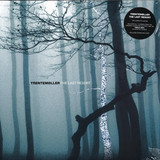
Special vinyl re-issue of Trentemøller's groundbreaking debut album. Includes all of the 13 songs on vinyl for the first time. Triple-vinyl in gatefold sleeve.
Trentemøller's debut album remains one of the few genre-defining and groundbreaking albums in many regards. It's still being praised for its composition and sounddesign alike and sounds as fresh and breathtaking today as it did when it was originally released in 2006.
The Last Resort - a beautifully crafted, astonishing masterpiece, that will leave you breathless. The 13 instrumental tracks together form a wordless musical story, almost like the soundtrack of a movie. It
manages to capture a whole range of emotions in subtle melodic miniatures, dreamy ambiences, dusty beats, deep dub-tracks and driving groove-excursions. An ever-changing kaleidoscope of colours and moods. Although it's an electronic album, it also incorporates live-drums, guitars, bass and other acoustic instruments like celesta, glockenspiel, melodica and even DJ scratching to create a more organic feel. The album received fantastic acclaim from both music fans and journalists around the world and made it into the top-lists of the month, the year, the decade - alongside an array of awards for best production or best album.
Back in 2006, the original pressing only included a selection of songs from the original 13-track album release. It missed out on songs which had been released on singles or didn't "fit" on the so called "vinyl edition". Due to 'public demand' and simply because this album deserves a proper vinyl release we are happy to finally present, for the first time, the full album on vinyl. It spans of three vinyl discs and is packed in a beautiful gatefold sleeve which also holds a download-code. The recut has been carefully crafted from first generation, orignal masters by Calyx in Berlin. Since the album has been praised for its fantastic sound the primary directive was to cut the lacquers for the re-issue so that they would sound exactly the same as the original release, which has been the CD version of the album. No 'digital remastering' or any other alterations have been applied.
All 13 songs of the classic album on one vinyl release for the first time. Triple-Vinyl edition. Gatefold sleeve. download code. original sound-quality. NO digital remastering.
Finally! The long-awaited Raffaele Attanasio's label , " Letters From Jerusalem " , is born - Jerusalem represents the spiritual and physical center of the Earth, hence that comes to life the metaphor that locates in it ourselves center. Music as a means of exploration, as a descriptive source ofdeepest and hidden feelings and emotions in the center of man. Music as creation and destruction of feelings and perceptions, as act that turns into potency.The first release includes four tracks of which two recorded live , particular attention is drawn to the title track : " Credible Threat " , which has a special partnership with Douglas J. McCarthy , leader of legendary EBM band " Nitzer Ebb ". There is no time, we'll all die ! LFJ001 early Feedbacks and Supports: Slam : Thanks Raffaele these are all destroyers:)
Philippe Petite : Thanks for sharing your new EP. My favourites are A1 and B2: super Ben Sims : Eutanasia is the track for me, thx! Gary Beck: the 2 live cuts are wild and brilliant! Really look forward to playing them in my upcoming sets, love it!
Dustin Zahn :The production on the promo is really high! thanks
Rebekah : cool tracks, thanks! Ancient Methods : That is a great start what you have for your label! thanks for the promo