The Future Sound of London's long and varied history stretches back almost 25 years and as such a vast amount of unrealised material exists in the FSOL Archives.
1988 to 2018 - 30 years of recorded history
Archived 9 brings further treats from the mammoth FSOL archives - this time ranging from early 90s right up to recent times.
14 unreleased tracks woven together to form over 60 mins of mind bending sound experiments
From light to darkness from forests to deserts
onwards............
Did you know - The Future Sound of London were the first band to distribute their music via the internet, in 1994
Did you know - The Future Sound of London were the first band to use ISDN technology to transmit their music via the internet and also to radio stations across the world - a system that has now been adopted by the radio industry worldwide
After years of working as a graphic artist, designer, and creative director, Pilar Zeta will release her debut album Moments of Reality on Ultramajic Records on October 5th, 2018.
Inspired by Japanese post-modern art from the 1980s and produced using synthesizers from the 1990s, the new age album of nine electronic pieces is ambient and cinematic with an off-world feeling.
Her sound draws on the style of bands like Art of Noise and Steve Roach that she was exposed to early in her life and evokes the work of Yasuaki Shimizu, Yello, and Laurie Anderson. Each of the nine tracks will feature a cover with different objects in absurdist settings. Much the same way Zetas visuals seem to be artifacts from a parallel universe, Zetas ethereal and melodic compositions sound like a coded language transmitting from a neighboring galaxy.
I feel privileged to be able to translate my visual world into sound, the unknown was the most fun and fascinating aspect of it
Fueled by a lifelong love of the paranormal, Zetas metaphysical iconography and music exist in futuristic, surreal, and elegant spaces. Her visual and sonic works function as a form of practical magic in a machine-centric world, connecting different mediums through a singular, transcendent vision.
Scored for Maurice Béjart's choreography to the 'Orphée Ballet', based on the Greek god Orpheus, this is one of Pierre Henry's finest works of musique concrète, the genre in which Henry was an early innovator and to which he devoted his career. After years working for the French national radio (RTF) and honing his studio chops on radio spots and editing/composition, Henry formed his own studio in 1958 and began working on modern dance and ballet and soundtrack work. Incorporating percussion, industrial soundscapes, nature sounds, spoken French narrative, and synthesized tones, 'Orphée Ballet' is a beautiful piece that, while less known than what is perhaps his most famous work, also for Béjart's ballet production, 1967's 'Les Jerks Électroniques De La Messe Pour Le Temps Présent Et Musiques Concrètes Pour Maurice Béjart', is equally compelling and groundbreaking. Following his passing in 2017 at age 89, Henry's work has found renewed interest, and this is a welcome reissue of one of his rarest and finest works. Truly brilliant.
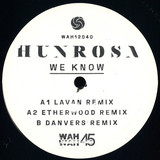
As bottom end provider for Cinematic Orchestra and Paper Tiger, Hunrosa (AKA Sam Vicary) already has something of a pedigree for a man of such tender years. His music glides effortlessly between Bonobo at his most sonorous, Jon Hopkins at his most ethereal and Flying Lotus at his most freaky. Currently based in Manchester, his music captures the wild organic senses of his Cornish childhood, anchoring it with a darker 2am undercurrent. Following the success of 'Ransom' (a firm favourite of BBC 6 Music's Tom Ravenscroft) Hunrosa returns with his newest offering 'We Know'. An eerie, ethereal track full of haunting atmospheres, Vicary enlists Austrian percussion maestro Manu
Delago, who lends his hang drum expertise to the proceedings weaving it amongst the twisting, intricate beats and Anna McLuckie's delicate vocals. the original is accompanied by a white label 12' containing three reworkings from burgeoning producers Lavan, Etherwood and Danvers. Newcomer Lavan is up first, moulding the organic melodies and earthy percussion into a dubbed out, soulful and bouncy 4/4 number. Hospital Records golden boy Etherwood (whose band Hunrosa is also a member of) brings a late-night liquid DnB atmosphere into play, harnessing the raw emotional power of the lyrics, as reverberating piano chords strike out into the darkness. Having turned the
heads of Bradley Zero and Gilles Peterson with his recent releases, CoOp and WotNot Music's Danvers resets the atmosphere with a zen like extended intro, before launching headfirst into a hypnotic and enthralling looped rhythm section. The groove locked in place, it rises and falls with precision, joined by spaced-out synths throughout the nine-minute duration, allowing the majestic instrumentation to gather pace as the spine chilling vocals drift overhead.
(comes in different coloured sleeve we cannot guarantee which one you will recieve)
Building on his very sexy works for the Borft weirdos, Jon Doppler's Security is a meeting of Sued's minimal funk sound and the post-acid house trip of early Rephlex. The elasticized acid of Ciphertext, the skanky dub of Wonwah, and the mammoth low end of Lag Down all propel from below, while the swollen synthwork on Hot Sauce and showstopping
MK650 inspire from above. These are late, late night jams that growl ominously in the bassbins, enhancing the foggy atmosphere and begging you to stay for one last dance.
Following Gruth 's Limited Edition Cassette Release Laments I N Late July, Befallen Is A Sister Piece To His Debut Vinyl Ep Futile Demise , Released Earlier This Year On Tormenta Electrica . Taking His Dark And Experimental Signature Sound A Step Further, Befallen Mixes The Artist's More Recent Material, Written In Brazil, With A Selection Of Older Works Executed In Berlin.
The Opening Track 'disdained Doctrine' Showcases New Production Methods That Fit Within The Techno Bpm-range And Introduces Processed Black Metal Vocals, As Well As A Return To The Artist's Original Instrument: The Electric Guitar. 'jurupari Despumation' Explores The Outskirts Of Halftime 160 Bpm Post-jungle, Blending Industrial Textures With Evil Reese Synths. The Closing Track Of A-side, 'hoarfrost', A Collaboration With Mord Records' Kamikaze Space Programme , Depicts A Frozen Landscape, With No Beats Or Traditional Sequencing Required. The B-side Of The Record Includes Works Completed With Gruth's Native-finnish Peers: 'exhumed Black' Is An Industrial Techno Journey With Helsinki Techno/ambient Artist Ikola , While 'befallen' Is A Haunting And Emotional Violin-piece Composed With The Mysterious Violinist And Sound Designer Kujo .
If you check the credits of The Rolling Stones' Goats Head Soup LP from 1973 you'll find a certain "Pascal" listed on the percussion section. That is none other than Los Angeles based artist Nicolas Pascal Raicevik (1933-1994), aka 107-34-8933, aka Head, aka Nik Pascal, aka Nik Raicevic. Besides his hitting the bongoes on the Stones album, Nik was a great artist on his own, both as a painter and as a musician. As a musician, he was a pioneer in the use of synthesizers, preceeding the Berlin school by some years when his Head LP was released on on Buddah in 1970. Buddah probably saw in Head the opportunity to cash in some money from the remains of the psychedelic scene - the three tracks on the LP are named after drugs used in the late sixties. The sounds, however, are accomplished works that show Raicevic as one of the most interesting pioneers in the use of synths. The album probably didn't do too well, since Buddah didn't renew the contract with Raicevic, who instead took his own way releasing his works on his very own Narco Records and Tapes label. Between 1968 and 1975 Narco would issue 4 LPs credited either to Nik Raicevic (Beyond The End... Eternity) or Nik Pascal (The Sixth Ear, Magnetic Web and Zero Gravity) plus one credited to 107-34-8933 (Numbers, which is in fact the same LP as Buddah's Head, albeit with different cover art). Copies of these LPs came with an ironic sticker over the shrinkwrap that read "Do not listen to this LP if you are stoned".
1972 saw the release of The Sixth Ear (Narco NR666), this time credited to Nik Pascal. A more complex work than Beyond The End..., it adds consistent rhythmic patterns to the mix with the addition of bongoes and also explores some interesting chord progressions.
Besides his musical explorations, Nik was also an interesting painter. His paintings are auctioned from time to time, and are consciousness expanding works influenced by abstract cubism and surrealism, some kind of Salvador Dalí on drugs exploring the outter and inner space. All the artwork on the sleeves of his LPs is done by himself. Spacey landscapes and psychedelic colours that fit perfectly to the music they contain.
"Nik Raicevic's music is at the intersection of radical psycho-electronic weirdness and kraut kosmische music (in particular the scifi-hypno-minimal modules of Conrad Schnitzler in Grun, Rot and Blau). It presents mega epic & tripped out electronic improvisations.
"This is an absolute must for collectors and fans of visceral, neurotic soundscapes." (progarchives)
"As far as late-60s / early-70s American Bedroom' Electronic Music goes, these LPS have to be among the first transmissions from this sector, made all the more attractive when coupled with Raicevic's alien topographIes - the covers are high-color portrayals of Venusian lanes, knotted growths, & future-past architecture in a style you might equate with Vintage' sci-fi pulp-novel covers - & copious Downer' sentiment. This music is imbued with a sort of lonely, anti-social sensibility that's about as far as you can get from the Academic' Early Electronic vector. I will say that if the Steve Birchall, Cellutron & the Invisible, and/or Pythagoron™ seed your garden, this will likely do the same." (twoheadeddog)
Never reissued before on vinyl format, the Wah Wah reissue features original sleeve artwork made of paintings and drawings by Nik himself and reproduction of the famous ironic "Do not listen if you are stoned" sticker. Limited edition, 500 copies only.
If you check the credits of The Rolling Stones' Goats Head Soup LP from 1973 you'll find a certain "Pascal" listed on the percussion section. That is none other than Los Angeles based artist Nicolas Pascal Raicevik (1933-1994), aka 107-34-8933, aka Head, aka Nik Pascal, aka Nik Raicevic. Besides his hitting the bongoes on the Stones album, Nik was a great artist on his own, both as a painter and as a musician. As a musician, he was a pioneer in the use of synthesizers, preceeding the Berlin school by some years when his Head LP was released on on Buddah in 1970. Buddah probably saw in Head the opportunity to cash in some money from the remains of the psychedelic scene - the three tracks on the LP are named after drugs used in the late sixties. The sounds, however, are accomplished works that show Raicevic as one of the most interesting pioneers in the use of synths. The album probably didn't do too well, since Buddah didn't renew the contract with Raicevic, who instead took his own way releasing his works on his very own Narco Records and Tapes label. Between 1968 and 1975 Narco would issue 4 LPs credited either to Nik Raicevic (Beyond The End... Eternity) or Nik Pascal (The Sixth Ear, Magnetic Web and Zero Gravity) plus one credited to 107-34-8933 (Numbers, which is in fact the same LP as Buddah's Head, albeit with different cover art). Copies of these LPs came with an ironic sticker over the shrinkwrap that read "Do not listen to this LP if you are stoned".
Nik's last album, Zero Gravity (Narco NR123) came under the Nik Pascal name and had a fantastic side long piece on the title track which reminisces of the works of Cluster. B side features four tracks that also bear some Conrad Schnitzler reminiscences. This was to be Nik's last LP before he would sell all his synths to ex car racer and future electronic/ambient music star Steve Roach.
Besides his musical explorations, Nik was also an interesting painter. His paintings are auctioned from time to time, and are consciousness expanding works influenced by abstract cubism and surrealism, some kind of Salvador Dalí on drugs exploring the outter and inner space. All the artwork on the sleeves of his LPs is done by himself. Spacey landscapes and psychedelic colours that fit perfectly to the music they contain.
"Nik Raicevic's music is at the intersection of radical psycho-electronic weirdness and kraut kosmische music (in particular the scifi-hypno-minimal modules of Conrad Schnitzler in Grun, Rot and Blau). It presents mega epic & tripped out electronic improvisations.
"This is an absolute must for collectors and fans of visceral, neurotic soundscapes."
"As far as late-60s / early-70s American Bedroom' Electronic Music goes, these LPS have to be among the first transmissions from this sector, made all the more attractive when coupled with Raicevic's alien topographIes - the covers are high-color portrayals of Venusian lanes, knotted growths, & future-past architecture in a style you might equate with Vintage' sci-fi pulp-novel covers - & copious Downer' sentiment. This music is imbued with a sort of lonely, anti-social sensibility that's about as far as you can get from the Academic' Early Electronic vector. I will say that if the Steve Birchall, Cellutron & the Invisible, and/or Pythagoron™ seed your garden, this will likely do the same."
Never reissued before on vinyl format, the Wah Wah reissue features original sleeve artwork made of paintings and drawings by Nik himself, and reproduction of the famous ironic "Do not listen if you are stoned" sticker. Limited edition, 500 copies only.
If you check the credits of The Rolling Stones' Goats Head Soup LP from 1973 you'll find a certain "Pascal" listed on the percussion section. That is none other than Los Angeles based artist Nicolas Pascal Raicevik (1933-1994), aka 107-34-8933, aka Head, aka Nik Pascal, aka Nik Raicevic. Besides his hitting the bongoes on the Stones album, Nik was a great artist on his own, both as a painter and as a musician. As a musician, he was a pioneer in the use of synthesizers, preceeding the Berlin school by some years when his Head LP was released on on Buddah in 1970. Buddah probably saw in Head the opportunity to cash in some money from the remains of the psychedelic scene - the three tracks on the LP are named after drugs used in the late sixties. The sounds, however, are accomplished works that show Raicevic as one of the most interesting pioneers in the use of synths. The album probably didn't do too well, since Buddah didn't renew the contract with Raicevic, who instead took his own way releasing his works on his very own Narco Records and Tapes label. Between 1968 and 1975 Narco would issue 4 LPs credited either to Nik Raicevic (Beyond The End... Eternity) or Nik Pascal (The Sixth Ear, Magnetic Web and Zero Gravity) plus one credited to 107-34-8933 (Numbers, which is in fact the same LP as Buddah's Head, albeit with different cover art). Copies of these LPs came with an ironic sticker over the shrinkwrap that read "Do not listen to this LP if you are stoned".
Magnetic Web was released in 1973. It appeared under the Nik Pascal monicker and showed a clear evolution in sound, favoured by the addition of an Arp 2600 and some rhythm boxes. It also included percussions and cymbals. The Two Headed Dog site thinks "this is his masterpiece in all of its acid-laced glory."
Besides his musical explorations, Nik was also an interesting painter. His paintings are auctioned from time to time, and are consciousness expanding works influenced by abstract cubism and surrealism, some kind of Salvador Dalí on drugs exploring the outter and inner space. All the artwork on the sleeves of his LPs is done by himself. Spacey landscapes and psychedelic colours that fit perfectly to the music they contain.
"Nik Raicevic's music is at the intersection of radical psycho-electronic weirdness and kraut kosmische music (in particular the scifi-hypno-minimal modules of Conrad Schnitzler in Grun, Rot and Blau). It presents mega epic & tripped out electronic improvisations.
"This is an absolute must for collectors and fans of visceral, neurotic soundscapes."
"As far as late-60s / early-70s American Bedroom' Electronic Music goes, these LPS have to be among the first transmissions from this sector, made all the more attractive when coupled with Raicevic's alien topographIes - the covers are high-color portrayals of Venusian lanes, knotted growths, & future-past architecture in a style you might equate with Vintage' sci-fi pulp-novel covers - & copious Downer' sentiment. This music is imbued with a sort of lonely, anti-social sensibility that's about as far as you can get from the Academic' Early Electronic vector. I will say that if the Steve Birchall, Cellutron & the Invisible, and/or Pythagoron™ seed your garden, this will likely do the same."
Never reissued before on vinyl format, the Wah Wah reissue features original sleeve artwork made of paintings and drawings by Nik himself, and reproduction of the famous ironic "Do not listen if you are stoned" sticker. Limited edition, 500 copies only.
After more than a decade of deep, expansive productions on labels such as Detroit Underground and CPU, Annie Hall arrives on MUSAR for a record typically rich in texture and understated grooves.
Opening track 'Linium' immediately seduces listeners with a complex drum pattern that somehow feels spacious, subtly twisting and turning its way around Hall's analogue world. Dutch artist Mattheis maintains this understated feel but adds a soft, compelling kick in response on his suspenseful remix of 'Lavandula'. The original, moodier version of this cut the follows to open the B side, gradually erupting around a killer distorted bassline. The EP continues to hit a more urgent note with the tense machinations of 'Silene', where dense layers of stuttering, frenetic drums interweave with Hall's trademark, melancholy keys. The record concludes on a weightless, transcendent note with 'Santolina', taking each visceral element featured thus far and slowing each down, with affecting results.
Indebted to vintage electro and IDM, Hall's music is no throwback, always looking forward and moving dancefloors in the most unexpected ways.
DJ FEEDBACK
Early support from
Michael Mayer (Kompakt) : Nice vibes from Mattheis... will play for sure!
James Zabiela (Born Electric) : Linium is a nice one, thanks.
Arnaud Le Texier (Cocoon / Chronicle) : Nice music. Thx!
Marcel Dettmann (Ostgut Ton/MDR) : Thx!
Carl Craig (Planet E) : Thx!
Gonno (Beats In Space Records / Endless Flight) : I like Mattheis' :)
Thomas Hessler (Index Marcel Fengler) : Nice one! Thank you!
Tom Lye (Melodic Distraction - Liverpool) : Big fan of the whole EP. Strong, building electro with different moods. Essential!
Afrodeutsche (NTS / LuckyMe / Skam) : Glitchy melodica... Right up my Strasse...
DJ Shiva / Noncompliant (Valence / Detroit Underground) : Stellar music here. Moving beyond "DJ music", this is just really fantastic to listen to in headphones. Gorgeous stuff.
Lonya (Asymmetric Recordings) : Great stuff here!
Nori (Posivision) : Cool work.
Cinnaman (Rush Hour / Naked Naked) : Lavandula and Santolina are my favorites! thanks
Dj Windows XP (E-Beamz) : Dope E.P. Will play Lavandula.
Ambivalent/LA-4A (Delft/Cocoon/Ovum) I'm a huge fan of Annie Hall and Mattheis!!! This is a FANTASTIC release!! One of my favorites of recent months just on first listen!!
Benoit C (Tsugi) : Linium for me
Ian Blevins (ESP Institute / Sulk Magic) : Linium and another bit of top work from Mattheis. Santolina is pushing my buttons too. Aphexy vibes.
Joe Europe (Ransom Note) : Very nice!
Azterisco: Very interesting record. Nice remix!
Oded Peled : What a fantastic release! Was hard to choose a favourite between Linium and the Mattheis Remix of Lavandula. Both will come in handy in my sets. ....Thanx a lot and keep em coming.
Naduve (Cocktail d'Amore / Disco Halal) : Both A1 and A2 are great!..Thanks.
Anastasia Kristensen (Nous) : I dig this a lot, it's a crazy well produced record.
Demia E.Clash (Darknet) : Such a good ep-.i love them all,quality production yess.
Pedro Martins (Karakter Records) : Nice EP overall. Linium, Silene, and Santolina are my favorites. Thank you so much!
Xinobi (Discotexas) : Great record. I'm specially enchanted by the original version o Lavandula. Congratulations.
Scan Mode (DJ Mag Spain) : Lavandula in both mixes for me
John Osborn (TANSTAAFL) : Can't pick a fav. it is all Devine. thank you.
Madloch (Sound Avenue) : Nice EP, Linium & Lavandula original are my favs, thanks.
DVS NME (Transient Force) : The standout track is Lavandula.
out of Stock
Last delivered 5 years ago available to reorder, subject to availability
'Jump Trax' is another essential piece of early Chicago house music crafted by the legendary Duane Thamm JR back in 1984. Fusing together a myriad of influences including early 80's Euro pop, Italo Disco and HI NRG, Thamm JR was responsible for helping create and influence the burgeoning House sound that would emanate from the city all throughout the second half of the 1980's. Not only were these sounds new and fresh, they were experimental too, 'Jump Trax' sees the BPM's gradually shift throughout the duration of the tracks seamlessly giving the more adventurous DJ's out there more ammunition and room to experiment with styles and BPM's. A truly visionary approach to production and all recorded and mixed within Chicago's city limits by Thamm JR at his Reel To Reel Studio located in Villa Park, Illinois. 'Jump Trax' continues to be as influential today as it was back in '84, with many top DJ's still citing the record as a 'go to', powerful indeed.
Chicago's Still Music are proud to present this fully legit, remastered and repressed piece of Chicago house history. A truly pivotal record now made available again for 2018. Essential sound for those who love the real deal - snoozing not advised, OG copies of this monster are hard to come by!
Needwant welcome Berlin duo Kim Brown back into the fold with the stellar 'Pleasuredome Continuum''. Comprised of two dynamic breakbeat cuts to sink into and some incredible remixes from Earth Boys (Let's Play House) and Kemback (Omena/Futureboogie).
'Helical Scan' comes straight from the Berlin 5am scene with raw breakbeat production and huge hitting pads and rolling synths. Whilst the uniquely titled 'Ceramic Unicorns' is anything but fluffy and cuddly. The pulsating hi-hat, lofi percussion and cosmic chords take you to another level.
Kim Brown is Ji-Hun Kim & Julian Braun, local heroes on the Berlin club scene and rising producers with previous releases on Just Another Beat, Retreat, Rivulet, Rimini, Freerange, Fauxpas Musik, Film and Permanent Vacation.
Over the past ten years the Needwant mantra has been to push the very best in new talent, having provided the platform for the likes of Kiwi, The Mekanism, Maxxi Soundsystem, The Revenge and many more.
Almost three decades after he put out his first record as one half of Tummy Touch twosome Tutto Matto, Paulo Guigliemino continues to produce effortlessly brilliant music that joins the dots between vintage disco, boogie, proto-house and sun-kissed Balearica. For proof, just check the heavyweight dancefloor sunshine that is 'Bella Topa', his first release on Leng Records.
Slow, sensual and blessed with all manner of delay-laden drum machine percussion hits, the track fixes the producer's usual colourful, boogie-era synth flourishes and ear-pleasing instrumentation (think fluid electric pianos, fluttering flutes, eyes-closed jazz guitar solos, lilting saxophones and spacey electronic chords) to a chugging, head-in-the-clouds groove reminiscent of Lindstrom and Prins Thomas's early collaborative work. 'Bella Topa' cleverly shifts shape several times throughout, utilising jazzier rhythms and bolder melodies to light up key moments.
Remixes come from Guigliemino's old pal Federico Marton, a producer best known for being one half of sometime Get Physical, Superfiction and Snatch Recordings artists Italoboyz. He lays down two distinctive revisions, starting with a 'Slow' club reconstruction that adds additional percussive heaviness and sparkling electronics to Super Paolo's twinkling, sun-baked original.
His other version, a 'Fast' club reconstruction, drags Guigliemino's track towards peak-time dancefloors kicking and screaming. Making the most of his friend's killer groove and finding sufficient time and space for each life-affirming musical element to sparkle, his mix bobs, weaves and eventually soars for 12 mesmerizing minutes. The mix, like his slow version, makes use of additional percussion and wisely gives more prominence to the A-side's spacey electronics and boogie-influenced synthesizer flourishes. The results are little less than breathtaking.
Skinny Pelembe has corralled together a cast of talented friends for his new EP. It's the second release from the Doncaster-raised, multi-talented producer-cum-bandleader since signing to Gilles Peterson's Brownswood label in February. This one's a group effort, with each of its tracks featuring a different artist, each of them an act he's met through music or through linking with Brownswood's talent development programme Future Bubblers two years ago.
The EP touches on hip-hop, psych-rock and jazz-influenced sounds, continuing in the gloriously magpie-like approach of his earlier releases. Each of its songs started as a rough idea which was then fleshed out and re-imagined with his collaborators. He says that the title of the EP comes from some advice which he left for himself on an old notebook. The singer-guitarist-producer, born in Johannesburg and raised in Doncaster, signed to Brownswood earlier this year and debuted with the 'Spit / Swallow' single in March. It's seen support from Dazed, The Quietus and Huck. He's been invited as a guest onto Jamz Supernova on Radio 1xtra, as well as Tom Ravenscroft and Lauren Laverne on 6 Music. He recently featured as one of the guests chosen for 6 Music's showcase at The Great Escape. The single release will be followed by Skinny's first UK Tour in September.
Composer, filmmaker and photographer Phill Niblock is a true pillar of the New York avant-garde. In the past 50 years, he has curated over 1,000 performances at his Centre Street loft and steadfastly built a massive, multidisciplinary body of work. While his earliest musical compositions date back to 1968, Niblock waited until the early '80s to release any recordings. Nothin To Look At Just A Record, a powerful debut with densely layered trombones, would be the first to unfurl his unique approach to sound.
The second album and perhaps the most rare in Niblock's vast catalogue, 1984's Niblock For Celli / Celli Plays Niblock is a meeting of two great minds. Working with reed player Joseph Celli (a composer in his own right, who has collaborated with John Cage, Pauline Oliveros and Ornette Coleman), Niblock nimbly removes the breathing pauses from Celli's oboe and English horn to create seamless, enchanting drones.
Niblock insists that his music be played loud: only in this way can one experience the visceral ringing of these long instrumental tones through the speakers and their natural overtones generated by the room. Niblock For Celli remains deeply absorbing.
This first-time reissue is recommended for fans of Alvin Lucier, Yoshi Wada and Dome.
Following the release of lo-fi electronic masterpiece I Don't Remember Now / I Don't Want To Talk About It and his brilliant follow-up Plaster Falling, Cincinnati-based artist John Bender began assembling his third and last album, Pop Surgery, in late 1982.
While all of Bender's work draws from intimate home recordings - featuring the artist alone with various keyboards, analogue sequencers and tape delays - Pop Surgery remains the one that perhaps best distills his arrant deconstruction of the "pop" concept. These twelve frenetic tracks, meticulously stitched together with dubbed-out vocals and disjointed drum machines, stretch the boundaries of bedroom electronics.
Bender would forgo the handmade LP sleeves typical of his Record Sluts imprint. The cover depicts an imposing scrapyard crane, ready to pick up discarded objects with its bright red electromagnet, while the center labels détourn Columbia's classic '70s style.
"I pressed a single run of 500 copies," Bender recounts. "The only review I remember railed at the poor production quality. The DIY era had clearly come to an end."
This first-time standalone reissue is recommended for fans of Suicide, TG's 20 Jazz Funk Greats and early Cabaret Voltaire. Liner notes by John Bender.
This Geneva-based band have finely honed their instrumental "post-internet groove", creating the perfect blend of old-school funk, afro-beat, 70s soundtrack fusion, always adding a pinch of futuristic production and a touch of modernity aimed at bring the groove genre to new generations.
Side A, 'Funky Splash' is an original composition, understated in its groove but with the punch and crunch falling in all the right places, hence can be enjoyed either stewing in the background or as a dancefloor filler. The wah-wah and off-the-wall synths are both used to great rhythmic effect.
Side B, 'O Caminho do Bem', is a cover version of the Brazilian musical heavyweight Tim Maia. Always hard to revisit a classic, but L'Eclair's tight musicianship, perfect pacing and futuristic twist all add an extra layer of groove onto the mellow funk of the original.
Another slice of immaculate sounds for the ears and feet from Switzerland's finest export, Rocafort Records.
American composer and multi-instrumentalist Alvin Curran has remained one of the great emblems of experimental music for the last half-century. In 1966, along with Frederic Rzewski and Richard Teitelbaum, Curran co-founded Musica Elettronica Viva, a seminal gesture in collective free improvisation. In the early '70s, his solo work would become a crucial bridge between minimalist traditions on both sides of the Atlantic.
Canti E Vedute Del Giardino Magnetico, Curran's solo debut, was recorded by the artist himself and issued on Ananda, the small Italian imprint started by Curran and fellow composers Giacinto Scelsi and Roberto Laneri. The piece itself was put together in the winter of 1973 and presented for the first time at Teatro Beat 72 (Rome's The Kitchen).
Encouraged by the work of Terry Riley, La Monte Young, Charlemagne Palestine and Simone Forti, Curran binds the listener to aberrant notions of place and time: blending field recordings (wind, high-tension wires, beach waves, etc.) with simple and often primitive instruments. Across two sidelong tracks, Giardino Magnetico forms a lyrical collage of synthesizer, glass and metal chimes, plastic tubes, brass and the composer's alluring voice - converging in an immersive realm of Curran's inner / outer experiences.
This first-time vinyl reissue is recommended for fans of Harry Bertoia, Michel Redolfi and Lino Capra Vaccina.
Cassegrain announce collaborative EP. The Berlin based duo of Alex Tsiridis & Hüseyin Evirgen will release new work recorded alongside DJ Nobu, Tensal & Lady Starlight via their own Arcing Seas imprint in September. Leaning towards the more heady, high octane end of the genre - the three track EP showcases the duo's natural affinity for collaboration, maintaining Evirgen & Tsiridis' characteristic finish and atten-tion to detail, whilst providing ample space for the guests to properly colour the work. CT01, alongside Tensal, marries caustic drones with a potent lead sequence to produce a perfect peak time roller; whilst CN01, with DJ Nobu, riffs on a more melodic, stepping approach - maintaining that same rousing energy, but with a more psychedelic bent. CLS01, the duo's collaboration with La-dy Starlight comes in at almost 11 minutes, an ambient Techno journey that warps and shifts organi-cally across it's extended run time - complete with beat-less intro and multiple segues that work to bind the piece and it's different sections into one, cohesive narrative. Effective and impeccably produced - but with a keen ear for new & exciting sonics within the genre - this first collaborative outing proves an enviable addition to the duo's already impressive discogra-phy.
You may know of 'Rude Movements', an early dance music classic produced by SunPalace (Mike Collins and Keith O'Connell) back in 1983 that brought together protohouse, balearic beats and funky vibes. In 1984, the tune quickly became an anthem that could regularly be heard at David Mancuso's 'The Loft' or at Larry Levan's 'Paradise Garage' for example.
Thanks to Mike Collins, the studio veteran still in the business after more than 35 years and currently busy perpetuating the legacy of SunPalace, more material from the archives
has been 'surfacing' over the past few years on UK-based record labels. After a very productive meeting earlier this year, Parisian label Chuwanaga is really proud to present four unreleased songs produced between 1982 and 1984! Co-written by Mike Collins from SunPalace and Breeze McKrieth, a founder member of Britfunk bands Light Of The World and Beggar & Co, these Lost Songs are the almost forgotten result of this seminal collaboration, an exclusive musical rendez-vous between experienced studio music makers and funksters at the top of their game, including some of the finest Britfunk musicians. Bringing together eighties influences and futuristic sounds, the result covers a wide range of genres, from jazz-funk to new wave: it captured a unique
moment in British musical history, a smooth transition to a more electronic sound. Definitely not one to be missed!
The fourth instalment of Moxie's compilation series is back, presenting this exclusive 4 track vinyl sampler thoughtfully curated line-up of artists. Featuring friends of On Loop, up-and-coming producers and prominent names alike. Stepping up to open this 12' sampler is The Maghreban, adding his trademark touch to an off-kilter remix of Steve Spacek's 'Gimmi Da Love'. Lisbon's Violet is up next, laying down her energetic signature breakbeat sound on 'Antifa Beats'. Flipping over, the B-side begins with Nathan Micay's infectious builder 'Basic Plumbing', paving the way for Louise Chen's 'Reach (Raw Mix) a solid house number. On Loop has continued on a straight upward trajectory since it began, with 2017's Volume 3 securing a nomination in DJ Mag's end of year awards for Best Compilation, and the imprint earning a place in Mixmag's 20 Best Record Labels of 2017. As the label steps things up, so does Moxie's NTS radio show, now moving to a weekly slot and cementing its place as a staple dance show for the station with regular parties at Manchester's Soup Kitchen, Edinburgh's Sneaky Pete's and London's Pickle Factory. With an international tour to be announced this year, things are just getting started for the DJ & Radio host.
A A1 | Steve Spacek - Gimmi Da Love (The Maghreban Remix)
Parisian-based Kodäma's experimental electro-soul is absolutely sublime (...) a warm and delightful sound to your ears !
Kodäma presents its second EP «Black Cloud», featuring five tracks to be released in spring, after the success of the debut EP end of 2016, highly acclaimed by Gilles Peterson and Bradley Zero. A mature and elaborate work, in which the band's influences take shape. From «Wonder» featuring Kiala Nzatovunga, to the impressing «Water No Get Enemy», covering Fela Kuti, along with «Black Cloud» 's enveloping harmonics, Kodäma delivers a unique & personal sound. The record was mixed in Los Angeles by Benjamin Tierney (Kamasi Washington, Shaq Husayn...) and mastering has been done by engineer Kelly Hibbert (J Dilla, Madlib, Flying Lotus...).
XGLARE (all caps), is Jessee Egan, a Brooklyn-based producer, sound designer and multimedia artist. She has released music under multiple aliases since 2011, most notably on AY Japan. Her latest incarnation, XGLARE, balances warped sound design, unearthly atmospheres and experimental rhythms that reject genre boundaries.
Representing Brooklyn in full force on the debut record, 'Morph EP,' XGLARE yields incredibly heavy atmospheres. This is a mature record showing patience, design and a thoughtfulness sorely lacking in much of the electronic music scene. Beats and dance elements take center stage alongside impossibly powerful, almost elemental transitions. Track 1, Lymph sets the tone with an updated halcyon rave sound. Imagine standing in a field in the countryside at an illegal rave at 6 in the morning as the sun is rising, wind blowing in the air. Track 2 Fossa feat ARIADNE, an Opera trained singer, immediately submits you to whisper shouting, a highlight of the album. In between more dance floor-oriented tracks, Spore and Plexus, sit two sound design gems, title track Morph with its pounding rhythmic charges and vast reverberated rooms, and Ganglia, which reminds of early Do You Know-era Squarepusher. A well-rounded EP showing off the many talents of XGLARE also comes housed in beautiful artwork designed by Egan herself.
For over 18 years, Spectral Sound, the dance music imprint of Ghostly International, has thrived at the forefront of techno and house. It has been a source of support for numerous DJs and producers during that time, from Matthew Dear and Benoit & Sergio to Avalon Emerson and Hieroglyphic Being. Now, Spectral brings the past alongside the present with its latest release, a compilation that offers a vibrant cross-section of the current moment in underground dance music. Despite the wide-ranging selections on Spectral 139, a throughline of classic style and infectious energy emerges from the up-and-coming and established artists alike. Rising talents such as Minimal Violence, Russell E.L. Butler, and Earth Trax x Newborn Jr. bring unique perspectives to their hardware-centric productions. Veteran producers bring their own edge as well: D'Marc Cantu blows the roof off with the outsized funk of "Regularly People," and Nigil Caenaan's "January's End," a low-key Detroit classic from the late '90s, closes Spectral 139 with a whirlwind of manic rhythms and sedate synths. Gunnar Haslam opens the tracklist with his acidic mindbender, "Versione Antica." And Ghostly regulars like Tadd Mullinix, who drops a lush JTC remix of his new X-Altera alias, and Matrixxman, who collaborates with Riccardo Limiti on the cavernous "Inferno," tie everything back to the label's roots. The double-12" compilation, as well as each individual single, features original work by Los Angeles-based artist Nina Hartmann. Her designs have appeared on releases from labels such as Ascetic House and Big Love, and the pieces for Spectral 139 continue to develop her cryptic aesthetic. The marriage of Hartmann's striking, high-contrast symbols with such bold dance music speaks to a collection that aims to stand out.
The fourth release of Another Earth, a small Dutch vinyl only label with limited 300 pressings, has finally arrived. The A side is proper techno created by Dave Simon. A1 In Acid We Trust is a peak time acid techno track and A2 Path of Ability has a warm Detroit feel. The B side by Anders Ilar together with John H is more obscure. Deep weird acid techno that seems to come from another planet. Uncertain Principle feels like its exploring the surface of a strange planet with it's weird soundscapes and Field of Vision is a deep obscure acid track with a proper groove. Both tracks have a great analog feel to them.
Lockjaw introduces his upcoming LP 'Human Research' with the release of the 'Human Research Sampler EP' on Locked Concept. A longtime curator of adroit, technical drum & bass through his Locked Concept imprint, Lockjaw now steps to the foreground, revealing four tracks from his forthcoming album that exemplify a continued dedication to this guiding principle, whilst displaying his expert abilities across an eclectic array of tracks that give a tantalizing taste of what is to come from the full LP.
The titular 'Human Research' opens with glistening chimes and a pensive drone, quickly joined by a wandering bassline that sweeps through the shadowy milieu of the track's opening, winding its way forwards amongst a series of increasingly sharp and distorted pulses towards the track's main section, where the combination is joined by a frantic drumbeat that rushes forwards with single minded determination.
'Without You' bears a tangible nostalgia, its opening drums carrying a classic, rave inspired piano riff and vocal reminiscent of an earlier era that reaches its climax amongst rising saw stabs, before locking into a dynamic bassline groove still rippling with the same jubilant energy introduced at the track's beginning.
'Velveteen' features the vocals of QUAILS, who provides an ethereal verse that daydreams about possible affection over soft, floating keys and a pulsating bassline, which drift aimlessly until the track grows with excitement in the second chorus amongst rising percussion & desirous guitar. 'Second Chance' considers the prospect of beginning again, as its sweeping pads grow from muted beginnings to produce an originally subdued drumbeat which exudes a humanizing growth in confidence that waxes as its complexity increases, with a rolling bass and stirring percussion introduced alongside wistful pads still wary from the outcome of the unspoken first attempt.
With the 'Human Research Sampler EP', Lockjaw, demonstrates in brief his unique ability to bestow deeply human qualities to his musical productions across a wide array of tones. In debuting these four sample tracks, he issues firm assurance that the forthcoming 'Human Research LP' will be no less mystifying as its researches the condition of humanity and the emotions most central to it.
Having previously featured on Comb and Razor's popular compilation 'Brand New Wayo', Caribou's 'The Longest Mixtape: 1000 Songs For You' (twice) and remixed by numerous DJs including Kornél Kovács. It has long been over due that Nigerian synth-funk legend Dizzy K gets the reissue he deserves, teaming up with London based record label Sticky Buttons for a very special double LP compilation.
Dizzy K Falola is one of Nigeria's most adored disco funk artists form the early 80's. His career was propelled by EMI Nigeria who brought him to notoriety with his first album 'Excuse Me Baby', released in 1982. Excuse Me Baby became an instant success in Nigeria and within 3 months he was back in the studio recording his second album and touring with international superstars such as The Whispers. The success of his work came both from the creative collaboration of musicians and their progressive style of synth-funk and disco influenced heavily by western artists. The team included Nkono Teles, Felix Liberty and Dizzy K's mentor and manager Tony Okoroji amongst others who together formed the disco funk that infected the homes, streets and clubs of Lagos. Noted in 'Hip Hop Africa: New African Music in a Globalizing World', Dizzy K's song titled Saturday Night Raps which features on Excuse Me Baby is thought to have been on of the earliest examples of commercial African Rap music. It was examples like this that showed Dizzy K was bringing something new to the Nigerian boogie scene.
With careful restoration by Colin Young at See Why Audio, (who's expertise and talents have graced some of the most iconic reissues of recent years, including "Who Is William Onyeabor" and Charanjit Singh's "Synthesizing: Ten Raga's to a Disco Beat") and vinyl mastering conducted by The Carvery, cutting the masters on a Neumann VMS70 mastering lathe originally used in Nashville's CBS studio to cut Motown classics. This is an uncompromising vinyl package covering Dizzy K's first 3 albums from '82-'84. Compiled for the dance floor and offering Sticky Buttons take on the bright boogie goodness of Dizzy. With personal liner notes from the artist and fresh artwork by the team this is a record that cuts to the point.
'Bound to shake your walls and rattle your windows' Max Reinhardt, BBC RADIO 3 "The first bit of evidence that Elizabeth Bernholz's next album Pastoral - due out in September - could be her best to date". THE QUIETUS "Will likely be one of the year's very best records.' CLASH 'What species is this What century' Forged in a rural idyll in Middle-England, the new album Pastoral, by Gazelle Twin, exhumes England's rotten past, and shines a torch over its ever-darkening present. Told through a troupe of multi-gender voices, in vernaculars old and new; from the shrill echo of folksong to tabloid-tinged jaunts, the artist aka Elizabeth Bernholz, presents the notion that 'there is horror in every idyll, and danger lurking beyond the 'quaint' '. The village square - once host to centuries of public torture - becomes a floral framed postcard, dolled-up for the Summer Fête. A sunny, afternoon walk over the hills unsettles a cloud of angry flies feeding from unidentifiable remains. Bigoted vitriol gently murmurs amidst tearoom chatter, as the neatly framed pastoral picture dissolves into a solemn ennui. Four years in the making, amidst life-changing events, including a move far out of the city, Pastoral will be the first major release by the artist since her widely acclaimed LP UNFLESH (2014, Anti-Ghost Moon Ray) and is seamlessly on-theme, together with Bernholz's J.G. Ballard-inspired A/V show 'Kingdom Come' (soundtrack released November 2017, Anti-Ghost Moon Ray) - a fascism-infused hellscape, this time set in deepest Old England. As its sole creator, Gazelle Twin 'The Composer, Musician and Producer' has crafted an album overflowing with a frenzy of traditional and contemporary musical tropes; from early music instrumentation - the harpsichord and the humble recorder, fed through myriad electronics - to the compelling, ritualistic application of found sample-looping. Beyond Bernholz's signature choral-infusions, here reverberating like a warped Sunday Service, there are even shades of '90s house and the once-thriving rural rave scene, albeit recalled as a watery, second-hand memory. In its consummation it is an album that feels pan-century, even pan-species. Set against a verdant backdrop of hedgerows and steeples, Gazelle Twin 'The Artist and Performer', constructs an eccentric and commanding visual embodiment of all-of-the-above - a costume fit for a court Jester of the 21st Century. The colours of Neo-Nationalism. Coke cans, and DANGER. 'It' (not 'she') hints at folkloric traditions with a footy mascot twist. The 'Ye Olde' and 'The Everyman' of the English cliché. Brandishing a sneer and a hobby horse. A riddle and a recorder. A jeer and a square dance in red, Adidas Gazelle's, and a mad, fixed GRIN - first glimpsed in the single, 'Hobby Horse' (22 June, Anti-Ghost Moon Ray). A deranged, absurd reflection of deranged and absurd times.
'Bound to shake your walls and rattle your windows' Max Reinhardt, BBC RADIO 3 "The first bit of evidence that Elizabeth Bernholz's next album Pastoral - due out in September - could be her best to date". THE QUIETUS "Will likely be one of the year's very best records.' CLASH 'What species is this What century' Forged in a rural idyll in Middle-England, the new album Pastoral, by Gazelle Twin, exhumes England's rotten past, and shines a torch over its ever-darkening present. Told through a troupe of multi-gender voices, in vernaculars old and new; from the shrill echo of folksong to tabloid-tinged jaunts, the artist aka Elizabeth Bernholz, presents the notion that 'there is horror in every idyll, and danger lurking beyond the 'quaint' '. The village square - once host to centuries of public torture - becomes a floral framed postcard, dolled-up for the Summer Fête. A sunny, afternoon walk over the hills unsettles a cloud of angry flies feeding from unidentifiable remains. Bigoted vitriol gently murmurs amidst tearoom chatter, as the neatly framed pastoral picture dissolves into a solemn ennui. Four years in the making, amidst life-changing events, including a move far out of the city, Pastoral will be the first major release by the artist since her widely acclaimed LP UNFLESH (2014, Anti-Ghost Moon Ray) and is seamlessly on-theme, together with Bernholz's J.G. Ballard-inspired A/V show 'Kingdom Come' (soundtrack released November 2017, Anti-Ghost Moon Ray) - a fascism-infused hellscape, this time set in deepest Old England. As its sole creator, Gazelle Twin 'The Composer, Musician and Producer' has crafted an album overflowing with a frenzy of traditional and contemporary musical tropes; from early music instrumentation - the harpsichord and the humble recorder, fed through myriad electronics - to the compelling, ritualistic application of found sample-looping. Beyond Bernholz's signature choral-infusions, here reverberating like a warped Sunday Service, there are even shades of '90s house and the once-thriving rural rave scene, albeit recalled as a watery, second-hand memory. In its consummation it is an album that feels pan-century, even pan-species. Set against a verdant backdrop of hedgerows and steeples, Gazelle Twin 'The Artist and Performer', constructs an eccentric and commanding visual embodiment of all-of-the-above - a costume fit for a court Jester of the 21st Century. The colours of Neo-Nationalism. Coke cans, and DANGER. 'It' (not 'she') hints at folkloric traditions with a footy mascot twist. The 'Ye Olde' and 'The Everyman' of the English cliché. Brandishing a sneer and a hobby horse. A riddle and a recorder. A jeer and a square dance in red, Adidas Gazelle's, and a mad, fixed GRIN - first glimpsed in the single, 'Hobby Horse' (22 June, Anti-Ghost Moon Ray). A deranged, absurd reflection of deranged and absurd times.
Mannequin Records is proud to present a trilogy of reissues from the avantgarde Italian-born producer Doris Norton, "Norton Computer For Peace" (1983), "Personal Computer" (1984), "Artificial Intellingence" (1985).
Apple's first music "endorsement" (later IBM consultant) and early Roland affiliate, Doris Norton is one of the most important women pioneer in the use of synths and in the early electro / computer music.
While the beat-oriented style of Norton's music aligns her with such global fellow-travelers as Yellow Magic Orchestra and Kraftwerk, her championing of the personal computer as a tool for self-sufficient musical creativity also connects her to more artsy musicians such as Pietro Grossi, Laurie Spiegel, and the League of Automatic Music Composers. Norton's predilection for the bright, glossy timbres of early digital instruments also recalls Hubert Bognermayr and Harald Zuschrader's bizarre 1982 one-off Erdenklang.
1 year after "Personal Computer", Doris Norton released 'Artificial Intelligence' (previous title: From Art-Physiol to Artificial Intelligence, changed before publishing) in 1985, setting a step up in her deep electronic music research and innovation.
Here at Death & Leisure we are on a continuing mission to surprise and experiment, and so with our new release we present something very special, Blackmoon1348 and The Tibetan Monks of The Tashi Lhunpo Monastary. This project sounds like nothing else, it fuses heavy drone guitar sounds with traditional tibetan throat singing and live instrumentation.
BlackMoon1348 in collaboration with the Tibetan Monks of the Tashi Lhunpo Monastery (Tibet/ India). 2017 BlackMoon1348 embarked on a cultural experimentation of cultural diversity in the arts, forming a collaboration of ancient Tibetan ceremonial practises and instrumentation with sub-harmonic drones and industrial soundscapes. The music amalgamates sacred mantras that date back to the early teachings of Tibetan Buddhism practised in the Tashi Lhunpo Monastery, with heavy detuned western instruments, synths, and electronic music for the first time in recorded history. The Tashi Lhunpo monastery was once home to the Panchen Lama who subsequently 'disappeared' under the oppressive Chinese rule of Tibet. A handful of the Tashi Lhunpo monks were fortunate to escape into exile and have since re-built the monastery in Mysore, South India - now flourishing with over 400 monks practising within the monastery. Tibetan Buddhism is an outlawed ancient tradition within Tibet - monks, nuns, and Tibetans cannot openly practise their heritage and traditions, forcing Tibetans to inhabitable plateaus, with such areas are now under 'Chinese Re-development', the land being stripped of natural resources for China's ever growing economy and totalitarian rule. Tibetans face persecution for as little as owning a Tibetan flag, or picture of the Dali Lama, with such actions landing you in jail, tortured, poised, and/or being released just before the point of death. It is important for us to remember and celebrate the traditions of the Himalayas and its sacred, peaceful practises.
The music was recorded live in one take at Flesh and Bone studio in Hackney for NTS Radio's Black Impulse show. Engineered, mixed, and mastered by Oliver and Owen at Flesh and Bone, capturing the raw, ethereal essence of the collaboration and ceremonial sounds buried deep within the Himalayas. This was the first time in history for such collaboration of tradition, ideology from Adeline Rozario and orchestrated by David Kerry of BlackMoon1348 who created this music to diversify and bring together ceremonial instruments, diversifying the metaphysics of transcendence through ceremonial Tibetan practises.
It is important to understand that BlackMoon1348 are not attempting to change the fundamental meaning or belief of the Tashi Lhunpo Monks, or assume to have a deep-rooted understanding of the ancient traditions of Tibetan Buddhism, This is our understanding of Tibetan culture and practices as truly and honestly as we see and feel it, and our attempt to spread this beautiful, sacred, culture, and keep it alive within today's society.
Having Previously Released Some Rare Solo Material From Ende Shneafliet Member Hanjo Erkamp Aka Dr. C. Stein, Artificial Dance Is Now Serving Up Something Special From The Cult Dutch Minimal Wave Band's Lesser-known Side Project, King Ende Shneafliet. The Result Is The First Ever Vinyl Release Of Tracks From The Outfit's Cult Dimension Mix Series.
Adding king' To Their Name In Honour Of Original Dub Maestro King Tubby, King Ende Shneafliet Produced Far More Experimental And Out-there Material Than Their Better-known Big Brother. They Released Their First Cassette, Dimension Mix Chapter I In 1981 Via Cult Label Trumpett, With Batches Of Follow-up Material Trickling Out On Various Obscure Tapes And Later Cd-rs Up To The Year 2000.
Artificial Dance's First Dip Into The Dimension Mix Archives - A Second Vinyl Volume Will Follow Later In The Year - Features Selections From Chapter Ii (1999), Which Was Originally Recorded Between 1981 And '88. The Magical, Mind-altering Music Is Raw, Lo-fi, Spaced-out And Forward-thinking, Combining Effects-laden, Sample-heavy Sound Collages And Reverberating Ambient Soundscapes With Pulsating Proto-electro Jams, Moody Minimal Wave Instrumentals And Kosmiche-influenced Throw-downs. It Effectively Joins The Dots Between Early-80s, Diy Electronic Exploration And Dub Soundsystem Culture.
"The Room", Fenster's fourth album and their first release on Altin Village & Mine marks the beginning of a new chapter for the band. After releasing three albums, a feature length film, and touring extensively throughout Europe and North America since 2012, "The Room" serves as an entry point into their sonic evolution. The essential characteristic of the band is transformation - within and between genres, albums, and songs. Their sound is a window framing psychedelic, groovy, hypnogogic, playful pop.
Fenster is Elias Hock (Germany), Jonathan Jarzyna (Germany), Lucas Ufo (France) and JJ Weihl (USA). Their mission in creating this album was to compose and arrange every song together in a room. It is an experiment in collective creativity that pushed all of them to transcend their individuality and create something together which is greater than the sum of its parts.
The songs were tracked live in a house where the band ate, slept, and played together. Often the songs were recorded without implementing a click track. They were intent on finding and locking into a human groove—one open to imperfection—while still maintaining a tightness between them. They wanted to make the songs feel alive—as if the listener were present in the room with them in the moment of creation.
The album's title track "The Room" opens the record like a rollercoaster ride. There is a tension in the first bars that ties us to earth, a minimal riff that guides us to the first chorus where we feel we are slowly lifting into the air—and by the time we reach the second chorus it has exploded into a space far away from the planet's gravitational pull.
The band's use of juxtaposition is not just a way of channeling a vast library of musical genres and concepts, it is a means of expression. Combining tender pop melodies with kraut-beats, disco grooves and psychedelia frees the band from any one sound and creates a genre all its own.
This playfulness is especially vibrant in songs like "Rhythm A" and "HAHA lol" which deconstruct and fuse together disparate moments of explosive rock, tender harmonies, percussion made of splashing water, voices from a radio, and electric piano. Even "Feel Better", a sparkly pop ballad is cracked wide open by a long trippy interlude that appears unexpectedly within an otherwise classic structure.
The cover art, created by the band's own Lucas Ufo, invites us into a room in the shape of a human skull. If one looks "out" the window in the picture, one finds oneself looking in to an infinite portal of rooms within rooms. The record plays a lot with this idea of perception. In "HBW", the relationship between the bass and the drums creates the feeling of an infinity loop. The lyrics lend an enigmatic tint to the landscape of so called objective reality v. perceived reality: "I was a phase — you were going through — said I was the one but there is no one — there's only the sun — that gives shape to the moon"
The record starts with "The Room" and ends with "Two Doors". Maybe one door is an exit, and one leads to another room... who knows The song has something mysterious and expansive, like a digital ocean flooding the room, carrying everything away. The whole process of making a record is about capturing a moment in time. This is the record they made - in this point in time, all together, in a room. The last words of the record roll out with the waves: "What you leave behind for someone else to find — Two doors inside — neither one is right"
You May Not Have Heard The Name Jackson Almond Before, But You Will Have Likely Heard Some Of His Music. Having Released On Wotnot Back In 2013 Under The Name Real, With A Flurry Of Eps, Remixes And Bootlegs Under This Name And As Part Of Duo Boean (on Bbe, Warner, Xvi & Slowfoot Among Others), Jackson Has Been Delighting Ears For A While Now, With A Particular Knack For Balancing Hooks And Earworms With Original Ideas And Creative Production.
This Ep Began Life As A Series Of Headphone Jams Written When Jackson Was Living Outside Of The City In Self-imposed Exile, Tuning Into The Goings On In Dance Music From An External Position. It Was Then Polished Into Dancefloor Gems At The Wotnot Studio At The Total Refreshment Centre. The Music Reflects This, With The Sonic Palette Reflecting Lo-fi And Outsider House, But With A Warmth, Depth And Musicality Specific To His Own Personal Situation.
The Music Embodies The Hook Of The Title Track - Open Your Head - A Mix Of Influences And Sounds From World, Soul, Jazz, House And Techno Sources. In Oyh, A Child's Voice Floats Over Percussive Drum And Mbira Layers With African Flavours, While Soulful Guitar Stabs Widen The Palette. Ee Ye Follows A Similar Idea With Overseas Sounds Opening To Infectious House Organ Stabs. People, Places, Things In Spaces Is An Immersive Roller With Warming Wurlitzer Chords Providing An Almost Gospel-like Inflection.
The Attention To Detail Throughout The Ep Is Astonishing, The Best Example Being The Arrangement Of Our Personal Favourite Common, With The Irresistible Chord Progression Working Its Way Around Instruments, Patiently Building To Hit Its Peak Halfway Through The Track For The Ultimate Screwface Moment.
Ultimately This Rebirth Of Jackson Almond Sits Nicely With A Label Finding Their Stride Again, With Widely-praised Releases From Danvers And K15 Already This Year, Wotnot Are Staking Their Claim On People's Ears Once Again.
Early Dj Support:
Atjazz, Jimpster, Dave Harvey Futureboogie, &me, Robert Luis (tru Thoughts), Severino Panzetta (horsemeat Disco)
On her debut EP, Brussels-based multi-instrumentalist Esinam gives us an entrancing insight into her eclectic world of jazztronica.
Released 21st September via Sdban Ultra, her self-titled EP carries influences from different worlds geographically, culturally and musically. Blending traditional and modern instruments with her soulful voice, the acoustic sounds of the instruments are allowed to evolve and take on new dimensions, opening up a kaleidoscopic spectrum of sound and colour.
Esinam Dogbatse is part of a new generation of musicians bringing forth a cultural blend of music. Having opened for the likes of Nakhane and Témé Tan at Les Nuits earlier this year, Belgian rapper Baloji invited her to guest on his latest critically acclaimed album '137 Avenue Kaniama'. She has also supported Alsarah & The Nubatones, Selah Sue and Melanie De Biasio on her sold-out shows at Ancienne Belgique.
For the recording of the EP, Esinam joined forces with Jules Fradet from Studio Planet (Damso, Afrikan Prötökol). Producing and playing most of the instruments herself, the EP was mastered by LA-based producer Kelly Hibbert aka Almachrome (J Dilla, Madlib, Little Dragon, Flying Lotus, Ebo Taylor, Mark de Clive-Lowe and Arca).
Lead track 'Birds Fly Under a Heavy Sky' is a mesmerising opener that smoulders effortlessly against a backdrop of subtle beats and sensual rhythms, with Esinam's soft vocals and hypnotic flute providing the groove.
On 'Do Not Go Into That Black Night', she is dark and direct. It's a magnetic take on jazz noire that doesn't distract from the sultry inflections of her voice, while 'Gavoé' recalls the spirit of her Ghanaian roots in a ballet of instruments that display a level of personal freedom and sensitivity. Through merging different genres of music, we are warmly welcomed into Esinam's musical universe.
Esinam teamed up with Senegalese DJ and producer Ibaaku on the highly charged 'Electric Lady', who provided some distinctive musical hues. A track drenched in afro-futurist colours, sonic samples and collages freely mix with electric and raw sounds, supporting the energetic playing of the flute. The structure of the song remains true to Esinam's signature sounds: surprising ruptures, poetic atmospheres and constant affirmation of groove.
When Esinam performs live, she juggles traditional instruments such as the tama, kalimba and pandeiro, which she loops and blends with the sound of her flute and voice. It sometimes triggers dance, sometimes contemplation
'Garage bands suddenly obtain cult status and become the antithesis of their initial appeal'
Garage Class were a group of reluctant outliers who produced one of the finest contributions to the wave of UK DIY music that emerged during the late 70s and early to mid-80s.
Hailing from Alsager in North West England and comprised of Tim Shutt (vocals) Phil Murphy (lead guitar) Clive Williams (guitar) Lynne Sanders (bass) and Phil Bourne (drums / bass on studio recordings) Garage Class originally went by the name of The Pits before their then manager Steve Hurt imposed an alias which, though unpopular within their ranks, would nevertheless reflect the shambolic art they would eventually capture on their first and only single.
As The Pits the group offered a loutish inflection on glam-punk flamboyance, evoking Johnny Thunder hitting the north and remaining disowned yet undeterred in a dreary old boozer. But as Garage Class the group distilled a roughcast and homespun primitivism that felt quintessentially their own. In this they proved too unruly to be assimilated into any wider scene. Early gigs descended into acrimony and recognition proved elusive. Yet what they managed to make back then now sounds like an extraordinary article of underdog ambition.
Released in 1984, four years after it was originally recorded, the Terminal Tokyo single is an unlikely triumph of exceptional messthetic punk. Though raw and unpolished the songs here are precariously pop-minded and indisputably anthemic. The titular A-side reveals the dry and detached drawl of Shutt aka The Subliminal Kid, a sharp, jaded and poetic voice that has some of the most iconic lines never heard in punk. Accompanied by second-hand guitars, on-the-fly handclaps and a chorus like a terrace chant this is the cult hit that never was, a heroically artless masterpiece that has all the ragged character and misfit euphoria of Swell Maps and The Buzzcocks if they were more impulsive and boisterous, and left to their own devices in the remote margins of a Cheshire town. The original B-side is here substituted for I Got Standards, a track that, until now, has somehow remained unreleased. An ideal twin to Terminal Tokyo there's the same brusque and dog-eared quality to the band's delivery, as well as the same upfront emphasis on strong hooks and insistent momentum. Yet again, Shutt is on impeccable form, perfecting an inflated, adolescent antagonism that has all the sardonic, malcontented charm of similarly 'shirty' buggers like Dan Treacy (Television Personalities), Patrik Fitzgerald and Mark Perry (Alternative TV).
Although never accepted in their own time both tracks represent a brief but inspired moment of fervent imperfection, one that epitomized the best of a diffuse and autonomous underground movement spearheaded by The Desperate Bicycles and built upon by the likes of Amos & Sara, The Homosexuals, The Cleaners From Venus and Family Fodder. Like them Garage Class were situated at a point where punk, art, humour and a sense of stubborn independence all intersected.
In the years since Terminal Tokyo has accumulated a retrospective appeal among certain trusted circles, with Jon Dale celebrating the single in his exhaustive and essential Story of UK DIY for Fact Magazine, and original copies regularly changing hands for a foolish forty quid or so. With this inaugural release on the Outer Reaches label Terminal Tokyo is not only restored for the very first time but given a worthy expansion courtesy of JD Twitch (Optimo).
Continuing his own fascination with the fringe history of UK DIY - documented on his own outstanding compilation Cease & Desist: DIY! (Cult Classics From The Post Punk Era 1978-1982) and in his re-edits of Crass Records classics for an early release on RVNG INTL - Twitch reinterprets I Got Standards as an incisive, dubwise outing that pictures Jaki Liebezeit and Muslimgauze on a bender in England's provinces, tasked with remixing the raw product of local punks. A new slant on Garage Class' crude magnificence, built to play loud on contemporary soundsystems.
Although the latter part of 1980 spelled the end for Garage Class with members moving on to other projects (Bourne fell in with The Colours Out of Time, Murphy went on to front The Regular Guys and Shutt eventually left to form Happy Refugees) this reissue attempts to give their fleeting time together and the unique single statement they made the treatment it deserves. If this means Garage Class have obtained cult status, their initial appeal remains. Just listen for yourself.
Takashi Kokubo - A Dream Sails Out To Sea (get At The Wave) (lagrec003)
Recorded In 1987 As Promotion For A Luxury Air Conditioning Line, Takashi Kokubo's Balearic Gem A Dream Sails Out To Sea Gets First Ever Official Release From Lag Records, Complete With Previously Unheard Music.
Originally Only Available As A Sought-after Promo By The Name Of Get At The Wave, Takashi Kokubo's Mini-masterpiece Of Halcyon Mastery Finally Re-emerges For The First Time Since 1987 With A Remastered Vinyl Edition Courtesy Of Uk Label Lag Records.
A Dream Sails Out To Sea (get At The Wave) Comes Not Only With A New Title, But Also A Brand New B-side As Taken From Get At The Wave's Original Recording Sessions. Never-before Released, The Epic Ocean Breeze Makes The Perfect Companion For The Sonic World Kokubo Created With His Original Release, Imbued As It Is With The Same Serene Sense Of Understated Beauty.
The Original Story Of A Dream Sails Out To Sea Is As Interesting As Kokubo's Own Backstory As A Musician And Sound Artist. Originally Composed To 'soundtrack' A High-end Air Conditioning Line From Japanese Electronic Giant Sanyo, The Album Was Meant To Transport The Consumer Into A Paradise Far Away From The Heat And Hurry Of Urban Life. One Listen To Something As Splendorous As Underwater Dreaming, And It's Mission Accomplished.
Takashi Kokubo Meanwhile Is A Musician Whose Work, Without Many Knowing It, Has Perhaps Touched The Most Lives In Japan. Composer Of Environmental Music Such As Nationwide Phone Alerts To Warn Of Oncoming Earthquakes, And The Fruitful Jingle Of A Standard Contactless Payment, Kokubo's Oeuvre Also Includes Anime Soundtracks And Works In The Avant Garde Realm.
It Is With Kokubo's Blessing And Original Masters That The Lag Records Release Has Been Made Possible, With A Remastering Courtesy Of Jerome Schmitt At The Airlab. A Dream Sails Out To Sea (get At The Wave) Also Comes With New Artwork By Ella Mclean In A Standard Sleeve On Clear Blue Vinyl Lp.
Boredom, anxiety, pain killers and frustration make a heady mix for both reflection and action. For three weeks I stared out of the window of the tower block onto the tall brick towers of the old asylum chimneys. The past was a strange land suddenly out of reach, the present confusing and claustrophobic, the future something I could only visualise and idolise.
From the balmy Autumn day of my release a light was switched on, buzzing urgently like a neon street light on my path. Life took on new vigour and meaning. Pleasures starkly illuminated, annoyances inconsequential. Old work was re-examined and appreciated. Machines were treasured and connected. My basement filled with ever greater warmth and excitement.
The toy towns of our inner minds are constructed of a million tiny building blocks of experience. But there's a freedom that comes from realising what might have been. Peace in reflection, untethered from the everyday distraction and I take pleasure in the hum drum. Unhampered by trends, untethered to a scene, stripped back to essential carnal influences and desires. Who are we but the sum of our experience.
'Everything Is Quite Now' meanders through a reimagined landscape of personal history, releasing musical fragments to dri* amongst soaring treetops, hollowed lakes and labyrinthine concrete structures, liberated from genre and form - alive at last. In these great expanses, light and dark are presented not as polar opposites, but as a limitless, unified whole.
References to EBM and industrial techno manifest within the sporadic percussive framework whilst gauzy ambient backdrops form an entire world of their own, constructed from the gentle hiss of a looping tape, the booming caverns of a muffled kick, the vivid distortions of a crystalline synth. In the depths of a misty forest, warmth permeates, absorbing inside it all of the darkness, pain, romance and beauty from before.
Prequel Tapes is a work of deep synthesis. Fragments of melody and memory orchestrated into densely layered tapestries; a deeply emotional study on a life characterised by a shi*ing relationship to electronics. The pieces serve as a chronology of desire and reflection, reconciling a nascent passion for industrial music with a history in the club. Oscillating between utopian to claustrophobic, the evolving synth work, deep techno atmosphere and traces of clangorous energy of early European ambient and industrial tell a distinctly German tale, forged between the forest and the autobahn.
* Alk-e-d is the first to get the 'Legacy' treatment on Kniteforce Records. One of the original KF crew, he has been with the label since 1991, and remains a fan favourite. The Legacy series is designed to showcase our most dedicated artists, those who have been with the label since the very early days. And if Kniteforce itself has a legacy, it is one where risks get taken and the love of good music is always at the front of our minds. This EP contains 4 remixes, and the highlight must be the first brand new remix in decades from legendary producer Sublove who went onto become huge with Way Out West. Sublove featured on the very first Kniteforce EP back in 1992, and was enticed to come back and make some old skool for the label as well as remixing Alk-e-d. And what a remix it is! Proper old skool with depth and class. Not only that, we have Darwin, one of the biggest names in the modern hardcore scene, Shadowplay, and Luna-C on remix duties too. All in all, this EP is stunning, and is nto to be missed.
Club / DJ Support
Billy Bunter, the Fat Controller, Glowkid, Slipmatt, Dj Jedi, Dj Luna-C, Dj Brisk, Clayfighter, Jimni Cricket, Bustin, Sc@r, Doughboy, Saiyan, Dave Skywalker, Ponder and many others
SEPT 2016. The Moog Sound Lab's first trip out for a live session at Café Oto's project & café rooms. Jimi Tenor, finnish futurist, shako & Warp Records confederate, jazzed, funked, far-ra'd out. Tony Allen - original drummer to Fela Kuti - Godfather of the Afro-Beat.
These two titans of the beat strange -fed & watered through the mighty Moog Sound Lab via a prototype future sound
systems drum trigger unit built & operated by UK moog minder engineer Mr Finlay Shakespeare. New sound universes emerge, collide.
Explosions & implosions make sonic debris. Cosmic dancers prepare to be run ragged by a feral 'tronic funk that brings to mind early 'D.A.F.