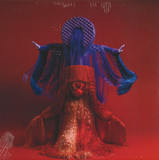
The seductive first full-length from electronic composer and multi-disciplinary visual artist Amosphère. Born in China, partly educated in Japan and now residing in Paris, her work came to the attention of a wider circle of listeners when she was invited by Laurel Halo to perform as part of a 10-hour durational ambient concert at London's Mode Exchange in 2019. Amosphère uses a careful selection of vintage electronics, sophisticated harmonic sense, and keen compositional intelligence to invite listeners into a meditative sonic space. Time expands and contracts, simplicity reveals complexity, and repetition becomes patient transformation. Spreading out over six expansive yet self-contained tracks, more die of heartbreak serves as a perfect introduction to Amosphère's warmly enveloping approach to analogue sound. Developed from scores (contained in the accompanying booklet) using techniques from concrete poetry and graphic notation as well as fragments of traditionally notated material, these six pieces take in a broad sweep of moods and approaches, from the gently burbling layered monophonic patterns of the opening 'circuit of unconsciousness', reminiscent of the sun-drenched synth figures of 70s Alvin Curran, to the haunted gliding tones and reverberating pops of the closing 'melting a piece of cadmium'. At times starkly minimal and making bold use of the stereo field, Amosphère's production approach keeps the grit and grain of her analogue gear intact, at times calling to mind the work of pioneers like Delia Derbyshire and Eliane Radigue.
Search:edu k
Restock soon..!
London underground sound meets south German dopehouse science: Shuffling Grooves, deep chords and the little extra spice of bigbait flavour - that's the Stoney Clouds EP. On this groundbreaking 4-tracker we introduce London- based producer Chocky, supported by Big Bait stalwarts de:pot and Scherbe.
Stoney Clouds - About the Record
The Stoney Clouds Ep is unfolding a wide span of warm and soulful electronic dance music, again beautifully boxed by our in-house visual-arts-mastermind Marek Slipek!
Go Bananas Original
The opener of this wonderful EP immediately sets the record straight, with smooth as silk drum-patterns rolling around an obscure vocal sample over dirty state-of-the-art-jazzloops. With these ingredients, mastermind Chocky unfolds his unique world of shuffle-laden hyperspace-house, fizzling and wonking every floor to great extent!
Go Bananas Scherbe Remix
Dresden-resident and long-time bigbait collaborator Scherbe takes control of the remix. In his highly significant Slowhouse-style, he turns the original into a lightfoot dancefloor bomb with trademark MPC-grooves slowly pioneering the way for this huge and wet clap, that's bursting every club speaker into pieces. After the break a sparkling synth arpeggio comes in, abducting the dancer into unknown yet addictive discoid heights.
Stoney Clouds Original
Straight forward from the beginning, the title track of this EP opens dj-friendly with huge kicks and jazzy hihat patterns. In an unbelievably smooth stop-and-go manner, a deep bassline pairs itself with an almost sucked-out clap compressing everything into an amalgam of UK-history-laden deephouse funk for every smoked out latenight workout.
Stoney Clouds de:pot Remix
Last but not least we have de:pot, the crazy beat-wizard from Gera. His remix doesn't even bother to stay close to the original. Instead, inscrutable, de- quantized patterns wipe over deconstructed sample melodies twisted with his highly educated trademark sound to a completely new definition of German dopehouse science. This one is for the sophisticated headphone connoisseur who likes his b2 sides slow and dirrrty!
- A1: Suena Blanca Espuma (El Kinto)
- A2: Mejor Me Voy (Diane Denoir + Eduardo Mateo) / Mejor Me
- A3: Música De La Película Del Mismo Nombre (Horacio Buscagl
- A4: Musicasion Iii (Urbano Moraes)
- A5: Muy Lejos Te Vas (Rada + El Kinto)
- A6: Sueño De Una Noche De Mermelada (Horacio Buscaglia)
- A7: Si Te Vas De Mi Pueblo (Reinaldo + Mateo
- A8: Príncipe Azul (El Kinto)
- A9: Margaritas Rojas (Mateo + García Vigil + Figares)
- A10: Yo Volveré Por Ti (El Kinto)
- A11: Fabula Moderna Para Ser Cantada Y No Olvidada... (Horac
- A1 2: Hombre (Veronica Indart + Mateo)
- A1 3: Pippo (El Kinto)
- B1: Rosa (Urbano Moraes + El Kinto)
- B2: Mumi (Veronica Indart + Mateo)
- B3: Para Una Musicasion (Horacio Buscaglia + El Kinto)
- B4: Tu Andaras (Urbano Moraes)
- B5: Estoy Sin Ti -En Vivo En El Concierto Beat Iv, (Diane D
- B6: Aquel Payaso -En Vivo En El Concierto Beat Iv, (Rada +
- B7: Base Para "Mirando La Luna" (Urbano Moraes)
- B8: Solo Me He De Quedar (El Kinto)
- B9: Instrumental Para Otra Musicasion (Eduardo Mateo)
- B10: Esa Tristeza -Version Completa- (El Kinto)
- B11: Martín (Urbano Moraes)
- B12: Las Cosas (Urbano Moraes)
- B13: Te Esperaré (Horama)
- B14: Ni Me Puedes Ver -Version Completa- (El Kinto)
LTD 50TH ANNIVERSARY REISSUE
Originally released in 1971, during the dark days of the military dictatorship in Uruguay, this unique album made a strong and lasting impression on Juana Molina when she was a child. The present reissue on Sonamos (Juana's recently-formed owned label) is the result of a patient labor of love conducted by Juana and her associate producer Mario Agustin Gonzalez. This anniversary release comes our as a very limited-edition containing the remastered original LP, a second LP with 16 unreleased tracks, and a thick, informative booklet: Musicasión was a series of collective shows by a group of artists, mixing theatrical elements, poetry, improvised stage effects, and of course music, with a very special blend of rock (then called beat, in a dual reference to British pop bands of the sixties and to Beat Generation poetry), candombe (the percussion-driven style created in Uruguay among the descendants of liberated African slaves) tango, jazz and bossa nova. A combination which bears more than a passing resemblance with Brazilian Tropicália, which originated around the same time.
Taking direction from both the cinematic song stylings of sardonic yet
unfettered troubadours like Randy Newman, Brian Wilson, and Harry
Nilsson and the "visual scoring" of indie pop song placement in 21stcentury films, Best Move's music suggests the sound of a decade of
winding, disparate avenues finally convening in a perfect center
The Sacramento-based trio is composed of Kris Anaya, Joseph Davancens, and
Fernando Olivia. Anaya, a talented songwriter with a penchant for wry, offbeat
guitar-based folk-pop songs, and Davancens, who holds higher education degrees
in avant- garde composition and jazz double bass, formed the electronic act
Doombird together in 2016, but in 2019 the pair gravitated back to what they
consider more natural inclinations: organic instruments, earnest songwriting, and
a more true-to-themselves direction. Adding Oliva, Best Move was born. Many of
Best Move's songs maintain an intentionally similar sonic feel. Guitars strum and
piano twinkles while a layer of manipulated or synthesized instruments spread a
hazy overtone on top of it all, and steady yet minimal drums keep things moving.
Lyrically, the standards prevail - love, loss, friendship, searching for purpose - but
the themes bubble under the surface of a sea of metaphor, leaving the listener to
decipher the message in their own way. Anaya calls the sound a "thank you to the
past," and while a warm, familiar tone echoes throughout the band's universe,
something unmistakably modern remains.
Oslo-based American-Norwegian trio Buster Sledge releases their first
studio album Call Home in May 2022, following up on their self-recorded
and self-released debut Spirit (2020)
Fiddle, banjo, guitar and three voices are the vehicle for lyrical storytelling against
an orchestral background anchored in the acoustic music traditions of the United
States. Hailing from northern California, lead vocalist and songwriter Michael
Barrett Donovan mixes themes from personal experience with folk and country
music archetypes to breathe new life into time-tested song structures. Banjoist
Mikael Jonassen and guitarist Jakob Folke Ossum both share a thorough
appreciation for the fundamentals of bluegrass music, clear melodies and
harmony- singing through the lens of being trained jazz musicians. In eleven
tracks, Call Home tips its hat to artists such as Norman Blake, The Punch
Brothers, Tim O'Brien and John Hartford. Buster Sledge was the first group to
record in the recently relocated Globus Studio of Sjur Lyseid (Little Hands of
Asphalt) and his influence from behind the mixing board pushed the band into a
slightly-augmented acoustic sound with more streamlined arrangements which is
a suiting duet with the album art by William Hay that realizes a scene of a rider
overlooking a large river-valley in impressionistic swaths of color.
Banjoist Mikael Jonassen, from Bodo in the far north, is Norway's first and only
higher-education certified banjo player. Despite beginning with an electric banjo
and playing exclusively fusion jazz, Jonassen currently focuses his efforts on
Scrugg's style acoustic banjo and the playing of Bela Fleck and has taken several
trips to the US to learn from the masters. Jakob Folke Ossum, jazz- guitarist
turned flat- picking aficionado, discovered the sound of acoustic flat- picking
through Tony Rice and Bryan Sutton and meticulously taught himself from
records and videos. Fiddler Michael Barrett Donovan made a living as a musician
in New York City doing a master's in classical composition while touring with a
Grateful Dead tribute band. The three met in a comment section on a bluegrass
forum after Donovan moved to Norway in 2019. The rest of the story you'll have
to ask them at a show sometime. Buster Sledge has been on stage in many small
venues in southern Norway, don't miss them the next time they come to town!
- A1: Nonato & Seu Conjunto - Cafua
- A2: Os Novos Crioulos - Mar Afunda
- A3: Jose Roberto - Crioula Multicolorida
- A4: Rita Lee & Tutti Frutti - Agora E Moda
- A5: Trio Esperanga - Nao Aguento Voce
- B1: Robson Jorge & Lincoln Olivetti - Aleluia
- B2: Erasmo Carlos - Jeep
- B3: Chalo Eduardo - Beija-Flor Suite
- B4: Ely Camargo - Taieiras
- B5: Silvio Cesar - A Festa
- C1: Toni Tornado - O Jornaleiro
- C2: Som Tres - Tanga
- C3: Noriel Vilela - 16 Toneladas
- C4: Chocolate Da Bahia - Ele Guenta
- C5: Tim Maia - E Necessario
- C6: Joao Bosco - Cobra Criada
- C7: Os Incriveis - Uma Rosa Pra Dita
- D1: Edson Frederico - Tava Mas Nao Tava
- D2: Helio Matheus - Mais Kriola
- D3: Miguel De Deus - Black Soul Brothers
- D4: Ana Rosely - Skim Dum Dum Dum
- D5: Luiz Gonzaga & Ze Dantas - Sao Joao Antigo
Compiled by Sean Marquand and Greg Caz, 2 DJs well-known for their epic parties at Williamsburg’s legendary Black Betty club, that sadly closed in 2009. The duo played a deep variety of strictly vintage samba, samba-rock, Tropicalia, and Brazilian funk under the banner of ‘Brazilian Beats Brooklyn’.
Sean is known as half of Embassy Sound Productions. He took his team to Brazil to help resurrect Black Rio legends Uniao Black for a new release. Greg has DJ'd at some of the hottest Brazilian parties around the globe and presents a monthly radio show ‘Warm Wave’ on Soho Radio NYC.
Featuring Noriel Vilela’s singular “16 Toneladas,” a sublime cover of the Tennessee Ernie Ford smash “16 Tons” with a spare samba groove and unbelievable baritone vocals and hot jams from Tim Maia, Erasmo Carlos, Joao Bosco, Toni Tornado.
Included in this compilation of original 60's and 70's Brazilian gems are some of Greg and Sean's favourite tracks that have been filling dancefloors for years.
- A1: Alberto Radius - California Bill
- A2: Mario Lavezzi - In Alto Mare
- A3: Beppe Cantarelli - Se Il Mio Canto Sei Tu
- B1: I Ricci - Vienimi A Pigliare
- B2: Eduardo De Crescenzo - Alle Sei Di Sera
- B3: Im Porto - Smettila (Po-Para) (Po-Para)
- B4: Barnaba - Bianco E Nero
- C1: Enzo Cervo - Solo Mo
- C2: Peppino Di Capri - Mo
- C3: Franco Camassa - Non Andar Via
- C4: Stefano Pulga - La Mia Nave
- D1: Massimo Stella - C'e Una Donna Sola
- D2: Gino D'eliso - Ti Ricordi Vienna?
- D3: Enzo Carella - Contatto
- D4: Serafini - Serafini
Between the late 70s and the early 80s, pop music was in a transitional phase. After a return to the roots of punk, rock was morphing into new wave, while disco was rapidly declining and the electronic revolution, already on the rise, was ushering in the transition from analog to digital. This period also saw the emergence and relatively brief flowering of a commercially dominant style that mixed soul influences (especially Stevie Wonder and Ear th Wind & Fi re) , folk/pop songwriting and jazz sensibilities in equal measure, creating a hybrid easy on the ears but also emotionally and musically rich. It was the style represented by artists like Christopher Cross, Michael McDonald, Gino Vannelli and Kenny Loggins, who were all influenced by black music. They belonged to a larger trend that took place in all major music producing countries, including Italy where, like so many other things, the style was not merely imported or copied, but reshaped into a specifically local version based on the nation's tastes and cultural traditions. In Italy, a soulful and sophisticated approach to pop music was embraced not only by established names like Mina, Alan Sorrenti and Loredana Berté, but also, and perhaps most importantly, by an entire generation of writers, arrangers and musicians who had grown up listening to early fusion, to Steely Dan's refined recordings, and to Quincy Jones's productions. So, with this compilation we hope to give new exposure to artists and songs that, despite having moderate or little success when first released, must be regarded as among the creative peaks of Italian pop music. "Paisà Got Soul" features pop veterans Peppino Di Capri, Mario Lavezzi and Alberto Radius alongside atypical singer-songwriters (Enzo Carella, Enzo Cervo, Gino D'Eliso), Italo-disco heroes (Stefano Pulga), international hit composers (Beppe Cantarelli, who has co-written for Aretha Franklin and Mariah Carey), Brazilian-born naturalized Italians (Jim Porto) and complete unknowns (Franco Camassa, I Ricci, Massimo Stella).It brings together little gems that in most cases are no longer available on the market, or only available in their original and now very rare vinyl format. We believe they all deserve to be rediscovered today, partly because of the recently renewed interest in "yacht rock", as this music style has been retrospectively named, and partly because they provide further evidence that Italian artists rework international music styles in creative and original ways.
Compiled and conceived by David Nerattini partnered by Pierpaolo De Sanctis
One of the most legendary LPs from Uruguay remains a hidden treasure in the rest of the world. It is the first LP by singer Diane Denoir. Diane was a regular in the “Conciertos Beat” (“Beat Concerts”) of Montevideo's 1960s scene where she performed with Eduardo Mateo on guitar (leader of El Kinto, one of the most influential bands in "candombe beat", and the ones who coined the term), Roberto Galletti on drums and Antonio Lagarde on double bass. Diane was also Mateo's muse throughout the early years of his career, he wrote several songs for her, among them “Esa tirsteza,” “Y hoy te vi,” and the classic “Mejor me voy.” Eduardo Mateo would become one of the biggest names of all times in Uruguay's musical scene. Diane, instead, found herself outside the country when the military coup installed a non constitutional government in Urugay in 1973 and was wisely advised by friends not to go back home to avoid trouble with the new dictatorial regime. A brave defendant of Human Rights, she had been very active against torture, thus becoming a target for the dictatorial regime military intelligence. She exiled in Argentina and Venezuela, and she later settled in Europe and didn't perform in public or record again until recent years when she returned to her home country.
On her eponymous 1972 debut album, Diane fused all her influences in one solid sound through songs created by Uruguayan songwriters (Eduardo Mateo, Urbano Moraes –bassplayer for El Kinto,– Daniel Amaro, Giuso Bellanca), plus Argentinian lyricist Edgardo Lisi. She had released a couple of 7" between 1966 and 1970, but it is her debut album –which would be her only one until her 2008 comeback– that made her legend grow among future generations of music lovers.
It's hard to name artists in the same dimension as Diane Denoir for reference, but be sure that you will love this LP if you like the candombe beat scene of El Kinto, Tótem or the Fattorusso brothers (Hugo and Osvaldo) in their post Los Shakers works, but also the bossa nova sound and even artists of their own like Vainica Doble.
Very limited edition, only 500 copies made. Remastered sound. Comes in upgraded artwork, gimmick cover with printed inner sleeve.
Surrounded by music from an early age, Vladimir Cosma pursued his education at the Paris National Conservatoire of Music in 1963. 5 years later Yves Robert entrusted him with his first composition of film soundtracks. Today Vladimir Cosma is at the origin of over 300 film soundtracks, the majority of which have become classics such as "La Boum", "The Adventures of Rabbi Jacob" or "Diva". Cosma's works saw him receive 2 Césars awards (French Grammy's) for best soundtrack amongst others. Find all his greatest songs he composed for original soundtracks on this nice 2LP vinyl.
LIMITED EDITION: ONLY 500
“Here We Go Again” is a favourite amongst ardent soul buffs who recognise the Isley Brothers song, faithfully updated for a 21st Century audience. Output/Input was formed during lockdown by Melvin Lee Davis a Californian native and a skilled master bassist, composer, producer, and educator who is in high demand and is also Music Director for the “Queen of Funk” Chaka Khan.
Written in early 2020, and inspired by childhood memories of their
forborne General Store in Bishop's Mills ON - 'Front Porch' is a family
production that thrums with alt-roots and Americana warmth
The music also reflects much of the influences that informed Graham's musical
education - with nods to The Beatles, Dolly Parton and Lyle Lovett. In fact, the
entire new album serves as a time capsule filled with precious memories that
only come with being born, raised and homeschooled together in a house in the
woods a kilometer from the nearest neighbour. It was these memories and
moments that culminated in 'Graham's General Store' and it was presented to
their parents as a surprise for their 43rd wedding anniversary.
"The dazzling symphonic album he always threatened to produce" UNCUT 5/5
"A soulful symphonic masterpiece" ROLLING STONE
Originally released in Japan only on CD in 2002, Plush's Fed lives up to the cult-like adulation it has garnered ever since. A stunning symphony of Bacharach-inspired pop, Toussaint-swing andMelody Nelson-era-Gainsbourg, it's an album bound together by Liam Hayes' maverick genius, an uncompromising Brian Wilson-esque quest for sonic perfection. Positively indulgent in every way, this sumptuous record has long deserved to be treated to a deluxe vinyl edition. Lovingly overseen by Hayes and recent collaborator Pat Sansone (Wilco/The Autumn Defense), it will finally be available on the format it should've always been, this Record Store Day 2018. Remastered and presented as a double LP - cut specially at 45rpm - it comes housed in a beautiful gatefold jacket with expanded artwork throughout.
Its expansive, singular vision infamously took years to realise, involving Earth Wind & Fire's horn arranger (the legendary Tom Tom MMLXXXIV) amongst other elite personnel. Recorded with five different engineers (including Steve Albini and John McEntire), Hayes meticulously extracted every ounce of pop from each note. A long list of renowned studio ringers (including soul drummer Morris Jennings) and Chicago regulars (McEntire, Rizzo, Parker) among many others provide playing of demonstrably professional precision. As such, Hayes' complex, meandering melodies are rendered far more coherent and satisfying than they otherwise might have appeared, bringing his epic, anguished pop to a rarely seen level of perfection and depth. This unstinting dedication to the overarching vision was rewarded handsomely - artistically, at least.
However, as might have been expected, his deluxe approach resulted in a bill too steep for any American or European label to ultimately support. It has since seemed unlikely that it would see the light of day on either side of the Atlantic. Yet we were determined not to allow Hayes' lifetime achievement to go unnoticed or let music fans across the world miss out on one of the finest albums of this century.
A wide-eyed opus of stunning intensity, Fed oozes Hayes' impeccable influences without ever becoming overwhelmed by them. Incredibly, it touches upon Blaxploitation soul, Boz Scaggs-soft-rock, hints of jazz and blues, timeless baroque and skewed pop. In one long minute, the stabbing, soulful "So Blind" moves through five different melodic segments, horns shift easily from haunting backdrop to explosive forefront, smoothly giving way to strings as Hayes' voice casts its bewitching spell. The ambitious soul of "Having It All" has been described as the diffident cousin of Marvin Gaye's "Save The Children" whilst the breezy "Greyhound Bus Station" is pure 70s AM Gold, evoking the easy warmth of Jimmy Webb's beloved Land's End period. The sublime resignation of "No Education", a beautifully slow number that begins, "Never read a book in my life/ But I feel just fine" is post-rock ballad heaven. Arriving towards the end, the title track arrives as a majestic suite, moving from a horn-and-guitar-led instrumental via shifting melodies to Hayes' compelling vocal bursts.
An album of such brilliance, Fed can comfortably sit alongside such staggering statement pieces as David Bowie's Young Americans, Randy Newman's 12 Songs or Harry Nilsson's Nilsson Schmilsson. Indeed, for all the sprawling elements that went in - lengthy guitar builds, exploding horn sections, solemn strings, female backup chorus - it is a deeply personal and original record. Employing a distinct "more is more" aesthetic, he demonstrates remarkable restraint in producing an album of such intimacy. "My creation has drowned me," he memorably sings on languid opener "Whose Blues", yet he navigates the shifting styles and ideas with enviable ease.
Ltd to 100 copies
Melancholic energy blast from Gran Canaria’s cult trio, MINIATURa, helmed by Eduardo Briganty.
Formed in Las Palmas in 2007 and with three records under their belt, Music Box (2007), La Huida Concéntrica (2012) and Estrategias de Perdición (2015) the trio now unleashes its fourth album with a distillation of Briganty's musical and artistic references, coming like a cross of concept album and an unintentional imaginary soundtrack to a David Lynch flick – an island version of a depressed or irate David Lynch.
Featuring deep rock workouts to somnambulant ballads, Geometría Prohibida (Keroxen, 2022) presents itself like a statement from the band, a crystallization of the bands intentions with a concise and precise 26mins of masterfully produced music showcasing the kind of restrain you’d expect from past giants like Joy Division, Neu! or Scott Walker.
The hallmarks of krautrock and shoegazing/dream pop haunt this record like a benevolent force, another unique reference of music made through an insular lens of remoteness that Keroxen drives to showcase to the world.
MORE unobvious Island music to the outer world.
Pauline Oliveros' Accordion & Voice is available on LP for the first time since it was originally released in 1982. Cut at Golden and pressed at RTI for maximum fidelity.
Pauline Oliveros was an electronic music pioneer, accordionist, composer and educator who resided in Kingston, New York. Her instrument was tuned in Just Intonation and she often included it in her meditative improvisational music. Her music is not meditative in the sense that it is intended for listening to while meditating, rather each piece is a form of meditation, such as her aptly titled Sonic Meditations.
A central figure in post-war electronic art music, Oliveros is one of the original members of the San Francisco Tape Music Center (along with Morton Subotnick, Ramon Sender, Terry Riley, and Anthony Martin), which was the resource on the U.S. West coast for electronic music during the 1960s. The Center later moved to Mills College, where she was its first director, and is now called the Center for Contemporary Music. Oliveros often improvises with the Expanded Instrument System, an electronic signal processing system she designed, in her performances and recordings.
“Accordion & Voice was the first of my recordings as a soloist. I was living in an A-frame house in a meadow just below Mount Tremper at Zen Mountain Center. I had a wonderful view of the graceful saddle mountain top. When away on a performance trip I would imagine the mountain as I played Rattlesnake Mountain. I followed the feelings and sensations of my many experiences of the mountain - the changing colors of the season, the breezes and winds blowing through the grasses and trees. Horse Sings From Cloud taught me to listen to the depth of a tone and to have patience. Rather than initiating musical impulses of motion, melody and harmony I wanted to hear the subtlety of a tone taking space and time to develop. The tones linger and resonate in the body, mind, instrument and performance space. My thanks to Important Records for bringing these pieces to be heard again.” ~ Pauline Oliveros, 2007
- A1: David Nyman - Hopes & Dreams
- A2: David Nyman - A Neon Glow Lights The Way
- A3: Insaneintherain - Welcome To Va-11 Hall-A
- A4: Every Day Is Night
- A5: Neon District
- A6: Dusk
- A7: Strictly Business
- B1: Drive Me Wild
- B2: Commencing Simulation
- B3: Good For Health, Bad For Education
- B4: Who Was I?
- B5: Troubling News
- B6: Heart Of The City
- B7: A New Frontier
- B8: A Gaze That Invited Disaster
- C1: A Rene
- C2: Skyline
- C3: Better Luck Next Time
- C4: Jc Elton's
- C5: A City That Never Sleeps
- C6: Friendly Conversation
- C7: Follow The Trail
- C8: Snowfall (Senzafine Remix)
- D1: Digital Drive
- D2: A Star Pierces The Darkness
- D3: Glitch City
- D4: Safe Haven
- D5: Shine Spark (Feat Adriana Figueroa)
- D6: Shine Spark (Instrumental)
- D7: Every Day Is Night
- E1: Synthestitch
- E2: All Systems, Go!
- E3: Umemoto
- E4: Meet The Staff
- E5: Neo Avatar
- E6: Tense
- F1: Base Of The Titans
- F2: Dawn Approaches
- F3: Calicomp 1.1 Startup
- F4: Calicomp 1.1 Shutdown
- F5: Spirit Potion
- F6: March Of The White Knights
- F7: Out Of Orbit
- F8: Transition I
- F9: Transition Ii
- G1: Through The Storm, We Will Find A Way
- G2: An Alternate Reality
- G3: Showtime!
- G4: Another Satisfied Customer
- G5: Where Do I Go From Here?
- G6: Will You Remember Me?
- G7: Everything Will Be Okay
- G8: Your Love Is A Drug (Feat Adriana Figueroa)
- H1: Metropolis
- H2: Karmotrine Dream
- H3: Your Love Is A Drug
- H4: Underground Club
- H5: Go! Go! Streaming-Chan!
- H6: Base Of The Titans (Sage Remix)
- H7: Lifebeat Of Lilim (Feat Adriana Figueroa)
- H8: Lifebeat Of Lilim (Instrumental)
- H9: Truth
- I1: Nighttime Maneuvers
- I2: Those Who Dwell In Shadows
- I3: The Girl With The Iron Heart
- I4: With Renewed Hope, We Continue Forward
- I5: The Answer Lies Within
- I6: Last Call
- I7: Final Result
- J1: You've Got Me
- J2: Snowfall
- J3: Reminiscence
- J4: Believe In Me Who Believes In You
- J5: Until We Meet Again
- J6: Every Day Is Night
HIGHLIGHTS: 1984 Brazilian electro funk/early rap by Sao Paulo crew Electric Boogies, recorded under the influence of New York's B-Boy culture and local artists like Black Juniors, Villa Box_ First time vinyl reissue. DETAILS: Following the success of the early Brazilian rap artists Black Juniors, Villa Box, Buffalo Girls_ Electric Boogies emerged out of Sao Paulo, Brazil, as a crew devoted to breakdancing under the influence of New York's B-Boy culture. They would record "Break Mandrake" in 1984, originally released on RGE Records. This single has two fabulous electro-funk tracks, side A is vocal and on the flipside we find the instrumental version with some extra keys that give it a more jazzy touch. DJ Irai Campos would provide the scratches while the arrangements and keyboards were credited to Eduardo Assad, who also worked with Black Juniors, Sasha and others.
Balls is the 18th studio album by Sparks and was originally released in August 2000. The album has been newly remaster for this LP reissue and will be released on heavyweight vinyl.
- 1: What Did You Do In The War
- 2: Dark And Bloody Ground
- 3: Homestead
- 4: Chain Smokin
- 5: Never Be Enough Time
- 6: Comin' Down Maria
- 7: Talk Show
- 8: American Babylon
- 9: No Strings Attached
- 10: Labor Of Love
- 11: Chain Smokin' (W/ Bruce Springsteen) (Live)
- 12: Billy's Waltz
- 13: Only Lovers Left Alive
- 14: American Babylon (W/ Bruce Springsteen) (Live)
- 15: Only Lovers Left Alive (Live)
- 16: Light Of Day (W/ Bruce Springsteen) (Live)
- 17: Keep Knockin' (W/ Bruce Springsteen) (Live)
- 18: Bruce Springsteen Intro (Live)
- 19: What Did You Do In The War (W/ Bruce Springsteen) (Live)
25TH DELUXE ANNIVERSARY EDITION OF AMERICAN BABYLON FEATURING LIVE TRACKS WITH BRUCE SPRINGSTEEN Grushecky and his band had been a club fixture in the Northeast for nearly 25 years when they released American Babylon in 1995. The Pittsburgh band had proven themselves to be the consummate bar band with occasional flirtations with national success. American Babylon found them teaming up with Bruce Springsteen, who handles production, plays on several tracks, and wrote two songs for the album. The title track is an uptempo rocker detailing the disintegration of societal mores. There are plenty of songs outlining love gone wrong and the struggles of common folk, all delivered in Grushecky’s warm, well-worn voice over a barroom mixture of blues-based traditional rock. However, delivered with such earnestness and spirit makes American Babylon a worthy contender and an enjoyable listen for fans of Mellencamp, Seger, and, especially, Springsteen. The 25th anniversary deluxe reissue edition will include LIVE tracks from the Houserockers’ legendary October Assault Tour recorded at an enthusiastic hometown show that same year. “American Babylon is an impassioned, sharply-etched portrait of working-stiff triumphs and travails.” -Rick Reger, Chicago Tribune “As the leader of the Pittsburgh-based Iron City Houserockers, Joe Grushecky hammered out four heartland rock albums in the late 70s and early 1980s. These won over more critics than fans, so he became a special education teacher to support his family. Still, he maintained a close relationship with Bruce Springsteen, and in 1995, they teamed up for American Babylon. The two remain tight and play together at least once a year, but this album remains their greatest joint accomplishment.” -Rolling Stone “At a time when rock had splintered into grunge, industrial, alternative, and more, Joe Grushecky planted a defiant flag in the soul of rock and roll with American Babylon--one of the very best and undeservedly overlooked albums of the 1990s, and one that sounds just as fresh, vibrant, and relevant 25 years later. Bruce Springsteen may have helped bring the album to life, but his contributions only elevate a collection of songs that in another time would have been radio classics on their own.” -Ken Rosen, E Street Shuffle
You might know Bert Dockx from the inimitable alternative jazz-rock-trio Dans Dans; or from his moody, psychedelic rock formation Flying Horseman; or from his more intimate but equally special solo records. In 2019, the ever productive guitarist released an album with Ottla, a jazzy sextet blending different genres, textures and moods in wholly original ways, resulting in long, evocative pieces, brooding with tension and atmosphere. Recently, the band has transformed into a quartet, a tighter unit with a sparser and slightly more electric sound. This new Ottla is playing a mixture of reimagined tracks from the aforementioned album, and several brand new pieces. Ottla's music - like all music for which Dockx is responsible - is imaginative, intense and deeply felt.
In the spring of 2021, actor and writer Josse De Pauw contacted Bert with a question. He wanted to perform work of the Uruguayan writer Eduardo Galeano on stage, texts about the madness of colonialism and slavery, and about the beauty and mystery of the jungle, and asked Dockx to come up with a live soundtrack. Dockx invited two friends from his jazz band Ottla (Thomas Jillings and Louis Evrard) and a fourth musician (bass player Axel Gilain). He composed new material, adapted some existing Ottla pieces and could count on the improvisational talent of his fellow musicians for the rest of the soundtrack. In a handful of rehearsals, an impressive concert was put together that captivated the audience during a short run in August. This live EP contains two pieces recorded on one of these blistering evenings. Side A opens with the authoritarian voice of De Pauw, who recites the Song of the Fire, before making way for a scorching, almost apocalyptic version of 'Stofwolk'. On side B we hear Thomas Jillings perform an impressionist clarinet improvisation while De Pauw conjures up images of the unlimited sea and the winds, ships and slaves, heaven and hell.
- A1: Mateus Enter
- A2: O Cidadão Do Mundo
- A3: Etnia
- A4: Quilombo Groove
- A5: Mac?
- A6: Um Passeio No Mundo Livre
- A7: Samba Do Lado
- A8: Sangue De Bairro
- B1: Maracatu Atômico
- B2: O Encontro De Isaac Asimov Com Santos Dumont No Céu
- B3: Corpo De Lama
- B4: Manguetown
- B5: Um Satélite Na Cabeça
- B6: Baião Ambiental
- B7: Amor De Muito
Afrociberdelia is the second studio album Brazilian of manguebeat Chico Science & Zombie Nation, released on May 15 of 1996. It was ranked 18th in the list of 100 best records of Brazilian music by Rolling Stone Brasil magazine and 2nd in the election of the best national records of the years dev 1990, carried out by the website “Scream & Yell”. The album was produced by Eduardo BiD and recorded at Nas Nuvens studio, in Rio de Janeiro. With a stronger presence of elements of electronic music and hip hop than its predecessor, Da Lama ao Chaos, he would reach the gold record in April 1997. In interviews, members of the band stated that they preferred the timbre of the drums in Afrociberdelia, which would finally have approached the sound that the group made on stage.
Parallel Traces of the Jewel Voice by dj sniff is a project that takes inspiration from historical narratives and personal memories constructed around The Jewel Voice Broadcast (Gyokuon Hoso) that took place on 15th August 1945. Contrary to common belief, Emperor Hirohito did not speak live on air to announce the surrender of Japan on this day. Instead, two lathe-cut discs with his recorded voice were skilfully mixed and played by NHK engineer Shizuto Haruna. Haruna’s proto-DJ/turntablist performance was heard not only in Japan but also throughout the colonized territories in Asia, marking the end of World War II and Japanese rule.
Interested in these aspects which often have been overlooked within the Japanese narratives of this historical event, dj sniff conducted research in both Taiwan and Japan. Over the course of 3 years he collected various materials that include; interviews and field recordings, audio samples extracted from phonograph discs and recordings sessions with improvising musicians, and a re-reading of the Imperial Rescript on Surrender in Chinese. These were used to compose two compositions that are paired differently depending on their distribution format.
The vinyl release is a multi-sided disc with two parallel grooves cut on one side, which in effect plays a different composition depending on where the stylus is cued. The other side has no audio but features two silkscreened lines that refer to how Haruna played the original lathe-cut discs. For the digital release, each composition is independently assigned to the left and right channel and is heard simultaneously.
Additionally, an extensive text written by dj sniff accompanies this release. Sniff uncovers technical details of the recording and broadcasting of the emperor’s voice that took place over 75 years ago. He also reflects on his encounters with the elderly community in Taiwan who spoke fluent Japanese and shared their personal stories after listening together to records from their childhood.
DJ Sniff – Biography
dj sniff (Takuro Mizuta Lippit) is a musician, curator, and educator. His work builds upon a distinct practice that combines DJing, instrument design, and free improvisation. His collaborations include Evan Parker, Otomo Yoshihide, Paul Hubweber, Tarek Atoui, Senyawa, and Ken Ueno.
He was the Artistic Director of STEIM in Amsterdam between 2007 to 2012 and a Visiting Assistant Professor at the School of Creative Media, City University Hong Kong between 2012 to 2017. He is now based in Tokyo where he is the Co-Director of AMF (Asian Meeting Festival) and teaches at Kyoto Seika University.
- A1: Cecilia Krull - My Life Is Going On
- A2: Hank Williams - Settin’ The Woods On Fire
- A3: Bryan Ferry - Slave To Love
- A4: The Velvet Underground - Pale Blue Eyes
- A5: Cass Elliott - Make Your Own Kind Of Music
- A6: Kool & The Gang - Get Down On It
- A7: Billy Idol - Rebel Yell
- B1: Wang Chung - Dance Hall Days
- B2: The Stone Poneys - Different Drum
- B3: Greg Holden - The Lost Boy
- B4: George Baker Selection - Little Green Bag
- B5: Rodriguez - Hate Street Dialogue
- B6: Peggy Lee - Fever
- B7: John Mellencamp - Rock In The Usa
- B8: Yello - Oh Yeah
Song Education brings together some of the pivotal songs from these series, showcasing great music from the Sixties until the Nineties resurrecting through trending series like La Casa De Papel, American Horror Story, Sex Education and Breaking Bad. And what’s a better way to rediscover old gems than by listening to them on a classic vinyl record
Håvard Nordberg Funderud - guitar and 12-string guitar Lauritz Heitmann Skeidsvoll - saxophone Martin Heggli Mellem - drums Karl Erik Hornsdalsveen - double bass Henriette Eilertsen - flute Back in 2020, Kafé Hærverk, Oslo's live hotspot for a wide range of jazz and experimental music invited Master Oogway to do monthly concerts from August to December, bringing along a guest for each occasion. Two had to be moved to 2021 due to Covid restrictions, but the other three were recorded for possible use later. Initially we thought about doing a "best of" from all of the recordings, but after further listening it soon dawned on us that the concert with Henriette was nothing less than magical. To make room for the 45 minute vinyl edition, we had to drop one of the five pieces that were played on the night, and also make two minor edits. Other than that, this is what was played, there are no overdubs or cosmetic treatments. The album was brilliantly mixed in Athletic Sound by Dag Erik Johansen. Henriette Eilertsen (28) is part of the fertile and exciting environment around the Motvind label, and a member of Billy Meier and Andreas Roysum Ensemble. She released her solo debut "Poems For Flute" on Motvind in 2021.Håvard Nordberg Funderud (28) finished his bachelor at the Norwegian Academy of Music in 2018 and also studied in Gothenburg and Copenhagen. He is involved in several projects, Master Oogway being his priority. Lauritz Lyster Skeidsvoll (28) and Karl Erik Horndalsveen (27) are both educated from the same academy in Oslo as Håvard, while Martin Heggli Mellem (25) is educated from the jazz program at NTNU in Trondheim."Happy Village" is Master Oogway's third album, their second on Rune Grammofon. The music on the previous outing two years ago ("Earth And Other Worlds") was all written by Håvard, while the music on "Happy Village" is written by Karl Erik, one track co-written with Håvard. "Happy Village" finds the band in a more lyrical and exuberant mood than before, in no small part due to Henriette's beautiful contributions.
"Stand In The Fire" - Warren Zevon (voc, g, p); Zeke Zirngiebel (g, voc); David Landau (g); Bob Harris (synth, p, voc); Roberto Piñón (b, voc); Marty Stinger (dr)
Warren Zevon had toured for quite some time as a songwriter in the rock scene, released a few singles and landed a flop with his debut LP in 1969 before the tide finally turned. Roughly ten years later, his live album – put together from a five-day residency at the Roxy Theater in West Hollywood – entered the annals of vinyl history as one of the best live albums of all time and was awarded four stars by the magazine Rolling Stone. Ambiguously entitled by the comprehensively educated Zevon, who had been confronted with the tough side of show business, "Stand In The Fire" delivers genial simple pure and straightforward rock right from the start, which hit the public with a vengeance. Full of vim and elation, the band pours out the significant, biting verses with fire ("Jeannie Needs A Shooter") and fuels the emotional inferno with high-speed bursts of rock ("Excitable Boy"). Zevon proves his skills as a singer and songwriter in the ballad-like yet powerful "Mohammed’s Radio". In a direct comparison to this number we have the forthright, no-nonsense hit "Werewolves Of London" with its close harmonies. Just how Zevon manages to succeed in getting his delicate voice and lyrics over to the public is shown in the powerful mix of heavy and honky-tonk ("I’ll Sleep When I’m Dead") and finally in the thunderous final number – "Bo Didley’s A Gunslinger" – with its percussive and metrically complicated antiphony.
This Speakers Corner LP was remastered using pure analogue components only, from the master tapes through to the cutting head. More information under pure-analogue
All royalties and mechanical rights have been paid.
Recording: August 1980 live at The Roxy Theatre in West Hollywood, CA., by Billy Youdelman and Greg Ladanyi
Production: Greg Ladanyi & Warren Zevon
Next up from Renegade Hardware's 'From the Vaults' rerelease series we have an EP that might have just celebrated its twentieth anniversary, but still sounds as future-proofed as ever. This is the 'Street Level EP'.
First, a bit of background. By 2001, Q Project and Spinback – or Total Science as they're known in combination – were already well-established pillars of the junglist community. Between the pair of them, they'd delivered anthems like the perennial 'Champion Sound', released on labels as disparate as Reinforced, Good Looking, Hardleaders and Metalheadz, and even dropped a full-length album, 'Advance', on their own CIA imprint.
As we journey from 'Street Level' to 'Rebel Soul' onwards to 'Room Service', we hear the influence of Total Science's junglistic roots, a sound that has remained steadfastly relevant across the generations. Breaks and samples are sliced,
twisted and manipulated into heart-palpitating arrangements, with an expert's ear for rhythm programming keeping us just the right side of insanity.
The EP is closed out with Source Direct's remix of 'Out of Touch', reconfiguring Total Science's break and bass workout into an evolving old skool-tinged surrealist landscape. So, we're shown yet another facet of drum 'n' bass music's possibilities drawn out by Hardware's roster.
And again, Renegade Hardware's 'From the Vaults' series delivers. Many current junglists are actually younger than this EP, which is why it's huge that this music has become available for them in an accessible form. Clearly, this era of stylistic meldings as jungle influence combined with drum 'n' bass technique should be a cornerstone of their musical education.
Spaceship is Mark S. Williamson, a musician, sound artist and educator based in Todmorden, West Yorkshire. His work is often made in response to his environment, working on location, combining field recordings with electronic and acoustic instrumentation, usually recorded outside, amid the landscape and weather. Mark has recorded for wiaiwya, Apollolaan, the Dark Outside and his own Forged River Recordings. His work has been reviewed by The Wire, Electronic Sound, Shindig and The Quietus and he was recently one of the fourteen artists featured in Electronic Sound Magazine’s ‘field recording special’. His collaboration with Luke Turner on series of readings from Luke’s book ‘Out of the Woods’ has seen performances at Cecil Sharp House, Port Eliot Festival, The Trades Club in Hebden Bridge, Krankenhaus Festival and the Horse Hospital and he recently collaborated with the artist Michael Powell on his Calderfolk project. A direct sequel to 2019’s Outcrops (also on wiaiwya), Ravines moves its focus from the uplands above Todmorden to the narrow, steep sided ravines, known as cloughs, that contain the streams that flow down the valley sides to feed the River Calder. These valleys, formed over hundreds, if not thousands of years can be peaceful sanctuaries, their stepped pools and waterfalls a shelter from the windswept moors. In time of heavy rainfall though, they become the conduits for the rapidly descending overland flows which reach the Calder and, in extreme circumstances, cause the floods which remain a part of valley life. These cloughs also saw the beginnings of industry in the area. Colden Clough and Jumble Hole Clough contain the ruin of small water fed mills which would evolve into the much larger steam powered facilities in Todmorden and Hebden Bridge. Mostly recorded in the field using portable equipment, these pieces are intended to reflect all three of these aspects; the peace, the violence and the beginnings of humankind’s ultimate separation from the landscape brought on by the industrial revolution. The sleeve is by Maxim Peter Griffin, an artist, illustrator and writer based in Lincolnshire. A fine art graduate and former stonemason, over the past few years he has been building a body of work that echo his experiences on foot between the North Sea and the hills. "...a luminous soundtrack to the passage of geological time." Shindig // "Williamson is building desire tunnels, churning through the layers of rock and soil to find his conclusions." The Wire // "These rumbling synth drifts and ominous drones transport you to entirely different places-like being cast adrift in a cosmic void" Electronic Sound // "...the droning synthesizer waves conjure up something spectral and eerie, stretching out like the wide horizon..." The Quietus // "Beautiful." Hannah Peel
Back in stock! Ghanaian Afro-Rock From Producer/Composer JJ Whitefield, Inspired By His Karl Hector & The Malcouns And Whitefield Brothers Projects JJ Whitefield, who in the early ‘90s revived the gritty, analogue Funk sounds of the ‘60s and ‘70s with his Poets Of Rhythm, has been working with Now-Again Records for over decade, releasing a flock of acclaimed projects with Karl Hector & The Malcouns, Whitefield Brothers, Rodinia and the Original Raw Soul anthology. He first started exploring African rhythms with the Whitefield Brothers in the late ‘90s, continuing in the ‘00s with Karl Hector & The Malcouns. He’s been instrumental in launching Ghanaian Afro Beat/Funk legend Ebo Taylor´s international career, decades after the maestro recorded the landmark albums that have inspired thousands. Whitefield recorded two new studio albums with Taylor and toured in his band between 2009 and 2013, where he met Taylor’s son Henry and percussionist/Singer Eric Owusu. The trio now front the Johnny! band and find inspiration not only in Ghana’s hypnotic grooves, but also the full frontal fuzz guitar assault heard on the legion of 70s Zambian Zamrock albums reissued by Now-Again. Indeed, Whitefield credits his tours with Zamrock godfathers Rikki Ililonga and WITCH’s Jagari Chanda as instrumental in creating the Johnny’s sonic backdrop. The band is rounded out by Turkish drummer Bernd Oezsevim (Woima Collective, Rodinia) and Indonesian bassist/multi instrumentalist Tomi Simatupang (Whitefield Brothers). This is what was oft-called “Afro Rock” at the core, with the possibilities to stretch out into swinging highlife, sweet soul or psychedelia . The results, point at a new direction for the music inspired by the Great Continent. One that takes a direction once mocked as derivative and asserts its importance on the globe’s current musical stage.
On a balmy Brazilian night in February, 1981, a crowd gathered in Rio de Janeiro's Gávea neighbourhood under the iconic dome of the city's Planetário (Planetarium). Alongside musicians like Helio Delmiro and Milton Nascimento (who were in the audience that night), they were there to see the great "Bruxo" (sorcerer) Hermeto Pascoal live in concert, with his new band formation which would become known simply as "O Grupo" (The Group).
Growing up on a farm in Brazil's northeastern state of Alagoas, Hermeto has always been deeply in tune with, and inspired by nature. In his youth he would make his own flutes to play call and response with the birds and frogs. He would build scrap-metal instruments in his blacksmith grandfather's forge, and sit for hours by the lake listening to the sounds of nature. On the Planetário Da Gávea recordings though, Hermeto is cast as the "sorcerer" or the "cosmic emissary" (as the great Brazilian guitarist Guinga once called him), exhibiting an intuitive sense of harmony and melody beyond that of our own world.
"Tudo e Som" (All is Sound). It's a phrase Hermeto regularly returns to, and it points to the fact that not only can music be made from anything, but also alludes to something much more profound. It's an understanding of the universe as being in a state of constant movement, forever vibrating at the quantum level, like the string of a guitar, or a saxophone's reed. "Tudo e Som" is a declaration of the mystical and spiritual power of sound, as a fundamentally vibrational force.
The series of concerts at the Planetário marked the birth of "O Grupo" which would last with the same line-up (apart from Zé Eduardo Nazário) for the next eleven years. Every member of O Grupo was a phenomenal musician in their own right. It was one of saxophonist/flautist Carlos Malta's first gigs with the group, and the concert unusually featured two drummers, Zé Eduardo Nazário and Marcio Bahia. Nazário, from São Paulo, had played with Hermeto during the mid-70s (as well as with Milton Nascimento, Egberto Gismonti and Toninho Horta, to name a few). Bahia though had just joined the group. Acclaimed keyboard player Jovino Santos Neto was on keyboards, piano and organ, and the great Itiberê Zwarg (who remains in Hermeto's band to this day), played bass. Rounding the group off was the percussionist Pernambuco. During this period (up until the early 90s) the group would rehearse for hours on end, virtually seven days a week, with a total dedication to music and Hermeto's musical vision.
Most of the compositions performed that night at the Planetário had never been recorded before, and many are unique to this album, including the wild 'Homônimo Sintróvio', the exaltant 'Samba Do Belaqua', 'Vou Pra Lá e Pra Cá' and 'Bombardino', which features Hermeto's wonderfully absurd call and response mouthpiece soliloquy. Then there's the stunning 7/4 Samba 'Jegue' which builds with inventive dissonance, before releasing yet another celestially colourful, celebratory refrain. The show also features the first recorded performances of 'Era Pra Ser e Não Foi' and 'Ilza na Feijoada' (inspired by Hermetos' wife Ilza's famed black bean and meat stew), which Hermeto later recorded on his 1984 studio album "Lagoa Da Canoa Município De Arapiraca".
Dubbed by Miles Davis as "one of the most important musicians on the planet", a Hermeto Pascoal live show was (and still is) an experience like no other. Across the recording of the Planetário concert, wild improvisation meets groovy, virtuosic vamping on progressive, extended psychedelic jams. The tracks are generally built around a beautiful, transcendent melody; instantly recognisable as being Hermeto's, and for the most part, the musicians then solo over extended two chord vamps. There's a plethora of powerfully delivered rhythms, wild solos and the performances are punctuated by Hermeto's unpredictable, at times comical sonic antics.
Over forty years since this historic happening, Far Out Recordings is overjoyed to release this magical recording of Hermeto Pascoal e Grupo Live at Planetário Da Gávea, on double vinyl LP, CD and digitally for a February 4th 2022 release.
Re-mastering by: Cicely Baston at Alchemy/Air Mastering, London
Wendell Harrison was born in Detroit in 1942 where he began formal jazz studies for piano, clarinet and tenor saxophone. At 14, while still in high school, Harrison started performing & recording professionally with artists such as Marvin Gaye, Grant Green, Sun Ra, Hank Crawford … and many others.
In 1971, Harrison began teaching music at Metro Arts (a multi-arts complex for youth) where he also connected with Marcus Belgrave, Harold McKinney and Phil Ranelin…soon after they formed the (now legendary) Afro-centric TRIBE record label and artist collective. TRIBE used the Metro Arts complex as a vehicle to convey a growing black political consciousness. Wendell Harrison also published the very popular TRIBE magazine, a publication dedicated to local and national social and political issues, as well as featuring artistic contributions such as poetry and visual pieces.
In 1978 Harrison and McKinney co-founded REBIRTH, a non-profit jazz performance and education organization, in which many notable jazz artists have participated. Around the same time Wendell Harrison also created the WENHA record label and publishing company, which released many of his (now classic) recordings as well as those of other artists, such as Phil Ranelin, Doug Hammond and Reggie Fields (The Real ShooBeeDoo).
In the early 1990s, Wendell Harrison was awarded the title of “Jazz Master” by Arts Midwest. This distinction led Harrison to collaborate with fellow honorees and gave him the chance to tour throughout the United States, Middle East and Africa. Even to this day Wendell Harrison’s recordings for the TRIBE, WENHA and REBIRTH labels have a large worldwide fanbase.
DREAMS OF A LOVE SUPREME is a monster album that features an all-star line-up that includes Phil Ranelin on trombone, Harold McKinney on Keyboards and Roy Brooks on percussion. Although you can hear the 80ies creeping in with a smoother sound, more synths, and disco/R&B vocals… this remains a very spiritual (and soulful) jazz record. The record’s an irresistible blend of soul jazz combined with funky electric instrumentation…a groovy sound which is very much of its time, yet overtly timeless and as relevant today as it was back when it was initially released. Notes courtesy of Tidal Waves
Fenne was born in London and moved to Dorset as a toddler,
where she grew up in the picturesque English countryside. She
was a ‘free range kid’, as she calls it, after her parents took her
out of school for a period at the age of seven. Over the following
year, they taught her while the family travelled Europe in a livein bus. Even after she returned to traditional school at 9, her
home education never ended, extending to music. Her mother
gifted Fenne with her old record collection, through which she
discovered her love for T-Rex and the Velvet Underground and
Nico. Soon after she fell for the strange genius of PJ Harvey
and came to worship Nick Drake, Joni Mitchell and the richly
crafted worlds of Feist, which inspired Fenne to pick up a guitar.
Fenne’s debut album, ‘On Hold’, has been highly sought after
and out of print since 2018. A tender collection of expressive,
open-hearted songs, the album was Fenne’s first foray into
songwriting, written during her teenage years. Writing her own
songs was initially a ‘therapy exercise’ for Fenne, who is
normally reserved when it comes to talking about her feelings.
The album, self-released in 2018, organically found a large
audience online, which grew after she opened for Lucy Dacus
and Andy Shauf’s North American tours last spring. Surrounding
‘On Hold’s release, The Line of Best Fit deemed Fenne “a new
and extraordinary voice capable of wringing profound and
resonant moments out of loss.”
In Fenne’s words, “To have this record physically re-released is
a big deal for me and the person I was when I made it. A lot’s
changed since then but these songs and what they’ve given me
will remain dependable reminders of beginnings and endings
that shaped me as a teenager. For an album whose title is half
‘hold’, it makes sense that now whoever wants to can finally do
that again.”
Acclaimed UK electronic musician Kevin Richard Martin (The Bug, King Midas Sound) releases a stunningly powerful rescore of Andrei Tarkovsky’s seminal 1972 movie Solaris on Phantom Limb.
In May 2020, British musician Kevin Martin was invited by the Vooruit arts centre in Gent, Belgium to compose a new score for a film of his choice. Having been long inspired by pioneering Soviet filmmaker Andrei Tarkovsky, Martin tells us that his 1972 masterpiece Solaris was the “natural choice”. The film is an unattested giant, not only of science fiction and Soviet film, but also in the annals cinematic history. And its original score, composed by regular Tarkovsky collaborator and early Soviet electronic musician Eduard Artemyev, is a magnificent work of haunting majesty, a key element to the film’s brilliance. Martin’s challenge was great: “it was with a certain amount of trepidation I stepped into such large footprints,” he writes.
The results - an all new score entitled Return to Solaris - are breathtaking. The film is intense, psychologically devastating and bleakly compelling. Interweaving themes of love, horror, sorrow, nostalgia, memory and dystopia, Martin’s score expertly mirrors this expansive breadth of psychic weight, from existential dread to heartbreaking poignancy, with immense emotional gravity. Drawn to its “narrative struggle between organic, pastoral memories of a lost past, and the harsh, dystopian realities of a futuristic hell,” Martin employs atonal noise, simmering waves of distorted synthesis, undulating drones and otherworldly, astronomic sound-design to crushing effect. Subtly submerged recurring motifs - reflections of individual characters - rise and fall amidst the fog, occasionally illuminating the doom like motes of starlight, before settling back into the density of space.
‘In Free Fall’ is composer and electronic musician Maya
Shendfeld’s debut album. Guests include James Ginzburg
(Emptyset), Kelly Odonighue and The Bethenian youth
Choir.
Berlin composer Maya Shenfeld’s music is as powerfully
evocative as it is strikingly intimate. Through a mastery of
sound sculpting and visionary approach to composition,
Shenfeld has established herself as one of the most vital
voices in Berlin’s New Music scene. Her work exists in
liminal spaces, collapsing the boundaries between
electronic synthesis and organic sound as it draws equally
from classical tradition and underground experimentalism.
Shenfeld is also in demand for her technical knowledge,
working with electronic music innovators Ableton in music
education and research.
Shenfeld is a rising star in the active Berlin music scene.
Her numerous commissions range from largescale
orchestral to site-specific sound installations, performing in
venues such as the KW Berlin, in collaboration with Berlinbased artist Richard Frater, leading a performance of
Julius Eastman’s ‘Gay Guerrila’ by an ensemble of sixteen
women playing bass and guitar for the opening event of
the Disappearing Berlin festival or writing for the Bethanien
youth choir, who performed at Baerwald bad, an
abandoned 1902 swimming pool in the heart of Berlin.
Deluxe LP package artwork is designed by fashion
designer, and Maya’s sister, Gal Shenfeld. LP includes
digital download card.
Mastered by Rashad Becker (Matmos, Laurie Spiegel,
Black To Comm, Clipping., Alvin Lucier, Félicia Atkinson).
- 1: Death And Insanity
- 2: Goblet Of Gore
- 3: Lethal Tendencies
- 4: Obituary
- 5: Plea Of The Aged
- 6: Suicide
- 7: D.i.e. (Death In Effect)
- 8: Attack Of The Iguana
- 9: Nefarious
- 10: Nobody Lives Forever
- 11: Death And Insanity (Reprise)
- 12: Nefarious (Live November 1985)
- 13: Valley Of The Dolls / Suicide (Live November 1985)
- 14: Death And Insanity (Live November 1985)
- 15: Lethal Tendencies (Live November 1985)
Formed in 1983, Hallows Eve was a thrash metal band hailing from Atlanta, GA, whose first brush with notoriety came via the inclusion of their song Metal Merchants" in the Metal Massacre, Vol. 6 compilation two years later. Duly signed by the collection's parent label, Metal Blade, the group, comprised of vocalist Stacy Anderson, guitarists David Stuart and Steve "Skullator" Shoemaker, bassist Tommy Stewart, and drummer Ronny Appoldt, released their debut album, Tales of Terror, later the same year and then followed it with two more discs (1986's Death & Insanity and 1988's Monument). By 1989, the band had folded but eventually re-formed in 2004 with plans to record a new, as yet unreleased, effort. - Eduardo Rivadavia (All Music Guide)
- A1: Josef Strauss: Phönix-Marsch, Op. 105
- A2: Johann Strauss Jr.: Phönix-Schwingen, Walzer, Op. 125
- A3: Josef Strauss: Die Sirene, Polka Mazur, Op. 248
- A4: Hellmesberger Jr.: Kleiner Anzeiger, Galopp, Op. 40
- A5: Johann Strauss Jr.: Morgenblätter, Walzer, Op. 279
- A6: Eduard Strauss: Kleine Chronik, Polka Schnell, Op. 128
- B1: Johann Strauss Jr.: Die Fledermaus: Overtüre08:42
- B2: Johann Strauss Jr.: Champagner-Polka, Op. 211
- B3: Ziehrer: Nachtschwärmer, Walzer, Op. 466
- B4: Johann Strauss Jr.: Persischer Marsch, Op. 289
- B5: Johann Strauss Jr.: Tausend Und Eine Nacht, Walzer, Op. 346
- B6: Eduard Strauss: Gruß An Prag, Polka Française, Op. 144
- C1: Hellmesberger Jr.: Heinzelmännchen
- C2: Josef Strauss: Nymphen-Polka, Op. 50
- C3: Josef Strauss: Sphärenklänge, Walzer, Op. 235
- C4: Johann Strauss Jr.: Auf Der Jagd, Polka Schnell, Op. 373
- C5: Neujahrsgruß / New Year's Address / Allocution Du Nouvel An
- C6: Johann Strauss Jr.: An Der Schönen Blauen Donau, Walzer, Op. 314
- C7: Johann Struass Sr.: Radetzky-Marsch, Op. 228
In 2022, the Vienna Philharmonic's New Year's Concert could once again take place in front of an audience. However, 2G-plus rules and an FFP2 mask requirement applied throughout the Gesellschaft der Musikfreunde building in Vienna. Standing room was not offered this year and the number of seats in the Golden Hall was limited to 1,000.
Daniel Barenboim performed with the Vienna Philharmonic as a young pianist as early as 1965, and he has also conducted them since 1989. He already took the podium at the tradition-steeped New Year's Concert in 2009 and 2014. Barenboim's engagements as head of the Berlin State Opera Unter den Linden and the Staatskapelle Berlin, as founder and director of the West-Eastern Divan Orchestra, and as a pianist show him to be a true musical citizen of the world. As such, he is also an exceptionally good fit for Vienna's world-class orchestra and the message of the New Year's Concert: hope, friendship and peace for the whole world.
At the start of the new year, the Vienna Philharmonic once again presented a cheerful, upbeat and contemplative program of symphonic waltzes, polkas and marches by the Strauss dynasty and its contemporaries. The 2022 program showed a clear reference to the fantastic and fairytale-like. In addition to the phoenix, a siren and an indeterminate number of brownies and nymphs, there was also Johann Strauss' waltz "One Thousand and One Nights".
Six pieces had their premiere at a New Year's concert in 2022. The "Phoenix March", the Polka mazur "The Siren" and the Polka française "Nymph Polka" were performed by Josef Strauss. Eduard Strauss was represented with the quick polka "Kleine Chronik", Carl Michael Ziehrer with the waltz "Nachtschwärmer" and Joseph Hellmesberger with the character piece "Heinzelmännchen" among the repertoire novelties.
There is the 50th anniversary of the UNESCO World Heritage Convention to celebrate in 2022, which Austria also joined 30 years ago. In the intermission film of the concert, the twelve Austrian World Heritage sites showed themselves from their best side. Schönbrunn Palace in Vienna, on the World Heritage List since 1996, was also the setting for the ballet interlude with ten dancers from the Vienna State Ballet to the waltz "One Thousand and One Nights." The second performance was created at the Spanish Riding School, which has been designated as a UNESCO Intangible World Heritage Site since 2015. Eight magnificent Lipizzaner stallions and their riders demonstrated the high school of classical horsemanship to Josef Strauss's "Nymph Polka".
The phoenix, a very special bird from ancient Greek mythology, burns at the end of its life cycle, only to rise again from its ashes. The Vienna Philharmonic Orchestra paid tribute to it twice. The concert began with the "Phoenix March", followed by the waltz "Phoenix Swing". Such a concert opening - with a march and a waltz - should be a sign. It is to be hoped that a rebirth and renewal in the new year can really take place.
Wendell Harrison was born in Detroit in 1942 where he began formal jazz studies for piano, clarinet and tenor saxophone. At 14, while still in high school, Harrison started performing & recording professionally with artists such as Marvin Gaye, Grant Green, Sun Ra, Hank Crawford … and many others.
In 1971, Harrison began teaching music at Metro Arts (a multi-arts complex for youth) where he also connected with Marcus Belgrave, Harold McKinney and Phil Ranelin…soon after they formed the (now legendary) Afro-centric TRIBE record label and artist collective. TRIBE used the Metro Arts complex as a vehicle to convey a growing black political consciousness. Wendell Harrison also published the very popular TRIBE magazine, a publication dedicated to local and national social and political issues, as well as featuring artistic contributions such as poetry and visual pieces.
In 1978 Harrison and McKinney co-founded REBIRTH, a non-profit jazz performance and education organization, in which many notable jazz artists have participated. Around the same time Wendell Harrison also created the WENHA record label and publishing company, which released many of his (now classic) recordings as well as those of other artists, such as Phil Ranelin, Doug Hammond and Reggie Fields (The Real ShooBeeDoo).
In the early 1990s, Wendell Harrison was awarded the title of “Jazz Master” by Arts Midwest. This distinction led Harrison to collaborate with fellow honorees and gave him the chance to tour throughout the United States, Middle East and Africa. Even to this day Wendell Harrison's recordings for the TRIBE, WENHA and REBIRTH labels have a large worldwide fanbase.
It is on WENHA that Harrison released the opus: DREAMS OF A LOVE SUPREME (1980), which we are presenting you today.
DREAMS OF A LOVE SUPREME is a monster album that features an all-star line-up that includes Phil Ranelin (Freddie Hubbard, Solomon Burke, Mulatu Astakte) on trombone, Harold McKinney (Tribe) on Keyboards and Roy Brooks (Yusef Lateef, Chet Baker, Mingus) on percussion. Although you can hear the 80ies creeping in with a smoother sound, more synths, and disco/R&B vocals… this remains a very spiritual (and soulful) jazz record. The record’s an irresistible blend of soul jazz combined with funky electric instrumentation…a groovy sound which is very much of its time, yet overtly timeless and as relevant today as it was back when it was initially released.
Tidal Waves Music now proudly presents the first ever vinyl reissue of ‘Dreams of A Love Supreme’ since its release in 1980. This official reissue is now available as a deluxe 180g vinyl edition (limited to 500 copies) and comes with an unreleased bonus track.
Habibi Funk presents a selection of works by Algerian-born, Amazigh artist Majid Soula. Majid’s music blends the best of Arab-disco, highlife and groovy funk into something wholly unique.
Born in Kabylie, Algeria - a place that remains fundamental to his career - Majid Soula is a self-made musician, artist and producer. With no formal music education, Majid’s tenacity has led to a career that is still blossoming. His synths, driving drums, guitar & strong lyrics make a unique sound. A strong proponent for the rights of the Amazigh, he has a band that to this day plays shows, most linked to cultural events of the Amazigh diaspora in France, as well as in Belgium, Russia the UK and Sweden. He was part of a new wave of widely popular and successful Kabyle artists in the 1980s, such as Ait Menguellet, Lounès Matoub, Takfarinas, Idir and many more.
Habibi Funk as a label is dedicated to re-releasing music from “The Arab World”, but this release shows how reductive this term can be, as the countries from North Africa and West Asia being summarized under this term include a vast number of languages and identities. Obviously, headlines sometimes come with limited space, and one can’t avoid using terms that paint a half-finished picture. That being the case, however, we are even more happy that Majid Soula liked our idea to work on a release of a selection of his music with us. The tracks here are incredible and need to be introduced to a new generation of listeners.
For Majid Soula music is more than just entertainment. He considers himself an activist through music, and foremost a “chanteur engagé”, as he says of himself: „I take my inspiration from the daily life of my people and I share all their aspirations, mainly the official recognition of Tamazight as a language, culture and identity.”
He still works on new music in his small home studio in Belleville and occasionally plays concerts for the Amazigh community of the city.
We sincerely hope that for you reading this and listening to Majid’s album, his music will have the same revelatory feeling it had on us, and that this will be part of a momentum that will allow Majid to keep on working, playing, and sharing his message for many years to come.
Acclaimed US DJ and producer Maceo Plex has announced the release of his long awaited studio album ‘Solar’. The climax to a lead up that included last year’s 7-track ‘Journey to Solar’, and 2015’s 2 track ‘Solar Sampler’, ‘Solar’ is due for release on his brand new label Lone Romantic on the 16th June.
Lone Romantic is a new electronica based label; it will focus on albums and will also open its doors to releasing more avant guard and leftfield singles.
Meanwhile, the ‘Solar’ album allows Maceo to utilise the long format to explore and expose his less explicitly club leaning and more reflective side, taking the listener on a journey through shades of electronica, techno, breakbeats, dub and more. Named after his son Solar, the album also chronicles his new found fatherhood; “the ups and downs in the first few years and its effects on life, marriage and more”.
There’s still dancefloor suitable music within the album; opener ‘Sparks of Light’’s propulsive drums make for an attention grabbing first track, just as the driving 4/4 bassline of closing track ‘The Tesseract’ is a memorable climax. ’Polygon Pulse’ also features the hefty low end that Maceo has become known for, yet underneath breakbeat style drums and sighing vocal snippets.
Vocals are a prominent defining feature of ‘Solar’ that mark it out as a departure towards more of a home listening, experimental album. ‘Indigo’ marries Maceo’s characteristic signature sounds with a slower tempo and gritty male vocals for a stirring, downbeat piece of indie electronica, whilst following track ‘Separation’s breathy vocals and subtle DnB cymbals feel more relaxed.
‘Kepler’s Journey’ marks a stylistic break midway through the album, before the vocoded vocals of ‘Solar Wind’ and ‘Wash Away My Tears’ (the 12” mix of which was included in the Solar Sampler) bring to mind a forward thinking, indie take on French touch. Elsewhere, the lilting, dub techno influenced ‘Swan Dive’ sees this effect take on a more eery, thoughtful tone.
The release of ‘Solar’ sees Maceo Plex enter a new, more developed chapter of his long career - taking the sounds that have made him so popular and building upon them to push himself forward artistically, the album is a very personal use of the long format and an education in the producer’s musical influences.
“I can remember literally bolting across a busy warehouse party in the early 90's (I think it was actually DIY in Gloucester?) afterhearing a record come on which immediately stood out to me, hadn't heard it before.... A clear 303 single note bassline/hook with sublime strings and undeniable flavours of Detroit and Chicago in the drums and vibe. I needed to know what it was!!That record was "Northern Lights" by Caucasian Boy (AKA Crispin J Glover and David Jenkins, AKA DJ Shakra), and I have honestly been playing it ever since. Fast forward 28 years, and here we are releasing their new acid house monster, the Remote Control EP”Justin Harris Remote Control immediately puts youback in the warehouse or one of those dark, sweaty basement parties which have shaped manymusical educationsover the decades, you know, when things are just starting to get really involved! Beginning with a relentless 90's feel and withmore thana nod to early 90's Belgian Techno, Remote Control steers you through a perfect six and a half minutes of heads down warehouse acid groove, all culminating in a kick-ass gorgeous breakdown. And then there's Dystopia.A deep, dark 909 driven cut of excellence. You can hear in every bar that the purveyors of this track have a deep experience of and are driven to write for the dance floor. Once again, making perfect use of 303, 909 and 808 (amongst others) Dystopia pullsno punches and shamelessly leads you right into the middle of that sweaty dancefloor, and it's perfectly executed deliverykeeps you right there.
Legendary Brazilian group Orquestra Afro-Brasileira are reborn for first new album in over fifty years, produced by Beastie Boys collaborator Mario Caldato Jr.
Led by maverick composer Abigail Moura, Orquestra Afro-Brasileira were one of the most influential yet overlooked groups in Brazilian music history. Operating for almost thirty years until 1970, they released just two albums - the first of which, Obaluayê, has recently been reissued by Day Dreamer Records - and left behind a legacy of Afro-Brazilian consciousness that continues to resonate today.
Combining Yoruba spirituality, folk tales, Candomblé chants and West African percussion with the instrumentation of the big band jazz tradition in the United States, the Orquestra placed Afro-Brazilian heritage in a new and vital context. Weaving emancipatory narratives into complex poly-rhythms and powerful, syncopated horn lines, the group educated and enlightened all those who saw them perform.
For Abigail’s protégé and percussionist on the group’s 1968 album Carlos Negreiros, the message of the group’s music had a profound impact: “I became aware of what it is to be black,” he says, “discovering the extraordinary potential of the Afro-Brazilian culture in the making of the national ethos.” Now the last remaining member of the original Orquestra, Carlos was tracked down by producer Mario Caldato Jr. - whose credits include Beastie Boys, Marcelo D2 and Seu Jorge among others - to oversee the first new album of Orquestra Afro-Brasileira material since 1968.
“I was overwhelmed with the percussive rhythms, beautiful deep vocals and combined energy,” Caldato Jr. explains. “It felt like the most authentic Brazilian roots music I had ever heard. It was raw and dynamic, a pure organic sound and energy. It was a spiritual experience.”
Alongside arranger Caio Cezar, Carlos assembled his Orquestra to record five tracks at Berna Ceppas’ Estudio Maravilha 8 studio in Rio De Janeiro. With percussion, horns and vocals cut in single takes over three days, the session captured the intuitive, pure and natural spirit of the group in full flow.
Following the success of the initial session, five additional tracks were recorded at the iconic Estudio CIA dos Tecnicos in Copacabana to complete the album. Mixed by Caldato Jr., 80 Anos is a contemporary incarnation of Abigail Moura’s vision, bristling with the flair of the original recordings.
Following this year’s hugely successful UK No. 1 album
‘As The Love Continues’ entering the US Billboard Chart
at No. 9, Mogwai went on to be nominated for this year’s
Mercury Music Prize. Now they reissue their 90’s EPs on
vinyl for the first time in over 20 years through Chemikal
Underground.
Each EP was originally released in limited numbers
between 1997 and 1999 and quickly sold out. Although
packaged as the CD and download compilation album
‘EP+6’, this is the first time ‘4 Satin’, ‘No Education = No
Future (Fuck the Curfew)’ and ‘E.P.’ have been available
on vinyl since the initial pressings.
A beautiful triple vinyl reissue of the three EPs originally
released in the 1990s, presented in their original artwork
inside a 7mm wide spine outer sleeve.
‘4 Satin’: Curacao vinyl, originally released in 1997.
‘No Education = No Future (Fuck the Curfew)’: Clear
vinyl, originally released in 1998.
‘E.P.’: Sun yellow vinyl, originally released in 1999.
“I’m incredibly proud of these EPs,” says guitarist and
singer Stuart Braithwaite. “I think they’re interesting as
we were experimenting with so many things back then.
A lot of what we tried out on those records are things
that went on to define us.”
A long time in the pipeline, Mogwai’s ‘e.p. x 3’ is both an
illuminating document for fans who came to the group in
more recent years and an essential purchase for
collectors of the group’s music on vinyl.
This new SPAZA release is the original motion picture soundtrack of the film UPRIZE!, but it serves a parallel function. Recorded in Yeoville, Johannesburg, during a three-day improvised scoring workshop in 2016, the recording is almost the underside of the film, which strikes a defiant pose both in the selection of speakers and in the tone of much of the archival footage.
- A1: Choose Love
- A2: Dignity (Ft Yemi Alade)
- A3: Africa, One Of A Kind (Ft Mr Eazi & Salif Keita)
- B1: Mother Nature
- B2: Do Yourself (Ft Burna Boy)
- B3: Meant For Me (Ft Shungudzo)
- B4: Omon Oba (Ft Zeyab & Lionel Loueke)
- C1: Free & Equal (Ft Sampa The Great)
- C2: Fired Up (Ft Blue Lab Beats & Ghetto Boy)
- C3: Take It Or Leave It (Ft Earthgang)
- D1: Mycelium (Ft -M-)
- D2: One Africa
- D3: Flying High
A worldwide icon, 4-time Grammy Award winner, BBC’s TOP 100 Most Inspiring & Influential Women. Known for her humanitarian efforts in the areas of Education, Women’s Rights and Environmental Awareness. Angélique returns with a new image & new sound on May 28th. Produced by the Nigerian rising star producer Kel-P (Burna Boy, Wizkid, Future). Featuring Burna Boy, Yemi Alade, Wizkid, Mr Eazi + more.
Strut presents the 1973 Egyptian jazz classic, 'Egypt Strut' by Salah Ragab and Cairo Jazz Band. The vinyl album is released in its original Prism Music Unit artwork.
Inspired by a concert in Cairo by Randy Weston in 1967 encouraging Pan African unity, drummer Ragab, Eduard “Edu” Vizvari, a Czech jazz musician, and Hartmut Geerken of Goethe Institut vowed to create Egypt's first jazz big band. Following the Arab-Israeli war, Ragab became a Major in the Egyptian army and had unparalleled access to the military's 3000 musicians spanning Upper and Lower Egypt, along with a wide range of instruments. Part of the barracks were christened the Jazz House and, following a crash course in jazz history by Geerken, the Cairo Jazz Band was born, playing their first concert at Ewart Memorial Hall at the American University in 1969. Further inspired by Sun Ra & His Arkestra's first visit to Egypt in 1971, Ragab recorded an album for the Egyptian Ministry Of Culture a year later, entitled ‘Egyptian Jazz’, later released as 'Egypt Strut', a perfect fusion of jazz with Arabic modes with tracks referencing Islamic festivals, Egyptian landmarks and friends and family dear to Ragab. The
Wire’s Francis Gooding summarises the album as “esoteric African American Egyptianism and radically spiritualised modal jazz taken up by
Ragab as the tool for a form of mystical Egyptian nationalism – a triumphalist military jazz, angled in Ra-like fashion towards the Gods of the New Kingdom.” The vinyl album is released in its original Prism Music Unit artwork and is packaged with the original house bag designs. CD version includes extra unreleased tracks and a 24 page booklet featuring unseen photos and extensive liner notes by Francis Gooding (The Wire)
Left Ear returns where they started, further highlighting the music of the enigmatic Leong Lau. Arguably one of the most unique artists to come out of Malaysia/Australia during the 70’s, Leong migrated to Australia to pursue an education in Engineering. He finished his degree but instead took a different ’career path’, choosing to explore his creativity.
From an early age Leong had been trained in the arts including both Chinese opera and flute. Leong recalls “making flutes out of grass weeds”, as he couldn’t afford a flute. It was this DIY ethos that Leong attached to his lifestyle. He found himself promoting festivals in the infamous town of Nimbin before moving to Sydney where he would record a small body of music with the sessional musicians he was playing with daily in the venues of Sydney’s Circular Quays. Leong’s ‘Late Night Flyer’ was the single to his supposed second album, which was allegedly manufactured but unfortunately a copy of the LP is yet to surface. One thing is for certain, two tracks landed on a 7” and together with a predominantly Chilean backing band known as ‘The East-West Unity Band’ they created two raw latin influenced jazz-rock tracks that stand the test of time.
The A-side a homage to the omnipresent characters that frequented the after-hours jazz clubs Leong performed at. Whereas the B-side is named after his favourite philosopher Herbert Marcuse’s novel ‘One Dimensional Man’, which sees Leong take a more psyched out approach.
- 1: Les Jours Heureux (The Happy Days)
- 2: Imagine
- 3: De Couleurs Vives (Of Vivid Colors)
- 4: Ce Que Tu Es Dans Ma Vie (What You Are In My Life)
- 5: Là-Haut (Up There)
- 6: Il Faut Qu’on Se Donne (We Need To Give Ourselves)
- 7: Exister (To Exist)
- 8: A Perte De Rue (Beyond The Streets)
- 9: Comme Tu Voudras (As You Wish)
- 10: Avec Son Frère (With His Brother)
- 11: Le Jardin Des Larmes (Feat. Till Lindemann) *
- 12: Le Chant Des Grives (Thrushes’ Song)
- 13: Et Le Reste (And The Rest)
Three years after the platinum Effet Miroir (Mirror Effect), Zaz is about to release her fifth album. A record she began making during the spring 2020 lockdown.
After a frenzied decade of sold-out concerts, awards and prestigious collaborations (Quincy Jones, Charles Aznavour), it was after her last world tour which ended in the United States that Zaz refocused herself. For this album, recorded between Provence (Southern France), Brussels and Amsterdam’s area, Zaz worked with Dutch producer REYN (Vanessa Paradis, Stephan Eicher, Benjamin Biolay, Gaëtan Roussel…). “Imagine a world in tune with you”, advises Zaz in the first single. “When you see the state the world is in, it saddens me. What are we going to leave for our children?", asks the artist, who has always held deeply ingrained questions of education and environment. “It's sad, scary. But ‘Imagine’ is a song of hope", she explains, putting things into perspective.
Nair Mirabrat is a Uruguayan ensemble led by the composer Martín Ibarra. The candomberos of Montevideo are dressed in the infinite colors of the world and they immerse themselves in the world of song and dance, building bridges between the inside and the outside. "Juntos ahora" is built based on the myth of the hero and his journey through the symbolic labyrinth. Death, time and place are the themes where the lyrics wander. DESCRIPTION Martín Ibarra and his Nair Mirabrat ensemble bring a garden variety of electrifying rhythms with "Juntos ahora", fusing together elements of candombe fusion, jazz, and pop. Deep in the Montevideo music scene, Nair Mirabrat effortlessly transcends genres and local tradition bringing forth a new era of influence as they revel in the bliss of Ibarra's soaring vocals over tropical rhythms. Ibarra and crew are a modern-day mixture of Jaime Roos, OPA, Hugo Fattoruso and Eduardo Mateo with their explorative, forward-thinking passion of keeping it 100% Uruguay. Chris J. Morris
The Brvtalist is proud to present The Dying of The Outer-Self, the new industrial techno album by Alessandro Nero. Available as a 12″ vinyl & digital re- lease, the EP includes two cutting remixes from hyp- noskull and LɅVΣN, in which both display a biting re- visitation to create a perfectly erosive synergy.
We catapult ourselves into a narrative that tells us
about the loss of the external being – of its appearance and sexuality, of flesh and of course, blood. Zeal- ous industrial sounds from the 90’s unite functional techno with contemporary noise and harsh hitting kick-drums, arriving at the discovery of new auditory carpets and intricate experimentations between the sacred and the profane in a guided recitation of the theater of life. The inevitable misfortune of the human situation, the failure of communication in the age of communication, the distance that causes distortion and a paradoxical, almost divine, impact. If only we could all have a sincere conversation, at least through art.
But sadly, like a distant echo of voices of violence from the past – a ruthless education made of respect and fear, commonly feeding on human and animal bones, is still floating, chopping everything as if the muscles were nothing more than mush to be served for dinner. An organic meat grinder emanating a pulp made of fictitious progress, now what matters are the first 5 seconds of attention, and that’s where your child is biologically more stupid than you – spicy and salty brain balls as a sack lunch for the scholastic trip to the sensory slaughterhouse.
The intoxicating, high-octane hit is set to soundtrack a surge of pent-up revelry and romance throughout the summer of 2021, as it ushers in a bold new chapter for the band. Lifted from the new album Huffy - also announced today for release on 8th October 2021 - the band have revealed the secret ingredients of the lead single’s winning formula...
Saxophonist Wendell Harrison has lived by a standard philosophy for his 50-plus-year career: One must have complete self-autonomy. Both his music and business dealings reflect this. Besides being a legend on the Detroit jazz scene and mentoring up-and-coming musicians through his non-profit organization Rebirth Inc., he co-founded the Tribe Records label in the 1970s, which produced a magazine and many classic albums.
Harrison is continuing Tribe’s legacy—this time around with a group of rising jazz musicians from the Motor City such as drummer Louis M. Jones III, trumpeter Trunino Lowe, and guitarist Jacob Schwantz—on his new recording Get Up Off Your Knees.
There’s a lot to digest here because the original compositions encompass R&B, soul, spoken word, and “world” music, all seen through the lens of jazz. Harrison tends to weave elements of African music into many of his compositions. On “Siera” and “Samoulén Khalé Yi,” both written by vocalist and bassist Pathe Jassi, he pays tribute to Guinea-Bissau and Senegalese culture. “Educators” also has African nuances in its hardcore drumming and Harrison’s sublime blowing on bass clarinet and clarinet.
Any discriminating jazz listener will be consumed by Get Up Off Your Knees, but it seems Harrison’s primary purpose for making this album is to encourage the current generation to put education first and build social awareness. On the title track, vocalist Miche Braden pushes the self-determination angle, which is again highlighted on “Revolution,” a reimagined take on Gil Scott-Heron’s “The Revolution Will Not Be Televised” delivered with an adherence to contemporary events by the poet Rev. Mbiyu Chui. By Veronica Johnson from Jazz Times.
Black So Man. For Black Is Also Man. Tout Le Monde Et Personne. He blames ‘Everybody and No one’.
Clealry, Bingotoma Traore was not trying to get rich, or entertain: he wanted to change the world. And all it took to get there was four cassettes, all recorded between 1994 et 1998. In that time he went from extreme poverty, sellings eggs in the streets and killing pigs at the factory, to being the biggest pop star in his native country, Burkina Faso, and a legend all over Western Africa.
Corruption, ill governance, education, colonisation… All his songs were history and philosophical lessons for the ghetto youths, the unemployed, and the many people who could identify themselves with him.
He died 20 years ago, mortally wounded after going through a car crash. Today, his videos still ranks millions of views on social network. No one has forgotten him. And his fight is more relevant than ever.
Rest In Power Black So Man (1967-2002). Thank you to his son Ange Fela Traore and his ex-wife Adji Sanon (to whom he dedicated the song ‘Adji’ included here) for their trust in us leading this reissue project. Half of the profits from the record goes to them.
Avant-garde cosmic sounds from Senegal, Wau Wau Collectif's "Yaral Sa Doom" is a groundbreaking album spanning borders and musical scenes. Inspired from West African tradition, Sufi praise songs, spiritual jazz, and dub rhythms, the effect is a genre defying entry in outernational sound. Hypnotic percussion loops across sweeping pads, call and response chants echoes layer over electronic beats, and children's voices sing out to recordings of crashing waves. In 2018, Swedish music archeologist and leftfield musician Karl Jonas Winqvist traveled to Toubab Dialaw, Senegal, a small fishing village turned hub of Senegal's bohemian art scene. Over the next weeks, local musicians, percussionists, poets, and beat makers came together, sketching out ideas and recording free improvisation. Winqvist returned to Sweden, trading recordings back and forth over WhatsApp with Senegal based collaborator and studio engineer Arouna Kane. "Yaral Sa Doom" is a Wolof phrase that means "educate the young." Central to the album is this theme of education, with songs that directly address social issues facing contemporary Senegal, education, and immigration. "Today you must educate children with an instrument and art, when you teach them an instrument you teach them to use their spirit," says Djiby Ly. With over 20 contributing performers from Senegal and Sweden, Wau Wau Collectif's debut is layered and complex, yet maintains a central vision. "It's like diving into the sea," explains Kane. "There are all different species of fish swimming around, but together they make the ocean." Nonetheless, it's also a geographic anomaly, made possible only by exchange of the internet age. An exceptional recording on its own, "Yaral Sa Doom" is a visionary entry in the future of transglobal collaboration
Clear Vinyl
This is a special 180 gram, Limited Edition, clear vinyl, one-sided 45RPM of Mike Huckaby´s Remix of Skymark - Easy Saturday Night EP ((Kevin Reynolds & Mike Huckaby Remixes)). which will come out
soon on · n s y d e · .
In honor of musician, educator, friend Mike Huckaby, who has tragically passed away last year, we had decided to postpone the release in humble respect of the mourning time for this outstanding
human and soul.
To pay tribute to Mike Huckaby´s high sonic standards, n s y d e puts out an audiophile one-sided 45rpm 180 gram version of his remix.
This Track is in our opinion amongst Mike Huckaby´s best productions It touches the classic soulfulness of a Larry Heard Piano and blissful vocals combined with hints of Basic Channel eternal electrifcations.
This is a perfect testament to Mike Huckaby´s unparalleled knowledge and musical bandwith which defned all forms of electronic dance music under the sheltering tree of House Music. Do You know House?
Ephat Mujuru exemplifies a unique generation of traditional musicians in Zimbabwe. Born under an oppressive colonial regime in Southern Rhodesia, his generation witnessed the brutality of the 1970s liberation struggle, and then the dawn of independent Zimbabwe, a time in which African music culture - long stigmatized by Rhodesian educators and religious authorities - experienced a thrilling renaissance. Under the tutelage of his grandfather, who was a respected spirit mediumand mbira master, Ephat showed an early talent for the rigors of mbiratraining, playing his first possession ceremony when he was just ten years old. By then, guerilla war was engulfing the country and his grandfather Muchatera tragically became a victim of the violence, a devastating blow to the young musician. In the midst of the liberation struggle, mbira music became political. Eventually, the Rhodesians were defeated, but rather than return to the past, the nation of Zimbabwe was born and a new future unfolded. Ephat threw himself into the spirit of independence, singing of brotherhood, healing, and unity: crucial themes during a time when the nation's two dominant ethnic groups, the Shona and the Ndebele, were struggling to reconcile differences. Ephat's band would eventually follow the popular trend and add electric instruments. But before that, he and Spirit of the People released two all-acoustic albums, and they may well be the most exciting and beautiful recordings he made in his career. Mbavaira, the second of these albums, was released in 1983. As the independence years moved on, there would be fewer and fewer commercial mbira releases. But for the moment, Ephat had the required stature and reputation. Also, with the energy and drive we hear in these recordings, the album could easily rival the pop music of its day. Within a few years after the release of Mbavaira, it and albums like it became harder to find in Zimbabwean record stores. Ephat adapted to the times and formed an electric band. They recorded more albums over the years but none of them have the particularly delicious energy of Spirit of the People in the first years of Zimbabwe's independence.
Born in Naples, educated in New York and now residing in Paris, drummer Francesco Ciniglio combines spotless drumming facility with substantial compositional flair, and has the capacity to move, reflect and express through his music. An in-demand sideman, Ciniglio has collaborated with Wynton Marsalis, Shai Maestro, Aaron Parks, Dayna Stephens, Seamus Blake and Tony Tixier. Following his debut solo solo release ('Wood', with Parks and Joe Sanders), Ciniglio returns as leader for his Whirlwind debut, 'The Locomotive Suite', a set of compositions for sextet that combine a personal metaphor of resilience with snapshots of his formative familial influences. Barcelona-based Raynald Colom (trumpet), fellow Paris emigrée Matt Chalk (alto) and Matteo Pastorino (bass clarinet) take the frontline duties, with Frenchman Alexis Valet on vibraphone and rising star Felix Moseholm on double bass.
After a period of spending time in nature living in the Spanish coastal town of Dexo - producer Roi speaks of his experience of returning to city life on his second EP for Fanzine Records on Crunia EP. Set to drop this summer, Roi shares two tightly honed original tracks inviting Carl Finlow and The Exaltics to remix.
The EP is a counterpoint to Deixo EP - his 2019 EP on Fanzine that speaks from his opposite perspective of the self-knowledge born out of his isolation when he first moved to the coast out of the city. Crunia marks his time preparing the return to the jungle of the asphalt.
It's a new chapter moving from an introverted to extroverted existence and between nature and man's constructs in the city. Opening the EP Maianca works in deep breakbeats with shimmering synths with a jumping and uplifting feel. Carl Finlow's remix builds it into an ultra-funky electro boogie number that perfectly speaks of the carefree existence of living in nature.
Crunia takes the EP into a more frantic corner of urban life - to light up dark corners gritty warehouse dance floors. For their remix The Exaltics take's Roi's heavy handed lead and brings a heavily kicking version of Crunia to the mix ready to pump the city's sound systems.
Fanzine Records is part of Fanzine Project - promoters and educators based in A Coruna, Spain. They focus on developing and supporting local artists through Fanzine Records, Fanzine Fest and Fanzine School.
- A1: Territory (Feat David Ellefson)
- A2: Cut-Throat (Feat Scott Ian)
- A3: Sepulnation (Feat Danko Jones)
- A4: Inner Self (Feat Phil Rind)
- B1: Hatred Aside (Feat Angelica Burns, Mayara Puertas & Fernanda Lira)
- B2: Mask (Feat Devin Townsend)
- B3: Fear,Pain,Chaos,Suffering (Feat Emmily Barreto)
- B4: Vandals Nest (Feat Alex Skolnick)
While the pandemic paralyzed the entire world and prevented bands from touring, Latin America's biggest metal export SEPULTURA refused to sit back and act like an animal trapped in a cage. Like the flowers growing out of the deceased bird’s body depicted on the stunning colourful cover artwork by Eduardo Recife, the thrash metal pioneers from Belo Horizonte made good use of their unexpected free time to start a project that kept them busy throughout the entirety of 2020:
‘SepulQuarta’ was born at the very beginning of the pandemic when everything was halted”, guitarist Andreas Kisser remembers. “We had a new album out, but we couldn’t tour for it. Therefore, we created this recurring event where we could talk with our fans around the world, play our music and exchange ideas, it was a blast! »SepulQuarta« kept us alive and strong throughout one of the most difficult times in human history.”
“Doing Sepulquarta during this period allowed me to stay in contact with music. Playing my instrument was the only thing left to do in this pandemic,” adds drummer Eloy Casagrande, and indeed, music seemed to be a good way of coping with the never-ending lockdown and fear of loss and isolation that haunted people worldwide. Obviously, the Brazilian pioneers were not the only musicians feeling this way, so they started to connect with friends and colleagues worldwide and asked them to not only be part of their weekly podcast, but also join them in playing one of SEPULTURA’s classics tracks. From the safety of their homes, international stars like David Ellefson, Scott Ian, Danko Jones, Devin Townsend, Matt Heafy and many more recorded a SEPULTURA track together with the band, which have now been mixed and mastered by Conrado Ruther.
“We invited our amazingly talented friends to be a part of our project, either jamming with us or as a guest in the many Q&A’s we promoted,” Andreas explains. “We talked about our history, music, politics, sports, philosophy, depression and the environment among other things. We learned a lot with specialist guests and many of the great minds of today. Here you will find unique performances of SEPULTURA’s music from the many phases of our career, with amazing guest musicians that lent us their talent and energy to record these historical versions!”
- A1: Limahl - Never Ending Story (Stranger Things)
- A2: Roxy Music - Love Is The Drug (Sex Education)
- A3: The Motels - Suddenly Last Summer (Breaking Bad)
- A4: Duran Duran - Save A Prayer (American Horror Story)
- A5: Abc - The Look Of Love (Dark)
- A6: Canned Heat - Going Up The Country (Legends Of Tomorrow)
- A7: Cutting Crew - (I Just) Died In Your Arms (Stranger Things)
- B1: Elton John - Rocket Man (I Think It’s Going To Be A Long Long Time) (Blacklist)
- B2: Salt-N-Pepa - Push It (Sex Education)
- B3: Devo - Whip It (Stranger Things)
- B4: Billy Ocean - Love Really Hurts Without You (Sex Education)
- B5: The Spencer Davis Group - Keep On Running (End Of The Fckn World)
- B6: Frankie Goes To Hollywood - Two Tribes (Sex Education)
- B7: Santa Esmeralda - Don’t Let Me Be Misunderstood (Riverdale)
- B8: Lesley Gore - You Don’t Own Me (American Horror Story)
Music has always played an important role in TV shows. It can create a vibe, tension, a romantic atmosphere or a certain setting in time. With the wide range of shows currently being offered by the growing number of streaming services, their audiences are discovering bands and artists, old and new, more than ever before.
Song Education brings together some of the pivotal songs from these series, with background info on each of these artists for educational purposes. But mostly, for you to enjoy these often re-discovered songs in the most romantic way to experience music: on a beautiful vinyl record.
Song Education is a new compilation that serves to familiarise youth and young adults with popular music from the 60’s through the 90’s. Some of the artists included on this record are Roxy Music, Duran Duran, The Cutting Crew, Elton John, Salt-N-Pepa and Frankie Goes to Hollywood. The album is available on solid red coloured vinyl. The package contains an insert with more information about the featured artists.
This album is released through Vinyl Base, a brand new sublabel by Music On Vinyl that is specifically targeted at youth and young adults.
New York, NY –March 12th, 2021 –Multi-Platinum DC trio SHAED has announced the title and release date for their highly anticipated debut album. High Dive is set for release on May 14th via Photo Finish Records. The trio has teamed up with mental health organization Teen Line–who provides personal teen-to-teen education and support using a national hotline, current technologies and community outreach-and will be donating a portion of proceeds from album sales and pre-order bundles.
Natalie Chami and Whitney Johnson perform as a duo under the
name Damiana.
Both artists have built their own catalogs as multi-instrumentalist improvisers
and composers in the Chicago experimental scene, exploring the intersections
between ambient, electro-acoustic improv, and more legible songcraft based
around their voices and their work with synths and electronics -- all filtered
through their backgrounds in classical performance and education.
Chami’s solo recordings under the TALsounds moniker have appeared on labels
such as NNA Tapes, and Ba Da Bing!, and her collaborative projects include
the trio Good Willsmith. Johnson has released a series of solo LPs as Matchess
on the label Trouble in Mind, and has contributed to recordings and live performances by Ryley Walker, Circuit Des Yeux, and Tortoise’s 20th anniversary
performances of TNT, among other artists.
After meeting in the early 2010s, Chami and Johnson embarked on multiple US
tours together, and their informal duo collaborations naturally crystallized over
time into the Damiana project The duo’s debut album Vines presents their first
recordings after years of live sets and home recording sessions.
The album strikes a balance between the realms of deliberate compositional
sculpting and free-form improvisation, as Damiana’s evolving sessions of looping synth phrases and harmonized vocal lines emphasize austere beauty and
meditation as much as spectral disorientation and instrumental complexity.
While the tracks on Vines create the illusion at any given moment of a standing
cloud, often colored by Johnson’s lush viola and Chami’s effect-manipulated
electronics, a zoomed out perspective of each session reveals an undulating
story arc with contrasting emotional resonances and constantly shifting timbral
focus.
Treading the line between transportive stasis and upward motion, the duo has
honed their sense of when to push forward with a new texture or melodic
flourish without disrupting the atmospheres that they meticulously build together. Packaging: LP Black vinyl. Artwork by Heather Gabel (from the band
HIDE). Manufactured at 8Merch in Poland.
Born in Naples, educated in New York and now residing in Paris, drummer Francesco Ciniglio combines spotless drumming facility with substantial compositional flair, and has the capacity to move, reflect and express through his music. An in-demand sideman, Ciniglio has collaborated with Wynton Marsalis, Shai Maestro, Aaron Parks, Dayna Stephens, Seamus Blake and Tony Tixier. Following his debut solo release (‘Wood’, with Parks and Joe Sanders), Ciniglio returns as leader for his Whirlwind debut, ‘The Locomotive Suite’, a set of compositions for sextet that combine a personal metaphor of resilience with snapshots of his formative familial influences. Barcelona-based Raynald Colom (trumpet), fellow Paris emigr e Matt Chalk (alto) and Matteo Pastorino (bass clarinet) take the frontline duties, with Frenchman Alexis Valet on vibraphone and rising star Felix Moseholm on double bass. The suite is a collection of substantial, knotty harmonies, rhythmic shifts and spacious textures. But it also experiments internally, with chordal horn textures giving bass and vibraphone more melodic freedom. The unusual scoring is inspired by the soundworlds of Pat Metheny and Ben van Gelder, bridging the gap between music for large ensemble and harmonically focused trio music. Or, as Ciniglio puts it, it’s all about “finding an ensemble that’s not too big or small.” “This album is all about movement - getting a train here, marching there,” summarises Ciniglio. But it also reflects on people and places, and on the personal growth that helps make ‘The Locomotive’ Suite a significant compositional statement.
Everaldo Marcial aka Évé, born in 1951 and raised in Sao Paulo, fled the Brasilian dictatorship in 1974 to settle in France. Canto Aberto, originally released on the Free Lance label in 1979, is his one and only sought-after recording, made before he moved to the US in the early 80s and decided to quit music.
Recorded with Parisian musicians, noteworthy fellow expatriate Manduka on one song and the AfricanAmerican saxophonist Bruce Tobe Grant as musical director, the music of Évé will please fans of Egberto Gismonti, Nana Vasconselos, Milton Nascimento, Edu Lobo...
This first vinyl reissue is remastered from the original master tapes by Frank Merritt at The Carvery.
The Chilean/French duet are known for their hypnotic music which incorporates eerie sounds generated by raw and mineral materials (metal, rocks etc) to create tracks that are in turn hyper-rhythmic and dreamy, poised between postpunk rock and electronic dance music. The band have also been very active in the field of multimedia & performance arts, and Xpujil explores that other dimension of their talent. Released on Crammed's revered MADE TO MEASURE series (which is dedicated to experimental, minimal & ambient music), Xpujil consists of a single 40-minute track, which draws the listener into an aural, immersive experience. Based on sounds recorded by Nova Materia during a trip in the Mexican jungle, in Maya territory (Xpujil is the name of an old Mayan city, now lost in the middle of the forest), the album was then produced in the band's Parisian studio, and features contribution by electronic musician/drummer Ikue Mori (of DNA fame) and cellist Gaspar Claus. The album was mixed in binaural, and is best enjoyed on headphones. Nova Materia will be performing Xpujil in appropriate settings (museums, performance arts spaces), with multichannel immersive sound systems. Nova Materia are Caroline Chaspoul and Eduardo Henriquez, formerly with Panico, the alternative rock band they had created in Chile, with which they toured around the globe and released several albums.
Heavenly Recordings announce the debut solo album from
acclaimed Bay Area multi-instrumentalist, producer and
composer Dougie Stu.
Dougie grew up outside of Chicago and his early education
began in jazz clubs and festivals as a teenager - frequenting
sessions with Jeff Parker, Fred Anderson, Nicole Mitchell and
other members of the AACM. Left exceedingly inspired, he
continued on to the University of Michigan, studying bass
under Detroit jazz royalty Robert Hurst and Geri Allen, where
he deepened his practice in Jazz and Contemplative
Studies.
Now, based out of Oakland and Los Angeles, Stuart
collaborates within many Jazz, Hip-Hop, and Experimental
music scenes. His works include compositions for the NPR
podcast Snap Judgement, along with co-writes and
production with various groups including: Brijean, Bells Atlas,
Meernaa, Luke Temple and Jay Stone.
Dougie Stu’s ‘Familiar Future’ is a uniquely jazz-attuned
album that is soulful and ethereal. It draws inspiration from
artists and producers like Lonnie Liston Smith, Charles
Stepney, David Axelrod and Alice Coltrane. Stuart has
arrived at a sound that harkens back to the golden era of
soul jazz and R&B, while still sounding contemporary.
The band feature the immediately recognizable guitar
stylings of Jeff Parker (Tortoise), who was one of Stuart’s
biggest influences growing up in Chicago, Maya Kronfeld
(Georgia Anne Muldrow, NYEUSI) on Fender Rhodes, Steve
Blum (Bells Atlas) on synthesizer, percussionists Brijean
Murphy (Toro Y Moi, Poolside), John Santos (Tito Puente,
Dizzy Gillespie) and drummer Hamir Atwal (tune-yards).
Special guests include Marcus Stephans on flute, Shaina
Evoniuk on violin and Crystal Pascucci on cello. The album
was engineered and mixed by Rob Shelton at Tiny
Telephone and he also appears on synthesizer on one song.
« The pioneer of Dusselcore is back! »
Maddie Chavez
« Once upon a time Tera Octe’s debut album »
Eduardo Nash
« New Big Room »
Zach Tippit
« On loop at the office »
Chad Ferguson
Mastering by legendary Arjan Rietvink (Qlimax, Armin Van Buuren, Headhunterz…)
Design by Coquelin & Cloarec
J.D’S TIME MACHINE PRESENTS:
JEFF RAMSEY feat. CLEVELAND P. JONES - NEVER ENOUGH YOU b/w JEFF RAMSEY - HOPES UP
Soul singer and educator Jeff Ramsey sadly passed away in February 2020; we feel the time is right to release this tribute record. Two tremendous but lesser known collaborations with James Day; one with the immense Cleveland P. Jones. A scholarship in Jeff's name has been set up at Berklee College of Music (Boston, MA) and it is our goal that this IZIPHO SOUL vinyl release will enable us to make a welcome contribution.
During the 70′s the Italian public television – RAI - used to broadcast disturbing and paranoid dramas, being the subject whether the bottom of the sea or the so-called “educational” movies. Obviously all these images needed a musical counterpart. Libraries more often. These ad hoc soundtracks were handled by shady characters, a number of composers on the border of classical avant-garde, electronic space age and even breezy Italian pop. Some of those names are pretty much familiar: Ennio Morricone, for example. Or even mythological too, as in the case of Piero Umiliani. But the brightest and maybe the most inspiring was Egisto Macchi. ESP was a four-part television series produced by Rai in 1973, directed by Daniele D'Anza, and aired from Sunday, May 27 1973 to Sunday, June 17, 1973.
On steady rise following two sublime singles over the past year—Sagano b/w Haru Wa Akebono and Karakuri b/w Michinoku—Tokyo-based artist Hoshina Anniversary elaborates his eccentric musical point-of-view even further with a debut album for the ESP Institute entitled Jomon. Fourteen tracks stir a melting pot in line with our obsessions, a variety of styles which often stay in their own dedicated lanes while here their trajectories collide in demonstrable fusion. Hoshina gleans borderline absurdist qualities from late Jazz hero Chick Corea (evident in his wild and meticulous keyboard runs), calls upon ancient Japanese instruments, shrines and mythologies, and makes sideways nods to early minimal synth productions, yet all of the above are sifted through some granular equalization, an abstract veil that smooths the skin of Hoshina's mutant creation. A weight of experience pervades throughout, a requisite education in the electronic realm and a deep reverence for Jazz and its masters, and in turn this confidence transfers a sense of ease which leaves us poring over alternative approaches to otherwise familiar tropes. Once this conversation with the music is established, a subliminal push/pull tension toys with us across the length of the album, undulating our sense of space. The tonally rich, dynamic and melodic side of the works present a cool sense of depth but are violently contrasted by a slew of over-saturated punches, and at some point an inevitable alchemy casts these disparate expressions into a haunting monolithic array. Some are glistening and smooth, others are porous and jagged, but all amount to a staunch and cohesive work with the ability to transport listeners to regions unknown.
A new title in the series of full-album reissues that Vampisoul (co-produced in collaboration with Little Butterfly Records) is releasing as a valuable addition to the largely acclaimed compilation “América Invertida”, focusing on the obscure leftfield pop and experimental folk scene from ‘80s Uruguay, making some of these elusive and essential albums available again.
Hugo Jasa aimed to merge the glamour of the 80s (drum machines and Yamaha DX7 and Roland D50 synthesizers command the timbre of the album) with Uruguayan Afro-candombe sound in his songs. A deep bench of national talent, as Eduardo Mateo, Hugo Fattoruso, Jorge Galemire or Mariana Ingold, took part in these sessions. The album was originally released in 1990 with a single pressing of 300 copies, and then recently rediscovered by new generation of DJs, musicians and hardcore record collectors around the world thanks to the internet, reaching a cult status and becoming a top want.
Hugo Jasa’s “Estados de ánimo” is reissued here for the first time, in its original artwork with an extra OBI and including an insert with liner notes by Uruguayan music writer Andrés Torrón.
- A1: Introduction
- A2: Singularity
- A3: Regret
- A4: Love Vigilantes
- A5: Ultraviolence
- B1: Disorder
- B2: Crystal
- B3: Academic
- B4: Your Silent Face
- C1: Sub Culture
- C2: Blt
- C3: Vanishing Point
- D1: Waiting For The Sirens’ Call
- D2: Plastic
- D3: Perfect Kiss
- E1: True Faith
- E2: Blue Monday
- E3: Temptation
- F1: Atmosphere
- F2: Decades
- F3: Love Will Tear Us Apart
Recorded live on 9th November 2018 (their only UK show of 2018), ‘education entertainment recreation’ is a brand new live album from London’s Alexandra Palace.
Sonically spectacular, spanning 2 hours 20 minutes, the show joyously mixed New Order classics, their latest acclaimed album ‘Music Complete’ and Joy Division’s finest.
Opening with ‘Singularity’ from ‘Music Complete’, they eased back in time to 1993’s ‘Regret’, to ‘Love Vigilantes’ from 1985’s ‘Low-Life’ to ‘Ultraviolence from 1983 debut ‘Power, Corruption and Lies’.
Later, their power over the dance floor was proven by sublime performances in the manner of the celebrated extended 12 inch remixes they are synonymous with - on ‘True Faith’, ‘Blue Monday’ and ‘Temptation’ before a four song Joy Division mini set to end
- A1: T'aimer Follement
- A2: Laisse Les Filles
- A3: J'suis Mordu
- A4: Souvenirs Souvenirs
- A5: Je Veux Me Promener
- A6: Tu Parles Trop
- A7: Une Boom Chez John
- B1: Oui Mon Cher
- B2: 24000 Baisers
- B3: Sentimental
- B4: Tutti Frutti
- B5: Nous, Quand On S'embrasse
- B6: Tu Peux La Prendre
- B7: Viens Danser Le Twist - Let's Twist Again
- C1: Retiens La Nuit
- C2: Sam Di Soir
- C3: Ya Ya Twist
- C4: Ja, Der Elefant
- C5: Be-Bop A Lula
- C6: Maybeleene
- C7: Hound Dog
- D1: Madison Twist
- D2: Hey! Baby
- D3: Pas Cette Chanson
- D4: Hey Little Girl
- D5: L'idole Des Jeunes
- D6: C'est Le Mashed Potatoes
- D7: Comme L'été Dernier
- D8: La Bagarre
Jean Philippe Smet went to a different type school: while education came second, he spent most of his time in music halls. He began studio recording at 17 and was still there almost 60 years later, at 74. You can fool people for a long time and an audience for a brief moment, but no one could have fooled such a diverse fanbase for 57 years. There are only few examples, in France or anywhere else, of such longevity in the music industry.
Not only did Johnny Hallyday attract a horde of admirers around him, but he also never stopped growing his fans who stayed with him for 57 years. Staying at the top for five decades is only possible for an artist who combines sincerity with talent.
It is that combination of gifts and personality, along with the exceptional composers and writers surrounding him, that can explain why three years after his death, people are still looking for the slightest opportunity to get together and celebrate their idol.
There’sone word that unites everyone who loves Johnny Hallyday with the ones who don't; and this word is 'Respect'. This record is available in crystal clear with a printed inner sleeve!”
"For their fourth release, East London based label want? welcome seminal Frankfurt artist Frost to the fold. It’s a special happening and the first time that label owner Matteo Manzini has invited a guest artist other than his studio partner Fabrizio Maurizi to contribute to the label. The collaboration comes from a place of both personal and professional respect for the Pressure Traxx founder following many meetings in the sacred halls of Robert Johnson. Frost has been an influence on many levels to want? and his spirit of education and music sharing is the backbone of this EP.".
On the Corner have taken a deep dive into the murky waters whereancient percussion are jolted through history with a high voltageshock of experimental electronics. Across the territory of 'When theWaters Refused Our History', Sunken Cages channels his ownjourney and that of the world of his ancestors and adroitly breachesthe porous frontiers being pushed by the cosmic adventures-led OntheCorner. Sunken Cages is the moniker for Ravish Momin, an Indian-borndrummer, electronic music producer and educator. For the pastdecade, Momin has been experimenting with enhancing his acousticdrum sounds with electronic ones, and has crafted a unique electro-acoustic approach. He triggers sounds and textures, layers live-loops and manipulates them 'on the fly', to blur the lines betweencomposition and improvisation. While rooted in Indian folk and BlackMusic traditions, Sunken Cages is also influenced by the streetsounds of South African G'com, Angolan Kuduro and Egyptian Mahraganat. He currently leads the electronic music focussed duo 'TurningJewels Into Water' with Haitian percussion virtuoso Val Jeanty.Ravish's unique approach quickly led him to work as a sideman witha diverse cast of musicians ranging from pop-star Shakira tolegendary avant-saxophonist Kalaparusha Maurice McIntyre (of theAACM).
Guitarist Paulo Morello and his three equally talented co-musicians merge jazzy bop and the variety of rhythms, forms and moods of Brazilian music into something new and beautiful.
Paulo Morello has put together an exquisite band for ‘Sambop’, Lula Galvo (born 1962), is the star guest from Brazil on the acoustic guitar and one of the masters of his profession, who has played with Caetano Veloso, Rosa Passos, Ivan Lins and Guinga.
The rhythmic drive is provided by Eduardo ‘’Dudu’’ Penz on electric bass and Mauro Martins on drums - two Brazilians living in Switzerland, for Paulo Morello ‘’the best Brazilian rhythm section in all of Europe’’
A conceptual album featuring five long tracks with raw in–your–face sound and production, over–charged fuzz & wah wah guitar, powerful vocals with killer echo/reverb and studio effects. This is must for any hard rock / metal / heavy psych aficionado, reissued for the first time on vinyl and remastered from the original tapes.
Including insert with liner notes and rare pictures from the archive of Vicente Feijóo, the original guitarist & vocalist from Zarpa. Heavy carboard sleeve + OBI.
Formed in Mislata, Valencia, in 1977 by four teenager friends (Vicente Feijóo on lead vocals & lead guitar, Eduardo Feijóo on bass & vocals, Javier Herviás on guitar and Jesús Martinez on drums), Zarpa Rock (“Claw Rock”), later shortened to Zarpa, evolved from a group called Wolframio. After spending most of 1977 learning how to play their instruments, they were approached by a management agency called Zeus Rock, joining their roster in company of bands like Doble Zero.
Under Zeus Rock guidance, the band did their first recording: a conceptual album titled “Los 4 Jinetes del Apocalipsis” (The Four Horsemen of Apocalypse) which due to low studio budget, was recorded “live in the studio” in a single one-hour-and-a-half take. After the bankruptcy of Zeus Rock, the proposed album project was shelved. Zarpa shared stage with legends like Ian Gillan and later on, in the heyday of Heavy Metal in Spain, they managed to release two more LP’s which established them as a very popular band, even opening for Barón Rojo, true Metal Stars in the early 80’s. They’re still in active.
“Pretty much heavier and more loaded with crazed lead guitar than any of the other big ones from Spain like Storm, Tapiman, Leño or anything else I can think of” – Rockadrome
“Their music combines the slightly bluesy mid-70s Spanish hard rock sound of bands like Storm, which channeled Sabbath and Deep Purple, with a just-this-side-of-NWOBHM early heavy metal sound”
-Shit-Fi
Following 2012's acclaimed Red Nail album, machine manipulator, DJ, collector and music auteur, Cherrystones has been consistently working - composing, producing, editing, educating, programming, soundtracking and performing.
Biding time, considering and now ready to present the latest instalment of his journey. After completing the Critical Mass compilation - with part 2 due late 2020 - he left London for Scotland for two years to isolate. An experiment to truly find himself, with no social circle or need to engage, the objective to alchemise and create.
Building an intensive, all analogue studio running to 1/4 & 2 tape, the majority of these recordings are the emotions and moods drawn from this detoxification. The widescream Rave Digger, horror-haus Lavid Grinch show a more expansive Cherrystones. The occult beats of Uhuru Glue lead to the anthem Amaziac, with it's organic AFX rising, before again down to future beats of Silver Soarde and closer, Sethodone Recess Plant.
A musical blacksmith, a magician, conjurer a part of me i knew existed but have never fully spoken to or back to, i saw the sun rise and the clouds swarm, i saw dark settle and as the process speaks for itself they were aged in Bronze, dawn of man-man of dawn.
- A1: Grupo Irakere - Chequere Son
- A2: Conjunto Rumbavana - El Son Del Campeon
- A3: Juan Formell & Los Van Van - Mi Ritmo Caliente
- B1: Grupo Monumental - Mi Son Caridad
- B2: Grupo De Experimentacion Sonora Del Icaic - Sondeando
- B3: Las D'aida - Con Cadencia Y Con Dulzura
- B4: Juan Formell & Los Van Van - Y No Le Conviene
- C1: Pablo Milanes - Te Quiero Porque Te Quiero
- C2: Emiliano Salvado - Luna Wanestain
- C3: Los Reyes 73 - Un Lamento Hecho Cancion
- D1: Eduardo Ramos - Vocacion Revolucion
- D2: Grupo Monumental - Hasta Las Cuantas
- D3: Los 5 U 4 - Solo Esta Musica
- D4: Grupo De Experimentacion Sonora Del Icaic - Cancion Con Todos
- D5: Orquesta Los Van Van - Yo Se Que Van Van
- E1: Grupo Monumental - Nadie Se Siente Cansado
- E2: Orquesta Ritmo Oriental - Maria, Baila El Son
- E3: Juan Pablo Torres Y Algo Nuevo - Rompe Cocorioco
- E4: Los Reyes 73 - Grandes Amigos
- F1: Paquito D'rivera - La Patica
- F2: Grupo De Experimentacion Sonora Del Icaic - Grifo
- F3: Raul Gomez - Dacapo
- F4: Grupo Irakere - Juana 1600
‘Cuba: Music and Revolution’ is a new album compiled by Gilles Peterson and Stuart Baker (Soul Jazz Records) that explores the many new styles that emerged in Cuba in the 1970s as Jazz, Funk, Brazilian Tropicalia and even Disco mixed together with Latin and Salsa on the island as Cuban artists experimented with new musical forms created in the unique socialist state of Cuba.
The album comes as a deluxe double CD and heavyweight triple vinyl, complete with extensive sleeve notes, jam-packed with heavy basslines, synth and WahWah guitar funk combined with the heavyweight percussion, powerful brass lines and the all-encompassing Latin rhythms of Cuban music known throughout the world.
The album is released to coincide with the massive new deluxe large format book ‘Cuba: Music and Revolution: Original Cover Art of Cuban Music: Record Sleeve Designs of Revolutionary Cuba 1959-90’, which is also compiled by Gilles Peterson and Stuart Baker (Soul Jazz Records) and which features the music and record designs of Cuba, made in the 30-year period following the Cuban Revolution.
The music on this album features legendary Cuban groups such as Irakere, Los Van Van and Pablo Milanés, as well as a host of lesser known artists such as the radical Grupo De Experimentación, Juan Pablo Torres and Algo Nuevo, Grupo Monumental and Orquesta Ritmo Oriental, groups whose names remain largely unknown outside of Cuba owing to the now 60-year old US trade embargo which remains in place today and which prevents trade with Cuba - and thus most Cuban records were only ever available in Cuba or in ex-Soviet Union states.
The music on this album reflects the most cutting-edge of Cuban groups that were recording in Cuba in the 1970s and 1980s - who were all searching for a new Cuban identity and new musical forms that reflected both the Afro-Cuban cultural heritage of a nation that gave birth to Latin music - and its new position as a socialist state. Most of the music featured on this album has never been heard outside of Cuba.
Both Gilles Peterson and Stuart Baker have been involved in Cuban music for more than two decades - Gilles Peterson with his many Havana Cultura projects for his Brownswood label and Stuart Baker with a number of Soul Jazz Records albums recorded in Cuba. This Soul Jazz Records album is released in conjunction with Egrem, the Cuban state record company, and has been put together after the many crate-digging trips that both compilers have made on the streets of Havana and beyond in Cuba stretching over a 20-year period, searching out rare and elusive original Cuban vinyl records.
Press - Reviews & features in Mojo, The Wire, The Guardian, The Times, The Telegraph, Pitchfork, Irish Times, The Observer, Clash, Vice, Metro, Record Collector, Uncut, Independent, Q.
Launch of a new series of Various Artists 12inches to be released on Night Defined Recordings, which will serve as a platform for the existing NDR label family as well as for new faces. NDVAX01 gathers four tracks by Șerb, SW., Roger 23 and Eduardo De La Calle, which find common ground when it comes to depth and space as well as to walk away from established song structures in favor of establishing a forward-thinking type of club music.
The Copenhagen-based, Scottish-born composer Clarissa Connelly’s music is evocative of the whimsical and almost child-like, tainted by an undercurrent of dark sensuality, disquietude and existential dread. Characterized by complex arrangements, big compounded chords, as well as a broad array of instruments, effects and sounds, her songs orient the listener towards utopian beauty that lie somewhere between the baroque and the primordial. With an experimental approach to vocal techniques, her voice can manifest benevolent fay-like creatures as easily as banshees and maleficent spirits singing melodies that retain the accessibility typically associated with pop-music. The compositions are lyrically and aesthetically grounded in Celtic folklore and Scandinavian vitalism. The threshold between the mundane and the fantastical are accentuated in her work, in such a way that the pursuit for – and the ability to recognize – real beauty in the world become anchored in the realm of work, everyday anxiety, motivation, human brilliance and failure.
With forthcoming album The Voyager, Connelly sets out to not only to study the relationship between nature and music, but also its relationship with time. She says: “I’ve always been especially excited about times in the north before Christianity came, and how the Pagan culture and Christianity became intertwined in people through rituals and formations in the landscape - burial mounds, passage graves, dolmens, etc.” She continues: “In some way, it’s very difficult to translate nature into an understandable movement of change. Looking at a mountain I often view a still picture of time – a moment right now – but sometimes, I can look at the mountain and see millions of years of change and movement. I believe that this point of view can be assisted by art and music. In a landscape ornamented with ruined Viking fortresses or ancient burial mounds, I find that I, for whatever reason, seem to be able to perceive time and comprehend history (the history of nature and culture) as a series of changes in a more salient way.”It is here that The Voyager derives so much of its power. It roots itself in history, mythology, capable of intertwining and unravelling both past and present. Songs such as Holler and The Hills Are Crying – opening and closing tracks on the album, respectively – conjure images of these ancient Danish sites, offering something more than just a fluid, long-forgotten way, and instead a tangible reverie that can educate, engage and thrill in equal measure. Connelly explains: “I have the idea, that the mystical and fantastical nature of these olden barrows and ruins can kindle a more dynamic and historically informed perspective. I think that an understanding of time as a movement is articulated when looking at the landscape in this way and can maybe bring us out of our little bell jar, and into a greater experience of life as a whole.”
The Voyager is released in conjunction with an app Vandringen (released 27 september 2020), conceived and created by Clarissa Connelly - along with the contributions of 21 other Danish musicians, painters, sculptures, performers - which highlights special ancient Danish locations, not viewable on Google Maps. These locations are presented with local knowledge and a number of them are interpreted for the modern day by the creatives involved. Connelly concludes: “I am very eager to write music that sounds like something that is happening now but has also happened a very long time ago. I have always found it fascinating to view history through changes in the landscapes around us, and therefore I started created this app and wrote this album.”
- 1: Erizonte - Obertura
- 1: 2Mecanica Popular And Erizonte - Dos Veces En La Vida
- 1: 3La Fura Dels Baus And Erizonte - ¡Mierda De Guerra!
- 1: 4Macromassa With Erizonte - Tonsura
- 1: 5Pelayo Arrizabalaga, Eli Gras And Erizonte - Miedo A La Verdad
- 1: 6Erizonte - Tres Piezas Para Teclados
- 1: 7Erizonte - (Des) Educación
- 1: 8Esplendor Geométrico & Erizonte - Clerecía
- 1: 9Mar Otra Vez - Calma
- 1: 0Erizonte - Difracción
- 1: Erizonte With Jesus Alonso - En El País Del Silencio
- 1: 2Scud Hero With Erizonte - Hipnosis Colectiva
- 1: 3Corcobado And Erizonte - Sol Sotnemurtsni Es Nacot
- 1: 4Erizonte - Coda
HIGHLIGHTS New pieces by Spanish pioneers from the 80's and before in Experimental rock, Electronica, Industrial, Avant-Garde, etc. Inspired by the mysterious and disturbing anti-Franco illustrator OPS, nowadays well known as El Roto. Second part of the Erizonte trilogy on drawing as a transmitter of progressive ideas, first part being Suite Los Caprichos by Francisco de Goya. Available only in vinyl gatefold edition. TRACKLIST: SIDE A A1. ERIZONTE - Obertura A2. MECANICA POPULAR and Erizonte - Dos veces en la vida A3. LA FURA DELS BAUS and Erizonte - ¡Mierda de guerra! A4. MACROMASSA with Erizonte - Tonsura A5. PELAYO ARRIZABALAGA, ELI GRAS & ERIZONTE-Miedo a la verdad A6. ERIZONTE - Tres piezas para teclados SIDE B B1. ERIZONTE - (Des) educación B2. ESPLENDOR GEOMÉTRICO & Erizonte - Clerecía B3. MAR OTRA VEZ - Calma B4. ERIZONTE - Difracción B5. ERIZONTE with JESUS ALONSO - En el país del silencio B6. SCUD HERO with Erizonte - Hipnosis colectiva B7. CORCOBADO and Erizonte - Sol sotnemurtsni es nacot B8. ERIZONTE - Coda More Details: In this collective creation directed by Erizonte well-known artists sharing ethics and aesthetics come together over the mysterious and disturbing drawings that appeared in some newspapers, books and magazines in the mid 1960's to mid 1980's, such as Hermano Lobo, Triunfo or Cuadernos para el Diálogo, signed OPS - later better known by the heteronym of El Roto. Musicians or sound artists, representatives of avant-garde music that emerged in the Spain of OPS, have composed a piece for this album on a given, recurring theme: repression, censorship, informative manipulation, induced or obligatory oblivion, the vices of clericalism, the horrors of war, imperialism, bad education or the lack thereof and gender violence. These are themes that coincide with those already undertaken by Goya in etchings, and of whom we can consider Andrés Rábago, the painter behind these two pseudonyms, as the legitimate heir, at least in this field. He himself has chosen the drawings that illustrate each of the covers corresponding to the individual editions of each piece as they appeared. The covers are all gathered here, along with a new cover. This album is part II of Erizonte's trilogy inspired by drawings in the media c. After the first part, the "Suite Los Caprichos de Goya", where 19th century ideals of the Enlightenment can be seen through the etchings of Francisco de Goya, while this second album corresponds to the OPS cartoons, anti-Francoism and its environment, as it was when they appeared in newspapers and magazines, the media of the 20th century. The artist and the graphic medium for the third and last part, corresponding to this 21st century, is yet to be discovered ...
MJN RECORDS Trondheim Jazz Orchestra & The MaXx / Live ‘Live’ with
Trondheim Jazz Orchestra & The MaXx is really a story of three young
Swedes, Oscar Gr nberg, Petter Kraft and Tomas J rmyr meeting in college
before starting their formal jazz education in Trondheim.
When The MaXx won the prestigious Jazz talent award (JazZtipendiatet) at
Molde International Jazz Festival in 2017, they decided to use the opportunity
to invite some of their best friends and amazing musicians from their college
years, both guitarist Anton Toorell and trombone player Petter H ngsel met the
guys from The MaXx at Fridheim Folkh gskola in 2006. A few years later Oscar,
Petter and Tomas reunited in Trondheim, and The MaXx was born.
The MaXx developed the music on ‘Live’ through hours of jamming in their
studio in an old German bunker in Trondheim. Simultaneously with the music
slowly taking shape, a theme dealing with the youth’s fascination for dystopian
sci-fi, involuntary heroes and time travels evolved. Combined with their love
for rhythmical riffs and extreme musical shifts a new piece of music appeared.
Some people have called it an abstract rock opera. The MaXx tells us that what
this project is really about is to amplify the undisguised energy and joy that
always has been the core of band.
Advice: Live is grasping the steaming atmosphere in the theatre a hot summer
night in Molde, and should be played on a high volume!
TJO & The MaXx:
Oscar Gr nberg - keyboards; Petter Kraft - guitar, tenor saxophone and vocals;
Tomas J rmyr - drums; Mia Marlen Berg - vocals; Thomas Johansson - trumpet;
Petter H ngsel - trombone and recorder; Mette Rasmussen - alto saxophone;
Kjetil M ster - tenor saxophone; Anton Toorell - electric guitar; Anja Lauvdal -
keyboards; Mattis Kleppen - electric bass; Recorded by Tor Breivik Mixed by H
vard Soknes.
Still only 29 years old when composing and recording this album, Kjetil Mulelid is one of the brightest talents in Norwegian jazz, and these days that really says something. In Kjetil's childhood home they had a subscription for a "Classical Masterpieces" CD collection. One that especially caught his attention, and would be played repeatedly, included the most melodic piano music of Beethoven, Chopin and Debussy. At the same time his elder brother introduced him to "old" rock like Led Zeppelin and Queen, winning him over and getting him interested in the guitar rather than the piano. When he later applied to music education in high school with electric guitar as his main instrument, the teachers asked if he played other instruments. He duly played a song on the piano, and heard nothing more of it. Months later, thinking he was enrolled as a guitarist, he was (to his horror) introduced to the class as a pianist. While he loved listening to classical piano music, playing it he felt tied up in the "rules" and the sheet music. It was simply more fun to play rock music on electric guitar_ surely a familiar story! Later a classically trained piano teacher played him some gospel and boogie woogie and introduced him to some simple pentatonic hooks on a C major blues. He hadn't really touched the piano in a very long time, but the same night he started experimenting and improvising around what she had shown him, and from that moment he was all into the piano and would dig further into improvisation and jazz. And the rest is history, as they say. Kjetil was sceptical when we first suggested a solo piano record back in early 2018, but the idéa slowly grew on him and when the pandemic exploded and other plans had to be scrapped, he suddenly had the time as well as the means to do it. So the bulk of the album was written in a hectic lockdown period and recorded on a steaming hot June day in the legendary Athletic Sound studio on their unique and characteristic Bösendorfer grand piano from 1919. Of the piano Kjetil says the sound is one of a kind, very clear and not typically "perfect" like most new ones. We can only wholeheartedly agree, it sounds great and is also very well recorded and mixed, giving the impression that you sit next to him, and not in a concert hall. In turn joyful, playful and elegant, the album fully shows Kjetil's harmonic and melodic mastery and the influence from those early introductions to the classical masters. Whether staying with the tune or taking off on improvised flights, there is an ease and assurance in his playing that betrays his young age.Kjetil has a bachelor degree in jazz performance from NTNU in Trondheim, has played in most European countries, Japan and USA, released two acclaimed albums with his trio on Rune Grammofon, and is also a member of Wako.
- A:1.Expanding The Head Of Zed
- A2: The Triumph Of King Freak (A Crypt Of Preservation And Superstition)
- A3: The Ballad Of Sleazy Rider
- A4: Hovering Over The Dull Earth
- A5: Shadow Of The Cemetery Man
- A6: A Brief Static Hum And Then The Radio Blared
- A7: 18Th Century Cannibals, Excitable Morlocks And A One-Way Ticket On The Ghost Train
- A8: The Eternal Struggles Of The Howling Man
- A9: The Much Talked Of Metamorphosis
- B1: The Satanic Rites Of Blacula
- B2: Shower Of Stones
- B3: Shake Your Ass – Smoke Your Grass
- B4: Boom-Boom-Boom
- B5: What You Gonna Do With That Gun Mama
- B6: Get Loose
- B7: The Serenity Of Witches
- B8: Crow Killer Blues
As a rock icon and filmmaker with a unique vision, ROB ZOMBIE has continuously challenged audiences as he stretches the boundaries of both music and film. He has sold more than fifteen million albums worldwide, and is the only artist to experience unprecedented success in both music and film as the writer/director of eight feature films with a worldwide gross totaling more than $150 million.
ROB ZOMBIE has achieved great success in the music industry, first as a member of the multi-platinum band WHITE ZOMBIE and later as a solo artist with even greater results collecting numerous multi-platinum and gold albums along the way including Hellbilly Deluxe, The Sinister Urge and Educated Horses. In 2013, the seven-time GRAMMY® nominee released his fifth solo album, Venomous Rat Regeneration Vendor, on his Zodiac Swan label through UMe. The album debuted at No. 7 on the Billboard 200 and spawned two Top 10 Active Rock singles, “Dead City Radio and the New Gods of Super Town” and Zombie’s spin on GRAND FUNK RAILROAD’s anthemic “We’re An American Band.”
In April 2016, ZOMBIE released his 6th studio album, The Electric Warlock Acid Witch Satanic Orgy Celebration Dispenser. The album debuted at number six on the Billboard Top 200 making it the sixth consecutive release to debut Top Ten. Produced by Zeuss, it was recorded and mixed at Goathouse Studios. A full return to form by the rock icon, The Electric Warlock… features John 5 (Guitar), Piggy D (Bass) and Ginger Fish (Drums).
October 2020 sees the release of the first new ZOMBIE track and video in over four years — “King Freak: A Crypt Of Preservation And Superstition” off of the forthcoming full-length album entitled The Lunar Injection Kool Aid Eclipse Conspiracy. A classic ZOMBIE album through and through with high-energy rages like The Eternal Struggles of the Howling Man and Get Loose to heavy-groove thumpers like Shadow Of The Cemetery Man and Shake Your Ass-Smoke Your Grass. This new slab of ZOMBIE madness hits in early 2021
For the past two decades ROB ZOMBIE has also directed dozens of music videos for himself as well as other artists including Ozzy Osbourne. ZOMBIE was also the first self-directed artist to win an MTV Video Music Award. He’s also directed a special episode of CBS’s CSI: Miami, two Comedy Central specials, and uncharacteristically macabre commercials for various brands.
Nachpressung! Der Name FRIERSON mag dem ein oder anderen bekannt vorkommen. Es war der Nachname von WENDY RENE, deren Werk 2012 von Light In The Attic zur Compilation ,After Laughter Comes Tears" zusammengetragen wurde. Und tatsächlich ist JOHNNIE FRIERSON ihr Bruder, ein weiteres Mitglied des Mittsechziger-Stax-Quartetts THE DRAPELS. Doch ,Have You Been Good To Yourself" wird für jeden, der den eher treibenden R&B von JOHNNIE und seinen Geschwistern erwartet, eine Überraschung sein. Die ultrararen Home Recordings sind eine Mischung aus Spoken Word, Folk und Gospel, die direkt auf Kassette aufgenommen wurden und von FRIERSONs religiöser Kindheit und seiner Karriere im Musikbusiness beeinflusst sind, die 1970 jäh unterbrochen wurde, als er als Soldat nach Vietnam gesendet wurde. Der Schatzsucher Jameson Sweiger fand ,Have You Been Good To Yourself" auf einer Zusammenstellung mit dem Titel ,Real Education" und unter dem Namen KHAFELE OJORE AJANAKU in einem Secondhandladen in Memphis, doch offensichtlich stammte die Aufnahme von FRIERSON. Die Tapes waren nicht weit gekommen: ursprünglich wurden sie in Eckläden und auf Musikfesten in der Umgebung von Memphis verkauft, wo FRIERSON weiterhin auftrat und eine Gospel-Radiosendung moderierte, während er hauptberuflich als Mechaniker, Hilfsarbeiter und Lehrer arbeitete. Die sieben Songs auf ,Have You Been Good To Yourself" sind offenkundig religiös; einige, so wie ,Out Here On Our World", sind durchdringend und eindringlich; andere, wie das selbstkritische ,Have You Been Good To Yourself" sind eher meditativ. Sie spiegeln die schwierige Situation wider, in der sich FRIERSON zur Zeit der Aufnahmen befand, verstört durch seine Zeit beim Militär und in tiefster Trauer um den frühzeitigen Tod seines Sohnes. ,Er war wirklich auf der Suche nach einer Antwort für sich", erinnert sich FRIERSONs Tochter Keesha in Andria Lisles Liner Notes. ,Und komponieren und Musik spielen waren seine Lösung". Remastert und zum ersten Mal professionell veröffentlicht, bleibt die Botschaft FRIERSONs, der 2010 verstarb, ungetrübt.
Both tracks produced by Robin The Fog at The Sticky Shed, Penge during lockdown 2020. Side A features a recording of a wine glass. Side B is created entirely from closed input sounds of the tape machines themselves. One take, no edits, no overdubs, no artificial FX. Mastered by Steven McInerney. A.H.M.F. and long live the Wyrm.
Robin The Fog is a sound designer, radio producer, audio archivist, educator and occasional DJ based in London. His work falls under the broad term "radiophonics" and includes composition, sound installation, field recording and documentary. Best known as founder and chief strategist of "tape loop quintet" Howlround, he also produces work alongside DJ Food and Chris Weaver as The New Obsolescents and with Ken Hollings as The Howling. Originally described as a "second wave hauntologist", his current obsession is attempting to use closed-input feedback loops to create primitive techno, which is quite a long way from where he started. His biggest fear is being swallowed by a python, but living in South London he appreciates the contingency is a remote one.
Tape
Dylan Henner is back on Dauw with his new album "Great Prairie Plains: studies of American Minimalism". The album is a celebration of two pieces of music that he loves and have been hugely important to his musical life and education.
The album starts with an arrangement of Terry Riley's In C. During his school-time, Henner was allowed by his music teacher - with plenty of persuasion, in an environment of mostly much straighter classical music - to study this piece. He not only had a deep familiarity with it, but also the pdf scores that he transcribed for his homework. The arrangement was created mostly with the marimba, as an instrument that can layer very deeply without muddying the frequency range and also includes some synths, piano and a VST choir.
“I tried to balance my boundless admiration for the piece with a personalised arrangement. It would be pointless to copy Riley's original - it's too good - but I can at least try to do well by it.”
Alongside In C is an arrangement of Su Tissue's 2nd Movement, from her near-mythical "lost" album Salon de Musique. After trying to buy a copy of this record for years - they are so scarcely found he suspects he never will – Henner wondered if the next best thing would be - instead of owning a copy - to create his own copy. He started this arrangement with as much faith as he could. According to Henner, Su’s work is too rare to warrant changing, but instead should be honoured with autencitiy.
“It's not until the end of the piece that my arrangement begins to take a different shape to Su's. Once I started playing along on the piano, the rest fell into place.”
Dylan lives in Brighton, works as a photographer's assistant for his day-job and plays analogue synths, tuned percussion and cello. Last year Dylan released well-received albums on Dauw and AD 93 (fka Whities) among others. Even though he is a relatively new name, with these albums he already came to the fore as a promising artist within the electro-acoustic field.
a 01. In C [Terry Riley]
[b] 02. 2nd Movement [Su Tissue]
[a] 01. In C [Terry Riley]
[b] 02. 2nd Movement [Su Tissue]
- A1: Wouldn't It Be Nice
- A2: You Still Believe In Me
- A3: That's Not Me
- A4: Don't Talk (Put Your Head On My Shoulder)
- A5: I'm Waiting For The Day
- A6: Let's Go Away For Awhile
- A7: Sloop John B
- B1: God Only Knows
- B2: I Know There's An Answer
- B3: Here Today
- B4: I Just Wasn't Made For These Times
- B5: Pet Sounds
- B6: Caroline No
The ultimate pressings of the Beach Boys discography from Analogue Productions!
Original mono mix produced by Brian Wilson
One of 10 titles featuring 33 1/3 mono and stereo remastered editions: Surfin' USA, Surfer Girl, Little Deuce Coupe, Shut Down Vol. 2, All Summer Long, Today!, Summer Days (And Summer Nights!!), Beach Boys Party!, Pet Sounds and Smiley Smile
Mastered by Kevin Gray at Cohearent Audio, most from the original master tapes or best sources available
Lacquer plating by Gary Salstrom and 180-gram vinyl pressing by Quality Record Pressings!
"It was Pet Sounds that blew me out of the water…I love the album so much. I've just bought my kids each a copy of it for their education in life. I figure no one is educated musically 'til they've heard that album." – Paul McCartney
"All of us, Ginger (Baker), Jack (Bruce), and I consider Pet Sounds to be one of the greatest pop LPs to ever be released. It encompasses everything that's ever knocked me out and rolled it all into one." – Eric Clapton
"For those in search of an original mono in pursuit of sonic quality, search no more. This Analogue Productions pressing is now the definitive pressing and the one we chose to feature at our Classic Album Sundays events to honour the 50th anniversary of Pet Sounds, an album that helped change the course of pop music." — Colleen ‘Cosmo' Murphy, Classic Album Sundays
"Overall though, this new reissue is the best sounding of all. The bottom end has more weight and solidity and the instrumental separation and front to back layering is nothing short of astonishing compared to the pleasing mush offered up by other editions. ... Pet Sounds belongs in every serious rock record collection and if you're going to have but one version this one from Analogue Productions is the one to have." — Music = 11/11; Sound = 11/11 - Michael Fremer, AnalogPlanet Read the whole review here.
"What I can say is that Kevin Gray has been able to extract every last bit of information from whatever tape is in the box, and present it in a way that is pleasing and natural to the ear. ... in my opinion, the Analogue Productions pressings are now THE definitive issue of each Beach Boys album, and will be my reference copies until if and when something better comes along — which may be never." — Lee Dempsey, Endless Summer Quarterly, Summer 2015 Edition
To meet the standards of Analogue Productions, our Beach Boys album reissues had a mission to achieve: Present the band's music the way that Brian Wilson — famed co-founder, songwriter and arranger — intended. Mono mixes created under Wilson’s supervision were how the surf rockin’ California crew rose to fame! And we’ve got ‘em!
For the early part of the Beach Boys' career, all of their singles were mixed and mastered and released only in the mono format — they didn't release a single in stereo until 1968. In those days, hits were made on AM radio in mono. And the mono of those times worked well for Wilson, who suffers from partial deafness. In fact, for their first 13 albums, Wilson originally turned in all the final mixed Beach Boy albums to Capitol Records only in mono. The mono mixes were where Wilson paid intense attention, and the dedication paid off!
We’ve taken 10 of the most classic, best-sounding Beach Boy titles ever and restored them to their mono glory!
But there’s no disputing that the close harmonies and one-of-a-kind rhythms of hits like “Surfer Girl,” “In My Room,” “Little Deuce Coupe” and more lend themselves naturally to stereo. So we’ve got your 2-channel needs covered with prime stereo mix versions as well.
Mastered by Kevin Gray, most from the original master tapes, and plated and pressed by Quality Record Pressings, the finest LP pressing facility in the world, these are awesome recordings to experience. And the look of each album befits its sonic superiority! Presented in "old school" Stoughton tip-on jackets, these time honoured favourites shine brighter than the originals!
Pet Sounds is famous for its use of multiple layers of unorthodox instrumentation as well as other cutting edge audio techniques for its time. It's considered the best Beach Boys album, and one of the best of the 1960s. The group here reached a whole new level in terms of both composition and production, layering tracks upon tracks of vocals and instruments to create a richly symphonic sound.
Conventional keyboards and guitars were combined with exotic touches of orchestrated strings, bicycle bells, buzzing organs, harpsichords, flutes, Theremin, Hawaiian-sounding string instruments, Coca-Cola cans, barking dogs, and more. It wouldn't have been a classic without great songs, and this has some of the group's most stunning melodies, as well as lyrical themes which evoke both the intensity of newly born love affairs and the disappointment of failed romance (add in some general statements about loss of innocence and modern-day confusion as well). The spiritual quality of the material is enhanced by some of the most gorgeous upper-register male vocals (especially by Brian and Carl Wilson) ever heard on a rock record. "Wouldn't It Be Nice," "God Only Knows," "Caroline No," and "Sloop John B" (the last of which wasn't originally intended to go on the album) are the well-known hits, but equally worthy are such cuts as "You Still Believe in Me," "Don't Talk," "I Know There's an Answer," and "I Just Wasn't Made for These Times." It's often said that this is more of a Brian Wilson album than a Beach Boys recording (session musicians played most of the parts), but it should be noted that the harmonies are pure Beach Boys (and some of their best).
VH-1 named Pet Sounds as the No. 3 album in the Top 100 Albums in Rock 'n' Roll History, as judged in a poll of musicians, executives and journalists. It's been ranked No. 1 in several music magazines' lists of the greatest albums of all time, including NME, The Times and Mojo Magazine. It was ranked No. 2 in Rolling Stone's 500 Greatest Albums of All Time list.
- A1: Deep Moaning Blues (Feat. Maxayn Lewis)
- A2: El Train
- A3: Lazy Mama
- A4: Chicago Sun
- A5: Those Dogs Of Mine (Feat. Viola Davis)
- A6: Hear Me Talking To You (Instrumental)
- B1: The Story Of Memphis Green
- B2: Jump Song
- B3: Leftovers
- B4: Shoe Shopping
- B5: Deep Henderson
- C1: Reverend Gates
- C2: Ma Rainey’s Black Bottom (Feat. Maxayn Lewis)
- C3: Levee’s Song
- C4: Sweet Lil’ Baby Of Mine (Feat. Clint Johnson)
- C5: In The Shadow Of Joe Oliver
- C6: Hear Me Talking To You (Feat. Maxayn Lewis)
- D1: Levee And Dussie
- D2: Levee Confronts God
- D3: Sandman
- D4: Baby, Let Me Have It All (Feat. Clint Johnson)
- D5: Toledo’s Song
- D6: Chicago At Sunset
- D7: Skip, Skat, Doodle-Do (Feat. Cedric Watson)
Ma Rainey’s Black Bottom is the official soundtrack to the 2020 Netflix original film of the same name about “Mother of the Blues” Ma Rainey. The album features score music by critically-acclaimed saxophonist, instrumentalist, composer, bandleader and educator Branford Marsalis, as well as newly-recorded covers of both popular Ma Rainey tracks and blues and jazz standards from the era. The multi-GRAMMY Award® winner brings over four decades of experience across stylistic boundaries to the project, imbuing the film with an authentic 1920s Chicago soundscape. The film was directed by George C. Wolfe and stars Viola Davis and Chadwick Boseman. It is lauded by critics and moviegoers alike, and it is expected that Ma Rainey’s Black Bottom will be a favorite at many 2021 award ceremonies. Ma Rainey’s Black Bottom is available to watch on Netflix now.
Hoshina Anniversary returns from forever for a majestic dance. This is his second offering for the ESP Institute. Side A’s Karakuri contains all the elements of Hoshina’s signature sound; bouncy staccato bassline, minor chords and organ stabs, a Chick Corea-inspired Rhodes that walks all over the place, all tracked along sparse bits of Japanese percussion and cymbal that juxtapose organic texture with precision-machined timing. The lead keys feel at first as if they’re freeform, however, Hoshina’s obsession with order becomes apparent as the bars develop and his systematic control and repetition is revealed. On side B’s Michinoku, we’re treated to a deep and slow burner. A roller of a beat based on 808 toms and a pishy snare sets the somewhat bumpy base for this groove, and again the meat of the rhythm is built with dirty chords, this time on the upstroke, in an almost Reggae style. What the flipside taught us about Hoshina’s controlled chaos, is here again the lesson and perhaps even moreso. The voice of the track remains the Fender Rhodes, played in brief but wild phrases and arranged into patterns upon which Hoshina builds layers over some 8+ minutes. There is a deep and dark mood throughout both sides of the record, but perhaps more sultry than devilish, and one that listeners educated in the stoned arts will appreciate. These two songs have built the end into the beginning.
Just when you thought every loner folk genius had been outed/discovered, hyped, and pontificated about, a new/old challenger lurks in the murky depths of time...and Maine. Sure, you have your Skip Spences, Dave Bixbys, Stone Harbours, and Perry Leopolds already, but have you heard the lonesome sound of Bill Stone? Well, don't feel bad or "unkool", hardly anyone has--unless you lived in rural Maine in the early 70s and grabbed his barely-ever seen LP in the day. Titled simply Stone, Bill's mysterious album was pressed in the micro-est of quantities, covering wistful, airy psychedelia on par with the UK's Mark Fry's classic Dreaming of Alice, while still evoking the earthy, evening-hour melancholy of Leonard Cohen or Tom Rapp. Stone was also especially influenced by one Donny P. Leitch, one Robby Zimmerman, and much trad folk, while growing up in his hometown of Old Town, Maine. Stone started out playing in a few small folk ensembles while also moonlighting with occasional solo gigs, finally recording this lone platter in 1969 in a pottery studio (!?) on a 2-track Panasonic tape recorder in Boothbay, Maine (where he says, they competed with a cat in heat). The LP features Tom Blackwell/Bill Stone-guitars, Arthur Webster-bass, Bob Blackwell/Skip Smith-drums, Bill/Beth Waterhouse on vocals. It also seems cover artist Doug Bane went on to become an acclaimed cosmic painter--committing loads of animals, psychedelic scenes, and Native American portraits to canvas, who knew? But we digress--anyhow, seems Stone's solo career slowed down after marriage hit, and he transitioned to playing covers in bars for cash, but after acquiring a masters and doctorate in education, he moved into the teaching walk of life. Bill published books and articles on subjects as diverse as school counseling and chaos theory--but now retired, he's returned to music, even recording a new album of originals and traditional numbers, based on his experiences as a cab driver (another wrinkle in the Stone Saga we must hear more of someday - but for now check out). So with Bill back in action and the world slowly crawling out of a disillusioning haze, now seems like the perfect time for a first-time-ever reissue of this incredibly rare, happy-sad, gently delicate, Stone(d) classic of a downer song-cycle.
- 1: Let's Do That Again Space Cadet
- 2: Tyler Moonlight
- 3: In The Mouth Of Sadness
- 4: Kodak Break
- 5: Thus Spoke My Father, The Coward
- 6: Drug Dealer, Drug Dealer
- 7: Sway Me, Sway Me Into The Arms Of The Lord
- 8: Dis Dumbass Ghost
- 9: Brian's #1
- 10: Für Arvo (In 2025)
- 11: Death Of A Hip Hop Dancer
- 12: Black Addicts
- 13: Hatred For Muzak Pt 2
- 14: (...)
African-born, Baltimore-based experimental hip-hop producer Infinity Knives joins PhantomLimb for the release of his unique debut album Dear, Sudan, a vibrant and polymathic labyrinth of moods and colours.
Infinity Knives - aka producer and musician Tariq Ravelomanana - moved from Tanzania (via Kenya, South Africa and Madagascar) to Baltimore with his family as a teenager, soaking up the raw,vociferous hip hop culture around him, devouring Western classical music, and embedding himself with the city’s verdant music scene. This unique combination of life experiences and contrasting strands of musical education empowered and enabled him to create his Infinity Knives guise, allowing us a window into his singular energy with Dear, Sudan.
Tariq writes “Music has always been my medium. Since I was a child living in Tanzania, music has been my babysitter. The one central idea I kept dwelling on was that all humans experience sorrow, but despite the fact that it's universal, we still experience it as if we were alone.”
Appropriately, Infinity Knives casts a wide and thrilling net. Dear, Sudan runs like a masterful showreel of deftly balanced disparate elements, a late night channel-hopping between multiple, vital, powerful musics. Tariq himself offers “experimental, drone, hip hop, leftfield minimalism, neo-classical and Baltimore” as his key styles. “I wanted Dear, Sudan to be a record of the things that I enjoy, the things that keep me coming back to this life and I wanted it to be in the language I understand the most. I hope that this album can be a companion to those in need.”
- A1: Alive (Zedd Remix) - Empire Of The Sun
- A2: 1, 2 - Lissie
- A3: Demon Dance - Surfer Blood
- A4: The Hurry And The Harm - City And Colour
- A5: Lights Across The River
- A6: We Are The Other Half
- A7: Fit In To Get In
- B1: Candid Camera
- B2: Adam 2.0
- B3: On Your Knees
- B4: Hamilton
- B5: Titans Fall
- B6: Remember Who You Are
- B7: Adam’s Theme
Paranoia is a 2013 American thriller film directed by Robert Luketic. Its score was created by Tom Holkenborg, better known as Junkie XL, a Grammy nominated multi-platinum producer, musician, composer and educator. His other scoring credits include Mad Max: Fury Road, Deadpool, Man of Steel and The Dark Knight Rises. This special edition of the Paranoia soundtrack includes 4 extra songs from the movie: “The Hurry and the Harm” by City and Colour, “Alive (Zedd Remix)” by Empire of the Sun, “1, 2” by Lissie and “Demon Dance” by Surfer Blood. This release comes out as a limited edition of 500 individually numbered copies on translucent blue vinyl and includes an insert with images from the film.
- A1: Yes We Can Can – Allen Toussaint
- A2: World I Never Made – Dr. John
- A3: Back Water Blues – Irma Thomas
- A4: Gather By The River – Davell Crawford
- A5: Cryin' In The Streets – Buckwheat Zydeco
- B1: Canal Street Blues – Dr. Michael White
- B2: Brother John Is Gone / Herc-Jolly-John – Wild Magnolias
- B3: When The Saints Go Marching In – Eddie Bo
- B4: My Feet Can't Fail Me Now – Dirty Dozen Brass Band
- B5: Tou' Les Jours C'est Pas La Meme (Every Day Is Not The Same) – Carol Fran
- C1: L'ouragon (The Hurricane) – Beausoleil
- C2: Do You Know What It Means To Miss New Orleans –Preservation Hall Jazz Band
- C3: Prayer For New Orleans – Charlie Miller
- C4: What A Wonderful World (Feat. Donald Harrison) – The Wardell Quezergue Orchestra
- C5: Tipitina And Me – Allen Toussaint
- C6: Louisiana 1927 (With Members Of The New York Philharmonic) – Randy Newman And The Louisiana Philharmonic Orchestra
- D1: Do You Know What It Means – Davell Crawford *
- D2: Let's Work Together – Buckwheat Zydeco & Ry Cooder *
- D3: Crescent City Serenade – Dr. Michael White *
- D4: Walking By The River – Dr. John *
- D5: Do You Know What It Means (Feat. Donald Harrison) – The Wardell Quezergue Orchestra *
Nonesuch releases a remastered, special edition of the 2005 record Our New Orleans for the first time on vinyl. The two-LP set, also available digitally, includes five previously unreleased tracks: ‘Do You Know What It Means’, by Davell Crawford; ‘Let's Work Together’, by Buckwheat Zydeco and Ry Cooder; ‘Crescent City Serenade’, by Dr. Michael White; ‘Walking By the River’, by Dr. John; and ‘Do You Know What It Means’, by The Wardell Quezergue Orchestra featuring Donald Harrison.
The $1.5 million raised from the 2005 release went toward providing housing in partnership with low-income musicians and others through the New Orleans Habitat Musicians’ Village, a concept that was developed by New Orleans Area Habitat for Humanity, working with Branford Marsalis and Harry Connick, Jr. Habitat–built homes in the village now provide musicians and others of modest means the opportunity to buy decent, affordable housing. The centerpiece of the village is the Ellis Marsalis Center for Music, dedicated to celebrating the music and musicians of New Orleans and to the education and development of homeowners and others who live nearby.
For Our New Orleans, many of the Crescent City’s best-known musicians recorded songs that are integral to their lives and that express their feelings about the city and the trauma of Katrina. The album was made swiftly and simply, over the course of a month, in one-day sessions across the country. Nick Spitzer, host of public radio’s New Orleans–based American Routes, contributed liner notes to the record, as did Pulitzer Prize–winning author Richard Ford, also a Crescent City resident. Other producers who made enormous contributions include Mark Bingham, Ry Cooder, Joel and Adam Dorn, Steve Epstein, Joe Henry, Doug Petty, Matt Sakakeeny, and Hal Willner.
Nonesuch’s parent company – Warner Records, part of the Warner Music Group – donated all production costs for Our New Orleans as part of the Group’s larger efforts on behalf of hurricane victims on the Gulf Coast. Many others involved in creating the album also generously donated their time and services.
Nonesuch President David Bither recalls, “What was most remarkable to me was the immediate response of the musicians. Many were in New Orleans when Katrina struck. Many lost everything they owned including even the musical instruments that are their livelihood. Yet they responded within days to the question of whether they might participate in this project. The emotion and the power of Our New Orleans come both from their anguish and from their incredible generosity.”
And the label’s Chairman Emeritus Bob Hurwitz said, “When we pick up a CD booklet, we usually skip over the page that says, ‘Special thanks to…’, but in the case of Our New Orleans, it is, after the listing of the musician’s names, the most important part of this package. Everyone wanted to help – studios that insisted on contributing free time, caterers, photographers and videographers, instrument rentals, producers, engineers – every step down the line, people gave, not only their profits, but absorbed all of their costs. It was an incredible outpouring of generosity.”
“Our New Orleans is a testament to the power of music to heal and provide a sense of community,” said Marguerite Oestreicher, Executive Director of New Orleans Area Habitat for Humanity. “Musicians helped the city heal after Hurricane Katrina, and Musicians’ Village helped them come home. We’re grateful to Nonesuch and everyone who worked on this album. This year has brought new challenges to everyone, but especially to our culture-bearers. This re-release could not be more timely.”
Houston’s reputation for developing first-class jazz acts is well-established, as a stream of young players have been distinguishing themselves for decades…among those musicians and mentors who stood tallest, Bubbha Thomas was no exception (and a major key-player) in this long tradition of talent.
Before becoming an artist and educator, Bubbha Thomas (born 1937) was a Fourth Ward kid who grew up in a music-filled household. In High School he divided his time between music & basketball (he excelled at both) and studied with jazz legend Conrad “Prof” Johnson. “Prof” would later bring jazz glory to Texas with the Kashmere Stage Band, the group of teenagers who would win the “Best High School Stage Band In The Nation” prize in Mobile, Alabama in 1972 and who were anthologized in 2006 on Now-Again’s ‘Thunder Soul’ (which led to the 2010 Jamie Foxx documentary of the same name).
After finishing college, Bubbha got drafted in the service (he was a Korean War veteran) and would return to Houston in the early 1960s where he found work as a session drummer for the Duke and Peacock labels. Thomas drummed on recordings by O.V. Wright, Buddy Ace and the Mighty Clouds of Joy. He was playing his own stuff and backing luminaries such as R&B singer Chuck Jackson and homegrown legends like Lightnin’ Hopkins. Bubbha Thomas also teamed up with some of his equally legendary peers (like guitarist Melvin Sparks & organist Leon Spencer) and eventually established his own group, the Jazz Merchants.
Bubbha learned every style that was thrown at him and he played straight-ahead jazz with renowned artists before the political and social upheaval of the late 1960s led him to a path first charted by Coltrane and Sun Ra…the result of these new found influences was the incredible spiritual jazz ensemble ‘The Lightmen’, who released four incredible recordings in the 1970s. Their first album ‘Free As You wanna be’ predates the deep-set, maverick jazz issued by the likes of Tribe and Strata East and is a harbinger of some of the best in the 1970s jazz underground. The Lightmen albums eventually fell out of print until 2017 when the Now-Again record label brought them back into circulation and generated new interest in Bubbha Thomas’ work.
Thomas had a storied career as a drummer and bandleader, but perhaps his most enduring work is that as founder of Houston’s Summer Jazz Workshop, a remarkable program that nurtured upcoming talent for generations...we can’t begin to count the number of young people who benefitted from the exposure to music-arts because of Bubbha Thomas and what he meant to the Houston music community. In his career he earned five Grammy nominations and authored a pair of books. Next to this he was also a writer/editor for several local newspapers, ran one of the first Houston African American Television shows and he hosted a radio program on KYOK. Impressive to say the least!
Bubbha Thomas passed away in March 2020 at the age of 82. It was obvious he was a principled, fiery & wise person…and any anger he felt at America’s (and the world’s) injustices he met with music, intellect, activism and unity!
Next to his work with ‘’The Lightmen’’, Bubbha also released the fantastic (solo) album ‘Life & Times’ in 1985. ‘Life & Times’ (which we are proudly presenting you today) is particularly interesting to boogie-enthusiasts because of its high doses of funky twerks, solid grooves, crazy synth work, soulful vocals and excellent drum-beats courtesy of Mr. Thomas himself. You’ll quickly find yourself shaking hips the moment the needle hits the first track! The whole album is backed by a fantastic cast of all-star players and includes Howard Harris (Ruth Copeland), Dwight Sills (Bobby Lyle - TLC), Jerry McPherson (Donna Summer), Leo Polk (Kashmere Stage Band), John Gordon (Strata East) and Jackie Simley (Queen Latifah - Lionel Richie). All of the above makes this LP an essential purchase for any self-respecting fan and collector.
Tidal Waves Music now proudly presents the FIRST ever vinyl reissue of this fantastic album (originally released in 1985 on Lightin’ Records). This rare record (original copies tend to go for large amounts on the secondary market) is now finally back available as a limited 180g vinyl edition (500 copies) complete with the original artwork.
- A1: Samba Negra - Eberebijara
- A2: King Somalie - Monkey 'S Dance
- A3: El Grupo Folclórico - Tamba
- A4: Los Viajeros Siderales - El Campanero
- A5: Rio Latino - Ayu
- B1: Aníbal Velásquez - La Mazamorra Del Diablo
- B2: La Francachela - Mosquita Muerta
- B3: El Grupo Folclórico - Juipiti
- B4: King Somalie - Le Mongui
- C1: El Grupo Folclórico - El Tornillito
- C2: Samba Negra - Long Life Africa
- C3: La Banda Africana - Te Clavo La... Mano
- C4: Myrian Makenwa - El Platano
- D1: El Grupo Folclórico - Tucutru
- D2: Grupo Bola Roja - Caracol
- D3: El Grupo D'abelard - Otro Perro Con Ese Hueso
- D4: Conjunto Barbacoa - Wabali
La Locura de Machuca is the story of one man’s bizarre odyssey into Colombia’s coastal music underground, and the wild, hypnotic sounds he helped bring up to the surface.
One night in 1975, a successful tax lawyer named Rafael Machuca had his mind blown in Barranquilla’s ‘Plaza de los Musicos’. Overnight he went from a high ranking position in the Columbian revenue authority to visionary production guru of the newly formed record label that bore his name, Discos Machuca, and for the next six years he devoted his life to releasing some of the strangest, most experimental Afro Psychedelia Cumbias ever produced. La Locura de Machuca is the story of one man’s bizarre odyssey into Colombia’s coastal music underground, and the wild, hypnotic sounds he helped bring up to the surface.
The Colombian music industry was thriving in the mid-seventies, but while homegrown bolero and vallenato tunes were doing well on the charts, it was imported African records that were setting crowds on fire at the picos – the sound-systems that fuelled neighbourhood parties – and wherever those records were played there were always a handful of groups who were inspired to plug traditional Cumbia directly into the electric currents coming from across the Atlantic.
It was these obscure bands, who fused Colombian and African rhythms with the swirling organs and psychedelic guitars of underground rock, that fired Machuca’s imagination. While the label made its money releasing popular hits by legends such as Alejandro Durán and Aníbal Velásquez, that money was poured back into a unique run of experimental releases by fringe artists such as La Banda Africana, King Somalie, Conjunto Barbacoa, and Abelardo Carbono, one of the godfathers of Champeta Criolla.
When Machuca couldn’t find groups to realise his particular vision, he simply created them himself. Drawing on a fearsome roster of musicians associated with the label, he assembled bands that lasted only as long as it took to record an album ,and unleashed the results – complete with arrestingly unusual album covers – under a series of different names such as Samba Negra or El Grupo Folclórico. This unorthodox approach led his longtime recording engineer, Eduardo Dávila, to describes Machuca’s productions as the “B-Movies of Colombian music.”
The story of Doctor Machuca and his eccentric exploits tells of one of Colombia’s most atypical and peculiar record companies; a defining pillar of Afro-Caribbean psychedelia. His productions have come to represent the roots of Champeta and set the pedigree standards for Afro and Costeño avant-garde. The seventeen tracks on La Locura de Machuca, harvested from the darkest, strangest corners of the Discos Machuca catalogue, sound like little else recorded before or since.
Saga: Ólafur Stephensen 01.02.1936 – 28.04.2016 Wife: Klara Stephensen Children: Ingibjörg “Día” Ambonguilat Stephensen, Stephan Stephensen, Magnús Stephensen & Ólafur Björn Stephensen
Ólafur was born in Reykjavik. His parents were Stephan Stephensen, a shopkeeper at Verðandi, and Ingibjörg Stephensen, a housewife.
Ólafur graduated from The Commercial College of Iceland on June 16, 1956 and then studied public relations as well as marketing and propaganda at Columbia University in New York where he graduated in 1962.
Ólafur was a pioneer in the advertising services in Iceland which with him turned away from being solely a profession of illustrators to a new era of marketing. Ólafur touched on many subjects through his career. Alongside his study Ólafur worked for NBC News and META educational TV. He reported for UN Radio and Voice of America as well as for AFRTS under the pen name of Sonny Greco. Ólafur was the managing director of The Icelandic Red Cross, a jazz pianist in Harlem, the spokesperson for the media center of the NATO ministerial summit in Reykjavík in 1968 and hosted a program on the Icelandic National Television. Ólafur was the first Scandinavian citizen to become a member of the Advertising Club of New York, the first president of the Reykjavik chapter of JC as well as the first vice-president of JC International, the host of a jazz program on Icelandic National Radio, a judge for the American Advertising Awards and an active Freemason in Iceland as well as Portugal. Ólafur was awarded a Badge of Honour by the Finnish Red Cross in 1967.
Ólafur founded both ÓSA advertising agency and later Gott Fólk and was the first elected president of the Icelandic Advertising Association. He wrote a large number of published newspaper and magazine articles on his trade of advertising and marketing and released a book on the subject, “New and Better”, in 1987. Ólafur Stephensen released three jazz albums with his jazz trio named Tríó Óla Steph, played music both in Iceland as well as internationally with various jazz combos and was a big fencing enthusiast.
Leroy Smart the self-proclaimed ‘Don’, carries much respect in the Jamaican musical community. His attacking vocal style gives his lyrics and tunes that extra meaningfulness.
Born in Jamaica and orphaned as a young child, Leroy was sent to Maxfield Park children's home and educated at the famed Alpha Boys School. The school was run by nuns who encouraged musical talent and would provide the world with the cream of Jamaica’s artistic talent. Such legends as Don Drummond, Tommy McCook, Johnny’ Dizzy’ Moore, to name but a few, all learnt their musical trade in this strict environment.
Leroy worked with many Jamaican producers, but seemed to find his feet working with Bunny ’Striker’ Lee. With whom he cut many of his greatest tunes. It is from this period that we have compiled this album. Featuring lost to now dubs to many of his classic tunes, like ' Wreck up my Life’, featured here as ’Dub Wrecker’. ’God Helps the Man’ Help yourself to Dub, Pride and Ambition If I should Dub. Fittest of the Fittest Dub for the Fittest and the title track of this selection his self-affirming Mr Smart Mr Smart in Dub.
These work alongside less known cuts that he also puts his musical stamp on .’No Love’ No Love In Dub. which sees him working over the ‘Zion Gate’ rhythm, made famous by Mr Horace Andy. The ‘My Conversation’ rhythm originally cut by Slim Smith but made into Leroy’s own ‘Jah Jah Forgive them’ For They Know What They Dub. All portrayed in his enviable style.
Such was Mr Leroy Smart’s stature in his homeland Jamaica, that when the ‘One Love’ peace concert line-up was put together for the 22nd of April 1978. The best of Jamaica’s Reggae stars was picked to play alongside Bob Marley & the Wailers. Such greats as Dennis Brown, The Mighty Diamonds, Peter Tosh and Inner Circle were chosen alongside the Don himself, Mr Smart. Whose stage shows were always colourful and to say the least eventful..
Mr Smart has continued to release music during the 80’s & 90’s, most notably with ‘She Just a Draw Card’ & ‘I’m the Don’. But as a set we feel this stands up with the best of them. Hope you enjoy the ride...
Respect Jah Floyd.
The latest vinyl slice from FBNM sees us head to the depths of central Africa via Paris to track down a feast of rare seventies afro funky jams from Cameroonian master musician EKO. We've brought FBNM favourite Riccio along for the journey too, who has provided us with a fantastic Rerub coaxing out some modern dancefloor sensibilities and production sparkle.
Eko Roosevelt Louis has had a music career spanning over forty years, born the grandson of a Kribi tribal chief, his musical persuasion beginning humbly with his village's local church before his formal education at the Senegal conservatoire and Paris' École Normale de Musique. EKO made a number of jazz funk and disco records in the mid seventies during a stint recording and touring in and around France before returning to Cameroon to take over his grandfather's tribal chieftaincy, a role he still holds today! Alongside this position of office EKO has continued to work with music, performing, teaching and even leading Cameroon's national orchestra!
The tracks we have selected for reissue are all taken from EKO's third album, Funky Disco Music which was recorded in Paris and released on his own Dragon Phenix imprint. Sung in a combination of English and EKO's native tongue we've lined up a real excursion in feel good afro-jazz, funk and soul made purely for dancing feet and boogying butts!
All tracks have been officially licensed and lovingly remastered for this special release by Andreas Lupo Lubich (CALYX Berlin), packaged alongside Riccio's sympathetic work in the cutting room on 12" vinyl with a special interview with Eko Roosevelt Louis himself!
Recorded between 1985 and 1987, this album brings together the two founders and leading performers of candombe-beat, Ruben Rada and Eduardo Mateo. They hadn´t collaborated in a project since 1969. Both artists had reached their creative prime, with Mateo having released “Cuerpo y Alma” and Rada, “La yapla mata” (which included the classic song ‘Tengo un candombe para Gardel’). 140 gram vinyl with OBI & Insert
This initiative sprang from the artists themselves. But when it was time to create, they rarely got together in the studio, preferring to work on their own. Once finished, the album failed to make an impact, since neither of them promoted it.
This revival brings that semi-hidden treasure to light. It includes two tracks of the artists strictly performing a duet, the only recordings of Mateo and Rada working alongside each other and no one else. It also contains two additional tracks where you can relish Rada accompanied by Mateo’s guitar and Mateo backed by Rada’s percussion. It includes a track where Mateo commands the instruments (as in Mateo solo bien se lame) and another with Rada’s solo on vocals and percussion. There are instances when Rada’s band of that moment and “super-group” (with Osvaldo Nolé on keyboards, Ricardo Lew on electric guitar, Urbano on the bass and Osvaldo Fattoruso on drums), makes an appearance. Sometimes, Urbano comes forth as lead singer, completing the triad of singers of “El Kinto”. All excellent songs.
This album is exceptional and one-of-a-kind, an overflow of talent, musicality, swing, imagination, rhythm, spark, and transcendence.
Guilherme de Alencar Pinto
MF001 marks the introduction of UK artist / producer Max Frith. Having made music since his early teens and now in his early twenties, this 10,000 hours honing in on self-education and exploration has resulted in a keen ability to be meticulous in his output. ‘Fade’ is an almost suppressed UKG, chord progressions running in the opposite direction of is elder cousin’s dancefloor swagger, right out the door and on the night bus home. Slipstream works to exemplify the attention to detail Max has managed to work into his productions, successfully unifying anxious percussion carried with cloud-like ambience.
Fade / Slipstream is release #1 of three incoming 12”s that will put the breadth of proficiency on display of the newcomer. Right now in 2020 the talent and ambition of Max Firth is exactly what we need, thankfully choosing not to heed the advice of the UK government and re-train to work in ‘cyber’.
- A1: Ave Do Deserto
- A2: L Varrido
- A3: Doctor Albert Hofmann Encontra Em Barcelona Os Irmaos Siameses (2 Cabecas E 1 Cerebro) "Pico & Peco" Com Sus Sombreros A Admirar La Raponesita De Osaka
- B1: She Is Going To "The Hell" & Everybody Knows & Everybody Goes
- B2: Massacre Da Serra Eletrica I
- B3: Massacre De Serra Eletrica Ii
"Lugar Alto's newest project is the idiosyncratic album MUMIA (portuguese for MUMMY). Never released before, it is a work that was originally recorded on cassette and combines elements of post-punk, industrial and ambient music.
Kodiak Bachine and Celso Alves formed the ephemeral and eponymous duo in 1988. The partnership resulted in a single recording derived from improvised sessions using minimal amounts of electronic equipment at Celso's country house, located in the interior of São Paulo.
Bachine was an important figure in the São Paulo underground. His most renowned project was the band Agentss from 1981, which also consisted of Miguel Barella, Eduardo Amarante, Elias Glik and Lyses Pupo (later replaced by Thomas Susemihl). In its brief duration, the band released only two seven inches that were considered seminal artifacts in the Brazilian post-punk scene: “Agentes / Angra” from 1982 and “Professor Digital / Cidade Industrial” from 1983. These two rare records are highly sought after by collectors and DJs from around the world for their inventiveness and originality.
Similar to Agentss, MUMIA brings with it extreme authenticity, managing to extrapolate the barriers of more traditional Brazilian music and interact with unorthodox elements. The lyrics are a mixture of Portuguese and English and it is still possible to identify picturesque fragments of Spanish, French and German. In addition, sonically, the record portrays aesthetics from the eighties and dialogues with themes relating to LSD. Another notable feature is the fixation on Egyptian post-mortem themes, providing a cinematic and lysergic experience of the desert landscapes from the African country.
It is a recording with comic passages which provokes an unpretentious reaction from the listener. However, it still has more ethereal and atmospheric moments, such as the opening song “Ave do Deserto”. In the final two tracks, it is possible to enjoy a darker MUMIA, which with “Massacre da Serra Elétrica I” and “Massacre da Serra Elétrica II”, provide a sound experience capable of accompanying intense scenes from the macabre productions by Tobe Hooper and George Romero.
The striking new artwork was created by the Sometimes Always studio, a partner of Lugar Alto and responsible for diverse graphic collaborations with artists, venues and parties in Brazil. The album, mastered by the prolific Arthur Joly, also has a booklet containing Kodiak’s texts in Portuguese and English, in addition to the lyrics, which serve as a logical exercise for further understanding of the album.
MUMIA was unearthed by the renowned Brazilian DJ Millos Kaiser, who in addition to kindly curating this album, put together the compilation “Onda de Amor: Synthesized Brazilian Hits That Never Were (1984-94)”, released by Soundway Records.
Now, after 32 years in its tomb, the MUMIA has risen and thanks to Lugar Alto it can finally be celebrated and appreciated."
Washington collective, The 3 Pieces, privately-pressed Iwishcan William on their own DL Records in 1982. The 12 has Discogs, for one, confused. Is it soul, rap, jazz, go-go, funk, electro, or educational? By nature of its birthplace and date of birth, it`s all of those.
Synths shimmer in harp-like glissando. The bass grumbles, rumbles, machine-made. The beat pops and locks. The whole thing grooving and exuding positivity. One part the cosmic funk of say Cloud One`s Patty Duke. Another, the balearic chug of Will Powers` Adventures In Success. Like Brother D it looks to “agitate, educate, and organize”, and stirs in the sentiments of Razzy`s I Hate Hate. Imagine if the Last Poets jammed with sister Sarah Webster Fabio. Keys parp like car horns, a real trumpet blows a Don Cherry solo, but the track really revolves around its sweet Sesame Street call-and-response chorus:
“I wish love. I can love. I will love. I am love.”
Swiss gentleman DJ and Phantom Island resident, Lexx, produces a killer remix - smoothing out the OG`s jerky edges, upping its sophistication. Making clear the contributions of Lexx` new bubbling electronics. rescuing a clipped guitar, previously lost deep in the mix, and moving the children’s voices to the fore. Ensuring you’ll remember that
““I am” is the glory of a wish come true.”
Idjut Boy Dan Tyler then ties up the package, well he actually kinda sends it out into space - expanding everything in echo. NYC Peech Boys-esque delay. The result is a mind-blowing, psychedelic, almost ambient, Larry Levan-like, Paradise Garage dub. Where fragments of song fly at you from four corners. Trippily pan from left to right. The horn blasts now paying tribute to King Tubby`s Hi-Fi. François Kevorkian going bang!
All carefully mastered with love from the original master tapes by Sam Berdah at The Wall studios.
- A1: Hope 73822
- A2: The End Of A Techno Era
- A3: The Vaccines Progression
- B1: Dead Tribute
- B2: Get Used To Electronic Money Happily
- C1: End Of A Generation
- C2: The Getaway
- D1: Cleaning, Detoxification And Covert Maneuvers From The Budapest Butler
- D2: Chords From My Own Narcissism
- D3: The Unknown Beauty Of Achala's Spheres
The MINDFULNESS HIPERNORMALISATION album itself marks a new turn in Eduardo's work, breaking away from any musical style or stereotype and always trying to seeking freedom of expression,marked also by a strong connotation of voluntary ostracism.A new stage in which Eduardo uses this double vinyl like a tool to mark a distance with the current international scene and also support the Adam Curtis theories shown on his acclamed documentary "The HiperNormalisation" 2016 . The album show influences that goes from romantic ambient melodies to the most complex and experimental electronica,also including easy listening techno where it is difficult to differentiate the line between techno and ambient.
Francois Kervorkian,DJ and official engineer of albums belonging to Depeche Mode or Kraftwerk, gives support to this great work of Eduardo which will remain in the near future and without any doubt as a cult album.
Vox Populi!'s cult and highly sought after debut LP is finally reissued here after 30 years. Recorded after their first single - Ectoplasmies (1983) - between 1984 and 1985, the original band of Mitra and her (then) 14 year old brother Arash and Axel Kyrou, evolved from 2 early cassettes and the 7"s' rudimentary, idiosyncratic and improvisational structures to more cohesive edges. Living together, but with no formal music education, the nature of the disparate elements led to a sparseness of the recordings. Influenced by his mother, the concrete music pioneer, Mireille Kyrou and her work at GRM (State Institute for Musical Research), Axel challenged his creativity by utilising their Vox Man studio as an instrument. Building on minimal synth, rhythm box, hand percussion and Persian poetry, they experimented with tape manipulation - layering the music with forward, backward and echo simultaneously - creating a leap in the band's development. The dark nature Myscitismes was reflected in their increasing interest in industrial and ethnic music, with a great fascination for the religious traditional music of Tibet. Ceremonial, gothic, drone-folk, the progression is apparent; onward perceptions.
- A1: Can't Pay Won't Pay
- A2: Stealing The Future
- A3: Frontline
- A4: Access Denied
- B1: Realignment
- B2: Comin' Over Here (Feat Stewart Lee)
- B3: Human 47 (Feat 47 Soul)
- B4: Mindlock
- C1: Swarm
- C2: Lost In The Shadows
- C3: Youthquake Part 1 - Greta Speaks
- D1: New Alignment
- D2: Frontline Santiago (Feat Ana Tijoux)
- D3: Smash & Grab The Future (Feat Dub Fx)
It was a busy 2019 for Asian Dub Foundation with the long-awaited reissue of their Mercury Prize-nominated 1998 classic Rafi’s Revenge. The reissue garnered ecstatic reviews, all of which agreed that the sound and the message that ADF threw down in 1998 is as relevant now as it was then-perhaps even more so. So it’s timely that in 2020 the band are set to release their 9th album “Access Denied” which finds them as uncompromising as ever. The album showcases ADF in full spectrum mode from the tough Jungle Punk sound of “Stealing The Future” and “Mind-lock” through to the orchestral meditation of “Realignment” and the reggae lament of the title track.
With guestspots from Greta Thunberg, incendiary Palestinian shamstep warriors 47 Soul, Chilean revolt’s rap main figure Ana Tijoux and radical UK comedian Stewart Lee, Asian Dub Foundation continue their sonic opposition to the powers that be and “Access Denied” kicks harder and higher than ever.
Asian Dub Foundation are a genre unto themselves. Their unique combination of tough jungle rhythms, dub bass lines and wild guitar overlaid by references to their South Asian roots and militant high-speed rap has established them as one of the best live bands in the world. During their long and productive career Asian Dub Foundation have shared the stage with the likes of Rage Against The Machine, the Beastie Boys and Primal Scream also collaborating on record with the likes of Radiohead, Sinead O’ Connor, Iggy Pop and Chuck D.
The story began in the early 90’s when ADF formed from a music workshop in East London at the institution which is their spiritual home, Community Music. Their unique beginnings in a music workshop in east London marked out both their sound and their wider educational aspirations, as showed by their early involvements with Roma Youth in Budapest, hooking up with the leg-endary Afro Reggae in the favelas of Rio, and setting up their own education organisation ADF Education (ADFED), not to mention their campaigns on behalf of those suffering miscarriages of justice. Building a solid live reputation in the mid-90’s, particularly in France, they eventually es-tablished themselves as an important worldwide force and particularly as an explosive alterna-tive to the backward-looking obsession with Britpop in the UK.
In addition to their blistering live reputation ADF were one of the first bands to experiment with the now more commonplace live film re-score, beginning with their rapturously-received interpre-tation of the French classic La Haine back in in 2001. They’ve continued to perform said project or nearly two decades, taking in David Bowie’s Meltdown at London’s South Bank and a contro-versial show at the Broadwater Farm Estate, scene of the events that led to the London Riots of 2011.They’ve also rescored George Lucas’ debut THX 1138 (with encouragement from Mr. Lu-cas himself) and they’ve recently revived their explosive live interpretation to the continually rele-vant Battle of Algiers at the Museum of Immigration in Paris.
Outfitted with anthemic romps, tongue-in-cheek pastiches, and percussions that pivot from rolling adventures to rain hitting the windowpane, Intimacy's 'Across the Bridge' marks the artist's fifth release on vinyl and first release on Bouquet.
A grab bag of fun, dancefloor-ready tracks written across 2019, the EP delivers his aesthetic of old computers, sci-fi movies, and science class educational videos configured into deep, spacey line-toting bedroom techno and melancholic house.
The title track features a catchy electroclash-esque (!!!) saw wave bassline, complete with emo Roland D50 strings and bells, all laid over a very beefy electro beat. It crossbreeds a Drexciya strain of low-end thump with a chewy, Eurotrash bassline evoking that time you lost your wallet at Tresor in '98. Strings and bells from the Roland D50 introduce the same euphoric high found in most of the products crawling out of Perdue's lab these days.
'Angelo's House' is a full-forced banger built around a well-traveled sample of Angelo Badalamenti's theme from Twin Peaks, recorded from an Intimacy live set early last year.
The flipside leads with the spiritual acid techno masterpiece 'Datalore 66'. Bubbling basslines hit a boiling point when placed in sequence with flutes showing genetic linkage to the Hartnoll family. Highly reactive material.
'Eternal September' opens a portal to the earliest hours of morning via synthesis of swirling pads and snapping drums. Closing the EP in introspective fashion, the track shows just how much emotional range Intimacy can pull out of decades-old disciplines.
ABOUT THE ARTIST
Parks Perdue is a Memphis-born electronic musician. A culmination of internet research and home listening in the club-barren Tennessee city, his style draws from stoned out Dutch West Coast concept albums, video game soundtracks, and old-school midwest house and techno. Perdue made his vinyl debut under the alias Intimacy in 2016 on the short lived UK, DJ Haus-run label Vector Works. Perdue is now based in Los Angeles, California.
Hello Everybody,
I hope that you will have as much enjoyment from my music here as I had performing it!! I would like at this time to give you a little "History" of myself and as to how I came to love the music that I play! Coming from a "Musical Family"; my father was Tyree Glenn, Musical Director and Trombonist with Louis Armstrong and played with the likes of Cab Calloway and Duke Ellington among others and my brother, Roger Glenn, a very "Talented Musician" in his own right, it was not difficult for me to be "Influenced" and get into "Show Business" as a Musician and Entertainer! My early years in the "Fifties" were spent playing the Saxophone with my "Teenage Band" in New Jersey and later, after 4 years at Marietta College in Ohio, in the "New York City Area" in the "Sixties"! As the song goes: "IF YOU CAN MAKE IT THERE, YOU CAN MAKE IT ANY WHERE" which I did and it was in New York City where I got my "Musical Education" which would become a part of me for the rest of my life! In the "Mid-Sixties", I was offered a "Partnership" in a Night Club in the Algarve Portugal and readily accepted the chance to perform "In My Own Club"! Moving on to Lisbon after a few successful years in the Algarve, I performed in TV and recorded records there in Lisbon! By the way, I played Professional Basketball for "Benfica Lisboa" which was and remains to this day, my "Big Love for Basketball" and was to be a big part of my life! From Lisbon, I eventually went on to live and play in Italy in the early Seventies with Rocky Roberts. Returning to Lisbon in the mid-Seventies, I worked with my buddy from my "New York City Days", the very talented "Singer & Entertainer" Wayne Bartlett, and we formed the "Duo": "Wayne & Tyree" and performed in the Casinos in Portugal! We accepted an offer to perform our show in Germany and as things worked out, I have been living and playing my music here since 1976! I have enjoyed bringing my "R&B" to everyone and showing just a little bit of how it was performing "R&B" in NYC back in the "Sixties"! I hope that you will enjoy this Compilation of my work here in Germany from the past years and I would especially like to thank Tramp Records for making this record possible and being a "True R&B Fan" of Tyree Glenn Jr. and my Music!
The second release from Wax Ninja, a Moscow-based record-shop-turned-record-label, is the longed-for gem cut by Artem Xio, the humble leading light of the local underground scene. Can't Stop Now EP is a universal musical weapon, perfect for a DJ bag in which a variety of genres - from hip-hop and jungle to garage house and techno - coexist peacefully. Each side reflects Xio's stages of formation: not only as a collector, DJ and artist, but primarily as a an educated listener with a sensitive ear. The title track Can't Stop Now was written in 2010 to be rethought 10 years after and become a house banger powered by emotionally charged vocals. The dramatic opus that is Crucial Moment pleases with its Detroit-style anguish, while the U Took My Love, an ode to electric organ, gives out some proper Jersey house vibe. Raw and heavy, True School was born out of an unreleased remix for the local rap group, and finally Now U Know takes you back to the beginning of 00s thanks to Cream Soda d'n'b rework. In other words, this "unstoppable" EP is a true delight both for nostalgic old school heads and for those who expect some quality time on the dancefloor.
DJ Feedbacks: (please find all feedbacks in the pdf sheet)
Laurent Garnier: “GREAT EP -- Love the whole thing”
Tensnake: “can't stop now is big thanks”
Robert Owens: ''cool tracks!"
Ka§par: "“For me the house tracks are fun and all, but it's the
Cream Soda jungle mix that's got me into this release,
thanks!”
Anja Schneider: “Great thx .”
Portable: “Wonderful summer vibes post lockdown!”
Black Madonna: “Nice!”
Moodsetter: “Damn Yeaaah !!!
This is classic New York underground sound...
what a vibe !!!
I just L. O. V. E. I. T !!!
- A1: Flag Day/The Mother Stone
- A2: I Want To Love You
- B1: The Great I Am
- B2: Lullabbey
- B3: No Where's Where Nothing's Died (A Marvelous Pain) (A Marvelous Pain)
- B4: Thanks For Staying
- C1: Little Planet Pig
- C2: You're So Wonderful
- C3: I Dig Your Dog
- C4: Katya
- B1: All I Am In You/The Big Worm
- B2: No Where's Where Nothing's Died
- B3: Licking The Days
- B4: For The Longest Time
- B5: The Hodge-Podge Porridge Poke
"I think most of it takes place in dreams," Caleb Landry Jones says of his debut solo album, The Mother Stone. "I'm talking more about dreams than I am about what's happened in the physical realm. Or I'm talking about both, and you're not sure what's what." Caleb Landry Jones was born in Garland, Texas in 1989 and comes from a long line of fiddle players. Three, maybe four generations back, on his mother's side. His grandfather wrote jingles for commercials, his mother was a singer-songwriter who taught piano lessons in the house, and his father was a contractor who did a lot of work for the Dallas music-equipment retailer Brook Mays and knew a guy if you needed a bass or a banjo. But Jones is not sure if you can hear any of this in his music and he does not play the fiddle. Jones has been writing and recording music since age 16, around the same time he started acting professionally. Played in a band called Robert Jones for a minute, lost his guitar player to higher education, moved into his own place, and broke up with somebody, at which point the songs really started coming hard and fast. "I started playing guitar and playing more keys," he says, "and then started writing record after record after record after record, because I didn't know what to do with myself. It was a good way of healing. And it felt like as soon as I started doing it, it felt like it needed to happen all the time." In the ensuing years he'd spend a lot of time carrying unrecorded songs around in his head like goldfish in a bag, waiting for a chance to record them in marathon sessions in his parents' barn. "You gotta play the songs every day, or every two or three days, to keep `em," he says. "Otherwise I forget them." Sometimes the ideas fuse together, one chapter to the next; this is how songs grow into seven-plus-minute epics like the ones on The Mother Stone. His back catalog is around seven hundred songs deep_ a whole discography of full albums, most of them unheard outside the barn, at least for now.
It goes without saying that the global metal scene would not be the same without Sepultura. For 35 years now, the Brazilian icons are not only a band revered worldwide; they have been, are and forever will be at the very forefront of Thrash Metal, trailblazing ever since they released their long-since legendary debut album “Morbid Visions” in 1986.
While quickly establishing themselves as leaders of the second wave of Thrash already in the late eighties, to this day they never came even close to stagnation. “Quadra”, their mighty new undertaking, is proof of a will unbroken, a thirst unquenched and a quality so staggeringly high it’s a wonder this band doesn’t implode. Now three albums deep into what may very well be their strongest incarnation yet – uniting the talents of old-school members Andreas Kisser (guitars, vocals) and Paulo Xisto Pinto Jr. (bass), vocal force of nature Derrick Leon Green (vocals) and drummer Eloy Casagrande – Sepultura are an unleashed power to be reckoned with, uniting bucketloads of experience and youthful vigour in a totally revived way.
“On ‘Quadra’, we felt the urge to revisit that old thrash feeling of ‘Beneath the Remains’ or ‘Arise“,’ only seen through the eyes of today,” Andreas Kisser utters the magic words. “Add to that the tribal percussion, the orchestral elements, the choirs, the melodies and the clean vocals and you get a thorough run-through of our entire career, backed by a very contemporary approach.” Fuelled by an energy almost uncanny for a band that has been active for so long, Sepultura storm through a contemporary thrash monument, backed by sublime melodies, a very eerie atmosphere and a fiendishly high level of technicality. Kisser is appreciating these compliments, still maintaining his very down to earth approach. “We don’t heed the past and we don’t try to be preoccupied by the future too much,” he shrugs. “We’re in the now, trying every day to make Sepultura a little bit better. That’s what keeping us strong.”
And that’s what they have been doing for the last 30+ years. Album after album, tour after tour, no gap in between records longer than three years. “Music is all we do,” Kisser states matter-of-factly. “If it wouldn’t be for Sepultura,” he laughs, “I would be a sad and lonely guy. Sepultura is what we are.” And “Quadra” is living testimony to that. The old Sepultura echo through the very fibre of the songs in all its raw and morbid splendour, but yet it’s the present, the experienced and refined beast that is Sepultura in 2020 that’s blasting out thrash metal anthems for a fucked-up age.
With now 15 albums under their belts, Sepultura are the work horses of the metal world, always ready to attack. In many ways, “Quadra” broadens the vision the Brazilian thrash troopers had on “Machine Messiah” (2017), again relying on the impeccable talent of Swedish producing giant Jens Bogren and his Fascination Street Studios. “He is so full of passion, it’s unbelievable, man,” Kisser raves. “He’s really there, he really cares about the projects he’s doing. For Sepultura, he’s like the fifth member of the band. The chemistry was so amazing, 99 percent of what we were trying do to actually worked. That was insane!” Even after more than 30 years at the forefront of international thrash, guitarist Kisser sounds positively baffled by working with Bogren. “We felt like we were in our rehearsal room.”
Bringing together a monumental grandeur and a wild, untamed ferocity, Sepultura stepped up their game musically – and conceptually as well. “We were possessed by the number four, by the numerology of it”, Kisser starts to explain. “I divided the album into four parts as if we were doing a double vinyl. Side one is the pure and raw thrash side. Side two brings in the rhythms and percussion from our ‘Roots’ era. Three is getting a bit experimental and four brings forth the melodies and the acoustic guitars.” With John North’s book “Quadrivium” as a further source of inspiration, Sepultura dive deep into a mystical world full of hidden meanings. “You have four seasons and twelve month in a year just to pick one example. A lot of stuff in our culture is divided like that.”
Plus, Quadra also is the Portuguese word for ‘sport court’ that by definition is a limited area of land, with regulatory demarcations, where according to a set of rules the game takes place,” he adds. “We all come from different Quadras. The countries, all nations with their borders and traditions; culture, religions, laws, education and a set of rules where life takes place.” In the Quadra of thrash, however, we all are the same. And we bow our heads in unison to the mighty leader that is Sepultura.
Gigantic producer/DJ from Scotland, Creep Woland, lands back on the Astral Black heli-pad with his 'Chamberlain' EP. Four blistering breaks-led, club ready, jungle tracks intended as an ode to the rolling bass and rainy days that raised him. Picking up near enough where his Close Reading debut left off, Chamberlain sees a more refined and honed execution of the hard hitting electronica Woland has become known for.
Informed by the experience of playing to dance-floors, as well as educational journeys down to London for radio sets, these new tracks are fine tuned and bass heavy - perfect for existential club experiences or the driving of sports vehicles. The subdued intrigue of EP opener 'Imposter Syndrome' sets the mystical and reflective tone of the record, while down the line junglist anthems 'Medieval Draw' and '0800-Falkirk Triangle' call for slow motion gun finger. Written at a time of personal hardship and mastery of oneself, the hopeful promise of closer 'Lord Chamberlain' acts as a sonic representation of the proverbial light at the end of the tunnel of this particular time in Woland's life.
Recently, Chamberlain EP's 'Imposter Syndrome' has been receiving early radio support from Rinse FM's Jossy Mitsu & Impey on NTS, whilst his debut release Close Reading received radio support from the likes of Josey Rebelle (in her award-winning Essential Mix), Om-Unit and JD. Reid as well as critical acclaim from FACT, CLASH & Hyponik. In addition to its various accolades, Close Reading also lead to Woland being handpicked by Lanark Artefax as the opening act for his 'Enter The Gateway' performance, and has since performed alongside the likes of Om-Unit, Proc Fiskal, DJ Storm and more.
It was 50 years ago that a talented local musician named Lamont Butler started to create an album that would combine love, happiness and joy. Lamont’s only official album release It’s Time For A Change has been very popular for record collectors around the world but never saw the wider success it truly deserved.
Born 1949 in Louisville, Kentucky; Lamont Butler was drawn to music and dance from the very beginning. He was the son of a well-known gospel, blues and R&B singer and pianist Clifford Butler Sr, receiving an early education in what’s required to be a touring musician.
It quickly became apparent that Lamont had a wonderful voice and was pushed to the front despite no being fully confident yet of his singing ability. Lamont performed on the gospel circuit for a number of years cutting his teeth with groups such as The Enterprise, The Dynamics and The New Beginnings eventually going solo with Lamont Butler and The Spirit of Truth.
It was whilst he was singing and performing during this period that he started to write his own songs and think about putting together an album bringing together all of his influences from R&B, jazz, soul and of course gospel. The result is very raw, almost low-fi sound of It’s Time For A Change, released nearly 10 years after Lamont started to pen the first tracks and it gained relative success. He toured the album around churches in Louisville with tracks such as Love One Another, Time For A Change and Ungodly War quickly becoming firm favourites within the churches of Louisville.
Miles Away Records are pleased to working with Lamont and to be issuing a long overdue album reissue of It’s Time For A Change on LP and CD. Remastered with care by Nick Robbins at Sound Mastering and complete with in-depth sleeve notes.
Scottish trumpeter Malcolm Strachan is a founder member of top UK funk/jazz-funk band The Haggis Horns as well as being one of the busiest session musicians in the UK today. In a professional career spanning 20 years, he's recorded with the likes of Mark Ronson, Amy WineHouse, Corinne Bailey Rae, Jamiroquai, Martha Reeves and The Vandellas, Jesse Glynne, The Craig Charles Fantasy Funk Band, Black Honey, The New Mastersounds and Blue Note saxophone legend Lou Donaldson. Now he's finally releasing his first solo album, aptly titled "About Time", on Haggis Records and he's going back to his original roots... Jazz.
The album is a collection of original compositions, all written and arranged by Malcolm, which are firmly rooted in the classic acoustic modern jazz style typified by the great 60's and 70's recordings on the legendary Blue Note Records label. A nice variation of themes and tempos feature throughout the album. From full-on latin vibes to beautiful ballads, soul jazz grooves to cinematic soundtrack flavours, all woven together by a great group of experienced musicians.
Malcolm's core quartet is himself on trumpet/flugelhorn, fellow Haggis Horns members George Cooper (piano) and Erroll Rollins (drums), plus Courtny Tomas on double bass. Featured guests are Atholl Ransome on tenor sax (The Haggis Horns), Rob Mitchell on baritone sax (Abstract Orchestra) and Danny Barley on Trombone. Strings are courtesy of Richard Curran and the percussionist is one of the finest session players in Europe, Karl Vanden Bossche (Incognito, Robert Palmer, Joss Stone, The Gorillaz, Sade, Blur - He and Malcolm met while touring with Mark Ronson)
Malcolm's love of jazz comes from his parents. Aged 7, his jazz musician father gave him a trumpet. From then on, jazz was his life. His musical education came via music teachers, youth jazz orchestras and jazz summer schools but mostly from his dad's record collection listening to Art Blakey and Dizzy Gillespie records and learning to improvise and solo by ear. At 18, he enrolled at Leeds College of Music and quickly immersed himself in the city's vibrant acid jazz, funk and soul scene and from making his recording debut in 1999 with The New Mastersounds, jazz was his musical passion but took a back seat to funk/soul/pop which were the day job. Until now.
Jazz is back. The wait is over. It really is "About Time" for Malcolm Strachan.
"Available again for the first time since original release in 1974, Outernational Sounds proudly presents one of the deepest custom press jazz recordings of all – Jaman’s spiritualised and funky Sweet Heritage.
The history of jazz is often told as though it was principally a history of releases and recordings. On those terms, it’s easy to mistake a small recorded footprint for obscurity or silence. But that is to put the cart before the horse, for the true history of the jazz is the story of the music as it was played night after night in the clubs, bars, concert halls and backrooms of cities and towns across America and the world. Only a tiny fraction of this living tradition ever makes it onto a recording. The far greater part is embodied in the musicians and their music as they play it and live it. And even though 1974’s Sweet Heritage is James Edward Manuel’s only release, the pianist and educator better known as Jaman has undoubtedly lived it.
Brought up in Buffalo, New York, Jaman studied classical piano before beginning formal jazz studies under greats including Earl Bostic and Horace Parlan. Quickly becoming a respected regular on the club scene in Buffalo, Jaman held down innumerable residencies and worked with top local musicians – one of his early trios included the renowned bassist John Heard and drummer Clarence Becton, both of whom were poached one night by a visiting Jon Hendricks; sometime Sun Ra Arkestra bassist Juini Booth and regular Ahmad Jamal sideman Sabu Adeyola (also of Kamal & The Brothers) have graced his groups too. At famous night spots all over Buffalo’s East Side and on excursions to Manhattan’s storied jazz clubs, Jaman has shared the stage with some of the most illustrious names in jazz and blues: Big Joe Turner, Muddy Waters, Joe Henderson, Ruth Brown, Frank Morgan, Woody Shaw, Sonny Stitt, and too many others to mention. His eponymous group, Jaman, was formed in 1970; they toured the US and Canada steadily in the years that followed. He became, in short, one of Buffalo’s true jazz stalwarts, and so he remains.
But despite a life lived deep within the music, Jaman only recorded a single LP, 1974’s Sweet Heritage. Pressed in tiny quantities by the Mark Records custom service, and issued with a stock landscape cover, Sweet Heritage featured the regular Jaman group playing a mixture of covers and originals. The whole LP showcases an ensemble in compete control, and with the flying, spiritual sound of ‘Free Will’ and the upful, Latin-tinged ‘In The Fall of The Year’ – both Jaman originals – the album has since become a legendary collector’s classic. Unavailable since its original issue, Outernational Sounds is proud to present Jaman’s Sweet Heritage – the soulful and spiritualised sounds of a master at work."
Tartelet Records kicks off 2020 with the re-issue of a rare Discogs gem from the early 80s by the legendary Danish composer and music educator Lotte Kærså and her band of young musicians, "Græsrodderne."
The re-issued LP entitled Jubiiilæum (Anniversary) consists of songs taken from Lotte Kærså two first albums "Jeg Har Set Det Selv" (I've Seen It Myself) from 1979 and "Hjemme I Vores Gade" (On Our Street) from 1981 - both of which have long been sought after items among
diggers and vinyl collectors.
In the nascent stages of her musical journey, Lotte Kærså's music was already imbued with a new kind of sound. Weaving genres from near and far, elements of exotic sounds such as samba, jazz funk, and dub-reggae come together with a distinctly Danish cheerfulness in the songs' lyrics.
Istanbul based global record company Caz Plak proudly presents “KÜN”, the first solo album of Cem Yıldız, one of the preminent faces of the electronic-traditional hybrid music in Turkey.
Cem Yıldız known as one of the important musicians of past years
and has an impressive career; from his education in Istanbul Technical University Conservatory to the Orient Expressions band; from Montreux Jazz Festival to one of the world’s most esteemed music festival Sonar Barcelona, “İnsanlar” the band that he founded with Barış K, soundtracks of various TV shows and movies; the smash hit song called “STIL” which he composed and read on the Musique de France album of Acid Arab and made a tremendous impression all over the world.
Kün album, in this respect, is the first solo album of Cem Yıldız and represents a new phase of hybrid music retaining his signature sound, blending traditional, electronic, psychedelic music and Anatolian philosophy.
“Kün” has recorded in Istanbul, mastered in Los Angeles and produced by Caz Plak in 12’’ LP format in limited numbers.
Sotomayor is the electronic music project with afro latin influence by siblings Raul (music production) and Paulina (vocals). It is a dance music project that fuses rhythms like cumbia, afro beat, dancehall, Peruvian "chicha" and merengue with futuristic electronic beats.
The band debuted in 2015 with "Salvaje," an album that allowed them to perform in several festivals around the globe in countries like England, US, Mexico and Colombia.
The album received excellent reviews from foreign media in countries like Japan, Australia, United Kingdom, Chile, United States and Colombia. They also appeared in more than 25 lists of the best of the year from medias from all around the world. 2020 will see the release of "Orígenes" their 3rd studio album trough the NY based label Wonderwheel Recordings.
This album was recorded between Mexico and Puerto Rico, and was produced by the 28 times Grammy Winner Eduardo Cabra aka "Visitante" from the legendary band "Calle 13." In this production Sotomayor explores a new Afro Caribbean vision in the music, much more dance floor focused, and highly influenced by percussion
Kaitlyn Aurelia Smith is an American composer, performer and producer, originally from Orcas Island and currently based in Los Angeles. After several self-released albums, Smith was signed to independent record label Western Vinyl in 2015, who released her first official album, Euclid, in January 2015. Her latest album, T ides: Music for the Meditation and Yoga , was released in January 2019.
Smith grew up and was home-educated on Orcas Island, Northwestern Washington. She left the island to study composition and sound engineering at Berklee College of Music in Boston, before returning to the island after her graduation.
It was after returning home that Smith discovered synthesizers, when a neighbor introduced her to the Buchla 100 Synthesizer. Having originally intended to use her voice as her primary instrument, and then moving to classical guitar and piano, Smith switched to the use of synthesizer after being leant and experimenting with the Buchla 100 for a year.
Smith formed indie-folk band Ever Isles whilst still at Berklee but left the project after discovering the Buchla 100, explaining, “I got so distracted and enamored with the process of making sounds with the Buchla’s potential that I abandoned the next Ever Isles album”.
When developing her composition skills, Smith used visual aid as inspiration for her music. She has said that she is always composing to a visual in her head, explaining, “Sometimes I let the sound create the image for me and then I build off that. Or vice versa: I come up with imagery that is inspiring to me, or I see something that is inspiring, and then create sounds that I feel match it”.
Recorded in 2013, Tides is a glimpse into the early phase of what has become Kaitlyn Aurelia Smith’s signature approach to electronic music. Composed and played on a Buchla Music Easel––the modular synthesizer that gives Smith’s music its organic feel––this collection of instrumentals is at once uplifting, transportive and meditational.
This album was recorded during Thollem's 2017 residency at Brooklyn-based multi-discipline mecca Pioneer Works. It's the second by Radical Empathy, which combines three uncategorizable improvisors. Michael Wimberly has been astonishing folks since his days in Charles Gayle bands and Steve Coleman & Five Elements in the early '90s, and has gone on become a composer and educator of note. Nels Cline has spent decades changing people's ideas about the role of the electric guitar in multiple contexts, ranging from Wilco to Anthony Braxton (think about that!) as well as many projects as a leader; this is his fourth album in trio with Thollem, and a fifth will follow next year, also on ESP. Some people have given ESP-Disk' flak (and "flak" was not the first word choice here) about putting out Thollem McDonas albums. "He's not in the jazz tradition," they say, and even though their idea of the jazz tradition includes Albert Ayler, we like to think that this album will make their little, closed minds explode.
“Osondi owendi. What is cherished by some is despised by others. One man’s meat is another man’s poison. Different strokes for different folks. To each their own. Osondi owendi.
It’s a conventional aphorism in the Igbo language but if you utter the word “osondi owendi” in Nigeria today, the first thing that comes to anybody’s mind is the cucumber-cool highlife music maestro Chief Stephen Osita Osadebe and his legendary album that takes its name from the adage. Released in 1984, Osondi Owendi was instantly received as Osadebe’s magnum opus, the crowning event of an exalted career stretching back to the early years of highlife’s emergence as Nigeria’s predominant popular music.
Stephen Osadebe first appeared on the music scene in 1958 as a spry, twenty-two year-old vocalist in the Empire Rhythm Skies Orchestra, directed by bandleader Steven Amechi. With his dapper suits, urbane Nat King Cole-influenced vocal stylings and jaunty, uptempo, calypso-scented dance tunes, he personified the frisky spirit and anxious aspirations of a young, educated generation that had come of age in the wake of the Second World War, in a Nigeria that was rapidly shaking off British colonization and marching towards an independent future. 1959 would be the year that he truly made his mark in the business with his debut solo single “Lagos Life Na So So Enjoyment.” A giddy exhortation of the music, sex, fun and freedom availed by life in the big city, the song became a sensation and an anthem, and Stephen Osadebe became the leader of his own popular dance band, the Nigerian Sound Makers.
Osadebe would ride this wave of acclaim through most of the nineteen sixties, but a change in direction would be called for at the dawn of the seventies. As Nigeria emerged from a devastating civil war, so did a new generation of youth inspired by rock and funk, confrontational sounds reflective of a more violent, less idealistic era. All of the sudden, the idioms of the post-WWII dance orchestras that nurtured Osadebe’s cohort seemed quaint, the stuff of nostalgia. Osadebe needed to evolve to respond to the new tumultuous, turned-up times.
His response? He cooled it down.
Abetted by a new crop of fire-blooded young players, Osadebe slowed his music to a mellow, meditative tempo, brought forward the lumbering, Afro Cuban-accented bass and percussion, from the rockers he borrowed searing lead lines on the electric guitar. Over this musical bedrock, doesn’t so much as sing as he dreamily muses, coos, sighs aphorisms, words of wisdom and inspiration. “When one listens to my music, all I say appears meaningful,” Osadebe explained his lyrical approach, “at times they are in the form of proverbs which provoke much thought afterwards.” The result is a blend that is both rollicking and soothingly languid. Osadebe christened the style Oyolima—a tranquil, otherworldly state of total relaxation and pleasure. Osondi Owendi represents oyolima at its finest, and possibly Nigerian highlife in epitome.
Osondi owendi. What is cherished by some is despised by others. In some way, the album’s title constitutes a paradox. Because Osondi Owendi is a record that it’s almost impossible to imagine being despised by anybody."
- A1: Desencanto - Contraviento
- A2: Tras Tus Ojos - Jaime Roos Y Estela Magnone
- A3: De Los Relojeros - Eduardo Darnauchans
- A4: Kabumba - Hugo Jasa
- A5: El Chi-Li-Ban-Dan - Eduardo Mateo
- B1: En Este Momento - Travesía
- B2: Capítulos - Mariana Ingold
- B3: Llamada Insólita - La Escuelita
- B4: Y El Tiempo Pasa - Hugo Jasa
- B5: Bombinhas - Leo Masliah Y Jorge Cumbo
- B6: A Ustedes - Fernando Cabrera
Synth ambiences, acoustic landscapes, deep songwriting and subtle candombe percussions combine in most of the musical output released in Uruguay during the 80s. A very unique sound was developed within the narrow boundaries of Montevideo by just a small group of very talented artists. These sounds reverberated in singer-songwriting, jazz fusion approximations, experimental music and the work of musicians at the intersections of these worlds.
In “América Invertida”, ethereal vocal arrangements and acoustic guitars cohabit with synthesizers and drum machines; Candombe and Latin American music form a fellowship with new wave and dream pop.
"América Invertida" is presented with obi strip, deluxe artwork finishing and insert including extensive liner notes and previously unseen photos. Most of the tracks are reissued here for the first time.
This compilation is the fruitful output of a collaboration with Montevideo based label Little Butterfly, the first of many to come
Counterweight started at the end of 2015 as a party-series in Munich (Rote Sonne). It was about pushing the style of techno we stand for and which we couldn’t find easily in our city. During this journey we’ve learnt a lot about what somehow sadly has to be called a business and we met many artists and people involved in the Techno Scene. We even made friends throughout the years and that’s one of the nicest things after all.
The first V.A. release on Counterweight is an installment with some excellent artists we met during this time, we love their music as much as we love them as a person. Four years ago we couldn’t even imagine we would release a record with some of our favourites artists … Now, check this out. Heavy Kick-Drums, destructive basslines, distorted hi-hats, mesmerising melodies and…lots of passion.
Redshape – Whoever is behind the masked face, he always has something else to say. This guy simply understands sound. And here we get the standard Redshape treatment. A no-nonsense chugger, a cold kinda-subby-but-not baseline, a nod to the break and away we go. We take no prisoners.
Eduardo – Reminiscent of the golden days of Jam and Spoon, gas-masks and fluorescent nights, trance seems to be back in the house. And what can we say but welcome it back into our hearts, minds and onto our floors. And for that we have the mighty Spaniard, Eduardo De La Calle, to show is how it’s done. Trance 2.0.
Undo – Undo trying not to piss off old people even more after Hell and Italo Brutalo? Well, good luck with that one, cause we’re pissed off. Pissed off cause we want to be young again, dancing with the Elephants, having fun. Fuck it, age is only a number, no? Alors on danse!
XDB – The sweet purr, the glacial strings, the subaquatic, the wink to the greats. A chiller on a hazy morning. A gentle awakening.
I felt totally unrestrained making this album” says Lindstrøm about his 6th solo album On A Clear Day I Can See You Forever (a title inspired by the 1970’s musical On A Clear Day You Can See Forever starring Barbra Streisand). “I’ve listened to Robert Wyatt’s solo albums and his Matching Mole’s debutalbum a lot lately. It so effortless, fearless and free. And not insisting. I was very inspired by this” In the autumn of 2018, Lindstrøm composed a commissioned piece for Norway’s premiere art centre Henie Onstad Kunstsenter. Sketches from the three sold-out performances became the foundation for the new tracks. “I decided to keep some of the initial ideas and develop them further. All the songs are based on long one-take recordings”, says Lindstrøm “Also I’ve been very conscious about the music on the album not exceeding the length of the physical limitations of the vinyl-format, finding that 2 long tracks on each side were the perfect balance for this album” This is also the first time ever Lindstrøm has made an album entirely with hardware instead of computer-plugins. He utilised thirty plus synthesizers and drum-machines during his performance at Henie Onstad Kunstsenter. The experience inspired him to embrace a similar set-up when making the album. “The joy of making music on actual physical objects and devices makes a lot of sense to me now. After working on a computer for over 15 years, I don’t think I’ll ever look back” he says with an almost childlike excitement. It was the accessibility to his enviable collection of music gear – largely consisting of sought after synthesizers – that allowed Lindstrøm to experiment so freely with ideas and soundscapes. “The title track is a 10-minutes improvisation on the Moog Memorymoog. I liked the loose feel so I decided to keep everything unedited. The other tracks were written and arranged prior to the recordings. I then set up the instruments needed for my sessions, then recorded more or less everything in a single take. I’m really happy with the way this album came together.” Lindstrøm has cited classical music as an inspiration the last couple of years “I used to study classical music at school. Back then I was listening to a lot of Opera, orchestral music and solo music on the piano. Listening to classical music again has been a revisit to my childhood days, just like I did when I embraced the 80s in the early 2000s”
Once embracing the freedom and the joy of making music without inhibitions, immersing himself in to the physical realm of making music with hardware, Lindstrøm learned something new not only about music – but about himself.
“I guess I've been trying to re-educate myself”
“This album will be part of the everlasting impact the Tribe collective had on our culture, on our hope and possibilities.” - Herb Boyd
Strut and Art Yard present the first compilation bringing together the modern era recordings of Tribe, Detroit’s acclaimed independent jazz collective.
Tribe began as a musical ensemble in 1971 co-founded by Saxophonist Wendell Harrison and trombonist Phil Ranelin that soon expanded into a broad amalgam including a live collective and independent record label. Ignored by the mainstream, many African American jazz artists in Detroit and across the US began creating their own small imprints and Tribe emerged alongside other cultural entities to express selfdetermination goals in the city: saxophonist Ernie Rodgers with his sessions at Rapa House; John and Leni Sinclair’s Artist Workshop; Bruce Millan’s Repertory Theater; the Hastings Jazz Experience and the Strata Corporation led by Kenny Cox. Harrison’s ideas of independence, self-determination and education were central to the Tribe ethos: “I might be possessed with a drive to get the knowledge out,” explained Harrison, “because I see this as sustaining the future of the jazz diaspora, the jazz tradition.” Tribe album releases like Harrison’s ‘An Evening With The Devil’ (1972) and Harrison and Ranelin’s ‘A Message From The Tribe’ (1973) became early ‘70s milestones in Detroit jazz.
In 1977, Harrison teamed up with pianist/composer Harold McKinney to form Rebirth Inc., aided by Detroit cultural warrior John Sinclair, a continuation of the Tribe community ethos. Musically, it formed a link with radio station WDET and began an outreach program to teach children and to publish Harrison’s jazz instruction books. Harrison continue to record extensively as a leader with his own labels, WenHa and Tribe, documenting the collective through sessions led by Phil Ranelin, Harold McKinney, Pamela Wise and more.
The ‘Hometown’ compilation places the spotlight on this later era of Tribe and Rebirth Inc., with rare and previously unreleased recordings from Harrison’s WenHa / Rebirth Studios and the SereNgeti Gallery And Cultural Center. Among many highlights, Harold McKinney and his “McKinfolk” family of musicians contribute the pulsing ‘Wide And Blue’ and dance celebration ‘Juba’; Phil Ranelin re-works his classic ‘He The One We All Knew’; Poet Mbiyu Chui (Williams Moore), pianist Pamela Wise and percussionist Djallo Djakate spark on the uncompromising ‘Ode To Black Mothers’ and the rallying cry of ‘Marcus Garvey’: “If we ever get together we will astound the world.” Harrison himself evokes the power and majesty of juju on ‘Conjure Man’.
‘Hometown’ comes as a 2LP gatefold and 1CD digipak fully remastered by Technology Works from the original session recordings. Both formats include exclusive sleeve notes by journalist Herb Boyd with rare photos from Wendell Harrison’s personal archive.
’La Macarena’ is one of the brightest lights in Barcelona’s glimmering nightlife, and a landmark of the Spanish techno scene. 17 years in daily business brought thousands of electronic artists behind the decks and countless dancers and electronic music lovers on the floor of the legendary micro club. The new music label ’Macarena Musica’ features musical contributions by ’Macerena’ resident artists and special guests - all of them share a big love for ’La Macarena’ and Barcelona. The passionate crafted releases come as limited vinyl-editions and extended digital packages, complete with expressive black-and-white artworks, capturing the atmosphere of the club and the streets of Barna.
For the debut release, ’Macarena’ longterm-resident Patrick Zigon teamed up with his friend Paulo Olarte for ’Belleza Tropical’ - a declaration of love to the club and the heart warming vibe of Barcelona, which is strongly coloured by the latin way of life. It’s not surprising at all that this beautiful inspiration led Patrick Zigon to a tropical excursion into the deep cosmos of latin-infused Techno and House music. As in many previous collaborations, Paulo Olarte refines the productions of the Berlin-based producer with his naughty vocals, resulting in a poetic and love-driven statement for the latin familia. ’Belleza Tropical’ is the first glimpse into Zigon’s third studio album ’Between The Lines’, coming up in summer on his ’Traumraum’ imprint. Beside the Original and Instrumental versions, the single features remixes by the Spanish master of hypnotic techno, señor Eduardo De La Calle, Paulo Olarte and Blanali (digital only). Desde Barcelona con amor!
Fleeing her Soviet ruled home of Tbisili at a young age with her parents, Saze grew up as a nomad living in Russia, France, Canada and the USA before finally settling down and pursuing a career in NYC. A classically trained musician and dancer, before long the Georgian turned her back on corporate life to pour her heart and soul into the arts. Becoming a diligent and versatile electronic music producer, DJ and live act, Sophia Saze is as comfortable sculpting intricate and atmospheric productions in the studio as she is decimating dancefloors with robust Techno and frenetic Breaks. Reflecting on her turbulent life and how it’s formed her own identity, Saze composed her aptly titled debut album, ‘Self’. Released on cassette in two instalments, ‘Part I’ dropped in June and was critically acclaimed with support from the likes of BBC 6MUSIC’s Tom Ravenscroft, Mixmag, DJ Mag, XLR8R, Resident Advisor, Future Music, Attack Magazine, TRAX, Tsugi, Ransom Note and Groove Magazine, with the latter drawing a parallel between hers and Burial’s music. Completing the journey, ‘Part II’ meanders through genres like Ambient, Hip Hop and Breaks, and features very personal insights including handpicked samples from Soviet television shows and VHS cassette recordings from her childhood. Hidden allusions of her classical music education bring up distant memories and melt together the organic but thoroughly electronic ambience. Crackles, hushes and hisses are elaborated so well that the record virtually gushes over the ears like mountain torrents. It appears peaceful and quiet, then rousing and it is sparked with bewildering sounds. It lets scattered beats arise from the thicket and drown again in streams of noise. But
Matasuna Records is thrilled to reissue another musical jewel from Peru on vinyl for the first time. The songs were recorded by the band Bossa 70 and released on a 7inch EP and the self-titled album in 1970. Both are much sought-after collector's items and impossible to find. The songs were transferred from the original master tapes and got a new mastering.
Nilo Espinoza Vascones or better known under his artist name Nilo Espinosa is without doubt a Peruvian saxophone and flute legend. After a classical musical education he entered the music scene in the early 1960s. In 1966 he founded the band Los Hilton's with some of the best Peruvian musicians including the gifted piano player Otto de Rojas. In 1967 they recorded the first and only LP of the group, which was released in a small edition in Peru.
Their concerts were more and more influenced by Jazz and Bossa Nova, so in 1968 they changed the band's name to Bossa 70. In the record label's office Nilo met the Afro-Peruvian Carmen Rosa Basurco, who also loved Bossa Nova and could sing in Portuguese and English. From then on she was the main singer of the band.
Bossa 70 recorded four songs for a 7-inch EP in an edition of only 100 copies, which was given away for promotional purposes at concerts and to friends & family. In 1970 they recorded their self-titled LP which reflected a mixture of Bossa Nova, Latin Jazz and Funk. The label pressed only 300 copies, which were sold out very quickly. This LP was the band's only album and is a rare piece of Peruvian music history.
Si Voce Pensa on the A-side is a great cover version of the same named song by famous Brazilian musician Roberto Carlos from 1968. Bossa 70 adapted the song for the dancefloor, which is driven by an uplifting rhythm and the expressive voice of the singer. Of course, the great interplay of the other musicians must not go unmentioned. A fantastic track that will heat up everywhere!
Birimbao on the flipside is another fantastic Brazilian cover version. The song was written in the 1960s by Baden Powell, one of the most important Brazilian guitarists and one of the pioneers of Bossa Nova. Bossa 70 set their own stamp with a new instrumentation with brass, wah wah guitars, piano, flute parts and trumpet solos. The percussion section is also a brilliant backup for this one. Another winner!
- A1: Anushka Chkheidze - The Old Man And The Sea
- A2: Stia - One
- A3: Anushka Chkheidze - Only Notes
- A4: Anushka Chkheidze - +995
- B1: Katie Eristavi - Monument (Feat Dea Bezhuashvili)
- B2: Anushka Chkheidze - Sleepers, Walkers, Scientists
- B3: Eto Gelashvili - Rivers
- B4: Tamta Gwarliani - Thoughts
- C1: Ani Zakareishvili - 5 Margarets
- C2: N Chavchavadze - Queen Size
- D1: Dea Bezhuashvili - Snow Queen
- D2: Tamta Gwarliani - Failed To Open
- D3: Natalie Beridze - Girl Galaxy
SLEEPERS POETS SCIENTISTS is the compilation of 9 female Georgian artists. It showcases works by Natalie Beridze's students at the CES (Creative Education Studio), where Beridze teaches song-writing and music production. Natalie Beridze is an international well-established artist with releases on Max Ernst, Laboratory Instinct, and Monika Enterprise, through live performances, theatre and movie soundtrack works, as a member of artists collective Goslab, and collaborations with Ryuichi Sakamoto, Thomas Brinkmann, Gudrun Gut, Nikakoi – to name but a few. "This compilation is the backbone of what I try to persuade as a lecturer and as a person, who endlessly loves the music-making process. "Sleepers, Poets, Scientists " is the embodiment of intelligent, benevolent, dedicated, talented and beautiful women, who I believe have a bright future as female composers in Georgia and this album is a significant step towards it."
The retro cover is a nod to the famous group shot from the 1927 Solvay conference, which brought together physicists like Albert Einstein, Erwin Schrödinger, Marie Curie, and others. With this in mind, the name Sleepers, Poets, Scientists rings like a call to action for today's brightest minds, to wake up and save our chaotic, troubled world.
In 1986, Uruguayan vocalist and musician Mariana Ingold took the advice of a storied Uruguayan composer and musicologist and recorded her first album (Todo Depende) for the now legendary label Ayuí/Tacuabé. In the early ’80s, the introduction of the synthesizer fostered an experimental new approach to traditional Candombe rhythms. Ingold’s influence on the scene looms large. Pairing elegant vocals and majestic harmonies with complex arrangements, she pushed the Montevideo-specific sound — loosely termed Candombe fusion — in new directions and thrived working collaboratively with artists including Eduardo Mateo, Jaime Roos, and Hugo Fattoruso.
With the assistance of Chris J. Morris, Left Ear Records has extracted a collection of tracks that encapsulate this period between 1986-1991, lifting from her albums Todo Depende, Cambio de Clima, and Haace Calor. Full liner notes translated in English and Spanish with archival photos included.
- A1: Penny Penny - Shilungu
- A2: Alaska - Accuse (Instrumental)
- B1: Ze Spirits Band - Tucheza (Esa Extended Mix)
- B2: Nonku Phiri - Sîfó (Feat. Dion Monti)
- B3: Os Panteras - Melo Do Anjo (Outra Edit)
- C1: Pascal Latour - Lague Yo (Boulo Edit)
- C2: Masalo - Yera (Feat. Doussou Koulibaly)
- D1: Esa - Pantsula Traxx
- D2: Narchbeats - Cheeks
- D3: Dj Spoko - #Justsnares
Esa's compilation Amandla: Music To The People holds diverse dancefloor tracks from over the world. The first compilation in 2019 for Soundway and a comprehensive picture that connects the dots of Esa’s musical journey.
Growing up in Cape Town, South Africa, during the last days of Apartheid, Esa recalls the immense power that music had in resisting oppression and division. “Amandla, Awethu”, which literally means “the power is ours”, was an ubiquitous chant echoing throughout the politically charged atmosphere of the time – a call to unite, and a call from which this release derives not only its title, but its intention as well.
“Music was a crucial way of bringing people and communities together”, reflects Esa, “and it’s what I hope to achieve with this compilation, too”. For Esa Williams is not only a musical polymath but also passionate about connecting people through music – be it as a skilled DJ, an educator in production, a band leader reigniting the legendary Ata Kak band from Ghana, or a collaborator with the likes of Tanzanian artist Mim Suleiman. A firm favourite on the DJ circuit, he held a monthly residency at Phonox London for over 6 months - bringing guests such as Nu Guinea to Brixton audiences - as well as delivering memorable sets at Dekmantel, Atlas Festival, Boiler Room and more.
The last few years have seen a recent surge in interest in South African music from the 80s and 90s, including bubblegum, which was recently showcased on Soundway’s critically acclaimed 2018 compilation Gumba Fire: Bubblegum Soul & Synth Boogie in 1980s South Africa, put together by DJ Okapi. It was only natural that the label looked to delve deeper into the country’s rich musical legacy and tap another of its esteemed ambassadors for the role of compiler.
The result is a rainbow of complementary electronic styles hailing from not only South Africa but further afield, including zouk from Brazil and the French Antilles, as well as Afro-futurism. Together, they form a comprehensive picture that connects the dots of Esa’s musical journey – from growing up in South Africa, to artists he has encountered in his worldwide travels who have helped develop his identity as a musician.
“Following on from Homenagem, Lugar Alto’s first critically acclaimed project, the São Paulo label's new endeavour is the reissue of another neglected masterpiece. This time, it’s “Poema da Gota Serena” turn by Zé Eduardo Nazário from 1982. This unique work gathers elements of free jazz, Brazilian Northeastern rhythms, Asian percussive instruments and electronics.
Zé Eduardo is a virtuoso drummer and percussionist with a prolific career as a musician and teacher. He was introduced to music in his youth and started playing professionally at the age of thirteen. In the late 60’s he was a regular at the famous Totem night club in São Paulo, where he performed alongside the pianist Tenório Jr. and other exceptional instrumentalists. It was there that he met Guilherme Franco, and together they formed the Grupo Experimental de Percussão. This period defined Nazário’s interest in different sonorities involving percussion, and he broke away from the more traditional genres, such as bossa nova and jazz. Over time, this distinctiveness in sound and playing allowed him to create his own path which culminated in an extensive number of remarkable works, including the colorful and psychedelic “M andala”, which examines Indian and hippie themes. He also played with Hermeto Pascoal’s group and joined him and Jaques Morelenbaum for the recording of the cult classic “Imyra, Tayra, Ypy” by Taiguara. For Egberto Gismonti’s “Nó Caipira”, Nazário performed with the khene, a mouth organ from Laos, a present from Gismonti himself.
But it is Nazário’s work with the 1976 collective Grupo Um which is his most well-known, who, during their 6-year legacy recorded, amongst movie and ballet soundtracks, 3 albums: “Marcha Sobre a Cidade”, “Reflexões Sobre a Crise do Desejo” and “Flor de Plástico Incinerada”. The combo is considered one of the most innovative formations of its time, unusually combining electro-acoustic elements, jazz and Brazilian traditional music.
Poema da Gota Serena was Zé Eduardo's first solo project and it was financed by the legendary Lira Instrumental, a collaboration between the ground-breaking venue, label and publisher for the São Paulo avant-garde, Lira Paulistana, along with the always interesting Continental Records, home to such luminaries as Tom Zé. The album was offered as a package deal simultaneously with the production of “Flor de Plástico Incinerada”, ensuring 2 studio sessions at JV studios in October 1982.
Each side of the album explores different duets which, with its suite formated tracks, give the album the feel of a cohesive whole. The first half of the A side, “Energia dos Três Mundos”, is shared with the improvised saxophone of Cacau. Nazário delves into free jazz rhythms and plays his drums with a rolling and tumbling swing, using the kit in full, demonstrating the power of Brazilian jazz fusion. The second half of the suite takes us into a more tranquil mode. “Só Prá Ouvir”, demonstrates Zé’s mastery on the glockenspiel, and Indian percussion instruments, such as the tabla and mridangam. Cacau, on his side, switches his saxophone for more delicate dancing flute driven passages, equal parts northeastern rhythms and deep Amazonian indigenous influences. The B side, with “Prá Pensar / Prá Sentir e Prá Contar”, contrasts heavily with the A side’s more organic and natural feel. In Prá Pensar Lelo Nazários’s synth clusters and electronic blasts strangely interact with the exploring, wandering percussion. This track leads into the sublime “Prá Sentir e Prá Contar” where South Indian inspired vocals, performed by Zé Eduardo, accompany the graceful synth chords and fluttering percussion. The result is a hypnotic, otherworldly feel to the music that is infectious and takes the listener on an extraordinary journey.
With Poema da Gota Serena, it is possible to hear music that extrapolates the lines of the avant-garde and popular music. It is an album the demonstrates that Brazilian jazz fusion can be both spiritual and challenging at the same time.
All the tracks were expertly remastered by Lelo Nazário, directly from the original tapes, maintaining the high quality of production that Lugar Alto are becoming renowned for. All the artwork was reinterpreted by the São Paulo design studio Sometimes Always, including an exclusive insert and unpublished images.
It seems that Lugar Alto have managed to excavate yet another gem from the seemingly bottomless Brazilian mines. Long may they continue to do what they do so well.”
Eduardo De La Calle presents his new 12 inches in the new Rhod platform...
4 very sequential techno cuts with synoptic reviews and clearly syncopatic reactions produced with the intention and need of an intense search for new sounds and structures.
Eduardo always shows influences from the early and old pioneers who took control in the techno music business on previous decades...
we can name a few artists like New World Aquarium, Luke Slater or more recently Aubrey that have strongly influenced Eduardo in recent and format times also labels like Shelter Records or Solid Groove are important to be mentioned, they are platforms where Eduardo has also received notable influences when making this record.
In general terms a very solid 12" inch with character an over all... a work with personality for the most demanding DJs.
Mastered by Javier 'KTC Mastering'
Design - Antonio Romero
Rhod Records.
Calling Marcelle a DJ doesn’t wholly represent what she’s doing. (Three) turntables and a mixer is more the medium that she uses to create and share sounds, ideas and moments.
The same goes for her own productions. They don't have a fixed style, as can be heard on all five EP's released by the Munich label Jahmoni since 2016. They are free in attitude and music and cross boundaries between genres. Most tracks are a collision of ideas, a magically gritty, self-aware car crash as if Muslimgauze grew up in sunny Lisbon with the Principe crew as opposed to the grim North of England.
On her new LP 'One Place For The First Time' we find nine tracks brimming with ideas that ignore stale production norms. Sure, the pulsing drum 'n' bass-esque 'Hippies Use Side Door' is weirdly danceable, just like the cackling stomp of 'Respect Caged Animals', but can we dance to 'Technicians And Their Smoke Machines'? (Answer: We’d certainly enjoy trying). It's almost a jazz song, but like with everything Marcelle does, it's jazz from a different world and has proven to be a dancefloor smash when she’s played out the dubplate over recent months.
Marcelle's life-long love for far-out dub is clear in 'Dub (Dub)' and 'Respect My Snack Foods' is in the same 'educational' tradition as was the song about how to deal with constipation (olive oil!) from the 2018 'Psalm Tree' EP. Now we learn how to apologise. 'The Mother Of All Messes' (a UK newspaper headline about Brexit) introduces perhaps a more tender side, a comforting nursery rhyme plays while a muffled kick occasionally growls with distortion - as if it knows the importance of its place in the dance.
By the time the refrain of the intro track returns it seems to carry more significance, Marcelle has made her point quite clear. Defiant til the end… ‘Don’t touch the table!’ This particular sample is taken from Marcelle's legendary Boiler Room performance at 2018's Nyege Nyege Festival in Uganda where the MC of the event repeatedly declares that 'She Plays Vinyl' and therefore asks 'Don't Touch The Table!'. It goes without saying that the latter song is full of banging on the table noises.
The sleeve - as always with Marcelle - is very colourful and features photos of knitted egg cosies and images related to individual songs. It's a bit of a puzzle to find out which photo connects to which song, an enjoyable challenge, just like the LP itself.
Shining on lineups whether they’re cutting edge festivals, big clubs, touring circus shows or DIY garage venues comes naturally given she approaches all with the same mindset ('always the same, always different'), these causes are adopting her rather than the other way round.
Marcelle is a genuine innovator who remains inherently relevant by not following trends, not focusing on technicalities, having a sense of humour, dissolving obsolete structures, being excited, defying others rules while creating new ones, eschewing #tagline posers and ‘tasteless A&R wankers’, supporting artists that need it, supporting places that need it, supporting people who need it and not giving a fuck for as long as possible.
And HUGELY welcome living proof that you can excel in doing things differently and having a bloody good time n all.
James Marrs, London, March 2019
It's a welcome change to see the dance music industry shift from a sausage fest to a decidedly more diverse scene of artists and DJs, one where challenging and marginalized voices can be heard.
MISS REPRESENTED has such a voice, raw and fearless, an educated woman of experience, who has lived her life on the dark side of Scotland's acid house scene, where she has found plenty of food for thought.
Co-produced by Thomas Von Party of Multi Culti, who enlisted the talents of Kris Baha and Matt Karmil to mix, and brought in the elusive UK-underground legend Johnny Aux to rough up the already rugged Crack That Habit into an extended house banger.
If there's one thing dance music is guilty of, it's escapism. A refusal to confront reality. None of that here. Calling out a culture of lies, empowering female sexuality, facing the perils of addiction, and speaking of the resilience of the human mind, this is heady stuff for the rawest of parties.
Southern Lord announce the next Caspar Brötzmann Massaker reissues in the ongoing series, continuing with Der Abend Der Schwarzen Folklore and Koksofen this July. Read on for more insight into these albums, and for information about incoming live dates supporting Sunn O))).
Caspar Brötzmann is one of the most unique and innovative guitarists of the last 40 years. With his Berlin-based trio Massaker, he evolved a whole new autonomous approach to writing rock songs, starting from sounds that were widely considered ornamental if not detrimental ‘sonic waste’, such as shrieking feedback and droning overtones. This plethora of sounds were arranged into tracks to sound like breaking concrete, grinding metal, or bursting glass, at once monumental and threatening, impenetrable and hermetic, yet also archaically tender and loving.
Even today, as the art of noise has reached a level of sophistication that no one could have imagined 30 years ago, Caspar Brötzmann Massaker’s music is resoundingly singular. Ultra heavy riffs and beats, ominous tribal chants and a raw physical force is conjured up by these three sinister and proud minds of their era. Their unhinged, unified stream of energy is captured on these remastered reissues and the results are thrilling.
Koksofen (which translates as blast furnace), originally released in 1993, has become one of Massaker’s most popular albums. Like it’s predecessor, ...Schwarzen Folklore, the album took shape in Massaker’s rehearsal room below the Berlin subway station Schlesisches Tor, and was recorded at Conny Plank’s studio near Cologne, with Plank’s former associates Ingo Krauss and Bruno Gephard producing.
There’s a different kind of intensity to Koksofen. The features of Massaker’s sound are in full bloom. Mountainous noises tower up and crash down, and tormented sounds rise from ominously seething grounds, haunting the entire song-scape. The feel of doom and dread hangs heavily over the five songs, and the title song rumbles, shrieks and wails, plagued by Caspar’s guttural growls of war, suffering and death.
Caspar recalls one anecdote from shortly after the original release whereby Bassist Edu Delgado called him asking to turn on the TV, thus discovering that “Hymne“ was being used as background music to a report about the death penalty in the US. A different kind of intensity indeed.
Reflecting on the album to this day Caspar remarks “Koksofen is still a mystery to me,'' he continues “I can still feel the troubled times in these songs.” - the effects are certainly potent for the listener too. And the album undoubtedly affirms Massaker as the fiercely original and compellingly raw musicians that they are.
Cult, obscure 1976 proto-electronics masterpiece 'Viaje' is a purely brain frying avant garde flipout from the electroacoustic musicians Eduardo Polonio and Horacio Vaggione (probably most known for his album on Cramps). Together, they deploy synths, electric guitars, organs and bass and squash them all up together in sundry sense befouling ways. On the A side, they're tangled into an overpowering threshing machine of spitting electronic mayhem, while the B side moves the proceedings into overtly acidy territory, everything ratcheting down and expanding outward into a delirious psychedelic electronic whirlpool. Beautiful gatefold vinyl reproducing the original artwork.
Eduardo De La Calle s recent Distortion Theory III EP on Abstract Reasoning was another impressive piece of work from the prolific producer. Now come four diverse remixes of the title track, each with their own unique twist on the warped machinations of the original.
J - Keel kicks off proceedings with a droning, tense interpretation which toughens up the original considerably. Reversed chord stabs pitch up and down as ominous bass bores a steady course through the track s underbelly, with ticking percussive elements ensuring a motorik pulse.
The masterful Roman Fl gel teases out the chime motif of the original and supplements them with muted marimba-esque arpeggios for a soothing, underwater feel. The beats are kept to a succinct minimum, with subtle swathes of strings bringing a majestic, dreamlike tinge to this refined, minimalistic production.
Fellow Spaniard ORBE brings an ambient feel to the hazy, delicate melodics of his mix, with the delayed, warped synth patterns that struggle to be heard and beautiful atmospherics recalling Carl Craig. Moments of distorted pressure seep through and remind us of the buggedout flavour of the original.
Holland s Conforce rounds things off with plump low end throbs and sparse synth pulses reminiscent of Basic Channel, with gently shuffling hi-hats underpinning the murky yet warm textures and broad, heavily reverbed swathes of chord drama.
Pale Bloom finds Sarah Davachi coming full circle. After abandoning the piano studies of her youth for a series of albums utilizing everything from pipe and reed organs to analog synthesizers, this prolific Los Angeles-based composer returns to her first instrument for a radiant work of quiet minimalism and poetic rumination.
Recorded at Berkeley, California's famed Fantasy Studios, Pale Bloom is comprised of two delicately-arranged sides. The first – a three-part suite where Davachi's piano acts as conjurer, beckoning Hammond organ and stirring countertenor into a patiently unfolding congress – recalls Eduard Artemiev's majestic soundtrack for Andrei Tarkovsky's Solaris. "Perfumes I-III" employs the harmonically rich music of Bach as a springboard for abstract, solemn pieces that sound as haunted as they are dreamlike.
While the first half of Pale Bloom showcases Davachi's latent Romanticism, the sidelong "If It Pleased Me To Appear To You Wrapped In This Drapery" reveals the Mills College graduate's affinity for the work of avant-garde composers La Monte Young and Eliane Radigue. Softly vibrating strings rise and fall like complementary exhalations of breath. As the fluctuating pitches create overtones that pitter and pulse, the piece slowly and subtly evolves – suggesting a well-tempered stillness, yet without stasis.
Pale Bloom finds Sarah Davachi coming full circle. After abandoning the piano studies of her youth for a series of albums utilizing everything from pipe and reed organs to analog synthesizers, this prolific Los Angeles-based composer returns to her first instrument for a radiant work of quiet minimalism and poetic rumination.
Recorded at Berkeley, California's famed Fantasy Studios, Pale Bloom is comprised of two delicately-arranged sides. The first – a three-part suite where Davachi's piano acts as conjurer, beckoning Hammond organ and stirring countertenor into a patiently unfolding congress – recalls Eduard Artemiev's majestic soundtrack for Andrei Tarkovsky's Solaris. "Perfumes I-III" employs the harmonically rich music of Bach as a springboard for abstract, solemn pieces that sound as haunted as they are dreamlike.
While the first half of Pale Bloom showcases Davachi's latent Romanticism, the sidelong "If It Pleased Me To Appear To You Wrapped In This Drapery" reveals the Mills College graduate's affinity for the work of avant-garde composers La Monte Young and Eliane Radigue. Softly vibrating strings rise and fall like complementary exhalations of breath. As the fluctuating pitches create overtones that pitter and pulse, the piece slowly and subtly evolves – suggesting a well-tempered stillness, yet without stasis.
Black Truffle is honoured to announce the first ever vinyl reissue of David Rosenboom’s legendary Brainwave Music, originally released on A.R.C. Records in 1975 and here expanded to a double LP with the addition of over 40 minutes of contemporaneous material. Pioneer of live electronics, innovator in music education, collaborator with artists as diverse as Jon Hassell, Jacqueline Humbert, Terry Riley and Anthony Braxton, Rosenboom is renowned for his ground-breaking experiments with the use of brain biofeedback to control live electronic systems.
Each of the three pieces that make up the original Brainwave Music LP integrates biofeedback with musical technology in different ways. In the side-long opening piece “Portable Gold and Philosophers’ Stones”, four performers have electrodes and monitoring devices attached to their bodies to receive information about brainwaves, temperature, and galvanic skin response. This information is analysed and fed into a complex set of frequency dividers and filters, manned by Rosenboom, but essentially played by each of the performers through their psychophysiological responses to the situation. The result is a slowly unfolding web of filtered electronic tones over a tanpura-esque fundamental, possessing the unhurried, stately grandeur of an electronic raga. In “Chilean Drought”, three different variations of a text about a drought in Chile, each read by a different voice in a different style, are associated with the Beta, Alpha, and Theta brainwave bands. Alongside an insistent piano accompaniment, we hear a constantly shifting combination of the three vocal recordings controlled by the relative preponderance of each of the brainwave bands in the soloist whose brainwaves are being monitored. “Piano Etude I (Alpha)”, the earliest piece included here, is based on research into the link between Alpha brain wave production and the execution of repetitive motor tasks. As Rosenboom plays a very rapid, incessantly repeated pattern in both hands – deliberately designed to be difficult to execute without being in an alert, non-thinking state similar to that associated with strong Alpha brainwave production – two filters controlled by monitoring his brainwaves process the piano sound, moving gradually higher in frequency as the average Alpha amplitude increases, resulting in a hypnotic, constantly shifting blur of repeated notes reflected through the shimmering, watery lights of the filters. For this reissue, the original LP is supplemented with an additional LP containing an unreleased 1977 live recording of Rosenboom’s “On Being Invisible”, in which the composer himself performs on an array of electronics that are fed information from his brainwaves. Stretching out over 40 minutes, the piece begins in similar territory to “Portable Gold and Philosophers’ Stones” but eventually becomes far wilder, building up to pointillistic bleeps and dense layers of electronic fizz that unexpectedly cut to near-silence. As Rosenboom explains, the piece creates a situation in which the ‘performer’s active imaginative listening became one of the ways to play their instrument, as well as an active agent in how self-organizing musical forms might emerge.’ Enriched with archival images and new notes from the composer, this expanded reissue of Brainwave Music is essential listening for anyone interested in the history of live electronic music and alive to the possibilities it might still contain.
U Know Me Records proudly presents a special album showcasing Polish drumming scene - each track was produced by a different drummer - these are their portraits.
official video promo: https://youtu.be/qxuTYjMRUMM
In the 21st century drummers imperceptibly switched from the background to the front line, despite popular music not exactly pandering to them. In the early days of rock culture this joke made the rounds "What's the last thing a drummer says in a band?" "Perhaps we could play one of my songs…?"
In popular music the drummer became the first to compete with machines. They were the first band members that consequently began disappearing, however, as contemporary electronic music took hold, they were also the first to return. First they were incorporated into compositions but gradually - took centre stage. Thanks partly to the ubiquitous culture of Hip Hop recognising the drummer's role as key in any recording, alongside the eclecticism of new music, which demanded fluid transitions between musical forms, a drummer's adaptive skills – as a trained multi instrumentalist – became truly impressive. This new generation of drummers seen on Polish stages today are exceptional even against the backdrop of today's unusually creative and well-educated music scene which rejects narrow minded or genre-centric views.
This album exhibits portraits from the cream of today's Polish drummers. Kovalevo Tone Bank by Michał Bryndal tags the 1980's, the era which began stealing drummers' bread. Incidentally, the heavy groove laid down by the artist references a hit by Wham!, the same hit in which the group decided to cut the drummer's part because he was late and replace him with a LinnDrumm machine. Hubert Zemler in The Life and Death of Ben Bekele and Łukasz Moskal in Father Sparrow show they've found themselves perfectly in close cooperation with electronic instruments.
Multifaceted improvisors - Qba Janicki (Kabina projekcyjna) and Jan Młynarski (Roj) - transform their drums kits into multifunctional devices capable of delivering wildly diverse palettes of sound. Rafał Dutkiewicz (Displaced) showcases drums as the lead instrument on a club track. Marcin Rak (Alpaka) does the same, but with the conventions of Funk and Hip Hop, whereas Krzysztof Dziedzic (Vagabonde) gravitates towards the edges of jazz. Each of them here is a leader and… plays one of their songs.
Bartek Chaciński
(translation: Sean Palmer)
Winner of the 2018 BASCA British Composer Award for Solo or Duo
"Bloody hell that was good" Tim McKinney, BBC Radio 3
Dominic Murcott – The Harmonic Canon
A music project featuring a specifically design half-tonne double bell, an array of rare percussion and two highly virtuosic percussionists.
Dominic Murcott is a composer, percussionist, curator and educator based in London. Much of his work combines acoustic instruments with computers, film and other media. He has a continuing interest in work that is personalised for specific performers and has created acoustic/electronic pieces for trumpeter Noel Langley, percussionist Joby Burgess, clarinetist Joan Enric Lluna, harpist Sioned Williams and the Elysian String Quartet among many others. He has taken an unusual path to his current position, starting out as a self taught musician, his early career included playing drums with no-wave pioneers 'Blurt' and composing for the highly successful V-Tol Dance Company throughout their ten-year history. Changing from drums to vibraphone he became a member of art-pop band The High Llamas and has played on records by many influential artists including Stereolab and Pavement.
Created in collaboration with sculptor Marcus Vergette, The Harmonic Canon is both the name of the piece and the double bell that was custom-made for it. Comprising of two bells tuned a semitone apart, the bell was created using Finite Element Analysis, a type of structural analysis that determines the vibration patterns of the bell, manipulating its harmonic series to create a complex series of frequencies that make up a note. Part One is made up of rapid, high energy, virtuosic passages, articulated with the ominous striking of the bell while the second part contrasts with a single resonant tone that evolves and shifts over time. This is part of nonclassical's 21 Minutes series, a new project commissioning 21-minute pieces.
The piece won the BASCA British Composer Award for Solo or Duo. Premiered in 2018, the piece has had radio play on BBC Radio 3, broadcast from Huddersfield Contemporary Music Festival.
Crammed Discs present the debut album by innovative, exciting French/ Chilean band Nova Materia. Avaialble as a CD and as a double LP version is housed in a gatefold jacket, plus colour innersleeves and includes a download card. Nova Materia's powerful, hypnotic music incorporates eerie sounds generated by raw and mineral materials (metal, rocks etc.) to create tracks that are in turn hyper-rhythmic and dreamy, poised between postpunk rock and electronic dance music. Nova Materia is a duet consisting of Caroline Chaspoul from France and Eduardo Henriquez from Chile. The band was born three years ago from the ashes of Panico, the Chilean alternative rock group with which Caroline and Eduardo toured around the globe and released several albums. After two Eps produced a.o. in collaboration with French producer Chloé and her Kill The
DJ label, Nova Materia now joins the likes of Acid Arab, Konono N°1, Juana Molina, Yasmine Hamdan and Matias Aguayo on the Crammed Discs roster.
For the second release on the Galaxiid imprint, a label of electronic music archeology and quality, we are transported to the strange sonic world of an elusive 90s pioneer. Solar X's 1997 album X-Rated will be released for the first time on vinyl, as well as reissued digitally, with new artwork by the Japanese artist Keiichi Tanaami. Two worlds connecting sonically, visually and culturally.
Solar X enjoyed a burgeoning career in post-Perestroika Moscow making playful, low-tech electronica from Soviet analogue instruments, which he masterfully configured to forge animated compositions and dancefloor rarities. Fascinated by chaos and complexity, his music explores the ways in which our minds can be manipulated by structure - an endeavour quite plausibly linked to his other career as a lecturer and researcher of AI, information theory and cognitive science, his interest in which was in turn triggered by his young experiments in computer music.
Solar X gained international attention at a time when Russia was (quite unfairly) seen as a vacuum for electronic music, but was exploding in the period of piracy, poverty and freedom following the collapse of the USSR. Young Russians had benefited from the soviet education system and there was a strong DIY computer programming and music scene, fuelled by hackers, gear freaks and party animals. Viewed from today, the album is reborn at a time of further political and social strife, which many see as fuelling the huge creativity and radical thinking of modern Russia's young creatives.
X-Rated treats tempo and form as fluid concepts, administering sudden changes to its sonic landscape with disorienting effect, underlain with a subtle dose of humour and experimentation. Downtempo trip-hop sits alongside frenetic IDM and blistering electro, all bound together by peculiar melodic inflections and lively distortions. Warm, trippy harmonies and robotic synths are offset with angular drums, shifting erratically through moods and genres with cunning intent. Much like his contemporaries from the era, it's his ability to breathe life into a humble production setup that makes his music so compelling some twenty one years later.
The track titles are from a book of call girl cards in London phone booths, that reached the artist in Moscow in 1995. "I liked the titles from these cards, which were self-promoting and offering pleasure (e.g. "Mistress awaits you"). So, I thought since my tracks also offered some kind of pleasure, they might as well advertise this through their titles.'
Label head Nina Kraviz was introduced to the work of the 83 year old sensei Keiichi Tanaami by Ukawa Naoshiro, founder of Dommune in Tokyo, one of the brightest figureheads for the arts in Japan, responsible for the graphic design of the cover. In September 2017 Nina played for the opening of Tanaami-san's first exhibition in Moscow at Gary Tatintsian Gallery. Nina performed a live sound palette, to accompany the looping 7 minute animation, of experimental music from the Soviet Union, Russian pioneers of electronic music like Species Of Fishes and SolarX, Soviet-time pioneer Lev Termen, Kuryochin, avant-guard rock mixed with some Stockhausen and just pure abstract sounds, as well as treasured artists like Biogen.
Tanaami's illustrative work has strong sexual elements, so out of the five art pieces Nina selected and commissioned for Galaxiid, the first fits perfectly for 'X-rated'. The vertical line of text on the left is the traditional form for Japanese covers of foreign releases. The cover, together with the accompanying poster and sticker, are printed in Japan to ensure the highest print quality and purity of the colours.
Anadol is a psychedelic synth folk project by Gözen Atila, a Turkish sound artist and photographer based in Berlin. Her third album Uzun Havalar is based on collective improvisations of middle eastern folk songs called „uzun hava“. They turn out as rich, atmospheric synth ballads. A diverse roster of improvising musicians creates their fascinating complexity. Anadol recorded them during extensive sessions in Istanbul. You can hear drummers laughing and playing guitars, composers howling, announcements in French and screams in no language, record collectors playing oscillators, and trumpets through spacious echoes. Anadol represents Gözen Atila’s liberation from a rather academic approach to electronic composition which she pursued during her music technology studies in Istanbul. She calls her education the „darkness of serious music“ where she first tried to belong, then to break free with the help of lo-fi synth pop. As a producer of radio plays and an expert field recording artist she has developed a distinct sense of timing, editing and sound design. Her Anadol project walks in the footsteps of lone synth experimentalists like Bruce Haack and The Space Lady with their childlike curiosity for electronic sounds, pushing the boundaries of minimal equipment. On Uzun Havalar she translates her experimental background into these floating folk ballads. The album was originally released on tape via Kinship in 2018.
180g
In order to celebrate 5 thrilling and inspiring years, we gathered well-known artists, Goldmin regulars and emerging talents. It was really important for us to express the elusive nature of the Goldmin sound, in the form of a compilation tracklisting. Over the past 5 years, we had the chance to meet most of these guys in person, follow their very own creative path, share ideas, thoughts and there’s no doubt that they all had their part to play in crafting our sound. This intimate and stimulating kind of collaboration had to be expressed and there couldn’t be a better way to capture what we’ve been busily working for, than a serie of Various Artists 12″. What it comes down to is a quintessential, hard-to-follow Goldmin selection devoid of any specific standard or norm. And this whole compilation seems to reflect that non-septate artistic direction, this little something, which has grown throughout our whole catalogue, since the label’s birth.That’s why, picking these select few tracks, that could illustrate Goldmin Music’s essential freedom was probably our toughest work yet. It was also important to pick only the most original and iconic tracks from each artist. In the end each track had to be their most Goldmin one and they all have been tried in all types of situations, in club at 1 and 5 AM, on the highway at night or even staring at the ceiling during a sleepless insomnia session. They all fullfilled their duty.
- A1: White Blindness
- A2: Appledore Fayre
- A3: Voyager
- B1: Lady Lovibonde/Goodwin Pavane
- B2: Lionel Mettle
- C1: Fanhare
- C2: I Was A Scientist (1892)
- C3: Did I Dream Pts. 1-4
- D1: The Terror Of Melton
- D2: The Ballade Of Layser Manne
- D3: Chromium Dioxide And The Crazy Data
- D4: Hanfare
- D5: Cold Blows The Whistle, Lonely Night
What kind of band would choose a double vinyl, gatefold LP for their first release The Hare and Hoofe. Their eponymous first release consists of two discs. Disc One rounds up their 'hits' so far - 2018's smash hit White Blindness, the space gregorian
chant that is Voyager, and the pastoral tale of Appledore Fayre. The second consists of their rock opera, The Terror of Melton. Time-travelling scientists. Giant laser-eyed robots. A rock opera to end all rock operas...
Pitched somewhere between The Who, The Stooges, ELO, Sparks, Pink Floyd, Voivod, Pete Townshend, Brainiac, Bowie and Judas Priest, The Terror of Melton is a headspinning,
ambitious journey. In turns stomping, tear-jerking, full-on rocking and dreamlike, it will transport you. Prog Magazine's Dom Lawson described it as 'absurdly entertaining and deliciously weird... An unmissable trip for fans of the fuzzy and farout'.
2018 saw the band recording a BBC6Music Marc Riley session before even releasing a physical record. In addition, they've had plays on Stuart Maconie's Freak Zone. The band have also gained a monstrously good live reputation, playing an instantly
legendary set at Hastings' Beatwave festival, as well as headlining Tannerfest, Pitch Fest, playing with Focus and The Fierce and The Dead, and the John Snow Society's annual celebration of the eminent epidemiologist.
Some describe them as 'educational psych', others prefer 'polytechnic beat', still more as 'a seventies garage band'. There's certainly primeval drums, fuzz bass, lashings of guitar and synth noises from another planet.
Formed from a gang of friends from Folkestone, Hoofe members have played in groups including The Heliocentrics, The Priscillas, Ye Nuns, Jail Cell Recipes, The Frank Sidebottom Oh Blimey Big Band, Chalet and Hyperglo.
Blossoming From The Depths Of Saint-etienne, Worst Records Is Proud To Present The Second Release Of Its Catalogue. Jacques Satre Delivers With « Anatole Trance » A Radical Hallucinogenic Journey Through Warped Horizons Of The Mind. This Long Time Member Of The Positive Education Crew Sets Up A Curious Yet Fascinating Mixture Of Bassdriven Downtempo Techno, Free Range Acidalia And Fierce Sense Of Absurd Humor. The Three Tracks Evolve Slowly, Building Up Between Litanies For Wrecked Concrete Samples And Colourful Enchantment. This Ambivalence Results In Dancefloor Burning Tunes That Could Also Be The Soundtrack For Mesmerizing Off-time Afterhours. A Concentrate Of Local Wizardry That Unveils Once Again Hollow Zones Of The Sound Of Saint-etienne.
Baby Buddha is the experimental new wave duo of Charles Hornaday (vocals, guitar, electronics, drums) and David Javelosa (vocals, electronics, clarinet). Born from late night improvisations of San Francisco synth-punks Los Microwaves with a rotating cast of musicians. Live shows would include music, projections, dance and performance art in both clubs and gallery spaces. In 1980, Howie Klein's 415 Records released their first single of Tammy Wynette's 'Stand By Your Man'. In 1981, 'Music For Teenage Sex' was their first full length album released via Poshboy Records. It featured Los Microwaves' Meg Brazill, Poshboy boss Robbie Fields, and Kathy Peck as "Tammy Why-not", who later went on to found H.E.A.R (Hearing Education and Awareness for Rockers). In January 1983 Kathy, Charles and David went into the studio with a couple of Kathy's original 'country' songs and began working on a sophomore album. They also incorporated songs from a live multi-track recording of a concert at the Graffiti Club on June 6th 1984. The album titled 'Everyone Is My Age' sat unreleased until 1987 due to relocation to Los Angeles and eventually found a home on David's Hyperspace Communications, the original label for the first Los Microwaves singles. For this first time reissue we've added a previously unreleased bonus song 'What's Going On,' a Kathy Peck original. All songs have been remastered by George Horn at Fantasy Studios in Berkeley. The vinyl comes housed in the original jacket featuring a collage by David Javelosa and includes an insert with lyrics, photos and liner notes. Alternative.
Classic Brazilian album from master drummer, Ronald Mesquita, originally released in 1972. Featuring songs by Jorge Ben, Antonio Carlos-Jobim, Gilberto Gil, Edu Lobo and others.
Mesquita is probably most well-known for playing with Luis Carlos Vinhas and his 'Bossa Tres' outfit, along with his own group, 'Ronie E A Central Do Brasil', that he formed after his return from the US in the early 1970s. He also played on several songs on Tenorio Jr.'s 'Embalo' album that Mr Bongo recently reissued.
The killer track 'Balanca Pema' was very big in the Jazz Dance scene in the 90s and also featured on the Mojo compilation 'Dancefloor Jazz Volume Four'.
Madlib sampled 'Balanca Pema' on his Medicine Show Number 2 'Flight to Brazil'.
Official Mr Bongo reissue. Licensed courtesy of Universal Music Group Limited.
Eduardo De La Calle has been doing his thing since the early 2000s, but the last couple of years have seen him move into overdrive. Releases on Planet E, Hivern Discs, Nitsa Trax, Turbo Recordings, Gigolo and Darkroom Dubs to name just a few have shown he is both prolific and consistent, and this new four-track collection is just as compelling as his recent output.rnrnDistortion Theory III is a whirring hypnotic machine jam that melds shimmering synth snippets to mind-bending FX undulations and throbbing low end. Disorientating and wonky as hell, it's the sound of a funky computer malfunction somewhere in deep space.rnrnLight Tunnel continues the theme, coming across like the dying throes of space station spinning out of control due to excessive amounts of sub bass. It's a dizzying, disorientating ride.rnrnAcid Aaron C (Edit) wastes no time getting down to business with its gurgling, incessant 303 line present from the get-go. Shuffling percussion rubs up against heady female vocal lines and wonky detuned 8-bit synth blips, the undercurrent of the track swelling and calming seemingly at will. rnrnThe Dub Math takes things down a notch with hazy sounds and plodding sub bass combining with heavily reverbed vocal incantations which all combine to bring together the vibe referenced in the title.
YANGA brings a new dimension to the rapidly growing scene of Afro-Latin independent music taking shape in Los Angeles and concentrated in the fertile enclave known as the Inland Empire. Intertwined with other intrepid musical explorers who call the IE home, YANGA has sprouted their own distinct branch on the tree of Caribbean music and culture.
Much like their cousins and Names You Can Trust label mates of the same Southern California region (QUITAPENAS, EL SANTO GOLPE and BUYEPONGO), YANGA creates new recipes based on a traditionalbouillabaisseof Afro-Carib rhythm, sharing a few ingredients and musicians to develop a deeper chemistry and cohesiveness but cohering into their own piquant flavor.
YANGA's singular focus and strength is their inspiration from and adherence to the beloved rhythms found throughout the Caribbean coast of Colombia — rhythms like cumbia,garabato, tambora and zambapalo. These rhythms form a touchstone and a proud statement of purpose for their debut on Names You Can Trust.
Led by John D'Alessandro's accordion and the fiery female voice of Eddika Organista (El Haru Kuroi), this new recording is an intense ode to the band's fundamental influences, conceptually crystallized in the studio of Chicano Batman bassist Eduardo Arenas with veteran Marcos Garcia (Antibalas, Chico Mann, Here Lies Man) crafting the mix. It's a realized and impeccably executed scene of dark, gritty and saturated drums and bass, the entire sonic landscape dosed with subtle psychedelia and studio wizardry that never overshadows the band's natural performance or their reverence for the classic sounds of the tropical '70s. The finished product is a perfect juxtaposition between vintage and modern. This special edition, double-issue single packed with deep dancefloor grooves are a sure-shot entry into the timeless canon of Afro-Caribbean recordings.
YANGA brings a new dimension to the rapidly growing scene of Afro-Latin independent music taking shape in Los Angeles and concentrated in the fertile enclave known as the Inland Empire. Intertwined with other intrepid musical explorers who call the IE home, YANGA has sprouted their own distinct branch on the tree of Caribbean music and culture.
Much like their cousins and Names You Can Trust label mates of the same Southern California region (QUITAPENAS, EL SANTO GOLPE and BUYEPONGO), YANGA creates new recipes based on a traditionalbouillabaisseof Afro-Carib rhythm, sharing a few ingredients and musicians to develop a deeper chemistry and cohesiveness but cohering into their own piquant flavor.
YANGA's singular focus and strength is their inspiration from and adherence to the beloved rhythms found throughout the Caribbean coast of Colombia — rhythms like cumbia,garabato, tambora and zambapalo. These rhythms form a touchstone and a proud statement of purpose for their debut on Names You Can Trust.
Led by John D'Alessandro's accordion and the fiery female voice of Eddika Organista (El Haru Kuroi), this new recording is an intense ode to the band's fundamental influences, conceptually crystallized in the studio of Chicano Batman bassist Eduardo Arenas with veteran Marcos Garcia (Antibalas, Chico Mann, Here Lies Man) crafting the mix. It's a realized and impeccably executed scene of dark, gritty and saturated drums and bass, the entire sonic landscape dosed with subtle psychedelia and studio wizardry that never overshadows the band's natural performance or their reverence for the classic sounds of the tropical '70s. The finished product is a perfect juxtaposition between vintage and modern. This special edition, double-issue single packed with deep dancefloor grooves are a sure-shot entry into the timeless canon of Afro-Caribbean recordings.
Analog Room Director and co-founder Mehdi Ansari expands his dedication to the electronic music scene of the Middle East. After six years of weekly events, presenting quality and cutting edge electronic music from around the globe, the educating continues with the launch of Moozike Analog Room. Moozike ('Music of' in Farsi) Analog Room launch is to showcase the sounds and artists that Analog Room is all about.
The first release is an EP by Analog Room's co-founder and resident artist Salar Ansari who has been producing for over a decade. Salar's sound is influenced by a very unique mix of
residencies from Tehran and Dubai to Detroit, Michigan. It took all these years for Salar to reach a place where he is happy to share his work with the world.
In this release he speaks jazz in house music by a very romantic conversation of percussions, horns, keys and bass. The release contains of 2 special remixes by Patrice Scott and Donald
Lee Roland II where both explain their angle of these heavenly compositions.
Its Rap and Roll, 2nd Generation.(1st generation was Run DMC, Beastie Boys,LL Cool J).A mash up of styles all under one album..
Trying to explain the immoral wrongs of the world within the world we come from... Re educating our selfs and saying what we believe in our songs.. Hence 'Teach Peace'. Education, housing, healthcare, food banks, racism, corporate greed, tax evasion, climate change, child abuse and religion all need to be addressed properly.
Not swept under the carpet to be covered up by the next scandal.. We need moral leaders who are strong and willing to die for they're beliefs.. Not selling their people down the river to the highest bidder!!... We all need to be speaking our minds about whats going on... Peace is the only way for everyone... Peace can be just as prosperous as war.. Even for the corporations..there's nothing wrong with making money. It's what you do with it that counts..
It just takes a little bit of time and thought. But greed leads to the inequality of more than 80% of our world.. We need to help people become aware of this.. It's not where we're from, it's where we're at!