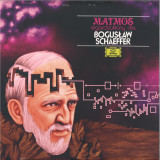
Matmos are one of the most prominent experimental electronic artists working today, crafting work by creating new conceptual frameworks and immediately testing those frameworks’ absolute limits. For ‘Regards/Ukłony dla Bogusław Schaeffer’ they’ve focused on another artist known, in large part, for doing the same.
Bogusław Schaeffer was one of the first Polish artists creating electronic music. In step with American contemporaries like John Cage and Morton Feldman, he worked across the boundaries of classical composition, electronic experimentation and radical theatre, in playfully form-breaking ways.
Matmos are not the first ones to recognize the power of his catalogue, from ‘Solo’ (a 2008 documentary that garnered numerous international awards), to the annual Shaeffer’s Era Festival (most recently celebrated simultaneously in Warsaw and Los Angeles), Bogusław Schaeffer’s work continues to inspire.
‘Regards/Ukłony dla Bogusław Schaeffer’, however, was not just inspired by his work. Matmos were given access to the entirety of Schaeffer’s recorded works to use as they saw fit, commissioned by the prestigious Instytutu Adama Mickiewicza. They re-assembled and re-combined these recorded works with modern instrumentations in a way that only Matmos could, and what emerged is a composite portrait of the utopian 1960s Polish avant-garde and the contemporary dystopian cultural moment regarding each other across a distance.
Vinyl packaged with digital download card.
out of Stock
Last delivered 4 years ago available to reorder, subject to availability
Joining the dots between Brazilian musical culture and the sonic melting pot that is New York City, Saidera are a trio on the rise. They’ve already released a pair of critically acclaimed, carnival-ready singles on Brooklyn’s Let’s Play House label and are now ready to make their debut on Leng Records.
The band’s roots can be traced back to a trip that Lemonade band member Alex Pasternak made to Brazil in 2014. While DJing at a house party in the bohemian Rio de Janeiro neighbourhood of Sta Teresa, Pasternak was left gobsmacked when a mysterious local singer/sambista Vadinho Freire, grabbed the mic and started freestyling lyrics and melodies over his set. Realising their instinctive musical connection, Pasternak and Freire decided to work together on some music, with New Yorker Le Chev joining them to complete the Saidera trio.
Now based in Rio and California, the group’s sun-soaked sound – which they describe as “samba disco-Afro melody” – is a cross-cultural stew in which infectious Brazilian percussion, colourful synth sounds, glistening guitars and celebratory vocals combine to create magical, life-affirming musical moments.
‘Luzes Da Cidade’, their first outing on Leng, encapsulates all that’s good about the Saidera sound and the trio’s approach to music. The song is about identity and connection and in its original form is languid, loved-up and joyous, with acoustic and electric guitars, Portuguese vocals and Korey Riker’s gently breezy flute solos rising above a squelchy synth bassline and energetic, sweat-soaked samba drums.
The song’s main mix comes accompanied by a wonderful instrumental pass featuring more extensive solos by Riker, and Saidera’s own remix of ‘Luzes Da Cidade’ – an extra-percussive, breakbeat-tinged fusion of hazy deep house, energetic samba and sunset-ready synth-disco that will delight DJs and dancers alike.
To round off the EP, Saidera has delivered a brand new “Uprockin Dub” of debut single ‘Deixa Tudo Fluir’, this time with female vocals from Irina Bertolucci taking the lead. Brilliantly kaleidoscopic sonically, with dub delay-laden vocals, guitars and flutes, it’s a superb, life-affirming Balearic reggae interpretation of a now familiar favourite. If you’re not singing along with the chorus after your first listen, we’d be very surprised.
out of Stock
Last delivered 10 months ago available to reorder, subject to availability
A voice in the ether. A calm, clement drone. A gentle, pulsing throb. Like the ghost of a forgotten future as imagined by the distant past, Certain Creatures' sophomore LP Nasadiya Sukta is a study in timelessness - crystalline, heartfelt ambient music designed to push light through shadow. Nasadiya Sukta is the debut release on Mysteries of the Deep, a record label dedicated to total sensory immersion. Mysteries (as it's known colloquially and affectionately) launched in 2011 after a particularly fruitful late-night mixing session, first as a cult podcast series dedicated to narcotic music of all kinds, subsequently expanding into a series of seasonal events. Now, with the release of Nasadiya Sukta, Mysteries of the Deep becomes a full-fledged outlet for music to play in the dark. Certain Creatures is the alias of Brooklyn-based artist Oliver Chapoy, and Nasadiya Sukta was crafted especially for Mysteries of the Deep. Its genesis came when Grant Aaron, Mysteries' proprietor, tapped Chapoy to perform at Mysteries' Halloween event in 2015. His performance was the night's axis point, bridging earlier subdued sounds with late-night upbeat moods. Two years later, reworked and reconfigured, this performance is reborn as Nasadiya Sukta. Although divided into six tracks, Nasadiya coheres into a single extra-terrestrial mass, its beautiful understated elegance encouraging repeat listens. Simultaneously harking back to ambient classics from the '90s (you know who they are) while cementing Chapoy as a visionary artist with his own unique voice, Nasadiya Sukta is one for the space travellers indeed. Releases on Styles Upon Styles, Medical Records Label Promo + Tour
out of Stock
Last delivered 3 years ago available to reorder, subject to availability
Sunny Ozuna is a living legend and a man worthy of praise on many levels. In the Texas and Latin Music pantheon, few have been at it longer and are more revered by their fans and peers than Sunny is. He became a star right out of high school in the late `50s and hasn't looked back in the seven decades since. Among countless other honors and notable achievements, Sunny was the first Latino artist to appear on Dick Clark's "American Bandstand" (in 1963). He penned "Smile Now, Cry Later," a hit for him and The Sunliners, which along with the theater masks that grace the album's cover, became staples in the Chicano Soul and Lowrider Soul cultures. We have been fans of Sunny & The Sunliners' music for a long time. We first got in touch with Sunny to try to reissue some of his records in 2013 but we didn't sign a deal until 2015. It took a trip to San Antonio and then two years of steady phone calls before they decided "if you have been chasing us for this long, you must be serious." With Sunny's blessing we started getting everything mastered, scanned, and planned. First we released 2017's Mr Brown Eyed Soul Vol. 1 compilation that put rare 7" sides next to some of his biggest hits and mixed in some choice album cuts for good measure. In the wake of that, we released three of Sunny's full lengths with their original track lists and art: Smile Now, Cry Later, Little Brown Eyed Soul, and The Missing Link - all of which were Record Store Day releases that raised money for the victims of 2017's Hurricane Harvey. For the 7" collectors, we reissued 45s, making some very hard to come by sides widely available again and pressing some tunes on the format for the first time. In 2020, as an homage to Sunny, we released Dear Sunny... a compilation of Big Crown artists covering Sunny & The Sunliners songs. Through all of this we were able to do what we set out to do: get Sunny's music to a new audience of people and make it all accessible and available again to his existing fanbase. Sunny still keeps a busy schedule and loves performing as much as he did as a teenager. His music and the music that it directly influenced are seeing a resurgence in popularity in the last few years. With any luck at all, our efforts played some small part in that, and on that note, we present Mr Brown Eyed Soul Vol. 2 - another compilation curated by us, where we dig a little deeper into Sunny's catalog and pull some lesser known gems that hold court with his hits. Hats off again to Mr Brown Eyed Soul himself, San Antonio's own, Sunny Ozuna, we are sure you will enjoy the music.
Sunny Ozuna is a living legend and a man worthy of praise on many levels. In the Texas and Latin Music pantheon, few have been at it longer and are more revered by their fans and peers than Sunny is. He became a star right out of high school in the late `50s and hasn't looked back in the seven decades since. Among countless other honors and notable achievements, Sunny was the first Latino artist to appear on Dick Clark's "American Bandstand" (in 1963). He penned "Smile Now, Cry Later," a hit for him and The Sunliners, which along with the theater masks that grace the album's cover, became staples in the Chicano Soul and Lowrider Soul cultures. We have been fans of Sunny & The Sunliners' music for a long time. We first got in touch with Sunny to try to reissue some of his records in 2013 but we didn't sign a deal until 2015. It took a trip to San Antonio and then two years of steady phone calls before they decided "if you have been chasing us for this long, you must be serious." With Sunny's blessing we started getting everything mastered, scanned, and planned. First we released 2017's Mr Brown Eyed Soul Vol. 1 compilation that put rare 7" sides next to some of his biggest hits and mixed in some choice album cuts for good measure. In the wake of that, we released three of Sunny's full lengths with their original track lists and art: Smile Now, Cry Later, Little Brown Eyed Soul, and The Missing Link - all of which were Record Store Day releases that raised money for the victims of 2017's Hurricane Harvey. For the 7" collectors, we reissued 45s, making some very hard to come by sides widely available again and pressing some tunes on the format for the first time. In 2020, as an homage to Sunny, we released Dear Sunny... a compilation of Big Crown artists covering Sunny & The Sunliners songs. Through all of this we were able to do what we set out to do: get Sunny's music to a new audience of people and make it all accessible and available again to his existing fanbase. Sunny still keeps a busy schedule and loves performing as much as he did as a teenager. His music and the music that it directly influenced are seeing a resurgence in popularity in the last few years. With any luck at all, our efforts played some small part in that, and on that note, we present Mr Brown Eyed Soul Vol. 2 - another compilation curated by us, where we dig a little deeper into Sunny's catalog and pull some lesser known gems that hold court with his hits. Hats off again to Mr Brown Eyed Soul himself, San Antonio's own, Sunny Ozuna, we are sure you will enjoy the music.
Hypnagogia remains one of the most mysterious and haunting daily states of mind. Moments of revelation are wont to traditionally hit us particularly in the hinterland between dream and waking, It’s this particular headspace that’s very much the world of ‘Pö om pö’, the second Rocket Recordings released full-length record from Sweden’s equally mysterious OCH. Pö om pö (meaning ‘little by little’) is a journey further into inner space from ‘II’, the previous Rocket outing (which followed a 2014 cassette only release) What’s mapped out here is a trajectory on the kosmische continuum that touches on the terrain of late-‘70s Sky records style ambience, the more overgrown quarters of Swedish experimental prog and the sun-baked lo-fi DIY cassette culture of the US early ‘00s.Dwelling in a smoke-clouded glow that’s equal parts sunset gold and effects pedal red, OCH have here transcended all influences to creating a tapestry of potent psychotropic sound. A record in which new horizons open up beyond the small hours, and where primeval wah-wah-abetted skronk and mantric folk tinged repetition can collude to reveal new third-eye perceptions. Little By Little, Pö om pö , these forty minutes are here to bridge the chasms between conscious and subconscious, and in style.
Some bands reveal themselves immediately, coming right out and winning the listener over the moment they hit play. And then there are bands that open up with time, rewarding repeat listens with new lyrical and musical thrills on every return. Glaswegian jangle pop extraordinaires U.S. Highball have the rare distinction of being both. The duo specialize in the kind of instantly charming songwriting that makes a great first impression, and an even better second, third, and beyond. Their songs are equal parts wit and heart, full of pop culture nods, inside jokes, and hooks upon hooks. Now U.S. Highball’s third full-length, A Parkhead Cross of The Mind, leans even further into their unique dichotomy, offering another goldmine of discovery set to their finest batch of pop gems to date.
Beabadoobee’s thrillingly diverse and experimental second album Beatopia is a fantastical yet deeply personal world housing Bea's most impressive work to date. Marking a huge progression, in 14 songs she traverses fuzzy rock, classic singer-songwriter, psychedelia, midwest emo and outright pop whilst remaining undeniably herself throughout. Born in the Philippines and raised in London, Bea Kristi began recording music as beabadoobee in 2017. At just 21 years old, beabadoobee already has a debut album and five sonically diverse EPs under her belt, while also receiving BRIT Award and BBC Sound Of nominations. She has accumulated 4.6 billion streams worldwide and has a 3 million+ social reach, with a huge, dedicated Gen-Z fan base. beabadoobee’s highly anticipated debut album Fake It Flowers was released in 2020 to widespread critical acclaim (“a thrilling debut from Gen-Z’s newest guitar hero”, NME 5*, “the charismatic star of the indie revival”, The Times 4*, “at once raw and confessional, yet at the same time anthemic in scale”, Dazed), and debuted in the top 10 of the UK charts.
Évariste is one of the rare specimens of artist-cum-scientists. Among his kind stand others like Pierre Schaeffer, a Polytechnique graduate (an engineer but also the father of musique concrète) and the eccentric Boby Lapointe (graduate of the École centrale and inventor of the Bibi-binaire system, patented in 1968). Évariste's songwriting, joyful and full of energy (albeit extremely critical), shrouds an original tragedy: born in 1943 among résistants, Joël Sternheimer (aka Évariste) grew up without a father, lost to Auschwitz. Although he makes little reference to Jewish culture in his music, his origins leave their mark: in 1974, he sings a Hebrew song on television. In 1966, the young Joël sports Princeton's colourful paraphernalia - that's because he's freshly returning from the US, where he was sent to pursue his research on "particle mass and the interpretation of observed regularities, such as the effects of a wave" (will understand who may). When he gets there the country's in the midst of the Vietnam War. With McNamara keen to find an alternative to the nuclear weapon and calling upon the country's biggest brains to undertake the task, there's a "fund shift" within the university - a diplomatic way to give notice to whoever may not be disposed to follow the government's scheme. Joël, who's under the supervision of a rebellious physician, is dismissed. He regardless keeps following the prestigious seminaries of the Institute for Advanced Study, chaired by Oppenheimer, inventor of the atomic bomb. Likely inspired by the hippie movement and music, Joël buys a guitar and starts playing in Washington Square - after all, Bob Dylan himself started there. He blithely skips Oppenheimer and receives a warm (though surprised) welcome from a crowd thoroughly unfamiliar with French. When the ageing physicist questions him about his decreasing attendance, Joël explains how drawn he is to music, and how he thinks it could help him in self-financing his research. Évariste recalls seeing the sickened man, his face torn by remorse, lighten up to his words and say: "What's keeping you - go for it! If I was still young that's exactly what I'd do." The student takes these words as a testimony from his professor - and it's enough to convince him . And so he takes the leap during the Christmas vacations he spends in Paris. A journalist friend he often sees around the Sorbonne introduces him to the artistic director of Disques AZ. The latter passes the tapes on to the label's boss, Lucien Morisse, also program manager on Europe N°1. Morisse is blown away - and signs him onto the label right away. Michel Colombier, arranger for Serge Gainsbourg and co-author of "Psyché Rock", with Pierre Henry, contributes some of his original ideas to the 7 inch "E=mc2": Évariste's preoccupation with the percussion sound on the track "Le calcul intégral" is that it goes "poom poom" and not "tock tock" - Colombier is aware of the issue and records Évariste's guitar like a percussion in an isolated booth. The organist Eddy Louis, who is to participate, in 1969, to the success of Claude Nougaro's "Paris mai", also appears on the record. It's 1966 and the Antoine phenomenon (signed on Vogue) storms through France. The two singers share similarities: Antoine is an engineer of the École centrale, gifted with a great originality in his song-writing. A godsend for the two labels who turn this resemblance into a commercial strategy, setting them out as rivals. To this day though, Évariste still denies what was little more than slushy tabloïd gossip. Success comes around swiftly and in 1967 Évariste launches into a second 7 inch, "Wo I nee", again arranged by Michel Colombier. Quantum mechanics fans finally get their anthem with "La Chasse Au Boson Intermédiaire" (or the "Intermediary Boson Pursuit"). To sum up what's a boson, say he's a close pal of the meson, photon and other gluons. A few months later, it's May 68 and everything's turned upside down. Évariste writes a series of songs inspired by the events, which he immediately submits to Lucien Morisse. When the man behind "Salut les copains", once married to Dalida, hears the song "La révolution" - a father and son dialogue - he can't take any more: AZ simply cannot release this. But there and then Lucien Morisse makes a gesture which will remain engraved in French music's history: sorry to be unable to officially stand by the singer, he encourages him to self-produce the record, but with his tacit support. He calls the pressing factory and asks they apply the same rate for Évariste as they would for AZ. The singer and his musicians use the same studio as for the previous record, all of them playing for free awaiting a return on investment. Évariste keeps singing at the Sorbonne with "Jussieu's gang" and "the young Renaud" he nicknames "le p'tit gavroche" (or "street urchin"). Renaud volunteers to type the lyrics of the song "La révolution" so that the chorus can be sung and recorded. A boy in the group is related to Wolinski and introduces them. The two get along so well that Wolinski ends up drawing the cover for the record "La révolution", for free. The self-released 7 inch "La révolution / La faute à Nanterre" is sold under the table and door-to-door for half the price of a standard record, on and around the boulevard Saint-Michel; and it runs out fast. In the end, there will be 6 releases of the record, and 25000 copies sold. When the theatre director Claude Confortès decides to adapt Wolinski's drawing series titled "Je ne veux pas mourir idiot" ("I don't want to die a fool"), he asks Évariste to write the original soundtrack. His friend, now cartoonist for Hara-Kiri Hebdo, often promotes him in accordance with a principle dear to him by virtue of which he gives a special place to his friends. Dominique Grange (writer of the song "Nous sommes les nouveaux partisans") soon joins the team. After 150 performances, Évariste leaves his place to Dominique Maurin (brother of Patrick Dewaere). Évariste composes the songs for Claude Confortès' next play, "Je ne pense qu'à ça" ("That's all I think about"), co-wrote with Wolinski in 1969. The comedians of the play record the songs on a 7 inch, with a cover signed, again, by Wolinski. In 1971, French television produces the documentary "Évariste et les 7 dimensions", but doesn't air it. Indeed, the scientific sub-comity of the programming comity (sic) censors the show. The given justification is that "Évariste dangerously mixed science with science-fiction, numerology and other non-scientific disciplines". The underlying motive might have been a will to censor the singer-mathematician's political discourse. In the documentary and among other things, Évariste discusses hierarchy, alienation and revolution. Half a century later the documentary remains invisible, though some excerpts resurfaced in 1992 in the cult show "L'oeil du cyclone", on Canal +. Though flourishing, Évariste's career is nearing its end. 1970 is the beginning of a decade in the course of which he is to make a decisive discovery in the musical and scientific domains. Following this breakthrough, he moves away from self-produced music and gaucho magazines to focus on science. He keeps Oppenheimer's encouraging words in mind, now freely pursuing his research thanks to the sales of his records. Joël realises that when decoding protein sequences, one finds musical sequences recognisable to humans. He names them "proteodies". If, when listening to a proteody, one responds by being so sensitive as to finding it beautiful, then it reveals a deficiency of the related protein - and this peculiar music may be the cure. We could trace back the music history in light of proteins lacking in a given artist, or within a public's majority. You always thought these hysterical groupies who'd throw their underwear with passion and faint in the pit had miraculously appeared because they had never heard anything as wonderful as the Beatles? Make no mistake! For Évariste, it all boils down to an intro's protein content. Indeed, the beginning of their first hit "Love Me Do" corresponds to dopamine, the neurotransmitter linked to compulsive buying. An intro like this could only unleash the fervour of groupies, victims of fashion and biology. Évariste's success is such that the income from his sales gives him the autonomy to which he had aspired when confiding to Oppenheimer. It made it possible for him to pursue his research without any institutional constraints. He now devotes himself to his proteodies, sat in the offices of the European University for Research, just around the corner from the Sorbonne he knew so well. Évariste is no more. Joël regained control of this strange and comical beast.
Sunny Ozuna is a living legend and a man worthy of praise on many levels. In the Texas and Latin Music pantheon, few have been at it longer and are more revered by their fans and peers than Sunny is. He became a star right out of high school in the late ‘50s and hasn’t looked back in the seven decades since. Among countless other honors and notable achievements, Sunny was the rst Latino artist to appear on Dick Clark’s “American Bandstand” (in 1963). He penned "Smile Now, Cry Later," a hit for him and The Sunliners, which along with the theater masks that grace the album's cover, became staples in the Chicano Soul and Lowrider Soul cultures. We have been fans of Sunny & The Sunliners' music for a long time. We first got in touch with Sunny to try to reissue some of his records in 2013 but we didn't sign a deal until 2015. It took a trip to San Antonio and then two years of steady phone calls before they decided "if you have been chasing us for this long, you must be serious." With Sunny's blessing we started getting everything mastered, scanned, and planned. First we released 2017's Mr Brown Eyed Soul Vol. 1 compilation that put rare 7" sides next to some of his biggest hits and mixed in some choice album cuts for good measure. In the wake of that, we released three of Sunny's full lengths with their original track lists and art: Smile Now, Cry Later, Little Brown Eyed Soul, and The Missing Link all of which were Record Store Day releases that raised money for the victims of 2017's Hurricane Harvey. For the 7" collectors, we reissued ve 45s, making some very hard to come by sides widely available again and pressing some tunes on the format for the rst time. In 2020, as an homage to Sunny, we released Dear Sunny... a compilation of Big Crown artists covering Sunny & The Sunliners songs. Through all of this we were able to do what we set out to do: get Sunny's music to a new audience of people and make it all accessible and available again to his existing fanbase. Sunny still keeps a busy schedule and loves performing as much as he did as a teenager. His music and the music that it directly in‑uenced are seeing a resurgence in popularity in the last few years. With any luck at all, our efforts played some small part in that, and on that note, we present Mr Brown Eyed Soul Vol. 2 – another compilation curated by us, where we dig a little deeper into Sunny's catalog and pull some lesser known gems that hold court with his hits. Hats off again to Mr Brown Eyed Soul himself, San Antonio's own, Sunny Ozuna, we are sure you will enjoy the music. Tracks: Side A 1 I Can Remember 2 Sitting In The Park 3 Give Me Time 4 Should I Take You Home (Keyloc Version) 5 If I Could See You Now 6 Come Back Baby 7 Viva Mi Triestesa Side B 1 Runaway 2 Sharing You 3 I’ve Never Found A Girl 4 Together 5 I’m No Stranger 6 Best Of Both Worlds 7 Baby, I Apologize
Hurtling out of Lesser Poland full of indignant rage and armed with defiant conviction come Lublin’s OHYDA with a third LP that puts Kaczyński and his PiS cronies to shame. The legacy of Polish forefathers DEZERTER lurks behind razor-sharp riffs and tightly-wound drums, but this record is no mere exercise in homage paying. Where other efforts may hide behind prescriptive cacophony, OHYDA leap out from the dark with a sound that is both cleaner and more considered while somehow remaining belligerently heavy and grotesque. Such is the catchiness that loiters beneath the swell of this tortured LP you might even pick up glimmers of TZN XENNA’s 1985 7” Dzieci z Brudnej Ulicy. Right-wing populists and pro-lifers are amongst the victims who are dressed down with both fury and absurdity. There’s also an entire tune that goes after Kaja Godek, which deserves a round of applause in itself. The band’s best work to date. (Christopher Dodd, Bad Breeding). Pan Bóg Spełni Wszystkie Pragnienia Lewaków... I Dojdzie Do Katastrofy! was recorded at the local Culture Center (CK Lublin) by Dariusz Kociński and mastered by Jack Control at Enormous Door Studios. Sleeve art by Dziki, mincing the head of Kaja Godek, a prolife/anti LGBTQ+ activist, with lettering help from Guitarrist Mike Champagne.
High Focus Records are excited to share a new full length offering from prolific Brighton based producer Mr Slipz, this time with a fresh label signing, Australian rapper Nelson Dialect. A landmark release and signing for High Focus with Nelson being the first international signing on the label. UK listeners might have first heard Nelson collaborating with Verbz & Mr Slipz on the song ‘Hope’ from their acclaimed LP ‘Radio Waves’ released on High Focus in 2020. Nelson has a cult following in his own right in Australia, and previously released music on the legendary U.S label Fat Beats to great acclaim. Now teaming up with one of the most exciting and respected UK producers, Nelson & Mr Slipz deliver ‘Ever Since’. A statement piece by two artists with well over a decade spent on their craft which sounds as urgent and refreshing as if it were their first time releasing music. The album’s title is a reference to the endless quest for a timeless sound, reflecting the creative partnerships which spark from a seemingly forever existing thread of music. The two artists crossed paths whilst Nelson was on tour in Brighton, and a chance introduction to Slipz made this album a reality. As fate would have it, due to a cancellation of plans and changing of schedules during Nelson’s tour, the pair ended up in the studio for 8 days straight together which is when the bulk of the album was created. They each saw this as a cosmic alignment and thus played into the albums astrological artwork themes and overarching concept. Striving to capture the lightning in a bottle moment, what resulted musically on this album was an inspired surge of energy and intense creative output that is felt across the entire LP. Equal parts personal and lyrically dextrous, Nelson explores a multitude of concepts over the hard hitting drums and jazzy samples producer Mr Slipz is renowned for through his previous work with artists including Verbz, Kofi Stone, Vitamin G & Datkid among many more. The album features a slew of impressive guest verses including label mates Vitamin G & Verbz on the emphatic ‘Oxford Scholars’. Two legends Jehst & Confucius MC combine on ‘Smooth Ride’. Bronx pioneer & D.I.T.C legend A.G delivers a show stopping verse on ‘Trembling the Marrow’. There are hypnotic singing performances by Indira May on ‘First Date’ & ‘Open Book’ as well as Hiatus Kaiyote back up vocalist Jace XL on the soul stirring anthem “Figure Out What’s Right”. U.S rappers SickInTheHead & Cazeaux O.S.L.O round out the impressive guest list on the album with their inspired verses. Listeners caught their first glimpse of the duo with their debut single ‘Only Just Begun’. A whirlwind 3 verse tune showcasing the relentless wordplay and imagery Nelson is regarded for over a moody, hard hitting Slipz production. With a buzz already around what Nelson Dialect & Mr Slipz are brewing, the duo have just released their second single ‘Oxford Scholars’ featuring label mates Vitamin G & Verbz
Having been extensively road-tested this past year by DJs including Daniel Avery, HAAi and Gerd Janson, Highdive arrives with tangible anticipation. The work of less-than-shadowy figures Gramrcy and John Loveless, the pair have passed lockdown and beyond remixing artists such as WH Lung, Discovery Zone and Ghost Culture. Debuting their first original material, closely following Gramrcy’s recent appearance on Loveless’s own Hot Concept imprint, Highdive is a long-anticipated explosion of energy.
Built around a sonic-boom breakdown, glossy rave chords and pounding post-punk drums, Highdive feels immediately at home on Phantasy. Having worked closely alongside founder Erol Alkan in recent years to shape the imprint's diverse output, Loveless' collaboration with the Peach Discs founder nods to the electro landscape of the label's earliest days. Having never left dance floors since, Gramrcy & John Loveless take a golden opportunity to plunge dancers into the sublime and the ridiculous.
While a stripped-down ‘Beats Mix’ sees the pair adopt a less-maximal approach, leave it to Schacke to stretch Highdive into hardcore rave heaven. The already-influential Copenhagen artist underscores his refreshing funk in the ‘fast-techno’ scene through which he has risen, turning the screws and upping the tempo with intense but elastic results.
out of Stock
Last delivered 4 years ago available to reorder, subject to availability
Hailing from Adelaide, Australia's CHARNEL ALTAR formed in late 2018. Not long after, the band's self-titled debut demo followed in January 2019. Originally self-released digitally, a cassette version was soon released by Desert Wastelands Productions and a 12" vinyl version by Seed of Doom Records and Impure Sounds; a tape re-release then came in mid-2020 via Blood Moon Productions. With this underground momentum building, CHARNEL ALTAR released a split EP with fellow Aussies CARCINOID, which was released on tape by Headsplit Records and on 10" vinyl once again by Seed of Doom. During all this, CHARNEL ALTAR became a prolific force on the live front. Their first show was supporting Uada, and they went on to play with the likes of Incantation, Krisiun, Integrity, Primitive Man, Faceless Burial, Gutless, Ignivomous, and Vile Apparition. A tour with CARCINOID was planned for 2020, but was unfortunately cancelled due to the Coronavirus pandemic. Nevertheless, CHARNEL ALTAR make their full-length debut with the slimy 'n' stultifying Abatement of the Sun. Horrific and harrowing, churning and gestating with utter dread and doom, CHARNEL ALTAR's death metal is like a slo-mo melting of mind and matter. One could arguably qualify it as death-doom, but the band's version of such evades easy categorization and aims more for hovering tension and paradoxically spacious density - indeed, like old(er)-school death metal dragged through tar but trudging forward like a tank. That all three members previously played together in the cult Tombsealer - who toured nationally in support of Mournful Congregation and played with such acts as Dead Congregation, Portal, Fetid, Windhand, Cough, Inverloch, and Nocturnal Graves to name a few - shows in their seemingly effortless execution, that these dreadful 'n' doomed-out ruminations have been simmering in their hearts for time eternal. Or, put another way, Abatement of the Sun is all-too-perfectly titled: the end is not just nigh; it's NULL.
Finally the 4th volume of "The Encyclopedia of Civilizations" is here! This time it is not a split LP, but a collaboration. Modular synth maestro M. Geddes Gengras and left-field pop priestess Leyna Noel aka Psychic Reality join forces to compose together their new project inspired by Zoroaster: M.Goddess. An exquisite modern ambient record mixing leftfield, kosmische, new age, dub vibes... Very original and rich compositions with genius arrangements combining spacey synth sequences, dreamy guitars, modular sounds, weird rhythms... Along the lines of Craig Leon, Conrad Schnitzler, or the Mecánica Clásica's contemporary approach to the kosmische masters. "Zoroastrianism is an ancient religion that is still actively practiced today by a small population of people worldwide and has had a massive influence on western culture. Many things that appear to be integral to western thinking (and thus “wholesome”) indeed have their roots in ancient Iran. Dualities such as good and evil, light and dark, heaven and hell—even paradise is an old Persian word. For this project, we are exploring this Zoroaster moment—set in the bread basket of the Iranian plateau, six to seven millennia before the Common Era—that’s like a cross-fade. The fading of goddess worship and the first strains of the patriarchy. Not the -ism of today’s still-living religion, but the moment when this man Zoroaster came along and created a new religion that centred one god instead of the many. Forcing the divine feminine underground, if not fully occulted, obscured and engulfed into the mainstream enough to be forgotten. Goddesses that before had their own dedicated cults were converted into lesser players. We’re reviving those flames too."
Part of The Optic Sevens 4.0 Reissue Series.
Limited to 1000 copies worldwide.
Pressed on White Vinyl Includes postcard and poster.
Edward Ball was a member of cult band The Television Personalities alongside his school friend Dan Treacy before leaving to concentrate on The Times.
‘I Helped Patrick McGoohan Escape’ (inspired by cult TV series The Prisoner) Is probably the best known track from them, originally released on the Artpop! label in 1982.
The second single from The Times reissued here with an extra track from the 12” (released a year later in 1983). We have also decided to use the same sleeve that was used for the original 12”
out of Stock
Last delivered 4 years ago available to reorder, subject to availability
Joe Rainey is a Pow Wow singer. On his debut album Niineta he demonstrates his command of the Pow Wow style, descending from Indigenous singing that's been heard across the waters of what is now called Minnesota for centuries. Depending on the song, his voice can celebrate or console, welcome or intimidate, wake you up or lull your babies to sleep. Each note conveys a clear message, no matter the inflection: We're still here. We were here before you were, and we never left. On Niineta, Rainey finds himself in between cultures, collaborating with producer Andrew Broder, who brought his turntablist sensibility to the project. The two of them met backstage at Justin Vernon's hometown Eaux Claires music festival before crossing paths more through the 37d03d collective, and both contributed to the last Bon Iver album before partnering up. "At first I didn't know what I could add," Broder says. "I came to understand everything is rooted in the drum-even the songs on our record that have no drum." Each song started with Broder's beats, the two of them experimenting with various sounds and tempos before orchestrating and recontextualizing the ancient sounds in strange, new in-between places, also pulling from Rainey's vast sample folder of pow wow recordings, layering in slices of his life. Niineta is a short version of the Ojibwe term meaning, "just me," and Rainey is using the term only in the sense that he's taking sole responsibility for the music. He is protective of Pow Wow culture-once outlawed by the US government and maintained in secret-while trying to figure out where he fits and how he can be creative with it. "These are my creations, but they're pow wow songs, and our language is sacred," he says. Rainey suggests conceptualizing the album as him working the door at a Pow Wow after party. "If I'm answering that door, I want to say, hey, yeah, come on in. But there's fucking tons of us in here. It ain't just me."
From a previous album dedicated exclusively to Soul music by the Roman producer Nerio Papik Poggi, this new project in the artistic name 'The Soultrend Orchestra' was born in 2017. The album titlereleased that year, '84 King Street', definied the musical genre to which it is dedicated. In fact, the address is that of the legendary New York club Paradise Garage from where Disco music in the late 70s was definitively launched all over the world by deejays David Mancuso and Larry Levan in the first place. So Soul and Disco are the predominance of this first album which has had great success in the sector so much so that the band has performed live in important European festivals.
This new album entitled Live For Funk starts from where the first left us musically to enter much more on the Funk sound, especially the English one of the early 80s and the American one linked to jazz musicians such as Donald Byrd or Roy Ayers who have been re-evaluated so much in the years starting from the Acid Jazz scene from the 90s onwards.
15 songs in total, including three covers, all three already released as digital singles. The three covers are remakes of cult songs from past
years in the Disco Funk world and exactly Get Down Saturday Night by Oliver Cheatham, Outstanding by the Gap Band and Act Like You
Know by the Fat Larry's Band. In the project Nerio Poggi brought with him his historical musicians such as Alfredo Bochicchio on guitars, Peter De Girolamo on keyboards, Massimo Guerra on trumpet, Fabio Tullio on sax, Simone 'Federicuccio' Talone on percussion and Luca Trolli on drums. In addition to a dozen other guest musicians also 8 different singers among which the names of Alan Scaffardi, Al Castellana, Kenneth Bailey and Danny Losito of Kaigo stand out
out of Stock
Last delivered 17 months ago available to reorder, subject to availability
Following the precursor singles of 2021, Formality Jerne-Site’s unveiling is finally cast upon her already-growing fanbase. Trained classically as a composer and completing a masters at the Royal Danish Academy of Fine Arts, Jura introduces a highly-anticipated playground of carefully sculpted characters, plots and lessons - sometimes charming, sometimes nefarious, always absolute and sincere. A fictional land opens its doors and roof to us. A trio of trans kids run amok in rural suburbia. Various sorcerers of the wild future enter the scene on some songs; on others, the mind is cast to sun-drenched drives and journeys of yesteryear. At the heart is a pop sensibility: yearning, reflections, vanity, guesswork, hope. Jura is adamant about practice and precision. Dead seriously she offers, about making music: ‘Nothing should be half-hearted or an accident.’ There’s a maturity and elegance to her compositions, arrangements that - although at first sound seem abstract - lean away from experimental, somehow. She sing-speaks in English, and somehow not typically theatrically for such a play of a record. The theatrics are all real. It’s a fantasy land for sure, but it's based on hard facts. Like academia subdivided into poetry. It’s that weird-ass specificity she mentioned. Opener ‘Someone’s Lifework’ introduces less a choir of voices, than a choir of personalities. The art of storytelling is at the center of the musical expression. A protagonist relinquishes control of chaos that’s bigger than them on a perilous journey on some vessel: they comfort their co-passengers. There’s a sense that the hero - or anti-hero - might be more canny and cunning than the sweetness they first sell to fellow players. 'Is this our getaway chance?’ sings fellow Copenhagener Ydegirl amongst swelling synths and reverb that become so definitely Jerne-Site as the quest continues. The search? For intimacy, perhaps. ‘Same late Age (dIcK bIfFeReNcE)’ imbibes at once, some further disorientation, perhaps a little hallucinatory feeling which may come over the listener. Through a synthesizing of political themes that work across time ‘Same Late Age (dIcK bIfFeReNcE)’ bears reminiscences of the musical expressions of anti-capitalism in the 1980es, although in a new body and context. “I have a feeling that music reconjures societal morals and ideas from the time in which it was written when we press play or hear a live performance. From the moment at a concert when the symphonic orchestra starts tuning in, the time traveling begins. So I imagined how it would be to be trans sitting there playing the first violin, having the job of producing that first tone that all the other musicians around me tune in ona, ” Jura explains. The listener yearns for more; and subsequent tracks deliver. On ‘How Intimate It Gets,’ Jura meditates on the futility of closeness, begging the audience to enter the blood and guts of their own entanglements, the blueprints of focusing entering. Jura sings richly about fingers being lines, pointing or bending, and we’re reminded of their own wicked ways we can’t control. A history of singing in choirs informs the harmony of myriad inner voices heard across the album. At once prophetic and enigmatic, some of the songs rearrange historical events out of pop musical language. The enormously entertaining ‘Pinot-Botticelli Toast to European Users’ conjures scenes of Cold-War world leaders stuck on a cruise in the Transatlantic vacuum, and the protagonist watches a devastating heartbreaker careen on into the picture, led by his own hips on ‘The Lasceaux Associate’. Finally, on title track ‘Formality Jerne-Site’, American English rises to the occasion like a verdict around the narrative of three trans teenagers in rural Colorado: language turns into something sensual and haptic, playing with the snare and sizzle of syllables. The words twist and bend, while the music follows its own synaesthetic logic: “around us pop culture made a vow to a normative desire, drawing in like water color percussion”. Anyines is a site of play and documentation, with a canon so far quite nice. Their future is one that envisions supporting the galaxies their dear friends embody, be it music, performance, video games or beyond. Highlights from their discerning back catalogue include myriad formats: live and digital, plus releases binded to physical artefacts that enhance the live experience such as sculptures and scents. Their history also includes disappearing time-sensitive shadow-tracked material and cross-disciplinary opportunities that reflect deep professionalism and a totally non-schooled semblance of sound and drama. Recent releases include a dance-theatre soundtrack, a traditional shiny pop record, and the acclaimed ML Buch sophomore, Skinned.
Edições CN label founder Lieven Martens (Dolphins Into The Future) joins the Dauw label with his new album Short stories - pleasant and/or rather sad. On Short stories, Martens continues his quest for unique sound collages based on recorded original work, field recordings and samples. He offers 3 pieces depicting their own narrative. But what's the narrative? Martens leaves his listener with only music and a few linguistic traces as guidelines.
(1) Romantic collection
I. Under the 4pm sun (smoke and deep green) II. Two white-tailed tropicbirds III. Waves breaking on black lava rocks IV. The distant lights of fishing boats at night
(2) Sonorities
20 memories of maximum 20 seconds – and an intermezzo.
(3) Madrigal: a Conversation in the Dark
In front of the house across my parents’ house. There are two statues. They’re bought in the local garden shop, on a budget. In their driveway strewn with gravel, they slyly talk at night.
Lieven Martens (Lieven Martens Moana, formerly Dolphins Into The Future) is a composer and observer. He makes a conceptual form of music – programme music - that travels beyond the pure description. His works are like narrative stills; encounters with objects and thoughts.
As a recording artist, the main focus lies on the music album, and the live concert. But other forms come into play too, like an operetta, music for carillon, music for a commercial, a few movie soundtracks, installation music, et al.
Since he never submitted his work for an art prize, he didn’t won any. But a few years back he received a grant from the Flemish Department of Culture.
Next to his music he writes to make an extra euro. He also writes a few emails every week too. In general, you know.
Martens runs Edições CN, a private press that is praised for its catalogue of original works by a list of internationally acclaimed artists. He also hosts an irregular radio show on We Are Various radio in Antwerp (previous programs for Lyl Radio, and Radio Centraal).
Matmos are one of the most prominent experimental electronic artists working today, crafting work by creating new conceptual frameworks & immediately testing those frameworks absolute limits. For Regards / Uklony dla Boguslaw Schaeffer they've focused on another artist known, in large part, for doing the same. Boguslaw Schaeffer was one of the first Polish artists creating electronic music. In step with American contemporaries like John Cage and Morton Feldman, he worked across the boundaries of classical composition, electronic experimentation, and radical theater in playfully form-breaking ways. Matmos are not the first ones to recognize the power of his catalog, from Solo (a 2008 documentary that garnered numerous international awards), to the annual Shaeffer's Era Festival (most recently celebrated simultaneously in Warsaw and Los Angeles) his work continues to inspire. Regards.. however, was not just inspired by his work, Matmos were given access to the entirity of Schaeffer's recorded works to use as they saw fit, commissioned by the prestigious Instytutu Adama Mickiewicza. They re-assembled & re-combined these recorded works with modern instrumentations in a way that only Matmos could, and what emerges is a composite portrait of the utopian 1960s Polish avant-garde and the contemporary dystopian cultural moment regarding each other across a distance. To facilitate the transcultural exchange that is the album's essential premise, all song titles and liner-notes are provided in both English and Polish. The album was mastered by Rashad Becker and features illustration and design by acclaimed artist Robert Beatty (Tame Impala, Osees, Mdou Moctar). Like the anagrams of the letters of Boguslaw Schaeffer's name that were re-assembled to create some of the song titles, the album itself is a musical re-assemblage of component parts into possible but unforeseen new shapes. Adding harp from Irish harpist Una Monaghan, erhu, viola and violin from Turkish multi-instrumentalist Ulas Kurugullu, and electronic processes from Baltimore instrument builder Will Schorre, and Horse Lords wunderkind Max Eilbacher, the resulting arrangements constantly toy with scale as they move from the close-mic-ing of ASMR and the intimacy of chamber music to the immensity of processed drones and oceanic field-recordings that close the album. Offering a "life review" of production styles, Regards / Uklony dla Boguslaw Schaeffer builds temporary shelters out of the panoramic wreckage of modernist composition, sixties tape music, seventies dub, eighties industrial music, nineties postrock and dark ambient, 2000s era glitch fetishism, and contemporary post-everything collage sensibilities.
out of Stock
Last delivered 4 years ago available to reorder, subject to availability
A lot has been said and repeated about the interiority of this club music - how the joyful tremor of the "Raingurl" refrain holds hands with such soft and doubtful verses. How special it is that house music so of New York can contain storytelling cultivated so far away. That repetition is born of people all over the world going out, and staying in, with this music as a compass; songs that define so many late night hangs for crews of friends, singalongs in DJ booths, contemplative 5am walks home from the club. What can get lost in that repetition, in the shifting canonization of these recordings as symbols of any one scene or moment, is what was behind the pair of round glasses reflecting so tirelessly outwards. Yaeji, an exceptional friend only at the very beginning of finding her path as a cross-disciplinary artist and collaborator. Yaeji wrote this music while going out nearly every night of the week to DJ and support her own NYC community of friends at their turns behind the decks. These tracks originated from explorations in dancefloor anonymity, growing from seeds planted by sharing her first musical experiments online.
out of Stock
Last delivered 4 years ago available to reorder, subject to availability
South American Jazz & Bossanova flavours from 60s & 70s in Liguria, north west Italy. Melody sounds really close to Brazilian Portuguese and instrumental tracks smells of South American Jazz.
Nonetheless, the sound landscape clearly reflects the Italian Library Music of the time. This mingling was made possible by the commercial and cultural interconnections during the discovery of the New World: the local Ligurian language was influenced by new stimuli from the new territories and vice-versa. Moreover, from the end of the Nineteenth Century, a strong migration of Italians involved South America, with numbers comparable to the Italian migration in the USA, but less known because less represented in films or narrative.
As a result of these connections, these songs sound mellow, carioca and exotic, based on the phonetics of one of the most musical, folkloric and peculiar Italian dialects.
The artwork project is a homage to lithographs and ADV that were inspired by the first tourist and migration trips departing from Genoa towards Rio De Janeiro. The lithographs were recovered by “L’Image” an existing art gallery in Alassio, a small town in Liguria.
"Bossa Ligure" can be seen as a micro-genre and a different form and aesthetic of Brazilian music, which is unknown to many, but that we would like to make available with this collectanea. A musical and a
cultural expression which reveals a strong influence and connection to the Brasileiro sound in an unexpected territory.
out of Stock
Last delivered 3 years ago available to reorder, subject to availability
Far Out Recordings proudly presents Milton Nascimento's Maria Maria. Recorded in 1974 and unreleased until almost thirty years later, the album was written as the soundtrack to a ballet which dealt with the legacy of slavery in Brazil. Raw, atmospheric and emotionally charged, Maria Maria reveals one of Brazil's greatest ever songwriters at his creative peak. Featuring an all-star cast of fellow Brazilian legends including Nana Vasconcelos, Joao Donato, Paulinho Jobim, and members of Som Imaginario, Maria Maria holds what Milton considers to be the definitive versions of some of his classic songs, including 'Os Escravos De Jó' and 'Maria Maria'.
Originally released in 2003 as a double CD package, with Milton Nascimento's 1984 follow up ballet soundtrack Ultimo Trem, Maria Maria will be available on vinyl for the very first time from December 2019, with Ultimo Trem set for vinyl release early 2020.
Milton Nascimento possesses one of the most immediately recognizable voices in Brazilian music: high and sweet and as breathtakingly sublime as that of any soul singer. It was this voice that the legendary Brazilian singer Elis Regina fell in love with back in 1964, having heard Milton perform his song 'Canção do Sal (Sultry Song)' at a private party in Sao Paulo. Ellis went on to record the song in 1967 -giving Milton his first hit in Brazil and beginning a career that has spanned over 50 years.
Born in Rio on the 26th October 1942, Milton moved with his adoptive parents at the age of 18 months to Tres Pontas, a rural town in the state of Minas Gerais, 500 miles north of Rio. He began his musical career as a young teenager, singing in a crooner style he learnt from listening to Brazilian singers and US groups such as The Platters on the radio. Hungry for more opportunities to perform, Milton moved to Belo Horizonte, the capital of Minas Gerais, at the age of twenty. By the beginning of the 60s Milton had made a name for himself both as an accomplished singer and guitarist.
Milton became part of a local network of musicians, film makers, dancers, theatre directors and writers that included the journalist and song writer Fernando Brant as well as lyricist Marcio Borges and his younger brother Lo Borges. Together these four wrote and produced what would become Milton's milestone album, 'Clube da Esquina (Club on the Corner)'. The originality of 'Club da Esquina' shaped the local scene, and it reflects the essence of 'the Nascimento Sound'. Milton's religious upbringing as an Afro-Brazilian Catholic saw him exposed to church choral music from an early age. His love of this genre of music is apparent in both his celestial falsetto and vocal choral arrangements. This collection also displays his early fascination with evocative, non-verbal, scat-style singing, spare, harmonic guitar work and local folk music, jazz and rock.
In 1976, Milton and Fernando Brant teamed up with a new contemporary dance company called Grupo Corpo, whose Argentinian choreographer Oscar Araiz, would become a collaborator with the two musicians. Together, they conceived a show based on the composite life story of the daughter of a black slave called Maria. Nascimento wrote music to Brant's lyrics and "Maria Maria" was premiered in the main theatre of the Belo Horizonte Palacio das Artes that year. "Fernando wrote the lyrics for the ballet, but there were originally no lyrics for the theme song, "Maria Maria'". Milton and Fernando worked on the lyrics together, basing them on folk stories about black women of the countryside. Adds Milton "These memories are mostly things that we witnessed – Fernando and I – rather than what we experienced ourselves.
Milton's music is impressionistic, emotional and romantic. Relying on songs without lyrics as well as evocative vocalizing and choruses, Milton experimented heavily with Afro-Brazilian percussion and taped jungle sounds. His composing method for these recordings was highly unconventional: "I wrote the music for 'Maria Maria' in a tiny Rio apartment with friends and their kids running around and having fun! I love to be in noisy places, surrounded by people", he says.
The music on 'Maria Maria' was performed by an impressive group of young musicians who are today household names in Brazilian music, including Naná Vasconcelos (percussion and effects), Toninho Horta (guitars) and Paulo Moura (sax). Several vocalist including Naná Caymmi, Fafá de Belém, Beto Guedes, and Milton himself, had hits in years to come with reworkings of these songs.
Milton says his compositions follow his visions "like a movie", and he believes that reflects his long love affair with cinema. "I only began composing because of enjoying the movies so much," he says. "I wrote my first song "Peace for the Coming Love" after seeing 'Jules et Jim' (the cult 60s French film directed by François Truffaut), with my friend Marcio Borges. We went early in the morning and watched it four or five times in a row, then went to Márcio's home and wrote the song."
The songs also include solo spoken passages set to music, clearly influenced by this style of French art cinema. On the title track, Maria's story is narrated and translated to music through the use of African Percussion, drums and metal signifying the field slave tools of the day. 'Trabalhos (Works)' runs to work rhythms and whipcracks: no words, just pain. 'Lília' documents the beating of the slave woman. After 'A Chamada (The call)' and the triumphant 'Era Rei e Sou Escravo (I was a king now I am a slave' things begin to turn and Milton employs tropical jungle cries to symbolize freedom. 'Santos Catholicos x Candomble (Catholic Saints vs Candomble)' represents the battle between African and European religions through the music of both sides. Milton's heavenly falsetto pours into 'Francisco' and 'Pai Grande (Great Father)' and the outstanding 'Eu Sou Uma Preta Velha Aqui Sentada no Sol (I'm an old black lady, sitting under the sun)' conjures images of an old woman sitting deep in the forest, her memories painted in drums, piano and voices.
out of Stock
Last delivered 6 years ago available to reorder, subject to availability
Following releases from label founder Palms Trax, a reissue of eighties Chicago House innovator Rog’e, and a pair of cassette mixtapes from Berlin-based selectors Enchanted Rhythm and Budino, CWPT looks to the North-East of England for its next release, live and direct from REES.
Hot on the heels of a twelve-inch on Bordello A Parigi and underscoring a slowly simmering reputation as one of the brightest stars of his community, REES’s debut on CWPT is a classy and globally informed perspective on house, disco and acid styles.
Undistilled rhythm is at the heart of Rees’s vision of club culture; on title track, Devils Club, it’s effect makes itself known immediately, driving a channel of lively percussion towards a series of tasteful breakdowns that are both propulsive and alluring. On ‘Magic’, a confidently raw, loose drum loop accelerates into a glossy, psychedelic speed-chase that’s pure Miami Vice reimagined in Middlesbrough.
On the flip, two versions of ‘The Spirit’ tastefully expand beyond REES’s musical borders and into warm, cinematic territory, blending tropically tinted instrumentation with (and then without) an entrancing vocal sample.
out of Stock
Last delivered 10 months ago available to reorder, subject to availability
For the third release on De:tuned we proudly present The Kosmik Kommando AKA Mike Dred. Mike hardly needs an introduction; considered as one of the masters of the Roland TB-303 Mike has been releasing records under various aliases since the early 90s. He has recorded for high profile labels such as R&S and Rephlex as well as his own Machine Codes label. Together, with Aphex Twin, Mike was behind the Universal Indicator releases which are among the most collectible and sought after records in techno history.
De:tuned has worked closely with Mike to develop an 8 track project that gives props to the American Psychologist Timothy Leary and his proposed theory of 'The Eight-Circuit Model of Consciousness'. This model describes 8 circuits of information that operate within the human nervous system. Each circuit refers to a different sphere of activity, enhanced by experimentation with a particular substance. Each circuit also represents a higher stage of evolution than the one before it and the higher the circuit, the fewer the people have activated it as the higher four circuits exist for those who migrate to outer space and live extraterrestrially.
The 8 Models are applied to the track titles that present a varied collection integrating acid house, techno, electro and rave culture.
3 of the tracks on offer here were written exclusively for Mike's live performance at the De:tuned 'Meeting of Minds' event in June 2012, which was Mike's first full live show in 3 years.
This 8 track project will be available on limited 180 gr white double vinyl with label and sleeve artwork by Mike himself. Stay Tuned!
out of Stock
Last delivered 4 years ago available to reorder, subject to availability
For the third release on De:tuned we proudly present The Kosmik Kommando AKA Mike Dred. Mike hardly needs an introduction; considered as one of the masters of the Roland TB-303 Mike has been releasing records under various aliases since the early 90s. He has recorded for high profile labels such as R&S and Rephlex as well as his own Machine Codes label. Together, with Aphex Twin, Mike was behind the Universal Indicator releases which are among the most collectible and sought after records in techno history.
De:tuned has worked closely with Mike to develop an 8 track project that gives props to the American Psychologist Timothy Leary and his proposed theory of 'The Eight-Circuit Model of Consciousness'. This model describes 8 circuits of information that operate within the human nervous system. Each circuit refers to a different sphere of activity, enhanced by experimentation with a particular substance. Each circuit also represents a higher stage of evolution than the one before it and the higher the circuit, the fewer the people have activated it as the higher four circuits exist for those who migrate to outer space and live extraterrestrially.
The 8 Models are applied to the track titles that present a varied collection integrating acid house, techno, electro and rave culture.
3 of the tracks on offer here were written exclusively for Mike's live performance at the De:tuned 'Meeting of Minds' event in June 2012, which was Mike's first full live show in 3 years.
This 8 track project will be available on limited 180 gr white double vinyl with label and sleeve artwork by Mike himself. Stay Tuned!
out of Stock
Last delivered 12 months ago available to reorder, subject to availability
1998'S CLASSIC SECOND STUDIO ALBUM OF SYMPHONIC, OCCULT
BLACK METAL
PRESENTED ON DOUBLE GATEFOLD VINYL & ON THE VINYL FORMAT FOR THE
FIRST TIME.Opera IX are a symphonic black metal band formed in Italy by
guitarist Ossian & released their debut album 'The Call of the Wood' in 1995 &
over subsequent years have become regarded as one of the most revered &
important Italian bands of the genre. The band's sound is an eclectic concoction,
moving beyond straight-forward black metal, mixing elements of thrash, doom &
death metal with symphonic elements, even folk influences. Opera IX is known for
their strong occult themes blended with topics of paganism & are also known for
being one of the first examples of a black metal band with a female vocalist.
'Sacro Culto' was the band's second album, originally released in 1998. Lead
singer Cadaveria used more melodic vocal experimentation this time with almost
operatic passages sitting alongside the trademark black metal style whilst further
evolving the central themes of occultism & paganism.
This edition of 'Sacro Culto' is presented on double gatefold vinyl & on the vinyl
format for the first time.
Our story begins in Jerusalem 1980 – Zadik Zecharia – a folk musician whose speciality is the Zorna – a traditional kurdish woodwind instrument – recorded a cassette of kurdish melodies played on Zorna and Dola, a kurdish drum.
The tape was released independently and distributed mainly around the kurdish-jewish community in Israel. Zadik mostly performed at weddings and ha as / celebrations and was also known by the nickname “Iron Lungs”, because of his ability to take only a few pauses for breath during his long gigs.
In 2005, one tape found its way to “Something on the Road” – an underground CD-r Jerusalem based label which reissued the music on CD-r. Overnight, these intense melodies became a cult phenomena in the hipster-ish circles of Jerusalem and beyond. The kurdish melodies could suddenly be heard during dj sets, topping electronic beats, or adding drones to heavy experimental sessions. which later led “Something on the Road’s” founder to initiate a remix compilation with Jerusalem’s nest producers. One of them is your truly, Mule Driver. The remix has became a cult by its own.
Fast forward to present time, a conversation with Legowelt about folk music led Mule Driver to dig an unreleased longer version of this techno remix. As well as ask the mighty Legowelt for his interpretation, that turned out as a killer acid track followed by an EBM – electro belter by Juju (Juju and Jordash) and PRZ (Clone).
out of Stock
Last delivered 4 years ago available to reorder, subject to availability
SINGLE VINYL EDITION OF DODHEIMSGARD'S 1999 MASTERCLASS OF
BOUNDARY-PUSHING EXPERIMENTAL BLACK METAL.To fans of black
metal, Dødheimsgard need no introduction, being one of the great
purveyors of the Norwegian Black Metal creative evolution
The band was formed in 1994 by Aldrahn (Thorns) & Vicotnik (Ved Buens Ende).
The early incarnation was that of a raw & at often melodic black metal band, with
their debut album also featuring Fenriz of Darkthrone on bass. In recent years,
Dodheimsgard has become known for its eclectic musical ventures & poignant
mood shifts, with a less chaotic, more considered approach compared to their
earliest works. Following the 'Kronet til Konge' & 'Monumental Possession'
opuses, there was a shift in direction as demonstrated on 1998's 'Satanic Art' EP
& by Dødheimsgard's third album, '666 International', Vicotnik had taken over a lot
of the writing duties, with DHG's style becoming more technical yet ferocious
black metal, with strong experimental ideas & industrial elements. Vicotnik's riffs
were inspired by cult bands such as Thorns & perfectly entwined with Aldrahn's
delightfully twisted lyrics & immense vocals to create something truly unique. In
its '666 International' incarnation, DHG (as they were later to be known) featured a
line- up of well- respected Norwegian musicians including Czral (Aura Noir, Ved
Buens Ends, Virus), Apollyon (Aura Noir, Immortal), plus Mr Magic Logic (Fleurety)
on keyboards, as the album was constructed over a period of time. All in all, '666
International' is rightly regarded as a highly influential masterpiece of avant-garde
metal by many since its release in 1999.
This edition of '666 International' is presented on black vinyl in single sleeve,
retaining the original cover artwork & contains lyrics.
Dallas-born Roger Kynard Erickson, better known as Roky Erickson, is a legend of psychedelic music and culture. Playing piano at five years old and guitar at ten, he dropped out of high school in Austin shortly before graduating, since the school dress code demanded short hair. In 1965, his group, The Spades, made an impact with “We Sell Soul” and the following year, The 13 th Floor Elevators burst onto the scene with debut album The Psychedelic Sounds of the 13 th Floor Elevators, but the band’s non-conformist attitude and open endorsement of drugs such as marijuana and LSD put them in repeated conflict with the authorities. Then, in 1968, during a performance at the San Antonio edition of the World’s Fair, known as HemisFare, Erickson began speaking incomprehensible nonsense on stage, leading to a diagnosis of paranoid schizophrenia and confinement in a Houston psychiatric hospital, where he was forcibly given electroshock therapy. The following year, after being busted with a single joint, Erickson pleaded not guilty by means of insanity, leading to a 3-year stay in Rusk State Hospital, with further electroshock and Thorazine treatments. Following his release Erickson formed a group initially called Bleib Alien, which evidenced a more hard-rock orientation, later renamed The Aliens, though Erickson was also working with Austin’s The Explosives in the same era. Aliens material produced by Stu Cook of Creedence Clearwater Rival was issued by CBS and an independent, 415 Records. Then, in the early 1980s, Erickson became fixated with junk mail and unsolicited letters, writing to lawyers and celebrity figures on a regular basis; in 1985, solo mini-LP Clear Night For Love was produced at Music Tracks in Austin by bassist/guitarist Speedy Sparks, with former Joe “King” Carrasco and Delbert McClinton drummer, Ernie Durawa, plus Supernatural Family Band alumnus John Reed on guitar. Released by France’s New Rose label in small numbers, the release found Erickson back in semi-psychedelic/country rock mode on opening track “You Don’t Love Me Yet,” the plaintive “Starry Eyes” and the anthem-like title track, while “The Haunt” is more in swamp/horror rock vein and “Don’t Slander Me” has heavy blues leanings.
Winston 'Niney' Holmes AKA The Observer, must be one of Reggaes finest Roots Rebel producers. Capable of making some of the heaviest, innovative music, not only in sound but also in the Cultural/Political sense.
Born George Boswell, Montego Bay, Jamaica 1951, and name checked 'Niney' due to losing a thumb in a workshop accident. He began his career in music by organising bands to play at school dances. But his first steps learning the musical ropes came working under the tutelage of producer Bunny Lee around 1967, organising sessions for Bunny's stable of artists. He moved on to work alongside Lee Perry at Joe Gibb's 'Amalgamated' label setup, where on Lee Perry's leaving in 1969 to start his own 'Upsetter' label, Niney became chief engineer.
Inspired by Perry's success it wasn't long before his own 'Destroyer' label was under way. It was 1970, and his first production entitled 'Mr Brown' by DJ's Dennis Alcapone and Lizzy, proved to be a minor hit, but his own 'Blood and Fire' track released in December of that year would become a major hit. After initial problems with it's likeness to Bob Marley's track ' Duppy Conqueror' being ironed out, it's reissue on his now named 'Observer' label, saw it go on to become, Jamaican Record of the Year 1971. Far out selling Bob Marley's track to the tune of 30,000 copies in Jamaica alone. A roots classic...
Niney's reputation for building great roots tracks, was furthered with more success working with singer Max Romeo. Issuing cuts such as 'Beard Man Feast', the great 'Reggae Matic' and 'Aily Ailaloo' and renewing his friendship with Lee Perry on the track 'Rasta Band Wagon', who's production credit read Perry, Niney, Maxie. In 1973, Niney began working with Dennis Brown, who was already an established star from an early age, they found a chemistry that went on to produce some of Dennis' finest work. The 1973 hit 'Westbound Train' was followed in 1974 by 'Cassandra', 'I am the Conqueror' and the timeless 'No More Shall I rOam'. Another important connection around this time was the great King Tubby who Niney would take his tapes along to and even record some of his tracks at Tubby's house, 18 Drummlie Avenue, Kingston, which doubles as his Studio of Dub.
It's these tracks that we are concentrating on here. Tubby would strip the tracks back to the bone and rebuild then sometimes leaving off the hook line. Whether that be the horn line or keyboard line and adding effects over the top that could disguise the cut even more. Even Niney stating that when Tubby had finished with a cut, he found it hard to recognise the track himself. Its these tracks as dub plate specials that Tubby would play on his Hometown HI-FI Sound System and it's these such tracks that we have compiled for this release. Dub Plated that have not seen the light of day since tragically the great Osborne Ruddock AKA King Tubby was gunned won and murdered on the 06th December 1989. For a few dollars and a gold chain, reggae music has lost one of it's most creative, inventive forces.
Niney also cut tracks with many other Reggae giants such as Gregory Issacs, Michael Rose, Junior Delgado, Horace Andy and Delroy Wilson to name but a few. As in house producer at the legendry Channel Studios and supervising sessions at Dynamic and Randy's Studio 17, his magic touched many. DJ, Arranger, Producer, his Roots Rebel music still stands the test of time.
Hope you enjoy the set.....
out of Stock
Last delivered 4 years ago available to reorder, subject to availability
Cabaret Voltaire’s ‘The Covenant, The Sword and The Arm of The Lord’, as originally remastered in 2013, now reissued on White vinyl. Known for being the harder, more experimental album of their “Pop” period, ‘The Covenant, The Sword and The Arm of The Lord’ was originally released in 1985 and includes the classic ‘I Want You’. The album embodys Cabaret Voltaire’s industrial electro-funk sound and their punk ethos.
Cabaret Voltaire were very much ahead of their time, harmonising dance music, techno, dub, house and experimental electronics, making them, without a doubt, one of the most influential acts in electronic music.
“...The Covenant, the Sword and the Arm of the Lord is an exercise in paranoia with anxiety coded into the jittery sample-heavy structures of the music itself.” - Spectrum Culture
out of Stock
Last delivered 4 years ago available to reorder, subject to availability
A lot has been said and repeated about the interiority of this club music - how the joyful tremor of the "Raingurl" refrain holds hands with such soft and doubtful verses. How special it is that house music so of New York can contain storytelling cultivated so far away. That repetition is born of people all over the world going out, and staying in, with this music as a compass; songs that define so many late night hangs for crews of friends, singalongs in DJ booths, contemplative 5am walks home from the club. What can get lost in that repetition, in the shifting canonization of these recordings as symbols of any one scene or moment, is what was behind the pair of round glasses reflecting so tirelessly outwards. Yaeji, an exceptional friend only at the very beginning of finding her path as a cross-disciplinary artist and collaborator. Yaeji wrote this music while going out nearly every night of the week to DJ and support her own NYC community of friends at their turns behind the decks. These tracks originated from explorations in dancefloor anonymity, growing from seeds planted by sharing her first musical experiments online.
out of Stock
Last delivered 3 years ago available to reorder, subject to availability
After an initial link up last summer, Altrimenti Records present four more remixes of cult Italian synth maestros Cabaret Du Ciel. Once again the focus is on experimentation, testing unusual crossovers between artists, eras and styles in pursuit of compelling new sounds.
The results across all four of these versions are distinct from each other, and distinct from wider trends in dance music.
First up, Benedek approaches 'Great Plains' as a low-tempo space-boogie excursion. Following in the wake of his releases on Leaving Records, L.I.E.S. and People's Potential Unlimited, the LA-based artist lays down thick slabs of Moog while retaining the ethereal swirl of the source material.
Rome's L.U.C.A. (aka Francesco De Bellis) has established his new wave-inspired sound on his own Edizioni Mondo label, not to mention working in other projects such as MAT101 and Jollymusic, and he brings a sprightly, motorik energy to 'Climatic Variation'.
Lorenzo Fortino's 'Suspacid Revisitation' version of 'Lakota' is aqueous and psychedelic, but remains elegant and understated in its execution. The emergent producer has already released on Wo-Land and most recently Miniera, and this remix ably embodies the entrancing qualities inherent in his sound.
The remix package concludes with a playful, leftfield electro diversion from elusive Montreal-based producers Sentena. Hailing from an emergent scene orbiting the Doo label and projects like SnP 500 and Fashion, their crooked take on machine music perfectly meets the adventurous aims of Altrimenti in testing out crossovers of styles and creative processes.
out of Stock
Last delivered 2 years ago available to reorder, subject to availability
THE CULT 1990 DEBUT ALBUM OF INFLUENTIAL UK GRINDCORE FROM
PROPHECY OF DOOM - PRESENTED ON THE VINYL FORMAT WITH
COVER ARTWORK FROM THE ORIGINAL 1990 PRESSING.UK grind/death
veterans Prophecy Of Doom formed in Gloucestershire, 1988, with
bassist Martin Holt & vocalist Shrew Schroder uniting to embark upon a
journey to create something challenging & memorable to stand out in the
UK scene
After a few personnel changes whilst looking to establish a permanent recording
line-up after their 1988 demo & the 1989 EP, 'Calculated Mind Rape' (which had
brought the band to the attention of legendary DJ John Peel), the time had come
to create their debut full- length album. And so 'Acknowledge the Confusion
Master' came to be & was released in 1990 on the burgeoning Peaceville Records
& their then newly established sub- label, Deaf Records. A highly effective
concoction of blasting amid a titanic wall of raw grinding riffs & chaos propelled
Prophecy Of Doom to the forefront of the scene, also leading to two recording
sessions with John Peel & further enforcing Prophecy Of Doom's position on the
map of notable British grind acts.
As a further distinguishing factor, there was a great depth & consideration to the
themes of the album, perhaps in stark contrast to how the tracks were presented
sonically. Written by mainman/vocalist "Shrew", there with a strong philosophical
element to the lyrics, an exploration of awareness & intuition amid an era of
increasingly suppressed feelings & an urge to rise above mental restrictions.
This vinyl edition of 'Acknowledge the Confusion Master' contains cover artwork
from the 1990 release with printed inner sleeve containing lyrics & receives its
first vinyl pressing on Peaceville since that initial 1990 edition.
James 'Perturbator' Kent and Cult of Luna are the masters of their respective worlds. Over the last decade, the French maestro has become the most expectation-breaking name in synthwave, transcending its '80s video game aesthetic with metal and post-punk.
Meanwhile, the Swedish sextet have affirmed themselves as post-metal's biggest stars. Seismic riffs, earth-quaking growls and brave collaborations with everyone from Julie Christmas to Colin Stetson have ensured they're as blistering as they are forward-thinking.
Eclecticism and violence are married in Final Light: Perturbator's team-up with Cult of Luna singer/guitarist Johannes Persson. The pair's self-titled debut album is the perfect conglomerate between seemingly incompatible sounds.
On its opening track, the insidious "Nothing Will Bear Your Name", synths bubble to construct an arresting opening half. Then, release. Johannes' roar strikes and guitar chords boom as computerised beats anchor the chaos.
"It Came with the Water" echoes Cult of Luna's 2013 titan Vertikal, invoking images of an urban dystopia as its deep guitar melody grinds beneath sci-fi electronica. The title track's distorted EDM beats, on the other hand, are all James 'Perturbator' Kent, capable of invigorating the seediest of underground nightclubs. Both parties are clearly playing to their strengths - but for them to do so in such perfect harmony is, in itself, a genre-demolishing feat.
Lyrically, Final Light seethes with anger. "There was so much that I was so fucking pissed about," Johannes explains. "Some of my friends were dealing with a poisonous person: a narcissistic, crazy person. I was walking around full of anger and hate, so I think that came out in those lyrics."
The tandem's story began in 2019. Walter Hoeijmakers, the artistic director of the Netherlands' lauded Roadburn festival, approached James 'Perturbator' Kent with the opportunity of doing a commissioned piece with any musician of his choosing. As soon as the pair began work on their boundary-decimating songs, they knew that they had to be immortalised as an album.
"It was immediate," states Perturbator. "It's a project that I really want to share; it's not only the fruit of a collaboration between me and one of my favourite musicians, but also very unique and once-in-a-lifetime."
They wrote and recorded together in Paris before the start of the pandemic. Covid, which postponed the Roadburn festival at which the band would have debuted, gave them time to perfect what they'd crafted.
Johannes recorded additional vocals at Cult of Luna's resident studio in Umeå, Sweden, fully capturing the rage of his apocalyptically harsh voice.
Borders were built to be shattered. This is the sound of their destruction. Single-handedly, Final Light have birthed a new, bleak breed of experimental metal.
James 'Perturbator' Kent and Cult of Luna are the masters of their respective worlds. Over the last decade, the French maestro has become the most expectation-breaking name in synthwave, transcending its '80s video game aesthetic with metal and post-punk.
Meanwhile, the Swedish sextet have affirmed themselves as post-metal's biggest stars. Seismic riffs, earth-quaking growls and brave collaborations with everyone from Julie Christmas to Colin Stetson have ensured they're as blistering as they are forward-thinking.
Eclecticism and violence are married in Final Light: Perturbator's team-up with Cult of Luna singer/guitarist Johannes Persson. The pair's self-titled debut album is the perfect conglomerate between seemingly incompatible sounds.
On its opening track, the insidious "Nothing Will Bear Your Name", synths bubble to construct an arresting opening half. Then, release. Johannes' roar strikes and guitar chords boom as computerised beats anchor the chaos.
"It Came with the Water" echoes Cult of Luna's 2013 titan Vertikal, invoking images of an urban dystopia as its deep guitar melody grinds beneath sci-fi electronica. The title track's distorted EDM beats, on the other hand, are all James 'Perturbator' Kent, capable of invigorating the seediest of underground nightclubs. Both parties are clearly playing to their strengths - but for them to do so in such perfect harmony is, in itself, a genre-demolishing feat.
Lyrically, Final Light seethes with anger. "There was so much that I was so fucking pissed about," Johannes explains. "Some of my friends were dealing with a poisonous person: a narcissistic, crazy person. I was walking around full of anger and hate, so I think that came out in those lyrics."
The tandem's story began in 2019. Walter Hoeijmakers, the artistic director of the Netherlands' lauded Roadburn festival, approached James 'Perturbator' Kent with the opportunity of doing a commissioned piece with any musician of his choosing. As soon as the pair began work on their boundary-decimating songs, they knew that they had to be immortalised as an album.
"It was immediate," states Perturbator. "It's a project that I really want to share; it's not only the fruit of a collaboration between me and one of my favourite musicians, but also very unique and once-in-a-lifetime."
They wrote and recorded together in Paris before the start of the pandemic. Covid, which postponed the Roadburn festival at which the band would have debuted, gave them time to perfect what they'd crafted.
Johannes recorded additional vocals at Cult of Luna's resident studio in Umeå, Sweden, fully capturing the rage of his apocalyptically harsh voice.
Borders were built to be shattered. This is the sound of their destruction. Single-handedly, Final Light have birthed a new, bleak breed of experimental metal.
• Revised reissue of the acclaimed first-ever book-length investigation into French Touch.
• Back in print for the first time since 2004.
• Updated version features previously unpublished interviews with Daft Punk, Laurent Garnier, Cerrone, Jean Jacques Perrey, Motorbass, Chris Le Friant (aka Bob Sinclar), Air, Etienne de Crecy, La Funk Mob, Cassius, The Micronauts, Stardust, Benjamin Diamond, Modjo, DJ GilbR, i-Cube, DJ Cam and many more...
During the second half of the 1990s, Paris experienced a dance music revolution thanks to groundbreaking artists like Daft Punk, Air, Super Discount, Motorbass, Cassius, Dimitri from Paris, Bob Sinclar and many, many more. It was a scene that became known as French Touch and was heralded throughout the world as the epitome of dance music cool, forever placing Paris on the dance culture map.
Journalist and author Martin James was there right from the start, documenting the scene from its inspirations to its earliest moments and onto its global breakthrough. In the process, he inadvertently provided the French Touch moniker that became adopted throughout the world.
Drawing on a dazzling array of exclusive interviews with the biggest names in French electronic music history, French Connections explores France’s significant contribution to dance music culture that paved the way for the French Touch explosion.
“Endlessly informative and thoroughly enjoyable, James manages to bring even the most boring artists (Air) to vibrant life with his energetic prose and rich imagery.” Bob Stanley, Mojo
“(James) has a rare, imagistic talent for evoking the unearthly sounds of modern dance music.” The Guardian
“Viva Monsieur James! Essential reading for all fans of Gallic grooves.” DJ Mag
“If ever a book was overdue then it’s this one, which charts the influence of French electronica on the world outside the hexagon over the past decade or so… tres bien.” Select
"Emotional Rescue continues its 10th anniversary by again presenting Jorge Reyes’ collaborative album with Antonio Zepeda – a masterpiece and therefore, worthy of the time and effort to share.
From cult artist to becoming an essential musical discovery, Jorge Reyes is an example that no one discovered or owns the music beyond the writer and creator.
Growing up in Mexico’s 2nd City, he spent much of his life dedicated to travelling and learning music traditions and instruments. While at University to study Flute, he was involved in several influential bands of the era before going on to travel the world to further his learning, before returning to found the seminal Chac Mool group.
By the early 80s he went solo, exploring an increasing interest in the use of Prehispanic instruments mixed with electronics. In the opening songs, I-Cana and A La Izquiedra Del Colibri, the interplay between flute, guitar and vocals with TR-700, Poly 800 and DX7, all fuse his vision perfectly.
The additional contribution of Antonio Zepeda’s percussion creates a timeless mystique to the album, taking you on a journey deep in the mind of one of Mexico’s most important experimental artists.
Passing away at just 56, Jorge Reyes work was cut short, however he has left over a dozen albums to be explored. While critics increasingly question the valedictory of reissues, the premise on whether something should be heard is if it’s good. Therefore, let A La Izquierda Del Colibri be heard."
out of Stock
Last delivered 4 years ago available to reorder, subject to availability