“It was a rainy day at the recycling centre in Leitrim. There, amongst the tangle of discarded kettles and broken-down toasters, I first laid eyes on her…” A few years after her stand-out contribution to our ‘Wacker That’ compilation and following a bunch of purple patch releases for Nyahh Records, TakuRoko, Fort Evil Fruit and Eiderdown Records, Natalia Beylis graces Touch Sensitive with a true landmark album for the label – ‘Mermaids. Recorded both at home in Leitrim and at neighbour Mat Warren’s studio (Studio Moo Moo – a converted cow shed), ‘Mermaids’ was inspired by two salvaged items: a CRB Elettronica Ancona - Model: Diamond 708 E electric keyboard from the local tip and a photo taken by her father found in a pile of old family scraps. Smuggled home in the back of the van and ridded of the nine purple crayons lodged inside, the keyboard sounded perfect to Natalia; “The sounds that come from her when I play always move me like water; swimming in rivers and floating in the murk beneath the surface.” The striking image which would become the cover art features Natalia’s mother and two friends during a dip in the ocean. We see three women hanging out on a large rock – their bad-ass hairdos and poses perfectly framed and saturated in sepia. “There are complete siren vibes coming from the rock. Three women, three girls, three witches, three mermaids. I wish I was one of them. Or friends with them.’ After testing compositions and recordings for months on the rescued keys, the discovery of her father’s image formed the final work: “A confluence of the sounds and the image charged through me, and the album began to flicker into being.” Much like the push and pull of the River Shannon, Natalia’s own local swimming spot, ‘Mermaids’ flow is both organic but unstoppable. Anchored around the album’s hypnotic 17-minute title track, we are fully immersed within this subaquatic suite from the first splash. Alongside the keyboard’s glistening tone, field recordings from Natalia’s expansive archive bring us back up for air; taking stops to check in with the chittering chickens and ducks of Athlone. In keeping with her back catalogue and extensive body of work, ‘Mermaids’ exists within its own imagined universe. This is truly singular work that continues to underline Natalia as one of the finest underground artists of her time. We wholeheartedly encourage you to take a forty-minute sonic dip into a deep, murky, watery world of her own creation.
Suche:girls we like
Punk pioneers Crass continue their vinyl reissue series, repressing their limited releases by adjacent artists through Crass Records, in association with One Little Independent. The series, including over twenty bands and solo artists recorded at the legendary Southern Studios and produced by Penny Rimbaud, continues with two more historic pieces from the Crass Records catalogue; ‘Farce’ by Rudimentary Peni and ‘Can’t Cheat Karma’ by Zounds.
Zounds are an English post-punk band from Reading, Berkshire, formed in 1977. Originally, they were part of the cassette culture movement, releasing material on the Fuck Off Records label, and were also involved in the squatting and free festival scene. The name of the band is derived from the old English ‘zounds’, a contraction of ‘God’s wounds’, referring to the crucifixion wounds of Jesus Christ, formerly used as a mildly blasphemous oath.
The band met up with fellow anarchists Crass when, legend has it, their van broke down on the road. They made their way to nearby Dial House, where Crass were based, who helped them with repairs. The two bands became friends, and although musically very divergent, they shared many common political views. Zounds shortly afterwards released their first EP, ‘Can't Cheat Karma’, on the Crass Records label in 1980. The EP featured possibly their most well-known track ‘Subvert’, a call to arms against the grind of daily life. The release of this EP and association with Crass led to an increase in the band's profile in the embryonic anarcho-punk scene, touring with both Crass and Poison Girls. They split in 1982 but reformed in 2007, and remain active today.
Penny continues; “Zounds could have made a fine pop group, but they were far too socially sassy to fall for that one. No, their commitment to radical political change, so abundantly clear in their lyrics, set them apart from the commercialism that had so blighted the likes of The Clash and other punkish pretenders. Having been drawn from the ranks of hippy bands like Here and Now, Zounds encouraged dissent and personal change, and, at their own cost, to pursue and promote them as ideologies. Can't cheat karma? No, nor ever beat it. Zounds were hip to this fine point. Want a better life?
Then make it for yourself. Ain't no one gonna help you out on that one. Find your own way, it's the only way there is.”
First released on 7” vinyl, limiting the sound, the new series has been remastered for 12” by Alex Gordon at Abbey Road Studios, allowing them to be heard as never before. This, plus enlarged replicas of the original covers, brings new gusto to their already radical sound.
Life On Mars is the 1976 debut album by the American R&B/jazz fusion singer, arranger, musician, composer and conductor Dexter Wansel. The album is considered to be a "space-funk" classic, inspired by David Bowie's "Life On Mars?". Wansel composed his own sci-fi sounds with swirling, ring-like oscillators, cosmic sub tones, and metallic, otherworldly leads using his signature ARP 2600 synthesizer. Wansel's pioneering synth sound was shared on numerous records with artists like MFSB, Billy Paul, Evelyn "Champagne" King, Teddy Pendergrass, and The Jones Girls. The album inspired other artists and Wansel's "Theme From The Planets" drum beat intro is hailed as being one of the first foundation beats of hip-hop. His sampled music has been used by Kanye West, Lil Wayne, Drake, Rick Ross, J. Cole, Wiz Khalifa, and Ice Cube amongst others.
Life On Mars is available as a limited edition of 1500 individually numbered copies on translucent blue coloured vinyl.
- 1: Euphoria
- 2: Song For The Lonely
- 3: No More Tears (Enough Is Enough) – With Delta Goodrem
- 4: So Emotional
- 5: I Surrender
- 1: Summer Night City - With Andy Bell
- 2: This Time I Know It's For Real
- 3: Never Trust A Stranger
- 4: Gloria
- 5: Never Knew Love Like This Before
- 6: Goodbye To Love
Picture Vinyl[27,69 €]
With a hit-making, chart-topping, 25 year career already behind her as a member of STEPS, following on from the 2019 Top
10 album, ‘My Wildest Dreams’, CLAIRE RICHARDS releases her second solo album, ‘EUPHORIA’.
• Produced by Steve Anderson (Kylie/Britney/Girls Aloud/Take That/Westlife), the album features classics by legendary
female singers, of which Claire writes that “This album is a thank you to all the incredible women that inspired me to sing!”
• Two special guests join Claire on ‘EUPHORIA’, with Andy Bell featured on ‘Summer Night City’ and Delta Goodrem on ‘No
More Tears (Enough Is Enough)’ .
• The album’s lead single ‘I Surrender’, originally recorded by Celine Dion, showcases Claire’s incredible vocal range by
turning the song from a power-ballad into an absolute banging floorfiller, also demonstrating why Claire is one of the best
British vocalists.
• Produced as a multiple format release, this 11 track album comes as a Marble Colour Vinyl LP.
• Ever popular with TV presenters, Claire has an incredible PR plot lined-up, as everyone wants her on their show!
With a hit-making, chart-topping, 25 year career already behind her as a member of STEPS, following on from the 2019 Top
10 album, ‘My Wildest Dreams’, CLAIRE RICHARDS releases her second solo album, ‘EUPHORIA’.
• Produced by Steve Anderson (Kylie/Britney/Girls Aloud/Take That/Westlife), the album features classics by legendary
female singers, of which Claire writes that “This album is a thank you to all the incredible women that inspired me to sing!”
• Two special guests join Claire on ‘EUPHORIA’, with Andy Bell featured on ‘Summer Night City’ and Delta Goodrem on ‘No
More Tears (Enough Is Enough)’ .
• The album’s lead single ‘I Surrender’, originally recorded by Celine Dion, showcases Claire’s incredible vocal range by
turning the song from a power-ballad into an absolute banging floorfiller, also demonstrating why Claire is one of the best
British vocalists.
• Produced as a multiple format release, this 11 track album comes as a Marble Colour Vinyl LP.
• Ever popular with TV presenters, Claire has an incredible PR plot lined-up, as everyone wants her on their show!
- A1: Girls! Girls! Girls!
- A2: I Don't Wanna Be Tied
- A3: Where Do You Come From
- A4: I Don't Want To
- A5: We'll Be Together
- A6: A Boy Like Me, A Girl Like You
- A7: Earth Boy
- B1: Return To Sender
- B2: Because Of Love
- B3: Thanks To The Rolling Sea
- B4: Song Of The Shrimp
- B5: The Walls Have Ears
- B6: We're Comin' In Loaded
Set in Hawaii, Presley's eleventh film Girls! Girls! Girls! featured the usual
combination of exotic locations, plenty of songs and Elvis in fightin' mood.
Released in 1962, it features the notable Return To Sender, Earth Boy,
Because of Love and the title track Girls! Girls! Girls! which was originally
penned by Leiber & Stoller for The Coasters in 1961. Side One includes
Where Do You Come From, which was not in the film but is included on
the soundtrack album. In 1993, the U.S. Mail issued its Elvis Stamp and
noticed that there was an increase in the number of letters it was obliged
to return... zealous fans of the 'King' had marked the correspondence
'Return to sender - address unknown
- A1: California Girls
- A2: I Get Around
- A3: Surfin' Safari
- A4: Surfin' Usa
- A5: Fun, Fun, Fun
- A6: Surfer Girl
- A7: Don't Worry Baby
- A8: Little Deuce Coupe
- B1: Shut Down
- B2: Help Me, Rhonda
- B3: E True To Your School (Single Version)
- B4: When I Grow Up (To Be A Man) (To Be A Man)
- B5: In My Room
- B6: God Only Knows
- B7: Loop John B
- B8: Couldn't It Be Nice
- C1: Getcha Back
- C2: Come Go With Me
- C3: Rock & Roll Music
- C4: Dance, Dance, Dance
- C5: Barbara Ann
- C6: Do You Wanna Dance?
- C7: Heroes & Villains
- C8: Good Timin
- D1: Kokomo
- D2: Do It Again
- D3: Wild Honey
- D4: Darlin
- D5: I Can Hear Music
- D6: Good Vibrations
- E1: All Summer Long
- E2: Good To My Baby
- E3: This Whole World
- E4: All I Wanna Do
- E5: Disney Girls
- E6: Kiss Me, Baby
- E7: Let The Wind Blow
- E8: Forever
- F1: Sail On Sailor
- F2: Long Promised Road
- F3: Cotton Fields (The Cotton Song) (The Cotton Song)
- F4: Pom Pom Play Girl
- F5: Wind Chimes (Smile Version)
- F6: I Went To Sleep
- F7: Farmer's Daughter
- G1: Let Us Go On This Way
- G2: You Need A Mess Of Help To Stand Alone
- G3: The Night Was So Young
- G4: Marcella
- G5: You're So Good To Me
- G6: Aren't You Glad
- G7: Baby Blue
- H1: It's About Time
- H2: Do You Like Worms (Roll Plymouth Rock) (Roll Plymouth Rock)
- H3: Surf's Up
- H4: Add Some Music To Your Day
- H5: It's Ok
- H6: Goin' On
- H7: San Miguel
- I1: The Warmth Of The Sun
- I2: Everyone's In Love With You
- I3: All This Is That
- I4: California Saga (On My Way To Sunny California-I-A) (On My Way To Sunny California-I-A)
- I5: Feel Flows
- I6: Wendy
- I7: Girl Don't Tell Me
- J1: Let Him Run Wild
- J2: All I Want To Do (Alternate Take)
- J3: Susie Cincinnati
- J4: Vegetables
- J5: Time To Get Alone
- J6: Where I Belong
- J7: I Just Wasn't Made For These Times
- K1: Little Bird
- K2: Til I Die
- K3: (Wouldn't It Be Nice To) Live Again (Wouldn't It Be Nice To)
- K4: Friends
- K5: Devoted To You (Unplugged Version)
- K6: Can't Wait Too Long
- K7: California Feelin
Double LP[41,13 €]
Black Vinyl[9,12 €]
Blue Vinyl[10,29 €]
Black Vinyl[34,24 €]
Translucent Blue vinyl[35,92 €]
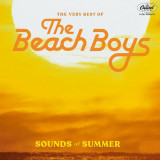
"To kick off the yearlong celebration and provide the perfect summer soundtrack, Capitol Records and UMe will release a newly remastered and expanded edition of The Beach Boys career-spanning greatest hits collection, Sounds Of Summer: The Very Best Of The Beach Boys, on June 17. Originally released in 2003, the album soared to no. 16 in the US and stayed on the chart for 104 weeks. Now certified 4x platinum for sales of nearly four and a half million albums, the collection has been updated in both number of songs and audio quality, expanding the original 30-track best of with 50 more of the band’s most beloved songs for a total of 80 tracks that span their earliest hits to deeper fan-favorite cuts and from their 1962 debut album, Surfin’ Safari through to 1989’s Still Cruisin’.
Assembled by Mark Linett and Alan Boyd, the team behind 2013's GRAMMY® Award-winning SMiLE Sessions and last year’s acclaimed boxed set, Feel Flows – The Sunflower and Surf's Up Sessions 1969-1971, Sounds Of Summer features nearly every US Top 40 hit of The Beach Boys’ incredible career, including “California Girls,” “I Get Around,” “Surfer Girl,” “Surfin’ U.S.A.,” “Fun, Fun, Fun,” “God Only Knows,” “Good Vibrations,” “Be True To Your School,” “Wouldn’t It Be Nice,” “Kokomo,” “Barbara Ann,” “Help Me, Rhonda,” “In My Room,” and many others. Fifty additional tracks showcase a broad mix of songs from across their wide-ranging catalog with some of the many highlights including “All Summer Long,” “Disney Girls,” “Forever,” “Feel Flows,” “Friends,” “Roll Plymouth Rock,” “Sail on Sailor,” “Surf’s Up,” and “Wind Chimes.”
The collection boasts 24 new mixes including two first-time stereo mixes, plus 22 new-and-improved stereo mixes, which in some cases feature the latest in digital stereo extraction technology, allowing for the team to separate the original mono backing tracks for the first time.
The expanded edition of Sounds Of Summer will be available in a variety of formats, including a 3CD softpack, and as a Super Deluxe Edition 6LP vinyl boxed set on 180-gram black vinyl in two options – a standard set or a numbered, limited edition version featuring a rainbow foil slipcase and four collectible lithographs. Both versions will feature color printed sleeves that replicate the original “Capitol Catalog” sleeves that highlight the entire Beach Boys discography, and all formats will include a booklet with new liner notes and updated photos. The original 30-track version will also be available in its newly remastered and upgraded form on single CD or double gatefold LP on standard weight vinyl or as a higher-end limited edition numbered version pressed on 180-gram vinyl with a tip-on jacket and a lithograph. "
Throw on your platform boots and stomp along to the latest 7' double Aside vinyl single and digital release of "Rock N Roller" and "Rock N Roll
Angel" out on Curation Records in May 2023! It's pure bubble glam crunch
rock madness!
Hammered Satin is a glam rock band from Los Angeles California
established in late 2010
Stylistically pulling from what is now known as unkshop Glam from the 1970's. In
other words, they aspire to sound not like David Bowie himself but more like the
hitless wonder wanna- be Bowie's, Bolans, Quatro's, Sweets, Muds ect ad
nauseam. There are also punk or 'Proto Punk" and Bubblegum elements to
Hammered Satin's music that seemingly goes under the radar. The current 2023
lineup includes the three founding members. Noah Wallace lead vocals (formerly
of Teachers's Pet, S'cool Girls), Dan Sandvick Bass, Conor Berhle guitar, and
glampa Don Bolles drums, vocals (formerly of The Germs, Celebrity Skin, 45
Grave among many others). To date Hammered Satin have released two albums,
four two song 7" singles, and four digital-only singles. Their music has made it
onto a few TV shows such as Showtimes 'Dice", and Netflix's cartoon Mr.
Peabody and Sherman. The band has even managed to garner press in Rolling
Stone magazine more than once which is unheard of for an underground band.
Other noteworthy moments were direct support slots for The Ark in Sweden and
The Black Crowes in Las Vegas.
The master sleuths at Dark Entries bring us Forbidden Overture, another tantalizing mystery from the hidden depths of sleaze. It all began years ago when Bijou Video’s Jules Zinn introduced the label to the soundtracks of the pornographic films of legendary filmmaker Steve Scott and gay superstar Al Parker. It wasn’t until The Magazine’s Bob Mainardi gifted a cassette copy of the soundtrack to the film TURNED ON—a bathhouse fantasy from 1982—that the wheels started turning. The steamy, hypnotic sounds were credited only to “Forbidden Overture…” but who was that? This question remained unanswered for some time, and countless hours of research, Venn diagramming, and elaborate flow charts all proved fruitless.
It wasn’t until a chance screening of BAD GIRLS DORMITORY, a 1986 women-in-prison movie from gay porn director Joe Gage that happened to reuse some of the same music did the answer become clear: Forbidden Overture was none other than the mighty Man Parrish!
The soundtrack to TURNED ON consists of two epic side-long pieces, both of which employ classic Man Parrish production techniques. “Primal Overture” slinks along with brooding pads and ominous chords, building and oozing throughout its 27 minute runtime like a sultrier Goblin soundtrack. “Strictly Forbidden” takes a similar groove to a major key, but it’s optimistic chirp conceals a wry, mysterious wink. Says director Steve Scott: “It took us about two weeks to find the right piece for the jockstrap scene. But it's like anything else—you know when it’s right.”
Also included is a 20 page booklet featuring photos, archival material, a pull-out poster, and interviews with Steve Scott and stars Al Parker and Scott Taylor. TURNED ON is an exciting musical rediscovery as well as a vital document of queer history.
This is the album that started it all! Right from the opening guitar chords of "Right Side of My Mind" to Metal Mike's high-pitched vocals -which always sound funny when he's trying to come across all angry, "Inside My Brain" is a non-stop psycho analysis backed up by blaring, tongue in cheek anthems suitable for all those who can't seem to express their anger. Being one of the pivotal bands that fueled the early Southern California punk scene, The Angry Samoans were one of the first bands to prove that one can express their frustrations of day to day life and still have a sense of humor about it; as evident with songs like "You Stupid Assholes" and "My Old Man's a Fatso." And to top it all off, this album was produced by Fear vocalist and all around jerk Lee Ving, who did a decent job capturing The Samoans raw energy. - Allmusic
- Super Freaky Girl
- Roman's Revenge
- Did It On'em
- Beez In The Trap
- Chun-Li
- Do We Have A Problem?
- We Go Up
- High School
- Moment 4 Life
- Truffle Butter
- Itty Bitty Piggy
- Barbie Dreams
- Anaconda
- Super Bass
- Starships
- Pound The Alarm
- Your Love
- Right Thru Me
- Bed
- Favorite
- Save Me
- Fly
- Seeing Green
- Hard White
- Catch Me
- Girls Fall Like Dominoes
- Bussin
- Lookin Ass
Das Album „Queen Radio: Volume 1” der amerikanischen Rapperin und Sängerin Nicki Minaj ist ab dem 07.07. als 3LP erhältlich!
„Queen Radio: Volume 1“ ist das erste Greatest-Hits-Album der amerikanischen Rapperin und Sängerin Nicki Minaj.
Es wurde am 26. August 2022 über Young Money Entertainment und Republic Records veröffentlicht.
Das Album wurde zwei Tage später erneut veröffentlicht, um einen Remix von Skengs 2022er Single ”Likkle Miss” hinzuzufügen.
Das Album enthält Songs aus all ihren Studioalben—”Pink Friday“ (2010), „Pink Friday: Roman Reloaded“ und seine Neuauflage „The Re-Up“ (beide erschienen 2012), „The Pinkprint“ (2014) und „Queen“ (2018).
Songs aus dem Mixtape „Beam Me Up Scotty“ (Originalversion von 2009 und Neuauflage von 2021), der Young Money Entertainment-Compilation „Rise of an Empire“ (2014) und einigen Nicht-Album-Singles, die sie 2022 veröffentlicht hatte. Es wurde überraschend ohne vorherige Ankündigung veröffentlicht. Eine der Singles von 2022 und der Eröffnungstrack des Albums, ”Super Freaky Girl”, debütierte und erreichte den Höhepunkt der Billboard Hot 100.
- A1: The Carver Area High School Seniors - Get Live '83 (The Senior Rap)
- A2: Mike T - Do It Any Way You Wanna
- B1: Chapter Iii - Real Rocking Groove (Rap & Breaks)
- B2: Sinister Two - Rock It, Don't Stop It
- C1: Sangria - To The Beat Y'all
- C2: Funky Four Plus One More - Rappin' And Rocking The House
- C3: The Just Four - Girls Of The World (Genius Rap & Breaks)
- D1: Eye Beta Rock - Super Rock Body Shock
- D2: Funky Constellation - Street Talk (Madam Rapper)
- E1: Kool Kyle The Starchild - Do You Like That Funky Beat (Ahh Beat, Beat)
- E2: The Just Four - Jam To Remember
- F1: Grandmaster Flash And The Furious Five - Super Rappin' No 2
- F2: Silver Star - Eei Eei O
- A1: Magic's Trick - Magic's Rap - Mono (7")
- B1: Magic's Trick - Magic's Rap - Stereo (7")
Yo! Boombox is the new instalment of Soul Jazz Records’ Boombox series on the early days of hip-hop on vinyl and features some of the many innovative underground first-wave of early rap and disco rap records made in the USA in the period 1979-83.
The album includes the first releases of seminal groups such as Grandmaster Flash & The Furious Five and The Funky Four Plus One More through to a host of rarities and little-known obscurities such as the Carver Area High School band’s ‘Get Live 83’, an awesome record made at a Chicago high school.
The album is released as a deluxe triple LP complete with 3x full inner sleeves of extensive sleeve notes, exclusive photography and original label artwork. There is also a very-limited one-pressing only special deluxe version that comes with an extra bonus super-rare 7” single of ‘Magic’s Rap’ by Magic’s Trick, aka ex-marine Magic Fraga, a record that was only ever available on US military bases!
Yo! Boombox also features the stunning photography of Sophie Bramly, one of a very select group of photographers (alongside Henry Chalfant, Martha Cooper, and Joe Conzo) who were allowed full access to document the exciting early days of hip-hop in New York.
These first exuberant wave of innocent, upbeat, party-on-the-block rap records were the first to try and create the sounds heard in community centres, block parties and street jams that first took place in the Bronx in the mid-1970s. Where the first DJs – Flash, Kool Herc and Bambaataa – were back-spinning, mixing and scratching together now classic breakbeat records like The Incredible Bongo Band’s Apache or Babe Ruth’s The Mexican, these first pre-sampling rap records were all made using live bands, often replaying then current disco tunes.
As Chic’s ‘Good Times’ was to ‘Rappers’ Delight’, the songs here feature then-current dancefloor hits such as the Tom Tom Club’s ‘Genius of Love’, Cheryl Lynn’s ‘To Be Real’, MFSB’s ‘Love Is the Message’ while MCs rapped over the top, creating a unique new sound. In fact, the links between disco and rap date back earlier to the ‘party style’ MCing of figures such as the legendary DJ Hollywood or radio DJs like Frankie Crocker.
This new Soul Jazz Records collection
celebrates these first old-school rap
records, bringing together rare, classic
and obscure tracks released in the
early days of rap.
- 1: Little Plastic Castle (2023 Remaster)
- 2: Fuel (03 Remaster)
- 3: Gravel (202 Remaster)
- 4: As Is (2023 Remaster)
- 5: Two Little Girls (2023 Remaster)
- 6: Deep Dish (2023 Remaster)
- 7: Loom (2023 Remaster)
- 8: Pixie (2023 Remaster)
- 9: Swan Dive (2023 Remaster)
- 10: Glass House (2023 Remaster)
- 11: Independence Day (2023 Remaster)
- 12: Pulse (2023 Remaster)
- 13: Gravel (Bed Tracks)
- 14: As Is (Bed Tracks)
- 15: Two Little Girls (Bed Tracks)
Orange Vinyl[39,92 €]
Twenty-five years later, Little Plastic Castle feels like a greatest hits collection. Her highest charting release on Billboard (peaking at #22) and containing her third Grammy nomination for Best Rock Performance - Female (“Glass House”), Ani DiFranco’s ninth studio album shows the Little Folksinger grappling with her independent career bubbling up into the mainstream — dissection of her fashion choices, a new expanded listenership encroaching on the die-hards, examination of what it means to sell out — encapsulated in singalongs so indelible that they’re staples of her live set decades later. This 25th Anniversary Edition sees a new remaster by Heba Kadry, the addition of three bonus tracks mixed by Tchad Blake, and a new CD package and first-time release on vinyl (2 LP). To make Little Plastic Castle, Ani returned to one of her favorite places to record in that era—the live-in studio the Congress House in Austin, Texas. In this relaxed setting she commented, "This album seemed to happen more organically than earlier studio releases." Ani is joined by drummer Andy Stochansky and bassist Jason Mercer who played with her on her 1997 tours, as well as bassist Sara Lee who toured with Ani in 1996. LPC also prominently features outside musicians including drummer Jerry Marotta (Peter Gabriel, Indigo Girls), a horn section composed of three Austin session musicians who add flavor to "Little Plastic Castle" and "Deep Dish," and trumpeter Jon Hassell (Brian Eno, Talking Heads) providing the sustained subtle solo on the 14-minute final track "Pulse." The three bonus tracks are recordings of Ani playing with the rhythm section of Sara Lee and Jerry Marotta, a trio that never reassembled after their single day of tracking. Though Ani described it as “the most light-hearted album I’ve made in a long time,” this record covers a wide range of topics — the impermanence of existence ("Fuel"), mutual respect ("Pixie"), forgiveness ("As Is"), drugs (“Two Little Girls”) — and emotions.
- 1: Little Plastic Castle (2023 Remaster)
- 2: Fuel (03 Remaster)
- 3: Gravel (202 Remaster)
- 4: As Is (2023 Remaster)
- 5: Two Little Girls (2023 Remaster)
- 6: Deep Dish (2023 Remaster)
- 7: Loom (2023 Remaster)
- 8: Pixie (2023 Remaster)
- 9: Swan Dive (2023 Remaster)
- 10: Glass House (2023 Remaster)
- 11: Independence Day (2023 Remaster)
- 12: Pulse (2023 Remaster)
- 13: Gravel (Bed Tracks)
- 14: As Is (Bed Tracks)
- 15: Two Little Girls (Bed Tracks)
Black Vinyl[39,92 €]
Twenty-five years later, Little Plastic Castle feels like a greatest hits collection. Her highest charting release on Billboard (peaking at #22) and containing her third Grammy nomination for Best Rock Performance - Female (“Glass House”), Ani DiFranco’s ninth studio album shows the Little Folksinger grappling with her independent career bubbling up into the mainstream — dissection of her fashion choices, a new expanded listenership encroaching on the die-hards, examination of what it means to sell out — encapsulated in singalongs so indelible that they’re staples of her live set decades later. This 25th Anniversary Edition sees a new remaster by Heba Kadry, the addition of three bonus tracks mixed by Tchad Blake, and a new CD package and first-time release on vinyl (2 LP). To make Little Plastic Castle, Ani returned to one of her favorite places to record in that era—the live-in studio the Congress House in Austin, Texas. In this relaxed setting she commented, "This album seemed to happen more organically than earlier studio releases." Ani is joined by drummer Andy Stochansky and bassist Jason Mercer who played with her on her 1997 tours, as well as bassist Sara Lee who toured with Ani in 1996. LPC also prominently features outside musicians including drummer Jerry Marotta (Peter Gabriel, Indigo Girls), a horn section composed of three Austin session musicians who add flavor to "Little Plastic Castle" and "Deep Dish," and trumpeter Jon Hassell (Brian Eno, Talking Heads) providing the sustained subtle solo on the 14-minute final track "Pulse." The three bonus tracks are recordings of Ani playing with the rhythm section of Sara Lee and Jerry Marotta, a trio that never reassembled after their single day of tracking. Though Ani described it as “the most light-hearted album I’ve made in a long time,” this record covers a wide range of topics — the impermanence of existence ("Fuel"), mutual respect ("Pixie"), forgiveness ("As Is"), drugs (“Two Little Girls”) — and emotions.
In collaboration with Croatian label Sareni Ducan, Discom proudly presents an official reissue of a very rare self-titled album of Yugoslavian 80’s funk band Boom Selekcija.
Boom Selekcija was a short-living group of musicians from Belgrade, active from 1979 to 1983. They recorded their debut and only album for the label Diskos in 1983 and after that disbanded. The line-up included musicians from Boban Petrovic’s backing band and Silva Delovska from Kim Band on vocals. The quality of recorded material and the complete lack of information about the band set them as a cult act among DJs and crate diggers. This is one of the albums which makes you ask ”What is this?” when you hear it, but nobody around could tell you an honest answer.
A side of the record begins with a track called Moje Cake (eng. My Tricks). It is a groovy theme with mellow vocals-a story of the poser who thinks he is very interesting. The same groove continues in the song Rokenrol Štipaljke (Rock And Roll Easy Girls) where friends are preparing for a crazy go out in a discotheque. It ends in a Balearic atmosphere in the songs Studentski San ( eng. A Student’s Dream)- a song about dreaming luxurious life on the Adriatic coastline) and Vladina Gitara (eng. Vlad’s guitar)-a nice dreamy guitar instrumental in the 70’s Yugoslavian style.
Equally groovy and interesting B side portrays naive and charming 80’s Belgrade: discotheques, parties, girls, tough guys, urban stories about real-common people and their destinies … all packed with such style and grace like you are in New York City suburbs in the late ’70s and enjoy perfect funk/soul musicianship. In this sense, you can hear: amazing slap bass by Vladan Mracic in the song Zuljas Me ( eng. You Are Going To My Nerves); cool funky guitar licks by Aleksandar Stefanovic in the song Bora Klej; authentic soul singing style of Mile Perisic and beautiful electric piano solo of Oliver Polak in song Frizerka Nada (eng. Nada, The Hairdresser) and convincing funk rhythm drumming by Zoran SImovski all way through.
This record will remain a significant point for investigating Yugoslavian funk history and it will be welcomed on every dance floor in the world that favors lesser-known grooves. We hope that we will manage to bring it closer to the younger audience and show how people used to live and have a good time in Belgrade and Yugoslavia.
Lanterns On The Lake kündigen ihr neues Album 'Versions Of Us' an, das am 2. Juni über Bella Union erscheint. Die selbstproduzierte fünfte Studio-LP folgt auf das 2020 für den Mercury-Prize nominierte Album 'Spook the Herd'.
Die neun Songs werfen große Gedanken auf, die sich mit den Möglichkeiten des Lebens auseinandersetzen, und der Frage, ob wir unser Schicksal ändern können oder dazu verdammt sind, dieselben Fehler im Leben immer und immer zu wiederholen. Die Stimme von Songwriterin Hazel Wilde liegt schwer über den Songs, die mit melodischen Gitarren, aufwühlenden Vintage-Synthesizern und verträumten Streichern musikalisch und textlich neues Terrain erkunden.
Mental health Probleme und persönliche Konflikte innerhalb der Band hatten einen großen Einfluss darauf, dass eine erste Version des Albums bereits frühzeitig Gestalt annahm, dann aber doch so nicht erschien. Die Band verwarf die Arbeit von fast einem Jahr und ging zu Song-Demos zurück, bei denen nur Hazel Wilde mit Philip Selway von Radiohead am Schlagzeug und an den Percussions neu begann.
- Ltd. Col. LP: (Transparent Orange Vinyl)
In the years since The Aces released their acclaimed sophomore album, ‘Under My Influence’ in 2020, the band has been on a journey of self-discovery. Faced with the realities of a global pandemic, sisters Cristal and Alisa Ramirez (lead vocals/guitar and drums, respectively), Katie Henderson (lead guitar/vocals), and McKenna Petty (bass) used quarantine as a time to reflect, confronting personal mental health issues as well as processing experiences they’d had growing up together in Provo, Utah, as part of the Mormon church. When The Aces returned to the studio, their vision — and the honesty and trust between them — felt stronger than ever. The result of this growth period is ‘I’ve Loved You For So Long,’ the band’s third LP. Written and executive-produced by the group (along with Keith Varon, the sole collaborator on the project), the album is a sparkling indie-rock record that’s by far their most personal and self-assured work to date. From tracks that ruminate on mental health and self-sabotage to searing anthems about love, longing, and heartbreak, ‘I’ve Love You For So Long’ is a record that’ll work its way into your head and heart — and will have you singing along all the way through. ‘I’ve Loved You For So Long’ is also an opportunity for The Aces to reach new heights and build on their many previous successes. To date, the group has earned over 205 million career streams; ‘Under My Influence’ alone garnered more than 75 million (including 35 million on its lead single “Daydream”). The album also appeared on numerous charts, including #53 on Billboard’s Top Albums list. Further, The Aces have toured with the likes of 5 Seconds of Summer, X Ambassadors, The Vamps, and COIN, and have played at festivals all over the world, including NY Pride, Lollapalooza, Firefly, Bonnaroo, OUTFEST, and more. After selling out their last U.S. headline tour in 2021, the band will hit the road again this year, with dates soon to be announced.
Sasu Ripatti presents the third volume in his "Dancefloor Classics" series with five 10" releases coming throughout 2023. Music for imaginary dancefloors, released on Ripatti's own label "Rajaton".
--
”Look up, into the light” she said, while the camera shutter clicked. ”Like this? Does it look holy?” His neck felt stiff. Her reply: ”Yes, just like that. What do you mean holy? Like religious? ”No, more like trying to look very far, somewhere beyond what we can see.” ”Okay, stand still, I’m going to come close to you now. The light hits your face great.” click, click, click.
He noticed her fingernails. They were not polished. Natural. Even somewhat rugged, as if something wore out the fingers slightly. What had these hands held besides the camera? What made the edges of her fingernails drift off?
He thought it’s weird to look straight into the camera. The photographer had closed her left eye, the one not looking into the lens. Then it opened, she looked up, perusing the surroundings, then she closed her eye again, then looked up, closed, looking up, very quickly. It all seemed very professional. Maybe she calculated the light, making sure it’s close to perfect. ”What will these photos look like?” – the thought popped into his head briefly. It was liberating to think it wouldn’t matter.
”What’s that song playing?” he asked. ”Wait a sec, Ol’ Dirty Bastard?” she replied. ”Oh yeah, right. But the sample?” ”Hey, could you look up again, like that. No, lower.”
New directions: ”Look out from the window, turn left.” ”My left or yours?” ”Yours, I always try to think from the direction of my model.” How professional! This is a good shoot, so natural. Should I worry about how the photos look like? No, I don’t want to. His thoughts bounced around. What would the story be like? It’s a big newspaper, everyone will read it. Maybe someone drinks coffee and eats a stroopwafel while they do it. Will they place the waffle on top of the mug for a brief while, so that it gets hot and the syrup melts a little? Then it feels wet, and you can bend the cookie.
She broke his train of thought off midway through: ”Now turn right, but look left, and slightly up, but don’t turn your face right.” ”Umm, like this? Sounds like a set of pilates instructions.” she laughed ”You do pilates?” ”Yeah, it’s hard sometimes. Have you tried?” ”No”, she said. ”I’m not good for sports that are done in groups.” ”Yeah, but in pilates you can just be inside your mind, drowning in your private thoughts.”
”What are you thinking in pilates?” she asked, taking more photos. ”Well, mostly just which way is right. And which left.” click, click.
--
The Undertones um Sänger Feargal Sharkey wurden 1975 in Derry, Nordirland, gegründet und veröffentlichten 1979 ihr Debütalbum "The Undertones", das auf Platz 13 der britischen Charts landete. John und Damian O'Neill verbanden ansteckende Gitarrenhooks mit 60er-Jahre-Garage und 70er-Jahre-Glam-Rock mit Feargal Sharkeys unverkennbarem Gesang. Diese Qualitäten kamen in ihrem Durchbruchshit "Teenage Kicks" zusammen, dessen Schlichtheit an die Ideale der 60er Jahre erinnert. Dieses klassische Debütalbum versprüht so viel unverhohlene Freude in zweiminütigen Drei-Akkord-Popsongs. Es gibt wenig Anmaßung in ihrer kompromisslosen Teenager-Weltanschauung, dass selbst die dunkleren Andeutungen des Lebens in Songs wie dem Selbstmord-Thema "Jimmy Jimmy" mit einem Optimismus vorgetragen werden, der im Gegensatz zu so
vielen ihrer Zeitgenossen steht. Limited Edition Repress auf transparent-grünem Vinyl.
- A1: Ghosts Of Decay (Album Mix)
- A2: Let's All Make Brutalism (Album Mix)
- A3: You've Heard This One Before (Album Mix)
- A4: (B) Owls In Tesco Bags (Album Mix)
- B1: Open Your Head (Album Mix)
- B2: Harder Times (Album Mix)
- B3: (B) We Never Wanted You (Album Mix)
- B4: 98 Russell Street (Album Mix)
- C1: (We Never Needed This) Fascist Groove Thang (Album Mix)
- C2: Thee Difference Ov Girls (Album Mix)
- C3: Empire Statement Humanoid (Album Mix)
- C4: Circus Ov Daath (Album Mix)
- C5: (B) Let Me Dada (Album Mix)
- D1: This Is Phil Talking (Album Mix)
- D2: Sound Ov Thee Crowd (Album Mix)
- D3: I Dare You (Album Mix)
- D4: Borstal Communications (Album Mix)
Sometimes, things "just happen". For months, we’d been working away on various projects and then, without really thinking about it, The Black EP just happened. It seemingly appeared from nowhere.
We’d been talking about the old days; making music with friends and dodgy kit, renting small practice rooms and using makeshift recording studios. It was such a common thing back then, you could pick a dusty space in a half-derelict building for as little as £25 a month. In those days, the Cabs and Human League had studios with posh-sounding names, but in reality, they were the same old workspaces long abandoned by the industries they were built for. Nevertheless, the grand names made them sound magical.
Sheffield had thousands of these spaces, and some still exist today, but their abundance and low-cost made Sheffield a very active place. Someone was always doing something. They’d exploded onto the scene in a flurry of excitement before disappearing just as quickly.
There’s something about these little mesters (workshops) that we believe lives in the very consciousness of Sheffield. It’s one of the reasons we never really had big scenes like Manchester or Leeds. The Hacienda would've never been built here.
We don’t really do big gangs or have that kind of mentality. We tend to exist in little pockets, often leaving each other alone. It would be 30 years before any member of The Black Dog talked to Cabaret Voltaire. Sure, we’d stood outside their practice room as kids, trying to listen in, but never felt any reason to approach. Sheffield is like that.
Once we had the first two tracks of the Black EP, we set off to see Jon at Do It Theesen, where he manually cut the tracks to an extremely limited set of 7" singles using a vinyl lathe. It just felt right to go back to the old ways; a small gang creating something special in workshops and sheds. There’s something very satisfying about it, a perfect circle, if you will.
We pushed further by adopting old practices, working with one synth per person and limiting the use of our computers. We only stopped short of putting everything on beer crates. It seems like madness these days, but there is raw creativity within these confines. Pretty much every band started this way. Depeche Mode travelled to the studio on the London Underground for their first appearance on Top Of The Pops, all lugging a synth each. That's how we approached the creation of this album; stripped back, raw and minimal - it just felt so right.
And then there’s the competitive element that was influenced when the original Human League split and became Human League MK II and Heaven 17. Both continued to use the same studio to write what became the albums "Dare" and "Penthouse and Pavement". There is something about that drive that is very Sheffield, just making stuff and hoping everything falls into place.
In Sheffield, we do things differently, because that’s how we are built. away on various projects and then, without really thinking about it, The Black EP just happened. It seemingly appeared from nowhere.
My name is King So So.
I am, because you are.
I created the Disco in the Sky solely for you, and it is now, finally ready for your glorious arrival. Here, I will welcome you, to dance in the light with me, where you will have fellowship with me, and with one another, and gone will be the days of darkness. Listen, I now stand at your door, Hippie Dance. I am knocking. If you have an ear, hear my voice and let me in. Grant me the pleasure and honour to sit with all of you, and I will allow you to sit with me on my throne in the Sky. Hear what the Spirit of So So says to you: Come dance in the Disco in the Sky, and swim in the Lake of Sweet Dreams with me and there I will manifest myself to you. If you love me, I will give you my Word that I will teach you all things sound and bring you memories of the light for you to return to the Sky. Peace I leave with you. Summon your friends, Hippie Dance. Tell them that I am waiting for all of you. I am ready for you. Tell them to arise! Tell them to go forth to the Disco in the Sky where we will be together until the Kingdom goes.
Yours, like I am, sincerely, King So So“
Blasting off higher than ever before, Metro Boomin proudly presents his anxiously awaited blockbuster new album, HEROES & VILLAINS, out via Boominati Worldwide/Republic Records through Island in UK. Assembling an Avengers-level guest list, the album also notably boasts the likes of John Legend, Future, Chris Brown, Don Toliver, Travis Scott, 21 Savage, Young Nudy, Young Thug, Mustafa, A$AP Rocky, Gunna, and the late Takeoff. It notably serves as his first solo LP in four years and the follow-up to his 2018 full-length debut, Not All Heroes Wear Capes. The latter bowed at #1 on the Billboard 200, picked up a platinum certification, and housed the triple-platinum “Space Cadet” feat. Gunna, platinum “No Complaints” feat. Drake & Offset, platinum “Don’t Come Out The House” feat. 21 Savage, triple-platinum “10 Freaky Girls” feat. 21 Savage, platinum “Overdue” feat. Travis Scott, among others.
First time available on cassette. Gap Girls led by Jacob Rubeck of Surf Curse. Gap Girls is the synth-pop project of Los Angeles DIY scene mainstay Jacob Rubeck. As half of the electrifying indie rock duo Surf Curse, Rubeck is no stranger to a good hook, but when he trades jangly guitars for synths, an entire new world opens up. On his new album Forever Love, Forever After, that world is one of love, hope, and welcomeness. In contrast to the shadowy wistful sounds of Gap Girls’ previous effort ‘Street Desires,’ ‘Forever Love, Forever After’ sounds like an uplifting triumph of love, in all its mysterious shapes and forms. With punchy drum machines, shimmering synths, and chest-rumbling bass, these songs are pure synth-pop bliss for letting love in.
- A1: Derrick L Carter - End Of The Line (Got Change For A $20)
- A2: Monolith - Something Wonderful (Club Mix)
- B1: Smoke City - Mr. Gorgeous (And Miss Curvaceous) (Mood Ii Swing Vocal Mix)
- B2: Armando - The Future (Cajmere's Vision)
- C1: Anneli Drecker - Sexy Love (Röyksopp Romantiske Sløyd)
- C2: A Man Called Adam - The Calling (Stay With Me - Vocal Mix)
- D1: Ten City - That's The Way Love Is (Underground Mix, Extended Version)
- D2: Freaks - Flywithme (Part 1)
Part 1[29,20 €]
A tribute to the late Kenny Hawkes, London's dark lord of house music. Lovingly selected and curated by Luke Solomon, Jonny Rock and Leon Oakey.
Running from 1995 to 2002, 'Space' was a Wednesday night founded by Kenny Hawkes and Luke Solomon. It inhabited the underground world of Bar Rumba right in the heart of London's West End and took place each and every week. Kenny and Luke had both been regular fixtures on infamous London Pirate Radio station 'Girls FM', and were seeking a suitable place to play the kind of music they supported on their respective radio shows. They were presented with a weekly opportunity at Bar Rumba and snapped it up.
'Space' was THE place for 7 solid years, hosting local and international guests from the house music community week in week out, to 200+ hardcore and dedicated followers. Regular guest bookings read like a 'who's who' of the music scene with sets from Derrick Carter, Andrew Weatherall, DJ Harvey, Tom Middleton, A Man Called Adam, Ralph Lawson and Huggy, Harri and Domenic, Francois Kevorkian, Salt City Orchestra, Carl Cox, Chez Damier and Ron Trent.... the list goes on and on and on! Music from seminal record labels such as Classic, Prescription, Cajual, Paper, Relief was played on rotation amongst a killer mix of Disco classics, alternative 80s music, left-field B-sides and techno. The night undeniably became a cauldron of amazing music and midweek hedonistic chaos.
As Soho changed beyond recognition and clubbing moved Eastwards, Kenny and Luke decided to call it a day. Sadly, Kenny Hawkes died in 2011, leaving a huge hole in the dance music community. Kenny was a legendary figure with an unmistakable sound and DJ style, he had a warped sense of humour and a huge personality and he continues to be dearly missed by all to this day.
As a tribute to Kenny, his musical partner in crime Luke Solomon alongside 'Space' regular and DJ / Editor supreme Jonny Rock, and former Classic Records label boss Leon Oakey have joined forces to celebrate his life through music. 3 years of tweaking, pooling music and clearing tracks have culminated in 2 very special double albums and a digital compilation. A collection of 'Space' classics, underground jams and the tracks that shook the Shaftesbury Avenue dance floor, shaping one of London's most revered midweek sessions.
All profits from the compilation will be donated to the British Liver Trust.
Freestyle serve up a slept-on piece of music history with the first ever reissue of Chartz "Girls World" - a prime 1983 boogie-funk groover from out of Wolverhampton, and the first ever release from a songwriting and production partnership that would go on to hit the pop music big time!
----------------
Chartz were a short-lived Wolverhampton-based covers band who also performed original material written by founder members Bernadette (Berny) Cosgrove and Kevin Clark. During its short lifetime Chartz was a springboard for lead singer/guitarist Berny and keyboard player Kevin to showcase and develop their songs, following their originally working together to write and produce jingles. They wrote, arranged and produced this 12" Girls World in 1983 with lyrics "celebrating female strength and independence whilst loving and respecting their partner", says Kevin & Berny. Shortly after this they went on to win a Sony Songwriters of the Year award and moved to London to co-form Hard Times Productions, with the 1986 self-titled Hard Times LP leading to the single "Never Give Into Love" the year after for Supreme Records - and then came the exciting offer of a songwriting contract with Motown's publishing company in New York!
A 10-year spell in the Big Apple saw Berny's solo artist debuts on movie soundtracks "True Love" and Lonely In America", and, after increasingly lucrative publishing deals with the likes of Sony, EMI & Warner Chappell, she and Kevin were commissioned for songwriting projects with an exhaustive list of pop stars spanning from Matt Goss, Rick Astley and Des O'Connor to Gary Barlow, Sheena Easton, Gloria Gaynor, Jimmy Sommerville and countless others. Berny & Kevin also wrote and produced two platinum selling US number 1 albums with boy-band Dream Street, and their biggest song to date is the internatinal hit "Crush" by Jennifer Paige which has sold in excess of 12 million copies worldwide.
Berny & Kevin's illustrious career definitively went from "Chartz" to CHARTS, and here you are able to go back to where it started as we serve up the first ever vinyl reissue of "Girls World" (original copies of which change hands for over £100) with the extended instrumental and radio mix on the flip.
»Love As Projection« is the new album by Frankie Rose, her fifth studio LP and second for Night School following the reissue of her interpretation of The Cure’s »Seventeen Seconds«. Frankie Rose has forged an enviable musical legacy, from playing with bands like Crystal Stilts and The Vivian Girls but on »Love As Projection« she takes a bold step into electronic pop production. A sumptuous recorded statement, it dances in ecstasy and broods on the tumult of the western world’s decay in equal proportion. At the heart of the album is glowing, confident songwriting, resplendent in hooks and choruses but still touched with an optimism undimmed.
After spending nearly two decades establishing herself across New York and Los Angeles independent music circles, Rose re-emerges after six years with a fresh form, aesthetic, and ethos. Celebrated over the years for her expansive approach to songwriting, lush atmospherics, and transcendent vocal melodies and harmonies, »Love As Projection« is a reintroduction of her established style through the lens of contemporary electronic pop. Recorded with producer Brandt Gassman and mixed with long-term collaborator Jorge Elbrecht this is the album Frankie Rose has been building up to her entire career.
More than a rebirth, a refinement, a resurgence, »Love As Projection« boasts a widescreen scope: a long- form project heavily considered for half of a decade, culminating in the most personal and accessible collection of art-pop that Frankie has ever written. When Rose aims for the pop jugular as in first lead track »Anything«, the result is unstoppable. A majestic pop song built for radio, it erupts into an irresistible chorus that marries classic epic 80s American pop with the cult effervescence of Strawberry Switchblade »It’s like a prom scene in a John Hughes movie. It’s a hopeful song about abandoning fear even if the world is quite literally on fire.. In the end, at least we have each other,« says Rose. »Sixteen Ways« further boasts a propulsive, massive chorus, though tempered by a cynicism built in global post-truth, global malaise. »It’s about getting your hopes up, but simultaneously making lists in your head about how it will never work out in your favour.«
The big anthems don’t let up there. On »DOA« some massive, rolling drums lathered in big mid-80s gated reverb dovetail with a syncopated baseline for the ages as Rose’s vocal sails effortlessly above. The effect isn’t unlike ethereal vocalists Clannad circa Howard’s Way or Enya jamming with Simple Minds in their stadium-conquering heyday. Rose tempers the adrenalin with heart-tugging bittersweet tones and there are plenty of them. »Sleeping Night And Day« takes its time with an off-the-cuff chorus, swirling around in harmony and chorus-bass. »Saltwater Girl« picks up the balladeering baton with another nod to album track-mode Switchblade, deep space opening up in the mid-tempo drum track and soupy, digital atmospherics. Album closer »Song For A Horse«, reimagines modern Pop production a-la-PC Music but shorn of the meta-atmosphere. Pianos, swelling synths, minor keys cut through with major. These moments, also seen in Feel Light offer ballast to the soaring pop choruses. Moments like these are big oceans of emotion to fall into before being led out by Rose into a bright new day.
»Love As Projection« is released in the USA by Slumberland.
A tribute to the late Kenny Hawkes, London's dark lord of house music. Lovingly selected and curated by Luke Solomon, Jonny Rock and Leon Oakey.
Running from 1995 to 2002, 'Space' was a Wednesday night founded by Kenny Hawkes and Luke Solomon. It inhabited the underground world of Bar Rumba right in the heart of London's West End and took place each and every week. Kenny and Luke had both been regular fixtures on infamous London Pirate Radio station 'Girls FM', and were seeking a suitable place to play the kind of music they supported on their respective radio shows. They were presented with a weekly opportunity at Bar Rumba and snapped it up.
'Space' was THE place for 7 solid years, hosting local and international guests from the house music community week in week out, to 200+ hardcore and dedicated followers. Regular guest bookings read like a 'who's who' of the music scene with sets from Derrick Carter, Andrew Weatherall, DJ Harvey, Tom Middleton, A Man Called Adam, Ralph Lawson and Huggy, Harri and Domenic, Francois Kevorkian, Salt City Orchestra, Carl Cox, Chez Damier and Ron Trent.... the list goes on and on and on! Music from seminal record labels such as Classic, Prescription, Cajual, Paper, Relief was played on rotation amongst a killer mix of Disco classics, alternative 80s music, left-field B-sides and techno. The night undeniably became a cauldron of amazing music and midweek hedonistic chaos.
As Soho changed beyond recognition and clubbing moved Eastwards, Kenny and Luke decided to call it a day. Sadly, Kenny Hawkes died in 2011, leaving a huge hole in the dance music community. Kenny was a legendary figure with an unmistakable sound and DJ style, he had a warped sense of humour and a huge personality and he continues to be dearly missed by all to this day.
As a tribute to Kenny, his musical partner in crime Luke Solomon alongside 'Space' regular and DJ / Editor supreme Jonny Rock, and former Classic Records label boss Leon Oakey have joined forces to celebrate his life through music. 3 years of tweaking, pooling music and clearing tracks have culminated in 2 very special double albums and a digital compilation. A collection of 'Space' classics, underground jams and the tracks that shook the Shaftesbury Avenue dance floor, shaping one of London's most revered midweek sessions.
All profits from the compilation will be donated to the British Liver Trust.
Hayley released her highly anticipated sophomore album ‘PANORAMA’, on 29th July 2022 on CD, & vinyl 3rd March 2023. Co-written by Hayley and produced by Kiyoko, Danja (Beyoncé, Britney Spears) and Pat Morrissey & Kill Dave, the transformative 12-track collection featured previously released singles, “For The Girls,” “Deep In The Woods,” “Chance,” and “Found My Friends”
“I went through a period of time after my last album where I'd lost my confidence and my self-worth. Thankfully I was surrounded by friends and family who kept me grounded, always supporting me in my lowest moments and reminding me who I was along the way. ‘Panorama’ was the last song I wrote for this album, in a moment of clarity to enjoy the present and not let my trauma define me. One of my favourite lyrics from this song is ‘I’m done confusing all these ashes with my worth,’ which is a metaphor for when we measure our own value only by our struggles and hardships, but in reality, our worth is unwavering. We just need to give ourselves the space to appreciate the highs and the lows of this beautiful journey.” – HAYLEY KIYOKO
In 2018, Hayley was at a high point. Following the success of her gold-certified anthem “Girls Like Girls,” Hayley’s landmark debut album, EXPECTATIONS, reacted with tastemakers and a legion of fans. Hayley resonated with a newfound community who brought her total streams to just shy of 1 billion as she sold out tours on multiple continents, lit up the stage at Coachella, and picked up “Push Artist of the Year” at the MTV VMAs.
Since her 2015 debut, Hayley has amassed over 606 million+ career WW audio streams, 507 million+ YouTube lifetime video views, and over 6 million followers across socials, notably 1.9m on Instagram and 1.7m on TikTok alone.
BLACK & WHITE VINYL[26,26 €]
If credibility were currency, FAKE NAMES" wealth would be off the charts. Composed of Brian Baker (Minor Threat, Bad Religion, Dag Nasty), Michael Hampton (S.O.A., Embrace), Dennis Lyxzén (Refused, INVSN, The International Noise Conspiracy), Johnny Temple (Girls Against Boys, Soulside) and the newest member Brendan Canty (Fugazi, Rites of Spring), the band is a veritable post-hardcore dream team. However instead of rehashing the past, Expendables is a reinvention that sees the band dialing back the distortion and leaning into the melodies. The result pairs their unparalleled pedigree with a pop sensibility that"s slightly unexpected and wholly satisfying. "For our last record 2019"s FAKE NAMESthe general influences were 70"s U.K. punk and power-pop; but it wound up with a little classic rock vibe as well, like the Vibrators meets Aerosmith. We never saw that coming!" , Baker explains. For Expendables the band enlisted producer Adam "Atom" Greenspan (IDLES, Yeah Yeah Yeahs). Baker explains, "The pop influences are a little more out front on this one and the production really helps it shine. It sounds more direct, more urgent." Expendables is the latest exchange in a musical conversation that spans four decades. Baker aptly refers to the lineup of FAKE NAMES as a "mutual admiration society" and says that once the five members got in the same room together, it felt as if they had already been in the band together for years.
Black Vinyl[21,81 €]
LIMITED BLACK & WHITE COLOURED VINYL EDIT
If credibility were currency, FAKE NAMES" wealth would be off the charts. Composed of Brian Baker (Minor Threat, Bad Religion, Dag Nasty), Michael Hampton (S.O.A., Embrace), Dennis Lyxzén (Refused, INVSN, The International Noise Conspiracy), Johnny Temple (Girls Against Boys, Soulside) and the newest member Brendan Canty (Fugazi, Rites of Spring), the band is a veritable post-hardcore dream team. However instead of rehashing the past, Expendables is a reinvention that sees the band dialing back the distortion and leaning into the melodies. The result pairs their unparalleled pedigree with a pop sensibility that"s slightly unexpected and wholly satisfying. "For our last record 2019"s FAKE NAMESthe general influences were 70"s U.K. punk and power-pop; but it wound up with a little classic rock vibe as well, like the Vibrators meets Aerosmith. We never saw that coming!" , Baker explains. For Expendables the band enlisted producer Adam "Atom" Greenspan (IDLES, Yeah Yeah Yeahs). Baker explains, "The pop influences are a little more out front on this one and the production really helps it shine. It sounds more direct, more urgent." Expendables is the latest exchange in a musical conversation that spans four decades. Baker aptly refers to the lineup of FAKE NAMES as a "mutual admiration society" and says that once the five members got in the same room together, it felt as if they had already been in the band together for years.
Local Action is proud to present Cyclorama, the long-awaited debut album by Ariel Zetina.
A resident DJ at Chicago’s iconic Smartbar, a long-standing Discwoman family member and a key part of the city’s dance music and LGBTQ+ communities, Ariel has established herself as one of the most exciting electronic artists operating today - through releases such as 2020’s acclaimed MUAs at the End of the World and 2017’s Organism, and her meticulous approach to DJ mixes - as recently evidenced on Sestina, her 2020 contribution to Mixtape Club.
Written across 2021 and honed this Spring, Cyclorama is Ariel’s most impressive and all-encompassing work yet, showcasing her as a producer, vocalist and also curator, pulling together an ensemble cast of her peers in Chicago (Cae Monāe, Mia Arevalo, DANNN) and some of the most exciting names in contemporary club music (Violet, Bored Lord).
Conceptually, Cyclorama draws heavily from Ariel’s background as a theater writer and producer. Popularized in 19th century German theater, a cyclorama (or cyc) is a large curtain, placed on the back wall of the stage. This creates an illusion of extra depth in the background, and often is used to represent the sky. In Ariel’s words, “I imagine all the tracks on this as the lights and action projected onto the cyclorama. The whole album is like the cyc, a representation of the sky. Or an imagined sky. An imagined dancefloor. An imagined theatrical production.”
As well as drawing conceptually from Ariel’s background in theater, the album draws on a personal level from Ariel’s journey as a trans woman of color - most directly on Cyclorama’s three vocal tracks, ‘Gemstone’, ‘Slab of Meat’ and lead single ‘Have You Ever’.
On ‘Have You Ever’, Ariel collaborates with Cae Monāe, a dear friend and fellow trans woman of color. “‘Have you ever been with a girl like me before?’ and all the lyrics refers to the fear and anxiety that cis men who are attracted to trans women feel, and also any woman that doesn’t fit the mold of a stereotypical woman”, Ariel explains. “Cae and I - and many trans women - have been in so many situations where society tells cis men they cannot be with trans women and this explores that and gives power to all trans women in this situation. The techno reflects that, as well as the “Spell my name” section at the end, showing the true power of trans women.”
On ‘Slab of Meat’, Ariel delivers a hypnotic solo vocal performance that builds in intensity with each line (“I am treated like a slab of meat both emotionally and sexually sometimes, especially one left in the freezer on the back burner. Why did you bring this meat home from the market? For what? You’re wasting meat!”), while ‘Gemstone’, a collaboration with Mia Arevalo, continues the empowering themes of ‘Have You Ever’ in a different context:
“‘Gemstone’ is a call for trans women to take time with your transition because it will all happen eventually. As two girls who have started our transition almost a decade ago, I think we have both seen that we have always needed to take our time to take our time. Reminders not to rush or compare yourself to other girls. I love the metaphor of gemstone months representing different periods of transition. I’ve been so many different women in recent years, and I'm excited to continue my journey.”
It’s immediately followed by album closer ‘Tropical Depression’, the title of which is a reference to Ariel growing up with tropical depressions, storms and hurricanes affecting her hometown of Jacksonville, Florida as well as her family in Belize City:
“This track for me is about living day to day and continuing while dealing with my really intense clinical depression. The sample comes from “Why can’t you let me go?” but is supposed to be transformative and not necessarily legible. How we hold on to our trauma and depression like a protective shell. This is an attempt to deal with it in a different way.”
The Cyclorama album cover, directed by Dylan Bragassa, stars Ariel alongside Monāe and Arevalo in an imagined theater production. In Ariel’s words, “a theoretical performance starring only trans women of color - I wanted an ensemble shot to represent the ensemble nature of this album! Love how Dylan combines so many ideas to create a very unique image that asks so many questions.”
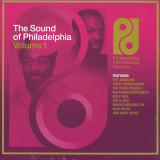
- A1: Mfsb - Tsop (The Sound Of Philadelphia) (The Sound Of Philadelphia)
- A2: The O'jays - Love Train
- A3: Hardol Melvin & The Blue Notes - Wake Up Everybody
- A4: Archie Bell & The Drells - Don't Let Love Get You Down
- B1: The Jacksons - Show You The Way To Go
- B2: Mcfadden & Whitehead - Ain't No Stoppin' Us Now
- B3: The O'jays - Back Stabbers
- B4: The Three Degrees - When Will I See You Again
- C1: Billy Paul - Me & Mrs Jones
- C2: Harold Melvin & The Blue Notes - If You Don't Know Me By Now (Feat Teddy Pendergrass)
- C3: Teddy Pendergrass - The Whole Town's Laughing At Me
- C4: Lou Rawls - You'll Never Find Another Love Like Mine
- D1: The Jones Girls - Nights Over Egypt
- D2: Dexter Wansel - The Sweetest Pain
- D3: Jean Carn - Don't Let It Go To Your Head
- D4: Archie Bell & The Drells - Let's Groove
- A1: Gloria: In Excelsis Deo / Gloria (Version) - Patti Smith
- A2: Survive - The Bags
- A3: Iama Poseur - X-Ray Spex
- A4: I Gave My Punk Jacket To Rickie - Mary Monday & The Bitches
- A5: I Didn’t Have The Nerve To Say No - Blondie
- A6: You’re A Million - The Raincoats
- B1: Popcorn Boy (Waddle Ya Do?) - Essential Logic
- B2: Expert - Pragvec
- B3: My Cherry Is In Sherry - Ludus
- B4: Kray Twins - Mo-Dettes
- B5: Earthbeat - The Slits
- B6: Das Ah Riot - Bush Tetras
- C1: Bitchen Summer (Speedway) - Bangles
- C2: Shakedown - Au Pairs
- C3: It’s About Time - The Pandoras
- C4: Come On Now - The Pussywillows
- C5: Rules And Regulations - We’ve Got A Fuzzbox And We’re Gonna Use It!!
- C6: Her Jazz - Huggy Bear
- C7: Bruise Violet - Babes In Toyland
- D1: Rebel Girl - Bikini Kill
- D2: Pretend We’re Dead - L7
- D3: What’s Wrong With You - Bratmobile
- D4: Let Go Of The Past - The Tuts
- D5: Hot - The Regrettes
- D6: Silver Spoons – Skinny Girl Diet
• “Guerrilla Girls!”, Ace Records’ much-anticipated first release of 2023, takes us on a thrilling ride from punk’s mid-70s origins, via the left-field post-punk groups, jangly female combos, grunge bands and vigilante Riot Grrrls of the 80s and 90s, to the she-punk bands of recent years – a five-decade alternative to the macho hegemony of rock.
• The collection highlights songs that emerged out of a dynamic underculture of female creative expression. What unites the featured artists is a healthy disregard for the way the music industry ties up its female performers into pretty, neo-liberal packages. From Patti Smith, universal mother of the punk movement, to the Bags, Bikini Kill and Skinny Girl Diet, this music is anti-A&R. Including lesser-known names such as San Francisco street punk Mary Monday and London-based experimentalists pragVec, it shows that, rather than being a few novelty bands existing on the margins, these performers represent a stronger, more three-dimensional version of the female experience.
• Glorious resistance was on display in the first wave of UK female-fronted punk bands. Poly Styrene’s charged vocals on X-Ray Spex’s ‘Iama Poseur’, for instance, were a deliberate refusal to be a pretty punkette. With 15 year-old Lora Logic on saxophone, X-Ray Spex epitomised a fearless, self-defined agency that was at odds with the pastel shades and flowery, submissive Laura Ashley version of 1970s girlhood. By the early 80s, there was a hugely vibrant scene propelled by the diverse rhythms and voices of post-punk feminism. Lora Logic had left X-Ray Spex to form the interweaving textures of Essential Logic, the Mo-dettes mangled ska and off-kilter pop, and Birmingham band Au Pairs sliced political rigour into their lyrics and funky guitar work.
• Some female artists took that elemental energy into pop, creating pop-punk with a twist. We’ve Got A Fuzzbox And We’re Gonna Use It!! made a statement on music technology and female power with a cheeky play on words. Their song ‘Rules And Regulations’ shows that what Guerrilla Girls do well is debunking – taking genres of popular song and turning them inside out – like the way the Pandoras and the Pussywillows would amp up the driving beat and high vocals of the 60s girl group style, and subvert it with a DIY garage element.
• In its fanzine culture, use of montage and DIY music, 90s Riot Grrrl bands such as Bikini Kill and Bratmobile drew direct inspiration from 70s punk, articulated through the prism of Third Wave feminism. Too often, Riot Grrrl gigs were invaded by men intent on heckling “the enemy”. Liz Naylor, manager of British Riot Grrrl band Huggy Bear, says that their concerts became war zones. From the US grunge and Riot Grrrl scenes emerged more female instrumentalists, with bands such as L7 and Babes In Toyland proving that it was possible to recruit cutting-edge drummers, bass players and guitarists. Lori Barbero, whose relentless power drumming is a major element of Babes In Toyland, took the one instrument that has been a staple of male rock’n’roll and made it her muse.
• In the 2000s a new generation of girl-punk bands drew on the Riot Grrrl underculture to form their own sound. London trio the Tuts refashioned C86, Riot Grrrl and lush dream pop on songs like the ironically titled ‘Let Go Of The Past’, while the Regrettes injected shots of ska and doo wop into their explosive West Coast pop-punk. What began with Patti Smith and 70s punk has grown into a vast, spikey infrastructure of girl music. Many take inspiration from their foremothers, like Skinny Girl Diet whose vigilante feminism and punk distortion has been championed in return by Viv Albertine of the Slits. As long as these female artists stay aware of their musical vision and what they are trying to express – in a sense, A&R themselves – the underculture will continue to grow and flower. And this “Guerrilla Girls!” compilation is a celebration of that power.
• The back sleeve of the release features a scene-setting introductory essay by Lucy O’Brien (author of She Bop: The Definitive History Of Women In Popular Music). Each of the two discs come in a swanky inner bag containing a track commentary by compiler Mick Patrick (Ace Records’ long-serving champion of female artists of all persuasions) and exclusive interviews with many of the featured artists by Vim Renault and Lene Cortina (founders of the Punk Girl Diaries webzine).
"Favourite tunesThe tunes are like my children....there is a whole heap of them !! Iwant to tell you this though...some of them i never released properly but 'A Class Girls' through it was the first one me love that, the rhythm! I don't know how the song never hit in Jamaica but listening to it back now its like you are branding the girls A and B so (perhaps) the girls weren't happy with it.But it was a good tune,wicked tune.
Tony Chin wrote it ,but it was Tony Chin and Chinna who taught me these thingsso I have to lovethose men forever"
Ossie Thomas
Triston Palmer was born in 1962 and grew up in Waltham Park,Kingston.
Triston knew from a very early age that he was destined to become an entertainer and his first visit to an recording studio at the age of 16 was with Ossie Thomas.
Their initial release was 'A Class Girls',which was a hit in England and Triston's subsequent releases on their Black Solidarity label laid the foundation for his rapid rise to dance super stardom.
As the 80's progressed and Dancehall began its inexorable rise to ubiquity the popularity of Triston Palmer who had 9 songs in the top forty was unstoppable.
So sit back and enjoy this selection of killer tunes.....
- A1: Long Time Me No See You Girl
- A2: Love & Devotion
- A3: Jumping With Mr Lee
- A4: Hold Your Jack
- A5: Bangerang
- A6: Little Boy Blue
- A7: Story Of Love
- B1: A Change Is Gonna Come
- B2: Jumping With Val
- B3: Girls Like Dirt
- B4: Tribute To King Sterling
- B5: Somebody's Baby
- B6: Sounds & Soul
- B7: My Conversation
- B8: Sir Lee's Whip
The period of 1967 – 1968 when Rocksteady was in full flow, would also be a turning point for Bunny ‘Striker’ Lee, when he became a producer in his own right. Many of the great tunes during this eventful year came out of his stable and initially saw the light of day on his own imprint label ‘Lee’s’. This album has been assembled from some of those fine tunes and tells the story of reggae in what was a stellar time for both reggae and Mr Bunny Lee.
Edward ‘Bunny’ Lee later to become known as ‘Striker’ (b.23rd August 1941) got his introduction to the music business around 1962 when his future brother in law singer Derrick Morgan introduced Bunny to producer Duke Reid, who gave him a job as record plugger for his Treasure Isle label. 1966 saw Bunny Lee move on to working for producer Ken Lack who ran his own label Caltone. Bunny’s first credit as a producer was released on the label when he produced ‘Lloyd Jackson and the Groovers’ with a tune called ‘Listen To The Music’.
As we stated earlier by 1967 Bunny Lee was leading the way and his vast stable of singers, were producing hit after hit for him. Many of those artists are featured on this compilation. The Sensations ‘Long Time Me No See You Girl’, the Uniques that featured the great Slim Smith are here on some of their greatest cuts ‘Love and Devotion’ and ‘The Beatitude’, ‘Girls Like Dirt’. ‘My Conversation’ a song that would be a big hit for the Uniques would also go on to be of the most covered songs and redone over rhythms, in the history of reggae music. The great singer Pat Kelly features on ‘Somebody’s Baby’ and ‘Little Boy Blue’ all massive hits, when originally released. Bunny’s love of Jazz and the brass sections would also shine through with some of Jamaica’s finest musicians featured here with the excellent tenor sax work of Val Bennett which gave us our album title track ‘Jumping With Mr Lee’ and ‘Jumping With Val’. The Alto sax work of Lester Sterling are featured on the timeless cut ‘Bangerang’ and ‘Tribute To Scratch’. The big sound of Trombonist ‘Vin Gordon’ features on ‘Sounds and Soul’. Not forgetting the previously mentioned King of Ska Derrick Morgan on ‘Hold Your Jack’. A song that in a few years’ time would provide the backbone for Mr Max Romeo’s cross over and controversial hit ‘Wet Dream’. So yes, a fine collection of tracks from the great producer Bunny ‘Striker’ Lee. Sit back and enjoy the reggae music of 1967-1968 with of the best sounds in town.Sit back and enjoy…..
Bubbling up from the psychedelic tar pits of L.A., Frankie and the Witch Fingers have been a constant source of primordial groove for the better part of the last decade. Formed and incubated in Bloomington, IN before moving west to scrap with Los Angeles’ garage rock rabble, the band evolved from cavern-clawed echo merchants to architects of prog-infected psych epics that evoke a shift in reality. After a stretch on Chicago/LA flagship Permanent Records the band landed at yet another fabled enclave of garage and psychedelia - Brooklyn’s Greenway Records, now working in tandem with psych powerhouse LEVITATION and their label The Reverberation Appreciation Society, the groups latest effort is dually supported by a RAS / Greenway co-release. After years of searching for the specific alchemy that would tear open the cosmos, they found the formula with the addition of Shaughnessy Starr on drums in the summer of 2018. They began a new cycle and tripped into tip-on double gatefold territory, flesh-ing out their lysergic impulses into a monolith of sound that closes in from all sides. The band reached new levels of grandiosity and utilized every minute to manifest their psych-soul Sabbath in four dimensions, spilling psychic blood on a populace ready and eagerly waiting. Yet, as expansive, inventive, and immersive as any studio album might be, the band is born for the stage. As their live prowess caught the ears of some legends in their own right, the band practically lived on the road last year with stints opening for Oh Sees, Cheap Trick and ZZ Top. Along the way the constant pulpit of the stage would form ZAM into a transformative experience while plotting their next permutation of space and time. That transformation, Monsters Eating People Eating Monsters... (repeated infinitely,) rises like a Phoenix from the road tar, van exhaust, and ozone crackle of amps in heat. Once off the road it was recorded in just five blistering days. Though, while the tour may have hammered the album into shape and brought about a wind of change, those changes stretched to the band itself as well. In the wake of the tour the band’s longtime bassist Alex Bulli made his exit, with the majority of bass parts on the album being written and played by multi-instrumental magician Josh Menashe with occasional pitch in from songwriter Dylan Sizemore. Stripped to their core the band has created their most ambitious work to date, an album that takes the turbulence of ZAM and crafts it into a beast more insidious and singular than anything in their catalog. Moving forward, the band has taken on new blood. Completing their lineup, Nikki Pickle (of Death Valley Girls) will join them working the new album out roadside on bass. A new horizon of Frankie and the Witch Fingers draws near and we’re all set to follow them into the unknown.
Freedom is both an integral and multi-layered topic for improvised music, describing its mechanics, aesthetics, and values and often an underlying political dimension as well. In the case of free jazz specifically, the word carries additional weight given the music's deep connection to the black liberation movement of the 1960's and 70's.
The passionate and unclassifiable work of Calgary-based improviser Jairus Sharif embraces each of these definitions of freedom and others, albeit strictly on its own personal and idiosyncratic terms. Since early 2020, the 34 year-old autodidact has been generating a steady stream of homespun solo recordings that forge unprecedented connections between hip-hop abstraction, cosmic skronk, outsider jazz, and staunch post-punk DIY ethos.
Leading up to the pandemic, Sharif's immersion in spiritual and exploratory jazz had culminated in him deciding to purchase an alto saxophone. Unbeknownst to him this instrument would be a catalyst for him to discover his own ardently individualistic artistic voice.
Prior to that point, he had always been somewhat of a solitary musical traveler. In 2002, he acquired his first instrument—a pair of Technics 1200s — but struggled to find local collaborators that had equal investment in hip hop culture. Ultimately, Sharif picked up the guitar, turning to the resilient local punk community, that had also nurtured both of his mothers some time earlier.
As Black Lives Matter gained momentum in the wake of George Floyd's murder, Sharif was suddenly flooded with an acute awareness of his own identity. It compelled him to zealously plunge headlong into open-ended spontaneous solo creation. Water & Tools, his strange and stirring debut for Toronto's Telephone Explosion Records (home to full-lengths from the likes of Brodie West's Eucalyptus, Mas Aya, and Joseph Shabason), offers a glimpse into this ongoing hermetic journey.
As Sharif dedicated himself to uncovering his own deeper musical truths, he assembled a home studio in his basement, cobbling together a drum kit from bits his bandmate had left at his house pre-pandemic, chaining effects together and outfitting the entire space with microphones. Somewhere between the chaos of child's treehouse and the tidy import of a shrine, this space (pictured on the album's back cover) consecrated his own imagination. He laid it out to maximize access to any and every tool in his arsenal, providing him a freedom to explore that he had never permitted himself to consummate before.
Within this cozy private universe, his recent purchase—the saxophone—assumed new meaning. It furnished a tangible connection to the black radicalism that mobilized free jazz, but also something far more personal. From a technical standpoint, the instrument was completely unfamiliar to him, yet rather than this being a hindrance to Sharif, his inexperience opened fruitful path forward, unencumbered by preconceptions. Resolving to shirk formal training, convention, and build his own understanding of it from scratch, allowed him to access his most raw, fundamental creative impulses. The Saxophone's inseverable bond with breath compounded this effect, echoing revelatory discoveries he had been making about breathing through yoga, research, and psychotherapy. Of course, the parallels with BLM's harrowing rallying cry—“I can't breathe”—were not lost on him either.
Water & Tools is a dense, contradictory statement with a blustery surface that shelters a soulful heart. It's generous music, exuding profound vulnerability—grappling with the loss of one his mothers, Lisa—all the while brimming with electric wide-eyed wonder. Almost every one of the nine pieces seems to carry some semblance of a groove, while remaining completely untethered from pulse. For Sharif, this collection is an expression of newfound lucidity, however for the listener his sonic concoctions act as powerful psychotropics. At points, there's a timelessness that's conveyed through the music's processional, ritualistic tenor, and yet there's an endless amount of wild, futuristic detail waiting to unspool at any given moment. Similarly, while this recording emerges from Sharif's private pilgrimage and personal emancipation, he also leaves room for collaboration. Woven throughout Sharif's one-man-ensemble textures, one finds Maxmilian Turnbull (of Badge Epoque, U.S. Girls, and Cosmic Range infamy) providing sundry keyboards and treatments, as well as his mixing skills.
Whether conjuring effusive psychedelia or plumbing introspective depths, the music that Jairus Sharif produces is singular, visceral, and wondrously unpredictable. Water & Tools sketches a raw, firsthand account of his nascent explorations within his own unbridled imagination.
- A1: Dua Lipa - Be The One
- A2: Avicii - Hey Brother
- A3: James Bay - Hold Back The River
- A4: Jessie J - Price Tag
- A5: Niall Horan - Slow Hands
- A6: Dermot Kennedy - Power Over Me
- A7: Years & Years - King
- B1: Katy Perry - Roar
- B2: Sheppard - Geronimo
- B3: Of Monsters & Men - Little Talks
- B4: The Weeknd - Starboy
- B5: Scouting For Girls - This Ain't A Love Song
- B6: Neon Trees - Animal
- B7: Lana Del Rey - Blue Velvet
- C1: Miley Cyrus - Malibu
- C2: Axwell & Ingrosso - More Than You Know
- C3: Dnce - Cake By The Ocean
- C4: Lorde - Royals
- C5: Mike Posner - I Took A Pill In Ibiza (Seeb Remix)
- C6: Ellie Goulding - Love Me Like You Do
- C7: Hozier - Take Me To Church
- D1: Bruno Mars - Locked Out Of Heaven
- D2: Icona Pop - I Love It
- D3: Tom Walker - Leave A Light On
- D8: The Teskey Brothers - Hold Me
- D4: American Authors - Best Day Of My Life
- D5: Tove Lo - Stay High (Feat Hippie Sabotage - Habits Remix)
- D6: Sam Smith - Stay With Me
- D7: Bastille - Pompeii
The Decades Collected compilations are part of the new Collected compilation series, which is a collaboration between Universal Music and Music On Vinyl. The compilations bring together the biggest names of each decade, combined with forgotten hits and less discovered gems, giving the listener an experience of listening to their favorite tunes while uncovering new musical grounds at the same time.
Various Artists - Tens Collected features Sam Smith “Stay With Me”, Lorde “Royals”, The Weeknd “Starboy”, Dua Lipa “Be The One”, Niall Horan “Slow Hands” and Ellie Goulding “Love Me Like You Do” amongst others.
- A1: St Pauli Second Line (Live)
- A2: Something's Missing (Live)
- A3: Arabesque Breakin&Apos; Suite (Live)
- A4: Theme From Beverly Hills Cop (Axel F)
- A5: Four Two Three (Live)
- A6: Silent Heroes (Live)
- B1: Carry On (Live)
- B2: Munich Psycholympics (Live)
- B3: Ghost Walk (Live)
- B4: Let The Music Play (Live)
- B5: Where Do We Go From Here (Live)
A unique longplayer by Germany's Funk champions The Mighty Mocambos: 'Scénarios' is a wild journey through iconic performances captured on 8-track tape, including celebrated versions of breakdance favourites like 'Axel F.' And 'Let The Music Play' as well as brand new original material composed especially for recordings in unusual settings.
Hamburg's deep funk chefs are known for their intuitive recordings that capture the energy of a live performance, and with this record they go all the way.
Just before the pandemic, the group recorded an in-store live session at legendary Hamburg record shop Groove City and taped an impromptu performance at JAM PDM! breakdance battle in Potsdam. Both were released on vinyl 45s, quickly sold out and became secret weapons for DJs. While most bands shifted their stage to the studio in 2020, producing an abundance of isolated lockdown-inspired material, the Mighty Mocambos – never shy of an antidote - took the mobile version of their recording studio on the road.
With no audience allowed at the Pitt Hopkins Music Session charity concert, the group used the occasion to compose meditative folk-soul instrumentals to be performed exclusively on stringed instruments. Sweaty funk does not work via video stream, but the format provided a welcome opportunity to create something entirely different. Even without electricity and drums, the cinematic "Four Two Three" and "Silent Heroes" are unmistakably recognizable as Mocambo themes.
When you follow Nina Simone's credo that an "artist's duty is to reflect the times", it became evident that once the world slowly started opening up again, further concerts would be captured on the group's portable Fostex R-8 tape machine. Luckily, restrictions fell on the very evening that the band hit the open air stage at the Import Export in Munich on September 11th 2021. The extended afrobeat-inspired jam on J.J. Cale's "Carry On" witnesses people celebrating and dancing together again for the first time after a year and the manic "Munich Psycholympics" unleashes all bottled-up energies that had being lying dormant.
The slightly kafka-esque "Ghost Walk" was taped during a soundcheck for a concert that was eventually called off for safety reasons, reflecting once more the uncertainty of the time. The last scénario sees the Mighty Mocambos returning to a packed indoor venue, playing "Let The Music Play" to a audience of b-boys and -girls – a testament to the sheer power of music. Featured as an encore here, an acoustic version of "Where Do We Go From Here?" (originally recorded with Lee Fields) closes the record and its restless voyage through unusual recording situations.
"Scénarios" differs drastically from other live albums as it does not seek to replicate existing material from studio albums. All songs were written or arranged especially for the live recordings in order to combine the group's DJ-friendly trademark sound with added vibes and momentum from the audience. Most of them were recorded while they were performed in public for the first time ever.
Comes in gatefold sleeve & includes download voucher.
d 04: Theme from Beverly Hills Cop (Axel F) Live
What Are People For? make the perfect kind of dystopic dance music for our times. Born from a collaboration between artist Anna McCarthy and musician/producer Manuela Rzytki, the band could be the illicit lovechild of Tom Tom Club and Throbbing Gristle, displaying the ideal balance of hip shaking vibes and dark provocative content.
On their collaborative debut, McCarthy and Rzytki share songwriting duties. The album was produced by Rzytki herself. They are joined by Paulina Nolte on backing vocals and Tom Wu on drums, while Keith Tenniswood mastered the record.
The whole project stems from a publication and exhibition by McCarthy laying the foundations for the content and lyrics of the album, which is humorous, poetic and political. As a lyricist, McCarthy uses her storytelling ability to explore anxieties and desires, digging into free surreal word associations reminiscent of Su Tissues’ tongue in cheek experiments with Suburban Lawns, but also explosive and gripping like a Kae Tempest rap.
Rzytki’s precise sonic palette and talent at penning structured bangers perfectly complement McCarthy’s playful and subversive language manipulations. Rzytki's beats are rooted in old school Hiphop loop principles and an authentic love for the analog. Her use of an array of synthesizers and other "real" instruments adds to WAPF's depth, soul and sincerity.
The album opens with a joyful anthem, full of energy and melodic hooks. The audience is confronted with the quintessential titular question What Are People For? and told that they are just a mere disposable commodity. Throughout the album, lyrical themes revolve around underground aspects of society, violence, political ideologies, sexuality and mysticism. The content is deep but the album is as danceable as it is biting.
73, with its drum machine hysteria and hypnotic synth basses is a a text collage written on the 73 bus through London, consisting of situations and conversation snippets encountered along the way. Drones indulges in the narrator’s paranoia as they feel they are being watched by cigarette machines, whilst the haunting choir is half spoken, half sung, ending on the orgasmic chanting of the word “mummy”. Nursery Rhyme brings more soothing incantations. There is definitely an affinity for fairytales, albeit adult ones and especially the anarchistic ones such as The Moomins, who were a consistent influence on the band. The artwork for the record, created by McCarthy, is a beautiful children's book-style painting of the group in a forest, seemingly about to engage in a magical encounter to which we are invited.
WAPF? have absorbed and digested a variety of influences. Trip hop, Punk and Techno are rubbing shoulders on Party Time. 1977 was coined “Summer of Hate” in the UK and unsurprisingly in WAPF?’s Summer of War, ethereal singing alternates with a powerful marching Garage/Grime chorus reminiscent of street protests and UK culture.
Mz. Lazy starts like an invitation to meditation and references Gertrude Stein’s book Ida in which she develops the idea that publicity is a new religion and people are now famous for being famous. Repressed anger explodes into violence and freedom at the end of the song as our heroine eventually grabs an axe to destroy her oppressors.
Fantasize, on its part, is raw, sexual and liberating while the closing track Bring Back the Dirt is a welcome hymn into a world that is becoming more and more sanitised.
While exploring deep subject matters throughout their album, WAPF? manage to remain satirical, exciting and funny. Each and everyone of their songs have a cathartic quality.
The visual identity of the band is intrinsic to their appeal. Live, they are eccentric, wild and unapologetic, wearing see-through costumes, bright miniskirts and intricate headpieces while delivering their songs with sharp intensity. Their performances radiate queer sexiness and transcend B52's thrift store aesthetics, creating a space for collective dreaming.
WAPF? is a rare combination of contemporary punk energy, irresistible groove, absurdist dry humour and astounding depth of field. They have the mighty power to create a party with their music and soon you will find yourself lifting your arms as if controlled by an external force, to chant: WAPF? WAPF? WAPF?
– Marie Merlet (Malphino, Little Trouble Girls, London)
- A1: Rock This Mother
- A2: Talk To Me Girl
- A3: You Can Find Me
- A4: Check This Out
- A5: Jesus Going To Clean House
- A6: Hope You Understood
- A7: Is It What You Want
- A8: Love Is Everlasting
- A9: This Is Hip-Hop Art
- A10: Opposite Of Love
- A11: Do You Know What I Mean
- B1: Saving All My Love For You
- B2: Look Out Here I Come
- B3: Girl You Always Talking
- B4: Have A Great Day
- B5: Take My Hand
- B6: I Need Your Love
- B7: Your Town
- B8: Talk Around Town
- B9: Booty Head/Take A Little Walk
- B10: I Love My Mama
- B11: I Never Found Anyone Like You
Vinyl LP[23,49 €]
As the sun sets on a quaint East Nashville house, a young man bares a piece of his soul. Facing the camera, sporting a silky suit jacket/shirt/slacks/fingerless gloves ensemble that announces "singer" before he's even opened his mouth, Lee Tracy Johnson settles onto his stage, the front yard. He sways to the dirge-like drum machine pulse of a synth-soaked slow jam, extends his arms as if gaining his balance, and croons in affecting, fragile earnest, "I need your love… oh baby…"
Dogs in the yard next door begin barking. A mysterious cardboard robot figure, beamed in from galaxies unknown and affixed to a tree, is less vocal. Lee doesn't acknowledge either's presence. He's busy feeling it, arms and hands gesticulating. His voice rises in falsetto over the now-quiet dogs, over the ambient noise from the street that seeps into the handheld camcorder's microphone, over the recording of his own voice played back from a boombox off-camera. After six minutes the single, continuous shot ends. In this intimate creative universe there are no re-takes. There are many more music videos to shoot, and as Lee later puts it, "The first time you do it is actually the best. Because you can never get that again. You expressing yourself from within."
"I Need Your Love" dates from a lost heyday. From some time in the '80s or early '90s, when Lee Tracy (as he was known in performance) and his music partner/producer/manager Isaac Manning committed hours upon hours of their sonic and visual ideas to tape. Embracing drum machines and synthesizers – electronics that made their personal futurism palpable – they recorded exclusively at home, live in a room into a simple cassette deck. Soul, funk, electro and new wave informed their songs, yet Lee and Isaac eschewed the confinement of conventional categories and genres, preferring to let experimentation guide them.
"Anytime somebody put out a new record they had the same instruments or the same sound," explains Isaac. "So I basically wanted to find something that's really gonna stand out away from all of the rest of 'em." Their ethos meant that every idea they came up with was at least worth trying: echoed out half-rapped exhortations over frantic techno-style beats, gospel synth soul, modal electro-funk, oddball pop reinterpretations, emo AOR balladry, nods to Prince and the Fat Boys, or arrangements that might collapse mid-song into a mess of arcade game-ish blips before rallying to reach the finish line. All of it conjoined by consistent tape hiss, and most vitally, Lee's chameleonic voice, which managed to wildly shape shift and still evoke something sincere – whether toggling between falsetto and tenor exalting Jesus's return, or punctuating a melismatic romantic adlib with a succinct, "We all know how it feels to be alone."
"People think we went to a studio," says Isaac derisively. "We never went to no studio. We didn't have the money to go to no studio! We did this stuff at home. I shot videos in my front yard with whatever we could to get things together." Sometimes Isaac would just put on an instrumental record, be it "Planet Rock" or "Don't Cry For Me Argentina" (from Evita), press "record," and let Lee improvise over it, yielding peculiar love songs, would-be patriotic anthems, or Elvis Presley or Marilyn Monroe tributes. Technical limitations and a lack of professional polish never dissuaded them. They believed they were onto something.
"That struggle," Isaac says, "made that sound sound good to me."
In the parlance of modern music criticism Lee and Isaac's dizzying DIY efforts would inevitably be described as "outsider." But "outsider" carries the burden of untold additional layers of meaning if you're Black and from the South, creating on a budget, and trying to get someone, anyone within the country music capital of the world to take your vision seriously. "What category should we put it in?" Isaac asks rhetorically. "I don't know. All I know is feeling. I ain't gonna name it nothing. It's music. If it grabs your soul and touch your heart that's what it basically is supposed to do."
=
Born in 1963, the baby boy of nine siblings, Lee Tracy spent his earliest years living amidst the shotgun houses on Nashville's south side. "We was poor, man!" he says, recalling the outhouse his family used for a bathroom and the blocks of ice they kept in the kitchen to chill perishables. "But I actually don't think I really realized I was in poverty until I got grown and started thinking about it." Lee's mom worked at the Holiday Inn; his dad did whatever he had to do, from selling fruit from a horse drawn cart to bootlegging. "We didn't have much," Lee continues, "but my mother and my father got us the things we needed, the clothes on our back." By the end of the decade with the city's urban renewal programs razing entire neighborhoods to accommodate construction of the Interstate, the family moved to Edgehill Projects. Lee remembers music and art as a constant source of inspiration for he and his brothers and sisters – especially after seeing the Jackson 5 perform on Ed Sullivan. "As a small child I just knew that was what I wanted to do."
His older brother Don began musically mentoring him, introducing Lee to a variety of instruments and sounds. "He would never play one particular type of music, like R&B," says Lee. "I was surrounded by jazz, hard rock and roll, easy listening, gospel, reggae, country music; I mean I was a sponge absorbing all of that." Lee taught himself to play drums by beating on cardboard boxes, gaining a rep around the way for his timekeeping, and his singing voice. Emulating his favorites, Earth Wind & Fire and Cameo, he formed groups with other kids with era-evocative band names like Concept and TNT Connection, and emerged as the leader of disciplined rehearsals. "I made them practice," says Lee. "We practiced and practiced and practiced. Because I wanted that perfection." By high school the most accomplished of these bands would take top prize in a prominent local talent show. It was a big moment for Lee, and he felt ready to take things to the next level. But his band-mates had other ideas.
"I don't know what happened," he says, still miffed at the memory. "It must have blew they mind after we won and people started showing notice, because it's like everybody quit! I was like, where the hell did everybody go?" Lee had always made a point of interrogating prospective musicians about their intentions before joining his groups: were they really serious or just looking for a way to pick up girls? Now he understood even more the importance of finding a collaborator just as committed to the music as he was.
=
Isaac Manning had spent much of his life immersed in music and the arts – singing in the church choir with his family on Nashville's north side, writing, painting, dancing, and working various gigs within the entertainment industry. After serving in the armed forces, in the early '70s he ran The Teenage Place, a music and performance venue that catered to the local youth. But he was forced out of town when word of one of his recreational routines created a stir beyond the safe haven of his bohemian circles.
"I was growing marijuana," Isaac explains. "It wasn't no business, I was smoking it myself… I would put marijuana in scrambled eggs, cornbread and stuff." His weed use originated as a form of self-medication to combat severe tooth pain. But when he began sharing it with some of the other young people he hung out with, some of who just so happened to be the kids of Nashville politicians, the cops came calling. "When I got busted," he remembers, "they were talking about how they were gonna get rid of me because they didn't want me saying nothing about they children because of the politics and stuff. So I got my family, took two raggedy cars, and left Nashville and went to Vegas."
Out in the desert, Isaac happened to meet Chubby Checker of "The Twist" fame while the singer was gigging at The Flamingo. Impressed by Isaac's zeal, Checker invited him to go on the road with him as his tour manager/roadie/valet. The experience gave Isaac a window into a part of the entertainment world he'd never encountered – a glimpse of what a true pop act's audience looked like. "Chubby Checker, none of his shows were played for Black folks," he remembers. "All his gigs were done at high-class white people areas." Returning home after a few years with Chubby, Isaac was properly motivated to make it in Music City. He began writing songs and scouting around Nashville for local talent anywhere he could find it with an expressed goal: "Find someone who can deliver your songs the way you want 'em delivered and make people feel what you want them to feel."
One day while walking through Edgehill Projects Isaac heard someone playing the drums in a way that made him stop and take notice. "The music was so tight, just the drums made me feel like, oh I'm-a find this person," he recalls. "So I circled through the projects until I found who it was.
"That's how I met him – Lee Tracy. When I found him and he started singing and stuff, I said, ohhh, this is somebody different."
=
Theirs was a true complementary partnership: young Lee possessed the raw talent, the older Isaac the belief. "He's really the only one besides my brother and my family that really seen the potential in me," says Lee. "He made me see that I could do it."
Isaac long being a night owl, his house also made for a fertile collaborative environment – a space where there always seemed to be a new piece of his visual art on display: paintings, illustrations, and dolls and figures (including an enigmatic cardboard robot). Lee and Issac would hang out together and talk, listen to music, conjure ideas, and smoke the herb Isaac had resumed growing in his yard. "It got to where I could trust him, he could trust me," Isaac says of their bond. They also worked together for hours on drawings, spreading larges rolls of paper on the walls and sketching faces with abstract patterns and imagery: alien-like beings, tri-horned horse heads, inverted Janus-like characters where one visage blurred into the other.
Soon it became apparent that they didn't need other collaborators; self-sufficiency was the natural way forward. At Isaac's behest Lee, already fed up with dealing with band musicians, began playing around with a poly-sonic Yamaha keyboard at the local music store. "It had everything on it – trumpet, bass, drums, organ," remembers Lee. "And that's when I started recording my own stuff."
The technology afforded Lee the flexibility and independence he craved, setting him on a path other bedroom musicians and producers around the world were simultaneously following through the '80s into the early '90s. Saving up money from day jobs, he eventually supplemented the Yamaha Isaac had gotten him with Roland and Casio drum machines and a Moog. Lee was living in an apartment in Hillside at that point caring for his dad, who'd been partially paralyzed since early in life. In the evenings up in his second floor room, the music put him in a zone where he could tune out everything and lose himself in his ideas.
"Oh I loved it," he recalls. "I would really experiment with the instruments and use a lot of different sound effects. I was looking for something nobody else had. I wanted something totally different. And once I found the sound I was looking for, I would just smoke me a good joint and just let it go, hit the record button." More potent a creative stimulant than even Isaac's weed was the holistic flow and spontaneity of recording. Between sessions at Isaac's place and Lee's apartment, their volume of output quickly ballooned.
"We was always recording," says Lee. "That's why we have so much music. Even when I went to Isaac's and we start creating, I get home, my mind is racing, I gotta start creating, creating, creating. I remember there were times when I took a 90-minute tape from front to back and just filled it up."
"We never practiced," says Isaac. "See, that was just so odd about the whole thing. I could relate to him, and tell him about the songs I had ideas for and everything and stuff. And then he would bring it back or whatever, and we'd get together and put it down." Once the taskmaster hell bent on rehearsing, Lee had flipped a full 180. Perfection was no longer an aspiration, but the enemy of inspiration.
"I seen where practicing and practicing got me," says Lee. "A lot of musicians you get to playing and they gotta stop, they have to analyze the music. But while you analyzing you losing a lot of the greatness of what you creating. Stop analyzing what you play, just play! And it'll all take shape."
=
"I hope you understood the beginning of the record because this was invented from a dream I had today… (You tell me, I'll tell you, we'll figure it out together)" – Lee Tracy and Isaac Manning, "Hope You Understand"
Lee lets loose a maniacal cackle when he acknowledges that the material that he and Isaac recorded was by anyone's estimation pretty out there. It's the same laugh that commences "Hope You Understand" – a chaotic transmission that encapsulates the duality at the heart of their music: a stated desire to reach people and a compulsion to go as leftfield as they saw fit.
"We just did it," says Lee. "We cut the music on and cut loose. I don't sit around and write. I do it by listening, get a feeling, play the music, and the lyrics and stuff just come out of me."
The approach proved adaptable to interpreting other artists' material. While recording a cover of Whitney Houston's pop ballad "Saving All My Love For You," Lee played Whitney's version in his headphones as he laid down his own vocals – partially following the lyrics, partially using them as a departure point. The end result is barely recognizable compared with the original, Lee and Isaac having switched up the time signature and reinvented the melody along the way towards morphing a slick mainstream radio standard into something that sounds solely their own.
"I really used that song to get me started," says Lee. "Then I said, well I need something else, something is missing. Something just came over me. That's when I came up with 'Is It What You Want.'"
The song would become the centerpiece of Lee and Isaac's repertoire. Pushed along by a percolating metronomic Rhythm King style beat somewhere between a military march and a samba, "Is It What You Want" finds Lee pleading the sincerity of his commitment to a potential love interest embellished by vocal tics and hiccups subtlely reminiscent of his childhood hero MJ. Absent chord changes, only synth riffs gliding in and out like apparitions, the song achieves a lingering lo-fi power that leaves you feeling like it's still playing, somewhere, even after the fade out.
"I don't know, it's like a real spiritual song," Lee reflects. "But it's not just spiritual. To me the more I listen to it it's like about everything that you do in your everyday life, period. Is it what you want? Do you want a car or you don't want a car? Do you want Jesus or do you want the Devil? It's basically asking you the question. Can't nobody answer the question but you yourself."
In 1989 Lee won a lawsuit stemming from injuries sustained from a fight he'd gotten into. He took part of the settlement money and with Isaac pressed up "Saving All My Love For You" b/w "Is It What You Want" as a 45 single. Isaac christened the label One Chance Records. "Because that's all we wanted," he says with a laugh, "one chance."
Isaac sent the record out to radio stations and major labels, hoping for it to make enough noise to get picked up nationally. But the response he and Lee were hoping for never materialized. According to Isaac the closest the single got to getting played on the radio is when a disk jock from a local station made a highly unusual announcement on air: "The dude said on the radio, 107.5 – 'We are not gonna play 'Is It What You Want.' We cracked up! Wow, that's deep.
"It was a whole racist thing that was going on," he reflects. "So we just looked over and kept on going. That was it. That was about the way it goes… If you were Black and you were living in Nashville and stuff, that's the way you got treated." Isaac already knew as much from all the times he'd brought he and Lee's tapes (even their cache of country music tunes) over to Music Row to try to drum up interest to no avail.
"Isaac, he really worked his ass off," says Lee. "He probably been to every record place down on Music Row." Nashville's famed recording and music business corridor wasn't but a few blocks from where Lee grew up. Close enough, he remembers, for him to ride his bike along its back alleys and stumble upon the occasional random treasure, like a discarded box of harmonicas. Getting in through the front door, however, still felt a world away.
"I just don't think at the time our music fell into a category for them," he concedes. "It was before its time."
=
Lee stopped making music some time in the latter part of the '90s, around the time his mom passed away and life became increasingly tough to manage. "When my mother died I had a nervous breakdown," he says, "So I shut down for a long time. I was in such a sadness frame of mind. That's why nobody seen me. I had just disappeared off the map." He fell out of touch with Isaac, and in an indication of just how bad things had gotten for him, lost track of all the recordings they'd made together. Music became a distant memory.
Fortunately, Isaac kept the faith. In a self-published collection of his poetry – paeans to some of his favorite entertainment and public figures entitled Friends and Dick Clark – he'd written that he believed "music has a life of its own." But his prescience and presence of mind were truly manifested in the fact that he kept an archive of he and Lee's work. As perfectly imperfect as "Is It What You Want" now sounds in a post-Personal Space world, Lee and Isaac's lone official release was in fact just a taste. The bulk of the Is It What You Want album is culled from the pair's essentially unheard home recordings – complete songs, half-realized experiments, Isaac's blue monologues and pronouncements et al – compiled, mixed and programmed in the loose and impulsive creative spirit of their regular get-togethers from decades ago. The rest of us, it seems, may have finally caught up to them.
On the prospect of at long last reaching a wider audience, Isaac says simply, "I been trying for a long time, it feels good." Ever the survivor, he adds, "The only way I know how to make it to the top is to keep climbing. If one leg break on the ladder, hey, you gotta fix it and keep on going… That's where I be at. I'll kill death to make it out there."
For Lee it all feels akin to a personal resurrection: "It's like I was in a tomb and the tomb was opened and I'm back… Man, it feels so great. I feel like I'm gonna jump out of my skin." Success at this stage of his life, he realizes, probably means something different than what it did back when he was singing and dancing in Isaac's front yard. "What I really mean by 'making it,'" he explains isn't just the music being heard but, "the story being told."
Occasionally Lee will pull up "Is It What You Want" on YouTube on his phone, put on his headphones, and listen. He remembers the first time he heard his recorded voice. How surreal it was, how he thought to himself, "Is that really me?" What would he say to that younger version of himself now?
"I would probably tell myself, hang in there, don't give up. Keep striving for the goal. And everything will work out."
Despite what's printed on the record label, sometimes you do get more than one chance.
Star Feminine Band: a 2020 debut, first journey and a 2022 return! Though not exactly a world music label, Born Bad took up the challenge and released Star Féminine Band's debut album in late 2020. Heaps of acclaims and praise and the whole shebang, then boom: the tour that was to materialize, live, all of the band and its entourage's hopes got cancelled due to Covid. After a long delay, the band finally managed to get to Europe, performing on the Transmusicales Festival, as well as for TV stations like Arte, TV5 and BBC to much acclaim. "Once they played, Born Bad and the band clearly had a "mission accomplished" feeling - that all the energy put into this was worth it, starting with the critics who abounded at the Transmusicales to weigh the phenomenon. They left convinced, just like the audience, enthralled by the direct, live formula. The sequel to the adventures of these new ambassadors for Unicef? They persist and sign with a feverish and energetic soundtrack in which nabo, peulh and waama are enlivened with drum lines and spiced up with more "modern" sounds, spreading words of tolerance and kindness. Simple and direct, they speak of their reality, of the ills of young women who don't always have a choice. Often out of school and destined to selling peanuts, bananas or gari on the roadside, most of the girls around there don't have a future. Forced marriage, precocious pregnancies_ "These kids are heroines!", continues Born Bads JB who, by welcoming them in a record studio, allowed for the formula to be sharpened into a sort of garage band with an afro twist. Thanks to the English lessons that their manager Jérémie Verdier has been providing every Sunday night for two years over videoconference, the girls even experimented with English lyrics in "We Are Star Feminine Band" and "Woman Stand Up". In Paris is the happy outcome of that challenge. Vinyl LP in printed under sleeve with French + UK linernotes + Download code * Digipak CD includes 12 pages booklet with French + UK linernotes.
Limited Edition LP re-press on White Vinyl. At the core of Death Valley Girls, vocalist/multi-instrumentalist Bonnie Bloomgarden and guitarist Larry Schemel channel a modern spin on Funhouse’s sonic exorcisms, ZZ Top’s desert-blasted riffage, and Sabbath’s occult menace. On their third album Darkness Rains, Death Valley Girls churn out the hypercharged scuzzy rock every generation yearns for, but there is a more subversive force percolating beneath the surface that imbues the band with an exhilarating cosmic energy. Album opener “More Dead” is a rousing wake up call, with a hypnotic guitar riff and an intoxicating blown-out solo underscoring Bloomgarden’s proclamation that you’re “more dead than alive.” The pace builds with “(One Less Thing) Before I Die”, a distillate of Detroit’s proto-punk sound. At track three, Death Valley Girls hit their stride with “Disaster (Is What We’re After)”, a rager that takes the most boisterous moments off Exile On Main Street and injects it with Zeppelin’s devil’s-note blues. Darkness Rains retains its intoxicating convocations across ten tracks, climaxing with the hypnotic guitar drones and cult-like chants of “TV In Jail On Mars.” “Death Valley Girls are a gift to the world.” - Iggy Pop
Tracklisting 1. More Dead 2. (One Less Thing) Before I Die 3. Disaster (Is What We’re After) 4. Unzip Your Forehead 5. Wear Black 6. Abre Camino 7. Born Again and Again 8. Street Justice 9. Occupation: Ghost Writer 10. TV in Jail on Mars
- A1: Rock This Mother
- A2: Talk To Me Girl
- A3: You Can Find Me
- A4: Check This Out
- A5: Jesus Going To Clean House
- A6: Hope You Understood
- A7: Is It What You Want
- A8: Love Is Everlasting
- A9: This Is Hip-Hop Art
- A10: Opposite Of Love
- A11: Do You Know What I Mean
- B1: Saving All My Love For You
- B2: Look Out Here I Come
- B3: Girl You Always Talking
- B4: Have A Great Day
- B5: Take My Hand
- B6: I Need Your Love
- B7: Your Town
- B8: Talk Around Town
- B9: Booty Head/Take A Little Walk
- B10: I Love My Mama
- B11: I Never Found Anyone Like You
Cassette[11,72 €]
As the sun sets on a quaint East Nashville house, a young man bares a piece of his soul. Facing the camera, sporting a silky suit jacket/shirt/slacks/fingerless gloves ensemble that announces "singer" before he's even opened his mouth, Lee Tracy Johnson settles onto his stage, the front yard. He sways to the dirge-like drum machine pulse of a synth-soaked slow jam, extends his arms as if gaining his balance, and croons in affecting, fragile earnest, "I need your love… oh baby…"
Dogs in the yard next door begin barking. A mysterious cardboard robot figure, beamed in from galaxies unknown and affixed to a tree, is less vocal. Lee doesn't acknowledge either's presence. He's busy feeling it, arms and hands gesticulating. His voice rises in falsetto over the now-quiet dogs, over the ambient noise from the street that seeps into the handheld camcorder's microphone, over the recording of his own voice played back from a boombox off-camera. After six minutes the single, continuous shot ends. In this intimate creative universe there are no re-takes. There are many more music videos to shoot, and as Lee later puts it, "The first time you do it is actually the best. Because you can never get that again. You expressing yourself from within."
"I Need Your Love" dates from a lost heyday. From some time in the '80s or early '90s, when Lee Tracy (as he was known in performance) and his music partner/producer/manager Isaac Manning committed hours upon hours of their sonic and visual ideas to tape. Embracing drum machines and synthesizers – electronics that made their personal futurism palpable – they recorded exclusively at home, live in a room into a simple cassette deck. Soul, funk, electro and new wave informed their songs, yet Lee and Isaac eschewed the confinement of conventional categories and genres, preferring to let experimentation guide them.
"Anytime somebody put out a new record they had the same instruments or the same sound," explains Isaac. "So I basically wanted to find something that's really gonna stand out away from all of the rest of 'em." Their ethos meant that every idea they came up with was at least worth trying: echoed out half-rapped exhortations over frantic techno-style beats, gospel synth soul, modal electro-funk, oddball pop reinterpretations, emo AOR balladry, nods to Prince and the Fat Boys, or arrangements that might collapse mid-song into a mess of arcade game-ish blips before rallying to reach the finish line. All of it conjoined by consistent tape hiss, and most vitally, Lee's chameleonic voice, which managed to wildly shape shift and still evoke something sincere – whether toggling between falsetto and tenor exalting Jesus's return, or punctuating a melismatic romantic adlib with a succinct, "We all know how it feels to be alone."
"People think we went to a studio," says Isaac derisively. "We never went to no studio. We didn't have the money to go to no studio! We did this stuff at home. I shot videos in my front yard with whatever we could to get things together." Sometimes Isaac would just put on an instrumental record, be it "Planet Rock" or "Don't Cry For Me Argentina" (from Evita), press "record," and let Lee improvise over it, yielding peculiar love songs, would-be patriotic anthems, or Elvis Presley or Marilyn Monroe tributes. Technical limitations and a lack of professional polish never dissuaded them. They believed they were onto something.
"That struggle," Isaac says, "made that sound sound good to me."
In the parlance of modern music criticism Lee and Isaac's dizzying DIY efforts would inevitably be described as "outsider." But "outsider" carries the burden of untold additional layers of meaning if you're Black and from the South, creating on a budget, and trying to get someone, anyone within the country music capital of the world to take your vision seriously. "What category should we put it in?" Isaac asks rhetorically. "I don't know. All I know is feeling. I ain't gonna name it nothing. It's music. If it grabs your soul and touch your heart that's what it basically is supposed to do."
=
Born in 1963, the baby boy of nine siblings, Lee Tracy spent his earliest years living amidst the shotgun houses on Nashville's south side. "We was poor, man!" he says, recalling the outhouse his family used for a bathroom and the blocks of ice they kept in the kitchen to chill perishables. "But I actually don't think I really realized I was in poverty until I got grown and started thinking about it." Lee's mom worked at the Holiday Inn; his dad did whatever he had to do, from selling fruit from a horse drawn cart to bootlegging. "We didn't have much," Lee continues, "but my mother and my father got us the things we needed, the clothes on our back." By the end of the decade with the city's urban renewal programs razing entire neighborhoods to accommodate construction of the Interstate, the family moved to Edgehill Projects. Lee remembers music and art as a constant source of inspiration for he and his brothers and sisters – especially after seeing the Jackson 5 perform on Ed Sullivan. "As a small child I just knew that was what I wanted to do."
His older brother Don began musically mentoring him, introducing Lee to a variety of instruments and sounds. "He would never play one particular type of music, like R&B," says Lee. "I was surrounded by jazz, hard rock and roll, easy listening, gospel, reggae, country music; I mean I was a sponge absorbing all of that." Lee taught himself to play drums by beating on cardboard boxes, gaining a rep around the way for his timekeeping, and his singing voice. Emulating his favorites, Earth Wind & Fire and Cameo, he formed groups with other kids with era-evocative band names like Concept and TNT Connection, and emerged as the leader of disciplined rehearsals. "I made them practice," says Lee. "We practiced and practiced and practiced. Because I wanted that perfection." By high school the most accomplished of these bands would take top prize in a prominent local talent show. It was a big moment for Lee, and he felt ready to take things to the next level. But his band-mates had other ideas.
"I don't know what happened," he says, still miffed at the memory. "It must have blew they mind after we won and people started showing notice, because it's like everybody quit! I was like, where the hell did everybody go?" Lee had always made a point of interrogating prospective musicians about their intentions before joining his groups: were they really serious or just looking for a way to pick up girls? Now he understood even more the importance of finding a collaborator just as committed to the music as he was.
=
Isaac Manning had spent much of his life immersed in music and the arts – singing in the church choir with his family on Nashville's north side, writing, painting, dancing, and working various gigs within the entertainment industry. After serving in the armed forces, in the early '70s he ran The Teenage Place, a music and performance venue that catered to the local youth. But he was forced out of town when word of one of his recreational routines created a stir beyond the safe haven of his bohemian circles.
"I was growing marijuana," Isaac explains. "It wasn't no business, I was smoking it myself… I would put marijuana in scrambled eggs, cornbread and stuff." His weed use originated as a form of self-medication to combat severe tooth pain. But when he began sharing it with some of the other young people he hung out with, some of who just so happened to be the kids of Nashville politicians, the cops came calling. "When I got busted," he remembers, "they were talking about how they were gonna get rid of me because they didn't want me saying nothing about they children because of the politics and stuff. So I got my family, took two raggedy cars, and left Nashville and went to Vegas."
Out in the desert, Isaac happened to meet Chubby Checker of "The Twist" fame while the singer was gigging at The Flamingo. Impressed by Isaac's zeal, Checker invited him to go on the road with him as his tour manager/roadie/valet. The experience gave Isaac a window into a part of the entertainment world he'd never encountered – a glimpse of what a true pop act's audience looked like. "Chubby Checker, none of his shows were played for Black folks," he remembers. "All his gigs were done at high-class white people areas." Returning home after a few years with Chubby, Isaac was properly motivated to make it in Music City. He began writing songs and scouting around Nashville for local talent anywhere he could find it with an expressed goal: "Find someone who can deliver your songs the way you want 'em delivered and make people feel what you want them to feel."
One day while walking through Edgehill Projects Isaac heard someone playing the drums in a way that made him stop and take notice. "The music was so tight, just the drums made me feel like, oh I'm-a find this person," he recalls. "So I circled through the projects until I found who it was.
"That's how I met him – Lee Tracy. When I found him and he started singing and stuff, I said, ohhh, this is somebody different."
=
Theirs was a true complementary partnership: young Lee possessed the raw talent, the older Isaac the belief. "He's really the only one besides my brother and my family that really seen the potential in me," says Lee. "He made me see that I could do it."
Isaac long being a night owl, his house also made for a fertile collaborative environment – a space where there always seemed to be a new piece of his visual art on display: paintings, illustrations, and dolls and figures (including an enigmatic cardboard robot). Lee and Issac would hang out together and talk, listen to music, conjure ideas, and smoke the herb Isaac had resumed growing in his yard. "It got to where I could trust him, he could trust me," Isaac says of their bond. They also worked together for hours on drawings, spreading larges rolls of paper on the walls and sketching faces with abstract patterns and imagery: alien-like beings, tri-horned horse heads, inverted Janus-like characters where one visage blurred into the other.
Soon it became apparent that they didn't need other collaborators; self-sufficiency was the natural way forward. At Isaac's behest Lee, already fed up with dealing with band musicians, began playing around with a poly-sonic Yamaha keyboard at the local music store. "It had everything on it – trumpet, bass, drums, organ," remembers Lee. "And that's when I started recording my own stuff."
The technology afforded Lee the flexibility and independence he craved, setting him on a path other bedroom musicians and producers around the world were simultaneously following through the '80s into the early '90s. Saving up money from day jobs, he eventually supplemented the Yamaha Isaac had gotten him with Roland and Casio drum machines and a Moog. Lee was living in an apartment in Hillside at that point caring for his dad, who'd been partially paralyzed since early in life. In the evenings up in his second floor room, the music put him in a zone where he could tune out everything and lose himself in his ideas.
"Oh I loved it," he recalls. "I would really experiment with the instruments and use a lot of different sound effects. I was looking for something nobody else had. I wanted something totally different. And once I found the sound I was looking for, I would just smoke me a good joint and just let it go, hit the record button." More potent a creative stimulant than even Isaac's weed was the holistic flow and spontaneity of recording. Between sessions at Isaac's place and Lee's apartment, their volume of output quickly ballooned.
"We was always recording," says Lee. "That's why we have so much music. Even when I went to Isaac's and we start creating, I get home, my mind is racing, I gotta start creating, creating, creating. I remember there were times when I took a 90-minute tape from front to back and just filled it up."
"We never practiced," says Isaac. "See, that was just so odd about the whole thing. I could relate to him, and tell him about the songs I had ideas for and everything and stuff. And then he would bring it back or whatever, and we'd get together and put it down." Once the taskmaster hell bent on rehearsing, Lee had flipped a full 180. Perfection was no longer an aspiration, but the enemy of inspiration.
"I seen where practicing and practicing got me," says Lee. "A lot of musicians you get to playing and they gotta stop, they have to analyze the music. But while you analyzing you losing a lot of the greatness of what you creating. Stop analyzing what you play, just play! And it'll all take shape."
=
"I hope you understood the beginning of the record because this was invented from a dream I had today… (You tell me, I'll tell you, we'll figure it out together)" – Lee Tracy and Isaac Manning, "Hope You Understand"
Lee lets loose a maniacal cackle when he acknowledges that the material that he and Isaac recorded was by anyone's estimation pretty out there. It's the same laugh that commences "Hope You Understand" – a chaotic transmission that encapsulates the duality at the heart of their music: a stated desire to reach people and a compulsion to go as leftfield as they saw fit.
"We just did it," says Lee. "We cut the music on and cut loose. I don't sit around and write. I do it by listening, get a feeling, play the music, and the lyrics and stuff just come out of me."
The approach proved adaptable to interpreting other artists' material. While recording a cover of Whitney Houston's pop ballad "Saving All My Love For You," Lee played Whitney's version in his headphones as he laid down his own vocals – partially following the lyrics, partially using them as a departure point. The end result is barely recognizable compared with the original, Lee and Isaac having switched up the time signature and reinvented the melody along the way towards morphing a slick mainstream radio standard into something that sounds solely their own.
"I really used that song to get me started," says Lee. "Then I said, well I need something else, something is missing. Something just came over me. That's when I came up with 'Is It What You Want.'"
The song would become the centerpiece of Lee and Isaac's repertoire. Pushed along by a percolating metronomic Rhythm King style beat somewhere between a military march and a samba, "Is It What You Want" finds Lee pleading the sincerity of his commitment to a potential love interest embellished by vocal tics and hiccups subtlely reminiscent of his childhood hero MJ. Absent chord changes, only synth riffs gliding in and out like apparitions, the song achieves a lingering lo-fi power that leaves you feeling like it's still playing, somewhere, even after the fade out.
"I don't know, it's like a real spiritual song," Lee reflects. "But it's not just spiritual. To me the more I listen to it it's like about everything that you do in your everyday life, period. Is it what you want? Do you want a car or you don't want a car? Do you want Jesus or do you want the Devil? It's basically asking you the question. Can't nobody answer the question but you yourself."
In 1989 Lee won a lawsuit stemming from injuries sustained from a fight he'd gotten into. He took part of the settlement money and with Isaac pressed up "Saving All My Love For You" b/w "Is It What You Want" as a 45 single. Isaac christened the label One Chance Records. "Because that's all we wanted," he says with a laugh, "one chance."
Isaac sent the record out to radio stations and major labels, hoping for it to make enough noise to get picked up nationally. But the response he and Lee were hoping for never materialized. According to Isaac the closest the single got to getting played on the radio is when a disk jock from a local station made a highly unusual announcement on air: "The dude said on the radio, 107.5 – 'We are not gonna play 'Is It What You Want.' We cracked up! Wow, that's deep.
"It was a whole racist thing that was going on," he reflects. "So we just looked over and kept on going. That was it. That was about the way it goes… If you were Black and you were living in Nashville and stuff, that's the way you got treated." Isaac already knew as much from all the times he'd brought he and Lee's tapes (even their cache of country music tunes) over to Music Row to try to drum up interest to no avail.
"Isaac, he really worked his ass off," says Lee. "He probably been to every record place down on Music Row." Nashville's famed recording and music business corridor wasn't but a few blocks from where Lee grew up. Close enough, he remembers, for him to ride his bike along its back alleys and stumble upon the occasional random treasure, like a discarded box of harmonicas. Getting in through the front door, however, still felt a world away.
"I just don't think at the time our music fell into a category for them," he concedes. "It was before its time."
=
Lee stopped making music some time in the latter part of the '90s, around the time his mom passed away and life became increasingly tough to manage. "When my mother died I had a nervous breakdown," he says, "So I shut down for a long time. I was in such a sadness frame of mind. That's why nobody seen me. I had just disappeared off the map." He fell out of touch with Isaac, and in an indication of just how bad things had gotten for him, lost track of all the recordings they'd made together. Music became a distant memory.
Fortunately, Isaac kept the faith. In a self-published collection of his poetry – paeans to some of his favorite entertainment and public figures entitled Friends and Dick Clark – he'd written that he believed "music has a life of its own." But his prescience and presence of mind were truly manifested in the fact that he kept an archive of he and Lee's work. As perfectly imperfect as "Is It What You Want" now sounds in a post-Personal Space world, Lee and Isaac's lone official release was in fact just a taste. The bulk of the Is It What You Want album is culled from the pair's essentially unheard home recordings – complete songs, half-realized experiments, Isaac's blue monologues and pronouncements et al – compiled, mixed and programmed in the loose and impulsive creative spirit of their regular get-togethers from decades ago. The rest of us, it seems, may have finally caught up to them.
On the prospect of at long last reaching a wider audience, Isaac says simply, "I been trying for a long time, it feels good." Ever the survivor, he adds, "The only way I know how to make it to the top is to keep climbing. If one leg break on the ladder, hey, you gotta fix it and keep on going… That's where I be at. I'll kill death to make it out there."
For Lee it all feels akin to a personal resurrection: "It's like I was in a tomb and the tomb was opened and I'm back… Man, it feels so great. I feel like I'm gonna jump out of my skin." Success at this stage of his life, he realizes, probably means something different than what it did back when he was singing and dancing in Isaac's front yard. "What I really mean by 'making it,'" he explains isn't just the music being heard but, "the story being told."
Occasionally Lee will pull up "Is It What You Want" on YouTube on his phone, put on his headphones, and listen. He remembers the first time he heard his recorded voice. How surreal it was, how he thought to himself, "Is that really me?" What would he say to that younger version of himself now?
"I would probably tell myself, hang in there, don't give up. Keep striving for the goal. And everything will work out."
Despite what's printed on the record label, sometimes you do get more than one chance.
The Crystal Furs are a queer indie pop/rock band from Portland, OR. They write melodic, textured songs about anxiety, architecture, lesbians, and queer feels - loud music for quiet hearts. In Coastal Light is the band’s fifth album, following on from 2020 LP Beautiful and True, and hears them honing their blend of grungey riffs and 60s-girl-group vocals. As featured on: KEXP, WFMU, BBC Radio, Freeform Portland, KBOO Portland, Portland Radio Project, Chasing Infinity on WRUW, Get In Her Ears, Grrls Like Us “Had Portland’s (via Forth Worth) The Crystal Furs been around in the late 80s – early 90s there is a possibility they would have been signed to Sarah Records, home of OG jangle pop bands like The Field Mice and The Sea Urchins. Then again with their sunny, bright melodies, they might have found themselves riding the charts alongside The Bangles.” 50Thirdand3rd “It’s something of a well-worn expression, that adult life is about ‘finding oneself’, but it certainly seems for the Buchanans, and their band, that all of the changes in their life have enabled them to do just that. And what they’ve found are winning alt. indie-pop purveyors in the mould of Helen Love. Beautiful And True is an album whose title could not be clearer: it is what it says it is.” Get In Her Ears “Think of those jangly C86 tunes mixing genteel harmonies, spiraling keyboards, melodic guitar/ bass sounds and wistful vocals and you begin to get the drift here.” Into Creative “From the opening tones of the Farfisa organ on ‘Comeback Girls’ the lo-fi indie pop shines through, with jangly guitars, unassuming instrumental breaks and a naturalistic production that puts the Furs right there in the room with you.” Cambridge Music Review“Retro without being jaded, cute without being cliched what The Crystal Furs do so well – and demonstrate deeply on both tracks in this release – is as we’ve said pair light, sparkling and downright danceable melodies with dark-hearted lyrics emerging from shadowy inner worlds and harder lived experiences.” Popoptica 1. Winter Stars 2. Charlatan 3. Miss Hughes 4. California Misses You 5. Stay With Me 6. Mr Moses 7. Rose-Colored Glasses 8. We Never Sang 9. Please Fade Away10. Girl in the Background
Deux Filles was not, in fact, two girls despite what the group name and its elaborate hoax of a backstory suggest. No, they were not Gemini Forque and Claudine Coule, French women who met as teenagers under tragic circumstances and became fast friends, recording two albums together before disappearing into the ether. In reality, Deux Filles was Simon Fisher Turner and Colin Lloyd Tucker, a UK duo who first worked together in an early incarnation of The The.
Straddling the line between experimental and pop, Turner was an actor and teen singing star who later composed soundtracks for the iconic queer filmmaker Derek Jarman while Tucker’s career began as an engineer for the famed UK library music studio, De Wolfe, before forming experimental wave group The Gadgets. In Deux Filles, the duo found an outlet for their least commercial tendencies, combining lo-fi proto-dream-pop instrumentals with samples, tape experiments, ambient textures, and drum machines. Even in the vibrant, seemingly endless well of UK DIY, Deux Filles stand out.
Silence & Wisdom – the duo’s 1982 debut – is a series of musical vignettes, like the score of an unrealized arthouse film. Blending processed guitars, sheets of synthesizers, echoey pianos, and washed-out vocal snippets to surprisingly varied effect, the album is recommended for fans of Durutti Column and Virginia Astley’s From Gardens Where We Feel Secure.
It’s time to testify, brothers & sisters and it’s about time. It’s so about time to put this gem out on vinyl. Properly! It was released twice on small editions before, but – no offense – they both sounded terrible. Now the tapes been re-mastered by Jürgen Hendlmeier and put right on wax, brand new artwork included. In our eyes this is one of the best and most powerful and pure garage rock albums ever. You have to hear it to know what I’m talkin about. GET DOWN – OR GET OUT! …and listen to a fine collection of soulful, rocking collection of raw songs that make you move(, unless you’re dead). With this album the Sideburns became the Finnish leaders of the new wave of Scandinavian Rock’n’Roll (along with the Hellacopters from Sweden, Gleucifer & Turbonegro [both from Norway]). The Hellacopters covered „Ungrounded Confusion“ from this album! This collection of songs is well inspired by bands such as the Sonics or the Wailers. And in the 90s and early 2000s more than ever before, bands everywhere are claiming the MC5 as their primary influence. Most bands, however, don't really get the sound right, or somehow lose the spirit of the music in a '70s rock haze. What makes the Flaming Sideburns feel authentic is that they understand the grooves that make this type of music work, and there's a ton of real enthusiasm behind it all. Songs like "Testify" are obviously inspired by Tyner and Co. but have a fresh energy that makes this old sound worth listening to. The mid-fi production also keeps the music sounding exciting and hot, without getting too heavy. They reach back a little in time to the mid-'60s with covers of the Wailers' "Out Of Our Tree" and the Electras' "Action Woman." Also super rocking is the wild "Jaguar Girls" and the spasm inspiring "Rock N Roll Boogaloo." If you like Detroit-style rock'n'roll with an unpretentious '60s edge to it, the Flaming Sideburns are for you. Track listing: La Bruta; Crashing Down; Close To Disaster; Rock n’ Roll Boogaloo; Testify; Out Of Our Tree; The Witch; Jaguar Girls; Ungrounded Confusion; You Weren’t Using Your Head; Women; Sailin’ Thru Cloud Nine; Sugar Ain’t That Sweet; Action Woman
- 1: Out Cont (Out Conte) Chaplin 03:47
- 1: 2 5 A.m. トクマルシューゴ / Shugo Tokumaru 05:48
- 1: 3 July F.l.y. 03:20
- 1: 4 あきのつばめ / Aki No Tsubame わすれろ草 / Wasurerogusa 04:24
- 1: 5 人が生まれる / Hito Ga Umareru ジョナサン・コンディショナー / Jonathan Conditioner 05:39
- 1: 6 或る夕べ / An Evening Litany 中村祐子 / Yuko Nakamura 02:02
- 1: 7 Wedding Song Kama Aina 05:30
- 1: 8 Ginger Yuko Kono 03:52
- 1: 9 つけも / Tsukemo ジョンのサン / Jon No Son 0:0
- 1: 0 ゆうたいりだつ / Yūtai-Ridatsu 森山ふとし / Futoshi Moriyama 06:9
- 1: Blue Mmm 05:9
- 1: 2 夜 / Night てんしんくん / Tenshinkun 0:42
- 2: 1 Origami Daisuke Tanabe 03:1
- 2: 不夜城 / Fuyajo その他の短編ズ / Sonotanotanpenz 01:36
- 2: 3 水 / Water んミィ / Nnmie 0:5
- 2: 4 君のような目にいつかなりたい / Wanna Be Like Your Eyes Someday わびさびくらぶ / Wabisabi Club 03:19
- 2: 5 スミヨシ / Sumiyoshi かきつばた / Kakitubata 07:43
- 2: 6 野球 / Baseball Hose 0:31
- 2: 7 グッモーニン / Good Morning ブラジル / Brazil 0:59
- 2: 8 わんわんのテーマ / The Theme Of Oneone わんわん / Oneone 04:38
- 2: 9 アルペジオ / Arpeggio 王舟 / Oh Shu 01:30
- 2: 10 少年少女 / Boys & Girls 惑星のかぞえかた / How To Count Planets 03:50
- 2: 11 雪がや / Yukiga Ya コントノボ / Contonovo 0:5
- 2: 1 夢が叶った / Yumega Kanatta / My Dream Has Come True 狩生健志 / Kariu Kenji 03:15
- 2: 13 話し方 / How To Speak Fuji||||||||||Ta 04:53
- 2: 14 染め / Dye (Some) 沼田佳命子 / Kanako Numata 03:11
Following the »Minna Miteru« compilation, released in 2020, Morr Music announces a sequel, dedicated to Japanese indie music, overflowing with surprises and welcome discoveries. Like its predecessor, »Minna Miteru 2« is compiled by Saya of Tenniscoats, with the support of Markus Acher (The Notwist). It’s also another part of the Minna Miteru universe, alongside retrospective albums by The Andersens (»There Is A Sound«, 2020) and yumbo (»The Fruit Of Errata«, 2021). Taken together, these albums suggest a scene in rude health, sharing a unique vibration.
If its predecessor circled around Tenniscoats and their close friends, the second volume, though featuring a collaboration between Tenniscoats and Deerhoof as oneone, reaches far further afield, drawing from music old and new, far and wide. Consistent across »Minna Miteru 2« is a sense of wonder and a cheerful unpredictability: you never quite know what you’ll hear next. There are some gorgeous indie pop songs here, like Yuko Kono’s »Ginger« or HOSE’s »Baseball«, but there are other sounds too, like Kariu Kenji’s blue-hued electro-pop, or the wheezing pipe-organ ambient of FUJI||||||||||TA: »Minna Miteru 2« hints at new kinds of beauty.
Some of the more widely known names here contribute typically gorgeous melodies – Kama Aina’s »Wedding Song«, from 2005’s »Hawaii Hawaii« CD, is a reflective tune that combines a country-ish lilt with hints of slack-key guitar. Shugo Tokumaru’s »5 A.M.« is a delirious psychedelic pop mantra, drawn from his excellent 2005 album, »L.S.T.«. Many of the revelations, though, come from artists and groups relatively unknown outside Japan. The lovely, disorienting glitch-folk of Wasurerogusa features Aki Tsuyuko, perhaps best known for her albums on Thrill Jockey and Jim O’Rourke’s Moikai label, collaborating with psych-folk legends Eddie Marcon.
There’s also the delightful synth-pop of Jonathan Conditioner; the electronic dreamscape of Chaplin, whose opening »Out Cont« runs along several parallel paths at once; the twinkling, acoustic jangle at the heart of mmm’s luscious »Blue«; and a curious collection of miniatures, from acts like tenshinkun, Daisuke Tanabe and NNMIE, that embrace a childlike curiosity, essaying a kind of toytown pop-tronica.
The twenty-six songs on »Minna Miteru 2« repeatedly catch you unawares, upending your expectations and signaling both the breadth and depth of the Japanese indie underground. It’s a compilation of play and pleasure, but also of bold experiment smuggled into the everyday through pop music’s welcoming moods, magically creating a new world for the listener, spun out of the air and woven in between your ears.
Alexandra Sauser-Monnig and Amelia Meath have been yodeling together for upwards of fifteen years – in the backseat of a Prius while on their first cross-country tour, on back porches and backstages. It’s what led them to Fruit, their debut release as The A’s – a joyous ten-song collection spanning genre and decades, with interpretations of traditionals, lullabies, and an original song, it weaves between the weird and the wonderful. “Why I’m Grieving,” originally recorded by the DeZurik Sisters, was the inspiration for the A’s existence. The A’s reach into the past to hold hands with the DeZurik Sisters, two farm girls from rural Minnesota who taught themselves to yodel amongst all their animals, in a continuing celebration of the tradition of folk eccentricity and whimsy. The A’s played their first show together in 2013 after Sauser-Monnig first moved to North Carolina, where Meath had been living at the time, but it wasn’t until summer 2021 that they thought seriously about making Fruit. They decamped to Sylvan Esso’s Chapel Hill studio, Betty’s, for two weeks in the midst of a balmy and blooming Carolinian summer. They rehearsed during the day, deconstructing yodeling parts phonetically and staring absurdly into each other’s eyes as they practiced tongue twisting harmonies - and recorded in the nighttime, candles lit, a flickering glow against the windows framing the violet twilight outside. “There was a lot of giggling during the session,” Sauser-Monnig explains. “At one point I was getting a tangle out of my hair and was like, oh, my God, that sounds really cool – the sound of my hands in my hair. And then I thought, what if we recorded hair for a percussion track? And then it just sort of snowballed.” Across the record, the A’s employ a bizarre-o ghost orchestra of strange noises that are percussive and melodic. The credits include nylon shorts, string (singular), hair, shoes, ice chunk, gravel, frog sample, and shoelace, among other unexpected makeshift instrumentation. The backing band is built out by a more traditional group of players: saxophone from Sam Gendel on “Copper Kettle,” backing vocals from Jenn Wasner (Flock of Dimes, Wye Oak) on “When I Die,” string arrangements from Gabriel Kahane on “He Needs Me,” and more. Fruit is made up simply of songs the A’s love to sing – there are lullabies and love songs; “He Needs Me,” written by Harry Nilsson and first released by Shelley Duvall in the 1980 Popeye film; traditional ballads like “Swing and Turn Jubilee,” “Copper Kettle” and closer “Buckeye Jim,” a multiplying song about frogs and nature. The sole original track to appear on the album is the penultimate “When I Die,” written by Meath. It contains both wishes and instructions for the celebration of her death, a low synth bubbling beneath Sauser-Monnig and Meath’s voices. It’s a collection of ten seemingly incongruous songs, but with the throughline of Sauser-Monnig and Meath’s vocals and sense of humor working in tandem, they fit together into a cosmic yodeling-folk masterpiece. Fruit feels like blowing the dust off a precious artifact of decades past, but also winking and modern. Sauser-Monnig sums up their ethos on the project succinctly: “If it doesn’t make you cackle or cry, it doesn’t belong.”
- 1: Haizea - Egunaren Hastapena
- 2: Izukaitz - Xori Bele
- 3: William S. Fischer - Pello Joxepe
- 4: Magdalena - Lanera Sartzen
- 5: Enbor - Agurra Ii
- 6: Itoiz - Ezekielen Ikasgaia
- 7: Koska - Ogia Eska
- 8: Itziar - Ameskoi
- 9: Errobi - Andere
- 10: Lisker - Amets Jazarriak
- 11: Amaia Zubiria Eta Pascal Gaigne - Itxasoan Laino Dago
- 12: Gontzal Mendibil - Hasperen Itun
- 13: Urria - Arrano Beltza Eta Amaia
1972-1985 KATEBEGIAK - Prog-Rock, Psych-Folk & Jazz-Rock Music from the BASQUE COUNTRY. The album KATEBEGIAK, now published by ELKAR, contains 13 tunes on double LP gatefold edition from Haizea, Izukaitz, William S. Fischer, Magdalena, Enbor, Itoiz, Koska, Itziar, Errobi, Lisker, Amaia Zubiria & Pascal Gaigne, Gontzal Mendibil & Taldea and Urria, and the CD-Book edition adds an extra bonus track by the great unknown artist Juan Arkotxa. Complied by Mikel Unzurrunzaga Schmitz aka DJ Makala. Music produced in the 70's in the Basque Country got trapped between two earth shattering artistic currents; Ez Dok Amairu in the 60s and Basque Radical Rock in the 80's, and unfortunately, most of the lovely discs and tunes created at that magical time have been pushed to a remote (and sometimes even despised) corner of our collective memory. 60's and 80's music currents are almost opposite, and both work as magnetic poles with a very strong power of attraction, and maybe also as a burden for any of the later artistic currents. 60's generation of artists searched within their rich and ancient cultural roots to acknowledge and update them, in proud, hopeful and unforgettable folk songs. The 80's one on the other hand, worked in a flammable environment in constant social and political conflict and found in punk the perfect way to express their anger and weariness for so many unfulfilled promises and the lack of opportunities into short, noisy, direct and corrosive songs, technically sparse but full of energy and expressive power. Most of the "classic" names engraved in our memory come from one or the other like Benito Lertxundi, Mikel Laboa, Lourdes Iriondo and Xabier Lete or Kortatu, Hertzainak, Zarama, Las vulpes, Eskorbuto or Cicatriz. 70's generation and their music work somehow as the "missing link" ("katebegia" in Basque) between the two. They loved folky tunes and don't forget their ancient roots, but they also look outside for inspiration and experimentation. Just as the 80's boys and girls found punk the 70's guys found a completely different sonic and aesthetic landscape in the works of Grateful Dead, Fairport Convention, King Crimson, Soft Machine, Gong_ and worked closely with keen souls in other neighboring regions such as Maquina!, Pau Riba or Sisa in Catalonia or Smash and Triana in Andalusia. This resulted in more abstract and poetic lyrical content, much longer psych-folk-prog-jazz tunes, full of complex instrumental passages and mesmerizing structures of sheer ambition and masterful execution in many cases. But, most important of all, they found a voice of their own, rich, unique, and fascinating, and that's what makes them so valuable to us. Not only to us, but also to lots of vinyl collectors and crate-diggers around the world, who have in many cases paid fortunes for some of the original editions of LPs that are the source of tunes in this compilation. Mikel Unzurrunzaga Schmitz aka DJ Makala, DJ and producer of worldwide scope and wisdom, noticed this fact first and decided to pay homage to these wonderful tunes through this masterful and dedicated selection for your pleasure and as an open invitation to dig deeper into your adventures in the dark and hidden side of Basque popular music.
- A1: Tender Surrender (3:59)
- A2: Let's Talk About Privileges (4:03)
- A3: Mona-Lisa's Smile (3:10)
- A4: Memory Foam (3:45)
- A5: American Express (4:34)
- A6: Money Never Dreams (3:09)
- B1: Not Today Satan (4:28)
- B2: Think Pink (3:14)
- B3: Modern World (2:46)
- B4: Inner Cities (3:59)
- B5: Theory Of Life (3:41)
- B6: Afterlife (3:34)
Red Vinyl
That we live in a world changed is beyond question. Since 2015's Zenith, Berlin-based songwriter Molly Nilsson has surrendered to the world, traveling from Mexico to Glasgow, observing the changing socio-political landscape and imagining a better world. For an artist who has so successfully created her own environment and gradually let others in, her 8th studio album Imaginations sees Nilsson directly engaging with her surroundings, engendering change and allowing love in. Imaginations dreams big, recasting storming, stadium-sized pop into the internal language of the solo auteur. Imaginations is not escapism, it's a kaleidoscope and an alternative view, an agent of change.Opener Tender Surrender encapsulates Imaginations, a tango on the ruins of the past, like many of Nilsson's best songs a collision between the political and personal. Though potentially a love song, there's a glowing anger in the lines I want your ruin, I want destruction, I won't be through until we mend this...' this is rapturous transformation, order and chaos. Molly has built an almost 10 year career on perfectly summing up how we feel and this is no different... Who else could write a song about privilege (Let's Talk About Privileges) and make a heart-rending chorus of It's never being afraid of the police, it's expecting every thank you, every please.' The artist's vision on this album is perhaps more forceful than the emotionally fragile moments of previous album Zenith, at times exemplified on songs like Memory Foam, a bright, driving pop song that belies themes of nostalgia and the past, reminding us that Molly alone can make us feel so welcome in loneliness. If there's overt anger in songs like Money Never Sleeps, an anthem for a post-capitalist utopia if ever there was one, there's also seams of optimism sewn into the album's genetic code. Any revolutionary will tell you that anger alone achieves nothing - Nilsson's mission on Imaginations is to offer some alternatives we can hold close. Not Today Satan is a song about accepting love as the agent of change, Don't be sad, but do get mad at all the small men who act so tall, in the end they always fall, there ain't no sin in giving in to love, that's just how we're winning the fight.' Love can be visceral, a weapon with which to fight the power.On Imaginations Molly is recasting her interior monologue as a prism through which to see the world, a means to live differently and to reject the status quo. We can Think Pink, change our destiny together. This is an optimism about the future when we need it the most. New boys, new girls.. give me your smile and I'll give you mine' Clearly, we are living through a transformation but with alchemists like Molly Nilsson, we're never alone in the process.
- A1: Mari Norleen - Knock Me A Kiss
- A2: Jack Carson Combo - Wildwood Jc
- A3: John Lemons Quartet - Ain't It The Truth
- A4: Macy & Company - Sixteen Tons
- A5: Jimmy Wilkins Orchestra - Snatchin' It Back
- B1: Rosie & Eddie - Undun
- B2: Vince Mance Trio - Big Boy
- B3: Junkyard Angels - See How You Are
- B4: Phil Palumbo & Pals - Sidewinder
- B5: Dianne Elliott - When He Speaks
- C1: Rudy Gutierrez & Orchestra - Viva Tirado
- C2: Bill Beau Trio - Blue Jamaica
- C3: Al Duncan - Bawana Jinde
- C4: Sleepy Carrethers - The Creeper
- D1: Reunion - A Brighter Day
- D2: Antelon - Real Life
- D3: Harry Hann - Syrene
- D4: Natral Ridum - Breezy
- E1: Al White & The Hi-Liters - Noise With The Boys
- F1: Al White & The Hi-Liters - Thread The Needle
MOVEMENTS Vol.11 – A bag full of rare rhythm & blues, mod-jazz, soul, and mid 70s funk.
Side A starts with rhythm & blues and jazz from the 1960s. The first three tracks were pulled from hopelessly obscure 7" singles. Macy & Company are responsible for the first 'aha' moment. Their version of "Sixteen Tons" would have certainly astouned even Tennessee Ernie Ford. A truely fantastic version indeed! "Snatchin' It Back" completes the first side with a furious bigband jazz cut.
Side B is all about mod-jazz. "Undun" is just like "Big Boy" a sure-shot for any dancefloor. Rare Groove DJs will have a lot of fun spinning these tunes in a club. Admittedly, the next one is a strange cut. "See How You Are" was recorded on a whim when they two composers were spontaneously pulled into a studio. High time for 'aha' effect #2. Many bands have tried their hands on a cover version of the Lee Morgan jazz classic, one of them being Mr. Palumbo. Listen closely to Dianne Elliott's contribution as it is a highlight for sure despite the fact von Frau Elliott.
Side C begins with 'aha' effect #3 and a fantastic cover version of Gerald Wilson's "Viva Tirado". "Blue Jamaica", is the second track on Movements 11 were a vibraphone is the lead instrument. "Bawana Jinde" is a wild, wailing blast of percussive instrumental explosion while "The Creeper" is the perfect choice to finish this side.
Side D is reserved for proper 1970s funk. The flip side of Reunion's sole 45rpm single was included on a previous Tramp compilation album. "A Brighter Day" has not been compiled yet. "Real Life", "Syrene" and "Breezy" are all prime examples how mid 70s funk has to sound . A dream for B-Boys and B-Girls.
Those of you who have been enjoying the detective work of the people behind the label over the past 18 years know that the Movements series can be easily considered as the flagship compilation series on Tramp. So, after having listened to the entire selection of this brand new volume we sincerely hope that we will have achieved our aim to surprise, delight, and enlighten you once again!
"The letter X marks the spot, crosses over, literally with a cross. It’s the former, the ex-. The ex-lover known simply as “an ex”. Ex- is the latin prefix meaning “out”. Exterior, an exit. Extraordinary. Excellent. It’s exciting. Generation X. X-files. X is the unknown. X is Extreme“
Extreme is Molly Nilsson’s tenth studio album. Recorded in 2019 and throughout the 2020 global pandemic at home in Berlin, Extreme is a departure for Nilsson, an explosion of angry love. It’s an album of anthems for the jilted generation, soaked with joy and offering solace, bristling with distorted, Metal guitars and planet-sized choruses that bring light to the dark centre of the galaxy. It’s an album of the times, by the times and for the people. It’s a record about power. About how to fight it, how to take it and how to share it.
Absolute Power explodes with massive guitars, double kick beats and the instantly iconic line “It’s me versus the black hole at the centre of the galaxy.” Nilsson’s performance itself portrays absolute power in its confidence but the song is a call-to-arms, an entreaty to grasp the here and now, to take the power back. It’s Nilsson pacing the ring and we’re instantly in her corner. Earth Girls takes familiar Molly Nilsson themes - female empowerment and subverting the patriarchy - but casually throws in one of the choruses of her career. “Women have no place in this world” she sings, but it’s the world that isn’t good enough. Stadium-sized but still warmly hazy, Earth Girls has its fists in the air, glorifying in harmony, almost ecstatic in its feeling good. Nilsson’s Springsteen-level conviction and righteousness bleeds through the speaker cones, the cognitive dissonance between the song’s cadences and angry lyrics redolent of Bruce in his prime. Female empowerment isn’t always an angry energy on Extreme, however. On Fearless Like A Child, Nilsson’s anthem to the female body and women’s sovereignty of it, she croons over a mid-80s blue-eyed Soul groove. It sets a nocturnal scene as the narrator surveys her past and her surroundings. Before we’re fully submerged in a dreamlike, Steve McQueen-era Prefab Sprout poem to learning from your mistakes the song erupts into one of those lines only Molly Nilsson can get away with: “I love my womb, come inside I feel so alive” she fervently sings. Against the backdrop of ever-encroaching, conservative rulings on women’s reproductive rights in places like Texas, it’s simultaneously angry and full of love.
Every song on Extreme is a gleaming gem in a pouch of jewels. On Kids Today, Nilsson is the voice of wisdom, archly commenting on the eternal struggle between youth and authority. Wisdom infuses Sweet Smell Of Success with a transcendent love that forgives the narrator’s shortcomings and celebrates the moment, it’s a letter to the author from the author that asks “what is success” and concludes that this is it, this song, this moment. It’s a rare moment of simple reflection that is generous in its insight to Nilsson’s inner life. “Success” is a tool of power and we don’t need it… We need power tools and there are moments on Extreme where it feels like Nilsson is showing us how to find them. It's an open conversation through out Extreme. She’s a warm, comforting presence through out the album and specially on these songs of encouragement, songs perhaps sang to a younger Molly Nilsson or, really, to whomever needs to hear them. “They’ll praise your efforts, they’ll call you slurs a rebel, a master, an amateur / Merely with your own existence, you already offer your resistance.” On Avoid Heaven she’s even more direct, pleading with us to avoid concepts of purity and to embrace the glorious, ebullient, emotional mess we’re often in as a method of upending the power structures who need things to be perfect.
They Will Pay brings back the big, distorted power chords in the form of a agit-punk, pop slammer. Of course, when Molly Nilsson does punk pop we get the catchiest chorus this side of The Bangles or The Nerves. It’s rendered in an off the cuff, throwaway manner that is just perfect in its roughness. However, it’s on Pompeii that Nilsson delivers the album’s epic, emotional heartbreaker. Like 1995 on Nilsson’s album Zenith, or Days Of Dust on Twenty Twenty, the lyrics of Pompeii are heavy with a transcendent sadness, an aching poetry that cuts to the truth of the heart like the best Leonard Cohen lines, though here delivered with an uplifting, life-affirming love. It contains the most personal moments of Extreme, a song lit by the dying embers of romance. Yet it’s here where the alchemy at the base of all Nilsson’s best work is found. Turning small nuggets of personal truth into big, generous universal moments that invite everyone to cry, to love and to fight the power. In an album of jewels, it might be the shining star.
Molly Nilsson’s biggest, boldest and most vital album to date, Extreme is about power. Against the love of power and for the power of love.
"bit by bit" is the first full-length release from Toronto-based singer-songwriter Evan J Cartwright. This self produced album from the go-to drummer/collaborator (The Weather Station, U.S. Girls, Brodie West) presents a highly singular songwriting vision that combines existential lyrics with masterful musicianship. Steeped in jazz melodicism, Cartwright’s trumpet-like phrasing mixed with contemporary composition presents an eclectic art song performed by an artist that could perhaps be best described as a post-modern Chet Baker. Deep poetic observations on love and time paint an affecting picture of an artist reflecting on life’s universal truths. Visual in nature, "bit by bit" places its audience within a world of musical leitmotifs extracted from field recordings of bells and birdsong. Collected during years of touring, these sounds evoke extant spaces beyond that which the music inhabits. The use of this source material in its unaltered form evokes the feeling of a technicolour European film at one moment and then, as the extrapolated melodies are meticulously translated into electronic tone bank sequences, a modernist setting the next. One carillon melody is used as the basis for a wealth of the album’s musical material before its origin is finally revealed by the chiming of bells in the last seconds of the album. The result is a fragment of space between the constructed world of the musical compositions and the candid world of documentation, inviting the listener to ponder whether those two worlds are distinct or whether the songs and music are not simply “field recordings” themselves. Throughout "bit by bit" Cartwright drops staggering revelations hiding in plain prose that often involve the contemplation of time. In I Don’t Know he states “if I only trusted time / then I would wish it all away” and nearing the album’s end he opens impossibly blue with the phrase “the impossible truth of time”, playfully inserting a pregnant pause before the word time. A drummer’s fixation, to be certain, the album’s recurring theme of time is eclipsed only by Cartwright’s contemplation of human relationships. Here he elaborates on some of the album’s subjects: “Many of the lyrics circle, and try to give a name to the illegible space between human beings. “i DON’t know” celebrates the fact that we will never truly understand what love is. Its message is one of assurance. It says that we can never really touch love, and that is ok. “and you’ve got nobuddy” refers to life’s great tragedy: that we are unable to read each others’ experiences, and in reaction to this, we separate ourselves.” The entirety of "bit by bit" is a continuous work. There is seldom a clear demarcation of where one piece ends and another begins and when this does occur, it is done crudely, as if someone is flipping through a series of broadcasted channels. At times words are sliced right out of their lines and replaced by pure tones. This is both a comical interpretation of censorship and a reminder that there are things in life that will forever remain unseen and illegible. In fact, this statement lies at the centre of the LP and although hidden beauty does reveal itself through repeated listenings, "bit by bit’s" eccentric world remains just out of reach — an imaginary second story room viewed from a crowded city street.
Mint Green is releasing their debut album on Pure Noise Records. “All Girls Go To Heaven” plays with the idea of paradise and perfection, but not in a traditional sense. Rather, it’s about discovering what “paradise” or “heaven” means to the individual. How freedom and peace can be found through introspection. The journey of self-discovery and self-acceptance. How someones idea of safety and wellness can be totally different from your own. In a more literal sense, “All Girls Go To Heaven” means that anyone can achieve this so-called “sacred” destination by simply believing that they belong there. Or rather, creating their own definition of what “heaven” is. The album touches subjects like homophobia, depression, anxiety, isolation, love, heartbreak, family, and religion.“ Expands across genres pop, rock, punk, singer-songwriter, indie, dreamy, 90s alt, funk, electro, dance.
- A1: In The Future
- A2: Supersonic Sex Machine
- A3: Just Like Tiger Woods
- A4: 17 Girls In A Row
- B1: If You Really, Really Love Me
- B2: It Won’t Suck Itself
- B3: Tomorrow Night
- B4: Why Can’t You Trust Me
- C1: That’s What Girls Are For
- C2: Gold Digging Whore
- C3: I Like Drugs
- D1: Critter
- D2: Let Me Cum In
- D3: Weenie Ride
Satiric glam band Steel Panther are known for their ridiculous concepts and hilarious lyrics, in combination with skilful musicianship. Their dedication to the concept caught on quickly and resulted in endless sold-out shows and commercial success. In 2011 they released their second studio album Balls Out, which features guest appearances by Chad Kroeger, Nuno Bettencourt and Dane Cook. Subtlety is not what this album is about, with titles such as “Supersonic Sex Machine”, “It Won’t Suck Itself” and “Let Me Cum In”. The album was even indexed in Germany and is only allowed to be sold to adults after request.
''The acts Mermaid Chunky call to mind here tend to lean on a blithe naivete: Animal Collective, Peaking Lights, youthful Norfolkians Let’s Eat Grandma and fuckwitted freak-folkers Cocorosie. This isn’t a fashionable sound in 2020 – venture your own sociopolitical reasoning – and I reckon I’ve found the one record of its type I want to hear this year.''
Mermaid Chunky are an audiovisual duo made up of artists Freya Tate and Moina Moin. Bathing in milkmaid serenity and improvised chaos, the duo boast of pumping trance rhythms, sad Easter time chicks and seriously arousing sax solos. Much of their cultivation has come out of the mossy club culture of Stroud's SVA and London's Total Refreshment Centre, collaborating with the likes of Alabaster DePlume, Danalogue, Donna Thompson, Grove, Snapped Ankles (UK tour support) and Yama Warashi.
Their debut Faith and Industry album VEST (produced by Capitol K at Total Refreshment Centre), was birthed last year out of a history of improvised cheek and club dexterity forefronting their live shows and audiovisual solstice celebrations, recently captured by British Vogue's 2021 PRIDE series. Championing this action is the Mermaid Chunky Mothership, a gang of fellow artists and performers, often clad in nauseous satin frills, swamping the stage with french mime and slut drops (Roundhouse 2021, End Of the Road 2021, SVA Solstice always.) The MC gang just scoured their PRS Woman Make Music funding so who knows what they will be stirring up in the heat of summer soup 2022 (the most ducks in a year we will ever experience.) The only way for you to find out is to join the chunklett buffet and dip your wicked, webbed fingers into something mega.
Mermaid Chunky will perform Camp Bestival (Shropshire), Kite Festival (Oxford) and at Orbury Common’s PrahEP launch (a collaborative audiovisual May Day celebration) at the Brunel Goods Shed, SVA, Stroud 30th April - 1st May.
They will aslo be collaborating with Percolate Music on a series of London based audiovisual events this year focused on experimental, electronic womxn performers, visual artists and DJs. More special announcements to be revealed in the present future of your past.
A product of generations of underground music in L.A. and beyond, The Linda Lindas' debut, Growing Up, channels classic punk, post punk, power pop, new wave, and other surprises into timelessly catchy and cool songs sung by all four members-each with her own style and energy. A handful of cuts have already been previewed at shows and enthusiastically approved by diehard followers in the pit at L.A.'s DIY punk institution The Smell and Head in the Cloud festival goers at The Rose Bowl alike. The Linda Lindas are stoked to unleash Growing Up. The Linda Lindas first played together as members of a pickup new wave cover band of kids assembled by Kristin Kontrol (Dum Dum Girls) for Girlschool LA in 2018 and then formed their own garage punk group just for fun. Sisters Mila de la Garza (drummer, now 11) and Lucia de la Garza (guitar, 14), cousin Eloise Wong (bass, 13), and family friend Bela Salazar (guitar, 17) developed their chops as regulars at all-ages matinees in Chinatown, where they played with original L.A. punks like The Dils, Phranc, and Alley Cats; went on to open for riot grrrl legends Bikini Kill and architect Alice Bag as well as DIY heavyweights Best Coast and Bleached; and were eventually featured in Amy Poehler's movie Moxie. When the pandemic put a pause on shows, The Linda Lindas went on to self-release a four-song EP, make their own videos and grow a following beyond Los Angeles. But they never expected or could have even dreamed that their performance of "Racist, Sexist Boy" for the Los Angeles Public Library in May 2021 would take them from punk shows to TV shows. A month later, when the school year ended and summer began, The Linda Lindas got to work on their first full-length LP. Having written a mountain of new material individually while sheltering in place and attending class virtually, the band was more than ready to enter the studio where Mila and Lucia's dad (and Eloise's uncle and Bela's "uncle") Carlos de la Garza oversaw recording and production. The Grammy-winning producer's work includes Paramore, Bad Religion, Best Coast, and Bleached.
- A1: Girls! Girls! Girls!
- A2: I Don't Wanna Be Tied
- A3: Where Do You Come From
- A4: I Don't Want To
- A5: We'll Be Together
- A6: A Boy Like Me, A Girl Like You
- A7: Earth Boy
- A8: Just Tell Her Jim Said Hello
- B1: Return To Sender
- B2: Because Of Love
- B3: Thanks To The Rolling Sea
- B4: Song Of The Shrimp
- B5: The Walls Have Ears
- B6: We're Coming In Loaded
- B7: Good Luck Charm
Classic Elvis Presley LP 'Girls! Girls! Girls!' plus 2 bonus tracks pressed on orange coloured 180g vinyl - limited edition and includes a sticker
"Sun Salt & Air," is Mellow Drunk band leader Leigh Gregory's latest fulllength solo record released on limited edition LP.Recorded in Leigh's
home studio during the pandemic all of the main tracks (guitar and
vocals) were first laid down at home, then backing vocals, violin, cello,
and drums were added by additional friends and musicians remotely due
to the lockdown
San Francisco engineer/ producer Damien Rasmussen pulled all the tracks
together and mixed the record and Nikos Lavdas mastered the record for Tip Top
Recordings. Based in San Francisco Leigh Gregory has opened for the likes of
Supergrass, Luna, trashcan sinatras, The Church, The Clientele, The Morning After
Girls, LILYSand Gorky's Zygotic Mynci as part of Mellow Drunk."Sun Salt & Air" had
its beginnings back in January 2020 when I was working on a handful of new
demos. Suddenly COVID hit and the rest of the year became free to write and
polish up the tunes and finish a fully realized record. It was quite inspiring to have
plenty of free time to develop parts for the songs, plus being at home I could run
into the home studio and spend as much time as I wanted trying out guitar
sounds, vocal melodies, and lyrics as they came to mind. I wanted "Sun Salt & Air"
to be a classic vinyl record with five individual songs per side that fit together
seamlessly and flow from one song to the next. I really like the sequencing on the
record in that it has longer songs with improvised endings, short songs, an
instrumental, and an acoustic song without drums. What I've always loved about
a ten song vinyl record is that it takes you on a little musical journey from side to
side which by the end you're ready to flip over and listen again and again."
HIGHLIGHTS: 1984 Brazilian electro funk/early rap by Sao Paulo crew Electric Boogies, recorded under the influence of New York's B-Boy culture and local artists like Black Juniors, Villa Box_ First time vinyl reissue. DETAILS: Following the success of the early Brazilian rap artists Black Juniors, Villa Box, Buffalo Girls_ Electric Boogies emerged out of Sao Paulo, Brazil, as a crew devoted to breakdancing under the influence of New York's B-Boy culture. They would record "Break Mandrake" in 1984, originally released on RGE Records. This single has two fabulous electro-funk tracks, side A is vocal and on the flipside we find the instrumental version with some extra keys that give it a more jazzy touch. DJ Irai Campos would provide the scratches while the arrangements and keyboards were credited to Eduardo Assad, who also worked with Black Juniors, Sasha and others.
White Tiger, Ana Egge's tenth album, has nine originals and one cover
(John Hartford), and so amply displays her singularly articulate and
affecting honesty and sensitivity as to once again deserve USA Today's accolade, "Ana can write and sing rings around" her contemporaries
The album features wind, string, and vocal arrangements by multiinstrumentalist/ producer Alec Spiegelman (Cuddle Magic) and guest appearances by Anais Mitchell, Billy Strings, Alex Hargreaves, and Buck Meek (Big Thief). Like the tiger in the title song, Egge, herself, is near-miraculous, rare but real, and, as Lucinda Williams said, "Listen to her lyrics. Ana is the folk Nina Simone."
Bloc Party return with their forthcoming sixth studio album Alpha Games, due 29 April 2022 via Infectious / BMG. Alpha Games is the band’s first studio album since 2016’s Hymns, and the first Bloc Party album written and recorded as this four piece; adding the musicality of Justin Harris (bass) and the unbridled energy and power of Louise Bartle on the drums to capture the spark of their live shows and to deliver the most exciting Bloc Party album yet.
Alpha Games, produced by Nick Launay & Adam Greenspan (Nick Cave, Yeah Yeah Yeahs, IDLES), includes new single Traps, which sees the band returning to the raucous, high-octane sound of their earliest work in an outburst of propulsive post-punk. The album’s 12 tracks veer from the intense and confrontational (Traps, Day Drinker) to melodic and introspective (If We Get Caught, By Any Means Necessary), and marks a new and important chapter in one of music’s most important voices in Kele Okereke and important bands in Bloc Party.
“Alpha Games was conceived on the road, playing in front of amazing crowds on our last tour and then brought to life with the fire and the frustrations of 2020,” says Kele Okereke on Bloc Party’s first new album in seven years.
“We wanted to can what was happening at those massive gigs in 2019, to showcase what Louise can do, what Russell is capable of and most importantly the electricity coming off the audience. We knew that Nick & Adam were the right choice of producers to do that and the result feels like fire in a bottle.”
Legendary privately pressed 1979 LP from Scotland. This illusive, super rare and sublimely wonderful percussion album is like no other. Hypnotic, celestial, even cosmic and ambient in parts and totally unique in all ways, it was played by a group of 11 girls with an average age of 14. The group included Evelyn Glennie, who was destined to become one of the world’s greatest percussionists. This is her first ever record.
The Cults Percussion Ensemble was a group formed by percussion teaching legend Ron Forbes in the mid 1970s. The ensemble must have one of the best group names of all time. To many it will immediately come across as something sinister, a touch spooky and possibly a bit dramatic too. They are certainly two of those but the use of the word “Cults” here is easily misinterpreted. Cults, in this case, is the suburb of Aberdeen.
The average age of the students was just 14. They came from a few of the schools in the area, including the Cults Academy, Ellon Academy, Aboyne Academy, Inverurie Academy and Powis.
My original copy of the album came from Spitalfields market in London. I loved the music the second it started, because it reminded me of Carl Orff and peculiar library. So I started to investigate it further, and eventually, thanks to the highly tuned world of percussion, was given the address of Ron Forbes. I got in touch with him and now we have this, a formal release of something quite lovely that was only previously available very briefly in 1979 at concerts when the young girls performed.
The music here is really quite unique, with a celestial swirling hypnotic quality. The blend of glockenspiels, xylophones, vibraphones, marimba and timpani drums is quite intoxicating and can recall the shimmering warmth of the desert sun one minute (“Baia”) or freezing glacial ice caps the next (“Circles”). The Ensemble perform with an effortless tightness and deftness of touch, building textured layers with recurring percussive motives which appear simultaneously dense and yet sparse, almost sounding like modern sampling. In fact, while struggling to find a musical comparison, during the pulsating introduction to "Percussion Suite" I found myself recalling "Gamma Player", a piece of soulful Detroit techno minimalism from Jeff Mills (Millsart - “Humana” EP 1995) with its rhythmic percussion layered with complex emotion. Weirdly enough, other tracks on that EP also prominently feature xylophone and tuned percussion, although obviously synthesised and programmed, a good 20 years after the CPE first recorded.
Sleevenotes also include a letter from Ron Forbes:
“I decided to form a percussion group to provide an outlet for my percussion pupils to play music specially written for them. The group soon became well known in the region and as a result of winning the outstanding award at the National Festival of Music for youth on three occasions, they were invited to play at other festivals within Europe, one being in Erlangen in Germany - hence the Erlangen Polka - and Autun in France - hence the Autun Carillon. During these visits we were often asked if we had any recordings and so it was decided to make an LP”.
Thanks to Ron Forbes and Trunk Records, more people can now enjoy the simple hypnotic musical charms of the Cults Percussion Ensemble
All These Years is Phil Cook's first fully instrumental piano release. A prolific songwriter, multi-instrumentalist, solo artist, and in-demand musician whose collaborations have run the gamut of genre - as a founding member of beloved band Megafaun to work with The Blind Boys of Alabama, Bon Iver, Kanye West, and Hiss Golden Messenger, to name a few - here, Cook returns to his primary instrument, the piano, back where it all began. All These Years was recorded at NorthStar Church of the Arts in Durham, NC by his cousin and collaborator Brian Joseph (Bon Iver, Sufjan Stevens, Indigo Girls), on a long-cared-for and much-loved one-hundred year-old Steinway piano. All These Years is near hymn-like, a collection of prayers or meditations, improvisations threaded together by feeling, by the things that matter most. When Cook began these songs, he was in the headspace of meditating on the people in his support network, and those closest to him.
- 1: Super-Fire
- 2: Click Click
- 3: Crash 17 (X-Rated Car)
- 4: Disco Six Six Six
- 5: Life In Pink
- 6: Thekindamzkyoulike
- 7: Vera Cruz
- 8: Anotherdroneinmyhead
- 9: Cash Machine
- 10: Wilmington, Zodiac Love Team
- 11: Sharkmeat, My Funny Valentine
- 12: Sexy Sam
- 13: I’m From France
- 14: Man Ray Of Love
- 15: Magattraction, Red Bar
- 16: If Glamour Is Dead
- 17: Viva Roma Star
- 18: Your Life To Slide (Previously Unreleased)
- 19: Distracted Rvs #7
- 20: Do It Like Diamonds
- 21: Black Leather
- 22: Keep Yr Pants On
Very limited double black vinyl, Download Card Included. No returns. This is for Indies Only. Seminal post–hardcore band Girls Against Boys are celebrating the 25th anniversary of the 1996 release of their critically acclaimed album House of GVSB with a double vinyl reissue of the album. Packaged in a full-color gatefold jacket, side A and B are the original album remastered by Bob Weston (Shellac). Side C and D feature odds and ends from the band’s 90s era work including sought-after b-sides, singles, compilation tracks, and one previously unreleased recording. Beginning February 4, 2022, GvsB will embark on their first tour since 2013. The band will be playing songs from across their entire catalog with stops in Chicago, Los Angeles, Washington, DC, and Seattle, among other cities. European dates to be announced soon. “the great ’90s post-hardcore thud-masters” Stereogum // “A pathbreaking hard-rock opus that plays like one long money shot” SPIN #5 Top Album of the Year
With ‘Love on My Mind’ - the six-song mini-album, mixed by Claudius
Mittendorfer (Tennis, Parquet Courts, Johnny Marr) - Bambara condense all the energy and darkness that have made them so compelling and rearrange it into something defiantly new.
Opening track, ‘Slither in the Rain’, all hissing high-hat and spectral
synthlines, is a true statement of intent. It’s minimal and atmospheric,
foregrounding Bateh’s raw vocals as he introduces one of ‘Love on My Mind’s main characters years after the events of the album are over, a lonely man who throws bottles at airplanes and dances a two-step in the pattern of a figure-8. While Bateh has always been adept at character sketches, tracks like ‘Slither’ introduce a newfound vulnerability that runs true through the entire album and cause the songs to hit on a more human level.
Similarly, ‘Point And Shoot’ - in which each stanza describes the louche, lawless scenes of “rooftop girls / standing shoulder-to-shoulder, naked figures with their hips / cocked,” busted up jaws, and couches full of burnholes captured by the snapshots of ‘Love on My Mind’s female lead - displays an autobiographical intimacy that is not as apparent in Bambara’s previous releases. This tenderness is echoed on ‘Birds’, a rare love song (from which the EP’s title is derived), and album closer ‘Little Wars’, a gripping finale of loneliness and isolation.
But while these songs may display a softer side of Bambara, it’s important to note that they haven’t lost the thrill of what attracted so many people to them in the first place. ‘Mythic Love’ (featuring vocals from Bria Salmena), with its driving bassline and ricocheting guitar lines, brings to mind past rave-ups like ‘Serafina’ and ‘Sunbleached Skulls’ but obliterates them in the process, while ‘Feelin’ Like A Funeral’ - a dangerously oscillating tale of a city knifing - is probably the most thrillingly anthemic song the band have ever recorded.
Taken together, ‘Love on My Mind’ amounts to another massive step forward for Bambara - the boldest thing they’ve ever done - and the sound of yet another breakthrough.
“Engrossing, dark and irresistible… an adventurous group, who just keep getting better all the time.” - CLASH
“Never anything less than captivating.” - Upset
“What Athens, Georgia bunch Bambara do, they do very well… the trio’s commitment to the dark side is never in question.” - DIY
“Bambara are ice cold and sharp as a knife’s edge.” - Loud & Quiet
“Brooklyn based doom-mongers delight… the trio go further than most in their quest to rattle.” - Q (4/5)
For fans of Daughters, Protomartyr, IDLES, King Krule, Ice Age.
A decade ago, the static signal of “Terminal” booting-up sounded and Galactic Melt launched into the atmosphere for the first time; Seth Haley’s Com Truise project arrived in full. A graphic designer based in New Jersey at the time, Haley found a sound on his synthesizers that sparked an immediate nostalgia response, tapping into classic sci-fi and proto-electro in a way that felt early ‘80s in scope, but also remarkably weird — stutter-step proggy and intoxicatingly psychedelic. Unknowingly he had stepped into a genre prism; suppose we know it now as synth-wave though the tag never landed squarely. To Haley, this was a space to explore and a story to tell, which he’d do across a saga of releases that would resonate with a legion of fans and send the producer touring the world in perpetual orbit. His full-length debut on Ghostly International, Galactic Melt delivered on the promise of Haley’s Cyanide Sisters EP as well as high-profile remixes for Twin Shadow, Neon Indian, and Daft Punk. Bold, imaginative, and unapologetically cosmic, the set occupies a beloved coordinate in the Com Truise catalog, considered the gateway for many. To celebrate its 10th
anniversary, Haley and Ghostly have repressed the long-sold out 2xLP and added five unreleased tracks to the expanded digital edition, giving this classic its due treatment as it passes the milestone.
From the keyed-up, skyscraping machine love of “VHS Sex” and “Cathode Girls” to pulsing cuts like “Air Cal” and “Ether Drift,” the music on Galactic Melt is mathy, forlorn, funky, and mighty in technical ambition. That they’re all noticeably cinematic is, of course, by design. Haley envisioned Galactic Melt as a “sort of film score...from the mind,” chronicling the life and death of Com Truise, the world’s first synthetic/robotic astronaut, from his creation and time on earth to his subsequent mission to a newly discovered galaxy called Wave 1 (released in 2014).
Lia Ices was pregnant with her first child when she started writing her forthcoming record, Family Album, a stunning collection of psychedelic-tinged Americana. She was living with her husband, a wine-maker, on Moon Mountain in Sonoma, CA, where she walked from house to studio through a rose garden with an orchard at its center every day to sit at her piano and see what fell out. It was a “total Eden,” Ices describes. “I got pregnant in January, and Una was born in September, so I was on the same ripening mode as all the fruit.” “This album is terroir,” she says, using a wine-making term used for the complete natural environmental factors that make something taste the way it does. Fully, spiritually connected to the soil on which it was made, to the air Ices breathed. Ices hasn’t released music for six years, since her last album, Ices, in 2014. It’s been a long personal journey to get to Family Album, which she’s putting out on her own label, Natural Music. The first song Ices wrote for Family Album was “Young on the Mountain,” a breezy folk-rock track about life and death and freedom that’s the album’s highest energy. “The more real life gets, the more mystical it feels,” she explains. This idea reaches throughout the album, like on “Anywhere At All,” which is essentially an ode to “how psychedelic it is to be a first time mother,” Creating a life and creating this record at the same time is only part of the story. Those two acts also brought Ices closer to who she really is, and to the music she’s supposed to make. There’s a holistic energy around Family Album, epitomized by the opening track, “Earthy,” a gorgeous, dynamic song that begins with Ices solo on the piano, and midway through becomes a total psych-Americana jam. Though it starts the album off, even by the end it’s clear this is the record’s centerpiece, both its introduction and its heart; she sings about the Muse, about life and death, about both being here and giving herself away in order to find herself. She worked with producer JR White (Girls) all over California: three studios in LA, one in Stinson Beach, and one in San Francisco. Ices describes White as a “Brian Wilson type” with a singular mastery over gear; she says even just the way he rigged the mic while she was singing allowed her to get some of her best-ever vocal performances. And for the album’s accompanying visuals, she entrusted good friend and filmmaker Conor Hagen to follow her and her band around the west coast of California on tour over the course of 9 months for the album’s first single ‘Hymn’, as well as director Aaron Brown (Cass McCombs, Arctic Monkeys) to help her make the aura-themed video for the record’s title track. Ices says of Family Album. There’s a “universal timing” to this record that it’s had since its beginning, with Ices’ ripening. “It keeps being a teacher to me, it has its own energy field around it.”
Jesse B Weaver, since christened Schoolly D, is one of the most iconic
figures in rap music.
Within the hip-hop industry, Schoolly is considered to be the creator of
gangster rap via his globally acclaimed singles 'P.S.K.' and 'Gucci Time'
Schoolly D has transcended the boundaries of genre and created "rap" music that
has been integrated in films, animated series and sampled by some of the most
prolific acts in music including Beastie Boys, Siouxsie & The Banshees, Lil Wayne
and The Chemical Brothers.
Deemed a "pioneer" by Jay-Z (Decoded, 09) and credited by Ice-T as releasing the
first gangsta rap record (Props Magazine), Schoolly D's career has given
inspiration to countless musicians and fans alike. Songs like 'Gucci Time',
'Saturday Night' and 'P.S.K. What Does It Mean?' have become classics and
illustrate the uncompromising narrative that has become synonymous with the
hardcore gangsta rap of the eighties. His true-to-life lyrics give a snapshot of the
streets of his hometown, Philadelphia, and the influences that drugs and gang life
had on him as a young man. Today, Schoolly D has an almost cult-like following,
as his music continues to be referential. Even younger generations have been
turned onto him thanks to his work with Aqua Teen Hunger Force.
This release is Schoolly's 2021 album 'Cuz Schoolly D Is Crazy' and features a
remake of his classic 'P.S.K.' with appearances by B-Real from Cypress Hill and
Too Short. The album also features appearances by Chuck D and Ice- T. The
album was recorded using the same studio and production of his legendary first
three albums. It's reminiscent of his early work and showcases his rhythmic raps,
mastery of beats and sometimes-explicit lyrics, proving the lasting power of one
of rap's legendary b-boys.
A few years back I had this dream: I was walking through vast grasslands
towards a solitary hill
On top of the hill was a movie house. On the marquee: History of Jazz.I kept
thinking about it. What was in the movie house? What happened before? What
followed? Why was I going there? Why "History of Jazz"? To reach some kind of
insight, I began a film script, extending the dream tenfold. The script morphed
into a novella-sized book, a series of songs, and finally, a "mind-movie" podcast,
forming this labyrinthine, multi- medium story – equal parts dream, film and
waking life. Figuring out how to transcend the traditional parameters of the album
to create a more panoramic story- vision is something I've been unconsciously
trying to do for some time. I've been pushing against the edges – toying with
narrative, characters and visuals with Easterween and Niagara, a weird children's
book Daydreams for Night – but the scope of life behind Rialto felt too
irrepressible and expansive to be boxed in an album. The book and podcast have
kicked open the doors – allowing the album to lead or serve where it should.In
Rialto's extended narrative, Klaus (loner, insomniac) is working a stint as a driver
for a small town writer's festival. Following a series of unsettling paranormal
events, he finds himself agreeing to a strange request - to deliver a film reel in
time for its premiere at a secluded movie house - the Rialto. The journey leads
him through a circuit of strangely located, oracular movie houses, screening a mix
of dreams, fantasies, memories and prophecies - numinous films of personal
revelation. Inhabiting the movie houses are underworld characters and spirits
with ambiguous motivations, some helping and some hindering Klaus's quest. It's
a Dantesque, deep cleanse pilgrimage to untangle bitterness and trauma,
rediscover a lost clairvoyance, ancestry, and ultimately, the medicinal source of
eternal youth. A metaphysical noir. A hyperstition.Rialto's album stars seven
singer-artists playing characters alongside mine: Tamara Lindeman (The Weather
Station), Daniel Knox, Thom Gill (Owen Pallet, Beverly Glenn- Copeland), Ryan
Driver (Jennifer Castle), Felicity Williams (Bahamas), Robin Dann (Bernice) and
Martin Tielli (Rheostatics). All Toronto- based like me except Daniel (Chicago).
Performed by the Venuti String Quartet with arrangements by Andrew Downing.
Produced by Jean Martin (Tanya Tagaq). It's my 13th album and fourth on Tin
Angel - previous releases on Tin Angel: Miracle In The Night (2019), Small Town
Water Tower (2016), and Niagara (2014). Each of Rialto's eight podcast episodes
features a chapter from the book performed by a cast of twenty five - made up
almost entirely of musicians – including the speaking voices of the
aforementioned singers, as well as Meg Remy (U.S. Girls), Claudia Dey, Veda Hille,
Devon Sproule, Luka Kuplowsky and others. Rialto is available as a 101-page eBook (illustrations by David Ouimet) on Sud de Valeur Press. Premiere
performances begin fourth quarter 2021. Happy Rialto listening, reading,
watching, dreaming...
Together, sisters Noa, Naomi and Nataja form the band Velvet Volume. Things have moved quickly for the trio since their first concert in 2013. They have already released two albums, played at a myriad of festivals such as Northside, Tinderbox, Smukfest, Reeperbahn, Eurosonic, JA JA JA, Musik i Lejet, Rolling Stone weekender and Alive Festival. They have also performed at both The Crown Prince Couple's Awards, Gaffa Award and several times at P6 Beat Rocker. Velvet Volume has always been the guarantor of a fantastic live experience, where the audience gets to feel the sibling-energy, with all its synergy, love, and temperament - they are sisters with the same origin, but they are also three women, three individuals, and three personalities, unfolding the second they enter the stage. With new music on the way, they continue the study of their own musicality, which stands as an independent and unique sound in the Danish music landscape. What started as three girls playing rock music has now evolved into three young women who are so much more than that and who challenge the genre melodically and musically. Deep engagement to their different instruments – Bas, Guitar and Drums taking their playing to new heights and also now dareing to thing and work with more melody and listener friendly productions. Their third album “nest”will be released in Feb. 2022.
- 1: Toyboat – Sharon Van Etten
- 2: Who Has Seen The Wind? – David Byrne With Yo La Tengo
- 3: Dogtown – Sudan Archives
- 4: Waiting For The Sunrise – Death Cab For Cutie
- 5: Yellow Girl (Stand By For Life) - Thao
- 6: Born In A Prison – U.s. Girls
- 7: Growing Pain – Jay Som
- 8: Listen, The Snow Is Falling – Stephin Merritt
- 9: No, No, No - Deerhoof
- 10: Don’t Be Scared – We Are King
- 11: Mrs. Lennon – The Flaming Lips
- 12: Nobody Sees Me Like You Do – Japanese Breakfast
- 13: There’s No Goodbye Between Us – Yo La Tengo
- 14: Run Run Run – Amber Coffman
Curated by Death Cab For Cutie’s Ben Gibbard, Ocean Child: Songs of Yoko Ono is various artist project covering songs of Yoko Ono compiled here by a generation-spanning group of musicians for whom her work has meant so much. It will feature contributions from David Byrne, Deerhoof, Death Cab For Cutie, The Flaming Lips, Japanese Breakfast, Jay Som, Stephin Merritt, Sharon Van Etten, Yo La Tengo & more and will be out on vinyl & CD on the February 18th 2022 with a portion of proceeds to go to WhyHunger.
On an album born out of both love and frustration, Ben evokes “the seemingly bottomless well of inspiration and enjoyment” that Yoko Ono’s music has provided, both for him and everyone else present on this compilation. “As an advocate, the tallest hurdle to clear has always been the public’s ignorance as to the breadth of Yoko’s work” he continues, as “she has consistently created melodies as memorable as those of the best pop writers”. It is his sincere hope that a new crop of Yoko Ono fans fall in love with her songwriting due in small part to this album that they have put together.
Is there a better pairing of kindred spirits than a split seven-inch single featuring Le Butcherettes and Death Valley Girls? We're hard pressed to think of one. Sure, the interaction is fleeting, but damn is it satisfying. We've got Le Butcherettes on side A taking on one of Death Valley Girls' most cosmic numbers, the kaleidoscopic centerpiece off Under the Spell of Joy album, "The Universe." Le Butcherettes' fearless and charismatic mastermind Teri Gender Bender takes the tune into even trippier territories, replicating the original song's sonic tapestry of synth, sax, and guitars with layer upon layer of vocals. Only the sparse accompaniment of acoustic guitar and modest percussion keeps the song from being fully a capella. It's a perfect interpretation of Death Valley Girls' communal and choral aims. On side B, Death Valley Girls offer up a new tune - the deliciously ecstatic "When I'm Free." Like every great Death Valley Girls song, it's a celebration of life bolstered by fiery rock n' roll riffage, spiritual organ, dizzying sax, and Bonnie Bloomgarden's defiant and triumphant vocals. Suicide Squeeze Records is proud to offer up this meeting of mystical minds on vinyl and digital platforms on February 11, 2022.
- 1: Nice Guys Finish Last
- 2: Pete Wentz Is The Only Reason We’re Famous
- 3: Good Girls Go Bad (Feat. Leighton Meester)
- 4: Fold Your Hands Child
- 5: You’re Not In On The Joke
- 6: Hot Mess
- 7: Living In The Sky With Diamonds
- 8: Wet Hot American Summer
- 9: The Scene Is Dead; Long Live The Scene
- 10: Move Like You Gonna Die
- 11: The World Will Never Do (Feat. B.o.b)
- 12: New Edition
- 13: Good Girls Go Bad (Frank E Remix)
- 14: Beautiful Life
- 15: Party With You
Fueled By Ramen will be reissuing one seminal album from our 25- year history each month throughout the calendar year of 2021, again this will be on Silver Vinyl as part of the FBR 25th Anniversary.
FBR 25 Podcast
We are currently working on a 16 part podcast that will delve into the history of FBR, it’s cultural relevance and Global impact over the past 25 years. Each episode will look at the careers of some of our most important artists, and deep dive into the making of albums told by the artists themselves in their own words.
25th Anniversary Merchandise
We announced the 25th Anniversary around Thanksgiving last year with our first 25th Anniversary limited merch drop, and then will be working throughout 2021 on new and exclusive designs to drop throughout the year.
m 13. Good Girls Go Bad (Frank E Remix) [feat. Flo Rida]
Mr Bongo is delighted to present a new and exciting collaborative project with Swedish label Piano Piano Records.
Hearing the Swedish outfit Sven Wunder for the first time is as refreshing as an ice-cold Limoncello after an Italian meal. One of those bands that feel instantly familiar like an old friend, yet simultaneously fresh and new. Straight away we fell in love with their sound and knew we had to work with them.
The first fruits of our partnership is a collector's edition 7”. We have selected two tracks of Turkish inspired funk goodness taken from their already cult-classic 2019 album, 'Doğu Çiçekleri (Eastern Flowers )'. Both instrumentals, 'Tulip' and 'Magnolia' could easily have come from a lost soundtrack to a psychedelic movie. With their beautiful, yet raw aesthetic, they will enthrall funk, B-Boy / Girls, and psychedelia fans alike.
Cut at the Timmion Records Cutting Lab in Finland.
Fine Place is a new duo comprising Frankie Rose (Vivian Girls, Crystal Stilts, Dum Dum Girls) and Matthew Hord (Running, Pop. 1280, Brandy). Based in Brooklyn, NYC together they’ve crafted a crystalline full length of nocturnal, electronic pop music that charts a way out the post-global, cyberpunk dystopian environment it was crafted in. Their debut album This New Heaven drenches minimalist song structures in post-industrial washes of sixstring delay and gothic post-punk synths. Presiding over it is the most evocative, emotive vocal performance Frankie
Rose has committed to tape to date.
Following Hord’s relocation from Chicago, the pair wanted to explore new avenues apart from their respective bands or solo projects. “The sound we were going for was an attempt to capture the dystopian feel of New York during a period of desertion by the wealthy. It was produced in a time-frame saturated in both uncertainty and serenity, and the soundscapes we created felt fitting and almost organic as a response to our surroundings. The title also reflects this in an arguably literal, maybe even satirical way.” Sonically, Fine Place references the pioneering mid-to-late 80s pioneers of icy melodrama The Cure and Cocteau Twins, while reflecting both the individuals’; music trajectories thus far. Modular synthesis triggers rhythm boxes and fluttery arps chirp around clanging 808-patterning as Rose’s reverb-laden vocal layering envelops the remaining headroom. The result is massive; a towering, shadowy music that embraces darkness while offering Rose’s bright vocal as chinks of light in the cracks; the production filling the head space of the beholder with preternatural imagery and emotional resonances that are real but not quite defined.
The title song propels forth out of the fog, scintillating with delayed guitar before the reverb-immersed vocal injects the human drama. The chorus constantly teases a big release but holds back creating a taut, dynamic tension. Cover Blind’s slow march makes full use of Rose’s layered vocal sinking and emerging from Hord’s bank of synths. Stand out It’s Your House is pure honey pouring from the speaker on a bank of of arps and near-hymnal vocal layering, a syrupy light offering in the mist. It’s an emotive highlight that only increases as the album progresses; Impressions Of Me is the Lynchian ballad that glides onward into the sunset. The album finishes on a choice re-interpretation of the 1989 track The Party Is Over by Belgian group Adult Fantasies, one of the great over-looked ballads of the era given an almost ecclesiastical makeover by Matthew Hord and Frankie Rose in 2021.
Says Hord: “This record was an incredibly challenging endeavor to make, as I had just come home from a European tour with another music project and wanted to invest into and focus on this collaboration with Frankie. I essentially reimagined how to approach writing basic sequences with the synthesizers I had been rehearsing and performing with for months prior to make something more accessible and pop- like for Frankie to build upon. Frankie is an unsung hero when it comes to mixing, and she was constantly mixing down and processing elements of the tracks to create different atmospheres as we forged forward with every song.”
This New Heaven is an ecstasy of sorts, a half-dream in the border between sleep and daylight.
- A1: Wallpaper For The Soul
- A2: 1,000 Times
- A3: The Other Side
- A4: Separate Ways
- B1: Get Yourself Together
- B2: Happy End
- B3: Fun Fair
- B4: Sould Deep
- B5: Open Book
- C1: The Train
- C2: Don't Look Below
- C3: Memories Of The Past
- C4: Don't Misunderstand
- C5: Silently Walking
- D1: Listen
- D2: Antonelli
- D3: Aftermath
- D4: Strange Thing
- D5: Better Day Will Come
- D6: In My Arms
After the worldwide success of their first album Puzzle (1999), which sold over 200,000 copies and went gold in Japan, Xavier Boyer (vocals, guitars), Pedro Resende (bass), Médéric Gontier (guitars) & Sylvain Marchand (drums) reunited with producer Andy Chase to record the follow-up, Wallpaper for the Soul, in New York City. Starting in November 2001 at Stratosphere Sound, the prolific sessions gave birth to twenty tracks, twelve of which appeared on the original tracklist. The eight outtakes were compiled on the mini albums A Piece of Sunshine (2003) & Extra Pieces of Sunshine (2004). This new vinyl edition will be the first time all these songs appear together.
Almost 20 years on, WFTS is a tour de force of contemporary songwriting with obvious nods to the past somehow revisited in a timeless fashion. Tahiti 80’s second effort can also be seen as an alternative and more sophisticated snapshot of an era often associated with the rebirth of rock (The White Stripes, The Strokes…). This set of songs also established them as stalwarts of the Post French Touch cannon, showcasing both their ability to write catchy songs and their knack for mélanges & experimentation. 1,000 Times or The Train are unique examples of blue-eyed soul augmented with French flair (« Prefab Sprout as produced by Thomas Bangalter » suggested Uncut which listed WFTS in their Top Ten’s albums of 2003). Listen to Don’t Look Below today, and ask yourself who was mixing Destiny’s Child with My Bloody Valentine in 2001? Delicate numbers like Open Book or live favorite Better Days Will Come both demonstrate T80’s songwriting skills and their innate sense of melancholia.
Listening back to WFTS today, one cannot help but think of it as an album recorded in a state-of-the-art fashion. All four members would typically perform together in the same room. Basic takes were printed on a 24-track analog tape machine and then bounced onto a computer for editing. A fine example of this method is the title track itself. Originally written on acoustic guitar, Wallpaper … is the result of three eight minutes synthesizer jams pieced together. The Frenchmen were keen to try out multitude of ideas and had developed a taste for experimentation. The sessions also coincide with a rich outburst of creativity from a band on top of their game after several months of touring around the world.
Another typical WFTS characteristic is Richard Hewson’s orchestration. Veteran string arranger, famous for arranging The Beatles’ The Long And Winding Road or writing RAH Band’s ‘80s classic Clouds Across The Moon Hewson gave the songs a sweeping orchestral touch. Strings, Horns & woodwinds were all performed at the now defunct Olympic Studios in London. Urban Soul Orchestra, a 24-piece ensemble who played on Oasis’ or Spice Girls’ hits can be heard on five songs: the opening trilogy Wallpaper…, 1,000 Times and The Other Side, then on the Northern Soul revival Soul Deep and lastly on the album’s closer Memories Of The Past.
Rouen’s most famous four-piece, now relocated in a house on France’s North West Coast, in the quiet seaside town of Étretat, added more bells & whistles and resumed production on the songs. With one last transatlantic leap during the summer of 2002, the boys flew to Portland, Oregon to attend the mixing sessions held by sound wizard Tony Lash (Elliott Smith, The Dandy Warhols…). Suggested by Sub Pop’s craftsman Eric Matthews, also a guest on trumpet and keyboards, Lash would later become a major collaborator on Tahiti 80’s subsequent albums.
In the meantime, Laurent Fétis, the designer behind Puzzle’s iconic artwork, had started working with artist Elisabeth Arkhipoff on a set of nostalgic photographs transfigured with a soft air-bush technique. Those visuals, like their predecessors, have since become an inseparable companion to Tahiti 80’s music.
Many musical fashions and flavors of the month have come and gone, but twenty years after its release, WFTS still sounds fresh and relevant. And always forward-looking, Tahiti 80 is currently wrapping up the recording of their eighth album, to be released in early 2022.
By now you’re probably familiar with our wildly popular Brown Acid series of rare, lost and unreleased proto-metal and stoner rock singles from the 60s-70s. In the endless pursuit of those glorious gems, we often uncover equally brilliant rarities from the late-70s to late-80s Golden Age of Heavy Metal that also just must be heard, but they don’t fit the series’ aesthetic. Scrap Metal, Volume 1 collects some of the greatest unknown and lost Heavy Metal tracks, long buried beneath the avalanche of the era’s classic output.
We all know the old adage that history is told by the winners. But sometimes the losers tell the best stories. And while none of these bands found fame and fortune, this artifact and the volumes to come are testament to the enduring power of heavy music. You can hear the blood, sweat and beers that went into each of these singles. The recordings may be low budget, but the inspiration and talent is immutable. Not only are the amps turned up to 11, the boyish sexual innuendo is cranked to 69. You can hear the convergence of influences — NWOBHM, thrash, glam metal, doom, etc — colliding at once as the era birthed a wellspring of subgenres.
Many of these singles are self-released and were thus limited to a small run of copies. Those that remain are hoarded by collectors and sold for exorbitant amounts. We’ve collected the best of the best for you here. As with Brown Acid, all of these tracks are licensed legitimately and the artists all get paid. Because it’s the right thing to do.
LINER NOTES:
Rapid Tears launch this series with the perfect christening. The Toronto, ON quintet’s 1981 single “Headbang” is such the pinnacle of heavy metal madness that it almost sounds like a spoof. There’s also enough of the rapid-fire sputum that inspired Metallica to bang the head that doesn’t, as such, engage in said practice, to be found on the band’s sole full length Honestly. But “Headbang” is a straightforward glammy anthem for the ages.
Air Raid’s “69 In A 55” may be lyrically so sophomoric that it’s actually pretty clever, but this 1983 Bay Area power metal single is loaded with sleek Judas Priest riffs and interwoven melodies that are downright sublime. The band’s sole release, the 2-song Rock Force 7” features a curious band photo in which 3 band members — dolled up in Crüe makeup and leather — are sexually menacing the lead singer/guitarist tied to a bed. Another low budget highlight is when singer/guitarist Tommy “Thrasher” Merry imitates a delay effect on his vocals as he sings, “tonight!...tonight...night.”
Hades’ “Girls Will Be Girls” has a real demo cassette feel to its vastly uneven mix, but the energy to the performance makes this an undeniable keeper. The long running Paramus, NJ quintet’s 1982 2- song debut 7” titled Deliver Us From Evil features this blistering thrasher dominated by shimmering leads and confident vocals that show why the band went on to near-fame on Metal Blade Records.
Resless don’t need no T to prove that they’ve got “The Power” with this 1984 driving mid-tempo rocker in the vein of Mötley Crüe and Ratt. The River Vale, NJ quartet’s tight crunch wails all over Bon Jovi posers but it’s the band’s unique and subtle deployment of background vocals that gives this rager its staying power.
Pittsburgh, the Steel City, is home to Don Cappa, a band that pays tribute to the burgh, the metal, and the awesomeness of both with “Steel City Metal.” Their lone single, issued in 1987 with only 300 copies released, sounds like the work of some serious steel driving men, with a drummer who might’ve forgotten to wear a hard hat one too many times on the construction site.
The Beast has more of a punk feel to their aggressive “Enemy Ace” track from the 4-song Power Metal EP from 1983 — something like Dr. Know meets D.O.A. But their look, artwork and lyrics all prove that Heavy Metal is where their hearts lie. And this hook filled monster delivers repeated lines like, “I command them all in my lofty realm,” with commendable conviction.
Dead Silence from Denver, Colorado, debuting in 1984 is not to be confused with Dead Silence from Denver, Colorado, who also debuted in 1984. The former a workman’s hard rock bar band, the latter a political peace punk band and neither knowing of the other’s existence throughout their tenure. The pre-internet days were a marvel, indeed.This Dead Silence spits out a slick, Nugent tinged rocker called “Can’t Stop” about life on the road.
The Danger Zone is, by all accounts, not the place to be. And, Hazardous Waste of Boston, MA saw fit to add their two cents on the matter with this 1986 single that combines Van Halen’s flashy musicianship with NWOBHM aggression that sounds so awesome it teeters on itself entering the “Danger Zone.”
Czar’s heavy, doomy “Iron Curtain” single from 1982 hearkens to the sleazy sounds of Saint Vitus and Pentagram with its cranked up DOD Distortion pedal in a Peavey combo amp guitar tone and meaty, barking vocals. The upstate NY quintet only issued this 2-song single, but its driving rhythm, nosedive whammy-bar guitar solos and comparatively mature Cold War subject matter show they had real potential.
Not much is known about Real Steel’s majestic “Viking Queen” from 1987, other than it rocks hard and the 7” 45 sells for upwards of a grand on the collectors market. The Flint, Michigan band recorded at the home studio of local radio personality Bill Lamb, who primarily released Christian Gospel recordings. So, perhaps the band was struck down by a bolt of lightning shortly after this rare single’s release. Whatever the case may be, it’s a must have for fans of classic metal mayhem.
With the release of Sweet Inspirations At Muon, the first appearance on vinyl of Tori Kudo’s mythical early ‘80s primitive rock gang Sweet Inspirations, another piece of the seemingly endless puzzle of the Japanese underground has fallen into place. Recorded some time in 1982 at Yokohama venue Muon – precise details are sketchy – we’re now given another chance to discover what was going on in Kudo’s mind just before he formed the group he is now best known for, the ragtag gang of pro and amateur musicians that was Maher Shalal Hash Baz.
Sweet Inspirations were one of several groups formed by Kudo around this time. He’d already released the visionary naïve-art album, Tenno, in collaboration with Reiko Omura, in 1980, and a trip to New York the following year led to the recording of Atlantic City, under the name La Consumption 4. Returning to Japan, Kudo first formed Guys’N’Dolls with Jun Yoshiwara (bass) and Kiyoaki Iwamoto (drums); Yoshiwara carried over into Sweet Inspirations, who existed for a few years, their membership, at various times, featuring Asahito Nanjo (High Rise etc.), Jutok Kaneko (Kousokuya), Yoshio Kuge (Les Rallizes Denudes etc.), 3C123 and many more.
The material here was originally released, without permission, by the Cragale label on CD-R in 2000. It was one of a sudden wave of archival CD-Rs that Cragale pumped out that year of material recorded at Muon, which was owned by Kohei Iehara, who co-founded Cragale with Tamotsu Hongo. In the context of the recent unleashing of material from the Kudo archives – the 9CD At Goodman set, the reissue of the first two Maher Shalal Hash Baz cassettes and the Noise LP, and the tantalising glimpses of other historical gems via Tori’s own Bandcamp page – hearing Sweet Inspirations with such clarity fills in a significant piece of the puzzle; here is Kudo, just before Maher, channelling the rough conceptualism of Red Krayola and the glinting, staggered rhythms of Syd Barrett into extended blooms of ragged glory, sketching out future classics like “Manson Girls”; A bonus CD includes a cover of a song by legendary South Korean rock group San Ul Lim.
Early, yet mysterious collaboration between Sun City Girls and Life Garden reissued on Unrock. Recorded live on Sept. 22, 1991 and originally released by visionary operator Nick Schultz on Majora Records, Tsunami .2↑ was, still is, and will remain a mysterious album. Because the music didn’t represent or sound like either of the bands involved, they decided to call the group Square 9 and chose to leave everybody’s names off of it. No further information was given, only "Recorded at Grand Theater, Buenos Aires, Argentina". Until today, nobody knows exactly who was behind the record. Rumors came up that is was part of the Sun City Girls legacy, but the "truth" lingered in the dark. So unusual and experimental the approach to record this album was, so remarkable it finally turned out. By the time it was released back in 1992 only a few dedicated core followers were aware of its existence. Everybody played anything and everything on this recording, no specific instruments are assigned to players. Different instruments, various percussion instruments, a piano and other sound sources. Insiders maybe recognize the voices of Su Ling and Alan Bishop or a piano sounding like Richard Bishop playing it. Some of the live sounds have been treated and processed live by W. David Oliphant. It was an impromptu series of improvisations by Sun City Girls and members of Life Garden (W. David Oliphant‘s main working group after Maybe Mental) and probably the last recordings made by members of Sun City Girls before the band fully re-located to Seattle. In retrospect it is a belonging and relevant part of the history of both bands, which needs to be broadcasted to a wider audience. 30 years after the recordings were made, a remastered version of the album is made available through Unrock. While the original release was two side-long tracks, the remastered version is split into 6 separate tracks, remixed and mastered by W. David Oliphant. Vinyl cut by Peter Koerfer at Ivory Tower. Square 9 were (in alphabetic order) Alan Bishop - Richard Bishop - Charles Gocher - Su Ling - W. David Oliphant - Peter Ragan
Green Vinyl
Have you ever wondered what would happen if the Spice Girls smoked crack and joined forces with the Power Rangers on acid? Meet BĘÃTFÓØT. These punk-infused electronic poltergeists and big-beat acid trio are Udi Naor, drummer and founding member of electronic duo Red Axes, Adi Bronicki (who also fronts Israeli garage-punk-folk band Deaf Chonky) and ace of all trades guitarist Nimrod Goldfarb.
The band have been launching warped stoner-acid-pop out of Tel Aviv with maniacal intent and are producing post-punk rave bangers that will scorch every dance floor with a huge lethal smile. BĘÃTFÓØT
are a DIY supergroup who describe themselves as sitting somewhere between Aqua, Beastie Boys and The Prodigy.
Their music endeavours feel akin to being hurtled through a kaleidoscopic waterslide, overflowing with the spirit of 90’s youth culture. The radioactive trio are DJ’s, musicians, songwriters and producers with a diverse range of individual projects and talents, their combined sonics map your journey across the hazy astral spectrum of hip-hop, big beat and rave music. Morph these radioactive pieces with the no New Release Informationnonsense attitude of punk-rock and the venomous spitting flow of golden-era rap and you might just come close to fabricating the freakish sound of BĘÃTFÓØT.
The band’s self-titled debut is set for release on 17th September on Manfredi Romano aka DJ Tennis’ Life and Death. Founded in 2010, the imprint curates soulful dance music with a post-rock aesthetic.
This refreshingly original and experimental LP from BĘÃTFÓØT marks a new direction for Life and Death this year and beyond.
“BĘÃTFÓØT” takes unsuspecting listeners on a wild ride of unprecedented musical madness (firmly without seatbelts). Fizzy synthesiser programming stimulates you effervescently through the album like the welcomed sting of sour sweets, surprising accompaniments appear in the form of manipulated vocal lines and quirky samples, all jovially mixed together in a gummy melting pot of wild conceptualisation and starry eyed rhythms.
Thirteen tracks of unprecedented dancefloor mutations send us triumphantly into the candy-covered kingdom of BĘÃTFÓØT with open arms and infinite imagery of fanciful gutter-glam escapades. This project fulfills the role of a musical bulldozer, flattening all previous conceptions of what it means to belong to a genre and leaving behind a hot mess trail of anarchic musical fragments in its wake. The undying spirit of the nineties.
With fans that include legendary Irish born singer, songwriter and producer Roisin Murphy, BĘÃTFÓØT are a breath of fresh air set to be igniting dancefloors this summer.
LP + DVD
Factory Benelux presents a 180gm vinyl edition of The Invisible Girls, a collection of rare lost studio recordings by legendary new wave production duo Martin Hannett and Steve Hopkins (aka The Invisible Girls).
The album has been newly remastered by Peter Beckmann at TechnologyWorks and is pressed on 180gsm black vinyl. The outer sleeve is printed in black with a silver pantone. The inner bag includes detailed liner notes by Steve Hopkins, as well as archive TIG and Strawberry images.
Martin ‘Zero’ Hannett is the legendary Manchester producer famous for his work with Joy Division, Buzzcocks, New Order, Magazine and Happy Mondays. Steve Hopkins was his musical partner in The Invisible Girls, a floating studio collective which shaped epochal records by John Cooper Clarke, Pauline Murray, Nico and several others.
The first five tracks on the album are a selection of previously unreleased demos (‘moods’) recorded at the famous Strawberry Studios between 1980 and 1987. “These were the beginnings of Martin’s Invisible Girls world domination plan,” ace arranger Hopkins explains. “The idea was to assemble a roster of key instrumental players, produce tracks to be fronted by different singers/stars - and get some hits!”
Also included are 3 Hannett solo pieces recorded in 1978 and 1979, with the deluxe package rounded off by a DVD featuring a remarkable 13 minute trio improvisation by Hannett, Hopkins and Vini Reilly of The Durutti Column, recorded for television in January 1980.
Praise for FBN 65: ‘This store room grab conjures Manchester’s scarred wastelands, jazz-funky library music and ambient disquiet. Blade Runner via the Arndale Centre. A strange wayward collection, just like the thought processes of Hannett’s brain’ (Mojo)
‘Lovingly annotated, these effortlessly melodic backdrops offer a glimpse into what could have been as a post-punk one-stop-shop Chic’ (Q); ‘Captivating’ (Classic Pop); ‘The Nelson Riddle of narcotic rock’ (The Wire)
LP pressed exclusively for National Album Day 2021 on gold vinyl in
single-pocket jacket with custom dust sleeve and digital download
coupon.
Through ‘Titanic Rising’, Weyes Blood, aka Natalie Mering, has
designed her own universe to soulfully navigate life’s mysteries.
Manoeuvring through a space time continuum, she plays the role of
melodic, sometimes melancholic, anthropologist.
Tellingly, Mering classifies ‘Titanic Rising’ - written and recorded during
the first half of 2018, after three albums and years of touring - as The
Kinks meeting WWII or Bob Seger meets Enya. The latter captures the
album’s wilful expansiveness (“You can tell there’s not a guy pulling the
strings in Enya’s studio,” she notes, admiringly). The former relays her
imperative to connect with listeners. “The clarity of Bob Seger is
unmistakable. I’m a big fan of conversational songwriting,” she adds. “I
just try to do that in a way that uses abstract imagery as well.”
The Weyes Blood frontwoman grew up singing in gospel and madrigal
choirs. (Listen closely to ‘Titanic Rising’ and you’ll also hear the jazz of
Hoagy Carmichael mingle with the artful mysticism of Alejandro
Jodorowsky and the monomyth of scholar Joseph Campbell.)
‘Something To Believe’, a confessional that makes judicious use of the
slide guitar, touches on that cosmological upbringing. “Belief is
something all humans need. Shared myths are part of our psychology
and survival,” she says. “Now we have a weird mishmash of capitalism
and movies and science. There have been moments where I felt very
existential and lost.”
As a kid, she filled that void with ‘Titanic’. (Yes, the movie.) “It was
engineered for little girls and had its own mythology,” she explains.
Mering also noticed that the blockbuster romance actually offered a story
about loss born of man’s hubris. “It’s so symbolic that The Titanic would
crash into an iceberg, and now that iceberg is melting, sinking
civilization.” Today, this hubris also extends to the relentless adoption of
technology, at the expense of both happiness and attention spans.
But Weyes Blood isn’t one to stew. Her observations play out in an
ethereal saunter: far more meditative than cynical. To Mering, listening
and thinking are concurrent experiences. “There are complicated
influences mixed in with more relatable nostalgic melodies,” she says.
“In my mind my music feels so big, a true production. I’m not a huge,
popular artist, but I feel like one when I’m in the studio. But it’s never
taking away from the music. I’m just making a bigger space for myself.”
Events currently taking place throughout the world only serve to stoke a fire under the likes of Pillow Queens, who find themselves continually inspired by a Dublin that is no stranger to fighting social injustice. Street artists, fashion designers, musicians, film makers and more comprise a scene which routinely champions queerness and marginalized groups, and engages with and activates young people in response to the likes of the city’s ongoing housing and mental health crises. Pillow Queens’ songs of togetherness and unity ring out louder than ever before.
In their short lifespan as a band they've released two demo EPs, performed on a successful string of UK & Irish dates & festival appearances, had playlisting from BBC 6 Music, and found themselves opening for the likes of American Football and Pussy Riot, as well as stadium performances opening for IDLES and Future Islands.
With all this under their belt, the band began working with Mercury Prize nominated producer Tommy McLaughlin for their single 'Gay Girls' – which received a nomination for the RTE Choice Music Prize song of the year, as well as International pickup from NPR’s World Cafe and KEXP. The song also found its way into the heart of actor Cillian Murphy and his BBC6 mixtape show.
2019 saw Pillow Queens venture into mainland Europe, as they lit up the Eurosonic festival and completed a string of tour dates opening for Soak. The tour was a messy and joyous affair captured beautifully in the DIY video for the bands summer single 'HowDoILook'.
In Waiting is Pillow Queens’ debut album, the result of four years of brotherly love in a sisterly unit from Ireland’s most urgent, yearning, rock band. Crafted from our lives, and honed in a studio in rural Donegal in the northwest of Ireland, this is a record by queens in waiting and kings in the making. It’s an album about love; self-love, queer love, the anxiety-inducing fault lines of romantic love, and the love for a city and a country that simultaneously has your back and is on your back.
- 1: Spencer Krug - Red Dress
- 2: The Besnard Lakes - Good Morning, Captain
- 3: They Hate Change - The Seeming And The Meaning
- 4: Angel Olsen - Cold Blooded Old Times
- 5: Bruce Hornsby - Feel The Pain
- 6: Jamila Woods - Fast Car
- 7: Nap Eyes - Car
- 8: S. Carey - Weight Of Water
- 9: Pink Mountaintops - The Concept
- 10: Cut Worms - One For The Catholic Girls
- 11: Okay Kaya - Nightswimming
Midway through his long, earnest and often very, very
funny essay on the role playing game ‘Dungeons &
Dragons’ in the September 2006 issue of The Believer,
writer Paul La Farge proposes that ‘Dungeons & Dragons’
is not a game at all but rather a ritual. La Farge notes the
marked difference between game and ritual. Whereas a
game seeks to demonstrate how unequal or distinct
players / teams are from one another, rituals seek to do
the very opposite.
And so, across the 25-year history of Jagjaguwar - an
independent record label curiously named using a
‘Dungeons & Dragons’ name generator - we find this idea
of ritual as a conjoining practice. We see it early on when
Jagjaguwar join forces with a midwestern label called
Secretly Canadian for a powerful fusion. We see it in
familial relationships and collaboration among Jagjaguwar
artists and the ways those artists’ most treasured
collaborators make their ways to the Jagjaguwar game
board.
‘Join The Ritual’, a piece of Jagjaguwar’s 25th Anniversary
celebrations, looks to pay homage to the labels and artists
that, whether they know it or not, invited Jagjaguwar to the
table, to this wild, dark magic ritual of music. We’re talking
about independent titans like Drag City, Too Pure, K
Records and Touch & Go. We’re talking about heroes like
R.E.M., Slint, Stereolab and Tracy Chapman. These songs
captured the imaginations of founders Darius Van Arman
and Chris Swanson - and ultimately, opened up worlds to
them.
- 1: Seriously
- 2: Dysfunction
- 3: Motivated By Fear
- 4: Interdependency
- 5: Ultimate Violations
- 6: The Threat
- 7: Sexism Impressed
- 8: In Your Face
- 9: Violent Tongue
- 10: True Self
- 11: Word Problem
- 12: Touch
- 13: Right
- 14: In Tradition
- 15: Isolation Burns
- 16: Removal
- 17: Moral Casualty
- 18: Fences
- 19: Blue
- 20: You & Me & The Art Of Being A Woman
- 21: What Are Little Girls Made Of?
- 22: Emaciation
- 23: Unknown
- 24: Wizened
- 25: 6 Feet Down
- 26: All Grown Up
“They were one of those bands that were a prequel to what the future was becoming. Feminism, human rights, animal rights, environmental
protection, gender issues... Spitboy was singing about these issues
30 fucking years ago.
I’m so grateful to have witnessed it.” - Billie Joe Armstrong “Spitboy are one of the most
important punk bands to have ever existed. To me, an angry 20-year-old in London, discovering them felt like the first time I truly identified with a band’s politics and agenda.
One of my all-time favourite albums (then and now) was Penis Envy by Crass. No lyrics
had ever touched me the way this album had--until Spitboy entered my life. My people. My radical feminists. My punk scene. Where I have lived and belonged for over 30
years.” -Vique Simba
- A1: Intro / A Million And One Questions / Rhyme No More
- A2: The City Is Mine
- A3: I Know What Girls Like Feat Puff Daddy & Lil' Kim
- B1: Imaginary Player
- B2: Streets Is Watching
- B3: Friend Or Foe '98
- B4: Lucky Me
- C1: (Always Be My) Sunshine
- C2: Who You Wit Ii
- C3: Face Off Feat Sauce Money
- D1: Real Niggaz Feat Too Short
- D2: Rap Game / Crack Game
- D3: Where I'm From
- D4: You Must Love Me
Volume 2[26,01 €]
On the 11th May 2018 USM will release a vinyl (180 gram) and CD reissue of the Jay-Z's In My Lifetime, Vol. 1' and Vol. 2...Hard Knock Life' on 2LP.
- In My Lifetime, Vol. 1 is the second studio album by American rapper Jay-Z, released on November 4, 1997, by Roc-A-Fella Records and Def Jam Recordings. The majority of the production is handled by Puff Daddy's production team The Hitmen from the Bad Boy label, giving the album a generally glossier sound than its predecessor.
- Vol. 2... Hard Knock Life is the third studio album by American rapper Jay-Z. It went on to become his most commercially successful album, selling over 5 million copies in the United States. Vol. 2... became Jay-Z's first album to debut at #1 on the Billboard 200. The album won Grammy Award for Best Rap Album at the 41st Annual Grammy Awards.
The ethereal harmonies of Eve were ever present, but the psychedelic girl group feel of their previous band, Honey Ltd, was replaced with funky grooves and a stoned country rock vibe that permeated Los Angeles in the early 1970s. In the late 1960s, four teenage girls from Detroit hitch-hiked to Los Angeles to follow their dream. Known as the Mama Cats, their combined voices, created a magical instrument, a holy harmonic vehicle built upon the inspiration and improvisation of four close friends. Their ethereal voices and heavenly harmonies sounded like no one. Upon meeting Lee Hazlewood in Los Angeles, he was bowled over, offering them a recording contract on his label, Lee Hazlewood Industries (LHI), renaming them, Honey Ltd. Their sole 1968 LP never saw the light of day. Out of the ashes of the group, the three remaining members continued on under the name Eve. In the spring of 1970, Eve and producer Tom Thacker went into the studio to record "Take It And Smile". The ethereal harmonies were ever present, but the psychedelic girl group feel of the Honey Ltd album were replaced with funky grooves and a stoned country rock vibe that permeated Los Angeles in the early 1970s (Think John Philips "Wolfking Of L.A.). Backed by another amazing group of musicians, the recording sessions included members of the Wrecking Crew, Elvis' TCB band, Ry Cooder, Sneaky Pete and Glenn Frey from the Eagles. Featuring songs by James Taylor, Fred Neil, The Gibb Brothers, Burt Bacharach, Bob Dylan, Mac Davis and a handful of amazing originals including the beautiful "Dusty Roads" and the title track "Take It And Smile," co-written with Glenn Frey. Upon its release, the album failed to find an audience. After recording one last song, "So Tired" for The Vanishing Point soundtrack, the girls went their separate ways, each continuing to sing professionally with artists that include Bob Seger, Neil Young, Tina Turner, Loretta Lynn and countless others. Remastered from the original analog tapes by GRAMMYr-nominated engineer John Baldwin, the reissue is complimented by a new Q&A interview with Eve members Laura Creamer, Temmer Darigan & Joan Glasser and GRAMMYr-nominated reissue producer Hunter Lea. This record is the first release in a new series of full albums reissues from the LHI (Lee Hazlewood Industries Records) catalogue that Munster will be releasing over the next months. All the releases include liner notes and exclusive interviews with the artists, rare photos, and restored original artwork
Norwegian duo Lost Girls, artist and writer Jenny Hval and multi-instrumentalist Håvard Volden, release their first album after collaborating for more than ten years. Volden has been playing regularly in Hval's live band for more than a decade, and their duo project goes back to an acoustic collaborative album from 2012, using the moniker Nude on Sand. Instead of resurrecting the previous band, Hval and Volden opted for a fresh start for their 2018 EP Feeling, taking nomenclatural inspiration from the 2006 graphic novel by writer Alan Moore and comics artist Melinda Gebbie. For their first LP, Hval and Volden booked an actual studio (Ora studios, Trondheim, Norway), which they had never done before. Recording sessions took place in March 2020, even if they felt like the material wasn't really ready for recording. This left a lot to improvisation, and so Menneskekollektivet was created in-between set structures and the energy of collective exploration. Perhaps this is what makes Menneskekollektivet unique: The quality of trying something, to see if the structures fit. In a way this is a more physical version of what Hval has been exploring lyrically over the past decade in her solo work. The title is Norwegian and translates to human collective, which adds to the feeling of a recording made as part of a strange, improvised performance project. The music flickers; between club beats and improvised guitar textures; between spoken word and melodic vocal textures; between abstract and harmonic synth lines. Throughout the piece, Volden's guitar and Hval's voice come across as equals, wandering, wondering, meandering. Sharing the space. The writing process began with short, more concise forms, but then Volden brought in experiments with seasick synth loops and drum machines, and the work went off on a longer durational tangent, inspired by chance and intuition. This allowed for an unfinished, raw feel, and the song structures and words were expanded and improvised in the studio. Hval says: "There are lots of late night ideas at work, begun as half-asleep, slack vocal takes on top of something really strange Håvard has sent me. We both record before we know what we're actually doing."
With over 5,000 performances spanning four decades, 20 million records sold worldwide, and inducted into the Rock and Roll Hall of Fame, CHEAP TRICK are undoubtedly one of the most influential classic rock groups of the past 50 years.
Produced by longtime associate Julian Raymond, IN ANOTHER WORLD sees Cheap Trick doing what they do better than anyone -- crafting indelible rock ‘n’ roll with oversized hooks, mischievous lyrics, and seemingly inexorable energy.
Trademark anthems like “Light Up The Fire” and “Boys & Girls & Rock N Roll” are countered by more introspective – but no less exuberant – considerations of times past, present, and unknowable future on such strikingly potent new tracks as “Another World” and “I’ll See You Again.” IN ANOTHER WORLD – which marks Cheap Trick’s first new LP since 2017’s double-header of WE’RE ALL ALRIGHT! and CHRISTMAS CHRISTMAS – further showcases Cheap Trick at their most eclectic, touching on a myriad of distinct sounds and song approaches, from the swampy Chicago blues number, “Final Days” (featuring fiery harmonica from GRAMMY® Award-nominated singer and Wet Willie frontman Jimmy Hall) to a timely rendition of John Lennon’s still-relevant “Gimme Some Truth,” originally released for Record Store Day Black Friday 2019 and featuring the instantly recognizable guitar sound of erstwhile Sex Pistol Steve Jones.
As irresistible and immediate as anything in their already awesome catalog, IN ANOTHER WORLD is Cheap Trick at their irrepressible best, infinitely entertaining and utterly unstoppable
- A1: Have A Nice Weekend Baby
- A2: The Love We Share Is The Greatest Of Them All
- A3: There’s Nothing In This World That Can Stop Me From Loving You
- A4: I Love You More & More
- B1: Naked As The Day I Was Born
- B2: That’s The Reason Why (I'll Love You Until The Day I Die) (I'll Love You Until The Day I Die)
- B3: Shame Me, Wake Me
- B4: If We Don’t Make It Nobody Can
Re-issue of a soul masterpiece from 1974, 'I Love You More and More' by Tom Brock was Tom's only solo album release, but what a beautiful classic it is. For some, it is up there in the pantheon alongside their all-time treasured soul favourites such as Marvin Gaye's 'What's Going On'.
Produced by the legend Barry White and released on 20th Century Records in 1974, it features the lush hallmark orchestration, heartfelt songs, and funky yet slick playing you’d expect from a White production. Like a dusting of sugar onto the top of the cake, the record also features the stunning arrangements of the great pianist, arranger, composer, and producer Gene Page, whose musical career left an impressive and prolific legacy.
'I Love You More and More' received another lease of life when it was resurrected for a new audience after having been sampled by Jay-Z, Mos Def, C.L. Smooth, and others. The record is solid throughout, but the song 'There's Nothing in This World That Can Stop Me From Loving You’ proved to be an extra-bright star in the sky and it formed the base to Jay-Z's 2001 hit 'Girls, Girls, Girls'. The sampling of Tom’s work triggered the collectors, diggers and DJs to explore his record and to transfer their passion for it onto their followers too.
Tom Brock passed away in 2002, but left behind his sensational soulful voice on a handful of amazing dusty 7" singles, several assorted productions recorded by other artists, and this absolute winner of an album, which will be cherished for years to come.
• Half-speed vinyl cut at Abbey Road Studios
• Sampled by Jay-Z, Mos Def, C.L. Smooth…
• Produced by Barry White, arranged by Gene Page.
Fountains of Wayne is one of those rare bands that digs back into what pop music is all about -- good, fun tunes. Their self-titled debut studio album was released in 1996. Recorded when the band was just a duo, Chris Collingwood and the late Adam Schlesinger provided almost all the instrumentation during the recording. Schlesinger and Porter had also been members of The Belltower, and bassist Danny Weinkauf later played with Lincoln before joining They Might Be Giants. Although the songs were written over a period of years (as outlets to make each other laugh through inside jokes and references to suburban New York and New Jersey), the album was recorded in just five days. The songwriting is straightforward and wonderful; nearly every song is a pop gem. The result is an innovative album - very few albums released in the 90’s are this pleasant, charming, and all-round likeable. The record is now available on transparent red coloured vinyl, in a limited edition of 1500 copies.
"Do you feel what I feel too?" Brijean Murphy floats the question at the start of Feelings, the full-length Ghostly International debut from Brijean, her collaborative project with Doug Stuart. Guided by a lush mix of charismatic keyboard chords, grooving bass lines, and radiant bongo-driven rhythms, the "Day Dreaming" lyric doubles as an invitation and a statement of intention. Brijean want you to move, physically, mentally, dimensionally; this is dance music for the mind, body, and soul. With Feelings, they've manifested a gentle collective space for respite, for self-reflection, for self-care, for uninhibited imagination and new possibilities. The album cultivates a specific vibe, a softness Murphy has come to call "romancing the psyche." Growing up in a family immersed in jazz, Latin and soul music, Murphy would become an accomplished DJ, session and live player in Oakland's diverse music scene and one of indie's most in-demand percussionists (Poolside, Toro Y Moi, U.S. Girls). In 2018, she began recording songs with multi-instrumentalist and producer Doug Stuart, who shares a background in jazz and pop in bands such as Bells Atlas, Meernaa, and Luke Temple. Following their first sessions, which resulted in the mini-album Walkie Talkie (released in 2019 on Native Cat Recordings), the duo continued freeform hangs in Oakland, inviting friends Chaz Bear, Tony Peppers, and Hamir Atwal. "We improvised on different feels for hours," says Murphy. "Nothing quite developed at first but we had seeds. We re-opened the sessions a couple months later, after returning from tours, and spent a month developing the songs in a little 400 square foot cottage." Aforementioned album opener "Day Dreaming" is a dynamic celebration of newness: the excitement in finding deeper understandings of yourself as you get to know someone, something, or somewhere new. "Wifi Beach" drops a pin in pure psych-pop exotica. With Atwal on drums, Stuart on bass, Peppers on keys, and Bear engineering, the group improvised the track's intro sequence based on the vision of a lavish 1970s pool party. Establishing the scene is a mid-frequency drum kit disco shuffle augmented by tight congas and timbale effect, as Murphy sings in spurts: "I want to be / Deep in love / I want to be / Say you love me too / I want to be / Honey." The stanzas cut between "reflective moments of wants and being overwhelmed by feelings of the present," she explains. "A lot of the `love songs' I write are to my psyche, self-reflections on how to encourage tender perspectives and make more time for the sweet stuff." Though there is a loose, dance-oriented motif throughout, the material gives way to somnolent turns. On "Ocean," Brijean's anodyne lyrics, reminiscent of Astrud Gilberto's airy croon, float atop a brushed drum pattern, sparkling rhodes lines, and pittering and softly funky woodblock bops. The opening line sets up the rest, "In this gentle space we lay" _ among the album's propensity for movement, tracks like "Ocean" stand out by leaning back for momentary sways of blissful introspection. Murphy calls the charming "Hey Boy" a "psychedelic guide _ the exploration of finding what feels good _ through sorrow, anxiety, apathy." This mentality applies to Feelings on the whole: in these nebulous and verdant worlds of hazy melodies, feathery hooks, and percussive details, the songs simply want us to feel alive. They radiate in wonderful abandon and with a sense of devotion to the self. RIYL: Stereolab, Astrud Gilberto, Air, Little Dragon, Broadcast, Khruangbin, Poolside.
LTD. BLUE & PINK SWIRL VINYL
"Do you feel what I feel too?" Brijean Murphy floats the question at the start of Feelings, the full-length Ghostly International debut from Brijean, her collaborative project with Doug Stuart. Guided by a lush mix of charismatic keyboard chords, grooving bass lines, and radiant bongo-driven rhythms, the "Day Dreaming" lyric doubles as an invitation and a statement of intention. Brijean want you to move, physically, mentally, dimensionally; this is dance music for the mind, body, and soul. With Feelings, they've manifested a gentle collective space for respite, for self-reflection, for self-care, for uninhibited imagination and new possibilities. The album cultivates a specific vibe, a softness Murphy has come to call "romancing the psyche." Growing up in a family immersed in jazz, Latin and soul music, Murphy would become an accomplished DJ, session and live player in Oakland's diverse music scene and one of indie's most in-demand percussionists (Poolside, Toro Y Moi, U.S. Girls). In 2018, she began recording songs with multi-instrumentalist and producer Doug Stuart, who shares a background in jazz and pop in bands such as Bells Atlas, Meernaa, and Luke Temple. Following their first sessions, which resulted in the mini-album Walkie Talkie (released in 2019 on Native Cat Recordings), the duo continued freeform hangs in Oakland, inviting friends Chaz Bear, Tony Peppers, and Hamir Atwal. "We improvised on different feels for hours," says Murphy. "Nothing quite developed at first but we had seeds. We re-opened the sessions a couple months later, after returning from tours, and spent a month developing the songs in a little 400 square foot cottage." Aforementioned album opener "Day Dreaming" is a dynamic celebration of newness: the excitement in finding deeper understandings of yourself as you get to know someone, something, or somewhere new. "Wifi Beach" drops a pin in pure psych-pop exotica. With Atwal on drums, Stuart on bass, Peppers on keys, and Bear engineering, the group improvised the track's intro sequence based on the vision of a lavish 1970s pool party. Establishing the scene is a mid-frequency drum kit disco shuffle augmented by tight congas and timbale effect, as Murphy sings in spurts: "I want to be / Deep in love / I want to be / Say you love me too / I want to be / Honey." The stanzas cut between "reflective moments of wants and being overwhelmed by feelings of the present," she explains. "A lot of the `love songs' I write are to my psyche, self-reflections on how to encourage tender perspectives and make more time for the sweet stuff." Though there is a loose, dance-oriented motif throughout, the material gives way to somnolent turns. On "Ocean," Brijean's anodyne lyrics, reminiscent of Astrud Gilberto's airy croon, float atop a brushed drum pattern, sparkling rhodes lines, and pittering and softly funky woodblock bops. The opening line sets up the rest, "In this gentle space we lay" _ among the album's propensity for movement, tracks like "Ocean" stand out by leaning back for momentary sways of blissful introspection. Murphy calls the charming "Hey Boy" a "psychedelic guide _ the exploration of finding what feels good _ through sorrow, anxiety, apathy." This mentality applies to Feelings on the whole: in these nebulous and verdant worlds of hazy melodies, feathery hooks, and percussive details, the songs simply want us to feel alive. They radiate in wonderful abandon and with a sense of devotion to the self. RIYL: Stereolab, Astrud Gilberto, Air, Little Dragon, Broadcast, Khruangbin, Poolside.
After two tracks were successfully taken for a limited Maxi single, the whole album is now available on Double LP - Nicely remastered.
Patience, Violet ,and Pinky recorded their first Album in 1992. Knowing each other from the music scene, the back up singers turned friends teamed up with Emmanuel Diale and signed with Mob Music to embark on their music career as their own act. The first two albums were straight African Disco, A leftover sound of the 80's that some had still hoped to capitalize on. By the time they released their third album Why O Nketsa so Baby, loosely translated to "Why are you doing this to me Baby", Kwaito was still called either Disco or International House, and it was new sound that was taking over. The third album was influenced by the Shangaan sound made largely popular by artists like Penny Penny and Peta Teanet. Looking back now, at the time Mob Music was really leading the pack with this new sound. Being one of the last labels to have official releases with artwork and a group of young talented producers given full creative freedom they pushed the sound in a way only few other labels of that time can be given the same credit.
For their fourth and final album on Mob Music they worked with legendary producer/songwriter Malcom "X" Makume. With three years of songwriting experience and stellar talent behind the desk the result was the LP Malende. Eight tracks that would combine the early kwaito sound with the more uptempo International House topped off with productions heavily inspired by what had been slowly making its way from Chicago over the last 10 years. At the time they had some success and to this day are well known amongst the real heads.
The girls would go on to record one final album once their contract with Mob was up and then after a 5 album catalog would hang up their matching outfits for work a in a newly free South Africa. They remain friends to this day.
Produced and recorded by the one and only Capitol K, who has recorded the likes of Thurston Moore, Flamingods, Snapped Ankles, Alabaster DePlume, The Comet is Coming and Deerhunter.
For fans of Mica levi, Tirzah, laps, Ivor Cutler
Mermaid Chunky are a post punk, free improvisation, performance art duo. Working in rhyme, costume and film they play drum machine, Casio, voice, saxophone and plethora of found household objects and toys to create there own sound world.
Not to be tricked by this naive playfulness Mermaid Chunky are musicians versed in classical and jazz lineage. Formed around the exciting SVA (Stroud valley arts) a west country community arts centre and music venue, Mermaid Chunky’s captivating performances came to be recorded and produced by Capitol K at Total Refreshment Centre and thus we have here VEST….
'Idiosyncratic blend of afrobeat, rap, post punk and performance art - totally unique and always a joy to behold.' Good On Paper.
- A1: Being Boiled
- A2: Geisha Boys And Temple Girls
- A3: Temptation
- A4: Penthouse And Pavement
- A5: Party Fears Two
- B1: Don't Fall
- B2: (We Don't Need This) Fascist Groove Thang
- B3: We Live So Fast
- B4: Empire State Human
Following the release of “Before After”, Heaven 17 returned to the studio in 2008.
“Naked As Advertised – Versions 08” featured new interpretations of Human League and Heaven 17 classics like “Empire State Human”, “Penthouse And Pavement”, and “We Live So Fast”, alongside a cover version of The Associates’ “Party Fears Two”.
The record is pressed on 140 gram clear vinyl.
c a3. Temptation [featuring Billie Godfrey]
Even if you don't know her name - you will know her voice. It's 'Melbourne's High Priestess Of Soul' Kylie Auldist's unmistakable vocals on the 2016 global dance hit 'This Girl' by Kungs vs Cookin' on 3 Burners - the track that not only topped almost every pop chart across the planet, featured in many TV shows, adverts and films and social media memes, and has achieved over 1 billion streams & climbing. But of course, that's far from the whole story. Kylie established her enviable reputation as the featured vocalist in the awesome Australian outfits The Bamboos, and Cookin' On 3 Burners, and her fantastically well received solo albums for Tru Thoughts; 'Just Say' (2008), 'Made of Stone' (2009) and 'Still Life' (2012) and 'Family Tree' Freestyle Records (2016). Kylie's brand new album - 'This Is What Happiness Looks Like', her first for Greg Boraman's brand new label Soul Bank Music, further develops the musical approach she began on it's predecessor 'Family Tree' - and is very firmly entrenched on an electro boogie tip, rooted deep in the New York club scene of the early 80's. The opening track 'Everythink' sets out that 1980's electro-boogie sound and then fuses it with the song writing of a classic Wham or Hall & Oates tune - it has an infectious, slinky Moog synth bass line that will lodge itself in people's minds. Kylie's simply stunning vocal performance on this breezy and summery tune will surely make it a future classic. Producers Warren Hunter and Lewis Moody skills in the studio have brought forth many musical highlights on this album, but special mention has to be made for Is It Fun? This is where a brilliant and incredibly infectious composition is further enhanced by some top notch instrumentalists, perfectly executed production, a simply beautiful vocal performance, and results in what should surely end up being an anthemic, brand new 'soul weekender' style classic. Soul boys & girls, funkateers and disco fans won't be able to stop themselves falling deeply for this new collection of tunes, because it's not only a highly original take on a classic sound, but it was conceived, performed and recorded with a genuine passion and love, as Kylie says "Some albums are written fast, some take a long time, some albums experience setbacks, become beset by creative blocks and personal issues, and can generally be a whole lot of hard work which makes you question why you even bothered to start it in the first place - this was not one of those albums - hence the title 'This Is What Happiness Looks Like'!
Conceived as a loosely-based concept album around the idea of crushes and young love, that dog’s sophomore album Totally Crushed Out! is a touchstone underrated classic in line with of-the-era releases like the Breeders Last Splash and Liz Phair’s Exile in Guyville.
From the Sweet Valley High reminiscent illustrated album cover, to the A minus rating given by the dean Robert Christgau, to the Jenni Konner songwriting credit (long before she was the showrunner for HBO’s Girls) this album is quirky, smart, well-written and most of all...enjoyable.
that dog’s touring behind Totally Crushed Out! found them sharing stages with Foo Fighters, Weezer and Teenage Fanclub, their songs being covered live by Pearl Jam, collaborating with Beck, and the vid for “He’s Kissing Christian” achieving sub-Buzz Bin status on MTV.
This 25th anniversary reissue marks the first EVER vinyl appearance for this album. Showing their attention to detail, Third Man Records sleuths got their hands on the original oil painting used for the front cover art and worked directly from that for all relevant artwork needs.
2017 release available again soon, first time through us, last copies. After numerous productions with Xatar, Haftbefehl, Plusmacher, Schwesta Ewa and many more, it was time for the solo debut of The Breed last year. The record entitled The Beauty & The Breed brought Westcoast Vibes into the German beat scene and provided the perfect soundtrack for the summer. Now the new album Sexbox follows up on this. The Breed brings the vibe for relaxed BBQ parties and sunny rides in a convertible. The inspiration for this continues to come from G-Funk and also the classic AON sound shines through again and again, but always stays up to date. The instrumentals are even more mature than on the predecessor and Breedy spins his movie logically further without repeating himself. But instead even more R'n'B influence, even more sex. No classic sample-flip-drum-ready loops, but rather songs that are repeatedly produced out of the box, which through the prominent use of talkbox, live instruments and vocal chops become more than just pure instrumentals. The Breed mixes all these ingredients in a well-considered and dosed way for the Sexbox Cocktail.
The powerful and bass-heavy produced beats make heads nod and spread a real feelgood vibe everywhere.
Matching the artwork Sexbox is released as pink coloured vinyl including a A2 poster for your living room and a mp3 download coupon.
- A1: East Man & Streema - Know Like Dat
- A2: East Man & Mic Ty - Everybody Knows
- A3: East Man & Fernando Kep - Ouroboros
- A4: East Man & Lyrical Strally - Ten Ton Riddim
- A5: East Man & Ny Ny - Boys
- A6: East Man & Whack Eye - Who Am I?
- B1: East Man & Eklipse - East Man Theme (Reprise)
- B2: East Man & Darkos Strife - Wow How?
- B3: Ease Up
- B4: Look & Listen (Part 2)
- B5: Machine Gun
- B6: Hi Tek Theme
'Prole Art Threat' is producer Anthoney Hart's second LP for Planet Mu under his East Man alias, after 2018's well received debut 'Red White & Zero'. It brings together a set of MCs from all over London, Darkos and Eklipse from East London and Lyrical Strally from near Feltham who were on the first album, Ny Ny and Mic Ty also from East London, Streema and 'Vision Crew' member Whack Eye from Lewisham plus Fernando Kep, an MC from the burgeoning Brazil grime scene. They work across a cohesive set of tight riddims forged from thoughtful amalgams of grime, dancehall and drum & bass. The album takes its name from a Fall song/mission statement of the same title, the band being self-consciously working class and led by a brilliant autodidact in Mark E Smith. East Man relates that the title is to be taken as “a reflection of working-class creativity and how the establishment marginalise us and (perhaps on a subconscious level) see us as a threat.” Les Back, author of 'The Art of Listening' and 'Out of Whiteness: Color, Politics and Culture (with Vron Ware)' contributes liner notes to the record: East Man understands the force and the democracy of the mic. Listening to Prole Art Threat is like being at a dance. As the mic is passed between each of the MCs, a different tale is ‘elevated... off the map’ as Ny Ny puts it. We hear instalmentsfrom Forest Gate, Lee, Lewisham and Manor Park as these ‘lyrical gaffers’ and ’top boys and girls’ tell tough stories of life under the scrutiny of the ‘Feds’ in a brutal and divided city. The bars and rhymes document what it means to live here; from the double standards applied to the sexuality of young girls and boys to the corrosive violence of everyday life. All this is dissected without compromise. This is not just aLondon story though, the inclusion of Fernando Kep from the burgeoning Grime scene in Brazil is evidence of the outernational reach of the music. The tracks on East Man’s album explode the wilful ignorance of those who see ‘the working class’ in contemporary London as code for whiteness. This is the sound of a proletarian urban multiculture, made from Caribbean and African influences, sound system culture, pirate radio and the inexorable rhythms of Grime, Drum & Bass, Techno and Dancehall. It is the stirring of the "white" & "black" working classes who are living together and coming together on their own terms in sound. ‘Making music because you love it... what the fuck else could you do?’ as East Man says. The tracks and voices you are holding in your hands are, as a result urgent, vital, as hard nails and twice as sharp.
Thembisa’s Hot Soul Singers were formed in 1975 by promoter and producer Sam “Jiza Jiza” Mthembu. In the early years the trio was called the Thembisa Happy Queens and consisted of sisters Ntombifuthi and Nombuso Mabaso and Lindiwe Ndlovu. The trio would start out playing Jive, Zulu Disco and other popular sounds of the 70s . In 1979 they became the Hot Soul Singers and would begin a career in the emerging Disco scene which their group name was now more fitting for.
Their first single under the new name was a tribute to their producer Sam, and their first album “Together” would come 2 years later in 1981. It contained their Lamont Dozier rip off from a year earlier, and biggest hit to date “ Give Me My Love Back” which was playing in jukeboxes across the country. At this time the Hot Soul Singers were also gaining popularity due to their demand as an opening act for American groups. Sam’s ongoing pursuit to be a successful promoter also helped to ensure they were always in the headlines and playing shows. It would be in 1983 that the group would temporarily step away from a major label and go onto record their first Maxi single with the independent Raintree Records new Lyncell Imprint.
Like most places in the world the early 80s was a fast changing time in music for South Africa. Although the Maxi had a disco standard for years in other parts of the world it had only recently been popularized in South Africa. Thanks to the Brenda and the Big Dudes smash, Weekend Special, the maxi took over as the preferred format for pop music, replacing the cheaper but time restricting 7” single. Singles were being pushed to the limits in the early 80’s with running times of 4+ minutes a sides by some labels. The Maxi allowed for groups to extend their grooves onto a full side and later album art containing smiling musicians infant of cheesy backdrops became the norm. Synthesizers had been used in pop music for years already but the DX7 wouldn’t land in the country for another year. Drum machines were being used but had yet to fully replace live drummers like would happen in the years to come. The recording of this new single would require a full band resulting in it being one of the gems of the crossover period before the complete midi takeover. Durban’s Graham Handley was recording some of the best upcoming Disco sounds for labels like Heads Music and groups like Kabasa and Masike Mohapi and was tasked as engineer. Other known musicians in the session would be Jimmy Mgwandi from the group Image, who’s signature bass playing can be heard on both songs. A young Daniel Phakoe aka “sox” was also present and took care of the male parts of the vocal line. Both musicians have writing credits along with lead singer Nombuso. Other possibilities of musicians would be Thami Mduli aka Professor Rhythm who had been with the group since their early days as well as a young Chicco who was best friends with Jimmy at the time.
The single, which was packaged in a customized but simple company disco sleeve, went on to do quite well. Less than a year later they would feature on a track with Sunset which would lead to them singing with Sounds of Soweto records label. The group would enjoy the growing fame when tragedy struck in 1984. On their way to a show in Mpumalanga they were involved in a car accident which took the life of Nombuso and left her husband Sam with a leg injury he limps with to this day. Upon recovering Sam would organize a tribute concert at Soweto’s Jabulani Amphitheatre. Even though the tragedy left the group broken and without a member the band went back to work to record their second full length album. They worked with Mac Mathunjwa who had written Nombuso’s favourite song “Going Crazy”. This album would be released with two different names and covers. One took the former singer’s favourite song as the album name and used a photo consisting of all three girls where the other released under the name “ A Tribute” and would only have the remaining members on the cover.
Although the tragedy never halted the group, moving forward the trio of singers would see a few members change. Lindiwe would leave to join Freeway and then become Linda “Babe” Majika so by the time they were ready to record in1986, now with Teal records, the only original member was Ntombifuthi. She would also shortly leave the group and provide backing vocals to other artists including her old band mate Linda. The Hot Soul Singers would be kept alive by Jiza Jiza and go on to record 5 more albums before calling it quits in 1990 after a successful 15 year career. Today the only core member left is Sam Mthembu who still lives in Thembisa and is occasionally promoting live events. Even though he did produce a handful of artists back in the 70s, his most significant additions to the music industry were the Hot Soul Singers and his event promotions, which is what he is best known for and will most likely be the legacy of his career.
Vinyl includes mp3 coupon. Shabazz Palaces' Black Up, the group's Sub Pop debut, was recently hailed as one of the best albums of the decade by outlets like Pitchfork, Gorilla Vs Bear, and Variety. Pitchfork summed it up thusly: "Black Up is drowned in murky instrumentals and bombastic, introspective rhymes. The sounds flirt with jazz but also root themselves in a firm understanding of silence, or the sparse magic of simplicity. The songs teem with unexpected climaxes...From great mystery exploded an album of impossible vision." That "impossible vision" has continued to confound and engage Shabazz Palaces fans over the course of four acclaimed albums and two EPs. Each release feels like an evolution, letting the music speak for itself, while slowly revealing more about its creator. With The Don of Diamond Dreams, the group's fifth album, that spirit remains, this time embracing modernism in hip-hop and rap. Featuring 10 tracks in 43 minutes, the album features the highlights "Fast Learner (ft. Purple Tape Nate)," "Chocolate Souffle," "Bad Bitch Walking (ft. Stas THEE Boss), and "Thanking The Girls." It also features contributions from singer/keyboardist Darrius Willrich, Seattle's OCnotes (who collaborated with Shabazz leader Ishmael Butler on the Knife Knights project), Los Angeles musician Carlos Overall, and bassist Evan Flory-Barnes. The Don of Diamond Dreams was recorded throughout 2019 and produced by Shabazz Palaces at Protect and Exalt: A Black Space in Seattle, mixed and engineered by Erik Blood at Studio 4 Labs in Venice, California, and mastered by Scott Sedillo at Bernie Grundman Mastering in Los Angeles.
LP SKY BLUE VINYL/LOSER-EDITION
Vinyl includes mp3 coupon. Shabazz Palaces' Black Up, the group's Sub Pop debut, was recently hailed as one of the best albums of the decade by outlets like Pitchfork, Gorilla Vs Bear, and Variety. Pitchfork summed it up thusly: "Black Up is drowned in murky instrumentals and bombastic, introspective rhymes. The sounds flirt with jazz but also root themselves in a firm understanding of silence, or the sparse magic of simplicity. The songs teem with unexpected climaxes...From great mystery exploded an album of impossible vision." That "impossible vision" has continued to confound and engage Shabazz Palaces fans over the course of four acclaimed albums and two EPs. Each release feels like an evolution, letting the music speak for itself, while slowly revealing more about its creator. With The Don of Diamond Dreams, the group's fifth album, that spirit remains, this time embracing modernism in hip-hop and rap. Featuring 10 tracks in 43 minutes, the album features the highlights "Fast Learner (ft. Purple Tape Nate)," "Chocolate Souffle," "Bad Bitch Walking (ft. Stas THEE Boss), and "Thanking The Girls." It also features contributions from singer/keyboardist Darrius Willrich, Seattle's OCnotes (who collaborated with Shabazz leader Ishmael Butler on the Knife Knights project), Los Angeles musician Carlos Overall, and bassist Evan Flory-Barnes. The Don of Diamond Dreams was recorded throughout 2019 and produced by Shabazz Palaces at Protect and Exalt: A Black Space in Seattle, mixed and engineered by Erik Blood at Studio 4 Labs in Venice, California, and mastered by Scott Sedillo at Bernie Grundman Mastering in Los Angeles.
- A1: Graham Dee - Another Night Alone
- A2: Graham Dee - Sampaguita
- A3: Maxine - A Love I Believe In (Horn Version)
- A4: Mike Berry - Soul Ride (Ascete Mix)
- A5: Graham Dee - Carrie
- A6: Graham Dee - Cheatin' On Love
- B1: Graham Dee - As Long As I'm Close To You
- B2: Lenny White - Can't Stop Thinking About Girls
- B3: Mick’s Bunch - I Just Wanna Be Your Friend
- B4: Tony Rivers - Tomorrow's Children
- B5: Razor - It's A Hard Way But It's My Way
- B6: Graham Dee - Somethin' Else
This album is Acid Jazz’s tribute to an eccentric, a charmer, an unsung Sixties hero who still has soul. The character that is Graham Dee has lived one heck of a life, from surviving the blitzing of East London during WW2 to playing with Pink Floyd and Jimmy Page - Graham has done it all and this compilation hopes to look back at the story of his life through music.
Dee was the A&R at Atlantic Records, signing artists and producing their songs plus playing on sessions that included pre-Led Zeppelin Jimmy Page and John Paul Jones. One of his tracks, ‘A Love I Believe In’, narrowly missed being a Number 1 after Tony Blackburn proclaimed the single as his Record Of The Week, only for Blackburn to be playing the flip side, ‘The Bitter With The Sweet’.
Around this period Graham was working with the likes of Georgie Fame, Elkie Brooks and Mike Berry to name just a few and even filled in for the absent Syd Barrett on some Pink Floyd shows.
He eventually parted company with Atlantic after he damaged studio equipment whilst practising pistol fast draws and purchasing a hunting bow and accidentally firing it, flooding the office and terrifying the staff.
A lot of the tracks signal specific moments in Graham’s life that involve a lot of these stories. The stories provide the context for the tracks and this spreads a certain spirit throughout the compilation. Now in his seventies, Graham Dee is still writing, recording, performing and releasing solo records.
- A1: Miss Love (First Version)
- A2: Here Come I, Here Is Me (First Version)
- A3: Hospitals
- A4: One Moment It Will Last
- A5: North South East The West
- B1: The Rose (First Version)
- B2: Mister Nothing
- B3: Looking For
- B4: Roots Of Life
- B5: What's There Left
- C1: Twinkling Stars
- C2: Blinded By The Lies
- C3: Bullshit
- C4: Foolin
- C5: How's About The Aims In Life
- D1: Intro (Live In Queekhoven 1982)
- D2: Miss Love (Live In Queekhoven 1982)
- D3: Here Come I, Here Is Me (Live In Queekhoven 1982)
- D4: The Rose (Live In Queekhoven 1982)
- D5: Something Between You & Me (Live In Queekhoven 1982)
Early Days maps out Nine Circles interpretation of Cold Wave and Minimal Synth. Unbelievably the tracks are mostly from a brief time period, ’80—’82. Alienation and uncertainty course through the 2LP with heavy Yamaha chords, metallic machine beats and brittle vocals.
Nine circles was formed in the early 80s by Peter Van Garderen and Lidia Fiala. In 1980 there was a band called Genetic Factor. This band split up when their three members got girlfriends and they started to make music together with their girls. So at that time there were 3 bands living together in one house.
One of the couples were Peter van Garderen and Lidia Fiala. Lidia had been writing lyrics since she was 15 years old. Nine Circles was born. Within 2 years they wrote about 60 songs.
Also living in the house was Richard Zeilstra, who had a job at the VPRO radio, hosting a show called „Spleen“ where he gave New Wave bands a chance to play. He asked bands to send tapes to him and the best bands had the opportunity to play live at the radio and also got the chance to be on the „Radio Nome“ compilation. Peter and Lidia sent their tape to him and were the only ones from this house to be on the show. Richard knew their music was special. Nine Circles never played a live show on stage, only one concert live at the radio which is also featured on this LP.
Two years later Peter and Lidia split up and Nine Circles disappeared. In 2009 Lidia’s son googled her name just for fun and found a lot about the band Nine Circles. Lidia was surprised, she never knew how popular Nine Circles have been over the years. She got herself on Facebook and since then she got in touch with many people and decided Nine Circles should come back! Peter was not able to join the band these days, he had a different life but he was supporting Lidia and liked that she enjoyed doing music again. Peter still had all the old recordings and sent Lidia a lot of the music they made together back in the days. The best tracks are collected on this 2LP.
Together with Per-Anders Kurenbach Lidia revived Nine Circles. They recorded new material (released on the album „Alice“) and played live until Lidia had to stop playing live for health reasons in 2016. Nevertheless they‘re working on a follow-up album called „Emerge“ which is planned to be released in 2020 and hopefully Lidia will be able to go on stage again soon.
Made up of Dave Harrington (Darkside/Dave Harrington Group) and Benjamin Jay (NDF/Benoit & Sergio), Lights Fluorescent is, as the two describe it, an ‘experiment in the spaces between song and texture, idea and reference, past and present.’ On their debut album, The Oldest Sons Of The Oldest Sons, the duo develops an atmospheric, slant-pop sensibility that lists toward the experimental tendencies of improvisational and ambient music.
The result is a set of songs meant to be lived with. Entirely percussion-less, recordings drift on a tenderness of guitar, revenant feedback and vocals of autumnal intimation. Space Metal and July 9th process layers of bespoke noise and washed out chords to tarry with integral depth, light, and shadow, while Hotels distills country-western longing into its nth dimensional essence always unrequited.
From within these sonic panoramas, vocals emerge more as watercolor traces than coarse etchings. They aim to capture evocative, lyrical intensities, eschewing the solace of the literal. As such, the album favors 'the gestural, the implicit, and the miniature over the more adolescent urges of grand narratives and epic.’ These preferences map onto the album in all of its moves. J Girls reveals a hint of story buried, like its context, deep in whorls of feedback. Fleeting images of monuments, cathedrals, or epitaphs on tracks like Palace Walls or Small Sacrifices speak to a sense of memory and community paradoxically ungrounded by the material instantiations meant to keep things in place.
- A1: How Do You Like My New Dog_ (2019 Remaster)
- A2: Kaltes Klares Wasser (2019 Remaster)
- A3: Geh Duschen (2019 Remaster)
- A4: Zarah (2019 Remaster)
- A5: Pernod (2019 Remaster)
- B1: Your Turn To Run (2019 Remaster)
- B2: Thrash Me (2019 Remaster)
- B3: You You (2019 Remaster)
- B4: Kampfen Und Siegen (2019 Remaster)
- B5: Dabo (2019 Remaster)
- C1: Geld - Money (2019 Remaster)
- C2: Leidenschaft - Passion (2019 Remaster)
- C3: Eifersucht - Jealousy (2019 Remaster)
- C4: Einsam - Lonesome (2019 Remaster)
- C5: Macht - Power (2019 Remaster)
- D1: Tod - Death (2019 Remaster)
- D2: Mensch (2019 Remaster)
- D3: Slave (2019 Remaster)
- D4: Traum - Dream (2019 Remaster)
- D5: Gewissen (2019 Remaster)
2x12" Repress
January 1981 found Gudrun Gut and Bettina Koster in Christopher Franke’s Berlin-Spandau Studio recording their first Malaria! EP (Zensor Records). Christine Hahn of The Static with Glenn Branca and Barbara Ess, joined in from New York, and Manon P. Duursma fresh from Nina Hagen’s O.U.T. project and Susanne Kuhnke completed the Line-Up.
Malaria! started touring intensively soon after the release of their 12”, commencing with a concert with New Order at Brussel’s Ancienne Belgique, and going on from there to concerts with Siouxsie and the Banshees, Birthday Party, The Slits, The AuPairs, Raincoats, Nina Hagen, John Cale, Einstuerzende Neubauten. They played venues as diverse as the Mudd Club, Peppermint Lounge and Studio 54 in New York, the Documenta in Kassel, the Bat Cave in London, Les Bains Douche in Paris, Milky Way and Paradiso in Amsterdam, ICA in London, the Piazza Santa Maria Novella in Florence and Markthalle in Hamburg and naturally, again and again, at the SO36 in Berlin.
While touring, Malaria! used their time off to record in Studios in New York, London, Brussels, New Orleans, and in Berlin (How Do You Like My New Dog? 7”, Weisses Wasser 12”, New York Passage 12”, Revisited MC, Emotion Album). At the BBC studios in London Maida Vale Malaria recorded an Kit Jensen and a John Peel Session.
Malaria! took a break in 1984 - Bettina and Christine re-located to New York, and Gudrun and Manon stayed in Berlin to form, with Beate Bartel, Matador, but not before they recorded their Mini-Album, Beat the Distance. 1992 Gudrun, Bettina, Christine, and Manon met up in New Orleans with Jim Thirlwell (Foetus) to record Elation 12”. Elation was followed by Cheerio, Album, which again was recorded in Berlin.
Chicks on Speed did their own version of Malaria’s song, Kaltes Klares Wasser in 2001, and the Remix went into the German Top 10.
Malaria has been an instrumental part of Berlin Music History, as recently presented at the „Zurück zum Beton“ at Düsseldorf’s Kunstakademie, Kunsthalle Wien „Punk!“, „Geniale Dilletanten“ Goethe Institut, and in B-Movie.
BIBA KOPF 2019
The theme song for that great German road movie yet to be made, Malaria!’s 1981 single “How Do You Like My New Dog?” etched the E into the motion music of their soon-come debut album Emotion with its trail-out line “Immer vorwärts, nie zurück...”. Always forward, never back: from West Berlin to London, Paris, New York and Tokyo... from here, there and everywhere to eternity, the Autobahn goes on forever, with Malaria! at the wheel, spinning new moves from timelines crossed in records and songs right on the money evoking Zarah Leander, fighting the power, staring down Death, and a whole lot more. In all, one merry hell of a ride, and on the evidence of Compiled 2.0, it’s not over yet.
MARK REEDER 2019
"Even today, their originality in everything from sound to style, has proven just how relevant Malaria! are. In my opinion, their music has stood the test of time. To me, Emotion sounds as good today as it did when it was first released and it was a pleasure to revisit it. They might not have had any zillion selling albums, and their image might have been copied, while their sound could never be. They remain exclusively unique and their influence and legacy will reach far into the future. This band is both an inspiration and a statement and they prove what five very creative girls can achieve, if given the right support to allow them to evolve, and it is exactly that, which has made Malaria! Germany’s most successful and renowned, all-girl band...“
DIEDRICH DIEDERICHSEN 1991
"...Malaria! put across so many clear, manifest, attractive, certain, muscular, and harsh symbols, just as they refused - defying the customs intrinsic to these symbols and the worlds in which they circulate - to weave all these things into a readable, reproducible and manageable, generic text..."
- A1: Friendly Fires
- A2: Dirty Disco
- A3: C.p
- A4: Loose Talk (Costs Lives)
- A5: Inside Out
- A6: Melt Close
- B1: Hit
- B2: Babies In The Bardo
- B3: Be Brave
- B4: New Horizon
- C1: Knew Noise
- C2: Up To You
- C3: Girls Don’t Count
- C4: After Image
- C5: Human Puppets
- D1: Charnel Ground
- D2: Haunted
- D3: Je Veux Ton Amour
- D4: One True Path
- E1: Loose Talk (Costs Lives) (Live)
- E2: Human Puppets (Live)
- E3: Knew Noise (Live)
- E4: Friendly Fires (Live)
- E5: Girls Don’t Count (Live)
- F1: New Horizon (Live)
- F2: Haunted (Live)
- F3: You’re On Your Own (Live)
- F4: One Step Backward (Live)
- G1: Always Now
- G2: Visitation
- G3: Regions
- G4: The Wheel
- G5: No Abiding Place
- G6: Once Before
- H1: There Was A Time
- H2: Wretch
- H3: Sutra
- I1: Fallen Monument
- I2: Are You There?
- I3: Virtually Everything
- I4: Tape Loop
- I5: Subferior
- I6: In The Garden Of Eden
- I7: Cry
- J1: Red Voice
- J2: Floating
- J3: Reading Uni Jam With New Order 1981
Factory Benelux is proud to present a deluxe 5 disc vinyl box set edition of Always Now, the debut album by cult Factory Records group Section 25, produced by legendary sonic architect Martin Hannett and sleeved by Peter Saville.
All tracks are newly re-mastered from the original quarter-inch tapes. The first 1000 copies of the box set are pressed in coloured vinyl: disc 1 (black); disc 2 (clear); disc 3 (yellow); disc 4 (red); disc 5 (silver). The outer case in printed in PMS 123 with spot varnish.
The 16 page booklet features unseen images by noted photographer Philippe Carly and texts by founder members Larry and Vin Cassidy. Also included is the first ever interview with guitarist Paul Wiggin, whose sudden departure in late 1981 saw Tony Wilson try (and fail) to recruit pre-Smiths teenager Johnny Marr as replacement.
Recorded as a trio at Pink Floyd’s Britannia Row studio in London in January 1981, Always Now combined austere post-punk rhythm and noise with elements of Can, Krautrock and modern psychedelia. Key tracks include Friendly Fires, Dirty Disco and New Horizon, along with C.P. (a collaboration with Hannett) and Hit (extensively sampled by Kanye West for the track F.M.L. on his 2016 album The Life of Pablo).
Disc 2 gathers together several non-album singles from 1980 and 1981, including Charnel Ground, Je Veux Ton Amour and debut EP Girls Don’t Count – the latter produced by mentors Rob Gretton and Ian Curtis (of Joy Division).
Disc 3 offers a complete live show professionally recorded at Groningen (Netherlands) on 26 October 1980, as part of a Factory package tour.
Disc 4 is part-improvised second studio album The Key of Dreams, recorded and produced by the band themselves a few months after Always Now, and released by Factory Benelux in June 1982.
Disc 5 consists of further experimental material recorded in 1981 and self-released on a cassette called Illuminus Illumina. This final disc closes with an extended (and previously unreleased) live encore jam recorded with all four members of New Order at Reading University on 8 May 1981.
“One of the best albums Britain's second city has unleashed” (Uncut);
“In 1980 their bass-driven mantras were thoughtlessly dismissed as second-rate Joy Division, but hindsight judges them more kindly. The wind-dried skeins of their blasted guitar harmonics and skimped electronics gauntly cling to the songs’ skeletal frames. With telltale titles like Babies in the Bardo their Buddhist interests hang heavy over these early stirrings. But, combining a bass-led drone with a characteristic groaning vocal, Charnel Ground succinctly pins down Section 25's pre-disco appeal” (The Wire)
incl. Download Code
Patience began as bedroom synth project for songwriter Roxanne Clifford after the break up of her acclaimed indie pop band Veronica Falls. Born out of a desire to experiment with a new sound and analogue synthesizers, the project has since grown to become an all-encompassing persona and serves as the main vehicle for the full emotional spectrum always latent in Clifford’s songwriting. From her first long-sold-out 7” singles on Night School, her knack for melodic hooks and oblique emotional stances already contained a glistening sheen of promise. ‘Dizzy Spells’ serves as an intimate portrait of Clifford’s creative adventure, almost diaristic, conceived and recorded in her home studio, as well as with collaborators Todd Edwards (Daft Punk/Uk Garage fame), Lewis Cook (Free Love/Happy Meals) and engineer Misha Hering (Virginia Wing). Dizzy Spells delivers a debut album that twists Clifford’s songwriting into new shapes and ecstasies. The album dances around melancholy, thrown to the floor like a bad dream to be circled, emerging bright-eyed into the early morning full of hope. The Girls Are Chewing Gum (produced by Todd Edwards) bursts open Dizzy Spells like fresh fruit: sweet and rich with a synth-bass line beamed down from Chicago House heaven. Exquisitely sung by Clifford, it’s a wonderful, funky, instant-classic hinting at sexuality and memories dredged from our bodies’ secrets. The bouncy production expertly renders the addictive power of our ephemeral pleasures. Living Things Don’t Last chases themes of longing and loss, opening up into a life affirming chorus that sings of transience, the passing of time and railing against inertia. It’s the perfect example of a song formula that Roxanne Clifford has almost patented: simple and cutting straight to the point. There are shades of Strawberry Switchblade or French synth pop pioneer Jacno in the happy/sad dichotomy and it is all the better for it. Dizzy Spells features all three long-sold out singles, embedded in the full depth of Patience’s soundworld they fit like pieces of a puzzle. White Of An Eye, The Church and The Pressure—all recorded in Clifford’s former home of Glasgow—crackle with razor sharp melodies and dancefloor-ready dynamics. There are exciting additions to Patience’s sonic palette, brought into sharp relief on Voices In The Sand. In this song, a plaintive Clifford enunciates a heart-torn plea to the antagonist, a mournful cascade of synths and haunting vocals evocative of AC Marias, a sepia-toned ode to anxiety, “a storm is on the way”. On No Roses, a Vince Clarkesque production belies a sunburnt sadness. Clifford defiantly sings “you would go out tonight, but there’s nowhere you like,” describing a disenchantment with her adopted city of Los Angeles, she longs for home in a singular refrain “No roses… no roses for us.” An ode to English folk singer Shirley Collins, a surprising yet innate influence throughout Clifford’s work. On Moral Damage, former Veronica Falls bandmate Marion Herbain joins Clifford on an anglo-french duet that feels instant and spontaneous, a cutting comment on emotional accountability. More than a vehicle for Roxanne Clifford’s songwriting prowess, Patience is holding our hand through the night, dancing with tears in our eyes, dizzy and spellbound.
At the end of last year we quite enjoyed the little spat when Simon Cowell's chosen one, Joe... Something or other had his Christmas number one spot whipped away from under his nose by Rage Against The Machine. Still whilst we enjoyed the sight of the X Factor being given a bloody nose as much as anyone else, there was also an undercurrent of the ridiculous prejudice that ROCK = GOOD & MEANINGFULL whilst POP = CRAP & DISPOSABLE to the whole thing that we found less agreeable.
Here at Hot Pockets we have no truck with such orthodoxy, no, what we need is suite simply better pop music, made with all the passion and spirit of your finest indie troubadour but filtered through the prism of a 3 minute teenage symphony. Listen back to the likes of Roxy Music or Pet Shop Boys and you have music that is as equally up to the task of inspiring as it is of soundtracking a quick fumble on the dancefloor, that is the beauty of great pop music.
Thankfully for those of us that do like smart, clever pop that doesn't come hurtling off a production line but instead is crafted with much love and precision :Kinema: have arrived with their debut release a classic double A-side of pop perfection, Recreation/My Girls.
First up we have Recreation, a slow burning slice of South coast electro-soul inspired by an insatiable thirst for fun and those who would pass judgement on our basic human need for intoxication and ecstatic night time rituals. All in all a bonafide late night disco classic. Flip the virtual release over and you'll find the band's stunning cover version of Animal Collective's My Girls, a live favourite the track has already been the subject of a blogging frenzy when a demo leaked back in December. Finally available the whole world can now enjoy this smooth, autotuned refix of the indie classic.
The new pop revolution starts here
Featuring Fab 5 Freddy,Jonzun Crew,Yoko Ono,Class Action,Johnny Dynell,Art ZoydandMore
Soul Jazz Records presents KEITH HARING: The World of Keith...
- A1: B Beat Girls – For The Same Man
- A2: Damon Harris – It’s Music
- A3: Pylon – Danger
- B1: The Jonzun Crew – Pak Man (Look Out For The Ovc)
- B2: Funk Masters – Love Money
- B3: John Sex – Bump And Grind It
- C1: Sylvester – Over And Over (12" Disco Mix)
- C2: Johnny Dynell And New York 88 – Jam Hot (Rhumba Rock
- D1: Art Zoyd – Sortie 134 (Part 2)
- D2: Adiche – Chuka-Ja (Get Ready)
- D3: Class Action – Weekend (Larry Levan Mix)
- E1: Gray – Cut It Up High Priest
- E2: The Golden Flamingo Orchestra – The Guardian Angel Is Watching Over Us
- E3: Extra T’s – E.t. Boogie
- F1: Fab 5 Freddy – Change The Beat
- F2: Convertion – Let’s Do It
- F3: Yoko Ono - Walking On Thin Ice
Soul Jazz Records are releasing this stunning new collection, The World of Keith Haring, featuring
music influential to the artist Keith Haring.
The art of Keith Haring is today one of the most recognisable of any visual artists of his generation,
defining 1980s New York during an intense period when downtown artists and musicians collaborated
like never before. Haring’s musical inspiration took in the punk/dance downtown sounds of clubs like
The Mudd Club, underground disco at Larry Levan’s Paradise Garage, as well the early days of hip-hop
and electro.
The album is released to coincide with the opening of the first major exhibition in the UK of Keith
Haring’s work at Tate Liverpool and which runs for the next six months.
Haring’s many friends included Jean-Michel Basquiat, Andy Warhol, Madonna, Fab Five Freddy,
William Burroughs, Jenny Holzer, Yoko Ono, Grace Jones, Larry Levan, Futura 2000.
If you were looking for a person to guide you through the wide variety of nightclub scenes of
downtown New York in the 1980s, then Keith Haring would have been your man.
This album comes in deluxe artwork and three formats – Double CD + 48-page book, a deluxe 3xLP +
bonus 7” + download code vinyl version, and a standard 3xLP + download standard vinyl version. All
formats of the album feature stunning photography, extensive sleevenotes and interviews.
The music here includes the work of a number of Haring’s close friends, including Jean-Michel
Basquiat, Yoko Ono, Larry Levan, John Sex and George Condo (The Girls), as well as healthy dose of
rare disco, early electro and New York punk/dance tracks.
“Ta Da” is the debut full length from J. McFarlane Reality Guest, the collective name for the trio headed by the eponymous McFarlane. As a member of the group Twerps, McFarlane has traversed guitar-centric, melodic pop music for some years while honing a highly unique, personal musical language. Ta Da is the first recorded unveiling of McFarlane’s affecting, oblique songwriting panache. Originally released in her native Australia on Hobbies Galore, Ta Da will be released worldwide by Night School in June 2019.
Wheezing into view with a troubled reed instrument set against a s of whoozy synth lines, Human Tissue Act is a foggy curtain the listener is invited to peel back. The dissonant notes are left to dance entwined, with clarinet heralding a Harry Partch-esque mallet percussion interlude. It’s a mood. With no resolution in sight, an audience dragged closer into uncertainty is suddenly drenched with the light of inter-weaving wah wah synth and saxophone. I Am A Toy introduces us to McFarlane’s vocal, an effortless and matter-of-fact, accented statement that quietly takes the reins. While McFarlane’s previous work in Twerps might reference 80s UK and antipodean guitar pop, Ta Da showcases a different influences immersed in psychedelic music and synths. It’s a brilliant, deft concoction swimming in Young Marble Giants-type minimalism washed with bare pop and harmony similar to Kevin Ayers making sense of a Melbourne suburb full of faces half-recognised in the blanching sun.
What Has He Bought begins with a Casio-keyboard rhythm pattern, palm-muted guitars and immaculately enunciated vocal give way to a burnt melodica part that elevates the spirits. Simple patterns repeated, like a well-tempered pop song that does what it needs to do and no more, build into the sound of summer leaking orange juice. They’re moments of joy, layered on top of each other like a melting cake. Do You Like What I’m Sayin’ recalls Marine Girls covering a classic ‘66 Garage nugget, organ lines fighting funk with guitar chords played just behind the percussion. “In a talking world, meanings are the same. Words want to hold on to the people they contain. Do you like what I’m sayin’?” We’re in a Beckett play perhaps, obtuse absurdities rendered pretty. Alien Ceremony is a heart-melter, given a melancholic timbre by bowed double bass it’s a tragi-comic piece that almost reeks of Robert Wyatt at his mid-whimsical twisting a fugue completely out of shape. Beneath the layers of harmony and twinkling instrumentation you sense there’s a genuine sadness somewhere even if it remains veiled.
Through out Ta Da, McFarlane plays with counterpoint and contrast to sometimes delirious effect. On Your Torturer, a simple, upbeat chord progression is hard panned, underpinning a flute solo which seems out of place, hence making it completely in place on this warmly surreal album. My Enemy is a slowly swinging eulogy to a failed relationship punctuated by analogue synth burbles, with our protagonist simply asking, in the aftermath, “can we be nice?” Here McFarlane’s vocal is straight forward, lyrically conversational but still not completely in focus, a surreal kitchen sink drama filtered through a dream where everything is in the wrong place. It’s a fine precursor to Heartburn, which similarly borrows BBC Radiophonic Workshop-style noise synths and the use of space to carve up the simple “You Will Make My Heart Burn” line. At this point, the listener has been in such close proximity to McFarlane’s show, the reality guest in a performance where they’re the sole audience member, that when Where Are You My Love rises on the horizon as a sleepy, psychedelic send off it’s uplifting. The vocal drifts away into the sunset, simple and direct. It leaves the listener slightly confused, perhaps, but grateful for the gentle surprise.
A cat may have nine lives, but Peter Cat Recording Co. has a multitude of dimensions. Formed in New Delhi around 2010 by the crooner Suryakant Sawhney, it's a group that's mutated over time, shedding members and accruing more, always evolving musically with each album: from gypsy jazz to psychedelic cabaret; ballroom waltzes to epic space disco; bossa supernova to uneasy listening. What's more they play jajj, which you've almost certainly never heard of.
'Gypsy jazz is the description we used around the time of our first album Cinema that we sound nothing like now,' says Sawhney, before adding: 'At the time I was really into Strauss.'
Portrait of a Time 2010 - 2016 is the first taste many Europeans will have of this highly original, musically capricious and deeply inscrutable New Delhi four-piece. The compilation helps you get to know a band who are essentially unknowable, not that that will stop you from trying. Furthermore, in a capital city known for its mystery, madness and mayhem, Peter Cat Recording Co. is something of ananomaly there too.
While Suryakant's crooning is spookily reminiscent of a hipster 50's Sinatra, it was more his intention to ape legendary Bollywood playback singers like Kishore Kumar, Mohammed Rafi and especially Hemant Kumar. There are diverse American influences in the mix too, including Sam Cooke, Etta James and even Tom Waits, and time spent in San Francisco studying film may have contributed to the cinematic melange. Thrown together it becomes something unique that equates less to a listening experience and more to an out-of-body experience.
They were signed to new French record company Panache after label boss Alexandre Rabia was trawling through YouTube one day and happened upon their remarkable promo for 'Love Demons'. It's a mind-blowing eight minute epic featuring the desert, one camel, a movie theatre, swirly organs over coruscating beats, dancing girls, more police and a cavernous pit that then-bassist Rohan Kulshreshtha falls into.
You can try to compartmentalize them all you want, but just when you think you've got them pegged, they will evolve and transmogrify and the description you have in your hand will slip through your fingers like sand. Who knows if Peter Cat Recording Co. has nine lives, but you can listen to a past life on Portrait of a Time, and a future incarnation - much of it recorded in Paris - will be available in the autumn. Just remember, unlike a cat, you'll never put them in a box.
The B-52's The B-52's on Numbered Limited Edition LP from Mobile Fidelity Silver Label
Ranked at #152 on Rolling Stone's List of the 500 Greatest Albums of All Time Delightfully Campy, Intentionally Goofy, Lyrically Kitschy: 1979 Set Is Nothing But a Good Time
Mastered on Mobile Fidelity's World-Renowned Mastering System and Pressed at RTI (America's Best Record Plant): LP Bursts Forth With the Color and Vibrancy of the Brilliant Pop Within
The B-52's' Wild Planet and Cosmic Thing Also Available on Silver Label LP Boffo! Beehive hairdos, goofy sci-fi humor, lava-lamp kitsch, thrift-store fashions, party-starting tunes, unconventional perspectives, and the unique blending of the underground aesthetic with mainstream accessibility: The B-52's mix all this and more into a dizzying cocktail on their self-titled debut, which remains one of the most ahead-of-its-time, endlessly enjoyable, and vividly colorful albums ever released.
Ranked at #152 on Rolling Stone's list of the 500 Greatest Albums of All Time, The B-52's has its roots in the band's improbable genesis, itself reflective of the record's gleeful moods and quirky charms. The five members first played after sharing a tropical alcoholic beverage at a Chinese restaurant, the ironic silliness and spontaneous irreverence indicative of the music on its breakthrough record. Not to mention how it mirrors the unusual hodgepodge of instrumentation: organs, walkie talkies, bongos, glockenspiels, tambourines, toy pianos, smoke alarms, and more!
Musically, the band proves just as adventurous and whimsical. Using pleasant harmonies as a backdrop and Kate Pierson's squealing organ as a starting point, the B-52's draw upon surf-rock grooves, beach-bound soul-pop, herky-jerky funk riffs, minimalist rhythms, and Ricky Wilson's unusual guitar lines to craft songs that tower above the sarcastic suggestiveness and campy declarations. Of course, the latter are plenty entertaining on their own, but there's no denying the dance-bound persuasiveness and melodic shimmy associated with the classic cult single 'Rock Lobster' and splendid cover of the ubiquitous Petula Clark standard 'Downtown.' You've never heard anything like this.
Indeed, the B-52s were about a decade ahead of the alt-rock revolution when they recorded this delightfully campy, intentionally goofy, lyrically tawdry, and undeniably harmonic 1979 new-wave set that comes off as the best dance party you might ever hear. This is 40 minutes of nothing but a good time.
Mastered on Mobile Fidelity's world-renowned mastering system and pressed at RTI (America's best record plant), Silver Label numbered limited edition LP presents the B-52's brilliant debut in a fidelity it's never previously enjoyed. So detailed and realistic are the timbres, accents, and harmonies, you'll think the band's bright outfits are appearing right in front of you. Plus, the LP is worth the cost alone for the iconic album cover, which spotlights those bouffant 'dos.
Jac Berrocal, David Fenech and Vincent Epplay return with Ice Exposure, their second album for Blackest Ever Black. A sequel and companion piece of sorts to 2015's Antigravity, its title couldn't be more apt: sonically it is both colder, and more exposed - in the sense of rawer, more volatile, more vulnerable - than its predecessor, capturing the combustible energy and barely suppressed violence of the trio's celebrated live performances with aspects of noir jazz, musique concrète, no wave art-rock, sound poetry and spectral electronics all interpenetrating in unpredictable and exhilarating ways. While there are moments of great sensitivity and even a cautious romanticism, the prevailing mood is one of anxiety, paranoia, and mounting psychodrama: close your eyes and Ice Exposure feels like a dissociative Hörspiel broadcasting from the seedy backstreets of your own troubled mind. Before he picks up an instrument or opens his mouth, Berrocal's unique and compelling presence can be felt: a combination of studied, glacial cool and anarchic, in-the-moment intensity that has served him well over a long and storied career. It was honed during his time as a theatre and film actor, and in the 70s Paris improv scene, it powered his influential Catalogue group in the 1970s, numerous seminal, sui generis solo sides, and far-sighted collaborations with the likes of Nurse With Wound, Lol Coxhill, Pascal Comelade and James Chance which have seen him come to be valorised by two generations of avant-garde agitators and eccentrics. Now in his eighth decade, it comes with an added gravitas, perhaps, but no less energy or vitality. On Ice Exposure, his lyrical, instantly recognisable trumpet playing is a key feature - see especially the ghostly, dubwise take on Ornette's 'Lonely Woman', the dissolute exotica of 'Salta Girls', and the sublime echo-chamber soliloquy 'Opportunity'. But more often it's his voice that commands centre-stage, whether casually discharging surreal poetic monologues or moaning in animal despair - a vocal tour de force that transcends language and culminates in the Dionysian frenzy of 'Why', Berrocal's half-spoken, half-howled exclamations jostling with David Fenech's slashes of dissonant guitar, over Badalamenti-ish, panther-stalk drums. Fenech's origins are in the mail-art scene of the early '90s, when he led the Peu Importe collective in Grenoble, and since then, in addition to his own recordings he has worked as a software developer at IRCAM and played with Jad Fair, Rhys Chatham and many others. Together with Vincent Epplay he is responsible for Ice Exposure's inspired arrangements and vivid, vertiginous sound design. Epplay is a visual artist and composer with particular interest in aleatory composition, concrete, and the reappropriation of vintage sound and film material. He and Fenech fashion a remarkable mise-en-scene for Berrocal to inhabit, one that embraces cutting-edge electronics while also paying homage to the best traditions of outlaw jazz and libidinous rock'n'roll ('Soundcheck' invokes the brutish spirit of Berrocal's hero Vince 'Rock N Roll Station' Taylor). On 'Blanche de Blanc', Berrocal's voice is framed by a groaning, ghoulish orchestra of industrial drones, while 'Equivoque' evokes the most humid and hostile Fourth World landscapes and 'Panic In Surabaya' lives up to its name, a hectic, pulse-quickening concrète collage that leaves you gasping for air. This is a searching and singular trio operating at the absolute peak of their powers, with an interplay that transcends studio and stage and occurs at an almost telepathic level. Ice Exposure is a triumph of that group mind, an underworld dérive as life-affirming as it is unnerving and psychologically precarious.
Panic In Surabaya
Emotional Response is delighted to announce Foreign Affairs - a limited edition special remix 7-inch single featuring reworks from Alexis Georgopoulos & Jefre Cantu-Ledesma's "Fragments of A Season" album by Woo and Felicia Atkinson.
Last year's ""Fragments of A Season"" represented a unique chapter in both artist's canon. Georgopoulos, who released the Arp album "Zebra" in June this year and Cantu-Ledesma, who released "On The Echoing Green" in October 2017 - both on Mexican Summer and to critical acclaim - wanted to stretch out and create a discrete work. A peripheral listen to "Fragments" revealed a resonant album of delicate, ambient vignettes, suggesting a Balearic take on Vini Reilly, Young Marble Giants and other poetically-minded, minimalistic post-punk era bands.
The Brothers Ives aka Woo were a major influence on the album's makers and so AG and JCL are thrilled they've submitted a beautiful reworking of the album's "Marine". Whereas the original sounded like Marine Girls and The Gist getting together for a nice beach day jam, Woo's rework transforms it into pulsating track of glistening proportions. Percolating synths, some guitar and clarinet - the true classic, idiosyncratic Woo-ification - creates a woozy, romantic, impossible to categorize slice of Balearic meets dub atmospherics.
If "Marine" is all midday sun, intoxicating and potently optimistic, Atkinson's remake represents the literal and figurative flip, bringing out the overcast dreaminess to "Cleo". Sounding like an outtake from a Rohmer film, or perhaps Cocteau Twins and Broadcast having a picnic in Biarritz, the version veers between abstraction, celluloid ambiguity and suggested narrative. Atkinson's reworking adds poetry of the tune (quite literally!) with her soft vocal under-gliding to perfection. Representing a temporary idyll, a meeting point where cobblestone streets lead to the sea. At nightfall, a discotheque heard in the distance. The morning mist burns off. Only such memories remain.
Created in 2006, SETENTA, the Latin Soul Band from Paris, spreads a unique mix over the world scene.
After sparkling debuts with their first albums Funky Tumbao (Hot Casa Records 2010), Latin Piece Of Soul (Hot Casa Records 2013), Paris to Nueva York (Latin Big Note 2016), following successful live experiences and strong links developed with New York and Joe BATAAN, the Latin soul legend, the French seven-piece combo is back with his modern definition of Latin music.
Composed and arranged collectively, this new opus mixes up Latin, Funk, Pop and Jazz, with the same percussive and strong vocal section, sung in Spanish, English, Creole and Yoruba, (cf. their arrangement of the traditionnal Rezo a Obatala). They also salute the great Camilo Azuquita with a rework of "Guajiro Bacan" (Ramon "Saoco" Perez), which they bring as a pledge of allegiance to the Latin Soul genre.
SETENTA spreads love, peace and positive energy all over the world, breaking rules and claiming We Latin Like That.
- A1: Billy Fury - Halfway To Paradise
- A2: Dusty Springfield - I Only Want To Be With You
- A3: The Breakaways - He Doesn't Love Me
- A4: Helen Shapiro - He Knows How To Love Me
- A5: Sonny Childe - Giving Up On Love
- A6: Tom Jones - Little Lonely One
- A7: Los Bravos - Black Is Black
- B1: David Bowie - Love You Till Tuesday
- B2: The Walker Brothers - Make It Easy On Yourself
- B3: Ivor Raymonde - Mylene
- B4: Burr Bailey - Chahawki
- B5: Cindy Cole - He's Sure The Boy I Love
- B6: Ottilie Patterson - Jealous Heart (With The Ivor Raymonde Group)
- C1: Dusty Springfield - Your Hurtin' Kinda Love
- C2: Dave Berry - I Got The Feeling
- C3: Jon Gunn - It's My Turn
- C4: Paul & Barry Ryan - I Love Her
- C5: Ivor Raymonde & His Orchestra - Grotty
- C6: Barbara Ruskin - Beautiful Friendship
- D1: Ian Dury & The Blockheads - Superman's Big Sister
- D2: The Flies - (I'm Not Your) Stepping Stone
- D3: The Ivor Raymonde Orchestra - It's The Real Thing
- D4: The Majority - Wait By The Fire
- D5: The Honeybus - She Sold Blackpool Rock
- D6: Alan David - I Found Out Too Late
- D7: The Walker Brothers - My Ship Is Coming In
Classic singles like Billy Fury's 'Halfway To Paradise', Dusty Springfield's 'I Only Want To Be With You' and The Walker Brothers' 'Make It Easy On Yourself' would not have been hits without Ivor Raymonde. As their arranger, and in the case of 'I Only Want To Be With You' songwriter too, he shaped the final recordings. He decided on the orchestration and backing
vocals, chose the instruments and determined what was heard on the radio - and what record buyers bought.
'Paradise: The Sound Of Ivor Raymonde' is a long-overdue celebration of Ivor Raymonde, collecting his work as an arranger, musical director, producer, singer and songwriter. The story of a British musical great is told for the first time.
Billy Fury, Dusty Springfield and The Walker Brothers are heard. So is the only vocal performance for which Ivor Raymonde received a credit on a record label. He worked with the pre-fame David Bowie and Tom Jones. He spotted the potential of Los Bravos, steering them into the charts with 'Black Is Black'. Near-misses and obscurities made with Brit-girls Cindy Cole and
Helen Shapiro, the soulful Sonny Childe and confrontational protopsychedelic London band The Flies are as fantastic as the hits. With these and more, 'Paradise: The Sound Of Ivor Raymonde' distils the essence of the magic of Ivor Raymonde.
'Paradise: The Sound Of Ivor Raymonde' is released by Bella Union, the label run by Ivor's son, former Cocteau Twins member Simon Raymonde.
Compiled by Simon and Kieron Tyler, it is a very personal tribute to a sadly missed father. Born in 1926, Ivor Raymonde passed away in 1990. The previously untold story is revealed through a moving reminiscence written by Simon and in-depth liner notes and a track-by-track commentary by Kieron. Ivor Raymonde played on the ocean liner The Queen Mary in 1949. In the Fifties, British television viewers saw him in legendary comedian Tony Hancock's 'Hancock's Half Hour' but music was always going
to be most important - the hits with Billy Fury and Dusty Springfield in 1961 and 1963 meant he was in demand. The 26 selections balance the wellknown with collectable rarities and tracks drawn from - until now - barely heard-of singles. Each is a gem and each shows the magic of an Ivor Raymonde recording.
'Paradise: The Sound Of Ivor Raymonde' is issued on CD and 180g heavyweight double vinyl album with digital download code. The vinyl version is sequenced slightly differently for listening flow. Every track was originally issued as a single issued in mono for the pop market until 1968 / 1969. Keeping the integrity of the compilation in mind, all but four tracks appear in mono as they did originally. The masters used are those of the original singles.
AE Productions in association with In Effect Recordings are proud to present the next installment from Philadelphia legend Phill Most Chill, this time with beats provided by Nova Scotia based DJ/Producer Jorun Bombay, under the guise of Jorun PMC - with a tip of the hat to Hip Hop legends Run DMC. If you've heard either of Jorun's incredible Rock The Discotek mixes you may have heard one or two tracks from this 12' in their early form as parts of those mixes. Here at AE Productions we thought it was a shame that they weren't available as songs in their own right on vinyl so here they are with an extra track for good measure and with more of Phill Most Chill's trademark artwork making the sleeve look incredible!
The EP opens with Can't Stop Won't Stop and gets straight down to business. Phill Most Chill starts on the first beat of the first bar almost as if he can't wait to rock the spot. This is pure party Hip Hop fueled by uptempo Disco Breaks, but don't be fooled by that statement - this is no crossover rap music, we mean the type of party that could be found in parks in New York in the early days of Hip Hop. Listen for a whirlwind of extended turntable action from Jorun who slices like a food processor throughout.
Magic Disco Machine stays with the classic Disco Break sound with various nods to Block Party Classics which create a great club friendly track. Again with some serious turntable skills from Jorun to complement Phill's hype rhymes, this is the brand new exclusive track for this release and has all the credentials of a summer party classic.
The final track here The Champ stays with the classic block party theme but this time utilising a raw Funk groove that will be a surefire hit with B-Boys and B-Girls worldwide and shouldn't fail to get any Hip Hop party moving. This could be considered the most underground sounding of the three tracks assembled here.
Joe Powers is from Edinburgh, far outside the network of the Grime capital of London. His caffeinated productions as Proc Fiskal are faster than usual, with many clocking in at 160bpm. 'The Highland Mob', his 2017 debut EP, opened up his music to open-eared footwork and drum'n'bass fans as well as the grime crowd. After following that up with a jungle-inflected EP on Cosmic Bridge, 'Insula' switches the feel and intention towards a personal, and melodic music with one foot in Grime, infused with often comic, often wistful recorded moments from his environment. He says 'I wanted to be aware of where the music is coming from, referencing things I'm presently experiencing, like making Grime, my Radar radio show, phone addiction, alcohol, my surroundings, girls, depression, positivity, being unemployed, being employed and hating it, my friends etc. Trying to be true to myself instead of relying on other peoples' nostalgia, and focusing on now.'
The record is a huge leap in vision, with delicate, pointillist melodies and intricate edits reminiscent of Grime producers such as Terror Danjah. It also resonates with Japanese video game music like that recently explored on the 'Diggin' In The Carts' compilation.
'I think I probably make tunes to get out emotions I don't express in day-to-day life. I used clips of my friends talking, drunk folk, and general Scottish life to preserve and represent what my experience is like right now, like a time capsule. Social media notification sounds are designed to release serotonin, which is what I'd like my music to do, to make me, and other people happy, and in using these manipulative noises in a positive way, I like to think I'm taking back the power of the manipulation.'
Proc Fiskal is adventurous and thoughtful as a producer, and at the young age of 21, his debut album is very advanced in its ideas and execution.
Truly nuts and really kind of essential... the Starship Commander had his whole approach to the Synthesiser Voice technique. B-Boys/Girls delight. Check the instrumental cut, Mastership - a head nod synth voyage of the highest order. Limited copies. TIP!
.
'How are you doing, Earthling' That's how Omer Coleman, Jr. addressed his public in the 80s, driving around Kansas City, Missouri in the electric space-car built especially for his alter ego Starship Commander Wooooo Wooooo.
Left Ear Records went back to Coleman's original master tapes for their vinyl reissue of the Commander's 1981 private press album Mastership, a lost electronic funk classic. Coleman performs in an alien voice that comes not from electronic filtering but from his own natural vocal distortions. This visitor from Mars wants people to be happy and, like his song goes, 'Laugh and Dance.' It's an endearing and very personal space-age funk that blends George Clinton and Kraftwerk in a vision of a better and happier world.
Born and raised in Kansas City, Coleman was musically inclined from an early age. His parents couldn't afford to buy him a real drum for orchestra, so he took up electrical wiring and wood shop instead, which fed his muse in a different direction. Omer built enormous speaker cabinets. In the late '70s he was a DJ, and ran a Mobile Disco business that took him across the country, hosting parties. After a trip to California, he came back to Kansas City inspired to dress up as Commander Wooooo Wooooo.
The future commander began working at the Armco Steel Mill in Kansas City when he was 18. He was inspired by older machinists who demanded perfection in their work and in their character. It was while he was working at the steel mill that Coleman came up with Starship Commander Wooooo Wooooo. One day coworker John Manley came up to Coleman with a vision of an electric car, and built it. His coworkers built all of his equipment, from lighting and fog machines to big steel eyeglasses. Coleman's sister, a seamstress, created his outfits.
Coleman started his own label in 1985 but took some time off from music to raise his children, and when they came of age his son recorded with Coleman as a gospel vocalist. When his son was killed in an auto accident in 2004, it took something out of him, and he stopped making music. But he's starting to get the feeling again.
Now 62, he's currently enjoying his retirement from a long stint with the IRS. The former Commander is in the middle of a house project where he's using metal ceiling tiles to line his walls. It's starting to look like a spaceship. Coleman promises, 'There is a real good possibility that we have not seen the last of Starship Commander Wooooo Wooooo!
Pat Padua'
- A1: Tender Surrender (3:59)
- A2: Let's Talk About Privileges (4:03)
- A3: Mona-Lisa's Smile (3:10)
- A4: Memory Foam (3:45)
- A5: American Express (4:34)
- A6: Money Never Dreams (3:09)
- B1: Not Today Satan (4:28)
- B2: Think Pink (3:14)
- B3: Modern World (2:46)
- B4: Inner Cities (3:59)
- B5: Theory Of Life (3:41)
- B6: Afterlife (3:34)
That we live in a world changed is beyond question. Since 2015's Zenith, Berlin-based songwriter Molly Nilsson has surrendered to the world, traveling from Mexico to Glasgow, observing the changing socio-political landscape and imagining a better world. For an artist who has so successfully created her own environment and gradually let others in, her 8th studio album Imaginations sees Nilsson directly engaging with her surroundings, engendering change and allowing love in. Imaginations dreams big, recasting storming, stadium-sized pop into the internal language of the solo auteur. Imaginations is not escapism, it's a kaleidoscope and an alternative view, an agent of change.Opener Tender Surrender encapsulates Imaginations, a tango on the ruins of the past, like many of Nilsson's best songs a collision between the political and personal. Though potentially a love song, there's a glowing anger in the lines I want your ruin, I want destruction, I won't be through until we mend this...' this is rapturous transformation, order and chaos. Molly has built an almost 10 year career on perfectly summing up how we feel and this is no different... Who else could write a song about privilege (Let's Talk About Privileges) and make a heart-rending chorus of It's never being afraid of the police, it's expecting every thank you, every please.' The artist's vision on this album is perhaps more forceful than the emotionally fragile moments of previous album Zenith, at times exemplified on songs like Memory Foam, a bright, driving pop song that belies themes of nostalgia and the past, reminding us that Molly alone can make us feel so welcome in loneliness. If there's overt anger in songs like Money Never Sleeps, an anthem for a post-capitalist utopia if ever there was one, there's also seams of optimism sewn into the album's genetic code. Any revolutionary will tell you that anger alone achieves nothing - Nilsson's mission on Imaginations is to offer some alternatives we can hold close. Not Today Satan is a song about accepting love as the agent of change, Don't be sad, but do get mad at all the small men who act so tall, in the end they always fall, there ain't no sin in giving in to love, that's just how we're winning the fight.' Love can be visceral, a weapon with which to fight the power.On Imaginations Molly is recasting her interior monologue as a prism through which to see the world, a means to live differently and to reject the status quo. We can Think Pink, change our destiny together. This is an optimism about the future when we need it the most. New boys, new girls.. give me your smile and I'll give you mine' Clearly, we are living through a transformation but with alchemists like Molly Nilsson, we're never alone in the process.
- I Wanna Get Me A Gun
- Crazy Woman
- Pussy
- Mighty Fine Time
- Monkey Grip Glue
- What A Blow
- White Lightnin
- I'll Pull You Thro
- It's A Wonder
- A Quarter To Three
- Gimme Just One Chance
- Soul Satisfying
- Apache Woman
- Every Sixty Seconds
- Get It On
- Feet
- Peanut Butter Time
- Wine And Wimmen
- If You Wanna Be Happy
- What's The Point
- No More Foolin
- Ride On Baby
- A New Fashion
- Nuclear Reactions
- Visions
- Jump Up
- Come Back Suzanne
- Rio De Janeiro
- Girls
- Seventeen
- (Si, Si) Je Suis Un Rock Star
- If I Was A Doo Doo Doo
- Like A Knife
- Stuff (Can't Get Enough)
- Leave Your Hat On
- This Strange Effect
- Mama Rap
- She Danced
- Fear Of Flying
- Affected By The Towns
- Blue Murder (Lies)
This box contains all four solo albums by Bill Wyman, the first Rolling Stone to release a solo record. The first two (from 1974
and 1976, both issued on Rolling Stones Records) were made the help of a galaxy of musical friends like Lowell George, Dr John,
Joe Walsh, Van Morrison, the Pointer Sisters, Danny Kortchmar, Dallas Taylor, Leon Russell, Bob Welch and Nicky Hopkins.
- The eponymous third album was home to Bill's 1981 big hit single (Si Si) Je Suis Un Rock Star' as well as follow-up hits
Come Back Suzanne', A New Fashion' and Visions, while fourth album Stuff' appeared in 1992, originally in Japan only.
- The albums are now issued on vinyl for the first time since their original release (and 'Stuff' on vinyl for the first time ever),
gathered together in a beautiful rigid slipcase. The new inner sleeves feature all the lyrics and the musician credits.
Breakbeat Paradise Recordings is pleased to welcome back the Laptop Funkers for another set of high-octane fun & funky breakbeat. This 8-track album is a symphony of samples and breaks designed for you to Feel The Goodness. Following up on the successful vinyl release Ready to Rumble from 2013 the Laptop Funkers is back in better shape than ever!
Almost instantly after Ready to Rumble was sold out and a repress was demanded , tunes started coming in for what quickly turned out to be a full album release. Now after tweaking and perfecting these jams for over 2 years we are ready to present you with Feel The Goodness - a 12" vinyl filled to the limited with the finest beats and breaks this scene has to offer.
The Laptop Funkers ( the alias used by producer and sound designer Nuno Soczka for this breaks project ) is an elusive underground act that only emerges when there are some fresh choons to showcase. The influences are not hard to discover and Laptop Funkers has no problem in taking us back to the glory days of Big Beat with tunes that would make even Fatboy Slim and The Chemical Brothers feel envious!
Some of the biggest grooves you've heard for a while can be found throughout this ruthless funky album : from the soul-gospel flow of the Feel The Goodness tune to the bouncy brass works on Ain´t Nobody Like We , the ghetto drops on Incredible Funk and the contagious funky groove of Soul Power , from the pump up energy on I Can Keep It Going to the laid back soulful vibes on Where The Funkers At , the b-boy banger attitude of Got The Party Rockin and the chemical psychedelics of The Temple.
8 golden joints of epic sampling inferno that'll be sure to keep you entertained from start to finish. Comes in a full-color front-and-back cover 12" vinyl package with custom illustrations by the talented Cristiano Suarez.
As so many times before BBP is here to provide the b-boys and girls with some proper breaks to keep the party going...,
Die in Genf lebende, in Lyon, mit Vorfahren aus Kamerun, geborene Emilie Nana ist ein Wunderkind. 'The Meeting Legacy' beinhaltet eine eklektische Selektion, die Vieles von dem beinhaltet, was Emilie ausmacht.
'The Meeting Legacy' umfasst 11 Stücke, inclusive Like You, welches bereits Anfang 2013 auf Compost Black Label als Maxi veröffentlicht wurde. Die Black Label # 61 wurde digital veröffentlicht und die Black Label # 95 gibt es auf Vinyl. 2013 war das eine von fünf EPs, die Emilie Nana bis dato herausgebracht hatte. I'm Childish, So What!, was erstmals im Sommer 2015 als Teil der COMPOST 500 - Compilation zu hören. Dieses Juwel ist von Emilie's Neffen inspiriert und basiert auf der Idee, dass wir, egal in welcher Lebensphase, stets zu uns selbst stehen sollen. Es ist der einzige Track auf dem Album mit französischen Vocals und vermittelt ein getragenes, leicht verrücktes, regelloses Gefühl, ein absolut fantasievolles Glanzstück. Drei Stücke des Albums: Tolstoy' Changes, Music und The Meeting Legacy, werden 2016 als Compost Black Label - Remix - Maxi erscheinen, mit Remixen von Manoo, Beanfield & Thomas Herb, Floyd Lavine.
The Meeting Legacy, der Titeltrack des Albums, ist purer Musik-Aktivismus. Der Text stammt von Elaine Brown, eine schwarze amerikanische Aktivistin und Künstlerin, Vorsitzende der Black Panther Partei. Der Bass dieses gemächlich stolzierenden Kampfsymbols ist Nana-esk und die Vocals heben sich mit Leichtigkeit ab und positionieren diesen Track auf ergreifende Weise.
Black Like Me erhebt einen fortwährenden Anspruch auf Fiktion und Non-Fiktion und verkörpert die gelebten und kenntnisreichen Erfahrungen Emilie Nanas. Eine warme, melodiöse Kreation, mit einfachsten Lyrics und im Hintergrund dümpelnden Marimbas. Es ist die musikalische Interpretation des Buches 'Black Like Me' von John Howard Griffin. Er erzählt hier die Geschichte des weissen Journalisten, der sich einer Hautverdunkelung unterzog, um sich im schwarzen Leben des separierten Südens der U.S.A. zu engagieren. Emilie's musikalische Interpretation erfasst die bunten kulturellen Äußerungen, welchen der weisse Journalist im gelebten schwarzen Alltag begegnet.
Track Fünf des Albums, dem inoffiziellen 'letzten Track von Teil 1' heist Confessions Of No Language. Während Emilie Nana hier ihre innersten Erfahrungen transponiert, oder transportiert, zielt sie auf eine 'gewisse' Körperzone. Welche Das muss man hören.
Das Album beginnt mit Off The Street, die wilden Begleiterscheinungen einer durchfeierten Nacht von Party-Girls, geht weiter mit dem, durch die frühen 90er Jahre von Janet Jackson und Prince beeinflussten Music, bei dem wir Emilie Nana sehr warm und cool erleben. Schliesslich entdecken wir sie in Inward Path, wenn sie resümiert, dass es mehr Glücklichkeit als Traurigkeit gibt, da immer Hoffnung in uns selbst existiert.
Dieses Werk erfreut sich an dem Erguss aus Nana's grazilem und dennoch lebhaftem Wesen und trachtet erfolgreich nach dem Brechen der Regeln, mit denen Kunst oft behaftet ist. Indem sie ihr Leben vergegenwärtigt, führt sie uns gekonnt, mit Kindesaugen, Teenage-Erfahrungen bis erwachsenen Sehnsüchten und ausgereif-ten Konversationen, durch Subkultur, Kampf und verschiedenen sozialen Einflüsse. Nach vier Jahren Produktionszeit, liefert Emilie Nana ein Album, das ihr verspielten, aber reifen Geist widerspiegelt und ihre Seele miteinbezieht, The Meeting Legacy.
Speedy Ortiz is proud to announce their sophomore album, Foil Deer, which will be released via Carpark Records on April 20th.
'Major Arcana' released in 2013 won them glowing reviews , features and several UK tours (highlights below):
- 4 PAGE NME FEATURE
- 9/10 LEAD REVIEW IN NME: 'One of the reasons 'Major Arcana' works so well is because it's addictive and fun. The guitars and bass sound incredible, like the last Deerhunter album without the Yankee Doodle Dandy'
8/10 Drowned In Sound : ' Speedy Ortiz are way too euphoric and glorious to suffer for their artfulness. Stripping away the frills, at heart Major Arcana is a mournful treasure that asks to be celebrated.'
*NME RADAR FEATURE: 'What's miraculous, though, is that Major Arcana doesn't sound at all self-pitying; it's torrid Slint-meets-Pavement rattle bolsters Sadie's relished words so that yelling along is an exercise in gleefully exorcising your own demons'
8.4 ON PITCHFORK: : 'There's the squalling, guitar-on-guitar carnage of Archers of Loaf, the grungy mysticism of Helium (Dupuis lifted the title Major Arcana from a book she was reading on black magic), and of course the deadpan wit of vintage Liz Phair ('I was never the witch that you made me to be,' Dupuis tells a burnt-out old flame on 'Plough', 'Still you picked a virgin over me').
Standard LP is gatefold, single black LP with chapbook, plus digital download card.
Deluxe LP Is as above but with metallic gold coloured vinyl, and sticker.(200 ONLY FOR UK)
CD comes in digipak with a folded poster approximating the chapbook in the LP.
Speedy Ortiz said they would get the flowers themselves. What a lark! What a plunge!
When considering Massachusetts' Speedy Ortiz, that line from Virginia Woolf comes to mind. Not only for the obvious echoes to DIY, a form and function that's characterized the band's nascency, but in the proto-feminist undertones driving much of their sophomore album, Foil Deer. "I'm not bossy, I'm the boss," Sadie Dupuis sings on "Raising the Skate," invoking in spirit one half of the Carter-Knowles clan and echoing the other's wordplay. And wordplay makes sense, considering Dupuis-the band's songwriter, guitarist, and frontwoman-spent the band's first few years teaching writing at UMass Amherst. She's drawn to the dense complexity of Pynchon, the dreamlike geometry of Bolaño, the confounded yearning of Plath-all attributes you could easily apply to the band's 2013 debut Major Arcana, which fans and press alike have invested with a sense of purpose and merit uncommon in contemporary guitar rock.
The group, including Mike Falcone on drums, Darl Ferm on bass, and new addition Devin McKnight of Grass is Green on guitar, have spent the last year on an almost endless cross-continental touring jag, tagging along with the likes of The Breeders, Stephen Malkmus & the Jicks, and Thurston Moore. That shift into full-time musicianship brought with it an attendant reordering of priorities when it came to songwriting, and the band members' lives in general. They would get the damn flowers themselves.
Dupuis wrote much of Foil Deer at her mother's home in the Connecticut woods, where the songwriter imposed a self-regulated exile and physical cleansing of sorts, finding that many of the songs came to her while running or swimming alone. "I gave up wasting mental energy on people who didn't have my back," she says. "Listening to our old records, I get the sense I was putting myself in horrible situations just to write sad songs. This music isn't coming from a dark place, and without slipping into self-empowerment jargon, it feels stronger." Many of the songs deal with a similar sense of starting over, editing out the unnecessary drama. "Boys be sensitive and girls be, be aggressive," she sings on "Mister Difficult."
And while their debut album was recorded on the fly, Speedy Ortiz spent almost a month in the studio on Foil Deer. Falcone's drums are taut, mechanistic; Ferm's bass ranges from the aggressive rattle of an AmRep classic to smoother, hip-hop inspired lines. McKnight, meanwhile, lends spacier, textural riffs to complement Dupuis' wiry, melody-driven guitar style. "The demos for our songs have always had tons of small details and production experimentation, but we never had any money to pay for more than a couple days in the studio, so the songs came out very live-sounding and guitar heavy," Dupuis says. It was recorded and mixed at Brooklyn's Rare Book Room with Nicolas Vernhes (Silver Jews, Enon, Deerhunter), with the record mastered by Emily Lazar (Sia, Haim, Beauty Pill), lending a more polished sound and a pop sensibility that will stand out to existing fans and new converts alike. For all the lyrical complexity and guitar-based excursions Speedy Ortiz have built their reputation on to this point, Foil Deer has a sense of light-footed fun. What's the point of doing things yourself if you're not going to enjoy the trip
Standard LP is gatefold, single black LP with chapbook, plus digital download card.
CD comes in digipak with a folded poster approximating the chapbook in the LP.
- A1: Screaming In The Darkness
- A2: Dream Sequence
- A3: European Eyes
- A4: Shoot You Down
- A5: Sympathy
- A6: Time Slipping
- B1: Drummer Boy
- B2: Thundertunes
- B3: When Will We Learn
- B4: Mr X
- B5: Judgement Day
- C1: Searching For Heaven
- C2: The Visitor
- C3: Animal Crazy
- C4: Dream Sequence Ii
- C5: Two Shots
- D1: Dream Sequence (Peel 3/1980)
- D2: Shoot You Down (Peel 3/1980)
- D3: Sympathy (Peel 3/1980)
- D4: When Will We Learn (Peel 3/1980)
PAULINE MURRAY , LEGENDARY VOCALIST OF MUCH LOVED PUNK BAND PENETRATION.
GUEST MUSICIANS JOHN MAHER (BUZZCOCKS) and VINI REILLY (DURUTTI COLUMN).
PRODUCED BY THE GOD-LIKE MARTIN HANNETT.
ARTWORK BY PETER SAVILLE AND TREVOR KEY
LINER NOTES BY JON SAVAGE
The double vinyl edition also includes a bonus CD featuring instrumental versions of all the album tracks (a must for students of Hannett's unique production sound), along with alternate takes of key singles.
Les Disques du Crepuscule presents a deluxe remastered edition of Pauline Murray and the Invisible Girls, the debut album by post/punk icon Pauline Murray, produced by revered sonic architect Martin 'Zero' Hannett.
Recorded at the famous Strawberry Studios in July 1980, the album offered epic electronic pop written by Pauline and partner Robert Blamire and marked a radical departure from their shared past in pioneering punk band Penetration. 'This is sophistication,' enthused Paul Morley in NME. 'Lovely songs of anxiety, malaise and self-doubt.' According to Melody Maker the album was 'unquestionably a musical highpoint of this year or any other.'
As well producer/arrangers Martin Hannett and Steve Hopkins (aka the Invisible Girls), the album features a stellar cast of guest musicians including John Maher (Buzzcocks) and Vini Reilly (Durutti Column). Indeed Pauline Murray and the Invisible Girls presents almost a Factory record, exquisitely sleeved by Peter Saville and Trevor Key. Stand-out tracks include the popular singles Dream Sequence and Mr X, with the newly remastered Hannett tracks now augmented on CD by a wealth of bonus material including non-album singles, live recordings (from tours in 1980 and 1981) and a John Peel session (1980). The liner note is by Jon Savage.
'It's a bit of a missing link album,' says Pauline today. 'Written and recorded after punk, but before Martin Rushent and the Human League made airy pop respectable again. We chose the other Martin in 1980 because we wanted the incredible sounds he achieved for Joy Division and Magazine. Thundertunes, basically.'
The Tenses is a duo comprised of Ju Suk Reet Meate and Jackie Oblivia, two veterans of the weirdo art collective that is known as the Los Angeles Free Music Society. They also form the core of legendary experimental juggernaut Smegma.
The LAFMS have been a singular force in DIY culture ever since the early seventies and encapsuled an endless string of projects and bands that married a sort of proto-punk with trashy guitars, avant-garde music, tape manipulations, free jazz, improv and absurd vocalizations into a hyper original and singular form of music. They're seen by many as the originators of noise music, and have been an immense influence on bands like Sun City Girls, Merzbow, Wolf Eyes, No Neck Blues Band, etc...
The Tenses is one of the latest vessels for Ju Suk and Jackie to explore the outer realms of sound and space. Compared to the mothership that is Smegma, it is a more compact and intimate project where turntables, tape collages, distorted surf guitar and coronet are used to create elaborate, haunted atmospheres.
After releases on Harbinger Sound and their own Pigface Records, The Tenses now add another chapter to their history with 'Howard', their new LP on Belgian imprint audioMER. 'Howard' is a mind expanding tour de force that scrambles spoken word deconstructions and spontaneous freak outs into a musical non-sequitur; a strange and disorienting trip.
Loops of voices from long lost instruction movies, shortwave radio dramas that get overrun with sirens, various non-instrumental sounds, and an bewildering stretch of Link Wray-like guitar riffs; 'Howard' is a record that oozes paranoia, the perfect soundtrack for making explosives in your basement.
Comes in a limited edition of 300 copies with artwork by Wouter Vandevoorde and design by Wouter Vanhaelemeesch and Jeroen Wille.