A kind of intimate scrapbook of the startling collaboration between the techno maestro and this long-standing musical collective based in Bishkek, devoted to the roots music of Kyrgyzstan. Loose-leaved but balanced, lucid and intimate, it sets out from stunning a cappella and virtuosic komuz and kylak, mouth harp and traditional percussion: not field, but expert studio recordings, using marvellous vintage microphones, made over several days in Berlin. Further, a few of these are deftly treated by Moritz, using Reichian de-synced double-tracking, and discreet effects. Also two ten-minute dubs: a deadly, signature Berlin steppers, plus its version; and an echoing, mystical drum session, recorded live on stage in Bishkek. And a side-long, dream-like summation: the locomotive, oceanic, clangorous, dread Facets. Ravishing, rooted, searching music; beautifully presented.
Suche:hj
We started with the principle - the cosmic idea that we were taught by our father from a very young age - that the stars and planets make a sound, that deep in outer space there is audible harmony.'With its cathedral-like, richly resonant acoustics, the new HBE album is a brilliant expression of this interplanetary principle. The album is by turns urgent and contemplative, funky and reflective, varied in its textures, but entirely of one piece. Underpinned by concepts of our earth's place in the cosmos, held in place by meditation, swirling with notions of history, science, theology, ancestry, there is a rich conceptual brew here. But always, what talks loudest is the music. The album rings with what back in the 1950s the jazz critic Whitney Balliet called the sound of surprise'. At a time when the phrase Spiritual Jazz threatens in some quarters to become a tired cliche, this is a record that makes you believe again in the genre's validity.
Talking to Cid, one of the Ensemble's two trombonists, one phrase recurs: back to the beginning'. We wanted to go back to the beginning, when we were kids, real young, and our father would wake us up at 5 AM to practice for two hours before breakfast.' One outcome - initially unplanned but subsequently embraced - is that unlike their two previous albums on Honest Jon's, this is an album without a drummer. When we started, as Wolf Pack, just brothers on the street with our horns, there wasn't a kit in sight.' Book Of Sound retains plenty of rhythmic heft, but the absence of a drummer opens up space for a notably varied instrumental palette. Acoustic guitar, piccolo, synthesiser, alto sax - none of them typical HBE Instruments - all have their place on the album. Most striking perhaps are the vocal lines that thread through the album and give it a palpable warmth. In Wolf Pack, we rapped and played, this time we took it a step further.'
Sessions were recorded in Brooklyn and Chicago, and brilliantly mixed at Abel Garibaldi's studio in the Loop ( Abel was like a musician on this record'), and it's the Hypnotic's hometown that permeates. For Cid this is a deeply Chicago record: it's got the vibe of the lake, the vibe of the prairies opening up to the west'. It also has the vibe of those Sun Ra Arkestra albums recorded in Chicago in the 1950s, and - of course - the Phil Cohran albums from the 1960s.
It's Phil Cohran (the father of all seven members of the Ensemble and their first teacher, and not just in music) who is the album's guiding spirit. For Cid it's a major regret that, in the months before their father's death early in 2017, Phil was not well enough to play on the album. He loved the whole idea, and we had the perfect place for his zither'. But Book Of Sound is a magnificent testament to their Cohran legacy. You know, it's tough trying to satisfy everybody with our music. It's hard enough satisfying ourselves, let alone the jazz scene, the hip hop guys, what have you. With this album we just dropped all that as a consideration, and tuned into deeper principles.'
No-one else makes music like this: devilishly complex but warm and intuitive, stirring together a dizzying assembly of outernational and outerspace influences, whilst retaining the subby funk-and-hot-breath pressure of Shackleton's soundboy, club roots.The result is an evolutionary, truly alchemical music — great shifting tides of dub, minimalist composition and choral song (Five Demiurgic Options), ritual spells to ward off the darkness (Before The Dam Broke, The Prophet Sequence), radiophonia and zoned-out guitar improv (Seven Virgins), even the febrile, freeform psychedelia of eighties noise rock (Sferic Ghost Transmits / Fear The Crown). Over the five years since Music For The Quiet Hour, Vengeance's vocal and lyrical range has rolled out across this new terrain. Throughout these six transmissions he's hoarse preacher, sage scholar and ravaged bluesman, blind man marching off to war, and exhausted time-traveller warning of impending socio-ecological catastrophe. Six dialogic accounts of our conflicted times, then, expanding beyond the treacly unease of the duo's early collaborative work into something subtler and more emotionally shattering — its shades of brightness more dazzling, and its darkness even murkier. "We almost didn't hear it when the foundations went."
Consummate Berlin dub science by the maestro.
Beautifully textured, shuffling Lagos funk, on home-made percussion… militant horns… and a walloping, filthy-stinking kick-drum like the bucking, hairy hind-most of the Devil himself.
The Dub is Warrior Charge, 2016.
What a record. Bim squared.
Vintage Electronica aware smart leftfield House jams & Ambient interludes
Pure worries from Leipzig — three club burners steeped in Detroit traditions, distilling the explorations in collective, nervy hypnosis of KM live sets. As the music slowly unfurls, there he is at every turn, subtly tweaking its parameters, redistributing its weight, pricking its grooves into a state of utterly infectious perpetual movement.
The two visions of Chilazon track opposite pathways: the first is twelve minutes of gorgeous, dubwise, aquatic techno, spattered with kicks and razor-sharp hi-hats, and smeared with ghostly echoes, then a terse mesh of broken drums, escalating to a quiet yet feverishly intense peak. Lanthanum is calligraphic swordplay, its toms and bass stabs warily circling one another in a graceful steppers' dance, spaced-out and fathoms-deep.
- A1: Hjálmar Lárusson And Jónbjörn Gíslason - Jómsvíkingarímur - Ýta Feldi Eigi Rór
- A2: Julianna Barwick - Forever
- A3: Koreless - Last Remnants 4:20
- A4: Odesza - How Did I Get Here (Instrumental)
- A5: Anois - A Noise
- B1: Samaris - Góða Tungl
- B2: Ólafur Arnalds - Rgb
- B3: Rival Consoles - Pre
- B4: Jai Paul - Jasmine (Demo)
- C1: Four Tet - Lion (Jamie Xx Remix)
- C2: James Blake - Our Love Comes Back
- C3: Spooky Black - Pull
- C4: Sarah Neufeld & Colin Stetson - And Still They Move
- D1: Ólafur Arnalds Ft. Arnór Dan - Say My Name
- D2: Kiasmos - Orgoned
- D3: Ólafur Arnalds - Kinesthesia I
- D4: Hjaltalín - Etheral
- D5: David Tennant - Undone
Standing at the intersection where techno meets classical music, Ólafur Arnalds directs the newest Late Night Tales, set for release on 24th June 2016.
After releasing the breakthrough album 'And They Have Escaped The Weight Of Darkness', in 2014 he was awarded a BAFTA for best original music for the TV series Broadchurch. Arnalds' music has a quietude that seems perfectly apposite and that's evident here as each song drifts like an autumn wind towards the next.
Arnalds has enlisted the help of a few of his countrymen for the journey out west - electronic bands Samaris and Hjaltalín - and just as his records manage to combine the experimentalism and adventure of electronic music with a classical sensibility, here he weaves them perfectly, using tracks like Koreless' brilliant post-dubstep 'Last Remnants' alongside the enigmatic brilliance of Jai Paul. It's a perfect musical landscape that is eerie yet beautiful, as on Odesza's 'How Did I Get Here'.
As if Ólafur wasn't spoiling us enough, he offers up three exclusives: his own 'Kinesthesia I' and 'RGB' and 'Orgoned' by his techno side project Kiasmos. Alongside that we have the obligatory cover version (Destiny's Child's 'Say My Name') and also a Late Night Tales debut for David Tennant, reading a story by Anam Sufi, with whom Ólafur worked on Broadchurch.
When I was asked to do the next installation of the Late Night Tales series I thought "This will be fun and easy, only a couple of days work. No problem!". Six months later, I was still pulling my hair out in some kind of quest to make the perfect mix. As someone who has never really done mixes before, I learned a lot of things along the way and the whole experience was very inspiring. I decided to approach the mix in a similar way as I would one of my scores. This is the soundtrack of my life. I included songs from many of my friends and collaborators and tried to deliver a mix that represents who I am as an artist and where my influences are coming from - both personally and musically.'
- A1: Pastor T. L. Barrett - After The Rain
- A2: Camille Doughty - Elijah Rock
- A3: The Howard Lemon Singers - For The Children
- A4: The Fantastic Family Aires - Tell Me
- A5: Jean Austin & Company - Spirit Free
- B1: The Jordan Singers - Will You Save Me
- B2: The Phillipians - Never Say What You Want
- B3: The Fabulous Luckett Brothers - Help Me To Carry On
- B4: Bright Clouds - I've Got To Make A Change
- C1: The Fantastic Family Aires - Troubled Mind
- C2: The O'neal Twins - Wake Up Everybody
- C3: Rev. T.l. Barrett - Said It Long Time Ago
- C4: The Fantastic Family Aires - The Color Of God
- C5: The Brooklyn All Stars - Blessed Be The Name Of God
- D1: The Original Sunset Travelers - On Jesus' Program
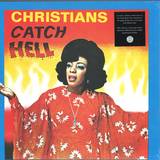
- D2: Reverend Edna Isaac And The Greene Sisters - Christians Catch Hell
- D3: The Fountain Of Life Joy Choir - Thank You
- D4: The Fantastic Family Aires - Glory
Utterly magnificent, sublimely soulful survey of the Gospel Roots label, subsidiary of the mighty TK Records at the height of the Miami Sound. Beautifully presented... the LPs with a 12"-square, full-colour, sixteen-page album of photos and original artwork. Check!!
A&R was co-ordinated by Gospel legends Ira Tucker — from the Dixie Hummingbirds — and Ralph Bass, veteran producer with Savoy, King and Chess. The label was run by Timmy Thomas, who had recently smashed with Why Can't We Live Together, for another TK spin-off, Glades. Operations were overseen by Henry Stone himself, unlikely King of Disco, who had recorded a young Ray Charles, and pushed forward James Brown. They drew in artists from all over the US, from St. Louis, Columbus, Memphis, Brooklyn, Cabrini Green in Chicago: unknowns like Camille Doughty, reluctant to jeopardise her job at GM ('Generous Motors') in Detroit, and huge-sellers like the revered Brooklyn All Stars, who started out on Peacock in 1958.
Choral belters, deep ballads, harmony quartets, epic city-blues, gritty funk, powerhouse female soul... Killer-diller Philly like a scorching version of Harold Melvin & The Blue Notes' Wake Up Everybody, and Jean Austin's raw Spirit Free, co-written by Ronnie Dyson, produced by Jesse James at Future Gold. Chicago Sound like The Fantastic Family Aires — named after the family's furniture store on North Cicero, but reminiscent of the Staple Singers at their best — through to the full-blown glory of The Fountain Of Life Joy Choir, led by Marvin Yancy from The Independents, and featuring Natalie Cole... Singers like Versie Mae Gibson, from the Jordans, by rights up there with Irma, Etta and Ree... Bangers 100%-guaranteed to find their way into Theo Parrish sets, and mortal delirium for the prissiest of soul and gospel purists.
In August 2000, Damon Albarn travelled to Mali for Oxfam's On The Line project (about people living along the Greenwich Meridian), intent on getting together with his favourite musicians there. In the capital Bamako and its surrounding villages, he sat in on club and private jam sessions, playing concerts and streetcorners, bars and boats.
Back home in London, more than forty hours of tapes were opened to other influences - reggae, dance, rock - and then the work in progress was returned to Mali, for further contributions from the musicians there: immersive and open, back and forth.
Spherical collections of stars form around black holes in situ; that is, locally to their cosmic neighbourhoods. It is said that future space colonization will rely on sourcing supplies in situ. Construction in situ uses raw materials at the site: colossal sculptures such as Naqsh-e Rustam, the Leshan Giant Buddha and Mount Rushmore were built in this fashion.
Wild, organic machine grooves, with a mind's eye on naked treetops and an early sunset. Melody breathes out from dubwise fx, percussion by turns sinewy and floating, sub blasts and stripped synth arrangements. Keys on air.
Spacious, witty, melancholic, deadly.
Since its 2005 debut, Torsten Profrock's T++ project has grown in stature and scope to the point where it's admired by fans of techno, dubstep, d'n'b and experimental electronics alike, and annexed by none. Anchored in the kind of scuffed, sub-heavy atmospherics Profrock developed in his 90s recordings for Chain Reaction, and naturally influenced by his work with Robert Henke as Monolake, the sound of T++ is singular, always evolving, difficult to fix.
Long ago snagged by the rhythmic innovations of the post-jungle underground, here Profrock makes explicit his debt to the radical fringe of UK garage. Snapping 2-step rhythms are at the heart of all four tracks; for all the distress, deconstruction and detournement they undergo at his hands, the spirit and swing of the British soundsystem tradition is unmistakable.
Further, Wireless is a kind of remix, a commission, shot through with the contorted samples of voice and ndingidi from a handful of old East African 78s (collected on the Honest Jon's compilation Something Is Wrong).
The result is a record that sounds at once ancient and modern, possessing a unique tonal language, and with it a curious, almost occult power — his most expressive, energetic and fully-realised work, affirming the enduring fundamentals of the T++ aesthetic even as it steers it into uncharted climes.
Erlend Øye is a skinny nerd, but maybe that's what makes him a pop star. His huge thick spectacle-lenses act as an interface between his inner life and his numerous collaborators and fans. Erlend Øye is a travelling singer-songwriter, who has been making music in various constellations since the late nineties. He sang for Röyksopp, while his own bands are Kings of Convenience and The Whitest Boy Alive, who recently split up. A laid back, everyday vibe runs through Erlend Øye's music. Erlend is not larger than life, at the most his songs may be. The pop star from next-door doesn't make any drama, but leaves that to life itself. His relaxed, laid back sound opens your eyes and ears for places, situations and encounters. A certain mournfulness runs through the songs, although they deal with a longing for self-fulfilment. Erlend sings of loneliness, and in doing so, he creates a 'we'. Until now Erlend's projects have often been based on simple concepts - two guitars and two vocals with Kings of Convenience, and four instruments with The Whitest Boy Alive. With his new solo album he frees himself of these parameters; for the first time everything is possible, for the first time Erlend Øye stands alone. The songs on 'Legao' were arranged and recorded with the Icelandic reggae band Hjálmar.
The magic of 'Legao' lies in the fact that Erlend's vulnerable vocals and his sincere lyrics are supported by the elegance and consistency of the band. Today roughness is often used to counterbalance roughness, whereas on Legao a equilibrium is sought - and found. A simplicity, clarity and minimalism is created that is rarely found in pop music. Erlend Øye has grown up. He accomplishes nothing less than the step towards an independent, free-standing solo musician, who can perform in any constellation - with a band, orchestra or alone with a guitar.
Part 1 of our 4 Sample 10 Years Full Pupp compilation. Each 12 has 4 brand new Exclusive tracks a 12. Norwegian´s finest Young Adults. Cost to Coast - Out of the Cold - Hot as Hell. 87392;"Doc Scott was on the decks. It was at Tribal Gathering (I think), 1996, standing in front of a wall of speakers to one side of the stage, enjoying myself, like you do, when this sound started growing inside my brain. My head was then ripped clean off my shoulders! Words are still hard to find! It was the first time I ever heard Shadow Boxing and its the only thing I still remember from that night. Om Unit's 2014 Remix is paired with the 1996 original. DJ support from: Fabio, Mark Pritchard, Friction, Surgeon, Toddla T, Laurent Garnier, Pinch, Zinc, Baliey, Rob Both, Billy Nasty, Krust & John B.
In the great tradition of Count Ossie, four new grounation furies — hypnotic, thunderous, urgent, mystical — with dubwise repeta, funde and bass drums embedding the Light Of Saba veteran's gorgeous trombone classicism.
The opener is a rocking kumina rhythm, with ring-the-alarm metal percussion and exhortatory brass; Free The People swirls some apocalyptic reasoning into the foggy, thumping mix. Universe In Crisis is another emergency call, chuffing headlong down the grooves... before the beautiful, anthemic Chant takes a step back from the fire, closing with a sense of thankful, spiritual reconciliation, the expert drumming and lyrical bone-work in full effect.
Up and away / To your journey to the sun / Drink your rocket juice / Fly away (Hey, Shooter).
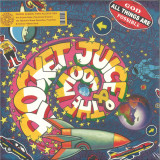
High up in the skies, amongst the clouds, Rocket Juice & The Moon was born. Literally. It happened back in 2008, when Damon Albarn, Flea and Tony Allen convened on the same Lagos flight, to play and exchange musical ideas in that city as part of the Africa Express collective. Relishing a shared enthusiasm for one another's work, and bonding immediately, there and then the triumvirate laid down the blueprint for Rocket Juice.
Still, more than a year passed before conditions were set for three weeks together at Albarn's West London studio, recording and refining two-dozen startlingly out and deeply funky instrumental grooves. The next stage was to invite onboard some extremely talented friends, with further sessions in Dallas, New York, Chicago and Paris... Erykah Badu, no less, queen of contemporary soul. Three companions from Africa Express: Malian singer Fatoumata Diawara, whose debut album has topped World Music charts since its release last Autumn; her multi-talented compatriot Cheick Tidiane Seck, whose prodigious keyboardism has lit up releases by artists ranging from Youssou N'Dour to Hank Jones; the young, Ghanaian rapper M.anifest, quizzically existential, switching seamlessly between Twi and English. And the Hypnotic Brass Ensemble, long-time stalwarts in the Honest Jon's set-up — since one of the team discovered them busking near the shop in Portobello Road, on his lunchbreak — with a second album for the label due in May... Finally, the tracks were dispatched for mixing to Berlin, to be meticulously honed, polished and envenomed by Mark Ernestus, one half of the legendary Basic Channel and Rhythm & Sound partnerships.
The result is Rocket Juice & The Moon — out March 26, 2012, on Honest Jon's Records — a triumphant exploration and proliferation of kinetic Afro-funk rhythms: organic, exuberant, communal music-making, evidenced by the project's live debut on stage as part of the Honest Jon's Chop Up in late 2011, which hit London, Marseille, Dublin, and Cork to such great acclaim (witness the flurry of smart-phone film-clips uploaded in the days thereafter).
From the inaugural bars — that absurdly funky slice of instructional timekeeping, 1-2-3-4-5-6 — the liquid pulse of Fela Kuti's classic recordings drives the action through a suite of 18 shape-shifting compositions. The greatest drummer in the world has never sounded so good as he does here. His intricate cross-patterns jostle and lock with Flea's nimble, rumbling bass riffs. Joined by Seck on There and Extinguished — 'when you dispose of something burning, be sure it's out' — Albarn's keyboards spray synth fusillades up top, over, and under... splicing into the mess of wires running between the freaked Afro-disco of William Onyeabor and the space-jazz-moog of Sun Ra. The HBE brings extra intensity and drama to Leave-Taking — likewise Flea's trumpet to Rotary Connection — teasing out the haunting melody coiled in the mix.
Where the best of vintage Afrobeat sides sustained their concentrated energies over the course of sprawling, marathon jams, RJ & TM manages something altogether different: the group bottles the idiom into capsules of funk... and real songs. Beautifully buoyed by Erykah Badu's unmistakable vocals, Hey, Shooter brilliantly traverses metaphysical spaceways sans any semblance of noodling. Lolo and Follow-Fashion — featuring the open-hearted sensuality of Diawara's singing, M.anifest's quick, brawny science, and more brass blasts — play like its musical cousins or codas. Indeed, the album's shrewd sequencing creates the composite effect of tracks working both individually or within the context of an extended song-cycle.
The lovely ballad, Poison, is bittersweet and ruminative: 'If you're looking for love, beware the signs / They will paralyze you one by one / Poison, it will only break your heart.' Down-tempo and dubby, Check Out and Worries amplify the range of styles and moods. And by the time of Fatherless — a chugging Afro blues that evokes John Lee Hooker lost in Lagos, one gets the sneaking suspicion there's very little outside the reach of this collective's inventive musical grasp.
There is, in fact, a palpable openness pervading Rocket Juice & The Moon — the sense of a limber willingness to follow creative impulse — right down to how the group acquired its name. When Ogunajo Ademola — the Lagotian commissioned to do the album's cover artwork — dubbed his submission 'Rocket Juice & The Moon', it quickly morphed into the formal name of the project, like trying to hold onto mercury.
Surely, the stars above also approved.