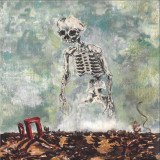
Rippikoulu's Musta seremonia is both an international cult item and an integral part of the history of Svart Records as well - a reissue of the original 1993 tape was one of the earliest Svart releases back in 2010. Back then, this album was considered as one of the best kept secrets in the Finnish underground metal scene. Four years and one quickly sold out reissue later Rippikoulu's greatness is no longer a secret, and we are happy to bring Musta seremonia back on the market.
Rippikoulu began their musical endeavours back in the late eighties, and like so many of their contemporaries, evolved from primitive punk noise to death metal. However, while many bands played death metal with groovy riffing and overall headbanging attitude, Rippikoulu's choice of style was darker. Their downtuned metal is bleak and nearly unbearably heavy in its execution, dark and soul-searching in its themes, intertwining faster bursts of chaos with slow, doomy passages.
Rippikoulu released the Musta Seremonia demo album on tape in 1993 and then disappeared. They never gained much popularity in their time, but their legacy has steadily grown in time. The album has been carefully remastered from the original DAT master tape, cleaned up and amplified.
quête:howe
Originally released onPrivilege, a sub-label of Polydor, this soundtrack by free jazz saxophonist Marion Brown is almost impossible to find in its original pressing. Nowmore than fifty years later it is finally reissued, to the delight of free jazz enthusiasts and film music collectors.
By 1967, Brown, then aged 36, already had a very successful career in the United States, appearing on John Coltrane’s ‘Ascension’, Archie Shepp’s ‘Fire Music’, performing with Sun Ra and Pharoah Sanders and recorded several records under his name for renowned avant-gade jazz label ESP Disk.
That year, he however decided to move to Europe where he met with German saxophonist and vibraphonist Gunter Hamphel. Accompanied by Steve Mc-Call (drums and percussions), Barre Phillips (double bass), Alain Corneau (Cowbells) and Ambrose Jackson (trumpet), they recorded in 1969 in the legendary Parisian studio Davout, the soundtrack of the movie by Marcel Camus entitled
“Le temps fou”.
This film, which starred Nino Ferrer, was released in 1970 under the title “Un été sauvage” and unfortunately it did not make history in cinema. Fallen into oblivion, only his two original soundtracks (there is also a 7’’ with titles composed by Richard de Bordeaux and Daniel Beretta) are spreading the word.
Repress!
When the award-winning producer, and an internationally beloved DJ, Guy Mantzur, started a new concept, he promised to open his new label with his work. It was worth it to wait! Guy intended to create a series of events under the same name as the label releasing the music by the artists performing at those events. Moments! After Amsterdam, Tel Aviv, and Ibiza parties, Guy started a platform with the releases going hand in hand with the concept. Mantzur wanted a repertoire with artists respecting and expanding the musical identity of Moments. The first release on the label represents its manifesto!
Guy manages to keep the elementary basis of his signature sound but makes a quantum leap into the future. The audio quality of his two-track release delivers a technical precision of scientific research. However, Mantzur achieves to make over 15 minutes of hypnotic journey exceptionally thrilling. Both tracks fuse percussive and tribal influence, spiced by the Middle-Eastern melodic flavors. The material is more than just a powerful dancefloor launcher stimulant but an intelligent and highly efficient doorway to emotional inner space.
Moments! Every one of them matters, but only the first one makes history!
"The Shape Of Jazz To Come" - Ornette Coleman (as); Don Cherry (crt); Charlie Haden (b); Billy Higgins (dr)
It was John Lewis, pianist of the Modern Jazz Quartet, who brought Ornette Coleman to the renowned Atlantic label, having heard him play in Los Angeles. »Ornette Coleman is doing the only really new thing in jazz …« he reportedly said. The present initial Atlantic album was released just in time to coincide with the New York debut of the Coleman Quartet in November 1959. Lewis was sure that Coleman would open up new paths for jazz, and his opinion is reflected in the title of the album – "The Shape Of Jazz To Come". After the rather worn-out hard bop routine of the past years, this music was like a breath of fresh air. The fast numbers ("Eventuality", "Chronology") remind one of wildly hyped-up bebop. Other numbers ("Congeniality", "Focus On Sanity") juggle with catchy, almost folk like short motifs. This album contains two of Coleman’s most beautiful compositions: "Peace" and "Lonely Woman", which was later given lyrics and often heard in its vocal version. The Mulligan-Baker Quartet provided the model for the pianoless quartet – and when the band swings along once in a while with a moderato tempo, it is truly reminiscent of cool jazz. Be that as it may, the two wind instrumentalists just love the frenetic 'cry' and the intentionally 'imprecise' interplay. Clearly defined stanzas or traditional harmonic forms were not for them. The jazz musicologist Peter N. Wilson wrote: »A record, which is not unjustifiably so entitled« about this LP which was given 5 stars by the magazine Rolling Stone.
This Speakers Corner LP was remastered using pure analogue components only, from the master tapes through to the cutting head. More information under pure-analogue
All royalties and mechanical rights have been paid.
Recording: May 1959 at Radio Recorders, Hollywood, CA, by Bones Howe
Production: Nesuhi Ertegun
- A1: Bangarang- Lester Sterling & Stranger Cole
- A2: Seven Letters-Derrick Morgan
- A3: Without You-Donnie Elbert
- A4: Everybody Needs Love-Slim Smith
- A5: Cool Operator-Delroy Wilson
- A6: King Of The Road-U Roy &Lennox Brown
- A7: Moon Hop-Derrick Morgan
- B1: Ten Thousand Tons Of Dollar Bills-Bunny Lee Allstars
- B2: If It Dont Work Out-Pat Kelly
- B3: Hold You Jack-Derrick Morgan
- B4: Who Cares-Delroy Wilson
- B5: Wet Dream-Max Romeo
- B6: Joe Razor-Roy Shirley
- B7: D.j.choice-Winston Williams
Countless incredible records were made in Kingston between 1968 and 1971 that has never been able to lose the stigma of being described as 'Skinhead Reggae' but in Jamaica the term never meant anything. However Bunny Lee's Aggro Sound's both at home and away.
They were tougher then tough ,rougher then rough ,kicked like a 'bovver' boot and were sharper then a razor cut trim.
Raw, pure and undiluted every time...some even troubled the UK national charts..
To say the man and his music dominated at the time would be a complete understatement.
'Striker' was everywhere...travelling between Kingston, where he opened his Agro Sounds record shop at 101 Orange Street and London where he set up his Unity label with the Palmer Brothers for the exclusive release of his productions and his Jackpot subsidiaries with both Trojan and Pama records.
Ubiquitous does not start to come into it.
We sincerely hope that this compilation helps to point you in the direction of some of the best music from this often overlooked period from one of the greatest producers EVER!
'The Aggro Man' himself Bunny Lee
Schmer brought these two together to battle it out for Schmer019: Snazelle vs Loveland : Get this special 6 track maxi EP of pure techno and YOU will be the winner.
Brooklyn based techno producer and Snazzy Fx boss. Much of the hardware Dan uses in his productions and live sets was designed and built by him. His focus as an artist is on electronic music as a vehicle for achieving transcendent states. This comes out in his sets as a respect for both the funky and hypnotic aspects of dance music. As a DJ and live act, Dan has performed throughout Europe and is a regular fixture in NYC.
2018 saw Dan release the "Exposure to a Steady Stream Ep" on Jacktone records. Fact Magazine included the track " Broken Saucers" in their best of September round-up.
In early 2019 Nina Kraviz and Dan released their collaboration "u ludei est pravo"on the trip compilation "Happy New Year! We Wish You Happiness".
In August, Schmer released his newest EP, "Swarm Draze".
Jasen Loveland is a mercurial force about whom little is known with any certainty. Much of Loveland’s life and exploits are shrouded in an opaque and often contradictory mythology that includes many other characters who may or may not be Loveland himself. Born sometime around 1950, Loveland seems to have been operational within the dance music community for decades, allegedly interning for Giorgio Moroder in Munich after finishing a medical degree in the 1970s. It is rumored he was the individual who did the actual synth programming on “I Feel Love”, however this was never confirmed. Documentation of Loveland’s past was further obscured by a “studio fire” while operating out of Chicago in the mid-1990s that destroyed all of Loveland’s memorabilia from the past, except for a handful of lo-resolution, poorly-scanned photographs Loveland (an early user of Hyperreal.org and the #mw.raves listserv) had emailed to a friend. Fortunately, Loveland was able to save his two favorite synthesizers, a battered Roland TB-303 and it’s demented sibbling, the MC-202, but the rest of Loveland’s equipment, and the documentation of his past, was lost in the blaze, leaving Loveland homeless for several months. Regardless of the veracity of his tales, Loveland’s music speaks for itself; the intense, maniacial vibes that pervade the ouvre are undeniably suited for the most far-out, dancefloor head trips, thus making it only a matter of time before he joined the Interdimensional Transmissions family.
Most recently, Loveland has been presenting DJ-style musical performances under the name “Loveland & Friends”, which has become an umbrella term for all projects related to his work, including JL-303, DJ Curtis Chipp, Chip Curtis, MIDI Master, Remote Perception, The Limit, Acid Musik Department, The Gaze, Ace of Fades, East German Chemistry, The Universal Vision, Clonus, Gamma Polaris, R.O.M. and DJ Kline, and Da House Band. Many of these, such as the DJ Kline project (with Prof. Dr. Alice B. Kline, a self-described “unremarkable scientist” and researcher at CERN), seem to be collaborations or ghost productions, although even this is not clear. In fact, the only confirmed Loveland collaborations are LW Productions (with Clay Wilson) and Pervocet (with Patrick Russell), the latter presented as a 12” by Interdimensional Transmissions, Detroit.
Limited Edition Classic LPs - 180g Virgin Vinyl -Audiophile Pressing Gerry Mulligan, Baritone Sax; Thelonious Monk, Piano; Wilbur Ware, Bass; Shadow Wilson, drums. New York, August 1957. Produced by Orrin Keepnews. Thelonious Monk was a creator in the true sense of the word. The current LP includes one of his rare albums that could fit within the standard formula of “jazz star 1 meets jazz star 2”. The pianist seldom shared the bill with other stars or accepted playing second fiddle to anyone. Two rare exceptions include his two 1950 sides backing singer Frankie Passions (“Especially to You” and “Nobody Knows”), and his 1950 studio session backing Charlie Parker and Dizzy Gillespie. But Monk is the leader on most of his recordings, and in a way, he was also the leading voice on this meeting with Gerry Mulligan. Most of the tunes played here are compositions by Monk, with the exception of the standard “Sweet and Lovely” - a favourite of Monk’s, who recorded it dozens of times - and Charlie Shavers’ “Undecided”, which could well have been Gerry’s only call for the evening. Although it remains clearly recognizable, the latter tune was slightly modified here, retitled “Decidedly” and attributed to Mulligan himself. No other recording of “Undecided” by Monk is known to exist. “’Round Midnight” was a Mulligan request for the session, as he wanted to record the song with its composer. It is clearly one of the best tracks of the whole album. However, the fact that no new compositions by Monk were recorded on this date seems to indicate that Monk always preferred to make his own albums and didn’t dedicate too much time to such experiments as Mulligan Meets Monk, which he may have regarded as a “commercial” venture. 4.5 Stars - Down Beat “The minutes of this meeting are very interesting indeed. They begin with a lyrical “’Round Midnight” and continue through Monk’s brittle “I Mean You”. In between, there are stretches of good to excellent Mulligan, brilliant Ware, and good to excellent Monk.” (Dom Cerulli)
g b4 | Straight, No Chaser [Alternate Version]
LIMITED UCKE YELLOW VINYL.
Xardinal Coffee is a debut album that is a strikingly contemporary record of slick hip hop, rich textures, idiosyncratic grooves and electronic-tinged wonky R&B. It’s an album that feels intricate and busy but also manages to retain a sense of space and looseness, allowing hypnotic rhythms to unfurl with grace. EXUM, aka Antone Chavez Exum Jr. credits the 'genius' of his two producers, Erik Samkopf and Dex Barstad, who he works closely with.
Samkopf being the producer responsible for Xardinal Coffee respectively. 'Sam and I don’t really like doing anything that doesn’t have an ückean effect. We’re not from here you know, we’re just getting adjusted’, says EXUM of the album’s eclectic sonic palate. 'We love to push the envelope on what is considered quirky, but try not to think about it too much. If me and another are walking down a street, who's going to be first to try something spectacular? Them. My walk will speak.’
However, any sense of weirdness is also married with an infectious and accessible quality. Tracks such as Arrest the Dancer - 'a David Bowie/Lady Gaga-type beat we got from YouTube by a producer named Raixsa' - comes alive with an irresistible funk strut, almost recalling Prince in the swaggering bounce of it. On top of this, EXUM’s vocals offer versatility and flexibility, moving from caramel smooth croons to tight rap flows and to enthusiastic bursts of singing.
A sense of texture is palpable throughout too. Portabella Mushroom was recorded on a rare magic mushrooms trip and retains a lysergic and psychedelic quality, sucking the listener up into its swirling atmospheres. Whereas the sparse, minimal and slightly eerie beats of Wolves Eat Wolves was recorded in pitch black and the song takes on that kind of crepuscular vibe, which interspersed with the song’s dark lyrical content - touching upon sex trafficking - further cements this. ‘I take no form’, the artist says, and his formless nature speaks to his willingness to constantly recreate himself as an artist.
A love of words is also clear in EXUM’s delivery, with them being carefully placed and sequenced amidst the ambitious soundscapes of the record. 'Writing is precious to me', he says. 'The vulnerability to bleed on paper. While playing with words, styling the same outfit for the 7th day in a row.'
Initially EXUM looked up producer Erik Samkopf to work with when he’d had a temporary falling out with his previous producer Barstad. In love with Samkopf’s work with Pen Gutt, EXUM took a punt and flew from his hometown of Richmond, Virginia to Oslo, Norway to work with him. As EXUM and Barstad patched things up, EXUM and Samkopf were building chemistry, creating something truly unique. 'Dex and Sam never cease to amaze me', he says. 'They’re versed and creative beyond measure, they both have an immense amount of musicality, and most of all, their love for music is sweaty.’
However adding to the legend, EXUM took a little detour on his musical journey, spending years as a professional footballer in the NFL, for teams such as the San Francisco 49ers and the Minnesota Vikings. Now leaving that chapter of his life behind, EXUM has returned to the true love held dear to him ever since he can remember: music.
EXUM is not simply trying his hand at music though; he is crafting every part of his artistic journey, from carefully selected contributors (such as string composer Christian Balvig) and overseas producers, to shaping his own brilliant music videos with directors such as Allison Bunce and Rosabel Ferber. Both of whom occupy creative space in his art world, which goes by the name of ücke. He has effectively created his own musical ecosystem. 'You’ve got to create your own world and live highly in that first', he says. 'Making it inevitable for other worlds to not be touched by what’s vibrating through you. In my world I’m already a massively iconic artist.'
Velvett Fogg are a psychedelic rock band hailing from Birmingham, England. Active during the late 1960’s, Velvett Fogg were one of the many new bands from the Birmingham underground scene trying to take pop and rock music to a higher level of creativity. They were given a record deal by Pye Records, through which they released their first and only studio album, the self-titled Velvett Fogg. The original package was accompanied by a quote from U.K. disc jockey John Peel, who commented that “there is a lot of good music on this record. Remember Velvett Fogg - you will hear the name again.” However, despite favourable reviews, the album didn’t become as commercially successful as expected and the band soon broke up. The album has since become a much sought after title.
Available now as a limited edition of 1000 individually numbered copies on purple coloured vinyl.
"Bones of a Dying World” is an hour long journey full of melody, melancholy, and cinematic post-metal. Hailing from Akron, Ohio, If These Trees Could Talk takes advantage of deep, layered sound full of reverberation and crisp guitar passages weaving in and out of the intense rhythm underneath. Overall, the album has a steady moderate pace with the majority of the songs maintaining catchy, melodic, clean guitar passages. The album also introduces a welcomed amount of distorted and heavy riffs built on top of the clean compositions, something only attainable with their trio of guitars. The group seems to stick to utilizing delay effects with long feedback trails; however, the band delivers a higher understanding of complexity by letting the effects organically enhance the amazing compositions." - The Sludge Lord
Book + CD
In the year 2018 visual artist Ken Verhoeven (1991, lives and works in Antwerp) presented his Friendship Paintings, a collection best described as “deconstructed designs for friendship bracelets”, at Trampoline gallery in Antwerp.
The subject: the friendship bracelet. A wristband infused with meaningful (?) symbols. Symbols crafted thread after thread. One pulls a string, and ... friendship happens. Or ... friendship is being manipulated by symbolism. Not unlike a fetish.
Ken Verhoeven upcycled this vulgar object and brought it inside the art gallery. Where he showed not only the designs, but also the schematics for how to craft each bracelet. Like exposing the crystals of friendship.
It is a recurring storyline in Ken Verhoeven’s work. In the words of gallerist Stella Lohaus “he constantly interprets curiosities that casually present themselves in the world around him.”
Friendship Songs For this book, Ken Verhoeven structured ten works as a dramatic narrative.
He invited me to translate these works to music. To treat them as sheet music. Graphic scores. From here on, the Friendship Paintings become Friendship Songs.
On the accompanying CD, i recorded 10 arrangements of the 10 scores. Not unlike how Ken Verhoeven only used an existing DIY online generator to create the designs – i stuck to very limited tools while arranging the music. Namely one Roland Sound Canvas module for the sounds, Christian Schubart’s seminal book about the aesthetics of the tonal arts – to determine the tonality of each score, and the Spectrotone Instrumental Tone-Colour Chart for the instrumentation. The latter being a system invented a century ago in Hollywood, to apply different colours to the various instruments and registers of an orchestra.
We arrive at objective musical interpretation. However, since we are not dealing with heartless content here, the arranger does need to take subjective decisions, to bring the arrangements home. These small musics can / should (who is the manipulator now?) be played as a friendship bracelet. Thus: as endless loops. Every song repeats itself as long as you wish for. Like the symbol on the bracelet is being repeated until the circular object is finalized. Once, twice, 10, 20, 100, ?? times. Enjoy, Friend!
Lieven Martens, Deurne 28 june 2021
Layton Giordani takes the next step in the evolution of his sound with ‘Hyper World’.
Despite the challenging year we all shared in 2020, Giordani continued to grow in leaps and bounds as a producer. His second studio album ‘New Generation’ was a critical success and showcased the breadth of his artistry over 11 tracks, with moods fit for both the dancefloor and afterhours alike.
His latest offering, however, flexes its raving muscle and ambles up for the summer. The title track is bad arse, with swirling pads, trippy arpeggios and subtle flourishes of acid and psychedelica that all combine for a stomping finish. Fresh in every sense. ‘Astro’ is heavy on drama, driven by a big synth lead that pierces the air with intensity, before a delicious mid-track key change pushes the energy up to eleven and shortly after drops down into a celestial break, before building back up again.
Coming from Oslo, Norway, Bizarrekult is bridging the two identities of it mastermind - philosophical depth
of frozen Siberian steppe and the majestic beauty of Norwegian soil on this debut album. Bizarrekult was
formed back in 2006 as a response to the chaos of the surroundings and already with
a first demo got attention through 2000 copy split CD release. However, following the second studio demo
and then a two track rehearsal demo in Bergen, the project was laid on ice. “Vi Overlevde” (we survived)
speaks to the heart of every post-Black Metal fan that is looking for something different. The tracks
are filled with great riffing and beautiful melodies, tightly connected to the lyrical themes of frustration,
despair, sorrow, forgiveness and finally - hope.
Something wicked this way comes. Following singles 'Know The Future' b/w 'Digital Warfare' in 2019 and 'Hypersocial' b/w 'Safety Test' in 2020, ESP’s own Patrick Conway has now teamed up with the illustrious Appleblim (of Skull Disco and Apple Pips fame) for a meaty self-titled debut 2xLP under the new collaborative moniker, Trinity Carbon. There is something to be said for art created in the face of global unraveling, while mass transgression and the friction of culture shifting produce poignant commentary, but more often than not, it’s the personal coping mechanisms within our work that have the power to speak directly to the receiver. After a number of sessions resulting in wild imaginative beginnings, it was the untimely passing of Andrew Weatherall and a coming to terms with that loss that moved the two Brits-via-Berlin to herd their roaming sketches into a more narrative statement. In the uphill struggle to retain some sense of individualism, it’s always outsiders like Weatherall whose risks illuminate the roads of creativity less traveled, and when those beacons go dark there is a disorientation felt far and wide. Conway and Blim concede to the internal inquiry, “What would Weatherall do?” bringing to mind the man’s pervading morale, always soldiering onward through mediocrity, as it was undoubtedly an impetus for the duo growing steadfast and chiseling 'Trinity Carbon' into completion. While employing trusted machines in the bass department, they established a warm euphonic home base from which they could stray in a variety of tonal and rhythmic directions without straining a tether to the album’s core. However, as soon as any hint of familiarity may arise, or listeners begin to mentally assign stylistic epithets, the duo boldly change course to remind us that while the banal stay safely defined, it’s the iconoclasts, the outsiders who make us feel.
Tape
It might be easy to assume that the distinctly focused compositional voice unveiled on Rose Bolton's The Lost Clock is the product of its creator's rigorous, almost hermetic dedication to her own particular aesthetic universe. A quick survey of Bolton's artistic career, however, reveals that her carefully sculpted approach to abstract electronica has been forged through a longstanding engagement with a wide range of intertwining creative activities.
This album—coming out on Important Records' cassette imprint, Cassauna—demonstrates both the Toronto-based composer's unique mastery of colour and her gift for breathing a tactile, organic quality into synthetic landscapes. Bolton's distinctive sensibility is akin to that of a painter—every hue has been carefully mixed so as to imbue its accompanying gesture with its own life and personality. This tangible dimensionality her electronic work assumes, however, can be traced back to the work Bolton has been doing since the 1990's. She has produced a large and varied catalogue of work that includes pieces for solo performers, chamber ensembles, orchestra, electronics, voice, and to accompany installations and films. A number of her works reside in several of these zones simultaneously, such as Song of Extinction, an ambitious collaboration between herself, filmmaker Marc de Guerre, poet Don McKay, and multiple live ensembles, that was mounted in an abandoned power station for Toronto's Luminato Festival.
This quasi-instrumental vitality isn't the only feature of The Lost Clock that reflects Bolton's diverse artistic practice. It can also be heard within the structural realm. Each of the collection's four tracks trace a patient unfolding and favour a certain roundness of timbre, even as finer details begin to fidget along the perimeter of the music. As with her writing for the concert hall, Bolton doesn't shy away from the evocative here, yet she doesn't pursue this poignancy through conventional, direct or quasi-narrative means. Her compositions lead the listener gradually through their impressionistic sonic scenery, but neither the path they take nor their ultimate destination are at all predictable. The ostensible gentleness each piece exudes dissolves as dissonances slowly insinuate themselves, obscure textures writhe just out of earshot, percussive lattice work materializes, or as the overall blend begins to exert a heavier weight. Her lucid-dream vision of form functions in tandem with her acute micro-level attentiveness to engender a vivid and elusive soundworld that resists classification.
Over more than two decades Rose Bolton has been garnering acclaim and enthusiasm from audiences and major collaborators alike. Last year, her brooding string quartet The Coming Of Sobs was nominated for Classical Composition of the Year at the JUNO Awards, following earlier accolades such as SOCAN Awards for Young Composers, and the Canadian Music Centre's Norman Burgess Fund. Her music has been commissioned by the likes of the CBC, stalwart experimental music festival the Sound Symposium, as well as key interpreters and ensembles such as percussionist David Schotzko, accordionist Joseph Petric the Esprit Orchestra, Continuum, Arraymusic, the Kitchener-Waterloo Symphony, and guitar quartet Instruments of Happiness (led by Tim Brady). Together with Marc de Guerre, she produced an 8-speaker sound and video installation for Toronto's Nuit Blanche Festival. She's also been featured by the likes of revered pianist Eve Egoyan, The Vancouver Symphony, L'ensemble contemporain de Montréal, The Music Gallery, and AKOUSMA, while appearing in concert alongside the likes of Jerusalem in My Heart (Constellation Records), Tanya Tagaq, and Francis Dhomont. Bolton is also a respected film composer, notably contributing music to the highly regarded documentary Anthropocene: The Human Epoch (co-directed by Jennifer Baichwal, Nicholas de Pencier and Edward Burtynsky).
As a performer, she variously employs electronics, violin, and viola. Parallel to her engagement with exploratory approaches, she's invested in the fiddle traditions of the British Isles, and various Canadian regions. She teaches this repertoire at the Royal Conservatory of Music. Bolton has also performed with Rhys Chatham, Owen Pallett, opened for Charlemagne Palestine, and appears on recordings by the likes of Chatham and Aidan Baker. In 1999 she joined the Canadian Electronic Ensemble, whose fifty-years together make them the world's longest-running live-electronic music group. In February 2020, the CEE held a residency and provided guest lectures at Carnegie Mellon University's music department. Bolton has also led workshops at the Banff Centre, also founded the SOCAN/ Moog Audio-sponsored program EQ: Women in Electronic Music, which worked to foster community and mentorship among (trans/cis) women and non-binary individuals.
Bring Me The Head of Kyle Bobby Dunn is a full length triple vinyl reissue of the original 2012 double compact disc album from Canadian composer Kyle Bobby Dunn. It was recorded at Bunce Cake studios in Brooklyn and remote parts of Ontario. The compositions are mostly long, slowly evolving minimal ambient and drone based works created from electric guitar processing. Perhaps more cinematic than previous albums, some pieces have since appeared in BBC documentaries and independent films over the years since its release. The original recordings on this Diggers Factory vinyl edition, however, have been remastered and practically rebuilt from the fog of their initial masters which have often been considered the composer's most quiet and even translucent works. Iranian composers and engineers, Milad Bagheri and Maryam Sirvan have brought out a certain clarity and freshness to the music and Dunn has considered it an almost completely different listening experience from the originals.
The album was critically praised and became a favourite of most fans and even after several subsequent albums later it remains a favourite and of the composer's as well.
Papiro’s approach to music is never technical, but always personal. Since the mid-Nineties, he has released a handful of noteworthy albums, each carefully put together and seemingly self- contained, yet all sharing an unmistakable musical language and a certain escapist aura.
La finestra dentata (The Toothed Window), is no exception. It includes both studio and concert recordings from 2016–2020. The sounds on this album appear infinite and full of marvels, ingenious in portraying imaginary creatures and environments.
The title track and Anelli take up most of the first side and include live outtakes. Papiro likes to describe his performances as therapeutic. These swirly symphonies are specifically intended as immersive deep-listening experiences for concert venues, and have been edited for this album to meet the physical demands of vinyl and domestic use. Imagine the younger cousins of Laurie Spiegel’s Concerto Generator performance, or Terry Riley’s Shri Camel.
However, those who know Papiro only from the stage might be unaware of a different side to his oeuvre; starry-eyed miniatures that may appear frivolous in comparison to the more heady stuff, but are nonetheless well worth discovering. Each piece adds a chapter to a phantasmagoric world populated by such characters as "Giant Duckling", "King Hard-Beard", or the "Bodulator". Tracks like the opener Odilon or Il triciclo nascosto, meanwhile, emanate a candor rarely found in the domain of serious music, and revisit Papiro’s early days of instrumental storytelling.
About Papiro:
Marco Papiro is a Swiss-Italian musician, composer and graphic designer. He teaches at the Schule für Gestaltung in Basel and is known for the posters and album covers that he's created for a number of prolific artists (Sun Araw, Sonic Boom, Panda Bear, Oren Ambarchi)
- A1: The Dutch Benglos - Shabi-Bi-Di-Do
- A2: Pat Thomas Kwashibu Area Band - Yamona - Dam Swindle Rmx
- A3: Pupkulies Rebecca - Saude
- A4: La Gran Banda Calena - Que Quieres Que Haga
- B1: Martina Camarguo - Me Robaste El Sueno
- B2: Mackjoss - Mounadji 76
- B3: Voilaaa - Limye-A Ft David Walters Lass Pat Kalla
- B4: Jobby Valente - Mi Moin Mi Ou
- C1: Luis Dias - Liborio
- C2: Bande-Gamboa - Pe Di Bissilon - Dam Swindle Rmx
- C3: Ngalah Oreyo - Aye
- C4: Alcione - Nzambi-Muadiakime
- D1: Ismail Sixu Toure - Utammada
- D2: Pat Kalla Le Super Mojo - Canette - Bosq Rmx
- D3: Aurelio - Nando
- D4: Chucho Pinto - Cumbia De Sal Y Azucar
"Guts finest selection from his DJ sets. Some dancefloor classics and some discoveries"
Any DJ set tells you, unconsciously or not, about its author.
Through the record choices and the way they are organized, one can feel the DJ’s state of mind and find out a bit more about the musical deposit discovered that is being shared and dug through by him or her at the moment.
The appetite for diggin’, the quest for a novelty or a forgotten rarity is what makes a DJ set a true organic living matter constantly fueled although not always, unfortunately, respected.
Time stretching. Too many DJ’s made a pact with this diabolical creature. A true digital steamroller that runs over the rhythm to fix the tempo while leaving behind an agonizing drummer whose sole crime was to have been carried away by his energy and having moved forward the BPM. At the end, everything that gave charm and life to the track, its imperfections and the peculiar fact that it makes you dance faster towards its end… all these along with all the lively movements contained within the track are reduced to nothing.
My conception of music and DJ sets is the exact opposite. Since the first volume of Straight From The Decks, my DJ sets have been redesigned, refreshed and improved. However, there was no preexisting plan, they evolved naturally following my new desires.
The famous core of my indispensable musical choices started to morph little by little into something different without losing sight of its center of gravity which remains undoubtedly afro-tropical.
No matter which track, its style and its origin, the quality of the music that is brought to my ears is always my sole and primary concern.
In this selection, you’ll find 7” vinyl records available to everyone sitting proudly next to some rarities found online and acquired through nerve-raking auctions battles. There are indeed exclusive remixes along with titles that until now were only available in their digital formats. Now for the first time they are available here in vinyl format. Obviously, if you have chosen the CD format, that precision doesn’t really matter…
Sixteen titles which have become the heart of my sets throughout this past year.
A heart which in a year will beat to a certainly different drum…
Pura Vida
Gutsto attend the next one..."
- 1: Bonjour Klaus - Jeff Özdemir & Daniel Raymond Gahn 03:58
- 2: He's A Woman - Jeff Özdemir With Knarf Rellöm & Dj Patex 03:51
- 3: I Follow My Heartbeat - F.s.blumm & Jeff Özdemir 0:25
- 4: Saatler, Dakikalar Ve Saniyeler Gelip Geçiyor - Jeff Özdemir & Ertan Doğancı 02:29
- 5: Kleistpark - Vackrow 04:22
- 6: Love Letters - Jeff Özdemir & Joanna Gemma Auguri 03:31
- 7 52: Nd Street Und Dann Die Erste Rechts - Jeff Özdemir 05:14
- 8: Campagne (Band Version) - Désolé Léo 04:46
- 9: Disco - Beige Gt 03:40
- 10: Losin' - Jeff Özdemir & Zap 04
- 11: Complètement Perdu - Jeff Özdemir & Alexandre Thiercelin 02:18
- 12: Zu Viele Erinnerungen - Otto Von Bismarck 08:23
- 13: That's Not What Friends Are For - Jeff Özdemir's New Hard Drive 02:58
- 14: Bremerhaven, Das Kann Ich Dir Nicht Antun - Jeff Özdemir 03:26
- 15: The Day - Eng°N Featuring Jeff Özdemir 05:43
- 16: Güneș - Jeff Özdemir & Treetop 01:51
- 17: Bored - Elke Brauweiler & Jeff Özdemir 04
- 18: Die Quelle Von Hermidas - Jeff Özdemir With Elmer Kussiac 02:19
In the past years, the multi-instrumentalist, composer, producer and music enthusiast Jeff Özdemir had been focusing on organising the Live-Mixtape series in Berlin, inviting numerous artists to join him on stage for every single event. However, the year 2020 put an end to this for all the painfully obvious and obviously painful reasons. Undeterred, he instead put together the third instalment of the »Jeff Özdemir & Friends« series, working with singers, musicians and groups such as Knarf Rellöm & DJ Patex, F.S. Blumm, Joanna Gemma Auguri, Elke Brauweiler and Elmer Kussiac for an 18-track … Now, is this a compilation or an artist album? Well, why just either this or that when it can just be both at once? This is »Jeff Özdemir & Friends Vol. 3« after all, emphasis on »&«.
Released on Karaoke Kalk like its two predecessors from the years 2015 and 2017, respectively, »Jeff Özdemir & Friends Vol. 3« sees the man behind Kreuzberg’s 33rpm record store and the 33rpm Records label showcase his qualities as a people remixer, songwriter and versatile musician. He put together a collection of groovy tunes picking up on funk and afrobeat rhythms, introspective ballads, a musically channeled punk attitude, shoegaze sentiments, spoken word passages, drones, glockenspiel sounds, seriously fun experimentation and much more. Just like on the cover artwork - courtesy of Marion Eichmann, Özdemir’s favourite visual artist - everything here seems to discreetly exist for itself while being tightly connected to everything else at same time.
While artists like Ertan Doğancı, Désolé Léo, eng°n, F.S. Blumm and Zap have been long-term collaborators of Özdemir and were featured on previous instalments of the »Jeff Özdemir & Friends« series, new faces and forces also enter the mix. The melancholic »Love Letters« for example marks the first (though hopefully not last) collaboration with singer Joanna Gemm Auguri, while Knarf Rellöm & DJ Patex’s appearance has been dreamt of collectively but hasn’t been fully realised until now.
Whether it’s Désolé Léo’s French crooner soul, the lo-fi synth pop song »Bored« featuring former Commercial Breakup singer Elke Brauweiler or the many different sounds and styles presented under the name Jeff Özdemir: no decision is ever made between either that or this musical direction, but all are being joyfully enjoyed together. Thus, throughout its 70 minutes, the stylistic diversity of »Jeff Özdemir & Friends Vol. 3« does not once border on randomness. Instead, these sometimes very different songs are marked by a shared atmosphere - a direct result of these very different musicians approaching their studio time together less as a chance to make music but more of a chance to carefully listen to and interact with each other.
Just like you’d expect it from someone deeply connected with the local music community who also happens to run a record store, Özdemir is also the kind of person who’ll hand you the worn copy of a record he has just fished out from the bargain bin because he knows about its potential to change your life. The contributions by Vackrow (»Kleistpark«), Gebrüder Teichmann’s old band BeigeGT (»Disco«), and Otto von Bismarck (»Zu viele Erinnerungen«, produced by The Whitest Boy Alive’s Daniel Nentwig) do not even feature Özdemir, but are simply musical pearls that were (almost) lost in the shuffle of music history and unearthed for this very special occasion. That’s just what friends do, don’t they?
Clint Mansell and Clint Walsh’s reimagining of Lou
Reed’s 1973 album ‘Berlin’ as a tribute to
Mansell’s late partner Heather who passed away
in 2014. Now available on vinyl.
Pressed on neon pink vinyl and housed in a deluxe
spined sleeve with spot varnish polaroid image.
The record itself comes housed in a double sided
printed inner sleeve with digital download card
included.
Mansell is best known as the former lead singer of
Pop Will Eat Itself and as a composer for films
such as ‘Requiem for a Dream’ and ‘Black Swan’.
Walsh is a multi-instrumentalist and founding
member of Tweaker and is known for his work with
Courtney Love, Gnarls Barkley and many others.
Mansell and Walsh worked previously together on
the score for ‘Black Mirror’ episode ‘San Junipero’.
“The ‘Berlin’ they've made together isn't a copy in
style, however: instead, it conjures up the sounds
of jangly goth-pop, early ‘90s synth, and classic
singer-songwriter balladry.” - The Quietus