A bit more than half a decade on from his widely acclaimed debut Vanishing Points from 2018, Swiss guitarist, composer, and improv musician Manuel Troller releases his new record Halcyon Future. A rhythmically dense and ambiguous, yet joyful ride for unstable times, a plea for warmth and hopeful resistance.
Troller’s mode of incorporating, zooming in, and expanding on small elements from improvised sessions creates a multilayered work of driving rhythms and abstract, vibrating textures. Opening with Halcyon Future I’s distinctive open pulse, this first piece guides us through subtle harmonic shifts that are almost unrecognizable as they take place over extended time, overlapping and creating a sense of ambiguity until the piece reaches an almost optimistic level with Mario Hänni’s unexpected introduction of driving acoustic drums. Relentlessly and with increasing excitement, heavy electronic 80s bass drums and an armada of layered hi-hats push them on, leading to the all-incorporating melodic finale.
The two long pieces Halcyon Future I and Halcyon Future II focus on forward momentum. In between them stands DNA, a purposely directionless contemplation on emotion as such. It is raw, naked, and confrontational, with a tender and subtly changing chord progression creating intimacy and proximity, abstraction and warmth, like a beautifully vibrant hologram for the listener to walk around in.
The B-side with its 20-minute Halcyon Future II features playful futuristic guitars, enhancing and challenging the stereo image that Troller is already well-known for. As it’s given time to develop and take root, the ever-varying guitar interactions densify and the staccato patterns jump out of the speakers with joy, creating excitement and building momentum. Compared to Side A, things turn to a slightly more complex rhythmical, melodic, and harmonic feel here. There are easy references, such as Manuel Göttsching’s E2-E4 or Pat Metheny performing Steve Reich’s Electric Counterpoint, but Troller goes a different and very much more concrete way. Although the piece has been recorded in various places and through a long process of overdubbing, there is an astonishingly strong live feel to it, from beginning to the end, from the slow rise to the full spectrum and the almost krautrock-like finale. Improvisers Hans Koch on soprano saxophone and Michael Flury on heavily fuzzed trombone join in, while Troller and Mario Hänni on many guitars, bass, drum machines, and acoustic drums provide a joyous driving entity, not giving up until it all breaks down again. There is overkill and brute force, though never without depth and a vision of future.
In the musical scope of Halcyon Future, there is no need for an absolute definition of things. A continuously changing interpretation of repetitive and variable elements fading in and out of focus tells a story of an excited sense of acceptance. Feelings of transcendence stem from Troller’s layering of constantly shifting rhythmic structures with unforeseen improvised harmonic changes. Drum machine parts overlayed with acoustic drums shift between musical modes, anchoring the album on the verge of a jazz-influenced, motorik, post-ECM balearic plateau. Abstract textural elements gently swirl around and behind all that is rhythm, providing a submissive counterpoint. As with much of Troller’s work, Halcyon Future is an album that unfolds slowly, revealing more of its richness, detail, and subtle beauty at each listen.
Halcyon Future is a joint release by three:four records and meakusma.
Cerca:its not over
- A1: Improvisation 4
- A2: Improvisation 5
- A3: Improvisation 6
- A4: Improvisation 7
- A5: Where Is The Police
- A6: Christiani Eddy
- A7: The Squirrel And The - Ricketty-Racketty Bridge
- B1: Improvisation 3
- B2: Improvisation 8
- B3: Improvisation 9
- B4: Improvisation 10
- B5: Improvisation 11
- B6: Improvisation 12
- B7: Improvisation: York
Recorded in 1971, Solo Guitar Volume 1 was Bailey's first solo album. Its cover is an iconic montage of photos taken in the guitar shop where he worked. He and the photographer piled up the instruments whilst the proprietor was at lunch, with Bailey promptly sacked on his return. The LP was issued in two versions over the years — Incus 2 and 2R — with different groupings of free improvisations paired with Bailey's performances of notated pieces by his friends Misha Mengelberg, Gavin Bryars and Willem Breuker. All this music is here, plus a superb solo performance at York University in 1972; a welcome shock at the end of an evening of notated music. It's a striking demonstration of the way Bailey rewrote the language of the guitar with endless inventiveness, intelligence and wit.
very dope.
With this EP an attempt is made at documenting the vibrant action happening during the late 1970s and early 1980s in the Pioneer Valley area of Western Massachusetts, US. The story is richer than the snapshot we present here, and a more detailed account is to be found in the accompanying book that can be purchased separately.
The Five Colleges in Hampshire County congregated a vast student population that inevitably interacted with the towns in the area. Bars, music and record stores, live music and a lot of experimentation and free thinking. Hampshire College, especially, promoted new approaches to teaching, subjects that might be considered radical by some even today, although a more favourable context would now surely exist for openly debating such topics as American Indians, Kayak Design, Black Oral Tradition, Food Management, etc. And the music? The immediate "punk effect" motivated the creation of numerous bands, many short lived, others evolving into New Wave / Power Pop territory, eventually crossing into Post-Punk experimentation. What is captured in "Noho EP" is a more electronic disposition, favoured by the existence of EMS gear and other equipment at Hampshire College and University of Massachusetts. We chose to focus on a group of musicians who, for a time, played together in different combinations under the loose umbrella of the Tekno Tunes label and the structure around it.
These musicians come from very different backgrounds and the nucleus portrayed here consisted of Christopher Vine, Elliott Sharp, James Whittemore and Nicholas Brown.
Of the several line-up changes The Scientific Americans went through, it was actually only the duo of Chris Vine and Jim Whittemore who recorded "Among Bodge Watt". Never before released, it is a companion piece to their track "El Salvador" available on the 1981 ROIR tape-album "Load & Go!". The Sci Ams were founders of the Tekno Tunes label and also created the Tekno Tours "concert promotion agency", under which name they exposed local audiences to bands such as The Stranglers, The Slits, Pylon, Pere Ubu, The Psychedelic Furs, The Bush Tetras, Steel Pulse, etc. Their own sound kept progressing but at its best there's a solid dub undercurrent, pretty obvious in "Among Bodge Watt".
Human Error was born out of a collective jam by Chris Vine, Elliott Sharp, Jim Whittemore and Nick Brown. Elliott Sharp had moved to Northampton in August of 1978 and naturally became involved in the local music scene, hooking up first with Whittemore at a hi-fi audio store where he worked at the time. Basement jams followed stimulating conversations, and other musicians joined the sessions. "Clandestinator" sounds gorgeously loose, an effortless groove coming from a quasi-dub set-up. Nothing here seems calculated, the music just flows, contagious and irregular as the handclaps in the mix.
The Higher Primates later evolved into a "proper" band but started as Nick Brown's solo project. The Primates only ever released a (now sought-after) 7" single in 1980 (on the Tekno Tunes label, precisely). Both tracks on "Noho EP" were recorded the following year and never released until now. "Auto Music in the Disco Dub Style" is self-explanatory, with a steady, mid-tempo TR808 beat running through, supporting synth squelches, echoes and reverbs, a fat bassline, dissonant melodic lines and odd vocal snippets. Kind of a DJ tool when the concept was barely in place. The more uptempo "Teresa Variations" adds a Fender Jazz bass and Selmer sax to the electronics. It actually sounds more "Disco", even with the robotic, unintelligible vocals. On top of this, the vibe is sealed by the overall Radiophonic Workshop analogue strangeness applied to a dance beat.
SIMON AND GARFUNKEL’S SWAN SONG: BRIDGE OVER TROUBLED WATER FEATURES METICULOUS PRODUCTION, GORGEOUS SONGWRITING, AND HEALING SPIRIT
Sourced from the Original Master Tapes and Limited to 4,000 Numbered Copies: Mobile Fidelity’s 180s SuperVinyl 33RPM LP Plays with Staggering Detail, Clarity, and Definition
1/4" / 15 IPS analogue master to DSD 256 to analogue console to lathe
Unifying, soothing, comforting: Simon and Garfunkel's Bridge over Troubled Water quickly became the album of an era upon release in 1970, the benchmark set serving as a beacon of hope and hymn of reassurance during a time marked by polarizing changes, social unrest, uncertain politics, and the dawn of a new era. These uplifting reasons — to say nothing about the gorgeous songwriting, meticulous production, and watershed performances — attest to why it is more relevant than ever in our current climate. Music, Bridge over Troubled Water simultaneously suggests and proves, heals all wounds and lifts all boats.
The seminal effort Rolling Stone named the 51st Greatest Album of All Time reaches illustrious sonic and emotional heights on Mobile Fidelity’s 180g SuperVinyl 33RPM LP. Pressed on MoFi SuperVinyl and strictly limited to 4,000 numbered copies, this ultra-hi-fi collector's edition brings you closer to music that picks up where the duo's Bookends leaves off. You'll enjoy deep-black backgrounds and pointillist details. Seemingly every note, breath, and movement is reproduced with exquisite accuracy, clarity, and balance. Each rotation benefits from SuperVinyl’s ultra-low noise floor and superb groove definition.
The best-selling record in the U.S. for several years running and winner of six Grammy Awards — including nods for Record of the Year, Album of the Year, Song of the Year, and Best Engineered Recording — Bridge over Troubled Water endures as a staple of accessible sophistication, angelic elegance, effortless singing, unhinged ambition, and therapeutic spirit. While it would turn out to be the final studio set for a duo surrounded by creative and personal disagreement, Simon and Garfunkel's collaborative ethos and soaring harmonies — combined with reflective narratives centred on the American experience, friendship, romance, and farewells — combine to turn the 11-track work into a paean to resolution, reconciliation, calm, and balance.
Home to the legendary title track graced by Garfunkel's pacifying solo lead vocals as well as the equally famous folk ballad "The Boxer," Peruvian-based "El Condor Pasa," upbeat "Cecilia," and rock ’n’ rolling "Baby Driver,” Bridge over Troubled Water remains as renowned for its musical diversity as its lyrical poignancy. Moving beyond the templates they'd perfected on four prior albums, Simon and Garfunkel embrace a then-unimaginable swath of styles. Rock, pop, gospel, country, R&B, South American, and jazz strains course throughout the songs, each sparked with bold experiments yet grounded in a well-orchestrated melange of melody, rhythm, and classicism that makes everything personal, familiar, and warm.
Not for nothing is Bridge over Troubled Water one of the finest-sounding albums ever made. Featuring instrumentation helmed by members of Los Angeles' fabled Wrecking Crew as well as multiple choral and string sections, songs took hundreds of hours to complete and involved pioneering recording techniques. Evoking both Phil Spector's live"Wall of Sound" approach as well as inventive effects, Bridge over Troubled Water is a triumph of texture, atmosphere, and architecture. Our audiophile edition brings the record's unique traits to the fore.
Whether the reverberation generated by Garfunkel's cassette recorder on "Cecilia," echoing drums captured in a corridor heard throughout "The Boxer," automobile noises peppering "Baby Driver," layer upon layer of voices dotting "The Only Boy Living in New York," or echo-chamber percussion on the title track, details comes through with stunning accuracy, clarity, and dimensionality. In every regard, Bridge over Troubled Water exudes genius.
The Telescopes Radio Sessions collects together the essence of three live session recordings in 3 different countries over a three year period between 2016-2019. This is the third in a series of radio session releases from Tapete Records that have so far included The Monochrome Set and Comet Gain. More session releases are being lined up for the rest of the year and beyond - enjoy the sonics and stay tuned. Over the years I have read a lot on people’s impressions of The Telescopes. Some folk think it’s a collective, others imagine it used to be a band and feel nostalgia towards what they consider to be the original line-up (even though many had come before, during and since) and some people refer to it as currently a solo career. In a way this is all true and none of it is. When faced with these kind of questions, along with questions about the style of music that The Telescopes make I often say The Telescopes house has many rooms, which explains things perfectly for me but for people on the outside looking in it only serves to increase their confusion. For me, confusion isn’t such a bad thing. Everything is born into confusion, the sense we try and make of that chaos is interesting and excites me. The universe often disorientates, it sends me a jumble of thoughts and impressions coupled with a feeling of something I need to express… if I could only decipher the encryption. This is how The Telescopes music comes to be and it is also how The Telescopes came to me. I regard The Telescopes as an entity of it’s own that introduced itself in my darkest hour and I was chosen as its vessel. From the second it arrived I was obsessed to the point where there was nothing else. A bit like having an imaginary friend. As the obsession grew it began to infect others, everybody loved my imaginary friend and wanted a piece of it. As its success grew however, so did the corruption, until one day the entity fell silent. The silence lasted for years, I tried everything to reconnect but it was having none of it. I had been a bad caretaker, I had let the house become infested and I had lost my way. This epiphany served to remind me of simpler times when anything felt possible with this entity by my side. It had trusted me with something so simplistically profound and I had let it down. The realisation of this was a eureka moment. I am not The Telescopes, I never was and never will be, I am the caretaker, the lighthouse keeper and if a job is worth doing it is worth doing well. With this dawning, I felt a crack open up in the cosmic egg and a familiar confusion in my head. The entity had returned. It was time to start untangling its tangled threads once more, to make sense of what it was saying, this time without corruption. It’s all about listening. I listen to what my cosmic friend sends me and channel this expression into what you hear through your speakers. It may take one person to achieve this, it may take more. There is no set line up or instrumentation that can hold The Telescopes. Whatever it takes to hit the zone, whatever is available, absolute focus is imperative. Sometimes it takes sabotage to keep that line of vision intact, there is no room for preconceptions or complacency in making the music. The Telescopes music is the now
incarnate and a state of total being is necessary to achieve. From the outside looking in... again, it’s all about listening. What comes through your speakers is the only thing that matters. The music either reaches you or it doesn’t. Everything else may seem interesting or confusing but ultimately it is corruption. So if you’ve bought the record, read the sleeve notes and bought a ticket to see a live show, don’t be surprised if the line-up is or isn’t the same as the recording. The only thing that is for sure is that The Telescopes as an entity is speaking to you in its own voice in every scenario.
Of course the difference between albums and live shows is that you can play the record over and over again to the point where you know every line and every note that was played. Whereas with live events you are left with an impression that can only be replayed in your mind. It can be frustrating at times. When you are touring with a great line-up and feel like something exciting is happening, you want everyone to hear it, not just the people at the shows but the people that couldn’t make it on the night as well. There is no guarantee that there will be the same line-up at a live show as there is on the album. This is why live sessions are important, they document a side of things that is often fleeting. Here we have three sessions, all different people transmitting The Telescopes sound on each. Some are regulars, some dip in and out and some were just passing through. In each case The Telescopes chose them as their vessel and as the lighthouse keeper I did everything I could to help them on that journey while trying to be a good caretaker to the house of many rooms. The Telescopes have been invited in for many sessions over the years, the first two were for John Peel on BBC Radio 1. We also recorded a session for Marc Riley and Mark Radcliffe before their
celebrity when they had a show on BBC Radio Manchester. We could have compiled this album from those sessions, it was certainly considered but Tapete and myself believe this selection gives an exciting glimpse into that fleeting side of The Telescopes in a constant state of flux that is left mostly to myth and imagination. For those who listen to the records but have never had the chance to take in the live experience, welcome to the other side. For those that follow us live, here’s a little reminder and a keepsake. Infinite suns. Stephen Lawrie February 2024.
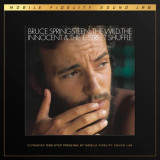
Released only eight months after his exhilarating debut, Bruce Springsteen's The Wild, the Innocent & the E Street Shuffle contains rousing dispatches from the boardwalk, the street, the beach, and the bedroom. It explodes with energy, dares to dream, teases with humour, crackles with tragedy, clings to hope, and overflows with discovery, youthfulness, and personality. It features an unforgettable cast of characters — corner boys, teenage hustlers, doomed lovers, jazz men, junk men, factory girls, fortune tellers, alley cats, pimps, escorts, and more — illuminated by vivid colour, breathtaking detail, and poetic action.
Musically, the heartfelt 1973 record is inhabited by sympathetic vignettes and cinematic arrangements steeped in rock 'n' roll, soul, jazz, and R&B. It finds the New Jersey native looking beyond the parameters of his preceding record and seeking to move on from environments he knows well (and chronicles here) by rushing headlong toward unknown territories, adventures, and people. Underpinned by the singer-guitarist's ambitious poetic enterprise and will to succeed, The Wild, the Innocent & the E Street Shuffle is the album on which Springsteen becomes the Boss.
Mastered on Mobile Fidelity's renowned mastering system, pressed at RTI on MoFi SuperVinyl, and strictly limited to 7,500 numbered copies, Mobile Fidelity's UltraDisc One-Step 180g 33RPM LP set is the definitive-sounding version of Springsteen's sophomore record. Benefitting from SuperVinyl’s nearly non-existent noise floor, superb groove definition, and dead-quiet surfaces, The Wild, the Innocent & the E Street Shuffle plays with a clarity, energy, presence, and openness that complement the expressiveness, dynamics, and scope of the seven restless songs that comprise a work Rolling Stone ranked the 345th Greatest Album of All Time.
Beyond the audiophile sonics that practically place you behind the console at 914 Sound Studios — listen to the separation between the instruments, natural decay of the notes, interplay within the widescreen soundstaging, and nothing-to-lose youthfulness of Springsteen’s voice — this reissue takes seriously this record’s influential merit by presenting it in packaging that underlines its status. Tucked in a beautiful slipcase, the LP is housed in a special foil-stamped jacket with faithful-to-the-original graphics. This reissue is made for listeners who prize sound quality and who want to engage themselves in everything involved with the invigorating set that busted Springsteen loose from the club circuit and landed him on the radio
Determined to liberate anyone within earshot and unafraid to come on strong, The Wild, the Innocent & the E Street Shuffle serves as the debut of the E Street Band — not only heard but seen for the first time by most of the public courtesy of the back-cover photograph. This is where saxophonist Clarence Clemons, organist-accordionist Danny Federici, and pianist David Sancious step out of the shadows — and drummer Vini Lopez and bassist Garry Tallent again stoke a fiery rhythmic engine that helps drive the untamed, reimagined big-band swing of “Kitty’s Back,” breathless R&B thrust of “Rosalita (Come Out Tonight),” and carefree dance steps of the funky “The E Street Shuffle.”
Of course, the main attraction remains a then-24-year-old visionary on the precipice of becoming a sensation and turning a then-bloated rock scene on its head. Recorded over three months while Springsteen and company were busy touring his debut LP, The Wild, the Innocent & the E Street Shuffle reflects the high-octane approach the vocalist embraced onstage and drifts away from the label-dictated acoustic-based frameworks of his debut. The set also witnesses Springsteen deepening his observational skills, with narratives such as the romantically tinged “4th of July, Asbury Park (Sandy)” and redemptive epic “Incident on 57th Street” mirroring changes taking place in the singer’s own life, small towns, and America at large.
A thrilling collision of memories, reflections, and composites — Sandy, Rosalita, and the latter’s parents are all based on actual people Springsteen knew, as is the community depicted in the opening track — the aptly titled The Wild, the Innocent & the E Street Shuffle resonates decades on due to its truths, authenticity, and spirit. Those characteristics — as well as the fact that many of its lengthy songs come on as the equivalent of sweaty, feverish soul revue that won’t stop until you’ve been exhausted — also explain how this now-iconic album triumphed over the reservations of industry “experts” that both demanded Springsteen re-record it and instructed deejays not to play it.
Yet there’d be no stopping a record that saw the past, present, and future, a band whose will would not be denied, and a phenomenon who was born to run. A never-ending invitation to act real cool and stay up all night, The Wild, the Innocent & the E Street Shuffle always feels alright.
Danza Nativa has done a great job of establishing its own unique sound in the techno sphere over the last half a decade. Now it marks the occasion of its fifth birthday with a two-part compilation that showcases its avant-garde take on the genre. They tell us that part one has been assembled as a sort of "mental (as in pensive, not deranged) techno album that takes the form of some direct tools for working DJs. Anthony Linell, Claudio PRC, Luigi Tozzi and DanielI are those who step up and explore abstract, drone, deep and plenty in between.
The Shadow Ring (1992-2002) presents a comprehensive overview of the work produced by British musicians Graham Lambkin, Darren Harris, and later Tim Goss over the course of a decade. Throughout their legendary ten-year run, this shambolic rock outfit, formed by a group of teenagers in the port town Folkestone, were an enigmatic force on the international musical sub-underground. The group have left behind a mighty run of eight LPs, a handful of 7-inches, and a spate of raucous live shows and cryptic zine appearances on both sides of the Atlantic. Collected here for the first time are The Shadow Ring's live cuts, rarities, and complete commercial releases, spread out across eleven CDs and a DVD, accompanied by an nearly five-hundred-page book that includes a monographic biographical survey, more than one hundred color photos, a comprehensive discography with transcribed lyrics, and a selection of zine appearances, fliers, postcards, and other miscellanea. In aggregate, this significant collection not only plums the depths of the band and its attendant lore, but reveals a vivid minor history of mail-order networks, bedroom recording sessions, cross-USA couch-surfing, and encounters with fellow travelers such The Dead C, Harry Pussy, Charalambides, Richard Youngs and the No-Neck Blues Band. Where is the connecting thread between Ralf Wehowsky and Squirrel Nut Zippers? Inquire within. The roughly 200 songs in this set trace the band from its earliest days recording in Lambkin's parents' house (SHP Studios), through its brooding mid-period, garnering word-of-mouth notoriety that peaked with the trio turning down an invitation to tour with Pavement, to a string of increasingly uncompromising experiments with electronics, voice, and tape. Although the band's sound morphs considerably during this time period, from spartan beginnings using pots and pans as a drum set to their ultra-deconstructed latter-day approach, certain core sensibilities are apparent throughout: brash youthful rawness, wry and morbid lyricism, stripped-down angularity, and a penchant for atmospherics. This boxset, featuring every record and single, and buttressed by twenty-nine rarely-heard recordings, including proto-Shadow Ring projects such as the Cat & Bells Club and Footprint cassettes, and their unearthed final CD-R Darren Harris Reads Graham Lambkin, presents the first opportunity to hear this arc in full. The ebbs and flows of the band_their schoolboy beginnings, initial successes, first shows and tours, life milestones, and Lambkin's gradual development as a solo artist_are painstakingly detailed in a sizable band history-cum-Künstlerroman by Blank Forms artistic director Lawrence Kumpf, illustrated with candid photos, sketches, letters, newspaper clippings, and other ephemera. The music and videos can speak for themselves, but taken as a mass, this collection makes sense of the group's utter uncanniness without comprising one iota of their mystique, bringing something new to the table for completionists and the uninitiated alike.
A landmark recording and masterful symphony of performance, composition, and execution, Miles Davis' E.S.P. established the template jazz would follow for the following decade. The 1965 record splits the gap between accessible hard-bop and the cutting-edge approach Davis increasingly pursued into the 1970s. Adventurous, sophisticated, and yet altogether cohesive, E.S.P. stands out not only due to its elastic compositions but via its chemistry, interplay, and feeling attained by the instrumentalists. The first album Davis' classic second quintet made together, it's also very arguably the group's best. Never before has the effort been experienced in such transformational sound.
Pressed at RTI, this 180g 45RPM 2LP set of E.S.P. renders the music's dynamics, pitch, colors, and textures with lifelike realism and proper scale. Reference-caliber separation, wall-to-wall soundstages, and distinct images magnify the intensity and beauty of Davis and Co.'s creations. Whether it's the distinctive snap of Tony Williams' drum sticks against the snare head, air moving through Davis' trumpet, acoustic thrum of Ron Carter's bass, or upper register of Herbie Hancock's piano, the sound is better than you'd even hear in the most intimate jazz clubs. Prepare to be swayed on every level.
For many, E.S.P. looms among the decade's best albums if only because of the significance of Davis' line-up. While Hancock, Williams, and Carter are holdovers that began playing with one another on 1963's Seven Steps to Heaven, Wayne Shorter functions as the secret weapon and key addition responsible for this ensemble hitting a new peak. Indeed, the saxophonist helped pen two of the seven compositions here – notably, E.S.P. is entirely comprised originals and clocked in as one of the longest-running jazz LPs issued at the time – and, more importantly, grants Davis the confidence and leeway necessary for the eruption of enigma, steadiness, and tension.
As he did with John Coltrane year earlier, Davis hangs back and picks his moments to solo, with Shorter stepping up to supply the churn. Their bandmates respond in kind, itching to take off into new stratospheres all the while keeping their improvisations grounded and connected to the piece at hand. Guided by Davis' visions and inspired by current boundary-pushing works by the likes of Ornette Coleman, Cecil Taylor, and Coltrane, the magnificent results spark with variation, harmony, emotion, energy, and brilliant movement.
Interlocking lines drive "Little One," alternating rhythms pulse through the funky "Eighty-One," melodies soar on the balladic "Iris," the aptly titled "Mood" broods over minor-key structures, and "Agitation" – goosed by a two-minute percussive introduction by Williams – delivers on its promise. No record – and no group of musicians – have ever balanced coherent themes and exploratory playing in better fashion than Davis' quintet on E.S.P. It's the avant-garde record even jazz traditionalists love, and essential on every level.
Andrea has his roots in the independent musical scene in the first decade of the 2000s. In addition to his compositional and live experience as the first Nadàr Solo drummer, he is one half of the Turin duo Anthony Laszlo with Anthony Sasso, ex guitarist and singer of Milena Lovesick. Andrea Laszlo De Simone made his debut in 2012 when he released his first homemade album, Ecce Homo. Recorded at home by makeshift means and accompanied by the following videos: Solo un uomo, 11:43, I nostri piccoli occhi, Perdutamente.
At the beginning of 2014, he met some experienced musicians from Turin’s underground scene that later, after a few months in a rehearsal room, became his band: Damir Nefat (guitar/backing vocals), Dani C (bass guitar/backing vocals), Filippo Cornaglia (drums/backing vocals), Zevi Bordovach (keyboards/backing vocals) and Anthony Sasso (keyboards/backing vocals/percussions).
Anticipated by the individual tracks Uomo Donna, Vieni a salvarmi and La guerra dei baci on June 9, 2017 - for 42Records - Uomo Donna came out. It’s Andrea Laszlo De Simone’s first real album, a well received work by both audience and critics. It also was pointed as one of the best albums of 2017 by several national music magazines.
Uomo Donna is a complex, articulate and vital album that lives in its own time - where past, present and future coexist. It’s a time in which a sonic world takes shape blending classic and modern, Italian songs with psychedelia, Battisti and Radiohead, Modugno and Verdena, the Beatles and Tame Impala, the magical flight of Claudio Rocchi and the earthly flight of IOSONOUNCANE.
The album was self-produced and then post-produced by Andrea in collaboration with Giuseppe Lo Bue, a sound engineer from Bologna. The recordings were made between October 2014 and the end of 2016 with experimental techniques straddling digital and analogic.
After playing in some important Italian festivals as Siren Festival and TOdays -- that earned him a special mention in the live scores by Rolling Stones -- on October 28, 2017 the first Uomo Donna album tour started in the clubs of the major Italian cities.
On November 30th 2017, Andrea Laszlo De Simone presented his video, Sogno l'amore, during the Torino Film Festival as a short film, shot in Sicily and directed by Francesca Noto and Andrea Laszlo De Simone.
On March 15th 2018 the music video of Gli uomini hanno fame was released, the most political song of the album, an overlook through ferocious human emotions, an eleven and fifty minutes trip within human nature portrayed even in its most ferocious instincts. The music video was directed by Andrea Laszlo De Simone and the mysterious duo Sans. The official cycle of Uomo Donna ends on 31 December 2018 with the music video of Sparite Tutti created by the creative collective Irene&Irene.
2019 was a year of new goals for Andrea, in fact, the album Uomo Donna leaves national borders and got a special mention on social media by the famous American band The Lumineers which included Andrea Laszlo De Simone and Uomo Donna among the most interesting discoveries of the international musical underground and inserts Solo un Uomo in the Spotify playlist “Inspirations”. A few days later, Solo un Uomo was broadcasted by KEXP Radio. On November 4th Andrea and his band were chosen to open for The Lumineers’ only Italian show at Alcatraz, in Milan.
On November 8th Andrea released a brand new work, digitally and on vinyl for 42Records, Immensità, a ‘suite’ of four singles: Immensità, Conchiglie, Mistero and La Nostra Fine. Turned into a medium-length film using Immensità as the soundtrack.
Immensità was presented with four special sold out concerts in Rome, Turin, Padua and Milan. For these shows Andrea Laszlo De Simone was accompanied on stage by a mixed orchestra composed of synths, electronics, choirs, strings and woodwinds. Classic and modern instruments that are intertwined in a nine elements formation: an immersive concert, a contemporary version of chamber music.
In March 2020 Immensità was released also in France, UK, Canada, Belgium and the United States with Ekleroshock/ Hamburger Records (Roster: Benjamin Clementine, Polo & Pan, Limousine and many others). The response of the transalpine press and media, sector and not, was unexpected: major French newspapers and magazines - from Le Monde to Liberation, Vanity Fair and Les Inrockuptibles - dedicated entire pages and rave reviews to Immensità and Andrea Laszlo De Simone. The track Immensità entered, after a few days, at the fourteenth rank of Spotify’s Top viral 50 playlist and broadcasted on France Inter and Radio Nova.
“Immensità” is a complex cross media work of music and images. A project divided into four chapters (the songs) for nine tracks (each chapter has a prologue or a conclusion). A true suite, using the classic term that best describes an instrumental composition in several stages, that can be enjoyed in its entirety only by listening to vinyl or digitally in the innovative single track format, without pauses: a single symphony of 25 minutes and 6 seconds.
In September 2020, Dal giorno in cui sei nato tu was released on all italian platforms, a song dedicated to Andrea’s children, a real love letter in the form of a small speech, where he tries to give them the three keys to approaching life: fantasy, music and irony. Martino, 8 years old, replies to his father’s love letter by making the video accompanying the song, created in Super 8. It's the story of the world through the eyes of the child. It is also an homage to the new little girl in family, Lucia.
THE 1968 ALBUM ON WHICH JOHNNY CASH BECAME A LEGEND: AT FOLSOM PRISON AMONG THE MOST IMPORTANT AND POTENT STATEMENTS OF THE 20TH CENTURY
Johnny Cash already knew his way around Folsom Prison when he and his band stepped inside the institution’s forbidding walls on the morning of January 13, 1968 to record At Folsom Prison. He’d played there two years prior. But this time was different.
Cash took the stage that day for two shows amid a darkening sociopolitical atmosphere and a raging war in Vietnam, as well as the knowledge his career and health hung on by a thread. The Arkansas native shared many of the long odds and abject failures of the inmates for which he performed. The songs he chose, and the conviction with which he delivered them, say as much. The point at which Cash transformed from a country star into a legendary artist, and a bold statement about the American prison state and its commitment to rehabilitation, the triple-platinum At Folsom Prison remains one the most important, potent, and fabled records of the 20th century.
You can hear it echo off the walls of the room; pulse through the itchiness of the Tennessee Three’s acoustic-based boom-chick rhythms; crackle in the announcements conveyed over the intercom; ring in the comedy of the off-cuff remarks and pair of novelty tunes; sense it in palpable energy that wells up within Cash and his audience. And you can experience it like never before via Cash’s knockout singing. The bedrock foundation of all his music, the singer’s baritone resonates with profound degrees of depth, pliability, and passion that underscore how much this appearance meant to him — and the extent he was living the narratives.
Indeed, every song on At Folsom Prison serves a purpose and speaks to the conditions — mental, emotional, physical, geographical, legal, social — the inmates confronted on a daily basis. Beginning with the explicit messages of the opening “Folsom Prison Blues,” Cash makes it clear he understands and shares many of their plights. Not for nothing did the myth of Cash having done hard time persist for decades once this record hit the streets. That’s how real it is, and how dedicated Cash remains to conveying every note with the same truth he invests in the impromptu comments he makes between and amid songs.
Listen to the sorrow, regret, pity, and loneliness of Merle Travis’ “Dark as the Dungeon,” Cash pulling syllables til they threaten to break and inhabiting the mood of bleak phrases such as “pleasures are few” and “the sun never shines.” Witness the isolation, dejection, and sadness punctuating the walking-blues “I Still Miss Someone,” matched in gravity by a solemn reading of “The Long Black Veil” — a traditional dirge that involves murder, cheating, and deception. Cash cuts even deeper on a heartbreaking solo rendition of “Send a Picture of Mother” and plainspoken version of Harlan Howard’s “The Wall,” detailing a suicide disguised as jailbreak through cliched-jaw deliveries that softly curse the impossible situation.
In chronicling temptations, mistakes, mortality, punishment, and life “inside” — for better or worse, the stories of the disenfranchised, forgotten, written-off, and unrepentant — At Folsom Prison also has a blast playing the outlaw role. Cash captures wild-eyed craziness and out-of-control mayhem on a revved-up take of “Cocaine Blues,” taking extra satisfaction in its dastardly tales by way of voice that shifts into character for the sheriff and judge. The gallows humor and racing drama of “25 Minutes to Go”; quicksilver accents and resigned acceptance of “I Got Stripes”; train-whistle blare and twangy locomotion of “Folsom Prison Blues” — all fight the law only to see the law win.
Cash remains deeply committed at every moment, and inseparably connected with the tortured souls removed from the goings-on of the outside world. No wonder all but two songs here stem from the day’s first performance that saw Cash, Luther Perkins, Marshall Grant, and company give everything. As does the Man in Black’s soon-to-be-wife, June Carter. The couple’s fiery duet on “Jackson” scorches; their combination of surrender and fortitude “Give My Love to Rose” puts us in the dying protagonist’s shoes.
And with the closing “Greystone Chapel,” famously penned by convict Glen Sherley, who watched it all happen under the watchful eye of guards, Cash separates the corporeal from the spiritual, relaying lessons about salvation and survival. Heady themes to which he’d return for the remainder of his illustrious career.
- A1: We Need Freedom (Featuring Jermain Jackman)
- A2: Black Gold (Featuring Jermain Jackman)
- A3: Cut The Cheque (Featuring Percee P & Great Okosun)
- A4: Believe (Featuring Ugochi Nwaogwugwu & Toyin Agbetu)
- A5: Skull Tax (Featuring Anthony Joseph)
- A6: Indifference (Featuring Anthony Joseph)
- B1: Why Do They Fear Us? (Featuring Yolanda Lear)
- B2: Prison Of Skin (Featuring Ugochi Nwaogwugwu)
- B3: The Walls Of Jericho (Featuring Dylema)
- B4: Intensity In Five (Featuring Anthony Joseph)
Introducing "The Architecture of Oppression Part 2" - the highly anticipated follow-up to Jake Ferguson's critically acclaimed debut album - Part 1. Ferguson is recognised as the ‘other half’ of The Heliocentrics, producing his solo work under the moniker, The Brkn Record. Effortlessly merging the realms of music and activism, he has created a groundbreaking album, which is set to be one of the most important bodies of work that illustrate ongoing systemic racism this side of the millennium. Ferguson takes the listener to a world where artistry and social consciousness intersect. Crafting an array of captivating soundscapes and themes. This album showcases the vocal talents of both established artists and hidden gems discovered through Ferguson's day-job as a former charity CEO and community activist. While Part 1 served as a rallying cry to dismantle oppressive systems, Part 2 offers a compelling soundtrack of a Pro-Black world reclaiming its destiny. This thought-provoking art piece invites listeners to envision alternative paths while avoiding the pitfalls of past paradigms. Unlike a broken record, this The Brkn Record album keeps pushing boundaries— By enlisting the voices of The Global Majority, The Brkn Record creates a platform for genuine expression through sound. Renowned for his production skills, Ferguson has captured the admiration of industry heavyweights including Nas, Madlib and Kanye West. However, rather than seeking popular features, he chooses to amplify the authentic perspectives of the talented youth he collaborates with in Hackney. One such initiative supported by Ferguson, Account Hackney, introduced him to two gifted artists showcased on this album – Great Okosun and Yolanda Lear. ‘This album serves as a visceral demonstration of my anger at the racially founded status quo in this country and globally. The continued oppression of people on the basis of their race is beyond evil, its common place and needs to end. Simple as.’ The album also sees Ferguson joining forces with award winning laureate Anthony Joseph and legendary hip-hop MC Percee P - their dynamic and thought-provoking lyrics seamlessly intertwine with expertly produced musical landscapes. "The Architecture of Oppression Part 2" is not just an album; it is a transformative journey that challenges the listener and wants you to ‘feel’. It’s Art. A musical experience that inspires, compels, and empowers. Over to you!
BBE Music is thrilled to present J Jazz: Free and Modern Jazz From Japan 1954-1988, a
remarkable large-format book covering some of the deepest, rarest, and most innovative
jazz music released anywhere in the post-war era. Compiled by Tony Higgins and Mike
Peden, co-curators of BBE Music's acclaimed J Jazz Masterclass Series, the book also
features a foreword by Japanese jazz icon, Terumasa Hino.
This is the first time a book of this type has been published outside of Japan and the first
anywhere of this size and scale. It is a unique collection of over 500 albums of free and
modern jazz released in Japan during a period of radical transformation and constant
reinvention. An era that saw Japan return from the ravages of World War Two to become a
global economic power and emerge as both a technological leader and an international
cultural force.
Through a unique gallery of albums, J Jazz charts the development of jazz in Japan from the
first stirrings of the modern jazz scene in the mid to late 1950s and on through the hard bop
and modal jazz of the 1960s. It steers the reader into the radical directions of the 1970s when
free jazz, fusion, post-bop, and jazz-funk opened up a growing number of Japanese jazz
artists to a new global audience before consolidating in the mid to late 1980s with a musical
scene that laid the path for the contemporary jazz generation to follow.
Over 500 full-colour sleeves from many of the leading names in Japanese jazz sit alongside
rare and private pressings that tell a story of constant change and musical exploration. J
Jazz includes profiles of several leading record labels such as East Wind, Frasco, King
Records, and Nippon Columbia as well as critical independents such as Three Blind Mice,
ALM, and Aketa’s Disk.
J Jazz includes interviews with celebrated jazz photographer Tadayuki Naito, and pianist
Tohru Aizawa, bandleader on the totemic spiritual jazz album, Tachibana Vol 1, as well as
free-jazz record collector and jazz musician Mats Gustafsson.
The book also features a chapter on albums by non-Japanese artists that only received a
Japanese release, with collectible, rare, and obscure releases by figures such as Herbie
Hancock, Miles Davis, Mal Waldron, Steve Lacy, and Art Blakey. J Jazz includes Japanese
jazz charts from some of the world's leading jazz DJs including Gilles Peterson, Toshio
Matsuura, Paul Murphy, and Shuya and Yoshihiro Okino. Among the specialist content is a
feature on obi strips by record dealer and Japanese jazz expert, Yusuke Ogawa, plus a
special article on Japanese Blue Note albums.
Across its 300-plus pages, J Jazz includes a detailed introduction contextualising the music,
tracing the story of Japan's fascination with jazz back before the war. It also features
biographical information on many of the key artists involved in shaping the post-war
Japanese jazz scene including Sadao Watanabe, Toshiko Akiyoshi, Masabumi Kikuchi,
Masahiko Togashi, Terumasa Hino, Yosuke Yamashita, Fumio Itabashi, Masayuki
Takayanagi, Takeo Moriyama, Isao Suzuki, and many more
Available on “Green Tea” colored vinyl, limited to 300. Remixed by Chris Teti & remastered by Kris Crummet for 10th Anniversary. Recommend If You Like: Prince Daddy & the Hyena, Into It. Over It., Blink-182. Maybe it always had to be this way. Posture & the Grizzly formed in Connecticut, in '08, and churned out a couple of demo tapes before dropping their debut LP in early 2014. Busch Hymns was scrappy and raw, all weed smoke and pent-up fury. Songs like "Egg Nog Drunk Off Hilary Duff's Piss" (yeah) and "You Know I Know What You Did Last Summer" exemplify the band's charm perfectly crystalline, wobbly leads ready to burst under bouncy hooks equal parts snarl and singalong. Just a glance at the tracklist lets you know what Posture & the Grizzly's all about: eight goofily titled songs in and out in eighteen minutes. Just in time for the LP's tenth anniversary, it's been given a remix by The World Is…'s Chris Teti, who originally produced and engineered the album back in 2013, along with remastering from Kris Crummett (Knuckle Puck, Dance Gavin Dance). Sometimes when an album like this is remastered, it loses some of its charm; the gloss crowds out the grit, the whole thing is recolored a bit too bright. But not so on Busch Hymns—these songs are crisper, but that doesn't mean they're cleaner. J. Nasty's throaty howls are as ragged as ever, but this time around they stand out against Piss Malone and Cabbage Pile's rhythm section, no longer straining for spotlight but basking in it. Their sound would get streamlined a bit over the course of their next two albums, I Am Satan and Posture & the Grizzly, replacing some of Busch Hymns's bite with a clearer-eyed sparkle and a newfound melodicism. Busch Hymns stands now as a document of the cult punks' early days, a transitional period from their throat-shredding demo days to their all-too-brief time as a pop-punk juggernaut. It's clearer than ever with the Busch Hymns remaster that Posture & the Grizzly was meant to sound like this, was meant for more than basement shows and beer-soaked floors. In this light, Busch Hymns is more than a transitional period; it's a glimpse into the greatness to come. So if you're sick of listening to modern punk too, then quit it. Listen to Busch Hymns instead
Following the release of Eric Chenaux's last album Say Laura (2022), The Guardian wrote "the Canadian songwriter has one of the all-time great singing voices in popular music, an intensely romantic Chet Baker-ish instrument that seems to float with piercing direction, like a paper aeroplane thrown hard through mist." With Uncut describing his songcraft "as delicate and lovely as a rare orchid" and Record Collector praising the album's "sublime alien balladry" such are the accolades that have accrued throughout Chenaux's unique and consummately uncompromising solo music for well over a decade now. Delights Of My Life opens a new chapter for the singer/guitarist and formally introduces the Eric Chenaux Trio, with Toronto-based musicians Ryan Driver on Wurlitzer organ and Phillipe Melanson on electronic percussion. Driver is a longtime collaborator, appearing on several of Chenaux's solo albums (even embedded into the very title of the 2010 masterpiece Warm Weather With Ryan Driver). Melanson has a long list of involvements that include Bernice, Joseph Shabason, and U.S Girls, and a recent release with his Impossible Burger project on Chenaux's own experimental label Rat-drifting, but this marks the first fulsome involvement between the two as players on a recording. In many ways Delights Of My Life also picks up right where Chenaux's previous album left off, in its subversions of a classic, timeless jazz-inflected balladry, while the interplay of the trio formation indeed unfurls many new delights. Recording together at Chenaux's spartan home studio in rural France, Driver's harmonically warped organ and Melanson's electroacoustic sampling and percussion hold time in newfound ways. Where previously Chenaux relied on a freeze/sustain pedal and minimalist rhythmic triggers to generate both pulse and chordal foundations, Melanson now paints timekeeping with expressive and intricate colourations, through live deployments of fluid sampled percussion (including orchestral timbres like timpani, kettle drums, and woodblock) that blur the boundaries between acoustic and electronic. Driver also ramps up his role in the song arrangements (prefigured in his support playing on Say Laura), teasing out chords and melodic filigree on Wurlitzer that percolate more prominently with Chenaux's signature fried guitar solos and succulent singing. Both trio members add dulcet backing vocals, most notably on the 10-minute tour-de-force of fuzzed and ring-modulated swing "This Ain't Life" that opens the record. All seven songs on the album groove and sway, simmer and sparkle, like nothing in the inestimable Chenaux discography to date. Chenaux's tunes have the uncanny ability to sound like jazz standards; songs you feel you've heard before, though certainly never quite like this. Yet these are of course all originals, compositionally and interpretively, bent through an inimitable avant/out-music lens. Delights Of My Life conveys warm familiarity, shot through with the exuberantly experimental subversion and playful, even mischievous, iconoclasm that continues to mark Chenaux as defiantly, virtuosically, and genially one-of-kind.
1973 was an amazing year for the pop/rock duo Hall & Oates as they ushered their superstardom further with the incredible second album masterpiece Abandoned Luncheonette.
Produced by the great Arif Mardin, this nine-song album fused with classic Philly soul, rock and acoustic pop anthems delivered in a big way for the history making duo. Including the huge hit single "She's Gone," as well as the celebrated title track, Abandoned Lunchonette was a watershed album which has rewarded them with non-stop success for the past four decades.
Abandoned Luncheonette is the most commercially successful of the duo's Atlantic Records period; the album reached No. 33 on the Billboard Top LPs & Tapes chart. Twenty-nine years after its release, the album was certified platinum (over one million copies sold) by the Recording Industry Association of America (RIAA).
This top-notch Analogue Productions reissue is pressed at Quality Record Pressings, and housed in tip-on old style gatefold double pocket jackets with film lamination by Stoughton Printing.
This product is a Record Store Day exclusive title and is not available to pre-order.
To buy in-store: 8am, 20/04/2024 (Record Store Day).
To buy online: 8pm, 22/04/2024. (Subject to availability).
Don’t forget: Click 'Notify Me' to be the first to know about its availability online. It also helps us to place accurate orders so that we can please as many of you as possible on the day.
Manhattan Fire is a collection of demos from prolific Brooklyn outfit The Men, revealing early versions of the tracks that would go on to make up their 2023 LP New York City – described by Pitchfork as “an unpretentious garage-punk racket … summoning the snottiest ghosts of the city’s punk past.”
Recorded in mono and with a drum machine by founding members Mark Perro and Nick Chiericozzi over lockdown in late 2020 – before being shelved for the full-band, live-to-tape affair of the final LP – Manhattan Fire shows a new side to those songs that's even more primitive and rough around the edges, as well as previously unheard tracks that never made it onto the album.
Upchuck are experiencing a moment. The Atlanta punk collective just came off multiple tour runs with their good friend Faye Webster. Their Ty Segall-produced second album Bite The Hand That Feeds, with all its buzzsaw guitars and high-speed rippers and headbanging sludge, arrived in October. Later this year, they’ll make appearances at multiple festivals including Coachella. In the midst of relentlessly barreling ahead, the band and their label Famous Class are taking a beat to revisit how they got here. After working with Segall on Bite the Hand That Feeds, the band floated the notion that they wished they could hear what their collaborator could do with the songs on their 2022 debut album Sense Yourself. Holed up in his studio over Christmas with COVID and nothing else to do, Ty Segall began toying with Sense Yourself, sifting through folders of unlabeled stems to find the best guitar parts, emboldening the drum sound, and bringing greater clarity to KT’s vocals, all while bolstering the urgency of the band’s overall attack. With Segall’s new mix, Upchuck’s intense and righteous debut now impossibly overflows with even more fuzz and fury. In Segall, they found a kindred spirit whose studio approach made sense for just how hard they wanted this music to hit. “When we first went to record with Ty for Bite the Hand That Feeds, Mikey and I walked into the guitar room and Ty said, ‘Don’t touch the EQs.’ We looked at the amp and everything was on 10 except the master volume,” Hoff said. Previously, the band had been encouraged to capture the unvarnished sound of the studio. They’d toured with Segall’s band Fuzz, so everybody had the same goal while recording together: Capture the electricity of their intense live set. The band’s shows have a reputation for coming unglued, and there’s no greater document of that than Sense Yourself’s iconic album artwork. With no text, it’s a candid photo of a moment from a show shot on film without editing: blood streaked across KT’s face as they shout into the mic. In the middle of their EP release show, KT was in the pit as a fan started crowd surfing inside a shopping cart. A loose piece of metal near a wheel caught the singer right near the eyebrow and blood was everywhere, an instant piece of iconography snapped by probably every camera phone in the room. When Hoff revisits the message of this first album and Upchuck’s first songs, he thinks back to the year before the band even started when he and KT were hanging out. “We were sitting around talking for eight hours like ‘fuck, that's fucked up, that's fucked up.’” Upchuck became a vehicle for these five people to process how fucked up everything it is—to digest these formative hours-long conversations and put them to bludgeoning, intense rock music. The music is also fun as hell, and that’s part of the point. “There's a lot we need to do as people and a lot of things we need to fix in society but also like come on man like have your fun, wild out, have your drink,” KT says. “But be on your shit at the same time. Check your folk.”
'The Singles Collection (The Spinefarm Years)' is a new luxurious compilation of singles by the legendary Finnish doom/death metal band Swallow The Sun. It focuses on the Spinefarm era of the band, which is to say their first six releases - five full-length albums and the 'Plague Of Butterflies' EP.
All of these full-lengths are represented with two songs (the singles) each on 12" singles, while the EP is included in its entirety on the same format, all of them including the original singles artwork and new liner notes provided by the band itself. The booklet pages and
lavish press photos in poster size were made especially for this boxset.
Two versions are available: a limited edition of 300 will come in variously coloured vinyl, and the remaining 700 will offer black
vinyl. In total, a limited and numbered edition of 1000 units which includes certificate of authenticity.
"Swallow the Sun is one of those bands that has created a notable amount of music over the years while remaining true to their
own unique sound. They have managed to consistently innovate their thoughtful voice while maintaining their originality." - Ghost
Cult Magazine
- A1: Barry Woolnough - Great Father Spirit In The Sky
- A2: David Holmes & Steve Jones - The Reiki Healer From County Down
- A3: The Children Of Sunshine - It's A Long Way To Heaven
- A4: Spark Sparkle - Slythtovery
- A5: Alain Maclean - Talking Judgement Day Blues
- A6: David Crosby - Orleans
- A7: Buddy Holly - Love Is Strange
- B1: After Dinner - Paradise Of Replica
- B2: Lullaby Movement - Ru-Ru (Sleep Little Baby)
- B3: Jeff Bridges & Keefus Ciancia - It's In Every One Of Us
- B4: Song Sung - I'm Not In Love
- C1: Neo Maya - I Wont Hurt You
- C2: Bp Fallon & David Holmes - Henry Mccullough
- C3: Documenta - Love As A Ghost (Produced By David Holmes)
- C4: Keith Fullerton Whitman - Stereo Music For Acoustic Guitar, Buchla Music Box 100 Hewlett Packard Model 236 Oscillator, Electric Guitar And Computer Part I
- D1: Eat Lights Become Lights - Into Forever
- D2: Geese - Andrew Parsnip
- D3: Die Hexen - Gloomy Sunday
- D4: Jon Hopkins & David Holmes Feat Stephen Rea - Elsewhere Anchises
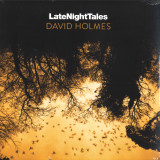
DJ and producer David Holmes is welcomed to the Late Night Tales fraternity with an evocative collection of personal songs and music, peppered with exclusive new material and rare gems. By now, I think we all know David Holmes, right There's acid house Holmes, with bone-rattling Chicago jams and Detroit destroyers, break-digger Holmes responsible for the grittily shaking 'Let's Get Killed' and seminal Essential Mix compilation (which brought Sixto Rodriguez to people's attention, and then there's soundtrack Holmes. His most enduring and vital source of musical inspiration - cinema - plugged into David's rst solo record 'This Film's Crap, Let's Slash the Seats' and inspired 2000's 'Bow Down to the Exit Sign', created as the soundtrack to a not-yet-made movie. Ofcial soundtracks have been bountiful, including scores for Soderbergh's Out Of Sight and Ocean's trilogy, '71, Hunger and Good Vibrations. In a series of personal songs sung by himself, David's last solo album 'The Holy Pictures' explored inuences of La Düsseldorf, The Jesus and Mary Chain and early Brian Eno. His Unloved collaboration with Keefus Ciancia and Jade Vincent then took us on a musical journey full of raw 60s pop-noir, psychedelia and French Ye Ye with a contemporary twist. Somehow he's also found time to produce records by Primal Scream and Jon Spencer Blues Explosion. Unsurprisingly, for someone au fait with matters cinematic, this Late Night Tales conjures up its own mindmovies. It's not only packed with the judiciously selected nuggets for which his mixes are noted but also stuffed with original material, including collaborations with BP Fallon and Jon Hopkins and an amazing new reading of 10cc's 'I'm Not In Love' by Holmes-produced Song Sung. In fact, there's a Celtic thread running through the whole journey with Stephen Rea's reading of an extract from Seamus Heaney's AENEID BOOK VI - Elsewhere Anchises. Among the other gems included here are David Crosby's lush 'Orleans', Buddy Holly's celestial 'Love Is Strange' and the Children Of Sunshine's 'It's A Long Way To Heaven'. David Holmes loves music. It's a way of expressing the sometimes inexpressible or the inconsolable, a questing desire to nd out just what is over the next hill. It's no surprise to learn he's a keen walker. Always on the move, headphones on, lost in some reverie or piece of music, the soundtrack to his life, the stuff that feeds his imagination. I walk a lot. It's amazing for listening to music: your phone or your emails aren't going and you're just in the forest listening to music. It's so intimate. Anyway, I was listening to the KLF's Chill Out album, which still sounds amazing, but it triggered an idea with concrete sounds through travelling and movement. And one of the things I was trying to do was to use this idea not just break up the moods but also as a metaphor for moving through life and arriving in different destinations or arriving at different stages in different parts of your life. Memory, Love, Living, Family, Friendship, Healing, Death and The Afterworld are some of the themes I wanted to explore within this record. Although these strong themes and tracks are personal to me, I also wanted it to be a great listen that was unpredictable yet had a seamless ow - a journey that was personal to me yet to the listener a great compilation of music that they may or may not have heard before. I hope I've succeeded in the later.' David Holmes 2016
Repress!
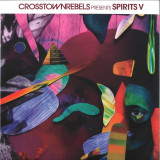
The release of Crosstown Rebels’ SPIRITS compilation is always a bastion moment for the label. The first edition came to prominence in 2017 and we’ve been graced with an annual compilation ever since, showcasing a consistent habit to champion established artists and breakthrough ones alike. Now, Crosstown Rebels’ lauded SPIRITS series will see the light of day once more in June, with the release of SPIRITS V.
NYC-native Layla Benitez leads proceedings with Fides, a progressive-leaning, introspective number that retains an inherent danceability throughout. It kicks off the compilation with a driving energy, one that’s perfectly matched by Trabajar - the Crosstown Rebels debut of recent Hot Creations inductee Mr.Diamond.
A techy-inspired cut, punchy four-four drum patterns create a distinctive late-night feel, as UK-talent Denney soon arrives with Kill The Soundboy. Showcasing the groove-laced house sound with which he’s become best known, the near seven-minute piece is sure to light up many a club setting this year, paving the way for Talk To Me. It’s a collaborative venture between Munich-based artist ASK:ME and El Muerto, with Soulfoot featuring on vocals. Retaining a vintage Detroit style, the fast-paced tempo creates a natural excitement before Romanian-born mainstay GruuvElement’s gifts us the minimal-toned Boom Room.
Building with tribal-like percussion and salsa-inspired instrumentals, it’s a playful excursion into dance music’s outer realms, paving the way for young Peruvian producer Chinonegro with My Moment. Whether it be the pluck of a guitar string or a jazzy trumpet solo, there’s an inherent authenticity to the six-minute piece, as a mid-track breakdown gives way to whispering hats and a rhythmic underlying backbone.
The penultimate offering comes from French-born, London-based regular Maglia, who serves up the enchanting Rayiys. The chirping of birds resides atop an ever-changing bassline, leaving us open and ready for the VA’s closing saga: Thanks Moon, by Spain’s I AM JAS. A heady combination of beautiful lyrical contributions combines with softly moving electronic elements, to leave us in a state of calm, inward reflection. Rounding off proceedings on a note of quietude, it reminds us of the final moments in clubland, transporting our psyche to sunrise, fond memories and everything in between.
Over a period of nineteen years, Damian Lazarus’ Crosstown Rebels has evolved into a world-renowned institution, garnering global audiences thanks to a consistent schedule of quality releases. In years since it’s earliest beginnings, the likes of Maceo Plex, Art Department, Seth Troxler, Ali Love, Mathew Jonson, Pier Bucci, Acid Pauli, Dennis Kurtel, Francesca Lombardo, Glimpse, Aphrohead, Fur Coat and a plethora of other figureheads have all found their home on the label.
The roster is international, showcasing how Crosstown has shaped a truly global scene. Releases are born in different continents by artists who hail from different countries, resulting in a sound that resonates worldwide. Perhaps most pivotal to the label’s success is its musical output: no part is governed by boundary or genre. It’s underpinned by a truly eclectic sound, one that reflects the diversity of Damian’s love for music itself. An album from drum and bass icon DJ Krust here, a maiden LP from Audiojack there… traversing genres has been Damian’s forte for decades - and Crosstown epitomises that as a result.
With the buzz around her building, Priddy made her biggest splash with the 2021 release of her debut album, The Eternal Rocks Beneath. The 10 self- penned tracks are delivered with a maturity and depth that belie the fact that this is her first full length release. At times tender, at times carrying a darker edge, the stories she weaves are transporting. Not surprising then that Nick Drake, John Martyn, Tunng and Scott Matthews are amongst her many influences.
The album was recorded over a 2-year period at Rebellious Jukebox studios, a little basement studio hidden beneath inner-city Birmingham and presided over by masterful producer Simon Weaver. The ensemble cast of musicians, including a sweeping string section, occasionally cut through by raw electric guitar and drums, as well as Richard March (Pop Will Eat Itself) on double bass and Mikey Kenny on fiddle, enhance Priddy's command of melody and lyricism and provide the perfect backdrop for the feelings of nostalgia and timelessness that underpin the record. Many of the songs were written during Priddy's teenage years and early twenties and reference themes of childhood and distant memories.
The title, 'Eternal Rocks Beneath' reflects this is Priddy's first album; the culmination of her earlier life experiences and the bedrock for whatever follows next.
Deluxe 180g vinyl. Art Edition LP includes set of six 12”x12” art cards.
The follow-up to Kee Avil's acclaimed 2022 debut Crease: "A stunning debut" (The Quietus); "A whiplash style of uninhibited exploration" (The Wire); "Kee Avil's debut is a force" (Foxy Digitalis); "A work of Frankensteinian wonder" (Electronic Sound); "A tightly coiled, finely wrought vision of avant-pop" (Exclaim); "A debut of fiendish creativity" (Bandcamp Album Of The Day / Albums Of The Year) Kee Avil's music is both adventurous and intimate, intellectually challenging and emotionally resonant. The Montréal guitarist and producer's 2022 debut LP Crease garnered plaudits from outlets like The Wire, The Quietus, Mojo and Foxy Digitalis, picking up a Canadian Juno Award nomination and Bandcamp Album Of The Day and Albums Of The Year along the way. Its intricate construction, unnerving atmospheres, and knife-edge take on avant-pop prompted comparisons to early PJ Harvey, This Heat, and Gazelle Twin. A remix EP with work by claire rousay, Ami Dang, Cecile Believe, and Pelada brought collaborative perspectives to four Crease tracks, offering new pathways within those songs. With Spine, Kee Avil strips back her heavily textured compositions, opening up a much rawer sound. She calls it folk… and while traditionalists might scoff, this is urgent music that reflects the precarity of modern life, as well as the jarring mixture of electronic and real-world interactions that have become the fabric of our day-to-day experiences. There's a hypnotic post-punk somnambulance to it all, using the repetition and fracturing of melodic phrases interwoven with delicate electronics to create curious and persistent hooks. While not a concept album, themes of time's passage, remembrance, and decay crop up across multiple tracks. Each track intentionally only has four elements - guitar, electronics, and two other instruments, with Kee's voice and guitar pushed to the front. Within this minimalist framework, the juxtaposition of beauty and discomfort that is key to the Kee Avil sound stands out in skin-prickling relief. "We're shaped by many versions of ourselves," says Avil. "I was looking back at these versions of myself and what could have been, what didn't end up being and what did end up being, and going back like that through time. Seeing the future, the past." Spine was written in Kee Avil's home studio after a lapse in writing while touring Crease and working on other projects. She is a well-known and respected member of the Montréal experimental scene, and formerly ran Concrete Sound Studio with Zach Scholes, who continues to work with her as a producer on Spine. Compared to the three years that went into making her debut, Spine emerged in a matter of months - a process that may also be a factor in its intensity and sharpness: "This record was much harder, like it was really discovering everything from scratch." In her desire to not simply replicate or extend the sound of Crease, she felt she had to rip up the rule book, write in a different way, and pare back songs against her usual instincts. Sometimes, when we work against our ingrained habits, we get to the core of who we really are. Spine is an exercise in that process. Without over-intellectualizing or being didactic, it hits immediately and emotionally, especially if you are a person who has spent much time in the process of self-examination. Kee's voice hisses, whispers, and chants; her guitar bends and rings; electronics skitter and crackle; violin creaks like a door in the wind. There is something so evocative about the atmospheres she creates that it's easy to overlay one's own feelings onto her work, but to do that wholly would be to overlook one of the most important things about Spine: Kee Avil's clear and thoughtful vision. This isn't just the next step forward in her artistic trajectory; it's a stunner of a record that stands on its own, a bracing and thrilling listen that has much to reveal about the contradictions inherent in being human. - jj skolnik
The current lineup of New Haven's long running Mountain Movers (guitarist/vocalist Dan Greene, bassist Rick Omonte, guitarist Kr yssi Battalene, & drummer Ross Menze) have been playing together for over a decade now, making their recorded debut on a slew of singles released from 2011-2013, but it wasn't until 2015's "Death Magic" (released on New Haven label Safety Meeting) that the potential of that iteration of the group became clear; Mountain Movers are a force of nature. The camaraderie & sensitivity to each others playing has only grown over time, cr ystallizing on the group's trio of albums for Trouble In Mind; 2017's eponymous "Mountain Movers" served as a reintroduction of the group to a larger audience, while 2018's "Pink Skies" raged like a group confident in its strengths, and 2020's prescient "World What World" - written & recorded before the world shut down - slightly shifted focus away from the jams & back toward the weight of guitarist/songwriter Dan Greene's poetic tales of magical realism. The band's ninth album "Walking After Dark" finds a happy medium between both aspects of the band's strengths; Greene's lyrical compositions and the group's long-form improvised jams. To those that are tuned in, that feeling of communion is evident in the Movers' playing. The members swap & cycle effortlessly through instruments without missing a beat, utilizing the downtime of lockdown to write & record every jam in their practice space. Those piles of tapes would eventually get edited & sequenced into "Walking After Dark", a tour-de-force double-album that balances fried, stony brilliance with outré excursions of experimental serenity. Consider the opening track "Bodega On My Mind" that ambles in like a road-worn traveller, its lysergic folk strums peppered with acidic lead lines from Battalene's Telecaster, eventually giving way to "The Sun Shines On The Moon, where the group's sizzling guitars are buoyed by Omonte's pillowy bass & Menze's percussion. From there on out, tracks like "Factory Dream" give the listener a taste of The Movers' modus operandi here; a mixture of (more) traditional song craft interspersed between long-form, improvised pieces of modern psychedelia. The group shuffles through instruments; synths, drum machines, auto-harp, various forms of percussion (and whatever else was laying around) as well as the trad guitar/bass/drums configuration to craft a suite of songs that - while not necessarily similar in composition - feel unified in their overall sonic scope. Tracks like the 14-minute "Reclamation Yard", whose deep-space electronic pulse is juxtaposed against side C opener "See The City "s persistent acoustic strum that showcase similar ideas of the `spirituality ' of losing ones self in repetition, but executed differently. In many ways "Walking After Dark"s duality feels like a merger of "On The Beach"-era Neil Young & the collective freak-outs of Amon Düül, taking inspiration in the `incorporeality ' of free music and lacing it with Greene's hazy, haunting lyricism and is an exciting step forward for a band that's already a few steps ahead. "Walking After Dark" is released on black double-vinyl in a full color gatefold jacket & includes an insert with artwork & lyrics by member Dan Greene.
In one sense, it’s easy for artists—songwriters, specifically—to express their feelings in their work. After all, that’s what the lyrics are for! But it’s much harder to convey emotional energy in how you play, slash at the guitar, and the structure of the music itself. That’s precisely why Girl and Girl’s Sub Pop debut, Call A Doctor, feels like such a vital, electrifying shock to the senses. Not since the early work of Car Seat Headrest or Conor Oberst’s widescreen emotional brutality as Bright Eyes has indie rock managed to come across as this intimate and grandiose, as the Australian quartet led by Kai James lay a lifetime’s worth of woes—mental health, the human race’s planned obsolescence if you’ve been living on this cursed rock you know what we’re getting at—across a canvas of indie rock that feels both timeless and in-the-moment.
An audacious and aggressively tuneful blast of a record, Call A Doctor is an unforgettable first bow from Girl and Girl, whose origins lie in James and guitarist Jayden Williams jamming in his mother’s garage in the afternoon after school. One afternoon, James’ Aunty Liss headed down to their practice space after walking her dog and asked if she could sit in on drums. “It sounded really great,” James recalls. “We begged her to stay, and she said, ‘I’ll stay until you find another drummer.’ We wore her down, and she eventually became a permanent member.”
After bassist Fraser Bell joined to round things out, Girl and Girl hit the road and began to make a name for themselves beyond the Australian bush, eventually signing to Sub Pop off the strength of word of mouth. Call A Doctor came together quickly soon after, largely recorded in marathon sessions in a two-story industrial complex over the course of two weeks. “That added to the intensity of the album,” James says about the frenzied creative process overseen by producer Burke Reid. “I can hear the stress in the record, which is good because that’s what it’s about—being tense, tied up, and in your own head.”
Call A Doctor’s eleven songs—spanning sweeping guitar epics and wry acoustic shuffles to spiky punk maneuvers and the type of raw, adoringly unvarnished indie-pop associated with legendary PacNW label K Records—are literally plucked from James’ personal history, as he reworked older recordings with newer lyrics reflecting his past struggles as well as new anxieties that emerged prior to the album’s recording. “I’ve struggled with mental health for a lot of my life,” he explains, “and I went through a particularly difficult patch when we were making the album; the band had started to get some attention, and I felt an enormous amount of pressure to live up to it.”
Far from the sound of collapsing under pressure, Call A Doctor finds James and Co. stepping up with their entire collective chest. This is a record that’s so out-and-out alive that you nearly feel like you’re in the same room with Girl and Girl as you listen to it; lead single “Hello” practically bursts through the speakers, amplified by Aunty Liss’ unbelievable stickhandling duties. “‘Hello’ is all about romanticizing your own misery. Letting those deep, dark, dirty thoughts take over. Understanding that even if you could pull yourself out, you wouldn’t because the constant stress and worry is far too familiar and comfortable.”
“Mother” pogos on a spiky groove that’s reminiscent of the geographically close New Zealanders who make up the legendary Flying Nun label, while “Oh Boy” draws from the Shins’ own jangly sound, injected with James’ wonderfully nervy vocals. Then there’s Call A Doctor’s sorta-centerpiece “Maple Jean and the Anthropocene,” a five-minute epic offering a new perspective on climate change and the notion of what it means, in a personal sense, to suffer: “I live in the bushland, and I was driving home one night and hit and killed a wallaby with my car,” James recalls while discussing the song’s lyrical inspiration. “My first thought was, ‘What is the universe trying to tell me?’ No remorse, no guilt, just total self-centeredness. Which was like, Woah, you fucking psychopath! This wallaby wasn’t put on this earth to send you a message. That’s what the song is about, our egocentric species - thinking you’re the main character and that everything that happens is somehow about you.”
“This record is about an individual who’s too far in their head, trying to get out,” James continues while discussing Call A Doctor’s overall outlook—specifically the snapshot it offers of its creator. But even though this record deals with uneasy topics we all know well from within ourselves, it’s important to emphasize how teeming with life Girl and Girl’s music is. There’s a brazen, bold sense of humor to this stuff, an undeniable brightness to the darkness that makes it impossible not to be drawn in as a listener. Feeling down never sounded so goddamn good.
Suffering can be a borderline experience, opening doors to the divine. Canadian black-metal-outfit GIVRE has dedicated its fourth album to this concept, well known throughout Christian history: On "Le Cloitre" (engl. "The Cloister") the band continues its exploration of the atoning side of pain and the austere aspects of faith through music that goes all the way from elegiac elegance to disturbing outbursts. Even the band deals with Christianity, through a historic lense, they should not be understood as religious band in any way!
The group was founded back in 2010 in Rouyn-Noranda by David Caron-Proulx (Composition, guitars, keys), Jean-Lou David (research, vocals), and Mathieu Garon (bass) when they were just 16 years old. They self-produced a demo album, then moved away from their hometowns. David is now a composer for film and mixed media and Jean-Lou is a writer and historian. In October 2020, ten years after their first collaborative endeavors, they reunited and recorded two more albums: "Le Pressoir mystique" and "Destin Messianique".
The creation of "Le Cloitre" was a lengthy process. While most recordings were made right after "Destin Messianique" in 2021, extensive work was done over an extended period of time to add layers and perfect the album's concept. Each of the six songs corresponds to a holy woman from Christian history. The lyrics are taken directly from their writings or hagiography (an idealized biography), delving into their connection to the divine through suffering. The words are sometimes rearranged, but they are all direct citations without anything new added to them, from the symbolic poetry of Hildegard Von Bingen (1098-1179) to the disturbing and factual depictions of Marthe Robin (1902-1981).
The compositions vary to reflect these different perspectives: sometimes dark and eerie, other times blissful or sorrowful. Therefore, a crucial addition to the album's atmosphere was the inclusion of female vocal performances. Additionally, samples from the French film "Le dialogue des Carmelites" from 1959 are incorporated. Excerpts of a piece by Hildegard von Bingen are used in the song dedicated to her. The album was recorded in the band members'home studios. Mixing and mastering were done by long-time-collaborator Gael Poisson-Lemay (Gris, Sombre Forets, Miserere Luminis), who also contributed guitars to the song about Marthe Robin. Vinyl mastering was done by Greg Chandler (Esoteric) at Priory Recording Studios.
- 1: Kaleidoscope
- 2: Please Excuse My Face
- 3: Dive Into Yesterday
- 4: Mr. Small, The Watch Repairer Man
- 5: Flight From Ashiya
- 6: The Murder Of Lewis Tollani
- 7: (Further Reflections) In The Room Of Percussion
- 8: Dear Nellie Goodrich
- 9: Holidaymaker
- 10: A Lesson Perhaps
- 11: The Sky Children
- 12: Kaleidoscope (Earliest Known Recorded Version)
- 13: Dream For Julie (Earliest Known Recorded Version)
Look through any self respecting quality music publication or web site and peruse through a list of the most important and influential psychedelic albums of all time and you can be pretty sure to see KALEIDOSCOPE'S 'Tangerine Dream' ranked high up there, along with your 'Sgt Peppers', your 'Forever Changes' 'Satanic Majesties Request' 'Axis Bold As Love' 'Odyssey & Oracle' and 'The Psychedelic Sounds of the 13th Floor Elevators'........
This seminal album of quintessential English psychedelia is one of the most highly prized artifacts that define the psychedelic genre and like some of the most highly collected and prized albums from that time, mint copies can now go for way in excess of £1000.
Thus given the record`s rarity & collectability, matched to the recent explosive interest in all things psyche, garage & underground, you would be excused for thinking that this slice of perfect late 60's progressive underground pop would have been given the full reissue and remastering treatment already. Surprisingly though, you would very much be mistaken. But to those of you who know the checkered history of Kaleidoscope this will perhaps come as no surprise!!!
Thankfully after 3 years of painstaking detective work, chance encounters with Universal archivists, heavy negotiations with major label legal executives and some good fortune, we are delighted to announce that this record will finally not only get its first proper official reissue in over 5 decades, but thanks to a lot of pure persistence it can now be presented to its listeners in the manner in which it was supposed to have been heard, following the discovery of a batch of the original master tapes that were languishing in the vaults of Universal that have laid largely unheard for 50 years!
Furthermore following a couple of shared festival billings at Austin and Copenhagen Psyche Festival, with another legend of the scene, Mr Pete Kember aka SONIC BOOM of SPACEMEN 3 fame, Sonic has been holed up in his Lisbon studio, painstakingly remastering the album from the original ¼' tapes.
The remastering of these ¼' tapes though is only part of the story, as along with the discovery of these a significant number of ½' tapes and other material was also discovered which is penned for a future release when the band`s entire works will be presented in a definitive boxset of all four of their studio albums (including all their Fairfield Parlour recordings) plus BBC Sessions, live recordings, alternative takes, new mixes, unreleased tracks and material from the band`s own archive including pre-Kaleidoscope demos when they were known as both The Sidekicks and The Key.
For now though, this 50th Anniversary release comes with a flavor of what is to come, with the inclusion of two unreleased out-takes tracks from 1967 on a bonus 7' housed in a replica original paper thin Fontana sleeve which, includes an early version of the track that gave the band their name, the suitably titled: 'Kaleidoscope'. Whilst the flip presents an alternative earliest known recorded version of the album's follow-up single: Dream For Julie'.
The album itself, has been cut onto 180g heavyweight vinyl, housed in a deluxe high-end gatefold tip-on sleeve with the lyrics printed and new artwork. The first 1000 copies of the album will be hand numbered by the band & pressed on 'Tangerine' orange vinyl housed in an inner sleeve with attractive new artwork + download code.
The relatively short life of San Francisco's Aluminum has so far yielded a single (Spinning Backwards, 2020) and an EP (Windowpane, 2022), but their debut LP, Fully Beat, overflows with tenured confidence and a singular style that deftly comprises shoegaze, big beat, and jangle pop. With influences ranging from Orbital, to Wipers, to The Avalanches and Sly and the Family Stone, theirs is a multifaceted take on established forms, fed through fuzz and led by honeyed, male-female vocal harmonies from Bay Area post-punk veterans Marc Leyda (of Wild Moth) and Ryann Gonsalves (of Torrey). "Smile" begins with deceptive sparseness, adding neon swirls of stacked tremolo over a mesmerizing lyrical refrain, and hinting at the dynamism to come with understated grace and grit. "Always Here, Never There" is Fully Beat's first pure hit of melodic pop: its liquid bass groove winds beneath a melancholy-sweet synth hook and Leyda's plaintive vocals, while drummer Chris Natividad's deep, pillowy snare and propulsive style maintain a driving pace. Lead single, "Behind My Mouth", shifts gears into a big beat shuffle and howl of overdriven guitars, which relent to Gonsalves' rolling bassline and playful, snarky vocal. Composed across several weeks of experimentation, it is a prime iteration of Aluminum's meticulous world of sound, which nevertheless carries an air of wry nonchalance. Asking, "Do you ever see behind my mouth?", Gonsalves notes that the song "comes from a place of wanting to be understood authentically, and to communicate intentionally." This approach speaks to the album's broader theme of exhaustion amid the demands of the modern grind: working unfulfilling jobs to pay exorbitant rent, feeling society break at the seams, and trying to maintain a meaningful personal life with the remaining scraps of morale. The response, then, must be to find joy. These songs were crafted over a half-dozen months in basements and practice spaces, creating an abundance of authentic passion and catharsis that's as nostalgic and comforting as a cherished, tattered band t-shirt. The closer, "Upside Down", is a full-throttle blare of joyous release - "a straight-up love song," according to Leyda. The deliberate choice to end it with a gradual fade, rather than a dramatic climax, smartly suggests the ambivalence of acceptance - perhaps fitting, when considering the immensity of the album's subject matter. It also hints that there is much more to be said, and as such a rich and compelling debut, Fully Beat shows that Aluminum are only getting started.
In one sense, it's easy for artists-songwriters, specifically-to express their feelings in their work. After all, that's what the lyrics are for! But it's much harder to convey emotional energy in how you play, slash at the guitar, and the structure of the music itself. That's precisely why Girl and Girl's Sub Pop debut, Call A Doctor, feels like such a vital, electrifying shock to the senses. Not since the early work of Car Seat Headrest or Conor Oberst's widescreen emotional brutality as Bright Eyes has indie rock managed to come across as this intimate and grandiose, as the Australian quartet led by Kai James lay a lifetime's worth of woes-mental health, the human race's planned obsolescence if you've been living on this cursed rock you know what we're getting at-across a canvas of indie rock that feels both timeless and in-the-moment. An audacious and aggressively tuneful blast of a record, Call A Doctor is an unforgettable first bow from Girl and Girl, whose origins lie in James and guitarist Jayden Williams jamming in his mother's garage in the afternoon after school. One afternoon, James' Aunty Liss headed down to their practice space after walking her dog and asked if she could sit in on drums. "It sounded really great," James recalls. "We begged her to stay, and she said, 'I'll stay until you find another drummer.' We wore her down, and she eventually became a permanent member." After bassist Fraser Bell joined to round things out, Girl and Girl hit the road and began to make a name for themselves beyond the Australian bush, eventually signing to Sub Pop off the strength of word of mouth. Call A Doctor came together quickly soon after, largely recorded in marathon sessions in a two-story industrial complex over the course of two weeks. "That added to the intensity of the album," James says about the frenzied creative process overseen by producer Burke Reid. "I can hear the stress in the record, which is good because that's what it's about-being tense, tied up, and in your own head." Call A Doctor's eleven songs-spanning sweeping guitar epics and wry acoustic shuffles to spiky punk maneuvers and the type of raw, adoringly unvarnished indie-pop associated with legendary PacNW label K Records-are literally plucked from James' personal history, as he reworked older recordings with newer lyrics reflecting his past struggles as well as new anxieties that emerged prior to the album's recording. "I've struggled with mental health for a lot of my life," he explains, "and I went through a particularly difficult patch when we were making the album; the band had started to get some attention, and I felt an enormous amount of pressure to live up to it." "This record is about an individual who's too far in their head, trying to get out," James continues while discussing Call A Doctor's overall outlook-specifically the snapshot it offers of its creator. But even though this record deals with uneasy topics we all know well from within ourselves, it's important to emphasize how teeming with life Girl and Girl's music is. There's a brazen, bold sense of humor to this stuff, an undeniable brightness to the darkness that makes it impossible not to be drawn in as a listener. Feeling down never sounded so goddamn good.
"I was in a dream, but now I can see that change is the only law." With a credo adapted from science fiction author Octavia E. Butler, an album title from a collection of metaphysical poetry, and an expansion in consciousness brought on by personal crisis, guitarist and songwriter Shana Cleveland learns to embrace a changing world with unconditional love on News of the Universe, the new full-length from California rock band La Luz. News of the Universe is a record born of calamity, a work of dark, beautiful psychedelia reflecting Cleveland's experience of having her world blown apart by a breast cancer diagnosis just two years after the birth of her son. It's also a portrait of a band in flux, marking the first appearance for drummer Audrey Johnson and the final ones from longtime members bassist Lena Simon and keyboardist Alice Sandahl, whose contributions add a bittersweet edge to a record that is both elegy for an old world and cosmic road map to a strange new one. But is there any band in the world more suited to capturing the chaos of change in all its messy beauty than La Luz? Formed by Cleveland in 2012, La Luz is beloved for their ability to balance bedlam and bliss, each new record another fine-tuning of the band's mix of swaggering riffs with angelic vocals borrowed from doo-wop and folk; a band so reliably great that it makes the huge step forward in confidence and sheer musicality that is News of the Universe all the more formidable. Cleveland, also a writer and painter, has developed into a truly original songwriter with her own canon of haunted psychedelia. Yet if Cleveland has spent years writing songs about ghosts, what lurks in the shadows of News of the Universe is nothing less than death itself. "There are moments on this album that sound to me like the last frantic confession before an asteroid destroys the earth," says Cleveland. The powerful sense of openness that permeates News of the Universe is at least partially due to the fact that it is a record made entirely by women-from the performing, writing, and producing all the way through to the recording, engineering, and mastering. Working with producer Maryam Qudos (Spacemoth), the all-female environment allowed Cleveland to feel safe tapping into difficult places and expressing hard emotions women are socialized to suppress. Unashamedly vulnerable, unabashedly feminine, and undeniably triumphant, News of the Universe is another knockout record from a band so reliably great that it has perhaps led people to overlook how pioneering La Luz really are: women of color in indie music forging their own path by following their own artistic star into galaxies beyond current musical trends, always led by an earnest belief in the cosmic power of love and a great riff. Never is that more true than on News of the Universe, which might be La Luz's most brutal record to date but also their most blissful.
Composed by Jim O’Rourke and pieced together by Jim together with longtime collaborator and trumpeter Eivind Lønning at Jim and Eiko Ishibashi’s home in the Japanese mountains, this engrossing new album blows brass wails and tense fanfares across O'Rourke's manipulated Kyma tapestries for a deep, captivating trip into the aether.
Eivind Lønning has been sharing ideas with O'Rourke for several years: the duo collaborated on music for the Whitney's 'Calder: Hypermobility' exhibition, and Lønning played trumpet on O'Rourke's brilliant 2020 album 'Shutting Down Here'. For this new work, Lønning headed to O'Rourke and EIko Ishibashi's home studio in the Japanese mountains, where he teased unfamiliar, alien textures from his trumpet to open the labyrinthine three-part composition. O'Rourke took the material and subsequently funnelled it through his Kyma system, transforming it into a swirl of sound that hums alongside Lønning's original takes. The album was composed, mixed and mastered by O'Rourke, with everything's based on Lønning's virtuosic performance.
The album begins by cautiously introducing us to its sonic palette: wavering, bird-like horn wails that O'Rourke contorts around quiet synth oscillations and computerised swarms. Lønning's spittle-drenched blasts are given the spotlight, but O'Rourke's manipulations - often gentle and illusory, and sometimes utterly lacerating - lift the sounds into completely new territory. When Lønning begins to turn rhythmic cycles using the trumpet keys, popping with his mouth to compliment its leathery timbre, O'Rourke replies with dense, hallucinatory drones, juxtaposing unstable electronics with Lønning's breathy, sustained notes. All these sounds coalesce into a dizzy vortex, but O'Rourke is careful not to overwhelm the senses, dropping to near silence as the first act transitions into the second. O'Rourke pelts Lønning's vertiginous wails, steadily mutating them into Xenakis-like stabs until they sound like cybernetic strings and icy tones that extract the tension from Lønning's brassy harmonics.
The third act is more screwed, with O'Rourke allowing Lønning's improvisations wail into cathedral-strength reverb, accompanying the sound with glassy penetrations and throbbing subs. Here, Lønning sounds as if he's heralding the arrival of a celestial being, piercing the atmosphere with bright, sustained tones and muted, jazzy flourishes. O'Rourke hangs back, carefully spinning the notes into naturalistic fibres and orchestral drapery, before he allows the electronics to subside completely and the trumpet to echo into the imposing negative space.
'Most, but Potentially All' is a dumbfounding piece that shifts the dial on contemporary experimental music; dizzyingly complex but never showy, it's the kind of record you can spin repeatedly and hear something different each time. As an exploration of the trumpet, it's a unique expression, and as a progression of electro-acoustic compositional techniques, it draws a deep trench in the sand, setting a new standard.
Syncrophone Presents the Very First Vinyl Release From Aleqs Notal’s Label : Industrial Light. This Premiere Sees Notal Partnering Up With Long Time Friend and Fellow Producer Modern House Quintet. Throughout Four Tracks &Ndash; Two From Each Musician &Ndash; This Release Dives Into Several Sub-Genres of Electronic Music and Provides Four Compelling Songs. on the A1 Side, Message From the P Opens Up the Record With a Classical Notal’s Signature Sounds : Ron-Trent-Ish Pad and Organ Samples, Supported by Additional Snares and Several Lines of Hi-Hats. This Delicate House Track, With Its Acid Line Chord Core Is Perfect to Open Up a Set. A2 Drinking Workers Sees Notal Weave His Hi-Hats Patterns Around a Typical Detroit-House Bass Line. Architected and Thought Like Scratches (Due to His Hip-Hop Background), Hi-Hats Set the Tone and Enhance the Track as a Back-and-Forth Game With the Bass, Contributing to the Overall Depth of the Song. Once Again, Notal Shows His Creativity About Blending Different Sub-Genres Into a Single Track. on the Flip Side, Modern House Quintet Presents Two Very Different Tracks (Although Both Are Clearly Made for the Floors). B1 Nadrezacalenis Associates Several Layers of Shakers and Subtle Hi-Hats &Ndash; Combined With Percussion &Ndash; in Order to Emphasize the Lush Rhodes Chords And, Later, the Entrancing Vibraphone Notes. Last but Not Least, B2 Dioskouron Is Clearly a Track for a Peak Time Moment. With Its Detroit-Techno Atmosphere, Its Tr-909 Drums Pattern, Its Textures (The Discreet, Yet There, Pad) and Its Pace, DJs Can Rely on This Great Addition for an Ideal 3 Am Set to See Heads Nod and Bodies Swing. as for All the Previous I.l Releases, Artwork Is Made by Jn/wl. ...
Donny McCaslin is an artist consistently at the forefront of musical innovation. Building on the foundation laid by his critically acclaimed 2023 album "I Want More," described by Mojo Magazine as an "emotive electro-jazz" masterpiece and celebrated for its adventurous spirit by De Volkskrant, Donny McCaslin continues to chart new territories in sound with his latest 7in vinyl and digital release, "Kid." This new project, encompassing the tracks "Kid" and "Maxine," which not only encapsulates the direct, bold, and charismatic essence of McCaslin's sound but also signals his relentless pursuit of artistic growth, refusing to rest on the laurels of past achievements.
"Kid" is a testament to the fruitful collaboration between McCaslin and Tim Lefebvre, reflecting a deepening of their artistic development as collaborators, writers, and bandmates. This instrumental track, enriched by David Fridmann's visionary production, explores the complexities of musical narrative through its intricate harmony and dynamic saxophone lines. The bass subs introducing an electronic vibe into the track signify the duo's forward-thinking approach, blending genres and sounds into a cohesive whole. The saxophone, treated with effects of delays and reverb, veers away from traditional jazz solos, creating textures that support an overarching sound world, inviting listeners to immerse themselves in the music rather than focusing on individual performances. "Maxine", on the other hand, presents a more introspective journey. Originating from a track sent by Colby Keyz, McCaslin develops this piece into a poignant love song, layered with saxophone melodies and solos that evoke a deep sense of longing and emotional depth.
The production, handled masterfully by Steve Wall, enhances the track's unique sounds, demonstrating McCaslin's ability to create profound musical experiences even in the absence of live band interaction. Together, "Kid" and "Maxine" highlight McCaslin's virtuosity and innovation as a musician. His commitment to evolving his sound and the depth of his collaborations exemplify why he remains a progressive force in the music world. With "Kid", Donny McCaslin reaffirms his position as an artist unafraid to explore, develop, and redefine the boundaries of contemporary music, making this release an essential addition to the collections of aficionados and newcomers alike.
One of the most essential works from Nurse With Wound, coming in an extended luxury 3x picture LP and 2CD edition, with many unreleased, alternative versions and songs.
This album is the sister album to Current 93’s same titled album and it’s a crownjewel for collectors of avantgarde and experimental music.
The original release of Nurse with Wound’s gargantuan “Thunder Perfect Mind” in 1992 coincided with that of Current 93’s homonymous genre-defining album. Legend has it that the gnostic name initially appeared to Steven Stapleton in a dream as the title of Tibet’s then still nameless upcoming album. Both records feature contributions from David Tibet, Colin Potter, Rose McDowall, John Balance of Coil, Alan Trench of Orchis and Joolie Wood amongst others. The title and the partial overlap of the personnel on both albums isn’t quite where the similarities end, both albums have since become undisputed milestones in their respective artists’ oeuvre. At the core of the definitive 2023 Infinite Fog re-release fully overseen by Steven Stapleton are the two original tracks “Cold” – a classic unsettling rhythmic Nurse collage-fest, significantly closer to jittery psychelia than the oft-cited “industrial feel” and the epic “Colder Still”, easily one of the most mind-bending breathtaking NWW compositions up to this point and well beyond. The track soothes ghostly atmosphere and reveals new surprises with every listen, not least of which is a direct link to its sister release from c93 as well as the first appearance of the signature rhythm loop that would mutate and re-emerge on several later tracks. The album also is the first full-length collaboration with genius sound wizard Colin Potter who has since become a ubiquitous sidekick both on Nurse albums as well as in live performances. As a follow-up to what is widely acknowledged as one of the best-loved exercises in drone of the 20th century “Soliloquy for Lilith”, TPM is a much more varied but at least equally rewarding experience. Infinite Fog are beyond pleased to be able to offer a significantly enhanced, remastered and extended 3 LP version for old and new fans alike.
- Little Women
- Plumfield
- The Beach
- Christmas Morning
- Dance On The Porch
- Ice Skating
- The Book
- Father Comes Home
- Christmas Breakfast
- Amy
- Friedrich Dances With Jo
- Telegram
- Theatre In The Attic
- Laurie Kisses Amy
- Friedrich
- Laurie And Jo On The Hill
- Young Love
- Meg's Dress
- Carriage Ride
- Laurie
- The Letter
- Snow In The Garden
- Jo Writes
- Amy, Fred, Meg & John
- Dr March's Daughters
- It's Romance
"Little Women explores the lives of the March sisters in 1860s New England in the aftermath of the American Civil War. The prolific composer Alexandre Desplat, who has an incredible number of high-profile projects under his belt, composed the music for the movie. Overall, Desplat currently has ten Oscar nominations in his career, with two wins (The Shape Of Water and The Grand Budapest Hotel). As some has stated his musical score for Little Women was undoubtedly one of the best compositions of the year. According to one of its producers, the new adaptation of Little Women focuses more on the sisters' young adult lives, particularly after Meg, Jo, and Amy leave their family home. The film jumps back and forth in time and focuses more on themes rather than narrative. Little Women stars Timothée Chalamet, Saoirse Ronan, Emma Watson, and Meryl Streep amongst others.
Little Women is available as a limited edition of 1500 individually numbered copies on lavender coloured vinyl. This 2LP is housed in a heavyweight gatefold sleeve and includes a 32-page booklet with exclusive pictures, liner notes, and sheet music."
Little Women by Alexandre Desplat, released 16 May 2024, includes the following tracks: "The Beach ", "Dance On The Porch ", "The Book ", "Christmas Breakfast " and more.
This version of Little Women comes as a 2xLP in a(n) Gatefold Sleeve
"Legend On Legend!
Eddy’s superb reverb-drenched renditions of Dylan’s biggest hits gives your ears a fresh take on these familiar favorites. Full of twang and gut bucket harmonica, this collection of 12 songs encapsulates the ‘60s in a way only Duane Eddy could.
Originally released in 1965, the album has remained one of the rarest and hard-to-get collectibles for Duane Eddy fans everywhere.
Produced by Lee Hazelwood, the album is completely instrumental and showcases Eddy’s individual stylings of the 1960s.
Eddy’s guitar romps and soars through Dylan’s brain waves – translated in this album into notes which build and explode into bar lines of enjoyable melodies. By instrumentally interpreting 12 of the significant songs of the 60’s, Eddy proves there is quality and richness in popular music, too often knocked down for its tendency toward shrillness and over-amplification.
What Bob Dylan is capable of saying with his magical way with words, Duane Eddy is capable of saying instrumentally. As you will undoubtedly hear, it’s a happy marriage."
"Duane Eddy Does Bob Dylan" includes the following tracks: "It Ain’t Me Babe", "She Belongs To Me", "Houston", "Mr. Tambourine Man" and more.
"Legend On Legend!
Eddy’s superb reverb-drenched renditions of Dylan’s biggest hits gives your ears a fresh take on these familiar favorites. Full of twang and gut bucket harmonica, this collection of 12 songs encapsulates the ‘60s in a way only Duane Eddy could.
Originally released in 1965, the album has remained one of the rarest and hard-to-get collectibles for Duane Eddy fans everywhere.
Produced by Lee Hazelwood, the album is completely instrumental and showcases Eddy’s individual stylings of the 1960s.
Eddy’s guitar romps and soars through Dylan’s brain waves – translated in this album into notes which build and explode into bar lines of enjoyable melodies. By instrumentally interpreting 12 of the significant songs of the 60’s, Eddy proves there is quality and richness in popular music, too often knocked down for its tendency toward shrillness and over-amplification.
What Bob Dylan is capable of saying with his magical way with words, Duane Eddy is capable of saying instrumentally. As you will undoubtedly hear, it’s a happy marriage."
"Duane Eddy Does Bob Dylan" includes the following tracks: "It Ain’t Me Babe", "She Belongs To Me", "Houston", "Mr. Tambourine Man" and more.
Greenhouse Recordings label head and long-time master of deep house Andrew Macari steps up to his own imprint with a bunch of fine originals. The opener is a deep tech cut with steely drums that are tight and compelling and offset by smooth chords. Manuel Sahagun then steps up to remix and brings a touch of jazz to his chords which swirl around over heavyweight bass rumbles. 'U Got Me' is then a house sound that harks back to the DIY heyday of Nottingham with its bumping drums and lush chord work and 'When I Want' closes out with more fresh synths and an alluring female vocal.
Hailing from South Korea, the mind & body trained on the raves of Seoul, and across the country we have Jesse You. The gifted producer has embodied 3 original cuts which are showcasing a hefty range of electronic sound. Describing it using standard words would be too banal, so would prefer to say it is interstellar, from dark to funk and served at absolutely correct temperature. Because it is important not to melt the vinyl but to melt the gooey part inside the head. Jesse is no stranger to sound production and have proved this with “Tone Select” a disc that requires shoes which can stand the test of time on the dancefloor.
On the remix duties its Z@P, resident of many prestigious electronic music communities all over the world and one of the hardest working producers of our time. He has applied a deep burner vision on the original track which allows to dissolve in space time continuum given a correct, as well as an incorrect setting. This 12” Vinyl performs many tasks, some of those you know and some of those you have yet to discover, just select the tone.
- 1: Desmond Dekker & The Aces – 007 (Shanty Town)
- 2: Lee "Scratch" Perry – I Am The Upsetter
- 3: Pat Kelly – Somebody's Baby
- 4: Delroy Wilson – Once Upon A Time
- 5: The Rulers – Wrong Emboyo
- 6: The Sensations – Right On Time
- 7: Austin Faithful – I'm In A Rocking Mood
- 8: The Maytals – 54-46 That's My Number
- 9: The Paragons – Memories By The Score
- 10: The Rulers – Copasetic
- 11: Derrick Morgan – Conquering Ruler
- 12: Stranger & Gladdy – Seeing Is Knowing (With Lyn Taitt & The Jets)
- 13: Val Bennett – Baby Baby (Aka 5-10-15 Hours)
- 14: The Uniques – People Get Ready Do Rock Steady
- 15: Val Bennett – The Russians Are Coming (Take Five)
- 16: Desmond Dekker & The Aces – A It Miek
- 17: Roy Shirley – Hold Them
- 18: The Kingstonians – Winey Winey
- 19: The Viceroys – Lip And Tongue (Alternate Version)
- 20: The Overtakers – Girl You Ruff
- 21: Lloyd & The Groovers – Do It To Me Baby
- 22: The Upsetters – Return Of Django (Feat. Val Bennett)
- 23: The Ethiopians – Train To Skaville
- 24: Desmond Dekker & The Aces – Intensified '68 (Music Like Dirt)
- 27: The Tennors – Ride Your Donkey
- 28: Derrick Morgan – Judge Dread In Court
- 25: The Uniques – My Conversation
- 26: Stranger & Gladdy – Over Again
The immediate successor to ska, the soulful, melodic sound of rock steady first developed during the long hot Jamaican summer of 1966 and reigned supreme thereafter for two glorious years before finally being superseded by the more energetic style of reggae.
Despite its relatively brief period as the island’s national sound, the rhythms of many of its biggest hits have continued to influence and inspire music-makers to the present day, resulting in renewed interest in the sub-genre among record buyers in recent years.
This superb 2xLP vinyl collection features 24 of the most popular recordings of the rock steady era, including the UK hits, ‘007’, ‘Train To Skaville’ and ‘It Miek’ and The Maytals’ anthemic dance-filler, ’54 46 That’s My Number’.
Pressed on high quality 140gm vinyl and presented in a stylishly designed sleeve, the album not only provides the ideal introduction to this hugely popular and influential sound, but is also a must for established fans of the Jamaican sub-genre, with many of the tracks appearing on vinyl for the first time in decades.
Jonah Matranga has been making music for over 30 years. A prolific artist, he has become an enduring institution in the scene with a devoted fan base, rich lineage, and varied music career. Jonah has often straddled the line between the underground and mainstream. He’s worked with indie labels like Jade Tree and majors such as Atlantic, having fronted the bands FAR, NEW END ORIGINAL, and GRATITUDE. His music has influenced bands from Deftones to Blink-182, and he was there for emo and post-hardcore giants in their earliest beginnings–taking bands such as Thursday and Dashboard Confessional on tour. Simply put, the scene cannot be separated from Jonah’s art. Jonah has always written from the heart and performed in an intimate way that few others have accomplished. From basements to massive festivals, he brings the same energy to them all: raw honesty and an ability to make every show unique and personal. This is most apparent in Jonah’s solo and collaborative project ONELINEDRAWING. Jonah’s solo performance has always been about connecting with fans in an intimate setting, where they often perform with only a guitar and R2D2 sidekick. Sketchbook is the latest release from ONELINEDRAWING, featuring a collection of songs from Jonah’s early solo years, 1999 - 2001, completely remastered for vinyl. The album features originals and renditions of the likes of 7 Seconds and Jawbox, as well as the Sensefield split honoring the late Jon Bunch (Sense Field / Further Seems Forever). The LP also includes liner notes and zine by Norman Brannon (Texas is the Reason / New End Original). Sketchbook exists as both a time capsule and thank you letter to fans and music itself–a combination of the period in which Jonah first embarked on his solo journey and a celebration of the vitality that music and community not only affords him but all of us. Available in the EU/UK from Thirty Something Records and in the US from Iodine Recordings. Genre: Alternative / Emo
Coloured Vinyl[27,94 €]
As an organism, Blood circa Loving You Backwards, was a six piece. Tim O'Brien is the lyric writer, but the song writing and arrangement is a painstakingly collaborative process in which the band aims for democracy over swiftness.
The record also features the band's first major work with the producer Daniel Enrique Howard, whom the band recorded with at his studio in Brooklyn. Howard helped guide Blood into this new sonic territory. It is not a bedroom project, but instead fully realized, somehow sounding both intimate like Liz Harris' Grouper feels intimate and totally vast in the way that a Talk Talk record feels vast. It's in the same universe as Ought in its earlier iterations.
It's the one all the massive have been waiting for! Part 2 of the Salford sage - DJ Absolutely Shit's 'Memoirs Of A Crust Monster'. More hyped up tear outs, soundsystem ruffage, and bass 'n breaks love songs from our Hell's Angel-dodging beat freak.
Kicking things off with glowing neons and super-charged subs is 'Higher', a modern jungle monster decorated with classic hip-hop samples and a well known diva vox squealing through the melee.
A serious 'watch your bassbins' track - RL HQ have safety tested this on the most robust car stereo systems and so far have yet to avoid any cabinet damage - proceed with caution!
'Lost In Space' rolls outta the speaker stacks with a b-boy swagger and loose breaks. A tribute to classic breakdance electro galvanized with Ab Shit's intricate trademark production chops. You'll want to crack out your finest red Puma classics and a slick tracksuit for this one.
Onto 'Out On Love' and between you and me, someone needs to call the social service for samples - as it's unlikely you'll ever witness a more blatant case of sample molestation. Squeezing every last drop out of a catchy piano lick, TV snippet and drum break; the track really does highlight the unrivaled programming prowess of our Irlam renegade who's taken SP1000 trickery to its absolute zenith.
'Money Talks' sees our cheeky ragamuffin dictate a life affirming sunrise over Pomona - pre-gentrification of course; a thousand smiles and memories of old Mancunia shimmering in the early morning industrial haze. And an abject slight at those who put profits above people - another poignant ode to our changing cityscape driven by the most addictive boogie-based groove and clattering Linn drums.
Spine-tingles and fanny flutters guaranteed ALL DAY on this one cru!
Look out for the full 16 track album due on C90 cassette and digi download coming very soon...
RL x
Maximilian Skiba, an Eminent Figure in the World of Electronic Music, Makes a Triumphant Return to Skylax After an Absence Spanning Over a Decade. His Resurgence Is Nothing Short of Exceptional, as He Joins Forces With the Legendary Snax to Deliver a Musical Offering That Rekindles the Very Essence of House Music's Illustrious origins.
Skiba's Two New Tracks, "Pushing My Buttons" and "In Motion," Serve as a Compelling Testament to His Impeccable Craftsmanship as a Producer. the Influence of the Pioneering triumvirate—Larry Levan, Ron Hardy, and Frankie Knuckles—is Palpable Within These Compositions. Both Tracks Are a Masterful Blend of Nostalgia and Innovation, Perfectly Aligning With the Playlists That Once Defined the Heyday of House Music's Most Celebrated luminaries.
"Pushing My Buttons" and "In Motion" Evoke an Air of Sophistication, Exuding a Smooth, Velvety Quality That Transports Listeners to the Cherished Era of Original Disco. Drawing Parallels to the Timeless Classics Like Dinosaur’s "Kiss Me Again" or Loose Joints "Is It All Over My Face", Skiba's Creations Pay Homage to the Bygone Era While Injecting a Modern Edge. This Phenomenal Ep Goes Beyond Skiba's Original Works, Offering Two Exceptional Remixes That Elevate the Experience. the First Remix, a Balearic Interpretation by the Emerging Talent Maltitz, Adds a Refreshing Dimension to the Tracks. the Second Remix, Helmed by the Skilled Apollon Telefax, Ingeniously Transforms the Already-Classic Tunes Into an Explosive Italo-Disco Sensation. These Remixes Seamlessly Weave Together the Past and the Present, Creating a Bridge Between Different Eras While Keeping the Music timeless.
In Essence, This Ep Is Not Just a Musical Offering; It's a Journey—a Seamless Fusion of History and Innovation That Transports the Listener to an Era of Musical Brilliance, All the While Redefining the Boundaries of Contemporary Sound. Skiba and Snax's Collaboration Is Not Merely a Comeback; It's a Testament to the Enduring Legacy of Electronic Music, Encapsulating the Spirit of House Music's Golden Age While Breathing New Life Into Its Timeless Allure....
Fast approaching the label's two year anniversary, what better way to celebrate than with a double header of LP's from the stalwarts of the modern atmospheric scene. Fresh from his incredible album on Over/Shadow, ASC continues to find a new lease of life rekindling the atmospheric drum & bass scene of the 90's, slowing down the pace to reveal a depth that's just not achievable with higher tempos. Reflections is the culmination of ASC's work in the genre, picking up where others jumped off, and breathing new life into music with old school breaks and sensibilities at its core.
A1 - Still Motion
Opening the album with the airy sounds of a lively coastline, Still Motion is a glorious, unique throwback gem which takes inspiration from elysian points in time in the history of atmospheric drum & bass. Snappy beats and eager kick drums contrast perfectly to the serenity of the keys and a warm, soothing bassline which rumbles along below, unleashing a deep three note melody which will be in your head all day from the first listen.
A2 - Glaciers
Delicate beat work and timid bells introduce Glaciers, before jungly breaks take over and the depth of the piece takes shape with long, mournful strings punctuated by an emotive melody, boring its way into your soul. The track displays a dense, contemplative vibe that must be heard to comprehend, heavy with impact as you are compelled to release your own inner thoughts to slowly dance with ASC's intense production.
B1 - Mirage
Another slice of intense atmospherics awaits with Mirage, beginning with crisp breaks and the sounds of water droplets plunging into the abyss. A cacophony of effects are splashed around the mix while melancholic pad work surrounds the ever-changing breaks, patient melodies waiting their turn to seize the moment. The distinctive ''feel my soul'' vocal sample delivers a simple message - this is a track from within.
B2 - Constellations
Switching up the vibe is Constellations, opening with ASC serving up a barrage of detailed breakbeats that frolic merrily before soothing pads rise in the backdrop, joined by a serene female vocal sample and calming echoed effects. Mild intrigues its atop as our breaks are gradually and subtly layered with intricate detail towards a laid-back conclusion, offering a perfect mid-point breather to the LP.
C1 - Diffusion
An eerie, continuous melody - slightly reminiscent of Tubular Bells - opens and punctuates Diffusion, leading into a typically punchy and energetic masterclass of edited breaks. Tense pad work provides a haunting backdrop to the track, while understated sub bass hides beneath a quadruple hit of low, tuneful tones. The distinctively pitched vocal sample complements the composition to create a truly unique slice of atmospheric drum & bass.
C2 - Dreams
Utilising a detailed, zestful break previously heard in certain classics from the old Progression Sessions days, ASC showcases his superb editing skills to chop the break into something quite scintillating and new. Dreams is one of those tracks which has something fresh to offer the ear each time you listen, riddled with complexity yet also dancefloor friendly with some sumptuous pad work and whispered samples in the backdrop.
D1 - Frozen in Time
A deeply atmospheric piece, Frozen in Time delivers a weighty break pattern which thumps its way into the foreground while a tense, endless melody reflexively grips your attention - and holds it. Building a dramatic, thoughtful vibe with long, washing synths and rising notes, ASC's aural storytelling prowess works in parallel to the nervous energy of the melody, creating a memorable slice of ethereal drum & bass.
D2 - Prototype
Closing out the LP we have something suitably special with Prototype, taking inspiration from far & wide with an experimental feel, showcasing ASC's versatility and command of the apache break. Beats are edited and scattered like dense confetti in the mix, as a varied array of effects mingle around clouds of synths and deep basslines. A signature female vocal yearns ''take me away'' - Prototype, like the rest of the album before it, fulfills that desire in style.
Words by Chris Hayes (Spatial / Red Mist)
- A1: The Soul Stirrers - Wade In The Water (Chatter - Lp1)
- D4: Sam Cooke - Yield Not To Temptation (Chatter)
- D5: Sam Cooke - Yield Not To Temptation
- D6: Sam Cooke - Couldn't Hear Nobody Pray
- D7: Sam Cooke - Somewhere There's A God
- D8: Mel Carter - That's Heaven To Me
- E1: The Simms Twins - You Send Me (Demo)
- E2: The Simms Twins - Just For You
- E3: The Valentinos - Somewhere There's A Girl
- E4: Johnnie Taylor - You Were Made For Me
- E5: Johnnie Taylor - When A Boy Falls In Love
- E6: Johnnie Taylor - Soothe Me
- E7: The Valentinos - That's Where It's At (Chatter)
- E8: Lc Cooke - That's Where It's At
- E9: Johnnie Taylor - Everybody Wants To Fall In Love
- F1: Billy Preston - Keep On Loving You
- F2: The Simms Twins - I'll Always Be In Love With You
- F3: Johnnie Morisette - Baby We've Got Love (Chatter)
- F4: Johnnie Taylor - Baby We've Got Love
- F5: Johnnie Morisette - Baby, Lots Of Luck
- F6: Johnnie Morisette - Put Me Down Easy
- F7: Johnnie Morisette - Rome (Wasn't Built In A Day) (Wasn't Built In A Day)
- F8: Johnnie Taylor - Greazee (Part 1 & 2)
- G1: Johnnie Morisette - I Gopher You
- G2: The Simms Twins - I Gopher You (Chatter)
- G3: Lc Cooke - You're Always On My Mind
- G4: The Valentinos - I Need Lots Of Love
- A2: The Soul Stirrers - Wade In The Water
- G5: The Valentinos - Don't Throw Your Love On Me So Strong
- G6: The Valentinos - Black Night
- G7: The Valentinos - Damper
- G8: The Valentinos - You Can Run (But You Can't Hide) (But You Can't Hide)
- G9: Meet Me At The Twisting Place (Chatter)
- G10: Meet Me At The Twisting Place
- H1: Good Good Loving
- H2: The Wobble
- H3: Lookin' For A Love (Chatter)
- H4: Lookin' For A Love
- H5: I've Got A Love For You
- H6: I've Got A Girl (Chatter)
- H7: I've Got A Girl
- H8: Tired Of Living In The Country
- H9: It's All Over Now
- A3: The Soul Stirrers - I'm A Pilgrim
- A4: Rh Harris & His Gospel Paraders - Praying Ground
- A5: Rh Harris & His Gospel Paraders - Somebody (Chatter)
- A6: The Soul Stirrers - Somebody
- A7: Rh Harris & His Gospel Paraders - Sometimes
- A8: The Soul Stirrers - Amazing Grace
- B1: The Soul Stirrers - Pass Me Not (Lp2)
- B2: The Soul Stirrers - Oh Mary, Don't You Weep (Chatter)
- B3: The Soul Stirrers - Oh Mary, Don't You Weep
- B4: The Soul Stirrers - Since I Met The Savior
- B5: The Soul Stirrers - God Is Standing By
- B6: The Soul Stirrers - Lead Me To Calvary (Rehearsal)
- B7: The Soul Stirrers - Listen To The Angels Sing
- B8: The Soul Stirrers - Don't Leave Me Alone
- C1: The Soul Stirrers - Stand By Me Father
- C2: The Soul Stirrers - Jesus Be A Fence Around Me
- C3: Rh Harris & His Gospel Paraders - Lead Me Jesus
- C4: Rh Harris & His Gospel Paraders - Free At Last
- C5: The Soul Stirrers - Looking Back (Chatter)
- C6: The Soul Stirrers - Looking Back
- C7: The Womack Brothers - Born Again
- D1: The Womack Brothers - Wait On Jesus
- D2: The Womack Brothers - Time Brings About A Change
- D3: Sam Cooke - Must Jesus Bear The Cross Alone
Sam Cooke’s SAR Records Story 1959-1965 gathers significant recordings of SAR Records – the label Sam Cooke co-founded, produced the majority of records for and was instrumental in operating. Groundbreaking artists such as The Soul Stirrers, Johnnie Taylor, Billy Preston, and Bobby Womack’s group The Valentinos are all featured, in addition to Sam himself. “The whole SAR Records Story is infused with Sam Cooke’s rapturous sense of how sacred gospel and sexual soul flow together, unbroken,” stated Milo Miles on NPR’s Fresh Air upon the set’s initial release almost three decades ago. In an era where black-owned labels were a rarity, Los Angeles based SAR Records was founded at almost exactly the same time as Motown, its Detroit counterpart. SAR was established in 1959 by Sam Cooke, music publisher J.W. Alexander, and S. Roy Crain, Cooke’s road manager and founder of gospel group The Soul Stirrers. The acronymous name standing for Sam Alex Roy, SAR sought to keep gospel music alive while simultaneously crossing over to pop audiences in the secular world. LPs 1 and 2 of the set focus on the former, while LPs 3 and 4 encompass the latter. From choosing talent, to writing a great number of songs, to producing, SAR was entirely the fulfillment of Cooke’s vision on a musical/creative level. The superstar singer, who had already crossed over from the gospel world himself, tirelessly coached the vocalists during SAR recording sessions, emphasizing diction. His methods are heard throughout the collection, as he is heard speaking to artists between takes. “And by Sam being there with you and just giving you that special attention, you wanted to give it to him like it was supposed to be. I think that’s what made SAR, SAR. Because he was selling himself through different artists.” – Bobby Womack. VERY LIMITED 1-2 COPIES ONLY PER SHOP
- A1: Reloaded (Feat. Action Bronson, Big Body Bes, Pain In Da Ass, Termanology, Tony Touch)
- A2: Bird Eye's View (Feat. Black Thought, Joey Bada$$, Raekwon)
- A3: East Coast (Feat. Lil' Fame, Noreaga)
- A4: 21 & Over (Feat. Mac Miller, Sean Price)
- A5: The Spark (Feat. Action Bronson, Joey Bada$$, Mike Posner)
- B1: Make Believe (Feat. Ea$Y Money, Freddie Gibbs, Termanology)
- B2: Pinky Ring (Feat. Prodigy)
- B3: Funeral Season (Feat. Bun B, Hit Boy, Styles P)
- B4: Bring Em' Up Dead (Feat. Joell Ortiz)
- B5: Camouflage Dons (Feat. Flatbush Zombies, Smif N Wessun)
- C1: Big City Of Dreams (Feat. Ag Da Coroner, Meyhem Lauren, Push!)
- C2: Gz, Pimps, Hustlers (Feat. Slaine, Wais P)
- C3: My Hoe (Feat. Blu, Evidence, Reks)
- C4: Love & War (Feat. Ea$Y Money, Freeway)
- D1: 100 Stacks (Feat. Jfk, Strong Arm Steady)
- D2: Live From The Era (Feat. Pro Era)
- D3: Game Break (Feat. Lecrae, Posdnuos, Termanology)
- D4: Home (Feat. Talib Kweli)
Celebrating a decade of hip-hop excellence with the 10th Anniversary Vinyl Reissue of Statik Selektah's groundbreaking album, Extended Play. Pressed onto high-quality vinyl and housed in a silver laminated jacket, this limited edition reissue pays homage to the timeless collaboration between the legendary producer and some of the finest wordsmiths in the game.
Extended Play showcases the essence of authentic hip-hop, seamlessly blending old-school vibes with innovative production. Featuring an all-star lineup of rap luminaries, including Action Bronson, Mac Miller, Joey Bada$$, Sean Price, Raekwon, Black Thought, Prodigy, Evidence, Termanology, Posdnous of De La Soul and Talib Kweli amongs several others, this album is a masterclass in lyrical prowess and beatsmithing finesse.
Immerse yourself in the artistry of Statik Selektah as he crafts intricate beats that serve as the canvas for the lyrical dexterity of hip-hop's finest. Each track is a testament to the genre's evolution, capturing the essence of both its roots and its future. From the gritty realism of Sean Price's verses to the introspective musings of Mac Miller, every moment on this album is a revelation.
This commemorative vinyl reissue not only offers listeners a chance to experience the album in its purest form but also provides a glimpse into the collaborative spirit that defines hip-hop culture. The album cover artwork has been meticulously restored and printed onto a silver laminated jacket. Join us in celebrating the legacy of Extended Play and the everlasting impact of Statik Selektah's musical vision!
The band was founded on January 20, 1966 by Cologne students, initially as a political cabaret. The group grew out of the Cologne APO Non-parliamentary Opposition in Germany (Außerparlamentarische Opposition APO) around the SDS German Socialist Students‘ Union, its political orientation evolving over the years towards a clearly dialectical and Marxist position. Independently of each other, group members joined the DKP German Communist Party between 1970 and 1973. On September 6, 1970, the band performed at the Fehmarn Festival following Jimi Hendrix; this was their last appearance for a long time. In 1973, Floh from Cologne performed as part of a West German delegation at the 10th World Youth Festival in East Berlin. From 1980, part of the band (with Vridolin Enxing as chairman) was active in “Rock gegen Rechts” Rock against the extreme right; in the same year, the band was awarded the Deutscher Kleinkunstpreis with Gerhard Polt.
After more than 3,000 concerts in Germany and Europe, Cologne Floh disbanded in May 1983 after a farewell tour. The farewell concert in Cologne‘s sports hall attracted 6,000 spectators and lasted 14 hours, with the participation of numerous musicians such as Hannes Wader, Dieter Süverkrüp, Franz-Josef Degenhardt, Hanns-Dieter Hüsch, Die 3 Tornados, BAP and Ina Deter. In 2023, the group was awarded the Holger Czukay Honorary Prize by the City of Cologne for its lifetime artistic achievement.
With the rock band cantata „Mumien“, the group reacted in 1974 to the 1973 putsch in Chile, notably by setting to music the last speech of deposed president Salvador Allende. In the same year, the band worked with Hans Werner Henze on alternative musical settings of Chilelied (“Dieser chilenische Sommer war süß” / This Chilean summer was sweet; 1974), lyrics: Rudi Bergmann (* 1950), first performed on May 31, 1974 in Essen (Grugahalle: memorial concert for Víctor Jara, at the same time a demonstration of solidarity with the resistance in Chile). „Mumien“ has not yet been reissued on vinyl, and the only CD version (with the album „Vietnam“) dates from 1995.
This live album is a recording of the last live performance by Drumwolf (Toru)'s with the band. The concert was held at W.W.W.X. in Shibuya on March 11th, 2023 and includes 13 of the songs that they played at this gig.
It is the last memorial live performance for Toru, the bedrock of Guitarwolf for many years and will be permanently etched on vinyl. This is a must record that fans need to get hold of, as it is the live recording of the band's latest performance featuring many of their classic songs.
Guitar Wolf have been expanding their horizons of their activities in recent years, including an appearance at the Shimane Jet festival, and they hope you can appreciate the pure joy of their universal rock 'n' roll vibes on vinyl that might be too hot for the whole world to handle!
And as a bonus item, you can stream the full live performance of this monumental concert of Guitarwolf in its entirety as well! It was directed by Tetsuro Takeuchi who has previously worked on Guitarwolf's music videos for many years.
This video of their live performance was edited full of tension and speed and it truly displays how much Guitarwolf deserves the title of Japan's number one rock 'n' roll band. This fact can also be relived by seeing this video included in this deluxe edition.
Guitarwolf
Members:
Seiji (Guitarwolf): Lead Vocals, Guitar
GOTZ (Basswolf): Bass, Vocals
Shingo (Drumwolf): Drum Note: Joined the band in 2022
Real-life rock 'n'roll super heroes that rock fans all over Japan continue to admire.
While creating numerous legendary myths in the 1990s, being unique beyond comparison, they continue to consistently blare out their spontaneity to the present day,
The band's unusually extreme and bombastic sound amplifies the embryonic impulses of rock 'n' roll, while Seiji's lyrics mix words that evoke the 'universe' and the 'Showa era' with his own unique sense of humor. In their relentless pursuit of a style that has remained unchanged since the band's formation, the music that the three members who don their entire bodies in black leather play, emits power that transcends time and space. While doing so, they continue to gain enthusiastic fans from all over the world.
Formed in 1987, the original members, Seiji and Billy (bass, vocals) and Toru who joined the band later, started their musical activities together and released their debut album "Wolf Rock" in 1993 from the Memphis-based Goner Records. Later, they signed to Matador Records, one of the leading indie labels in the USA. They also made their major label debut in 1997 with the album, "Wolf Planet" on Ki/oon Records/ Sony Music in Japan.
They have released 12 albums to date. The band has also continued to tour energetically around the world, not only in Japan but also in the US, EU countries, Australia and South America. Billy suddenly passed away in 2005. After having two mighty support casts, U.G. and Hikaru, GOTZ (Gotz) joined the band in 2018 as the new bass wolf. Also, Toru who had been with the band as drum wolf for many years left in 2022 and the band is now more energetically active with their new drum wolf, Shingo.
1981, the leaden years are over, the socialist left is in power in France and the first wave of punk seems a long way off. However, the youth of the day had not said its last word, and bands were springing up all over the place, free radio stations were opening up, fanzines were being published, concerts were being staged on the fly and little by little a scene was forming, a motley crew of kids in revolt, radical activists and just plain old folk passing through.
After having cut their teeth in a variety of more or less confidential bands, in which you'd come across a good number of players from this up-and-coming alternative scene, the members of Guernica moved up a gear, determined to blow on the still-glowing embers of rebel rock. With the shortage of venues the rule at the time, they began by scouring the suburban MJCs, putting on wild concerts and eventually meeting up with the squatters of the Couronnes commune and the members of V.I.S.A., with whom they played an active part in organising concerts in squatted buildings in these relegated areas of the capital.
In February 1983, the V.I.S.A. association and the Abattoir art collective (which included some members of Guernica) organised a concert at the Usine Pali-Kao. That evening, two groups took to the stage in succession: Guernica and a fledgling duo, Bérurier Noir. The evening will go down in the history of alternative rock as one of the key turning points of the period. After the departure of Loran, who played guitar with both bands, Fabrice Benoît joined Guernica on guitar, and the gang continued for a few more months, ending on a high note with a chaotic concert at the Eldorado in Paris.
Until now, it's been impossible to get your hands on any of the band's recordings unless you're lucky enough to own the Paris Mix compilation, the Guernica/Bérurier Noir split or the V.I.S.A. Usine Cascades 1982 cassette. This vinyl, a perfect record of the era, brings together the six tracks recorded by the band at the time.
A psychedelic storm rages over The Netherlands, and its name is Heath. Their upcoming debut album “Isaak’s Marble” marks the beginning of a long story and opens the door to the world of Heath, where anything is possible.
Odd time signatures, blazing harmonica, and driving guitars accompanied by narrative vocals create an enchanting journey. Heath is known for their energetic live shows, which together with carefully drawn out eclectic songs seamlessly blend into an atmosphere that is both hypnotic and liberating.
Heath is also playing Roadburn 2024 Roadburn Festival Artistic Director Walter Hoeijmakers: “It’s rare that we book a band for Roadburn before they even release their debut album, but we believe Heath are a rare band. You may not know them yet (or maybe you do, and that’s cool too), but we were lucky enough to get an early listen to ‘Isaak’s Marble,’ which will be released by Suburban Records on 10 May, and we knew immediately they needed to be on our stage this year. In Heath, we hear instrumental breadth and organic vocal melodies combine in ways that draw from classic influences like The Allman Brothers, Grateful Dead, or even the Red Devils, but they are not a throwback at all. They are a proper and vital new band, and their energy bleeds into every dynamic second of ‘Isaak’s Marble.’ We cannot wait to introduce them to the Roadburn audience, and we know they’ll be talked about afterward as a highlight for those who were there.”
The title of the Lau Nau's 10th album, Aphrilis, derives from the Latin word aperire, meaning "to open." A fitting verb for the month of the year it is closely associated with — April. And while the images of plants and blossoms coming back to colorful life after a long, cold winter feels appropriate when listening to the rich and lustrous bloom of music on Aphrilis, another definition of open feels even more apt. For under the abundance lies the memory of times of austerity, the friction of hard choices, the acceptance that nothing is fixed and the future is unknown. This literal and metaphorical exploration of complexity and contradiction makes Aphrilis a multi-dimensional antidote for our troubled times, one that emphasizes the quiet and communal over noise and spectacle. Laura Naukkarinen, the Finnish artist behind this project, has long kept her mind and spirit open to whatever sounds and creative ideas felt appropriate for the moment. For the past six years that has meant primarily working with modular synthesis — learning how to build modules and releasing acclaimed work centered on its sounds like 5x4 (2023) or Puutarhassa (2022). Running parallel to this work, however, has been a continued exploration of acoustic instruments and group performances with her trio Lau Nau ja Seitsemäs Taivas. Aphrilis arrives then like fresh growth in a creative season cycle. A companion to her brilliant 2017 release Poseidon, the album, says Naukkarinen, "felt like a needed moment to embrace songs with lyrics again." And through the creation of this work, she remained open not only to her own creative muse, but also the input of her chosen collaborators. Each player on Aphrilis — Matti Bye on celesta and synths, Pekko Käppi on jouhikko, Hermanni Yli-Tepsa on violin and contrabass, Topias Tiheäsalo on electric guitar, Samuli Kosminen (Múm) on various instruments — was given free reign to arrange their own parts to accompany Naukkarinen's compositions. Kosminen’s lush fingerprint can also be heard in the mixing and production of the album, as with Poseidon six years ago. The moniker of this project may be taken from Naukkarinen’s own name, but Lau Nau feels more like a band than ever before. The delicacy and softness of the music is reflected in Naukkarinen’s lyrics. Each song is rife with imagery and creatures from the natural world. The spiders in the forest. The animals that keep a young woman company in her refuge in the woods. Wet grass. The feeling of the music is almost tactile, as if listening to the album will leave a bit of dew or sap on your fingers. The theme of this material, says Naukkarinen, runs even deeper. “The songs tell about cracks and changes of direction in different histories: personal, societal, planetary,” she says. “About moments when a yes can become a no and vice versa. The album wants to propose that at the moment of a crisis there is a possibility to influence the histories by our choices.” That may feel like a lot for such a fragile sounding collection of songs to bear. But Aphrilis is an album of surprising strength and resilience
Aural Imbalance has enjoyed a colourful and celebrated journey through music over the years, taking in ambient soundscapes, deep house and of course, a pioneering role in atmospheric drum & bass. With Spatial, he has unearthed a pure, varied musical prowess seldom seen, with the ability to control both the lighter aspects of the mix as well as expert breakbeat craft. Infinity Spectrum showcases the breadth of talent Aural Imbalance possesses in one incredible package, not to be missed.
A1 - Aurealis
Opening the album with a wonderfully serene track, Aural Imbalance delicately rolls out his trademark smooth ambience with building cymbals and an energetic break merging perfectly in the mix - along with a great, pounding undertone of bass. Riddled with old-school sensibilities, Aurealis layers the building blocks until the track opens up further through a superbly lush breakdown, blooming like a flower in the summer sun before the breaks return.
A2 - Glistening Stars
Washing strings and the chitter-chatter of playful effects introduce Glistening Stars, before familiar, crisp old school breaks steal the limelight. A happy earworm melody soon reveals itself, and the breaks are gradually filtered back in following an other amazing breakdown before the melody takes on new life. Packed with detail and soul, this track will repeat on you long after you've moved on.
B1 - Alpha
Curious, apprehensive tones punctuate a fascinating intro, with a deep old school bassline creeping out first to greet us, before the hi-hat laden break loses its inhibitions and roams free.
Crafting a deliciously textured atmosphere, Aural Imbalance continues to showcase the breadth of his production techniques in his Spatial form, flecking the track with sumptuous melodies to create yet another gem.
B2 - Stargazers
This piece opens with a special blend of quiet, epic serenity, evoking hope and wonder as amen cymbal work and a stabbing snare-heavy break pattern rise and fall in the surrounding symphony. The quietly musical bassline plays a key role in the aural world-building here, complementing the breaks it harmonises with superbly. Aural Imbalance allows the composition to breathe and flourish for a superbly executed final act. Delightful.
C1 - Slow Motion
Introduced with quietly filtered breaks, Slow Motion dials back the pace with a break pattern which relaxes the snare while still maintaining a playful energy as the kicks and bass bumble along below. A uniquely atmospheric yet eccentric melody takes shape with dreamy pads filling the backdrop, and calming scatterings of echoing effects colliding and combining to generate a blissful collage of sound.
C2 - Apparition
Switching up the vibe we have Apparition, which boldly utilises long, tranquil yet purposeful pad work before an immense break pattern riddled with stark snares and a jumpy bassline which rides the smothered kickdrums so well, they appear to be fused as one. The breaks on this are truly special and will move the discerning dancefloor for sure, Aural Imbalance continuing to reveal a never-ending depth to his sound.
D1 - Artificial Satellite
Introduced with smooth synths and DJ-friendly hi hats, Artificial Satellite sees Aural Imbalance laying down a fresh showcase of old-school breakbeats, laced with that inimitable Spatial flavour. A swirling low-key sci-fi vibe punctuates the breakdown before the beats re-emerge. A deep, brooding bassline pulses beneath throughout, while the perfectly executed breaks enjoy their final flourish.
D2 - Unknown Forces
Finally, up steps Unknown Forces for a blistering finale to the LP. Aural Imbalance is at his amen-editing best here with a truly superb showcase of analogue break patterns to nourish the ears and set pulses racing on the dancefloor. Deep bass elevates the gentle intro before thumping kicks begin an epic workout, chopped to perfection with synths and strings flying gracefully above. We couldn't have a Spatial LP without an amen banger could we? What a way to end
Words by Chris Hayes (Spatial/Red Mist)
The third major release from deadbeat Records – East London’s newest home for delinquent house, techno and breaks – sees I Love Acid heads Posthuman swagger out of the shadows with a wry smile, packing a full clip and one in the chamber.
DBR003 offers 4 peak cuts of early-hours madness. Pure and simple. And we are not talking fucking beautiful sunrises here. This is 4am, sanity wearing off, blurred vision, locked jaw, pumped fist, heart in your mouth kind of music. Where Extender drops in hard upfront with its jacked, high energy rave stabs,
Head Wrench’s relentless acid worm burrows a little deeper into your amygdala before splitting it wide open. On the flipside, Wobble Tool’s suitably drippy hook oozes over a brooding, proggy baseline, but only after Builder growls out the gate, an irresistible dancefloor-melting monster with an appetite for destruction
Hailing from Copenhagen, Denmark, The Sonic Dawn is one of Europe's most prominent current acid rock bands. Formed in 2013 by childhood friends Emil Bureau, Jonas Waaben, and Niels 'Bird' Fuglede, the trio has delivered four albums, celebrated for their dynamic fusion of genres from sitar pop to heavy psych. Their highly anticipated fifth LP is slated for release this spring via Heavy Psych Sounds. The debut album, Perception (2015), marked their international breakthrough with Berlin-based Nasoni Records. The sophomore release, Into the Long Night (2017), launched on Heavy Psych Sounds, accompanied by an extensive European album tour-some 60 shows, including two weeks with Brant Bjork (US)-solidifying their presence. The subsequent album, Eclipse (2019), earned acclaim as "easily one of the best psychedelic pop albums of the decade," and once again the group hit the road hard, playing in 11 different countries. In 2020, The Sonic Dawn unveiled Enter the Mirage, recognized as "a modern psych classic" by Shindig Magazine. While the planned album tour was cut short, it was possible to play on WDR's legendary TV show Rockpalast, which has featured David Bowie, the Grateful Dead, and many more through the years. Now, their highly anticipated fifth album, Phantom (2024), is set for a worldwide release on May 10th, 2024. Formally welcoming long-time collaborator Erik 'Errka' Petersson as a new studio band member on organ/keys, The Sonic Dawn continues its sonic journey. Culminating from four years of creating music, the album showcases a raw and heavy musical style blended with the melodic psychedelia for which the band is renowned.
- A1: Goldne Abendsonne, Wie Bist Du So Schön
- A2: Aprilnacht
- A3: Urin Deiner Blüten 1
- A4: Mutter Maria Zwischen Den Himmeln
- A5: Requiem Für Eine Ringelnatter
- A6: Urin Deiner Blüten 2
- B1: Apfelbaum, Kuh Und Backofen
- B2: Nie Kann Ohne Wonne, Deinen Glanz Ich Sehn
- B3: Requiem Für Ein Schwalbennest
- B4: Morgensonne
- B5: Afra Altar Maidbronx
Originally released on tape by SicSic in 2014, Aprilnacht commemorates a decade of music from Brannten Schnüre and marked the spring in a tetralogy of albums about the four seasons when it came out. Back then the Würzburg-based project consisted solely of Christian Schoppik, who later welcomed Katie Rich to take over the vocals. He used to perform as Agnes Beil, but dropped the name when, while making this album realized his music was becoming "much gentler and more fragile". Aprilnacht already captured the particular musical ideas that Schoppik would thoroughly keep exploring, delving deeper and deeper into the use and manipulation of samplers from sources so diverging as to wander between the five continents to post-war German family television and cult cinema. Heir of the ritualistic intensity of Coil, of the intricate sampler assemblies of Ghédalia Tazartès', and of the dusty, dismal old ballads from around the world, Brannten Schnüre manages to make these paths cross in a territory that is as inherent as it is uncanny; sieged by the past and intimate as a hearth. An organic approach to folk, ambient, and sound collage, where ethereal yet thoroughly textured pieces coalesce in enthralling, delicate, and innermost musical rituals.
The album cover paintings reveal the temper: dreary old towns where shadows come to dim the slow passage of crepuscular colors, a soft area of reanimation where wind and light come close and foresee the night of spring. Aprilnacht was inspired by the stories of German philosopher and writer Friedrich Alfred Schmid Noerr, whose work exhaustively examines the conflict between paganism and Christianity, safeguarding myth in a way that Schoppik describes as boldly modern, humorous and unpredictable in its variations of the Germanic folklore motifs. "I wanted to do the same with the music," he states, and the music here could as well be suitable for a night when household deities welcome wandering will-o'-the-wisps, water nymphs, and gyrovagues to discuss Perchta's leadership of The Wild Hunt, but this album is not a folk tale, it's not an elegy to worlds already gone, hidden in years; it's an intersection of routes that open mysteriously before our ears like a congregation of vapors. Aprilnacht is a gathering of voices; "There are too many children, and none of them keeps quiet," reads the last verse of «Requiem für eine Ringelnatter.»
Sensuality drips over the music to celebrate both the voluptuousness and tragic quality of nature; "It's raining on me, urine from your flowers," Schoppik sings in «Urin deiner Blüten» and later on, faced with a snake's erotic features, as if he wanted to be embraced by it: "Your quick, sharp tongue and your warm venom; that's what the pond is missing." Orality is where this profusion of contents thrives. When the voices get closer and condense, the words reveal the saliva employed to pronounce them; we feel the mouth and the tongue, but when breath envelops them in sorrow and softens their edges, they sound distant, diffused in the atmosphere, letting go of the body that held them. These two vocal facets oscillate permanently and interact naturally with the fertile assembly of samplers and instruments that develop throughout the album, which condense and disperse impersonating each other, interweaving to search for a specific syntax. Tangled whisperings of enigmatic phrases, timid voices that stick out to check the scene but hide away quickly, shivering trance chants and monastic ambiances, distant screams and clamors in between chaos and warfare swirl until bursting into subtle songs where even Mother Mary comes forth softly. Soothed by foggy atmospheres and crackling punctuations, these voices shape a vulnerable crowd, an occasion of fragility. Along this swarm of songs thrown into thin air, accordions sound like heavy-breathing lungs; clarinets sigh like curtains shaking; violin solos wander around like bees; Gjallarhorns cries distend like fleeing cattle; glockenspiels evoke remote music boxes and inherited toys; backward emanations emerge like slender waves retreating. On the banks of stretching loops and ember textures is where the songs slowly nest, collecting the words to find their tone.
A poem by Jorge Teillier says, "To talk with the dead you have to choose words that they recognize as easily as their hands recognized the fur of their dogs in the dark. To talk with the dead you have to know how to wait: they are fearful like the first steps of a child. But if we are patient one day they will answer us with a flame that suddenly revives in the fireplace." This may be Brannten Schnüre's main purpose: To find the voice to speak to those of whom we were a vision. Not in mourning, but acknowledging the obscure and volatile nature of spring's regenerative force, searching for the treasure of balance, as evidenced in the lyrics of «Requiem für ein Schwalbennest,» "Its nest was destroyed so many times before it was finished, and despite that, the shallow builds as if it is infatuated." The same idea is here in the words of Schmid Noerr, who made poetry an act of resistance to the horror of Nazism; "Since having seen the ability of a brilliant spirit to die, with a calm mouth that everyone saw, health is true again and we affirm it, even if rivers of blood flow." And as we call for the dusk's kindness, waiting to return home and eat with our kin by the stove, our ears become used to the games of the night. We feel like we're rowing on wetlands, while the "moon musick" keeps us vigilant against the slightest movement of water or sweet moan because eeriness here is imperative for survival. Do not succumb to the insipid howl of death, for nothing may last but mutability. You see, the rock has moved a little during the night; the rest is just wind fleeing from the void.
Glasgow’s Somewhere Press return with their inaugural vinyl release, a new album from Madelyn Byrd aka Slowfoam. Mining the seam between ecology and technology, Byrd offsets syrupy, dissociated electronics with sparse acoustic instrumentation and expressive field recordings.
The polyrhythmic pulse of the natural world surges through Byrd’s productions, and though the sounds are mostly electronic and strictly metered, a landscape teeming with insects, birds, and wildlife fills the horizon. We’re languidly ushered through the gates on the opening 'Enlightened Smudge on the Machine', juxtaposing glassy tones with flute (from Berlin-based sound artist Diane Barbé) and skittering percussion that could have been lifted straight off Björk’s 'Vespertine'. "No traffic, under the stem," a stoic voice muses while sounds dissolve into waterlogged ambience. There are hints of vintage West Coast new age music, but Byrds' over-arching theme is one of a contemporary digital reality slowly harmonising with its distant, bucolic past.
Field recordist Pablo Diserens provides some of the album's most arcane material, handing over environmental recordings of sulphur pools, Arctic terns and glacial streams. The lengthy 'Divine Morpho, Shimmering' deploys a swarm of insects, forming a looped, uneven rhythm that counters Byrd's pulsing electronics. Choral stems mesh with uncanny strings, blurring the line that separates artificial from organic sound sources. Byrd uses mutation and reconstruction as a form of "speculative melting" to bring us closer to utopia. On 'Like Phantom Memories In The Slinking Storm’, one of the album's most levitational moments, they tease twangy harp-lyre plucks into dubbed-out smudges, eventually given a reprise on 'Grief Rituals' where the same riffs are stretched into slower phrases, queered against giddy, xenharmonic drones.
Bird calls and tremulous exotica mark the brilliant 'Fragrant Dusking', and ‘Soft Body Virisdescence' takes us to a gurgling, kaleidoscopic climax, with electronic processes thrust into the foreground. 'Of Data & Delight' distills all the album’s sonic elements into a sort of delirious fever dream, using pitched animal calls to signal sensuality. It's not ambient, exactly, even if it shares space with the 3XL crew's sludgy eroticism, and it's not wholeheartedly electro-acoustic either. The record exists at a place of convergence, as one era wrestles with a new dawn, and real life glimpses high fantasy.
London-based four-piece Adult Jazz announce their first full-length album in a decade, So Sorry So Slow, out 26 April 2024 via Spare Thought. Alongside the announcement comes lovesick new single ‘Suffer One’ featuring Owen Pallett, a cautious excavation of self and sexuality, clambering across a gorgeously shapeshifting, filmic five-minutes.
Containing some of the band’s most abrasive but gentle, beautiful and melismatic work to date, So Sorry So Slow has many defining characteristics: romance, panic, devotion and remorse, threaded together by an intentionally laser-focused love. It’s deeply personal, bruised and candid in its expressions of tenderness, and deeply pained in its concurrent reflections of ecological regret. Across its hour-long runtime, a delicate, frenetic energy and glacial heaviness coexist, the band pitting those paces against one another. In their richly experimental timbre, dancing strings and fluttering falsettos prang against a bed of brass drones like a wounded bird.
“We started writing in 2017 and began recording in 2018,” says vocalist Harry Burgess. “We genuinely thought it might be finished in 2018! But things kept developing and, having resolutely not struck while the iron was hot, there was no real external push to rush things after that, so we just kept letting things shift and unfold until it felt right. Listening back to my voice notes it’s nice to notice that there are fragments of ideas from the whole period 2017-2023 which have shaped the record.”
Recorded in bursts at studios across London and in the band members’ flats, at Konk, on the Isle of Wight and in Sussex, So Sorry is unambiguous in its evolution. Sonically, there are sparks of the arrhythmic brightness that afforded the band’s critically acclaimed debut album Gist Is its cult adoration, for fans of Arthur Russell and Meredith Monk, but with a blossoming, melancholic darkness often overhead. Piano sprees and luscious string sections appear like low-hanging stars on a night-time drive, whilst plunging vocal distortions and humming brass loops resurrect heavy limbs in a bad dream.
“I usually have objects as kind of totems for ideas,” explains Burgess. “The album initially started out to do with performance… the totem was a head mic, one of the subtle skin-tone ones, discreet on the forehead of a West End star. A number of the first songs in their original forms were almost musical theatre piano ballads. I think that was really a device to write about my life as the ‘main character’ (pre internet-speak reframing): regrets about romance, relationships - unsustainable relationships with the self and others.”
“However, once we started writing, the ideas about unsustainable personal relationships, loving unevenly and heartbreak conflated with a more expressly ecological regret. Like contending with big feelings of loss, endings, beauty, desolation, and with how much joy the earth contains in it. Feeling so much gratitude bound up in waves of sadness. Maybe witnessing a slow-motion goodbye to all that, or its last gasps. I love the earth and the life it supports so much. I love how ecosystems fit together - even the brutal stuff. It may be basic to say, but now is the time to be laser focused on that love. I was thinking about human centrality on earth, us as the ‘main character’, the way that is served by faith and romanticism, and the subsequent disingenuous understandings of our position in the ecosystem, as only stewards somehow, rather than subjects. The totems at this point: a herald’s horn, lorry inner tubes, archaeological tools. I guess from doom, industry, history respectively.”
“Now I would say the record is about gripping. Totems being: crampons, rope, drips, desalination equipment, accruing various survival tech. I think gripping sums up both of the threads. There’s the emotionally correct clinging to the earth that is the substrate of everything we value, or the delusional clinging to our imagined dominant position. But also the practical, technological aspects of creating a sustainable relationship, of remaining here. Then I think of romance again.”
So Sorry So Slow comes out 26th April 2024 on Spare Thought, mixed by Fabian Prynn at 4AD Studios and mastered by Alex Wharton at Abbey Road.
Adult Jazz is Harry Burgess, Tim Slater, Steven Wells and Tom Howe.
Kee Avil's music is both adventurous and intimate, intellectually challenging and emotionally resonant. The Montréal guitarist and producer's 2022 debut LP Crease garnered plaudits from outlets like The Wire, The Quietus, Mojo and Foxy Digitalis, picking up a Canadian Juno Award nomination and Bandcamp Album Of The Day and Albums Of The Year along the way. Its intricate construction, unnerving atmospheres, and knife-edge take on avant-pop prompted comparisons to early PJ Harvey, This Heat, and Gazelle Twin. A remix EP with work by claire rousay, Ami Dang, Cecile Believe, and Pelada brought collaborative perspectives to four Crease tracks, offering new pathways within those songs. With Spine, Kee Avil strips back her heavily textured compositions, opening up a much rawer sound. She calls it folk—and while traditionalists might scoff, this is urgent music that reflects the precarity of modern life, as well as the jarring mixture of electronic and real-world interactions that have become the fabric of our day-to-day experiences. There's a hypnotic post-punk somnambulance to it all, using the repetition and fracturing of melodic phrases interwoven with delicate electronics to create curious and persistent hooks. While not a concept album, themes of time's passage, remembrance, and decay crop up across multiple tracks. Each track intentionally only has four elements—guitar, electronics, and two other instruments, with Kee's voice and guitar pushed to the front. Within this minimalist framework, the juxtaposition of beauty and discomfort that is key to the Kee Avil sound stands out in skin-prickling relief. "We're shaped by many versions of ourselves," says Avil. "I was looking back at these versions of myself and what could have been, what didn't end up being and what did end up being, and going back like that through time. Seeing the future, the past." Spine was written in Kee Avil's home studio after a lapse in writing while touring Crease and working on other projects. She is a well-known and respected member of the Montréal experimental scene, and formerly ran Concrete Sound Studio with Zach Scholes, who continues to work with her as a producer on Spine. Compared to the three years that went into making her debut, Spine emerged in a matter of months—a process that may also be a factor in its intensity and sharpness: "This record was much harder, like it was really discovering everything from scratch." In her desire to not simply replicate or extend the sound of Crease, she felt she had to rip up the rule book, write in a different way, and pare back songs against her usual instincts. Sometimes, when we work against our ingrained habits, we get to the core of who we really are. Spine is an exercise in that process. Without over-intellectualizing or being didactic, it hits immediately and emotionally, especially if you are a person who has spent much time in the process of self-examination. Kee's voice hisses, whispers, and chants; her guitar bends and rings; electronics skitter and crackle; violin creaks like a door in the wind. There is something so evocative about the atmospheres she creates that it's easy to overlay one's own feelings onto her work, but to do that wholly would be to overlook one of the most important things about Spine: Kee Avil's clear and thoughtful vision. This isn't just the next step forward in her artistic trajectory; it's a stunner of a record that stands on its own, a bracing and thrilling listen that has much to reveal about the contradictions inherent in being human. — jj skolnik.
Warehouse Find!
Red D is back for a follow up to his brilliant Chez EP which dropped last year and this time he's going for the jugular! The man responsible for
some of the finest house music of the last decade as FCL (with San Soda) and FCL vs VFB (with Motor City Drum Ensemble) knows a thing or two about
what makes the dancefloor lose its s**t, with tracks such as Let's Go Seven, It's You and Can We Try all testament to this.
When he's not DJing at the likes of Panorama Bar or hosting his own stage at Tomorrowland, Red D can be found running his own mighty fine We Play House label from his Ghent HQ.
Moan The Mania opens this release in suitably back to the raw fashion! A minimal drum machine groove and clipped bassline lay the foundations of this tribute to all things jacking with a sprinkling of porno groans to help you on your way. This is sleazy machine funk at it's very best. Next up we have a remix from Eli Escobar, the native New Yorker who has recently been making major waves following the release of his LP Happiness on Classic.
As someone who has remixed the likes of Lana Del Rey, Kim Ann Foxman, Honey Dijon and Holy Ghost we knew he'd be the man to take Red D's baton and run with it.
Keeping the overall vibe of the original intact
Eli cranks the energy further with additional in your face percussion parts and a couple of perfectly placed build ups. Flipping over we have Chase The Cat which takes a similarly stripped-back and minimal approach as Moan The Mania but goes heavier on the 707 beats. Finally we have Dusk Or Dawn closing the release with a deeper mood.
Simple FM synth stabs and glassy chimes provide a tender and naive-sounding counterpoint to the basic beats.
Red D proving once again that limiting your tools and not over-complicating things can often have so much more impact when it comes to house music.
The Baby Seals debut album, "Chaos," is a sonic exploration that blends heavy guitars, a pop edge, and a punk rock garage spirit with a heavy attack. The band, comprised of Amy "Amos" Devine on drums and backing vocals, Kate Shore on bass and backing vocals, and Kerry Devine on guitar and lead vocals, delivers a raw and energetic collection that captures the essence of their live performances. Recorded in March 2023 in Thaxted, just outside of Essex, "Chaos" embodies the DIY ethos that has defined The Baby Seals' approach to music. Working with engineer Joe in a secluded outhouse surrounded by fields, the band laid down the tracks live over a day, capturing the unfiltered essence of their sound. Joe's extensive collection of homemade pedals added a unique touch to the recording, while Benny T's mixing expertise brought the album to its final form. The decision to minimise post-production sets "Chaos" apart from previous recordings, reflecting the band's commitment to authenticity and a desire to showcase their growth and maturity. On Chaos Kerry says: “Chaos is the next phase in life for us lasses in the band - babies and mid-life responsibilities. The album definitely is about how we feel and experience the world around us in our 30s and 40s. Someone who heard the album recently said it's like the The Baby Seals have grown up and I liked that because that's what I feel likes happened to me in the last two years… The album definitely has Themes: inclusivity, gender inequality, the mental load, the motherload, power, body positivity, challenging taboos, liberation. The importance of what to take seriously and what not to take seriously. Title track, Chaos is one of the songs on the album which I'd written after a series of events including watching an interview with the late writer Benjamin Zephaniah who said the only way to liberation for all was to tear big governments down and to believe in your community. The cover photo by Jeff Pitcher sums us up and hopefully gives you a feeling of what the album sounds like. Album design was created by Igor Prato Luna, he just seemed to understand what we are about. He referenced loads of wonderful album cover, poster and flyer artwork from the 60s - 90s, and even some fabulous sci-fi artwork from the 1920s and those incredible 1950s sci-fi pulp book covers. Nothing was referenced too heavily, though, and Igor definitely made it his own
Warehouse Find! Test Pressing!
Simbad makes a welcome return to Freerange following last year’s brilliant Take My Hand EP featuring South African vocalist Brian Temba. Now based predominantly in Cape Town, the French Londoner producer and DJ is one of the most prolific artists in the scene having notched up countless EP’s, remixes and production work for labels like Apron, G.A.M.M. Faces, Hyperdub, Atjazz, BBE & Brownswood. His association with Gilles Peterson and Worldwide runs deep, hosting regular shows on WWFM as well as traversing the globe delivering his unique and eclectic sets from Africa
to Asia and beyond.
Peaceful Revolution is one of those special house tracks which transcends boundaries, encapsulating an outernational sound in a way that Simbad excels in. Featuring South African upcoming producer Zito Mowa & vocalist Lwandile Zulu who brings a raw and impassioned energy to the deep and soulful mood, this tune was recorded in support of the troubled events from the past few months (Black Lives Matter movement).
Next up we have a track entitled Let Go which could quite easily be the lead track of the EP if they weren’t all as good as each other! This is late night emotive house music at its most sublime. Drop this at the right time and watch the floor come together in collective bliss.
Flip over for SMBD’s Shaolin Dub remix of Peaceful Revolution which pushes the original to the outer limits of the audio spectrum. Sub-sonic low end rumbles sitting in contrast to the ghost like whispers, glitches and industrial noises that pierce the ethereal pads.
Closing out this special release we find the unassumingly titled Soulful Jam, a low-slung groove which sees Simbad going heavy on fizzing analogue synths with a serene synth solo takin centre stage amongst the lush chords.
- 1: No Rest No End (Feat. Spiro Dussias)
- 2: Hex Unending (Feat Dan Sugarman And Ice Nine Kills)
- 3: Ascension (Feat. Dean Lamb And Archspire)
- 4: With Ill Desire
- 5: The Silent Foray (Feat. Per Nilsson & Scar Symmetry)
- 6: Unwelcome Return (Feat. Spiro Dussias)
- 7: Purified By Vengeance (Feat. Mark Holcomb And Mick Gordon)
- 8: Deserving Of The Grave (Feat. Jeff Loomis)
- 9: Into Forgotten Dirt
Lauded experimental death metal band Dååth has emerged from its 13-year hiatus with a new album, The Deceivers, at once a devastating reminder and giant leap forward that showcases the technical wizardry and brutal intensity that the Atlanta, Georgia-bred band is capable of. After 12 years on hiatus, Dååth found their ideal new home at Metal Blade, signing to the label and wasting no time creating new music, cover songs (Death’s “The Philosopher” and Morbid Angel’s “Where the Slime Live”) and reissuing previous albums. The first new song from the revitalized Dååth, “No Rest No End” (released ahead of the album in February, 2023), features guest solos by Spiro Dussias and now-Daath member Trujillo, who impressed Levi so much while guesting on the track that he was invited to join the band. Metal Injection called the song “massive,” with Sean Z. saying, “The first time I heard 'No Rest No End' in demo form, I was blown away! I immediately knew exactly what I wanted to do vocally. The words practically flew off the page. During every step of the creation process, the song was an obvious masterpiece.” The band began their journey in 1999 and stayed busy for just over a decade before its 2011 hiatus. In that time, Dååth released four studio albums—2004’s Futility, The Hinderers in 2007, The Concealers in 2009, and their self-titled LP in 2010. Tours with Cattle Decapitation, Dark Funeral, Cynic, Nile, Slayer, Dragonforce, Goatwhore, Chimaira, Dying Fetus, and Devildriver followed. Dååth also landed a coveted spot on Ozzfest playing before tens of thousands of fans in outdoor amphitheaters across the US, in addition to the infamous and long-running metal tour Summer Slaughter. Levi believes this is the most focused and deadly version of Dååth to date, and is excited about what’s in store. “The chemistry is great, because we can talk about stuff that would normally be uncomfortable for a lot of musicians to do without causing problems,” he says. He’s lived a lot of life since the band went away over a decade ago and admits that his mindset is very different now than it was during the original run. “We're taking this to its full potential, letting nothing and nobody stand in our way,” Levi concludes. “If you're not going all out, what's the point?"
- A1: Oriana Ikomo - Never Forget
- A2: Moodprint - Eartha
- A3: Kin Gajo - Exit, Gajo!
- A4: Adja - Told You So
- A5: Bodies - Brioche
- B1: Orson Claeys - Conversations
- B2: Bodem - Kleine Mars
- B3: Honey - Bossa Dolce
- C1: Azmari - Sheep Party
- C2: Le Ministère - De L'amour
- C3: Ciao Kennedy - Parcifal Pt. I
- D1: Echofarmer - Beginning Would Have Been Outside
- D2: Kassius - Escapism
- D3: Bruno X Soet X Moene - Ott
Vol. 1[22,27 €]
Vol.2 Black Vinyl[24,79 €]
Vol.2 Limted Red Vinyl[26,01 €]
Vol. 3 Black Vinyl[24,16 €]
Limted version on 2LP transparent violet vinyl in gatefold sleeve, 300 copies! ‘Lefto presents Jazz Cats' is back with volume 3 and still doing what it does best: putting you in the front row of what the thriving Belgian jazz scene currently has to offer and revealing a melting pot of the musical talent.
'Lefto presents Jazz Cats' is back with volume 3 and still doing what it does best: putting you in the front row of what the thriving Belgian jazz scene currently has to offer and revealing a melting pot of the musical talent coming out one of the smallest countries in Europe. Never change a winning team they say, so we're happy to have Belgian DJ and eclectic connoisseur Lefto on board again.
Although you expect thecompilation to be talking jazz, volume 3 explores a broader array of styles, genres, and sounds than ever before, arriving at a point where the 'young cats' of today don't bother no more. It may focus on the Belgian scene, but let's face it, seeing the influences, this one could be compiled from all over the world. From the empowering and bittersweet voices of Oriana Ikomo and Adja, over the more acoustic-electronic productions of Moodprint, Ciao Kennedy, Kassius and echofarmer. It's even expanding the Jazz Cats universe to dub and bass-heavy tracks with Kin Gajo and Le Ministère, Ethio-jazz from Azmari, while sending you back to earth with bodies' swirling sax and drums. That saxophone still rings in your ears when you end up in the orbit of the march-like drums of Bodem, Orson Claeys' piano testing your ability to follow him, slamming the breaks to go smooth cruisin' with HONEY (Morricone meets Khruangbin, anyone?), to crashing in a raging tempo on that last track of Bruno x Soet x Moene. And there you are, back with us.
2018's 'Lefto presents Jazz Cats' included tracks from some of Belgium's biggest hitters, including Black Flower, STUFF. De Beren Gieren and Glass Museum who have all gone on to receive global acclaim. The album was given the accolade of 'Album of the Week' on Worldwide FM and also received further radio support from Jazz FM in addition to numerous glowing reviews. The 2022 follow-up 'Jazz Cats volume 2' paved the way for a new generation inspired by its peers, entering another era of very talented individuals and collectives. Maybe even more so than 4 years before. It uncovered a beautiful balance of more established but also obscure musicians and artists. Opening up to electronics and dance, enter bands like ECHT!, Stellar Legions and TUKAN. Thrilling innovative soundscape grooves and jazz fusion with Bandler Ching and L?p?GangGang, not to forget about the weaving musical odyssey that is M.CHUZI. In addition, there's the balanced unease of One Frame Movement, the laidback 'acoustic electronica' of Boombox Experiments, the classic funky jazz stylings of Cargo Mas and cinematic The Brums, all of these have set volume 2 on the map as an essential release for any jazzhead with a passion for new sounds.
Tastemaker, selector, curator, DJ and producer, these words often get mentioned when Lefto's name pops up in discussions. And rightly so. If you've ever had the pleasure to listen to one of his incredible Boiler Room sets or one of his many radio shows, you'll know why. Famed for his gloriously eclectic taste on the decks, he switches effortlessly between hip hop, funk, breaks, neck-snapping beats, future bass, South-American influences, bruk riddims, some wild African rhythms and of course, jazz.
Growing up as a child, his father would have the sounds of jazz flowing through the speakers. Which led him to bars around town to hear the latest jazz ensembles. Falling in love with the genre, he would later refine his knack for record digging and fine ear for music working at Belgium's legendary Music Mania record store in his hometown Brussels. Which makes that Lefto is consistently a couple steps ahead. He doesn't wait for the next thing to land in his lap, but actively seeking it out.
Lefto on Jazz Cats volume 3:
"Another release in less than two years! I am very impressed by the amount of creative "jazz" talent we've managed to compile over the last couple of years. Thanks to the internet, young musicians find inspiration from around the globe and incorporate diverse influences into their work. Given the history and heritage of jazz in this country, it has managed to create a healthy jazz scene supported by festivals, venues, press, and labels. Therefore, I am very proud to present to you the thirdinstallment of Jazz Cats. This compilation is dedicated to the young and hardworking musicians who are the present and the future of Belgium's jazz scene."
- Love Somebody
- Didn't Anybody Tell You
- Ain't No Easy Way
- Memories
- You Don't Live Here Anymore
- (Keep Chasing) Blue Skies
- Take It Back
- No One Does It Like You
- Life Is Like A Mountain
- Thought I Knew You
Limited to 1000 copies for RSD 2024. The Flirtations are poised to release 'Still Sounds Like the Flirtations' - their first album of new material in 55 years. They are best known for their 1969 signature song, "Nothing But A Heartache", off their debut album 'Sounds Like the Flirtations'. That song spent 14 weeks on Billboard's Hot 100, and its success saw the group tour with Stevie Wonder, Tom Jones, The Four Tops and The Temptations. "Nothing But a Heartache" remains an undeniable Northern Soul classic; it has been streamed over 13 million times, and in 2022 was remixed by Tobtok and Oliver Nelson. On their forthcoming album, which was produced, engineered, mixed, and co-written by Ben Rice (Joan Osborne, Valerie June), Earnestine Pearce, Shirley Pearce, and Viola Billups aka Pearly Gates tell the stories of their lives. Drawing inspiration from the churn of personal, social, and political situations that they have lived through over the past five decades, they capture a timeless and well-earned perspective on love and life. The record, which features the Dap King horns, contains standout tracks, including the reflective call to action "Memories", co-written by Stevie Wonder; the hopeful love song "Ain't No Easy Way" and the instant dance floor hit "Didn't Anybody Tell You", both co-written by Grammy-nominated songwriter Gian Stone (John Legend, Meghan Trainor); the uplifting groover "Love Somebody"; and the roaring "Take It Back", co-written by Dave Sherman (Nick Cave & the Bad Seeds, Elle King). The recording process was a transatlantic adventure, with sessions at Abbey Road and Resident Studios in London, Degraw Sound in Brooklyn, and Creative Workshop in Nashville. Retaining the classic soul sound and melodic harmonies The Flirtations are known for, the album will not disappoint long-time fans, while also promising to bring their authentic, inimitable sound to a new generation of music.
Pull the Rope, the new record by Ibibio Sound Machine, casts the Eno Williams and Max Grunhard-led outfit in a new light. The hope, joy, and sexiness of their music remain, but, further honing the edge of their acclaimed 2022 album Electricity, the connection they aim to foster has shifted venues from the sunny buoyancy of a sunlit festival to a sweat-soaked, all-night dance club. Williams and Grunhard attribute this shift to a matter of collaborators, recording Pull the Rope with Sheffield-based producer Ross Orton (Arctic Monkeys, M.I.A.) over the course of two weeks. The way the pair wrote songs changed significantly_rather than Eno penning lyrics to music generated by Max and company's jamming, Orton started with Eno and Max writing together before adding the band. With less time in the studio and a new way of considering how they built songs, the duo found making decisions about Pull the Rope's sound quicker and more instinctual than before. "Ross is from Sheffield, which has an edgier, more industrial vibe than London," Grunhard explains. "He hears things differently than us, is more grounded in rave and grungier sounds, and knew when to add drums or push the instrumentation more. It was very different for us, but it lends itself to where Ibibio Sound Machine is going." In melding their songwriting process, Grunhard and Williams have, impossibly, pulled the trick of making Ibibio Sound Machine a tighter band than ever before, building out from their core in a way that highlights the electrifying group of musicians they play with. Rather than recording with the full band in the room, Pull the Rope was sculpted, elements added and shaped by Grunhard, Williams, and Orton along the way. As a result, Pull the Rope is a nimble, sleek machine that's thrilling from the first note of the opening title track, Eno's otherworldly voice and PK Ambrose's throbbing bass driving through a kaleidoscopic array of house, post-punk, funk, Afrobeat and disco, bangers and ballads, making an argument for unity that begins on the dancefloor. "We are the places we grew up, the places we've been, and the people we've met along the way," Williams says. "Hopping around the globe, we've found that people are fundamentally the same_they're people. Opposing sides push and pull, but there is an alternative to war, violence, and suffering." Lead single "Got to Be Who U Are" literally globetrots, name checking locales across the world that would feel disparate were it not for how well-traveled they are. Eno growing up in the musical melting pot of the Ibibio region of Nigeria and Max being a conservatory-trained musician from Australia, one could call their meeting in London and formation of Ibibio Sound Machine predestined. "Mama Say" and "Let My Yes Be Yes" touch themes of female empowerment. They're indicative of the band's depth as they push further into the electronic; "Mama Say" hits notes of electropop while "Let My Yes Be Yes" fuses electro to Afrobeat. Ibibio Sound Machine have always imbued their music with political consciousness, and the light that shines through in Williams' vocals and voice has never felt more necessary. The sound of Pull the Rope, then, is hope in darkness, bliss in spite of bleakness. Once again, Ibibio Sound Machine are here to provide the soundtrack to the best night of your life, and the better world to come.
- 01: Absolutely Cuckoo
- 02: I Don't Believe In The Sun
- 03: All My Little Words
- 04: A Chicken With Its Head Cut Off
- 05: Reno Dakota
- 06: I Don't Want To Get Over You
- 07: Come Back From San Francisco
- 08: The Luckiest Guy On The Lower East Side
- 09: Let's Pretend We're Bunny Rabbits
- 10: The Cactus Where Your Heart Should Be
- 11: I Think I Need A New Heart
- 12: The Book Of Love
- 01: Fido, Your Leash Is Too Long
- 02: How Fucking Romantic
- 03: The One You Really Love
- 04: Punk Love
- 05: Parades Go By
- 06: Boa Constrictor
- 07: A Pretty Girl Is Like
- 08: My Sentimental Melody
- 09: Nothing Matters When We're Dancing
- 10: Sweet-Lovin' Man
- 11: The Things We Did And Didn't Do
- 01: Roses
- 02: Love Is Like Jazz
- 03: When My Boy Walks Down The Street
- 04: Time Enough For Rocking When We're Old
- 05: Very Funny
- 06: Grand Canyon
- 07: No One Will Ever Love You
- 08: If You Don't Cry
- 09: You're My Only Home
- 10: (Crazy For You But) Not That Crazy
- 11: My Only Friend
- 12: Promises Of Eternity
- 01: World Love
- 02: Washington, D.c
- 03: Long-Forgotten Fairytale
- 04: Kiss Me Like You Mean It
- 05: Papa Was A Rodeo
- 06: Epitaph For My Heart
- 07: Asleep And Dreaming
- 08: The Sun Goes Down And The World Goes Dancing
- 09: The Way You Say Good-Night
- 10: Abigal, Belle Of Kilronan
- 11: I Shatter
- 01: Underwear
- 02: It's A Crime
- 03: Busby Berkeley Dreams
- 04: I'm Sorry I Love You
- 05: Acoustic Guitar
- 06: The Death Of Ferdinand De Saussure
- 07: Love In The Shadows
- 08: Bitter Tears
- 09: Wi' Nae Wee Bairn Ye'll Me Beget
- 10: Yeah! Oh, Yeah!
- 11: Experimental Music Love
- 01: Meaningless
- 02: Love Is Like A Bottle Of Gin
- 03: Queen Of The Savages
- 04: Blue You
- 05: I Can't Touch You Anymore
- 06: Two Kinds Of People
- 07: How To Say Goodbye
- 08: The Night You Can't Remember
- 09: For We Are The King Of The Boudoir
- 10: Strange Eyes
- 11: Xylophone Track
- 12: Zebra
Limited edition silver vinyl anniversary reissue of the Magnetic Fields' classic 1999 rumination on, of course, love. Funny, smart, dark, memorable, and a lifetime's worth of listening. Stephin Merritt solidifies his songwriting genius on his "most ambitious and fully realized work". (AMG) This vinyl reissue is remastered for vinyl and beautifully packaged in a 10" slipcase box with three double gatefold sleeves and a 24 page booklet!
Read any article or comment thread about the Seattle noise-rock outfit GREAT FALLS and you're likely to see descriptors like cathartic, heavy, crushing, and unhinged. Maybe even psychotic. And sure, those are all apt: For over a decade, vocalist/guitarist Demian Johnston and bassist Shane Mehling (who also played together in the early-2000s noisecore band PLAYING ENEMY and the experimental duo HEMINGWAY) have honed their sludgy, overwhelmingly intense brand of heaviness, punctuated by delectably discordant riffs, terrifyingly low, thwacking bass lines, and mesmerizingly tight percussion. In the live setting, too, they’re notorious for a stage presence that is so aggressively confrontational and menacing that Mehling once broke his own arm mid-set.
But the most striking aspect of GREAT FALLS, setting them apart from the murky sea of sludge metal and AmRep-inspired noise-rock bands, is their ability to paint a deeply, utterly human story through an all-out assault on the senses: an art the band has perfected on their fourth full-length album OBJECTS WITHOUT PAIN, out September 15 via NEUROT RECORDINGS.
The album is not only their NEUROT debut, but also the first LP featuring drummer Nickolis Parks (GAYTHEIST, BASTARD FEAST), who joined the band prior to the release of their exhilarating, cacophonous 2023 EP,FUNNY WHAT SURVIVES.
OBJECTS WITHOUT PAIN takes us on a bleak, purgative journey through a separation–a snapshot of the turmoil and indecision that occurs after the initial realization of someone's misery, and before the ultimate decision to end a decades-long partnership. From the foreboding intro riffs of “DRAGGED HOME ALIVE” to the end of the 13-minute closer “THROWN AGAINST THE WAVES,” its eight tracks explore the thoughts that come up when a person is staring down the barrel of blowing up their life: How did this happen? Is it too late for a new life? Will the kid be OK? What will make me happier: familiar torment or unknown freedom?
Culled from three 1985 gigs in the UK during a transitional and transcendent time in the band's story, Sonic Youth's `Walls Have Ears' appeared as a 2LP set in 1986, not just a live album but an artful tapestry full of live experimentation with songs, between-song tape segues, darkness, humor and audio verité on par with elements of side B of `Master Dik' to come later. With a bit of complexity to the situation of the release itself. But that's a different story. Deleted as quickly as it appeared then, it's now issued for the first time officially under the band's auspices. In this 2LP set brimming with primitive classics like "The Burning Spear", "I Love Her All The Time", "Death Valley 69" and "I'm Insane" (uncredited on sleeve), segues and live guitar changes ooze together threaded by Madonna tapes and vocal loops off the board. The first two sides of `Walls' are massive, cavernous, with newly-drafted drummer Steve Shelley in tow taking on past tunes and unveiling "Expressway To Yr Skull" in glorious form. They tear it up especially on one trash-fi excerpt of "Blood On Brighton Beach" (actually "Making the Nature Scene") from a legendary outdoor gig November 8th where Moore, Gordon and Ranaldo's guitars treble-blast dissonant shockwaves over the black-stoned beach of Quadrophenia fame. The record's second slab spotlights an April 1985 pre-Shelley gig supporting Nick Cave at London's Hammersmith Palais and was one of the final appearances live of Bob Bert, again featuring some molten takes on "Brother James", "Kill Yr Idols", "Flower" (Iisted as "The Word (E.V.O.L.)"), "Ghost Bitch" and others. The emergence of the Jesus and Mary Chain in the world gave Brit scribes a lazy and easy parallel, addressed here with a wink with the inclusion of "Speed JAMC", another offstage tape interlude playfully scrolling through one of that band's songs at fast-forward. This document remains an essential representation of some lean and mean years of the quartet's throttling march out into the world in the mid eighties. Coloured vinyl, one red, one yellow LP.
Pull the Rope, the new record by Ibibio Sound Machine, casts the Eno Williams and Max Grunhard-led outfit in a new light. The hope, joy, and sexiness of their music remain, but, further honing the edge of their acclaimed 2022 album Electricity, the connection they aim to foster has shifted venues from the sunny buoyancy of a sunlit festival to a sweat-soaked, all-night dance club. Williams and Grunhard attribute this shift to a matter of collaborators, recording Pull the Rope with Sheffield-based producer Ross Orton (Arctic Monkeys, M.I.A.) over the course of two weeks. The way the pair wrote songs changed significantly_rather than Eno penning lyrics to music generated by Max and company's jamming, Orton started with Eno and Max writing together before adding the band. With less time in the studio and a new way of considering how they built songs, the duo found making decisions about Pull the Rope's sound quicker and more instinctual than before. "Ross is from Sheffield, which has an edgier, more industrial vibe than London," Grunhard explains. "He hears things differently than us, is more grounded in rave and grungier sounds, and knew when to add drums or push the instrumentation more. It was very different for us, but it lends itself to where Ibibio Sound Machine is going." In melding their songwriting process, Grunhard and Williams have, impossibly, pulled the trick of making Ibibio Sound Machine a tighter band than ever before, building out from their core in a way that highlights the electrifying group of musicians they play with. Rather than recording with the full band in the room, Pull the Rope was sculpted, elements added and shaped by Grunhard, Williams, and Orton along the way. As a result, Pull the Rope is a nimble, sleek machine that's thrilling from the first note of the opening title track, Eno's otherworldly voice and PK Ambrose's throbbing bass driving through a kaleidoscopic array of house, post-punk, funk, Afrobeat and disco, bangers and ballads, making an argument for unity that begins on the dancefloor. "We are the places we grew up, the places we've been, and the people we've met along the way," Williams says. "Hopping around the globe, we've found that people are fundamentally the same_they're people. Opposing sides push and pull, but there is an alternative to war, violence, and suffering." Lead single "Got to Be Who U Are" literally globetrots, name checking locales across the world that would feel disparate were it not for how well-traveled they are. Eno growing up in the musical melting pot of the Ibibio region of Nigeria and Max being a conservatory-trained musician from Australia, one could call their meeting in London and formation of Ibibio Sound Machine predestined. "Mama Say" and "Let My Yes Be Yes" touch themes of female empowerment. They're indicative of the band's depth as they push further into the electronic; "Mama Say" hits notes of electropop while "Let My Yes Be Yes" fuses electro to Afrobeat. Ibibio Sound Machine have always imbued their music with political consciousness, and the light that shines through in Williams' vocals and voice has never felt more necessary. The sound of Pull the Rope, then, is hope in darkness, bliss in spite of bleakness. Once again, Ibibio Sound Machine are here to provide the soundtrack to the best night of your life, and the better world to come.
Four years and one pandemic after his latest Dreams Of A Dark Building EP, the herald of dungeon synth pop is finally back from his shallow grave.
Life has not been gentle with Seattle-based solo producer Parker Lautenschlager over the past few years, imposing its unpredictability and forcing him to channel all the feelings that come with it into Profit Prison’s music.
It’s no surprise that his first full-length album Gilt marks one futher step towards the dark corners of italo / hi-nrg body music. Typical Profit Prison’s vocals and melodies, reminiscent of OG synth masters Kraftwerk, Giorgio Moroder and Orchestral Manoeuvres in the Dark, are still here, buried in the mix and waiting to haunt the listeners and drag them down in one sulfurous dancing spiral.
Lead single Sophia juxtaposes some weirdly camouflaged vocals with one heavenly chorus that seems willing to revive your fortunes while instead it literally sings “But I lost it all”. A Matter Of Tact displays pop escapism over some throbbing minimal synth tension, Seven Words sounds like a throwback to 70’s italo filtered through the eyes of a 21st century punk rocker. Katalina has a rampant synth à la Carpenter climbing over a story of loss and Katalina, An Ascetic is a solo ramble reaching for the inner light on a carpet of cold keys.
What’s more, tracks got longer in Parker’s recent songwriting, with most of the songs being now five minute long and reaching peaks of seven minutes with the closing, almost progressive disco jam of A.R.P. (Amphetamine Research Project), nothing short of a lucid dream on the floor of Studio 54.
Last but not least, the artwork by French artist Robin Roche delivers medieval-yet-punk graphic vibes to match just perfectly the sounds on this record.
James’ longevity – with over 25 million albums sold over their 42-year career and their celebrated reunion period since 2007 earning them more Top 20 album placings and faster ticket sales than their whirlwind initial run from 1982 to 2001 - is miraculous itself, but with simple cause. James, you see, are more than a band; they’re sonic belongingYummy – the band’s 18th studio album – is a quintessential James record: comforting yet adventurous, electronic yet human, dark yet life-affirming, experimental yet familiar, heart-warming yet deeply introspective on both the personal and human scale. “This record is really uplifting and joyful, but a lot of that comes from the music,” says singer Tim Booth of a career-high album that confronts ageism, conspiracy theory, AI control, the mental health pandemic, ecological apocalypse, mortality and modern love in all its shades. “Some of the lyrics are pretty hard-nosed.” UK Arena tour with special guests Razorlight in June 2024. 'Yummy' has already received 4/5 in MOJO, 4.5/5 in Classic Pop Magazine and 7/10 in Uncut
Four years and one pandemic after his latest Dreams Of A Dark Building EP, the herald of dungeon synth pop is finally back from his shallow grave.
Life has not been gentle with Seattle-based solo producer Parker Lautenschlager over the past few years, imposing its unpredictability and forcing him to channel all the feelings that come with it into Profit Prison’s music.
It’s no surprise that his first full-length album Gilt marks one futher step towards the dark corners of italo / hi-nrg body music. Typical Profit Prison’s vocals and melodies, reminiscent of OG synth masters Kraftwerk, Giorgio Moroder and Orchestral Manoeuvres in the Dark, are still here, buried in the mix and waiting to haunt the listeners and drag them down in one sulfurous dancing spiral.
Lead single Sophia juxtaposes some weirdly camouflaged vocals with one heavenly chorus that seems willing to revive your fortunes while instead it literally sings “But I lost it all”. A Matter Of Tact displays pop escapism over some throbbing minimal synth tension, Seven Words sounds like a throwback to 70’s italo filtered through the eyes of a 21st century punk rocker. Katalina has a rampant synth à la Carpenter climbing over a story of loss and Katalina, An Ascetic is a solo ramble reaching for the inner light on a carpet of cold keys.
What’s more, tracks got longer in Parker’s recent songwriting, with most of the songs being now five minute long and reaching peaks of seven minutes with the closing, almost progressive disco jam of A.R.P. (Amphetamine Research Project), nothing short of a lucid dream on the floor of Studio 54.
Last but not least, the artwork by French artist Robin Roche delivers medieval-yet-punk graphic vibes to match just perfectly the sounds on this record.
Some of us love PIC vinyl but some don't. NWW do loves PIC vinyl, but please take note - that picture “vinyl” is no audiophile format, it’s a collectible format. Especially for music like NWW with its wide stereo spread, swirling high frequencies, and deep droning basses. The more stereo and bass, the wider and deeper the grooves have to be, to provide all information to the needle. But picture discs have only a very thin plastic foil over the pictures, it’s no vinyl, just plastic, similar to pet bottles. On picture “vinyl” can not be pressed so deep and wide grooves, that it would sound as well as a real vinyl. That’s the same for ALL picture LPs, not only NWW.
General conclusion:
Of course, our picture LP editions are enjoyable to listen to! But to get the best sound quality, you should choose the 2CD version, those sound best. For your collection just buy whatever you think looks best.
Includes digital pre-order of Thunder Perfect Mind. You get 6 tracks now (streaming via the free Bandcamp app and also available as a high-quality download in MP3, FLAC and more), plus the complete album the moment it’s released.
Falling somewhere between Soulside, Ignition, and The Chocolate Watchband, Vile Cherubs were a short-lived and puzzling band that for a brief window in 1986-88 managed to captivate, confuse, and annoy the D.C. punk scene. Consisting of high school classmates Tim Green, Jesse Quitlsund, and Ben Wides—along with Green’s childhood friend Seth Lorinczi—the Vile Cherubs were more focused on the then-forgotten sounds of ‘60s garage rock and psychedelia than on Minor Threat. Being minors themselves, they likely would’ve remained trapped in the school-dance circuit were it not for Geoff Turner (Gray Matter / 3), who took an interest in the band and recorded their two demos. That first tape caught the ear of d.c. space booker Cynthia Connolly, who despite her initial skepticism paired them with Didjits, Cynics, and other noteworthy bands. Rumors of a potential Dischord album built all through 1987, ending with mysterious suddenness after label co-owner Jeff Nelson dropped in on a rehearsal to find a miasma of LSD, alcohol, feedback, and vomit. Though the band released a posthumous LP in 1988, the original Geoff Turner demos explain why the D.C. scene briefly lost its shit over these teen ne’er-do-wells. Lovingly and exhaustively resuscitated by audio maestro Tim Green from the original multitrack tapes, “Lysergic Lamentations” is the Vile Cherubs at the height of their brief existence.
2x7"
Not so long ago Marlena Shaw was a forgotten figure. The talented vocalist had made several LPs for respected labels such as Cadet and Blue Note, and she'd performed regularly throughout the '60s and '70s. But she hardly had what you might call diva status. Falling into the unfortunate category that slips uneasily between soul and jazz, she was accepted - but not especially admired - by aficionados of either genre. Then came the '90s, and an open-minded enthusiasm for soul and jazz - and more importantly - everything in between - soon changed that. Marlena Shaw became an icon, and the diva status soon blossomed amongst her new-found soul-jazz fans.
Respect is a word that means much to any singer. The artist who stands up in the bright lights before an audience that has handed over their hard-earned cash has only their physical presence and naked voice to rely on. There is no hiding when you're on stage, you're the focus of attention and everybody is gawping at you. The singer yearns to communicate and entertain, and in return not only asks for appreciation and acceptance, but respect. To this end Marlena Shaw has endured decades of singing in the shadows, and she has only recently finally found her niche.
On Disc One we have 'California Soul', probably the most enduring and well-known of her many songs, but just a few seconds listening will tell you that it is much more than that. It's already a classic amongst those who have already seen the light and have danced and swayed to its timeless swing. Upon hearing it all lovers of soul, jazz – or any other kind of good music - will feel an aural glow as warm as the Californian sun. The song 'Liberation Conversation' on the flip was only ever available on her highly revered 1969 LP 'The Spice of Life'. This is where the 'Blues ain't nothing but a good woman gone bad' launches into an irresistible, relentless uptempo funk groove.
Disc Two showcases 'Wade in the Water', an ancient song rumoured to have been developed and popularised by slaves in the American south. The message is to pass on the notion that by fleeing in a bid for freedom through streams and rivers, the scent that bloodhounds use to follow their victims will be obscured. Marlena's version has long been a favourite dancefloor filler since its 45-only release back in 1966.
'Woman of the Ghetto' is one of her best-known songs and ends the set on the other side. The opening number from 'The Spice of Life', it's since been recognised for the classic it is, and as such has been afforded anthemic status. We release the original 45 version here, as used to promote the LP back in the day.
This special 2x7" product from Jazzman is dedicated to the memory of Marlena Shaw, b. 22 September 1939, d. 19 January 2024.
Full of Hell Coagulated Bliss bio Full of Hell burst forth with incredible force from the small, dagger-shaped city of Ocean City, Maryland, 15 years ago. Over five full-lengths, five collaborative full-lengths, and countless splits, EPs, singles, and noise compilations, they’ve evolved at extraordinary speed, their music becoming more complicated and technical without ever slowing down or losing its soul. Everything on a Full of Hell album feels like a blur: smears of guitar, harsh noise shaken like gravel in a bag, singer Dylan Walker’s snarl and bite carrying him into outer space or into the core of the earth. They’re coiled, interlocking, impossible to penetrate, and they move with alarming speed. They have now reached terminal velocity. Having created their own context, they’re now able to walk around within it, to survey its terrain, to visit far corners and see who’s nearby. Coagulated Bliss sounds like Full of Hell, but it’s nothing like any Full of Hell record that’s come before it. These songs are trimmer, less freighted with anxiety, more interested in opening up than speeding away. Its bile is sometimes funneled into traditional song structures. It never shies away from the extreme harsh noise, unrelenting spirit, and pitch-black sadness of previous Full of Hell records; if anything, the leanness of these songs makes them feel even heavier. Nevertheless, there are tracks here you might find yourself whistling hours after listening. It’s an extraordinary and unexpected evolution in sound for a band who made their name on rapid metamorphosis, and it’s the logical endpoint of everything Full of Hell has covered so far..
Ever since their auspicious beginnings, more than a decade ago, Laughing Bastards have giddily delighted in impurity. Initially a reeds-guitar-bass trio modeled after the classic Jimmy Giuffre 3, the band has remained truthful to its original spirit. Saxophone player Michel Mast and guitarist Jan-Sebastiaan Degeyter have remained its core, but the band went through several permutations, first welcoming Eline Duerinck (cello) and Marcos Della Rocha (for Unanimal in 2019) and solidifying its present-day line-up with bassist Cyrille Obermüller.
Bastards. It's kind of a rude word to throw around carelessly, but there has always been that element of being irregular, being too stubborn to comply with what is expected, that has set them apart. This is nowhere more evident than in the material contributed by Degeyter, who wrote more than half of the album's compositions. A talented illustrator and designer (he created a few of their striking album covers) as well as a versatile guitarist, Degeyter always manages to add a strong visual component to his material. In combination with his knack for pulling exotic influences into the band's overall sound, it leads to a playful, cinematic eccentricity.
"Tigraman" and "Black Spoon" are examples of this. Both are infused with an Ethiopian-tinged sound, but while the first one develops the catchy throbbing of a trance-like soul/rock tune, the second exudes the lush cadence of Golden Age Ethio jazz, the kind that gets under your skin with those sensual, irrepressible rhythms. They are a nice match with the increasing drama of the Slavic-tinged "Red Lemon", the slow, dreamy flow of the Jamaican dance hall-inspired "Sand", a strong feature for Duerinck, and "Dosi", that shows Obermüller's knack for propulsive melody.
The synesthete in Degeyter gets free reign in "Calliope", chamber jazz in which sweeping sax and cello are kept grounded by guitar, bass and drums. Mast's odd meter-song "Fetish" is another showcase for the band's effortless dancing and some gorgeous tenor schmooze. Della Rocha's "Turquoise" starts off in brooding, contemplative way and keeps simmering on a low, glowing fire. To top it off, there are a few covers that remind you of the band's origins. A new take on Giuffre's rootsy "The Train and the River" stresses their loose flexibility with an Americana style somewhat reminiscent of Charlie Haden, while Carla Bley's evergreen "Vashkar" gets a carefully constructed makeover to close out the album with grace.
On their latest album, Laughing Bastards prove they are a quintessential Belgian band - soaking up sounds and influences from all over the place while maintaining a tight unity - with an international appeal. Combining jazz and chamber music with ideas from pop music and multi-colored strains does not only give their music an iridescent edge, but also keeps the interplay fresh and inspired, something to return to while waiting to see them live on stage.
"All our dreamers lose to the light" - from "Angels Go Home" When the pandemic began, and the world shut down, so did the process of creating for Iron & Wine's Sam Beam. In its place was a domesticity that the singer hadn't felt in a long time, and although it was filled with many rewards, making music was not one of them. Reflecting on that time, Beam notes: "I feel blessed and grateful that I and most of my friends and family made it through the pandemic relatively unscathed compared to so many others, but it completely paralyzed the songwriter in me. The last thing I wanted to write about was COVID, and yet every moment I sat with my pen, it lingered around the edges and wouldn't leave. This lasted for over two years." The journey back began with a recording session in Memphis to record a handful of Lori McKenna tracks for the EP Lori with friend and producer Matt Ross-Spang. The cathartic experience reconnected Beam with his love for making music, and soon enough the paralysis had passed, and he was finishing lyrics and booking studio time for what would become Light Verse. Light Verse was recorded with engineer and mixer Dave Way at his studio Waystation high up in Laurel Canyon (with an additional session at Silent Zoo Studio with a 24-piece orchestra), with a host of talented musicians joining Beam: Tyler Chester, Sebastian Steinberg, David Garza, Griffin Goldsmith, Beth Goodfellow, Kyle Crane, and Paul Cartwright. And, Fiona Apple joined Beam on vocals for the duet "All In Good Time." Beam lyrically once again takes focus on a series of both fictional and personal insights, filled with desperate characters and wide-eyed optimists, offering promise and a dose of heartache, tears and laughter, life and love. Taking stock in the album's title, he jokes, "Light verse is a form of poetry about playful themes that often uses nonsense and wordplay, and it's my first official Iron & Wine comedy album!_. Just kidding_." While true this may be Iron & Wine's most playful record, Beam says the title mostly reflects the way the songs were born with joy after the heaviness and anxiety of the pandemic. Where recent records like Beast Epic or Weed Garden gave air to the disquiet of middle-aged frailty and brokenness, these songs trade that for the focus acceptance can bring. Moment by moment, they delight in being pointed or silly (or both) and attempt beauty over prettiness. Light Verse arrives April 26th, and it's Iron & Wine's seventh full-length overall and fifth for Sub Pop Records. Fashioned as an album that should be taken as a whole, it sounds lovingly handmade and self-assured as a secret handshake. Track by track, its equal parts elegy, kaleidoscope, truth, and dare.
New Heaven, INTER ARMA’s latest album, is a compelling testament to perseverance, top to bottom. Its thicket of ever-dense layers of doom, death, and black metal occasionally let bits of light slip in, fleeting reminders to keep going amid the tumult. New Heaven marks a sharp turn for the band, showcasing some of the most extreme and angular songwriting INTER ARMA has ever laid bare. Known for their cinematic take on sludgy, extremely cavernous, and borderline psychedelic Metal, the Richmond band broadens their dynamics by seesawing between piledriving momentum and swirling oblivion. New Heaven crushers and conquers, and illustrates what INTER ARMA can truly be. Take the title track, with its hair-raising lead riff stemming from drummer/songwriter TJ Childers’ challenge to himself to write a nonsensically dissonant part that he ended up loving. The song spirals upward into a punishing Death-Metal march, Meanwhile, vocalist Mike Paparo’s stentorian bellows the bludgeon, above an impossibly complicated web of riffs and rhythms. From the get go, New Heaven and the opening title track eschews any restraint - INTER ARMA is completely unchained. Paparo’s keen and empathetic lyrics about innocent victims of war, addiction, and social apathy affirm that feeling, as a survivor grimaces at the carnage behind him and presses ahead best he can. “You stared into the brutish jaws of strife’s heartless device,” he growls into a chthonic blitz during “The Children the Bombs Overlooked,” a late-album powerhouse. “And you turned your back to hell.” That forward march out of madness is New Heaven in an armor-plated nutshell. Though this is indeed another INTER ARMA triumph, it is not a triumphant album, meant to offer some glib or naïve assurance that everything will be fine. What evidence is there for that, really, either on a record where friends are forced into submission, addiction, suicide, or retreat to a world where suffering remains the lingua franca? No, INTER ARMA and New Heaven are too realistic and experienced for that. This is, instead, a record about enduring brambles and curses and lasting long enough to make something profound, honest, and even affirming about it all every now and again—exactly as INTER ARMA has on New Heaven. FFO: Amenra, Neurosis, Full of Hell, Cult of Luna, Yob, Primitive Man, Thou, Ulcerate, Mastodon, The Body, Panopticon
If the Chateau Marmont could sing. This would be it. Loren Kramar's voice vibrates with the shameless hum of a room after a celebrity exits Ecstatic aspiration. Doubt. Proximity. Desire. The album "Glovemaker" is about the skins we craft to be seen by the world, and Loren reminds us that we are all in drag. All exposed. No matter what gloves we slip on. "I'm a slut for all my dreams", Loren Kramar sings with Patti Smith brashness, "I'm a whore for them, I've got more of them". Loren's lyrics move like tinsel, shimmering bravely, then just as quickly, curling, fragile under the spotlight. Loren has always been obsessed with fame. Not with famous people, but with the electricity that perverts attention - the crushing desire to be truly seen. And all of Loren, and this obsession, is in this album. He grew up in the Valley, forced to hide his Barbies from his father, so the closet was a gorgeous Spanish ranch house on a gilded cul-de-sac crawling with celebrities. Naturally this gay boy wanted to be a child star so his mother secretly shuttled him to tap and jazz and figure skating lessons. "I've got hands and feet to put in the concrete", Loren croons, in "Hollywood Blvd", a song which clangs with brawny bravado. But "Gay Angels" reminds us that Loren's infatuation with stardom is inextricably linked with his queerness and his own desire to live outside of fear. To be famous is to be out. To be known. To be himself. "Glovemaker has become a kind of code for art making itself. A glove as a covering or mask that follows the contours of the life beneath it. As a song and a symbol, this is an album about studying and tracing a life - and then sharing what's there," Loren says. And his desire to share truth feels urgent. To listen to Loren is to understand there is no choice; the songs must tear through the air right now. This very second. "I see myself tearing and splitting and becoming a trampoline", he belts in "No Man," breaking our hearts right alongside his. Part poet, part theatrical diva, Loren loops together the tragedy of breathing on this planet, because like Eartha Kitt or Cat Stevens, Loren is at his core - an incredible story teller. This whole album is a shrine, a mantle atop a blazing fire of life, spread with the memorabilia of Loren; all of the pain and lust dazzling on unabashed view. This is a songwriter's album. Loren's lyrics are all his, and you feel it with every bright, Maraschino-cherry-like word that falls from his lips. "Like a lover, You scream and I shatter, I hit like a hammer" Loren sings. And we get to feel what Loren feels We live in his brain, riding his genre bending emotions, on a wave of modern pop. And the songs lift, they are anthems of belief, "Hollywood Blvd", "I'm a Slut", "Euphemism", "Gay Angels", are all odes to triumphing over the corroding powers of fear and doubt. And on this ride, Loren's voice is the guard rail, ever eager to stretch and transform, belting, talk-singing, multiplying, keeping us safe. "Glovemaker" slaps and soars. The album is an ecstatic overture to love and loneliness, to dreams and promises, to everything Los Angeles dangles. Buckle up. Loren knows how to craft space, how to move us through darkened bars, strobing arenas, beige carpeted bungalows and yellow lit highways. "How do you like LA?" Loren asks. I hope you love it.
Red Vinyl
If the Chateau Marmont could sing. This would be it. Loren Kramar's voice vibrates with the shameless hum of a room after a celebrity exits Ecstatic aspiration. Doubt. Proximity. Desire. The album "Glovemaker" is about the skins we craft to be seen by the world, and Loren reminds us that we are all in drag. All exposed. No matter what gloves we slip on. "I'm a slut for all my dreams", Loren Kramar sings with Patti Smith brashness, "I'm a whore for them, I've got more of them". Loren's lyrics move like tinsel, shimmering bravely, then just as quickly, curling, fragile under the spotlight. Loren has always been obsessed with fame. Not with famous people, but with the electricity that perverts attention - the crushing desire to be truly seen. And all of Loren, and this obsession, is in this album. He grew up in the Valley, forced to hide his Barbies from his father, so the closet was a gorgeous Spanish ranch house on a gilded cul-de-sac crawling with celebrities. Naturally this gay boy wanted to be a child star so his mother secretly shuttled him to tap and jazz and figure skating lessons. "I've got hands and feet to put in the concrete", Loren croons, in "Hollywood Blvd", a song which clangs with brawny bravado. But "Gay Angels" reminds us that Loren's infatuation with stardom is inextricably linked with his queerness and his own desire to live outside of fear. To be famous is to be out. To be known. To be himself. "Glovemaker has become a kind of code for art making itself. A glove as a covering or mask that follows the contours of the life beneath it. As a song and a symbol, this is an album about studying and tracing a life - and then sharing what's there," Loren says. And his desire to share truth feels urgent. To listen to Loren is to understand there is no choice; the songs must tear through the air right now. This very second. "I see myself tearing and splitting and becoming a trampoline", he belts in "No Man," breaking our hearts right alongside his. Part poet, part theatrical diva, Loren loops together the tragedy of breathing on this planet, because like Eartha Kitt or Cat Stevens, Loren is at his core - an incredible story teller. This whole album is a shrine, a mantle atop a blazing fire of life, spread with the memorabilia of Loren; all of the pain and lust dazzling on unabashed view. This is a songwriter's album. Loren's lyrics are all his, and you feel it with every bright, Maraschino-cherry-like word that falls from his lips. "Like a lover, You scream and I shatter, I hit like a hammer" Loren sings. And we get to feel what Loren feels We live in his brain, riding his genre bending emotions, on a wave of modern pop. And the songs lift, they are anthems of belief, "Hollywood Blvd", "I'm a Slut", "Euphemism", "Gay Angels", are all odes to triumphing over the corroding powers of fear and doubt. And on this ride, Loren's voice is the guard rail, ever eager to stretch and transform, belting, talk-singing, multiplying, keeping us safe. "Glovemaker" slaps and soars. The album is an ecstatic overture to love and loneliness, to dreams and promises, to everything Los Angeles dangles. Buckle up. Loren knows how to craft space, how to move us through darkened bars, strobing arenas, beige carpeted bungalows and yellow lit highways. "How do you like LA?" Loren asks. I hope you love it.
Pigeons Playing Ping Pong, a veritable tour de force known for turning heads coast-to-coast with their high-octane live concerts, not only grabs life by the horns, but they harness its energy within their hypnotic hybrid of funk, rock and psychedelic groove.With a devout fanbase and trail of sold-out tours behind them, the Maryland quartet takes a major step forward on their seventh full-length offering, Day In Time.Guitarist Jeremy Schon says, "This album is the most cohesive group of songs we've ever had in the studio"."This record is a snapshot of our band as a group and as individuals at this exact moment." says Greg Ormont (vocals, guitar). "The title serves as a reminder that life moves fast, so we better make the most of each day, make each second count."
There are one million ways to approach love, one million ways to experience love, one million ways in which love shapes both the course of our lives and how we choose to navigate that course. On her second album, Bnny’s Jessica Viscius looks love square in its many eyes and describes, with self-awareness and humor, not only what she sees, but what it makes her feel. Deep romantic love, breathy lust, generous self-love—and their opposites, self-loathing, resentment, disappointment—all make appearances. Like a sheet being draped over a clothesline, channeling Mazzy Star and mimicking the soft, gauzy, fresh feeling of realizing you’re able to begin it all again with a new person. Recorded in Asheville at Drop of Sun and produced by Viscius alongside Alex Farrar (Wednesday, Indigo De Souza, Snail Mail), One Million Love Songs is Bnny’s revelatory second album. Out April 2024 on Fire Talk
"Nothing and no one can extinguish this flame within you," sings Emilie Simon from the opening title of Polaris, her first true album in ten years. An apparent long eclipse that the French singer, musician, and producer has nevertheless used to explore new territories, open uncharted paths, and reinvent her musical vocabulary and narrative threads. Like Ariane in a dreamlike world, she stretches these threads along her journey, inviting us to blindly follow.
After composing music for the film "The Jesus Roll" with John Turturro, and a musical journey between Earth and Mars through a series of singles, in 2023, Emilie Simon chose to revisit her debut album, both in the studio and on stage, to definitively close a chapter begun twenty years earlier. She also published "Phoenix," a gothic tale with a "vampiric" theme, sung and spoken in alexandrines. The central character, Lily Mercier, is the same one found at the heart of the Polaris adventure. Clearly, Lily is a projection of Emilie, on a quest for the North Star that symbolizes the never-extinguished desire to find her way. The dazzlement too, when one is a musician always eager to ignite again for the infinite mysteries of sound and to translate its shivers into songs.
This album, sung in both French and English, succeeds in combining the clarity of melodies with the demands of production. It immediately captivates (the irresistible burn of the Sun) and enchants over repeated listens, like a lasting iridescence of a thousand sonic fragments. Recorded in New York (where Emilie lived for a long time), Los Angeles, Montreal, Rome, and Paris (where she returned to settle), Polaris has its own cartography. Its universe is the standard scale, its pulsation inspired by cosmic rhythms, and its unique poetry both disturbs and captivates. A sign that nothing and no one can extinguish this flame within her.
Somehow Klasse Wrecks has made it to 50 official releases, not bad for a label that wears its ignorance for others and 'the norm' proudly on its dirty sleeve. Over the years the label has released a multitude of various sounds, spanning bleep, rave, deep house, down tempo and the 50th release does well to encapsulate that free spirit and openess. Without much planning and totally by way of coincidence the responsibility lies with label co-owner Luca Lozano and its sonically a typical mixed bag as to be expected. Kicking off with restless acid stomping, the title track barges through the door...knocks over a few drinks before blossoming into a breakdown that propels the 303 deep into space and back again. On the A2, Lozano shows off his love for creaky breakbeats and DX donks on a track called 'Re-Mix'...which as far as we know isnt a remix of anything at all. The flip contains more raving beauties, 'Save Me From The Rave' might be a desperate plea but by the sounds of it he's still enjoying the madness, the producer makes an epic breakdown that might well signify the end of all Trance homages. Then the final track of the EP sounds like it could be played in a field in Glastonbury in 1993, its haunting vocal harmonies signify the sun is coming up soon and likely that we're about to start Chapter 2 of the Wrecks Wrebellion. The special edition sleeve artwork features examples of previous artwork from the last 50 records, overlaid in a typically chaotic manner by the label's designer
Bite Down, the Merge Records debut of Rosali, finds acclaimed songwriter and guitarist Rosali Middleman in the midst of transition. Written after moving to North Carolina from her longtime home of Philadelphia, Bite Down is a searching, hungry record by an artist who is resolved to bite down on life, in all its horror and joy. She is joined here by Mowed Sound_David Nance (bass, guitar), James Schroeder (guitar, synth), Kevin Donahue (drums, percussion)_and in studio by Destroyer collaborator Ted Bois (keys). Bite Down is Rosali's second album working with Mowed Sound, and there is urgency and ambition in their collaboration_a band pushing each other not just to expand on what they've already done together, but to break through into altogether new territory. Among those joining Rosali and her band there is Dan Bejar of Destroyer, who waxes poetically on where she's been, where she's going, and how thrilling Bite Down is to experience: It's hard to talk about Rosali's music. Songs that reach outward like this, but then constantly disarm with their intimacy. What do you call such inner searching that is hellbent on rollicking? Songs that long for a sense of peace and songs that want romance, all on equal footing in the same plot of earth? Performed wild, but always centered around the incredible lyrical calm that is Rosali's voice. Bite Down makes me think about singers and bands that throw themselves hard into the storm, the way the Rosali quartet does. (Jim captures the tone of this perfectly, again!) The calm of her voice over top of the band's raging_it is the emblem of songs that live to put themselves in harm's way. But it's not harm. It's just that you have to play hard to get at these goods. The calm of Rosali's voice, the straight talk of her inner search vs. the wildness of the band, the sonic storm she rides in on. That's their sound. The Mowed Sound. It's hard to talk about these last couple Rosali albums without talking about them. They play free and wild and relentlessly melodious. They rip and create space and fill it up with what seems like reckless abandon, but listen carefully or listen for a while and you'll find them paying real close attention to each other and exactly what the song demands. Maybe Fairport did this, maybe VU. It's a strange telepathic brew. Breezier songs like "On Tonight" and "Rewind" sound like they've fought their way to get to that sense of ease. Maybe that's the Mowed Sound "sound"_hard-won ease. Then add to that Ted Bois' patented Rhodes sleaze (see sinuous title track "Bite Down") steering the record into late-night corners; the incredible "Hills on Fire" (maybe the centerpiece of the album), the guitar-ripping and the singing taking turns in reaching new levels of intimacy. It feels listened-in on, exposed and invented on the spot. It is also simply a staggeringly beautiful song. There are a few of those on the album. In contrast, "My Kind" is a raucous, hand-delivered classic; the band throws tables over. For the most part, this is a moodier record than No Medium. It has the same sound of "I've traveled through fire to deliver you these songs," but it is also quieter, more nocturnal. The quiet dread of staring down an open road, and the excitement of that. By the final track, "May It Be on Offer," it is the prayer uttered as you hand yourself over to the world.
The second in our Mr Bongo series opening the vault on classic recordings from the fabled Groove Merchant Records catalogue. This time the spotlight turns to the Hammond B3 organ maestro Lonnie Smith, as we proudly present a reissue of his cosmic jazz-funk journey, ‘Afro-Desia’.
Originally released in 1975, this much-loved album was produced by Groove Merchant label owner Sonny Lester and features the mysterious 'Compliments Of A Friend' on guitar. Considering Smith was part of George Benson’s quartet in the ‘60s, that not so discreet veil appears to have been lifted on who this ‘friend’ might be. However, presumably due to contractual reasons, Benson had to remain covert for this recording. The lineup doesn’t stop there though, with the likes of legendary bassist Ron Carter and Grammy award winning saxophonist Joe Lavano joining the outfit.
An album of two parts, the first side sees Lonnie Smith in a spaced-out, cosmic jazz funk setting. The opener 'Afrodesia' is a funk flexing, steamy groover. Greg Hopkins and Lavano trading off on trumpet and sax respectively, as that bassline walks its way over fluttering jazz percussion and off-kilter electronics. 'Spirits Free' is an epic 15-minute free-wheeling jazz-funk workout. A mind melting trip that rises and falls, in parts spacey and serene, with Smith’s organ playing complimented by stretched out horns. Before long it opens out into unconstrained fluid sections that do its title proud. Pure ‘70s jazz-funk at its most stellar.
Side B takes a more classic soul-jazz flavour, with touches of Latin spice. 'Straight To The Point' kicks off with a carnival zing, full-frontal horn and organ lines providing a fiery party punch. It’s a swinging jazz cut that used to receive spins by DJs at Russ Dewbury's Jazz Room's sessions in Brighton in the ‘90s.
Finally, 'Favors' and 'The Awakening' close out the release. Two sure shot, quintessential Lonnie Smith firing Hammond grooves. Each conjuring up images of packed out, smokey jazz bar jams, every player letting loose with masterful improv sections to whip the crowd up into a frenzy.
A truly wonderful album, and an archetypal release showcasing the height of jazz musician excellence from this era.
Don't judge a book by its cover. Judge a record by its cover.
And, perhaps, its title.
Cedar Walton's Mobius is as outrageously, disorientatingly brilliant as the stunning jacket design, featuring the legendary jazz pianist morphing into a mobius strip, set against a beautiful sky filled with cumulus clouds. A proper jazz-funk fusion slapfest, Mobius is a stellar electric set from - essentially - one *hell* of a SUPERBAND.
Yes, in addition to Walton's Fender Rhodes wizardry, Mobius is elevated by Ryo Kawasaki's stinging electric guitar, pristinely clear vocals by Adrienne Albert and Lani Groves, rootsy percussion by Ray Mantilla and Omar Clay, alto and baritone from Charles Davis, trumpet from Roy Burrowes, Gordon Edwards on bass and Frank Foster's tenor sax. Oh and did we mention STEVE GADD ON DRUMS?!?!
Gem after gem of looping, bliss-inducing gold, it's an incredibly revelatory album. It presents a thrilling synthesis of R&B, funk, blues and hard bop (with a hint of rock), all driven by an idiosyncratic electronic keyboard. Walton, a giant in the jazz world, got quite the workout every time he played, from piano to arp synthesizer to clarinet to electric piano to mini-moog and back again.
Mobius was Cedar Walton's debut for RCA in 1975. The versatile artist confirmed his abilities as a player, composer, interpreter and arranger with this stunning record, and his own bright compositions offered a springboard for the improvisations of the different soloists. Coltrane's "Blue Trane" is the first classic to be given the funkafied Mobius treatment, Ryo Kawasaki let loose all over neck-snapping Gadd-drum gold before the horns take a fiery turn and subsequently give way to Cedar's virtuosity. A sparkling b-boy break version of Thelonious Monk's "Off Minor" (featuring an absolutely *fire* solo from Walton) really sets proceedings alight. Of the three original pieces, the shuffling, percussive power of "Soho" is just absolutely mind bending Latin-influenced jazzy soul whilst the mellow vibes of "The Maestro" bring elegant, sumptuous soul. And then there's the effortlessly funky "Road Island Red". Just too, too good.
Cedar Walton was born in Dallas, Texas, on January 17, 1934 and began his professional career in 1959 when he began touring for several years with the J.J. Johnson Quintet. He later joined the Art Farmer-Benny Golson Jazztet and then Art Blakey's Jazz Messengers. Pretty solid credentials, right? While based in New York City, Cedar played with such luminaries as Donald Byrd, Eddie Harris, Blue Mitchell, Kenny Dorham, Lee Morgan, Freddie Hubbard, Jimmy Heath and Milt Jackson. Without question, he was one of the most complete and gifted musicians of his time and Mobius provides proof of that. The fresh, danceable tracks, all firmly rooted in the living tradition of blues and gospel, are skilfully presented by a master who enjoyed keeping abreast of contemporary tastes and was always keen to renew his language.
As the album notes state: “Mobius, which is the theoretical shape of the infinite universe, makes use of the most modern recording techniques and synthesizers. We mastered and mixed so that it’s hotter than the competition, which should help radio play and in-store demonstration.” Indeed. Mobius is really gorgeous mid-70s fusion, ranging from the funky to the ecstatic. It's an absolute MONSTER that will completely blow you away; and, yes, it's as wild and hypnotic as the cover. The audio for Mobius has been carefully remastered by Be With regular Simon Francis, ensuring it sounds better than ever. Cicely Balston's expert skills have made sure nothing is lost in the cut whilst the records have been pressed to the highest possible standard at Record Industry in Holland. The original, iconic sleeve has been restored here at Be With HQ as the finishing touch to this long overdue re-issue.
Available on ltd edition Eco mix vinyl, with only 250 copies pressed. Includes download.
We’re delighted to bring you the latest full length from London psych heads The Confederate Dead.
‘As an artist, one of the most extraordinary gifts is the ability to convert life's experiences and emotions into music, transmuting pain into beauty, tragedy into art. With our latest album, 'Flamingo', we embarked on this creative journey. The inception of this project dates back to 2022, a year marked by a period of separation that was both challenging and transformative. 'Flamingo' is not just an album; it is a voyage through the labyrinth of heartache and healing. Each track resonates with the overarching theme of the album, yet each presents a unique interpretation of it. Every song echoes the same meaning, the same core narrative, but from a different emotional lens.’ Butchy Davy (The Confederate Dead)
‘“Flamingo by London’s psychedelic indie band The Confederate Dead flows by like a strange dream. Each song flows differently, shifting the dreamy images into another direction. Thoughts of The Black Angels, the Fuzz Club catalogue and genres from shoegaze to garage pop and back to good old psych rock fight a confusing fight for my attention. In the end it appears that this struggle will never truly be decided. The Confederate Dead is their own beast, and a great one at that.
Theirs is a sound that oozes confidence and grandeur, presented like a big name would. and there is no reason why The Confederate Dead would not dream big, they have the chops, the songs, the looks, the only thing standing in the way of moving up might be their dark brooding undertones and their refusal to do a cool thing twice.
Because the most powerful thing about Flamingo is its versatility. The album is like a box of assorted chocolates, the one you can’t get enough of because each song is delicious and sweet in its own way. So, indulge yourself, have a chocolate, or ten…before you know it the album is over, and you’ll press play again.’
@weirdoshrineblog 2023.
Available on ltd edition white vinyl, only 300 pressed. Includes extended album download.
Ivan The Tolerable is the alter ego solo project of Middlesbrough based musical wizard Oli Heffernan. Aside from his solo work as ITT, Oli has played in numerous bands over the years including Year Of Birds, King Champion Sounds with members of the Ex, Detective Instinct, and Shrug, and has collaborated with icons like Mike Watts of the Minutemen, and J Mascis of Dinosaur Jr.
On Black Water/Brown Earth, Heff called in the help of his Dutch friends Mees and Elsa in King Champion Sounds again and wrote the album in a long-distance session. The album feels like an excursion in nature, featuring bird song, flowing water, pots and pans percussion, and a genuine feel of wandering about and experiencing the outside world with eyes and ears wide open. It is a band effort too, with organic sounding drums, the characteristic saxophone, and droning synths.
‘Elsewhere, gentle intonations of morning with almost childlike embellishments and rhythmic beats, and more flute, might lull and comfort but nothing ever sits exactly in time which might make this Ivan The Tolerable’s most frustrating album at times but also one of his most interesting to really delve into aurally. ‘Sawdust’ is another sonic interlude, little more than a purge of effects and ideas but in a place where effects and ideas are plentiful. However, it’s centrepieces ‘Seaweed’ and ‘Signs’ that provide the pulsing, grooving dual that makes the second half of Black Water/Brown Earth a sheer delight. The former being simply kind of folky with a bit of sitar but utterly immersive, the latter oddly upbeat with eastern vibes and tubular rhythms, combined it is nearly twenty minutes of serene experimentalism.
The shorter tracks are perhaps designed to temper the mood or counter and reflect the passage of time on an album of mostly structured improvisation, and it may only be closer ‘Memory’ that is truly free to roam musically, its long jazzy segments skipping off into the farthest corners of the left field’.
Clear Vinyl
Since her re-discovery in 2013 via cult favourite The Space Lady’s Greatest Hits, The Space Lady’s mission of galactic peace and celestial harmony has grown into a world-wide underground phenomenon. Recorded in 1990, The Space Lady’s original repertoire is a parallel universe greatest hits: songs familiar are transmogrified into shimmering bliss while new compositions amplify the message. The Space Lady’s Other Hits, released on April 20th for Record Store Day 2024, constitutes the songs recorded by Susan “The Space Lady” Dietrich Schneider as part of that repertoire that never made the original Greatest Hits, save for a limited bonus CD on the first CD pressing. Remastered by Mikey Love for vinyl, The Space Lady’s Other Hits completes the picture.
The Space Lady began her odyssey on the streets of Boston in the late 70s, then San Francisco ten years later, playing versions of contemporary pop music with an accordion and dressed flamboyantly. Following the theft and destruction of her accordion , The Space Lady invested in a then-new Casio keyboard, complete with a phase shifter, delay pedal and headset mic, birthing an otherworldly new dimension to popular song that has captured the imaginations of the underground and its leading exponents ever since.
The Space Lady’s Other Hits were recorded as they were played on the street, live, one-take, with Schneider playing, singing and simultaneously manipulating the various effects. Beginning with Elvis Presley’s iconic All Shook Up, the walking bassline underpinning the vocal, phasing in and out of this dimension, providing a fragile, extraterrestrial shadow to Presley’s original lust-driven performance. Slapback Boomerang is an original composition, written by Schneider’s then-husband Joel Dunsany a Rock ’n’ Roll pounder that could have been performed by The Cramps, its tale of relationship turmoil changed into a meditation on the nature of echo and feedback. There are moments where Schneider performs vocal caesuras, swimming in delay and phase for the pleasure of it, a pantomime drama performance that rings out. Closing Side B, Puttin’ On The Ritz is Irving Berlin’s 20s smash hit manipulated into a sombre ballad with its latent class struggle narrative brought to the fore.
A staple of The Space Lady’s performances to this day, Golden Earring’s 70s global hit Radar Love retains something of the original’s driving gallop but in The Space Lady’s telling it is shorn of the tight-trousered, taut machismo. The Space Lady coos and reaches up into the heavens away from the road, the phaser waves drenching the composition with transcendence.
Schneider’s falsetto performances in the choruses do nothing but lift the spirits ever-arching upwards. Next, The Space Lady emasculated Jim Morrison’s performance in The Doors’ 20th Century Fox. Faithfully playing Ray Manzarek’s keyboard parts on her Casio, Schneider disintegrates Morrison’s lust into waves of echo and delay, creating a Dubbed out version of the song, sounding eroded and decayed in all its ghostly glory. Pioneering Rock ’n’ Roll outfit Pete & The Pirates’ 1960 hot Shakin’ All Over, something of a response to Elvis’ All Shook Up, is blown out in warm fuzz and the celestial hug of The Space Lady’s
spirit.
The Morning Papers Have Given Us the Vapours was made with the black watch bandmates and producers/engineers Rob Campanella (Brian Jonestown Massacre, The Tyde, The Warlocks) and Andy Creighton (The World Record, Parson Red Heads). Ben Eshbach, formerly of The Sugarplastic, arranged the strings. Kesha Rose guests on lead vocals on the second single, Oh Do Shut Up. And the great Lindsay Murray once again lends her beautiful backing vox to a number of tracks.
the black watch songwriter/frontman John Andrew Fredrick wrote the ten songs on this, his Los Angeles-based band's latest album, entirely unselfconsciously, with no set goal in mind other than to revel in the joy of songwriting, and, eventually, the luxury of recording his music with his more-than-accomplished band. The Morning Papers Have Given Us the Vapours, produced separately and together by Rob Campanella and Andy Creighton evinces the black watch's often stunning ability to, as Andy Gill once observed in The Independent, "find chaos in the calm, melody in the miasma."
Fredrick, who has also published four comedic novels and a book on the early films of Wes Anderson, jovially describes himself as "a recovering Anglophile--one who'll never, one hopes, fully recover." From his home studio in the Angeleno Heights district of L.A., he waxes eloquent about how being branded, as it were, as a too-ardent lover of British music, film, and literature has left him as bemused as has the tag "prolific" that is often affixed to reviews of his work.
"I just don't think it's all that interesting to note that we've made so many records. Looked at one way, it's a sort of deflection from talking about the timbre if not the quality of the individual songs. Though I know it can be intimidating for fans who've just discovered us--a sort of 'My goodness, where do I start with this band that has put out LPs since 1988?' I get it. I do. I picture someone standing at our slot at a bin at a record store becoming overwhelmed at the prospect of picking the 'wrong' title. And then walking away and not picking up anything from us!" Fredrick laughs. "What can you do indeed?"
He started his career as a songwriter as a result of an American Football injury that left him bedridden in the home he grew up in in Santa Barbara, California. The year The Beatles immortal double-album came out at Christmastime he broke his leg so badly that he had to be home-schooled for an entire year. His parents, ex-teachers themselves, refused to let him watch telly for more than an hour a day. He propped a Silvertone acoustic on top of the massive cast that screamed all the way up to his thigh from his toes, and began to write little melodies and lyrics that, doubtless, did not in the least mask his love for the Fabs, The White Album in especial.
And he read and read and read--histories of the American Revolution and Civil War, mostly, and as many Dickens novels as his mum and dad could bring him. "That year," Fredrick observes, "surely made me who I am today. Proof that intensely unfortunate-seeming events can prove most fortunate. As a sport-mad kid, it made me absolutely mental that I was exiled from the activities I loved most and the school teams I played on. What a blessing undisguised that injury was! Not that I'd like to experience anything like it ever again, mind you."
Fredrick can even recall a few of the melodies he wrote as boy ("Utterly trite, of course, completely jejune"); and in a way, The Morning Papers Have Given Us the Vapours showcases a kind of get-back-to-where-you-once-belonged sensibility. "I didn't intend, this time, to make an album per se. I write both songs and fiction in order to find out what happens, to find out what I might want to say," he notes. "Rob often asks me what a particular song is about; and I often reply that I either don't know, or would prefer that others say. Same thing goes for when people ask me where they should start with our discography. I never know what to say. Our LP from 2011, Led Zeppelin Five (remastered in 2021 for its tenth anniversary), has been our best seller, I think--but that may be because some stoned Zepheads thought their gods had perhaps put out a record they'd missed!"
Despite being deadly serious about music-making, TBW's been known to either whimsically or perversely title their albums. Examples: Jiggery-Pokery (an allusion to John Lennon assessing George Martin's productions), After the Gold Room (a pun on the Neil Young classic plus a local eastside L.A. watering hole), Sugarplum Fairy, Sugarplum Fairy (echoing Lennon's famous count-off to A Day in the Life), Fromthing Somethat (a garbled spoonerism/lyric while doing a vocal), Brilliant Failures (the 2020 release that, along with Fromthing Somethat, was named Album of the Year by venerable indie rock magazine The Big Takeover), and the aforementioned LZ5.
For the new LP, the band recruited longtime friends and allies Ben Eshbach (the Emmy-Award-winning frontman of The Sugarplastic) and Lindsay Murray (Gretchens Wheel) to compose and arrange strings and sing heaps of lovely backing vocals, respectively.
And the result? A collection of songs that Fredrick, in his quite-but-not-quite self-deprecatory way, might call another set of brilliant failures. "Every song, every LP we do, is a failure of sorts--no matter how powerful or beautiful or pleasing-to-us it turns out," John concludes. "I have often said that my aim is to write songs as good as anything on The Beatles... and I will never achieve my goal. And thus I'll have to keep at it, keep trying. And chin-chin to that!"
And now your attention's been brought to a band (or you've heard of them or heard a track or two down the years) that has been pegged by The L.A. Weekly as "a national treasure" as well as "the most criminally-neglected indie pop group imaginable."
So here's to the prospect of that ostensible neglect becoming as much of a thing of the past as John Andrew Fredrick's year-long stint in bed.
Honk driven throb with Thin Lizzy styled melodies overlaying supreme HARD ROCK prowess...
This is HEAVY ROCK for now!!
Spidergawd is Per Borten (guitar, vocals), Kenneth Kapstad (drums), Rolf Martin Snustad (baritone sax) and Bent Sæther (bass). Depending on how well versed you are in Norwegian rock music (or how big the rock you live under is), these names will mean a lot to you, or possibly nothing at all. Whatever the case, with three very strong albums now under its belt, this band has the right to stand on its own merits.
Spidergawd III is, logically enough, Spidergawd's third album, one of a trio - so far - of LPs that seem to appear with alarming regularity at least once a year in between numerous 7's and what feels like constant touring. These guys are on fire, and you can hear it in every song and see it at every concert. A band that is self-confident enough to record their debut album during their fifth-ever rehearsal, and who have since evolved even further and found their voice, which is adventurous, energetic and very immediate.
Since the release of Spidergawd II, the band has toured Europe several times, played Roadburn, Roskilde and the Reeperbahn Festival, and Per finished building his recording studio, which Spidergawd III was then promptly recorded in. Spending more time on the recording of III than they did on its predecessors, Per and Kenneth worked on the songs together in advance, focusing in particular on what Per describes as expanding his guitar vocabulary.
And you can hear it. Still in-your-face rock, this album is a touch more complex, with more depth and even more color. No fear, the band has not sacrificed melody to the god of noodling - the melodies are strong and the songs (still) boogie their asses off. And if the sax at the beginning of The Best Kept Secrets doesn't make you do the same, then there is no help for you.
Crispin Glover Records in cooperation with Stickman Records is proud to present Spidergawd's third album to the world. In finest Spidergawd tradition, the album once again comes on black180 gr vinyl with an absolutely stunning cover and a CD included. Tour to follow, of course!
Delphine Dora is a prolific composer, improviser and musician who has released on a plethora of labels including Recital, Morc, Sloow Tapes, Feeding Tube, Okraïna and more, and ‘Le Grand Passage’ is her Modern Love debut, a stunning set of songs for piano and voice, recorded in one take without overdubs or edits.
In an act of pure expression, Delphine Dora recorded the 8 songs of ‘The Great Passage’ in a single take, succumbing to a whirlwind of inspiration that transported her beyond the material world. Baroque paradigms bleed into fragile, introspective mantras, expressed through a made up language of existential yearning and channeled through piano and voice. It’s music that caresses the sublime, made without any premeditation.
Delphine was nearing the end of a three-day prepared piano residency when an technician stepped in to tune her grand piano for her final performance. He removed the objects from the strings and fixed the pitch, leaving Dora with a freshly tuned instrument. Mesmerised by its new sound, she proceeded to switch on her recorder and pour out her soul, channeling, in her own words, "something greater than myself".
The result is some of the most unusual but elevated material the prolific composer, improviser and multi-instrumentalist has ever recorded, rooted in a deep understanding of European musical history but willing to push at its boundaries, questioning the earthly logic of life and death, asceticism and impiety. Glistening imperfections lash 'The Great Passage' to the physical world, but Dora - seemingly possessed as she quivers in a fictional dialect - lets her fantasies intensify her spirit, lifting the music towards the heavens. It's not sacred music, per se, but it is unashamedly mystical.
On the luxurious, languid opening, Dora dissolves eerily familiar romantic piano motifs into an attentive ceremony, singing with charged emotion. Her words aren't really decipherable, but their resonance vibrates beyond language; it's striking to hear how confident she is in vulnerability. She lets the piano wrap into her voice, connecting us directly to a unique mode of emotional expression by urging us - the listener - to project our own meaning onto her abstracted words.
Dora refers to the act of improvisation itself as a way to indicate "the fragility of being”, and as her words blur in and out of focus, dipping from a hoarse croak to a choking wail, she places herself at the very edge of musical formality, questioning strictures put in place to suffocate self-expression. Her music has often been labeled "outsider", but here she sounds intimate and interconnected, more self-consciously candid than anything traditional might have allowed. She conjures affecting, plainspoken poetry, like a bedside diary written in a hypnagogic, delirious state: a stream-of-unconsciousness, channelling the beyond.
The album title connects to a book dedicated to French philosopher and activist Simone Weil, who famously pored over global religions to ascertain spiritual truths. To Weil, meditation was a passage to access mystical experience, or a bridge between humanity and divinity. In Dora's hands, this idea is a corridor between herself and the listener, a liminal place where she's able to address feelings without making anything explicit. The title, of course, also refers to life, its impermanence, finitude, and fragility, presenting the complex, multi-dimensionality of being through one of the most undiluted, unbridled set of songs imaginable.
Grain is the third Innode release following on from Gridshifter in 2013 and syn in 2021.
A new methodology to make the album is applied yet again from the trio of Bernhard Breuer, Steven Hess and Stefan Németh. The approach is more an anti approach where the trio let the process of creation itself steer the development of the recording, without any prior conceptual agenda.
Irregular rhythmic patterns often served as the initial springboard for each piece with Breuer creating a loop either by playing drums or with the aid of a modelling percussion synthesizer. The results often bypass existing formulaic grids. The outfit embraced these anti-precision steps building shapes around the tarnished templates.
The process of building upon the core structures laid forth alters throughout. In the case of "Splitter" you can hear an example of Bernhard´s core loops dominating a skeletal audio sphere. The title of the track "Impactopium" reflects the process of its construction being a conglomeration of individual titles meshed into a whole. The audio is a non-linear compendium of several fragments of individual elements. A conscious method of exploring a more decentralised architecture saw three disparate elements layered randomly on top of each other with some synths added as a sonic seasoning at the later stages.
Elsewhere sonic elements are restructured in unusual ways. One member's contribution is completely stripped away, quiet sounds captured with contact mics are highly amplified, the last track introduces twisted themes of the first track.
The title Grain refers to the roughness resulting from these explorations. It also takes note of the term grain as used in analogue photography or in the case of audio as a distorted signal, or "noise". All of these elements, normally eschewed, are here embraced as a thematic thread to instigate the exploratory proceedings.
This is a playbox of inventiveness, a hall of mirrors and an endless search for unusual tactics and fresh results.
Tackling the initial loop tracks from a wide variety of strategic approaches Innode has concocted a strangely cohesive work. From sparse source material to heavy overdubs of overdubs grain is a uplifting collection of works from this relentlessly curious and exploratory Austrian outfit. Humans make the work but the random embracing of unexpected processes means the gentleman of the outfit is not fully ruling what becomes of these works.
As a professional sound engineer by day, Colin Dunkerley aka Lapsed Pacifist, spends much of his time traveling and rarely gets to focus on producing his own music. Despite high praise from those who have become familiar with his work over the years, Colin’s previous productions have mainly consisted of shares with friends and DJs in smaller circles through his ‘Negative Neutron’ alias.
Colin envisaged a more pronounced and darker ambient style to emerge one day, but struggled to dedicate the time. ‘Hypatia’ came to life over an extended and fragmented period, with field recordings and loops of audio created on the go, later processed through his modular setup. In the autumn of 2022, Colin spent time collating and listening to these many fragments and field recordings, making notes in a book as he wandered around cold, unfamiliar places with headphones on, trying to shape disparate starting points into something thematically connected.
The title of Lapsed Pacifist’s debut album, ‘Hypatia’ is a reference to one of the many fantastical descriptions of imaginary places by Marco Polo in the book, Invisible Cities. Written as a dialogue between Mongol emperor Kublai Khan and Marco Polo, the book became the inspiration and a clear parallel for how Hypatia came to be and what it means to Colin today.
Attaching music to a place and time can become a very powerful and long-lasting memory. Across its eight tracks, Hypatia depicts fragmented glimpses of color and textures –a scrapbook of senses– traversing the optimistic first steps; the first smell of cold air; cityscapes burnt into your head; and the many emotions from exploring new places that stick with you longer than any photograph ever could.
“The experience of moving between places so frequently can be fascinating but also dislocating and often quite lonely. I have so many small stories about places I’ve been, but I often think they aren’t necessarily real reflections of anywhere, no more real than anything Invisible Cities author Calvino dreamt up”. - Lapsed Pacifist.
Hypatia is available on Transparent Copper smoke 12” + digital, mastered by Rafael Anton Irisarri and featuring artwork by Noah M / Keep Adding.
A Chaos Of Flowers is an album that builds on their ferocious 2023 album nature morte. BIG|BRAVE"s music has been described as massive minimalism. Their fusillades of textural distortion and feedback emphasize their music"s frayed edges as much as its all-encompassing weight. The potency of the trio"s work is their singular artistry combining elements of traditional folk techniques and a modern deconstruction of guitar music. Gain, feedback, and amplitude are essential. For A Chaos Of Flowers guitarist/vocalist Robin Wattie drew heavily on the poems of artists whom Wattie found kinship in, their words resonant with experiences of those often sidelined by cultural norms. "I discovered that most poems from folk traditions or in the public domain seem to be by men - to which I could not quite relate. In my search, I rediscovered some of my favorite works and poets," says Wattie. Guitarist Mathieu Ball and drummer Tasy Hudson help Wattie shape poetry into pieces as dense and impenetrable as they are vulnerable. BIG|BRAVE achieve their colossal sound through minimalist approaches, a deft understanding of dynamics and an inventive employment of percussion and distortion. The trio reconceptualize what it is to be heavy or minimal, challenging perceptions with their illumination of painfully overlooked perspectives. Guest guitarist Marisa Anderson lends earthen, blues-inflected atmospheres to the album, where guitarist Tashi Dorji and saxophonist Patrick Shiroishi amplify the squall. Working closely with frequent collaborator and producer/engineer Seth Manchester, the internal tumult of Wattie"s voice rings out in warbles, haunting echoes, and unearthly harmonies across bold immense walls of distortion. BIG|BRAVE have collaborated with metal monsters The Body on a previous Thrill Jockey release, Leaving None But Small Birds, and have toured internationally with bands like SUMAC, Godspeed You! Black Emperor, SUNN O))), and Lingua Ignota. As they continue to ascend in their journey as pioneers in the contemporary metal scene, it"s safe to say that BIG|BRAVE are here to stay.
- Gods On Safari
- The World Shadow
- Rocket Number Nine
- The Voice Of Pan
- Dawn Over Israel
- Space Mates
- Conversation With Saturn
Black Vinyl[25,42 €]
2024 REPRESS
To understand the significance of the word 'featuring' on Featuring Pharoah Sanders And Black Harold, consider how infrequently Sun Ra used it and the exact way it had been used. The October Revolution in Jazz, organized by Bill Dixon in the West Village in 1964, presented a vivid cross section of approaches to the new music, including a sextet led by Ra. For the October Revolution's continuation, titled Four Days in December, held at nearby Judson Hall on the last days of 1964, the Arkestra performance presented Pharoah Sanders as well as a flautist (who was and remained obscure thereafter) named Harold Murray, nicknamed Black Harold. It wasn't until long after Sanders had achieved worldwide acclaim with John Coltrane that Ra and manager Alton Abraham decided to issue the music they'd recorded at Judson Hall. After its first release in plain or handdecorated covers in 1976, Featuring Pharoah Sanders And Black Harold remained an exceptionally rare item in the El Saturn discography, known to a few lucky collectors. We're lucky to have this glimpse of what Sanders sounded like in such a different context, galvanizing the large group and in turn being inspired to make his first significant contribution on record.' —John Corbett (excerpt from the liner notes)
- A1: Step By Step - Ik Laat Me Niet Belazeren
- A2: Monica Rypma - Ik Hou Veel Van Jou
- A3: Bloedgroep O - Slow Motion
- A4: Francis Verdoodt & Herrie - Tegelliedje / Gevaarlijk (Harde Smart Edit)
- B1: Rob Glotzbach - Hoofdstuk 1
- B2: Noodweer - De Toekomst Laat Me Koud
- B3: Jan Hautekiet - Nachttrafiek
- B4: Peter Praet & Praeters - Enkel Proberen
- B5: Omar & The New Sound - Drugs
- C1: Joost Belinfante - Zonder Woorden
- C2: De Div - Teken De Tijd
- C3: Mam - Ongelofelijk
- C4: Cocododo - Roekoe
- D1: Kurt Van Eeghem - Cool Hé, Jongen
- D2: Nadagen - Onder 4 Ogen
- D3: Mensen Blaffen - Braziliaanse Woud
- D4: Wim De Craene - Hoor
Did you know that for decades, record collectors across the Dutch-speaking region have overlooked a significant portion of their own musical heritage while avidly searching for rare grooves and breaks in bins filled with more exotic music? It's a fact! And that's where Harde Smart comes in. After delving deep into dusty crates of Belgian and Dutch music, Harde Smart's inaugural compilation in 2019, dedicated to music from the 1970s, brought to light a selection of smooth, jazzy, funky, and soulful gems from Flanders (the Dutch-speaking part of Belgium) and Holland. In addition to exquisite grooves and hard-pounding drums, these songs shared Dutch lyrics, offering a unique compilation of lyric-driven Flemish and Dutch music from back in the days.
Yet, nothing is as certain as the unexpected. This compilation marked the first time a Dutch album uncovered the authentic Afro-American funk and soul vibe, which, albeit sporadically, influenced the work of both popular and lesser-known singers and musicians in this corner of the world during the 1970s. Undoubtedly, influences also stemmed from French chanson and rock music of the era. This 21-trackalbum shattered all musical predictability, taking listeners on a strange and nostalgic journey, offering a revised collection of "essential homegrown classics" for local listeners while also captivating non-Dutch-speaking audiences.
With the second compilation, Harde Smart shifts its focus from the 1970s sound to explore the next decade, the 1980s. Vinyl aficionados No Sleep Richy and Micha Marva joined forces with Sjefke De Kok, one of Holland's premier crate diggers, to continue their musical odyssey. Digging even deeper into dusty bins filled with Dutch and Flemish records once again unearthed an exquisite selection of tracks-too weird to play, too rare to ignore. From butt-shaking boogie to weird disco adventures on wax, this album encapsulates all the good stuff of the 1980s: smooth and seductive alongside dark and wavy. Get ready for an atypical introduction into the Dutch lyric-driven music from the 1980's.
Samosa Records roars into 2024 with a sublime four-tracker, the curiously titled ‘(Re)-Funk+Head EP'.
All four tracks have been carefully sized, selected and re-edited by De Gama himself. For those not in the know, Re-Funking is serious business and you can tell De Gama’s laboratory was in full flow in bringing these tracks even closer to the dance floor!
First up on the A-Side are Samosa favourites Dirtyelements & Drunkdrivers with the hypnotic, smokey dim lit club thumper ‘Keep It Coming’. Coming in at a deceptive 115bpm, the bass massages your brain whilst the keys, vocal sample and beats tickle your toes. A deliciously salty and sweet re-edit.
Sneaking up on you is A2 and a track from label boss De Gama himself – the flutey, tootie late night funk bomb that is ‘Some More’. Be warned - this dirty birdie stirs up primordial feelings that are probably illegal in some countries. It’s not an overstatement to say that ‘Some More’ is the definition of pure, adult-orientated funking. Saddle up, put out the camp fire and ride it into town.
A quick flip to the B-side and you’ll find Paul Older’s Sax Francisco (B1) parading down the street in all its splendid glory. Mr Older sure knows how to cook - and served on his sombrero-shaped sun terrace is this fantastic tropical sorbet of a tune. The production is assured and so warm that you lose yourself for the entire 6 mins and 26 seconds in its spell. Expect this to be packed in your summer 2024 suitcase with your Factor 50.
Closing the EP off is the super-talented MB Edit and his deadly groover ‘Got The Feeling’. The serious business of Re-Funking is on full display here – stompy, squeaky clean four-to-the-floor drumbeats, twisted riffs and subtle piano prepare you for the soaring horns, heavenly strings and disco-fied vocal breakdown that used to make lofts bounce and dark clubs heave. A dreamy, relentless journey into the disco ball for those lucky enough to jump in.
(Re)-Funk+Head is another exceptional EP from the Samosa stables and pushes the ever-expanding sonic boundaries with seriously solid production, stone cold grooves and a roster of amazing talent on one EP. A must, must, must have for the record box!!
Ste Hendry Black Light Disco
Released in July 1994 by Atlantic Records, Cracked Rear View is Hootie & the Blowfish's most successful album, reaching No. 1 on the Billboard 200 five times during the course of 1995. It was also the best-selling album of 1995 in the United States, selling 7 million copies, and since then has gone on to sell more than 10.2 million copies, making it one of the best-selling albums of all time.
AllMusic's Stephen Thomas Erlewine says Hootie & the Blowfish, on Cracked Rear View, "...deliver the goods, turning out an album of solid, rootsy folk-rock songs that have simple, powerful hooks."
The album played a pivotal role in shaping the career of its lead vocalist, Darius Rucker, who transitioned to country music in the mid-2000s as a solo artist. Cracked Rear View was an instant sensation, with chart-topping hits such as "Hold My Hand," "Let Her Cry," and "Only Wanna Be with You." The album has a distinctive sound, blending rock, pop, and a hint of folk, using Rucker's soulful, raspy baritone as its emotional core, and his heartfelt delivery to win over audiences.
This Analogue Productions (Atlantic Series) reissue of Cracked Rear View has the essential elements that make it a standout for your collection. We turned to Ryan K. Smith at Sterling Sound in Nashville for an exemplary cut direct from the master tape. Pressing on 180-gram vinyl is by Quality Record Pressings, and the album is housed in tip-on old style gatefold double pocket jackets with film lamination by Stoughton Printing.
Cracked Rear View's emotional depth and Rucker's distinctive voice left an indelible mark on the music industry, making Hootie & the Blowfish's debut album a timeless piece of musical history.
Genesis' album Nursery Cryme, released in November 1971, marked a significant moment in the band's evolution and showcased the burgeoning talents of their new drummer and vocalist, Phil Collins, plus guitarist Steve Hackett.
Nursery Cryme saw the band take a more aggressive direction of some songs, with substantially improved drumming. The opening piece, "The Musical Box" combined the band's trademark mix of twelve-string guitars with harsh electric guitars and keyboards. The song, a macabre fairy story set in Victorian Britain, became the inspiration for the album cover, and went on to be a live favorite.
This album played a pivotal role in establishing the band's progressive rock sound and laid the foundation for their future success.
Although Peter Gabriel remained the band's primary vocalist, Collins' distinctive voice began to shine through on tracks like "For Absent Friends" and "Harlequin." Collins' vocals added a new dimension to the band's sound, blending seamlessly with Gabriel's, and hinting at the vocal prowess that would later define his solo career. His emotive and versatile singing style contributed to the album's overall charm.
Nursery Cryme is regarded as a crucial stepping stone in Genesis' discography, and with time, became recognized as a progressive rock classic. The album received acclaim for its adventurous and intricate compositions, combining elements of folk, rock, and classical music. Genesis' signature storytelling lyrics, often filled with surreal and whimsical imagery, captivated listeners and added depth to the music.
Critics praised the band's musicianship, with particular attention to the intricate guitar work of Steve Hackett and the melodic basslines of Mike Rutherford.
All the hallmarks of a top-notch Analogue Productions reissue are here for you to savor: Mastered directly from the original master tape by Chris Bellman at Bernie Grundman Mastering and cut at 45 RPM. Pressed on 180-gram vinyl at Quality Record Pressings, and housed in tip-on old style gatefold double pocket jackets with film lamination by Stoughton Printing.
Nia Archives is the star at the forefront of the latest era of jungle. Since her emergence in 2020, her collagist soundscapes have helped bring the sound to a new generation of clubgoers (though fair warning: don’t call her a “revivalist” – she’s the first to point out that the scene never went away). So when it comes to talk of the 24-year-old producer, DJ, singer and songwriter’s much-anticipated debut album, the odds are you’re thinking of a full-length record of weightless jungle tracks with basslines so intense they’ll leave your ears ringing.
But the reality of the Bradford-born, Leeds-raised artist’s first ever album – while very much replete with that exquisite jungle sound she does so well – is also doing something a little different. On the thrilling and freeing Silence Is Loud, Nia Archives is looking to make music for beyond the rave. As she explains: “I think music can be experienced in different ways, and there’s different kinds of music for different scenarios. Say you’re at a festival listening to music with thousands of other people, that can feel really uniting. But then you might listen to an album on your own in the bus, or in a taxi; and this project is definitely more a record to sit and listen to than a collection of club tracks.” Nia is intent that Silence Is Loud is taken in as a full body of work of something “more song-focussed, putting interesting sounds on jungle.” It means that this is a record which finds gloomy Britpop, warm Motown, soaring indie, a love for Kings of Leon’s Aha Shake Heartbreak, skittering IDM, Madchester, classic rock, old skool hardcore and more, woven and fused into her ragga and junglist tapestry, all layered with feeling, imbued with her songwriterly lyricism about loneliness, relationships, family, navigating her 20s, and the intense potential power of silence.
The vast sonic palette on Silence Is Loud comes down to Nia’s broad array of influences through her life. With her Jamaican heritage, Nia remembers hearing jungle as a child via her nana, as well as at Bradford Carnival, where she was drawn to the soundsystem culture, dancing carefree on the floats in the parade. The first album she ever bought was Rihanna’s debut, Music of the Sun, and she also went to Pentecostal church back then, and was obsessed with gospel. Aged 16, she moved to Manchester, where she didn’t really know anybody: and so, her solution to meeting people was going out. “Partying was a huge part of my life,” she says, “They used to do little freestyle cyphers at the house parties and I would join in – that’s kind of how I got into singing.” She had found music boring at school, but in meeting all these new people she became interested in making her own music as a hobby. “I was making boom-bap kind of stuff which I didn’t really like in the end,” she laughs, “My lyrics are quite deep, so on a hip-hop beat it all sounds really depressing. I wanted people to dance to my music.” And so she began experimenting with faster tempos alongside that melancholy songwriting, teaching herself how to make beats on Logic: “It’s all been a lot of trial and error, really.”
Nia went to study music in London, and was also interested in visual art, making collages and VHS: “Before the music, I was trying to make a visual archive of my life and the people around me,” she explains, “And then my music was like my diary, and a sonic archive, as well.” Hence, she paired the word “archives” with her middle name, Nia. To this day, in her spare time she’s working on pulling together a documentary on the global nature of the jungle scene.
Back on those first two EPs, Headz Gone West (2021) and Forbidden Feelingz (2022), she honed that junglist sound, painting it with new flecks of colour and vibrance. It was only after she started releasing work that she realised pursuing music could be a viable life path for her. The decision has been paying off ever since. Nia Archives placed third in the prestigious BBC Sound Poll for 2023, alongside garnering a nomination for the Brit Awards’ Rising Star prize, plus wins at the DJ Mag, NME, the MOBOs and Artist and Manager Awards. She has also toured the world – be it North America, Europe or Asia – and even opened a show in London as part of a little something called Beyoncé’s Renaissance World Tour. She’s renowned as a party-starter in her own right, too, with takeovers at Glastonbury, Warehouse Project and her own Bad Gyalz day event. She’s done official remixes for the likes of Jorja Smith, had a huge summer hit with her Yeah Yeah Yeahs rework ‘Off Wiv Ya Headz’, and worked with brands like Corteiz, Nike, Flannels, Burberry, FIFA and Apple. In just three years, it’s fair to say that Nia Archives has become a need-to-know name in dance music.
But Nia is not interested in being one fixed thing. Building on the terrain from her third EP, Sunrise Bang Ur Head Against Tha Wall, the universe of Silence Is Loud is not totally unfamiliar territory; but it’s still emblematic of a bolder scope than we’ve heard from the artist before. Working with Ethan P. Flynn (the songwriter and producer known for his work with FKA twigs and David Byrne), the resulting record is an impressive feat of deftly-sculpted textures; sometimes big and euphoric, like the wobbly, lusty bass of ‘Forbidden Feelingz’, or elsewhere notably gentle and quiet – see: the gorgeous, surprisingly drumless ‘Silence Is Loud (Reprise)’, a heartfelt number that sits somewhere in the school of Adele. “I really sharpened my songwriting skill on this project,” Nia says, “I was really intentional about what I was writing about, and I really loved co-producing with Ethan. His process is so different to anyone I’ve worked with before, and he’s got a kind of DIY set-up like me.” Flynn’s flat overlooks the Barbican, adding that unquantifiable futurist urban quality that the area holds to the music. The pair enjoyed the collaborative process so much that the album was done within three and a half months.
Perhaps this is why Silence Is Loud maintains an exuberant immediacy while still being sleek and spacious, interspersed with flourishes of metallic beats, lush melody and topped with her sugary but powerful vocal, floating over it all. There is an intimacy to the record, perhaps in part due to Nia writing most of her lyrics while sitting in bed in her flat in Bow (once a bedroom producer, always a bedroom producer). You can hear it on the refrain for lead single ‘Crowded Roomz’, which finds rippling guitar lines cutting taut through the beats as Nia refrains: “I feel so lonely crowded rooms.” The song is an examination of life on tour, constantly surrounded by people, but not necessarily those she can be herself around; more than that, the track is exemplary in the category of sad bangers.
Silence Is Loud often finds itself in that push and pull between melancholy and euphoria. There’s a celebration of her unconditional love for her younger brother (the title track), a rumination of an evening with an Irish boy she met by Temple Bar (‘Cards On The Table), or a letter to herself on the light and airy ‘Unfinished Business’, even coming to terms with a lover having a past they haven’t quite processed yet (“nobody comes with a clean slate”). The latter was recorded the week after a music festival, and accordingly captures Nia’s vocal in its not quite healed, husky state.
Nia’s work is always a snapshot of where she’s at when she’s making it. This might not be the debut album you were expecting, but that’s what makes Silence Is Loud so special. Nia Archives has learned the rules of her sound, and is unafraid to break them, pushing jungle and herself into new, unchartered territories that, in turn, go some way to map the history of the greats of British dance music. More than that, it plants her firmly in that lineage.
NOTURNALL. This is the name of this young group that, in less than 10 years on the road, is considered one of the biggest and most important bands in Brazilian Heavy Metal history. Starting in 2014, its brief, but intense history brings some legends of the so-called “Brazilian metal scene” that left their marks on worldwide renowned bands: Shaman, Angra and Project46. They also have in their line-up legendary North American guitarist Mike Orlando, who sold hundreds of thousands of album copies with ADRENALINE MOB and was listed a top 100 guitar player of all time and also a top 10 superstar of the year 2008 by Guitar Player Magazine.Iconic concerts, bold tours, thrilling music videos and guest appearances by Heavy Metal legends from all over the world, such as Michael Kiske (Helloween, Unisonic), Mike Portnoy, James Labrie (Dream Theater), Russell Allen (Symphony X, Adrenaline Mob), Michael Romeo (Symphony X), Edu Falaschi, among others, consolidate the band as a true jewel of Brazilian Heavy Metal. In 2022, after almost 2 years away from stage, Noturnall started the year with a nostalgic concert in SESC 24 de Maio, presenting classic songs. Noturnall released their fourth studio album, entitled Cosmic Redemption, showcasing the band’s best shape and also featuring as special guests: guitarist MARTY FRIEDMAN and bassist DAVID ELLEFSON (both former MEGADETH), founding SYMPHONY X guitarist, MICHAEL ROMEO, the internationally renowned prog metal drummer, MIKE PORTNOY (ex-DREAM THEATER, THE WINERY DOGS, SONS OF APOLLO), who previously toured with the band and appeared in the video for the single “SCREAM! FOR!! ME!!!”, and lastly Brazilian MPB legend, NE Brazilian MPB legend, NEY MATOGROSSO.
Cosmic Redemption by Noturnall, released 12 April 2024, includes the following tracks: "Shallow Grave", "Shadows (Walking Through) (Feat. Michael Romeo)", "Tempo Não Para (Feat. Matogrosso)" and more.
This version of Cosmic Redemption comes as a 1xLP.
The vinyl is pressed as a opaque disc.
Necrot continue their ascent to the forefront of American aural extremity, pushing the boundaries of style and continuing to recast metal in their image. Founded by bassist, vocalist and principal songwriter Luca Indrio and drummer Chad Gailey in 2011 – guitarist Sonny Reinhardt joined the next year – the Oakland, California, trio offer Lifeless Birth (in continued collaboration with Tankcrimes) as a culmination of their to-date efforts to encapsulate and push forward the deathly stylings of 2020’s Mortal and their 2017 debut, Blood Offerings. It’s not about giving up a ferocity that’s helped make them a household name among the converted. Instead, Necrot use that same, by-now-characteristic intensity as the backdrop for an expanded songwriting palette. They’ve always been a band who stood out. The maturity they show on Lifeless Birth confirms that’s been the plan all along. It is a vision of what metal can be and do in 2024, tearing down old barriers and keeping those traditional elements that make it stronger. Recorded with Grammy-winning producer Greg Wilkinson (who has helmed all three Necrot albums) and mastered by Brad Boatright at Audiosiege, Lifeless Birth pivots fluidly between technical intricacy, progressive poise and all-out brutality. Scouring lead work will have thrash heads nodding knowingly, and an overarching groove reaches out across the metal microgenres with a righteous call to worship. Its songs are memorable and varied, unpretentious but able to rear up with statelier violence. At the same time, “Drill the Skull,” “Cut the Cord,” “The Curse” and others prove that just because a song is beating you into the ground doesn’t mean it can’t also be forward-thinking. Or catchy. After having their Mortal tour plans scuttled owing to the covid pandemic, family health issues that led Luca, who became a US citizen in 2016 and currently lives in Mexico, to return to Italy for a time canceled what would have been their first tour post-plague. Still, despite this and Chad suffering a broken back, requiring multiple surgeries and intense physical therapy to be able to drum again, period, Luca being struck with Bell’s Palsy the night before he was originally due to fly to the studio to record, and Sonny requiring multiple surgeries on his hands in the months since they finished, Necrot charge forward with material distinguished in its real-world point of view and willingness to look beyond extreme metal tropes in lyrics, the melodies of its guitar solos, and unbridled audience engagement. For a collection of songs that feel so much written for the stage, it should be no surprise tours early in 2024 and summer festivals are to be announced. Mortal (2020, Tankcrimes) was #2 on Billboard's Top New Artist chart, #30 on the Top Current Albums chart, #4 on the Current Hard Music, and #10 on the Heatseeker Albums chart for week of release. Necrot have toured in North America, Europe, Australia and Japan, and shared the stage with Cannibal Corpse, Immolation, The Black Dahlia Murder, Suffocation, Morbid Angel, and hundreds of others. Expect no letup as Lifeless Birth brings Necrot all the more to their own place among metal’s superlatively aggressive proliferators. – JJ Koczan
DUBFIRE INVITES CHRIS LIEBING, TRUNCATE, CARL CRAIG, DRUMCELL, NADIA STRUIWIGH & MORE TO HIS REMIX ALBUM
EVOLV is a visionary window into the mind of Dubfire, the journey of the ‘hybrid’ being and its evolution. Last year in October, an 11-track debut album was released on his long-standing SCI+TEC imprint. And now, just over a year later, Grammy award winning producer Dubfire returns to that sonic discourse, drafting in an impressive array of names to re-interpret the material, and accompanied by Dubfire's new audio-visual EVOLV show which picked up where the critically acclaimed electronic performance experience HYBRID had left off.
The eclectic package will include such notables as Glaskin, Arjun Vagale, Nadia Struiwigh, Mathimidori (dub alias of Mathias Kaden), Maral, Decka, DEAS, Carl Craig, Truncate, Drumcell, Chris Liebing, and Luke Slater as L.B. Dub Corp who have all given the original music in their own unique style.
With a career spanning over 3 decades, Dubfire has achieved global success as an artist with relentless drive, talent, and intuition. Pioneering commercial notoriety came initially as one half of the Grammy Award-winning (2001) duo Deep Dish, before embarking on a truly groundbreaking solo career in 2007. A career filled with timeless tracks include his early works, ‘RibCage’ (2007), ‘Emissions' (2007), ‘Roadkill’ (2007) and the highly acclaimed ‘Grindhouse’ (2009) remix from Radio Slave which led to a host of other notable projects over the years.
Collaborative work highlights include projects with Miss Kitten, Luke Slater, Flug, and Oliver Huntemann, as well as co-producing two songs on Underworld’s Barking album. A true artist, he has always been heavily invested in exploring performance technology, unveiled to wide praise with his HYBRID live show. A two-year world tour commenced in 2015 and was followed by his retrospective album, A Decade Of Dubfire (2017), a celebration of his immense output during the first 10 years of solo artist stardom. EVOLV is Dubfire’s debut solo artist album.
Gimme, Gimme, Gimme Desire, an everlasting grip of that youthful energy, that fire and fury you felt playing a style of music that gives you a lifelong addiction and appreciation. If you’ve once been part of that certain something, that became part of your identity, it never lets you go. Drummer Sascha, bassist Jan, guitarists Philipp and Tobias know how it is getting older but still feeling the fire. The four friends shook up the scenes out of Frankfurt in the 90s and 00s. They played in different bands, they toured Europe and the US of A, they were mods, punks, hardcore kids. And they never lost their connection and love for their music. That’s why they got together some years back, rehearsing and writing songs just for the heck of it. Out of pure desperation the four of them were thinking about staying a goddamn instrumental band, maybe working with projections and shit to fog the fact that there was something initial missing: a singer. The road was calling their names, and they wanted to play shows and let you and you and you know what they got... So, they gave it one last try to find somebody to fill the void behind the mic. What helped was a platform – basically Tinder for musicians – to find that certain somebody. They kept it simple and only dropped one thing: #blackflag. On the other side of the screen there is Sam, a mystical, ghostly punkrock fairy. Sam shares that same hashtag, and she wants to sing. So, why not give it a try? Sam takes the offer, shows up in the rehearsal space, and the rest is history. Sam owns it. Sam is prepared. Sam can sing, scream, kick ass and has the lyrics to back it all up! On different occasions they now set stages on fire. They played a sweaty show in a packed Molotow cellar at Reeperbahn Festival, they joined the “Female Fronted Is Not A Genre” festival at legendary SO36 in Berlin and took the place by storm. They are ready. They were born ready. And they have that record to prove it. As any classic hardcore/punk LP it’s almost over before it started. Ten songs in twenty minutes. That’s the way. I Am A God sets the tone: “You think that I’m a girl?”, Sam asks, “Let me tell you I am a god/ And you know that I’m heaven sent.” What else would Sam be? The legendary hashtagged Californian hardcore icons drip out of every note here. This is old-school knowledge, played today. Fast, furious, and packed with energy. But it’s way more than just a bland tribute. It’s a middle-finger that finds its own direction. Salary Man allows itself a certain amount of melody – also carried by Sam who obviously can do more than bellow. Or Somewhere that shows that The Pill is a more dimensional band that can even Hüsker Dü things up if they are willing to. The Bitter Pill presents itself surprisingly angular and kind of melancholic. And What’s New almost makes its way into post-hardcore territory. Inbetween Switch and Off give you all the Greg Ginn vs. Dez Cadena your damaged souls were desperately striving for. The debut album Hollywood Smile will be released on April 5th, 2024 by Hamburg’s Sounds Of Subterrania.
“Great Doubt” is the third full length LP by Danish composer Astrid Sonne. Throughout her acclaimed discography, Astrid Sonne has been carefully crafting different moods through electronic and acoustic instrumental endeavours. On “Great Doubt” this skill is refined, now with the distinct addition of the composer's own vocal in front. The tone of each track is unmistakably Sonne’s, structured around contrasts through an impeccable sense of timing. Lyrics on the album are sparse, merely highlighting different scenes or emotional states of being, leaving the music to fill in the blanks. Yet they also form a pattern of ambiguity, consolidated through the album title, searching for answers through looking at how and what you are asking, questions for the world, questions of love. The viola, a trusted companion since Astrid Sonne’s youth, appears effortlessly throughout the album, fully integrated into the sonic universe; through a pizzicato driven arrangement in the poignant track “Almost” or along with booms and claps in mutated cinematic stabs during “Give my all”, paraphrasing Mariah Carey's 1997 ballad. Yet the string section also gives way to explorations of woodwinds, counterbalancing the bowed movements with digital brass and airy flutes. Finally, beats and detuned piano are fresh additions to the soundscape, cementing how Sonne’s practice is always evolving into new territories. In fall 2022, Astrid Sonne relocated from Copenhagen with its peers of artists such as ML Buch, Erika de Casier and Smerz, to live in London, where musicians of the South-East London scene like Coby Sey, Lolina, Still House Plants and Mica Levi provide a new inspirational framework. “Great Doubt” bears witness to both of those geographical locations, yet finds itself in its own unique space, in many ways due to the presence of Sonne's voice throughout. A voice that has always been present in her work, but never fully explored as a solo instrument before now. Astrid Sonne elaborates on the wish to work more in depth with the voice: “I come from a tradition of choir singing where I’ve used my voice as a way of creating unity with other voices. I’ve disciplined my voice in a certain way and this album is an exploration of me trying to find my own voice as an instrument, as a communicator, as a new way of being honest.” Questions take up a central role throughout the album. The doubt is both a blessing and a curse, always lying in-between, acting as both what holds back and drives forward. A metamorphosis not going anywhere. The great doubt takes place in a space of courage, chances, love, loss, gifts and surprises. Genre: Electronic / Experimental
- 01: E Nun Ce Voio Sta
- 02: Squadra Antifurto (Suspense)
- 03: Squadra Antifurto (Azione E Mistero)
- 04: Squadra Antifurto (Azione)
- 05: Squadra Antifurto (Nico A New York)
- 06: E Nun Ce Voio Sta (Versione Fisarmonica E Chitarra)
- 07: Squadra Antifurto (Nico A New York #2)
- 08: Squadra Antifurto (Azione #2)
- 09: Squadra Antifurto (Suspense #2)
- 10: Squadra Antifurto (Azione #3)
- 11: E Nun Ce Voio Sta (Versione Chitarra)
- 12: Squadra Antifurto (Azione E Mistero #2)
- 13: Squadra Antifurto (Azione E Mistero #3)
- 14: E Nun Ce Voio Sta (Titoli Di Coda)
Black Vinyl[33,19 €]
Here at Four Flies, we kind of feel we need a bigger word than 'proud', this time, to present, in collaboration with Beat Records, the first-ever release of the original soundtrack written in 1976 by Guido & Maurizio De Angelis for the legendary Squadra Antifurto, the second chapter of the comedy-infused crime saga directed by Bruno Corbucci and starring Tomas Milian as the iconic Italian Police Marshal Nico Giraldi.
The excitement in this case is nothing short of gigantic, difficult to rein in for those who, like ourselves, grew up adoring the character played by Milian as one of our cult heroes, and dreaming that the soundtracks of the first three films in the saga – the only ones composed by the De Angelis brothers – would one day be released.
Since the launch of our label, Squadra Antifurto has been at the top of the list of film scores we most wanted to release. Until a few months ago, this dream of ours seemed destined to remain just that, so strong was the conviction in all of us that the master tapes were definitively lost, that they had forever vanished into thin air. That's why their recovery, made possible by Maurizio De Angelis himself and the persistence of our friends at Beat Records, is an extraordinary feat.
Nearly 50 years after it was first heard in cinemas, the soundtrack penned by the De Angelis brothers is resurrected in its entirety and can finally shine its incredible power all over us.
Beautifully seeping through this score – like many others composed by the golden duo in the 1970s – are elements from the Italian, and especially Roman, folk tradition, for instance in the warm, heartfelt ballad sung by Alberto Griso, "E nun ce voio sta," which first plays in the opening credit sequence and is then reprised in various forms throughout the film, culminating with the soul-stirring orchestral version that closes the album's tracklist.
But as in any Italian crime film worthy of that name, a different soundscapetakes centre stage: it's the music that accompanies the countless scenes of tension, action, and pursuit that punctuate the film, and which has made us fall madly in love with this score.
The main theme is a prog-funk joyride, drawing inspiration from the traditional tarantella but elevated to irresistible energy thanks to a rock orchestration featuring psychedelic flutes, wild percussion, distorted electric guitars, piano chords, and various feedback and delay effects.
The resulting groove is just mind-blowing, and we almost can't believe it's finally available on a record, completely remastered for vinyl.
We really couldn't be prouder, and dedicate this release to all passionate fans of Italian crime films, the De Angelis brothers, and Tomas Milian aka Nico Giraldi.
Available starting April 12th on standard black vinyl and limited coloured vinyl (transparent amber, limited to 300 copies).
- A1: Fern Kinney - Baby Let Me Kiss You (Original Album Version)
- A2: Dennis Parker - Like An Eagle (Original 12" Mix)
- A3: Teddy Pendergrass - Life Is A Song Worth Singing (Original Album Version)
- B1: Earth Wind & Fire - Boogie Wonderland (Original 12" Instrumental Mix)
- B2: Slick - Space Bass (Original 12" Mix)
- B3: Chuck Cissel - Cisselin' Hot (Original 12" Mix)
- C1: Boys Town Gang - Yester-Me, Yester-You, Yesterday (Original Album Version)
- C2: Karen Young - Hot Shot
- C3: Celi Bee & The Buzzy Bunch - One Love (Original 12" Mix)
- D1: Paradise Express - Dance (Original 12" Mix)
- D2: Gloria Gaynor - Love Is Just A Heartbeat Away (Nocturna's Theme)
- D3: Bionic Boogie - Risky Changes (Extended Version)
Welcome back to Demon’s ‘Disco Discharge’ series, originally issued in a series of 2CD collections between 2009 and
2012. The themed compilations of full-length, extended Disco originals, lovingly curated by the mysterious “MrPinks”
and with detailed sleeve notes by author and Disco aficionado Alan Jones, have remained in-demand among collectors
and the club cognoscenti. This time around, the series kicks off with ‘Classic Disco’ and ‘Disco Fever USA’, both issued
in new-formatted 2CD Deluxe gatefold sleeves and, for the first time, as 2LP coloured 140-gram vinyl editions.
While Disco happened the whole world over, ‘Disco Fever USA’ cherry-picks 12 milestones hailing from its American
birthplace on 140g White vinyl. Alongside lesser-known cuts from the likes of Fern Kinney, Gloria Gaynor and Boys
Town Gang there’s also another wealth of treasures including a rare instrumental version of Earth, Wind & Fire’s
‘Boogie Wonderland’, the sublime ‘Like An Eagle’ by sometime gay porn actor Dennis Parker and Bionic Boogie’s ‘Risky
Changes’, a track you could say predicted Chicago House sound a full ten years before the fact.
- A1: Goodbye Jackie Dandelion
- A2: Larry Bird
- A3: Cabra Drive
- A4: Bambi Feat Gotts Street Park
- A5: Woof Feat Biig Piig
- A6: Johnny Mcenroe Feat Wiki
- A7: Yoko Oh No!
- A8: Fat Ronaldo/Covent Gardens
- B1: Wagyu
- B2: Rainy Days
- B3: What If? Feat Charlotte Dos Santos
- B4: Citizen Kane
- B5: Peekaboo
- B6: Phantom Of The Afters
- B7: Heaven Shouldn't Have You
PHANTOM OF THE AFTERS is the 3rd album from Irish rapper Kojaque, out on his very own Soft Boy Records. With landmark projects Deli Daydreams and Town’s Dead, that saw him 2x nominated for Choice Music Prize, receive support from Radio 1, 1xtra, 6Music, support Loyle Carner & Lana Del Rey and headline festivals across Ireland, Kojaque changed the rap landscape (and Irish culture) for good. Collaborations on his latest project include Biig Piig, Wiki, Charlotte Dos Santos and Gotts Street Park. The album traces blurred outlines of childhood trauma, depression, grief and love, interweaving the physical and emotional journey of central character Jackie Dandelion with bigger questions about immigrant identity, homesickness, cultural stereotypes and ultimately the reconciliation of self. Kojaque has created a cinematic-universe that is bigger in scope but also more tender and intimate in approach than ever before. It’s this willingness to be vulnerable - grotesque, even - that’s captured in the album’s iconic artwork, which subverts the bigoted depictions of Irish caricatures in 19th and 20th century Punch Magazine cartoons and sees this particular Phantom of the Opera remove not just those distorted masks, but also his own.
With songs that are cocksure and contemplative, brutally honest but also refreshingly myth-making, PHANTOM OF THE AFTERS marks a new era from Kojaque: one of his generation’s most unique talents. In suitably audio-visual style, the album traces blurred outlines of childhood trauma, depression, grief and love. It interweaves the journey of central character Jackie Dandelion from Dublin to London with bigger questions about immigrant identity, homesickness, cultural stereotypes and ultimately the reconciliation of self. It’s this willingness to be vulnerable - grotesque, even - that’s captured in the iconic artwork, which subverts the bigoted depictions of Irish caricatures in 19th and 20th century Punch Magazine cartoons and sees this particular Phantom of the Opera remove not just those distorted masks, but also his own.
The record drops alongside one of its more brooding moments, ‘WHAT IF?’: a soulful ode to anxiety, and the crippling impact of fear in moving forward in life or your relationships. “I’ve been obsessed with Charlotte Dos Santos ever since I heard her project Cleo,” Kojaque comments. “She’s just got such a distinct voice and sound. I sent the track over hoping she’d be into it and she sent me back a near perfect hook.” A fully independent artist, Kojaque has brought a stellar lineup of guests together on his latest work: from Biig Piig, Charlotte Dos Santos and NY rapper Wiki (who featured on ‘JOHNNY MCENROE’) to Gotts Street Park (‘BAMBI’) plus production credits such as Calvin Valentine (Ryan Beaty), Tony Seltzer (Eartheater, Freddie Gibbs) and Karma Kid (Hak Baker, Shygirl).
PHANTOM OF THE AFTERS will see Kojaque continue to blaze a trail around the world. He first came to prominence with the genre-bending concept record Deli Daydreams: it became the first mixtape to ever be nominated for the Choice Music Prize, and demonstrated his prowess not only as a polymathic artist, but DIY label-head (co-founding Soft Boy Records, which was subject to a Boiler Room documentary) and visual artist (Kojaque has received a prestigious Royal Hibernian Academy Award for his film-making). Even as the rest of the world sat up and paid Irish Art some long-overdue attention, Kojaque’s creative output has remained thrillingly uncompromising. Tour-de-force debut album Town’s Dead examined everything from gentrification, masculinity and mental health to a gnarly love-triangle unfolding on New Year’s Eve, held together by a multi-hyphenate attitude. Once again nominated for the Choice Prize, Kojaque played a sold-out UK & European headline tour around the restrictive local lockdowns, with the album landing additional support across the likes of Radio 1, 1xtra, 6Music, plus shows with Lana Del Rey and Loyle Carner (who also sampled Kojaque on hugo). With his landmark projects to date, Kojaque changed the rap landscape (and Irish culture) for good. On PHANTOM OF THE AFTERS, you sense he’s just getting started.
Jamwax presents the resurrection of a hard-hitting space synth masterpiece that's set to ignite your senses and shake the very foundations of sound systems worldwide. 'In Ting Sound' is a sonic juggernaut, a hard-as-nails sound bwoy killer that refuses to be confined to the constraints of time. With its pulsating beats and infectious rhythms, this track commands attention from the moment the first note hits. But it's the heavy drums that truly set it apart, pounding with relentless force and driving the groove forward with unstoppable momentum.
Get ready to embark on a sonic journey like no other as this reissue comes with three exclusive unreleased tracks :
'Mandela': Feel the pulse of liberation with this uptempo digital killer, featuring Winston's impassioned plea to "Free Nelson Mandela...he never done no wrong, he is just a conscious man..."
Let the rhythm of justice resonate as you groove to this powerful anthem of freedom. 'Life All Over': Flip over to the B-side for a digital roots tune that- hits hard with its strong bassline and conscious lyrics. "Life AllOver" dives deep into the essence of existence, delivering a message of hope and resilience that reverberates with every beat. 'Finnegan' aka 'Life All Over Dubwise': Prepare to enter the realm of dub mastery. The second part of "Life All Over" takes you on a journey through the echoes of space and time, where the music transcends boundaries and the spirit of dub reigns supreme.
About Winston Fergus : Winston Fergus, a stalwart of the UK reggae scene whose career spans over four decades. Winston kickstarted his journey in 1976 as the vibrant lead singer of The Equators, renowned for their iconic track 'Father Oh Father' released under Joe Sinclair's esteemed Klik label. Not only did The Equators make waves in their own right, but they also provided the musical backdrop for rising star Pablo Gad, solidifying Winston's reputation as a mentor in the industry.
In 1977, Winston ventured into solo territory with the soulful release 'Give Me Love' on Jah Jah Bus, marking the beginning of a prolific solo career. Lightning Records recognized his talent and signed him, resulting in the release of 'African Woman'. Throughout the '80s, Winston remained a prominent figure, collaborating with luminaries like Clement Bushay, Clive Stanhope, and John Dread, producing hits such as 'Jezebel Woman', 'Keep On Dancing', and 'Hope For The World'.
In the late 80's, Winston's entrepreneurial spirit led him to establish his own imprint, Fergie Music label, marking a new chapter in his illustrious career.
The space between every love is filled with vigilance in preparation for future threat. This threat is not so much pain as failure and, above all, fatigue. Even the beginnings, when love seems at its most accessible, are disturbing. In spite of this we advance into the turmoil because we are inebriated with love.
Dominik Suchy's third album admits all this as a quality of love. Disembodied and denied to be gloom or bliss, love is revealed to be a raw process at full length. This makes for emotionally hypercharged music that is more inevitable than tense. The record unfolds, for all its ruptures and weight, as familiar. It is a music of pathos, because it benefits from the emotional knowledge that already resides in you.
The universality of this angle allows for compositions that are less than opulent. A focus on the mass of sound // verticality leads to a bareness that sets "Every Love..." apart from Suchy's previous works. At times sonically overwhelming and rhythmically ambiguous, it should be approached as free jazz rather than post-club.
Every Love Is an Exercise in Depersonalisation on a Body Without Organs Yet to Be Formed does not submit to the weariness of love // Weltschmerzen does not submit to the weariness of the world.
“In places harrowing and emotionally charged, in other places quite inconspicuous, you feel that you are standing in front of something big, transcending everything, which you observe with sacred reverence. Maybe it's the eye of the storm or that love which is the origin of everything.”
Peter Dolnik, 34.sk —
“One of the most distinct electronic artists in our geographical area.'”
Roberta Tothova, Pravda.sk —
“Everything happens with deep apprehension, the atmosphere and its variations are executed on a masterly level””
Richard Kutej, Fullmoon Zine —
“An album full of incessant soundscapes, undulations and sound-design based portrayals of magnificence.”
Mikulas Hamerla, Alterecho.cz —
When Bob Vylan won the first MOBO award for Best Alternative Music Act in 2022, the punk-grime duo took to the stage and used the platform to speak about how they managed to achieve the impossible as independent artists in a genre-defying space. “We released an album this year that we produced entirely, mixed entirely, recorded entirely, all from my bedroom…so everybody that’s here, bigging up Atlantic and bigging up Warner, fuck that, us man did it ourselves”.
It was an acceptance speech that rattled the room and built anticipation for their next projects.
Humble as the Sun, the forthcoming album from Bob Vylan continues with much of the rage and urgency that they have come to be known and loved for, but this latest project shows that they are now stronger and wiser, bolstered by the wins and learnings that they have fought hard for along the way. The resulting tracklist aims to leave the listener feeling power alongside their anger, and brings a fresh and compelling blend of punk, rock, grime and rap together in an experimental way.
Following on from the last album, Bob Vylan Presents the Price of Life, the message woven throughout Humble as the Sun remains dark in places but is high-energy, defiant and unapologetic in its critique of a broken social and political system that so many have fallen victim to, but feel powerless against.
This album is for the underdogs, the ones who come out swinging and those who refuse to be defeated in the face of injustice, and aims to remind listeners that anger is a fire that can be harnessed and put to use. The album creation started from a conversation with the sun, which is, after all, a big ball of fire that sustains life.
From masculinity to myths about the G Spot, the themes and topics explored on Humble As The Sun make for an often humorously empowering celebration of the peoples ability to endure, overcome and bring about change.
The lyricism on this album is even more layered than their previous projects, still darkly humorous, anti-establishment and unforgiving but at times pauses to deliver much-needed words of afrmation to listeners, “You are loved. You are not alone. You are going through hell but keep going.” Bobby assures the listener, ofering an antidote to the state of the world, aiming to give some power and agency to those who hear it. At a time when so little trust or faith exists between the people and the powers that be, Bob Vylan ofers out a hand in the despondent darkness that has overwhelmed so many in the shadow of a burning planet. They guides the listener to a place where they can see some light and feel empowered to do something, to fight back, to continue pushing forwards despite the challenges faced along the way.

Mixing all of the best quintessentially British - and Jamaican - musical elements from punk to drum and bass, grime and rock, Bob Vylan creates a sound that reflects the state of the nation, at once voicing the frustrations that normal people have, while also highlighting one’s ability to persevere, overcome hardship and to change.
Anders als bei ihrem selbstproduzierten Debüt 'Refuge Cove' und dem Nachfolger 'Storm Queen' arbeitete Grace Cummings für ihr neues Album 'Ramona' mit Produzent Jonathan Wilson (Angel Olsen, Father John Misty) zusammen und schuf einen aufwändig orchestrierten Sound, der die Tiefe und den Umfang ihres stimmlichen Könnens voll zur Geltung bringt.
'Ramona', das am 5. April über ATO Records erscheinen wird, behandelt Trauer, Selbstzerstörung und emotionale Gewalt und verleiht Cummings Musik dabei eine neue Größe. “In the past I’ve been caught up in worrying about whether I’m being too emotional or over-the-top, but this time around I decided not to filter any of that out”, so Cummings. “My only intention was to be myself, which meant being extremely vulnerable in my writing and my vocal performance, without going back and editing myself later on.”
Das Album entstand in Zusammenarbeit mit einer Reihe von Gästen, darunter die Harfenistin Mary Lattimore und der Streicherarrangeur und Multiinstrumentalist Drew Erickson (Weyes Blood, Mitski, Lana Del Rey), mit Cummings an der Gitarre und am Klavier und Wilson an der Gitarre, dem Schlagzeug, dem Banjo und der Orgel. “I wanted everything and the kitchen sink on this record, to make it as big and dramatic as possible and show a whole range of colors.”
- A1: Hopeton Lewis - This Music Got Soul
- A2: Hopeton Lewis - Let Me Come On Home
- A3: The Zodiacs - Walk On By
- A4: Termites- We Gonna Make It
- A5: The Dynamites - Fountain Bliss
- B1: Hopeton Lewis - Rock A Shacka
- B2: Hopeton Lewis - Don't Cry
- B3: The Royals - House Upon The Hill
- B4: The Tartans - Real Gone Sweet
- B5: The Tartans - Rolling Rolling
- C1: Hopeton Lewis - I Don't Want Trouble
- C2: Lester Sterling - Lester Sterling Special
- C3: The Dynamites - If You Did Love Me (Take 1)
- C4: The Tartans - Don't Take That Train
- C5: Lynn Taitt & The Jets - Batman (Early Take Version)
- D1: Hopeton Lewis - Oh Tell Me Darling (Take 1)
- D2: The Tartans - I'm Ready
- D3: Henry Buckley - Take Me Back
- D4: Roland Alphonso - Sounds Of Silence
- D5: Lynn Taitt & The Jets - Batman (Rehearsal Version)
- D6: The Federal All Stars - Merritone False Starts (Pt. 2)
Part 1[31,72 €]
repress !
The birth of rock steady portrayed in a consummate collection from the vaults of Federal Records
Most of them drawn directly from Ken Khouri's master tapes this miscellany of cool rock steady includes marvellous music from the originator of the genre, the one and only Lynn Taitt, alongside an array of Jamaica's greatest singers and vocal harmony group
American rhythm & blues fervour, boosted by a multitude of sound systems playing 78rpm records on increasingly larger sets, gripped Jamaica from the late forties onwards but, towards the end of the decade, the American audience began to move towards a somewhat softer sound. The driving rhythm & blues discs became increasingly hard to find and the more progressive Jamaican sound system operators, realising that they now needed to make their own music, turned to Kingston's jazz and big band musicians to record one off custom cut discs. These were not initially intended for commercial release but designed solely for sound system play on acetate or 'dub plates' as they would later be termed. These 'specials' soon began to eclipse the popularity of American rhythm & blues and the demand for their locally produced music proved so great that the sound system operators began to release their music commercially on vinyl and became record producers. Clement Coxsone' Dodd, Duke Reid 'The Trojan' and Prince Buster, who operated his Voice Of The People Sound System, were among the first to establish themselves in this new role and the nascent Jamaican recording industry now went into overdrive.
In 1954 Ken Khouri had numbered among the first far sighted entrepreneurs to produce mento records with local musicians (mento is Jamaica's original indigenous music) before progressing to opening Jamaica's first record manufacturing plant. Three years later he moved his operation to Foreshore Road (later renamed Marcus Garvey Drive) where, with the assistance of the inestimable Graeme Goodall, he updated and upgraded his recording studio. The importance of this enterprising move was critical to the development of Jamaican music and its influence both profound and far reaching.
"It was Ken Khouri's Federal Recording Studio, the womb that gave birth to the talented writers, artists and musicians that gave Jamaica its musical identity." Prince Buster
Federal Records was not only the place for the sound system men to record their music but it was also where they had their records manufactured and, consequently, the company enjoyed a near total monopoly on recording and record pressing in Kingston. In 1963 Ken Khouri sold his one track board to Clement 'Coxsone' Dodd, who established Studio One, and Ken imported the first stereo equipment to Jamaica and Federal began making stereo records. The following year WIRL (West Indies Records Limited) opened but the competition served to drive the company on to higher heights. Ken Khouri continued to work on his own productions and, in 1966, the seven inch release of Hopeton Lewis' 'Take It Easy', recorded under the guidance of Trinidadian guitarist Lynn Taitt, ushered in the rock steady era.
These two essential albums showcase a stunning selection of well known hits, and not so well known rarities, from the vast Federal catalogue. All tracks have been transferred direct from the master tapes and assembled with the invaluable assistance of Ken Khouri's son, Paul Khouri, who generously gave Dub Store unlimited access to the Federal tape vaults. The extensive liner notes feature extracts from extensive interviews with Paul Khouri whose knowledgeable recollections of working on Marcus Garvey Drive, not only as a producer but as an engineer and musician, are illuminating and educational. Both sets present an insight into the birth and growth of Federal Records and the Jamaican recording industry and are essential to an understanding of the real roots of reggae music.
Gatefold Sleeve / 180g Vinyl
Returning to the well of Roger Doyle once again, his “Babel” project spans a decade of composition work before its’ initial release in 1999 as a 5CD set. Over 100 pieces and almost 50 collaborators it marks a journey through a virtual tower of Babel with each piece corresponding to a room within an imagined giant tower city. For the 25th Anniversary vinyl edition Doyle has revisited it- remastering it and providing its first vinyl edit - 80 minutes spread across two 180gm LP’s - rounding out the package with extended liner notes and a download code to the full 6 hours.
We’ve previously explored Roger’s Operating Theatre days and the idea for this project came in the early nineteen eighties while Doyle was heavily involved with the experimental theatre group. Working with emerging technologies and across a variety of genres he realised that he would be unlikely to achieve an overarching compositional style. Instead deciding to make a virtue out of the fact that he composed so schizophrenically, he wished to create a musical alphabet out of short abstract sounds with these sounds being analogous to phonemes in speech. With Blade Runner and sci-fi embedded in the zeitgeist of the times he came to the idea of the Tower of Babel as both a futuristic skyscraper and also an embodiment of language.
In the spring of 1990 Babel was finally begun and kept growing until it reached over 6 hours of music and was released in 1999.A large-scale musical structure making use of many technologies and music languages, with each piece of music being thought of as a 'room' or place within an enormous tower city. Each track in the main section corresponds to a virtual sonic architecture. The pieces are divided into two kinds: aural representations of actual spaces like The Dressing Room, The Stairwell and Mr. Brady's Room alongside internalised dream spaces like the Room Of Rhetoric, the Spirit Levels and the Mansard childhood memory room. Listeners can navigate their way differently through this virtual building at each hearing. As a supplement to the Babel Tower KBBL - the fictitious radio station – broadcasts a number of shows. Each has its own style and atmosphere. Collaborating with DJs, actors, writers and singers, KBBL is made to sound like a real radio station with ads, traffic reports and phone-ins.
Examples of the connections within the project can be found via the architecture were the saxophonist in the off-stage dressing room is rehearsing for her solo in the concert-hall (heard in Pagoda Charm) or the room off the stairwell, where the sounds of piano lessons and apartment life can be heard and the apartment where a muffled KBBL can be overheard At a molecular level The Iron Language Alphabet is a sound alphabet containing tiny fragments of sound representing letters or characters of an alien alphabet. This sound alphabet can be heard scattered through other pieces like The Room of Rhetoric, Pagoda Charm and in KBBL in Johnny’s Body at 002. Other molecular scatterings can be found in Cantilena where two songs sung by Operating Theatre’s Elena Lopez in KBBL are exploded and re-arranged to form new entities.
Doyle’s Babel celebrates language - a slight variation on the Biblical morality tale - and musical expression in all its variety.
The 8-member strong brass band from the windy streets of Amsterdam are back with their fifth studio effort reflecting on their over a decade-long career of bringing the best that instrumental brass music has to offer. With their newest album, they claim their righteous throne as stalwarts of the new European wave of brass bands making waves on the continent.
Containing 9 tracks of top-notch quality brass music from a collective of musicians, friends, and renegades that pursue a quest of innovating of what we know instrumental brass music to be. Gallowstreet is considered a reference point for the (future) sound of European brass bands that mix a multitude of styles into a new sound, whilst simultaneously (re)anchoring the notion of brass bands in its counter-cultural and communal roots. Distinct from its American counterpart, whilst paying homage to the legacy
Janis Joplin wouldn't be denied on Pearl. The powerhouse vocalist had kicked her addictions, teamed with a stupendous band, and partnered with a producer that knew how to best showcase her voice on record. She came to the sessions with an armload of astonishing songs, and a burst of creative energy that mirrored her rejuvenated emotional state and undeniable spirit. You can hear it on every note of the 1971 record. Ranked #135 on Rolling Stone's 500 Greatest Albums of All Time list, Pearl sold more than four million copies and stands as the first female rock superstar's definitive studio work.
Mastered from the original master tapes, cut at 45RPM, and pressed on dead-quiet vinyl at RTI, the iconic audiophile label's reissue takes Joplin and Co.'s stupendous performances to newly transcendent levels. Boasting a fidelity that further magnifies the singer's passion and producer Paul A. Rothchild's clear production, this pressing benefits from increased spaciousness, dynamics, and openness afforded by the wider grooves. Joplin's husky, strong, and penetrating singing has never sounded so vibrant or made deeper connections. Warm, organic, and free of any artificial ceilings, this version lets you step into Sunset Sound Recorders with the performers, such is the degree of realism and authenticity. Indeed, few, if any words, describe Joplin better than "authentic," and her spirit comes to life on this 2LP set in positively transcendent fashion. Like its headliner, this pressing leaves it all on the floor.
While Joplin's electrifying vocal prowess is universally lauded – she's recognized as the greatest white female blues singer the world has ever seen – her mix of compassion, confidence, and charm play as large a role in attracting listeners and keeping them ensnared more than four decades after her tragic death. And on Pearl, she burrows into deeper stylistic veins, teasing out sides of her persona and craft she'd never previously displayed. Her signature desperation, sadness, and vulnerability remain – the harrowing, lonely wail that begins her soul-ravishing take on Jerry Ragovoy's "Cry Baby," underlined with a Wall of Sound-like piano accompaniment, could only come from a person severely scarred by loss and disappointment – yet Joplin also reveals a sense of humour and beatnik innocence that helped propel the album to the top of the charts for nine straight weeks.
Playfully introduced as "a song of great social and political import," the acapella "Mercedes Benz" reflects Joplin's throaty timbre as well as her enhanced, sunnier mood. Similarly, her definitive read of Kris Kristofferson's "Me and Bobby McGee" signals a laidback demeanour and a move into country strains, with the delivery as natural, carefree, and loving as any in the rock canon. As she does throughout the record, Joplin invests her all in the narrative so that there's no line between the performer and the song. She makes everything on Pearl feel autobiographical, and by extension, gut-wrenchingly honest, and devastatingly intimate. Joplin achieved these feats often during her brief career, yet there are differences on Pearl, chiefly among them her balance of impeccable timing and raw emotion. Heart-aching anthems such as "A Woman Left Lonely" offer both grit and control, subtlety and attack, resulting in cathartic releases distinguished with originality, personality, and instinctual passion.
Pearl remains Joplin's finest hour, with credit also owed to the Full Tilt Boogie Band – the only group she ever considered to be her own – as well as the Doors alum that sat behind the boards. Joplin and Rothchild both admitted to sharing a common bond and understanding, with the latter inheriting the role of teacher and Joplin, a willing student ready to discover how she could use her voice in new, more expressive ways. The fruits of the pair's labours fill Pearl, be it the guardedly optimistic "Get It While You Can" or assertive, fleet-footed "Move Over."
Experienced in the new light brought to fore by this definitive Mobile Fidelity edition, Joplin's swan song is no longer about a masterpiece that its creator never lived to see finished. Rather, it's about a once-in-a-lifetime vocalist realizing mammoth potential and wringing passion out of every note. It's not a tragedy, but a triumph. Get it while you can.
Miles Davis' boundlessly influential On the Corner was so far ahead of its time upon release in 1972, the jazz cognoscenti rejected its groundbreaking concoction as middling in nature. Yet time has a way of righting wrongs and shifting views by adding needed context and perspective to visionary ideas, music, and approaches — the likes of which fill Davis' boldest and most controversial — undertaking. Designed to bring the focus back on the groove and bottom-end frequencies, the funk-loaded On the Corner revolutionized jazz. It also set new standards for record production, presaging remixing and electronica by more than a decade. And the work has never sounded more thrilling thanks to this very special pressing.
Sourced from the original master tapes and pressed on MoFi SuperVinyl, Mobile Fidelity's numbered-edition 180g 33RPM SuperVinyl LP of On the Corner exposes the internal mechanisms, free-associated playing, and then-unmatched studio techniques in vivid fashion. The low end, crucial to every composition here, is both heard and felt, with locked-in bass lines and low-range percussion conveyed as taut, solid, and visceral passages. You can discern the multiple layers of rhythm Davis employed on complex tracks such as "Black Satin," as On the Corner stands as his first effort to use overdubbing and multiple tape machines. As a pioneer, Davis likely would’ve loved MoFi’s groundbreaking SuperVinyl profile that features the lowest-possible analogue noise floor as well as pristine transparency, dead-quiet surfaces, and superb groove definition.
New degrees of spaciousness and airiness — equally important to the musique concrete arrangements — give the impression Davis and Co.'s creations float in space. Instruments are portrayed in three-dimensional manners, rhythmic loops retain tonal purity, and horn solos skitter across an extra-wide soundstage that takes listeners into Columbia's Studio E. Mobile Fidelity's SuperVinyl LP captures Teo Macero's innovative production — and the trumpeter's cutting-edge aural collages — in definitive fashion.
Heavily inspired by Sly and the Family Stone, On the Corner portrays street vibes and remains Davis' Blackest-sounding record. The conscious attempt to connect with youthful audiences tapped into rock and funk is evident not only on the colorful cartoon cover art depicting hot-pants and zoot-suit revelers, but in the music's emphasis of recurring drum and bass grooves. Distinct from Davis' earlier fusion experiments, the record's long-misunderstood set dials back improvisation in favor of beats, loops, and atmospherics that generate trance-like effects. While Davis utilizes his band for core duties — Chick Corea and Herbie Hancock prominently figure — he also relies on an all-star cast of side-men for concentrated soloing and additional support.
With rhythm providing the basic foundation, other notes fall into place, with their positioning steered by Macero and Davis' editing-room techniques. Looking to the manipulation-based work of Karlheinze Stockhausen and teaming with Stockhausen disciple Paul Buckmaster, Davis re-imagines what grooves constituted and could accomplish throughout On the Corner. The shapes of the songs become completely transformed as they progress. Faint melodies, spacey chords, chunky riffs, wah-wah fills, and repeated motifs bounce in and out of a sonic funhouse that wouldn't be out of place at a Harlem block party.
Exotic, intrepid, and filled with Davis' "jungle sound," On the Corner remains daringly hip more than four decades later.
Recorded by award-winning mastering engineer Kevin Gray's record label, Anthony Wilson's Hackensack West is Cohearent Records' follow-up to Kirsten Edkins' Shapes & Sound album. Produced by Joe Harley and recorded all-analogue/all-tube at Gray's studio, Cohearent Recording, the AAA vinyl release is pressed on 180-gram vinyl at RTI and housed in a deluxe tip-on gatefold jacket.
From the liner notes:
The week before these sessions in the summer of 2023, I sat down each morning with the goal of composing one new song by day's end. I knew I'd soon be in the room with my dear friends Gerald Clayton, John Clayton, and Jeff Hamilton, three musicians whom I trust the most, and with whom I've played the most over the last couple of decades. I tried to imagine themes that would feel natural to us, the kinds of songs we could simply dive into without much thinking. When we headed to Kevin Gray's studio to record, I brought seven new songs along with me. Five are included on this album.
"Daido" is dedicated to Japanese photographer Daido Moriyama, who became known in the late 1960s for his grainy, sometimes blurry, high-contrast black and white images made throughout Japan. I love his pictures taken on the streets of various Tokyo neighbourhoods such as Shinjuku. His portrait of a menacing stray dong, from his series "A Hunter," is the kind of picture that, seen just once, is unforgettable. These days Daido is still out on the street making pictures, at the ripe young age of 85.
"Verdesse" has a sinuous, chorinho-like melody and rhythmic feel. The tune seems to weave and bob playfully in a space of brightness the way a grapevine seems to curl towards the sunlight. So I named it after a wine grape native to the pre-Alpine region of Isère, near Grenoble in eastern France, that makes a particularly delicious and drinkable white wine.
I wrote "Sunday," well...on Sunday. It unfolds slowly, like a good Sunday does when there's nothing to do, you can sleep in, you've got your person beside you, and you just relax into the day.
"The Lands" is dedicated to a family very dear to my heart: that of tenor saxophonist Harold Land. My mother met Harold when they were both teenagers growing up in San Diego, California. The two of them became lifelong friends, and a little later, Harold enjoyed a fruitful musical association and close friendship with my father, Gerald Wilson. Harold, his lovely wife Lydia, and their son Harold Jr. were extended family for us; they looked after me with love and care. Some of my first gigs ever as a young guitarist were with Harold's incredible band that included Oscar Brashear, Billy Higgins, Richard Reid, and Harold Land Jr.
I've loved Todd Rundgren's "Marlene" since I first heard it on his epic double-album Something/Anything. With its tender, well-contoured melody buoyed by a few special harmonic surprises, it almost seems like something from the pen of Burt Bacharach. It tells such a complete musical story. Rundgren's recorded version has a beautiful endlessly repeating tag. So we played the melody simply, and used the tag as a small staging area for a bit of improvising.
Hackensack West is our alias for engineer Kevin Gray's studio Cohearent Recording, a place inspired by Rudy Van Gelder's first studio in Hackensack, New Jersey. Located inside Van Gelder's parents' home, the musicians played in the living room! It was there, in 1954, that Thelonious Monk recorded his classic tune "Hackensack," a "contrafact" melody over the chord changes to the Gershwins' "Oh, Lady Be Good!" In contrafact-like fashion, my own bebop-spirited melody "Hackensack West" seems to nod toward the changes of a few recognizable standards, without corresponding to any particular one.
OOH-sounds family members more eaze, pardo & glass join forces on a celestial album linking ambient neo-folk, fractured electronics and romantic escapism.
Referencing to Wim Wenders' 1984 road-movie drama masterpiece, 'paris paris, texas texas' is a strikingly cinematic tapestry of americana, resampled guitars, glistening electronics, subtle field recordings and processed vocals.
The beginnings of this project date back to the summer of 2022 when pardo and glass started recording some improvisations in a small studio with the aim of making an experimental guitar record. Over time, the drafts developed into mesmerizing slabs of guitar textures, simultaneously immense and intimate. No material was better suited for more eaze to add to the recordings her transversal and sensitive approach, linking the past and the present.
Ranging from gentle ambient folk to winding pedal steel passages, from twinkling electronics to distorted drones, 'paris paris, texas texas' is an album that's not just "atmospheric", it conjures its own unique atmosphere from thin air. Like a snake shedding its skin, the record slowly mutates from track to track - an epiphany, a transformation, a tangible and perceptible moment. Despite its distant trans-Atlantic origins, it evokes a warmth and intimacy that is hard to deny, an emotion that has perhaps been held back for too long. A landmark release in OOH's catalogue, capturing the magic of its curation and sensibility in one sublime record.
Mastered by Giuseppe Ielasi, artwork by incepBOY, words by Adam Badi Donoval
DRIFT. Is British-Italian producer Nathalia Bruno, releasing music under the guise since 2015. Her 'techno-pop' EPs 'Black Devotion' and 'Genderland' released with Avant! records were the first explorations in finding the sound of DRIFT. but as the name suggests, is in constant flux. In 2020 'Symbiosis' the debut record was released on Hamburg's Tapete Records, an assemblage of lo-fi futurism reflecting on the breakdown of communication and interaction Nathalia felt was increasing around her. Channelling classic industrial electronica, haunting melodies, using samples, field recordings and curated sound as a 'canvas to rewire the vision of the future as colourful and old, ceremonial and rust beaten. A shrine like ornament and clinical machine language plaited together.'. In 2022 DRIFT. Self released 'The nature of things', a 30 minute piece entitled 'CTRL/ Algorhythm of love' written and produced for designer Mona Cordes' 'Cellusion' show for London fashion week. "_a journey into the dark heart of the dancefloor. The glimmering bass-heavy trance of its opening section could be classic Underworld, while its ambient center is genuinely Eno-esque. And then it all kicks off again as a Berlin school style banger. It's terrific" says Electronic Sound Magazine. This year, 2023 will give birth to DRIFT.'s second album released with God Unknown records '11 points In Time' written for and based on disappeared artist Rosi Crucci, compiled of sounds/field recordings recorded onto cassettes found in the attic of the home she last lived at, interpreted into song using some of her poetry and journal entries of what was happening in the world around her, attempting to finally give Rosi a voice. PRESS Louder Than War album review 'Symbiosis' (2020) "...blends passion with precision to create a tapestry of machine-made sounds that are bursting with ideas and filled with emotion. "We live in times where nothing means nothing," she sings on Visualise The Invisible. "And nothing is true." Never more so than now...Over the course of its ten tracks, Symbiosis draws from pretty much every strand of electronic music throughout its 50-year history" Shindig Magazine review 'Symbiosis' 2020 "A brilliant, fascinating album" Post Punk Magazine review 'Symbiosis' 2020 "is an exercise in disjointed meditation, a trip through the doors of the spirit lodge and inner workings of the human psyche." Pop Matters Review 'Symbiosis' 2020 "...One track in particular, "In Orbit", speaks to this new disturbing unknown we are creating. A distorted, three-note death knell drives it as repeated knocking seems to come from a dank tunnel. If it sounds bleak, it's likely also to be therapeutic and finds common ground with the entrancing industrial thud of Throbbing Gristle or Third Eye Foundation..."
The Diggin' in the Crates Crew, commonly abbreviated as D.I.T.C., is a hip hop collective from New York City. It was founded by Diamond D and Showbiz and its name is from the art of digging for records to sample for production. The members have achieved substantial and consistent recognition in the music industry and Hip Hop circles.
They have collaborated with underground and commercial artists from around the world. All of the members are from the Bronx, with the exception of the late Big L from Harlem, and O.C. from Brooklyn. D.I.T.C., “The Official” Version is an alternative version of D.I.T.C.'s self-titled album D.I.T.C. which was not officially available on vinyl upon its initial release via Tommy Boy when it became apparent that group maintained vinyl rights of the album.
The Official Version has a different track listing with many of the songs being totally different versions than the ones appearing on the first album and also 2 tracks that weren't on D.I.T.C. at all - "All Love" and "We Known For That" (which is actually a remix of the 12" single "Internationally Known"). The album is executively produced by Show and re-released on D.I.T.C. Records with distribution by Fat Beats Distribution -20 years after its initial limited pressing.
Many of the songs appear in remixed forms that had yet to be released, some remixes and some original versions. Highlights include "Where Ya At"; the Big Pun/Milano collaboration but here, instead set over a slamming DJ Premier remix. Likewise, the "Way Of Life" features a totally different Buckwild beat, that is actually the original version of the track, that stands in stark contrast to the B-Boy anthem heard on the Tommy Boy album.
a A1. Thick Rockwilder Mix
b A2. Way Of Life Buckwild's OG Mix (Ft. additional Lord Finesse verse]
[c] A3. Get Yours [Show Remix]
[d] A4. Where Ya At [DJ Premier Remix] (w. Big Pun & Milano)
[e] A5. We Known For That (Internationally Known) [Show Remix]
[h] B1. Ebonics [DJ Premier Remix]
High Llamas present Hey Panda - a modern pop music/deep listening experience that could only issue forth from their personal quadrant of the galaxy. Hey Panda projects soulfully through an enervating abstract of today"s popular music; the sound of the Llamas" stately melodies and expressive ditties laid open - blissfully shattered - with drums and vocals hitting different, burning sounds and contemporary production twists pulling the ear at every turn. For the past few decades, High Llamas have trafficked in contemporary pop sounds directed toward the avant end of the spectrum as much as not. But here the message was clear. Llamas" composer-in-residence Sean O"Hagan was determined to let go. Hey Panda does just that, with a set of tunes reflecting on multiple levels how definitions change over the course of a lifetime, radiating an optimism derived from the diverse conundrums of today. Eight years since their last release, the pop musical Here Come The Rattling Trees, High Llamas have reinvented themselves again, mixing their peerless harmonic voice with what Sean regards as the "extraordinarily good" production sounds of today on Hey Panda. Choosing not to look backward to former golden ages celebrated in earlier Llamas eras, Sean"s instead found himself opened up by the sounds of music brought into the house by his adult children and the sounds encountered at sessions for which he"s recently written arrangements. In addition to the more traditional contributions he made to The Coral"s Sea of Mirrors album, plus his score for the Safdie brothers" 2022 film production, Funny Pages, Sean"s drawn great inspiration through working with Fryars, Rae Morris, King Krule, Pearl and The Oyster, while also soaking up the work of Tierra Whack and Chicago"s Pivot Gang, and being cheered on from a distance by longtime admirer Tyler The Creator. Thus, Sean"s producer procedural has evolved again, with upgrades first detected in his 2019 solo effort, Radum Calls, Radum Calls. With a cover of Billie Eilish"s "Wish You Were Gay" arranged for Bill Callahan and Bonnie Prince Billy"s Blind Date Party, along with his COVID-era solo single, "The Wild Are Welcome", Sean has leveled up again and again, leading to the delirious revelations of Hey Panda. Hey Panda"s wide reach is aided by two co-writes from Bonnie "Prince" Billy, (who bonded with Sean over a shared love of gospel soul during writing sessions), guest vocals from Rae Morris and Sean"s daughter Livvy, production twists from Fryars and the stalwart, flexible presence of High Llamas. For all of its sense of departure, Hey Panda is a movement in the High Llamas oeuvre that"s been a long time in development. Aspects of soul music were addressed at the time of Can Cladders; similarly, aspects of electronic dance music were in the mix in the late 90s, around the time of Cold and Bouncy. But nothing up to now has refocused the music of High Llamas so completely. Sharing the impulse of late-period Miles Davis and Quincy Jones, with further inspiration from Steve Lacy, SZA, Sault, No Name and Ezra Collective, among many others, Sean O"Hagan and High Llamas are living joyfully in the new and the now, with Hey Panda.
Mesmerizing and exuberant Argentinian La Yegros, probably the most magnetic artist on the South American continent, is back with a new album!
The undisputed Queen of "Nu Cumbia" has not rested on her laurels. Surrounded by the same accomplices who have supported her for the last ten years, but eager to renew herself, she has set about recording her fourth album, which stands out from her discography. Although her personal folklore is still rooted in South American folklore, La Yegros is now absorbing contemporary, global music, while tackling intimate, often melancholy and even painful subjects, which she overcomes with the same resilience that drives her in concert. Nothing stands in the way of this Argentinian whirlwind, all the more fascinating for the fact that personal considerations are now surfacing beneath the veneer of the party atmosphere she sets alight.
La Yegros returned to the stage in 2022 to celebrate the 10th anniversary of Viene de Mí, her single hit from the self-titled album, released in 2012 in Argentina and then worldwide in 2013, which catapulted her to international fame. We then discovered a singer who had grown up in the traditions of her country. Her parents come from Misiones, a province bordering Brazil and Paraguay, where balls are filled with the sounds of chamamé (a mix of polka and Guaraní music), Carnavalito (Andean folklore) and Colombian Cumbia. But she herself is a native of Buenos Aires, whose nights are enlivened by the bass of Dancehall and electronic music.
These influences have merged in two further successful albums, Magnetismo (2016) and Suelta (2019), followed by high voltage tours during which La Yegros has been able to display her generous nature, inexhaustible energy, exuberant personality and infectious enthusiasm.
To record her new album entitled 'HAZ', La Yegros has put her faith in the same team that has worked with her since Viene de Mí. On one hand, producer Gaby Kerpel (also known as King Coya), a pioneer of synthetic experimentation applied to traditional music, who has remained her faithful accomplice for over twenty years. On the other hand, composer Daniel Martín, who knows how to come up with melodies to dream about and hymns to sing along to. Inseparable and complementary, the trio continues to concoct this mesmerizing mixture where acoustic instruments meet samples and the rolling of machines. But the new productions don't rely on a tried and tested formula. Generally co-produced between France and Argentina, they break away from over-defined genres. La Yegros knits together new rhythms and incorporates sounds that are unheard of in her country, derived from the latest urban trends, as well as echoes of reggae and funk. As for the lyrics, signed alternately by the trio, they are embodied by La Yegros whose charismatic voice questions a period of her life tossed by waves of love and lovelessness, joy and sorrow, euphoria and anguish, indulgence and resentment.
The album is open to a wealth of musical styles. You'll hear funk guitar and Andean flutes, melancholy accordion and rolling drums, Tuareg blues enhanced by brass, house and electro Cumbia loops, and the bassoons of a chamber orchestra. The folklore 2.0 of La Yegros, nourished by its colorful inspiration, at times tender or exalted, has been imagined as a hymn to love and the contradictory feelings that come with it. As always, it has also been conceived with the stage in mind. Hatching in a storm of overturned emotions, the album is all the more explosive for the strength of the live show that accompanies it. In addition to the usual line-up of guitar, accordion and percussion, a musician handles synthesizers and machines to boost the electronic turboshaft. In any case, you can count on the singer to assert her increasingly clear-cut character with each new project. And, above all, she won't give up. L.a Yegros is back and her batteries are fully charged.
- A1: You Already Know
- A2: Keep Me In Mind
- A3: One Call, That's All
- A4: The Simple Life
- A5: Coasting On Fumes (Feat. Jordana)
- A6: Kiss Me In The Rain
- B1: Heaven On Wheels
- B2: Time Flies When You're Having Fun (Feat. Pearl & The Oysters)
- B3: Cactus Flower
- B4: Don't Stop Doing What You're Doing
- B5: Singing For My Supper
- B6: Let's Take It From The Top (Feat. Jimmy Whispers)
Every morning when Dent May wakes up, the first thing he says is, “What’s for breakfast?” For the Los Angeles-based songwriter and pop auteur, this question is part inside joke with his girlfriend, part sitcom-style catchphrase, and part mantra about getting up every day and persevering in the face of good or bad is happening around you in your life. It’s also the title of his sixth album, which is out on March 29, 2024 via Carpark Records. What’s For Breakfast? is May’s most immediate, nostalgic, and rollicking LP yet, one that’s concerned with breaking daily routines and rediscovering the joys of songwriting.
Over the past 17 years, May has been a consistently adventurous and prolific bedroom pop pioneer and connoisseur of impeccably crafted melodies. Though his songs are always well-written and comfortable, with What’s For Breakfast?, May has freed himself up to more playfully experiment with new and vintage musical inspirations. “I’ve occupied a lot of different lanes over the years,” says May. “I’ve always been drawn to making kaleidoscopic pop inspired by old soul, disco, country, whatever. This time around, I was tapping into music from my childhood, like The Strokes, Weezer and Elephant 6 Collective bands.” By revisiting the music of his youth—energetic and infectious guitar rock—he found a vibrant palate to explore for this new LP.
Lead single “One Call, That’s All” kickstarts with frenetic guitar-driven intensity. While the track slyly takes its name from the slogan of an ambulance-chasing Mississippi lawyer, May sings of unrequited love and phone-based ennui. “It’s a fast tempo pop-rock song that isn’t like anything I’ve done before,” says May. Elsewhere, opener “You Already Know” showcases May’s goofball lyrical charm with lines about playing chess online and looking like a Dawson’s Creek character. Beyond the jokes in the song, there is a bittersweet recognition of time passing and a call to action when May sings, “Now you already know what time it is / It’s time to live your life / Cuz it’s flying by / No matter the day, week, month or year / It’s time to do a lot / Ready or not.”
What’s For Breakfast? marks another first for Dent in being his most collaborative LP yet. Alongside guest appearances from Jimmy Whispers and co-writes with Paul Cherry, are two standout singles with Jordana and Pearl & The Oysters respectively. Jordana assists on the wistful “Coasting on Fumes,” which captures the feeling of being stuck in a rut while the yearning “Time Flies When You’re Having Fun” guests Pearl and the Oysters. “My first album came out almost 15 years ago, so bringing in others to help out is crucial to keep things interesting,” says May. “I’m constantly falling back in love with music through the eyes of others. This album is about remembering why I like music.”
Hua Li has often worked the fruitful tension between opposing forces, whether being mixed-race, bisexual, or overtly political and softly vulnerable. Now the “half-Chinese, half-militant, half-rapper of your heart” is back with "ripe fruit falls but not in your mouth", her most ambitious and personal record to date. Playing between hazy R&B, hip-hop, jazz and electronic, Hua Li’s sophomore LP takes the imaginary garden as a proxy for cultivating home. With complex vocal arrangements, lush production by Alex Thibault (aka Gloze), and big, vibrant mixing by TNGHT’s Lunice, ripe fruit is a private confessional on a loud-ass record.
Following 2019’s Dynasty and 2020’s critically acclaimed Yellow Crane EP, "ripe fruit" is characteristically libertine. Textured and sensual, the Montreal multi-hyphenate balances her rich, waveforming tone with danceable, electronic signatures. The rapper is fierce and frequently funny, erupting from gauzy runs to deliver a quick uppercut that stings. With hooky, addictive features by Ambrose Getz and Darkus Millon, ripe fruit is an intimate record of healing, with Montreal’s nightlife at its heart. An artful collaborator, Hua Li co-wrote and performed on Gayance's 2023 Polaris short-listed album, Masquerade, and is the touring DJ for Inuk electro-pop throat singer, Riit.
Her charismatic stage show has taken her around the world, including tours with Cadence Weapon and Fat Tony (serving as the former’s touring DJ), to Reykjavik’s Secret Solstice Festival, the Montreal International Jazz Festival, and Pride Toronto. Luminous and compelling, Hua Li shows it takes tenderness to let things ripen, and guts to let things die. In-between is a kind of rapture that begs to be savoured.
For Fans Of: Gayance, Tirzah, FKA Twigs, Heems, Tkay Maidza
- A1: Brand New Girl - Billy Garner
- A2: Mister Bass Man - The Fatback Band
- A3: Bad On Bad - Chet Ivey
- A4: Grits And Gravy - The Fame Gang
- A5: Foolish Man (Part 1) – The Huck Daniels Co (Featuring Johnny Adams)
- A6: Funky Kingston - Tribe
- A7: Over Dose (Of Your Love) – The Two Things In One
- B1: Stop! - Camille "Lil" Bob
- B2: Hypocrisy - Millie Jackson
- B3: Do It - Billy Sha-Rae
- B4: Mother Popcorn - The Mello Matics
- B5: Here Comes The Judge - Larry & Tommy
- B6: Soul Feeling Pt 1 - Eddy Giles
- B7: Get Me Back On Time, Engine #9 – National Soul Review
This Is Street Funk” is part of a new series aimed at vinyl buyers who want a genre specific compilation to excite their ears. They will appeal to long-standing, discerning music acolytes and recent converts alike. Two sides of fantastic music, at an affordable price, hand-picked with TLC from Ace and its associated catalogues.
Compiled by Dean Rudland, who also writes the liner notes, “This Is Street Funk” brings you 14 tracks of hard hitting, heavy funk, and sums up the sound of 70s Black America. A combination of fatback drums, syncopated bass, rhythmic guitars and explosive vocals.
The line-up of tracks includes classics from the Fatback Band and Millie Jackson, dancefloor favourites from Billy Garner and Billy Sha-Rae and screaming organ instrumentals from the Fame Gang and Larry & Tommy.
This is fourteen tracks that defy you to start dancing.
This is long overdue. I mean, looooooonnnnnng overdue. A solo album by Jim. The trap kit - so straightforward, so mysterious. What"s inside those things? Air and light - from which century? Which continent? Which planet? Depending on how and when you hit them it can be a vibration sent through a prehistoric breath, particles of Saturn"s atmosphere, the dead, wet leaves you walked through on the way to the first day of school. These are the memories of the drums on this record. Infinite and personal. Editing each other as they muscle to the front or soft shoe to the shadow. Cymbals can override/cancel everything out - wipe your memory clear or make the memory clearer. Drums are the instrument where you can feel the presence of the player the most - the full body - and sense the thoughts of the player the most. The instrument with the most choices to be made sends out the most brainwaves. A bouquet of brainwaves is on this LP. Jim oversees it all, surveys from the lost place we"re in, the void - the drumless song. We trust. We trust, Jim. His big green eyes search for the right tool (mallet, brush, etc), eyes that search you like you"re a song he wants to join, wants to see if he can add to or understand. Before humans, drums were playing - these drums. Genesis was a solo drum piece. After humans, these drums, this album. Someone - the last man - is out in a spaceship at the edge of space. He plays a single chord on a synth to set time free from its bind and then lets go. This album sets time free, lets it frolic, lets it graze, lets it remember. This is a record of thoughts, memories, surgery. A deft surgical operation you may not even realize is happening as it"s happening but you"re back on your feet when it"s over. Memories refreshed. Did you really even listen to it? -Bill Callahan, November 2023
Anna Gréta goes gentle...into her second album on ACT, “Star of Spring”. The Reykjavik-born pianist, singer and a songwriter, who has lived in Stockholm since 2014, has her own way of approaching the art of quiet, artful, deeply personal songs, often drawing inspiration from the beauty and power of Iceland’s natural landscape. Her 2021 ACT debut "Nightjar in the Northern Sky" was named after a bird, and this follow-up album lands gracefully on a flower, the “glory of the snow”, also known as the "star of spring", which symbolises the ending of winter and the arrival of spring.
But look closer, and there are always other levels of meaning. Her "Nightjar”, the rare bird she once saw in front of the northern sky, was a metaphor for the search for the things which are special and essential. In fact, almost all of Anna Gréta's lyrics have more than one significance, and her storytelling has now taken a leap forward on "Star of Spring". She says of the little flower on the title track: "I wasn't just inspired by the way it takes over the meadows in spring and turns them from green to blue, but also by the fact that it blooms because it is compelled to do so. It cannot do anything else."
Anna Gréta's starting point to creating music was and is the piano. She first studied classical music, then switched to jazz. She only started singing later, when she was writing the songs for Nightjar and wanted to express herself in words. Anna Gréta's debut as a singer, pianist and songwriter earned her international acclaim: Downbeat Magazine called it „an album with the metamophoric diversity of a year’s seasons and a voice like the everchanging colours of the Northern lights“, France Musique “a remarkably immersive experience” and Jazzwise “starkly beautiful”.
On "Star Of Spring" Anna Gréta has further developed her individual style. Her vocal lines can resemble piano motifs, often doubling them and resonating with an impressively quiet vibrato, sometimes quirkily reminiscent of Björk, at other times with the brooding ease of Norah Jones. The album also bears a very distinctive production style. For each of the songs, Anna Gréta has created her own little world of choirs, rhythmic textures and various smartly used keyboard instruments. The album ranges from the hymnal and elegiac - in "She Moves" or in the title track - to the playful and cheerful "Space Time" or the extremely pared-down melancholic ballad "Denouement". And even if the general mood of the music exudes above all warmth and comfort, Anna Gréta also deals with serious topics, such as the forced birth control of women in Greenland during the 60s and 70s in the song "The Body Remembers".
There is a directness of expression and emotionality, even sensuousness about the new album, and that is not least because Anna Gréta’s band has developed and become a properly played-in unit with the experience to take this album’s more complex arrangements in its stride. The sheen and brightness of her piano playing is contrasted with a deeper voice, that of her father Sigurður Flosason's bass clarinet, on three tracks. "This album is more playful and experimental," she says. "A lot of things were easier for me than on the first album. And while I was still completely focussed on my own world then, now I was even more conscious and aware of what was going on around me."
The result is music that is rooted in jazz, but at the same time goes far beyond it in a very subtle and deeply touching way.
Code: Selfish is a 1992 LP by British rock band The Fall. Their 14th full-length studio album, it entered the UK chart at number 21, although it spent only one week on the chart.
The album is characterised by its harsher sound in relation to the previous year's Shift-Work, and is influenced by techno music (techno fan Dave Bush had been added on keyboards and computers).7 Despite this, the album also has some notably mellow moments, with "Time Enough At Last" (named after an episode of The Twilight Zone) and "Gentlemen's Agreement" being at odds with the overall sound of the album.
Largely recorded in a converted church in Glasgow, Code: Selfish features the group's only self-penned Top 40 single, "Free Range". The album would prove to be their last for the Phonogram label, as the group were dropped following the release of the Ed's Babe EP later in 1992. Simon Ford reports in his Fall biography Hip Priest that Phonogram had to compensate the band for the early termination of their five-album deal and that these funds were used to record what became The Infotainment Scan.
The album was re-released by Voiceprint in 2002 under licence from Phonogram, and also appeared in a double-CD set coupled with an edition of Shift-Work on the same label in 2003. This edition added "Ed's Babe" and "Free Ranger" to the track listing. It was reissued again in expanded and remastered form by Universal in May 2007.
400 copies purple wax! Fold Out Poster, remastered & remixed by Eroc Welcome to the definitive Vortex. The LP you're holding has been on a journey, and no, not just shipping. Mouth's second after 2009's Rhizome, Vortex was mostly recorded in 2011 and 2012 over five sessions in a small space where the band rehearsed. Material was pieced together intermittently over a period of 11 months with Chris Koller handling guitar, keys and bass and Nick Mavridis on drums. That's where it started. Two construction projects: the studio and a recording that would help define the course of the band in classic and melodic progressive rock, happening almost simultaneously in a creative meta-narrative that could easily stand as analog for the depth of pieces like "Into the Light" or the sprawling "Vortex" itself, which opens the record (new and old editions) in an encompassing display of impulse and fluidity Through experiments in atmosphere like "March of the Cyclopes" and toward the finish of "Epilogue," Mouth married sounds that in other contexts would come up disparate, like finding a hidden magnetism between two north poles. Most of the Vortex songs were created on the spot in the studio.There would be no way to know it at the time, but this process would result in a collection of songs with a broad range, within as well as between the component tracks. "Parade" taps Sly Stone on the shoulder and asks if he wants to party (he does), while the penultimate "Soon After_" resonates with its smoky, mellow-jazz vibe. "Vortex" itself happens over six movements and was put together across different sessions, while "Epilogue" happened in a day. Dissatisfaction with the original mix - and when an album has as much put into its arrangements as Vortex, that balance matters - would lead Mouth to offer Out of the Vortex in 2020 as a collection of alternate versions of pieces like "Mountain" and "Parade," as well as the unreleased "Ready" and "Homagotago's Paddle Boat Trip," the latter an apparent successor to a cut from Floating. But sometimes a thing nestles itself into the back of your head and just won't leave, and Mouth's pursuit of a finished Vortex would lead them into the studio again. Koller handled the remix himself in Oct. 2023, and in addition to helming the new master, krautrock legend Eroc (who drummed in Grobschnitt) brought a gong to mark the beginning of "March of the Cyclopes." Like a lot of the finer touches on this Vortex, be it a hashed-out stretch in the title-track built on a drum/bass jam or just pulling the vocals and Hammond down a bit in "Epilogue," the result is a stylistic flourishing that was there all along throughout the journey and now can finally shine as the band intended. - JJ Koczan / Dec. 2023
Bite Down, the Merge Records debut of Rosali, finds acclaimed songwriter and guitarist Rosali Middleman in the midst of transition. Written after moving to North Carolina from her longtime home of Philadelphia, Bite Down is a searching, hungry record by an artist who is resolved to bite down on life, in all its horror and joy. She is joined here by Mowed Sound_David Nance (bass, guitar), James Schroeder (guitar, synth), Kevin Donahue (drums, percussion)_and in studio by Destroyer collaborator Ted Bois (keys). Bite Down is Rosali's second album working with Mowed Sound, and there is urgency and ambition in their collaboration_a band pushing each other not just to expand on what they've already done together, but to break through into altogether new territory. Among those joining Rosali and her band there is Dan Bejar of Destroyer, who waxes poetically on where she's been, where she's going, and how thrilling Bite Down is to experience: It's hard to talk about Rosali's music. Songs that reach outward like this, but then constantly disarm with their intimacy. What do you call such inner searching that is hellbent on rollicking? Songs that long for a sense of peace and songs that want romance, all on equal footing in the same plot of earth? Performed wild, but always centered around the incredible lyrical calm that is Rosali's voice. Bite Down makes me think about singers and bands that throw themselves hard into the storm, the way the Rosali quartet does. (Jim captures the tone of this perfectly, again!) The calm of her voice over top of the band's raging_it is the emblem of songs that live to put themselves in harm's way. But it's not harm. It's just that you have to play hard to get at these goods. The calm of Rosali's voice, the straight talk of her inner search vs. the wildness of the band, the sonic storm she rides in on. That's their sound. The Mowed Sound. It's hard to talk about these last couple Rosali albums without talking about them. They play free and wild and relentlessly melodious. They rip and create space and fill it up with what seems like reckless abandon, but listen carefully or listen for a while and you'll find them paying real close attention to each other and exactly what the song demands. Maybe Fairport did this, maybe VU. It's a strange telepathic brew. Breezier songs like "On Tonight" and "Rewind" sound like they've fought their way to get to that sense of ease. Maybe that's the Mowed Sound "sound"_hard-won ease. Then add to that Ted Bois' patented Rhodes sleaze (see sinuous title track "Bite Down") steering the record into late-night corners; the incredible "Hills on Fire" (maybe the centerpiece of the album), the guitar-ripping and the singing taking turns in reaching new levels of intimacy. It feels listened-in on, exposed and invented on the spot. It is also simply a staggeringly beautiful song. There are a few of those on the album. In contrast, "My Kind" is a raucous, hand-delivered classic; the band throws tables over. For the most part, this is a moodier record than No Medium. It has the same sound of "I've traveled through fire to deliver you these songs," but it is also quieter, more nocturnal. The quiet dread of staring down an open road, and the excitement of that. By the final track, "May It Be on Offer," it is the prayer uttered as you hand yourself over to the world.
"Jolifanto" takes its name from the first verse of "Karawane", a seminal Dadaist phonetic poem by Hugo Ball. When Ball first recited it in 1916 at the Cabaret Voltaire, both the author and the audience embraced a trance that left Ball exhausted, requiring assistance off the stage as the audience claimed the spotlight.
Over a century later, by a series of fortuitous events, "Jolifanto" is also the title of an album featuring two powerful musical entities. Artists stemming from diverse backgrounds converge with a shared experimental spirit, curiosity and passion for exploration in their music.
"Jolifanto" is an unexpected explosion propelled by (poly)rhythm, expanding into seemingly distant territories under the influence of flamenco. The Dadaist spirit permeates the work, where a constant tension between the improvised and the meticulously planned is evident. ZA! and Perrate together form an organism traveling from the roots to the rave, with nothing sounding out of place because the place is yet to be defined.
Perrate witnessed ZA!'s concert in a festival he attended as part of the audience. The Catalans surprised him with a proposal that he found radical and unclassifiable. Later, after being invited to prepare a collaboration for the Música y Museos season in Seville, Perrate decided to move off the beaten path, approaching ZA!, who quickly embraced the proposal. Exchanges of ideas and audio tracks ensued in a short time and they quickly found out that they were in the same wavelength. A week before the concert, they met in the same physical space for the first time, dedicating a couple of days to composition and preparing the gig at La Mina Studios in Seville. The concert took place, hailed as "the best concert most attendees had experienced in a long time", as reported by the Diario de Sevilla. That energy needed to be captured, and so it was, at the Happy Place studio in Seville, where the album was recorded between March 6th and 9th, 2023.
The Catalan duo ZA!, "the duo that mash up terrace-chant mayhem with... everything else" (The Wire #384), has operated independently and self-managed since their inception in 2004. They overlap genres and amalgamate sounds that move, with intensity, between wild jazz, post-rock and avant-garde electronics, among other influences. In their acclaimed latest work, they have revived the Phoenician language, exploring Mediterranean sounds alongside MegaCobla and Tarta Relena.
Perrate, active since the late 90s, explores the outer edges of flamenco without forsaking its profound essence rooted in lineage and tradition, evident in every note of his voice. His latest work, "Tres golpes" (Lovemonk/El Volcán, 2022), named flamenco album of the year by Babelia/El País, and one of the albums of the year for BBC3's Late Junction, reflects an innate curiosity, possibly the seed of all the fortuitous events leading to this album.
The encounter between Perrate and ZA! is the result of serendipitous events interwoven with the narrative of artists dedicated to experimentation and radicalism in all its forms.
96kHz - 48-bit HD Audio with digital booklet including original photography by Christopher Kayfield and liner notes by Shaun Brady.
Pianist Kevin Hays, bassist Ben Street, and drummer Billy Hart reunite for a second, scintillating trio date, BRIDGES, featuring original compositions by Hays and Hart with classics by Wayne Shorter, Bill Frisell, The Beatles, and Milton Nascimento.
Hays Street Hart, the trio of pianist Kevin Hays, bassist Ben Street, and legendary drummer Billy Hart, recorded their acclaimed 2021 debut, ALL THINGS ARE, under less than optimal conditions. The album began life as a performance in honor of Hart’s 80th birthday in December 2020, live-streamed from an empty Smoke Jazz Club in the final weeks of that grueling pandemic year. Despite those adversities, the music they created that night was spectacular enough to convince all involved that it should be released.
Two years later, the trio has reconvened, this time fully cognizant that they were going to record an album at Sear Sound Studios in NYC. The captivating BRIDGES brilliantly spotlights the unique chemistry and shared spirit of exploration that emerged fully formed on that initial impromptu session. The title succinctly hints at some of the reasons why Hays, Street and Hart work so well together: this is a trio that bridges generations, certainly, as well as a wealth of diverse experience and inspiration. But it also sums up a mutual desire to bring people together through music.
“In this world that seems to be crumbling beneath our feet,” Hays explains, “we sense the need to make allies where there might be adversaries. On the most intimate level, interpersonally and inter-psychically we set out to overcome any number of misunderstandings and adversarial situations.”
Not that there was any antagonism to overcome within the trio itself. More than anything, Hays Street Hart is a mutual admiration society of the highest order. The esteem in which the pianist and bassist hold Billy Hart likely goes without saying. The drummer was ordained in 2022 as an NEA Jazz Master, just one of the many honors he has chalked up over a breathtaking career. He began his career with an apprenticeship under the revered vocalist Shirley Horn and went on to make notable music with such luminaries as Miles Davis, McCoy Tyner, Herbie Hancock, Wes Montgomery, Jimmy Smith, Stan Getz, and as part of the quartet Quest featuring David Liebman and Richie Beirach.
But Hart is if anything, even more laudatory toward his younger bandmates. Street has been a member of the drummer’s stellar quartet for two decades, alongside pianist Ethan Iverson and saxophonist Mark Turner, a tenure that speaks for itself. As for Hays, Hart is quick to place the pianist in the exalted company of some of his iconic former collaborators.
“I’ve been lucky enough to have the chance to perform with Herbie Hancock and McCoy Tyner,” says Hart modestly. “Each generation presents their own equivalent, and Kevin is an example of the latest innovations. There was Herbie and McCoy, then it was Chick Corea and Keith Jarrett, and then you have what's coming next. I think Kevin is definitely part of that continuum.”
Though Hays sticks strictly to the piano on BRIDGES, he is also an accomplished singer whose vocal instincts fuel his inventive and lyrical melodicism. Street points to those facets as key to the connection between the pianist and Hart, who has enjoyed several meaningful collaborations with vocalists.
“It always seems to me that Kevin has the capacity to sing in his mind and then accompany himself on the piano,” Street describes. “That makes for such a nice connection with Billy, who has played with and learned from so many singers. I don't even feel like we're playing as a piano trio most of the time; it feels more like a quartet.”
Those qualities are especially clear on Hays’ “Butterfly,” which opens the album. Though it’s performed here as an instrumental, the pianist has composed lyrics for the piece, and its gorgeous, song-like quality shines through. Hays also contributed the breathtaking ballad “Song for Peace,” highlighted by Hart’s gentle, embracing brushwork and Street’s sturdy, stentorian tone. The pianist’s third original, “Row Row Row,” is constructed on a twelve-tone row, but as the playful title suggests, it has none of the more stringent qualities of the serialist composers.
Hart’s stunning “Irah,” originally recorded on his quartet’s self-titled 2006 debut, is dedicated to the composer’s mother and was recorded at Street’s suggestion. The bassist also brought guitarist Bill Frisell’s reflective “Throughout” to the date, imagining Frisell’s Americana influences would resonate with the similarly inclined Hays, who approaches the tune with a harp-like beauty. Hays’ love of pop and rock music is also reflected by the inclusion of The Beatles classic “With a Little Help from My Friends.”
The trio pays tribute to the late, great Wayne Shorter with “Capricorn,” originally released on the composer’s 1969 Blue Note album SUPER NOVA and later included on the Miles Davis Quintet set WATER BABIES. Hart called Shorter one of a kind. I think of the many times I heard him excel – with the Maynard Ferguson Big Band, with Art Blakey's Jazz Messengers, with Weather Report. And in each case, he was innovative.”
BRIDGES closes with the title track, a dazzling piece by the great Brazilian singer and songwriter Milton Nascimento, which Hays calls “one of my favorite compositions ever, by anybody.”
BRIDGES was recorded under ideal studio conditions by a now-established trio with a weeks-long European tour under their belts. Perhaps what’s most remarkable about the album is not that Hays, Street, and Hart play so masterfully together – with three artists of their caliber, who could expect any less? – but that this second outing maintains the bold spirit of inquisitiveness and spontaneity that its predecessor naturally possessed. Credit that to a trio perpetually determined to discover new bridges worth building.
"The Train I’m On was the fifth album by Tony Joe White. It was produced by Jerry Wexler and Tom Dowd and recorded in 1972 at the legendary Muscle Shoals Sound Studio. Acoustic textured for much of its length and built on a close, intimate sound overall, The Train I'm On is permeated with the dark side of White's usual swamp rock sound, filled with songs about unsettled loves and lives, and men caught amid insoluble situations. Betraying surprising vulnerability for much of its length, he shows off an emotional complexity that wasn't always obvious on his earlier work. Dark, pensive, soulful bluesy rock, highlighted by some bristling acoustic guitar work. The Train I’m On spawned three singles, including “I’ve Got a Thing About You Baby”, which was notably covered by Elvis Presley. The Train I’m on is available as a limited edition of 1000 individually numbered copies on yellow coloured vinyl.
- A1: Yo Swagger
- A2: Munchies
- A3: Off The Dime
- A4: Beep Me
- A5: But The World Won't Break Me (Ft Tripsixvivo)
- A6: Yawn!!
- B1: Fat Ketchup (Ft Speckman)
- B2: Kein Problem (Ft Vitus04 & Kaba)
- B3: Bottom Line
- B4: The Techno Dj Superstar Conspiracy (Skit)
- B5: Poster Man
- B6: Continuity
- B7: Speith Keith (Ft Dainell Aiken & Jonas Gersema Trio)
- B8: Eyo Swagger
After his first two one-off singles "Black Pegasus" and "Day Without You" introduced DJ Swagger's massive songwriting abilities and love for recording instruments, his first album on Kommerz Records, "Chemistry Forever", showcases his background in UK-leaning elec- tronic music as well as new tendencies towards neo soul, indie pop and jazz. Welcome DJ Swagger to the Kommerz Records stage and prepare for the album to drop on March 22nd.
The 25-year-old from West Germany's Bielefeld is pretty much the archetype of a so-called Wunderkind. At his young age the producer, DJ, multi instrumentalist and songwriter released more than 40 vinyl records including two solo albums and endless rave tracks since turn- ing 16. As of most recently and even though coming from an electronic music background DJ Swagger's creative agenda ventured more and more into classic songwriting and taking over the role of lead vocalist of his one-man-band. His third solo album "Chemistry Forever" show- cases this transformation from UK-influenced electronica towards neo soul and indie without losing its listeners at any point. His subtle melancholic vocal performance and the just as subtle, yet constant pop appeal make this equation solve itself magically. From electro, 2 step and breakbeat over hip-hop, indie and R&B to a final bebop (!) madness - "Chemistry Forever" is a trip for music lovers while each and every song has heavy potential to be listened to on repeat.
Besides his own vocal performances DJ Swagger also invited rappers TripSixVivo (London), Vitus04 (Bielefeld), Kaba (Paris) and poet Dainell Aiken (NYC) for mesmerizing guest perfomances. Additional production work came from Hamburg dance producer Speckman and jazz outfit Jonas Gersema Trio.
Aaaand since we called him a Wunderkind: Be aware that he's not only a next level musician, but studied graphic designer, illustrator and most likely many more things. Just an example: Most recently he sold self-made perfumed candles through his D.I.Y. label and fashion brand Goddess Music. He obviously designed everything around the album, directed the music videos and merch drops are to be expected.
For us, brothers Lukas and Jonathan, the love story goes way back though. In the midst of the long gone lo-fi house hysteria (2017-2018) we discovered the Bielefeld native's dance floor productions, which fused hip-hop braggadocio with pumping electronic music. We kept following up on his ever evolving musical journey into new genres and felt super honored when he reached out to release his upcoming projects via Kommerz.
More about the world has changed than not in the decade since dance production dyad Frank & Tony released their last full-length record, 2014’s You Go Girl. Despite, or perhaps in spite of, this shifting landscape, house music has managed to stay fundamentally reliable (either a bug or its greatest feature, depending on who you ask). Where previously, Frank & Tony have been celebrated for their contemplative, studious approach to the genre, with 2024’s Ethos, the Brooklyn/Biarritz-based duo return amidst metastatic cultural upheaval to prove out those scholarly credentials — with an album that serves to remind listeners why dancefloors and liberatory politics consistently share the language of movements and revolutions.
Undoubtedly, Ethos is tremendously influenced by the multitude of projects originating from, and supported by, the duo and their label in the decade since You Go Girl– releasing records from a vast diversity of artists (including Nadia Khan, Gry, Villete, Darand Land, Alex Albrecht, DJ Sprinkles and CCL), and Harris becoming curatorial voice of Brooklyn’s premiere venue for audiophiles, Public Records, where he continues to amplify work across a global diaspora (and where the duo maintain a residency of wide praise).
It is this bright energy and focus on the necessity of community and relationships that animates the aptly-titled Ethos. If past Frank & Tony releases have been lauded as ‘a coloring book in which someone has exclusively drawn inside the lines… with extreme precision,’ Ethos deviates by inviting friends in for a game of exquisite corpse. From singer and pianist Eliana Glass, whose androgynous, double-reeded voice freestyles across album opener Olympia, to distinct track features from fellow house masterminds DaRand Land, DJ Aakmael and Lawrence over half of the album’s nine tracks highlight artists in the larger Scissor & Thread circle.
After winning three leading Belgian music awards with Humo's Rock Rally, De Nieuwe Lichting and Sound Track, girl band BLUAI is expanding its horizons. On their debut album Save It For Later, the trio leaves for a road trip through the sonorous areas populated by the likes of Big Thief, Pinegrove, Haim, and Alabama Shakes.
Save It For Later is a record not unlike a Polaroid picture. Belgian songwriter Catherine Smet captures the memories of her youth in lyrics with a perfume of Americana, country pop, and indie folk. The stories areset in her native Flanders, but close your eyes, and galloping horses on a ranch in Mississippi form the backdrop of BLUAI's debut album.
Catherine Smet (vocals, guitar), Mo Govaerts (drums), and Caitlin Talbut (bass) joined forces with producer Willem Ardui (blackwave.) for this record. BLUAI's instrumentation was expanded with banjo, twelve-string guitar, and lap steel. Engineer Tobie Speleman received 'Nashville tuning' as a briefing. BLUAI thus shifts the focus from indie rock to Americana and breaks open the band's frame of reference, with influences ranging from Maggie Rogers to Alabama Shakes to The Japanese House.
Save It For Later is the creation of a group that came together two years after the formation of BLUAI, found a common drive, and is now cruising at full speed. BLUAI is here to stay.
Mr Lee Perry who in no uncertain terms defines the words musical genius, recorded some of the most inspiring, soulful, funny and weird / wild reggae music ever put down on tape. Working through all the manifestations of reggae from Ska to Roots and Dub, where his ground breaking 1973 ‘Blackboard Jungle’ LP, set the standards, he was an innovator. If this was not enough his recordings of THE WAILERS, many believe to be their finest work. Born Rainford Hugh Perry, 28 March 1936, Hanover, Jamaica. He began his career at the grand age of 16, working for Clement ‘Coxone’ Dodd’s sound system, rising quickly to the position of record scout and organising recording sessions during his 3 year period 1963-1966. Restlessness and unsatisfied with credit he felt due to him he moved on to work with Producers J.J. Johnson and Clancy Eccles, the later of which would help him set up his ‘Upsetter’ label in 1968,which would see his first of many recordings telling the injustices done to him by previous employees. ‘The Upsetter’ track itself pointed at Mr Dodd but reflected back to Perry when he inherited it as a nick name along side many others during the coarse of his career, including ‘Scratch’, again taken from one of his recordings ‘Chicken Scratch’ recorded in 1965/1966. Perry’s work in 1968 with producer Joe Gibbs was fruitful and resulted in many successfulreleases, but again lack of credit and itchy feet, it was time to move on. But not without leaving his trademark recording summing up his feelings at the time ‘People Funny Boy’ this time aimed at Mr Gibbs. Still not having a studio of his own, Perry recorded at the various Kingston establishments of the time, Randy’s Studio 17 on North Parade, Dynamics on Bell Road and Harry J’s on Roosevelt Avenue where the bulk of the aforementioned recordings with The Wailers were carried out. During this time and the years that followed Perry has built up a vast catalogue of backing tracks / instrumentals, he had cut over a 100 releases on his ‘Upsetter’ label alone. A library of music that he has an uncanny knack of reutilising to work into something new when put against a new song / singer. This collection of rare and unreleased dubs stems from his 1971-1974 period. We can here on tracks like ‘Perry’s Jump Up’ Ska-ish up tempo chopping guitar cuts leading through to organ laden tracks like ‘Roots Rock Dub’. The sound moving to a slowed down rhythm on ‘Perry in Dub’ which would predominate his sound, when in mid 1974 he’d open his own studio at his home in the Washington Gardens district of Kingston. We hope this selection of lost treasures will add to the jigsaw that makes Mr Perry’s output now spanning over 5 decades so remarkable.
RESPECT.... JAH FLOYD.
- A1: Solomonic Reggae Star - Anti-Apartheid
- A2: Solomonic Reggae Star - Solidarity
- A3: Bunny Wailer - Arab Oil Weapon (12" Disco Mix)
- B1: Bunny Wailer - Love Fire
- B2: Bunny Wailer - Love's Version
- B3: Bunny Wailer - Bright Soul
- C1: Bunny Wailer - Rise & Shine
- C2: Solomonic All Stars - Solomonic Dub
- C3: Bunny Wailer - Riding
- C4: Bunny Wailer - Galang So
- D1: Bunny Wailer - Troubles Is On The Road Again
- D2: Bunny Wailer - Cease Fire
- D3: Bunny Wailer - Rule Dancehall
- D4: Solomonic All Stars - Rule Dancehall (Dub Version)
At the same time that Neville 'Bunny Wailer' Livingston recorded his debut solo long playing masterpiece, 'Blackheart Man', he was also creating a series of singles for his own Solomonic label. These records were every bit as good, at times even better, but they have never been released outside of Jamaica. Until now...,
It is next to impossible to ever overstate the importance of The Wailers to the history of Jamaican music and, as the last surviving member of the group, Bunny Wailer rightly regards himself as the sole keeper of their history ever mindful of the group's exalted position in the story of reggae music and the importance of their legacy. In 2010 Dub Store were proud to be able to work with Bunny on re-releasing a selection of his earliest recordings for the Solomonic label, lovingly restored and presented in reproduction sleeves and labels, on limited edition seven and twelve inch singles. Now, taking another step forward, we are more than proud to present Bunny's timeless music on two beautifully packaged CD's and double LP's. Bunny's first solo album, 'Blackheart Man' originally released in 1976 on his own Solomonic label in Jamaica and on Island in the UK, is one of the undisputed all time classics of Jamaican music and established Bunny Wailer as a highly respected, world renowned artist in his own right. During this period Bunny also produced a series of singles released in Jamaica and the UK in strictly limited quantities without the benefit of international distribution, that are every bit as good and, in some cases, even better than this awesome debut long player. Original copies have subsequently become highly prized, and highly priced, collector's items. "Classic rarities" is an overused and abused term too often employed to describe average records that failed to sell on their initial release but both 'Tread Along' and 'Rise & Shine' are packed from beginning to end with a searing selection of some of the greatest and hardest to find reggae records ever produced. 'Tread Along' opens, naturally enough, with 'Tread Along' from 1969, one of the last singles for The Wailers' own Wail N Soul M label, and runs through the first release on the Solomonic label, 'Searching For Love' also known as 'Search For I', 'Bide Up' released as 1974 drew to a close, a radical reworking of 'Pass It On' and a marked contrast to the version on The Wailers' 'Burnin'', album, 'Life Line' and the prophetic 'Arabs Oil Weapon' kept the pressure on as Bunny began outlining the flawless 'Blackheart Man' album. Each release was a certified classic in its own right. Peter Tosh's melodica version to Bunny's 'Amagideon' ('Armageddon'), the first track on 'Rise & Shine', is followed by 'Love Fire', an update of another Wail N Soul M track, 'Fire Fire'/'Babylon Burning', through to one of the deepest roots records ever created, 'Rise & Shine', on to 'Riding' from the 'Bunny Wailer Sings The Wailers' sessions (but not featured on the album) and a huge hit in the UK in 1981, and closing with 'Rule Dance Hall' from 1985. No idle boast..., The liner notes feature the story of The Wailers, as told to Dub Store by Bunny himself in Kingston in an enlightening 2012 interview, and rarely seen contemporary photographs complete these essential releases. The music of Bunny Wailer was not only a medium for change and protest but also to elucidate and educate and 'Tread Along' and 'Rise & Shine' finally complete the canon of un-compiled Wailers music. "I'm quite satisfied, you know, reggae music is the kind of music that although sometimes you would look at it and say..., boy, it's hard..., then again you look at what it has done for the people of the world you know that that couldn't be locked up in a little place like Jamaica!" Bunny Wailer
- A1: Walter Rizzati - L`unica Chance
- A2: Chrisma - Amore
- A3: I Robots - Tabù Tubà (Part 1)
- B1: Luca D`ammonio - Oh Caron
- B2: Ramasandiran Somusundaram - Contrabbando Di Fagioli
- B3: Jean Paul & Angelique - Africa Sound
- C1: Weyman Corporation - Kumbayero
- C2: African Revival - Soul Makossa
- C3: Lara Saint Paul - The Voodoo Lady
- D1: Beryl Cunningham - Why O
- D2: Augusto Martelli & The Real Mccoy - Calories
- D3: Prognosi Riservata - M A.a.g.o
Africamore: The Afro-Funk Side of Italy (1973-1978)
Continuing Four Flies' dedication to delving into lesser-explored periods of Italian music, Africamore takes us on a captivating journey into the intersection of Afro-funk and the Italian soundscape during the six years between 1973 and 1978 - a time when disco was looming on the horizon and the nightclub market was rapidly expanding.
Before reaching Italian shores, the infectious sound originating from African and Afro-Caribbean roots traversed both the Mediterranean and the Atlantic, landing on New York dancefloors, where DJ Dave Mancuso discovered "Soul Makossa" by Manu Dibango. In 1973, from Mancuso's Loft parties, the song's hypnotic groove spread to the rest of the globe, including in Italy, where it sparked a wave of imitations and variations.
Tribal influences thus found their way into Italian soul-funk and early-disco productions released between 1973 and 1978 – from psychedelic-tinged tunes like Jean Paul & Angelique's "Africa Sound" to the Afrobeat-inspired club banger "Kumbayero" by composer/producer Albert Verrecchia (aka Weyman Corporation); and from groundbreaking Afro-cosmic songs like Chrisma's "Amore", co-written by Vangelis and featuring the rhythms of Ghanaian-British Afro-rock band Osibisa, to mind-blowing floor-fillers like Beryl Cunningham's "Why O", a re-write of Nat King Cole's "Calypso Blues" arranged by Paolo Ormi, with percussion breaks that sound pretty much like what would later become known as techno.
Combining feel-good vibes with driving rhythms, world-style percussion, and even synths, all these productions pushed the boundaries of dance music at a time when disco had not yet taken over. In doing so, they sowed many of the seeds of the later Italian cosmic scene and its unique mixture of African elements, disco-funk and electronic music.
This was a brief but nuanced period in Italian music history, one that deserves to be rediscovered, with love.
Africamore is due out on March 22nd and will be available as a gatefold 2LP and digipak CD. Both formats come with stunning artwork by Kathrin Remest and liner notes by Pierpaolo De Sanctis and Elena Miraglia.
- Mar Vista - Visions Part 1 Her Eyes Are Closed
- Kennlisch - Kennlisch
- Crystal Eyes - Crystalzed
- Warlus - Girl Like You
- Gerard Alfonsi - Fana Stickle
- Geoffroy - Viking
- Amphyrite - Symphonie Pour 3 Oeufs Brouilles
- Eole - Friendship
- Capucine - Les Elephants
- Rictus - Flashes
- Inscir Transit Express
- Polaris - Polaris
- Joel Boutolleau - Force
- Spotch Forcey - Frustre
- Demon Wizard - Black Witch
- Temple Sun - Voyage Sans Retour
- Chantal Weber - Ballade Aux Chataignes Tombees
- Jean-Claude Zemour - X Kmh
- Rhodes Co - Baoum
- Guidon Edmond Et Clafoutis - Stormy Sunday
"For a long time, I'd come across these discs without really understanding what connected them, apart from a button and that famous logo designed by René Dessirier. Then, with a little more digging, I discovered the "self-production" link. For choirs, schools, folk singers, young pop groups, popular homes and even great composers who engraved unique copies of certain recording sessions...
The French equivalent of the English "Derby Service", the Kiosque d'Orphée, formerly at 7 Rue Grégoire de Tours in the 6th arrondissement, was taken over by Georges Batard in 1967 and moved to 20 Rue des Tournelles in the 4th arrondissement of Paris. The adventure lasted until 1991. Georges Batard was a sound engineer who used a Neumann tube engraver to engrave acetates from the tapes he received, before printing the precious vinyls in the press factories of the day, where he was able to produce very small runs of between 50 and 500 copies.
Of course, there were other structures for releasing his records, such as Voxigrave or, later, FLVM, but none of them had so many records in their catalog. Le Kiosque d'Orphée was neither a label nor a publisher, but a structure that allowed you to press your own vinyl, at a time when it was quite an adventure to get your first 45 rpm or 33 rpm album released!
Georges Batard was described as passionate and conscientious. His son, bassist Didier Batard, wrote of him:
"Georges was passionate about recording and reproducing the stereo sound of his great passion, music. He paid close attention to distortion rates, signal-to-noise ratios, response curves, rise times and other damping factors in audio equipment. He was looking for the exact reproduction of concert hall sound in his living room (with the same sound level, if possible...). In the late '50s/early '60s, he found other sound enthusiasts in AFDERS (Association Française pour le Développement de l'Enregistrement et de la Reproduction Sonores). He became its honorary president. Every Saturday afternoon, its members met to test au- dio equipment. Their opinions were published in the monthly Revue du Son.
All you had to do was send in your tapes and choose the number of record copies you'd like to take home with you, so you could finally share your creations and, in a way, exist. You could opt for a generic sleeve, available in several colors, directly customizable with your name and credits, or you could design your dream sleeve yourself in your living room or at a printer's.
This "Do It Yourself" temple gave birth to some superb pouches. Stencilled, hand-written, illustrated with paintings, drawings, illustrations by friends or girlfriends of the time, photo prints hastily stuck in the middle of a blank, white sleeve, on which the traces of time would leave their imprints, so that collectors and the curious would come and buy them decades later, with the promise of a musical discovery, unfortunately not always fulfilled...
What most of these records have in common is the youth of their songwriters, whether or not they've had a career. Stories of buddies, of getting by and dreams of glory made up this catalog. Most of them were amateur productions, both in terms of the level of the musicians and the quality of the recordings, made on a two-track or, the ultimate luxury, a 4-track in a teenager's bedroom or parents' living room.
It was the beginning of the home studio, thanks to the advent of the Revox portable tape recorder. A bit of a shaky DIY system, but, in return, the luxury of setting no limits: one-sided tracks, no outside censorship, no artistic director, no manager, no Barclay or EMI/Pathé Marconi logos...
When you finally had your own record, you could give it away or sell it to friends, family or after concerts. You could also drop it off at the nearest record shop, with undisguised pride.
It was also a calling card that could be sent to radio stations or music labels, in the hope of launching a career...
Many of the protagonists in this story tried to sign with labels, but in those days, bridges were not so easy to build between one's hometown, or even one's village, and the major or more specialized label that might have released these records. At the time, the advertisements published in the press by the Kiosque d'Orphée opened up the field of possibilities for provincial composers. It was now possible to make their own record, without having to go through the process of signing with a label.
Some of the composers who have gone on to make a career have used this channel to release their first record or parallel projects (Claude Engel, Dominique A, Andy Emler, Michel Deneuve, Claude Mairet, Mick Piellard, Tristan Mu- rail...) and sometimes even single or very limited pressings of work or promotional copies (Bernard Parmegiani, Jef Gilson...).
This album is the conclusion of a long investigation, begun six years ago. It took a long time to find the records, scattered all over the place, in the homes of collectors and sometimes the musicians themselves, and then to listen to them, sometimes painstakingly, to unearth these moments of grace.
From this work, 23 tracks remain, but there are dozens of others that could have been included, so we had to choose, and the choice had to be as universal as possible. This selection is obviously not objective, but I hope you'll like it.
Today's music is raw, touching and powerful. "
Jean-Baptiste Guillot - Born Bad Records
- Trio Rosario - Cuando Yo Muera
- Fefita La Grande - Cana Brava
- Aristides Ramirez - Los Lanbones
- Bilo Y Sus Tipicos - La Negra
- Negrito Figueroa - Por La Mananita
- Trio Royecell - La Pasion De Cristo
- Victor Suriel Y Trio Rio Verde - La Mecha
- Rafaelito Roman - Que Mala Suerte
- Bilo Y Sus Tipicos - Cuande Baje De La Loma
- Trio Ramirez - Me Gustan Las Pegajosas
Merengue Típico: Nueva Generación! delves into the heart of Dominican merengue, a genre whose significance often eludes the spotlight. Bongo Joe's venture into unexplored terrain takes us to the Caribbean, specifically the Dominican Republic, shedding light on its musical tapestry. Curated by Xavier Daive, aka Funky Bompa, the compilation unveils rare '60s and '70s gems, providing a glimpse into a transformative period following the fall of the Trujillo regime.
With over 20 years in the Dominican Republic, Xavier Daive meticulously sources original 45s, offering a snapshot of merengue's evolution during a creatively charged era post-Trujillo. The genre's roots, dating back to the 19th-century Dominican Republic, predate salsa, establishing its unique identity with the introduction of accordions via German trade ships. The genre's classic típico configuration emerged in the mid-'60s, leaving a lasting impact on its evolution.
Focused on the explosive '60s and '70s merengue típico scene, influenced by genre pioneers like “Tatico” Henríquez and Trio Reynoso, the compilation showcases technical finesse and high-speed rhythms. Tracks like Rafaelito Román’s "Que Mala Suerte" embody the genre's infectious energy. Aristides Ramírez’s "Los Lanbones" adds a touch of humor, cautioning against pub freeloaders. Merengue Típico: Nueva Generación transcends the realms of a typical reissue; it's an immersive journey into mthe roots of Dominican merengue, expanding its narrative beyond borders to enrich the global musical landscape.
This compilation goes beyond individual tracks, providing a historical and cultural context, enriching our understanding of the genre's evolution in the Dominican Republic during a crucial period. Designed for both connoisseurs and wild dancefloors, this compilation is not only a historical and cultural exploration but also a treasure trove for DJs seeking to infuse their sets with the vibrant rhythms of merengue típico.
Of the countless accolades and analyses that surround Blue, no point is more significant than the fact that the 1971 Joni Mitchell album continues to become more popular, revered, referenced, and relevant with each passing day. Such vitality is not only extremely singular; it is the ultimate measure of great art and, in the context of Blue, indisputable proof of the record's accessibility, integrity, and timelessness. If the most brilliant and everlasting music seeks to find truths shared by all of humanity, Blue can be said to be universal doctrine.
Sourced from the original analogue master tapes, pressed on MoFi SuperVinyl, and strictly limited to 12,000 numbered copies, Mobile Fidelity's UltraDisc One-Step 180g 45RPM 2LP box set presents the landmark album with reference-grade detail, tonality, and directness. Marking the first time the beloved LP has received audiophile-quality treatment, it's one of six iconic 1970s Mitchell records Mobile Fidelity is reissuing on definitive-sounding vinyl and SACD sets.
Everything about Blue sounds more intimate, involving, and inescapable on this transparent pressing, which benefits from a virtually non-existent noise floor and superior groove definition. Mitchell's voice, positioned front and center, and primarily accompanied by minimalist acoustic guitar, piano, and dulcimer playing, comes across clearly and prominently. Suspended notes and radiant chords double as question marks, commas, and phrases. The in-the-room presence and spatial dimensionality make absolute the full-range spectrum of introspective emotions — hurt and distress, self-awareness and joy, difficulty and uncertainty, warmth and desire — Mitchell navigates, queries, and contemplates throughout the record. The defencelessness the singer once spoke about is laid bare here like never before.
The packaging of the Blue UD1S set complements its distinguished status. Housed in a deluxe box, both LPs come in special foil-stamped jackets with faithful-to-the-original graphics that illuminate the splendor of the recording. This UD1S reissue exists as a curatorial artifact for listeners who prize sound quality and production, and who desire to engage themselves in everything involved with the album, including the unforgettable cover photograph of a ruminative Mitchell shot by Tim Considine.
Deemed the third Greatest Album of All Time by Rolling Stone; universally celebrated by critics, fans, artists, and educators; and defined by a spell of disarmingly vulnerable songs that are at once confessional, intense, spare, honest, painful, hopeful, and exquisite, Blue charts love, spiritualism, independence, and loss like no record before or since. Widely considered the album that established the singer-songwriter template, the largely autobiographical LP changed everything shortly after its original release in June 1971. Amazingly, it continues to do so more than five decades later.
An incalculable influence on generations of artists, it stands as the through-line from Carole King, Elton John, James Taylor, Joan Armatrading, and Leonard Cohen to Patti Smith, Carly Simon, Emmylou Harris, and Rosanne Cash to 21st century contemporaries like Brandi Carlile, Taylor Swift, Sharon Van Etten, and Courtney Barnett. Teetering between agony and optimism, it is — to borrow a phrase from Mitchell's eternal "A Case of You" — a bottomless "box of paints."
The beauty of the stripped-down arrangements, intoxicating melodies, and Mitchell's wisdom on Blue didn't go unnoticed. Critical acclaim, coupled with the depth of the material and Mitchell's reputation, propelled the album into the Top 20 in the U.S. and Top 10 in the U.K. Yet while so much pop music diminishes with age, Blue has defied norms and headed in the opposite direction. Its 50th anniversary year witnessed an outpouring of tributes, reflections, and testimonials that helped frame the record's escalating importance and symbolism — apt in an age in which women have become the prominent trailblazers in rock, R&B, and hip-hop.
Perhaps most succinctly, in a 2021 article celebrating the LP, the Los Angeles Times declared: "In 1971, nothing sounded like Joni Mitchell's Blue. 50 years later, it's still a miracle." Nothing, indeed. Yet "miracle" suggests Blue partially owes to a divine agent or inexplicable circumstance. And though Mitchell's bracing conviction and forthright sincerity can appear otherworldly, her musical approach and lyrical storytelling is nothing if not personal and human. What we hear is pure truth — no matter how aching, complicated, or stark.
Much has been written about the circumstances that inspired the songs on Blue: Mitchell's romances; her time overseas; her disdain for celebrity; her lingering sense of loss at having given up her daughter for adoption; her treatment by the very same industry that her music made uncomfortable; her prolonged search for resolution. These situations and experiences pushed Mitchell to question everything — especially big-picture concepts that have always obsessed mankind: fulfilment, autonomy, love, honesty, being.
"I wanna make you feel free," Mitchell sings on the record-opening "All I Want." Mission accomplished. Blue is liberation — and the start of a freedom that continues to impact music, culture, and identity today.
More About Mobile Fidelity UltraDisc One-Step and Why It Is Superior
Mobile Fidelity Sound Lab's UltraDisc One-Step (UD1S) technique bypasses generational losses inherent to the traditional three-step plating process by removing two steps: the production of father and mother plates, which are created to yield numerous stampers from each lacquer that is cut. For UD1S plating, stampers (also called "converts") are made directly from the lacquers. Since each lacquer yields only one stamper, multiple lacquers need to be cut. Mobile Fidelity's UD1S process produces a final LP with the lowest-possible noise floor. The removal of two steps of the plating process also reveals musical details and dynamics that would otherwise be lost due to the standard multi-step process. With UD1S, every aspect of vinyl production is optimized to produce the best-sounding vinyl album available today.
The album "Folkhemmet" by Raa is a captivating musical journey that was released by Malmos Diskografiska. With its unique blend of folk and indie pop, this album offers a refreshing and soulful listening experience.
Raa, a talented Swedish singer-songwriter, showcases her exceptional storytelling abilities throughout the album. Her heartfelt lyrics delve into themes of love, loss, and self-discovery, resonating with listeners on a deep emotional level.
The melodies in "Folkhemmet" are beautifully crafted, combining acoustic instruments with subtle electronic elements. The arrangements are intricate yet understated, allowing Raa's enchanting vocals to take center stage. Her voice effortlessly glides over the melodies, conveying both vulnerability and strength.
Each track on the album has its own distinct personality. From the hauntingly beautiful ballad "Lost in Time" to the upbeat and infectious "Wanderlust," Raa showcases her versatility as an artist. The songs are expertly produced, creating a rich sonic landscape that draws the listener in from start to finish.
"Folkhemmet" is not just an album; it is an immersive experience that transports you to another world. Whether you're looking for introspective moments or catchy tunes to sing along to, this album has something for everyone.
With its thought-provoking lyrics, mesmerizing melodies, and impeccable production quality, "Folkhemmet" is a must-have addition to any music lover's collection. Immerse yourself in Raa's enchanting world and let her music touch your soul.
One of the most successful and enjoyable debuts in history, The Cars' self-titled album doubles as a greatest-hits collection. That's because not one song here is unrecognized or unknown. A huge reason why the Boston quintet became America's most popular new-wave band, The Cars launched eight tracks still regularly heard on radio stations everywhere. Consider the hit list: "You're All I've Got Tonight." "Good Times Roll." "Just What I Needed." "Moving in Stereo." "My Best Friend's Girl." "Don't Cha Stop." If you're a fan of pop music, this album is mandatory. Just call it the best new-wave rock album ever made.
And now, The Cars sounds better than it has in any previous incarnation. Mastered from the original analogue tapes, Mobile Fidelity's numbered-edition LP allows the music's oscillating rhythms, futuristic keyboard passages, panned stereo images, and rippling textures to be experienced like never before. The songs take on a surreal quality, the Cars manipulating the vibrant music at will to mesmerize the listeners' senses and hold them at bay. Mobile Fidelity's pressing epitomizes the sensation of "moving in stereo."
Led by Ric Ocasek and Benjamin Orr, the Cars managed to unite then-disparate styles: bubblegum pop melodies, angular art rock, progressive arrangements, and terse minimalism. Orr's low, understated singing and Ocasek's cool, detached vocals lend shades of doubt and double meaning to the lyrics, which are further counterbalanced by orchestral keyboard flourishes and electronic beats. The brilliant arrangements also benefit from a laidback cool and understated irony that remain uncommon in the over-the-top world of mainstream music. Obsessed with incorporating the latest technologies and sounds into its palette, the band spiced its tunes with delightfully quirky accents — country-tinged guitar fills, echoing Syndrums, reggae splashes, hard-rock tones, robotic pulses.
The results are the sounds of a creative landmark. At once accessible and eccentric, edgy and catchy, The Cars explodes with emotion, energy, and hooks. It's impossible not to get caught up humming and singing along to every song, an appeal that comes courtesy of Roy Thomas Baker's stellar production. The legendary producer, best known for his work with Queen, ensured that the record seamlessly packed a smooth midrange, spacious imaging, and call-and-answer choruses in one tight package. Baker's trademark touches with harmony vocals abound.
"The MoFi disc is much better than the original in every way. It's more dynamic, much more natural on top, and all three dimensions have a lot bigger space. This disc is great from start to finish, but "Moving in Stereo" will blow you away on a great system in a big room."
—Jeff Dorgay, TONEAudio
John Coltrane's landmark 1961 jazz album My Favorite Things was born of the same recording sessions that yielded a majority of the albums Coltrane Plays the Blues (1962), Coltrane's Sound (1964), and Coltrane Legacy. That My Favorite Things was recorded in less than three days was in itself, remarkable. This record marked a significant turning point in Coltrane's career and showcased his distinctive playing style, which continues to inspire and influence musicians to this day. Coltrane's playing on My Favorite Things can be described as innovative, exploratory, and deeply emotive. The unforced, practically casual soloing styles of the assembled quartet — which includes Coltrane (soprano/tenor sax), McCoy Tyner (piano), Steve Davis (bass), and Elvin Jones (drums) — allow for tastefully executed passages à la the Miles Davis Quintet, a trait Coltrane no doubt honed during his tenure in that band, notes AllMusic. Coltrane was known for pushing the boundaries of jazz and expanding the possibilities of the saxophone as an instrument. Throughout the album, Coltrane's improvisations are characterized by their intensity, virtuosity, and sheer creativity. The title track is a modal rendition of the Rodgers and Hammerstein song "My Favorite Things" from The Sound of Music. Coltrane's use of modal playing made him a pioneer — modal jazz emphasizes improvisation over specific chord progressions. Coltrane's modal approach allowed him to explore a broader range of tonal colors and to create more open and expansive musical landscapes. Each track of this album is a joy to revisit. The ultimate listenability may reside in this quartet's capacity to not be overwhelmed by the soloist. As a soloist, the definitive soprano sax runs during the Cole Porter standard "Everytime We Say Goodbye" and tenor solos on "But Not for Me" easily establish Coltrane as a pioneer of both instruments. In 1998, My Favorite Things received the Grammy Hall of Fame award. The album attained gold record certified status in 2018, having sold 500,000 copies. We've given this definitive reissue of such a landmark album the presentation it deserves: Mastered directly from the original master tape by Ryan K. Smith at Sterling Sound and cut at 45 RPM. Pressed on 180-gram vinyl at Quality Record Pressings, and housed in tip-on old style gatefold double pocket jackets with film lamination by Stoughton Printing.
- A1: Clä-Sick - Morning In China
- A2: La Sellrose Can Can - Aerobicise
- A3: Linolium - Unit 25
- A4: Sume Ba Miyako
- A5: Pink Label - Good Luck
- A6: Name - N.h.k
- A7: Picky Picnic - Kibo No Asu
- A8: Rever - Performan
- B1: Name - Do We All Need Love
- B2: Classic Pearl - Pearl
- B3: La Sellrose Can Can - Happy Morning
- B4: Clä-Sick - Every Night
- B5: Clä-Sick - Black Nile
Celebrated new wave compilation from Japan reissued for the first time on Glossy Mistakes.
A much-cherished gem from the 1980s underground Japanese music scene returns as Soft Selection 84 is reissued by Glossy Mistakes for its 40th anniversary. Originally released on DIY label Soft, the compilation sees 13 tracks from nine acts spanning minimal, ambient, zolo and more for a beguiling listen.
The result is a charming time capsule of eclectic creativity in which nothing sounds dated. Take La Sellrose Can Can, whose two party jams predate Kero Kero Bonito's hyperpop by decades. In addition, an impeccable remastering from the original master tapes adds to the "could have been recorded yesterday" feel of the collection.
Soft Selection 84 also includes the eccentric Picky Picnic. One of the few featured artists with recordings beyond the anthology, the trio is an essential act for those curious about Japanese art pop of the era. There is also new wave introspection from Name, whose "Do We All Need Love" plays out as a sensual nod to John Lennon. In a similar vein is Clä-Sick, the recording name of Goro Some, the compilation's original producer and founder of Soft.
The record's rerelease comes with Some's blessing, along with his original artwork and photography. Ultimately, the listener is left tantalised by his selection and its bold excursions into no wave, synth pop, radioplay and bizzaro house. Most of the artists on this release would fade into obscurity, but the transient nature of the potential showcased has helped cement the compilation's reputation over the years.
Soft Selection will be released on vinyl LP by Glossy Mistakes on March 2024, with a remastering from the original master tapes.
For a few years Leo Robinson was the sort of hidden secret you sometimes come across in local music scenes. First in Manchester and now in Glasgow, he’d pop up regularly on DIY bills or as local support to a touring act, quietly blowing them off stage with his rich baritone vocal and homespun lo-fi tales of folklore and animism. With The Temple – his debut on PRAH Recordings – he looks set to cross over from being a cult concern.
“There's a spectrum within the album between fully mythologising or symbolising my lived experience, and just stating it in very matter of fact terms - that push and pull between the need to abstract and the need to break through the abstraction and have an honest moment with oneself” he explains. “This is one of the themes of the album as well as part of the process. The aim was to take all these anecdotal or symbolic elements and merge them into one narrative and one world, in a way that you can find your way through the record as if it were a landscape or language with its own logic.”
The record takes on a pastoral, slightly baroque nature that Robinson partly attributes to a friend screening a lot of ‘70s BBC material in his book shop that they used to hang out at. There are also elements of jazz, flickering to life in “The Spring”’s piano-led finale and coda.
Thematically, Robinson likens it to a Jungian ‘Hero's Journey’, his voice possessing a character who goes through several defined stages of consciousness. From conception and the beginning of an earthly life, the first half of the album recognises the development of the protagonist’s narrative and identity, before “The Pink Light”’s freeform departure from the hitherto more song-based suite devastatingly shatters this. The second half of the album then sees the protagonist witness “the uncontainable” water; learning that true divinity lies not in the individual self or lofty notions of gods and temples, but in the unremarkable nettles, insects and dogs on the roadside riverbank - referenced on tracks “The Cormorant” and “The Spring”.
Although now residing north of the border, The Temple was written while Robinson was finding his feet in Manchester, having moved there to go to art school as a teenager (as a visual artist, he has exhibited at the Tiwani Contemporary in London and Cardiff’s Chapter Arts Centre). As a result, many of the tracks bear out the shadows of his experiences in the northern city – at their most visible and explicit on the beautifully fragile storytelling of “The Pavement”. Written the day after the Manchester Arena Bombings, it recalls Robinson waking up to go to work on a hot summer’s day to discover that his street had been blocked off for terrorism investigations; it then progresses through the rest of his day, amidst the grimly surreal aftermath of the previous night.
Having written the chords, melodies and lyrics to the album, Robinson fleshed out the tunes by scoring out parts for the additional instrumentation, but it was only when a friend sent a demo to PRAH that he was able to fund its full recording. Guitars, vocals, piano and French Horn (the latter recorded by Lauren Reeve-Rawlings) were put down at Green Door Studios in Glasgow. Microphones were placed around the room and the sound of the musicians stepping on creaky floorboards and opening creaky doors were left audible to further the record’s live feel. The harpsichord heard on “The Serpent”, meanwhile, came from University of Glasgow lecturer David McGuinness. Strings were then recorded at PRAH Studios by Francesca Ter-Berg and Raven Bush, the Social Singing Choir adding their choral vocals to “Temple II”.
The result is an album that feels both luscious and yet intimately raw; as grand as Richard Dawson at his most panoramic but containing the rough edges and skeletal looseness of a Calvin Johnson work. At times Robinson lyrically moves towards the surreal, but ultimately this is a record grounded in reality; a true showcase of Robinson’s skill as a lyricist and songwriter.
Miles Davis created just one studio album with his original sextet: Milestones. And he made every moment count. Pairing with Cannonball Adderley, John Coltrane, Red Garland, Paul Chambers, and Philly Joe Jones, Davis not only laid the groundwork for the modalism that immediately followed but tailored a genuine modern-jazz masterwork laden with performances among the most explosive of his distinguished career. Sandwiched between the more famous 'Round About Midnight and the epochal Kind of Blue, Milestones remains a seminal work of art.
Sourced from the original master tapes and pressed on dead-quiet SuperVinyl, Mobile Fidelity's numbered-edition 180g LP grants each musician their own space amid broad soundstages. Afforded the benefits of a nearly non-existent noise floor and supreme groove definition, this vinyl reissue doubles as a time machine back to the February-March 1958 recording sessions.
Colors, shapes, and dimensions appear in the manner that resembles what you'd glean from behind a studio control room's window. Davis' burnished trumpet is rendered in three-dimensional perspective and seemingly coaxes the band to play with unburdened zest. Coltrane's trademark saxophone teems with lifelike tonality and images with specificity; his solos work in tandem with and against the driving rhythms. Garland's swaggering piano lines? Visualize the keys as he hits full stride, the chords and fills slithering around skeletal frameworks.
Inducted into the Grammy Hall of Fame and selected as a "Core Collection" record by the Penguin Guide to Jazz, Milestones is as famous for its title track – widely considered ground zero for modalism and bolstered by Jones' hallmark "Philly Lick" rim shot – as the players that produced it. The launching pad for many of Davis' improvisational flights, the album teases the explorations Coltrane would soon chase. Davis' own solo work broaches territories that far exceed what he had done in his bop-rooted past. Every song is a highlight.
Take the bravado "Dr. Jackle," featuring a hot-foot pace and bebop strains, or "Sid's Ahead," which continues the album's blues theme while juggling edgy harmonics and inside-out structures. On "Billy Boy," distinguished with an arco bass solo from Chambers, Garland gets a turn in the spotlight and channels the openness practised by one of his heroes, Ahmad Jamal. Even more instructive is the band's reading of Dizzy Gillespie's "Two Bass Hit." Three years removed from the version Davis and company recorded for the trumpeter's Columbia debut, this interpretation demonstrates the extent to which the group had jelled in a relatively short amount of time.
Then there's "Straight, No Chaser," the definitive rendition of Thelonious Monk's signature piece. Coltrane's marbled playing pulls at the tune's borders, Adderley takes liberty with solos, and Davis dances around his mates, at one point quoting "When the Saints Go Marching In" while demonstrating his knowledge of tradition and casting an eye towards the future.
About that future. Garland already had one foot out the door during the Milestones sessions to the extent Davis spells him on "Sid's Ahead." Jones would stick around for a bit longer but soon plot his exit. History proves Davis navigated the changes with visionary aplomb. Yet the chemistry, excitement, and beauty the sextet achieves on Milestones cannot be overstated. This reissue helps put the album in proper perspective – and presents the music the fidelity it deserves.
Some artists embrace their success by repeating the steps that originally granted them fame. Billy Joel did the opposite, refusing to be contained by prescribed approaches or constrained by a given label. The follow-up to the breakthrough The Stranger, 52nd Street further expands on its predecessor's bold production techniques and inventive arrangements, incorporating more sophisticated textures as well as reflecting a jazz edge gleaned from New York City's thriving club scene.
A key piece of Mobile Fidelity's Billy Joel catalogue restoration series, 52nd Street is here sourced from the original master tapes and pressed on 45RPM 180g LP at RTI. The wider and deeper grooves – as well as the meticulous mastering – yield resplendent dynamics, broad soundstages, three-dimensional perspectives, and tonal balances absent from prior editions. This is how you want to experience the 1978 LP that captured the Grammy Award for Album of the Year.
Teaming again with producer Phil Ramone, Joel capitalizes on his momentum, churning out another direct-sounding affair replete with captivating melodic devices, showmanship accents, and penetrating lyrics. The singer's concision and focus is evident via the tune's lengths, with only "Until the Night" breaking the six-minute mark. Hit singles "Big Shot" and "My Life" rattle forth with an urgency and intensity that Joel had not previously demonstrated, the combination of passionate deliveries, snide overtones, and insistent grooves setting the table for what follows.
Broadening his palette, and drawing from New York's thriving jazz club scene and the city's late-70s grit, Joel splashes Latin and jazz colours on several pieces, employing veterans such as Dave Grusin and Freddie Hubbard to contribute along with a cast that includes a team of background vocalists and horn players. Everything is tastefully appointed, and yet the vocalist's trademark Broadway gaze and knack for the grand gesture coincide with the straight-ahead swagger.
52nd Street is one of the main reasons why Joel has always been championed for consistency. Everything here, from the production to the stand-up songs, helped redefine mainstream pop-rock. Decades later, it's finally available in fidelity that nears that of the Columbia Records' master tapes produced right on 52nd Street.
Randy Rice mixed accoustic singer-songwriter songs with electrifying acid guitar in his marvellous privately pressed double album from 1974.
Offered here in a much needed reissue so you do not have to spend over a grand for an original copy.
Housed in it's original minimalist hand made artwork with the little upgrade twist of silk-screen printing.
· First ever vinyl reissue of ultra rare privately pressed double LP!
· Remastered sound!
· Reproductions of the two original inserts!
· Plus a new one with liner notes by Randy Rice himself sharing his memories of the recording!
I was between the ages of 18 and 20 when I wrote the 22 songs found on To Anyone Who Ever Laughed at Someone Else. They express the thoughts and frustrations, hopes and fears of a young man coming of age in a world that was full of upheaval and transformation. I was a product of that period in America we call the sixties—those years between the assassination of President John F. Kennedy in November 1963 and the resignation of President Richard Nixon in August 1974. In fact, this record was released that same month Nixon resigned. Over the next five years, I toured the country as an acoustic artist performing at clubs, coffeehouses and colleges. During that time, I watched the idealism and social consciousness of the sixties slowly fade away. In its place emerged a cynicism and materialism that still seems to be with us so many years later. More than anything else, I think To Anyone Who Ever Laughed at Someone Else is a time capsule that speaks to us from a past era. A period when, above all other things, we asked questions. We questioned our country, we questioned our faith, we questioned the very purpose of life itself. I am very excited to bring those questions and these songs to a new generation on a new continent. Special thanks to my friends Jordi Segura of Wah Wah Records who took the initiative to release this 50th Anniversary Re-issue of To Anyone Who Ever Laughed at Someone Else and Michel Veenstra Klinkhamer, who introduced us.
A1.Hello
A2. Mr. Dumpty, Before The Fall
A3.The Song
A4.Mrs.Bitch
A5.Students From Marian Catholic High School
A6.Will You Still Love Me When You're Twenty-One
A7.To Anyone Who's Ever Laughed At Someone Else
B1.The Other Day
B2.SPQR Part 1 - I Wish That Fly Would Land So I Could Swat Him
B3.SPQR Part 2 - Sorry
B4.SPQR Part 3 - My Last Question
B5.SPQR Part 4 - Gosh, Darn, Golly Gee, or Those Canadians Can Sure Tell It Like It Is
B6.SPQR Part 5 - All American Girl
B7.SPQR Part 6 - Let Me Grow
C1.For Me, For You
C2.The New Testament, Or A Good Samaritan Will Never Jew You · Matthew: Love Means Never
Having To Say You're Happy
C3.The New Testament, Or A Good Samaritan Will Never Jew You · Mark: Jesus Was A Capricorn, But
Then So Am I
C4.The New Testament, Or A Good Samaritan Will Never Jew You · Luke: Morning Meditation
C5.The New Testament, Or A Good Samaritan Will Never Jew You · John: Mother Mary, Let Me Be
C6.The New Testament, Or A Good Samaritan Will Never Jew You · Fred: Post-Mortem Dirge
D1.Everyday People Revisited
D2.Filler Song
Out Of Here
D5.The Continuing Story Of A Square Peg In A Round Hole Part 3: Footnote To The Preceding Nineteen Songs, And Is It Really Necessary
D6.The Continuing Story Of A Square Peg In A Round Hole Part 4: I Hope I Always See You
Smiling
D7.The Continuing Story Of A Square Peg In A Round Hole Part 5: My Song
D3.The Continuing Story Of A Square Peg In A Round Hole Part 1: The Ballad Of Uthage
D4. The Continuing Story Of A Square Peg In A Round Hole Part 2: I Think It's Time For Me To Get
- A1: Garden Of Eden (Feat. Charlotte Savary) - 3’38
- A2: Middle Of Nowhere (Feat. Charlotte Savary) - 4’22
- A3: Insomnia - 3’46
- A4: The Trip (Feat. Charlotte Savary) - 3’44
- A5: Andy’s Dream - 4’27
- B1: Game Over (Feat. Charlotte Savary) - 3’43
- B2: Around The Corner - 2’58
- B3: Stranger Night - 3’19
- B4: One Day (Feat. Charlotte Savary) - 3’30
- B5: Last Call From Earth - 3’29
The Trip is the first solo album by N'Zeng, better known as Sébastien Blanchon. It has to be said that he hid behind his (hollow) nose to sniff out the right projects (ex Le Peuple de l'Herbe, member of Entourloop). His nose is hollow, but not for the trumpet, and yet it's with this instrument that he started out. And he reinvents it, giving it a subtle place on this musical road trip we call The Trip.
A journey open to all, with no tolls and no filters, apart from the cinematic filter of this lover of original soundtracks and trip hop. Beautiful images flash before our eyes, and in our ears, the smooth voice of Charlotte Savary (Wax Tailor). An album, a very good trip for lovers of Portishead, Gorillaz, and well-felt scratches in the form of controlled skids.
He's making a name for himself as N'Zeng, with his smooth arrangements.
N'Zeng's father played trumpet with his grandfather in the Feurs brass band in the Loire department. When he arrived in Saint Etienne, young Sébastien started out with a cornet à pistons at the Conservatoire. His teacher at the time, Marcel Heyte, had won a prize in Paris at the same time as a certain Maurice André.
His father took lessons in orchestral conducting, accompanying the offspring's budding musical career, which included a course at the Festival de Cuivre in Monastier-sur-Gazeille, where he met the soloists of the Radio France orchestra. A new awareness, a new confidence: off to Lyon, not for a soccer derby, but to "beef up his game". In 1997, he was awarded a gold medal for trumpet by a unanimous jury at the Conservatoire National de Lyon.
Lyon, capital of the Gauls, was the starting point for N'Zeng, who went on to become a member of the group Le Peuple de l'Herbe. 15 years later, with several successful records to his credit, a concert in 2003 at the Transmusicales with Beth Gibbons (Portishead), and a Victoire de la Musique award, it was time for N'Zeng to move on to other things.
Arrival in the City of Light, the place where dreams come true. Nzeng's dreams are not only sonic, but also visual, for Sébastien is not only a friendly presence and a talented musician, but also a cinephile. His knowledge of music theory, acquired during his years at the conservatory, enables him to tackle music for pictures.
He created a soundtrack for the cult film Alien - The 8th Passenger, and worked with musician Rone (collaborating with Baxter Dury) and his bandmates from Le Peuple de l'Herbe, composing 2 tracks for the soundtrack of Virginie Despentes's hard-hitting film "Baise-moi". On the album "Hollywood Hustlers", with the group "Mustang Force", he pays tribute to the soundtracks of Lalo Shiffrin, Ennio Morricone... The album is also well received by the critics. He conducts the arrangements and orchestrations for the Degiheuga Orchestra, and composes the original music for the Hôtel Bellevue dance show, another success!
2019 sees the birth of "The Trip" project. On this record, no masks, but a female voice, that of Charlotte Savary (Wax Taylor), laid on a carpet of strings. With this musical voyage, trip hop takes pride of place, with a balance between the body of the instruments and the mechanics of beatmaking.
There's no getting off track on this well-balanced record, with its silky orchestrations. N'Zeng accompanies us elegantly, with his trusty trumpet as GPS, here used subtly. The album cover is a photograph taken by Sébastien Blanchon's mother, in 1973, a year when Saint Etienne was about to become French champion for the 7th time.