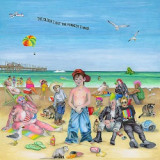
For its second release, Elmir once again puts 1980s pop-raï in the spotlight with the identical reissue of Cheb Kader's masterpiece: El Awama. Originally self-produced on cassette in 1986, this album was then released on vinyl by Michel Lévy, who was then Cheb Mami's manager and producer. Back then, the album was not the hit it was expected to be, because a little too avant-garde for the time. But more than 35 years later, fans and collectors consider the few remaining copies as priceless. The raï of Cheb Kader is a subtle compromise between the melodies of Oranese suburbs, the electricity of Casablancan guitars and the roaring layers of reggae. The listener can only be fascinated by this Awama (witch) who burns in his heart and to whom he declares his love; they can only be carried away by his hypnotic Reggae-Raï. This record is a rejuvenating find that makes you fall in love with the raï of the beginnings all over again. This new edition was remastered by Josh Stevenson in Canada and enriched with notes in French and English by the specialist Rabah Mezouane.
Поиск:its not over
Все
Following on from 2016’s Doing It In Lagos: Boogie, Pop & Disco in 1980s Nigeria, Soundway Records return to that blistering set for the first and only officially licensed re-issue of the highly coveted debut album from Steve Monite, featuring the single ‘Only You’ that recently
seeped its way into popular culture. Lovingly restored
and remastered on 180g vinyl with liner notes.^
Shooting, space-synth sounds ripple and vibrate, incessant grooves keep the tracks in motion and Nkono Teles production, a producer often overlooked for his hand in the Nigerian boogie sound, sets the LP into orbit. An album that was largely overlooked on release in
1984, the track list includes the latter day hit ‘Only You’
and ‘Things Fall Apart’, the melody of which was lifted for
Young Franco’s 2020 single ‘Fallin’ Apart’.
Pianist, drummer, composer and producer Hamish Balfour presents jazz funk, soul and electronic music, bridging the gap from classic Blue Note to Warp via Sonar Kollektiv on Running Colours, his electrifying debut album for London's Shapes of Rhythm Records.
Praised by Jazzwise for hissolo flourishes and sidestepping harmonies, Hamish Balfour should be a recognisable face to jazz addicts. The go-to keys player has performed and recorded alongside American jazz drumming legend Harvey Mason, Tenderlonious, The Temptations, Odyssey, Faze Action, Yolanda Charles' Project PH, Bassically, Nim Quartet and Yam Who. Popping up not only in the credits of many sought-after albums, but also Channel 4, ITV and BBCprogrammes for his compositions on various shows.
Over the course of eleven tracks, Balfour folds in and explores his influences, with a wide yet highly cohesive and strong palette of sounds, whilst interacting with high caliber guest vocalists such as spoken word artist and broken beat icon, Lyric L(Seiji,Nathan Haines), London Elektricity and Hospital Records' star vocalist Elsa Esmeralda, award-winning and chart-storming singer-songwriter Belle Humble (Freestylers, Paloma Faith) and soul and house mainstay Andre Espeut (Afriquoi,Simbad,Faze Action).
Responsible for all piano, synths, percussion and production on the album, Balfour's musicality shines through, a reminder of how overdue this debut album as leader is. However, in addition to the incredible vocalists, he's joined by some of the UK's finest jazz musicians: James Copus (trumpet), Pete Matin (bass), Laurie Lowe and Saleem Raman (drums) and Rob Updegraff (guitar).
Elsa Esmeralda implores us 'not to be afraid' on lead single and title track Running Colours. A perfect invitation to get stuck into this many layered album. Balfour compliments Esmeralda's soothing vocals with delicate piano intro before Lowe's bruk-easque drums and lead an irresistible groove bedded in warm synths and guitar licks.
Yes or No showcases Loose Lips legend Lyric L contemplating the uncertainty of love over a swinging mid-tempo jazz funk boogie groove propelled by tight drums and Hammond chords, closing with a flying trumpet solo from Copus, weaving around Balfour's nimble keys.
Wealth, featuring singer/songwriter Belle Humble, displays incredible depth and restraint. Humble delivers the enticing vocal with ease, as it slides over the intricate webs of jazz fusion and electronics.
Mogul is arguably Running Colours' curveball. An eastern-inspired whirlwind of all manner of synths and twisting drums which constantly morph throughout. Guitars and trumpets take turns to solo on a track that feels like a series of questions that we never quite get answers to.
Balfour's ability to merge free wheeling jazz and fusion with timeless electronic production and soulful compositions is also apparent on instrumental pieces such as Reflector 28. Here, we find the musicians upbeat, uplifting, progressive and playful, showcasing the keys whilst the bass underpins the groove.
South Of The Sun is Running Colours' laid-back moment with Roy Ayers-type vibrations as bass and drums sit in the pocket (at least to begin with), whilst a Rhodes weaves its magic. Like many of the album's tracks we take a few twists and turns before returning to our main feel-good motif.
Hamish's long awaited debut is sure to exceed the expectations of those who know him already, whilst introducing a whole new audience to his wealth of talent and originality.
"Meat. The story needs meat. (And blood ... coagulated blood (Gore)). The substance we are seeking here lies beyond the bare bones of fact, thewhen and the where (founded in 1988, Mülheim an der Ruhr) or personneland instruments (a trio since 2016, built around keyboards, saxophone, bass & drums). The story is more than the sum of its facts. Mysteries may very well lurk here or there along the way. What keeps the final two foundermembers going after all this time Do Morten Gass and Robin Rodenberg have skeletons locked in their closets How dearly we would we love to know the answer to that one, alas the most beautiful puzzles tend to remain unsolved.Including their debut Gore Motel' (1994), BOHREN & DER CLUB OF GORE have amassed an impressive eight longplayers. Four album titles allude to the night - their debut was followed by Midnight Radio' (1995), Sunset Mission' (2000), and Black Earth' (2002), whilst the most recent instalment carried the name Piano Nights' (2014). The nocturnal quartet was punctuated by Geisterfaust' (2005), Dolores' (2008) and a mini-album entitled Beileid' (2011), adding rather eerie overtones to the after hours ambience. The BOHREN & DER CLUB OF GORE legend has grown stronger both at home and abroad with every record they have released and every show they have played. Strange as it may seem, there is a uniform consistency to their reception. Whatever the band does, critiques are unfailingly positive, yet repetitious. References, links and associations recur almost word for word. Consider the arrival of Christoph Clöser in 1997, by way of illustration. When he joined the group, his saxophone replaced the departing Reiner Henseleit's guitar as one of the defining instruments in the band. This was arguably the sharpest break in their sound to this day and a significant marker in terms of the band's reverence for Dutch instrumentalists GORE (the clue is in the name), whose repetitive riffs paved the way for how the guitar would be deployed in a post-everything future. Nevertheless, this fissure in the BOHREN continuum has barely merits a mention in the greater scheme of things. Similarly conspicious by their absence in the BOHREN chronicles are the numerous instruments which they added to the mix - vibraphone, organ, tuba, bass trombone to name just a few. The introduction of choirs at least had a clear visual impact. Since Thorsten Benning left at the end of 2015, the band has continued as a trio, sharing shifts on the drums (although they have equipped themselves with mechanical brushes). A decrease in personnel was conversely accompanied by quantum leaps forward in the group's musical development - or more precisely, minor adjustments triggered major effects. Such changes may not get any easier to spot in the future, such is the intensity of internal imagery sparked by the music, a maelstrom of distractions so powerful that its promises are too sweet and too dangerous in equal measure. The music of BOHREN & DER CLUB OF GORE opens up remarkable rooms of association, from a warm burrow to a pristine secret lodge, from a
dusky woodland tavern to a smoky quayside dive. Individual and collective floods of images rush forth irresistibly. Loneliness is not at all problematic: empty multi-storey car parks, nighttime drives, remote bridges to nowhere. All in your mind. This is the temptation, a sweet, guilt-free addiction. It's all in your mind - and only there. These sinister crackling songs are invitations to secrete oneself in darkness. With track titles such as 'Maximum Black', 'Zombies Never Die' or 'Dandys Lungern Durch Die Nacht', the mind wanders inexorably into filmic spaces.
Echoing the masters of midnight cinema, stories evolve all by themselves. As the American Film Noir Foundation observed so smartly: 'the vivid co-mingling of lost innocence, doomed romanticism, hard-edged cynicism, desperate desire, and shadowy sexuality.' Their definition of Film Noir serves just as well as an appraisal of the group, 'Bohren For Beginners'.
Which says it all really, doesn't it A final word of warning! Sources close to the band describe the double CD
released in October 2016 as a gateway drug to the Bohren universe. Enter at your own risk, some have never found their way out again."(by Lars Brinkmann)
- A1: Second Chance Ft. Kimberly Davis (Club Mix)
- A2: Try My Love (On For Size) Ft. Teni Tinks (Club Mix)
- B1: Life Is A Dancefloor Ft. Kimberly Davis (Club Mix)
- B2: Look, Don't Touch Ft. Teni Tinks (Extended Mix)
- C1: Bring On The Rain Ft. Joss Stone
- C2: When Love Breaks Down Ft. Teni Tinks
- D1: Slippery People Ft. Ramona Renea & Fiorious
- D2: Tell Me It's Not Over Ft. Adi Oasis
- E1: Love's Been Waiting Ft. Kimberly Davis
- E2: You Ain't Love Ft. Teni Tinks (Club Mix)
- F1: Finally Ready Ft. Billy Porter (Extended Monologue Mix)
- F2: The One That Got Away Ft. Obi Franky (Extended Mix)
From an aspiring b-boy to working with luminaries Billy Porter, Joss Stone, Kimberly Davis and Teni Tinks, The Shapeshifters, Simon Marlin announces the release of his brand-new studio album “Let Loose”.
Wrapped in a defining optimistic mood and colourful palette, “Let Loose” plays with the friction between musical persona and influence, delivering a masterclass in Simon’s flourishing depth of integrity as a producer and admiration to those that exert their enduring influence upon him.
“I'm a facilitator of talent. I'm blessed that over the years I've managed to put a team of people together - as a producer, that's what I do, very much in the old school sense like a Quincy Jones or Gamble & Huff, they’re the guys I try to emulate - and make something magic out of nothing, but do it in a contemporary way. That’s what really floats my boat, and that's what this whole project is about.” Simon Marlin – The Shapeshifters
Across the latest and long-awaited studio album “Let Loose” The Shapeshifters pledge rhythmic allegiance to the golden era disco records and their spellbinding qualities; embracing the tension often found between tradition and future to craft a euphoric, certifiable body of work presented to the devoted audience he deserves. The Shapeshifters exemplify a scene in rude health one that is now switching on an ever-younger fan base, and with Marlin being the beating heart of it it’s easy to see why The Shapeshifters are more in demand in the clubs than ever.
The twelve-track album is illuminated with vocal collaborations including the recently released and debut collaboration with the Grammy, Tony and Emmy Award-winning Billy Porter.
Layers of rushing strings, flares of brass and hedonistic grooves provide refreshing dancefloor power dynamics and deliver a liberating, triumphant and inherently uplifting record.
Taking an impeccably smooth course through disco-infused house, The Shapeshifters continue the rich relationship with Glitterbox and its record label; one that has yielded instant classics that epitomise the label’s ethos for preserving disco’s mission to uplift and empower.
Baiser Mortel is the soundtrack of a performance commissioned by the Bourse de Commerce - Pinault Collection, performed in Paris in October 2021. PAN presents Baiser Mortel, the original soundtrack to the acclaimed theatrical performance of the same name. Staged at the Bourse de Commerce - Pinault Collection over four days last October, the original production - collaboratively realized by composer and director Low Jack, composer and rapper Lala &ce, choreographer Cecilia Bengolea with costumes designed by Marine Serre and Oriana Bekka as creative director and co- director of the performance - merged ballet and urban folklore; sound art and soap opera. A modern-day danse macabre, Baiser Mortel (trans. "The Kiss of Death") cast Lala &ce in the title role. Unfolding over thirteen songs, the musical narrative follows Death as she navigates the realm of the living, and the encounters - desire, romance, spiritual awakening, and adventure - which validate the human experience. "I brought in people who are close to me personally and musically in order to tell a story that speaks to humanity," Lala &ce says in a video uploaded to Bourse de Commerce - Pinault Collection's YouTube channel. Performers Jäde, Rad Cartier, BabySolo33, and Le Diouck joined Lala &ce on stage and in the booth at La Place - Centre Culturel Hip Hop in Paris, where the official soundtrack was recorded. A sonic representation of the musical's themes, Baiser Mortel the album - produced by Low Jack and written by Lala &ce with artwork by Pierre Debusschere - moves through the distorted strings of its opening track, "Goûter" and gathers sonic and lyrical intensity on each successive song. "Lune," the melancholically autotuned midpoint of the album, marks the beginning of the musical's second act and sets the tone for its tragic resolution. Mechanical sounds mix with sonic influences spanning the Global South throughout the album, honoring both Low Jack and Lala &ce's musical heritage and influences, while developing a new musical lexicon that defies comparison. As a theatrical production, Baiser Mortel represents a departure for both artists. A veteran of Parisian subculture, Low Jack's collaboration with Lala &ce represents a new model of artistic mentorship based not on age but on experience, with each artist leaving a distinct signature on the work.
Lucky', the title of Nada Surf's fifth album, is at once literal and ironic. Like the songs that singer / guitarist Matthew Caws, bassist Daniel Lorca and drummer Ira Elliot crafted for their previous two albums, Let Go' (2003) and The Weight Is A Gift' (2005), Lucky is filled with images of restlessness, longing and the elusiveness of love. Yet the band counterbalances the lyrical bitter sweetness with musical buoyancy. Intimate songs become in-it-together anthems, thanks to the chiming guitars, propulsive rhythms, and the emotional candour in Caws' vocals. A song like Beautiful Beat' segues from a sparsely arranged, confessional first verse into a harmony-laden chorus and reaches multi-layered, canon-like proportions before the track fades out. If Caws is often suggesting that romance and resolution may still be an inch or two out of reach, he's also proffering immediate musical solace. Turn up the volume, hit the repeat button, and your troubles, for a blissful three minutes or so, will disappear.
The three members of Nada Surf have played together now for a dozen years. They've survived overnight major-label success and the inevitable morning-after bleariness, persevering past obstacles that would have sunk a less resilient combo, to become one of America's most truly independent and respected bands. Experience has only made their work richer, bringing gravity to the subject matter and lightness to its presentation. Keeping things honest has become a modus operandi.
- A1: It's The New Style
- D6: So What'cha Want (Acapella)
- D7: Intergalactic Fast (Acapella)
- D8: Intergalactic Slow (Acapella)
- A2: No Sleep Till Brooklyn
- A3: Paul Revere
- A4: Hold It Now Hit It
- A5: Shake Your Rump
- A6: Egg Man
- A7: High Plains Drifter
- B1: Car Thief
- B2: Shadrach
- B3: Dub The Mic
- B4: Beastie Groove
- B5: So What'cha Want
- B6: Sure Shot
- C1: Root Down
- C2: The Scoop
- C3: Sabotage
- C4: Get It Together
- C5: Flute Loop
- C6: Budhisattva Vow
- C7: Intergalactic
- C8: Ch-Check It Out
- D1: An Open Letter To Nyc
- D2: Make Some Noise
- D3: Triple Trouble
- D4: Too Many Rappers
- D5: Sabotage (Acapella)
White Vinyl[26,01 €]
An outstanding 2LP compiling the best instrumentals of the greatest white rap group ever: the Beastie Boys. New Yorkers Ad-Rock, MCA and Mike D crossed over into the mainstream in the mid 80s with their full-length Licensed to Ill and exploded any notions of one-dimensionality with its ambitious followups such as Paul's Boutique, On Check Your Head and Ill Communication. Taking influences from hardcore and hip hop, these innovators performed most of the music while integrating an array of rock samples, 808 beats and witty wordplay into an ever-intriguing sonic smorgasbord.
Detroit based 3-piece combining a blend of industrial, deathrock, drum machines, gothic elements, soundtrack scapes, spaghetti western guitars and a thick, rumbling bass tone. Features new mixes by Adam Stilson, mastering by Rafael Anton Irisarri and a re-imagining of the original artwork by Chris Samuels. The vinyl & CD packaging includes a 12-page booklet of photos, lyrics and images from the original release date, (2012/2013). The story of Ritual Howls begins in a southwest Detroit basement in the early winter of 2012. Singer/guitarist Paul Bancell had been writing and performing solo as well as in several bands and was looking for collaborators for a new project. Ben Saginaw (bass) and Chris Samuels (synths, drums, drum machines) were acquatances that became natural fits. With the help of a friend (Jeff Navarre), they recorded their first full-length in Ben's art studio using a laptop. Paul tracked vocals at home in his bedroom and, not wanting to relinquish control, mixed and mastered the album himself. A formidable introduction to the band's haunting, cinematic blend of twangy industrial rock, their self-titled album established the band as a unique force in the landscape of dark music, both past and present. Separated by a decade, four LPs, two EPs later, Ritual Howls is an impressively cohesive first effort and testament to the band's vision that, even in its infancy, forged a distinct sound that has only matured with perfection over time. Past support from outlets like Stereogum, FACT, Tiny Mix Tapes, Self-Titled, Paste, Post-Punk, CVLT Nation + more. Track listing: 01. The Year Of Fear 02. Cemetery Guards 03. Keep Those Stones Up 04. L’Atalante 05. Rosabelle Believe 06. Anchorites 07. Hell Fuck 08. The Mark 09. Sacred Awe
Punk pioneers Crass continue their vinyl reissue series, re-pressing their limited releases by adjacent artists through Crass Records, in association with One Little Independent. The series, including over twenty bands and solo artists recorded at the legendary Southern Studios and produced by Penny Rimbaud, continues with two more historic pieces from the Crass Records catalogue; The "Grey" EP by North London post-punks Lack of Knowledge, and "Beware" by US anarchists Sleeping Dogs. Sleeping Dogs were one of only two American bands to release on Crass Records and in 1982 their sardonic and sludgy, but politically sharp, hardcore made up the "Beware" EP. They were first formed under the moniker Arsenal by the late artist, and designer of the iconic Crass logo, David King. "Beware" showed the originality and potential of Sleeping Dogs, even as Rimbaud and Crass guitarist Phil Free augmented the band"s sound for the studio session. The front cover of the single featured its own striking image, courtesy of King. Sleeping Dogs disbanded shortly after, re-emerging briefly under the new guise of Brain Rust a few years later. Distorted, biting, and beat-driven, the collection is a well-researched and poignant expose of Western imperialism. First released on 7" vinyl, limiting the sound, the new series has been remastered for 12" by Alex Gordon at Abbey Road Studios, allowing them to be heard as never before. This, plus enlarged replicas of the original covers, brings new gusto to their already radical sound. Penny Rimbaud notes that "Our (Crass") interest was never in personalities, profits or power, and neither did we have time for reformist liberals. Our position was solidly revolutionary; we took no prisoners. Talking the talk was never enough for us, no, we demanded that we also walk the walk. Ours wasn"t a show, it was a battle, not a living, but a lifestyle, a lifestyle with a difference - rather than looking only to ourselves, we sought to share our gains. I feel that this willingness added great strength to the form of anarchism that we practiced both on stage and out on the street."
Orange Vinyl[26,85 €]
One of the last pieces in the vast discography of Link Wray not available on vinyl previously, this album captures the Rumble Man live on two dates in London and Manchester on one of his last tours in 1997. Over an hour of primal rock'n'roll from one of its absolute pioneers, captured in front of a live audience in the UK! The set lists feature brutally loud renditions of a select number of Wray classics with added cover tunes here and there. With updated cover art, the Svart vinyl edition comes in a gatefold sleeve and features liner notes.
Black Vinyl[26,01 €]
One of the last pieces in the vast discography of Link Wray not available on vinyl previously, this album captures the Rumble Man live on two dates in London and Manchester on one of his last tours in 1997. Over an hour of primal rock'n'roll from one of its absolute pioneers, captured in front of a live audience in the UK! The set lists feature brutally loud renditions of a select number of Wray classics with added cover tunes here and there. With updated cover art, the Svart vinyl edition comes in a gatefold sleeve and features liner notes.
Tape
»No Date Tapes 2« is the second official cassette release from Harry Bertoia's tape archive and, like the first cassette, these recordings were chosen from a small collection of tapes in Bertoia's archive missing recording dates.
This cassette is packaged in a metallic shell and produced on super-ferro tape for incredible analog sound.
Bio:
Harry Bertoia first gained some artistic visibility in the early 1940s, then came into prominence with his sculptural, ergonomic chairs, produced by Knoll Furniture beginning in 1952, which quickly became classics of modernist furniture. Inspired by the resonant sounds emanating from metals as he worked them and encouraged by his brother Oreste, whose passion was music, Harry restored a fieldstone "Pennsylvania Dutch" barn as the home for this experiment in sounding sculptures which he had begun in the late 1950s. Bertoia was an obsessive composer and relentless experimenter, often working late into the night and accumulating hundreds of tapes of his best performances; Oreste, too, would explore and record the sculptures' sounds during his annual visits to his brother's home in rural Pennsylvania.
Harry Bertoia's recently dismantled Sonambient barn collection was an attentive listener's paradise full of warm, expressive instruments that were gorgeous visually and audibly. Nothing could prepare you, even on return visits, for the overwhelming experience of entering the spacious wood and plaster interior where gongs, some of them giant, hung among the ranks of standing sculptures of various metals. Over nearly twenty years of adding, culling and rearranging, Bertoia carefully selected nearly 100 harmonious pieces ranging in height from under a foot to more than fifteen feet. He considered this barn a full experience, sights and sounds comprising not a collection of works, but one piece unto itself. It was here, deep in the woods, that his Sonambient recording work took place.
Learning by experimentation was common for Bertoia and he mastered the art of tape recording, turning the Sonambient barn into a sound studio with four overhead microphones hanging from the rafters in a square formation. He would experiment with overdubbing by performing along to previous recordings, sometimes backwards, constantly improving his methods while also honing his performance skills. Bertoia was a careful editor of his own work and only chosen recordings remained, each with a date and carefully considered observations written on a note included with each tape. Through these pieces of paper a the artist's logic can be uncovered, a careful approach to composition, ideas, feelings and forms. The story of Sonambient barn collection will slowly be told through the release of recordings from the archive as well as installations and performances built from Bertoia's own recordings, lectures and a book.
(7" light blue colored vinyl) Next up in our 7” vinyl series, Honey C aka the late great Philippe Van Mullem and Bonzai stalwart Philippe Toutlemonde, delight with two seminal vocal trance tracks – Stop (The Disease) and Desire.
Next up in our 7” vinyl series, Honey C aka the late great Philippe Van Mullem and Bonzai stalwart Philippe Toutlemonde, delight with two seminal vocal trance tracks – Stop (The Disease) and Desire. Housed on light blue colour 7” vinyl, both tracks were first released in 1993 on the Houze Factory imprint before Stop (The Disease) was snapped up on the legendary Bonzai Trance Progressive in 1997 with a raft of remixes in tow. Desire would make an appearance on Bonzai Classics Digital in 2007, cementing its status as a retro gem. The 2 Philippe's were pioneers of that vocal trance sound and their project Quadran gave rise to the vocal melodic trance scene which still resonates to this day. Between them they notched up quite a few cuts with aliases and groups such as Innertales, Extreme Trax, Oudja and The Gaps among their repertoire.
The A side features the original mix of Stop (The Disease) which intros with a classic build up and explosion before an eerie, almost cinematic sequence takes over. The melodies soon become prevalent as a tight drum section keeps the rhythm flowing. A pulsing bassline holds the track together beautifully as that infectious vocal takes over the groove. On the flip side the Club Mix of Desire resides, taking us into an energy driven experience that sends the nostalgia juices flowing. Classic gated synths stand out as a powerful bassline drives the groove. The vocal is catchy and inviting, striking a perfect balance in the groove. 2 solid cuts for the collectors of fine beats.
The debut of Hamburg trio Cloud Management stages the meeting of three proven exceptional figures: Thomas Korf and Sebastian Kokus have been responsible for some stunning leftfield neo-kraut releases with their band Love-Songs in recent years; Ulf Schütte has been one of the most productive, and innovative protagonists of experimental electronic music in Germany for many years (see Datashock, Phantom Horse, or his most recent collaboration with G. Steenkiste/Hellvete on Umor Rex, for example). Following Love-Songs' highly acclaimed collaboration with Schütte, »Spannende Musik«, released in 2021, the formation of Cloud Management as a group in its own right marks a new beginning, which is celebrated with the long player on Altin Village & Mine.
The album is characterized by a dense texture of repetitions in which (modular) synthesizers and bass go head-to-head. It is on this foundation that the formal grammar of the album develops over its nearly 45-minute running time, organized along precise interventions into the hypnotic pulse: What is recognizable as echoes of 1960s/70s minimalism or Cluster functions on »Cloud Management« not in the sense that the sequences or the sequencers are left to themselves, but as highly concentrated, microscopic work on repetition. This virtuosically arranged, groove-based and even danceable density of the seven pieces never sounds strained or as an end in itself, but floating, cloud-like. The polyrhythmic workouts are at all times in the service of a refreshing expanse that opens up from the sonic saturation and is far removed from the formulaic box-checking often associated with the attribute ›kosmisch‹. »Cloud Management«, thus, marks not an exercise in the traditions of a musical past, but a distinctive position within contemporary electronic music.
All songs are written, recorded and produced by Ulf Schütte, Thomas Korf and Sebastian Kokus.
100% GALCHER was by all accounts a game-changer when it landed in 2013 as an hour of original music from a relatively unknown producer ushered in by the beloved mix series Blowing Up The Workshop. Galcher Lustwerk's signature sound — a smoky stream-of-consciousness baritone shadow-boxing with beats, informed by funk, rap, rhythm, and blues — felt like an epiphany, impossibly hypnotic and complete. Resident Advisor writes, "100% GALCHER laid out a louche, lysergic and resolutely black take on deep house." Pitchfork remembers the music's immediate impact: "It's the sort of gem you felt inclined to pass around” — and by year-end list time, word-of-mouth intensified. It was Resident Advisor and Juno's mix of the year, and earned a top-ten placement in FACT Magazine's albums list, as well as Philip Sherburne's personal rundown for Spin." Since then, select songs from 100% GALCHER have seen small-run pressings, while the album has lived primarily on SoundCloud and YouTube as a low-key cult legend. The gateway into Lustwerk's now well-established catalog, known for its reliability as a late-night listen and its prophetic vision for the near future of underground dance music. RA would later name it a mix of the decade, citing its influence and imagination: “Original in every sense — unknown, unheard and unbelievably good.” In late 2022, marking ten years since he first recorded the material, Lustwerk returns to Ghostly International to release 100% GALCHER as a remastered limited-edition double LP.
Lustwerk is a product of the Midwest. Growing up in Cleveland, he'd tape over his parents’ cassettes and spend hours at his family computer recording loops and designing artwork for the jewel cases of burned CDs. In high school, he turned to Ableton Live and absorbed every electronic music magazine he could find at the local Borders Books store. In excerpts from the 100% GALCHER liner notes, Lustwerk looks back: "My dad drove me to this shop on the westside Bent Crayon, where I would get anything the blogs told you to get + whatever the clerk recommended. CDs stayed in their packaging, there was always an overflow of vinyl stacked on the floor. I was too shy to listen to anything before buying."
As a college student at RISD, he played in noise bands, plugged into Providence's DIY scene via Myspace, and started DJing weeknights at bars downtown. There he connected with Young Male and DJ Richard, who would go on to found White Material Records and offer their third release to Galcher Lustwerk, an alias realized via CAPTCHA test, a perfect artifact of its internet age. By 2012, Lustwerk had drifted to New York City and settled into a graphic design job, quickly growing disenfranchised by office culture. "Some days I felt like a token, other days I felt invisible." At night, he and his friends were carving out their own space
Pique-nique Recordings is proud to present People’s Dream, the latest solo release from NYC-based vibraphonist and electronic producer Will Shore.
Inspired by Francis Bebey and Don Cherry’s electronic music from the 70s and 80s, People’s Dream draws heavily from modal jazz, minimalism, and dance music. It blends tightly composed percussive phrases with freely moving melodic improvisations that feel as much at home in a DIY loft space as they do on a custom-built sound system at Nowadays.
Shore says: “The vibraphone is the thing that I know best, but I’ve always found the instrument quite limited. Its pure bell-like tone can seem too pretty to evoke a wide range of feelings. I normally find ways to obscure that pure sound: I distort it, pitch it down, or layer rougher textures over it. But for People’s Dream and Lucid, instead of obscuring the sound quality, I decided to embrace it.
I used the vibraphone for not only melodic parts but also as a driving rhythmic element. I let the entrances and exits of melodies appear and disappear in a dream-like way, and added electronics and percussion as texture, to create a more cinematic atmosphere.”
On the B-side, UK producer and label-head Tom Blip (Blip Discs) flips Lucid into a driving, bass-oriented club track, fit for vibrant dancefloors this summer. On the back of successful collaborations with East African artists Swordman Kitala and Mubashira Mataali Group, Blip unleashes a trademark peak-time drum track designed to elude any dream-like state.
People’s Dream is the seventh release on NYC/Sydney label Pique-nique Recordings, which worked with Shore in 2019 on their signature event, Take Two. Shore led a nine-piece band through a reinterpretation of Albert Ayler’s Spiritual Unity for the occasion, utilizing his mentor Butch Morris’ conduction technique to rapturous effect.
Afro-Finnish band Maajo return with their third album, "Water of Life," a fluid celebration of various influences. Supported by two preceding singles, "Better Days" and "Unelmissani," the album is the group's first release with the Brooklyn, NY-based tastemaker label Wonderwheel Recordings. Maajo's signature Afro-Balearic sound meets late eighties new age and fusion, with touches of modern soul. The addition of two band members, Waina and Gilbert K, as well as featuring artists Issiaka Dembele and Ismaila Sané, has rooted the album's stories in a diverse range of backgrounds, featuring vocals in no less than six different languages.
Gilbert K's drum grooves pay tribute to the late Tony Allen's legendary heritage and the percussion experiments on a more melodic and atmospheric tip. Cold synth pads and 303 squeaks blend with warm guitars, fretless bass, and Issiaka Dembele's sublime kora harps and balafon mallets. "Water of Life" shows a band at its maturation point, reaching the cross-cultural coalescence of Finnish-African sound that's ready for the dancefloor or home-listening.
The three vocalists take centre-stage on the album: Waina hails from Zambia and sings in Nyanja, English and Finnish; a renowned musician in Zambia for over two decades who now calls Finland home, Waina wrote a song that reached the finals of the 2020 Afrimusic contest. Gilbert K primarily sings in his native Mauritian Creole while comprising part of the percussion line. He made his way to Finland by way of South Africa and China, eventually winning the Voice of Finland show. Gilbert K has played with such legends as Tony Allen, Andy Summers, Diana King, and Suzanne Vega. Ismaila Sané is from the Casamance region of Southern Senegal and sings in Wolof (a widely-spoken language in West Africa) on "Ndekete," and in Jola (a smaller language in Casamance) on "Èwàn".
Maajo is a sonic, linguistic, and cultural melting pot that has come together in Tampere, Finland, like a tropical breeze from the cold north. Their musical explorations lead from equatorial soundscapes to the woods and moods of their native Scandinavia. African influences, electronic beats and organic rhythms, ethereality and the sounds of nature all make up the patchwork sound of Maajo.
Not only is Maajo's music a way of travelling to faraway places, the songs themselves have travelled all over the globe. Maajo has evolved from a sample-based electronic music project to a full-sized band, including African vocalists and musicians. The group has put out two full-length albums and three EP's on Queen Nanny records, in addition to a release on German label Permanent Vacation. Maajo has received the remix treatment from artists such as Luke Vibert and Call Super, and has toured festivals and clubs internationally. The band has built a dedicated international following having been championed by the likes of Gilles Peterson (Worldwide FM), Tom Ravenscroft (BBC Radio 6), and Tim Sweeney (Beats In Space), while they've been featured by KEXP (Song of the Day), Resident Advisor, Ransom Note, and Pan-African Music.
"Water of Life" is out on Wonderwheel Recordings October 14th, 2022, both digitally and as an exclusive, limited-run 2xLP.
d 04: Better Days (Kumba) feat. Waina & Gilbert K
100% GALCHER was by all accounts a game-changer when it landed in 2013 as an hour of original music from a relatively unknown producer ushered in by the beloved mix series Blowing Up The Workshop. Galcher Lustwerk's signature sound — a smoky stream-of-consciousness baritone shadow-boxing with beats, informed by funk, rap, rhythm, and blues — felt like an epiphany, impossibly hypnotic and complete. Resident Advisor writes, "100% GALCHER laid out a louche, lysergic and resolutely black take on deep house." Pitchfork remembers the music's immediate impact: "It's the sort of gem you felt inclined to pass around” — and by year-end list time, word-of-mouth intensified. It was Resident Advisor and Juno's mix of the year, and earned a top-ten placement in FACT Magazine's albums list, as well as Philip Sherburne's personal rundown for Spin." Since then, select songs from 100% GALCHER have seen small-run pressings, while the album has lived primarily on SoundCloud and YouTube as a low-key cult legend. The gateway into Lustwerk's now well-established catalog, known for its reliability as a late-night listen and its prophetic vision for the near future of underground dance music. RA would later name it a mix of the decade, citing its influence and imagination: “Original in every sense — unknown, unheard and unbelievably good.” In late 2022, marking ten years since he first recorded the material, Lustwerk returns to Ghostly International to release 100% GALCHER as a remastered limited-edition double LP.
Lustwerk is a product of the Midwest. Growing up in Cleveland, he'd tape over his parents’ cassettes and spend hours at his family computer recording loops and designing artwork for the jewel cases of burned CDs. In high school, he turned to Ableton Live and absorbed every electronic music magazine he could find at the local Borders Books store. In excerpts from the 100% GALCHER liner notes, Lustwerk looks back: "My dad drove me to this shop on the westside Bent Crayon, where I would get anything the blogs told you to get + whatever the clerk recommended. CDs stayed in their packaging, there was always an overflow of vinyl stacked on the floor. I was too shy to listen to anything before buying."
As a college student at RISD, he played in noise bands, plugged into Providence's DIY scene via Myspace, and started DJing weeknights at bars downtown. There he connected with Young Male and DJ Richard, who would go on to found White Material Records and offer their third release to Galcher Lustwerk, an alias realized via CAPTCHA test, a perfect artifact of its internet age. By 2012, Lustwerk had drifted to New York City and settled into a graphic design job, quickly growing disenfranchised by office culture. "Some days I felt like a token, other days I felt invisible." At night, he and his friends were carving out their own space
- A1: I Don't Know Anyone, I Am
- A2: Stones Pull Out Heart
- A3: I Don't Want To Ask Your Father Or Anything
- A4: Melanchole/Diary (Part 1)
- A5: I Was All Over Her
- B1: Like You Know I Get Old
- B2: Post-Traumatic All-Night-Long
- B3: Voice Vi
- B4: Reprise
- B5: (Dream) (Dream)
- B6: Needs No Progress, I Will Lie
- B7: Girl
- B8: Te Aroha
Melanchole is a collection of ambitious lo-fi pop songs recorded by Daniel Johann in the winter of 2012 in Wellington, New Zealand, when Johann was only 15 years old. The songs deal with the awkwardness of growing up, the pains of being apart, and the anxieties of being alive and real. Originally self-released on bandcamp, the album became a viral internet sensation, garnering over 100 million streams on Spotify and a large TikTok following. In 2018, Danger Collective remastered Melanchole and reissued it on vinyl with a new track listing; the first pressing sold out within the first 24 hours it was released. This third pressing will be released on doublemint green vinyl with a brand new album cover, packaged with an OBI strip and a 12x12 insert. Johann continues to remain somewhat of an enigma, rarely performing live or giving interviews. After almost a decade since his debut, Johann is currently in the midst of recording a follow-up album. “Really just the first of its kind. A study in experimental music and conceptualizing sounds that not many else would have a vision for.” // “The echoing soundtrack of loneliness in my head.” // “One of my favourite lo-fi records finally gets remastered and released on vinyl. I daresay that the changes to the track listing make this version of the album even better than the original.” // “I didn’t think it was possible for home to feel so melancholy.” // “Amazing amazing AMAZING lo-fi album.” // “This album habis a hazy, dreamily sedating effect on the careful and passionate listener. Simply put this album is entrancing with weeping, wistful melodies synchronized with Picasso’s blue period.” // Track Listing: 1. I Dont Know Anyone, I Am 2. Stones Pull Out Heart 3. I Dont Want To Ask Your Father Or Anything 4. Melanchole / Diary Pt. 1 5. I Was All Over Her 6. Like You Know I Get Old 7. Post-Traumatic All-Night-Long 8. Voice Vi 9. Reprise 10. (Dream) 11. Needs No Progress, I Will Lie 12. Girl 13. Te Ahora
Violet Vinyl
The debut of Hamburg trio Cloud Management stages the meeting of three proven exceptional figures: Thomas Korf and Sebastian Kokus have been responsible for some stunning leftfield neo-kraut releases with their band Love-Songs in recent years; Ulf Schütte has been one of the most productive, and innovative protagonists of experimental electronic music in Germany for many years (see Datashock, Phantom Horse, or his most recent collaboration with G. Steenkiste/Hellvete on Umor Rex, for example). Following Love-Songs' highly acclaimed collaboration with Schütte, »Spannende Musik«, released in 2021, the formation of Cloud Management as a group in its own right marks a new beginning, which is celebrated with the long player on Altin Village & Mine.
The album is characterized by a dense texture of repetitions in which (modular) synthesizers and bass go head-to-head. It is on this foundation that the formal grammar of the album develops over its nearly 45-minute running time, organized along precise interventions into the hypnotic pulse: What is recognizable as echoes of 1960s/70s minimalism or Cluster functions on »Cloud Management« not in the sense that the sequences or the sequencers are left to themselves, but as highly concentrated, microscopic work on repetition. This virtuosically arranged, groove-based and even danceable density of the seven pieces never sounds strained or as an end in itself, but floating, cloud-like. The polyrhythmic workouts are at all times in the service of a refreshing expanse that opens up from the sonic saturation and is far removed from the formulaic box-checking often associated with the attribute ›kosmisch‹. »Cloud Management«, thus, marks not an exercise in the traditions of a musical past, but a distinctive position within contemporary electronic music.
All songs are written, recorded and produced by Ulf Schütte, Thomas Korf and Sebastian Kokus.
Originally from West Wales now residing in Amsterdam in a studio nestled beside the river Ij, Maroki now joins the ROOS family following a string of stellar releases. He leaves nothing to chance, using his classically trained skills and expertly engineered sounds into a pool of influences that range from breaks, moon-lit acid and headsdown chuggy goodness.
The record launches with title track 'Emerald City' a moody cut that whisks you away from the city's bustling streets and off the beaten track. Maroki's fixed hand helps elements blend seamlessly into another, in what feels like a personal guide through the emerald's subterranean. Then comes the gentle and tranquil electronics of 'Alfred Stole My Brain' both welcoming and meditative, while the swing in drums provide dance-floor functionality and set the pace. The A side comes to a grand close with 'Talk2Me' a brooding acid cut that mixes in elements of breaks and aquatic synths. The track's swelling energy feeds from the A side's previous two, culminating in a build up of emotion and speed.
'Total Recall' raises its hypnotic head, a series of winding synths and 4/4 kick drums creating a maze of sound, before perhaps the record's hidden gem 'All Be Over' arrives like an old friend. The track's familiar sound design coupled with Maroki's distinct personality create a warm and lasting friendship; melting together old and new perspectives. 'Slower' rounds off the EP, an equally stunning and fiery mix of breaks and angelic electronics.l
Ibrahim Alfa Jnr released techno music since the age of 17. He started to play piano when was six years old and has a master degree in sonic arts. As a Live Act and DJ he is world wide known.
His first album on Mille Plateaux is a fine example of Hypercussion, which implies a new rhythmic A-logic when beats split or shoot each other off, or when they overlap and mutate into high-pitched hums and rattlesnake breaks; accelerating, before music again blurs into the grains of noise or calm science fiction landscapes and at the same time builds gigantic sound walls. And such music, as far as its conceptualization is concerned, does not have to submit itself to technology at all, but must understand itself as a form that can be recombined with technology.
LTD. RED VINY
Guitar and bass duo Gong Gong Gong charge out from Beijing's underground scene with a distinct vision and uncompromising sense of purpose. The duo taps into a wavelength uniting musical cultures, drawing on inspirations as wide-ranging as Bo Diddley, Cantonese opera, West African desert blues, drone, and electronic music.
Despite the band's decision to eschew traditional rock percussion, on their debut LP Phantom Rythm, the locomotive chug of Tom Ng's guitar combines with Joshua Frank's thumping, harmonics-laden basslines to conjure an aura of ghostly snare hits and timpani overtones. Over Frank's enigmatic melodies, Ng sings in Cantonese, piecing together abstract tales of absurdity, doubt, desire, and lust. Synchronized to the point of near-telephathy, "the Gongs" use their minimalistic tools and idiosyncratic playing style to challenge the notions of rock n' roll and strip the form down to its bare essentials: rhythm, melody, and grit.
“This is for the family,” Abe Linx says. “It’s not really about who doesn’t love us, it’s about those that do. The ones we motivate and inspire. It’s for those people.” The World Famous La Familia Forever is the powerful sophomore effort from Abe Linx & Tully C., two incredibly gifted emcees who have crafted a contender for the best release of 2022. Across this EP’s 10 tracks, the Indianapolis-repping duo showcase their worldview, dig into their personal histories, and firmly plant themselves on the hip-hop map. And as Abe Linx spits on the stunning track “WORLDWIDE”: “Who the f*ck gon’ tell me different?” In addition to the passion of Abe Linx & Tully C. and their collaborators, TWFLFF stands on its own because it is just so sonically engaging. The production is equally crunchy and fascinating, because it flirts with sounds crafted by legends without sounding dated. This is timeless, raw hip-hop helmed by two talented rappers and their favorite producers like Nomstks & AWSME J, as well as longtime collaborators Baleboy Geechie & DJ GB.
You can tell that Abe & Tully took their time with these songs, meticulously piecing them together in the two years since their previous release. Each cut moves seamlessly into the next, bringing that special kind of cohesion. Just listen to how “RABIES” moves into “400MPH (skit)” and then “SKYSCRAPER,” a brilliant slice of showin’-out rap elegance. While there are only three guest features on the project, they’re used to great effect and make as much of an impact as their hosts. Planet Asia stomps all over the aptly titled “SHOWOFF,” while Willie The Kid complements the smoked-out vibes of “CHANDELIER.” And when Bub Rock shows up on “RABIES”? It’s a wrap as soon as he hops on that piano-laced, dusty instrumental. TWFLFF is a mission statement, with pieces that also sound like a word of warning to anyone looking at these two sideways. Or, as Tully C. raps so perfectly on “CHANDELIER”: “I be in this b*tch, with my clique/ So don’t act stupid.” The World Famous La Familia Forever drops on vinyl right in time for the holidays through their recent partnership with Fat Beats.
Tape
By its very nature, intuition is something of which we easily lose sight. Music however, as both bridge and secret technology, connects the natural, artificial, and the earned. It can act as both a reminder of cultures and people gone, while materialising and alchemising from thin air elements not to be found on any periodic tables, and visions no human can see.
»Pin down the dust« is the first meeting of Nighte - Christina Carter (Charalambides) and Mari Maurice (more eaze) - and it feels both automatic and natural. The collaboration stems from a spontaneous decision by the duo to start playing together weekly. “That's how this music was made,” explains Carter, “with gut feeling as the guiding principle. Mari understands the music I've made on such a deep level that playing with her feels so natural.”
The result of this meeting is inarguably some of the most beautiful music to ever emerge from either Carter or Maurice. The structures are spacious, generous, and gentle, with scraped violin strings and seemingly ancient moans strewn sparingly like falling leaves on a picnic blanket. Having begun life as freeform interplays between the duo recorded live at Maurice’s house, overdubs were later added and the material mixed by Maurice alone into finalised pieces.
Maurice’s varied instrumentation litters the background with distant and oneiric miscellanies, from groaned saxophone phrases and heavenly organ drones to glissandi guitars. Carter’s voice sits in the centre, embodying and channelling (mostly) wordless human ecstasy - and at times unease - amidst the allotment of blossoming sounds. Maurice & Carter’s clairvoyant connection notwithstanding, music always offers a portal back to our buried intuitions. “Pin Down The Dust” is both a tribute and a guide to this spontaneity and instinct, putting aside thought in favour of feeling.
Berlin-based producer Rampue has not released an album in 14 (in words: fourteen) years. Between 2008 and 2020 he toured the world and worked mainly on his live sets in the meantime. So now only a worldwide pandemic had the power to prevent the traveling musician from continuing this hustle and bustle and eventually share a new record with the public. Corona was what brought this standstill and the otherwise well- traveled individual experiences cabin-fever during lockdown. Hence, the new Rampue album "Tragweite" came into existence in February 2021, which portrays the artist's desire for experimentation.
Inspired by a modular synthesizer (Buchla), Rampue has seemingly put himself into a kind of trance, in which he lets the machines work and combines randomly created sounds with airy structures such as low drums or simple grooves. Rampue accomplished to break free by using random sounds as a new impulse and a way out of a creative crisis, which stemmed both from the enforced home isolation and from the self-perceived paralysis. The result is literally unique, as many of the sound products cannot be reconstructed and are preserved in album form for the general public.
Listening to "Tragweite" one gets the impression that the dialectical relationship between chaos and order, further supported by its production, is the defining theme of the album. After an initially perceived chaos, a delicate order, which is determined by structuring drum patterns and basslines, takes over throughout the course of the album.
Later, it frays and loses itself again in sounds and tones created mechanically However, it never seems arbitrary, but willful and skillfully staged. For instance, "Furo?" begins with apparent arrhythmia. The combination of bass and subtle percussion, however, gives this arrhythmia a shape, guiding the track which gradually becomes more and more driving without losing its original playfulness.
Although one might be inclined to think of genres such as Downtempo or Ambient at the beginning in the further course of the album results in such a diverse sound and rhythmic landscape that one willingly questions one's own perception of music while listening and finally throws every type of categorization overboard joyfully. The listening experience is too intoxicating and enlightening to stick to simple genre boundaries. The musical spectrum ranges from straight arrangements that live entirely without a drum foundation ("Fu?r Dich") to almost meditative sound collages ("Regengesicht") to the four-to-the-floor banger "Kembang" which adds a grimmer note with a certain industrial appeal to the overall rather melancholic-progressive curation. "Direct Faden" on the other hand, surprises with its simple guitar-based foundation on which the omnipresent synth snippets and pads are allowed to let off steam towards the end of the record. The track that most closely combines the progressive production style with a danceable club atmosphere is probably "Phobia". Wafting, partly breaking away synthesizer sounds rise higher and higher, while the driving mixture of bass and drums consistently march forward.
Rampue breaks with his old, musical habits as "Tragweite" creates the impression of improvisation and jam character without getting lost. Rampue takes his listeners on a journey that is stirring and moving, sometimes demanding or even a bit disturbing, yet always one thing: incredibly exciting.
Since he first emerged at the end of 1999 with instant UK garage classic Re-Rewind, Craig David has scored 25 UK top 40 singles (16 of them top 10), nine UK top 40 albums (five of them top 10) and amassed over 5 billion (!) streams worldwide. In fact, over 1.5 billion of those came via his most recent releases, 2016's chart-topping comeback album, Following My Intuition, and 2018's career consolidating The Time Is Now. If you're more used to the old school metrics, that's 20m global sales. And speaking of global, he's played sold out tours everywhere from America to Australia, Japan to Germany. Across his twenty-plus year career, he's collaborated with the likes of Sting, Kano, Diplo and KSI, while also becoming one of the biggest DJs in Ibiza via his TS5 soundsystem. Award-wise we're talking 14 Brit Award nominations, two Grammy nominations, four MOBO awards and three Ivor Novellos honouring his songwriting. It's impressive, sure, but that's the past. It's ephemera. “I always feel like you need to be more real-time and present in the now,” David confirms.
That present involves an excellent new album, his eighth, in the shape of next year's 22. “It's 22 years since the first album, it will be 2022 when the album drops,” he explains of the title. This month sees the arrival of 22's glorious, MNEK-assisted lead single Who You Are, which cocoons a feel-good pop lyric about being present in a pristine UK garage casing courtesy of producer Digital Farm Animals. Like all Craig David classics it feels both box fresh and warmly nostalgic. “It will live in the world this song,” David says. “It feels so authentic, it has intention. Put on Who You Are to try and talk to someone that needs help.”
The idea of putting a smile on people's faces is at the heart of 22, an album whose title itself reflects myriad different themes. “There's also a spiritualism in the number 22 and what it represents,” he says. “In numerology it's a very powerful number and in terms of angel numbers it's bringing balance and equilibrium to my life. We're in a world where there's a lot of me against you, and so it's bridging the gap.” The title also represents distance; it's a date stamp that marks his career longevity. So what does the album's contents say about Craig David in 2022? “At its core it's still very much everything I've honoured since I was a kid, but in some ways I'm being more playful,” he says. “Loosening up the chains of my history. My debut is probably the most clear expression of who I am because it was my first outing – it's everything you are. So on this album there's that energy mixed with the wisdom and experience I can bring to the world. I've not mastered anything yet, I'm a newcomer still.” Still very much born to do it, just older and wiser.
Live At Robert Johnson proudly presents the new »Holographic Witness« EP by Niall Mannion aka Mano le Tough!
Please enjoy four very special tracks made by experienced Irishman Mannion near beautiful Lake Zurich. Four tracks to jump into like Zurich folks jump into the Limmat to get carried away. Now here's YOUR chance to get carried away too!
Let's start with the hypnotic grooves of »Holographic Witness« with its subtle handclaps and percussions turning this bass-line driven monster to further heights - a bass-line quite reminiscent of that special Miami sound made famous by the Murk guys back in the early 90ies. Add some balearic guitar riffings and wait until that mighty bass drum comes back in after 6 minutes and you'll find yourself dreaming on a dancefloor in heaven.
Niall continues with more pounding drum sounds in next tune »Kakooja«. Stabbing synths sounds dominate this track while Niall manages to create another dreamy vibe again for this monotonous (in a very positive way that is) work of art - a dreamy vibe which can be found on any of Niall's EP's tracks. This leads us directly to »Last Floating Figh, Liufe Floating« where Mr. Mannion floats into much quieter shores. It's a very meditative affair which makes you want to listen to it over and over again once the tune comes to an end. We think that Señor Villalobos might unleash this one very soon onto some European dancefloor … don't you think?
On »Weather Master«, this EP's last track, Niall masters the art of trippy sounds for a fourth time building another dreamy hypnotic groove that is just beautiful. Maybe too beautiful for this world … we don't know, but what do we know? We're fans. Fans of Mano Le Tough who does not seem so tough at all considering his first offering for Live At Robert Johnson.
Maybe you should consider becoming a fan too - in case you aren't already …
Sláinte, Niall! We raise our glasses respectfully!
On November 18th, Rural Tapes is back with a follow-up to the highly acclaimed debut album "Rural Tapes" from 2021. A year and a half ago, Arne Kjelsrud Mathisen was declared a genius by Mojo, who described his music as a hybrid between Kraftwerk, Air, Tortoise and Serge Gainsbourg. While the debut album was created over a period of almost 10 years, the music on "Inner space music" has been composed and recorded during one intense month in January 2022 in Mathisens own studio in the countryside of Grimstad, Norway. Again, a number of high-profile musicians have left their mark on Rural Tapes' music, including The Dream Syndicate frontman Steve Wynn, PJ Harvey saxophonist Terry Edwards and REM guitarist Peter Buck and Scott McCaughey, both of whom are Mathisen's bandmates in the psychedelic jangle pop group The No Ones. ACCLAIM FOR RURAL TAPES: “A level of its very own” MOJO "Rural Tapes delights in the unexpected. At every turn, you encounter something new, something to be marvelled over. Kjelsrud Mathisen has said he wants this music to stand the test of time. It will." The Independent “A dreamy self-titled debut full of broad soundscapes... Melding smooth jazz with floaty puffs of synth, the album is both meditative and uplifting, the sort of soundtrack you might expect from a dream sequence in a 1970s film." GQ Magazine “From the first notes of this debut album from respected Norwegian producer Arne Kjelsrud Mathisen, you know you’re in for a treat. As Rural Tapes he makes rich, warm technicolour soundtracks… it really is delightful stuff.” Electronic Sound "This is an excellent debut album." Prog Magazine "Mathisen’s musical pedigree makes Rural Tapes an intriguing musical journey of an album that takes in pulsating Krautrock, neo-classical moods and dreamy, proggy pop, all formed through an intuitive composition process." Shindig Magazine
2022 Repress
Pioneers in their own musical approaches, Alva Noto and Ryuichi Sakamoto, began their exploration of sound in the evocatively titled V.I.R.U.S series in 2002. After more than a decade from the release of the collection's final installment with "Summvs" in 2011, NOTON reissues all the five albums between June and October 2022.
With its impressionistic atmosphere, in this collaborative project two generations met and shared the idea of electronic music as an inspiration source for new musical structures. Over a series of five albums, Vrioon (2002),Insen (2005), Revep (2006), utp_ (2008), and summvs (2011), the duo have explored blending electronic and acoustic sounds into a meditative whole that is at once expressive, breathing and precision-engineered.
Remastered in collaboration with Calyx Mastering, the recordings of Vrioon, Insen, Revep, Utp_, and Summvs are made available on vinyl and CD under the title 'reMASTER, accompanied by exclusive, unreleased compositions and housed in a beautifully designed sleeve with original cover art by Carsten Nicolai.
Swords and metal go hand in hand. That’s what crossover thrash band High Command say, having turned heads with their debut album Beyond The Wall of Desolation (2019). But it’s not solely metal music which influences the band, who cite the lustful violence of Robert E. Howard, Michel Moorcock, Jack Vance and many other legendary pulp writers of the 20th century as an impetus for their expansive storytelling.
“People would also be surprised to hear we drew quite a bit of inspiration from the music of Ennio Morricone, especially in regards to writing some more of the epic, grandiose passages and chord progressions.” says the band.
Now, with their second album, Eclipse of the Dual Moons, the band take their love of storytelling a step further, deepening and widening the world of Secartha, the realm of High Command’s songs. The band place themselves as omniscient narrators of the world they have created, and say that they are inseparable from Secartha and its people. “It’s one thing to make a good metal record, but it’s another to put on top of it a sort of overarching story that makes sense to listeners. The whole High Command project is enriched by lyrics articulating characters, a world, and trials faced within it. We want our records to be immersive and leave listeners with a feeling they’ve experienced something bigger than the music.”
It’s not just a question of widening the world, which the band first started exploring on The Secartha Demos (2016); Eclipse of the Dual Moons sees High Command honing their process to a fine art “it’s like we started with chiseling a rock… this record is the moment the rock in question begins to look like an actual sculpture.”
Swords and metal go hand in hand. That’s what crossover thrash band High Command say, having turned heads with their debut album Beyond The Wall of Desolation (2019). But it’s not solely metal music which influences the band, who cite the lustful violence of Robert E. Howard, Michel Moorcock, Jack Vance and many other legendary pulp writers of the 20th century as an impetus for their expansive storytelling.
“People would also be surprised to hear we drew quite a bit of inspiration from the music of Ennio Morricone, especially in regards to writing some more of the epic, grandiose passages and chord progressions.” says the band.
Now, with their second album, Eclipse of the Dual Moons, the band take their love of storytelling a step further, deepening and widening the world of Secartha, the realm of High Command’s songs. The band place themselves as omniscient narrators of the world they have created, and say that they are inseparable from Secartha and its people. “It’s one thing to make a good metal record, but it’s another to put on top of it a sort of overarching story that makes sense to listeners. The whole High Command project is enriched by lyrics articulating characters, a world, and trials faced within it. We want our records to be immersive and leave listeners with a feeling they’ve experienced something bigger than the music.”
It’s not just a question of widening the world, which the band first started exploring on The Secartha Demos (2016); Eclipse of the Dual Moons sees High Command honing their process to a fine art “it’s like we started with chiseling a rock… this record is the moment the rock in question begins to look like an actual sculpture.”
Adam BFD first burst onto the scene with his colourful, emotive driven productions; making a name for himself as an artist bridging the gap between electro, breaks and house. Now based in Paris, his work continues to put a nostalgic and animated spin on his far-reaching influences, from London to Mexico City and beyond. In the time since Adam’s introduction a series of singles and a recent EP on Running Out of Steam has seen the musician further refine and develop his sonic palette and Embrace coming by way of Distant Horizons is no exception. The five track EP covers many life cycles and no matter how mature, Adam’s tracks never lose the ability to make people move.
Adam starts by embracing the unknown in Le Voyage with its frenetic breaks and glistening melodies opening up a pathway to the stars, before space opens and time resides in Flotus; a special heart-searching moment, balanced by springly, danceable grooves. I Mean It gently unravels with tangible percussion and daydreaming textures, vocal loops becoming increasingly hypnotic as time stands still.
It’s not just Adams pacing that’s impressive, but his ability to turn real world sounds into fully functional elements heard in title track Embrace. Water moves freely over tightly packed drums and arpeggiated synths; a piece of tranquility ready when needed. Which Gate follows with pensive field recordings and cloud-formations; jerking breaks leaping back and forth in another special EP from a producer just getting started.
The story about the lost recordings of Ghia continues: Following the recently released "At The Hilton" single, our label is extremely proud to present "Curaçao Blue", the band's first full-length album. And it is simply mind-blowing, to say the least! The LP features 10 unreleased tracks in a similar Balearic vein as featured on the single.
Incredibly, it was only just a few months ago that these tracks were rediscovered on some old tapes by band members Lutz Boberg and Frank Simon. Could anyone imagine that two physics students from a small German town could create such beautiful, thrilling music in their home studio? Although the technical aspects in the creation of the band's earliest tracks may have been straightforward, the outcome is high-quality, creative, modern jazz-funk, with one step in the electro-funk genre due to the use of a drum machine and synthesizer basslines. The album features mostly 4-track recordings, based mainly on the musicians' weapons of choice: a DX21 keyboard (later updated to the legendary DX7) and a guitar. Many things had to be done live in just one take, though the artists were unafraid of using overdubbing techniques to weave their instrumental journeys. The DIY aesthetics just add more beauty and uniqueness to the songs and compositions, and the result is an extremely harmonic work of undeniable musicality. Ghia delivers Balearic jazz-funk at its finest.
Though the music was recorded in Germany, Ghia had a true relationship with the Balearic region and effortlessly applied the vibes to their compositions. As a side note, one track on their earliest demo tapes was called "3 AM at Moëf Gaga" and we did not know what it meant. The band explained that Moëf Gaga is a nightclub on the Spanish coast that is actually still active today. Boberg and Simon, the two original band members of Ghia, visited the club in the early 80s and spent their holiday close to the sea. With their music, they intended to create a summery vibe, capturing a relaxed and soulful view of the seashore, likely with a drink in hand... Perhaps a Blue Curaçao?
The album starts with a revised version of the title track. The drums in this take are much punchier, and we thought that it would fit just perfectly as an introduction. We continue with the already classic "Down At The Hilton" that was featured on the single, but like us, we are sure you could happily listen to this track on repeat. Next up, "Jump In The Water" opens with a catchy delayed melody, which develops into another perfect jazz-funk piece with an extended guitar solo. Another remarkable song might be "In The Fast Lane". As the name suggests, an uptempo number, now with an electro-funk beat combined with speedy keyboard solos that almost sounds like a marimba. On side B, the album keeps the relaxed seaside vibes flowing. To round out the album, we are treated to two pieces that originated after the return home, with memories of the Spanish coast fading but still lingering, likely recorded between 1986 and 1988. Both are instrumental versions of songs to be used later for studio sessions with their new band member, singer Lisa Ohm (who you will hear on Ghia's next album!). On "Crystal Silence In Dub" we get a perfect downtempo groove, positively reminding us of the sound of the 1980s UK funk scene. The album ends with "Keep Your House In Disorder", here as an earlier, rougher, and funkier take than on the final vocal version, which could be found on the B-side of the "What's Your Voodoo" single.
We hope you love this album as much as we do! Nothing like this has yet been released out of Germany. We hardly can recall any privately produced, home recorded jazz-funk/fusion from the 1980s as free, creative, and uninhibited as Ghia's Curaçao Blue. The playful and creative approach, coupled with those nostalgic tones should make this LP an essential pick for any record collection, whether you are a DJ, a home listener, a music lover, or a modern jazz-funk/synth-funk aficionado.
The album is out now on The Outer Edge, the new label by record collector DJ Scientist, aka John Raincoatman. We also want to thank Frederic Stader for his awesome work mastering and sound restoration of the material on this LP.
Second Editions presents a new collaborative work by Marja Ahti and Judith Hamann.
After their distinguished duet ‘Portals’ for Cafe Oto's Takuroku label, ‘A coincidence is perfect, intimate attunement’ is a wonderful sophomore collaborative work pieced together over two years of changing seasons, ideas, moods, and feelings. The release is formed from a shifting field of sound correspondence that pivots on moments of coincidence, of a tuning in.
What are we opening ourselves to when we tune in to sound? How can one be truly open to a sound? How can the activity of recording move beyond notions of capture and release into more generative frames? Rather than a tool purposed for preservation or ‘conservation’ of memory, of time and place, can recording sound instead form new vibrant or vibratory spaces of attunement?
‘A coincidence..’ is an LP length composition of multiple interlocking parts, created through exchange, alignment, unpredictability: the title borrowed from poet Fanny Howe falling right into place, a flock of birds in flight, pitches matched and moved across different geographies and temporal frames. Marja & Judith have created an intuitive, lyrical longform piece that considers the idea of attunement itself as, in some sense, the smallest form of measure or denominator connecting their respective practices: across field recording, just intonation, electronic sonorities and instrumental bodies. ‘A coincidence..’ reflects a sense of a willingness to tune in to impulses given, or gifted to the other, a position that embraces an intimate synchronicity.
Recordings & correspondances between 2020-2022. Mixed by Marja Ahti & Judith Hamann. Mastered and cut by Anne Taegert at Dubplates & Mastering in Berlin, 2022. Title quotation from Night Philosophy by Fanny Howe, Divided Publishing, 2020. Photogrpahy by Joshua Bonnetta. Thanks to Nino Bulling, Niko-Matti Ahti and leo. The work was supported by Kone Foundation, Akademie Schloss Solitude and NEUSTART KULTUR.
Marja Ahti (b. 1981) is a Swedish-Finnish composer and sound artist based in Turku, Finland. Ahti works with field recordings and other acoustic sound material combined with synthesizers and electronic feedback in order to find the space where these sounds start to communicate. She makes music that rides on waves of slowly warping harmonies and mutating textures – rough edged, yet precise compositions, rich in detail. Ahti has presented her music in many different contexts around Europe, in Japan and the United States. She is currently active in the duo Ahti & Ahti with her partner Niko-Matti Ahti and in the artist/organizer collective Himera.
Judith Hamann is a cellist and performer/composer from Narrm/Melbourne in so-called Australia, currently based in Berlin. Their work encompasses performance, improvisation, electro-acoustic composition, field recording, electronics, site specific generative work, and micro-tonal systems in a deeply considered process based approach to creative practice. Currently Judith’s work is focused on an examination of expressions and manifestations of 'shaking’ in solo performance practice, a collection of works for cello and humming, as well as ongoing research surrounding ‘collapse’ as a generative imaginary surface, and the ‘de-mastering’ of bodies (human and non-human) in European settler-colonial heritage instrumental practice and pedagogy. Judith likes working with and thinking-with other artists which sometimes includes people like Joshua Bonnetta, Dennis Cooper, Charles Curtis, Golden Fur (with James Rushford and Sam Dunscombe), Lori Goldston, the Harmonic Space Orchestra, Sarah Hennies, Yvette Janine Jackson, and Anike Joyce Sadiq.
Repress in on Red & Yellow Vinyl, note new price. 1000 only worldwide. Today's Active Lifestyles, the second full-length by North Carolina rockers Polvo, did exactly what a sophomore LP is supposed to do: It expanded the ideas put forth in the first album, gave them a new spin and shine, and presented the "where we are now" to the world. Produced and recorded over four heady days in December 1992 by former Bostonian and ex-Volcano Suns bassist Bob Weston (around the time he started in Shellac), Today's Active Lifestyles hit record store shelves in April 1993. From the whizzing crunch of "Thermal Treasure" to the loping, connective "My Kimono" to the 7-minute-plus blowouts "Stinger (Five Wigs)" and album closer "Gemini Cusp," the album asserted its place as a most worthy successor to Cor-Crane Secret. The foreboding title of a particularly screechy, fuzzy jam, "Time Isn't on My Side," proved to be nonsense; Today's Active Lifestyles has aged beautifully. “The band experiments with several ideas throughout the album, and each concept is successful. The album ranges from cascading guitar solos in “Stinger (Five Wigs)” to the straightforward “Tilebreaker” to the catchy, rolling, keyboard-punctuated “Time Isn’t On My Side.” Overall an excellent album with many layers.” ALL MUSIC GUIDE. Track Listing: SIDE A 1 Thermal Treasure 2 Lazy Comet 3 My Kimono 4 Sure Shot 5 Stinger (Five Wigs). SIDE B 6 Tilebreaker 7 Shiska 8 Time Isn’t On My Side 9 Action vs. Vibe 10 Gemini Cusp
- A1: It's The New Style
- D6: So What'cha Want (Acapella)
- D7: Intergalactic Fast (Acapella)
- D8: Intergalactic Slow (Acapella)
- A2: No Sleep Till Brooklyn
- A3: Paul Revere
- A4: Hold It Now Hit It
- A5: Shake Your Rump
- A6: Egg Man
- A7: High Plains Drifter
- B1: Car Thief
- B2: Shadrach
- B3: Dub The Mic
- B4: Beastie Groove
- B5: So What'cha Want
- B6: Sure Shot
- C1: Root Down
- C2: The Scoop
- C3: Sabotage
- C4: Get It Together
- C5: Flute Loop
- C6: Budhisattva Vow
- C7: Intergalactic
- C8: Ch-Check It Out
- D3: Triple Trouble
- D4: Too Many Rappers
- D5: Sabotage (Acapella)
- D1: An Open Letter To Nyc
- D2: Make Some Noise
Black Vinyl[21,81 €]
White Vinyl
An outstanding 2LP compiling the best instrumentals of the greatest white rap group ever: the Beastie Boys. New Yorkers Ad-Rock, MCA and Mike D crossed over into the mainstream in the mid 80s with their full-length Licensed to Ill and exploded any notions of one-dimensionality with its ambitious followups such as Paul's Boutique, On Check Your Head and Ill Communication. Taking influences from hardcore and hip hop, these innovators performed most of the music while integrating an array of rock samples, 808 beats and witty wordplay into an ever-intriguing sonic smorgasbord.
Macadam Mambo launches another special LP to end the 2022 season, presenting the debut album of this Belgo-Italian aural freak show called « Sexo Y Fantasia ». A delicious record full of sun by aspect, dreamy, dubby and balearic in the tone, flavored and contrasted with little bits of darkness and tension in the background. As the name suggests it, the sexiness is in every note, the erotic male voice is floating all over it, surfing on waves of endless reverb and delay. Throughout being anchored with clear hints from the 80ties and 90ties, this 35 minutes oeuvre still keeps full modernity in its form. DJ-friendly, it’s also an excellent overall listening experience to enjoy from beginning to end while sipping a fancy cocktail somewhere out in a cosmic dreamland.
Don’t miss this joint, it might be one of the highlights of the year
- A1: Watch Your Tone
- A2: Ready (Feat Nov)
- A3: You Don't Know (Feat Kas, Jarv Dee & Jvde)
- A4: Maybe I Should Move To La
- A5: Heartache + U
- A6: Why Can't We Go Back
- B1: Come Closer (Feat Marcus Harmon)
- B2: Flirtation Avenue (Feat Foreign Tapes & Jvde)
- B3: Easy Come, Easy Go (Feat Jvde)
- B4: Flow (Feat Dave Giles Ii & Cor.ece)
- B5: Do Better (Feat Toribio)
- B6: Always With U
Bad Colours is back with his sophomore album, "Always With U," out on Bastard Jazz Recordings in November, 2022. The London-born, Maryland-raised, Brooklyn-based DJ, songwriter, producer, and multi-instrumentalist - aka Ibe Soliman - continues to build on the well-deserved acclaim from his 2021 debut LP, "PINK," as well as a slew of standalone singles and collaborations with the likes of Shabazz Palaces, Jarv Dee, and Stas THEE Boss.
"Always With U" sees Ibe further develop his talents as a songwriter and producer, while maintaining the signature balance of banging dance music and dense bars that he's quickly becoming known for. The album expands Ibe's role to a collaborator, band leader, and all-around star-of-the-show; it's certainly still a dance record, but there's also so much more. Live instrumentation accompanies every track, with the notable contributions of Nigerian bassist Akin-Alade Ogo heard across the album, as well as the NY-based saxophonist Carras Paton on the jazzy, upbeat house number, "Heartache + U."
The lead single, "Maybe I Should Move to LA," sees the proudly Brooklyn-based Bad Colours contemplate a move out West – an idea that came about following a trip to LA for the 20 Years of Bastard Jazz anniversary party (which he DJed) in November last year. Bright pads, a thumping four-on-the-floor beat, and a catchy vocal line make it the perfect accompaniment to a top-down joy-ride up PCH. The album's second single, "You Don't Know," features frequent collaborator and PNW darling Jarv Dee, as well as KAS and JVDE who have both been making waves in the Brooklyn scene (KAS for his work with Grammy- nominated producer Harmony Samuels featured on BET, and JVDE as the lead-singer of alternative band Blind Benny). "You Don't Know" turns up the heat with Jarv and KAS trading dense, rapid-fire verses over a high-tempo beat and detuned vocal; the kick cuts out for the bridge, replaced by syncopated keyboard stabs and JVDE's stacked vocals. "You Don't Know" is high-energy hip house at its finest: Super catchy and irresistibly dancey.
The two singles are emblematic of the rest of the album, which largely alternates between vocal and hip house, sometimes jazzy, other times touching on R&B or dancefloor influenced pop. Dave Giles II and Cor.Ece (who recently both contributed to Beyoncé's chart-topping "Renaissance" LP and Honey Dijon's "Work" single) feature on "Flow," while Toribio (of the acclaimed Brooklyn band Conclaves) provides vocals for "Do Better;" both tracks are on the mellower side, reminiscent of late-90s New York mid-tempo garage. Rising artist N.O.V. features on the second track, "Ready," rapping over a bass-heavy beat; MarcusHarmon makes a return after appearing on "PINK," with smooth vocals on the romantic "Come Closer." Aforementioned JVDE can be heard throughout the album, contributing to "You Don't Know," "Flirtation Avenue," and "Easy Come, Easy Go."
While Ibe's career has spanned nearly two decades - as both a DJ (alongside the likes of James Murphy, Mark Ronson, and Q-Tip) and producer (for Kendrick Lamar, Faith Evans, Keyshia Cole, and Rick Ross, among others) - the Bad Colours name only came into being in early 2020, with the debut LP, "PINK," being released in February, 2021 on the Brooklyn tastemaker label Bastard Jazz. By tapping into his deep network of artist friends, Ibe compiled a treasure-trove of vocal samples, snippets, sketches, and fresh instrumental loops into a beautiful debut record that touches on hip-hop, house, and left-field electronic, while remaining danceable.
A slew of singles throughout 2020 and 2021 included "Feelin' Like," featuring the Seattle rapper Jarv Dee, has become an underground hit, popping up everywhere from Best Buy ads, Hulu's "Woke," celebrity Peloton instructor Emma Lovewell's playlist, and even as a soundtrack to the Mayor of Madrid's TikTok video. Most recently, "Feelin' Like" had a prominent placement in the #1 Netflix film "Spiderhead," directed by Joseph Kosinski ("Tron: Legacy;" "Top Gun: Maverick") and starring Chris Hemsworth, Miles Teller, and Jurnee Smollett. The breakout success of "Feelin' Like" further led to a collaborative EP with Jarv Dee, titled "BLAKHOUSE," which saw additional features from fellow PNW natives Shabazz Palaces ("Clouds," featured in Hulu's "Shoresy") and Stas THEE Boss ("Black Skin"). This year, Bad Colours dropped the early Summer banger "Hit The Breaks," and served as the musical director for the influential MADE New York festival, a two-day fashion, music, and arts event presented by Public School NYC and Paypal, that saw performances by Nas, Heron Preston, and Bearcat among others.
"Always With U" is a testament to Bad Colours' versatility as a producer and artist, which has allowed him to bring together such a diverse group of friends and collaborators. Yes, the house and hip-hop roots remain, but "Always With U" shows an evolution of the Bad Colours sound into masterfully crafted dancefloor sounds. It's a truly stunning follow-up from an artist undoubtedly on the rise. The album is out on all platforms, via Bastard Jazz Recordings, November 11th, 2022.
- A1: Pendulum (Feat Lucy & Rrose)
- A2: Lost Conductor (Feat Lucy & Rrose)
- B1: Wishing Well (Feat Lucy & Rrose)
- B2: Tunnel (Feat Lucy & Rrose)
- B3: Intracluster (Feat Lucy & Rrose)
- C1: Stars (Feat Lucy & Rrose)
- C2: The End Of Words (Feat Lucy & Rrose)
- D1: Filament (Feat Lucy & Rrose)
- D2: Pray (Feat Lucy & Rrose)
Lotus Eater is a duo consisting of Luca Mortellaro (Lucy) and Seth Horvitz (Rrose), techno artists just as comfortable operating in the uncharted area of experimental music who have gained a cult following, both influencing and challenging the direction of contemporary electronic music.
Eschewing the typical instrumentation of techno but still inhabiting its archetypes, Lotus Eater uses synthesised sound and feedback as fundamental sources to generate both textural and percussive elements. A sense of tension and weight emerge from sources that cannot be easily pinpointed. Each release forms a complex narrative from a paradoxically simple and restrained set of sound sources.
Officially formed in 2017, Lotus Eater came to life through several collaborations over a number of years, and finally blossomed with the release of its critically acclaimed debut album "Desatura," which Lotus Eater toured live in 2018 - 2019.
2022 sees the release of the second Lotus Eater album "Plasma" and a new audiovisual live project to accompany it. "Plasma" unfolds with exacting precision by exhibiting a point of focus and expanding on it. It uses a single, throbbing pulse to generate a constellation of sounds and rhythms that form around it like a volcanic eruption in slow motion. Playing with our sense of time and weight, "Plasma" feels simultaneously slow and urgent, spacious and immense. Lotus Eater zooms into the infinite abyss and finds not just light, but fire at the end of the tunnel. Will we be saved, or will we burn?
Following on from 2016’s Doing It In Lagos: Boogie, Pop & Disco in 1980s Nigeria, Soundway Records return to that blistering set for the first and only officially licensed re-issue of the highly coveted debut album from Steve Monite, featuring the single ‘Only You’ that recently
seeped its way into popular culture. Lovingly restored
and remastered on 180g vinyl with liner notes.^
Shooting, space-synth sounds ripple and vibrate, incessant grooves keep the tracks in motion and Nkono Teles production, a producer often overlooked for his hand in the Nigerian boogie sound, sets the LP into orbit. An album that was largely overlooked on release in
1984, the track list includes the latter day hit ‘Only You’
and ‘Things Fall Apart’, the melody of which was lifted for
Young Franco’s 2020 single ‘Fallin’ Apart’.
Felix Laband’s The Soft White Hand is the masterwork of an artist who expresses himself through musical and artistic collage acting together to reinterpret his sources and to express significant elements of his own personal story.
Released by Munich-based Compost Records, the 14-track album is Laband’s first full-length offering since the critically acclaimed Deaf Safari in 2015. It is heralded by the single “Derek and Me”, and is being pressed on vinyl for distribution globally.
In The Soft White Hand Laband works with source materials that will be familiar to those who know his previous four records – Thin Shoes in June (2001), 4/4 Down the Stairs (2002), Dark Days Exit (2005) and especially Deaf Safari which reached deep into the South Africa scene and its political culture to inspire its vocal and music sampling. However, the disengagement he felt from his homeland during his latest album’s creation – an abiding sense of untethered-ness to place and space, exquisitely rendered in tracks like “Death of a Migrant” – is perceptible in Laband’s desire to illuminate instead aspects of his own life.
“For this album, my source material became almost autobiographical as opposed to African statements I’ve worked with previously,” says the artist. “I have sampled a lot from documentaries from the 80s crack epidemic in impoverished African American communities and believe my work speaks unapologetically for the lost and marginalised, for those who are the forgotten casualties of the war on drugs. In the past, I have had my issues with substance abuse, and I know first-hand about the nightmares and fears, what it feels like to be isolated and abandoned.”
Few artists have managed to air these intimate aspects of their life so luminously as Laband does in tracks like “5 Seconds Ago”, “They Call Me Shorty” and in the strange and meditative “Dreams of Loneliness”. “I’ve been building this weird, autobiographical story using other people talking. It’s kind of humorous but it is also sad and beautiful,” says Laband.
Yet, as in all of Laband’s recorded output, the delineations between emotions are never starkly drawn and The Soft White Hand is also shot through with beauty. Nature appears in recordings made in his garden in the intimate early morning hours, whether as in the calls of the Hadada Ibis and other birdsong in “Prelude” or of the vertical-tail-cocking bird in “Derek and Me”. The last is a wonderful track with Derek Gripper, the South African experimental classical guitarist of international renown, whose 2020 song “Fanta and Felix” imagines a meeting between Fanta Sacko and Laband.
Laband’s eloquence in reinterpreting classical composers such as Beethoven in “We Know Major Tom’s a Junkie” is another thrilling aspect of the new record. “I’ve been properly exploring classical music on this album,” explains Laband, “taking melodies from classical compositions and reinterpreting them”. A fresh quality comes to his work through this sonic adventuring: the tender manipulation of the mundaneness of the computer’s AI voice to reimagine and reinvent iconic lyrics and melodies in strange and unexpected configurations.
The Soft White Hand is Laband’s most cohesive body of work to date. Yet it remains, in its sheer artistic scope, impossible to describe fully. Darkness abuts the gossamer light. A song that summons the sunrise and all the hope of a new day could also be about the final dipping down of the sun that portends a troubled night ahead. Interludes are invitations to expand outwards or shift inwards. Mistakes and “weird fuckups” in the sound are cherished as convincing statements against what Laband calls the “grossness” of perfect sound in modern music.
For this world-leading electronic artist, the boundaries are unfixed. He is inspired by the German Dada artist, Hannah Höch, who memorably declared: “I wish to blur the firm boundaries which we self-certain people tend to delineate around all we can achieve.” His music consequently reflects a primal artistic impulse that is also visible in Laband’s considerable visual art output as seen recently in several solo exhibitions such as that held in the No End Gallery in Johannesburg in 2019 and in the works he produced during his 2018 Nirox Foundation Artists Residency. “My music is always about collage, as is my art,’’ he affirms. “Everything I do is collage. It is a medium I find very interesting because you are taking history and distorting it and changing its meaning and turning it upside down and back to front.” In her book Recollections of My Non-Existence, Rebecca Solnit calls collage “literally a border art”; it is “an art of what happens when two things confront each other or spill onto each other”.
With The Soft White Hand, Laband is confirming his singular ability to achieve this in both art and music, melting the divisions between the two creative disciplines until they become one. He is also affirming his belief that an album of music should be more than a collection of unrelated tracks, but should unfold a fully integrated, cohesive story as in the song cycles of the great classical composers. In doing so, he claims his position as one of the most significant artists working today.
Artist Statement – Felix Laband – August 2022
When the Khmer Rouge took their captives for processing, they identified their class enemies by looking at their hands. If they were sunburned, rough and calloused, they were those of a peasant, a proletarian to be spared. But if they were soft and white, then they were those of a city-dweller, an intellectual or bourgeois, an adversary to be liquidated.
In calling this album The Soft White Hand, I was reflecting on the Cambodian genocide and how it resonates in contemporary South Africa. The apartheid era is over, and gone with it is white political domination. Yet economic and social privilege is still held in soft white hands. But those who grasp it know just how tenuous is their hold, how it singles them out, and my music reflects their subconscious fears, the stress and guilt of clinging on to what others envy and desire.
The soft white hand of the title suggests to me a further image, one that relates to all of postcolonial Africa. In my mind’s eye, I see the soft, duplicitous handshake of the smooth representatives of the superpowers making deals and promising gifts that benefit only them, and not their African dupes.
Yet, soaring above the wailing of sirens sampled from the first day of the invasion of Ukraine, my music is also about love gained and passion lost. It is about the tender caress of a soft white hand that conducts you into a place of dreams to be enfolded by nocturnal melodies.
Re-mastered from the original master tapes.
180 gr vinyl pressed by Optimal in Germany using the Metal Mothers from Pallas.
Facsimile reissue using the original photo by Jean-Pierre Leloir.
Double insert using an original color photo by JP Leloir.
Each record has been visually checked to prevent defects.
In its October ‘58 issue, the title carried by Jazz Hot magazine was: »Revelation at the Chat Qui Pêche. The spirit of jazz (which some thought was dying) is sparkling with life in the Donald Byrd Quintet.« And indeed, on its first appearance at the Cannes Festival in July (the Jazz Festival, not the other one), the Donald Byrd Quintet brought the house down. Its members were hardly the Who’s Who of jazz, however. People vaguely knew that the leader had replaced Kenny Dorham in the Jazz Messengers, that Doug Watkins had played bass with them, and that pianist Walter Davis Jr. had been with Charlie Parker before he was 19. As for Art Taylor, if he’d already enjoyed a career longer than that of his colleagues, it hadn’t yet brought him recognition beyond a small circle of cognoscenti. Only Bobby Jaspar – who’d shone at the Club St. Germain – was famous with the Parisian audience. At the beginning of 1956, he’d decided to try his luck in the United States; J.J. Johnson had hired him, and then Miles Davis (for a brief spell) before Donald Byrd brought him into his own group. After appearing in Cannes (in the sun) and Knokke-le-Zoute (a much smaller audience) for almost three months, the Donald Byrd Quintet settled down for the autumn in one of the capital’s top jazz spots, the Chat Qui Pêche on the Rue de la Huchette. »In that tiny room,« wrote Frank Ténot, »where the owner used to bump into the soloists by accident when she was serving her customers, the music they played was hot, and always surprising.« To crown a tour that had been extremely satisfying for everyone, a concert at the Olympia theatre was organised (there were gigs there called “Jazz Wednesdays”). Byrd and Co. took things very seriously, even though they preserved the relaxed approach that their (relatively) long association now permitted: "La Marseillaise", and "And The Angels Sing" are both present in the introduction to Parisian Thoroughfare played by the two horns. The latter then went on to imitate other horns, those of the cars on 52nd Street ... However, when it came to "Stardust", it was with all the seriousness in the world, almost in meditation in fact, that Donald Byrd improvised over the backing provided by just Walter Davis Jr. and Doug Watkins. Bobby Jaspar, of course, was marvellous. If he showed a marked obedience to Sonny Rollins, he still preserved, intact, the virtues of sobriety that prevented him falling into the trap of serving up torrents of notes in pieces taken at a rapid tempo ("At This Time", for example). During the exchanges on "Formidable", you’d be forgiven for saying that he gets the better of Donald Byrd. As for the complicity that reigned between the members of the rhythm section, it gave the formation a homogenous character that was very rare in a quintet. One can’t thank François Postif enough for taking the risk to release this concert at the time. Now, almost half a century later, one
White Vinyl[28,53 €]
There are only a few figures in music whose work influences and
shapes a genre as a whole. This is undoubtedly true of the Swede
Esbjörn Svensson. With his trio e.s.t., the pianist and composer
wowed audiences beyond age and genre affiliations. And his
influence on jazz as a whole reverberates to this day and already
within the second and third generation of musicians worldwide.
‘HOME.S.’ is Esbjörn Svensson’s only solo album and the sheer
existence of such a recording and its completely unexpected
discovery over a decade after its creation are nothing less than a
sensation: Since the early 1990s, Svensson focused almost his entire
creative energy and recording activities on his work with e.s.t.. Thus,
these new recordings are not only the first, but practically the only
ones that show Svensson in a setting other than that of the trio:
Intimate, concentrated and completely one with himself. The
recordings for ‘HOME.S.’ were made only a few weeks before
Esbjörn Svensson’s sudden death on June 14, 2008. Svensson
recorded the music in his Swedish home.
For almost ten years afterwards, the album rested untouched in his
wife Eva Svensson’s personal archive. Here, she tells the story
behind the discovery of the album and the music: “After Esbjörn’s
passing, I made sure all the contents of his computer were saved to
backup hard drives. And then I basically left them untouched for the
next ten years. At the point where I eventually felt ready to look into
the material, I soon realised that there was something I wanted to
look into.
“I took the hard drive and went to Gothenburg to meet with Åke
Linton, the sound engineer who had worked on all e.s.t. albums as
well as on their live shows. He was also the one who had helped me
to save the material from Esbjörn’s computer in the first place. So he
probably already knew that there was something hidden in there. But
nobody had listened to it.
“We went to his studio. And we pressed the start button. Then there
was a total silence and we couldn't speak for the entire time the music
was playing. After it finished, at first we were not able to say anything,
because we were both so touched and surprised that it was all there,
and that it was so beautiful. The tracks seemed to follow one another
like pearls on a string. After we just had sat there for a while we
agreed: This is really good. Musically, but also from a sound
perspective.”
- A1: Horvitz Morris Previte Trio - Todos Santos
- A2: Christina Petrie - Ballads
- A3: Christmas Decorations - Broken Leg Hours
- A4: Gilles Chabenat And Frederic Paris - De L'eau Et Des Amandes
- B1: Antonietta Borgoli - Dindindino Dindindalo
- B2: Tanto Pressanto - I Mues Immer A Di Tanke
- B3: Yuko Kono - Triangle
- B4: The Unthanks - Waiting
- C1: David Lang - Just (After Song Of Songs)
- C2: Rachel Bonch-Bruevich - Untitled (Ddr 1972)
- D1: Merula - Dags Att Sova
- D2: Stella Vander - Ondes
- D3: Hydroplane - The Love You Bring
Over the better half of a decade, Time is Away, the London-based duo of Jack Rollo and Elaine Tierney, have made tender and heartfelt transmissions through countless mixes, sound works and radio. Exploring deeply human themes of memory, persistence and resistance using an assemblage of source material, the duo's unique mode of storytelling culminates in Ballads, a new suite of songs and, significantly, their first officially licensed compilation.
From the opening notes of Horvitz Morris Previte Trio's jazz romanticism to Gilles Chabenat and Frédéric Paris's lively reimagined standard, the haunting vocal seance of Tanto Pressanto and the mesmerising swirls of The Unthanks, Yuko Kono and Rachel Bonch-Bruevich, the spirit of Ballads roams through generations of affectionate songwriting and conjures images both candid and surreal. The voice of poet and longtime collaborator Christina Petrie appears briefly and contemplates the "sighs and replies… the space between verses" of the Ballad, its beauty, its place in our lives. What is the Ballad but a reflection of our soul? "Perhaps I'll wander in search of it", she bittersweetly concedes.
At the suite's cusp is an alternate version of David Lang's 'Just (After Song of Songs)', a thirteen-minute meditation on devotion which featured in Paolo Sorrentino's Youth (2015). The track's universal themes of faith and desire radiate throughout and elucidate Time is Away's peerlessly precise yet gossamer touch.
Tape
Welcome to Carsharing Tapes. Welcome to the future.
With "DIURNAL TIDES: First Wave" we're proud to present not only the first release of our new imprint for classic electronic music mixtape culture but also the first ever official gathering of two long standing figures which both have been relentlessly and continuously contributing to the German underground scene for more than two decades now.
And these two are: baze.djunkiii and THE D3VI7.
baze.djunkiii, Hamburg-born and based, officially entered the electronic music scene as a DJ back in 1997 from an angle of being an enthusiastic raver, launched his very own label Intrauterin Recordings in 1999 and - apart from becoming an 24/7 networker, knowledge hub, music blogger etc. - evolved into one of the most versatile underground DJs and purveyor of original DJ culture around whose journey on the decks has taken him all over Germany as well as to Greece and the United States and to countless hours of air time on a plethora of underground radio stations as well.
THE D3VI7, on the other hand, remains an elusive figure. Deeply rooted in electronic music production and the hell'ish jungle of circuit board wiring as well as DAW madness THE D3VI7 is a moniker created by one of the most active, yet probably most underrated figures on the release circuit, a nom de guerre which serves the sole purpose of being able to operate anonymously without any confirmation bias being attached to other musical guises which might, or might have not, been used previously and in earlier stages of a long lasting involvement in music. And btw - this is the first time ever THE D3VI7 agreed to provide an official DJ mix for a mixtape release.
With baze.djunkiii's mix opening the roughly hour long journey of "DIURNAL TIDES: First Wave" on the A-side we're getting a prime example of what original DJ culture is all about as he's taking us on a fascinating journey from deepest underground Electro to screaming, spiralling Acid madness and beyond, digging up most underground vinyl cuts and making proper use of his extensive collection of rare 7" releases - a format that has been criminally overlooked by many DJs but provides a treasure trove of goodness as this mix easily proves.
Turning the tape THE D3VI7 does what THE D3VI7 does best on the flip: Being a force. A dark one. Forging a pounding, most relentless stream of hammering Techno tunes to take out unsuspecting punters on heaving dancefloors one by one THE D3VI7 provides a high octane selection of peak time excess that either thrills or kills - an ode to the power of raw and unpolished Techno madness in its purest form. A power that cannot be contested. Ever.
Bill Nace"s Through a Room represents a seismic progression from Both, his startling 2020 debut solo LP for Drag City. Nace"s career has been defined by a relentless probing of ways to frame the complex menu of human emotions, and that the guitar has been his primary tool for exploring this terrain is of little consequence. On this new release, he also employs tapes, hurdy gurdy, doughnut pipe, quelle est belle, as well as his latest instrument of choice, taishogoto. This is also, ultimately, insignificant. What matters is the discerning spirit which animates his work. The tracks are carefully built from loops and phrases that talk to each other, subsume one another, overlapping and crashing and diving and expanding and emerging into unimagined vistas. On the whole, the record offers a fascinating and engrossing chronicle - a sequence of interrelated stories told by a temporally dislodged narrator. You think you"re here, then you"re there, and then you go through trapdoors and along tunnels, into cellars and secret rooms, and you find that actually you"re back where you started. But it"s not hard to follow. Trust me. Nothing this enticing can be hard to follow. The record was recorded and edited in Philadelphia during the uncertain summer of 2021 with engineer and co-producer Cooper Crain. Where Both was a chiseling down of spontaneous live performance, Through a Room, while obviously the work of the same artist, treats its sounds as building blocks, combining them to mesmerizing effect. What"s striking is the poise, the degree of authorial intensity. The false dichotomy of composition and improvisation is thoroughly and rightfully abolished. Bill"s interests range from post-punk to post-industrial to hip-hop to free jazz to avant-garde composition, and every area between such unhelpful labels. From the inscrutable, evocative track titles to the enticingly baffling cover art by his longtime compatriot Daniel Higgs, Nace is guided by an ineffable, internal muse, a persistently personal stormcloud of ideas that, ultimately, comprise that thing we call art. Here"s the real deal. - Matt Krefting, Holyoke, 2022
Berlin electronic duo Donna Regina recorded two songs for the 10th edition of the Snowflakes Christmas Singles Club. In ‘Weihnachten Woanders’ (‘Christmas Somewhere Else’), singer Regina Janssen reflects on how it feels to spend Christmas away from home. Somewhere else, in a strange town where nobody knows your name and no one is waiting for you. You miss the familiar sounds of Christmas, like the child that sings ‘Stille Nacht’ and you dream of being home again. It’s a feeling many people can relate to. Especially this year, a year in which so many people were forced to flee from their homes. Günter Janssen, the other half of Donna Regina and Regina’s husband, lays down a minimalistic tapestry of synths and drum rolls. A loop of street sounds, a sample taken from sound artist Paula Schopf’s 2021 album ‘Especios En Soledad’, forces its way into the song, and in the end overpowers voice and other instruments. ‘Weihnachten Woanders’ very much captures the year 2022 and the worrying times we are living in, in both lyrics and music.
‘Christmas With You’, the B-side of the single, was originally written and recorded by Polish indie band Old Time Radio for their 2009 Christmas album 'Sketches For Another Christmas Songbook'. Donna Regina again goes for a minimalistic electronic sound, but also adds a certain melancholy to the song. Partly due to the synths that in places resemble the sound of an organ, an instrument that appeared on so many Christmas recordings from the 1950s and early 1960s. The love-hate relationship many people have with Christmas is perfectly laid down in the lyrics: “We watch the cartoons / We sing out of tune / Kiss by the fireplace / Listen to those horrible songs / Do we know / It’s Christmas time at all?”.
Regina and Donna Janssen debuted as Donna Regina in 1990 with the single 'Avec Le Temps' and released their debut album 'Lazing Away' in 1992 on Our Choice, a German sublabel of Rough Trade. In 1999, after four albums on Strange Ways Records, they signed to their current label Karaoke Kalk. Since then, they have released eight albums for the label. In 2015, Karaoke Kalk also released 'Dis Cover', a compilation of Donna Regina songs recorded by other artists like Dean & Britta, Bernard Burgalat, Mouse On Mars and many others. Donna Regina’s songs have been featured on compilations of labels like Rough Trade, Sonar Kollektiv, Klant Elektronik, Milan and Rolling Stone. Donna Regina was not Günther’s first band. In the early 1980s he was part of a Neue Deutsche Welle act with a very Christmas-related name: Heilige 3 Köninge ('Holy 3 Kings'). Their sole album, 1982's 'Zum Teufel Met Dem Kamel' has become very collectable. Günther was also featured as songwriter and musician on German singer Romie Singh's 1986 CBS album 'Masters' and later ventured into writing music for television and film. Regina Janssen also recorded as a vocalist with French musician Bertrand Burgalat, and sang several songs on his 2005 album ‘Portrait-Robot”.
On the album Opening, Tord Gustavsen reveals a fresh angle to his
particularly unique trio investigations into Scandinavian folk hymns,
gospel, chorale and jazz, as he introduces a different voice on bass
With a new fellow- traveller on board and its recording premiere in Lugano's
Auditorio Stelio Molo, the trio discovers inspired new ways to interact with each
other, using innovative approaches to sound and technique in the process. Made
up in equal parts of intricately textured improvisations and understated melodic
hooks, the group's conversations bring an enticing unfamiliarity to the language
the Norwegian pianist has developed over almost two decades of collaboration
with ECM.
Tord Gustavsen: piano, electronics
Steinar Raknes: double bass, electronics
Jarle Vespestad: drums
Press:
"Vibrates between the introspective and the dramatic in rich and singular ways.
Scene-setting opener 'The Circle' sees Gustavsen exploring a modal melodic line
of beguiling simplicity, with the trio's sotto voce approach creating an atmosphere
of hushed intimacy." - **** Jazzwise (Editor's Choice)
"The focus of Opening remains the playing from Gustavsen and the rich
accompaniment from his fellow musicians, creating an atmosphere perfect for a
walk by a cabin at dawn, with the sun peeking in through the trees." - Pitchfork
"Norwegian piano star Tord Gustavsen's long-honed recipe of low-key folk songs,
gospel, classical music and jazz gets a graceful makeover on Opening - with new
bassist Steinar Raknes, a player of uncannily responsive precision alongside
regular percussionist Jarle Vespestad, while subtle electronics sometimes create
ghostly horn-player effects." - The Guardian
"For Gustavsen, pieces such as Floytelat and Vaer Sterk, Min Sjel are routes into
the sort of cerebral mysteries that the former church pianist has made his own.
The first is a funereal theme where the notes he sprinkles like raindrops build into
a fatalistic flood. The second, from the Norwegian Hymnal, is played with an
innocent simplicity. Both are equally powerful...Remarkable music, Norwegian
blues." - The Times
"Quietly beguiling release...With lesser artists the uniformity of mood and
reluctance to turn up the volume would pall. But there's an artistry to Gustavsen's
compositions, a skill in their execution, and a warmth to their spirit that keeps the
listener engaged." - LondonJazz News
- A1: Breathe (Feat Lily James)
- A2: Coconut Grove (Feat Homeboy Sandman)
- A3: Don't Even Try It (Feat Liam Bailey)
- A4: Lesson 1956 (Feat Jamie Cullum & Dj Woody)
- A5: My Energy (Feat Eva Lazarus)
- B1: Feel Like Home (Feat The House Gospel Choir)
- B2: Airplane Mode (Feat Lily James & Choosey)
- B3: Harder I Rock (Feat Choosey)
- B4: Way Home (Feat O Love)
- B5: Don't Mean A Thing (Feat Beardyman)
Dressed in a powder blue suit with the frilly shirt to match, DJ Yoda invites you to be his +1 for ‘Prom Nite’, his new album promising retro Americana full of daydreaming reverie, international megastar guests, trip hop acknowledging the likes of Morcheeba and Nightmares on Wax, and the turntable extraordinaire’s bread and butter of cuts, beats and rhymes.
Certainly no stranger to retro sounds having famously peppered his DJ and AV sets with the unexpected the world over, and his ‘How to Cut n Paste’ mix series going all the way back to the 30s, Yoda’s harp-laden puppy love vibe spreads from the sweet and mellow sound of 2019’s ‘Home Cooking’, an album described as ‘boundary-breaking’ by Mojo upon slotting nicely into the UK’s blooming jazz canon. Think deliciously harmonised doo-wop murmuring ‘Goodnight Sweetheart’ with an eye for dreamboats en route to Makeout Point – on ‘My Energy’, Eva Lazarus takes the form of an earth angel, with Yoda on jukebox cut-ups, taking it back to starry-eyed, clean cut days of wonder (or more recently, Little Mix’s ‘Love Me Like You’).
Beginning enigmatically with the assistance of Hollywood A-lister (and former next-door neighbour) Lily James, ‘Breathe’ demonstrate Yoda’s continued evolution as a musician (not to mention shrewd decision maker), with James’ vocal confidence - a little Lana del Rey to her breathiness - returning on the velvet-smooth ‘Airplane Mode’. It’s a smartly executed soundclash accentuated by LA rapper Choosey, the star of the album’s straightest hip-hop shooter ‘Harder I Rock’. Homeboy Sandman adds some kick to the prom punch with typical wordplay sent down ‘Coconut Grove’, and Liam Bailey is perfectly cast for the darkly cinematic sway of ‘Don’t Even Try It’.
On an album of many talking points, the LP’s crowning glory is opening single ‘Feel Like Home’: featuring the vocal comforts of the House Gospel Choir, it’s your go–to pick-me-up when the chips are down, targeting the hairs on the backs of necks like a softer focus version of Jamie xx’s ‘Loud Places’. Extended into an alternative, equally uplifting form by Beardyman’s ‘Don’t Mean Thing’, summer festival season already has its homecoming anthem.
With tongues wagging, the twists and turns step away from Heartbreak Ridge when O Love tucks into the mouthwatering shopping list funk of ‘Way Home’; and ‘Lesson 1956’, featuring Jamie Cullum and DJ Woody, jauntily pays homage to classic Cut Chemist alchemy, Yoda’s celebrated turntable tomfoolery back in full effect and extending the flavours found in ‘Home Cooking’.
Again maximising the experience and enjoyment gained from recording live instruments and prioritising songs over beats, Yoda continues to progress with a mixture of risk-taking, elite musicianship, nostalgia brought bang up to date, and ultimately, good clean fun capable of stirring your soul, making ‘Prom Nite’ a date to remember.
Magpie artwork supplied by London’s ENDLESS, whose signature style has tagged Liberty and Lagerfeld as but two high profile clients, Yoda again maximises the experience and enjoyment gained from recording live instruments and prioritising songs over beats. His continued progress mixes risk-taking, elite musicianship, nostalgia brought bang up to date, and ultimately, good clean fun capable of stirring your soul, making ‘Prom Nite’ a date to remember.
Featured 7” Vinyl singles:
Feel Like Home (feat. The House Gospel Choir)/ Don’t Mean A Thing (feat. Beardyman)
My Energy (feat. Eva Lazarus)/Lesson 1956 (feat. Jamie Cullum & DJ Woody)
Italian The Villains Inc. moves up a gear with its fourth release to date and already the second in less than a year!
Conscious “Time To Go Back EP” introduces the exclusive collaboration between label owner Gab.Gato (Dominance Electricity, Drivecom, SolarOne) and his partner in crime Jack Bags (La Sabbia) from Milan.
Together, they drop an untouchable dancefloor oriented five tracker based upon a terrific concept.
Coming from the year 2106 with a preventive message to save Earth from manhandled destruction, scientist Dr Boomer understands how much it’s too late to prevent the planet from Armageddon.
A side opens with insane “Man Of The Future”: a pure analogical time machine merging whispers a la Egyptian Lover to heading vocoder sequences over a sharp 808 programming.
Luminous and hypnotizing at the same, this oldschool anthem is instantly followed by enthusiastic “No Permission”.
A groovy bassline melt with acidic loops turns the song into a masterpiece enhanced by funny vocal scanding “You Have No Permission To Get Into My Head”.
Top notch! With its fierce rhythm and relentless beats, title track “Time To Go Back” coming next signs an ode to the glorious days of West Coast electro sound.
Vintage sonorities fuse into cutting-edge drums while a funky atmosphere will propel you through time and space. Ace!
The flipside goes deeper into the realm serving up what appears as the climax of the EP. Combining gloomy strings to progressive swirls and ethereal chords, well named “Darkness” delivers a scary yet prophetic message from the future that will spread guilty feelings to any listener: “There Will Be No Light, No Hope…”. You have been warned! Last cut “The Bad Place” concludes the 12” on a soulful note regarding the state of our world controlled by government and technology.
Completed by a fantastic comic style artwork, awaken and despair “Time To Go Back EP” offers an outstanding retrofuturist release from which no one will come out unscathed.
One of the best outings in The Villains Inc. so far, rush on it!
Written and recorded between 1972 and 1982 in Western Oregon, Back to the Woodlands is a previously unreleased, and nearly lost, album made by Ernest Hood during the same era as his near mythical album Neighborhoods . A visionary combination of field recordings, zithers, and synthesizers, Back to the Woodlands offers an unprecedented depth of access to this singular artistic mind. Born into a musical family, Ernest Hood began a promising career as a jazz guitarist during the 1940s, touring internationally with his brother Bill Hood and the saxophonist Charlie Barnet , before contracting polio in his late twenties. The disease left Ernest unable to play the guitar and confined him to a wheelchair for the rest of his life. It also forced him to adapt and innovate around his musical practices in the face of adversity; Hood's value of sound matured with a remarkably democratic and nonhierarchical approach and application. Taking up the zither, a less physically-demanding stringed instrument to the guitar, embarking upon the unprecedented process of incorporating field recordings into his work as early as 1956, and eventually discovering the synthesizer, Hood's music became imbued with optimism and subtle cultural critique. This ethos and technique - refined over the coming decades - would lay the groundwork for a sprawling body of radio work, mail order recordings for homebound listeners, and Neighborhoods , self- issued as a small vinyl edition in 1975. Where Neighborhoods , a nostalgic opus, drawing from a well of collective memory of the 1950s, is defined by traces of human activity, Back to the Woodlands leaves the modern world behind, delving into Hood's love for nature. Only recently discovered in his archives, the album dramatically expands his concept of "musical cinematography," imagistically triggering states of sensory memory from within its zither and synthesizer melodies, intertwined with field recordings made during Hood's extensive travels throughout Oregon. If Neighborhoods is a retreat into the gauzy joys of a romanticized past, Back to the Woodlands is an immersion in the timeless sanctuary of the natural world. A fascinating counterpoint to its predecessor, Back to the Woodlands brings us even closer to Hood's belief in the transportive qualities of sound; that field recordings could serve as a vehicle for the imagination and liberation, particularly for those with similar mobile disabilities as his own. Across the album's twelve compositions, the rippling instrumental harmonics - shifting between abstraction and playful melody - fold so seamlessly into the birdsong, bubbling brooks, and other environmental ambiences, that they often give the impression of having been recording within the landscapes toward which they whisper. Falling somewhere between the immersive calm of healing music and New Age, the creative field recording practices of sound ecologists world building for Folkways, and the jazz infected ambiences during Obscure / Editions EG's highest heights, Back to the Woodlands sculpts an singular proximity of music for its moment; a form of ambient sonic realism that draws the consciousness toward its surroundings as much as within. Working closely with his estate to maintain his original vision, Freedom to Spend has restored and remastered this never before released, lost masterpiece by Ernest Hood from the original tapes. Ernest Hood's Back to the Woodlands will be issued on vinyl, as well as on CD in combination with its contemporary Where the Woods Begin , with new liner notes by Michael Klausman . On behalf of Ernest Hood and Freedom To Spend, a portion of the proceeds from this release will benefit Oregon Wild, an organization dedicated to protecting and restoring Oregon's wildlands, wildlife, and waters as an enduring legacy for future generations.
- A1: Ataxia - Detroit Gospel
- A2: Ataxia & Andres - Pine Island
- A3: Ataxia - Language
- B1: Ataxia & Dj Minx – Maxia
- B2: Ataxia - Spit In Your Percolator
- B3: Ataxia - 98 Degrees
- C1: Ataxia - Number Streets
- C2: Ataxia - The Formulator
- C3: Ataxia - The Pusher
- D1: Ataxia & Mister Joshooa - Feels Like
- D2: Ataxia – Wm
- D3: Ataxia - Dance The Bridge
Having torn up raves for well over a decade, the Detroit duo Rickers and Ted Krisko AKA Ataxia present their debut longplayer ‘Out Of Step’. Featuring guest spots from close peers DJ Minx, Andrés and Mr Joshooa, they twist house, techno, electro, breakbeat and rave into revitalized new shapes; embellished with a touch of soul, funk and hip hop. With backgrounds in hardcore and punk, Ataxia’s debut is suffused with that energy, attitude, and approach; this is raw, lean and unashamedly no-nonsense dance floor tackle that goes straight for the jugular. Heavily analogue, the album experiments with tape saturation, which harks back to the duo’s formative years in bands, recording demos to cassettes. These straight-up, in-the-red tracks give preference to overdriven drum machines, rather than generic polished sheen, but conversely, it’s all deceptively well-crafted too; ‘Out Of Step’ is a standout record that’s big in character, bringing to mind the renegade spirit of Underground Resistance, and the bombastic brilliance of The Prodigy and Chemical Brothers.
Defiantly optimistic despite the state of the world, a “life is good” vocal sample meets minor chords sliding over 808 hats on the exemplary house/techno pumper ‘Detroit Gospel’, before a lighter moment on the album, but no less impactful with its hefty low-end thump, is ‘Pine Island’ featuring Motor City hero Andrés. Together they cook up a Motown-inspired house cut awash with horn swells and backup singers, bouncing to wide swung funk bass, in classic 313 style. ‘Language’ turns the club on its head – busting out one of the most distinct basslines in recent times, and bristling with buzzy, undulating chords, whilst ‘Maxia’ features influential Detroit royalty DJ Minx. Inspired by her classic ‘A Walk In The Park’, with a fat distorted kick and stealthy bass groove, this is low-slung, stripped-back, heads-down coolness. The high-tech funk of ‘Spit In Your Percolator’, is laser-guided in its efficiency, with a strobe-like, increasingly intensifying energy, peppered with clever, tripped up vocal chops. With the next cut, conveyor belt noises and fast churning low-end gives way to a dubbed-out breakdown, on the deep breakbeat roller ‘98 Degrees’. Charged with a blistering, rave intensity, ‘Number Streets’, is a futuristic distorted techno workout that booms through the subs, whilst ‘The Formulator’ mixes filtered snippets, abstract synth noises and melodic bleeps with a bassline echoing Paperclip People’s ‘The Floor’. Closer to the UK definition of hardcore, combining 4/4 and breakbeat, ‘The Pusher’ evokes the spirit of late 80s orbital raves, adding a natty keys solo, and deadly bass used sparingly, for even deadlier effect. ‘Feels Like’ sees Rickers and Ted team up their studiomate and fellow TV Lounge resident and club booker, Mister Joshooa. Inspired by Photek but also almost UKG in style, this breakbeat session is stamped with MJ’s signature chopped vocals and intricate rhythmic interplay. The bubbling, wobbly loose swing of ‘WM’ is constructed around a classic chopped-up MTV cribs sample, with a filtered vocal creating a far out psychedelic effect – all of which is propelled apace by a huge bruising LFO. The LP concludes in fine style with ‘Dance The Bridge’, where bouncy beats and wigged-out keys meet bright, gently uplifting synth chords that bring a clear-skied mood; ending the record as it began, on an optimistic note.
‘Out Of Step’ marks another chapter in the ongoing relationship between Life and Death co-founder DJ Tennis and Ataxia. Their connection goes back to the earliest days of the label, where they played gigs together on some of Tennis’ initial visits to Detroit. It’s a friendship that’s blossomed organically over the last decade through their shared love of punk and hardcore, and led to the fruition of one of Ataxia’s most compelling projects to date. Labels to release Ataxia’s output include legendary Detroit techno imprints Planet E and KMS, plus the seminal American house label Nervous Records. Their catalogue also includes music for Visionquest, Leftroom, 20/20 Vision and Seth Troxler’s Play It Say It.
Robert Groslot's Concerto for Bass Guitar and Orchestra represents the
next step in the evolution of the bass guitar
Groslot's composition pushes the instrument to its technical limits, while creating
a unique symbiosis between the soloist and the orchestra. Although he may not
be the first composer to write for the bass guitar in a symphonic setting, Groslot
brings a level of artistry and sophistication to the composition that will continue
and accelerate the legitimation of the bass guitar within contemporary classical
music. "The idea of a concerto for bass guitar is something that I have been
dreaming of for decades. Since its invention, the bass guitar has firmly
established itself as an essential and integral part of practically every genre of
music. The bass guitar, as we now know it, was invented and produced by Leo
Fender starting in 1951. The more portable bass guitar, in comparison to the large
and unwieldy double bass, was capable of playing at higher volumes via
amplification and satisfied the new sonic demands created by the widespread
use of electrification in popular music. By increasing the overall scale of the
electric guitar and only using the lowest four strings (E, A, D, G), Fender gave birth
to a new instrument. Traditional double bassists could quickly adapt, with the
added benefit of more accurate intonation due to the frets. Hence the original
name: The Precision Bass. At the same time, guitarists could also become bass
players when called upon. As a result, many of the early bass guitarists began
their musical life as guitar players, with the most well-known example being Paul
McCartney of The Beatles.
The fact that the bass guitar had no direct lineage like the evolution of the piano
or violin over time, led to a variety of disparate playing styles without any
fundamental methodology. Unlike the more traditional instruments, the bass
guitar does not sit upon a foundation of centuries of proven methods and
established schools of playing. The evolution of the bass guitar has been a
patchwork of trial and error by active musicians. This has led to a plethora of
personal approaches and hybrid-styles, effectively leading to the rapid evolution
of bass guitar technique. Given its relatively young history, it is remarkable how
the bass guitar has grown from being an instrument taken up out of necessity, or
as an afterthought, to being as respected and vital to modern music as any of the
older, more established instruments." - Thomas Fiorini
Hate Propaganda's far too overlooked 2019 debut EP "World War 666" sees a much needed reissue on vinyl, remastered and enhanced by brand new artwork commissioned for the purpose by Xerox master P. Van Trigt. When it was first released on cassette tape back in 2019 by War Arts Productions, this war-torn debut offering of primeval warnoise by the mysterious Portuguese war criminals stood out immediately as a crown jewel debut for the genre and as one of the year's most definitive and underrated manifestations of extreme metal's most hateful and berserk fringe. Packing in nineteen minutes of absolute hatred, the annihilating MLP manifests as a nightmare hallucination of complete violence and negativity, evoking eons of perennial apocalyptic global planetary war and terror on the wings of its nefarious design of achieving maximum annihilation in the shortest amount of time possible. To harness this bleak pantheon of ruin, the Portuguese conquerors have assembled a weaponized and uncontrolled sonic chain reaction where grindcore, black metal, death metal and hardcore punk are all accelerated and instigated into an inescapable payload of death aimed straight at the vital sinews of humanity. A sonic maelstrom churned into shape by an onslaught of obscure violent riffs, psychotic leads and ominous laughter which, parallel to a pulverizing drum performance, emanates from oblivion with an antediluvian, negative aura. Comparisons to bands like Diocletian, Heresiarch, Tetragrammacide and Nuclearhammer will run abound, yet these would be only easy superficial conjectures as this is a manifestation of sonic extremism which dwells on a plain of excellence entirely its own. Its uniqueness transpires particularly in the maniacal drumming which underlines the band's hardcore and punk influences, and is exalted further by an unusually crystalline production and by a masterful onslaught of uber-audible riffs hiding behind nothing and seemingly going in the opposite direction of the homogenous and indiscernible sensorial smothering the genre usually opts to go in. Tracklisting: 1. World War 666 2. Neverending Mass Graves 3. Violent Nature of Human Annihilation 4. Welcoming the Nuclear War With Open Arms 5. Let the Sirens Signal the End of Times
Visitor Kane, a band always in search of new ground, has gone through some changes over the last 5 years. Releasing their first album “Easy Concern” as a two piece, an album that dove into new wave sounds, with synths, drum machines and a crooning voice, soon became a fully electrified band, transforming into a classic rock and roll outfit. Their second full length “Change of Heart” showcased a sonic turn. Drum machines and synths were replaced by acoustic guitars, old Casio organs and drums, making the album sound substantially different from its predecessor. Now after 4 years, they are ready for new adventures, and it comes in the form of a new album titled “At Issue” out on November 11th, 2022. The album is a humble look into different aspects of interaction within the boundaries of society. Patrick from Visitor Kane elaborates; “At issue is me trying to describe the world and its affairs through abstraction. It’s tough to understand so it seemed fitting to do so. It being hard to fathom means that it can come across as a bit pessimistic, although it’s something I try hard not to be, because there’s a bright side to almost anything. The title for me represents it very well with its dualistic nature. On one side it’s analogue as hell, but on the the other, it’s all about ones and zeroes...” ‘At Issue’ will be available on vinyl and digitally on November 11th via Part Time Records.
In 2016 lutenist Sofie Vanden Eynde put her instrument aside for nine
months in order to recover from a severe burnout
Five years later, she felt the need to look back. Would it be possible, she
wondered, to use the intense, shared concentration between musician and
listener to convey sensations of over- stimulation, contrast, excess, stagnation,
emptiness, beauty and movement? Would it be possible to articulate the inner
reality of a burnout musically: to make a burnout audible, tangible,
understandable and, who knows, avoidable? The result is Vanishing Point /
Verdwijntijd, an autobiographical recital, a musical narrative, a journey:
somewhere between fragile comfort and cautious happiness. Writer Annemarie
Peeters drew on her interviews with Sofie to write a text that reflects the three
phases of a burnout. The run- up, the phase of total stagnation during, and the
cautious way out. Three colours, three seasons, three ways of being. Lurking
beneath Sofie's personal story are experiences that many will recognize: the
craving for efficiency, the sudden faltering, the unfamiliar and at the same time
disconcerting sense of emptiness, and the tentative search for a new balance.
But also the questions Sofie asked herself – about the connection between her
own little story and the big world that surrounds her – evoke wide recognition. Is
burnout a personal failure or a social symptom?
Sofie went in search of pieces from the solo lute repertoire that she intuitively
associated with the various phases of the text. This resulted in a recital with a
surprising palette of colours, styles and atmospheres. At times she chose the
rich, powerful sound of the theorbo. At others she chose the fragile, hushed
sound of the Renaissance lute. The Prelude by the French baroque composer
Robert de Visee combines phrases full of grandeur with breathing pauses filled
with intimate doubt. The music of John Dowland draws on the typically English
penchant for melancholy. In the fantasias and ricercars of Francesco da Milano, it
is not only the bright colours of the Italian Renaissance that resound, but also the
constant search for a new beginning. Luis de Narvaez's Cancion del emperador is
an arrangement for lute of the famous chanson Mille Regretz by Josquin Desprez,
a song that emanates serene regret for everything that is not. And in Robert de
Visee's Chaconne the same chord sequence revolves around its own axis. Hope,
tenderness, revolt and acceptance each step to the fore in turn.
At Sofie's request, Vladimir Gorlinsky created a new composition, one which
reflects the state of mind in the middle of a burnout. Vanishing Point balances on
the edge of total emptiness, a stagnation that at times is hard to bear. Vanishing
Point starts out from this stagnation to explore the different facets of burnout:
resistance and acceptance, fear and hope, stagnation and movement, absolute
solitude and the desire to interact again with the surrounding world. Vanishing
Point / Verdwijntijd can be listened to in different ways: not only as a lute recital,
but also as a radio play with voice, lute and soundscapes. Annemarie Peeters'
text was recorded by actress Katelijne Damen (NL) and voice artist Caroline
Daish (EN). Vladimir Gorlinsky created soundscapes based on the sounds of the
lute, which were magnified as if under a microscope. The soundscapes weave
themselves between the text and the lute music. Jo Thielemans created the
sound design and provided the live electronics.
Charbel Haber is Lebanese musician, performer, visual artist and composer from Beirut. His work has seen him collaborate with artists from a wide range of disciplines - film, video art, visual art, theatre, dance - both in Lebanon and abroad.
As a solo artist and as a member of post-punk band Scrambled Eggs, he has composed music for directors Khalil Joreige and Joana Hadjithomas, Ghassan Salhab, Mohamad Malas, video artists Lamia Joreige and Akram Zaatari, Maqamat dance company and playwrights Rabih Mroueh and Lina Saneh, to name but a few. His prolific and collaborative career includes free improv group Johnny Kafta Anti-Vegetarian Orchestra, psychedelic Arabic music ensembles Malayeen and Orchestra Omar, cold wave band The Bunny Tylers and minimal ambient duo Good Luck In Death. He is the founder of Those Kids Must Choke and co-founder of Johnny Kafta's Kids Menu - two experimental record labels - and he has recorded and collaborated with notable artists from the fields of free rock and improv such as Oiseaux-Tempête, Radwan Moumneh, Tarek Atoui, Jean Francois Pauvros, The Ex, Michael Zerang, Mats Gustafson, Eddie Prevost, Xavier Charles and Tony Buck.
And once again, here I am telling you to go look for the truth and its beauty in the words of dead poets, in the little tales of ravaged cities, in aborted dreams, in the melancholy of the ruins of tomorrow, in meaningless plastic totems, in the enigmatic end of restless fools.
I'll be here long after you all disappear.
These are the first and last sentences from Charbel Haber's latest offering, A Common Misunderstanding of the Speed of Light: a multi-media musing on the chronic and the chronological, the subversive nature of time. This combination of a record and book observes the slow passing of life and the illusion of retrogradation in his every day. Simply by documenting - via image, text and tune - Haber assigns value to everything that is cast in amber by this project. There's an acceptance and appreciation of the destitution he witnesses, it is an homage given in overlapping forms.
ACMOTSOL has two parts. The book, hardcover in an embossed orange, features photographs and texts taken from Haber's personal digital diary spanning from 2020 to the start of 2022. Broken into six chapters - named for the six tracks on the record - the entries are an artist's log of sorts during a peculiar period of global hyper stagnation and navigating the aftermath of the Beirut explosions. The 96 pages highlight Haber's interest in decay, negative space and the temporality of the human condition. Instead of presenting the images and texts as they were originally paired online, they're reordered and recontextualized in the book. New connections are formed, as tenuous and fleeting as the content they surround. The images interrupt the texts in many instances, forcing pauses and inviting distraction.
At the center of the book is a sudden burst of orange pages, with stylized pluckings of the text framing a QR-code that grants access to the record. With the brilliant orange covers and matching innards, pregnant with the music at the core, it's almost as if these central pages act as a way to turn the book inside out. There, the book's purpose is altered, fixated on a mirror image of itself. It forms a self-completing arc for the project, a loop.
ACMOTSO's second half is that mirrored album. Six tracks totalling just under 52 minutes. The music could be a continuation of his solo albums Of Palm Trees and Decompositions (2016) and It Ended Up Being a Good Day Mr. Allende (2012), an exploration into the expansiveness of seemingly simple loops of a lilting guitar. Careful electronic effects add dimensions or reground the listener. There's a swelling of sound, the illusion of the push of space before it retracts back into itself or fades into the distance. Much like the images and texts the music complements, the songs challenge the purity of cycles. Endings are beginnings, beginnings are endings or is everything just the middle? Haber is quietly and elegantly grappling with the troublesome act of place-making. In music, in words and in visual storytelling.
ACMOTSOL is a work that can be calming or disorienting, depending on what is requested of it. Similar to the way loops and cycles can signify both meditation and mania. The tendrils of Haber's past - his home of Beirut, fictional and real characters encountered, authors read, films watched, composers listened, walks taken - knit themselves together for a presentation of our immediate present. An evidence of a happening. A considered project of time.
All photographs, texts and music by Charbel Haber. Album mixed by Radwan Ghazi Moumneh. Design by Maziyar Pahlevan. Printed by Albe De Coker in Belgium.
This dual-part project will be released on XX XXX 2022 on 'Other People.'
Description by Nereya Otieno.
Jozef Van Wissem- Lute, Electronics, Beats, Electric Guitar, Found Bird Sounds. In 2013 van Wissem won the Cannes Soundtrack Award at the Cannes Film Festival for Jim Jarmusch’s “Only Lovers Left Alive “. In December 2017 Jozef van Wissem was invited to perform the madrigal depicted in Caravaggio’s painting The Lute Player (1596) at the Hermitage museum of Saint Petersburg. In 2022 three of his works were used for in the soundtrack and trailer of Irma Vep (HBO). His completely unique musical world can be easily verified by his collaborations, especially that these relationships are also strengthening his own musical character. He worked together with Zola Jesus, Tilda Swinton, Jarboe as well as with his long-time collaborative partner, also his friend, Jim Jarmusch. “La Cinémathèque Française in Paris commissioned me to write and perform the score at the presentation of the restored version of Nosferatu. I was a bit overwhelmed by its success. It was sold out. I wasn’t going to repeat it. But people kept asking. In the beginning the soundtrack was more improvised and reactive to the images but after a few times the audience kind of showed me the way. To start with a few notes and building the score slowly to a dense slow metal ending. I found an old 7-inch single with recordings of extinct birds on a market, I electronically processed and added them to the score . “ Manipulating the sounds of electric guitar in alternate tuning he manages to create the feeling of fear, equal to the experience of the victims of Count Orlok. “To me Nosferatu personifies this Death Bird of the Plague. The Black Death depicted in the film offers a timeless parallel with contemporary society. The vampire Count Orlok infests the city with rats and people are infected with the plague. They must quarantaine. This provokes hysteria. Much like nowadays”. With a melodic almost medieval magic and mystery Jozef van Wissem has reignited the light through the filters of dark energy post punk and even black metal into a wondrous new melodramatic cinematic space…- John Robb (Louder Than War) Beginning with a solo played on the lute, his performance will incorporate electric guitar and distorted recordings of extinct birds, graduating from subtlety to gothic horror. – New York Times Delightfully macabre, intense and electrifying – MXDWN
Sunda Arc are brothers Nick Smart and Jordan Smart. Best known as key members of folk and jazz influenced minimalists Mammal Hands, their Sunda Arc project takes inspiration from the likes of Jon Hopkins, Rival Consoles, Moderat and Nils Frahm as well as their own music world. Their debut EP 'Flicker' was released in December 2018 and now the duo are set to release their debut LP, 'Tides' on 7th February 2020.
Named for a volcanic arc in the Indian Ocean, created by the process of massive tectonic plates colliding, Sunda Arc strives to mingle electronic and acoustic sounds until they become almost indistinguishable from each other. It's a process where they draw the acoustic properties and quirks out of electronic sounds and find the electronic potential in acoustic sounds. "Finding the ghost in the machine or blending the human elements of playing live is something we are always trying to explore in our work.
Experimentation is a large part of our process and we tend to combine carefully composed material with chaotic ideas to find the balance between the two" — Sunda Arc 'Tides', their debut album, takes its name from the idea of unseen forces that can affect our lives in myriad ways, being pushed and pulled and at the whim of powerful forces outside of our control as well as offering a nod to things such as the tides on our planet, tectonic plate movements and weather systems. There are often chaotic elements in these systems that function in a way that produce a type of controlled randomness on a large scale. This is something they try to reflect in their music by adopting some of the ways these systems work into musical sequences, and using ideas such as chaos theory to control musical parameters. "Tides is a reference to themes we were thinking a lot about during the making of this album. These include the similarities between macro and micro systems, or the circulatory and nervous systems in the body. Things that produce a type of controlled randomness on a large scale". — Sunda Arc 'Hymn', the first single from the album, uses Nick's voice sampled and played back through a keyboard to create a human yet electronic feel.
It mixes soft vocals with heavier electronic elements to create a danceable yet human sound world. 'Dawn', is best described as uplifting-techno, its use of repeated phrases building in intensity and variations to put you into a hypnotic state whilst also being industrial and danceable. 'Daemon' is one of the tracks that really resonates live. Drawing on the sound of UK dubstep it's intense but fun and the bass clarinet blends with synths at the end to create a sound almost like a vocal. 'Secret Window' brings forward another side of the band, focusing around a lo-fi recording of felted piano and bass clarinet.
These are blended with granularised and processed versions of themselves which emerge like ghosts of the instruments throughout the track. 'Cluster' is another key track. It utilises a small group of notes looped in an unusual way to create a sense of cascading patterns over a solid danceable drum groove. It emphasises soprano sax blended into the sound world half-way through to lift into the final section.
Mondays at The Enfield Tennis Academy, x2 LPs of long-form, lyrical, groove-based free improv by acclaimed guitarist & composer Jeff Parker's ETA IVtet. Recorded live at ETA (referencing David Foster Wallace), a bar in LA’s Highland Park neighborhood with just enough space in the back for Parker, drummer Jay Bellerose, bassist Anna Butterss, & alto saxophonist Josh Johnson to convene in extraordinarily depth-full & exploratory music making. Gleaned for the stoniest side-length cuts from 10+ hours of vivid two-track recordings made between 2019 & 2021 by Bryce Gonzales, Mondays at The Enfield Tennis Academy is a darkly glowing séance of an album, brimming over with the hypnotic, the melodic, & patience & grace in its own beautiful strangeness. Room-tone, electric fields, environment, ceiling echo, live recording, Mondays, Los Angeles. Jeff Parker's first double album & first live album, Mondays at The Enfield Tennis Academy belongs in the lineage of such canonical live double albums recorded on the West Coast as Lee Morgan’s Live at the Lighthouse, Miles Davis' In Person Friday & Saturday Night at the Blackhawk, San Francisco & Black Beauty, & John Coltrane's Live in Seattle.
While the IVtet sometimes plays standards &, including on this recording, original compositions, it is as previously stated largely a free improv group —just not in the genre meaning of the term. The music is more free composition than free improvisation, more blending than discordant. It’s tensile, yet spacious & relaxed. Clearly all four musicians have spent significant time in the planetary system known as jazz, but relationships to other musics, across many scenes & eras —dub & Dilla, primary source psychedelia, ambient & drone— suffuse the proceedings. Listening to playbacks Parker remarked, humorously & not, “we sound like the Byrds” (to certain ears, the Clarence White-era Byrds, who really stretched it).
A fundamental of all great ensembles, whether basketball teams or bands, is the ability of each member to move fluidly & fluently in & out of lead & supportive roles. Building on the communicative pathways they’ve established in Parker’s -The New Breed- project, Parker & Johnson maintain a constant dialogue of lead & support. Their sampled & looped phrases move continuously thru the music, layered & alive, adding depth & texture & pattern, evoking birds in formation, sea creatures drifting below the photic zone. Or, the two musicians simulate those processes by entwining their terse, clear-lined playing in real-time. The stop/start flow of Bellerose, too, simulates the sampler, recalling drum parts in Parker’s beat-driven projects. Mostly Bellerose's animated phraseologies deliver the inimitable instantaneous feel of live creative drumming. The range of tonal colors he conjures from his extremely vintage battery of drums & shakers —as distinctive a sonic signature as we have in contemporary acoustic drumming— bring almost folkloric qualities to the aesthetic currency of the IVtet's language. A wonderful revelation in this band is the playing of Anna Butterss. The strength, judiciousness & humility with which she navigates the bass position both ground & lift upward the egalitarian group sound. As the IVtet's grooves flow & clip, loop & repeat, the ensemble elements reconfigure, a terrarium of musical cultivation growing under controlled variables, a tight experiment of harmony & intuition, deep focus & freedom.
For all its varied sonic personality, Mondays at The Enfield Tennis Academy scans immediately & unmistakably as music coming from Jeff Parker‘s unique sound world. Generous in spirit, trenchant & disciplined in execution, Parker’s music has an earned respect for itself & for its place in history that transmutes through the musical event into the listener. Many moods & shapes of heart & mind will find utility & hope in a music that combines the autonomy & the community we collectively long to see take hold in our world, in substance & in staying power.
On the personal tip, this was always my favorite gig to hit, a lifeline of the eremite records Santa Barbara years. Mondays southbound on the 101, driving away from tasks & screens & illness, an hour later ordering a double tequila neat at the bar with the band three feet away, knowing i was in good hands, knowing it would be back around on another Monday. To encounter life at scales beyond the human body is the collective dance of music & the beholding of its beauty, together. – Michael Ehlers & Zac Brenner
2022 limited edition of this Japanese no wave gem from 1982. With extended liner notes and interviews with band members about the recordings of the album, as well as unpublished photographs from 1981 by Jibiki Yuichi.
The Japanese punk rock movement known as Tokyo Rockers began in the summer of 1978. It incubated an independent music culture as well as a host of fascinating, individualistic musicians. One of the more striking units was the male-female duo Maria 023. NON played bass for them, and it was here that she first attracted attention. However, Maria 023 was short-lived, and NON would not reappear until the following year, August 1979, on stage at the legendary concert event "Drive to 80s". Her unbilled performance at the event consisted of several songs for solo bass and vocals, and her combination of intensity and a distinctly female emotionality made a striking impression. In the months that followed, NON continued to play solo and she became a pivotal presence among the female rockers on the scene at the time.
Finally she shifted from solo to group performance, and formed NON BAND. After several member changes, the line-up stabilized into a unique trio with Kinosuke Yamagishi on violin and clarinet, and Mitsuru Tamagaki on drums. It was with this line-up that the group reached a musical peak. At the same time, the Japanese punk and new wave rock scene was moving in a new direction, as a second generation of artists appeared and mushrooming independent labels began to play an increasingly important role. I myself started a label called Telegraph Records in 1981 and worked hard on record releases and building a distribution network.
Since starting the label, I had wanted to release a record by NON BAND. There were many vicissitudes before it could happen, but in February 1982 NON BAND's first album was released as a 10-inch LP on Telegraph Records, the label's fifth release. In the early Japanese indies scene, if a release sold 1000 copies it was counted as a significant success. The NON BAND album went through several repressing and sold 2000 copies. The album was a hit and the band's critical reception and popularity suddenly took off.
The shows that followed the release of the album were given a boost by the addition of two female rockers, the guitarist Kummy and keyboard player Mitsuwa. The group was reaching a real musical peak and everyone expected more great developments, but just six months after the release of the album the group would grind to a halt. Members quit the band one after another, and with no possible replacements to be found, NON herself faded away from the scene.
NON BAND's career in the early Japanese indies scene was thus short-lived. But their sole album was reissued twice on CD, and remained popular with listeners. However, the group's history was to have a second chapter.
NON ended up returning to her hometown, snowy Hirosaki in the far northern prefecture Aomori. There she raised two children and took over the running of the family business, an arts supplies store. Her thoughts turned once again towards music, and in 1999 she took up her bass again and began to sing. She invited two fabulous musicians, Keiji Haino and Tatsuya Yoshida, to Hirosaki, and performed together with them as well as solo. This marked the beginning of a new phase for her, and she played live in Tokyo and released a solo album, "ie". She got back in touch with Yamagishi and Tamagaki and reformed NON BAND. They added Emi Sasaki on accordion and began to play a handful of gigs each year, bringing a mature depth to their undiminished power and dazzling a new generation of fans. In 2012 the group released an album of recent live performances entitled " NON BAND Liven' 2009-2012". I released the album on the newly reanimated Telegraph Records.
NON still lives in the north, in Hirosaki. The city is famous for its summer Neputa festival. The first track on this album, "Duncan Dancin'" is almost a theme song for NON BAND, but its rhythm is taken from the ohayashi music that is performed in this festival, as large floats and troupes of dancers wind their way through the streets. The title refers to the legendary dancer, Isadora Duncan. The image perfectly represents NON herself: Isadora Duncan dancing to the earthy rhythms bubbling up out of the north land.
Nov 9, 2016 Jibiky Yuichi (Telegraph Factory)
In order to achieve a meticulous sound quality the reissue version is cut on 12" vinyl instead of the original 10" format. The original cover artwork has been reproduced and there are liner notes by Jibiky Yuichi with unpublished photos of NON BAND.
Einstürzende Neubauten producer Boris Wilsdorf, Karl O’Connor aka Regis and MY DISCO's Liam Andrews assemble as EROS, bottling no-wave/industrial lightning with a tight set of pulverized, widescreen torched-songs that rasp, grate and throb somewhere between This Heat, The Cure, Cabaret Voltaire, Alva Noto x Pan Sonic.
An industrial fantasy of flesh and steel, ‘A Southern Code’ is the stunning continuation of the trio’s work at Wilsdorf’s pivotal Anderesbaustelle studio on Regis’ watershed album, ‘Hidden In This Is The Light That You Miss’. Rejoined by another key muse, Anni Hogan, and Einstürzende Neubauten’s Jochen Arbeit, they effectively galvanised a new band, EROS, during long days and nights in the studio across 2020 and into 2021. The sound they make is fiercely lean, shaped by Wilsdorf’s manacled mixing and anchored in the frankly sexy as f#ck swerve of Regis vocals and his snake-hipped rhythm section.
The first songs issued from those sessions form a lustrous new high point of contemporary industrial and dance music, one porous to Kurdish dabke as much as archetypal goth, pulsing with a metallic bloodlust and spatialized by Wilsdorf’s genre-forming tekkerz in a way that seriously rewards with proper amplification. Judged on its immediate merits, it’s the sort of record that could have feasibly come out at any point between the ‘80s and now, but closer inspection reveals a discreet framework of sculpted subbass and sleekly rolling traction that betrays the modernity of minimalist D&B physics and up-to-the-second sound design that places ‘A Southern Code’ in a timeless echelon.
Registering the venomous drums and over-the-shoulder whispers of its title track, plus the incendiary middle eastern horns of ‘The Crawling Man’ - a real parallel dimension take on The Cure’s ‘The Top’ - to the post-apocalyptic lounge lizard styles of ‘In This Place’, and the unheimlich creep to ‘Nature Unborn (From Sun to Sun)’, the band’s first album plants a vital stake in the ground for industrial musick at the crest of a new decade.
- A1: Fantastic
- A2: Keep It On (This Beat)
- A3: I Don't Know
- A4: How We Bullshit
- A5: Fat Cat Song
- A6: The Look Of Love
- B1: Estimate
- B2: Hoc N Pucky
- B3: Beej N Dem
- B4: Pregnant (T3)
- B5: Forth & Back (Rock Music)
- B6: Fantastic 2
- B7: Fantastic 3
- C1: Keep It On
- C2: 5 Ela Remix
- C3: Give This Nigga
- C4: Players
- C5: Look Of Love (Remix)
- C6: Pregrent (Baatin)
- D1: Things U Do (Remix)
- D2: Fat Cat (Remix)
- D3: Fantastic 4
- D4: What's Love Gotta Do With It (Look Of Love Remix)
- D5: 2 You 4 You
Available again. Note price increase. The contributions of the late Detroit producer James DeWitt Yancey –better known to the world as J Dilla to the world of hip-hop can't be overstated, and nowhere is his legacy more apparent than his work as a member of Slum Village. A founding member of the trio, (Alongside rappers T3 and Baatin) Dilla provided the group's distinctly esoteric, free-wheeling sound, built around winding basslines, quirky drumbeats, subtle low-end frequencies, and classic jazz & soul samples. Against the backdrop of Dilla's rich production, T3 and Baatin's free-flowing style of rhyming would also earn wide critical praise, leading to comparisons as the successors to A Tribe Called Quest. (A label they themselves have rejected.) It's on Slum Village's 1997 studio debut, Fan-Tas-Tic Vol. 1, that all these elements come together in the most proficient manner. An instant hit among Detroit's underground hip-hop scene, the album seemed to combine all the best elements of the reigning alternative and gangsta styles of hip-hop into one cohesive style that was a hit among critics. Fan-Tas-Tic's influence extended far beyond Detroit, as its sound heavily influenced the sounds of D'Angelo, Erykah Badu, and The Roots just to name a few. (Roots drummer ?uestlove has even declared that: "Hands down this album birthed the neo-soul movement.") Ne'Astra Media Group now presents the album reissued on vinyl, for the first time in several years. Every wobbling bass note of J Dilla's production has been preserved and every freestyle line of T3 and Baatin has been re-created, to maintain the legacy of a late-90s rap classic, and the legend of one of hip-hop's greatest beatsmiths.
- A1: No Way Out (Intro)
- A2: Victory (Feat The Notorious Big & Busta Rhymes)
- A3: Been Around The World (Feat The Notorious Big & Mase)
- A4: What You Gonna Do?
- B1: Don't Stop What You're Doing (Feat Lil' Kim)
- B2: If I Should Die Tonight (Feat Carl Thomas - Interlude)
- B3: Do You Know?
- B4: Young G's (Feat The Notorious Big & Jay-Z)
- C1: I Love You Baby (Feat Black Rob)
- C2: It's All About The Benjamins (Feat The Notorious Big, Lil' Kim & The Lox - Remix)
- C3: Pain
- C4: Is This The End? (Feat Ginuwine, Twista & Carl Thomas)
- D1: I Got The Power (Feat The Lox)
- D2: Friend (Feat Foxy Brown)
- D3: Senorita
- D4: I'll Be Missing You (Feat Faith Evans & 112)
- D5: Can't Nobody Hold Me Down (Feat Mase)
No Way Out is the classic rap album helmed by Puff Daddy and featuring his Family of labelmates and trusted collaborators from across the Bad Boy universe and the music industry at large. Debuting in the Summer of 1997, the Grammy Award winning album sold well over half a million copies in its first week of release—securing the Number One spot on the Billboard 200 chart. It also spawned several Billboard Hot 100 singles, including the international chart-topping Biggie tribute “I’ll Be Missing You” which sat in the top spot for 11 consecutive weeks and has the distinction of being the first ever rap song to debut at Number One on the Hot 100 chart.
Originally conceived as an ode to Harlem and a nod to the mob narratives of Scorsese and Puzzo, Puff changed course (and album titles!) following the death of his friend and fellow Bad Boy artist The Notorious BIG. Assembling a powerhouse production team of rotating talent known collectively as “The Hitmen” and stowing away to Trinidad, they spent weeks expanding on the project. What came of those sessions were not only major hit records for No Way Out, but also tracks that appear on Life After Death and various other Bad Boy releases throughout the late 90’s.
Since his debut 25 years ago as a bona fide solo artist, Diddy has gone on to develop countless other talented performers and produce a myriad of projects that reach beyond music into fashion, film and television. Yet and still, No Way Out—which has been RIAA certified 7x Platinum—remains one of Puffy’s most successful, highest grossing albums to date.
Aggressive Blackened Death Metal with hooks and technical finesse that invokes the Ancient Gods! Aurora Borealis has been around for years (going back to as far as 1994! and it has mostly self-released their albums. Underground fanatics might remember the band reaching out to promote its music on forums back in the day and tracking its progress, each album was a large improvement over the earlier ones. And through time Aurora Borealis had great drummers ranked in its line-ups: Tony Laureano, Derek Roddy and Tim Yeung, which indicates the quality and level we talk about here. Aurora Borealis plays Black/Death Metal, remaining gritty not unlike Angelcorpse, but being more dynamic comparatively. It has got unique themes and the album artworks represent that. As the band name suggests, they are indicative of the Aurora Borealis phenomenon although the band has progressed to involve sci-fi imagery not far removed from Nocturnus, where artworks are concerned. Musically, the band remains true to its original Black/Death sound but it’s doing it with far more potential and competency than the others. The band’s definitely got a solid US death metal sense, it is not flirting too much with the European style of melody-infused death metal as it may appear. One will be surprised to find it so hard-hitting and gravelly and yet be rife with some of the most driven and enthusiastic activity. It is not solely focused on being technical (which in a way it is) but it is varied and it is catchy. Floridian Death Metal bands have much in common with the way Aurora Borealis structures its songs and there is the ever-present Morbid Angel influence, infected with some early Malevolent Creation rabidity. This is what makes death metal so good, few could contest with that. It’s got Death Metal in its genes, but Aurora Borealis takes the vitriol from Black Metal especially in the vocal department and gives the music an edge that is hard to miss. Here there is that special spice, that sizzling quality that comes from the rasps, adding a certain Thrashiness to it as well. The hooks make this album special, because writing good songs can be safely left in the hands of founding member Ron Vento.
Puckered with ruggedly pointillist swagger and evoking discrete worlds hidden in plain sight, »Traditional Music of South London« is a riveting masterwork by experimental music’s distinctive and cherished modernist, Dale Cornish. It is a concrète grimoire of recent and ancient folklore that binds Dale’s music, lyrics, and background into a strikingly personal synecdoche of South London.
Since emerging as part of London’s shouty electroclash movement in the mid ‘00s, and assuming the role of deconstructed rave pioneer and poet in 2011, Dale Cornish has been (lo)key to new movements in electronic music’s underbelly for the best part of this century. His 12th LP, proper, »Traditional Music of South London« is Dale’s definitive record; a confident testament to artistic maturity that comes with doing your thing against the grain over decades, and a potent expansion on ideas chiselled during his run of releases with the inspirational (now sadly defunct) label, Entr’acte, who helped foster Dale’s explorations of concrète rave and industrial pop tropes during the ‘10s.
On one level the album reads as a deep topography or psychosexual-geography of London’s lost gay club haunts, with the meat-motoring deep house of ‘Great Storm’ recalling DJ Sprinkles taking Loefah to the darkroom in its concrète carved and flesh trembling 8:08 perfection; or more literally in »Foxhole«, with Dale’s deliciously Croydon-toned accent describing urban gay mythologies with pungent lyrics about rotten fox cadavers synced to drily ricocheting hand claps, while the tight swinge of his “requiem for all the dead gay venues” in the gut-level bass of »Hoist Crash Fort«, and the playful evocation of “internecine conflict within the gays - live!” on »Palace Intrigue« just utterly slap like nothing else.
Yet it’s in the LP’s slower, bloozier and folky vocal bits that Dale’s dare- to-differ character comes into its own. The clandestine skulk of ‘My Geography’ portrays him like a modern Jandek traversing London’s brutalist- meets-semi rural meridian, and at its gooier core flashes of folk-classical brilliance such as the groggy ‘Norman Lewis’ give way to the writhing foley orgy of »Crowd Scene«, while the naked, one-take end of szn paean of »SCY BFR HNH« and slurred, Tricky-esque confessional »Shout Outs« consolidate and temper the conflicting aspects of his persona with a deep burning pathos in the LP’s fading phosphorescence.
In an era of overproduction and imitation-not-innovation, Dale’s strikingly original, sensually brutalist industro-folk-dance-pop critically cocks a snook at conventional, careerist music while embracing its heartical truths. An extremely personal record certain to resonate with those who believe art in music still matters.
Wellington, New Zealand four-piece Hans Pucket writes nervy but effortlessly danceable rock songs about feeling bad. Their second full-length album, No Drama, which is out November 4th via Carpark Records, gleefully captures the all-too-common twenty-something anxieties of talking too much and then being unable to find the right words to say. When frontman Oliver Devlin sings, “I’m surfing a constant wave of alarm” on the title track, it’s a compass for the other nine tracks. This is inviting and relatable music for people who, despite their best efforts, feel uncomfortable about themselves, the state of the world, and their place in it.
Both lyrically and sonically, No Drama is a departure for Hans Pucket from their 2018 debut Eczema. “I realized I didn’t want to write any more real heartbreak songs,” says Oliver Devlin. “We were and still are a live band. We're still trying to make music that’s catchy and people can dance to, but also really interesting to us: songs about growing up and finding how you exist in the world.” Songs like “My Brain Is a Vacant Space” with its blistering guitars and ebullient hooks hone in on the feeling that you have nothing to offer while “Bankrupt,” a fuzzed-out punk track, boasts lines like “I don’t know if I’ll always feel like / I don’t know what I’m doing wrong.”
Recorded with the band’s good friend and former tour mate Jonathan Pearce of The Beths at his Auckland studio, No Drama is full of big leaps, immaculate arrangements, and a ton of immediate grooves. “We were very ambitious when we first started recording this,” says bassist Callum Devlin. “Intentionally we left heaps of space in the track so we could add strings and horns. Because we were very measured and quite deliberate with the parts we had. It was a really fun process filling in the gaps.”
No Drama came together over several years and during its creation, the band added multi-instrumentalist Callum Passels, who provided all the horn arrangements on the LP. With Pearce producing, his other Beths bandmates like Benjamin Sinclair added string arrangements while singer Elizabeth Stokes provided backing vocals.
Overall it’s a remarkably eclectic record where the smooth pop of a track like “Kiss the Moon” can coexist perfectly with the Abbey Road freakout of “Some Good News.” “We didn’t want to be afraid of our 15-year-old self's influences,” says Oliver Devlin.” We really wanted to make an album that teenage us would just be amazed by.”
The result is Hans Pucket’s most sparkling and confident collection yet. While it’s danceable and fun, it’s also a thoughtful exploration of anxiety, a call for empathy in a turbulent time, and a relatable reminder that it’s hard to figure things out.
Tape
Wellington, New Zealand four-piece Hans Pucket writes nervy but effortlessly danceable rock songs about feeling bad. Their second full-length album, No Drama, which is out November 4th via Carpark Records, gleefully captures the all-too-common twenty-something anxieties of talking too much and then being unable to find the right words to say. When frontman Oliver Devlin sings, “I’m surfing a constant wave of alarm” on the title track, it’s a compass for the other nine tracks. This is inviting and relatable music for people who, despite their best efforts, feel uncomfortable about themselves, the state of the world, and their place in it.
Both lyrically and sonically, No Drama is a departure for Hans Pucket from their 2018 debut Eczema. “I realized I didn’t want to write any more real heartbreak songs,” says Oliver Devlin. “We were and still are a live band. We're still trying to make music that’s catchy and people can dance to, but also really interesting to us: songs about growing up and finding how you exist in the world.” Songs like “My Brain Is a Vacant Space” with its blistering guitars and ebullient hooks hone in on the feeling that you have nothing to offer while “Bankrupt,” a fuzzed-out punk track, boasts lines like “I don’t know if I’ll always feel like / I don’t know what I’m doing wrong.”
Recorded with the band’s good friend and former tour mate Jonathan Pearce of The Beths at his Auckland studio, No Drama is full of big leaps, immaculate arrangements, and a ton of immediate grooves. “We were very ambitious when we first started recording this,” says bassist Callum Devlin. “Intentionally we left heaps of space in the track so we could add strings and horns. Because we were very measured and quite deliberate with the parts we had. It was a really fun process filling in the gaps.”
No Drama came together over several years and during its creation, the band added multi-instrumentalist Callum Passels, who provided all the horn arrangements on the LP. With Pearce producing, his other Beths bandmates like Benjamin Sinclair added string arrangements while singer Elizabeth Stokes provided backing vocals.
Overall it’s a remarkably eclectic record where the smooth pop of a track like “Kiss the Moon” can coexist perfectly with the Abbey Road freakout of “Some Good News.” “We didn’t want to be afraid of our 15-year-old self's influences,” says Oliver Devlin.” We really wanted to make an album that teenage us would just be amazed by.”
The result is Hans Pucket’s most sparkling and confident collection yet. While it’s danceable and fun, it’s also a thoughtful exploration of anxiety, a call for empathy in a turbulent time, and a relatable reminder that it’s hard to figure things out.
For over two decades Bjørke has cut his own path, as a solo artist and enthusiastic collaborator. Bjørke’s Copenhagen home may be one of Europe’s great cultural hubs, and he’s certainly added a paragraph or two to that story, but his music is distinctly international. Even a cursory listen exposes an impressive, ever-evolving career. However, few expected him to initiate the collaborative ambient / neo-classical project Kasper Bjørke Quartet. In 2018 The Fifty Eleven Project was released on Kompakt Records, a deeply personal record that musically documents Bjørkes encounter with, and triumph over, cancer. The album topped many critics' lists, and was included among The Guardian’s Best Contemporary Albums of the year.
Mother, which will be released on October 28th, represents a quantum leap forward. Literally, when you consider the terrestrial shifts that informed it. Six compositions explore what the evolution of our planet sounds like. While Holst may have gotten there first, Mother singularly focuses on the orb where we reside, from its formation, to its likely conclusion. Other artists have tackled song cycles that parallel a day, a year, or even a lifetime. Mother spans a timeframe from 4.5 billion years ago up to humankind’s impending demise. It hints at how that may be sooner than we think, as well as the earth’s resilience, and the promise of another chapter.
Additional gravity comes courtesy of evocative choir arrangements - - and marimba recorded at the Copenhagen Opera House. “Formation” condenses 20 million years of runaway accretion into 20 minutes. It is sublimely padded by feature artist Sofie Birch’s gentle synths. “Abiogenesis” intimates a different type of emergence: the first life to inhabit our nascent planet. The entire cosmos is condensed into the layered vocals of Philip|Schneider. Birch returns on “Miocene,” which signals the divergence of proto-humans from primates not with foreboding, but rather cascaded notes and swells adumbrating a pure and curious being, revealing nothing of what the Catch-22 of knowledge will bring. That’s addressed in the diptych of “Anthropocene” and “Tipping Points,” respectively marking the dawn and foreshadowing the probable downfall of homosapians, through wondrous advancements and their climate damaging byproducts. It’s tempting to think the album’s finale, “Requiem,” implies only a dark conclusion, owing to its sparkling verrillon’s coronach, and the return of Philip|Schneider’s empyrean vocals, but its juxtaposition with revolving, enigmatic piano chords infers the earth will enter its next act.
Mother is a staggering achievement, encouraging contemplative thought. The album is released October 28th on Kompakt Records, both digitally and on limited edition double vinyl. The atwork is designed by multidisciplinary artist Trevor Jackson.
Seit mehr als zwei Jahrzehnten folgt Kasper Bjørke seinem ganz eigenen Weg, sowohl als Solokünstler als auch als umtriebiger Kollaborateur, während er gleichzeitig das Beste aus Techno, Pop, Elektro, New Wave, House, Ambient, Italo und klassischer Disco aufgreift und in seinen Produktionen zusammenfügt. Bjørke’s Heimat Kopenhagen gilt als eines der großen kulturellen Zentren Europas, und die Stadt hat dieser Geschichte sicherlich den einen oder anderen Absatz hinzugefügt, aber Kasper’s Musik ist eindeutig international. Schon ein flüchtiges Hineinhören gibt den Blick frei auf eine beeindruckende, sich ständig weiterentwickelnde Karriere. Nur wenige hätten jedoch erwartet, dass dieser Werdegang 2018 in der Gründung eines neoklassischen Quartetts gipfeln würde. In diesem Jahr wurde “The Fifty Eleven Project” auf KOMPAKT veröffentlicht. Ein sehr persönliches Album, das musikalisch dokumentierte, wie Bjørke seinen Kampf gegen den Krebs gewonnen hatte. Es wurde unter anderem in die Liste der besten zeitgenössischen Klassik-Alben des Jahres von The Guardian aufgenommen.
“Mother”, das am 28. Oktober erscheint, ist ein Quantensprung für das Kasper Bjørke Quartett. Im wahrsten Sinne des Wortes, wenn man die tektonischen Bewegungen bedenkt, die dem Album zugrunde liegen. Sechs Kompositionen erforschen, wie sich die Evolution unseres Planeten anhört. Gustav Holst (englischer Komponist, dessen bekanntestes Werk die Orchestersuite “Die Planeten” darstellt; Anm. des Übersetzers) war vielleicht zuerst da, aber “Mother” konzentriert sich ausschließlich auf die Erdkugel, auf der wir uns befinden, von ihrer Entstehung bis zu ihrem wahrscheinlichen Ende. Andere Künstler haben sich mit Songzyklen beschäftigt, die einen Tag, ein Jahr oder sogar ein ganzes Leben abdecken. “Mother” umfasst etwa 4,5 Milliarden Jahre, vom Anfang aller Zeit bis zum bevorstehenden Untergang der Menschheit. Das Werk deutet an, dass dies schneller geschehen könnte, als wir alle denken, aber auch die Widerstandsfähigkeit der Erde und das Versprechen auf ein neues Kapitel.
Für zusätzliche Erdanziehung sorgen stimmungsvolle Chor Arrangements und eine Marimba-Sektion, die im Kopenhagener Opernhaus aufgenommen wurde. "Formation" verdichtet 20 Millionen Jahre unkontrollierter Akkumulation in 20 Minuten, subtil untermalt von den sanften Klängen der Ambient-Künstlerin Sofie Birch. "Abiogenesis" beschreibt das erste Leben, das entsteht und unseren Planeten besiedelt. Der gesamte Kosmos verdichtet sich hier in den vielschichtigen Vocals von Philip|Schneider. Birch taucht erneut im Track "Miocene" auf, in dem das evolutionäre Streben des Proto-Menschen weg vom Primaten noch keine böse Vorahnung enthält, sondern mit kaskadenartigen Sounds und langsam anschwellenden Klängen musikalisch vom reinen und neugierigen Wesen des Menschen erzählt, in dem noch nichts von der Zwickmühle zum Vorschein kommt, in die ihn sein Wissen bringen wird.
Das wird im Diptychon "Anthropocene" und "Tipping Points" thematisiert, die den Anfang vom Ende, den Beginn des wahrscheinlichen Untergangs des Homo sapiens durch die Folgen des Fortschritts und seiner klimaschädlichen Nebenprodukte vorhersagen. Es ist naheliegend zu denken, dass das Finale des Albums, "Requiem", nur das düstere Ende von allem darstellt. Doch as funkelnde Glockenspiel und Philip|Schneiders eindringlicher Gesang in Gegenüberstellung mit sich windenden und erratischen Klavierakkorden deuten an, dass die Geschichte der Erde ein neues Kapitel aufschlagen wird.
Mother ist eine beeindruckende Performance, die zum Nachdenken anregt.
Emotional Rescue reaches its 100th reissue in its 10th year with a landmark, a collection of previously unreleased songs from Brenda Ray. Encouraged and cajoled since the label's inception, Brenda Ray's (Kenny) music has gone from cult curio to cult status in that time, as her mix of DIY/post punk, dub reggae, jazz and pop transcends reached admiring audiences.
Following the completion of Naafi Sandwich in 1985 and the subsequent recordings as Brenda And The Beach Balls - the sought after Volume 1 LP in 1986 and three singles on Siren/Virgin in 1987/88 - her releases might of stopped for almost two decades but she never stopped recording.
The 10 songs show not only continuous activity in her North-West home studio, but to be consistently creative, moving forward and relevant. Hip-Hop, Street Soul and House all feature alongside Brenda's unmistakeable Be-Pop-Dub-Pop song writing. Working as always with partner Gerry Kenny aka Sir Freddie Viadukt, plus a cohort of friends joining across the sphere.
Starting with 'Universal Purpose', poet and friend Eugene Lange delivers a lanquid breakbeat-dub sermon on struggle and love, as Brenda's vocals accompany. 'Spirit's So High' captures House music's dawning optimism to perfection, a swirling, uplifting 4.30 minutes as you'll ever hear. The doo-wop shuffle of 'MMMMoon Warp' experiments with Coldcut-lite sampledlica cut ups, alongside Brenda's unmistakable breathing-singing delivery, before 'Love's The Most' and 'Hope' are classic Ray love sentimental paeans, backed with latter day Balearic musicality.
Eugene Lange returns with the rap attack of 'Dancehall Exocet'. A conscious poetic stream over "Minister of Noise" industrial beats with backing and counter from Brenda, shows the breadth she was exploring at this time. Crude synth bass and chiming 4/4 percussion follow on 'This Was No Dream' with soft, humming vocals encapsulating some proto-house romantic escapism, before Eastern influences mix with flute, strings, bells and a doo-wop skiffle on the aptly named 'Tequila Sam'.
The album closes with a nod to what's gone before, in 'Return Of The Theme From A Tall Dark Stranger', an update on her "Volume 1" classic, all is replayed, overlayed and "mad"-mixed, Brenda's studio mastery shining through. An acoustic return of 'Love's The Most' bring the album to completion, but this is by no means the end but hopefully, the start of more undiscovered and discovered mini-masterpieces from Brenda Ray and friends to see the light of day.
Paving the way for independent artists with songs about love, loss and life, Low Island release their highly anticipated sophomore album, Life In Miniature, promising more ‘delicious alt pop’ (Clash) as the group follow in the footsteps of fellow ‘Oxford bands Glass Animals, Radiohead and Foals’ (Rolling Stone Germany).
It comes fresh off the back of their debut album, If You Could Have It All Again, which placed #17 in the Official UK Album Sales Chart and won them plaudits from Gigwise (‘truly engrossing’), Line of Best Fit (‘arena ready’), Double J, KCRW, Radio1, 6music and Zane Lowe, who described the bands ‘intellectual, soulful creativity.’ Their second album, Life In Miniature, sees Low Island continue to broaden the scope of their ambition, with a record that exquisitely balances stirring electronics, euphoric indie and infectious pop. It’s a record described by the band as a ‘timecapsule, a sonic photo album that captures three years of accelerated change that felt like a lifetime. Leaving home, falling in love, losing loved ones, trying to capture full complexity of emotion that all of those experiences engender.’
Setting that heartfelt lyricism against such a diverse range of sonic backdrops is something that Low Island have been devotedly fine-tuning over the years, firmly rooted in an independence that extends to everything from managing themselves and releasing their music on their own label, Emotional Interference. Its lead to an electrifying live show, which has seen them play festivals from Glastonbury to Lollapalooza Berlin, support synthpop legends Hot Chip and pack out their own shows everywhere from London to Berlin, Prague and Paris, prompting 6music’s Tom Robinson to prophesise that ‘we’ll have them rocking the Pyramid Stage yet, mark my words’.
Talkbox is multidisciplinary artist Michael O’Mahony’s third album and his first for 33-33. It’s his most complete and cohesive music project to date, a culmination of ideas, happy accidents and compositions that have been cut up and re-arranged over many years. The album’s sonic signature is the Vocaloid software synthesizer – the titular ‘talkbox’ – famously by Japanese cartoon Hatsune Miku. O’Mahony became aware of Vocaloid in 2015 through the popular Nyan Cat meme, which em marketed ploys the software. Excited by the emotive potential and realism of Vocaloid’s voice synthesis, he began to imagine an album that combined its capabilities with italo disco- and UK garage-inflected sounds. As the version of Vocaloid O’Mahony had access to sang only in Japanese, O’Mahony relied on Google Translate to obtain the required characters to enter into the software. In early experiments with the software, the north Londoner translated BBC match reports from his beloved Arsenal FC. Eventually, he amassed a library of syllables and phonetic sounds, from which he created the melodies crystallised on the record. As far as we know, these vocal lines have no meaning in lyrical terms. O’Mahony works largely in an iterative way; song ideas are reworked over and over in different styles, sometimes over a period of years. Multiple versions of a song might appear on an album, each one with its own particular nuances in feeling. Music perhaps does not always flow out of O’Mahony, but emerges over time. O’Mahony’s album forms part of his wider project: an analysis of his subjectivity through art and psychotherapy. The music complements his writing and video work, which feature in his performances. He writes in chains of association, speculating on topics such as family dynamics, or the meaning of recurring dreams about a childhood game console. His video practice features footage of objects found in his parents’ house, such as his sister’s childhood My Little Pony toy and his retired psychiatrist father’s lecture tapes. The music, at once synthetic and heartfelt, imbues the writing and video work with a strange tenderness. Taken together, these various aspects of O’Mahony’s work form a meditation on the emotional attachments we make to consumer objects and the role of early life in character formation. Tracklist 1/Talkbox 2/More Succinct 3/Electricity 4/Not Giving Up 5/Dinosaur 6/Trumpet 7/Electricity (Rock Version) 8/Aliss 9/Be Good 10/Not Giving Up (Slow Version)
Some of the greatest jazz musicians of all time have passed through Art Blakey's Jazz Messengers: Horace Silver, Hank Mobley, Kenny Dorham, Wayne Shorter and Donald Byrd, among many others. However brief their stay, working with the demanding and full-throttle drummer not only increased their visibility, but also their chops and interpretive capacity. Blakey's ability to drum up the best players in the game may have even eclipsed his superhuman ability to play drums.
Altoist Jackie McLean, trumpeter Bill Hardman, bassist Spanky deBrest, and pianist Sam Dockery deliver whole-bop goodness on five propulsive, fiery tracks. True to its title, this LP bops hard, with a ferocious swing, boundless energy and telepathic communication between players - especially Blakey and Hardman. Considering the rhythmic demands of Blakey's locomotive playing style, this was an incredible achievement.
Impex Records has cut this gorgeous 180-gram LP with the original analogue mono master tapes and without computer processing of any kind. You hear all the vivacious interplay that occurred on that weekend in 1957 when Blakey and crew forged a bold new vision of muscular, funky jazz. This is music that still resonates over 50 years later. Not to be missed!
If you ever wondered what ambient music of the 21st century could sound like, then you should explore the musical spheres of "ifsonever". This colorful debut-album draws a blueprint of an urban ambient club record of a parallel universe. A collage of beautifully improvised pieces, strictly recorded in "one takes". A gripping fusion that brings together the warm analog textures of classic vintage synthesizers and electronic urban ambiences.
Trying to appreciate the recent times of silence and deceleration, Daniel Helmer aka ifsonever has quickly developed a tonal language as a solo artist. With a non-compromising approach he would visit his studio, a cozy garden shed, to record one new track a day in strictly analog fashion as "one takes". His aim for this project was to capture the innocence and instinctive creative energy of the present moment. These 9 timeless pieces invite the listener to explore hypnotic and meditative atmospheres such as on the opener "transpose" or on "jonesy dreams of birds", as well as gloomy and almost mystical sounding tracks such as "total global" or "an unexpected error has occurred". ifsonever is a wonderful amalgamation of organic, laid-back sounds and electronic, club oriented elements.
Recorded at a time when social contact was forbidden and culture was at a standstill, many professional musicians felt challenged not to feel useless when performances and sessions in public were cancelled, while the need for expression, participation and communication persisted. What happens when you've read all your books, when you're tired of looking at screens, and when you're digitally saturated? Then the unbearable lightness of being will begin. Daniel Helmer decided to let his creativity flow into a picture depicting that moment in time. He gave himself the opportunity to reflect this period through the creation of music. Not always an easy thing to do when the only social interactions would be cats passing by or the sound of children playing nearby. However that can be exactly the perfect tranquil surrounding to ground oneself in the here and now and draw inspiration from the inside. This self titled album reflects a peaceful journey from start to finish.
Two old friends have been invited to contribute overdubs in hindsight. MillianX is a film composer and noise artist, a colleague from the viennese filmacademy. Both worked together on the film score for the science fiction movie "Rubikon" while the album was in its final stages. So a collaboration was an obvious choice. The creamy arpeggiated synthline created for "jonesy dreams of birds"' was extended by Millianx with some field recordings and a big cloudy synthwave that dips into a vast sea of noise.
Guido Spannocchi is a london based jazz musician. Both knew each other for several years but never had the chance to work together. When Daniel Helmer wrote "an unknown error has occured" he imagined a saxophone layer to accompany the existing synthline. But when the two musicians finally got together to record in the legendary jazz club "Porgy & Bess", Guido just let his creativity flow and jammed freely to the track with a totally unique jazz vibe.
Between film, music & sound Daniel Helmer is continuously searching for a spot to call his own. Expanding boundaries, pursuing the unheard and breaking genre definitions are byproducts of his curiosity and his drive to avoid repetition. Daniel Helmer resides in Vienna where he studied at the local film academy. He became one of the founding members of the techno-punk band "Gudrun von Laxenburg" with album releases on the legendary Skint label, collaborated with Sam Irl on "International Major Label" as the production duo "Mantra Mantra" and released an album as "Yogtze" on Gerd Janson's imprint "Running Back Incantations", together with Feater. At the moment he is focusing on his work as a film composer and is currently working on two feature films in Austria.
"ifsonever" offers a timeless ambience to help you slow down, reflect and enjoy the beauty of nothingness. It might help us to learn and accept a state of being unutilized without feeling futile and benefit from this rare silence.
The cover artwork is a collaboration between Jazz & Milk graphic designer Tim Schmitt and photographer Frank Hulsbömer. A scan of the artist's head, hand and foot was 3D printed, photographed and transformed into an otherworldly scenery that visualizes the musical atmosphere.
For over a decade, Names You Can Trust has presented a variety of new music that has grown from a prolific network of talented musicians in Colombia's capital city. Frente Cumbiero, Romperayo, La Boa, and Meridian Brothers are some of the important names to have reached a well-deserved global audience. The scene itself in Bogotá has been on the cutting edge for some time, and this new generation of musical spirit has naturally become a beacon in the tropical music community, not only as a standard bearer for honoring tradition but as well as the ability to flip that tradition on its head, with thoughtful modern and technological experimentations. The good news is that there are no signs of this particular renaissance slowing down, as some of these marquee names in the aforementioned list have expanded their creative output as producers, engineers and mixers.
In this case, Meridian Brothers creator and musical savant, Eblis Álvarez lends his expertise to a new emerging septet of tropicalistas, La Sonora Mazurén, named after a northern neighborhood in Bogotá. The group's mission is best described as an exploration into the many influences of tropical music that have thrived in Colombia for decades. Thinkcumbia,chicha,charangaandvallenatoto name a few, and that's where we land on with the group's debut single for NYCT. It's an apt illustration of the band's range, starting with the A-side's quintessential "Charanga Mazurén," a throwback to pure dancefloor accordion bliss, a pulse that is synchronized with the aura of Colombia's legends such as Landero, Meza, or Gutiérrez. The B-side "Cachicha" is a take on the all-importantchicha, which has become an inescapable and essential part of Peru's nationalcumbia, and likewise a staple within Colombia's borders since the advent of the popular style on record back in the day. That tradition continues here, the familiar pluck of the psychedelic guitars mixed with an array of synthesized sonics, the palette of Peru mixed with that of producer Álvarez's wizardry and the group's talented players.
A NEW, STELLAR & ECLECTIC JOURNEY OF OLD METAL IN THE
DARKTHRONE ODYSSEY
From their formation back in 1986, to becoming one of Norway's finest musical
exports (with a number of highly revered black metal masterpieces released in
the early 90's helping to solidify their legacy), Darkthrone has continued to evolve
& challenge in equal measure, throughout their illustrious recording career
spanning over three decades. And now, the ever- productive duo of Nocturno &
Fenriz continue their own metallic saga with a new selection of fine, vintage
sounding headbanging classics in the making. 'Astral Fortress' is itself a swift
follow- up to 2021's 'Eternal Hails' opus, because of Darkthrone's consistent &
ongoing writing process, which has been in force for some years now. For
Darkthrone does not sleep - it only waits.
Carried on the brisk wind of eager rock, with foundations in black, thrash, doom &
heavy metal, 'Astral Fortress' is the latest album of stellar, eclectic old metal in the
Darkthrone odyssey. With a seemingly endless dungeon full of heavy metal
influences channelled through Darkthrone's dynamic riff-machine, plus also with
many increasing inspirations taken from their own past catalogue, Darkthrone
has truly become its own beast within the metal world. Even though sprinkled
with atmospheric touches such as synthesizers & mellotron on 'Astral Fortress' to
great effect, the Darkthrone sound remains stripped down to the core; always
primitive & organic.
'Astral Fortress' was recorded at Chaka Khan Studios in Oslo, the same location
used for the 'Eternal Hails' album, with Ole Øvstedal & Silje Høgevold.
Ringing from hi-fi headphones and blown-out boombox speakers alike
comes the overloaded guitar genius of "Easy Listening", a record of rock
n' roll daydreams and terminal boredom, and 2nd Grade's long awaited
second LP.Like a blue slushy on a hot day, Easy Listening is a sweet
respite
Like the Blue Angels touching down on the Las Vegas Strip, Easy Listening is
impossible to ignore. And like a janitor mopping up beer on the floor of the
Hollywood Palladium in 1972, hours after the Rolling Stones have finished
Ventilator Blues and climbed onto the bus, Easy Listening knows the glory and
cost of escapism, abandon, and the soul of rock n roll. Philadelphia's 2nd Grade
(Peter Gill, Catherine Dwyer, Jon Samuels, David Settle, and Fran Lyons) is a band
both obsessed with and worthy of rock stardom, and Easy Listening proves their
status as virtuosos of the power pop renaissance.Sonically and lyrically, Easy
Listening pays tribute to a guitar lineage linking the Stones to the Flamin'
Groovies, to Redd Kross and Guided By Voices. With its spiraling hooks and
handclapped quarter note beat, lead single Strung Out On You sounds like an
alternate reality post-Radio City Big Star cut. In 2nd Grade's world, music history
is a prism, not a linear progression. Famous teens transcend time on the outro to
Teenage Overpopulation, a shouted cacophony of names including Tommy
Stinson, Lizzie McGuire, and Joan of Arc. The line between the love of an
audience and that of a romantic partner is blurred on songs like Hands Down and
Me & My Blue Angels. Across the album, hi- fi and lo- fi styles splice together;
playful references and surreal hints of impossibility build a complex, believable
world atop a foundation of simple and sticky melodies that resonate on very first
listen. Pressed on Blue Jay Color vinyl.
As a teen Kim Salmon blew his mind on the fusion of Miles Davis' Bitches Brew, the stellar freakout of Sun Ra's 'Space is the Place' and the generally unhinged groove of Can's Ege Bamyasi. They showed him an alternative to just 'playin the blooze'. Then Punk Rock came along! The earlier inspirations, however, where not idealistically opposed to the free expression espoused by the punk movement. Some of the freeform freakout fusion can be heard in Kim's seminal band the Scientists on tracks like Nitro, Revhead and Human Jukebox, in fact most of what the band played throughout the nineteen eighties. As that band and decade came to a close Kim resolved to give free reign to that avant garde, jazz, in fact, downright weird streak, on his 'solo' venture The Surrealists. Their debut 'Hit Me with the Surreal Feel' is soaked in it all! Alas, as the nineties progressed, so did this band into a highly respected but conventional indie rock band. It did much successful touring around Europe, the USA and Australia on its own and with the likes of, U2, The Bad Seeds, Jon Spencer and the Cramps. It's best known and best selling album was 1993's Sin Factory. With the 2006 reunion of the Surrealists, for the Spanish Azkena Festival, Kim was re-acquainted with the free jazz/noise/ fusion bug and resolved to get the band back together for at least long enough to work through what it started back in the late 1980s. Recorded throughout 2008 and 2009 over a series of live sessions, 'Grand Unifying Theory' has the band given some framework compositions by Kim. The band - Kim, Stu Thomas and Phil Collings - then takes these ideas to the outer limits of punk/jazz/ thrash freakout!. The results are taken by Kim and producer Mike Stranges and assembled into the most far out music Kim Salmon has been responsible for to date! 'Grand Unifying Theory' with its polyrhythmic beats, its atonal keys, its heavy funk/punk grooves, its spaced out use of equipment buzz and Dictaphone.
While she might be best known as an improviser (most notably in the Spontaneous Music Ensemble, the Feminist Improvising Group and more recently with the likes of Les Diaboliques), Maggie Nicols’ talents stretch into song, dance, poetry, performance and composition. When Cafe OTO was shut over lockdown we invited her to follow up the wonderful solo ‘Creative Contradiction’ with some time spent singing alone at the piano. ‘Are You Ready?’ comprises an LP of songs and a 2CD edition which includes a companion disk of freely improvised meditations entitled, ‘Whatever Arises.’ Songs - seemingly contradictory to the practices of free improvisation - have been a vital part in Nicols’ relationship to music. It was singing bebop with pianist Dennis Rose which nurtured and challenged Nicols, allowing her to develop her own skills and sound amongst a repertoire of standards sung in clubs and pubs. Singing alongside Julie Tippetts in Centipede showed her how heady experimentation could be woven into composition, and a more recent gig with pianist Steve Lodder played out ‘The Maggie Nicols Songbook.’ Are You Ready? recalls Nicols’ own compositions from memory, working out tunes and turning them over. New routes down old paths form in moments of improvisation and all wrong turns are played out with joyous discovery. What John Stevens dubbed Maggie's “ability to find the ‘rhythmelodic’” meets a willingness to be understood and to understand. Solo at the piano, Nicols is still firmly rooted in the collective however - “Sans Papiers” sets the words of poet Vicky Scrivener to tune; a story of migration and struggle which is as important to Nicols as the songs her mother wrote. Such an intimate recording of her own compositions came with a certain amount of reflection and anxiety - best confronted with time spent freely improvising. ‘Whatever Arises’ - a companion disk to the ‘Songs’ - is a meditation of sorts, a process of ‘following the energy’ which has its roots in John Stevens’ work. “Improvisation gives the confidence to compose,” Nicols told us in an interview about some of her archival tapes, and here the two are as important as each other. Beginning with breath and repetition, ‘Whatever Arises’ allows Nicols’ to find new voices, accompanied by the piano and over dubbings of her tap shoes on the concrete floor. Brilliantly she is able to share her moments of discovery with the listener, finding comfort in vulnerability. Whilst rooted in Stevens’ work, Nicols’ improvisational techniques also remind us of Pauline Oliveros’ Sonic Meditations. They are what has allowed Nicols to find her own sound, to ‘teach herself to fly.’ They have allowed Nicols to grow and share and to be able to keep close the songs that mean so much to her, now shared with us. Recorded at Cafe OTO on July 15th, 16th and 17th 2021 by Shaun Crook. Mixed by Shaun Crook. Mastered by Sean McCann. Artwork by Annalisa Colombara. Lettering by Rosella Garavaglia. Layout by Maja Larrson. ‘Slow Within The Urgency’ inspired by mindfulness teacher Jeff Warren. Original poem ‘Sans Papiers’ by Vicky Scrivener. Original poem ‘You Darkness’ by Rainer Maria Rilke. Music and lyrics to ‘Music Is The Healing Force of The Universe’ by Mary Maria Parks.
Collapso Calypso is the long-awaited third album from dreampop artist Chorusgirl. Initially planned for release in 2020, but the pandemic and a nervous breakdown brought everything to a screeching halt. It took Silvi Wersing - aka Chorusgirl - the rest of 2020 and 2021 to rebuild her life and reconsider everything, including her music and the band. She decided to relocate from London to her small hometown in Germany, to become a carer for her increasingly ill father and to take Chorusgirl back to its roots as a solo project, just like in 2014. She revisited old demos and wrote a few more songs, and steadily worked to complete the album as an anchor at a time of turmoil. With the album charting her progress back to health, she decided to call it Collapso Calypso, a riff on taking her despair for a dance. The album includes a multitude of references from music and film and features Silvi's trademark self-reflective lyrics on the themes of coming through a crisis, grief, resilience, and ultimately letting go, or the inability thereof, all set to the sounds of 60s girl groups and her favourite bands from the 80s. The release follows on from 2018 album Shimmer and Spin (Reckless Yes) and the self-titled 2015 debut (Fortuna Pop). “Chorusgirl pertain to a certain kind of cold, detached dreaminess you’d associate with a label like 4AD in its prime: their overall sound being seemingly informed by Lush’s successful hybrid of classic pop, fiery punk and shimmering soundscapes. … Yet, rather than reliving a sound there’s a sense here that Chorusgirl are more intent on reinventing it. Look no further than their debut self-titled LP for conviction.” (8/10) Line of Best Fit “Chorusgirl’s sound is distinctly London (although, more the London of the 80s than of now) but it’s also the sound of escaping London. (…) It’s the feeling of sleeping with the bedroom window open for the first time in months and waking up with a fresh wafting across your face.” Noisey “Chorusgirl explore universal themes with the catchiest of tunes, thundering rhythms, a wry sense of self and fascinating multi-meaning lyrics.” (8/10) Louder Than War “There’s no slack on the album – from the starting gate to the finish line, Chorusgirl bristle with static and nerves.” … Chorusgirl are simple, until they’re not. You might recognise the distant spirits, the razor chords, the surfy snarls. But where other bands coast on borrowed sound, Wersing bends it to her own life, creating a space that resonates with insight and empathy. Ever felt separate from the human race? Be comforted, for here is your kind.” (7/10) Drowned In Sound This is a record with teeth… one of the most impressive first albums of a year rich in strong debuts.” (5/5) NARC Magazine “Sparkling with bright rhythms and jangling pop…with hints of something shadier, bittersweet and more potent.” London In Stereo “Lovingly smudged guitars” (7/10) Loud & Quiet
Gelb's semi-surreal observations lace things together perfectly.” UNCUT. Filled with loud and lucky abandon; heady steady and direct singalongs for the heart in constant turmoil. Giant Sand’s esoteric journey to ‘Heartbreak Pass’ is an exotic journey through hails of Youngian guitars, off-the-cuff jazz piano rounds and beautiful alt-country yearning. While containing only new songs for this album, this feels like a greatest hits and as such is a perfect entry point for Giant Sand neophytes. Fire Records give ‘Heartbreak Pass’ a long overdue repress on white vinyl, with new liner notes and updated artwork. There’s a roll of the tongue, a couplet and some convolution underpinning Giant Sand’s 2015 opus ‘Heartbreak Pass’. So the story goes, so legend has it, a mere 30 years into their career, almost ten years ago, Giant Sand were regrouped and, for a fleeting second, someone made sense of it all (the words, the genre swapping sound, the roll call of friends and accomplices, the majesty of polar opposites attracting). On ‘Heartbreak Pass’ the result from this lengthy travelogue is a memoir filled with trinkets exchanged along the way. Sure, the Arizona desert is there, gritty and unforgiving but Howe's one-man-band is joined by a throng of well-wishers, this time around including Steve Shelley (Sonic Youth), Grant-Lee Phillips and Ilse DeLange (Common Linnets), The Voices Of Praise Choir, oft-time collaborator John Parish, Grandaddy’s Jason Lytle, Maggie Bjorklund on pedal steel, Italian singer/songwriter Vinicio Capossela and many more. It’s an album that travels far and shows its road weariness in places but it’s a celebration in all its ragged glory. In his original sleevenotes Howe pondered the fact that “The album is roughly broken into three volumes - loud and lucky abandon; heady steady and direct (Gelb's vision of Americana); and the heart in constant turmoil and something about a transponder.” He summarised: “I can't recommend it, nor do I regret it. It's been one life split into two.”
Tracks: A1 Heaventually A2 Texting Feist A3 Hurtin' Habit A4 Transponder A5 Song So Wrong A6 Every Now And Then A7 Man On A String B1 Home Sweat Home B2 Eye Opening B3 Pen To Paper B4 House In Order B5 Gypsy Candle B6 Done
Released on gold vinyl, ‘The Coincidentalist’ and ‘Dust Bowl’ are two discs of Howe Gelb filled with randomness and happenstance, a typical treasure trove spanning all genres from alt country to Cohen-esque grandeur. They traverse, unflinchingly, his chameleon-like repertoire. This deluxe re-issue includes ‘Dust Bowl’ on vinyl for the very first time, with the records housed in a gatefold sleeve featuring updated artwork and liner notes. ‘The Coincidentalist’, originally released in 2013, features a raft of friends and collaborators including Bonnie Prince Billy, Andrew Bird, M. Ward, Steve Shelley, and Jason Lytle of Grandaddy with John Parrish on mixing duties. Ever the focal point of Giant Sand and Gelb releases, the Arizona Desert serves as a key inspiration for the record, animating the barren landscape with stories of those that have navigated them. Praise for the release was not short, with AllMusic proclaiming that it’s “one of Gelb's most realized efforts; despite its relaxed, airy presentation, it's musically and lyrically provocative, as poetic, strange, and mysterious as the desert itself." The accompanying collection ‘Dust Bowl’ is a personal sketchbook of songs, a more stripped back set than it’s counterpart. Featuring everything from the country blues of ‘Porch Banjo’ and ‘John Deere’, to off-kilter piano ballads like ‘The Old Overrated’ and ‘Reality Or Not’ and the deconstructed desert pop on ‘Forever And A Day’ and the fragile ‘Man On A String’. ‘Dust Bowl’ is an insider’s view of Howe’s songwriting craft, a unique insight into the man himself. “‘Dust Bowl’ was primarily for fans that have followed me for a while. ‘The Coincidentalist’ is for the friends of the fans.” Howe told Under The Radar. While Nightlife magazine reported that; “Without warning, the Giant Sand frontman and polymorphous countryman dropped this compilation of house recordings via Bandcamp… At a time when so much harmless, soulless folk resonates, Howe Gelb is a mandatory point of reference for any fan of the genre.”
Moody Blue Vinyl. RIYL: Codeine, Mazzy Star, Bedhead, Red House Painters, Low & American Music Club. Previously unreleased 16-track recordings that predates Spain’s 1995's landmark “The Blue Moods Of Spain". Includes original studio version of "World Of Blue" featuring Petra Haden on violin. Re-mixed and re-imagined by Kramer for Shimmy-Disc. The LP “World of Blue” features Merlo Podlewski on guitar. I first met Merlo in 1994. My sister Rachel Haden, who had been working with him at the Rhino Records store in Westwood, knew I was looking for a new guitarist for my band, and introduced us. Merlo is one of those guitarists whose playing is so smooth and effortless he makes anyone feel like they can play. He had an instinctual grasp of harmony and theory, which brought a great counterpoint to the technical knowledge and finesse of lead guitarist Ken. Spain played their first official L.A. gig with Merlo at a club called Pan, which shortly thereafter changed its name to Spaceland. We opened for Beck and That Dog. We played at Spaceland a lot and at other small clubs and coffee joints like the Troy Cafe (owned by Beck’s mom), Congo Square Coffee House in Santa Monica, Alligator Lounge, and others. At a certain point that year we were ready to record our first 7” single, and I reserved some time at Poop Alley. Poop Alley didn’t seem like the ideal recording setting. The walls and floors were made of concrete, and there was no soundproofing. The mixing board was in a loft up this steep staircase with no guard rails. But it worked somehow. On the particular day we recorded basics there was a rain storm which you can clearly hear in the background. The ceiling was so high there almost wasn’t a ceiling. A steep curving staircase with no guardrail led up to a loft area where the console was located, and next to it, on a custom-built, guardrail-less ledge, a queen-sized bed where Tom slept. I paid for the session with weed I grew in my closet. We set up and it started raining. Tom put a microphone outside. After tracking was finished, Petra came over and overdubbed violin. There was a cushioned area where I remember sitting during mixdown. We stayed good friends with Tom. We recorded a couple more songs with him the following year. Tom recorded lots of bands at Poop Alley. My sisters’ band That Dog, Beck, the Rentals, Rod Poole, Tom’s band Waldo the Dog Faced Boy, and many others. There were parties in the alley. There would be a keg of beer. Everyone was well-behaved. The most dangerous it got was when Kenny asked Beck if he was a Scientologist. I remember laughter and happiness the most from those parties. Not long afterwards Tom shut down the studio. Luckily for us, the tapes still exist. On those tapes are five songs, all of which are represented here. “I Lied” and “Her Used-To-Been” were released on the 7”, the remaining three have never been released before now. I can’t remember who I sent copies of the 7” to but shortly after it came out I got a call from an A&R executive at Geffen inviting me to their offices to talk. “I love your songs,” I remember him saying to me, “but my boss David Geffen won’t let me sign you because he doesn’t know how to market you.” Eventually a label that did want to sign us got in touch with me. Restless Records, they had decent distribution, so I said to myself, “Why not?”. This eventually led to the recording that produced our debut LP “Blue Moods of Spain”. Track listing: A1. Her Used-To-Been A2. Phone Machine A3. I Lied B1. Dreaming of Love B2. World of Blue
Experimental black metal from Brooklyn featuring the conductor of the Glenn Branca Ensemble. For fans of Krallice, Mizmor, Liturgy. Also featuring member of Pyrrhon, Weeping Sores, Glorious Depravity, and Seputus. There’s a real sense of loss on Brooklyn experimental black metalists Scarcity’s debut album Aveilut, an inescapable presence of the realities of death. Multi-instrumentalist Brendon Randall-Myers (conductor of the Glenn Branca Ensemble since Branca’s passing) wrote Aveilut while processing the sudden deaths of two people close to him, tracked it while caught in Beijing’s first lockdown of 2020, and finished it while surrounded by the overwhelming plague visuals of New York’s early COVID peak. Back in Brooklyn, vocalist Doug Moore (of Pyrrhon, Weeping Sores, Glorious Depravity, and Seputus) soon found himself in the midst of an equally bleak lockdown experience—living next to a funeral home when New York City was America’s COVID epicenter. From conception through development, tangible death surrounded Aveilut. The result of such a profound closeness with death is this grief-stricken release, which takes its name from the Hebrew word for mourning. 72-note octaves, alternate tunings, psychoacoustic phenomena and macro-phrases embody the hugeness of loss, the inexplicable space of death’s void that Randall-Myers faced both on a personal and existential scale. Together with Moore’s gripping vocal delivery and stark lyrics, the album takes the form of a hyperobject, an entity with such vastness and reach that it’s difficult for the human mind to comprehend. Consisting of one 45-minute composition, the music is black metal roughly in the vein of Jute Gyte, Krallice, Mare Cognitum, and Enhare—with hefty doses of post-Branca microtonal guitar abuse, and a cinematic scope that draws on Randall-Myers’ work with orchestras. Aveilut’s mathematical abstraction and lyrical focus on the greatness of the void breed raw emotion, attempting to represent a catastrophe, the vastness and inevitability of things outside one’s control, as well as a direct expression of grief, a kind of requiem. Though born of Randall-Myers and Moore’s intense intimacy with absence, Aveilut is an attempt to present a harrowing universal representation of death’s true form. Tracklist: 1 I 2 II 3 III 4 IV 5 V
Produced by Laurel Halo and released via Norway's respected Smalltown Supersound label, Anja Lauvdal's first solo release, From a Story Now Lost, is a gorgeous musical essay reflecting on time, its perception, and lost histories rediscovered. Finally exploring her own voice after more than a decade of collaborative improvisational playing - starting at her time in jazz conservatory in Trondheim - the album is a jewel of subtle beauty and innovative detail. A freeform musician on piano, synthesizers, and electronics, Lauvdal's discography stretches back to 2013 and includes her participation in a myriad of ensembles and collaborations exploring the limits of sound and music in many forms, including noise, jazz, and more. Following her move to Oslo after graduation, she became deeply embedded in the music community there, touring with Jenny Hval as well as playing on her records. When pandemic hit and isolation was the norm, Lauvdal began working on her own, recording her improvisations in an attempt to capture something new for herself. Connecting to Laurel Halo via Smalltown's founder Joakim Haugland, the acclaimed American artist agreed to work with Lauvdal in shaping her solo record, becoming integral to its creation through all of its stages. Lauvdal credits Halo as a deep listener and gentle "thought-provoker", who contributed ideas as well as helping to shape the finished versions (Halo also worked alongside Rashad Becker on the final mix of the album). Together, they found a method of recording Lauvdal's improvisations, making small loops from those, feeding them back into the synthesizers, and making synthesizers out of the improvisations, which Lauvdal would then re-improvise with. She describes the end result, "like seeing different pieces of time around in the universe." While the record is based on Lauvdal's improvisations, some tracks were inspired Agathe Backer Grondahl, a Norwegian classical pianist and composer from the latter half of the 19th century. Lauvdal notes that Grondahl is not widely known, although her best friend Edvard Grieg is still considered Norway's most famous composer. Yet now, partly through Lauvdal, her story resurfaces and persists. "From a Story Now Lost means the story is still there," Lauvdal explains. "It hasn't gone anywhere even though nobody heard it, or maybe you're hearing it for the first time. And actually it was told a long time ago - maybe you weren't ready to hear that story at the time." This hints at the limitless nature of her music, as well as its new emotional texture. Direct in its vulnerability, immediate in its tenderness, From a Story Now Lost is a sophisticated evocation over restrained artistry spilling over with meaning.
Keiji Haino/Jim O'rourke/Oren Ambarchi
Caught in the dilemma of being made to choose” This makes the...
- 1: A Contradiction Has Started To Devour The Numerical Sequence We May Be Made Aware That Normal??? Exists Finally
- 2: Thinking Too Deeply I Skipped Over ¯¯ Three By Three
- 5: “Caught In The Dilemma Of Being Made To Choose” This Makes The Modesty Which Should Never Been Closed Off Itself Continue To Ask Itself: “Ready Or Not?” Part 1
- 6: “Caught In The Dilemma Of Being Made To Choose” This Makes The Modesty Which Should Never Been Closed Off Itself Continue To Ask Itself: “Ready Or Not?” Part 2
- 7: Overtightened The Screw Of The Password To Mystery Drowns In An Infinite Number
The renowned trio of Keiji Haino, Jim O’Rourke and Oren Ambarchi return to Black Truffle with their 11th release, “Caught in the dilemma of being made to choose” This makes the modesty which should never been closed off itself Continue to ask itself: “Ready or not?” Demonstrating once again their commitment to continual experimentation in instrumentation and approach, the record begins with a long-distance collaboration made in response to a commission from New York’s Issue Project Room in 2021 during widespread lockdowns and travel limitations. A unique piece in the trio’s extensive body of work, this side-long epic finds Haino performing on metal percussion, O’Rourke on electronics and Ambarchi on gongs and bells. Initially dominated by rapid patterns on resonant, high-pitched tuned percussion, the piece sets Haino’s dynamic and dramatic performance against a calm backdrop of cycling electronics, thrumming gong strikes and hanging bell tones. The performance develops a heightened, intensely concentrated atmosphere reminiscent of Haino’s classic Tenshi No Ginjinka or his Nijiumu project; when Haino moves to clashing hand cymbals in its second half, the piece’s ritualistic energy suggests aspects of the music of Tibetan Buddhism.
The remainder of the double LP documents the trio live at Tokyo’s SuperDeluxe (the location of all but their very first recording) in a wide-ranging set recorded in December 2017. The concert opens, in another first for the trio, with Haino on drums, O’Rourke on Hammond organ and Ambarchi on his signature Leslie cabinet guitar tones. Haino’s explosively untutored approach to the drumkit will be familiar to some listeners from the radical duo iteration of Fushitsusha heard on Origin’s Hesitation. Setting flurries of rapid activity against moments of silence, his drumming here at times suggests Milford Graves in its tumbling toms and thudding kick-drum propulsion. Accompanied by O’Rourke’s organ and Ambarchi’s guitar, which in their shared use of long tones and shifting modulation speeds almost blend into a single voice, the opening sections of this performance are some of the most magical music the trio has committed to tape thus far.
After an interlude of spoken vocals in both Japanese and English, Haino makes a dramatic entrance on guitar. Against O’Rourke and Ambarchi’s increasingly intense electronic backdrop, Haino unleashes a stunning passage of slowly moving chromatic melodies and sudden shrieking explosions bathed in distortion and reverb. By the time we reach the third side, the guitar/bass/drums power trio is established and lurches into a passage of massive, lumbering rock that threatens to fall apart at every beat, O’Rourke’s strummed chordal work on six string bass creating a harmonic density equivalent to a second guitar. An abrupt edit throws the listener in media res into a frantic locked groove grounded by fuzzed out bass patterns and caveman drums. As Haino moves through a variety of approaches, from massive edifices of stuttering fuzz to ominous swarms of feedback, the trio eventually stumble into a kind of Harmolodic military tattoo, Haino’s guitar weaving and slashing across the rhythm section’s irregular accents. Moving through an epic opening duet for O’Rourke on Hammond and Haino’s wailing guitar, the fourth side eventually ramps up into a frenetic finale of mad bass riffing, crackling snare hits and guitar squall.“Caught in the dilemma of being made to choose” This makes the modesty which should never been closed off itself Continue to ask itself: “Ready or not?” is a testament to the continuing power and invention of this trio, who continue to seek out new terrain after over a decade working together. 2LP set presented in a lavish gatefold sleeve on heavy stock along with inner sleeves containing live pics by Tsuyoshi Kamaike. Photography by Jim O’Rourke, design by Lasse Marhaug and translation by Alan Cummings.
The killer debut by Belgium’s best kept secret: Slaughter the Giant. Intense melodic Death Metal for those who slaughter the soul! Slaughter The Giant ready to release their debut album “Depravity” in October 2022. A melodic intense Death Metal attack not hear before from Belgian soil. Slaughter The Giant was formed in 2018 and released their 5-track debut EP “Asylum of the Damned” in 2019 and it received good reviews worldwide. The year 2022 marks a new post-Covid start with the release of their first full-length album entitled “Depravity”, on Hammerheart Records. Slaughter the Giant performs intense melodic Death Metal that will appeal to fans of The Black Dahlia Murder and At The Gates. Hammerheart Records heard the album and was convinced of its quality and a deal was made. “Depravity” is a giant leap when compared to their EP, and acts on a whole different level. The brutality and melodic side have been pushed to new boundaries, while not losing the “good song” idea as a first must. The influences are still heard, but are now just that; influences. In the track “Co-ed Butcher” we find a kind of Obscura-esque approch that clashes into Flesh God Apocalypse alike symphony sounds, and album highlight “The Undead” is not a single and video without a reason, featuring excellent solo work on the guitar. The over all level is high and consistent throughout the album, and makes one replay after finishing.
"Under This Hunger Moon We Fell" is the new album from the uniquely talented, multi-instrumental artificer Lomond Campbell, the third and final instalment of his experiments using tape loops at the heart of his music making process. Campbell notes that "as the album was nearing completion there was a particularly dramatic Supermoon called a Hunger Moon. Apparently it has this name because it occurs right at the end of winter, when predators are at their most lethal and desperate, and those seen as less powerful are preyed upon". These themes can be clearly heard on an album that feels cold and bleak in tandem with moments of vulnerability and tenderness. "Under This Hunger Moon We Fell" stalks from the shadows with a natural, quiet confidence before exploring more carnal heaviness and occasionally brutal displays of dramatic tension. It meditates in cycles and is at both times predator and prey, conveying the balance of these relationships with its cinematic compositions. The album ranges from soft, delicate atmospheric musings such as "Bastard Wing" and "Leave Only Love Behind" to the dark electronics of "And They Are Afraid Of Her" and "Phonon For No One", which Campbell describes as "akin to a massive machine starting up, like a huge sinister power mobilising". During its gloomier moments, "Under This Hunger Moon We Fell" buries tonally ambiguous ambience underneath hazy, distorted textures created via the gradual degradation of the tape. It creates a dream-like backdrop with a moody undertone created by deep basslines and hulking percussive elements, blended with orchestral sounds that add an air of humanity. Although his music is grounded in sound it often incorporates sculpture, engineering, product design and visual art. Using a combination of hardware hacking and industrial manufacturing techniques, Lomond builds his own unique instruments and devices for creating sound which he combines with modular synths, piano and voice. The album also sees Campbell"s vocal debut on "For The Uncarved", having originally written the part for a friend. "I was supposed to be recording her album in my studio The Lengths, but she was struck down with Covid so the session was scrapped. It felt like the album needed some kind of human element so I resorted to singing the part myself". "Under This Hunger Moon We Fell" concludes a trio of albums using tape loops, which was kickstarted with an email from Lomond"s long-time friend and collaborator King Creosote. He was looking for a custom tape looping machine so Lomond set about designing and building a unique music machine, inspired by Reich and Basinski, that plays 10 second tape loops which disintegrate over time as they pass near a rotating magnetic disc. Campbell built and then tested the machine by recording a series of improvisations with it which became LUP, the first album in the trilogy.
As three souls plunge down from the heavens, death and destruction can be felt hanging in the air like a foul stench. Red clouds swirl around a black sun that never sets and an erratic clock ticks off-tempo, moving faster and slower before rewinding and starting anew.
“Let me paint you a picture…” vocalist Mikey Arthur sings, welcoming listeners with a dramatic opening scene. It takes a skillful guide to navigate the darkest depths of hell. And, as The Gloom In The Corner depict in their second full-length album Trinity, death is merely the beginning of the series of chilling adventures
Purposefully aligning their song count with unlucky number thirteen – a reoccurring symbol in the ever-unfolding Gloom Cinematic Universe or GCU – it comes as little surprise to longtime fans that each of the Australian quartet’s enticing tracks intertwine to form an interlocking tale; this time centered around the appropriately labeled unholy trinity.
Comprised of previously deceased characters Rachel Barker, Ethan Hardy, and Clara Carne, the group’s bloody battle is woven throughout the album as the anti-heroes determinedly claw their way back to Earth from the Rabbit Hole dimension, slashing, shooting, and extinguishing anyone who dares to oppose their quest. Yet, for the Girl of Glass, Ronin, and Queen of Misanthropy, there is clearly more to the story than what can be contained within a single package.
Projecting a wide and complex web of lore, plot twists, and tongue and cheek humor, frontman Mikey Arthur, guitarist Matt Stevens, bassist Paul Musolino, and drummer Nic Haberle, have been producing highly detailed concept releases since their formation. And, consistently filling in more missing pieces of the puzzle with every body of work, the band equate each new record to a fresh season of The Umbrella Academy dropping on the streaming service of your choice. Because, just as a great TV series captivates viewers with its music and storytelling, the quartet’s work provides a complete experience designed to allow fans to check in with their favorite characters, all the while enjoying a cinematic new soundtrack.
For those just joining the GCU, as well as those looking for a quick refresh, 2016 debut album Fear Me introduced listeners to main protagonists Julian “Jay” Hardy, a Section 13 agent consumed by anger over his girlfriend Rachel’s death, and Jay’s gloom (later known as Sherlock Adaliah Bones), a demonic entity who at times takes over Jay’s body as a host vessel. 2017 EP Homecoming tells the tale of Jay’s brother Ethan, a war veteran suffering from PTSD, who upon discovering his brother’s struggle, kills himself as part of a Dante-style rescue mission to bring Rachel back to life. In 2019 EP Flesh and Bones, we’re introduced to Clara Carne, a past witness to one of Jay and Sherlock’s crimes, who instead of taking revenge, began a twisted love story with Sherlock, only to be murdered by his forced hand. And 2020’s Ultima Pluvia EP where we finally learn of Sherlock’s past as an ancient warlord under the tyrannical King Baphicho, and see Sherlock and Jay’s deaths ushered in by Section 13 opponent and New Order leader Elias DeGraver and his gloom Atticus Encey.
After 2016’s Fear Me, the band admit that their original intention was to jump straight into the events of Trinity before pivoting to create Homecoming, Flesh and Bones, and Ultima Pluvia. However, upon reflection, primary storywriter Mikey Arthur believes that pushing the timeline back actually provided greater opportunity for the group to properly flesh out the songs and plotlines for their sophomore studio record.
Indeed, while Trinity re-introduces the three central “heroes” of this new arc, it’s important to understand that while familiar, the characters are not carbon copies of who they were earlier in the story. And neither is the band who brought them to life.
Fully embracing the weird and whacky has never been a struggle for The Gloom In The Corner. Rather, it’s together with this attitude that the group come away with special moments such as the fascinating old and new dynamic between neighboring tracks “Red Clouds” – a song whose initial version predates the formation of The Gloom In The Corner as an official band – and “Gravity” in which a demo intended for future material was adjusted to fit the sonic drop.
Mirroring this evolution in the band’s musical approach, a sense of growth can also be seen projected in the characters and story that the quartet chronicle across the thirteen tracks.
Classifying their individual sound as an intricate form of “cinema or theater-core” due to the depth and breadth of their musical approach, features, samples, symphonic elements, and conceptual nature, The Gloom In The Corner continue to prove that they’re more than just a simple concept band.
In fact, similar to character theme music in movies and video games, the group seamlessly play off their diverse sonic story in a variety of ways. Continuing to breathe new life into older staples from their catalog, the quartet reworked their infamous “Oxymøron” breakdown from Fear Me into an impactful moment in Trinity’s “Nor Hell A Fury” and sprinkled audio easter eggs of this sort all throughout their new music for fans to discover.
Listeners are also brought further into the world of the GCU with the help of what The Gloom In The Corner call their “casting process.” Like picking actors for a musical, the band meticulously selected eleven different vocal features and several additional voice actors to bring the album and characters to life. Described as a 50/50 split between notable talents such as Ryo Kinoshita (Crystal Lake), Joe Badolato (Fit For An Autopsy), and Lauren Babic (Red Handed Denial), as well as talented friends and family like Elijah Witt (Cane Hill) and Mikey’s sister Amelia Duffield, each featured artist brought their own touch and realistic spark to the characters they portrayed.
For in the end, as much as Trinity and it’s cast live within the confines of their own supernatural worlds, themes such as falling out of love (Gatekeeper), battling depression (Obliteration Imminent), and standing behind women’s empowerment (Nor Hell A Fury), are ones that many can relate to or understand. And, while most individuals may avoid drowning their woes by way of transforming into full-on egotistical murderers like the Queen and King of Misanthropy and the gang, The Gloom In The Corner have illustrated that time and time again, life’s a little more fun when you can crack a smile. Taking a page from the trinity’s playbook: try to avoid the end of the world. But if you can’t…at least spend it with a killer soundtrack.
- A1: Waiting To Go (Feat Duskee & Disrupta)
- A2: Want You Back (Feat Mindstate & Emilie Rachel)
- A3: Comme Ci (Feat T95)
- B1: Can't Explain (Feat Document One)
- B2: Summer (Feat Tyler Daley & Dogger)
- B3: Shush (Feat Dub Phizix)
- C1: Embers Reign (Feat Calibre)
- C2: They Ain't Listening (Feat T95)
- C3: Kiss & Tell (Feat Monrroe)
- D1: Heaven's Not Cheap (Feat Drumantle)
- D2: Sweet Love (Feat Lsb)
- D3: Wake You Up (Feat Dogger & Mindstate)
The purest reflection of DRS as a musician to date, his self-titled 'Del-Rok-Ski' album sees one of the most heavyweight lyricists in the game delve deep into the intricacies of himself to deliver an honest, inward, and characteristically beautiful work of art. His fifth album in the space of three transformative years, the Manchester-based artist has found a home for his latest album on Shogun Audio, traversing an eclectic and beguiling selection of sonic soundscapes across twelve of the purest tracks that you'll hear this year.
Whilst incorporating the powerful messaging and undeniable lyrical expertise that DRS has demonstrated for over a decade, 'Del-Rok-Ski' offers something that none of the previous albums has been able to. Marking two years sober, this latest offering investigates previously unexplored territories for DRS. "I feel like music has never been me", says the vocalist, who truly feels that this album, which evolves from moods of darkness and loss to those of lightness and hope, is an unadulterated reflection of himself to its core.
Teaming up with a selection of hugely talented collaborators, including the likes of Calibre, LSB, Dub Phizix, Duskee, Disrupta, Monrroe, and many more, 'Del-Rok-Ski' sees DRS serve up a heartfelt, intimate, and personal lyrical journey that is arguably his best work to date.
Through the heartwrenching, high-energy feels of 'Can't Explain (Faded) ft. Document One', summer anthems such as 'Waiting To Go ft. Disrupta & Duskee' and 'Heavens Not Cheap ft. Drumantle', certified dancefloor destroyers like 'Comme Ci' and 'They Ain't Listening', which are both produced by T95, and many other gems embedded in this album, DRS further cements his reputation as one of the most unique, talented, and iconic lyricists to ever grace the drum and bass scene.
"I feel like I've never been so cleared-headed during my whole career of making music. 'Del-Rok-Ski' is me.
DRS
To celebrate the forthcoming release of 'Del-Rok-Ski', DRS is now embarking on 'The Man Who Fell To Earth Tour', which sees him tour the U.K and work with 8 Gold Rings, Dom Lawson, and Dogger to curate a deeply personal Live Show that'll see appearances from numerous special guests up and down the country.
Vargmal Records is an independent record label and multidisciplinary platform founded by Gent Gjonbalaj. Operating from Prishtina, Kosovo, the imprint publishes hypnotic compositions of various forms, exploring the realms of electronic music and beyond. The label's debut release marks the birth of an initiative started several years ago, reflecting on a process of growth, research and refinement.
Conceived as a foundation record, the 'Classics' EP demonstrates Vargmal's concept and overall spirit. The Italian pioneer Leo Anibaldi inaugurates the label featuring two cuts on the A-side, originally produced in the early 1990s--'Muta 5' and an as yet unheard version of 'Endurance 4'--replete with Anibaldi's signature sound programming and high-octane output. On the flip, the torch is passed to another Italian master, Donato Dozzy, who takes them to another level with his peculiar and precise remix treatment. Where Anibaldi paves the way for a possible future, Dozzy applies a modern touch to the same fundamental approach--a balancing act that shows a spectrum within the conceptual framework from two different points in the continuum, transcending any individual style or place in time.
Selected by their ability to extract the full potentiality of the sound, the tracks on this release reflect a minimalist approach that is inherently resourceful and discerning, whilst maximizing effect and impact. The efficiency of the sound can be heard in the stripped-back elements, practical arrangement and execution of the creative idea. 'Muta 5' opens the EP, a throbbing mass of pressure cooker action, continuously building tension with rippling percussion lines and syncopated beats. Ahead of its time in 1993, 'Muta 5' has a raw, driving energy and commanding authority. Dozzy reworks it into a tighter, linear forma--whilst retaining the angst of the original, he applies new synth motifs and notches the speed down for extra poise. 'Endurance 4' (Version II) is a tribal workout with hallmarks of the classic Italian deep techno sound. With arching drones, chugging rhythms and dramatic narratives, 'Endurance 4' presents an idiosyncratic style and emotive character which later became the model for this sound. Dozzy's hypnotic faculty shines through on the remix, a polished re-run that elaborates on the ominous melodic theme, and lifts the sound majestically to a gliding altitude--marking the end of this record and the beginning of Vargmal's journey.
crystal clear vinyl / limited
Vargmal Records is an independent record label and multidisciplinary platform founded by Gent Gjonbalaj. Operating from Prishtina, Kosovo, the imprint publishes hypnotic compositions of various forms, exploring the realms of electronic music and beyond. The label's debut release marks the birth of an initiative started several years ago, reflecting on a process of growth, research and refinement.
Conceived as a foundation record, the 'Classics' EP demonstrates Vargmal's concept and overall spirit. The Italian pioneer Leo Anibaldi inaugurates the label featuring two cuts on the A-side, originally produced in the early 1990s--'Muta 5' and an as yet unheard version of 'Endurance 4'--replete with Anibaldi's signature sound programming and high-octane output. On the flip, the torch is passed to another Italian master, Donato Dozzy, who takes them to another level with his peculiar and precise remix treatment. Where Anibaldi paves the way for a possible future, Dozzy applies a modern touch to the same fundamental approach--a balancing act that shows a spectrum within the conceptual framework from two different points in the continuum, transcending any individual style or place in time.
Selected by their ability to extract the full potentiality of the sound, the tracks on this release reflect a minimalist approach that is inherently resourceful and discerning, whilst maximizing effect and impact. The efficiency of the sound can be heard in the stripped-back elements, practical arrangement and execution of the creative idea. 'Muta 5' opens the EP, a throbbing mass of pressure cooker action, continuously building tension with rippling percussion lines and syncopated beats. Ahead of its time in 1993, 'Muta 5' has a raw, driving energy and commanding authority. Dozzy reworks it into a tighter, linear forma--whilst retaining the angst of the original, he applies new synth motifs and notches the speed down for extra poise. 'Endurance 4' (Version II) is a tribal workout with hallmarks of the classic Italian deep techno sound. With arching drones, chugging rhythms and dramatic narratives, 'Endurance 4' presents an idiosyncratic style and emotive character which later became the model for this sound. Dozzy's hypnotic faculty shines through on the remix, a polished re-run that elaborates on the ominous melodic theme, and lifts the sound majestically to a gliding altitude--marking the end of this record and the beginning of Vargmal's journey.
In the summer of 2000, school friends Mark Lawton, Jon Pearce and Jamie Lenman won a battle-of-the-bands competition and used the prize money to record the five tracks that would become their first professional release, entitled Pilot. Then called Angel, before the EP was released on local label Badmusic they changed their name to Reuben and were over the moon when the record received notices in Kerrang and even a spin from Steve Lamacq on Radio One. “We were just a school band, but we definitely had grand plans,” says Lenman, now a successful solo artist in his own right. “We changed our name because we knew we’d have to do it at some point, and we didn’t want the EP to get forgotten.” Despite selling out several modest runs on CD, Pilot was never issued on vinyl, and so to celebrate the 21st anniversary of its release, the five original tracks have been re-mastered and pressed onto wax. But more than this – after a chance discovery of five extra tracks on a DAT tape in a loft, Pilot has been bumped up to album status with the inclusion of a second side. “I always thought we’d only recorded those five tracks before Mark left – I’d completely forgotten about the recordings from the end of the same year,” says Lenman. “They were just demos of new material, they were never meant to be packaged together with the tracks from Pilot – in fact, you can already hear how the sound was starting to change in just six months. But they do make a nice set, and I guess if that original line up of the band had made a full album before Racecar, this is maybe what it might have sounded like.” The album inlay itself boasts a hoard of unseen photos from both recording sessions, unearthed after two decades, as well as the original EP inlay and the unused cover art credited to Angel instead of Reuben – hence Pilot Angel.
To celebrate the 10th anniversary of Recital, we present Autumn Fair: A group LP comprised of 44 guest players (full list below), curated and edited together by Sean McCann.
Autumn Fair aptly embodies the feeling of Recital as a record label; the infusion of abstract sound art and sentimental beauty – performed by both younger and older generations of artists.
Oren Ambarchi - guitar, Ed Atkins - paper shredder, Jason Bannon - family, Derek Baron - keyboard, Karla Borecky - upright piano, Andrew Chalk - guitar, crys cole - birds, Loren Connors - guitar, Philip Corner - grand piano, Maxwell August Croy - whistle, Sarah Davachi - electronics, Aaron Dilloway - SFX, Delphine Dora - voice, Giovanni Fontana - voice, Scott Foust - trumpet, Peter Friel - impression, Malcolm Green - camera, Judith Hamann - cello / voice, Mark Harwood - speech, Forest Juziuk - voice, Johnny Kay - tapping, Kajsa Lindgren - hydrophone, Rob Magill - guitar, Lia Mazzari - whip, Molly McCann - flute, Sean McCann - editing / voice, Nour Mobarak - voice sampler, Azikiwe Mohammed - interview, Charlie Morrow - MIDI piano, Kiera Mulhern - SFX, Zachary Paul - violin, claire rousay - SFX, Michel Samson - violin, Troy Schafer - strings, Eric Schmid - tone generator, Ben Schumacher - SFX, Tom James Scott - keyboard / SFX, Asha Sheshadri - reading, Patrick Shiroishi - winds, Sydney Spann - voice, Matthew Sullivan - instruments, Flora Sullivan-Kelly - percussion, Connor Tomaka - SFX / synth, Alex Twomey - upright piano.
I won't go into too much detail on the album itself, but after many twists and turns, the album concludes with “Recital Program,” an intense track that manically collages two-second excerpts from every Recital album to date.
I extend a sincere ‘thank you’ for all the incredible support for Recital over the past decade.
Ltd. LP Edition of 350 copies on 175gram black vinyl, gold foil printing, incl. program notes, comes with printed ticket, mechanically numbered.
A true love letter to house music, Larson presents his account of the ubiquitous dance music genre diving deep into its origins. Connecting the dots with some of the genre’s most beloved innovators such as Larry Heard, Boo Williams, Ron Trent, Chez Damier or Chris Brann, the Belgian producer pays tribute by adding his own emphases. Setting a bright mood, at times aiming for the dance floor, at others comforting the listener into a casual vibe, Larson is not seeking, but spontaneously drawing attention with his graceful sounds, stripped to the bone and built on an intuitive factor.
Larson hails from Liège, the South Belgian city known for its meat balls and the mighty river La Meuse, and works as a sound editor in movie production. Recognised by those-who-know as one of the most quintessential figures of Liège’s burgeoning underground nightlife scene, the time is now for Larson to step forward. His 2x12” debut release dubbed ‘Interlace Joy Motions’ is one for the house heads, shifting between 121 and 130 BPM and showcasing the diverse sounds the producer has in store.
Opening track Our Inner Sun has smiles written all over. A simple yet effective piano loop, warm strings and a delicately running acid baseline are all Larson needs to set the standard for the beauty that is yet to come. Effortlessly entertaining for close to seven minutes, here is the essence of timeless house music at work.
Pushing up the speed up to 129 BPM, A2 brings the brand new label’s title track, Larson’s take on the many meanings the name may represent. Designed for jubilant dance floor action, Hi Scores is punchy and elegant at the same time.
On the flip side, Slack Breeze is an eleven-minutes-long breezy electro trip paying homage to Detroit music pioneer Juan Atkins and offers two mixes, nicely manufactured as one auditive whole on the vinyl record with a useful visual marker in between. Be aware of the slight tempo drop between the bold Club mix and the more laid back Sensual mix.
In a cultured and charming manner, Lethal Dance opens the second 12”. Driven by a fab bassline and soft as silk string arrangements, here is a slow burner for moments lost track of time. High Jazz Travel on C2 continues this trip to lofty spaces, speeding up the pace but holding on to Larson’s well crafted dream universe, with its mellow aura almost turning into a debonair lullaby for grown-ups.
Adding another layer to the cake is Chris ‘Funk’ Ferreira, the C12 resident DJ and ½ Senga Ferreira. Also active as the mixing engineer of this double 12”, on the D1 the Brussels based producer takes up the role as remixer with his stomping and energy building ‘Magic Force’ version of Hi Scores, contributing the single vocal sample to the EP. Things come to an end with Souvenir d’Enfance, a playful and innocent conga driven house track, cherished as a safe and sound childhood memory, forever in our hearts just as this excellent debut by Larson.
Like a rediscovered Viking burial ship, Electro Nova compiles near-mythical drone recordings produced in 1998 and described by Helge Sten aka Deathprod as some of the most important music to ever come out of Norway. It's the work of Kåre Dehlie Thorstad and compiles two of the earliest releases on Smalltown Supersound, back when it was basically no more than a bedroom operation. It’s taken over two decades, but finally the label have given the material a first ever proper release on vinyl, complete with mixing and mastering by Deathprod. If you’re into the ice cold swells of anyone from Thomas Köner to Harley Gaber, Biosphere, Kali Malone or, of course, Deathprod - this one's as essential as they come.
Kaare Dehlie Thorstad's Elektro Nova produced just two releases during the late ‘90s that have since slipped into drone lore - Trans-Inter-Ference and Elektro Nova/Electro Nova. Admired not only by Deathprod and Joakim Haugland of Smalltown, but also by his contemporaries Lasse Marhaug and Biosphere, his work has evaded pretty much any attention outside of Norway these last two decades. Following a chance meeting with Thorstad at Oslo airport a few years back, Smalltown were prompted to give the recordings a second wind, presenting what is essentially a captivating new release, and crucial addition to the Norsk drone canon.
As the story goes, Thorstad was studying photography in the late 90’s in Scotland, but instead of delivering a photo for his final exam he made a record - a double album (2CDs) and a 10” to be precise. That should provide some idea of the textural synaesthetic and landscaping qualities evoked by his music, which he ended up sending to a then-young Smalltown label, who were mostly issuing tapes at the time. With no proper distribution the records largely bypassed wider attention, and become a personal favourite of Smalltown’s Joakim Haugland, as well as avowed fan Helge Sten (Deathprod), who helped render its diaphanous scale in mix down, and Lasse Marhaug who describes them as "two perfect records that deserved much bigger attention”.
Between its jaw-dropping opener; the post-apocalyptic vision of its untitled part; and the cinematic white-out of the 10” tracks; Thorstad comes as close as we’ve ever heard to evoking the inhospitable nature and stark beauty of the wild far north. We can hear those landscapes palpably internalised and alchemically transmuted into its coarse grained textural swells and a reverberating multi-dimensionality, variously sustained to extents that evoke an abandonment of the senses, or likewise squashed and isolated to imply the relative anxiety relief of atmospheric flux, where a few degrees temperature rise or a drop in the wind speed can make the difference between life and death.
Impressively, Thorstad realised after the release of Elektro Nova and just two live shows that he couldn’t really follow up the work and instead pursued a career as professional cyclist, eventually combining his visual skills to become a pro cycling photographer. In that sense, he’s a bit like composer-turned-tennis coach Harley Gaber, whose almighty ‘The Winds Rise In The North’ (1976) is in some ways richly prescient of this work. Like Gaber, Thorstad can remain safe in the knowledge that his contribution to the drone sphere will endure for the ages, especially with this important, impressive new edition.
- A1: Spotlight
- A10: Mirage (Don't Stop) (Don't Stop)
- A11: The Kill
- A12: Remember Where You Are
- A2: What's Your Pleasure?
- A3: Ooh La La
- A4: Soul Control
- A5: Save A Kiss
- A6: Adore You
- A7: In Your Eyes
- A8: Step Into My Life
- A9: Read My Lips
- B1: Please
- B2: Impossible
- B3: Eyes Closed
- B4: Overtime
- B5: Hot N Heavy
- B6: Pale Blue Light
- B7: 0208 (Feat Kindness)
- B8: Adore You (Endless Remix)
2021 has been an incredible year so far for Jessie Ware. ‘What’s Your Pleasure?’ re-entered the Top 10 following a brilliant Graham Norton performance of ‘Remember Where You Are’ which has proved itself to be one of Jessie’s most connective singles to date. In addition, Jessie has two BRITs nominations, one for Female Solo artist and one for Album Of The Year – the category with a historic four women up for the award. On 28th April Jessie returns with a brand new single ‘Please’ taken from the upcoming deluxe release of ‘What’s Your Pleasure?’ officially titled as ‘What’s Your Pleasure? The Platinum Pleasure Edition’. Released on 11th June, the album features 6 brand new songs and more.
Her newest track, ‘Please’ sees Jessie continue the energy of ‘What’s Your Pleasure’ in the form of a throwback to 70s and 80s dance music, and pulls it together in a wonderfully anachronistic style, all packaged with Ware’s outstanding vocals. The track fits perfectly into ‘What’s Your Pleasure - The Platinum Pleasure Edition’, Ware’s deluxe offering of her sensational 2020 record. This edition still bears the cohesive, complementary songwriting, the killer grooves and flawless production of the original version. The Platinum Pleasure Edition only serves to heighten the rich and powerful soul of last year’s release with tracks like Please, 0208 featuring synthpop visionary Kindness, the Endless Remix of ‘Adore You’ and a whole host more.
Talking about the upcoming deluxe and new single Jessie said: ”I had such an amazing response to the ‘What’s Your Pleasure?’ record that I didn’t want the lights to go up and the party to be over just yet! ‘Please’ is full of optimism and ready to be played in a place where we can all be together and flirt, dance, touch and kiss. A wonderful excuse not to stop the party from ending.”
It’s safe to say that the last twelve months have been pretty stellar for Jessie Ware. June 2020 saw Jessie release ‘What’s Your Pleasure?’ and gain not only her fourth UK Top 10 album of her career, but also her highest charting record when it entered straight into the UK Official Album Charts at No.3. As if this wasn’t amazing enough, she went on to release her first cookbook and continued her immensely popular podcast Table Manners and recently hit a massive milestone of 21 million individual listens, oftentimes featuring household names such as Dua Lipa, Kylie Minogue, Yungblud, Robbie Williams, Alanis Morissette., Dawn French and Dolly Parton to name a few.
Last year saw the album continue to receive widespread critical acclaim, with ‘What’s Your Pleasure?’ featuring heavily amongst ‘album of the year’ lists including for music critic Anthony Fantano, also known as The Needle Drop, who gave What’s Your Pleasure?’ the coveted no. 1 spot on his ‘Best Albums of 2020’ list, declaring it to be “a religious experience”. The record garnered praise from The Guardian who say it’s“Ware’s finest record yet"; Rolling Stone laude it as a “fantastic dance-pop record”; Pitchfork say “Jessie reminds us why we listen to dance music in the first place.”, GQ proclaim it as “the perfect album” and NME stated it was“pure escapism.”
The Older I Get, the Funnier I Was, which follows Thomas’ brilliant 2020 HBO special The Golden One and his Can't Believe You're Happy Here EP released earlier this year, surveys a range of emotion and offers a broad sonic palette, moving between pop punk, electro, and the obvious influence of the singer-songwriters he grew up listening to in early childhood. It conjures the ennui of Bright Eyes alongside the barefaced storytelling of John Prine, the overstuffed lists of Fred Thomas with the lackadaisical humor of Colleen Green, among many others.
Thomas attributes the dexterity of the record to Duterte, who recorded and engineered most of it in addition to serving up plenty of encouragement when Thomas got down on the process. “As a comic, I used to test out new songs during sets to see if the funny bits were hitting, but since I wrote this in isolation I ended up writing lyrics and worrying less about making jokes,” Thomas says. That said, the album’s plenty funny. Stand-out and lead single “Rigamarole” opens with a Thomas-voiced infomercial that recalls his oft-cited lookalike Jim Carrey as the Grinch, before launching into a buoyant pop song about being depressed.
Whitmer Thomas will admit that when he traveled home to small town Gulf Shores, Alabama to record his HBO stand-up special, The Golden One, he expected to be greeted as a returning hero, a conquering king, or at minimum, a guy with a moderately successful career as an entertainer in Los Angeles. “I expected a big welcome home, open arms, but when I went back I realized: nobody fucking knows me. Nobody remembers me,” Thomas says. “In the years I’d been performing that show, I’d been romanticizing my childhood in this mythologized place, but the visit made me see that I’m not really from there anymore.”
The sense of alienation compounded when Thomas recognized how few people in town remembered his mom, to whom The Golden One is dedicated and largely about. Thomas grew up watching her perform with her twin sister at the legendary Flora-Bama Lounge, where he set the special, and still counts her as one of his musical influences. His new album, The Older I Get, the Funnier I Was, isn’t overtly about his mom, her presence is deeply felt throughout. While in Gulf Shores, Thomas discovered dozens of her old recordings, all of which had been wrecked by Katrina, but upon returning to LA, Thomas paid “a fancy place in Hollywood” to fix the tapes and hired Melina Duterte (Jay Som, Bachelor, Routine) to mix them. The two struck up a collaborative friendship, and Thomas had the sound of his mom’s voice back. “I was listening to songs she recorded when she was about my age, just these heartfelt, sweet Americana songs,” he says. “I decided then that I wanted to lose the Ian Curtis voice I always sing with; I wanted to do what came naturally, because my mom always sounded like herself, even when she was singing some cheesy reggae song about, like, Jamaica.”
Thus he went into The Older I Get, the Funnier I Was knowing it was time to retire his darkwave persona, and leaning into his natural, chirpier voice, which he says sounds “like a 12-year-old’s.” It makes sense: much of the album chronicles what Thomas calls “being a kid and feeling like you have no control and overcompensating by being annoying.” “So much of the album is about witnessing drug and alcohol addiction as a kid and seeing what it does to people, but also realizing that there's nothing you can do about it,” Thomas says. It’s familiar territory (see: “Partied to Death”) but the methodology is different this time around; true to its title, The Older I Get, the Funnier I Was isn’t always looking for laughs. Thomas might’ve left his hometown behind, but his kid self is still tagging along, a Peter Pan shadow he can’t untether himself from. The first line he sings on The Older I Get, the Funnier I Was is: “There should be a room at every party where you can just sit and watch a movie.” Find a 12-year-old who wouldn’t say the same.
We Jazz Records presents the second volume of their reworks albums dealing with source material from the Helsinki-based label's catalog. This time around, it's Carl Stone's turn to tackle the source albums at hand and filter the label's output through his musical lens.
We Jazz Reworks is an idea that repurposes some of the label's output 10 albums at a time. That is, the label invites producers whose music they love on board, and one by one, they tackle 10 albums worth of source material, of which they are free to use as much or as little as they choose. The series evolves chronologically, so this volume being number two, the source material is pulled from We Jazz LPs numbers 11 through 20. The artist has complete freedom.
Volume 2 in the series happens with Carl Stone, a legendary figure in creative music. His career spans decades of unlimited musical innovation. Stone's recent output on Unseen Worlds, the label who has also been instrumental in issuing some of his remarkable earlier work, ranks among the most original art of our time and renders notions such as "genre" virtually meaningless.
Here, We Jazz originals by Terkel Nørgaard, OK:KO, Jonah Parzen-Johnson and more are met here with a fresh sense of discovery, spun around and delivered ready for the turntable once again.
Carl Stone says:
"It was wonderful that We Jazz gave me carte blanche to work with any materials from the set of ten releases in its catalog. This freedom to work with everything could have been a mixed blessing though, as it could be a challenge to try to deal with so much musical information. In the end I did what I almost always do: Let my intuition be my guide and to seize upon any musical items that seemed to fit into an overall approach."
"To make a new piece I usually start with an extended period of what really is just playing, the way a child plays with toys. Experimentation without necessary expectation, leading to (hopefully) discovery of things of musical interest, then figuring out a way to craft and shape these into a structured piece of music. Each track uses a different approach, which I found along the way during this play period."
This conceptual approach becomes complete with the design, in which album graphics are treated in a similar fashion, reworking what's there. This time around, the artwork is reinvented by Tuomo Parikka, a regular cover collage contributor for the We Jazz Magazine.
CURACAO BLUE TRANSPARENT VINYL, INSIDE OUT SLEEVE, OBI W/ LINER NOTES, PRINTED INNER SLEEVE WITH SOURCE ALBUM DESIGN REFLECTIONS.
From the mid-90s to 2005, Sweden’s Defleshed churned out a white hot blend of thrash, death metal, and grindcore, marking themselves as one of the most vital bands in all three of those genres. Having run out of inspiration and wanting to try other things they called it a day the same year they released their fifth album Reclaim The Beat, and ever since fans have hollered for their reunion. In 2021 they got what they were asking for when the band’s core lineup - guitarist Lars Löfven, drummer Matte Modin and bassist/vocalist Gustaf Jorde - got back together. None of the members took any convincing to reform or to push ahead with the full-length, starting to seriously write in Autumn 2021, and there was no masterplan guiding them. “We just wanted to see what we sounded like today, with new perspectives on things. We knew it had to be fast and furious yet diverse.” The result is an album “filled to its maximum with power and energy”, this made clear by opener “Bent Out Of Shape”, which is perhaps the greatest start to any of their records. They do not take it easy on the listener from there on, with the likes of the thrashy “Dear Devil” and groove-laden “Unburdened By Genius” taking very different tactics in the damage they wreak, the band making a point of not repeating themselves while staying true to that classic Defleshed sound.
- A1: Les Survivants Resume
- A2: Les Survivants Tango
- A3: Les Survivants Theme Siffle
- A4: Sarlino
- A5: Cointreau
- A6: Michelin Radial
- A7: Coral
- A8: Tarif De Nuit (Instrumental)
- A9: Tarif De Nuit (Version Chante)
- A10: Fiat Coupe
- A11: Muratti
- A12: Maniatis
- A13: Megeve Mont D'arbois
- B1: De Paris A L'everest
- B2: Cashmire
- B3: Trois Enfants Au Nepal
- B4: Everest
- B5: Tradit
- B6: Mobyx
- B7: Le Cubisme, Les Tableaux
- B8: L'avenir Du Futur
Composer François de Roubaix was born in 1939. He didn’t receive any formal musical education, but he became interested in jazz from the age of 15. His professional musical career only spanned ten years, from 1965-1975. During that period he composed for commercials, TV series, shorts, and about 30 feature-length films.
The most striking aspect of François de Roubaix’s music is its versatility: on one hand, it’s his ability to create simple, memorable tunes; on another hand, it’s his bolder experiments with different timbres and recording techniques. He freely combined folkloric and electronic instruments, embracing the advent of the first synthesizers and rhythm boxes. Being a multi-instrumentalist gave him a high degree of artistic freedom, as he spent long hours at his home studio overdubbing various parts of his scores until he would reach the desired result.
Du Jazz à L’Electro 1965-1975 is a brand new compilation album consisting of compositions by Francois de Roubaix. It includes previously unreleased and hard to find compositions from tv-series like Les Survivants and Tarif De Nuit. This compilation also includes compositions for commercials of Cointreau, Muratti and Fiat Coupé. Du Jazz à L’Electro 1965-1975 is available as a limited edition of 1500 individually numbered copies on solid yellow coloured vinyl, housed in a gatefold sleeve with liner notes and background stories about the compositions.
'Marasma Vussa is the Brainchild of Antonio Feola a long standing figure on the London music scene, Antonio has been running the Fish Factory Studio in Willesden, North London for over two decades now. Throughout the years, he has had a major role in helping many of the current lead players of the London scene have a place to record and define their sound.
Antonio's project Masmara has existed for over 30 years and here has found its place on record. Recorded on tape over time with some of the most sought after players in London and edited during the lockdown period, Vussa is an album of mind-bending deep, cosmic mediative jazz experiments. Boasting catchy melodies and heavy, heavy jazz breaks!'
- A1: Rock This Mother
- A2: Talk To Me Girl
- A3: You Can Find Me
- A4: Check This Out
- A5: Jesus Going To Clean House
- A6: Hope You Understood
- A7: Is It What You Want
- A8: Love Is Everlasting
- A9: This Is Hip-Hop Art
- A10: Opposite Of Love
- A11: Do You Know What I Mean
- B1: Saving All My Love For You
- B2: Look Out Here I Come
- B3: Girl You Always Talking
- B4: Have A Great Day
- B5: Take My Hand
- B6: I Need Your Love
- B7: Your Town
- B8: Talk Around Town
- B9: Booty Head/Take A Little Walk
- B10: I Love My Mama
- B11: I Never Found Anyone Like You
Vinyl LP[23,49 €]
As the sun sets on a quaint East Nashville house, a young man bares a piece of his soul. Facing the camera, sporting a silky suit jacket/shirt/slacks/fingerless gloves ensemble that announces "singer" before he's even opened his mouth, Lee Tracy Johnson settles onto his stage, the front yard. He sways to the dirge-like drum machine pulse of a synth-soaked slow jam, extends his arms as if gaining his balance, and croons in affecting, fragile earnest, "I need your love… oh baby…"
Dogs in the yard next door begin barking. A mysterious cardboard robot figure, beamed in from galaxies unknown and affixed to a tree, is less vocal. Lee doesn't acknowledge either's presence. He's busy feeling it, arms and hands gesticulating. His voice rises in falsetto over the now-quiet dogs, over the ambient noise from the street that seeps into the handheld camcorder's microphone, over the recording of his own voice played back from a boombox off-camera. After six minutes the single, continuous shot ends. In this intimate creative universe there are no re-takes. There are many more music videos to shoot, and as Lee later puts it, "The first time you do it is actually the best. Because you can never get that again. You expressing yourself from within."
"I Need Your Love" dates from a lost heyday. From some time in the '80s or early '90s, when Lee Tracy (as he was known in performance) and his music partner/producer/manager Isaac Manning committed hours upon hours of their sonic and visual ideas to tape. Embracing drum machines and synthesizers – electronics that made their personal futurism palpable – they recorded exclusively at home, live in a room into a simple cassette deck. Soul, funk, electro and new wave informed their songs, yet Lee and Isaac eschewed the confinement of conventional categories and genres, preferring to let experimentation guide them.
"Anytime somebody put out a new record they had the same instruments or the same sound," explains Isaac. "So I basically wanted to find something that's really gonna stand out away from all of the rest of 'em." Their ethos meant that every idea they came up with was at least worth trying: echoed out half-rapped exhortations over frantic techno-style beats, gospel synth soul, modal electro-funk, oddball pop reinterpretations, emo AOR balladry, nods to Prince and the Fat Boys, or arrangements that might collapse mid-song into a mess of arcade game-ish blips before rallying to reach the finish line. All of it conjoined by consistent tape hiss, and most vitally, Lee's chameleonic voice, which managed to wildly shape shift and still evoke something sincere – whether toggling between falsetto and tenor exalting Jesus's return, or punctuating a melismatic romantic adlib with a succinct, "We all know how it feels to be alone."
"People think we went to a studio," says Isaac derisively. "We never went to no studio. We didn't have the money to go to no studio! We did this stuff at home. I shot videos in my front yard with whatever we could to get things together." Sometimes Isaac would just put on an instrumental record, be it "Planet Rock" or "Don't Cry For Me Argentina" (from Evita), press "record," and let Lee improvise over it, yielding peculiar love songs, would-be patriotic anthems, or Elvis Presley or Marilyn Monroe tributes. Technical limitations and a lack of professional polish never dissuaded them. They believed they were onto something.
"That struggle," Isaac says, "made that sound sound good to me."
In the parlance of modern music criticism Lee and Isaac's dizzying DIY efforts would inevitably be described as "outsider." But "outsider" carries the burden of untold additional layers of meaning if you're Black and from the South, creating on a budget, and trying to get someone, anyone within the country music capital of the world to take your vision seriously. "What category should we put it in?" Isaac asks rhetorically. "I don't know. All I know is feeling. I ain't gonna name it nothing. It's music. If it grabs your soul and touch your heart that's what it basically is supposed to do."
=
Born in 1963, the baby boy of nine siblings, Lee Tracy spent his earliest years living amidst the shotgun houses on Nashville's south side. "We was poor, man!" he says, recalling the outhouse his family used for a bathroom and the blocks of ice they kept in the kitchen to chill perishables. "But I actually don't think I really realized I was in poverty until I got grown and started thinking about it." Lee's mom worked at the Holiday Inn; his dad did whatever he had to do, from selling fruit from a horse drawn cart to bootlegging. "We didn't have much," Lee continues, "but my mother and my father got us the things we needed, the clothes on our back." By the end of the decade with the city's urban renewal programs razing entire neighborhoods to accommodate construction of the Interstate, the family moved to Edgehill Projects. Lee remembers music and art as a constant source of inspiration for he and his brothers and sisters – especially after seeing the Jackson 5 perform on Ed Sullivan. "As a small child I just knew that was what I wanted to do."
His older brother Don began musically mentoring him, introducing Lee to a variety of instruments and sounds. "He would never play one particular type of music, like R&B," says Lee. "I was surrounded by jazz, hard rock and roll, easy listening, gospel, reggae, country music; I mean I was a sponge absorbing all of that." Lee taught himself to play drums by beating on cardboard boxes, gaining a rep around the way for his timekeeping, and his singing voice. Emulating his favorites, Earth Wind & Fire and Cameo, he formed groups with other kids with era-evocative band names like Concept and TNT Connection, and emerged as the leader of disciplined rehearsals. "I made them practice," says Lee. "We practiced and practiced and practiced. Because I wanted that perfection." By high school the most accomplished of these bands would take top prize in a prominent local talent show. It was a big moment for Lee, and he felt ready to take things to the next level. But his band-mates had other ideas.
"I don't know what happened," he says, still miffed at the memory. "It must have blew they mind after we won and people started showing notice, because it's like everybody quit! I was like, where the hell did everybody go?" Lee had always made a point of interrogating prospective musicians about their intentions before joining his groups: were they really serious or just looking for a way to pick up girls? Now he understood even more the importance of finding a collaborator just as committed to the music as he was.
=
Isaac Manning had spent much of his life immersed in music and the arts – singing in the church choir with his family on Nashville's north side, writing, painting, dancing, and working various gigs within the entertainment industry. After serving in the armed forces, in the early '70s he ran The Teenage Place, a music and performance venue that catered to the local youth. But he was forced out of town when word of one of his recreational routines created a stir beyond the safe haven of his bohemian circles.
"I was growing marijuana," Isaac explains. "It wasn't no business, I was smoking it myself… I would put marijuana in scrambled eggs, cornbread and stuff." His weed use originated as a form of self-medication to combat severe tooth pain. But when he began sharing it with some of the other young people he hung out with, some of who just so happened to be the kids of Nashville politicians, the cops came calling. "When I got busted," he remembers, "they were talking about how they were gonna get rid of me because they didn't want me saying nothing about they children because of the politics and stuff. So I got my family, took two raggedy cars, and left Nashville and went to Vegas."
Out in the desert, Isaac happened to meet Chubby Checker of "The Twist" fame while the singer was gigging at The Flamingo. Impressed by Isaac's zeal, Checker invited him to go on the road with him as his tour manager/roadie/valet. The experience gave Isaac a window into a part of the entertainment world he'd never encountered – a glimpse of what a true pop act's audience looked like. "Chubby Checker, none of his shows were played for Black folks," he remembers. "All his gigs were done at high-class white people areas." Returning home after a few years with Chubby, Isaac was properly motivated to make it in Music City. He began writing songs and scouting around Nashville for local talent anywhere he could find it with an expressed goal: "Find someone who can deliver your songs the way you want 'em delivered and make people feel what you want them to feel."
One day while walking through Edgehill Projects Isaac heard someone playing the drums in a way that made him stop and take notice. "The music was so tight, just the drums made me feel like, oh I'm-a find this person," he recalls. "So I circled through the projects until I found who it was.
"That's how I met him – Lee Tracy. When I found him and he started singing and stuff, I said, ohhh, this is somebody different."
=
Theirs was a true complementary partnership: young Lee possessed the raw talent, the older Isaac the belief. "He's really the only one besides my brother and my family that really seen the potential in me," says Lee. "He made me see that I could do it."
Isaac long being a night owl, his house also made for a fertile collaborative environment – a space where there always seemed to be a new piece of his visual art on display: paintings, illustrations, and dolls and figures (including an enigmatic cardboard robot). Lee and Issac would hang out together and talk, listen to music, conjure ideas, and smoke the herb Isaac had resumed growing in his yard. "It got to where I could trust him, he could trust me," Isaac says of their bond. They also worked together for hours on drawings, spreading larges rolls of paper on the walls and sketching faces with abstract patterns and imagery: alien-like beings, tri-horned horse heads, inverted Janus-like characters where one visage blurred into the other.
Soon it became apparent that they didn't need other collaborators; self-sufficiency was the natural way forward. At Isaac's behest Lee, already fed up with dealing with band musicians, began playing around with a poly-sonic Yamaha keyboard at the local music store. "It had everything on it – trumpet, bass, drums, organ," remembers Lee. "And that's when I started recording my own stuff."
The technology afforded Lee the flexibility and independence he craved, setting him on a path other bedroom musicians and producers around the world were simultaneously following through the '80s into the early '90s. Saving up money from day jobs, he eventually supplemented the Yamaha Isaac had gotten him with Roland and Casio drum machines and a Moog. Lee was living in an apartment in Hillside at that point caring for his dad, who'd been partially paralyzed since early in life. In the evenings up in his second floor room, the music put him in a zone where he could tune out everything and lose himself in his ideas.
"Oh I loved it," he recalls. "I would really experiment with the instruments and use a lot of different sound effects. I was looking for something nobody else had. I wanted something totally different. And once I found the sound I was looking for, I would just smoke me a good joint and just let it go, hit the record button." More potent a creative stimulant than even Isaac's weed was the holistic flow and spontaneity of recording. Between sessions at Isaac's place and Lee's apartment, their volume of output quickly ballooned.
"We was always recording," says Lee. "That's why we have so much music. Even when I went to Isaac's and we start creating, I get home, my mind is racing, I gotta start creating, creating, creating. I remember there were times when I took a 90-minute tape from front to back and just filled it up."
"We never practiced," says Isaac. "See, that was just so odd about the whole thing. I could relate to him, and tell him about the songs I had ideas for and everything and stuff. And then he would bring it back or whatever, and we'd get together and put it down." Once the taskmaster hell bent on rehearsing, Lee had flipped a full 180. Perfection was no longer an aspiration, but the enemy of inspiration.
"I seen where practicing and practicing got me," says Lee. "A lot of musicians you get to playing and they gotta stop, they have to analyze the music. But while you analyzing you losing a lot of the greatness of what you creating. Stop analyzing what you play, just play! And it'll all take shape."
=
"I hope you understood the beginning of the record because this was invented from a dream I had today… (You tell me, I'll tell you, we'll figure it out together)" – Lee Tracy and Isaac Manning, "Hope You Understand"
Lee lets loose a maniacal cackle when he acknowledges that the material that he and Isaac recorded was by anyone's estimation pretty out there. It's the same laugh that commences "Hope You Understand" – a chaotic transmission that encapsulates the duality at the heart of their music: a stated desire to reach people and a compulsion to go as leftfield as they saw fit.
"We just did it," says Lee. "We cut the music on and cut loose. I don't sit around and write. I do it by listening, get a feeling, play the music, and the lyrics and stuff just come out of me."
The approach proved adaptable to interpreting other artists' material. While recording a cover of Whitney Houston's pop ballad "Saving All My Love For You," Lee played Whitney's version in his headphones as he laid down his own vocals – partially following the lyrics, partially using them as a departure point. The end result is barely recognizable compared with the original, Lee and Isaac having switched up the time signature and reinvented the melody along the way towards morphing a slick mainstream radio standard into something that sounds solely their own.
"I really used that song to get me started," says Lee. "Then I said, well I need something else, something is missing. Something just came over me. That's when I came up with 'Is It What You Want.'"
The song would become the centerpiece of Lee and Isaac's repertoire. Pushed along by a percolating metronomic Rhythm King style beat somewhere between a military march and a samba, "Is It What You Want" finds Lee pleading the sincerity of his commitment to a potential love interest embellished by vocal tics and hiccups subtlely reminiscent of his childhood hero MJ. Absent chord changes, only synth riffs gliding in and out like apparitions, the song achieves a lingering lo-fi power that leaves you feeling like it's still playing, somewhere, even after the fade out.
"I don't know, it's like a real spiritual song," Lee reflects. "But it's not just spiritual. To me the more I listen to it it's like about everything that you do in your everyday life, period. Is it what you want? Do you want a car or you don't want a car? Do you want Jesus or do you want the Devil? It's basically asking you the question. Can't nobody answer the question but you yourself."
In 1989 Lee won a lawsuit stemming from injuries sustained from a fight he'd gotten into. He took part of the settlement money and with Isaac pressed up "Saving All My Love For You" b/w "Is It What You Want" as a 45 single. Isaac christened the label One Chance Records. "Because that's all we wanted," he says with a laugh, "one chance."
Isaac sent the record out to radio stations and major labels, hoping for it to make enough noise to get picked up nationally. But the response he and Lee were hoping for never materialized. According to Isaac the closest the single got to getting played on the radio is when a disk jock from a local station made a highly unusual announcement on air: "The dude said on the radio, 107.5 – 'We are not gonna play 'Is It What You Want.' We cracked up! Wow, that's deep.
"It was a whole racist thing that was going on," he reflects. "So we just looked over and kept on going. That was it. That was about the way it goes… If you were Black and you were living in Nashville and stuff, that's the way you got treated." Isaac already knew as much from all the times he'd brought he and Lee's tapes (even their cache of country music tunes) over to Music Row to try to drum up interest to no avail.
"Isaac, he really worked his ass off," says Lee. "He probably been to every record place down on Music Row." Nashville's famed recording and music business corridor wasn't but a few blocks from where Lee grew up. Close enough, he remembers, for him to ride his bike along its back alleys and stumble upon the occasional random treasure, like a discarded box of harmonicas. Getting in through the front door, however, still felt a world away.
"I just don't think at the time our music fell into a category for them," he concedes. "It was before its time."
=
Lee stopped making music some time in the latter part of the '90s, around the time his mom passed away and life became increasingly tough to manage. "When my mother died I had a nervous breakdown," he says, "So I shut down for a long time. I was in such a sadness frame of mind. That's why nobody seen me. I had just disappeared off the map." He fell out of touch with Isaac, and in an indication of just how bad things had gotten for him, lost track of all the recordings they'd made together. Music became a distant memory.
Fortunately, Isaac kept the faith. In a self-published collection of his poetry – paeans to some of his favorite entertainment and public figures entitled Friends and Dick Clark – he'd written that he believed "music has a life of its own." But his prescience and presence of mind were truly manifested in the fact that he kept an archive of he and Lee's work. As perfectly imperfect as "Is It What You Want" now sounds in a post-Personal Space world, Lee and Isaac's lone official release was in fact just a taste. The bulk of the Is It What You Want album is culled from the pair's essentially unheard home recordings – complete songs, half-realized experiments, Isaac's blue monologues and pronouncements et al – compiled, mixed and programmed in the loose and impulsive creative spirit of their regular get-togethers from decades ago. The rest of us, it seems, may have finally caught up to them.
On the prospect of at long last reaching a wider audience, Isaac says simply, "I been trying for a long time, it feels good." Ever the survivor, he adds, "The only way I know how to make it to the top is to keep climbing. If one leg break on the ladder, hey, you gotta fix it and keep on going… That's where I be at. I'll kill death to make it out there."
For Lee it all feels akin to a personal resurrection: "It's like I was in a tomb and the tomb was opened and I'm back… Man, it feels so great. I feel like I'm gonna jump out of my skin." Success at this stage of his life, he realizes, probably means something different than what it did back when he was singing and dancing in Isaac's front yard. "What I really mean by 'making it,'" he explains isn't just the music being heard but, "the story being told."
Occasionally Lee will pull up "Is It What You Want" on YouTube on his phone, put on his headphones, and listen. He remembers the first time he heard his recorded voice. How surreal it was, how he thought to himself, "Is that really me?" What would he say to that younger version of himself now?
"I would probably tell myself, hang in there, don't give up. Keep striving for the goal. And everything will work out."
Despite what's printed on the record label, sometimes you do get more than one chance.
DUBFIRE ANNOUNCES HIS DEBUT SOLO ALBUM ON HIS SCI+TEC IMPRINT
With a career spanning over 3 decades, Dubfire has achieved global success as an artist with relentless drive, talent, and intuition. Pioneering commercial notoriety came initially as one half of the Grammy award (2001) winning duo Deep Dish, before embarking on a truly groundbreaking solo career in 2007. A career filled with timeless tracks include his early works ‘Ribcage’ (2007), ‘Emissions (2007), ‘Roadkill’ (2007) and the highly acclaimed ‘Exit’ (2014) a debut collaboration with Kiss Kitten. Collaborative work highlights include Luke Slater, Moscoman, Oliver Huntemann, Chris Liebing, Tiga and co-producing two tracks on the legendary Underworld’s ‘Barking’ album. A true artist, he has always been heavily invested in exploring boundaries or audio and visual technologies, which he displayed more than ever with his HYBRID show. A two-year world tour with a goal to reinvent the concert experience in 2015, also became his muse for his retrospective album ‘A Decade Of Dubfire’. A collection of all his biggest tracks and remixes from the last decade, released in 2017. It may come as a surprise to many, with so many landmark releases, that Ali ‘Dubfire’ Shirazinia hasn't yet released a totally solo album, until now.
EVOLV is an 11-track visionary into the mind of Dubfire to be released on his long-standing label SCI+TEC. It’s concept? The journey of the ‘hybrid’ being and its evolution, which kicks off with ‘Dark Matter’ and ‘Dust & Gas’ set a brooding atmosphere. The rougher percussion, and eerie lead in ‘Dark Matter’ is accompanied by a stripped back sound and glitchy vocals sitting in a spaced-out atmosphere in ‘Dust & Gas’. Its deep and minimal drum work is exceptional. ‘Escape’, a deep, dark and pulsating track that sets the tone for the body of work on the album. Coupled with ‘Elevation’ and it’s understated arpNew Release Information and crisp percussion for the second single. ‘Bottom Dweller’ give you two different versions, the original is straight forward, yet effective for a late-night head down cut, where the ‘Meltdown Mix’ takes a minimal path, and faster pace. ‘Swerve’ sees Dubfire return to that stripped back sound with heavy swinging
percussion, a landmark and much-loved element in his music. Sonically, the journey so far has been like a dystopian landscape, but ‘Decent’ brings a kaleidoscope of colour and sound before dropping into the ‘CHALLNGR’ duo. ‘CHALLNGR 1.1’ is perhaps the most contemporary track on the album. Dubfire picks up the rhythm for a full-on dancefloor focused track. It’s no-nonsense techno at its best, with heaps of pure energy. Two versions appear on the album, ‘CHALLNGR 1.2’ retains the BPM but reigns in the percussion with a snappier approach and a more euphoric warped effect. Closing out, is a special digital only track ‘The Bells Tolls’. This one drives the energy back to ground level, into a more unsettling and mysterious end to a killer 11 track debut album. The music will also be accompanied by a new audio-visual show from the revered DubLab team based in Portugal. Test shows at DGTL (Amsterdam),
Caprices (Crans-Montana) and in Sofia between 2018 and 2019 had created lots of buzz just before the COVID-19 pandemic shut the world down for two years. But now the stage is firmly set for the new album
and live shows. As music evolves, so does Dubfire. EVOLV is a special project from this pioneering producer showing his interpretation of techno in his own unique vision.
We are proud to present "I'm Always Right" by Imagination, an unreleased jazz rock LP from 1977. Comprised of five tracks with a playtime of roughly 30 minutes, you will hear one of the finest German late-70s rock-tinged electric jazz albums of the era. The recording is a delightful stand-out with unique compositions, aspiring solo work, and a soulful spirit throughout. Additionally, the album veritably glows with exceptional sound quality, as it has been remastered from original tapes that were cut more than four decades ago at the WDR Funkhaus, Cologne.
Here is the story of how label founder John Raincoatman became aware of these lost tapes:
"I first got in touch with members of Imagination from Düsseldorf (not to be confused with the UK disco band under the same name) in 2017 for licensing the track "Strawberry Wine" from their collectible "Shake It" album from 1980. A couple of months later, when I was speaking with Willi Hövelmann, the guitarist for Imagination, he told me about some recordings the band had made a couple of years before, when they had been invited to to the studio of the WDR, a major German broadcaster. A couple of weeks later, when Hövelmann finally sent me the files that he had requested from the WDR, I could not believe what I heard - not only that the songs were totally different from what I expected, but that they were also very very good! The music wasn't comparable to any other kind of fusion release that I knew of. These five songs were straight forward, tight and soulful electric jazz rock, a combination rarely heard from Germany from that time period."
How come Imagination - at that time a young newcomer band consisting of musicians between 19 and 22 years of age - was able to record at the well-equipped Funkhaus studio of German radio and television? Hövelmann explains: "The WDR got to know us from a newcomer band competition called "Pop am Rhein" (Pop at the Rhine) which was set up to support local bands and was promoted by several bigger newspapers. Imagination was one of the 5 contestants which were picked from 59 bands by a jury of music journalists and our band was invited to play a concert at the Philipshalle in front of about 3500 guests. Although a band called "Accept" won the contest (yes, the heavy metal band that gained international success in the following years!) and Imagination only made 3rd place, we were invited by music host and journalist Wolfgang Neumann to record in a professional studio."
Neumann's broadcasting show at the WDR was called "Rock Studio", and one of his special goals was to help push newcomer bands by giving them airplay. As a side note, Neumann actually compiled a series of three LPs on the Harvest label from 1979-1982, each of them featuring four bands. However, the earlier recordings of Imagination had only been used for broadcasting reasons, they were aired a couple of times but never made it to a vinyl or CD release.
So, on October 10th, 1977, it was time for the band to show up and prove themselves in the studio. The tracks were all recorded in one afternoon, mainly as one takes. In some cases flute, saxophone were overdubbed, as well as the vocals on "Love is Genesis", as Hövelmann remembers.
The first song, "Jazzgang" can probably be seen as Imagination's most characteristic composition out of their early period: heavy bass, saxophone leads and speedy solos by the band members. A genuine, rough, yet funky uptempo jazz rock tune. But it's "I'm Always Right", the second track on the album, that raises the bar as the key track of the release with its 10-minute length. The song starts with a great piano solo by Mario F. Demonte. In fact, "Demonte" was a pseudonym of Ratko Delorko, a classically trained piano virtuoso who is still active today as conductor, composer and performer. At that time, it was simply impossible for him to officially be part in a band like Imagination and hence the alias was invented. Anyway, the speedy intro leads to a very soulful mid-tempo jazz funk groove that offers space and time for the band members to perform a solo. First off is Uwe Ziss with sax and flute combined. The second solo belongs to Willi "Sultan" Hövelmann on electric guitar. For the furious ending the pace is set back to high speed. Delorko serves us with one of the most brilliant uptempo piano solos you may have heard in a while on a jazz record.
The next song stylistically stands out from the rest. "Biting My Time" incorporates a rhythm and blues feel with a 60s soul jazz attitude. The track was composed by Uwe Ziss who leads through the track with aspiring flute solos which feel like an easy summer breeze after the first two rock tinged tunes.
"Himalaya" sees Imagination move away from jazz quite a bit, rather approaching the psychedelic rock genre with a vibe reminiscent of the sound of the early 70s. Again starting with a piano solo by Ratko Delorko the pace is quickly at 150 bpm with the full band laying down an energetic jazz rock sound. Just after a little over one-and-a-half minutes there is a breakdown to a slower tempo with overdubbed mysterious vocals and psyche-y screams which may remind more of the legendary krautrock band Can than what is typically known as "jazz". The mood continues with tense saxophone and guitar solos, just to speed up again towards the end with furious drumming by Andreas Oelschläger.
"Love Is Genesis" concludes the release. It was composed and sung by former bassist Robert Schlickmann. Though most of the band members didn't really like the song at that time it still is a one-of-a-kind soft rock pop ballad which partly reminds of some of the vocal song tracks later to be found on the "Shake It" LP from 1980. The track manifested that Imagination were never really supposed to be solely an instrumental band.
We are now happy to have cleared the exclusive rights for this recording from the WDR and are proud to re-present this amazing collection of songs. It should appeal to fusion, jazz rock and jazz funk aficionados but also to late krautrock collectors. We are also certain that it will also please fans of the "Shake It" album, simply in terms of being such a bright and soulful debut with great music overall.
2022 Repress
Junior Ross and The Spears are another great Jamaican Roots group that have been nurtured under the guidance of fellow Jamaican, producer and singer Tapper Zukie.Who not only gave the singer and his band their name but recorded, produced and released their records on his own 'Stars' imprint label.
Junior Ross (Clifford Palmer, b.7 Sept 1953, Kingston, Jamaica) grew up alongside his brothers Frankie Jones and Roy 'Soft' Palmer, who in turn had entered the music business alongside future roots singer Price Alla .
Prince Alla had formed a group called 'The Nazarines' with Roy Palmer and Milton Henry, so music was all around Junior Ross and he would soon follow in their footsteps and start recording some of his songs.
This album you have here had its initial release in 1992...We have added to it various dub versions that were b-sides to the singles and extended recordings again produced by Tapper Zukie.
So you have the Junior Ross and the Spear's classis album and its related musical accompaniments all in one place and sounding better than ever...
We hope you enjoy this classic roots set....
Trouble’s 2013 comeback album (feat. Kyle Thomas on vocals) is 100% quality Doom/Heavy Metal! Trouble’s last studio offering (from 2013) has proven to be quite extraordinary. After putting out the “Simple Mind Condition” and replacing Eric Wagner with Kory Clarke, Trouble looked like they were to reinvent themselves. After trying out Kory, Bruce Franklin and Rick Wartell decided to call Kyle Thomas of Exhorder and Alabama Thunderpussy fame to reprise his role as vocalist for Trouble since he had acted as their vocalist for 4 shows during the late 90’s but had never recorded with them. With Kyle Thomas, Trouble was able to truly reinvent themselves, and in a very positive manner. Obviously the first notable topic of interest is the mentioned Kyle Thomas. As this was the first album to not feature long-time vocalist Eric Wagner (who sadly passed away in 2021). With that said, Kyle does a stellar job. He possesses an incredible vocal range, and delivers his vocals in a powerful way. Many of his vocal melody’s soar over nicely layered chords, and a lot of Kyle’s harmonies mesh nicely with the music. Kyle certainly deserves credit for stepping into the lead vocalist position and delivers a stellar performance. Musically, the album sits between Trouble’s classic doomy metal sound and their psychedelia/rock infused material. Some Trouble fans do not like that era of Trouble too much while others embrace and love it moreover Trouble’s classic releases. “The Distortion Field” manages to effectively mesh Trouble’s classic sound and their psychedelic rock nods in a very balanced way. The song writing is more straightforward as far as arrangements go, and the album is full of powerful riffs; Bruce Franklin and Rick Wartell once again prove that they are the undisputed champions of heavy doomy riffing. Their powerful lead work can be heard throughout the album, and as always adds to the Trouble vintage sound. Upon its release in 2013 everybody gave Trouble the credit they deserve, and the album aged really well.
- A1: Delroy Wilson - Cool Operator
- A2: Leroy Smart - Mr Smart
- A3: Ken Boothe - I'm Not For Sale
- A4: Dillenger - Babylon Yard
- A5: Delroy Wilson - Better Must Coome
- A6: Dillenger - Leggo Violence
- A7: Leroy Smart - Mr Rich Man
- B1: Delroy Wilson - (Mash Up Illiteracy) Mash It Up (Mash Up Illiteracy)
- B2: Ken Boothe - You're No Good
- B3: Leroy Smart - God Helps The Man
- B4: Delroy Wilson - Can I Change Your Mind
- B5: Dillenger - Answer Me Question
- B6: Leroy Smart - Pride & Ambition
- B7: Delroy Wilson - You Must Believe Me
2022 Repress
The legendary gig that Joe Strummer, singer from the Punk Rock band 'The Clash' attended and inspired his writing their classic 'White Man In Hammersmith Palais' took place on the 05th June 1977.
At the Hammersmith Palais venue on Shepherd's Bush Road W6, London during the height of Punk Mania. The full line up for the show were all Jamaican artists Dillinger, Leroy Smart, Delroy Wilson (all the first time from Jamaica) and Ken Boothe.
'Ken Boothe for UK pop reggae' who had already scored some hits with 'Everything I own' and 'Crying Over You' in 1974. Joe Strummer was expecting Roots, Rock, Reggae but the Sound System this evening 'Admiral Ken Sound' was playing 'Four Tops all night' as in soul and northern soul that were staple crowd pleasers at the time to warm up the audience, but in Joe's eyes the music should have reflected more Jamaican roots based music. The song also deals with bigger issues of black and white unity, but some people including the Punk Rockers.
'They're all too busy fighting, for a good place under the lighting'. Joe Strummer himself was looking for fun. 'I'm the Whiteman in the Palais....Just Looking for Fun'
The artwork supplied by Punk Artist MAL-ONE has used the two posters that were made for this gig, the reggae promoters 'Star Promotions' poster, that contained a picture of Ken Boothe and the venue's own poster that used text to announce it's line up for that evenings performance. Alongside these lost relics he has also combined the groups own poster for the 'White Man In Hammersmith Palais' single that incorporated the use of rifle target sights, perhaps enhancing the air of violence contained in the songs message.
MAL-ONE has collaged these together joining the two stories as indeed the song lyrics reflected. People often forget that the songs release was in fact as year after the actual gig, we have tied this release to the 40th anniversary of the song's release. Joe Strummer was one of the few voices from the Punk Era that used his lyrics as a weapon to tell the events that were happening around him and their relevance to those times.
The song itsel a Clash Classic and also a Punk Anthem, released on the 16th June 1978. We have compiled this album with songs by these artists, most of which you would have heard that night. As a post script to this story when the Hammersmith Palais sadly closed its doors for the last time after 82 years' service in 1999, the owners thought it fitting to present Joe Strummer with a sign from the venue's entrance. Mr Strummer's understated reply 'I guess I'll have to send a man with a van round to pick it up'.
Hope you Enjoy the set....
- A1: The Dukes - Mystery Girl
- A2: Prime Time Band - Fall In Love In Outer Space
- A3: Kenny Nolan - You're So Beautiful Tonight
- A4: Peter Skellern - Now That I Need You
- B1: Marc Jordan - Generalities
- B2: Severin Browne - Stay
- B3: The Faragher Brothers - Stay The Night
- B4: Alan Price - Groovy Times
- C1: James Felix - Open Up
- C2: Hirth Martinez - Altogether Alone
- C3: Max Leake - Tell Me The Reasons Why
- C4: Stpehen Encinas - Music In Me
- D1: Eric Andersen - Can't Get You Out Of My Life
- D2: Jimmie Spheeris - Beautiful News
- D3: Jeannine Otis & Heikki Sarmanto - Magic Song
- D4: Pleasure - Nothin' To It
Purple Vinyl[25,17 €]
mp3 Download PostCard
After smooth detours into Soul covers, French Neo-Disco, modern Sunset Disco and Brazilian AOR, in 2022 DJ Supermarkt's Too Slow to Disco series makes a joyous return to its original Westcoast AOR/Yacht roots. Celebrating the 10th TSTD compilation. Who would have thought….
The Berlin curator releases a killer 4th edition of the original compilation art form, "Too Slow to Disco", featuring forgotten and overseen gems from the mid 70s to the early 80s from a global world of smooth, brilliant lost and overproduced tracks from Finland via London and L.A. to Trinidad and beyond.
The great 'un-vanisher' of lost lazy classics, DJ Supermarkt once again unearthed some incredible music that labels, publishers (in many cases also those, who actually own the rights to those tracks…) and streaming services have often long overlooked. You're welcome, world!
Welcome to Retropolis! Known for the inimitable Can’t Stop with Coloray, an unhealthy obsession with vintage music machines, a baroque style in the use of synthesizer melodies and a forewarn-looking approach to the past, Chris Barratt’s music as Eagles & Butterflies can be as fun-loving as melancholically beautiful. For his long overdue debut on Running Back, the english man dishes out a bit of both in a healthy bowl of broth.
Retropolis is not only the direction giving title, but bold and bonny at the same time. That its working title was Italo should tell you all you need to know. Suitable for big rooms, major moments, minor miracles and sophisticated car chase scenes alike. Faster takes off in another direction. Imagine two people falling in love during a bumper car ride – heartfelt vocals included.
On the flip side E&B follows a similar state of equilibrium. Like the highs and lows and ups and downs in a John Hughes movie, it also showcases the characteristics of two synthesizer classics: the exuberant piano version of Juno Ninja (please look at the digital release for a version devoid of it) offsets the poignant and plangent vibe of CS-80. In summary: made with lots of synthesizers and for fans of keyboard music. And always keep in mind: the future sounds and looks better than you think!
The Happy Fits' third full-length is a massive leap forward for the New
Jersey trio, who have already built a serious following with their energetic
and electrifying pop-rock style
At once a showcase of rock-solid songcraft and gleeful experimentation, Under
the Shade of Green is a deceptively bright opus that also zooms in on the
anxieties and catastrophes of daily life while never losing its irresistibly hooky
attitude.From the punchy "Dance Alone" to the serpentine riffs of "Do Your Worst,"
Under the Shade of Green finds The Happy Fits unloading earworm after earworm
— even as darkness looms, as suggested by the album's cover of a pineapple
covered in flaming money. "It's a metaphor for what we are all seeing and not
talking about enough," Langman says reflecting on the album's overall arc." If
these songs don't make you feel alive—well, you might just want to check your
pulse.
Domino Records announce the Tenth Anniversary
edition of ‘Melody’s Echo Chamber’, the
eponymously titled debut album from French
musician Melody Prochet.
Recorded and co-produced with Tame Impala’s
Kevin Parker in Perth, Australia, and finished in the
South of France, the album became a cornerstone
of the new wave of psychedelia on its release in
2012.
The reissue will be released alongside ‘Unfold’, the
lost follow-up album from which seven rare and
unreleased tracks will be made available for the
first time.
‘Melody’s Echo Chamber’ is a hypnotic and
sometimes hypnagogic adventure of the senses,
full of summery, shimmery songs that still sound as
dreamy and vivid as they did a decade ago. At the
time Pitchfork called it “... enchanting, psychedelictinged pop with just the right amount of thematic
darkness,” while NME said it was “subtly
disorientating” and noted that Prochet had created
something that was “just as dark as it is light.”
2LP bundle includes ‘Melody’s Echo Chamber’ on
transparent orange coloured vinyl with two-page
insert and bonus anniversary 16-page booklet plus
digital download card.
Also includes ‘Unfold’ on black vinyl with printed
inner sleeve and digital download card.
Obi-strip style bellyband placed over both LPs.
- A1: C Brand - Wired For Games (Long Version)
- A2: Ritz - Workin' Out
- B1: Fonda Rae - Live It Up (Short Vocal Version)
- B2: Feel - Got To Have Your Lovin' (Short Vocal Version)
- B3: Mynk - Get Up An' Dance (Dance With Me) (Dance With Me)
- C1: Fatback - Spread Love
- C2: Glory - Let's Get Nice
- C3: Blaze - We Come To Jam
- D1: Body - Have Your Cake
- D2: Lonnie Youngblood - Sing A Song
• 1980s New York was where modern dance music took its first steps; a phoenix rising out of the ashes of disco’s over-exposure and demise. The underground scene was the very opposite of the celebrity-sprinkled commercialism of Studio 54 – “Lofts & Garages” looks at how the Spring label, with its brand new 1980s subsidiary Posse, reacted to the new movement.
• As an independent New York label, it was perfectly placed to understand new trends in the clubs; it worked with some of those who would go on to define the dance music of the era, and for a glorious summer tracked the important early work of Arthur Baker, Maurice Starr and Michael Jonzun. These began their careers with productions that included Ritz, Glory and Blaze – records that sounded perfect for 12-inch singles and mixed electronic instruments with a real feel for the dancefloor.
• Label mainstays Fatback were always searching for a new groove and kept an eye on the floor. Their final single for the label, ‘Spread Love’, was remixed by Morales and Munzibai. Fatback’s Bill Curtis and Gerry Thomas also produced the sought-after boogie single ‘Get Up An’ Dance (Dance With Me)’ for Mynk.
• Others featured include one of the most distinctive voices in dance music, Fonda Rae, with her single ‘Live It Up’, released here in its rare radio edit; veteran soul man Lonnie Youngblood with his gospel-influenced ‘Sing A Song’; Detroit dance pioneers C-Brand’s ‘Wired For Sound’ and Body’s ‘Have Your Cake’, which has an early mixing credit for dance music legend Timmy Regisford.
• These records may not have all worked on the floor of the Paradise Garage, but they were part of the energy that was given off by that and the rest of New York’s vibrant post-disco era.
Completely unknown album by Salah Ragab's Cairo Jazz Band vocalist Maha, recorded in Cairo in 1979. Features productions by Hany Shenoda of Al Massrieen. Maha’s “Orkos,” originally released on cassette, is one of these standout musical diamonds that combines Jazz and Egyptian vocal traditions with Funk, Latin and Soul. Out via Habibi Funk October 10th.
Maha’s “Orkos” immediately catches your ear as a unique album. A strong and energetic voice, equally grounded in jazz as well as Egyptian vocal traditions, Maha sings over instrumentals that offer a wide palette of influences, sonically emblematic of the cultural changes that were occurring in the country. The album features rich compositions and productions by renown Egyptian musician Hany Shenoda, who’s group, Al Massrieen, Habibi Funk worked with in 2017 (the release led to sync placements in Hulu’s “Ramy” TV Series).
At the time of its release, however, the “Orkos” cassette quickly faded away among the growing number of releases populating the Egyptian musical soundscape. For more than 40 years, it sat in near obscurity before being given new life in the form of a properly licensed vinyl release. Habibi Funk and Disco Arabesquo are honored to play a part in sharing Maha’s story. Below is a bit more context around the release as well as the campaign schedule.
The arrival of the cassette brought a seismic shift in how music was produced and consumed around the world. Smaller bands and labels were able to release music without the logistical and financial barrier present in vinyl manufacturing. At the same time, in Egypt, a new crop of musicians and composers made their way into the scene, seeking to bring something fresh to what was perceived as the widely monophonic musical traditions of Egypt. Hany Shenoda, Mohamed Mounir, Magdy El Hossainy, Omar Korshid, Salah Ragab and Hamid El Shaeri are some names that come to mind. Many built their sounds combining their own musical upbringing with influences coming from the outside. The success of these projects varied widely, but for each there were numerous lesser-known bands and singers. Many of these often-short-lived projects would release their music on cassettes on tiny labels only to fade into the musical ether.
Maha’s “Orkos” album fits this category. Put out in a small run of cassettes, it’s fair to say that the singer’s sole recording outing was not a financial success when it was originally released by Egyptian label Sout El Hob in 1979. While it may not have found an engaged and open-eared audience upon its release, the first few bars of the album indicate this is a special, timeless album that transcends the musical boundaries that many artists were seeking to break through at the time.
From the funk sounds of “Law Laffeina El Ard” (Single 1, out September 1 with Pre-Order announcement); the moody, mellow sounds of “Kabl Ma Nessallem We Nemshy” (Single 2, out September 23) or “We Mesheet;” to excursions into Latin sounds in the title track “Orkos,” and disco with “Ana Gaya” (Album Focus Track, out October 10) the album is an amalgamation of genres that stands out from the immense creativity present in Egypt at the time.
We connected Maha in late 2021 and she was clearly surprised to have someone call about music she recorded more than 40 years ago. She also seemed interested in the idea in bringing her music back to people’s attention. A few weeks later we were speaking with our friend Moataz, who runs the Disco Arabesquo project and showed him this great new album we found and to our surprise he knew the album, having found a copy of it a year or two before, in Cairo. It was then obvious to team up for a collaboration for this project. You can find Moataz’s story about Maha and her music, as well as extensive interviews with Maha herself, in the booklet accompanying the release.
As always, both vinyl and CD come with an extensive booklet featuring interviews with Maha as well as unseen photos.
France is the trio of Jeremie Sauvage on electric bass, Mathieu Tilly on drums and Yann Gourdon on amplified hurdy-gurdy. They play one note / one rhythm producing energetic performances reminiscent of the early collaborations between Faust and Tony Conrad. Creativly recycled influences result in intense shows with pounding overtones and repetitive pulsing rhythms. Loud straight and trance-inducing.
The pertinency of the recordings only slowly appear On Occitanie" in the mass of sound, the rhythmic repetition and the elongated drones. The hurdy-gurdy forces you deeper, highlighting points of microtonal flux, cracking open the single note, the nodding rhythm, to imply the presence of every note, every sound, inside it. The insensible evolution, lurks in a corner of noise and finally imposes itself slowly on careful listening.
The band members of France perform in various other projects: Tanz Mein Herz, Toad and Jérico, all are member of the collective La Novià, an organisation based in Haute-Loire which brings together professional musicians and is a place for reflection and experimentation around traditional and / or experimental music.
In 2009, France was invited to play in Pau, a city far south-west of France, next to spain, by the people running Pagans Musica, a like-minded traditionnal-oriented group of people, also bent on educational issues concerning the local music and dialect: Occitan and on fusioning traditional musics and rock related sounds and instruments. They had set up a show for France and their band Artus and originaly wanted to have Acid Mother's Temple join the bill. The japanese band had done versions of songs coming from their village (eg. "La Nòvia") but weren't touring near France so instead they invited Duo Ancelin Rouzier as the third act, a band both Artus and France were also very fond of.
Pagans had everything set-up for the concert to be recorded and as France had plenty of time for sound-check, they went on to record the Pau" album in the afternoon, taking a thirty seconds pause in the middle of the session so as to mark both sides of the vinyl. The Occitanie Lp is the recording of the live set later that night, with no cut and a longer, more savage performance.
- 1: Invocation 3
- 2: Born Of Satan's Flesh
- 3: The Bestowal Of Abomination
- 4: Angels Hung From The Arches Of Heaven
- 5: Death From Above
- 6: Ruinous Liturgy
- 7: Victory Is The Lightning Of Destruction
- 8: Voracious Blood Fixation
- 9: The Devil's Warlords
- 10: Weight Of A Soulless Heart
- 11: Nihil
- 12: And I Was Delivered From The Wound Of Perdition
Rampaging into their 25th year as purveyors of the most ruthless extreme metal, Goatwhore return with perhaps the strongest album of their storied career. Angels Hung From The Arches Of Heaven is 47 minutes of their trademark blend of death, black, thrash and sludge metal delivered with breathless intensity and an unrepentant bloodlust, making for one of the most thrilling records to come out of 2022. Featuring beasts such as the savage “Born Of Satan’s Flesh” that thrashes along relentlessly and drips with evil, the old school crossover flavored “Death From Above” with its guttural chorus, and the epic, chilling title track that is as haunting as it is heavy they cover a lot of sonic territory, everything having that signature Goatwhore feel while constantly doing something a little different. The title of the record - like all Goatwhore releases - is both deep and direct - “It is a basis of human despondency, the arc of life and its relationship with the personal abyss of overwhelming emotion and thought. A mixture of esoteric ideas and biblical scripts and the journey to the places some people care not to venture on mental paths. The rise and fall of the self and how the abyss can be a turning point for some and a passageway to oblivion for others. It is blunt and to the point, just like countless aspects of life.”
DNO hits double figures as Denver’s Trisicloplox & Sectra return with more industrial-strength electro-sludge.
Sectra sets the tone with ‘Mail Theft’, a hulking mass of sand-blasting static, insectoid jitter and low-end boom. It’s an intimidating, uneasy listen, like tuning through the haunting emptiness of post-apocalyptic broadcast frequencies, only to be interrupted by sudden bursts of unseen filth and gore.
Trisicloplox follows with a brace of tracks. ‘Bruised’ does exactly what it says on the tin, gargantuan kicks pummelling layer upon layer of dense sound into an impenetrable wall of noise. Ritualistic rhythms and gluttonous amounts of overdrive swarm over distant wails, sending everything into a spiral into despair.On ‘Megastructure’, doom metal meets hip-hop, as rough-hewn drums crunch above a bassline that takes its cues from the Super Hans School of Electronic Music: “The longer the note, the more dread.”
And finishing up the vinyl offerings is ‘Dead On Arrival’. Coming courtesy of Sectra, the most traditionally ‘club-focused’ effort of the lot sees a serrated breakbeat and venomous acid lick sparring over dissonant pads.
As always, digital listeners are offered a little bonus, this time the only full collab: ‘The Dead InTheir Shrouds’. Shunted along by a systematic kick, the track’s jackhammer subs become all-consuming, seemingly sucking all the air from the room and hurling it back out of the bassbins in a violent frenzy.
A bold release that’s not for the faint of heart, the ‘Dead Structure’ EP further cements Trisicloplox & Sectra as truly original talents and DNO as an outlet that can never be pigeonholed.
Rhythms of postmodern realism at the very bottom of the DNO.
“I think it’s a mistake to equate ‘perfection’ with flawlessness. To be human is to be perfectly flawed,” Johanna Warren observes while describing the joys of analog recording. Her new LP Lessons for Mutants was tracked live with a band to two inch tape—a revelatory new way of working for Warren. “Tape forces you to commit to a performance, eccentricities and all. The little glitches and anomalies that we’re tempted to ‘correct’ are often what make a thing magical.”
Lessons for Mutants is the prolific songwriter’s sixth solo LP and her second for Wax Nine/Carpark Records. The album’s running theme of metamorphosis (the title of the closing track, “Involvulus,” is Latin for “caterpillar”) reflects major changes in Warren’s personal life: after a decade of relentless touring, as the world was closing its borders, the American multi-instrumentalist unexpectedly found herself quarantining in rural Wales, where she’s now permanently homesteading.
Though tracking for the new album began in New York in 2018 in tandem with the sessions for 2020’s Chaotic Good, the majority of Lessons for Mutants was recorded in the UK surrounded by sheep, cows and a forager’s paradise of wild edible plants—a far cry from the urban jungle of LA that Warren had most recently called home. The body of work that emerged from this dramatic about-face is Warren’s most dynamic to date, shapeshifting seamlessly from searing punk screams to sparkly psych-folk soundscapes, from the bootleg ambivalence of Dylan’s Basement Tapes to cosmic stoner grooves reminiscent of Black Sabbath’s acoustic moments.
“Sometimes I can relate to myself/ I disassociate more than I’d like to, but what can you do?” Warren croons in “Tooth for a Tooth,” a wistful piano ballad that conjures the grainy romance of some smoke-filled 1940s jazz club. This kind of to-the-bone lyrical honesty has always been one of Warren’s strong suits, but these latest reflections are especially unflinching. Being forced to stop touring brought no shortage of self-examination for Warren, who quickly came to view her history on the road as an addiction from which she’s been detoxing. This sentiment dances through opening track “I’d Be Orange,” a drum-driven indie rock number replete with Beatles-esque male backing vocals: “Thirst for power, hunger for fame/ Always was a junkie for pain,” Warren confesses. This exploration of masochistic ambition and artistic martyrdom overflows into grunge anthem “Piscean Lover”: “It’s alright, we’re not ok/ We burn out not to fade away.”
“There’s this unspoken rule in modern music—modern life, really—that everything needs to be Auto-Tuned and ‘on the grid,’” Warren concludes. “This record is an act of resistance against that. There’s beauty and power in our aberrations, if we can embrace them.”
The first album of Web Web is very uncut, raw, live and direct. Oracle is the first output of a German Supergroup. Check the musician credits below and you'll get the score. The initial idea was to record a spiritual-jazz type of album, with all its imperfection as far as intonation, sound, influences of tunes... just like from their big jazz-heroes in the 70ies (e.g. Strata East, Black Jazz).
Web Web's idea was to record a jazz jam session while to found and proclaim being a fictive band, a formation, which did not exist, while telling people, it would be a secret jam session recording of the Seventies. The prompt problem they were facing: Oh, we never would be able to play concerts, doing interviews, or placing photos on sleeves or post likeness images online. So they decided to reveal their real identities:
Web Web are: Roberto Di Gioia (Piano, Synth, Percussion), Tony Lakatos (Tenor- and Sopranosaxophone), Christian von Kaphengst (Upright Bass) and Peter Gall (Drums).
Roberto Di Gioia (Mastermind of Web Web): - The four of us set up very close in a big room, so we could hear and feel each other the best way. The music became more intensive, improvisations became more dynamic and it was impulsive .
The album Oracle' was recorded on one day, only first takes were used!
We want to keep the burning spirit and the loose vibe we had during the recording session. And we play concerts the wild and free way we recorded this album. Web Web will be on tour 2018, but playing a few concerts in 2017.
Furthermore, one main decision to blab their real identities was: The second Web Web album is recorded in June (with guests like the famous and unique Gembri-player and multiinstrumentalist and singer Majid Bekkas from Morocco).
Both albums were engineered, recorded and mixed by Jan Krause (Beanfield, Poets Of Rhythm).
Roberto Di Gioia: - Tony was tuning his Soprano too high, and his (overdubbed) tenor way too flat!
My synthesizers were somewhere in between...HA! We exactly had the sound we had in our minds, we had it exactly there were we wanted it: a bit of Sun Ra here, a bit of Horace Tapscott there. On some tunes Tony's soprano just sounds like a trumpet, since due to his weird tuning the soprano develops different frequencies in relation to other instruments.
Oracle' is the first live jazz release on Compost. Produced by Roberto Di Gioia and Michael Reinboth.
Roberto Di Gioia has been working with numerous jazz-legends, such as Woody Shaw, Art Farmer, James Moody, Johnny Griffin, Charlie Rouse, Clifford Jordan, Clark Terry, Roy Ayers, Gregory Porter and many more.
From 1990 to 2008: member Klaus Doldingers Passport. As a pianist he made recordings with Udo Lindenberg (MTV-Unplugged, 2011), Charlie Watts ( Music Of The Rolling Stones , 2005), Console ( Reset The Preset , 2003), The Notwist ( Shrink 1998, Neon Golden , 2002). Since 2007 he is working together with Samon Kawamura and Max Herre as KAHEDI: Max Herre ( Hallo Welt , 2012), Joy Denalane ( Gleisdreieck , 2017), u.v.m...His own group MARSMOBIL (produced by Peter Kruder) will release his fourth studioalbum in winter 2017.
Tony Lakatos originates from the world famous Lakatos-familiy from Budapest, Hungary. His father was a famous violinist, as well as his younger brother Roby. He started playing saxophone when he was 15 years old. Tony studied at the Bela-Bartok-Conservatory in Budapest, and made his degree in 1979. Since then he played on over 350 jazz albums (!!), to name a few: Al Foster, Kirk Lightsey, Randy Brecker, George Mraz, David Witham, Terri Lyne Carrington, Anthony Jackson. Tony was a member of Jasper Van´t Hofs PILI PILI. Since 1993 he is working with the HR Radio-Bigband as a soloist.
Christian von Kaphengst learned the piano at the Peter-Cornelius-Conservatory in Mainz when he was 6 years old. From 1988 to 1995 he studied upright-bass at the - Musikhochschule in Cologne. He was touring with his own Jazzquartett - Cafe du Sport to Pakistan, India, Turkey and West-Africa. Since 1999 he regularly plays with Patti Austin and The New York Voices in Europe. Von Kaphengst played with the greatest musicians, such as Randy Brecker, Nat Adderley, Roy Hargrove, Joe Sample, Charlie Mariano, Katja Ebstein, Xavier Naidoo, Roachford, Yvonne Catterfeld.
Peter Gall won some important German awards already when he was a youngster, like - Jugend Jazzt . He was touring with the famous - Bundesjazzorchester conducted by German jazz legend Peter Herbholzheimer. He studied at the Berlin University Of Fine Arts and at the Jazz Institute Berlin with John Hollenbeck. Gall made a masterclass at the Manhattan School Of Music with John Riley. He has been working with Seamus Blake, Ben Street, Gabriel Rios, Jasmin Tabatabai, Thomas Quasthoff, Peter Fessler.
- 1: When Logic Rises Morality Falls Logic And Morality In J
- 2: A Shredded Coiled Cable Within This Cable Sincerity Cou
- 3: Into This Juvenile Apocalypse Our Golden Blood To Pour
- 4: Because The Evidence Of A Fact Is Valued Over The Fact
- 5: That Fuzz Pedal You Planted In Your Throat, Its Screw H
- 6: That "Regularity" Of Yours, Can You Throw It Further Th
Grey Vinyl[33,74 €]
Thrill Jockey Records is proud to present Into This Juvenile Apocalypse Our Golden Blood to Pour Let Us Never, the third collaborative album by Japanese free music provocateur Keiji Haino and expressionist metal trio SUMAC. Into This Juvenile Apocalypse finds the quartet navigating the push-and-pull of creative interplay with bolder strides and stronger chemistry. Recorded on May 21, 2019 at the Astoria Hotel on Vancouver BC"s notorious East Hastings Street as a one-off performance during a short North American tour for Haino, the six compositions comprising Into This Juvenile Apocalypse showcase a musical unit bouncing unfiltered ideas off of one another, mining a trove of textures and timbres from their armory to buoy and bolster these living and breathing pieces. Like so many albums documenting free music, the thrill here is in the tight rope walk, the wavering moments of uncertainty and the ecstatic moments of shared brilliance. Japan"s fearless multi-instrumentalist and cultural provocateur Keiji Haino has made a career out of his free-form musical improvisations and diverse collaborations. Whether deconstructing American blues, to a few rogue notes hanging across chasms of empty space in his solo endeavors, sparring with the nebulous fringes of psychedelia in Fushitsusha, or teaming up with musicians like Faust, Boris, Jim O"Rourke, Stephen O"Malley, John Zorn, and Peter Brötzmann for fleeting aural experiments. Haino"s work is never pre-planned or structured, but rather a completely spontaneous exploration of chemistry, texture, and dynamics. SUMAC"s tenure is much younger than Haino"s, though guitarist-vocalist Aaron Turner has covered a similarly large swath of musical territory across numerous projects and collaborations. From the sedated drones of recent projects with Daniel Menche and William Fowler Collins, to the modern compositions of Mamiffer and all the way back to the restless evolutions of post-metal stalwarts ISIS. With his cohorts Nick Yacyshyn (Baptists, Erosion) on drums and Brian Cook (Russian Circles) on bass, Turner has dissolved the rigid forms of heavy music, searching for a balance between disciplined precision and unhinged musical barbarism, crafting music that vacillates between meticulously detailed instrumentation and uninhibited forays into oblique abstraction.
- 1: When Logic Rises Morality Falls Logic And Morality In J
- 2: A Shredded Coiled Cable Within This Cable Sincerity Cou
- 3: Into This Juvenile Apocalypse Our Golden Blood To Pour
- 4: Because The Evidence Of A Fact Is Valued Over The Fact
- 5: That Fuzz Pedal You Planted In Your Throat, Its Screw H
- 6: That "Regularity" Of Yours, Can You Throw It Further Th
Black Vinyl[32,31 €]
Thrill Jockey Records is proud to present Into This Juvenile Apocalypse Our Golden Blood to Pour Let Us Never, the third collaborative album by Japanese free music provocateur Keiji Haino and expressionist metal trio SUMAC. Into This Juvenile Apocalypse finds the quartet navigating the push-and-pull of creative interplay with bolder strides and stronger chemistry. Recorded on May 21, 2019 at the Astoria Hotel on Vancouver BC"s notorious East Hastings Street as a one-off performance during a short North American tour for Haino, the six compositions comprising Into This Juvenile Apocalypse showcase a musical unit bouncing unfiltered ideas off of one another, mining a trove of textures and timbres from their armory to buoy and bolster these living and breathing pieces. Like so many albums documenting free music, the thrill here is in the tight rope walk, the wavering moments of uncertainty and the ecstatic moments of shared brilliance. Japan"s fearless multi-instrumentalist and cultural provocateur Keiji Haino has made a career out of his free-form musical improvisations and diverse collaborations. Whether deconstructing American blues, to a few rogue notes hanging across chasms of empty space in his solo endeavors, sparring with the nebulous fringes of psychedelia in Fushitsusha, or teaming up with musicians like Faust, Boris, Jim O"Rourke, Stephen O"Malley, John Zorn, and Peter Brötzmann for fleeting aural experiments. Haino"s work is never pre-planned or structured, but rather a completely spontaneous exploration of chemistry, texture, and dynamics. SUMAC"s tenure is much younger than Haino"s, though guitarist-vocalist Aaron Turner has covered a similarly large swath of musical territory across numerous projects and collaborations. From the sedated drones of recent projects with Daniel Menche and William Fowler Collins, to the modern compositions of Mamiffer and all the way back to the restless evolutions of post-metal stalwarts ISIS. With his cohorts Nick Yacyshyn (Baptists, Erosion) on drums and Brian Cook (Russian Circles) on bass, Turner has dissolved the rigid forms of heavy music, searching for a balance between disciplined precision and unhinged musical barbarism, crafting music that vacillates between meticulously detailed instrumentation and uninhibited forays into oblique abstraction.
Star Feminine Band: a 2020 debut, first journey and a 2022 return! Though not exactly a world music label, Born Bad took up the challenge and released Star Féminine Band's debut album in late 2020. Heaps of acclaims and praise and the whole shebang, then boom: the tour that was to materialize, live, all of the band and its entourage's hopes got cancelled due to Covid. After a long delay, the band finally managed to get to Europe, performing on the Transmusicales Festival, as well as for TV stations like Arte, TV5 and BBC to much acclaim. "Once they played, Born Bad and the band clearly had a "mission accomplished" feeling - that all the energy put into this was worth it, starting with the critics who abounded at the Transmusicales to weigh the phenomenon. They left convinced, just like the audience, enthralled by the direct, live formula. The sequel to the adventures of these new ambassadors for Unicef? They persist and sign with a feverish and energetic soundtrack in which nabo, peulh and waama are enlivened with drum lines and spiced up with more "modern" sounds, spreading words of tolerance and kindness. Simple and direct, they speak of their reality, of the ills of young women who don't always have a choice. Often out of school and destined to selling peanuts, bananas or gari on the roadside, most of the girls around there don't have a future. Forced marriage, precocious pregnancies_ "These kids are heroines!", continues Born Bads JB who, by welcoming them in a record studio, allowed for the formula to be sharpened into a sort of garage band with an afro twist. Thanks to the English lessons that their manager Jérémie Verdier has been providing every Sunday night for two years over videoconference, the girls even experimented with English lyrics in "We Are Star Feminine Band" and "Woman Stand Up". In Paris is the happy outcome of that challenge. Vinyl LP in printed under sleeve with French + UK linernotes + Download code * Digipak CD includes 12 pages booklet with French + UK linernotes.
- A1: Tenison Stephens - Don&Apos;T Rip Me Off!
- A2: Leontine Dupree - Standing On His Word
- A3: Frankie Staton - Love One Another (Feat Speckled Rainbow)
- A4: Joe Washington &Amp; Wash - Blueberry Hill
- B1: Reno &Amp; The Chosen 3 - Soul Bagg
- B2: Don Patterson Trio - Paddy Wagon
- B3: Bill Cole - Bring It On Back To Me
- B4: Unknown Organist - Untitled
- B5: Roy Long - Mercy Mercy Mercy
- C1: Mckinley Edmonds - Hard Times
- C2: Marva Josie - I&Apos;M Satisfied
- C3: Shirley Wahls - Tell The Truth
- C4: The Echomen - Talk Is Cheap
- C5: Unknown - Damn You Sheriff Black
- D1: Rick Bowen - Snake In The Grass
- D2: 101 Gold Street Band - You Came A Long Way From St Louis
- D3: Bobbi Lane - Black And White
- D4: Dave Stockwell - I Can&Apos;T Get Enough
- D5: Delores Eiler - He Won&Apos;T Love You
** SISTER FUNK, SOUL-JAZZ and BLUE-EYED-SOUL - OBSCURE RARE GROOVES ALL THE WAY THRU! **
- the double vinyl LP comes with a full album download code
- deluxe double-gatefold LP with detailed liner notes & unseen photographs
- ALL songs appear on LP & digital for the very first-time
- sales notes by Joel Ricci (aka Lucky Brown)
When Tramp Records was founded, there really were very few ways in which the music lover could discover new music besides the traditional methods of digging, good luck, and inheritance. First there were torrent sites such as Napster and Limewire where generous collectors might digitize and upload portions of their accessions, and sometimes you could find entire radio show broadcasts of live vinyl curation made by real Disc Jockeys out there, a lot of the Deep Funk I heard for the first time in around 1999 I found this way via Disc Jockeys on radio shows from the UK, tunes were faded and mixed together and of course veiled with that unmistakable Mp3 'whoosh'. And unless you have been living as an off-grid hermit for the past 20 years, you know the rest of the story.
But though our world has changed, and even though everyone from our grandparents to our 5-year old nieces are curating their own internet playlists, I submit that the role of DJ has become even more vital, not less. We as a culture have always relied on our Disc Jockeys to introduce us to sounds that speak to their souls, to control the vibe and most importantly put forth the narrative that speaks to society as a whole. DJs are our tribal storytellers, and the music they bring us are the stories. And when a DJ like Tobias Kirmayer is telling us that story clearly and with conviction, it speaks to our souls as well.
"Countdown to...SOUL" is a compilation series that, much like Tramp Records' other critically-acclaimed comps such as Movements, Feeling Nice, and the Praise Poems Series' examines a unique facet of the Golden Era of Soul, Funk, Jazz and R&B. Perhaps, in this case the dawning of the Soul era, "proto-soul", "primitive soul", or even "pre-soul" if you will. When they were recorded, many of these tunes were still firmly ensconced in the Black Radical Jazz tradition, but there was a change in the air, something happening in the coming years that would revolutionize popular music forever. In fact, Soul had already taken over the world by the time many of these tunes were released on 45, but for various reasons, the artists and their music occupied the fringes of the idiom and therefore remained obscure. Countdown to...SOUL chronicles that beginning, that buildup, those heady moments before the lid blew off and American Black music would explode across the planet, while scouring the outskirts and tide pools for specimens that were emanating in their own respective neighborhoods and communities, so often overlooked by the American pop music machine.
Side A features barrier-breaking pioneer Frankie Staton and her message of "Love One Another" to the world that is as fresh and vital today as it was when it first came out in the late seventies. In that spirit, Tenison Stevens' appeal "Don't Rip Me Off" reminds us to treat each other as brothers and sisters.
Side B meets us at the altar of the formidable Hammond Organ with an Unknown and uncredited Organist found languishing on a one-of-a-kind unreleased acetate and moving on to explore the nexus of Soul, Bebop, and R&B with Don Patterson's "Paddy Wagon".
Side C satisfies our hunger for the blaring horn sections, big beat drums, wailing Hammonds, pleading vocals and gritty guitars of authentic Soul music (both brown and blue-eyed) with Marva Josie, Shirley Wahls and The Echomen, among others, but then takes a hard left turn into undoubtedly uncharted territory with the hybrid folk/country/soul story of Sherrif Black and poor Sally who, though she is tragically met with a terrible fate, thanks to the careful and conscientious mastering of our German engineers, the song itself remains alive and is a genuine addition to the canon.
For the remaining side, I'm gonna just let you discover this music on its own terms, as you won't find these tunes anywhere else, not on Napster, not even on Limewire, or anywhere else. I want to personally thank you for putting your trust in the DJ and for continuing to listen, study, appreciate, and share the work and mission of Tramp Records.
-Joel Ricci (May 2022)
- A1: Mad Town
- A2: Ultima Caccia
- A3: Amboseli
- A4: Space And Freedom
- B1: Zoo Folle
- B2: Chains
- B3: Red Old Skies
- B4: Slaves
- B5: Roma Londra Parigi
- C1: Amboseli (Versione Completa)
- D1: Zoo Folle (Titoli)
- D2: Red Old Skies (Versione Chitarra)
- D3: Roma Londra Parigi (Seconda Versione)
- D4: Chains (Versione Archi)
- D5: Space And Freedom (Versione Piano)
(Extended Reissue)
Double vinyl LP | Extended reissue
All tracks remastered from the original master tapes.
And here it is! For the first time ever, Zoo Folle in its full, extended glory.
This double LP contains both the soundtrack as released in 1974 (sides A and B) and previously unreleased gems (sides C and D).
Back in 2016 we put out the first official reissue of Zoo Folle. It sold out in a matter of months, leaving many vinyl collectors hungry for more. Quite serendipitously, the following year we found ourselves digging through Giuliano Sorgini's personal archives to prepare what would become Africa Oscura and stumbled upon a few mysterious reels that could be traced back to Zoo Folle. Imagine our joy when we realized that they contained the complete recording sessions of the original soundtrack, including unreleased material and never-before heard alternate versions! It was a no-brainer to start planning this extended reissue.
Already a phenomenon among collectors and experts, not only does Zoo Folle it keep winning more and more recognition, but, together with The Living Dead at Manchester Morgue and Under Pompelmo, it has established Sorgini as one of the great Italian composers of his generation.
And this is no coincidence. Zoo Folle is Sorgini's most committed and personal work. It reflects at once his beliefs as an animal rightist and his deep friendship with TV director and long-time collaborator Riccardo Fellini (brother of La Dolce Vita director Federico). It was Fellini himself who asked Sorgini to score his documentary on the living conditions of animals in zoos in Western metropolises (Rome, London and Paris in particular).
Originally broadcast by RAI in three primetime episodes, Fellini's exposé sharply contrasts the lives of caged animals with the freedom they experience in nature and wildlife reserves such as the Amboseli National Park in Kenya, Africa.
For his part, Sorgini offers perhaps his grandest score ever – a magnificent, multifaceted soundtrack that brings together a variety of instruments and the best musicians available at the time, from the lavish string orchestra recorded at the Fono Roma studios (a dream come true for someone who had not penetrated the inner circle of A-list composers like Morricone), to the angelic voice of Edda Dell'Orso, who conveys the sweetness and melancholy of the African sunset in Red, Old Skies.
Also performing on the soundtrack are exquisite soloists – all long-time friends of the composer. Nino Rapicavoli, for instance, whose flute adds a magical touch to the psycho-funk of Mad Town and the groove of Slaves, as well as Enzo Restuccia, whose afro-tribal percussions have made Ultima caccia a legendary track especially among lovers of Balearic grooves, and Enrico Ciacci, whose classical guitar soars beautifully over the nostalgic and poignant Chains. Not to mention the fact that Sorgini himself laid down the foundation tracks for the album in the small studio he had in the Prati neighbourhood in Rome, playing the piano, drums and several synthesizers.
So, what are you waiting for? Get your turntables ready for the full version of Amboseli (14 minutes of sheer bliss versus less than 6 in the original record) and for stunning, previously unreleased alternate versions of many other themes composed by Sorgini to celebrate the beauty of the savannah.
In response to the current political and ecological turmoil, the famous Malian quintet BKO appeals to the magical spirit of the djinn with Djine Bora (the appearance of the genie). An explosive and mystical third album, embodied by a music of resistance, the fruit of their unique experimentation with Mandingo music and their extraordinary history
The three letters B.K.O. are the code for Bamako airport. It is in the Malian capital that the group has been rehearsing since 2012. In the same year that Mali declared a state of emergency, no one could have imagined that these musicians would be responsible for three albums and over 450 concerts in 25 different countries. BKO fights, does not fail, unifies and looks like no one else.
In this album, the band delivers an abrasive music where tradition is tinged with rock, polyphonies, distortions and shrill breaks. They invoke ancestral spiritualities by marrying for the first time in Mali
two diametrically opposed traditions.
In the course of the ten tracks of Djine Bora, BKO propels the traditions within a powerful and hybrid universe, just like Bamako. In this bewitching atmosphere, crackling concrete and ritual ceremonies
meet. The group has released one of its most accomplished albums, tinged with trance, enigmatic melodies (Ntiaro's Peulh prayer) and unifying messages (Maya, Bamako, Toumaro).
Double LP documenting a realtime collaboration between Terrence Dixon (Metroplex/Tresor/Rush Hour) and Jordan GCZ (Off Minor/Minimal Detroit/Rush Hour). Finally the full results of these special sessions see the light of day (a ltd edition 12" of exclusive tracks owas released in 2020).
BIG TIP!
"In September 2019, Motor City techno legend Terrence Dixon made a rare trip to Europe. He was introduced to Jordan Czamanski AKA Jordan GCZ, a serial collaborator and electronic music improviser best known for his work as part of Juju & Jordash and, alongside David Moufang and Gal “Juju” Aner, as Magic Mountain High.
The pair hit it off immediately, so Czamanski powered up his studio and the pair began to jam. Over the following five days, the pair improvised extensively, stopping only periodically to drink coffee and discuss music, life and much more besides. While in the studio, they barely uttered a word to each other, instead responding almost psychically to the rhythms, grooves, riffs and musical motifs the other was spinning into the mix.
The results of these surprisingly magical 2019 studio sessions are showcased on Keep In Mind, I’m Out of My Mind, the pair’s first joint album and Dixon’s most significant musical collaboration since the Detroiter’s 2018 hook-up with German techno and ambient veteran Thomas Fehlmann.
In keeping with the project’s improvised roots, the six-track set is notable for its immediacy, pleasing looseness – it was mostly created using outboard equipment including synthesizers, drum machines and effects units – and sonic fluidity. It offers a neat, symmetrical blend of the two producers’ trademark styles, with Czamanski’s attractive chords, melodies and jazz-flecked motifs rising above hypnotic, cymbal-heavy rhythms that have long been the hallmark of Detroit’s sci-fi-fuelled techno sound.
This unique and appealing, dancefloor-focused sound ripples through album opener ‘Fretless’, an ultra-deep chunk of heady liquid techno, and the breathless bustle of ‘Operation Delete’, where bubbly synthesizer motifs, cascading ambient electronics and urgent bass cluster around a killer broken techno groove.
It’s there, too, throughout the surging, deliciously percussive ‘Space Chime’, an alien-sounding concoction that sounds like it was beamed down from some distant galaxy, the warming-but-intoxicating minor key swirl of ‘Axis Mundi’ – a two-part slab of techno psychedelia full of trippy electronics, dystopian jazz riffs and intergalactic intent – and the pitched-down, mind-altering oddness of closing cut ‘Above Ground’, when the pair goes all-out in pursuit of leftfield techno perfection.
Created from scratch in a few days by two of electronic music’s most accomplished improvisers, Keep In Mind, I’m Out of My Mind is an exemplary meeting of musical minds and sonic sensibilities."
Matt Annis
Comes with insert with photographs by Atelier Fantasma (Jop Verberne).
- E1: Anniversary (Nothing Up My Sleeve)
- G2: Not For The Season (Laminated Cat)
- H2: Not For The Season (Laminated Cat)
- K3: Remember To Remember (Hummingbird)
- N2: Love Will (Let You Down)
- A1: I Am Trying To Break Your Heart (2022 Remaster)
- A2: Kamera (2022 Remaster)
- A3: Radio Cure (2022 Remaster)
- B1: War On War (2022 Remaster)
- B2: Jesus, Etc. (2022 Remaster)
- B3: Ashes Of American Flags (2022 Remaster)
- C1: Heavy Metal Drummer (2022 Remaster) #
- C2: I'm The Man Who Loves You (2022 Remaster) #
- C3: Pot Kettle Black (2022 Remaster) #
- D1: Poor Places (2022 Remaster) #
- D2: Reservations (2022 Remaster) #
- E2: Venus Stopped The Train (American Aquarium Version) *
- E3: Poor Places (American Aquarium Version 1)
- E4: I Am Trying To Break Your Heart (American Aquarium Version) *
- F1: American Aquarium *
- F2: Cars Can't Escape (American Aquarium Version) *
- F3: Kamera (American Aquarium Version) *
- F4: War On War (American Aquarium Version) *
- F5: I'm The Man Who Loves You (American Aquarium Version) *
- G1: Ashes Of American Flags (American Aquarium Version) *
- G3: Shakin' Sugar (American Aquarium Version) * #
- G4: Let Me Come Home (American Aquarium Version) *
- H4: I Am Trying To Break Your Heart (Here Comes Everybody Version) *
- H5: Kamera (Here Comes Everybody Version) *
- K1: Cars Can't Escape (Here Comes Everybody Version) * #
- K2: A Magazine Called Sunset (The Unified Theory Of Everything Version) ** #
- K4: I Am Trying To Break Your Heart (The Unified Theory Of Everything Version)
- L1: Kamera (The Unified Theory Of Everything Version) ** #
- L2: Radio Cure (The Unified Theory Of Everything Version) ** #
- L3: War On War (The Unified Theory Of Everything Version) ** #
- L4: Jesus, Etc. (The Unified Theory Of Everything Version) ** #
- M1: Ashes Of American Flags (Stravinsky Mix) ** #
- M2: Heavy Metal Drummer (The Unified Theory Of Everything Version) ** #
- M3: I'm The Man Who Loves You (The Unified Theory Of Everything Version) **
- M4: Pot Kettle Black (The Unified Theory Of Everything Version) ** #
- M5: Poor Places (The Unified Theory Of Everything Version) ** #
- N1: Reservations (The Unified Theory Of Everything Version) ** #
- N3: Lost Poem Demo (Lonely In The Deep End Version) *
- N4: I’m The Only One Who Lets Her Down (Lonely In The Deep End Version) *
- N5: Has Anybody Seen My Pencil? (Lonely In The Deep End Version) *
- G5: Poor Places (American Aquarium Version 2) *
- H3: Remember To Remember (Hummingbird) (Here Comes Everybody Version)
‘Complex and dangerously catchy, lyrically sophisticated and provocative, noisy and somehow serene… Yankee Hotel Foxtrot… is simply a masterpiece.’ – Pitchfork, 10/10, April 2002
‘The looped chaos and plangent melodies... effectively heralded the birth of a new band, as Jeff Tweedy overhauled his compositional modus operandi. So tender was the emotional core of songs like ‘Jesus, Etc.’ that the record became wrapped up in America’s post-9/11 cultural discourse... Yankee Hotel Foxtrot embedded Wilco’s great American songwriter status.’
– Mojo
‘It's as if the Flying Burrito Brothers suddenly decided to cover Pavement songs. There is a gentle, rootsy beauty here that Wilco has buried in a box of vulnerability and covered with a handful of dirt.’ – New York Times
‘Born out of turmoil, Wilco’s fourth album was a stone-cold classic.’ – Uncut
Nonesuch releases seven special editions of Wilco’s landmark 2002 album Yankee Hotel Foxtrot. The now-classic record has been remastered and will be available as part of each set. The Super Deluxe version comprises eleven vinyl LPs and one CD – including demos, drafts, and instrumentals, charting the making of Yankee Hotel Foxtrot – plus a live 2002 concert recording and a September 2001 radio performance and interview. That box set includes eighty-two previously unreleased music tracks as well as a new book featuring an interview with singer/songwriter/guitarist Jeff Tweedy, drummer Glenn Kotche, and Jim O’Rourke, who mixed the acclaimed 2002 album; an in-depth essay by journalist/author Bob Mehr; and previously unseen photos of the band making the album in their Chicago studio, The Loft. For the Yankee Hotel Foxtrot recording, Wilco was Jeff Tweedy, John Stirratt, Leroy Bach, Glenn Kotche, and Jay Bennett with Craig Christiansen, Ken Coomer, Jessy Greene, Fred Lonberg-Holm, and Jim O’Rourke.
A live version of ‘Reservations’ from a legendary concert contained on Snoozin’ at The Pageant – Live 7/23/02 at The Pageant, St. Louis, MO – a recording that is part of the Super Deluxe LP and CD sets as well as the Deluxe LP and digital sets – is now available. A limited-edition vinyl 7” with versions of ‘I’m the Man Who Loves You’ and ‘War on War’, from the Super Deluxe box set, is available now from wilcostore.
Wilco marked the anniversary of Yankee Hotel Foxtrot – which was released commercially on April 23, 2002, after a circuitous and storied gestation, including a period of streaming for free on the band’s website – with a performance of the album’s ‘Poor Places’ on April 18’s Late Show with Stephen Colbert, which may be seen here. The band is currently performing Yankee Hotel Foxtrot in its entirety (plus a mix of concert favourites and rarities) in two limited runs at New York City’s United Palace and Chicago’s Auditorium Theatre. The Chicago show on April 23 will be available as a live stream here.
Yankee Hotel Foxtrot was widely acclaimed as one of 2002’s best albums, appearing in year-end lists of Mojo, NME, Q, Rolling Stone, and Uncut, among many others. Yankee Hotel Foxtrot also was featured in multiple decade-end lists, with Rolling Stone naming it #3 Album of the 2000s, as well as many Greatest Albums of All Time lists, including in the NME.
Among Yankee’s inspirations was a recording Tweedy bought at Tower Records in the late 1990s, The Conet Project: Recordings of Shortwave Numbers Stations. As Bob Mehr points out in his new album note, the record got “deep under Tweedy’s skin.” Tweedy said in his 2017 memoir, Let’s Go (So We Can Get Back), “It was as fascinating to me as anything being made by actual musicians using actual instruments… I wanted to know why it was so hypnotic to me. Why could I listen to hours of this stuff, even though I had no clue what any of them were saying. That question became the foundation for Yankee Hotel Foxtrot… the way people communicated or ultimately failed to communicate.” The album takes its title from a haunting recording of a woman repeating those words that is included in The Conet Project; that recording is sampled in the penultimate song on Yankee Hotel Foxtrot, ‘Poor Places’.
“Conceptually, Tweedy had decided to focus on a big idea for the next album: the state of America. His lyrics – often distilled from scribbled pages of free verse or poetry – became a form of inquiry,” Mehr continues. Tweedy said, in 2004, “I wanted to write about the stuff right in front of my eyes, microscopically looking at America and asking questions about each little thing… How can there be all these good things and things that I love about America, alongside all of these things that I’m ashamed of? And that was an internal question, too; I think I felt that way about myself.”
Mehr says, “Exploring those questions, while weaving in strands of Eastern philosophy and bits of autobiography – Yankee lyrics would be loaded with the pained imagery of someone suffering from migraines and mental health issues – Tweedy would conjure a deep examination of both country and self.”
Describing the uncanny, strangely prescient feeling of the album, which Wilco began offering as a free stream on its website in 2001, Mehr notes: “In the wake of 9/11, Yankee Hotel Foxtrot would be burdened with unintended meaning. The disc had originally been scheduled for a September 11 release. Its cover – a Sam Jones-shot image of Chicago’s twin Marina Towers angled in looming fashion – bore an eerie resemblance to the felled World Trade Center towers. And the songs – with titles like ‘Ashes of American Flags’ and ‘War on War,’ and lyrics about how ‘tall buildings shake, sad voices escape’ – took on a terrible new resonance.”
Yankee Hotel Foxtrot was the first Wilco release on Nonesuch Records following the band’s infamous split with Reprise (both labels are part of Warner Music Group). It was also the first release featuring the line-up of drummer Glenn Kotche and multi-instrumentalist Leroy Bach joining founding members Jeff Tweedy and John Stirratt. The 2002 Sam Jones film I Am Trying to Break Your Heart documented the fraught recording and mixing process, personnel changes, and label issues.
The relationship with Nonesuch would last nearly a decade and include three more studio albums – the Grammy Award-winning A ghost is born, Sky Blue Sky, and Wilco (the album) – along with a live album and a live DVD, plus reissues of earlier records, before Wilco began its own label, dBpm. The band’s current lineup of Jeff Tweedy, John Stirratt, Glenn Kotche, Mikael Jorgensen, Patrick Sansone, and Nels Cline has been together for nearly twenty years.
DISC 5: HERE COMES EVERYBODY – BUILDING YANKEE HOTEL FOXTROT (PART 2)
Side I: (TRAIN)
1. Radio Cure (Here Comes Everybody Version) *
2. War on War (Here Comes Everybody Version) *
3. Venus Stopped the Train (Here Comes Everybody Version) * #
4. I'm the Man Who Loves You (Here Comes Everybody Version) *
5. The Good Part (Here Comes Everybody Version) * #
Side J: (KETTLE)
1. Pot Kettle Black (Here Comes Everybody Version) *
2. Ashes of American Flags (Here Comes Everybody Version) *
3. Poor Places (Here Comes Everybody Version) *
4. Shakin' Sugar (Here Comes Everybody Version) *
5. Reservations (Here Comes Everybody Version) *
DISC 6: HERE COMES EVERYBODY – BUILDING YANKEE HOTEL FOXTROT (PART 2) / THE UNIFIED THEORY OF EVERYTHING – BUILDING YANKEE HOTEL FOXTROT (PART 3)
Side K: (ESCAPE)
1. Cars Can't Escape (Here Comes Everybody Version) * #
2. A Magazine Called Sunset (The Unified Theory of Everything Version) ** #
3. Remember to Remember (Hummingbird) The Unified Theory of Everything Version ** #
4. I Am Trying to Break Your Heart (The Unified Theory of Everything Version) ** #
Side L: (WAR)
1. Kamera (The Unified Theory of Everything Version) ** #
2. Radio Cure (The Unified Theory of Everything Version) ** #
3. War on War (The Unified Theory of Everything Version) ** #
4. Jesus, Etc. (The Unified Theory of Everything Version) ** #
DISC 7: THE UNIFIED THEORY OF EVERYTHING – BUILDING YANKEE HOTEL FOXTROT (PART 3) / LONELY IN THE DEEP END – DEMOS, DRAFTS, ETC.
Side M: (DRUMMER)
1. Ashes of American Flags (Stravinsky Mix) ** #
2. Heavy Metal Drummer (The Unified Theory of Everything Version) ** #
3. I'm The Man Who Loves You (The Unified Theory of Everything Version) **
4. Pot Kettle Black (The Unified Theory of Everything Version) ** #
5. Poor Places (The Unified Theory of Everything Version) ** #
Side N: (RESERVATIONS)
1. Reservations (The Unified Theory of Everything Version) ** #
2. Love Will (Let You Down) Lonely in the Deep End Version *
3. Lost Poem Demo (Lonely in the Deep End Version) *
4. I’m The Only One Who Lets Her Down (Lonely in the Deep End Version) *
5. Has Anybody Seen My Pencil? (Lonely in the Deep End Version) *
[l] E1. Anniversary (Nothing Up My Sleeve) [American Aquarium Version] *
[v] G2. Not for the Season (Laminated Cat) [American Aquarium Version] *
[y] H2. Not for the Season (Laminated Cat) [Here Comes Everybody Version] * #
[xe] K3. Remember to Remember (Hummingbird) [The Unified Theory of Everything Version] ** #
[xq] N2. Love Will (Let You Down) [Lonely in the Deep End Version] *
‘Complex and dangerously catchy, lyrically sophisticated and provocative, noisy and somehow serene… Yankee Hotel Foxtrot… is simply a masterpiece.’ – Pitchfork, 10/10, April 2002
‘The looped chaos and plangent melodies... effectively heralded the birth of a new band, as Jeff Tweedy overhauled his compositional modus operandi. So tender was the emotional core of songs like ‘Jesus, Etc.’ that the record became wrapped up in America’s post-9/11 cultural discourse... Yankee Hotel Foxtrot embedded Wilco’s great American songwriter status.’
– Mojo
‘It's as if the Flying Burrito Brothers suddenly decided to cover Pavement songs. There is a gentle, rootsy beauty here that Wilco has buried in a box of vulnerability and covered with a handful of dirt.’ – New York Times
‘Born out of turmoil, Wilco’s fourth album was a stone-cold classic.’ – Uncut
Nonesuch releases seven special editions of Wilco’s landmark 2002 album Yankee Hotel Foxtrot. The now-classic record has been remastered and will be available as part of each set. The Super Deluxe version comprises eleven vinyl LPs and one CD – including demos, drafts, and instrumentals, charting the making of Yankee Hotel Foxtrot – plus a live 2002 concert recording and a September 2001 radio performance and interview. That box set includes eighty-two previously unreleased music tracks as well as a new book featuring an interview with singer/songwriter/guitarist Jeff Tweedy, drummer Glenn Kotche, and Jim O’Rourke, who mixed the acclaimed 2002 album; an in-depth essay by journalist/author Bob Mehr; and previously unseen photos of the band making the album in their Chicago studio, The Loft. For the Yankee Hotel Foxtrot recording, Wilco was Jeff Tweedy, John Stirratt, Leroy Bach, Glenn Kotche, and Jay Bennett with Craig Christiansen, Ken Coomer, Jessy Greene, Fred Lonberg-Holm, and Jim O’Rourke.
A live version of ‘Reservations’ from a legendary concert contained on Snoozin’ at The Pageant – Live 7/23/02 at The Pageant, St. Louis, MO – a recording that is part of the Super Deluxe LP and CD sets as well as the Deluxe LP and digital sets – is now available. A limited-edition vinyl 7” with versions of ‘I’m the Man Who Loves You’ and ‘War on War’, from the Super Deluxe box set, is available now from wilcostore.
Wilco marked the anniversary of Yankee Hotel Foxtrot – which was released commercially on April 23, 2002, after a circuitous and storied gestation, including a period of streaming for free on the band’s website – with a performance of the album’s ‘Poor Places’ on April 18’s Late Show with Stephen Colbert, which may be seen here. The band is currently performing Yankee Hotel Foxtrot in its entirety (plus a mix of concert favourites and rarities) in two limited runs at New York City’s United Palace and Chicago’s Auditorium Theatre. The Chicago show on April 23 will be available as a live stream here.
Yankee Hotel Foxtrot was widely acclaimed as one of 2002’s best albums, appearing in year-end lists of Mojo, NME, Q, Rolling Stone, and Uncut, among many others. Yankee Hotel Foxtrot also was featured in multiple decade-end lists, with Rolling Stone naming it #3 Album of the 2000s, as well as many Greatest Albums of All Time lists, including in the NME.
Among Yankee’s inspirations was a recording Tweedy bought at Tower Records in the late 1990s, The Conet Project: Recordings of Shortwave Numbers Stations. As Bob Mehr points out in his new album note, the record got “deep under Tweedy’s skin.” Tweedy said in his 2017 memoir, Let’s Go (So We Can Get Back), “It was as fascinating to me as anything being made by actual musicians using actual instruments… I wanted to know why it was so hypnotic to me. Why could I listen to hours of this stuff, even though I had no clue what any of them were saying. That question became the foundation for Yankee Hotel Foxtrot… the way people communicated or ultimately failed to communicate.” The album takes its title from a haunting recording of a woman repeating those words that is included in The Conet Project; that recording is sampled in the penultimate song on Yankee Hotel Foxtrot, ‘Poor Places’.
“Conceptually, Tweedy had decided to focus on a big idea for the next album: the state of America. His lyrics – often distilled from scribbled pages of free verse or poetry – became a form of inquiry,” Mehr continues. Tweedy said, in 2004, “I wanted to write about the stuff right in front of my eyes, microscopically looking at America and asking questions about each little thing… How can there be all these good things and things that I love about America, alongside all of these things that I’m ashamed of? And that was an internal question, too; I think I felt that way about myself.”
Mehr says, “Exploring those questions, while weaving in strands of Eastern philosophy and bits of autobiography – Yankee lyrics would be loaded with the pained imagery of someone suffering from migraines and mental health issues – Tweedy would conjure a deep examination of both country and self.”
Describing the uncanny, strangely prescient feeling of the album, which Wilco began offering as a free stream on its website in 2001, Mehr notes: “In the wake of 9/11, Yankee Hotel Foxtrot would be burdened with unintended meaning. The disc had originally been scheduled for a September 11 release. Its cover – a Sam Jones-shot image of Chicago’s twin Marina Towers angled in looming fashion – bore an eerie resemblance to the felled World Trade Center towers. And the songs – with titles like ‘Ashes of American Flags’ and ‘War on War,’ and lyrics about how ‘tall buildings shake, sad voices escape’ – took on a terrible new resonance.”
Yankee Hotel Foxtrot was the first Wilco release on Nonesuch Records following the band’s infamous split with Reprise (both labels are part of Warner Music Group). It was also the first release featuring the line-up of drummer Glenn Kotche and multi-instrumentalist Leroy Bach joining founding members Jeff Tweedy and John Stirratt. The 2002 Sam Jones film I Am Trying to Break Your Heart documented the fraught recording and mixing process, personnel changes, and label issues.
The relationship with Nonesuch would last nearly a decade and include three more studio albums – the Grammy Award-winning A ghost is born, Sky Blue Sky, and Wilco (the album) – along with a live album and a live DVD, plus reissues of earlier records, before Wilco began its own label, dBpm. The band’s current lineup of Jeff Tweedy, John Stirratt, Glenn Kotche, Mikael Jorgensen, Patrick Sansone, and Nels Cline has been together for nearly twenty years.
DISC 5: HERE COMES EVERYBODY – BUILDING YANKEE HOTEL FOXTROT (PART 2)
Side I: (TRAIN)
1. Radio Cure (Here Comes Everybody Version) *
2. War on War (Here Comes Everybody Version) *
3. Venus Stopped the Train (Here Comes Everybody Version) * #
4. I'm the Man Who Loves You (Here Comes Everybody Version) *
5. The Good Part (Here Comes Everybody Version) * #
Side J: (KETTLE)
1. Pot Kettle Black (Here Comes Everybody Version) *
2. Ashes of American Flags (Here Comes Everybody Version) *
3. Poor Places (Here Comes Everybody Version) *
4. Shakin' Sugar (Here Comes Everybody Version) *
5. Reservations (Here Comes Everybody Version) *
DISC 6: HERE COMES EVERYBODY – BUILDING YANKEE HOTEL FOXTROT (PART 2) / THE UNIFIED THEORY OF EVERYTHING – BUILDING YANKEE HOTEL FOXTROT (PART 3)
Side K: (ESCAPE)
1. Cars Can't Escape (Here Comes Everybody Version) * #
2. A Magazine Called Sunset (The Unified Theory of Everything Version) ** #
3. Remember to Remember (Hummingbird) The Unified Theory of Everything Version ** #
4. I Am Trying to Break Your Heart (The Unified Theory of Everything Version) ** #
Side L: (WAR)
1. Kamera (The Unified Theory of Everything Version) ** #
2. Radio Cure (The Unified Theory of Everything Version) ** #
3. War on War (The Unified Theory of Everything Version) ** #
4. Jesus, Etc. (The Unified Theory of Everything Version) ** #
DISC 7: THE UNIFIED THEORY OF EVERYTHING – BUILDING YANKEE HOTEL FOXTROT (PART 3) / LONELY IN THE DEEP END – DEMOS, DRAFTS, ETC.
Side M: (DRUMMER)
1. Ashes of American Flags (Stravinsky Mix) ** #
2. Heavy Metal Drummer (The Unified Theory of Everything Version) ** #
3. I'm The Man Who Loves You (The Unified Theory of Everything Version) **
4. Pot Kettle Black (The Unified Theory of Everything Version) ** #
5. Poor Places (The Unified Theory of Everything Version) ** #
Side N: (RESERVATIONS)
1. Reservations (The Unified Theory of Everything Version) ** #
2. Love Will (Let You Down) [Lonely in the Deep End Version] *
3. Lost Poem Demo (Lonely in the Deep End Version) *
4. I’m The Only One Who Lets Her Down (Lonely in the Deep End Version) *
5. Has Anybody Seen My Pencil? (Lonely in the Deep End Version) *
DISC 8: LONELY IN THE DEEP END – DEMOS, DRAFTS, ETC.
Side O: (MAGAZINE)
1. The Good Part (Lonely in the Deep End Version) *
2. A Magazine Called Sunset (Lonely in the Deep End Version) *
3. A Magazine Called Sunset (Backing Track) [Lonely in the Deep End Version] *
4. Anniversary (Nothing Up My Sleeve) (Lonely in the Deep End Version) *
5. Kamera (Lonely in the Deep End Version) *
Side P: (DOOBY)
1. I'm The Man Who Loves You (Lonely in the Deep End Version) *
2. I Am Trying To Break Your Heart (Lonely in the Deep End Version) *
3. Jesus, Etc. (Lonely in the Deep End Version) *
4. Reservations (Backing Track) [Lonely in the Deep End Version] *
5. Let Me Come Home (Synth) [Lonely in the Deep End Version] *
6. Ooby Dooby (Lonely in the Deep End Version) *
DISC 9: SNOOZIN’ AT THE PAGEANT – 7/23/02 THE PAGEANT, ST. LOUIS, MO
Side Q: (SNOOZIN)
1. I Am Trying to Break Your Heart (Live at The Pageant, St. Louis, MO 7/23/02) **
2. I’m the Man Who Loves You (Live at The Pageant, St. Louis, MO 7/23/02) **
3. War on War (Live at The Pageant, St. Louis, MO 7/23/02) **
4. Kamera (Live at The Pageant, St. Louis, MO 7/23/02) **
Side R: (PAGEANT)
1. Radio Cure (Live at The Pageant, St. Louis, MO 7/23/02) **
2. A Shot in the Arm (Live at The Pageant, St. Louis, MO 7/23/02) **
3. She’s a Jar (Live at The Pageant, St. Louis, MO 7/23/02) **
DISC 10: SNOOZIN’ AT THE PAGEANT – 7/23/02 THE PAGEANT, ST. LOUIS, MO
Side S: (RUSTY)
1. I’m Always in Love (Live at The Pageant, St. Louis, MO 7/23/02) **
2. Sunken Treasure (Live at The Pageant, St. Louis, MO 7/23/02) **
3. Jesus, Etc. (Live at The Pageant, St. Louis, MO 7/23/02) **
4. Heavy Metal Drummer (Live at The Pageant, St. Louis, MO 7/23/02) **
Side T: (SWING)
1. Pot Kettle Black (Live at The Pageant, St. Louis, MO 7/23/02) **
2. Ashes of American Flags (Live at The Pageant, St. Louis, MO 7/23/02) **
3. Not for the Season (Laminated Cat) [Live at The Pageant, St. Louis, MO 7/23/02] **
DISC 11: SNOOZIN’ AT THE PAGEANT – 7/23/02 THE PAGEANT, ST. LOUIS, MO
Side U: (OUTTASITE)
1. Reservations (Live at The Pageant, St. Louis, MO 7/23/02) **
2. California Stars (Live at The Pageant, St. Louis, MO 7/23/02) **
3. Red-Eyed and Blue (Live at The Pageant, St. Louis, MO 7/23/02) **
4. I Got You (At the End of The Century) [Live at The Pageant, St. Louis, MO 7/23/02] **
Side V: (WHEEL)
1. Misunderstood (Live at The Pageant, St. Louis, MO 7/23/02) **
2. Far, Far Away (Live at The Pageant, St. Louis, MO 7/23/02) **
3. Outtasite (Outta Mind) [Live at The Pageant, St. Louis, MO 7/23/02] **
4. I’m a Wheel (Live at The Pageant, St. Louis, MO 7/23/02) **
BONUS CD: 9/18/01 SOUND OPINIONS WXRT-CHICAGO, IL WITH GREG KOT & JIM DEROGATIS
1. Interview, Pt. 1 **
2. War on War (Live in Studio) **
3. Interview, Pt. 2 **
4. Interview, Pt. 3 **
5. I'm the Man Who Loves You (Live in Studio) **
6. Interview, Pt. 4 **
7. Should've Been in Love (Live in Studio) **
8. Interview, Pt. 5 **
9. She's a Jar (Live in Studio) **
10. Interview, Pt. 6 **
11. Ashes of American Flags (Live in Studio) **
[l] E1. Anniversary (Nothing Up My Sleeve) [American Aquarium Version] *
[v] G2. Not for the Season (Laminated Cat) [American Aquarium Version] *
[y] H2. Not for the Season (Laminated Cat) [Here Comes Everybody Version] * #
[xe] K3. Remember to Remember (Hummingbird) [The Unified Theory of Everything Version] ** #
[xq] N2. Love Will (Let You Down) [Lonely in the Deep End Version] *
‘Complex and dangerously catchy, lyrically sophisticated and provocative, noisy and somehow serene… Yankee Hotel Foxtrot… is simply a masterpiece.’ – Pitchfork, 10/10, April 2002
‘The looped chaos and plangent melodies... effectively heralded the birth of a new band, as Jeff Tweedy overhauled his compositional modus operandi. So tender was the emotional core of songs like ‘Jesus, Etc.’ that the record became wrapped up in America’s post-9/11 cultural discourse... Yankee Hotel Foxtrot embedded Wilco’s great American songwriter status.’
– Mojo
‘It's as if the Flying Burrito Brothers suddenly decided to cover Pavement songs. There is a gentle, rootsy beauty here that Wilco has buried in a box of vulnerability and covered with a handful of dirt.’ – New York Times
‘Born out of turmoil, Wilco’s fourth album was a stone-cold classic.’ – Uncut
Nonesuch releases seven special editions of Wilco’s landmark 2002 album Yankee Hotel Foxtrot. The now-classic record has been remastered and will be available as part of each set. The Super Deluxe version comprises eleven vinyl LPs and one CD – including demos, drafts, and instrumentals, charting the making of Yankee Hotel Foxtrot – plus a live 2002 concert recording and a September 2001 radio performance and interview. That box set includes eighty-two previously unreleased music tracks as well as a new book featuring an interview with singer/songwriter/guitarist Jeff Tweedy, drummer Glenn Kotche, and Jim O’Rourke, who mixed the acclaimed 2002 album; an in-depth essay by journalist/author Bob Mehr; and previously unseen photos of the band making the album in their Chicago studio, The Loft. For the Yankee Hotel Foxtrot recording, Wilco was Jeff Tweedy, John Stirratt, Leroy Bach, Glenn Kotche, and Jay Bennett with Craig Christiansen, Ken Coomer, Jessy Greene, Fred Lonberg-Holm, and Jim O’Rourke.
A live version of ‘Reservations’ from a legendary concert contained on Snoozin’ at The Pageant – Live 7/23/02 at The Pageant, St. Louis, MO – a recording that is part of the Super Deluxe LP and CD sets as well as the Deluxe LP and digital sets – is now available. A limited-edition vinyl 7” with versions of ‘I’m the Man Who Loves You’ and ‘War on War’, from the Super Deluxe box set, is available now from wilcostore.
Wilco marked the anniversary of Yankee Hotel Foxtrot – which was released commercially on April 23, 2002, after a circuitous and storied gestation, including a period of streaming for free on the band’s website – with a performance of the album’s ‘Poor Places’ on April 18’s Late Show with Stephen Colbert, which may be seen here. The band is currently performing Yankee Hotel Foxtrot in its entirety (plus a mix of concert favourites and rarities) in two limited runs at New York City’s United Palace and Chicago’s Auditorium Theatre. The Chicago show on April 23 will be available as a live stream here.
Yankee Hotel Foxtrot was widely acclaimed as one of 2002’s best albums, appearing in year-end lists of Mojo, NME, Q, Rolling Stone, and Uncut, among many others. Yankee Hotel Foxtrot also was featured in multiple decade-end lists, with Rolling Stone naming it #3 Album of the 2000s, as well as many Greatest Albums of All Time lists, including in the NME.
Among Yankee’s inspirations was a recording Tweedy bought at Tower Records in the late 1990s, The Conet Project: Recordings of Shortwave Numbers Stations. As Bob Mehr points out in his new album note, the record got “deep under Tweedy’s skin.” Tweedy said in his 2017 memoir, Let’s Go (So We Can Get Back), “It was as fascinating to me as anything being made by actual musicians using actual instruments… I wanted to know why it was so hypnotic to me. Why could I listen to hours of this stuff, even though I had no clue what any of them were saying. That question became the foundation for Yankee Hotel Foxtrot… the way people communicated or ultimately failed to communicate.” The album takes its title from a haunting recording of a woman repeating those words that is included in The Conet Project; that recording is sampled in the penultimate song on Yankee Hotel Foxtrot, ‘Poor Places’.
“Conceptually, Tweedy had decided to focus on a big idea for the next album: the state of America. His lyrics – often distilled from scribbled pages of free verse or poetry – became a form of inquiry,” Mehr continues. Tweedy said, in 2004, “I wanted to write about the stuff right in front of my eyes, microscopically looking at America and asking questions about each little thing… How can there be all these good things and things that I love about America, alongside all of these things that I’m ashamed of? And that was an internal question, too; I think I felt that way about myself.”
Mehr says, “Exploring those questions, while weaving in strands of Eastern philosophy and bits of autobiography – Yankee lyrics would be loaded with the pained imagery of someone suffering from migraines and mental health issues – Tweedy would conjure a deep examination of both country and self.”
Describing the uncanny, strangely prescient feeling of the album, which Wilco began offering as a free stream on its website in 2001, Mehr notes: “In the wake of 9/11, Yankee Hotel Foxtrot would be burdened with unintended meaning. The disc had originally been scheduled for a September 11 release. Its cover – a Sam Jones-shot image of Chicago’s twin Marina Towers angled in looming fashion – bore an eerie resemblance to the felled World Trade Center towers. And the songs – with titles like ‘Ashes of American Flags’ and ‘War on War,’ and lyrics about how ‘tall buildings shake, sad voices escape’ – took on a terrible new resonance.”
Yankee Hotel Foxtrot was the first Wilco release on Nonesuch Records following the band’s infamous split with Reprise (both labels are part of Warner Music Group). It was also the first release featuring the line-up of drummer Glenn Kotche and multi-instrumentalist Leroy Bach joining founding members Jeff Tweedy and John Stirratt. The 2002 Sam Jones film I Am Trying to Break Your Heart documented the fraught recording and mixing process, personnel changes, and label issues.
The relationship with Nonesuch would last nearly a decade and include three more studio albums – the Grammy Award-winning A ghost is born, Sky Blue Sky, and Wilco (the album) – along with a live album and a live DVD, plus reissues of earlier records, before Wilco began its own label, dBpm. The band’s current lineup of Jeff Tweedy, John Stirratt, Glenn Kotche, Mikael Jorgensen, Patrick Sansone, and Nels Cline has been together for nearly twenty years.
Following on from the stunning recording of her 1992 performance at the Berlin Parampara Festival (BT079), Black Truffle is pleased to continue its documentation of the work of Berlin-based Italian singer Amelia Cuni, one of the great contemporary exponents of dhrupad, the oldest surviving style of North Indian classical vocal music. Beautifully recorded in concert at Vishweshwarayya Hall, Mumbai. 04.02.1996 presents expansive performances of three ragas stretching across four sides and almost one and a half hours of music. Beginning with the serene Raga Lalit, Cuni dwells for over twenty-five minutes on its opening alap movement, accompanied only by tanpura, her limpid yet full-bodied voice moving from graceful exposition in free tempo to increasingly rhythmically active variations, gradually spiralling upward in register. She is then joined by master pakwahaj player Manik Munde for the raga’s dhrupad and dhamar sections, the resonant tone of the drum and his constant invention with the complex 14-beat cycle serving as the perfect accompaniment for Cuni’s ecstatic melodic developments. On the more solemn Raga Bhairav, Cuni’s alap, again stretching out over a whole side, is particularly notable for its powerful held notes and mastery of microtonal movement of pitch. After Munde returns for another rhythmically intricate dhamar movement, the record ends with the buoyancy of the Raga Alhaiya Bilaval, whose mode has, for the Western listener, an unmistakably ‘major’ quality. The rapturous applause that greets the performance is reflected in a remarkable selection of press clippings contemporary with the recording, which demonstrate Cuni’s success with Indian critics. Arriving in a gorgeous gatefold featuring stunning colour photographs of Cuni taken by legendary Australian fashion photographer Robyn Beeche (who resided in India from the early 90s), Mumbai. 04.02.1996 is a document of indescribable beauty and a moving testament to music’s ability to cross national and cultural borders.
With Panorama, Frank Maston pays homage to the classic era of library records and Italian soundtracks of the 70s. A blissed-out, grooving collection of filmic cues, it continues the unique brilliance of Tulips and Darkland. Elegant and easy, subtle and stylish, breezy and beautiful; this is his Maston-piece. Commissioned by legendary label KPM, Panorama cements Maston as a master of modern classics and the most mesmeric of contemporary composers.
In early 2020, Be With suggested to Frank that he should make a KPM record. He wasn't aware that they were still putting out new library records - but he was super keen: "It was completely surreal and it still hasn't fully sank in that I have a record in that catalog, sitting alongside those incredible albums that were so influential to me."
Frank was visiting family in his hometown of LA in March 2020 when the world ground to a halt so the KPM project arrived at a fortuitous moment. Having fantasised about committing to a record with no distractions, with a proper budget, access to his gear and space to work in - to really dig in and try to write and arrange the best work he could possibly make - it was a real "be careful what you wish for" moment. But, as Frank explained, "it completely saved my year and sanity to have something to focus on and get excited about. It was my lifeline." He spent seven months on it, working almost every day.
Maston had already been making library-influenced music so when KPM outlined the criteria for the tracks it was exactly what he had been doing all along. He thought the best approach would be to make a follow-up to Tulips that had a parallel life as a KPM record. Enjoying complete creative freedom, “gave me the drive to power through and dig in deep. I'm not sure if I could have kept myself on such a rigorous recording schedule under my own steam, and I think the momentum I had writing and recording it is part of the strength of this record."
Maston’s sleek retro-groove instrumentals emulate the classic KPM “Greensleeve” reel-to-reel recordings that provided mood-setting music for mid-century cinema, television, and radio programs. Apparently in close conversation with the John Cameron-Keith Mansfield KPM pastoral masterclass Voices In Harmony, Maston's Panorama could be heard as that record's funky follow-up. Yes, it's *that good*. Another reference point from the hallowed library would be Francis Coppieter's wonderful Piano Viberations.
Opener "First Class" is a blissed-out groove, featuring the soothing vocals of Molly Lewis and a glistening harp over drums, a two-note bass motif (from Eli Ghersinu of L'Eclair) and an assemblage of guitars, synths, French horn and glowing vibraphone. Acid Lounge, anyone? The irresistibly funky "Easy Money" is a gorgeous cut led by more of Molly's vocals, pastoral flute and Rhodes, underpinned by drums and percussion, grooving bass, chilled guitars and synth strings. Kicking the tempo up, the percussive "Storm" is a vibin' filmic-fusion jam where psychedelic guitars (courtesy of Pedrum of Allah Las/Paint) organ, jazzy flute, Rhodes and vibes all compete for a place in the sun, over drums and walking bassline.
The heavenly "You Shouldn't Have" is a delicate, melancholic wonder; a dreamy instrumental where the melody is shared by a whistle, harpsichord and celeste, over a cyclical piano chord sequence and bass, synths, guitars, organ and distant French horn. The tempo rises again with the passionate, sticky "Fling", a summery, nostalgic groove with skipping drums and percussion, warm bass and electric guitar, yearning flute and synth strings. The brilliantly titled "Fool Moon" has that Voices In Harmony sound down pat. A romantic slow-mo dreamscape of Rhodes and harpsichord, piano, light drums and softly strummed acoustic guitar.
Side B opens with "Medusa", a hopeful, mellowed-out track with shuffling drums, feel-good flute, muted horns, glowing Rhodes and synth strings. The soft and gentle "Morning Paper" is an elegant way to start the day; a beatless blend of flute, guitar, percussion, ambient synths and vibes. The upbeat head-nod jam "Scenic" has that widescreen car-chase feel, uptempo drums and percussion, grooving bass, piano, synths and ambient electric guitar. "Adieu" is a smooth summer vibe, relaxing with brushed drums, Rhodes, flutes and horns. Molly Lewis's gorgeous vocals steal the show, alongside vibes, jamming organ and synth strings.
"Hydra" is another laid-back 70s-sounding retro cinema cue with light drums and percussion, walking bass, spacey synths, clavinet, glowing vibraphone, vintage organ and electric guitar. Closer "Jet Lag" is a laconic bow out; bass-driven drum machine soul, featuring hand percussion, Rhodes, vibes, synths and organ.
Multi-instrumentalist Frank played a bit of everything across Panorama. Yet, humble as ever, he believes the time, energy, and enthusiasm of all of the musicians invited to the sessions helped him realise his vision: "There were two Italian flautists who really understood what I was going for. Two french horn players, cor anglais, a vibraphonist and a flügel horn player. I've never involved this many people in my projects before, and yet the result is the most "me" record I've ever made."
Musically, a strong Italian theme runs through the record. Frank is fascinated by ancient Rome and both his parents are Italian (Maston was originally Mastrantonio before anglicisation). So, it felt natural to fully embrace these strands and tie everything together with the striking artwork. The Romans were influenced by Greek culture, emulating their art and architecture, which, in turn, influenced Renaissance era artists. Frank acknowledged this tradition when reflecting on his place in the lineage of library and soundtrack composers. He then asked his friend Mattea Perrotta, a painter and sculptor, for some sketches. What he received was exactly what he had in mind: "Especially the theater mask, which really captures the range of moods on the album". Frank arranged them as per the cover and it soon felt right: "I wanted to make a cover that was reminiscent of the classic KPM albums without making it too pastiche - so it has its own identity and looks at home alongside other library records, while still fitting in nicely in the KPM catalogue." The last step was for us to introduce Frank to Be With-KPM’s Rich Robinson, who helped put together the back and centre labels and align it all within the KPM standard.
Panorama is a perfect title for the album. With no opportunity to travel for tours or recording projects, Frank arranged postcards from his collection on his desk with beautiful views of the mediterranean coast, the Roman Colosseum and Cinque Terre. These also served as visual prompts: "That was part of the sonic concept - imagining myself driving down the mediterranean coast with this music on, with the top down." Additionally, the range of moods and vibes - "I tried to make each song very different from the previous one in terms of tempo and arrangement and feeling" - speaks to the idea of a Panorama of music and sounds and emotions. The last track was originally called Panorama, but KPM already had that title in their catalogue so it was changed to "Jet Lag", which, as Frank notes, "is perhaps even more fitting, since the trip is over".
- 1: Por La Mañana
- 2: Oda A La Gente Mediocre
- 3: Hay Un Extraño Esperando En La Puerta
- 4: Si La Guerra Es Buen Negocio, Invierte En Tus Hijos
- 5: Reflejos De Olla
- 6: Historia De Un Loto Que Floreci En Otoño
- 7: Niños
- 8: No Como Antes
- 9: La Banda Le Hace Ud. Caer En Cuenta Que
- 10: Nosotros, Nuestra Arcadia, Nuestra Hermanita Pequeña
- 11: Un Sueño MGico
- 12: Psalmo Siglo Xx, Era De La DestrucciN
Last album recorded by Colombian rock pioneers Los Speakers in 1968 after leaving behind its affinity with yéyé and go-go music. One of the most brilliantly whacked-out psych LPs to emerge from South America. Originally self-released on their own Producciones Kris label, this is an almost impossible to find cult record. Officially reissued for the first time. By 1968, Colombian rock had left behind its affinity with yéyé and go-go music. In Medellín, Discos Fuentes had terminated its contract with Los Yetis, whose farewell record "Olvídate" set a strong anti-establishment tone. While the fire of protest that had spread rapidly among students in Paris was dying out, young people in Bogotá voiced their discontent. Aware of the effervescent political climate across the world, Los Speakers wrote their last record between June and September of the convulsive year of 1968. In order to give shape to these new songs they needed a space where they could experiment freely with sound. The music historian and critic and sound engineer, Manuel Drezner, made a providential appearance and offered the innovative Ingeson studios to the trio under one condition: that his company's name was included in the title of the record. For four months, Rodrigo, Manuel and Roberto created a record that was completely different to anything on the Colombian rock scene at that time. Los Speakers used cutting-edge equipment to record and mix "El maravilloso mundo de Ingeson", It was the first time local musicians had access to a multichannel mixing desk where they could experiment with all kinds of bold sound effects. The silences between songs were replaced with brief intervals of sound including the noise of a train running over a passer-by, a bomb exploding_ Although it's often labelled a conceptual record, the four compositions that each of the band members contribute reveal different aesthetic personalities. From the strong influence of Renaissance and Baroque poetry and music to the virulent social critique and pacifist statements, suffused with religiosity and mysticism. Armed with the demo tape, Los Speakers presented the project to CBS, Philips, Sonolux and Bambuco. The labels' verdict was unanimous: not very commercial and very costly. The group reacted to this negative response by pooling their personal savings, inventing a fictious record label called Kris and released the record just as they had imagined it. This led to the creation of a graphic concept unheard of in Colombia: the record included a booklet containing photos, texts and illustrations. Although there was a big media roll out, which included TV appearances and features in newspapers and magazines, as predicted the album was a commercial failure_ "El maravilloso mundo de Ingesón" is one of the most brilliantly whacked-out psych LPs to emerge from South America.
- A1: Another Sketch
- A2: Be Cool (Feat Little Dragon)
- A3: Vera (Judah Speaks) (Judah Speaks)
- A4: Leave It (Feat Charlotte Day Wilson)
- A5: September
- A6: To The Floor (Feat Badbadnotgood)
- B1: Backwards (Feat Sampha)
- B2: What If? (Feat Skiifall)
- B3: Colours
- B4: About Us (Feat Elmiene)
- B5: Still (Feat Sampha & Ghetts)
- B6: Ends Now (Feat Serpentwithfeet)
One of the UK’s most consistently inventive production minds of recent times, Lil Silva has perhaps one of the most varied resumes in the world. Causing a seismic effect on the world of club music with smashes such as ‘Seasons’ and releases with the likes of Night Slugs, production credits for a diverse range of artists such as Adele, BANKS, Mark Ronson and serpentwithfeet, and a collaborative project with George FitzGerald as OTHERLiiNE even before factoring stellar solo releases under the Lil Silva moniker using his own vocal, he has continuously combined a broad range of influences to create a transformative, varied discography. After the release of ‘Backwards’ last month alongside Sampha, today Lil Silva announces his long awaited debut album, Yesterday Is Heavy.
Over 10 years in the making, ‘Yesterday Is Heavy’ is a cumulative product of an already remarkable career filled with highlights. An album about stepping out: outside of a comfort zone, and, for Lil Silva, outside of himself. It’s a debut album of heft and heart, but most of all hope – and trusting the process. Buoyed on by the encouragement of long-time collaborators like Jamie Woon and Sampha early in his career (they both implored him to commit his own voice to record), and bolstered by incomparable session experience working with Mark Ronson, Adele and more, the Lil Silva story that started aged 10 in Bedford is beginning full circle. Created primarily in the town he grew up in (and continues to live now), the pervading solace of home courses through the project, while providing the thrilling moments of sleight of hand that Silva has always been capable of.
As he so often does, Lil Silva shares the spotlight with an astonishing international cast of guests. He fuses well-versed modern legends in the shape of Sampha, Ghetts, and Little Dragon with rising stars serpentwithfeet, Charlotte Day Wilson and Skiifall to thrilling effect, the whole time never allowing his deftly dynamic yet considered touch to be outshone throughout. The album has also been created with musical direction from Louis Vuitton musical director and BBC Radio 1 tastemaker Benji B, as well as creative direction from award winning visual artist BAFIC. It’s with the opening track ‘Another Sketch’ however, where his singular talent introduces itself.
With a visual directed by UKMVA Award winner Fenn O’Meally, ‘Another Sketch’ is a prime example of the vast array of talents that Lil Silva possesses. A video that transcends generations of Black Britons (featuring Lil Silva’s own family as well as Sampha), ‘Another Sketch’ focuses on the subject of time. Looking at generations of black britons as monuments, the visual centres on the idea that despite time being able to wear down your appearance, what’s inside of you can never depreciate. The main centrepiece of this is heritage, with archive and newly recorded footage showing Silva’s family and friends enjoying the same activities they did generations ago, spliced with footage and voice notes from one of the lands of his dual heritage, Jamaica. The track itself focuses on a central theme of actions, their consequences and changing our inevitable future, with Lil Silva’s stunning falsetto shining alongside background vocals from serpentwithfeet and an instrumental that initially opens minimalistically before gradually unfurling to unveil elements of his electronic beginnings; a thumping hip hop infused beat and swelling melodic embellishments.
With ‘Yesterday Is Heavy’, Lil Silva reaps the rewards of over a decade of influence to create the debut album he’s always imagined. Simultaneously riding the line between pertinent storytelling and virtuosic production, ‘Yesterday Is Heavy’ charts the story of one of UK music’s unsung heroes taking his time to build something that is truly timeless. Yesterday Is Heavy, but tomorrow is forever.
(Vinyl Re-Issue)
TROUBLE’s comeback album “Simple Mind Condition” re-issued as deluxe 2CD edition, features a fantastic “Greatest Hits” set played live, known as “Live in Stockholm 2003” on CD 2, all fully remastered! Here we have Trouble returning with “Simple Mind Condition”, after a long hiatus (twelve years had passed since the release of “Plastic Green Head”), taking once more to the skies of metal. Some complaints and criticism followed upon its release which are not really fair. Although fat and doomy stomps as on “Psalm 9” and “The Skull” are not present in abundance, nor are the stoner metal speed assaults of the self-titled “Trouble”, but neither those have been present really since the self-titled came out. “Manic Frustration” was a killer album, no doubt, but different being focussed on hard rock and not the doom and stoner influences. “Plastic Green Head” remedied this problem, to impressive standards and resulted in another great Trouble album. This album features songs that are well-written and have a lot of sludgy stoner hooks, and are drenched in Eric Wagner’s (R.I.P.) woe-is-me penmanship. Overall, a very good album, a convincing album worth your listening time. Those expecting the past could be a little bit disappointed, but those who will give the time to this album will find a hidden treasure in it. We decided to add a true gem to the re-issue, being the full set from their reunion show in November 2003, recorded live in Stockholm, Sweden. This is nothing short but an absolute fantastic Trouble live-set and the tracklist will speak for itself, all killer no filler!
- A1: The Poet Acts
- A2: Morning Passages
- A3: Something She Has To Do
- A4: “For Your Own Benefit”
- B1: Vanessa And The Changelings
- B2: “I'm Going To Make A Cake”
- B3: An Unwelcome Friend
- B4: Dead Things
- C1: The Kiss
- C2: “Why Does Someone Have To Die?”
- C3: Tearing Herself Away
- D1: Escape!
- D2: Choosing Life
- D3: The Hours
‘Was there ever a more perfect film for Glass’s lyrical manner? He refers to his own past, but the way in which the material is treated transforms it inevitably into that eternal present. Such a feeling of fragile beauty is a rare achievement.’ – Gramophone
‘Simple and complex by turn, Glass’s score adds dignity and depth to the movie, and to the tragedies and triumphs, big or small, of ordinary life.’
– Guardian
‘Underpinning the anguish at the heart of The Hours a beautiful score. Glass’s motifs capture the passage of time and the universality of human experience.’ – Classic FM’s Best Soundtracks
Nonesuch releases Philip Glass’s award-winning soundtrack to The Hours on vinyl for the first time to coincide with its 20th anniversary and Glass’ 85th birthday concert season. Originally released in December 2002, Glass’s score to the Academy Award-winning film was itself nominated for an Academy Award, as well as a Golden Globe and a Grammy, and went on to win a BAFTA and a Classical BRIT.
Directed by Stephen Daldry, The Hours is the story of three women searching for more potent, meaningful lives. Based on Michael Cunningham’s 1999 Pulitzer Prize–winning novel, with a screenplay by David Hare, the film interweaves the stories of three women – a book editor in New York (Meryl Streep), a young mother in California (Julianne Moore), and the author Virginia Woolf (Nicole Kidman). Their stories intertwine, and finally come together in a surprising, transcendent moment of shared recognition.
Philip Glass’s score was conducted by Nick Ingman, with Michael Reisman on piano and the Lyric Quartet, and recorded at Abbey Road Studios and Air Studios, London. The score was a key element in this acclaimed triptych of dramatic tales. ‘The inter-cutting of personal stories over a wide span of time,’ said NPR, ‘is held together by a single music approach.’
In his original liner note, Michael Cunningham wrote, ‘Each novel I’ve written has developed a soundtrack of sorts; a body of music that subtly but palpably helped shape the book in question. The one constant since I started trying to write novels, however – my only ongoing act of listening fidelity – has been the work of Philip Glass. I love Glass’s music almost as much as I love Woolf’s Mrs. Dalloway. Glass, like Woolf, is more interested in that which continues than he is in that which begins, climaxes, and ends; he insists, as did Woolf, that beauty often resides more squarely in the present than it does in the present’s relationship to past or future. So, when I heard he’d agreed to contribute the music to the film version of The Hours, it seemed both inevitable and too good to be true. I’m not sure if I can offer any higher praise than this: When I saw the movie with the music added, I thought automatically of how I could use the soundtrack, when it came out, to help me finish my next book.’
“This is a movie about art and how art affects life," explains Philip Glass. “The story is very complicated and the music could take on a very important role in the film, as I saw it – to make it viewable, to make it comprehensible, so the stories of the three women in the film didn’t seem separate, that they were tied together. The music had to be the thread that tied the movie together. There’s no question that the emotional point of view is conveyed by the music. Music is the arrow you shoot in the air. Everything follows that.’
Born in Baltimore, Maryland, in 1937, Philip Glass is a graduate of the University of Chicago and the Juilliard School. By 1974, Glass had created a large collection of music for The Philip Glass Ensemble. The period culminated in the landmark opera, Einstein on the Beach. Since Einstein, Glass’s repertoire has grown to include music for opera, dance, theater, orchestra, and film. His scores have received Academy Award nominations (including Kundun and The Hours, both released on Nonesuch, as well as Notes on a Scandal) and a Golden Globe (The Truman Show). Recent works include Glass’s memoir, Words Without Music, Glass’s first Piano Sonata, opera Circus Days and Nights, and Symphony No. 14. Glass received the Praemium Imperiale in 2012, the US National Medal of the Arts from President Barack Obama in 2016, and 41st Kennedy Center Honors in 2018.
Nonesuch’s relationship with Glass began in 1985, with the release of the score for Paul Schrader’s Mishima. In addition to The Hours (2002) and Kundun (1997), over the years other Glass works on Nonesuch have included Einstein on the Beach (1993), Music in Twelve Parts (1996), the soundtracks for Powaqqatsi (1988) and Koyaanisqatsi (1998), Glass Box (2008), and Kronos Quartet’s Performs Philip Glass (1995), amongst others.
First time reissue of one of the essential and most sought-after Venezuelan rock albums, originally released in 1970, along the lines of what other artists such as Santana or El Chicano were doing from the United States in those same years. Grupo Pan was led by Carlos "Nené" Quintero, former member of Los Dementes, Ray Pérez's group, and through this record he aims to retain the rhythmic strength and brass arrangements typical of salsa, but also explore other sounds based on powerful guitars. This reissue includes original artwork, liner notes and exclusive photos. 180g vinyl Grupo Pan was formed in 1970 in the popular Caracas neighborhood of Marín at the initiative of Carlos "Nené" Quintero together with his brother Jesús "Chú" Quintero. His experience as a professional musician as part of Los Dementes, Ray Pérez's group, would allow him to retain the rhythmic strength and brass arrangements typical of salsa, but also explore other sounds based on powerful guitars. The band would be completed with Alfredo Padilla (percussion), David Azuaje and Carlos Guerra (trombones), Henry Camba (trumpet) and Rubén "Micho" Correa (electric guitar), already with a solid reputation as a guitarist after years playing in rock bands. Nené Quintero would resume contact with his acquaintance Mario Tepedino, at that time artistic director of 2001 Juvenil, a Venezuelan tv show focused on the promotion of young musical values, who would offer them to appear on said program. Through the popularity provided by their frequent television appearances, they were offered the opportunity to record an album. In December 1970 their first and only LP would release, recorded at the Fidelis studios in Caracas and produced by Mario Tepedino. It was published by Souvenir, a label responsible for the release of many other essential Venezuelan rock albums, such as the highly sought-after records by The Love Depression or Ladies W.C. "Pan" successes in overcoming through its grooves the eternal rivalry between the followers of the hard rock sounds and those who, on the contrary, were devotees of salsa. All the songs on the album are written by "Nené" Quintero himself and remain as fundamental milestones in the history of Venezuelan rock. The album would contribute to the birth of a new paradigm of Latin rock, along the lines of what other artists such as Santana or El Chicano were doing from the United States in those same years. After this Souvenir release, the band would also record two singles on another label called Promus. Grupo Pan would remain active until 1973 when the band members would follow different paths. "Pan", their only LP, has become one of the essential and most sought-after Venezuelan albums, and we are pleased to now be able to present the first-time reissue, including liner notes and exclusive photos.
Genteel, springlike sounds emanate once more from Paris. Those who live there or have visited will know a joy in this that non-residents or travelers can only imagine, but one senses that there’s a texture to it all that bakes into the human experience when winter finally lifts and trees blossom, warm breezes blow. After being stuck at home for two years, once the weather picks up and the world hopes to shift back in gear without millions of deaths, one’s imagination begins to run. Parisian duo Zusammen Clark have codified this sound of openness and warmth using known goalposts of sound – the subtle drag of these sturdy, easygoing songs, a direct path from Jean-Charles Delarue’s previous outing in Bruit Direct outfit City Band; the descent of chord structures, a deep voice going high and staying louche. Maybe a bit of Felt’s cherry red pastoral, shades of that time in speculative fiction where Pavement signed to Postcard (remember? it was the same year that Dandelion and Les Temps Heureux got out of bed and toured coffeehouses together), the Go-Betweens just before the wheels fell off, or NYC underdogs Plates of Cake. Horns swoop in at the right moments and don’t linger. Hooks lock in and down, lead guitar casually doubles itself. Hair gets done, stubble let fashionably go. Along with bandmate and cousin Jerome Lemee, Delarue constructs a frame, pencils in the outline and begins decorating these songs with all the right touches and a confidence that knows where to place them, not just the value of the objects. This is a world of sound where everything has a story and a place, every room can provide a closet mix. It’s a world that opens into a larger world, a human world, maybe a world these two knew from childhood, maybe one they’ve built for themselves. Earlier is too well-assembled to not have a foundation in profoundly comfortable moments in life, and the knowledge of how to get there, even if one knows they can never stay. It’s a catalogue of delight, impossible to oversell. – Doug Mosurock TRACKLIST: A1 - Magyar A2 - Animals & Evidence A3 - Rest Position A4 - Swim In A Blue B1 - Parallel Lines B2 - Ho Chi Minh B3 - The Postcard B4 - Own Company
Limited Blue Sky Colour Vinyl LP Pressing. This release is strictly for Indie Stores Only. First reissue of Love Battery’s 1992 Debut Sub Pop Album. Remastered by Jack Endino from the Original Masters. Includes Liner Notes with photos, lyrics and more. Jackpot Records is proud to announce the upcoming vinyl reissue of the classic 1992 Sub Pop album: LOVE BATTERY “Dayglo”. In the middle of the wonderful sludge that was coming out of Seattle in the late 80s/early 90’s, Love Battery pierced through with something different to offer. They were more psychedelic, more tuneful, and even more...dare we say...British sounding than what Sub Pop was releasing at the time. We were listening. The results are crystal clear on the record Jackpot Records is reissuing, ‘Dayglo’. And like many of the Sub Pop records of the day, this has not been available on vinyl in the U.S. Until now. On 'Dayglo', inventive and underrated guitar wizard Kevin Whitworth and vocalist/guitarist Ron Nine slash and burn through 10 songs that would give bands like Blur, Swervedriver, and yes, Nirvana, a run for their money. It doesn't hurt that the focused driven energy of drummer Jason Finn (soon to be of The Presidents Of The United States) and ex-U-Men bass monster Jim Tillman add more than their weight to the sonic mystery of these songs. From the melodic battle cry of opener 'Out Of Focus' with its slippery, infectious chorus, it's obvious that Love Battery had an incredible knack for hypnotic hooks, cryptic lyrics, and propulsive grooves, ones that record obsessives still drool over when the needle hits the turntable. The record is as mysterious as early R.E.M., with equal hints of 13th Floor Elevators and Screaming Trees sprinkled throughout.
Reviews: “4 ½ stars out of 5 - Dayglo is imbued with a highly energetic style and creative force”. All Music Guide // “Two years later, Oasis made the same record and were called geniuses” SPIN Magazine // Track listing: 1 Out Of Focus 2 Foot 3 Damaged 4 See Your Mind 5 Side (With You) 6 Cool School (Trane Of Thought) 7 Sometimes 8 Blonde 9 Dayglo 10 23 Modern Stories
(Cargo Collective Title) RIYL: Barker, burger/ink, Andy Stott, Shackleton, Monolake, Jan Jelinek, Perila, Fax. 180gLP in 350gsm jacket + 190gsm inner + DL. CD in custom mini-gatefold paperboard jacket. T. Gowdy has kept up a productive albeit mostly virtual pace since the release of Therapy With Colour (his third full-length album and first for Constellation) which dropped just as things were locking down back in spring 2020: performances at numerous festivals including MUTEK Montréal, Node Festival and NEW NOW; audiovisual pieces exhibited at various European galleries and events; a track and video for Constellation’s Corona Borealis Longplay Singles Series; sound design for the documentary Atalaya by filmmaker Emma Roufs. Gowdy now returns with Miracles, his second full-length for Constellation, which draws on source materials originally performed in 2018 for an unreleased audio/visual project based around surveillance footage—a precursor to video1capped, monitor-based horizons that soon took on new meanings. Re-immersing himself in those recordings, Gowdy disassembles and deploys them as raw source material for new experiments with vactrols, noise gates and analog-to-digital triggering and aliasing, the original recordings juxtaposed anew amidst their successive textural and rhythmic treatments. Gowdy keeps this re-composition process stripped down, elemental and purposive, guided by an ascetic Aufhebung: synthesis as sublation—subjecting a temporal material/theme to analysis and transformation, reintegrating to form a whole that overcomes what it preserves without erasure, reshaping and intrinsically carrying its origins forward. Where Therapy With Colour was strictly and rigorously a set of stereo live performances, Miracles fuses iterative—though still spartan—layers of performance. “Therapy With Colour was about healing through self-hypnosis; Miracles is about forging a future with memory through subjection to trigger mechanisms” notes Gowdy. The result is a captivating collection of minimal IDM and oscillated electronics from the Montréal/Berlin producer, working primarily in a 120-140 BPM zone of tonal percussion and corrugated pulse. Gowdy’s sensibility and sound palette gets deeper and dirtier, summoning new pathways of alluvial flicker and abraded euphoria. As the album progresses, low-pass gate vactrols coalesce into a clear and vital theme, conveying immanence through woody timbres at times reminiscent of the Shinrin-yoku aesthetic (Japanese ‘forest bathing’), though always with a grainy transcendence rather than invoking any clean pure sheen. Gowdy consistently heats and heightens the presence of each component in the mix, balancing different elements in democratic compression/distortion, attaining an unornamental and earnest form of mantric-industrial majesty. Miracles is live, corporeal, activated electronic music of the highest caliber, deployed with monastic and meditative focus. Tracklist: 1 350J 2 Miracles 3 Déneigeuse 4 Transcend I 5 U4A 6 Vidisions 7 Clipse 8 Transcend II
Royal Blue Vinyl[25,42 €]
* Remastered At Abbey Road * Ltd Colour 180gm Vinyl * Die Cut Sleeve * Two New Sleeve Designs * Fold Out Poster. When the mysterious masked collective calling themselves Goat first emerged in 2012, armed with an incendiary debut album ‘World Music’ and a backstory for the ages – the band’s anonymous members hailing from the remote village of Korpilombo in northern Sweden, where inhabitants had for centuries been devoted to a form of voodoo introduced by a travelling witch doctor – there was, and there still isn’t, anyone else on earth quite like them. Their mythology enticing, their music full of sinuous grooves and manic explosions of fuzz, Goat were outliers from the very beginning. ‘World Music’ received an avalanche of acclaim with critics, psych heads, outernational crate diggers etc, all left enraptured by its thunderous intensity, conjured from a singular mix of sounds from across the globe.Now, exactly a decade later, Rocket Recordings and the band have decided to dust-off the original recordings of ‘World Music’ and pass them over to the capable hands of the team at the legendary Abbey Road Studios to remaster the tracks and make them shine like they have never before. The results are better than we could have hoped. New details within the tracks have been revealed and - most importantly - the fuzz is even more explosive than before. You hear every crackle of electricity as it flows through the pedals. ‘World Music’ s famous die-cut sleeve has been updated too, the colours of the eye-popping pattern have been reversed from the original, making this package even more desirable. The album is brimming with tracks now seen as ‘classic’ Goat live favourites. Tracks that have been wowing audiences all over the world; the afrobeat stomp of ‘Disco Fever’ , the fuzz abuse of ‘Goathead’, the post-punk groove of ‘Let it Bleed’, the sing-along repetitive pop of ‘Run to your Mama’ ...From the first note to the last, ‘World Music’ oozes with a sonic confidence rarely seen on a debut album. Over the last 10 years many bands have tried to recreate the addictive ingredients which make up Goat ’s cosmic soup, but none have ever come close to getting the recipe right. What Goat have is unique. They have an unsurpassed level of authenticity and honesty that makes them stand head and shoulders above all their imitators. They’ve managed to create a sound unrestrained by genre boundaries. There literally is still no other band on earth that sounds quite like them
Hot Pink Vinyl[23,74 €]
* Remastered At Abbey Road * Ltd Colour 180gm Vinyl * Die Cut Sleeve * Two New Sleeve Designs * Fold Out Poster. When the mysterious masked collective calling themselves Goat first emerged in 2012, armed with an incendiary debut album ‘World Music’ and a backstory for the ages – the band’s anonymous members hailing from the remote village of Korpilombo in northern Sweden, where inhabitants had for centuries been devoted to a form of voodoo introduced by a travelling witch doctor – there was, and there still isn’t, anyone else on earth quite like them. Their mythology enticing, their music full of sinuous grooves and manic explosions of fuzz, Goat were outliers from the very beginning. ‘World Music’ received an avalanche of acclaim with critics, psych heads, outernational crate diggers etc, all left enraptured by its thunderous intensity, conjured from a singular mix of sounds from across the globe.Now, exactly a decade later, Rocket Recordings and the band have decided to dust-off the original recordings of ‘World Music’ and pass them over to the capable hands of the team at the legendary Abbey Road Studios to remaster the tracks and make them shine like they have never before. The results are better than we could have hoped. New details within the tracks have been revealed and - most importantly - the fuzz is even more explosive than before. You hear every crackle of electricity as it flows through the pedals. ‘World Music’ s famous die-cut sleeve has been updated too, the colours of the eye-popping pattern have been reversed from the original, making this package even more desirable. The album is brimming with tracks now seen as ‘classic’ Goat live favourites. Tracks that have been wowing audiences all over the world; the afrobeat stomp of ‘Disco Fever’ , the fuzz abuse of ‘Goathead’, the post-punk groove of ‘Let it Bleed’, the sing-along repetitive pop of ‘Run to your Mama’ ...From the first note to the last, ‘World Music’ oozes with a sonic confidence rarely seen on a debut album. Over the last 10 years many bands have tried to recreate the addictive ingredients which make up Goat ’s cosmic soup, but none have ever come close to getting the recipe right. What Goat have is unique. They have an unsurpassed level of authenticity and honesty that makes them stand head and shoulders above all their imitators. They’ve managed to create a sound unrestrained by genre boundaries. There literally is still no other band on earth that sounds quite like them
For the next instalment in our split series, we handed the reins over to two producers whose work has kept us continually inspired over the last few years. At the helm of the A-side, Berlin big-room havoc-wreaker AMOTIK puts on the burners right away with two riotous jams that scream nothing but sonic aggression. On the flip, the mysterious, genre-unbound Janice sweeps us into his psychedelic, non-formulaic techno mindset. True to AMOTIK's minutely balanced, well-integrated blends of punishing kick drums and sunken harmonics, metronomic destroyer "Narangi" swings the pendulum sharp and clean, from deep down a thick sludge of reverb-soaked, FX-topped percussive armada to bleeps n' bloops barrage fire, whereas quake-inducing tides of 909 thunder hail down upon the dance floor with unrelenting frenzy. The dusty bone-bruiser "Hara" picks up the torch and it's in no calmer mood. A slowed-down, breaks-loaded churner, this one relies on a fine engineering of lo-freq moves and pure hardware-processed filth to establish a murky motel, cinematic narrative of sorts. Up with the fracturing wares, here's Janice rocking the flip upside down with the aptly-titled "Mass Formation Hypnosis". Doing what's written on the tin, the faceless producer rushes us headfirst into the boiler for a thorough, unfaltering brainwash. Smelling of leather, grease and coal, this one's bristling with a delectably rugged palette of unambiguous electronics: an ultimate shelling of chest-rattling drum work, in-your-face bass uppercuts, trumpeting stabs and menacingly altered vox. The final salvo, "Names and Excuses", tops it all off on an ominously droney tip, flinging us right away into the frothing mouth of a deadly machine giant, hurtling and tumbling down mazy bowels of washed-out ambient techno via rhyzomatic gutters of brooding abstract motifs and no-frills heavyweight pound. Hectic. ''XVII'' comes adorned with a duly outstanding frame to shine, and will be pressed on 180g audiophile quality vinyl. Once again a way for RYC to openly declare its aspirations and goals, in letting people know that quality, passion and love for the music is all that matters.
Inspiration Information Is Presented In An Opaque Metalic Silver Pressing. Well before Shuggie Otis cut his debut album, musicianship and performance had long been a part of his life. The son of rhythm and blues legend Johnny Otis, Shuggie learned to play guitar as early as the age of two, and performed professionally with his father's band at eleven. Throughout his long and illustrious career he performed on records for the likes of Frank Zappa, Al Kooper, Etta James, and George Duke, to name a few. Despite only moderate success upon its initial release, Shuggie Otis' third album Inspiration Information turned into underground smash decades later and has since maintained a level of cult status normally reserved for mysterious, unearthed legends like Sixto Rodriguez or Lee Fields. Inspiration Information is also noteworthy among Shuggie's other releases, as it was entirely self-produced, as opposed to being overseen by his father Johnny Otis. Shuggie's signature blend of baroque funk is on full display, but with a heavy dosage of psychedelic soul blended in, resulting in an album that's equally swarthy, lush, funky, and emotional; gathering all the best bits of Marvin Gaye, Love, Miles Davis, and even Os Mutantes. Inspiration Information is more than worthy of all acclaim awarded to it, despite the delayed reverence. Track Listing: A1. Inspiration / Information A2. Island Letter A3. Sparkle City A4. Aht Uh Mi Hed B1. Happy House B2. Rainy Day B3. XL-30 B4. Pling! B5. Not Available
- A1: Pepe Velasquez Y Su Arpa Paraguaya - Santo Domingo
- A2: Pedro Salcedo Y Su Orquesta - La Pollera Colora
- A3: Pedro Laza Y Sus Pelayeros - La Compatible
- A4: Los Alegres Diablos - La Magdalena
- A5: Juan Pina Y Sus Muchachos - Zapatico Viejo
- A6: Pello Torres Y Sus Diablos Del Ritmo - El Lunatico
- A7: Los Satlites - Pa La Playa
- B1: Julio Erazo Y Su Conjunto - El Indio Chimila
- B2: Ariza Y Su Combo - Ariza En Descarga
- B3: Pedro Jairo Garces Y Su Guitarra Estereofonica - Fajardos Charanga
- B4: Los Claves - El Dulcerito
- B5: Los Super Star De Colombia - El Toro Pusnaix
- B6: Peregoyo Y Su Combo Vacana - Salsa Pa Ti
- B7: La Carnaval Swing - Descarga Colombiana
- C1: El Sexteto Miramar - Cumbia De Serenata
- C2: Tono Y Su Combo - Con El Tambor
- C3: Los Corraleros De Majagual - Amaneci Tomando
- C4: Juancho Vargas Al Organo - La Murga Panamea
- C5: El Super Combo Los Diamantes - Salsa Sabrosa
- C6: Csar Pompeyo Y Su Sonora - Marcela
- D1: La Integracion - Wah Wah
- D2: Dimension Caribe De Pedro Conde - Atruku Truku Ta
- D3: Michi Y Sus Bravos - Corazon De Arana Negra
- D4: The Latin Brothers - La Noche
- D5: Wganda Kenya - El 77
- D6: Afrosound - Zaire Pop
Third volume in our series of Afro-Latin sounds from the golden period of the seminal Discos Fuentes label in Colombia. An outstanding selection of 26 hard-to find-tracks, many reissued for the first time, covering a wide array of Afro-rooted genres, with an stronger focus on the music's folkloric origins than in previous volumes, comprising recordings by the likes of Michi Sarmiento, Wganda Kenya, The Latin Brothers, Los Corraleros De Majagual, Peregoyo_ It's been a few years, but Vampisoul is back with the next installment of Colombian tropical bangers from the deep vaults of Discos Fuentes. The term Afrosound denotes an always exciting, sometimes surprising soundtrack chronicling the embrace, development, dissemination, and commercialization of the country's rich Afro-Coastal musical heritage over more than four decades. It is the proud sound of African-rooted culture translated, transformed, and transmitted through the commercial enterprise of Discos Fuentes, and this third collection offers an even more diverse and chronologically wide-ranging array of tracks than the previous two volumes, with an even stronger focus on the music's folkloric origins. The unifying factor this time is the same: African roots or influences and the period of experimentation, self-expression, upheaval, rebellion, and rebirth in the industry, nurtured by the label and its stable of musicians, song-writers, producers, and engineers. Although this volume does not list Fruko Y Sus Tesos in the track-by-track credits, the presence of Julio Ernesto Estrada Rincón can be felt throughout, with the first half setting the stage for his artistic birth, schooling and eventual emergence at the label, and the second half featuring bands that he was an integral part of or had a hand in creating, producing, and composing for. And with that said, we dedicate this collection to Fruko: long may he reign as The King of Afrosound. This incredible stream of black gold adorned and enriched the public airways of Cali, Buenaventura, Cartagena, Baranquilla, to become a symbol of pride and part of Colombia's collective identity. It includes an extended booklet with notes by compiler Pablo Yglesias aka DJ Bongohead.
There’s no escaping the motherlode - that eternal continuum of high drama and overheated amp stacks fit to raise the pulse and revivify the spirits. It’s merely an unmistakable band chemistry that transforms base hard rock into gemstones, and this process is an increasingly rare phenomenon in the here and now. Luckily for Stockholm’s alchemists LUGNET, they are one of the few. Here in these steamrollering grooves and strident anthems is just the kind of swagger and bravado on which rock built its foundations in the ‘70s, yet without any of the cliches or the bloated self-importance. The roots of LUGNET may be visible to see, and the primal stomp of early Deep Purple, the apocalyptic sermonising of Black Sabbath and the cinematic majesty of Rainbow can easily be detected in the almighty sturm-und-drang. Yet this sound is delivered with charisma and maverick energy that effortlessly summons fresh vibrant life to a classic form. The spark that lit LUGNET originates in 2009, when Fredrik Jansson-Punkka (also drummer of Angel Witch, and whose storied history includes stints in Witchcraft, Abramis Brama and Count Raven) met bassist Lennart ‘Z’ Zethzon at Sweden Rock Festival and the two first discussed getting together to jam. Three years later this finally came to fruition and guitarists Bonden Jansson and Mackan Holten joined the fray, alongside vocalist Roger Solander. An original plan to play ‘70s blues-rock with Swedish lyrics was ultimately warped and transformed into the monumental attack of 2016’s self-titled debut proper on Pride & Joy Music. The road to ‘Nightwalker’ saw changes afoot in the band, as Solander was replaced by the soulful pipes of Johan Fahlberg, who matches the swashbuckling charm of the Dio/Coverdale tradition with flourishes and personality all his own, whilst Bonden Jansson made way for wunderkind new guitarist Matti Norlin. This was a quantum leap on from the debut, replete with fiery interplay and incisive song writing, from the slow Zeppelin-esque catharsis of ‘Death Laughs At You’ to the monstrous ‘Stargazer’-esque grandeur of the mellotron-assisted finale ‘Kill Us All’. The aftermath saw Lugnet traverse from strength to strength, a notable highlight being packing out their tent at Sweden Rock Festival in 2018 even whilst a certain Birmingham-birthed Prince Of Darkness himself occupied the main stage across the field. Michael Linder (formerly of Troubled Horse) soon replaced Mackan Holten, and this line-up has subsequently amassed enough material for two albums, with all members throwing their hat into the ring song writing-wise. One of these ‘Tales From The Great Beyond’ has already been recorded at SolnaSound Recording with the dream-team of Simon Johansson (Wolf/ Soilwork) and Mike Wead (King Diamond/ Mercyful Fate) at the helm / mixed by Marcus Jidell (Avatarium/ Candlemass). Just like for the debut album, the front cover artwork was designed by Vance Kelly. Whatever the future holds for Lugnet, only a fool would bet on the result not being a spectacular explosion of righteousness. This machine is firing on all cylinders, and rockers of all persuasions would be well advised to get on board or get out of the way. Track listing: Still A Sinner; In Harvest Time; Another World; Out Of My System; Svarv; Eaten Alive; Pale Design; I Can’t Wait; Black Sails; Tåsjö Kyrkmarsch
- A1: Rock This Mother
- A2: Talk To Me Girl
- A3: You Can Find Me
- A4: Check This Out
- A5: Jesus Going To Clean House
- A6: Hope You Understood
- A7: Is It What You Want
- A8: Love Is Everlasting
- A9: This Is Hip-Hop Art
- A10: Opposite Of Love
- A11: Do You Know What I Mean
- B1: Saving All My Love For You
- B2: Look Out Here I Come
- B3: Girl You Always Talking
- B4: Have A Great Day
- B5: Take My Hand
- B6: I Need Your Love
- B7: Your Town
- B8: Talk Around Town
- B9: Booty Head/Take A Little Walk
- B10: I Love My Mama
- B11: I Never Found Anyone Like You
Cassette[11,72 €]
As the sun sets on a quaint East Nashville house, a young man bares a piece of his soul. Facing the camera, sporting a silky suit jacket/shirt/slacks/fingerless gloves ensemble that announces "singer" before he's even opened his mouth, Lee Tracy Johnson settles onto his stage, the front yard. He sways to the dirge-like drum machine pulse of a synth-soaked slow jam, extends his arms as if gaining his balance, and croons in affecting, fragile earnest, "I need your love… oh baby…"
Dogs in the yard next door begin barking. A mysterious cardboard robot figure, beamed in from galaxies unknown and affixed to a tree, is less vocal. Lee doesn't acknowledge either's presence. He's busy feeling it, arms and hands gesticulating. His voice rises in falsetto over the now-quiet dogs, over the ambient noise from the street that seeps into the handheld camcorder's microphone, over the recording of his own voice played back from a boombox off-camera. After six minutes the single, continuous shot ends. In this intimate creative universe there are no re-takes. There are many more music videos to shoot, and as Lee later puts it, "The first time you do it is actually the best. Because you can never get that again. You expressing yourself from within."
"I Need Your Love" dates from a lost heyday. From some time in the '80s or early '90s, when Lee Tracy (as he was known in performance) and his music partner/producer/manager Isaac Manning committed hours upon hours of their sonic and visual ideas to tape. Embracing drum machines and synthesizers – electronics that made their personal futurism palpable – they recorded exclusively at home, live in a room into a simple cassette deck. Soul, funk, electro and new wave informed their songs, yet Lee and Isaac eschewed the confinement of conventional categories and genres, preferring to let experimentation guide them.
"Anytime somebody put out a new record they had the same instruments or the same sound," explains Isaac. "So I basically wanted to find something that's really gonna stand out away from all of the rest of 'em." Their ethos meant that every idea they came up with was at least worth trying: echoed out half-rapped exhortations over frantic techno-style beats, gospel synth soul, modal electro-funk, oddball pop reinterpretations, emo AOR balladry, nods to Prince and the Fat Boys, or arrangements that might collapse mid-song into a mess of arcade game-ish blips before rallying to reach the finish line. All of it conjoined by consistent tape hiss, and most vitally, Lee's chameleonic voice, which managed to wildly shape shift and still evoke something sincere – whether toggling between falsetto and tenor exalting Jesus's return, or punctuating a melismatic romantic adlib with a succinct, "We all know how it feels to be alone."
"People think we went to a studio," says Isaac derisively. "We never went to no studio. We didn't have the money to go to no studio! We did this stuff at home. I shot videos in my front yard with whatever we could to get things together." Sometimes Isaac would just put on an instrumental record, be it "Planet Rock" or "Don't Cry For Me Argentina" (from Evita), press "record," and let Lee improvise over it, yielding peculiar love songs, would-be patriotic anthems, or Elvis Presley or Marilyn Monroe tributes. Technical limitations and a lack of professional polish never dissuaded them. They believed they were onto something.
"That struggle," Isaac says, "made that sound sound good to me."
In the parlance of modern music criticism Lee and Isaac's dizzying DIY efforts would inevitably be described as "outsider." But "outsider" carries the burden of untold additional layers of meaning if you're Black and from the South, creating on a budget, and trying to get someone, anyone within the country music capital of the world to take your vision seriously. "What category should we put it in?" Isaac asks rhetorically. "I don't know. All I know is feeling. I ain't gonna name it nothing. It's music. If it grabs your soul and touch your heart that's what it basically is supposed to do."
=
Born in 1963, the baby boy of nine siblings, Lee Tracy spent his earliest years living amidst the shotgun houses on Nashville's south side. "We was poor, man!" he says, recalling the outhouse his family used for a bathroom and the blocks of ice they kept in the kitchen to chill perishables. "But I actually don't think I really realized I was in poverty until I got grown and started thinking about it." Lee's mom worked at the Holiday Inn; his dad did whatever he had to do, from selling fruit from a horse drawn cart to bootlegging. "We didn't have much," Lee continues, "but my mother and my father got us the things we needed, the clothes on our back." By the end of the decade with the city's urban renewal programs razing entire neighborhoods to accommodate construction of the Interstate, the family moved to Edgehill Projects. Lee remembers music and art as a constant source of inspiration for he and his brothers and sisters – especially after seeing the Jackson 5 perform on Ed Sullivan. "As a small child I just knew that was what I wanted to do."
His older brother Don began musically mentoring him, introducing Lee to a variety of instruments and sounds. "He would never play one particular type of music, like R&B," says Lee. "I was surrounded by jazz, hard rock and roll, easy listening, gospel, reggae, country music; I mean I was a sponge absorbing all of that." Lee taught himself to play drums by beating on cardboard boxes, gaining a rep around the way for his timekeeping, and his singing voice. Emulating his favorites, Earth Wind & Fire and Cameo, he formed groups with other kids with era-evocative band names like Concept and TNT Connection, and emerged as the leader of disciplined rehearsals. "I made them practice," says Lee. "We practiced and practiced and practiced. Because I wanted that perfection." By high school the most accomplished of these bands would take top prize in a prominent local talent show. It was a big moment for Lee, and he felt ready to take things to the next level. But his band-mates had other ideas.
"I don't know what happened," he says, still miffed at the memory. "It must have blew they mind after we won and people started showing notice, because it's like everybody quit! I was like, where the hell did everybody go?" Lee had always made a point of interrogating prospective musicians about their intentions before joining his groups: were they really serious or just looking for a way to pick up girls? Now he understood even more the importance of finding a collaborator just as committed to the music as he was.
=
Isaac Manning had spent much of his life immersed in music and the arts – singing in the church choir with his family on Nashville's north side, writing, painting, dancing, and working various gigs within the entertainment industry. After serving in the armed forces, in the early '70s he ran The Teenage Place, a music and performance venue that catered to the local youth. But he was forced out of town when word of one of his recreational routines created a stir beyond the safe haven of his bohemian circles.
"I was growing marijuana," Isaac explains. "It wasn't no business, I was smoking it myself… I would put marijuana in scrambled eggs, cornbread and stuff." His weed use originated as a form of self-medication to combat severe tooth pain. But when he began sharing it with some of the other young people he hung out with, some of who just so happened to be the kids of Nashville politicians, the cops came calling. "When I got busted," he remembers, "they were talking about how they were gonna get rid of me because they didn't want me saying nothing about they children because of the politics and stuff. So I got my family, took two raggedy cars, and left Nashville and went to Vegas."
Out in the desert, Isaac happened to meet Chubby Checker of "The Twist" fame while the singer was gigging at The Flamingo. Impressed by Isaac's zeal, Checker invited him to go on the road with him as his tour manager/roadie/valet. The experience gave Isaac a window into a part of the entertainment world he'd never encountered – a glimpse of what a true pop act's audience looked like. "Chubby Checker, none of his shows were played for Black folks," he remembers. "All his gigs were done at high-class white people areas." Returning home after a few years with Chubby, Isaac was properly motivated to make it in Music City. He began writing songs and scouting around Nashville for local talent anywhere he could find it with an expressed goal: "Find someone who can deliver your songs the way you want 'em delivered and make people feel what you want them to feel."
One day while walking through Edgehill Projects Isaac heard someone playing the drums in a way that made him stop and take notice. "The music was so tight, just the drums made me feel like, oh I'm-a find this person," he recalls. "So I circled through the projects until I found who it was.
"That's how I met him – Lee Tracy. When I found him and he started singing and stuff, I said, ohhh, this is somebody different."
=
Theirs was a true complementary partnership: young Lee possessed the raw talent, the older Isaac the belief. "He's really the only one besides my brother and my family that really seen the potential in me," says Lee. "He made me see that I could do it."
Isaac long being a night owl, his house also made for a fertile collaborative environment – a space where there always seemed to be a new piece of his visual art on display: paintings, illustrations, and dolls and figures (including an enigmatic cardboard robot). Lee and Issac would hang out together and talk, listen to music, conjure ideas, and smoke the herb Isaac had resumed growing in his yard. "It got to where I could trust him, he could trust me," Isaac says of their bond. They also worked together for hours on drawings, spreading larges rolls of paper on the walls and sketching faces with abstract patterns and imagery: alien-like beings, tri-horned horse heads, inverted Janus-like characters where one visage blurred into the other.
Soon it became apparent that they didn't need other collaborators; self-sufficiency was the natural way forward. At Isaac's behest Lee, already fed up with dealing with band musicians, began playing around with a poly-sonic Yamaha keyboard at the local music store. "It had everything on it – trumpet, bass, drums, organ," remembers Lee. "And that's when I started recording my own stuff."
The technology afforded Lee the flexibility and independence he craved, setting him on a path other bedroom musicians and producers around the world were simultaneously following through the '80s into the early '90s. Saving up money from day jobs, he eventually supplemented the Yamaha Isaac had gotten him with Roland and Casio drum machines and a Moog. Lee was living in an apartment in Hillside at that point caring for his dad, who'd been partially paralyzed since early in life. In the evenings up in his second floor room, the music put him in a zone where he could tune out everything and lose himself in his ideas.
"Oh I loved it," he recalls. "I would really experiment with the instruments and use a lot of different sound effects. I was looking for something nobody else had. I wanted something totally different. And once I found the sound I was looking for, I would just smoke me a good joint and just let it go, hit the record button." More potent a creative stimulant than even Isaac's weed was the holistic flow and spontaneity of recording. Between sessions at Isaac's place and Lee's apartment, their volume of output quickly ballooned.
"We was always recording," says Lee. "That's why we have so much music. Even when I went to Isaac's and we start creating, I get home, my mind is racing, I gotta start creating, creating, creating. I remember there were times when I took a 90-minute tape from front to back and just filled it up."
"We never practiced," says Isaac. "See, that was just so odd about the whole thing. I could relate to him, and tell him about the songs I had ideas for and everything and stuff. And then he would bring it back or whatever, and we'd get together and put it down." Once the taskmaster hell bent on rehearsing, Lee had flipped a full 180. Perfection was no longer an aspiration, but the enemy of inspiration.
"I seen where practicing and practicing got me," says Lee. "A lot of musicians you get to playing and they gotta stop, they have to analyze the music. But while you analyzing you losing a lot of the greatness of what you creating. Stop analyzing what you play, just play! And it'll all take shape."
=
"I hope you understood the beginning of the record because this was invented from a dream I had today… (You tell me, I'll tell you, we'll figure it out together)" – Lee Tracy and Isaac Manning, "Hope You Understand"
Lee lets loose a maniacal cackle when he acknowledges that the material that he and Isaac recorded was by anyone's estimation pretty out there. It's the same laugh that commences "Hope You Understand" – a chaotic transmission that encapsulates the duality at the heart of their music: a stated desire to reach people and a compulsion to go as leftfield as they saw fit.
"We just did it," says Lee. "We cut the music on and cut loose. I don't sit around and write. I do it by listening, get a feeling, play the music, and the lyrics and stuff just come out of me."
The approach proved adaptable to interpreting other artists' material. While recording a cover of Whitney Houston's pop ballad "Saving All My Love For You," Lee played Whitney's version in his headphones as he laid down his own vocals – partially following the lyrics, partially using them as a departure point. The end result is barely recognizable compared with the original, Lee and Isaac having switched up the time signature and reinvented the melody along the way towards morphing a slick mainstream radio standard into something that sounds solely their own.
"I really used that song to get me started," says Lee. "Then I said, well I need something else, something is missing. Something just came over me. That's when I came up with 'Is It What You Want.'"
The song would become the centerpiece of Lee and Isaac's repertoire. Pushed along by a percolating metronomic Rhythm King style beat somewhere between a military march and a samba, "Is It What You Want" finds Lee pleading the sincerity of his commitment to a potential love interest embellished by vocal tics and hiccups subtlely reminiscent of his childhood hero MJ. Absent chord changes, only synth riffs gliding in and out like apparitions, the song achieves a lingering lo-fi power that leaves you feeling like it's still playing, somewhere, even after the fade out.
"I don't know, it's like a real spiritual song," Lee reflects. "But it's not just spiritual. To me the more I listen to it it's like about everything that you do in your everyday life, period. Is it what you want? Do you want a car or you don't want a car? Do you want Jesus or do you want the Devil? It's basically asking you the question. Can't nobody answer the question but you yourself."
In 1989 Lee won a lawsuit stemming from injuries sustained from a fight he'd gotten into. He took part of the settlement money and with Isaac pressed up "Saving All My Love For You" b/w "Is It What You Want" as a 45 single. Isaac christened the label One Chance Records. "Because that's all we wanted," he says with a laugh, "one chance."
Isaac sent the record out to radio stations and major labels, hoping for it to make enough noise to get picked up nationally. But the response he and Lee were hoping for never materialized. According to Isaac the closest the single got to getting played on the radio is when a disk jock from a local station made a highly unusual announcement on air: "The dude said on the radio, 107.5 – 'We are not gonna play 'Is It What You Want.' We cracked up! Wow, that's deep.
"It was a whole racist thing that was going on," he reflects. "So we just looked over and kept on going. That was it. That was about the way it goes… If you were Black and you were living in Nashville and stuff, that's the way you got treated." Isaac already knew as much from all the times he'd brought he and Lee's tapes (even their cache of country music tunes) over to Music Row to try to drum up interest to no avail.
"Isaac, he really worked his ass off," says Lee. "He probably been to every record place down on Music Row." Nashville's famed recording and music business corridor wasn't but a few blocks from where Lee grew up. Close enough, he remembers, for him to ride his bike along its back alleys and stumble upon the occasional random treasure, like a discarded box of harmonicas. Getting in through the front door, however, still felt a world away.
"I just don't think at the time our music fell into a category for them," he concedes. "It was before its time."
=
Lee stopped making music some time in the latter part of the '90s, around the time his mom passed away and life became increasingly tough to manage. "When my mother died I had a nervous breakdown," he says, "So I shut down for a long time. I was in such a sadness frame of mind. That's why nobody seen me. I had just disappeared off the map." He fell out of touch with Isaac, and in an indication of just how bad things had gotten for him, lost track of all the recordings they'd made together. Music became a distant memory.
Fortunately, Isaac kept the faith. In a self-published collection of his poetry – paeans to some of his favorite entertainment and public figures entitled Friends and Dick Clark – he'd written that he believed "music has a life of its own." But his prescience and presence of mind were truly manifested in the fact that he kept an archive of he and Lee's work. As perfectly imperfect as "Is It What You Want" now sounds in a post-Personal Space world, Lee and Isaac's lone official release was in fact just a taste. The bulk of the Is It What You Want album is culled from the pair's essentially unheard home recordings – complete songs, half-realized experiments, Isaac's blue monologues and pronouncements et al – compiled, mixed and programmed in the loose and impulsive creative spirit of their regular get-togethers from decades ago. The rest of us, it seems, may have finally caught up to them.
On the prospect of at long last reaching a wider audience, Isaac says simply, "I been trying for a long time, it feels good." Ever the survivor, he adds, "The only way I know how to make it to the top is to keep climbing. If one leg break on the ladder, hey, you gotta fix it and keep on going… That's where I be at. I'll kill death to make it out there."
For Lee it all feels akin to a personal resurrection: "It's like I was in a tomb and the tomb was opened and I'm back… Man, it feels so great. I feel like I'm gonna jump out of my skin." Success at this stage of his life, he realizes, probably means something different than what it did back when he was singing and dancing in Isaac's front yard. "What I really mean by 'making it,'" he explains isn't just the music being heard but, "the story being told."
Occasionally Lee will pull up "Is It What You Want" on YouTube on his phone, put on his headphones, and listen. He remembers the first time he heard his recorded voice. How surreal it was, how he thought to himself, "Is that really me?" What would he say to that younger version of himself now?
"I would probably tell myself, hang in there, don't give up. Keep striving for the goal. And everything will work out."
Despite what's printed on the record label, sometimes you do get more than one chance.
Big name pile up alert! Frankie Knuckles and fellow Chicago producer Ricky Sinz team up for a funky house outing that has classic written all over from the moment its R&B-slanted vocal starts to wind your around its little finger and the pumping, stripped down 80s groove kicks into life. Orlando Voorn delves even further back for inspiration on his remix, shimmering in disco strings, before Ben Sims carves out two harder-edged mixes that nestle neatly on the house/divide, both playing a single bass note off against restless rhythms.
Temples is a tempting invitation into another world, full of light and movement. From the second the synth comes in this track has got us deep in its pocket. Shotter manages something that is hard to achieve - he has us floating completely, yet steadily carried by tip-toeing metallic rhythm elements and the relentless swells of bright synths. The game changer in the second half is a new, gritty bass quality, which couldn't roll in any more fiercely. At its fullest the track has us in an uncompromising trance, a relentless movement that we don't ever want to escape from. Breaking back down to pleasantly gentle hi-hat reverb-tails and inducing synth patterns Temples lets us down easy, with the unspoken promise to return.
Ueno claims the room to itself completely and immediately. The rise and fall of melodic synth lines lead us through a labyrinth at first, leaving plenty of space for imagination. Before we notice playful call-and-response rhythms are teasing our ears, until the track surrenders itself to an ever-growing wave of synth patterns and their behind-the-beat-delay. It climaxes into a haunting silence with tenuous high-pitched sounds and a clear outer space feel. Finally, all elements lock into a comforting groove, driving us forward, not too fast, not too slow - exactly right.
The track starts off with a blissfully nostalgic vintage-feel - slightly muffled, like the humbling quality you get from an old Technics playing your favourite LP. But don't be fooled, Cube March is bold. And unexpected. Stomping rhythms take over quickly and full-blown gritty synth-stabs cut the air effortlessly, like blades. An unapologetic and careless pumping bass line makes us want to move with every cell in our body. Shotter demonstrates his fearlessness in experimenting with heavy contrasts and elements from different genres here. A break with tastefully placed repetitive rhythm elements is complemented by the constant ebb and flow of melody lines. Both in volume and presence they fluctuate, one handing over the spotlight to the other seamlessly, keeping us hooked until the very end.
This remix lures you away from reality in a matter of seconds, with Definition's signature heavy hitting bass dominating. He expertly weaves shimmery fills into buoyant synth lines and brings us a skilful mix of dark minimal techno, breaks and infectious monster synth lines. Every so often, he adds a new layer, increasing the depth of the track, before letting it all crumble in a breakdown where time stops and tension grows, as we impatiently await the next rise to carry us away. The lengthy build-ups give this remix the energy to fill any room, easily. It is subtle, yet propulsive, too - a lane that Definition seems to manage regularly.
Glenn Fallows and Mark Treffel released their first album, ‘The Globeflower Master Vol. 1’, on Mr Bongo in September 2021. With its lush, warm and timeless productions paying homage to classic 60s and 70s soundtrack composers, it was very well received and struck a chord with the scene’s connoisseurs. Louder Than War emphatically stated, "It’s impossible not to like The Globeflower Masters Vol. 1.”, with Gigwise echoing that praise “slickly compelling retro vibes”.
The Globeflower Master Vol. 2 is the slightly edgier and more grown-up sequel to Mark and Glenn's 2021 debut album. For this excursion, the Brighton-based duo wanted to lean a little further into their European film soundtrack influences, with particular inspiration mined from the works of Stefano Torossi, David Shire, and Roger Webb. This expansion of their sound builds upon the rich tapestry of cinematic funk à la David Axelrod, Serge Gainsbourg and Morricone that fashioned Vol. 1. Here the arrangements, melodies, and harmonies have been refined; only what is needed is left. Pulled into its vortex for the ride. This record doesn’t pull any punches.
The recordings are drenched in visual imagery; they stimulate the senses and invite the imagination to roam. Ethereal, hazy memories of lost summers are triggered; the beauty of listening to music when driving along a deserted road in the Italian countryside lined with cypress trees heading towards the sun, and beyond. As the musical journey progresses, we even take a voyage to another planet. Whether these memories are real or constructed recollections of scenes from film and television, the tracks evoke a feeling of nostalgia and comfort. Like all the best music, 'The Globeflower Masters Vol. 2' takes us out of ourselves even if it's only temporarily.
To consolidate the shape of the sound, drummers Timmy Rickard and Ollie Boorman (who also featured on Vol. 1) and John Maiden (Tricky collaborator) sprinkled their magic and forged their stamps onto the recordings. Collaborating with other talented musicians contributed to the picture Mark and Glenn wanted to paint. The ‘Globeflower Master Vol. 2’ is a fitting tribute to the music they love and care deeply about and a glorious addition to their musical world.
In a world hurtling towards new frontiers of horror on a daily basis, there’s precious little time for pause. For the self respecting artist, the only reasonable solution is psychic warfare. Such is the terrain of Petbrick on the titanic and transformative Liminal. Here on their second album the duo of Wayne Adams (Big Lad/Johnny Broke) and Iggor Cavalera (Sepultura/Cavalera Conspiracy/Soulwax) lays waste to all or any constrictions in its path, Blending a vast sonic landscape with a relentless compunction to break the pain barrier, Liminal is a dizzying exercise in overdrive which can take in industrial abrasions, pulverising rhythmic drive, acid-damaged freakery, cinematic tension and balladic gravitas in disarmingly coherent fashion. Other heads and personalities also came on board to add richness and intrigue to the onslaught - “I believe we got an amazing team of collaborators - from old school friends like Neurosis’ Steve Von Tilll and Converge’s Jacob Bannon to new school artists like Paula Rebbeledo from Rakta and New York doom rappers Lord Goat and Truck Jewelz” notes Iggor. This is an album birthed in difficult times and expressly engaged with raging against the dying of the light. As Iggor puts it “Liminal is an insane mirror of what being isolated feels like - madness through noise experimentations” An alchemical vision fit to both elevate the spirit and destroy everything in its path, ‘Liminal’ is the sound of Petbrick blasting their way through the boundaries of a fresh hell. Tracks: 01. Primer 02. Arboria 03. Pigeon Kick 04. Raijin 05. Lysergic Aura (Feat. Lord Goat & Truck Jewelz) 06. Damballa 07. Ayan 08. Grind You Dull (Feat. Jake Bannon) 09. Chemical Returns 10. Distorted Peace (Feat. Paula Rebellato) 11. Reckoning (Feat. Steve Von Till
An’archives announce the release of Ricshari, the first LP from Japanese free improvising duo MAI MAO. Consisting of Shizuo Uchida of Hasegawa-Shizuo, Albedo Gravitas, Archeus, Kito Muzukumi Rouber, TERROR SHIT, UH, etc. on bass, and Kyosuke Terada, of HUH (who have their own release due on An’archives soon), TERROR SHIT, Bay City Rolaz, Praymate, The Obey Unit, etc. on guitar, they’ve previously released two wild cassettes, Curvature Improvement Plan (Haang Niap, 2020) and Folk Dope Rally (2021), both documenting one-take improvisations from live gigs. Ricshari was recorded by Nobuki Nishiyama in January 2021, and is proof, if any was needed, that this duo is one of the most fiercely unique, out -there units currently extant – in Japan, or anywhere, for that matter.
The music of MAI MAO seems to proceed by opposites and juxtaposition, shifting from frantic, hectic runs of splattering note spray to moments of granular stasis, where Uchida and Terada coax their instruments into and out of deep wells of silence, or rest, temporarily, in a lagoon of fermenting fuzz. Spiralling kinetics are largely the order of the day, though – the opener, “Chew a flying flash prayer”, skitters here and there, guitar and bass jumping over one another in games of leapfrog and Twis ter, finding new ways to perplex and puzzle the listener, and perhaps each other in the process, Uchida and Terada fully committed to the short -circuiting spirit of the moment.
The energy here is hyperactive, but it also speaks of a curious and committed attention to improvisatory responsiveness, one that’s just as likely to fork off into different directions in a split second – it’s real edge-of-the-seat stuff, as though the hands are moving too fast for the mind to follow. That’s all the better, then, to let the gush of genuinely free-thinking, devoted duo improvisation to fly at its most playful and intelligent. File next to the likes of Davey Williams & LaDonna Smith and their TransMuseq companions, or th e wickedly perplexing bass-synth/trombone duets of Dave Dove Paul Duo, and you’ve some idea of what’s going on here, provisionally at least, ‘cos this one’s an enthralling, yet welcoming, head-scratcher of the highest calibre.
Following up on the Rock Sound and Kerrang! Radio supported album
'Amorphous', Icon For Hire introduced 'The Reckoning', with the bruising
single 'Ready For Combat'
Described by Rock Sound as "a bold and belligerent piece of hard rock chaos", the
track, alongside its high-powered music video, perfectly depict the harder-edged
sound and aesthetic of the upcoming album, in the band's own words; "grittier,
louder, larger". Talking about the album Icon For Hire say; "'The Reckoning' isn't
just about exploring all the dark and heavy pieces of ourselves, it's about
embracing and accepting those pieces, and using them as weapons against the
gatekeepers that hold us back, even when those gatekeepers are our own selfimposed limitations." Featuring collaborations with Keith Wallen of Breaking
Benjamin and mixing by Joe Rickard of In Flames and Red, the album boasts
Ariel's fiercest vocals to date, and Shawn's signature in-your-face guitar style.
Since forming in 2007, Icon For Hire - composed of singer Ariel Bloomer and
guitarist Shawn Jump - have quietly amassed a legion of fans. With 250 millions
global streams to date and nearly 1 million followers across social platforms,
Icon For Hire are no longer the sleeping giants of the modern rock scene. Having
sold over 120,000 albums to date through their completely independent set up,
they are one of the most successful direct to fans stories. Continuing to build
their legacy on their own terms, unapologetically forcing all to take note that they
aren't going anywhere any time soon, with 'The Reckoning' Icon For Hire are
embracing their self funded freedom.
Featuring collaborations with Keith Wallen (Breaking Benjamin) & mixed by Joe
Rickard (previously of In Flames & Red).
144M YouTube streams / 410K subscribers.
725K+ followers across social channels.
This is a limited edition pressing of 500, 140-gram, black vinyl records in deluxe tip-on “old style” jackets. Exquisitely printed on textured, water color paper. Digital download included. Be Earth Now comprises forty minutes of potent poetic recitation by Joanna Macy and Anita Barrows from their seminal translation of Rainer Maria Rilke’s The Book of Hours. Channeled in a spiritual fervor in 1899, The Books of Hours remains a profound and highly prescient body of work. Rilke’s poems illuminate paths of embodied mysticism, passionately express ecological grief, and reveal the exquisite expanses of the human heart. The Book of Hours, and now Be Earth Now, offer a poetic map for navigating the heartbreak, rage, and soaring love that so many of us feel in these ecologically urgent and socially emergent times. Rilke’s poems surge with passion and pain for a world that was already teetering toward peril at the turn of the last century, due to the rapid industrialization of Europe, and humankind’s increasing alienation from nature. This work flowed through Rilke in a torrent with sometimes as many as five or six poems arriving in a single day, each self-complete and with no need for later revision. While truly mystical poetry, Rilke’s musings on spirituality overtly critique fundamentalism and organized religion. Instead, Rilke extolls what he finds sacred in the mundane and conjures a sense of wonder for both the more-than-human-world and simply for existence itself. So, who better to give voice to these mystic treasures than Joanna Macy and Anita Barrows? Not only because of their enchanted translations, but also because these women are unquestionably two of our righteous elders. Macy and Barrows have worked diligently for many decades, through art, activism, education, psychology, and spiritual practice, to bring some balance back to this world. The same world that Rilke pleaded with his God to sustain for “just a few more hours,” so that we might have time to mend our relationship with the natural world, to cherish and connect with what is good and real, and to possibly even learn to “be earth now.” A1 Anita Barrows Recites Selections from Rainer Maria Rilke's 'The Book of Hours' B1 Joanna Macy Recites Selections from Rainer Maria Rilke's 'The Book of Hours'
- B2:
- A1: Nekta - Who´s Sorry Now
- A2: Mop Mop - Hot Pot (Ezequiel Lodeiro "Latinazo " Dub)
- A3: Gabriele Poso - Freedom
- A4:
- B1: Aromabar - Calling
- B3: Metropolitan Jazz Affair - You Can Dig
- B4: Dublex Inc Feat. Stee Downes - Something´s Missin
- B5: Valique - Herbie's Delight
- C1: Jhelisa - Love Is A State Of Mind
- C2: Woodland Conclave - Celebration Of Life (Song For Simon)
- C3: Matthias Vogt Trio – Driver (Joash Remix)
- D1: Taxi – The Accessory
- D2: Rime - Smoke And Regret
- D3: Shantel - Considerando (Video Version)
- D4: Kosma - La Seule Fleur Dans Le Jardin (For Karen)
INFRACom!, one of the longest operating Independent labels in Germany, celebrate it´s 30yrs anniversary with a vinyl compilation consisting of tracks that have never been released on vinyl before. Label co-founder Jan Hagenkötter handpicked these from various artist in the catalog, true to the spirit of the label and its operator – We couldn´t save the entire planet but we still like to save your soul.
The artwork was once again designed by Rafael Jimenez Heckmann, a well-known graphic designer from Offenbach. He is responsible for most of the artworks and designs on INFRACom!... his covers have already been awarded several times e.g. in Lürzers Archive and others.
The inlay was designed by the long time friend & well known artist Jim Avignon. In the nineties before Jim went to Berlin and New York to get world famous he lived in Frankfurt for a few years and drew and partied a lot with Jan Hagenkötter & Namé Vaughn…the two DJ´s, friends and founders of INFRACom! He even contributed a song to the very first INFRACom! production. Since that time they cultivate a lovely friendship and Jim was happy to contribute an artwork to this anniversary release.
Most of the tracks included on the compilation were released only on CD and then digitally in the so-called 2000s or noughties, as it was very difficult to release any album on vinyl during that time due to the situation in the music market while the transition from physical to digital products and the piracy phenomenon. Fortunately, today the different formats can coexist again.
INFRACom!, once started locally in Frankfurt with artist like Shantel who released his first recordings on the label. He is featured by a collaboration with the Brazilian duo Rosanna & Zélia. Soon INFRACom! expanded to an international platform for artist from all over the world like Jhelisa (USA), Mop Mop & Gabriele Poso..both from Italy, Metropolitan Jazz Affair the brainchild of French producer and musician Patchworks, Taxi from the UK, Rime from Finland or Aromabar from Austria…all with different styles of music.
The vision of the two founders Jan Hagenkötter & Namé Vaughn was and still is artistically oriented and has never favored just only one style of music.
The roots of INFRACom as a label are based in the various form of black music culture - conditiopned to the influences and personal history of the two founders - but also deeply rooted in the club and DJ culture and various forms of electronic music. The compilation can only show a small glimpse into the universe with tunes that stand the test of time.
One of the best examples is Matthias Vogt with whom the label has a long standing collaboration and who just this year released the album PIANISSIMO on INFRACom!. He can be heard with his Matthias Vogt (Jazz) Trio in a cinematic remix from Joash and two pieces by the highly successful re:jazz band which he leads.
With Valique we are happy to feature a Belarus/Russian artist on the release these days….one who already showed ten years ago on his album artworks what he thinks about the politics of his government. As an open minded label and ethnical diverse ppl. we think “Fuck Putin and his disciples and like-minded people, but let's not condemn all Russian-born people. Some prefer to worship Herbie Hancock...like Valique and we want to support that.”
With Nekta, Dublex Inc. feat Stee Downes and Kosma this release features three more artists from various regions in Germany, each with their great moments.….and last but not least the mysterious Woodland Conclave (UK)…a waltz and a story yet to be told and hopefully will be…on INFRACom!…in the near future!
d A4 | re jazz Feat N'dea Davenport - Don't Push Your Luck (Wagon Cookin´ Vocal Remix)
f B2 | re jazz Feat Mediha - Tears
d A4 | [Re:Jazz] feat. N'Dea Davenport - Don'T Push Your Luck (Wagon Cookin' Vocal Remix)
[f] B2 | [Re:Jazz] feat. Mediha - Tears
From 2008 comes 'Keys, Strings, Tambourines' - Kenny Larkin's fourth full length LP.
Yet another advanced, singular and funked out techno milestone that bears all of Larkin's idiosyncratic stylings and melodic touches. Once more he shows us how it's done, sounding like nothing you've heard from him previously, 'Keys, Strings, Tambourines' is a truly adventurous record that defies categorisation today. Quietly influencing producers and DJs since its release, it points to where techno can go and what it can be and is a truly and criminally overlooked modern Detroit techno classic. This is an essential purchase for all electronic machine-funk aficionados worldwide. This special expanded edition boasts a slightly reshuffled track order and some additional cuts that were only available on singles at the time, now giving the world 3 solid slabs of futurist techno sonics for the believers! Essential music from the motor city.
'Keys, Strings, Tambourines' has been legitimately reissued for 2022 on Kenny’s own Art Of Dance imprint. Remastered from DAT tapes and original sources by Curve Pusher. Artwork redesigned by Atelier Superplus.
The Blackploid resurgence of recent years continues to gather steam. After laying dormant for some time, Martin Matiske's project roared back into life in 2021 with a pair of EPs for Central Processing Unit. It doesn't look like he'll be taking his foot off the gas any time soon - not only does the new Blackploid collectionPlanetary Sciencecomplete Matiske's hat-trick for the Sheffield label, but it also serves as a prelude to the full-length album which Blackploid will deliver on CPU in 2023.
If that LP is as good as the tracks we get here, then it's safe to say that we're on to a winner. This EP contains a quartet of top-tier machine-funk productions, the kind of crisp post-Drexciya joints we've come to know and love Blackploid for. Each track onPlanetary Sciencemakes good on the record's title by delivering club tackle flecked with FX which sound distinctly like spaceships blasting off into the cosmos.
There is also progression acrossPlanetary Science. While it still aims for the dancefloor,Planetary Scienceis a somewhat more textured listen than eitherStrange StarsorCosmic Traveler, Blackploid's previous CPU drops. Most notable is the increased use of synth pads, with Matiske draping chord progressions over all of these tracks in order to give his music a newfound depth.
Blackploid's subtle evolution is clear from the opening track. 'Dimension Unknown' may begin with a precision-engineered groove reminiscent of an early Legowelt joint, but things soon soften with the introduction of some rich keyboard chords. A few well-chosen bleeps and bloops flit in and out of the mix, but whereas some would use these to scuff up the track further here they are warm and playful.
The more confrontational stance of following cut 'Magnetron' makes it a yin to 'Dimension Unknown's yang. Blackploid works with similar tools here - machine-gun beat programming, chords playing off boinging bass - but there is a tension and buzz to the track which isn't apparent on its predecessor. The synths have a slight Eighties deep space thriller vibe about them, and the FX cut through the mix with more bite.
'Magnetron's energy carries through to 'Wire', the first track on thePlanetary ScienceB-side. Here a big, brutish bassline takes centre stage from the off, a chunk squarewave equal-parts Dopplereffekt and early Eskibeat. Around this swirls a queasy brew of synthesised tones, with the component parts all arranged in order to channel 'Magnetron's sense of unease.
Planetary Sciencecloses out with 'Neurotransmitter'. On this cut, Blackploid returns somewhat to where we started off, finding a midpoint between 'Dimension Unknown's more spacious feel and the livewire flavour of 'Magnetron' and 'Wire'. Tension remains, particularly when Matiske serves up one of the EP's snakiest basslines, but there's also a deftness to the synth pads here which makes 'Neurotransmitter' a little softer around the edges.
Blackploid limbers up for a forthcoming full-length on Central Processing Unit withPlanetary Science, an EP of stargazing electro joints that quietly expand the project's sonic world.
RIYL:Drexciya, Dopplereffekt, DMX Krew, I-F, Annie Hall
Vessels promise an escape from responsibilities towards the landscape, they facilitate our avoidance of conscientiously feeling our attachment to the mainland. The visual nothingness of deep water and clean horizons fools the brain and delivers a treacherous feeling of independence.
We ignore the truths expressed by landscapes, so we mould them into urban projects for our strange desires. We clean up the irrationalities by which nature constructs itself. Then we look up to the skies, where the abstractions we have to draw in our minds should reside and inspire us.
We peer into the various shades of blue above the waters, the emptiness guarantees possibilities of our abstractions becoming realities. The apathetic stare into neat, straight horizons transforms our ancestral landscape into dirt and danger, when looking back to it.
To be on a ship under quarantine, is an upside down experience, for the promised escape has turned into a forced paralysis. The Lima flag (? - ? ?, in morse code), presented on the outer sleeve of this record, indirectly demands of all passengers to stay aboard and contemplate their escape from the land they now desire to return to.
These four piano pieces could be considered as a classical sonata (allegroadagio-scherzo-rondo). In a recital they are accompanied by four video pieces by artist Karl Van Welden. We picked the videos out of his extensive archive, choosing images intuitively while listening to the piano music. The theme of ships relating to quarantine thus came unannounced but of course, we were in the middle of the pandemic at the time.
Solastalgia was already waiting as a title for the new album before march 2020. I first came across the word in Underland, a book by Robert Macfarlane (2019). He defines the word as "The unhappiness of people whose landscapes are being transformed about them by forces beyond their control". These forces and this unhappiness are, I believe, what constitutes the modern human. Solastalgia, about the music We haven't found them yet, the words to talk to each other about the worrying signs of climate change. Feeling worried when walking on autumn leaves in the beginning of August should be completely normal. But how do we communicate about it? We don't want to be just the next hysterical doomer.
With this music I try to focus on the climate pain itself, gently inviting the listener to investigate their latent feelings of unease and growing concerns about the environment. As in real life, we circumvent the real issues because they are just too big, there are no words, no expressions yet.
This album tries, in four different attempts, to carve out a path towards communicating about a deeper pain that eventually will connect us all. My general method is to start with a comforting melody, full of fake nostalgia, which, after changing gear to autodestruct mode, morphs into a painful question mark.
The first part sets off with an idyllic melody, accompanied by repeated notes, as a far, muted echo of an alarm. The melody starts to explain itself painfully into a dissonant whirlwind in the high register, sounding not unlike Ravel's Gaspard de la Nuit bravura. In the second piece a warm Beatles like melody (And I love her) gets confronted with the weird hippie mantra of a later Lennon song War is over, if you want it. Sentences get reduced to syllables and result in lonely notes that crash and shiver under the burden of too much meaning. Like Shostakovich's latest work, the Sonata for viola and piano.
The descending melody of Bach's Erbarme dich, Mein Gott is echoed in the upper and lower voicings of the third piece, juxtaposed to a typical, threatening Ennio Morricone Western dotted rhythm accompaniment. This rhythm eventually evolves into citing the 1972 Captain Beefheart early ecological warning song Blabber and Smoke (there's a big pane/pain in your window, it's gonna hang you all,... dangle you all). Towards the middle of the piece, the music explodes and the three layers get dispersed all over the keyboard in a virtuosic maelstrom towards another painful question mark. The bitter answer is going back to business with a barely noticeable citation of the first notes of the RZA's Liquid Swords album.
The final piece is some kind of mantra, the same 7/4 pulse all throughout the piece. The dampers of all A's and B's on the keyboard are released by the middle pedal, thus sustaining an ever present resonance. Melodic cells alternate in shifting quantifications with small, bell like percussive cluster playing. While composing this piece an image crept up: walking out of the church on Sunday morning, tolling bells enthusiastically moderating the churchgoers' small talk in the local dialect. Apparently I have tried to evoke this kind of conversation, but injecting it with fictitious alarming conversation topics, the contemporary.

Frederik Croene (August '22)
Saib is the prolific producer and guitarist whose insatiable desire to create comes from his childhood: passionate about Bossa Nova, Japanese Anime Soundtracks, Jazz as well as old school Hip-Hop, he draws his inspiration from composers and musicians such as Yoko Kanno, Joe Pass and Nujabes. Bathing in the cosmopolitan culture of Casablanca, a melting pot at the crossroads of the two African and European continents. This diversity is a constant in his music, where groove and melody are skillfully mixed in a style inspired by the classic hip-hop productions of the 90s. Hip Hop beats form the backbone of Saib’s musical palette, as his style skips from Jazz flavors to lounge experiments and to upbeat four on the floor grooves ... and sometimes within a single track.
Saib’s hyper-productivity has allowed him to release, over the last five years, seven albums and more than a dozen EPs and singles, including releases on labels such as Chillhop Music, Cold Busted, Majestic Casual and Blue Note Records. Saib’s tracks are a regular fixture on Editorial Playlists including Spotify’s “Jazz Vibes” (2 million Likes) and “lofi beats” and have accumulated more than 500 million plays on streaming platforms.
Saib’s new LP, “Unwind” maintains the stupendous head-nodding grooviness that listeners have come to love from the young producer with a healthy added dose of Tropical and Lounge/Bossa-jazz influence. Album and single artwork done by star-Moroccan photographer Ismail Zaidy (IG: @l4artiste) who has seen his work featured in GQ Middle East, Art Basel, BASE Milano, Vogue Arabia, and has done partnerships with The Sims and Adobe. LP design work done by Jakarta label mainstay, Robert Winter. “Unwind” also includes features by Rotterdam’s ØDYSSEE and legendary Hip-Hop MC Masta Ace. Jakarta is ecstatic to share such a career-defining work, arriving digitally and physically September 16th, 2022.
The albums 1st single, “Mushroom Samba” arrives Wednesday, June 29th along with the vinyl pre-order announcement. The track is deliciously groovy, and is a perfect example of the kind of sunny, jubilant grooves to be encountered on the LP. Saib takes the lofi-expertise he’s become known for since his 2015 debut and brings a freshness to the beat-genre. The song is perfect for the onset of summer and will have you humming along to the brass refrain by the songs end.
2nd single, “Pennywise,” will be released July 13 and features legendary Hip-Hop MC Masta Ace on the album’s only vocal track. The track is a surefire splash of hip-hop that’s both nostalgic and forward-moving. Ace sounds as fresh as ever, flowing over a head-bobbing beat with lush, tropical guitar inflections. While the beat brings to mind sandy shores and sun rays, Ace’s two verses invoke skyscrapers and boomboxes, making “Pennywise” a perfect track for your summer hip-hop fix.
Saib’s 3rd single is the stunning, swirling, and utterly smooth “Cosmic Dust” with Rotterdam producer ØDYSSEE arriving August 10. Keeping with the tropical essence, the track comes and goes like waves on a beach. Soft sounds flow like water before the drums and bass wash in, building to a saxophone and piano heavy crescendo. Like the tide, the beat recedes and the track ends as gently as it began, leaving you wanting to hear it all again.
Single 4, the moody “Suave” arrives August 24 and is bossa nova at its core. What starts off with a familiar Brazilian groove quickly takes a hip-hop turn, with a smooth bass drop and crisp drums layered over bossa nova keystrokes. Warm / timeless saxophone punctuate the track, providing a mellow break between basslines and closing out the end. “Suave” is a sunny and soul-soothing fusion of bossa nova, jazz, and hip-hop, perfect for closing out the summer with.
“Unwind” is a project steeped in the beats that keep you moving and grooving but with a sonic and visual aesthetic palette that goes deeper and groovier than the surface level lo-fi artists that have proliferated in the last 5 years. Ranging from FloFilz and eevee imbued vibrations to Jonwayne-styled beats, Saib brings forth a sonic spa session that invokes a state of calm that leaves you an uplifting and energetic plateau. Dig it.